EP1216964A2 - Procédé et filtre de traitement de l'eau - Google Patents
Procédé et filtre de traitement de l'eau Download PDFInfo
- Publication number
- EP1216964A2 EP1216964A2 EP01130070A EP01130070A EP1216964A2 EP 1216964 A2 EP1216964 A2 EP 1216964A2 EP 01130070 A EP01130070 A EP 01130070A EP 01130070 A EP01130070 A EP 01130070A EP 1216964 A2 EP1216964 A2 EP 1216964A2
- Authority
- EP
- European Patent Office
- Prior art keywords
- water
- alginic acid
- filter
- acid
- water treatment
- Prior art date
- Legal status (The legal status is an assumption and is not a legal conclusion. Google has not performed a legal analysis and makes no representation as to the accuracy of the status listed.)
- Withdrawn
Links
- XLYOFNOQVPJJNP-UHFFFAOYSA-N water Substances O XLYOFNOQVPJJNP-UHFFFAOYSA-N 0.000 title claims abstract description 86
- 238000000034 method Methods 0.000 title claims abstract description 20
- 230000008569 process Effects 0.000 title abstract description 9
- 235000010443 alginic acid Nutrition 0.000 claims abstract description 44
- 239000000783 alginic acid Substances 0.000 claims abstract description 44
- 229920000615 alginic acid Polymers 0.000 claims abstract description 44
- 229960001126 alginic acid Drugs 0.000 claims abstract description 44
- 150000004781 alginic acids Chemical class 0.000 claims abstract description 44
- 230000015572 biosynthetic process Effects 0.000 claims abstract description 13
- 238000011144 upstream manufacturing Methods 0.000 claims abstract description 3
- 239000002245 particle Substances 0.000 claims description 17
- 239000000843 powder Substances 0.000 claims description 15
- OKTJSMMVPCPJKN-UHFFFAOYSA-N Carbon Chemical compound [C] OKTJSMMVPCPJKN-UHFFFAOYSA-N 0.000 claims description 11
- 238000010438 heat treatment Methods 0.000 claims description 10
- AEMOLEFTQBMNLQ-AZLKCVHYSA-N (2r,3s,4s,5s,6r)-3,4,5,6-tetrahydroxyoxane-2-carboxylic acid Chemical compound O[C@@H]1O[C@@H](C(O)=O)[C@@H](O)[C@H](O)[C@@H]1O AEMOLEFTQBMNLQ-AZLKCVHYSA-N 0.000 claims description 7
- 239000007787 solid Substances 0.000 claims description 4
- 239000002253 acid Substances 0.000 description 13
- 208000006558 Dental Calculus Diseases 0.000 description 12
- 230000009471 action Effects 0.000 description 4
- 238000009434 installation Methods 0.000 description 4
- 238000012360 testing method Methods 0.000 description 4
- VTYYLEPIZMXCLO-UHFFFAOYSA-L Calcium carbonate Chemical compound [Ca+2].[O-]C([O-])=O VTYYLEPIZMXCLO-UHFFFAOYSA-L 0.000 description 3
- 241000195493 Cryptophyta Species 0.000 description 3
- KRKNYBCHXYNGOX-UHFFFAOYSA-N citric acid Chemical compound OC(=O)CC(O)(C(O)=O)CC(O)=O KRKNYBCHXYNGOX-UHFFFAOYSA-N 0.000 description 3
- 239000000835 fiber Substances 0.000 description 3
- 150000002500 ions Chemical class 0.000 description 3
- 239000000126 substance Substances 0.000 description 3
- FHVDTGUDJYJELY-UHFFFAOYSA-N 6-{[2-carboxy-4,5-dihydroxy-6-(phosphanyloxy)oxan-3-yl]oxy}-4,5-dihydroxy-3-phosphanyloxane-2-carboxylic acid Chemical class O1C(C(O)=O)C(P)C(O)C(O)C1OC1C(C(O)=O)OC(OP)C(O)C1O FHVDTGUDJYJELY-UHFFFAOYSA-N 0.000 description 2
- ZAMOUSCENKQFHK-UHFFFAOYSA-N Chlorine atom Chemical compound [Cl] ZAMOUSCENKQFHK-UHFFFAOYSA-N 0.000 description 2
- 229920000388 Polyphosphate Polymers 0.000 description 2
- 239000011324 bead Substances 0.000 description 2
- 229910000019 calcium carbonate Inorganic materials 0.000 description 2
- 239000003795 chemical substances by application Substances 0.000 description 2
- 239000000460 chlorine Substances 0.000 description 2
- 229910052801 chlorine Inorganic materials 0.000 description 2
- 239000008139 complexing agent Substances 0.000 description 2
- 239000011521 glass Substances 0.000 description 2
- 229910052500 inorganic mineral Inorganic materials 0.000 description 2
- 235000000396 iron Nutrition 0.000 description 2
- 239000011707 mineral Substances 0.000 description 2
- 235000010755 mineral Nutrition 0.000 description 2
- 239000000575 pesticide Substances 0.000 description 2
- 239000004033 plastic Substances 0.000 description 2
- 239000001205 polyphosphate Substances 0.000 description 2
- 235000011176 polyphosphates Nutrition 0.000 description 2
- 239000002244 precipitate Substances 0.000 description 2
- 229920005989 resin Polymers 0.000 description 2
- 239000011347 resin Substances 0.000 description 2
- 230000000717 retained effect Effects 0.000 description 2
- 238000005406 washing Methods 0.000 description 2
- IXPNQXFRVYWDDI-UHFFFAOYSA-N 1-methyl-2,4-dioxo-1,3-diazinane-5-carboximidamide Chemical compound CN1CC(C(N)=N)C(=O)NC1=O IXPNQXFRVYWDDI-UHFFFAOYSA-N 0.000 description 1
- OYPRJOBELJOOCE-UHFFFAOYSA-N Calcium Chemical compound [Ca] OYPRJOBELJOOCE-UHFFFAOYSA-N 0.000 description 1
- 229920003043 Cellulose fiber Polymers 0.000 description 1
- 241000439035 Lessonia flavicans Species 0.000 description 1
- 235000019738 Limestone Nutrition 0.000 description 1
- 241000199919 Phaeophyceae Species 0.000 description 1
- 239000004743 Polypropylene Substances 0.000 description 1
- 206010063493 Premature ageing Diseases 0.000 description 1
- 208000032038 Premature aging Diseases 0.000 description 1
- 238000009825 accumulation Methods 0.000 description 1
- 230000009286 beneficial effect Effects 0.000 description 1
- 238000009835 boiling Methods 0.000 description 1
- 239000011575 calcium Substances 0.000 description 1
- 229910052799 carbon Inorganic materials 0.000 description 1
- 150000001768 cations Chemical class 0.000 description 1
- 230000000052 comparative effect Effects 0.000 description 1
- 229920001577 copolymer Polymers 0.000 description 1
- 230000006378 damage Effects 0.000 description 1
- 230000003247 decreasing effect Effects 0.000 description 1
- HNPSIPDUKPIQMN-UHFFFAOYSA-N dioxosilane;oxo(oxoalumanyloxy)alumane Chemical compound O=[Si]=O.O=[Al]O[Al]=O HNPSIPDUKPIQMN-UHFFFAOYSA-N 0.000 description 1
- 238000000605 extraction Methods 0.000 description 1
- 238000001033 granulometry Methods 0.000 description 1
- 230000005484 gravity Effects 0.000 description 1
- 239000008236 heating water Substances 0.000 description 1
- 239000008235 industrial water Substances 0.000 description 1
- 230000010354 integration Effects 0.000 description 1
- 230000002045 lasting effect Effects 0.000 description 1
- 239000006028 limestone Substances 0.000 description 1
- 235000014659 low sodium diet Nutrition 0.000 description 1
- 239000011777 magnesium Substances 0.000 description 1
- ZLNQQNXFFQJAID-UHFFFAOYSA-L magnesium carbonate Chemical compound [Mg+2].[O-]C([O-])=O ZLNQQNXFFQJAID-UHFFFAOYSA-L 0.000 description 1
- 239000001095 magnesium carbonate Substances 0.000 description 1
- 229910000021 magnesium carbonate Inorganic materials 0.000 description 1
- 238000004519 manufacturing process Methods 0.000 description 1
- 230000004048 modification Effects 0.000 description 1
- 238000012986 modification Methods 0.000 description 1
- LNOPIUAQISRISI-UHFFFAOYSA-N n'-hydroxy-2-propan-2-ylsulfonylethanimidamide Chemical compound CC(C)S(=O)(=O)CC(N)=NO LNOPIUAQISRISI-UHFFFAOYSA-N 0.000 description 1
- 230000000737 periodic effect Effects 0.000 description 1
- -1 polypropylene Polymers 0.000 description 1
- 229920001155 polypropylene Polymers 0.000 description 1
- 239000011148 porous material Substances 0.000 description 1
- 230000002028 premature Effects 0.000 description 1
- 238000012545 processing Methods 0.000 description 1
- 239000000047 product Substances 0.000 description 1
- 230000009467 reduction Effects 0.000 description 1
- 230000008929 regeneration Effects 0.000 description 1
- 238000011069 regeneration method Methods 0.000 description 1
- 150000003839 salts Chemical class 0.000 description 1
- 239000000661 sodium alginate Substances 0.000 description 1
- 235000010413 sodium alginate Nutrition 0.000 description 1
- 229940005550 sodium alginate Drugs 0.000 description 1
- 229910001415 sodium ion Inorganic materials 0.000 description 1
- 241000894007 species Species 0.000 description 1
- 230000008961 swelling Effects 0.000 description 1
- 239000004753 textile Substances 0.000 description 1
- 231100000331 toxic Toxicity 0.000 description 1
- 230000002588 toxic effect Effects 0.000 description 1
- 238000012549 training Methods 0.000 description 1
Images

Classifications
-
- C—CHEMISTRY; METALLURGY
- C02—TREATMENT OF WATER, WASTE WATER, SEWAGE, OR SLUDGE
- C02F—TREATMENT OF WATER, WASTE WATER, SEWAGE, OR SLUDGE
- C02F5/00—Softening water; Preventing scale; Adding scale preventatives or scale removers to water, e.g. adding sequestering agents
- C02F5/08—Treatment of water with complexing chemicals or other solubilising agents for softening, scale prevention or scale removal, e.g. adding sequestering agents
- C02F5/10—Treatment of water with complexing chemicals or other solubilising agents for softening, scale prevention or scale removal, e.g. adding sequestering agents using organic substances
-
- C—CHEMISTRY; METALLURGY
- C02—TREATMENT OF WATER, WASTE WATER, SEWAGE, OR SLUDGE
- C02F—TREATMENT OF WATER, WASTE WATER, SEWAGE, OR SLUDGE
- C02F1/00—Treatment of water, waste water, or sewage
- C02F1/02—Treatment of water, waste water, or sewage by heating
-
- C—CHEMISTRY; METALLURGY
- C02—TREATMENT OF WATER, WASTE WATER, SEWAGE, OR SLUDGE
- C02F—TREATMENT OF WATER, WASTE WATER, SEWAGE, OR SLUDGE
- C02F2307/00—Location of water treatment or water treatment device
- C02F2307/04—Location of water treatment or water treatment device as part of a pitcher or jug
Definitions
- the present invention relates to methods and water treatment filters to avoid pie formation in water consuming systems.
- These water consuming systems include all installations or all devices in which stays or circulates water, and in particular the systems comprising means for heating water.
- the deposits of tartar come from the accumulation of tartar particles formed in water. These tartar particles are made up of salts and mainly calcium carbonate, calcium and magnesium carbonate. Tartar deposits are the main cause of premature aging of water heaters and especially those of appliances appliances. Tartar deposits on the elements heaters significantly decrease their efficiency and can lead to their destruction. Likewise the water heater pipes can be quite quickly clogged in areas where water is particularly limestone, which leads to a setting out premature appliance service.
- Water treatment with exchange resins ion is also commonly used in domestic installations or certain appliances appliances such as irons and coffee makers.
- the effectiveness of these resins is limited and has the disadvantage of decreasing very quickly in time. They are therefore most often used in association with a specific device allowing regenerate them periodically because their replacement regular is expensive. But the integration of a device of regeneration in a household appliance is difficult to envisage for obvious reasons size, security and cost.
- Another solution to combat scale formation is to add a soluble agent to the water, such as polyphosphates or certain soluble alginate salts.
- a soluble agent such as polyphosphates or certain soluble alginate salts.
- This type of solution has several drawbacks.
- the dosage of the added complexing agent must be very precise to ensure an effective anti-tart action without exceeding the threshold beyond which it forms a precipitate which can make the water unfit for human consumption.
- the dose should be 3 mg / l, and 0.3 mg / l for soluble alginate salts.
- a reliable metering device for metering these small quantities is not easily achievable and represents a significant cost.
- the major drawback is the presence of the agent in the treated water and the possible release of certain ions, which modifies the organoleptic qualities and in particular the taste of the water.
- the use of sodium alginate releases Na + ions which can be contraindicated in the case of a low sodium diet.
- the object of the invention is to remedy these disadvantages in proposing a method for treating water to prevent the formation of tartar lasting significant effectiveness without intervention user, and can be applied in addition to water intended for human consumption.
- this process must be able to be easily implemented in a household appliance without incurring an additional cost important.
- the treatment method consists of bringing water into contact with acid alginic.
- alginic acid is insoluble in water, there has been a significant decrease in scale formation using water thus treated. Thanks to this process, scale formation is avoided on heating elements operating even at high temperature and used in particular in devices of the small and large household appliances.
- This process can easily be implemented in a household appliance by making a filter containing alginic acid, for example in the form of powder, which is crossed by the flow of water.
- the invention relates to a method for treating water to prevent scale formation in a system water consumer which consists of bringing water into contact with insoluble alginic acid.
- water consuming system in the sense of the invention means any installation or any device in which water stays or circulates, and in particular systems comprising heating means some water.
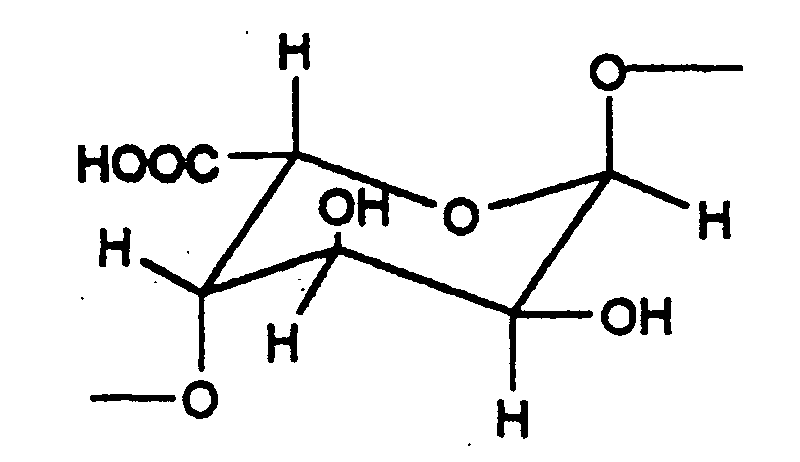
- Alginic acid is extracted from certain brown algae in the class of pheophyceae. This acid is actually a copolymer of two isomers, ⁇ -D-manuronic acid on the one hand and ⁇ -L-guluronic acid on the other hand.
- the content of ⁇ -D-manuronic acid and ⁇ -L-guluronic acid varies in particular according to the species of algae and according to the alginic acid extraction process. This variable content is characterized by the M / G ratio, i.e. the proportion of ⁇ -D-manuronic acid per compared to ⁇ -L-guluronic acid.
- alginic acid with a predominant content of ⁇ -L-guluronic acid that is to say alginic acid having an M / G ratio of less than 1
- alginic acid having an M / G ratio of less than 1 is used for the process according to the invention.
- the algae of the Lessonia Flavicans species make it possible to obtain an alginic acid with a M / G ratio of 0.7. This type of acid has shown little loss of efficacy after a large number of cycles of use.
- the bed may contain alginic acid under different forms.
- it can be in the form fibrous, in the form of balls or in the form of powder.
- alginic acid used is in powder form but for reasons of manufacturing and cost it may be preferable to use alginic acid in fibrous form.
- This fibrous form generally consists of a heap of straight fibers 0.5 to 3 mm long.
- the alginic acid bed can contain other chemicals for processing water or elements ensuring good flow hydraulic water through the bed to improve the contacting of water and acid.
- a filter including a pocket which contains alginic acid.
- the alginic acid contained in the pouch is preferably in the form of a powder such as previously described. But the alginic acid contained in the pocket can also be in fibrous form.
- an acid is used alginic with a predominant content of ⁇ -L-guluronic acid to obtain a duration of treatment effectiveness of water that is significantly higher.
- the filter bag can be made with different textiles or papers allowing water to pass through, and whose pores are small enough to retain the alginic acid powder.
- the filter can be made differently without depart from the scope of the invention and be in the form a plastic case containing the acid alginic with two porous faces through which water can circulate so as to be in contact with alginic acid.
- the alginic acid powder placed in the filter is mixed with solid elements modifying the flow water through said alginic acid powder which has tendency to gel under the action of water.
- These elements may consist of glass beads with a diameter of the order of 2 mm for example or by zeolite particles. So, by facilitating the routing of water through the filter, setting contact of water with alginic acid is improved by creating micro channels in acid powder alginic. Elements mixed with alginic acid can also have a beneficial effect against swelling of alginic acid under the action of water.
- the alginic acid powder inserted in the filter is mixed with activated carbon particles. These particles with a dimension of the order of 2 to 3 millimeters act on the flow of water through the filter like the solid elements and allow in plus retain certain unwanted components of water like pesticides or chlorine.
- the method or the filter according to the invention is particularly interesting for systems consumers of water including heating means water and in which the filter is arranged upstream said heating means.
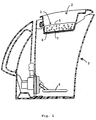
- the filter 1 can be arranged in the orifice filling 2 of an electric kettle 3 comprising an electrical heating resistance 4.
- the filter 1 is produced in the form of a flexible pocket 5 made of cellulosic fibers inside which contains alginic acid 6 and possibly elements 7 modifying the flow of the water. Water poured through the filling opening 2 passes through filter 1 containing gravity alginic, and is thus brought into contact with insoluble acid particles.
- the filter can be changed to function of the water consuming system to which it is intended.
- the filter can take the form of a cartridge in rigid plastic suitable for mounting in the pressure water supply pipe.
- the kettle previously described was used to carry out tests with different filters containing alginic acid in different forms and coming from different algae.
- the tests consisted of carrying out 40 filling / heating cycles with 1.5 liters of a given mineral water of constant quality. After heating, the water is passed over a filter paper of determined porosity, then the quantity of tartar particles retained by the filter paper is measured.
- the table below groups together the characteristics of the various filters used and the average quantity of scale measured during the 40 cycles using an index 100 for untreated water.
- the graph in Figure 2 shows, on the ordinate, the amount of tartar particles measured using a index 100 corresponding to the average value measured with untreated mineral water, and the abscissa 40 first cycles of use.
- Curves A, B, C represent the results obtained respectively with filters 1, 2, 3.
- the AC curve corresponds to the result obtained with water treated with a activated carbon filter
- the NT curve represents the amount of tartar particles formed with non-water treated.
- the quantity of tartar particles formed with treated water according to the invention is very low, moreover the longevity filters containing alginic acid is fine higher than that of the activated carbon filter.
- the invention responds to the concern to avoid training of scale in water consuming systems without add substances that could affect the qualities water, which is particularly interesting for applications in the field of water intended for human consumption. But the efficiency and the duration of action of alginic acid do not limit its application to this area alone.
Landscapes
- Chemical & Material Sciences (AREA)
- Chemical Kinetics & Catalysis (AREA)
- General Chemical & Material Sciences (AREA)
- Life Sciences & Earth Sciences (AREA)
- Hydrology & Water Resources (AREA)
- Engineering & Computer Science (AREA)
- Environmental & Geological Engineering (AREA)
- Water Supply & Treatment (AREA)
- Organic Chemistry (AREA)
- Water Treatment By Sorption (AREA)
- Solid-Sorbent Or Filter-Aiding Compositions (AREA)
Abstract
Description
Tout d'abord, le dosage de l'agent complexant ajouté doit être très précis pour assurer une action anti-tarte efficace sans dépasser le seuil au-delà duquel il forme un précipité qui peut rendre l'eau impropre à la consommation humaine. Par exemple pour les polyphosphates la dose doit être de 3 mg/l, et de 0,3 mg/l pour les sels d'alginate solubles. Un dispositif doseur fiable permettant de doser ces faibles quantités n'est pas facilement réalisable et représente un coût important.
Mais l'inconvénient majeur est la présence de l'agent dans l'eau traitée et la libération éventuelle de certains ions, ce qui modifie les qualités organoleptiques et notamment le goût de l'eau. Par exemple, l'emploi d'alginate de sodium libère des ions Na+ qui peuvent être contre-indiqués en cas de régime hyposodé. On a aussi noté une perte d'efficacité des agents complexant quand l'eau est portée à haute température.
- la figure 1 est une vue en coupe d'une bouilloire électrique équipée d'un filtre suivant l'invention.
- la figure 2 est un graphique représentant la quantité de particules de tartre mesurée après ébullition en fonction du nombre de cycles d'utilisation de différents filtres.

| Rapport M/G | Granulo-métrie | Masse d'acide alginique | Quantité moyenne de tartre mesurée | |
| Eau non filtrée | 100 | |||
| Filtre charbon actif | 69 | |||
| Filtre 1 | 0,7 | 354 µm | 10 g | 17 |
| Filtre 2 | 0,7 | 150 µm | 10 g | 24 |
| Filtre 3 | 0,7 | 200 µm | 5 g + 15 g de billes de verre | 10 |
Claims (12)
- Procédé de traitement de l'eau pour éviter la formation de tartre dans un système consommateur d'eau
caractérisé en ce qu'il consiste à mettre en contact l'eau avec de l'acide alginique insoluble. - Procédé de traitement de l'eau selon la revendication 1,
caractérisé en ce que la mise en contact de l'eau avec l'acide alginique est réalisée par un écoulement d'eau à travers un lit contenant l'acide alginique. - Procédé de traitement de l'eau selon la revendication 1 ou 2,
caractérisé en ce que l'acide alginique a une teneur prédominante en acide α-L-guluronique. - Procédé de traitement de l'eau selon l'une quelconque des revendications 1 à 3,
caractérisé en ce que l'acide alginique est sous forme d'une poudre de granulométrie supérieure à 200 micromètres. - Procédé de traitement de l'eau selon l'une quelconque des revendications 1 à 3,
caractérisé en ce que l'acide alginique est sous forme fibreuse - Filtre de traitement de l'eau pour éviter la formation de tarte dans un système consommateur d'eau,
caractérisé en ce qu'il comprend une poche perméable à l'eau contenant de l'acide alginique insoluble. - Filtre selon la revendication 6,
caractérisé en ce que l'acide alginique a une teneur prédominante en acide α-L-guluronique. - Filtre selon la revendication 6 ou 7,
caractérisé en ce que l'acide alginique est sous forme d'une poudre de granulométrie supérieure à 200 micromètres. - Filtre selon la revendication 6 ou 7,
caractérisé en ce que l'acide alginique est sous forme fibreuse. - Filtre contenant de l'acide alginique sous forme de poudre ou sous forme fibreuse selon la revendication 6 ou 7,
caractérisé en ce que la poche contient également des éléments solides modifiant l'écoulement de l'eau à travers ladite poche. - Filtre selon la revendication 10,
caractérisé en ce que les éléments solides sont constitués par des particules de charbon actif. - Système consommateur d'eau comprenant des moyens de chauffage de l'eau et un filtre selon l'une quelconque des revendications 6 à 11,
caractérisé en ce que le filtre est agencé en amont des moyens de chauffage.
Applications Claiming Priority (2)
| Application Number | Priority Date | Filing Date | Title |
|---|---|---|---|
| FR0017072 | 2000-12-21 | ||
| FR0017072A FR2818633B1 (fr) | 2000-12-21 | 2000-12-21 | Procede et filtre de traitement de l'eau |
Publications (2)
| Publication Number | Publication Date |
|---|---|
| EP1216964A2 true EP1216964A2 (fr) | 2002-06-26 |
| EP1216964A3 EP1216964A3 (fr) | 2003-07-02 |
Family
ID=8858237
Family Applications (1)
| Application Number | Title | Priority Date | Filing Date |
|---|---|---|---|
| EP01130070A Withdrawn EP1216964A3 (fr) | 2000-12-21 | 2001-12-18 | Procédé et filtre de traitement de l'eau |
Country Status (2)
| Country | Link |
|---|---|
| EP (1) | EP1216964A3 (fr) |
| FR (1) | FR2818633B1 (fr) |
Family Cites Families (3)
| Publication number | Priority date | Publication date | Assignee | Title |
|---|---|---|---|---|
| DE19834916A1 (de) * | 1997-09-09 | 1999-03-11 | Oeste Franz Dietrich | Filterpapier für die Wasserreinigung |
| DE19939901A1 (de) * | 1999-06-09 | 2000-12-14 | Franz Dietrich Oeste | Verfahren zur Herstellung von Fasermaterialien mit mehreren Würkstoffkomponenten |
| EP1214274A1 (fr) * | 1999-09-23 | 2002-06-19 | Reckitt Benckiser (UK) Limited | Procede de lutte contre l'eau calcaire et le tartre par l'utilisation d'algines |
-
2000
- 2000-12-21 FR FR0017072A patent/FR2818633B1/fr not_active Expired - Fee Related
-
2001
- 2001-12-18 EP EP01130070A patent/EP1216964A3/fr not_active Withdrawn
Also Published As
| Publication number | Publication date |
|---|---|
| EP1216964A3 (fr) | 2003-07-02 |
| FR2818633B1 (fr) | 2004-05-14 |
| FR2818633A1 (fr) | 2002-06-28 |
Similar Documents
| Publication | Publication Date | Title |
|---|---|---|
| KR100834410B1 (ko) | 음이온 흡착 탄소 재료와 그 제조 방법 | |
| JP7378471B2 (ja) | エスプレッソコーヒーマシンにおける水を監視及び濾過するためのアクティブシステム、並びに関連するエスプレッソコーヒーマシン | |
| Zhao et al. | Fouling of RO membranes by effluent organic matter (EfOM): Relating major components of EfOM to their characteristic fouling behaviors | |
| FR2655642A1 (fr) | Installation de traitement des eaux par une boucle de filtration tangentielle. | |
| Chinniagounder et al. | Adsorptive removal of crystal violet dye using agricultural waste cocoa (Theobroma cacao) shell | |
| FR2819200A1 (fr) | Adoucisseur d'eau a dosage de sel, procede d'actionnement dudit adoucisseur et procede de regeneration dudit adoucisseur | |
| BE1005513A5 (fr) | Adoucisseur d'eau. | |
| FR2818633A1 (fr) | Procede et filtre de traitement de l'eau | |
| EP0777742B1 (fr) | Procede pour adsorber des agents anti-microbiens contenus dans un liquide biologique et appareil pour la mise en uvre de ce procede | |
| Son et al. | Application of MIEX® pre-treatment for ultrafiltration membrane process for NOM removal and fouling reduction | |
| Taylor et al. | Testing of home use carbon filters | |
| WO2022171717A1 (fr) | Procédé de commande en fonctionnement d'une unité de traitement d'eau et unité de traitement d'eau pour la mise en œuvre d'un tel procédé | |
| WO2000029787A1 (fr) | Generateur de vapeur a purge rapide | |
| FR2536678A1 (fr) | ||
| Gicquel et al. | Adsorption of atrazine by powdered activated carbon: influence of dissolved organic and mineral matter of natural waters adsorption de L'atrazine Par Charbon Actif en Poudre: Influence des Matieres Organiques et Minerales Dissoutes des Eaux Naturelles | |
| EP2089158B1 (fr) | Procede et dispositif pour le traitement d'eau avant son melange avec un produit de traitement phytosanitaire | |
| EP3237340B1 (fr) | Dispositif avec agent antitartre biodegradable | |
| EP1034037B1 (fr) | Procede d'optimisation du cycle de fonctionnement d'une unite de traitement d'eau | |
| FR3065210B1 (fr) | Appareil electromenager comportant des moyens pour chauffer de l'eau et un dispositif de liberation d'un agent antitartre dans l'eau | |
| CA2860510A1 (fr) | Appareil a liberation controlee et ses utilisations | |
| FR2687660A1 (fr) | Procede et dispositif de demineralisation de l'eau. | |
| FR2510628A1 (fr) | Feuille absorbante stabilisee, notamment pour tampons hygieniques et couches | |
| EP0723940A1 (fr) | Procédé pour empêcher la formation et le dépÔt de tartre dans des appareils électroménagers et appareils électroménagers comportant un agent complexant | |
| CN214300864U (zh) | 一种衣物处理装置的进水管道结构、洗衣机 | |
| Oria-Usifo et al. | Use of Moringa oleifera seed extracts as alternative natural material for water purification |
Legal Events
| Date | Code | Title | Description |
|---|---|---|---|
| PUAI | Public reference made under article 153(3) epc to a published international application that has entered the european phase |
Free format text: ORIGINAL CODE: 0009012 |
|
| AK | Designated contracting states |
Kind code of ref document: A2 Designated state(s): AT BE CH CY DE DK ES FI FR GB GR IE IT LI LU MC NL PT SE TR |
|
| AX | Request for extension of the european patent |
Free format text: AL;LT;LV;MK;RO;SI |
|
| PUAL | Search report despatched |
Free format text: ORIGINAL CODE: 0009013 |
|
| AK | Designated contracting states |
Designated state(s): AT BE CH CY DE DK ES FI FR GB GR IE IT LI LU MC NL PT SE TR |
|
| AX | Request for extension of the european patent |
Extension state: AL LT LV MK RO SI |
|
| 17P | Request for examination filed |
Effective date: 20040102 |
|
| AKX | Designation fees paid |
Designated state(s): AT BE CH CY DE DK ES FI FR GB GR IE IT LI LU MC NL PT SE TR |
|
| D17P | Request for examination filed (deleted) | ||
| DBV | Designated contracting states (deleted) | ||
| R17P | Request for examination filed (corrected) |
Effective date: 20040102 |
|
| RBV | Designated contracting states (corrected) |
Designated state(s): AT BE CH CY DE DK ES FI FR GB GR IE IT LI LU MC NL PT SE TR |
|
| R17P | Request for examination filed (corrected) |
Effective date: 20040102 |
|
| RBV | Designated contracting states (corrected) |
Designated state(s): AT BE CH CY DE DK ES FI FR GB GR IE IT LI LU MC NL PT SE TR |
|
| REG | Reference to a national code |
Ref country code: DE Ref legal event code: 8566 |
|
| 17Q | First examination report despatched |
Effective date: 20040511 |
|
| STAA | Information on the status of an ep patent application or granted ep patent |
Free format text: STATUS: THE APPLICATION IS DEEMED TO BE WITHDRAWN |
|
| 18D | Application deemed to be withdrawn |
Effective date: 20041123 |