EP1215839A1 - Méthode et dispositif de détection multi-utilisateur - Google Patents
Méthode et dispositif de détection multi-utilisateur Download PDFInfo
- Publication number
- EP1215839A1 EP1215839A1 EP01403223A EP01403223A EP1215839A1 EP 1215839 A1 EP1215839 A1 EP 1215839A1 EP 01403223 A EP01403223 A EP 01403223A EP 01403223 A EP01403223 A EP 01403223A EP 1215839 A1 EP1215839 A1 EP 1215839A1
- Authority
- EP
- European Patent Office
- Prior art keywords
- vector
- symbols
- points
- network
- detection method
- Prior art date
- Legal status (The legal status is an assumption and is not a legal conclusion. Google has not performed a legal analysis and makes no representation as to the accuracy of the status listed.)
- Granted
Links
- 238000000034 method Methods 0.000 title claims abstract description 23
- 238000001514 detection method Methods 0.000 title claims description 26
- 239000013598 vector Substances 0.000 claims abstract description 90
- 230000003595 spectral effect Effects 0.000 claims abstract description 13
- 239000000969 carrier Substances 0.000 claims abstract description 9
- 230000007480 spreading Effects 0.000 claims abstract description 9
- 239000011159 matrix material Substances 0.000 claims description 37
- 238000012545 processing Methods 0.000 claims description 2
- 238000007476 Maximum Likelihood Methods 0.000 description 7
- 230000009466 transformation Effects 0.000 description 7
- 230000005540 biological transmission Effects 0.000 description 5
- 230000000875 corresponding effect Effects 0.000 description 5
- 238000004061 bleaching Methods 0.000 description 4
- 239000000654 additive Substances 0.000 description 3
- 230000000996 additive effect Effects 0.000 description 3
- 230000002087 whitening effect Effects 0.000 description 3
- 238000000354 decomposition reaction Methods 0.000 description 2
- 230000004044 response Effects 0.000 description 2
- 230000001629 suppression Effects 0.000 description 2
- PXFBZOLANLWPMH-UHFFFAOYSA-N 16-Epiaffinine Natural products C1C(C2=CC=CC=C2N2)=C2C(=O)CC2C(=CC)CN(C)C1C2CO PXFBZOLANLWPMH-UHFFFAOYSA-N 0.000 description 1
- 241000566613 Cardinalis Species 0.000 description 1
- 241001644893 Entandrophragma utile Species 0.000 description 1
- 108010003272 Hyaluronate lyase Proteins 0.000 description 1
- 238000004364 calculation method Methods 0.000 description 1
- 238000004891 communication Methods 0.000 description 1
- 230000021615 conjugation Effects 0.000 description 1
- 230000002596 correlated effect Effects 0.000 description 1
- 238000011161 development Methods 0.000 description 1
- 230000018109 developmental process Effects 0.000 description 1
- 230000000694 effects Effects 0.000 description 1
- 238000001914 filtration Methods 0.000 description 1
- 230000008569 process Effects 0.000 description 1
- 230000000135 prohibitive effect Effects 0.000 description 1
- 238000011084 recovery Methods 0.000 description 1
- 238000001228 spectrum Methods 0.000 description 1
- 238000012360 testing method Methods 0.000 description 1
- 238000012546 transfer Methods 0.000 description 1
- 230000001131 transforming effect Effects 0.000 description 1
Images


Classifications
-
- H—ELECTRICITY
- H04—ELECTRIC COMMUNICATION TECHNIQUE
- H04L—TRANSMISSION OF DIGITAL INFORMATION, e.g. TELEGRAPHIC COMMUNICATION
- H04L25/00—Baseband systems
- H04L25/02—Details ; arrangements for supplying electrical power along data transmission lines
- H04L25/03—Shaping networks in transmitter or receiver, e.g. adaptive shaping networks
- H04L25/03006—Arrangements for removing intersymbol interference
- H04L25/03178—Arrangements involving sequence estimation techniques
- H04L25/03331—Arrangements for the joint estimation of multiple sequences
-
- H—ELECTRICITY
- H04—ELECTRIC COMMUNICATION TECHNIQUE
- H04L—TRANSMISSION OF DIGITAL INFORMATION, e.g. TELEGRAPHIC COMMUNICATION
- H04L25/00—Baseband systems
- H04L25/02—Details ; arrangements for supplying electrical power along data transmission lines
- H04L25/03—Shaping networks in transmitter or receiver, e.g. adaptive shaping networks
- H04L25/03993—Noise whitening
-
- H—ELECTRICITY
- H04—ELECTRIC COMMUNICATION TECHNIQUE
- H04L—TRANSMISSION OF DIGITAL INFORMATION, e.g. TELEGRAPHIC COMMUNICATION
- H04L5/00—Arrangements affording multiple use of the transmission path
- H04L5/02—Channels characterised by the type of signal
- H04L5/023—Multiplexing of multicarrier modulation signals, e.g. multi-user orthogonal frequency division multiple access [OFDMA]
- H04L5/026—Multiplexing of multicarrier modulation signals, e.g. multi-user orthogonal frequency division multiple access [OFDMA] using code division
-
- H—ELECTRICITY
- H04—ELECTRIC COMMUNICATION TECHNIQUE
- H04B—TRANSMISSION
- H04B1/00—Details of transmission systems, not covered by a single one of groups H04B3/00 - H04B13/00; Details of transmission systems not characterised by the medium used for transmission
- H04B1/69—Spread spectrum techniques
- H04B1/707—Spread spectrum techniques using direct sequence modulation
- H04B1/7097—Interference-related aspects
- H04B1/7103—Interference-related aspects the interference being multiple access interference
Definitions
- the present invention relates to a multi-user detection method and device. More particularly, the present invention relates to a method and a multi-user detection device with maximum likelihood for a MC-CDMA ( Multi-Carrier Code Division Multiple Access ) telecommunications system.
- MC-CDMA Multi-Carrier Code Division Multiple Access
- MC-CDMA Multi-Carrier Code Division Multiple Access
- OFDM Orthogonal Frequency Division Multiplex
- CDMA multiple access technique was first proposed by N. Yee et al. in the article entitled “CDMA Multicarrier in indoor wireless radio networks” published in Proceedings of PIMRC '93, Vol. 1, pages 109-113, 1993. The developments of this technique have been reviewed by S. Hara et al. in the article entitled “Overview of multicarrier CDMA” published in IEEE Communication Magazine, pages 126-133, December 1997.
- the signature here multiplies the signal in the frequency domain, each element of the signature multiplying the signal of a different subcarrier.
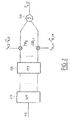
- FIG. 1 shows the structure of an MC-CDMA transmitter for a given user k .
- d k ( i ) be the ith symbol to be sent from user k where d k ( i ) belongs to the modulation alphabet.
- the symbol d k ( i ) is first multiplied to 110 by a spreading sequence or signature of the user, denoted c k ( t ), consisting of N c “chips”, each “chip” being of duration T c , the total duration of the spreading sequence corresponding to a symbol period T.
- the results of the multiplication of the symbol d k ( i ) by the different “chips” are converted by the serial / parallel converter 120 into a block of L symbols, where L is generally a multiple of N c .
- L N c .
- the block of L symbols is then subjected to an inverse FFT in the module 130 before being transmitted to the parallel / series converter 140.
- a guard interval of length greater than the duration of the impulse response of the transmission channel, is added to the symbol MC-CDMA. This interval is obtained by adding (not shown) a chosen suffix identical to the beginning of said symbol.
- the symbol thus obtained is amplified at 150 before being transmitted on the user channel. It can therefore be seen that the MC-CDMA method is analyzed in a spread in the spectral domain (before IFFT) followed by an OFDM modulation.
- FIG. 2 An MC-CDMA receiver for a given user k has been illustrated diagrammatically in FIG. 2.
- the received demodulated signal is sampled at the “chip” frequency and the samples belonging to the guard interval are deleted (suppression not shown).
- the signal obtained can be written: where h kn (i) translates the response of the user channel k to the frequency of the subcarrier n of the MC-CDMA symbol transmitted at time i . T and ⁇ (t) is the noise received.
- the samples thus obtained are parallelized in a serial / parallel converter 210 before undergoing an FFT in the module 220.
- the samples in the frequency domain, at the output of 220, are equalized and despread by the signature of the user k.
- the samples of the frequency domain are multiplied by the coefficients q kn (i) -c * kn in the multipliers 230 0 , .., 230 Nc-1 then summed in 240 to provide an output symbol d and k ( i ).
- the receiver illustrated in Fig. 2 only makes it possible to decode the data of a single user k. However, it is often advantageous to decode the data transmitted for all of the K users, in order to estimate and eliminate the interference between the different transmission channels.
- Multi-user detection and joint detection techniques have also been considered for the MC-CDMA method.
- the article by S. Kaiser et al. entitled “Multi-carrier CDMA with iterative decoding and soft-interference cancellation” published in GLOBECOM '97 on pages 6-10, 1997 proposes a joint detection method with parallel interference suppression (PIC for Parallel Interference Cancellation ).
- PIC Parallel Interference Cancellation
- the aim of the present invention is to propose a method and a device for multi-user detection in the context of an MC-CDMA transmission which does not does not have the disadvantages of the above techniques.
- the present invention is defined by a method of detecting a plurality of symbols ( d k ( i )) transmitted by or for a plurality K of users, each symbol belonging to a modulation constellation and making the subject to spectral spreading before being modulated on a plurality L of carriers, said method comprising a demodulation step and a step of spectral despreading of the received signal ( r ( i )) to provide a vector ( y ( i ), ( i ), y 2 ( i ), 2 ( i )) characteristic of said signal, said method further comprising a search step, within a network of points ( ⁇ , ⁇ , ⁇ 2 , ⁇ 2 ) generated by the symbols of said modulation constellations, d 'at least the closest neighbor to said vector.
- said search step is limited to a set of points of the network belonging to a predetermined area around the received vector.
- said search step is limited to a set of points of the network belonging to a predetermined area around the origin of said network.
- Said predetermined area will preferably be determined by a sphere.
- said complex vector may be decomposed into a first vector with real components and a second vector with real components.
- Said search step then consists in determining the closest neighbor of said first vector and of said second vector within a network ( ⁇ , ⁇ ) of points with real coordinates of dimension K
- said search step consists in determining the nearest neighbor within a network ( ⁇ 2 , ⁇ 2 ) of points with real coordinates of dimension 2. K.
- the search step is advantageously carried out on a plurality of real components of said complex vector, the search being limited for each of said components to an interval defined by a lower bound and an upper bound, said bounds being chosen so that said interval does not include points relating to symbols which cannot belong to the modulation constellation.
- the step of spectral demodulation is followed by a step of despreading and equalization of the symbols obtained by demodulation of the signal received at the different carriers, said providing a vector ( y ( i ), y 2 ( i )) of equalized symbols for different users.
- said characteristic vector ( ( i ), 2 ( i )) is obtained from the vector of equalized symbols by means of a matrix processing aimed at substantially decorrelating the different noise components of the latter.
- said search step is extended to that of a set of neighboring points of said characteristic vector and the symbols transmitted are estimated flexibly from the symbols generating said neighboring points and distances separating said neighboring points from the received point.
- the invention is also defined by a device for detecting a plurality of symbols ( d k ( i )) transmitted by or for a plurality K of users, each symbol belonging to a modulation constellation and being the subject of a spectral spread before being modulated on a plurality L of carriers, the device comprising means for implementing the method described above.
- Such a detection device can be used in a detection system.
- the idea underlying the invention is to perform a multi-user MC-CDMA detection by means of a representation by network of points.
- the expression (8) or in an equivalent manner (9) or (10) is nothing other than a filtering operation adapted to the signature and to the channel relating to each user k . It can be considered as an MRC (Maximum Ratio Combining) of the different symbols received.
- the points of the network form an additive abelian subgroup of R K , it is moreover the smallest subgroup of R K containing the vectors ⁇ v 1 , v 2 , ..., v K ⁇ and a Z - R K module.
- the region delimited by the basic vectors is called the fundamental parallelotope and its volume, denoted vol ( ⁇ ) or det ( ⁇ ), is called the fundamental volume.
- This fundamental volume is none other than the modulus of the vector product of the K basic vectors and is therefore equal to
- the Voronoi region V or Dirichlet cell of a point x belonging to the network is the set of points of R K closer to x than to any other point of the network.
- the volume of this region is equal to the fundamental volume.
- the stacking radius ⁇ of the network is the radius of the largest sphere inscribed in the Voronoi region and the overlapping radius that of the smallest sphere circumscribed in this same region.
- the stacking radius is therefore the radius of the spheres whose stacking constitutes the network of points and the overlapping radius is that of the smallest spheres which, centered on the points of the network, make it possible to cover the entire space R K .
- the density of the network is the ratio between the volume of the sphere of radius ⁇ and the fundamental volume.
- the components of the vector d 2 (i) belonging to a finite alphabet of cardinal A could be PAM modulation symbols of order M.
- the invention can be applied to any finite alphabet of symbols such that there exists an affine transformation transforming the components d R / k ( i ) and d I / k ( i ) into elements of Z.
- the vector y 2 ( i ) can therefore be considered as a point in the network ⁇ 2 corrupted by noise n 2 ( i ).
- the problem of detection in the sense of maximum likelihood of the symbols emitted by the different users can be expressed as the search for the point z 2 of the network ⁇ 2 such that its distance to y 2 ( i ) is minimum.
- a decoding is carried out noise whitening operation.
- W 2 is a lower triangular matrix of size 2 K x2 K.
- We define a bleached observation vector: as well as a new network of points ⁇ 2 made up of component vectors ( 1 / R ( i ), 1 / I ( i ), ..., R / K ( i ), I / K ( i )) with 2 ( i ) x 2 ( i ) W T -1 / 2 where x 2 ( i ) is a vector of components ( x R / 1 ( i ), x I / 1 ( i ), ..., x R / K ( i ), x I / K ( i )) belonging to ⁇ 2 .
- the decoding therefore comprises a first step of bleaching the observation vector followed by a step of finding the nearest neighbor in the network of points ⁇ 2 .
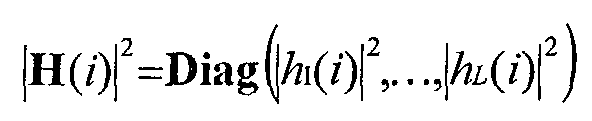
- the real observation vectors y R ( i ) and y I ( i ) are first subjected to a bleaching operation:
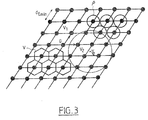
- Fig. 3 schematically illustrates a network of points and the method for finding the closest neighbor to a bleached observation vector 2 in a lattice of dimension 2 K or, in the case of actual signatures, whitened observation vectors R , I in a network of dimension K.
- the noise vector ⁇ has independent real components according to a Gaussian distribution with zero mean and variance ⁇ 2 .
- R be the covariance matrix of the noise vector
- ⁇ v 1 , v 2 , ..., v ⁇ ⁇ the rows of the matrix G.
- these vectors form the basis of the network.
- the set of symbols issued is limited to an alphabet of finite size A ⁇ ⁇ Z ⁇ called a constellation.
- This constellation is determined by the modulation constellations used by (or for) the ⁇ users and the cardinal of the alphabet A ⁇ is the product of the cardinals of the different modulation alphabets. We will suppose that the complex points of each of these constellations have real values and complex values regularly distributed.
- the decoder advantageously restricts its calculation to the points which are located inside a zone of the constellation situated around the received point, preferably inside a sphere of given radius. VS centered on the point received as shown in Fig. 3. Only the points of the network located at a quadratic distance less than C from the received point are therefore considered for the minimization of the metric (31).
- the decoder performs the following minimization:
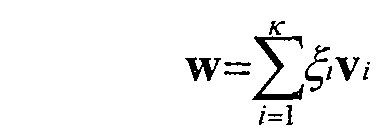
- the decoder searches for the smallest vector w in the translated set y - ⁇ .
- ⁇ and ⁇ are real vectors.
- the vector w is a point of the network whose coordinates ⁇ i are expressed in the translated coordinate system centered on the received point y.
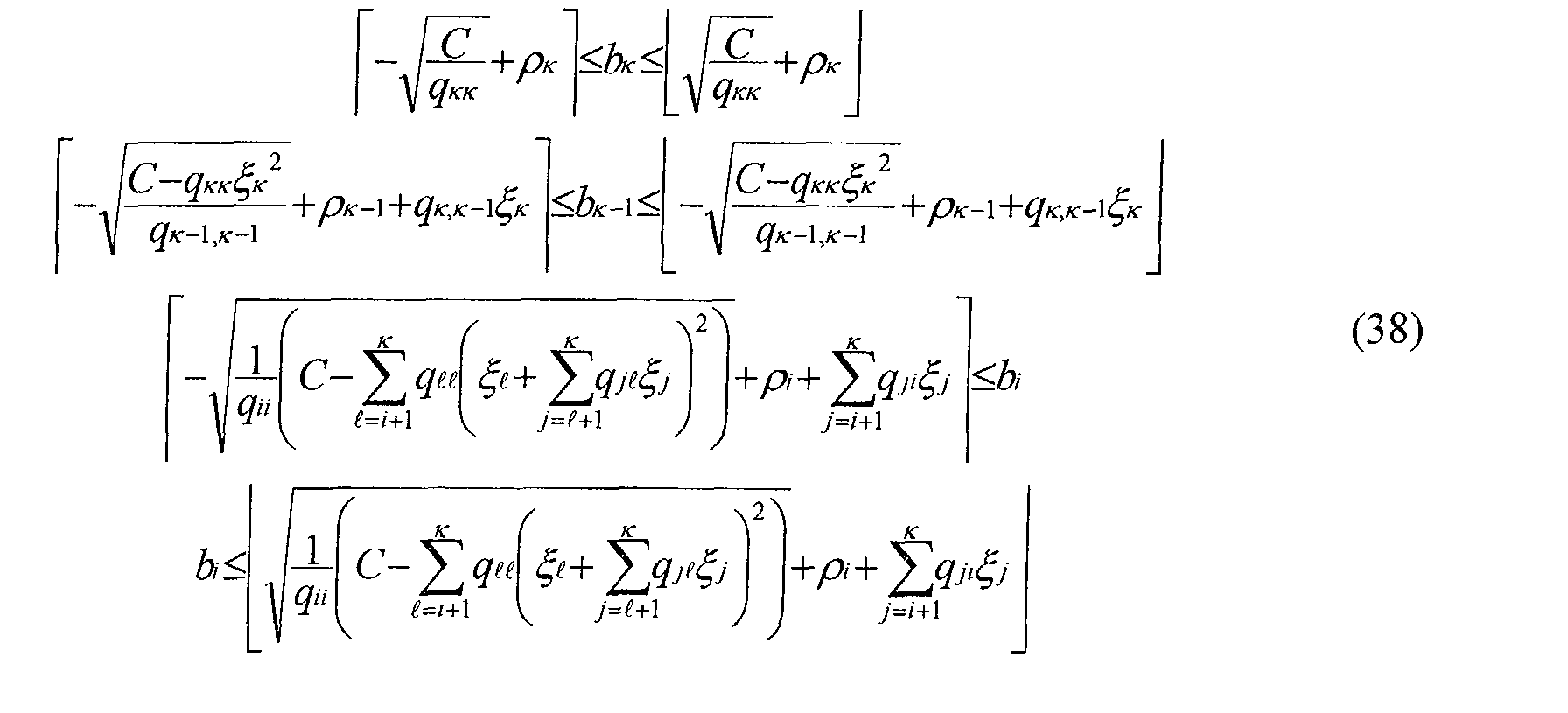
- the decoder has internes internal counters, namely a counter by dimension, each counter counting between a lower and an upper bound as indicated in (38), it being understood that each counter is associated with a particular pair of terminals. In practice, these terminals can be updated recursively.
- the search inside the sphere can be considerably accelerated by updating the radius VS with the last calculated Euclidean norm ⁇ w ⁇ .
- the search radius VS must be chosen appropriately. Indeed, the number of points of the network located inside the decoding sphere increases with C. This is why the choice of a large value of C penalizes the decoding algorithm while the search sphere can be empty if C is too weak.
- a search radius advantageously chosen is greater than the radius of recovery of the network.
- V K is the volume of a sphere of unit radius in real space R ⁇ .
- the decoder operates on a network of points and not on a modulation constellation.
- the constellation used on a dimension is a PAM constellation of order M
- the integer coordinates of the point must be between 0 and M -1.
- the search limits of (38) can advantageously adjust the search limits of (38) so that they remain between 0 and M -1.
- Fig. 4 schematically illustrates the structure of a multi-user detection device according to an embodiment of the invention.
- the received signal is first of all sampled at the “chip” frequency and the samples are parallelized by a serial / parallel converter.
- the vectors of L samples obtained are transformed into 420 by an FFT in the time domain.
- the L time samples are transmitted to a battery of K filters 430 1 ,., 430 K adapted to the signature and to the transmission channel of each user.
- K filters 430 1 ,., 430 K adapted to the signature and to the transmission channel of each user.
- These adapted filters make it possible to obtain the complex vector y ( i ) according to the relation (9) or (10) according to the case of an uplink or downlink.
- the components of y ( i ) undergo spectral whitening at 440 in order to decorrelate the noise samples.
- the output of the decoding module 450 (possibly after inverse transformation to that mentioned above, not shown) is a vector d and ( i ) whose components are the estimated symbols transmitted by the different users.
- the module 450 performs two nearest neighbor searches in a network of points ⁇ of dimension K , as we have seen above.
- the receiver can be adapted to provide flexible symbols.
- the search inside the decoding sphere is no longer limited to the nearest neighbor but is extended to a plurality of closest neighbors to the point relating to the received signal.
- the device according to the invention can be realized in the form of a processor programmed to execute the different functions represented or in the form of a plurality of dedicated processors capable of implementing one or more of these functions.
Landscapes
- Engineering & Computer Science (AREA)
- Signal Processing (AREA)
- Computer Networks & Wireless Communication (AREA)
- Power Engineering (AREA)
- Mobile Radio Communication Systems (AREA)
- Digital Transmission Methods That Use Modulated Carrier Waves (AREA)
- Testing, Inspecting, Measuring Of Stereoscopic Televisions And Televisions (AREA)
- Sorting Of Articles (AREA)
- Push-Button Switches (AREA)
- Investigating Or Analysing Materials By The Use Of Chemical Reactions (AREA)
- Measuring Pulse, Heart Rate, Blood Pressure Or Blood Flow (AREA)
- Image Processing (AREA)
- Error Detection And Correction (AREA)
Abstract

Description

Si l'on se place maintenant au niveau d'une station de base transmettant des symboles vers K utilisateurs, le signal modulé résultant peut s'exprimer simplement comme :



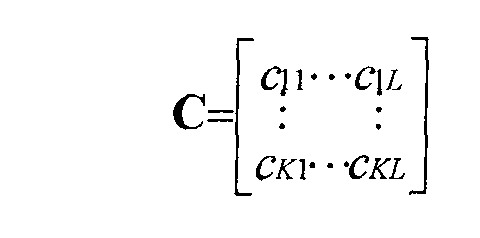
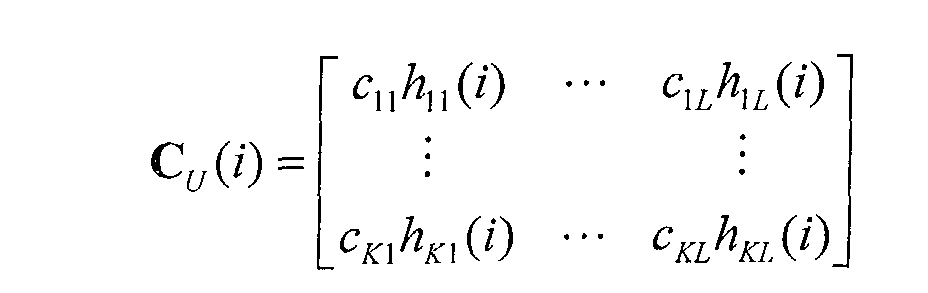
Considérons à nouveau un système de télécommunication MC-CDMA et intéressons nous au signal reçu à l'instant i sur les L différentes sous-porteuses du signal OFDM. Nous supposerons à nouveau que le nombre de sous-porteuses est égal au facteur d'étalement. Soit r(i)=(r 1(i),..., rL(i)) le vecteur des signaux reçus sur les différentes sous-porteuses et d(i)=(d 1(i),...,dK (i)) le vecteur des K symboles émis à l'instant i. On peut écrire C la matrice des K séquences d'étalement de longueur L :
De manière équivalente on peut minimiser l'expression :




y2(i)=(y R / 1(i),y I / 1(i),...,y R / K(i),y I / K(i)) où y R / k(i),y I / k(i)sont respectivement la partie réelle et la partie imaginaire du symbole yk (i);
d 2(i)=(d R / 1(i),d I / 1(i),...,d R / K(i),d I / K(i)) où d R / k(i),d I / k(i)sont respectivement la partie réelle et la partie imaginaire du symbole dk (i);
n 2(i)=(n R / 1(i),n I / 1(i),...,n R / K(i),n I / K(i)) où n R / k(i),n I / k(i) sont respectivement la partie réelle et la partie imaginaire de nk (i);
et où M2 est la matrice 2Kx2K définie par :

Les composantes du vecteur d2 (i) appartenant à un alphabet fini de cardinal A. Par exemple, les composantes d R / k(i) et d l / k(i) pourront être des symboles de modulation PAM d'ordre M. Dans ce cas,
d' R / k(i)= 1 / 2(d R / k(i)+M-1) et d' I / k(i)= 1 / 2(d I / k(i)+M-1) soit encore de manière vectorielle :
les composantes d' R / k(i) et d' I / k(i) sont des éléments de Z et par suite d'2(i) est un vecteur de Z2 K.
On définit un vecteur d'observation blanchie :











Claims (12)
- Méthode de détection d'une pluralité de symboles (d k(i)) transmis par ou pour une pluralité K d'utilisateurs , chaque symbole appartenant à une constellation de modulation et faisant l'objet d'un étalement spectral avant d'être modulé sur une pluralité L de porteuses, ladite méthode comprenant une étape de démodulation (420) et une étape de désétalement spectral (430) du signal reçu (r(i)) pour fournir un vecteur (y2 (i),2(i)) caractéristique dudit signal, caractérisée en ce qu'elle comprend une étape (450) de recherche, à l'intérieur d'un réseau de points (Λ2,Ω2) généré par les symboles desdites constellations de modulation, d'au moins le plus proche voisin dudit vecteur.

- Méthode de détection selon la revendication 1, caractérisée en ce que ladite étape de recherche est limitée à un ensemble de points du réseau appartenant à une zone prédéterminée autour dudit vecteur caractéristique.
- Méthode de détection selon la revendication 1, caractérisée en ce que ladite étape de recherche est limitée à un ensemble de points du réseau appartenant à une zone prédéterminée autour de l'origine dudit réseau.
- Méthode de détection selon la revendication 2 ou 3, caractérisée en ce que ladite zone prédéterminée est une sphère.
- Méthode de détection selon l'une des revendications précédentes, caractérisée en ce que les symboles transmis ayant été étalés spectralement au moyen de séquences à valeurs réelles, ledit vecteur caractéristique est décomposé en un premier vecteur à composantes réelles et un second vecteur à composantes réelles et que ladite étape de recherche consiste à déterminer le plus proche voisin dudit premier vecteur et dudit second vecteur à l'intérieur d'un réseau (Λ,Ω) de points à coordonnées réelles de dimension K.
- Méthode de détection selon l'une des revendications 1 à 4, caractérisée en ce que, ledit vecteur caractéristique étant considéré comme un vecteur à composantes réelles de taille 2.K, ladite étape de recherche consiste à déterminer le plus proche voisin à l'intérieur d'un réseau (Λ2,Ω2) de points à coordonnées réelles de dimension 2.K.
- Méthode de détection selon la revendication 6, caractérisée en ce que ladite étape de recherche est effectuée sur une pluralité de composantes réelles dudit vecteur caractéristique, la recherche étant limitée pour chacune desdites composantes à un intervalle défini par une borne inférieure et une borne supérieure, lesdites bornes étant choisies de manière à ce que ledit intervalle ne comprenne pas des points relatifs à des symboles ne pouvant appartenir à la constellation de modulation.
- Méthode de détection selon l'une des revendications précédentes, caractérisée en ce que l'étape de démodulation spectrale est suivie d'une étape de désétalement et égalisation des symboles obtenus par démodulation du signal reçu aux différentes porteuses, ladite fournissant un vecteur (y 2(i)) de symboles égalisés pour les différents utilisateurs.
- Méthode de détection selon la revendication 8, caractérisée en ce que ledit vecteur caractéristique (
- Méthode de détection selon l'une des revendications précédentes, caractérisée en ce que ladite étape de recherche est étendue à celle d'un ensemble de points voisins dudit vecteur caractéristique et que les symboles transmis sont estimés de manière souple à partir des symboles générant lesdits points voisins et des distances séparant lesdits points voisins du point reçu.
- Dispositif de détection d'une pluralité de symboles (d k(i)) transmis par ou pour une pluralité K d'utilisateurs, chaque symbole appartenant à une constellation de modulation et faisant l'objet d'un étalement spectral avant d'être modulé sur une pluralité L de porteuses, le dispositif comprenant des moyens pour mettre en oeuvre la méthode revendiquée selon l'une des revendications précédentes.
- Récepteur pour système de télécommunication mobile MC-CDMA comprenant un dispositif de détection selon la revendication 11.
Applications Claiming Priority (2)
| Application Number | Priority Date | Filing Date | Title |
|---|---|---|---|
| FR0016351A FR2818057B1 (fr) | 2000-12-13 | 2000-12-13 | Methode et dispositif de detection multi-utilisateur |
| FR0016351 | 2000-12-13 |
Publications (2)
| Publication Number | Publication Date |
|---|---|
| EP1215839A1 true EP1215839A1 (fr) | 2002-06-19 |
| EP1215839B1 EP1215839B1 (fr) | 2006-10-04 |
Family
ID=8857683
Family Applications (1)
| Application Number | Title | Priority Date | Filing Date |
|---|---|---|---|
| EP01403223A Expired - Lifetime EP1215839B1 (fr) | 2000-12-13 | 2001-12-12 | Méthode et dispositif de détection multi-utilisateur |
Country Status (6)
| Country | Link |
|---|---|
| US (1) | US7130353B2 (fr) |
| EP (1) | EP1215839B1 (fr) |
| JP (1) | JP4014077B2 (fr) |
| AT (1) | ATE341873T1 (fr) |
| DE (1) | DE60123559T2 (fr) |
| FR (1) | FR2818057B1 (fr) |
Families Citing this family (17)
| Publication number | Priority date | Publication date | Assignee | Title |
|---|---|---|---|---|
| US7952511B1 (en) | 1999-04-07 | 2011-05-31 | Geer James L | Method and apparatus for the detection of objects using electromagnetic wave attenuation patterns |
| EP1328083B1 (fr) * | 2002-01-11 | 2006-10-25 | Mitsubishi Electric Information Technology Centre Europe B.V. | Procédé de prédistortion pour une liaison montante AMRC-multiporteuse |
| DE60213193T2 (de) * | 2002-01-11 | 2007-06-21 | Mitsubishi Electric Information Technology Centre Europe B.V. | Verfahren für eine Aufwärtsstrecken-Vorverzerrung für ein MC-CDMA-Telekommunnikationssystem |
| KR100465315B1 (ko) * | 2002-10-25 | 2005-01-13 | 한국전자통신연구원 | 다중반송파 코드분할 다중접속에서의 확산/역확산 시스템및 그 방법 |
| US7042967B2 (en) * | 2003-03-03 | 2006-05-09 | Interdigital Technology Corporation | Reduced complexity sliding window based equalizer |
| WO2004079927A2 (fr) * | 2003-03-03 | 2004-09-16 | Interdigital Technology Corporation | Egaliseur base sur une fenetre glissante a complexite reduite |
| FR2853480B1 (fr) * | 2003-04-01 | 2005-06-17 | Procede et dispositif d'identification autodidacte d'un melange sous-determine de sources au quatrieme ordre | |
| US6985699B2 (en) * | 2003-04-16 | 2006-01-10 | Bae Systems Information And Electronic Systems Integration Inc. | Efficient and optimal channel encoding and channel decoding in a multiple access communications system |
| EP1492241B1 (fr) * | 2003-06-26 | 2007-02-14 | Mitsubishi Electric Information Technology Centre Europe B.V. | Décodage par sphères amélioré de symboles transmis dans un système de télécommunications |
| EP1895726A1 (fr) * | 2006-08-28 | 2008-03-05 | Sony Deutschland Gmbh | Entzerrungsschaltung und Entzerrungsverfahren |
| EP1895728A1 (fr) * | 2006-08-28 | 2008-03-05 | Sony Deutschland Gmbh | Dispositif d'égalisation et procédé d'égalisation |
| EP1895729B1 (fr) * | 2006-08-28 | 2012-04-18 | Sony Deutschland Gmbh | Dispositif d'égalisation et procédé d'égalisation |
| US20090285125A1 (en) * | 2008-05-17 | 2009-11-19 | Farokh Marvasti | Iterative synchronous and Asynchronous Multi-User Detection with Optimum Soft limiter |
| US8203992B2 (en) * | 2008-09-17 | 2012-06-19 | Qualcomm Incorporated | Methods and systems for implementing CDMA-based dedicated control channels in an OFDMA-based network |
| US8275267B2 (en) * | 2010-01-25 | 2012-09-25 | Infinera Corporation | Method, system, and apparatus for filter implementation using hermitian conjugates |
| US10148285B1 (en) | 2012-07-25 | 2018-12-04 | Erich Schmitt | Abstraction and de-abstraction of a digital data stream |
| US10795858B1 (en) | 2014-02-18 | 2020-10-06 | Erich Schmitt | Universal abstraction and de-abstraction of a digital data stream |
Citations (1)
| Publication number | Priority date | Publication date | Assignee | Title |
|---|---|---|---|---|
| EP0465851A2 (fr) * | 1990-06-14 | 1992-01-15 | Oy Nokia Ab | Récepteur de signaux MAQ qui compense à la fois des distorsions linéaires et non-linéaires |
Family Cites Families (13)
| Publication number | Priority date | Publication date | Assignee | Title |
|---|---|---|---|---|
| US5297170A (en) * | 1990-08-21 | 1994-03-22 | Codex Corporation | Lattice and trellis-coded quantization |
| FR2701178A1 (fr) * | 1993-02-03 | 1994-08-05 | Philips Electronique Lab | Système de communication par étalement de spectre à multiutilisateurs. |
| FI106898B (fi) | 1993-11-10 | 2001-04-30 | Nokia Networks Oy | Vastaanottomenetelmä ja CDMA-vastaanotin |
| WO1998009385A2 (fr) * | 1996-08-29 | 1998-03-05 | Cisco Technology, Inc. | Traitement spatio-temporel pour telecommunications |
| US6263013B1 (en) * | 1996-11-21 | 2001-07-17 | Dsp Group, Inc. | Fast tracking of PN synchronization in a direct-sequence spread-spectrum digital communications system |
| US6628699B2 (en) | 1997-06-23 | 2003-09-30 | Schlumberger Resource Management Systems, Inc. | Receiving a spread spectrum signal |
| US6181729B1 (en) * | 1997-12-19 | 2001-01-30 | Supergold Communication Limited | Spread spectrum communication |
| US6654365B1 (en) * | 1998-02-24 | 2003-11-25 | L-3 Communications Corporation | Reduced complexity trellis-based multiuser detector for CDMA |
| EP1109326A1 (fr) | 1999-12-15 | 2001-06-20 | Lucent Technologies Inc. | Détecteur de préambule pour un récepteur AMRC |
| JP4327973B2 (ja) | 2000-01-25 | 2009-09-09 | パナソニック株式会社 | 受信装置および受信時刻推定方法 |
| US6801579B1 (en) * | 2000-03-09 | 2004-10-05 | Lucent Technologies Inc. | Method and wireless communication using unitary space-time signal constellations |
| US6618433B1 (en) * | 2000-08-04 | 2003-09-09 | Intel Corporation | Family of linear multi-user detectors (MUDs) |
| FR2814014B1 (fr) | 2000-09-14 | 2002-10-11 | Mitsubishi Electric Inf Tech | Methode de detection multi-utilisateur |
-
2000
- 2000-12-13 FR FR0016351A patent/FR2818057B1/fr not_active Expired - Fee Related
-
2001
- 2001-12-04 JP JP2001370053A patent/JP4014077B2/ja not_active Expired - Fee Related
- 2001-12-11 US US10/011,757 patent/US7130353B2/en not_active Expired - Fee Related
- 2001-12-12 AT AT01403223T patent/ATE341873T1/de not_active IP Right Cessation
- 2001-12-12 DE DE60123559T patent/DE60123559T2/de not_active Expired - Lifetime
- 2001-12-12 EP EP01403223A patent/EP1215839B1/fr not_active Expired - Lifetime
Patent Citations (1)
| Publication number | Priority date | Publication date | Assignee | Title |
|---|---|---|---|---|
| EP0465851A2 (fr) * | 1990-06-14 | 1992-01-15 | Oy Nokia Ab | Récepteur de signaux MAQ qui compense à la fois des distorsions linéaires et non-linéaires |
Non-Patent Citations (4)
| Title |
|---|
| HELARD J F ET AL: "LINEAR MMSE DETECTION TECHNIQUE FOR MC-CDMA", ELECTRONICS LETTERS, IEE STEVENAGE, GB, vol. 36, no. 7, 30 March 2000 (2000-03-30), pages 665 - 666, XP000936982, ISSN: 0013-5194 * |
| JUNG P ET AL: "A GENERALIZED VIEW ON MULTICARRIER CDMA MOBILE RADIO SYSTEMS WITH JOINT DETECTION (PART II). EINE VERALLGEMEINERTE DARSTELLUNG VON MOBILFUNKKONZEPTEN MIT MULTITRAEGER-CDMA UND GEMEINSAMER DETEKTION (TEIL II)", FREQUENZ, SCHIELE UND SCHON GMBH. BERLIN, DE, vol. 51, no. 11/12, 1 November 1997 (1997-11-01), pages 270 - 275, XP000765910, ISSN: 0016-1136 * |
| KLEIN A ET AL: "Simultaneous cancellation of cross interference and ISI in CDMA mobile radio communications", PIMRC '92: THE THIRD IEEE INTERNATIONAL SYMPOSIUM ON PERSONAL, INDOOR AND MOBILE RADIO COMMUNICATIONS PROCEEDINGS (CAT. NO.92TH0488-7), 1992, NEW YORK, NY, USA, pages 118 - 122, XP002179045, ISBN: 0-7803-0841-7 * |
| NAHM S ET AL: "TIME-DOMAIN EQUALIZATION FOR THE ORTHOGONAL MULTI-CARRIER CDMA SYSTEMS", IEEE GLOBECOM 1996: THE KEY TO GLOBAL PROSPERITY, vol. 3, 18 November 1996 (1996-11-18), NEW YORK, NY, USA, pages 1583 - 1587, XP000748718, ISBN: 0-7803-3337-3 * |
Also Published As
| Publication number | Publication date |
|---|---|
| DE60123559T2 (de) | 2007-08-16 |
| ATE341873T1 (de) | 2006-10-15 |
| EP1215839B1 (fr) | 2006-10-04 |
| FR2818057B1 (fr) | 2006-07-07 |
| FR2818057A1 (fr) | 2002-06-14 |
| US20020097784A1 (en) | 2002-07-25 |
| JP2002217867A (ja) | 2002-08-02 |
| US7130353B2 (en) | 2006-10-31 |
| DE60123559D1 (de) | 2006-11-16 |
| JP4014077B2 (ja) | 2007-11-28 |
Similar Documents
| Publication | Publication Date | Title |
|---|---|---|
| EP1215839B1 (fr) | Méthode et dispositif de détection multi-utilisateur | |
| EP2499796B1 (fr) | Procédé pour émettre des données numériques pre-egalisées, et base émettrice mettant en oeuvre un tel procédé | |
| EP1223687B1 (fr) | Méthode simplifiée de détection par sphères en présence de faible rapport signal à bruit | |
| EP2156590B1 (fr) | Émission et réception de signaux à porteuses multiples et spectre étalé | |
| EP2879341A1 (fr) | Méthode d'estimation de canal pour système de télécommunication FBMC | |
| EP1221219B1 (fr) | Procede d'egalisation dans des recepteurs utilisant une combinaison des techniques de modulations a porteuses multiples et a acces multiple par repartition de codes | |
| EP0130263A1 (fr) | Procédé d'initialisation d'un filtre annuleur d'écho et système de communication utilisant ledit procédé | |
| EP2327190B1 (fr) | Methode d'estimation aveugle de parametres de modulation OFDM selon un critere de maximum de vraisemblance | |
| WO2010029225A1 (fr) | Systeme de transmission numerique multiporteuse d'un signal utilisant des bancs de filtres et le prechargement de memoires pour l'initialisation | |
| EP1189370B1 (fr) | Puissance d'émission des symboles pilotes | |
| WO2017114920A1 (fr) | Procede d'extraction univalente et univoque de cles a partir du canal de propagation | |
| EP3202077B1 (fr) | Procédé d'émission d'un signal multi-porteuses, procédé de réception, dispositifs, et programmes d'ordinateurs associés mettant en oeuvre une modulation de type oqam | |
| EP1221773B1 (fr) | Méthode et dispositif de détection multi-utilisateur en mode DS-CDMA | |
| EP1244244B1 (fr) | Egalisation à minimisation de l'erreur quadratique moyenne globale | |
| EP1244242B1 (fr) | Egalisation à minimisation de l'erreur quadratique moyenne globale | |
| EP1244243B1 (fr) | Egalisation à minimisation de l'erreur quadratique moyenne globale | |
| FR2818842A1 (fr) | Methode acceleree de detection par spheres | |
| EP1793522A1 (fr) | Procédé et dispositif de sélection des paramètres d'étalement d'un système OFDM-CDMA | |
| EP1050987B1 (fr) | Procédé d'accès multiple de type CDMA à capacité améliorée | |
| EP3232627B1 (fr) | Récepteur pour système fbmc à codage spatio-temporel de type alamouti par blocs | |
| EP1220464B1 (fr) | Méthode accélérée de détection par sphères | |
| EP2327191B1 (fr) | Méthode d'estimation aveugle de paramètres de signal OFDM par filtrage adapté | |
| Medjahdi | Interference modeling and performance analysis of asynchronous OFDM and FBMC wireless communication systems | |
| Smith | Optimization strategies for blind multiuser detection in strong interference scenarios | |
| WO2005109708A1 (fr) | Procede de determination de codes d’etalement utilises dans un signal cdma et dispositif de communication correspondant. |
Legal Events
| Date | Code | Title | Description |
|---|---|---|---|
| PUAI | Public reference made under article 153(3) epc to a published international application that has entered the european phase |
Free format text: ORIGINAL CODE: 0009012 |
|
| AK | Designated contracting states |
Kind code of ref document: A1 Designated state(s): AT BE CH CY DE DK ES FI FR GB GR IE IT LI LU MC NL PT SE TR |
|
| AX | Request for extension of the european patent |
Free format text: AL;LT;LV;MK;RO;SI |
|
| 17P | Request for examination filed |
Effective date: 20020805 |
|
| AKX | Designation fees paid |
Designated state(s): AT BE CH CY DE DK ES FI FR GB GR IE IT LI LU MC NL PT SE TR |
|
| RAP1 | Party data changed (applicant data changed or rights of an application transferred) |
Owner name: MITSUBISHI ELECTRIC INFORMATION TECHNOLOGY CENTRE |
|
| GRAP | Despatch of communication of intention to grant a patent |
Free format text: ORIGINAL CODE: EPIDOSNIGR1 |
|
| GRAS | Grant fee paid |
Free format text: ORIGINAL CODE: EPIDOSNIGR3 |
|
| GRAA | (expected) grant |
Free format text: ORIGINAL CODE: 0009210 |
|
| AK | Designated contracting states |
Kind code of ref document: B1 Designated state(s): AT BE CH CY DE DK ES FI FR GB GR IE IT LI LU MC NL PT SE TR |
|
| PG25 | Lapsed in a contracting state [announced via postgrant information from national office to epo] |
Ref country code: IE Free format text: LAPSE BECAUSE OF FAILURE TO SUBMIT A TRANSLATION OF THE DESCRIPTION OR TO PAY THE FEE WITHIN THE PRESCRIBED TIME-LIMIT Effective date: 20061004 Ref country code: FI Free format text: LAPSE BECAUSE OF FAILURE TO SUBMIT A TRANSLATION OF THE DESCRIPTION OR TO PAY THE FEE WITHIN THE PRESCRIBED TIME-LIMIT Effective date: 20061004 Ref country code: AT Free format text: LAPSE BECAUSE OF FAILURE TO SUBMIT A TRANSLATION OF THE DESCRIPTION OR TO PAY THE FEE WITHIN THE PRESCRIBED TIME-LIMIT Effective date: 20061004 Ref country code: NL Free format text: LAPSE BECAUSE OF FAILURE TO SUBMIT A TRANSLATION OF THE DESCRIPTION OR TO PAY THE FEE WITHIN THE PRESCRIBED TIME-LIMIT Effective date: 20061004 Ref country code: IT Free format text: LAPSE BECAUSE OF FAILURE TO SUBMIT A TRANSLATION OF THE DESCRIPTION OR TO PAY THE FEE WITHIN THE PRESCRIBED TIME-LIMIT;WARNING: LAPSES OF ITALIAN PATENTS WITH EFFECTIVE DATE BEFORE 2007 MAY HAVE OCCURRED AT ANY TIME BEFORE 2007. THE CORRECT EFFECTIVE DATE MAY BE DIFFERENT FROM THE ONE RECORDED. Effective date: 20061004 |
|
| REG | Reference to a national code |
Ref country code: GB Ref legal event code: FG4D Free format text: NOT ENGLISH |
|
| REG | Reference to a national code |
Ref country code: CH Ref legal event code: EP |
|
| REG | Reference to a national code |
Ref country code: IE Ref legal event code: FG4D Free format text: LANGUAGE OF EP DOCUMENT: FRENCH |
|
| REF | Corresponds to: |
Ref document number: 60123559 Country of ref document: DE Date of ref document: 20061116 Kind code of ref document: P |
|
| PG25 | Lapsed in a contracting state [announced via postgrant information from national office to epo] |
Ref country code: LI Free format text: LAPSE BECAUSE OF NON-PAYMENT OF DUE FEES Effective date: 20061231 Ref country code: CH Free format text: LAPSE BECAUSE OF NON-PAYMENT OF DUE FEES Effective date: 20061231 Ref country code: MC Free format text: LAPSE BECAUSE OF NON-PAYMENT OF DUE FEES Effective date: 20061231 Ref country code: BE Free format text: LAPSE BECAUSE OF NON-PAYMENT OF DUE FEES Effective date: 20061231 |
|
| PG25 | Lapsed in a contracting state [announced via postgrant information from national office to epo] |
Ref country code: DK Free format text: LAPSE BECAUSE OF FAILURE TO SUBMIT A TRANSLATION OF THE DESCRIPTION OR TO PAY THE FEE WITHIN THE PRESCRIBED TIME-LIMIT Effective date: 20070104 Ref country code: SE Free format text: LAPSE BECAUSE OF FAILURE TO SUBMIT A TRANSLATION OF THE DESCRIPTION OR TO PAY THE FEE WITHIN THE PRESCRIBED TIME-LIMIT Effective date: 20070104 |
|
| PG25 | Lapsed in a contracting state [announced via postgrant information from national office to epo] |
Ref country code: ES Free format text: LAPSE BECAUSE OF FAILURE TO SUBMIT A TRANSLATION OF THE DESCRIPTION OR TO PAY THE FEE WITHIN THE PRESCRIBED TIME-LIMIT Effective date: 20070115 |
|
| GBT | Gb: translation of ep patent filed (gb section 77(6)(a)/1977) |
Effective date: 20070116 |
|
| PG25 | Lapsed in a contracting state [announced via postgrant information from national office to epo] |
Ref country code: PT Free format text: LAPSE BECAUSE OF FAILURE TO SUBMIT A TRANSLATION OF THE DESCRIPTION OR TO PAY THE FEE WITHIN THE PRESCRIBED TIME-LIMIT Effective date: 20070316 |
|
| NLV1 | Nl: lapsed or annulled due to failure to fulfill the requirements of art. 29p and 29m of the patents act | ||
| REG | Reference to a national code |
Ref country code: IE Ref legal event code: FD4D |
|
| PLBE | No opposition filed within time limit |
Free format text: ORIGINAL CODE: 0009261 |
|
| STAA | Information on the status of an ep patent application or granted ep patent |
Free format text: STATUS: NO OPPOSITION FILED WITHIN TIME LIMIT |
|
| REG | Reference to a national code |
Ref country code: CH Ref legal event code: PL |
|
| 26N | No opposition filed |
Effective date: 20070705 |
|
| BERE | Be: lapsed |
Owner name: MITSUBISHI ELECTRIC INFORMATION TECHNOLOGY CENTRE Effective date: 20061231 |
|
| PG25 | Lapsed in a contracting state [announced via postgrant information from national office to epo] |
Ref country code: GR Free format text: LAPSE BECAUSE OF FAILURE TO SUBMIT A TRANSLATION OF THE DESCRIPTION OR TO PAY THE FEE WITHIN THE PRESCRIBED TIME-LIMIT Effective date: 20070105 |
|
| PG25 | Lapsed in a contracting state [announced via postgrant information from national office to epo] |
Ref country code: LU Free format text: LAPSE BECAUSE OF NON-PAYMENT OF DUE FEES Effective date: 20061212 Ref country code: TR Free format text: LAPSE BECAUSE OF FAILURE TO SUBMIT A TRANSLATION OF THE DESCRIPTION OR TO PAY THE FEE WITHIN THE PRESCRIBED TIME-LIMIT Effective date: 20061004 |
|
| PG25 | Lapsed in a contracting state [announced via postgrant information from national office to epo] |
Ref country code: CY Free format text: LAPSE BECAUSE OF FAILURE TO SUBMIT A TRANSLATION OF THE DESCRIPTION OR TO PAY THE FEE WITHIN THE PRESCRIBED TIME-LIMIT Effective date: 20061004 |
|
| PGFP | Annual fee paid to national office [announced via postgrant information from national office to epo] |
Ref country code: FR Payment date: 20120110 Year of fee payment: 11 |
|
| REG | Reference to a national code |
Ref country code: FR Ref legal event code: ST Effective date: 20130830 |
|
| PG25 | Lapsed in a contracting state [announced via postgrant information from national office to epo] |
Ref country code: FR Free format text: LAPSE BECAUSE OF NON-PAYMENT OF DUE FEES Effective date: 20130102 |
|
| PGFP | Annual fee paid to national office [announced via postgrant information from national office to epo] |
Ref country code: GB Payment date: 20131219 Year of fee payment: 13 Ref country code: DE Payment date: 20131220 Year of fee payment: 13 |
|
| REG | Reference to a national code |
Ref country code: DE Ref legal event code: R119 Ref document number: 60123559 Country of ref document: DE |
|
| GBPC | Gb: european patent ceased through non-payment of renewal fee |
Effective date: 20141212 |
|
| PG25 | Lapsed in a contracting state [announced via postgrant information from national office to epo] |
Ref country code: DE Free format text: LAPSE BECAUSE OF NON-PAYMENT OF DUE FEES Effective date: 20150701 Ref country code: GB Free format text: LAPSE BECAUSE OF NON-PAYMENT OF DUE FEES Effective date: 20141212 |