EP1215568A2 - Method for transmitting information - Google Patents
Method for transmitting information Download PDFInfo
- Publication number
- EP1215568A2 EP1215568A2 EP01660230A EP01660230A EP1215568A2 EP 1215568 A2 EP1215568 A2 EP 1215568A2 EP 01660230 A EP01660230 A EP 01660230A EP 01660230 A EP01660230 A EP 01660230A EP 1215568 A2 EP1215568 A2 EP 1215568A2
- Authority
- EP
- European Patent Office
- Prior art keywords
- terminal
- display
- information
- area
- visual information
- Prior art date
- Legal status (The legal status is an assumption and is not a legal conclusion. Google has not performed a legal analysis and makes no representation as to the accuracy of the status listed.)
- Withdrawn
Links
Images

Classifications
-
- H—ELECTRICITY
- H04—ELECTRIC COMMUNICATION TECHNIQUE
- H04N—PICTORIAL COMMUNICATION, e.g. TELEVISION
- H04N1/00—Scanning, transmission or reproduction of documents or the like, e.g. facsimile transmission; Details thereof
- H04N1/00127—Connection or combination of a still picture apparatus with another apparatus, e.g. for storage, processing or transmission of still picture signals or of information associated with a still picture
- H04N1/00281—Connection or combination of a still picture apparatus with another apparatus, e.g. for storage, processing or transmission of still picture signals or of information associated with a still picture with a telecommunication apparatus, e.g. a switched network of teleprinters for the distribution of text-based information, a selective call terminal
-
- G—PHYSICS
- G06—COMPUTING OR CALCULATING; COUNTING
- G06F—ELECTRIC DIGITAL DATA PROCESSING
- G06F3/00—Input arrangements for transferring data to be processed into a form capable of being handled by the computer; Output arrangements for transferring data from processing unit to output unit, e.g. interface arrangements
- G06F3/14—Digital output to display device ; Cooperation and interconnection of the display device with other functional units
- G06F3/1454—Digital output to display device ; Cooperation and interconnection of the display device with other functional units involving copying of the display data of a local workstation or window to a remote workstation or window so that an actual copy of the data is displayed simultaneously on two or more displays, e.g. teledisplay
-
- H—ELECTRICITY
- H04—ELECTRIC COMMUNICATION TECHNIQUE
- H04N—PICTORIAL COMMUNICATION, e.g. TELEVISION
- H04N1/00—Scanning, transmission or reproduction of documents or the like, e.g. facsimile transmission; Details thereof
- H04N1/00127—Connection or combination of a still picture apparatus with another apparatus, e.g. for storage, processing or transmission of still picture signals or of information associated with a still picture
- H04N1/00281—Connection or combination of a still picture apparatus with another apparatus, e.g. for storage, processing or transmission of still picture signals or of information associated with a still picture with a telecommunication apparatus, e.g. a switched network of teleprinters for the distribution of text-based information, a selective call terminal
- H04N1/00315—Connection or combination of a still picture apparatus with another apparatus, e.g. for storage, processing or transmission of still picture signals or of information associated with a still picture with a telecommunication apparatus, e.g. a switched network of teleprinters for the distribution of text-based information, a selective call terminal with a radio transmission apparatus
-
- G—PHYSICS
- G09—EDUCATION; CRYPTOGRAPHY; DISPLAY; ADVERTISING; SEALS
- G09G—ARRANGEMENTS OR CIRCUITS FOR CONTROL OF INDICATING DEVICES USING STATIC MEANS TO PRESENT VARIABLE INFORMATION
- G09G5/00—Control arrangements or circuits for visual indicators common to cathode-ray tube indicators and other visual indicators
- G09G5/14—Display of multiple viewports
-
- H—ELECTRICITY
- H04—ELECTRIC COMMUNICATION TECHNIQUE
- H04M—TELEPHONIC COMMUNICATION
- H04M1/00—Substation equipment, e.g. for use by subscribers
- H04M1/72—Mobile telephones; Cordless telephones, i.e. devices for establishing wireless links to base stations without route selection
- H04M1/724—User interfaces specially adapted for cordless or mobile telephones
- H04M1/72403—User interfaces specially adapted for cordless or mobile telephones with means for local support of applications that increase the functionality
- H04M1/7243—User interfaces specially adapted for cordless or mobile telephones with means for local support of applications that increase the functionality with interactive means for internal management of messages
- H04M1/72439—User interfaces specially adapted for cordless or mobile telephones with means for local support of applications that increase the functionality with interactive means for internal management of messages for image or video messaging
-
- H—ELECTRICITY
- H04—ELECTRIC COMMUNICATION TECHNIQUE
- H04N—PICTORIAL COMMUNICATION, e.g. TELEVISION
- H04N2201/00—Indexing scheme relating to scanning, transmission or reproduction of documents or the like, and to details thereof
- H04N2201/0077—Types of the still picture apparatus
- H04N2201/0086—Image transceiver
-
- H—ELECTRICITY
- H04—ELECTRIC COMMUNICATION TECHNIQUE
- H04N—PICTORIAL COMMUNICATION, e.g. TELEVISION
- H04N2201/00—Indexing scheme relating to scanning, transmission or reproduction of documents or the like, and to details thereof
- H04N2201/0077—Types of the still picture apparatus
- H04N2201/0089—Image display device
-
- H—ELECTRICITY
- H04—ELECTRIC COMMUNICATION TECHNIQUE
- H04W—WIRELESS COMMUNICATION NETWORKS
- H04W4/00—Services specially adapted for wireless communication networks; Facilities therefor
-
- H—ELECTRICITY
- H04—ELECTRIC COMMUNICATION TECHNIQUE
- H04W—WIRELESS COMMUNICATION NETWORKS
- H04W88/00—Devices specially adapted for wireless communication networks, e.g. terminals, base stations or access point devices
- H04W88/02—Terminal devices
Definitions
- the present invention relates to a method for transmitting information as presented in the preamble of the appended claim 1.
- the present invention also relates to an information transmission system as presented in the preamble of the appended claim 8.
- the invention further relates to a terminal as set forth in the preamble of the appended claim 14.
- the invention further relates to a terminal as set forth in the preamble of the appended claim 17.
- the properties of displays in wireless communication devices have advanced to a significant extent, wherein a variety of visual information can be shown on the display.
- a purpose of the present invention is to provide an information transmission system, which enables transmission of only a selected part of information from a first communication device to a second communication device where the received information is displayed.
- the information is based on the idea that the visual information intended to be transmitted can be limited substantially freely from the whole display area, and this limited information can be transmitted to the receiver. Subsequently, the information received in the communication device of the receiver is displayed.
- the method according to the present invention is primarily characterized in what will be presented in the characterizing part of the appended claim 1.
- the information transmission system according to the present invention is primarily characterized in what will be presented in the characterizing part of the appended claim 8.
- the terminal according to the present invention is primarily characterized in what will be presented in the characterizing part of the appended claim 14.
- the terminal according to the present invention is primarily characterized in what will be presented in the characterizing part of the appended claim 17.
- Fig. 1a shows the information displayed, in an exemplary situation, on the display 2a of the first terminal 1.
- the user On the display 2a, the user has defined, with a frame 3, an area that is to be transmitted to the second terminal 4.
- Fig. 1b shows how the information contained in the transmitted area is displayed on the frame 12 on the display 2b of the receiving terminal 4.
- the transmission can be carried out for example so that the user first defines the limits of the frame 3, for example by using an arrow key 5 or a pointer means 6. Subsequently, the user selects a transmission, for example by pressing a key in the keypad, wherein the first terminal starts transmitting the information contained in the area defined by the frame 3.
- Another alternative is a continuous transmission, wherein information defined by the frame 3 is constantly transmitted from the first terminal 1 to the second terminal 4. Consequently, the size and/or location of the frame changes made by the user of the first terminal 1 are also seen in the receiving, second terminal 4, substantially immediately after the information has been transmitted from the first terminal 1 to the second terminal 4.
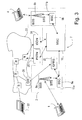
- the information transmission is carried out in a manner known as such (Fig. 3) using one or more communication networks, for example a mobile communication network 7. Consequently, a communication link is set up between the first 1 and the second terminal 4, which communication link can be an ordinary voice call, a data call, or a video call, which is set up for example as a circuit-switched connection or a packet connection.
- a part of the information such as the voice information
- a part of the information such as the visual information
- the first terminal 1 communicates with a base station 8a of a first base station subsystem 11a, from which base station 8a the information is transmitted by means of a base station controller 9a and a mobile services switching centre 10 to a base station system 11b in whose area the second terminal 4 is situated at the time.
- the second terminal 4 communicates with a base station 8b belonging to this second base station subsystem 11b, which base station 8b communicates with a base station controller 9b of this base station subsystem.
- the first 1 and the second terminal 4 can also be situated inside the area of the same base station subsystem 11a, 11b, or even inside the area of the same base station 8a, 8b.
- the first terminal 1 forms packets of the information to be sent, these packets being transmitted via the base station controller 9a to a packet switched network, preferably to a GPRS packet network 21, from which the packets are further transmitted to the second terminal 4 in a manner known as such.
- the terminals 1, 4 are wireless communication devices, but it is obvious that the invention can also be applied in connection with other terminals, such as personal data processing devices provided with telecommunication terminal properties, and in public switched telephone network.
- the information transferred via the communication network 7, 23, 24, 25 is received and the necessary actions are performed, such as displaying the visual information on the display 2b, and conversion of voice information into acoustic signals.
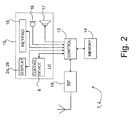
- the appended Fig. 2 shows, in a reduced block chart, the structure of a terminal 1 complying with a preferred embodiment of the invention.
- the terminal comprises a control block 13 comprising for example a microcontroller and an application specific integrated circuit.
- the terminal 1, 4 comprises a memory, for example for storing data during use, for storing images, applications and text files, for storing application files, and for storing program codes required in the operation of the terminal 1, 4 in a manner known as such.
- the user interface 15 of the terminal 1, 4 preferably comprises a microphone 16, an earpiece 17, a keypad 18 and a display 2a, 2b.
- the terminal 1, 4 can further comprise a pointer means 6, such as a roller ball or the like.
- the terminal 1, 4 can communicate with a mobile communication network 7.
- a situation in which a user of the first terminal 1 initiates a multimedia call to the second terminal 4. Consequently, in the mobile communication network 7, sufficient communication capacity is allocated for the connection for transmission of audio information and visual information in the mobile communication network between terminals 1 and 4.
- the user of the first terminal can have on the display for example a so-called desktop on which a wallpaper, application icons, application windows for active applications etc. can be shown. During the call the user can also activate and terminate applications, move icons on the display and/or application windows to a different place, change the size and the definitions of the application windows, etc.
- the control block 13 finds that the user has activated a limiting frame, whereafter the control block 13 checks in the memory 14 the definitions set for this limiting frame 3, such as the default position and the default size. Subsequently, this limiting frame 3 is displayed on the display 2a. After this the user can, for example by using the arrow key 5 or the pointer device 6, move a cursor 20 displayed on the display 2a to this limiting frame 3.
- the control block 13 examines the movements of the pointer means 6 and pressings of the keypad 18, preferably the pressings of the arrow keys 5, and concludes on the basis of them, whether the limiting frame 3 needs to be moved and/or whether its size needs to be changed, and changes the information on the display 2a accordingly. If the user has selected a controlled transmission from the settings, the user can, by pressing a key defined for this purpose, activate the transmission of the image area limited by the limiting frame. At this phase the control block 13 examines at which point of the memory means 14 the area defined on the display 2a by the limiting frame 3 is located.
- this control block 13 calculates, from the storing area of the image information formed in the memory means 14, which memory elements belong inside the limited area.
- the image information is stored in successive memory elements of the memory means 14 row by row, wherein the last pixel of the row is in the memory usually followed by the first pixel of the following row.
- the size of the memory area required by the image depends for example on the resolution of the display 2a and on the type of the display, that is, whether the display 2a is a colour display or a monochromatic (for example black and white) display.
- a colour display typically three numeric values are stored for every pixel, each of which represents information on one basic colour. In the most common colour displays, red (R), green (G) and blue (B) are used as the basic colours.
- the control block 13 starts, by means of the radio part 19, to transmit data from the memory means 14 to the mobile communication network 7, by means of a modem (not shown) or the like, to a public switched communication network 23, 24, 25, if a terminal 22, which is coupled to the public switched communication network 23, 24, 25, is used, which is known as such.
- a public switched communication network 23, 24, 25 if a terminal 22, which is coupled to the public switched communication network 23, 24, 25, is used, which is known as such.
- the information is transferred to the second terminal 4, in which the information is received and transferred to be processed by the control block 13.
- the visual information contained in the limiting frame can be displayed in the corresponding size and, if desired, at the respective location on the display 2b of the second terminal 4.
- the received visual information can be stored in the memory means 14, immediately in a memory area allocated for the display information, wherein the changes are shown substantially directly on the display 2b, or a temporal memory area can be used, into which the data is stored, whereafter the data is transferred to the right location in the memory area allocated on the display.
- the user of the receiving terminal 4 can, if the user so wishes, define the location where the received visual information is presented.
- the user of the receiving terminal 4 can also change the image proportions, that is, to stretch or narrow the visual information in the lateral and/or vertical direction. Consequently, the control block modifies the visual information, if necessary, to correspond to the changed image proportions, and transfers the information to the location on the memory area allocated on the display that has been defined by the frame 3, 12.
- the visual information can also be transmitted continuously, wherein the transmission of the visual information defined by the limiting frame 3 is performed from the first terminal 1 at regular intervals, for example once every second, more often or more seldom.
- the information is updated on the display 2b of the receiving terminal 4 at a corresponding rate, if the data transfer capacity of the mobile communication network 7 is sufficient.
- the transfer of the limiting frame and/or the size change, performed in the first terminal 1 can be seen in the second terminal 4 substantially right after the new information has been received and processed in the second terminal 4.
- the visual information is always displayed on the same location, even if the limiting frame 3 were moved in the first terminal 1.
- the location information of the frame is also transmitted from the first terminal 1 to the second terminal 4, on the basis of which the received visual information can be displayed in a corresponding location on the display 2b of the second terminal 4.
- the invention can be applied in connection with various types of terminals 1, 4.
- the terminal 1, 4 can comprise for example a touch screen, wherein the user can make personal markings on the display. Consequently, the user can for example write or draw on the limiting frame, wherein these markings of the user are also shown in the second terminal 4.
- the invention can also be applied in such a manner that if the area defined by the limiting frame 3 contains information in which other kind of information than visual information has also been added, for example voice information, this voice information can be transferred also in connection with the transmission of the visual information.
- voice information can be transferred also in connection with the transmission of the visual information.
- Such a situation can occur for example when an icon displayed on the display 2a is supplemented with sound, an application, or the like in the first terminal 1.
- the user of the first terminal 1 can define whether other information related to this icon is also transmitted in addition to the visual information.
- the transmission of for example applications, ringing tones, electric postcards, or the like can be implemented between the terminals 1, 4 in a user-friendly manner, because in such a situation it is not necessary for the user of the first terminal 1 to separately search and transmit one or several files related to the application.
- the reference numeral 22 also represents, a terminal connected to a public switched telecommunication network, which terminal can be used in the present invention both as the first 1 and the second terminal 4. Communication to such a terminal 22 is performed for example through the Internet data network 23.
- the Internet data network 23 preferably comprises at least routers R and terminal servers S, which is known as such.
- a communication link can be set up between the mobile communication network 7 and the Internet data network 23, for example via a packet network 21 (General Packet Radio Service, GPRS), an integrated services digital network 24 (ISDN) and/or a public switched telephone network 25 (PSTN).
- GPRS General Packet Radio Service
- ISDN integrated services digital network 24
- PSTN public switched telephone network 25
- the mobile communication network 7 preferably comprises base station subsystems 11a, 11b (BSS) and at least one mobile services switching centre 10 (MSC). From the packet network 21, a data transmission connection is set up to the Internet data network 23, preferably via a gateway support node 26.
- the wireless terminals 1, 4 used can be for example so-called communicator type wireless communication devices or other communication devices provided with means for processing visual information in addition to and/or in connection with the mobile station functions.
- An example of such a known communicator type device is Nokia 9110 Communicator.
- the information transmission system according to the preferred embodiment of the invention shown in Fig. 3 is only a reduced example, but in practical applications, the structure of the information transmission system 7, 23 can differ, even to a significant degree, from the example of Fig. 3.
- the Internet data network comprises a large number of routers R, nodes N and terminal servers S.
- the information transmission system 7, 23 can comprise a wireless local area network (WLAN), known as such, which is not shown in the accompanying figures.
- WLAN
- both the first 1 and the second terminal 4 are substantially identical in the above-described example, it is obvious that the properties of the terminals 1, 4 can also differ from each other. If the resolution of the display 2b of the second terminal 4 differs from the resolution of the first terminal 1, the resolution of the image information defined by the is changed, if necessary, before it is displayed on the display 2b of the second terminal.
- the limiting frame is used in the second terminal 4.
- the user of the second terminal 4 can define an area on the display 2b, the visual information on which is transmitted to the first terminal 1 to be displayed on the display 2a of the first terminal.
- the invention can also be applied bidirectionally, wherein both in the first 1 and in the second terminal 4 the limiting frame 3 is used for defining the visual information that is transmitted.
- the present invention can also be applied in a variety of situations, in which visual information is transmitted between the terminals 1, 4.
- the user can for example activate various applications, open a document on the display 2a, open an image application, take pictures by a camera connected to the terminal, etc. Consequently, by placing the frame 3 in accordance with the invention, the user can select visual information from a variety of applications to be sent simultaneously to the second terminal 4.
- This arrangement enables the transmission of very versatile information and it is obvious that the above described example is merely one applicable embodiment.
- the area defined by the limiting frame 3 does not have to be oblong, but the limiting frame 3 can be for example circular, triangular, polygonal, or it can even have a substantially free form.
- the control block 13 defines a necessary number of such points that can be used to define the area on the display 2a, 2b defined by the limitation block 3.
- more than one area can be defined, wherein the information on several such areas can be transmitted between the terminals 1, 4.
- the limiting frame displayed on the display does not have to be closed, but the area defined by the limiting frame can be expressed for example by means of markings shown on the angles, as a hatched area, as a darker or a brighter area, etc.
Landscapes
- Engineering & Computer Science (AREA)
- Human Computer Interaction (AREA)
- Theoretical Computer Science (AREA)
- Multimedia (AREA)
- Signal Processing (AREA)
- General Engineering & Computer Science (AREA)
- Physics & Mathematics (AREA)
- General Physics & Mathematics (AREA)
- Computer Networks & Wireless Communication (AREA)
- Digital Computer Display Output (AREA)
- Information Transfer Between Computers (AREA)
- Telephonic Communication Services (AREA)
- Mobile Radio Communication Systems (AREA)
Abstract

Description
- Figs. 1a and 1b
- show an exemplified situation on applying the method of the invention,
- Fig. 2
- shows a terminal according to a preferred embodiment of the invention in a reduced block chart, and
- Fig. 3
- shows an information transmission system according to a preferred embodiment of the invention in a reduced chart.
Claims (18)
- A method for transmitting information from a first terminal (1) to a second terminal (4), in which method visual information is displayed on a display (2a) of the first terminal, characterized in that in the method at least one area on the display (2a) of the first terminal is defined, the information on which area is transmitted to the second terminal (4) provided with at least one display (2b), wherein the visual information received in the second terminal is displayed on said display (2b) of the second terminal.
- The method according to claim 1, characterized in that said area is defined by means of a limiting frame (3) displayed on the display (2a).
- The method according to claim 2, characterized in that the location, the size and/or the shape of said limiting frame (3) can be changed.
- The method according to claim 1, 2 or 3, characterized in that the visual information received in the second terminal (4) is displayed on a fixed location of said display (2b) of the second terminal.
- The method according to claim 1, 2 or 3, characterized in that the presentation location of the visual information received in the second terminal (4) can be changed in the display (2b) of the second terminal.
- The method according to claim 5, characterized in that information related to the location of the area defined on the display (2a) of the first terminal is transmitted to the second terminal (4), wherein the visual information transmitted from the defined area is displayed on a substantially corresponding location on said display (2b) of the second terminal.
- The method according to any of claims 1 to 6, characterized in that the information displayed on the area defined on the display (2a) of the first terminal is transmitted at intervals, wherein the visual information is updated at intervals on the display (2b) of the second terminal.
- An information transmission system comprising means (7, 23, 24, 25) for transmitting information from a first terminal (1) to a second terminal (4), which first terminal comprises at least one display (2a) for displaying visual information, characterized in that the system further comprises means (5, 6, 18) for defining at least one area on the display (2a) of the first terminal, means (19) for transmitting information contained in said area to the second terminal (4), in connection of which at least one display (2b) is arranged, wherein the second terminal (4) comprises means (13, 14) for displaying the received visual information on said display (2b) of the second terminal.
- The information transmission system according to claim 8, characterized in that said means for defining said area comprise means for displaying a limiting frame (3) on the display (2a), and means (5, 6, 18) for changing the location, the size and/or the shape of said limiting frame (3).
- The information transmission system according to claim 8 or 9, characterized in that the second terminal (4) comprises means for changing the presentation location of the received visual information on said display (2b) of the second terminal.
- The information transmission system according to claim 10, characterized in that it comprises means (7, 13, 19, 23, 24, 25) for transmission of information related to the location of the area defined on the display (2a) of the first terminal to the second terminal (4), wherein the second terminal (4) comprises means (13, 14) for displaying the visual information on a substantially corresponding location on said display (2b) of the second terminal.
- The information transmission system according to any of claims 8 to 11, characterized in that the first terminal (1) comprises means (13) for transmitting information displayed on an area defined on the display (2a) at intervals, wherein the transmitted visual information on the display (2b) of the second terminal is arranged to be updated at intervals.
- The information transmission system according to any of claims 8 to 12, characterized in that at least one terminal (1, 4) is a wireless communication device.
- A terminal (1), comprising means (19) for transmitting information to a communication network (7, 23, 24, 25), and at least one display (2a) for displaying visual information, characterized in that the terminal further comprises means (5, 6, 18) for defining at least one area on said display (2a), means (19) for transmitting the information contained in said limited area to the communication network (7, 23, 24, 25).
- The terminal according to claim 14, characterized in that said means for defining said area comprise means for displaying a limiting frame (3) on the display (2a), and means for changing the location, the size and/or the shape of said limiting frame (3).
- The terminal according to claim 14 or 15, characterized in that it comprises means (13) for transmitting the information displayed on the area defined on the display (2a) at intervals.
- The terminal (4), comprising means (19) for receiving the visual information, and at least one display (2b) for displaying the visual information, characterized in that the terminal further comprises means (13, 14) for displaying on the display (2b) at least one piece of visual information contained in the limited area, which visual information is created of a limited area on the display (2a) of the first terminal.
- The terminal according to any of claims 14 to 17, characterized in that it is a wireless communication device.
Applications Claiming Priority (2)
| Application Number | Priority Date | Filing Date | Title |
|---|---|---|---|
| FI20002759A FI20002759A7 (en) | 2000-12-15 | 2000-12-15 | Method for conveying information |
| FI20002759 | 2000-12-15 |
Publications (2)
| Publication Number | Publication Date |
|---|---|
| EP1215568A2 true EP1215568A2 (en) | 2002-06-19 |
| EP1215568A3 EP1215568A3 (en) | 2006-01-04 |
Family
ID=8559728
Family Applications (1)
| Application Number | Title | Priority Date | Filing Date |
|---|---|---|---|
| EP01660230A Withdrawn EP1215568A3 (en) | 2000-12-15 | 2001-12-17 | Method for transmitting information |
Country Status (4)
| Country | Link |
|---|---|
| US (1) | US20020080092A1 (en) |
| EP (1) | EP1215568A3 (en) |
| JP (1) | JP2002287952A (en) |
| FI (1) | FI20002759A7 (en) |
Cited By (2)
| Publication number | Priority date | Publication date | Assignee | Title |
|---|---|---|---|---|
| WO2009130664A1 (en) * | 2008-04-25 | 2009-10-29 | Koninklijke Philips Electronics N.V. | System and method for controlling video output |
| US20110191695A1 (en) * | 2010-02-03 | 2011-08-04 | Skype Limited | Screen sharing |
Families Citing this family (3)
| Publication number | Priority date | Publication date | Assignee | Title |
|---|---|---|---|---|
| JP5062291B2 (en) * | 2010-05-14 | 2012-10-31 | 船井電機株式会社 | COMMUNICATION METHOD, INFORMATION TERMINAL DEVICE, DISPLAY DEVICE, AND COMMUNICATION SYSTEM PROVIDED WITH THE SAME |
| US8843358B2 (en) | 2011-02-03 | 2014-09-23 | Echostar Technologies L.L.C. | Apparatus, systems and methods for presenting displayed image information of a mobile media device on a large display and control of the mobile media device therefrom |
| CN103702064B (en) * | 2013-12-27 | 2019-01-18 | 三亚中兴软件有限责任公司 | A kind of video-meeting method, terminal and system |
Family Cites Families (15)
| Publication number | Priority date | Publication date | Assignee | Title |
|---|---|---|---|---|
| US5473740A (en) * | 1993-12-29 | 1995-12-05 | International Business Machines Corporation | Method and apparatus for interactively indicating image boundaries in digital image cropping |
| AU2902395A (en) * | 1994-06-17 | 1996-01-15 | Intel Corporation | Apparatus and method for application sharing in a graphic user interface |
| JPH0879620A (en) * | 1994-08-31 | 1996-03-22 | Sony Corp | Image special effect device |
| US5913920A (en) * | 1994-12-13 | 1999-06-22 | International Business Machines Corporation | Indicating updates from a remote display |
| US5874960A (en) * | 1995-07-05 | 1999-02-23 | Microsoft Corporation | Method and system for sharing applications between computer systems |
| US5864711A (en) * | 1995-07-05 | 1999-01-26 | Microsoft Corporation | System for determining more accurate translation between first and second translator, and providing translated data to second computer if first translator is more accurate |
| US5781665A (en) * | 1995-08-28 | 1998-07-14 | Pitney Bowes Inc. | Apparatus and method for cropping an image |
| US6343313B1 (en) * | 1996-03-26 | 2002-01-29 | Pixion, Inc. | Computer conferencing system with real-time multipoint, multi-speed, multi-stream scalability |
| US6662210B1 (en) * | 1997-03-31 | 2003-12-09 | Ncr Corporation | Method of remote collaboration system |
| US6151020A (en) * | 1997-10-24 | 2000-11-21 | Compaq Computer Corporation | Real time bit map capture and sharing for collaborative tools |
| US5990887A (en) * | 1997-10-30 | 1999-11-23 | International Business Machines Corp. | Method and system for efficient network desirable chat feedback over a communication network |
| US6201548B1 (en) * | 1998-02-24 | 2001-03-13 | Hewlett-Packard Company | Graphical user interface for image editing |
| US6397259B1 (en) * | 1998-05-29 | 2002-05-28 | Palm, Inc. | Method, system and apparatus for packet minimized communications |
| JP2000076487A (en) * | 1998-09-03 | 2000-03-14 | Sony Corp | Information processing apparatus and method, and providing medium |
| US6668273B1 (en) * | 1999-11-18 | 2003-12-23 | Raindance Communications, Inc. | System and method for application viewing through collaborative web browsing session |
-
2000
- 2000-12-15 FI FI20002759A patent/FI20002759A7/en not_active Application Discontinuation
-
2001
- 2001-12-12 US US10/017,712 patent/US20020080092A1/en not_active Abandoned
- 2001-12-17 EP EP01660230A patent/EP1215568A3/en not_active Withdrawn
- 2001-12-17 JP JP2001382456A patent/JP2002287952A/en active Pending
Cited By (6)
| Publication number | Priority date | Publication date | Assignee | Title |
|---|---|---|---|---|
| WO2009130664A1 (en) * | 2008-04-25 | 2009-10-29 | Koninklijke Philips Electronics N.V. | System and method for controlling video output |
| US20110191695A1 (en) * | 2010-02-03 | 2011-08-04 | Skype Limited | Screen sharing |
| WO2011095523A1 (en) * | 2010-02-03 | 2011-08-11 | Skype Limited | Screen sharing |
| CN102859480A (en) * | 2010-02-03 | 2013-01-02 | 斯凯普公司 | Screen sharing |
| US8904294B2 (en) | 2010-02-03 | 2014-12-02 | Skype | Screen sharing |
| CN102859480B (en) * | 2010-02-03 | 2016-01-20 | 斯凯普公司 | Screen sharing |
Also Published As
| Publication number | Publication date |
|---|---|
| EP1215568A3 (en) | 2006-01-04 |
| US20020080092A1 (en) | 2002-06-27 |
| FI20002759L (en) | 2002-06-16 |
| FI20002759A0 (en) | 2000-12-15 |
| JP2002287952A (en) | 2002-10-04 |
| FI20002759A7 (en) | 2002-06-16 |
Similar Documents
| Publication | Publication Date | Title |
|---|---|---|
| US20050104909A1 (en) | Communications system and method | |
| CN100373851C (en) | Communication method, communication server device, communication terminal device, and communication system | |
| CN101212751A (en) | Mobile communication terminal displaying multi-party video call and display method thereof | |
| US7535484B2 (en) | Communication terminals that vary a video stream based on how it is displayed | |
| WO2006007587A2 (en) | Method and appartus for automatically sending a captured image to a phone call participant | |
| CN1901664A (en) | Method of conveying emotion in video telephone mode and wireless terminal implementing the same | |
| EP1215568A2 (en) | Method for transmitting information | |
| JP4212600B2 (en) | Wireless communication terminal device | |
| KR100438540B1 (en) | Image transmitting/receiving method and system for mobile communication terminal equipment | |
| KR100630165B1 (en) | How to search phone number of mobile device | |
| KR100475953B1 (en) | Method and System for Providing Substitute Image for Use in Image Mobile Phone | |
| JP2005168012A (en) | Video phone compatible type internet phone | |
| KR100527393B1 (en) | Apparatus for Providing Video Phone using Multimedia Contents Synthesis and Method Thereof | |
| KR100617736B1 (en) | How to zoom in and out of pictures on your mobile device | |
| EP1746830A2 (en) | Method for performing presentation in video telephone mode and wireless terminal implementing the same | |
| EP1551159B1 (en) | Apparatus and method for changing colors of input data and of background in a portable terminal | |
| JP5154020B2 (en) | Videophone system, videophone terminal apparatus, and videophone image display method | |
| JP2006203612A (en) | Mobile phone equipment | |
| CN1758674A (en) | State display method of mobile communication terminal using telephone directory | |
| KR20040097642A (en) | Method for establishing user-data by one-touch in mobile phone | |
| KR101282411B1 (en) | Web browsing common system and web browsing common method | |
| KR101331664B1 (en) | Method and apparatus for utilizing user identity | |
| JP2003067294A (en) | Portable information terminal, information providing method, and multimedia providing system | |
| JP2002125208A (en) | Videophone system | |
| CN119211619A (en) | A method, device and system for implementing screen projection |
Legal Events
| Date | Code | Title | Description |
|---|---|---|---|
| PUAI | Public reference made under article 153(3) epc to a published international application that has entered the european phase |
Free format text: ORIGINAL CODE: 0009012 |
|
| AK | Designated contracting states |
Kind code of ref document: A2 Designated state(s): AT BE CH CY DE DK ES FI FR GB GR IE IT LI LU MC NL PT SE TR |
|
| AX | Request for extension of the european patent |
Free format text: AL;LT;LV;MK;RO;SI |
|
| PUAL | Search report despatched |
Free format text: ORIGINAL CODE: 0009013 |
|
| AK | Designated contracting states |
Kind code of ref document: A3 Designated state(s): AT BE CH CY DE DK ES FI FR GB GR IE IT LI LU MC NL PT SE TR |
|
| AX | Request for extension of the european patent |
Extension state: AL LT LV MK RO SI |
|
| AKX | Designation fees paid |
Designated state(s): AT BE CH CY DE DK ES FI FR GB GR IE IT LI LU MC NL PT SE TR |
|
| STAA | Information on the status of an ep patent application or granted ep patent |
Free format text: STATUS: THE APPLICATION IS DEEMED TO BE WITHDRAWN |
|
| 18D | Application deemed to be withdrawn |
Effective date: 20060705 |