EP1215281A1 - Cyclic depsipeptide synthases, genes thereof and mass production system of cyclic depsipeptide - Google Patents
Cyclic depsipeptide synthases, genes thereof and mass production system of cyclic depsipeptide Download PDFInfo
- Publication number
- EP1215281A1 EP1215281A1 EP00957009A EP00957009A EP1215281A1 EP 1215281 A1 EP1215281 A1 EP 1215281A1 EP 00957009 A EP00957009 A EP 00957009A EP 00957009 A EP00957009 A EP 00957009A EP 1215281 A1 EP1215281 A1 EP 1215281A1
- Authority
- EP
- European Patent Office
- Prior art keywords
- cyclic depsipeptide
- seq
- gene
- substance
- sequence
- Prior art date
- Legal status (The legal status is an assumption and is not a legal conclusion. Google has not performed a legal analysis and makes no representation as to the accuracy of the status listed.)
- Granted
Links
- 108010002156 Depsipeptides Proteins 0.000 title claims abstract description 100
- 108090000623 proteins and genes Proteins 0.000 title claims abstract description 55
- 238000004519 manufacturing process Methods 0.000 title claims abstract description 19
- 108090000364 Ligases Proteins 0.000 claims abstract description 67
- 239000000126 substance Substances 0.000 claims abstract description 61
- 102000003960 Ligases Human genes 0.000 claims abstract description 40
- 239000013598 vector Substances 0.000 claims abstract description 25
- 239000002773 nucleotide Substances 0.000 claims abstract description 19
- 125000003729 nucleotide group Chemical group 0.000 claims abstract description 19
- 230000000694 effects Effects 0.000 claims abstract description 11
- FWMNVWWHGCHHJJ-SKKKGAJSSA-N 4-amino-1-[(2r)-6-amino-2-[[(2r)-2-[[(2r)-2-[[(2r)-2-amino-3-phenylpropanoyl]amino]-3-phenylpropanoyl]amino]-4-methylpentanoyl]amino]hexanoyl]piperidine-4-carboxylic acid Chemical compound C([C@H](C(=O)N[C@H](CC(C)C)C(=O)N[C@H](CCCCN)C(=O)N1CCC(N)(CC1)C(O)=O)NC(=O)[C@H](N)CC=1C=CC=CC=1)C1=CC=CC=C1 FWMNVWWHGCHHJJ-SKKKGAJSSA-N 0.000 claims abstract description 8
- 238000012986 modification Methods 0.000 claims abstract description 7
- 230000004048 modification Effects 0.000 claims abstract description 7
- 238000003780 insertion Methods 0.000 claims abstract description 6
- 230000037431 insertion Effects 0.000 claims abstract description 6
- 238000012217 deletion Methods 0.000 claims abstract description 5
- 230000037430 deletion Effects 0.000 claims abstract description 5
- 238000006467 substitution reaction Methods 0.000 claims abstract description 5
- 125000003275 alpha amino acid group Chemical group 0.000 claims abstract 7
- 238000000034 method Methods 0.000 claims description 33
- 244000005700 microbiome Species 0.000 claims description 30
- 108091028043 Nucleic acid sequence Proteins 0.000 claims description 22
- 102000004169 proteins and genes Human genes 0.000 claims description 21
- 239000013604 expression vector Substances 0.000 claims description 8
- 238000012258 culturing Methods 0.000 claims description 5
- 239000001963 growth medium Substances 0.000 claims description 5
- 108091033319 polynucleotide Proteins 0.000 claims 6
- 239000002157 polynucleotide Substances 0.000 claims 6
- 102000040430 polynucleotide Human genes 0.000 claims 6
- 108090000790 Enzymes Proteins 0.000 abstract description 25
- 102000004190 Enzymes Human genes 0.000 abstract description 20
- 108020004414 DNA Proteins 0.000 description 43
- 239000012634 fragment Substances 0.000 description 35
- 229940088598 enzyme Drugs 0.000 description 19
- 210000004027 cell Anatomy 0.000 description 17
- 235000018102 proteins Nutrition 0.000 description 16
- 239000000243 solution Substances 0.000 description 16
- 150000001413 amino acids Chemical class 0.000 description 13
- 238000006243 chemical reaction Methods 0.000 description 13
- 239000013612 plasmid Substances 0.000 description 12
- 230000001105 regulatory effect Effects 0.000 description 12
- 230000014509 gene expression Effects 0.000 description 11
- 239000012528 membrane Substances 0.000 description 10
- 238000013519 translation Methods 0.000 description 10
- 101150019466 AOC1 gene Proteins 0.000 description 9
- LFQSCWFLJHTTHZ-UHFFFAOYSA-N Ethanol Chemical compound CCO LFQSCWFLJHTTHZ-UHFFFAOYSA-N 0.000 description 9
- PEDCQBHIVMGVHV-UHFFFAOYSA-N Glycerine Chemical compound OCC(O)CO PEDCQBHIVMGVHV-UHFFFAOYSA-N 0.000 description 9
- 101100498460 Mus musculus Dbnl gene Proteins 0.000 description 9
- 108700026244 Open Reading Frames Proteins 0.000 description 9
- 101100433523 Schizosaccharomyces pombe (strain 972 / ATCC 24843) pab1 gene Proteins 0.000 description 9
- 101100406776 Xenopus laevis pabpc1-a gene Proteins 0.000 description 9
- 239000000523 sample Substances 0.000 description 9
- 239000000758 substrate Substances 0.000 description 9
- ROHFNLRQFUQHCH-YFKPBYRVSA-N L-leucine Chemical compound CC(C)C[C@H](N)C(O)=O ROHFNLRQFUQHCH-YFKPBYRVSA-N 0.000 description 8
- FAPWRFPIFSIZLT-UHFFFAOYSA-M Sodium chloride Chemical compound [Na+].[Cl-] FAPWRFPIFSIZLT-UHFFFAOYSA-M 0.000 description 8
- 239000002609 medium Substances 0.000 description 8
- 230000015572 biosynthetic process Effects 0.000 description 7
- 238000010367 cloning Methods 0.000 description 7
- 238000010276 construction Methods 0.000 description 7
- 238000001962 electrophoresis Methods 0.000 description 7
- 238000005516 engineering process Methods 0.000 description 7
- 230000002194 synthesizing effect Effects 0.000 description 7
- VOXXWSYKYCBWHO-QMMMGPOBSA-N (S)-3-phenyllactic acid Chemical compound OC(=O)[C@@H](O)CC1=CC=CC=C1 VOXXWSYKYCBWHO-QMMMGPOBSA-N 0.000 description 6
- IJGRMHOSHXDMSA-UHFFFAOYSA-N Atomic nitrogen Chemical compound N#N IJGRMHOSHXDMSA-UHFFFAOYSA-N 0.000 description 6
- VTYYLEPIZMXCLO-UHFFFAOYSA-L Calcium carbonate Chemical compound [Ca+2].[O-]C([O-])=O VTYYLEPIZMXCLO-UHFFFAOYSA-L 0.000 description 6
- 241000588724 Escherichia coli Species 0.000 description 6
- OKKJLVBELUTLKV-UHFFFAOYSA-N Methanol Chemical compound OC OKKJLVBELUTLKV-UHFFFAOYSA-N 0.000 description 6
- WCUXLLCKKVVCTQ-UHFFFAOYSA-M Potassium chloride Chemical compound [Cl-].[K+] WCUXLLCKKVVCTQ-UHFFFAOYSA-M 0.000 description 6
- 230000003321 amplification Effects 0.000 description 6
- -1 blastcidin S Natural products 0.000 description 6
- 239000000872 buffer Substances 0.000 description 6
- 238000012136 culture method Methods 0.000 description 6
- 239000000203 mixture Substances 0.000 description 6
- 238000003199 nucleic acid amplification method Methods 0.000 description 6
- 239000000047 product Substances 0.000 description 6
- 229930182843 D-Lactic acid Natural products 0.000 description 5
- JVTAAEKCZFNVCJ-UWTATZPHSA-N D-lactic acid Chemical compound C[C@@H](O)C(O)=O JVTAAEKCZFNVCJ-UWTATZPHSA-N 0.000 description 5
- 108010014303 DNA-directed DNA polymerase Proteins 0.000 description 5
- 102000016928 DNA-directed DNA polymerase Human genes 0.000 description 5
- 241000233866 Fungi Species 0.000 description 5
- DBMJMQXJHONAFJ-UHFFFAOYSA-M Sodium laurylsulphate Chemical compound [Na+].CCCCCCCCCCCCOS([O-])(=O)=O DBMJMQXJHONAFJ-UHFFFAOYSA-M 0.000 description 5
- 229920002472 Starch Polymers 0.000 description 5
- 229940022769 d- lactic acid Drugs 0.000 description 5
- 238000000605 extraction Methods 0.000 description 5
- 230000035772 mutation Effects 0.000 description 5
- 238000012163 sequencing technique Methods 0.000 description 5
- 239000008107 starch Substances 0.000 description 5
- 235000019698 starch Nutrition 0.000 description 5
- GRRNUXAQVGOGFE-UHFFFAOYSA-N Hygromycin-B Natural products OC1C(NC)CC(N)C(O)C1OC1C2OC3(C(C(O)C(O)C(C(N)CO)O3)O)OC2C(O)C(CO)O1 GRRNUXAQVGOGFE-UHFFFAOYSA-N 0.000 description 4
- 239000004395 L-leucine Substances 0.000 description 4
- 235000019454 L-leucine Nutrition 0.000 description 4
- TWRXJAOTZQYOKJ-UHFFFAOYSA-L Magnesium chloride Chemical compound [Mg+2].[Cl-].[Cl-] TWRXJAOTZQYOKJ-UHFFFAOYSA-L 0.000 description 4
- CSNNHWWHGAXBCP-UHFFFAOYSA-L Magnesium sulfate Chemical compound [Mg+2].[O-][S+2]([O-])([O-])[O-] CSNNHWWHGAXBCP-UHFFFAOYSA-L 0.000 description 4
- 238000000246 agarose gel electrophoresis Methods 0.000 description 4
- 238000004587 chromatography analysis Methods 0.000 description 4
- GNBHRKFJIUUOQI-UHFFFAOYSA-N fluorescein Chemical compound O1C(=O)C2=CC=CC=C2C21C1=CC=C(O)C=C1OC1=CC(O)=CC=C21 GNBHRKFJIUUOQI-UHFFFAOYSA-N 0.000 description 4
- 239000000499 gel Substances 0.000 description 4
- 238000009396 hybridization Methods 0.000 description 4
- 229960003136 leucine Drugs 0.000 description 4
- 239000003550 marker Substances 0.000 description 4
- 239000002244 precipitate Substances 0.000 description 4
- 108091008146 restriction endonucleases Proteins 0.000 description 4
- 239000011780 sodium chloride Substances 0.000 description 4
- CSCPPACGZOOCGX-UHFFFAOYSA-N Acetone Chemical compound CC(C)=O CSCPPACGZOOCGX-UHFFFAOYSA-N 0.000 description 3
- WEVYAHXRMPXWCK-UHFFFAOYSA-N Acetonitrile Chemical compound CC#N WEVYAHXRMPXWCK-UHFFFAOYSA-N 0.000 description 3
- DCXYFEDJOCDNAF-UHFFFAOYSA-N Asparagine Natural products OC(=O)C(N)CC(N)=O DCXYFEDJOCDNAF-UHFFFAOYSA-N 0.000 description 3
- 206010059866 Drug resistance Diseases 0.000 description 3
- XEKOWRVHYACXOJ-UHFFFAOYSA-N Ethyl acetate Chemical compound CCOC(C)=O XEKOWRVHYACXOJ-UHFFFAOYSA-N 0.000 description 3
- WQZGKKKJIJFFOK-GASJEMHNSA-N Glucose Natural products OC[C@H]1OC(O)[C@H](O)[C@@H](O)[C@@H]1O WQZGKKKJIJFFOK-GASJEMHNSA-N 0.000 description 3
- HEMHJVSKTPXQMS-UHFFFAOYSA-M Sodium hydroxide Chemical compound [OH-].[Na+] HEMHJVSKTPXQMS-UHFFFAOYSA-M 0.000 description 3
- 241000209140 Triticum Species 0.000 description 3
- 235000021307 Triticum Nutrition 0.000 description 3
- 239000011543 agarose gel Substances 0.000 description 3
- 230000000507 anthelmentic effect Effects 0.000 description 3
- 210000004899 c-terminal region Anatomy 0.000 description 3
- 229910000019 calcium carbonate Inorganic materials 0.000 description 3
- 229940041514 candida albicans extract Drugs 0.000 description 3
- 238000005119 centrifugation Methods 0.000 description 3
- 125000004122 cyclic group Chemical group 0.000 description 3
- 239000008103 glucose Substances 0.000 description 3
- 238000005259 measurement Methods 0.000 description 3
- 210000004897 n-terminal region Anatomy 0.000 description 3
- 229910052757 nitrogen Inorganic materials 0.000 description 3
- 235000016709 nutrition Nutrition 0.000 description 3
- 238000004806 packaging method and process Methods 0.000 description 3
- 239000013600 plasmid vector Substances 0.000 description 3
- 239000001103 potassium chloride Substances 0.000 description 3
- 235000011164 potassium chloride Nutrition 0.000 description 3
- 108090000765 processed proteins & peptides Proteins 0.000 description 3
- 229930000044 secondary metabolite Natural products 0.000 description 3
- 239000001509 sodium citrate Substances 0.000 description 3
- HRXKRNGNAMMEHJ-UHFFFAOYSA-K trisodium citrate Chemical compound [Na+].[Na+].[Na+].[O-]C(=O)CC(O)(CC([O-])=O)C([O-])=O HRXKRNGNAMMEHJ-UHFFFAOYSA-K 0.000 description 3
- 229940038773 trisodium citrate Drugs 0.000 description 3
- 238000011144 upstream manufacturing Methods 0.000 description 3
- 239000012138 yeast extract Substances 0.000 description 3
- VZSRBBMJRBPUNF-UHFFFAOYSA-N 2-(2,3-dihydro-1H-inden-2-ylamino)-N-[3-oxo-3-(2,4,6,7-tetrahydrotriazolo[4,5-c]pyridin-5-yl)propyl]pyrimidine-5-carboxamide Chemical compound C1C(CC2=CC=CC=C12)NC1=NC=C(C=N1)C(=O)NCCC(N1CC2=C(CC1)NN=N2)=O VZSRBBMJRBPUNF-UHFFFAOYSA-N 0.000 description 2
- QKNYBSVHEMOAJP-UHFFFAOYSA-N 2-amino-2-(hydroxymethyl)propane-1,3-diol;hydron;chloride Chemical compound Cl.OCC(N)(CO)CO QKNYBSVHEMOAJP-UHFFFAOYSA-N 0.000 description 2
- 102000002260 Alkaline Phosphatase Human genes 0.000 description 2
- 108020004774 Alkaline Phosphatase Proteins 0.000 description 2
- 241000894006 Bacteria Species 0.000 description 2
- 108020004705 Codon Proteins 0.000 description 2
- 238000001712 DNA sequencing Methods 0.000 description 2
- 101710088194 Dehydrogenase Proteins 0.000 description 2
- AHCYMLUZIRLXAA-SHYZEUOFSA-N Deoxyuridine 5'-triphosphate Chemical compound O1[C@H](COP(O)(=O)OP(O)(=O)OP(O)(O)=O)[C@@H](O)C[C@@H]1N1C(=O)NC(=O)C=C1 AHCYMLUZIRLXAA-SHYZEUOFSA-N 0.000 description 2
- 244000068988 Glycine max Species 0.000 description 2
- 235000010469 Glycine max Nutrition 0.000 description 2
- 241001465754 Metazoa Species 0.000 description 2
- LRHPLDYGYMQRHN-UHFFFAOYSA-N N-Butanol Chemical compound CCCCO LRHPLDYGYMQRHN-UHFFFAOYSA-N 0.000 description 2
- 239000004677 Nylon Substances 0.000 description 2
- 229910019142 PO4 Inorganic materials 0.000 description 2
- NBIIXXVUZAFLBC-UHFFFAOYSA-N Phosphoric acid Chemical compound OP(O)(O)=O NBIIXXVUZAFLBC-UHFFFAOYSA-N 0.000 description 2
- 239000002202 Polyethylene glycol Substances 0.000 description 2
- CDBYLPFSWZWCQE-UHFFFAOYSA-L Sodium Carbonate Chemical compound [Na+].[Na+].[O-]C([O-])=O CDBYLPFSWZWCQE-UHFFFAOYSA-L 0.000 description 2
- QAOWNCQODCNURD-UHFFFAOYSA-N Sulfuric acid Chemical compound OS(O)(=O)=O QAOWNCQODCNURD-UHFFFAOYSA-N 0.000 description 2
- XSQUKJJJFZCRTK-UHFFFAOYSA-N Urea Chemical compound NC(N)=O XSQUKJJJFZCRTK-UHFFFAOYSA-N 0.000 description 2
- 229940024606 amino acid Drugs 0.000 description 2
- 235000001014 amino acid Nutrition 0.000 description 2
- 238000004458 analytical method Methods 0.000 description 2
- 239000003242 anti bacterial agent Substances 0.000 description 2
- 229940088710 antibiotic agent Drugs 0.000 description 2
- 230000003416 augmentation Effects 0.000 description 2
- 239000011324 bead Substances 0.000 description 2
- 230000006696 biosynthetic metabolic pathway Effects 0.000 description 2
- ZPWVASYFFYYZEW-UHFFFAOYSA-L dipotassium hydrogen phosphate Chemical compound [K+].[K+].OP([O-])([O-])=O ZPWVASYFFYYZEW-UHFFFAOYSA-L 0.000 description 2
- 238000012869 ethanol precipitation Methods 0.000 description 2
- 238000002474 experimental method Methods 0.000 description 2
- 239000000284 extract Substances 0.000 description 2
- 230000002068 genetic effect Effects 0.000 description 2
- GRRNUXAQVGOGFE-NZSRVPFOSA-N hygromycin B Chemical compound O[C@@H]1[C@@H](NC)C[C@@H](N)[C@H](O)[C@H]1O[C@H]1[C@H]2O[C@@]3([C@@H]([C@@H](O)[C@@H](O)[C@@H](C(N)CO)O3)O)O[C@H]2[C@@H](O)[C@@H](CO)O1 GRRNUXAQVGOGFE-NZSRVPFOSA-N 0.000 description 2
- 229940097277 hygromycin b Drugs 0.000 description 2
- 238000002955 isolation Methods 0.000 description 2
- 239000007788 liquid Substances 0.000 description 2
- 229910001629 magnesium chloride Inorganic materials 0.000 description 2
- 229910052943 magnesium sulfate Inorganic materials 0.000 description 2
- 235000019341 magnesium sulphate Nutrition 0.000 description 2
- 229920001778 nylon Polymers 0.000 description 2
- 150000002989 phenols Chemical class 0.000 description 2
- 239000010452 phosphate Substances 0.000 description 2
- 229920002401 polyacrylamide Polymers 0.000 description 2
- 229920001223 polyethylene glycol Polymers 0.000 description 2
- 239000013587 production medium Substances 0.000 description 2
- 238000000746 purification Methods 0.000 description 2
- 238000005215 recombination Methods 0.000 description 2
- 230000006798 recombination Effects 0.000 description 2
- 150000003839 salts Chemical class 0.000 description 2
- 238000002415 sodium dodecyl sulfate polyacrylamide gel electrophoresis Methods 0.000 description 2
- VWDWKYIASSYTQR-UHFFFAOYSA-N sodium nitrate Chemical compound [Na+].[O-][N+]([O-])=O VWDWKYIASSYTQR-UHFFFAOYSA-N 0.000 description 2
- 238000001179 sorption measurement Methods 0.000 description 2
- 239000006228 supernatant Substances 0.000 description 2
- 238000003786 synthesis reaction Methods 0.000 description 2
- 239000006188 syrup Substances 0.000 description 2
- 235000020357 syrup Nutrition 0.000 description 2
- 230000009466 transformation Effects 0.000 description 2
- DGVVWUTYPXICAM-UHFFFAOYSA-N β‐Mercaptoethanol Chemical compound OCCS DGVVWUTYPXICAM-UHFFFAOYSA-N 0.000 description 2
- MNULEGDCPYONBU-WMBHJXFZSA-N (1r,4s,5e,5'r,6'r,7e,10s,11r,12s,14r,15s,16s,18r,19s,20r,21e,25s,26r,27s,29s)-4-ethyl-11,12,15,19-tetrahydroxy-6'-[(2s)-2-hydroxypropyl]-5',10,12,14,16,18,20,26,29-nonamethylspiro[24,28-dioxabicyclo[23.3.1]nonacosa-5,7,21-triene-27,2'-oxane]-13,17,23-trio Polymers O([C@@H]1CC[C@@H](/C=C/C=C/C[C@H](C)[C@@H](O)[C@](C)(O)C(=O)[C@H](C)[C@@H](O)[C@H](C)C(=O)[C@H](C)[C@@H](O)[C@H](C)/C=C/C(=O)O[C@H]([C@H]2C)[C@H]1C)CC)[C@]12CC[C@@H](C)[C@@H](C[C@H](C)O)O1 MNULEGDCPYONBU-WMBHJXFZSA-N 0.000 description 1
- MNULEGDCPYONBU-DJRUDOHVSA-N (1s,4r,5z,5'r,6'r,7e,10s,11r,12s,14r,15s,18r,19r,20s,21e,26r,27s)-4-ethyl-11,12,15,19-tetrahydroxy-6'-(2-hydroxypropyl)-5',10,12,14,16,18,20,26,29-nonamethylspiro[24,28-dioxabicyclo[23.3.1]nonacosa-5,7,21-triene-27,2'-oxane]-13,17,23-trione Polymers O([C@H]1CC[C@H](\C=C/C=C/C[C@H](C)[C@@H](O)[C@](C)(O)C(=O)[C@H](C)[C@@H](O)C(C)C(=O)[C@H](C)[C@H](O)[C@@H](C)/C=C/C(=O)OC([C@H]2C)C1C)CC)[C@]12CC[C@@H](C)[C@@H](CC(C)O)O1 MNULEGDCPYONBU-DJRUDOHVSA-N 0.000 description 1
- MRXDGVXSWIXTQL-HYHFHBMOSA-N (2s)-2-[[(1s)-1-(2-amino-1,4,5,6-tetrahydropyrimidin-6-yl)-2-[[(2s)-4-methyl-1-oxo-1-[[(2s)-1-oxo-3-phenylpropan-2-yl]amino]pentan-2-yl]amino]-2-oxoethyl]carbamoylamino]-3-phenylpropanoic acid Chemical compound C([C@H](NC(=O)N[C@H](C(=O)N[C@@H](CC(C)C)C(=O)N[C@@H](CC=1C=CC=CC=1)C=O)C1NC(N)=NCC1)C(O)=O)C1=CC=CC=C1 MRXDGVXSWIXTQL-HYHFHBMOSA-N 0.000 description 1
- XJODGRWDFZVTKW-LURJTMIESA-N (2s)-4-methyl-2-(methylamino)pentanoic acid Chemical compound CN[C@H](C(O)=O)CC(C)C XJODGRWDFZVTKW-LURJTMIESA-N 0.000 description 1
- MNULEGDCPYONBU-YNZHUHFTSA-N (4Z,18Z,20Z)-22-ethyl-7,11,14,15-tetrahydroxy-6'-(2-hydroxypropyl)-5',6,8,10,12,14,16,28,29-nonamethylspiro[2,26-dioxabicyclo[23.3.1]nonacosa-4,18,20-triene-27,2'-oxane]-3,9,13-trione Polymers CC1C(C2C)OC(=O)\C=C/C(C)C(O)C(C)C(=O)C(C)C(O)C(C)C(=O)C(C)(O)C(O)C(C)C\C=C/C=C\C(CC)CCC2OC21CCC(C)C(CC(C)O)O2 MNULEGDCPYONBU-YNZHUHFTSA-N 0.000 description 1
- MNULEGDCPYONBU-VVXVDZGXSA-N (5e,5'r,7e,10s,11r,12s,14s,15r,16r,18r,19s,20r,21e,26r,29s)-4-ethyl-11,12,15,19-tetrahydroxy-6'-[(2s)-2-hydroxypropyl]-5',10,12,14,16,18,20,26,29-nonamethylspiro[24,28-dioxabicyclo[23.3.1]nonacosa-5,7,21-triene-27,2'-oxane]-13,17,23-trione Polymers C([C@H](C)[C@@H](O)[C@](C)(O)C(=O)[C@@H](C)[C@H](O)[C@@H](C)C(=O)[C@H](C)[C@@H](O)[C@H](C)/C=C/C(=O)OC([C@H]1C)[C@H]2C)\C=C\C=C\C(CC)CCC2OC21CC[C@@H](C)C(C[C@H](C)O)O2 MNULEGDCPYONBU-VVXVDZGXSA-N 0.000 description 1
- XHFVGHPGDLDEQO-ZETCQYMHSA-N (R)-4'-phosphopantothenic acid Chemical compound OP(=O)(O)OCC(C)(C)[C@@H](O)C(=O)NCCC(O)=O XHFVGHPGDLDEQO-ZETCQYMHSA-N 0.000 description 1
- 108091032973 (ribonucleotides)n+m Proteins 0.000 description 1
- NWUYHJFMYQTDRP-UHFFFAOYSA-N 1,2-bis(ethenyl)benzene;1-ethenyl-2-ethylbenzene;styrene Chemical compound C=CC1=CC=CC=C1.CCC1=CC=CC=C1C=C.C=CC1=CC=CC=C1C=C NWUYHJFMYQTDRP-UHFFFAOYSA-N 0.000 description 1
- QRBLKGHRWFGINE-UGWAGOLRSA-N 2-[2-[2-[[2-[[4-[[2-[[6-amino-2-[3-amino-1-[(2,3-diamino-3-oxopropyl)amino]-3-oxopropyl]-5-methylpyrimidine-4-carbonyl]amino]-3-[(2r,3s,4s,5s,6s)-3-[(2s,3r,4r,5s)-4-carbamoyl-3,4,5-trihydroxy-6-(hydroxymethyl)oxan-2-yl]oxy-4,5-dihydroxy-6-(hydroxymethyl)- Chemical compound N=1C(C=2SC=C(N=2)C(N)=O)CSC=1CCNC(=O)C(C(C)=O)NC(=O)C(C)C(O)C(C)NC(=O)C(C(O[C@H]1[C@@]([C@@H](O)[C@H](O)[C@H](CO)O1)(C)O[C@H]1[C@@H]([C@](O)([C@@H](O)C(CO)O1)C(N)=O)O)C=1NC=NC=1)NC(=O)C1=NC(C(CC(N)=O)NCC(N)C(N)=O)=NC(N)=C1C QRBLKGHRWFGINE-UGWAGOLRSA-N 0.000 description 1
- OSJPPGNTCRNQQC-UWTATZPHSA-N 3-phospho-D-glyceric acid Chemical compound OC(=O)[C@H](O)COP(O)(O)=O OSJPPGNTCRNQQC-UWTATZPHSA-N 0.000 description 1
- MNULEGDCPYONBU-UHFFFAOYSA-N 4-ethyl-11,12,15,19-tetrahydroxy-6'-(2-hydroxypropyl)-5',10,12,14,16,18,20,26,29-nonamethylspiro[24,28-dioxabicyclo[23.3.1]nonacosa-5,7,21-triene-27,2'-oxane]-13,17,23-trione Polymers CC1C(C2C)OC(=O)C=CC(C)C(O)C(C)C(=O)C(C)C(O)C(C)C(=O)C(C)(O)C(O)C(C)CC=CC=CC(CC)CCC2OC21CCC(C)C(CC(C)O)O2 MNULEGDCPYONBU-UHFFFAOYSA-N 0.000 description 1
- 101710163881 5,6-dihydroxyindole-2-carboxylic acid oxidase Proteins 0.000 description 1
- 241000186361 Actinobacteria <class> Species 0.000 description 1
- 229920000936 Agarose Polymers 0.000 description 1
- 241000589158 Agrobacterium Species 0.000 description 1
- 102000007698 Alcohol dehydrogenase Human genes 0.000 description 1
- 108010021809 Alcohol dehydrogenase Proteins 0.000 description 1
- 239000004382 Amylase Substances 0.000 description 1
- 102000013142 Amylases Human genes 0.000 description 1
- 108010065511 Amylases Proteins 0.000 description 1
- 241000193830 Bacillus <bacterium> Species 0.000 description 1
- 108010006654 Bleomycin Proteins 0.000 description 1
- DKPFZGUDAPQIHT-UHFFFAOYSA-N Butyl acetate Natural products CCCCOC(C)=O DKPFZGUDAPQIHT-UHFFFAOYSA-N 0.000 description 1
- OYPRJOBELJOOCE-UHFFFAOYSA-N Calcium Chemical compound [Ca] OYPRJOBELJOOCE-UHFFFAOYSA-N 0.000 description 1
- UXVMQQNJUSDDNG-UHFFFAOYSA-L Calcium chloride Chemical compound [Cl-].[Cl-].[Ca+2] UXVMQQNJUSDDNG-UHFFFAOYSA-L 0.000 description 1
- OKTJSMMVPCPJKN-UHFFFAOYSA-N Carbon Chemical compound [C] OKTJSMMVPCPJKN-UHFFFAOYSA-N 0.000 description 1
- 108010059892 Cellulase Proteins 0.000 description 1
- ZAMOUSCENKQFHK-UHFFFAOYSA-N Chlorine atom Chemical compound [Cl] ZAMOUSCENKQFHK-UHFFFAOYSA-N 0.000 description 1
- OLVPQBGMUGIKIW-UHFFFAOYSA-N Chymostatin Natural products C=1C=CC=CC=1CC(C=O)NC(=O)C(C(C)CC)NC(=O)C(C1NC(N)=NCC1)NC(=O)NC(C(O)=O)CC1=CC=CC=C1 OLVPQBGMUGIKIW-UHFFFAOYSA-N 0.000 description 1
- 229920000742 Cotton Polymers 0.000 description 1
- 239000004375 Dextrin Substances 0.000 description 1
- 229920001353 Dextrin Polymers 0.000 description 1
- 108010067770 Endopeptidase K Proteins 0.000 description 1
- YQYJSBFKSSDGFO-UHFFFAOYSA-N Epihygromycin Natural products OC1C(O)C(C(=O)C)OC1OC(C(=C1)O)=CC=C1C=C(C)C(=O)NC1C(O)C(O)C2OCOC2C1O YQYJSBFKSSDGFO-UHFFFAOYSA-N 0.000 description 1
- 108700039691 Genetic Promoter Regions Proteins 0.000 description 1
- 108700007698 Genetic Terminator Regions Proteins 0.000 description 1
- WHUUTDBJXJRKMK-UHFFFAOYSA-N Glutamic acid Natural products OC(=O)C(N)CCC(O)=O WHUUTDBJXJRKMK-UHFFFAOYSA-N 0.000 description 1
- 101100295959 Halobacterium salinarum (strain ATCC 700922 / JCM 11081 / NRC-1) arcB gene Proteins 0.000 description 1
- 108010054147 Hemoglobins Proteins 0.000 description 1
- 108090000604 Hydrolases Proteins 0.000 description 1
- DGAQECJNVWCQMB-PUAWFVPOSA-M Ilexoside XXIX Chemical compound C[C@@H]1CC[C@@]2(CC[C@@]3(C(=CC[C@H]4[C@]3(CC[C@@H]5[C@@]4(CC[C@@H](C5(C)C)OS(=O)(=O)[O-])C)C)[C@@H]2[C@]1(C)O)C)C(=O)O[C@H]6[C@@H]([C@H]([C@@H]([C@H](O6)CO)O)O)O.[Na+] DGAQECJNVWCQMB-PUAWFVPOSA-M 0.000 description 1
- 102000001706 Immunoglobulin Fab Fragments Human genes 0.000 description 1
- 108010054477 Immunoglobulin Fab Fragments Proteins 0.000 description 1
- DCXYFEDJOCDNAF-REOHCLBHSA-N L-asparagine Chemical compound OC(=O)[C@@H](N)CC(N)=O DCXYFEDJOCDNAF-REOHCLBHSA-N 0.000 description 1
- GDBQQVLCIARPGH-UHFFFAOYSA-N Leupeptin Natural products CC(C)CC(NC(C)=O)C(=O)NC(CC(C)C)C(=O)NC(C=O)CCCN=C(N)N GDBQQVLCIARPGH-UHFFFAOYSA-N 0.000 description 1
- 102000004882 Lipase Human genes 0.000 description 1
- 108090001060 Lipase Proteins 0.000 description 1
- 239000004367 Lipase Substances 0.000 description 1
- 108010028921 Lipopeptides Proteins 0.000 description 1
- WHXSMMKQMYFTQS-UHFFFAOYSA-N Lithium Chemical compound [Li] WHXSMMKQMYFTQS-UHFFFAOYSA-N 0.000 description 1
- FYYHWMGAXLPEAU-UHFFFAOYSA-N Magnesium Chemical compound [Mg] FYYHWMGAXLPEAU-UHFFFAOYSA-N 0.000 description 1
- NIPNSKYNPDTRPC-UHFFFAOYSA-N N-[2-oxo-2-(2,4,6,7-tetrahydrotriazolo[4,5-c]pyridin-5-yl)ethyl]-2-[[3-(trifluoromethoxy)phenyl]methylamino]pyrimidine-5-carboxamide Chemical compound O=C(CNC(=O)C=1C=NC(=NC=1)NCC1=CC(=CC=C1)OC(F)(F)F)N1CC2=C(CC1)NN=N2 NIPNSKYNPDTRPC-UHFFFAOYSA-N 0.000 description 1
- 241000244206 Nematoda Species 0.000 description 1
- 108090000913 Nitrate Reductases Proteins 0.000 description 1
- 102000007981 Ornithine carbamoyltransferase Human genes 0.000 description 1
- 101710113020 Ornithine transcarbamylase, mitochondrial Proteins 0.000 description 1
- 238000009004 PCR Kit Methods 0.000 description 1
- 108010004210 PF 1022A Proteins 0.000 description 1
- YJNUXGPXJFAUQJ-LYWANRAQSA-N PF1022A Chemical group C([C@@H]1C(=O)N(C)[C@H](C(O[C@H](C)C(=O)N(C)[C@@H](CC(C)C)C(=O)O[C@H](CC=2C=CC=CC=2)C(=O)N(C)[C@@H](CC(C)C)C(=O)O[C@H](C)C(=O)N(C)[C@@H](CC(C)C)C(=O)O1)=O)CC(C)C)C1=CC=CC=C1 YJNUXGPXJFAUQJ-LYWANRAQSA-N 0.000 description 1
- 108020002230 Pancreatic Ribonuclease Proteins 0.000 description 1
- 102000005891 Pancreatic ribonuclease Human genes 0.000 description 1
- 108091005804 Peptidases Proteins 0.000 description 1
- 239000001888 Peptone Substances 0.000 description 1
- 108010080698 Peptones Proteins 0.000 description 1
- LTQCLFMNABRKSH-UHFFFAOYSA-N Phleomycin Natural products N=1C(C=2SC=C(N=2)C(N)=O)CSC=1CCNC(=O)C(C(O)C)NC(=O)C(C)C(O)C(C)NC(=O)C(C(OC1C(C(O)C(O)C(CO)O1)OC1C(C(OC(N)=O)C(O)C(CO)O1)O)C=1NC=NC=1)NC(=O)C1=NC(C(CC(N)=O)NCC(N)C(N)=O)=NC(N)=C1C LTQCLFMNABRKSH-UHFFFAOYSA-N 0.000 description 1
- 108010035235 Phleomycins Proteins 0.000 description 1
- IAJOBQBIJHVGMQ-UHFFFAOYSA-N Phosphinothricin Natural products CP(O)(=O)CCC(N)C(O)=O IAJOBQBIJHVGMQ-UHFFFAOYSA-N 0.000 description 1
- 108010022181 Phosphopyruvate Hydratase Proteins 0.000 description 1
- 102000012288 Phosphopyruvate Hydratase Human genes 0.000 description 1
- 206010034972 Photosensitivity reaction Diseases 0.000 description 1
- 108010021757 Polynucleotide 5'-Hydroxyl-Kinase Proteins 0.000 description 1
- 102000008422 Polynucleotide 5'-hydroxyl-kinase Human genes 0.000 description 1
- ZLMJMSJWJFRBEC-UHFFFAOYSA-N Potassium Chemical compound [K] ZLMJMSJWJFRBEC-UHFFFAOYSA-N 0.000 description 1
- 239000004365 Protease Substances 0.000 description 1
- 102000001253 Protein Kinase Human genes 0.000 description 1
- 108700005075 Regulator Genes Proteins 0.000 description 1
- 102100037486 Reverse transcriptase/ribonuclease H Human genes 0.000 description 1
- 240000004808 Saccharomyces cerevisiae Species 0.000 description 1
- VYPSYNLAJGMNEJ-UHFFFAOYSA-N Silicium dioxide Chemical compound O=[Si]=O VYPSYNLAJGMNEJ-UHFFFAOYSA-N 0.000 description 1
- 238000002105 Southern blotting Methods 0.000 description 1
- 108091081024 Start codon Proteins 0.000 description 1
- 101100370749 Streptomyces coelicolor (strain ATCC BAA-471 / A3(2) / M145) trpC1 gene Proteins 0.000 description 1
- 229930006000 Sucrose Natural products 0.000 description 1
- CZMRCDWAGMRECN-UGDNZRGBSA-N Sucrose Chemical compound O[C@H]1[C@H](O)[C@@H](CO)O[C@@]1(CO)O[C@@H]1[C@H](O)[C@@H](O)[C@H](O)[C@@H](CO)O1 CZMRCDWAGMRECN-UGDNZRGBSA-N 0.000 description 1
- 108010006785 Taq Polymerase Proteins 0.000 description 1
- JZRWCGZRTZMZEH-UHFFFAOYSA-N Thiamine Natural products CC1=C(CCO)SC=[N+]1CC1=CN=C(C)N=C1N JZRWCGZRTZMZEH-UHFFFAOYSA-N 0.000 description 1
- 108010075344 Tryptophan synthase Proteins 0.000 description 1
- 235000010724 Wisteria floribunda Nutrition 0.000 description 1
- 238000009825 accumulation Methods 0.000 description 1
- 108010048241 acetamidase Proteins 0.000 description 1
- 239000003463 adsorbent Substances 0.000 description 1
- 238000005273 aeration Methods 0.000 description 1
- 238000013019 agitation Methods 0.000 description 1
- 239000012670 alkaline solution Substances 0.000 description 1
- XAGFODPZIPBFFR-UHFFFAOYSA-N aluminium Chemical compound [Al] XAGFODPZIPBFFR-UHFFFAOYSA-N 0.000 description 1
- 229910052782 aluminium Inorganic materials 0.000 description 1
- 229910000147 aluminium phosphate Inorganic materials 0.000 description 1
- 101150069003 amdS gene Proteins 0.000 description 1
- 125000000539 amino acid group Chemical group 0.000 description 1
- 125000003277 amino group Chemical group 0.000 description 1
- BFNBIHQBYMNNAN-UHFFFAOYSA-N ammonium sulfate Chemical compound N.N.OS(O)(=O)=O BFNBIHQBYMNNAN-UHFFFAOYSA-N 0.000 description 1
- 229910052921 ammonium sulfate Inorganic materials 0.000 description 1
- 235000011130 ammonium sulphate Nutrition 0.000 description 1
- 229960000723 ampicillin Drugs 0.000 description 1
- AVKUERGKIZMTKX-NJBDSQKTSA-N ampicillin Chemical compound C1([C@@H](N)C(=O)N[C@H]2[C@H]3SC([C@@H](N3C2=O)C(O)=O)(C)C)=CC=CC=C1 AVKUERGKIZMTKX-NJBDSQKTSA-N 0.000 description 1
- 235000019418 amylase Nutrition 0.000 description 1
- 239000010775 animal oil Substances 0.000 description 1
- 101150008194 argB gene Proteins 0.000 description 1
- 229960001230 asparagine Drugs 0.000 description 1
- 235000009582 asparagine Nutrition 0.000 description 1
- QVGXLLKOCUKJST-UHFFFAOYSA-N atomic oxygen Chemical compound [O] QVGXLLKOCUKJST-UHFFFAOYSA-N 0.000 description 1
- RIOXQFHNBCKOKP-UHFFFAOYSA-N benomyl Chemical compound C1=CC=C2N(C(=O)NCCCC)C(NC(=O)OC)=NC2=C1 RIOXQFHNBCKOKP-UHFFFAOYSA-N 0.000 description 1
- MITFXPHMIHQXPI-UHFFFAOYSA-N benzoxaprofen Natural products N=1C2=CC(C(C(O)=O)C)=CC=C2OC=1C1=CC=C(Cl)C=C1 MITFXPHMIHQXPI-UHFFFAOYSA-N 0.000 description 1
- WQZGKKKJIJFFOK-VFUOTHLCSA-N beta-D-glucose Chemical compound OC[C@H]1O[C@@H](O)[C@H](O)[C@@H](O)[C@@H]1O WQZGKKKJIJFFOK-VFUOTHLCSA-N 0.000 description 1
- GINJFDRNADDBIN-FXQIFTODSA-N bilanafos Chemical compound OC(=O)[C@H](C)NC(=O)[C@H](C)NC(=O)[C@@H](N)CCP(C)(O)=O GINJFDRNADDBIN-FXQIFTODSA-N 0.000 description 1
- 229960001561 bleomycin Drugs 0.000 description 1
- OYVAGSVQBOHSSS-UAPAGMARSA-O bleomycin A2 Chemical compound N([C@H](C(=O)N[C@H](C)[C@@H](O)[C@H](C)C(=O)N[C@@H]([C@H](O)C)C(=O)NCCC=1SC=C(N=1)C=1SC=C(N=1)C(=O)NCCC[S+](C)C)[C@@H](O[C@H]1[C@H]([C@@H](O)[C@H](O)[C@H](CO)O1)O[C@@H]1[C@H]([C@@H](OC(N)=O)[C@H](O)[C@@H](CO)O1)O)C=1N=CNC=1)C(=O)C1=NC([C@H](CC(N)=O)NC[C@H](N)C(N)=O)=NC(N)=C1C OYVAGSVQBOHSSS-UAPAGMARSA-O 0.000 description 1
- 238000009835 boiling Methods 0.000 description 1
- UDSAIICHUKSCKT-UHFFFAOYSA-N bromophenol blue Chemical compound C1=C(Br)C(O)=C(Br)C=C1C1(C=2C=C(Br)C(O)=C(Br)C=2)C2=CC=CC=C2S(=O)(=O)O1 UDSAIICHUKSCKT-UHFFFAOYSA-N 0.000 description 1
- 239000007853 buffer solution Substances 0.000 description 1
- 125000000484 butyl group Chemical group [H]C([*])([H])C([H])([H])C([H])([H])C([H])([H])[H] 0.000 description 1
- 239000011575 calcium Substances 0.000 description 1
- 229910052791 calcium Inorganic materials 0.000 description 1
- 239000001110 calcium chloride Substances 0.000 description 1
- 229910001628 calcium chloride Inorganic materials 0.000 description 1
- 239000004202 carbamide Substances 0.000 description 1
- 235000013877 carbamide Nutrition 0.000 description 1
- 229910052799 carbon Inorganic materials 0.000 description 1
- 230000003197 catalytic effect Effects 0.000 description 1
- 229940106157 cellulase Drugs 0.000 description 1
- 239000001913 cellulose Substances 0.000 description 1
- 229920002678 cellulose Polymers 0.000 description 1
- 239000000460 chlorine Substances 0.000 description 1
- 229910052801 chlorine Inorganic materials 0.000 description 1
- 210000000349 chromosome Anatomy 0.000 description 1
- 108010086192 chymostatin Proteins 0.000 description 1
- 238000003776 cleavage reaction Methods 0.000 description 1
- 239000010941 cobalt Substances 0.000 description 1
- 229910017052 cobalt Inorganic materials 0.000 description 1
- GUTLYIVDDKVIGB-UHFFFAOYSA-N cobalt atom Chemical compound [Co] GUTLYIVDDKVIGB-UHFFFAOYSA-N 0.000 description 1
- 238000004040 coloring Methods 0.000 description 1
- 238000004440 column chromatography Methods 0.000 description 1
- 229910000365 copper sulfate Inorganic materials 0.000 description 1
- 229960000355 copper sulfate Drugs 0.000 description 1
- ARUVKPQLZAKDPS-UHFFFAOYSA-L copper(II) sulfate Chemical compound [Cu+2].[O-][S+2]([O-])([O-])[O-] ARUVKPQLZAKDPS-UHFFFAOYSA-L 0.000 description 1
- 238000002425 crystallisation Methods 0.000 description 1
- 230000008025 crystallization Effects 0.000 description 1
- SUYVUBYJARFZHO-RRKCRQDMSA-N dATP Chemical compound C1=NC=2C(N)=NC=NC=2N1[C@H]1C[C@H](O)[C@@H](COP(O)(=O)OP(O)(=O)OP(O)(O)=O)O1 SUYVUBYJARFZHO-RRKCRQDMSA-N 0.000 description 1
- SUYVUBYJARFZHO-UHFFFAOYSA-N dATP Natural products C1=NC=2C(N)=NC=NC=2N1C1CC(O)C(COP(O)(=O)OP(O)(=O)OP(O)(O)=O)O1 SUYVUBYJARFZHO-UHFFFAOYSA-N 0.000 description 1
- RGWHQCVHVJXOKC-SHYZEUOFSA-J dCTP(4-) Chemical compound O=C1N=C(N)C=CN1[C@@H]1O[C@H](COP([O-])(=O)OP([O-])(=O)OP([O-])([O-])=O)[C@@H](O)C1 RGWHQCVHVJXOKC-SHYZEUOFSA-J 0.000 description 1
- HAAZLUGHYHWQIW-KVQBGUIXSA-N dGTP Chemical compound C1=NC=2C(=O)NC(N)=NC=2N1[C@H]1C[C@H](O)[C@@H](COP(O)(=O)OP(O)(=O)OP(O)(O)=O)O1 HAAZLUGHYHWQIW-KVQBGUIXSA-N 0.000 description 1
- NHVNXKFIZYSCEB-XLPZGREQSA-N dTTP Chemical compound O=C1NC(=O)C(C)=CN1[C@@H]1O[C@H](COP(O)(=O)OP(O)(=O)OP(O)(O)=O)[C@@H](O)C1 NHVNXKFIZYSCEB-XLPZGREQSA-N 0.000 description 1
- 230000002950 deficient Effects 0.000 description 1
- 230000003412 degenerative effect Effects 0.000 description 1
- 238000004925 denaturation Methods 0.000 description 1
- 230000036425 denaturation Effects 0.000 description 1
- 230000008021 deposition Effects 0.000 description 1
- 238000001514 detection method Methods 0.000 description 1
- 235000019425 dextrin Nutrition 0.000 description 1
- 238000000502 dialysis Methods 0.000 description 1
- PXEDJBXQKAGXNJ-QTNFYWBSSA-L disodium L-glutamate Chemical compound [Na+].[Na+].[O-]C(=O)[C@@H](N)CCC([O-])=O PXEDJBXQKAGXNJ-QTNFYWBSSA-L 0.000 description 1
- LNUIUONEPHRXHM-UHFFFAOYSA-L disodium acetic acid ethane-1,2-diamine diacetate Chemical compound [Na+].[Na+].CC(O)=O.CC(O)=O.CC([O-])=O.CC([O-])=O.NCCN LNUIUONEPHRXHM-UHFFFAOYSA-L 0.000 description 1
- 238000009826 distribution Methods 0.000 description 1
- VHJLVAABSRFDPM-QWWZWVQMSA-N dithiothreitol Chemical compound SC[C@@H](O)[C@H](O)CS VHJLVAABSRFDPM-QWWZWVQMSA-N 0.000 description 1
- 229940079593 drug Drugs 0.000 description 1
- 239000003814 drug Substances 0.000 description 1
- 238000004520 electroporation Methods 0.000 description 1
- 239000011536 extraction buffer Substances 0.000 description 1
- 238000000855 fermentation Methods 0.000 description 1
- 230000004151 fermentation Effects 0.000 description 1
- ZHNUHDYFZUAESO-UHFFFAOYSA-N formamide Substances NC=O ZHNUHDYFZUAESO-UHFFFAOYSA-N 0.000 description 1
- 108020001507 fusion proteins Proteins 0.000 description 1
- 102000037865 fusion proteins Human genes 0.000 description 1
- 238000002523 gelfiltration Methods 0.000 description 1
- 238000010359 gene isolation Methods 0.000 description 1
- 238000010353 genetic engineering Methods 0.000 description 1
- BRZYSWJRSDMWLG-CAXSIQPQSA-N geneticin Natural products O1C[C@@](O)(C)[C@H](NC)[C@@H](O)[C@H]1O[C@@H]1[C@@H](O)[C@H](O[C@@H]2[C@@H]([C@@H](O)[C@H](O)[C@@H](C(C)O)O2)N)[C@@H](N)C[C@H]1N BRZYSWJRSDMWLG-CAXSIQPQSA-N 0.000 description 1
- 239000011521 glass Substances 0.000 description 1
- IAJOBQBIJHVGMQ-BYPYZUCNSA-N glufosinate-P Chemical compound CP(O)(=O)CC[C@H](N)C(O)=O IAJOBQBIJHVGMQ-BYPYZUCNSA-N 0.000 description 1
- 235000013922 glutamic acid Nutrition 0.000 description 1
- 239000004220 glutamic acid Substances 0.000 description 1
- 235000011187 glycerol Nutrition 0.000 description 1
- 230000034659 glycolysis Effects 0.000 description 1
- PCHJSUWPFVWCPO-UHFFFAOYSA-N gold Chemical compound [Au] PCHJSUWPFVWCPO-UHFFFAOYSA-N 0.000 description 1
- 229910052737 gold Inorganic materials 0.000 description 1
- 239000010931 gold Substances 0.000 description 1
- FUZZWVXGSFPDMH-UHFFFAOYSA-N hexanoic acid Chemical compound CCCCCC(O)=O FUZZWVXGSFPDMH-UHFFFAOYSA-N 0.000 description 1
- 230000002209 hydrophobic effect Effects 0.000 description 1
- 150000001261 hydroxy acids Chemical class 0.000 description 1
- 230000006872 improvement Effects 0.000 description 1
- 238000000338 in vitro Methods 0.000 description 1
- 238000011534 incubation Methods 0.000 description 1
- 239000000411 inducer Substances 0.000 description 1
- 239000003456 ion exchange resin Substances 0.000 description 1
- 229920003303 ion-exchange polymer Polymers 0.000 description 1
- 150000002500 ions Chemical class 0.000 description 1
- 229930027917 kanamycin Natural products 0.000 description 1
- 229960000318 kanamycin Drugs 0.000 description 1
- SBUJHOSQTJFQJX-NOAMYHISSA-N kanamycin Chemical compound O[C@@H]1[C@@H](O)[C@H](O)[C@@H](CN)O[C@@H]1O[C@H]1[C@H](O)[C@@H](O[C@@H]2[C@@H]([C@@H](N)[C@H](O)[C@@H](CO)O2)O)[C@H](N)C[C@@H]1N SBUJHOSQTJFQJX-NOAMYHISSA-N 0.000 description 1
- 229930182823 kanamycin A Natural products 0.000 description 1
- 150000002596 lactones Chemical class 0.000 description 1
- GDBQQVLCIARPGH-ULQDDVLXSA-N leupeptin Chemical compound CC(C)C[C@H](NC(C)=O)C(=O)N[C@@H](CC(C)C)C(=O)N[C@H](C=O)CCCN=C(N)N GDBQQVLCIARPGH-ULQDDVLXSA-N 0.000 description 1
- 108010052968 leupeptin Proteins 0.000 description 1
- 235000019421 lipase Nutrition 0.000 description 1
- 238000004811 liquid chromatography Methods 0.000 description 1
- 229910052744 lithium Inorganic materials 0.000 description 1
- 101150039489 lysZ gene Proteins 0.000 description 1
- 239000011777 magnesium Substances 0.000 description 1
- 229910052749 magnesium Inorganic materials 0.000 description 1
- WRUGWIBCXHJTDG-UHFFFAOYSA-L magnesium sulfate heptahydrate Chemical compound O.O.O.O.O.O.O.[Mg+2].[O-]S([O-])(=O)=O WRUGWIBCXHJTDG-UHFFFAOYSA-L 0.000 description 1
- 229940061634 magnesium sulfate heptahydrate Drugs 0.000 description 1
- 230000014759 maintenance of location Effects 0.000 description 1
- 229940099596 manganese sulfate Drugs 0.000 description 1
- 239000011702 manganese sulphate Substances 0.000 description 1
- 235000007079 manganese sulphate Nutrition 0.000 description 1
- SQQMAOCOWKFBNP-UHFFFAOYSA-L manganese(II) sulfate Chemical compound [Mn+2].[O-]S([O-])(=O)=O SQQMAOCOWKFBNP-UHFFFAOYSA-L 0.000 description 1
- 239000013028 medium composition Substances 0.000 description 1
- 108020004999 messenger RNA Proteins 0.000 description 1
- XELZGAJCZANUQH-UHFFFAOYSA-N methyl 1-acetylthieno[3,2-c]pyrazole-5-carboxylate Chemical compound CC(=O)N1N=CC2=C1C=C(C(=O)OC)S2 XELZGAJCZANUQH-UHFFFAOYSA-N 0.000 description 1
- 230000000813 microbial effect Effects 0.000 description 1
- 235000013379 molasses Nutrition 0.000 description 1
- 229910000402 monopotassium phosphate Inorganic materials 0.000 description 1
- 235000019796 monopotassium phosphate Nutrition 0.000 description 1
- 235000013923 monosodium glutamate Nutrition 0.000 description 1
- 239000004570 mortar (masonry) Substances 0.000 description 1
- 231100000350 mutagenesis Toxicity 0.000 description 1
- 239000006199 nebulizer Substances 0.000 description 1
- 101150095344 niaD gene Proteins 0.000 description 1
- FSVCQIDHPKZJSO-UHFFFAOYSA-L nitro blue tetrazolium dichloride Chemical compound [Cl-].[Cl-].COC1=CC(C=2C=C(OC)C(=CC=2)[N+]=2N(N=C(N=2)C=2C=CC=CC=2)C=2C=CC(=CC=2)[N+]([O-])=O)=CC=C1[N+]1=NC(C=2C=CC=CC=2)=NN1C1=CC=C([N+]([O-])=O)C=C1 FSVCQIDHPKZJSO-UHFFFAOYSA-L 0.000 description 1
- 108020004707 nucleic acids Proteins 0.000 description 1
- 102000039446 nucleic acids Human genes 0.000 description 1
- 150000007523 nucleic acids Chemical class 0.000 description 1
- 235000015097 nutrients Nutrition 0.000 description 1
- 229930191479 oligomycin Natural products 0.000 description 1
- MNULEGDCPYONBU-AWJDAWNUSA-N oligomycin A Polymers O([C@H]1CC[C@H](/C=C/C=C/C[C@@H](C)[C@H](O)[C@@](C)(O)C(=O)[C@@H](C)[C@H](O)[C@@H](C)C(=O)[C@@H](C)[C@H](O)[C@@H](C)/C=C/C(=O)O[C@@H]([C@@H]2C)[C@@H]1C)CC)[C@@]12CC[C@H](C)[C@H](C[C@@H](C)O)O1 MNULEGDCPYONBU-AWJDAWNUSA-N 0.000 description 1
- KYOBSHFOBAOFBF-XVFCMESISA-N orotidine 5'-phosphate Chemical compound O[C@@H]1[C@H](O)[C@@H](COP(O)(O)=O)O[C@H]1N1C(=O)NC(=O)C=C1C(O)=O KYOBSHFOBAOFBF-XVFCMESISA-N 0.000 description 1
- 230000033116 oxidation-reduction process Effects 0.000 description 1
- 239000001301 oxygen Substances 0.000 description 1
- 229910052760 oxygen Inorganic materials 0.000 description 1
- 230000003071 parasitic effect Effects 0.000 description 1
- 235000019319 peptone Nutrition 0.000 description 1
- 125000001997 phenyl group Chemical group [H]C1=C([H])C([H])=C(*)C([H])=C1[H] 0.000 description 1
- NIXKBAZVOQAHGC-UHFFFAOYSA-N phenylmethanesulfonic acid Chemical compound OS(=O)(=O)CC1=CC=CC=C1 NIXKBAZVOQAHGC-UHFFFAOYSA-N 0.000 description 1
- 229940093429 polyethylene glycol 6000 Drugs 0.000 description 1
- 239000011591 potassium Substances 0.000 description 1
- 229910052700 potassium Inorganic materials 0.000 description 1
- GNSKLFRGEWLPPA-UHFFFAOYSA-M potassium dihydrogen phosphate Chemical compound [K+].OP(O)([O-])=O GNSKLFRGEWLPPA-UHFFFAOYSA-M 0.000 description 1
- LWIHDJKSTIGBAC-UHFFFAOYSA-K potassium phosphate Substances [K+].[K+].[K+].[O-]P([O-])([O-])=O LWIHDJKSTIGBAC-UHFFFAOYSA-K 0.000 description 1
- 239000000843 powder Substances 0.000 description 1
- 238000001556 precipitation Methods 0.000 description 1
- 239000002243 precursor Substances 0.000 description 1
- 125000002924 primary amino group Chemical group [H]N([H])* 0.000 description 1
- 102000004196 processed proteins & peptides Human genes 0.000 description 1
- 208000019585 progressive encephalomyelitis with rigidity and myoclonus Diseases 0.000 description 1
- 235000019419 proteases Nutrition 0.000 description 1
- 108060006633 protein kinase Proteins 0.000 description 1
- 101150054232 pyrG gene Proteins 0.000 description 1
- 230000005855 radiation Effects 0.000 description 1
- 239000002994 raw material Substances 0.000 description 1
- 230000010076 replication Effects 0.000 description 1
- 239000012723 sample buffer Substances 0.000 description 1
- 230000007017 scission Effects 0.000 description 1
- 238000012216 screening Methods 0.000 description 1
- 238000000926 separation method Methods 0.000 description 1
- 239000000741 silica gel Substances 0.000 description 1
- 229910002027 silica gel Inorganic materials 0.000 description 1
- 239000011734 sodium Substances 0.000 description 1
- 229910052708 sodium Inorganic materials 0.000 description 1
- 229910000029 sodium carbonate Inorganic materials 0.000 description 1
- 229940073490 sodium glutamate Drugs 0.000 description 1
- 239000004317 sodium nitrate Substances 0.000 description 1
- 235000010344 sodium nitrate Nutrition 0.000 description 1
- 238000000638 solvent extraction Methods 0.000 description 1
- 230000001954 sterilising effect Effects 0.000 description 1
- 238000004659 sterilization and disinfection Methods 0.000 description 1
- 239000005720 sucrose Substances 0.000 description 1
- 235000019157 thiamine Nutrition 0.000 description 1
- 229960003495 thiamine Drugs 0.000 description 1
- 239000011721 thiamine Substances 0.000 description 1
- KYMBYSLLVAOCFI-UHFFFAOYSA-N thiamine Chemical compound CC1=C(CCO)SCN1CC1=CN=C(C)N=C1N KYMBYSLLVAOCFI-UHFFFAOYSA-N 0.000 description 1
- DPJRMOMPQZCRJU-UHFFFAOYSA-M thiamine hydrochloride Chemical compound Cl.[Cl-].CC1=C(CCO)SC=[N+]1CC1=CN=C(C)N=C1N DPJRMOMPQZCRJU-UHFFFAOYSA-M 0.000 description 1
- 229960000344 thiamine hydrochloride Drugs 0.000 description 1
- 235000019190 thiamine hydrochloride Nutrition 0.000 description 1
- 239000011747 thiamine hydrochloride Substances 0.000 description 1
- 238000012546 transfer Methods 0.000 description 1
- 230000001131 transforming effect Effects 0.000 description 1
- YNJBWRMUSHSURL-UHFFFAOYSA-N trichloroacetic acid Chemical compound OC(=O)C(Cl)(Cl)Cl YNJBWRMUSHSURL-UHFFFAOYSA-N 0.000 description 1
- 101150016309 trpC gene Proteins 0.000 description 1
- 235000015112 vegetable and seed oil Nutrition 0.000 description 1
- 239000008158 vegetable oil Substances 0.000 description 1
- 235000013343 vitamin Nutrition 0.000 description 1
- 239000011782 vitamin Substances 0.000 description 1
- 229940088594 vitamin Drugs 0.000 description 1
- 229930003231 vitamin Natural products 0.000 description 1
- XLYOFNOQVPJJNP-UHFFFAOYSA-N water Substances O XLYOFNOQVPJJNP-UHFFFAOYSA-N 0.000 description 1
- NWONKYPBYAMBJT-UHFFFAOYSA-L zinc sulfate Chemical compound [Zn+2].[O-]S([O-])(=O)=O NWONKYPBYAMBJT-UHFFFAOYSA-L 0.000 description 1
- 229910000368 zinc sulfate Inorganic materials 0.000 description 1
- 229960001763 zinc sulfate Drugs 0.000 description 1
Images



Classifications
-
- C—CHEMISTRY; METALLURGY
- C12—BIOCHEMISTRY; BEER; SPIRITS; WINE; VINEGAR; MICROBIOLOGY; ENZYMOLOGY; MUTATION OR GENETIC ENGINEERING
- C12N—MICROORGANISMS OR ENZYMES; COMPOSITIONS THEREOF; PROPAGATING, PRESERVING, OR MAINTAINING MICROORGANISMS; MUTATION OR GENETIC ENGINEERING; CULTURE MEDIA
- C12N9/00—Enzymes; Proenzymes; Compositions thereof; Processes for preparing, activating, inhibiting, separating or purifying enzymes
-
- C—CHEMISTRY; METALLURGY
- C12—BIOCHEMISTRY; BEER; SPIRITS; WINE; VINEGAR; MICROBIOLOGY; ENZYMOLOGY; MUTATION OR GENETIC ENGINEERING
- C12P—FERMENTATION OR ENZYME-USING PROCESSES TO SYNTHESISE A DESIRED CHEMICAL COMPOUND OR COMPOSITION OR TO SEPARATE OPTICAL ISOMERS FROM A RACEMIC MIXTURE
- C12P21/00—Preparation of peptides or proteins
Definitions
- the present invention relates to a cyclic depsipeptide synthetase and a gene thereof, and a mass production system for the cyclic depsipeptide. More specifically, the present invention relates to an enzyme for synthesizing substance PF1022 having anthelmintic activity and a gene thereof, and a mass production system for the substance PF1022.
- the substance PF1022 [cyclo( D -lactyl- L - N -methylleucyl - D -3-phenyllactyl- L - N -methylleucyl-D-lactyl- L - N -methylleucyl-D-3-phenyllactyl- L - N -methylleucyl)] is a cyclic depsipeptide which is produced by the filamentous fungus strain PF1022 ( Mycelia sterilia , FERM BP-2671), which belongs to Agonomycetales , and has an extremely high anthelmintic activity against animal parasitic nematodes (Japanese Patent Application Laid-open No.
- this substance is useful as a anthelmintic and also as a raw material for synthesizing a highly active derivative of this substance.
- the amount of secondary metabolites produced by microorganisms isolated from nature is very small. Accordingly, in order to use the secondary metabolites industrially, it is necessary to improve the amount of the production.
- the culture method and the medium composition are investigated, fermentation conditions are improved by addition of precursors and the like, and strains are improved by mutation with W irradiation or mutation inducers. Recently, in addition to these means, genetic recombination technology has become available to improve the productivity.
- the most common technique is augmentation of expression of an enzyme gene for biosynthesis.
- a foreign gene has been successfully introduced by transformation (WO97/00944); however, the gene for biosynthesis has not been isolated.
- the substance PF1022 comprises a structure in which L-N -methylleucine, D -lactic acid and D -phenyllactic acid are bonded via ester bonds and amide bonds.
- a peptide-synthesizing enzyme from four molecules of L-leucine, two molecules of D-lactic acid, and two molecules of D-phenyllactic acid.
- Peptide-synthesizing enzymes are those which carry out biosynthesis of secondary metabolites of microorganisms, such as peptides, depsipeptides, lipopeptides, and peptide lactone, using amino acids and hydroxy acids as a substrate.
- An objective of the present invention is to provide an enzyme that synthesizes a cyclic depsipeptide, in particular the substance PF1022 (referred to as “cyclic depsipeptide synthetase” hereinafter).
- Another objective of the present invention is to provide a gene that encodes the cyclic depsipeptide synthetase (referred to as “cyclic depsipeptide synthetase gene” hereinafter).
- Still another objective of the present invention is to provide a recombinant vector and a transformant for expressing the cyclic depsipeptide synthetase, a mass-production system of the cyclic depsipeptide, and a method of producing the cyclic depsipeptide using the system.
- Another objective of the present invention is to provide a method for producing the cyclic depsipeptide synthetase.
- a cyclic depsipeptide synthetase according to the present invention is a protein comprising an amino acid sequence selected from the group consisting of the following sequences:
- a recombinant vector according to the present invention comprises a cyclic depsipeptide synthetase gene according to the present invention.
- a transformant and a mass-production system of the cyclic depsipeptide according to the present invention are a host comprising the recombinant vector according to the present invention.
- a method for producing the cyclic depsipeptide according to the present invention comprises the steps of culturing the transformant according to the present invention and collecting the cyclic depsipeptide from the culture medium.
- a method for producing a cyclic depsipeptide synthetase comprises the steps of culturing the transformant according to the present invention and collecting the cyclic depsipeptide synthetase from the culture medium.
- a cyclic depsipeptide synthetase can be excessively expressed in a substance PF1022-producing microorganism, and the substance PF1022 can be massively produced.
- the strain PF1022 described in Example 1-1 was deposited with the National Institute of Bioscience and Human-Technology, Agency of Industrial Science and Technology, the Ministry of International Trade and Industry (1-3 Higashi 1-Chome, Tsukuba City, Ibaraki Prefecture, Japan), dated January 24, 1989.
- the accession number is FERM BP-2671.
- Escherichia coli (DH5 ⁇ ) transformed with plasmid pPFsyn described in Example 2-1-(1) was deposited with the National Institute of Bioscience and Human-Technology, Agency of Industrial Science and Technology, the Ministry of International Trade and Industry (1-3 Higashi 1-Chome, Tsukuba City, Ibaraki Prefecture, Japan), dated September 1, 1999.
- the accession number is FERM BP-7253.
- Escherichia coli (DH5 ⁇ ) transformed with plasmid pPFsynN described in Example 2-1-(1) was deposited with the National Institute of Bioscience and Human-Technology, Agency of Industrial Science and Technology, the Ministry of International Trade and Industry (1-3 Higashi 1-Chome, Tsukuba City, Ibaraki Prefecture, Japan), dated September 1, 1999.
- the accession number is FERM BP-7254.
- the present invention provides a cyclic depsipeptide synthetase, preferably a substance PF1022-synthesizing enzyme, and a gene thereof.
- the enzyme according to the present invention acts on four molecules of L -leucine, two molecules of D -lactic acid, and two molecules of D -phenyllactic acid to synthesize substance PF1022.
- a derivative of substance PF1022 can be produced by in advance modifying D -lactic acid, L -leucine, and D -phenyllactic acid.
- derivatives of substance PF1022 are derivatives in which two phenyl groups at the para positions in substance PF1022 are substituted by amino groups.
- D - p -amino phenyllactic acid can be used instead of D -phenyllactic acid as a synthesizing substrate for the substance PF1022 derivative.
- the number of modifications can be, for example, one to several, more specifically, 1 to 6.
- the number of modifications can be, for example, one to dozens.
- sequence (b) and sequence (e) if multiple mutations are introduced, said mutations can be the same or different.
- Sequence (d) can be preferably at least 80%, more preferably at least 90%, or most preferably at least 95% homology to the DNA sequence of SEQ ID NO: 1.
- stringent conditions means that a membrane after hybridization is washed at a high temperature in a solution of low salt concentration, for example, at a 0.2 x SSC concentration (1 x SSC: 15 mM trisodium citrate, 150 mM sodium chloride) in a 0.1% SDS solution at 60°C for 15 minutes.
- sequence (b) "has the cyclic depsipeptide synthetase activity" or not can be evaluated, for example, by providing a substrate for the cyclic depsipeptide, reacting the protein to be tested, and then confirming the synthesis of the cyclic depsipeptide, for example, by chromatography.
- sequences (d), (e) and (f) "encode a protein having cyclic depsipeptide synthetase activity" or not can be evaluated, for example, by expressing the nucleotide sequence to be tested in a host, reacting the resulting protein with a substrate for the cyclic depsipeptide, and then confirming the synthesis of the cyclic depsipeptide, for example, by chromatography, as described in Example 2.
- nucleotide sequences encoding the amino acid sequence can be easily determined, and various nucleotide sequences encoding the amino acid sequence depicted in SEQ ID NO: 2 can be selected.
- nucleotide sequences encoding the synthesizing enzyme according to the present invention include any DNA sequence encoding the same amino acid sequence and having degenerative codons, in addition to a part or all of the DNA sequence of SEQ ID NO: 1, and further includes RNA sequences corresponding to those sequences.
- a gene according to the present invention can be obtained, for example, based on the following.
- a genomic DNA is isolated from a substance PF1022-producing microorganism and cleaved with appropriate restriction enzymes, and a library comprising the genomic DNA of the substance PF1022-producing microorganism is constructed using a phage vector.
- Appropriate primers are synthesized based on a conservative region of the amino acid sequence of the peptide-synthesizing enzyme or a partial amino acid sequence of the cyclic peptide-synthesizing enzyme purified from the substance PF1022-producing microorganism.
- the PCR method is carried out using the primers and the genomic DNA derived from the substance PF1022-producing microorganism as a template, and thus the DNA fragment of the cyclic peptide-synthesizing enzyme gene is amplified.
- the genomic library is screened using this DNA fragment as a probe.
- the whole region of the cyclic peptide-synthesizing enzyme gene can be isolated.
- appropriate restriction enzyme cleavage sites are introduced upstream of the translation start codon and downstream of the translation stop codon by PCR or the like to obtain a gene fragment which contains the cyclic depsipeptide synthetase gene, exclusively.
- the present invention provides a recombinant vector comprising a nucleotide sequence encoding a cyclic depsipeptide synthetase.
- the procedure and method for constructing a recombinant vector according to the present invention can be any of those commonly used in the field of genetic engineering.
- vectors that can be incorporated into a host chromosome DNA and vectors having a self-replicable autonomous replication sequence which can be present as a plasmid in a host cell, for example, pUC vectors (e.g., pUC18 and pUC118), pBluescript vectors (e.g., pBluescriptII KS+), and pBR322 plasmid.
- pUC vectors e.g., pUC18 and pUC118
- pBluescript vectors e.g., pBluescriptII KS+
- pBR322 plasmid e.g., pBR322 plasmid.
- One or more copies of the gene can be present in a host cell.
- a recombinant vector according to the present invention can be constructed, for example, by operably ligating a promoter and a terminator upstream and downstream of the nucleotide sequence encoding a cyclic depsipeptide synthetase, respectively, and if appropriate, a gene marker and/or other regulatory sequences.
- the ligation of the promoter and terminator to the gene according to the present invention and the insertion of the expression unit into the vector can be carried out by known methods.
- a promoter and a terminator to be used in the present invention are not particularly limited.
- the promoter and the terminator include regulatory sequences of genes of glycolysis enzymes, such as 3-phosphoglycerate kinase, glycelaldehyde-3-phosphate dehydrogenase and enolase; regulatory sequences of amino acid-synthetase genes , such as ornithine carbamoyltransferase and tryptophan synthase; regulatory sequences of hydrolase genes, such as amylase, protease, lipase, cellulase, and acetamidase; regulatory sequences of genes of oxidation-reduction enzymes, such as nitrate reductase, orotidine-5'-phosphate dehydrogenase, and alcohol dehydrogenase; and a regulatory sequence of a gene derived from a substance PF1022-producing microorganism, such as Abp1 , which is highly expressed in the substance
- a protein of the present invention can be expressed as a fusion protein by ligating a gene according to the present invention to a foreign gene encoding a translation region of another protein.
- a gene marker can be introduced, for example, by introducing an appropriate restriction enzyme cleaving site into a regulatory sequence by the PCR method, inserting this regulatory sequence into a plasmid vector, and ligating a selective marker gene such as a drug resistance gene and/or a gene complementing a nutritional requirement to the vector.
- a gene marker can be appropriately selected depending on the technique for selecting a transformant.
- a gene encoding drug resistance or a gene complementing a nutritional requirement can be used.
- the drug resistance gene include genes conferring resistance to destomycin, benomyl, oligomycin, hygromycin, G418, bleomycin, bialaphos, blastcidin S, phleomycin, phosphinothricin, ampicillin, and kanamycin.
- Examples of the gene complementing a nutritional requirement include amdS , pyrG , argB , trpC , niaD , TRP1 , LEU2 , URA3 , and the like.
- the present invention provides a host transformed with the above-mentioned vector.
- a host to be used in the present invention is, not particularly restricted, any microorganism which can be used as a host for genetic recombination.
- the host to be used include microorganisms, namely certain bacteria or fungi, preferably Escherichia coli , bacteria of genus Bacillus, actinomycetes, yeasts, and filamentous fungi, more preferably filamentous fungi which produce substance PF1022, most preferably the strain PF1022 ( Mycelia sterilia , FERM BP-2671).
- a recombinant vector for the gene expression can be introduced into a host by an ordinary method.
- the method for the introduction include the electroporation method, the polyethylene glycol method, the Agrobacterium method, the lithium method, and the calcium chloride method.
- a method most effective for a specific host cell can be selected.
- the polyethylene glycol method is preferable when a substance PF1022-producing microorganism is used as a host.
- a transformant can be cultured by appropriately selecting a medium, culture conditions and the like according to an ordinary method.
- Conventional components can be used for a medium.
- a carbon source glucose, sucrose, cellulose, starch syrup, dextrin, starch, glycerol, molasses, animal and vegetable oils, and the like can be used.
- a nitrogen source soybean powder, wheat germ, pharma media, cornsteep liquor, cotton seed lees, bouillon, peptone, polypeptone, malt extract, yeast extract, ammonium sulfate, sodium nitrate, urea, and the like can be used.
- inorganic salts which can produce sodium, potassium, calcium, magnesium, cobalt, chlorine, phosphoric acid, sulfuric acid, and other ions, such as potassium chloride, calcium carbonate, dipotassium hydrogenphosphate, magnesium sulfate, monopotassium phosphate, zinc sulfate, manganese sulfate, and copper sulfate, can be effectively added.
- various vitamins such as thiamine (e.g., thiamine hydrochloride), amino acids such as glutamic acid (e.g., sodium glutamate) and asparagine (e.g., DL-asparagine), trace nutrients such as nucleotides, and selective drugs such as antibiotics can be added.
- organic and inorganic substances to promote microbial growth and enhance cyclic depsipeptide production can be appropriately added.
- the cultivation can be carried out by a shaking culture method under an aerobic condition, an agitation culture method with aeration, or an aerobic submerged culture method.
- an aerobic submerged culture method is most preferable.
- the pH of the medium is, for example, about 6 to 8.
- An appropriate culture temperature is 15°C to 40°C. Most cells grow at about 26°C to 37°C.
- Production of the cyclic depsipeptide synthetase and cyclic depsipeptide depends on a media, culture conditions, or a host used. However, the maximum accumulation can be attained generally in 2 to 25 days in any culture method.
- the cultivation is terminated when the amount of the cyclic depsipeptide synthetase or cyclic depsipeptide in the medium reaches its peak, and the cyclic depsipeptide synthetase or cyclic depsipeptide is isolated from the culture and purified.
- the cyclic depsipeptide synthetase or cyclic depsipeptide can be extracted and purified from the culture by any conventional separation method based on its properties, such as a solvent extraction method, an ion-exchange resin method, adsorption or distribution column chromatography, gel filtration, dialysis, precipitation, and crystallization, either singly or appropriately in combination.
- the cyclic depsipeptide synthetase can be efficiently purified by hydrophobic chromatography using butyl agarose or the like.
- the cyclic depsipeptide can be extracted from the culture, for example, with acetone, methanol, butanol, ethyl acetate, or butyl acetate.
- the cyclic depsipeptide can be further purified by chromatography using an adsorbent such as silica gel and aluminum, Sephadex LH-20 (Pharmacia), or Toyopearl HW-40 (Toso Co.).
- the pure cyclic depsipeptide can be obtained by using any of above-mentioned methods, either singly or appropriately in combination.
- the present invention provides a mass production system of a cyclic depsipeptide.
- a host applicable to a cyclic depsipeptide production system, particularly a substance PF1022 production system, is preferably a substance PF1022-producing filamentous fungus, most preferably the strain PF1022 ( Mycelia sterilia , FERM BP-2671).
- a recombinant vector used for transformation is preferably an expression vector in which a regulatory sequence (e.g., promoter and terminator), which functions in the substance PF1022-producing microorganism, is operably linked to a cyclic depsipeptide synthetase gene, most preferably an expression vector in which a regulatory sequence, which functions in the strain PF1022 ( Mycelia sterilia , FERM BP-2671), is operably linked to a cyclic depsipeptide synthetase gene.
- a regulatory sequence e.g., promoter and terminator
- a cyclic depsipeptide, particularly the substance PF1022 can be preferably produced by culturing a substance PF1022-producing microorganism transformed with an expression vector in which a regulatory sequence, which functions in the substance PF1022-producing microorganism, is operably linked to a cyclic depsipeptide synthetase gene, and isolating the cyclic depsipeptide from the culture.
- the deficient substrate or a derivative thereof can be added to a culture medium to produce the substance PF1022 or a derivative thereof.
- Example 1 Cloning of cyclic depsipeptide synthetase gene from substance PF1022-producing microorganism
- the strain PF1022 ( Mycelia sterilia , PERM BP-2671) was subjected to UV radiation or NTG treatment to induce mutation, and a genomic DNA was extracted from the resulting substance PF1022-producing strain 432-26, in which PF1022 productivity was improved.
- the substance PF1022-producing strain 432-26 was cultured in 50 ml of a seed medium (1% yeast extract, 1% malt extract, 2% polypeptone, 2.5% glucose, 0.1% dipotassium hydrogenphosphate, 0.05% magnesium sulfate, pH 7.0) at 26°C for 2 days, and the cells were recovered by centrifugation. The cells thus obtained were frozen with liquid nitrogen and then smashed with a mortar and pestle.
- a seed medium 1% yeast extract, 1% malt extract, 2% polypeptone, 2.5% glucose, 0.1% dipotassium hydrogenphosphate, 0.05% magnesium sulfate, pH 7.0
- a genomic DNA was isolated from these smashed cells using ISOPLANT (Nippon Gene Co., Ltd.) according to the attached protocol.
- the isolated genomic DNA was partially digested with Sau 3AI, after which a DNA fragment of 15 kb to 20 kb was recovered by agarose gel electrophoresis and treated with alkaline phosphatase to dephosphorylate the terminal of the DNA fragment.
- This DNA fragment was inserted into a phage vector, Lambda DASH II (Stratagene Co.).
- the recombinant phage vector thus obtained was subjected to in vitro packaging using a GigapackIII Gold Packaging Extract (Stratagene Co.) according to the attached protocol. Thereafter, Escherichia coli XL1-Blue MRA (P2) strain was infected with this recombinant phage and cultured on a plate to form a plaque.
- P2 Escherichia coli XL1-Blue MRA
- WTSMYDG SEQ ID NO: 3
- WQYFPT SEQ ID NO: 4
- Primers 5'-TGGACIWSNATGTAYGAYGG-3' SEQ ID NO: 5
- 5'-GTIGGRAARTAYTGIACNAC-3' SEQ ID NO: 6
- the PCR was conducted in 50 ⁇ l of reaction solution using 50 ng of the genomic DNA as a template, 1.25 units of ExTaq DNA polymerase (Takara Shuzo Co., Ltd.), attached buffer and dNTP Mixture, and 10 ⁇ M primer, under the following conditions: 3 minutes at 94°C; 30 cycles of [one minute at 94°C, one minute at 65°C (lowered 0.5°C per cycle), one minute at 72°C]; and 3 minutes at 72°C.
- a DNA fragment of about 350 bp was amplified by this reaction and this DNA fragment was inserted into plasmid vector pCR2.1 using an Original TA Cloning Kit (Invitrogen) according to the attached protocol.
- the nucleotide sequence of the DNA fragment thus cloned was determined using a DNA Sequencing Kit dRhodamine Terminator Cycle Sequencing Ready Reaction (Applied Biosystems) and an ABI PRISM 310 Genetic Analyzer (Applied Biosystems) according to the attached protocol. Results revealed that the nucleotide sequence of the isolated DNA fragment was homologous to that of the peptide synthesizing enzyme gene, and was a part of the cyclic depsipeptide synthetase gene of interest.
- a probe used in the screening of the genomic library was prepared by incorporating fluorescein-labeled dUTP into a DNA fragment by PCR.
- the PCR was carried out in 50 ⁇ l of reaction solution using plasmid vector pCR2.1, into which 100 ng of the cyclic depsipeptide synthetase gene DNA fragment was inserted, as a template, 1.25 units of ExTaq DNA polymerase (Takara Shuzo, Co., Ltd.) and attached buffer, 0.2 mM dATP, 0.2 mM dCTP, 0.2 mM dGTP, 0.02 mM dTTP, 0.18 mM fluorescein-labeled dUTP (FluoroGreen, Amersham Pharmacia Biotech), and 10 ⁇ M primers (SEQ ID NO: 5 and SEQ ID NO: 6) under the following conditions: 2 minutes at 94°C; 25 cycles of [30 seconds at 94°C, one minute at 55°C,
- a Hibond-N+ Membrane (Amersham Pharmacia Biotech) was placed on a plate with the plaque, which was prepared in Example 1-1, to adhere the plaque.
- the membrane was treated with alkaline, the recombinant phage DNA on the membrane was denatured into a single strand and adsorbed to the membrane.
- the membrane with the adsorbed phage DNA was taken into a buffer solution prepared using Hybridization Buffer Tablets (Amersham Pharmacia Biotech), and then incubation was carried out at 60°C for 1 hour.
- the above-mentioned fluorescein-labeled probe was denatured by heat and added to this, and hybridization was carried out at 60°C overnight.
- the membrane was then washed in a 1 x SSC (SSC: 15 mM trisodium citrate, 150 mM sodium chloride) - 0.1% SDS solution at 60°C for 15 minutes, and further in a 0.2 x SSC - 0.1% SDS solution at 60°C for 15 minutes.
- SSC 1 x SSC
- the fluorescein-bonded plaque was visualized using a DIG Wash and Block Buffer Set (Boehringer-Manheim), anti-fluorescein antibody labeled with alkaline phosphatase (Anti-fluorescein-AP, Fab fragment; Boehringer-Manheim), and nitroblue tetrazolium chloride (Boehringer-Manheim) and X-phosphate (Boehringer-Manheim) as coloring substrates, according to the attached protocol.
- a positive clone containing a 5' upstream region and a 3' downstream region homologous to the probe was selected.
- the DNA fragment in the positive clone thus isolated was amplified by PCR using phage vector sequences 5'-GCGGAATTAACCCTCACTAAAGGGAACGAA-3' (SEQ ID NO: 7) and 5'-GCGTAATACGACTCACTATAGGGCGAAGAA-3' (SEQ ID NO: 8) as primers.
- the PCR was carried out in 50 ⁇ l of reaction solution using 100 ng of the positive clone DNA as a template, 2.5 units of LA Taq DNA polymerase (Takara Shuzo Co., Ltd.), attached buffer and dNTP Mixture, 2.5 mM magnesium chloride, and 0.2 ⁇ M primers under the following conditions: one minute at 94°C; 25 cycles of [10 seconds at 98°C, 15 minutes at 68 °C]; and 15 minutes at 72°C.
- the resulting PCR product was purified, treated with a nebulizer and randomly decomposed to 0.5 kb to 2.0 kb.
- the terminals of these fragments were blunted with T4 DNA polymerase and phosphorylated with T4 polynucleotide kinase, after which the resulting fragments were inserted into the Eco RV site of pT7Blue (Novagen, inc.) and introduced into Escherichia coli JM109 strain.
- the resulting 168 colonies were subjected to direct PCR using M13 Primer M4 (Takara Shuzo Co., Ltd.) and M13 Primer RV (Takara Shuzo Co., Ltd.). After purification, sequencing was carried out using M13 Primer M4 (Takara Shuzo Co., Ltd.) as a primer.
- the PCR was carried out in 50 ⁇ l of reaction solution using 1.25 units of ExTaq DNA polymerase (Takara Shuzo Co., Ltd.), attached buffer and dNTP Mixture, and 0.5 ⁇ M primers, under the following conditions: 4 minutes at 94°C; 30 cycles of [30 seconds at 94°C, 30 seconds at 55°C, 2 minutes at 72°C); and 3 minutes at 72°C. Sequencing was carried out using a DNA Sequencing Kit dRhodamine Terminator Cycle Sequencing Ready Reaction (Applied Biosystems) and an ABI PRISM 310 Genetic Analyzer (Applied Biosystems) according to the attached protocol.
- Example 2 Improvement of PF1022 productivity by excessive expression of cyclic depsipeptide synthetase gene
- the inserted DNA fragment was cleaved with Not I from the positive clone obtained in Example 1-3, and inserted into the Not I site of pBluescriptII KS+ (Stratagene Co.) to construct plasmid pPF7.
- the pPF7 was cleaved with Ban III and Sma I, after which agarose gel electrophoresis was carried out and a DNA fragment of about 8250 bp was recovered from the agarose gel. This fragment was inserted into pBluescriptII KS+ to construct plasmid pPF7-1.
- PCR was carried out using pPF7 as a template; 5'-AGCATCGGATCCTAACAATGGGCGTTGAGCAGCAAGCCCTA-3' (SEQ ID NO: 9, designed to start translation from Met on position 10 from the N-terminal of the ORF) or 5'-AGCATCGGATCCTAACAATGTCAAACATGGCACCACTCCCTA-3' (SEQ ID NO: 11, designed to start translation from Met on position 1 from the N-terminal of the ORF), and 5'-TTTGCTTCGTACTCGGGTCCT-3'(SEQ ID NO: 10) as primers for the amplification of the fragment of about 440 bp (SEQ ID NO: 9 and SEQ ID NO: 10 were used) or the fragment of about 470 bp (SEQ ID NO: 11 and SEQ ID NO: 10 were used) from near the N-terminal to the Ban III site; and further, 5'-GCATCGCGATACTAGAGAAG-3' (SEQ ID NO: 12) and 5'-AGCATCGAATT
- the primers were designed to introduce Bam HI sites to the 5' and 3' sides of the cyclic depsipeptide synthetase gene of the present invention.
- the PCR was carried out in 50 ⁇ l of reaction solution using 150 ng of plasmid DNA as a template, 2.5 units of KOD DNA polymerase (Toyobo Co., Ltd.) and attached buffer and dNTP Mixture, 1 mM magnesium chloride, and 0.5 ⁇ M primers, under the following conditions: 30 seconds at 98°C; 10 cycles of [15 seconds at 98°C, 2 seconds at 65°C, 30 seconds at 74°C]; and one minute at 74°C.
- the PCR reaction solution obtained using each primer was precipitated with ethanol to recover PCR products.
- the N-terminal region was cleaved with Bam HI and Ban III, and the C-terminal region was cleaved with Sma I and Bam HI, after which agarose gel electrophoresis was carried out to recover DNA fragments from the agarose gel.
- the above-mentioned C-terminal region PCR fragment was inserted into the Sma I, Bam HI sites of pPF7-1 to construct plasmid pPF7-2.
- This plasmid was cleaved with Ban III and Bam HI, after which agarose gel electrophoresis was carried out to recover a DNA fragment of about 9170 bp from the agarose gel.
- This DNA fragment and the N-terminal region prepared using SEQ ID NO: 9 and SEQ ID NO: 10 were simultaneously inserted into the Bam HI site of pBluescriptII KS+ to reconstruct the cyclic depsipeptide synthetase gene of the present invention, and thus plasmid pPFsyn (in which translation starts from Met on position 10 from the N-terminal of ORF) was constructed.
- the DNA fragment of about 9170 bp cleaved from pPF7-2 and the N-terminal region constructed using SEQ ID NO: 9 and SEQ ID NO: 11 were simultaneously inserted into the Bam HI site of pHSG299 (Takara Shuzo Co., Ltd.) to reconstruct the cyclic depsipeptide synthetase gene of the present invention, and thus plasmid pPFsynN (in which translation starts from Met on position 1 from the N-terminal of ORF) was constructed. In this way, the cyclic depsipeptide synthetase gene having Bam HI sites on both terminals was constructed.
- the genomic DNA of the substance PF1022-producing microorganism was isolated according to the method of Horiuchi et al. (H. Horiuchi et al., J. Bacteriol., 170, 272-278, 1988). More specifically, cells of the substance PF1022-producing strain (FERM BP-2671) were cultured for 2 days in a seed medium (2.0% soluble starch, 1.0% glucose, 0.5% polypeptone, 0.6% wheat germ, 0.3% yeast extract, 0.2% soybean cake, and 0.2% calcium carbonate; pH 7.0 before sterilization; see Example 1 in WO97/00944), and the cells were recovered by centrifugation (3500 rpm, 10 minutes).
- the cells thus obtained were lyophilized, suspended in a TE solution, treated in a 3% SDS solution at 60°C for 30 minutes, and then subjected to TE-saturated phenol extraction to remove the cell residue.
- the extract was precipitated with ethanol and treated with Ribonuclease A (Sigma) and Proteinase K (Wako Pure Chemical Industries, Ltd.), and the nucleic acid was then precipitated with 12% polyethylene glycol 6000.
- the precipitate was subjected to TE-saturated phenol extraction and ethanol precipitation, and the resulting precipitate was dissolved in a TE solution to obtain the genomic DNA.
- the genomic DNA derived from the substance PF1022-producing microorganism prepared as described above was partially digested with Sau 3AI.
- the product was ligated to the Bam HI arm of a phage vector, a ⁇ EMBL3 Cloning kit (Stratagene Co.) using T4 ligase (Ligation Kit Ver. 2; Takara Shuzo Co., Ltd.). After ethanol precipitation, the precipitate was dissolved in a TE solution.
- the entire ligated mixture was used to infect Escherichia coli LE392 strain using a Gigapack III Plus Packaging kit (Stratagene Co.) to form phage plaques.
- the 1.3 x 10 4 (2.6 x 10 4 PFU/ml) phage library obtained by this method was used for cloning of the Abp1 gene.
- a probe to be used was prepared by amplifying the translation region of the Abp1 gene by the PCR method.
- the PCR was carried out using the genomic DNA prepared from the substance PF1022-producing microorganism as described above as a template and synthetic primers 8-73U and 8-73R, according to a LETS GO PCR kit (SAWADY Technology).
- SAWADY Technology a LETS GO PCR kit
- the PCR reaction for amplification was conducted by repeating 25 cycles of 30 seconds at 94°C, 30 seconds at 50°C, and 90 seconds at 72°C.
- DNA sequences of the 8-73U and 8-73R are as follows:
- the PCR product thus obtained was labeled using an ECL Direct System (Amersham Pharmacia Biotech).
- the phage plaque prepared as described above was transferred to a Hibond N+ nylon transfer membrane (Amersham Pharmacia Biotech), and after alkaline denaturation, the membrane was washed with 5-fold concentration SSC (SSC: 15 mM trisodium citrate, 150 mM sodium chloride), and dried to immobilize the DNA.
- SSC 5-fold concentration SSC
- prehybridization 42°C was carried out for 1 hour, after which the previously labeled probe was added, and hybridization was carried out at 42°C for 16 hours.
- the probe was washed according to the kit protocol described above.
- the nylon membrane with the washed probe was immersed for one minute in a detection solution, and was then photosensitized on a medical X-ray film (Fuji Photo Film Co., Ltd.) to obtain one positive clone.
- Southern blot analysis of this clone showed that a Hin dIII fragment of at least 6 kb was identical with the restriction enzyme fragment of the genomic DNA.
- Figure 2 shows the restriction map of this Hin dIII fragment.
- the Hin dIII fragment was subcloned into pUC119 to obtain pRQHin/119 for the following experiments.
- the promoter region and the terminator region of the Abp1 gene were amplified by the PCR method using pRQHin/119 as a template.
- the PCR was carried out using a PCR Super Mix High Fidelity (Lifetech Oriental Co., Ltd.), primers ABP-Neco and ABP-Nbam for promoter amplification and ABP-Cbam and ABP-Cxba for terminator amplification.
- the amplification reaction was conducted by repeating 25 cycles of 30 seconds at 94°C, 30 seconds at 50°C, and 90 seconds at 72°C.
- the DNA sequences of ABP-Neco, ABP-Nbam, ABP-Cbam and ABP-Cxba are as follows:
- PCR product was purified with a Microspin S-400 column (Amersham Pharmacia Biotech) and precipitated with ethanol, after which the promoter was digested with Eco RI and Bam HI, the terminator was digested with Bam HI and Xba I, and the resulting fragments were ligated one by one to pBluescriptII KS+ previously digested with the same enzymes.
- the product was digested with Xba I, and a destomycin resistance cassette derived from pMKD01 (WO98/03667) was inserted to construct pABPd ( Figure 3).
- the pABPd has the promoter and the terminator of the Abp1 gene.
- the cyclic depsipeptide synthetase gene region recovered from the gel as described above was inserted into the Bam HI site of pABPd to construct expression vectors for the expression of the cyclic depsipeptide synthetase gene, i.e., pABP/PFsyn (in which translation starts from Met on position 10 from the N-terminal of ORF) and pABP/PFsynN (in which translation starts from Met on position 1 from the N-terminal of ORF).
- the expression vector was introduced into the strain PF1022 ( Mycelia sterilia , FERM BP-2671) according to the method described in Example 1 of WO97/00944, and strains having a high hygromycin B resistance were selected.
- the introduction of the gene of interest in these strains was verified by PCR using the primer 5'-TGATATGCTGGAGCTTCCCT-3' (SEQ ID NO: 20) constructed from the sequence of the Abp1 promoter, and the primer 5'-GCACAACCTCTTTCCAGGCT-3' (SEQ ID NO: 21) constructed from the sequence of the cyclic depsipeptide synthetase gene.
- gene-introduced strains having a high hygromycin B resistance, into which the cyclic depsipeptide synthetase gene of the present invention was introduced were selected.
- the gene-introduced strains and the parent strain ( Mycelia sterilia , FERM BP-2671) were each cultured in 50 ml of the seed medium at 26°C for 2 days, after which a 1 ml portion of each resultant culture was inoculated into 50 ml of a production medium (6% starch syrup, 2.6% starch, 2% wheat germ, 1% pharma media, 0.2% magnesium sulfate heptahydrate, 0.2% calcium carbonate, and 0.3% sodium chloride; pH 7.5), and the cultivation was carried out at 26°C for 4 days. The resulting culture was centrifuged at 4500 rpm for 5 minutes to recover the cells. The cells thus obtained were washed with 0.3 M potassium chloride, frozen with liquid nitrogen, and then lyophilized.
- a production medium 6% starch syrup, 2.6% starch, 2% wheat germ, 1% pharma media, 0.2% magnesium sulfate heptahydrate, 0.2% calcium carbonate, and 0.3% sodium chloride; pH
- the extraction procedure described below was carried out on ice or in a cold room at 4°C.
- the lyophilized cells (10 mg) and 1.0 ml of glass beads (0.5 mm in diameter) were placed in a 2 ml- microtube, and 1.0 ml of extraction buffer [50 mM Tris-HCl (pH8.0), 0.3 M potassium chloride, 60% glycerol, 10 mM ethylenediamine disodium tetraacetate, 5 mM dithiothreitol, 10 ⁇ M leupeptin, 1 mM phenylmethanesulfonic acid, 60 ⁇ g/ml chymostatin] was added into the microtube.
- This microtube was set on a Mini-Bead Beater-8 (Biospeck) and extraction was carried out at the maximum speed for 3 minutes. After centrifugation at 15000 rpm for 5 minutes, 100 ⁇ l of supernatant was admixed with 100 ⁇ l of 10% trichloroacetic acid solution.
- the admixture was centrifuged at 15000 rpm for 10 minutes, and the resultant precipitate was dissolved in 15 ⁇ l of an alkaline solution (2% sodium carbonate, 0.4% sodium hydroxide), and 60 ⁇ l of sample buffer [125 mM Tris-HCl (pH 6.8), 20% glycerol, 4% sodium dodecyl sulfate, 10% 2-mercapto ethanol, 50 mg/L Bromophenol Blue] was added.
- sample buffer 125 mM Tris-HCl (pH 6.8), 20% glycerol, 4% sodium dodecyl sulfate, 10% 2-mercapto ethanol, 50 mg/L Bromophenol Blue
- the resultant admixture was heated in boiling water for 5 minutes, and then subjected to electrophoresis with 4% to 20% polyacrylamide gels [sodium dodecyl sulfate-polyacrylamide gel electrophoresis (SDS-PAGE)] using an electrophoresis system (Tefco). After electrophoresis, the polyacrylamide gels were stained with Quick-CBB (Wako Pure Chemical Industries, Ltd.) according to the attached protocol.
- the result of the electrophoresis of the proteins extracted from the parent strain and the gene-introduced strain into which pABP/PFsyn was introduced is shown in Figure 4.
- the result of the electrophoresis of the proteins extracted from the parent strain and the gene-introduced strains into which pABP/PFsynN was introduced is shown in Figure 5.
- the gene-introduced strains and the parent strain were each cultured in 50 ml of the seed medium at 26°C for 2 days, after which a 1 ml portion of each culture was inoculated into 50 ml of the production medium, and the cultivation was carried out at 26°C for 6 days. A 10 ml portion of each resulting culture was centrifuged at 3000 rpm for 10 minutes to recover the cells. Methanol (10 ml) was added to the cells, and the admixture was vigorously shaken and then allowed to stand for 30 minutes.
- the admixture was shaken again and centrifuged at 3000 rpm for 10 minutes, after which the substance PF1022 extracted from the cells of each strain in the supernatant was quantitatively measured by liquid chromatography.
- the column used was LiChrospher 100 RP-18 (e) (Kanto Kagaku), the column temperature was 40°C, the mobile phase was 80% acetonitrile, the flow rate was 1.0 ml/min, and the substance PF1022 was detected by adsorption at 210 nm. The retention time for the substance PF1022 was 5 to 6 minutes under these conditions.
- the gene-introduced strain showed about 2.5 times higher productivity than the parent strain. It was revealed that the substance PF1022 productivity was enhanced by excessively expressing the cyclic depsipeptide synthetase of the present invention.
Landscapes
- Life Sciences & Earth Sciences (AREA)
- Chemical & Material Sciences (AREA)
- Health & Medical Sciences (AREA)
- Organic Chemistry (AREA)
- Wood Science & Technology (AREA)
- Zoology (AREA)
- Engineering & Computer Science (AREA)
- Bioinformatics & Cheminformatics (AREA)
- Genetics & Genomics (AREA)
- General Health & Medical Sciences (AREA)
- Microbiology (AREA)
- Biotechnology (AREA)
- Molecular Biology (AREA)
- Biochemistry (AREA)
- General Engineering & Computer Science (AREA)
- Medicinal Chemistry (AREA)
- Biomedical Technology (AREA)
- Chemical Kinetics & Catalysis (AREA)
- General Chemical & Material Sciences (AREA)
- Enzymes And Modification Thereof (AREA)
- Micro-Organisms Or Cultivation Processes Thereof (AREA)
- Preparation Of Compounds By Using Micro-Organisms (AREA)
- Medicines That Contain Protein Lipid Enzymes And Other Medicines (AREA)
- Peptides Or Proteins (AREA)
Abstract
Description






| Substance PF1022 (µg/ml) | |
| Parent strain | 88 |
| Gene-introduced strain | 222 |
| Substance PF1022 (µg/ml) | |
| Parent strain | 29 |
| Gene-introduced | 123 |
| Gene-introduced | 136 |
| Gene-introduced | 172 |


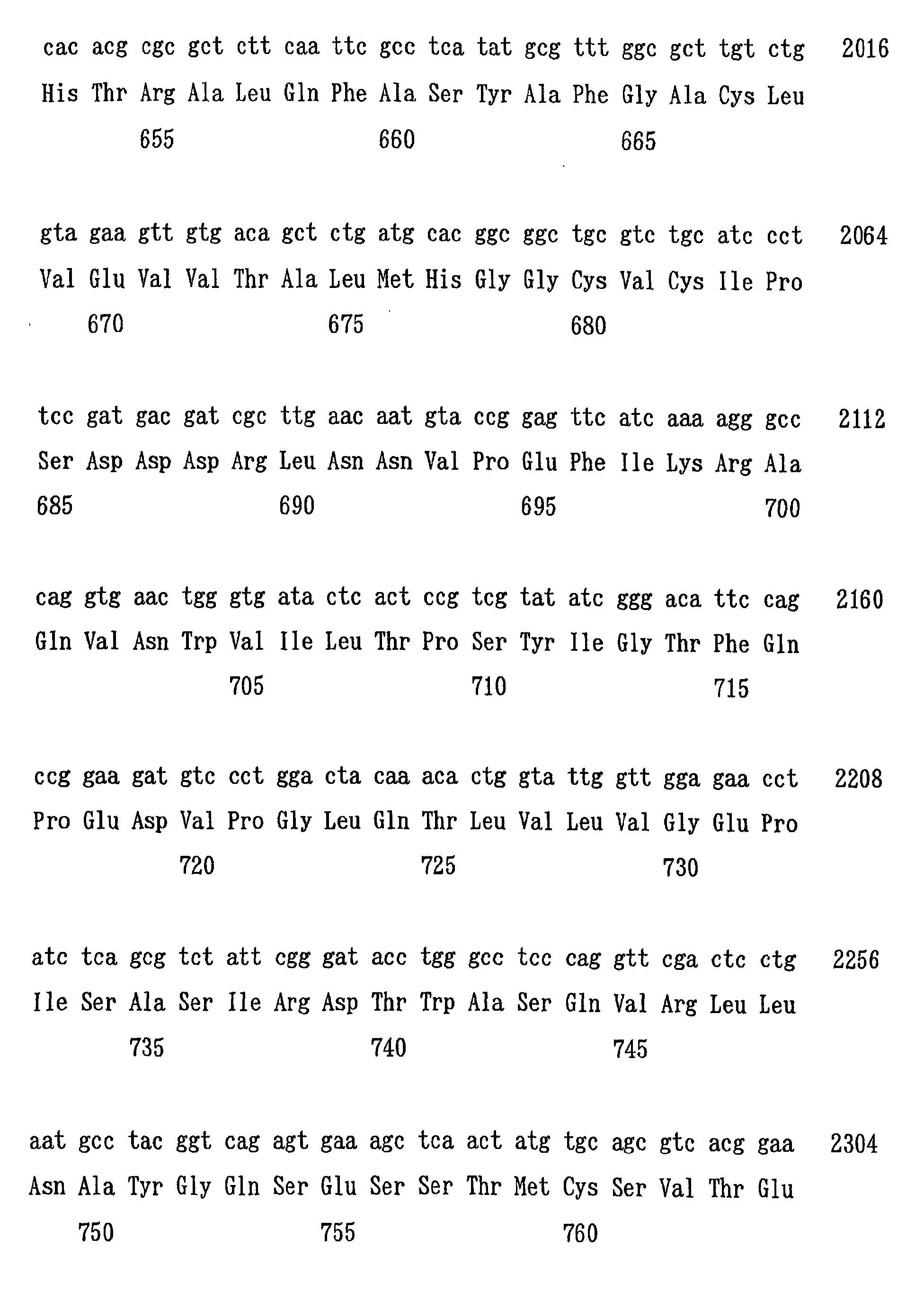
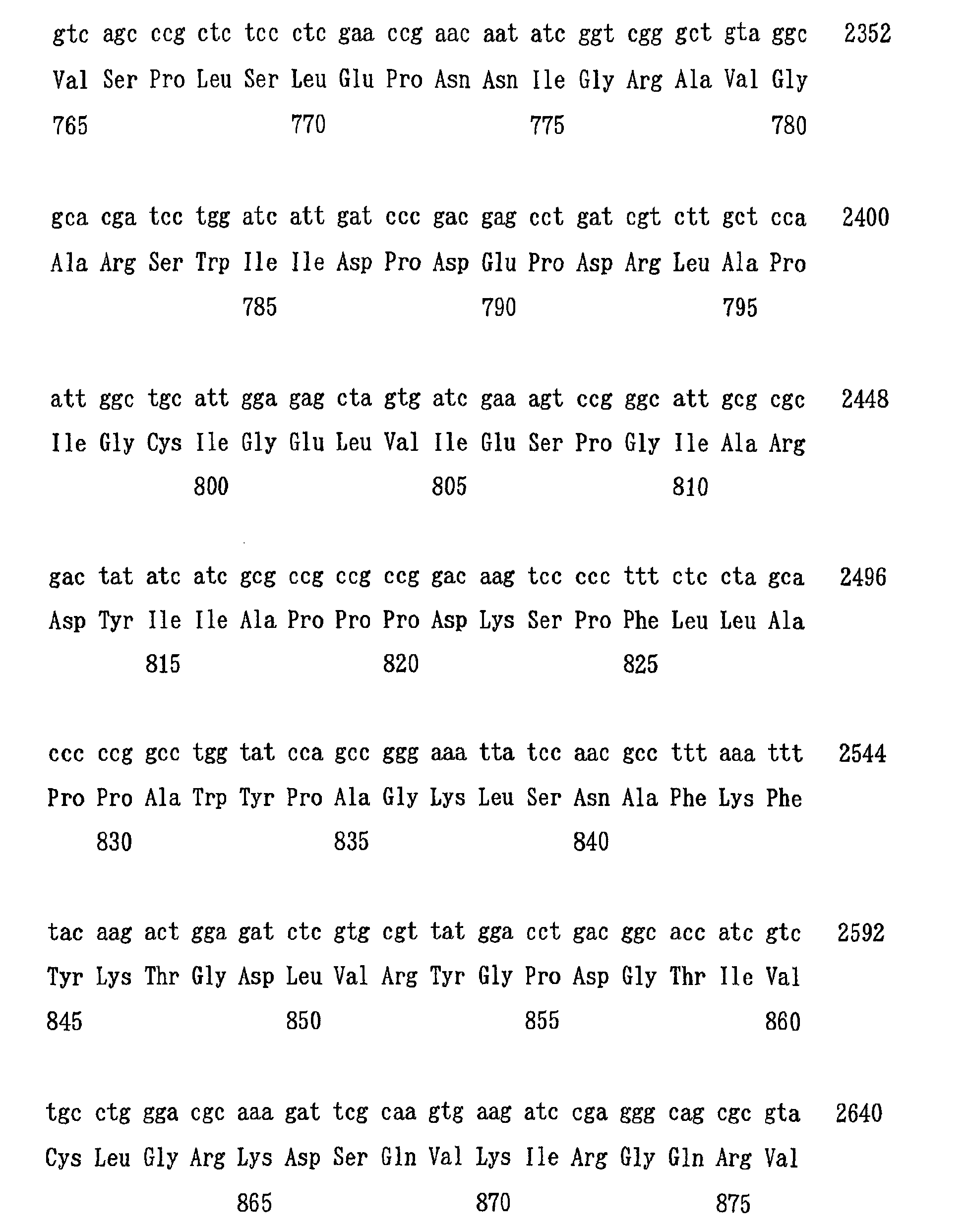
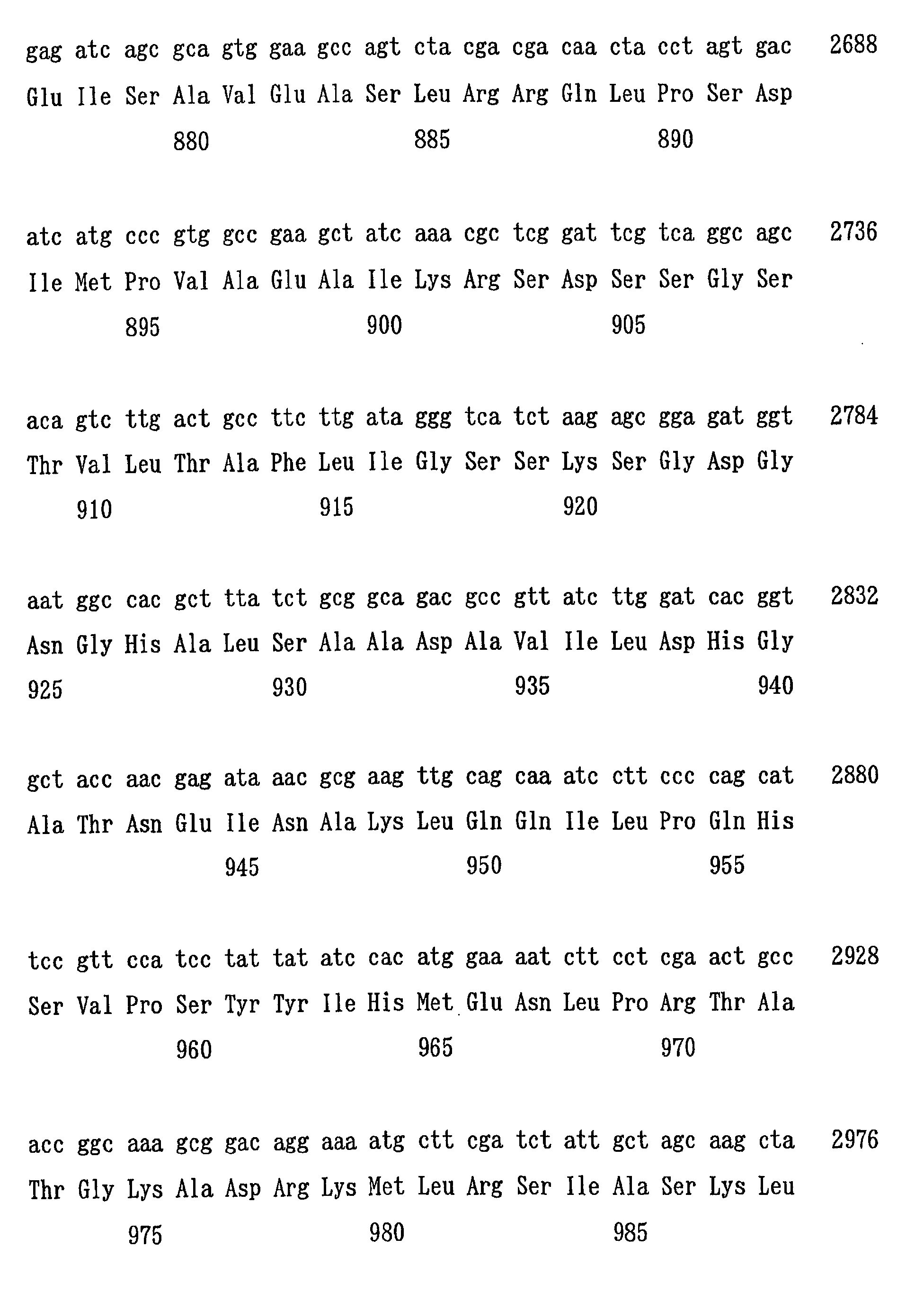


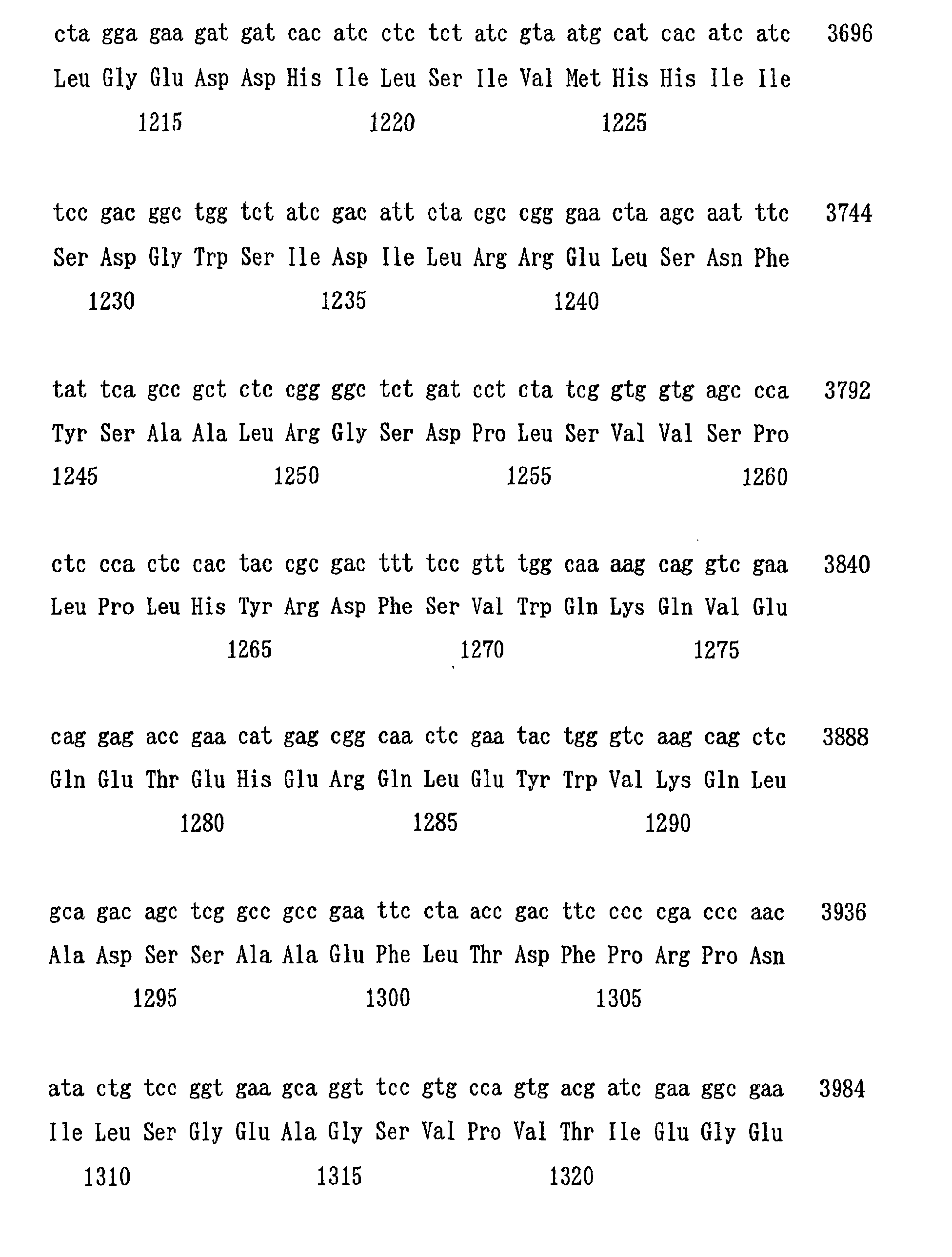
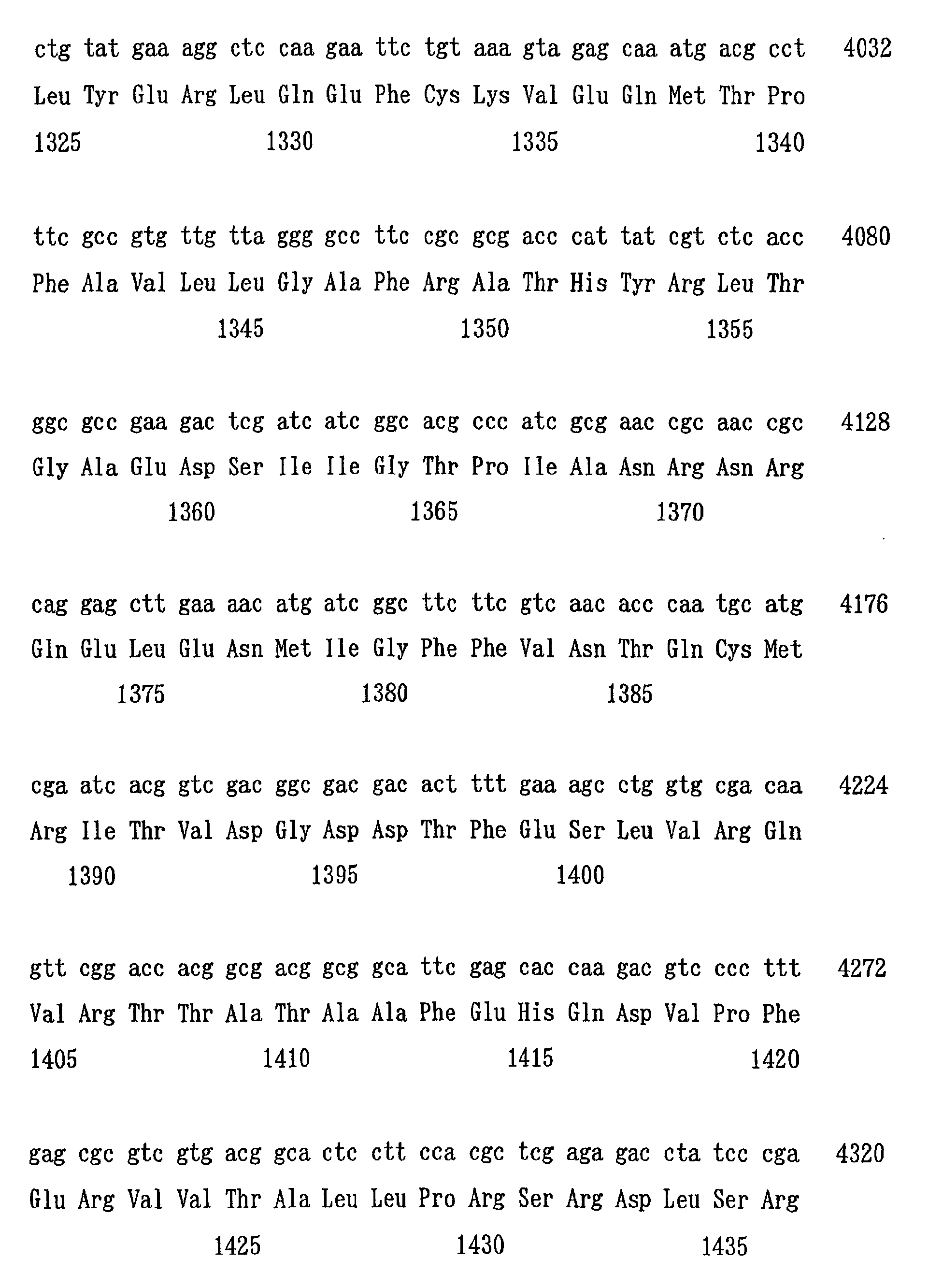
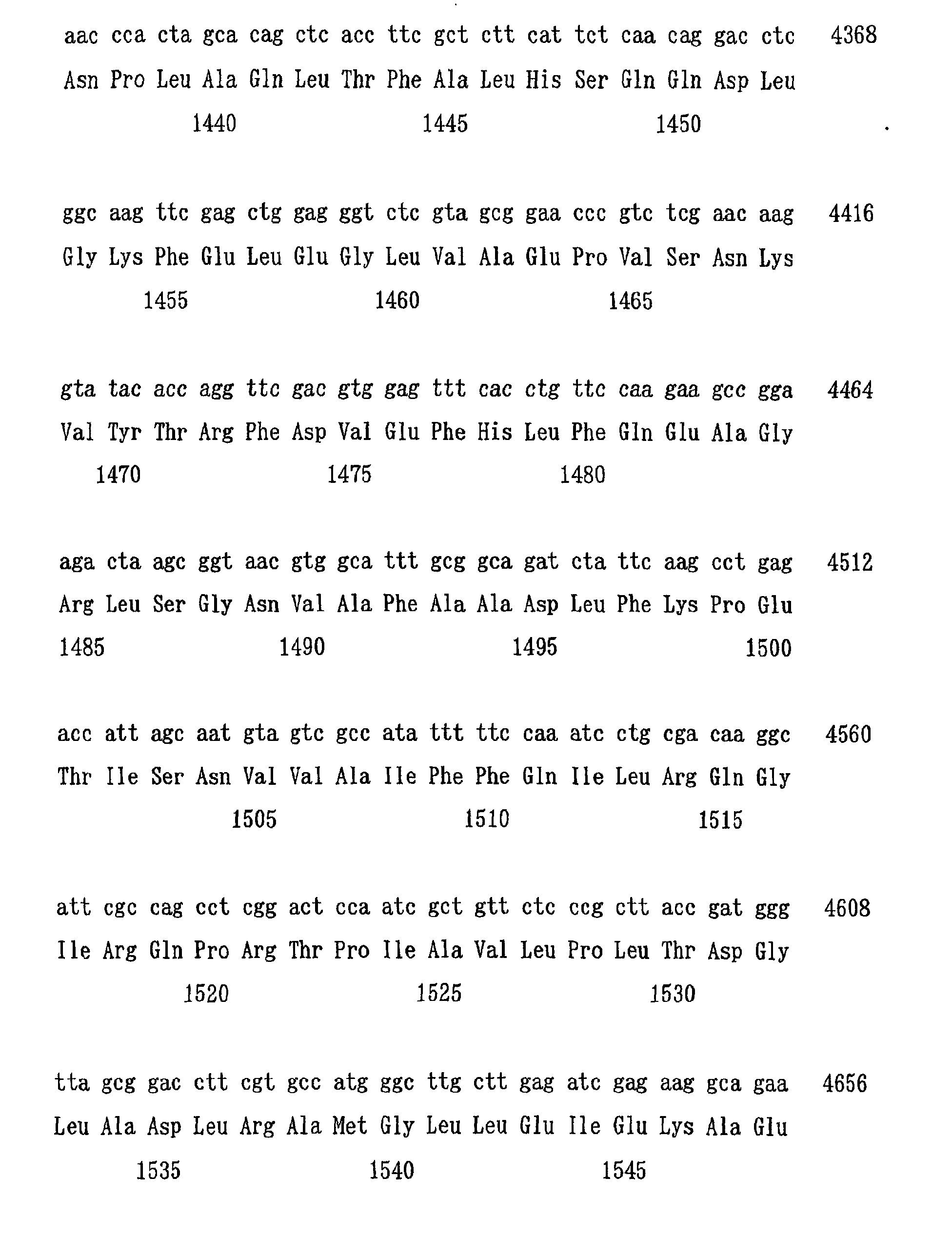


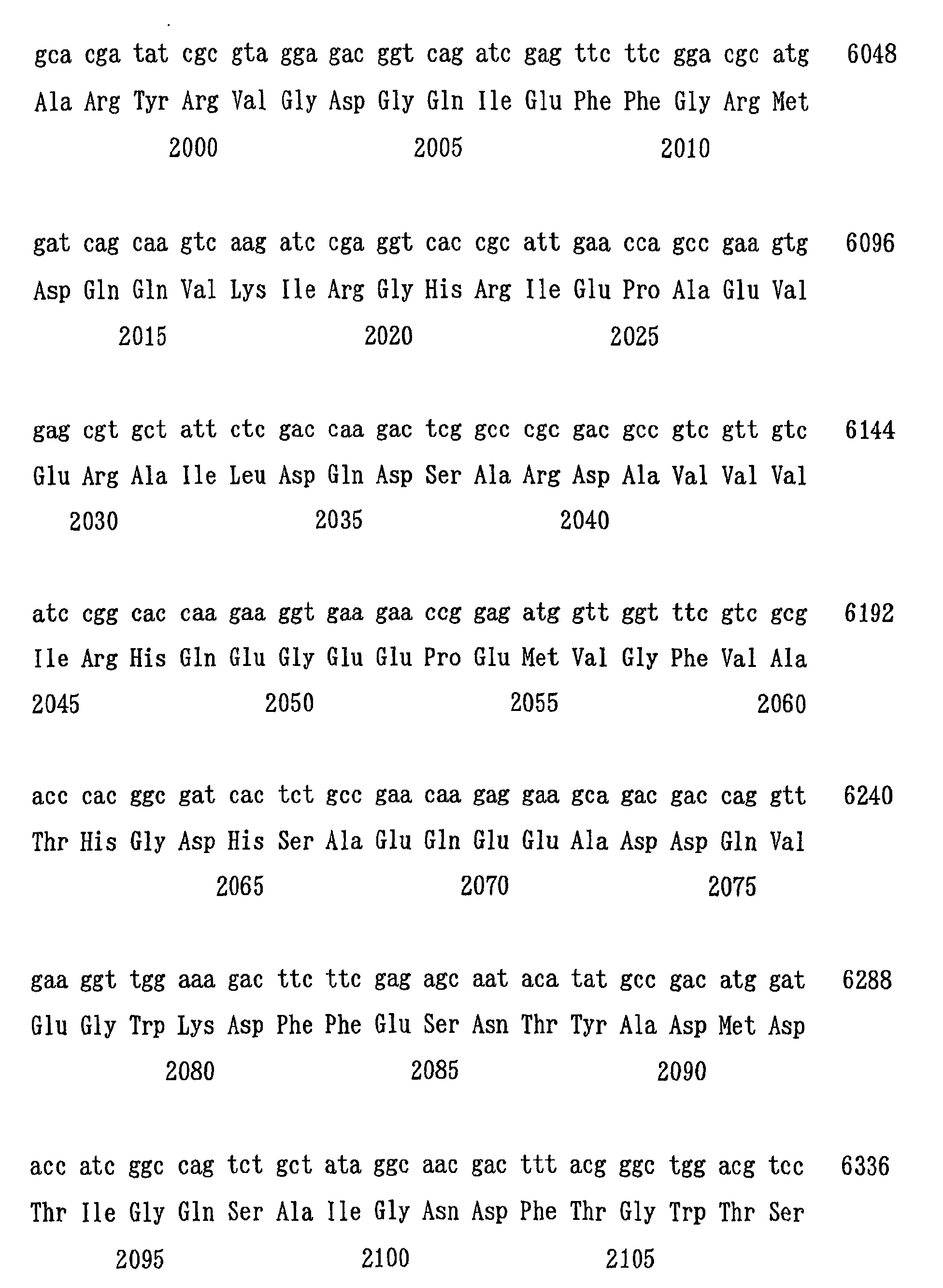


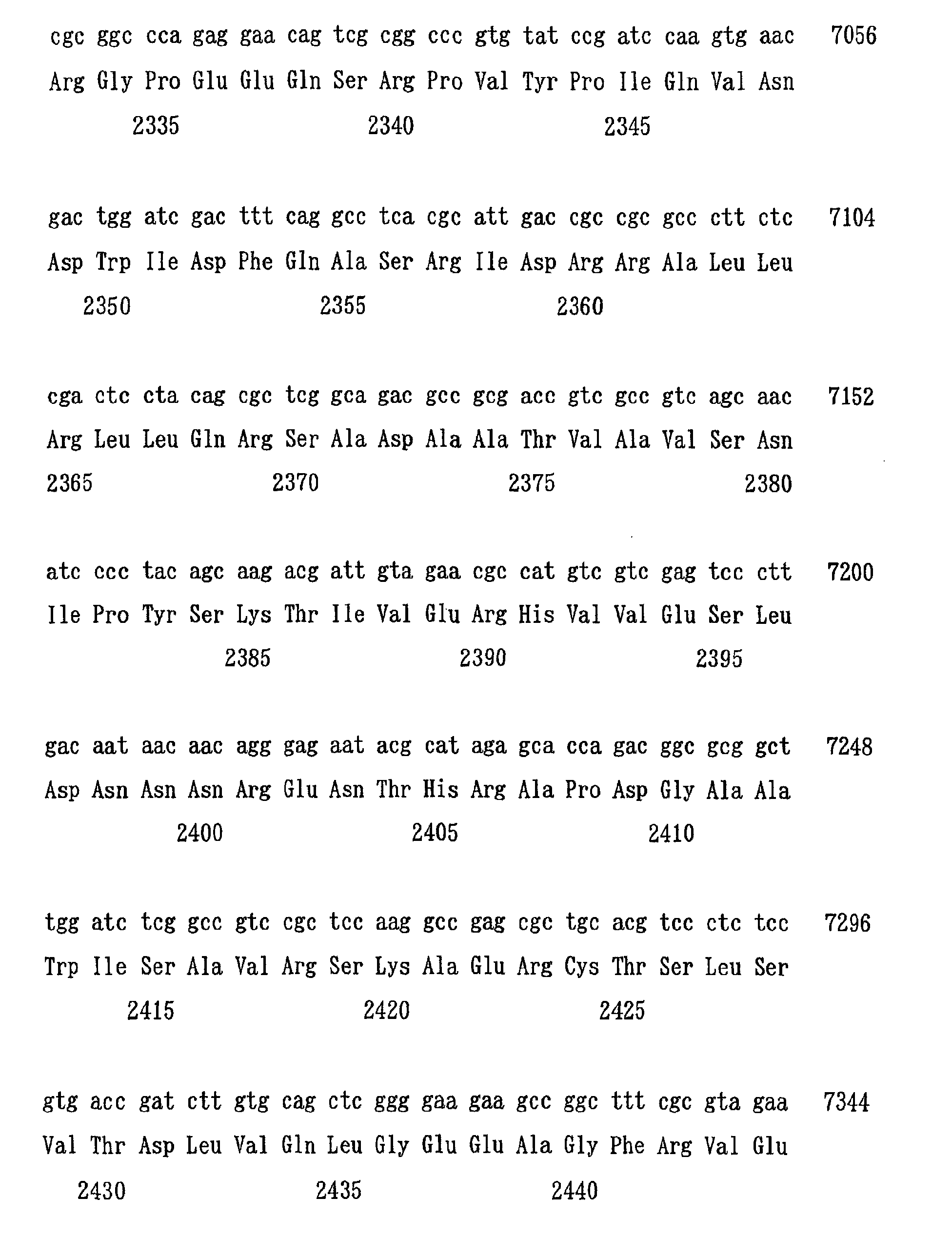


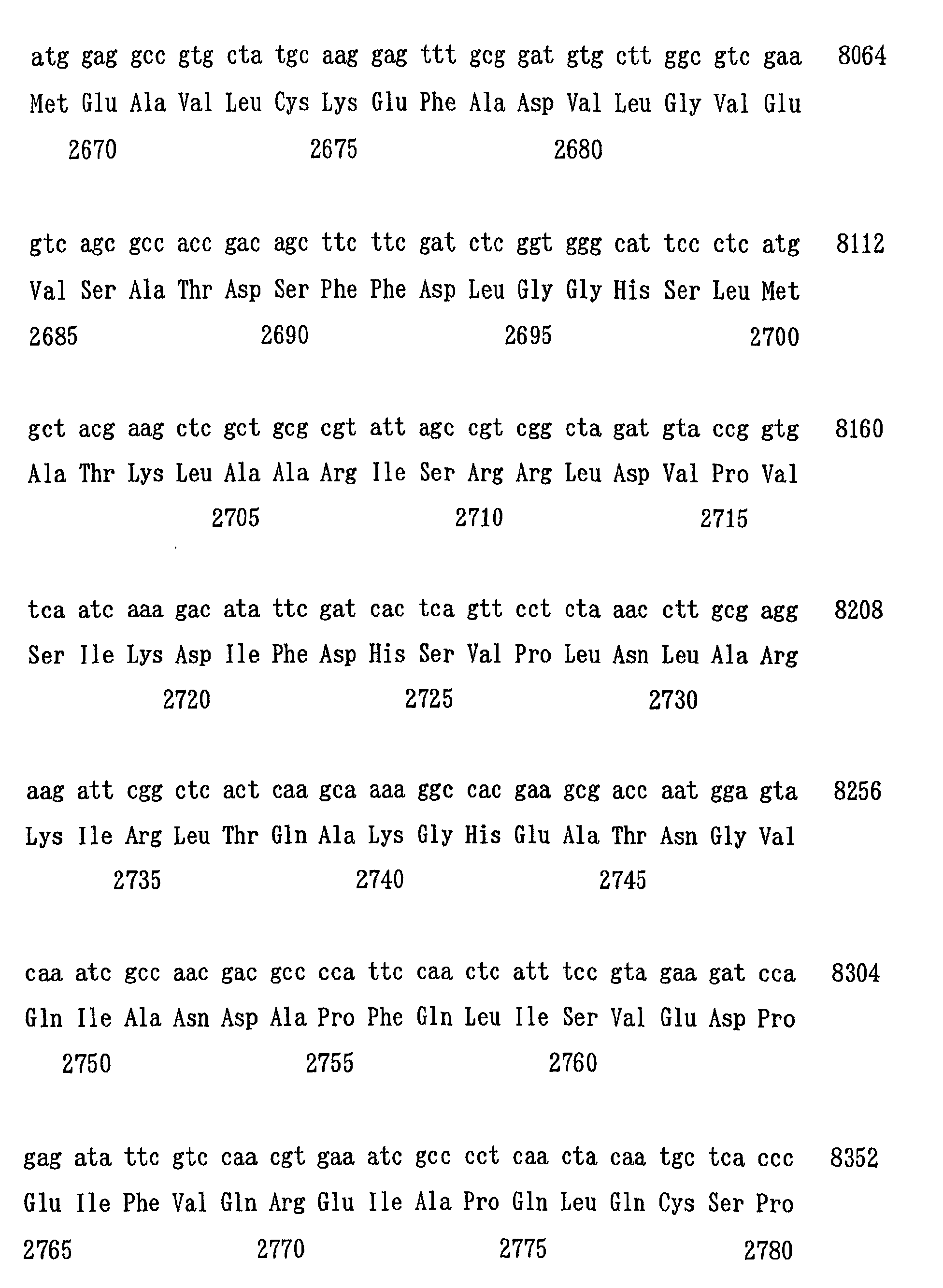


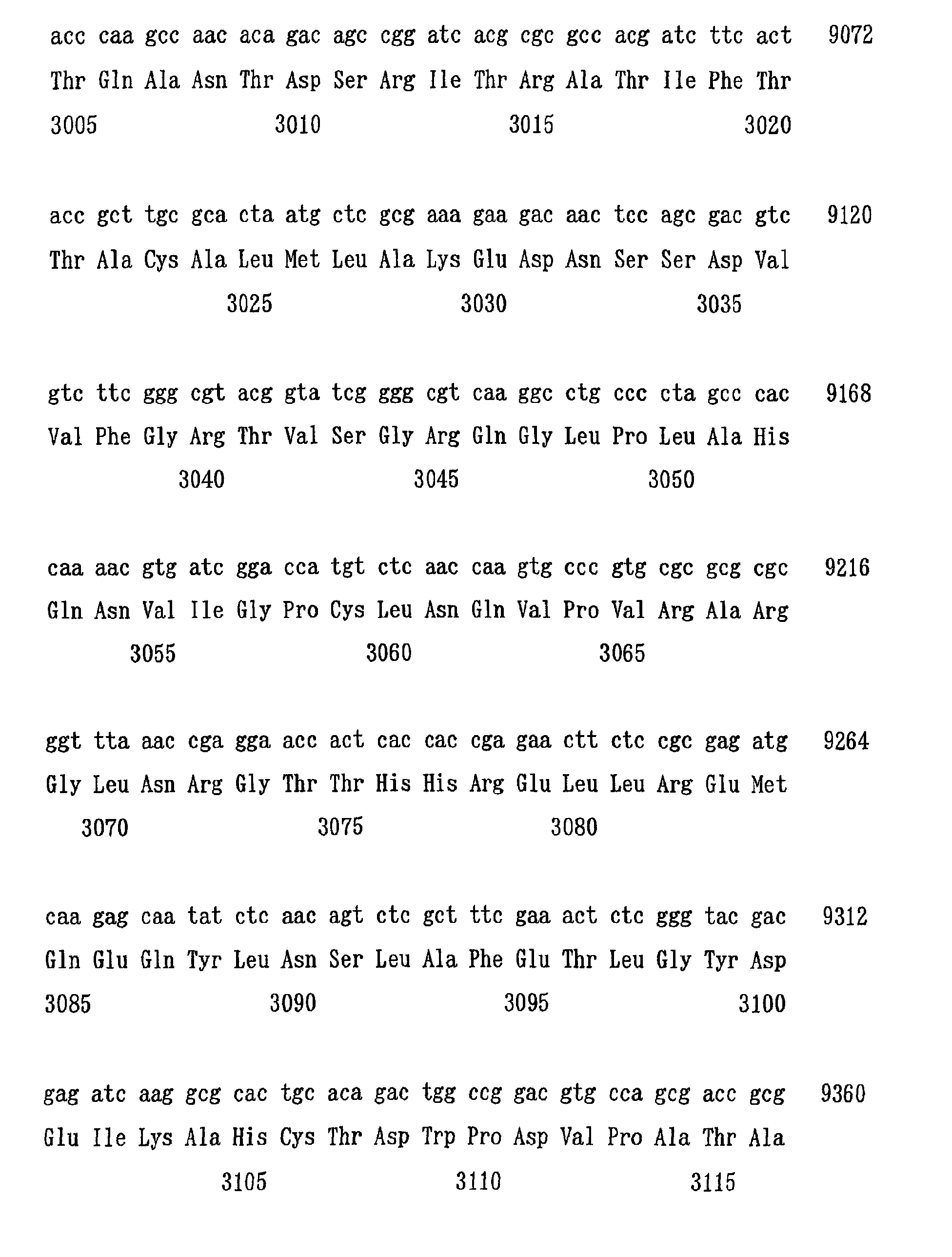
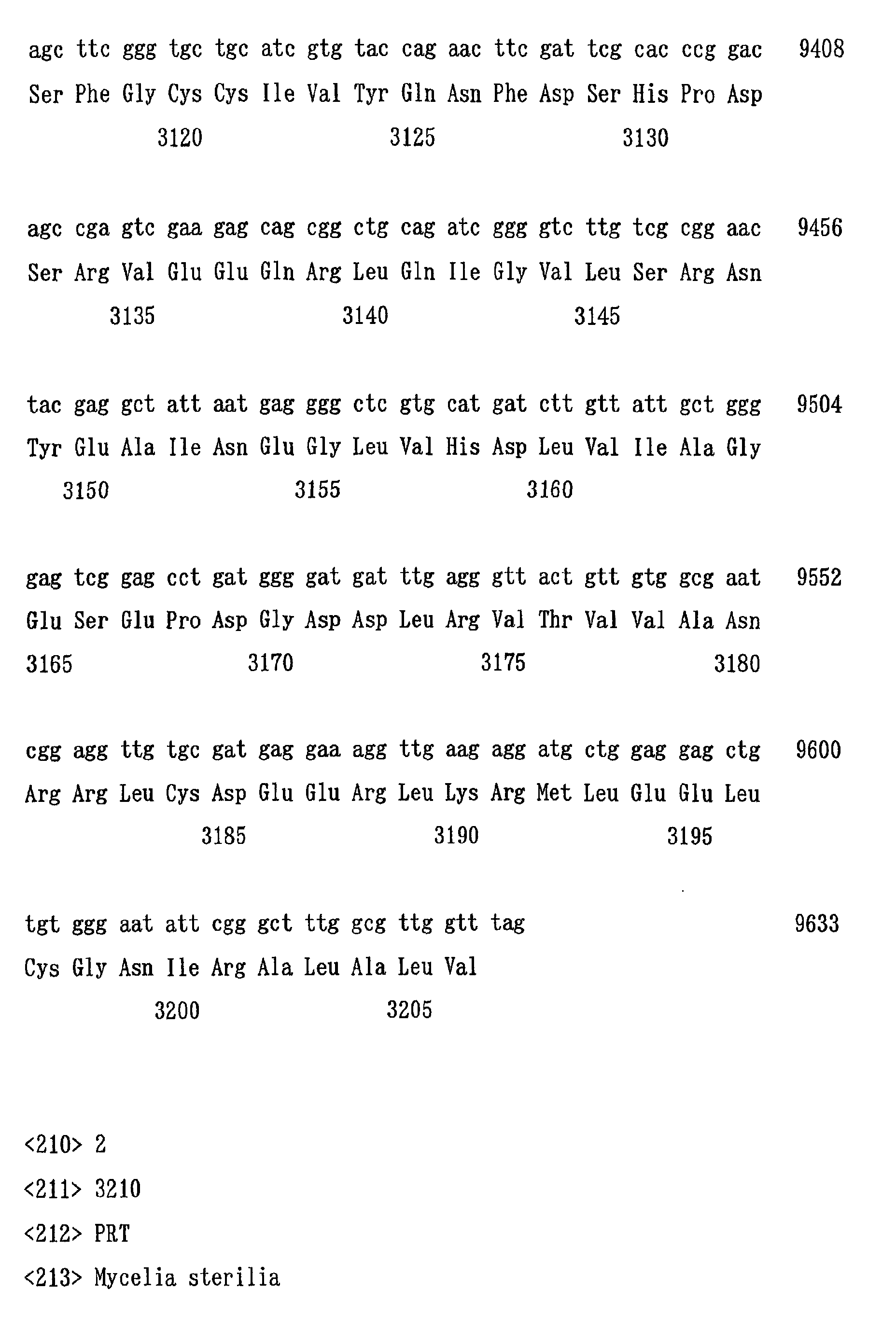

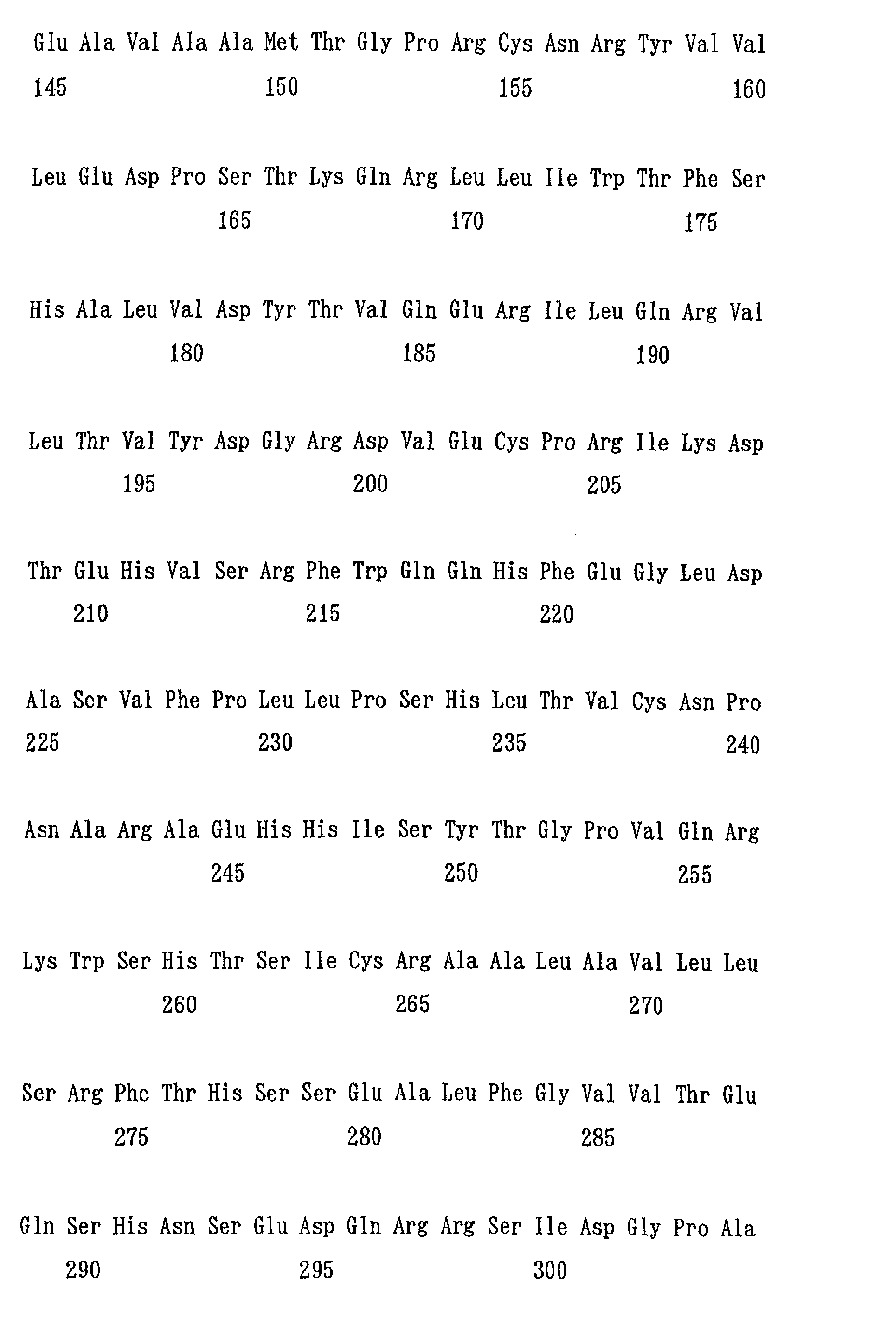

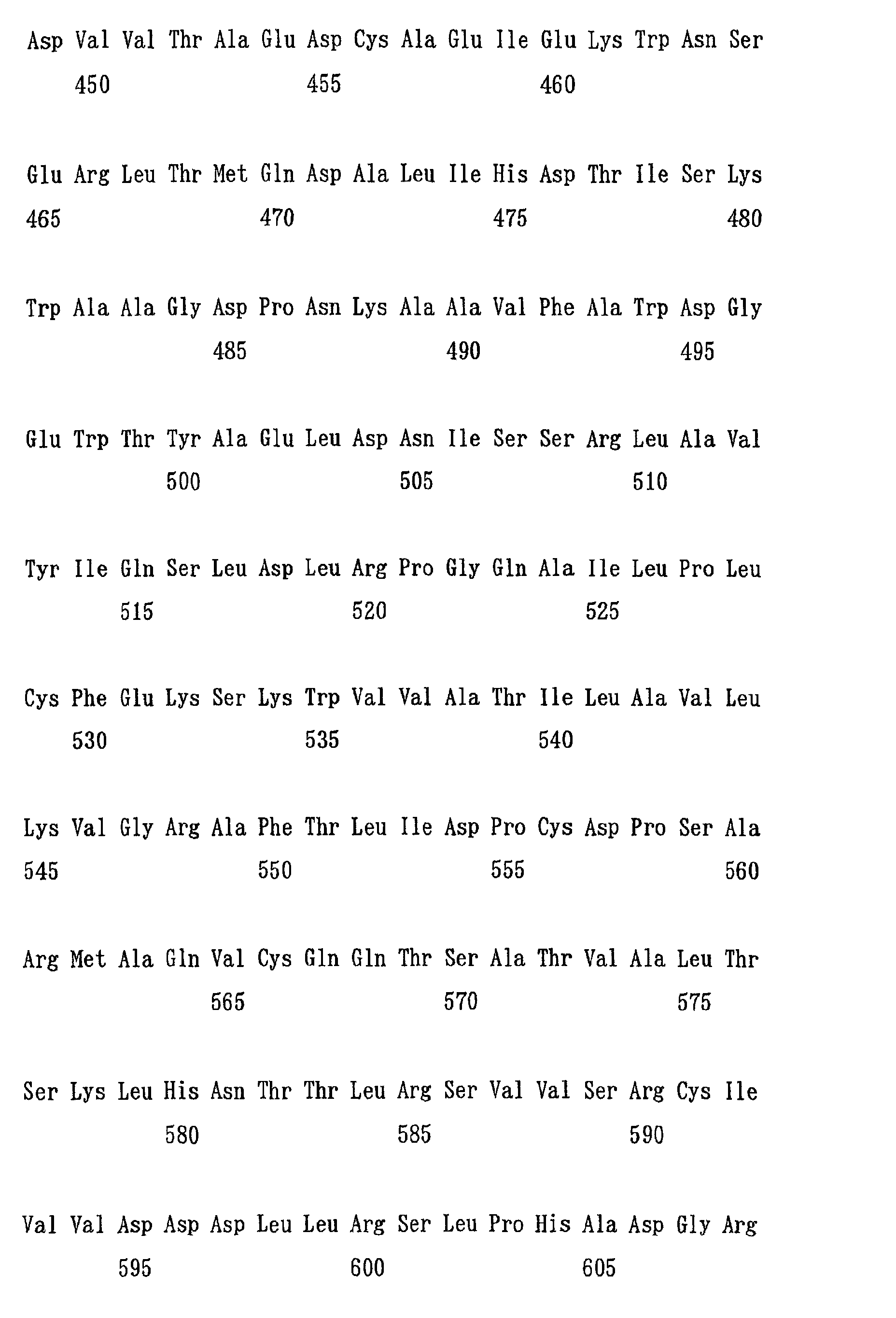


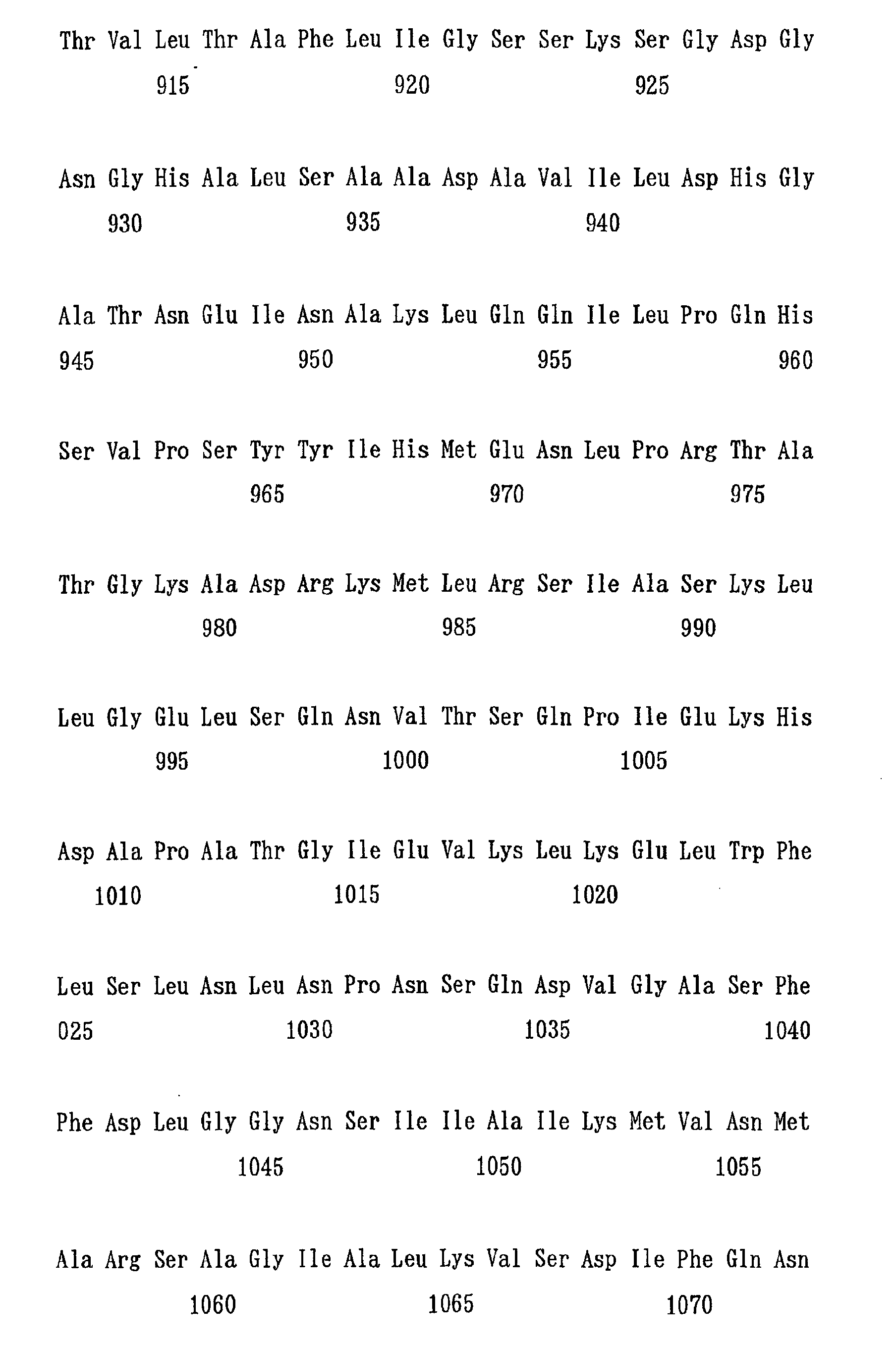


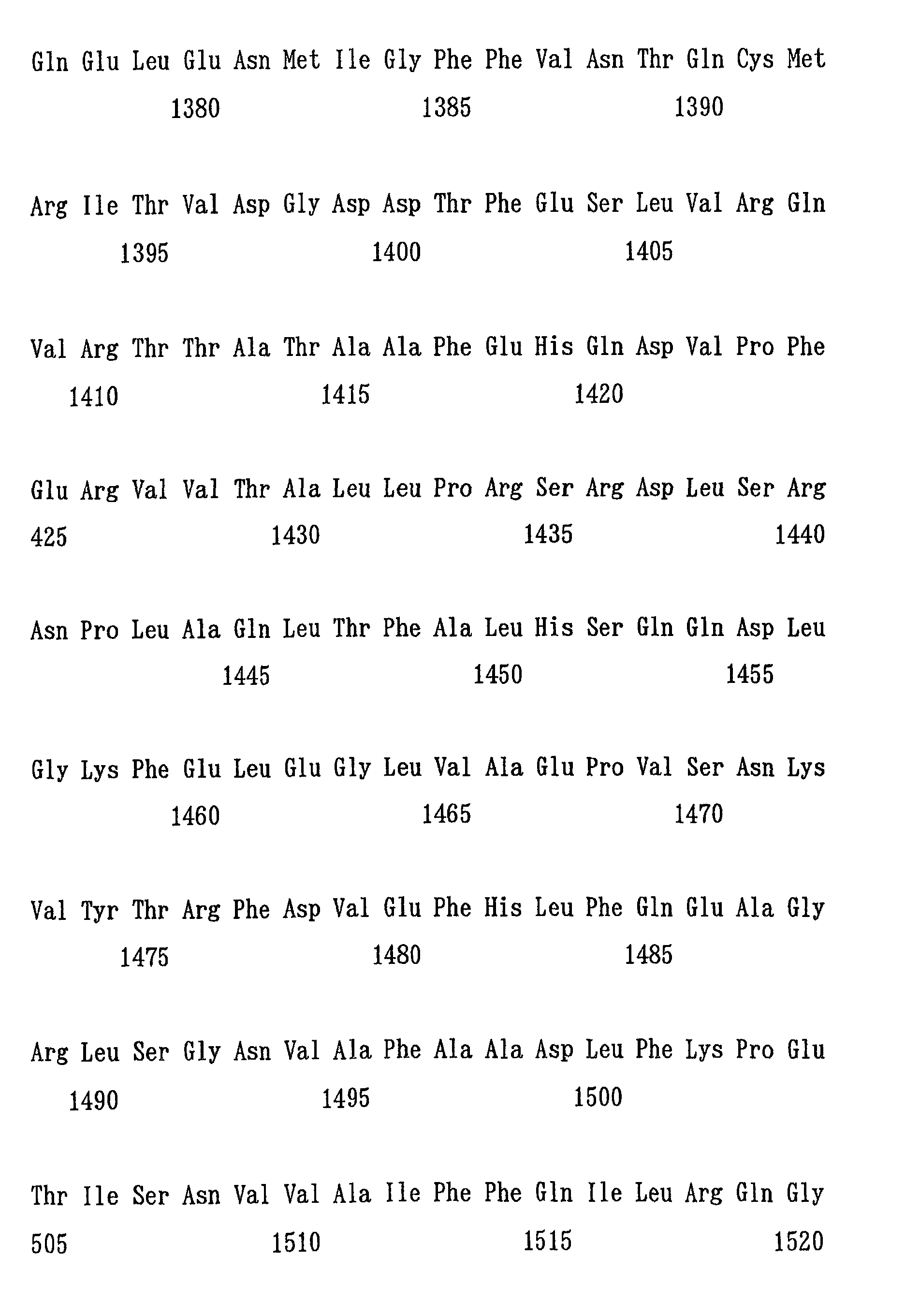

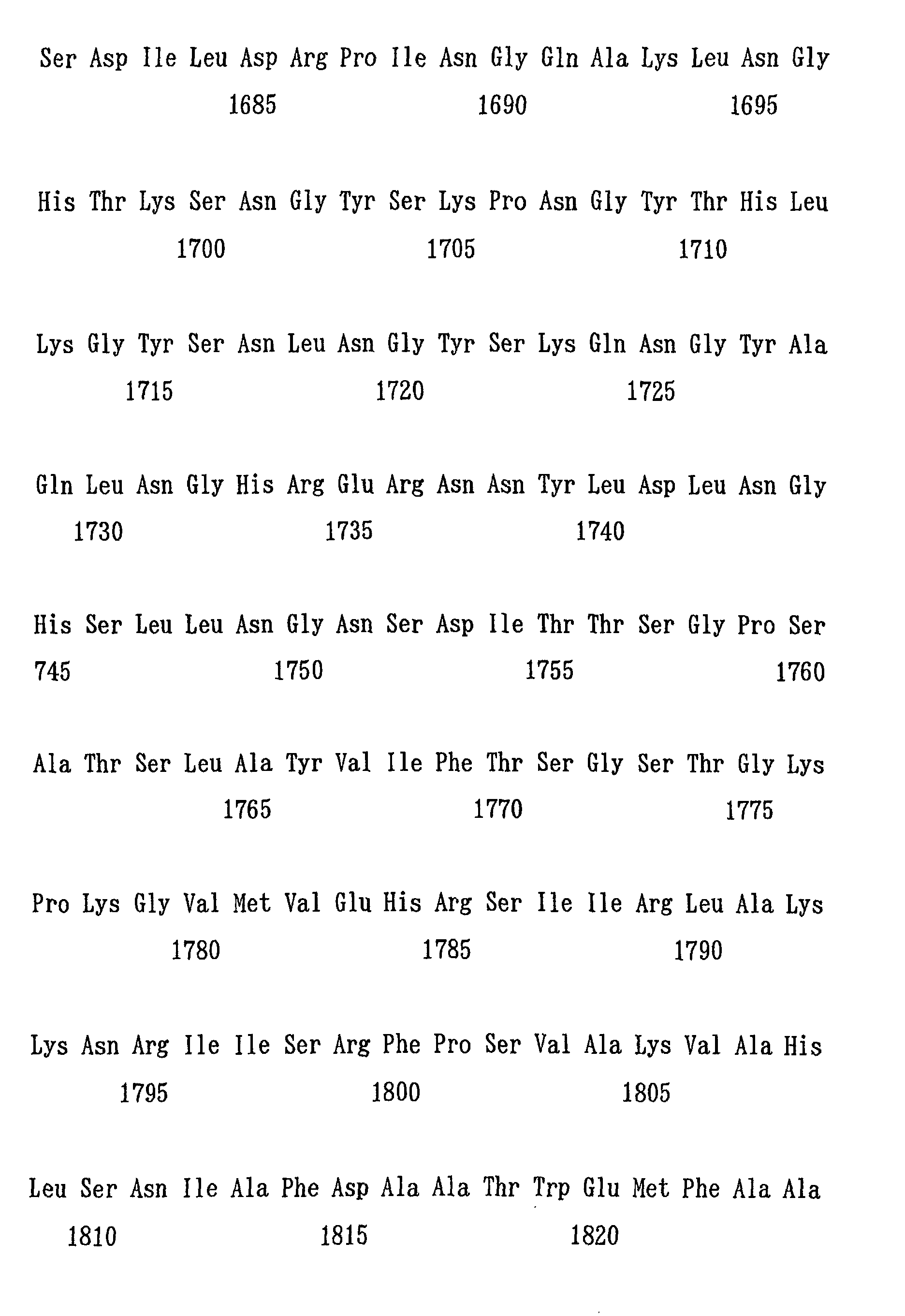
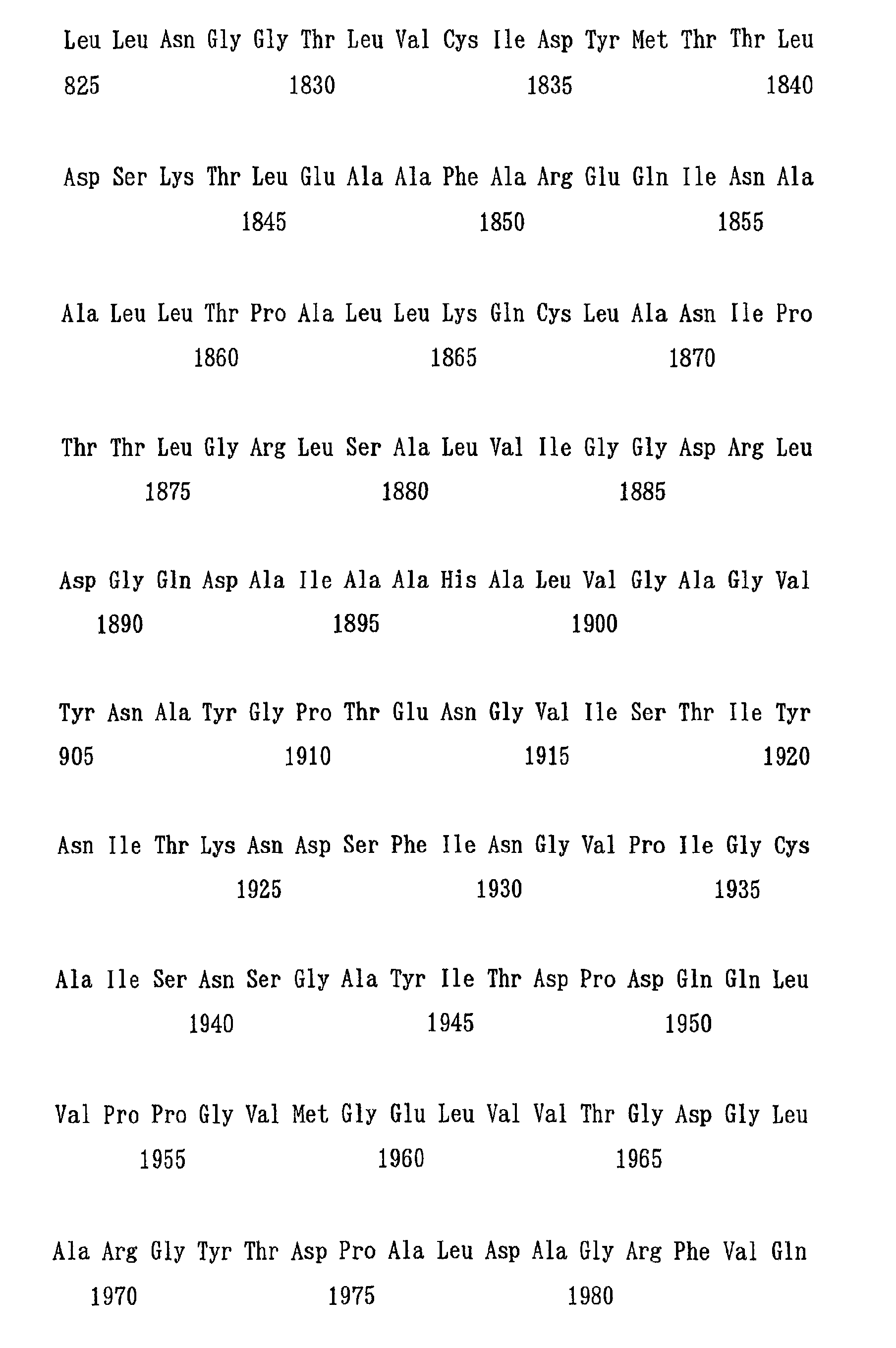


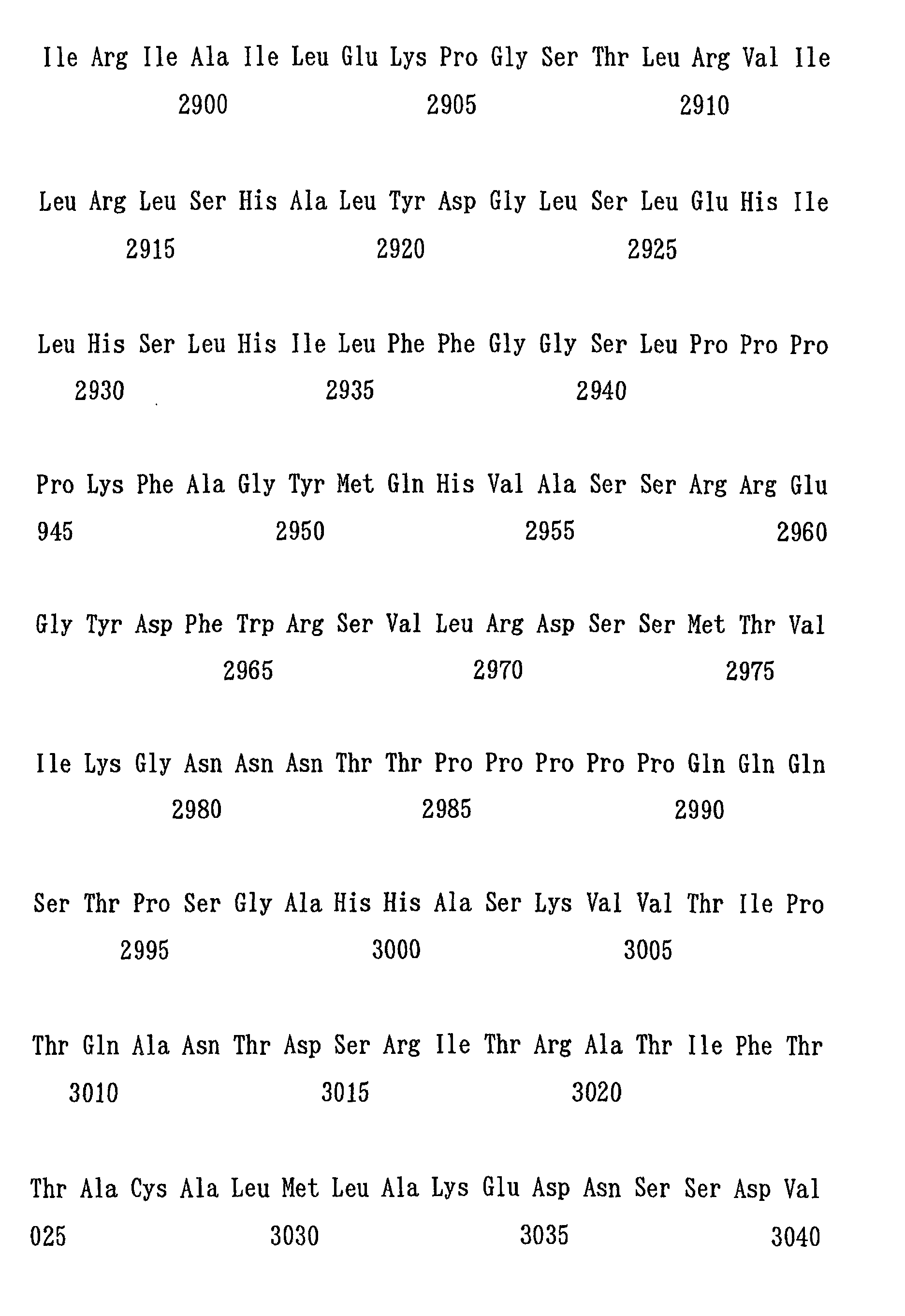


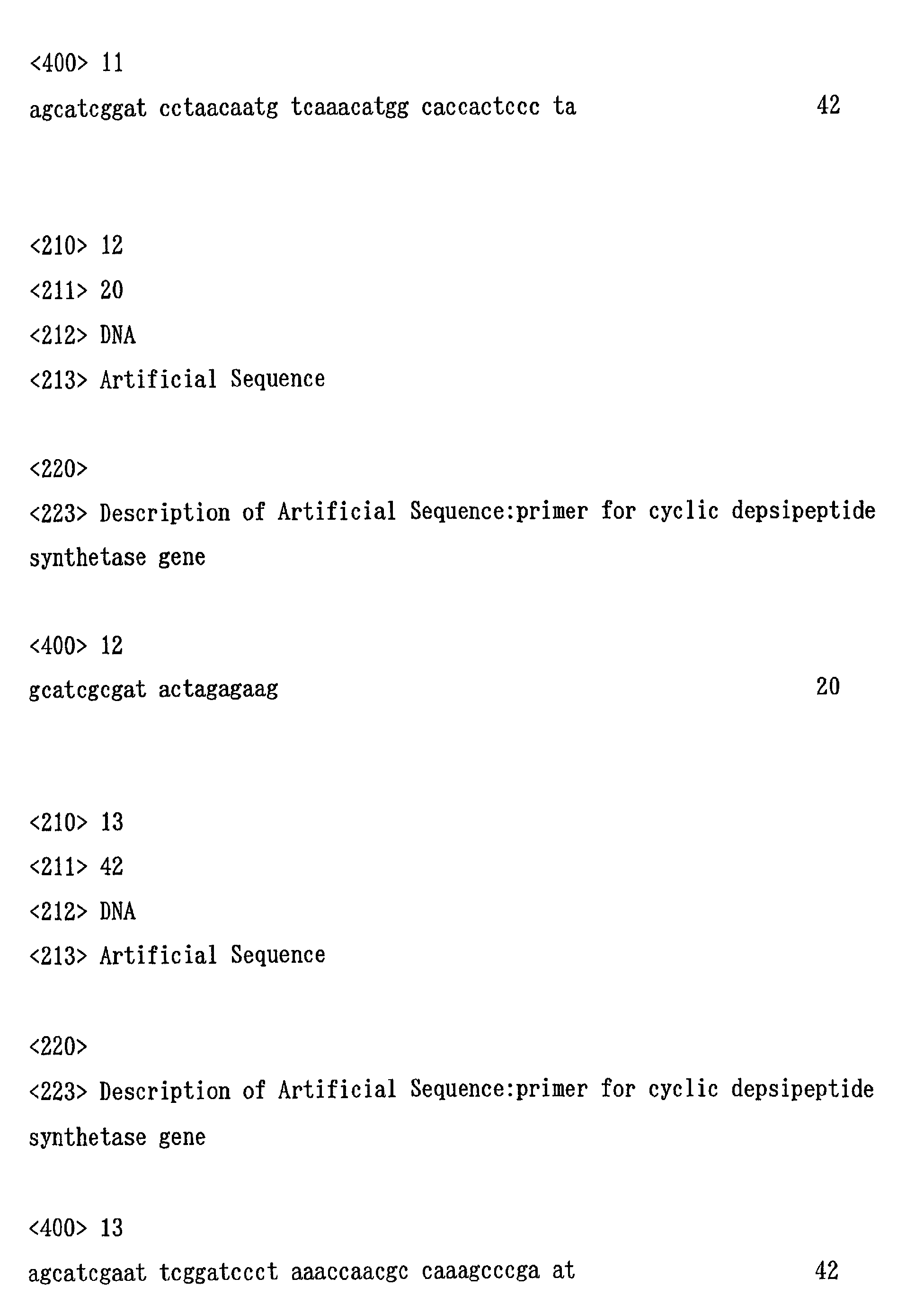

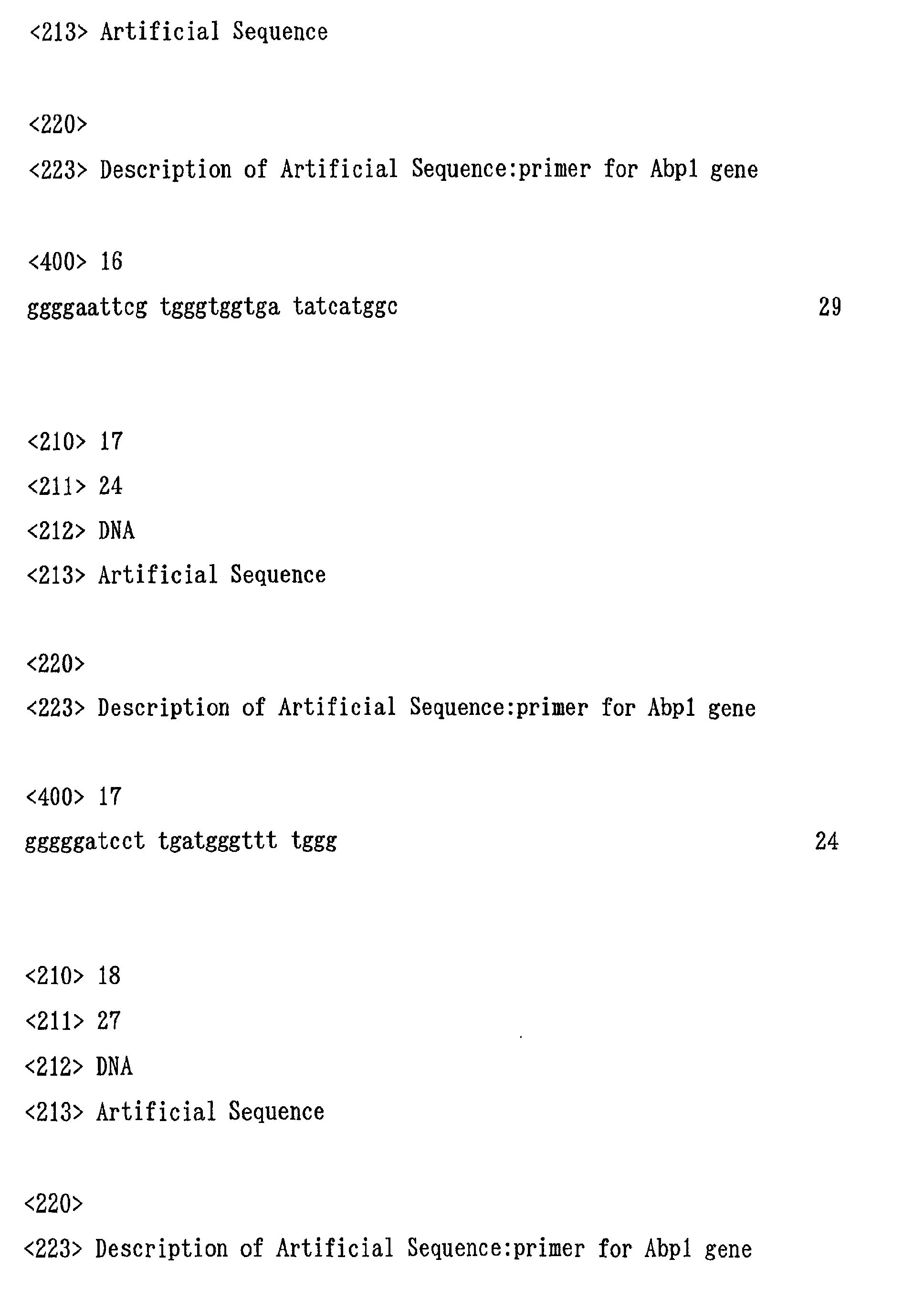
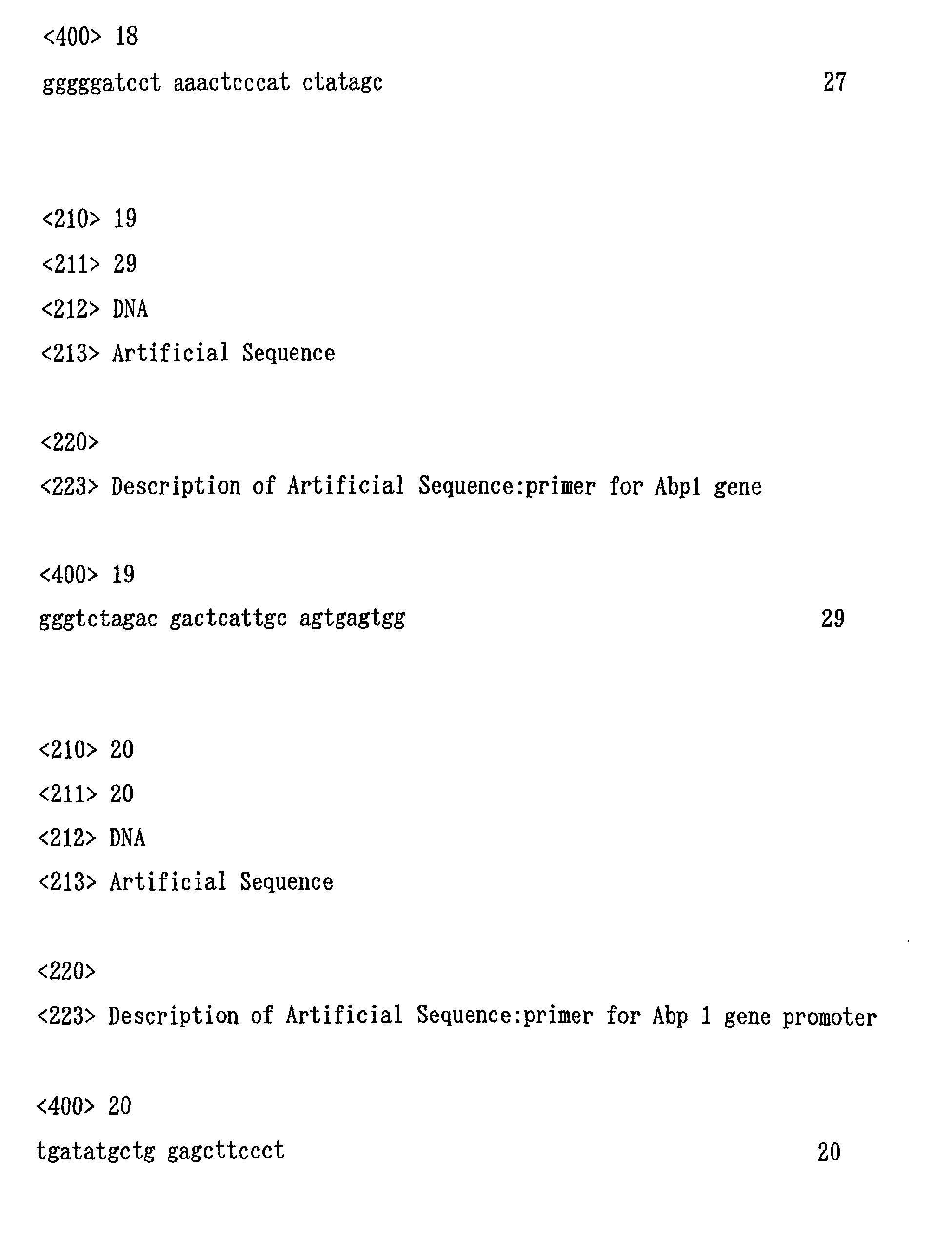

Claims (14)
- A protein comprising an amino acid sequence selected from the group consisting of the following sequences:(a) an amino acid sequence of SEQ ID NO: 2, and(b) a modified amino acid sequence of the amino acid sequence of SEQ ID NO: 2 that has one or more modifications selected from a substitution, a deletion, an addition and an insertion and has cyclic depsipeptide synthetase activity.
- A polynucleotide encoding the protein of claim 1.
- A polynucleotide according to claim 2, which comprises the DNA sequence of SEQ ID NO: 1.
- A polynucleotide selected from the group consisting of the following sequences:(c) a DNA sequence of SEQ ID NO: 1,(d) a nucleotide sequence that has at least 70% homology to the DNA sequence of SEQ ID NO: 1 and encodes a protein having cyclic depsipeptide synthetase activity,(e) a modified DNA sequence of the DNA sequence of SEQ ID NO: 1 that has one or more modifications selected from a substitution, a deletion, an addition and an insertion and encodes a protein having cyclic depsipeptide synthetase activity, and(f) a nucleotide sequence that hybridizes with the DNA sequence of SEQ ID NO: 1 under stringent conditions and encodes a protein having cyclic depsipeptide synthetase activity.
- The polynucleotide according to claim 4, wherein sequence (d) is a nucleotide sequence that has at least 80% homology to the DNA sequence of SEQ ID NO: 1.
- The polynucleotide according to claim 4, wherein sequence (d) is a nucleotide sequence that has at least 90% homology to the DNA sequence of SEQ ID NO: 1.
- A recombinant vector comprising the polynucleotide of any one of claims 2 to 6.
- A host comprising the expression vector of claim 7.
- The host according to claim 8, which expresses a cyclic depsipeptide synthetase.
- The host according to claim 8 or 9, which is a substance PF1022-producing microorganism.
- A method for producing a cyclic depsipeptide, which comprises the steps of culturing the host of claim 8, 9 or 10 and collecting the cyclic depsipeptide from the culture medium.
- The method according to claim 11, wherein the cyclic depsipeptide is the substance PF1022 and a derivative thereof.
- A method for producing a cyclic depsipeptide synthetase , which comprises the steps of culturing the host of claim 8, 9 or 10 and collecting the cyclic depsipeptide synthetase from the culture medium.
- The method according to claim 13, wherein the cyclic depsipeptide is the substance PF1022 and a derivative thereof.
Applications Claiming Priority (5)
| Application Number | Priority Date | Filing Date | Title |
|---|---|---|---|
| JP25304099 | 1999-09-07 | ||
| JP25304099 | 1999-09-07 | ||
| JP2000104291 | 2000-04-06 | ||
| JP2000104291 | 2000-04-06 | ||
| PCT/JP2000/006103 WO2001018179A1 (en) | 1999-09-07 | 2000-09-07 | Cyclic depsipeptide synthases, genes thereof and mass production system of cyclic depsipeptide |
Publications (3)
| Publication Number | Publication Date |
|---|---|
| EP1215281A1 true EP1215281A1 (en) | 2002-06-19 |
| EP1215281A4 EP1215281A4 (en) | 2003-07-02 |
| EP1215281B1 EP1215281B1 (en) | 2006-05-24 |
Family
ID=26541010
Family Applications (1)
| Application Number | Title | Priority Date | Filing Date |
|---|---|---|---|
| EP00957009A Expired - Lifetime EP1215281B1 (en) | 1999-09-07 | 2000-09-07 | Cyclic depsipeptide synthases, genes thereof and mass production system of cyclic depsipeptide |
Country Status (12)
| Country | Link |
|---|---|
| US (1) | US7285404B1 (en) |
| EP (1) | EP1215281B1 (en) |
| JP (1) | JP3961289B2 (en) |
| KR (1) | KR100702728B1 (en) |
| CN (1) | CN1183248C (en) |
| AT (1) | ATE327321T1 (en) |
| AU (1) | AU784466B2 (en) |
| CA (1) | CA2384122C (en) |
| DE (1) | DE60028217T2 (en) |
| NO (1) | NO330902B1 (en) |
| NZ (1) | NZ517588A (en) |
| WO (1) | WO2001018179A1 (en) |
Cited By (3)
| Publication number | Priority date | Publication date | Assignee | Title |
|---|---|---|---|---|
| EP1924699A4 (en) * | 2005-08-26 | 2009-11-11 | Aureogen Biosciences | Aureobasidin a synthetase |
| WO2015140315A3 (en) * | 2014-03-20 | 2015-12-03 | Technische Universität Berlin | Process for producing chimeric cyclooligodepsipeptides in filamentous fungi |
| WO2018166899A1 (en) * | 2017-03-14 | 2018-09-20 | Acidophil Ltd | Methods for production of pf1022a derivatives |
Families Citing this family (7)
| Publication number | Priority date | Publication date | Assignee | Title |
|---|---|---|---|---|
| ATE354650T1 (en) | 2000-04-26 | 2007-03-15 | Meiji Seika Kaisha | NOVEL (R)-2-HYDROXY-3-PHENYLPROPIONATE (D-PHENYL LACTATE) DEHYDROGENASE AND GENE CODING IT |
| US7326546B2 (en) * | 2005-03-10 | 2008-02-05 | Ajinomoto Co., Inc. | Purine-derived substance-producing bacterium and a method for producing purine-derived substance |
| BR112012019458B8 (en) | 2010-01-26 | 2022-08-02 | Mmag Co Ltd | nucleic acid construction, transformant, and methods to produce pyripyropenes |
| CA2878644C (en) | 2012-07-09 | 2023-10-03 | Meiji Seika Pharma Co., Ltd. | Uk-2 biosynthetic genes and method for improving uk-2 productivity using the same |
| GB201421850D0 (en) * | 2014-12-09 | 2015-01-21 | Bactevo Ltd | Method for screening for bioactive natural products |
| CN106749569B (en) * | 2017-03-03 | 2021-10-15 | 重庆乾泰生物医药有限公司 | A kind of separation and purification method of PF1022A |
| CN113046332B (en) * | 2021-03-29 | 2023-08-01 | 华东理工大学 | A class of sesquiterpene skeleton compound and its synthetic gene and preparation method |
Family Cites Families (4)
| Publication number | Priority date | Publication date | Assignee | Title |
|---|---|---|---|---|
| NO176766C (en) | 1989-02-07 | 1995-05-24 | Meiji Seika Kaisha | Process for the preparation of a compound having anthelmintic activity |
| EP0578616A3 (en) * | 1992-07-09 | 1994-06-01 | Sandoz Ltd | Cylosporin synthetase |
| JP3910634B2 (en) * | 1995-06-22 | 2007-04-25 | 明治製菓株式会社 | Transformant producing PF1022 substance and method for transforming bacteria belonging to filamentous fungi |
| US6057491A (en) * | 1997-05-29 | 2000-05-02 | Borad Of Regents For University Of Oklahoma | Protein having insecticidal activities and method of use |
-
2000
- 2000-09-07 AU AU68741/00A patent/AU784466B2/en not_active Ceased
- 2000-09-07 WO PCT/JP2000/006103 patent/WO2001018179A1/en not_active Ceased
- 2000-09-07 NZ NZ517588A patent/NZ517588A/en not_active IP Right Cessation
- 2000-09-07 KR KR1020027002704A patent/KR100702728B1/en not_active Expired - Fee Related
- 2000-09-07 CA CA2384122A patent/CA2384122C/en not_active Expired - Fee Related
- 2000-09-07 DE DE60028217T patent/DE60028217T2/en not_active Expired - Lifetime
- 2000-09-07 JP JP2001522391A patent/JP3961289B2/en not_active Expired - Fee Related
- 2000-09-07 US US10/070,387 patent/US7285404B1/en not_active Expired - Fee Related
- 2000-09-07 EP EP00957009A patent/EP1215281B1/en not_active Expired - Lifetime
- 2000-09-07 CN CNB008153019A patent/CN1183248C/en not_active Expired - Fee Related
- 2000-09-07 AT AT00957009T patent/ATE327321T1/en not_active IP Right Cessation
-
2002
- 2002-03-06 NO NO20021100A patent/NO330902B1/en not_active IP Right Cessation
Non-Patent Citations (3)
| Title |
|---|
| BURMESTER J ET AL: "HIGHLY CONSERVED N-METHYLTRANSFERASES AS AN INTEGRAL PART OF PEPTIDE SYNTHASES" BIOCHEMISTRY AND MOLECULAR BIOLOGY INTERNATIONAL, ACADEMIC PRESS, LONDON, GB, vol. 37, no. 2, October 1995 (1995-10), pages 201-207, XP000965322 ISSN: 1039-9712 * |
| MARAHIEL M A ET AL: "Modular peptide synthetases involved in nonribosomal peptide synthesis" CHEMICAL REVIEWS, AMERICAN CHEMICAL SOCIETY. EASTON, US, vol. 97, no. 7, November 1997 (1997-11), pages 2651-2673, XP002133489 ISSN: 0009-2665 * |
| See also references of WO0118179A1 * |
Cited By (4)
| Publication number | Priority date | Publication date | Assignee | Title |
|---|---|---|---|---|
| EP1924699A4 (en) * | 2005-08-26 | 2009-11-11 | Aureogen Biosciences | Aureobasidin a synthetase |
| WO2015140315A3 (en) * | 2014-03-20 | 2015-12-03 | Technische Universität Berlin | Process for producing chimeric cyclooligodepsipeptides in filamentous fungi |
| US10738316B2 (en) | 2014-03-20 | 2020-08-11 | Technische Universität Berlin | Process for producing chimeric cyclooligodepsipeptides in filamentous fungi |
| WO2018166899A1 (en) * | 2017-03-14 | 2018-09-20 | Acidophil Ltd | Methods for production of pf1022a derivatives |
Also Published As
| Publication number | Publication date |
|---|---|
| EP1215281B1 (en) | 2006-05-24 |
| CN1183248C (en) | 2005-01-05 |
| CA2384122C (en) | 2010-05-04 |
| JP3961289B2 (en) | 2007-08-22 |
| EP1215281A4 (en) | 2003-07-02 |
| ATE327321T1 (en) | 2006-06-15 |
| NO20021100L (en) | 2002-05-07 |
| NO20021100D0 (en) | 2002-03-06 |
| KR100702728B1 (en) | 2007-04-03 |
| NO330902B1 (en) | 2011-08-15 |
| CN1387566A (en) | 2002-12-25 |
| US7285404B1 (en) | 2007-10-23 |
| DE60028217D1 (en) | 2006-06-29 |
| CA2384122A1 (en) | 2001-03-15 |
| NZ517588A (en) | 2005-01-28 |
| WO2001018179A1 (en) | 2001-03-15 |
| AU784466B2 (en) | 2006-04-06 |
| AU6874100A (en) | 2001-04-10 |
| DE60028217T2 (en) | 2007-04-26 |
| KR20020029767A (en) | 2002-04-19 |
Similar Documents
| Publication | Publication Date | Title |
|---|---|---|
| CN112292452B (en) | Microorganism producing mycosporine-like amino acid and method for producing mycosporine-like amino acid using the same | |
| KR101530819B1 (en) | A microorganism having enhanced l-lysine productivity and method of producing l-lysine using the same | |
| EP1215281B1 (en) | Cyclic depsipeptide synthases, genes thereof and mass production system of cyclic depsipeptide | |
| CN111527211A (en) | Microorganism producing mycosporine-like amino acid and method for producing mycosporine-like amino acid using the same | |
| JP3910634B2 (en) | Transformant producing PF1022 substance and method for transforming bacteria belonging to filamentous fungi | |
| JPWO2001018179A1 (en) | Cyclic depsipeptide synthase and its gene, and a mass production system for cyclic depsipeptides | |
| EP3205728B1 (en) | Process for producing 7-dehydrocholesterol and vitamin d3 | |
| JPWO1997000944A1 (en) | Transformant producing PF1022 substance and method for transforming fungi belonging to the class of filamentous fungi | |
| CN109563504B (en) | Nucleoside enzyme | |
| CN112368387A (en) | Engineered biosynthetic pathway for production of histamine by fermentation | |
| US7709240B2 (en) | AMP deaminase originating streptomyces and utilization thereof | |
| CN113005071A (en) | Application of SsgA coding gene SMDS _1018, recombinant strain and construction method of recombinant strain | |
| US7109018B1 (en) | Transformant producing secondary metabolite modified with functional group and novel biosynthesis genes | |
| TWI903096B (en) | Microorganism with weakened activity of laci family dna-binding transcriptional regulator and production method of l-glutamic acid using the same | |
| CN112639117A (en) | Method for producing glutathione | |
| EP1197557A1 (en) | Gene encoding cyclic lipopeptide acylase and expression of the same | |
| EP1291417B1 (en) | Novel (r)-2-hydroxy-3-phenylpropionate (d-phenyllactate) dehydrogenase and gene encoding the same | |
| EP1380649B1 (en) | Transformant producing pf1022 substance derivatives, process for producing the same and novel biosynthesis gene | |
| JPWO2001081563A1 (en) | Novel (R)-2-hydroxy-3-phenylpropionic acid (D-phenyllactate) dehydrogenase and gene encoding same | |
| KR101592269B1 (en) | Transcription regulating sigma factor SigA-vm and producing method for glycopeptide compounds by overexpressing the sigma factor | |
| CN119144641A (en) | Method for improving succinic acid tolerance of yeast, yeast strain with improved succinic acid tolerance and application of yeast strain | |
| JP2004024199A (en) | Protein having mannose isomerase activity and polynucleotide encoding the protein | |
| HK40046127A (en) | Engineered biosynthetic pathways for production of histamine by fermentation |
Legal Events
| Date | Code | Title | Description |
|---|---|---|---|
| PUAI | Public reference made under article 153(3) epc to a published international application that has entered the european phase |
Free format text: ORIGINAL CODE: 0009012 |
|
| 17P | Request for examination filed |
Effective date: 20020404 |
|
| AK | Designated contracting states |
Kind code of ref document: A1 Designated state(s): AT BE CH CY DE DK ES FI FR GB GR IE IT LI LU MC NL PT SE |
|
| AX | Request for extension of the european patent |
Free format text: AL;LT;LV;MK;RO;SI |
|
| A4 | Supplementary search report drawn up and despatched |
Effective date: 20030516 |
|
| RIC1 | Information provided on ipc code assigned before grant |
Ipc: 7C 12P 21/04 B Ipc: 7C 12N 9/00 A Ipc: 7C 12N 15/52 B Ipc: 7C 12N 1/15 B Ipc: 7C 12P 21/00 B |
|
| 17Q | First examination report despatched |
Effective date: 20031125 |
|
| GRAP | Despatch of communication of intention to grant a patent |
Free format text: ORIGINAL CODE: EPIDOSNIGR1 |
|
| GRAS | Grant fee paid |
Free format text: ORIGINAL CODE: EPIDOSNIGR3 |
|
| GRAA | (expected) grant |
Free format text: ORIGINAL CODE: 0009210 |
|
| AK | Designated contracting states |
Kind code of ref document: B1 Designated state(s): AT BE CH CY DE DK ES FI FR GB GR IE IT LI LU MC NL PT SE |
|
| PG25 | Lapsed in a contracting state [announced via postgrant information from national office to epo] |
Ref country code: AT Free format text: LAPSE BECAUSE OF FAILURE TO SUBMIT A TRANSLATION OF THE DESCRIPTION OR TO PAY THE FEE WITHIN THE PRESCRIBED TIME-LIMIT Effective date: 20060524 Ref country code: LI Free format text: LAPSE BECAUSE OF FAILURE TO SUBMIT A TRANSLATION OF THE DESCRIPTION OR TO PAY THE FEE WITHIN THE PRESCRIBED TIME-LIMIT Effective date: 20060524 Ref country code: CH Free format text: LAPSE BECAUSE OF FAILURE TO SUBMIT A TRANSLATION OF THE DESCRIPTION OR TO PAY THE FEE WITHIN THE PRESCRIBED TIME-LIMIT Effective date: 20060524 Ref country code: FI Free format text: LAPSE BECAUSE OF FAILURE TO SUBMIT A TRANSLATION OF THE DESCRIPTION OR TO PAY THE FEE WITHIN THE PRESCRIBED TIME-LIMIT Effective date: 20060524 |
|
| REG | Reference to a national code |
Ref country code: GB Ref legal event code: FG4D |
|
| REG | Reference to a national code |
Ref country code: CH Ref legal event code: EP |
|
| REG | Reference to a national code |
Ref country code: IE Ref legal event code: FG4D |
|
| REF | Corresponds to: |
Ref document number: 60028217 Country of ref document: DE Date of ref document: 20060629 Kind code of ref document: P |
|
| PG25 | Lapsed in a contracting state [announced via postgrant information from national office to epo] |
Ref country code: SE Free format text: LAPSE BECAUSE OF FAILURE TO SUBMIT A TRANSLATION OF THE DESCRIPTION OR TO PAY THE FEE WITHIN THE PRESCRIBED TIME-LIMIT Effective date: 20060824 Ref country code: DK Free format text: LAPSE BECAUSE OF FAILURE TO SUBMIT A TRANSLATION OF THE DESCRIPTION OR TO PAY THE FEE WITHIN THE PRESCRIBED TIME-LIMIT Effective date: 20060824 |
|
| PG25 | Lapsed in a contracting state [announced via postgrant information from national office to epo] |
Ref country code: ES Free format text: LAPSE BECAUSE OF FAILURE TO SUBMIT A TRANSLATION OF THE DESCRIPTION OR TO PAY THE FEE WITHIN THE PRESCRIBED TIME-LIMIT Effective date: 20060904 |
|
| PG25 | Lapsed in a contracting state [announced via postgrant information from national office to epo] |
Ref country code: IE Free format text: LAPSE BECAUSE OF NON-PAYMENT OF DUE FEES Effective date: 20060907 |
|
| PG25 | Lapsed in a contracting state [announced via postgrant information from national office to epo] |
Ref country code: MC Free format text: LAPSE BECAUSE OF NON-PAYMENT OF DUE FEES Effective date: 20060930 |
|
| PG25 | Lapsed in a contracting state [announced via postgrant information from national office to epo] |
Ref country code: PT Free format text: LAPSE BECAUSE OF FAILURE TO SUBMIT A TRANSLATION OF THE DESCRIPTION OR TO PAY THE FEE WITHIN THE PRESCRIBED TIME-LIMIT Effective date: 20061024 |
|
| ET | Fr: translation filed | ||
| REG | Reference to a national code |
Ref country code: CH Ref legal event code: PL |
|
| PLBE | No opposition filed within time limit |
Free format text: ORIGINAL CODE: 0009261 |
|
| STAA | Information on the status of an ep patent application or granted ep patent |
Free format text: STATUS: NO OPPOSITION FILED WITHIN TIME LIMIT |
|
| 26N | No opposition filed |
Effective date: 20070227 |
|
| PG25 | Lapsed in a contracting state [announced via postgrant information from national office to epo] |
Ref country code: GR Free format text: LAPSE BECAUSE OF FAILURE TO SUBMIT A TRANSLATION OF THE DESCRIPTION OR TO PAY THE FEE WITHIN THE PRESCRIBED TIME-LIMIT Effective date: 20060825 |
|
| PG25 | Lapsed in a contracting state [announced via postgrant information from national office to epo] |
Ref country code: LU Free format text: LAPSE BECAUSE OF NON-PAYMENT OF DUE FEES Effective date: 20060907 |
|
| PG25 | Lapsed in a contracting state [announced via postgrant information from national office to epo] |
Ref country code: CY Free format text: LAPSE BECAUSE OF FAILURE TO SUBMIT A TRANSLATION OF THE DESCRIPTION OR TO PAY THE FEE WITHIN THE PRESCRIBED TIME-LIMIT Effective date: 20060524 |
|
| PGFP | Annual fee paid to national office [announced via postgrant information from national office to epo] |
Ref country code: GB Payment date: 20120905 Year of fee payment: 13 |
|
| PGFP | Annual fee paid to national office [announced via postgrant information from national office to epo] |
Ref country code: FR Payment date: 20120926 Year of fee payment: 13 Ref country code: IT Payment date: 20120914 Year of fee payment: 13 Ref country code: DE Payment date: 20120905 Year of fee payment: 13 |
|
| PGFP | Annual fee paid to national office [announced via postgrant information from national office to epo] |
Ref country code: BE Payment date: 20120912 Year of fee payment: 13 Ref country code: NL Payment date: 20120919 Year of fee payment: 13 |
|
| BERE | Be: lapsed |
Owner name: *MEIJI SEIKA KAISHA LTD Effective date: 20130930 |
|
| REG | Reference to a national code |
Ref country code: NL Ref legal event code: V1 Effective date: 20140401 |
|
| GBPC | Gb: european patent ceased through non-payment of renewal fee |
Effective date: 20130907 |
|
| REG | Reference to a national code |
Ref country code: FR Ref legal event code: ST Effective date: 20140530 |
|
| REG | Reference to a national code |
Ref country code: DE Ref legal event code: R119 Ref document number: 60028217 Country of ref document: DE Effective date: 20140401 |
|
| PG25 | Lapsed in a contracting state [announced via postgrant information from national office to epo] |
Ref country code: GB Free format text: LAPSE BECAUSE OF NON-PAYMENT OF DUE FEES Effective date: 20130907 Ref country code: BE Free format text: LAPSE BECAUSE OF NON-PAYMENT OF DUE FEES Effective date: 20130930 |
|
| PG25 | Lapsed in a contracting state [announced via postgrant information from national office to epo] |
Ref country code: NL Free format text: LAPSE BECAUSE OF NON-PAYMENT OF DUE FEES Effective date: 20140401 Ref country code: IT Free format text: LAPSE BECAUSE OF NON-PAYMENT OF DUE FEES Effective date: 20130907 Ref country code: DE Free format text: LAPSE BECAUSE OF NON-PAYMENT OF DUE FEES Effective date: 20140401 Ref country code: FR Free format text: LAPSE BECAUSE OF NON-PAYMENT OF DUE FEES Effective date: 20130930 |