EP1215209A1 - Method for the production of a crystalline epoxide - Google Patents
Method for the production of a crystalline epoxide Download PDFInfo
- Publication number
- EP1215209A1 EP1215209A1 EP01310368A EP01310368A EP1215209A1 EP 1215209 A1 EP1215209 A1 EP 1215209A1 EP 01310368 A EP01310368 A EP 01310368A EP 01310368 A EP01310368 A EP 01310368A EP 1215209 A1 EP1215209 A1 EP 1215209A1
- Authority
- EP
- European Patent Office
- Prior art keywords
- tert
- butoxycarbonylamino
- phenylbutane
- solvent
- water
- Prior art date
- Legal status (The legal status is an assumption and is not a legal conclusion. Google has not performed a legal analysis and makes no representation as to the accuracy of the status listed.)
- Granted
Links
- 238000000034 method Methods 0.000 title claims abstract description 62
- 238000004519 manufacturing process Methods 0.000 title claims abstract description 22
- 150000002118 epoxides Chemical class 0.000 title 1
- XLYOFNOQVPJJNP-UHFFFAOYSA-N water Substances O XLYOFNOQVPJJNP-UHFFFAOYSA-N 0.000 claims abstract description 65
- 239000013078 crystal Substances 0.000 claims abstract description 54
- 238000002425 crystallisation Methods 0.000 claims abstract description 48
- 230000008025 crystallization Effects 0.000 claims abstract description 45
- 239000002798 polar solvent Substances 0.000 claims abstract description 38
- NVPOUMXZERMIJK-STQMWFEESA-N tert-butyl n-[(1s)-1-[(2r)-oxiran-2-yl]-2-phenylethyl]carbamate Chemical compound C([C@H](NC(=O)OC(C)(C)C)[C@H]1OC1)C1=CC=CC=C1 NVPOUMXZERMIJK-STQMWFEESA-N 0.000 claims abstract description 14
- KFZMGEQAYNKOFK-UHFFFAOYSA-N Isopropanol Chemical compound CC(C)O KFZMGEQAYNKOFK-UHFFFAOYSA-N 0.000 claims description 72
- LFQSCWFLJHTTHZ-UHFFFAOYSA-N Ethanol Chemical compound CCO LFQSCWFLJHTTHZ-UHFFFAOYSA-N 0.000 claims description 28
- 239000002904 solvent Substances 0.000 claims description 25
- OKKJLVBELUTLKV-UHFFFAOYSA-N Methanol Chemical compound OC OKKJLVBELUTLKV-UHFFFAOYSA-N 0.000 claims description 24
- BDERNNFJNOPAEC-UHFFFAOYSA-N propan-1-ol Chemical compound CCCO BDERNNFJNOPAEC-UHFFFAOYSA-N 0.000 claims description 24
- 239000012046 mixed solvent Substances 0.000 claims description 19
- 238000001556 precipitation Methods 0.000 claims description 14
- NVPOUMXZERMIJK-CHWSQXEVSA-N tert-butyl n-[(1r)-1-[(2s)-oxiran-2-yl]-2-phenylethyl]carbamate Chemical compound C([C@@H](NC(=O)OC(C)(C)C)[C@@H]1OC1)C1=CC=CC=C1 NVPOUMXZERMIJK-CHWSQXEVSA-N 0.000 claims description 13
- 230000032683 aging Effects 0.000 claims description 9
- 125000005843 halogen group Chemical group 0.000 claims description 7
- GFGQSTIUFXHAJS-STQMWFEESA-N tert-butyl n-[(2s,3r)-4-chloro-3-hydroxy-1-phenylbutan-2-yl]carbamate Chemical compound CC(C)(C)OC(=O)N[C@H]([C@@H](O)CCl)CC1=CC=CC=C1 GFGQSTIUFXHAJS-STQMWFEESA-N 0.000 claims description 7
- 229910052801 chlorine Inorganic materials 0.000 claims description 4
- 125000001309 chloro group Chemical group Cl* 0.000 claims description 4
- GFGQSTIUFXHAJS-CHWSQXEVSA-N tert-butyl n-[(2r,3s)-4-chloro-3-hydroxy-1-phenylbutan-2-yl]carbamate Chemical compound CC(C)(C)OC(=O)N[C@@H]([C@H](O)CCl)CC1=CC=CC=C1 GFGQSTIUFXHAJS-CHWSQXEVSA-N 0.000 claims description 2
- 238000009776 industrial production Methods 0.000 abstract description 6
- 239000002002 slurry Substances 0.000 description 13
- HEMHJVSKTPXQMS-UHFFFAOYSA-M Sodium hydroxide Chemical compound [OH-].[Na+] HEMHJVSKTPXQMS-UHFFFAOYSA-M 0.000 description 12
- KRKNYBCHXYNGOX-UHFFFAOYSA-N citric acid Chemical compound OC(=O)CC(O)(C(O)=O)CC(O)=O KRKNYBCHXYNGOX-UHFFFAOYSA-N 0.000 description 12
- 238000003756 stirring Methods 0.000 description 12
- 239000011541 reaction mixture Substances 0.000 description 10
- 239000002585 base Substances 0.000 description 9
- VLKZOEOYAKHREP-UHFFFAOYSA-N n-Hexane Chemical compound CCCCCC VLKZOEOYAKHREP-UHFFFAOYSA-N 0.000 description 9
- 238000000926 separation method Methods 0.000 description 9
- CSCPPACGZOOCGX-UHFFFAOYSA-N Acetone Chemical compound CC(C)=O CSCPPACGZOOCGX-UHFFFAOYSA-N 0.000 description 7
- 150000001875 compounds Chemical class 0.000 description 7
- 238000001914 filtration Methods 0.000 description 7
- 239000002245 particle Substances 0.000 description 7
- KWYUFKZDYYNOTN-UHFFFAOYSA-M Potassium hydroxide Chemical compound [OH-].[K+] KWYUFKZDYYNOTN-UHFFFAOYSA-M 0.000 description 6
- 230000018109 developmental process Effects 0.000 description 5
- 239000000203 mixture Substances 0.000 description 5
- 239000003960 organic solvent Substances 0.000 description 5
- 238000006243 chemical reaction Methods 0.000 description 4
- 238000009826 distribution Methods 0.000 description 4
- WEVYAHXRMPXWCK-UHFFFAOYSA-N Acetonitrile Chemical compound CC#N WEVYAHXRMPXWCK-UHFFFAOYSA-N 0.000 description 3
- XEKOWRVHYACXOJ-UHFFFAOYSA-N Ethyl acetate Chemical compound CCOC(C)=O XEKOWRVHYACXOJ-UHFFFAOYSA-N 0.000 description 3
- 239000003513 alkali Substances 0.000 description 3
- 238000005345 coagulation Methods 0.000 description 3
- 230000015271 coagulation Effects 0.000 description 3
- 238000000605 extraction Methods 0.000 description 3
- VEXZGXHMUGYJMC-UHFFFAOYSA-N Hydrochloric acid Chemical compound Cl VEXZGXHMUGYJMC-UHFFFAOYSA-N 0.000 description 2
- CDBYLPFSWZWCQE-UHFFFAOYSA-L Sodium Carbonate Chemical compound [Na+].[Na+].[O-]C([O-])=O CDBYLPFSWZWCQE-UHFFFAOYSA-L 0.000 description 2
- WQDUMFSSJAZKTM-UHFFFAOYSA-N Sodium methoxide Chemical compound [Na+].[O-]C WQDUMFSSJAZKTM-UHFFFAOYSA-N 0.000 description 2
- QAOWNCQODCNURD-UHFFFAOYSA-N Sulfuric acid Chemical compound OS(O)(=O)=O QAOWNCQODCNURD-UHFFFAOYSA-N 0.000 description 2
- WYURNTSHIVDZCO-UHFFFAOYSA-N Tetrahydrofuran Chemical compound C1CCOC1 WYURNTSHIVDZCO-UHFFFAOYSA-N 0.000 description 2
- -1 alkylsulfonyl halide compound Chemical class 0.000 description 2
- 238000010960 commercial process Methods 0.000 description 2
- 238000001816 cooling Methods 0.000 description 2
- 238000010904 focused beam reflectance measurement Methods 0.000 description 2
- 239000012535 impurity Substances 0.000 description 2
- 239000012452 mother liquor Substances 0.000 description 2
- 230000003287 optical effect Effects 0.000 description 2
- BWHMMNNQKKPAPP-UHFFFAOYSA-L potassium carbonate Chemical compound [K+].[K+].[O-]C([O-])=O BWHMMNNQKKPAPP-UHFFFAOYSA-L 0.000 description 2
- 238000005406 washing Methods 0.000 description 2
- ZWEHNKRNPOVVGH-UHFFFAOYSA-N 2-Butanone Chemical compound CCC(C)=O ZWEHNKRNPOVVGH-UHFFFAOYSA-N 0.000 description 1
- WKBOTKDWSSQWDR-UHFFFAOYSA-N Bromine atom Chemical group [Br] WKBOTKDWSSQWDR-UHFFFAOYSA-N 0.000 description 1
- 229940122440 HIV protease inhibitor Drugs 0.000 description 1
- UKDNURHNFMSCHJ-KBPBESRZSA-N [(2r,3s)-2-hydroxy-3-[(2-methylpropan-2-yl)oxycarbonylamino]-4-phenylbutyl] methanesulfonate Chemical compound CC(C)(C)OC(=O)N[C@H]([C@@H](O)COS(C)(=O)=O)CC1=CC=CC=C1 UKDNURHNFMSCHJ-KBPBESRZSA-N 0.000 description 1
- 239000002253 acid Substances 0.000 description 1
- 150000001298 alcohols Chemical class 0.000 description 1
- 150000001338 aliphatic hydrocarbons Chemical class 0.000 description 1
- 239000008346 aqueous phase Substances 0.000 description 1
- 239000007810 chemical reaction solvent Substances 0.000 description 1
- 238000007796 conventional method Methods 0.000 description 1
- 238000004090 dissolution Methods 0.000 description 1
- 230000000694 effects Effects 0.000 description 1
- 230000002431 foraging effect Effects 0.000 description 1
- 239000004030 hiv protease inhibitor Substances 0.000 description 1
- 230000001771 impaired effect Effects 0.000 description 1
- 239000000543 intermediate Substances 0.000 description 1
- 238000002955 isolation Methods 0.000 description 1
- 238000002156 mixing Methods 0.000 description 1
- 238000006386 neutralization reaction Methods 0.000 description 1
- 238000010899 nucleation Methods 0.000 description 1
- 229910000027 potassium carbonate Inorganic materials 0.000 description 1
- LPNYRYFBWFDTMA-UHFFFAOYSA-N potassium tert-butoxide Chemical compound [K+].CC(C)(C)[O-] LPNYRYFBWFDTMA-UHFFFAOYSA-N 0.000 description 1
- 238000000746 purification Methods 0.000 description 1
- 238000010992 reflux Methods 0.000 description 1
- 150000003839 salts Chemical class 0.000 description 1
- 229910000029 sodium carbonate Inorganic materials 0.000 description 1
- QDRKDTQENPPHOJ-UHFFFAOYSA-N sodium ethoxide Chemical compound [Na+].CC[O-] QDRKDTQENPPHOJ-UHFFFAOYSA-N 0.000 description 1
- 238000006277 sulfonation reaction Methods 0.000 description 1
- SIFKOOILPFBRCJ-STQMWFEESA-N tert-butyl n-[(2s,3r)-3,4-dihydroxy-1-phenylbutan-2-yl]carbamate Chemical compound CC(C)(C)OC(=O)N[C@H]([C@@H](O)CO)CC1=CC=CC=C1 SIFKOOILPFBRCJ-STQMWFEESA-N 0.000 description 1
- YLQBMQCUIZJEEH-UHFFFAOYSA-N tetrahydrofuran Natural products C=1C=COC=1 YLQBMQCUIZJEEH-UHFFFAOYSA-N 0.000 description 1
Classifications
-
- C—CHEMISTRY; METALLURGY
- C07—ORGANIC CHEMISTRY
- C07D—HETEROCYCLIC COMPOUNDS
- C07D303/00—Compounds containing three-membered rings having one oxygen atom as the only ring hetero atom
- C07D303/02—Compounds containing oxirane rings
- C07D303/36—Compounds containing oxirane rings with hydrocarbon radicals, substituted by nitrogen atoms
-
- C—CHEMISTRY; METALLURGY
- C07—ORGANIC CHEMISTRY
- C07D—HETEROCYCLIC COMPOUNDS
- C07D301/00—Preparation of oxiranes
- C07D301/36—Use of additives, e.g. for stabilisation
Definitions
- the present invention relates to a production method for crystals of (2R,3S)-3-tert-butoxycarbonylamino-1,2-epoxy-4-phenylbutane and for crystals of (2S,3R)-3-tert-butoxycarbonylamino-1,2-epoxy-4-phenylbutane.
- the (2R,3S)-3-tert-butoxycarbonylamino-1,2-epoxy-4-phenylbutane [the following formula (1), hereinafter sometimes to be referred to as a (2R,3S)-epoxide compound] and (2S,3R)-3-tert-butoxycarbonylamino-1,2-epoxy-4-phenylbutane [the following formula (2), hereinafter sometimes to be referred to as a (2S,3R)-epoxide compound] are useful as intermediates for pharmaceutical compounds such as HIV protease inhibitor and the like [see, for example, A. A.
- the (2R,3S)-epoxide compound and (2S,3R)-epoxide compound are relatively difficult to crystallize and the development of a method of producing the crystals of these compounds at an industrial scale has been desired. While the production methods of these compounds are disclosed in JP-A-6-206857 (EP0580402), WO99/38855, WO00/44736 and the like, they are not necessarily sufficient as a method for industrially producing the crystals.
- JP-A-6-206857 discloses a method comprising treating (2R,3S)-3-tert-butoxycarbonylamino-1-chloro-2-hydroxy-4-phenylbutane with an aqueous KOH solution in ethanol to give (2R,3S)-epoxide compound, removing alkali and the like by extraction, dissolving the compound by refluxing in ethyl acetate and adding hexane to the obtained solution for crystallization.
- WO99/38855 discloses a method comprising reacting (2R,3S)-3-tert-butoxycarbonylamino-2-hydroxy-4-phenyl-1-butanol with alkylsulfonyl halide compound or arylsulfonyl halide compound in an organic solvent in the presence of a base for sulfonation to give (2R,3S)-3-tert-butoxycarbonylamino-2-hydroxy-4-phenyl-1-methanesulfonyloxybutane, treating the compound with a base and crystallizing the obtained (2R,3S)-epoxide compound from an aliphatic hydrocarbon solvent such as hexane and the like.
- WO00/44736 discloses a crystallization method comprising treating (2R,3S)-3-tert-butoxycarbonylamino-1-chloro-2-hydroxy-4-phenylbutane with aqueous sodium hydroxide solution in acetone to give (2R,3S)-epoxide compound, separating the aqueous phase, dissolving the obtained (2R,3S)-epoxide compound in a mixed solvent of acetone and water and adding the resulting solution to water.
- a solution of the objective product is added dropwise to a poor solvent to allow rapid crystallization.
- crystals may aggregate or form scales and the like depending on the conditions of the dropwise addition, stirring and the like.
- a solution of the objective product needs to be added into a different container containing the poor solvent, which makes the method not entirely suitable for an industrial production.
- the present invention aims at providing a method for industrial scale production of a crystal of (2R,3S)-3-tert-butoxycarbonylamino-1-epoxy-4-phenylbutane and a crystal of (2S,3R)-3-tert-butoxycarbonylamino-1,2-epoxy-4-phenylbutane, which method ameliorates the above-mentioned problems (e.g., complicated operation, extremely low temperature necessary for crystallization and the like).
- water is added to a solution of (2R,3S)-3-tert-butoxycarbonylamino-1,2-epoxy-4-phenylbutane or an optical isomer thereof, (2S,3R)-3-tert-butoxycarbonylamino-1,2-epoxy-4-phenylbutane, in a polar solvent, to allow crystallization, whereby crystals superior in filtration property and separation property are obtained conveniently in a high yield without requiring an extremely low temperature.
- the present invention provides the following.
- (2R,3S)-epoxide compound and/or (2S,3R)-epoxide compound may be sometimes referred to as "the objective product”.
- the (2R,3S)-epoxide compound is a known compound, which can be produced by, for example, treating (2R,3S)-3-tert-butoxycarbonylamino-1-halo-2-hydroxy-4-phenylbutane of the following formula (3) wherein X is a halogen atom, with a base.
- the (2S,3R)-epoxide compound can be produced by, for example, treating (2S,3R)-3-tert-butoxycarbonylamino-1-halo-2-hydroxy-4-phenylbutane of the following formula (4) wherein X is a halogen atom, with a base [see, for example, JP-A-6-206857 (EP0580402) etc.].
- halogen atom at X chlorine atom and bromine atom are preferable, and particularly chlorine atom is preferable.
- the base to be used for the production of (2R,3S)-epoxide compound and (2S,3R)-epoxide compound is not particularly limited, but preferred are, for example, potassium hydroxide, sodium hydroxide, potassium carbonate, sodium carbonate, sodium methoxide, sodium ethoxide and potassium tert-butoxide.
- (2R,3S)-3-tert-butoxycarbonylamino-1-halo-2-hydroxy-4-phenylbutane is also a known compound, which can be produced by, for example, reducing (3S)-3-tert-butoxycarbonylamino-1-halo-4-phenyl-2-butanone.
- (2S,3R)-3-tert-butoxycarbonylamino-1-halo-2-hydroxy-4-phenylbutane can be produced by, for example, reducing (3R)-3-tert-butoxycarbonylamino-1-halo-4-phenyl-2-butanone [see, for example, P. Raddatz et al., J. Med.
- the crystallization method is explained in the following by referring to (2R,3S)-epoxide compound as an example.
- An optical isomer thereof, (2S,3R)-epoxide compound can be also crystallized by a similar method.
- the polar solvent in the present invention is not particularly limited as long as it is a good solvent for the objective product and easily miscible with water.
- the polar solvent include organic solvent miscible with water (e.g., methanol, ethanol, 1-propanol, 2-propanol, acetone, 2-butanone, acetonitrile, tetrahydrofuran etc.), where one or more kinds of these may be used in combination, a mixed solvent of one or more kinds of these organic solvents and water, and the like.
- Preferable polar solvent may be, for example, alcohol such as methanol, ethanol, 1-propanol, 2-propanol and the like, and a mixed solvent of these alcohols and water, particularly preferably 2-propanol and a mixed solvent of water and 2-propanol. Water acts as a poor solvent for the objective product. A different solvent may be present as long as the effect of the present invention is not impaired.
- the mixing ratio varies depending on the content of the objective product, crystallization temperature and the like.
- a suitable ratio can be determined appropriately by those of ordinary skill in the art.
- Preferable volume ratio is water being not more than 10, more preferably not more than 5, relative to organic solvent being 1.
- the concentration of the polar solvent solution containing the objective product, which is to be subjected to a crystallization step is not particularly limited. Preferable conditions can be determined appropriately by those of ordinary skill in the art, in consideration of the kind of the polar solvent to be used, crystallization temperature and the like. Preferable concentration is not lower than 5 wt%.
- reaction mixture When (2R,3S)-3-tert-butoxycarbonylamino-1-chloro-2-hydroxy-4-phenylbutane is treated with a base to give (2R,3S)-epoxide compound and the above-mentioned polar solvents are used as a reaction solvent, the reaction mixture can be used as it is or used directly for a crystallization step after appropriate concentration. In this way, the objective product can be produced more conveniently.
- the base and the like present in the reaction mixture do not need to be removed specifically, but the reaction mixture is preferably subjected to crystallization after neutralization with an acid, such as hydrochloric acid, sulfuric acid, citric acid and the like.
- water is added to a solution of the objective product in a polar solvent to allow crystallization. Because water, which is a poor solvent, is added to the solution containing the objective product, the crystals can be precipitated under relatively mild conditions, and scaling is not produced easily.
- the resulting slurry is inferior in fluidity and the obtained crystals are inferior in filtration property and separation property, so that it is not suitable for an industrial production.
- the crystallization is preferably performed at a temperature of not higher than 16°C, at which the solvent does not solidify.
- the crystallization is preferably performed at -10°C to 16°C, particularly preferably 0°C to 10°C.
- the objective product unpreferably tends to become oily.
- crystallization is preferably started and the precipitated crystals are aged before adding water.
- the method for starting precipitation is not particularly limited, and, for example, (i) a method for adding water, (ii) a method for adding a seed crystal, (iii) a method for cooling the solution and the like are mentioned. These methods can be optionally combined. When, for example, the aforementioned (i) and (ii) are combined, the seed crystal can be added concurrently with water or thereafter.
- the amount of water to be added in (i) may be an amount that starts precipitation of the crystals of the objective product.
- the temperature of water to be added in (i) is not particularly limited, but it is preferably about the same as the temperature of the crystallization.
- the amount of addition of the seed crystal in (ii) can be determined as appropriate, which is generally preferably about 0.01% - 3% relative to the objective product present in a solution.
- the aging applied after starting the precipitation of the crystals is preferably performed under stirring and the temperature is preferably lowered from the temperature at the start of the crystal precipitation.
- the time of aging is not particularly limited, and is, for example, about 10 min - 24 h, preferably about 30 min - 2 h.
- Water is added after the aging step. Water is preferably added while appropriately stirring the solution of the polar solvent, thereby not to easily cause coagulation or scaling of crystals and the like. Those of ordinary skill in the art can properly set the stirring conditions easily as long as such problems do not occur. Water can be added at a lower temperature than that for aging.
- the amount of water to be added also varies depending on the conditions of concentration, crystallization temperature and the like of the objective product and is not particularly limited. It is generally about 50 - 500%, preferably about 100 - 300%, in volume ratio relative to the polar solvent when crystallization is started.
- the rate of adding water is not particularly limited, and water may be added gradually generally over 20 min to 4 h.
- the temperature of water to be added is not particularly limited, but preferably about the same as the crystallization temperature. Those of ordinary skill in the art can set the preferable amount and rate of addition of water and the like according to various conditions.
- the method of the present invention can be used as a purification method of the objective product, (2R,3S)-epoxide compound and (2S,3R)-epoxide compound.
- the objective product is obtained by the above-mentioned known method and the like, the objective product is subjected to the method of the present invention without isolation from the reaction mixture.
- alkali and salt contained in the reaction mixture are removed to the mother liquor side simultaneously with crystallization of the objective product. Consequently, the objective product obtained by a known method and the like can be easily isolated as a crystal without particularly requiring extraction and the like.
- the present invention provides a superior production method.
- the reaction mixture can be used directly for the crystallization step, thereby affording production of the objective product by a more convenient method.
- the obtained crystal can be purified as necessary according to a conventional method, such as washing with a solvent, such as water, a mixed solvent of water and alcohol and the like, washing a slurry after adding water and the like, to provide a crystal having a higher purity.
- a solvent such as water, a mixed solvent of water and alcohol and the like
- washing a slurry after adding water and the like to provide a crystal having a higher purity.
- (2R,3S)-epoxide compound and (2S,3R)-epoxide compound which cannot be obtained easily as a crystal, can be conveniently obtained, and the obtained crystals show uniform particle sizes and are superior in filtration property and separation property.
- the method of the present invention produces crystals under relatively mild conditions, by the addition of a poor solvent to a solution containing the objective product. Therefore, control of the coagulation and scaling of the crystals is easy and the method is convenient.
- the resulting slurry is superior in fluidity, thereby preventing clogging of conduit and the like during delivery of the slurry from a crystallization can.
- the method of the present invention does not require a special or excessive solvent or manipulation, facility and the like. Therefore, it is a superior production method that can be conveniently employed for industrial production.
- the particle size distribution of the crystal in the obtained slurry was measured with FBRM, M-500L (Lasentec). As a result, the average particle size was 100 ⁇ m, indicating that the slurry was free of bulky aggregates, had uniform particle size distribution, superior fluidity and fine dischargeability.
- the particle size distribution of the crystal in the obtained slurry was measured with FBRM, M-500L (Lasentec). As a result, the average particle size was 100 ⁇ m, indicating that the slurry-was free of bulky aggregates, had uniform particle size distribution, superior fluidity and fine dischargeability.
- This slurry was filtered through Kiriyama filter paper 5A.
- the slurry showed fine filtration property and separation property.
- the crystals of (2R,3S)-epoxide compound and (2S,3R)-epoxide compound superior in filtration property and separation property can be produced conveniently in a high yield by an industrial production method without requiring an extremely low temperature.
Landscapes
- Chemical & Material Sciences (AREA)
- Organic Chemistry (AREA)
- Organic Low-Molecular-Weight Compounds And Preparation Thereof (AREA)
- Epoxy Compounds (AREA)
Abstract
Description
- The present invention relates to a production method for crystals of (2R,3S)-3-tert-butoxycarbonylamino-1,2-epoxy-4-phenylbutane and for crystals of (2S,3R)-3-tert-butoxycarbonylamino-1,2-epoxy-4-phenylbutane.
- The (2R,3S)-3-tert-butoxycarbonylamino-1,2-epoxy-4-phenylbutane [the following formula (1), hereinafter sometimes to be referred to as a (2R,3S)-epoxide compound] and (2S,3R)-3-tert-butoxycarbonylamino-1,2-epoxy-4-phenylbutane [the following formula (2), hereinafter sometimes to be referred to as a (2S,3R)-epoxide compound] are useful as intermediates for pharmaceutical compounds such as HIV protease inhibitor and the like [see, for example, A. A. Malik, The 3rd International Conference on Organic Process Research & Development, Development of a Commercial Process for 2S,3S and 2R,3S-epoxides, 10-12th July 2000, Montreal, T. Archibald et al., Scientific Update Conference Manual, Chiral USA '99, Full Scale Chiral Separations Using SMB, 4th May 1999, San Francisco, Scientific Update].

- The (2R,3S)-epoxide compound and (2S,3R)-epoxide compound are relatively difficult to crystallize and the development of a method of producing the crystals of these compounds at an industrial scale has been desired. While the production methods of these compounds are disclosed in JP-A-6-206857 (EP0580402), WO99/38855, WO00/44736 and the like, they are not necessarily sufficient as a method for industrially producing the crystals.
- For example, JP-A-6-206857 (EP0580402) discloses a method comprising treating (2R,3S)-3-tert-butoxycarbonylamino-1-chloro-2-hydroxy-4-phenylbutane with an aqueous KOH solution in ethanol to give (2R,3S)-epoxide compound, removing alkali and the like by extraction, dissolving the compound by refluxing in ethyl acetate and adding hexane to the obtained solution for crystallization. WO99/38855 discloses a method comprising reacting (2R,3S)-3-tert-butoxycarbonylamino-2-hydroxy-4-phenyl-1-butanol with alkylsulfonyl halide compound or arylsulfonyl halide compound in an organic solvent in the presence of a base for sulfonation to give (2R,3S)-3-tert-butoxycarbonylamino-2-hydroxy-4-phenyl-1-methanesulfonyloxybutane, treating the compound with a base and crystallizing the obtained (2R,3S)-epoxide compound from an aliphatic hydrocarbon solvent such as hexane and the like.
- According to the above-mentioned methods, however, a complicated step of extraction and the like is necessary to remove alkali and the like remaining in the system after production of the (2R,3S)-epoxide compound. In addition, a poor solvent used (e.g., hexane etc.) dissolves the objective product of the present invention to some extent, and the crystallization ratio tends to decrease. Therefore, crystallization should be conducted at an extremely low temperature of -20°C (WO99/38855) or -40°C (JP-A-6-206857) to increase the ratio. As such, these methods are not necessarily sufficient for industrial production.
- WO00/44736 discloses a crystallization method comprising treating (2R,3S)-3-tert-butoxycarbonylamino-1-chloro-2-hydroxy-4-phenylbutane with aqueous sodium hydroxide solution in acetone to give (2R,3S)-epoxide compound, separating the aqueous phase, dissolving the obtained (2R,3S)-epoxide compound in a mixed solvent of acetone and water and adding the resulting solution to water. According to this method, however, a solution of the objective product is added dropwise to a poor solvent to allow rapid crystallization. As a result, crystals may aggregate or form scales and the like depending on the conditions of the dropwise addition, stirring and the like. In addition, a solution of the objective product needs to be added into a different container containing the poor solvent, which makes the method not entirely suitable for an industrial production.
- The present invention aims at providing a method for industrial scale production of a crystal of (2R,3S)-3-tert-butoxycarbonylamino-1-epoxy-4-phenylbutane and a crystal of (2S,3R)-3-tert-butoxycarbonylamino-1,2-epoxy-4-phenylbutane, which method ameliorates the above-mentioned problems (e.g., complicated operation, extremely low temperature necessary for crystallization and the like).
- According to the present invention, water is added to a solution of (2R,3S)-3-tert-butoxycarbonylamino-1,2-epoxy-4-phenylbutane or an optical isomer thereof, (2S,3R)-3-tert-butoxycarbonylamino-1,2-epoxy-4-phenylbutane, in a polar solvent, to allow crystallization, whereby crystals superior in filtration property and separation property are obtained conveniently in a high yield without requiring an extremely low temperature.
- Accordingly, the present invention provides the following.
- [1] A method for producing crystalline (2R,3S)-3-tert-butoxycarbonylamino-1,2-epoxy-4-phenylbutane ((2R,3S)-epoxide compound) of the above-mentioned formula (1) or (2S,3R)-3-tert-butoxycarbonylamino-1,2-epoxy-4-phenylbutane ((2S,3R)-epoxide compound) of the above-mentioned formula (2), which method comprises adding water to a solution of the (2R,3S)-epoxide compound or the (2S,3R)-epoxide compound in a polar solvent to allow crystallization.
- [2] The method of the above-mentioned [1], wherein the crystallization comprises a step of starting precipitation of crystals and aging the crystals precipitated.
- [3] The method of the above-mentioned [1], wherein the crystallization is conducted at a temperature of not higher than 16°C.
- [4] The method of the above-mentioned [1], wherein the polar solvent is one or more kinds of solvent(s) selected from group (A) consisting of methanol, ethanol, 1-propanol and 2-propanol, or a mixed solvent of water and one or more kinds of solvent(s) selected from the group (A).
- [5] The method of the above-mentioned [1], wherein the polar solvent is 2-propanol or a mixed solvent of water and 2-propanol.
- [6] A method for producing crystalline (2R,3S)-3-tert-butoxycarbonylamino-1,2-epoxy-4-phenylbutane
or (2S,3R)-3-tert-butoxycarbonylamino-1,2-epoxy-4-phenylbutane,
which method comprises treating (2R,3S)-3-tert-butoxycarbonylamino-1-halo-2-hydroxy-4-phenylbutane
of
the following formula (3)
wherein X is a halogen atom, or (2S,3R)-3-tert-butoxycarbonylamino-1-halo-2-hydroxy-4-phenylbutane of the following formula (4)
 wherein X is a halogen atom, with a base in a polar solvent to give a solution of (2R,3S)-epoxide compound or (2S,3R)-epoxide compound in a polar solvent, and adding water to the obtained solution to allow crystallization.
- [7] The method of the above-mentioned [6], wherein X is a chlorine atom.
- [8] The method of the above-mentioned [6], wherein the crystallization comprises a step of starting precipitation of crystals and aging the crystals precipitated.
- [9] The method of the above-mentioned [6], wherein the crystallization is conducted at a temperature of not higher than 16°C.
- [10] The method of the above-mentioned [6], wherein the polar solvent is one or more kinds of solvent(s) selected from group (A) consisting of methanol, ethanol, 1-propanol and 2-propanol, or a mixed solvent of water and one or more kinds of solvent(s) selected from the group (A).
- [11] The method of the above-mentioned [6], wherein the polar solvent is 2-propanol or a mixed solvent of water and 2-propanol.
- [12] A method for producing crystalline (2R,3S)-3-tert-butoxycarbonylamino-1,2-epoxy-4-phenylbutane or (2S,3R)-3-tert-butoxycarbonylamino-1,2-epoxy-4-phenylbutane, which method comprises treating (2R,3S)-3-tert-butoxycarbonylamino-1-chloro-2-hydroxy-4-phenylbutane or (2S,3R)-3-tert-butoxycarbonylamino-1-chloro-2-hydroxy-4-phenylbutane with a base in a polar solvent to give a solution of (2R,3S)-epoxide compound or (2S,3R)-epoxide compound in a polar solvent, and adding water to the obtained solution to allow crystallization.
- [13] The method of the above-mentioned [12], wherein the crystallization comprises a step of starting precipitation of crystals and aging the crystals precipitated.
- [14] The method of the above-mentioned [12], wherein the crystallization is conducted at a temperature of not higher than 16°C.
- [15] The method of the above-mentioned [12], wherein the polar solvent is one or more kinds of solvent(s) selected from group (A) consisting of methanol, ethanol, 1-propanol and 2-propanol, or a mixed solvent of water and one or more kinds of solvent(s) selected from the group (A).
- [16] The method of the above-mentioned [12], wherein the polar solvent is 2-propanol or a mixed solvent of water and 2-propanol.
-
- The present invention is described in detail in the following. In the present specification, (2R,3S)-epoxide compound and/or (2S,3R)-epoxide compound may be sometimes referred to as "the objective product".
- The (2R,3S)-epoxide compound is a known compound, which can be produced by, for example, treating (2R,3S)-3-tert-butoxycarbonylamino-1-halo-2-hydroxy-4-phenylbutane of the following formula (3)wherein X is a halogen atom, with a base. Similarly, the (2S,3R)-epoxide compound can be produced by, for example, treating (2S,3R)-3-tert-butoxycarbonylamino-1-halo-2-hydroxy-4-phenylbutane of the following formula (4)
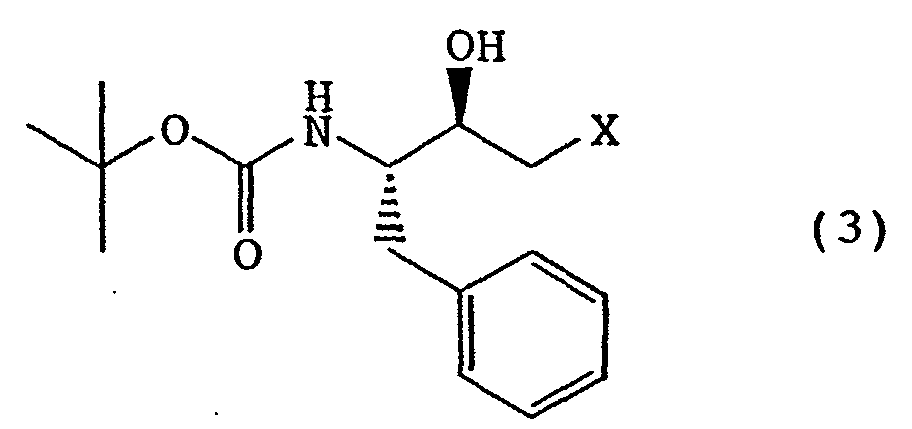 wherein X is a halogen atom, with a base [see, for example, JP-A-6-206857 (EP0580402) etc.].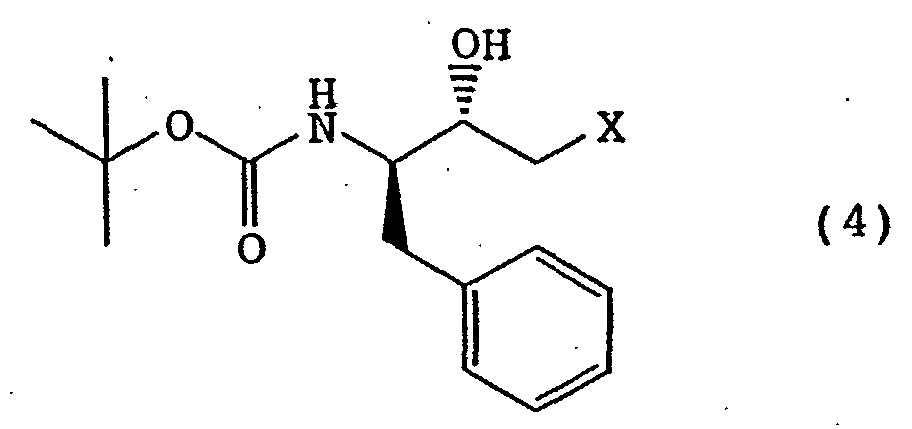
- As the halogen atom at X, chlorine atom and bromine atom are preferable, and particularly chlorine atom is preferable.
- The base to be used for the production of (2R,3S)-epoxide compound and (2S,3R)-epoxide compound is not particularly limited, but preferred are, for example, potassium hydroxide, sodium hydroxide, potassium carbonate, sodium carbonate, sodium methoxide, sodium ethoxide and potassium tert-butoxide.
- As the polar solvent to be used for the production of (2R,3S)-epoxide compound and (2S,3R)-epoxide compound, those used for the crystallization step to be mentioned below are exemplified.
- The above-mentioned (2R,3S)-3-tert-butoxycarbonylamino-1-halo-2-hydroxy-4-phenylbutane is also a known compound, which can be produced by, for example, reducing (3S)-3-tert-butoxycarbonylamino-1-halo-4-phenyl-2-butanone. Similarly, (2S,3R)-3-tert-butoxycarbonylamino-1-halo-2-hydroxy-4-phenylbutane can be produced by, for example, reducing (3R)-3-tert-butoxycarbonylamino-1-halo-4-phenyl-2-butanone [see, for example, P. Raddatz et al., J. Med. Chem., 34, 11, 3269 (1991), A. A. Malik, The 3rd International Conference on Organic Process Research & Development, Development of a Commercial Process for 2S,3S and 2R,3S-epoxides, 10-12th July 2000, Montreal, or T. Archibald et al., Scientific Update Conference Manual, Chiral USA '99, Full Scale Chiral Separations Using SMB, 4th May 1999, San Francisco, Scientific Update].
- The crystallization method is explained in the following by referring to (2R,3S)-epoxide compound as an example. An optical isomer thereof, (2S,3R)-epoxide compound, can be also crystallized by a similar method.
- First, (2R,3S)-epoxide compound is dissolved in a polar solvent. The polar solvent in the present invention is not particularly limited as long as it is a good solvent for the objective product and easily miscible with water. Examples of the polar solvent include organic solvent miscible with water (e.g., methanol, ethanol, 1-propanol, 2-propanol, acetone, 2-butanone, acetonitrile, tetrahydrofuran etc.), where one or more kinds of these may be used in combination, a mixed solvent of one or more kinds of these organic solvents and water, and the like. Preferable polar solvent may be, for example, alcohol such as methanol, ethanol, 1-propanol, 2-propanol and the like, and a mixed solvent of these alcohols and water, particularly preferably 2-propanol and a mixed solvent of water and 2-propanol. Water acts as a poor solvent for the objective product. A different solvent may be present as long as the effect of the present invention is not impaired.
- When the above-mentioned mixed solvent of an organic solvent and water is used as a polar solvent, the mixing ratio varies depending on the content of the objective product, crystallization temperature and the like. A suitable ratio can be determined appropriately by those of ordinary skill in the art. Preferable volume ratio is water being not more than 10, more preferably not more than 5, relative to organic solvent being 1.
- The concentration of the polar solvent solution containing the objective product, which is to be subjected to a crystallization step, is not particularly limited. Preferable conditions can be determined appropriately by those of ordinary skill in the art, in consideration of the kind of the polar solvent to be used, crystallization temperature and the like. Preferable concentration is not lower than 5 wt%.
- When (2R,3S)-3-tert-butoxycarbonylamino-1-chloro-2-hydroxy-4-phenylbutane is treated with a base to give (2R,3S)-epoxide compound and the above-mentioned polar solvents are used as a reaction solvent, the reaction mixture can be used as it is or used directly for a crystallization step after appropriate concentration. In this way, the objective product can be produced more conveniently. In this case, the base and the like present in the reaction mixture do not need to be removed specifically, but the reaction mixture is preferably subjected to crystallization after neutralization with an acid, such as hydrochloric acid, sulfuric acid, citric acid and the like.
- According to the present invention, water is added to a solution of the objective product in a polar solvent to allow crystallization. Because water, which is a poor solvent, is added to the solution containing the objective product, the crystals can be precipitated under relatively mild conditions, and scaling is not produced easily.
- On the other hand, in the case that the crystallization is performed, for example, by cooling in a mixture solvent of water and a polar solvent without adding water, the resulting slurry is inferior in fluidity and the obtained crystals are inferior in filtration property and separation property, so that it is not suitable for an industrial production.
- The crystallization is preferably performed at a temperature of not higher than 16°C, at which the solvent does not solidify. For example, the crystallization is preferably performed at -10°C to 16°C, particularly preferably 0°C to 10°C. When crystallization is performed at a temperature exceeding 16°C, the objective product unpreferably tends to become oily.
- To produce a crystal superior in filtration property and separation property and to suppress coagulation and scaling of crystals in the present invention, crystallization is preferably started and the precipitated crystals are aged before adding water.
- The method for starting precipitation is not particularly limited, and, for example, (i) a method for adding water, (ii) a method for adding a seed crystal, (iii) a method for cooling the solution and the like are mentioned. These methods can be optionally combined. When, for example, the aforementioned (i) and (ii) are combined, the seed crystal can be added concurrently with water or thereafter.
- The amount of water to be added in (i) may be an amount that starts precipitation of the crystals of the objective product. The temperature of water to be added in (i) is not particularly limited, but it is preferably about the same as the temperature of the crystallization.
- The amount of addition of the seed crystal in (ii) can be determined as appropriate, which is generally preferably about 0.01% - 3% relative to the objective product present in a solution.
- The aging applied after starting the precipitation of the crystals is preferably performed under stirring and the temperature is preferably lowered from the temperature at the start of the crystal precipitation. The time of aging is not particularly limited, and is, for example, about 10 min - 24 h, preferably about 30 min - 2 h.
- Water is added after the aging step. Water is preferably added while appropriately stirring the solution of the polar solvent, thereby not to easily cause coagulation or scaling of crystals and the like. Those of ordinary skill in the art can properly set the stirring conditions easily as long as such problems do not occur. Water can be added at a lower temperature than that for aging.
- The amount of water to be added also varies depending on the conditions of concentration, crystallization temperature and the like of the objective product and is not particularly limited. It is generally about 50 - 500%, preferably about 100 - 300%, in volume ratio relative to the polar solvent when crystallization is started. The rate of adding water is not particularly limited, and water may be added gradually generally over 20 min to 4 h. The temperature of water to be added is not particularly limited, but preferably about the same as the crystallization temperature. Those of ordinary skill in the art can set the preferable amount and rate of addition of water and the like according to various conditions.
- According to the production method of the present invention, when a high polarity impurity is contained, it is removed to the mother liquor side, whereby the objective product can be separated from the high polarity impurity. Therefore, the method of the present invention can be used as a purification method of the objective product, (2R,3S)-epoxide compound and (2S,3R)-epoxide compound.
- When the objective product is obtained by the above-mentioned known method and the like, the objective product is subjected to the method of the present invention without isolation from the reaction mixture. As a result, alkali and salt contained in the reaction mixture are removed to the mother liquor side simultaneously with crystallization of the objective product. Consequently, the objective product obtained by a known method and the like can be easily isolated as a crystal without particularly requiring extraction and the like. As such, the present invention provides a superior production method. Moreover, when the same polar solvent as used for the crystallization step is used for the production of the objective product, the reaction mixture can be used directly for the crystallization step, thereby affording production of the objective product by a more convenient method.
- The obtained crystal can be purified as necessary according to a conventional method, such as washing with a solvent, such as water, a mixed solvent of water and alcohol and the like, washing a slurry after adding water and the like, to provide a crystal having a higher purity.
- According to the production method of the present invention, (2R,3S)-epoxide compound and (2S,3R)-epoxide compound, which cannot be obtained easily as a crystal, can be conveniently obtained, and the obtained crystals show uniform particle sizes and are superior in filtration property and separation property. Moreover, the method of the present invention produces crystals under relatively mild conditions, by the addition of a poor solvent to a solution containing the objective product. Therefore, control of the coagulation and scaling of the crystals is easy and the method is convenient. The resulting slurry is superior in fluidity, thereby preventing clogging of conduit and the like during delivery of the slurry from a crystallization can.
- The method of the present invention does not require a special or excessive solvent or manipulation, facility and the like. Therefore, it is a superior production method that can be conveniently employed for industrial production.
- Embodiments of the present invention are explained in detail in the following by way of Examples. It is needless to say that the present invention is not limited by these Examples.
- (2R,3S)-3-tert-Butoxycarbonylamino-1-chloro-2-hydroxy-4-phenylbutane (18.5 g) was cast in a 500 ml round-bottom flask and 2-propanol (101.05 ml) and water (33.75 ml) were added to allow dissolution. The mixture was cooled to 4°C. For stirring, a semicircular stirring plate (7.5 cm) was installed and the rate of rotation was set to 250 rpm. Aqueous NaOH solution (4 mol/L, 25.3 ml) was added to this solution and the mixture was stirred while maintaining the temperature at 4°C for 60 min. By the above operation, a reaction solution containing (2R,3S)-epoxide compound (15.24 g) was obtained.
- While maintaining the reaction solution containing (2R,3S)-epoxide compound, which was obtained in the above-mentioned Reference Example, at 4°C, citric acid (2.16 g) and water (21.8 ml) were added to neutralize the reaction mixture. Water (20.2 ml) was further added and then a seed crystal (20 mg) was added and the start of precipitation was confirmed. After the start of the precipitation, the crystals were aged with stirring at 4°C for 1 h. While maintaining the reaction mixture at 4°C, water (101 ml, 4°C) was added dropwise thereto over 1 h with stirring.
- The particle size distribution of the crystal in the obtained slurry was measured with FBRM, M-500L (Lasentec). As a result, the average particle size was 100 µm, indicating that the slurry was free of bulky aggregates, had uniform particle size distribution, superior fluidity and fine dischargeability.
- This slurry was filtered through Kiriyama filter paper 5A. The slurry showed fine filtration property and separation property ((2R,3S)-epoxide compound in wet crystals: yield 15.0 g, yield 98.4%).
- The obtained wet crystals were dried at 35°C in vacuo until water content became not more than 0.1% to give crystals of (2R,3S)-epoxide compound.
- While maintaining the reaction solution containing (2R,3S)-epoxide compound, which was obtained in the above-mentioned Reference Example, at 4°C, citric acid (2.16 g) and water (21.8 ml) were added to neutralize the reaction mixture. Water (20.2 ml) was further added and then a seed crystal (20 mg) was added and the start of precipitation was confirmed. After the start of the precipitation, the crystals were aged with stirring at 4°C for 1 h. While maintaining the reaction mixture at 4°C, water (101 ml, 4°C) was added dropwise thereto over 1 h with stirring.
- The particle size distribution of the crystal in the obtained slurry was measured with FBRM, M-500L (Lasentec). As a result, the average particle size was 100 µm, indicating that the slurry-was free of bulky aggregates, had uniform particle size distribution, superior fluidity and fine dischargeability.
- This slurry was filtered through Kiriyama filter paper 5A. The slurry showed fine filtration property and separation property.
- To the obtained wet crystals was added water (202 ml) and the slurry was washed and filtrated. The obtained wet crystals were washed with water (202 ml) and dried at 35°C in vacuo until water content became not more than 0.1% to give crystals of (2R,3S)-epoxide compound: yield 93.4% (14.23 g).
- (2R,3S)-3-tert-Butoxycarbonylamino-1-chloro-2-hydroxy-4-phenylbutane (5.50 g) was dissolved in a mixed solvent of 2-propanol (13.2 ml) and water (5.0 ml), and the solution was cooled to 4°C. 29% Aqueous sodium hydroxide solution (2.92 ml) was added and the mixture was stirred at 4°C for 2.5 h. After the reaction was stopped by adding 27.7% aqueous citric acid solution (2.1 g), water (4.2 ml) was added dropwise over 10 min with stirring, thereby seeding was completed. Water (17.2 ml) was further added dropwise over generally about 30 min - 4 h with stirring, and the mixture was stirred overnight at 4°C to crystallize (2R,3S)-epoxide compound. The obtained slurry was filtered through Kiriyama filter paper 5A, washed with water (44 ml) and dried overnight at room temperature under reduced pressure to give the objective crystal of (2R,3S)-epoxide compound (4.76 g, yield 98.6%).
- According to the present invention, the crystals of (2R,3S)-epoxide compound and (2S,3R)-epoxide compound superior in filtration property and separation property can be produced conveniently in a high yield by an industrial production method without requiring an extremely low temperature.
Claims (16)
- A method for producing crystalline (2R,3S)-3-tert-butoxycarbonylamino-1,2-epoxy-4-phenylbutane of the following formula (1)or (2S,3R)-3-tert-butoxycarbonylamino-1,2-epoxy-4-phenylbutane of the following formula (2)
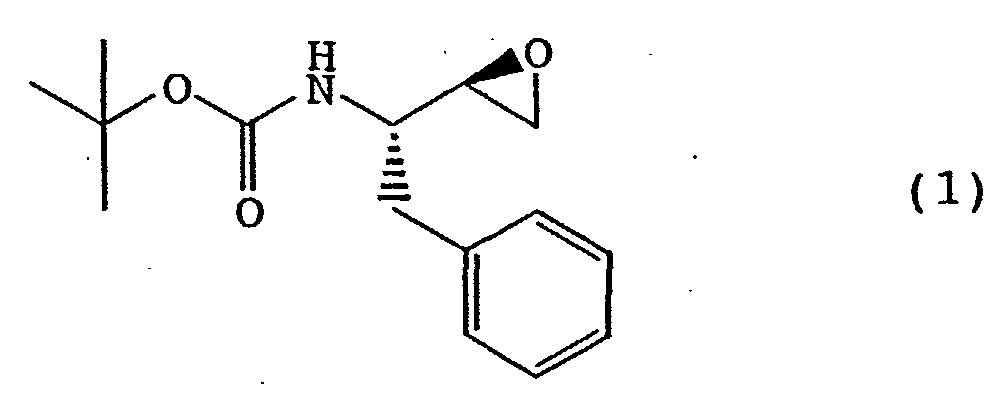 which method comprises adding water to a solution of the (2R,3S)-3-tert-butoxycarbonylamino-1,2-epoxy-4-phenylbutane or the (2S,3R)-3-tert-butoxycarbonylamino-1,2-epoxy-4-phenylbutane in a polar solvent to allow crystallization.
- The method of claim 1, wherein the crystallization comprises a step of starting precipitation of crystals and aging the crystals precipitated.
- The method of claim 1 or claim 2, wherein the crystallization is conducted at a temperature of not higher than 16°C.
- The method of any one of the preceding claims wherein the polar solvent is one or more kinds of solvent(s) selected from group (A) consisting of methanol, ethanol, 1-propanol and 2-propanol, or a mixed solvent of water and one or more-kinds of solvent(s) selected from the group (A).
- The method of claim 4, wherein the polar solvent is 2-propanol or a mixed solvent of water and 2-propanol.
- A method for producing crystalline (2R,3S)-3-tert-butoxycarbonylamino-1,2-epoxy-4-phenylbutane of the following formula (1)or (2S,3R)-3-tert-butoxycarbonylamino-1,2-epoxy-4-phenylbutane of the following formula (2)
 which method comprises treating (2R,3S)-3-tert-butoxycarbonylamino-1-halo-2-hydroxy-4-phenylbutane of the following formula (3)
 wherein X is a halogen atom, or (2S,3R)-3-tert-butoxycarbonylamino-1-halo-2-hydroxy-4-phenylbutane of the following formula (4)
 wherein X is a halogen atom, with a base in a polar solvent to give a solution of the (2R,3S)-3-tert-butoxycarbonylamino-1,2-epoxy-4-phenylbutane or the (2S,3R)-3-tert-butoxycarbonylamino-1,2-epoxy-4-phenylbutane in a polar solvent, and adding water to the obtained solution to allow crystallization.
- The method of claim 6, wherein X is a chlorine atom.
- The method of claim 6 or claim 7, wherein the crystallization comprises a step of starting precipitation of crystals and aging the crystals precipitated.
- The method of any one of claims 6 to 8, wherein the crystallization is conducted at a temperature of not higher than 16°C.
- The method of any one of claims 6 to 9, wherein the polar solvent is one or more kinds of solvent(s) selected from group (A) consisting of methanol, ethanol, 1-propanol and 2-propanol, or a mixed solvent of water and one or more kinds of solvent(s) selected from the group (A).
- The method of claim 10, wherein the polar solvent is 2-propanol or a mixed solvent of water and 2-propanol.
- A method for producing crystalline (2R,3S)-3-tert-butoxycarbonylamino-1,2-epoxy-4-phenylbutane of the following formula (1)or (2S,3R)-3-tert-butoxycarbonylamino-1,2-epoxy-4-phenylbutane of the following formula (2)
 which method comprises treating (2R,3S)-3-tert-butoxycarbonylamino-1-chloro-2-hydroxy-4-phenylbutane or (2S,3R)-3-tert-butoxycarbonylamino-1-chloro-2-hydroxy-4-phenylbutane with a base in a polar solvent to give a solution of the (2R,3S)-3-tert-butoxycarbonylamino-1,2-epoxy-4-phenylbutane or the (2S,3R)-3-tert-butoxycarbonylamino-1,2-epoxy-4-phenylbutane in a polar solvent, and adding water to the obtained solution to allow crystallization.
- The method of claim 12, wherein the crystallization comprises a step of starting precipitation of crystals and aging the crystals precipitated.
- The method of claim 12 or 13, wherein the crystallization is conducted at a temperature of not higher than 16°C.
- The method of any one of claims 12 to 14, wherein the polar solvent is one or more kinds of solvent(s) selected from group (A) consisting of methanol, ethanol, 1-propanol and 2-propanol, or a mixed solvent of water and one or more kinds of solvent(s) selected from the group (A).
- The method of claim 15, wherein the polar solvent is 2-propanol or a mixed solvent of water and 2-propanol.
Applications Claiming Priority (4)
| Application Number | Priority Date | Filing Date | Title |
|---|---|---|---|
| JP2000377804 | 2000-12-12 | ||
| JP2000377804 | 2000-12-12 | ||
| JP2001051108 | 2001-02-26 | ||
| JP2001051108 | 2001-02-26 |
Publications (2)
| Publication Number | Publication Date |
|---|---|
| EP1215209A1 true EP1215209A1 (en) | 2002-06-19 |
| EP1215209B1 EP1215209B1 (en) | 2004-08-25 |
Family
ID=26605686
Family Applications (1)
| Application Number | Title | Priority Date | Filing Date |
|---|---|---|---|
| EP01310368A Expired - Lifetime EP1215209B1 (en) | 2000-12-12 | 2001-12-12 | Method for the production of a crystalline epoxide |
Country Status (6)
| Country | Link |
|---|---|
| US (1) | US6764545B2 (en) |
| EP (1) | EP1215209B1 (en) |
| KR (1) | KR20020046948A (en) |
| AT (1) | ATE274504T1 (en) |
| CA (1) | CA2364838A1 (en) |
| DE (1) | DE60105113T2 (en) |
Cited By (6)
| Publication number | Priority date | Publication date | Assignee | Title |
|---|---|---|---|---|
| WO2005063770A1 (en) | 2003-12-23 | 2005-07-14 | Tibotec Pharmaceuticals Ltd. | Process for the preparation of (3r,3as,6ar)-hexahydrofuro [2,3-b] furan-3-yl (1s,2r)-3-[[(4-aminophenyl) sulfonyl] (isobutyl) amino]-1-benzyl-2-hydroxypropylcarbamate |
| EP1777213A1 (en) * | 2005-10-18 | 2007-04-25 | Ajinomoto Co., Inc. | Production method of aminochlorohydrin sulfate |
| US7432391B2 (en) | 2005-05-24 | 2008-10-07 | Daito Chemix Corporation | Process for the production of tert-butyl N-(2-bromoethyl)carbamate |
| US8153829B2 (en) | 2006-11-09 | 2012-04-10 | Janssen Pharmaceutica N.V. | Methods for the preparation of hexahydrofuro[2,3-B]furan-3-ol |
| US8829208B2 (en) | 2010-01-28 | 2014-09-09 | Mapi Pharma Ltd. | Process for the preparation of darunavir and darunavir intermediates |
| US8921415B2 (en) | 2009-01-29 | 2014-12-30 | Mapi Pharma Ltd. | Polymorphs of darunavir |
Families Citing this family (11)
| Publication number | Priority date | Publication date | Assignee | Title |
|---|---|---|---|---|
| RS51073B (en) | 2003-12-23 | 2010-10-31 | Tibotec Pharmaceuticals Ltd. | PREPARATION PROCESS (3R, 3AS, 6AR) -HEKSAHIDROFURO│2,3-B│ FURAN-3-IL (1S, 2R) -3-││ (4-AMINOPHENYL) SULPHONYL (ISOBUTYL) AMINO │-1-BENZYL -2-hydroxypropylcarbamate |
| US7582468B2 (en) * | 2005-05-25 | 2009-09-01 | Bristol-Myers Squibb Company | Process for preparing (2R,3S)-1,2-epoxy-3-(protected)amino-4-substituted butane and intermediates thereof |
| BRPI0810609A2 (en) | 2007-04-27 | 2014-10-21 | Tibotec Pharm Ltd | METHODS FOR PREPARING N-ISOBUTIL-N- (2-HYDROXY-A-AMINO-4-PHENYLBUTIL) -P-NITROBE NZENOSULFONILAMIDE DERIVATIVES |
| SI2170292T1 (en) * | 2007-06-22 | 2014-05-30 | Bristol-Myers Squibb Holdings Ireland | Tableted compositions containing atazanavir |
| JP2010530892A (en) * | 2007-06-22 | 2010-09-16 | ブリストル−マイヤーズ スクイブ カンパニー | Tablet composition containing atazanavir |
| JP2010530889A (en) * | 2007-06-22 | 2010-09-16 | ブリストル−マイヤーズ スクイブ カンパニー | Tablet composition containing atazanavir |
| ES2359770T3 (en) * | 2007-06-22 | 2011-05-26 | Bristol-Myers Squibb Company | COMPOSITIONS IN TABLETS CONTAINING ATAZANAVIR. |
| WO2009136365A1 (en) * | 2008-05-08 | 2009-11-12 | Ranbaxy Laboratories Limited | Process for the preparation of 3,4-epoxy-2-amino-1-substituted butane derivatives and intermediate compounds thereof |
| KR100970596B1 (en) * | 2008-06-24 | 2010-07-16 | 대한주택공사 | Door wall structure that can be moved on line |
| AR073248A1 (en) | 2008-09-01 | 2010-10-20 | Tibotec Pharm Ltd | PROCESS FOR THE PREPARATION OF (1S, 2R) -3- ((4-AMINOFENIL) SULFONIL) (ISOBUTIL) AMINO) -1- BENCIL-2- HYDROXYPROPYL CARBAMATE (3R, 3AS, 6AR) - HEXAHYDROFIDE- (2,3- B) FURAN-3- ILO (DARUNAVIR) AND USEFUL INTERMEDIATE COMPOUNDS IN THIS PROCESS. |
| CN103044361B (en) * | 2012-12-30 | 2014-08-06 | 江苏八巨药业有限公司 | Preparation method of (2R,3S)-epoxidation amino-benzene butane |
Citations (3)
| Publication number | Priority date | Publication date | Assignee | Title |
|---|---|---|---|---|
| EP0754669A1 (en) * | 1995-02-03 | 1997-01-22 | Kaneka Corporation | Processes for producing alpha-halo ketones, alpha-halohydrins and epoxides |
| WO2000044736A1 (en) * | 1999-01-29 | 2000-08-03 | Kaneka Corporation | PROCESSES FOR THE PREPARATION OF threo-1,2-EPOXY-3-AMINO-4-PHENYLBUTANE DERIVATIVES |
| EP1081133A1 (en) * | 1999-08-31 | 2001-03-07 | Ajinomoto Co., Inc. | Method for producing N-carbamate-protected beta-aminoepoxide and beta-aminoalcohol |
Family Cites Families (6)
| Publication number | Priority date | Publication date | Assignee | Title |
|---|---|---|---|---|
| CH515925A (en) * | 1968-11-21 | 1971-11-30 | Ciba Geigy Ag | Process for the production of new B-methylglycidyl isocyanurates and their use for the production of curable compositions |
| US3676433A (en) * | 1970-09-15 | 1972-07-11 | Upjohn Co | Improved process for the 5{60 ,6{60 -epoxidation of {66 {11 -double bonds |
| US5166371A (en) * | 1989-07-31 | 1992-11-24 | Arco Chemical Technology, L.P. | Asymmetric epoxidation using a chiral hydroperoxide |
| US5559256A (en) | 1992-07-20 | 1996-09-24 | E. R. Squibb & Sons, Inc. | Aminediol protease inhibitors |
| US5481011A (en) | 1994-12-13 | 1996-01-02 | Bristol-Myers Squibb Company | Process for preparing N-protected amino acid α-halomethyl ketones and alcohols from N-protected amino acid esters |
| JP4250335B2 (en) | 1998-01-28 | 2009-04-08 | 日本化薬株式会社 | Process for producing optically active threo-3-amino-1,2-epoxy compound |
-
2001
- 2001-12-11 KR KR1020010078050A patent/KR20020046948A/en not_active Abandoned
- 2001-12-11 US US10/011,304 patent/US6764545B2/en not_active Expired - Fee Related
- 2001-12-12 EP EP01310368A patent/EP1215209B1/en not_active Expired - Lifetime
- 2001-12-12 CA CA002364838A patent/CA2364838A1/en not_active Abandoned
- 2001-12-12 AT AT01310368T patent/ATE274504T1/en not_active IP Right Cessation
- 2001-12-12 DE DE60105113T patent/DE60105113T2/en not_active Expired - Fee Related
Patent Citations (4)
| Publication number | Priority date | Publication date | Assignee | Title |
|---|---|---|---|---|
| EP0754669A1 (en) * | 1995-02-03 | 1997-01-22 | Kaneka Corporation | Processes for producing alpha-halo ketones, alpha-halohydrins and epoxides |
| WO2000044736A1 (en) * | 1999-01-29 | 2000-08-03 | Kaneka Corporation | PROCESSES FOR THE PREPARATION OF threo-1,2-EPOXY-3-AMINO-4-PHENYLBUTANE DERIVATIVES |
| EP1067125A1 (en) * | 1999-01-29 | 2001-01-10 | Kaneka Corporation | PROCESSES FOR THE PREPARATION OF threo-1,2-EPOXY-3-AMINO-4-PHENYLBUTANE DERIVATIVES |
| EP1081133A1 (en) * | 1999-08-31 | 2001-03-07 | Ajinomoto Co., Inc. | Method for producing N-carbamate-protected beta-aminoepoxide and beta-aminoalcohol |
Non-Patent Citations (1)
| Title |
|---|
| BARRISH J C ET AL: "AMINODIOL HIV PROTEASE INHIBITORS. 1. DESIGN, SYNTHESIS, AND PRELIMINARY SAR", JOURNAL OF MEDICINAL CHEMISTRY, AMERICAN CHEMICAL SOCIETY. WASHINGTON, US, vol. 37, no. 12, 1994, pages 1758 - 1768, XP001002509, ISSN: 0022-2623 * |
Cited By (7)
| Publication number | Priority date | Publication date | Assignee | Title |
|---|---|---|---|---|
| WO2005063770A1 (en) | 2003-12-23 | 2005-07-14 | Tibotec Pharmaceuticals Ltd. | Process for the preparation of (3r,3as,6ar)-hexahydrofuro [2,3-b] furan-3-yl (1s,2r)-3-[[(4-aminophenyl) sulfonyl] (isobutyl) amino]-1-benzyl-2-hydroxypropylcarbamate |
| US7432391B2 (en) | 2005-05-24 | 2008-10-07 | Daito Chemix Corporation | Process for the production of tert-butyl N-(2-bromoethyl)carbamate |
| EP1777213A1 (en) * | 2005-10-18 | 2007-04-25 | Ajinomoto Co., Inc. | Production method of aminochlorohydrin sulfate |
| US8153829B2 (en) | 2006-11-09 | 2012-04-10 | Janssen Pharmaceutica N.V. | Methods for the preparation of hexahydrofuro[2,3-B]furan-3-ol |
| US8921415B2 (en) | 2009-01-29 | 2014-12-30 | Mapi Pharma Ltd. | Polymorphs of darunavir |
| US9453024B2 (en) | 2009-01-29 | 2016-09-27 | Mapi Pharma Ltd. | Polymorphs of darunavir |
| US8829208B2 (en) | 2010-01-28 | 2014-09-09 | Mapi Pharma Ltd. | Process for the preparation of darunavir and darunavir intermediates |
Also Published As
| Publication number | Publication date |
|---|---|
| EP1215209B1 (en) | 2004-08-25 |
| US6764545B2 (en) | 2004-07-20 |
| US20020087014A1 (en) | 2002-07-04 |
| DE60105113D1 (en) | 2004-09-30 |
| DE60105113T2 (en) | 2005-08-18 |
| ATE274504T1 (en) | 2004-09-15 |
| KR20020046948A (en) | 2002-06-21 |
| CA2364838A1 (en) | 2002-06-12 |
Similar Documents
| Publication | Publication Date | Title |
|---|---|---|
| EP1215209B1 (en) | Method for the production of a crystalline epoxide | |
| CN1139596C (en) | Crystalline amine salt of cefdinir | |
| EP1067125B1 (en) | PROCESSES FOR THE PREPARATION OF threo-1,2-EPOXY-3-AMINO-4-PHENYLBUTANE DERIVATIVES | |
| JP5641802B2 (en) | Process for producing diastereomeric salt of (S) -4-[(4-chlorophenyl) (2-pyridyl) methoxy] piperidine | |
| JP5485138B2 (en) | Method for purifying ethynylthymidine compounds | |
| JPH1180149A (en) | Optical resolution of (±) -chromancarboxylic acid | |
| JP2011006379A (en) | Method for recrystallizing {2-amino-1,4-dihydro-6-methyl-4-(3-nitrophenyl)-3,5-pyridine dicarboxylic acid-3-[1-(diphenylmethyl)azetidin-3-yl]ester-5-isopropyl ester}(azelnidipine), isopropyl alcohol adduct of azelnidipine, and method for producing azelnidipine | |
| JP4927258B2 (en) | Purification and isolation method of (2S, 3S)-or (2R, 3S) -halohydrin derivatives | |
| EP1106611B1 (en) | Crystalline or crystallized acid addition salt of losartan and purification method of losartan | |
| JPWO2000043357A1 (en) | Method for purifying and isolating (2S,3S)- or (2R,3S)-halohydrin derivatives | |
| JP2003096068A (en) | Method for producing 3-hydroxy-γ-butyrolactone | |
| CN105418477B (en) | The method for reducing diastereoisomer impurity content in Lei Dipawei intermediate | |
| JPWO2002020453A1 (en) | Crystallization method of hydroxycarboxylic acids | |
| US20090312577A1 (en) | Process for Production of Beta-Amino-Alpha-Hydroxy Carbonxamide Derivative | |
| JP2002322166A (en) | Method for preparing epoxide crystal | |
| WO2002020453A1 (en) | Methods for crystallization of hydroxycarboxylic acids | |
| JP2915306B2 (en) | Method for producing N-alkoxycarbonyl amino acid ester | |
| JP5092289B2 (en) | Process for producing optically active N-tert-butylcarbamoyl-L-tert-leucine | |
| JP2001526291A (en) | Method for purifying solution of ampicillin prodrug ester | |
| JPWO2003057665A1 (en) | Method for producing benzenesulfonamide derivative crystal, novel crystal of intermediate and method for producing the same | |
| EP0612760B1 (en) | Method for purification of estramustin phosphate or salt thereof | |
| JP2004051577A (en) | Method for crystallizing methionine and alkali metal hydrogen carbonate | |
| JPWO2000044736A1 (en) | Method for obtaining threo-1,2-epoxy-3-amino-4-phenylbutane derivatives | |
| JP2004307402A (en) | Method for producing 2-carboxyethyldimethylsulfonium sulfate | |
| JPH08183779A (en) | Process for producing optically active piperazine derivative and intermediate for production |
Legal Events
| Date | Code | Title | Description |
|---|---|---|---|
| PUAI | Public reference made under article 153(3) epc to a published international application that has entered the european phase |
Free format text: ORIGINAL CODE: 0009012 |
|
| AK | Designated contracting states |
Kind code of ref document: A1 Designated state(s): AT BE CH CY DE DK ES FI FR GB GR IE IT LI LU MC NL PT SE TR |
|
| AX | Request for extension of the european patent |
Free format text: AL;LT;LV;MK;RO;SI |
|
| 17P | Request for examination filed |
Effective date: 20021008 |
|
| 17Q | First examination report despatched |
Effective date: 20021209 |
|
| AKX | Designation fees paid |
Designated state(s): AT BE CH CY DE DK ES FI FR GB GR IE IT LI LU MC NL PT SE TR |
|
| GRAP | Despatch of communication of intention to grant a patent |
Free format text: ORIGINAL CODE: EPIDOSNIGR1 |
|
| GRAS | Grant fee paid |
Free format text: ORIGINAL CODE: EPIDOSNIGR3 |
|
| GRAA | (expected) grant |
Free format text: ORIGINAL CODE: 0009210 |
|
| RIN1 | Information on inventor provided before grant (corrected) |
Inventor name: IZAWA, KUNISUKEC/O AJINOMOTO CO., INC. Inventor name: HIROSE, NAOKOC/O AJINOMOTO CO., INC. Inventor name: ONISHI, TOMOYUKIC/O AJINOMOTO CO., INC. Inventor name: SUZUKI, YUICHIC/O AJINOMOTO CO., INC. |
|
| AK | Designated contracting states |
Kind code of ref document: B1 Designated state(s): AT BE CH CY DE DK ES FI FR GB GR IE IT LI LU MC NL PT SE TR |
|
| PG25 | Lapsed in a contracting state [announced via postgrant information from national office to epo] |
Ref country code: IT Free format text: LAPSE BECAUSE OF FAILURE TO SUBMIT A TRANSLATION OF THE DESCRIPTION OR TO PAY THE FEE WITHIN THE PRESCRIBED TIME-LIMIT;WARNING: LAPSES OF ITALIAN PATENTS WITH EFFECTIVE DATE BEFORE 2007 MAY HAVE OCCURRED AT ANY TIME BEFORE 2007. THE CORRECT EFFECTIVE DATE MAY BE DIFFERENT FROM THE ONE RECORDED. Effective date: 20040825 Ref country code: NL Free format text: LAPSE BECAUSE OF FAILURE TO SUBMIT A TRANSLATION OF THE DESCRIPTION OR TO PAY THE FEE WITHIN THE PRESCRIBED TIME-LIMIT Effective date: 20040825 Ref country code: FI Free format text: LAPSE BECAUSE OF FAILURE TO SUBMIT A TRANSLATION OF THE DESCRIPTION OR TO PAY THE FEE WITHIN THE PRESCRIBED TIME-LIMIT Effective date: 20040825 Ref country code: TR Free format text: LAPSE BECAUSE OF FAILURE TO SUBMIT A TRANSLATION OF THE DESCRIPTION OR TO PAY THE FEE WITHIN THE PRESCRIBED TIME-LIMIT Effective date: 20040825 Ref country code: BE Free format text: LAPSE BECAUSE OF FAILURE TO SUBMIT A TRANSLATION OF THE DESCRIPTION OR TO PAY THE FEE WITHIN THE PRESCRIBED TIME-LIMIT Effective date: 20040825 Ref country code: AT Free format text: LAPSE BECAUSE OF FAILURE TO SUBMIT A TRANSLATION OF THE DESCRIPTION OR TO PAY THE FEE WITHIN THE PRESCRIBED TIME-LIMIT Effective date: 20040825 Ref country code: FR Free format text: LAPSE BECAUSE OF FAILURE TO SUBMIT A TRANSLATION OF THE DESCRIPTION OR TO PAY THE FEE WITHIN THE PRESCRIBED TIME-LIMIT Effective date: 20040825 Ref country code: CY Free format text: LAPSE BECAUSE OF FAILURE TO SUBMIT A TRANSLATION OF THE DESCRIPTION OR TO PAY THE FEE WITHIN THE PRESCRIBED TIME-LIMIT Effective date: 20040825 |
|
| REG | Reference to a national code |
Ref country code: GB Ref legal event code: FG4D |
|
| REG | Reference to a national code |
Ref country code: CH Ref legal event code: EP |
|
| REG | Reference to a national code |
Ref country code: IE Ref legal event code: FG4D |
|
| REF | Corresponds to: |
Ref document number: 60105113 Country of ref document: DE Date of ref document: 20040930 Kind code of ref document: P |
|
| REG | Reference to a national code |
Ref country code: CH Ref legal event code: NV Representative=s name: NOVAGRAAF INTERNATIONAL SA |
|
| PG25 | Lapsed in a contracting state [announced via postgrant information from national office to epo] |
Ref country code: GR Free format text: LAPSE BECAUSE OF FAILURE TO SUBMIT A TRANSLATION OF THE DESCRIPTION OR TO PAY THE FEE WITHIN THE PRESCRIBED TIME-LIMIT Effective date: 20041125 Ref country code: SE Free format text: LAPSE BECAUSE OF FAILURE TO SUBMIT A TRANSLATION OF THE DESCRIPTION OR TO PAY THE FEE WITHIN THE PRESCRIBED TIME-LIMIT Effective date: 20041125 Ref country code: DK Free format text: LAPSE BECAUSE OF FAILURE TO SUBMIT A TRANSLATION OF THE DESCRIPTION OR TO PAY THE FEE WITHIN THE PRESCRIBED TIME-LIMIT Effective date: 20041125 |
|
| PG25 | Lapsed in a contracting state [announced via postgrant information from national office to epo] |
Ref country code: ES Free format text: LAPSE BECAUSE OF FAILURE TO SUBMIT A TRANSLATION OF THE DESCRIPTION OR TO PAY THE FEE WITHIN THE PRESCRIBED TIME-LIMIT Effective date: 20041206 |
|
| PG25 | Lapsed in a contracting state [announced via postgrant information from national office to epo] |
Ref country code: LU Free format text: LAPSE BECAUSE OF NON-PAYMENT OF DUE FEES Effective date: 20041212 |
|
| PG25 | Lapsed in a contracting state [announced via postgrant information from national office to epo] |
Ref country code: IE Free format text: LAPSE BECAUSE OF NON-PAYMENT OF DUE FEES Effective date: 20041213 |
|
| PG25 | Lapsed in a contracting state [announced via postgrant information from national office to epo] |
Ref country code: MC Free format text: LAPSE BECAUSE OF NON-PAYMENT OF DUE FEES Effective date: 20041231 |
|
| NLV1 | Nl: lapsed or annulled due to failure to fulfill the requirements of art. 29p and 29m of the patents act | ||
| PLBE | No opposition filed within time limit |
Free format text: ORIGINAL CODE: 0009261 |
|
| STAA | Information on the status of an ep patent application or granted ep patent |
Free format text: STATUS: NO OPPOSITION FILED WITHIN TIME LIMIT |
|
| 26N | No opposition filed |
Effective date: 20050526 |
|
| EN | Fr: translation not filed | ||
| REG | Reference to a national code |
Ref country code: IE Ref legal event code: MM4A |
|
| PG25 | Lapsed in a contracting state [announced via postgrant information from national office to epo] |
Ref country code: PT Free format text: LAPSE BECAUSE OF NON-PAYMENT OF DUE FEES Effective date: 20050125 |
|
| PGFP | Annual fee paid to national office [announced via postgrant information from national office to epo] |
Ref country code: CH Payment date: 20081216 Year of fee payment: 8 |
|
| PGFP | Annual fee paid to national office [announced via postgrant information from national office to epo] |
Ref country code: DE Payment date: 20081205 Year of fee payment: 8 |
|
| PGFP | Annual fee paid to national office [announced via postgrant information from national office to epo] |
Ref country code: GB Payment date: 20081210 Year of fee payment: 8 |
|
| REG | Reference to a national code |
Ref country code: CH Ref legal event code: PL |
|
| GBPC | Gb: european patent ceased through non-payment of renewal fee |
Effective date: 20091212 |
|
| PG25 | Lapsed in a contracting state [announced via postgrant information from national office to epo] |
Ref country code: CH Free format text: LAPSE BECAUSE OF NON-PAYMENT OF DUE FEES Effective date: 20091231 Ref country code: LI Free format text: LAPSE BECAUSE OF NON-PAYMENT OF DUE FEES Effective date: 20091231 |
|
| PG25 | Lapsed in a contracting state [announced via postgrant information from national office to epo] |
Ref country code: DE Free format text: LAPSE BECAUSE OF NON-PAYMENT OF DUE FEES Effective date: 20100701 |
|
| PG25 | Lapsed in a contracting state [announced via postgrant information from national office to epo] |
Ref country code: GB Free format text: LAPSE BECAUSE OF NON-PAYMENT OF DUE FEES Effective date: 20091212 |