EP1215170A1 - Precipitated silica particles for cat litter - Google Patents
Precipitated silica particles for cat litter Download PDFInfo
- Publication number
- EP1215170A1 EP1215170A1 EP00204527A EP00204527A EP1215170A1 EP 1215170 A1 EP1215170 A1 EP 1215170A1 EP 00204527 A EP00204527 A EP 00204527A EP 00204527 A EP00204527 A EP 00204527A EP 1215170 A1 EP1215170 A1 EP 1215170A1
- Authority
- EP
- European Patent Office
- Prior art keywords
- precipitated silica
- particles
- silica particles
- pore volume
- water
- Prior art date
- Legal status (The legal status is an assumption and is not a legal conclusion. Google has not performed a legal analysis and makes no representation as to the accuracy of the status listed.)
- Withdrawn
Links
Classifications
-
- C—CHEMISTRY; METALLURGY
- C01—INORGANIC CHEMISTRY
- C01B—NON-METALLIC ELEMENTS; COMPOUNDS THEREOF; METALLOIDS OR COMPOUNDS THEREOF NOT COVERED BY SUBCLASS C01C
- C01B33/00—Silicon; Compounds thereof
- C01B33/113—Silicon oxides; Hydrates thereof
- C01B33/12—Silica; Hydrates thereof, e.g. lepidoic silicic acid
- C01B33/18—Preparation of finely divided silica neither in sol nor in gel form; After-treatment thereof
- C01B33/187—Preparation of finely divided silica neither in sol nor in gel form; After-treatment thereof by acidic treatment of silicates
- C01B33/193—Preparation of finely divided silica neither in sol nor in gel form; After-treatment thereof by acidic treatment of silicates of aqueous solutions of silicates
-
- A—HUMAN NECESSITIES
- A01—AGRICULTURE; FORESTRY; ANIMAL HUSBANDRY; HUNTING; TRAPPING; FISHING
- A01K—ANIMAL HUSBANDRY; AVICULTURE; APICULTURE; PISCICULTURE; FISHING; REARING OR BREEDING ANIMALS, NOT OTHERWISE PROVIDED FOR; NEW BREEDS OF ANIMALS
- A01K1/00—Housing animals; Equipment therefor
- A01K1/015—Floor coverings, e.g. bedding-down sheets ; Stable floors
- A01K1/0152—Litter
-
- A—HUMAN NECESSITIES
- A01—AGRICULTURE; FORESTRY; ANIMAL HUSBANDRY; HUNTING; TRAPPING; FISHING
- A01K—ANIMAL HUSBANDRY; AVICULTURE; APICULTURE; PISCICULTURE; FISHING; REARING OR BREEDING ANIMALS, NOT OTHERWISE PROVIDED FOR; NEW BREEDS OF ANIMALS
- A01K1/00—Housing animals; Equipment therefor
- A01K1/015—Floor coverings, e.g. bedding-down sheets ; Stable floors
- A01K1/0152—Litter
- A01K1/0154—Litter comprising inorganic material
-
- C—CHEMISTRY; METALLURGY
- C01—INORGANIC CHEMISTRY
- C01P—INDEXING SCHEME RELATING TO STRUCTURAL AND PHYSICAL ASPECTS OF SOLID INORGANIC COMPOUNDS
- C01P2004/00—Particle morphology
- C01P2004/54—Particles characterised by their aspect ratio, i.e. the ratio of sizes in the longest to the shortest dimension
-
- C—CHEMISTRY; METALLURGY
- C01—INORGANIC CHEMISTRY
- C01P—INDEXING SCHEME RELATING TO STRUCTURAL AND PHYSICAL ASPECTS OF SOLID INORGANIC COMPOUNDS
- C01P2006/00—Physical properties of inorganic compounds
- C01P2006/10—Solid density
-
- C—CHEMISTRY; METALLURGY
- C01—INORGANIC CHEMISTRY
- C01P—INDEXING SCHEME RELATING TO STRUCTURAL AND PHYSICAL ASPECTS OF SOLID INORGANIC COMPOUNDS
- C01P2006/00—Physical properties of inorganic compounds
- C01P2006/14—Pore volume
-
- C—CHEMISTRY; METALLURGY
- C01—INORGANIC CHEMISTRY
- C01P—INDEXING SCHEME RELATING TO STRUCTURAL AND PHYSICAL ASPECTS OF SOLID INORGANIC COMPOUNDS
- C01P2006/00—Physical properties of inorganic compounds
- C01P2006/19—Oil-absorption capacity, e.g. DBP values
Definitions
- the invention pertains to precipitated silica particles, pet litter comprising these particles and use of these particles to make pet litter.
- Pet litter is extensively used, especially cat litter, since a considerable number of cats is held as pets. For instance, 34% of all US households possess a cat. In Europe it is estimated that comparable numbers of cats are held as pets. For this reason there is a significant market for cat litter.
- the cat litter market consists of various materials, but is dominated by clay minerals.
- a break-through was the introduction of Na-montmorillonite clay (Na-bentonite) which was the first clumping cat litter.
- Na-bentonite Na-montmorillonite clay
- This material has excellent absorbency and forms discrete clumps around the cat's waste that can be removed, still leaving the remainder of the litter unsoiled.
- this material is mainly composed of Ca-montmorillonite clay.
- a substantial improvement to this material was the addition of sodium bicarbonate, which appeared to be an excellent odor control agent.
- Na- and Ca--montmorillonite clay are relatively heavy, contain substantial amounts of dust, which causes a main health concern since this is suspected to be a carcinogenic component in bentonite, and are environmental unfriendly. These clays must be strip mined to obtain it. Strip mining creates irreversible damage to the earth. This latter disadvantage encouraged cat litter producers to look for alternatives.
- a more environmental friendly product was obtained from recycled newspapers and marketed under the fancy trade brand name today's News®.
- Another non-clay litter is a silica gel based product that was launched recently. These products are sold in the form of small, hard, transparent gel beads, "pearls", or “crystals". These beads contain millions of micropores which absorb and evaporate moisture, while locking away the odor inside. However, their absorbing capacity is still not much more than their own weight and there is room for further improvement.
- the ideal cat litter must satisfy the following requirements:
- the invention pertains to precipitated silica particles having edged surfaces and a length : width : depth ratio of 1 : 1 : 1 to 3 : 3-1 : 1 with the length being 0.25 to 15 mm, an absorbing capacity PV water (%) >125, a pore volume PV Hg (ml/g) 0.8-4, a pore volume PV N 2 (ml/g) 0.2-1.5, a bulk density BD (g/l) 200-500, and a pH ⁇ 8.
- a further aspect of the invention is the pet litter, particularly cat litter comprising the above precipitated silica, and the use of said silica for making the pet litter.
- the length : width : depth ratio is important for obtaining particles that do not stick to the animal's paws and at the same time feel comfortable to the animal, such that it accepts the litter to go onto it.
- the largest distance of the particle is called the length, the smallest the depth, and the intermediate distance is the width.
- the particles have edged surfaces in order to prevent rolling around. This has the advantage that the particles do not roll around and stray far from the litter box if spilt during filling.
- the particles Preferably, the particles have a cubic format. Some of the edges may be rounded-off, but not to such a degree that the particles can roll away.
- a major property of the particles is the unusually low pH.
- the standard products coming from the rotary oven have a pH of between 6 and 8.
- odor retention was considerably improved when the pH was decreased to pH ⁇ 6. This is remarkable and unexpected, because it is known that such odor improvement is obtained by adding basic sodium bicarbonate to cat litter, and known cat litters have pH values as high as 10 (for example, Catsan Ultra® pH 9.6, Sivomatic® pH 10.0).
- the silica particles have a PV water (%) >140, a pore volume PV Hg (ml/g) 1.2-2.5, a pore volume PV N 2 (ml/g) 0.3-0.9, a bulk density BD (g/l) 250-400, and a pH ⁇ 6.
- Another aspect of the invention is a method of making the precipitated silica.
- the process started with the simultaneous addition of water glass and a mineral acid into a heel of water, and was maintained at a specific pH between 5 and 10. This process was continued for 1 to 4 hours, and a precipitated silica slurry was obtained.
- the reaction slurry was subsequently acidified to a pH between 2 and 6.
- This slurry was then pumped to filter presses, in which the slurry was filtered and washed to remove excess salt from the filter cake.
- This filter cake containing between 15 and 35% of dry solids (silica plus salt left), was then chopped and transported to a filter cake bunker at the entrance of the rotary dryer.
- This filter cake was fed to the rotary dryer in which the filter cake was both dried and shaped simultaneously.
- the dryer is a so-called rotary dryer which is a long tube of approximately 20 m and having a diameter of approximately 2.5 m. This dryer was positioned under a certain slope in order to transport the silica in the dryer from the entrance to the exit position. Inside the dryer, 3 layers of heat transferring pipes are attached close to the outer wall, which are shaped such to increase the heat transferring surface area. Steam was led through the pipes in order to provide the energy necessary for evaporating the water from the filter cake. Furthermore, a slight under pressure was applied in order to remove the evaporated water from the dryer. The residence time of the filter cake in the dryer ranged from 1 to 6 hours.
- the filter cake was rolling inside the dryer.
- the filter cake rolled back under influence of the gravity and the slope of the amount of filter cake present on that side.
- this rotary movement was enhanced.
- the silica was shaped into a bead-like material. These beads are not completely round, but have edges. The fact that these particles are not completely round may be due to the long residence time and the forces applied on the silica beads in the dryer in that time.
- the silica may become more vulnerable to the presence of the three layers of the finned heating pipes and some abrasion may take place. This abrasion is probably less in the beginning of the dryer, since the silica is at that point still contained in the filter cake, which has more elasticity and which is more sticky than the dried silica. From this process essentially rounded particles, however with edges, are obtained. These silica beads were then taken from the dryer, possibly sieved to remove the particles that are too small or too large, and bagged. A specific product of the invention was dried at a steam pressure at a temperature of 100 to 130°C inside the dryer. The residence time for this specific product is between 1 and 3 hours.
- the particles have an edged structure.
- they Preferably, they have a round-like structure with edges, i.e. they are not completely round.
- Particles having completely round structures as cat litter will very easily move in the cat toilet, causing the cat to "sink” into the cat litter, and furthermore, the completely rounded particles may be pushed outside the cat toilet and roll through the room in which the cat toilet is placed or spilled during filling the toilet. These particles are then very difficult to collect since they start rolling on touching.
- the particles of the invention have a clearly edged surface, and are not able to roll very far. Closer examination shows that the particles are very irregularly shaped, i.e. have a stone like structure, with surprisingly flat edges in some occasions. Due to the irregular shape, which is preferred, the particles do not roll very far and the bed of particles in the cat toilet is not moving when the cat walks or sit on it.
- the length to width to depth ratio may be ranging from 1:1:1, i.e. essentially round (however with edged surface) or cubic, to 3:3-1:1 for particles which are more rod shaped then others.
- the edge of a particle with a ratio close to 1:1:1 is better able to withstand applied forces. Further, it was experienced that the cat's acceptance of the particles diminished for thin rod-like structures.
- Beads obtained from a rotary dryer have a size distribution of between approximately 0.25 and 15 mm (unsieved).
- One particular particle for example, was sized 8:5:4 mm (ratio 2:1.25:1).
- This product was sieved over a 1.6 mm sieve, after which the sieved particles had sizes (in mm): 8:6:5, 7:5:5, 6:5:5, 6:5:4, 5:4:4, to 1.5:1.5:1.5, corresponding to ratio's of 1.6:1.2:1; 1.4:1:1; 1.2:1:1; 1.7:1.25:1; 1.25:1.25:1; 1:1:1, respectively.
- Nitrogen fysisorption With this method the specific surface area BET is determined with a so-called multi-point analysis. Also the pore volume N 2 is determined with this method; the pore volume is analyzed for pores up to a maximum of 60 nm.
- the PV water is performed as follows. An exact known amount of approximately 20 g of silica particles, is placed on a sieve. The bed height of the sieve is approximately 3-4 cm. Water is "dropped" onto this bed of silica or any other material, until the first drop is visible below the bed. The total amount of water added until this point is carefully determined. This amount of water is then divided by the amount of silica in the bed and multiplied with 100 to obtain the percentage of absorption. A value of 100 indicates that per 1 g of silica (or any other absorbent), 1 g of water is absorbed.
- the BD Bulk density (BD).
- the BD is determined by filling a graduated cylinder to a specific volume (250 ml) and weighing the amount of silica added.
- the BD in g/l is obtained by dividing the amount (mass) of silica added by the volume of 250 ml.
- the pH of a dried silica is analyzed by taking 5 g of (milled) silica, adding 95 g of water, and recording the pH after stirring the slurry for 5 min.
- boron-containing beads absorb more water than the non-boron standard beads from the rotary dryer, and such beads, although more expensive, are preferred from a view point of efficacy. Moreover, boron is known to have anti-septic properties, and may thus be very useful in this respect.
- silica particles of the present invention are superior to known cat litter products, which are denoted in the following Table II:
- the precipitated silica particles of the invention are lighter than the known competition products, even lighter than the silica gel pearls, and they absorb more water than the known competitor products.
Landscapes
- Life Sciences & Earth Sciences (AREA)
- Environmental Sciences (AREA)
- Chemical & Material Sciences (AREA)
- Inorganic Chemistry (AREA)
- Organic Chemistry (AREA)
- Zoology (AREA)
- Animal Husbandry (AREA)
- Biodiversity & Conservation Biology (AREA)
- Silicon Compounds (AREA)
- Housing For Livestock And Birds (AREA)
- Solid-Sorbent Or Filter-Aiding Compositions (AREA)
- Compositions Of Macromolecular Compounds (AREA)
Abstract
The invention pertains to precipitated silica particles having edged surfaces and a length : width : depth ratio of 1 : 1 : 1 to 3 : 3-1 : 1 with the length being 0.25 to 15 mm, an absorbing capacity PV water (%) >125, a pore volume PV Hg (ml/g) 0.8-4, a pore volume PV N2 (ml/g) 0.2-1.5, a bulk density BD (g/l) 200-500, and a pH <8, for use a cat litter.
Description
The invention pertains to precipitated silica particles, pet litter comprising these
particles and use of these particles to make pet litter.
Pet litter is extensively used, especially cat litter, since a considerable number of cats is
held as pets. For instance, 34% of all US households possess a cat. In Europe it is
estimated that comparable numbers of cats are held as pets. For this reason there is a
significant market for cat litter.
The cat litter market consists of various materials, but is dominated by clay minerals. A
break-through was the introduction of Na-montmorillonite clay (Na-bentonite) which
was the first clumping cat litter. This material has excellent absorbency and forms
discrete clumps around the cat's waste that can be removed, still leaving the remainder
of the litter unsoiled. In Europe this material is mainly composed of Ca-montmorillonite
clay. A substantial improvement to this material was the addition of sodium
bicarbonate, which appeared to be an excellent odor control agent. Despite the many
advantages of this product, Na- and Ca--montmorillonite clay are relatively heavy,
contain substantial amounts of dust, which causes a main health concern since this is
suspected to be a carcinogenic component in bentonite, and are environmental
unfriendly. These clays must be strip mined to obtain it. Strip mining creates
irreversible damage to the earth.
This latter disadvantage encouraged cat litter producers to look for alternatives. A more environmental friendly product was obtained from recycled newspapers and marketed under the fancy trade brand name Yesterday's News®. Another non-clay litter is a silica gel based product that was launched recently. These products are sold in the form of small, hard, transparent gel beads, "pearls", or "crystals". These beads contain millions of micropores which absorb and evaporate moisture, while locking away the odor inside. However, their absorbing capacity is still not much more than their own weight and there is room for further improvement.
This latter disadvantage encouraged cat litter producers to look for alternatives. A more environmental friendly product was obtained from recycled newspapers and marketed under the fancy trade brand name Yesterday's News®. Another non-clay litter is a silica gel based product that was launched recently. These products are sold in the form of small, hard, transparent gel beads, "pearls", or "crystals". These beads contain millions of micropores which absorb and evaporate moisture, while locking away the odor inside. However, their absorbing capacity is still not much more than their own weight and there is room for further improvement.
The ideal cat litter must satisfy the following requirements:
- long term odor retention
- excellent moisture absorption
- dust-free
- high acceptance by cat
- should not stick to the cat's paws
- light weighted
- environmental friendly
None of the known cat litters satisfies to al of these requirements. We have now found
a new pet litter that is particularly suitable as cat litter, and which satisfies all of above
requirements.
The invention pertains to precipitated silica particles having edged surfaces and a
length : width : depth ratio of 1 : 1 : 1 to 3 : 3-1 : 1 with the length being 0.25 to 15 mm,
an absorbing capacity PV water (%) >125, a pore volume PV Hg (ml/g) 0.8-4, a pore
volume PV N2 (ml/g) 0.2-1.5, a bulk density BD (g/l) 200-500, and a pH <8.
A further aspect of the invention is the pet litter, particularly cat litter comprising the
above precipitated silica, and the use of said silica for making the pet litter.
The length : width : depth ratio is important for obtaining particles that do not stick to
the animal's paws and at the same time feel comfortable to the animal, such that it
accepts the litter to go onto it. The largest distance of the particle is called the length,
the smallest the depth, and the intermediate distance is the width. The particles have
edged surfaces in order to prevent rolling around. This has the advantage that the
particles do not roll around and stray far from the litter box if spilt during filling.
Preferably, the particles have a cubic format. Some of the edges may be rounded-off,
but not to such a degree that the particles can roll away.
A major property of the particles is the unusually low pH. The standard products
coming from the rotary oven have a pH of between 6 and 8. However, for the use of
these silicas as cat litter, it was found that odor retention was considerably improved
when the pH was decreased to pH<6. This is remarkable and unexpected, because it
is known that such odor improvement is obtained by adding basic sodium bicarbonate
to cat litter, and known cat litters have pH values as high as 10 (for example, Catsan
Ultra® pH 9.6, Sivomatic® pH 10.0).
In a preferred embodiment the silica particles have a PV water (%) >140, a pore
volume PV Hg (ml/g) 1.2-2.5, a pore volume PV N2 (ml/g) 0.3-0.9, a bulk density BD
(g/l) 250-400, and a pH <6.
Another aspect of the invention is a method of making the precipitated silica. The
process started with the simultaneous addition of water glass and a mineral acid into a
heel of water, and was maintained at a specific pH between 5 and 10. This process
was continued for 1 to 4 hours, and a precipitated silica slurry was obtained. The
reaction slurry was subsequently acidified to a pH between 2 and 6. This slurry was
then pumped to filter presses, in which the slurry was filtered and washed to remove
excess salt from the filter cake.
This filter cake, containing between 15 and 35% of dry solids (silica plus salt left), was then chopped and transported to a filter cake bunker at the entrance of the rotary dryer. This filter cake was fed to the rotary dryer in which the filter cake was both dried and shaped simultaneously. The dryer is a so-called rotary dryer which is a long tube of approximately 20 m and having a diameter of approximately 2.5 m. This dryer was positioned under a certain slope in order to transport the silica in the dryer from the entrance to the exit position. Inside the dryer, 3 layers of heat transferring pipes are attached close to the outer wall, which are shaped such to increase the heat transferring surface area. Steam was led through the pipes in order to provide the energy necessary for evaporating the water from the filter cake. Furthermore, a slight under pressure was applied in order to remove the evaporated water from the dryer. The residence time of the filter cake in the dryer ranged from 1 to 6 hours. Due to the rotary movement of the dryer, the filter cake was rolling inside the dryer. First the filter cake was transported to that wall of the dryer moving up due to the rotary movement. When stacked to high, the filter cake rolled back under influence of the gravity and the slope of the amount of filter cake present on that side. In this way the filter cake was rolled up and down during most of its time that it was present in the dryer. After the silica was partially, or even fully dried, this rotary movement was enhanced. In this way the silica was shaped into a bead-like material. These beads are not completely round, but have edges. The fact that these particles are not completely round may be due to the long residence time and the forces applied on the silica beads in the dryer in that time. After partially and further drying, the silica may become more vulnerable to the presence of the three layers of the finned heating pipes and some abrasion may take place. This abrasion is probably less in the beginning of the dryer, since the silica is at that point still contained in the filter cake, which has more elasticity and which is more sticky than the dried silica.
From this process essentially rounded particles, however with edges, are obtained. These silica beads were then taken from the dryer, possibly sieved to remove the particles that are too small or too large, and bagged.
A specific product of the invention was dried at a steam pressure at a temperature of 100 to 130°C inside the dryer. The residence time for this specific product is between 1 and 3 hours.
This filter cake, containing between 15 and 35% of dry solids (silica plus salt left), was then chopped and transported to a filter cake bunker at the entrance of the rotary dryer. This filter cake was fed to the rotary dryer in which the filter cake was both dried and shaped simultaneously. The dryer is a so-called rotary dryer which is a long tube of approximately 20 m and having a diameter of approximately 2.5 m. This dryer was positioned under a certain slope in order to transport the silica in the dryer from the entrance to the exit position. Inside the dryer, 3 layers of heat transferring pipes are attached close to the outer wall, which are shaped such to increase the heat transferring surface area. Steam was led through the pipes in order to provide the energy necessary for evaporating the water from the filter cake. Furthermore, a slight under pressure was applied in order to remove the evaporated water from the dryer. The residence time of the filter cake in the dryer ranged from 1 to 6 hours. Due to the rotary movement of the dryer, the filter cake was rolling inside the dryer. First the filter cake was transported to that wall of the dryer moving up due to the rotary movement. When stacked to high, the filter cake rolled back under influence of the gravity and the slope of the amount of filter cake present on that side. In this way the filter cake was rolled up and down during most of its time that it was present in the dryer. After the silica was partially, or even fully dried, this rotary movement was enhanced. In this way the silica was shaped into a bead-like material. These beads are not completely round, but have edges. The fact that these particles are not completely round may be due to the long residence time and the forces applied on the silica beads in the dryer in that time. After partially and further drying, the silica may become more vulnerable to the presence of the three layers of the finned heating pipes and some abrasion may take place. This abrasion is probably less in the beginning of the dryer, since the silica is at that point still contained in the filter cake, which has more elasticity and which is more sticky than the dried silica.
From this process essentially rounded particles, however with edges, are obtained. These silica beads were then taken from the dryer, possibly sieved to remove the particles that are too small or too large, and bagged.
A specific product of the invention was dried at a steam pressure at a temperature of 100 to 130°C inside the dryer. The residence time for this specific product is between 1 and 3 hours.
One of the most essential characteristics of the product is its shape. It is of importance
that the particles have an edged structure. Preferably, they have a round-like structure
with edges, i.e. they are not completely round. Particles having completely round
structures as cat litter will very easily move in the cat toilet, causing the cat to "sink" into
the cat litter, and furthermore, the completely rounded particles may be pushed outside
the cat toilet and roll through the room in which the cat toilet is placed or spilled during
filling the toilet. These particles are then very difficult to collect since they start rolling
on touching.
The particles of the invention have a clearly edged surface, and are not able to roll very
far. Closer examination shows that the particles are very irregularly shaped, i.e. have a
stone like structure, with surprisingly flat edges in some occasions. Due to the irregular
shape, which is preferred, the particles do not roll very far and the bed of particles in
the cat toilet is not moving when the cat walks or sit on it.
When describing the particles, the length to width to depth ratio may be ranging from
1:1:1, i.e. essentially round (however with edged surface) or cubic, to 3:3-1:1 for
particles which are more rod shaped then others. The edge of a particle with a ratio
close to 1:1:1 is better able to withstand applied forces. Further, it was experienced that
the cat's acceptance of the particles diminished for thin rod-like structures.
When for example densified and roll-compacted silica is applied, the particles obtained
are essentially rod shaped. This implies that these particles will break more easily upon
load. When breaking, small fragments are also broken off from the breaking planes,
resulting in the formation of undesired small (dust) particles. Furthermore, in this way
compacted particles will have sharp edges, hindering or irritating and possibly
damaging the cat's paws.
Beads obtained from a rotary dryer have a size distribution of between approximately
0.25 and 15 mm (unsieved). One particular particle, for example, was sized 8:5:4 mm
(ratio 2:1.25:1).
In another experiment unsieved particles had sizes (in mm): 7:5:4, 6:5:3, 6:3:2, 6:5:4 to
0.5:0.5:0.5. For the ratio this means 1.75:1.25:1; 2:1.7:1; 3:1.5:1; 1.7:1.25:1; to 1:1:1,
respectively. This product was sieved over a 1.6 mm sieve, after which the sieved
particles had sizes (in mm): 8:6:5, 7:5:5, 6:5:5, 6:5:4, 5:4:4, to 1.5:1.5:1.5,
corresponding to ratio's of 1.6:1.2:1; 1.4:1:1; 1.2:1:1; 1.7:1.25:1; 1.25:1.25:1; 1:1:1,
respectively.
In Table I properties of some product according to the invention are given.

Nitrogen fysisorption. With this method the specific surface area BET is determined
with a so-called multi-point analysis. Also the pore volume N2 is determined with this
method; the pore volume is analyzed for pores up to a maximum of 60 nm.
Mercury intrusion (Hg). With this method also a specific surface area is determined (SA
Hg) and a pore volume (PV Hg). The results of this technique are very dependent on
which surface tension and contact angle are used (for SA Hg) and on the pressure
range applied and used for calculation (for PV Hg). We used:
The PV water is performed as follows. An exact known amount of approximately 20 g
of silica particles, is placed on a sieve. The bed height of the sieve is approximately 3-4
cm. Water is "dropped" onto this bed of silica or any other material, until the first drop is
visible below the bed. The total amount of water added until this point is carefully
determined. This amount of water is then divided by the amount of silica in the bed and
multiplied with 100 to obtain the percentage of absorption. A value of 100 indicates that
per 1 g of silica (or any other absorbent), 1 g of water is absorbed.
Bulk density (BD). The BD is determined by filling a graduated cylinder to a specific
volume (250 ml) and weighing the amount of silica added. The BD in g/l is obtained by
dividing the amount (mass) of silica added by the volume of 250 ml.
The pH of a dried silica is analyzed by taking 5 g of (milled) silica, adding 95 g of water,
and recording the pH after stirring the slurry for 5 min.
It was found that boron-containing beads absorb more water than the non-boron
standard beads from the rotary dryer, and such beads, although more expensive, are
preferred from a view point of efficacy. Moreover, boron is known to have anti-septic
properties, and may thus be very useful in this respect.
The silica particles of the present invention are superior to known cat litter products,
which are denoted in the following Table II:
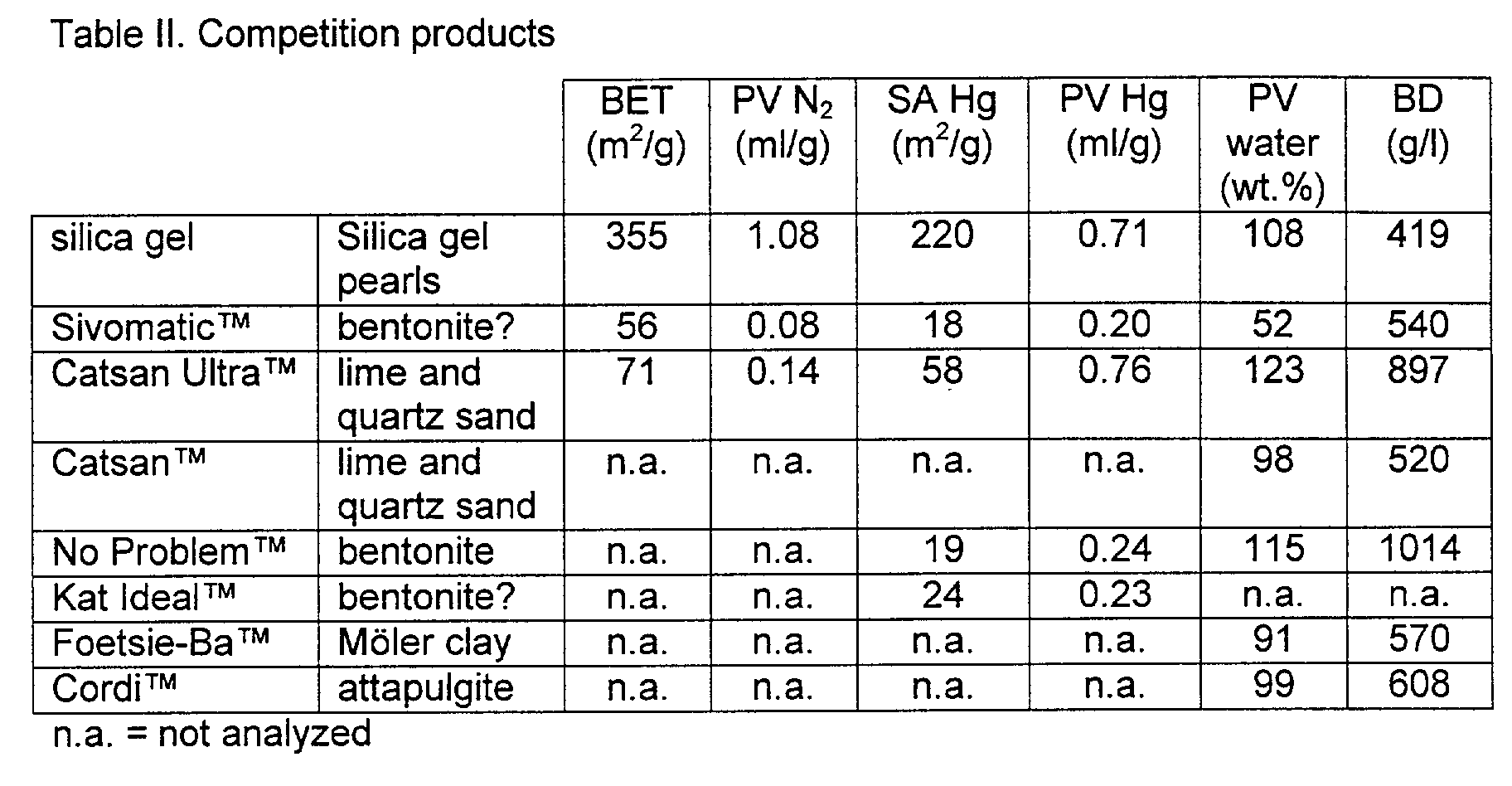
The precipitated silica particles of the invention are lighter than the known competition
products, even lighter than the silica gel pearls, and they absorb more water than the
known competitor products.
Due to the hardness of precipitated silica, the amount of dust is minimal.
Due to the porosity and the low pH of the beads, the urine smell is reduced to a minimum.
Due to the porosity and the low pH of the beads, the urine smell is reduced to a minimum.
Claims (7)
- Precipitated silica particles having edged surfaces and a length : width : depth ratio of 1 : 1 : 1 to 3 : 3-1 : 1 with the length being 0.25 to 15 mm, an absorbing capacity PV water (%) >125, a pore volume PV Hg (ml/g) 0.8-4, a pore volume PV N2 (ml/g) 0.2-1.5, a bulk density BD (g/l) 200-500, and a pH <8.
- The precipitated silica particles of claim 1 wherein the absorbing capacity PV water (%) >140, the pore volume PV Hg (ml/g) 1.2-2.5, the pore volume PV N2 (ml/g) 0.3-0.9, the bulk density BD (g/l) 250-400, and the pH <6.
- The precipitated silica particles of claim 1 or 2 having an irregular shape.
- The precipitated silica particles of any one of claims 1 to 3 comprising boron.
- Pet litter comprising the precipitated silica of any one of claims 1 to 4.
- Use of the precipitated silica particle any one of claims 1 to 4 for making pet litter, preferably cat litter.
- Method for the preparation of the precipitated silica any one of claims 1 to 4 comprising the steps of adding water glass and a mineral acid into a heel of water to obtain a slurry, and optionally adding a boron compound, maintaining the pH between 5 and 10 for 1 to 4 hours, adding optionally a boron compound, subsequently acidifying the slurry to a pH between 2 and 6, converting the slurry to a filter cake, feeding the filter cake to a dryer and shaping it to a particle having edged surfaces and a length : width : depth ratio of 1:1:1 to 3 : 3-1:1 with the length being 0.25 to 15 mm.
Priority Applications (15)
| Application Number | Priority Date | Filing Date | Title |
|---|---|---|---|
| EP00204527A EP1215170A1 (en) | 2000-12-14 | 2000-12-14 | Precipitated silica particles for cat litter |
| JP2002549579A JP2004525847A (en) | 2000-12-14 | 2001-12-14 | Settled silica particles for cat litter |
| DE60121998T DE60121998T2 (en) | 2000-12-14 | 2001-12-14 | FILLED PEBBLE SILICONE PARTICLES FOR CAT DISTRESS |
| AU3844102A AU3844102A (en) | 2000-12-14 | 2001-12-14 | Precipitated silica particles for cat litter |
| CA2436690A CA2436690C (en) | 2000-12-14 | 2001-12-14 | Precipitated silica particles for cat litter |
| US10/433,924 US7037475B2 (en) | 2000-12-14 | 2001-12-14 | Precipitated silica particles for cat litter |
| PL361748A PL202656B1 (en) | 2000-12-14 | 2001-12-14 | Precipitated silica particles for cat litter |
| AU2002238441A AU2002238441B2 (en) | 2000-12-14 | 2001-12-14 | Precipitated silica particles for cat litter |
| PT01986888T PT1343723E (en) | 2000-12-14 | 2001-12-14 | Precipitated silica particles for cat litter |
| EP01986888A EP1343723B1 (en) | 2000-12-14 | 2001-12-14 | Precipitated silica particles for cat litter |
| PCT/EP2001/014854 WO2002048037A1 (en) | 2000-12-14 | 2001-12-14 | Precipitated silica particles for cat litter |
| DK01986888T DK1343723T3 (en) | 2000-12-14 | 2001-12-14 | Precipitated silica particles for cat grit |
| AT01986888T ATE334940T1 (en) | 2000-12-14 | 2001-12-14 | PRECIPITATED SILICIC ACID PARTICLES FOR CAT LITTER |
| ES01986888T ES2269489T3 (en) | 2000-12-14 | 2001-12-14 | PARTICLES OF PRECIPITATED SILICE FOR CATS MILK. |
| EA200300677A EA005781B1 (en) | 2000-12-14 | 2001-12-14 | Precipitated silica particles for cat litter |
Applications Claiming Priority (1)
| Application Number | Priority Date | Filing Date | Title |
|---|---|---|---|
| EP00204527A EP1215170A1 (en) | 2000-12-14 | 2000-12-14 | Precipitated silica particles for cat litter |
Publications (1)
| Publication Number | Publication Date |
|---|---|
| EP1215170A1 true EP1215170A1 (en) | 2002-06-19 |
Family
ID=8172433
Family Applications (2)
| Application Number | Title | Priority Date | Filing Date |
|---|---|---|---|
| EP00204527A Withdrawn EP1215170A1 (en) | 2000-12-14 | 2000-12-14 | Precipitated silica particles for cat litter |
| EP01986888A Revoked EP1343723B1 (en) | 2000-12-14 | 2001-12-14 | Precipitated silica particles for cat litter |
Family Applications After (1)
| Application Number | Title | Priority Date | Filing Date |
|---|---|---|---|
| EP01986888A Revoked EP1343723B1 (en) | 2000-12-14 | 2001-12-14 | Precipitated silica particles for cat litter |
Country Status (13)
| Country | Link |
|---|---|
| US (1) | US7037475B2 (en) |
| EP (2) | EP1215170A1 (en) |
| JP (1) | JP2004525847A (en) |
| AT (1) | ATE334940T1 (en) |
| AU (2) | AU3844102A (en) |
| CA (1) | CA2436690C (en) |
| DE (1) | DE60121998T2 (en) |
| DK (1) | DK1343723T3 (en) |
| EA (1) | EA005781B1 (en) |
| ES (1) | ES2269489T3 (en) |
| PL (1) | PL202656B1 (en) |
| PT (1) | PT1343723E (en) |
| WO (1) | WO2002048037A1 (en) |
Families Citing this family (14)
| Publication number | Priority date | Publication date | Assignee | Title |
|---|---|---|---|---|
| CA2743872A1 (en) * | 2008-11-14 | 2010-05-20 | Ross Technology Corporation | Long lasting, non-wetting, odor free, easily manageable animal litter and litter box usable therewith |
| AU2010337087B2 (en) | 2009-12-29 | 2016-09-22 | W. R. Grace & Co.-Conn. | Compositions for forming obscuration films and methods of making and using the same |
| PL2555920T3 (en) | 2009-12-29 | 2018-02-28 | W. R. Grace & Co.-Conn | Composite inorganic particles and methods of making and using the same |
| US11000711B2 (en) | 2009-12-29 | 2021-05-11 | W. R. Grace & Co.-Conn. | Compositions for forming films having a desired degree of obscuration and methods of making and using the same |
| DE102010018173A1 (en) | 2010-04-22 | 2011-10-27 | Rudolf Bröder | Marking composition useful for marking sports fields and playgrounds, comprises a silicon dioxide and/or aluminum oxide content, and a minor component |
| CA2813741C (en) * | 2010-10-05 | 2019-12-17 | Drylet, Llc | Composition and method for delivery of substances in a dry mode having a surface layer |
| DE202011002156U1 (en) | 2011-01-31 | 2011-05-26 | Promat GmbH, 40878 | Latent heat storage |
| CA2830086C (en) | 2011-04-04 | 2020-06-23 | Drylet, Llc | Composition and method for delivery of living cells in a dry mode having a surface layer |
| US8871186B2 (en) | 2012-08-21 | 2014-10-28 | Red Lion Chem Tech, Llc | Compositions and methods for control of malodor and other environmental contaminants |
| TWI648220B (en) * | 2014-02-28 | 2019-01-21 | 法商隆迪亞營運公司 | Method for preparing modified cerium oxide, modified cerium oxide and use thereof, especially for reinforcing polymer |
| FR3050458B1 (en) * | 2016-04-25 | 2019-07-05 | Prevor International | SOLID DEPOLLUTION COMPOSITION, PROCESS FOR OBTAINING SAME AND USES THEREOF |
| US11440853B2 (en) | 2017-02-28 | 2022-09-13 | Drylet, Inc. | Systems, methods, and apparatus for increased wastewater effluent and biosolids quality |
| EP3659968A1 (en) * | 2018-11-29 | 2020-06-03 | ImerTech | Mineral composition |
| CN109455730B (en) * | 2018-12-07 | 2020-10-13 | 清华大学 | A kind of preparation method of spherical silica nanoparticles |
Citations (5)
| Publication number | Priority date | Publication date | Assignee | Title |
|---|---|---|---|---|
| WO1988000434A1 (en) * | 1986-07-15 | 1988-01-28 | Patrick Yananton | Non-absorbent litter for use with absorbent pad |
| WO1997046485A1 (en) * | 1996-06-06 | 1997-12-11 | Rhodia Chimie | Silica capable of being used in toothpaste compositions |
| WO1998027809A1 (en) * | 1996-12-23 | 1998-07-02 | Tolsa | Animal litter composition and method for obtaining same |
| EP0901986A1 (en) * | 1997-09-15 | 1999-03-17 | Degussa Aktiengesellschaft | Sligthly dispersible precipitated silica |
| EP1029448A1 (en) * | 1997-10-24 | 2000-08-23 | Tolsa S.A. | Bacteriostatic agent, preparation and utilisation thereof |
Family Cites Families (7)
| Publication number | Priority date | Publication date | Assignee | Title |
|---|---|---|---|---|
| DE3713742A1 (en) | 1987-04-24 | 1988-11-03 | Embsen Gipswerk | METHOD FOR PRODUCING AN ADSORPTION AGENT FROM PERLITE AND CALCIUM SULFATE SEMI-HYDRATE |
| US4914066A (en) * | 1989-02-24 | 1990-04-03 | Hoechst Celanese Corporation | Pellets of clay and superabsorbent polymer |
| US5846506A (en) * | 1994-10-07 | 1998-12-08 | Degussa Aktiengesellschaft | Precipitated silicas |
| DE19526476A1 (en) * | 1995-07-20 | 1997-01-23 | Degussa | precipitated silica |
| DE19527278A1 (en) * | 1995-07-26 | 1997-01-30 | Degussa | Precipitated silica |
| US5929156A (en) * | 1997-05-02 | 1999-07-27 | J.M. Huber Corporation | Silica product for use in elastomers |
| US6610266B2 (en) * | 2001-11-28 | 2003-08-26 | Michael C. Withiam | Calcium metasilicates and methods for making |
-
2000
- 2000-12-14 EP EP00204527A patent/EP1215170A1/en not_active Withdrawn
-
2001
- 2001-12-14 US US10/433,924 patent/US7037475B2/en not_active Expired - Fee Related
- 2001-12-14 WO PCT/EP2001/014854 patent/WO2002048037A1/en not_active Ceased
- 2001-12-14 ES ES01986888T patent/ES2269489T3/en not_active Expired - Lifetime
- 2001-12-14 PT PT01986888T patent/PT1343723E/en unknown
- 2001-12-14 JP JP2002549579A patent/JP2004525847A/en active Pending
- 2001-12-14 CA CA2436690A patent/CA2436690C/en not_active Expired - Fee Related
- 2001-12-14 EA EA200300677A patent/EA005781B1/en not_active IP Right Cessation
- 2001-12-14 AU AU3844102A patent/AU3844102A/en active Pending
- 2001-12-14 AU AU2002238441A patent/AU2002238441B2/en not_active Ceased
- 2001-12-14 AT AT01986888T patent/ATE334940T1/en active
- 2001-12-14 PL PL361748A patent/PL202656B1/en not_active IP Right Cessation
- 2001-12-14 EP EP01986888A patent/EP1343723B1/en not_active Revoked
- 2001-12-14 DE DE60121998T patent/DE60121998T2/en not_active Expired - Lifetime
- 2001-12-14 DK DK01986888T patent/DK1343723T3/en active
Patent Citations (5)
| Publication number | Priority date | Publication date | Assignee | Title |
|---|---|---|---|---|
| WO1988000434A1 (en) * | 1986-07-15 | 1988-01-28 | Patrick Yananton | Non-absorbent litter for use with absorbent pad |
| WO1997046485A1 (en) * | 1996-06-06 | 1997-12-11 | Rhodia Chimie | Silica capable of being used in toothpaste compositions |
| WO1998027809A1 (en) * | 1996-12-23 | 1998-07-02 | Tolsa | Animal litter composition and method for obtaining same |
| EP0901986A1 (en) * | 1997-09-15 | 1999-03-17 | Degussa Aktiengesellschaft | Sligthly dispersible precipitated silica |
| EP1029448A1 (en) * | 1997-10-24 | 2000-08-23 | Tolsa S.A. | Bacteriostatic agent, preparation and utilisation thereof |
Also Published As
| Publication number | Publication date |
|---|---|
| ES2269489T3 (en) | 2007-04-01 |
| AU2002238441B2 (en) | 2007-11-01 |
| EA005781B1 (en) | 2005-06-30 |
| EP1343723A1 (en) | 2003-09-17 |
| CA2436690A1 (en) | 2002-06-20 |
| PL361748A1 (en) | 2004-10-04 |
| PL202656B1 (en) | 2009-07-31 |
| JP2004525847A (en) | 2004-08-26 |
| US7037475B2 (en) | 2006-05-02 |
| DE60121998D1 (en) | 2006-09-14 |
| CA2436690C (en) | 2010-03-30 |
| WO2002048037A1 (en) | 2002-06-20 |
| ATE334940T1 (en) | 2006-08-15 |
| US20040146444A1 (en) | 2004-07-29 |
| AU3844102A (en) | 2002-06-24 |
| DE60121998T2 (en) | 2007-03-15 |
| EA200300677A1 (en) | 2003-10-30 |
| DK1343723T3 (en) | 2006-11-13 |
| PT1343723E (en) | 2006-12-29 |
| EP1343723B1 (en) | 2006-08-02 |
Similar Documents
| Publication | Publication Date | Title |
|---|---|---|
| CA2436690C (en) | Precipitated silica particles for cat litter | |
| CA1246848A (en) | Animal litter | |
| AU2002238441A1 (en) | Precipitated silica particles for cat litter | |
| US5188064A (en) | Clumping cat litter | |
| US4607594A (en) | Animal litter | |
| US7603964B2 (en) | Composite particle animal litter and method thereof | |
| WO2011091262A2 (en) | Hybrid animal litter composition | |
| EP2418935A1 (en) | Absorbent material | |
| US12389875B2 (en) | Low density pet litters and methods of making and using such pet litters | |
| JP2651350B2 (en) | Sorbent and production method thereof | |
| CA2978423C (en) | Animal litters exhibiting reduced adhesion properties, and related methods | |
| EP3311659A1 (en) | Animal litter composition, especially suitable for cats | |
| JPH06269660A (en) | Preparation of smectite based sorption agent for absorbing liquid | |
| JPH04287626A (en) | Sand of toilet for pet | |
| EP0677244A1 (en) | Improved sorbent composition | |
| JP4057185B2 (en) | Method for producing pet excreta absorbent | |
| PL216161B1 (en) | Method for manufacturing pet litter and litter produced by this method | |
| JP3877432B2 (en) | Method for producing pet excreta absorbent | |
| EP0436608A1 (en) | Odour eliminating and liquid absorbing agent. | |
| PL224686B1 (en) | Method for producing hygienic litter bedding for small animals, preferably for cats and the hygienic litter bedding for small animals, preferably for cats |
Legal Events
| Date | Code | Title | Description |
|---|---|---|---|
| PUAI | Public reference made under article 153(3) epc to a published international application that has entered the european phase |
Free format text: ORIGINAL CODE: 0009012 |
|
| AK | Designated contracting states |
Kind code of ref document: A1 Designated state(s): AT BE CH CY DE DK ES FI FR GB GR IE IT LI LU MC NL PT SE TR |
|
| AX | Request for extension of the european patent |
Free format text: AL;LT;LV;MK;RO;SI |
|
| AKX | Designation fees paid | ||
| REG | Reference to a national code |
Ref country code: DE Ref legal event code: 8566 |
|
| STAA | Information on the status of an ep patent application or granted ep patent |
Free format text: STATUS: THE APPLICATION IS DEEMED TO BE WITHDRAWN |
|
| 18D | Application deemed to be withdrawn |
Effective date: 20021220 |