EP1213910A1 - Digital image distribution system, apparatus and method - Google Patents
Digital image distribution system, apparatus and method Download PDFInfo
- Publication number
- EP1213910A1 EP1213910A1 EP01309992A EP01309992A EP1213910A1 EP 1213910 A1 EP1213910 A1 EP 1213910A1 EP 01309992 A EP01309992 A EP 01309992A EP 01309992 A EP01309992 A EP 01309992A EP 1213910 A1 EP1213910 A1 EP 1213910A1
- Authority
- EP
- European Patent Office
- Prior art keywords
- data
- user
- address
- stored
- digital camera
- Prior art date
- Legal status (The legal status is an assumption and is not a legal conclusion. Google has not performed a legal analysis and makes no representation as to the accuracy of the status listed.)
- Granted
Links
Images




Classifications
-
- G—PHYSICS
- G06—COMPUTING OR CALCULATING; COUNTING
- G06Q—INFORMATION AND COMMUNICATION TECHNOLOGY [ICT] SPECIALLY ADAPTED FOR ADMINISTRATIVE, COMMERCIAL, FINANCIAL, MANAGERIAL OR SUPERVISORY PURPOSES; SYSTEMS OR METHODS SPECIALLY ADAPTED FOR ADMINISTRATIVE, COMMERCIAL, FINANCIAL, MANAGERIAL OR SUPERVISORY PURPOSES, NOT OTHERWISE PROVIDED FOR
- G06Q50/00—Information and communication technology [ICT] specially adapted for implementation of business processes of specific business sectors, e.g. utilities or tourism
- G06Q50/10—Services
-
- G—PHYSICS
- G06—COMPUTING OR CALCULATING; COUNTING
- G06Q—INFORMATION AND COMMUNICATION TECHNOLOGY [ICT] SPECIALLY ADAPTED FOR ADMINISTRATIVE, COMMERCIAL, FINANCIAL, MANAGERIAL OR SUPERVISORY PURPOSES; SYSTEMS OR METHODS SPECIALLY ADAPTED FOR ADMINISTRATIVE, COMMERCIAL, FINANCIAL, MANAGERIAL OR SUPERVISORY PURPOSES, NOT OTHERWISE PROVIDED FOR
- G06Q30/00—Commerce
- G06Q30/06—Buying, selling or leasing transactions
-
- H—ELECTRICITY
- H04—ELECTRIC COMMUNICATION TECHNIQUE
- H04L—TRANSMISSION OF DIGITAL INFORMATION, e.g. TELEGRAPHIC COMMUNICATION
- H04L67/00—Network arrangements or protocols for supporting network services or applications
- H04L67/01—Protocols
- H04L67/02—Protocols based on web technology, e.g. hypertext transfer protocol [HTTP]
-
- H—ELECTRICITY
- H04—ELECTRIC COMMUNICATION TECHNIQUE
- H04L—TRANSMISSION OF DIGITAL INFORMATION, e.g. TELEGRAPHIC COMMUNICATION
- H04L9/00—Cryptographic mechanisms or cryptographic arrangements for secret or secure communications; Network security protocols
- H04L9/40—Network security protocols
-
- H—ELECTRICITY
- H04—ELECTRIC COMMUNICATION TECHNIQUE
- H04N—PICTORIAL COMMUNICATION, e.g. TELEVISION
- H04N1/00—Scanning, transmission or reproduction of documents or the like, e.g. facsimile transmission; Details thereof
- H04N1/00127—Connection or combination of a still picture apparatus with another apparatus, e.g. for storage, processing or transmission of still picture signals or of information associated with a still picture
- H04N1/00132—Connection or combination of a still picture apparatus with another apparatus, e.g. for storage, processing or transmission of still picture signals or of information associated with a still picture in a digital photofinishing system, i.e. a system where digital photographic images undergo typical photofinishing processing, e.g. printing ordering
-
- H—ELECTRICITY
- H04—ELECTRIC COMMUNICATION TECHNIQUE
- H04N—PICTORIAL COMMUNICATION, e.g. TELEVISION
- H04N1/00—Scanning, transmission or reproduction of documents or the like, e.g. facsimile transmission; Details thereof
- H04N1/00127—Connection or combination of a still picture apparatus with another apparatus, e.g. for storage, processing or transmission of still picture signals or of information associated with a still picture
- H04N1/00132—Connection or combination of a still picture apparatus with another apparatus, e.g. for storage, processing or transmission of still picture signals or of information associated with a still picture in a digital photofinishing system, i.e. a system where digital photographic images undergo typical photofinishing processing, e.g. printing ordering
- H04N1/00137—Transmission
-
- H—ELECTRICITY
- H04—ELECTRIC COMMUNICATION TECHNIQUE
- H04N—PICTORIAL COMMUNICATION, e.g. TELEVISION
- H04N1/00—Scanning, transmission or reproduction of documents or the like, e.g. facsimile transmission; Details thereof
- H04N1/00127—Connection or combination of a still picture apparatus with another apparatus, e.g. for storage, processing or transmission of still picture signals or of information associated with a still picture
- H04N1/00132—Connection or combination of a still picture apparatus with another apparatus, e.g. for storage, processing or transmission of still picture signals or of information associated with a still picture in a digital photofinishing system, i.e. a system where digital photographic images undergo typical photofinishing processing, e.g. printing ordering
- H04N1/00148—Storage
- H04N1/00151—Storage with selective access
-
- H—ELECTRICITY
- H04—ELECTRIC COMMUNICATION TECHNIQUE
- H04N—PICTORIAL COMMUNICATION, e.g. TELEVISION
- H04N1/00—Scanning, transmission or reproduction of documents or the like, e.g. facsimile transmission; Details thereof
- H04N1/00127—Connection or combination of a still picture apparatus with another apparatus, e.g. for storage, processing or transmission of still picture signals or of information associated with a still picture
- H04N1/00132—Connection or combination of a still picture apparatus with another apparatus, e.g. for storage, processing or transmission of still picture signals or of information associated with a still picture in a digital photofinishing system, i.e. a system where digital photographic images undergo typical photofinishing processing, e.g. printing ordering
- H04N1/00161—Viewing or previewing
- H04N1/00164—Viewing or previewing at a remote location
-
- H—ELECTRICITY
- H04—ELECTRIC COMMUNICATION TECHNIQUE
- H04N—PICTORIAL COMMUNICATION, e.g. TELEVISION
- H04N1/00—Scanning, transmission or reproduction of documents or the like, e.g. facsimile transmission; Details thereof
- H04N1/00127—Connection or combination of a still picture apparatus with another apparatus, e.g. for storage, processing or transmission of still picture signals or of information associated with a still picture
- H04N1/00132—Connection or combination of a still picture apparatus with another apparatus, e.g. for storage, processing or transmission of still picture signals or of information associated with a still picture in a digital photofinishing system, i.e. a system where digital photographic images undergo typical photofinishing processing, e.g. printing ordering
- H04N1/00169—Digital image input
- H04N1/0018—Digital image input of images captured using a loaned, rented or limited-use still digital camera, e.g. recyclable or disposable camera
Definitions
- the present invention relates to a data distribution system, a data distribution apparatus and a data distribution method, and in particular to a technique for distributing image data or the like to a user connected to a network.
- image data, music data, or the like are distributed to a user's client terminal from a server computer via the Internet.
- a user when a user produces a silver salt photograph of an image captured using an optical camera, that image can be scanned and the digital image can be stored on a server computer connected to the Internet.
- a user can transmit an image captured by a digital camera via the Internet to a service center, which can then produce hardcopies of the image and mail these back to the user.
- a service for printing an image captured using a digital camera by a user and transmitted to a predetermined service center via the Internet is advantageous in that a user need not purchase their own expensive printer.
- this service is troublesome in that the user must own an expensive digital camera for capturing an image and always carry the digital camera so as to obtain desired images.
- the user in order to transmit the images captured by the digital camera to a predetermined service center, the user must input the image captured by the digital camera into his own terminal, such as a personal computer, which must be connected to the Internet for transmitting the image data. This requires not inconsiderable knowledge and equipment.
- the popularity of digital cameras has increased, they have come to be used by people of wide demographics, such that the demand that image data be available in a visible manner has increased.
- the present invention was conceived in view of the above described disadvantages of the related art and aims to provide a system and a method of obtaining desired data more easily and effectively than with the related art.
- a method of distributing data to a user using a network comprising the steps of inputting data stored in a device returned by a user; storing said data in a server computer connected with said network in association with a uniquely assigned address; and transmitting said data via said network to a terminal when the user accesses said server computer from the terminal using said address.
- a user borrows a device such as a digital camera and, when the user returns the device after capturing desired data, the data stored in the device is input and stored on a server computer (a server) in association with a unique address. This enables the user to easily obtain the data he captured using the address.
- the address may, for example, be provided with the device in a form which is visible to the user, so that the user can obtain the address, at least when they return the device, and after returning the device can obtain the data they captured from the server using that address.
- the address may, for example, be generated from information inherent in the device. By using information inherent in the device, a unique address can be provided. A serial number of the device could be an example of such inherent information. Alternatively, when information for identifying the device is provided on the device in the form of bar code, the bar code data can also be used.
- the address may, for example, be prestored in a memory of the device, and may be input along with the data captured by the user to be further stored in the server computer. This can further reduce time and labor at the shop to which the device is returned, and can also ensure that the address is reliably provided to the server.
- the memory may be a ROM or a RAM.
- the address may, for example, be generated from information associated with the user. This helps the user to recognize or remember the address.
- the address may, for example, be a HTTP URL.
- a unique web page on which the data captured by the user is published can be specified by the URL, such that the user can easily access their data.
- At least one of a computer, a portable telephone, and a digital television may be used as the user's terminal.
- the data may one or both of image and voice data.
- Image data may be still or a motion image data.
- the device borrowed and returned by the user may be, for example, a digital camera.
- the present invention provides a system for distributing data to a user via a network.
- the system comprises data input means for inputting data stored in a device which returned by a user; storing means connected to said network for storing said data in association with a uniquely assigned address; processing means for searching said data stored in said storing means in response to an access request transmitted from terminal operated by the user and for transmitting said data to the user's terminal via said network.
- the present invention further provides an apparatus for distributing data to a user via a network.
- the apparatus comprises means for storing data stored in a device which is returned by a user in association with a uniquely assigned addressand means for receiving from a terminal a data request indicating said address and for transmitting said data to said terminal via said network.
- the apparatus according to the present invention can function as a server computer connected to a network such as the Internet.
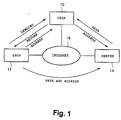
- a conceptual view of a system according to an embodiment of the present invention is illustrated.
- a user 10 a shop 12, and a server 14 are interconnected via the Internet 16.
- the user 10 borrows a desired device, such as a digital camera, from the shop 12 and captures desired image or voice data.
- a desired device such as a digital camera
- Such data capturing may be by the user's capturing of an image of a person or a scene at indoor or outdoor sites, such as a theme park, an amusement park, a business exhibition place or a town, or recording human speech or other sound. More specifically, the user may, for example, capture a souvenir photograph at a theme park or with a friend visiting town, or may capture scenes of a mountain while on vacation or images of an exhibition attended on a business trip.
- the user 10 After capturing the desired data, the user 10 returns the device to the shop 12.
- the shop 12 which may, for example, be a convenience store
- the data captured by the user 10 is read from the returned device and the user 10 is provided with an address which will allow the user 10 to acquire the captured data via the Internet 16.
- the address can be an HTTP (Hyper Text Transfer Protocol) URL (Uniform Resource Locator). Specific examples of methods for assigning an address are described below.
- the data captured by the user is read from the device at the shop 12, the data is then transmitted to the server 14 via the Internet 16 along with the address provided to the user 10.
- the data transmitted from the shop 12 is stored in the server 14 in association with the address. For example, when displaying the data on a web page written in HTML (Hyper Text Markup Language), the URL of the web page may correspond to the address provided at the shop 12.
- HTML Hyper Text Markup Language
- the data captured by the device which the user borrowed from the shop is stored on the server 14 and an address for accessing the data is provided. Accordingly, it is possible for the user 10 to access the data captured by himself using the address and thereby obtain the captured data via the Internet when desired.
- Fig. 2 is a block diagram showing the structure of the shop 12 in Fig. 1.
- the image data captured by the user or the voice data input by the user is stored in a memory of the device, for example a digital camera 17, which the user 10 returns to the shop 12.
- the image or voice data is then read from the memory of the digital camera 17 and input to a data input section 12a provided at the shop 12.
- This data transfer may be performed through wireless communication using radio or infrared signals, or through wired communication using a data line or a connector.
- wired communication in order to prevent the user's captured data from being transferred to general devices such as computers, it may be preferable to use a data line or a connector having a unique configuration that is not interchangeable with the standard connectors of such devices.
- the data transfer from the digital camera 17 at the shop 12 may be initiated by starting a transfer program upon detection of external factors, such as an external radio signal sent to the digital camera 17, mechanical insertion of a pin into the digital camera 17, or the like.
- the image or voice data thus transferred to the data input section 12a is then read and transmitted to a data transmission section 12b, which further transmits the data to the server 14 via the Internet 16.
- the uniquely assigned address is also input to the data input section 12a, and is further transmitted to the server 14 through the data transmission section 12b.
- the address may be previously provided in the device returned from the user 10 or may be generated independently of the returned device and input to the data input section 12a.
- the data input section 12a and the data transmission section 12b are controlled by a control section, such as a CPU of a personal computer which is not shown. Reading and inputting of the data from the digital camera 17, addition of address information to this input data, data transfer to the data transmission section 12b, and further data transfer from the data transmission section 12b to the network is controlled by instructions from the CPU and these processes are sequentially executed in synchronization.
- the data input section 12a the input data is temporarily stored in a memory (not shown) and a URL for the user is then added to the data under the control of the CPU. This URL enables the user to access to the server 14 as described in greater detail later in this specification.
- the data transmission section 12b transmits data in packet units indicating the address of the server 14 which is the destination of the data transmission.
- Fig. 3 illustrates an example format for data to be transmitted from the data transmission section 12b to the server 14 via the Internet 16.
- the data 18 to be transmitted comprises a header portion, a uniquely assigned address (shown as a URL in Fig. 3), image data, and voice data.
- the server 14 is capable of storing the image and voice data captured by the user in association with the URL.
- Fig. 4 illustrates the structure of a digital camera 17 as one example of a device which the user borrows and then returns.
- the digital camera 17 described herein may have limited functions.
- a battery used as a power source of the digital camera 17 may not be interchangeable with commercially available batteries, and a connection terminal as required in a general personal computer for inputting the data stored in a memory (a flash memory) is not necessary for the digital camera 17.
- the number of images that can be captured or the photographing resolution can be limited in accordance with the rental fee.
- a sticker 17a having an address (a URL is shown as an example in Fig. 4) indicated thereon may be attached onto a predetermined portion of the digital camera 17. When the user 10 returns the digital camera 17 to the shop 12, this sticker 17a is removed from the digital camera 17 and given to the user 10, so that the user 10 can know the address for their data.
- the data corresponding to the address indicated on the sticker 17a in a predetermined part of the digital camera 17 in a machine readable form such as, for example, a bar code, such that the data can be read by a reader provided at the shop 12 and then input to the data input section 12a.
- a pair of stickers 17a can be provided, so that one is removed and provided to the user 10 while the other is used for machine reading.
- This sticker 17a is not necessarily put on the body of the digital camera, but may be provided in a package for the digital camera, for example. In such a case, the user 10 can recognize the address only after borrowing the digital camera 17 and opening the package prior to use.
- the memory such as a flash memory
- the flash memory 20 includes an image area 20a for storing image data (voice data) and a text area 20b for storing text data.
- An address area 20c is further provided in a portion of the text area 20b for storing the address data such as a URL. This address data may be stored when the digital camera 17 is shipped from the factory or at another suitable point.
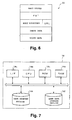
- the flash memory 20 of the digital camera 17 When the flash memory 20 of the digital camera 17 is divided into a boot record region, a FAT (file allocation table) region, a root directory region, an image data region, and a voice data region as shown in Fig. 6, it is possible to store the URL data in the root directory region, for example, so as to store the address data while securing the memory capacity of the image data region and the voice data region.
- the data arrangement in the flash memory 20 of the digital camera 17 is not limited to those shown in Figs. 5 and 6, and other arrangement may be used.
- the address data may be stored in the flash memory 20 when the digital camera is shipped from the factory or when the camera is borrowed or returned by the user 10.
- the address data When the address data is stored at the time of factory shipment of the digital camera 17, it is preferable that the address data be generated based on information inherent to the digital camera. When the address data is stored when the digital camera is borrowed or returned, on the other hand, it is preferable that the address data be generated based on the information associated with the user 10. In order to generate the address data based on the information inherent to the digital camera 17, the address data may be generated from the serial number, or a combination of the serial number and manufacturing date of the digital camera 17. When a URL is used as the address data, the address data may be in a form such as www.service.sanyo.com/(serial number) or the like.
- the serial number of the digital camera 17 be read by a reader and printed in the form of a URL that can be supplied to the user along with a receipt, or that the predetermined URL be printed on a receipt for supplying to the user.
- the reader and the printer may function as address generating means.
- a POS terminal installed in the shop 12 may be used as address generating means.
- the address data may be generated based on the user's home telephone number or the number of a mobile telephone carried by the user. In such a case, the address data may be www.service.sanyo.com/(telephone number) or the like.
- the address data is not limited to URL addresses themselves, and any data which corresponds uniquely to the URL can also be used as the address data.
- a certain ID is assigned to the user 10 and a URL corresponding to this ID on one-to-one basis is generated at the shop 12 and sent to the server 14 along with the user's ID.
- the user 10 can first access a service providing a web page in order to acquire a URL using the ID and can then use the URL provided by this service to access the data captured by the user.
- Fig. 7 illustrates the structure of the server 14 shown in Fig. 1.
- the server 14 comprises an input/output interface I/F 14a, a CPU 14b, a ROM 14c, a RAM 14d, a data storing section 14e and a user data storing section 14f.
- the address data and the user's captured data transmitted from the shop 12 are supplied through the interface I/F 14a to the CPU 14b, which then stores the address data and the user's captured data in the data storing section 14e and the user data storing section 14f.
- the data storing section 14e stores the data captured by the user 10 in association with the address
- the user data storing section 14f stores user's personal data such as a name, ID, and usage history for the user.
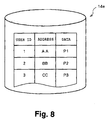
- Fig. 8 schematically shows data stored in the data storing section 14e.
- Each user is provided with an ID and the respective users are managed collectively based on their IDs.
- the data captured by the user 10 is stored in association with the address assigned to each user.
- data P1 is stored in association with a user having ID 1 and address AA.
- the server 14 functions as a WWW server.
- the CPU 14b searches for the data stored in the data storing section 14e corresponding to this address and then transmits the data to the user 10 via the Internet 16.
- the address is a URL
- the user 10 transmits the URL to the server 14 using a web browser installed on the user's terminal, and a web page uniquely corresponding to this URL is transmitted from the server 14 and is then displayed by the browser on the user's terminal. In this manner, the user can obtain over the Internet 16 the data he captured.
- Fig. 9 is a flowchart showing the complete process operation according to the present embodiment.
- the device that the user 10 borrows and returns is a digital camera 17.
- the shop 12 lends the user 10 a digital camera (S101). This lending can be charged and the rental fee may include a deposit.
- the shop 12 After capturing desired image or voice data using the digital camera 17, the user 10 returns the digital camera 17 to the shop 12 (S102). At this time, the shop may return the deposit to the user 10.
- the shop 12 provides the user with an address (S103). As described above, the address may be a URL or an ID for obtaining the URL.
- an ID which is generated by adding predetermined character string to the home telephone number or the number of portable telephone of the user 10, such as 09099999999AB, is supplied to the user 10.
- the shop 12 From this ID, the shop 12 generates a URL, which is then transmitted to the server 14.
- the server 14 stores the ID and the URL in the user data storing section 14f.
- the URL stored in the user data storing section 14f is read and transmitted to the user 10.
- the ID and the data captured by the user 10 are transmitted from the shop 12 to the server 14, where a URL is generated from the ID and is stored in the user data storing section 14f.
- the data captured by the user 10 is also stored in the data storing section 14e in association with the URL thus generated.
- the ID also functions as a search key for acquiring the URL, and is therefore address data.
- the data captured by the user and the address is input (S104) and then transmitted to the server 14 (S105) from the shop 12.
- the server 14 stores the data transmitted from the shop 12 in association with the address (S106). It should be noted that when the server 14 is located in the shop 12, it is not necessary to transmit the data via the Internet 16, and the data can be transmitted from the data transmission section 12b and stored in the server 14 located in the shop 12.
- the server 14 determines whether or not access is requested by the user 10 (S107). If the user requests access using the address, the data stored in association with that address is transmitted to the user 10 (S108).
- Fig. 10 shows an example of a web page transmitted to the user 10 in the following manner.
- the user 10 first operates a web browser installed in the user's terminal to access the server 14 using a URL as the address.
- the server 14 then transmits the web page in response to the user's access.
- a web page 22 which is specified uniquely by the URL is transmitted from the server 14 and image data 22a, 22b which was captured by the user 10 appears on this web page 22.
- the image data 22a, 22b may be in BMP format, JPEG format or any other format.
- the user 10 can view a web page having the image data captured by the user himself, only by capturing a desired image using the digital camera 17 borrowed from the shop 12 and then returning the digital camera 17 to the shop 12.
- This web page 22 is created for the user 10, and, in this sense, the server 14 can be considered as having a function of creating a web page for the user 10.
- the data arrangement within a web page may be predetermined by the server 14, may be specified by the user 10 when the digital camera 17 is returned, or may be specified by the user 10 when displaying the data on the web.
- the data regarding data arrangement specified by the user 10 is stored in the user data storing section 14f, and is read by the CPU 14b as necessary to generate a web page specific to the user 10, which can then be stored in the data storing section 14e.
- the display format for the web page data is not limited to that shown in Fig. 10, and may, for example, be selected in accordance with the user's request from among an album-like display, a business trip report, and other formats.
- the user 10 can, for example, inform a third person of the URL to enable the third person to easily view the user's web page.
- the user 10 can easily share the image or voice data they captured .
- the sever 14 can provide a bulletin board system (BBS) along with the web page so that people who access the web page of the user 10 can share their thoughts. It is also preferable that when the user 10 access the web page 22 and enters his own ID, the user 10 is allowed to edit the web page 22. By doing this, the user 10 can add comments or the like to the image data they captured.
- BSS bulletin board system
- Fig. 11 shows a web page 22 produced in such a manner. Specifically, on the web page 22, the text data 22c obtained by converting the voice data captured by the user into text data is displayed below the image data 22a. It is also possible to store the voice data in correspondence with the image data, so that just the image data is visually displayed on the web page while the voice data is recreated as an audible output.
- the user 10 can easily obtain the data he captured via the Internet 16.
- the user 10 need only capture desired data using a device borrowed from the shop 12 and then return the device to the shop.
- the user 10 can easily obtain the data he captured when desired, without purchasing any additional electronic equipment and without transmitting the captured data from his own terminal via the Internet.
- the user 10 may access the server 14 using a portable telephone or a Personal Digital Assistant (PDA).
- PDA Personal Digital Assistant
- the user 10 may also access the server 14 using a digital television or a CATV connected to the Internet.
- data transmitted from the server 14 is displayed on the digital television or the like, the user can easily display or share their image or other data with their family or friends.
- the shop 12 is not limited to a convenience store or the like, and can be located at a public facility such as a train station, an amusement park, and a specific event place such as a fair and an exhibition.
- a user wishing to capture image or voice data of a specific event need not obtain or bring their own digital camera, but can borrow a digital camera at the event place and obtain the captured data later via the Internet.
- the shops such as convenience stores into which the system of the present invention is introduced are owned by a same company or various companies, as long as they cooperate in the present system, the user can return a digital camera 17 to a shop which is not a shop from which the user borrows the digital camera 17.
- the image data or the like is then stored in the server 14 and can be obtained later through the Internet.
- the data captured by the user 10 is transmitted from the shop 12 to the server 14 via the Internet 16 in the foregoing embodiment, it is also possible to print the image data or store the captured data onto a recording medium such as CD, MD, and DVD at the shop 12, when requested by the user 10. It is also possible that, when the user 10 presents to the shop 12a URL or an address previously acquired, the data stored on the server 14 is downloaded to a terminal at the shop 12, such that the data can be printed or written into a recording medium such as a CD, MD, or DVD.
- the user 10 can appropriately select or specify the data to be input when the data captured by the user 10 is input at the shop 12.
- the user can operate an input device installed in the shop 12 to display and select the image data captured by the user 10 on a display screen of the input device, so that only the image data selected by the user 10 will be input to the data input device 12a.
- an existing multimedia terminal can also be used as the input device.
- the multimedia terminal can further be used to optionally select among the display forms on the web including the display form shown in Fig. 10, an album-like display form, and a business report type display form.
- any other suitable device such as a video camera
- the device need not be a digital device, and an analog device may also be used.
- an analog device it is desirable that the analog data is converted into digital data at the shop 12 or within the server 14 before being stored on the server 14.
- the storage capacity of the sever 14 may prove insufficient when the server 14 is used by a large number of users,.
- the data captured by the user 10 can be stored in the data storing section 14e for just a predetermined period and be automatically deleted after that period has elapsed.
- a serial number of the device or information associated with the user such as a telephone number
- the address is not limited to that information and may be any number or character strings as long as it can result in a unique URL.
- any information indicated by a number or character string is commonly used by a plurality of users, such information could not be used as an address. It is preferable to use, for example, all or a part of date, an ID number or letters regarding a shop, the receipt number in each shop or throughout the business, an identification number or characters of a country or a region, or random numbers, in combination.
- the server 14 it is necessary for the server 14 to perform centralized control so as not to assign the same number or character string to a plurality of users or tasks.
- a serial number or a telephone number and a surname or full name of an individual may be combined with the above information to generate an address.
- the ID which is used as one type of address can be user's personal information such as a fingerprint or retinal pattern.
- the address is provided to the user 10 at the shop 12 and is then transmitted to the server 14 via the Internet. It is also possible, however, that the address is generated by the CPU 14b of the server 14, transmitted via the Internet 16 to the shop 12, and then provided by the shop to the user 10. For example, when the user 10 returns the digital camera 17, the image data stored in the memory of the digital camera 17 is read and transmitted to the server 14 from the shop 12. At the server 14, the address is generated by the CPU 14b on a first-come first-served basis and the received data is stored in association with the address, and then the generated address is transmitted to the shop 12. At the shop 12, the received address can be printed out and handed to, or supplied in another form, to the user 10.
- the network may be a LAN or WAN, and the connection means is not limited to wired or wireless connection.
- the image data may be stored on a server 14 of that company. Such image data can be viewed by the employee himself and others and used to facilitate a business report.
- new URL is issued and supplied to the user each time the digital camera 17 is returned in the foregoing embodiment
- new data can, at the user's request, be stored in a storing region corresponding to the user's URL.
- authentication can be performed using the user's ID.
- the registered user may display an ID or membership card whenever they return a digital camera 17.
- a user can very easily and effectively acquire data which they have captured.
Landscapes
- Engineering & Computer Science (AREA)
- Signal Processing (AREA)
- Multimedia (AREA)
- Business, Economics & Management (AREA)
- Finance (AREA)
- Accounting & Taxation (AREA)
- General Business, Economics & Management (AREA)
- Theoretical Computer Science (AREA)
- Economics (AREA)
- Marketing (AREA)
- Strategic Management (AREA)
- Physics & Mathematics (AREA)
- Computer Networks & Wireless Communication (AREA)
- General Physics & Mathematics (AREA)
- Computer Security & Cryptography (AREA)
- Development Economics (AREA)
- Tourism & Hospitality (AREA)
- Health & Medical Sciences (AREA)
- General Health & Medical Sciences (AREA)
- Human Resources & Organizations (AREA)
- Primary Health Care (AREA)
- Information Transfer Between Computers (AREA)
- Two-Way Televisions, Distribution Of Moving Picture Or The Like (AREA)
- Studio Devices (AREA)
- Apparatus For Radiation Diagnosis (AREA)
- Management, Administration, Business Operations System, And Electronic Commerce (AREA)
Abstract
Description
- The present invention relates to a data distribution system, a data distribution apparatus and a data distribution method, and in particular to a technique for distributing image data or the like to a user connected to a network.
- Against the background of recent developments in the Internet and related technologies, have been seen a huge number of proposals for services providing users with various data via the Internet. For example, image data, music data, or the like are distributed to a user's client terminal from a server computer via the Internet. In another example, when a user produces a silver salt photograph of an image captured using an optical camera, that image can be scanned and the digital image can be stored on a server computer connected to the Internet. In another example, a user can transmit an image captured by a digital camera via the Internet to a service center, which can then produce hardcopies of the image and mail these back to the user.
- A service for printing an image captured using a digital camera by a user and transmitted to a predetermined service center via the Internet is advantageous in that a user need not purchase their own expensive printer. On the other hand, this service is troublesome in that the user must own an expensive digital camera for capturing an image and always carry the digital camera so as to obtain desired images. Further, in order to transmit the images captured by the digital camera to a predetermined service center, the user must input the image captured by the digital camera into his own terminal, such as a personal computer, which must be connected to the Internet for transmitting the image data. This requires not inconsiderable knowledge and equipment. Especially, as the popularity of digital cameras has increased, they have come to be used by people of wide demographics, such that the demand that image data be available in a visible manner has increased.
- The present invention was conceived in view of the above described disadvantages of the related art and aims to provide a system and a method of obtaining desired data more easily and effectively than with the related art.
- In accordance with the present invention, there is provided a method of distributing data to a user using a network, comprising the steps of inputting data stored in a device returned by a user; storing said data in a server computer connected with said network in association with a uniquely assigned address; and transmitting said data via said network to a terminal when the user accesses said server computer from the terminal using said address. A user borrows a device such as a digital camera and, when the user returns the device after capturing desired data, the data stored in the device is input and stored on a server computer (a server) in association with a unique address. This enables the user to easily obtain the data he captured using the address.
- The address may, for example, be provided with the device in a form which is visible to the user, so that the user can obtain the address, at least when they return the device, and after returning the device can obtain the data they captured from the server using that address.
- Further, the address may, for example, be generated from information inherent in the device. By using information inherent in the device, a unique address can be provided. A serial number of the device could be an example of such inherent information. Alternatively, when information for identifying the device is provided on the device in the form of bar code, the bar code data can also be used.
- Further, the address may, for example, be prestored in a memory of the device, and may be input along with the data captured by the user to be further stored in the server computer. This can further reduce time and labor at the shop to which the device is returned, and can also ensure that the address is reliably provided to the server. The memory may be a ROM or a RAM.
- Still further, the address may, for example, be generated from information associated with the user. This helps the user to recognize or remember the address.
- According to the present invention, the address may, for example, be a HTTP URL. A unique web page on which the data captured by the user is published can be specified by the URL, such that the user can easily access their data.
- Moreover, according to the present invention, at least one of a computer, a portable telephone, and a digital television may be used as the user's terminal.
- Further, according to the present invention, the data may one or both of image and voice data. Image data may be still or a motion image data.
- The device borrowed and returned by the user may be, for example, a digital camera.
- Further, the present invention provides a system for distributing data to a user via a network. The system comprises data input means for inputting data stored in a device which returned by a user; storing means connected to said network for storing said data in association with a uniquely assigned address; processing means for searching said data stored in said storing means in response to an access request transmitted from terminal operated by the user and for transmitting said data to the user's terminal via said network.
- The present invention further provides an apparatus for distributing data to a user via a network. The apparatus comprises means for storing data stored in a device which is returned by a user in association with a uniquely assigned addressand means for receiving from a terminal a data request indicating said address and for transmitting said data to said terminal via said network.
- The apparatus according to the present invention can function as a server computer connected to a network such as the Internet.
- These and other objects of the invention will be explained in the description below, in connection with the accompanying drawings, in which:
- FIG. 1 is a conceptual view showing a system according to an embodiment of the present invention;
- FIG. 2 is a block diagram showing the structure of a
shop 12 shown in Fig. 1; - FIG. 3 is a view for explaining a transmission data format according to the embodiment;
- FIG. 4 is a view showing the structure of a
digital camera 17; - FIG. 5 a view for explaining an URL stored in a flash memory of a digital camera;
- FIG. 6 is a view for explaining another URL stored in a flash memory of a digital camera;
- FIG. 7 is a block diagram showing the structure of a
server 14 shown in FIG. 1; - FIG. 8 is a structural view of a data storing section shown in FIG. 7;
- FIG. 9 is a flowchart of a whole process operation according to the embodiment of the present invention;
- FIG. 10 is a view for explaining the screen display of a user terminal according to the embodiment of the present invention; and
- FIG. 11 is a view for explaining another screen display of a user terminal according to the embodiment of the present invention.
-
- A preferred embodiment of the present invention will be described in further detail with reference to the accompanying drawings.
- Referring to Fig. 1, a conceptual view of a system according to an embodiment of the present invention is illustrated. In Fig. 1, a
user 10, ashop 12, and aserver 14 are interconnected via the Internet 16. Theuser 10 borrows a desired device, such as a digital camera, from theshop 12 and captures desired image or voice data. Such data capturing may be by the user's capturing of an image of a person or a scene at indoor or outdoor sites, such as a theme park, an amusement park, a business exhibition place or a town, or recording human speech or other sound. More specifically, the user may, for example, capture a souvenir photograph at a theme park or with a friend visiting town, or may capture scenes of a mountain while on vacation or images of an exhibition attended on a business trip. After capturing the desired data, theuser 10 returns the device to theshop 12. At theshop 12, which may, for example, be a convenience store, the data captured by theuser 10 is read from the returned device and theuser 10 is provided with an address which will allow theuser 10 to acquire the captured data via the Internet 16. When the data captured by the user is, for example, provided in the form of a web page, the address can be an HTTP (Hyper Text Transfer Protocol) URL (Uniform Resource Locator). Specific examples of methods for assigning an address are described below. - After the data captured by the user is read from the device at the
shop 12, the data is then transmitted to theserver 14 via the Internet 16 along with the address provided to theuser 10. The data transmitted from theshop 12 is stored in theserver 14 in association with the address. For example, when displaying the data on a web page written in HTML (Hyper Text Markup Language), the URL of the web page may correspond to the address provided at theshop 12. - In this manner, the data captured by the device which the user borrowed from the shop is stored on the
server 14 and an address for accessing the data is provided. Accordingly, it is possible for theuser 10 to access the data captured by himself using the address and thereby obtain the captured data via the Internet when desired. - Fig. 2 is a block diagram showing the structure of the
shop 12 in Fig. 1. The image data captured by the user or the voice data input by the user is stored in a memory of the device, for example adigital camera 17, which theuser 10 returns to theshop 12. The image or voice data is then read from the memory of thedigital camera 17 and input to adata input section 12a provided at theshop 12. This data transfer may be performed through wireless communication using radio or infrared signals, or through wired communication using a data line or a connector. In wired communication, in order to prevent the user's captured data from being transferred to general devices such as computers, it may be preferable to use a data line or a connector having a unique configuration that is not interchangeable with the standard connectors of such devices. In wireless communication, it may be desirable to transfer data using a proprietary transmission method, or to transfer scrambled data. The data transfer from thedigital camera 17 at theshop 12 may be initiated by starting a transfer program upon detection of external factors, such as an external radio signal sent to thedigital camera 17, mechanical insertion of a pin into thedigital camera 17, or the like. The image or voice data thus transferred to thedata input section 12a is then read and transmitted to adata transmission section 12b, which further transmits the data to theserver 14 via theInternet 16. On the other hand, the uniquely assigned address is also input to thedata input section 12a, and is further transmitted to theserver 14 through thedata transmission section 12b. The address may be previously provided in the device returned from theuser 10 or may be generated independently of the returned device and input to thedata input section 12a. Thedata input section 12a and thedata transmission section 12b are controlled by a control section, such as a CPU of a personal computer which is not shown. Reading and inputting of the data from thedigital camera 17, addition of address information to this input data, data transfer to thedata transmission section 12b, and further data transfer from thedata transmission section 12b to the network is controlled by instructions from the CPU and these processes are sequentially executed in synchronization. In thedata input section 12a, the input data is temporarily stored in a memory (not shown) and a URL for the user is then added to the data under the control of the CPU. This URL enables the user to access to theserver 14 as described in greater detail later in this specification. In the case of data transfer through the Internet, thedata transmission section 12b transmits data in packet units indicating the address of theserver 14 which is the destination of the data transmission. - Fig. 3 illustrates an example format for data to be transmitted from the
data transmission section 12b to theserver 14 via theInternet 16. Thedata 18 to be transmitted comprises a header portion, a uniquely assigned address (shown as a URL in Fig. 3), image data, and voice data. By receiving data in such a format, theserver 14 is capable of storing the image and voice data captured by the user in association with the URL. - The uniquely assigned address can be previously provided in the device to be returned from the
user 10, as described above. Fig. 4 illustrates the structure of adigital camera 17 as one example of a device which the user borrows and then returns. Unlike a commercially available digital camera, thedigital camera 17 described herein may have limited functions. For example, a battery used as a power source of thedigital camera 17 may not be interchangeable with commercially available batteries, and a connection terminal as required in a general personal computer for inputting the data stored in a memory (a flash memory) is not necessary for thedigital camera 17. Further, the number of images that can be captured or the photographing resolution can be limited in accordance with the rental fee. It is also possible to provide a timer in thedigital camera 17 and to start the timer when the user borrows thecamera 17, so that the photographing operation can be limited within a fixed time period to promote prompt return to the shop. In addition, to encourage return of devices and improve their return ratio, the refund amount may be tied to the number of images captured or an amount of data captured. Asticker 17a having an address (a URL is shown as an example in Fig. 4) indicated thereon may be attached onto a predetermined portion of thedigital camera 17. When theuser 10 returns thedigital camera 17 to theshop 12, thissticker 17a is removed from thedigital camera 17 and given to theuser 10, so that theuser 10 can know the address for their data. It is also possible to provide the data corresponding to the address indicated on thesticker 17a in a predetermined part of thedigital camera 17 in a machine readable form such as, for example, a bar code, such that the data can be read by a reader provided at theshop 12 and then input to thedata input section 12a. Of course, a pair ofstickers 17a can be provided, so that one is removed and provided to theuser 10 while the other is used for machine reading. Thissticker 17a is not necessarily put on the body of the digital camera, but may be provided in a package for the digital camera, for example. In such a case, theuser 10 can recognize the address only after borrowing thedigital camera 17 and opening the package prior to use. It is also preferable to pre-store in the memory (such as a flash memory) of thedigital camera 17 data indicating the address indicated on thesticker 17a, and to read and input this address data into thedata input section 12a when reading the image or voice data stored in the flash memory of thedigital camera 17. - Referring to Fig. 5, an example of the structure of a
flash memory 20 of thedigital camera 17 is shown when the address data is stored therein. Theflash memory 20 includes animage area 20a for storing image data (voice data) and atext area 20b for storing text data. Anaddress area 20c is further provided in a portion of thetext area 20b for storing the address data such as a URL. This address data may be stored when thedigital camera 17 is shipped from the factory or at another suitable point. - When the
flash memory 20 of thedigital camera 17 is divided into a boot record region, a FAT (file allocation table) region, a root directory region, an image data region, and a voice data region as shown in Fig. 6, it is possible to store the URL data in the root directory region, for example, so as to store the address data while securing the memory capacity of the image data region and the voice data region. The data arrangement in theflash memory 20 of thedigital camera 17 is not limited to those shown in Figs. 5 and 6, and other arrangement may be used. The address data may be stored in theflash memory 20 when the digital camera is shipped from the factory or when the camera is borrowed or returned by theuser 10. When the address data is stored at the time of factory shipment of thedigital camera 17, it is preferable that the address data be generated based on information inherent to the digital camera. When the address data is stored when the digital camera is borrowed or returned, on the other hand, it is preferable that the address data be generated based on the information associated with theuser 10. In order to generate the address data based on the information inherent to thedigital camera 17, the address data may be generated from the serial number, or a combination of the serial number and manufacturing date of thedigital camera 17. When a URL is used as the address data, the address data may be in a form such as www.service.sanyo.com/(serial number) or the like. It is preferable that at theshop 12 the serial number of thedigital camera 17 be read by a reader and printed in the form of a URL that can be supplied to the user along with a receipt, or that the predetermined URL be printed on a receipt for supplying to the user. In such a case, the reader and the printer may function as address generating means. Alternatively, a POS terminal installed in theshop 12 may be used as address generating means. On the other hand, so as to generate the address data based on the information inherent to theuser 10, for example, the address data may be generated based on the user's home telephone number or the number of a mobile telephone carried by the user. In such a case, the address data may be www.service.sanyo.com/(telephone number) or the like. - It should be noted that the address data is not limited to URL addresses themselves, and any data which corresponds uniquely to the URL can also be used as the address data. For example, it is possible that a certain ID is assigned to the
user 10 and a URL corresponding to this ID on one-to-one basis is generated at theshop 12 and sent to theserver 14 along with the user's ID. Theuser 10 can first access a service providing a web page in order to acquire a URL using the ID and can then use the URL provided by this service to access the data captured by the user. - Fig. 7 illustrates the structure of the
server 14 shown in Fig. 1. Theserver 14 comprises an input/output interface I/F 14a, aCPU 14b, aROM 14c, aRAM 14d, adata storing section 14e and a userdata storing section 14f. The address data and the user's captured data transmitted from theshop 12 are supplied through the interface I/F 14a to theCPU 14b, which then stores the address data and the user's captured data in thedata storing section 14e and the userdata storing section 14f. Thedata storing section 14e stores the data captured by theuser 10 in association with the address, and the userdata storing section 14f stores user's personal data such as a name, ID, and usage history for the user. - Fig. 8 schematically shows data stored in the
data storing section 14e. Each user is provided with an ID and the respective users are managed collectively based on their IDs. The data captured by theuser 10 is stored in association with the address assigned to each user. For example, as shown in Fig. 8, data P1 is stored in association with auser having ID 1 and address AA. When a URL is used as the address, the user's captured data can be accessed on a web page specified by this unique URL. In this case, theserver 14 functions as a WWW server. - When the
user 10 requests access to theserver 14 via the Internet using the address provided, theCPU 14b searches for the data stored in thedata storing section 14e corresponding to this address and then transmits the data to theuser 10 via theInternet 16. At this time, if the address is a URL, theuser 10 transmits the URL to theserver 14 using a web browser installed on the user's terminal, and a web page uniquely corresponding to this URL is transmitted from theserver 14 and is then displayed by the browser on the user's terminal. In this manner, the user can obtain over theInternet 16 the data he captured. - Fig. 9 is a flowchart showing the complete process operation according to the present embodiment. In this embodiment, it is assumed that the device that the
user 10 borrows and returns is adigital camera 17. First, theshop 12 lends the user 10 a digital camera (S101). This lending can be charged and the rental fee may include a deposit. After capturing desired image or voice data using thedigital camera 17, theuser 10 returns thedigital camera 17 to the shop 12 (S102). At this time, the shop may return the deposit to theuser 10. Then, theshop 12 provides the user with an address (S103). As described above, the address may be a URL or an ID for obtaining the URL. For example, an ID, which is generated by adding predetermined character string to the home telephone number or the number of portable telephone of theuser 10, such as 09099999999AB, is supplied to theuser 10. From this ID, theshop 12 generates a URL, which is then transmitted to theserver 14. Theserver 14 stores the ID and the URL in the userdata storing section 14f. When theuser 10 requests access to the data using this ID, the URL stored in the userdata storing section 14f is read and transmitted to theuser 10. - It is also possible to generate a URL from the ID in the
server 14, rather than in theshop 12 as described above. Specifically, the ID and the data captured by theuser 10 are transmitted from theshop 12 to theserver 14, where a URL is generated from the ID and is stored in the userdata storing section 14f. The data captured by theuser 10 is also stored in thedata storing section 14e in association with the URL thus generated. In this case, the ID also functions as a search key for acquiring the URL, and is therefore address data. - After the address is provided to the
user 10 at step S103, the data captured by the user and the address is input (S104) and then transmitted to the server 14 (S105) from theshop 12. Theserver 14 stores the data transmitted from theshop 12 in association with the address (S106). It should be noted that when theserver 14 is located in theshop 12, it is not necessary to transmit the data via theInternet 16, and the data can be transmitted from thedata transmission section 12b and stored in theserver 14 located in theshop 12. - The
server 14 then determines whether or not access is requested by the user 10 (S107). If the user requests access using the address, the data stored in association with that address is transmitted to the user 10 (S108). - Fig. 10 shows an example of a web page transmitted to the
user 10 in the following manner. Namely, theuser 10 first operates a web browser installed in the user's terminal to access theserver 14 using a URL as the address. Theserver 14 then transmits the web page in response to the user's access. Specifically, aweb page 22 which is specified uniquely by the URL is transmitted from theserver 14 andimage data user 10 appears on thisweb page 22. Theimage data user 10 can view a web page having the image data captured by the user himself, only by capturing a desired image using thedigital camera 17 borrowed from theshop 12 and then returning thedigital camera 17 to theshop 12. Thisweb page 22 is created for theuser 10, and, in this sense, theserver 14 can be considered as having a function of creating a web page for theuser 10. The data arrangement within a web page may be predetermined by theserver 14, may be specified by theuser 10 when thedigital camera 17 is returned, or may be specified by theuser 10 when displaying the data on the web. The data regarding data arrangement specified by theuser 10 is stored in the userdata storing section 14f, and is read by theCPU 14b as necessary to generate a web page specific to theuser 10, which can then be stored in thedata storing section 14e. The display format for the web page data is not limited to that shown in Fig. 10, and may, for example, be selected in accordance with the user's request from among an album-like display, a business trip report, and other formats. - Further, because the
web page 22 is stored on theserver 14, theuser 10 can, for example, inform a third person of the URL to enable the third person to easily view the user's web page. Thus, theuser 10 can easily share the image or voice data they captured . - Further, the sever 14 can provide a bulletin board system (BBS) along with the web page so that people who access the web page of the
user 10 can share their thoughts. It is also preferable that when theuser 10 access theweb page 22 and enters his own ID, theuser 10 is allowed to edit theweb page 22. By doing this, theuser 10 can add comments or the like to the image data they captured. - When the user has captured both voice and image data with the
digital camera 17, it is possible to convert the voice data into text data using any well-known speech recognition technique and to display the text data on theweb page 22 along with the image data. - Fig. 11 shows a
web page 22 produced in such a manner. Specifically, on theweb page 22, thetext data 22c obtained by converting the voice data captured by the user into text data is displayed below theimage data 22a. It is also possible to store the voice data in correspondence with the image data, so that just the image data is visually displayed on the web page while the voice data is recreated as an audible output. - As described above, it is possible for the
user 10 to easily obtain the data he captured via theInternet 16. Theuser 10 need only capture desired data using a device borrowed from theshop 12 and then return the device to the shop. Theuser 10 can easily obtain the data he captured when desired, without purchasing any additional electronic equipment and without transmitting the captured data from his own terminal via the Internet. - The present invention is not limited to the example use to illustrate the above described embodiment and various modifications may be made.
- For example, although it is described above that the
user 10 accesses theserver 14 through theInternet 16 using a terminal, theuser 10 may access theserver 14 using a portable telephone or a Personal Digital Assistant (PDA). Theuser 10 may also access theserver 14 using a digital television or a CATV connected to the Internet. In this case, as data transmitted from theserver 14 is displayed on the digital television or the like, the user can easily display or share their image or other data with their family or friends. - Further, the
shop 12 is not limited to a convenience store or the like, and can be located at a public facility such as a train station, an amusement park, and a specific event place such as a fair and an exhibition. When such a facility is available, a user wishing to capture image or voice data of a specific event need not obtain or bring their own digital camera, but can borrow a digital camera at the event place and obtain the captured data later via the Internet. Further, whether the shops such as convenience stores into which the system of the present invention is introduced are owned by a same company or various companies, as long as they cooperate in the present system, the user can return adigital camera 17 to a shop which is not a shop from which the user borrows thedigital camera 17. The image data or the like is then stored in theserver 14 and can be obtained later through the Internet. - Further, although the data captured by the
user 10 is transmitted from theshop 12 to theserver 14 via theInternet 16 in the foregoing embodiment, it is also possible to print the image data or store the captured data onto a recording medium such as CD, MD, and DVD at theshop 12, when requested by theuser 10. It is also possible that, when theuser 10 presents to theshop 12a URL or an address previously acquired, the data stored on theserver 14 is downloaded to a terminal at theshop 12, such that the data can be printed or written into a recording medium such as a CD, MD, or DVD. - Also, it is possible for the
user 10 to appropriately select or specify the data to be input when the data captured by theuser 10 is input at theshop 12. For example, the user can operate an input device installed in theshop 12 to display and select the image data captured by theuser 10 on a display screen of the input device, so that only the image data selected by theuser 10 will be input to thedata input device 12a. In particular, when theshop 12 is a convenience store or the like, an existing multimedia terminal can also be used as the input device. The multimedia terminal can further be used to optionally select among the display forms on the web including the display form shown in Fig. 10, an album-like display form, and a business report type display form. - Further, although the foregoing embodiment describes a
digital camera 17 as an example of a device borrowed by theuser 10, any other suitable device, such as a video camera, can be employed. Also, the device need not be a digital device, and an analog device may also be used. When an analog device is used, it is desirable that the analog data is converted into digital data at theshop 12 or within theserver 14 before being stored on theserver 14. - In the example used to illustrate the embodiment, it can be expected that the storage capacity of the
sever 14 may prove insufficient when theserver 14 is used by a large number of users,. To limit the likelihood of such an occurrence, the data captured by theuser 10 can be stored in thedata storing section 14e for just a predetermined period and be automatically deleted after that period has elapsed. - Further, although a serial number of the device or information associated with the user, such as a telephone number, are given as examples for forming an address in the foregoing description of the preferred embodiment, the address is not limited to that information and may be any number or character strings as long as it can result in a unique URL. In other words, if any information indicated by a number or character string is commonly used by a plurality of users, such information could not be used as an address. It is preferable to use, for example, all or a part of date, an ID number or letters regarding a shop, the receipt number in each shop or throughout the business, an identification number or characters of a country or a region, or random numbers, in combination. With regard to random numbers, however, it is necessary for the
server 14 to perform centralized control so as not to assign the same number or character string to a plurality of users or tasks. Of course, a serial number or a telephone number and a surname or full name of an individual may be combined with the above information to generate an address. Further, the ID which is used as one type of address can be user's personal information such as a fingerprint or retinal pattern. - Moreover, in the basic example of the preferred embodiment, the address is provided to the
user 10 at theshop 12 and is then transmitted to theserver 14 via the Internet. It is also possible, however, that the address is generated by theCPU 14b of theserver 14, transmitted via theInternet 16 to theshop 12, and then provided by the shop to theuser 10. For example, when theuser 10 returns thedigital camera 17, the image data stored in the memory of thedigital camera 17 is read and transmitted to theserver 14 from theshop 12. At theserver 14, the address is generated by theCPU 14b on a first-come first-served basis and the received data is stored in association with the address, and then the generated address is transmitted to theshop 12. At theshop 12, the received address can be printed out and handed to, or supplied in another form, to theuser 10. - Further, although in the foregoing example of the preferred embodiment data is distributed to the
user 10 via theInternet 16, the network may be a LAN or WAN, and the connection means is not limited to wired or wireless connection. When a LAN is employed and, for example, an employee of one company borrows adigital camera 17 and returns the camera after capturing image data, the image data may be stored on aserver 14 of that company. Such image data can be viewed by the employee himself and others and used to facilitate a business report. - Still further, although new URL is issued and supplied to the user each time the
digital camera 17 is returned in the foregoing embodiment, when the user already has an URL, new data can, at the user's request, be stored in a storing region corresponding to the user's URL. In such a case, authentication can be performed using the user's ID. It is also possible to assign a single URL to each registered user and that the data is always stored a location corresponding to that user's specific URL or ID region. To facilitate this, for example, the registered user may display an ID or membership card whenever they return adigital camera 17. With such a configuration, it is possible to display the user's URL and ID or bar code data corresponding to the URL and ID on a member card or the like and to input this information into thedata input section 20a using a keyboard or a reader. Alternatively, it is also possible to prestore the URL or ID of the user on an IC card, and to input this information into thedata input section 20a using a connector or an electronic circuit such as a wireless transmitting/receiving technology. - As described above, according to the present invention, a user can very easily and effectively acquire data which they have captured.
- While the preferred embodiment of the present invention has been described using specific terms, such description is for illustrative purposes only, and it is to be understood that changes and variations may be made without departing from the spirit or scope of the appended claims.
Claims (25)
- A method of distributing data to a user over a network, comprising the steps of:inputting data stored in a device returned by a user;storing said data in a server computer connected to said network in association with a uniquely assigned address; andtransmitting said data to a terminal connected to said network when the user accesses said server computer from the terminal using said address.
- A method according to claim 1, wherein said address is previously provided in said device in a form which is visible to the user.
- A method according to claim 1, wherein said address is generated from information inherent in said device.
- A method according to claim 1, wherein said address is previously stored in a memory of said device, and, when said data is input, said address stored in the memory is also input and stored into said server computer.
- A method according to claim 1, wherein said address is generated from information associated with the user.
- A method according to claim 1, wherein said address is a URL.
- A method according to claim 1, wherein said data which has been input is transmitted to said server computer via said network and is stored on said server computer.
- A method according to claim 1, wherein said terminal of the user is at least one of a computer, a portable telephone, and a digital television.
- A method according to claim 1, wherein said data includes image data and/or voice data.
- A method according to claim 1, wherein said device is a digital camera.
- A system for distributing data to a user via a network, comprising:data input means for inputting data stored in a device returned by a user;storage means connected to said network for storing said data in association with a uniquely assigned address; andprocessing means for searching said data stored in said storage means in response to an access by the user using said address and transmitting said data via said network to a terminal employed by the user.
- A system according to claims 11, further comprising data transmitting means for transmitting said data input by said data input means and said address to said storing means via said network.
- A system according to claim 11, further comprising address generating means for generating said address from information inherent in said device.
- A system according to claim 11, further comprising address generating means for generating said address from information associated with said user.
- A system according to claim 11, wherein said data input means inputs, along with said data, said address previously stored in said device.
- A system according to claim 11, wherein said address is a URL.
- A system according to claim 11, wherein said data is image data and/or voice data.
- A system according to claim 11, wherein said device is a digital camera.
- An apparatus for distributing data to a user via a network, comprising:means for storing data previously stored in a device returned by a user, in association with a uniquely assigned address; andmeans for receiving a data request using uniquely assigned said and transmitting said data via said network to a terminal operated the user.
- An apparatus according to claim 19, wherein said address is generated from information inherent in said device.
- An apparatus according to claim 19, wherein said address is generated from information associated with said user.
- An apparatus according to claim 19, wherein said address is previously stored in a memory provided within said device.
- An apparatus according to claim 19, wherein said address is a URL and wherein data transmission means transmits said data to the terminal of said user in the form of a web page.
- An apparatus according to claim 19, wherein said data includes image data and/or voice data.
- An apparatus according to claim 19, wherein said device is a digital camera.
Applications Claiming Priority (2)
| Application Number | Priority Date | Filing Date | Title |
|---|---|---|---|
| JP2000365490A JP2002170059A (en) | 2000-11-30 | 2000-11-30 | Data distribution system, apparatus and method |
| JP2000365490 | 2000-11-30 |
Publications (2)
| Publication Number | Publication Date |
|---|---|
| EP1213910A1 true EP1213910A1 (en) | 2002-06-12 |
| EP1213910B1 EP1213910B1 (en) | 2004-10-13 |
Family
ID=18836253
Family Applications (1)
| Application Number | Title | Priority Date | Filing Date |
|---|---|---|---|
| EP01309992A Expired - Lifetime EP1213910B1 (en) | 2000-11-30 | 2001-11-29 | Digital image distribution system, apparatus and method |
Country Status (10)
| Country | Link |
|---|---|
| US (1) | US20020095477A1 (en) |
| EP (1) | EP1213910B1 (en) |
| JP (1) | JP2002170059A (en) |
| KR (1) | KR20020042509A (en) |
| CN (1) | CN1211979C (en) |
| AT (1) | ATE279834T1 (en) |
| DE (1) | DE60106375T2 (en) |
| ES (1) | ES2231393T3 (en) |
| PT (1) | PT1213910E (en) |
| TW (1) | TW563040B (en) |
Cited By (3)
| Publication number | Priority date | Publication date | Assignee | Title |
|---|---|---|---|---|
| WO2005099137A1 (en) * | 2004-04-07 | 2005-10-20 | Chen Ye | A digital video recorder controlled by network |
| EP1720336A1 (en) * | 2005-05-06 | 2006-11-08 | Yet Chan | Camera |
| US7492395B2 (en) | 2003-09-19 | 2009-02-17 | Eastman Kodak Company | Method of providing photofinishing services using recycled digital camera memory devices |
Families Citing this family (18)
| Publication number | Priority date | Publication date | Assignee | Title |
|---|---|---|---|---|
| KR100446538B1 (en) * | 2002-11-21 | 2004-09-01 | 삼성전자주식회사 | On-line digital picture processing system for digital camera rental system |
| JP4110271B2 (en) * | 2002-11-26 | 2008-07-02 | 富士フイルム株式会社 | Image providing system and method |
| JP2004220153A (en) * | 2003-01-10 | 2004-08-05 | Fujitsu Ltd | Image providing system |
| NL1025222C2 (en) * | 2004-01-13 | 2005-07-18 | Maxifoto Int Bv | System for coding a recording and method thereof. |
| US7404085B2 (en) * | 2004-09-03 | 2008-07-22 | Sap Ag | Authentication of handheld devices for access to applications |
| WO2008067646A1 (en) * | 2006-12-04 | 2008-06-12 | Sxip Identity Corp. | Method and system for trusted client bootstrapping |
| JP4555322B2 (en) * | 2007-08-31 | 2010-09-29 | シャープ株式会社 | Image communication system and image communication apparatus |
| US8463740B2 (en) * | 2009-08-05 | 2013-06-11 | Microsoft Corporation | Sharing files on a computer through use of URIs |
| US8455859B2 (en) * | 2009-10-01 | 2013-06-04 | Taiwan Semiconductor Manufacturing Company, Ltd. | Strained structure of semiconductor device |
| US20110282946A1 (en) * | 2010-05-14 | 2011-11-17 | International Business Machines Corporation | Personal unique url access processing system |
| US20120044362A1 (en) * | 2010-08-18 | 2012-02-23 | Motiondrive Ag | Methods and systems for processing digital camera exposures in a network |
| US8670065B2 (en) | 2010-08-18 | 2014-03-11 | DigiDays, AG | Methods and systems for cameras with a disposable housing |
| US20120047095A1 (en) * | 2010-08-18 | 2012-02-23 | Motiondrive Ag | Methods and systems for selling digital photography services in combination with a single-use digital camera |
| CN101951508B (en) * | 2010-09-27 | 2012-05-23 | 深圳市同洲电子股份有限公司 | Method for accessing Internet video by digital television terminal and related equipment and system |
| CN102572226A (en) * | 2010-12-09 | 2012-07-11 | 三星电子(中国)研发中心 | Self-adaptive distributed camera shooting method and system |
| US20180246993A1 (en) * | 2017-02-28 | 2018-08-30 | Panasonic Intellectual Property Management Co., Ltd. | Data game token from destination-based games |
| CN107067834A (en) * | 2017-03-17 | 2017-08-18 | 麦片科技(深圳)有限公司 | Point-of-reading system with oral evaluation function |
| CN107483882A (en) * | 2017-07-07 | 2017-12-15 | 上海斐讯数据通信技术有限公司 | A kind of windows display system and method |
Citations (3)
| Publication number | Priority date | Publication date | Assignee | Title |
|---|---|---|---|---|
| EP0844781A2 (en) * | 1996-11-20 | 1998-05-27 | Fuji Photo Film Co., Ltd. | System for storing and utilizing picture image data recorded by digital camera |
| EP0860980A2 (en) * | 1997-02-20 | 1998-08-26 | Eastman Kodak Company | Electronic camera with "utilization" selection capability |
| WO2000030338A2 (en) * | 1998-11-13 | 2000-05-25 | Silicon Film Technologies, Inc. | Electronic film system and method of film processing |
Family Cites Families (6)
| Publication number | Priority date | Publication date | Assignee | Title |
|---|---|---|---|---|
| DE4005673C2 (en) * | 1989-02-23 | 1994-02-03 | Minolta Camera Kk | Imaging device with a small-sized memory with a bit card allocation system |
| JP4266397B2 (en) * | 1997-10-21 | 2009-05-20 | キヤノン株式会社 | Image processing apparatus, data processing method for image processing apparatus, and storage medium storing computer-readable program |
| JP2000194718A (en) * | 1998-12-28 | 2000-07-14 | Fuji Photo Film Co Ltd | File integration device and method, recording medium storing file integration program, and printer control system and method |
| JP2000228740A (en) * | 1999-02-05 | 2000-08-15 | Fuji Photo Film Co Ltd | Digital camera, playback apparatus, production system, and method of producing digital camera |
| US7111317B1 (en) * | 2000-03-24 | 2006-09-19 | Eastman Kodak Company | Method for providing image goods and/or services to a customer |
| US6788769B1 (en) * | 1999-10-13 | 2004-09-07 | Emediacy, Inc. | Internet directory system and method using telephone number based addressing |
-
2000
- 2000-11-30 JP JP2000365490A patent/JP2002170059A/en active Pending
-
2001
- 2001-11-29 PT PT01309992T patent/PT1213910E/en unknown
- 2001-11-29 EP EP01309992A patent/EP1213910B1/en not_active Expired - Lifetime
- 2001-11-29 DE DE60106375T patent/DE60106375T2/en not_active Expired - Fee Related
- 2001-11-29 US US09/997,067 patent/US20020095477A1/en not_active Abandoned
- 2001-11-29 AT AT01309992T patent/ATE279834T1/en not_active IP Right Cessation
- 2001-11-29 ES ES01309992T patent/ES2231393T3/en not_active Expired - Lifetime
- 2001-11-30 CN CNB01142902XA patent/CN1211979C/en not_active Expired - Fee Related
- 2001-11-30 KR KR1020010075287A patent/KR20020042509A/en not_active Ceased
- 2001-11-30 TW TW090129628A patent/TW563040B/en not_active IP Right Cessation
Patent Citations (3)
| Publication number | Priority date | Publication date | Assignee | Title |
|---|---|---|---|---|
| EP0844781A2 (en) * | 1996-11-20 | 1998-05-27 | Fuji Photo Film Co., Ltd. | System for storing and utilizing picture image data recorded by digital camera |
| EP0860980A2 (en) * | 1997-02-20 | 1998-08-26 | Eastman Kodak Company | Electronic camera with "utilization" selection capability |
| WO2000030338A2 (en) * | 1998-11-13 | 2000-05-25 | Silicon Film Technologies, Inc. | Electronic film system and method of film processing |
Non-Patent Citations (2)
| Title |
|---|
| "CONSUMER IMAGE SYSTEM", IBM TECHNICAL DISCLOSURE BULLETIN, IBM CORP. NEW YORK, US, vol. 36, no. 8, 1 August 1993 (1993-08-01), pages 151, XP000390174, ISSN: 0018-8689 * |
| DAL DEGANN N ET AL: "STILL IMAGES RETRIEVAL FROM A REMOTE DATABASE: THE SYSTEM IMAGINE", SIGNAL PROCESSING. IMAGE COMMUNICATION, ELSEVIER SCIENCE PUBLISHERS, AMSTERDAM, NL, vol. 5, no. 3, 1 May 1993 (1993-05-01), pages 219 - 234, XP000367170, ISSN: 0923-5965 * |
Cited By (4)
| Publication number | Priority date | Publication date | Assignee | Title |
|---|---|---|---|---|
| US7492395B2 (en) | 2003-09-19 | 2009-02-17 | Eastman Kodak Company | Method of providing photofinishing services using recycled digital camera memory devices |
| US7724288B2 (en) | 2003-09-19 | 2010-05-25 | Eastman Kodak Company | Method of providing photofinishing services |
| WO2005099137A1 (en) * | 2004-04-07 | 2005-10-20 | Chen Ye | A digital video recorder controlled by network |
| EP1720336A1 (en) * | 2005-05-06 | 2006-11-08 | Yet Chan | Camera |
Also Published As
| Publication number | Publication date |
|---|---|
| DE60106375T2 (en) | 2006-03-09 |
| DE60106375D1 (en) | 2004-11-18 |
| ATE279834T1 (en) | 2004-10-15 |
| KR20020042509A (en) | 2002-06-05 |
| CN1364011A (en) | 2002-08-14 |
| JP2002170059A (en) | 2002-06-14 |
| CN1211979C (en) | 2005-07-20 |
| US20020095477A1 (en) | 2002-07-18 |
| EP1213910B1 (en) | 2004-10-13 |
| PT1213910E (en) | 2005-02-28 |
| TW563040B (en) | 2003-11-21 |
| ES2231393T3 (en) | 2005-05-16 |
Similar Documents
| Publication | Publication Date | Title |
|---|---|---|
| EP1213910B1 (en) | Digital image distribution system, apparatus and method | |
| US7502133B2 (en) | Accessing additional information associated with the image and sending the additional information to a second user terminal | |
| US20020186412A1 (en) | Image data storing system and method, image obtaining apparatus, image data storage apparatus, mobile terminal, and computer-readable medium in which a related program is recorded | |
| JP4104055B2 (en) | Image data management device | |
| JP4593873B2 (en) | Image search system, terminal device, server, and image search method | |
| JP2004297134A (en) | Composite image providing system, image composition apparatus, and program | |
| JP2009288955A (en) | Name card information registration device, name card information registration system, and name card information registration method | |
| KR20000063758A (en) | System for casting entertainers and models making use of image on the internet and method thereof | |
| KR101854363B1 (en) | System and Method for providing visit record service using store terminal | |
| JP2002185893A (en) | Image information providing system and program recording medium for controlling image information providing system | |
| JP2003125280A (en) | Shooting service system | |
| KR20180075720A (en) | Album production service system and method for servicing using the same | |
| JP2005286454A (en) | Video record distribution system | |
| JP2012170527A (en) | Game system and information providing system in game hall | |
| JP2002342465A (en) | Camera and image distribution system and method using the same | |
| KR100692661B1 (en) | Real time issuing method and system for access code for internet access | |
| JP4915632B2 (en) | Imaging system | |
| JP2002189723A (en) | Digital photo service system | |
| JP2008172815A (en) | Image data management apparatus and image service system | |
| JP2002222304A (en) | Photo management system for entertainment facilities | |
| JP2003281457A (en) | Information provision system | |
| GB2642101A (en) | Storytelling AI proof of attendance systems and methods | |
| KR20030014025A (en) | Method for internet photo service using mobile vehicle studio | |
| JP2002063268A (en) | Profile page dispatch system | |
| JP2002077871A (en) | Video data storage and exchange system |
Legal Events
| Date | Code | Title | Description |
|---|---|---|---|
| PUAI | Public reference made under article 153(3) epc to a published international application that has entered the european phase |
Free format text: ORIGINAL CODE: 0009012 |
|
| AK | Designated contracting states |
Kind code of ref document: A1 Designated state(s): AT BE CH CY DE DK ES FI FR GB GR IE IT LI LU MC NL PT SE TR |
|
| AX | Request for extension of the european patent |
Free format text: AL;LT;LV;MK;RO;SI |
|
| 17P | Request for examination filed |
Effective date: 20021203 |
|
| AKX | Designation fees paid |
Designated state(s): AT BE CH CY DE DK ES FI FR GB GR IE IT LI LU MC NL PT SE TR |
|
| 17Q | First examination report despatched |
Effective date: 20030212 |
|
| GRAP | Despatch of communication of intention to grant a patent |
Free format text: ORIGINAL CODE: EPIDOSNIGR1 |
|
| GRAS | Grant fee paid |
Free format text: ORIGINAL CODE: EPIDOSNIGR3 |
|
| GRAA | (expected) grant |
Free format text: ORIGINAL CODE: 0009210 |
|
| AK | Designated contracting states |
Kind code of ref document: B1 Designated state(s): AT BE CH CY DE DK ES FI FR GB GR IE IT LI LU MC NL PT SE TR |
|
| PG25 | Lapsed in a contracting state [announced via postgrant information from national office to epo] |
Ref country code: SE Free format text: LAPSE BECAUSE OF FAILURE TO SUBMIT A TRANSLATION OF THE DESCRIPTION OR TO PAY THE FEE WITHIN THE PRESCRIBED TIME-LIMIT Effective date: 20041013 Ref country code: BE Free format text: LAPSE BECAUSE OF FAILURE TO SUBMIT A TRANSLATION OF THE DESCRIPTION OR TO PAY THE FEE WITHIN THE PRESCRIBED TIME-LIMIT Effective date: 20041013 Ref country code: CY Free format text: LAPSE BECAUSE OF FAILURE TO SUBMIT A TRANSLATION OF THE DESCRIPTION OR TO PAY THE FEE WITHIN THE PRESCRIBED TIME-LIMIT Effective date: 20041013 Ref country code: CH Free format text: LAPSE BECAUSE OF FAILURE TO SUBMIT A TRANSLATION OF THE DESCRIPTION OR TO PAY THE FEE WITHIN THE PRESCRIBED TIME-LIMIT Effective date: 20041013 Ref country code: TR Free format text: LAPSE BECAUSE OF FAILURE TO SUBMIT A TRANSLATION OF THE DESCRIPTION OR TO PAY THE FEE WITHIN THE PRESCRIBED TIME-LIMIT Effective date: 20041013 Ref country code: LI Free format text: LAPSE BECAUSE OF FAILURE TO SUBMIT A TRANSLATION OF THE DESCRIPTION OR TO PAY THE FEE WITHIN THE PRESCRIBED TIME-LIMIT Effective date: 20041013 Ref country code: FI Free format text: LAPSE BECAUSE OF FAILURE TO SUBMIT A TRANSLATION OF THE DESCRIPTION OR TO PAY THE FEE WITHIN THE PRESCRIBED TIME-LIMIT Effective date: 20041013 Ref country code: AT Free format text: LAPSE BECAUSE OF FAILURE TO SUBMIT A TRANSLATION OF THE DESCRIPTION OR TO PAY THE FEE WITHIN THE PRESCRIBED TIME-LIMIT Effective date: 20041013 |
|
| REG | Reference to a national code |
Ref country code: GB Ref legal event code: FG4D |
|
| REG | Reference to a national code |
Ref country code: CH Ref legal event code: EP |
|
| REG | Reference to a national code |
Ref country code: IE Ref legal event code: FG4D |
|
| REF | Corresponds to: |
Ref document number: 60106375 Country of ref document: DE Date of ref document: 20041118 Kind code of ref document: P |
|
| PG25 | Lapsed in a contracting state [announced via postgrant information from national office to epo] |
Ref country code: LU Free format text: LAPSE BECAUSE OF NON-PAYMENT OF DUE FEES Effective date: 20041129 Ref country code: IE Free format text: LAPSE BECAUSE OF NON-PAYMENT OF DUE FEES Effective date: 20041129 |
|
| PG25 | Lapsed in a contracting state [announced via postgrant information from national office to epo] |
Ref country code: MC Free format text: LAPSE BECAUSE OF NON-PAYMENT OF DUE FEES Effective date: 20041130 |
|
| PG25 | Lapsed in a contracting state [announced via postgrant information from national office to epo] |
Ref country code: DK Free format text: LAPSE BECAUSE OF FAILURE TO SUBMIT A TRANSLATION OF THE DESCRIPTION OR TO PAY THE FEE WITHIN THE PRESCRIBED TIME-LIMIT Effective date: 20050113 Ref country code: GR Free format text: LAPSE BECAUSE OF FAILURE TO SUBMIT A TRANSLATION OF THE DESCRIPTION OR TO PAY THE FEE WITHIN THE PRESCRIBED TIME-LIMIT Effective date: 20050113 |
|
| REG | Reference to a national code |
Ref country code: PT Ref legal event code: SC4A Free format text: AVAILABILITY OF NATIONAL TRANSLATION Effective date: 20041214 |
|
| REG | Reference to a national code |
Ref country code: CH Ref legal event code: PL |
|
| REG | Reference to a national code |
Ref country code: ES Ref legal event code: FG2A Ref document number: 2231393 Country of ref document: ES Kind code of ref document: T3 |
|
| PLBE | No opposition filed within time limit |
Free format text: ORIGINAL CODE: 0009261 |
|
| STAA | Information on the status of an ep patent application or granted ep patent |
Free format text: STATUS: NO OPPOSITION FILED WITHIN TIME LIMIT |
|
| ET | Fr: translation filed | ||
| 26N | No opposition filed |
Effective date: 20050714 |
|
| REG | Reference to a national code |
Ref country code: IE Ref legal event code: MM4A |
|
| PGFP | Annual fee paid to national office [announced via postgrant information from national office to epo] |
Ref country code: DE Payment date: 20081127 Year of fee payment: 8 Ref country code: NL Payment date: 20081116 Year of fee payment: 8 |
|
| PGFP | Annual fee paid to national office [announced via postgrant information from national office to epo] |
Ref country code: ES Payment date: 20081127 Year of fee payment: 8 Ref country code: PT Payment date: 20081106 Year of fee payment: 8 |
|
| PGFP | Annual fee paid to national office [announced via postgrant information from national office to epo] |
Ref country code: IT Payment date: 20081126 Year of fee payment: 8 |
|
| PGFP | Annual fee paid to national office [announced via postgrant information from national office to epo] |
Ref country code: FR Payment date: 20081112 Year of fee payment: 8 |
|
| PGFP | Annual fee paid to national office [announced via postgrant information from national office to epo] |
Ref country code: GB Payment date: 20081126 Year of fee payment: 8 |
|
| REG | Reference to a national code |
Ref country code: PT Ref legal event code: MM4A Free format text: LAPSE DUE TO NON-PAYMENT OF FEES Effective date: 20100531 |
|
| REG | Reference to a national code |
Ref country code: NL Ref legal event code: V1 Effective date: 20100601 |
|
| GBPC | Gb: european patent ceased through non-payment of renewal fee |
Effective date: 20091129 |
|
| PG25 | Lapsed in a contracting state [announced via postgrant information from national office to epo] |
Ref country code: PT Free format text: LAPSE BECAUSE OF NON-PAYMENT OF DUE FEES Effective date: 20100531 |
|
| REG | Reference to a national code |
Ref country code: FR Ref legal event code: ST Effective date: 20100730 |
|
| PG25 | Lapsed in a contracting state [announced via postgrant information from national office to epo] |
Ref country code: FR Free format text: LAPSE BECAUSE OF NON-PAYMENT OF DUE FEES Effective date: 20091130 Ref country code: NL Free format text: LAPSE BECAUSE OF NON-PAYMENT OF DUE FEES Effective date: 20100601 |
|
| PG25 | Lapsed in a contracting state [announced via postgrant information from national office to epo] |
Ref country code: DE Free format text: LAPSE BECAUSE OF NON-PAYMENT OF DUE FEES Effective date: 20100601 |
|
| PG25 | Lapsed in a contracting state [announced via postgrant information from national office to epo] |
Ref country code: GB Free format text: LAPSE BECAUSE OF NON-PAYMENT OF DUE FEES Effective date: 20091129 |
|
| PG25 | Lapsed in a contracting state [announced via postgrant information from national office to epo] |
Ref country code: IT Free format text: LAPSE BECAUSE OF NON-PAYMENT OF DUE FEES Effective date: 20091129 |
|
| REG | Reference to a national code |
Ref country code: ES Ref legal event code: FD2A Effective date: 20110405 |
|
| PG25 | Lapsed in a contracting state [announced via postgrant information from national office to epo] |
Ref country code: ES Free format text: LAPSE BECAUSE OF NON-PAYMENT OF DUE FEES Effective date: 20110323 |
|
| PG25 | Lapsed in a contracting state [announced via postgrant information from national office to epo] |
Ref country code: ES Free format text: LAPSE BECAUSE OF NON-PAYMENT OF DUE FEES Effective date: 20091130 |