EP1213705A2 - Method and apparatus for speech synthesis without prosody modification - Google Patents
Method and apparatus for speech synthesis without prosody modification Download PDFInfo
- Publication number
- EP1213705A2 EP1213705A2 EP01128765A EP01128765A EP1213705A2 EP 1213705 A2 EP1213705 A2 EP 1213705A2 EP 01128765 A EP01128765 A EP 01128765A EP 01128765 A EP01128765 A EP 01128765A EP 1213705 A2 EP1213705 A2 EP 1213705A2
- Authority
- EP
- European Patent Office
- Prior art keywords
- speech
- context
- segments
- training
- unit
- Prior art date
- Legal status (The legal status is an assumption and is not a legal conclusion. Google has not performed a legal analysis and makes no representation as to the accuracy of the status listed.)
- Granted
Links
Images



Classifications
-
- G—PHYSICS
- G10—MUSICAL INSTRUMENTS; ACOUSTICS
- G10L—SPEECH ANALYSIS TECHNIQUES OR SPEECH SYNTHESIS; SPEECH RECOGNITION; SPEECH OR VOICE PROCESSING TECHNIQUES; SPEECH OR AUDIO CODING OR DECODING
- G10L13/00—Speech synthesis; Text to speech systems
- G10L13/06—Elementary speech units used in speech synthesisers; Concatenation rules
- G10L13/07—Concatenation rules
Definitions
- the present invention relates to speech synthesis.
- the present invention relates to prosody in speech synthesis.
- Text-to-speech technology allows computerized systems to communicate with users through synthesized speech.
- the quality of these systems is typically measured by how natural or human-like the synthesized speech sounds.
- Very natural sounding speech can be produced by simply replaying a recording of an entire sentence or paragraph of speech.
- the complexities of human languages and the limitations of computer storage make it impossible to store every conceivable sentence that may occur in a text.
- This concatenative approach combines stored speech samples representing small speech units such as phonemes, diphones, triphones, or syllables to form a larger speech signal.
- a stored speech sample has a pitch and duration that is set by the context in which the sample was spoken. For example, in the sentence “Joe went to the store” the speech units associated with the word “store” have a lower pitch than in the question "Joe went to the store?" Because of this, if stored samples are simply retrieved without reference to their pitch or duration, some of the samples will have the wrong pitch and/or duration for the sentence resulting in unnatural sounding speech.
- One technique for overcoming this is to identify the proper pitch and duration for each sample. Based on this prosody information, a particular sample may be selected and/or modified to match the target pitch and duration.
- Identifying the proper pitch and duration is known as prosody prediction. Typically, it involves generating a model that describes the most likely pitch and duration for each speech unit given some text. The result of this prediction is a set of numerical targets for the pitch and duration of each speech segment.
- targets can then be used to select and/or modify a stored speech segment.
- the targets can be used to first select the speech segment that has the closest pitch and duration to the target pitch and duration. This segment can then be used directly or can be further modified to better match the target values.
- TD-PSOLA Time-Domain Pitch-Synchronous Overlap-and-Add
- TD-PSOLA Time-Domain Pitch-Synchronous Overlap-and-Add
- the prior art increases the pitch of a speech segment by identifying a section of the speech - segment responsible for the pitch. This section is a complex waveform that is a sum of sinusoids at multiples of a fundamental frequency F 0 .
- the pitch period is defined by the distance between two pitch peaks in the waveform.
- the prior art copies a segment of the complex waveform that is as long as the pitch period. This copied segment is then shifted by some portion of the pitch period and reinserted into the waveform. For example, to double the pitch, the copied segment would be shifted by one-half the pitch period, thereby inserting a new peak half-way between two existing peaks and cutting the pitch period in half.
- the prior art copies a section of the speech segment and inserts the copy into the complex waveform.
- the entire portion of the speech segment after the copied segment is time-shifted by the length of the copied section so that the duration of the speech unit increases.
- a speech synthesizer that concatenates stored samples of speech units without modifying the prosody of the samples.
- the present invention is able to achieve a high level of naturalness in synthesized speech with a carefully designed speech corpus by storing samples based on the prosodic and phonetic context in which they occur.
- some embodiments of the present invention limit the training text to those sentences that will produce the most frequent sets of prosodic contexts for each speech unit.
- Further embodiments of the present invention also provide a multi-tier selection mechanism for selecting a set of samples that will produce the most natural sounding speech.
- embodiments of the present invention determine a frequency of occurrence for each context vector associated with a speech unit. Context vectors with a frequency of occurrence that is larger than a certain threshold are identified as necessary context vectors. Sentences that include the most necessary context vectors are selected for recording until all of the necessary context vectors have been included in the selected sub-set of sentences.
- a set of candidate speech segments is identified for each speech unit by comparing the input context vector to the context vectors associated with the speech segments.
- a path through the candidate speech segments is then selected based on differences between the input context vectors and the stored context vectors as well as some smoothness cost that indicates the prosodic smoothness of the resulting concatenated speech signal.
- the smoothness cost gives preference to selecting a series of speech segments that appeared next to each other in the training corpus.
- FIG. 1 illustrates an example of a suitable computing system environment 100 on which the invention may be implemented.
- the computing system environment 100 is only one example of a suitable computing environment and is not intended to suggest any limitation as to the scope of use or functionality of the invention. Neither should the computing environment 100 be interpreted as having any dependency or requirement relating to any one or combination of components illustrated in the exemplary operating environment 100.
- the invention is operational with numerous other general purpose or special purpose computing system environments or configurations.
- Examples of well known computing systems, environments, and/or configurations that may be suitable for use with the invention include, but are not limited to, personal computers, server computers, hand-held or laptop devices, multiprocessor systems, microprocessor-based systems, set top boxes, programmable consumer electronics, network PCs, minicomputers, mainframe computers, distributed computing environments that include any of the above systems or devices, and the like.
- the invention may be described in the general context of computer-executable instructions, such as program modules, being executed by a computer.
- program modules include routines, programs, objects, components, data structures, etc. that perform particular tasks or implement particular abstract data types.
- the invention may also be practiced in distributed computing environments where tasks are performed by remote processing devices that are linked through a communications network.
- program modules may be located in both local and remote computer storage media including memory storage devices.
- an exemplary system for implementing the invention includes a general-purpose computing device in the form of a computer 110.
- Components of computer 110 may include, but are not limited to, a processing unit 120, a system memory 130, and a system bus 121 that couples various system components including the system memory to the processing unit 120.
- the system bus 121 may be any of several types of bus structures including a memory bus or memory controller, a peripheral bus, and a local bus using any of a variety of bus architectures.
- such architectures include Industry Standard Architecture (ISA) bus, Micro Channel Architecture (MCA) bus, Enhanced ISA (EISA) bus, Video Electronics Standards Association (VESA) local bus, and Peripheral Component Interconnect (PCI) bus also known as Mezzanine bus.
- ISA Industry Standard Architecture
- MCA Micro Channel Architecture
- EISA Enhanced ISA
- VESA Video Electronics Standards Association
- PCI Peripheral Component Interconnect
- Computer 110 typically includes a variety of computer readable media.
- Computer readable media can be any available media that can be accessed by computer 110 and includes both volatile and nonvolatile media, removable and non-removable media.
- Computer readable media may comprise computer storage media and communication media.
- Computer storage media includes both volatile and nonvolatile, removable and non-removable media implemented in any method or technology for storage of information such as computer readable instructions, data structures, program modules or other data.
- Computer storage media includes, but is not limited to, RAM, ROM, EEPROM, flash memory or other memory technology, CD-ROM, digital versatile disks (DVD) or other optical disk storage, magnetic cassettes, magnetic tape, magnetic disk storage or other magnetic storage devices, or any other medium which can be used to store the desired information and which can be accessed by computer 100.
- Communication media typically embodies computer readable instructions, data structures, program modules or other data in a modulated data signal such as a carrier wave or other transport mechanism and includes any information delivery media.
- modulated data signal means a signal that has one or more of its characteristics set or changed in such a manner as to encode information in the signal.
- communication media includes wired media such as a wired network or direct-wired connection, and wireless media such as acoustic, FR, infrared and other wireless media. Combinations of any of the above should also be included within the scope of computer readable media.
- the system memory 130 includes computer storage media in the form of volatile and/or nonvolatile memory such as read only memory (ROM) 131 and random access memory (RAM) 132.
- ROM read only memory
- RAM random access memory
- BIOS basic input/output system
- RAM 132 typically contains data and/or program modules that are immediately accessible to and/or presently being operated on by processing unit 120.
- FIG. 1 illustrates operating system 134, application programs 135, other program modules 136, and program data 137.
- the computer 110 may also include other removable/non-removable volatile/nonvolatile -computer storage media.
- FIG. 1 illustrates a hard disk drive 141 that reads from or writes to non-removable, nonvolatile magnetic media, a magnetic disk drive 151 that reads from or writes to a removable, nonvolatile magnetic disk 152, and an optical disk drive 155 that reads from or writes to a removable, nonvolatile optical disk 156 such as a CD RCM or other optical media.
- removable/non-removable, volatile/nonvolatile computer storage media that can be used in the exemplary operating environment include, but are not limited to, magnetic tape cassettes, flash memory cards, digital versatile disks, digital video tape, solid state RAM, solid state ROM, and the like.
- the hard disk drive 141 is typically connected to the system bus 121 through a non-removable memory interface such as interface 140, and magnetic disk drive 151 and optical disk drive 155 are typically connected to the system bus 121 by a removable memory interface, such as interface 150.
- hard disk drive 141 is illustrated as storing operating system 144, application programs 145, other program modules 146, and program data 147. Note that these components can either be the same as or different from operating system 134, application programs 135, other program modules 136, and program data 137. Operating system 144, application programs 145, other program modules 146, and program data 147 are given different numbers here to illustrate that, at a minimum, they are different copies.
- a user may enter commands and information into the computer 110 through input devices such as a keyboard 162, a microphone 163, and a pointing device 161, such as a mouse, trackball or touch pad.
- Other input devices may include a joystick, game pad, satellite dish, scanner, or the like.
- a monitor 191 or other type of display device is also connected to the system bus 121 via an interface, such as a video interface 190.
- computers may also include other peripheral output devices such as speakers 197 and printer 196, which may be connected through an output peripheral interface 190.
- the computer 110 may operate in a networked environment using logical connections to one or more remote computers, such as a remote computer 180.
- the remote computer 180 may be a personal computer, a hand-held device, a server, a router, a network PC, a peer device or other common network node, and typically includes many or all of the elements described above relative to the computer 110.
- the logical connections depicted in FIG. 1 include a local area network (LAN) 171 and a wide area network (WAN) 173, but may also include other networks.
- LAN local area network
- WAN wide area network
- Such networking environments are commonplace in offices, enterprise-wide computer networks, intranets and the Internet.
- the computer 110 When used in a LAN networking environment, the computer 110 is connected to the LAN 171 through a network interface or adapter 170. When used in a WAN networking environment, the computer 110 typically includes a modem 172 or other means for establishing communications over the WAN 173, such as the Internet.
- the modem 172 which may be internal or external, may be connected to the system bus 121 via the user input interface 160, or other appropriate mechanism.
- program modules depicted relative to the computer 110, or portions thereof may be stored in the remote memory storage device.
- FIG. 1 illustrates remote application programs 185 as residing on remote computer 180. It will be appreciated that the network connections shown are exemplary and other means of establishing a communications link between the computers may be used.
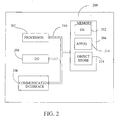
- FIG. 2 is a block diagram of a mobile device 200, which is an exemplary computing environment.
- Mobile device 200 includes a microprocessor 202, memory 204, input/output (I/O) components 206, and a communication interface 208 for communicating with remote computers or other mobile devices.
- I/O input/output
- the afore-mentioned components are coupled for communication with one another over a suitable bus 210.
- Memory 204 is implemented as non-volatile electronic memory such as random access memory (RAM) with a battery back-up module (not shown) such that information stored in memory 204 is not lost when the general power to mobile device 200 is shut down.
- RAM random access memory
- a portion of memory 204 is preferably allocated as addressable memory for program execution, while another portion of memory 204 is preferably used for storage, such as to simulate storage on a disk drive.
- Memory 204 includes an operating system 212, application programs 214 as well as an object store 216.
- operating system 212 is preferably executed by processor 202 from memory 204.
- Operating system 212 in one preferred embodiment, is a WINDOWS® CE brand operating system commercially available from Microsoft Corporation.
- Operating system 212 is preferably designed for mobile devices, and implements database features that can be utilized by applications 214 through a set of exposed application programming interfaces and methods.
- the objects in object store 216 are maintained by applications 214 and operating system 212, at least partially in response to calls to the exposed application programming interfaces and methods.
- Communication interface 208 represents numerous devices and technologies that allow mobile device 200 to send and receive information.
- the devices include wired and wireless modems, satellite receivers and broadcast tuners to name a few.
- Mobile device 200 can also be directly connected to a computer to exchange data therewith.
- communication interface 208 can be an infrared transceiver or a serial or parallel communication connection, all of which are capable of transmitting streaming information.
- Input/output components 206 include a variety of input devices such as a touch-sensitive screen, buttons, rollers, and a microphone as well as a variety of output devices including an audio generator, a vibrating device, and a display.
- input devices such as a touch-sensitive screen, buttons, rollers, and a microphone
- output devices including an audio generator, a vibrating device, and a display.
- the devices listed above are by way of example and need not all be present on mobile device 200.
- other input/output devices may be attached to or found with mobile device 200 within the scope of the present invention.
- a speech synthesizer that concatenates stored samples of speech units without modifying the prosody of the samples.
- the present invention is able to achieve a high level of naturalness in synthesized speech with a carefully designed speech corpus by storing samples based on the prosodic and phonetic context in which they occur.
- the present invention limits the training text to those sentences that will produce the most frequent sets of prosodic contexts for each speech unit.
- the present invention also provides a multi-tier selection mechanism for selecting a set of samples that will produce the most natural sounding speech.
- FIG. 3 is a block diagram of a speech synthesizer 300 that is capable of constructing synthesized speech 302 from an input text 304 under embodiments of the present invention.
- speech synthesizer 300 Before speech synthesizer 300 can be utilized to construct speech 302, it must be initialized with samples of speech units taken from a training text 306 that is read into speech synthesizer 300 as training speech 308.
- speech synthesizers are constrained by a limited size memory. Because of this, training text 306 must be limited in size to fit within the memory. However, if the training text is too small, there will not be enough samples of the training speech to allow for concatenative synthesis without prosody modifications.
- One aspect of the present invention overcomes this problem by trying to identify a set of speech units in a very large text corpus that must be included in the training text to allow for concatenative synthesis without prosody modifications.
- FIG. 4 provides a block diagram of components used to identify smaller training text 306 of FIG. 3 from a very large corpus 400.
- very large corpus 400 is a corpus of five years worth of the People's Daily, a Chinese newspaper, and contains about 97 million Chinese Characters.
- large corpus 400 is parsed by a parser/semantic identifier 402 into strings of individual speech units.
- the speech units are tonal syllables.
- other speech units such as phonemes, diphones, or triphones may be used within the scope of the present invention.
- Parser/semantic identifier 402 also identifies high-level prosodic information about each sentence provided to the parser. This high-level prosodic information includes the predicted tonal levels for each speech mit as well as the grouping of speech units into prosodic words and phrases. In embodiments where tonal syllable speech units are used, parser/semantic identifier 402 also identifies the first and last phoneme in each speech unit.
- the strings of speech units produced from the training text are provided to a context vector generator 404, which generates a Speech unit-Dependent Descriptive Contextual Variation Vector (SDDCVV, hereinafter referred to as a context vector).
- SDDCVV Speech unit-Dependent Descriptive Contextual Variation Vector
- the context vector describes several context variables that can affect the prosody of the speech unit. Under one embodiment, the context vector describes six variables or coordinates. They are:
- the position-in-phrase coordinate and the position-in-word coordinate can each have one of four values
- the left phonetic context can have one of eleven values
- the right phonetic context can have one of twenty-six values
- the left and right tonal contexts can each have one of two values.
- there are 4*4*11*26*2*2 18304 possible context vectors for each speech unit.
- the context vectors produced by generator 404 are grouped based on their speech unit. For each speech unit, a frequency-based sorter 406 identifies the most frequent context vectors for each speech unit. The most frequently occurring context vectors for each speech unit are then stored in a list of necessary context vectors 408. In one embodiment, the top context vectors, whose accumulated frequency of occurrence is not less than half of the total frequency of occurrence of all units, are stored in the list.
- the sorting and pruning performed by sorter 406 is based on a discovery made by the present inventors.
- the present inventors have found that certain context vectors occur repeatedly in the corpus. By making sure that these context vectors are found in the training corpus, the present invention increases the chances of having an exact context match for an input text without greatly increasing the size of the training corpus. For example, the present inventors have found that by ensuring that the top two percent of the context vectors are represented in the training corpus, an exact context match will be found for an input text speech unit over fifty percent of the time.
- a text selection unit 410 selects sentences from very large corpus 400 to produce training text subset 306.
- text selection unit 410 uses a greedy algorithm to select sentences from corpus 400. Under this greedy algorithm, selection unit 410 scans all sentences in the corpus and picks out one at a time to add to the selected group.
- selection unit 410 determines how many context vectors in list 408 are found in each sentence. The sentence that contains the maximum number of needed context vectors is then added to training text 306. The context vectors that the sentence contains are removed from list 408 and the sentence is removed from the large text corpus 400. The scanning is repeated until all of the context vectors have been removed from list 408.
- training text subset 306 After training text subset 306 has been formed, it is read by a person and digitized into a training speech corpus. Both the training text and training speech can be used to initialize speech synthesizer 300 of FIG. 3. This initialization begins by parsing the sentences of text 306 into individual speech units that are annotated with high-level prosodic information. In FIG. 3, this is accomplished by a parser/semantic identifier 310, which is similar to parser/semantic identifier 402 of FIG. 4. The parsed speech units and their high-level prosodic description are then provided to a context vector generator 312, which is similar to context vector generator 404 of FIG. 4.
- the context vectors produced by context vector generator 312 are provided to a component storing unit 314 along with speech samples produced by a sampler 316 from training speech signal 308. Each sample provided by sampler 316 corresponds to a speech unit identified by parser 310. Component storing unit 314 indexes each speech sample by its context vector to form an indexed set of stored speech components 318.
- the samples are indexed by a prosody-dependent decision tree (PDDT), which is formed automatically using a classification and regression tree (CART).
- PDDT prosody-dependent decision tree
- CART provides a mechanism for selecting questions that can be used to divide the stored speech components into small groups of similar speech samples. Typically, each question is used to divide a group of speech components into two smaller groups. With each question, the components in the smaller groups become more homogenous. The process for using CART to form the decision tree is shown in FIG. 5.
- a list of candidate questions is generated for the decision tree.
- each question is directed toward some coordinate or combination of coordinates in the context vector.
- an expected square error is determined for all of the training samples from sampler 316.
- the expected square error gives a measure of the distances among a set of features of each sample in a group.
- the features are prosodic features of average fundamental frequency (F a ), average duration (F b ), and range of the fundamental frequency (F c ) for a unit.
- ESE(t) is the expected square error for all samples X on node t in the decision tree
- E a , E b , and E c are the square error for F a , F b , and F c , respectively
- W a , W b , and W c are weights
- the operation of determining the expected value of the sum of square errors is indicated by the outer E().
- 2 , j a,b,c
- R ( F j ) is a regression value calculated from samples X on node t.
- the regression value is the expected value of the feature as calculated from the samples X at node t:
- R j ( E j ) E ( E j / X ⁇ node t ).
- the first question in the question list is selected at step 504.
- the selected question is applied to the context vectors at step 506 to group the samples into candidate sub-nodes for the tree.
- the expected square error of each sub-node is then determined at step 508 using equations 1 and 2 above.
- a reduction in expected square error created by generating the two sub-nodes is determined.
- ⁇ WESE ( t ) is the reduction in expected square error
- ESE(t) is the expected square error of node t, against which the question was applied
- P(t) is the percentage of samples in node t
- ESE(l) and ESE(r) are the expected square error of the left and right sub-nodes formed by the question, respectively
- P(l) and P(r) are the percentage of samples in the left and right node, respectively.
- the reduction in expected square error provided by the current question is stored and the CART process determines if the current question is the last question in the list at step 512. If there are more questions in the list, the next question is selected at step 514 and the process returns to step 506 to divide the current node into sub-nodes based on the new question.
- each leaf node when the decision tree is in its final form, each leaf node will contain a number of samples for a speech unit. These samples have slightly different prosody from each other. For example, they may have different phonetic contexts or different tonal contexts from each other. By maintaining these minor differences within a leaf node, this embodiment of the invention introduces slender diversity in prosody, which is helpful in removing monotonous prosody.
- step 516 If the current leaf nodes are to be further divided at step 516, a leaf node is selected at step 518 and the process returns to step 504 to find a question to associate with the selected node. If the decision tree is complete at step 516, the process of FIG. 5 ends at step 520.
- FIG. 5 results in a prosody-dependent decision tree 320 of FIG. 3 and a set of stored speech samples 318, indexed by decision tree 320.
- decision tree 320 and speech samples 318 can be used under further aspects of the present invention to generate concatenative speech without requiring prosody modification.
- the process for forming concatenative speech begins by parsing a sentence in input text 304 using parser/semantic identifier 310 and identifying high-level prosodic information for each speech unit produced by the parse. This prosodic information is then provided to context vector generator 312, which generates a context vector for each speech unit identified in the parse. The parsing and the production of the context vectors are performed in the same manner as was done during the training of prosody decision tree 320.
- the context vectors are provided to a component locator 322, which uses the vectors to identify a set of samples for the sentence.
- component locator 322 uses a multi-tier non-uniform unit selection algorithm to identify the samples from the context vectors.
- FIGS. 6 and 7 provide a block diagram and a flow diagram for the multi-tier non-uniform selection algorithm.
- each vector in the set of input context vectors is applied to prosody-dependent decision tree 320 to identify a leaf node array 600 that contains a leaf node for each context vector.
- a set of distances is determined by a distance calculator 602 for each input context vector.
- a separate distance is calculated between the input context vector and each context vector found in its respective leaf node.
- each distance is calculated as: where D c is the context distance, D i is the distance for coordinate i of the context vector, W ci is a weight associated with coordinate i, and I is the number of coordinates in each context vector.
- the N samples with the closest context vectors are retained while the remaining samples are pruned from node array 600 to form pruned leaf node array 604.
- the number of samples, N, to leave in the pruned nodes is determined by balancing improvements in prosody with improved processing time. In general, more samples left in the pruned nodes means better prosody at the cost of longer processing time.
- the pruned array is provided to a Viterbi decoder 606, which identifies a lowest cost path through the pruned array.
- the lowest cost path is identified simply by selecting the sample with the closest context vector in each node.
- the cost function is modified to be: where C c is the concatenation cost for the entire sentence, W c is a weight associated with the distance measure of the concatenated cost, D cj is the distance calculated in equation 4 for the j th speech unit in the sentence, W s is a weight associated with a smoothness measure of the concatenated cost, C sj is a smoothness cost for the j th speech unit, and J is the number of speech units in the sentence.
- the smoothness cost in Equation 5 is defined to provide a measure of the prosodic mismatch between sample j and the samples proposed as the neighbors to sample j by the Viterbi decoder.
- the smoothness cost is determined based on whether a sample and its neighbors were found as neighbors in an utterance in the training corpus. If a sample occurred next to its neighbors in the training corpus, the smoothness cost is zero since the samples contain the proper prosody to be combined together. If a sample did not occur next to its neighbors in the training corpus, the smoothness cost is set to one.
- the identified samples 608 are provided to speech constructor 303.
- speech constructor 303 simply concatenates the speech units to form synthesized speech 302. Thus, the speech units are combined without having to change their prosody.
Landscapes
- Engineering & Computer Science (AREA)
- Computational Linguistics (AREA)
- Health & Medical Sciences (AREA)
- Audiology, Speech & Language Pathology (AREA)
- Human Computer Interaction (AREA)
- Physics & Mathematics (AREA)
- Acoustics & Sound (AREA)
- Multimedia (AREA)
- Machine Translation (AREA)
- Document Processing Apparatus (AREA)
Abstract
Description


Claims (25)
- A method for synthesizing speech, the method comprising:generating a training context vector for each of a set of training speech units in a training speech corpus, each training context vector indicating the prosodic context of a training speech unit in the training speech corpus;indexing a set of speech segments associated with a set of training speech units based on the context vectors for the training speech units;generating an input context vector for each of a set of input speech units in an input text, each input context vector indicating the prosodic context of an input speech unit in the input text;using the input context vectors to find a speech segment for each input speech unit; andconcatenating the found speech segments to form a synthesized speech signal.
- The method of claim 1 wherein the each context vector comprises a position-in-phrase coordinate indicating the position of the speech unit in a phrase.
- The method of claim 1 wherein the each context vector comprises a position-in-word coordinate indicating the position of the speech unit in a word.
- The method of claim 1 wherein the each context vector comprises a left phonetic coordinate indicating a category for the phoneme to the left of the speech unit.
- The method of claim 1 wherein the each context vector comprises a right phonetic coordinate indicating a category for the phoneme to the right of the speech unit.
- The method of claim 1 wherein the each context vector comprises a left tonal coordinate indicating a category for the tone of the speech unit to the left of the speech unit.
- The method of claim 1 wherein the each context vector comprises a right tonal coordinate indicating a category for the tone of the speech unit to the right of the speech unit.
- The method of claim 1 wherein indexing a set of speech segments comprises generating a decision tree based on the training context vectors.
- The method of claim 8 wherein using the input context vectors to find a speech segment comprises searching the decision tree using the input context vector.
- The method of claim 9 wherein searching the decision tree comprises:identifying a leaf in the tree for each input context vector, each leaf comprising at least one candidate speech segments; andselecting one candidate speech segment in each leaf node, wherein if there is more than one candidate speech segment on the node The selection is based on a cost function.
- The method of claim 10 wherein the cost function comprises a distance between the input context vector and a training context vector associated with a speech segment.
- The method of claim 11 wherein the cost function further comprises a smoothness cost that is based on a candidate speech segment of at least one neighboring speech unit.
- The method of claim 12 wherein the smoothness cost gives preference to selecting a series of speech segments for a series of input context vectors if the series of speech segments occurred in series in the training speech corpus.
- A method of selecting sentences for reading into a training speech corpus used in speech synthesis, the method comprising:identifying a set of prosodic context information for each of a set of speech units;determining a frequency of occurrence for each distinct context vector that appears in a very large text corpus;using the frequency of occurrence of the context vectors to identify a list of necessary context vectors; andselecting sentences in the large text corpus for reading into the training speech corpus, each selected sentence containing at least one necessary context vector.
- The method of claim 14 wherein identifying a collection of prosodic context information sets as necessary context information sets comprises:determining the frequency of occurrence of each prosodic context information set across a very large text corpus; andidentifying a collection of prosodic context information sets as necessary context information sets based on their frequency of occurrence.
- The method of claim 15 wherein identifying a collection of prosodic context information sets as necessary context information sets further comprises:sorting the context information sets by their frequency of occurrence in decreasing order;determining a threshold, F, for accumulative frequency of top context vectors; andselecting the top context vectors whose accumulative frequency is not smaller than F for each speech unit as necessary prosodic context information sets.
- The method of claim 14 further comprising indexing only those speech segments that are associated with sentences in the smaller training text and wherein indexing comprises indexing using a decision tree.
- The method of claim 17 wherein indexing further comprises indexing the speech segments in the decision tree based on information in the context information sets.
- The method of claim 18 wherein the decision tree comprises leaf nodes and at least one leaf node comprises at least two speech segments for the same speech unit.
- A method of selecting speech segments for concatenative speech synthesis, the method comprising:parsing an input text into speech units;identifying context information for each speech unit based on its location in the input text and at least one neighboring speech unit;identifying a set of candidate speech segments for each speech unit based on the context information; andidentifying a sequence of speech segments from the candidate speech segments based in part on a smoothness cost between the speech segments.
- The method of claim 20 wherein identifying a set of candidate speech segments for a speech unit comprises applying the context information for a speech unit to a decision tree to identify a leaf node containing candidate speech segments for the speech unit.
- The method of claim 21 wherein identifying a set of candidate speech segments further comprises pruning some speech segments from a leaf node based on differences between the context information of the speech unit from the input text and context information associated with the speech segments.
- The method of claim 20 wherein identifying a sequence of speech segments comprises using a smoothness cost that is based on whether two neighboring candidate speech segments appeared next to each other in a training corpus.
- The method of claim 21 wherein identifying a sequence of speech segments further comprises identifying the sequence based in part on differences between context information for the speech unit of the input text and context information associated with a candidate speech segment.
- A computer-readable medium having computer executable instructions for synthesizing speech from speech segments based on speech units found in an input text, the speech being synthesized through a method comprising steps of:identifying context information for each speech unit based on the prosodic structure of the input text;identifying a set of candidate speech segments for each speech unit based on the context information;identifying a sequence of speech segments from the candidate speech segments;concatenating the sequence of speech segments without modifying the prosody of the speech segments to form the synthesized speech.
Priority Applications (1)
| Application Number | Priority Date | Filing Date | Title |
|---|---|---|---|
| EP07002565A EP1777697B1 (en) | 2000-12-04 | 2001-12-03 | Method for speech synthesis without prosody modification |
Applications Claiming Priority (4)
| Application Number | Priority Date | Filing Date | Title |
|---|---|---|---|
| US25116700P | 2000-12-04 | 2000-12-04 | |
| US251167P | 2000-12-04 | ||
| US09/850,527 US6978239B2 (en) | 2000-12-04 | 2001-05-07 | Method and apparatus for speech synthesis without prosody modification |
| US850527 | 2001-05-07 |
Related Child Applications (1)
| Application Number | Title | Priority Date | Filing Date |
|---|---|---|---|
| EP07002565A Division EP1777697B1 (en) | 2000-12-04 | 2001-12-03 | Method for speech synthesis without prosody modification |
Publications (3)
| Publication Number | Publication Date |
|---|---|
| EP1213705A2 true EP1213705A2 (en) | 2002-06-12 |
| EP1213705A3 EP1213705A3 (en) | 2004-12-22 |
| EP1213705B1 EP1213705B1 (en) | 2007-02-14 |
Family
ID=26941450
Family Applications (1)
| Application Number | Title | Priority Date | Filing Date |
|---|---|---|---|
| EP01128765A Expired - Lifetime EP1213705B1 (en) | 2000-12-04 | 2001-12-03 | Method and apparatus for speech synthesis |
Country Status (4)
| Country | Link |
|---|---|
| US (3) | US6978239B2 (en) |
| EP (1) | EP1213705B1 (en) |
| AT (1) | ATE354155T1 (en) |
| DE (1) | DE60126564T2 (en) |
Cited By (3)
| Publication number | Priority date | Publication date | Assignee | Title |
|---|---|---|---|---|
| EP1463031A1 (en) | 2003-03-24 | 2004-09-29 | Microsoft Corporation | Front-end architecture for a multi-lingual text-to-speech system |
| WO2008107223A1 (en) * | 2007-03-07 | 2008-09-12 | Nuance Communications, Inc. | Speech synthesis |
| CN107945786A (en) * | 2017-11-27 | 2018-04-20 | 北京百度网讯科技有限公司 | Phoneme synthesizing method and device |
Families Citing this family (173)
| Publication number | Priority date | Publication date | Assignee | Title |
|---|---|---|---|---|
| EP1266313A2 (en) | 1999-03-19 | 2002-12-18 | Trados GmbH | Workflow management system |
| US7369994B1 (en) | 1999-04-30 | 2008-05-06 | At&T Corp. | Methods and apparatus for rapid acoustic unit selection from a large speech corpus |
| US20060116865A1 (en) | 1999-09-17 | 2006-06-01 | Www.Uniscape.Com | E-services translation utilizing machine translation and translation memory |
| US8645137B2 (en) | 2000-03-16 | 2014-02-04 | Apple Inc. | Fast, language-independent method for user authentication by voice |
| US6978239B2 (en) * | 2000-12-04 | 2005-12-20 | Microsoft Corporation | Method and apparatus for speech synthesis without prosody modification |
| DE10117367B4 (en) * | 2001-04-06 | 2005-08-18 | Siemens Ag | Method and system for automatically converting text messages into voice messages |
| GB0113581D0 (en) * | 2001-06-04 | 2001-07-25 | Hewlett Packard Co | Speech synthesis apparatus |
| GB0113587D0 (en) * | 2001-06-04 | 2001-07-25 | Hewlett Packard Co | Speech synthesis apparatus |
| GB2376394B (en) * | 2001-06-04 | 2005-10-26 | Hewlett Packard Co | Speech synthesis apparatus and selection method |
| US7574597B1 (en) | 2001-10-19 | 2009-08-11 | Bbn Technologies Corp. | Encoding of signals to facilitate traffic analysis |
| US7263479B2 (en) * | 2001-10-19 | 2007-08-28 | Bbn Technologies Corp. | Determining characteristics of received voice data packets to assist prosody analysis |
| KR100438826B1 (en) * | 2001-10-31 | 2004-07-05 | 삼성전자주식회사 | System for speech synthesis using a smoothing filter and method thereof |
| US7483832B2 (en) * | 2001-12-10 | 2009-01-27 | At&T Intellectual Property I, L.P. | Method and system for customizing voice translation of text to speech |
| US20030154080A1 (en) * | 2002-02-14 | 2003-08-14 | Godsey Sandra L. | Method and apparatus for modification of audio input to a data processing system |
| US7136816B1 (en) * | 2002-04-05 | 2006-11-14 | At&T Corp. | System and method for predicting prosodic parameters |
| KR100486734B1 (en) | 2003-02-25 | 2005-05-03 | 삼성전자주식회사 | Method and apparatus for text to speech synthesis |
| US8103505B1 (en) * | 2003-11-19 | 2012-01-24 | Apple Inc. | Method and apparatus for speech synthesis using paralinguistic variation |
| US7983896B2 (en) * | 2004-03-05 | 2011-07-19 | SDL Language Technology | In-context exact (ICE) matching |
| US7788098B2 (en) * | 2004-08-02 | 2010-08-31 | Nokia Corporation | Predicting tone pattern information for textual information used in telecommunication systems |
| US7869999B2 (en) * | 2004-08-11 | 2011-01-11 | Nuance Communications, Inc. | Systems and methods for selecting from multiple phonectic transcriptions for text-to-speech synthesis |
| KR101056567B1 (en) * | 2004-09-23 | 2011-08-11 | 주식회사 케이티 | Apparatus and Method for Selecting Synthesis Unit in Corpus-based Speech Synthesizer |
| JP2007024960A (en) * | 2005-07-12 | 2007-02-01 | Internatl Business Mach Corp <Ibm> | System, program and control method |
| US8677377B2 (en) | 2005-09-08 | 2014-03-18 | Apple Inc. | Method and apparatus for building an intelligent automated assistant |
| US8224647B2 (en) * | 2005-10-03 | 2012-07-17 | Nuance Communications, Inc. | Text-to-speech user's voice cooperative server for instant messaging clients |
| US20070203706A1 (en) * | 2005-12-30 | 2007-08-30 | Inci Ozkaragoz | Voice analysis tool for creating database used in text to speech synthesis system |
| US8036894B2 (en) * | 2006-02-16 | 2011-10-11 | Apple Inc. | Multi-unit approach to text-to-speech synthesis |
| US7584104B2 (en) * | 2006-09-08 | 2009-09-01 | At&T Intellectual Property Ii, L.P. | Method and system for training a text-to-speech synthesis system using a domain-specific speech database |
| US9318108B2 (en) | 2010-01-18 | 2016-04-19 | Apple Inc. | Intelligent automated assistant |
| US8027837B2 (en) * | 2006-09-15 | 2011-09-27 | Apple Inc. | Using non-speech sounds during text-to-speech synthesis |
| US8521506B2 (en) | 2006-09-21 | 2013-08-27 | Sdl Plc | Computer-implemented method, computer software and apparatus for use in a translation system |
| US20080077407A1 (en) * | 2006-09-26 | 2008-03-27 | At&T Corp. | Phonetically enriched labeling in unit selection speech synthesis |
| CN101202041B (en) * | 2006-12-13 | 2011-01-05 | 富士通株式会社 | Method and device for forming Chinese prosodic phrases |
| JP5434587B2 (en) * | 2007-02-20 | 2014-03-05 | 日本電気株式会社 | Speech synthesis apparatus and method and program |
| BRPI0808289A2 (en) | 2007-03-21 | 2015-06-16 | Vivotext Ltd | "speech sample library for transforming missing text and methods and instruments for generating and using it" |
| US9251782B2 (en) | 2007-03-21 | 2016-02-02 | Vivotext Ltd. | System and method for concatenate speech samples within an optimal crossing point |
| US8977255B2 (en) | 2007-04-03 | 2015-03-10 | Apple Inc. | Method and system for operating a multi-function portable electronic device using voice-activation |
| JP5238205B2 (en) * | 2007-09-07 | 2013-07-17 | ニュアンス コミュニケーションズ,インコーポレイテッド | Speech synthesis system, program and method |
| US8583438B2 (en) * | 2007-09-20 | 2013-11-12 | Microsoft Corporation | Unnatural prosody detection in speech synthesis |
| US9053089B2 (en) | 2007-10-02 | 2015-06-09 | Apple Inc. | Part-of-speech tagging using latent analogy |
| US8620662B2 (en) * | 2007-11-20 | 2013-12-31 | Apple Inc. | Context-aware unit selection |
| US9330720B2 (en) | 2008-01-03 | 2016-05-03 | Apple Inc. | Methods and apparatus for altering audio output signals |
| US8996376B2 (en) | 2008-04-05 | 2015-03-31 | Apple Inc. | Intelligent text-to-speech conversion |
| US10496753B2 (en) | 2010-01-18 | 2019-12-03 | Apple Inc. | Automatically adapting user interfaces for hands-free interaction |
| US20100030549A1 (en) | 2008-07-31 | 2010-02-04 | Lee Michael M | Mobile device having human language translation capability with positional feedback |
| US9959870B2 (en) | 2008-12-11 | 2018-05-01 | Apple Inc. | Speech recognition involving a mobile device |
| GB2468278A (en) * | 2009-03-02 | 2010-09-08 | Sdl Plc | Computer assisted natural language translation outputs selectable target text associated in bilingual corpus with input target text from partial translation |
| US9262403B2 (en) * | 2009-03-02 | 2016-02-16 | Sdl Plc | Dynamic generation of auto-suggest dictionary for natural language translation |
| US10241752B2 (en) | 2011-09-30 | 2019-03-26 | Apple Inc. | Interface for a virtual digital assistant |
| US10255566B2 (en) | 2011-06-03 | 2019-04-09 | Apple Inc. | Generating and processing task items that represent tasks to perform |
| US9858925B2 (en) | 2009-06-05 | 2018-01-02 | Apple Inc. | Using context information to facilitate processing of commands in a virtual assistant |
| US10241644B2 (en) | 2011-06-03 | 2019-03-26 | Apple Inc. | Actionable reminder entries |
| US9431006B2 (en) | 2009-07-02 | 2016-08-30 | Apple Inc. | Methods and apparatuses for automatic speech recognition |
| RU2421827C2 (en) * | 2009-08-07 | 2011-06-20 | Общество с ограниченной ответственностью "Центр речевых технологий" | Speech synthesis method |
| GB2474839A (en) * | 2009-10-27 | 2011-05-04 | Sdl Plc | In-context exact matching of lookup segment to translation memory source text |
| GB0922608D0 (en) | 2009-12-23 | 2010-02-10 | Vratskides Alexios | Message optimization |
| US10705794B2 (en) | 2010-01-18 | 2020-07-07 | Apple Inc. | Automatically adapting user interfaces for hands-free interaction |
| US10276170B2 (en) | 2010-01-18 | 2019-04-30 | Apple Inc. | Intelligent automated assistant |
| US10553209B2 (en) | 2010-01-18 | 2020-02-04 | Apple Inc. | Systems and methods for hands-free notification summaries |
| US10679605B2 (en) | 2010-01-18 | 2020-06-09 | Apple Inc. | Hands-free list-reading by intelligent automated assistant |
| DE202011111062U1 (en) | 2010-01-25 | 2019-02-19 | Newvaluexchange Ltd. | Device and system for a digital conversation management platform |
| US8682667B2 (en) | 2010-02-25 | 2014-03-25 | Apple Inc. | User profiling for selecting user specific voice input processing information |
| US8688435B2 (en) | 2010-09-22 | 2014-04-01 | Voice On The Go Inc. | Systems and methods for normalizing input media |
| US10762293B2 (en) | 2010-12-22 | 2020-09-01 | Apple Inc. | Using parts-of-speech tagging and named entity recognition for spelling correction |
| US9128929B2 (en) | 2011-01-14 | 2015-09-08 | Sdl Language Technologies | Systems and methods for automatically estimating a translation time including preparation time in addition to the translation itself |
| US9262612B2 (en) | 2011-03-21 | 2016-02-16 | Apple Inc. | Device access using voice authentication |
| TWI441163B (en) * | 2011-05-10 | 2014-06-11 | Univ Nat Chiao Tung | Chinese speech recognition device and speech recognition method thereof |
| US10057736B2 (en) | 2011-06-03 | 2018-08-21 | Apple Inc. | Active transport based notifications |
| US8994660B2 (en) | 2011-08-29 | 2015-03-31 | Apple Inc. | Text correction processing |
| US10134385B2 (en) | 2012-03-02 | 2018-11-20 | Apple Inc. | Systems and methods for name pronunciation |
| US9483461B2 (en) | 2012-03-06 | 2016-11-01 | Apple Inc. | Handling speech synthesis of content for multiple languages |
| US9280610B2 (en) | 2012-05-14 | 2016-03-08 | Apple Inc. | Crowd sourcing information to fulfill user requests |
| US10395270B2 (en) | 2012-05-17 | 2019-08-27 | Persado Intellectual Property Limited | System and method for recommending a grammar for a message campaign used by a message optimization system |
| US9721563B2 (en) | 2012-06-08 | 2017-08-01 | Apple Inc. | Name recognition system |
| US9495129B2 (en) | 2012-06-29 | 2016-11-15 | Apple Inc. | Device, method, and user interface for voice-activated navigation and browsing of a document |
| US10007724B2 (en) * | 2012-06-29 | 2018-06-26 | International Business Machines Corporation | Creating, rendering and interacting with a multi-faceted audio cloud |
| US9576574B2 (en) | 2012-09-10 | 2017-02-21 | Apple Inc. | Context-sensitive handling of interruptions by intelligent digital assistant |
| US9547647B2 (en) | 2012-09-19 | 2017-01-17 | Apple Inc. | Voice-based media searching |
| US10638221B2 (en) | 2012-11-13 | 2020-04-28 | Adobe Inc. | Time interval sound alignment |
| US10249321B2 (en) * | 2012-11-20 | 2019-04-02 | Adobe Inc. | Sound rate modification |
| US10455219B2 (en) | 2012-11-30 | 2019-10-22 | Adobe Inc. | Stereo correspondence and depth sensors |
| DE112014000709B4 (en) | 2013-02-07 | 2021-12-30 | Apple Inc. | METHOD AND DEVICE FOR OPERATING A VOICE TRIGGER FOR A DIGITAL ASSISTANT |
| US9368114B2 (en) | 2013-03-14 | 2016-06-14 | Apple Inc. | Context-sensitive handling of interruptions |
| WO2014144949A2 (en) | 2013-03-15 | 2014-09-18 | Apple Inc. | Training an at least partial voice command system |
| WO2014144579A1 (en) | 2013-03-15 | 2014-09-18 | Apple Inc. | System and method for updating an adaptive speech recognition model |
| WO2014197334A2 (en) | 2013-06-07 | 2014-12-11 | Apple Inc. | System and method for user-specified pronunciation of words for speech synthesis and recognition |
| WO2014197336A1 (en) | 2013-06-07 | 2014-12-11 | Apple Inc. | System and method for detecting errors in interactions with a voice-based digital assistant |
| US9582608B2 (en) | 2013-06-07 | 2017-02-28 | Apple Inc. | Unified ranking with entropy-weighted information for phrase-based semantic auto-completion |
| WO2014197335A1 (en) | 2013-06-08 | 2014-12-11 | Apple Inc. | Interpreting and acting upon commands that involve sharing information with remote devices |
| KR101959188B1 (en) | 2013-06-09 | 2019-07-02 | 애플 인크. | Device, method, and graphical user interface for enabling conversation persistence across two or more instances of a digital assistant |
| US10176167B2 (en) | 2013-06-09 | 2019-01-08 | Apple Inc. | System and method for inferring user intent from speech inputs |
| KR101809808B1 (en) | 2013-06-13 | 2017-12-15 | 애플 인크. | System and method for emergency calls initiated by voice command |
| KR101749009B1 (en) | 2013-08-06 | 2017-06-19 | 애플 인크. | Auto-activating smart responses based on activities from remote devices |
| CN105593936B (en) * | 2013-10-24 | 2020-10-23 | 宝马股份公司 | System and method for text-to-speech performance evaluation |
| US9620105B2 (en) | 2014-05-15 | 2017-04-11 | Apple Inc. | Analyzing audio input for efficient speech and music recognition |
| US10592095B2 (en) | 2014-05-23 | 2020-03-17 | Apple Inc. | Instantaneous speaking of content on touch devices |
| US9502031B2 (en) | 2014-05-27 | 2016-11-22 | Apple Inc. | Method for supporting dynamic grammars in WFST-based ASR |
| US9633004B2 (en) | 2014-05-30 | 2017-04-25 | Apple Inc. | Better resolution when referencing to concepts |
| US9842101B2 (en) | 2014-05-30 | 2017-12-12 | Apple Inc. | Predictive conversion of language input |
| US9785630B2 (en) | 2014-05-30 | 2017-10-10 | Apple Inc. | Text prediction using combined word N-gram and unigram language models |
| US9430463B2 (en) | 2014-05-30 | 2016-08-30 | Apple Inc. | Exemplar-based natural language processing |
| WO2015184186A1 (en) | 2014-05-30 | 2015-12-03 | Apple Inc. | Multi-command single utterance input method |
| US10289433B2 (en) | 2014-05-30 | 2019-05-14 | Apple Inc. | Domain specific language for encoding assistant dialog |
| US10078631B2 (en) | 2014-05-30 | 2018-09-18 | Apple Inc. | Entropy-guided text prediction using combined word and character n-gram language models |
| US10170123B2 (en) | 2014-05-30 | 2019-01-01 | Apple Inc. | Intelligent assistant for home automation |
| US9760559B2 (en) | 2014-05-30 | 2017-09-12 | Apple Inc. | Predictive text input |
| US9734193B2 (en) | 2014-05-30 | 2017-08-15 | Apple Inc. | Determining domain salience ranking from ambiguous words in natural speech |
| US9715875B2 (en) | 2014-05-30 | 2017-07-25 | Apple Inc. | Reducing the need for manual start/end-pointing and trigger phrases |
| US9338493B2 (en) | 2014-06-30 | 2016-05-10 | Apple Inc. | Intelligent automated assistant for TV user interactions |
| US10659851B2 (en) | 2014-06-30 | 2020-05-19 | Apple Inc. | Real-time digital assistant knowledge updates |
| US10446141B2 (en) | 2014-08-28 | 2019-10-15 | Apple Inc. | Automatic speech recognition based on user feedback |
| US9818400B2 (en) | 2014-09-11 | 2017-11-14 | Apple Inc. | Method and apparatus for discovering trending terms in speech requests |
| US10789041B2 (en) | 2014-09-12 | 2020-09-29 | Apple Inc. | Dynamic thresholds for always listening speech trigger |
| US9606986B2 (en) | 2014-09-29 | 2017-03-28 | Apple Inc. | Integrated word N-gram and class M-gram language models |
| US10127911B2 (en) | 2014-09-30 | 2018-11-13 | Apple Inc. | Speaker identification and unsupervised speaker adaptation techniques |
| US9668121B2 (en) | 2014-09-30 | 2017-05-30 | Apple Inc. | Social reminders |
| US10074360B2 (en) | 2014-09-30 | 2018-09-11 | Apple Inc. | Providing an indication of the suitability of speech recognition |
| US9646609B2 (en) | 2014-09-30 | 2017-05-09 | Apple Inc. | Caching apparatus for serving phonetic pronunciations |
| US9886432B2 (en) | 2014-09-30 | 2018-02-06 | Apple Inc. | Parsimonious handling of word inflection via categorical stem + suffix N-gram language models |
| US10552013B2 (en) | 2014-12-02 | 2020-02-04 | Apple Inc. | Data detection |
| US9711141B2 (en) | 2014-12-09 | 2017-07-18 | Apple Inc. | Disambiguating heteronyms in speech synthesis |
| US9865280B2 (en) | 2015-03-06 | 2018-01-09 | Apple Inc. | Structured dictation using intelligent automated assistants |
| US10567477B2 (en) | 2015-03-08 | 2020-02-18 | Apple Inc. | Virtual assistant continuity |
| US9886953B2 (en) | 2015-03-08 | 2018-02-06 | Apple Inc. | Virtual assistant activation |
| US9721566B2 (en) | 2015-03-08 | 2017-08-01 | Apple Inc. | Competing devices responding to voice triggers |
| US9899019B2 (en) | 2015-03-18 | 2018-02-20 | Apple Inc. | Systems and methods for structured stem and suffix language models |
| US9842105B2 (en) | 2015-04-16 | 2017-12-12 | Apple Inc. | Parsimonious continuous-space phrase representations for natural language processing |
| US10083688B2 (en) | 2015-05-27 | 2018-09-25 | Apple Inc. | Device voice control for selecting a displayed affordance |
| US10127220B2 (en) | 2015-06-04 | 2018-11-13 | Apple Inc. | Language identification from short strings |
| US10101822B2 (en) | 2015-06-05 | 2018-10-16 | Apple Inc. | Language input correction |
| US9578173B2 (en) | 2015-06-05 | 2017-02-21 | Apple Inc. | Virtual assistant aided communication with 3rd party service in a communication session |
| US11025565B2 (en) | 2015-06-07 | 2021-06-01 | Apple Inc. | Personalized prediction of responses for instant messaging |
| US10255907B2 (en) | 2015-06-07 | 2019-04-09 | Apple Inc. | Automatic accent detection using acoustic models |
| US10186254B2 (en) | 2015-06-07 | 2019-01-22 | Apple Inc. | Context-based endpoint detection |
| US10747498B2 (en) | 2015-09-08 | 2020-08-18 | Apple Inc. | Zero latency digital assistant |
| US10671428B2 (en) | 2015-09-08 | 2020-06-02 | Apple Inc. | Distributed personal assistant |
| US9697820B2 (en) | 2015-09-24 | 2017-07-04 | Apple Inc. | Unit-selection text-to-speech synthesis using concatenation-sensitive neural networks |
| US11010550B2 (en) | 2015-09-29 | 2021-05-18 | Apple Inc. | Unified language modeling framework for word prediction, auto-completion and auto-correction |
| US10366158B2 (en) | 2015-09-29 | 2019-07-30 | Apple Inc. | Efficient word encoding for recurrent neural network language models |
| US11587559B2 (en) | 2015-09-30 | 2023-02-21 | Apple Inc. | Intelligent device identification |
| US10504137B1 (en) | 2015-10-08 | 2019-12-10 | Persado Intellectual Property Limited | System, method, and computer program product for monitoring and responding to the performance of an ad |
| US10691473B2 (en) | 2015-11-06 | 2020-06-23 | Apple Inc. | Intelligent automated assistant in a messaging environment |
| US10049668B2 (en) | 2015-12-02 | 2018-08-14 | Apple Inc. | Applying neural network language models to weighted finite state transducers for automatic speech recognition |
| US10832283B1 (en) | 2015-12-09 | 2020-11-10 | Persado Intellectual Property Limited | System, method, and computer program for providing an instance of a promotional message to a user based on a predicted emotional response corresponding to user characteristics |
| US10223066B2 (en) | 2015-12-23 | 2019-03-05 | Apple Inc. | Proactive assistance based on dialog communication between devices |
| US10446143B2 (en) | 2016-03-14 | 2019-10-15 | Apple Inc. | Identification of voice inputs providing credentials |
| US9934775B2 (en) | 2016-05-26 | 2018-04-03 | Apple Inc. | Unit-selection text-to-speech synthesis based on predicted concatenation parameters |
| US9972304B2 (en) | 2016-06-03 | 2018-05-15 | Apple Inc. | Privacy preserving distributed evaluation framework for embedded personalized systems |
| US10249300B2 (en) | 2016-06-06 | 2019-04-02 | Apple Inc. | Intelligent list reading |
| US10049663B2 (en) | 2016-06-08 | 2018-08-14 | Apple, Inc. | Intelligent automated assistant for media exploration |
| DK179588B1 (en) | 2016-06-09 | 2019-02-22 | Apple Inc. | Intelligent automated assistant in a home environment |
| US10509862B2 (en) | 2016-06-10 | 2019-12-17 | Apple Inc. | Dynamic phrase expansion of language input |
| US10192552B2 (en) | 2016-06-10 | 2019-01-29 | Apple Inc. | Digital assistant providing whispered speech |
| US10586535B2 (en) | 2016-06-10 | 2020-03-10 | Apple Inc. | Intelligent digital assistant in a multi-tasking environment |
| US10490187B2 (en) | 2016-06-10 | 2019-11-26 | Apple Inc. | Digital assistant providing automated status report |
| US10067938B2 (en) | 2016-06-10 | 2018-09-04 | Apple Inc. | Multilingual word prediction |
| DK179343B1 (en) | 2016-06-11 | 2018-05-14 | Apple Inc | Intelligent task discovery |
| DK179415B1 (en) | 2016-06-11 | 2018-06-14 | Apple Inc | Intelligent device arbitration and control |
| DK201670540A1 (en) | 2016-06-11 | 2018-01-08 | Apple Inc | Application integration with a digital assistant |
| DK179049B1 (en) | 2016-06-11 | 2017-09-18 | Apple Inc | Data driven natural language event detection and classification |
| US10043516B2 (en) | 2016-09-23 | 2018-08-07 | Apple Inc. | Intelligent automated assistant |
| US10593346B2 (en) | 2016-12-22 | 2020-03-17 | Apple Inc. | Rank-reduced token representation for automatic speech recognition |
| DK201770439A1 (en) | 2017-05-11 | 2018-12-13 | Apple Inc. | Offline personal assistant |
| DK179496B1 (en) | 2017-05-12 | 2019-01-15 | Apple Inc. | USER-SPECIFIC Acoustic Models |
| DK179745B1 (en) | 2017-05-12 | 2019-05-01 | Apple Inc. | SYNCHRONIZATION AND TASK DELEGATION OF A DIGITAL ASSISTANT |
| DK201770431A1 (en) | 2017-05-15 | 2018-12-20 | Apple Inc. | Optimizing dialogue policy decisions for digital assistants using implicit feedback |
| DK201770432A1 (en) | 2017-05-15 | 2018-12-21 | Apple Inc. | Hierarchical belief states for digital assistants |
| DK179560B1 (en) | 2017-05-16 | 2019-02-18 | Apple Inc. | Far-field extension for digital assistant services |
| US10635863B2 (en) | 2017-10-30 | 2020-04-28 | Sdl Inc. | Fragment recall and adaptive automated translation |
| US10817676B2 (en) | 2017-12-27 | 2020-10-27 | Sdl Inc. | Intelligent routing services and systems |
| US11256867B2 (en) | 2018-10-09 | 2022-02-22 | Sdl Inc. | Systems and methods of machine learning for digital assets and message creation |
| CN109754778B (en) * | 2019-01-17 | 2023-05-30 | 平安科技(深圳)有限公司 | Text speech synthesis method and device and computer equipment |
| KR102637341B1 (en) * | 2019-10-15 | 2024-02-16 | 삼성전자주식회사 | Method and apparatus for generating speech |
| US12314300B1 (en) * | 2023-12-28 | 2025-05-27 | Open Text Inc. | Methods and systems of content integration for generative artificial intelligence |
Family Cites Families (37)
| Publication number | Priority date | Publication date | Assignee | Title |
|---|---|---|---|---|
| US4718094A (en) * | 1984-11-19 | 1988-01-05 | International Business Machines Corp. | Speech recognition system |
| US5146405A (en) * | 1988-02-05 | 1992-09-08 | At&T Bell Laboratories | Methods for part-of-speech determination and usage |
| US4979216A (en) * | 1989-02-17 | 1990-12-18 | Malsheen Bathsheba J | Text to speech synthesis system and method using context dependent vowel allophones |
| US5384893A (en) | 1992-09-23 | 1995-01-24 | Emerson & Stern Associates, Inc. | Method and apparatus for speech synthesis based on prosodic analysis |
| US5440481A (en) * | 1992-10-28 | 1995-08-08 | The United States Of America As Represented By The Secretary Of The Navy | System and method for database tomography |
| CA2119397C (en) | 1993-03-19 | 2007-10-02 | Kim E.A. Silverman | Improved automated voice synthesis employing enhanced prosodic treatment of text, spelling of text and rate of annunciation |
| JP2522154B2 (en) * | 1993-06-03 | 1996-08-07 | 日本電気株式会社 | Voice recognition system |
| US5715367A (en) * | 1995-01-23 | 1998-02-03 | Dragon Systems, Inc. | Apparatuses and methods for developing and using models for speech recognition |
| US5592585A (en) * | 1995-01-26 | 1997-01-07 | Lernout & Hauspie Speech Products N.C. | Method for electronically generating a spoken message |
| WO1997008686A2 (en) * | 1995-08-28 | 1997-03-06 | Philips Electronics N.V. | Method and system for pattern recognition based on tree organised probability densities |
| WO1997008685A2 (en) * | 1995-08-28 | 1997-03-06 | Philips Electronics N.V. | Method and system for pattern recognition based on dynamically constructing a subset of reference vectors |
| JP2871561B2 (en) | 1995-11-30 | 1999-03-17 | 株式会社エイ・ティ・アール音声翻訳通信研究所 | Unspecified speaker model generation device and speech recognition device |
| US6366883B1 (en) * | 1996-05-15 | 2002-04-02 | Atr Interpreting Telecommunications | Concatenation of speech segments by use of a speech synthesizer |
| US5905972A (en) * | 1996-09-30 | 1999-05-18 | Microsoft Corporation | Prosodic databases holding fundamental frequency templates for use in speech synthesis |
| US6172675B1 (en) * | 1996-12-05 | 2001-01-09 | Interval Research Corporation | Indirect manipulation of data using temporally related data, with particular application to manipulation of audio or audiovisual data |
| US5937422A (en) * | 1997-04-15 | 1999-08-10 | The United States Of America As Represented By The National Security Agency | Automatically generating a topic description for text and searching and sorting text by topic using the same |
| KR100238189B1 (en) * | 1997-10-16 | 2000-01-15 | 윤종용 | Multi-language tts device and method |
| US6064960A (en) | 1997-12-18 | 2000-05-16 | Apple Computer, Inc. | Method and apparatus for improved duration modeling of phonemes |
| US6230131B1 (en) * | 1998-04-29 | 2001-05-08 | Matsushita Electric Industrial Co., Ltd. | Method for generating spelling-to-pronunciation decision tree |
| US6076060A (en) | 1998-05-01 | 2000-06-13 | Compaq Computer Corporation | Computer method and apparatus for translating text to sound |
| US6101470A (en) * | 1998-05-26 | 2000-08-08 | International Business Machines Corporation | Methods for generating pitch and duration contours in a text to speech system |
| US6401060B1 (en) | 1998-06-25 | 2002-06-04 | Microsoft Corporation | Method for typographical detection and replacement in Japanese text |
| US6151576A (en) * | 1998-08-11 | 2000-11-21 | Adobe Systems Incorporated | Mixing digitized speech and text using reliability indices |
| JP2000075878A (en) | 1998-08-31 | 2000-03-14 | Canon Inc | Speech synthesis apparatus and method, and storage medium |
| WO2000030069A2 (en) * | 1998-11-13 | 2000-05-25 | Lernout & Hauspie Speech Products N.V. | Speech synthesis using concatenation of speech waveforms |
| JP2000206982A (en) * | 1999-01-12 | 2000-07-28 | Toshiba Corp | Speech synthesizer and machine-readable recording medium recording sentence-to-speech conversion program |
| US6185533B1 (en) | 1999-03-15 | 2001-02-06 | Matsushita Electric Industrial Co., Ltd. | Generation and synthesis of prosody templates |
| JP2000305585A (en) * | 1999-04-23 | 2000-11-02 | Oki Electric Ind Co Ltd | Speech synthesizing device |
| US6829578B1 (en) | 1999-11-11 | 2004-12-07 | Koninklijke Philips Electronics, N.V. | Tone features for speech recognition |
| GB2357943B (en) | 1999-12-30 | 2004-12-08 | Nokia Mobile Phones Ltd | User interface for text to speech conversion |
| US7010489B1 (en) * | 2000-03-09 | 2006-03-07 | International Business Mahcines Corporation | Method for guiding text-to-speech output timing using speech recognition markers |
| US6910007B2 (en) * | 2000-05-31 | 2005-06-21 | At&T Corp | Stochastic modeling of spectral adjustment for high quality pitch modification |
| US6505158B1 (en) * | 2000-07-05 | 2003-01-07 | At&T Corp. | Synthesis-based pre-selection of suitable units for concatenative speech |
| WO2002027709A2 (en) | 2000-09-29 | 2002-04-04 | Lernout & Hauspie Speech Products N.V. | Corpus-based prosody translation system |
| US6990450B2 (en) | 2000-10-19 | 2006-01-24 | Qwest Communications International Inc. | System and method for converting text-to-voice |
| US6871178B2 (en) | 2000-10-19 | 2005-03-22 | Qwest Communications International, Inc. | System and method for converting text-to-voice |
| US6978239B2 (en) * | 2000-12-04 | 2005-12-20 | Microsoft Corporation | Method and apparatus for speech synthesis without prosody modification |
-
2001
- 2001-05-07 US US09/850,527 patent/US6978239B2/en not_active Expired - Fee Related
- 2001-12-03 AT AT01128765T patent/ATE354155T1/en not_active IP Right Cessation
- 2001-12-03 EP EP01128765A patent/EP1213705B1/en not_active Expired - Lifetime
- 2001-12-03 DE DE60126564T patent/DE60126564T2/en not_active Expired - Lifetime
-
2003
- 2003-09-15 US US10/662,985 patent/US20040148171A1/en not_active Abandoned
-
2005
- 2005-01-06 US US11/030,208 patent/US7127396B2/en not_active Expired - Fee Related
Cited By (6)
| Publication number | Priority date | Publication date | Assignee | Title |
|---|---|---|---|---|
| EP1463031A1 (en) | 2003-03-24 | 2004-09-29 | Microsoft Corporation | Front-end architecture for a multi-lingual text-to-speech system |
| US7496498B2 (en) | 2003-03-24 | 2009-02-24 | Microsoft Corporation | Front-end architecture for a multi-lingual text-to-speech system |
| CN1540625B (en) * | 2003-03-24 | 2010-06-09 | 微软公司 | Front end architecture for multi-lingual text-to-speech system |
| WO2008107223A1 (en) * | 2007-03-07 | 2008-09-12 | Nuance Communications, Inc. | Speech synthesis |
| US8249874B2 (en) | 2007-03-07 | 2012-08-21 | Nuance Communications, Inc. | Synthesizing speech from text |
| CN107945786A (en) * | 2017-11-27 | 2018-04-20 | 北京百度网讯科技有限公司 | Phoneme synthesizing method and device |
Also Published As
| Publication number | Publication date |
|---|---|
| EP1213705B1 (en) | 2007-02-14 |
| EP1213705A3 (en) | 2004-12-22 |
| US6978239B2 (en) | 2005-12-20 |
| US20020099547A1 (en) | 2002-07-25 |
| DE60126564T2 (en) | 2007-10-31 |
| US20050119891A1 (en) | 2005-06-02 |
| ATE354155T1 (en) | 2007-03-15 |
| US20040148171A1 (en) | 2004-07-29 |
| US7127396B2 (en) | 2006-10-24 |
| DE60126564D1 (en) | 2007-03-29 |
Similar Documents
| Publication | Publication Date | Title |
|---|---|---|
| EP1213705B1 (en) | Method and apparatus for speech synthesis | |
| US7124083B2 (en) | Method and system for preselection of suitable units for concatenative speech | |
| US7263488B2 (en) | Method and apparatus for identifying prosodic word boundaries | |
| US7024362B2 (en) | Objective measure for estimating mean opinion score of synthesized speech | |
| US6823309B1 (en) | Speech synthesizing system and method for modifying prosody based on match to database | |
| US6845358B2 (en) | Prosody template matching for text-to-speech systems | |
| US7386451B2 (en) | Optimization of an objective measure for estimating mean opinion score of synthesized speech | |
| US5949961A (en) | Word syllabification in speech synthesis system | |
| US8468020B2 (en) | Speech synthesis apparatus and method wherein more than one speech unit is acquired from continuous memory region by one access | |
| EP0833304A2 (en) | Prosodic databases holding fundamental frequency templates for use in speech synthesis | |
| EP1037195A2 (en) | Generation and synthesis of prosody templates | |
| US20080059190A1 (en) | Speech unit selection using HMM acoustic models | |
| US20060155544A1 (en) | Defining atom units between phone and syllable for TTS systems | |
| US20080177543A1 (en) | Stochastic Syllable Accent Recognition | |
| WO2005034082A1 (en) | Method for synthesizing speech | |
| US8798998B2 (en) | Pre-saved data compression for TTS concatenation cost | |
| US7328157B1 (en) | Domain adaptation for TTS systems | |
| Chu et al. | A concatenative Mandarin TTS system without prosody model and prosody modification. | |
| EP1777697B1 (en) | Method for speech synthesis without prosody modification | |
| Chen et al. | A Mandarin Text-to-Speech System | |
| Dong et al. | A Unit Selection-based Speech Synthesis Approach for Mandarin Chinese. | |
| EP1501075B1 (en) | Speech synthesis using concatenation of speech waveforms | |
| GB2292235A (en) | Word syllabification. | |
| Bharthi et al. | Unit selection based speech synthesis for converting short text message into voice message in mobile phones | |
| JPH09198074A (en) | Speech synthesizer |
Legal Events
| Date | Code | Title | Description |
|---|---|---|---|
| PUAI | Public reference made under article 153(3) epc to a published international application that has entered the european phase |
Free format text: ORIGINAL CODE: 0009012 |
|
| AK | Designated contracting states |
Kind code of ref document: A2 Designated state(s): AT BE CH CY DE DK ES FI FR GB GR IE IT LI LU MC NL PT SE TR |
|
| AX | Request for extension of the european patent |
Free format text: AL;LT;LV;MK;RO;SI |
|
| PUAL | Search report despatched |
Free format text: ORIGINAL CODE: 0009013 |
|
| AK | Designated contracting states |
Kind code of ref document: A3 Designated state(s): AT BE CH CY DE DK ES FI FR GB GR IE IT LI LU MC NL PT SE TR |
|
| AX | Request for extension of the european patent |
Extension state: AL LT LV MK RO SI |
|
| 17P | Request for examination filed |
Effective date: 20050404 |
|
| AKX | Designation fees paid |
Designated state(s): AT BE CH CY DE DK ES FI FR GB GR IE IT LI LU MC NL PT SE TR |
|
| GRAP | Despatch of communication of intention to grant a patent |
Free format text: ORIGINAL CODE: EPIDOSNIGR1 |
|
| RTI1 | Title (correction) |
Free format text: METHOD AND APPARATUS FOR SPEECH SYNTHESIS |
|
| GRAS | Grant fee paid |
Free format text: ORIGINAL CODE: EPIDOSNIGR3 |
|
| GRAA | (expected) grant |
Free format text: ORIGINAL CODE: 0009210 |
|
| AK | Designated contracting states |
Kind code of ref document: B1 Designated state(s): AT BE CH CY DE DK ES FI FR GB GR IE IT LI LU MC NL PT SE TR |
|
| PG25 | Lapsed in a contracting state [announced via postgrant information from national office to epo] |
Ref country code: CH Free format text: LAPSE BECAUSE OF FAILURE TO SUBMIT A TRANSLATION OF THE DESCRIPTION OR TO PAY THE FEE WITHIN THE PRESCRIBED TIME-LIMIT Effective date: 20070214 Ref country code: DK Free format text: LAPSE BECAUSE OF FAILURE TO SUBMIT A TRANSLATION OF THE DESCRIPTION OR TO PAY THE FEE WITHIN THE PRESCRIBED TIME-LIMIT Effective date: 20070214 Ref country code: AT Free format text: LAPSE BECAUSE OF FAILURE TO SUBMIT A TRANSLATION OF THE DESCRIPTION OR TO PAY THE FEE WITHIN THE PRESCRIBED TIME-LIMIT Effective date: 20070214 Ref country code: FI Free format text: LAPSE BECAUSE OF FAILURE TO SUBMIT A TRANSLATION OF THE DESCRIPTION OR TO PAY THE FEE WITHIN THE PRESCRIBED TIME-LIMIT Effective date: 20070214 Ref country code: NL Free format text: LAPSE BECAUSE OF FAILURE TO SUBMIT A TRANSLATION OF THE DESCRIPTION OR TO PAY THE FEE WITHIN THE PRESCRIBED TIME-LIMIT Effective date: 20070214 Ref country code: LI Free format text: LAPSE BECAUSE OF FAILURE TO SUBMIT A TRANSLATION OF THE DESCRIPTION OR TO PAY THE FEE WITHIN THE PRESCRIBED TIME-LIMIT Effective date: 20070214 Ref country code: BE Free format text: LAPSE BECAUSE OF FAILURE TO SUBMIT A TRANSLATION OF THE DESCRIPTION OR TO PAY THE FEE WITHIN THE PRESCRIBED TIME-LIMIT Effective date: 20070214 |
|
| REG | Reference to a national code |
Ref country code: GB Ref legal event code: FG4D |
|
| REG | Reference to a national code |
Ref country code: CH Ref legal event code: EP |
|
| REF | Corresponds to: |
Ref document number: 60126564 Country of ref document: DE Date of ref document: 20070329 Kind code of ref document: P |
|
| REG | Reference to a national code |
Ref country code: IE Ref legal event code: FG4D |
|
| PG25 | Lapsed in a contracting state [announced via postgrant information from national office to epo] |
Ref country code: SE Free format text: LAPSE BECAUSE OF FAILURE TO SUBMIT A TRANSLATION OF THE DESCRIPTION OR TO PAY THE FEE WITHIN THE PRESCRIBED TIME-LIMIT Effective date: 20070514 |
|
| PG25 | Lapsed in a contracting state [announced via postgrant information from national office to epo] |
Ref country code: ES Free format text: LAPSE BECAUSE OF FAILURE TO SUBMIT A TRANSLATION OF THE DESCRIPTION OR TO PAY THE FEE WITHIN THE PRESCRIBED TIME-LIMIT Effective date: 20070525 |
|
| PG25 | Lapsed in a contracting state [announced via postgrant information from national office to epo] |
Ref country code: PT Free format text: LAPSE BECAUSE OF FAILURE TO SUBMIT A TRANSLATION OF THE DESCRIPTION OR TO PAY THE FEE WITHIN THE PRESCRIBED TIME-LIMIT Effective date: 20070716 |
|
| NLV1 | Nl: lapsed or annulled due to failure to fulfill the requirements of art. 29p and 29m of the patents act | ||
| ET | Fr: translation filed | ||
| REG | Reference to a national code |
Ref country code: CH Ref legal event code: PL |
|
| PLBE | No opposition filed within time limit |
Free format text: ORIGINAL CODE: 0009261 |
|
| STAA | Information on the status of an ep patent application or granted ep patent |
Free format text: STATUS: NO OPPOSITION FILED WITHIN TIME LIMIT |
|
| 26N | No opposition filed |
Effective date: 20071115 |
|
| PG25 | Lapsed in a contracting state [announced via postgrant information from national office to epo] |
Ref country code: GR Free format text: LAPSE BECAUSE OF FAILURE TO SUBMIT A TRANSLATION OF THE DESCRIPTION OR TO PAY THE FEE WITHIN THE PRESCRIBED TIME-LIMIT Effective date: 20070515 |
|
| PG25 | Lapsed in a contracting state [announced via postgrant information from national office to epo] |
Ref country code: MC Free format text: LAPSE BECAUSE OF NON-PAYMENT OF DUE FEES Effective date: 20071231 |
|
| PG25 | Lapsed in a contracting state [announced via postgrant information from national office to epo] |
Ref country code: IE Free format text: LAPSE BECAUSE OF NON-PAYMENT OF DUE FEES Effective date: 20071203 |
|
| PG25 | Lapsed in a contracting state [announced via postgrant information from national office to epo] |
Ref country code: CY Free format text: LAPSE BECAUSE OF FAILURE TO SUBMIT A TRANSLATION OF THE DESCRIPTION OR TO PAY THE FEE WITHIN THE PRESCRIBED TIME-LIMIT Effective date: 20070214 |
|
| PG25 | Lapsed in a contracting state [announced via postgrant information from national office to epo] |
Ref country code: LU Free format text: LAPSE BECAUSE OF NON-PAYMENT OF DUE FEES Effective date: 20071203 |
|
| PG25 | Lapsed in a contracting state [announced via postgrant information from national office to epo] |
Ref country code: TR Free format text: LAPSE BECAUSE OF FAILURE TO SUBMIT A TRANSLATION OF THE DESCRIPTION OR TO PAY THE FEE WITHIN THE PRESCRIBED TIME-LIMIT Effective date: 20070214 |
|
| PGFP | Annual fee paid to national office [announced via postgrant information from national office to epo] |
Ref country code: IT Payment date: 20101218 Year of fee payment: 10 |
|
| PG25 | Lapsed in a contracting state [announced via postgrant information from national office to epo] |
Ref country code: IT Free format text: LAPSE BECAUSE OF NON-PAYMENT OF DUE FEES Effective date: 20121203 |
|
| REG | Reference to a national code |
Ref country code: DE Ref legal event code: R082 Ref document number: 60126564 Country of ref document: DE Representative=s name: GRUENECKER, KINKELDEY, STOCKMAIR & SCHWANHAEUS, DE |
|
| REG | Reference to a national code |
Ref country code: GB Ref legal event code: 732E Free format text: REGISTERED BETWEEN 20150108 AND 20150114 |
|
| REG | Reference to a national code |
Ref country code: DE Ref legal event code: R082 Ref document number: 60126564 Country of ref document: DE Representative=s name: GRUENECKER PATENT- UND RECHTSANWAELTE PARTG MB, DE Effective date: 20150126 Ref country code: DE Ref legal event code: R081 Ref document number: 60126564 Country of ref document: DE Owner name: MICROSOFT TECHNOLOGY LICENSING, LLC, REDMOND, US Free format text: FORMER OWNER: MICROSOFT CORP., REDMOND, WASH., US Effective date: 20150126 |
|
| REG | Reference to a national code |
Ref country code: FR Ref legal event code: TP Owner name: MICROSOFT TECHNOLOGY LICENSING, LLC, US Effective date: 20150724 |
|
| REG | Reference to a national code |
Ref country code: FR Ref legal event code: PLFP Year of fee payment: 15 |
|
| REG | Reference to a national code |
Ref country code: FR Ref legal event code: PLFP Year of fee payment: 16 |
|
| REG | Reference to a national code |
Ref country code: FR Ref legal event code: PLFP Year of fee payment: 17 |
|
| PGFP | Annual fee paid to national office [announced via postgrant information from national office to epo] |
Ref country code: FR Payment date: 20171113 Year of fee payment: 17 Ref country code: DE Payment date: 20171129 Year of fee payment: 17 |
|
| PGFP | Annual fee paid to national office [announced via postgrant information from national office to epo] |
Ref country code: GB Payment date: 20171129 Year of fee payment: 17 |
|
| REG | Reference to a national code |
Ref country code: DE Ref legal event code: R119 Ref document number: 60126564 Country of ref document: DE |
|
| GBPC | Gb: european patent ceased through non-payment of renewal fee |
Effective date: 20181203 |
|
| PG25 | Lapsed in a contracting state [announced via postgrant information from national office to epo] |
Ref country code: FR Free format text: LAPSE BECAUSE OF NON-PAYMENT OF DUE FEES Effective date: 20181231 Ref country code: DE Free format text: LAPSE BECAUSE OF NON-PAYMENT OF DUE FEES Effective date: 20190702 |
|
| PG25 | Lapsed in a contracting state [announced via postgrant information from national office to epo] |
Ref country code: GB Free format text: LAPSE BECAUSE OF NON-PAYMENT OF DUE FEES Effective date: 20181203 |