EP1213361A2 - Terminal labeled probe array and method of making it - Google Patents
Terminal labeled probe array and method of making it Download PDFInfo
- Publication number
- EP1213361A2 EP1213361A2 EP01309879A EP01309879A EP1213361A2 EP 1213361 A2 EP1213361 A2 EP 1213361A2 EP 01309879 A EP01309879 A EP 01309879A EP 01309879 A EP01309879 A EP 01309879A EP 1213361 A2 EP1213361 A2 EP 1213361A2
- Authority
- EP
- European Patent Office
- Prior art keywords
- probe
- probes
- amount
- substrate
- matrix
- Prior art date
- Legal status (The legal status is an assumption and is not a legal conclusion. Google has not performed a legal analysis and makes no representation as to the accuracy of the status listed.)
- Granted
Links
- 239000000523 sample Substances 0.000 title claims abstract description 146
- 238000004519 manufacturing process Methods 0.000 title claims description 4
- 239000000758 substrate Substances 0.000 claims abstract description 78
- 239000011159 matrix material Substances 0.000 claims abstract description 68
- 239000013076 target substance Substances 0.000 claims abstract description 47
- 238000000034 method Methods 0.000 claims abstract description 42
- 238000002372 labelling Methods 0.000 claims abstract description 38
- 230000015572 biosynthetic process Effects 0.000 claims abstract description 26
- 238000003786 synthesis reaction Methods 0.000 claims abstract description 26
- 150000001875 compounds Chemical class 0.000 claims abstract description 24
- 239000000126 substance Substances 0.000 claims description 25
- 108091034117 Oligonucleotide Proteins 0.000 claims description 14
- 238000006243 chemical reaction Methods 0.000 claims description 14
- 125000002887 hydroxy group Chemical group [H]O* 0.000 claims description 12
- 239000007850 fluorescent dye Substances 0.000 claims description 9
- 230000008878 coupling Effects 0.000 claims description 8
- 238000010168 coupling process Methods 0.000 claims description 8
- 238000005859 coupling reaction Methods 0.000 claims description 8
- 108091093037 Peptide nucleic acid Proteins 0.000 claims description 7
- 239000000178 monomer Substances 0.000 claims description 6
- 108020004707 nucleic acids Proteins 0.000 claims description 6
- 102000039446 nucleic acids Human genes 0.000 claims description 6
- 150000007523 nucleic acids Chemical class 0.000 claims description 6
- 108090000623 proteins and genes Proteins 0.000 claims description 6
- 108010038807 Oligopeptides Proteins 0.000 claims description 5
- 102000015636 Oligopeptides Human genes 0.000 claims description 5
- 102000004169 proteins and genes Human genes 0.000 claims description 5
- 230000002194 synthesizing effect Effects 0.000 claims description 5
- 150000008300 phosphoramidites Chemical class 0.000 claims description 3
- 239000007787 solid Substances 0.000 claims description 3
- 229910019142 PO4 Inorganic materials 0.000 claims description 2
- 230000001590 oxidative effect Effects 0.000 claims description 2
- NBIIXXVUZAFLBC-UHFFFAOYSA-K phosphate Chemical compound [O-]P([O-])([O-])=O NBIIXXVUZAFLBC-UHFFFAOYSA-K 0.000 claims description 2
- 239000010452 phosphate Substances 0.000 claims description 2
- OJMIONKXNSYLSR-UHFFFAOYSA-N phosphorous acid Chemical compound OP(O)O OJMIONKXNSYLSR-UHFFFAOYSA-N 0.000 claims description 2
- 125000002743 phosphorus functional group Chemical group 0.000 claims description 2
- 238000001514 detection method Methods 0.000 abstract description 5
- 239000003298 DNA probe Substances 0.000 description 24
- 108020004414 DNA Proteins 0.000 description 21
- 108020003215 DNA Probes Proteins 0.000 description 17
- 238000009396 hybridization Methods 0.000 description 13
- GNBHRKFJIUUOQI-UHFFFAOYSA-N fluorescein Chemical compound O1C(=O)C2=CC=CC=C2C21C1=CC=C(O)C=C1OC1=CC(O)=CC=C21 GNBHRKFJIUUOQI-UHFFFAOYSA-N 0.000 description 12
- 239000007864 aqueous solution Substances 0.000 description 9
- JLCPHMBAVCMARE-UHFFFAOYSA-N [3-[[3-[[3-[[3-[[3-[[3-[[3-[[3-[[3-[[3-[[3-[[5-(2-amino-6-oxo-1H-purin-9-yl)-3-[[3-[[3-[[3-[[3-[[3-[[5-(2-amino-6-oxo-1H-purin-9-yl)-3-[[5-(2-amino-6-oxo-1H-purin-9-yl)-3-hydroxyoxolan-2-yl]methoxy-hydroxyphosphoryl]oxyoxolan-2-yl]methoxy-hydroxyphosphoryl]oxy-5-(5-methyl-2,4-dioxopyrimidin-1-yl)oxolan-2-yl]methoxy-hydroxyphosphoryl]oxy-5-(6-aminopurin-9-yl)oxolan-2-yl]methoxy-hydroxyphosphoryl]oxy-5-(6-aminopurin-9-yl)oxolan-2-yl]methoxy-hydroxyphosphoryl]oxy-5-(6-aminopurin-9-yl)oxolan-2-yl]methoxy-hydroxyphosphoryl]oxy-5-(6-aminopurin-9-yl)oxolan-2-yl]methoxy-hydroxyphosphoryl]oxyoxolan-2-yl]methoxy-hydroxyphosphoryl]oxy-5-(5-methyl-2,4-dioxopyrimidin-1-yl)oxolan-2-yl]methoxy-hydroxyphosphoryl]oxy-5-(4-amino-2-oxopyrimidin-1-yl)oxolan-2-yl]methoxy-hydroxyphosphoryl]oxy-5-(5-methyl-2,4-dioxopyrimidin-1-yl)oxolan-2-yl]methoxy-hydroxyphosphoryl]oxy-5-(5-methyl-2,4-dioxopyrimidin-1-yl)oxolan-2-yl]methoxy-hydroxyphosphoryl]oxy-5-(6-aminopurin-9-yl)oxolan-2-yl]methoxy-hydroxyphosphoryl]oxy-5-(6-aminopurin-9-yl)oxolan-2-yl]methoxy-hydroxyphosphoryl]oxy-5-(4-amino-2-oxopyrimidin-1-yl)oxolan-2-yl]methoxy-hydroxyphosphoryl]oxy-5-(4-amino-2-oxopyrimidin-1-yl)oxolan-2-yl]methoxy-hydroxyphosphoryl]oxy-5-(4-amino-2-oxopyrimidin-1-yl)oxolan-2-yl]methoxy-hydroxyphosphoryl]oxy-5-(6-aminopurin-9-yl)oxolan-2-yl]methoxy-hydroxyphosphoryl]oxy-5-(4-amino-2-oxopyrimidin-1-yl)oxolan-2-yl]methyl [5-(6-aminopurin-9-yl)-2-(hydroxymethyl)oxolan-3-yl] hydrogen phosphate Polymers Cc1cn(C2CC(OP(O)(=O)OCC3OC(CC3OP(O)(=O)OCC3OC(CC3O)n3cnc4c3nc(N)[nH]c4=O)n3cnc4c3nc(N)[nH]c4=O)C(COP(O)(=O)OC3CC(OC3COP(O)(=O)OC3CC(OC3COP(O)(=O)OC3CC(OC3COP(O)(=O)OC3CC(OC3COP(O)(=O)OC3CC(OC3COP(O)(=O)OC3CC(OC3COP(O)(=O)OC3CC(OC3COP(O)(=O)OC3CC(OC3COP(O)(=O)OC3CC(OC3COP(O)(=O)OC3CC(OC3COP(O)(=O)OC3CC(OC3COP(O)(=O)OC3CC(OC3COP(O)(=O)OC3CC(OC3COP(O)(=O)OC3CC(OC3COP(O)(=O)OC3CC(OC3COP(O)(=O)OC3CC(OC3COP(O)(=O)OC3CC(OC3CO)n3cnc4c(N)ncnc34)n3ccc(N)nc3=O)n3cnc4c(N)ncnc34)n3ccc(N)nc3=O)n3ccc(N)nc3=O)n3ccc(N)nc3=O)n3cnc4c(N)ncnc34)n3cnc4c(N)ncnc34)n3cc(C)c(=O)[nH]c3=O)n3cc(C)c(=O)[nH]c3=O)n3ccc(N)nc3=O)n3cc(C)c(=O)[nH]c3=O)n3cnc4c3nc(N)[nH]c4=O)n3cnc4c(N)ncnc34)n3cnc4c(N)ncnc34)n3cnc4c(N)ncnc34)n3cnc4c(N)ncnc34)O2)c(=O)[nH]c1=O JLCPHMBAVCMARE-UHFFFAOYSA-N 0.000 description 8
- 239000000243 solution Substances 0.000 description 8
- LFQSCWFLJHTTHZ-UHFFFAOYSA-N Ethanol Chemical compound CCO LFQSCWFLJHTTHZ-UHFFFAOYSA-N 0.000 description 6
- FAPWRFPIFSIZLT-UHFFFAOYSA-M Sodium chloride Chemical compound [Na+].[Cl-] FAPWRFPIFSIZLT-UHFFFAOYSA-M 0.000 description 6
- 238000012937 correction Methods 0.000 description 6
- 229910021642 ultra pure water Inorganic materials 0.000 description 6
- 239000012498 ultrapure water Substances 0.000 description 6
- 238000003491 array Methods 0.000 description 4
- 239000011521 glass Substances 0.000 description 4
- 239000000976 ink Substances 0.000 description 4
- 238000005259 measurement Methods 0.000 description 4
- 239000002773 nucleotide Substances 0.000 description 4
- 125000003729 nucleotide group Chemical group 0.000 description 4
- WEVYAHXRMPXWCK-UHFFFAOYSA-N Acetonitrile Chemical compound CC#N WEVYAHXRMPXWCK-UHFFFAOYSA-N 0.000 description 3
- 108091028043 Nucleic acid sequence Proteins 0.000 description 3
- 239000006087 Silane Coupling Agent Substances 0.000 description 3
- HEMHJVSKTPXQMS-UHFFFAOYSA-M Sodium hydroxide Chemical compound [OH-].[Na+] HEMHJVSKTPXQMS-UHFFFAOYSA-M 0.000 description 3
- 239000012190 activator Substances 0.000 description 3
- 230000003321 amplification Effects 0.000 description 3
- 230000000052 comparative effect Effects 0.000 description 3
- 230000000295 complement effect Effects 0.000 description 3
- 238000005558 fluorometry Methods 0.000 description 3
- 238000003199 nucleic acid amplification method Methods 0.000 description 3
- 239000008363 phosphate buffer Substances 0.000 description 3
- 239000011780 sodium chloride Substances 0.000 description 3
- KZNICNPSHKQLFF-UHFFFAOYSA-N succinimide Chemical compound O=C1CCC(=O)N1 KZNICNPSHKQLFF-UHFFFAOYSA-N 0.000 description 3
- WGTODYJZXSJIAG-UHFFFAOYSA-N tetramethylrhodamine chloride Chemical compound [Cl-].C=12C=CC(N(C)C)=CC2=[O+]C2=CC(N(C)C)=CC=C2C=1C1=CC=CC=C1C(O)=O WGTODYJZXSJIAG-UHFFFAOYSA-N 0.000 description 3
- VLARLSIGSPVYHX-UHFFFAOYSA-N (2,5-dioxopyrrolidin-1-yl) 6-(2,5-dioxopyrrol-1-yl)hexanoate Chemical compound O=C1CCC(=O)N1OC(=O)CCCCCN1C(=O)C=CC1=O VLARLSIGSPVYHX-UHFFFAOYSA-N 0.000 description 2
- HTSGKJQDMSTCGS-UHFFFAOYSA-N 1,4-bis(4-chlorophenyl)-2-(4-methylphenyl)sulfonylbutane-1,4-dione Chemical compound C1=CC(C)=CC=C1S(=O)(=O)C(C(=O)C=1C=CC(Cl)=CC=1)CC(=O)C1=CC=C(Cl)C=C1 HTSGKJQDMSTCGS-UHFFFAOYSA-N 0.000 description 2
- QGZKDVFQNNGYKY-UHFFFAOYSA-N Ammonia Chemical compound N QGZKDVFQNNGYKY-UHFFFAOYSA-N 0.000 description 2
- XKRFYHLGVUSROY-UHFFFAOYSA-N Argon Chemical compound [Ar] XKRFYHLGVUSROY-UHFFFAOYSA-N 0.000 description 2
- IJGRMHOSHXDMSA-UHFFFAOYSA-N Atomic nitrogen Chemical compound N#N IJGRMHOSHXDMSA-UHFFFAOYSA-N 0.000 description 2
- IAZDPXIOMUYVGZ-UHFFFAOYSA-N Dimethylsulphoxide Chemical compound CS(C)=O IAZDPXIOMUYVGZ-UHFFFAOYSA-N 0.000 description 2
- PEDCQBHIVMGVHV-UHFFFAOYSA-N Glycerine Chemical compound OCC(O)CO PEDCQBHIVMGVHV-UHFFFAOYSA-N 0.000 description 2
- XUQUNBOKLNVMMK-UHFFFAOYSA-N [5-[6-[2-cyanoethoxy-[di(propan-2-yl)amino]phosphanyl]oxyhexylcarbamoyl]-6'-(2,2-dimethylpropanoyloxy)-3-oxospiro[2-benzofuran-1,9'-xanthene]-3'-yl] 2,2-dimethylpropanoate Chemical compound C12=CC=C(OC(=O)C(C)(C)C)C=C2OC2=CC(OC(=O)C(C)(C)C)=CC=C2C21OC(=O)C1=CC(C(=O)NCCCCCCOP(N(C(C)C)C(C)C)OCCC#N)=CC=C21 XUQUNBOKLNVMMK-UHFFFAOYSA-N 0.000 description 2
- 238000007664 blowing Methods 0.000 description 2
- 239000000872 buffer Substances 0.000 description 2
- 238000007796 conventional method Methods 0.000 description 2
- 229960001760 dimethyl sulfoxide Drugs 0.000 description 2
- 229910001873 dinitrogen Inorganic materials 0.000 description 2
- 125000003700 epoxy group Chemical group 0.000 description 2
- 238000011156 evaluation Methods 0.000 description 2
- 125000000524 functional group Chemical group 0.000 description 2
- 125000005439 maleimidyl group Chemical group C1(C=CC(N1*)=O)=O 0.000 description 2
- -1 polyethylene Polymers 0.000 description 2
- 230000035945 sensitivity Effects 0.000 description 2
- XLYOFNOQVPJJNP-UHFFFAOYSA-N water Substances O XLYOFNOQVPJJNP-UHFFFAOYSA-N 0.000 description 2
- 108091032973 (ribonucleotides)n+m Proteins 0.000 description 1
- 102000040650 (ribonucleotides)n+m Human genes 0.000 description 1
- 108091003079 Bovine Serum Albumin Proteins 0.000 description 1
- 238000000018 DNA microarray Methods 0.000 description 1
- 108020005187 Oligonucleotide Probes Proteins 0.000 description 1
- CBENFWSGALASAD-UHFFFAOYSA-N Ozone Chemical compound [O-][O+]=O CBENFWSGALASAD-UHFFFAOYSA-N 0.000 description 1
- 239000004698 Polyethylene Substances 0.000 description 1
- 229910000831 Steel Inorganic materials 0.000 description 1
- XSQUKJJJFZCRTK-UHFFFAOYSA-N Urea Chemical compound NC(N)=O XSQUKJJJFZCRTK-UHFFFAOYSA-N 0.000 description 1
- 238000002835 absorbance Methods 0.000 description 1
- 230000021736 acetylation Effects 0.000 description 1
- 238000006640 acetylation reaction Methods 0.000 description 1
- 125000003275 alpha amino acid group Chemical group 0.000 description 1
- HSFWRNGVRCDJHI-UHFFFAOYSA-N alpha-acetylene Natural products C#C HSFWRNGVRCDJHI-UHFFFAOYSA-N 0.000 description 1
- 230000004075 alteration Effects 0.000 description 1
- 125000000539 amino acid group Chemical group 0.000 description 1
- 150000001413 amino acids Chemical class 0.000 description 1
- 125000003277 amino group Chemical group 0.000 description 1
- 229910021529 ammonia Inorganic materials 0.000 description 1
- 229910052786 argon Inorganic materials 0.000 description 1
- 238000003556 assay Methods 0.000 description 1
- 229940098773 bovine serum albumin Drugs 0.000 description 1
- 230000000711 cancerogenic effect Effects 0.000 description 1
- 239000004202 carbamide Substances 0.000 description 1
- 239000006229 carbon black Substances 0.000 description 1
- 231100000315 carcinogenic Toxicity 0.000 description 1
- 239000003795 chemical substances by application Substances 0.000 description 1
- 238000004140 cleaning Methods 0.000 description 1
- 238000001816 cooling Methods 0.000 description 1
- 239000007822 coupling agent Substances 0.000 description 1
- 239000003599 detergent Substances 0.000 description 1
- 238000007599 discharging Methods 0.000 description 1
- 238000001035 drying Methods 0.000 description 1
- QFXZANXYUCUTQH-UHFFFAOYSA-N ethynol Chemical compound OC#C QFXZANXYUCUTQH-UHFFFAOYSA-N 0.000 description 1
- 230000005284 excitation Effects 0.000 description 1
- MHMNJMPURVTYEJ-UHFFFAOYSA-N fluorescein-5-isothiocyanate Chemical group O1C(=O)C2=CC(N=C=S)=CC=C2C21C1=CC=C(O)C=C1OC1=CC(O)=CC=C21 MHMNJMPURVTYEJ-UHFFFAOYSA-N 0.000 description 1
- 235000011187 glycerol Nutrition 0.000 description 1
- IIRDTKBZINWQAW-UHFFFAOYSA-N hexaethylene glycol Chemical compound OCCOCCOCCOCCOCCOCCO IIRDTKBZINWQAW-UHFFFAOYSA-N 0.000 description 1
- 230000003100 immobilizing effect Effects 0.000 description 1
- 238000011065 in-situ storage Methods 0.000 description 1
- 230000010354 integration Effects 0.000 description 1
- 125000005647 linker group Chemical group 0.000 description 1
- 239000007788 liquid Substances 0.000 description 1
- 125000000956 methoxy group Chemical group [H]C([H])([H])O* 0.000 description 1
- PHQOGHDTIVQXHL-UHFFFAOYSA-N n'-(3-trimethoxysilylpropyl)ethane-1,2-diamine Chemical compound CO[Si](OC)(OC)CCCNCCN PHQOGHDTIVQXHL-UHFFFAOYSA-N 0.000 description 1
- 239000002751 oligonucleotide probe Substances 0.000 description 1
- 238000000206 photolithography Methods 0.000 description 1
- 229920002120 photoresistant polymer Polymers 0.000 description 1
- 229920000573 polyethylene Polymers 0.000 description 1
- 238000012545 processing Methods 0.000 description 1
- 239000010453 quartz Substances 0.000 description 1
- 239000011347 resin Substances 0.000 description 1
- 229920005989 resin Polymers 0.000 description 1
- PYWVYCXTNDRMGF-UHFFFAOYSA-N rhodamine B Chemical group [Cl-].C=12C=CC(=[N+](CC)CC)C=C2OC2=CC(N(CC)CC)=CC=C2C=1C1=CC=CC=C1C(O)=O PYWVYCXTNDRMGF-UHFFFAOYSA-N 0.000 description 1
- FZHAPNGMFPVSLP-UHFFFAOYSA-N silanamine Chemical compound [SiH3]N FZHAPNGMFPVSLP-UHFFFAOYSA-N 0.000 description 1
- VYPSYNLAJGMNEJ-UHFFFAOYSA-N silicon dioxide Inorganic materials O=[Si]=O VYPSYNLAJGMNEJ-UHFFFAOYSA-N 0.000 description 1
- 239000007790 solid phase Substances 0.000 description 1
- 238000010532 solid phase synthesis reaction Methods 0.000 description 1
- 239000002904 solvent Substances 0.000 description 1
- 239000010959 steel Substances 0.000 description 1
- 238000003756 stirring Methods 0.000 description 1
- 229960002317 succinimide Drugs 0.000 description 1
- YODZTKMDCQEPHD-UHFFFAOYSA-N thiodiglycol Chemical compound OCCSCCO YODZTKMDCQEPHD-UHFFFAOYSA-N 0.000 description 1
- 229950006389 thiodiglycol Drugs 0.000 description 1
- 125000003396 thiol group Chemical group [H]S* 0.000 description 1
- 238000012546 transfer Methods 0.000 description 1
- BPSIOYPQMFLKFR-UHFFFAOYSA-N trimethoxy-[3-(oxiran-2-ylmethoxy)propyl]silane Chemical compound CO[Si](OC)(OC)CCCOCC1CO1 BPSIOYPQMFLKFR-UHFFFAOYSA-N 0.000 description 1
- 238000002525 ultrasonication Methods 0.000 description 1
- 238000005292 vacuum distillation Methods 0.000 description 1
Images




Classifications
-
- B—PERFORMING OPERATIONS; TRANSPORTING
- B01—PHYSICAL OR CHEMICAL PROCESSES OR APPARATUS IN GENERAL
- B01J—CHEMICAL OR PHYSICAL PROCESSES, e.g. CATALYSIS OR COLLOID CHEMISTRY; THEIR RELEVANT APPARATUS
- B01J19/00—Chemical, physical or physico-chemical processes in general; Their relevant apparatus
- B01J19/0046—Sequential or parallel reactions, e.g. for the synthesis of polypeptides or polynucleotides; Apparatus and devices for combinatorial chemistry or for making molecular arrays
-
- B—PERFORMING OPERATIONS; TRANSPORTING
- B82—NANOTECHNOLOGY
- B82Y—SPECIFIC USES OR APPLICATIONS OF NANOSTRUCTURES; MEASUREMENT OR ANALYSIS OF NANOSTRUCTURES; MANUFACTURE OR TREATMENT OF NANOSTRUCTURES
- B82Y30/00—Nanotechnology for materials or surface science, e.g. nanocomposites
-
- G—PHYSICS
- G01—MEASURING; TESTING
- G01N—INVESTIGATING OR ANALYSING MATERIALS BY DETERMINING THEIR CHEMICAL OR PHYSICAL PROPERTIES
- G01N33/00—Investigating or analysing materials by specific methods not covered by groups G01N1/00 - G01N31/00
- G01N33/48—Biological material, e.g. blood, urine; Haemocytometers
- G01N33/50—Chemical analysis of biological material, e.g. blood, urine; Testing involving biospecific ligand binding methods; Immunological testing
- G01N33/53—Immunoassay; Biospecific binding assay; Materials therefor
- G01N33/543—Immunoassay; Biospecific binding assay; Materials therefor with an insoluble carrier for immobilising immunochemicals
-
- B—PERFORMING OPERATIONS; TRANSPORTING
- B01—PHYSICAL OR CHEMICAL PROCESSES OR APPARATUS IN GENERAL
- B01J—CHEMICAL OR PHYSICAL PROCESSES, e.g. CATALYSIS OR COLLOID CHEMISTRY; THEIR RELEVANT APPARATUS
- B01J2219/00—Chemical, physical or physico-chemical processes in general; Their relevant apparatus
- B01J2219/00274—Sequential or parallel reactions; Apparatus and devices for combinatorial chemistry or for making arrays; Chemical library technology
-
- B—PERFORMING OPERATIONS; TRANSPORTING
- B01—PHYSICAL OR CHEMICAL PROCESSES OR APPARATUS IN GENERAL
- B01J—CHEMICAL OR PHYSICAL PROCESSES, e.g. CATALYSIS OR COLLOID CHEMISTRY; THEIR RELEVANT APPARATUS
- B01J2219/00—Chemical, physical or physico-chemical processes in general; Their relevant apparatus
- B01J2219/00274—Sequential or parallel reactions; Apparatus and devices for combinatorial chemistry or for making arrays; Chemical library technology
- B01J2219/00277—Apparatus
- B01J2219/00351—Means for dispensing and evacuation of reagents
- B01J2219/00378—Piezoelectric or ink jet dispensers
-
- B—PERFORMING OPERATIONS; TRANSPORTING
- B01—PHYSICAL OR CHEMICAL PROCESSES OR APPARATUS IN GENERAL
- B01J—CHEMICAL OR PHYSICAL PROCESSES, e.g. CATALYSIS OR COLLOID CHEMISTRY; THEIR RELEVANT APPARATUS
- B01J2219/00—Chemical, physical or physico-chemical processes in general; Their relevant apparatus
- B01J2219/00274—Sequential or parallel reactions; Apparatus and devices for combinatorial chemistry or for making arrays; Chemical library technology
- B01J2219/00277—Apparatus
- B01J2219/00351—Means for dispensing and evacuation of reagents
- B01J2219/00427—Means for dispensing and evacuation of reagents using masks
- B01J2219/00432—Photolithographic masks
-
- B—PERFORMING OPERATIONS; TRANSPORTING
- B01—PHYSICAL OR CHEMICAL PROCESSES OR APPARATUS IN GENERAL
- B01J—CHEMICAL OR PHYSICAL PROCESSES, e.g. CATALYSIS OR COLLOID CHEMISTRY; THEIR RELEVANT APPARATUS
- B01J2219/00—Chemical, physical or physico-chemical processes in general; Their relevant apparatus
- B01J2219/00274—Sequential or parallel reactions; Apparatus and devices for combinatorial chemistry or for making arrays; Chemical library technology
- B01J2219/00277—Apparatus
- B01J2219/00497—Features relating to the solid phase supports
-
- B—PERFORMING OPERATIONS; TRANSPORTING
- B01—PHYSICAL OR CHEMICAL PROCESSES OR APPARATUS IN GENERAL
- B01J—CHEMICAL OR PHYSICAL PROCESSES, e.g. CATALYSIS OR COLLOID CHEMISTRY; THEIR RELEVANT APPARATUS
- B01J2219/00—Chemical, physical or physico-chemical processes in general; Their relevant apparatus
- B01J2219/00274—Sequential or parallel reactions; Apparatus and devices for combinatorial chemistry or for making arrays; Chemical library technology
- B01J2219/00277—Apparatus
- B01J2219/00497—Features relating to the solid phase supports
- B01J2219/00527—Sheets
-
- B—PERFORMING OPERATIONS; TRANSPORTING
- B01—PHYSICAL OR CHEMICAL PROCESSES OR APPARATUS IN GENERAL
- B01J—CHEMICAL OR PHYSICAL PROCESSES, e.g. CATALYSIS OR COLLOID CHEMISTRY; THEIR RELEVANT APPARATUS
- B01J2219/00—Chemical, physical or physico-chemical processes in general; Their relevant apparatus
- B01J2219/00274—Sequential or parallel reactions; Apparatus and devices for combinatorial chemistry or for making arrays; Chemical library technology
- B01J2219/00277—Apparatus
- B01J2219/0054—Means for coding or tagging the apparatus or the reagents
- B01J2219/00572—Chemical means
- B01J2219/00576—Chemical means fluorophore
-
- B—PERFORMING OPERATIONS; TRANSPORTING
- B01—PHYSICAL OR CHEMICAL PROCESSES OR APPARATUS IN GENERAL
- B01J—CHEMICAL OR PHYSICAL PROCESSES, e.g. CATALYSIS OR COLLOID CHEMISTRY; THEIR RELEVANT APPARATUS
- B01J2219/00—Chemical, physical or physico-chemical processes in general; Their relevant apparatus
- B01J2219/00274—Sequential or parallel reactions; Apparatus and devices for combinatorial chemistry or for making arrays; Chemical library technology
- B01J2219/00583—Features relative to the processes being carried out
- B01J2219/00585—Parallel processes
-
- B—PERFORMING OPERATIONS; TRANSPORTING
- B01—PHYSICAL OR CHEMICAL PROCESSES OR APPARATUS IN GENERAL
- B01J—CHEMICAL OR PHYSICAL PROCESSES, e.g. CATALYSIS OR COLLOID CHEMISTRY; THEIR RELEVANT APPARATUS
- B01J2219/00—Chemical, physical or physico-chemical processes in general; Their relevant apparatus
- B01J2219/00274—Sequential or parallel reactions; Apparatus and devices for combinatorial chemistry or for making arrays; Chemical library technology
- B01J2219/00583—Features relative to the processes being carried out
- B01J2219/00596—Solid-phase processes
-
- B—PERFORMING OPERATIONS; TRANSPORTING
- B01—PHYSICAL OR CHEMICAL PROCESSES OR APPARATUS IN GENERAL
- B01J—CHEMICAL OR PHYSICAL PROCESSES, e.g. CATALYSIS OR COLLOID CHEMISTRY; THEIR RELEVANT APPARATUS
- B01J2219/00—Chemical, physical or physico-chemical processes in general; Their relevant apparatus
- B01J2219/00274—Sequential or parallel reactions; Apparatus and devices for combinatorial chemistry or for making arrays; Chemical library technology
- B01J2219/00583—Features relative to the processes being carried out
- B01J2219/00603—Making arrays on substantially continuous surfaces
- B01J2219/00605—Making arrays on substantially continuous surfaces the compounds being directly bound or immobilised to solid supports
-
- B—PERFORMING OPERATIONS; TRANSPORTING
- B01—PHYSICAL OR CHEMICAL PROCESSES OR APPARATUS IN GENERAL
- B01J—CHEMICAL OR PHYSICAL PROCESSES, e.g. CATALYSIS OR COLLOID CHEMISTRY; THEIR RELEVANT APPARATUS
- B01J2219/00—Chemical, physical or physico-chemical processes in general; Their relevant apparatus
- B01J2219/00274—Sequential or parallel reactions; Apparatus and devices for combinatorial chemistry or for making arrays; Chemical library technology
- B01J2219/00583—Features relative to the processes being carried out
- B01J2219/00603—Making arrays on substantially continuous surfaces
- B01J2219/00605—Making arrays on substantially continuous surfaces the compounds being directly bound or immobilised to solid supports
- B01J2219/00612—Making arrays on substantially continuous surfaces the compounds being directly bound or immobilised to solid supports the surface being inorganic
-
- B—PERFORMING OPERATIONS; TRANSPORTING
- B01—PHYSICAL OR CHEMICAL PROCESSES OR APPARATUS IN GENERAL
- B01J—CHEMICAL OR PHYSICAL PROCESSES, e.g. CATALYSIS OR COLLOID CHEMISTRY; THEIR RELEVANT APPARATUS
- B01J2219/00—Chemical, physical or physico-chemical processes in general; Their relevant apparatus
- B01J2219/00274—Sequential or parallel reactions; Apparatus and devices for combinatorial chemistry or for making arrays; Chemical library technology
- B01J2219/00583—Features relative to the processes being carried out
- B01J2219/00603—Making arrays on substantially continuous surfaces
- B01J2219/00605—Making arrays on substantially continuous surfaces the compounds being directly bound or immobilised to solid supports
- B01J2219/00623—Immobilisation or binding
- B01J2219/00626—Covalent
-
- B—PERFORMING OPERATIONS; TRANSPORTING
- B01—PHYSICAL OR CHEMICAL PROCESSES OR APPARATUS IN GENERAL
- B01J—CHEMICAL OR PHYSICAL PROCESSES, e.g. CATALYSIS OR COLLOID CHEMISTRY; THEIR RELEVANT APPARATUS
- B01J2219/00—Chemical, physical or physico-chemical processes in general; Their relevant apparatus
- B01J2219/00274—Sequential or parallel reactions; Apparatus and devices for combinatorial chemistry or for making arrays; Chemical library technology
- B01J2219/00583—Features relative to the processes being carried out
- B01J2219/00603—Making arrays on substantially continuous surfaces
- B01J2219/00605—Making arrays on substantially continuous surfaces the compounds being directly bound or immobilised to solid supports
- B01J2219/00632—Introduction of reactive groups to the surface
- B01J2219/00637—Introduction of reactive groups to the surface by coating it with another layer
-
- B—PERFORMING OPERATIONS; TRANSPORTING
- B01—PHYSICAL OR CHEMICAL PROCESSES OR APPARATUS IN GENERAL
- B01J—CHEMICAL OR PHYSICAL PROCESSES, e.g. CATALYSIS OR COLLOID CHEMISTRY; THEIR RELEVANT APPARATUS
- B01J2219/00—Chemical, physical or physico-chemical processes in general; Their relevant apparatus
- B01J2219/00274—Sequential or parallel reactions; Apparatus and devices for combinatorial chemistry or for making arrays; Chemical library technology
- B01J2219/00583—Features relative to the processes being carried out
- B01J2219/00603—Making arrays on substantially continuous surfaces
- B01J2219/00659—Two-dimensional arrays
-
- B—PERFORMING OPERATIONS; TRANSPORTING
- B01—PHYSICAL OR CHEMICAL PROCESSES OR APPARATUS IN GENERAL
- B01J—CHEMICAL OR PHYSICAL PROCESSES, e.g. CATALYSIS OR COLLOID CHEMISTRY; THEIR RELEVANT APPARATUS
- B01J2219/00—Chemical, physical or physico-chemical processes in general; Their relevant apparatus
- B01J2219/00274—Sequential or parallel reactions; Apparatus and devices for combinatorial chemistry or for making arrays; Chemical library technology
- B01J2219/00583—Features relative to the processes being carried out
- B01J2219/00603—Making arrays on substantially continuous surfaces
- B01J2219/00675—In-situ synthesis on the substrate
-
- B—PERFORMING OPERATIONS; TRANSPORTING
- B01—PHYSICAL OR CHEMICAL PROCESSES OR APPARATUS IN GENERAL
- B01J—CHEMICAL OR PHYSICAL PROCESSES, e.g. CATALYSIS OR COLLOID CHEMISTRY; THEIR RELEVANT APPARATUS
- B01J2219/00—Chemical, physical or physico-chemical processes in general; Their relevant apparatus
- B01J2219/00274—Sequential or parallel reactions; Apparatus and devices for combinatorial chemistry or for making arrays; Chemical library technology
- B01J2219/00718—Type of compounds synthesised
- B01J2219/0072—Organic compounds
- B01J2219/00722—Nucleotides
-
- B—PERFORMING OPERATIONS; TRANSPORTING
- B01—PHYSICAL OR CHEMICAL PROCESSES OR APPARATUS IN GENERAL
- B01J—CHEMICAL OR PHYSICAL PROCESSES, e.g. CATALYSIS OR COLLOID CHEMISTRY; THEIR RELEVANT APPARATUS
- B01J2219/00—Chemical, physical or physico-chemical processes in general; Their relevant apparatus
- B01J2219/00274—Sequential or parallel reactions; Apparatus and devices for combinatorial chemistry or for making arrays; Chemical library technology
- B01J2219/00718—Type of compounds synthesised
- B01J2219/0072—Organic compounds
- B01J2219/00725—Peptides
-
- B—PERFORMING OPERATIONS; TRANSPORTING
- B01—PHYSICAL OR CHEMICAL PROCESSES OR APPARATUS IN GENERAL
- B01J—CHEMICAL OR PHYSICAL PROCESSES, e.g. CATALYSIS OR COLLOID CHEMISTRY; THEIR RELEVANT APPARATUS
- B01J2219/00—Chemical, physical or physico-chemical processes in general; Their relevant apparatus
- B01J2219/00274—Sequential or parallel reactions; Apparatus and devices for combinatorial chemistry or for making arrays; Chemical library technology
- B01J2219/00718—Type of compounds synthesised
- B01J2219/0072—Organic compounds
- B01J2219/00729—Peptide nucleic acids [PNA]
Definitions
- the present invention relates to a labeled probe array, a method for producing the labeled probe array, and a method for determining the amount of a target substance using the labeled probe array.
- probe array For precise assessment of a target substance, a method has been intensively studied using a plurality of probes disposed in an array on the surface of a substrate, called “probe array”.
- a typical example is a so-called “DNA probe array” in which a plurality of DNA probes are disposed on a substrate.
- This DNA probe array is also referred to as a DNA chip.
- the DNA probe array for example, the presence of a plurality of target genes can be analyzed at the level of base sequence.
- Methods of making the probe array are roughly classified into two.
- One is a method that synthesizes probes by sequential synthesis on a solid substrate, applicable to the probes being a substance that can be synthesized by chemical elongation and of which nucleotide or amino acid sequence has an important meaning, e.g., DNA, oligonucleotide, peptide nucleic acids (PNAs), proteins, and oligopeptides.
- PNAs peptide nucleic acids
- U.S. Patent No. 5,445,966 discloses a method of synthesizing a DNA probe array on a substrate by using photolytic protection groups and photolithography.
- U.S. Patent No. 5,474,796 discloses a method supplying nucleotide monomers by an ink jet process.
- the other method is applicable, in addition to the above described substances, to the substances not chemically synthesizable, since this method is to supply probes that have been previously synthesized or prepared to the matrix sites of a probe-array substrate by the micro-dispensing method, pin transfer method, or ink jet process etc.
- the second method uses probes which have been purified and of which quantity can be controlled, the purity of the probes is secured and the concentrations of the probes to be reacted with the substrate can be freely determined. Consequently, the final amounts of respective probes on the substrate surface can be assessed with a certain accuracy, to enhance the reliability of the target substance detection using the probe array.
- the second method requires previous synthesis of all kinds of probes for the probe array and it also requires to apply the probes to the substrate for reaction. Sometimes, several hundreds of thousands of probes may be required for a probe array. In that case, it will be considerably difficult to synthesize all probes beforehand.
- the object of the present invention is to solve the above described problems.
- a method of making a probe array for capturing a target substance which comprises the steps of:
- a probe array which comprises a plurality of probes immobilized at a plurality of matrix sites on a substrate for capturing a target substance, wherein the probes are sequentially synthesized at the matrix sites on the substrate until a desired length, the probes are different from each other, and a labeling compound is coupled to each terminus of the probes in a final step of the synthesis.
- the present invention also provides a method of measuring an amount of a probe in a probe array wherein the probe array comprises a plurality of probes immobilized at a plurality of matrix sites on a substrate for capturing a target substance, the probes are sequentially synthesized at the matrix sites on the substrate until a desired length, the probes are different from each other, and a labeling compound is coupled to each terminus of the probes in a final step of the synthesis, which method comprises the step of measuring an amount of the labeling compound at each matrix site.
- the present invention provides a method of evaluating an amount of a target substance, which comprises the steps of:
- the present invention also provides a method of evaluating an amount of a target substance comprising the steps of:
- the feature of the present invention is to introduce a quantitatively determinable labeling substance to the probe in the final step of the sequential synthesis.
- the sequential synthesis is a method for synthesizing a concatenate oligomer consisting of from several to around one hundred units (for example, DNA consisting of nucleotides and protein consisting of amino acid residues) by sequentially bonding the desired units.
- This conventional method widely used in synthesis of oligonucleotides, oligopeptides, and PNAs can be used in the present invention without any alterations thereto.
- the most commonly used method with an automatic synthesizer at present is the phosphoramidite method. This method comprises the following steps of:
- probes are, but not limited to, RNAs, DNAs, oligonucleotides, peptide nucleic acids (PNAs), proteins, oligopeptides or the like.
- the probe array In detecting a target substance using the probe array, it is common to label the target substance with a fluorescent dye. Therefore, it is convenient to label the probes with a fluorescent dye, because the labeling substance can be detected by the same measuring device for detecting the target.
- labeling substances may be used, but should be chosen not to disturb detection of the target substance.
- the labeling agent for the target substance and that for the probe are different.
- labeling substances are both fluorescent dyes, it is desirable that they are different in excitation wavelength and fluorescent wavelength.
- one is FITC and the other is rhodamine, or one is CY3 (Amersham Pharmacia Biotech Co.) and the other is CY5 (Amersham Pharmacia Biotech Co.).
- capping treatment to inactivate the uncoupled functional group
- hydroxyl groups at the reactive site are inactivated by acetylation.
- probes that have elongated to the final step are labeled with a labeling substance, so that the measurement of the amount of the labeling substance at each matrix site allows evaluation of the probe quantity at each matrix site.
- relative correction between respective probes in determining the amount of the target substance can be done by comparing the quantitatively determined probe amount and the amount of the labeling substance of the target substance captured by the probe.
- a control site is provided on the substrate where only the first hydroxyl groups introduced to the substrate are labeled with a labeling substance without subsequent elongation reaction steps, and the amount of the labeling substance at the control site is compared with the respective amounts of the labeling substance coupled to the probes synthesized at the matrix sites by elongation reaction.
- This allows to evaluate relative amounts of the synthesized probes to the initial functional groups introduced to the substrate surface.
- Example 2 Quantitative fluorometry of the DNA probe array synthesized in Example 1.
- Fluorescence of the fluorescein in each matrix site was taken in by using a fluorescence microscope ECLIPSE800 (Nikon Corp., an objective lens CFIPlanApo 20 ⁇ ) and a CCD camera C2400-87 equipped with an image intensifier (Hamamatsu Photonics K.K.), then analyzed by an image processing device, Argu50 (Hamamatsu Photonix Co., Ltd.).
- An amplification degree HV of the image intensifier was 2.0, integration was performed 64 times, and B-2E/C for the fluorescein measurement was employed as a filter block of the fluorescence microscope.
- FIG. 2 shows measured fluorescence values.
- the fluorescence value (11330) written outside the square in FIG. 2 was from a matrix site where the fluorescein was directly bound to the substrate.
- FIG. 2 shows that fluorescence values obtained from the bonded oligonucleotides range from 2940 to 10350. These values can be used to correct the amounts of respective oligonucleotide probes, and the hybridization results can be corrected by using these fluorescence values.
- a plurality of DNA arrays it is possible to correct the values of the matrix sites using the fluorescence value of the control matrix site where fluorescein has been directly bonded to the substrate in respective DNA arrays.
- Example 3 Assay of a target DNA using the DNA probe array synthesized in Example 1.
- FIG. 3 shows a structure of a tetramethyl rhodamine-labeled model target DNA used for hybridization. This target DNA sequence corresponds to the sequence No. 65 as mentioned above.
- the hybridization was carried as follows:
- the substrate was rinsed in the above buffer for 20 minutes, then fluorescence from tetramethyl rhodamine of the target DNA was measured in the same manner as in Example 2.
- Y-2E/C was employed as a fluorescence filter block.
- the amplification degree of the image intensifier was 4.0.
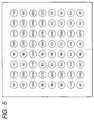
- FIG. 5 shows values after correction obtained by multiplying the measured values of FIG. 4 by a correction coefficient ( control fluorescence value from fluorescein directly bonded to the substrate without elongation reaction 11330/measured fluorescence from fluorescein at the corresponding matrix site where elongation reaction had been carried out). These values are compared with values obtained from Comparative Examples (as described later).
- a glass substrate was cleaned as described in Example 1.
- a 1% aqueous solution of aminosilane coupling agent KBM-603, Shin-Etsu Chemical Co., Ltd.
- aminosilane coupling agent KBM-603, Shin-Etsu Chemical Co., Ltd.
- the above treated substrate was rinsed and immediately dipped in the above described aqueous solution of silane coupling agent for one hour at room temperature.
- the substrate was rinsed with running water (ultra pure water), dried by blowing nitrogen gas, and then fixed in an oven for one hour at 120°C.
- EMCS. Dojindo Co. Compound I below
- This treatment coupled the amino group of the silane coupling agent on the glass substrate and the succinimide group of EMCS, so that a maleimide group was formed on the substrate surface.
- This maleimide group is coupled to the thiol group of a DNA probe (as described later).
- DNA probes having completely the same sequences as described in Example 3 were purchased from Becks K.K. Each of these DNAs carries a thiol linker at 5'-terminal thereof for coupling to the substrate.
- An example of the DNA having the thiol linker is illustrated as Compound II below.
- This compound II has a base sequence (No. 42) which is completely complementary to the model target DNA.
- Each DNA probe was dissolved in a solvent to be ejected from a thermal jet printer, that is, each DNA probe was dissolved in an aqueous solution containing 7.5 wt% of glycerin, 7.5 wt% of urea, 7.5 wt% of thiodiglycol, and 1 wt% of acetylene alcohol represented by the following general formula III (trade name: Acetylenol EH, Kawaken Fine Chemicals Co., Ltd.) to an absorbance of 1.0.
- general formula III trade name: Acetylenol EH, Kawaken Fine Chemicals Co., Ltd.
- each solution was charged in a modified ink supplying part of a thermal jet printer, which printer can hold two ink-jet heads (Canon Inc.). Then the solutions were discharged onto the above described substrate to form the same pattern as in Examples 1 to 3 with different shapes. According to the configuration of this apparatus, the amount of one drop of the discharged solution was 24 pL, and the dot diameter formed by one drop of the solution became 70 to 100 ⁇ m under these conditions. The discharging density was 120 dpi (dot/inch). After probe application, the substrate was placed in a moisture chamber at 100% humidity for one hour at room temperature for reaction, then rinsed with running water (ultra pure water) for 30 seconds.
- running water ultra pure water
- FIG. 7 shows the comparison of the results of FIG. 5 and the results of FIG. 6.
- the former shows the corrected hybridization results obtained by using an array of DNA probes sequentially synthesized and terminal labeled, corrected by the fluorescence value of the fluorescent dye used for labeling the probe terminus and the fluorescent value of the fluorescent dye directly bonded to the substrate, and the latter shows the hybridization results obtained by using a DNA probe array where the synthesized and purified probes were bonded to the substrate.
- Cn Bn ⁇ ( ⁇ An/ ⁇ Bn)/An ( ⁇ An represents a sum of A1 to A64 and ⁇ Bn represents a sum of B1 to B64.)
- FIG. 7 shows the effectiveness of the correction of the present invention. Values indicated in FIG. 7 are within a range of ⁇ 20% and the standard deviation is within a range of about 9%. It is also possible to correct data of plural DNA probe arrays on the basis of fluorescence values of control matrix sites where no elongation reaction was carried out and a fluorescent dye (fluorescein) was directly bonded to the substrate.
- a fluorescent dye fluorescein
Landscapes
- Chemical & Material Sciences (AREA)
- Engineering & Computer Science (AREA)
- Health & Medical Sciences (AREA)
- Immunology (AREA)
- Life Sciences & Earth Sciences (AREA)
- Nanotechnology (AREA)
- Urology & Nephrology (AREA)
- Biomedical Technology (AREA)
- General Physics & Mathematics (AREA)
- Physics & Mathematics (AREA)
- Hematology (AREA)
- Organic Chemistry (AREA)
- Molecular Biology (AREA)
- Food Science & Technology (AREA)
- Composite Materials (AREA)
- Medicinal Chemistry (AREA)
- Cell Biology (AREA)
- Analytical Chemistry (AREA)
- Biochemistry (AREA)
- General Health & Medical Sciences (AREA)
- Biotechnology (AREA)
- Pathology (AREA)
- Microbiology (AREA)
- Condensed Matter Physics & Semiconductors (AREA)
- Materials Engineering (AREA)
- Crystallography & Structural Chemistry (AREA)
- Chemical Kinetics & Catalysis (AREA)
- Measuring Or Testing Involving Enzymes Or Micro-Organisms (AREA)
- Investigating Or Analyzing Non-Biological Materials By The Use Of Chemical Means (AREA)
- Investigating Or Analysing Biological Materials (AREA)
Abstract
Description
- The present invention relates to a labeled probe array, a method for producing the labeled probe array, and a method for determining the amount of a target substance using the labeled probe array.
- Recently, for precise assessment of a target substance, a method has been intensively studied using a plurality of probes disposed in an array on the surface of a substrate, called "probe array". A typical example is a so-called "DNA probe array" in which a plurality of DNA probes are disposed on a substrate. This DNA probe array is also referred to as a DNA chip. By using the DNA probe array, for example, the presence of a plurality of target genes can be analyzed at the level of base sequence.
- Methods of making the probe array are roughly classified into two.
- One is a method that synthesizes probes by sequential synthesis on a solid substrate, applicable to the probes being a substance that can be synthesized by chemical elongation and of which nucleotide or amino acid sequence has an important meaning, e.g., DNA, oligonucleotide, peptide nucleic acids (PNAs), proteins, and oligopeptides.
- As an example of such a method, U.S. Patent No. 5,445,966 discloses a method of synthesizing a DNA probe array on a substrate by using photolytic protection groups and photolithography. Alternatively, U.S. Patent No. 5,474,796 discloses a method supplying nucleotide monomers by an ink jet process.
- The other method is applicable, in addition to the above described substances, to the substances not chemically synthesizable, since this method is to supply probes that have been previously synthesized or prepared to the matrix sites of a probe-array substrate by the micro-dispensing method, pin transfer method, or ink jet process etc.
- Since the second method uses probes which have been purified and of which quantity can be controlled, the purity of the probes is secured and the concentrations of the probes to be reacted with the substrate can be freely determined. Consequently, the final amounts of respective probes on the substrate surface can be assessed with a certain accuracy, to enhance the reliability of the target substance detection using the probe array. On the other hand, the second method requires previous synthesis of all kinds of probes for the probe array and it also requires to apply the probes to the substrate for reaction. Sometimes, several hundreds of thousands of probes may be required for a probe array. In that case, it will be considerably difficult to synthesize all probes beforehand.
- On the other hand, according to the first method, necessary probes are synthesized on the substrate and then used for the reaction with the target substances, so that operations for immobilizing the previously synthesized or prepared probes onto the substrate can be omitted.
- However, in order to improve the detection sensitivity or reliability of the first method, following points must be improved.
- (1) The yield in each step of the sequential synthesis is not 100%, some times the final yield is as low as 5%. This directly leads to reduction in the sensitivity when the target substance is detected.
- (2) For the same reason, both full length probes and shorter length probes are present at each matrix site of the probe array. This lowers the reliability in detecting a target substance.
- (3) As a result of in situ synthesis on the substrate, the amount of the probe at each matrix site cannot be measured. This also lowers the reliability in detecting a target substance.
- (4) As mentioned above, the synthetic yield in each step of sequential synthesis is not 100% and the synthetic yield varies depending on the steps and the matrix sites, so that the final amounts of respective probes vary broadly. This also lowers the reliability of the detection of a target substance.
-
- The object of the present invention is to solve the above described problems.
- According to the present invention, there is provided a method of making a probe array for capturing a target substance which comprises the steps of:
- synthesizing a plurality of probes immobilized at a plurality of matrix sites on a substrate by sequential synthesis where constitutional units are added one by one to a plurality of basal parts immobilized to the substrate until a desired length is obtained; and
- coupling a labeling compound to a terminus of the probe of the desired length.
-
- Further, according to the present invention, there is provided a probe array which comprises a plurality of probes immobilized at a plurality of matrix sites on a substrate for capturing a target substance, wherein the probes are sequentially synthesized at the matrix sites on the substrate until a desired length, the probes are different from each other, and a labeling compound is coupled to each terminus of the probes in a final step of the synthesis.
- The present invention also provides a method of measuring an amount of a probe in a probe array wherein the probe array comprises a plurality of probes immobilized at a plurality of matrix sites on a substrate for capturing a target substance, the probes are sequentially synthesized at the matrix sites on the substrate until a desired length, the probes are different from each other, and a labeling compound is coupled to each terminus of the probes in a final step of the synthesis, which method comprises the step of measuring an amount of the labeling compound at each matrix site.
- The present invention provides a method of evaluating an amount of a target substance, which comprises the steps of:
- reacting a probe array and a target substance wherein the probe array comprises a plurality of probes immobilized at a plurality of matrix sites on a substrate for capturing a target substance, the probes are sequentially synthesized at the matrix sites on the substrate until a desired length, the probes are different from each other, and a labeling compound is coupled to each terminus of the probes in a final step of the synthesis;
- measuring an amount of the labeling compound at each matrix site to determine an amount of the probe at the matrix site;
- measuring an amount of a labeled target substance captured by the probe at the matrix site; and
- comparing the amount of the probe with the amount of the labeled target substance.
-
- The present invention also provides a method of evaluating an amount of a target substance comprising the steps of:
- reacting a probe array and a target substance, wherein the probe array comprises a plurality of probes immobilized at a plurality of matrix sites on a substrate for capturing a target substance, the probes are sequentially synthesized at the matrix sites on the substrate until a desired length, the probes are different from each other, and a labeling compound is coupled to each terminus of the probes in a final step of the synthesis;
- measuring an amount of the labeling compound at each matrix site to determine an amount of the probe at the matrix site;
- measuring an amount of a labeled target substance captured by the probe at the matrix site;
- measuring an amount of the labeling compound directly bonded to the substrate at a predetermined matrix site on the surface of the substrate during a first step of the sequential synthesis without elongation reaction; and
- comparing the amount of the probe, the amount of the labeled target substance, and the amount of the directly bonded labeling compound.
-
-
- FIG. 1 shows a probe arrangement on the array substrate with nucleotide sequences of a target DNA and probes;
- FIG. 2 shows fluorescence values of a DNA probe array of Example 2, derived from fluorescein;
- FIG. 3 shows the structural formula of a target DNA;
- FIG. 4 shows the hybridization result of Example 3;
- FIG. 5 shows corrected result of the hybridization of Example 3;
- FIG. 6 shows the hybridization result of Comparative Example; and
- FIG. 7 shows a comparison of the result of FIG. 6 with the result of FIG. 5.
-
- The feature of the present invention is to introduce a quantitatively determinable labeling substance to the probe in the final step of the sequential synthesis.
- The sequential synthesis is a method for synthesizing a concatenate oligomer consisting of from several to around one hundred units (for example, DNA consisting of nucleotides and protein consisting of amino acid residues) by sequentially bonding the desired units. This conventional method widely used in synthesis of oligonucleotides, oligopeptides, and PNAs can be used in the present invention without any alterations thereto. In case of DNA (oligonucleotide) synthesis, for example, the most commonly used method with an automatic synthesizer at present is the phosphoramidite method. This method comprises the following steps of:
- (1) deprotecting hydroxyl groups bonded to the surface of a solid carrier (a glass substrate etc.) via a linker;
- (2) coupling the deprotected hydroxyl group to the 3'phosphorus group of an amidite monomer having a desired base;
- (3) capping the hydroxyl groups not reacted in step(2);
- (4) oxidizing the coupled amidite in step (3) from phosphite to phosphate;
- (5) removing the protection group protecting 5' hydroxyl moiety of the coupled amidite in step (2);
- (6) repeating steps (2) to (5) to obtain an oligonucleotide of a desired length and base sequence in a direction from 3' to 5'; and
- (7) deprotecting the nucleotide bases.
-
- Examples of the probes are, but not limited to, RNAs, DNAs, oligonucleotides, peptide nucleic acids (PNAs), proteins, oligopeptides or the like.
- In detecting a target substance using the probe array, it is common to label the target substance with a fluorescent dye. Therefore, it is convenient to label the probes with a fluorescent dye, because the labeling substance can be detected by the same measuring device for detecting the target.
- Other labeling substances may be used, but should be chosen not to disturb detection of the target substance. In this viewpoint, it is preferable that the labeling agent for the target substance and that for the probe are different.
- When labeling substances are both fluorescent dyes, it is desirable that they are different in excitation wavelength and fluorescent wavelength. For example, one is FITC and the other is rhodamine, or one is CY3 (Amersham Pharmacia Biotech Co.) and the other is CY5 (Amersham Pharmacia Biotech Co.).
- In sequential synthesis in the solid phase, capping (treatment to inactivate the uncoupled functional group) is carried out after each elongation reaction. For example, in a solid phase synthesis of DNA, hydroxyl groups at the reactive site are inactivated by acetylation.
- Therefore, in the present invention, only probes that have elongated to the final step (to a desired chain length) are labeled with a labeling substance, so that the measurement of the amount of the labeling substance at each matrix site allows evaluation of the probe quantity at each matrix site.
- Thus, relative correction between respective probes in determining the amount of the target substance can be done by comparing the quantitatively determined probe amount and the amount of the labeling substance of the target substance captured by the probe.
- In order to determine the absolute amount of the captured target substance in the present invention, a control site is provided on the substrate where only the first hydroxyl groups introduced to the substrate are labeled with a labeling substance without subsequent elongation reaction steps, and the amount of the labeling substance at the control site is compared with the respective amounts of the labeling substance coupled to the probes synthesized at the matrix sites by elongation reaction. This allows to evaluate relative amounts of the synthesized probes to the initial functional groups introduced to the substrate surface. By comparing thus determined amount of the probe in each matrix with the amount of the labeling substance coupled to the target substance that was captured by the probe, evaluation of the absolute amount of the target substance and relative correction between the probes can be carried out simultaneously.
- Any procedures disclosed in the above described U.S. Patents and other conventional techniques can be used for respective steps in preparing the terminal-labeled probe array of the present invention.
- The present invention will now be particularly described by the following Examples.
-
- (1) A synthetic quartz substrate (25.4 mm × 25.5 mm × 0.5 mm) was subjected to ultrasonication for 20 minutes with a 10% aqueous solution of a ultrasonic detergent (GP-II, a product of Branson Co.), washed with ultra pure water, dipped in an aqueous solution of 1 N sodium hydroxide (80°C), washed with ultra pure water, dried, and then subjected to the UV ozone treatment to clean the surface thereof.
- (2) Next, DEEP-UV resist containing carbon black (BK-739P, a negative photoresist for black matrix, Nippon Steel Chemical Co., Ltd.) was applied to the substrate to a thickness of 5 µm by using a spin coater. This substrate was heated at 80°C for 5 minutes on a hot plate to pre-bake the resist. This resist film was subjected to proximity exposure by using a DEEP-UV aligner and a pattern mask corresponding to the matrix pattern where the matrix sites of 100 µm × 100 µm are arranged at 100 µm intervals within an area of 1 cm × 1 cm as shown in FIG. 1. Then the resist was developed with an inorganic alkaline aqueous solution in a spin developer, and rinsed with ultra pure water to completely remove the inorganic alkaline aqueous solution. This substrate was roughly dried with the use of a spin dryer, then heated to 180°C for 30 minutes in a clean oven in order to post-bake the resist. Consequently, 2500 matrix sites, each of which being surrounded with the resist film, were formed on the surface of the substrate. The volume of each matrix site thus formed is calculated as 50 pL.
- (3) An aqueous solution of 1% silane coupling agent having epoxy groups (KBM403: γ-glycidoxypropyltrimethoxysilane, Shin-Etsu Chemical Co., Ltd.) was hydrolyzed by stirring it for one hour at room temperature. The substrate provided with the above described matrix sites thereon was dipped in this solution for one hour and cleaned with ultra pure water properly, then heated at 120°C for one hour. As a result, epoxy groups were bonded to the above described matrix sites. By treating the substrate with hexaethylene glycol, hydroxyl groups were introduced to the matrix sites for coupling oligonucleotides.
- (4) The synthesis of oligonucleotides on the
substrate was carried out by the ordinary
phosphoramidite method. A polyethylene chamber to
contain the above described substrate therein was
fabricated and then mounted in a column part of a DNA
synthesizer (381A, a product of ABI Inc.).
Synthesizing steps other than substance application of amidite monomers and activators, subsequent cleaning, and drying steps were carried out by the DNA synthesizer. A modified piezo ink-jet system was employed in supplying the amidite monomers and activators. Operating the piezo ink-jet apparatus in a dry box (argon), not inks but acetonitrile solutions of four amidite monomers and an activator were applied to the above described matrix sites on the substrate under the position control. The liquid amount supplied at a time from the piezo device was 24 pL on average. - (5) Basically, it is possible to synthesize
distinct oligonucleotides for all of 2500 matrix sites.
In this example, however, 64 oligonucleotides, i.e.,
DNA probes, were synthesized. These 64 oligonucleotides
include every base variation at three positions in two
triplets encoding two amino acids in a carcinogenic
gene p53. The DNA probe array substrate obtained was
dipped in a 30% aqueous solution of ammonia for 12
hours at room temperature to deprotect the nucleic acid
bases.
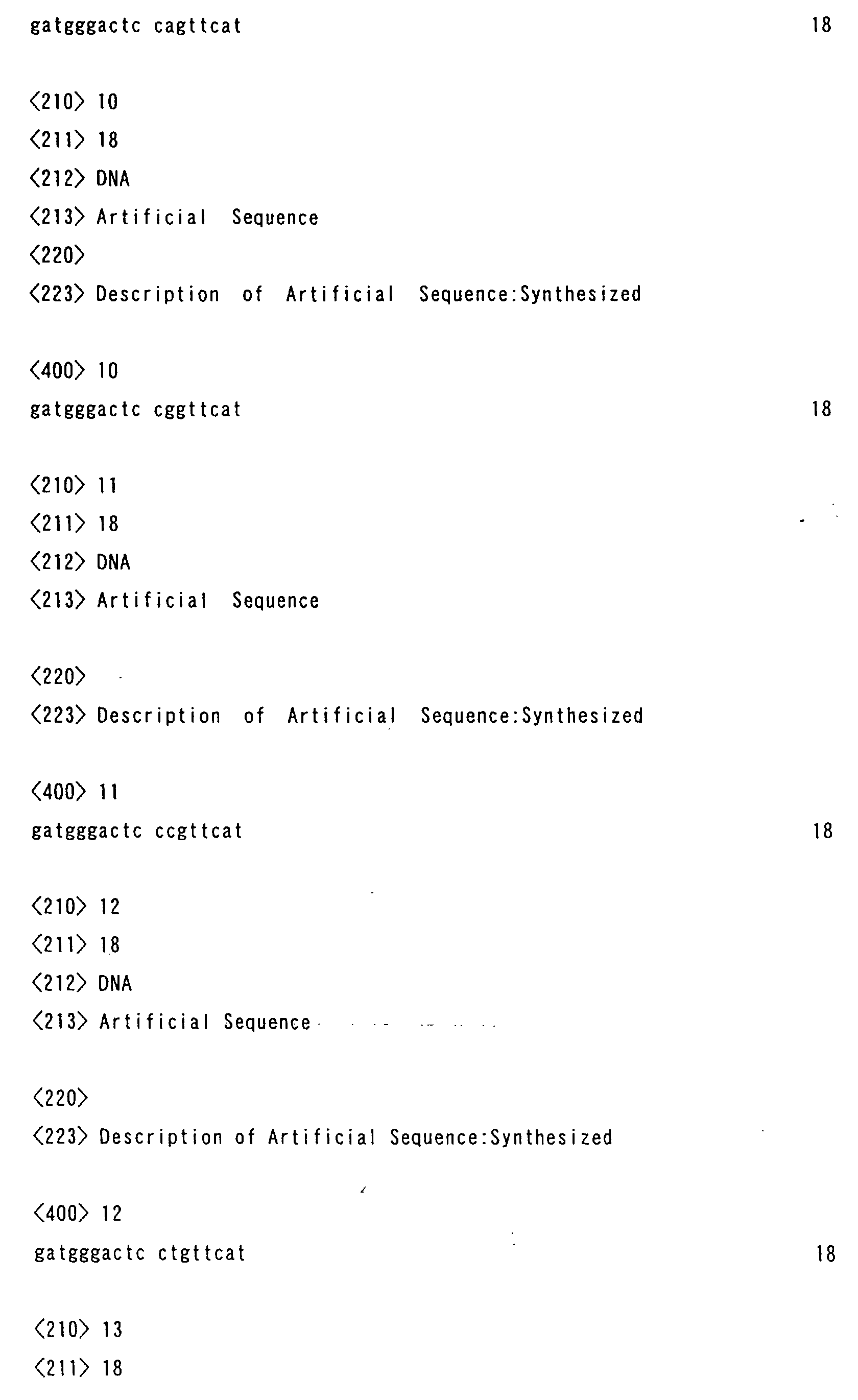
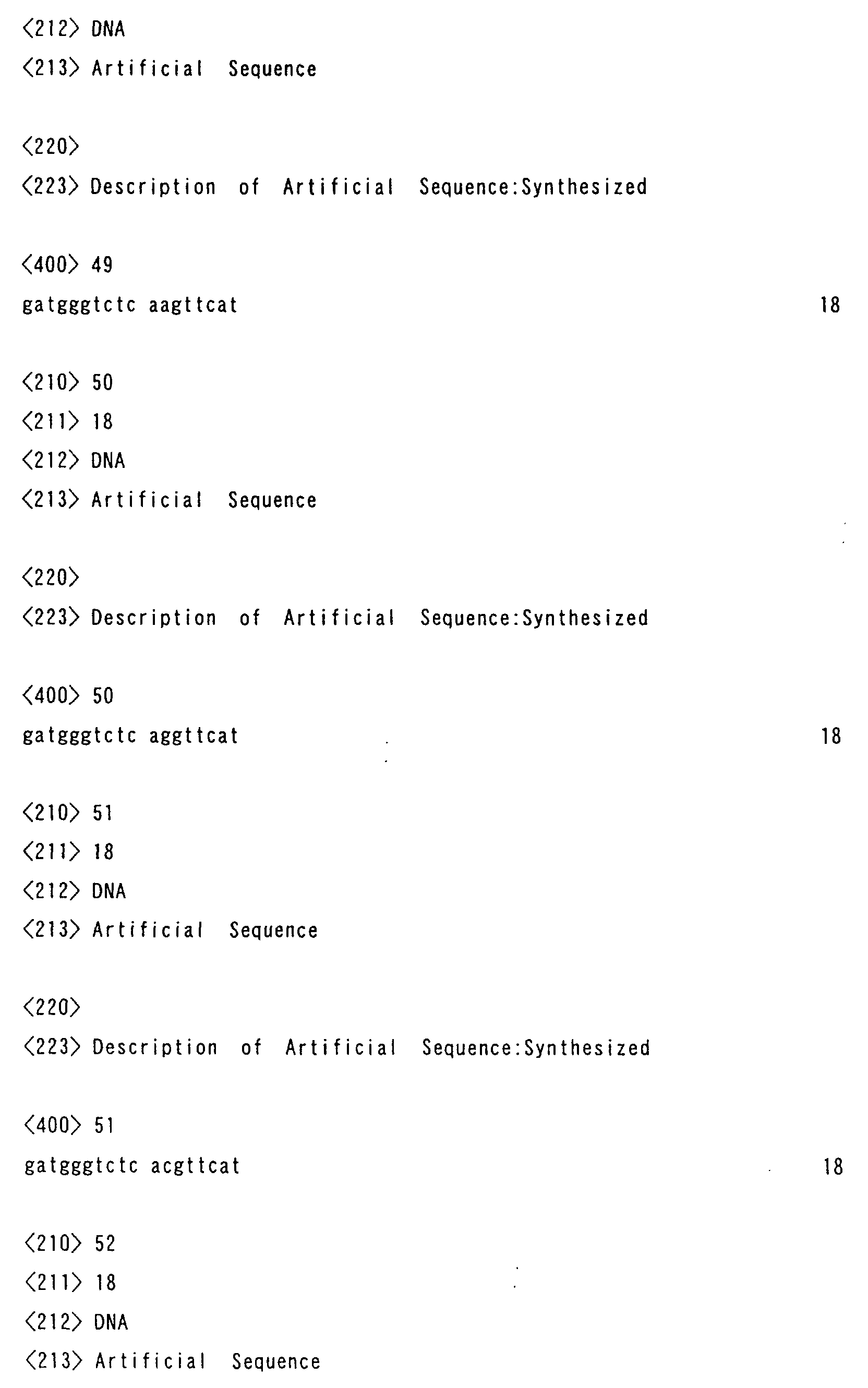
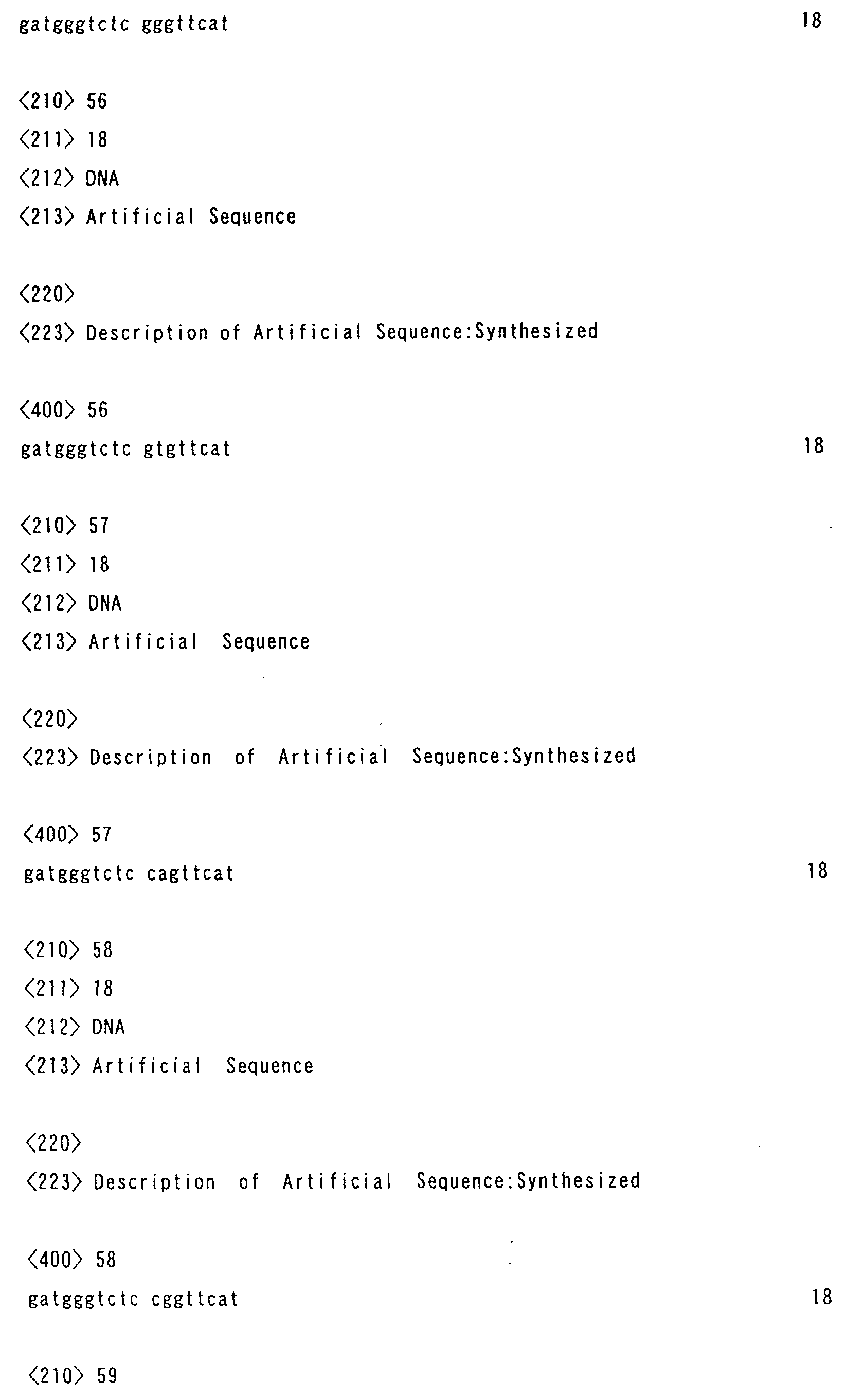
Base sequences of synthesized DNA probes (SEQ ID
NO: 1 to SEQ ID NO: 64) are as follows.

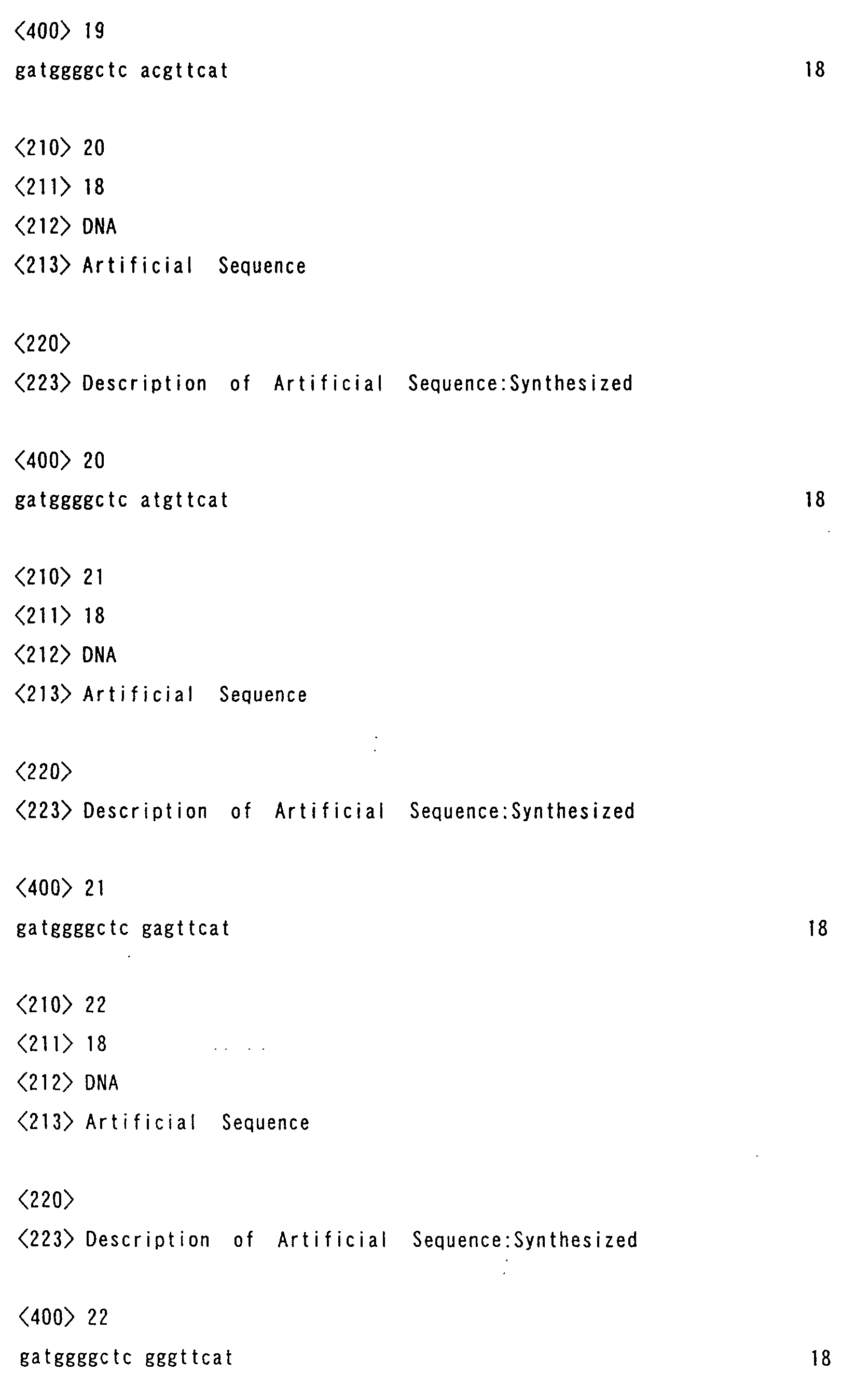
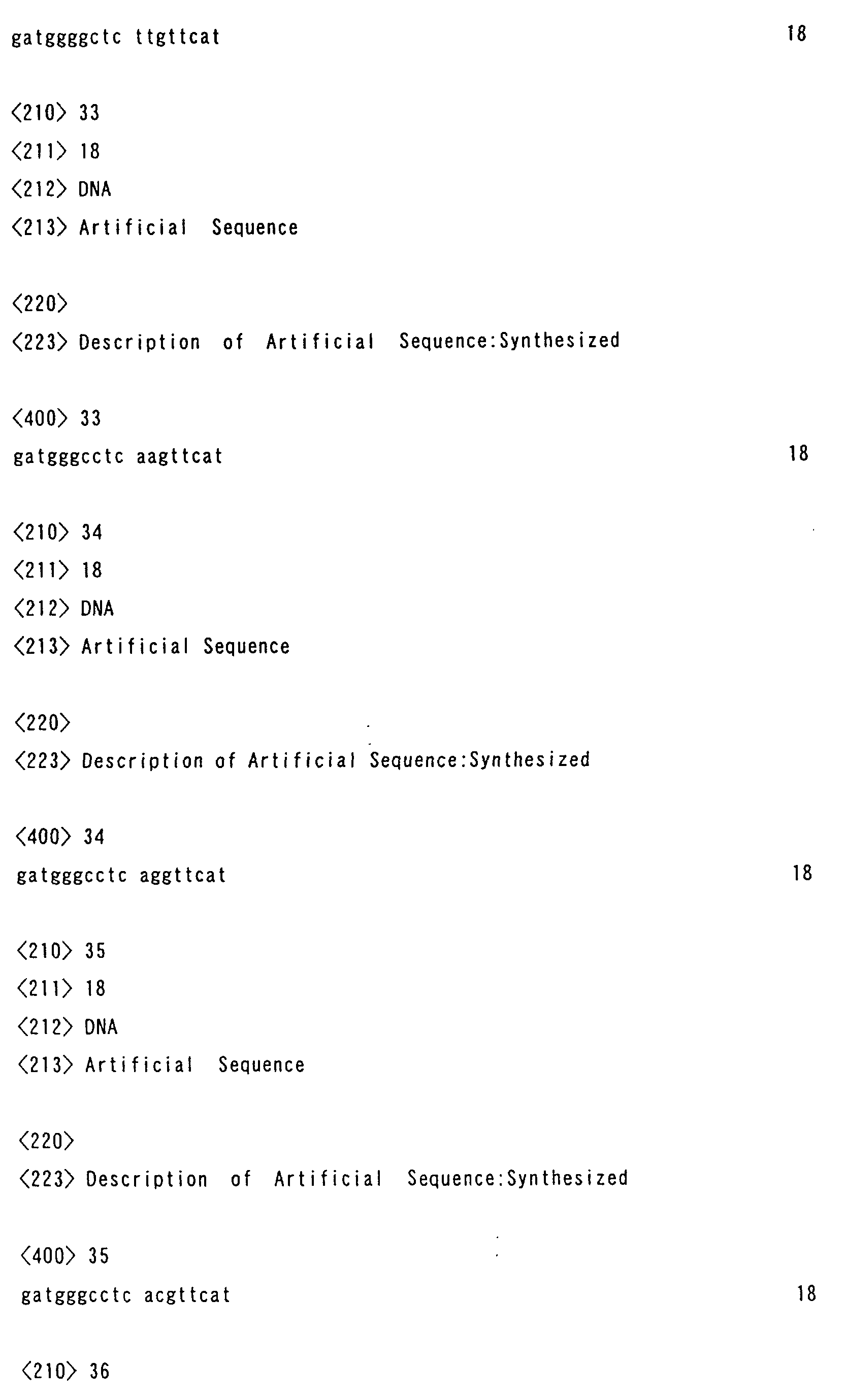
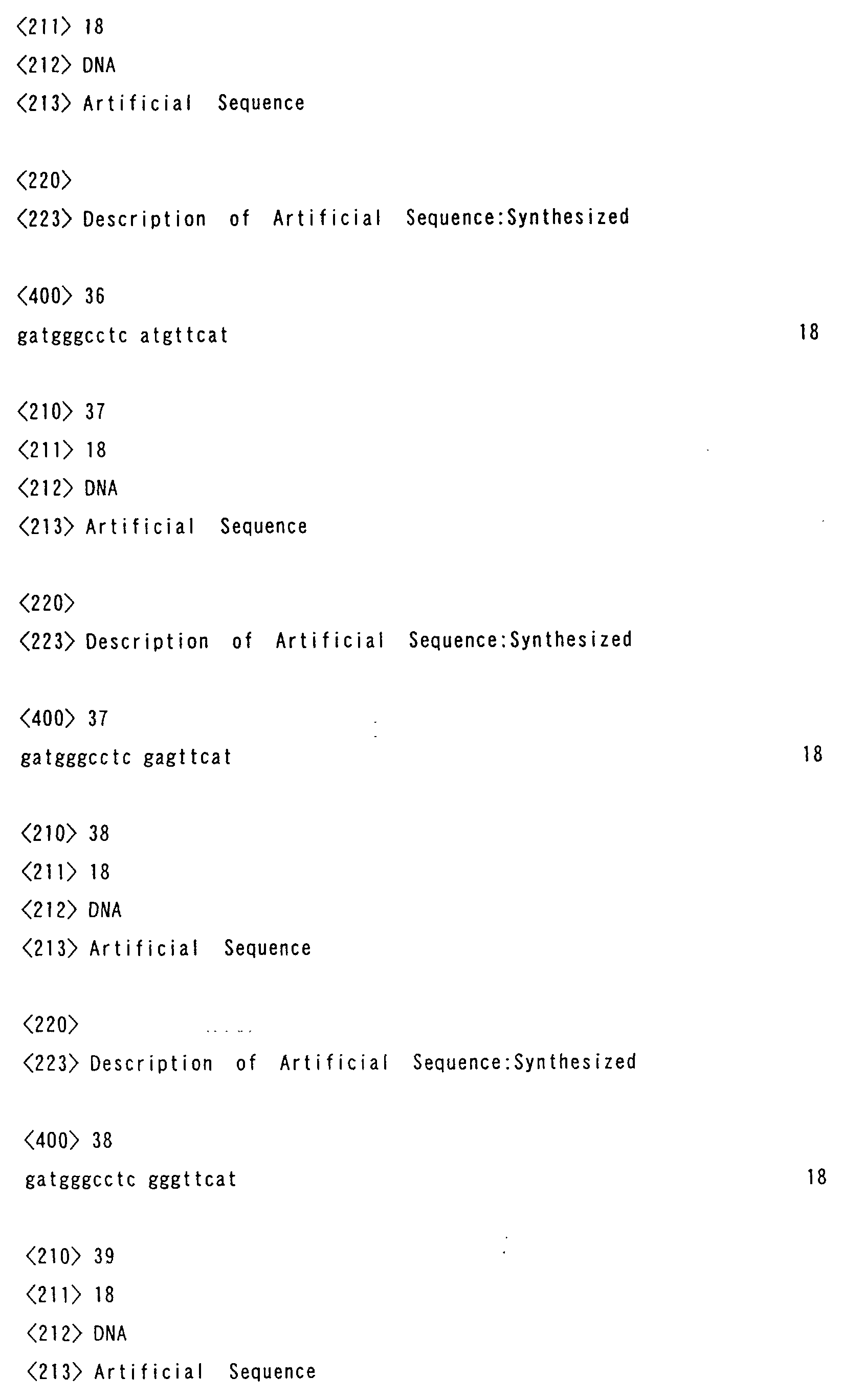
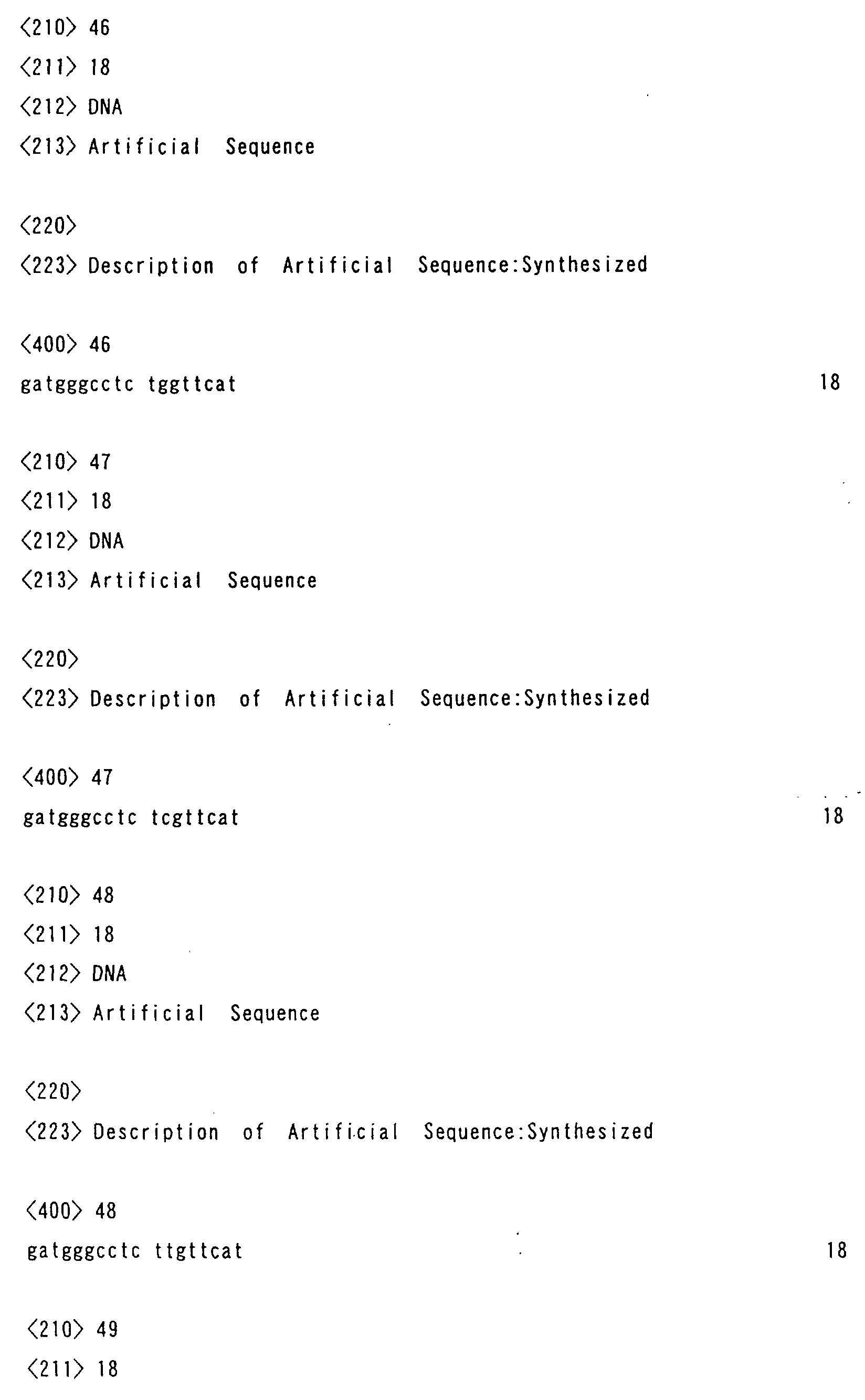
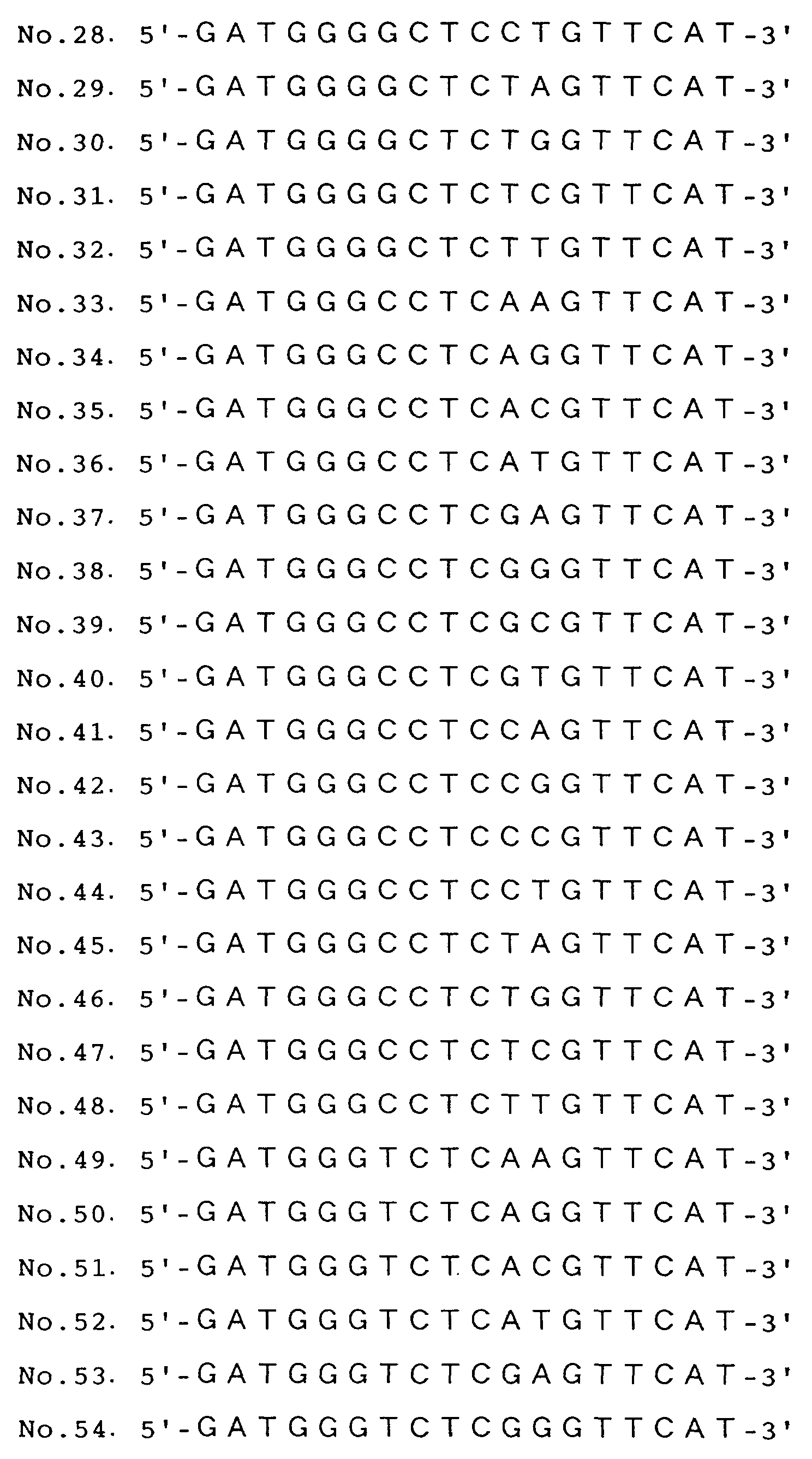 FIG. 1 shows base sequences of DNA probes on the DNA array substrate and an arrangement thereof as well as base sequences of tetramethyl rhodamine labeled model target DNA to be used for subsequent hybridization. The sequence No. 65 (SEQ ID NO: 65) is a target DNA sequence and complementary probe sequences No. 1 to 64 differ each other at three underlined base positions, where one of A, G, C and T comes to create 43 = 64 combinations. The three base positions of the above described probes correspond to the underlined parts in the sequence No. 65. The position denoted by N in each sequence corresponds to A, G, C and T written above the upper edge of the box. As a result, DNA probe No.42 is completely complementary to the target DNA, and others have one, two, or three mismatches within the sequences as illustrated in FIG. 1.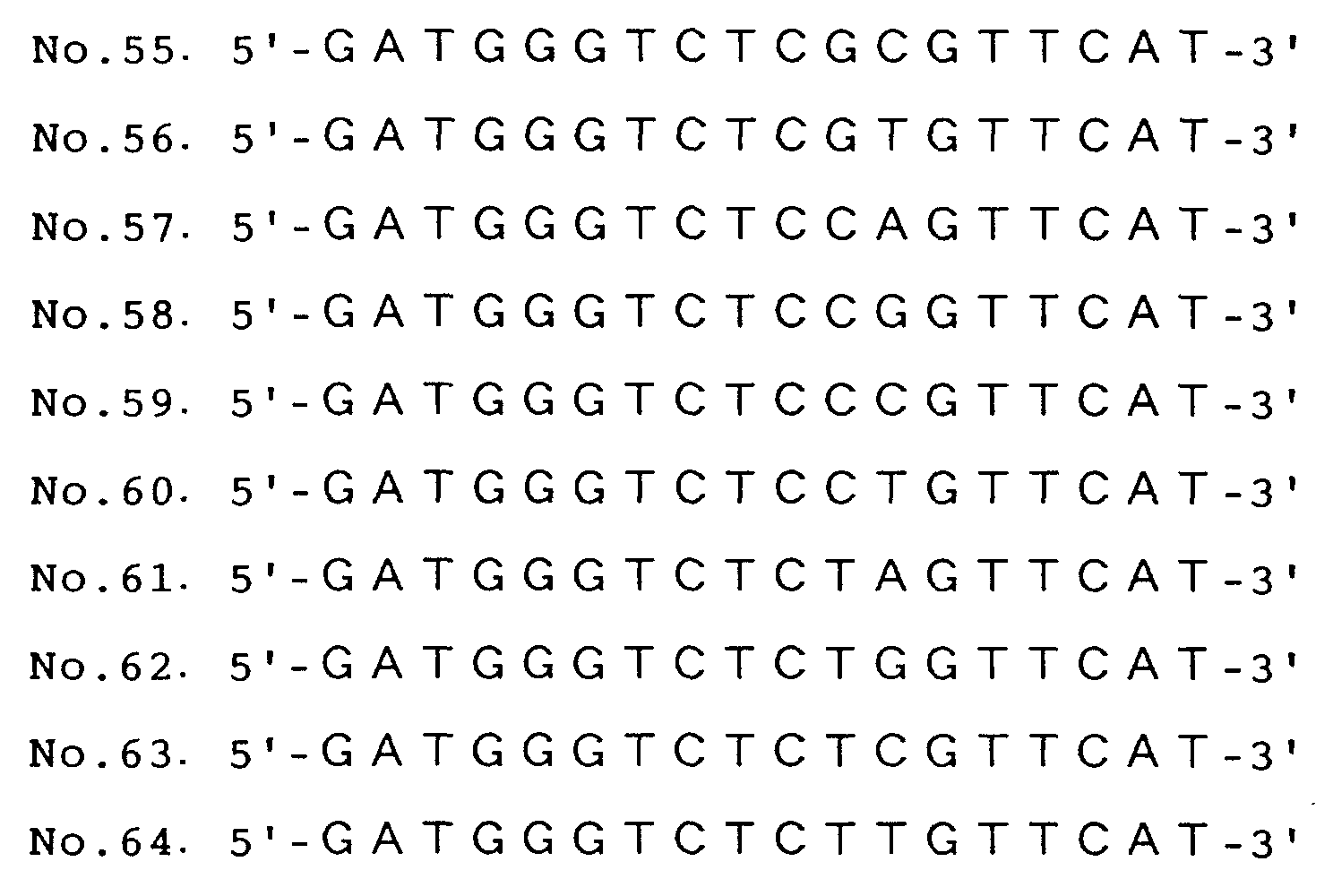
- (6) A fluorescent dye, fluorescein, was bound to the 5'-terminal of every synthesized DNA probe by using fluorescein phosphoramidite (Glenn Research Co.). In addition, fluorescein was directly bound to another matrix site using fluorescein amidite, at the matrix site, fluorescein was directly coupled with the hydroxy groups of the substrate using fluorescein phosphoramidite instead of amidite in step (2). In this case, elongation reaction will not proceed in principle in subsequent steps.
-
- Fluorescence of the fluorescein in each matrix site was taken in by using a fluorescence microscope ECLIPSE800 (Nikon Corp., an
objective lens CFIPlanApo 20×) and a CCD camera C2400-87 equipped with an image intensifier (Hamamatsu Photonics K.K.), then analyzed by an image processing device, Argu50 (Hamamatsu Photonix Co., Ltd.). An amplification degree HV of the image intensifier was 2.0, integration was performed 64 times, and B-2E/C for the fluorescein measurement was employed as a filter block of the fluorescence microscope. In the measurement of the fluorescence, a substrate was placed on a slide glass and 50 mmol/L of a phosphate buffer (pH = 7.0, containing 100 mmol/L NaCl) was dropped onto the substrate appropriately, then a cover slip was put thereon for the measurement. - FIG. 2 shows measured fluorescence values. The fluorescence value (11330) written outside the square in FIG. 2 was from a matrix site where the fluorescein was directly bound to the substrate. FIG. 2 shows that fluorescence values obtained from the bonded oligonucleotides range from 2940 to 10350. These values can be used to correct the amounts of respective oligonucleotide probes, and the hybridization results can be corrected by using these fluorescence values. When a plurality of DNA arrays are used, it is possible to correct the values of the matrix sites using the fluorescence value of the control matrix site where fluorescein has been directly bonded to the substrate in respective DNA arrays.
- FIG. 3 shows a structure of a tetramethyl rhodamine-labeled model target DNA used for hybridization. This target DNA sequence corresponds to the sequence No. 65 as mentioned above.
- The above described probe array was dipped in a 50 mmol/L phosphate buffer (pH = 7.0, containing 100 mmol/L of NaCl and 2% bovine serum albumin (Sigma-Aldrich Japan) for one hour, then rinsed with the above described buffer appropriately, and subjected to hybridization.
- The hybridization was carried as follows:
- First the DNA probe array and 2 mL of a 50 mmol/L phosphate buffer (pH = 7.0, 100 mmol/L NaCl) containing the above described target DNA at a concentration of 50 nmol/L were enclosed in a resin pack for hybridization, and heated to 70°C and then cooled to 20°C, and left standing for 24 hours.
- Next, the substrate was rinsed in the above buffer for 20 minutes, then fluorescence from tetramethyl rhodamine of the target DNA was measured in the same manner as in Example 2. In this case, Y-2E/C was employed as a fluorescence filter block. In addition, the amplification degree of the image intensifier was 4.0.
- The result is shown in FIG. 4. FIG. 5 shows values after correction obtained by multiplying the measured values of FIG. 4 by a correction coefficient ( control fluorescence value from fluorescein directly bonded to the substrate without
elongation reaction 11330/measured fluorescence from fluorescein at the corresponding matrix site where elongation reaction had been carried out). These values are compared with values obtained from Comparative Examples (as described later). - A glass substrate was cleaned as described in Example 1. A 1% aqueous solution of aminosilane coupling agent (KBM-603, Shin-Etsu Chemical Co., Ltd.) purified by vacuum distillation was stirred for one hour at room temperature to hydrolyze the methoxy moiety thereof. The above treated substrate was rinsed and immediately dipped in the above described aqueous solution of silane coupling agent for one hour at room temperature. Then the substrate was rinsed with running water (ultra pure water), dried by blowing nitrogen gas, and then fixed in an oven for one hour at 120°C.
- After cooling, the substrate was dipped in a 0.3% solution (ethanol:dimethylsulphoxide = 1:1) of N-(6-maleimidocaproxy) succinimide (EMCS. Dojindo Co.)
(Compound I below) for two hours at room temperature for reaction, and then it was rinsed with a solution of ethanol:dimethylsulphoxide = 1:1 once and rinsed with ethanol three times, and dried by blowing nitrogen gas.
- This treatment coupled the amino group of the silane coupling agent on the glass substrate and the succinimide group of EMCS, so that a maleimide group was formed on the substrate surface. This maleimide group is coupled to the thiol group of a DNA probe (as described later).
- Sixty four kinds of DNA probes having completely the same sequences as described in Example 3 were purchased from Becks K.K. Each of these DNAs carries a thiol linker at 5'-terminal thereof for coupling to the substrate. An example of the DNA having the thiol linker is illustrated as Compound II below.

- This compound II has a base sequence (No. 42) which is completely complementary to the model target DNA.
- Each DNA probe was dissolved in a solvent to be ejected from a thermal jet printer, that is, each DNA probe was dissolved in an aqueous solution containing 7.5 wt% of glycerin, 7.5 wt% of urea, 7.5 wt% of thiodiglycol, and 1 wt% of acetylene alcohol represented by the following general formula III (trade name: Acetylenol EH, Kawaken Fine Chemicals Co., Ltd.) to an absorbance of 1.0.

- Then 0.4 mL of each solution was charged in a modified ink supplying part of a thermal jet printer, which printer can hold two ink-jet heads (Canon Inc.). Then the solutions were discharged onto the above described substrate to form the same pattern as in Examples 1 to 3 with different shapes. According to the configuration of this apparatus, the amount of one drop of the discharged solution was 24 pL, and the dot diameter formed by one drop of the solution became 70 to 100 µm under these conditions. The discharging density was 120 dpi (dot/inch). After probe application, the substrate was placed in a moisture chamber at 100% humidity for one hour at room temperature for reaction, then rinsed with running water (ultra pure water) for 30 seconds.
- Treatment with BSA, conditions for hybridization, and conditions of quantitative fluorometry were the same as described in Example 3. Amplification degree of the image intensifier was 2.0. The result of quantitative fluorometry is shown in FIG. 6.
- FIG. 7 shows the comparison of the results of FIG. 5 and the results of FIG. 6. The former shows the corrected hybridization results obtained by using an array of DNA probes sequentially synthesized and terminal labeled, corrected by the fluorescence value of the fluorescent dye used for labeling the probe terminus and the fluorescent value of the fluorescent dye directly bonded to the substrate, and the latter shows the hybridization results obtained by using a DNA probe array where the synthesized and purified probes were bonded to the substrate.
- Value Cn in the matrix of FIG. 7 was calculated by the following equation (1), where An is a value from each matrix site of FIG. 5 and Bn is a value from each matrix site of FIG. 6 (n = 1 to 64).
- FIG. 7 shows the effectiveness of the correction of the present invention. Values indicated in FIG. 7 are within a range of ±20% and the standard deviation is within a range of about 9%. It is also possible to correct data of plural DNA probe arrays on the basis of fluorescence values of control matrix sites where no elongation reaction was carried out and a fluorescent dye (fluorescein) was directly bonded to the substrate.
- As described above, according to the present invention, one can evaluate the probe amount at each matrix site by terminal labeling of the sequentially synthesized probes. Also it enables to detect and quantify the target substance by correcting respective probe amounts. Further, direct coupling of a labeling substance to the substrate enables correction between probe arrays.












Claims (20)
- A method of making a probe array for capturing a target substance comprising the steps of:synthesizing a plurality of probes immobilized at a plurality of matrix sites on a substrate by sequential synthesis where constitutional units are added one by one to a plurality of basal parts immobilized to the substrate until a desired length is obtained; andcoupling a labeling compound to a terminus of the probe of the desired length.
- The method according to claim 1, wherein the probe is a nucleic acid.
- The method according to claim 2, wherein the nucleic acid is a DNA, an oligonucleotide, or a peptide nucleic acid.
- The method according to claim 3, wherein the nucleic acid is a DNA and the sequential synthesis is a phosphoramidite method comprising the steps of:(1) deprotecting hydroxyl groups bonded to the surface of a solid substrate via a linker;(2) coupling the deprotected hydroxyl group to the 3'phosphorus group of an amidite monomer having a desired base;(3) capping the hydroxyl groups not reacted in step(2);(4) oxidizing the coupled amidite in step (3) from phosphite to phosphate;(5) deprotecting a 5' hydroxyl moiety of the coupled amidite in step (2);(6) repeating steps (2) to (5) to obtain an oligonucleotide of a desired length and base sequence in a direction from 3' to 5'; and(7) deprotecting the bases.
- The method according to claim 1, wherein the probe is a protein.
- The method according to claim 1, wherein the probe is an oligopeptide.
- The method according to claim 1, wherein the labeled substance coupled to the terminus of the probe is a fluorescent substance.
- The method according to claim 7, wherein the labeled substance is a fluorescent dye.
- The method according to claim 1, wherein the labeled substance coupled to the terminus of the probe is different from a labeled substance coupled to the target substance.
- A probe array comprising a plurality of probes immobilized at a plurality of matrix sites on a substrate for capturing a target substance, wherein the probes are sequentially synthesized at the matrix sites on the substrate until a desired length, the probes are different from each other, and a labeling compound is coupled to each terminus of the probes in a final step of the synthesis.
- A method of measuring an amount of a probe in a probe array wherein the probe array comprises a plurality of probes immobilized at a plurality of matrix sites on a substrate for capturing a target substance, the probes are sequentially synthesized at the matrix sites on the substrate until a desired length, the probes are different from each other, and a labeling compound is coupled to each terminus of the probes in a final step of the synthesis, comprising the step of measuring an amount of the labeling compound at each matrix site.
- A method for evaluating an amount of a target substance comprising the steps of:reacting a probe array and a target substance wherein the probe array comprises a plurality of probes immobilized at a plurality of matrix sites on a substrate for capturing a target substance, the probes are sequentially synthesized at the matrix sites on the substrate until a desired length, the probes are different from each other, and a labeling compound is coupled to each terminus of the probes in a final step of the synthesis;measuring an amount of the labeling compound at each matrix site to determine an amount of the probe at the matrix site;measuring an amount of a labeled target substance captured by the probe at the matrix site; andcomparing the amount of the probe with the amount of the labeled target substance.
- The method according to claim 12, wherein the amount of the labeling compound coupled to the probe is compared with an amount of the labeling compound directly bonded to the substrate at a predetermined matrix site on the surface of the substrate during a first step of the sequential synthesis without elongation reaction.
- A method of evaluating an amount of a target substance comprising the steps of:reacting a probe array and a target substance, wherein the probe array comprises a plurality of probes immobilized at a plurality of matrix sites on a substrate for capturing a target substance, the probes are sequentially synthesized at the matrix sites on the substrate until a desired length, the probes are different from each other, and a labeling compound is coupled to each terminus of the probes in a final step of the synthesis;measuring an amount of the labeling compound at each matrix site to determine an amount of the probe at the matrix site;measuring an amount of a labeled target substance captured by the probe at the matrix site;measuring an amount of the labeling compound directly bonded to the substrate at a predetermined matrix site on the surface of the substrate during a first step of the sequential synthesis without elongation reaction; andcomparing the amount of the probe, the amount of the labeled target substance, and the amount of the directly bonded labeling compound.
- A probe array according to claim 10, wherein the probe is a nucleic acid.
- A probe array according to claim 15, wherein the nucleic acid is a DNA, a oligonucleotide, or a peptide nucleic acid.
- A probe array according to claim 10, wherein the probe is a protein.
- A probe array according to claim 10, wherein the probe is an oligopeptide.
- A probe array according to claim 10, wherein the labeled substance coupled to the terminus of the probe is a fluorescent substance.
- A probe array according to claim 19, wherein the labeled substance is a fluorescent dye.
Applications Claiming Priority (2)
| Application Number | Priority Date | Filing Date | Title |
|---|---|---|---|
| JP2000357446A JP3596868B2 (en) | 2000-11-24 | 2000-11-24 | Method for evaluating the amount of probe in end-labeled probe array, and method for evaluating amount of target substance using labeled probe array |
| JP2000357446 | 2000-11-24 |
Publications (3)
| Publication Number | Publication Date |
|---|---|
| EP1213361A2 true EP1213361A2 (en) | 2002-06-12 |
| EP1213361A3 EP1213361A3 (en) | 2004-02-11 |
| EP1213361B1 EP1213361B1 (en) | 2012-02-29 |
Family
ID=18829509
Family Applications (1)
| Application Number | Title | Priority Date | Filing Date |
|---|---|---|---|
| EP01309879A Expired - Lifetime EP1213361B1 (en) | 2000-11-24 | 2001-11-23 | Terminal labeled probe array and method of making it |
Country Status (3)
| Country | Link |
|---|---|
| US (2) | US20030027160A1 (en) |
| EP (1) | EP1213361B1 (en) |
| JP (1) | JP3596868B2 (en) |
Families Citing this family (14)
| Publication number | Priority date | Publication date | Assignee | Title |
|---|---|---|---|---|
| US20070105100A1 (en) * | 2003-04-28 | 2007-05-10 | Canon Kabushiki Kaisha | Process for assay of nucleic acids by competitive hybridization using a dna microarray |
| JP4458327B2 (en) * | 2003-08-28 | 2010-04-28 | キヤノン株式会社 | Method for quantifying target substance and probe carrier used in the method |
| JP4508632B2 (en) | 2003-12-25 | 2010-07-21 | キヤノン株式会社 | Nucleic acid detection method and liquid composition |
| JP4541731B2 (en) * | 2004-03-12 | 2010-09-08 | キヤノン株式会社 | Nucleic acid detection method |
| JP2006094760A (en) * | 2004-09-29 | 2006-04-13 | Canon Inc | Cell screening method and oral cancer cell detection method |
| US8535914B2 (en) * | 2005-01-21 | 2013-09-17 | Canon Kabushiki Kaisha | Probe, probe set and information acquisition method using the same |
| JP2006322741A (en) * | 2005-05-17 | 2006-11-30 | Canon Inc | Hybridization data processing method using probe array |
| JP2007010413A (en) * | 2005-06-29 | 2007-01-18 | Canon Inc | Method for measuring melting point of nucleic acid hybrid and apparatus therefor |
| US7642086B2 (en) * | 2005-08-09 | 2010-01-05 | Canon Kabushiki Kaisha | Labeled probe bound object, method for producing the same and method for using the same |
| US20090011413A1 (en) * | 2005-12-14 | 2009-01-08 | Canon Kabushiki Kaisha | Method for screening colon cancer cells and gene set used for examination of colon cancer |
| US20090035767A1 (en) * | 2006-11-28 | 2009-02-05 | Canon Kabushiki Kaisha | Primer for bacterium genome amplification reaction |
| JP5729904B2 (en) | 2009-06-02 | 2015-06-03 | キヤノン株式会社 | Methods for preparing proteins, DNA, RNA from cells |
| JP7676786B2 (en) * | 2021-01-27 | 2025-05-15 | 横河電機株式会社 | Method for manufacturing a device for target measurement, and kit for target measurement |
| WO2024080776A1 (en) * | 2022-10-14 | 2024-04-18 | 고려대학교 산학협력단 | Sulfur-containing probe for colorimetric detection, and method for accelerating enzymatic activity through sulfur introduction into nucleic acids |
Family Cites Families (17)
| Publication number | Priority date | Publication date | Assignee | Title |
|---|---|---|---|---|
| US5474796A (en) * | 1991-09-04 | 1995-12-12 | Protogene Laboratories, Inc. | Method and apparatus for conducting an array of chemical reactions on a support surface |
| US5445966A (en) | 1993-04-20 | 1995-08-29 | Northeastern University | Extractive hydrogenation for chemical analyses |
| US5670315A (en) | 1993-09-13 | 1997-09-23 | Canon Kabushiki Kaisha | Nucleic acid determination employing pyryilium dye |
| US5556752A (en) | 1994-10-24 | 1996-09-17 | Affymetrix, Inc. | Surface-bound, unimolecular, double-stranded DNA |
| US5843655A (en) * | 1995-09-18 | 1998-12-01 | Affymetrix, Inc. | Methods for testing oligonucleotide arrays |
| US7014992B1 (en) * | 1996-11-05 | 2006-03-21 | Clinical Micro Sensors, Inc. | Conductive oligomers attached to electrodes and nucleoside analogs |
| CA2276462C (en) * | 1996-12-31 | 2007-06-12 | High Throughput Genomics, Inc. | Multiplexed molecular analysis system apparatus and method |
| US6013789A (en) * | 1998-02-20 | 2000-01-11 | Beckman Coulter, Inc. | Covalent attachment of biomolecules to derivatized polypropylene supports |
| US6251583B1 (en) | 1998-04-27 | 2001-06-26 | Schering Corporation | Peptide substrates for HCV NS3 protease assays |
| US6245518B1 (en) * | 1998-12-11 | 2001-06-12 | Hyseq, Inc. | Polynucleotide arrays and methods of making and using the same |
| US6312906B1 (en) * | 1999-01-15 | 2001-11-06 | Imperial College Innovations, Ltd. | Immobilized nucleic acid hybridization reagent and method |
| GB9902970D0 (en) * | 1999-02-11 | 1999-03-31 | Zeneca Ltd | Novel matrix |
| US6284465B1 (en) * | 1999-04-15 | 2001-09-04 | Agilent Technologies, Inc. | Apparatus, systems and method for locating nucleic acids bound to surfaces |
| JP3469504B2 (en) * | 1999-06-01 | 2003-11-25 | 日立ソフトウエアエンジニアリング株式会社 | Microarray chip and indexing method thereof |
| WO2001012855A2 (en) | 1999-08-13 | 2001-02-22 | Yale University | Binary encoded sequence tags |
| US6297016B1 (en) | 1999-10-08 | 2001-10-02 | Applera Corporation | Template-dependent ligation with PNA-DNA chimeric probes |
| US6471916B1 (en) * | 1999-11-09 | 2002-10-29 | Packard Instrument Company | Apparatus and method for calibration of a microarray scanning system |
-
2000
- 2000-11-24 JP JP2000357446A patent/JP3596868B2/en not_active Expired - Fee Related
-
2001
- 2001-11-21 US US09/988,873 patent/US20030027160A1/en not_active Abandoned
- 2001-11-23 EP EP01309879A patent/EP1213361B1/en not_active Expired - Lifetime
-
2003
- 2003-08-04 US US10/634,510 patent/US7402384B2/en not_active Expired - Fee Related
Non-Patent Citations (1)
| Title |
|---|
| None |
Also Published As
| Publication number | Publication date |
|---|---|
| EP1213361A3 (en) | 2004-02-11 |
| US20040018552A1 (en) | 2004-01-29 |
| US7402384B2 (en) | 2008-07-22 |
| JP2002153284A (en) | 2002-05-28 |
| EP1213361B1 (en) | 2012-02-29 |
| JP3596868B2 (en) | 2004-12-02 |
| US20030027160A1 (en) | 2003-02-06 |
Similar Documents
| Publication | Publication Date | Title |
|---|---|---|
| EP0895082B1 (en) | Bubble jet method for spotting probes on a solid support and method of manufacturing probe arrays. | |
| JP4261661B2 (en) | Probe binding substrate, probe binding substrate manufacturing method, probe array, target substance detection method, method for specifying base sequence of single-stranded nucleic acid in sample, and method for quantifying target substance in sample | |
| US7402384B2 (en) | Methods for evaluating probe arrays | |
| US6939673B2 (en) | Manufacture of arrays with reduced error impact | |
| US8198071B2 (en) | Substrate for biochip, biochip, method for manufacturing substrate for biochip, and method for manufacturing biochip | |
| US20230294064A1 (en) | Substrates, systems, and methods for nucleic acid array synthesis | |
| JP2003014760A (en) | Probe carrier, carrier for immobilizing probe and method for producing them | |
| US20030190612A1 (en) | Detecting method and detection substrate for use therein | |
| US20070003958A1 (en) | Method for measuring melting temperature of nucleic acid hybrid and apparatus for use in the method | |
| US8759078B2 (en) | Biochemical reaction cassette and detection apparatus for biochemical reaction cassette | |
| JP4378042B2 (en) | Method for detecting target component in specimen sample, and detection substrate used therefor | |
| JP4274561B2 (en) | Probe array and manufacturing method thereof | |
| JP4208392B2 (en) | Liquid composition for ejecting probe by inkjet method | |
| KR100700462B1 (en) | Probe medium | |
| EP1419272A4 (en) | METHOD AND DEVICE FOR MICRO ARRAYS WITH THREE MARKINGS | |
| JP2005164546A (en) | Microarray with address markers | |
| JP4410991B2 (en) | Probe medium and probe fixing method on substrate | |
| JP2002107364A (en) | Biological reagent array for non-label detection and method for producing the same |
Legal Events
| Date | Code | Title | Description |
|---|---|---|---|
| PUAI | Public reference made under article 153(3) epc to a published international application that has entered the european phase |
Free format text: ORIGINAL CODE: 0009012 |
|
| AK | Designated contracting states |
Kind code of ref document: A2 Designated state(s): AT BE CH CY DE DK ES FI FR GB GR IE IT LI LU MC NL PT SE TR |
|
| AX | Request for extension of the european patent |
Free format text: AL;LT;LV;MK;RO;SI |
|
| PUAL | Search report despatched |
Free format text: ORIGINAL CODE: 0009013 |
|
| AK | Designated contracting states |
Kind code of ref document: A3 Designated state(s): AT BE CH CY DE DK ES FI FR GB GR IE IT LI LU MC NL PT SE TR |
|
| AX | Request for extension of the european patent |
Extension state: AL LT LV MK RO SI |
|
| 17P | Request for examination filed |
Effective date: 20040326 |
|
| 17Q | First examination report despatched |
Effective date: 20040428 |
|
| AKX | Designation fees paid |
Designated state(s): CH DE FR GB LI NL SE |
|
| 17Q | First examination report despatched |
Effective date: 20040428 |
|
| GRAP | Despatch of communication of intention to grant a patent |
Free format text: ORIGINAL CODE: EPIDOSNIGR1 |
|
| RIN1 | Information on inventor provided before grant (corrected) |
Inventor name: SUZUKI, TOMOHIRO Inventor name: YAMAMOTO, NOBUKO Inventor name: OKAMOTO, TADASHI |
|
| GRAS | Grant fee paid |
Free format text: ORIGINAL CODE: EPIDOSNIGR3 |
|
| GRAA | (expected) grant |
Free format text: ORIGINAL CODE: 0009210 |
|
| AK | Designated contracting states |
Kind code of ref document: B1 Designated state(s): CH DE FR GB LI NL SE |
|
| REG | Reference to a national code |
Ref country code: GB Ref legal event code: FG4D Ref country code: CH Ref legal event code: EP |
|
| REG | Reference to a national code |
Ref country code: DE Ref legal event code: R096 Ref document number: 60146182 Country of ref document: DE Effective date: 20120419 |
|
| REG | Reference to a national code |
Ref country code: NL Ref legal event code: VDEP Effective date: 20120229 |
|
| PG25 | Lapsed in a contracting state [announced via postgrant information from national office to epo] |
Ref country code: NL Free format text: LAPSE BECAUSE OF FAILURE TO SUBMIT A TRANSLATION OF THE DESCRIPTION OR TO PAY THE FEE WITHIN THE PRESCRIBED TIME-LIMIT Effective date: 20120229 |
|
| PG25 | Lapsed in a contracting state [announced via postgrant information from national office to epo] |
Ref country code: SE Free format text: LAPSE BECAUSE OF FAILURE TO SUBMIT A TRANSLATION OF THE DESCRIPTION OR TO PAY THE FEE WITHIN THE PRESCRIBED TIME-LIMIT Effective date: 20120229 |
|
| PLBE | No opposition filed within time limit |
Free format text: ORIGINAL CODE: 0009261 |
|
| STAA | Information on the status of an ep patent application or granted ep patent |
Free format text: STATUS: NO OPPOSITION FILED WITHIN TIME LIMIT |
|
| 26N | No opposition filed |
Effective date: 20121130 |
|
| REG | Reference to a national code |
Ref country code: DE Ref legal event code: R097 Ref document number: 60146182 Country of ref document: DE Effective date: 20121130 |
|
| REG | Reference to a national code |
Ref country code: CH Ref legal event code: PL |
|
| GBPC | Gb: european patent ceased through non-payment of renewal fee |
Effective date: 20121123 |
|
| PG25 | Lapsed in a contracting state [announced via postgrant information from national office to epo] |
Ref country code: CH Free format text: LAPSE BECAUSE OF NON-PAYMENT OF DUE FEES Effective date: 20121130 Ref country code: LI Free format text: LAPSE BECAUSE OF NON-PAYMENT OF DUE FEES Effective date: 20121130 |
|
| REG | Reference to a national code |
Ref country code: FR Ref legal event code: ST Effective date: 20130731 |
|
| PG25 | Lapsed in a contracting state [announced via postgrant information from national office to epo] |
Ref country code: GB Free format text: LAPSE BECAUSE OF NON-PAYMENT OF DUE FEES Effective date: 20121123 Ref country code: FR Free format text: LAPSE BECAUSE OF NON-PAYMENT OF DUE FEES Effective date: 20121130 |
|
| PGFP | Annual fee paid to national office [announced via postgrant information from national office to epo] |
Ref country code: DE Payment date: 20161130 Year of fee payment: 16 |
|
| REG | Reference to a national code |
Ref country code: DE Ref legal event code: R119 Ref document number: 60146182 Country of ref document: DE |
|
| PG25 | Lapsed in a contracting state [announced via postgrant information from national office to epo] |
Ref country code: DE Free format text: LAPSE BECAUSE OF NON-PAYMENT OF DUE FEES Effective date: 20180602 |