EP1212902B1 - A short message gateway - Google Patents
A short message gateway Download PDFInfo
- Publication number
- EP1212902B1 EP1212902B1 EP00960942A EP00960942A EP1212902B1 EP 1212902 B1 EP1212902 B1 EP 1212902B1 EP 00960942 A EP00960942 A EP 00960942A EP 00960942 A EP00960942 A EP 00960942A EP 1212902 B1 EP1212902 B1 EP 1212902B1
- Authority
- EP
- European Patent Office
- Prior art keywords
- pdc
- short message
- gateway
- network
- imt
- Prior art date
- Legal status (The legal status is an assumption and is not a legal conclusion. Google has not performed a legal analysis and makes no representation as to the accuracy of the status listed.)
- Expired - Lifetime
Links
- 238000006243 chemical reaction Methods 0.000 claims description 19
- 230000004044 response Effects 0.000 claims description 19
- 238000000034 method Methods 0.000 claims description 9
- 238000013507 mapping Methods 0.000 claims description 4
- 230000011218 segmentation Effects 0.000 claims description 4
- 230000000903 blocking effect Effects 0.000 claims description 2
- 238000001914 filtration Methods 0.000 claims description 2
- 238000004891 communication Methods 0.000 abstract description 5
- 238000005516 engineering process Methods 0.000 description 5
- 238000012546 transfer Methods 0.000 description 4
- 101000597193 Homo sapiens Telethonin Proteins 0.000 description 2
- 102100035155 Telethonin Human genes 0.000 description 2
- 238000013459 approach Methods 0.000 description 2
- 238000010586 diagram Methods 0.000 description 2
- 238000012986 modification Methods 0.000 description 2
- 230000004048 modification Effects 0.000 description 2
- 230000011664 signaling Effects 0.000 description 2
- -1 SCCP Proteins 0.000 description 1
- 238000004458 analytical method Methods 0.000 description 1
- 230000009118 appropriate response Effects 0.000 description 1
- 230000005540 biological transmission Effects 0.000 description 1
- 238000010276 construction Methods 0.000 description 1
- 230000036541 health Effects 0.000 description 1
- 238000007726 management method Methods 0.000 description 1
- 238000012544 monitoring process Methods 0.000 description 1
- 230000000737 periodic effect Effects 0.000 description 1
- 230000008569 process Effects 0.000 description 1
Images




Classifications
-
- H—ELECTRICITY
- H04—ELECTRIC COMMUNICATION TECHNIQUE
- H04W—WIRELESS COMMUNICATION NETWORKS
- H04W88/00—Devices specially adapted for wireless communication networks, e.g. terminals, base stations or access point devices
- H04W88/18—Service support devices; Network management devices
- H04W88/184—Messaging devices, e.g. message centre
Definitions
- the invention relates to transfer of short messages between non-compatible networks such as PDC and IMT-2000 networks.
- non-compatible networks such as PDC and IMT-2000 networks.
- these two network types are used as examples to describe signal transfers.
- the invention is therefore directed towards providing a gateway to improve such communication to the extent of achieving transparency.
- Short message transparency between PDC and IMT-2000 networks in this specification means the ability for short message service centres, served by their home technology to send short messages to handsets served by a foreign technology, and for handsets in a foreign technology to send short messages to their home short message service centres served by their home technology.
- the invention is directed towards achieving short message subscriber transparency as follows.
- a subscriber's home Short Message Service Centre is the SMSC that handles that subscriber's mobile originated short messages.
- an IMT-2000 subscriber's home SMSC is in the IMT-2000 network even when roaming onto the PDC network.
- a PDC subscriber's home SMSC is in the PDC network.
- WO00/42790 describes provision of voice mail messages to mobile subscribers.
- 'VMSC visitor mobile switching centre
- SMSC short message service centre
- MSRN Mobile Station Roaming Number
- the invention provides a short message gateway comprising a gateway function (SMGF) and components of other network elements.
- SMGF gateway function
- the SMGF is a gateway function through which all short messages between the networks are routed.
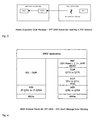
- the SMGF is responsible for mediating between the different protocols and elements of procedure and for conveting short messages to the appropriate format and onward routing to the destination network. This is shown in Figs. 1 and 2 .
- the SMGF resides as a separate entity in the IMT-2000 network, which has roaming agreements with the PDC networks.
- the SMGF places no infrastructure requirements on the PDC networks.
- PDC SMSC short messages destined for an IMT-2000 network and IMT-2000 SMSC short messages, destined for a PDC network, are all routed to the SMGF.
- the SMGF performs routing enquiries to determine the location of the destination handset. Once the destination network of the handset has been determined the SMGF then carries out the appropriate conversion between the PDC short message and the IMT-2000 short message format and forwards the short message towards the serving VMSC.
- the SMGF comprises an SMG application over a PDC stack comprising PDC-ISUP, and MTP layers and an IMT-2000 stack comprising MAP, TCAP, SCCP, and MTP layers.
- the SMGF is programmed to determine by what type of network a subscriber is being served (i.e. IMT-2000 or PDC) and to route short messages accordingly. It supports the interface protocols to allow it to inter-work with specific network entities in both the IMT-2000 network and the PDC networks. It interfaces to the PDC network over PDC ISUP and to the IMT-2000 network over GSM MAP. In addition the SMGF supports functionality to perform short message format conversion between IMT-2000 and PDC.
- the SMGF appears as either a serving VMSC, or a home SMSC.
- its function is to mediate between the different protocols and elements of procedure and to relay the message onwards and to translate the results. It does not store the messages and, therefore, there is no database of messages.
- SMGF small cell lung disease
- PDC subscribers could also send short messages to IMT-2000 subscribers of other IMT-2000 networks.
- IMT-2000 networks would not require a SMGF node, instead all short messages could be routed to the IMT-2000 network, which has the SMGF node and routed onwards from there.
- SMS short message service centre
- IMT-2000 HLR IMT-2000 HLR for both circuit switched and packet switched IMT-2000 subscribers.
- SMSC Any IMT-2000 short message service centre GMSC: A gateway MSC. In all the following scenarios, it refers to a gateway MSC interfacing with a PDC network.
- PDC SMSC Any PDC short message service centre HLR The HLR of a PDC subscriber.
- IMT-2000 subscriber roaming in a PDC network will receive a ROaming Number (RON) from it's home HLR, which is used to query the GLR for routing instructions.
- IW-MSC The MSC which interworks with the PDC SMSC.
- VMSC The MSC serving a PDC subscriber.
- GMSC A gateway MSC. In all the following scenarios, it refers to a gateway MSC interfacing with the IMT-2000 network.
- a mobile originated short message the mobile station sends the message specifying the telephone number of the SMSC (usually the home SMSC).
- the serving MSC sends an MO_FSM (Mobile Originated Forward Short Message) MAP operation to the home SMSC, which then handles delivery.
- MO_FSM Mobile Originated Forward Short Message
- the SMSC requests routing information from the HLR about the recipient mobile. Interconnection agreements permit some operators to query HLRs in other operators' domains. If the mobile is believed to be active, the HLR responds with the identification of the serving MSC to which the short message should be sent.
- the SMGF is not involved in the end-to-end application procedures. It assumes that the handsets will handle any messages sent to them.
- the SMGF may provide the functionality to perform a filtering, or conditional passage or blocking of messages according to some configurable criteria, such as the originating subscriber or service number or number group.
- IMT-2000 short messages have a maximum length of 140 octets whereas PDC short messages have a maximum length of 128 octets.
- PDC short messages have a maximum length of 128 octets.
- the short message is segmented into lengths of 128 octets or shorter and delivered as two separate short messages. These two short messages will then be re-assembled on the PDC handset.
- PDC short messaging has a concatenation tele-service, which allows the segmentation and re-assembly of short messages.
- the handset can determine whether or not it has received all segments of the short message and return an appropriate response indicating this.
- the SMGF may incorporate functionality which will perform the concatenation and segmentation of messages being passed between the diverse networks where necessary. This functionality, where existing in the SMGF could also be enabled or disabled conditionally by the operator of the SMGF.
- the PDC short message specification defines a number of Data Coding Schemes that can be used for encoding short message user data, for example ASCII, Shift, Shift JIS and PDC encoding to name a few.
- the data coding schemes supported by IMT-2000 for short messaging are defined in GSM 03.38. These include Default Alphabet, 8 bit encoding and Unicode. It is also possible to define a user specific data coding scheme.
- a PDC short message is sent to an IMT-2000 handset with user data encoded in a format not supported by the IMT-2000 handset then it will not be interpreted properly.
- an IMT-2000 short message sent to a PDC handset may contain user data encoding that is not supported by the PDC handset and again the short message will not be interpreted properly.
- the exact handling of such messages by the handset is a matter for the network operators to decide.
- the SMGF incorporates a level of functionality to perform data coding scheme conversions, which allows messages of different data coding schemes to be passed between technologies. Additionally, the SMGF could carry out handling procedures to either accept or reject a short message depending on its destination and data coding scheme used.
- the SMGF maintains a simple table to convert between PDC message classes and tele-services into the IMT-2000 equivalents.
- the SMGF also comprises an advanced programmable mapping function between data coding schemes which is controlled by instructions in the form of operator commands and a configuration file.
- Two-way messaging is a tele-service of PDC short messaging. It is assumed that an IMT-2000 handset, on receipt of such short messages, will be capable of performing appropriate procedures and return any replies as independent short messages.
- the reply from a two way message is contained in the REL(ease) message.
- the SMGF converts such replies into an independent message in the IMT-2000 domain; they will be addressed to the sender of the original message via the SMSC through which it was sent.
- the SMG comprises a data capture program and a database for collecting statistics and making these available for external analysis. Statistics are collected at a configurable periodic interval (e.g. 5 - 15 minutes). Statistics include:
- the SMGF maintains a network transaction log for system diagnostics.
- the diagnostic data is captured according to parameters such as integrity of received messages and timing of bursts of excessive numbers of messages. It is possible for these logs to be restricted to just one scenario.
- the SMGF provides event and fault monitoring capabilities as well as a general capability to view the status of the whole system.
- the SMGF supplies appropriate operations and support interfaces for network management purposes to monitor the health of the platform.
- the Calling Party's Category parameter code in binary is 00001001. It is a mandatory, fixed length (one byte) parameter in an ISUP IAM operation.
- the values used for PDC short messages are: Mobile Terminated 11111100 (0xFC) Mobile originated 11111101 (0xFD)
- the SMGF requires that an IMT-2000 HLR, when queried for routing information, returns specific information to allow the correct routing of pseudo calls and short messages.
- an IMT-2000 SMSC needs to know the address of the serving VMSC of the handset in order to deliver a short message. This information is obtained by sending a SRI_SM (Send Routing Information for Short Message) enquiry to the IMT-2000 HLR. The IMT-2000 HLR will respond with a SRI_SM response which will contain the address of the serving VMSC. The IMT-2000 SMSC will then forward the short message to the VMSC address received using a FSM(Forward Short Message).
- SRI_SM Send Routing Information for Short Message
- the short message needs to be routed to the SMGF first in order to carry out the procedures required for delivering a short message in PDC format. Therefore, in this case, the IMT-2000 HLR when queried for a SRI_SM must return the address of the SMGF as the serving VMSC address in an SRI_SM response.
- the IMT-2000 HLR in response to a SRI_SM enquiry must return the SMGF address as the serving VMSC address in an SRI_SM response when the queried subscriber is:
- PDC networks short messages are delivered using pseudo calls, which carry the short message as user data. Therefore routing of short messages in PDC networks is similar to the routing of voice calls, i.e. the MSC queries the HLR or GLR, depending on the subscriber, for routing information to the serving VMSC.
- the HLR/GLR will return the PRN (Pursuit Routing Number) which is used to route the call to the serving VMSC.
- PRN Pursuit Routing Number
- short messages from an IMT-2000 SMSC destined for a handset in the PDC network must first be routed to the SMGF.
- the SMGF must then obtain routing information from the IMT-2000 HLR to set-up a pseudo call towards the PDC network. This routing information is obtained by sending a SRI (Send Routing Information) request to the IMT-2000 HLR for a specific subscriber.
- SRI Send Routing Information
- the IMT-2000 HLR will respond with a SRI response indicating the MSRN(Mobile Station Roaming Number), which is a number that is used to route the call to a serving VMSC.
- PDC subscribers There are two types of subscriber which can receive short messages in the PDC network, these are PDC subscribers and IMT-2000 subscribers roaming onto the PDC network. Furthermore these subscribers could have ported numbers.
- IMT-2000 HLR Because of number porting between the PDC and IMT-2000 networks, calls originating in the IMT-2000 network destined for either an IMT-2000 or a PDC number must first be queried towards the IMT-2000 HLR. In the case that no entry exists in the IMT-2000 HLR for the queried number the IMT-2000 HLR needs to return a response to indicate to what network, if any, the call should be routed. For this reason the IMT-2000 HLR needs to have knowledge of numbers ported into and out of the IMT-2000 network.
- the IMT-2000 HLR is required to return appropriate information for pseudo calls to PDC subscribers to indicate the PDC Subscriber Type i.e. is the PDC subscriber using a ported IMT-2000 number and if so which network is it ported. Based on this information the SMGF attaches a suitable prefix to the called subscriber number and routes the pseudo call to the IMT-2000 GMSC. The IMT-2000 GMSC will be responsible for interpreting the prefix and carrying out routing to the appropriate PDC network.
- the IMT-2000 HLR is required to return the PDC roaming number supplied by the PDC GLR i.e. the RON(Roaming Number).
- the SMGF will use this RON in the Called Party Address of a pseudo call setup towards the IMT-2000 GMSC.
- the IMT-2000 GMSC is responsible for correctly routing the pseudo call to the correct PDC network where the PDC network will carry out the pseudo call setup to the roaming IMT-2000 subscriber.
- the SMSC can categorise short messages and only deliver those that can be handled by the serving handset. Undeliverable messages do not block those that can be delivered. Thus, the SMSC discriminates between text messages, PDC ring-tone down-load messages, and other binary messages. Separate queues are maintained, such that if a message of one category is rejected, messages in other categories can still be attempted.
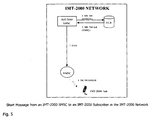
- Fig. 5 illustrates the signal transfers.
- the signals 1 to 4 are as follows.
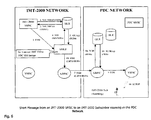
- Fig. 6 illustrates the signals 1 to 10 for this scenario as follows.
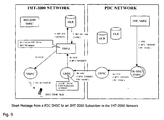
- Fig. 7 illustrates the signals 1 to 10 as follows.
- Fig. 8 illustrates signals 1 to 3 as follows.
- Fig. 9 illustrates the signals 1 to 7 as follows.
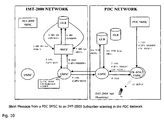
- Fig. 10 illustrates signals 1 to 12 as follows.
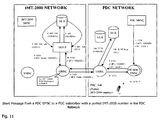
- Fig. 11 illustrates signals 1 to 12 as follows.
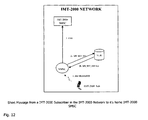
- Fig. 12 illustrates signals 1 to 3 as follows.
- Fig. 13 illustrates signals 1 to 4 as follows.
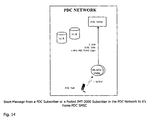
- Fig. 14 illustrates signals 1 and 2 as follows.
- the invention provides for comprehensive and versatile SM communication across different networks. This is achieved without modification of one of the networks.
Landscapes
- Engineering & Computer Science (AREA)
- Computer Networks & Wireless Communication (AREA)
- Signal Processing (AREA)
- Mobile Radio Communication Systems (AREA)
- Data Exchanges In Wide-Area Networks (AREA)
- Computer And Data Communications (AREA)
- Telephonic Communication Services (AREA)
- Two-Way Televisions, Distribution Of Moving Picture Or The Like (AREA)
Applications Claiming Priority (3)
| Application Number | Priority Date | Filing Date | Title |
|---|---|---|---|
| IE990776 | 1999-09-17 | ||
| IE990776 | 1999-09-17 | ||
| PCT/IE2000/000107 WO2001022752A1 (en) | 1999-09-17 | 2000-09-18 | A short message gateway |
Publications (2)
| Publication Number | Publication Date |
|---|---|
| EP1212902A1 EP1212902A1 (en) | 2002-06-12 |
| EP1212902B1 true EP1212902B1 (en) | 2011-01-05 |
Family
ID=11042124
Family Applications (1)
| Application Number | Title | Priority Date | Filing Date |
|---|---|---|---|
| EP00960942A Expired - Lifetime EP1212902B1 (en) | 1999-09-17 | 2000-09-18 | A short message gateway |
Country Status (7)
| Country | Link |
|---|---|
| EP (1) | EP1212902B1 (es) |
| JP (1) | JP4599548B2 (es) |
| AT (1) | ATE494757T1 (es) |
| AU (1) | AU7308900A (es) |
| DE (1) | DE60045481D1 (es) |
| ES (1) | ES2357331T3 (es) |
| WO (1) | WO2001022752A1 (es) |
Families Citing this family (17)
| Publication number | Priority date | Publication date | Assignee | Title |
|---|---|---|---|---|
| FI108193B (fi) * | 1999-01-25 | 2001-11-30 | Sonera Oyj | Menetelmä ja järjestelmä sanoman reitittämiseksi |
| EP1384384A1 (en) | 2001-05-03 | 2004-01-28 | Markport Limited | Improvements in sms messaging |
| KR100447715B1 (ko) * | 2001-12-04 | 2004-09-08 | 엘지전자 주식회사 | 3세대 이동 교환 시스템에서의 단문 메시지 발/착신 처리장치 및 방법 |
| FI20020391A7 (fi) * | 2002-02-28 | 2003-08-29 | Sonera Oyj | Kaksisuuntainen lyhytsanomapalvelu I-modeen |
| WO2003090486A1 (en) | 2002-04-22 | 2003-10-30 | Qualcomm Incorporated | Sms format mapping for different cellular systems |
| WO2004019634A1 (en) * | 2002-08-21 | 2004-03-04 | Intellprop Limited | Telecommunications services apparatus and methods |
| ES2201921B1 (es) * | 2002-09-04 | 2005-05-16 | Airtel Movil, S.A. | Sistema y metodo de aviso de errores de marcacion. |
| US6959194B2 (en) * | 2002-09-04 | 2005-10-25 | Cmg International B.V. | SMS-messaging |
| US20040137899A1 (en) * | 2002-12-16 | 2004-07-15 | Hartmaier Peter J. | TCAP/MAP network interconnection |
| GB0406119D0 (en) * | 2004-03-18 | 2004-04-21 | Telsis Holdings Ltd | Telecommunications services apparatus and method |
| GB0407454D0 (en) * | 2004-04-01 | 2004-05-05 | Telsis Holdings Ltd | Telecommunications services apparatus and method |
| CN100411453C (zh) * | 2004-07-31 | 2008-08-13 | 华为技术有限公司 | 蜂窝移动通信系统的短消息实现方法 |
| IES20040693A2 (en) | 2004-10-14 | 2006-04-19 | Anam Mobile Ltd | A messaging system and method |
| CN100484283C (zh) * | 2006-03-13 | 2009-04-29 | 华为技术有限公司 | 通过短消息获取用户信息的方法 |
| JP2007274524A (ja) * | 2006-03-31 | 2007-10-18 | Nec Corp | Smsメールシステムおよびsmsメール送信方法 |
| JP5147676B2 (ja) * | 2008-12-24 | 2013-02-20 | 株式会社エヌ・ティ・ティ・ドコモ | ショートメッセージ制御装置、ショートメッセージ制御システム、及びショートメッセージ制御方法 |
| US8549083B2 (en) * | 2010-01-06 | 2013-10-01 | Alcatel Lucent | Message waiting notification to external message centers |
Family Cites Families (8)
| Publication number | Priority date | Publication date | Assignee | Title |
|---|---|---|---|---|
| FI100444B (fi) * | 1995-02-20 | 1997-11-28 | Nokia Mobile Phones Ltd | Tiedonsiirtomenetelmä ja -järjestelmä |
| SE503752C2 (sv) * | 1995-08-30 | 1996-08-26 | Sendit Ab | System och värdanordning för överföring av elektronisk post över ett mobiltelenät |
| EP0777394A1 (en) * | 1995-12-01 | 1997-06-04 | ALCATEL BELL Naamloze Vennootschap | Method and apparatus for electronic mail transmission as short messages towards a mobile radio terminal |
| FI104873B (fi) * | 1997-04-16 | 2000-04-14 | Nokia Networks Oy | Datapalvelu matkaviestinverkossa |
| NL1006862C2 (nl) * | 1997-08-27 | 1999-03-17 | Libertel Bv | Werkwijze en stelsel voor het verwerken van oproepen voor communicatie-apparatuur met een abonneenummer, dat van een eerste operateur naar een tweede operateur is meegenomen, in het bijzonder geschikt voor toepassing bij stelsels voor mobiele communicatie. |
| FI106509B (fi) * | 1997-09-26 | 2001-02-15 | Nokia Networks Oy | Laillinen salakuuntelu tietoliikenneverkossa |
| DK1040676T3 (da) * | 1997-12-16 | 2007-02-05 | Teliasonera Finland Oyj | Fremgangsmåde og system til transmission og ændring af intelligente netværksparametre |
| US6298232B1 (en) * | 1999-01-15 | 2001-10-02 | Telefonaktiebolaget Lm Ericsson (Publ) | Voice mail service notification between mobile systems |
-
2000
- 2000-09-18 AT AT00960942T patent/ATE494757T1/de not_active IP Right Cessation
- 2000-09-18 ES ES00960942T patent/ES2357331T3/es not_active Expired - Lifetime
- 2000-09-18 EP EP00960942A patent/EP1212902B1/en not_active Expired - Lifetime
- 2000-09-18 DE DE60045481T patent/DE60045481D1/de not_active Expired - Lifetime
- 2000-09-18 JP JP2001525984A patent/JP4599548B2/ja not_active Expired - Lifetime
- 2000-09-18 AU AU73089/00A patent/AU7308900A/en not_active Abandoned
- 2000-09-18 WO PCT/IE2000/000107 patent/WO2001022752A1/en not_active Ceased
Also Published As
| Publication number | Publication date |
|---|---|
| ATE494757T1 (de) | 2011-01-15 |
| WO2001022752A1 (en) | 2001-03-29 |
| ES2357331T3 (es) | 2011-04-25 |
| JP4599548B2 (ja) | 2010-12-15 |
| DE60045481D1 (de) | 2011-02-17 |
| AU7308900A (en) | 2001-04-24 |
| JP2003510915A (ja) | 2003-03-18 |
| EP1212902A1 (en) | 2002-06-12 |
Similar Documents
| Publication | Publication Date | Title |
|---|---|---|
| US6947743B2 (en) | Short message gateway with interworking for non-compatible networks | |
| US7079524B2 (en) | Methods and systems for off-loading a-interface short message service (SMS) message traffic in a wireless communications network | |
| JP3916004B2 (ja) | セルラ通信システムにおいて短メッセージを記憶し移動体加入者に転送する方法 | |
| US6745041B2 (en) | Methods and systems for communicating between subscribers of different application-layer mobile communications protocols | |
| EP1212902B1 (en) | A short message gateway | |
| US8903437B2 (en) | Method and system for efficiently routing messages | |
| US6718178B1 (en) | Automatic in-line messaging system | |
| EP1602252B1 (en) | Virtual network solution for sms message exchange between gsm and ansi (tia/eia 41) networks | |
| EP1250820B1 (en) | Routing of short messages in a telecommunication system | |
| EP1145577B1 (en) | Method and system for the routing of a message | |
| US20050176433A1 (en) | Telecommunications services apparatus | |
| US8099116B2 (en) | Method and a system for the delivery of short messages | |
| US7054654B1 (en) | Automatic messaging in response to television viewing | |
| US7251480B1 (en) | Method and system of sending a voice message in a wireless communication network | |
| EP1855497B1 (en) | A method and system for message routing of multimedia messaging service | |
| EP1294204A1 (en) | Gateway emulating presence of mobile phone | |
| CN1126385C (zh) | 选择路由和控制路由选择的方法和装置 | |
| US20040266464A1 (en) | Method and a system for transmitting a short message | |
| IES20000747A2 (en) | A short message gateway | |
| TWI252020B (en) | Method for transmitting short messages mutually between fixed network and mobile network | |
| GB2399994A (en) | Distributed message transmission system and method | |
| GB2377861A (en) | Distributed message transmission |
Legal Events
| Date | Code | Title | Description |
|---|---|---|---|
| PUAI | Public reference made under article 153(3) epc to a published international application that has entered the european phase |
Free format text: ORIGINAL CODE: 0009012 |
|
| 17P | Request for examination filed |
Effective date: 20020314 |
|
| AK | Designated contracting states |
Kind code of ref document: A1 Designated state(s): AT BE CH CY DE DK ES FI FR GB GR IE IT LI LU MC NL PT SE |
|
| AX | Request for extension of the european patent |
Free format text: AL;LT;LV;MK;RO;SI |
|
| 17Q | First examination report despatched |
Effective date: 20070926 |
|
| RAP1 | Party data changed (applicant data changed or rights of an application transferred) |
Owner name: MARKPORT LIMITED |
|
| RAP1 | Party data changed (applicant data changed or rights of an application transferred) |
Owner name: MARKPORT LIMITED |
|
| GRAP | Despatch of communication of intention to grant a patent |
Free format text: ORIGINAL CODE: EPIDOSNIGR1 |
|
| RIC1 | Information provided on ipc code assigned before grant |
Ipc: H04W 88/18 20090101AFI20100812BHEP |
|
| RBV | Designated contracting states (corrected) |
Designated state(s): AT BE CH CY DE DK ES FI FR GB GR IT LI LU MC NL PT SE |
|
| GRAS | Grant fee paid |
Free format text: ORIGINAL CODE: EPIDOSNIGR3 |
|
| GRAA | (expected) grant |
Free format text: ORIGINAL CODE: 0009210 |
|
| AK | Designated contracting states |
Kind code of ref document: B1 Designated state(s): AT BE CH CY DE DK ES FI FR GB GR IT LI LU MC NL PT SE |
|
| REG | Reference to a national code |
Ref country code: GB Ref legal event code: FG4D |
|
| REG | Reference to a national code |
Ref country code: CH Ref legal event code: EP |
|
| REF | Corresponds to: |
Ref document number: 60045481 Country of ref document: DE Date of ref document: 20110217 Kind code of ref document: P |
|
| REG | Reference to a national code |
Ref country code: DE Ref legal event code: R096 Ref document number: 60045481 Country of ref document: DE Effective date: 20110217 |
|
| REG | Reference to a national code |
Ref country code: NL Ref legal event code: T3 |
|
| REG | Reference to a national code |
Ref country code: ES Ref legal event code: FG2A Ref document number: 2357331 Country of ref document: ES Kind code of ref document: T3 Effective date: 20110425 |
|
| PG25 | Lapsed in a contracting state [announced via postgrant information from national office to epo] |
Ref country code: SE Free format text: LAPSE BECAUSE OF FAILURE TO SUBMIT A TRANSLATION OF THE DESCRIPTION OR TO PAY THE FEE WITHIN THE PRESCRIBED TIME-LIMIT Effective date: 20110105 Ref country code: GR Free format text: LAPSE BECAUSE OF FAILURE TO SUBMIT A TRANSLATION OF THE DESCRIPTION OR TO PAY THE FEE WITHIN THE PRESCRIBED TIME-LIMIT Effective date: 20110406 Ref country code: PT Free format text: LAPSE BECAUSE OF FAILURE TO SUBMIT A TRANSLATION OF THE DESCRIPTION OR TO PAY THE FEE WITHIN THE PRESCRIBED TIME-LIMIT Effective date: 20110505 |
|
| PG25 | Lapsed in a contracting state [announced via postgrant information from national office to epo] |
Ref country code: BE Free format text: LAPSE BECAUSE OF FAILURE TO SUBMIT A TRANSLATION OF THE DESCRIPTION OR TO PAY THE FEE WITHIN THE PRESCRIBED TIME-LIMIT Effective date: 20110105 Ref country code: CY Free format text: LAPSE BECAUSE OF FAILURE TO SUBMIT A TRANSLATION OF THE DESCRIPTION OR TO PAY THE FEE WITHIN THE PRESCRIBED TIME-LIMIT Effective date: 20110105 Ref country code: FI Free format text: LAPSE BECAUSE OF FAILURE TO SUBMIT A TRANSLATION OF THE DESCRIPTION OR TO PAY THE FEE WITHIN THE PRESCRIBED TIME-LIMIT Effective date: 20110105 Ref country code: AT Free format text: LAPSE BECAUSE OF FAILURE TO SUBMIT A TRANSLATION OF THE DESCRIPTION OR TO PAY THE FEE WITHIN THE PRESCRIBED TIME-LIMIT Effective date: 20110105 |
|
| PG25 | Lapsed in a contracting state [announced via postgrant information from national office to epo] |
Ref country code: DK Free format text: LAPSE BECAUSE OF FAILURE TO SUBMIT A TRANSLATION OF THE DESCRIPTION OR TO PAY THE FEE WITHIN THE PRESCRIBED TIME-LIMIT Effective date: 20110105 |
|
| PLBE | No opposition filed within time limit |
Free format text: ORIGINAL CODE: 0009261 |
|
| STAA | Information on the status of an ep patent application or granted ep patent |
Free format text: STATUS: NO OPPOSITION FILED WITHIN TIME LIMIT |
|
| 26N | No opposition filed |
Effective date: 20111006 |
|
| PG25 | Lapsed in a contracting state [announced via postgrant information from national office to epo] |
Ref country code: IT Free format text: LAPSE BECAUSE OF FAILURE TO SUBMIT A TRANSLATION OF THE DESCRIPTION OR TO PAY THE FEE WITHIN THE PRESCRIBED TIME-LIMIT Effective date: 20110105 |
|
| REG | Reference to a national code |
Ref country code: DE Ref legal event code: R097 Ref document number: 60045481 Country of ref document: DE Effective date: 20111006 |
|
| PG25 | Lapsed in a contracting state [announced via postgrant information from national office to epo] |
Ref country code: MC Free format text: LAPSE BECAUSE OF NON-PAYMENT OF DUE FEES Effective date: 20110930 |
|
| REG | Reference to a national code |
Ref country code: CH Ref legal event code: PL |
|
| PG25 | Lapsed in a contracting state [announced via postgrant information from national office to epo] |
Ref country code: CH Free format text: LAPSE BECAUSE OF NON-PAYMENT OF DUE FEES Effective date: 20110930 Ref country code: LI Free format text: LAPSE BECAUSE OF NON-PAYMENT OF DUE FEES Effective date: 20110930 |
|
| PG25 | Lapsed in a contracting state [announced via postgrant information from national office to epo] |
Ref country code: LU Free format text: LAPSE BECAUSE OF NON-PAYMENT OF DUE FEES Effective date: 20110918 |
|
| REG | Reference to a national code |
Ref country code: FR Ref legal event code: PLFP Year of fee payment: 17 |
|
| REG | Reference to a national code |
Ref country code: FR Ref legal event code: PLFP Year of fee payment: 18 |
|
| REG | Reference to a national code |
Ref country code: FR Ref legal event code: PLFP Year of fee payment: 19 |
|
| PGFP | Annual fee paid to national office [announced via postgrant information from national office to epo] |
Ref country code: NL Payment date: 20190926 Year of fee payment: 20 Ref country code: FR Payment date: 20190925 Year of fee payment: 20 |
|
| PGFP | Annual fee paid to national office [announced via postgrant information from national office to epo] |
Ref country code: GB Payment date: 20190927 Year of fee payment: 20 |
|
| PGFP | Annual fee paid to national office [announced via postgrant information from national office to epo] |
Ref country code: DE Payment date: 20190927 Year of fee payment: 20 |
|
| PGFP | Annual fee paid to national office [announced via postgrant information from national office to epo] |
Ref country code: ES Payment date: 20191001 Year of fee payment: 20 |
|
| REG | Reference to a national code |
Ref country code: DE Ref legal event code: R071 Ref document number: 60045481 Country of ref document: DE |
|
| REG | Reference to a national code |
Ref country code: NL Ref legal event code: MK Effective date: 20200917 |
|
| REG | Reference to a national code |
Ref country code: GB Ref legal event code: PE20 Expiry date: 20200917 |
|
| PG25 | Lapsed in a contracting state [announced via postgrant information from national office to epo] |
Ref country code: GB Free format text: LAPSE BECAUSE OF EXPIRATION OF PROTECTION Effective date: 20200917 |
|
| REG | Reference to a national code |
Ref country code: ES Ref legal event code: FD2A Effective date: 20220128 |
|
| PG25 | Lapsed in a contracting state [announced via postgrant information from national office to epo] |
Ref country code: ES Free format text: LAPSE BECAUSE OF EXPIRATION OF PROTECTION Effective date: 20200919 |