EP1211559A1 - Photosensitive resin composition, fabricating method for patterned substrate, and device comprising this substrate - Google Patents
Photosensitive resin composition, fabricating method for patterned substrate, and device comprising this substrate Download PDFInfo
- Publication number
- EP1211559A1 EP1211559A1 EP01128740A EP01128740A EP1211559A1 EP 1211559 A1 EP1211559 A1 EP 1211559A1 EP 01128740 A EP01128740 A EP 01128740A EP 01128740 A EP01128740 A EP 01128740A EP 1211559 A1 EP1211559 A1 EP 1211559A1
- Authority
- EP
- European Patent Office
- Prior art keywords
- acid
- photosensitive resin
- resin composition
- substrate
- resist
- Prior art date
- Legal status (The legal status is an assumption and is not a legal conclusion. Google has not performed a legal analysis and makes no representation as to the accuracy of the status listed.)
- Withdrawn
Links
- 239000011342 resin composition Substances 0.000 title claims abstract description 41
- 239000000758 substrate Substances 0.000 title claims abstract description 39
- 238000000034 method Methods 0.000 title claims abstract description 21
- 239000002253 acid Substances 0.000 claims abstract description 65
- 229920000642 polymer Polymers 0.000 claims abstract description 53
- 239000000203 mixture Substances 0.000 claims abstract description 41
- 150000001875 compounds Chemical class 0.000 claims abstract description 30
- 125000000524 functional group Chemical group 0.000 claims abstract description 24
- 235000000346 sugar Nutrition 0.000 claims abstract description 14
- 239000002245 particle Substances 0.000 claims abstract description 13
- 230000005855 radiation Effects 0.000 claims abstract description 11
- 239000002904 solvent Substances 0.000 claims description 21
- -1 t-butoxycarbonyl group Chemical group 0.000 claims description 21
- 229920013821 hydroxy alkyl cellulose Polymers 0.000 claims description 16
- 125000002887 hydroxy group Chemical group [H]O* 0.000 claims description 13
- 229920002153 Hydroxypropyl cellulose Polymers 0.000 claims description 8
- 239000001863 hydroxypropyl cellulose Substances 0.000 claims description 8
- 235000010977 hydroxypropyl cellulose Nutrition 0.000 claims description 8
- 125000002768 hydroxyalkyl group Chemical group 0.000 claims description 7
- YQTCQNIPQMJNTI-UHFFFAOYSA-N 2,2-dimethylpropan-1-one Chemical group CC(C)(C)[C]=O YQTCQNIPQMJNTI-UHFFFAOYSA-N 0.000 claims description 3
- 229920000663 Hydroxyethyl cellulose Polymers 0.000 claims description 3
- 239000004354 Hydroxyethyl cellulose Substances 0.000 claims description 3
- 235000019447 hydroxyethyl cellulose Nutrition 0.000 claims description 3
- 229910052739 hydrogen Inorganic materials 0.000 claims 2
- 239000001257 hydrogen Substances 0.000 claims 2
- 125000004435 hydrogen atom Chemical group [H]* 0.000 claims 2
- 239000004065 semiconductor Substances 0.000 abstract description 20
- 239000003513 alkali Substances 0.000 description 16
- XUIMIQQOPSSXEZ-UHFFFAOYSA-N Silicon Chemical compound [Si] XUIMIQQOPSSXEZ-UHFFFAOYSA-N 0.000 description 15
- 229910052710 silicon Inorganic materials 0.000 description 15
- 239000010703 silicon Substances 0.000 description 15
- WGTYBPLFGIVFAS-UHFFFAOYSA-M tetramethylammonium hydroxide Chemical compound [OH-].C[N+](C)(C)C WGTYBPLFGIVFAS-UHFFFAOYSA-M 0.000 description 12
- OKKJLVBELUTLKV-UHFFFAOYSA-N Methanol Chemical compound OC OKKJLVBELUTLKV-UHFFFAOYSA-N 0.000 description 9
- 229920002678 cellulose Polymers 0.000 description 9
- 239000001913 cellulose Substances 0.000 description 9
- 229920005989 resin Polymers 0.000 description 9
- 239000011347 resin Substances 0.000 description 9
- 239000000243 solution Substances 0.000 description 9
- 125000002723 alicyclic group Chemical group 0.000 description 8
- 239000007864 aqueous solution Substances 0.000 description 8
- LFQSCWFLJHTTHZ-UHFFFAOYSA-N Ethanol Chemical class CCO LFQSCWFLJHTTHZ-UHFFFAOYSA-N 0.000 description 7
- KFZMGEQAYNKOFK-UHFFFAOYSA-N Isopropanol Chemical compound CC(C)O KFZMGEQAYNKOFK-UHFFFAOYSA-N 0.000 description 6
- 235000019441 ethanol Nutrition 0.000 description 6
- 238000002360 preparation method Methods 0.000 description 6
- LLHKCFNBLRBOGN-UHFFFAOYSA-N propylene glycol methyl ether acetate Chemical compound COCC(C)OC(C)=O LLHKCFNBLRBOGN-UHFFFAOYSA-N 0.000 description 6
- ISWSIDIOOBJBQZ-UHFFFAOYSA-N Phenol Chemical compound OC1=CC=CC=C1 ISWSIDIOOBJBQZ-UHFFFAOYSA-N 0.000 description 5
- 238000002156 mixing Methods 0.000 description 5
- 229920003986 novolac Polymers 0.000 description 5
- 239000003963 antioxidant agent Substances 0.000 description 4
- 230000003078 antioxidant effect Effects 0.000 description 4
- SRBFZHDQGSBBOR-UHFFFAOYSA-N beta-D-Pyranose-Lyxose Natural products OC1COC(O)C(O)C1O SRBFZHDQGSBBOR-UHFFFAOYSA-N 0.000 description 4
- 238000004519 manufacturing process Methods 0.000 description 4
- BDERNNFJNOPAEC-UHFFFAOYSA-N propan-1-ol Chemical compound CCCO BDERNNFJNOPAEC-UHFFFAOYSA-N 0.000 description 4
- 230000035945 sensitivity Effects 0.000 description 4
- 238000002834 transmittance Methods 0.000 description 4
- ZWEHNKRNPOVVGH-UHFFFAOYSA-N 2-Butanone Chemical compound CCC(C)=O ZWEHNKRNPOVVGH-UHFFFAOYSA-N 0.000 description 3
- SVONRAPFKPVNKG-UHFFFAOYSA-N 2-ethoxyethyl acetate Chemical compound CCOCCOC(C)=O SVONRAPFKPVNKG-UHFFFAOYSA-N 0.000 description 3
- UHOVQNZJYSORNB-UHFFFAOYSA-N Benzene Chemical compound C1=CC=CC=C1 UHOVQNZJYSORNB-UHFFFAOYSA-N 0.000 description 3
- WVDDGKGOMKODPV-UHFFFAOYSA-N Benzyl alcohol Chemical compound OCC1=CC=CC=C1 WVDDGKGOMKODPV-UHFFFAOYSA-N 0.000 description 3
- 229920001665 Poly-4-vinylphenol Polymers 0.000 description 3
- YXFVVABEGXRONW-UHFFFAOYSA-N Toluene Chemical compound CC1=CC=CC=C1 YXFVVABEGXRONW-UHFFFAOYSA-N 0.000 description 3
- PYMYPHUHKUWMLA-UHFFFAOYSA-N arabinose Natural products OCC(O)C(O)C(O)C=O PYMYPHUHKUWMLA-UHFFFAOYSA-N 0.000 description 3
- 239000002585 base Substances 0.000 description 3
- 238000006243 chemical reaction Methods 0.000 description 3
- 238000001312 dry etching Methods 0.000 description 3
- 230000010354 integration Effects 0.000 description 3
- 238000001459 lithography Methods 0.000 description 3
- 239000000463 material Substances 0.000 description 3
- VLKZOEOYAKHREP-UHFFFAOYSA-N n-Hexane Chemical compound CCCCCC VLKZOEOYAKHREP-UHFFFAOYSA-N 0.000 description 3
- 238000012545 processing Methods 0.000 description 3
- 239000004094 surface-active agent Substances 0.000 description 3
- XLYOFNOQVPJJNP-UHFFFAOYSA-N water Substances O XLYOFNOQVPJJNP-UHFFFAOYSA-N 0.000 description 3
- WQZGKKKJIJFFOK-SVZMEOIVSA-N (+)-Galactose Chemical compound OC[C@H]1OC(O)[C@H](O)[C@@H](O)[C@H]1O WQZGKKKJIJFFOK-SVZMEOIVSA-N 0.000 description 2
- ZNQVEEAIQZEUHB-UHFFFAOYSA-N 2-ethoxyethanol Chemical compound CCOCCO ZNQVEEAIQZEUHB-UHFFFAOYSA-N 0.000 description 2
- XLLIQLLCWZCATF-UHFFFAOYSA-N 2-methoxyethyl acetate Chemical compound COCCOC(C)=O XLLIQLLCWZCATF-UHFFFAOYSA-N 0.000 description 2
- QTWJRLJHJPIABL-UHFFFAOYSA-N 2-methylphenol;3-methylphenol;4-methylphenol Chemical compound CC1=CC=C(O)C=C1.CC1=CC=CC(O)=C1.CC1=CC=CC=C1O QTWJRLJHJPIABL-UHFFFAOYSA-N 0.000 description 2
- FFWSICBKRCICMR-UHFFFAOYSA-N 5-methyl-2-hexanone Chemical compound CC(C)CCC(C)=O FFWSICBKRCICMR-UHFFFAOYSA-N 0.000 description 2
- XKRFYHLGVUSROY-UHFFFAOYSA-N Argon Chemical compound [Ar] XKRFYHLGVUSROY-UHFFFAOYSA-N 0.000 description 2
- CURLTUGMZLYLDI-UHFFFAOYSA-N Carbon dioxide Chemical compound O=C=O CURLTUGMZLYLDI-UHFFFAOYSA-N 0.000 description 2
- ZAQJHHRNXZUBTE-WUJLRWPWSA-N D-xylulose Chemical compound OC[C@@H](O)[C@H](O)C(=O)CO ZAQJHHRNXZUBTE-WUJLRWPWSA-N 0.000 description 2
- VQTUBCCKSQIDNK-UHFFFAOYSA-N Isobutene Chemical compound CC(C)=C VQTUBCCKSQIDNK-UHFFFAOYSA-N 0.000 description 2
- NTIZESTWPVYFNL-UHFFFAOYSA-N Methyl isobutyl ketone Chemical compound CC(C)CC(C)=O NTIZESTWPVYFNL-UHFFFAOYSA-N 0.000 description 2
- UIHCLUNTQKBZGK-UHFFFAOYSA-N Methyl isobutyl ketone Natural products CCC(C)C(C)=O UIHCLUNTQKBZGK-UHFFFAOYSA-N 0.000 description 2
- IMNFDUFMRHMDMM-UHFFFAOYSA-N N-Heptane Chemical compound CCCCCCC IMNFDUFMRHMDMM-UHFFFAOYSA-N 0.000 description 2
- OFBQJSOFQDEBGM-UHFFFAOYSA-N Pentane Chemical compound CCCCC OFBQJSOFQDEBGM-UHFFFAOYSA-N 0.000 description 2
- CZMRCDWAGMRECN-UGDNZRGBSA-N Sucrose Chemical compound O[C@H]1[C@H](O)[C@@H](CO)O[C@@]1(CO)O[C@@H]1[C@H](O)[C@@H](O)[C@H](O)[C@@H](CO)O1 CZMRCDWAGMRECN-UGDNZRGBSA-N 0.000 description 2
- 229930006000 Sucrose Natural products 0.000 description 2
- 238000002835 absorbance Methods 0.000 description 2
- 150000001298 alcohols Chemical class 0.000 description 2
- PYMYPHUHKUWMLA-LMVFSUKVSA-N aldehydo-D-ribose Chemical compound OC[C@@H](O)[C@@H](O)[C@@H](O)C=O PYMYPHUHKUWMLA-LMVFSUKVSA-N 0.000 description 2
- 125000001931 aliphatic group Chemical group 0.000 description 2
- 125000003118 aryl group Chemical group 0.000 description 2
- MVPPADPHJFYWMZ-UHFFFAOYSA-N chlorobenzene Chemical compound ClC1=CC=CC=C1 MVPPADPHJFYWMZ-UHFFFAOYSA-N 0.000 description 2
- 229930003836 cresol Natural products 0.000 description 2
- JHIVVAPYMSGYDF-UHFFFAOYSA-N cyclohexanone Chemical compound O=C1CCCCC1 JHIVVAPYMSGYDF-UHFFFAOYSA-N 0.000 description 2
- BGTOWKSIORTVQH-UHFFFAOYSA-N cyclopentanone Chemical compound O=C1CCCC1 BGTOWKSIORTVQH-UHFFFAOYSA-N 0.000 description 2
- 238000013461 design Methods 0.000 description 2
- 238000011161 development Methods 0.000 description 2
- 230000018109 developmental process Effects 0.000 description 2
- RXKJFZQQPQGTFL-UHFFFAOYSA-N dihydroxyacetone Chemical compound OCC(=O)CO RXKJFZQQPQGTFL-UHFFFAOYSA-N 0.000 description 2
- 238000004090 dissolution Methods 0.000 description 2
- 230000000694 effects Effects 0.000 description 2
- 238000010894 electron beam technology Methods 0.000 description 2
- 238000005516 engineering process Methods 0.000 description 2
- LZCLXQDLBQLTDK-UHFFFAOYSA-N ethyl 2-hydroxypropanoate Chemical compound CCOC(=O)C(C)O LZCLXQDLBQLTDK-UHFFFAOYSA-N 0.000 description 2
- 238000007689 inspection Methods 0.000 description 2
- 238000010884 ion-beam technique Methods 0.000 description 2
- 150000002500 ions Chemical class 0.000 description 2
- 229910052743 krypton Inorganic materials 0.000 description 2
- DNNSSWSSYDEUBZ-UHFFFAOYSA-N krypton atom Chemical compound [Kr] DNNSSWSSYDEUBZ-UHFFFAOYSA-N 0.000 description 2
- 239000004973 liquid crystal related substance Substances 0.000 description 2
- 229940043265 methyl isobutyl ketone Drugs 0.000 description 2
- 239000003960 organic solvent Substances 0.000 description 2
- 238000004806 packaging method and process Methods 0.000 description 2
- XNLICIUVMPYHGG-UHFFFAOYSA-N pentan-2-one Chemical compound CCCC(C)=O XNLICIUVMPYHGG-UHFFFAOYSA-N 0.000 description 2
- 239000000049 pigment Substances 0.000 description 2
- IUGYQRQAERSCNH-UHFFFAOYSA-N pivalic acid Chemical compound CC(C)(C)C(O)=O IUGYQRQAERSCNH-UHFFFAOYSA-N 0.000 description 2
- 238000004321 preservation Methods 0.000 description 2
- 230000008569 process Effects 0.000 description 2
- 239000000126 substance Substances 0.000 description 2
- 229960004793 sucrose Drugs 0.000 description 2
- BDHFUVZGWQCTTF-UHFFFAOYSA-M sulfonate Chemical compound [O-]S(=O)=O BDHFUVZGWQCTTF-UHFFFAOYSA-M 0.000 description 2
- 238000012360 testing method Methods 0.000 description 2
- QAEDZJGFFMLHHQ-UHFFFAOYSA-N trifluoroacetic anhydride Chemical compound FC(F)(F)C(=O)OC(=O)C(F)(F)F QAEDZJGFFMLHHQ-UHFFFAOYSA-N 0.000 description 2
- HVLLSGMXQDNUAL-UHFFFAOYSA-N triphenyl phosphite Chemical compound C=1C=CC=CC=1OP(OC=1C=CC=CC=1)OC1=CC=CC=C1 HVLLSGMXQDNUAL-UHFFFAOYSA-N 0.000 description 2
- FAYMLNNRGCYLSR-UHFFFAOYSA-M triphenylsulfonium triflate Chemical compound [O-]S(=O)(=O)C(F)(F)F.C1=CC=CC=C1[S+](C=1C=CC=CC=1)C1=CC=CC=C1 FAYMLNNRGCYLSR-UHFFFAOYSA-M 0.000 description 2
- HDTRYLNUVZCQOY-UHFFFAOYSA-N α-D-glucopyranosyl-α-D-glucopyranoside Natural products OC1C(O)C(O)C(CO)OC1OC1C(O)C(O)C(O)C(CO)O1 HDTRYLNUVZCQOY-UHFFFAOYSA-N 0.000 description 1
- LWHOMMCIJIJIGV-UHFFFAOYSA-N (1,3-dioxobenzo[de]isoquinolin-2-yl) trifluoromethanesulfonate Chemical compound C1=CC(C(N(OS(=O)(=O)C(F)(F)F)C2=O)=O)=C3C2=CC=CC3=C1 LWHOMMCIJIJIGV-UHFFFAOYSA-N 0.000 description 1
- KIUKXJAPPMFGSW-DNGZLQJQSA-N (2S,3S,4S,5R,6R)-6-[(2S,3R,4R,5S,6R)-3-Acetamido-2-[(2S,3S,4R,5R,6R)-6-[(2R,3R,4R,5S,6R)-3-acetamido-2,5-dihydroxy-6-(hydroxymethyl)oxan-4-yl]oxy-2-carboxy-4,5-dihydroxyoxan-3-yl]oxy-5-hydroxy-6-(hydroxymethyl)oxan-4-yl]oxy-3,4,5-trihydroxyoxane-2-carboxylic acid Chemical compound CC(=O)N[C@H]1[C@H](O)O[C@H](CO)[C@@H](O)[C@@H]1O[C@H]1[C@H](O)[C@@H](O)[C@H](O[C@H]2[C@@H]([C@@H](O[C@H]3[C@@H]([C@@H](O)[C@H](O)[C@H](O3)C(O)=O)O)[C@H](O)[C@@H](CO)O2)NC(C)=O)[C@@H](C(O)=O)O1 KIUKXJAPPMFGSW-DNGZLQJQSA-N 0.000 description 1
- LQXVFWRQNMEDEE-UOWFLXDJSA-N (2r,3r,4r)-2-(hydroxymethyl)oxolane-2,3,4-triol Chemical compound OC[C@@]1(O)OC[C@@H](O)[C@H]1O LQXVFWRQNMEDEE-UOWFLXDJSA-N 0.000 description 1
- OWEGMIWEEQEYGQ-UHFFFAOYSA-N 100676-05-9 Natural products OC1C(O)C(O)C(CO)OC1OCC1C(O)C(O)C(O)C(OC2C(OC(O)C(O)C2O)CO)O1 OWEGMIWEEQEYGQ-UHFFFAOYSA-N 0.000 description 1
- KGRVJHAUYBGFFP-UHFFFAOYSA-N 2,2'-Methylenebis(4-methyl-6-tert-butylphenol) Chemical compound CC(C)(C)C1=CC(C)=CC(CC=2C(=C(C=C(C)C=2)C(C)(C)C)O)=C1O KGRVJHAUYBGFFP-UHFFFAOYSA-N 0.000 description 1
- QTUVQQKHBMGYEH-UHFFFAOYSA-N 2-(trichloromethyl)-1,3,5-triazine Chemical compound ClC(Cl)(Cl)C1=NC=NC=N1 QTUVQQKHBMGYEH-UHFFFAOYSA-N 0.000 description 1
- XNWFRZJHXBZDAG-UHFFFAOYSA-N 2-METHOXYETHANOL Chemical compound COCCO XNWFRZJHXBZDAG-UHFFFAOYSA-N 0.000 description 1
- IYUOYLLVOZNGKW-UHFFFAOYSA-N 2-azidonaphthalene-1,4-dione Chemical compound C1=CC=C2C(=O)C(N=[N+]=[N-])=CC(=O)C2=C1 IYUOYLLVOZNGKW-UHFFFAOYSA-N 0.000 description 1
- PRWJPWSKLXYEPD-UHFFFAOYSA-N 4-[4,4-bis(5-tert-butyl-4-hydroxy-2-methylphenyl)butan-2-yl]-2-tert-butyl-5-methylphenol Chemical compound C=1C(C(C)(C)C)=C(O)C=C(C)C=1C(C)CC(C=1C(=CC(O)=C(C=1)C(C)(C)C)C)C1=CC(C(C)(C)C)=C(O)C=C1C PRWJPWSKLXYEPD-UHFFFAOYSA-N 0.000 description 1
- ZMCBPOWGXHULPT-UHFFFAOYSA-M 9,10-dimethoxyanthracene-2-sulfonate;diphenyliodanium Chemical compound C=1C=CC=CC=1[I+]C1=CC=CC=C1.[O-]S(=O)(=O)C1=CC=C2C(OC)=C(C=CC=C3)C3=C(OC)C2=C1 ZMCBPOWGXHULPT-UHFFFAOYSA-M 0.000 description 1
- 239000004925 Acrylic resin Substances 0.000 description 1
- 229920000178 Acrylic resin Polymers 0.000 description 1
- GUBGYTABKSRVRQ-XLOQQCSPSA-N Alpha-Lactose Chemical compound O[C@@H]1[C@@H](O)[C@@H](O)[C@@H](CO)O[C@H]1O[C@@H]1[C@@H](CO)O[C@H](O)[C@H](O)[C@H]1O GUBGYTABKSRVRQ-XLOQQCSPSA-N 0.000 description 1
- 229920000856 Amylose Polymers 0.000 description 1
- CIWBSHSKHKDKBQ-JLAZNSOCSA-N Ascorbic acid Chemical compound OC[C@H](O)[C@H]1OC(=O)C(O)=C1O CIWBSHSKHKDKBQ-JLAZNSOCSA-N 0.000 description 1
- 229930185605 Bisphenol Natural products 0.000 description 1
- OKTJSMMVPCPJKN-UHFFFAOYSA-N Carbon Chemical compound [C] OKTJSMMVPCPJKN-UHFFFAOYSA-N 0.000 description 1
- 229920002101 Chitin Polymers 0.000 description 1
- 229920001661 Chitosan Polymers 0.000 description 1
- 229920001287 Chondroitin sulfate Polymers 0.000 description 1
- XDTMQSROBMDMFD-UHFFFAOYSA-N Cyclohexane Chemical compound C1CCCCC1 XDTMQSROBMDMFD-UHFFFAOYSA-N 0.000 description 1
- YTBSYETUWUMLBZ-UHFFFAOYSA-N D-Erythrose Natural products OCC(O)C(O)C=O YTBSYETUWUMLBZ-UHFFFAOYSA-N 0.000 description 1
- RFSUNEUAIZKAJO-VRPWFDPXSA-N D-Fructose Natural products OC[C@H]1OC(O)(CO)[C@@H](O)[C@@H]1O RFSUNEUAIZKAJO-VRPWFDPXSA-N 0.000 description 1
- WQZGKKKJIJFFOK-CBPJZXOFSA-N D-Gulose Chemical compound OC[C@H]1OC(O)[C@H](O)[C@H](O)[C@H]1O WQZGKKKJIJFFOK-CBPJZXOFSA-N 0.000 description 1
- WQZGKKKJIJFFOK-IVMDWMLBSA-N D-allopyranose Chemical compound OC[C@H]1OC(O)[C@H](O)[C@H](O)[C@@H]1O WQZGKKKJIJFFOK-IVMDWMLBSA-N 0.000 description 1
- WQZGKKKJIJFFOK-RSVSWTKNSA-N D-altro-hexose Chemical compound OC[C@H]1OC(O)[C@@H](O)[C@H](O)[C@@H]1O WQZGKKKJIJFFOK-RSVSWTKNSA-N 0.000 description 1
- CIWBSHSKHKDKBQ-DUZGATOHSA-N D-araboascorbic acid Natural products OC[C@@H](O)[C@H]1OC(=O)C(O)=C1O CIWBSHSKHKDKBQ-DUZGATOHSA-N 0.000 description 1
- YTBSYETUWUMLBZ-IUYQGCFVSA-N D-erythrose Chemical compound OC[C@@H](O)[C@@H](O)C=O YTBSYETUWUMLBZ-IUYQGCFVSA-N 0.000 description 1
- UQPHVQVXLPRNCX-GSVOUGTGSA-N D-erythrulose Chemical compound OC[C@@H](O)C(=O)CO UQPHVQVXLPRNCX-GSVOUGTGSA-N 0.000 description 1
- SHZGCJCMOBCMKK-SVZMEOIVSA-N D-fucopyranose Chemical compound C[C@H]1OC(O)[C@H](O)[C@@H](O)[C@H]1O SHZGCJCMOBCMKK-SVZMEOIVSA-N 0.000 description 1
- MNQZXJOMYWMBOU-VKHMYHEASA-N D-glyceraldehyde Chemical compound OC[C@@H](O)C=O MNQZXJOMYWMBOU-VKHMYHEASA-N 0.000 description 1
- SHZGCJCMOBCMKK-UHFFFAOYSA-N D-mannomethylose Natural products CC1OC(O)C(O)C(O)C1O SHZGCJCMOBCMKK-UHFFFAOYSA-N 0.000 description 1
- WQZGKKKJIJFFOK-QTVWNMPRSA-N D-mannopyranose Chemical compound OC[C@H]1OC(O)[C@@H](O)[C@@H](O)[C@@H]1O WQZGKKKJIJFFOK-QTVWNMPRSA-N 0.000 description 1
- BJHIKXHVCXFQLS-PUFIMZNGSA-N D-psicose Chemical compound OC[C@@H](O)[C@@H](O)[C@@H](O)C(=O)CO BJHIKXHVCXFQLS-PUFIMZNGSA-N 0.000 description 1
- ZAQJHHRNXZUBTE-NQXXGFSBSA-N D-ribulose Chemical compound OC[C@@H](O)[C@@H](O)C(=O)CO ZAQJHHRNXZUBTE-NQXXGFSBSA-N 0.000 description 1
- LKDRXBCSQODPBY-IANNHFEVSA-N D-sorbose Chemical compound OCC1(O)OC[C@@H](O)[C@H](O)[C@H]1O LKDRXBCSQODPBY-IANNHFEVSA-N 0.000 description 1
- ZAQJHHRNXZUBTE-UHFFFAOYSA-N D-threo-2-Pentulose Natural products OCC(O)C(O)C(=O)CO ZAQJHHRNXZUBTE-UHFFFAOYSA-N 0.000 description 1
- YTBSYETUWUMLBZ-QWWZWVQMSA-N D-threose Chemical compound OC[C@@H](O)[C@H](O)C=O YTBSYETUWUMLBZ-QWWZWVQMSA-N 0.000 description 1
- SRBFZHDQGSBBOR-IOVATXLUSA-N D-xylopyranose Chemical compound O[C@@H]1COC(O)[C@H](O)[C@H]1O SRBFZHDQGSBBOR-IOVATXLUSA-N 0.000 description 1
- GHKOFFNLGXMVNJ-UHFFFAOYSA-N Didodecyl thiobispropanoate Chemical compound CCCCCCCCCCCCOC(=O)CCSCCC(=O)OCCCCCCCCCCCC GHKOFFNLGXMVNJ-UHFFFAOYSA-N 0.000 description 1
- RWSOTUBLDIXVET-UHFFFAOYSA-N Dihydrogen sulfide Chemical class S RWSOTUBLDIXVET-UHFFFAOYSA-N 0.000 description 1
- MYMOFIZGZYHOMD-UHFFFAOYSA-N Dioxygen Chemical compound O=O MYMOFIZGZYHOMD-UHFFFAOYSA-N 0.000 description 1
- YCKRFDGAMUMZLT-UHFFFAOYSA-N Fluorine atom Chemical compound [F] YCKRFDGAMUMZLT-UHFFFAOYSA-N 0.000 description 1
- RFSUNEUAIZKAJO-ARQDHWQXSA-N Fructose Chemical compound OC[C@H]1O[C@](O)(CO)[C@@H](O)[C@@H]1O RFSUNEUAIZKAJO-ARQDHWQXSA-N 0.000 description 1
- WQZGKKKJIJFFOK-GASJEMHNSA-N Glucose Natural products OC[C@H]1OC(O)[C@H](O)[C@@H](O)[C@@H]1O WQZGKKKJIJFFOK-GASJEMHNSA-N 0.000 description 1
- SXRSQZLOMIGNAQ-UHFFFAOYSA-N Glutaraldehyde Chemical compound O=CCCCC=O SXRSQZLOMIGNAQ-UHFFFAOYSA-N 0.000 description 1
- HTTJABKRGRZYRN-UHFFFAOYSA-N Heparin Chemical compound OC1C(NC(=O)C)C(O)OC(COS(O)(=O)=O)C1OC1C(OS(O)(=O)=O)C(O)C(OC2C(C(OS(O)(=O)=O)C(OC3C(C(O)C(O)C(O3)C(O)=O)OS(O)(=O)=O)C(CO)O2)NS(O)(=O)=O)C(C(O)=O)O1 HTTJABKRGRZYRN-UHFFFAOYSA-N 0.000 description 1
- XBLJCYOUYPSETL-UHFFFAOYSA-N Isopropyl citrate Chemical compound CC(C)O.CC(=O)CC(O)(C(O)=O)CC(O)=O XBLJCYOUYPSETL-UHFFFAOYSA-N 0.000 description 1
- 239000002310 Isopropyl citrate Substances 0.000 description 1
- 229920000288 Keratan sulfate Polymers 0.000 description 1
- LKDRXBCSQODPBY-AMVSKUEXSA-N L-(-)-Sorbose Chemical compound OCC1(O)OC[C@H](O)[C@@H](O)[C@@H]1O LKDRXBCSQODPBY-AMVSKUEXSA-N 0.000 description 1
- PNNNRSAQSRJVSB-UHFFFAOYSA-N L-rhamnose Natural products CC(O)C(O)C(O)C(O)C=O PNNNRSAQSRJVSB-UHFFFAOYSA-N 0.000 description 1
- SRBFZHDQGSBBOR-OWMBCFKOSA-N L-ribopyranose Chemical compound O[C@H]1COC(O)[C@@H](O)[C@H]1O SRBFZHDQGSBBOR-OWMBCFKOSA-N 0.000 description 1
- GUBGYTABKSRVRQ-QKKXKWKRSA-N Lactose Natural products OC[C@H]1O[C@@H](O[C@H]2[C@H](O)[C@@H](O)C(O)O[C@@H]2CO)[C@H](O)[C@@H](O)[C@H]1O GUBGYTABKSRVRQ-QKKXKWKRSA-N 0.000 description 1
- GUBGYTABKSRVRQ-PICCSMPSSA-N Maltose Natural products O[C@@H]1[C@@H](O)[C@H](O)[C@@H](CO)O[C@@H]1O[C@@H]1[C@@H](CO)OC(O)[C@H](O)[C@H]1O GUBGYTABKSRVRQ-PICCSMPSSA-N 0.000 description 1
- CERQOIWHTDAKMF-UHFFFAOYSA-M Methacrylate Chemical compound CC(=C)C([O-])=O CERQOIWHTDAKMF-UHFFFAOYSA-M 0.000 description 1
- SECXISVLQFMRJM-UHFFFAOYSA-N N-Methylpyrrolidone Chemical compound CN1CCCC1=O SECXISVLQFMRJM-UHFFFAOYSA-N 0.000 description 1
- CTQNGGLPUBDAKN-UHFFFAOYSA-N O-Xylene Chemical compound CC1=CC=CC=C1C CTQNGGLPUBDAKN-UHFFFAOYSA-N 0.000 description 1
- OAICVXFJPJFONN-UHFFFAOYSA-N Phosphorus Chemical compound [P] OAICVXFJPJFONN-UHFFFAOYSA-N 0.000 description 1
- NINIDFKCEFEMDL-UHFFFAOYSA-N Sulfur Chemical compound [S] NINIDFKCEFEMDL-UHFFFAOYSA-N 0.000 description 1
- HDTRYLNUVZCQOY-WSWWMNSNSA-N Trehalose Natural products O[C@@H]1[C@@H](O)[C@@H](O)[C@@H](CO)O[C@@H]1O[C@@H]1[C@H](O)[C@@H](O)[C@@H](O)[C@@H](CO)O1 HDTRYLNUVZCQOY-WSWWMNSNSA-N 0.000 description 1
- ABXJKEFHMCWCTM-UHFFFAOYSA-J [Sb]([O-])([O-])(=O)F.[Sb]([O-])([O-])(=O)F.[Sb]([O-])([O-])(=O)F.[Sb]([O-])([O-])(=O)F.C(C)(C)(C)C1=CC=C(C=C1)[S+](C1=CC=C(C=C1)C(C)(C)C)C1=CC=C(C=C1)C(C)(C)C.C(C)(C)(C)C1=CC=C(C=C1)[S+](C1=CC=C(C=C1)C(C)(C)C)C1=CC=C(C=C1)C(C)(C)C.C(C)(C)(C)C1=CC=C(C=C1)[S+](C1=CC=C(C=C1)C(C)(C)C)C1=CC=C(C=C1)C(C)(C)C.C(C)(C)(C)C1=CC=C(C=C1)[S+](C1=CC=C(C=C1)C(C)(C)C)C1=CC=C(C=C1)C(C)(C)C.C(C)(C)(C)C1=CC=C(C=C1)[S+](C1=CC=C(C=C1)C(C)(C)C)C1=CC=C(C=C1)C(C)(C)C.C(C)(C)(C)C1=CC=C(C=C1)[S+](C1=CC=C(C=C1)C(C)(C)C)C1=CC=C(C=C1)C(C)(C)C.C(C)(C)(C)C1=CC=C(C=C1)[S+](C1=CC=C(C=C1)C(C)(C)C)C1=CC=C(C=C1)C(C)(C)C.C(C)(C)(C)C1=CC=C(C=C1)[S+](C1=CC=C(C=C1)C(C)(C)C)C1=CC=C(C=C1)C(C)(C)C Chemical compound [Sb]([O-])([O-])(=O)F.[Sb]([O-])([O-])(=O)F.[Sb]([O-])([O-])(=O)F.[Sb]([O-])([O-])(=O)F.C(C)(C)(C)C1=CC=C(C=C1)[S+](C1=CC=C(C=C1)C(C)(C)C)C1=CC=C(C=C1)C(C)(C)C.C(C)(C)(C)C1=CC=C(C=C1)[S+](C1=CC=C(C=C1)C(C)(C)C)C1=CC=C(C=C1)C(C)(C)C.C(C)(C)(C)C1=CC=C(C=C1)[S+](C1=CC=C(C=C1)C(C)(C)C)C1=CC=C(C=C1)C(C)(C)C.C(C)(C)(C)C1=CC=C(C=C1)[S+](C1=CC=C(C=C1)C(C)(C)C)C1=CC=C(C=C1)C(C)(C)C.C(C)(C)(C)C1=CC=C(C=C1)[S+](C1=CC=C(C=C1)C(C)(C)C)C1=CC=C(C=C1)C(C)(C)C.C(C)(C)(C)C1=CC=C(C=C1)[S+](C1=CC=C(C=C1)C(C)(C)C)C1=CC=C(C=C1)C(C)(C)C.C(C)(C)(C)C1=CC=C(C=C1)[S+](C1=CC=C(C=C1)C(C)(C)C)C1=CC=C(C=C1)C(C)(C)C.C(C)(C)(C)C1=CC=C(C=C1)[S+](C1=CC=C(C=C1)C(C)(C)C)C1=CC=C(C=C1)C(C)(C)C ABXJKEFHMCWCTM-UHFFFAOYSA-J 0.000 description 1
- NVJPBZCLWGTJKD-UHFFFAOYSA-N [bis(4-tert-butylphenyl)-lambda3-iodanyl] trifluoromethanesulfonate Chemical compound CC(C)(C)c1ccc(cc1)[I](OS(=O)(=O)C(F)(F)F)c1ccc(cc1)C(C)(C)C NVJPBZCLWGTJKD-UHFFFAOYSA-N 0.000 description 1
- 230000001133 acceleration Effects 0.000 description 1
- JABXMSSGPHGCII-UHFFFAOYSA-N acetic acid;propane-1,2-diol Chemical compound CC(O)=O.CC(O)CO JABXMSSGPHGCII-UHFFFAOYSA-N 0.000 description 1
- 230000002378 acidificating effect Effects 0.000 description 1
- 230000009471 action Effects 0.000 description 1
- GZCGUPFRVQAUEE-ZXXMMSQZSA-N aldehydo-D-idose Chemical compound OC[C@@H](O)[C@H](O)[C@@H](O)[C@H](O)C=O GZCGUPFRVQAUEE-ZXXMMSQZSA-N 0.000 description 1
- GZCGUPFRVQAUEE-KAZBKCHUSA-N aldehydo-D-talose Chemical compound OC[C@@H](O)[C@H](O)[C@H](O)[C@H](O)C=O GZCGUPFRVQAUEE-KAZBKCHUSA-N 0.000 description 1
- 150000001334 alicyclic compounds Chemical class 0.000 description 1
- 150000001335 aliphatic alkanes Chemical class 0.000 description 1
- HDTRYLNUVZCQOY-LIZSDCNHSA-N alpha,alpha-trehalose Chemical compound O[C@@H]1[C@@H](O)[C@H](O)[C@@H](CO)O[C@@H]1O[C@@H]1[C@H](O)[C@@H](O)[C@H](O)[C@@H](CO)O1 HDTRYLNUVZCQOY-LIZSDCNHSA-N 0.000 description 1
- SRBFZHDQGSBBOR-STGXQOJASA-N alpha-D-lyxopyranose Chemical compound O[C@@H]1CO[C@H](O)[C@@H](O)[C@H]1O SRBFZHDQGSBBOR-STGXQOJASA-N 0.000 description 1
- 239000002280 amphoteric surfactant Substances 0.000 description 1
- 229940072049 amyl acetate Drugs 0.000 description 1
- PGMYKACGEOXYJE-UHFFFAOYSA-N anhydrous amyl acetate Natural products CCCCCOC(C)=O PGMYKACGEOXYJE-UHFFFAOYSA-N 0.000 description 1
- 125000000129 anionic group Chemical group 0.000 description 1
- 239000003945 anionic surfactant Substances 0.000 description 1
- 229910052786 argon Inorganic materials 0.000 description 1
- 150000001491 aromatic compounds Chemical class 0.000 description 1
- 235000019445 benzyl alcohol Nutrition 0.000 description 1
- WQZGKKKJIJFFOK-VFUOTHLCSA-N beta-D-glucose Chemical compound OC[C@H]1O[C@@H](O)[C@H](O)[C@@H](O)[C@@H]1O WQZGKKKJIJFFOK-VFUOTHLCSA-N 0.000 description 1
- GUBGYTABKSRVRQ-QUYVBRFLSA-N beta-maltose Chemical compound OC[C@H]1O[C@H](O[C@H]2[C@H](O)[C@@H](O)[C@H](O)O[C@@H]2CO)[C@H](O)[C@@H](O)[C@@H]1O GUBGYTABKSRVRQ-QUYVBRFLSA-N 0.000 description 1
- 230000015572 biosynthetic process Effects 0.000 description 1
- UEJFJTOGXLEPIV-UHFFFAOYSA-M bis(4-tert-butylphenyl)iodanium;4-methylbenzenesulfonate Chemical compound CC1=CC=C(S([O-])(=O)=O)C=C1.C1=CC(C(C)(C)C)=CC=C1[I+]C1=CC=C(C(C)(C)C)C=C1 UEJFJTOGXLEPIV-UHFFFAOYSA-M 0.000 description 1
- IISBACLAFKSPIT-UHFFFAOYSA-N bisphenol A Chemical compound C=1C=C(O)C=CC=1C(C)(C)C1=CC=C(O)C=C1 IISBACLAFKSPIT-UHFFFAOYSA-N 0.000 description 1
- 229910052799 carbon Inorganic materials 0.000 description 1
- 239000001569 carbon dioxide Substances 0.000 description 1
- 229910002092 carbon dioxide Inorganic materials 0.000 description 1
- 125000002091 cationic group Chemical group 0.000 description 1
- 239000003093 cationic surfactant Substances 0.000 description 1
- 239000012461 cellulose resin Substances 0.000 description 1
- 230000008859 change Effects 0.000 description 1
- 238000003776 cleavage reaction Methods 0.000 description 1
- 229920001577 copolymer Polymers 0.000 description 1
- 230000006866 deterioration Effects 0.000 description 1
- 235000013681 dietary sucrose Nutrition 0.000 description 1
- 229940120503 dihydroxyacetone Drugs 0.000 description 1
- 229910001882 dioxygen Inorganic materials 0.000 description 1
- OZLBDYMWFAHSOQ-UHFFFAOYSA-N diphenyliodanium Chemical compound C=1C=CC=CC=1[I+]C1=CC=CC=C1 OZLBDYMWFAHSOQ-UHFFFAOYSA-N 0.000 description 1
- SBQIJPBUMNWUKN-UHFFFAOYSA-M diphenyliodanium;trifluoromethanesulfonate Chemical compound [O-]S(=O)(=O)C(F)(F)F.C=1C=CC=CC=1[I+]C1=CC=CC=C1 SBQIJPBUMNWUKN-UHFFFAOYSA-M 0.000 description 1
- 150000002016 disaccharides Chemical class 0.000 description 1
- KPUWHANPEXNPJT-UHFFFAOYSA-N disiloxane Chemical class [SiH3]O[SiH3] KPUWHANPEXNPJT-UHFFFAOYSA-N 0.000 description 1
- 235000010350 erythorbic acid Nutrition 0.000 description 1
- 239000004318 erythorbic acid Substances 0.000 description 1
- 238000005530 etching Methods 0.000 description 1
- BEFDCLMNVWHSGT-UHFFFAOYSA-N ethenylcyclopentane Chemical compound C=CC1CCCC1 BEFDCLMNVWHSGT-UHFFFAOYSA-N 0.000 description 1
- 229940116333 ethyl lactate Drugs 0.000 description 1
- 238000001704 evaporation Methods 0.000 description 1
- 230000008020 evaporation Effects 0.000 description 1
- 229910052731 fluorine Inorganic materials 0.000 description 1
- 239000011737 fluorine Substances 0.000 description 1
- 239000007789 gas Substances 0.000 description 1
- 239000011521 glass Substances 0.000 description 1
- LHGVFZTZFXWLCP-UHFFFAOYSA-N guaiacol Chemical compound COC1=CC=CC=C1O LHGVFZTZFXWLCP-UHFFFAOYSA-N 0.000 description 1
- 229920000669 heparin Polymers 0.000 description 1
- 229960002897 heparin Drugs 0.000 description 1
- MNWFXJYAOYHMED-UHFFFAOYSA-M heptanoate Chemical compound CCCCCCC([O-])=O MNWFXJYAOYHMED-UHFFFAOYSA-M 0.000 description 1
- 229920002674 hyaluronan Polymers 0.000 description 1
- 229960003160 hyaluronic acid Drugs 0.000 description 1
- XMBWDFGMSWQBCA-UHFFFAOYSA-N hydrogen iodide Chemical class I XMBWDFGMSWQBCA-UHFFFAOYSA-N 0.000 description 1
- 230000006872 improvement Effects 0.000 description 1
- 239000003112 inhibitor Substances 0.000 description 1
- 238000002347 injection Methods 0.000 description 1
- 239000007924 injection Substances 0.000 description 1
- 229940026239 isoascorbic acid Drugs 0.000 description 1
- 235000019300 isopropyl citrate Nutrition 0.000 description 1
- KXCLCNHUUKTANI-RBIYJLQWSA-N keratan Chemical compound CC(=O)N[C@@H]1[C@@H](O)C[C@@H](COS(O)(=O)=O)O[C@H]1O[C@@H]1[C@@H](O)[C@H](O[C@@H]2[C@H](O[C@@H](O[C@H]3[C@H]([C@@H](COS(O)(=O)=O)O[C@@H](O)[C@@H]3O)O)[C@H](NC(C)=O)[C@H]2O)COS(O)(=O)=O)O[C@H](COS(O)(=O)=O)[C@@H]1O KXCLCNHUUKTANI-RBIYJLQWSA-N 0.000 description 1
- 150000003903 lactic acid esters Chemical class 0.000 description 1
- 239000008101 lactose Substances 0.000 description 1
- 229960001375 lactose Drugs 0.000 description 1
- 229960002160 maltose Drugs 0.000 description 1
- 238000005259 measurement Methods 0.000 description 1
- 150000002772 monosaccharides Chemical class 0.000 description 1
- TVMXDCGIABBOFY-UHFFFAOYSA-N octane Chemical compound CCCCCCCC TVMXDCGIABBOFY-UHFFFAOYSA-N 0.000 description 1
- 230000003287 optical effect Effects 0.000 description 1
- 230000003647 oxidation Effects 0.000 description 1
- 238000007254 oxidation reaction Methods 0.000 description 1
- 239000003208 petroleum Substances 0.000 description 1
- 229910052698 phosphorus Inorganic materials 0.000 description 1
- 239000011574 phosphorus Substances 0.000 description 1
- 238000001020 plasma etching Methods 0.000 description 1
- RLUCXJBHKHIDSP-UHFFFAOYSA-N propane-1,2-diol;propanoic acid Chemical compound CCC(O)=O.CC(O)CO RLUCXJBHKHIDSP-UHFFFAOYSA-N 0.000 description 1
- 125000006239 protecting group Chemical group 0.000 description 1
- 238000000746 purification Methods 0.000 description 1
- 230000009467 reduction Effects 0.000 description 1
- 230000007261 regionalization Effects 0.000 description 1
- 230000007017 scission Effects 0.000 description 1
- 238000005063 solubilization Methods 0.000 description 1
- 230000007928 solubilization Effects 0.000 description 1
- 235000010199 sorbic acid Nutrition 0.000 description 1
- 239000004334 sorbic acid Substances 0.000 description 1
- 229940075582 sorbic acid Drugs 0.000 description 1
- 238000006467 substitution reaction Methods 0.000 description 1
- 239000005720 sucrose Substances 0.000 description 1
- 150000008054 sulfonate salts Chemical class 0.000 description 1
- 229910052717 sulfur Inorganic materials 0.000 description 1
- 239000011593 sulfur Substances 0.000 description 1
- 229910052715 tantalum Inorganic materials 0.000 description 1
- GUVRBAGPIYLISA-UHFFFAOYSA-N tantalum atom Chemical compound [Ta] GUVRBAGPIYLISA-UHFFFAOYSA-N 0.000 description 1
- RUPAXCPQAAOIPB-UHFFFAOYSA-N tert-butyl formate Chemical group CC(C)(C)OC=O RUPAXCPQAAOIPB-UHFFFAOYSA-N 0.000 description 1
- 238000012546 transfer Methods 0.000 description 1
- HHMQUQRJNPTPAJ-UHFFFAOYSA-M trifluoromethanesulfonate;tris(4-tert-butylphenyl)sulfanium Chemical compound [O-]S(=O)(=O)C(F)(F)F.C1=CC(C(C)(C)C)=CC=C1[S+](C=1C=CC(=CC=1)C(C)(C)C)C1=CC=C(C(C)(C)C)C=C1 HHMQUQRJNPTPAJ-UHFFFAOYSA-M 0.000 description 1
- 125000000391 vinyl group Chemical group [H]C([*])=C([H])[H] 0.000 description 1
- 239000008096 xylene Substances 0.000 description 1
Images


Classifications
-
- G—PHYSICS
- G03—PHOTOGRAPHY; CINEMATOGRAPHY; ANALOGOUS TECHNIQUES USING WAVES OTHER THAN OPTICAL WAVES; ELECTROGRAPHY; HOLOGRAPHY
- G03F—PHOTOMECHANICAL PRODUCTION OF TEXTURED OR PATTERNED SURFACES, e.g. FOR PRINTING, FOR PROCESSING OF SEMICONDUCTOR DEVICES; MATERIALS THEREFOR; ORIGINALS THEREFOR; APPARATUS SPECIALLY ADAPTED THEREFOR
- G03F7/00—Photomechanical, e.g. photolithographic, production of textured or patterned surfaces, e.g. printing surfaces; Materials therefor, e.g. comprising photoresists; Apparatus specially adapted therefor
- G03F7/004—Photosensitive materials
- G03F7/039—Macromolecular compounds which are photodegradable, e.g. positive electron resists
-
- G—PHYSICS
- G03—PHOTOGRAPHY; CINEMATOGRAPHY; ANALOGOUS TECHNIQUES USING WAVES OTHER THAN OPTICAL WAVES; ELECTROGRAPHY; HOLOGRAPHY
- G03F—PHOTOMECHANICAL PRODUCTION OF TEXTURED OR PATTERNED SURFACES, e.g. FOR PRINTING, FOR PROCESSING OF SEMICONDUCTOR DEVICES; MATERIALS THEREFOR; ORIGINALS THEREFOR; APPARATUS SPECIALLY ADAPTED THEREFOR
- G03F7/00—Photomechanical, e.g. photolithographic, production of textured or patterned surfaces, e.g. printing surfaces; Materials therefor, e.g. comprising photoresists; Apparatus specially adapted therefor
- G03F7/004—Photosensitive materials
- G03F7/0045—Photosensitive materials with organic non-macromolecular light-sensitive compounds not otherwise provided for, e.g. dissolution inhibitors
-
- Y—GENERAL TAGGING OF NEW TECHNOLOGICAL DEVELOPMENTS; GENERAL TAGGING OF CROSS-SECTIONAL TECHNOLOGIES SPANNING OVER SEVERAL SECTIONS OF THE IPC; TECHNICAL SUBJECTS COVERED BY FORMER USPC CROSS-REFERENCE ART COLLECTIONS [XRACs] AND DIGESTS
- Y10—TECHNICAL SUBJECTS COVERED BY FORMER USPC
- Y10S—TECHNICAL SUBJECTS COVERED BY FORMER USPC CROSS-REFERENCE ART COLLECTIONS [XRACs] AND DIGESTS
- Y10S430/00—Radiation imagery chemistry: process, composition, or product thereof
- Y10S430/143—Electron beam
-
- Y—GENERAL TAGGING OF NEW TECHNOLOGICAL DEVELOPMENTS; GENERAL TAGGING OF CROSS-SECTIONAL TECHNOLOGIES SPANNING OVER SEVERAL SECTIONS OF THE IPC; TECHNICAL SUBJECTS COVERED BY FORMER USPC CROSS-REFERENCE ART COLLECTIONS [XRACs] AND DIGESTS
- Y10—TECHNICAL SUBJECTS COVERED BY FORMER USPC
- Y10S—TECHNICAL SUBJECTS COVERED BY FORMER USPC CROSS-REFERENCE ART COLLECTIONS [XRACs] AND DIGESTS
- Y10S430/00—Radiation imagery chemistry: process, composition, or product thereof
- Y10S430/167—X-ray
-
- Y—GENERAL TAGGING OF NEW TECHNOLOGICAL DEVELOPMENTS; GENERAL TAGGING OF CROSS-SECTIONAL TECHNOLOGIES SPANNING OVER SEVERAL SECTIONS OF THE IPC; TECHNICAL SUBJECTS COVERED BY FORMER USPC CROSS-REFERENCE ART COLLECTIONS [XRACs] AND DIGESTS
- Y10—TECHNICAL SUBJECTS COVERED BY FORMER USPC
- Y10S—TECHNICAL SUBJECTS COVERED BY FORMER USPC CROSS-REFERENCE ART COLLECTIONS [XRACs] AND DIGESTS
- Y10S430/00—Radiation imagery chemistry: process, composition, or product thereof
- Y10S430/167—X-ray
- Y10S430/168—X-ray exposure process
Definitions
- the resist using the aliphatic polymer is inferior in resistance against dry etching at processing of the substrate following pattern formation.
- the resist which is prepared by using a polymer having an alicyclic group in a polymer side chain.
- the resist prepared by using norbonenmethacrylate copolymer and adamanthyl methacrylate. Resists prepared by these polymers have been described on, for example, Japanese Patent Application Laid-Open No. 5-80515 and Japanese Patent Application Laid-Open No. 5-265212.
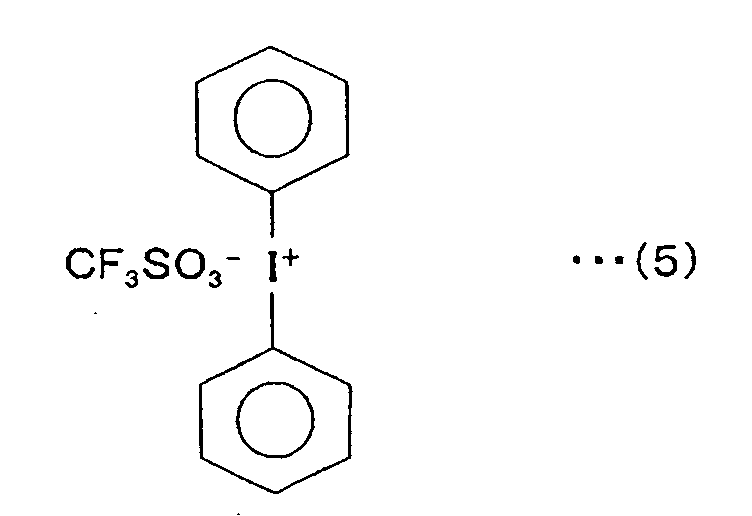
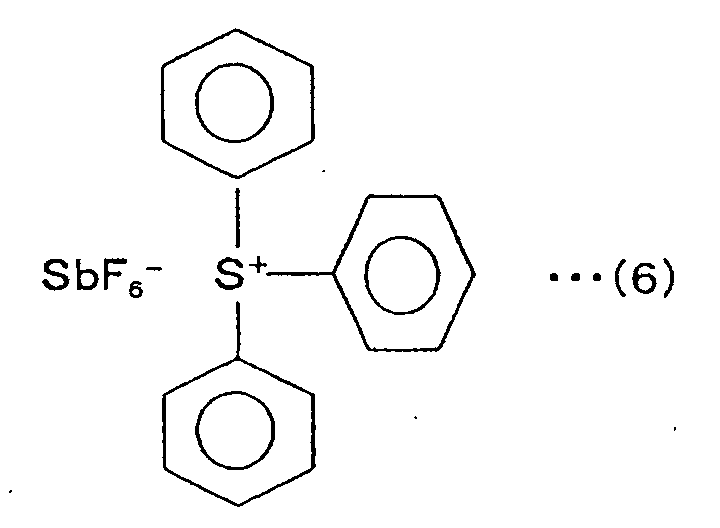
- an iodonium salt such as diphenyliodonium trifluromethyl sulfonate salt shown by formula (5), a sulfonium salt such as triphenylsulfonium hexafluoroantimonate shown by formula (6), and the like can be used.
- the photo acid generator to be added can be used singly or in combination with one or more of the other photo acid generators.
Landscapes
- Physics & Mathematics (AREA)
- Spectroscopy & Molecular Physics (AREA)
- General Physics & Mathematics (AREA)
- Materials For Photolithography (AREA)
- Compositions Of Macromolecular Compounds (AREA)
- Exposure And Positioning Against Photoresist Photosensitive Materials (AREA)
Abstract
There are provided a photosensitive resin
composition containing at least a polymer compound
having a sugar structure, which has at least two
species of functional groups cleavable in the presence
of an acid, and a photo acid generator generating an
acid by radiation of an electromagnetic wave or a beam
of an electrically charged particle, and in addition, a
resist composition, a method for fabricating a
patterned substrate for fabricating a semiconductor
device and the like, and a device such as a highly
integrated semiconductor and the like.
Description
The present invention relates to a resist
composition having performances high in sensitivity and
high in resolution against an electromagnetic waves
such as an ultraviolet light, a far ultraviolet light,
a vacuum ultraviolet light, an X-ray, and the like and
a electrically charged particle such as an electron
beam, an ion beam, and the like, and high in safety
against environment, a fabricating method for patterned
substrate by using the resist composition, and also the
device having a substrate fabricated by the fabricating
method.
In recent years, according to a high density and
high speed semiconductor integrated circuit,
miniaturization and integration of the integrated
circuits are being progressed than the past. Large
capacity memory devices for these integrated circuits
is transcribed from a mask to a semiconductor substrate
by using the light belonging to near ultraviolet light
and far ultraviolet light. In these ranges of light
wavelength, a processible line width of a semiconductor
device is coming close to a limit. Therefore, it is
necessary to promote to use a short wavelength for an
exposing light. In recent years, an ArF excimer laser
and a F2 laser are being used as the light source for
exposure in order to develop a lithography technology.
In accordance to using such short wavelength as
the exposure wavelength, a severe problem arises, for
example, a transmittance of the resist against the
exposure light lowers to cause deterioration of
resolution performance of a pattern. Particularly in
light lithography using the ArF excimer laser as the
light source, novolac resin and polyvinyl phenol, which
is used in a conventional resist and has an aromatic
ring in a structure thereof, are very difficult to be
used in view of light transmittance due to a high light
absorbance by this aromatic ring. On the other hand,
it has been known that light transmittance of the
exposure light can be improved largely by using an
aliphatic polymer. However, as a rule, the resist
using the aliphatic polymer is inferior in resistance
against dry etching at processing of the substrate
following pattern formation. Hence, the resist, which
is prepared by using a polymer having an alicyclic
group in a polymer side chain, has been developed. For
example, the resist prepared by using norbonenmethacrylate
copolymer and adamanthyl methacrylate.
Resists prepared by these polymers have been described
on, for example, Japanese Patent Application Laid-Open
No. 5-80515 and Japanese Patent Application Laid-Open
No. 5-265212. However, the polymer having the
alicyclic group is generally difficult to be fabricated
at low cost and low in solubility in a solvent and a
developer to cause to be difficult to yield the resist
having a high performance. In addition, concerning a
material itself for the resist, making a low load on
nature environment is required.
On the other hand, the material based on cellulose
shows high transmittance in the short wavelength region
of the ArF excimer laser and the like and thus, is
preferable as the resist. For example, in Japanese
Patent Application Laid-Open No. 6-34412, a polymer
compound, which is prepared by substituting at least
part of a hydroxyl group of cellulose to a protecting
group, is proposed to use as the resist. In addition,
in Japanese Patent Application Laid-Open No. 10-213903,
a proposal is made for a positive type resist compound
made of the cellulose resin having an acid functional
group, an acidic acrylic resin, and a photo acid
generator. However, the polymer prepared by simple
substitution of the hydroxyl group of cellulose is
difficult to satisfy control of solubility in a
solvent, which is used for solubilization of the
resist, and solubility of the polymer dissolved in an
alkali aqueous solution, which is used for development,
and resist performance, at the same time. Therefore, a
high performance resist is difficult to be obtained.
An object of the present invention is to provide a
resist composition having performances high in
sensitivity and high in resolution against
electromagnetic waves such as ultraviolet light, far
ultraviolet light, vacuum ultraviolet light, X-ray, and
the like and an electrically charged particle such as
electron beam, ion beam, and the like, and high in
safety against environment, a fabricating method for a
patterned substrate by using the resist composition,
and also a device having a substrate fabricated by the
fabricating method.
According to an aspect of the present invention,
there is provided a photosensitive resin composition
comprising a polymer compound having a sugar structure,
which has at least two species of functional group
cleavable in the presence of an acid, and a photo acid
generator generating the acid by radiation of an
electromagnetic wave or a charged particle beam.
According to another aspect of the present
invention, there is provided a photosensitive resin
composition containing a polymer compound having a
sugar structure, which has at least two species of
functional group cleavable in the presence of an acid,
and a photo acid generator generating the acid by
radiation of an electromagnetic wave or a charged
particle beam; and a solvent for dissolving the
photosensitive resin composition.
According to still another aspect of the present
invention, there is provided a method for fabricating a
patterned substrate, which comprises the steps of
applying a resist composition to a substrate, exposing
the substrate to which the resist composition has been
applied, and developing the exposed substrate, wherein
the resist composition contains a photosensitive resin
composition containing a polymer compound having a
sugar structure, which has at least two species of
functional group cleavable in the presence of an acid,
and a photo acid generator generating the acid by
radiation of an electromagnetic wave or a charged
particle beam; and a solvent for dissolving the
photosensitive resin composition.
According to a further aspect of the present
invention, there is provided a device comprising a
patterned substrate and an input/output part of a
signal, wherein the substrate is fabricated by a
fabricating method comprising the steps of applying a
resist composition to a substrate, exposing the
substrate to which the resist composition has been
applied, and developing the exposed substrate, wherein
the resist composition contains a photosensitive resin
composition containing a polymer compound having a
sugar structure, which has at least two species of
functional group cleavable in the presence of an acid,
and a photo acid generator generating the acid by
radiation of an electromagnetic wave or a charged
particle beam; and a solvent for dissolving the
photosensitive resin composition.
In order to improve the dry etching resistant
performance, the present inventors paid their attention
to cellulose, which has an alicyclic structure in a
main chain, as the polymer having an alicyclic group.
Cellulose has the alicyclic structure in the main chain
and therefore, a carbon density per a unit volume is
high to allow high dry etching resistance. Meanwhile,
it has been know that cellulose dissolves in a strong
alkali solution and on the other hand, shows a low
solubility in common organic solvent. By this reason,
the inventors improved solubility by introducing a
hydroxyalkyl group in the side chain. In addition, a
residue of the functional group cleavable in the
presence of acid is added to the hydroxyl group of the
hydroxyalkyl cellulose to lower solubility a base resin
in an alkali developer with a purpose of improvement of
contrast of exposed part and unexposed part.
Consequently, the photosensitive resin composition
according to the present invention dissolves easily in
the solvent and the like and also, is easy to express
resist performance, and further, is excellent in
applicability to such substrate as semiconductor wafer.
Moreover, hydroxyalkyl group itself contained in
the base resin of the photosensitive resin composition
has a property as a residue of a functional group
weakly cleavable by an action of an acid in the
presence of the acid. Thus, it is advantageous to
present solubility to the solvent and take a role for
improving sensitivity of the resist. On the other
hand, the other functional group, which is formed by
adding another residue to such a hydroxyalkyl group and
is cleavable in the presence of the acid, takes a chief
role of expression of resist performance. The presence
of such a multiple functional group realizes a high
performance resist.
In the photosensitive resin composition according
to the present invention, the polymer compound has the
sugar structure, which has at least two species of
functional group cleavable in presence of acid. When a
residue of the functional group cleavable by acid is
added to the polymer compound, solubility of the
polymer compound against an organic solvent is
improved, solubility of the polymer compound is lowered
against the alkali developer (working as a dissolution
inhibitor), and cleavages of the functional groups
increase developing rate to the alkali developer. As
the residue of such a functional group, hydroxyalkyl
group, tertiary butoxycarbonyl group and the like are
preferable, but those presenting the same effect and
inhibit no characteristics of the photosensitive resin
composition can be used.
In the present invention, by using two species or
more of the above described functional groups, the
above described effects are satisfactorily expressed to
yield an excellent photosensitive resin composition.
The above described acid can be obtained by
exposing the photo acid generator to generate the acid
by radiation (named exposure) of the electromagnetic
wave or the beam of the electrically charged particle.
The sugar structure is exemplified by a
monosaccharide such as D-glucose, D-mannose, D-allose,
D-altrose, D-galactose, D-talose, D-idose, D-gulose, D-fucose,
D-fructose, D-sorbose, L-sorbose, D-tagasose,
D-psicose, D-ribose, D-deoxyribose, D-arabinose, D-xylose,
D-lyxose, D-ribulose, D-xylulose,
D-arabinulose, D-lyxulose, D-threose, D-erythrose, D-erythrulose,
D-glyceraldehyde, dihydroxyacetone, and a
disaccharide such as sucrose, saccharose, maltose,
lactose, cellubiose, trehalose and the like. In
addition, the polymer compounds having these sugar
structure are exemplified by amylose, cellulose,
chitin, chitosan, hyaluronic acid, chondroitin 6-sulfate,
keratan sulfate, heparin, and the like.
Further, a molecular weight of these polymer
compounds ranges preferably from 20,000 to 2,000,000
and more preferably, 50,000 to 500,000.
As such a polymer compounds as described above,
hydroxyalkyl cellulose derivative, in which at least
one of hydroxyl groups of hydroxyalkyl cellulose is
substituted by a substitutional group capable of
generating a hydroxyl group by cleaing by acid, is
suitable. Hydroxyalkyl cellulose also has a
hydroxyalkyl group which is a residue of the functional
group cleavable by acid as described above.
Accordingly, the hydroxyalkyl cellulose derivative has
two species of the functional groups in total as
described above through having the substitutional group
capable of generating a hydroxyalkyl group by cleaving
by acid besides the functional group cleavable in the
presence of acid.
As such a hydroxyalkyl cellulose, hydroxyethyl
cellulose and hydroxypropyl cellulose are preferable.
Moreover, t-butoxycarbonyloxy group is preferably
used as the substitutional group which substitutes for
a hydroxyl group of the hydroxyalkyl cellulose and is
cleaved in the presence of acid. Pivaloyloxy group is
also used as the substitutional group. When such a
pivaloyloxy group is cleaved, the pivaloyloxy group
discharges isobutene and carbon dioxide, produces a
hydroxyl group in the terminal cleaved, and increases
dissolution rate of the polymer compounds against the
alkali developer.
As an example, formula (3) shows a hydroxyalkyl
cellulose derivative that is the polymer obtained by
adding the pivaloyl group to hydroxypropyl cellulose
through a reaction of the hydroxypropyl cellulose with
pivalic acid.
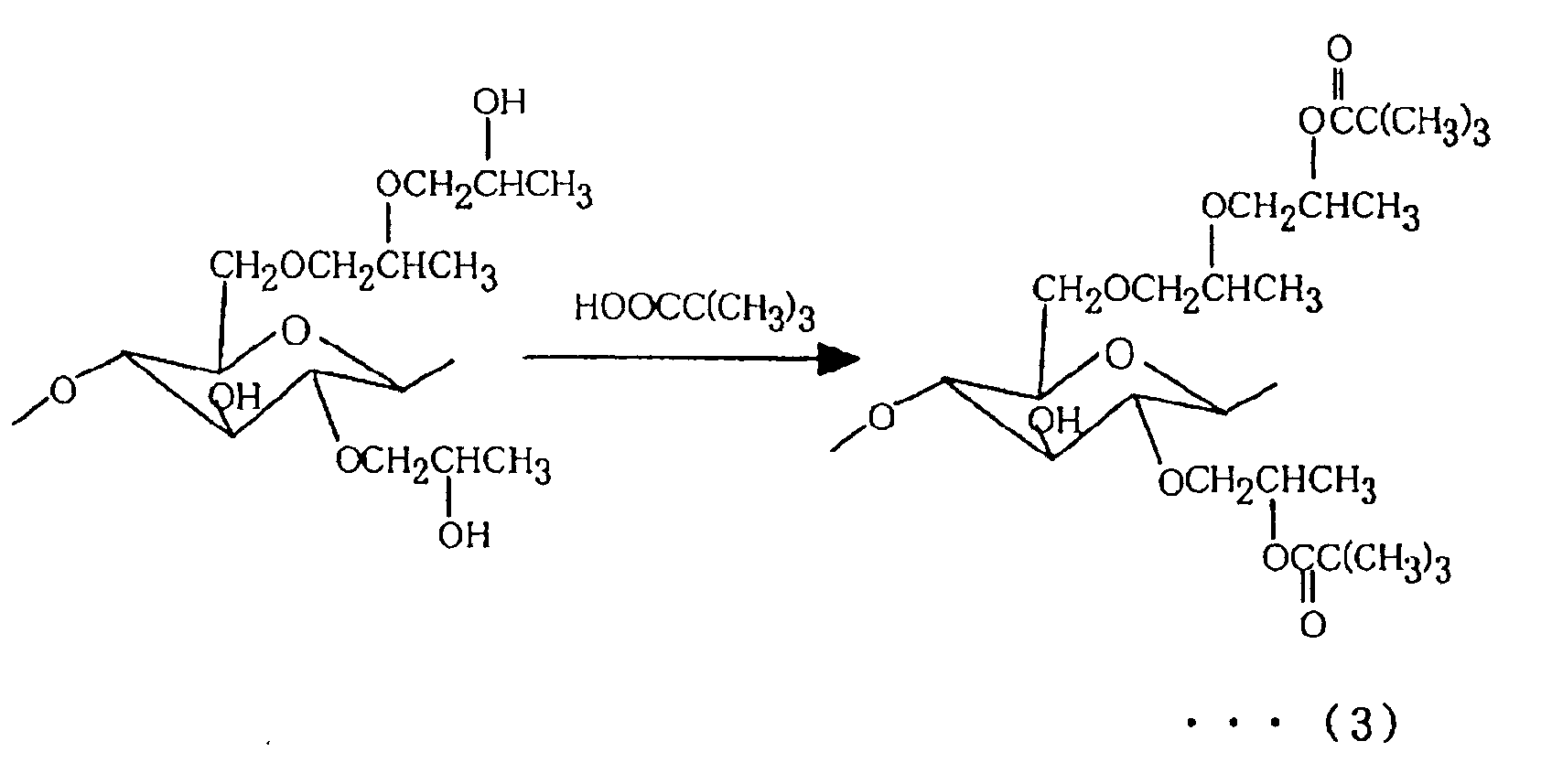
When treated by heat in the presence of water and
the acid, this polymer causes a chemical change as
shown in formula (4) to be solubilized in an alkali
aqueous solution.

In the presence of the acid, not only pivaloyloxy
group but also hydroxypropyloxy group of the cellulose
cleaves to produce the hydroxyl group, which is not
shown in the above formula.
In addition, a polymer chain itself of cellulose
is occasionally cleaved partially. Meanwhile, as water
necessary for the reaction, water contained in an
atmosphere or a resist film is used. Humidity of the
atmosphere can be adjusted by an apparatus for
exclusive use if necessary.
Photosensitive resin composition according to the
present invention contains an appropriate photo acid
generator to generate the acid by radiation of the
electromagnetic wave or the beam of the electrically
charged particle.
As a preferable photo acid generator, an iodonium
salt such as diphenyliodonium trifluromethyl sulfonate
salt shown by formula (5), a sulfonium salt such as
triphenylsulfonium hexafluoroantimonate shown by
formula (6), and the like can be used. The photo acid
generator to be added can be used singly or in
combination with one or more of the other photo acid
generators. Other than these compounds, the photo acid
generators are exemplified by diphenyliodoniumparatoluene
sulfonate, N-hydroxynaphthalimidetrifluoromethane
sulfonate, N-hydroxyphthalimidetrifluoromethane
sulfonate, diphenyliodonium-9,10-dimethoxy
anthracene-2 sulfonate, bis (4-t-butylphenyl)
iodonium-trifluoromethane sulfonate, bis (4-t-butylphenyl)
iodonium-p-toluene sulfonate,
triphenylsulfonium trifluoromethane sulfonate, tris (4-t-butylphenyl)
sulfonium-trifluoromethane sulfonate,
triphenylsulfonium trifluoromethane sulfonate, tris (4-t-butylphenyl)
sulfonium-hexafluoroantimonate, tris (4-t-butylphenyl)
sulfonium-tetrafluoroantimonate, 2-[2'-(5'-methyl
2'-furyl) ethenyl]-4,6-bis
(trichloromethyl)-1,3,5-triazine, and the like.
Among the photosensitive resin compositions
according to the present invention, it is preferable in
viewpoint of film thickness regulation that for 100
mass parts of the polymer compound such as the
hydroxyalkyl cellulose derivative and the like, which
has the sugar structure having at least two species of
the functional groups cleavable in the presence of the
acid, the photo acid generator is 0.1 to 20 mass parts
and 1 to 10 mass parts is more preferable.
The photosensitive resin compositions according to
the present invention can contain, other than the
polymer compound such as the hydroxyalkyl cellulose
derivative and the like as described above and the
photo acid generator as described above, a surfactant,
an antioxidant, a pigment compound, and the like. A
content thereof ranges preferably from 0.001 to 20 mass
parts for 100 mass parts of the photosensitive resin
compositions and 0.005 to 10 mass parts is more
preferable.
A method for obtaining the photosensitive resin
compositions according to the present invention may be
mixing each component evenly as possible. The method
for mixing is not specially restricted. But when even
mixing is difficult for only these components, it is
possible that the solvent is added to liquefy and then
dried.
When dissolved in the solvent, this photosensitive
resin compositions can be used as the resist of so-called
chemically amplified type.
In addition to the photosensitive resin
compositions as described above, other alkali soluble
resin can be used as the resist by dissolving in the
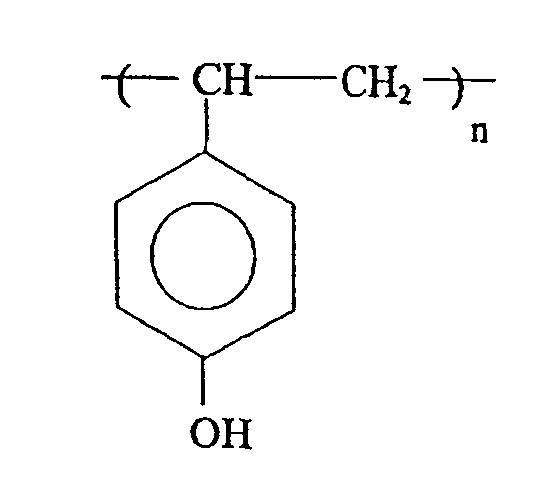
solvent. As the alkali soluble resin usable, novolac
resin, polyvinyl phenol, and the like used for a
conventional resist as shown in Formula (7) and Formula
(8) can be used. Further, for lithography using the
short wavelength light source such as excimer laser
(wavelength 193 nm) and F2 laser (157 nm) of argon
fluorinate, it is preferable to use the alkali soluble
resin such as polyglutaraldehyde, hydroxypropyl
cellulose, hydroxyethyl cellulose, and the like, which
have the alicyclic group.

As a mode of using in combination with other
alkali soluble resin as described above, combination
with the polymer, which is alkali soluble and contains
silicon, may be possible. As the polymer, which is
alkali soluble and contains silicon,
polyparahydroxysesquioxane and siloxane polymer of a
ladder type as shown in Formula (9) can be used.

As described above, the resist in combination with
the polymer containing silicon can be used as so-called
multilayer resist and it is effective against a
decrease in a focus depth following a shorter
wavelength of the exposure light as use of F2 laser,
and an increase in NA (numerical aperture) of an
optical system of a light projection exposure
apparatus.
As the solvent for preparing these resist
compositions, common solvents such as alcoxy ethanols
such as methyl cellosolve, ethyl cellosolve and buthyl
cellosolve; cellosolve acetate such as methyl
cellosolve acetate, ethyl cellosolve acetate and buthyl
cellosolve acetate; propylene glycol acetate such as
propylene glycol monomethyl acetate; lactic acid esters
such as ethyl lactate; aliphatic ketones such as
methylethyl ketone, 2-pentanone, methyl isobutyl ketone
and methyl isoamyl ketone; alicyclic ketones such as
cyclohexanone and N-methyl pyrrolidone; aromatic
compounds such as benzene, toluene, xylene and
chlorobenzene; and alcohols such as methyl alcohol,
ethyl alcohol, n-propyl alcohol, isopropyl alcohol and
benzyl alcohol can be used in a single or mixed form.
Moreover, with the purpose of controlling solubility to
these solvents and vapor pressure, alcohols such as
methyl alcohol, ethyl alcohol, n-propyl alcohol and
isopropyl alcohol; aliphatic alkane such as pentane,
hexane, heptane and octane; and alicyclic compounds
such as cyclopentanone and cyclohexane may be blended
as the solvent.
Furthermore, with the purpose of adjusting
characteristic of application to the substrate, an
anionic, cationic or amphoteric surfactant, fluorine-based
surfactant and the like may be blended. In
addition, in order to improve preservation stability of
the resist, a monophenol-based compound such as phenol,
cresol, methoxyphenol and 2,6-di-t-buthyl-p-cresol, a
bisphenol-based compound such as 2,2'-methylene bis (4-methyl-6-t-butylphenol);
a polymer type phenol-based
compound such as 1,1,3-tris (2-methyl-4-hydroxy-5-t-butylphenyl)
butane; a sulfur-based antioxidant such as
dilauryl-3,3'-thiodipropionate; a phosphorus-based
antioxidant such as triphenylphosphite; and the
antioxidant such as sorbic acid, erythorbic acid,
isopropyl citrate and nordihydroguaialetic acid may be
added.
Adjusting concentration of the photosensitive
resin compositions according to the present invention
among the resist composition according to the present
invention allows obtaining a desired thickness of the
film on the substrate. For the concentration of the
photosensitive resin compositions, it is preferable
that the polymer compound, which has the sugar
structure having at least two species of the functional
groups cleavable in the presence of the acid, accounts
for preferably 1 to 50 mass % and more preferably about
3 to 30 mass %. Meanwhile, other alkali soluble resin
than the photosensitive resin compositions according to
the present invention is preferably contained ranging
from 0.1 to 40 mass % and more preferably from 1 to 30
mass % in the resist composition. In addition,
concentration of the above described surfactant
contained in the resist composition ranges preferably
from 0.001 to 20 mass % and the preservation stability-improving
component as described above ranges
preferably from 0.01 to 20 mass % in the resist
composition. The resist composition as described above
can contain, in addition to compounds as described
above, the pigment compound and the like to adjust
absorbance of the exposure light and content thereof
ranges preferably from 0.01 to 10%. Part other than
these components of the resist composition is the
solvent.
As described above, the photosensitive resin
compositions according to the present invention can be
used as the normal resist of so-called chemically
amplified type, the resist in combination with other
alkali soluble resin, and also the multilayer resist in
combination with the polymer containing silicon.
Moreover, these combination allows an optimal
combination with the exposure wavelength.
The present invention is a pattern forming method
comprising the step to apply the resist composition to
the substrate such as a silicon wafer, a glass
substrate, and the like, the step to expose the
substrate, to which the resist composition is applied
through a mask or directly, and the step to develop the
substrate, which has been exposed, wherein the resist
composition is the resist composition as described
above. There is no special restriction of the pattern
forming method as described above in the present
invention other than using the resist composition
according to the present invention as the resist
composition.
In addition, the present invention provides the
device characterized in having the substrate, which has
a pattern formed by the pattern forming method as
described above.
There is no special restriction of the device
according to the present invention other than having
the patterned substrate as described above. As the
example of the device, a semiconductor chip such as IC,
LSI, and the like or the semiconductor device such as a
liquid crystal panel and a CCD are exemplified.
Next, an embodiment of the fabricating method for
the semiconductor device (semiconductor element) using
the resist composition as described above will bell
described.
Fig. 1 is the flow chart of fabricate of the
semiconductor device (the semiconductor chip such as
IC, LSI, and the like or the liquid crystal panel and
the CCD, and the like). In this example, a step S1
(circuit design) carries out circuit design of the
semiconductor device. Step S2 (mask fabrication)
fabricates the mask on which a circuit pattern designed
is formed. On the other hand, step S3 (wafer
fabrication) fabricates the wafer using such material
as silicon. Step S4 (wafer process) is called a
prestep and forms an actual circuit on the wafer by
lithographic technology using the mask and the wafer
prepared in the above described steps.
Reticle is carried and chucked to a reticle chuck.
Then, the silicon wafer substrate, to which the resist
composition according to the present invention is
applied, is loaded on inside of the exposure apparatus.
An alignment unit reads data for global alignment and
on the basis of a result of measurement, a wafer stage
is actuated to carry out exposure sequentially in
predetermined positions.
The next step S5 (assemblage) is called a poststep
and the step for making the semiconductor chip by using
the wafer fabricated by the step S4 and includes steps
such as an assembling step (dicing and bonding), a
packaging step (chip packaging).
Step S6 (inspection) carries out inspection such
as operation checking test, tolerance test, and the
like of the semiconductor device fabricated in the step
S5. Through these steps, the semiconductor device is
completed and shipped (step S7).
Fig. 2 is the detailed flow chart of the wafer
process of the step S4 as described above. First, step
S11 (oxidation) oxidizes a surface of the wafer. Step
S12 (CVD) forms an insulating film on the surface of
the wafer.
Step S13 (electrode formation) forms an electrode
on the wafer by evaporation. Step S14 (ion injection)
injects an ion into the wafer. Step S15 (resist
processing) applies a sensitizer (the resist
composition according to the present invention) to the
wafer.
Step S16 (exposure) carries out baking exposure of
the circuit patter of the mask on the wafer by the
exposing apparatus as described above.
Step S17 (developing) develops the wafer exposed.
Step S18 carries out etching processing and the part
except the resist developed by the step S19 is removed.
Repeat of these steps forms multiple circuit pattern on
the wafer.
Pivalic acid of 20 g was dissolved in
trifluoroacetic anhydride to activate at 50°C, and 20 g
of hydroxypropyl cellulose (Aldrich Co. made) was then
dissolved to add a pivaloyl group to hydroxypropyl
cellulose. Following the reaction, a product was
precipitated in a large volume of methyl alcohol to dry
in vacuum resulting in yield of an objective polymer.
The polymer was repeatedly dissolved, precipitated, and
dried in vacuum for purification.
Triphenylsulfonium hexafluoroantimonate of 0.25 g
as the photo acid generator was added to 5 g of the
resulting polymer and stirred to yield the
photosensitive resin composition.
The photosensitive resin composition of 25 g
yielded in Example 1 was dissolved in 97 g of propylene
glycol monomethyl ether acetate and the resulting
solution was filtered through a 0.1 µm mesh filter to
yield 122 g of the resist composition according to the
present invention.
Diphenyliodonium trifluoromethyl sulfonate salt of
0.15 g as the photo acid generator, 30 g of cresol
novolac resin (manufactured by Mitsubishi Gas Chemical
Company, Inc.), and 4.5 g of the polymer yielded in
Example 1 were dissolved in propylene glycol monomethyl
ether acetate of 100 ml (97 g), and the resulting
solution was filtered through a 0.1 µm mesh filter to
yield 131.7 g of the resist composition according to
the present invention.
Triphenylsulfonium hexafluoroantimonate of 0.08 g
as the photo acid generator, 30 g of polyvinyl phenol
(commercial name Maruka Linker; manufactured by Maruzen
Petroleum Chemistry Co., Ltd.), and the polymer of 4.5
g yielded in Example 1 were dissolved in propylene
glycol monomethyl ether acetate of 100 ml (97 g), and
the resulting solution was filtered through the 0.1 µm
mesh filter to yield 131.6 g of the resist composition
according to the present invention.
Triphenylsulfonium hexafluoroantimonate of 0.1 g
as the photo acid generator, 30 g of polyglutaraldehyde
polymer (polymer of glutaraldehyde, manufactured by
Tokyo Kasei Corp.), which was employed as the polymer
having alicyclic group, and the polymer of 4.5 g
yielded in Example 1 were dissolved in propylene glycol
monomethyl ether acetate of 100 ml (97 g), and the
resulting solution was filtered through the 0.1 µm mesh
filter to yield 131.6 g of the resist composition
according to the present invention.
Triphenylsulfonium hexafluoroantimonate of 0.08 g
as the photo acid generator, 30 g of hydroxypropyl
cellulose (Aldrich Corp. made), which was employed as
the polymer having alicyclic group, and the polymer of
4.5 g yielded in Example 1 were dissolved in a solvent
(93 g) prepared by mixing propylene glycol monomethyl
ether acetate of 80 ml and 20 ml of ethanol anhydride,
and the resulting solution was filtered through the 0.1
µm mesh filter to yield 127.6 g of the resist
composition according to the present invention.
Triphenylsulfonium hexafluoroantimonate of 0.08 g
as the photo acid generator, 30 g of polyparahydroxyl
sesquioxane, which was employed as the polymer having
alkali-soluble silicon element, and the polymer of 4.5
g yielded in Example 1 were dissolved in a solvent (93
g) prepared by mixing propylene glycol monomethyl ether
acetate of 80 ml and methylisobutyl ketone of 20 ml,
and the resulting solution was filtered through the 0.1
µm mesh filter to yield 128 g of the resist composition
according to the present invention.
The resist yielded in Example 2 was subjected to
spin coat with the film thickness of 0.3 µm on a
silicon wafer. Next, a pattern on the mask was
transferred by using a reduction projection type
exposure apparatus (stepper) having an ArF excimer
laser as the light source and developed with 2.38%
aqueous solution of tetramethyl ammonium hydroxide to
yield the pattern of 0.18 µm.
The resist yielded in Example 3 was subjected to
spin coat with the film thickness of 0.7 µm on a
silicon wafer. Next, a drawing was carried out by
using an electron drawing apparatus at an acceleration
voltage of 50 kV and developed with 2.38% aqueous
solution of tetramethyl ammonium hydroxide to yield the
pattern of 0.15 µm.
The resist yielded in Example 4 was subjected to
spin coat with the film thickness of 0.4 µm on a
silicon wafer. Next, a tantalum pattern on a mask was
transferred onto the resist through an X-ray mask by
using an X-ray exposure apparatus and developed with
2.38% aqueous solution of tetramethyl ammonium
hydroxide to yield the pattern of 0.15 µm.
The resist yielded in Example 5 was subjected to
spin coat with the film thickness of 0.7 µm on a
silicon wafer. Next, a pattern on a mask was
transferred by using an exposure apparatus using a
krypton fluorinate excimer laser as the light source
and developed with 2.38% aqueous solution of
tetramethyl ammonium hydroxide to yield the pattern of
0.2 µm.
The resist yielded in Example 6 was subjected to
spin coat with the film thickness of 0.7 µm on a
silicon wafer. Next, a pattern on a mask was
transferred by using an exposure apparatus using the
krypton fluorinate excimer laser as the light source
and developed with 2.38% aqueous solution of
tetramethyl ammonium hydroxide to yield the pattern of
0.2 µm.
A resist containing novolac resin and
naphthoquinone azide as main components was subjected
to spin coat with the film thickness of 1.0 µm on a
silicon wafer and then subjected to hard baking. The
resist yielded in Example 7 was subjected to spin coat
on the resultant with the film thickness of 0.2 µm.
Next, a pattern on a mask was transferred by using an
exposure apparatus using F2 laser as the light source
and developed with 2.38% aqueous solution of
tetramethyl ammonium hydroxide to yield the pattern of
0.2 µm. In addition, the novolac type resist was
processed by reactive ion etching using oxygen gas to
transfer perfectly the 0.12 µm pattern formed on a top
layer resist to a bottom layer resist.
The resist solution yielded in Example 2 was
subjected to spin coat with the film thickness of 0.5
µm on a silicon wafer. Next, a drawing was carried out
by using a proton beam and then, the development was
carried out by using amyl acetate by 6×10⁻⁸C/cm2
exposure. As a result, a 0.15 µm pattern was yielded.
A device having the signal input/output part and
the patterned substrate, which was yielded in Examples
as described above, was fabricated.
The present invention provides the photosensitive
resin composition that is good in solubility against
the solvent, thus the resist solution can be easily
prepared, and solubility against the alkali developer
of the base resin can be suppressed, is preferably used
particularly in the vacuum ultraviolet range. In
addition, the fabricating methods of a cheap resist
composition suitable for mass production of easy
fabrication, high sensitivity, and high resolution and
the patterned substrate fabricable of the semiconductor
device of high integration are provided. Moreover,
devices such as the semiconductor device of high
integration is provided.
Claims (9)
- A photosensitive resin composition comprising a polymer compound having a sugar structure, which has at least two species of functional group cleavable in the presence of an acid, and
a photo acid generator generating the acid by radiation of an electromagnetic wave or a charged particle beam. - The photosensitive resin composition according to claim 1, wherein said polymer compound is a hydroxyalkyl cellulose derivative capable of having a hydroxyl group by allowing at least one of hydroxyalkyl groups of hydroxyalkyl cellulose to cleave by the acid.
- The photosensitive resin composition according to claim 2, wherein the hydroxyalkyl cellulose derivative has a hydroxyethyl cellulose structure represented by formula (1):wherein each of R1, R2, and R3 represents hydrogen or -CH2CH2OZ, which OZ represents a hydroxyl group or a substitutional group which is capable of generating a hydroxyl group by cleaving by acid.

- The photosensitive resin composition according to claim 2, wherein the hydroxyalkyl cellulose derivative has a hydroxypropyl cellulose structure represented by formula (2):, wherein each of R4, R5, and R6 represents hydrogen or the following structure:
 or
or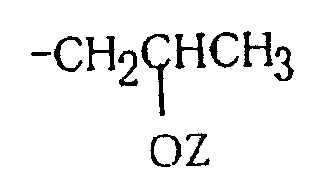 wherein OZ represents a hydroxyl group or a substitutional group which is capable of generating a hydroxyl group by cleaving by acid.
- The photosensitive resin composition according to claim 2, wherein said hydroxyalkyl cellulose derivative has a t-butoxycarbonyl group.
- The photosensitive resin composition according to claim 2, wherein said hydroxyalkyl cellulose derivative has a pivaloyl group.
- A resist composition comprising:a photosensitive resin composition containing a polymer compound having a sugar structure, which has at least two species of functional group cleavable in the presence of an acid, and a photo acid generator generating the acid by radiation of an electromagnetic wave or a charged particle beam; and a solvent for dissolving the photosensitive resin composition.
- A method for fabricating a patterned substrate, which comprises the steps of:wherein the resist composition contains a photosensitive resin composition containing a polymer compound having a sugar structure, which has at least two species of functional group cleavable in the presence of an acid, and a photo acid generator generating the acid by radiation of an electromagnetic wave or a charged particle beam; and a solvent for dissolving the photosensitive resin composition.applying a resist composition to a substrate,exposing the substrate to which the resist composition has been applied, anddeveloping the exposed substrate,
- A device comprising a patterned substrate and an input/output part of a signal, wherein
the substrate is fabricated by a fabricating method comprising the steps of:wherein the resist composition contains a photosensitive resin composition containing a polymer compound having a sugar structure, which has at least two species of functional group cleavable in the presence of an acid, and a photo acid generator generating the acid by radiation of an electromagnetic wave or a charged particle beam; and a solvent for dissolving the photosensitive resin composition.applying a resist composition to a substrate,exposing the substrate to which the resist composition has been applied, anddeveloping the exposed substrate,
Applications Claiming Priority (2)
| Application Number | Priority Date | Filing Date | Title |
|---|---|---|---|
| JP2000368588 | 2000-12-04 | ||
| JP2000368588A JP2002169291A (en) | 2000-12-04 | 2000-12-04 | Photosensitive resin composition, resist composition, pattern forming method and device |
Publications (1)
| Publication Number | Publication Date |
|---|---|
| EP1211559A1 true EP1211559A1 (en) | 2002-06-05 |
Family
ID=18838791
Family Applications (1)
| Application Number | Title | Priority Date | Filing Date |
|---|---|---|---|
| EP01128740A Withdrawn EP1211559A1 (en) | 2000-12-04 | 2001-12-03 | Photosensitive resin composition, fabricating method for patterned substrate, and device comprising this substrate |
Country Status (3)
| Country | Link |
|---|---|
| US (2) | US6866973B2 (en) |
| EP (1) | EP1211559A1 (en) |
| JP (1) | JP2002169291A (en) |
Cited By (4)
| Publication number | Priority date | Publication date | Assignee | Title |
|---|---|---|---|---|
| EP1557719A3 (en) * | 2004-01-26 | 2007-04-18 | Matsushita Electric Industrial Co., Ltd. | Chemically amplified resist and pattern formation method |
| US8460969B2 (en) | 2008-12-03 | 2013-06-11 | Tesa Se | Method for encapsulating an electronic arrangement |
| EP2784586A1 (en) * | 2013-03-27 | 2014-10-01 | Univerza v Mariboru Fakulteta za strojnistvo | Multidimensionally photopatterned substrates on the basis of monosaccharide derivatives, their oligomers and their polymers and a method of production thereof |
| WO2016162638A1 (en) | 2015-04-09 | 2016-10-13 | Universite Claude Bernard Lyon I | Use of chitosan or alginate as a transfer mask in lithography and transfer methods |
Families Citing this family (9)
| Publication number | Priority date | Publication date | Assignee | Title |
|---|---|---|---|---|
| JP3902916B2 (en) * | 2001-03-16 | 2007-04-11 | キヤノン株式会社 | Resin composition, molding method thereof, and recycling method of the resin composition |
| JP3886358B2 (en) | 2001-10-31 | 2007-02-28 | 松下電器産業株式会社 | Pattern formation method |
| EP1649322A4 (en) | 2003-07-17 | 2007-09-19 | Honeywell Int Inc | PLANARIZATION FILMS FOR ADVANCED MICROELECTRONIC DEVICES AND APPLICATIONS AND METHODS FOR PRODUCING SAID FILMS |
| US7622240B2 (en) * | 2005-02-28 | 2009-11-24 | International Business Machines Corporation | Low blur molecular resist |
| KR100761759B1 (en) | 2006-09-14 | 2007-10-04 | 삼성전자주식회사 | Molecular resin, photoresist composition comprising same and pattern forming method using same |
| US8533082B1 (en) * | 2009-08-14 | 2013-09-10 | Bank Of America Corporation | Consumer leverage modeling |
| US8423454B2 (en) | 2009-08-14 | 2013-04-16 | Bank Of America Corporation | Determining leading indicators |
| JP5672161B2 (en) * | 2011-06-13 | 2015-02-18 | 信越化学工業株式会社 | Pattern formation method |
| US12105416B2 (en) | 2021-01-28 | 2024-10-01 | Canon Kabushiki Kaisha | Photocurable composition comprising an organic ionic compound |
Citations (4)
| Publication number | Priority date | Publication date | Assignee | Title |
|---|---|---|---|---|
| JPH06342212A (en) * | 1993-04-07 | 1994-12-13 | Matsushita Electric Ind Co Ltd | Resist for forming fine pattern and fine pattern forming method |
| JPH086252A (en) * | 1994-06-24 | 1996-01-12 | Sony Corp | Photosensitive resin composition |
| US5716740A (en) * | 1993-11-24 | 1998-02-10 | Canon Kabushiki Kaisha | Method for manufacturing a color filter in which light irradiation alters the ink absorption of portions of a resin layer and in which coloring is done by ink jets |
| EP0848290A1 (en) * | 1996-12-10 | 1998-06-17 | Morton International, Inc. | High resolution positive acting dry film photoresist |
Family Cites Families (5)
| Publication number | Priority date | Publication date | Assignee | Title |
|---|---|---|---|---|
| JP3000745B2 (en) | 1991-09-19 | 2000-01-17 | 富士通株式会社 | Resist composition and method of forming resist pattern |
| JPH05265212A (en) | 1992-03-17 | 1993-10-15 | Fujitsu Ltd | Resist material and pattern forming using it |
| JP2695577B2 (en) | 1992-07-20 | 1997-12-24 | 株式会社日立製作所 | Shield tube and air flow meter for anti-electromagnetic interference of air flow measuring element |
| JP3589365B2 (en) * | 1996-02-02 | 2004-11-17 | 富士写真フイルム株式会社 | Positive image forming composition |
| US5981135A (en) | 1997-08-13 | 1999-11-09 | Morton International, Inc. | High resolution positive acting dry film photoresist |
-
2000
- 2000-12-04 JP JP2000368588A patent/JP2002169291A/en not_active Withdrawn
-
2001
- 2001-12-03 EP EP01128740A patent/EP1211559A1/en not_active Withdrawn
- 2001-12-03 US US09/998,228 patent/US6866973B2/en not_active Expired - Fee Related
-
2004
- 2004-09-17 US US10/942,890 patent/US7122297B2/en not_active Expired - Fee Related
Patent Citations (4)
| Publication number | Priority date | Publication date | Assignee | Title |
|---|---|---|---|---|
| JPH06342212A (en) * | 1993-04-07 | 1994-12-13 | Matsushita Electric Ind Co Ltd | Resist for forming fine pattern and fine pattern forming method |
| US5716740A (en) * | 1993-11-24 | 1998-02-10 | Canon Kabushiki Kaisha | Method for manufacturing a color filter in which light irradiation alters the ink absorption of portions of a resin layer and in which coloring is done by ink jets |
| JPH086252A (en) * | 1994-06-24 | 1996-01-12 | Sony Corp | Photosensitive resin composition |
| EP0848290A1 (en) * | 1996-12-10 | 1998-06-17 | Morton International, Inc. | High resolution positive acting dry film photoresist |
Non-Patent Citations (2)
| Title |
|---|
| DATABASE WPI Section Ch Week 199611, Derwent World Patents Index; Class A89, AN 1996-101274, XP002194982 * |
| PATENT ABSTRACTS OF JAPAN vol. 1995, no. 03 28 April 1995 (1995-04-28) * |
Cited By (5)
| Publication number | Priority date | Publication date | Assignee | Title |
|---|---|---|---|---|
| EP1557719A3 (en) * | 2004-01-26 | 2007-04-18 | Matsushita Electric Industrial Co., Ltd. | Chemically amplified resist and pattern formation method |
| US8460969B2 (en) | 2008-12-03 | 2013-06-11 | Tesa Se | Method for encapsulating an electronic arrangement |
| EP2784586A1 (en) * | 2013-03-27 | 2014-10-01 | Univerza v Mariboru Fakulteta za strojnistvo | Multidimensionally photopatterned substrates on the basis of monosaccharide derivatives, their oligomers and their polymers and a method of production thereof |
| WO2016162638A1 (en) | 2015-04-09 | 2016-10-13 | Universite Claude Bernard Lyon I | Use of chitosan or alginate as a transfer mask in lithography and transfer methods |
| FR3034881A1 (en) * | 2015-04-09 | 2016-10-14 | Univ Claude Bernard Lyon | IMPLEMENTING CHITOSAN OR ALGINATE AS A TRANSFER MASK IN LITHOGRAPHY AND TRANSFER PROCESSES |
Also Published As
| Publication number | Publication date |
|---|---|
| US7122297B2 (en) | 2006-10-17 |
| JP2002169291A (en) | 2002-06-14 |
| US20020086226A1 (en) | 2002-07-04 |
| US6866973B2 (en) | 2005-03-15 |
| US20050031992A1 (en) | 2005-02-10 |
Similar Documents
| Publication | Publication Date | Title |
|---|---|---|
| US4968581A (en) | High resolution photoresist of imide containing polymers | |
| US4837124A (en) | High resolution photoresist of imide containing polymers | |
| US6866973B2 (en) | Photosensitive resin composition, resist composition, fabricating method for patterned substrate, and device | |
| JP4619218B2 (en) | Polymer of upper antireflection film, method for producing the same, and composition of upper antireflection film containing the same | |
| KR19990076735A (en) | Resist composition | |
| KR100598176B1 (en) | Upper antireflection film polymer, preparation method thereof and upper antireflection film composition containing same | |
| KR20080099479A (en) | Chemically Amplified Positive Photoresist Composition and Resist Pattern Forming Method Using The Same | |
| US6753132B2 (en) | Pattern formation material and pattern formation method | |
| JPH01300248A (en) | Photoresist composition | |
| KR100574491B1 (en) | Upper antireflection film polymer, preparation method thereof and upper antireflection film composition containing same | |
| US7041428B2 (en) | Pattern-forming material and method of forming pattern | |
| JPH09265177A (en) | Photoresist composition | |
| US6830869B2 (en) | Pattern forming material and method of pattern formation | |
| JP4516250B2 (en) | Pattern forming material and pattern forming method | |
| JP2975315B2 (en) | Three-component chemically amplified photoresist composition | |
| JP3664549B2 (en) | Resist composition, pattern forming method, and method for manufacturing semiconductor device | |
| KR100334745B1 (en) | Resist composition and pattern forming process | |
| US6737213B2 (en) | Pattern formation material and method | |
| US6576398B2 (en) | Pattern formation material and method | |
| KR100586541B1 (en) | Organic antireflection film composition and pattern formation method using same | |
| JPH04149445A (en) | Positive type photosensitive composition | |
| EP0353600A2 (en) | Aromatic diazonium salt, radiation sensitive composition containing the aromatic diazonium salt and method for formation of pattern using the radiation sensitive composition | |
| KR20100047046A (en) | I-line chemically amplified positive photoreist and pattern forming method using the same | |
| KR20100047050A (en) | I-line chemically amplified positive photoreist and pattern forming method using the same | |
| JPH02173752A (en) | Radiation sensitive composition |
Legal Events
| Date | Code | Title | Description |
|---|---|---|---|
| PUAI | Public reference made under article 153(3) epc to a published international application that has entered the european phase |
Free format text: ORIGINAL CODE: 0009012 |
|
| AK | Designated contracting states |
Kind code of ref document: A1 Designated state(s): AT BE CH CY DE DK ES FI FR GB GR IE IT LI LU MC NL PT SE TR |
|
| AX | Request for extension of the european patent |
Free format text: AL;LT;LV;MK;RO;SI |
|
| 17P | Request for examination filed |
Effective date: 20021021 |
|
| AKX | Designation fees paid |
Designated state(s): CH DE FR GB IT LI NL |
|
| 17Q | First examination report despatched |
Effective date: 20031219 |
|
| STAA | Information on the status of an ep patent application or granted ep patent |
Free format text: STATUS: THE APPLICATION IS DEEMED TO BE WITHDRAWN |
|
| 18D | Application deemed to be withdrawn |
Effective date: 20060701 |