EP1211275A1 - Modified Polylactam - Google Patents
Modified Polylactam Download PDFInfo
- Publication number
- EP1211275A1 EP1211275A1 EP00126193A EP00126193A EP1211275A1 EP 1211275 A1 EP1211275 A1 EP 1211275A1 EP 00126193 A EP00126193 A EP 00126193A EP 00126193 A EP00126193 A EP 00126193A EP 1211275 A1 EP1211275 A1 EP 1211275A1
- Authority
- EP
- European Patent Office
- Prior art keywords
- polylactam
- modified
- lactam
- group
- phenyl
- Prior art date
- Legal status (The legal status is an assumption and is not a legal conclusion. Google has not performed a legal analysis and makes no representation as to the accuracy of the status listed.)
- Withdrawn
Links
Classifications
-
- C—CHEMISTRY; METALLURGY
- C07—ORGANIC CHEMISTRY
- C07D—HETEROCYCLIC COMPOUNDS
- C07D201/00—Preparation, separation, purification or stabilisation of unsubstituted lactams
- C07D201/02—Preparation of lactams
- C07D201/04—Preparation of lactams from or via oximes by Beckmann rearrangement
-
- C—CHEMISTRY; METALLURGY
- C07—ORGANIC CHEMISTRY
- C07D—HETEROCYCLIC COMPOUNDS
- C07D223/00—Heterocyclic compounds containing seven-membered rings having one nitrogen atom as the only ring hetero atom
- C07D223/02—Heterocyclic compounds containing seven-membered rings having one nitrogen atom as the only ring hetero atom not condensed with other rings
- C07D223/06—Heterocyclic compounds containing seven-membered rings having one nitrogen atom as the only ring hetero atom not condensed with other rings with hetero atoms or with carbon atoms having three bonds to hetero atoms with at the most one bond to halogen, e.g. ester or nitrile radicals, directly attached to ring carbon atoms
- C07D223/08—Oxygen atoms
- C07D223/10—Oxygen atoms attached in position 2
-
- C—CHEMISTRY; METALLURGY
- C08—ORGANIC MACROMOLECULAR COMPOUNDS; THEIR PREPARATION OR CHEMICAL WORKING-UP; COMPOSITIONS BASED THEREON
- C08G—MACROMOLECULAR COMPOUNDS OBTAINED OTHERWISE THAN BY REACTIONS ONLY INVOLVING UNSATURATED CARBON-TO-CARBON BONDS
- C08G69/00—Macromolecular compounds obtained by reactions forming a carboxylic amide link in the main chain of the macromolecule
- C08G69/02—Polyamides derived from amino-carboxylic acids or from polyamines and polycarboxylic acids
- C08G69/08—Polyamides derived from amino-carboxylic acids or from polyamines and polycarboxylic acids derived from amino-carboxylic acids
- C08G69/14—Lactams
-
- C—CHEMISTRY; METALLURGY
- C08—ORGANIC MACROMOLECULAR COMPOUNDS; THEIR PREPARATION OR CHEMICAL WORKING-UP; COMPOSITIONS BASED THEREON
- C08G—MACROMOLECULAR COMPOUNDS OBTAINED OTHERWISE THAN BY REACTIONS ONLY INVOLVING UNSATURATED CARBON-TO-CARBON BONDS
- C08G69/00—Macromolecular compounds obtained by reactions forming a carboxylic amide link in the main chain of the macromolecule
- C08G69/02—Polyamides derived from amino-carboxylic acids or from polyamines and polycarboxylic acids
- C08G69/08—Polyamides derived from amino-carboxylic acids or from polyamines and polycarboxylic acids derived from amino-carboxylic acids
- C08G69/14—Lactams
- C08G69/16—Preparatory processes
Definitions
- the invention relates to a modified polylactam containing recurring units of lactam and minor amounts of a lactam derivative.
- the invention further relates to a process for the preparation of the modified polylactam, to the use of the modified polylactam, to fibres made from the modified polylactam and to the lactam derivative and its production.
- Polyamide-6 can be made suitable for differential dyeing by introducing sulfonate groups in the polymer. This makes it possible to dye the fibre using both cationic and anionic dyes. These fibres also have anti-stain properties, which means that it is difficult for acid-based impurities to attach themselves to these fibres.
- Such polyamides-6 are mainly used for the production of carpet yarns, but also for fibres, paper coatings and glues.
- US 5,164,261 describes shaped articles, such as fibres, formed of a polyamide formed by salt-blending the polyamide precursor salt with a cationic dye modifier, such as the dimethyl ester of 5-sulfoisophthalic acid, followed by polymerisation.
- the articles are rendered resistant to staining by acid dyes at ambient conditions either by adding an acid dye to the polymer melt or by dyeing with an acid dye from an acid dyebath at pH 2 to 7 and 60°C to 100°C. so that the shaped article contains from at least 0.0048 and preferably at least 0.0096 wt % of an acid dyestuff.
- the shaped articles are oriented, crimped, heat-set fibres for use as the facing in carpets.
- Li-sip system an alkali metal salt of 5-sulfoisophthalic acid in combination with hexamethylenediamine
- Li-sip system hexamethylenediamine
- the lithium or sodium salts can be used.
- These compounds are added during the polymerisation of polyamide-6 from caprolactam.
- the polymer is used to form products such as fibres or foils.
- This object of the invention is achieved by a modified polylactam containing recurring units of lactam and minor amounts of a lactam derivative having one or more non-polymerisable functional groups directly or indirectly attached to the carbon atoms of the lactam ring and wherein the functional group comprises a heteroatom.
- heteroatom as used within the description covers all atoms except carbon atom and hydrogen atom. It is preferred that the heteroatom is selected from the group consisting of N-atom, O-atom, P-atom, S-atom, halogen-atom. Most preferred are N-atom, O-atom, P-atom, S-atom.
- the heteroatom containing functional groups can be further substituted with carbon or hydrogen containing groups, preferably alkyl-groups.
- the term "functional group” as used within the description is defined as a group that actively takes part in stabilization, dyeability and flame retardancy of the resulting polymer.
- the lactam or the lactam derivative is selected from the group consisting of caprolactam, lauryllactam, caprylolactam or mixtures thereof.
- the lactam and the lactam derivative are both caprolactam, lauryllactam, caprylolactam, so that the resulting polylactam is made from caprolactam and modified caprolactam or from lauryllactam and modified lauryllactam or from caprylolactam and modified caprylolactam.
- the lactam derivative contains a substituted or unsubstituted phenyl group between the functional group and the lactam group.
- the lactam derivative is substituted by a group according to formula I wherein X is a -SO 3 H group, a ⁇ SO 2 NH 2 group, a OH group, a phosphate group, a NHR 1 group or a OR 2 group or salts thereof and R 1 , R 2 independently are a C 1 -C 4 alkyl group, a cycloalkyl group, or a phenyl group, and wherein the phenyl ring can be substituted at each position of the carbon atom.
- salts monovalent, bivalent or trivalent salts can be used, preferably salts selected from the group consisting of Cu, Al, Mg, Zn, Ca, Sn, Fe salts or mixtures thereof. Most preferred are alkali metal salts, for example Li-salt, Na-salt, K-salt.
- groups substituting the lactam derivative are selected from t-butyl phenol, phenyl sulfonate, phenyl sulfonamide, phenyl phosphate, phosphate, phenol, and salts thereof.
- the lactam derivative is substituted by a group of the formula II wherein one or more ⁇ SO 3 M groups are present at the phenyl ring and M is lithium, sodium or potassium, wherein the caprolactam derivative having the formula III, wherein M is lithium, sodium, or potassium, is mostly preferred.
- the modified polylactam can contain up to 20 mol-%, preferably 0.001 to 20 mol-%, of the lactam derivative. These lactam derivative can be added during polymerisation without disturbing the polymerisation process and without a risk of gel formation.
- the modified polylactam of the invention is prepared in the presence of the lactam derivative in the usual way.
- the polymerisation procedure incorporating the new lactam derivatives is exactly the same as for the normal lactam polymerisation.
- the resulting modified polylactam has essentially the same molecular weight as the normal polylactam. Furthermore, the thermal properties of the polymer are less affected in comparison with a polylactam obtained using the dicarboxylic acid/diamine system, for example with the lithium salt of 5-sulfoisophthalic acid and hexamethylenediamine.
- the modified polylactam can be subjected to a postcondensation step to raise the M w .
- the modified polylactam Before the postcondensation step the modified polylactam has a M w of 2000 to 35000, preferably 20000 to 30000 and most preferably 20000 to 25000.
- the modified polylactam After postcondensation the modified polylactam has a M w of 30000 to 60000, preferably 40000 to 60000 and most preferably 45000 to 55000.
- the modified polylactam is used for fibres, paper coatings, glues, carpet yarns and engeneering plastics. Fibres made from the modified polylactam can further comprise usual polylactam. In this case the modified polylactam is incorporated in the polylactam by using a masterbatch of the modified polylactam, which is mixed with the regular polylactam.
- the invention further relates to the new lactam derivative taking actively part in stabilisation, dyeability, and flame retardancy of the polylactam without affecting the molecular weight and the molecular weight distribution of the resulting polylactam.
- the most preferred lactam derivative is the caprolactam derivative having the formula III, wherein M is lithium, sodium, or potassium.
- the lactam derivative can be produced in the usual way by the following steps:
- lactam derivative is the compound according to formula III
- a further advantage is that the compound can be obtained using the normal caprolactam synthesis starting from phenyl-cyclohexanone wherein the Beckmann rearrangement and the sulfonisation is made in one step according to the following procedure:
- the new lactam derivatives according to the invention have a number of advantages over the existing systems of the state of the art using dicarboxylic acid salts and diamines.
- the lactam derivative does hardly interfere with the lactam polymerisation during the production of polylactam. As can be seen from the examples, a good incorporation of the lactam derivative takes place during the polylactam polymerisation.
- the use of the lactam derivative according to the invention has only a little effect on the molecular weight and molecular weight distribution compared to the known systems. The effect of the lactam derivative according to the invention on the thermal properties of the polymer is smaller than that of the known systems of the state of the art.
- the use of the lactam derivative in the modified polylactam results in a higher melt viscosity at the same molecular weight in comparison with unmodified polylactam, which does not contain this additive.
- the lactam derivative containing polymers have a higher zero shear melt viscosity.
- the increase of the zero shear melt viscosity is at least 5 %, preferably at least 10 % to 15 %, and most preferably at least 20 %. This is advantageous for blow moulding or film forming applications.
- the new lactam derivative according to the invention is a good alternative for the known additive systems containing dicarboxylic acid salts and diamines.
- the starting material was 4-phenyl-cyclohexanone ( 1 ) and the process is described as follows:
- the non-purified hydroxylimine 2 (108 g, max. 0.56 mole) was added in a short time to a mechanically stirred mixture of p-xylene (300 mL) and polyphosphoric acid (300 g). Subsequently, another 300 mL p-xylene was added and the mixture was heated for 3 hours until the boiling point was reached. Afterwards, the mixture was cooled to room temperature and 500 mL water was added with adequate stirring. This was followed by extraction with 1L chloroform. The organic layer was washed with water, dried (Na 2 SO 4 ) and evaporated. The product was recrystallised from approx. 600 mL ethanol so that 83.1 g (0.44 mole, 75 %) (2 steps from 1 ) of compound 3 could be isolated as a white solid.
- Phenyl caprolactam 3 (54.2 g, 287 mmol) was added in portions to 150 ml 96% sulphuric acid. During the addition, the temperature of the mixture rose to 55°C. After everything had been added (in approximately 15 minutes) the mixture was stirred for 45 minutes at 60-65°C. Next, the reaction mixture was poured into 750 mL ice water and stirred for 30 minutes, the precipitate formed being filtered off and washed with methanol. After drying, the crude yield was 55.1 g. The filtrate was left to stand for a weekend, upon which precipitate was again formed, which was filtered off and dried, so that a second portion of 14.7 g could be isolated.
- Lithium salt of 5-(1-(4-sulfonic acid)-phenyl)-hexahydro-2H-azepine-2-one ( 5 )
- Li-salt 5-(1-(4-sulfonic acid) ⁇ phenyl) ⁇ hexahydro- 2H- azepine-2-one
- Table 1 shows that the sulphur content found is very close to the theoretical value. On the basis of the sulphur content, Li-salt has the same reactivity relative to the polymerisation as caprolactam.
- Li-salt containing polymers have a higher zero shear melt viscosity.
- the increase of the zero shear melt viscosity in the present example is about 18 %. This is advantageous for blow moulding or film forming applications.
- Li-salt reduces the melting temperature (Tm 2 ), the crystallisation temperature during cooling (Tcc), and the melting heat formed during both melting and cooling ( ⁇ H h2 , ⁇ Hc 1 ). Still, there is a clear improvement in these properties compared to the known system (lithium salt of 5-sulfoisophthalic acid/Hexamethylenediamine hereinafter referred as Li-sip system) as currently in commercial use.
- Li-sip system lithium salt of 5-sulfoisophthalic acid/Hexamethylenediamine
Landscapes
- Chemical & Material Sciences (AREA)
- Organic Chemistry (AREA)
- Health & Medical Sciences (AREA)
- Chemical Kinetics & Catalysis (AREA)
- Medicinal Chemistry (AREA)
- Polymers & Plastics (AREA)
- Polyamides (AREA)
- Emulsifying, Dispersing, Foam-Producing Or Wetting Agents (AREA)
- Macromolecular Compounds Obtained By Forming Nitrogen-Containing Linkages In General (AREA)
Abstract
The invention relates to a modified polylactam containing recurring units of lactam
and minor amounts of a lactam derivative having one or more non-polymerisable
functional groups directly or indirectly attached to the carbon atoms of the lactam
ring and wherein the functional group comprises a heteroatom. The invention further
relates to a process for the preparation of the polylactam, to the use of the
modified polylactam, to fibres made from the modified lactam and to the lactam
derivative and its production.
Description
- The invention relates to a modified polylactam containing recurring units of lactam and minor amounts of a lactam derivative. The invention further relates to a process for the preparation of the modified polylactam, to the use of the modified polylactam, to fibres made from the modified polylactam and to the lactam derivative and its production.
- Polyamide-6 can be made suitable for differential dyeing by introducing sulfonate groups in the polymer. This makes it possible to dye the fibre using both cationic and anionic dyes. These fibres also have anti-stain properties, which means that it is difficult for acid-based impurities to attach themselves to these fibres. Such polyamides-6 are mainly used for the production of carpet yarns, but also for fibres, paper coatings and glues.
- US 5,164,261 describes shaped articles, such as fibres, formed of a polyamide formed by salt-blending the polyamide precursor salt with a cationic dye modifier, such as the dimethyl ester of 5-sulfoisophthalic acid, followed by polymerisation. The articles are rendered resistant to staining by acid dyes at ambient conditions either by adding an acid dye to the polymer melt or by dyeing with an acid dye from an acid dyebath at pH 2 to 7 and 60°C to 100°C. so that the shaped article contains from at least 0.0048 and preferably at least 0.0096 wt % of an acid dyestuff. In a preferred aspect of the invention, the shaped articles are oriented, crimped, heat-set fibres for use as the facing in carpets.
- From the state of the art of US 3,950,311 it is known to introduce a sulfonate group by using an alkali metal salt of 5-sulfoisophthalic acid in combination with hexamethylenediamine (hereinafter referred as Li-sip system). For this purpose, the lithium or sodium salts can be used. These compounds are added during the polymerisation of polyamide-6 from caprolactam. The polymer is used to form products such as fibres or foils.
- US 4,579,762 describes a similar process only using an alkali metal salt of 5-sulfoisophthalic acid without hexamethylenediamine.
- However, the use of these compounds greatly affects the lactam polymerisation and results in several complications during the polymerisation. The reason for that is, that the carboxy groups and the amino groups of the additives interfere with the lactam and the polyamide chains. So the compounds act as bifunctional chainstoppers and influence the molecular weight of the resulting polyamide. Furthermore, the solubility of the additives, the affects on the acidity and the balance between the amount of dicarboxylic acids and diamines are factors that complicate the polymerisation and often cause problems. In addition, the thermal properties of the polyamide are affected, the melting point is lowered and interference with the crystallisation of the polyamide occurs.
- Therefore, it was the object of the present invention to prepare a modified polylactam with a new additive, which interferes with the lactam polymerisation to a lesser extent and adds functionality to the resulting modified polylactam.
- This object of the invention is achieved by a modified polylactam containing recurring units of lactam and minor amounts of a lactam derivative having one or more non-polymerisable functional groups directly or indirectly attached to the carbon atoms of the lactam ring and wherein the functional group comprises a heteroatom.
- The term "heteroatom" as used within the description covers all atoms except carbon atom and hydrogen atom. It is preferred that the heteroatom is selected from the group consisting of N-atom, O-atom, P-atom, S-atom, halogen-atom. Most preferred are N-atom, O-atom, P-atom, S-atom. The heteroatom containing functional groups can be further substituted with carbon or hydrogen containing groups, preferably alkyl-groups.
- The term "functional group" as used within the description is defined as a group that actively takes part in stabilization, dyeability and flame retardancy of the resulting polymer.
- In a preferred embodiment the lactam or the lactam derivative is selected from the group consisting of caprolactam, lauryllactam, caprylolactam or mixtures thereof. In a most preferred embodiment the lactam and the lactam derivative are both caprolactam, lauryllactam, caprylolactam, so that the resulting polylactam is made from caprolactam and modified caprolactam or from lauryllactam and modified lauryllactam or from caprylolactam and modified caprylolactam.
- In a further preferred embodiment the lactam derivative contains a substituted or unsubstituted phenyl group between the functional group and the lactam group. Preferably the lactam derivative is substituted by a group according to formula Iwherein X is a -SO3H group, a ―SO2NH2 group, a OH group, a phosphate group, a NHR1 group or a OR2 group or salts thereof and R1, R2 independently are a C1-C4 alkyl group, a cycloalkyl group, or a phenyl group, and wherein the phenyl ring can be substituted at each position of the carbon atom. As salts monovalent, bivalent or trivalent salts can be used, preferably salts selected from the group consisting of Cu, Al, Mg, Zn, Ca, Sn, Fe salts or mixtures thereof. Most preferred are alkali metal salts, for example Li-salt, Na-salt, K-salt.

- Further examples for groups substituting the lactam derivative are selected from t-butyl phenol, phenyl sulfonate, phenyl sulfonamide, phenyl phosphate, phosphate, phenol, and salts thereof.
- In a most preferred embodiment the lactam derivative is substituted by a group of the formula IIwherein one or more ―SO3M groups are present at the phenyl ring and M is lithium, sodium or potassium, wherein the caprolactam derivative having the formula III,
 wherein M is lithium, sodium, or potassium, is mostly preferred.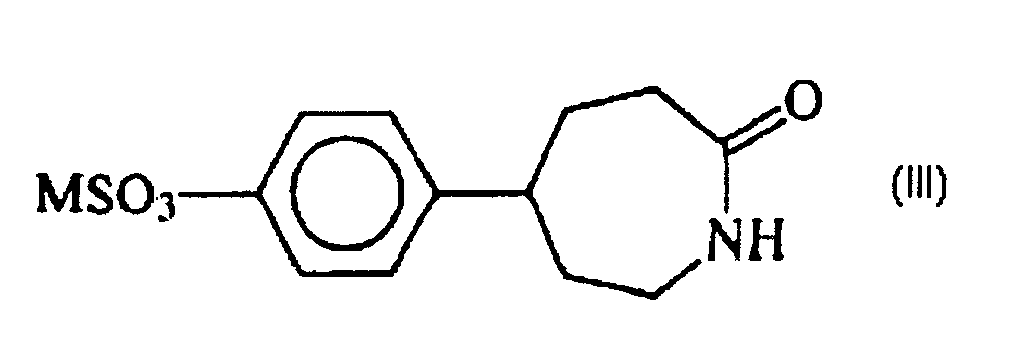
- As the functional group is not polymerisable the modified polylactam can contain up to 20 mol-%, preferably 0.001 to 20 mol-%, of the lactam derivative. These lactam derivative can be added during polymerisation without disturbing the polymerisation process and without a risk of gel formation.
- The advantage of these compounds is, that they influence the polymerisation process to a lesser extent than the known systems of the state of the art. Thus the molecular weight and the molecular weight distribution is hardly changed. Furthermore, they do not interfere with the N-group balance and do not affect the acidity of the lactam melt.
- The modified polylactam of the invention is prepared in the presence of the lactam derivative in the usual way. The polymerisation procedure incorporating the new lactam derivatives is exactly the same as for the normal lactam polymerisation. The resulting modified polylactam has essentially the same molecular weight as the normal polylactam. Furthermore, the thermal properties of the polymer are less affected in comparison with a polylactam obtained using the dicarboxylic acid/diamine system, for example with the lithium salt of 5-sulfoisophthalic acid and hexamethylenediamine.
- The modified polylactam can be subjected to a postcondensation step to raise the Mw. Before the postcondensation step the modified polylactam has a Mw of 2000 to 35000, preferably 20000 to 30000 and most preferably 20000 to 25000. After postcondensation the modified polylactam has a Mw of 30000 to 60000, preferably 40000 to 60000 and most preferably 45000 to 55000.
- The modified polylactam is used for fibres, paper coatings, glues, carpet yarns and engeneering plastics. Fibres made from the modified polylactam can further comprise usual polylactam. In this case the modified polylactam is incorporated in the polylactam by using a masterbatch of the modified polylactam, which is mixed with the regular polylactam.
- The invention further relates to the new lactam derivative taking actively part in stabilisation, dyeability, and flame retardancy of the polylactam without affecting the molecular weight and the molecular weight distribution of the resulting polylactam. The most preferred lactam derivative is the caprolactam derivative having the formula III,wherein M is lithium, sodium, or potassium.
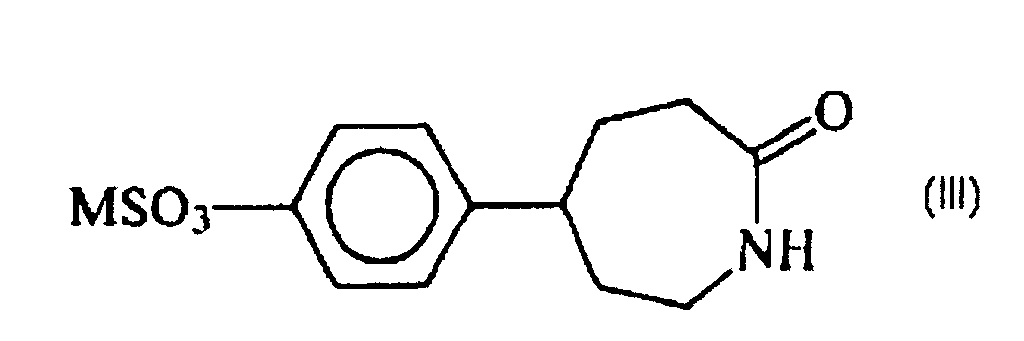
- The lactam derivative can be produced in the usual way by the following steps:
- a. oximation reaction of a substituted cycloketone to the hydroxylimine of the ketone,
- b. contacting with concentrated sulfuric acid to affect Beckmann rearrangement of hydroxylimine.
-
- In the case the lactam derivative is the compound according to formula III a further advantage is that the compound can be obtained using the normal caprolactam synthesis starting from phenyl-cyclohexanone wherein the Beckmann rearrangement and the sulfonisation is made in one step according to the following procedure:
- a. oximation reaction of phenyl cyclohexanone to the hydroxylimine of phenyl cyclohexanone,
- b. contacting with concentrated sulfuric acid to affect Beckmann rearrangement of hydroxylimine of phenyl cyclohexanone and sulfonisation of phenyl ring in one step to give sulfonated phenyl caprolactam,
- c. addition of alkalihydroxide and reaction of the sulfonated phenyl caprolactam to the alkali salt of sulfonated phenyl caprolactam.
-
- Thus it is possible to produce the new additives in a usual caprolactam producing facility.
- The new lactam derivatives according to the invention have a number of advantages over the existing systems of the state of the art using dicarboxylic acid salts and diamines. The lactam derivative does hardly interfere with the lactam polymerisation during the production of polylactam. As can be seen from the examples, a good incorporation of the lactam derivative takes place during the polylactam polymerisation. The use of the lactam derivative according to the invention has only a little effect on the molecular weight and molecular weight distribution compared to the known systems. The effect of the lactam derivative according to the invention on the thermal properties of the polymer is smaller than that of the known systems of the state of the art. Moreover, the use of the lactam derivative in the modified polylactam results in a higher melt viscosity at the same molecular weight in comparison with unmodified polylactam, which does not contain this additive.
- A further finding is, that the lactam derivative containing polymers, have a higher zero shear melt viscosity. The increase of the zero shear melt viscosity is at least 5 %, preferably at least 10 % to 15 %, and most preferably at least 20 %. This is advantageous for blow moulding or film forming applications.
- Therefore, the new lactam derivative according to the invention is a good alternative for the known additive systems containing dicarboxylic acid salts and diamines.
- The invention will be further described on the basis of the following examples without being limited thereto.
- The starting material was 4-phenyl-cyclohexanone ( 1 ) and the process is described as follows:
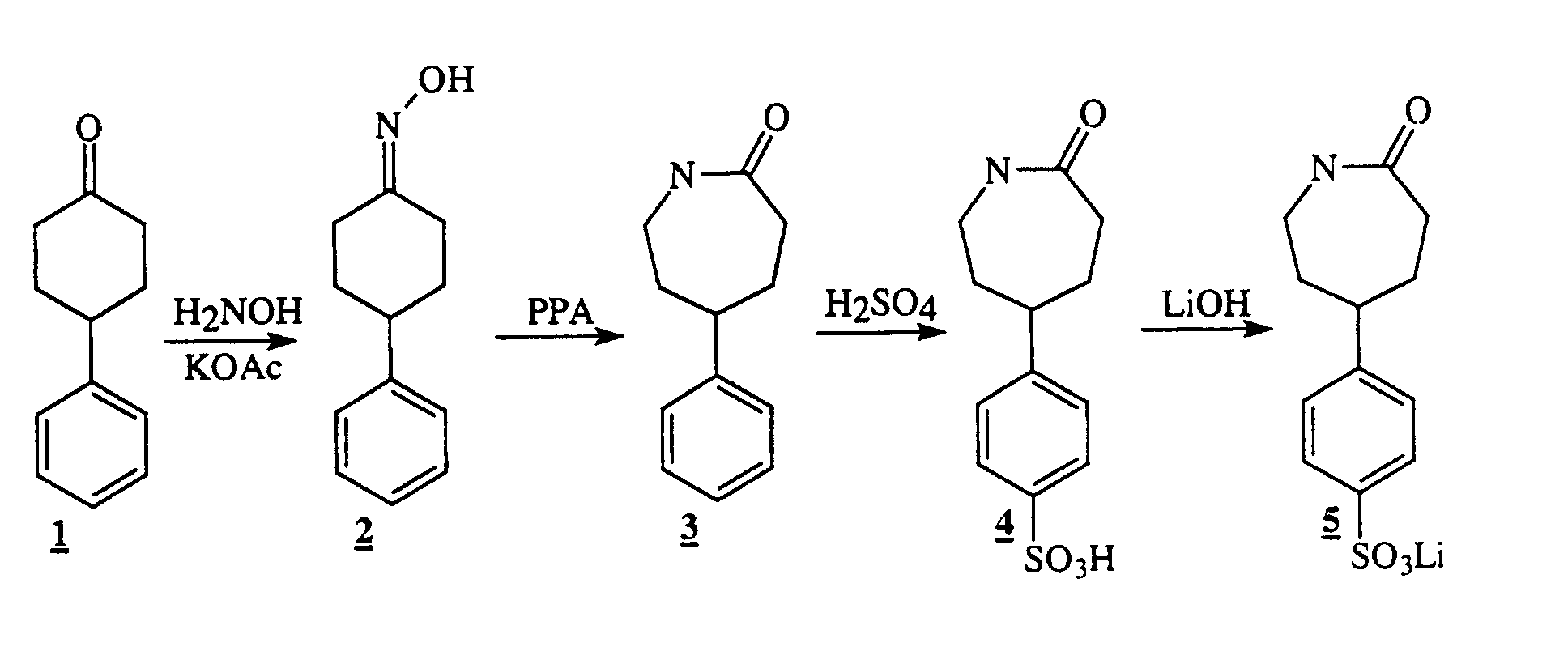
- 4-phenyl-cyclohexanone ( 1 ) (103 g, 0.59 mole) was dissolved in methanol (1 L).
This mixture was cooled to 0°C, after which potassium acetate (173 g) and hydroxylammonium chloride (73 g) were added. The reaction mixture was then stirred for 16 hours upon which the temperature slowly rose to room temperature. Subsequently, the methanol was evaporated and the residue poured out into 1.5 L water and stirred for 10 min. The solid was removed by filtration, washed with water and dried. This resulted in 114 g of compound 2 (quantitative yield) being isolated as a white solid that was pure enough for the next step. - The non-purified hydroxylimine 2 (108 g, max. 0.56 mole) was added in a short time to a mechanically stirred mixture of p-xylene (300 mL) and polyphosphoric acid (300 g). Subsequently, another 300 mL p-xylene was added and the mixture was heated for 3 hours until the boiling point was reached. Afterwards, the mixture was cooled to room temperature and 500 mL water was added with adequate stirring. This was followed by extraction with 1L chloroform. The organic layer was washed with water, dried (Na2SO4) and evaporated. The product was recrystallised from approx. 600 mL ethanol so that 83.1 g (0.44 mole, 75 %) (2 steps from 1 ) of compound 3 could be isolated as a white solid.
- Phenyl caprolactam 3 (54.2 g, 287 mmol) was added in portions to 150 ml 96% sulphuric acid. During the addition, the temperature of the mixture rose to 55°C. After everything had been added (in approximately 15 minutes) the mixture was stirred for 45 minutes at 60-65°C. Next, the reaction mixture was poured into 750 mL ice water and stirred for 30 minutes, the precipitate formed being filtered off and washed with methanol. After drying, the crude yield was 55.1 g. The filtrate was left to stand for a weekend, upon which precipitate was again formed, which was filtered off and dried, so that a second portion of 14.7 g could be isolated. The two portions were combined, brought to the boil in methanol for a short time and cooled to room temperature. The precipitate was filtered, washed twice with methanol and dried, so that 67 g (249 mmol, 87%) of pure sulfonic acid 4 could be isolated.
- Sulfonic acid 4 (75,5 g, 281 mmol) was stirred in 400 ml water. Subsequently, LiOH H2O (11.8g, 281 mmol) was added and the mixture was heated to 50°C so that a clear solution was formed. 200 mL water was evaporated and the residue was added to 200 mL acetone with vigorous stirring. The precipitate formed was filtered off, washed with acetone and dried so that 47.9 g (174 mmol, 62%) pure Li-salt 5 could be isolated. Expected elementary analysis: C 52.36%, H 5.13%, N 5.09%, Li 2.52%. Found: C 51.81%, H 5.06%, N 4.93%, Li 2.46%. (Purity on basis of Li and N is 97%)
- The process for the preparation of compound ( 5 ) is made in the same way as in example 1 with the difference that compound ( 2 ) is contacted with concentrated sulfuric acid to affect Beckmann rearrangement of hydroxylimine of phenyl cyclohexanone and sulfonisation of phenyl ring in one step to give sulfonated phenyl caprolactam ( 4 ).
- To the mixture of caprolactam, aminocaproic acid and water 2.2 wt-% of the lithium salt of 5-(1-(4-sulfonic acid) ―phenyl) ―hexahydro- 2H- azepine-2-one (hereinafter referred as Li-salt) was added after which the normal polymerisation and treatment procedure for the production of polycaprolactam was carried out.
- It was investigated whether the Li-salt was incorporated during the polymerisation in the modified polycaprolactam. This was done by determining the concentrations of sulphur by X-ray fluorescence in the washed polymer. Non-polymerised Li-salt is water-soluble and is therefore removed during the washing step. It was found that the amount of the Li-salt incorporated in the polymer was 90%.
Incorporation during polymerisation of caprolactam with 2.2 wt-% Li-salt found theory Sulphur 0.21 (± 0.02) wt-% 0.22 wt-% - Table 1 shows that the sulphur content found is very close to the theoretical value. On the basis of the sulphur content, Li-salt has the same reactivity relative to the polymerisation as caprolactam.
- The molecular weight and the rheology of the modified polycaprolactam was measured and compared with blank polycaprolactam.
Influence of Li-salt on the molecular weight and the rheology SEC-DV Mw/Mn Mw (x103) Mz/Mw [η]HCOOH dl/g η 0 230C Pas as-polymerised blank polycaprolactam (comparison) 2.2 25 1.6 1.05 5.9x10² polycaprolactam with 0.08 meq/g Li-salt (invention) 1.9 22 1.6 0.89 7.2x10² Post-condensed blank polycaprolactam (comparison) 2.2 52 1.9 1.68 1.3x10⁴ polycaprolactam with 0.08 meq/g Li-salt (invention) 2.0 49 1.8 1.57 1.4x10⁴ SEC-DV = size exclusion chromatography-differential viscosimetry Mw/Mn = average molecular weight/number average molecular weight Mw = average molecular weight Mz/Mw = viscosity average molecular weight/ average molecular weight [η]HCOOH = intrinsic viscosity measured in formic acid η 0 230C = zero shear melt viscosity Pas = Pascalseconds meq = milliequivalents - From Table 2 it is concluded that the addition of Li-salt has only very little effect on the molecular weight and the molecular weight distribution of the polymer. The SEC-DV results indicate that there is a small decrease in the molecular weight. It is evident from the fact that the Li-salt does not function as a chain stopper (causes non-reactive chain ends) that the polymer can be subjected to post-condensation up to a very high molecular weight, just like the blank polycaprolactam. It should be noted that after post-condensation the differences in molecular weight are within the reproducibility of the polymerisation experiments.
- A further finding is, that the Li-salt containing polymers have a higher zero shear melt viscosity. The increase of the zero shear melt viscosity in the present example is about 18 %. This is advantageous for blow moulding or film forming applications.
- The thermal properties of the modified polycaprolactam of the invention were measured and compared with blank polycaprolactam. Table 3 shows the results.
Influence of comonomers on thermal properties Tm2 (°C) ΔHh2 (J/g) Tcc (°C) ΔHc1 (J/g) Tg (°C) as-polymerised blank polycaprolactam (comparison) 218.8 77.4 171.1 73.5 44 polycaprolactam with 0.08 meq/g Li-salt (invention) 216.0 65.7 164.6 66.2 45 polycaprolactam with 0.08 meq/g Li-sip + 0.06 meq/g HMDA (comparison) 212.8 64.2 160.4 62.1 63 post-condensed blank polycaprolactam (comparison) 220.2 76.3 167.7 76.3 56 polycaprolactam with 0.08 meq/g Li-salt (invention) 215.8 74.3 161.9 71.3 48 - As evident from Table 3, the incorporation of Li-salt reduces the melting temperature (Tm2), the crystallisation temperature during cooling (Tcc), and the melting heat formed during both melting and cooling (ΔHh2, ΔHc1). Still, there is a clear improvement in these properties compared to the known system (lithium salt of 5-sulfoisophthalic acid/Hexamethylenediamine hereinafter referred as Li-sip system) as currently in commercial use. Compared to blank polycaprolactams, post-condensation increases the difference in Tm2, Tcc and Tg, whereas the difference in melting and crystallisation heat decreases.
Claims (18)
- Modified polylactam containing recurring units of lactam and minor amounts of a lactam derivative having one or more non-polymerisable functional groups directly or indirectly attached to the carbon atoms of the lactam ring and wherein the functional group comprises a heteroatom.
- Modified polylactam according to claim 1, characterised in that the lactam or the lactam derivative is selected from the group consisting of caprolactam, lauryllactam, caprylolactam or mixtures thereof.
- Modified polylactam according to claim 1 or 2, characterised in that the lactam derivative contains a substituted or unsubstituted phenyl group between the functional group and the lactam group.
- Modified polylactam according to claims 1 to 3, characterised in that the lactam derivative is substituted by a group according to formula Iwherein X is a -SO3H group, a ―SO2NH2 group, a OH group, a phosphate group, a NHR1 group or a OR2 group and salts thereof and R1, R2 independently are a C1-C4 alkyl group, a cycloalkyl group, or a phenyl group, and wherein the phenyl ring can be substituted at each position of the carbon atom.
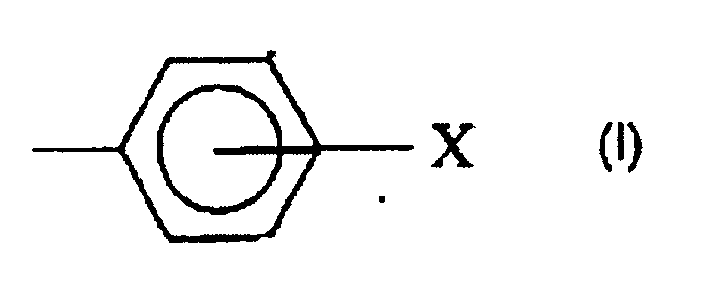
- Modified polylactam according to claims 1 to 4 ,characterised in that the lactam derivative is substituted by groups selected from t-butyl phenol, phenyl sulfonate, phenyl sulfonamide, phenyl phosphate, phosphate, phenol, and salts thereof.
- Modified polylactam according to claims 1 to 5, characterised in that the lactam derivative is substituted by a group of the formula IIwherein one or more ―SO3M groups are present at the phenyl ring and M is lithium, sodium or potassium.

- Modified polylactam according to claims 1 to 6, characterised in that the lactam derivative is a caprolactam derivative having the formula III,wherein M is lithium, sodium, or potassium.

- Modified polylactam according to claims 1 to 7, characterised in that it contains 0.001 to 20 mol-% of the lactam derivative.
- Process for the preparation of a modified polylactam according to claims 1 to 8, characterised in that the lactam polymerisation is carried out in the presence of a functionalised lactam derivative as described in claims 1 to 8.
- Process according to claim 9, characterised in that the modified polylactam is subjected to a postcondensation.
- Use of the modified polylactam according to claims 1 to 8 for fibres, paper coatings, glues, carpet yarns, engeneering plastics.
- Fibres comprising the modified polylactam according to claims 1 to 8.
- Fibres according to claim 11 further comprising polylactam.
- Lactam derivative that takes actively part in stabilisation, dyeability, and flame retardancy of the polylactam without affecting the molecular weight and the molecular weight distribution of the resulting polylactam.
- Lactam derivative as described in claims 1 to 8.
- Use of the lactam derivative according to claims 13 or 14 for adding functionality to polylactam without affecting the molecular weight and the molecular weight distribution of the resulting polylactam.
- Process for the manufacture of the lactam derivative according to claims 1 to 7 by the following steps:a. oximation reaction of a substituted cycloketone to the hydroxylimine of the ketone,b. contacting with concentrated sulfuric acid to affect Beckmann rearrangement of hydroxylimine.
- Process for the preparation of the lactam derivative according to claim 6 or 7, characterised by the following steps:a. oximation reaction of phenyl cyclohexanone to the hydroxylimine of phenyl cyclohexanone,b. contacting with concentrated sulfuric acid to affect Beckmann rearrangement of hydroxylimine of phenyl cyclohexanone and sulfonisation of phenyl ring in one step to give sulfonated phenyl caprolactam,c. addition of alkalihydroxide and reaction of the sulfonated phenyl caprolactam to the alkali salt of sulfonated phenyl caprolactam.
Priority Applications (6)
| Application Number | Priority Date | Filing Date | Title |
|---|---|---|---|
| EP00126193A EP1211275A1 (en) | 2000-11-30 | 2000-11-30 | Modified Polylactam |
| DE60130240T DE60130240D1 (en) | 2000-11-30 | 2001-11-26 | MODIFIED POLYLACTAM |
| AT01998581T ATE371688T1 (en) | 2000-11-30 | 2001-11-26 | MODIFIED POLYLACTAM |
| AU2002222803A AU2002222803A1 (en) | 2000-11-30 | 2001-11-26 | Modified polylactam |
| EP01998581A EP1337575B1 (en) | 2000-11-30 | 2001-11-26 | Modified polylactam |
| PCT/NL2001/000859 WO2002044246A1 (en) | 2000-11-30 | 2001-11-26 | Modified polylactam |
Applications Claiming Priority (1)
| Application Number | Priority Date | Filing Date | Title |
|---|---|---|---|
| EP00126193A EP1211275A1 (en) | 2000-11-30 | 2000-11-30 | Modified Polylactam |
Publications (1)
| Publication Number | Publication Date |
|---|---|
| EP1211275A1 true EP1211275A1 (en) | 2002-06-05 |
Family
ID=8170536
Family Applications (2)
| Application Number | Title | Priority Date | Filing Date |
|---|---|---|---|
| EP00126193A Withdrawn EP1211275A1 (en) | 2000-11-30 | 2000-11-30 | Modified Polylactam |
| EP01998581A Expired - Lifetime EP1337575B1 (en) | 2000-11-30 | 2001-11-26 | Modified polylactam |
Family Applications After (1)
| Application Number | Title | Priority Date | Filing Date |
|---|---|---|---|
| EP01998581A Expired - Lifetime EP1337575B1 (en) | 2000-11-30 | 2001-11-26 | Modified polylactam |
Country Status (5)
| Country | Link |
|---|---|
| EP (2) | EP1211275A1 (en) |
| AT (1) | ATE371688T1 (en) |
| AU (1) | AU2002222803A1 (en) |
| DE (1) | DE60130240D1 (en) |
| WO (1) | WO2002044246A1 (en) |
Cited By (1)
| Publication number | Priority date | Publication date | Assignee | Title |
|---|---|---|---|---|
| CN112375218A (en) * | 2020-09-16 | 2021-02-19 | 贺州学院 | Water-soluble polymer modifier containing nylon structure for calcium carbonate surface modification and preparation method thereof |
Families Citing this family (1)
| Publication number | Priority date | Publication date | Assignee | Title |
|---|---|---|---|---|
| DE102008026075B4 (en) * | 2008-05-30 | 2015-04-30 | Lurgi Zimmer Gmbh | Process for the preparation of polyamides using carboxylic acids and amides |
Citations (4)
| Publication number | Priority date | Publication date | Assignee | Title |
|---|---|---|---|---|
| US3228759A (en) * | 1961-02-23 | 1966-01-11 | Ici Ltd | Anionic polymerization of lactams with volatile promoters |
| US3950311A (en) * | 1973-03-10 | 1976-04-13 | Bayer Aktiengesellschaft | Process for the preparation of polycaprolactam which can be dyed with cationic dyes |
| US4579762A (en) * | 1984-12-24 | 1986-04-01 | Monsanto Company | Stain resistant carpet with impervious backing |
| US5164261A (en) * | 1990-08-08 | 1992-11-17 | E. I. Du Pont De Nemours And Company | Dyed antistain nylon with cationic dye modifier |
-
2000
- 2000-11-30 EP EP00126193A patent/EP1211275A1/en not_active Withdrawn
-
2001
- 2001-11-26 EP EP01998581A patent/EP1337575B1/en not_active Expired - Lifetime
- 2001-11-26 AU AU2002222803A patent/AU2002222803A1/en not_active Abandoned
- 2001-11-26 AT AT01998581T patent/ATE371688T1/en not_active IP Right Cessation
- 2001-11-26 WO PCT/NL2001/000859 patent/WO2002044246A1/en not_active Ceased
- 2001-11-26 DE DE60130240T patent/DE60130240D1/en not_active Expired - Lifetime
Patent Citations (4)
| Publication number | Priority date | Publication date | Assignee | Title |
|---|---|---|---|---|
| US3228759A (en) * | 1961-02-23 | 1966-01-11 | Ici Ltd | Anionic polymerization of lactams with volatile promoters |
| US3950311A (en) * | 1973-03-10 | 1976-04-13 | Bayer Aktiengesellschaft | Process for the preparation of polycaprolactam which can be dyed with cationic dyes |
| US4579762A (en) * | 1984-12-24 | 1986-04-01 | Monsanto Company | Stain resistant carpet with impervious backing |
| US5164261A (en) * | 1990-08-08 | 1992-11-17 | E. I. Du Pont De Nemours And Company | Dyed antistain nylon with cationic dye modifier |
Cited By (2)
| Publication number | Priority date | Publication date | Assignee | Title |
|---|---|---|---|---|
| CN112375218A (en) * | 2020-09-16 | 2021-02-19 | 贺州学院 | Water-soluble polymer modifier containing nylon structure for calcium carbonate surface modification and preparation method thereof |
| CN112375218B (en) * | 2020-09-16 | 2022-10-28 | 贺州学院 | A kind of water-soluble polymer modifier for calcium carbonate surface modification, containing nylon structure and preparation method thereof |
Also Published As
| Publication number | Publication date |
|---|---|
| EP1337575A1 (en) | 2003-08-27 |
| DE60130240D1 (en) | 2007-10-11 |
| ATE371688T1 (en) | 2007-09-15 |
| AU2002222803A1 (en) | 2002-06-11 |
| EP1337575B1 (en) | 2007-08-29 |
| WO2002044246A1 (en) | 2002-06-06 |
Similar Documents
| Publication | Publication Date | Title |
|---|---|---|
| US4391968A (en) | Process for preparing polyamides having a modified dye affinity | |
| US4012365A (en) | Fiber-forming polyamides from naphthalene-2,7-dicarboxylic acid and aliphatic diamine | |
| EP1337575B1 (en) | Modified polylactam | |
| US7314906B2 (en) | High molecular weight stereoregular head-tail poly(glucaramides) | |
| US3654237A (en) | Aliphatic acid sulfonate modified polyamides | |
| US4219636A (en) | Preparation polyamides of isophthalic acid and hexamethylene diamine with formic acid | |
| US5723569A (en) | Random copolymerized polyamide resin and process for preparing the same | |
| US6355769B1 (en) | Partially aromatic polyamides and a process for making them | |
| US5026818A (en) | Melt preparation of polyamide with additive combination | |
| US3821168A (en) | Process for the preparation of linear polyamides containing sulfonategroups | |
| US4225701A (en) | Crystalline polyamides from branched chain diamine and terephthalic acid | |
| US5276131A (en) | Preparation of polyamide from arylene cyclic diamide | |
| US4873310A (en) | Aromatic polyamides based on phenoxyterephthalic acid and process for preparing them | |
| US3951599A (en) | Polyamides having improved dyeability prepared from aromatic carboxylic monosulfonated compounds | |
| US5686556A (en) | Process for the preparation of an α-amino ω-ester monoamide and process for the manufacture of a polyamide | |
| CA1036748A (en) | Polyamide concentrates containing sulphonate groups | |
| EP0411709B1 (en) | Polyamide composition | |
| CA1338649C (en) | Aromatic copolyether amide which can be processed as a thermoplastic, process for its preparation, and its use for the production of moldings | |
| US3950311A (en) | Process for the preparation of polycaprolactam which can be dyed with cationic dyes | |
| Jeong et al. | Synthesis and characterization of novel aromatic polyamides from 3, 4-Bis (4-aminophenyl)-2, 5-diphenylthiophene and aromatic dicarboxylic acids | |
| JP3601384B2 (en) | Novel polyamide and process for producing the same | |
| KR100221030B1 (en) | Polyamide having n, n-substituents-1,2,4,5-diimido group and its preparation method | |
| KR100768380B1 (en) | Continuous production method of nylon 6 and nylon fibers produced thereby | |
| US4617375A (en) | Polyamide, from condensed cyclic dicarboxylic acid and branched chain diamine | |
| KR950000070B1 (en) | Method for preparing basic dye salt-containing polyamide |
Legal Events
| Date | Code | Title | Description |
|---|---|---|---|
| PUAI | Public reference made under article 153(3) epc to a published international application that has entered the european phase |
Free format text: ORIGINAL CODE: 0009012 |
|
| AK | Designated contracting states |
Kind code of ref document: A1 Designated state(s): AT BE CH CY DE DK ES FI FR GB GR IE IT LI LU MC NL PT SE TR |
|
| AX | Request for extension of the european patent |
Free format text: AL;LT;LV;MK;RO;SI |
|
| AKX | Designation fees paid | ||
| REG | Reference to a national code |
Ref country code: DE Ref legal event code: 8566 |
|
| STAA | Information on the status of an ep patent application or granted ep patent |
Free format text: STATUS: THE APPLICATION IS DEEMED TO BE WITHDRAWN |
|
| 18D | Application deemed to be withdrawn |
Effective date: 20021206 |