EP1211024A2 - Polishing method - Google Patents
Polishing method Download PDFInfo
- Publication number
- EP1211024A2 EP1211024A2 EP01128235A EP01128235A EP1211024A2 EP 1211024 A2 EP1211024 A2 EP 1211024A2 EP 01128235 A EP01128235 A EP 01128235A EP 01128235 A EP01128235 A EP 01128235A EP 1211024 A2 EP1211024 A2 EP 1211024A2
- Authority
- EP
- European Patent Office
- Prior art keywords
- polishing
- polished
- abrasive
- polishing method
- acid
- Prior art date
- Legal status (The legal status is an assumption and is not a legal conclusion. Google has not performed a legal analysis and makes no representation as to the accuracy of the status listed.)
- Withdrawn
Links
Images
Classifications
-
- B—PERFORMING OPERATIONS; TRANSPORTING
- B24—GRINDING; POLISHING
- B24D—TOOLS FOR GRINDING, BUFFING OR SHARPENING
- B24D3/00—Physical features of abrasive bodies, or sheets, e.g. abrasive surfaces of special nature; Abrasive bodies or sheets characterised by their constituents
- B24D3/34—Physical features of abrasive bodies, or sheets, e.g. abrasive surfaces of special nature; Abrasive bodies or sheets characterised by their constituents characterised by additives enhancing special physical properties, e.g. wear resistance, electric conductivity, self-cleaning properties
-
- H—ELECTRICITY
- H10—SEMICONDUCTOR DEVICES; ELECTRIC SOLID-STATE DEVICES NOT OTHERWISE PROVIDED FOR
- H10P—GENERIC PROCESSES OR APPARATUS FOR THE MANUFACTURE OR TREATMENT OF DEVICES COVERED BY CLASS H10
- H10P52/00—Grinding, lapping or polishing of wafers, substrates or parts of devices
-
- B—PERFORMING OPERATIONS; TRANSPORTING
- B24—GRINDING; POLISHING
- B24B—MACHINES, DEVICES, OR PROCESSES FOR GRINDING OR POLISHING; DRESSING OR CONDITIONING OF ABRADING SURFACES; FEEDING OF GRINDING, POLISHING, OR LAPPING AGENTS
- B24B37/00—Lapping machines or devices; Accessories
- B24B37/11—Lapping tools
- B24B37/20—Lapping pads for working plane surfaces
- B24B37/24—Lapping pads for working plane surfaces characterised by the composition or properties of the pad materials
Definitions
- the present invention relates to a polishing method, and to be more specific, relates to a polishing method using a polishing pad having a polishing part in which abrasive is dispersed, and an aqueous chemical mechanical polishing solution.
- the polishing method in the invention can be used favorably for the polishing of precision materials of various fields, for example, in the connection formation process of a DRAM, a high-speed logic LSI, or other semiconductor device requiring mixed installation of fine connections of approximately 0.1 ⁇ m to wide connections of approximately 100 ⁇ m.
- the polishing method in the invention is also especially favorable for polishing applications that require the attainment of a high degree of surface flatness.
- CMP Chemical mechanical polishing
- polishing is performed by sliding while pressing a surface to be polished of the wafer and the like against a disk-like polishing pad and at the same time, pouring a slurry, in which abrasive is dispersed, onto the polishing pad.
- the slurry the abrasive in particular
- the slurry is expensive and furthermore, vast costs are required for the treatment of used slurry.
- Polishing pads in which the abrasive is contained, have been disclosed in Japanese Unexamined Patent Publication No. Hei-10-329032, Japanese Unexamined Patent Publication No. Hei-11-151659, Japanese Unexamined Patent Publication No. Hei-11-188647, Japanese Unexamined Patent Publication No. Hei-11-207632 and the like.
- adequate removal rates cannot be obtained with these polishing pads, especially in the polishing of a surface to be polished containing a metal such as tungsten, copper and aluminum.
- the present invention can resolve the above problems, and an object thereof is to provide a polishing method, with which a surface of high flatness can be obtained without fail at a high removal rate and in a stable manner, and, in particular, provide a polishing method, with which the above effects can be obtained even for a surface to be polished that contains a metal such as copper, tungsten and the like.
- a surface having high flatness can be obtained at a high removal rate and in a stable manner.
- a slurry that contains an abrasive is not used, there is no need to take countermeasures against the aggregation of the abrasive during storage, transport or the like.
- the above-mentioned "abrasive” is mainly a particle that exhibits a mechanical polishing action.
- the abrasive may be used a particle comprised of at least one selected from ceria, silica, alumina, titanium oxide, chromium oxide, manganese dioxide, dimanganese trioxide, iron oxide, zirconium oxide, silicon carbide, boron carbide, diamond and barium carbonate.
- ceria, silica and alumina are preferable. Since these are good in compatibility with water, they are high in dispersion property in water.
- the abrasive in employing may be comprised of one kind above or be in combination of two or more. In the case where glass or other form of silicon oxide is polished, ceria is considered to exhibit a chemical polishing action in addition to a mechanical polishing action.
- the preferred abrasive is substantially spherical in shape and do not have any sharp corners.
- the abrasive is preferably high in purity.
- Preferable abrasive is for example, (1) abrasive produced by a fumed method in which silicone chloride, aluminum chloride, titanium chloride and the like is reacted with oxygen and hydrogen in the gas phase, (2) abrasive synthesized by a sol-gel method in which a metal alkoxide, such as tetraethoxysilane or titanium alkoxide and the like, is hydrolyzed and condensated, (3) abrasive produced by an inorganic colloid method in which impurities are removed by refining, and the like.
- the mean particle diameter of the abrasive is preferably 0.005 to 50 ⁇ m, more preferably 0.005 to 10 ⁇ m, and even more preferably 0.01 to 1 ⁇ m. If the mean particle diameter is less than 0.005 ⁇ m, the polishing effect tends to be low. On the other hand, the mean particle diameter in the excess of 50 ⁇ m is not preferable in that there is a tendency for the probability of causing scratches to increase gradually since the abrasive is large.
- the mean particle diameter can be measured by using a transmission electron microscope.
- the "polishing part” is comprised of a matrix phase and the abrasive contained therein.
- the abrasive may be contained in the polishing part in any form. For example, only the abrasive may be dispersed and contained in the matrix phase constituting the polishing part. And composite particles which the abrasive is attached to the peripheries of organic particles may be dispersed and contained in the matrix phase.
- the abrasive is preferably contained in the above-mentioned polishing part in the condition where its mean particle diameter is within the above-mentioned preferable particle diameter range.
- the polishing part may comprise the entirety of the polishing pad or just a part of the polishing pad.
- the "matrix material” is a material constituting the matrix phase that holds the abrasive in the polishing part of the polishing pad. Rubber, resin, thermoplastic elastomer and the like may be used as the matrix material.
- the matrix material may be used diene-based polymers, styrene-based polymers, (meth)acrylic-based polymers, olefin-based polymers, epoxy-based polymers, phenol-based polymers, polyimide-based polymers and the like. Among these, styrene-based polymers and (meth)acrylic-based polymers are preferable. Any of these polymers may be used alone or in combination of two or more. And these polymer may be a homopolymer or a copolymer.
- the matrix material may be a crosslinked polymer or an uncrosslinked polymer, and is preferably crosslinked one.
- the matrix material is preferably forming fine particles and dispersed in the aqueous dispersion containing thereof.
- the mean particle diameter of the fine particles is preferably 10 ⁇ m or less and more preferably 0.1 to 3 ⁇ m.
- the amount of the matrix material constituting the polishing part is preferably 10 to 99% by volume, more preferably 15 to 70% by volume based on 100% by volume of the total of the matrix material and the abrasive.
- the above-mentioned polishing part may contain an inorganic acid or organic acid which is not functioning as an oxidizing agent upon dissolving in the aqueous chemical mechanical polishing solution, a surfactant which is soluble in the aqueous chemical mechanical polishing solution, a hydroxide of an alkali metal, a chelating agent, a scratch inhibitor, an antistatic agent, a substance which dissolves in the aqueous chemical mechanical polishing solution to give rise to a multivalent metal ion, and the like.
- the above-mentioned polishing part is preferably formed by the solidification of an aqueous dispersion, in which the matrix material and the abrasive are respectively dispersed and contained.
- the above-mentioned polishing part is preferably formed by solidifying an aqueous dispersion, having dispersed and contained therein composite particles where the abrasive is attached to the matrix material.
- the aqueous dispersion may furthermore have the matrix material and/or the abrasive dispersed and contained therein.
- the above-mentioned polishing part is preferably obtained by solidification of an aqueous dispersion, which is (1) an aqueous dispersion, in which a matrix material and abrasive are contained and dispersed separately, (2) an aqueous dispersion, in which composite particles are contained and dispersed, (3) an aqueous dispersion, in which composite particles and abrasive are contained and dispersed, (4) an aqueous dispersion, in which composite particles and a matrix material are contained and dispersed, or (5) an aqueous dispersion, in which composite particles, a matrix material, and the abrasive are contained and dispersed.
- an aqueous dispersion which is (1) an aqueous dispersion, in which a matrix material and abrasive are contained and dispersed separately, (2) an aqueous dispersion, in which composite particles are contained and dispersed, (3) an aqueous dispersion, in which composite particles and abrasive are
- the “composite particles” are particles, where the abrasive is attached to surface and/or interior of the matrix material. Attaching of the abrasive is not restricted to the surface of the composite particles.
- the method of attaching the abrasive to the matrix material is not restricted in particular, and the abrasive may be attached electrostatically to the matrix material by a zeta potential difference. In the case of this method, the zeta potentials of the matrix material and the abrasive are opposite in sign and the potential difference is preferably 5mV or more and more preferably 10mV or more.
- the zeta potential of the matrix material may be adjusted by the introduction of at least one type of group among a carboxyl group, a sulfonic acid group, an amino group, a sulfuric ester group, a phosphoric ester group, an ether-bond, an ester-bond and the like. Furthermore, the surface of the composite particles may be covered by a condensate comprised of a silane coupling agent, so that the attached abrasive will not drop off readily.
- a dispersion medium of the above-mentioned "aqueous dispersion” may be just water or a mixed dispersion medium that contains a dispersion medium besides water.
- the water content is preferably 10% by mass or more and more preferably 20% by mass or more based on 100% by mass of the mixed dispersion medium.
- the dispersion medium besides water that is to be contained in the mixed dispersion medium include non-protonic polar solvents, esters, ketones, phenols, alcohols, amines, and other dispersion media.
- the dispersion medium with a boiling point of 60 to 200°C is preferably used so that excessive evaporation will not occur in the preparation of the aqueous dispersion and yet the removal of the dispersion medium can be performed readily.
- the solid content of the aqueous dispersion is preferably 1 to 80% by mass and more preferably 10 to 60% by mass. A solid content in the excess of 80% by mass is not preferable in that the dispersion stability of the aqueous dispersion will tend to be low and precipitation can occur.
- the aqueous dispersion is preferably one where the abrasive is dispersed in an emulsion in which the matrix material is dispersed.
- an emulsion such as an emulsion obtained by emulsion polymerization, an emulsion obtained by emulsification using an emulsifying agent or the like, enables a polishing part, with which the dispersion of the abrasive is especially good, to be obtained.
- the method of dispersing the matrix material in the aqueous dispersion is not restricted in particular.
- the dispersion may be obtained by emulsion polymerization, suspension polymerization and the like, or by dissolving the previously obtained matrix material in a solvent or the like, and dispersing the resulting solution in water and the like.
- the aqueous dispersion, in which the matrix material and the abrasive are dispersed may be obtained by directly adding and dispersing the abrasive or by adding a previously prepared dispersion in which the abrasive is dispersed.
- the aqueous dispersion may contain, if necessary, a surfactant, a substance which dissolves in the aqueous chemical mechanical polishing solution to give rise to a multivalent metal ion, a vulcanizing agent, a vulcanization accelerator, a crosslinking agent, a crosslinking accelerator, a filler, a foaming agent, hollow particles (expanding or non-expanding) which form voids, a softening agent, an antioxidant, an ultraviolet absorber, an antistatic agent, a plasticizer and the like.
- an oxidizing agent a hydroxide of alkali metal, an acid, a pH adjuster, a chelating agent, a scratch inhibitor and the like which are conventionally contained in a slurry used in CMP may be employed.
- the hydroxide of alkali metal may be used sodium hydroxide, potassium hydroxide, rubidium hydroxide, cesium hydroxide and the like.
- the hydroxide of alkali metal may be used alone or in combination of two or more.
- the acid may be used an inorganic acid and an organic acid, which is indicated as examples in the description of the "aqueous chemical mechanical polishing solution" below.
- the inorganic acid may be used hydrochloric acid, nitric acid, sulfuric acid and the like.
- the acid may be used alone or in combination of two or more.
- the chelating agent may be used ethylenediaminetetraacetic acid(EDTA), nitrilotriacetic acid, acetylacetone, bis-acetylacetoneethylenediimine, diethylenentriaminepentaacetic acid, glycoletherdiamine tetraacetic acid and the like.
- EDTA ethylenediaminetetraacetic acid
- acetylacetone acetylacetone
- bis-acetylacetoneethylenediimine diethylenentriaminepentaacetic acid
- glycoletherdiamine tetraacetic acid glycoletherdiamine tetraacetic acid and the like.
- the chelating agent may be used alone or in combination of two or more.
- the scratch inhibitor may be used biphenol, bipyridyl, 2-vinylpyridine, 4-vinylpyridine, salicylaldoxime, o-phenylenediamine, m-phenylenediamine, catechol, o-aminophenol, thiourea, N-alkyl-group-containing (meth)acrylamide, N-aminoalkyl-group-containing (meth)acrylamide, 7-hydroxy-5-methyl-1,3,4-triazaindolizine, 5-methyl-lH-benzotriazole, phthalazine, melamine, 3-amino-5,6-dimethyl-1,2,4-triazine and the like.
- the scratch inhibitor may be used alone or in combination of two or more.
- solidification normally requires a dispersion medium elimination process and a forming process. These processes may be carried out simultaneously or separately. Or, after eliminating the dispersion medium to some degree, forming may be performed and thereafter, complete elimination of the dispersion medium may be performed.
- the elimination of the dispersion medium may for example be performed by leaving in an open system to eliminate the dispersion medium naturally by evaporation.
- the evaporation of the dispersion medium may furthermore be promoted by heating, depressurizing and the like.
- the dispersion medium may also be evaporated rapidly at the same time as in forming by a spray drying method and the like.
- the residue which has been made into lump, flake, powder, pellet or the like in form after elimination of the dispersion medium to some degree, may be subject to press molding, extrusion molding, injection molding and the like.
- the aqueous dispersion may be poured into a desired mold and solidification to the shape of the mold may be performed by eliminating the dispersion medium in the same manner as described above. Also, without using a mold, the aqueous dispersion may be developed across the surface of a film and the like which is to be the base material, and thereafter the dispersion medium may be eliminated in the same manner as described above.
- crosslinking may be performed by heating and the like after solidification.
- the matrix material is a crosslinking polymer, a crosslinking copolymer or the like
- the aqueous dispersion may be made to contain a binder and this may be solidified to bind the matrix material.
- the binder may be used a homopolymer and/or a copolymer which is the same as the above-mentioned matrix material.
- the abrasive is dispersed extremely well even though it is normally extremely difficult to disperse the abrasive in the matrix phase due to the low compatibility of the organic material (matrix material) and the inorganic material (abrasive).
- the volume ratio of the abrasive may be adjusted over a wide range, preferably from 1 to 90% by volume, more preferably 30 to 85% by volume.
- aqueous chemical mechanical polishing solution (hereinafter referred to simply as “aqueous solution”) shall be described.
- the above-mentioned aqueous solution is for existing between the polishing surface of the polishing pad and the surface to be polished of the object to be polished in the process of polishing the object to be polished by using the polishing pad.
- the above-mentioned "polishing surface” is a surface that at least includes the surface of the polishing part of the polishing pad and is the surface that is made to slide against the surface to be polished of the object to be polished in the polishing process.
- An oxidizing agent and an aqueous medium that dissolves this oxidizing agent are normally contained in the above-mentioned aqueous solution.
- aqueous medium just water or a medium containing water may be used.
- This aqueous medium may contain, for example, a non-protonic polar solvent, an ester, a ketone, a phenol, an alcohol, an amine and the like. These may be used alone or in combination of two or more.
- Water is contained in the above-mentioned aqueous solution at an amount of preferably 10% by mass or more and more preferably 20% by mass or more.
- the above-mentioned “oxidizing agent” is for oxidizing the components that constitute the above-mentioned surface to be polished of the object to be polished. Especially in the case where the surface to be polished is a metal layer, the removal rate can be improved significantly by oxidization of the metal layer by the oxidizing agent and removing of the oxidized metal with the abrasive.
- the above-mentioned oxidizing agent is not restricted in particular, and normally, a water-soluble oxidizing agent is favorably used. Considering the electrochemical properties and the like of the surface to be polished, it is preferable to select the oxidizing agent using, for example, a Pourbaix line diagram and the like.
- the above-mentioned oxidizing agent may be used inorganic peroxides such as hydrogen peroxide, persulfates such as ammonium persulfate and potassium persulfate, heteropolyacids such as silicomolybdic acid, phosphomolybdic acid, tungstosilicic acid and phosphotungstenic acid, permanganate compounds such as potassium permanganate, dichromate compounds such as potassium dichromate, halogenate compounds such as chlorates, chlorites, perchlorates and potassium iodate, nitrates such as nitric acid and iron nitrate, transition metal salts such as potassium ferricyanide, organic peroxides such as peracetic acid, perbenzoic acid and tert-butylhydroperoxide, and the like.
- inorganic peroxides such as hydrogen peroxide, persulfates such as ammonium persulfate and potassium persulfate, heteropolyacids such as silicom
- hydrogen peroxide is especially preferable.
- treating the waste liquid after use is facilitated, and furthermore in the case of manufacture of a semiconductor device, the washing of the semiconductor device after polishing is facilitated.
- Any of these oxidizing agent may be used alone or in combination of two or more.
- the preferable content of the above-mentioned oxidizing agent in the aqueous solution will differ according to the type of the oxidizing agent.
- the content of the above-mentioned oxidizing agent is preferably 0.1 to 30 parts by mass and more preferably 1 to 10 parts by mass based on 100 parts by mass of the aqueous solution. If the content is less than 0.1 parts by mass, the removal rate may not be improved adequately. Meanwhile, if the content is exceeding 30 parts by mass, the surface to be polished may undergo excessive corrosion.
- heterocyclic compound may be used compounds with a penta-heterocyclic ring or a hexa-heterocyclic ring. Also, it is preferable for the heteroatom that comprises the heterocyclic ring to be at least one type of atom selected from among the nitrogen atom, sulfur atom and oxygen atom. Among these, the nitrogen atom is especially preferable.
- the heterocyclic compound is preferably a condensed ring compound of a nitrogen-atom-containing penta-heterocyclic compound or a nitrogen-atom-containing hexa-heterocyclic compound and a benzene ring or a naphthalene ring.
- the heterocyclic compound is preferably a heterocyclic compound that is selected from among quinoline, isoquinoline, benzotriazole, benzoimidazole, indole, isoindole, quinazoline, cinnoline, quinoxaline, phthalazine and acridine, or is a heterocyclic compound having the structure of an above-mentioned compound.
- quinoline, benzotriazole, benzoimidazole, or a heterocyclic compound having the structure of quinoline, benzotriazole, or benzoimidazole is preferable, even more preferred is quinalidic acid, benzotriazole, or benzoimidazole, and quinalidic acid is especially preferable.
- the content of the heterocyclic compound in the aqueous solution depends on the type of heterocyclic compound. In general, the content is preferably 0.01 to 3% by mass, more preferably 0.01 to 1% by mass and even more preferably 0.05 to 0.8% by mass with respect to the total amount of the above-mentioned aqueous solution. If the content is less than 0.01% by mass, it tends to be difficult to control erosion adequately. On the other hand, the desired effects can be obtained adequately if the content is 3% by mass.
- multivalent metal ions include the multivalent ions of transition metal element, Al, Zn, Cd, Sn, Sb, Hg, and Pb.
- the multivalent ions of Al, Ti, V, Cr, Mn, Fe, Co, Ni, Cu, Zn, Nb, Mo, Ru, Pd, Sn, Ag, Os and Ce are preferable and the multivalent ions of Al, Ti, V, Cr, Mn, Fe, Cu, Zn, Sn and Ce are especially preferably in that they effectively enable the removal rate higher. Any of these multivalent metal ions may be used alone or in combination of two or more.
- the content of the multivalent metal ions in the aqueous solution is preferably 3 to 3,000ppm, more preferably 10 to 2,000ppm and even more preferably 30 to 1,000ppm in the above-mentioned aqueous solution in general. If the content is less than 3ppm, the effect of promoting the function of the oxidizing agent, which is an action of the multivalent metal ions, tends to be difficult to be obtained adequately. On the other hand, the content exceeding of 3,000ppm is not preferable in that, in the case where a semiconductor device and the like is to be polished, soiling by the metal ion will tend to occur readily.
- the ions may be produced by dissolving a sulfate, acetate, or other salt of an above-mentioned metal element, a complex, or the like of the above-mentioned metal element in an aqueous medium. Also, even in the case where only univalent ions are produced immediately after dissolution in the aqueous medium, such ions may be converted into multivalent ions by means of the oxidizing agent.
- An organic acid may be contained in the above-mentioned aqueous solution. However, this organic acid is different from the organic acids that function as the oxidizing agent in the above-mentioned aqueous solution. By using the aqueous solution containing the organic acid, the removal rate may be improved further.
- the organic acid is preferably a compound with an acidic group, such as a carboxyl group, a hydroxyl group, and/or sulfone group.
- an acidic group such as a carboxyl group, a hydroxyl group, and/or sulfone group.
- examples include paratoluenesulfonic acid, dodecylbenzenesulfonic acid, isoprenesulfonic acid, glutaric acid, gluconic acid, adipic acid, lactic acid, citric acid, tartaric acid, malic acid, tannic acid, glycolic acid, malonic acid, formic acid, oxalic acid, succinic acid, fumaric acid, isophthalic acid, terephthalic acid, maleic acid, phthalic acid, gallic acid and the like.
- malonic acid and succinic acid are preferable. Any of these organic acids may be used alone or in combination of two or more.
- the content of the above-mentioned organic acid is preferably 0.001 to 5% by mass, more preferably 0.05 to 3% by mass and particularly preferably 0.1 to 2% by mass with respect to the total amount of the aqueous solution. If the content is less than 0.001% by mass, the removal rate is not improved. On the other hand if the content is exceeding 5% by mass, the effect of improving the removal rate doesn't tend to be better.
- the aqueous solution may, if necessary, also contain a surfactant, a hydroxide of an alkali metal, a chelating agent, a scratch inhibitor, an antistatic agent, an inorganic acid and the like which are used conventionally in a CMP slurry.
- the above-mentioned surfactant is not restricted in particular, and a cationic surfactant, an anionic surfactant, a nonionic surfactant or the like may be used. Among these, an anionic surfactant is preferable.
- An anionic surfactant includes fatty acid soaps, carboxylic acid salts such as salts of alkyl ether carboxylic acids, sulfonic acid salts such as alkylbenzenesulfonates, alkylnaphthalenesulfonates, ⁇ -olefin ether sulfonates, sulfuric acid ester salts such as higher alcohol sulfate ester salts, alkyl ether sulfates, polyoxyethylene alkylphenyl ether sulfates, and phosphoric acid ester salts such as alkylphosphoric acid ester salts.
- the sulfonic acid salt such as potassium dodecylbenzenesulfonate and ammonium dodecylbenzenesulfonate is especially preferable. Any of these may be used alone or in combination of two or more.
- the content of the surfactant existing between the polishing surface of the polishing pad and the surface to be polished of the object to be polished in polishing is preferably 0.001 to 0.1% by mass, more preferably 0.005 to 0.08% by mass with respect to the total of the above-mentioned aqueous solution. If the content is less than 0.001% by mass, adequate restraining of erosion tends to be difficult. On the other hand, there is no need for the content exceeding 0.1% by mass.
- the sum content of the organic acid and the inorganic acid existing between the polishing surface of the polishing pad and the surface to be polished of the object to be polished in polishing is preferably 0.1 to 20% by mass and more preferably 0.3 to 10% by mass with respect to the total amount of the aqueous solution.
- the above-mentioned aqueous solution may contain or not contain the abrasive, it is preferable for the aqueous solution not to contain the abrasive.
- the abrasive that have separated from the polishing part as a result of the polishing process may be contained in the above-mentioned aqueous solution during use.
- the soft parts tend to be polished excessively because the abrasive is inclined to be held in the soft parts in the polishing process.
- using the above-mentioned aqueous solution without the abrasive makes the surface flat with especially high precision. Furthermore, there will be no need to add additives or take other measures for preventing the aggregation of the abrasive.
- the above-mentioned aqueous solution does not contain the abrasive, and furthermore, it is preferable that the abrasive dropping off from the polishing part is small in amount.
- aqueous solution For the purpose of polishing one surface to be polished, just one type of the above-mentioned aqueous solution may be used or a plurality of types of aqueous solution may be used according to the polishing conditions. Particularly in the case where a semiconductor device is to be polished, it is preferable to change the components contained in the aqueous solution according to the object to be polished, such as the conductive layer, semiconductive layer, barrier metal layer and the like.
- aqueous solution is to be made to exist as a result between the polishing surface of the polishing pad and the surface to be polished of the object to be polished, and the method therefor is not restricted in particular.
- the aqueous solution may be poured from above as in prior arts to make it exist between the above-mentioned surfaces.
- the method of making the aqueous solution exist between polishing the surface of the polishing pad and the surface to be polished of the object to be polished directly from the surface of the polishing pad by providing a supply tube for supplying the aqueous solution in the polishing pad may also be used.
- Examples of the above-mentioned "object to be polished” include semiconductor devices such as a DRAM, high-speed logic LSI, or other semiconductor device requiring mixed installation of fine connections of approximately 0.1 ⁇ m to wide connections of approximately 100 ⁇ m, magnetic disks, liquid crystal displays and the like.
- the shape of the object to be polished is not restricted in particular and may be a thin film or a plate.
- the material constituting the above-mentioned surface to be polished is not restricted in particular and may be a metal, ceramic, resin and the like.
- the surface to be polished may be a surface where a metal, ceramic, resin and the like are mixed.
- the type of metal is not restricted in particular and examples include aluminum, tungsten, copper, silicon, tantalum, niobium, titanium and the like, which belongs to group 3 to 13 of the periodic table, and alloys that contain these elements.
- ceramic materials include oxides, nitrides and the like of silicon, tantalum, niobium, and titanium (glass, amorphous silicon, polycrystalline silicon, monocrystalline silicon and the like are included among silicon oxides).
- resins include polyimide-based resins, benzocyclobutene and the like. Among these simple metals and alloys are preferable.
- the content of the simple metal or alloy is preferably 95% by mass or more with respect to all components constituting the surface to be polished.
- the use of the aqueous solution containing the multivalent metal ions is favorable for polishing of tungsten. Also, the use of the aqueous solution containing the heterocyclic compound is favorable for polishing of copper.
- the polishing method in the invention can be used favorably in the manufacture of semiconductor devices. Since the semiconductor device has a surface to be polished, wherein a conductive layer that is a relatively soft part, coexists with a semiconductive layer and/or a barrier metal layer that are relatively hard parts as has been mentioned above, an extremely high surface flatness can be obtained by the polishing method.
- Materials constituting the conductive layer include a material to form a layer composing of at least one among aluminum, copper, tungsten and the like to be provided on the semiconductor substrate of an ultra LSI or the like as a major component whose content of any one of those metals is 95% by mass or more.
- Examples of such materials include pure aluminum, pure copper, pure tungsten, copper-silicon, copper-aluminum and the like.
- Materials constituting the semiconductive layer include silicon, gallium, arsenic and the like.
- Materials constituting the barrier metal layer include metals of high hardness such as tantalum, titanium and the like, and nitrides, oxides thereof. Also, the tantalum and the like does not have to be a pure product but may be an alloy, such as titanium-niobium and the like. Also, there is no need for tantalum nitride, titanium nitride and the like to be a pure product.
- This insulating layer may be a relatively soft in some cases and may be a relatively hard in some cases.
- Examples of such an insulating layer include thermally oxidized layers such as SiO 2 layers and plasma TEOS, and insulating layers of low dielectric constant for the purpose of improving the performance of ultra LSI's.
- Examples of such an insulating layer of low dielectric constant include silsesquioxane (dielectric constant; approx. 2.6 to 3.0), fluorine-added SiO 2 (dielectric constant; approx. 3.3 to 3.5), polyimide-based resin (dielectric constant; approx.
- the removal rate of the tungsten layer may be set preferably to 700 ⁇ /minute or more, more preferably to 800 ⁇ /minute or more, and even more preferably to 1,000 ⁇ /minute or more. If the above-mentioned aqueous solution contains multivalent metal ions, the removal rate of the tungsten layer may be set preferably to 800 ⁇ /minute or more, more preferably to 900 ⁇ /minute or more, and even more preferably to 1,100 ⁇ /minute or more. In all cases, a polished surface of high surface flatness can be obtained.
- the removal rate of the copper layer may be set preferably to 1,500 ⁇ /minute or more, more preferably to 2,000 ⁇ /minute or more, and even more preferably to 2,500 ⁇ /minute or more, and a polished surface of high surface flatness can be obtained.
- the polishing method in the invention may be carried out using a commercially available chemical mechanical polishing device, for example, the models "EPO-112" and “EPO-222,” made by Ebara Manufacturing Co., Ltd., the models “LGP-510” and “LGP-552,” made by Lapmaster SFT Corp., the device of the product name, "Mirra,” made by Applied Materials Corp., etc.
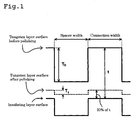
- Fig. 1 is an explanatory diagram for explaining the method of determining the degree of surface flatness of a sample surface polished by an embodiment.
- the mean particle diameter was measured using a laser particle size analysis system made by Otsuka Electronics Co., Ltd. (in the description that follows, the mean particle diameter was measured by the same method).
- the emulsion that was obtained was adjusted to pH8.5 by means of a 25% aqueous solution of potassium hydroxide. Thereafter, ion-exchanged water was added, and after stirring under room temperature using Three-One Motor, a ceria (CeO 2 ) powder, having a mean particle diameter of 0.3 ⁇ m prior to processing, was loaded and further stirring at 1,500 rotations/minute was carried out for 3 minute to obtain an aqueous dispersion (A).
- a ceria (CeO 2 ) powder having a mean particle diameter of 0.3 ⁇ m prior to processing
- the obtained emulsion containing 10% by mass of methyl methacrylate copolymer particles was then adjusted to pH10 by means of potassium hydroxide.
- the zeta potential of the methyl methacrylate copolymer particles in this emulsion was +12mV.
- the dispersion preparing to contain 10% by mass of fumed silica particle (product No. #90, made by Nippon Aerosil Co., Ltd.) was adjusted likewise to pH10.
- the zeta potential of the silica particles in this dispersion was -35mV.
- Aqueous dispersion (C) Component Amount (Parts by mass) Methyl methacrylate 94.0 Methacrylic acid 4.0 Hydroxymethyl methacrylate 2.0 Ammonium lauryl sulfate 0.1 Ammonium persulfate 0.5 Ion-exchanged water 400
- the zeta potential of the methyl methacrylate copolymer particles in this emulsion was -25mV.
- the zeta potential of the ceria in this dispersion was +20mV.
- aqueous dispersions (A) to (C) were spread thinly on a polyethylene film and made flake-like in form by leaving and drying for 48 hours under room temperature. The flakes thus obtained were then powdered using a mixer. Then using the respective powders, disk-shaped polishing pads [A] to [C] of 30cm diameter and 3mm thickness were obtained using a mold press.
- Aqueous chemical mechanical polishing solution (I) was prepared by incorporating hydrogen peroxide to an amount of 2% by mass and malonic acid to an amount of 1% by mass in ion-exchanged water.
- polishing pad [D] (trade name, "IC1000/SUBA400,” made by Rodel Nitta Co.), which does not contain the abrasive, was adhered onto the surface table of a polishing device (model "LM-15,” made by Lapmaster STF Corp.). Then using each polishing pad, a 4cm-square tungsten wafer (trade name, "SKW-5,” made by SKW Co., Ltd.) was polished while supplying aqueous solution (I) at a rate of 150ml per minute. In this process, the table rotation speed was set to 50rpm, the polishing pressure was set to 350g/cm 2 , and the polishing time was set to 2 minute intervals.
- the surface resistance value of the tungsten layer was measured by the DC 4-terminal method using a resistivity measuring device (model " ⁇ -10,” made by NPS Corp.), and using the equation (1) shown below, and the thickness of the tungsten layer was calculated from the ratio with respect to the resistivity of tungsten. Then from the thickness values of the tungsten layer before and after polishing, the removal rate was calculated using the equation (2) shown below.
- Thickness of tungsten layer ⁇ Resistivity of tungsten ( ⁇ /cm) ⁇ / ⁇ Resistance value ( ⁇ /cm 2 ) ⁇ ⁇ (1)
- Removal rate ( ⁇ /minute) (Thickness of tungsten layer before polishing - Thickness of tungsten layer after polishing) / Polishing time ⁇ (2)
- polishing was performed in likewise manner while supplying just ion exchanged water or a slurry (trade name, "W2000,” made by Cabot Corp.), containing the abrasive, in place of aqueous solution (I) and the removal rate for the respective cases were determined (Comparative example 5).
- the distance T 0 from the tungsten layer surface to the bottom surface of the spacer, is 10,000 ⁇
- the distance t from the tungsten layer surface to the surface of the insulating layer is 15,000 ⁇
- T 1 After polishing, the distance T 1 , from the tungsten layer surface to the bottom surface of the indented part after polishing that is formed at the location where the spacer was formed, was measured, and the value (T 1 /T 0 ), obtained by dividing T 1 by T 0 , was indicated as the degree of surface flatness in Table 4. A smaller value of this degree of surface flatness indicates that polishing of excellent surface flatness can be performed (see Fig. 1). T 0 and T 1 were measured using a fine profile measuring device (model "P-10,” made by KLA-Tencor Corp.). The results are shown in Table 4.
- Aqueous chemical mechanical polishing solution (II) was prepared by incorporating hydrogen peroxide to an amount of 3% by mass, succinic acid to an amount of 2% by mass, ammonium dodecylbenzenesulfonate to an amount of 0.01% by mass, and iron ions (incorporated as iron sulfate) to an amount of 200ppm in ion-exchanged water.
- Aqueous chemical mechanical polishing solution (III) was prepared by incorporated hydrogen peroxide of an amount of 4% by mass, quinalidic acid of an amount of 0.3% by mass, malonic acid of an amount of 1% by mass, and potassium dodecylbenzenesulfonate of an amount of 0.02% by mass in ion-exchanged water and adjusting the pH9.0 by ammonia.
- Each of the above-mentioned polishing pads [A] to [D] were adhered onto the surface table of the above-mentioned polishing device, and while supplying aqueous solution (III) at a rate of 150ml per minute, a 4cm-square wafer with copper layer was polished.
- the table rotation speed was set to 50rpm
- the polishing pressure was set to 350g/cm 2
- the polishing time was set to 2 minute intervals.
- the removal rate of copper layer was measured in the same manner as described above.
- polishing was performed in likewise manner while supplying just ion-exchanged water or a slurry, obtained by dispersing 1% by mass of fumed silica as the abrasive in aqueous solution (III), in place of aqueous solution (III) and the removal rates for the respective cases were determined in the same manner as in the tungsten cases (see Table 6).
- the pitch is 200 ⁇ m (line width: 100 ⁇ m, spacer width: 100 ⁇ m)
- the distance T 0 from the copper layer surface to the bottom surface of the spacer, is 7,000 ⁇
- the distance t from the copper layer surface to the surface of the insulating layer is 15,000 ⁇
- the distance T 1 from the copper layer surface to the bottom surface of the indented part after polishing that is formed at the location where the spacer was formed, was measured, and the degree of surface flatness, obtained in the same manner as described above using the value (T 1 /T 0 ), obtained by dividing T 1 by T 0 , was indicated as the degree of surface flatness in Table 6.
- the polishing method is to polish a surface to be polished of an object to be polished by using a polishing pad while existing an aqueous chemical mechanical polishing solution containing an oxidizing agent such as hydrogen peroxide between polishing surface of the polishing pad equipped with a polishing part that contains abrasive, and the surface to be polished to be polished of the object to be polished.
- the aqueous chemical mechanical polishing solution may be contained a heterocyclic compound, a multivalent metal ion, an organic acid and the like. Also, the aqueous chemical mechanical solution may be contained no abrasive.
Landscapes
- Engineering & Computer Science (AREA)
- Mechanical Engineering (AREA)
- Mechanical Treatment Of Semiconductor (AREA)
- Finish Polishing, Edge Sharpening, And Grinding By Specific Grinding Devices (AREA)
Abstract
Description
Preferable abrasive is for example, (1) abrasive produced by a fumed method in which silicone chloride, aluminum chloride, titanium chloride and the like is reacted with oxygen and hydrogen in the gas phase, (2) abrasive synthesized by a sol-gel method in which a metal alkoxide, such as tetraethoxysilane or titanium alkoxide and the like, is hydrolyzed and condensated, (3) abrasive produced by an inorganic colloid method in which impurities are removed by refining, and the like.
| Aqueous dispersion (A) | |
| Component | Amount (Parts by mass) |
| Butadiene | 15.0 |
| Styrene | 70.0 |
| Methyl methacrylate | 12.0 |
| Itaconic acid | 2.0 |
| Acrylic acid | 1.0 |
| α-Methylstyrene dimer | 0.1 |
| t-Dodecylmercaptan | 0.4 |
| Ion-exchanged water | 240 |
| Aqueous dispersion (B) | |
| Component | Amount (Parts by mass) |
| Methyl methacrylate | 90.0 |
| Methoxypolyethylene glycol methacrylate | 5.0 |
| 4-Vinylpyridine | 5.0 |
| Azo polymerization initiator | 2.0 |
| Ion-exchanged water | 400 |
| Aqueous dispersion (C) | |
| Component | Amount (Parts by mass) |
| Methyl methacrylate | 94.0 |
| Methacrylic acid | 4.0 |
| Hydroxymethyl methacrylate | 2.0 |
| Ammonium lauryl sulfate | 0.1 |
| Ammonium persulfate | 0.5 |
| Ion-exchanged water | 400 |


Claims (14)
- A polishing method, characterized in that a surface to be polished of an object to be polished is polished by using a polishing pad while existing an aqueous chemical mechanical polishing solution containing an oxidizing agent between polishing surface of said polishing pad equipped with a polishing part that contains abrasive, and said surface to be polished of said object to be polished.
- The polishing method according to Claim 1 wherein said abrasive is comprised of at least one selected from the group consisting of ceria, silica, alumina, titanium oxide, chromium oxide, manganese dioxide, dimanganese trioxide, iron oxide, zirconium oxide, silicon carbide, boron carbide, diamond and barium carbonate.
- The polishing method according to Claim 1 or 2 wherein said polishing part is formed by solidifying an aqueous dispersion in which a matrix material and abrasive are respectively dispersed and contained.
- The polishing method according to Claim 1 or 2 wherein said polishing part is formed by solidifying an aqueous dispersion containing dispersed composite particles where abrasive is attached to a matrix material.
- The polishing method according to any one of Claims 1 to 4, wherein abrasive is not contained in said aqueous chemical mechanical polishing solution.
- The polishing method according to any one of Claims 1 to 5, wherein an organic acid is contained in said aqueous chemical mechanical polishing solution.
- The polishing method according to any one of Claims 1 to 6, wherein a heterocyclic compound is further contained in said aqueous chemical mechanical polishing solution.
- The polishing method according to Claim 7 wherein said heterocyclic compound is at least one selected from the group consisting of a condensed ring compound composed of a nitrogen-atom-containing penta-heterocyclic compound or a nitrogen-atom-containing hexa-heterocyclic compound and a benzene ring or a naphthalene ring.
- The polishing method according to any one of Claims 1 to 7, wherein a multivalent metal ion is further contained in said aqueous chemical mechanical polishing solution.
- The polishing method according to Claim 9 wherein said multivalent metal ion is at least one selected from the group consisting of multivalent ions of aluminum, titanium, chromium, manganese, iron, copper, zinc and cerium.
- The polishing method according to any one of Claims 1 to 10, wherein said surface to be polished of said object to be polished contains at least one element selected from the group consisting of metal elements belonging to the group 3 to 13.
- The polishing method according to Claim 7 or 8 wherein said surface to be polished of said object to be polished contains copper.
- The polishing method according to Claim 9 or 10 wherein said surface to be polished of said object to be polished contains tungsten.
- The polishing method according to any one of Claims 1 to 13, which is to be used in the manufacture of a semiconductor device.
Applications Claiming Priority (6)
| Application Number | Priority Date | Filing Date | Title |
|---|---|---|---|
| JP2000365620A JP2002166356A (en) | 2000-11-30 | 2000-11-30 | Polishing method |
| JP2000365620 | 2000-11-30 | ||
| JP2000395729 | 2000-12-26 | ||
| JP2000395729A JP2002198331A (en) | 2000-12-26 | 2000-12-26 | Polishing method |
| JP2000398807A JP2002203818A (en) | 2000-12-27 | 2000-12-27 | Polishing method |
| JP2000398807 | 2000-12-27 |
Publications (2)
| Publication Number | Publication Date |
|---|---|
| EP1211024A2 true EP1211024A2 (en) | 2002-06-05 |
| EP1211024A3 EP1211024A3 (en) | 2004-01-02 |
Family
ID=27345330
Family Applications (1)
| Application Number | Title | Priority Date | Filing Date |
|---|---|---|---|
| EP01128235A Withdrawn EP1211024A3 (en) | 2000-11-30 | 2001-11-28 | Polishing method |
Country Status (4)
| Country | Link |
|---|---|
| US (1) | US6777335B2 (en) |
| EP (1) | EP1211024A3 (en) |
| KR (1) | KR100589070B1 (en) |
| TW (1) | TW558479B (en) |
Cited By (9)
| Publication number | Priority date | Publication date | Assignee | Title |
|---|---|---|---|---|
| WO2003107407A1 (en) * | 2002-06-14 | 2003-12-24 | セイミケミカル株式会社 | Method of polishing organic insulating film of semiconductor integrated circuit |
| WO2004037490A1 (en) * | 2002-10-28 | 2004-05-06 | Cabot Microelectronics Corporation | Transparent microporous materials for cmp |
| WO2005100496A3 (en) * | 2004-03-24 | 2005-12-29 | Cabot Microelectronics Corp | Chemical-mechanical polishing composition and method for using the same |
| US7267607B2 (en) | 2002-10-28 | 2007-09-11 | Cabot Microelectronics Corporation | Transparent microporous materials for CMP |
| US7311862B2 (en) | 2002-10-28 | 2007-12-25 | Cabot Microelectronics Corporation | Method for manufacturing microporous CMP materials having controlled pore size |
| US8038752B2 (en) | 2004-10-27 | 2011-10-18 | Cabot Microelectronics Corporation | Metal ion-containing CMP composition and method for using the same |
| US8075372B2 (en) | 2004-09-01 | 2011-12-13 | Cabot Microelectronics Corporation | Polishing pad with microporous regions |
| US11111435B2 (en) | 2018-07-31 | 2021-09-07 | Versum Materials Us, Llc | Tungsten chemical mechanical planarization (CMP) with low dishing and low erosion topography |
| EP4086041A1 (en) * | 2021-05-07 | 2022-11-09 | SKC Solmics Co., Ltd. | Polishing pad, method for manufacturing the same, and method for manufacturing semiconductor device using the same |
Families Citing this family (29)
| Publication number | Priority date | Publication date | Assignee | Title |
|---|---|---|---|---|
| JP2003338469A (en) * | 2002-05-21 | 2003-11-28 | Fujitsu Ltd | Abrasive, polishing method and cleaning method |
| KR100498816B1 (en) * | 2002-10-18 | 2005-07-01 | 주식회사 동진쎄미켐 | Chemical Mechanical Polishing Slurry Composition For Polishing Tungsten Metal Layer Having Improved Dispersion Stability |
| US7066801B2 (en) * | 2003-02-21 | 2006-06-27 | Dow Global Technologies, Inc. | Method of manufacturing a fixed abrasive material |
| US6910951B2 (en) | 2003-02-24 | 2005-06-28 | Dow Global Technologies, Inc. | Materials and methods for chemical-mechanical planarization |
| EP1473387A1 (en) * | 2003-05-02 | 2004-11-03 | Siemens Aktiengesellschaft | Method for stripping a coating from a part |
| US20050022456A1 (en) * | 2003-07-30 | 2005-02-03 | Babu S. V. | Polishing slurry and method for chemical-mechanical polishing of copper |
| US7186653B2 (en) * | 2003-07-30 | 2007-03-06 | Climax Engineered Materials, Llc | Polishing slurries and methods for chemical mechanical polishing |
| JP4206313B2 (en) * | 2003-08-08 | 2009-01-07 | 花王株式会社 | Polishing liquid composition for magnetic disk |
| CN1654617A (en) * | 2004-02-10 | 2005-08-17 | 捷时雅株式会社 | Cleaning composition, method for cleaning semiconductor substrate, and process for manufacturing semiconductor device |
| JP2006089363A (en) * | 2004-08-27 | 2006-04-06 | Showa Denko Kk | Process for manufacturing glass substrate for magnetic recording medium, glass substrate for magnetic recording medium obtained by the process, and magnetic recording medium obtained using the substrate |
| US7988878B2 (en) * | 2004-09-29 | 2011-08-02 | Rohm And Haas Electronic Materials Cmp Holdings, Inc. | Selective barrier slurry for chemical mechanical polishing |
| US7790618B2 (en) * | 2004-12-22 | 2010-09-07 | Rohm And Haas Electronic Materials Cmp Holdings, Inc. | Selective slurry for chemical mechanical polishing |
| EP1838795A2 (en) * | 2005-01-07 | 2007-10-03 | Dynea Chemicals OY | Engineered non-polymeric organic particles for chemical mechanical planarization |
| US7316977B2 (en) * | 2005-08-24 | 2008-01-08 | Air Products And Chemicals, Inc. | Chemical-mechanical planarization composition having ketooxime compounds and associated method for use |
| US20090031636A1 (en) * | 2007-08-03 | 2009-02-05 | Qianqiu Ye | Polymeric barrier removal polishing slurry |
| US8809247B2 (en) * | 2008-02-15 | 2014-08-19 | Lion Corporation | Cleaning composition and method for cleaning substrate for electronic device |
| WO2009107472A1 (en) * | 2008-02-27 | 2009-09-03 | Jsr株式会社 | Aqueous dispersion for chemical mechanical polishing, chemical mechanical polishing method using the same, and method for regenerating aqueous dispersion for chemical mechanical polishing |
| JP2009259309A (en) * | 2008-04-14 | 2009-11-05 | Showa Denko Kk | Method of manufacturing substrate for magnetic recording medium |
| WO2010092865A1 (en) | 2009-02-16 | 2010-08-19 | 日立化成工業株式会社 | Abrading agent and abrading method |
| SG172829A1 (en) * | 2009-02-16 | 2011-08-29 | Hitachi Chemical Co Ltd | Polishing agent for copper polishing and polishing method using same |
| CA2753068C (en) * | 2009-04-03 | 2017-11-28 | Sakai Chemical Industry Co., Ltd. | Generally spherical barium carbonate particles and method for producing generally spherical barium carbonate particles |
| EP2426705A4 (en) * | 2009-04-30 | 2012-09-26 | Lion Corp | METHOD FOR CLEANING SEMICONDUCTOR SUBSTRATE AND ACID SOLUTION |
| US10323162B2 (en) * | 2009-12-11 | 2019-06-18 | Mitsui Minig & Smelting Co., Ltd. | Abrasive material |
| EP2405708A1 (en) * | 2010-07-07 | 2012-01-11 | Saint-Gobain Glass France | Transparent plate with heatable coating |
| CN102699811B (en) * | 2012-05-29 | 2015-07-29 | 上海瑞钼特金属新材料有限公司 | Refractory metal alloy paillon foil part of surface best bright finish and preparation method thereof |
| US9279067B2 (en) * | 2013-10-10 | 2016-03-08 | Cabot Microelectronics Corporation | Wet-process ceria compositions for polishing substrates, and methods related thereto |
| KR102485534B1 (en) * | 2014-08-11 | 2023-01-06 | 바스프 에스이 | Chemical-mechanical polishing composition comprising organic/inorganic composite particles |
| US10618141B2 (en) * | 2015-10-30 | 2020-04-14 | Applied Materials, Inc. | Apparatus for forming a polishing article that has a desired zeta potential |
| US12679998B2 (en) | 2024-01-10 | 2026-07-14 | DuPont Electronic Materials Holding, Inc. | Soluble metal oxide anion CMP slurry |
Family Cites Families (12)
| Publication number | Priority date | Publication date | Assignee | Title |
|---|---|---|---|---|
| US3979239A (en) * | 1974-12-30 | 1976-09-07 | Monsanto Company | Process for chemical-mechanical polishing of III-V semiconductor materials |
| US4600469A (en) * | 1984-12-21 | 1986-07-15 | Honeywell Inc. | Method for polishing detector material |
| US6069080A (en) | 1992-08-19 | 2000-05-30 | Rodel Holdings, Inc. | Fixed abrasive polishing system for the manufacture of semiconductor devices, memory disks and the like |
| MY114512A (en) * | 1992-08-19 | 2002-11-30 | Rodel Inc | Polymeric substrate with polymeric microelements |
| US6180020B1 (en) | 1995-09-13 | 2001-01-30 | Hitachi, Ltd. | Polishing method and apparatus |
| US5958288A (en) * | 1996-11-26 | 1999-09-28 | Cabot Corporation | Composition and slurry useful for metal CMP |
| US6194317B1 (en) * | 1998-04-30 | 2001-02-27 | 3M Innovative Properties Company | Method of planarizing the upper surface of a semiconductor wafer |
| JPH10329032A (en) | 1997-05-29 | 1998-12-15 | Sumitomo Osaka Cement Co Ltd | Grinding stone for LSI oxide film polishing and LSI oxide film polishing method |
| JPH11151659A (en) | 1997-11-20 | 1999-06-08 | Sony Corp | Polishing pad, chemical mechanical polishing method, and chemical mechanical polishing apparatus |
| JPH11188647A (en) | 1997-12-25 | 1999-07-13 | Fuji Photo Film Co Ltd | Grinding body |
| JPH11207632A (en) | 1998-01-21 | 1999-08-03 | Mitsui Kensaku Toishi Kk | Polisher, its manufacturing method and polishing tool |
| US6656018B1 (en) * | 1999-04-13 | 2003-12-02 | Freudenberg Nonwovens Limited Partnership | Polishing pads useful in chemical mechanical polishing of substrates in the presence of a slurry containing abrasive particles |
-
2001
- 2001-11-28 EP EP01128235A patent/EP1211024A3/en not_active Withdrawn
- 2001-11-29 KR KR1020010074987A patent/KR100589070B1/en not_active Expired - Fee Related
- 2001-11-29 US US09/995,613 patent/US6777335B2/en not_active Expired - Fee Related
- 2001-11-29 TW TW090129565A patent/TW558479B/en not_active IP Right Cessation
Cited By (16)
| Publication number | Priority date | Publication date | Assignee | Title |
|---|---|---|---|---|
| WO2003107407A1 (en) * | 2002-06-14 | 2003-12-24 | セイミケミカル株式会社 | Method of polishing organic insulating film of semiconductor integrated circuit |
| WO2004037490A1 (en) * | 2002-10-28 | 2004-05-06 | Cabot Microelectronics Corporation | Transparent microporous materials for cmp |
| US7267607B2 (en) | 2002-10-28 | 2007-09-11 | Cabot Microelectronics Corporation | Transparent microporous materials for CMP |
| US7311862B2 (en) | 2002-10-28 | 2007-12-25 | Cabot Microelectronics Corporation | Method for manufacturing microporous CMP materials having controlled pore size |
| US7435165B2 (en) | 2002-10-28 | 2008-10-14 | Cabot Microelectronics Corporation | Transparent microporous materials for CMP |
| CN100589934C (en) * | 2002-10-28 | 2010-02-17 | 卡伯特微电子公司 | Transparent microporous material for chemical mechanical polishing |
| US8101093B2 (en) | 2004-03-24 | 2012-01-24 | Cabot Microelectronics Corporation | Chemical-mechanical polishing composition and method for using the same |
| WO2005100496A3 (en) * | 2004-03-24 | 2005-12-29 | Cabot Microelectronics Corp | Chemical-mechanical polishing composition and method for using the same |
| CN1938392B (en) * | 2004-03-24 | 2010-09-01 | 卡伯特微电子公司 | Chemical mechanical polishing composition and method of using same |
| US8075372B2 (en) | 2004-09-01 | 2011-12-13 | Cabot Microelectronics Corporation | Polishing pad with microporous regions |
| US8038752B2 (en) | 2004-10-27 | 2011-10-18 | Cabot Microelectronics Corporation | Metal ion-containing CMP composition and method for using the same |
| US11111435B2 (en) | 2018-07-31 | 2021-09-07 | Versum Materials Us, Llc | Tungsten chemical mechanical planarization (CMP) with low dishing and low erosion topography |
| US11884859B2 (en) | 2018-07-31 | 2024-01-30 | Versum Materials Us, Llc | Tungsten chemical mechanical planarization (CMP) with low dishing and low erosion topography |
| EP4086041A1 (en) * | 2021-05-07 | 2022-11-09 | SKC Solmics Co., Ltd. | Polishing pad, method for manufacturing the same, and method for manufacturing semiconductor device using the same |
| TWI819596B (en) * | 2021-05-07 | 2023-10-21 | 南韓商Skc索密思有限公司 | Polishing pad, preparing method of the same and preparing method of semiconductor device using the same |
| US12643192B2 (en) | 2021-05-07 | 2026-06-02 | Enpulse Co., Ltd. | Polishing pad, method for manufacturing the same, and method for manufacturing semiconductor device using the same |
Also Published As
| Publication number | Publication date |
|---|---|
| US20020098701A1 (en) | 2002-07-25 |
| KR100589070B1 (en) | 2006-06-13 |
| EP1211024A3 (en) | 2004-01-02 |
| US6777335B2 (en) | 2004-08-17 |
| KR20020042500A (en) | 2002-06-05 |
| TW558479B (en) | 2003-10-21 |
Similar Documents
| Publication | Publication Date | Title |
|---|---|---|
| US6777335B2 (en) | Polishing method | |
| EP1036836B1 (en) | Aqueous dispersion for chemical mechanical polishing | |
| JP3616802B2 (en) | Slurry composition and chemical mechanical polishing method using the same | |
| CN100565813C (en) | Aqueous dispersion for chemical mechanical polishing, method for chemical mechanical polishing, and kit for preparing aqueous dispersion for chemical mechanical polishing | |
| US7001252B2 (en) | Abrasive material | |
| US6454819B1 (en) | Composite particles and production process thereof, aqueous dispersion, aqueous dispersion composition for chemical mechanical polishing, and process for manufacture of semiconductor device | |
| JP5563496B2 (en) | Polishing composition for mixed abrasive and method of using the same | |
| KR100641348B1 (en) | Slurry for CPM, its manufacturing method and polishing method of substrate | |
| US20050076578A1 (en) | Tunable composition and method for chemical-mechanical planarization with aspartic acid/tolyltriazole | |
| KR102485534B1 (en) | Chemical-mechanical polishing composition comprising organic/inorganic composite particles | |
| JP2009524236A (en) | CMP slurry and semiconductor wafer polishing method using the same | |
| KR20200021519A (en) | Polishing liquid, polishing liquid set and polishing method | |
| JP2010153576A (en) | Grinding material for semiconductor integrated circuit, grinding method, and manufacturing method for semiconductor integrated circuit | |
| JP7508275B2 (en) | Polishing composition, polishing method, and method for producing semiconductor substrate | |
| KR101197163B1 (en) | Cmp slurry | |
| JP2002198331A (en) | Polishing method | |
| JP2002203818A (en) | Polishing method | |
| JP2002299292A (en) | Metal polishing composition | |
| JP2002166356A (en) | Polishing method | |
| KR100351442B1 (en) | Abrasive for shallow trench isolation chemical mechanical polishing and polishing method using it | |
| JP2002299291A (en) | Metal polishing composition | |
| JP2004175904A (en) | Polishing composition | |
| JP2004131617A (en) | Composition for polishing | |
| JP2004059825A (en) | Abrasive composition | |
| JP2004149630A (en) | Polishing composition |
Legal Events
| Date | Code | Title | Description |
|---|---|---|---|
| PUAI | Public reference made under article 153(3) epc to a published international application that has entered the european phase |
Free format text: ORIGINAL CODE: 0009012 |
|
| AK | Designated contracting states |
Kind code of ref document: A2 Designated state(s): AT BE CH CY DE DK ES FI FR GB GR IE IT LI LU MC NL PT SE TR |
|
| AX | Request for extension of the european patent |
Free format text: AL;LT;LV;MK;RO;SI |
|
| PUAL | Search report despatched |
Free format text: ORIGINAL CODE: 0009013 |
|
| AK | Designated contracting states |
Kind code of ref document: A3 Designated state(s): AT BE CH CY DE DK ES FI FR GB GR IE IT LI LU MC NL PT SE TR |
|
| AX | Request for extension of the european patent |
Extension state: AL LT LV MK RO SI |
|
| RAP1 | Party data changed (applicant data changed or rights of an application transferred) |
Owner name: JSR CORPORATION |
|
| 17P | Request for examination filed |
Effective date: 20040109 |
|
| AKX | Designation fees paid |
Designated state(s): DE FR IT |
|
| 17Q | First examination report despatched |
Effective date: 20040921 |
|
| STAA | Information on the status of an ep patent application or granted ep patent |
Free format text: STATUS: THE APPLICATION IS DEEMED TO BE WITHDRAWN |
|
| 18D | Application deemed to be withdrawn |
Effective date: 20130514 |