EP1210950A1 - Composition against Coccidiosis - Google Patents
Composition against Coccidiosis Download PDFInfo
- Publication number
- EP1210950A1 EP1210950A1 EP00850205A EP00850205A EP1210950A1 EP 1210950 A1 EP1210950 A1 EP 1210950A1 EP 00850205 A EP00850205 A EP 00850205A EP 00850205 A EP00850205 A EP 00850205A EP 1210950 A1 EP1210950 A1 EP 1210950A1
- Authority
- EP
- European Patent Office
- Prior art keywords
- composition
- group
- folic acid
- feed
- mixture
- Prior art date
- Legal status (The legal status is an assumption and is not a legal conclusion. Google has not performed a legal analysis and makes no representation as to the accuracy of the status listed.)
- Granted
Links
- 239000000203 mixture Substances 0.000 title claims abstract description 78
- 208000003495 Coccidiosis Diseases 0.000 title claims abstract description 16
- 206010023076 Isosporiasis Diseases 0.000 title claims abstract description 16
- OVBPIULPVIDEAO-LBPRGKRZSA-N folic acid Chemical compound C=1N=C2NC(N)=NC(=O)C2=NC=1CNC1=CC=C(C(=O)N[C@@H](CCC(O)=O)C(O)=O)C=C1 OVBPIULPVIDEAO-LBPRGKRZSA-N 0.000 claims abstract description 66
- OVBPIULPVIDEAO-UHFFFAOYSA-N N-Pteroyl-L-glutaminsaeure Natural products C=1N=C2NC(N)=NC(=O)C2=NC=1CNC1=CC=C(C(=O)NC(CCC(O)=O)C(O)=O)C=C1 OVBPIULPVIDEAO-UHFFFAOYSA-N 0.000 claims abstract description 33
- 229960000304 folic acid Drugs 0.000 claims abstract description 33
- 239000011724 folic acid Substances 0.000 claims abstract description 33
- 235000019152 folic acid Nutrition 0.000 claims abstract description 33
- 229940126575 aminoglycoside Drugs 0.000 claims abstract description 24
- 239000003814 drug Substances 0.000 claims abstract description 17
- 239000003795 chemical substances by application Substances 0.000 claims abstract description 14
- 230000000767 anti-ulcer Effects 0.000 claims abstract description 13
- 238000011282 treatment Methods 0.000 claims abstract description 10
- 238000004519 manufacturing process Methods 0.000 claims abstract description 4
- 241001465754 Metazoa Species 0.000 claims description 11
- 238000000034 method Methods 0.000 claims description 8
- 239000000969 carrier Substances 0.000 claims description 7
- 241000287828 Gallus gallus Species 0.000 description 17
- 235000013330 chicken meat Nutrition 0.000 description 15
- 244000144977 poultry Species 0.000 description 14
- 235000013594 poultry meat Nutrition 0.000 description 14
- 239000003651 drinking water Substances 0.000 description 10
- 235000020188 drinking water Nutrition 0.000 description 10
- 229960001596 famotidine Drugs 0.000 description 10
- 241000271566 Aves Species 0.000 description 9
- 229940079593 drug Drugs 0.000 description 9
- XUFQPHANEAPEMJ-UHFFFAOYSA-N famotidine Chemical compound NC(N)=NC1=NC(CSCCC(N)=NS(N)(=O)=O)=CS1 XUFQPHANEAPEMJ-UHFFFAOYSA-N 0.000 description 9
- 208000015181 infectious disease Diseases 0.000 description 8
- UCSJYZPVAKXKNQ-HZYVHMACSA-N streptomycin Chemical compound CN[C@H]1[C@H](O)[C@@H](O)[C@H](CO)O[C@H]1O[C@@H]1[C@](C=O)(O)[C@H](C)O[C@H]1O[C@@H]1[C@@H](NC(N)=N)[C@H](O)[C@@H](NC(N)=N)[C@H](O)[C@H]1O UCSJYZPVAKXKNQ-HZYVHMACSA-N 0.000 description 8
- ASXBYYWOLISCLQ-UHFFFAOYSA-N Dihydrostreptomycin Natural products O1C(CO)C(O)C(O)C(NC)C1OC1C(CO)(O)C(C)OC1OC1C(N=C(N)N)C(O)C(N=C(N)N)C(O)C1O ASXBYYWOLISCLQ-UHFFFAOYSA-N 0.000 description 6
- 229930193140 Neomycin Natural products 0.000 description 6
- 230000001165 anti-coccidial effect Effects 0.000 description 6
- ASXBYYWOLISCLQ-HZYVHMACSA-N dihydrostreptomycin Chemical compound CN[C@H]1[C@H](O)[C@@H](O)[C@H](CO)O[C@H]1O[C@@H]1[C@](CO)(O)[C@H](C)O[C@H]1O[C@@H]1[C@@H](NC(N)=N)[C@H](O)[C@@H](NC(N)=N)[C@H](O)[C@H]1O ASXBYYWOLISCLQ-HZYVHMACSA-N 0.000 description 6
- 229960002222 dihydrostreptomycin Drugs 0.000 description 6
- 230000000694 effects Effects 0.000 description 6
- 229960004927 neomycin Drugs 0.000 description 6
- 238000002360 preparation method Methods 0.000 description 6
- XLYOFNOQVPJJNP-UHFFFAOYSA-N water Substances O XLYOFNOQVPJJNP-UHFFFAOYSA-N 0.000 description 6
- 240000008042 Zea mays Species 0.000 description 5
- 235000016383 Zea mays subsp huehuetenangensis Nutrition 0.000 description 5
- 235000002017 Zea mays subsp mays Nutrition 0.000 description 5
- 235000009973 maize Nutrition 0.000 description 5
- 210000003250 oocyst Anatomy 0.000 description 5
- 230000000384 rearing effect Effects 0.000 description 5
- 239000000725 suspension Substances 0.000 description 5
- 230000001225 therapeutic effect Effects 0.000 description 5
- 241000224483 Coccidia Species 0.000 description 4
- KCXVZYZYPLLWCC-UHFFFAOYSA-N EDTA Chemical compound OC(=O)CN(CC(O)=O)CCN(CC(O)=O)CC(O)=O KCXVZYZYPLLWCC-UHFFFAOYSA-N 0.000 description 4
- 241000286209 Phasianidae Species 0.000 description 4
- 235000019764 Soybean Meal Nutrition 0.000 description 4
- 241000209140 Triticum Species 0.000 description 4
- 235000021307 Triticum Nutrition 0.000 description 4
- XZNUGFQTQHRASN-XQENGBIVSA-N apramycin Chemical compound O([C@H]1O[C@@H]2[C@H](O)[C@@H]([C@H](O[C@H]2C[C@H]1N)O[C@@H]1[C@@H]([C@@H](O)[C@H](N)[C@@H](CO)O1)O)NC)[C@@H]1[C@@H](N)C[C@@H](N)[C@H](O)[C@H]1O XZNUGFQTQHRASN-XQENGBIVSA-N 0.000 description 4
- 229950006334 apramycin Drugs 0.000 description 4
- -1 dinitolmide) Chemical compound 0.000 description 4
- 238000009472 formulation Methods 0.000 description 4
- 239000004455 soybean meal Substances 0.000 description 4
- 229960005322 streptomycin Drugs 0.000 description 4
- 235000015099 wheat brans Nutrition 0.000 description 4
- 244000075850 Avena orientalis Species 0.000 description 3
- 235000007319 Avena orientalis Nutrition 0.000 description 3
- BVKZGUZCCUSVTD-UHFFFAOYSA-L Carbonate Chemical compound [O-]C([O-])=O BVKZGUZCCUSVTD-UHFFFAOYSA-L 0.000 description 3
- 235000008733 Citrus aurantifolia Nutrition 0.000 description 3
- ZDPIZLCVJAAHHR-UHFFFAOYSA-N Clopidol Chemical compound CC1=NC(C)=C(Cl)C(O)=C1Cl ZDPIZLCVJAAHHR-UHFFFAOYSA-N 0.000 description 3
- 240000004658 Medicago sativa Species 0.000 description 3
- 235000010624 Medicago sativa Nutrition 0.000 description 3
- 240000004808 Saccharomyces cerevisiae Species 0.000 description 3
- 235000011941 Tilia x europaea Nutrition 0.000 description 3
- 229960004821 amikacin Drugs 0.000 description 3
- LKCWBDHBTVXHDL-RMDFUYIESA-N amikacin Chemical compound O([C@@H]1[C@@H](N)C[C@H]([C@@H]([C@H]1O)O[C@@H]1[C@@H]([C@@H](N)[C@H](O)[C@@H](CO)O1)O)NC(=O)[C@@H](O)CCN)[C@H]1O[C@H](CN)[C@@H](O)[C@H](O)[C@H]1O LKCWBDHBTVXHDL-RMDFUYIESA-N 0.000 description 3
- 239000003674 animal food additive Substances 0.000 description 3
- 229940124536 anticoccidial agent Drugs 0.000 description 3
- 235000015278 beef Nutrition 0.000 description 3
- 230000015572 biosynthetic process Effects 0.000 description 3
- 229960000731 clopidol Drugs 0.000 description 3
- 201000010099 disease Diseases 0.000 description 3
- 208000037265 diseases, disorders, signs and symptoms Diseases 0.000 description 3
- 239000013505 freshwater Substances 0.000 description 3
- 229960000318 kanamycin Drugs 0.000 description 3
- 229930027917 kanamycin Natural products 0.000 description 3
- SBUJHOSQTJFQJX-NOAMYHISSA-N kanamycin Chemical compound O[C@@H]1[C@@H](O)[C@H](O)[C@@H](CN)O[C@@H]1O[C@H]1[C@H](O)[C@@H](O[C@@H]2[C@@H]([C@@H](N)[C@H](O)[C@@H](CO)O2)O)[C@H](N)C[C@@H]1N SBUJHOSQTJFQJX-NOAMYHISSA-N 0.000 description 3
- 229930182823 kanamycin A Natural products 0.000 description 3
- 239000004571 lime Substances 0.000 description 3
- 239000000463 material Substances 0.000 description 3
- 235000012054 meals Nutrition 0.000 description 3
- 244000045947 parasite Species 0.000 description 3
- 241000894007 species Species 0.000 description 3
- 239000000126 substance Substances 0.000 description 3
- 235000013619 trace mineral Nutrition 0.000 description 3
- 239000011573 trace mineral Substances 0.000 description 3
- SUBDBMMJDZJVOS-UHFFFAOYSA-N 5-methoxy-2-{[(4-methoxy-3,5-dimethylpyridin-2-yl)methyl]sulfinyl}-1H-benzimidazole Chemical compound N=1C2=CC(OC)=CC=C2NC=1S(=O)CC1=NC=C(C)C(OC)=C1C SUBDBMMJDZJVOS-UHFFFAOYSA-N 0.000 description 2
- 241000272517 Anseriformes Species 0.000 description 2
- VTYYLEPIZMXCLO-UHFFFAOYSA-L Calcium carbonate Chemical compound [Ca+2].[O-]C([O-])=O VTYYLEPIZMXCLO-UHFFFAOYSA-L 0.000 description 2
- 241000223931 Eimeria acervulina Species 0.000 description 2
- 241000499566 Eimeria brunetti Species 0.000 description 2
- 241000223934 Eimeria maxima Species 0.000 description 2
- 241000499563 Eimeria necatrix Species 0.000 description 2
- 241000223932 Eimeria tenella Species 0.000 description 2
- 102000004190 Enzymes Human genes 0.000 description 2
- 108090000790 Enzymes Proteins 0.000 description 2
- LFQSCWFLJHTTHZ-UHFFFAOYSA-N Ethanol Chemical compound CCO LFQSCWFLJHTTHZ-UHFFFAOYSA-N 0.000 description 2
- 235000019733 Fish meal Nutrition 0.000 description 2
- NTYJJOPFIAHURM-UHFFFAOYSA-N Histamine Chemical compound NCCC1=CN=CN1 NTYJJOPFIAHURM-UHFFFAOYSA-N 0.000 description 2
- 240000005979 Hordeum vulgare Species 0.000 description 2
- 235000007340 Hordeum vulgare Nutrition 0.000 description 2
- FFEARJCKVFRZRR-BYPYZUCNSA-N L-methionine Chemical compound CSCC[C@H](N)C(O)=O FFEARJCKVFRZRR-BYPYZUCNSA-N 0.000 description 2
- KQXDHUJYNAXLNZ-XQSDOZFQSA-N Salinomycin Chemical compound O1[C@@H]([C@@H](CC)C(O)=O)CC[C@H](C)[C@@H]1[C@@H](C)[C@H](O)[C@H](C)C(=O)[C@H](CC)[C@@H]1[C@@H](C)C[C@@H](C)[C@@]2(C=C[C@@H](O)[C@@]3(O[C@@](C)(CC3)[C@@H]3O[C@@H](C)[C@@](O)(CC)CC3)O2)O1 KQXDHUJYNAXLNZ-XQSDOZFQSA-N 0.000 description 2
- 241000191967 Staphylococcus aureus Species 0.000 description 2
- 239000012752 auxiliary agent Substances 0.000 description 2
- 239000003224 coccidiostatic agent Substances 0.000 description 2
- 239000008139 complexing agent Substances 0.000 description 2
- 239000012141 concentrate Substances 0.000 description 2
- 210000003608 fece Anatomy 0.000 description 2
- 239000004467 fishmeal Substances 0.000 description 2
- 235000013312 flour Nutrition 0.000 description 2
- 210000001035 gastrointestinal tract Anatomy 0.000 description 2
- 239000003485 histamine H2 receptor antagonist Substances 0.000 description 2
- 230000000415 inactivating effect Effects 0.000 description 2
- 229930182817 methionine Natural products 0.000 description 2
- 229940126409 proton pump inhibitor Drugs 0.000 description 2
- 239000000612 proton pump inhibitor Substances 0.000 description 2
- 238000001228 spectrum Methods 0.000 description 2
- 239000013589 supplement Substances 0.000 description 2
- 238000003786 synthesis reaction Methods 0.000 description 2
- 229940088594 vitamin Drugs 0.000 description 2
- 229930003231 vitamin Natural products 0.000 description 2
- 235000013343 vitamin Nutrition 0.000 description 2
- 239000011782 vitamin Substances 0.000 description 2
- MOOFYEJFXBSZGE-QJUDHZBZSA-N 1,2-bis[(z)-(4-chlorophenyl)methylideneamino]guanidine Chemical compound C=1C=C(Cl)C=CC=1\C=N/N=C(/N)N\N=C/C1=CC=C(Cl)C=C1 MOOFYEJFXBSZGE-QJUDHZBZSA-N 0.000 description 1
- KLGQWSOYKYFBTR-UHFFFAOYSA-N 2-nitrobenzamide Chemical class NC(=O)C1=CC=CC=C1[N+]([O-])=O KLGQWSOYKYFBTR-UHFFFAOYSA-N 0.000 description 1
- SJUWEPZBTXEUMU-LDXVYITESA-N 7-bromo-6-chloro-3-[3-[(2s,3r)-3-hydroxypiperidin-2-yl]-2-oxopropyl]quinazolin-4-one;hydrobromide Chemical compound Br.O[C@@H]1CCCN[C@H]1CC(=O)CN1C(=O)C2=CC(Cl)=C(Br)C=C2N=C1 SJUWEPZBTXEUMU-LDXVYITESA-N 0.000 description 1
- 208000030090 Acute Disease Diseases 0.000 description 1
- 240000004160 Capsicum annuum Species 0.000 description 1
- 235000008534 Capsicum annuum var annuum Nutrition 0.000 description 1
- 229920002134 Carboxymethyl cellulose Polymers 0.000 description 1
- 208000003322 Coinfection Diseases 0.000 description 1
- ZEFNOZRLAWVAQF-UHFFFAOYSA-N Dinitolmide Chemical compound CC1=C(C(N)=O)C=C([N+]([O-])=O)C=C1[N+]([O-])=O ZEFNOZRLAWVAQF-UHFFFAOYSA-N 0.000 description 1
- 241000223924 Eimeria Species 0.000 description 1
- 244000309702 Eimeria hagani Species 0.000 description 1
- 241000179199 Eimeria mitis Species 0.000 description 1
- 241000530449 Eimeria mivati Species 0.000 description 1
- 241000499544 Eimeria praecox Species 0.000 description 1
- 241000224484 Eimeriidae Species 0.000 description 1
- 241000196324 Embryophyta Species 0.000 description 1
- 241000589602 Francisella tularensis Species 0.000 description 1
- 239000001828 Gelatine Substances 0.000 description 1
- CEAZRRDELHUEMR-URQXQFDESA-N Gentamicin Chemical compound O1[C@H](C(C)NC)CC[C@@H](N)[C@H]1O[C@H]1[C@H](O)[C@@H](O[C@@H]2[C@@H]([C@@H](NC)[C@@](C)(O)CO2)O)[C@H](N)C[C@@H]1N CEAZRRDELHUEMR-URQXQFDESA-N 0.000 description 1
- 229930182566 Gentamicin Natural products 0.000 description 1
- 244000068988 Glycine max Species 0.000 description 1
- 235000010469 Glycine max Nutrition 0.000 description 1
- 239000005909 Kieselgur Substances 0.000 description 1
- 229930182504 Lasalocid Natural products 0.000 description 1
- 241000589902 Leptospira Species 0.000 description 1
- 229930191564 Monensin Natural products 0.000 description 1
- GAOZTHIDHYLHMS-UHFFFAOYSA-N Monensin A Natural products O1C(CC)(C2C(CC(O2)C2C(CC(C)C(O)(CO)O2)C)C)CCC1C(O1)(C)CCC21CC(O)C(C)C(C(C)C(OC)C(C)C(O)=O)O2 GAOZTHIDHYLHMS-UHFFFAOYSA-N 0.000 description 1
- 241000204031 Mycoplasma Species 0.000 description 1
- VHKXXVVRRDYCIK-CWCPJSEDSA-N Narasin Chemical compound C[C@H]1C[C@H](C)[C@H]([C@@H](CC)C(O)=O)O[C@H]1[C@@H](C)[C@H](O)[C@H](C)C(=O)[C@H](CC)[C@@H]1[C@@H](C)C[C@@H](C)[C@@]2(C=C[C@@H](O)[C@@]3(O[C@@](C)(CC3)[C@@H]3O[C@@H](C)[C@@](O)(CC)CC3)O2)O1 VHKXXVVRRDYCIK-CWCPJSEDSA-N 0.000 description 1
- VHKXXVVRRDYCIK-UHFFFAOYSA-N Narasin Natural products CC1CC(C)C(C(CC)C(O)=O)OC1C(C)C(O)C(C)C(=O)C(CC)C1C(C)CC(C)C2(C=CC(O)C3(OC(C)(CC3)C3OC(C)C(O)(CC)CC3)O2)O1 VHKXXVVRRDYCIK-UHFFFAOYSA-N 0.000 description 1
- NNOPDLNHPOLRRE-UHFFFAOYSA-N Nequinate Chemical compound CCCCC1=CC(C(C(C(=O)OC)=CN2)=O)=C2C=C1OCC1=CC=CC=C1 NNOPDLNHPOLRRE-UHFFFAOYSA-N 0.000 description 1
- UKHWDRMMMYWSFL-UHFFFAOYSA-N Nicarbazin Chemical compound CC=1C=C(C)NC(=O)N=1.C1=CC([N+](=O)[O-])=CC=C1NC(=O)NC1=CC=C([N+]([O-])=O)C=C1 UKHWDRMMMYWSFL-UHFFFAOYSA-N 0.000 description 1
- 241000283973 Oryctolagus cuniculus Species 0.000 description 1
- 240000007594 Oryza sativa Species 0.000 description 1
- 235000007164 Oryza sativa Nutrition 0.000 description 1
- DNIAPMSPPWPWGF-UHFFFAOYSA-N Propylene glycol Chemical class CC(O)CO DNIAPMSPPWPWGF-UHFFFAOYSA-N 0.000 description 1
- JUJWROOIHBZHMG-UHFFFAOYSA-N Pyridine Chemical group C1=CC=NC=C1 JUJWROOIHBZHMG-UHFFFAOYSA-N 0.000 description 1
- 241000282849 Ruminantia Species 0.000 description 1
- 239000004189 Salinomycin Substances 0.000 description 1
- 241000607142 Salmonella Species 0.000 description 1
- VYPSYNLAJGMNEJ-UHFFFAOYSA-N Silicium dioxide Chemical compound O=[Si]=O VYPSYNLAJGMNEJ-UHFFFAOYSA-N 0.000 description 1
- 244000061456 Solanum tuberosum Species 0.000 description 1
- 235000002595 Solanum tuberosum Nutrition 0.000 description 1
- 241000282887 Suidae Species 0.000 description 1
- 241000607479 Yersinia pestis Species 0.000 description 1
- 239000004480 active ingredient Substances 0.000 description 1
- 239000013543 active substance Substances 0.000 description 1
- 150000001298 alcohols Chemical class 0.000 description 1
- 229920000615 alginic acid Polymers 0.000 description 1
- 235000010443 alginic acid Nutrition 0.000 description 1
- 150000001413 amino acids Chemical class 0.000 description 1
- LCTXBFGHZLGBNU-UHFFFAOYSA-M amprolium Chemical compound [Cl-].NC1=NC(CCC)=NC=C1C[N+]1=CC=CC=C1C LCTXBFGHZLGBNU-UHFFFAOYSA-M 0.000 description 1
- 229960003683 amprolium Drugs 0.000 description 1
- 235000019728 animal nutrition Nutrition 0.000 description 1
- 239000003242 anti bacterial agent Substances 0.000 description 1
- 229940088710 antibiotic agent Drugs 0.000 description 1
- 239000003699 antiulcer agent Substances 0.000 description 1
- 229960000892 attapulgite Drugs 0.000 description 1
- 235000013405 beer Nutrition 0.000 description 1
- 150000001556 benzimidazoles Chemical group 0.000 description 1
- 230000003115 biocidal effect Effects 0.000 description 1
- 239000006227 byproduct Substances 0.000 description 1
- 229910000019 calcium carbonate Inorganic materials 0.000 description 1
- 239000001511 capsicum annuum Substances 0.000 description 1
- 235000010948 carboxy methyl cellulose Nutrition 0.000 description 1
- 239000001768 carboxy methyl cellulose Substances 0.000 description 1
- 239000008112 carboxymethyl-cellulose Substances 0.000 description 1
- 239000012876 carrier material Substances 0.000 description 1
- 210000004027 cell Anatomy 0.000 description 1
- 239000004464 cereal grain Substances 0.000 description 1
- 229960001380 cimetidine Drugs 0.000 description 1
- CCGSUNCLSOWKJO-UHFFFAOYSA-N cimetidine Chemical compound N#CNC(=N/C)\NCCSCC1=NC=N[C]1C CCGSUNCLSOWKJO-UHFFFAOYSA-N 0.000 description 1
- FDJOLVPMNUYSCM-WZHZPDAFSA-L cobalt(3+);[(2r,3s,4r,5s)-5-(5,6-dimethylbenzimidazol-1-yl)-4-hydroxy-2-(hydroxymethyl)oxolan-3-yl] [(2r)-1-[3-[(1r,2r,3r,4z,7s,9z,12s,13s,14z,17s,18s,19r)-2,13,18-tris(2-amino-2-oxoethyl)-7,12,17-tris(3-amino-3-oxopropyl)-3,5,8,8,13,15,18,19-octamethyl-2 Chemical compound [Co+3].N#[C-].N([C@@H]([C@]1(C)[N-]\C([C@H]([C@@]1(CC(N)=O)C)CCC(N)=O)=C(\C)/C1=N/C([C@H]([C@@]1(CC(N)=O)C)CCC(N)=O)=C\C1=N\C([C@H](C1(C)C)CCC(N)=O)=C/1C)[C@@H]2CC(N)=O)=C\1[C@]2(C)CCC(=O)NC[C@@H](C)OP([O-])(=O)O[C@H]1[C@@H](O)[C@@H](N2C3=CC(C)=C(C)C=C3N=C2)O[C@@H]1CO FDJOLVPMNUYSCM-WZHZPDAFSA-L 0.000 description 1
- 150000001875 compounds Chemical class 0.000 description 1
- JHAYEQICABJSTP-UHFFFAOYSA-N decoquinate Chemical compound N1C=C(C(=O)OCC)C(=O)C2=C1C=C(OCC)C(OCCCCCCCCCC)=C2 JHAYEQICABJSTP-UHFFFAOYSA-N 0.000 description 1
- 229960001878 decoquinate Drugs 0.000 description 1
- 229960003934 dinitolmide Drugs 0.000 description 1
- 239000000428 dust Substances 0.000 description 1
- 210000003743 erythrocyte Anatomy 0.000 description 1
- 230000002550 fecal effect Effects 0.000 description 1
- 239000006052 feed supplement Substances 0.000 description 1
- 239000012847 fine chemical Substances 0.000 description 1
- 239000004052 folic acid antagonist Substances 0.000 description 1
- 235000013305 food Nutrition 0.000 description 1
- 230000037406 food intake Effects 0.000 description 1
- 229940118764 francisella tularensis Drugs 0.000 description 1
- 229920000159 gelatin Polymers 0.000 description 1
- 235000019322 gelatine Nutrition 0.000 description 1
- 229960002518 gentamicin Drugs 0.000 description 1
- 229960001340 histamine Drugs 0.000 description 1
- 239000010903 husk Substances 0.000 description 1
- 230000036039 immunity Effects 0.000 description 1
- 238000000338 in vitro Methods 0.000 description 1
- 230000002458 infectious effect Effects 0.000 description 1
- 239000004615 ingredient Substances 0.000 description 1
- 229910052500 inorganic mineral Inorganic materials 0.000 description 1
- 230000000968 intestinal effect Effects 0.000 description 1
- 210000004347 intestinal mucosa Anatomy 0.000 description 1
- 210000000936 intestine Anatomy 0.000 description 1
- 239000002555 ionophore Substances 0.000 description 1
- 230000000236 ionophoric effect Effects 0.000 description 1
- BBMULGJBVDDDNI-OWKLGTHSSA-N lasalocid Chemical compound C([C@@H]1[C@@]2(CC)O[C@@H]([C@H](C2)C)[C@@H](CC)C(=O)[C@@H](C)[C@@H](O)[C@H](C)CCC=2C(=C(O)C(C)=CC=2)C(O)=O)C[C@](O)(CC)[C@H](C)O1 BBMULGJBVDDDNI-OWKLGTHSSA-N 0.000 description 1
- 229960000320 lasalocid Drugs 0.000 description 1
- 231100001231 less toxic Toxicity 0.000 description 1
- 210000000265 leukocyte Anatomy 0.000 description 1
- 239000007788 liquid Substances 0.000 description 1
- 239000010807 litter Substances 0.000 description 1
- 210000004185 liver Anatomy 0.000 description 1
- 230000004807 localization Effects 0.000 description 1
- RWVUEZAROXKXRT-VQLSFVLHSA-N maduramicin Chemical compound O1[C@@H](C)[C@H](OC)[C@@H](OC)C[C@H]1O[C@@H]1[C@H]([C@@]2(C)O[C@H](CC2)[C@@]2(C)O[C@]3(O[C@@H]([C@H](C)[C@@H](O)C3)[C@@H](C)[C@H]3[C@@H]([C@@H](OC)[C@H](C)[C@@](O)(CC(O)=O)O3)OC)CC2)O[C@@H]([C@@H]2[C@H](C[C@@H](C)[C@@](C)(O)O2)C)C1 RWVUEZAROXKXRT-VQLSFVLHSA-N 0.000 description 1
- 229950006915 maduramicin Drugs 0.000 description 1
- 210000004379 membrane Anatomy 0.000 description 1
- 239000012528 membrane Substances 0.000 description 1
- 244000005700 microbiome Species 0.000 description 1
- 239000008267 milk Substances 0.000 description 1
- 235000013336 milk Nutrition 0.000 description 1
- 210000004080 milk Anatomy 0.000 description 1
- 239000011707 mineral Substances 0.000 description 1
- 235000010755 mineral Nutrition 0.000 description 1
- 239000002480 mineral oil Substances 0.000 description 1
- 229960005358 monensin Drugs 0.000 description 1
- GAOZTHIDHYLHMS-KEOBGNEYSA-N monensin A Chemical compound C([C@@](O1)(C)[C@H]2CC[C@@](O2)(CC)[C@H]2[C@H](C[C@@H](O2)[C@@H]2[C@H](C[C@@H](C)[C@](O)(CO)O2)C)C)C[C@@]21C[C@H](O)[C@@H](C)[C@@H]([C@@H](C)[C@@H](OC)[C@H](C)C(O)=O)O2 GAOZTHIDHYLHMS-KEOBGNEYSA-N 0.000 description 1
- PSZYNBSKGUBXEH-UHFFFAOYSA-N naphthalene-1-sulfonic acid Chemical class C1=CC=C2C(S(=O)(=O)O)=CC=CC2=C1 PSZYNBSKGUBXEH-UHFFFAOYSA-N 0.000 description 1
- 229960001851 narasin Drugs 0.000 description 1
- 229950002796 nequinate Drugs 0.000 description 1
- 229940073485 nicarbazin Drugs 0.000 description 1
- 229960004872 nizatidine Drugs 0.000 description 1
- SGXXNSQHWDMGGP-IZZDOVSWSA-N nizatidine Chemical compound [O-][N+](=O)\C=C(/NC)NCCSCC1=CSC(CN(C)C)=N1 SGXXNSQHWDMGGP-IZZDOVSWSA-N 0.000 description 1
- 150000007523 nucleic acids Chemical class 0.000 description 1
- 102000039446 nucleic acids Human genes 0.000 description 1
- 108020004707 nucleic acids Proteins 0.000 description 1
- 239000003921 oil Substances 0.000 description 1
- 235000019198 oils Nutrition 0.000 description 1
- 229960000381 omeprazole Drugs 0.000 description 1
- 229940041024 other aminoglycosides in atc Drugs 0.000 description 1
- 210000001711 oxyntic cell Anatomy 0.000 description 1
- 229910052625 palygorskite Inorganic materials 0.000 description 1
- 229920001223 polyethylene glycol Polymers 0.000 description 1
- 229920000136 polysorbate Polymers 0.000 description 1
- 229920000036 polyvinylpyrrolidone Polymers 0.000 description 1
- 235000013855 polyvinylpyrrolidone Nutrition 0.000 description 1
- 239000001267 polyvinylpyrrolidone Substances 0.000 description 1
- 235000012015 potatoes Nutrition 0.000 description 1
- 230000002265 prevention Effects 0.000 description 1
- 239000000047 product Substances 0.000 description 1
- 230000002035 prolonged effect Effects 0.000 description 1
- 238000011321 prophylaxis Methods 0.000 description 1
- 235000013772 propylene glycol Nutrition 0.000 description 1
- 150000007660 quinolones Chemical class 0.000 description 1
- 229960000620 ranitidine Drugs 0.000 description 1
- VMXUWOKSQNHOCA-LCYFTJDESA-N ranitidine Chemical compound [O-][N+](=O)/C=C(/NC)NCCSCC1=CC=C(CN(C)C)O1 VMXUWOKSQNHOCA-LCYFTJDESA-N 0.000 description 1
- 238000011084 recovery Methods 0.000 description 1
- 230000010076 replication Effects 0.000 description 1
- 235000009566 rice Nutrition 0.000 description 1
- 229960004591 robenidine Drugs 0.000 description 1
- 229960001548 salinomycin Drugs 0.000 description 1
- 235000019378 salinomycin Nutrition 0.000 description 1
- 239000002689 soil Substances 0.000 description 1
- 239000004094 surface-active agent Substances 0.000 description 1
- 239000000375 suspending agent Substances 0.000 description 1
- 230000008961 swelling Effects 0.000 description 1
- 231100000419 toxicity Toxicity 0.000 description 1
- 230000001988 toxicity Effects 0.000 description 1
- 235000015112 vegetable and seed oil Nutrition 0.000 description 1
- 239000008158 vegetable oil Substances 0.000 description 1
- 235000013311 vegetables Nutrition 0.000 description 1
- 229910052902 vermiculite Inorganic materials 0.000 description 1
- 235000019354 vermiculite Nutrition 0.000 description 1
- 239000010455 vermiculite Substances 0.000 description 1
- 239000011715 vitamin B12 Substances 0.000 description 1
- 150000003722 vitamin derivatives Chemical class 0.000 description 1
Classifications
-
- A—HUMAN NECESSITIES
- A61—MEDICAL OR VETERINARY SCIENCE; HYGIENE
- A61K—PREPARATIONS FOR MEDICAL, DENTAL OR TOILETRY PURPOSES
- A61K45/00—Medicinal preparations containing active ingredients not provided for in groups A61K31/00 - A61K41/00
- A61K45/06—Mixtures of active ingredients without chemical characterisation, e.g. antiphlogistics and cardiaca
-
- A—HUMAN NECESSITIES
- A61—MEDICAL OR VETERINARY SCIENCE; HYGIENE
- A61K—PREPARATIONS FOR MEDICAL, DENTAL OR TOILETRY PURPOSES
- A61K31/00—Medicinal preparations containing organic active ingredients
- A61K31/33—Heterocyclic compounds
- A61K31/395—Heterocyclic compounds having nitrogen as a ring hetero atom, e.g. guanethidine or rifamycins
- A61K31/435—Heterocyclic compounds having nitrogen as a ring hetero atom, e.g. guanethidine or rifamycins having six-membered rings with one nitrogen as the only ring hetero atom
- A61K31/44—Non condensed pyridines; Hydrogenated derivatives thereof
-
- A—HUMAN NECESSITIES
- A61—MEDICAL OR VETERINARY SCIENCE; HYGIENE
- A61K—PREPARATIONS FOR MEDICAL, DENTAL OR TOILETRY PURPOSES
- A61K31/00—Medicinal preparations containing organic active ingredients
- A61K31/33—Heterocyclic compounds
- A61K31/395—Heterocyclic compounds having nitrogen as a ring hetero atom, e.g. guanethidine or rifamycins
- A61K31/495—Heterocyclic compounds having nitrogen as a ring hetero atom, e.g. guanethidine or rifamycins having six-membered rings with two or more nitrogen atoms as the only ring heteroatoms, e.g. piperazine or tetrazines
- A61K31/505—Pyrimidines; Hydrogenated pyrimidines, e.g. trimethoprim
-
- A—HUMAN NECESSITIES
- A61—MEDICAL OR VETERINARY SCIENCE; HYGIENE
- A61K—PREPARATIONS FOR MEDICAL, DENTAL OR TOILETRY PURPOSES
- A61K31/00—Medicinal preparations containing organic active ingredients
- A61K31/33—Heterocyclic compounds
- A61K31/395—Heterocyclic compounds having nitrogen as a ring hetero atom, e.g. guanethidine or rifamycins
- A61K31/495—Heterocyclic compounds having nitrogen as a ring hetero atom, e.g. guanethidine or rifamycins having six-membered rings with two or more nitrogen atoms as the only ring heteroatoms, e.g. piperazine or tetrazines
- A61K31/505—Pyrimidines; Hydrogenated pyrimidines, e.g. trimethoprim
- A61K31/519—Pyrimidines; Hydrogenated pyrimidines, e.g. trimethoprim ortho- or peri-condensed with heterocyclic rings
-
- A—HUMAN NECESSITIES
- A61—MEDICAL OR VETERINARY SCIENCE; HYGIENE
- A61K—PREPARATIONS FOR MEDICAL, DENTAL OR TOILETRY PURPOSES
- A61K31/00—Medicinal preparations containing organic active ingredients
- A61K31/70—Carbohydrates; Sugars; Derivatives thereof
-
- A—HUMAN NECESSITIES
- A61—MEDICAL OR VETERINARY SCIENCE; HYGIENE
- A61P—SPECIFIC THERAPEUTIC ACTIVITY OF CHEMICAL COMPOUNDS OR MEDICINAL PREPARATIONS
- A61P33/00—Antiparasitic agents
- A61P33/02—Antiprotozoals, e.g. for leishmaniasis, trichomoniasis, toxoplasmosis
Definitions
- the present invention relates to a novel composition, a composition for use as a medicament, and use of a composition for the manufacture of a medicament for treatment of coccidiosis.
- Coccidiosis is a disease of the intestinal lining of poultry, for example chickens, caused by protozoan coccidial parasites of the genus Eimeria, such as Eimeria tenella, Eimeria necatrix, Eimeria acervulina, Eimeria brunetti, Eimeria maxima, Eimeria mitis, Eimeria mivati, Eimeria praecox and Eimeria hagani.
- Eimeria tenella Eimeria necatrix
- Eimeria acervulina Eimeria brunetti, Eimeria maxima, Eimeria mitis, Eimeria mivati, Eimeria praecox and Eimeria hagani.
- Species belonging to said genus cause clinical disease in chickens and immunity to any one species does not protect birds against infection with other species.
- Coccidiosis is seen most commonly in chickens between 3 and 6 weeks of age.
- Coccidiosis is caused by protozoa of the family Eimeriidae
- Anticoccidial drugs are available on the market for prevention and treatment of coccidiosis in especially chickens and turkeys. Anticoccidials are generally given to poultry in the feed to prevent acute disease. Water medication is generally preferred over feed medication for treatment. Antibiotics are sometimes used to improve rate of recovery and prevent secondary infections.
- anticoccidial drugs previously known, the following may be mentioned: Amprolium, Clopidol, folic acid antagonists, halofuginone hydrobromide, ionophores (monensin, salinomycin, lasalocid, narasin, maduramicin), Nicarbazin, nitrobenzamides (e.g. dinitolmide), quinolones (e.g. buquinolat, decoquinate, nequinate) and Robenidine. Due to the widespread resistance to most anticoccidial drugs, there is a continuous need for new compositions having fewer side effects.
- a novel composition comprising a mixture of at least two components selected from the group consisting of folic acid, aminoglycosides and antiulcerative agents.
- composition for use as a medicament comprising a mixture of at least two components selected from the group consisting of folic acid, aminoglycosides and antiulcerative agents, said components being present in therapeutically effective amounts, optionally in admixture with therapeutically acceptable carriers.
- compositions for the manufacture of a medicament for treatment of coccidiosis comprising a mixture of at least two components selected from the group consisting of folic acid, aminoglycosides and antiulcerative agents.
- composition of the invention contains three major components, viz. (A) folic acid, (B) aminoglycosides and (C) antiulcerative agents. However, it is no requirement that all three components are present in the composition at the same time. Thus, the composition may comprise a mixture of two components optionally selected among the three components mentioned above.
- the composition contains a complexing agent, for example EDTA (ethylenediaminetetraacetic acid).
- EDTA ethylenediaminetetraacetic acid
- Folic acid is an important ingredient in essentially all foods and feeds. Beer and feed yeasts, especially, are rich in folic acid. Further, all green parts of plants, extracted soybean meal, potatoes, wheat bran and liver contain a relatively large amount of folic acid. Folic acid is in particular involved in the synthesis of amino acids and nucleic acids. Along with vitamin B 12 , folic acid is essential for the formation of red and white blood cells.
- Folic acid is used as a supplement to animal feed.
- Animals have a considerable synthesis of folic acid owing to the microorganisms in the gastrointestinal tract. Especially in poultry and in young animals the initial amount of folic acid available in this way is inadequate and supplements to the feed are necessary.
- the dosage generally recommended for feed supplements in case of chickens, pullets, broilers, hens and turkeys is about 0.6 - 1.5 mg per kg of feed (88% dry matter).
- Concerning the use of folic acid as a feed additive reference is made to BASF Fine Chemicals. Know-how and quality for animal nutrition, "On feed additives: Technical Information". Edition 97/98, p. 33, 46-51. It should be mentioned that folic acid has no anticoccidial effect in poultry.
- Aminoglycosides are used primarily in the treatment of infections caused by aerobic gram-negative organisms. They are not active against anaerobic organisms. Aminoglycosides are divided into three classes: narrow-spectrum aminoglycosides, broad-spectrum aminoglycosides and miscellaneous aminoglycosides. As examples of aminoglycoside the following are mentioned.
- Streptomycin was the earliest aminoglycoside introduced. It is active against mycobacteria, Leptospira, Francisella tularensis and Yersinia pestis. Dihydrostreptomycin is chemically very similar to streptomycin.
- Neomycin became available for use a few years after streptomycin. Neomycin has been effective against many gram-negative organisms and Staphylococcus aureus. The use of neomycin is limited by a relatively high risk of toxicity.
- Kanamycin was introduced as a less toxic alternative to older aminoglycosides and was soon followed by gentamicin and later by amikacin.
- Amikacin was developed from kanamycin and has the broadest spectrum of activity of the aminoglycosides. It is considered effective against strains not susceptible to other aminoglycosides because it resists some aminoglycoside inactivating enzymes.
- Apramycin is an aminocyclitol antibiotic with a chemical structure very similar to that of the aminoglycosides but different enough to leave it unaffected by many aminoglycoside inactivating enzymes.
- Apramycin is active against Staphylococcus aureus, many gram-negative organisms and some mycoplasma strains.
- Apramycin has been reported to be effective in vitro among others against Salmonella species which are resistant to streptomycin and neomycin.
- dehydrostreptomycin has been found to be highly preferred as component in the composition of the invention.
- aminoglycosides are used in the treatment of infections caused by aerobic organisms and as such they are not active against parasites.
- a therapeutic effect against coccidiosis is shown when present in admixture with at least one of the remaining components, viz. component A and component C, which latter will be described in detail below.
- Antiulcerative agents can be divided into two groups, viz. proton pump inhibitors and histamine H 2 -antagonists.
- Chemically, proton pump inhibitors (PPIs) consist of a substituted benzimidazole moiety linked by an essential sulfinylmethyl group to a substituted pyridine ring.
- Omeprazol is an important member of the above group and is the active ingredient in Losec, a preparation developed by Astra, Sweden.
- Histamine H 2 -antagonists are structural analogs of histamine that competitively and surmountably block the H 2 -receptors located on the basolateral membrane of the parietal cell.
- Cimetidine Cimetidine
- Nitzatidine Nitzatidine
- Famotidine Ranitidine
- Ranitidine As to antiulcerative agents in general and their therapeutic effects especially reference is made to Ullmann's Encyclopedia of Industrial Chemistry, Sixth Edition, 2000 Electronic Release, ANTIULCER DRUGS.
- compositions according to the invention are quite generally suitable for protecting poultry, i.e. for treating useful farm poultry, such as chickens, turkeys, ducks or geese or also other birds, such as for example pheasants, etc.
- compositions according to the invention are used in the form of therapeutic preparations for treating animals, especially birds, which are attacked by coccidia.
- the expression "therapeutic” also includes prophylaxis.
- Such therapeutic preparations conventionally may contain therapeutically acceptable carriers.
- Such preparations find application in broiler farms or poultry rearing houses for pullets where a high burden of infection is produced for the poultry population because of the permanent forms of the coccidia (oocysts) which are constantly being excreted in the droppings.
- the use of the composition according to the invention and methods for combating coccidiosis are carried out in the normal manner. In view of the localisation of the coccidia in the intestinal tract, an oral administration is primarily suitable.
- the compositions according to the invention may in this case be mixed with feed stuffs or with drinking water.
- concentrations of the compositions in feed stuffs or in drinking water may widely vary within certain limits. In general the concentrations are within the range of 5-5000 ppm (by weight) of the composition based on the feed stuff or drinking water. A preferable range is 50-2000 ppm. A most preferable range is 50-300 ppm. It is within the competence field of the veterinary to choose the concentration of each component in the final composition. Such concentration is herein often referred to "a therapeutically effective amount" and is defined as the amount which is sufficient for successfully combating coccidiosis keeping the side effects to a minimum. Various concentrations of the components will appear from the Examples below.
- the concentrations of the compositions are based on the feed or drinking water preparations ad lib, i.e. for free feed or drinking water consumption during a normal practical fattening or rearing period.
- All feed formulations conventional in the poultry industry are suitable as carriers for the compositions according to the invention.
- the formulations specified below for poultry feed are examples of normal practical formulations.
- Both conventional dry mealy or pelletised feedstuffs but also liquid feed suspensions including feedstuffs such as distillers' residues and milk by-products can be used in the case of the compositions according to the invention.
- a concentrated premix which contains at least two of the components of the composition in high concentration, for example 0.2-75% by weight.
- the components are either dispersed or mixed in inert carrier substances, such as vermiculite, diatomaceous earth, attapulgite, calcium carbonate, etc., together with physiologically harmless carriers, such as propylene glycols, polyethylene glycols, inert oils, such as vegetable oils, highly refined mineral oils, ethanol, water, or aqueous alcohols.
- Organic carrier material such as wheat bran, shredded maize, soybean flour, lucerne meal, rice husks or ground maize cobs and any other organic carrier substances from vegetable products are likewise suitable for this purpose.
- compositions according to the invention may further also be administered to poultry together with the drinking water.
- Their inclusion in the drinking water is achieved by adding a form of the composition concerned which is soluble in water or can be suspended in water to the drinking water in a suitable quantity.
- Such preparations are in general produced by selecting a water-soluble form of the composition.
- Water-insoluble forms for example suspensions, may also be used.
- physiologically harmless auxiliary agents which keep the composition according to the invention in suspension in water over a prolonged period are used.
- auxiliary agents which are suitable for this purpose are swelling agents, such as alginates, gelatine, carboxymethylcellulose or polyvinylpyrrolidone.
- Surfactant compounds such as for example naphthalenesulfonates, alkylbenzenesulfonates, or polyoxyethylene sorbitan esters may be used for bringing the compositions into suspensions.
- a concentrated suspension or a dry formulation of the composition according to the invention and the suspension agents is produced in certain mixing ratios and is then diluted with the drinking water to the required application concentration or the premixes are mixed in suitable concentrations with the feedstuffs normal in practice.
- the drinking water or feed so medicated is then fed to the poultry either initially ad lib or for a certain period.
- Another object of the invention is therefore also a method for treating coccidiosis in animals, comprising administering to said animals a therapeutically effective amount of a composition comprising a mixture of at least two components selected from the group consisting of folic acid, aminoglycosides, and antiulcerative agents, said composition optionally containing therapeutically acceptable carriers.
- compositions of the invention are formed by mixing the components in the amounts defined in the table in a conventional mixer.
- the following Examples relate to animal feed compositions which can be used for administering the composition according to the invention.
- Rearing feed for chickens (0-8 weeks) Composition in % by weight Fishmeal (60-65% 5.0 Lucerne green meal 6.0 Coarse soybean meal (44%) 13.0 Feeding yeast 2.8 Beef dripping 2.0 Barley 6.0 Oats 6.0 Maize 37.0 Wheat 13.0 Wheat bran 7.3 Carbonate feed lime 1.29 .RTM. Hostaphos 0.57 Trace element premix 0.04 100.00 III.
- Rearing feed for chickens (9-20 weeks) Composition in % by weight Lucerne green meal 6.0 Coarse soybean meal (44%) 10.24 Feeding yeast 1.8 Beef dripping 2.0 Barley 8.0 Oats 6.0 Maize 40.0 Wheat 15.0 Wheat bran 8.3 Carbonate feed lime 1.53 .RTM. Hostaphos 1.02 Trace element premix 0.04 Methionine DL 0.07 100.00 IV.
- Rearing feed for chickens Composition in % by weight Fishmeal (60-65% 1.5 Coarse soybean meal (44%) 19.31 Beef dripping 1.0 Oats 6.7 Maize 40.0 Wheat 18.0 Coarse wheat flour 3.0 Methionine DL 0.07 Feed paprika 0.3 Carbonate feed lime 8.16 .RTM. Hostaphos 1.91 Trace element premix* 0.05 100.00 Furthermore vitamins are added as described in Example I (a).
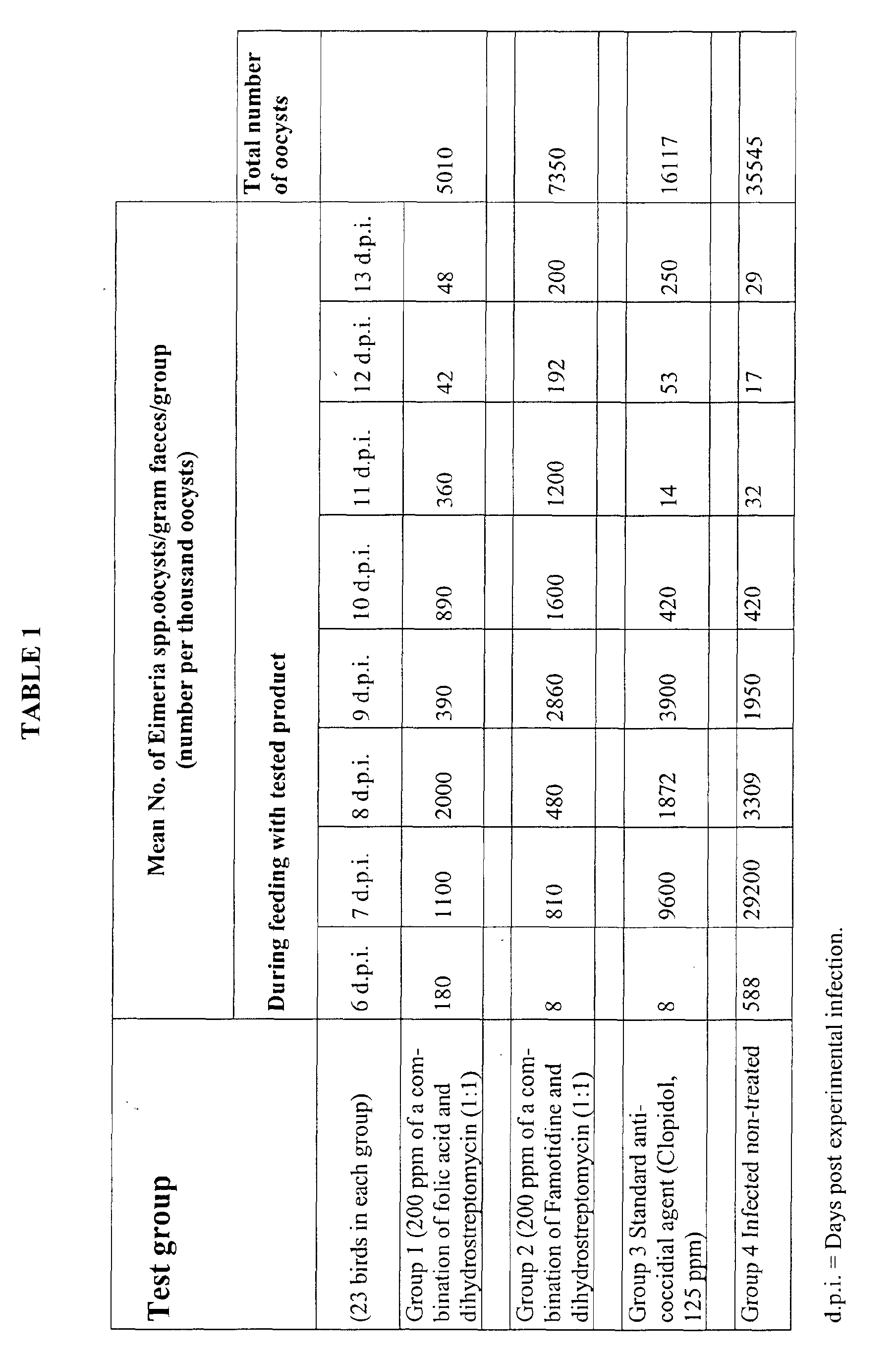
- a total of 92 one day old Habbared X breed chickens were used in the test. They were allocated into 4 groups (23 birds in each group), one group serving as a control group.
- composition to be tested was mixed in a sufficient amount of feed for each group and was used for daily feeding from the day zero of the test. Fresh water was supplied ad-libetum.
- test groups were:
- a total of 88 one day old Habbared X breed chickens were used in the test. They were allocated into 4 groups (22 birds in each group), one group serving as a control group.
- composition to be tested was mixed in a sufficient amount of feed for each group and was used for daily feeding from the day zero of the test. Fresh water was supplied ad-libetum.
- test groups were:
- composition to be tested was mixed into the feed of each group and was used for daily feeding. Fresh water was supplied ad-libetum.
- test groups were:
- each bird was experimentally infected orally by a mature sporulated mixture of oocysts containing 5 strains, viz. Eimeria acervulina, E. maxima, E. necatrix, E. tenella and E. brunetti.
Landscapes
- Health & Medical Sciences (AREA)
- Life Sciences & Earth Sciences (AREA)
- Veterinary Medicine (AREA)
- Chemical & Material Sciences (AREA)
- Medicinal Chemistry (AREA)
- Pharmacology & Pharmacy (AREA)
- Animal Behavior & Ethology (AREA)
- General Health & Medical Sciences (AREA)
- Public Health (AREA)
- Epidemiology (AREA)
- Molecular Biology (AREA)
- Tropical Medicine & Parasitology (AREA)
- Chemical Kinetics & Catalysis (AREA)
- General Chemical & Material Sciences (AREA)
- Nuclear Medicine, Radiotherapy & Molecular Imaging (AREA)
- Organic Chemistry (AREA)
- Pharmaceuticals Containing Other Organic And Inorganic Compounds (AREA)
- Fodder In General (AREA)
- Steroid Compounds (AREA)
- Heterocyclic Carbon Compounds Containing A Hetero Ring Having Oxygen Or Sulfur (AREA)
Abstract
Description
- The present invention relates to a novel composition, a composition for use as a medicament, and use of a composition for the manufacture of a medicament for treatment of coccidiosis.
- Coccidiosis is a disease of the intestinal lining of poultry, for example chickens, caused by protozoan coccidial parasites of the genus Eimeria, such as Eimeria tenella, Eimeria necatrix, Eimeria acervulina, Eimeria brunetti, Eimeria maxima, Eimeria mitis, Eimeria mivati, Eimeria praecox and Eimeria hagani. Species belonging to said genus cause clinical disease in chickens and immunity to any one species does not protect birds against infection with other species. Coccidiosis is seen most commonly in chickens between 3 and 6 weeks of age. Coccidiosis is caused by protozoa of the family Eimeriidae. Various sites in the intestine are infected. The infectious process is rapid (4-7 days) and is characterised by parasite replication in host cells with extensive damage to the intestinal mucosa. Clinical disease occurs only after ingestion of relatively large numbers of sporulated oocysts by susceptible birds. Both clinically infected and recovered birds shed oocysts in their droppings, which contaminate feed, dust, water, litter and soil.
- Anticoccidial drugs are available on the market for prevention and treatment of coccidiosis in especially chickens and turkeys. Anticoccidials are generally given to poultry in the feed to prevent acute disease. Water medication is generally preferred over feed medication for treatment. Antibiotics are sometimes used to improve rate of recovery and prevent secondary infections.
- Among anticoccidial drugs previously known, the following may be mentioned: Amprolium, Clopidol, folic acid antagonists, halofuginone hydrobromide, ionophores (monensin, salinomycin, lasalocid, narasin, maduramicin), Nicarbazin, nitrobenzamides (e.g. dinitolmide), quinolones (e.g. buquinolat, decoquinate, nequinate) and Robenidine. Due to the widespread resistance to most anticoccidial drugs, there is a continuous need for new compositions having fewer side effects.
- According to one aspect of the invention a novel composition is provided comprising a mixture of at least two components selected from the group consisting of folic acid, aminoglycosides and antiulcerative agents.
- According to another aspect of the invention there is provided a composition for use as a medicament comprising a mixture of at least two components selected from the group consisting of folic acid, aminoglycosides and antiulcerative agents, said components being present in therapeutically effective amounts, optionally in admixture with therapeutically acceptable carriers.
- According to still another aspect of the invention use of a composition for the manufacture of a medicament for treatment of coccidiosis is provided, said composition comprising a mixture of at least two components selected from the group consisting of folic acid, aminoglycosides and antiulcerative agents.
- The composition of the invention contains three major components, viz. (A) folic acid, (B) aminoglycosides and (C) antiulcerative agents. However, it is no requirement that all three components are present in the composition at the same time. Thus, the composition may comprise a mixture of two components optionally selected among the three components mentioned above.
- According to a preferred embodiment, the composition contains a complexing agent, for example EDTA (ethylenediaminetetraacetic acid).
- An interesting and surprising feature of the invention is the fact that according to published literature the individual components are not effective in treating coccidiosis. A composition comprising at least two of the above components is however effective, which will appear from tests described below.
- Each major component will now be described in detail below.
- Folic acid has the formula
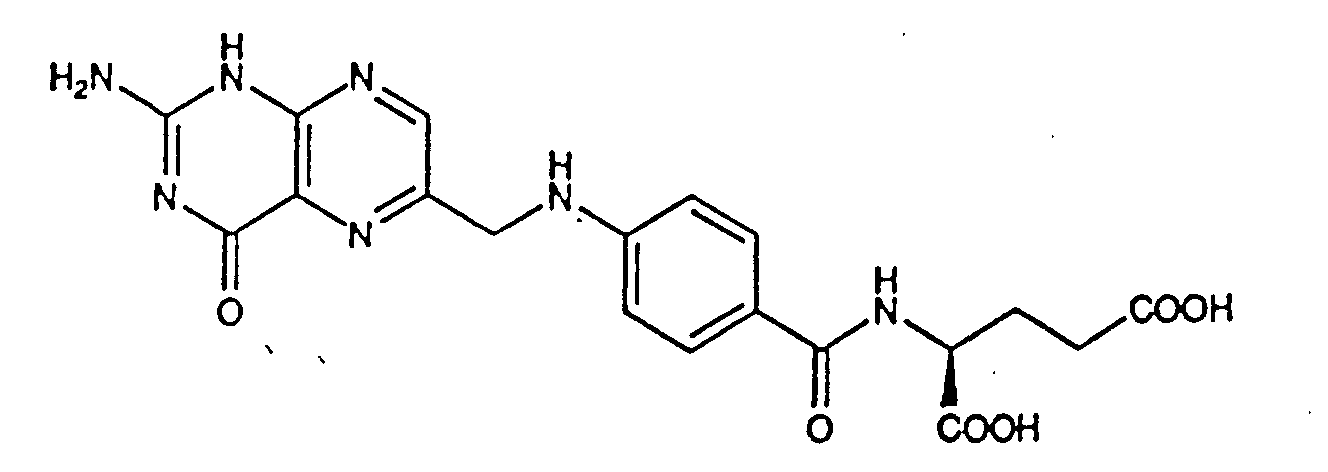
- Folic acid is an important ingredient in essentially all foods and feeds. Beer and feed yeasts, especially, are rich in folic acid. Further, all green parts of plants, extracted soybean meal, potatoes, wheat bran and liver contain a relatively large amount of folic acid. Folic acid is in particular involved in the synthesis of amino acids and nucleic acids. Along with vitamin B12, folic acid is essential for the formation of red and white blood cells.
- Folic acid is used as a supplement to animal feed. Animals have a considerable synthesis of folic acid owing to the microorganisms in the gastrointestinal tract. Especially in poultry and in young animals the initial amount of folic acid available in this way is inadequate and supplements to the feed are necessary. The dosage generally recommended for feed supplements in case of chickens, pullets, broilers, hens and turkeys is about 0.6 - 1.5 mg per kg of feed (88% dry matter). Concerning the use of folic acid as a feed additive reference is made to BASF Fine Chemicals. Know-how and quality for animal nutrition, "On feed additives: Technical Information". Edition 97/98, p. 33, 46-51. It should be mentioned that folic acid has no anticoccidial effect in poultry.
- Aminoglycosides are used primarily in the treatment of infections caused by aerobic gram-negative organisms. They are not active against anaerobic organisms. Aminoglycosides are divided into three classes: narrow-spectrum aminoglycosides, broad-spectrum aminoglycosides and miscellaneous aminoglycosides. As examples of aminoglycoside the following are mentioned.
- Streptomycin was the earliest aminoglycoside introduced. It is active against mycobacteria, Leptospira, Francisella tularensis and Yersinia pestis. Dihydrostreptomycin is chemically very similar to streptomycin.
- Neomycin became available for use a few years after streptomycin. Neomycin has been effective against many gram-negative organisms and Staphylococcus aureus. The use of neomycin is limited by a relatively high risk of toxicity.
- Kanamycin was introduced as a less toxic alternative to older aminoglycosides and was soon followed by gentamicin and later by amikacin.
- Amikacin was developed from kanamycin and has the broadest spectrum of activity of the aminoglycosides. It is considered effective against strains not susceptible to other aminoglycosides because it resists some aminoglycoside inactivating enzymes.
- Apramycin is an aminocyclitol antibiotic with a chemical structure very similar to that of the aminoglycosides but different enough to leave it unaffected by many aminoglycoside inactivating enzymes. Apramycin is active against Staphylococcus aureus, many gram-negative organisms and some mycoplasma strains. Apramycin has been reported to be effective in vitro among others against Salmonella species which are resistant to streptomycin and neomycin.
- Among those mentioned above, dehydrostreptomycin has been found to be highly preferred as component in the composition of the invention. As mentioned above, aminoglycosides are used in the treatment of infections caused by aerobic organisms and as such they are not active against parasites. However, according to the invention, a therapeutic effect against coccidiosis is shown when present in admixture with at least one of the remaining components, viz. component A and component C, which latter will be described in detail below.
- Antiulcerative agents can be divided into two groups, viz. proton pump inhibitors and histamine H2-antagonists. Chemically, proton pump inhibitors (PPIs) consist of a substituted benzimidazole moiety linked by an essential sulfinylmethyl group to a substituted pyridine ring. Omeprazol is an important member of the above group and is the active ingredient in Losec, a preparation developed by Astra, Sweden. Histamine H2-antagonists are structural analogs of histamine that competitively and surmountably block the H2-receptors located on the basolateral membrane of the parietal cell. Among members of the latter group, the following may be mentioned: Cimetidine, Nitzatidine, Famotidine and Ranitidine. As to antiulcerative agents in general and their therapeutic effects especially reference is made to Ullmann's Encyclopedia of Industrial Chemistry, Sixth Edition, 2000 Electronic Release, ANTIULCER DRUGS.
- The compositions according to the invention are quite generally suitable for protecting poultry, i.e. for treating useful farm poultry, such as chickens, turkeys, ducks or geese or also other birds, such as for example pheasants, etc.
- The compositions according to the invention are used in the form of therapeutic preparations for treating animals, especially birds, which are attacked by coccidia. The expression "therapeutic" also includes prophylaxis. Such therapeutic preparations conventionally may contain therapeutically acceptable carriers. Thus, such preparations find application in broiler farms or poultry rearing houses for pullets where a high burden of infection is produced for the poultry population because of the permanent forms of the coccidia (oocysts) which are constantly being excreted in the droppings. The use of the composition according to the invention and methods for combating coccidiosis are carried out in the normal manner. In view of the localisation of the coccidia in the intestinal tract, an oral administration is primarily suitable. The compositions according to the invention may in this case be mixed with feed stuffs or with drinking water.
- The concentrations of the compositions in feed stuffs or in drinking water may widely vary within certain limits. In general the concentrations are within the range of 5-5000 ppm (by weight) of the composition based on the feed stuff or drinking water. A preferable range is 50-2000 ppm. A most preferable range is 50-300 ppm. It is within the competence field of the veterinary to choose the concentration of each component in the final composition. Such concentration is herein often referred to "a therapeutically effective amount" and is defined as the amount which is sufficient for successfully combating coccidiosis keeping the side effects to a minimum. Various concentrations of the components will appear from the Examples below.
- The concentrations of the compositions are based on the feed or drinking water preparations ad lib, i.e. for free feed or drinking water consumption during a normal practical fattening or rearing period. All feed formulations conventional in the poultry industry are suitable as carriers for the compositions according to the invention. The formulations specified below for poultry feed are examples of normal practical formulations. Further, it is also possible, however, to use other feedstuffs based on some types of cereal grains which contain vitamin concentrates, mineral concentrates or other active substances and feed additives in any concentration. Both conventional dry mealy or pelletised feedstuffs but also liquid feed suspensions including feedstuffs such as distillers' residues and milk by-products can be used in the case of the compositions according to the invention.
- To prepare the poultry feed a concentrated premix is usually first made up which contains at least two of the components of the composition in high concentration, for example 0.2-75% by weight. For this purpose the components are either dispersed or mixed in inert carrier substances, such as vermiculite, diatomaceous earth, attapulgite, calcium carbonate, etc., together with physiologically harmless carriers, such as propylene glycols, polyethylene glycols, inert oils, such as vegetable oils, highly refined mineral oils, ethanol, water, or aqueous alcohols. Organic carrier material, such as wheat bran, shredded maize, soybean flour, lucerne meal, rice husks or ground maize cobs and any other organic carrier substances from vegetable products are likewise suitable for this purpose.
- As mentioned above, the compositions according to the invention may further also be administered to poultry together with the drinking water. Their inclusion in the drinking water is achieved by adding a form of the composition concerned which is soluble in water or can be suspended in water to the drinking water in a suitable quantity. Such preparations are in general produced by selecting a water-soluble form of the composition. Water-insoluble forms, for example suspensions, may also be used. In such cases physiologically harmless auxiliary agents which keep the composition according to the invention in suspension in water over a prolonged period are used. Auxiliary agents which are suitable for this purpose are swelling agents, such as alginates, gelatine, carboxymethylcellulose or polyvinylpyrrolidone. Surfactant compounds, such as for example naphthalenesulfonates, alkylbenzenesulfonates, or polyoxyethylene sorbitan esters may be used for bringing the compositions into suspensions. Normally, a concentrated suspension or a dry formulation of the composition according to the invention and the suspension agents is produced in certain mixing ratios and is then diluted with the drinking water to the required application concentration or the premixes are mixed in suitable concentrations with the feedstuffs normal in practice. The drinking water or feed so medicated is then fed to the poultry either initially ad lib or for a certain period.
- Although the invention has been described above with particular reference to the treatment of poultry against coccidia infections, treatment of other domestic and useful animals, for example other birds, rabbits, pigs and ruminants is also within the scope of the invention.
- Another object of the invention is therefore also a method for treating coccidiosis in animals, comprising administering to said animals a therapeutically effective amount of a composition comprising a mixture of at least two components selected from the group consisting of folic acid, aminoglycosides, and antiulcerative agents, said composition optionally containing therapeutically acceptable carriers.
- It is within the scope of the invention to use a mixture of anticoccidial drugs previously known and the composition of the invention in combating coccidiosis.
- The invention is explained by the Examples below.
- Table A below summarises examples of compositions of the invention. The compositions are formed by mixing the components in the amounts defined in the table in a conventional mixer.
Example Component A amount ppm by weight Component B amount ppm by weight Component C amount ppm by weight Complexing agent, ppm by weight 1 folic acid 66.7 66.7 Famotidine 66.7 2 -"- 55 -"- 90 Nizatidine 55 3 - - -"- 110 -"- 90 4 folic acid 55 -"- 90 Omeprazole 55 5 - - -"- 112 -"- 88 6 folic acid 50 -"- 100 Cimetedine 50 7 - - -"- 124 -"- 76 8 - - -"- 116 Ramitidine 84 9 folic acid 55 -"- 90 -"- 55 10 -"- 100 -"- 100 - - 11 - - -"- 100 Famotidine 100 12 folic acid 90 Amikacin 110 - - 13 -"- 40 Apramycin 160 - - 14 -"- 70 Neomycin 130 - - 15 - - -"- 145 Famotidine 55 16 folic acid 140 dhsm 60 - - 17 - - -"- 75 Famotidine 125 18 folic acid 66.7 -"- 66.7 -"- 66.7 EDTA 50 19 -"- 30 Neomycin 120 - - -"- 50 20 -"- 50 -"- 100 - - -"- 50 21 -"- 100 - - Famotidine 100 22 -"- 40 Kanamycin 160 - - - The following Examples relate to animal feed compositions which can be used for administering the composition according to the invention.

II. Rearing feed for chickens (0-8 weeks) Composition in % by weight Fishmeal (60-65% 5.0 Lucerne green meal 6.0 Coarse soybean meal (44%) 13.0 Feeding yeast 2.8 Beef dripping 2.0 Barley 6.0 Oats 6.0 Maize 37.0 Wheat 13.0 Wheat bran 7.3 Carbonate feed lime 1.29 .RTM. Hostaphos 0.57 Trace element premix 0.04 100.00 III. Rearing feed for chickens (9-20 weeks) Composition in % by weight Lucerne green meal 6.0 Coarse soybean meal (44%) 10.24 Feeding yeast 1.8 Beef dripping 2.0 Barley 8.0 Oats 6.0 Maize 40.0 Wheat 15.0 Wheat bran 8.3 Carbonate feed lime 1.53 .RTM. Hostaphos 1.02 Trace element premix 0.04 Methionine DL 0.07 100.00 IV. Rearing feed for chickens (from 21st week onwards) Composition in % by weight Fishmeal (60-65% 1.5 Coarse soybean meal (44%) 19.31 Beef dripping 1.0 Oats 6.7 Maize 40.0 Wheat 18.0 Coarse wheat flour 3.0 Methionine DL 0.07 Feed paprika 0.3 Carbonate feed lime 8.16 .RTM. Hostaphos 1.91 Trace element premix* 0.05 100.00 Furthermore vitamins are added as described in Example I (a). - A total of 92 one day old Habbared X breed chickens were used in the test. They were allocated into 4 groups (23 birds in each group), one group serving as a control group.
- Each composition to be tested was mixed in a sufficient amount of feed for each group and was used for daily feeding from the day zero of the test. Fresh water was supplied ad-libetum.
- The test groups were:
- Group No. 1
- feed containing 200 ppm of a combination of folic acid and dihydrostreptomycin in a ratio of 1:1,
- Group No. 2
- feed containing 200 ppm of a combination of Famotidine and dihydrostreptomycin in a ratio of 1:1,
- Group No. 3
- feed containing standard anticoccidial agent (Clopidol, 125 ppm),
- Group No. 4
- infected non-treated group.
- A total of 88 one day old Habbared X breed chickens were used in the test. They were allocated into 4 groups (22 birds in each group), one group serving as a control group.
- Each composition to be tested was mixed in a sufficient amount of feed for each group and was used for daily feeding from the day zero of the test. Fresh water was supplied ad-libetum.
- The test groups were:
- Group No. 1
- feed containing 200 ppm of a combination of folic acid, Famotidine, dihydrostreptomycin (1:1:1),
- Group No. 2
- feed containing 200 ppm of a combination of folic acid, Famotidine, dihydrostreptomycin (1:1:1) + EDTA (50 ppm),
- Group No. 3
- Clopidol, 125 ppm
- Group No. 4
- infected non-treated group.
- A total of 100 one day old Habbared X breed chickens were used in the test. They were reared on un-medicated feed as one group during the first 3 days. After that they were allocated into 5 groups (20 each) in 5 separate (1 x 1 meter) pens.
- With the beginning of the day 8 of bird life, the composition to be tested was mixed into the feed of each group and was used for daily feeding. Fresh water was supplied ad-libetum.
- The test groups were:
- Group No. 1
- feed containing 200 ppm dihydrostreptomycin,
- Group No. 2
- feed containing 100 ppm Famotidine,
- Group No. 3
- feed containing 100 ppm folic acid,
- Group No. 4
- feed containing standard anticoccidial agent (Coxistac, 60 ppm),
- Group No. 5
- infected non-treated group.
- The birds were kept on medicated feed for totally 2 days. On the 3rd day each bird was experimentally infected orally by a mature sporulated mixture of oocysts containing 5 strains, viz. Eimeria acervulina, E. maxima, E. necatrix, E. tenella and E. brunetti.
- Fresh fecal droplets were collected daily from the 4th day post experimental infection until day 13 post infection. Mean number of oocyst per gram feaces for each group were calculated using the Mc-Master technique according to Soulsby (1984).
The results appear from Table 3 below.

Claims (6)
- A novel composition comprising a mixture of at least two components selected from the group consisting of folic acid, aminoglycosides and antiulcerative agents.
- A composition for use as a medicament comprising a mixture of at least two components selected from the group consisting of folic acid, aminoglycosides and antiulcerative agents, said components being present in therapeutically effective amounts, optionally in admixture with therapeutically acceptable carriers.
- A composition as claimed in claim 2, wherein said mixture is a two-component mixture.
- A composition as claimed in claim 2, wherein said mixture is a three-component mixture.
- Use of a composition for the manufacture of a medicament for treatment of coccidiosis, said composition comprising a mixture of at least two components selected from the group consisting of folic acid, aminoglycosides and antiulcerative agents.
- A method for treating coccidiosis in animals, comprising administering to said animals a therapeutically effective amount of a composition comprising a mixture of at least two components selected from the group consisting of folic acid, aminoglycosides, and antiulcerative agents, said composition optionally containing therapeutically acceptable carriers.
Priority Applications (6)
| Application Number | Priority Date | Filing Date | Title |
|---|---|---|---|
| AT00850205T ATE306940T1 (en) | 2000-12-04 | 2000-12-04 | COMPOSITION AGAINST COCCIDIOSIS |
| DE60023321T DE60023321D1 (en) | 2000-12-04 | 2000-12-04 | Composition against coccidiosis |
| EP00850205A EP1210950B1 (en) | 2000-12-04 | 2000-12-04 | Composition against Coccidiosis |
| CNB018213340A CN1210064C (en) | 2000-12-04 | 2001-11-30 | Composition for treating coccidiosis |
| PCT/SE2001/002654 WO2002045751A1 (en) | 2000-12-04 | 2001-11-30 | Compositions for the treatment of coccidiosis |
| AU2002224308A AU2002224308A1 (en) | 2000-12-04 | 2001-11-30 | Compositions for the treatment of coccidiosis |
Applications Claiming Priority (1)
| Application Number | Priority Date | Filing Date | Title |
|---|---|---|---|
| EP00850205A EP1210950B1 (en) | 2000-12-04 | 2000-12-04 | Composition against Coccidiosis |
Publications (2)
| Publication Number | Publication Date |
|---|---|
| EP1210950A1 true EP1210950A1 (en) | 2002-06-05 |
| EP1210950B1 EP1210950B1 (en) | 2005-10-19 |
Family
ID=8175689
Family Applications (1)
| Application Number | Title | Priority Date | Filing Date |
|---|---|---|---|
| EP00850205A Expired - Lifetime EP1210950B1 (en) | 2000-12-04 | 2000-12-04 | Composition against Coccidiosis |
Country Status (6)
| Country | Link |
|---|---|
| EP (1) | EP1210950B1 (en) |
| CN (1) | CN1210064C (en) |
| AT (1) | ATE306940T1 (en) |
| AU (1) | AU2002224308A1 (en) |
| DE (1) | DE60023321D1 (en) |
| WO (1) | WO2002045751A1 (en) |
Cited By (1)
| Publication number | Priority date | Publication date | Assignee | Title |
|---|---|---|---|---|
| WO2008128566A1 (en) * | 2007-04-19 | 2008-10-30 | Poulpharma B.V.B.A. | Feed or pharmaceutical composition comprising apramycin or an adequate salt thereof |
Families Citing this family (1)
| Publication number | Priority date | Publication date | Assignee | Title |
|---|---|---|---|---|
| CN103018440B (en) * | 2012-11-23 | 2015-09-16 | 河南科技学院 | A kind of clopidol colloidal gold chromatographic test strip or card |
Citations (4)
| Publication number | Priority date | Publication date | Assignee | Title |
|---|---|---|---|---|
| GB1140315A (en) * | 1966-07-27 | 1969-01-15 | Pfizer & Co C | Animal feeds |
| FR2605221A1 (en) * | 1986-10-20 | 1988-04-22 | Sanofi Sa | Pharmaceutical or veterinary compositions containing 25-de(hydroxymethyl)-25-deoxy-25-oxomonensin |
| EP0642797A1 (en) * | 1993-09-09 | 1995-03-15 | Takeda Chemical Industries, Ltd. | Formulation comprising antibacterial substance and antiulcer substance |
| WO1997002021A1 (en) * | 1995-07-05 | 1997-01-23 | Byk Gulden Lomberg Chemische Fabrik Gmbh | Oral pharmaceutical compositions with delayed release of reversible proton pump inhibitors |
-
2000
- 2000-12-04 DE DE60023321T patent/DE60023321D1/en not_active Expired - Lifetime
- 2000-12-04 EP EP00850205A patent/EP1210950B1/en not_active Expired - Lifetime
- 2000-12-04 AT AT00850205T patent/ATE306940T1/en not_active IP Right Cessation
-
2001
- 2001-11-30 WO PCT/SE2001/002654 patent/WO2002045751A1/en not_active Ceased
- 2001-11-30 AU AU2002224308A patent/AU2002224308A1/en not_active Abandoned
- 2001-11-30 CN CNB018213340A patent/CN1210064C/en not_active Expired - Fee Related
Patent Citations (4)
| Publication number | Priority date | Publication date | Assignee | Title |
|---|---|---|---|---|
| GB1140315A (en) * | 1966-07-27 | 1969-01-15 | Pfizer & Co C | Animal feeds |
| FR2605221A1 (en) * | 1986-10-20 | 1988-04-22 | Sanofi Sa | Pharmaceutical or veterinary compositions containing 25-de(hydroxymethyl)-25-deoxy-25-oxomonensin |
| EP0642797A1 (en) * | 1993-09-09 | 1995-03-15 | Takeda Chemical Industries, Ltd. | Formulation comprising antibacterial substance and antiulcer substance |
| WO1997002021A1 (en) * | 1995-07-05 | 1997-01-23 | Byk Gulden Lomberg Chemische Fabrik Gmbh | Oral pharmaceutical compositions with delayed release of reversible proton pump inhibitors |
Cited By (2)
| Publication number | Priority date | Publication date | Assignee | Title |
|---|---|---|---|---|
| WO2008128566A1 (en) * | 2007-04-19 | 2008-10-30 | Poulpharma B.V.B.A. | Feed or pharmaceutical composition comprising apramycin or an adequate salt thereof |
| US8299037B2 (en) | 2007-04-19 | 2012-10-30 | Poulpharm B.V.B.A. | Feed or pharmaceutical composition comprising apramycin or an adequate salt thereof |
Also Published As
| Publication number | Publication date |
|---|---|
| EP1210950B1 (en) | 2005-10-19 |
| WO2002045751A1 (en) | 2002-06-13 |
| CN1482920A (en) | 2004-03-17 |
| AU2002224308A1 (en) | 2002-06-18 |
| DE60023321D1 (en) | 2006-03-02 |
| CN1210064C (en) | 2005-07-13 |
| ATE306940T1 (en) | 2005-11-15 |
Similar Documents
| Publication | Publication Date | Title |
|---|---|---|
| Ryley et al. | Chemotherapy of chicken coccidiosis | |
| CN106659787A (en) | Combinations, compositions and methods of administering said combinations or compositions to animals | |
| JP2001151675A (en) | Feed for prevention and/or treatment of coccidiosis | |
| EP0290998B1 (en) | Anticoccidial composition | |
| EP0076059B1 (en) | Anticoccidial combinations | |
| US6384052B1 (en) | Anticoccidial compounds | |
| WO2009035908A1 (en) | Compositions and their use for the treatment of protozoal infections comprising metaflumi zone | |
| US6569843B1 (en) | Steroidal sapogenins for the control of coccidiosis in animals | |
| US4824847A (en) | Coccidiocidal compositions | |
| US4861758A (en) | Coccidiocidal compositions | |
| EP1210950B1 (en) | Composition against Coccidiosis | |
| JPH07188009A (en) | Anticoccidial composition | |
| US4855299A (en) | Coccidiocidal compositions | |
| CA1266468A (en) | Laidlomycin phenylcarbamate | |
| JPS6366191A (en) | Antibiotic ll-e 19020 alpha and beta | |
| EP0821953A2 (en) | Anticoccidial methods and feedstuffs | |
| US3150042A (en) | Treating coccidiosis with lincomycin | |
| US3864479A (en) | Boromycin as a coccidiostat | |
| US3555150A (en) | Nigericin for treating coccidiosis | |
| US4659713A (en) | Quinoxalinedione compounds useful for controlling coccidiosis | |
| EP0246532B1 (en) | Coccidiocidal agents | |
| US5646135A (en) | Method for controlling coccidiosis | |
| US3655888A (en) | Anticoccidial compositions | |
| EA049298B1 (en) | METHOD OF CONTROLLING COCCIDIOSIS IN POULTRY | |
| JPH04178333A (en) | Anticoccidial agent |
Legal Events
| Date | Code | Title | Description |
|---|---|---|---|
| PUAI | Public reference made under article 153(3) epc to a published international application that has entered the european phase |
Free format text: ORIGINAL CODE: 0009012 |
|
| AK | Designated contracting states |
Kind code of ref document: A1 Designated state(s): AT BE CH CY DE DK ES FI FR GB GR IE IT LI LU MC NL PT SE TR |
|
| AX | Request for extension of the european patent |
Free format text: AL;LT;LV;MK;RO;SI |
|
| 17P | Request for examination filed |
Effective date: 20021109 |
|
| AKX | Designation fees paid |
Designated state(s): AT BE CH CY DE DK ES FI FR GB GR IE IT LI LU MC NL PT SE TR |
|
| 17Q | First examination report despatched |
Effective date: 20030814 |
|
| GRAP | Despatch of communication of intention to grant a patent |
Free format text: ORIGINAL CODE: EPIDOSNIGR1 |
|
| GRAS | Grant fee paid |
Free format text: ORIGINAL CODE: EPIDOSNIGR3 |
|
| GRAA | (expected) grant |
Free format text: ORIGINAL CODE: 0009210 |
|
| AK | Designated contracting states |
Kind code of ref document: B1 Designated state(s): AT BE CH CY DE DK ES FI FR GB GR IE IT LI LU MC NL PT SE TR |
|
| PG25 | Lapsed in a contracting state [announced via postgrant information from national office to epo] |
Ref country code: IT Free format text: LAPSE BECAUSE OF FAILURE TO SUBMIT A TRANSLATION OF THE DESCRIPTION OR TO PAY THE FEE WITHIN THE PRESCRIBED TIME-LIMIT;WARNING: LAPSES OF ITALIAN PATENTS WITH EFFECTIVE DATE BEFORE 2007 MAY HAVE OCCURRED AT ANY TIME BEFORE 2007. THE CORRECT EFFECTIVE DATE MAY BE DIFFERENT FROM THE ONE RECORDED. Effective date: 20051019 Ref country code: FI Free format text: LAPSE BECAUSE OF FAILURE TO SUBMIT A TRANSLATION OF THE DESCRIPTION OR TO PAY THE FEE WITHIN THE PRESCRIBED TIME-LIMIT Effective date: 20051019 Ref country code: TR Free format text: LAPSE BECAUSE OF FAILURE TO SUBMIT A TRANSLATION OF THE DESCRIPTION OR TO PAY THE FEE WITHIN THE PRESCRIBED TIME-LIMIT Effective date: 20051019 Ref country code: BE Free format text: LAPSE BECAUSE OF FAILURE TO SUBMIT A TRANSLATION OF THE DESCRIPTION OR TO PAY THE FEE WITHIN THE PRESCRIBED TIME-LIMIT Effective date: 20051019 Ref country code: LI Free format text: LAPSE BECAUSE OF FAILURE TO SUBMIT A TRANSLATION OF THE DESCRIPTION OR TO PAY THE FEE WITHIN THE PRESCRIBED TIME-LIMIT Effective date: 20051019 Ref country code: NL Free format text: LAPSE BECAUSE OF FAILURE TO SUBMIT A TRANSLATION OF THE DESCRIPTION OR TO PAY THE FEE WITHIN THE PRESCRIBED TIME-LIMIT Effective date: 20051019 Ref country code: AT Free format text: LAPSE BECAUSE OF FAILURE TO SUBMIT A TRANSLATION OF THE DESCRIPTION OR TO PAY THE FEE WITHIN THE PRESCRIBED TIME-LIMIT Effective date: 20051019 Ref country code: CH Free format text: LAPSE BECAUSE OF FAILURE TO SUBMIT A TRANSLATION OF THE DESCRIPTION OR TO PAY THE FEE WITHIN THE PRESCRIBED TIME-LIMIT Effective date: 20051019 |
|
| REG | Reference to a national code |
Ref country code: GB Ref legal event code: FG4D |
|
| REG | Reference to a national code |
Ref country code: CH Ref legal event code: EP |
|
| REG | Reference to a national code |
Ref country code: IE Ref legal event code: FG4D |
|
| PG25 | Lapsed in a contracting state [announced via postgrant information from national office to epo] |
Ref country code: CY Free format text: LAPSE BECAUSE OF FAILURE TO SUBMIT A TRANSLATION OF THE DESCRIPTION OR TO PAY THE FEE WITHIN THE PRESCRIBED TIME-LIMIT Effective date: 20051204 |
|
| PG25 | Lapsed in a contracting state [announced via postgrant information from national office to epo] |
Ref country code: IE Free format text: LAPSE BECAUSE OF NON-PAYMENT OF DUE FEES Effective date: 20051205 |
|
| PG25 | Lapsed in a contracting state [announced via postgrant information from national office to epo] |
Ref country code: LU Free format text: LAPSE BECAUSE OF NON-PAYMENT OF DUE FEES Effective date: 20051231 Ref country code: MC Free format text: LAPSE BECAUSE OF NON-PAYMENT OF DUE FEES Effective date: 20051231 |
|
| PG25 | Lapsed in a contracting state [announced via postgrant information from national office to epo] |
Ref country code: DK Free format text: LAPSE BECAUSE OF FAILURE TO SUBMIT A TRANSLATION OF THE DESCRIPTION OR TO PAY THE FEE WITHIN THE PRESCRIBED TIME-LIMIT Effective date: 20060119 Ref country code: SE Free format text: LAPSE BECAUSE OF FAILURE TO SUBMIT A TRANSLATION OF THE DESCRIPTION OR TO PAY THE FEE WITHIN THE PRESCRIBED TIME-LIMIT Effective date: 20060119 Ref country code: GR Free format text: LAPSE BECAUSE OF FAILURE TO SUBMIT A TRANSLATION OF THE DESCRIPTION OR TO PAY THE FEE WITHIN THE PRESCRIBED TIME-LIMIT Effective date: 20060119 |
|
| PG25 | Lapsed in a contracting state [announced via postgrant information from national office to epo] |
Ref country code: DE Free format text: LAPSE BECAUSE OF FAILURE TO SUBMIT A TRANSLATION OF THE DESCRIPTION OR TO PAY THE FEE WITHIN THE PRESCRIBED TIME-LIMIT Effective date: 20060120 |
|
| PG25 | Lapsed in a contracting state [announced via postgrant information from national office to epo] |
Ref country code: ES Free format text: LAPSE BECAUSE OF FAILURE TO SUBMIT A TRANSLATION OF THE DESCRIPTION OR TO PAY THE FEE WITHIN THE PRESCRIBED TIME-LIMIT Effective date: 20060130 |
|
| REF | Corresponds to: |
Ref document number: 60023321 Country of ref document: DE Date of ref document: 20060302 Kind code of ref document: P |
|
| PG25 | Lapsed in a contracting state [announced via postgrant information from national office to epo] |
Ref country code: PT Free format text: LAPSE BECAUSE OF FAILURE TO SUBMIT A TRANSLATION OF THE DESCRIPTION OR TO PAY THE FEE WITHIN THE PRESCRIBED TIME-LIMIT Effective date: 20060320 |
|
| NLV1 | Nl: lapsed or annulled due to failure to fulfill the requirements of art. 29p and 29m of the patents act | ||
| REG | Reference to a national code |
Ref country code: CH Ref legal event code: PL |
|
| PLBE | No opposition filed within time limit |
Free format text: ORIGINAL CODE: 0009261 |
|
| STAA | Information on the status of an ep patent application or granted ep patent |
Free format text: STATUS: NO OPPOSITION FILED WITHIN TIME LIMIT |
|
| 26N | No opposition filed |
Effective date: 20060720 |
|
| REG | Reference to a national code |
Ref country code: IE Ref legal event code: MM4A |
|
| EN | Fr: translation not filed | ||
| PG25 | Lapsed in a contracting state [announced via postgrant information from national office to epo] |
Ref country code: FR Free format text: LAPSE BECAUSE OF FAILURE TO SUBMIT A TRANSLATION OF THE DESCRIPTION OR TO PAY THE FEE WITHIN THE PRESCRIBED TIME-LIMIT Effective date: 20061208 |
|
| PGFP | Annual fee paid to national office [announced via postgrant information from national office to epo] |
Ref country code: GB Payment date: 20061208 Year of fee payment: 7 |
|
| GBPC | Gb: european patent ceased through non-payment of renewal fee |
Effective date: 20071204 |
|
| PG25 | Lapsed in a contracting state [announced via postgrant information from national office to epo] |
Ref country code: FR Free format text: LAPSE BECAUSE OF FAILURE TO SUBMIT A TRANSLATION OF THE DESCRIPTION OR TO PAY THE FEE WITHIN THE PRESCRIBED TIME-LIMIT Effective date: 20051231 |
|
| PG25 | Lapsed in a contracting state [announced via postgrant information from national office to epo] |
Ref country code: FR Free format text: LAPSE BECAUSE OF FAILURE TO SUBMIT A TRANSLATION OF THE DESCRIPTION OR TO PAY THE FEE WITHIN THE PRESCRIBED TIME-LIMIT Effective date: 20051019 |
|
| PG25 | Lapsed in a contracting state [announced via postgrant information from national office to epo] |
Ref country code: GB Free format text: LAPSE BECAUSE OF NON-PAYMENT OF DUE FEES Effective date: 20071204 |