EP1209821A1 - Satellite communication system - Google Patents
Satellite communication system Download PDFInfo
- Publication number
- EP1209821A1 EP1209821A1 EP00942370A EP00942370A EP1209821A1 EP 1209821 A1 EP1209821 A1 EP 1209821A1 EP 00942370 A EP00942370 A EP 00942370A EP 00942370 A EP00942370 A EP 00942370A EP 1209821 A1 EP1209821 A1 EP 1209821A1
- Authority
- EP
- European Patent Office
- Prior art keywords
- satellite
- satellite antenna
- antenna beam
- land
- communication system
- Prior art date
- Legal status (The legal status is an assumption and is not a legal conclusion. Google has not performed a legal analysis and makes no representation as to the accuracy of the status listed.)
- Withdrawn
Links
Images


Classifications
-
- H—ELECTRICITY
- H01—ELECTRIC ELEMENTS
- H01Q—ANTENNAS, i.e. RADIO AERIALS
- H01Q1/00—Details of, or arrangements associated with, antennas
- H01Q1/27—Adaptation for use in or on movable bodies
- H01Q1/28—Adaptation for use in or on aircraft, missiles, satellites, or balloons
- H01Q1/288—Satellite antennas
-
- H—ELECTRICITY
- H01—ELECTRIC ELEMENTS
- H01Q—ANTENNAS, i.e. RADIO AERIALS
- H01Q25/00—Antennas or antenna systems providing at least two radiating patterns
- H01Q25/002—Antennas or antenna systems providing at least two radiating patterns providing at least two patterns of different beamwidth; Variable beamwidth antennas
-
- H—ELECTRICITY
- H01—ELECTRIC ELEMENTS
- H01Q—ANTENNAS, i.e. RADIO AERIALS
- H01Q3/00—Arrangements for changing or varying the orientation or the shape of the directional pattern of the waves radiated from an antenna or antenna system
- H01Q3/26—Arrangements for changing or varying the orientation or the shape of the directional pattern of the waves radiated from an antenna or antenna system varying the relative phase or relative amplitude of energisation between two or more active radiating elements; varying the distribution of energy across a radiating aperture
-
- H—ELECTRICITY
- H04—ELECTRIC COMMUNICATION TECHNIQUE
- H04B—TRANSMISSION
- H04B7/00—Radio transmission systems, i.e. using radiation field
- H04B7/14—Relay systems
- H04B7/15—Active relay systems
- H04B7/204—Multiple access
- H04B7/2041—Spot beam multiple access
Definitions
- the present invention relates to a satellite communication system, and more specifically to a wireless channel configuration between a satellite and earth stations.
- satellite mobile terminals on the land and satellite mobile terminals on the sea have used different frequencies in the same allowed frequency band.
- part of the satellite mobile communication frequency band have had a limit to application areas on land and on inland sea due to a limitation to meet requirements for the permissible value of interference to be given to existing terrestrial wireless or radio communication systems (permissible value of interference to other systems).
- satellite communication systems in the future require a new wireless channel configuration method for configuring new wireless communication channels or links between satellites and earth stations, which is able to satisfy the permissible value of interference to other systems such as terrestrial radio or wireless communication systems, and which has a wide application area and is more economical.
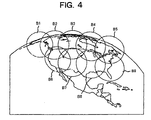
- Fig.4 is an illustration of a publication entitled "System Trade Off for a North American Mobile Satellite" (B. P. Cox J. Zacharatos, B. Williamson, C. Morgan, J. R. G. Cox; Spar Aerospace Limited, AIAA 12th International Communication Satellite Systems Conference, March 13-17, 1988/ Arlington, Virginia), which depicts an arrangement configuration of satellite antenna beams providing satellite mobile communication services in a band of 1.5 GHz in North America.
- one satellite antenna beam B7 irradiates only a part of a land.
- the remaining seven satellite antenna beams B1 through B6, B8 and B9 irradiate parts of the land and parts of the sea.
- the frequency of the satellite antenna beam B7, which irradiate s only the land, and the frequencies of the satellite antenna beams B1 through B6, B8 and B9, which irradiate both regions including the land and the sea, are of the same band of 1.5 GHz, and hence it is difficult to miniaturize satellite mobile terminals and greatly increase their transmission capacities because of the limitation on the permissible value of interference to other terrestrial wireless communication systems.
- the satellite communication systems have features such as large service areas, easiness in settings of communication lines or links, high reliability, etc., and hence are well adapted for telecommunication systems and are now in the course of development.
- problems such as the reduction of interference given to terrestrial wireless communication systems, i.e., reduction in giving interference (minimization of interference to other systems), the reduction of interference received from terrestrial wireless communication systems (minimization of interference from other systems), the expansion of transmission bands, and an increase in capacity are not resolved, there is little possibility of satellite communication systems developing in a large scale while being compatible with terrestrial wireless communication systems.
- the present invention is intended to obviate the problems as referred to above, and has for its object to achieve a satellite communication system which is compatible with terrestrial wireless communication systems, and which is excellent in availability in wide areas, in easiness in setting communication links or channels, and in wide-band characteristics, and which is capable of achieving large-capacity transmission with small-sized terminals in land regions as well as the minimization of interference to terrestrial wireless communication systems in sea regions and in aerial regions.
- a satellite communication system in which communications are carried out between a communication device installed on a satellite and earth stations through wireless channels formed therebetween, is characterized in that it comprises, as a satellite antenna beam irradiated from the communication device installed on the satellite toward the earth, a first satellite antenna beam irradiating an inner oceanic region at least including and contacting a land, and a second satellite antenna beam irradiating only an outer oceanic region which is in contact with said inner oceanic region, and that said first and second satellite antenna beams together constitute a communication service area, and that the frequency of said first satellite antenna beam is set to be higher and wider in band than that of said second satellite antenna beam.
- the first satellite antenna beam is characterized in that it irradiates the inner oceanic region including one or more lands.
- the first satellite antenna beam is characterized in that it irradiates the inner oceanic region including a land having only a part of its periphery in contact with the inner oceanic region.
- the first satellite antenna beam is characterized in that it irradiates the inner oceanic region including a land having two or more parts of its periphery in contact with the inner oceanic region.
- a satellite communication system in which communications are carried out between a communication device installed on a satellite and earth stations through wireless or radio communication channels or links formed therebetween, constitutes a communication service area by arranging a compound antenna beam comprising, as satellite antenna beams irradiated from the communication device installed on the satellite toward the earth, a satellite antenna beam irradiating a compound region which includes a land and an inner oceanic region enclosing the outer periphery of the land and which comprises the entire land and the inner oceanic region, and a satellite antenna beam irradiating only an outer oceanic region except those portions of the inner oceanic region which are in contact with the land.
- the frequency of the satellite antenna beam, which irradiates the compound region comprising the entire land and the inner oceanic region is set to be higher and wider in band than that of the satellite antenna beam which irradiates only the outer oceanic region.
- Fig. 1 relates to the first embodiment of the present invention, while taking Japan as an example, which illustrates an exemplary arrangement of a compound satellite antenna beam comprising two beams of mutually different frequency bands and of different frequencies, one of the beams being a satellite antenna beam of a first frequency irradiating an inner oceanic region 1 with a borderline 2 bounded by one or more lands, the other beam being a satellite antenna beam of a second frequency irradiating an outer oceanic region 3 which is in contact with the inner oceanic region 1 through the borderline 2.
- Such a configuration of the communication service area due to the arrangement of the satellite antenna beams and the settings of frequency bands and frequencies of the satellite antenna beams according to the first embodiment can be applied to Japan, the Commonwealth of Australia, the Republic of Philippines, the Republic of Indonesia, Formosa, etc., for example.
- a communication service area is constituted by arranging a compound antenna beam which comprises a satellite antenna beam irradiating an inner oceanic region including one or more lands, and a satellite antenna beam irradiating only an outer oceanic region, and additionally, the frequency of the satellite antenna beam irradiating the inner oceanic region including one or more lands is set to be higher and wider in band than that of the satellite antenna beam irradiating only the outer oceanic region.
- the frequency bands and the frequencies are different between the inner oceanic region including a land and the outer oceanic region, and hence mutual interference in these regions can be reduced. Moreover, it is possible to increase transmission capacity in the inner oceanic region by using a high frequency and a wide frequency band. Thus, it is possible to provide services for a lot of users and in wide areas as well. In addition, the lesser the interference, the lesser becomes the loss, thus making it easy to design communication channels or links.
- a satellite communication system in which communications are carried out between a communication device installed on a satellite and earth stations through wireless channels or links formed therebetween, constitutes a communication service area by arranging a compound antenna beam comprising, as satellite antenna beams irradiated from the communication device installed on the satellite toward the earth, a satellite antenna beam irradiating an inner oceanic region including a land of which a part of the outer periphery is in contact with the inner oceanic region, and a satellite antenna beam irradiating only an outer oceanic region which is in contact with the inner oceanic region.
- the frequency of the satellite antenna beam, which irradiates the inner oceanic region including a part of the land and its periphery is set to be higher and wider in band than that of the satellite antenna beam which irradiates only the outer oceanic region.
- Fig. 2 relates to the second embodiment of the present invention, while taking South America as an example, which illustrates an exemplary arrangement of a compound satellite antenna beam comprising two beams of mutually different frequency bands and of different frequencies, one of the beams being a satellite antenna beam of a first frequency irradiating an inner oceanic region and a land 4 of which a part of the periphery is contact with the inner oceanic region, the other beam being a satellite antenna beam of a second frequency irradiating an outer oceanic region 3 which is in contact with the inner oceanic region through an arbitrary borderline 5.
- Such a configuration of the communication service area due to the arrangement of the satellite antenna beams and the settings of frequency bands and frequencies of the satellite antenna beams according to the second embodiment can be applied to the Federative Republic of Brazil, the Republic of Korea, the People's Republic of China, the Republic of India, the Argentine Republic, the Republic of Peru, the Republic of Portugal, etc., for example.
- a communication service area is constituted by arranging a compound antenna beam which comprises a satellite antenna beam irradiating an inner oceanic region including a land of which a part of the outer periphery is in contact with an ocean, and a satellite antenna beam irradiating only an outer oceanic region.
- the frequency of the satellite antenna beam, which irradiates the inner oceanic region including part of lands with their periphery in contact with an ocean is set to be higher and wider in band than that of the satellite antenna beam which irradiates only the outer oceanic region.
- a satellite communication system in which communications are carried out between a communication device installed on a satellite and earth stations through wireless channels or links formed therebetween, constitutes a communication service area by arranging a compound antenna beam comprising a satellite antenna beam irradiating an inner oceanic region including a land of which two or more parts of the outer periphery are in contact with an inner ocean, and a satellite antenna beam irradiating only an outer oceanic region which is in contact with the inner oceanic region.
- the frequency of the satellite antenna beam, which irradiates the inner oceanic region including the land is set to be higher and wider in band than that of the satellite antenna beam which irradiates only the outer oceanic region.
- Fig. 3 relates to this third embodiment, while taking North America as an example, which illustrates an exemplary arrangement of a compound satellite antenna beam comprising two beams of mutually different frequency bands and of different frequencies, one of the beams being a satellite antenna beam of a first frequency irradiating an inner oceanic region 6 including a land of which two or more parts of the periphery is contact with an ocean, the other beam being a satellite antenna beam of a second frequency irradiating an outer oceanic region 3.
- Such a configuration of the communication service area due to the arrangement of the satellite antenna beams and the settings of frequency bands and frequencies of the satellite antenna beams according to the second embodiment can be applied to the United States, Canada, the United Mexican States, the Republic of Panama, the Republic of Colombia, Spain, the French Republic, the old Soviet Union, etc., for example.
- a communication service area is constituted by arranging a compound antenna beam which comprises a satellite antenna beam irradiating an inner oceanic region including a land of which two or more parts of the outer periphery are in contact with an ocean, and a satellite antenna beam irradiating only an outer oceanic region,
- the frequency of the satellite antenna beam, which irradiates the inner oceanic region including the land with two or more parts of its periphery in contact with an ocean is set to be higher and wider in band than that of the satellite antenna beam which irradiates only the outer oceanic region.
- the present invention it i s possible to achieve a satellite communication system which is compatible with terrestrial wireless or radio communication systems, and which is excellent in availability in wide areas, in easiness in setting communications links or channels, and in wide-band characteristics, and which is capable of achieving large-capacity transmission with small-sized terminals in land regions as well as the minimization of interference to terrestrial wireless communication system in sea regions and in aerial regions.
Landscapes
- Engineering & Computer Science (AREA)
- Physics & Mathematics (AREA)
- Astronomy & Astrophysics (AREA)
- General Physics & Mathematics (AREA)
- Remote Sensing (AREA)
- Aviation & Aerospace Engineering (AREA)
- Computer Networks & Wireless Communication (AREA)
- Signal Processing (AREA)
- Radio Relay Systems (AREA)
- Variable-Direction Aerials And Aerial Arrays (AREA)
Abstract
Description
Claims (4)
- A satellite communication system in which communications are carried out between a communication device installed on a satellite and earth stations through wireless communication channels formed therebetween,
characterized in that it comprises, as satellite antenna beams irradiated from said communication device installed on said satellite toward the earth, a first satellite antenna beam irradiating an inner oceanic region at least including and contacting a land, and a second satellite antenna beam irradiating only an outer oceanic region which is in contact with said inner oceanic region, and
that said first and second satellite antenna beams together constitute a communication service area, and
that the frequency of said first satellite anten na beam is set to be higher and wider in band than that of said second satellite antenna beam. - The satellite communication system according to claim 1, characterized in that said first satellite antenna beam irradiates said inner oceanic region which includes one or more lands.
- The satellite communication system according to claim 1, characterized in that said first satellite antenna beam irradiates said inner oceanic region which includes a land of which only a part of its periphery is in contact with said inner oceanic region.
- The satellite communication system according to claim 1, characterized in that said first satellite antenna beam irradiates said inner oceanic region which includes a land of which two or more parts of its periphery are in contact with said inner oceanic region.
Applications Claiming Priority (1)
| Application Number | Priority Date | Filing Date | Title |
|---|---|---|---|
| PCT/JP2000/004252 WO2002001753A1 (en) | 2000-06-28 | 2000-06-28 | Satellite communication system |
Publications (2)
| Publication Number | Publication Date |
|---|---|
| EP1209821A1 true EP1209821A1 (en) | 2002-05-29 |
| EP1209821A4 EP1209821A4 (en) | 2002-11-27 |
Family
ID=11736195
Family Applications (1)
| Application Number | Title | Priority Date | Filing Date |
|---|---|---|---|
| EP00942370A Withdrawn EP1209821A4 (en) | 2000-06-28 | 2000-06-28 | SATELLITE COMMUNICATION SYSTEM |
Country Status (2)
| Country | Link |
|---|---|
| EP (1) | EP1209821A4 (en) |
| WO (1) | WO2002001753A1 (en) |
Families Citing this family (1)
| Publication number | Priority date | Publication date | Assignee | Title |
|---|---|---|---|---|
| JP5500630B2 (en) * | 2009-11-18 | 2014-05-21 | 独立行政法人情報通信研究機構 | Interference evaluation method for ground-satellite frequency sharing communication system |
Family Cites Families (2)
| Publication number | Priority date | Publication date | Assignee | Title |
|---|---|---|---|---|
| JPH02171038A (en) * | 1988-12-24 | 1990-07-02 | Mitsubishi Electric Corp | Multi-beam antenna system |
| US5963175A (en) * | 1998-08-22 | 1999-10-05 | Cyberstar, L.P. | One dimensional interleaved multi-beam antenna |
-
2000
- 2000-06-28 EP EP00942370A patent/EP1209821A4/en not_active Withdrawn
- 2000-06-28 WO PCT/JP2000/004252 patent/WO2002001753A1/en not_active Ceased
Also Published As
| Publication number | Publication date |
|---|---|
| EP1209821A4 (en) | 2002-11-27 |
| WO2002001753A1 (en) | 2002-01-03 |
Similar Documents
| Publication | Publication Date | Title |
|---|---|---|
| CN101263670B (en) | Satellite communications apparatus and methods using asymmetrical forward and return link frequency reuse | |
| MX2007005805A (en) | Satellite communications systems, components and methods for operating shared satellite gateways. | |
| MXPA05012324A (en) | Systems and methods for handover between space based and terrestrial radioterminal communications, and for monitoring terrestrially reused satellite frequencies at a radioterminal to reduce potential interference. | |
| EP0000038B1 (en) | Method and apparatus for cancelling interference between area coverage and spot coverage antenna beams | |
| EP2026476A1 (en) | Frequency reuse in a geosynchronous satellite communication system | |
| US8744346B2 (en) | Method and system for improving the spectral efficiency of a data communication link | |
| KR100711015B1 (en) | Wireless system combining arrangement and method thereof | |
| US20080254845A1 (en) | Antenna module and apparatus utilizing the same | |
| Oodo et al. | Sharing and compatibility study between fixed service using high altitude platform stations (HAPS) and other services in the 31/28 GHz bands | |
| US20120057588A1 (en) | Multiple antenna multiplexers, demultiplexers and antenna assemblies | |
| Shamsan et al. | Spectrum sharing studies of IMT-advanced and FWA services under different clutter loss and channel bandwidths effects | |
| EP1209821A1 (en) | Satellite communication system | |
| US12288932B2 (en) | Antenna arrangement | |
| Son et al. | Analysis of the interference effects from maritime earth station in motion to 5G mobile service | |
| WO2019035113A1 (en) | A system that integrates a communication satellite network with a cellular network | |
| EP1900112B1 (en) | A point-to-point telecommunications system | |
| EP3105861A1 (en) | Combining radio frequency bands for increasing bandwidth in a wireless communication system | |
| EP2962356B1 (en) | Methods and devices for protecting antenna components from contaminants | |
| Park et al. | Technical and regulatory studies on HAPS | |
| Baker | Frequency reuse in land mobile-satellite systems | |
| KR20060058352A (en) | Frequency range setting method of repeater in mobile communication system | |
| CN212305395U (en) | Device for amplifying and repeating L-band satellite telephone signal | |
| KR100602753B1 (en) | Relay system using leaky coaxial cable | |
| Saeed et al. | Very Small Aperture Terminals (VSATs) and Requirments | |
| CN103026640B (en) | Hybrid cellular radio communications system and be used for keeping conforming processing method |
Legal Events
| Date | Code | Title | Description |
|---|---|---|---|
| PUAI | Public reference made under article 153(3) epc to a published international application that has entered the european phase |
Free format text: ORIGINAL CODE: 0009012 |
|
| 17P | Request for examination filed |
Effective date: 20011128 |
|
| AK | Designated contracting states |
Kind code of ref document: A1 Designated state(s): AT BE CH CY DE DK ES FI FR GB GR IE IT LI LU MC NL PT SE |
|
| A4 | Supplementary search report drawn up and despatched |
Effective date: 20021014 |
|
| AK | Designated contracting states |
Kind code of ref document: A4 Designated state(s): AT BE CH CY DE DK ES FI FR GB GR IE IT LI LU MC NL PT SE |
|
| RIC1 | Information provided on ipc code assigned before grant |
Free format text: 7H 04B 7/15 A, 7H 01Q 3/26 B, 7H 01Q 25/00 B |
|
| 17Q | First examination report despatched |
Effective date: 20030618 |
|
| STAA | Information on the status of an ep patent application or granted ep patent |
Free format text: STATUS: THE APPLICATION IS DEEMED TO BE WITHDRAWN |
|
| RBV | Designated contracting states (corrected) |
Designated state(s): FR GB |
|
| 18D | Application deemed to be withdrawn |
Effective date: 20031029 |
|
| REG | Reference to a national code |
Ref country code: DE Ref legal event code: 8566 |