EP1209212A1 - Adhesive composition and method of bonding with the adhesive composition - Google Patents
Adhesive composition and method of bonding with the adhesive composition Download PDFInfo
- Publication number
- EP1209212A1 EP1209212A1 EP00954979A EP00954979A EP1209212A1 EP 1209212 A1 EP1209212 A1 EP 1209212A1 EP 00954979 A EP00954979 A EP 00954979A EP 00954979 A EP00954979 A EP 00954979A EP 1209212 A1 EP1209212 A1 EP 1209212A1
- Authority
- EP
- European Patent Office
- Prior art keywords
- compound
- adhesive composition
- active energy
- exposure
- energy radiation
- Prior art date
- Legal status (The legal status is an assumption and is not a legal conclusion. Google has not performed a legal analysis and makes no representation as to the accuracy of the status listed.)
- Granted
Links
Classifications
-
- C—CHEMISTRY; METALLURGY
- C09—DYES; PAINTS; POLISHES; NATURAL RESINS; ADHESIVES; COMPOSITIONS NOT OTHERWISE PROVIDED FOR; APPLICATIONS OF MATERIALS NOT OTHERWISE PROVIDED FOR
- C09J—ADHESIVES; NON-MECHANICAL ASPECTS OF ADHESIVE PROCESSES IN GENERAL; ADHESIVE PROCESSES NOT PROVIDED FOR ELSEWHERE; USE OF MATERIALS AS ADHESIVES
- C09J4/00—Adhesives based on organic non-macromolecular compounds having at least one polymerisable carbon-to-carbon unsaturated bond ; adhesives, based on monomers of macromolecular compounds of groups C09J183/00 - C09J183/16
- C09J4/06—Organic non-macromolecular compounds having at least one polymerisable carbon-to-carbon unsaturated bond in combination with a macromolecular compound other than an unsaturated polymer of groups C09J159/00 - C09J187/00
-
- C—CHEMISTRY; METALLURGY
- C08—ORGANIC MACROMOLECULAR COMPOUNDS; THEIR PREPARATION OR CHEMICAL WORKING-UP; COMPOSITIONS BASED THEREON
- C08F—MACROMOLECULAR COMPOUNDS OBTAINED BY REACTIONS ONLY INVOLVING CARBON-TO-CARBON UNSATURATED BONDS
- C08F290/00—Macromolecular compounds obtained by polymerising monomers on to polymers modified by introduction of aliphatic unsaturated end or side groups
- C08F290/02—Macromolecular compounds obtained by polymerising monomers on to polymers modified by introduction of aliphatic unsaturated end or side groups on to polymers modified by introduction of unsaturated end groups
- C08F290/06—Polymers provided for in subclass C08G
- C08F290/062—Polyethers
-
- C—CHEMISTRY; METALLURGY
- C08—ORGANIC MACROMOLECULAR COMPOUNDS; THEIR PREPARATION OR CHEMICAL WORKING-UP; COMPOSITIONS BASED THEREON
- C08F—MACROMOLECULAR COMPOUNDS OBTAINED BY REACTIONS ONLY INVOLVING CARBON-TO-CARBON UNSATURATED BONDS
- C08F290/00—Macromolecular compounds obtained by polymerising monomers on to polymers modified by introduction of aliphatic unsaturated end or side groups
- C08F290/02—Macromolecular compounds obtained by polymerising monomers on to polymers modified by introduction of aliphatic unsaturated end or side groups on to polymers modified by introduction of unsaturated end groups
- C08F290/06—Polymers provided for in subclass C08G
- C08F290/067—Polyurethanes; Polyureas
-
- C—CHEMISTRY; METALLURGY
- C08—ORGANIC MACROMOLECULAR COMPOUNDS; THEIR PREPARATION OR CHEMICAL WORKING-UP; COMPOSITIONS BASED THEREON
- C08G—MACROMOLECULAR COMPOUNDS OBTAINED OTHERWISE THAN BY REACTIONS ONLY INVOLVING UNSATURATED CARBON-TO-CARBON BONDS
- C08G18/00—Polymeric products of isocyanates or isothiocyanates
- C08G18/06—Polymeric products of isocyanates or isothiocyanates with compounds having active hydrogen
- C08G18/08—Processes
- C08G18/10—Prepolymer processes involving reaction of isocyanates or isothiocyanates with compounds having active hydrogen in a first reaction step
-
- C—CHEMISTRY; METALLURGY
- C08—ORGANIC MACROMOLECULAR COMPOUNDS; THEIR PREPARATION OR CHEMICAL WORKING-UP; COMPOSITIONS BASED THEREON
- C08G—MACROMOLECULAR COMPOUNDS OBTAINED OTHERWISE THAN BY REACTIONS ONLY INVOLVING UNSATURATED CARBON-TO-CARBON BONDS
- C08G18/00—Polymeric products of isocyanates or isothiocyanates
- C08G18/06—Polymeric products of isocyanates or isothiocyanates with compounds having active hydrogen
- C08G18/70—Polymeric products of isocyanates or isothiocyanates with compounds having active hydrogen characterised by the isocyanates or isothiocyanates used
- C08G18/72—Polyisocyanates or polyisothiocyanates
- C08G18/80—Masked polyisocyanates
- C08G18/8061—Masked polyisocyanates masked with compounds having only one group containing active hydrogen
- C08G18/807—Masked polyisocyanates masked with compounds having only one group containing active hydrogen with nitrogen containing compounds
- C08G18/8077—Oximes
-
- C—CHEMISTRY; METALLURGY
- C09—DYES; PAINTS; POLISHES; NATURAL RESINS; ADHESIVES; COMPOSITIONS NOT OTHERWISE PROVIDED FOR; APPLICATIONS OF MATERIALS NOT OTHERWISE PROVIDED FOR
- C09J—ADHESIVES; NON-MECHANICAL ASPECTS OF ADHESIVE PROCESSES IN GENERAL; ADHESIVE PROCESSES NOT PROVIDED FOR ELSEWHERE; USE OF MATERIALS AS ADHESIVES
- C09J175/00—Adhesives based on polyureas or polyurethanes; Adhesives based on derivatives of such polymers
- C09J175/04—Polyurethanes
- C09J175/14—Polyurethanes having carbon-to-carbon unsaturated bonds
- C09J175/16—Polyurethanes having carbon-to-carbon unsaturated bonds having terminal carbon-to-carbon unsaturated bonds
-
- C—CHEMISTRY; METALLURGY
- C09—DYES; PAINTS; POLISHES; NATURAL RESINS; ADHESIVES; COMPOSITIONS NOT OTHERWISE PROVIDED FOR; APPLICATIONS OF MATERIALS NOT OTHERWISE PROVIDED FOR
- C09J—ADHESIVES; NON-MECHANICAL ASPECTS OF ADHESIVE PROCESSES IN GENERAL; ADHESIVE PROCESSES NOT PROVIDED FOR ELSEWHERE; USE OF MATERIALS AS ADHESIVES
- C09J201/00—Adhesives based on unspecified macromolecular compounds
- C09J201/02—Adhesives based on unspecified macromolecular compounds characterised by the presence of specified groups, e.g. terminal or pendant functional groups
- C09J201/10—Adhesives based on unspecified macromolecular compounds characterised by the presence of specified groups, e.g. terminal or pendant functional groups containing hydrolysable silane groups
Definitions
- This invention relates to an adhesive composition which is flowable in ordinary state, shows a spreadable viscosity, provides temporary bonding or fixing when its cohesion is improved by short-time exposure to an active energy radiation, and reaches a final bonding power when subjected to crosslinking or polymerization, and also to a joining method utilizing the adhesive composition.
- an adhesive composition which contains a compound having a hydrolyzable silyl group such as an alkoxysilyl and cures in the presence of moisture or the like.
- This adhesive composition exhibits superior impact resistance and creep resistance after it has been cured. Accordingly, its use at parts (e.g., joints between tiles or wall members) of a house that receive continuous loads has been investigated and actually practiced in building and construction sites.
- this adhesive composition if designed to have a fast-curing property adapted for use on such an assembly line, has a shorter pot life and is thus prevented from residing on an applicator for extended period of time, which has been a problem.
- a design is made to extend a pot life of the composition, curing thereof is retarded. In such a case, an appropriate measure must be taken to hold components in positions. In addition, the composition must be aged until it completes curing.
- photocurable compositions have been conventionally proposed (for example, in Japanese Patent Laying-Open No. Sho 63-139969) which are caused to cure by short-time exposure to a radiation.
- the application of such photocurable compositions to photo-curable inks, varnishes, coating materials or adhesives has also been proposed. Since photocurable adhesives incorporating such photocurable compositions show fast-curing properties, a sufficiently long pot life can be insured simply by shielding a light that otherwise sensitizes them. Accordingly, the use as inline adhesives has been proposed.
- the photocurable adhesives are generally irradiated after application thereof and following combination of adherends. This has prevented application of such photocurable adhesives to building and construction materials through which substantially no light can pass.
- curable compositions containing, in combination, a compound containing the aforementioned hydrolyzable silyl group and a photocurable substance have been proposed (for example, in Japanese Patent Laying-Open Nos. Sho 55-36241 and Hei 8-325466) for the purposes of improving stain resistance, dust resistance, tack and weather resistance of cured surfaces when they are used as building sealants. It has been however difficult to rapidly develop fast-curing and cohesive properties by short-time irradiation.
- This invention is directed toward solving the above-described problems and its object is to provide an adhesive composition which is flowable in ordinary state, has a spreadable viscosity, has a long pot life, develops cohesion by short-time irradiation, eliminates the need of temporary bonding and fixing procedures and exhibits superior impact resistance, creep resistance and other properties after it has been cured, and a joining method utilizing the adhesive composition.
- a first invention of this application is an adhesive composition characterized as containing a compound (X) having a crosslinkable or polymerizable group and a compound (Y) which is activated when exposed to an active energy radiation to generate species that cause crosslinking or polymerization of at least a part of the compound (X), wherein the composition has a viscosity at 25 °C of 1 - 10,000,000 cps, a conversion of the compound (X) immediately after exposure of the adhesive composition to the active energy radiation does not exceed 70 %, a conversion of the compound (X) after exposure of the adhesive composition to the active energy radiation and subsequent 24-hour aging at 25°C is within the range of 50 - 100 %, and after exposure to the active energy radiation and following 24-hour aging at 25 °C, the cured composition has an elongation at break of 10 - 1,000 % and a dynamic tensile modulus in the range of 10 5 - 10 9 Pa.
- the adhesive composition in accordance with the first invention Prior to exposure to the active energy radiation, the adhesive composition in accordance with the first invention is stored under a light-shielded or dehumidified condition so that crosslinking or polymerization of the compound (X) is prevented. That is, the compound (X) undergoes little change to show suitable flowability in ordinary state. This eases application of the composition onto various types of adherends by hands or spreaders conventionally known in the art.
- the compound (Y) undergoes rapid decomposition upon exposure to the active energy radiation. However, either a part or whole of the compound (X) is left unreacted within a normal operation time to combine adherends. This allows the adhesive composition to develop cohesion commensurate with the properties and conversion of the compound (X) and reach a sufficient adhesive level to provide temporary fixing, making it suitable for use in adhesively joining various adherends.
- a conversion of the compound (X) immediately after exposure of the adhesive composition to the active energy radiation is in the range of 10 - 70 % and the adhesive composition immediately after its exposure to the active energy radiation exhibits a dynamic tensile modulus in the range of 10 5 - 10 7 Pa. Accordingly, the highly elastic cured composition is obtained when the substantial absence of the compound (X) is established after exposure of the composition to the active energy radiation.
- the compound (X) immediately after exposure of the adhesive composition to the active energy radiation exhibits a conversion of not exceeding 30 %
- the composition has a viscosity at 25 °C in the range of 1 - 10,000,000 cps
- the compound (X) after exposure of the adhesive composition to the active energy radiation and following 12-hour aging thereof at 25 °C exhibits a conversion in the range of 50 - 100 %.
- the flowability is sustained over a certain time after exposure of the composition to the active energy radiation. This accordingly results in the provision of the adhesive composition excellent in wettability with respect to rough surfaces.
- This adhesive composition is thus made suitable for use in adhesively joining adherends such as mortar and plywood.
- the dynamic shear modulus and dynamic tensile modulus were determined by using a viscoelastic spectrometer at a measurement temperature of 25 °C.
- the dynamic shear modulus values were determined at an applied frequency of 0.1 rad/s.
- the dynamic tensile modulus values were determined at an applied frequency of 63 rad/s.
- a tensile tester with a crosshead speed of 500 mm/min was utilized to determine values for elongation at break at a temperature of 25 °C according to JIS K 6301.
- the adhesive composition in accordance with this invention may further contain other components.
- An adhesive composition in accordance with the below-described second invention is such an adhesive composition that contains the compound (X), the compound (Y) and additional components.
- the adhesive composition in accordance with the second invention contains: (A) a compound having at least two hydrolyzable silyl groups in a molecule, (B) a compound which induces crosslinking of the compound (A), (C) a compound having a polymerizable group in a molecule, (D) a compound which, when exposed to a radiation, initiates polymerization of the polymerizable group in the compound (C), and (E) a thixotropic agent. That is, the compound (A) and the compound (C) for use in the second invention, in combination, correspond to the compound (X) for use in the first invention, and the compound (D) does to the compound (Y) for use in the first invention.
- the compound (B) is a catalyst that promotes crosslinking of the compound (A) in the presence of moisture.
- the adhesive composition in accordance with the second invention further contains the compound (B) serving as a catalyst to promote crosslinking of the compound (A), and the thixotropic agent (E).
- the hydrolyzable silyl group in the compound (A) is an alkoxysilyl group and the compound (A) is a compound containing the alkoxysilyl group substituted in a polymer selected from polyalkylene glycol and polyolefin.
- the polymerizable group in the compound (C) is a free-radically polymerizable group and the compound (D) is a photochemically free-radical generating agent.
- the polymerizable group in the compound (C) is an acryloyl or methacryloyl group.
- the compound (C) includes at least one type of polymerizable compound (F) containing one or more polymerizable groups in a molecule and having a weight average molecular weight of not less than 3,000.
- the use of the compound (F) for a part of the compound (F) increases an initial creep resistance of the adhesive composition immediately after combination of adherends.
- the thixotropic agent (E) is at least one selected from the group consisting of glass balloons, glass beads, surface-treated calcium carbonates and silicas.
- the method of joining members in accordance with the present invention is characterized as comprising, in sequence, applying the adhesive composition of the first or second invention to one of the members, exposing a top surface of the applied adhesive composition layer to an active energy radiation and combining the one member with the other member.
- the type of the crosslinkable or polymerizable group incorporated in the compound (X) is not particularly specified.
- groups include hydrolyzable silyl groups such as alkoxysilyl, acetoxysilyl, chlorosilyl and bromosilyl groups; oxirane groups such as epoxy and oxetanyl groups; isocyanate groups; polymerizable unsaturated groups such as acryloyl, methacryloyl, styryl, allyl, vinyloxy, vinyloxycarbonyl, maleimide and unsaturated acid anhydride groups; and the like.
- the compound (X) may contain one or more of the above-listed groups in a molecule and such compounds may be used in combination.
- compounds (X) include below-listed compounds (A), compounds (C) and compounds containing one or more isocyanate groups in a molecule.
- aromatic monofunctional isocyanates include phenyl isocyanate, naphthyl isocyanate, 2,4-dimethoxydiphenyl isocyanate, 2,6-dimethylphenyl isocyanate, 3,5-dimethylphenyl isocyanate, 3-acetophenyl isocyanate, 2-biphenyl isocyanate, 2,6-diisopropylphenyl isocyanate, 2-ethoxyphenyl isocyanate, 4-ethoxyphenyl isocyanate, 2-ethylphenyl isocyanate, 4-heptyloxy-phenyl isocyanate, 4-isopropylphenyl isocyanate, 2-methoxyphenyl isocyanate, 3-methoxyphenyl isocyanate, 4-methoxyphenyl isocyanate, 4-methyl-3-
- Examples of aliphatic monofunctional isocyanates include cyclohexyl isocyanate, pentyl isocyanate, octyl isocyanate, benzyl isocyanate, dodecyl isocyanate, ethyl isocyanate, heptyl isocyanate, ethoxycarbonyl isocyanate, hexadecyl isocyanate, hexyl isocyanate, 4-methoxybenzyl isocyanate, 2-methylbenzyl isocyanate, 3-methylbenzyl isocyanate and 4-methylbenzyl isocyanate.
- aromatic diisocyanates examples include 2,4-tolylene diisocyanate (TDI), phenyl diisocyanate, xylene diisocyanate, 4,4'-diphenylmethane diisocyanate (MDI), a mixture (crude MDI) of MDI with triphenylmethane triisocyanate or the like, 1,5-naphthylene diisocyanate, isophorone diisocyanate, dicyclohexylmethane diisocyanate, ethylene diisocyanate/ methylene diisocyanate, propylene diisocyanate, tetramethylene diisocyanate and tolidine diisocyanate.
- TDI 2,4-tolylene diisocyanate
- MDI 4,4'-diphenylmethane diisocyanate
- MDI 4,4'-diphenylmethane diisocyanate
- a mixture crude MDI
- aliphatic diisocyanates examples include hexamethylene diisocyanate (HDI), isophorone diisocyanate (IPDI), xylylene diisocyanate, hydrogenated xylylene diisocyanate and dicyclohexylpentane diisocyanate.
- HDI hexamethylene diisocyanate
- IPDI isophorone diisocyanate
- xylylene diisocyanate xylylene diisocyanate
- hydrogenated xylylene diisocyanate dicyclohexylpentane diisocyanate
- tri- and higher-functional polyisocyanates examples include triphenylmethane triisocyanate, polymethylene polyphenyl polyisocyanate, TMP-modified TDI, an isocyanurate of TDI, TMP-modified HDI, an isocyanurate of HDI, a biuret of HDI, TMP-modified IPDI and an isocyanurate of IPDI.
- the above-listed isocyanate compounds may be used alone or in combination.
- the compound (Y) may be suitably chosen depending upon the type of the compound (X) used.
- Examples of compounds (Y) include those which generate, via photodegradation, active species reactive with the polymerizable group in the compound (X), such as photochemically radical-generating, cation-generating, acid-generating and amine generating agents which are below listed as examples of compounds (D). Such compounds (Y) may be used in combination.
- the compounds defined by the above structural formula can be obtained via a reaction of an urethane polymer or an isocyanate compound with an oxime compound. Any technique known in the art can be utilized to effect such a reaction.
- the defined compounds can be obtained by charging the reactants such that equimolar amounts of isocyanate moieties and hydroxyl moieties in oxime are introduced, optionally adding reaction catalysts such as tin and tertiary amine catalysts for isocyanate and hydroxyl groups, and allowing the reactant to react.
- additives can be added including a property control agent which will be later described, extender, reinforcer, plasticiser, coloring agent, flame retardant, antisagging agent, antioxidant, age resister, UV absorber, solvent, perfume, pigment, dye, sensitizer for the compound (Y) and the like.
- the active energy radiation may for example be in the form of ultraviolet radiation, visible light, infrared ray, electron beam or X-ray.
- a source of active energy radiation is suitably chosen depending upon its form of radiation.
- Suitable sources of active energy radiation include ultrahigh-pressure mercury lamps, high-pressure mercury lamps, medium-pressure mercury lamps, low-pressure mercury lamps, metal halide lamps, black light lamps, microwave-activated mercury lamps, halogen lamps, excimer laser, xenon lamps, fluorescent lamps, sunlight, electron beam emitter and the like.
- the amount of the compound (X) incorporated in the composition can be determined by a method as appropriate to the compound (X) used. Examples of such determination methods include gel permeation chromatography, thin-layer chromatography, affinity chromatography, normal phase chromatography, reversed phase chromatography, infrared spectroscopy, nuclear magnetic resonance spectroscopy, titration as appropriate to the crosslinkable or polymerizable group, quantitative determination by gel fraction and the like.
- the adhesive composition prior to exposure to the active energy radiation exhibits a viscosity in the range of 1 - 10,000,000 cps at 25 °C. If over 10,000,000 cps, the viscosity is too high to result in satisfactory application of the composition to an adherend.
- the viscosity in this specification is expressed by a value determined using a Brookfield viscometer with a rotor rotation speed of 10 rpm.
- the compound (X) shows a conversion in the range of 0 - 70 %. That is, when the composition is exposed to the active energy radiation, the compound (Y) is caused to decompose rapidly.
- the crosslinkable or polymerizable compound (X) is, either in part or whole, left unreacted within a time of a normal combining operation. Accordingly, the composition develops cohesion commensurate with the properties and residual content of the compound (X) to show a sufficient level of adhesion to provide temporary fixing, or alternatively, completes crosslinking rapidly while maintaining sufficient flowability to remain wettable. These permit easy and reliable adhesion of the composition to adherends.
- the compound (X) After exposure of the adhesive composition to the active energy radiation and following 24-hour aging thereof at 25 °C, the compound (X) exhibits a conversion in the range of 50 - 100 % and the cured composition shows an elongation at break of 10 - 1,000 % and a dynamic tensile modulus in the range of 10 5 - 10 9 Pa. Accordingly, the composition after cure has improved impact-resistant and durable adhesive properties.
- the compound (A) is used having two or more hydrolyzable silyl groups in a molecule.
- the hydrolyzable silyl group is not particularly specified in type.
- Examples of hydrolyzable silyl groups include those derived via replacement of at least one hydrogen atom of a silyl group by an alkoxy, oxime, alkenyl-oxy, acetoxy or halogen group.
- the use of the hydrolyzable silyl group (alkoxysilyl group) derived via replacement of at least one hydrogen atom by an alkoxy group is preferred for its superior storage stability.
- a polymer having at least two hydrolyzable silyl groups in a molecule is used for the aforementioned hydrolyzable silyl-containing or alkoxysilyl-containing compound.
- the use of such a polymer eases viscosity design of the adhesive composition and imparts the well-balanced cohesion and adhesion to the adhesive composition after cure.
- the polymer is not particularly specified in type. Examples of useful polymers include propylene glycol, ethylene glycol and other polyalkylene glycols, polyester, polyamide, polycarbonate, polymethacrylate, polyacrylate, polystyrene, polyolefin, copolymers thereof and the like.
- polyalkylene glycol and polyolfin are polyalkylene glycol and polyolfin. These polymers preferably have a weight average molecular weight of 4,000 - 30,000. More preferably, they have a weight average molecular weight of 10,000 - 30,000 and a molecular weight distribution (Mw/Mn) of 1.6 or below.
- alkoxysilyl group encompasses a monoalkylsilyl group, a dialkoxysilyl group and a trialkoxysilyl group.
- alkoxy groups include methoxy, ethoxy, propyloxy, isopropyloxy, butoxy, tert-butoxy, phenoxy, benzyloxy groups.
- dialkoxysilyl and trialkoxy-silyl groups the above-listed alkoxy groups may be used alone or in combination.
- the substituting alkoxysilyl group may be placed either at an end or on a side chain of the polymer. It may be placed at both locations.
- Examples of useful compounds (A) are commercially available, including Kaneka MS Polymers such as MS Polymer S-203, 303 and 903, Kaneka Silyl Polymers such as Silyl SAT-200, MA-403 and MA-447, and Asahi Glass ExceStar ESS-2410, 2420 and 3630.
- Kaneka MS Polymers such as MS Polymer S-203, 303 and 903
- Kaneka Silyl Polymers such as Silyl SAT-200, MA-403 and MA-447
- Asahi Glass ExceStar ESS-2410, 2420 and 3630 are commercially available, including Kaneka MS Polymers such as MS Polymer S-203, 303 and 903, Kaneka Silyl Polymers such as Silyl SAT-200, MA-403 and MA-447, and Asahi Glass ExceStar ESS-2410, 2420 and 3630.
- the type of the compound (B) used to induce crosslinking of the compound (A) is not particularly specified, so long as it shows an accelerating or catalytic action when the crosslinking of the compound (A) is caused to occur in the presence of moisture in the air.
- examples include tin compounds such as dibutyltin dilaurate, dibutyltin oxide, dibutyltin diacetate, dibutyltin phthalate, bis(dibutyltin laurate) oxide, dibutyltin bis-acetylacetonate, dibutyltin bis(monoester malate), tin octylate, dibutyltin octoate and dioctyltin oxide; titanate compounds such as tetra-n-butoxy titanate and tetraisopropoxy titanate; amine salts such as dibutylamine-2-ethyl hexoate; and other acid catalysts and basic catalysts. These compounds may
- the type of the compound (C) having a polymerizable group in a molecule is not particularly specified, so long as it has a polymerizable substituting group in such as a free-radically polymerizable or cationically polymerizable group. It may contain two or more dissimilar polymerizable groups in a molecule.
- free-radically polymerizable groups examples include styryl, acryloyl, methacryloyl, vinyl ester groups and the like. Acryloyl and methacryloyl groups are preferred for their superior polymerizability.
- styryl-containing compounds include styrene, indene, ⁇ -methylstyrene, p-methylstyrene, p-chlorostyrene, p-chloromethylstyrene, p-methoxystyrene, p-tert-butoxystyrene, divinylbenzene and the like.
- acryloyl-containing or methacryloyl-containing compounds include methyl (meth)acrylate, ethyl (meth)acrylate, propyl (meth)acrylate, n-butyl (meth)acrylate, tert-butyl (meth)acrylate, cyclohexyl (meth)acrylate, 2-ethylhexyl (meth)acrylate, n-octyl (meth)acrylate, isooctyl (meth)acrylate, isononyl (meth)acrylate, isomyristyl (meth)acrylate, stearyl (meth)acrylate, isobornyl (meth)acrylate, benzyl (meth)acrylate, 2-butoxyethyl (meth)acrylate, 2-phenoxyethyl (meth)acrylate, glycidyl (meth)acrylate, tetrahydrofurfuryl (meth)acrylate,
- vinyl ester-containing compounds include vinyl acetate, vinyl propionate, vinyl butyrate, vinyl caproate, vinyl benzoate and vinyl cinnamate.
- Examples of cationically polymerizable groups include epoxy, oxetanyl, vinyloxy and styryl groups.
- epoxy-containing compounds include bisphenol A epoxy resins, hydrogenated bisphenol A epoxy resins, bisphenol F epoxy resins, novolac epoxy resins, cycloaliphatic epoxy resins, brominated epoxy resins, rubber modified epoxy resins, urethane modified epoxy resins, glycidyl ester compounds, epoxidized polybutadiene and epoxydized styrene-butadiene-styrene copolymers.
- oxetanyl-containing compounds examples include 3-ethyl-3-hydroxymethyloxetane, 3-ethyl-3-phenoxymethyl-oxetane, 3-ethyl-3-hexyloxymethyloxetane, 1,4-bis[(3-ethyl-3-oxetanylmethoxy)methyl]benzene and the like.
- vinyloxy-containing compounds include n-propyl vinyl ether, n-butyl vinyl ether, isobutyl vinyl ether, tert-butyl vinyl ether, tert-amyl vinyl ether, cyclohexyl vinyl ether, 2-ethylhexyl vinyl ether, dodecyl vinyl ether, octadecyl vinyl ether, 2-chloroethyl vinyl ether, ethylene glycol butyl vinyl ether, triethylene glycol methyl vinyl ether, (4-vinyloxy)butyl benzoate, ethylene glycol divinyl ether, diethylene glycol divinyl ether, triethylene glycol divinyl ether, tetraethylene glycol divinyl ether, butane-1,4-diol-divinyl ether, hexane-1,6-diol-divinyl ether, cyclohexane-1,4-dimethanol-divinyl
- styryl-containing compounds include styrene, indene, ⁇ -methylstyrene, p-methylstyrene, p-chlorostyrene, p-chloromethylstyrene, p-methoxystyrene, p-tert-butoxystyrene, divinylbenzene and the like.
- the compound (F) is used for a part of the compound (C).
- the compound (F) is a polymerizable compound containing at least one polymerizable group in a molecule and having a weight average molecular weight of 3,000 or greater.
- the type of this polymerizable compound (F) is not particularly specified if it gives a long distance between crosslinks, develops conhesion, contains at least one free-radically polymerizable group and has a molecular weight of 3,000 or greater.
- Examples of compounds (F) include polymerizable compounds derived via terminal modification of polystyrene, polymethyl methacrylate, polypropylene or polyethyelene butylene; urethane acrylate; polyether acrylate and the like.
- the use of the compound (F) for a part of the compound (C) increases a creep resistance of the adhesive composition initially after combination of adherends.
- the weight of the compound (F) in 100 parts compound (C) is 0.1 - 70 parts. If the weight of the compound (F) is below 0.1 parts, the effectiveness of using the compound (F) may become negligible. On the other hand, if it exceeds 70 parts, irradiation may in some cases cause a marked increase in cohesion and accordingly a decrease in wettability of the adhesive composition to adherends, which results in the failure to obtain the sufficient creep resistance.
- the compound (D) that photoinitiates polymerization of the polymerizable group in the compound (C) can be suitably chosen depending upon the polymerization reaction mechanism of the polymerizable group contained in the compound (C).
- any type of compound photochemically radical-generating agent
- any type of compound can be used if it is able to induce free-radical polymerization upon exposure to radiation.
- examples of such compounds include acetophenone derived compounds such as 4-(2-hydroxyethoxy)phenyl(2-hydroxy-2-propyl) ketone, ⁇ -hydroxy- ⁇ , ⁇ '-dimethylacetophenone, methoxyacetophenone and 2, 2-dimethoxy-2-phenylacetophenone; benzoin ethers such as benzoin ethyl ether and benzoin propyl ether; and ketal derived compounds such as benzyldimethyl ketal.
- Other useful compounds include, for example, halogenated ketone, acylphosphine oxide, acyl phosphonate, 2-methyl-1-[4-(methylthio)phenyl]-2-morpholinopropane-1-on, 2-benzyl-2-N,N-dimethylamino-1- (4-morpholinophenyl)-1-butanone, 2,4,6-trimethylbenzoyl-diphenylphosphine oxide, bis-(2,6-dimethoxybenzoyl)-2,4,4-trimethylpentyl-phos phine oxide, bis( ⁇ 5 -cyclopentadienyl)-bis(pentafluorophenyl) -titanium and bis ( ⁇ 5-cyclopentadienyl)-bis[2,6-difluoro-3-(1 H-pyri-1-yl)phenyl]-titanium.
- the above-listed compounds may be used alone or in combination. Commercial products containing these compounds can
- any type of compound photochemically cation-generating agent
- any type of compound photochemically cation-generating agent
- examples of such compounds include iron-allene complex compounds, aromatic diazonium salts, aromatic iodonium salts, aromtaic sulfonium salts, pyridinium, aluminum complex/silanol salts and the like.
- a photosensitizer may also be added to increase a radiation sensitivity of the photochemically cation-generating agent.
- Suitable photosensitizers include anthracene, perylene, coronene, tetracene, benzanthracene, phenothiazine, flavin, acridine, ketocoumarin, thioxanthone derivatives, benzophenone, acetophenone, 2-chloro-thioxanthone, 2,4-dimethylthioxanthone, 2,4-diethylthioxanthone, 2,4-diisopropylthioxanthone, isopropylthioxanthone and the like.
- the wavelength photosensitivity of the compound (D) is not particularly specified, but the use of the compound which is sensitive to a radiation in the wavelength region of 300 - 800 nm is preferred.
- the compound (D) if only sensitive in the wavelength region over 800 nm, tends to readily decompose even at a low energy (thermal energy) level and initiate polymerization or crosslinking of the compound (C). This tendency may in some cases adversely affect the storage stability.
- the thixotropic agent (E) may be suitably chosen from compounds which can impart a thixotropic property to the adhesive composition.
- examples of such compounds include various silicas such as colloidal silica, surface-treated calcium carbonates such as hydrophobic calcium carbonate, glass balloons, glass beads, polyvinyl pyrrolidone and the like. Among these, glass balloons, glass beads, various silicas and surface-treated calcium carbonates are preferred.
- this thixotropic agent has a surface with a high affinity for the compound (A) or (C) for use in the adhesive composition of the present invention.
- urethane acrylate is used for the compound (C)
- the thixotropic agent (E) is preferably in the form of glass balloons.
- ⁇ , ⁇ -diacryloyl-poly(propylene glycol) is used for the compound (C)
- the use of surface-treated substances e.g., surface-treated calcium carbonates, is preferred.
- the blending proportions of the components incorporated in the adhesive composition of the second invention are not particularly specified, so long as they enable the adhesive composition to exhibit the superior application properties with a machine and improved storage stability, extended pot life, and the ability to develop initial cohesion by short-time irradiation.
- the thixotropic agent (E) is added in the amount of 20 - 65 % by volume (25 °C), based on 100 % by volume of all compounds (A) - (E).
- a cure rate of the compound (A) may in some cases be reduced to the degree that is substantially unsuited for a practical use.
- the amount of exceeding 20 parts by weight, while effective to accelerate the cure rate sufficiently, affects markedly on a bulk after cure to sometimes result in the difficulty to obtain sufficient adhesive strength.
- the amount of the compound (C) incorporated in the composition is below 15 parts by weight, the expected initial cohesion may not result from photopolymerization or photocrosslinking, even with the addition of excess amount of the thixotropic agent.
- the amount of exceeding 100 parts by weight while effective to impart the sufficient initial cohesion after cure, sometimes increases the cohesion excessively to reduce wettability of the adhesive composition, resulting in the failure to exhibit sufficient initial adhesiveness.
- the amount of the compound (D) incorporated in the composition is below 0.01 parts by weight, a polymerization or crosslinking rate of the compound (C) by irradiation may be reduced by a marked extent, resulting in the failure for the adhesive composition to exhibit initial adhesion after exposure to a radiation.
- the amount of exceeding 20 parts by weight while effective to accelerate a cure rate sufficiently, affects markedly on a bulk after cure to sometimes result in the difficulty to obtain sufficient adhesive strength.
- the amount of the thixotropic agent (E) incorporated in the composition is below 20 % by volume, it may become difficult to obtain a sufficient thixotropic property. The difficulty to obtain initial adhesion after exposure to a radiation may also result. By contrast, if it exceeds 65 % by volume, the adhesive composition of the present invention may show a marked viscosity increase, resulting in the difficult application thereof by a machine or in the marked reduction of the application rate.
- additives can be added, when needed, to the adhesive composition of the present invention.
- additives include property control agents such as for improving tensile properties, extenders, reinforcers, plasticizers, colorants, flame retarders and the like.
- silane coupling agents including vinyltrimethoxysilane, dimethyldimethoxysilane, methyltrimethoxysilane, methyltriethoxysilane, tetramethoxysilane, tetraethoxysilane, phenyltrimethoxysilane, diphenyldimethoxysilane, 3-aminopropyltrimethoxysilane, 3-aminopropylmethyldimethoxysilane, 3-aminopropyltriethoxysilane, N- (2-aminoethyl) -3-aminopropyltrimethoxysilane, N- (2-aminoethyl) -3-aminopropyltriethoxysilane, N,N'-bis- [3- (trimethoxysilyl)propyl] ethylenediamine, N, N'-bis- [3-(trimethoxysilyl)propyl] ethylenediamine, N
- Suitable for use as extenders are those which, when added to the adhesive composition in accordance with the present invention, do not provide significant effect on the thixotropic properties thereof.
- extenders include talc, clay, calcium carbonate, magnesium carbonate, anhydrous silicon, hydrated silicon, calcium silicate, titanium dioxide, carbon black and the like. These may be used alone or in combination.
- plasticizers examples include phosphate esters such as tributyl phosphate and tricresyl phosphate, phthalate esters such as dioctyl phthalate, aliphatic esters of monobasic acid such as glycerol monooleate ester, aliphatic esters of dibasic acid such as dioctyl adipate, polypropylene glycols and the like. These may be used alone or in combination.
- the adhesive composition of the present invention may also contain an antisagging agent, antioxidant, age resister, UV absorber, solvent, perfume, pigment, dye or the like, when necessary.
- the method of joining members in accordance with the present invention is characterized as comprising, in sequence, applying the adhesive composition of the first or second invention to one member, exposing a top surface of the applied adhesive composition layer to a radiation and combining the one member with the other member.
- the radiation source is not particularly specified, so long as it can emit a radiation including a wavelength region that corresponds to an absorption region of the compound (C) or the sensitizer added to improve photo-sensitivity, and is suitably chosen depending upon the type of the compound (C) or the sensitizer used.
- suitable radiation sources include low-pressure mercury lamps, medium-pressure mercury lamps, high-pressure mercury lamps, ultrahigh-pressure mercury lamps, excimer laser, chemical lamps, black light lamps, microwave-activated mercury lamps, metal halide lamps, sodium lamps, fluorescent lamps, sunlight and the like.
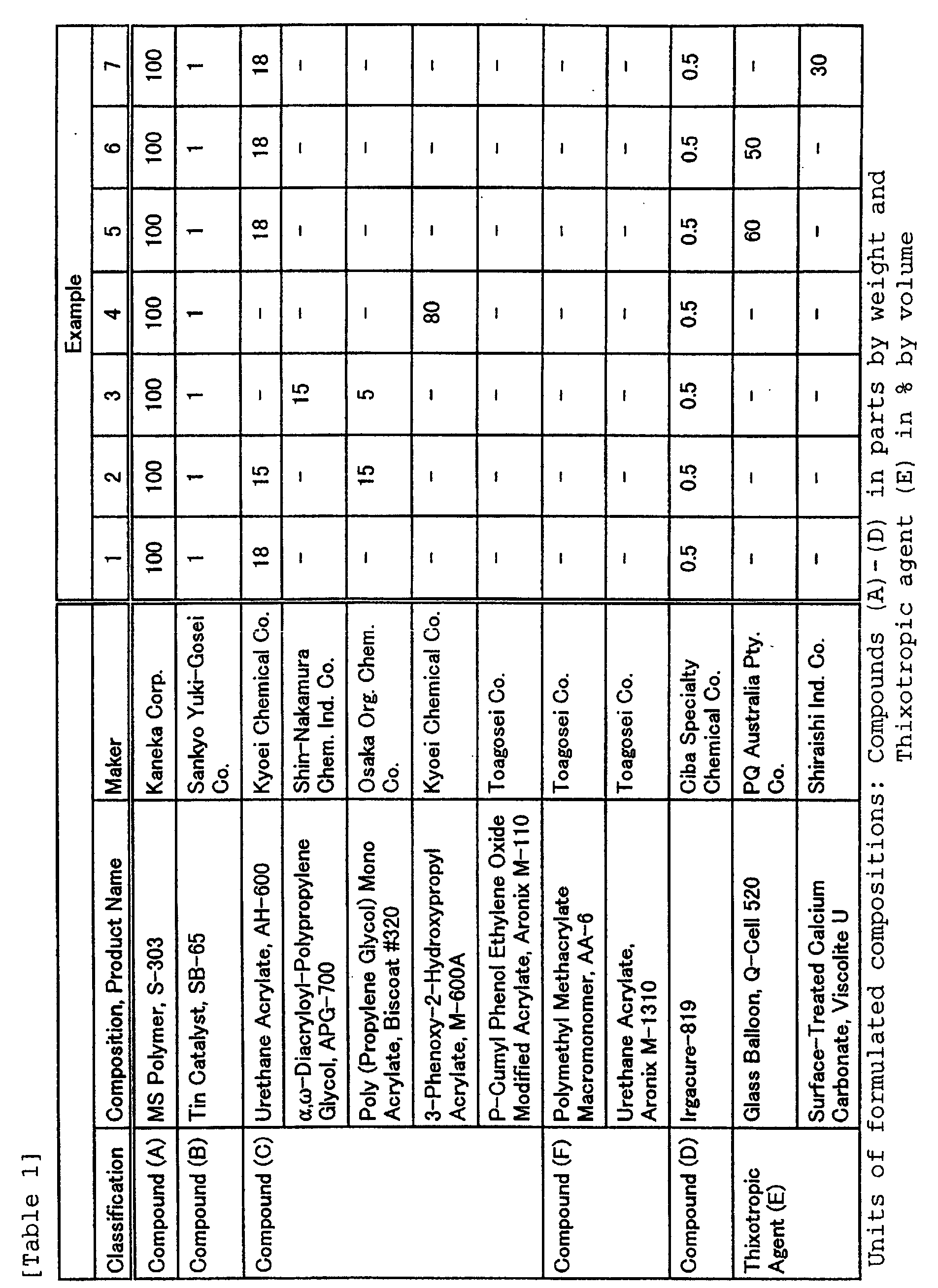
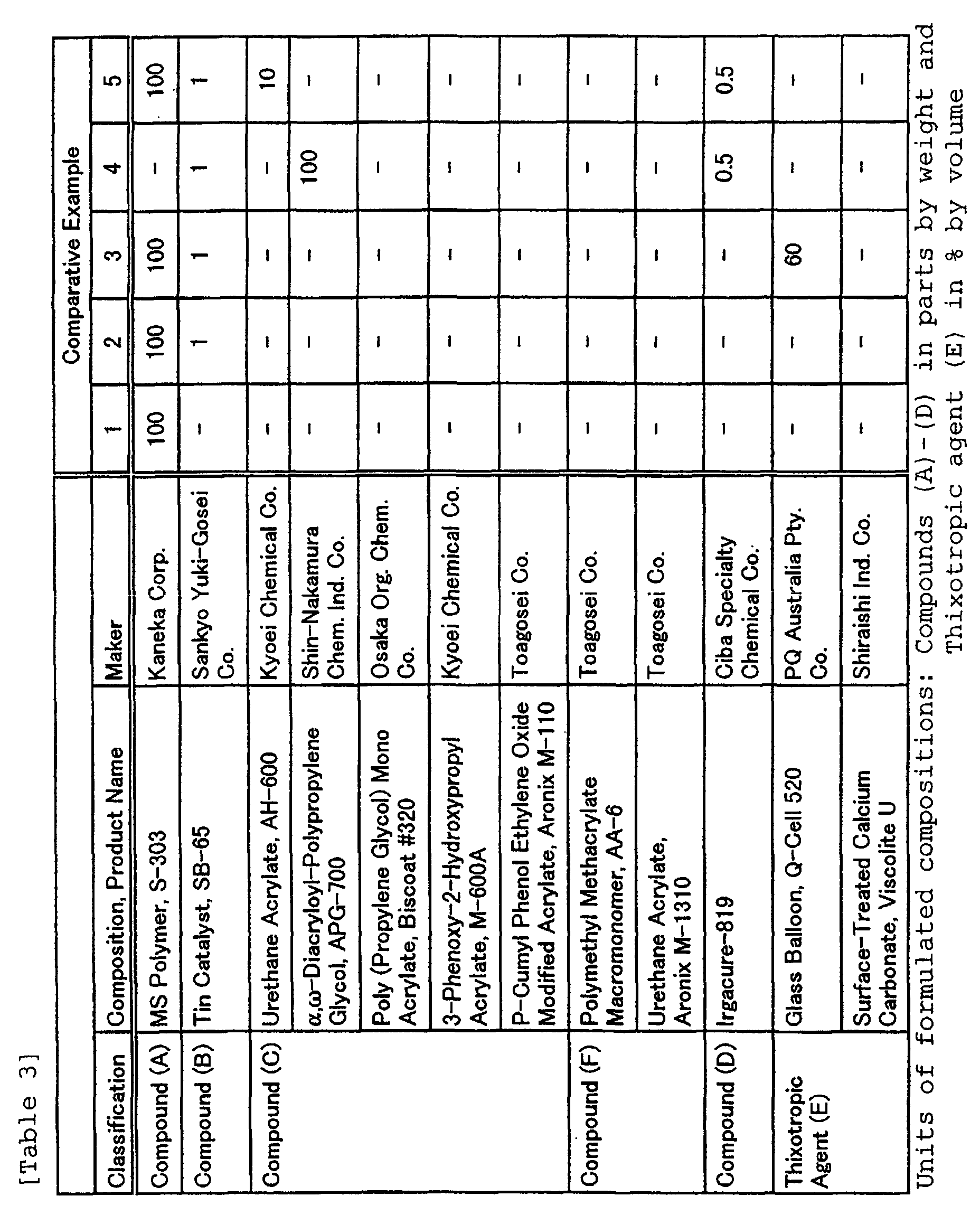
- the compounds (A), (B), (C) and (D), optionally with the compound (F), were first mixed with stirring to homogeneity in a beaker protected against a radiation by an aluminum foil (the blend, if containing a powder, was mixed under a light-shielded condition while maintained at 50 °C). After the blend was mixed to homogeneity, the thixotropic agent (E) was added and dispersed therein using a stirring machine (TK HOMO DISPER manufactured by Tokushu Kika Kogyo Co., Ltd.) under a stirring condition of 500 rpm x 10 minutes. As a result, adhesive compositions of the present invention were obtained.
- TK HOMO DISPER manufactured by Tokushu Kika Kogyo Co., Ltd.
- acetophenoneoxime dissolved in 100 ml THF was added to 0.05 mole hexamethylene diisocyanate. The mixture was stirred under dry and nitrogen atmosphere at 50 °C for 4 hours. Thereafter, THF was allowed to volatilize. The resulting white solid was dissolved in MEK at 80 °C and recrystalized therefrom to achieve purification. The purified compound was rendered as a photochemically amine-generating agent.
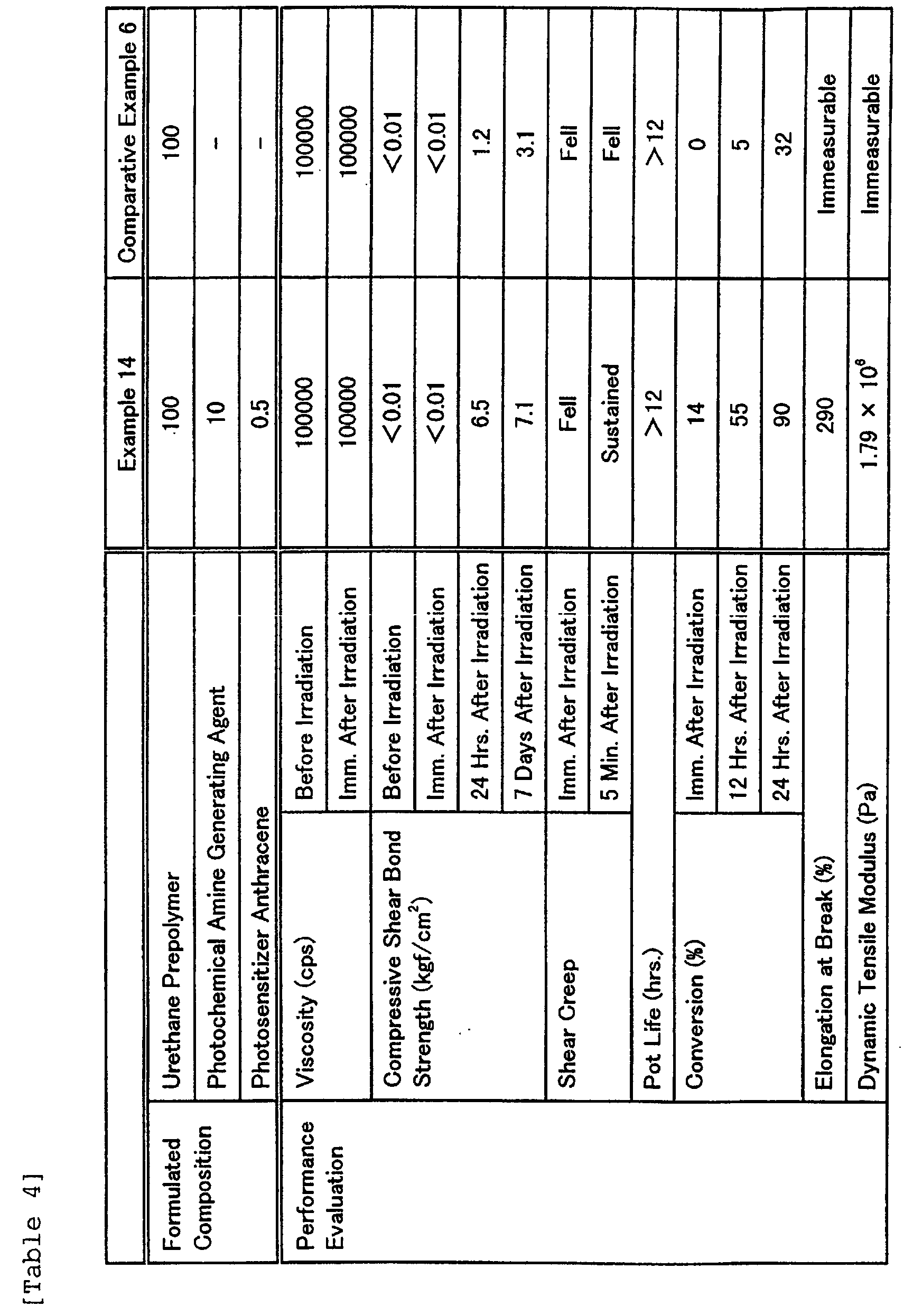
- the photochemically amine-generating agent and anthracene photosensitizer were added to 100 parts by weight of the above-obtained urethane prepolymer in the respective amounts specified in Table 4. The mixture was stirred to homogeneity to obtain a composition.
- Example 14 The urethane prepolymer obtained in Example 14 was used alone to prepare a composition of Comparative Example 6.
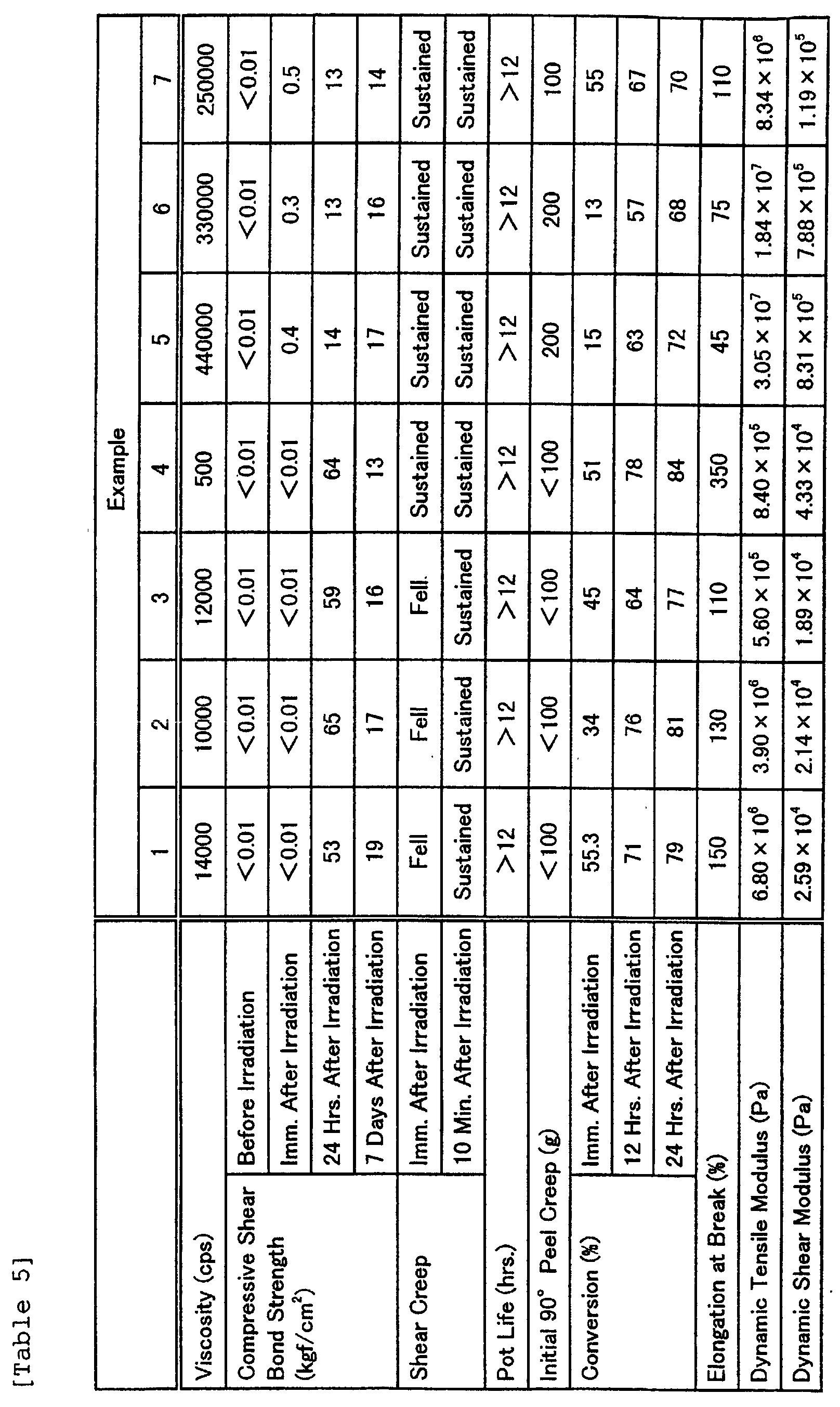
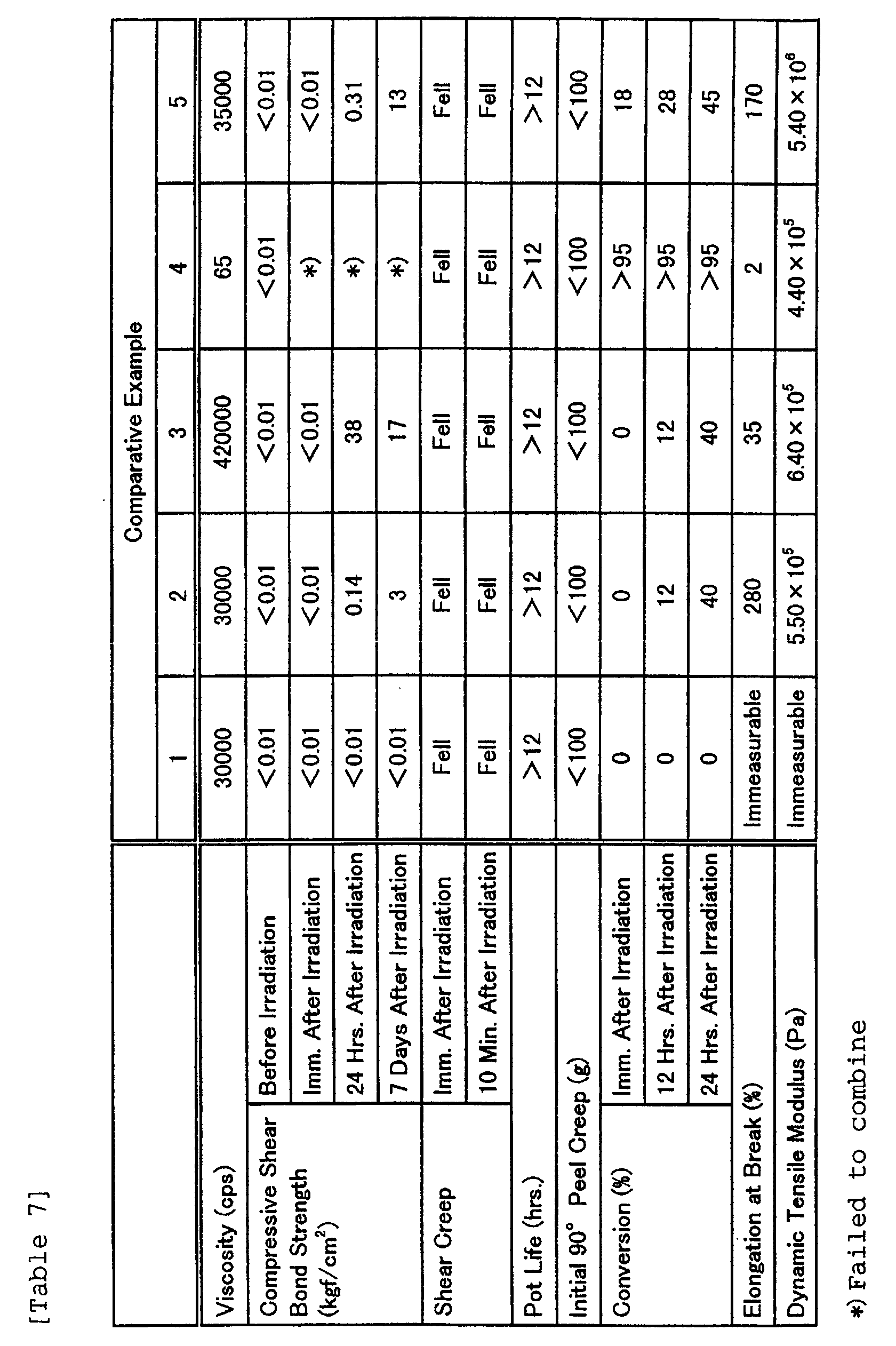
- the adhesive compositions obtained in Examples 1 - 14 and Comparative Examples 1 - 6 were evaluated for viscosity, compressive shear bond strength, shear creep, pot life (working life), initial creep resistance, conversion, elongation at break of cured compositions, dynamic tensile modulus and dynamic shear modulus according to the following procedures.
- the results of Examples 1-13 are listed in Tables 5 and 6.
- the results of Comparative Examples 1-5 are listed in Table 7.
- the results of Example 14 and Comparative Examples 6 are listed in Table 4.
- the viscosity of the compositions was measured at 25 °C using a rotational viscometer (Brookfield viscometer made by Tokyo Keiki Co., Ltd.) with a number 4 spindle at a rotational speed of 10 rpm, according to JIS K 6833.
- the spindle number and rotational speed were suitably selected in evaluating the adhesive composition if it excluded the thixotropic agent (E), fell beyond a measurable range under the above conditions or was a Newtonian viscous fluid.
- Each adhesive composition was coated onto a slate adherend (35 mm x 25 mm x 8 mm).
- the coated area was 25 mm x 25 mm x 0.3 mm.
- This slate adherend was combined with another slate adherend to fabricate an evaluation test sample.
- the sample obtained was subjected to a compressive test (at a crosshead speed of 300 mm/min) according to JIS K 6852, so that the compressive shear bond strength of the composition prior to exposure to a radiation was evaluated.
- each adhesive composition was coated on a slate adherend in the same manner as stated above.
- the coated surface was exposed to an ultraviolet radiation at 365 nm and at an energy of 700 mJ/cm 2 (Examples 1 - 13 and Comparative Examples 1 - 5) or at an energy of 7,000 mJ/cm 2 (Example 14 and Comparative Example 6) using a high-pressure mercury lamp.
- another slate adherend was combined therewith to fabricate an evaluation test sample.
- the sample obtained was subjected to a compressive test (at a crosshead speed of 300 mm/min) according to JIS K 6852, so that the compressive shear bond strength of the composition after exposure to a radiation was evaluated.
- evaluation test samples were fabricated in the same manner as used in evaluating the compressive shear bond strength of the composition immediately after exposure to a radiation.
- the samples obtained were aged at 25 °C and 63 % humidity for 24 hours, or separately aged for 7 days, and subjected to a compressive test (at a crosshead speed of 300 mm/min) according to JIS K 6852, so that the compressive shear bond strength of the composition either after 24 hours or 7 days from exposure to a radiation was evaluated.
- each composition was coated on a pentite steel plate (25 mm x 150 mm x 1 mm). The coated area was 25 mm x 25 mm. The coated composition was exposed to an ultraviolet radiation. After combination with another pentite steel plate (25 mm x 150 mm x 1 mm), the composition was subjected to aging at 23 °C for a duration specified in each Example to obtain an evaluation sample. Creep characteristics were evaluated by suspending one of the adherends of the obtained sample so that the own weight of the other adherend acted as a shear load. Evaluation was made by observing whether or not the load fell within 30 minute from the start of suspension.
- Each adhesive composition was coated on a glass substrate to a thickness of 0.35 mm and left to stand under conditions of 23 °C and 65 % humidity while maintained unexposed to a radiation. The period of time during which the adhesive composition remained unwebbed after it had been coated on the substrate was evaluated as a pot life.
- Each adhesive composition was coated on a 25 mm x 100 mm x 0.5 mm zinc steel plate to a size of 25 mm x 50 mm x 0.35 mm.
- the coated surface was exposed to an ultraviolet radiation at 365 nm and at an energy of 700 mJ/cm 2 (Examples 1 - 13 and Comparative Examples 1 - 5) or at an energy of 7,000 mJ/cm 2 (Example 14 and Comparative Example 6) using a high-pressure mercury lamp, followed by combination thereof with a 50 mm x 150 mm x 8 mm slate adherend.
- the slate adherend was fixed at its both ends such that it oriented horizontally and the zinc steel plate faced downward, and a mass of a specific weight was suspended from one end of the zinc steel plate. The maximum weight of the mass which caused no delamination within one hour was recorded. The heavier weight of the mass indicates the increased initial creep resistance.
- the adhesive composition was aged at 25 °C for 12 hours or 24 hours. A conversion of the compound (C) in the composition after the 12-hour or 24-hour aging was measured.
- the content of the compound (C) in the composition was determined by a gel permeation chromatograph equipped with an RI (Retlactive Index) device.
- the conversion of the compound (C) was calculated from the ratio of its content in the composition after to before exposure to the active energy radiation.
- compositions were exposed to an active energy radiation and subsequently subjected to 24-hour aging at 25 °C.
- the elongation at break of the cured composition was then measured at 25 °C using a tensile tester at a crosshead speed of 500 mm/minute, according to JIS K 6301.
- composition was exposed to an active energy radiation and subsequently subjected to 24-hour aging at 25 °C.
- the dynamic tensile modulus of the cured composition was then measured at 25 °C using a viscoelastic spectrometer at an applied frequency of 10 Hz.
- composition was exposed to an active energy radiation. Immediately thereafter, the dynamic shear modulus of the cured composition was measured at 25 °C using a viscoelastic spectrometer at an applied frequency of 0.016 Hz.
- the adhesive compositions of Examples 1 - 14 exhibit suitably spreadable viscosity, increased adhesive strength and improved cohesion immediately after exposure to a radiation, extended pot life, and sufficient build-up of adhesive strength 7 days after exposure to a radiation.
- the adhesive composition in accordance with the first invention prior to exposure to an active energy radiation, i.e., initially exhibits a sufficient flowability to permit easy application thereof on an adherend by hands or by a spreader.
- the compound (Y) therein When it is exposed to an active energy radiation, the compound (Y) therein is allowed to decompose rapidly and the compound (X) is allowed to crosslink or polymerize.
- the adhesive composition can afford to develop a suitable level of cohesion commensurate with a residual content of the compound (X) and exhibits a degree of tack that eliminates the need of temporary fixing.
- the polymerization and crosslinking are allowed to go proceed in the form of a dark reaction. Accordingly, curing is allowed to proceed in a rapid fashion.
- the first invention can provide an adhesive composition which exhibits good storage stability, curing characteristics and working properties. Also, the adhesive composition after cure exhibits the superior resistance to impact and creep.
- the adhesive composition in accordance with the second invention contains a component that cures in the presence of moisture in the air, a component that develops cohesion by short-time exposure to a radiation, and a thixotropic agent. Accordingly, this adhesive composition is flowable at ordinary state, shows a spreadable viscosity and a long pot life, develops cohesion by short-time exposure to a radiation, eliminates the need of temporary bonding or fixing, suits to a joining process on line, and exhibits superior physical properties, such as impact resistance and creep resistance, after it is applied and then cured.
Landscapes
- Chemical & Material Sciences (AREA)
- Organic Chemistry (AREA)
- Health & Medical Sciences (AREA)
- Chemical Kinetics & Catalysis (AREA)
- Medicinal Chemistry (AREA)
- Polymers & Plastics (AREA)
- Adhesives Or Adhesive Processes (AREA)
Abstract
Description
Since photocurable adhesives incorporating such photocurable compositions show fast-curing properties, a sufficiently long pot life can be insured simply by shielding a light that otherwise sensitizes them. Accordingly, the use as inline adhesives has been proposed. However, the photocurable adhesives are generally irradiated after application thereof and following combination of adherends. This has prevented application of such photocurable adhesives to building and construction materials through which substantially no light can pass.


Claims (10)
- An adhesive composition characterized as containing a compound (X) having a crosslinkable or polymerizable group and a compound (Y) which is activated when exposed to an active energy radiation to generate species that cause crosslinking or polymerization of at least a part of the compound (X) wherein:said composition has a viscosity at 25 °C of 1 - 10,000,000 cps; a conversion of the compound (X) immediately after exposure of the adhesive composition to the active energy radiation does not exceed 70 %; a conversion of the compound (X) after exposure of the adhesive composition to the active energy radiation and subsequent 24-hour aging at 25 °C is in the range of 50 - 100 %; and after exposure of the adhesive composition to the active energy radiation and subsequent 24-hour aging at 25 °C, the cured composition has an elongation at break of 10 - 1,000 % and a dynamic tensile modulus in the range of 105 - 109 Pa.
- The adhesive composition as recited in claim 1, characterized in that the conversion of the compound (X) immediately after exposure of the adhesive composition to the active energy radiation is in the range of 10 - 70 %, and the adhesive composition immediately after its exposure to the active energy radiation has a dynamic shear modulus in the range of 105-107 Pa.
- The adhesive composition as recited in claim 1, characterized in that the conversion of the compound (X) immediately after exposure of the adhesive composition to the active energy radiation does not exceed 30 % and the adhesive composition has a viscosity at 25 °C of 1 -* 10,000,000 cps; and
the conversion of the compound (X) after exposure of the adhesive composition to the active energy radiation and subsequent 12-hour aging at 25 °C is in the range of 50 - 100 %. - An adhesive composition characterized as containing the following components:(A) a compound having at least two hydrolyzable silyl groups in a molecule;(B) a compound which initiates crosslinking of the compound (A);(C) a compound having a polymerizable group in a molecule;(D) a compound which is activated by irradiation to initiate polymerization of the polymerizable group in the compound (C); and(E) a thixotropic agent.
- The adhesive composition as recited in claim 4, characterized in that the hydrolyzable silyl group in the compound (A) is a alkoxysilyl group, and the compound (A) is a compound containing the alkoxysilyl group substituted in a polymer selected from polyalkylene glycols and polyolefins.
- The adhesive composition as recited in claim 4 or 5, characterized in that the polymerizable group in the compound (C) is a free-radically polymerizable group and the compound (D) is a photochemically free-radical generating agent.
- The adhesive composition as recited in any one of claims 4 - 6, characterized in that the free-radically polymerizable group in the compound (C) is a polymerizable group selected from acryloyl and methacryloyl groups.
- The adhesive composition as recited in any one of claims 4 - 7, characterized in that the compound (C) contains at least one type of compound (F) containing at least one polymerizable group in a molecule and having a weight average molecular weight of not less than 3,000.
- The adhesive composition as recited in any one of claims 4 - 8, characterized in that the thixotropic agent (F) is at least one type selected from the group consisting of glass balloons, glass beads, surface-treated calcium carbonates and various silicas.
- A method of joining members characterized as comprising, in sequence, applying the adhesive composition as recited in any one of claims 1 - 9 to one of the members, exposing a top surface of the applied adhesive composition layer to an active energy radiation and combining the one member with the other member.
Applications Claiming Priority (3)
| Application Number | Priority Date | Filing Date | Title |
|---|---|---|---|
| JP24159999 | 1999-08-27 | ||
| JP24159999 | 1999-08-27 | ||
| PCT/JP2000/005694 WO2001016248A1 (en) | 1999-08-27 | 2000-08-24 | Adhesive composition and method of bonding with the adhesive composition |
Publications (3)
| Publication Number | Publication Date |
|---|---|
| EP1209212A1 true EP1209212A1 (en) | 2002-05-29 |
| EP1209212A4 EP1209212A4 (en) | 2002-10-30 |
| EP1209212B1 EP1209212B1 (en) | 2007-11-14 |
Family
ID=17076723
Family Applications (1)
| Application Number | Title | Priority Date | Filing Date |
|---|---|---|---|
| EP00954979A Expired - Lifetime EP1209212B1 (en) | 1999-08-27 | 2000-08-24 | Adhesive composition and method of bonding with the adhesive composition |
Country Status (4)
| Country | Link |
|---|---|
| EP (1) | EP1209212B1 (en) |
| AU (1) | AU6728400A (en) |
| DE (1) | DE60037124T2 (en) |
| WO (1) | WO2001016248A1 (en) |
Cited By (2)
| Publication number | Priority date | Publication date | Assignee | Title |
|---|---|---|---|---|
| WO2011110305A1 (en) * | 2010-03-08 | 2011-09-15 | Delo Industrie Klebstoffe Gmbh & Co. Kgaa | Dual curing compound and use of same |
| CN106010416A (en) * | 2016-05-28 | 2016-10-12 | 上海大学 | Polyurethane adhesive system based on D-A reaction and preparation method of polyurethane adhesive system |
Family Cites Families (10)
| Publication number | Priority date | Publication date | Assignee | Title |
|---|---|---|---|---|
| CA935398A (en) * | 1969-01-28 | 1973-10-16 | L. Osborn Claiborn | Crosslinking process |
| EP0035049B1 (en) * | 1980-03-05 | 1984-02-22 | Kanegafuchi Kagaku Kogyo Kabushiki Kaisha | Curable composition |
| JP2583134B2 (en) * | 1989-11-16 | 1997-02-19 | 鐘淵化学工業株式会社 | Room temperature curable composition |
| JPH0680825A (en) * | 1992-08-28 | 1994-03-22 | Three Bond Co Ltd | Ultraviolet-curable and moisture-curable resin composition |
| JPH06228248A (en) * | 1993-02-05 | 1994-08-16 | Three Bond Co Ltd | Production of reinforced rubber elastic body |
| AU1944095A (en) * | 1994-03-29 | 1995-10-17 | Gregory Robert William McEwan | Process for preparing bubble-free adhesive compositions |
| JPH08325466A (en) * | 1995-06-02 | 1996-12-10 | Asahi Glass Co Ltd | Improved curable composition |
| JPH09137137A (en) * | 1995-11-17 | 1997-05-27 | Sekisui Chem Co Ltd | Acrylic adhesive tape |
| JP2000044923A (en) * | 1998-05-27 | 2000-02-15 | Sekisui Chem Co Ltd | Curable adhesive composition and cured adhesive sheet |
| JP3713160B2 (en) * | 1999-03-25 | 2005-11-02 | 積水化学工業株式会社 | Photopolymerizable composition, moisture curable adhesive sheet, and member joining method |
-
2000
- 2000-08-24 AU AU67284/00A patent/AU6728400A/en not_active Abandoned
- 2000-08-24 EP EP00954979A patent/EP1209212B1/en not_active Expired - Lifetime
- 2000-08-24 DE DE60037124T patent/DE60037124T2/en not_active Expired - Lifetime
- 2000-08-24 WO PCT/JP2000/005694 patent/WO2001016248A1/en not_active Ceased
Cited By (5)
| Publication number | Priority date | Publication date | Assignee | Title |
|---|---|---|---|---|
| WO2011110305A1 (en) * | 2010-03-08 | 2011-09-15 | Delo Industrie Klebstoffe Gmbh & Co. Kgaa | Dual curing compound and use of same |
| CN102791818A (en) * | 2010-03-08 | 2012-11-21 | 德路工业胶粘剂有限两合公司 | Dual curing compound and use of same |
| US9068104B2 (en) | 2010-03-08 | 2015-06-30 | Delo Industrie Klebstoffe Gmbh & Co. Kgaa | Dual curing composition and use thereof |
| CN106010416A (en) * | 2016-05-28 | 2016-10-12 | 上海大学 | Polyurethane adhesive system based on D-A reaction and preparation method of polyurethane adhesive system |
| CN106010416B (en) * | 2016-05-28 | 2019-01-11 | 上海大学 | The polyurethane gluing system and preparation method thereof constructed based on diels-Alder reaction |
Also Published As
| Publication number | Publication date |
|---|---|
| DE60037124T2 (en) | 2008-09-25 |
| EP1209212A4 (en) | 2002-10-30 |
| EP1209212B1 (en) | 2007-11-14 |
| WO2001016248A1 (en) | 2001-03-08 |
| DE60037124D1 (en) | 2007-12-27 |
| AU6728400A (en) | 2001-03-26 |
Similar Documents
| Publication | Publication Date | Title |
|---|---|---|
| JP5491391B2 (en) | Curable silyl-containing polymer composition containing paint adhesion promoter | |
| CN100484978C (en) | Silante terminated polyurethane | |
| EP1002817B1 (en) | Photocurable composition | |
| US20110034602A1 (en) | Thixotropic reactive composition | |
| BRPI0808560B1 (en) | moisture curable silylated polymer resin composition and process for making said composition | |
| US6765055B2 (en) | Adhesion promoter for a primer and primer composition | |
| BRPI0806770A2 (en) | adhesion promoting composition for polymeric substrates | |
| EP1717240B1 (en) | Organoalkoxysilanes for use in moisture curable compositions | |
| JP2008542416A (en) | Silane-modified urea derivatives, their production methods and their use as rheology aids | |
| CN103328597A (en) | Two-component curable composition | |
| EP1209212B1 (en) | Adhesive composition and method of bonding with the adhesive composition | |
| JP4503939B2 (en) | Reactive hot melt adhesive composition | |
| JP3707975B2 (en) | Photocrosslinkable composition | |
| JP2002069387A (en) | Adhesive composition and method for adhesion using the adhesive composition | |
| JP2001139893A (en) | Adhesive composition and joining method using the adhesive composition | |
| JP2001064578A (en) | Photocurable putty composition | |
| US7262231B2 (en) | Photosensitive amine generator, photocurable composition and photoreactive adhesive composition | |
| JP2000063513A (en) | Dendrimer containing vinyl group | |
| CN118715250A (en) | Optical moisture curing resin composition, adhesive for electronic components, and adhesive for display element | |
| JPH11106468A (en) | Photo-setting resin composition and coating material | |
| JP2018100322A (en) | Reactive hot melt adhesive composition | |
| JP2005187615A (en) | Ultraviolet-curing acrylic composition | |
| JP2002302652A (en) | Adhesive composition and joining method of joining member | |
| JP4299562B2 (en) | Curable composition, sealing material and adhesive | |
| JP2002241461A (en) | Thixotropic moisture-curable urethane composition |
Legal Events
| Date | Code | Title | Description |
|---|---|---|---|
| PUAI | Public reference made under article 153(3) epc to a published international application that has entered the european phase |
Free format text: ORIGINAL CODE: 0009012 |
|
| 17P | Request for examination filed |
Effective date: 20011121 |
|
| AK | Designated contracting states |
Kind code of ref document: A1 Designated state(s): AT BE CH CY DE DK ES FI FR GB GR IE IT LI LU MC NL PT SE |
|
| AX | Request for extension of the european patent |
Free format text: AL;LT;LV;MK;RO;SI |
|
| A4 | Supplementary search report drawn up and despatched |
Effective date: 20020917 |
|
| AK | Designated contracting states |
Kind code of ref document: A4 Designated state(s): AT BE CH CY DE DK ES FI FR GB GR IE IT LI LU MC NL PT SE |
|
| RIC1 | Information provided on ipc code assigned before grant |
Free format text: 7C 09J 201/00 A, 7C 09J 4/06 B, 7C 09J 171/02 B, 7C 09J 5/00 B, 7C 09J 201/10 B, 7C 08J 3/28 B, 7C 08L 101/10 B |
|
| 17Q | First examination report despatched |
Effective date: 20030509 |
|
| RBV | Designated contracting states (corrected) |
Designated state(s): DE FR GB IT |
|
| GRAP | Despatch of communication of intention to grant a patent |
Free format text: ORIGINAL CODE: EPIDOSNIGR1 |
|
| GRAS | Grant fee paid |
Free format text: ORIGINAL CODE: EPIDOSNIGR3 |
|
| GRAA | (expected) grant |
Free format text: ORIGINAL CODE: 0009210 |
|
| AK | Designated contracting states |
Kind code of ref document: B1 Designated state(s): DE FR GB IT |
|
| REG | Reference to a national code |
Ref country code: GB Ref legal event code: FG4D |
|
| REF | Corresponds to: |
Ref document number: 60037124 Country of ref document: DE Date of ref document: 20071227 Kind code of ref document: P |
|
| EN | Fr: translation not filed | ||
| PLBE | No opposition filed within time limit |
Free format text: ORIGINAL CODE: 0009261 |
|
| STAA | Information on the status of an ep patent application or granted ep patent |
Free format text: STATUS: NO OPPOSITION FILED WITHIN TIME LIMIT |
|
| 26N | No opposition filed |
Effective date: 20080815 |
|
| PG25 | Lapsed in a contracting state [announced via postgrant information from national office to epo] |
Ref country code: FR Free format text: LAPSE BECAUSE OF FAILURE TO SUBMIT A TRANSLATION OF THE DESCRIPTION OR TO PAY THE FEE WITHIN THE PRESCRIBED TIME-LIMIT Effective date: 20080829 |
|
| GBPC | Gb: european patent ceased through non-payment of renewal fee |
Effective date: 20080824 |
|
| PG25 | Lapsed in a contracting state [announced via postgrant information from national office to epo] |
Ref country code: GB Free format text: LAPSE BECAUSE OF NON-PAYMENT OF DUE FEES Effective date: 20080824 |
|
| PG25 | Lapsed in a contracting state [announced via postgrant information from national office to epo] |
Ref country code: IT Free format text: LAPSE BECAUSE OF NON-PAYMENT OF DUE FEES Effective date: 20080831 |
|
| PGFP | Annual fee paid to national office [announced via postgrant information from national office to epo] |
Ref country code: DE Payment date: 20120822 Year of fee payment: 13 |
|
| PG25 | Lapsed in a contracting state [announced via postgrant information from national office to epo] |
Ref country code: DE Free format text: LAPSE BECAUSE OF NON-PAYMENT OF DUE FEES Effective date: 20140301 |
|
| REG | Reference to a national code |
Ref country code: DE Ref legal event code: R119 Ref document number: 60037124 Country of ref document: DE Effective date: 20140301 |