Technical Field
This invention relates to a rubber composition for extrusion
and molding and applications thereof.
Background Arts
An ethylene / α -olefin / non-conjugated polyene copolymer
rubber such as ethylene / propylene / diene copolymer rubber (EPDM)
is widely used for automotive parts, household electric appliance
parts, and the like thanks to superior weatherability, heat
resistance and ozone resistance.
Among these, materials for sealant or fillers (packing) for
automobiles and household electric appliances are the products
manufactured by a continuous extrusion molding process.
Requirements for such rubber extrusion composition are
continuous feedabillity to extruder and no occurrence of crack
or tear in a ribbon-like compound preformed prior to an extrusion
during its storage.
During extrusion process, cross-sectional area of extrudate
should not change, that is, die swell ratio should not vary.
Variation in die swell ratio leads to change in cross-sectional
shape of glassrun or window frame products and may results in
lowering of sealing performance and inferior products.
Furthermore, in weather strip sponge products, the materials
varying in the die swell ratio cause a big problem of uneven foaming
since the variation means uneven viscoelastic state in the
material.
In addition to these, in extrudate products of EPDM containing
carbon black, trouble of foreign matter coming from unknown cause
occurs very often. Analysis of a portion of the foreign matter
for its cause survey often results in that the portion is composed
of the same components to rubber substrate. Mysteriously this
trouble naturally disappears, and occurs again sometimes.
On the other hand, there are many products manufactured by
molding process in the rubber molding technology. Rubber vibration
isolator obtained by injection is one of the products using a
rubber composition for molding. Materials for injection are fed
as a ribbon-like compound sheeted out using a roll. Tear of the
ribbon lowers stability of material feeding and makes continuous
production impossible. Such a material may show an abrupt
viscosity increase in a feeder of the injection machine and leads
to poor flow in a mold after injection. The products molded in
such state often had a trouble such as an occurrence of crack during
durability test.
Materials used for molding weather strip corner are required
to have stable fluidity of the material. Changes of fluidity in
each molding cause a serious problem due to poor adhesion at
interface with straight parts of weather strip sponge or inferior
appearance at joint area.
Fixing roll for copying machine, one of OA rolls, is a foam
product having semiconductivity. It often had variation troubles
in foaming and electric resistance due to unknown cause.
O-ring product also had troubles of uneven product shrinkage
in each molding by unknown cause. Another problem was lowering
in mechanical strength of product even with good product
appearance.
Analysis of substrate for cause survey often resulted in no
specific difference in the substrate composition. These phenomena
are troublesome and mysterious because they naturally disappear
after a while and the same troubles occur again sometimes.
At present, these trouble is considered to be caused by
formation of a physical network originated in carbon black / rubber
interface produced in the compound during mixing. That is, this
network causes the troubles described above in molding a product.
To solve such problems, adding of polysulfide compounds
including sulfur or sulfur compounds as radical scavenger has been
disclosed in JP-A-H7-138379.
The addition of such sulfur or sulfur compounds at loading level
of about 1.0 × 10⁻² mole per 100 weight parts of polymer in a mixer,
however, causes start of crosslinking by the presence of zinc oxide
(ZnO) contained in the compound and leads to a problem of gelation
(chemical burning). Loading level of about 1.0 × 10⁻³ mole, 1/10
of the above loading level, is safe in view of the burning in a
mixer, but has little effect to solve the problems mentioned above.
Disclosure of the Invention
First object of the invention is to solve such problems
described above accompanied with conventional technology, and
provide a rubber composition for extrusion to give a ribbon-like
compound prepared prior to extrusion having no crack nor tear,
stable cross sectional shape of extrudate, and foamed products
with little variation in foaming, and also products made of the
said rubber composition such as weather strip sponge, high
extension seal, glass run channel, window frame and water hose
for automobile.
Second object of the invention is to provide a rubber
composition for molding to give a compound prepared for injection
having no tear phenomenon, superior fluidity in a mold, in addition
stable foaming and little variation in foaming in cast sponge,
and also products made of the said composition with good surface
texture and superior mechanical strength such as rubber vibration
isolator, cast sponge, grommet, O-ring, packing, boots, window
frame, break piston cup and OA roll products.
The invention includes the following disclosures.
A rubber composition for extrusion and a rubber composition
for molding of the invention comprise 100 weight parts of ethylene
/ α-olefin / non-conjugated polyene copolymer rubber composed
of ethylene, α-olefin having carbon atoms of 3 - 20 and non-conjugated
polyene (A), and at least 30-300 weight parts of carbon
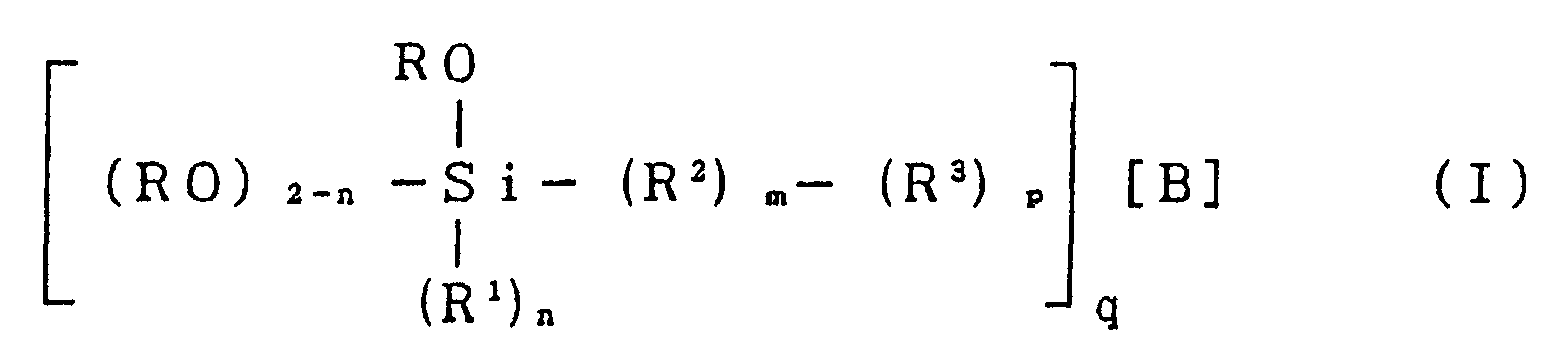
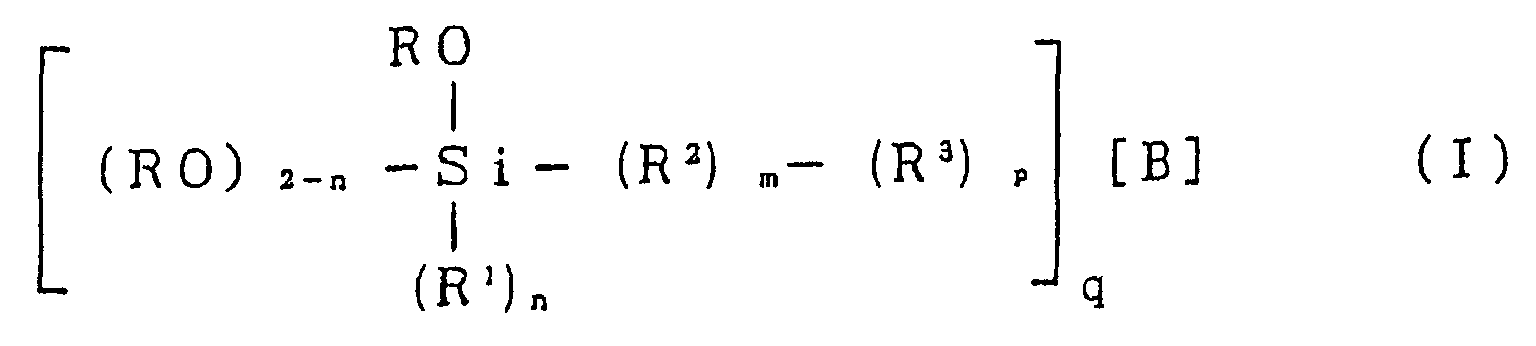
black (B) and 1.0 x 10⁻⁵ - 5.0 x 10⁻³ mol of alkoxysilane compound
shown by the above described formula (I).
Ethylene / α-olefin / non-conjugated polyene copolymer rubber
(A)
α-Olefin having carbon atoms of 3 - 20 in ethylene / α-olefin
/ non-conjugated polyene copolymer rubber (A) used in the
invention specifically includes propylene, 1-butene, 1-pentene,
1-hexene, 4-methyl-1-pentene, 1-heptene, 1-octene, 1-nonene,
1-decene, 1-undecene, 1-dodecene, 1-tridecene, 1-tetradecene,
1-pentadecene, 1-hexadecene, 1-heptadecene, 1-octadecene, 1-nonadecene,
1-eicosene, 9-methyl-1-decene, 11-methyl-1-dodecene,
12-ethyl-1-tetradecene and the like. These α-olefins may be used
alone or in combination of two or more. Among these α-olefins,
those having carbon atoms of 3 - 8 such as propylene, 1-butene,
4-methyl-1-pentene, 1-hexene and 1-octene are particularly
preferable.
In order to obtain a rubber composition providing vulcanized
rubber molded products with superior heat aging resistance,
strength characteristics, rubber elasticity, low temperature
properties and processability, the ethylene / α -olefin /
non-conjugated polyene copolymer rubber (A) preferably comprises
(a) an ethylene-derived unit and (b) an α-olefin-derived unit
having carbon atoms of 3-20 in [(a) / (b)] molar ratio of 50/50
- 90/10. The [(a) / (b)] molar ratio described above is preferably
65/35 - 90/10, more preferably 65/35 - 85/15 and particularly
preferably 65/35 - 80/20.
As a non-conjugated polyene in the ethylene / α -olefin /
non-conjugated polyene copolymer rubber (A), a cyclic or linear
non-conjugated polyene may be used.
The cyclic non-conjugated polyene includes, for example, dienes
such as methyltetrahydroindene, 5-ethylidene-2-norbornene, 5-methylene-2-norbornene,
5-isopropylidene-2-norbornene, 5-vinyl-2-norbornene,
6-chloromethyl-5-isopropenyl-2-norbornene,
dicyclopentadiene and norbornadiene; triene such as 2,3-diisopropylidene-5-norbornene,
2-ethylidene-3-isopropylidene-5-norbornene
and 2-propenyl-2, 5-norbornadiene.
And as the linear non-conjugated polyene includes, for example,
dienes such as 1,4-hexadiene, 3-methyl-1, 4-hexadiene, 4-methyl-1,
4-hexadiene, 5-methyl-1, 4-hexadiene, 4,5-dimethyl-1,
4-hexadiene, 6-methyl-1,6-octadiene, 7-methyl-1,6-octadiene,
6-ethyl-1,6-octadiene, 6-propyl-1,6-octadiene, 6-butyl-1,6-octadiene,
6-methyl-1,6-nonadiene, 7-methyl-1,6-nonadiene, 6-ethyl-1,6-nonadiene,
7-ethyl-1,6-nonadiene, 6-methyl-1,6-decadiene,
7-methyl-1,6-decadiene, 6-methyl-1,6-undecadiene and
7-methyl-1,6-octadiene; and triene such as 4-ethylidene-1,6-octadiene,
4-ethylidene-7-methyl-1,6-octadiene, 4-ethylidene-7-methyl-1,6-nonadiene,
4-ethylidene-6,7-dimethyi-1,6-octadiene,
4-ethylidene-6,7-dimethyl-1,6-nonadiene, 4-ethylidene-1,6-decadiene,
4-ethylidene-7-methyl-1,6-decadiene,
4-ethylidene-7-methyl-6-propyl-1,6-octadiene, 4-ethylidene-1,7-nonadiene,
4-ethylidene-8-methyl-1,7-nonadiene, 4-ethylidene-1,7-undecadiene,
4-ethylidene-8-methyl-1,7-undecadiene,
4-ethylidene-7,8-dimethyl-1,7-nonadiene, 4-ethylidene-7,8-dimethyl-1,7-decadiene,
4-ethylidene-7,8-dimethyl-1,7-undecadiene,
7-ethyl-4-ethylidene-8-methyl-1,7-undecadiene,
4-ethylidene-7,8-diethyl-1,7-decadiene, 4-ethylidene-9-methyl-1,8-decadiene,
4-ethylidene-8,9-dimethyl-1,8-decadiene,
4-ethylidene-10-methyl-1,9-undecadiene, 4-ethylidene-9,10-dimethyl-1,9-undecadiene,
4-ethylidene-11-methyl-1,10-dodecadiene,
4-ethylidene-10,11-dimethyl-1,10-dodecadiene
and 3,7-dimethyl-1,4,8-decatriene.
These non-conjugated polyenes may be used alone or in
combination of two or more.
In view of obtaining a rubber composition having high
crosslinking efficiency and capable to provide vulcanized rubber
molded products with superior compression set, along with an
advantage in cost, iodine value of the ethylene / α-olefin /
non-conjugated polyene copolymer rubber (A)is preferably 1 - 40,
more preferably 1 - 30.
In order to obtain a rubber compound to provide vulcanized
rubber molded products with superior strength characteristics,
compression set and processability, intrinsic viscosity [η] of
ethylene / α-olefin / non-conjugated polyene copolymer rubber
(A), measured in decalin at 135 °C is preferably 2.0 - 4.5 dl/g,
more preferably 2.2 - 4.0 dl/g in the rubber composition for
extrusion of the invention, and is preferably 0.8 - 4.5 dl/g, more
preferably 0.9 - 4.0 dl/g in the rubber composition for molding.
Carbon black (B)
In the rubber composition for extrusion of the invention, carbon
black (B) may be used at 30-300 weight parts, preferably at 50-200
weight parts, more preferably at 61-200 weight parts and most
preferably at 70-200 weight parts per 100 weight parts of the
ethylene / α-olefin / non-conjugated polyene copolymer rubber
(A) in order to obtain a rubber composition to be able to provide
vulcanized extruded rubber products with sufficient mechanical
strength. And in the rubber composition for molding of the
invention, carbon black (B) may be used at 30-300 weight parts,
preferably at 50-200 weight parts, more preferably at 61-200
weight parts and most preferably at 80-200 weight parts per 100
weight parts of ethylene / α-olefin / non-conjugated polyene
copolymer rubber (A) in order to obtain a rubber composition to
be able to provide vulcanized molded rubber products with
sufficient mechanical strength.
As the carbon black (B), SRF, GPF, FEF, MAF, HAF, ISAF, SAF,
FT, MT and the like may be used. In order to obtain a rubber
composition to be able to provide vulcanized rubber molded
products with superior mechanical strength and surface texture
of products, specific surface area by nitrogen absorption of
carbon black (B) is preferably 10-100 m2/g.
Alkoxysilane compound (C)
In the invention, an alkoxysilane compound (C) shown by the
formula (I) described above is compounded to reduce a change rate
in activation energy of a compound and suppress the formation of
physical network originating from carbon black / polymer interface
in the compound during mixing. In order to obtain sufficient
effects and maintain vulcanization rate and rubber elasticity,
loading level of the alkoxysilane compound (C) should be 1.0 ×
10-5 - 5.0 × 10⁻³ mole, preferably 1.0 × 10⁻⁴ - 4.0 × 10⁻³ mole and
further preferably 1.0 × 10⁻⁴ - 2.1 × 10⁻³ mole per 100 weight parts
of the ethylene / α-olefin / non-conjugated polyene copolymer
rubber (A).
Alkoxysilane compound (C) may be used as an impregnated form
into calcium carbonate or carbon black (B) in advance.
In the formula (I) described above, alkyl group having carbon
atoms of 1-4 shown as R or R1 includes, for example, methyl, ethyl,
n-propyl, isopropyl, n-butyl, isobutyl, sec-butyl and tert-butyl.
Alkoxy group having carbon atoms of 1-4 shown as R includes, for
example, methoxy, ethoxy, propoxy, isopropoxy, n-butoxy,
isobutoxy, sec-butoxy and tert-butoxy. Linear or branched
bivalent hydrocarbon group having carbon atoms of 1-6 shown as
R2 includes, for example, alkylene group such as methylene,
dimethylmethylene, ethylene, dimethylethylene, trimethylene,
tetramethylene, 1,2-cyclohexylene and 1,4-cyclohexylen;
alkylidene group such as cyclohexylidene; arylalkylene group such
as diphenylmethylene and diphenylethylene. Arylene group having
carbon atoms of 6-12 shown as R3 includes, for example, phenylene,
naphthylene and biphenylylene.
Typical examples of the alkoxysilane compound (C) shown in the
formula (I) described above includes bis-3-(trimethoxysilyl)propyltetrasulfane
[(CH3O)3Si-(CH2)3-S4-(CH2)3-Si(OCH3)3],
bis-3-(triethoxysilyl)propyltetrasulfane
[(C2H5O)3Si(CH2)3-S4-(CH2)3-Si(OC2H5)3] and bis-3-(tripropoxysilyl)propyltetrasulfane
[(C3H7O)3Si-(CH2)3-S4-(CH2)3-Si(OC3H7)3].
Other components
A rubber composition for extrusion and molding of the invention
may be compounded with additives known in the art other than carbon
black (B), such as rubber reinforcing agents, inorganic fillers,
softening agents, antioxidants, processing aids, foaming agents,
co-foaming agents, vulcanization accelerators, organic peroxides,
vulcanization promoters, colorants, dispersing agents, flame
retardants and the like, at loading level not impairing purposes
of the invention, depending on intended applications of vulcanized
products, etc.
The rubber reinforcing agents described above have an enhancing
effect on mechanical properties such as tensile strength, tear
strength and wear resistance and the like. Typical examples of
such rubber reinforcing agents include fine powder of silicic acid,
silica and the like. These may be pretreated with silane coupling
agents.
Typical examples of silica are fumed silica and precipitated
silica and the like. These silica may be applied with surface
treatment by reactive silane such as mercaptosilane, aminosilane,
hexamethylsilazane, chlorosilane and alkoxylsilane or siloxane
of low molecular weight.
Types and loading levels of these rubber reinforcing agents
may be suitably selected depending on applications, and maximum
loading levels, except for carbon black (B), are generally 150
weight parts, preferably 100 weight parts per 100 weight parts
of the ethylene / α-olefin / non-conjugated polyene copolymer
rubber (A).
Typical inorganic fillers described above include light calcium
carbonate, ground calcium carbonate, talc, clay and the like.
Types and loading levels of these inorganic fillers may be
suitably selected depending on applications and maximum loading
levels are generally 300 weight parts, preferably 200 weight parts
per 100 weight parts of the ethylene / α-olefin / non-conjugated
polyene copolymer rubber (A).
As the softening agents described above, those generally used
for rubber may be used. They include, typically, petroleum based
softening agents such as process oil, lubricating oil, paraffin
oil, liquid paraffin, petroleum asphalt and vaseline; coal tar
based softening agents such as coal tar and coal tar pitch; fatty
oil based softening agents such as castor oil, linseed oil,
rapeseed oil, soybean oil and coconut oil; tall oil; rubber
substitute (factice); waxes such as beeswax, carnauba wax and
lanolin; fatty acids and salts thereof such as ricinolic acid,
palmitic acid, stearic acid, barium stearate, calcium stearate
and zinc laurate; naphthenic acid; pine oil, rosin or derivatives
thereof; synthetic polymer materials such as terpene resin,
petroleum based resin, atactic polypropylene and coumarone-indene
resin; ester based softening agents such as dioctyl
phthalate, dioctyl adipate and dioctyl sebacate;
microcrystalline wax, liquid polybutadiene, modified liquid
polybutadiene, liquid Thiokol, hydrocarbon based synthetic
lubricating oil and the like. Among these, petroleum based
softening agents, in particular, process oil is suitably used.
Loading levels of these softening agents may be selected depending
on applications of vulcanized products.
The antioxidants described above include, for example, amine
based, hindered phenol based or sulfur based antioxidant and the
like, and may be used in the range of loading level not to impair
purposes of the invention. Amine based antioxidants include
diphenylamine, phenylenediamine and the like. Sulfur based
antioxidants include those usually adopted in rubber.
As the processing aids described above, those generally adopted
in rubber processing may be used. Typically, higher fatty acids
such as linoleic acid, ricinolic acid, stearic acis, palmitic acid
and laulic acid; salts of higher fatty acids such as barium
stearate, zinc stearate and calcium stearate; esters of higher
fatty acids described above and the like are included. These
processing aids may be used at not more than 10 weight parts,
preferably not more than 5 weight parts per 100 weight parts of
the ethylene / α-olefin / non-conjugated polyene copolymer rubber
(A), however, it is desirable to suitably determine an optimal
amount depending on required physical properties.
Foaming agents typically include inorganic foaming agents such
as sodium bicarbonate, sodium carbonate, ammonium bicarbonate,
ammonium carbonate and ammonium nitrite; nitroso compounds such
as N,N'-dimethyl-N,N'-dinitrosoterephthalamide and N,N'-dinitrosopentamethylenetetramine
(DPT); azo compounds such as
azodicarbonamide (ADCA), azobisisobutyronitrile (AZBN),
azobiscyclohexylnitrile, azodiaminobenzene and barium
azodicarboxylate; sulfonylhydrazide compounds such as
benzenesulfonylhydrazide (BSH), toluenesulfonylhydrazide (TSH),
p,p'-oxybis(benzenesulfonylhydrazide) (OBSH) and
diphenylsulfone-3,3'-disulfonylhydrazide; azide compounds such
as calcium azide, 4,4'-diphenyldisulfonylazide and p-toluenesulfonylazide.
These foaming agents may generally be used at the ratio of 0.5
- 30 weight parts, preferably 1 - 20 weight parts per 100 weight
parts of the ethylene / α -olefin / non-conjugated polyene
copolymer rubber (A) . Use of the foaming agents at the ratio
described above enables manufacturing of a foamed product with
apparent specific gravity of 0.03 - 0.8 g/cm3 for the rubber
composition for extrusion of the invention, and a foamed product
with apparent specific gravity of 0.1 - 0.8 g/cm3 for the rubber
composition for molding of the invention. However, it is desirable
to determine suitably an optimal amount depending on required
physical properties.
Co-foaming agents may be used in combination with the foaming
agents, if necessary. The co-foaming agents act to lower
decomposition temperature, accelerate decomposition of the
foaming agents and achieve even foaming. Such co-foaming agents
include, for example, organic acids such as salicylic acid,
phthalic acid, stearic acid and oxalic acid, urea and derivatives
thereof. These co-foaming agents may generally be used at the ratio
of 0.01 - 10 weight parts, preferably 0.1 - 5 weight parts per
100 weight parts of the ethylene / α-olefin / non-conjugated
polyene copolymer rubber (A), however, it is desirable to
determine suitably an optimal amount depending on required
properties.
In addition, another rubber known in the arts may be used by
blending with the crosslinkable rubber composition of the
invention, so long as not to impair objectives of the invention.
Such another rubber includes natural rubber (NR), isoprene based
rubber such as polyisoprene rubber (IR) and conjugated diene based
rubber such as polybutadiene rubber (BR), styrene-butadiene
rubber (SBR), acrylonitrile-butadiene rubber (NBR) and
chloroprene rubber (CR).
Vulcanization agents used for vulcanization include sulfur and
sulfur compounds. Typical sulfur includes, powder sulfur,
precipitated sulfur, colloidal sulfur, surface treated sulfur,
insoluble sulfur and the like. Typical sulfur compounds include
sulfur chloride, sulfur dichloride, polymeric polysulfide and
sulfur compounds to vulcanize a composition by generating active
sulfur at vulcanization temperature such as morpholine disulfide,
alkylphenol disulfide, tetramethylthiuram disulfide,
dipentamethylenethiuram tetrasulfide, Selenium
dimethyldithiocarbamate and the like. Sulfur is preferable among
these. Sulfur and sulfur compounds may generally be used at the
ratio of 0.1-10 weight parts, preferably 0.5-5 weight parts per
100 weight parts of the copolymer rubber (A) described above.
In using sulfur or sulfur compounds as vulcanization agents,
combined use of vulcanization accelerators is preferable. Typical
vulcanization accelerators include sulfenamide compounds such as
N-cyclohexyl-2-benzothiazolesulfenamide (CBS), N-oxydiethylene
glycol-2-benzothiazolesulfenamide (OBS), N-t-butyl-2-benzothiazolesulfenamide
(BBS) and N,N -diisopropyl-2-benzothiazolesulfenamide;
thiazole compounds such as 2-mercaptobenzothiazole
(MBT), 2-(2,4-dinitrophenyl)mercaptobenzothiazole,
2-(4-morpholinodithio)benzothiazole,
2-(2,6-diethyl-4-morpholinothio)benzothiazole
and dibenzothiazyldisulfide;
guanidine compounds such as diphenylguanidine (DPG),
triphenylguanidine, diorthotolylguanidine (DOTG),
orthotolylbiguanide and diphenylguanidine phthalate; aldehyde
amine or aldehyde-ammonium type compounds such as
acetaldehyde-aniline condensed compounds, butylaldehyde-aniline
condensed compounds, hexamethylenetetramine (H) and acetaldehyde
ammonia; imidazoline compounds such as 2-mercaptoimidazoline;
thiourea compounds such as thiocarbanilide, diethylthiourea
(EUR), dibutylthiourea, trimethylthiourea and
diorthotolylthiourea; thiuram compounds such as
tetramethylthiuram monosulfide (TMTM), tetramethylthiuram
diosulfide (TMTD), tetraethylthiuram monosulfide,
tetrabutylthiuram disulfide, tetrakis(2-ethylhexyl)thiuram
diosulfide (TOT) and dipentamethylenetetrathiuram sulfide (TRA);
salts of dithiocarbamic acid such as zinc dimethyldithiocarbamate,
zinc diethyldithiocarbamate, zinc di-n-butyldithiocarbamate,
zinc ethylphenyldithiocarbamate, zinc
butylphenyldithiocarbamate, sodium dimethyldithiocarbamate,
Selenium dimethyldithiocarbamate and tellurium
dimethyldithiocarbamate; xanthate such as zinc dibutylxanthate;
compounds such as zinc white (zinc oxide); and the like. These
vulcanization accelerators may generally be used at the ratio of
0.1-20 weight parts, preferably 0.2-10 weight parts per 100 weight
parts of the copolymer rubber (A) described above.
Preparation of a rubber composition and vulcanized rubber molded
body thereof
The rubber composition of the invention may be prepared by
mixing ethylene / α-olefin / non-conjugated polyene copolymer
rubber (A), carbon black (B), alkoxysilane compound (C) and
additives such as rubber reinforcing agents, inorganic fillers
and softening agents using an internal mixer (closed type mixer)
such as Bumbury's mixer and kneader at 80 - 170 °C for 2 - 20 min.,
followed by additional mixing of sulfur together with optional
vulcanization accelerators, vulcanization aids; foaming agents
and co-foaming agents using a roll such as open role or kneader
at roll temperature of 40 - 80 °C for 5 - 30 min., then sheeting
out.
The rubber composition for extrusion of the invention prepared
as described above may be shaped as intended by an extruder and
vulcanized at 140 - 270 °C for 1 - 30 min. simultaneously with the
extrusion or by introducing the extrudate into a vulcanization
chamber. Vulcanization process is generally carried out
continuously. As a heating method in the vulcanization chamber,
a heating measure such as hot air, fluidized bed of glass beads,
molten salt bath (LCM), PCM (Powder Curing Medium or Powder Curing
Method), UHF (ultra high frequency microwave), steam and the like
may be used.
And the rubber composition for molding of the invention prepared
as described above may be shaped suitably for a molding machine
for molded products. Sheet-like compound is prepared using a roll,
etc in advance for a compression molding and vulcanization machine.
In an injection, ribbon-like compound is sheeted out from a roll
and stored until molding. In a transfer molding of cast sponge
products, boll-like compound is prepared in advance. The compounds
thus prepared may be vulcanized by heating at 140 - 270 °C for 1
- 30 min.
The inventors, after thorough investigation on the problems
accompanied with conventional technology, clarified that the
cause is changes in compound viscosity depending on mixing
conditions in the ethylene / α-olefin / non-conjugated polyene
copolymer rubber system loaded with carbon black. The inventors
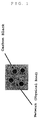
presumed that the cause is formation of a network between
interfaces of carbon black / polymer (Fig.1) since this phenomenon
is specified to the compound system loaded with carbon black. The
larger the specific surface area of carbon black is and the higher
the loading level of carbon black is, the easier this network tends
to be formed. The network also tends to be formed at higher mixing
temperature when mixing time is longer. Formation of such network
or use of material with generation of origins of such network at
carbon black / polymer interfaces results in an abrupt increase
in viscosity in an extruder or a mold. It then impairs the
production of extrudate due to change in cross sectional shape,
that is, change in die swell ratio in the composition for extrusion,
and causes fluctuation of fluidity, change in product shrinkage
or poor foaming in the composition for molding. Furthermore, in
any case of the rubber composition for extrusion and molding, a
ribbon crack phenomenon occurs, that is, cracks occur at bending
part of the compound during storage after mixing in a mixer and
forming to a ribbon-like compound, and thus leads to a serious
problem like a lowering in continuous productivity.
For a rubber composition for extrusion and molding, it is very
important not to have such viscosity increase which is closely
relating to inferior product ratio.
For a further precise explanation, this network means
structural change occurred inside a compound.
As an index to express the structural change in the compound
by mixing, an apparent activation energy is used in the Examples
described hereinafter. The activation energy is obtained from a
temperature dependency of viscosity, and determined by quality
of the polymer to be used, compounding of carbon black and the
like and loading levels of these materials. Its value becomes
smaller when the network (physical structural change) described
above is formed.
The inventors, after a thorough investigation, found that the
apparent activation energy of the rubber composition for extrusion
should be 20 - 300 kJ/mole, preferably 30 - 250 kJ/mole, and more
preferably 30 - 200 kJ/mole, and also that a change rate between
the apparent activation energy after mixing by rubber mixer and
that of right after extrusion in the next process should be not
higher than 40 %, preferably not higher than 30 %, and more
preferably not higher than 25 % to solve the problems associated
with conventional technology. Similarly, the inventors found that
the apparent activation energy of the rubber composition for
molding should be 20 - 200 kJ/mole, preferably 30 - 150 kJ/mole,
and more preferably 30 - 120 kJ/mole, and also that a change rate
between the apparent activation energy after mixing by rubber and
that of sheet-like, ribbon-like or ball-like compound in the case
of transfer molding should be not higher than 20 %, preferably
not higher than 15 %, and further preferably not higher than 10 %
to solve the problems associated with conventional technology.
Here, the apparent activation energy can not be measured in
the presence of vulcanization agents because vulcanization
proceeds during the measurement. Therefore, it was evaluated using
the compounds without the vulcanization agents in the Examples
described hereinafter. In ordinary production, ribbon-like
compounds, materials extruded from extruder or compounds before
molding contain the vulcanization agents. Results obtained by
measurement of the apparent activation energy to grasp and control
the effects of the invention do not change by the presence or
absence of the vulcanization agents.
Based on these consideration, in preparation of the rubber
composition for extrusion of the invention, it is desirable to
mix under such conditions that the apparent activation energy of
compound (1) obtained by the mixing procedure according to JIS
K6395 with an open roll of 8 inch becomes generally 20 - 300
kJ/mole, preferably 30 - 250 kJ/mole, and further preferably 30
-200 kJ/mole. Furthermore, it is desirable to mix under such
conditions that the apparent activation energy of compound (2)
obtained by mixing with a mixer usually used in the rubber industry
and then extruding with a extruder for rubber becomes 20 - 300
kJ/mole and the change rate (%) of the activation energy expressed
by the following formula:
[1-(apparent activation energy of compound (2))/(apparent
activation energy of compound (1))]×100
becomes generally not higher than 40 %, preferably not higher than
30 %, and more preferably not higher than 20 % as the result of
the reaction between carbon black (B) and alkoxysilane compound
(C) (silane coupling agent).
And also, in preparation of the rubber composition for molding
of the invention, it is desirable to mix under such conditions
that the apparent activation energy of compound (1) obtained by
the mixing procedure according to JIS K6395 with an open roll of
8 inch becomes generally 20 - 200 kJ/mole, preferably 30 - 150
kJ/mole, and further preferably 30 - 120 kJ/mole. Furthermore,
it is desirable to mix under such conditions that the apparent
activation energy of compound (2) obtained by mixing with a mixer
usually used in the rubber industry and then forming to sheet-like
for molding or ribbon-like for injection becomes 20 - 200 kJ/mole
and the change rate (%) of the activation energy expressed by the
following formula:
[1-(apparent activation energy of compound (2))/(apparent
activation energy of compound (1))]×100
becomes generally not higher than 20 %, preferably not higher than
15 %, and more preferably not higher than 10 % as a result of the
reaction between carbon black (B) and alkoxysilane compound (C)
(silane coupling agent).
Under coexistence of zinc oxide and silane coupling agent, the
silane coupling agent react with zinc oxide first resulting in
decrease of the silane coupling agent to be combined with carbon
black surface, increased change rate of the activation energy of
the material, and lowering of the effect of the silane coupling
agent. That is, the change rate of the activation energy of
material becomes an important parameter to obtain the effect of
the silane coupling agent.
In the Examples described hereinbelow, reasons for adopting
the activation energy of compounds mixed with an open roll of 8
inch as the standard are: No formation of the network described
above in a compound due to low mixing temperature (temperatures
of front roll / back roll = 50 °C / 50 °C), and expectable
stabilization of radicals generated by polymer chain scission
induced by shear due to presence of oxygen, along with possible
better dispersion of carbon black, etc. compared with other mixers.
The network among carbon black / polymer interfaces discussed in
the invention is hardly formed in an open state (in the presence
of oxygen) and at mild mixing temperature. In order to quantify
and control amount of the network formed in a closed type mixer
generally used in mixing process in the rubber industry, the state
of network is quantified using the apparent activation energy as
a standard value. Larger change rate in apparent activation energy
by mixing means more network formation in a mixer and gives the
problems of ribbon crack or tear. Furthermore, even if such
phenomena do not happen in a mixer, the compound with origin of
network formation gives abrupt increase in viscosity and thus
resulting in fluctuation of fluidity or extrusion out put, changes
in product cross sectional shape or shrinkage and inferior
foaming.
Reasons for the suppression effect of alkoxysilane (C) on
network formation is rapid reaction of silanol functional group
in its chemical structure with active species (carboxyl group,
lactone, hydroxyl group, ketone group and phenol group) at carbon
black surface and rapidly covering the surface during reaction,
along with stabilization effect of polysulfide group on the origin
points (at carbon black / polymer interface) for network formation
among the interfaces.
That is, alkoxysilane (C), even in very small amount,
effectively and rapidly disperses to carbon black / polymer
interfaces, cause points for viscosity increase to raise the
problem in extrusion and molding of a compound material, and
stabilizes origin sites of network formation and thus suppresses
the network formation. Since this effect is obtained with very
small amount there is no fear of burning in mixing, a problem of
polysulfide compounds such as sulfur in conventional technology
described above.
A vulcanized rubber product thus obtained are used for sponge
weather strip, seal products with high extension, glassrun channel,
window frame and water hose for automobile, in the rubber
composition for extrusion of the invention, whereas rubber
vibration isolator, cast sponge, grommet, O-ring, packing, boots,
window frame, break piston cup and OA roll, in the rubber
composition for molding of the invention.
Brief Description of the Drawings
Fig. 1 shows a state of physical network formation among carbon
black / polymer interfaces
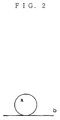
Fig. 2 shows measurement method for shape retention ratio,
wherein a and b designate vertical and horizontal direction,
respectively.
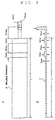
Fig. 3A shows a top view of a molded product used for the fluidity
test in Examples and Fig. 3B shows its cross sectional view.
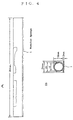
Fig. 4A shows a front view of tubular sponge manufactured in
Examples and Fig. 4B shows its cross sectional view.
In Figs. 3 and 4, 1 shows tubular sponge, and in Fig.3, 2 shows
a molded product.
This specification includes part or all of contents as disclosed
in the specifications of Japanese Patent Applications Nos.
11(1999)-209036 and 11(1999)-223639, which are the base of the
priority claim of the present application.
Best Mode for Carrying out the Invention
The invention will be further explained specifically by
Examples and Comparative Examples that follow, however, the scope
of the invention should not be restricted by these Examples.
Various physical properties and their measurement methods in
Examples and Comparative Examples are as follows.
[Apparent activation energy]
1) Measurement was carried out using RDS-II made by Rheometrix
Co., Ltd.
2) Sample preparation: A sheets of 2 mm thickness was prepared
from a compound containing no vulcanization agent nor accelerator
at 190 °C for 5 min. using 50 ton press machine.
3) Measurement conditions: Complex viscosity coefficient was
measured at each temperature of 170 °C, 190 °C and 210 °C under
frequency of 0.1 - 15 Hz (strain: 1 %, stabilization time at each
temperature: 3 min.).
4) Calculation of activation energy
Frequency dependencies of complex viscosity coefficient were
measured at 170 °C, 190 °C and 210 °C, and apparent activation energy
at 190 °C was obtained according to the following equations.
aT= A exp [Ea / R (T-Tref)]
ηT = aT ηT0
η
T and η
T0: Complex viscosity coefficient at T and T
0,
respectively, Tref: Standard temperature (190°C),
Quantification index of network (physical structural change):
(For rubber composition for extrusion)
Change rate of activation energy (%) = [1-((2) /(1))] × 100
(1) : Standard value = Apparent activation energy of a compound
obtained by mixing on an open roll of 8 inch for 21 min.
(2) : Apparent activation energy of a compound right after
injection by an injection machine in the next process.
(For rubber composition for molding)
Change rate of activation energy (%) = [1-((2) /(1))] × 100
[Die swell ratio]
A compound containing no vulcanization agent nor accelerator
was wound on an open roll of 8 inch (roll clearance: 5 mm) and
mixed for 2 min. then sheeted out in ribbon-like shape. The
compound was then fed to 50 mm extruder SCER (made by Shimadzu
Corp.) and extruded through a nozzle with L/D = 60 mm / 2 mm under
shear rate of 102 sec-1 and diameter of cross section (A) (mm) of
extrudate was measured. Die swell ratio was obtained according
to the following formula.
die swell ratio = A / 2 (nozzle diameter in mm)
[Ribbon crack test] (For rubber composition for extrusion)
A ribbon-like compound was cut to 30 cm in length, folded at the
center and both ends were fixed. Bending surface was checked on
crack and breakage after leaving in an oven at 40 °C for 24 hrs.
[Ribbon tear and breakage test] (For rubber composition for
molding)
A ribbon-like compound with the dimension of 5 mm T×40 mm W×
300 mm L was prepared using a roll of 8 inch and stored in an
oven at 40 °C for 1 hr. The ribbon was then extended to 350 mm and
occurrence of tear and breakage was evaluated.
[Product surface texture (sensory inspection)]
A tubular sponge rubber was cut to 30 mm in length, irradiated
from above with 60 W lamps, and checked visually from the angle
at which surface looked glossy(full mark is 5 point).
(4 or 2 point means intermediate level between 5 and 3 points
and 3 and 1 points respectively)
[Mooney viscosity]
Mooney viscosity (Vm) was obtained at 140 °C on green rubber
according to JIS K6300, and Mooney scorch time (t5) was determined
at 125 °C.
[M100 (100 % Modulus)]
It was measured in accordance with JIS K6251.
[M300 (300 % Modulus)]
It was measured in accordance with JIS K6251.
[Tensile test] (For rubber composition for extrusion)
A vulcanized rubber sheet was obtained at 170 °C for 10 min. using
a 150 ton press machine. Tensile strength at break (Tb) and
elongation at break (Eb) were measured at 23 °C under 500 mm / min
of rate of tension in accordance with JIS K6251.
[HA (Product Hardness)] (For rubber composition for extrusion)
Product hardness was measured with vulcanized sheet of 2 mm thick
piled up to 12 mm using durometer A in accordance with JIS K6253.
[Tensile test and Hardness test] (For rubber composition for
molding)
A vulcanized rubber sheet was obtained at 170 °C for 10 min. using
a 150 ton press machine. Tensile strength at break (Tb), elongation
at break (Eb) and hardness (HA) were measured at 23 °C under 500
mm / min of rate of tension in accordance with JIS K6251.
[Compression set test]
(1) Rubber composition for automobile glassrun channel and window
frame and products thereof
Test pieces vulcanized at 170 °C for 15 min were used under the
test conditions of 70 °C × 22 hrs in accordance with JIS K6262
(1993).
(2) Weatherstrip sponge products
A tubular sponge rubber vulcanized in hot air and cut to a length
of 30 mm was compressed to a half of the height before loading,
and held in a gear oven together with a fixture at 70 °C for 200
hrs. Height of the test piece was measured after taking out of
a compression fixture then cooling for 30 min. Compression set
was calculated according to the following formula.
Compression set = [(t0-t1) / (t0-t2)] × 100 (%)
t0: Height of sample before test t1: Height of sample after thermal treatment and cooling for
30 min. t2: Height of sample in the sate fixed to a fixture
(3) Rubber composition for molding
Compression set was measured with the test piece vulcanized at
170 °C for 12 min. under the test conditions of 120 °C × 22 hrs.
in accordance with JIS K6262 (1993).
[Dynamic viscoelasticity test]
Dynamic viscoelasticity test was carried out using RSA-2 tester
(made by Scientific Far East Co., Ltd.) at 25 °C, frequency of
1 Hz / 100 Hz and strain ratio of 0.1 % to obtain complex modulus
of elasticity E* (× 107 dyne/cm2). In addition, dynamic-to-static
modulus ratio (index for noisiness in a car) and loss tangent (tan
δ) (index for driving comfortableness) were obtained by the
formulas below.
E* = E' + iE"
(E*: Complex modulus of elasticity, E': Dynamic modulus of
elasticity, E'': Dynamic loss modulus of elasticity)
Dynamic-to-static modulus ratio = E* at 100 Hz / E* at 1 Hz
tan δ = E'' / E'
[Foreign matter test for extrusion products]
A flat plate was prepared from a ribbon-like compound by extruding
using 60 mm thick extruder and vulcanizing in a microwave
vulcanization chamber (UHF, 200 °C , 3 kW) and a hot air
vulcanization chamber (HAV, 230 °C) connected in series at take-up
speed of 7 m/min. Number of foreign matter (not smaller than 0.03
mm) on surface per 1 m was counted.
[M25 (25 % Tensile stress)]
(a) Test piece: Punched with JIS NO.1 dumb-bell.
(b) Measurement method: Stress at 25 % strain was measured at
the rate of extension of 50 mm/min.
[Specific gravity]
A test piece of 20 mm × 20 mm was punched out from hot air
vulcanized tubular sponge rubber. Dust on surface was wiped off
with alcohol. Masses of this test piece in air and pure water were
measured using an automatic specific gravimeter (made by Toyo
Seiki Seisaku-Syo Ltd., model M-1) at 25 °C. Specific gravity SG
of sponge was calculated from difference of both masses.
[Water absorption ratio (Wa)]
A test piece of 20 mm × 20 mm was punched out from hot air
vulcanized tubular sponge rubber. Dust on surface was wiped off
with alcohol. The test piece was immersed in water at depth of
50 mm and held for 3 min under 125 mmHg. Then, after leaving the
test piece for 3 min. under atmospheric pressure, weight of the
test piece with water absorbed was measured, and water absorption
ratio (Wa) was calculated according to the following formula.
Wa (weight %) = [(w2-w1) / w1] × 100
[Shape retention ratio (%)]
A test piece having length of 2 mm was cut out from hot air
vulcanized tubular sponge rubber. Shape retention ratio (%) was
calculated according to the following formula by measuring
vertical and horizontal dimensions, a and b, using magnifying
glass (see Fig. 2).
Shape retention ratio (%) = [(a-b) / a] × 100
[Fluidity test]
Rubber compound (10 g) was charged into a transfer mold in 10
sec. and vulcanized and foamed at the mold temperature of 180 °C
for 3.5 min. Thus obtained vulcanized and foamed rubber molded
body shown in Fig. 3 was taken out from mold, and length (L in
Fig. 3) of the molded body was measured.
Examples 1-5 and Comparative Examples 1-5 Rubber composition
for automobile glassrun channel and window frame and products
thereof
A composition including the following components was mixed
using 16 L Bumbury's mixer (made by Kobe Steel, Ltd.) under charge
ratio of 75%: 100 weight parts (110 weight parts as product weight)
of ethylene / propylene / 5-vinyl-2-norbornene copolymer rubber
(A-1) [molar ratio of ethylene / propylene = 68 / 32, intrinsic
viscosity [η] in decalin at 135 °C = 3.0 dl/g, iodine value =
12, Mooney viscosity (after oil extension) = 110, oil content =
10 phr (parts per hundred rubber); product of Mitsui Chem. Corp.],
175 weight parts of FEF carbon black [Asahi Carbon K.K., trade
name: Asahi #60G], 20 weight parts of ground calcium carbonate
[Shiraishi Calcium Kaisha Ltd., trade name: Whiton SB], 85 weight
parts of softening agent [Idemitsu Kosan Co., Ltd., trade name:
Diana Process Oil PW-380], 5 weight parts of zinc white [Sakai
Chem. Ind. Co., Ltd., trade name: No. 1], 1 weight part of stearic
acid and dimethyldistearylammonium chloride [Lion Akzo Co., Ltd.,
trade name: Arquad 2HT-F].
Mixing procedures were as follows: Firstly, ethylene /
propylene / 5-vinyl-2-norbornene copolymer rubber (A-1) was
masticated for 15 sec, followed by addition of zinc white, stearic
acid, ground calcium carbonate, softening agent and
dimethyldistearyl ammonium chloride, and finally carbon black
roughly mixed with 0.5 weight parts (1.0×10⁻³ mole) of bis-3-(triethoxysilyl)propyltetrasulfane
[Degussa Huels AG., trade
name: Si-69] (in Comparative Examples 1 -5, carbon black itself
without blending bis-3-(triethoxysilyl)propyltetrasulfane) was
charged and mixed for 4 min. after temperature of the mixture
reached at 150 °C, with floating weight being maintained in down
position. Temperatures of discharged compounds after mixing for
4 min. were as shown in Tables 2 and 3.
The compound thus prepared was then wound around 8 inch an
open roll of 8 mm (surface temperatures of front and back rolls;
50 °C, rotation speeds of front and back roll; 18 rpm and 15 rpm,
respectively, roll clearance; 5 mm), and then added with sulfur,
vulcanization accelerator and calcium oxide [Inoue Sekkai Kogyo
K.K., trade name: Vesta #BS] mixed for 5 min. A ribbon-like compound
with 10 mm thickness and 70 mm width was sheeted out and fed to
a 50 mm extruder for rubber to produce glassrun channel products.
Samples for measurement of activation energy and die swell were
prepared similarly by the process described above except for
excluding vulcanization agent and vulcanization accelerators in
roll mixing.
Formulation of each composition is shown in Table 1 and mixing
conditions and results are shown in Tables 2 and 3.
| | Example | Comparative Example |
| | 1 - 5 | 1 - 5 |
| (Composition) |
| Copolymer Rubber (A-1) | 110 | 110 |
| Zinc Oxide No.1 | 5 | 5 |
| Stearic Acid | 1 | 1 |
| Asahi #60G | 175 | 175 |
| Whiton SB | 20 | 20 |
| PW-380 | 85 | 85 |
| Si-69 | 0.5 | 0 |
| Sanceler 22 | 0.7 | 0.7 |
| Sanceler BZ | 1.3 | 1.3 |
| Sanceler MDB | 1.3 | 1.3 |
| Arquad 2HT-F | 1.0 | 1.0 |
| Sulfur | 1.0 | 1.0 |
| Vesta #BS | 5 | 5 |
Vulcanization system: Sulfur 1.0 weight part, vulcanization
accelerator 2-mercaptoimidazoline [Sanshin Chem. Ind. Co., Ltd.,
trade name: Sanceler 22] 0.7 weight part, vulcanization
accelerator zinc di-n-butyldithiocarbamate [Sanshin Chem. Ind.
Co., Ltd., trade name: Sanceler BZ] 1.3 weight part and
vulcanization accelerator 2-(4-morpholinodithio)benzothiazole
[Sanshin Chem. Ind. Co., Ltd. trade name: Sanceler MDB] 1.3 weight
part.
| | Example |
| | 1 | 2 | 3 | 4 | 5 |
(Mixing Conditions)
Discharge Temp. - Mixing Time |
| 150°C - 4 minutes | ○ |
| 160°C - 4 minutes | | ○ |
| 170°C - 4 minutes | | | ○ |
| 170°C - 8 minutes | | | | ○ |
| 175°C - 15 minutes | | | | | ○ |
| Compound Temperature after Discharge (°C) | 162 | 171 | 175 | 179 | 183 |
| Activation Energy 1 ○ (kJ/mol) | 158 | 158 | 158 | 158 | 158 |
| Activation Energy 2 ○ (kJ/mol) | 151 | 150 | 148 | 148 | 147 |
| Change Rate (%) | 4 | 4 | 6 | 6 | 6 |
| Die Swell Ratio | 1.10 | 1.10 | 1.10 | 1.10 | 1.10 |
| Ribbon Crack Test | No | No | No | No | No |
Foreign Matter
(Piece/m) | 0 | 0 | 0 | 0 | 0 |
| | Comparative Example |
| | 1 | 2 | 3 | 4 | 5 |
(Mixing Conditions)
Discharge Temp. - Mixing Time |
| 150°C - 4 minutes | ○ |
| 160°C - 4 minutes | | ○ |
| 170°C - 4 minutes | | | ○ |
| 170°C - 8 minutes | | | | ○ |
| 175°C - 15 minutes | | | | | ○ |
| Compound Temperature after Discharge (°C) | 163 | 170 | 174 | 178 | 181 |
| Activation Energy 1 ○ (kJ/mol) | 158 | 158 | 158 | 158 | 158 |
| Activation Energy 2 ○ (kJ/mol) | 120 | 80 | 20 | 9 | 6 |
| Change Rate (%) | 24 | 49 | 87 | 94 | 96 |
| Die Swell Ratio | 1.08 | 1.03 | 1.02 | 1.00 | 1.00 |
| Ribbon Crack Test | No | Crack | Break | Break | Break |
Foreign Matter
(Piece/m) | 2 | 5 | 6 | 10 | 15 |
Similar procedures to Example 1 - 5 were repeated except varying
addition amount of bis-3-(triethoxysilyl)propyltetrasulfane,
and mixing using a Banbury and a 8 inch roll were carried out
at 170 °C for 4 min. Temperature of the compound after discharge
was 175 °C.
Formulation of each composition is shown in Table 4 and mixing
conditions and results are shown in Table 5.
| | Example | Comparative Example |
| | 6 | 7 | 8 | 6 | 7 | 8 |
| (Composition) |
| Copolymer Rubber (A-1) | 110 | 110 | 110 | 110 | 110 | 110 |
| Zinc Oxide No.1 | 5 | 5 | 5 | 5 | 5 | 5 |
| Stearic Acid | 1 | 1 | 1 | 1 | 1 | 1 |
| Asahi #60G | 175 | 175 | 175 | 175 | 175 | 175 |
| Whiton SB | 20 | 20 | 20 | 20 | 20 | 20 |
| PW-380 | 85 | 85 | 85 | 85 | 55 | 55 |
| Si-69 | 0.05 | 0.3 | 1.5 | 0 | 3 | 5 |
| Sanceler 2.2 | 0.7 | 0.7 | 0.7 | 0.7 | 0.7 | 0.7 |
| Sanceler BZ | 1.3 | 1.3 | 1.3 | 1.3 | 1.3 | 1.3 |
| Sanceler MDB | 1.3 | 1.3 | 1.3 | 1.3 | 1.3 | 1.3 |
| Arquad 2HT-F | 1.0 | 1.0 | 1.0 | 1.0 | 1.0 | 1.0 |
| Sulfur | 1.0 | 1.0 | 1.0 | 1.0 | 1.0 | 1.0 |
| Vesta #BS | 5 | 5 | 5 | 5 | 5 | 5 |
| | Example | Comparative Example |
| | 6 | 7 | 8 | 6 | 7 | 8 |
| (Characteristics of Unvulcanized Rubber) |
| Vm (140°C) | 40 | 40 | 40 | 40 | 40 | 40 |
| t5 (125°C) | 10.3 | 10.3 | 12.1 | 8.5 | 15.6 | 17.6 |
| (Ribbon Crack Test) |
| Presence of Crack | No | No | No | Break | No | No |
| Die Swell Ratio | 1.10 | 1.10 | 1.10 | 1.02 | 1.10 | 1.10 |
| Activation Energy 1 ○ | 158 | 158 | 158 | 158 | 158 | 158 |
| Activation Energy 2 ○ | 143 | 147 | 150 | 20 | 151 | 152 |
| Change Rate (%) | 9 | 7 | 5 | 87 | 4 | 4 |
| (Physical Properties of Vulcanized Rubber) |
| M100 (MPa) | 3.74 | 3.45 | 3.27 | 4.3 | 3.01 | 2.97 |
| M300 (MPa) | 9.79 | 8.85 | 8.22 | 8.57 | 7.86 | 7.76 |
| TB (MPa) | 11.3 | 11.0 | 10.2 | 9.21 | 11.2 | 11.8 |
| EB (%) | 420 | 480 | 470 | 380 | 500 | 530 |
| HA | 77 | 78 | 77 | 75 | 76 | 75 |
| (Compression Set) 70°C x 22h (%) | 15 | 15 | 15 | 30 | 50 | 58 |
Foreign Matter
(Piece/m) | 0 | 0 | 0 | 6 | 0 | 0 |
Similar procedures to Example 3 were repeated except for using
equivalent mole of ingredient A shown in Table 6 or 0.03 or 0.3
weight parts of sulfur instead of bis-3-(triethoxysilyl)
propyltetrasulfane (mixing conditions: 170 °C for 4 min.).
Results are shown in Table 6.
| | Comparative Example |
| | 9 | 10 | 11 | 12 | 13 | 14 |
| (Component A) |
| Organosilane 1 | ○ |
| Organosilane 2 | | ○ |
| Vinylsilane | | | ○ |
| Accelerator TRA | | | | ○ |
| Sulfur (0.03 wt. parts) | | | | | ○ |
| Sulfur (0.3 wt. parts) | | | | | | ○ |
| Characteristics of Unvulcanized Rubber |
| Vm (140°C) | 43 | 42 | 41 | 43 | 42 | 68 |
| Die Swell Ratio | 1.05 | 1.05 | 1.05 | 1.00 | 1.05 | NM |
| Activation Energy |
| 1 ○ | 158 | 158 | 158 | 158 | 158 | NM |
| Activation Energy |
| 2 ○ | 13 | 15 | 12 | 10 | 6 | NM |
| Change Rate (%) | 92 | 90 | 92 | 94 | 96 |
| (Ribbon Crack Test) Presence of Crack | Break | Break | Break | Break | Break | Break |
Foreign Matter
(Piece/m) | 4 | 4 | 4 | 3 | 2 | NM |
Examples 9 - 11 and Comparative Examples 15 -16 Weatherstrip
sponge products
A composition consisting of the following components was mixed
by 16 L Bumbury's mixer (made by Kobe Steel, Ltd.) under charge
ratio of 75 % for 6 min: 100 weight parts (120 weight parts as
product weight) of ethylene / propylene / 5-vinyl-2-norbornene
copolymer rubber (A-2) [molar ratio of ethylene / propylene =
68 / 32, intrinsic viscosity [η] in decalin at 135 °C = 2.7 dl/g,
iodine value = 25, Mooney viscosity (ML(1+4) at 125 °C) 45, oil
content = 20 phr (parts per hundred rubber); product of Mitsui
Chem. Corp.] , 5 weight parts of activated zinc white [Inoue Sekkai
Kogyo K.K., trade name: MetaZ102], 90 weight parts of SRF-H carbon
black [Asahi Carbon Co., Ltd., trade name: Asahi #50HG],
predetermined amount of bis-3-(triethoxysilyl)
propyltetrasulfane [Degussa Huels AG., trade name: Si-69] , 70
weight parts of paraffinic process oil [Idemitsu Kosan Co., Ltd.,
trade name: Diana Process Oil PW-380] and predetermined amount
of activator [polyethylene glycol, NOF Corp. trade name: PEG#4000].
Temperature of discharged compound was 165 °C. Simultaneous mixing
method for whole components was adopted. Predetermined amount of
bis-3-(triethoxysilyl)propyltetrasulfane was sprayed on weighed
carbon black and charged into the mixer simultaneously with carbon
black.
The compound thus prepared was then wound around an open roll
of 8 inch (surface temperatures of front and back rolls; 50 °C,
rotation speeds of front and back rolls; 18 rpm and 15 rpm,
respectively) and then sulfur, vulcanization accelerator,
defoaming agent (calcium oxide; Inoue Sekkai Kogyo K.K., trade
name: Vesta 20) and foaming agent [p,p'-Oxybis
(benzenesulfonylhydrozide), Eiwa Chem. Ind. Co., Ltd., trade
name: Neocelbon N1000SW] were added and mixed for 5 min. A
ribbon-like compound with 10 mm thickness and 70 mm width was
sheeted out.
Vulcanization and foaming were performed using molding line
with a microwave vulcanization chamber (UHF) and a hot air
vulcanization chamber (HAV) connected in series or without the
former. Temperatures at extruder head and UHF were set at 80 °C
and 200 °C, respectively, and power was adjusted so that
temperature of extrudate surface at the exit of UHF was kept at
180 °C. HAV of 30 m length was used and temperature inside the
HAV was set at 250 °C.
Formulation of each composition and results are shown in Table
7.
Examples 12 Weatherstrip sponge products
A composition consisting of the following components was
premixed using 4.3 L Bumbury's mixer at 175 °C for 5 min: 100 weight
parts (120 weight parts as product weight) of ethylene / propylene
/ 5-vinyl-2-norbornene copolymer rubber (A-2) [molar ratio of
ethylene / propylene = 68 / 32, intrinsic viscosity [η] in decalin
at 135 °C = 2.7 dl/g, iodine value = 25, Mooney viscosity (ML(1+4)
at 125 °C) = 45, oil content = 20 phr (parts per hundred rubber);
product of Mitsui Chem. Corp.] and 20 weight parts of propylene
homopolymer (melting temperature: 160 °C, MFR (190 °C, 2.16 kg load
in accordance with ASTM D1238): 20 g/10 min and crystallinity:
85 %). The compound thus mixed was extruded using 50 mm extruder
at 260 °C (in nitrogen sealing), followed by cooling in water to
get EPDM / PP alloy. Procedures similar to Examples 9-11 were
repeated using the EPDN/PP alloy described above and formulations
shown in Table 7. Results are shown in Table 7.
| | Example | Comparative Example |
| | 9 | 10 | 11 | 12 | 15 | 16 |
| Copolymer Rubber (A-2) | 120 | 120 | 120 | | 120 | 120 |
| Polymer (A-3) |
| (EPDM/PP) | | | | 140 |
| Activated Zinc Oxide | 5 | 5 | 5 | 5 | 5 | 5 |
| Asahi 50HG | 90 | 90 | 90 | 70 | 90 | 90 |
| Si-69 | 0.01 | 0.3 | 1.0 | 0.3 | 3.0 | 0 |
| PW-380 | 70 | 70 | 70 | 70 | 70 | 70 |
| PEG #4000 | 1 | 1 | 1 | 1 | 1 | 4 |
| Vesta 20 | 4 | 4 | 4 | 4 | 4 | 4 |
| N1000SW | 4 | 4 | 4 | 4 | 4 | 4 |
| Physical Properties of Sponge |
| M25 (KPa) | 290 | 290 | 290 | 292 | 280 | 270 |
| Specific Gravity | 0.50 | 0.50 | 0.50 | 0.47 | 0.60 | 0.65 |
| Water Absorption (wt%) | 4 | 5 | 5 | 1 | 30 | 20 |
| Activation Energy 1 ○ | 70 | 70 | 70 | 70 | 70 | 70 |
| Activation Energy 2 ○ | 70 | 69 | 68 | 69 | 70 | 6 |
| Change Rate (%) | 0 | 1 | 1 | 1 | 0 | 91 |
| Die Swell Ratio | 1.30 | 1.30 | 1.30 | 1.29 | 1.30 | 1.00 |
| Shape Retention (%) | 91 | 91 | 91 | 91 | 90 | 94 |
| Compression Set (%) | 21 | 22 | 19 | 17 | 48 | 50 |
| Surface Texture of Product | 5 | 5 | 5 | 5 | 5 | 2 |
Vulcanization system: Sulfur 1.5 weight part, vulcanization
accelerator 2-mercapto benzothiazole [Sanshin Chem. Ind. Co.,
Ltd. trade name: Sanceler M] 1.0 weight part, vulcanization
accelerator N-cyclohexyl-2-benzothiazolesulfenamide [Sanshin
Chem. Ind. Co., Ltd., trade name: Sanceler CM] 1.0 weight part,
vulcanization accelerator diethylthiourea [Sanshin Chem. Ind.
Co., Ltd., trade name: Sanceler EUR] 1.0 weight part and
vulcanization accelerator tetrakis(2-ethylhexyl)thiuram
disulfide [Sanshin Chem. Ind. Co., Ltd., trade name: Sanceler
TOT] 1.0 weight part.
Examples 13 - 17 and Comparative Examples 17 -21 Composition
for rubber vibration isolators and products thereof
A composition including the following components was mixed by
16 L Bumbury's mixer (made by Kobe Steel, Ltd.) under charge ratio
of 75 %: 100 weight parts (150 weight parts as product weight)
of ethylene / propylene / 5-vinyl-2-norbornene copolymer rubber
(A-4) [molar ratio of ethylene / propylene = 68 / 32, intrinsic
viscosity [η] in decalin at 135 °C = 4.0 dl/g, iodine value =
22, Mooney viscosity (after oil extension) = 110, oil content =
50 phr (parts per hundred rubber); product of Mitsui Chem. Corp.] ,
60 weight parts of FEF carbon black [Asahi Carbon Co., Ltd., trade
name: Asahi #60G] , 5 weight parts of zinc white [Sakai Chem. Ind.
Co., Ltd., trade name: No. 1] and 1 weight part of stearic acid.
Mixing procedures were as follows: Ethylene / propylene /
5-vinyl-2-norbornene copolymer rubber (A-4) was masticated for
15 sec, followed by addition of zinc white, stearic acid and
softening agent, and finally 0.5 weight parts (1.0×10⁻³ mole) of
bis-3-(triethoxysilyl)propyltetrasulfane [Degussa Huels AG.,
trade name: Si-69] roughly mixed with carbon black (in Comparative
Examples 17-21, carbon black was charged alone without bis-3-(triethoxysilyl)propyltetrasulfane),
and mixed for 4 min.
Temperature of discharged compounds was 175 °C.
The compound thus prepared was then wound around an open roll
of 8 inch (surface temperatures of front and back rolls; 50 °C,
rotation speeds of front and back roll; 18 rpm and 15 rpm,
respectively, roll clearance: 5 mm), and then added with sulfur
and vulcanization accelerator and mixed for 5 min. A ribbon-like
compound with 5 mm thickness and 40 mm width was sheeted out and
fed to a vertical type injection machine to produce rubber
vibration isolators.
Samples for measurement of activation energy were prepared
similarly by the process described above except for excluding
vulcanization agent and vulcanization accelerators in roll
mixing.
Formulation of each composition is shown in Table 8 and mixing
conditions and results are shown in Tables 9 and 10.
| | Example | Comparative Example |
| | 13-17 | 17-21 |
| (Composition) |
| Copolymer Rubber (A-4) | 150 | 150 |
| Zinc Oxide No.1 | 5 | 5 |
| Stearic Acid | 1 | 1 |
| Asahi #60G | 60 | 60 |
| Si-69 | 0.5 | 0 |
| Sanceler BZ | 1.3 | 1.3 |
| Sanceler M | 0.7 | 0.7 |
| Sulfur | 0.75 | 0.75 |
Vulcanization system: Sulfur 0.75 weight part, vulcanization
accelerator zinc di-n-butyldithiocarbamate [Sanshin Chem. Ind.
Co., Ltd., trade name: Sanceler Bz] 1.3 weight part, vulcanization
accelerator 2-mercaptobenzothiazole [Sanshin Chem. Ind. Co., Ltd.,
trade name: Sanceler M] 0.7 weight part.
| | Example |
| | 13 | 14 | 15 | 16 | 17 |
| (Mixing Conditions) Discharge Temp. - Mixing Time |
| 150°C - 4 minutes | ○ |
| 160°C - 4 minutes | | ○ |
| 170°C - 4 minutes | | | ○ |
| 170°C - 8 minutes | | | | ○ |
| 175°C - 15 minutes | | | | | ○ |
| Activation Energy 1 ○ (kJ/mol) | 80 | 80 | 80 | 80 | 80 |
| Activation Energy 2 ○ (kJ/mol) | 80 | 79 | 78 | 78 | 77 |
| Change Rate (%) | 0 | 1 | 3 | 3 | 4 |
| Ribbon Break Test | No | No | No | No | No |
| | Comparative Example |
| | 17 | 18 | 19 | 20 | 21 |
(Mixing Conditions)
Discharge Temp. - Mixing Time |
| 150°C - 4 minutes | ○ |
| 160°C - 4 minutes | | ○ |
| 170°C - 4 minutes | | | ○ |
| 170°C - 8 minutes | | | | ○ |
| 175°C - 15 minutes | | | | | ○ |
| Activation Energy 1 ○ (kJ/mol) | 80 | 80 | 80 | 80 | 80 |
| Activation Energy 2 ○ (kJ/mol) | 38 | 30 | 18 | 10 | 7 |
| Change Rate (%) | 53 | 63 | 78 | 88 | 91 |
| Ribbon Break Test | Many Cracks | Break | Break | Break | Break |
A composition including the following components was mixed
using 16 L Bumbury's mixer (made by Kobe Steel Ltd.) under charge
ratio of 75 %: 100 weight parts (as product weight, 150 weight
parts) of ethylene / propylene / 5-vinyl-2-norbornene copolymer
rubber (A-4) [molar ratio of ethylene / propylene = 68 / 32,
intrinsic viscosity [η] in decalin at 135 °C = 4.0 dl/g, iodine
value = 22, Mooney viscosity (after oil extension) = 110, oil
content = 50 phr (parts per hundred rubber); product of Mitsui
Chem. Corp.] or 100 weight parts (110 weight parts as product
weight) of ethylene / propylene / 5-vinyl-2-norbornene copolymer
rubber (A-5) [molar ratio of ethylene / propylene molar ratio
= 68 / 32, intrinsic viscosity [η] in decalin at 135 °C = 2.7
dl/g, iodine value = 20, Mooney viscosity (after oil extension,
ML(1+4) 100 °C) = 90, oil content = 10 phr (parts per hundred
rubber); product of Mitsui Chem. Corp.], 60 weight parts of FEF
carbon black [Asahi Carbon Co., Ltd. trade name: Asahi #60G]
40 weight parts of softening agent [Idemitsu Kosan Co., Ltd.,
trade name: Diana Process Oil PW-380] (only in Example 20), 5
weight parts of zinc white [Sakai Chem. Ind. Co., Ltd., trade
name: No. 1] and 1 weight part of stearic acid .
Mixing procedures were as follows: Ethylene / propylene /
5-vinyl-2-norbornene copolymer rubber (A-4) or ethylene /
propylene / 5-vinyl-2-norbornene copolymer rubber (A-5) was
masticated for 15 sec, followed by addition of zinc white, stearic
acid, and softening agent (only in Example 20), and finally carbon
black roughly mixed with predetermined amount of bis-3-(triethoxysilyl)propyltetrasulfane
[Degussa Huels AG., trade
name: Si-69] (in Comparative Examples 23 and 24,
dipentamethylenethiuram tetrasulfide (Sanshin Chem. Ind. Co.,
Ltd., trade name: Sanceler TRA) and 0.04 weight part of sulfur
were roughly blended respectively, instead of bis-3-(triethoxysilyl)propyltetrasulfane)
and mixed for 4 min.
Temperature of discharged compounds was 170 °C.
The compound thus prepared was then wound around an open roll
of 8 inch (surface temperatures of front and back rolls; 50 °C,
rotation speeds of front and back roll; 18 rpm and 15 rpm,
respectively, roll clearance; 5 mm) and then added with sulfur
and vulcanization accelerator and mixed for 5 min. A ribbon-like
compound with 5 mm thickness and 40 mm width was sheeted out and
fed to a vertical type injection machine to produce rubber
vibration isolators.
Samples for measurement of activation energy were prepared
similarly by the process described above except for excluding
vulcanization agent and vulcanization accelerators in roll
mixing.
Formulation of each composition is shown in Table 11 and mixing
conditions and results are shown in Table 12.
| | Example | Comparative Example |
| | 18 | 19 | 20 | 22 | 23 | 24 |
| (Composition) |
| Copolymer Rubber (A-4) | 150 | 150 | | 150 | 150 | 150 |
| Copolymer Rubber (A-5) | | | 110 |
| Zinc Oxide No.1 | 5 | 5 | 5 | 5 | 5 | 5 |
| Stearic Acid | 1 | 1 | 1 | 1 | 1 | 1 |
| Asahi #60G | 60 | 60 | 60 | 60 | 60 | 60 |
| PW-380 | | | 40 |
| Sanceler TRA | | | | | 0.5 |
| Sulfur | | | | | | 0.04 |
| Si-69 | 0.3 | 0.5 | 1.0 | 3.0 | 0 | 0 |
| Sanceler M | 0.7 | 0.7 | 0.7 | 0.7 | 0.7 | 0.7 |
| Sanceler BZ | 1.0 | 1.0 | 1.0 | 1.0 | 1.0 | 1.0 |
| Sanceler TT | 0.8 | 0.8 | 0.8 | 0.8 | 0.8 | 0.8 |
| Sulfur | 0.75 | 0.75 | 0.75 | 0.75 | 0.75 | 0.75 |
| |
Example |
Comparative Example |
| |
18 |
19 |
20 |
22 |
23 |
24 |
| Activation Energy 1 ○ |
80 |
80 |
80 |
80 |
80 |
80 |
| Activation Energy 2 ○ |
79 |
79 |
80 |
80 |
15 |
10 |
| Change Rate (%) |
1 |
1 |
0 |
0 |
81 |
88 |
| (Physical Properties of Vulcanized Rubber |
| M100 (MPa) |
3.2 |
3.1 |
3.0 |
2.9 |
4.2 |
4.3 |
| M300 (MPa) |
11.8 |
11.2 |
10.8 |
10.1 |
11.8 |
11.7 |
| TB (MPa) |
21.5 |
21.9 |
22.5 |
22.5 |
12.5 |
12.8 |
| EB (%) |
760 |
770 |
780 |
790 |
420 |
410 |
| HA |
60 |
60 |
60 |
59 |
61 |
61 |
(Compression Set)
120°C x 22h (%) |
41 |
42 |
43 |
62 |
60 |
61 |
| Dynamic Modulus |
| (1Hz) |
| E*(x107)Pa |
7.2 |
6.8 |
6.7 |
6.5 |
7.8 |
7.9 |
| tan δ (x10-1) |
0.12 |
0.10 |
0.10 |
0.10 |
0.13 |
0.13 |
| (10Hz) |
| E*(x107)Pa |
8.5 |
8.3 |
8.2 |
8.0 |
9.5 |
9.7 |
| tan δ (x10-1) |
0.14 |
0.13 |
0.13 |
0.13 |
0.17 |
0.17 |
Example 21 and Comparative Examples 25-27 Weatherstrip sponge
product.
A composition including the following components was mixed by
16 L Bumbury's mixer (made by Kobe Steel Ltd.) under charge ratio
of 75 % for 6 min: 100 weight parts of ethylene / propylene /
5-vinyl-2-norbornene copolymer rubber (A-6) [molar ratio of
ethylene / propylene = 68 / 32, intrinsic viscosity [η] in decalin
at 135 °C = 2.1 dl/g, iodine value = 25, Mooney viscosity (ML(1+4)
125 °C) = 30; product of Mitsui Chem. Corp.] , 5 weight parts of
activated zinc white [Inoue Sekkai Kogyo K.K., trade name:
MetaZ102], 2 weight part of stearic acid , 100 weight parts of
SRF-H carbon black [Asahi Carbon Co., Ltd., trade name: Asahi
#50HG], predetermined amount of bis-3-(triethoxysilyl)propyltetrasulfane
[Degussa Huels AG., trade
name: Si-69] or other organosilane and 40 weight parts of
paraffinic process oil [Idemitsu Kosan Co., Ltd., trade name:
Diana Process Oil PW-380] . Simultaneous mixing method for whole
components was adopted. Predetermined amount of bis-3-(triethoxysilyl)propyltetrasulfane
and other organosilane were
sprayed on the surface of weighed carbon black and charged into
the mixer together with carbon black.
The compound thus prepared was then wound around an open roll
of 8 inch (surface temperatures of front and back rolls; 50 °C,
rotation speeds of front and back roll; 18 rpm and 15 rpm,
respectively), and then added with sulfur, vulcanization
accelerator, defoaming agent (calcium oxide; Inoue Sekkai Kogyo
K.K., trade name: Vesta 20), foaming agent [azodicarbonamide, Eiwa
Chem. Ind. Co., Ltd., trade name: Vinyhole AC#3] and co-foaming
agent [urea based type; Eiwa Chem. Ind. Co., Ltd., trade name:
Cellpaste 101] and mixed for 5 min. A ribbon-like compound with
10 mm thickness and 70 mm width was sheeted out.
The ribbon-like compound described above was then charged to
a tubular mold of a transfer molding machine in 10 sec, followed
by vulcanization and foaming at 180 °C for 3.5 min. to get a foamed
molded body (sponge rubber) shown in Fig. 4. Various tests for
physical properties were carried out on the vulcanized and foamed
rubber molded body.
Formulation of each composition, mixing conditions and results
are shown in Tables 13.
Example 22 Weatherstrip sponge product
A composition consisting of the following components was
premixed in advance using 4.3 L Bumbury's mixer at 175 °C for 5
min: 100 weight parts of ethylene / propylene / 5-vinyl-2-norbornene
copolymer rubber (A-6) [molar ratio of ethylene /
propylene = 68 / 32, intrinsic viscosity [η] in decalin at 135 °C
= 2.1 dl/g, iodine value = 25, Mooney viscosity (ML(1+4) at 125 °C)
= 30; product of Mitsui Chem. Corp.]and 20 weight parts of propylene
homopolymer (melting temperature: 160 °C, MFR (190°C, 2.16 kg load
in accordance with ASTM D1238): 20 g/10 min and crystallinity:
85 %). Thus mixed compound was extruded using 50 mm extruder at
260 °C (in nitrogen sealing), followed by cooling in water to get
EPDM / PP alloy. Similar procedures to Example 21 were repeated
using the alloy and ingredients shown in Table 13. Results are
shown in Table 13.
| | Example | Comparative Example |
| | 21 | 22 | 25 | 26 | 27 |
| Copolymer Rubber (A-6) | 100 | | 100 | 100 | 100 |
| EPDM/PP Alloy | | 120 |
| Activated Zinc Oxide | 5 | 5 | 5 | 5 | 5 5 |
| Stearic Acid | 2 | 2 | 2 | 2 | 2 2 |
| Asahi 50HG | 100 | 80 | 100 | 100 | 100 |
| PW-380 | 40 | 40 | 40 | 40 | 40 |
| Si-69 | 0.5 | 0.01 |
| Organosilane 1 | | | 0.3 |
| Organosilane 2 | | | | 0.3 |
| Organosilane 3 | | | | | 0.3 |
| Foaming Agent | 7 | 7 | 7 | 7 | 7 |
| Urea-based Co-foaming agent | 2 | 2 | 2 | 2 | 2 |
| Activation Energy 1 ○ | 95 | 95 | 95 | 95 | 95 |
| Activation Energy 2 ○ | 94 | 94 | 43 | 34 | 23 |
| Change Rate (%) | 1 | 1 | 55 | 64 | 76 |
| Temperature after Mixing and Discharge (°C) | 120 | 123 | 135 | 135 | 135 |
| Physical Properties of Sponge |
| Specific Gravity (kg/cm3) | 540 | 550 | 560 | 565 | 570 |
| TB (MPa) | 2.5 | 2.3 | 2.6 | 2.5 | 2.4 |
| EB (%) | 290 | 280 | 200 | 210 | 190 |
| Compression Set (%) | 30 | 32 | 43 | 45 | 47 |
| Fluidity (mm) | 170 | 145 | 110 | 100 | 90 |
| Surface Texture of Product | 5 | 5 | 2 | 2 | 2 |
Vulcanization system: Sulfur 1.0 weight part, vulcanization
accelerator 2-mercaptobenzothiazole [Sanshin Chem. Ind. Co., Ltd.,
trade name: Sanceler M] 0.5 weight part, vulcanization accelerator
tetramethylthiuram disulfide [Sanshin Chem. Ind. Co., Ltd., trade
name: Sanceler TT] 0.5 weight part, vulcanization accelerator zinc
di-n-butyldithiocarbamate [Sanshin Chem. Ind. Co., Ltd., trade
name: Sanceler BZ] 1.5 weight part and tetraethylthiuram disulfide
[Sanshin Chem. Ind. Co., Ltd., trade name: Sanceler TET] 0.5 weight
part.
All the publications, patents and patent applications cited
herein are incorporated herein by reference in their entirety.
Industrial Applicability
The invention provides a rubber composition for extrusion
giving an extrudate having no crack nor breakage and stable cross
sectional shape in ribbon-like compound prepared prior to
extrusion, along with foam products having little foaming
variation. This contributes to provide extrudate products such
as weatherstrip sponge, high extension foam seal, glassrun channel,
window frame and water hose for automobile, which have superior
surface texture and stable quality irrespective to season or type
of mixing machine. The invention eliminates most of inferior
products which have been recognized to be caused by unknown foreign
matter until now.
A rubber composition for molding of the invention provides a
compound prepared for injection which has superior fluidity in
a mold and no breakage phenomenon, along with stable and uniform
foaming characteristics in molded sponge. Furthermore, a rubber
composition for molding of the invention provides rubber vibration
isolator, cast sponge, grommet, O-ring, packing, boots, window
frame, break piston cup and OA roll products with good surface
texture and superior mechanical strength.