EP1209008A2 - Radial tire for heavy load and metal cord - Google Patents
Radial tire for heavy load and metal cord Download PDFInfo
- Publication number
- EP1209008A2 EP1209008A2 EP01127744A EP01127744A EP1209008A2 EP 1209008 A2 EP1209008 A2 EP 1209008A2 EP 01127744 A EP01127744 A EP 01127744A EP 01127744 A EP01127744 A EP 01127744A EP 1209008 A2 EP1209008 A2 EP 1209008A2
- Authority
- EP
- European Patent Office
- Prior art keywords
- filament
- core
- cord
- filaments
- waved
- Prior art date
- Legal status (The legal status is an assumption and is not a legal conclusion. Google has not performed a legal analysis and makes no representation as to the accuracy of the status listed.)
- Granted
Links
Images



Classifications
-
- D—TEXTILES; PAPER
- D07—ROPES; CABLES OTHER THAN ELECTRIC
- D07B—ROPES OR CABLES IN GENERAL
- D07B1/00—Constructional features of ropes or cables
- D07B1/06—Ropes or cables built-up from metal wires, e.g. of section wires around a hemp core
- D07B1/0606—Reinforcing cords for rubber or plastic articles
- D07B1/062—Reinforcing cords for rubber or plastic articles the reinforcing cords being characterised by the strand configuration
- D07B1/064—Reinforcing cords for rubber or plastic articles the reinforcing cords being characterised by the strand configuration the reinforcing cords being twisted and with at least one wire exchanging place with another wire
-
- B—PERFORMING OPERATIONS; TRANSPORTING
- B60—VEHICLES IN GENERAL
- B60C—VEHICLE TYRES; TYRE INFLATION; TYRE CHANGING; CONNECTING VALVES TO INFLATABLE ELASTIC BODIES IN GENERAL; DEVICES OR ARRANGEMENTS RELATED TO TYRES
- B60C9/00—Reinforcements or ply arrangement of pneumatic tyres
- B60C9/0007—Reinforcements made of metallic elements, e.g. cords, yarns, filaments or fibres made from metal
-
- B—PERFORMING OPERATIONS; TRANSPORTING
- B60—VEHICLES IN GENERAL
- B60C—VEHICLE TYRES; TYRE INFLATION; TYRE CHANGING; CONNECTING VALVES TO INFLATABLE ELASTIC BODIES IN GENERAL; DEVICES OR ARRANGEMENTS RELATED TO TYRES
- B60C9/00—Reinforcements or ply arrangement of pneumatic tyres
- B60C9/0057—Reinforcements comprising preshaped elements, e.g. undulated or zig-zag filaments
-
- B—PERFORMING OPERATIONS; TRANSPORTING
- B60—VEHICLES IN GENERAL
- B60C—VEHICLE TYRES; TYRE INFLATION; TYRE CHANGING; CONNECTING VALVES TO INFLATABLE ELASTIC BODIES IN GENERAL; DEVICES OR ARRANGEMENTS RELATED TO TYRES
- B60C9/00—Reinforcements or ply arrangement of pneumatic tyres
- B60C9/02—Carcasses
- B60C9/04—Carcasses the reinforcing cords of each carcass ply arranged in a substantially parallel relationship
- B60C9/08—Carcasses the reinforcing cords of each carcass ply arranged in a substantially parallel relationship the cords extend transversely from bead to bead, i.e. radial ply
-
- D—TEXTILES; PAPER
- D07—ROPES; CABLES OTHER THAN ELECTRIC
- D07B—ROPES OR CABLES IN GENERAL
- D07B1/00—Constructional features of ropes or cables
- D07B1/06—Ropes or cables built-up from metal wires, e.g. of section wires around a hemp core
- D07B1/0606—Reinforcing cords for rubber or plastic articles
- D07B1/0613—Reinforcing cords for rubber or plastic articles the reinforcing cords being characterised by the rope configuration
-
- D—TEXTILES; PAPER
- D07—ROPES; CABLES OTHER THAN ELECTRIC
- D07B—ROPES OR CABLES IN GENERAL
- D07B1/00—Constructional features of ropes or cables
- D07B1/06—Ropes or cables built-up from metal wires, e.g. of section wires around a hemp core
- D07B1/0606—Reinforcing cords for rubber or plastic articles
- D07B1/0646—Reinforcing cords for rubber or plastic articles comprising longitudinally preformed wires
- D07B1/0653—Reinforcing cords for rubber or plastic articles comprising longitudinally preformed wires in the core
-
- D—TEXTILES; PAPER
- D07—ROPES; CABLES OTHER THAN ELECTRIC
- D07B—ROPES OR CABLES IN GENERAL
- D07B2201/00—Ropes or cables
- D07B2201/10—Rope or cable structures
- D07B2201/1028—Rope or cable structures characterised by the number of strands
- D07B2201/1032—Rope or cable structures characterised by the number of strands three to eight strands respectively forming a single layer
-
- D—TEXTILES; PAPER
- D07—ROPES; CABLES OTHER THAN ELECTRIC
- D07B—ROPES OR CABLES IN GENERAL
- D07B2201/00—Ropes or cables
- D07B2201/10—Rope or cable structures
- D07B2201/104—Rope or cable structures twisted
-
- D—TEXTILES; PAPER
- D07—ROPES; CABLES OTHER THAN ELECTRIC
- D07B—ROPES OR CABLES IN GENERAL
- D07B2201/00—Ropes or cables
- D07B2201/20—Rope or cable components
- D07B2201/2015—Strands
- D07B2201/2023—Strands with core
-
- D—TEXTILES; PAPER
- D07—ROPES; CABLES OTHER THAN ELECTRIC
- D07B—ROPES OR CABLES IN GENERAL
- D07B2201/00—Ropes or cables
- D07B2201/20—Rope or cable components
- D07B2201/2015—Strands
- D07B2201/2024—Strands twisted
- D07B2201/2025—Strands twisted characterised by a value or range of the pitch parameter given
-
- D—TEXTILES; PAPER
- D07—ROPES; CABLES OTHER THAN ELECTRIC
- D07B—ROPES OR CABLES IN GENERAL
- D07B2201/00—Ropes or cables
- D07B2201/20—Rope or cable components
- D07B2201/2015—Strands
- D07B2201/2024—Strands twisted
- D07B2201/2029—Open winding
-
- D—TEXTILES; PAPER
- D07—ROPES; CABLES OTHER THAN ELECTRIC
- D07B—ROPES OR CABLES IN GENERAL
- D07B2201/00—Ropes or cables
- D07B2201/20—Rope or cable components
- D07B2201/2015—Strands
- D07B2201/2038—Strands characterised by the number of wires or filaments
- D07B2201/204—Strands characterised by the number of wires or filaments nine or more wires or filaments respectively forming multiple layers
-
- D—TEXTILES; PAPER
- D07—ROPES; CABLES OTHER THAN ELECTRIC
- D07B—ROPES OR CABLES IN GENERAL
- D07B2201/00—Ropes or cables
- D07B2201/20—Rope or cable components
- D07B2201/2047—Cores
- D07B2201/2052—Cores characterised by their structure
- D07B2201/2059—Cores characterised by their structure comprising wires
- D07B2201/2061—Cores characterised by their structure comprising wires resulting in a twisted structure
-
- D—TEXTILES; PAPER
- D07—ROPES; CABLES OTHER THAN ELECTRIC
- D07B—ROPES OR CABLES IN GENERAL
- D07B2501/00—Application field
- D07B2501/20—Application field related to ropes or cables
- D07B2501/2046—Tyre cords
-
- Y—GENERAL TAGGING OF NEW TECHNOLOGICAL DEVELOPMENTS; GENERAL TAGGING OF CROSS-SECTIONAL TECHNOLOGIES SPANNING OVER SEVERAL SECTIONS OF THE IPC; TECHNICAL SUBJECTS COVERED BY FORMER USPC CROSS-REFERENCE ART COLLECTIONS [XRACs] AND DIGESTS
- Y10—TECHNICAL SUBJECTS COVERED BY FORMER USPC
- Y10S—TECHNICAL SUBJECTS COVERED BY FORMER USPC CROSS-REFERENCE ART COLLECTIONS [XRACs] AND DIGESTS
- Y10S57/00—Textiles: spinning, twisting, and twining
- Y10S57/902—Reinforcing or tyre cords
-
- Y—GENERAL TAGGING OF NEW TECHNOLOGICAL DEVELOPMENTS; GENERAL TAGGING OF CROSS-SECTIONAL TECHNOLOGIES SPANNING OVER SEVERAL SECTIONS OF THE IPC; TECHNICAL SUBJECTS COVERED BY FORMER USPC CROSS-REFERENCE ART COLLECTIONS [XRACs] AND DIGESTS
- Y10—TECHNICAL SUBJECTS COVERED BY FORMER USPC
- Y10T—TECHNICAL SUBJECTS COVERED BY FORMER US CLASSIFICATION
- Y10T152/00—Resilient tires and wheels
- Y10T152/10—Tires, resilient
- Y10T152/10495—Pneumatic tire or inner tube
- Y10T152/10765—Characterized by belt or breaker structure
- Y10T152/10801—Structure made up of two or more sets of plies wherein the reinforcing cords in one set lie in a different angular position relative to those in other sets
Definitions
- the present invention relates to a metal cord capable of increasing rubber permeability to an inner portion of a cord while making a diameter of cord compact, and a radial tire for a heavy load using the metal cord for a carcass.
- a metal cord obtained by bundling a plurality of filaments is in heavy usage.
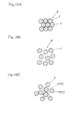
- This kind of metal cord is structured such that a plating treatment is applied to a surface thereof, however, for example, as shown in Fig. 10A, in the case of a compact cord a having no gap between filaments f and f, there is formed a space in which no rubber is permeated between the filaments. Accordingly, there has been a problem that a rust is generated within the cord due to an influence of a water content, thereby causing a reduction of bonding force between the cord and the rubber, a reduction of strength of the cord, a breakage of the cord and the like.
- an object of the present invention is to provide a metal cord which on the basis of using a metal cord of a layered structure forming a core by adding a torsion to one to four filament bundles having two-dimensional waved filaments and non-waved filaments in a mixed manner, can make a two-dimensional wave three-dimensional wave in accordance with the torsion and can sufficiently secure a rubber permeability while making a cord diameter compact, and a radial tire for a heavy load using the metal cord for a carcass.
- another object is to establish both of a cord strength reduction and a rubber permeability by limiting a wave height, a wave pitch and the like of the modeling of the waved filament to predetermined ranges, and to intend a stability of a tire shape by restricting an extension of the cord at a time of a low load.
- a radial tire for a heavy load including:
- Fig. 1 is a meridian cross section showing a radial tire for a heavy load in accordance with the present invention.
- a radial tire 1 for a heavy load is provided with a carcass 6 extending to a bead core 5 of a bead portion 4 from a tread portion 2 via a side wall portion 3, and a belt layer 7 arranged inside the tread portion and outside the carcass 6.
- the belt layer 7 is normally constituted by three to four belt plies.
- a four-sheet structure including an innermost belt ply 7A in which a belt cord using a metal cord is arranged at an angle, for example, about 60 ⁇ 15 degrees with respect to a tire circumferential direction, and belt plies 7B, 7C and 7D arranged at a small angle or 15 to 30 degrees with respect to the tire circumferential direction.
- the belt plies are overlapped with each other so as to have at least one portion in which the belt cords cross to each other between the plies.
- the carcass 6 is provided with fold-back portions 6b which are folded back to an outer side from an inner side in a tire axial direction around the bead core 5, in both sides of a main body portion 6a extending between the bead cores 5 and 5.
- a bead apex rubber 8 extending to an outer side in a tire radial direction from the bead core 5 in a tapered manner is arranged between the main body portion 6a and the fold-back portion 6b.
- the carcass 6 is formed by one of more carcass ply obtained by radially arranging the carcass cords at an angle of 70 to 90 degrees with respect to the tire circumferential direction.
- the carcass 6 is constituted by one carcass ply 6A obtained by arranging the carcass cords at an angle of 90 degrees.
- a carcass cord having a layered structure with a lot of filaments for example, 3 + 9 structure, 3 + 9 + 15 structure and the like has been frequently employed as the carcass cord used in the tire for the heavy load such as a truck, a bus and the like.
- a tensile strength per a cross sectional area tends to be reduced by making the filament thick, and it is necessary to use narrow filaments and increase a number of the filaments, in order to increase the strength with keeping an amount of steel fixed.
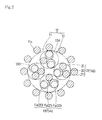
- a metal cord of a layered structure having a core 10 including six to twelve filaments Fa and a sheath 11 including eight to fifteen filaments Fb arranged around the core 10, as a carcass cord, as shown in Figs. 2 and 7.
- the core 10 is constituted by one to four filament bundles 13, and each of the filament bundles 13 includes a waved filament 20 modeled in a two-dimensional wave shape and a non-waved filament 21, in a state before being bundled. Further, the core 10 makes the wave of the waved filament 20 three-dimensional within the core by applying torsion to each of the filament bundles 13.
- a metal cord 12 (Fig. 2) in accordance with a first embodiment in which the core 10 is constituted by a plurality of (2 to 4) filament bundles 13, and a metal cord 12 (Fig. 7) in accordance with a second embodiment in which the core 10 is constituted by one filament bundle 13.
- the core 10 is constituted by two to four filament bundles 13 in which three filaments Fa are aligned. Accordingly, a total number of the filaments Fa constituting the core 10 is a multiple number of 3, that is, 6, 9 or 12, and the present embodiment exemplifies a case of having 12 filaments.
- each of the filament bundles 13, as shown in Fig. 4, one core 10 is formed by twisting the respective filament bundles 13 with each other after or at the same time when the torsion is applied to each of said filament bundles 13.
- three filaments Fa constituting the filament bundle 13 is constituted by the waved filament 20 and the non-waved filament 21.
- a filament bundle 13A constituted by two waved filaments 20 and one non-waved filament 21, and a filament bundle 13B constituted by one waved filament 20 and two non-waved filament 21 are mixed, however, the core 10 can be formed only by the filament bundle 13A or only by the filament bundle 13B.
- the non-waved filament 21 corresponds to a conventional filament formed in a substantially linear shape in a state before being bundled.
- the waved filament 20 is, as shown in Fig. 3, modeled in a two-dimensional wave shape in which crest portions Y1 and trough portions Y2 are repeated, in a state before being bundled, and in the present example, there is exemplified a case of being formed in a zigzag shape in which a straight portion Y3 is interposed between the crest portion Y1 and the trough portion Y2. In this case, it is possible to employ a modeling formed in a sine curve or the like which is constituted only by curves.
- the two-dimensional wave is made three-dimensional by applying the torsion to the filament bundle 13.
- the following description will be given of making the two-dimensional wave three-dimensional. That is, as schematically shown in Fig. 6A, when applying torsion K1 to the filament bundle A, the torsion K1 is reflected as the same torsion K2 in each of filaments B. At this time, in the case that a waved filament B1 is included in the filament bundle A, each of the waved filaments B1 is twisted around a center by the torsion K2 as schematically shown in Fig. 6B, whereby the two-dimensional wave is made three-dimensional.
- the three-dimensional structure has an advantage that it is possible to make the cord compact, for example, in comparison with the structure of being modeled in a three-dimensional spiral shape from the first.
- the structure of being modeled in a three-dimensional spiral shape from the first.
- the two-dimensional modeling is easily processed in comparison with the three-dimensional modeling such as the spiral shape or the like, has a high dimensional accuracy and an excellent form stability, and is easily treated, this structure is advantageous in this view.
- the total number of the filaments Fa in the core 10 and the total number of the filaments Fb in the sheath 11 are set among the range mentioned above in correspondence to the required strength at a time of being used in the carcass cord, however, on the assumption of the tire for the heavy load such as the truck, the bus or the like, it is preferably set to nine to twelve in the case of the filaments Fa.
- a wire diameter d of the filament Fa and a wire diameter d of the filament Fb are also set on the basis of a relation with respect to the strength required for the carcass cord, however, in the case of the load for the heavy load, a range between 0.15 and 0.30 mm is preferable.
- the wire diameter d is less than 0.15 mm, there is a problem that the wire diameter is too small, and is disadvantageous in view of the cord strength and the modeling easily turns back. On the contrary, it is over 0.30 mm, it becomes disadvantageous in view of a bending fatigue.
- the filament Fa and the filament Fb are structured such as to have the same diameter, whereby it is possible to make the wire extending process common and it is possible to economically produce the cord.
- the filaments Fa and Fb employ a hard steel wire having a carbon content between 0.78 and 0.86 %, in the case that it is less than 0.78 %, the strength tends to be reduced, and in the case that is more than 0.86 %, the hardness is too high and the strength reduction tends to be increased at a time of modeling.
- the waved filament 20 as shown in Fig. 3, it is preferable to satisfy relations of the following formulas (1) to (2), at a time of setting a wave pitch in a state before being bundled to Pw and a wave height to h.
- the wave pitch Pw corresponds to a distance in a longitudinal direction between the crest portions Y1 and Y1
- the wave height h corresponds to a distance in an amplitude direction between the crest portion Y1 and the trough portion Y2.
- the wave pitch Pw becomes less than 5.0 times of the wire diameter d, the wave pitch Pw becomes too small and the damage caused by the modeling process is large, thereby causing the reduction of the filament strength, and if it becomes over 30 times, the wave pitch Pw becomes too large, and the rubber permeability is reduced.
- the wave pitch Pw and the wave height h are set to a range between 3.0 and 9.0 mm and a range between 0.20 and 0.80 mm, respectively.
- a twist pitch Pc (shown in Fig. 4) at a time of twisting the filament bundles 13 so as to form one core 10 is between 5.0 and 30.0 mm, and it is preferable that a pitch Pf (shown in Fig. 4) of the torsion applied to each of the filament bundles 13 is set to a comparatively long pitch corresponding to 2 times to 20 times of the twist pitch Pc.
- the torsion pitch Pf is less than 2.0 times of the twist pitch Pc, the gap between the filaments is reduced so as to reduce the rubber permeability. On the contrary, when it becomes over 20 times, the effect of the three-dimensional structure is reduced. Further, there is generated a problem that the modeling is easily overlapped on the waved filaments, between the filament bundles 13 and 13. Accordingly, it is more preferable that the torsion pitch Pf is 3 times to 10 times of the twist pitch Pc.
- the twist pitch Ps of the filament Fb constituting the sheath 11 is set to a range between 5.0 and 30.0 mm. If it is less than 5.0 mm, the extension at a time of the low load of the cord is increased. On the contrary, if it becomes over 30.0 mm, the filaments are easily scattered, and the shape keeping property of the cord is deteriorated. In this case, it is preferable in view of the shape stability of the cord that the twist pitch Ps is set to be larger than the twist pitch Pc.
- the twisting direction of the sheath 11 in the present example, the case of being different from the twisting direction of the core 10 is exemplified, however, it may coincide with the twisting direction of the core 10, and with respect to the torsion direction of the filament bundle 13, in the present example, the case of coinciding with the twisting direction of the core 10 is exemplified, however, it may be different from the twisting direction of the core 10.
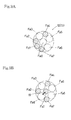
- Figs. 5A and 5B show another example of the core 10 in the first embodiment.
- the core 10 is constituted by three filament bundles 13A.
- Fig. 5B there is exemplified a case that the core 10 is constituted by two filament bundles 13A and one filament bundle 13B.
- the core 10 is formed by one filament bundle 13 constituted by six to twelve filaments Fa.
- the filament Fa is, as mentioned above, constituted by the waved filament 20 (shown in Fig. 3) and the non-waved filament 21.
- the metal cord 12 is formed by twisting the core 10 and the sheath 11, that is, winding the filament Fb around the core 10 while applying the torsion to the filament bundle 13 in which the waved filament 20 and the non-waved filament 21 are aligned with each other.
- the two-dimensional wave in the waved filament 20 is made three-dimensional within the core.
- a replacement portion 19 in which the positions of the filaments Fa are replaced between the inner side and the outer side is formed within the filament bundle 13.
- reference numerals 1 to 8 are applied to the respective filaments Fa so as to be distinguished, and in the present example, a filament Fa1 and a filament Fa8 are replaced between the inner side and the outer side.
- a conjuncture is generated between the filaments Fa, whereby it is possible to prevent them from being scattered. Accordingly, it is preferable that five or more replacement portions 19 are formed per a cord length 1 m.
- the torsion pitch Pf applied to the filament bundle 13 is set to a range between 5.0 and 600.0 mm.
- the torsion pitch Pf is smaller than 5.0 mm, an apparent outer diameter of the cord becomes small.
- the torsion pitch Pf is larger than 600.0 mm, the effect of the three-dimensional structure is reduced and an improving effect of the rubber permeability can not be sufficiently achieved.
- the twist pitch Ps of the sheath 11 that the winding pitch of the filament Fb is set to a range between 5.0 and 30.0 mm in the same manner as that of the first embodiment.
- the twist pitch Ps is smaller than 5.0 mm, an early extension of the cord becomes large and a reinforcing effect is deteriorated.
- the wire length between the filaments Fa and Fb is largely different, a partial charge of stress becomes unbalanced, and strength at a time of being broken tends to be reduced.
- the pitch Ps is over 30.0 mm, the filaments Fb are easily scattered and the shape keeping property of the cord is deteriorated.
- the twisting direction of the sheath 11 may be coincident with the torsion direction of the filament bundle 13 or may be different therefrom. Further, it is preferable in view of keeping the cord strength to generally set the torsion pitch Pf to be larger than the twist pitch Ps.
- a metal cord is manufactured by way of trial on the basis of the specification shown in Table 1, and a characteristic (a rubber permeability and a cord bending rigidity) of each of the trial cords and a tire performance (a rust generation after traveling and a strength keeping rate after traveling) at a time of using the trial cords in a carcass cord are tested, whereby a comparative evaluation is executed.
- the specification of the tire is shown in Table 2, and the other items than the carcass cord are all fixed.
- a tire provided with a carcass employing the trial metal cord is manufactured and the metal cord taken out from the tire is dissembled. Further, it is observed whether or not the rubber is completely charged between the filaments within the core, and a rubber permeability is set by a rate of a length of a portion in which the rubber is charged with respect to a whole observed length. The measurement mentioned above is applied to ten cords, and a measured value of the cord is set by an average value.
- V-5 rigidity tester manufactured by TABER CO., LTD. (U.S.A.)
- a force (g ⁇ cm) at a time of bending the metal cord at an angle of 15 degrees is measured as a bending rigidity of the metal cord.
- the tire After traveling the tire about 200 thousands km, the tire is dissembled and the generating condition of the rust in the metal cord is observed and is displayed by an index number obtained by setting a comparative embodiment 1 to 100. The smaller the numerical value is, the less the rust is generated, so that it is good.
- the tire After traveling the tire about 200 thousands km, the tire is dissembled so as to take out the metal cord and the strength of the cord is displayed by an index number obtained by setting that before traveling to 100. The smaller the numerical value is, the less the strength reduction is, so that it is good.
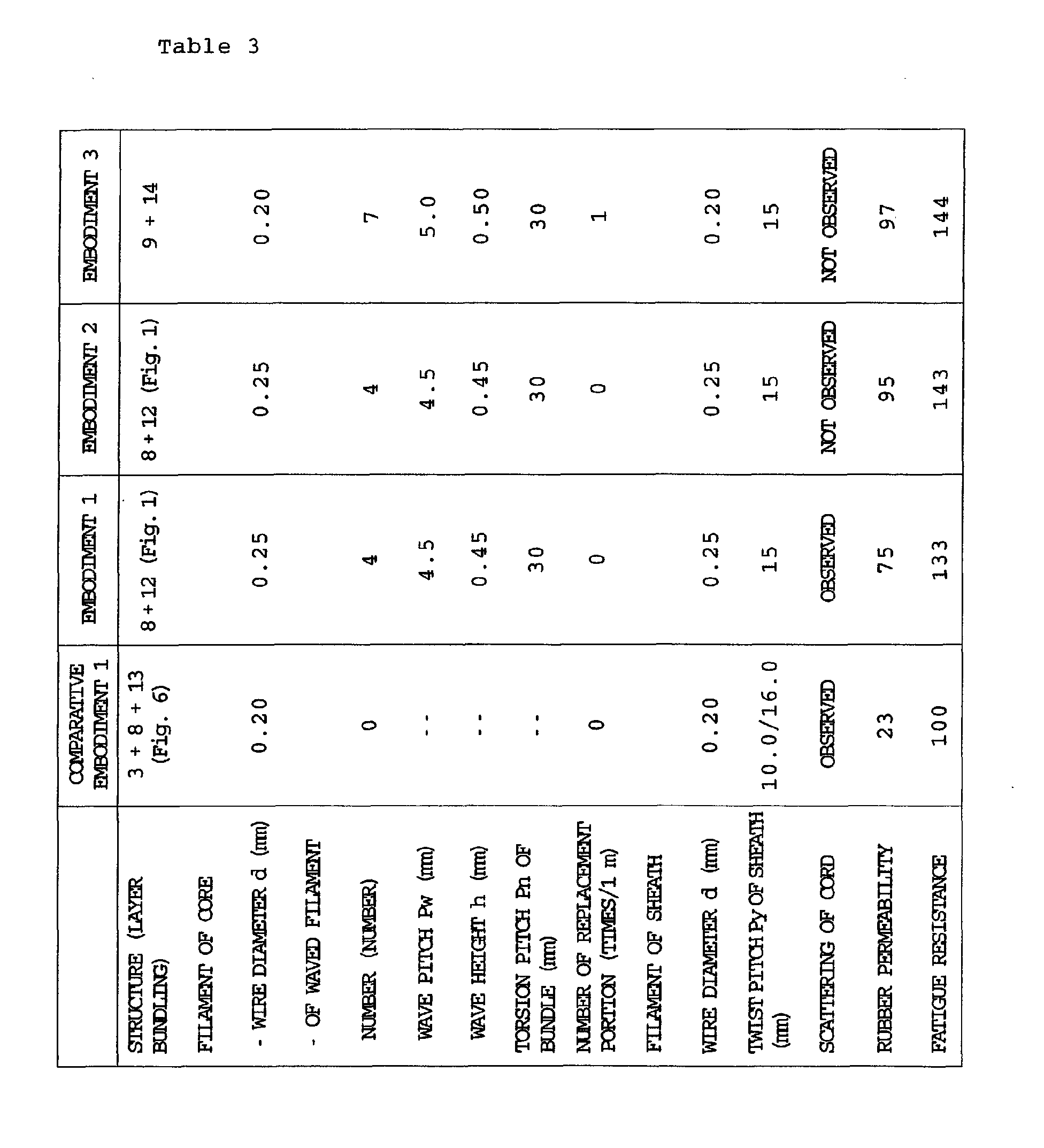
- a metal cord is manufactured by way of trial on the basis of the specification shown in Table 3, and a characteristic (a rubber permeability, a fatigue resistance and a scattering at a time of cutting cord) of each of the trial cords are tested, whereby a comparative evaluation is executed.
- a vulcanized rubber sheet in which the trial cord is inserted to the rubber is manufactured, a repeated bending is applied on the basis of a repeated bending fatigue test (Dematia method) in proportion to JIS L1017 until the rubber sheet is broken, and a broken number is measured.
- the measurement mentioned above is applied to ten rubber sheets and an average value is estimated on the basis of an index display obtained by setting a value of the comparative embodiment 1 to 100. The larger the numerical value is, the higher the fatigue resistance is, so that it is excellent.
- the trial cord is cut and it is searched on the basis of a visual observation whether or not the scattering of the cord exists at that time.
Landscapes
- Engineering & Computer Science (AREA)
- Mechanical Engineering (AREA)
- Ropes Or Cables (AREA)
- Tires In General (AREA)
Abstract
Description
wherein each of said filament bundles includes a waved filament modeled in a two-dimensional wave shape having crests and troughs repeatedly and a non-waved filament, in a state before being bundled, and
wherein said core makes the wave of said waved filament three-dimensional within the core by applying a torsion to each of the filament bundles.
| COMPARATIVE EMBODIMENT 1 | EMBODIMENT 1 | | | |
| STRUCTURE OF | 3 + 8 + 13 × 0.175 | 3 × 3 + 12 × 0.23 (Fig. 5A) | 3 × 3 + 11 × 0.23 (Fig. 5A) | 3 × 3 + 10 × 0.23 (Fig. 2) |
| CARBON CONTENT (%) | 0.82 | 0.82 | 0.82 | 0.82 |
| NUMBER OF FILAMENTS | - - | 3 | 3 | 4 |
| NUMBER OF FILAMENTS WITHIN ONE BUNDLE | - - | 3 | 3 | 3 |
| NUMBER OF WAVED FILAMENTS WITHIN ONE BUNDLE | - - | 2, 2, 2, | 1, 2, 2, | 1, 2, 1, 2 |
| WAVE SHAPE | - - | TWO-DIMENSION | TWO-DIMENSION | TWO-DIMENSION |
| WAVE HEIGHT h (mm) | - - | 0.45 | 0.45 | 0.35 |
| WAVE PITCH PW (mm) | - - | 5.0 | 5.0 | 3.5 |
| TORSION PITCH Pf OF BUNDLE (mm) | - - | 45.0 | 45.0 | 50.0 |
| TWIST PITCH Pc OF CORE (mm) | 5.0 | 15.0 | 15.0 | 10.0 |
| TWIST PITCH Ps OF SHEATH (mm) | 10.0/16.0 | 20.0 | 20.0 | 20.0 |
| CORD DIAMETER (mm) | 1.05 | 1.01 | 1.02 | 1.04 |
| STRENGTH (N/mm2) | 2850 | 2830 | 2900 | 2850 |
| BENDING RIGIDITY OF CORD (g·cm) | 34.1 | 84.2 | 80.2 | 88.2 |
| RUBBER PERMEABILITY INTO CORD INNER PORTION (%) | 10 | 93 | 92 | 91 |
| RUST GENERATION AFTER TRAVELING (INDEX NUMBER) | 100 | 21 | 24 | 27 |
| STRENGTH KEEPING RATE AFTER TRAVELING (INDEX NUMBER) | 88 | 99 | 97 | 96 |
| TIRE SIZE | 11R22.5 |
| CARCASS | |
| - PLY NUMBER (NUMBER) | 1 |
| - CORD STRUCTURE | TABLE 1 |
| - CORD ANGLE (DEGREE) | 90 (WITH RESPECT TO CIRCUMFERENTIAL DIRECTION) 30/5 cm |
| - STRIKING NUMBER | |
| BELT LAYER | |
| - PLY NUMBER (NUMBER) | 4 |
| - | 3 × 0.20 + 6 × 0.35 +65, +20, -20, -20 26/5 cm |
| - CORD ANGLE (DEGREE) | |
| - STRIKING NUMBER |
Claims (11)
- A radial tire for a heavy load comprising:wherein a carcass cord of said carcass is constituted by a metal cord having a core comprising totally 6 to 12 filaments sectioned into 1 to 4 filament bundles, and a sheath comprising 8 to 15 filaments arranged around the core,a carcass extending to a bead core of a bead portion from a tread portion via a side wall portion; anda belt layer arranged inside the tread portion and outside the carcass,
wherein each of said filament bundles includes a waved filament modeled in a two-dimensional wave shape having crests and troughs repeatedly and a non-waved filament, in a state before being bundled, and
wherein said core makes the wave of said waved filament three-dimensional within the core by applying a torsion to each of the filament bundles. - A radial tire for a heavy load as claimed in claim 1, wherein said core is formed from one filament bundle, and is bundled with said sheath while applying the torsion to each of said filament bundles.
- A radial tire for a heavy load as claimed in claim 1, wherein said core is formed from two to four filament bundles each constituted by three filaments, and after forming a core by twisting said filament bundles with each other after or at the same time when the torsion is applied to each of said filament bundles.
- A radial tire for a heavy load as claimed in claim 1, wherein the filament of said core has a wire diameter between 0.15 and 0.30 mm and having substantially the same diameter as that of the filament of said sheath.
- A radial tire for a heavy load as claimed in claim 1, wherein said waved filament satisfies a relation of the following formulas (1) to (2), when setting a wave pitch is Pw and a wave height to h.
- A radial tire for a heavy load as claimed in claim 3, wherein the twist pitch Pc of said core is between 5 and 30 mm, and the torsion pitch Pf of each of the filament bundles is equal to or more than 2 times of said twist pitch Pc and equal to or less than 20 times.
- A radial tire for a heavy load as claimed in claim 6, wherein the twist pitch Ps of said sheath is between 5 and 30 mm.
- A radial tire for a heavy load as claimed in claim 2, wherein said core has a replacement portion in which positions of the filaments are replaced between an inner side and an outer side, within the filament bundle, and a number of the replacement portion is set to be equal to or more than 5 per a cord length 1 m.
- A metal cord comprising:wherein each of said filament bundles includes a waved filament modeled in a two-dimensional wave shape having crests and troughs repeatedly and a non-waved filament, in a state before being bundled, anda core comprising totally 6 to 12 filaments sectioned into 1 to 4 filament bundles, and a sheath comprising 8 to 15 filaments arranged around the core,
wherein said core makes the wave of said waved filament three-dimensional within the core by applying a torsion to each of the filament bundles. - A metal cord as claimed in claim 9, wherein said core is formed from one filament bundle, and is bundled with said sheath while applying the torsion to each of the filament bundles.
- A metal cord as claimed in claim 9, wherein said core is formed from two to four filament bundles each constituted by three filaments, and after forming a core by twisting said filament bundles with each other after or at the same time when the torsion is applied to each of said filament bundles.
Applications Claiming Priority (4)
| Application Number | Priority Date | Filing Date | Title |
|---|---|---|---|
| JP2000355992 | 2000-11-22 | ||
| JP2000355992A JP4044279B2 (en) | 2000-11-22 | 2000-11-22 | Heavy duty radial tire |
| JP2000357927A JP4091246B2 (en) | 2000-11-24 | 2000-11-24 | Metal cord for rubber article reinforcement |
| JP2000357927 | 2000-11-24 |
Publications (3)
| Publication Number | Publication Date |
|---|---|
| EP1209008A2 true EP1209008A2 (en) | 2002-05-29 |
| EP1209008A3 EP1209008A3 (en) | 2004-08-11 |
| EP1209008B1 EP1209008B1 (en) | 2006-06-28 |
Family
ID=26604456
Family Applications (1)
| Application Number | Title | Priority Date | Filing Date |
|---|---|---|---|
| EP01127744A Expired - Lifetime EP1209008B1 (en) | 2000-11-22 | 2001-11-21 | Radial tire for heavy load and metal cord |
Country Status (3)
| Country | Link |
|---|---|
| US (1) | US6745806B2 (en) |
| EP (1) | EP1209008B1 (en) |
| DE (1) | DE60121117T2 (en) |
Cited By (1)
| Publication number | Priority date | Publication date | Assignee | Title |
|---|---|---|---|---|
| EP1486354A1 (en) * | 2003-06-12 | 2004-12-15 | Sumitomo Rubber Industries Ltd. | Radial tire |
Families Citing this family (5)
| Publication number | Priority date | Publication date | Assignee | Title |
|---|---|---|---|---|
| JP4430810B2 (en) * | 2000-11-22 | 2010-03-10 | 住友ゴム工業株式会社 | Method for producing metal cord for reinforcing rubber articles |
| DE60336253D1 (en) * | 2002-10-11 | 2011-04-14 | Michelin Soc Tech | KORDE FOR REINFORCING TIRES FOR HEAVY VEHICLES |
| EP2382352B1 (en) * | 2009-01-09 | 2014-10-29 | NV Bekaert SA | Steel cord with preformed wires in the core and the outer layer |
| WO2011161003A2 (en) * | 2010-06-22 | 2011-12-29 | Nv Bekaert Sa | Layered steel cord with alternating core |
| CN107953728B (en) * | 2017-11-27 | 2020-02-11 | 江苏兴达钢帘线股份有限公司 | Cable type tire bead and tire |
Family Cites Families (6)
| Publication number | Priority date | Publication date | Assignee | Title |
|---|---|---|---|---|
| JP3072929B2 (en) * | 1991-11-21 | 2000-08-07 | 住友ゴム工業株式会社 | Pneumatic tire |
| JPH05302282A (en) * | 1992-04-24 | 1993-11-16 | Bridgestone Corp | Steel cord for reinforcing rubber article and pneumatic radial tire for heavy load |
| US5661966A (en) * | 1996-06-27 | 1997-09-02 | Tokyo Rope Manufacturing Co. Ltd. | Steel cord for reinforcement of off-road tire, method of manufacturing the same, and off-road tire |
| US6065518A (en) * | 1995-08-01 | 2000-05-23 | Sumitomo Rubber Industries, Ltd. | Heavy duty pneumatic tire with high elongation steel belt cord |
| JPH1136182A (en) * | 1997-07-15 | 1999-02-09 | Tokyo Seiko Co Ltd | Steel cord and steel radial tire |
| EP1088931A4 (en) * | 1998-12-25 | 2003-05-07 | Yokohama Rubber Co Ltd | Rubber reinforcing steel cord and heavy duty pneumatic radial tire using the steel cord |
-
2001
- 2001-11-21 US US09/989,411 patent/US6745806B2/en not_active Expired - Fee Related
- 2001-11-21 DE DE60121117T patent/DE60121117T2/en not_active Expired - Lifetime
- 2001-11-21 EP EP01127744A patent/EP1209008B1/en not_active Expired - Lifetime
Cited By (1)
| Publication number | Priority date | Publication date | Assignee | Title |
|---|---|---|---|---|
| EP1486354A1 (en) * | 2003-06-12 | 2004-12-15 | Sumitomo Rubber Industries Ltd. | Radial tire |
Also Published As
| Publication number | Publication date |
|---|---|
| EP1209008B1 (en) | 2006-06-28 |
| US20020117246A1 (en) | 2002-08-29 |
| EP1209008A3 (en) | 2004-08-11 |
| DE60121117T2 (en) | 2006-12-21 |
| DE60121117D1 (en) | 2006-08-10 |
| US6745806B2 (en) | 2004-06-08 |
Similar Documents
| Publication | Publication Date | Title |
|---|---|---|
| JP4439727B2 (en) | Steel cord with wavefront element | |
| US6520232B1 (en) | Pneumatic tire with monofilament metallic belt cords | |
| EP1126074B1 (en) | Pneumatic tyre | |
| EP0543640B1 (en) | Pneumatic tyre | |
| WO2012081624A1 (en) | Steel cord for reinforcing rubber article, and pneumatic tire using same | |
| EP1314812A2 (en) | Metal cord and pneumatic tire including the same | |
| EP0976583B1 (en) | Metallic cord and pneumatic tyre | |
| US6745806B2 (en) | Radial tire for heavy load with specified metal carcass cord | |
| EP1125768B1 (en) | Pneumatic Tyre | |
| EP0905305A1 (en) | Steel cord for reinforcing rubber product and pneumatic tyre using such steel cords | |
| EP1211349A2 (en) | Metal cord for reinforcing rubber article | |
| JP4578200B2 (en) | Steel cord for reinforcing rubber articles and pneumatic tire using the same | |
| EP0655351B1 (en) | A pneumatic tire | |
| JP2006291376A (en) | Steel cord for rubber reinforcement and pneumatic radial tire | |
| JPH08127984A (en) | Steel cord for reinforcing rubber article and pneumatic radial tire | |
| JP4426810B2 (en) | Steel cord and pneumatic tire using the same | |
| JP4044279B2 (en) | Heavy duty radial tire | |
| JPH11200263A (en) | Steel cord for reinforcing tire | |
| JPH08127986A (en) | Steel cord for rubber reinforcement and radial tire using the same | |
| JPH0754286A (en) | Steel cord for reinforcing rubber product | |
| JP4426811B2 (en) | Steel cord and pneumatic tire using the same | |
| JP2005002518A (en) | Steel cord for rubber reinforcement and pneumatic radial tire | |
| JP2006328557A (en) | Steel cord for reinforcing rubber product and pneumatic tire | |
| JP2008156792A (en) | Steel cord for tire and pneumatic tire using the same | |
| JP2010115974A (en) | Pneumatic radial tire |
Legal Events
| Date | Code | Title | Description |
|---|---|---|---|
| PUAI | Public reference made under article 153(3) epc to a published international application that has entered the european phase |
Free format text: ORIGINAL CODE: 0009012 |
|
| AK | Designated contracting states |
Kind code of ref document: A2 Designated state(s): AT BE CH CY DE DK ES FI FR GB GR IE IT LI LU MC NL PT SE TR |
|
| AX | Request for extension of the european patent |
Free format text: AL;LT;LV;MK;RO;SI |
|
| PUAL | Search report despatched |
Free format text: ORIGINAL CODE: 0009013 |
|
| AK | Designated contracting states |
Kind code of ref document: A3 Designated state(s): AT BE CH CY DE DK ES FI FR GB GR IE IT LI LU MC NL PT SE TR |
|
| AX | Request for extension of the european patent |
Extension state: AL LT LV MK RO SI |
|
| RIC1 | Information provided on ipc code assigned before grant |
Ipc: 7D 07B 1/06 B Ipc: 7B 60C 9/00 A |
|
| 17P | Request for examination filed |
Effective date: 20041006 |
|
| AKX | Designation fees paid |
Designated state(s): DE FR GB |
|
| 17Q | First examination report despatched |
Effective date: 20050502 |
|
| RBV | Designated contracting states (corrected) |
Designated state(s): DE FR GB |
|
| GRAP | Despatch of communication of intention to grant a patent |
Free format text: ORIGINAL CODE: EPIDOSNIGR1 |
|
| GRAS | Grant fee paid |
Free format text: ORIGINAL CODE: EPIDOSNIGR3 |
|
| GRAA | (expected) grant |
Free format text: ORIGINAL CODE: 0009210 |
|
| AK | Designated contracting states |
Kind code of ref document: B1 Designated state(s): DE FR GB |
|
| REG | Reference to a national code |
Ref country code: GB Ref legal event code: FG4D |
|
| REF | Corresponds to: |
Ref document number: 60121117 Country of ref document: DE Date of ref document: 20060810 Kind code of ref document: P |
|
| ET | Fr: translation filed | ||
| PLBE | No opposition filed within time limit |
Free format text: ORIGINAL CODE: 0009261 |
|
| STAA | Information on the status of an ep patent application or granted ep patent |
Free format text: STATUS: NO OPPOSITION FILED WITHIN TIME LIMIT |
|
| 26N | No opposition filed |
Effective date: 20070329 |
|
| PGFP | Annual fee paid to national office [announced via postgrant information from national office to epo] |
Ref country code: DE Payment date: 20091119 Year of fee payment: 9 |
|
| PGFP | Annual fee paid to national office [announced via postgrant information from national office to epo] |
Ref country code: FR Payment date: 20091123 Year of fee payment: 9 Ref country code: GB Payment date: 20091118 Year of fee payment: 9 |
|
| GBPC | Gb: european patent ceased through non-payment of renewal fee |
Effective date: 20101121 |
|
| REG | Reference to a national code |
Ref country code: DE Ref legal event code: R119 Ref document number: 60121117 Country of ref document: DE Effective date: 20110601 Ref country code: DE Ref legal event code: R119 Ref document number: 60121117 Country of ref document: DE Effective date: 20110531 |
|
| REG | Reference to a national code |
Ref country code: FR Ref legal event code: ST Effective date: 20110801 |
|
| PG25 | Lapsed in a contracting state [announced via postgrant information from national office to epo] |
Ref country code: DE Free format text: LAPSE BECAUSE OF NON-PAYMENT OF DUE FEES Effective date: 20110531 |
|
| PG25 | Lapsed in a contracting state [announced via postgrant information from national office to epo] |
Ref country code: FR Free format text: LAPSE BECAUSE OF NON-PAYMENT OF DUE FEES Effective date: 20101130 |
|
| PG25 | Lapsed in a contracting state [announced via postgrant information from national office to epo] |
Ref country code: GB Free format text: LAPSE BECAUSE OF NON-PAYMENT OF DUE FEES Effective date: 20101121 |