Technical Field:
This invention relates to a light amplification optical
fiber utilized mainly for an optical communication system; and
a light amplifier using the optical fiber.
Background Art:
In recent years, a demand for communication by internet,
etc. has suddenly increased, and an increase in the
transmission capacity of an optical transmission passage is
being actively discussed. In accordance with these facts, an
increase in the capacity of a wavelength division multiplexing
(WDM) optical transmission system, i.e. an increase in the
number of channels and the expansion of a transmission band
are progressing. In order to attain an increase in the
capacity of a WDM optical transmission system, it is
indispensable to increase the level of an output from a signal
light amplifying light amplifier and attain the expansion of
a transmission band, and a light amplifier as an important key
device has increasingly attracted the technicians' attention.
With an increase in the number of channels for a WDM
signal, total signal light input power increases, and higher
saturation power has been demanded with respect to a light
amplifier which is adapted to collectively increase the number
of channels and signal light input power. Under the
circumstances, the increasing of a light amplifier output has
been forwarded by increasing the efficiency of a light
amplification optical fiber and a pumping source output.
The discussing of the expansion of a gain band for a light
amplifier is also being forwarded so as to expand a transmission
band, and a light amplifier having a gain band of a wavelength
larger than that a gain band in a related art light amplifier
has been attained in practice by using an elongated light
amplification optical fiber.
However, the above-mentioned increase in an output from
and the length of a light amplification optical fiber has caused
a new problem to arise, i.e., nonlinear phenomena which had
not been observed in a related art light amplification optical
fiber have occurred. The main nonlinear phenomena include
four-wave mixing and cross phase modulation. Since the
transmission quality of signal light is deteriorated due to
these nonlinear effects, the suppression of the occurrence of
nonlinearity has become necessary and indispensable.
The waveform distortion due to nonlinear phenomena can
be estimated by the following equation (1).
ΦNL = (2π/λ)•(n2/Aeff)LeffP
In this equation (1), Leff represents an effective length
of an amplification optical fiber, Aeff an effective core area ,
n2 a nonlinear refractive index, λ a signal light wavelength,
and P input light intensity.
It is understood from the equation (1) that, in order
to suppress the occurrence of waveform distortion ΦNL, it is
preferable to (1) reduce the effective length of a fiber, and
(2) minimize a nonlinear constant (n2/Aeff).
In order to reduce a length of a fiber used, it is
necessary to heighten a gain coefficient per unit length by
increasing an amount of addition of a rare earth element.
However, when the concentration of erbium is increased in an
erbium-doped optical fiber, which is being put to practical
use as a light amplifier for 1.55 µm band, a decrease in the
amplification efficiency due to concentration quenching
occurs.
In general, the concentration of erbium at which
concentration quenching starts occurring is several hundred
wtppm in the case of a pure quartz (SiO2) host, and it is said
to be around 1000 wtppm even in the case of Al2O3-SiO2 host to
which aluminum having a concentration quenching suppressing
effect is co-doped (refer to, for example, R.I.LAMING,
D.N.PAYNE, F.MELI, G.GRASSO, E.J.TARBOX, "SATURATED
ERBIUM-DOPED FIBRE AMPLIFIERS", OAA '90.Tech.Digest MB3.).
Therefore, there is a limit to the reduction of the length of
an erbium-doped optical fiber.
The increasing of an effective core area Aeff may be
mentioned as another nonlinearity suppressing method. In
general, an effective area of an erbium-doped optical fiber
has a value one digit smaller than that of a regular single-mode
optical fiber (SMF). The reason for the above is to form
excellent inverted population over the whole of a core by
increasing a relative refractive index difference Δ of a core
portion with respect to a clad portion, and thereby heightening
the pumping light density so as to improve the gain
characteristics of the erbium-doped optical fiber with a high
efficiency.
Furthermore, a light amplification optical fiber
contains various kinds of large amounts of dopants in a core
portion thereof as compared with a regular transmission optical
fiber, and this makes it more difficult to control an effective
core area.
A light amplification fiber contains many elements, for
example, an element for improving the solubility of a rare earth
element for melting the rare earth element in host glass, an
element for increasing a refractive index of host glass, an
element for varying gain wavelength characteristics thereof,
an element for improving the amplification characteristics
thereof, an element doped to regulate the viscosity thereof
and the like besides rare earth elements constituting active
substances. These elements, which are other than the rare
earth elements, doped to a core portion are called co-dopants.
The addition concentration of these co-dopants is
determined from the viewpoint of the optimization of the
amplification characteristics of the light amplifier.
Conjointly with the diversity of the co-dopants, the above
matter makes it very difficult to control the refractive index.
The germanium has heretofore been used as a co-dopant
for improving the refractive index of a core portion.
The germanium is effective not only in improving the
refractive index but also in regulating the viscosity of a core
portion. Such co-dopants as are mentioned above which are
doped to a core portion of a light amplification optical fiber
are all substances for improving the refractive index just as
the germanium.
However, since the relative refractive index difference
Δ becomes high due to the addition of the co-dopants, it is
difficult to suppress the nonlinearity of a light amplification
optical fiber. It is necessary as previously mentioned to
reduce the using length, i.e. effective length of a light
amplification optical fiber for the purpose of suppressing the
nonlinearity thereof. However, in order to meet this
requirement, it is necessary to improve the gain coefficient
per unit length. Therefore, the addition amounts of a rare
earth element and a co-dopant have to be increased, and this
causes the relative refractive index difference Δ to further
increase.
In view of these problems, a method of improving a limit
level of addition concentration of erbium, and a new method
of attaining a desired effective core area A eff without
depending upon the addition concentration of co-dopants, such
as a rare earth element, etc. for practically obtaining a
nonlinear phenomena-suppressed amplification optical fiber
have been demanded.
The present invention has been made in view of the
above-mentioned circumstances, and provides a nonlinear
phenomena-suppressed light amplification optical fiber, and
an optical amplifier using the fiber.
Disclosure of the Invention:
According to an aspect of the present invention, the
light amplification optical fiber has the following
construction, i.e. this optical fiber has a core portion, and
not less than one layer of clad portion surrounding an outer
circumference of the core portion, erbium ions being doped to
the core portion, at least one kind of rare earth element ions
which are other than the erbium ions, and which have ion radius
of not lower than 70% and not higher than 130% of that of the
erbium ions, being further doped to the core portion.
According to another aspect of the present invention,
the light amplification optical fiber has aluminum doped to
the core portion, the number of the ions of the aluminum doped
to the core portion being not less than 6 times as large as
a total ion number of the rare earth element contained in the
core portion.
According to still another aspect of the present
invention, the light amplification optical fiber has
phosphorus doped to the core portion.
According to a further aspect of the present invention,
the light amplification optical fiber has a substance reducing
a refractive index of pure quartz, this substance being doped
to the core portion, the substance reducing the refractive
index of pure quartz being, for example, fluorine.
According to another aspect of the present invention,
the light amplification optical fiber has germanium doped to
the core portion in some cases, or does not substantially have
germanium in the core portion in some cases.
According to still another aspect of the present
invention, the light amplification optical fiber has in at
least a part of the clad portion a substance increasing a
refractive index of pure quartz, this substance which increases
a refractive index of pure quartz being at least one of, for
example, germanium, phosphorus and aluminum.
According to a further aspect of the present invention,
the light amplification optical fiber has a concentration of
the erbium doped to the core portion of as high as over 1000
wtppm, the concentration being allowed to reach as high as 2000
wtppm level.
According to another aspect of the present invention,
the light amplification optical fiber has a rare earth element,
which is other than erbium, doped to the core portion, the rare
earth element being an element selected from the group of La,
Ce, Pr, Nd, Sm, Eu, Gd, Tb, Dy, Ho, Tm, Yb and Lu.
According to still another aspect of the present
invention, the light amplification optical fiber has an example
of refractive index distribution constitution thereof, in
which a relative refractive index difference of the core
portion with respect to the clad layer on the immediately outer
side of the core portion is smaller than 1.0%.
According to a further aspect of the present invention,
the light amplifier has the above-mentioned light
amplification optical fibers used as light amplification
optical fibers.
According to the present invention described above, the
increasing of the concentration of erbium to a high level can
be attained without causing a decrease in the efficiency
ascribed to concentration quenching to occur, and the length
of a fiber in use can be reduced. The reason for the above
resides in that ions of a rare earth element, which is other
than erbium, co-doped surround those of erbium to cause the
distances among the erbium ions to increase, and the
interaction of the erbium ions to be suppressed.
The addition of a substance reducing the refractive index
of the core portion and the non-addition of germanium thereto
enable a light amplification optical fiber in which a
nonlinearity constant is further reduced to be obtained in
practice. The reason for the above resides in that the degree
of freedom of regulating a refractive index difference between
the core and clad increases not depending upon the kind and
concentration of dopants, such as a rare earth element,
aluminum, phosphorus, etc., this enabling the effective core
area (Aeff) to be increased arbitrarily, and the nonlinearity
constant (n2/Aeff) to be increased in consequence.
The amount of waveform distortion due to nonlinear
phenomena is proportional to a product of an effective length
Leff and a nonlinearity constant (n2/Aeff).
According to the present invention, the effective length and
nonlinearity constant can be reduced respectively. As a
result, the occurrence of nonlinear phenomena in the light
amplification optical fiber can be suppressed, and a light
amplifier free from the deterioration of the transmission
quality of an optical signal can be obtained in practice.
Brief Description of the Drawings:
Fig. 1 illustrates the refractive index distribution
constitution of an embodiment of the light amplification
optical fiber according to the present invention;
Fig. 2 illustrates another example of the refractive
index distribution constitution of the light amplification
optical fiber according to the present invention;
Fig. 3 illustrates still another example of the
refractive index distribution constitution of the light
amplification optical fiber according to the present
invention;
Fig. 4 illustrates a further example of the refractive
index distribution constitution of the light amplification
optical fiber according to the present invention;
Fig. 5 illustrates another example of the refractive
index distribution constitution of the light amplification
optical fiber according to the present invention; and
Fig. 6 illustrates an example of the refractive index
distribution constitution of a related art light amplification
optical fiber.
Best Mode for Carrying Out the Invention:
The present invention will now be described more in
detail in accordance with the attached drawings. Fig. 1 shows
the refractive index distribution constitution of an
embodiment of the light amplification optical fiber according
to the present invention. Referring to Fig. 1, a reference
numeral 1 denotes a core portion, and 2 a clad portion, and
a reference symbol Δ a relative refractive index difference
of the core portion with respect to the clad portion 2. The
outer circumference of the core portion 1 of a high refractive
index is surrounded by the clad portion 2 of a low refractive
index, and the level of the refractive index of the clad portion
2 in the example of Fig. 1 agrees with that of silica.
In the light amplification optical fiber of this
embodiment of the present invention, erbium is doped to the
core portion 1, and rare earth elements other than erbium are
co-doped thereto. To be exact, the first embodiment of the
present invention is formed of an erbium-ytterbium-doped
optical fiber obtained by co-doping ytterbium (Yb) besides
erbium (Er) to the core portion 1 of the light amplification
optical fiber.
A second embodiment of the present invention is directed
to an erbium-lanthanum-doped optical fiber obtained by co-doping
lanthanum (La) besides erbium (Er) to a core portion
of a light amplification optical fiber.
In a related art example of a light amplification optical
fiber shown in Fig. 6, the level of a relative refractive index
difference Δ of a core portion 1 with respect to a clad portion
2 is lower than that of the refractive index of silica.
Namely, in the related art light amplification optical
fiber, a relative refractive index difference Δ is increased
by adding germanium as a dopant for increasing a refractive
index to a core portion 1 of an erbium-doped optical fiber (EDF),
and fluorine for decreasing a refractive index to a clad portion
2. These techniques are used so as to heighten the pumping
light density, and thereby attain an excellent pumping
efficiency but consideration is not given to the suppression
of nonlinear phenomena.
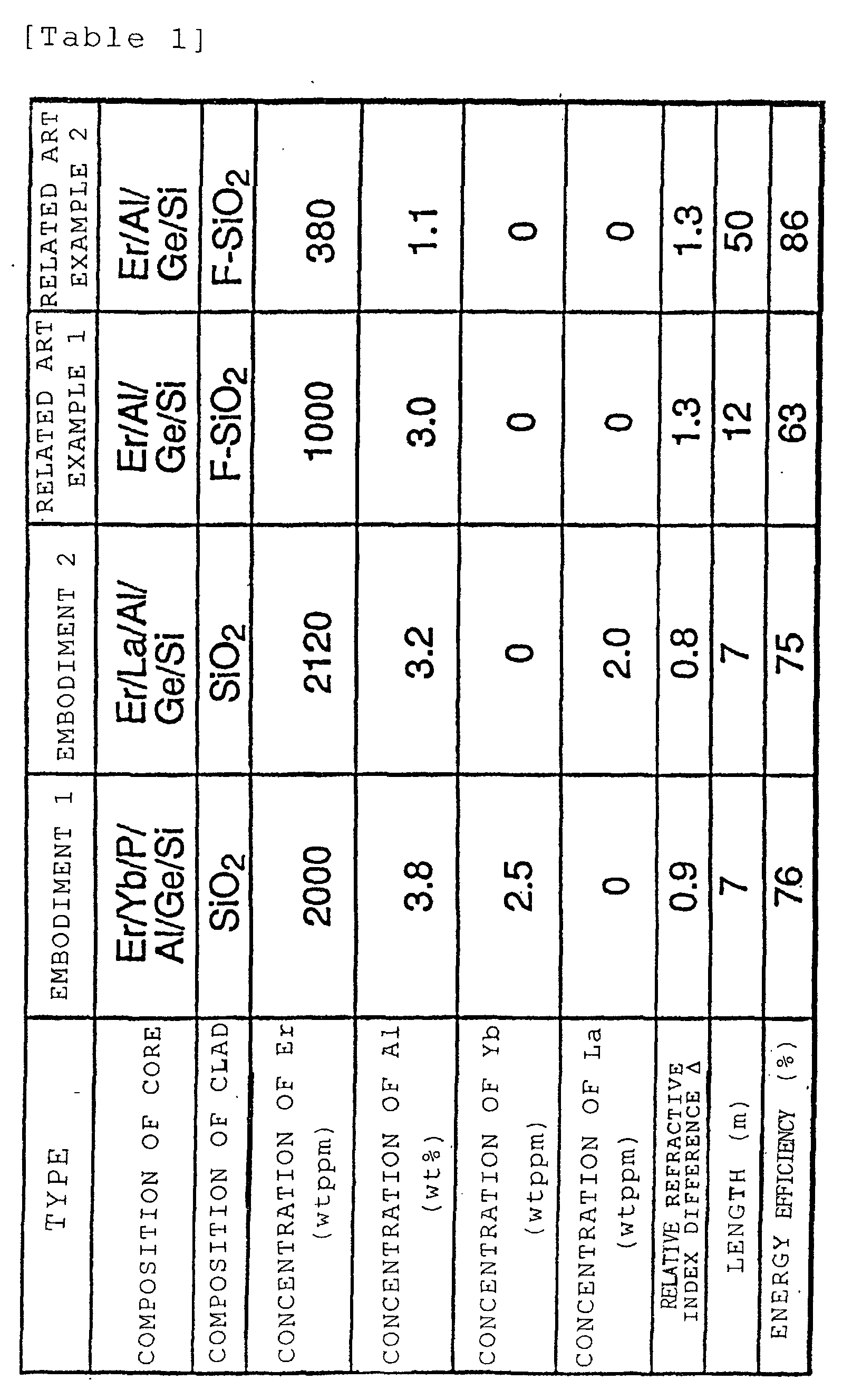
The parameters of the first and second embodiments of
the light amplification optical fiber according to the present
invention and those of the light amplification optical fibers
of the related art examples 1 and 2 as comparative examples
will be shown on Table 1. Table 1 further shows the results
of comparison between optimum lengths of these optical fibers
with respect to erbium concentration and pumping light
intensity and the energy conversion efficiency at the
corresponding time. The data shown on Table 1 are values
obtained when a pumping light wavelength and a signal light
wavelength are set to 1480 nm and 1560 nm respectively.
As is clear from Table 1, when ytterbium or lanthanum
is doped to the core portions of the light amplification optical
fibers of a small length of the embodiments 1 and 2, a high
energy conversion efficiency is displayed with a high erbium
concentration, i.e., the effect of the present invention was
ascertained.
From the above results, it was ascertained that the
ytterbium and lanthanum have an erbium concentration quenching
suppressing effect. It is known that, even when aluminum or
phosphorus is doped to a core portion, a certain degree of
concentration quenching suppressing effect is obtained.
However, when the concentration of doped erbium exceeds 1000
wtppm, concentration quenching necessarily occurs. This is
clear from the results as well of the energy efficiency
measurement in the related art example 1.
In the embodiments 1 and 2 of the present invention, in
which ytterbium or lanthanum was co-doped to the core portion
1, it was ascertained that a noticeable decrease in efficiency
due to concentration quenching did not occur even when the
concentration of erbium exceeded 2000 wtppm.
The reason for the above is that plural ytterbium ions
or lanthanum ions co-doped surround the erbium ions to form
clusters, so that the distances among the erbium ions increase
to cause the interactions of the erbium ions to be suppressed.
The shapes of the respective ions and arrangement of electrons
have delicate relation to the degree of the occurrence of
clustering between different kinds of ions.
Accordingly, substances having electron arrangement
identical with that of erbium and an ion radius substantially
equal to that of erbium ions, the substances attain an erbium
ion interaction suppressing effect identical with those of the
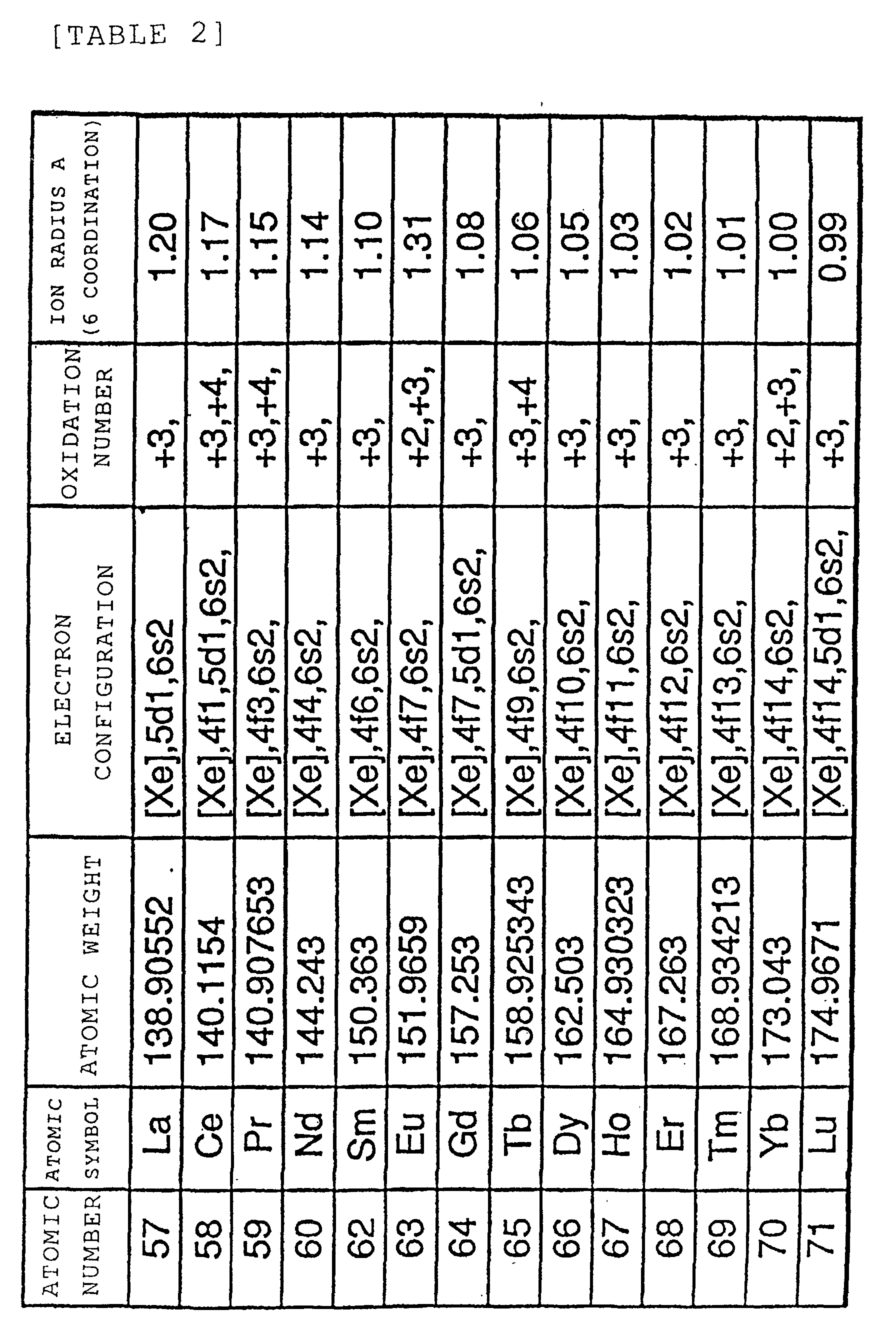
ytterbium and lanthanum. Such substances will be shown on
Table 2.
The rare earth elements shown on Table 2 have electronic
configuration identical with that of erbium ions, and, moreover,
ion radii which are not smaller than 70% and not larger than
130% of that of erbium ions. These elements are different in
the number of 4f-shell electrons. However, the 4f-shell
electrons are covered with eight electrons including 5s2 and
5p6 electrons, so that the chemical properties of these
elements are very similar to each other.
In view of the facts, these elements can also attain an
erbium ion interaction suppressing effect identical with those
of ytterbium and lanthanum. The values of erbium are also
shown on this table for comparison' sake. The chlorides of
all of these elements exist stably, and these elements are rare
earth elements capable of being doped in practice to a core
of an optical fiber.
In the embodiments 1 and 2, aluminum is doped for the
purpose of improving the solubility of a rare earth element.
A rare earth element originally has a low solubility with
respect to silica host. Therefore, when a large quantity of
rare earth element is doped as in the present invention, an
increase in a transmission loss occurs due to the
devitrification of a core which is ascribed to the clustering
of the rare earth element. Adding aluminum is effective for
suppressing this unfavorable phenomenon.
However, aluminum is a substance for increasing the
refractive index of pure quartz. When aluminum is doped to
the core portion 1, the effective core area thereof decreases.
Therefore, in view of the suppression of nonlinear phenomena,
restricting the amount of addition of aluminum to a minimum
level is preferable.
Under the circumstances, samples were made by varying
a ratio of a total amount of addition of rare earth elements
to an amount of addition of aluminum, to examine the occurrence
or non-occurrence of clustering. As a result, it was
ascertained that, when the number of aluminum ions doped was
not less than 6 times that of a total number of ions of rare
earth elements doped to the core portion 1, the devitrification
of the core did not occur. It was also ascertained that adding
phosphorus to the core portion 1 was also effective in
suppressing the clustering of rare earth elements.
An embodiment 3 of the present invention will now be
described. In this embodiment 3, fluorine is further doped
to a core portion 1 of an erbium-ytterbium-doped optical fiber
obtained by co-doping ytterbium to the core portion 1.
Germanium is not doped to the core portion 1.
Namely, in the embodiment 3, an excessive increase in
the refractive index of the core portion 1 which is ascribed
to germanium is suppressed, and, moreover, the refractive index
of the core portion 1 is reduced by adding fluorine. The items
of the erbium-ytterbium co-doped optical fiber in the
embodiment 3 will be shown on Table 3.
| COMPOSITION OF CORE | Er/Yb/P/Al/F/Si |
| COMPOSITION OF CLAD | SiO2 |
| RELATIVE REFRACTIVE INDEX DIFFERENCE Δ | 0.36% |
| CONCENTRATION OF Er | 2000wtppm |
| CONCENTRATION OF Yb | 2.5wt% |
| CONCENTRATION OF Al | 3.8wt% |
In order to estimate the amounts of waveform distortion
due to nonlinear phenomena in the light amplification optical
fibers of the embodiments 1 and 3 and related art example 2,
the effective core areas A
eff with respect to a wavelength of
1550 nm were measured. The results will be shown on Table 4.
| TYPE | EMBODIMENT 1 | EMBODIMENT 3 | RELATED ART EXAMPLE 2 |
| COMPOSITION OF CORE | Er/Yb/P/ Al/Ge/Si | Er/Yb/P/ Al/F/Si | Er/Al/ Ge/Si |
| COMPOSITION OF CLAD | SiO2 | SiO2 | F-SiO2 |
| RELATIVE REFRACTIVE INDEX DIFFERENCE (%) | 0.9 | 0.36 | 1.3 |
| CONCENTRATION OF Er IONS (wtppm) | 2000 | 2000 | 1000 |
| CONCENTRATION OF Al IONS (wtppm) | 3.8 | 3.8 | 3 |
| CONCENTRATION OF Yb IONS (wtppm) | 2.5 | 2.5 | 0 |
| Aeff(µm2)
@ λ = 1550nm | 40 | 74 | 23 |
From these results, the following effects of the present
invention were ascertained. Namely, it becomes possible to
increase the effective core area greatly, obtain a high energy
conversion efficiency with a high erbium concentration even
when an optical fiber of a small length is used, and reduce
waveform distortion ascribed to the nonlinearity of the fiber.
As previously described, it became clear in the optical
fiber of the embodiment 1 that the adding of ytterbium enabled
an optical fiber of a high erbium concentration to be obtained,
and that even an optical fiber of a small length enabled a high
energy conversion efficiency to be displayed. In the
embodiment 3, an equally high conversion efficiency was also
obtained by an optical fiber of a substantially equal length.
Namely, adding fluorine to a core as in the embodiment
3 enabled the effective core area to be increased, and a
waveform distortion ascribed to the nonlinearity of the optical
fiber to be further reduced as compared with that in the
embodiment 1. The reason resides in that the amount of
waveform distortion ascribed to nonlinear phenomena is
proportional to (Leff/Aeff).
In the embodiment 3, the effective core area was
increased by adding fluorine to the core portion 1, and by not
adding germanium thereto. The effective core area is also
increased in the same manner even when a dopant increasing a
refractive index is doped to at least a part of the clad portion
2. The dopant increasing the refractive index and used in this
case is preferably at least one of germanium, phosphorus and
aluminum in view of their capability of not spoiling various
properties of the optical fiber.
The refractive index distribution constitution of the
light amplification optical fiber according to the present
invention is not limited to a simple stepped type of Fig. 1.
For example, the core portion 1 may be set to have an alpha
profile.
As shown in Fig. 2 and Fig. 3, the optical fiber may have
a double (2-layer) clad type refractive index distribution
constitution formed of from the inner side a core portion 1,
a first clad portion 3 and a second clad portion 4. In this
case, a relative refractive index difference Δ is determined
by the core portion 1 and the first clad portion 3 which is
on the immediately outer side of the core portion 1.
As shown in Fig. 4 and Fig. 5, the optical fiber may have
a triple (three-layer) clad type refractive index distribution
constitution formed of from the inner side a core portion 1,
a first clad portion 5, a second clad portion 6 and a third
clad portion 7. In this case, a relative refractive index
difference Δ is determined by the core portion 1 and first clad
portion 5.
The refractive index distribution constitution is not
limited to those shown in Fig. 1 to Fig. 5. It is a matter
of course that the optical fiber may have other refractive index
distribution constitution.
Although, in the above-described embodiments, the
concentration of the erbium doped to the core portion 1 is set
to 2000 wtppm level, it may be at a level exceeding 1000 wtppm.
When the erbium concentration in a related art light
amplification optical fiber reaches a level in excess of 1000
wtppm, concentration quenching occurs even though aluminum or
phosphorus is doped to the core portion thereof. In the
structure according to the present invention, such a problem
does not arise, and excellent effect which could not be obtained
by a related art optical fiber can be displayed.
An embodiment of the light amplifier according to the
present invention will now be described. The light amplifier
in this embodiment is a fiber type light amplifier provided
with a light amplification optical fiber on an optical path
which an optical signal passes, in which the light
amplification optical fiber of each embodiment of the present
invention is used as the mentioned light amplification optical
fiber. Accordingly, the light amplifier of this embodiment
displays in the same manner the excellent effect of the light
amplification optical fiber of each of the above embodiments.
Industrial Applicability:
As described above, the light amplification optical
fiber and light amplifier according to the present invention
are suitable to be used for the amplification of an optical
signal in which the high-output and high-efficiency signal
amplification is carried out in optical communication, etc.
as nonlinear phenomena are suppressed.