EP1207589A2 - Wire connecting connector - Google Patents
Wire connecting connector Download PDFInfo
- Publication number
- EP1207589A2 EP1207589A2 EP01126445A EP01126445A EP1207589A2 EP 1207589 A2 EP1207589 A2 EP 1207589A2 EP 01126445 A EP01126445 A EP 01126445A EP 01126445 A EP01126445 A EP 01126445A EP 1207589 A2 EP1207589 A2 EP 1207589A2
- Authority
- EP
- European Patent Office
- Prior art keywords
- terminal
- connecting body
- connector
- wire connecting
- male
- Prior art date
- Legal status (The legal status is an assumption and is not a legal conclusion. Google has not performed a legal analysis and makes no representation as to the accuracy of the status listed.)
- Granted
Links
Images

Classifications
-
- H—ELECTRICITY
- H01—ELECTRIC ELEMENTS
- H01R—ELECTRICALLY-CONDUCTIVE CONNECTIONS; STRUCTURAL ASSOCIATIONS OF A PLURALITY OF MUTUALLY-INSULATED ELECTRICAL CONNECTING ELEMENTS; COUPLING DEVICES; CURRENT COLLECTORS
- H01R13/00—Details of coupling devices of the kinds covered by groups H01R12/70 or H01R24/00 - H01R33/00
- H01R13/02—Contact members
- H01R13/10—Sockets for co-operation with pins or blades
- H01R13/11—Resilient sockets
- H01R13/112—Resilient sockets forked sockets having two legs
-
- H—ELECTRICITY
- H01—ELECTRIC ELEMENTS
- H01R—ELECTRICALLY-CONDUCTIVE CONNECTIONS; STRUCTURAL ASSOCIATIONS OF A PLURALITY OF MUTUALLY-INSULATED ELECTRICAL CONNECTING ELEMENTS; COUPLING DEVICES; CURRENT COLLECTORS
- H01R12/00—Structural associations of a plurality of mutually-insulated electrical connecting elements, specially adapted for printed circuits, e.g. printed circuit boards [PCB], flat or ribbon cables, or like generally planar structures, e.g. terminal strips, terminal blocks; Coupling devices specially adapted for printed circuits, flat or ribbon cables, or like generally planar structures; Terminals specially adapted for contact with, or insertion into, printed circuits, flat or ribbon cables, or like generally planar structures
- H01R12/50—Fixed connections
- H01R12/59—Fixed connections for flexible printed circuits, flat or ribbon cables or like structures
- H01R12/65—Fixed connections for flexible printed circuits, flat or ribbon cables or like structures characterised by the terminal
- H01R12/67—Fixed connections for flexible printed circuits, flat or ribbon cables or like structures characterised by the terminal insulation penetrating terminals
- H01R12/675—Fixed connections for flexible printed circuits, flat or ribbon cables or like structures characterised by the terminal insulation penetrating terminals with contacts having at least a slotted plate for penetration of cable insulation, e.g. insulation displacement contacts for round conductor flat cables
Definitions
- the present invention relates to a wire connecting connector for connecting an electric wire.
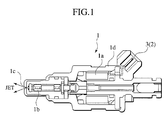
- a fuel injection valve 1 shown in Fig. 1 which electronically controls a fuel injection amount to a combustion chamber of an engine is structured such that a fuel injection amount from a nozzle 1c is varied by controlling the degree of opening a needle valve 1b based on a control electric current applied to a solenoid coil 1a.
- the fuel injection valve 1 is structured such that a harness for applying a control electric current is connected to the fuel injection valve 1 through a wire connecting connector 2 after the fuel injection valve 1 is mounted to a cylinder head (not shown).
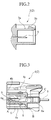
- the wire connecting connector 2 comprises a male connector 3 shown in Fig. 2 and a female connector 4 shown in Fig. 3.
- the male connector 3 is integrally protruded from a head portion of a housing 1d that carries the solenoid coil 1a.
- a pin-shaped male terminal 5 protrudes within a tubular receptor 3a.
- the female connector 4 is structured such that an inserting body 4b which is to be fitted to an inner circumference of the receptor 3a is provided within a housing 4a.
- the housing 4a is fitted to an outer circumference of the receptor 3a.
- a crimped terminal 6 as the female terminal is received within the inserting body 4b.
- a harness for applying the control electric current is connected to this crimped terminal 6.
- connection of the wire connecting connector 2 is performed by inserting the female connector 4 to the male connector 3, whereby the inserting body 4b and the receptor 3a are fitted to each other and the male terminal 5 is inserted into the crimped terminal 6 to be electrically connected with each other.
- the structure is made such that a liquid tight function with respect to an inner circumference of the receptor 3a is secured by a packing 8 provided on the outer circumference of the inserting body 4b, and a liquid tight function in a receiving portion of the crimped terminal 6 can be secured by a rubber plug 8a provided at the introducing portion of the harness 7.
- a disengagement prevention can be achieved by engaging an engaging projection 3b protruded from a tip end portion of the receptor 3a with a recess portion 4c of the housing 4a.
- An elastic contact piece 6a is provided within the crimped terminal 6 so as to securely perform an electric connection between the terminals, and the male terminal 5 is structured such that it is inserted into the crimped terminal 6 by compressing the elastic contact piece 6a.
- the crimped terminal 6 to which the male terminal 5 is inserted is provided with a receiving portion A formed in a rectangular column shape so as to receive the elastic contact piece 6a, a harness fixing portion B for fixing the end portion of the harness 7 from which a coating material has been peeled off, and an engaging shoulder 9 with which a lance C protruded from the housing 4a is engaged, and the like, which makes the construction of the terminal complex and leads to high production costs.
- an object of the present invention is to provide a wire connecting connector which can simplify a terminal structure so as to reduce a cost by forming a female terminal in a fork shape and gripping a harness and an opposing male terminal in the fork-shape part.
- a wire connecting connector comprising a first connecting body from which a male terminal is protruded, and a second connecting body which is fitted to the first connecting body and from which a female terminal to which the male terminal is inserted is protruded, wherein the female terminal is formed in a fork shape having an opening arranged to oppose the male terminal, wherein an acute angle portion which bursts through a coating body of a harness is provided between the tip portions of the fork part, and a conductive wire connecting portion which grips a conductive wire portion of the harness that has been burst through by the acute angle portion is provided between the base end portions of the fork part, and a terminal receptor to which the male terminal is inserted is provided between the middle portions of the fork part.
- the female terminal since the female terminal is formed in a fork shape and the acute angle portion, the conductive wire connecting portion, and the terminal receptor are respectively provided between the tip end, base end, and middle portions of the fork shape part, it can be connected to the harness by first bursting through the coating body of the harness with the acute angle portion and guiding the conductive wire portion to the conductive wire connecting portion so that it is held there.
- the connection of the wire connecting connector is completed by mutually fitting the first connecting body to the second connecting body in this state and inserting the male terminal to the terminal receptor. While it is necessary that the female terminal be provided with the acute angle portion, the conductive wire connecting portion, and the terminal receiving portion, it is sufficient to form them in the opposing side of the fork part, and therefore, the structure can be simplified.
- a wire connecting connector as recited in the first aspect, wherein a disengagement prevention means for holding a fitted state of the first connecting body and the second connecting body is provided between the first connecting body and the second connecting body.
- the disengagement prevention means for holding the fitted state between the first connecting body and the second connecting body Since the disengagement prevention means for holding the fitted state between the first connecting body and the second connecting body is provided, the electrical engagement state between the male terminal and the female terminal can be stably maintained by the disengagement prevention means.
- a wire connecting connector according to the second aspect, wherein the disengagement prevention means also serves as a positioning means which determines a relative rotational position between the first connecting body and the second connecting body.
- the disengagement prevention means also serves as the positioning means for determining the relative rotational position between the first connecting body and the second connecting body by setting a disengagement prevention position at which the male terminal and the female terminal oppose to each other when fitting the first connecting body to the second connecting body.
- the male terminal and the female terminal come to oppose with each other by their relative rotation toward the disengagement prevention position of the disengagement prevention means.
- the male terminal is securely inserted to the female terminal by relatively pressing the first connecting body and the second connecting body to each other in this state. Since the disengagement prevention means is also used as the positioning means, the structure of the wire connecting connector can be simplified.
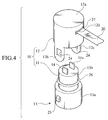
- a wire connecting connector 10 has a male connector 11 as a first connecting body and a female connector 12 as a second connecting body as shown in Fig. 4.
- the male connector 11 is formed at a top portion of an equipment 13 such as a fuel injection valve or the like.
- an inserting portion 13b having a reduced diameter is formed from a general portion 13a of the equipment 13, and a pair of male terminals 14 and 14a are protruded from a tip end of the inserting portion 13b.
- the male terminals 14 and 14a are formed in a flat plate shape arranged in a "geta" or wooden clogs support form at a predetermined interval.
- end portions of the male terminals 14 and 14a to be inserted within the inserting portion 13b are connected to an electric operating part of the equipment 13.
- the female connector 12 is open to the male connector 11 side and is formed in a tube shape having a bottom which is capable of fitting to the inserting portion 13b, and a pair of female terminals 15 and 15a are provided in the inner side of the bottom portion 12a.
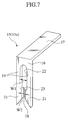
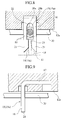
- Each of these female terminals 15 and 15a is structured by bending a strip-like flat plate in an L shape to form a terminal portion 16 at one side of the bent part and a supporting portion 17 at the other side of the bent part, as shown in Fig. 7 and Fig. 9.
- the supporting portion 17 is inserted in the bottom portion 12a of the female connector 12 to be parallel thereto and is fixed, and the terminal portion 16 is vertically protruded from the bottom portion 12a.
- the terminal portion 16 is provided with an opening 18 formed in a fork shape at the lower end side of the drawing to oppose to each of the male terminals 14 and 14a.
- An acute angle portion 21 which bursts through or tears a coating body 20a of a flexible flat cable (FFC) 20 as a harness (see Fig. 8) is provided at the tip end portions of a fork-shape part 19.
- a conductive wire connecting portion 22 which grips a conductive wire portion 20b of the FFC 20 that has been burst through or torn by the acute angle portions 21 is provided between the base end portions (at the supporting portion 17 side) of the fork-shape part 19.
- a terminal receptor 23 to which each of the terminals 14 and 14a is inserted is provided between the middle portions of the fork-shape part 19.
- the acute angle portion 21 is inclined so that opposing inner side of the fork-shape portion 19 forms a tapered shape, and each of the tip end portions is formed with an acute angle.
- a gripping width W1 of the conductive wire connecting portion 22 is determined corresponding to a diameter of the conductive wire 20b, and the conductive wire connecting portion 22 is formed to be slightly narrower than the diameter of the conductive wire 20b.
- the conductive wire 20b is guided to the conductive wire connecting portion 22 and is held after the coating portion 20a of the connecting end of the FFC 20 is burst through by the acute angle portion 21.
- the FFC 20 connected to the conductive wire connecting portion 22 is taken out from an opening 12d formed on a side of the female connector 12 and is connected to an electric power source (not shown).
- the inserting width W2 of the terminal receptor 23 is determined corresponding to a thickness of the male terminals 14 and 14a, and the terminal receptor 23 is formed to be slightly narrower than the thickness of the male terminals 14 and 14a.
- the main part of the wire connecting connector 10 according to the present embodiment is structured in the manner mentioned above.
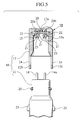
- a pair of extended portions 12b and 12c to be fitted to the general portion 13a of the male connector 11 are further provided at the opposing sides of the opening of the female connector 12 mentioned above, as shown in Figs. 4 and 5.
- Engagement holes 24 are formed at the extended portions 12b and 12c.
- a pair of engagement projections 25 is protruded from the corresponding part of the general portion 13a of the male connector 11, thereby constituting a disengagement prevention means.
- the disengagement prevention means is structured such that a relative rotational position between the male connector 11 and the female connector 12 is set to a rotational position at which the respective corresponding male terminals 14 and 14a and female terminals 15 and 15a oppose to each other. This can be made by coinciding a width in the circumferential directions of the engagement holes 24 and of the engagement projections 25.
- the disengagement prevention means is structured to also serve as a positioning means.
- a water proof function is applied by sealing between an outer circumference of the inserting portion 13b and an inner circumference of the female connector 12 through an O-ring 26 and by sealing an opening portion 12d for taking out the FFC 20 with a sealing member 27 such as a thermoplastic resin or the like.
- the wire connecting connector 10 of the present embodiment is structured such that the female terminals 15 and 15a are formed in the fork shape having the acute angle portion 21 between the tip end portions, the conductive wire connecting portion 22 between the base end portions, and the terminal receptor 23 between the middle portions.
- the FFC In order to connect the FFC to the female terminals 15 and 15a, it is sufficient to burst through the coating body 20a of the FFC 20 with the acute angle portion 21 and guide it to the conductive wire connecting portion 22 so as to grip it.
- each of the female terminals 15 and 15a is still provided with the acute angle portion 21, the conductive wire connecting portion 22, and the terminal receptor 23, it is sufficient to form them in the opposing side of a fork-shaped part, and therefore, the structure can be simplified. Since the female terminals 15 and 15a can be formed in a single process such as punching a flat plate or the like, it is possible to largely reduce production costs.
- the disengagement prevention means that comprises the engaging hole 24 and the engaging projection 25 is provided between the male connector 11 and the female connector 12, an electrical connection between the female connectors 15 and 15a and the male connectors 14 and 14a inserted to their terminal receptors 23 can be stably maintained.
- the engagement position of the disengagement prevention means also serves as the positioning means for determining the relative rotational position between the male connector 11 and female connector 12, the male terminals 14 and 14a and the female terminals 15 and 15a oppose to each other by relatively rotating the male connector 11 and the female connector 12 to the engagement position of the disengagement prevention means.
- the male terminals 14 and 14a and the female terminals 15 and 15a are securely inserted to each other by relatively pressing the male connector 11 and the female connector 12 to each other, and therefore, connection error can be avoided.
- the disengagement prevention means also serves as the positioning means, it is not necessary to provide them as independent structures, and the structure of the wire connector 10 can be simplified accordingly.
Landscapes
- Connector Housings Or Holding Contact Members (AREA)
- Coupling Device And Connection With Printed Circuit (AREA)
- Fuel-Injection Apparatus (AREA)
- Details Of Connecting Devices For Male And Female Coupling (AREA)
- Multi-Conductor Connections (AREA)
Abstract
Description
Claims (4)
- A wire connecting connector, comprising:wherein the female terminal is formed in a fork shape having an opening arranged to oppose the male terminal, anda first connecting body from which a male terminal is protruded; anda second connecting body from which a female terminal to which the male terminal is inserted is protruded, the second connecting body fitted to the first connecting body;
wherein an acute angle portion which bursts through a coating body of a harness is provided between the tip end portions of the fork part, and a conductive wire connecting portion which grips a conductive wire portion of the harness which has been burst through by the acute angle portion is provided between the base end portions of the fork part, and a terminal receptor to which the male terminal is inserted is provided between the middle portions of the fork part. - A wire connecting connector according to Claim 1, wherein a disengagement prevention means for holding a fitted state between the first connecting body and the second connecting body is provided between the first connecting body and the second connecting body.
- A wire connecting connector according to Claim 2, wherein the disengagement prevention means also serves as a positioning means for determining a relative rotational position between the first connecting body and the second connecting body.
- A wire connecting connector according to Claim 2, wherein the disengagement prevention means comprises an engagement hole and an engagement projection.
Applications Claiming Priority (2)
| Application Number | Priority Date | Filing Date | Title |
|---|---|---|---|
| JP2000340267A JP2002151189A (en) | 2000-11-08 | 2000-11-08 | Wiring connector |
| JP2000340267 | 2000-11-08 |
Publications (3)
| Publication Number | Publication Date |
|---|---|
| EP1207589A2 true EP1207589A2 (en) | 2002-05-22 |
| EP1207589A3 EP1207589A3 (en) | 2003-05-02 |
| EP1207589B1 EP1207589B1 (en) | 2005-04-20 |
Family
ID=18815208
Family Applications (1)
| Application Number | Title | Priority Date | Filing Date |
|---|---|---|---|
| EP01126445A Expired - Lifetime EP1207589B1 (en) | 2000-11-08 | 2001-11-08 | Wire connecting connector |
Country Status (4)
| Country | Link |
|---|---|
| US (1) | US6805577B2 (en) |
| EP (1) | EP1207589B1 (en) |
| JP (1) | JP2002151189A (en) |
| DE (1) | DE60110187T2 (en) |
Cited By (3)
| Publication number | Priority date | Publication date | Assignee | Title |
|---|---|---|---|---|
| FR2842026A1 (en) * | 2002-07-03 | 2004-01-09 | Tyco Electronics Amp Gmbh | ELECTRICAL CONNECTION |
| FR2861505A1 (en) * | 2003-10-27 | 2005-04-29 | Ixfin Magneti Marelli Systemes | Printed circuit board and external circuit connector system, has conducting contact units in electrical contact with drop terminals of external circuit, where terminals have end segments contacting clamp for contacting contact units |
| CN110912357A (en) * | 2018-09-18 | 2020-03-24 | 联合汽车电子有限公司 | Wire management fastening device and method |
Families Citing this family (15)
| Publication number | Priority date | Publication date | Assignee | Title |
|---|---|---|---|---|
| JP2004327169A (en) | 2003-04-23 | 2004-11-18 | Yazaki Corp | Packing and connector with packing |
| US7201604B1 (en) * | 2006-03-16 | 2007-04-10 | John Mezzalingua Associates, Inc. | Ethernet cable connector and methods of use thereof |
| DE102012007153A1 (en) * | 2011-04-12 | 2013-01-10 | Dynaenergetics Gmbh & Co. Kg | Igniter with a multi-function plug |
| KR101994984B1 (en) | 2012-07-16 | 2019-07-01 | 콤스코프 인코포레이티드 오브 노스 캐롤라이나 | Balanced pin and socket connectors |
| KR102055213B1 (en) * | 2015-02-03 | 2019-12-12 | 브로제 파르초이크타일레 게엠베하 운트 코. 콤만디트게젤샤프트 뷔르츠부르크 | Electric motor and switching unit therefor |
| GB2547958B (en) | 2016-03-04 | 2019-12-18 | Commscope Technologies Llc | Two-wire plug and receptacle |
| MX2019011906A (en) | 2017-04-24 | 2019-11-25 | Commscope Technologies Llc | Connectors for a single twisted pair of conductors. |
| CN110945724B (en) | 2017-06-08 | 2021-08-27 | 康普技术有限责任公司 | Connector for single twisted conductor pairs |
| US11296463B2 (en) | 2018-01-26 | 2022-04-05 | Commscope Technologies Llc | Connectors for a single twisted pair of conductors |
| EP3759765A4 (en) * | 2018-02-26 | 2022-04-13 | CommScope Technologies LLC | SINGLE TWISTED PAIR CONNECTORS AND CONTACTS |
| CN113574748A (en) | 2019-03-15 | 2021-10-29 | 康普技术有限责任公司 | Connector and contact for single twisted conductor pairs |
| EP4038698A4 (en) | 2019-09-30 | 2023-11-01 | CommScope Technologies LLC | COUPLER FOR SINGLE PAIR CONNECTORS |
| WO2021067268A1 (en) | 2019-09-30 | 2021-04-08 | Commscope Technologies Llc | High density coupling panel |
| KR102241110B1 (en) * | 2019-12-05 | 2021-04-19 | 주식회사 코아비스 | Motor and electric pump having the same |
| US12199372B2 (en) | 2021-02-26 | 2025-01-14 | Commscope Technologies Llc | Couplers for single pair connectors |
Family Cites Families (10)
| Publication number | Priority date | Publication date | Assignee | Title |
|---|---|---|---|---|
| AR208483A1 (en) | 1975-11-10 | 1976-12-27 | Amp Inc | ELECTRICAL TERMINAL |
| US4351582A (en) * | 1980-05-23 | 1982-09-28 | Robinson Nugent, Inc. | Adapting electrical connector |
| US4533200A (en) * | 1982-06-23 | 1985-08-06 | Thomas & Betts Corporation | Stackable electrical connector |
| JPS5942785A (en) | 1982-08-31 | 1984-03-09 | 日本圧着端子製造株式会社 | Electric connector |
| US4688872A (en) | 1984-08-02 | 1987-08-25 | Adc Telecommunications, Inc. | Electrical connector module with multiple connector housings |
| US4666232A (en) * | 1986-01-13 | 1987-05-19 | Don Shyu | Plug for a car antenna |
| US5207602A (en) * | 1989-06-09 | 1993-05-04 | Raychem Corporation | Feedthrough coaxial cable connector |
| DE29505938U1 (en) | 1995-04-06 | 1996-08-08 | Stocko Metallwarenfab Henkels | Electrical contact element and plastic housing for receiving the contact element |
| WO1997045896A1 (en) | 1996-05-30 | 1997-12-04 | The Whitaker Corporation | Surface mountable electrical connector |
| US6123566A (en) * | 1998-12-21 | 2000-09-26 | Lucent Technologies Inc. | Terminal strip with integrated strain relief mechanism for an insulation displacement connector |
-
2000
- 2000-11-08 JP JP2000340267A patent/JP2002151189A/en active Pending
-
2001
- 2001-11-07 US US09/986,077 patent/US6805577B2/en not_active Expired - Fee Related
- 2001-11-08 DE DE60110187T patent/DE60110187T2/en not_active Expired - Lifetime
- 2001-11-08 EP EP01126445A patent/EP1207589B1/en not_active Expired - Lifetime
Cited By (4)
| Publication number | Priority date | Publication date | Assignee | Title |
|---|---|---|---|---|
| FR2842026A1 (en) * | 2002-07-03 | 2004-01-09 | Tyco Electronics Amp Gmbh | ELECTRICAL CONNECTION |
| FR2861505A1 (en) * | 2003-10-27 | 2005-04-29 | Ixfin Magneti Marelli Systemes | Printed circuit board and external circuit connector system, has conducting contact units in electrical contact with drop terminals of external circuit, where terminals have end segments contacting clamp for contacting contact units |
| EP1528631A1 (en) * | 2003-10-27 | 2005-05-04 | Magneti Marelli Systèmes Electroniques S.A.S | Solderless connection system for printed circuits |
| CN110912357A (en) * | 2018-09-18 | 2020-03-24 | 联合汽车电子有限公司 | Wire management fastening device and method |
Also Published As
| Publication number | Publication date |
|---|---|
| EP1207589B1 (en) | 2005-04-20 |
| DE60110187T2 (en) | 2006-03-09 |
| JP2002151189A (en) | 2002-05-24 |
| EP1207589A3 (en) | 2003-05-02 |
| US20020055294A1 (en) | 2002-05-09 |
| DE60110187D1 (en) | 2005-05-25 |
| US6805577B2 (en) | 2004-10-19 |
Similar Documents
| Publication | Publication Date | Title |
|---|---|---|
| EP1207589B1 (en) | Wire connecting connector | |
| EP0666616B1 (en) | Male pin terminal | |
| US5573429A (en) | Wire holder for a water-proof connector having a u-shaped holder member and rubber plug | |
| JP2906469B2 (en) | Shielded wire connector | |
| JPS641740Y2 (en) | ||
| US5224875A (en) | Terminal lug-water sealing plug coupling structure | |
| JP2013004347A (en) | Shield connector | |
| US6068505A (en) | Electrical contact for flexible flat cable | |
| JP2008147094A (en) | Coaxial electrical connector | |
| JPH01232680A (en) | Crimp-style connecter and mounting method thereof | |
| EP4117123B1 (en) | Connector fitting structure | |
| US5336104A (en) | Connector | |
| JP4928800B2 (en) | Terminal fitting | |
| US6149460A (en) | RF plug connection system and method for assembling the RF plug connection system | |
| JP3267240B2 (en) | Waterproof connector | |
| US5302146A (en) | Crimp-style terminal | |
| US20220006218A1 (en) | Connector | |
| US7985104B2 (en) | Shield sleeve for a plug connector | |
| JP7495319B2 (en) | Connector housing, connector and electric wire with connector, connector unit, and method for manufacturing electric wire with connector | |
| US5997351A (en) | Waterproof press-connecting connector and press-connecting method | |
| CN2591788Y (en) | Line connector structure | |
| JPH0654242U (en) | Connector plug | |
| KR20200056056A (en) | Housing structure of plug connector | |
| JPH07263073A (en) | Waterproof rubber stopper | |
| CN110416840A (en) | A kind of curved formula Minisize coaxial connector |
Legal Events
| Date | Code | Title | Description |
|---|---|---|---|
| PUAI | Public reference made under article 153(3) epc to a published international application that has entered the european phase |
Free format text: ORIGINAL CODE: 0009012 |
|
| 17P | Request for examination filed |
Effective date: 20011108 |
|
| AX | Request for extension of the european patent |
Free format text: AL;LT;LV;MK;RO;SI |
|
| PUAL | Search report despatched |
Free format text: ORIGINAL CODE: 0009013 |
|
| AK | Designated contracting states |
Designated state(s): AT BE CH CY DE DK ES FI FR GB GR IE IT LI LU MC NL PT SE TR |
|
| AX | Request for extension of the european patent |
Extension state: AL LT LV MK RO SI |
|
| AKX | Designation fees paid |
Designated state(s): DE FR GB |
|
| 17Q | First examination report despatched |
Effective date: 20040318 |
|
| GRAP | Despatch of communication of intention to grant a patent |
Free format text: ORIGINAL CODE: EPIDOSNIGR1 |
|
| GRAS | Grant fee paid |
Free format text: ORIGINAL CODE: EPIDOSNIGR3 |
|
| GRAA | (expected) grant |
Free format text: ORIGINAL CODE: 0009210 |
|
| AK | Designated contracting states |
Kind code of ref document: B1 Designated state(s): DE FR GB |
|
| REG | Reference to a national code |
Ref country code: GB Ref legal event code: FG4D |
|
| REG | Reference to a national code |
Ref country code: IE Ref legal event code: FG4D |
|
| REF | Corresponds to: |
Ref document number: 60110187 Country of ref document: DE Date of ref document: 20050525 Kind code of ref document: P |
|
| PLBE | No opposition filed within time limit |
Free format text: ORIGINAL CODE: 0009261 |
|
| STAA | Information on the status of an ep patent application or granted ep patent |
Free format text: STATUS: NO OPPOSITION FILED WITHIN TIME LIMIT |
|
| ET | Fr: translation filed | ||
| 26N | No opposition filed |
Effective date: 20060123 |
|
| REG | Reference to a national code |
Ref country code: FR Ref legal event code: PLFP Year of fee payment: 15 |
|
| PGFP | Annual fee paid to national office [announced via postgrant information from national office to epo] |
Ref country code: DE Payment date: 20151103 Year of fee payment: 15 Ref country code: GB Payment date: 20151104 Year of fee payment: 15 |
|
| PGFP | Annual fee paid to national office [announced via postgrant information from national office to epo] |
Ref country code: FR Payment date: 20151008 Year of fee payment: 15 |
|
| REG | Reference to a national code |
Ref country code: DE Ref legal event code: R119 Ref document number: 60110187 Country of ref document: DE |
|
| GBPC | Gb: european patent ceased through non-payment of renewal fee |
Effective date: 20161108 |
|
| REG | Reference to a national code |
Ref country code: FR Ref legal event code: ST Effective date: 20170731 |
|
| PG25 | Lapsed in a contracting state [announced via postgrant information from national office to epo] |
Ref country code: FR Free format text: LAPSE BECAUSE OF NON-PAYMENT OF DUE FEES Effective date: 20161130 |
|
| PG25 | Lapsed in a contracting state [announced via postgrant information from national office to epo] |
Ref country code: DE Free format text: LAPSE BECAUSE OF NON-PAYMENT OF DUE FEES Effective date: 20170601 Ref country code: GB Free format text: LAPSE BECAUSE OF NON-PAYMENT OF DUE FEES Effective date: 20161108 |