EP1206939A1 - Cholesterol-lowering agents, secondary bile acid procuction inhibitors and foods and drinks - Google Patents
Cholesterol-lowering agents, secondary bile acid procuction inhibitors and foods and drinks Download PDFInfo
- Publication number
- EP1206939A1 EP1206939A1 EP00946404A EP00946404A EP1206939A1 EP 1206939 A1 EP1206939 A1 EP 1206939A1 EP 00946404 A EP00946404 A EP 00946404A EP 00946404 A EP00946404 A EP 00946404A EP 1206939 A1 EP1206939 A1 EP 1206939A1
- Authority
- EP
- European Patent Office
- Prior art keywords
- candida
- yeast
- acid
- cholesterol
- kluyveromyces
- Prior art date
- Legal status (The legal status is an assumption and is not a legal conclusion. Google has not performed a legal analysis and makes no representation as to the accuracy of the status listed.)
- Granted
Links
Classifications
-
- A—HUMAN NECESSITIES
- A23—FOODS OR FOODSTUFFS; TREATMENT THEREOF, NOT COVERED BY OTHER CLASSES
- A23L—FOODS, FOODSTUFFS OR NON-ALCOHOLIC BEVERAGES, NOT OTHERWISE PROVIDED FOR; PREPARATION OR TREATMENT THEREOF
- A23L2/00—Non-alcoholic beverages; Dry compositions or concentrates therefor; Preparation or treatment thereof
- A23L2/52—Adding ingredients
-
- A—HUMAN NECESSITIES
- A61—MEDICAL OR VETERINARY SCIENCE; HYGIENE
- A61K—PREPARATIONS FOR MEDICAL, DENTAL OR TOILETRY PURPOSES
- A61K36/00—Medicinal preparations of undetermined constitution containing material from algae, lichens, fungi or plants, or derivatives thereof, e.g. traditional herbal medicines
- A61K36/06—Fungi, e.g. yeasts
-
- A—HUMAN NECESSITIES
- A23—FOODS OR FOODSTUFFS; TREATMENT THEREOF, NOT COVERED BY OTHER CLASSES
- A23L—FOODS, FOODSTUFFS OR NON-ALCOHOLIC BEVERAGES, NOT OTHERWISE PROVIDED FOR; PREPARATION OR TREATMENT THEREOF
- A23L31/00—Edible extracts or preparations of fungi; Preparation or treatment thereof
-
- A—HUMAN NECESSITIES
- A23—FOODS OR FOODSTUFFS; TREATMENT THEREOF, NOT COVERED BY OTHER CLASSES
- A23L—FOODS, FOODSTUFFS OR NON-ALCOHOLIC BEVERAGES, NOT OTHERWISE PROVIDED FOR; PREPARATION OR TREATMENT THEREOF
- A23L31/00—Edible extracts or preparations of fungi; Preparation or treatment thereof
- A23L31/10—Yeasts or derivatives thereof
-
- A—HUMAN NECESSITIES
- A23—FOODS OR FOODSTUFFS; TREATMENT THEREOF, NOT COVERED BY OTHER CLASSES
- A23L—FOODS, FOODSTUFFS OR NON-ALCOHOLIC BEVERAGES, NOT OTHERWISE PROVIDED FOR; PREPARATION OR TREATMENT THEREOF
- A23L33/00—Modifying nutritive qualities of foods; Dietetic products; Preparation or treatment thereof
- A23L33/10—Modifying nutritive qualities of foods; Dietetic products; Preparation or treatment thereof using additives
-
- A—HUMAN NECESSITIES
- A23—FOODS OR FOODSTUFFS; TREATMENT THEREOF, NOT COVERED BY OTHER CLASSES
- A23L—FOODS, FOODSTUFFS OR NON-ALCOHOLIC BEVERAGES, NOT OTHERWISE PROVIDED FOR; PREPARATION OR TREATMENT THEREOF
- A23L33/00—Modifying nutritive qualities of foods; Dietetic products; Preparation or treatment thereof
- A23L33/10—Modifying nutritive qualities of foods; Dietetic products; Preparation or treatment thereof using additives
- A23L33/14—Yeasts or derivatives thereof
-
- A—HUMAN NECESSITIES
- A23—FOODS OR FOODSTUFFS; TREATMENT THEREOF, NOT COVERED BY OTHER CLASSES
- A23L—FOODS, FOODSTUFFS OR NON-ALCOHOLIC BEVERAGES, NOT OTHERWISE PROVIDED FOR; PREPARATION OR TREATMENT THEREOF
- A23L5/00—Preparation or treatment of foods or foodstuffs, in general; Food or foodstuffs obtained thereby; Materials therefor
-
- A—HUMAN NECESSITIES
- A61—MEDICAL OR VETERINARY SCIENCE; HYGIENE
- A61K—PREPARATIONS FOR MEDICAL, DENTAL OR TOILETRY PURPOSES
- A61K36/00—Medicinal preparations of undetermined constitution containing material from algae, lichens, fungi or plants, or derivatives thereof, e.g. traditional herbal medicines
- A61K36/06—Fungi, e.g. yeasts
- A61K36/062—Ascomycota
- A61K36/064—Saccharomycetales, e.g. baker's yeast
-
- A—HUMAN NECESSITIES
- A61—MEDICAL OR VETERINARY SCIENCE; HYGIENE
- A61P—SPECIFIC THERAPEUTIC ACTIVITY OF CHEMICAL COMPOUNDS OR MEDICINAL PREPARATIONS
- A61P3/00—Drugs for disorders of the metabolism
-
- A—HUMAN NECESSITIES
- A61—MEDICAL OR VETERINARY SCIENCE; HYGIENE
- A61P—SPECIFIC THERAPEUTIC ACTIVITY OF CHEMICAL COMPOUNDS OR MEDICINAL PREPARATIONS
- A61P3/00—Drugs for disorders of the metabolism
- A61P3/06—Antihyperlipidemics
-
- A—HUMAN NECESSITIES
- A61—MEDICAL OR VETERINARY SCIENCE; HYGIENE
- A61P—SPECIFIC THERAPEUTIC ACTIVITY OF CHEMICAL COMPOUNDS OR MEDICINAL PREPARATIONS
- A61P35/00—Antineoplastic agents
- A61P35/04—Antineoplastic agents specific for metastasis
-
- A—HUMAN NECESSITIES
- A61—MEDICAL OR VETERINARY SCIENCE; HYGIENE
- A61P—SPECIFIC THERAPEUTIC ACTIVITY OF CHEMICAL COMPOUNDS OR MEDICINAL PREPARATIONS
- A61P9/00—Drugs for disorders of the cardiovascular system
-
- A—HUMAN NECESSITIES
- A23—FOODS OR FOODSTUFFS; TREATMENT THEREOF, NOT COVERED BY OTHER CLASSES
- A23V—INDEXING SCHEME RELATING TO FOODS, FOODSTUFFS OR NON-ALCOHOLIC BEVERAGES AND LACTIC OR PROPIONIC ACID BACTERIA USED IN FOODSTUFFS OR FOOD PREPARATION
- A23V2002/00—Food compositions, function of food ingredients or processes for food or foodstuffs
Definitions
- the present invention relates to a cholesterol-lowering agent capable of lowering the blood or hepatic cholesterol level and improving atherogenic index; to a secondary bile acid production inhibitor useful for preventing and treating colorectal cancer, liver cancer, pancreatic cancer, cholelithiasis, etc.; and to use thereof for producing foods and drinks.
- cardiovascular diseases In recent years, the mortality rate relating to cardiovascular diseases has increased year by year. If diseases caused by arteriosclerosis such as cardiac infarction and brain infarction are included, cardiovascular diseases are ranked at the top of the causes of death in adults.
- Arteriosclerosis is caused by a variety of factors. Among them, increase in plasma lipid level, inter alia, plasma cholesterol level, is conceivably one of the most dangerous factors.
- One cause of elevated plasma cholesterol level is a genetic disease.
- grave patients are given diet therapy, and simultaneously, drugs such as a cholesterol synthesis inhibitor, Nicomol, Clofibrate, an ion-exchange resin, and an anabolic steroid are employed.
- drugs such as a cholesterol synthesis inhibitor, Nicomol, Clofibrate, an ion-exchange resin, and an anabolic steroid are employed.
- these drugs cause adverse side effects such as toxicity to the liver, gastrointestinal disorders, and carcinogenicity.
- yeasts are disclosed in surprisingly few number. From long ago, brewer's yeast has been known as a typical yeast, and its effect of improving lipid metabolism is disclosed in several literatures. For example, there are disclosed a case in which administration of chromium-added brewer's yeast (9 g/day) for eight weeks to elderly subjects decreased the serum cholesterol level [Ester G. Offenbacher and F. Xavier Pi-Sunyer, Beneficial effect of chromium-rich yeast on glucose tolerance and blood lipids in elderly subjects.
- Bile acids such as cholic acid and chenodeoxycholic acid are synthesized from cholesterol, and conjugated with glycine or taurine, to thereby yield glycine-conjugated or taurine-conjugated bile acid, which are secreted via the bile duct to the digestive tract.
- Bile acid causes lipid contained in foods and drinks to emulsify and disperse by its surface activation effect, and promotes digestion and absorption of lipid.
- the bile acid is then actively absorbed again from the ileum, returned to the liver via the portal vein, and resecreted to the digestive tract again.
- bile acids repeat enterohepatic circulation.
- a portion of bile acid which has not been absorbed by the ileum undergoes modification by enterobacteria; e.g., deconjugation, 7 ⁇ -dehydroxylation, oxidation, reduction, or epimerization, to thereby convert to secondary bile acid.
- Predominant secondary bile acids produced through the process are deoxycholic acid and lithocholic acid, which are formed by 7 ⁇ -dehydroxylation of primary bile acids (cholic acid and chenodeoxycholic acid, respectively.
- a portion of secondary bile acid is passively absorbed by the large intestine and transferred to the liver, repeating enterohepatic circulation in similar fashion to the case of primary bile acid. The remaining portion of secondary bile acid is excreted into feces.
- the carcinogenesis process is conceived to include an initiation step in which a gene is mutated by a chemical carcinogen, radiation, or a virus, and a promotion step in which abnormality occurs in growth and differentiation through long-term exposure to a promoter.
- secondary bile acids such as deoxycholic acid and lithocholic acid act as a promoter in the second step, to thereby promote onset of colorectal cancer, liver cancer, pancreatic cancer, bile duct cancer, etc.
- secondary bile acids such as deoxycholic acid and lithocholic acid act as a promoter in the second step, to thereby promote onset of colorectal cancer, liver cancer, pancreatic cancer, bile duct cancer, etc.
- secondary bile acids such as deoxycholic acid and lithocholic acid produced by enterobacteria existing in the large intestinal tract have a strong carcinogenetic promoter activity and cause cholelithiasis
- diseases such as colorectalcancer, liver cancer, pancreatic cancer, bile duct cancer, and cholelithiasis can be prevented and treated through inhibition of secondary bile acid production.
- Ampicillin and 3 ⁇ ,12 ⁇ -dihydroxy-5 ⁇ -cholane-24-N-methylamine inhibit secondary bile acid production by removing bacteria which catalyze 7 ⁇ -dehydroxylation in the large intestinal tract.
- these inhibitors are employed for a long period of time, there arise problems such as generation of resistant bacteria and occurrence of adverse side effects.
- selective exclusion of bacteria which relates to secondary bile acid production by use of antibiotics is impossible, and use of antibiotics simultaneously excludes enterobacteria which play an important role in maintaining the human health; e.g., Lactobacillus and Bifidobacterium, and this is greatly problematic.
- Lactulose and wheat bran are thought to suppress activity of 7 ⁇ -dehydroxylase which has optinal pH of a neutral region by lowering pH in the large intestinal track and thereby lower the production of secondary bile acid.
- these substances exert poor effectiveness, which does not reach the level for contributing to prevention and treatment of the diseases.
- an object of the present invention is to provide a cholesterol-lowering agent capable of effectively lowering the blood or hepatic cholesterol level by use of a safe yeast causing fewer and less severe side effects.
- Another object of the present invention is to provide a secondary bile acid production inhibitor of high effectiveness and safety, useful for preventing and treating diseases such as colorectal cancer, liver cancer, pancreatic cancer, bile duct cancer, and cholelithiasis.
- the present inventors have carried out extensive studies, and have found that the yeasts belonging to the following specific groups exert an effect of effectively lowering the blood or hepatic cholesterol and provide fewer and less severe side effects, and that the yeasts exert an effect of inhibiting transformation of primary bile acid to secondary bile acid.
- the present invention has been accomplished on the basis of these findings.
- the present invention provides a cholesterol-lowering agent containing, as an active ingredient, at least one yeast belonging to Candida, Issatchenkia, Hanseniaspora, Kloeckera, Kluyveromyces, Pichia, or Torulaspora, as well as foods and drinks containing the yeast.
- the present invention also provides use of these specific yeasts for producing a cholesterol-lowering agent, as well as foods and drinks for lowering cholesterol.
- the present invention provides a treatment method for lowering cholesterol through administration of these specific yeasts.
- the present invention provides a secondary bile acid production inhibitor containing, as an active ingredient, a yeast, as well as foods and drinks containing the yeast.
- the present invention provides use of the yeast for producing a secondary bile acid production inhibitor, as well as foods and drinks for inhibiting secondary bile acid production.
- the present invention provides a treatment method for inhibiting secondary bile acid production through administration of a yeast.
- Fig. 1 is a graph showing plasma cholesterol levels of a cholesterol-added diet administration group and a no-cholesterol-added diet administration group.
- the yeast to be used in the cholesterol-lowering agent or foods and drinks according to the present invention is a yeast belonging to Candida, Issatchenkia, Hanseniaspora, Kloeckera, Kluyveromyces, Pichia, or Torulaspora. These yeast may be used singly or in combination of two or more species.
- the above yeast may be live cells, heated cells, lyophilized products, milled products thereof, or contents thereof.
- yeasts belonging to the above groups include Candida kefyr, Issatchenkia orientalis, Hanseniaspora uvarum, Kloeckera africana, Kluyveromyces marxianus, Kluyveromyces lactis, Pichia farinosa, and Torulaspora delbrueckii. Of these, most preferred yeasts are the following:
- yeasts for producing foods (wine, milk liquor, cheese), and are strains that are considerably safe to the human body.
- yeasts which are used in the secondary bile acid production inhibitor of the present invention will next be described.
- the yeasts include live cells produced by culturing the yeasts, heated cells, lyophilized products, milled products thereof, and contents thereof.
- yeast to be used in the present invention has never been reported to inhibit elimination of the 7 ⁇ -hydroxyl group of cholic acid or similar substances, to thereby inhibit formation of secondary bile acid such as deoxycholic acid. Since the present invention employs the effect of yeast on suppression and inhibition of transformation of primary bile acid to secondary bile acid, yeasts which have excellent absorption power to primary bile acids, such as, particularly, cholic acid, taurocholic acid, glycocholic acid, and chenodeoxycholic acid, as well as excellent power to elevate the intestinal concentration level of short-chain fatty acids such as acetic acid, propionic acid, and butyric acid are preferred, from the viewpoint of excellent effect of inhibiting 7 ⁇ -dehydroxylation.
- yeasts preferably used in the secondary bile acid production inhibitor include Issatchenkia, Kluyveromyces, Hanseniaspora, Saccharomyces, Hyphopichia, Candida, Torulaspora, Pichia, and Zygosaccharomyces. These yeasts may be used singly or in combination of two or more species.
- yeasts are the following:
- yeasts From ancient times, these yeasts have been used to produce foods (wine, cheese), and are considerably safe microorganisms to the human body.
- the cells thereof which are particles having a particle size of some microns, are much easily taken as compared with particles having a size of 20 ⁇ m or more, which provide unfavorable sensation when taken.
- the above yeasts e g., Issatchenkia orentalis YIT 8266 (FERM BP-7215), have specific characteristics as shown in Table 6. The characteristics are nearly the same as those of similar yeasts disclosed in "The yeast, 3rd edition,” (N. J. W. Kreger-Van Rij, Elsevier Science Publishers B. V., Amsterdam, 1984).
- the yeast of the present invention can be produced through a routine method; e.g., culturing in a complex medium containing yeast extract and polypeptone or in a synthetic medium predominantly containing an inorganic salt.
- the thus-produced yeast can be employed, in the forms of live cells, lyophilized products thereof, killed cells obtained through heating or similar treatment, milled products thereof, or contents thereof, in a pharmaceutical composition or foods and drinks.
- commercially available yeast may also be used.
- the aforementioned yeast may be formed into a pharmaceutical composition of a variety of drug foams, through a routine method together with pharmaceutically acceptable carriers.
- a solid drug for peroral administration is prepared, the aforementioned yeast is mixed with a vehicle and optional additives such as a binder, a disintegrant, a lubricant, a colorant, a flavoring agent, and an aroma, and the resultant mixture is formed, through a customary method, into tablets, coated tablets, granules, powder, or capsules.
- Additives generally employed in the art may be used as the above additives.
- Examples include vehicles such as lactose, white sugar, sodium chloride, glucose, starch, calcium carbonate, kaolin, microcrystalline cellulose, and silicic acid; binders such as water, ethanol, propanol, simple syrup, glucose solution, starch solution, gelatin solution, carboxymethyl cellulose, hydroxypropyl cellulose, hydroxypropyl starch, methyl cellulose, ethyl cellulose, calcium phosphate, and poly(vinylpyrrolidone); disintegrants such as dry starch, sodium alginate, powdered agar, sodium hydrogencarbonate, calcium carbonate, sodium lauryl sulfate, stearic monoglyceride, and lactose; lubricants such as purified talc, stearate salts, borax, and polyethylene glycol; and flavoring agents such as white sugar, orange peel, citric acid, and tartaric acid.
- vehicles such as lactose, white sugar, sodium chloride, glucose, starch, calcium carbonate,
- the aforementioned yeast is mixed with additives such as a flavoring agent, a buffer, a stabilizer, and an aroma, and the resultant mixture is formed, through a customary method, into peroral liquid, syrups, and elixirs.
- additives such as a flavoring agent, a buffer, a stabilizer, and an aroma
- the resultant mixture is formed, through a customary method, into peroral liquid, syrups, and elixirs.
- the aforementioned flavoring agents may also be used.
- the buffer include sodium citrate
- examples of the stabilizer include tragacanth, gum arabic, and gelatin.
- the foods and drinks of the present invention can be produced by adding the aforementioned yeast to a variety of foods and drinks.
- preferred foods and drinks include fermented milk, fruit-juice-blended drinks, soup, rice cakes, and cookies. Animals feeds are also included in the foods and drinks.
- the amount of yeast which is to be added to the aforementioned drug varies in accordance with the drug form and the condition of the patient to which the drug is to be administered. Generally, an amount of 1-100 wt.% in the drug is preferred.
- the daily dose of the aforementioned drug or foods and drinks varies in accordance with the condition, body weight, age, sex, etc. of the patient, and cannot be determined as a fixed value. Generally, the daily dose per adult is approximately 10 mg to 30 g based on yeast, preferably approximately 1-5 g.
- the yeast is administered preferably once per day or 2-4 times per day in a divided manner.
- Each of a variety of yeasts which had been stored in a potato dextrose agar slant medium, was inoculated for one platinum loop into a medium (100 mL) shown in Table 7 placed in a Sakaguchi flask (500 mL), and the medium was subjected to shaking culture (120 spm) at 30°C.
- the culture (amount corresponding to two Sakaguchi flasks) was inoculated into a 10-liter fermentation tank (effective volume 7 L), and aerobic agitation culture was carried out at 30°C for two days, under the following conditions: aeration rate of 0.5 vvm, rotation rate of 250 rpm, and pH of 6.0 (automatically controlled by 5N sodium hydroxide).
- the supernatant and cells were separated by means of a cooling centrifugator, and the separated cells were washed twice by distilled water.
- the washed cells were placed in a 2-L Erlenmeyer flask, and distilled water (1 L) was added thereto. The mixture was heated at 115°C for 10 minutes in an autoclave. The thus-heated cells as such were lyophilized.
- each diet contains cholesterol; i.e., cholesterol (0.5%) and sodium cholate (0.25%).
- each type of lyophilized yeast cells was added in an amount of 5% or 10 %.
- Diet Composition (%) Ingredients Control group 10% Yeast administration group 5% Yeast administration group Casein 22.30 17.35 19.83 Soybean oil 1.0 1.0 1.0 Lard 10.0 9.45 9.72 Inorganic salt 4.0 3.54 3.77 Vitamins 1.0 1.0 1.0 Choline bitartrate 0.15. 0.15 0.15 Cholesterol 0.5 0.5 0.5 Sodium cholate 0.25 0.25 0.25 Filter paper powder 10.0 7.46 8.73 Sucrose 50.80 50.12 50.46 Yeast cells 0.0 10.0 5.0
- Test diets prepared in Example 1 (B) were employed.
- the liver was collected and lyophilized. Lipid extraction was performed by use of chloroform : methanol (2 : 1) in accordance with the method of Folch et al . The resultant chloroform lower layer was concentrated to solid, and the solid was diluted again by use of ethanol. The diluted sample was subjected to measurement of lipid components contained in the liver. Among hepatic lipids, the amount of cholesterol was measured by use of Determiner TC 555.
- the expression "100% reduction in plasma cholesterol” refers to a plasma cholesterol level lowered to a plasma cholesterol level of a rat belonging to a group administered an ordinary diet (no-cholesterol-added).
- the express "0% reduction in plasma cholesterol” refers to a plasma cholesterol level elevated to a plasma cholesterol level of a rat belonging to a group administered a cholesterol-added diet (control).
- the percent improvement of atherogenic index was calculated from the AI value of each yeast-containing-diet administration group and the AI value of cholesterol-added-diet administration group (control group).
- the "expression 100% improvement of atherosclerotic index” refers to an AI value identical to the AI value of the no-cholesterol-added-diet administration group.
- the expression “0% improvement of atherosclerotic index” refers to an AI value identical to the AI value of the cholesterol-added-diet administration group (control group).
- the body weight of each rat was measured upon purchase thereof.
- the rats were separated into groups such that no significant difference in body weight was present among the groups, and pre-breeding was started.
- the body weight was measured before starting the test and after completion of the test.
- the plasma cholesterol level of the cholesterol-added diet administration group increased to approximately the maximum at day 5. Thereafter, a slight increase was observed until day 14, but no significant change was observed.
- the plasma cholesterol level of the no-cholesterol-added diet administration group did not increase during the test period, and a tendency of slight decrease in level was observed.
- Table 9 shows the plasma lipid concentration on day 14 after initiation of administration of cholesterol-added diet.
- the cholesterol level of the no-cholesterol-added diet administration group is 72.5 mg/dL, whereas that of the cholesterol-added diet administration group is 325.3 mg/dL, indicating an approximately 4.5 fold increase in level.
- the plasma HDL cholesterol level of the cholesterol-added diet administration group is 45.9 mg/dL, significantly lower than that of the no-cholesterol-added diet administration group (31.4 mg/dL).
- Table 10 shows the hepatic lipid content on day 14 after initiation of administration of the cholesterol-added diet.
- the cholesterol level of the cholesterol-added diet administration group is about 20 times the cholesterol level of the no-cholesterol-added diet administration group.
- Intrahepatic Lipid Content (day 14) Diet administration groups Total cholesterol (mg/liver) Cholesterol free diet (Control group) 32.9 ⁇ 8.4 Cholesterol added diet (high-fat diet administration group) 637.9 ⁇ 60.70
- Jar culture was performed in accordance with the method of Example 1, to thereby prepare 200 g of lyophilized cells (heated at 110°C for 10 minutes) of each yeast. Each cell sample was mixed into a cholesterol-added diet at 10% (10% yeast group in Table 8). The resultant diet was administered to each group consisting of eight rats, and consumed ad libitum for seven days.
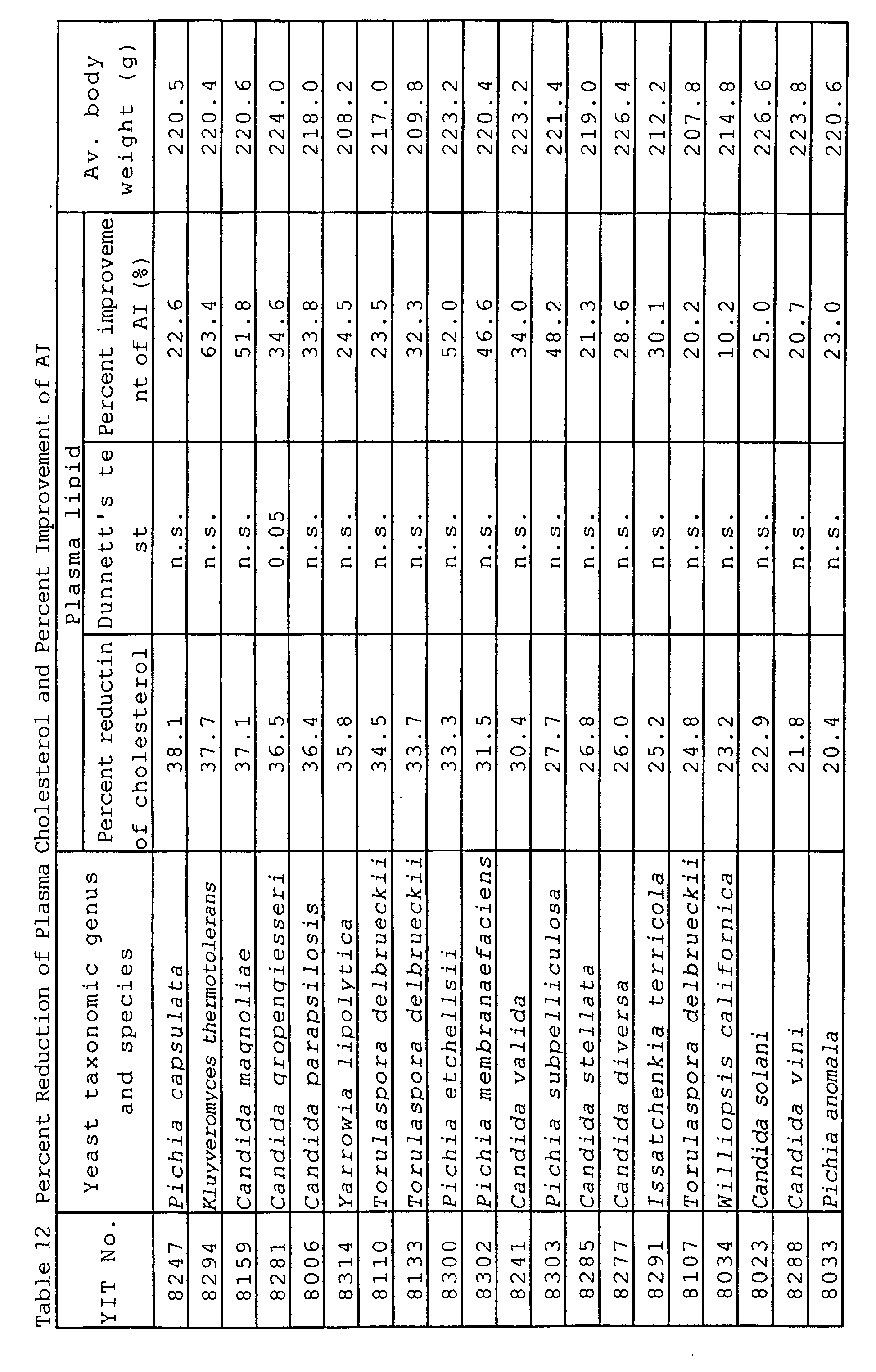
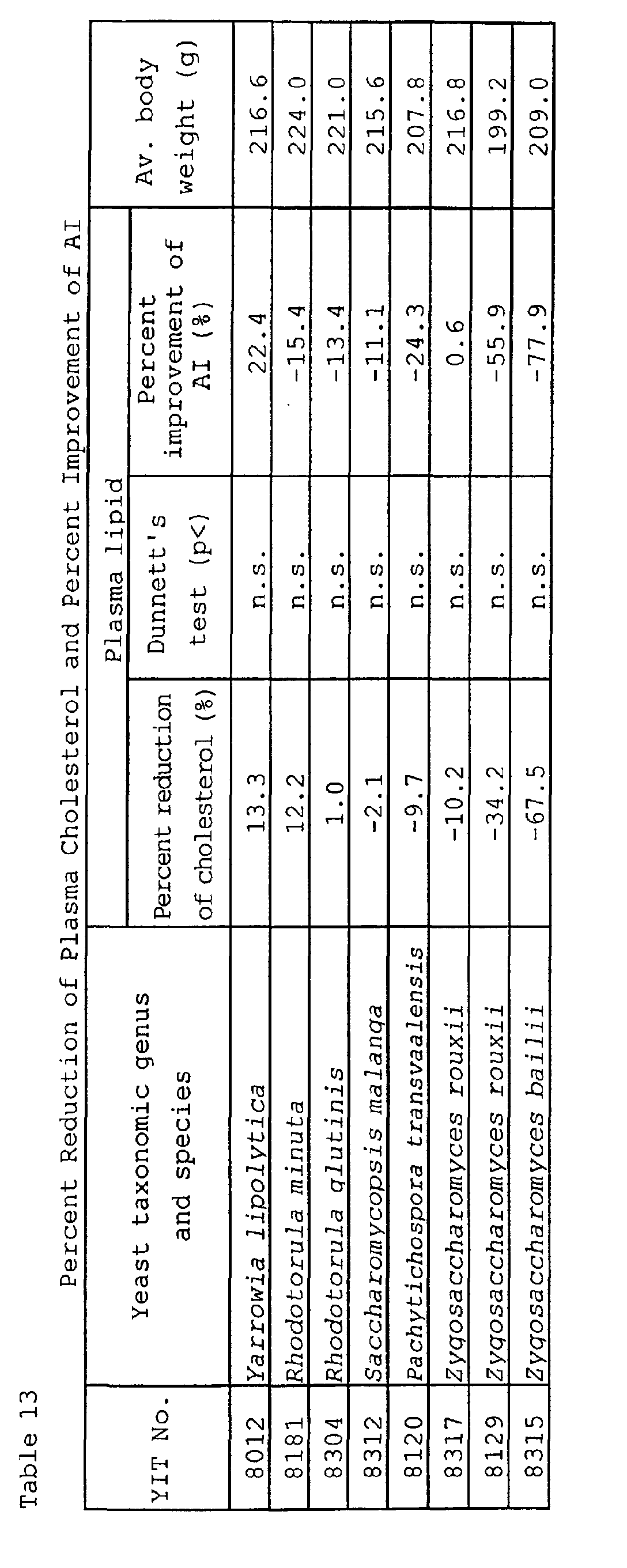
- Tables 11 to 13 show the percent reduction of cholesterol level and the percent improvement (%) of atherosclerotic index, based on the plasma cholesterol level of the high-cholesterol-diet administration control group. No significant change in weight was observed among the tested groups.
- Example 3 10% Yeast-added diet administration test
- Jar culture was performed in accordance with the method of Example 1 (A), to thereby prepare 200 g of lyophilized cells of each yeast.
- Each cell sample was mixed into a cholesterol-added diet at 10% (10% yeast group in Table 8).
- the resultant diet was administered to each group consisting of eight rats, and consumed ad libitum for seven days.
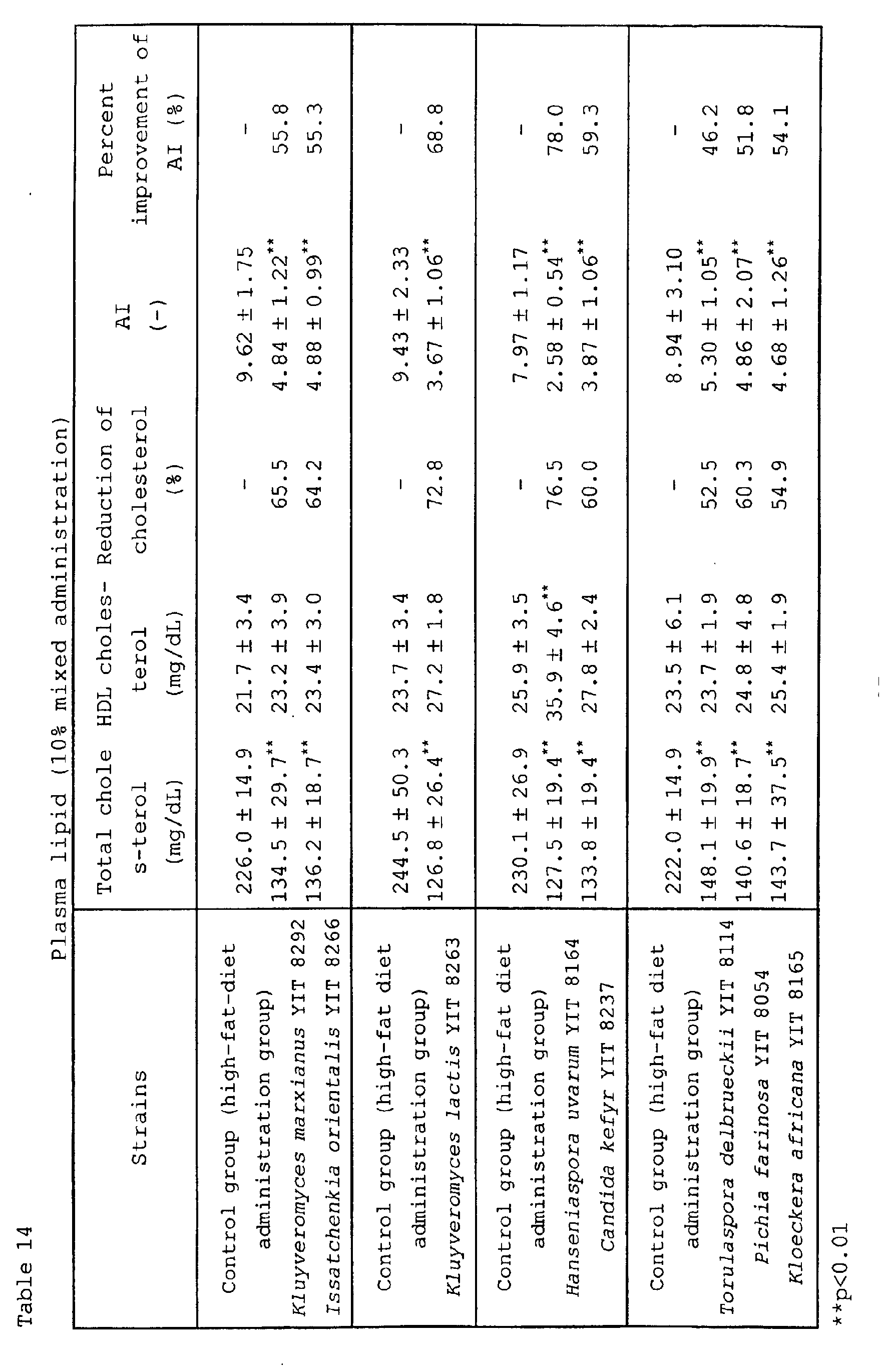
- Table 14 shows the results of plasma lipid measurement.
- the control group Through administration of a cholesterol-added high-fat food, the control group exhibited increase in total cholesterol level and elevation of atherosclerotic index to 7.97-9.62.
- yeasts i.e., Kluyveromyces marxianus YIT 8292, Kluyveromyces lactis YIT 8263, Hanseniaspora uvarum YIT 8164, Issatchenkia orientalis YIT 8266, Candida kefyr YIT 8237, and Pichia farinosa YIT 8058, exhibited remarkably excellent percent reduction of plasma cholesterol and were found to improve atherogenic index.
- Example 4 5% Yeast-added diet administration test
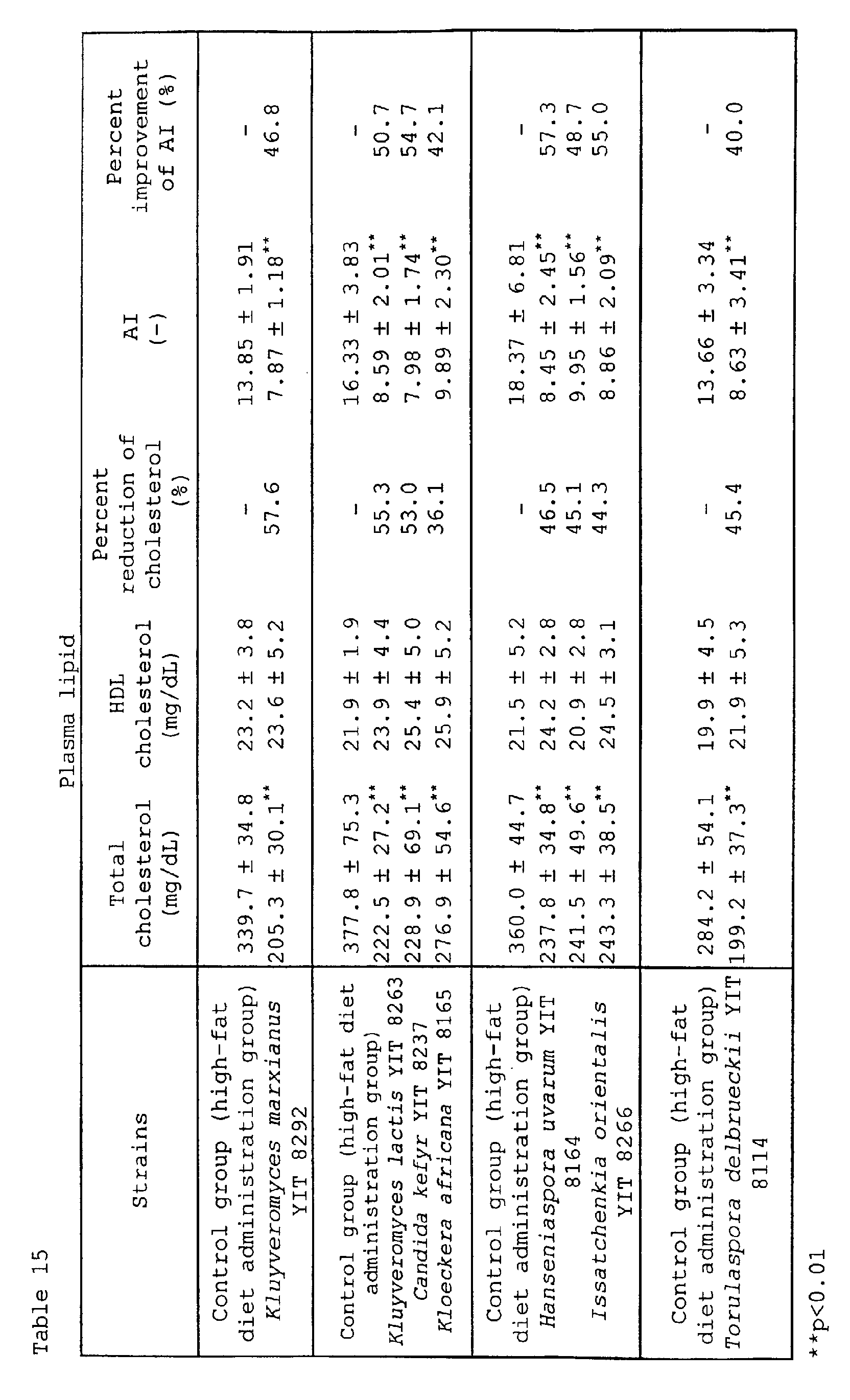
- Example 3 employing male 5-week-old Wistar rats was repeated, except that each lyophilized cell sample was mixed into a diet for test groups at 5% (5% yeast group in Table 8); the resultant diet was administered to each group consisting of eight rats; with restricted amount (15 g/day) for 14 days.
- Table 15 shows the results of plasma lipid analysis.
- the control group exhibited increase in total cholesterol level and elevation of atherogenic index.
- Table 16 shows the results of hepatic lipid measurement. In all test groups, the total hepatic cholesterol level decreased significantly, as compared with the control group.
- the yeasts according to the present invention have been found to serve as an excellent anti-cholesterol material which exerts an effect of lowering plasma lipid through peroral administration, as well as an effect of lowering hepatic lipid.
- Control group (high-fat diet administration group) 538.9 ⁇ 53.5 Kluyveromyces marxianus YIT 8292 459.6 ⁇ 44.9 Control group (high-fat diet administration group) 469.1 ⁇ 54.3 Kluyveromyces lactis YIT 8263 370.2 ⁇ 51.1 Candida kefyr YIT 8237 368.5 ⁇ 67.1 Kloeckera africana YIT 8165 399.5 ⁇ 43.3 Control group (high-fat diet administration group) 422.2 ⁇ 57.2 Hanseniaspora uvarum YIT 8164 390.8 ⁇ 49.1 Issatchenkia orientalis YIT 8266 348.5 ⁇ 36.9 Pichia farinosa YIT 8058 331.9 ⁇ 40.2 Control group (high-fat diet administration group) 463.1 ⁇ 66.9 Torulaspora delblueckii YIT 8114 380.1 ⁇ 65.4
- CA cholic acid
- TCA taurocholic acid
- GCA glycocholic acid
- DSA chenodeoxycholic acid
- DCA deoxycholic acid
- a sodium salt thereof product of Sigma was dissolved in a 0.1M phosphate buffer (pH 6.7) or a 0.1M phosphate buffer (pH 7.5) such that the final concentration was adjusted to 1 mM.
- Lyophylized cells 100 mg of Issatchenkia orientalis YIT 8266 were placed in a centrifugation tube (15 mL), and each bile acid solution (3.5 mL) prepared above was added thereto. The mixture was shaken (120 spm) at 37°C. One hour later, yeast cells were caused to precipitate through centrifugation (12,000 rpm, 10 minutes), to thereby collect the supernatant. The bile acid contained in the supernatant was quantitated by use of Enzabile II (product of Daiichi Pure Chemicals Co., Ltd.), and percent bile acid adsorption was calculated on the basis of the following formula.
- percent bile acid adsorption refers to a ratio (%) of the amount of bile acid adsorbed by yeast to the total amount of added bile acid, and the ratio serves as an index of the adsorption strength between the yeast and the bile acid.
- percent bile acid adsorption (%) [ ⁇ added bile acid (nmol) - bile acid in supernatant (nmol) ⁇ /added bile acid (nmol)] ⁇ 100
- Table 17 shows the percent bile acid adsorption. Issatchenkia orientalis YIT 8266 has been found to adsorb cholic acid, taurocholic acid, glycocholic acid, or chenodeoxycholic acid, exhibiting excellent primary bile acid adsorption power. The percent adsorption of bile acid by yeast did not depend on the pH (6.7 and 7.2) of the reaction mixture. These results indicate that the yeast tightly binds to primary bile acid in the large intestinal tract and inhibits deconjugation and 7 ⁇ -dehydroxylation caused by enterobacteria, to thereby inhibit production of secondary bile acid.
- the yeast tightly binds to deoxycholic acid ⁇ a type of secondary bile acid. This indicates that, in addition to inhibiting of production of secondary bile acid, the yeast also adsorbs and immobilizes formed secondary bile acid, to thereby reduce the toxicity thereof.
- Percent Bile Acid Adsorption by Issatchenkia orientalis % Yeast CA pH6.7 CA pH7.5 TCA pH7.5 GCA pH7.5 CDCA pH7.5 DCA pH7.5 Issatchenkia orientalis YIT 8266 40.3 40.2 29.3 43.8 68.8 73.7
- Example 7 Inhibition of secondary bile acid production by lyophilized cells of Issatchenkia orientalis YIT 8266
- mice Male, 5-week-old Wistar rats (obtained from Nihon Kurea) had been bred for 7 days with diet powder F-2 (product of Oriental Yeast). The rats were divided into groups such that no weight difference generates among the groups, each group containing 8 rats. To each group, the diet shown in Table 19 was administered for 14 days. The rats were bred individually in a metal-made cage, and allowed to consume diet and water ad libitum.
- Diet Composition [%] Ingredient Ordinary diet High-bile-acid d iet Casein 22.30 22.30 Sucrose 56.55 55.80 Inorganic salt 4.00 4.00 Vitamins 1.00 1.00 Soybean oil 1.00 1.00 Lard 10.00 10.00 Choline bitartrate 0.15 0.15 Cholesterol 0.00 0.50 Sodium cholate 0.00 0.25 Filter paper powder 5.00 5.00
- Lyophylized feces (day 12 to day 14) (25 mg) were weighed and placed in a test tube (15 mL) equipped with a screw cap, and an internal standard substance (5- ⁇ -pregnane-3 ⁇ , 17 ⁇ , 20 ⁇ -triol) (0.15 ⁇ mol) and ethanol (5 mL) were added thereto.
- the mixture was heated at 70°C for two hours by means of a block heater.
- the resultant insoluble matter was precipitated through centrifugation (3,000 rpm, 15 minutes). The supernatant was transferred to another test tube and dried to solid under nitrogen flow.
- the eluate provided from a separation column was mixed, at a flow rate of 1.0 mL/minute, with a reaction mixture (0.3 mM ⁇ -nicotinamide adenine dinucleotide ( ⁇ -NAD + ), 1 mM ethylenediaminetetraacetic acid, and 10 mM potassium phosphate buffer (pH 7.8) containing 0.05% 2-mercaptoethanol).
- a reaction mixture 0.3 mM ⁇ -nicotinamide adenine dinucleotide ( ⁇ -NAD + ), 1 mM ethylenediaminetetraacetic acid, and 10 mM potassium phosphate buffer (pH 7.8) containing 0.05% 2-mercaptoethanol).
- the liquid mixture was transferred to an enzyme column (Enzymepak (4.6 mm i.d.
- Each bile acid was identified on the basis of the retention time with reference to the standard.
- the bile acid concentration was obtained from the corresponding peak area. In this case, percent recovery was corrected by the peak area of the internal standard.
- Table 21 shows the results. The results indicate that administration of cholic acid increases the level of primary bile acid reaching the large intestinal tract, to thereby promote production of secondary bile acid. Thus, the effect of a secondary bile acid production inhibitor can be evaluated at high sensitivity.
- Lyophylized cells of Issatchenkia orientalis YIT 8266 were added to a high-bile-acid diet, and the resultant diet was administered for 14 days (5% mix diet) (Table 22).
- the energy score of each diet was equalized by controlling the amount of casein, saccharose, lipid, or cellulose.
- Administration of yeast cells provided substantially no influence on diet consumption and substantially no influence on increase in body weight during the test period (Table 23).
- Issatchenkia orientalis YIT 8266 exerted an effect of strongly inhibiting conversion of primary bile acid to secondary bile acid.
- Level of Bile Acids Excreted in Feces [ ⁇ mol/day] High-bile-acid diet Yeast-added high-bile-acid diet
- the contents in the decum (day 14) (0.5 g) were suspended in purified water (4.5 mL), and a 10% aqueous perchloric acid solution (0.5 mL) was added to the suspension.
- the resultant suspension was stored at 4°C overnight.
- the suspension was centrifuged (9,000 rpm, 10 minutes), and the supernatant was collected and passed through a filter (0.45 ⁇ m) (product of Nihon Millipore Ltd.).
- the thus-prepared analysis sample was subjected to HPLC.
- Short-chain fatty acids were analyzed by means of an HPLC system (product of Toa Dempa Kogyo) under the following conditions.
- the pH buffer was mixed with the eluent immediately before passage of the detector.
- Short-Chain Fatty Acid Analysis Conditions Column KC-811 Shodex (Showa Denko) ⁇ 2 Eluent(flow) 15mM Perchloric acid solution containing 7% acetonitrile (1 mL/min) Column temperature 42°C 15 mM Perchloric acid solution containing 7% acetonitrile and pH-Regulator (flow) 60 mM tris(hydroxymethyl)aminomethane (1 mL/min) Detector Conductivity detector (Toa Denpa Kogyo) Cell temperature 45°C pH and Short-Chain Fatty Acid Content in the Cecum High-bile-acid diet Yeast-added high-bile-acid diet pH in the cecum 6.65 ⁇ 0.08 6.46 ⁇ 0.20* Short-Cha
- High-bile-acid-diet groups exhibited a pH in the cecum of 6.65 and a total amount of short-chain fatty acid of 55.9 mM
- yeast ( Issatchenkia orientalis YIT 8266)-added high-bile-acid-diet groups exhibited a pH in the cecum of 6.46 (significance level 5%) and a total amount of short-chain fatty acid of 85.6 mM (significance level 1%), indicating decrease in pH in the cecum.
- yeast Issatchenkia orientalis YIT 8266
- Feces (day 14) 25 mg were weighed and placed in a test tube (15 mL) equipped with a screw cap, and an internal standard substance (5 ⁇ -cholestane) (0.1 ⁇ mol) and a 90% ethanol solution containing 1N sodium hydroxide (1 mL) were added thereto.
- the mixture was heated at 80°C by means of a block heater.
- distilled water (0.5 mL) was added, and neutral sterols were taken through two rounds of extraction by use of petroleum ether (2.5 mL).
- the resultant extract was washed with distilled water (7.5 mL), dehydrated over sodium sulfate, and dried to solid under nitrogen gas flow.
- Issatchenkia orientalis YIT 8266 Through administration of Issatchenkia orientalis YIT 8266, the concentrations in feces of coprostanol and coprostanone ⁇ decreased cholesterol metabolites in the intestine significantly (Table 29). Since these cholesterol metabolites in the large intestine are related to onset of diseases such as colovectal cancer (Suzuki, K., et al. , Cancer Lett. , 33, 307-316, 1986), Issatchenkia orientalis YIT 8266 is thought to be capable of preventing or treating a variety of diseases, by means of inhibiting production of cholesterol metabolites.
- Example 8 Inhibition of secondary bile acid production by cell contents of Issatchenkia orientalis YIT 8266
- Lyophilized cells of Issatchenkia orientalis YIT 8266 were suspended in a 0.1M phosphate buffer (pH 8.5), and the cells were mechanically ground by means of DYNO-MILL (product of Shinmaru Enterprises). During grinding, 0.45 mm glass beads were employed as a grinding agent, and grinding operation was repeated until grinding of 95% or more cells was confirmed through microscopic observation. The milled cell liquid was centrifuged (9,000 g, 15 minutes), to thereby isolate cell contents in the supernatant. The cell contents were collected and lyophilized.
- Table 30 shows the diet composition employed in the test.
- Administration of yeast cell contents exerted substantially no influence on diet consumption and substantially no influence on increase in body weight during the test period (Table 31).
- Diet Composition (%) Ingredients High-bile-acid diet diet Cell-content-added high-bile-acid diet Casein 22.30 20.78 Sucrose 55.80 53.12 Inorganic salt 4.00 4.00 Vitamins 1.00 1.00 Soybean oil 1.00 1.00 Lard 10.00 9.77 Choline bitartrate 0.15 0.15 Cholesterol 0.50 0.50 Sodium cholate 0.25 0.25 Filter paper powder 5.00 4.43 Cell contents 0.00 5.00 Diet Consumption and Increase in Body Weight during the Test Period High-bile-acid diet Cell-content-added high-bile-acid diet Diet consumption [g/14 days] 232.8 ⁇ 9.9 220.7 ⁇ 6.5 Body weight increase [g/14 days] 95.9 ⁇ 4.0 88.4 ⁇ 4.5 n.s.
- high-bile-acid-diet groups exhibited a total amount of 54.0 mM and a pH of 6.65
- yeast-cell contents-added high-bile-acid-diet groups exhibited a total amount of 68.3 mM (significance level 5%) and a pH of 6.46 (significance level 5%).
- the yeast cell contents shifted the large intestinal pH condition to more acidic by increasing the amount of short-chain fatty acid, to thereby deactivate 7 ⁇ -dehydroxylase of enterobacteria.
- Issatchenkia orientalis YIT 8266 As a result of administration of cell contents of Issatchenkia orientalis YIT 8266, the concentrations in feces of coprostanol and coprostanone ⁇ decreased cholesterol metabolites in the intestine significantly. Thus, similar to the case of the lyophilized cells, cell contents of Issatchenkia orientalis YIT 8266 are thought to be capable of preventing or treating a variety of diseases by inhibiting production of cholesterol metabolites.
- composition containing the following additives was pelletized, to thereby prepare tablets.
- Composition of Food for Maintaining and Promoting Health [%] Dried yeast cells 10 Plant extract powder 30 Royal jelly powder 5 Collagen powder 5 Lactose 25 Corn starch 20 Hydroxypropyl celllose 4 Mg stearate 1
- a drink for maintaining and promoting health was produced in accordance with the following formulation.
- Composition of Drink for Maintaining and Promoting Health [%] Dried yeast cells 5 Honey 15 Citric acid 0.1 dl-Malic acid 0.1 Plant extract (cinnamon) 20 D-Solbitol liquid (70%) 10 Sodium benzoate 0.05 Flavors suitable amount Purified water balance
- the drink was produced in accordance with the following formulation.
- Composition of Fruit-Juice-Blended Drink [%] Glucose liquid sugar 33 Grapefruit juice 60 Dried yeast cells 5 Flavors suitable amount Sour agent suitable amount
- Fermented milk containing heated yeast cells was produced in accordance with the following formulation.
- Example 1 To a sterilized mixture of 10% skimmed milk powder liquid and 5% glucose, a bacterium belonging to Lactobacillus was inoculated, to thereby produce yogurt. To the yogurt, heated yeast cells obtained in Example 1 were added in an amount of 0.1-20%, to thereby produce fermented milk.
- Example 1 To a sterilized mixture of 10% skimmed milk powder liquid and 5% glucose, a bacterium belonging to Lactobacillus and heated yeast cells obtained in Example 1 were inoculated simultaneously. The mixture was subjected to stationary culturing at 37°C for 48 hours, to thereby produce milk liquor.
- the cholesterol-lowering agent of the present invention comprising the aforementioned yeast cells or yeast cell contents exerts a remarkable effect of lowering plasma cholesterol and hepatic cholesterol, and therefore is very effective for preventing arteriosclerosis and other diseases caused by accumulation of cholesterol.
- the secondary bile acid production inhibitor of the present invention strongly inhibits production of secondary bile acid through adsorption of bile acid, acidic-shift of pH condition in the large intestine, etc., and therefore is very effective for prevention and treatment of colorectal cancer, liver cancer, pancreatic cancer, bile duct cancer, cholelithiasis, etc.
- the yeasts employed in the present invention having no pathogenicity are considerably safe, as evidenced by these yeasts having been used for producing cheese, koumiss, wine, etc. from ancient times.
- the cholesterol-lowering agent of the present invention comprising the yeast cells or yeast cell contents raises no problem when administered for a long period of time. This is confirmed by the finding that no death case has been observed among rats to which the agent had been perorally administered at a dose of 8 g/kg.
- the cholesterol-lowering agent and secondary bile acid production inhibitor of the present invention can be used as a peroral pharmaceutical, and are also very effective for maintaining health and preventing arteriosclerosis, colovectal cancer, liver cancer, pancreatic cancer, bile duct cancer, cholelithiasis, etc. by causing constant consumption of foods containing the agent or inhibitor.
Landscapes
- Health & Medical Sciences (AREA)
- Life Sciences & Earth Sciences (AREA)
- Chemical & Material Sciences (AREA)
- Engineering & Computer Science (AREA)
- Mycology (AREA)
- Polymers & Plastics (AREA)
- Food Science & Technology (AREA)
- Nutrition Science (AREA)
- Microbiology (AREA)
- Public Health (AREA)
- Pharmacology & Pharmacy (AREA)
- Medicinal Chemistry (AREA)
- Animal Behavior & Ethology (AREA)
- General Health & Medical Sciences (AREA)
- Veterinary Medicine (AREA)
- Natural Medicines & Medicinal Plants (AREA)
- Chemical Kinetics & Catalysis (AREA)
- Organic Chemistry (AREA)
- General Chemical & Material Sciences (AREA)
- Nuclear Medicine, Radiotherapy & Molecular Imaging (AREA)
- Biotechnology (AREA)
- Medical Informatics (AREA)
- Epidemiology (AREA)
- Botany (AREA)
- Alternative & Traditional Medicine (AREA)
- Bioinformatics & Cheminformatics (AREA)
- Diabetes (AREA)
- Hematology (AREA)
- Obesity (AREA)
- Heart & Thoracic Surgery (AREA)
- Cardiology (AREA)
- Oncology (AREA)
- Medicines Containing Material From Animals Or Micro-Organisms (AREA)
- Coloring Foods And Improving Nutritive Qualities (AREA)
Abstract
Description


| Composition of Medium for Pre-Culture and Culture | |
| Glucose (Kanto Chemical) | 30 g |
| Polypeptone (Daigo Eiyo) | 10 g |
| Yeast extract (Daigo Eiyo) | 5 g |
| Monopotassium phosphate (Wako Pure Chemical) | 1 g |
| Dipotassium phosphate (Wako Pure Chemical) | 2 g |
| Magnesium sulfate (Wako Pure Chemical) | 0.5 g |
| Tap water | 1 L |
| pH 6.0 |
| Diet Composition (%) | |||
| Ingredients | Control group | 10% Yeast administration group | 5% Yeast administration group |
| Casein | 22.30 | 17.35 | 19.83 |
| Soybean oil | 1.0 | 1.0 | 1.0 |
| Lard | 10.0 | 9.45 | 9.72 |
| Inorganic salt | 4.0 | 3.54 | 3.77 |
| Vitamins | 1.0 | 1.0 | 1.0 |
| Choline bitartrate | 0.15. | 0.15 | 0.15 |
| Cholesterol | 0.5 | 0.5 | 0.5 |
| Sodium cholate | 0.25 | 0.25 | 0.25 |
| Filter paper powder | 10.0 | 7.46 | 8.73 |
| Sucrose | 50.80 | 50.12 | 50.46 |
| Yeast cells | 0.0 | 10.0 | 5.0 |
| Plasma Lipid Concentration (day 14) | ||
| Diet administration groups | Cholesterol (mg/dL) | HDL cholesterol (mg/dL) |
| Cholesterol free diet (Control group) | 72.5 ± 6.1 | 45.9 ± 4.2 |
| Cholesterol added diet (high-fat diet administration group) | 325.3 ± 48.6 | 31.4 ± 4.00 |
| Intrahepatic Lipid Content (day 14) | |
| Diet administration groups | Total cholesterol (mg/liver) |
| Cholesterol free diet (Control group) | 32.9 ± 8.4 |
| Cholesterol added diet (high-fat diet administration group) | 637.9 ± 60.70 |

| Strains | Total cholesterol (mg/liver) |
| Control group (high-fat diet administration group) | 538.9 ± 53.5 |
| Kluyveromyces marxianus YIT 8292 | 459.6 ± 44.9 |
| Control group (high-fat diet administration group) | 469.1 ± 54.3 |
| Kluyveromyces lactis YIT 8263 | 370.2 ± 51.1 |
| Candida kefyr YIT 8237 | 368.5 ± 67.1 |
| Kloeckera africana YIT 8165 | 399.5 ± 43.3 |
| Control group (high-fat diet administration group) | 422.2 ± 57.2 |
| Hanseniaspora uvarum YIT 8164 | 390.8 ± 49.1 |
| Issatchenkia orientalis YIT 8266 | 348.5 ± 36.9 |
| Pichia farinosa YIT 8058 | 331.9 ± 40.2 |
| Control group (high-fat diet administration group) | 463.1 ± 66.9 |
| Torulaspora delblueckii YIT 8114 | 380.1 ± 65.4 |
| Percent Bile Acid Adsorption by Issatchenkia orientalis (%) | ||||||
| Yeast | CA pH6.7 | CA pH7.5 | TCA pH7.5 | GCA pH7.5 | CDCA pH7.5 | DCA pH7.5 |
| Issatchenkia orientalis YIT 8266 | 40.3 | 40.2 | 29.3 | 43.8 | 68.8 | 73.7 |

| Diet Composition [%] | ||
| Ingredient | Ordinary diet | High-bile-acid d iet |
| Casein | 22.30 | 22.30 |
| Sucrose | 56.55 | 55.80 |
| Inorganic salt | 4.00 | 4.00 |
| Vitamins | 1.00 | 1.00 |
| Soybean oil | 1.00 | 1.00 |
| Lard | 10.00 | 10.00 |
| Choline bitartrate | 0.15 | 0.15 |
| Cholesterol | 0.00 | 0.50 |
| Sodium cholate | 0.00 | 0.25 |
| Filter paper powder | 5.00 | 5.00 |
| Conditions for Separating Bile Acids | |
| Liquid A | Acetonitrile / Methanol / 30 mM Ammonium acetate (30:30:40) mixture |
| Liquid B | Acetonitrile / Methanol / 30 mM Ammonium acetate (20:20:60) mixture |
| Elution conditions | Proportional concentration gradient from 100% B + 0% A to 0% B + 100% A over 32 min. followed by elution for 13 min. by use of 100% A. |
| Flow rate | 1.0 mL/min |
| Column temperature | 25°C |
| Bilepak-II (4.6 mm i.d.×250 mm) (separation column, product of Jasco) |
| Level of Bile Acids Excreted in Feces [µmol/day] | ||
| Ordinary diet | High-bile-acid diet | |
| Primary bile acid | ||
| α-Muricholic acid | 1.52 ± 0.35 | 8.52 ± 3.05 |
| β-Muricholic acid | 0.20 ± 0.09 | 8.48 ± 1.55 |
| Hyocholic acid | 0.00 ± 0.00 | 0.23 ± 0.21 |
| Cholic acid | 0.00 ± 0.00 | 29.20 ± 7.44 |
| Chenodeoxycholic acid | 0.00 ± 0.00 | 0.57 ± 0.20 |
| Total primary bile acids | 1.72 ± 0.40 | 47.00 ± 10.31 |
| Secondary bile acid | ||
| Deoxycholic acid | 0.72 ± 0.26 | 9.13 ± 5.92 |
| Lithocholic acid | 0.18 ± 0.10 | 0.13 ± 0.18 |
| Hyodeoxycholic acid | 0.01 ± 0.03 | 1.06 ± 0.54 |
| Total secondary bile acids | 0.90 ± 0.35 | 10.32 ± 5.84 |
| Diet Composition [%] | ||
| Ingredients | High-bile-acid diet | Yeast-added high-bile-acid diet |
| Casein | 22.30 | 20.56 |
| Sucrose | 55.80 | 54.15 |
| Inorganic salt | 4.00 | 4.00 |
| Vitamins | 1.00 | 1.00 |
| Soybean oil | 1.00 | 1.00 |
| Lard | 10.00 | 9.85 |
| Choline bitartrate | 0.15 | 0.15 |
| Cholesterol | 0.50 | 0.50 |
| Sodium cholate | 0.25 | 0.25 |
| Filter paper Powder | 5.00 | 3.55 |
| Heat-dried yeast cells | 0.00 | 5.00 |
| Diet Consumption and Body Weight Increase during Test Period | ||
| High-bile-acid diet | Yeast-added high-bile-acid diet | |
| Diet consumption [g/14 days] | 236.0 ± 8.6 | 227.8 ± 21.5 |
| Body weight increase [g/14 days] | 95.9 ± 4.0 | 93.6 ± 11.9 |
| Level of Bile Acids Excreted in Feces [µmol/day] | ||
| High-bile-acid diet | Yeast-added high-bile-acid diet | |
| Primary bile acid | ||
| α-Muricholic acid | 13.70 ± 3.40 | 15.27 ± 3.12n.s |
| β-Muricholic acid | 7.32 ± 2.07 | 11.60 ± 2.48 |
| Hyocholic acid | 0.12 ± 0.17 | 0.29 ± 0.15 |
| Cholic acid | 24.37 ± 5.86 | 35.30 ± 2.55** |
| Chenodeoxycholic acid | 1.10 ± 0.41 | 1.34 ± 0.27n.s. |
| Total primary Bile acids | 46.60 ± 7.30 | 63.80 ± 6.81** |
| Secondary bile acid | ||
| Deoxycholic acid | 10.10 ± 6.51 | 0.22 ± 0.46** |
| Lithocholic acid | 0.35 ± 0.31 | 0.00 ± 0.00 |
| Hyodeoxycholic acid | 0.80 ± 0.32 | 1.81 ± 0.64n.s. |
| Total secondary Bile acids | 11.25 ± 6.59 | 2.03 ± 0.81** |
| Composition of Bile Acids in Feces [%] | ||
| High-bile-acid diet diet | Yeast-added high-bile-acid diet | |
| Primary bile acid | ||
| α-Muricholic acid | 23.58 ± 5.32 | 23.11 ± 3.47n.s. |
| β-Muricholic acid | 12.59 ± 3.07 | 17.50 ± 2.51 |
| Hyocholic acid | 0.19 ± 0.27 | 0.43 ± 0.22n.s. |
| Cholic acid | 42.47 ± 11.42 | 53.87 ± 3.01 |
| Chenodeoxycholic acid | 1.89 ± 0.65 | 2.06 ± 0.50 |
| Total primary bile acids | 80.72 ± 11.55 | 96.97 ± 0.98** |
| Secondary bile acid | ||
| Deoxycholic acid | 17.30 ± 11.46 | 0.30 ± 0.67** |
| Lithocholic acid | 0.59 ± 0.53 | 0.00 ± 0.00* |
| Hyodeoxycholic acid | 1.39 ± 0.59 | 2.73 ± 0.89** |
| Total secondary bile acids | 19.28 ± 11.55 | 3.03 ± 0.98** |
| High-bile-acid diet | Yeast-added high-bile-acid diet |
| Short-Chain Fatty Acid Analysis Conditions | |
| Column | KC-811 Shodex (Showa Denko) × 2 |
| Eluent(flow) | 15mM Perchloric acid solution containing 7% acetonitrile (1 mL/min) |
| Column temperature | 42°C 15 mM Perchloric acid solution containing 7% acetonitrile and |
| pH-Regulator (flow) | 60 mM tris(hydroxymethyl)aminomethane (1 mL/min) |
| Detector | Conductivity detector (Toa Denpa Kogyo) |
| Cell temperature | 45°C |
| pH and Short-Chain Fatty Acid Content in the Cecum | ||
| High-bile-acid diet | Yeast-added high-bile-acid diet | |
| pH in the cecum | 6.65 ± 0.08 | 6.46 ± 0.20* |
| Short-Chain Fatty Acid content [mM] | ||
| Acetic acid | 26.6 ± 8.4 | 37.5 ± 4.0** |
| Propionic acid | 7.2 ± 2.3 | 17.5 ± 4.0 |
| Butyric acid | 2.2 ± 1.4 | 3.9 ± 0.8 |
| Lactic acid | 2.5 ± 1.0 | 2.6 ± 1.2 |
| Succinic acid | 15.5 ± 7.3 | 21.8 ± 7.4n.s. |
| Formic acid | 1.1 ± 0.6 | 1.8 ± 1.3n.s. |
| Isobutyric acid | 0.7 ± 0.6 | 0.4 ± 0.4n.s. |
| Total short-chain fatty acids | 55.9 ± 15.7 | 85.6 ± 5.2** |
| Chromatographic (GC) Analysis Conditions | |
| GC apparatus | Model 5890 (Yokogawa-Hewlett-Packard) |
| Column | SPB-1 FS-coated capillary glass column (Supelco) 0.32 mm i.d. × 30 m |
| Column temperature | 250°C, 8 min → 270°C, 10°C/min → 270°C, 15 min |
| Carrier (flow) | He (0.8 mL/min) |
| Injector | Spilit, T = 230°C |
| Detector | FID, T = 280°C |
| Sample injection | 1 µL |
| Analysis time | 25 min |
| Neutral Cholesterol Composition in Feces [%] | ||
| High-bile-acid diet | Yeast-added high-bile-acid diet | |
| Coprostanol | 25.7 ± 12.5 | 9.2 ± 11.9 |
| Coprostanone | 1.9 ± 2.5 | 0.4 ± 0.6 |
| Cholesterol | 72.3 ± 14.2 | 90.5 ± 12.4* |
| Coprostanol + Coprostanone | + 27.7 ± 14.2 | 9.5 ± 12.4* |
| Diet Composition (%) | ||
| Ingredients | High-bile-acid diet diet | Cell-content-added high-bile-acid diet |
| Casein | 22.30 | 20.78 |
| Sucrose | 55.80 | 53.12 |
| Inorganic salt | 4.00 | 4.00 |
| Vitamins | 1.00 | 1.00 |
| Soybean oil | 1.00 | 1.00 |
| Lard | 10.00 | 9.77 |
| Choline bitartrate | 0.15 | 0.15 |
| Cholesterol | 0.50 | 0.50 |
| Sodium cholate | 0.25 | 0.25 |
| Filter paper powder | 5.00 | 4.43 |
| Cell contents | 0.00 | 5.00 |
| Diet Consumption and Increase in Body Weight during the Test Period | ||
| High-bile-acid diet | Cell-content-added high-bile-acid diet | |
| Diet consumption [g/14 days] | 232.8 ± 9.9 | 220.7 ± 6.5 |
| Body weight increase [g/14 days] | 95.9 ± 4.0 | 88.4 ± 4.5n.s. |
| Level of Bile Acids Excreted in Feces [µmol/day] | ||
| High-bile-acid diet | Cell-content-added high-bile-acid diet | |
| Primary bile acid | ||
| α-Muricholic acid | 8.56 ± 1.85 | 6.80 ± 2.04n.s. |
| β-Muricholic acid | 6.80 ± 2.18 | 8.70 ± 3.04n.s. |
| Hyocholic acid | 0.20 ± 0.15 | 0.25 ± 0.06n.s. |
| Cholic acid | 28.96 ± 11.99 | 29.99 ± 4.77n.s. |
| Chenodeoxycholic acid | 0.44 ± 0.29 | 0.64 ± 0.35n.s. |
| Total primary bile acids | 44.96 ± 13.17 | 46.37 ± 9.40 |
| Secondary bile acid | ||
| Deoxycholic acid | 9.87 ± 5.46 | 2.01 ± 2.26 |
| Lithocholic acid | 0.02 ± 0.05 | 0.00 ± 0.00n.s |
| Hyodeoxycholic acid | 0.65 ± 0.36 | 0.49 ± 0.14n.s |
| Total secondary bile acids | 10.54 ± 5.29 | 2.51 ± 2.18** |
| Composition of Bile Acids in Feces [%] | ||
| High-bile-acid diet | Cell-content-added high-bile-acid diet | |
| Primary bile acid | ||
| α-Muricholic acid | 16.01 ± 4.33 | 13.75 ± 1.82n.s. |
| β-Muricholic acid | 12.39 ± 3.19 | 17.30 ± 3.29** |
| Hyocholic acid | 0.34 ± 0.20 | 0.51 ± 0.09n.s. |
| Cholic acid | 51.04 ± 10.63 | 62.47 ± 6.95 |
| Chenodeoxycholic acid | 0.76 ± 0.34 | 1.27 ± 0.56 |
| Total primary bile acids | 79.82 ± 8.31 | 94.02 ± 3.61** |
| Secondary bile acid | ||
| Deoxycholic acid | 8.29 ± 8.90 | 3.64 ± 3.76** |
| Lithocholic acid | 0.04 ± 0.11 | 0.00 ± 0.00n.s |
| Hyodeoxycholic acid | 1.13 ± 0.38 | 1.07 ± 0.44n.s |
| Total secondary bile acids | 20.18 ± 8.31 | 5.98 ± 3.61** |
| pH and Short-Chain Fatty Acid Content in the Cecum | ||
| High-bile-acid diet diet | Cell-content-added high-bile-acid diet | |
| pH in the cecum | 6.65 ± 0.08 | 6.46 ± 0.20 |
| Short-Chain Fatty Acid content [mM] | ||
| Acetic acid | 26.2 ± 9.0 | 30.2 ± 7.1n.s. |
| Propionic acid | 7.2 ± 2.5 | 14.3 ± 2.2 |
| Butyric acid | 2.2 ± 1.5 | 2.1 ± 0.9 |
| Lactic acid | 2.4 ± 1.0 | 1.9 ± 1.2n.s. |
| Succinic acid | 14.3 ± 7.1 | 17.8 ± 6.4n.s. |
| Formic acid | 0.9 ± 0.3 | 1.8 ± 1.7n.s. |
| Isobutyric acid | 0.7 ± 0.7 | 0.2 + 0.2n.s. |
| Total short-chain fatty acids | 54.0 ± 15.9 | 68.3 ± 13.9* |
| Neutral Sterol Composition in Feces [%] | ||
| High-bile-acid diet | Cell-content-added high-bile-acid diet | |
| Coprostanol | 21.1 ± 8.2 | 10.0 ± 9.9 |
| Coprostanone | 2.0 ± 1.6 | 0.5 ± 0.5 |
| Cholesterol | 76.9 ± 9.6 | 89.6 ± 10.2* |
| Coprostanol + Coprostanone | 23.1 ± 9.6 | 12.1 ± 10.7* |
| Composition of Food for Maintaining and Promoting Health [%] | |
| Dried yeast cells | 10 |
| Plant extract powder | 30 |
| Royal jelly powder | 5 |
| Collagen powder | 5 |
| Lactose | 25 |
| Corn starch | 20 |
| Hydroxypropyl celllose | 4 |
| Mg stearate | 1 |
| Composition of Drink for Maintaining and Promoting Health [%] | |
| Dried yeast cells | 5 |
| Honey | 15 |
| Citric acid | 0.1 |
| dl-Malic acid | 0.1 |
| Plant extract (cinnamon) | 20 |
| D-Solbitol liquid (70%) | 10 |
| Sodium benzoate | 0.05 |
| Flavors | suitable amount |
| Purified water | balance |
| Composition of Fruit-Juice-Blended Drink [%] | |
| Glucose liquid sugar | 33 |
| Grapefruit juice | 60 |
| Dried yeast cells | 5 |
| Flavors | suitable amount |
| Sour agent | suitable amount |
Claims (19)
- A cholesterol-lowering agent containing, as an active ingredient, at least one yeast belonging to Candida, Issatchenkia, Hanseniaspora, Kloeckera, Kluyveromyces, Pichia, or Torulaspora.
- A cholesterol-lowering agent containing, as an active ingredient, at least one yeast selected from among Candida kefyr, Issatchenkia orientalis, Hanseniaspora uvarum, Kloeckera africana, Kluyveromyces marxianus, Kluyveromyces lactis, Pichia farinosa, and Torulaspora delbrueckii.
- A food and drink for reducing cholesterol containing a yeast as recited in claim 1 or 2.
- A secondary bile acid production inhibitor containing a yeast as an active ingredient.
- A secondary bile acid production inhibitor according to claim 4, wherein the yeast is at least one species selected from among Issatchenkia, Kluyveromyces, Hanseniaspora, Saccharomyces, Hyphopichia, Candida, Torulaspora, Pichia, and Zygosaccharomyces.
- A secondary bile acid production inhibitor according to claim 4, wherein the yeast is at least one species selected from among Issatchenkia orientalis, Kluyveromyces marxianus, Kluyveromyces lactis, Kluyveromyces thermotolerans, Hanseniaspora uvarum, Saccharomyces cerevisiae, Saccharomyces dairensis, Saccharomyces exiguus, Saccharomyces unisporus, Saccharomyces bayanus, Hyphopichia burtonii, Candida kefyr, Candida etchellsii, Candida zeylanoides, Candida solani, Candida maltosa, Candida tropicalis, Candida cylindracea, Candida utilis, Torulaspora delbrueckii, Pichia anomala, Pichia holstii, and Zygosaccharomyces rouxii.
- A food and drink for inhibiting secondary bile acid production containing a yeast as recited in any one of claims 4 to 6.
- Use, in the production of a cholesterol-lowering agent, of at least one yeast belonging to Candida, Issatchenkia, Hanseniaspora, Kloeckera, Kluyveromyces, Pichia, or Torulaspora.
- Use, in the production of a cholesterol-lowering agent, of at least one yeast selected from among Candida kefyr, Issatchenkia orientalis, Hanseniaspora uvarum, Kloeckera africana, Kluyveromyces marxianus, Kluyveromyces lactis, Pichia farinosa, and Torulaspora delbrueckii.
- Use of a yeast as recited in claim 1 or 2 in the production of a food and drink for reducing cholesterol.
- Use of a yeast in the production of a secondary bile acid production inhibitor.
- Use according to claim 11, wherein the yeast is at least one species selected from among Issatchenkia, Kluyveromyces, Hanseniaspora, Saccharomyces, Hyphopichia, Candida, Torulaspora, Pichia, and Zygosaccharomyces.
- Use of a yeast in the production of a secondary bile acid production inhibitor according to claim 11, wherein the yeast is at least one species selected from among Issatchenkia orientalis, Kluyveromyces marxianus, Kluyveromyces lactis, Kluyveromyces thermotolerans, Hanseniaspora uvarum, Saccharomyces cerevisiae, Saccharomyces dairensis, Saccharomyces exiguus, Saccharomyces unisporus, Saccharomyces bayanus, Hyphopichia burtonii, Candida kefyr, Candida etchellsii, Candida zeylanoides, Candida solani, Candida maltosa, Candida tropicalis, Candida cylindracea, Candida utilis, Torulaspora delbrueckii, Pichia anomala, Pichia holstii, Pachiticospora transverensis, and Zygosaccharomyces rouxii.
- Use, in the production of a food and drink for inhibiting secondary bile acid production, of a yeast as recited in any one of claims 11 to 13,.
- A treatment method for reducing cholesterol, comprising administration of at least one yeast belonging to Candida, Issatchenkia, Hanseniaspora, Kloeckera, Kluyveromyces, Pichia, or Torulaspora.
- A treatment method for reducing cholesterol, comprising administration of at least one yeast selected from among Candida kefyr, Issatchenkia orientalis, Hanseniaspora uvarum, Kloeckera africana, Kluyveromyces marxianus, Kluyveromyces lactis, Pichia farinosa, and Torulaspora delbrueckii.
- A treatment method for inhibiting secondary bile acid production, comprising administration of a yeast.
- A method according to claim 17, wherein the yeast is at least one species selected from among Issatchenkia, Kluyveromyces, Hanseniaspora, Saccharomyces, Hyphopichia, Candida, Torulaspora, Pichia, and Zygosaccharomyces.
- A method according to claim 17, wherein the yeast is at least one species selected from among Issatchenkia orientalis, Kluyveromyces marxianus, Kluyveromyces lactis, Kluyveromyces thermotolerans, Hanseniaspora uvarum, Saccharomyces cerevisiae, Saccharomyces dairensis, Saccharomyces exiguus, Saccharomyces unisporus, Saccharomyces bayanus, Hyphopichia burtonii, Candida kefyr, Candida etchellsii, Candida zeylanoides, Candida solani, Candida maltosa, Candida tropicalis, Candida cylindracea, Candida utilis, Torulaspora delbrueckii, Pichia anomala, Pichia holstii, Pachiticospora transverensis, and Zygosaccharomyces rouxii.
Applications Claiming Priority (5)
| Application Number | Priority Date | Filing Date | Title |
|---|---|---|---|
| JP20621899 | 1999-07-21 | ||
| JP20621899A JP4065360B2 (en) | 1999-07-21 | 1999-07-21 | Cholesterol lowering agent and food and drink |
| JP2000066659 | 2000-03-10 | ||
| JP2000066659A JP4535554B2 (en) | 2000-03-10 | 2000-03-10 | Secondary bile acid production inhibitor and food and drink |
| PCT/JP2000/004843 WO2001005412A1 (en) | 1999-07-21 | 2000-07-19 | Cholesterol-lowering agents, secondary bile acid procuction inhibitors and foods and drinks |
Publications (3)
| Publication Number | Publication Date |
|---|---|
| EP1206939A1 true EP1206939A1 (en) | 2002-05-22 |
| EP1206939A4 EP1206939A4 (en) | 2003-04-16 |
| EP1206939B1 EP1206939B1 (en) | 2008-10-15 |
Family
ID=26515510
Family Applications (1)
| Application Number | Title | Priority Date | Filing Date |
|---|---|---|---|
| EP00946404A Expired - Lifetime EP1206939B1 (en) | 1999-07-21 | 2000-07-19 | Cholesterol-lowering agents, secondary bile acid procuction inhibitors and foods and drinks |
Country Status (7)
| Country | Link |
|---|---|
| US (3) | US7101544B1 (en) |
| EP (1) | EP1206939B1 (en) |
| KR (1) | KR100717742B1 (en) |
| CN (1) | CN100356927C (en) |
| AU (1) | AU774978B2 (en) |
| DE (1) | DE60040548D1 (en) |
| WO (1) | WO2001005412A1 (en) |
Cited By (1)
| Publication number | Priority date | Publication date | Assignee | Title |
|---|---|---|---|---|
| CN108060091A (en) * | 2017-11-15 | 2018-05-22 | 宁夏红枸杞产业集团有限公司 | The application of aroma-producing yeast and its aroma-producing yeast in Chinese wolfberry fruit wine |
Families Citing this family (8)
| Publication number | Priority date | Publication date | Assignee | Title |
|---|---|---|---|---|
| MY146423A (en) * | 2005-10-22 | 2012-08-15 | Park Se Joon | Microorganisms having bad smell removal activity of organic waste and use thereof |
| JP2011516402A (en) * | 2008-03-07 | 2011-05-26 | 雪印乳業株式会社 | Adiponectin secretion promoter and / or suppressor |
| JP2013515085A (en) * | 2009-12-22 | 2013-05-02 | ジ・アドミニストレイターズ・オブ・ザ・チユレーン・エデユケーシヨナル・フアンド | Compositions and methods for treating obesity and diabetes |
| US8268305B1 (en) | 2011-09-23 | 2012-09-18 | Bio-Cat, Inc. | Method and compositions to reduce serum levels of triacylglycerides in human beings using a fungal lipase |
| US9987316B2 (en) * | 2012-09-14 | 2018-06-05 | Case Western Reserve University | Probiotic controlling fungi and uses thereof |
| US9670550B2 (en) * | 2013-02-12 | 2017-06-06 | Japanese Foundation For Cancer Research | Method for examination of carcinogenic risk |
| CN113577280A (en) * | 2020-04-30 | 2021-11-02 | 沈剑萍 | Product for selectively reducing intestinal secondary bile acid generation and application |
| CN113201462B (en) * | 2021-06-17 | 2022-07-26 | 广东海天创新技术有限公司 | Candida erickii ZB432 and application thereof |
Family Cites Families (35)
| Publication number | Priority date | Publication date | Assignee | Title |
|---|---|---|---|---|
| US470593A (en) * | 1892-03-08 | Hydraulic drill | ||
| JPS5639167B2 (en) * | 1973-10-19 | 1981-09-11 | ||
| GB1503653A (en) * | 1974-03-07 | 1978-03-15 | Unilever Ltd | Yeast containing food emulsions |
| US4313934A (en) | 1979-05-08 | 1982-02-02 | Kirin Beer Kabushiki Kaisha | Physiologically active polysaccharides, production and uses thereof |
| US4251519A (en) | 1979-07-30 | 1981-02-17 | Anheuser-Busch, Incorporated | Process for the prevention and reduction of elevated blood cholesterol and triglycerides levels |
| US4530846A (en) | 1983-02-15 | 1985-07-23 | Universal Foods Corporation | Method for the production of selenium yeast |
| JPS6030668A (en) * | 1983-07-28 | 1985-02-16 | Kagome Kk | Fermented drink and its preparation |
| US4740593A (en) | 1983-09-06 | 1988-04-26 | Microlife Technics, Inc. | Derived nisin producing microorganisms, method of production and use and products obtained thereby |
| US4716115A (en) | 1983-09-06 | 1987-12-29 | Microlife Technics, Inc. | Derived nisin producing microorganisms, method of production and use and products obtained thereby |
| ATE88215T1 (en) | 1983-09-06 | 1993-04-15 | Microlife Technics | DERIVED NISIN-PRODUCING MICROORGANISMS, METHODS OF MANUFACTURE AND USE, AND PRODUCTS SO OBTAINED. |
| JPS6094077A (en) | 1983-10-27 | 1985-05-27 | Kagome Kk | Fermented drink and its preparation |
| JPS60251857A (en) | 1984-05-29 | 1985-12-12 | Sankyo Food Kk | Flavor improver for food |
| EP0191513B2 (en) * | 1985-01-31 | 1992-12-09 | Unilever N.V. | A process for the preparation of food flavours |
| JPS6216424A (en) * | 1985-07-11 | 1987-01-24 | Rooto Seiyaku Kk | Antitumor active composition |
| US4739046A (en) * | 1985-08-19 | 1988-04-19 | Luzio Nicholas R Di | Soluble phosphorylated glucan |
| JPS6258987A (en) | 1985-09-07 | 1987-03-14 | Lotte Co Ltd | Novel yeast for assimilating ethanol |
| JPS62129223A (en) * | 1985-12-02 | 1987-06-11 | Taiyo Kagaku Kk | Production of antitumor substance |
| US4891220A (en) * | 1988-07-14 | 1990-01-02 | Immudyne, Inc. | Method and composition for treating hyperlipidemia |
| JPH02286057A (en) | 1989-04-28 | 1990-11-26 | Asahi Breweries Ltd | Water-soluble polysaccharides and food and beverages containing them |
| JPH0330667A (en) * | 1989-06-27 | 1991-02-08 | Snow Brand Milk Prod Co Ltd | Candida kefyr and candida tenuis to produce acidic polysaccharides having cholesterol and oxidized cholesterol adsorbing ability and acidic polysaccharides produced by the same fungi |
| JPH0449243A (en) | 1990-06-15 | 1992-02-18 | Chiba Seifun Kk | Cholesterol lowering agent and cholesterol lowering agent for animal |
| US5085875A (en) * | 1990-10-15 | 1992-02-04 | Alko Ltd. | Process of making a yeast fiber composition |
| AU1455292A (en) * | 1991-02-01 | 1992-09-07 | Bioglucans, L.P. | Soluble glucans |
| JP3217140B2 (en) | 1992-08-17 | 2001-10-09 | 協和醗酵工業株式会社 | New killer yeast |
| US5508461A (en) * | 1993-06-04 | 1996-04-16 | Daicel Chemical Industries, Ltd. | Optically active 1-phenyl-2-substituted propane derivatives and methods of producing the same |
| US5629200A (en) * | 1993-11-18 | 1997-05-13 | Daicel Chemical Industries, Ltd. | Production of optically active 2-amino-1-phenylethanol derivatives by asymetrical assimilation |
| US5622843A (en) * | 1993-12-30 | 1997-04-22 | Zymogenetics, Inc. | Phospholipid transfer proteins and DNA encoding them |
| JPH08242812A (en) | 1995-03-09 | 1996-09-24 | Rikagaku Kenkyusho | Functional food |
| AUPN166195A0 (en) | 1995-03-13 | 1995-04-06 | Norvet Research Pty Limited | Process for glucan extraction |
| JPH08298982A (en) * | 1995-05-02 | 1996-11-19 | Aasu Giken:Kk | Complex microbial pharmaceutical preparation |
| JPH0977674A (en) * | 1995-07-07 | 1997-03-25 | Kawashima Takaaki | Functional composition containing medicated dry yeast |
| JP2826808B2 (en) | 1995-07-14 | 1998-11-18 | カルピス株式会社 | Functional food with brain function improvement, learning ability enhancement and memory enhancement effect |
| JPH09107919A (en) | 1995-10-17 | 1997-04-28 | Meiji Seika Kaisha Ltd | Material for supplying magnesium, its manufacturing method and use |
| CN1066926C (en) * | 1996-04-08 | 2001-06-13 | 钟春燕 | Yebao-drink made from cocnut juice |
| JP4065360B2 (en) | 1999-07-21 | 2008-03-26 | 株式会社ヤクルト本社 | Cholesterol lowering agent and food and drink |
-
2000
- 2000-07-19 EP EP00946404A patent/EP1206939B1/en not_active Expired - Lifetime
- 2000-07-19 AU AU60205/00A patent/AU774978B2/en not_active Ceased
- 2000-07-19 US US10/031,569 patent/US7101544B1/en not_active Expired - Fee Related
- 2000-07-19 WO PCT/JP2000/004843 patent/WO2001005412A1/en not_active Ceased
- 2000-07-19 KR KR1020027000570A patent/KR100717742B1/en not_active Expired - Fee Related
- 2000-07-19 CN CNB008106746A patent/CN100356927C/en not_active Expired - Fee Related
- 2000-07-19 DE DE60040548T patent/DE60040548D1/en not_active Expired - Lifetime
-
2005
- 2005-07-08 US US11/176,398 patent/US7413740B2/en not_active Expired - Fee Related
-
2008
- 2008-05-22 US US12/125,545 patent/US7754204B2/en not_active Expired - Fee Related
Cited By (2)
| Publication number | Priority date | Publication date | Assignee | Title |
|---|---|---|---|---|
| CN108060091A (en) * | 2017-11-15 | 2018-05-22 | 宁夏红枸杞产业集团有限公司 | The application of aroma-producing yeast and its aroma-producing yeast in Chinese wolfberry fruit wine |
| CN108060091B (en) * | 2017-11-15 | 2021-06-11 | 宁夏红枸杞产业集团有限公司 | Aroma-producing yeast and application thereof in Chinese wolfberry fruit wine |
Also Published As
| Publication number | Publication date |
|---|---|
| US7101544B1 (en) | 2006-09-05 |
| KR100717742B1 (en) | 2007-05-11 |
| EP1206939B1 (en) | 2008-10-15 |
| DE60040548D1 (en) | 2008-11-27 |
| AU6020500A (en) | 2001-02-05 |
| US7413740B2 (en) | 2008-08-19 |
| US20050244426A1 (en) | 2005-11-03 |
| CN1361696A (en) | 2002-07-31 |
| AU774978B2 (en) | 2004-07-15 |
| KR20020027492A (en) | 2002-04-13 |
| CN100356927C (en) | 2007-12-26 |
| EP1206939A4 (en) | 2003-04-16 |
| WO2001005412A1 (en) | 2001-01-25 |
| US7754204B2 (en) | 2010-07-13 |
| US20080260709A1 (en) | 2008-10-23 |
Similar Documents
| Publication | Publication Date | Title |
|---|---|---|
| US7754204B2 (en) | Cholesterol-lowering agents, secondary bile acid production inhibitors and foods and drinks | |
| Xiao et al. | Effects of milk products fermented by Bifidobacterium longum on blood lipids in rats and healthy adult male volunteers | |
| Liu et al. | Hypocholesterolaemic effects of milk-kefir and soyamilk-kefir in cholesterol-fed hamsters | |
| US6284243B1 (en) | Physiologically functional food having brain function-improving, learning ability-enhancing, and memory-enhancing functions | |
| Tamai et al. | Effects of milk fermented by culturing with various lactic acid bacteria and a yeast on serum cholesterol level in rats | |
| EP2223697A1 (en) | Lactic acid bacterium-containing preparation | |
| WO2015146916A1 (en) | Novel lactobacillus paracasei strain | |
| WO2023066973A1 (en) | Probiotic strains for reducing blood cholesterol and/or treating dyslipidemia, and methods for using and producing the same | |
| CN101087621A (en) | Compositions having body fat reducing function and food and drink containing the same | |
| US20210275601A1 (en) | Ldl-cholesterol-lowering cell extract and food supplement | |
| US20060068047A1 (en) | Adsorbent for endocrine disruptors and foods and drinks containing the same | |
| EP3683303A1 (en) | Megamonas funiformis and applications thereof | |
| CN114848684B (en) | A composite probiotic composition having a significant improvement effect on hyperlipidemia | |
| JPH09194384A (en) | Mineral absorption accelerating agent | |
| US8025911B2 (en) | Preventive and/or remedy for inflammatory bowel diseases | |
| JP2003306436A (en) | Inhibitor of increased serum cholesterol level | |
| KR100435168B1 (en) | Lactic acid beverage containing acid-resistant Lactobacillus fermentum JS | |
| JP4535554B2 (en) | Secondary bile acid production inhibitor and food and drink | |
| Yoshida et al. | Potent hypocholesterolemic activity of the yeast Kluyveromyces marxianus YIT 8292 in rats fed a high cholesterol diet | |
| KR20090043758A (en) | Fatty liver improver composition | |
| AU2004200137B2 (en) | Cholesterol-lowering agents, secondary bile acid production inhibitors, and foods and drinks | |
| JP4011938B2 (en) | Lipid metabolism improving agent and food containing the same | |
| EP2865278B1 (en) | Fat binder obtained from biomass resulting from beer production | |
| JP4065360B2 (en) | Cholesterol lowering agent and food and drink | |
| KR101827701B1 (en) | functional fermented milk with emission of cholesterol and bile acid, and method for manufacturing the same |
Legal Events
| Date | Code | Title | Description |
|---|---|---|---|
| PUAI | Public reference made under article 153(3) epc to a published international application that has entered the european phase |
Free format text: ORIGINAL CODE: 0009012 |
|
| 17P | Request for examination filed |
Effective date: 20020109 |
|
| AX | Request for extension of the european patent |
Free format text: AL;LT;LV;MK;RO;SI |
|
| A4 | Supplementary search report drawn up and despatched |
Effective date: 20030303 |
|
| 17Q | First examination report despatched |
Effective date: 20030516 |
|
| RBV | Designated contracting states (corrected) |
Designated state(s): DE FR GB IT NL |
|
| GRAP | Despatch of communication of intention to grant a patent |
Free format text: ORIGINAL CODE: EPIDOSNIGR1 |
|
| RIC1 | Information provided on ipc code assigned before grant |
Ipc: A23L 1/30 20060101ALI20080423BHEP Ipc: A23L 1/28 20060101ALI20080423BHEP Ipc: A61P 3/06 20060101ALI20080423BHEP Ipc: A61K 36/06 20060101AFI20080423BHEP |
|
| GRAS | Grant fee paid |
Free format text: ORIGINAL CODE: EPIDOSNIGR3 |
|
| GRAA | (expected) grant |
Free format text: ORIGINAL CODE: 0009210 |
|
| AK | Designated contracting states |
Kind code of ref document: B1 Designated state(s): DE FR GB IT NL |
|
| REG | Reference to a national code |
Ref country code: GB Ref legal event code: FG4D |
|
| REF | Corresponds to: |
Ref document number: 60040548 Country of ref document: DE Date of ref document: 20081127 Kind code of ref document: P |
|
| PLBE | No opposition filed within time limit |
Free format text: ORIGINAL CODE: 0009261 |
|
| STAA | Information on the status of an ep patent application or granted ep patent |
Free format text: STATUS: NO OPPOSITION FILED WITHIN TIME LIMIT |
|
| 26N | No opposition filed |
Effective date: 20090716 |
|
| PGFP | Annual fee paid to national office [announced via postgrant information from national office to epo] |
Ref country code: DE Payment date: 20130717 Year of fee payment: 14 Ref country code: NL Payment date: 20130716 Year of fee payment: 14 |
|
| PGFP | Annual fee paid to national office [announced via postgrant information from national office to epo] |
Ref country code: FR Payment date: 20130724 Year of fee payment: 14 Ref country code: GB Payment date: 20130717 Year of fee payment: 14 |
|
| PGFP | Annual fee paid to national office [announced via postgrant information from national office to epo] |
Ref country code: IT Payment date: 20130715 Year of fee payment: 14 |
|
| REG | Reference to a national code |
Ref country code: DE Ref legal event code: R119 Ref document number: 60040548 Country of ref document: DE |
|
| REG | Reference to a national code |
Ref country code: NL Ref legal event code: V1 Effective date: 20150201 |
|
| GBPC | Gb: european patent ceased through non-payment of renewal fee |
Effective date: 20140719 |
|
| PG25 | Lapsed in a contracting state [announced via postgrant information from national office to epo] |
Ref country code: NL Free format text: LAPSE BECAUSE OF NON-PAYMENT OF DUE FEES Effective date: 20150201 |
|
| REG | Reference to a national code |
Ref country code: FR Ref legal event code: ST Effective date: 20150331 |
|
| PG25 | Lapsed in a contracting state [announced via postgrant information from national office to epo] |
Ref country code: IT Free format text: LAPSE BECAUSE OF NON-PAYMENT OF DUE FEES Effective date: 20140719 Ref country code: DE Free format text: LAPSE BECAUSE OF NON-PAYMENT OF DUE FEES Effective date: 20150203 |
|
| REG | Reference to a national code |
Ref country code: DE Ref legal event code: R119 Ref document number: 60040548 Country of ref document: DE Effective date: 20150203 |
|
| PG25 | Lapsed in a contracting state [announced via postgrant information from national office to epo] |
Ref country code: FR Free format text: LAPSE BECAUSE OF NON-PAYMENT OF DUE FEES Effective date: 20140731 Ref country code: GB Free format text: LAPSE BECAUSE OF NON-PAYMENT OF DUE FEES Effective date: 20140719 |