EP1206935A1 - Th2 differentiation inhibitors - Google Patents
Th2 differentiation inhibitors Download PDFInfo
- Publication number
- EP1206935A1 EP1206935A1 EP00946316A EP00946316A EP1206935A1 EP 1206935 A1 EP1206935 A1 EP 1206935A1 EP 00946316 A EP00946316 A EP 00946316A EP 00946316 A EP00946316 A EP 00946316A EP 1206935 A1 EP1206935 A1 EP 1206935A1
- Authority
- EP
- European Patent Office
- Prior art keywords
- optionally substituted
- ring
- compound
- lower alkyl
- pharmaceutical composition
- Prior art date
- Legal status (The legal status is an assumption and is not a legal conclusion. Google has not performed a legal analysis and makes no representation as to the accuracy of the status listed.)
- Withdrawn
Links
- 0 C*c(c(*=C)c1*)c(*)c(*)c1C(C(*)=C1*)=IC(*)=C1c1c(*)c(*)c(*)c(*)c1I Chemical compound C*c(c(*=C)c1*)c(*)c(*)c1C(C(*)=C1*)=IC(*)=C1c1c(*)c(*)c(*)c(*)c1I 0.000 description 2
Classifications
-
- C—CHEMISTRY; METALLURGY
- C07—ORGANIC CHEMISTRY
- C07C—ACYCLIC OR CARBOCYCLIC COMPOUNDS
- C07C251/00—Compounds containing nitrogen atoms doubly-bound to a carbon skeleton
- C07C251/32—Oximes
- C07C251/50—Oximes having oxygen atoms of oxyimino groups bound to carbon atoms of substituted hydrocarbon radicals
- C07C251/58—Oximes having oxygen atoms of oxyimino groups bound to carbon atoms of substituted hydrocarbon radicals of hydrocarbon radicals substituted by nitrogen atoms not being part of nitro or nitroso groups
-
- A—HUMAN NECESSITIES
- A61—MEDICAL OR VETERINARY SCIENCE; HYGIENE
- A61K—PREPARATIONS FOR MEDICAL, DENTAL OR TOILETRY PURPOSES
- A61K31/00—Medicinal preparations containing organic active ingredients
- A61K31/075—Ethers or acetals
-
- A—HUMAN NECESSITIES
- A61—MEDICAL OR VETERINARY SCIENCE; HYGIENE
- A61K—PREPARATIONS FOR MEDICAL, DENTAL OR TOILETRY PURPOSES
- A61K31/00—Medicinal preparations containing organic active ingredients
- A61K31/095—Sulfur, selenium, or tellurium compounds, e.g. thiols
-
- A—HUMAN NECESSITIES
- A61—MEDICAL OR VETERINARY SCIENCE; HYGIENE
- A61K—PREPARATIONS FOR MEDICAL, DENTAL OR TOILETRY PURPOSES
- A61K31/00—Medicinal preparations containing organic active ingredients
- A61K31/13—Amines
- A61K31/135—Amines having aromatic rings, e.g. ketamine, nortriptyline
-
- A—HUMAN NECESSITIES
- A61—MEDICAL OR VETERINARY SCIENCE; HYGIENE
- A61K—PREPARATIONS FOR MEDICAL, DENTAL OR TOILETRY PURPOSES
- A61K31/00—Medicinal preparations containing organic active ingredients
- A61K31/13—Amines
- A61K31/135—Amines having aromatic rings, e.g. ketamine, nortriptyline
- A61K31/136—Amines having aromatic rings, e.g. ketamine, nortriptyline having the amino group directly attached to the aromatic ring, e.g. benzeneamine
-
- A—HUMAN NECESSITIES
- A61—MEDICAL OR VETERINARY SCIENCE; HYGIENE
- A61K—PREPARATIONS FOR MEDICAL, DENTAL OR TOILETRY PURPOSES
- A61K31/00—Medicinal preparations containing organic active ingredients
- A61K31/13—Amines
- A61K31/15—Oximes (>C=N—O—); Hydrazines (>N—N<); Hydrazones (>N—N=) ; Imines (C—N=C)
-
- A—HUMAN NECESSITIES
- A61—MEDICAL OR VETERINARY SCIENCE; HYGIENE
- A61K—PREPARATIONS FOR MEDICAL, DENTAL OR TOILETRY PURPOSES
- A61K31/00—Medicinal preparations containing organic active ingredients
- A61K31/21—Esters, e.g. nitroglycerine, selenocyanates
- A61K31/215—Esters, e.g. nitroglycerine, selenocyanates of carboxylic acids
- A61K31/235—Esters, e.g. nitroglycerine, selenocyanates of carboxylic acids having an aromatic ring attached to a carboxyl group
-
- A—HUMAN NECESSITIES
- A61—MEDICAL OR VETERINARY SCIENCE; HYGIENE
- A61K—PREPARATIONS FOR MEDICAL, DENTAL OR TOILETRY PURPOSES
- A61K31/00—Medicinal preparations containing organic active ingredients
- A61K31/33—Heterocyclic compounds
- A61K31/395—Heterocyclic compounds having nitrogen as a ring hetero atom, e.g. guanethidine or rifamycins
- A61K31/435—Heterocyclic compounds having nitrogen as a ring hetero atom, e.g. guanethidine or rifamycins having six-membered rings with one nitrogen as the only ring hetero atom
- A61K31/44—Non condensed pyridines; Hydrogenated derivatives thereof
-
- A—HUMAN NECESSITIES
- A61—MEDICAL OR VETERINARY SCIENCE; HYGIENE
- A61K—PREPARATIONS FOR MEDICAL, DENTAL OR TOILETRY PURPOSES
- A61K31/00—Medicinal preparations containing organic active ingredients
- A61K31/33—Heterocyclic compounds
- A61K31/395—Heterocyclic compounds having nitrogen as a ring hetero atom, e.g. guanethidine or rifamycins
- A61K31/435—Heterocyclic compounds having nitrogen as a ring hetero atom, e.g. guanethidine or rifamycins having six-membered rings with one nitrogen as the only ring hetero atom
- A61K31/44—Non condensed pyridines; Hydrogenated derivatives thereof
- A61K31/4418—Non condensed pyridines; Hydrogenated derivatives thereof having a carbocyclic group directly attached to the heterocyclic ring, e.g. cyproheptadine
-
- A—HUMAN NECESSITIES
- A61—MEDICAL OR VETERINARY SCIENCE; HYGIENE
- A61K—PREPARATIONS FOR MEDICAL, DENTAL OR TOILETRY PURPOSES
- A61K31/00—Medicinal preparations containing organic active ingredients
- A61K31/33—Heterocyclic compounds
- A61K31/395—Heterocyclic compounds having nitrogen as a ring hetero atom, e.g. guanethidine or rifamycins
- A61K31/495—Heterocyclic compounds having nitrogen as a ring hetero atom, e.g. guanethidine or rifamycins having six-membered rings with two or more nitrogen atoms as the only ring heteroatoms, e.g. piperazine or tetrazines
-
- A—HUMAN NECESSITIES
- A61—MEDICAL OR VETERINARY SCIENCE; HYGIENE
- A61K—PREPARATIONS FOR MEDICAL, DENTAL OR TOILETRY PURPOSES
- A61K31/00—Medicinal preparations containing organic active ingredients
- A61K31/33—Heterocyclic compounds
- A61K31/395—Heterocyclic compounds having nitrogen as a ring hetero atom, e.g. guanethidine or rifamycins
- A61K31/495—Heterocyclic compounds having nitrogen as a ring hetero atom, e.g. guanethidine or rifamycins having six-membered rings with two or more nitrogen atoms as the only ring heteroatoms, e.g. piperazine or tetrazines
- A61K31/50—Pyridazines; Hydrogenated pyridazines
-
- A—HUMAN NECESSITIES
- A61—MEDICAL OR VETERINARY SCIENCE; HYGIENE
- A61K—PREPARATIONS FOR MEDICAL, DENTAL OR TOILETRY PURPOSES
- A61K31/00—Medicinal preparations containing organic active ingredients
- A61K31/33—Heterocyclic compounds
- A61K31/395—Heterocyclic compounds having nitrogen as a ring hetero atom, e.g. guanethidine or rifamycins
- A61K31/495—Heterocyclic compounds having nitrogen as a ring hetero atom, e.g. guanethidine or rifamycins having six-membered rings with two or more nitrogen atoms as the only ring heteroatoms, e.g. piperazine or tetrazines
- A61K31/505—Pyrimidines; Hydrogenated pyrimidines, e.g. trimethoprim
-
- A—HUMAN NECESSITIES
- A61—MEDICAL OR VETERINARY SCIENCE; HYGIENE
- A61P—SPECIFIC THERAPEUTIC ACTIVITY OF CHEMICAL COMPOUNDS OR MEDICINAL PREPARATIONS
- A61P1/00—Drugs for disorders of the alimentary tract or the digestive system
- A61P1/04—Drugs for disorders of the alimentary tract or the digestive system for ulcers, gastritis or reflux esophagitis, e.g. antacids, inhibitors of acid secretion, mucosal protectants
-
- A—HUMAN NECESSITIES
- A61—MEDICAL OR VETERINARY SCIENCE; HYGIENE
- A61P—SPECIFIC THERAPEUTIC ACTIVITY OF CHEMICAL COMPOUNDS OR MEDICINAL PREPARATIONS
- A61P15/00—Drugs for genital or sexual disorders; Contraceptives
-
- A—HUMAN NECESSITIES
- A61—MEDICAL OR VETERINARY SCIENCE; HYGIENE
- A61P—SPECIFIC THERAPEUTIC ACTIVITY OF CHEMICAL COMPOUNDS OR MEDICINAL PREPARATIONS
- A61P21/00—Drugs for disorders of the muscular or neuromuscular system
- A61P21/04—Drugs for disorders of the muscular or neuromuscular system for myasthenia gravis
-
- A—HUMAN NECESSITIES
- A61—MEDICAL OR VETERINARY SCIENCE; HYGIENE
- A61P—SPECIFIC THERAPEUTIC ACTIVITY OF CHEMICAL COMPOUNDS OR MEDICINAL PREPARATIONS
- A61P37/00—Drugs for immunological or allergic disorders
- A61P37/02—Immunomodulators
- A61P37/06—Immunosuppressants, e.g. drugs for graft rejection
-
- A—HUMAN NECESSITIES
- A61—MEDICAL OR VETERINARY SCIENCE; HYGIENE
- A61P—SPECIFIC THERAPEUTIC ACTIVITY OF CHEMICAL COMPOUNDS OR MEDICINAL PREPARATIONS
- A61P37/00—Drugs for immunological or allergic disorders
- A61P37/08—Antiallergic agents
-
- C—CHEMISTRY; METALLURGY
- C07—ORGANIC CHEMISTRY
- C07C—ACYCLIC OR CARBOCYCLIC COMPOUNDS
- C07C211/00—Compounds containing amino groups bound to a carbon skeleton
- C07C211/43—Compounds containing amino groups bound to a carbon skeleton having amino groups bound to carbon atoms of six-membered aromatic rings of the carbon skeleton
- C07C211/44—Compounds containing amino groups bound to a carbon skeleton having amino groups bound to carbon atoms of six-membered aromatic rings of the carbon skeleton having amino groups bound to only one six-membered aromatic ring
- C07C211/49—Compounds containing amino groups bound to a carbon skeleton having amino groups bound to carbon atoms of six-membered aromatic rings of the carbon skeleton having amino groups bound to only one six-membered aromatic ring having at least two amino groups bound to the carbon skeleton
- C07C211/50—Compounds containing amino groups bound to a carbon skeleton having amino groups bound to carbon atoms of six-membered aromatic rings of the carbon skeleton having amino groups bound to only one six-membered aromatic ring having at least two amino groups bound to the carbon skeleton with at least two amino groups bound to carbon atoms of six-membered aromatic rings of the carbon skeleton
-
- C—CHEMISTRY; METALLURGY
- C07—ORGANIC CHEMISTRY
- C07C—ACYCLIC OR CARBOCYCLIC COMPOUNDS
- C07C217/00—Compounds containing amino and etherified hydroxy groups bound to the same carbon skeleton
- C07C217/78—Compounds containing amino and etherified hydroxy groups bound to the same carbon skeleton having amino groups and etherified hydroxy groups bound to carbon atoms of six-membered aromatic rings of the same carbon skeleton
- C07C217/80—Compounds containing amino and etherified hydroxy groups bound to the same carbon skeleton having amino groups and etherified hydroxy groups bound to carbon atoms of six-membered aromatic rings of the same carbon skeleton having amino groups and etherified hydroxy groups bound to carbon atoms of non-condensed six-membered aromatic rings
Definitions
- the present invention relates to agents for inhibiting the differentiation from Th0 cells to Th2 cells which comprises a tricyclic compound.
- Th cells CD4 + helper T cells (hereinafter referred to as Th cells) involved in the onset of allergic diseases or autoimmune diseases are classified based on the type of the cytokines they produce into two types, namely, type I helper T cells (hereinafter referred to as Th1 cells) and type II helper T cells (hereinafter referred to as Th2 cells).
- Th1 cells produce IL-2, IFN- ⁇ , TNE- ⁇ and the like, whereby inducing a cellular immunity
- Th2 cells produce IL-4, IL-5, IL-6, IL-10, IL-13 and the like, whereby inducing a humoral immunity.
- Th0 cells which are common precursors for Th1 cells and Th2 cells are differentiated into either Th1 cells or Th2 cells in response to an antigenic stimulation and then becomes mature.
- a bacterium such as Bacillus tuberculosis and a virus such as an influenza virus are known to induce the differentiation to Th1 cells
- allergens such as a mite and a pollen are known to induce the differentiation to Th2 cells.
- Th1 cells and Th2 cells have been reported that a polarized existence of Th1 cells and Th2 cells in a body is involved greatly in a prevention of infection and induction of allergic diseases or autoimmune diseases, and it is expected that inhibiting an excessive differentiation to Th2 cells serve to give a therapeutic effect against allergic diseases or autoimmune diseases induced by Th2 cells.
- a compound having a backbone analogous to that of the present invention and having an immunosuppressive effect or an antiallergic effect is disclosed for example in WO94/27980, WO95/13067, WO96/15123, WO95/15318, WO96/40659, WO96/40143, WO96/38412, WO96/10012, WO97/24356, WO97/27181, WO97/24324, WO97/39999, WO97/44333, WO97/46524, WO98/04508, WO98/24766, WO98/24782, WO98/56785, FR2301250, US5593991, JP 47-7368 B, JP 51-91259 A, JP8-3163 A, JP 9-124571 A, JP 9-71564 A, JP9-124571 A, JP11-79993 A, Bioorganic & Medicinal Chemistry Letters, Vol.5, No.18, p2143-2146 (1995), J.
- An objective of the invention is to provide excellent Th2 differentiation inhibitors.
- the present invention provides
- halogen includes fluorine, chlorine, bromine and iodine. Those preferred especially are fluorine and chlorine.
- lower alkyl includes a straight or branched alkyl having 1 to 10, preferably 1 to 8, more preferably 1 to 6and most preferably 1 to 3 carbon atoms, such as methyl, ethyl, n-propyl, isopropyl, n-butyl, isobutyl, sec-butyl, tert-butyl, n-pentyl, isopentyl, neopentyl, hexyl, isohexyl, n-heptyl, isoheptyl, n-octyl, isooctyl, n-nonyl and n-decyl.
- a substituent on "optionally substituted lower alkyl” may for example be halogen; hydroxy; lower alkoxy which may be substituted by a lower alkoxy; acyl; acyloxy; carboxy; lower alkoxycarbonyl; mercapto; lower alkylthio; amino which may be substituted by hydroxy lower alkyl or optionally substituted acyl; imino which may be substituted by hydroxy, lower alkoxy, carboxy-lower alkoxy, aryl-lower alkoxy or 5- or 6-membered heterocyclyl; hydrazono which may be substituted by carbamoyl or lower alkoxycarbonyl; hydrazino which may be substituted by lower alkyl, lower alkenyl, optionally substituted lower alkylidene or cycloalkylidene; aminooxy which may be substituted by lower alkyl, lower alkenyl, optionally substituted lower alkylidene or cycloalkylidene; carbamoyl
- a substituent on “optionally substituted lower alkoxy”, “optionally substituted lower alkoxycarbonyl”, “optionally substituted lower alkylsulfonyl” and “optionally substituted lower alkylthio” may for example be a halogen; hydroxy; lower alkoxy which may be substituted by acyloxy; acyl; acyloxy which may be substituted by hydroxy or carboxy; carboxy; lower alkoxycarbonyl; lower alkylthio; amino which may be substituted by lower alkyl; phenyl which may be substituted by lower alkyl or lower alkoxy; heterocyclyl; a heterocyclylcarbonyloxy. These substituents may substitute at one or more of any possible positions.
- lower alkylidene includes a divalent hydrocarbon group having 1 to 10, preferably 1 to 6, more preferably 1 to 3 carbon atoms, and those may typically be exemplified are methylidene, ethylidene, propylidene, isopropylidene, butylidene, pentylidene, hexylidene, heptylidene, octylidene, nonylidene and decylidene.
- a substituent on "optionally substituted lower alkylidene” may for example be optionally substituted lower alkenyl, optionally substituted lower alkoxy, optionally substituted lower alkylthio, optionally substituted cycloalkyl, optionally substituted aryl or optionally substituted 5- or 6-membered heterocyclyl.
- Those preferred are lower alkenyl, lower alkoxy, cycloalkyl, phenyl or 5- or 6-membered heterocyclyl. These substituents may substitute at one or more of any possible positions.
- lower alkenyl includes straight or branched alkenyl having one or more double bonds at any positions and 2 to 10, preferably 2 to 8, more preferably 3 to 6 carbon atoms.
- Those exemplified typically are vinyl, propenyl (2-propenyl, isopropenyl and the like), butenyl, isobutenyl, prenyl, butadienyl, pentenyl, isopentenyl, pentadienyl, hexenyl, isohexenyl, hexadienyl, heptenyl, octenyl, nonenyl and decenyl.
- a substituent on “optionally substituted lower alkenyl” is similar to a substituent on “optionally substituted lower alkoxy” described above.
- Lower alkenyl may be substituted by these substituents at one or more of any possible positions.. Those preferred especially are one substituted by halogen or an unsubstituted group.
- a lower alkenyl moiety in “lower alkenyloxy”, “lower alkenyloxycarbonyl” and “lower alkenylamino” is similar to that in “lower alkenyl” described above.
- a substituent on “optionally substituted lower alkenyloxy”, “optionally substituted lower alkenyloxycarbonyl” and “optionally substituted lower alkenylthio” is similar to a substituent on "optionally substituted lower alkoxy” described above. These substituents may substitute at one or more of any possible positions.
- lower alkynyl includes straight or branched alkynyl having 2 to 10, preferably 2 to 8 and more preferably 3 to 6 carbon atoms, and those exemplified typically are ethynyl, propynyl (2-propynyl and the like), butynyl (2-butynyl and the like), pentynyl, hexynyl, heptynyl, octynyl, nonynyl and decynyl. Any of these groups has one or more triple bonds at any positions, optionally with one or more double bonds.
- a substituent on “optionally substituted lower alkynyl” is similar to a substituent on “optionally substituted lower alkoxy” described above. These substituents may substitute at one or more of any possible positions.
- acyl includes straight or branched aliphatic acyl having 1 to 20, preferably 1 to 15, more preferably 1 to 8, further preferably 1 to 6 and most preferably 1 to 4 carbon atoms, alicyclic acyl having 4 to 9, preferably 4 to 7 carbon atoms and aroyl.
- Those exemplified typically are formyl, acetyl, propionyl, butyryl, isobutyryl, valeryl, pivaloyl, hexanoyl, acryloyl, propyoloyl, methacryloyl, crotonoyl, cyclopropylcarbonyl, cyclohexylcarbonyl, cyclooctylcarbonyl and benzoyl.
- aroyl means aromatic carbocyclic carbonyl and aromatic heterocyclylcarbonyl.
- a substituent on “optionally substituted acyl” is similar to a substituent on “optionally substituted lower alkoxy", and alicyclic acyl and aroyl may further contain lower alkyl as their substituent. These substituents may substitute at one or more of any possible positions.
- An especially preferred substituent is halogen.
- acyl moiety on “acyloxy” is similar to "acyl” described above.
- a substituent on “optionally substituted acyloxy” is also similar as in the case of “optionally substituted acyl” described above, and these substituents may substitute at one or more of any possible positions.
- lower alkylcarbonyl includes aliphatic acyl having 2 to 4 carbon atoms, such as acetyl, propionyl, butyryl and isobutyryl. Acetyl is preferred especially
- cycloalkyl includes a carbocyclic group having 3 to 6 carbon atoms, such as cyclopropyl, cyclobutyl, cyclopentyl and cyclohexyl.
- a substituent on "optionally substituted cycloalkyl” may for example be lower alkyl, halogen, hydroxy, carboxy, lower alkoxycarbonyl, lower alkoxy lower alkylenedioxy, imino which may be substituted by lower alkoxy, an aryl or 5- or 6-membered heterocyclyl, which may substitute at one or more of any possible positions.
- cycloalkenyl includes a group having one or more double bonds at any positions in a cycloalkyl ring described above, and those exemplified typically are cyclopropenyl, cyclobutenyl, cyclopentenyl, cyclohexenyl and cyclohexadienyl.
- a substituent on “optionally substituted cycloalkenyl” is similar to a substituent on "cycloalkyl” described above. These substituents may substitute at one or more of any possible positions.
- cycloalkylidene includes a divalent carbocyclic group having 3 to 6 carbon atoms such as cyclopropylidene, cyclobutylidene, cyclopentylidene and cyclohexylidene.
- a substituent on "optionally substituted cycloalkylidene” is similar to a substituent on "cycloalkyl” described above, and such substituents may substitute at one or more of any possible positions . Unsubstituted cycloalkylidene is preferred.
- a substituent on "optionally substituted amino” may for example be optionally substituted lower alkyl (a substituent referred here means to be lower alkoxy, cycloalkyl, optionally substituted amino (a substituent is aroyl which may be substituted by an acyloxy-lower alkoxy), optionally substituted aryl (a substituent is lower alkyl, lower alkoxy, carboxy, lower alkoxycarbonyl) or heterocyclyl); lower alkenyl; lower alkynyl; cycloalkyl; aryl which may be substituted by lower alkyl, carboxy, acyl or lower alkoxycarbonyl; sulfamoyl which may be substituted by lower alkyl; optionally substituted lower alkoxycarbonyl (a substituent referred here means to be halogen, acyloxy, hydroxy-substituted acyloxy, carboxy-substituted acyloxy or heterocyclylcarbonyloxy); lower alkyls
- optionally substituted carbamoyl includes carbamoyl which may be substituted by one or more groups selected from lower alkyl, lower alkenyl, lower alkynyl and the like.
- optionally substituted sulfamoyl includes sulfamoyl which may be substituted by one or more groups selected from lower alkyl, lower alkenyl, lower alkynyl and the like.
- aromatic carbocyclic ring is a monocyclic or polycyclic aromatic carbocyclic ring, such as a benzene ring, a naphthalene ring, an anthracene ring and a phenanthrene ring.
- a benzene ring is preferred especially.
- An "aromatic carbocyclic ring” may also be fused with one or more other carbocyclic rings, and thus includes an indane ring, an indene ring and a dihydronaphthalene ring.
- aryl is a group formed by deleting one hydrogen from a monocyclic or polycyclic aromatic carbocyclic ring, such as phenyl, naphthyl, anthryl and phenanthryl. One preferred especially is phenyl.
- Aryl may also be fused with one or more other carbocyclic rings, and may have a bond in the carbocyclic ring with which it is fused. For example, indanyl, indenyl and dihydronaphthyl are included.
- a substituent on "optionally substituted aromatic carbocyclic ring" and"optionally substituted aryl” may for example be halogen; hydroxy; lower alkyl which may be substituted by halogen or carboxy; lower alkoxy which may be substituted byhalogen, aryl, heteroaryl or lower alkoxy; lower alkenyl; lower alkynyl; cycloalkyl; lower alkenyloxy; lower alkynyloxy; cycloalkoxy; acyl; acyloxy; carboxy; lower alkoxycarbonyl; lower alkenyloxycarbonyl; lower alkylthio; lower alkynylthio; amino which may be substituted by lower alkyl, cycloalkyl-lower alkyl, aryl-lower alkyl, heteroaryl-lower alkyl, lower alkenyl, cycloalkyl, optionally halogen-substituted acyl, lower alkoxycarbonyl or lower alkyl
- halogen hydroxy; lower alkyl which may be substituted by halogen; lower alkoxy which may substituted by aryl or lower alkoxy; lower alkenyloxy; acyloxy; lower alkylthio; amino which may be substituted by lower alkyl, lower alkenyl, optionally halogen-substituted acyl or lower alkylsulfonyl; nitro; lower alkylsulfonyl; lower alkylsulfonyloxy which may substituted by halogen; or arylsulfonyloxy.
- arylsulfonyl and “arylsulfonyloxy” is similar to "aryl” described above, with phenyl being preferred especially.
- a substituent on "optionally substituted arylsulfonyl” is similar to substituent on "optionally substituted aryl” described above, and may substitute at one or more of any possible positions. An unsubstituted group is preferred especially.
- a “5- or 6-membered heterocyclic ring” includes a 5- or 6-membered heterocyclic ring having 1 or more heteroatoms selected from 0, S and N, and may typically be an aromatic heterocyclic ring such as pyrrole, imidazole, pyrazole, pyridine, pyridazine, pyrimidine, pyrazine, triazole, triazine, isoxazole, oxazole, oxadiazole, isothiazole, thiazole, thiadiazole, furan and thiophene rings as well as a non-aromatic heterocyclic ring such as tetrahydropyran, dihydropyridine, dihydropyridazine, dihydropyrazine, dioxane, oxathiolane, thiane, pyrrolidine, pyrroline, imidazolidine, imidazoline, pyrazolidine, pyrazoline, piperidine, pipe
- a "5- or 6-membered heterocyclic ring" represented by ring A, ring B or ring C is preferably a pyridine ring and a pyrimidine ring each having a bond at 2- and 5-positions, respectively.
- 5- or 6-membered heterocyclic ring having one or two heteroatoms includes an aromatic heterocyclic ring such as pyrrole, imidazole, pyrazole, pyridine, pyridazine, pyrimidine, pyrazine, isoxazole, oxazole, isothiazole, thiazole, furan and thiophene rings as well as a non-aromatic heterocyclic ring such as dioxane, oxathiolane, thiane, dihydropyridine, pyrrolidine, pyrroline, imidazolidine, imidazoline, pyrazolidine, pyrazoline, piperidine, piperazine and morpholine rings among a "5- or 6-membered heterocyclic ring".
- An aromatic heterocyclic ring is preferred especially.
- a "5- or 6-membered heterocyclic group" represented by Y and Y' is preferably 4-pyridyl, 2-furyl, 3-furyl, 2-thienyl, 3-thienyl, 1,2-dihydropyridin-5-yl, 2,3-dihydropyridazin-6-yl, 1,2-dihydropyrazin-5-yl and the like.
- a "5- or 6-membered heterocyclic ring which may be fused with a benzene ring” may for example be indole, isoindole, benzimidazole, indazole, cinnoline, phthalazine, quinazoline, benzisoxazole, benzoxazole, benzoxadiazole, benzothiazole, benzisothiazole, benzofuran, benzothiophene, benzotriazole, isobenzofuran, indoline, isoindoline and chromene rings. Each of these may have a bond in a fusing heterocyclic ring.
- a substituent on an "optionally substituted 5- or 6-membered heterocyclic ring" and an " optionally substituted 5- or 6-membered heterocyclic ring which may be fused with a benzene ring” may for example be halogen; hydroxy; lower alkyl which may be substituted by hydroxy or acyloxy; lower alkoxy which may be substituted by halogen, aryl ora 5- or 6-membered heterocyclic group; lower alkenyl; lower alkenyloxy; lower alkynyl; lower alkynyloxy; acyloxy; carboxy; lower alkoxycarbonyl; mercapto; lower alkylthio; lower alkenylthio; amino which may be mono- or di-substituted by halogen, optionally substituted lower alkyl (a substituent is cycloalkyl or a 5- or 6-membered heterocyclic group), optionally halogen-substituted acyl, lower alkenyl, cyclo
- W 1 , W 2 and/or W 3 is a bond
- W 1 is a bond to give the positions where V 1 and X are bound to ring A represented by the formula:
- W 2 or W 3 is a bond to give the positions where V 1 and V 2 are bound represented by the formula:
- Each of X, V 1 and V 2 may directly be bound to a heteroatom which is a constituent of ring A, ring B and ring C, respectively
- R a and R b are taken together to form -(CR e R f )s-" means that R a and R b are taken together with nitrogen atom to which they are attached to form optionally substituted nitrogen-containing saturated heterocyclic ring, including, for example, optionally substituted aziridine, optionally substituted azetidine, optionally substituted pyrrolidine, optionally substituted piperidine and optionally substituted perhydroazepine (a substituent here denotes lower alkyl, lower alkoxy or amino).
- Each of a plural of R e and R f is independently hydrogen, lower alkyl, lower alkoxy or amino, typically including -(CH 2 ) 2 -, -(CH 2 ) 3 -, -CH(Me)(CH 2 ) 3 -, -CH 2 CH(OMe)(CH 2 ) 3 -,-(CH 2 ) 3 CH(NH 2 )(CH 2 ) 2 - and the like.
- Th2 differentiation inhibitors of the invention may include a pharmaceutically acceptable salt of Compound (I).
- Such pharmaceutically acceptable salt may for example be a salt of a mineral acid such as hydrochloric acid, sulfuric acid, nitric acid, phosphoric acid, hydrofluoric acid and a hydrobromic acid; a salt of an organic acid such as formic acid, acetic acid, tartaric acid, lactic acid, citric acid, fumaric acid, maleic acid and succinic acid; a salt of an organic base such as ammonium, trimethylammonium and triethylammonium; a salt of an alkaline metal such as sodium and potassium as well as a salt of an alkaline earth metal such as calcium and magnesium.
- Th2 differentiation inhibitors of the invention include a solvate (preferably a hydrate) of Compound (I).
- solvate may for example be a solvate with an organic solvent and/or water. When a hydrate is formed, a desired number of water molecules may be coordinated.
- Th2 differentiation inhibitors of the invention include all stereoisomers (for example an atropic isomer and the like) of Compound (I).
- Tables 1 to 3 show the structures of the moieties represented by the symbols A1, A2, ..., B1, B2, ..., C1, C2, ... employed in Table 4 or later.
- cHex represents cyclohexyl
- cPr represent cyclopropyl
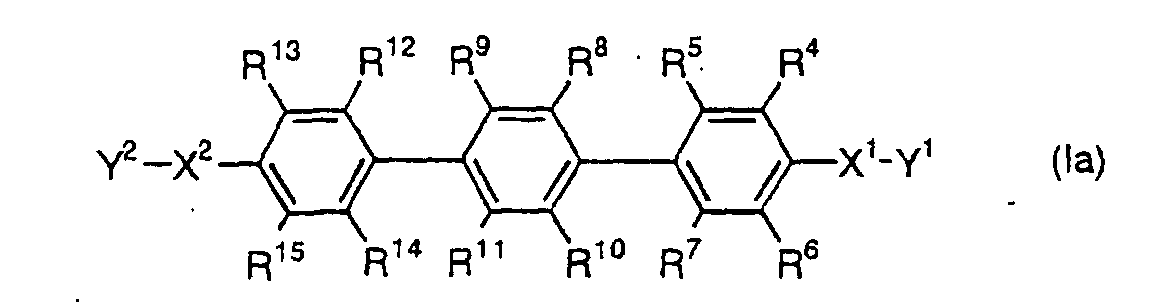
- a compound represented by Formula (I') shown below (hereinafter referred to as Compound (I')) can be produced by reacting a compound represented by Formula (IIa) (hereinafter referred to as Compound (IIa)) with a bicyclic compound represented by Formula (IIIa) (hereinafter referred to as Compound (IIIa)), or reacting a compound represented by Formula (IIb) (hereinafter referred to as Compound (IIb)) with a bicyclic compound represented by Formula (IIIb) (hereinafter referred to as Compound (IIIb)): wherein one of L and Z is dihydroxyboryl, di-lower alkylboryl or di-lower alkoxyboryl, and the other is halogen or -OSO2 (CqF2q+1) (q is an integer of 0 to 4), and other symbols are defined as described above).
- Compound (IIa) and Compound (IIIa) or Compound (IIb) and Compound (IIIb) are reacted in a mixture of a suitable solvent (for example, benzene, toluene, N, N-dimethylformamide, dimethoxyethane, tetrahydrofuran, dioxane, ethanol or methanol) with water or in an anhydrous system in the presence of a palladium catalyst (for example Pd(PPh 3 ) 4 , PdCl 2 (PPh 3 ) 2 , PdCl 2 , Pd(OAc) 2 or PdCl 2 (CH 3 CN) 2 , preferably Pd(PPh 3 ) 4 ) in a basic condition (with a base such as K 3 PO 4 , NaHCO 3 , NaOEt, Na 2 CO 3 , Et 3 N, Ba(OH) 2 , Cs 2 CO 3 , CsF, NaOH or Ag 2 CO 3 ) at room temperature
- One of substituents L and Z in compounds to be reacted with each other is any boryl group capable of being used in Suzuki reaction (Chemical Communication 1979, 866, Journal of Organic Synthesis Society, 1993, Vol.51, NO.11, page 91 to 100), and preferably dihydroxyboryl.
- the other is any leaving group applicable to Suzuki reaction, such as halogen or -OSO 2 (C q F 2q+1 ) wherein q is an integer of 0 to 4.
- Those preferred especially are halogen and trifluoromethanesulfonyloxy (hereinafter abbreviated as OTf), with bromine, iodine and OTf being most preferred.
- Y may be optionally substituted lower alkyl, optionally substituted lower alkenyl, optionally substituted lower alkynyl, optionally substituted acyl, optionally substituted cycloalkyl, optionally substituted cycloalkenyl, optionally substituted aryl or an optionally substituted 5- or 6-membered heterocyclic ring which may be fused with a benzene ring, and when X is -CH 2 -, Y may also be optionally substituted lower alkoxy. When X is -O- or -NR 1 - then Y may also be optionally substituted lower alkoxycarbonyl, optionally substituted lower alkylsulfonyl or optionally substituted arylsulfonyl.
- reaction described above can be effected.
- the reaction is preferably effected after introducing an ordinarily employed hydroxy protective group (for example, methoxymethyl, benzyl, t-butyldimethylsilyl, methanesulfonyl or p-toluenesulfonyl) which is subjected subsequently to a deprotection.
- an ordinarily employed hydroxy protective group for example, methoxymethyl, benzyl, t-butyldimethylsilyl, methanesulfonyl or p-toluenesulfonyl
- L and Z is -SiR e (3-r) (Hal) r (wherein each R e may be different and is lower alkyl, Hal is halogen, r is an integer of 1 to 3) and the other is halogen or -OSO 2 (C q F 2q+1 ) wherein q is an integer of 0 to 4, an ordinarily employed palladium catalyst is employed in a coupling reaction (Synlett, (1991) 845-853, J. Org. Chem., 1996, 61, 7232-7233).
- L and Z is -SnR f 3 (wherein each R f may be different and is lower alkyl) and the other is halogen, acetyloxy or -OSO 2 (C q F 2q+1 ) wherein q is an integer of 0 to 4, an ordinarily employed palladium catalyst (preferably Pd(PPh 3 ) 4 and the like) can be employed to obtain an intended compound (Angew. Chem. Int. Ed. Engl., 25 (1986) 508-524).
- Any of these reactions may be conducted in a suitable solvent (for example, N, N-dimethylformamide, tetrahydrofuran) at room temperature or with heating for several ten minutes to several ten hours.
- a suitable solvent for example, N, N-dimethylformamide, tetrahydrofuran
- Compounds (IIIa) and (IIIb) in a scheme shown above may be those known per se, or may be derived from a compound represented by Formula (Va) (hereinafter referred to as Compound (Va)) or a compound represented by Formula (Vb) (hereinafter referred to as Compound (Vb)) which can be synthesized by a known method or a method described below: wherein D and L are groups by which Suzuki reaction of Z is not affected adversely, and when a compound represented by Formula (IVa) or (IVb) is a symmetric compound,they may be groups similar to L, and other symbols are defined as described above.
- D is preferably a group which has no particular adverse effect on Suzuki reaction of L and Z and which can conveniently be converted into L.
- hydroxy, hydrogen, formyl and nitro may be employed.
- L or Z may be subjected to a reaction employing silicon, zinc or tin instead of a boryl group described above.
- a reaction with a trifluoromethanesulfonylating agent for example, trifluoromethanesulfonic anhydride, trifluoromethanesulfonyl chloride or N-phenyltrifluoromethanesulfonimide
- a suitable solvent for example, dichloromethane, chloroform, tetrahydrofuran, benzene or toluene
- a base sodium hydride, pyridine, triethylamine or potassium carbonate
- a reaction with a halogenating agent for example, chlorine, bromine, iodine or N-bromosuccinimide
- a suitable solvent for example, acetic acid, dichloromethane, chloroform, carbon tetrachloride, N, N-dimethylformamide or water
- a compound represented by Formula (I") shown below (hereinafter referred to as Compound (I")) can be produced by Suzuki reaction between a compound represented by Formula (VI) (hereinafter referred to as Compound (VI)) and a compound represented by Formula (IIa) (hereinafter referred to as Compound (IIa)), or by a condensation between a compound represented by Formula (VII) (hereinafter referred to as Compound (VII)) and a compound represented by Formula (VIII) (hereinafter referred to as Compound (VIII)): wherein one of M and Q is hydroxy or amino and the other is halogen, lower alkylsulfonyloxy, arylsulfonyloxy, lower alkylsulfonyl or arylsulfonyl as itself or as a substituent on methyl, or, one is lithium or Mg(Hal) wherein Hal is halogen and the other is carboxy, lower alkoxycarbonyl, carbamoyl
- a suitable solvent for example, benzene, toluene, acetone, acetonitrile, N, N-dimethylformamide, dimethylsulfoxide, pyridine, methanol or ethanol
- a base for example, sodium hydride, pyridine, triethylamine, potassium carbonate, sodium hydroxide or potassium hydroxide
- a copper catalyst copper powder, CuCl or CuO
- V 2 in an intended compound is -CH(OR g )- wherein R g is lower alkyl
- a compound in which V 2 is -CH(OH)- is obtained and subsequently alkylated.
- An intended compound in which V 2 is -CO- can be obtained by reacting a compound in which V 2 is -CH(OH)- with an oxidizing agent such as chromic anhydride or Jones reagent in a solvent suitable for the oxidizing agent such as t-butyl alcohol or acetone at 0°C or with heating for several hours.
- An intended compound in which V 2 is -CH(OH)- can be obtained by reducing a compound in which V 2 is -CO- in a suitable solvent (for example diethylether, tetrahydrofuran, dimethoxyethane, dioxane, methanol and ethanol) with sodium borohydride, lithium aluminum hydride and the like.
- one of substituents M and Q is formyl and the other is a halogenated methyl (halogen may for example be chlorine, bromine or iodine).
- halogen may for example be chlorine, bromine or iodine.
- an intended compound can be obtained by Wittig reaction (Organic Reaction, 1965, Vol.14, page 270).
- V 2 in an intended compound is -CH ⁇ CH-
- one of substituents M and Q is ethynyl and the other is halogen (preferably bromine or iodine)
- the synthesis can be effected by a coupling reaction (for example, Synthesis (1980) 627, Tetrahedron, 1982, 38, 631) using an ordinarily employed palladium catalyst.
- substituents on ring A, ring B and ring C in Compounds (VI), (IIa), (VII) and (VIII) and -X-Y are any groups by which Suzuki reaction of L and Z or the condensation between M and Q is not affected adversely. Even when any of the substituents in the reaction of Compound (VI) and (IIa) is halogen, the reaction described above can satisfactorily be advanced when the reactivity between substituents L and Z is higher relatively. While the reaction described above is possible even when any of the substituents is hydroxy, it is preferable in such case that the reaction is effected after introducing a protective group which is subjected subsequently to an ordinary deprotection.
- Compound (VI) in the reaction scheme described above may be a known compound or may be synthesized from a compound represented by Formula (X) (hereinafter refereed to as Compound (X)) which is synthesized by a method described below: wherein D' is a group by which the condensation between M and Q is not affected adversely, and, when a compound represented by Formula (IX) is a symmetric compound, it may be a group identical to Q, and other symbols are defined as described above.
- D' is preferably a group which has no particular adverse effect on the condensation between M and Q and which can conveniently be converted into L.
- D' is preferably a group which has no particular adverse effect on the condensation between M and Q and which can conveniently be converted into L.
- hydrogen, formyl or protected hydroxy or nitro is employed.
- a protective group for hydroxy may for example be benzyl, t-butyldimethylsilyl and methoxymethyl.
- a method for converting D' into L is similar to that for converting D into L described above. Other conditions are similar to those in the reaction of Compound (VII) and Compound (VIII).
- Compound (VIII) may be a known compound or may be derived by a known method or a compound synthesized from Compound (Vb) described above by a standard method.
- a compound represented by Formula (I"'): wherein each symbol is defined as described above may also be synthesized similarly to Compound (I").
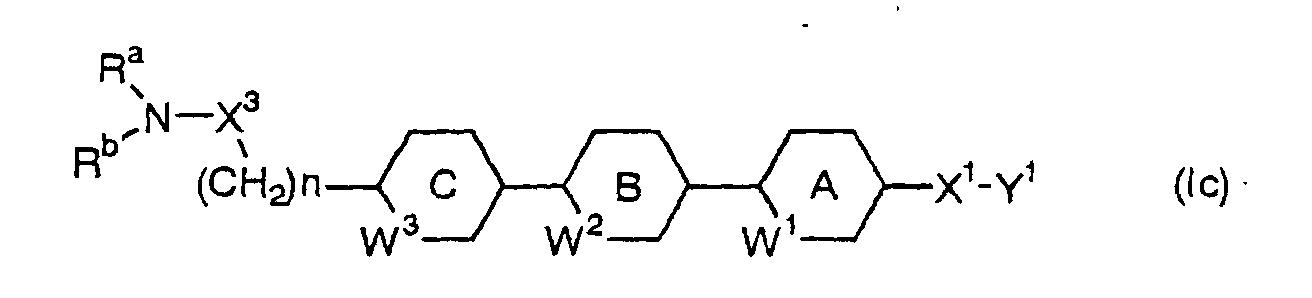
- a compound represented by Formula (Ic') (hereinafter referred to as Compound (Ic')) wherein each of R a and R b is independently hydrogen, optionally substituted lower alkyl, optionally substituted lower alkenyl, optionally substituted aryl, optionally substituted cycloalkyl, optionally substituted acyl or optionally substituted lower alkoxycarbonyl, or they are taken together to form -(CR e R f )r- can be obtained from a compound represented by Formula (XI) (hereinafter referred to as Compound (XI)) and a compound represented by Formula (XII) (hereinafter referred to as Compound (XII)): wherein substituent L is a leaving group such as halogen, lower alkylsulfonyl, arylsulfonyl, lower alkylsulfonyloxy or arylsulfonyloxy, and other symbols are defined as described above.
- substituent L is
- Compounds (XI) and (XII) are reacted in a suitable solvent (for example, benzene, toluene, acetone, acetonitrile, tetrahydrofuran, N, N-dimethylformamide, dimethylsulfoxide, pyridine, methanol or ethanol) optionally in the presence of a base (for example, sodium hydride, potassium t-butoxide, pyridine, triethylamine, potassium carbonate, sodium hydroxide or potassium hydroxide) at 0°C or with heating for several minutes to several tens hours to give intended Compound (Ic').
- a suitable solvent for example, benzene, toluene, acetone, acetonitrile, tetrahydrofuran, N, N-dimethylformamide, dimethylsulfoxide, pyridine, methanol or ethanol
- a base for example, sodium hydride, potassium t-butoxide, pyridine
- a suitable solvent for example, toluene, tetrahydrofuran, N, N-dimethylformamide, dimethylsulfoxide, pyridine, methanol or ethanol
- a compound thus obtained is subjected to a dehydration condensation with a carbonyl compound (XIII) such as ketone or aldehyde optionally in the presence of an acid catalyst (hydrochloric acid, acetic acid, trifluoroacetic acid, lower alkanesulfonic acid, arylsulfonic acid and the like) to give intended Compound (Ic").
- a carbonyl compound (XIII) such as ketone or aldehyde
- an acid catalyst hydrochloric acid, acetic acid, trifluoroacetic acid, lower alkanesulfonic acid, arylsulfonic acid and the like
- a suitable solvent for example, toluene, tetrahydrofuran, dioxane or dichloromethane
- an acid hydroochloric acid, acetic acid, perchloric acid and the like
- Compound (Ic') wherein R a and R b are hydrogens can also be synthesized from a compound represented by Formula (XI") (hereinafter referred to as Compound (XI'): wherein Q is NH 2 or a group by which Suzuki reaction is not affected adversely and which can be converted into substituent L by a general method, and other symbols are defined as described above.
- Formula (XI) hereinafter referred to as Compound (XI'): wherein Q is NH 2 or a group by which Suzuki reaction is not affected adversely and which can be converted into substituent L by a general method, and other symbols are defined as described above.
- a suitable base for example, sodium hydride, potassium t-butoxide, potassium carbonate, sodium hydroxide and potassium hydroxide
- Compound (Ic') can be produced also by reacting a compound represented by Formula (XIV) (hereinafter referred to as Compound (XIV)) with a compound represented by Formula (XV) (hereinafter referred to as Compound (XV)): wherein one of M and D is dihydroxyboryl, di-lower alkylboryl or di-lower alkoxyboryl and the other is halogen or -OSO 2 (C q F 2q+1 ) wherein q is an integer of 0 to 4, and other symbols are defined as described above.
- Formula (XIV) hereinafter referred to as Compound (XIV)
- Formula (XV) wherein one of M and D is dihydroxyboryl, di-lower alkylboryl or di-lower alkoxyboryl and the other is halogen or -OSO 2 (C q F 2q+1 ) wherein q is an integer of 0 to 4, and other symbols are defined as described above.
- Compound (XIV) and Compound (XV) are reacted in a mixture of a suitable solvent (for example, benzene, toluene, N, N-dimethylformamide, dimethoxyethane, tetrahydrofuran, dioxane, ethanol or methanol) with water or in an anhydrous system in the presence of a palladium catalyst (for example Pd(PPh 3 ) 4 , PdCl 2 (PPh 3 ) 2 , PdCl 2 , Pd(OAc) 2 or PdCl 2 (CH 3 CN) 2 , preferably Pd(PPh 3 ) 4 ) in a basic condition (with a base such as K 3 PO 4 , NaHCO 3 , NaOEt, Na 2 CO 3 , Et 3 N, Ba(OH) 2 , Cs 2 CO 3 , CsF, NaOH or Ag 2 CO 3 ) at room temperature or with heating for several tens minutes to several tens hours to
- Compound (XV) may be a known compound or may be obtained by a method for Compounds (Ic') and (IC") described above.
- substituent M and substituent D is any boryl group capable of being used in Suzuki reaction, and preferably dihydroxyboryl.
- the other is any leaving group applicable to Suzuki reaction, such as halogen or -OSO 2 (C q F 2q+1 ) wherein q is an integer of 0 to 4.
- halogen and -OSO 2 C q F 2q+1
- Those preferred especially are halogen and trifluoromethanesulfonyloxy (hereinafter abbreviated as OTf), with bromine, iodine and OTf being most preferred.
- substituents on ring A, ring B and ring C in Compounds (XIV) and (XV) and -X 1 -Y 1 are any groups by which Suzuki reaction is not affected adversely, including those except for halogen and -OSO 2 (C q F 2q+1 ) wherein q is an integer of 0 to 4, and even when any of the substituents on rings A, B and C is halogen, the reaction described above can satisfactorily be advanced when the reactivity between substituents M and D is higher relatively.
- substituent Q when substituent Q is hydroxy, conversion into halogen can be accomplished under a standard condition, or, an intended compound can be obtained using a suitable sulfonylating agent (for example, methanesulfonyl chloride, p-toluenesulfonyl chloride or trifluoromethanesulfonic anhydride).
- a suitable sulfonylating agent for example, methanesulfonyl chloride, p-toluenesulfonyl chloride or trifluoromethanesulfonic anhydride.
- substituent Q when substituent Q is hydroxy which has previously been protected with a suitable protective group such as benzyl, t-butyldimethylsilyl or methoxymethyl, it is deprotected by a standard method into hydroxy, and subsequent procedure in accordance with the method described above results in an intended compound.
- substituent Q is lower alkylthio or optionally substituted arylthio
- each may be converted into a corresponding sulfone form using a suitable oxidizing agent (for example, hydrogen peroxide, peracetic acid, m-chloroperbenzoic acid, oxone monopersulfate compound).
- a suitable oxidizing agent for example, hydrogen peroxide, peracetic acid, m-chloroperbenzoic acid, oxone monopersulfate compound.
- Compound (XIV) employed in the reaction described above may be a known compound, or may be produced from a known compound by Suzuki reaction.
- a compound having a substituent which interferes with a reaction described above such group is protected first with a suitable protective group, which is then cleaved at an appropriate stage by a standard method.
- a suitable protective group for example, when hydroxy interferes with a reaction, it is protected for example with methoxymethyl, methanesulfonyl, benzyl, trifluoromethanesulfonyl or t-butyldimethylsilyl, which is cleaved at an appropriate stage.
- methanesulfonyl chloride is allowed to react in a solvent such as dichloromethane, chloroform or carbon tetrachloride in the presence of a base such as triethylamine or pyridine under cooling with ice or at room temperature for several hours.
- a solvent such as dichloromethane, chloroform or carbon tetrachloride
- a base such as triethylamine or pyridine
- a deprotection can be effected in a solvent such as dimethylsulfoxide, N, N-dimethylformamide, tetrahydrofuran, dioxane and dimethoxyethane using 1 to 4 N sodium hydroxide, potassium hydroxide, an aqueous solution thereof, sodium methoxide or ethylmagnesium bromide at room temperature or with heating for several tens minutes to several hours.
- a solvent such as dimethylsulfoxide, N, N-dimethylformamide, tetrahydrofuran, dioxane and dimethoxyethane using 1 to 4 N sodium hydroxide, potassium hydroxide, an aqueous solution thereof, sodium methoxide or ethylmagnesium bromide at room temperature or with heating for several tens minutes to several hours.
- a reaction with chloromethyl methyl ether is carried out in a solvent such as tetrahydrofuran, dioxane and dimethoxyethane in the presence of sodium hydride or diisopropylethylamine, whereby forming protected hydroxy.
- a deprotection may ordinarily be carried out in a solvent such as methanol, tetrahydrofuran and acetic acid using hydrochloric acid or sulfuric acid.
- t-butyldimethylsilyl When t-butyldimethylsilyl is used as a protective group, a reaction with t-butyldimethylsilyl chloride or t-butyldimethylsilyl triflate is carried out in a solvent such as N, N-dimethylformamide, acetonitrile, tetrahydrofuran and dichloromethane in the presence of imidazole, triethylamine or 2, 6-lutidine.
- a protective group can be cleaved by a reaction with tetrabutylammonium fluoride in a solvent such as tetrahydrofuran.
- a compound according to the invention obtained as described above can further be converted into a prodrug.
- prodrug is any compound that can readily be subjected to an in vivo conversion into an active compound according to the invention, and a prodrug can be obtained by any standard method.
- a method for selecting and producing a suitable prodrug derivative is described for example in Design of Prodrugs, Elsevier, Amsterdam, 1985. According to this reference, a group employed usually for obtaining a prodrug is introduced into carboxy, hydroxy or amino bound at any position in a compound of the invention.
- the amino present in any position of the compound of the invention is ⁇ -haloalkoxycarbonylated and reacted with a suitable carboxylic acid under an appropriate condition, whereby obtaining the prodrug.
- an amino-containing compound of the invention and ⁇ -haloalkyl chloroformate are reacted in an inert solvent (diethylether, tetrahydrofuran, 1,4-dioxane, ethyl acetate, toluene and the like) in the presence of a base (pyridine, triethylamine, N-methylmorpholine and the like) at 0°C to room temperature to give a haloalkoxycarbamate compound.
- an inert solvent diethylether, tetrahydrofuran, 1,4-dioxane, ethyl acetate, toluene and the like
- a base pyridine, triethylamine, N-methylmorpholine and the like
- a compound thus obtained was reacted in a solvent (N, N-dimethylformamide, N, N-dimethylacetoamide, dimethylsulfoxide, sulfolane and the like) with a salt of a substituted carboxylic acid (for example, alkaline metal salt, alkaline earth metal salt, silver salt, mercury salt and the like) at room temperature or with heating for several hours to several days to give a prodrug compound.
- a solvent N, N-dimethylformamide, N, N-dimethylacetoamide, dimethylsulfoxide, sulfolane and the like
- a salt of a substituted carboxylic acid for example, alkaline metal salt, alkaline earth metal salt, silver salt, mercury salt and the like
- a substituent interfering with the formation of a prodrug, if any, can previously be protected with an appropriate protective group and then cleaved at an appropriate stage by a standard method.
- Th2 differentiation inhibitor is a pharmaceutical composition which inhibits the differentiation from Th0 cells to Th2 cells, thus, a pharmaceutical composition for treating and/or preventing diseases induced by Th2 cells or by cytokines produced by Th2 cells.
- Th2 differentiation inhibitors of the invention reduce the population of Th2 cells to give a reduction in the level of Th2 cell-derived cytokines, whereby exerting its inhibitory effects on B-cells activation and antibody production, which are associated further with the following characteristics.
- Th2 differentiation inhibitors of the invention have an inhibitory effect also on the activation of the B-cells by the Th2 cells themselves. Accordingly, a more effective treatment and prevention of allergic diseases or autoimmune diseases is possible when compared with conventional anti-allergic agents.
- Th2 differentiation inhibitors of the invention is effective also in treating diseases against which IgE production inhibitors alone, for example, are not expected to be so effective.
- Th2 differentiation inhibitors of the invention do not inhibit the differentiation from Th0 cells to Th1 cells, thus exhibiting a high Th2 selectivity. Accordingly, it shows no inhibitory effect on the protection against an infection with a virus or intracellular parasite in which Th1 cells are believed to be involved (for example, tuberculosis, leprosy, chlamydia), but inhibits advantageously the advancement of acquired immunodeficiency syndrome (AIDS), thus being an excellent pharmaceutical having less side effects.
- AIDS acquired immunodeficiency syndrome
- Th2 differentiation inhibitors of the invention are effective against immune diseases classified as type-Th2 immune diseases.
- they are used preferably as therapeutic and/or prophylactic agents against graft immune diseases (chronic GVHD), autoimmune diseases (especially organ non-specific autoimmune diseases) and type-Th2 allergic diseases.
- Diseases exemplified typically are ulcerative colitis, systemic lupus erythematodes, myasthenia gravis, systemic progressive scleroderma, rheumatoid arthritis, interstitial cystitis, Hashimoto's diseases, Basedow's diseases, autoimmune hemolytic anemia, idiopathic thrombocytopenic purpura, Goodpasture's syndrome, atrophic gastritis, pernicious anemia, Addison diseases, pemphigus, pemphigoid, lenticular uveitis, sympathetic ophthalmia, primary biliary cirrhosis, active chronic hepatitis, Sjogren's syndrome, multiple myositis, dermatomyositis, polyarteritis nodosa, rheumatic fever, glomerular nephritis (lupus nephritis, IgA nephtopathy, and the like), allergic
- organ non-specific autoimmune diseases such as graft immune diseases (chronic GVHD), ulcerative colitis, systemic lupus erythematosus, myasthenia gravis, systemic progressive scleroderma, rheumatoid arthritis, lupus nephritis, interstitial cystitis and the like.
- Th2 differentiation inhibitors of the invention When Th2 differentiation inhibitors of the invention are administered, it can be given orally and parenterally.
- a formulation employed customarily such as tablet, granule, powder, capsule, pill, solution, syrup, buccal or sublingual formulation may be given in a standard manner.
- a formulation employed customarily such as intramuscular or intravenous injection formulation, suppository, percutaneous absorption and inhalation formulations can preferably be given.
- An oral administration is particularly preferred.
- An effective amount of a compound according to the invention can be mixed if necessary with various pharmaceutical additives suitable for its particular dosage form such as excipient, binder, lubricant, disintegrant, lubricant, diluent and the like to form a pharmaceutical formulation.
- a formulation for injection may be prepared using a suitable vehicle to be sterilized simultaneously.
- suppository base may for example be cocoa butter, Macrogol and methylcellulose.
- a liquid, emulsion or suspension formulation for injection may be formulated using customarily employed solubilizing agent, suspending agent, emulsifier, stabilizer, preservative, isotonizing agent and other additives, and an oral formulation may contain sweetening agents and flavors.
- Th2 differentiation inhibitors of the invention can be given alone or in combination with other anti-allergic agents if necessary.
- An agent which can be employed in combination may for example be a steroid, a known anti-allergic agent and a bronchodilator.
- Th2 differentiation inhibitors of the invention are adjusted preferably on the basis of patient's age, body weight, type and severity of the diseases as well as the administration route, it is usually 0.05 to 100 mg/kg/day preferably 0.1 to 10 mg/kg/day in adults. While the dose when given parenterally varies greatly depending on the administration route, it is usually 0.0001 to 10 mg/kg/day, preferably 0.001 to 1 mg/kg/day. Such dose may be divided into several portions, which are given over a day.
- reaction mixture prepared by adding sodium hydride (60% in mineral oil, 3.85 g, 96.5 mmol) to a solution of prenol (9.8 ml, 96.5 mmol) in tetrahydrofuran (150 ml) was added under cooling on ice, and the mixture was stirred further for 2 hours at the same temperature.
- DNP-As dinitrophenylated Ascaris protein (porcine ascarid extract protein)
- Alum aluminum hydroxide adjuvant
- HBSS Hanks' balanced salt solution
- a non-viable Mycobacterium tuberculosis H37RA (DIFCO) was suspended in physiological saline, and 125 ⁇ g/50 ⁇ l was used for immunization as described above.
- DIFCO Mycobacterium tuberculosis H37RA
- Cells prepared from popliteal lymph nodes of these mice were suspended at 1 - 2 x 10 6 cells/ml (1-2 ml) in an RPMI 1640 medium (containing 10% fetal bovine serum - FBS and 50 ⁇ M 2-mercaptoethanol) and supplemented with PMA (Phorbol 12-Myristate 13-Acetate) at the final concentration of 50 ng/ml and 250 ng/ml A23187 (Ca ionophore) and then incubated at 37°C in the presence of 5% CO 2 . After incubating for 4 hours, Brefeldin A was added at the final concentration of 10 ⁇ g/ml and the mixture was incubated further for 2 hours.
- PMA Phorbol 12-Myristate 13-Acetate
- the cells were recovered and washed twice with a staining buffer (PBS containing 1% FBS and 0.1% sodium azide) and suspended in 100 ⁇ l of the staining buffer containing 5 ⁇ g/ml of Fc Block (rat anti-mouse CD16/CD32 purified monoclonal antibody, Pharmingen) and incubated on ice for 5 minutes to block the non-specific adsorption of the labeled antibody, and then combined with an equal volume of a Cy-Chrome-labelled rat anti-mouse CD4 monoclonal antibody (Pharmingen) which had been 200-fold diluted with the staining buffer and incubated on ice for 30 minutes.
- a staining buffer PBS containing 1% FBS and 0.1% sodium azide
- Fc Block rat anti-mouse CD16/CD32 purified monoclonal antibody, Pharmingen
- the cells were suspended in PBS and combined with an equal volume of a fixation solution (4% p-formaldehyde) and incubated at 4°C overnight, whereby effecting the fixation.
- a fixation solution 4% p-formaldehyde
- the fixed cells thus obtained were washed twice with the staining buffer and suspended in a permeabilazation buffer (PBS containing 1% FBS, 0.5% saponin and 0.1% sodium azide) and incubated on ice for 10 minutes, and then each cell sample was recovered as being divided into two equal portions.
- each portion was suspended in 100 ⁇ l of the permeabilazation buffer containing 5 ⁇ g/ml Fc Block and incubated on ice for 5 minutes to block the non-specific adsorption of the labeled antibody into the cells.
- One portion was combined with each 100 ⁇ l of an FITC-labelled rat anti-mouse IFN ⁇ monoclonal antibody (Pharmingen) and a PE-labeled rat anti-mouse IL-4 monoclonal antibody (Pharmingen) each had been 50-fold diluted with the permeabilazation buffer and incubated on ice for 30 minutes.
- the other portion serving as a control representing the non-specific adsorption of the labeled antibody, was combined with each 100 ⁇ l of each control antibody at the same concentration, i.e., an FITC-labelled rat IgG1 ⁇ purified antibody (Pharmingen) and a PE-labeled rat IgG1 ⁇ purified antibody (Pharmingen) to effect the similar staining.
- an FITC-labelled rat IgG1 ⁇ purified antibody Pharmingen
- a PE-labeled rat IgG1 ⁇ purified antibody Pharmingen
- FACScan (Nippon Becton Dickinson Company Ltd.) was used to determine the percentage of IFN ⁇ positive cells (Th1) and the percentage of IL-4 positive cells (Th2) in CD4 positive T cells, from each of which the percentage of non-specific positive cells stained by a control antibody was subtracted to obtain % Th1 and % Th2, while in the Th2 differentiation experiment a Th2/Th1 cell ratio was determined, and then based on these data the effect of a compound according to the invention of the differentiation from Th0 to Th1 or Th2 was investigated. The significant difference was analyzed by Dunnett multiple comparison test and Student t test. The results are shown in Tables 13 and 14.
- each of Compounds I-55, I-80, I-90, I-102, I-132 and I-133 at 40 mg/kg and I-89 at 10 mg/kg significantly inhibited the increase in the %Th2 and in the Th2/Th1 ratio when given orally for consecutive 6 days after immunization, resulting in the correction from the Th2-dominant condition.
- Compound I-6 significantly inhibited the increase in the %Th2 and in the Th2/Th1 ratio at a concentration of 10 mg/kg or higher, resulting in the correction from the Th2-dominant condition.
- the CD4 positive T cells in the popliteal lymph node of C57BL/6 mice immunized with non-viable Mycobacterium tuberculosis exhibited a selective increase in the %Th1 when compared with the non-immunized group received the injection only of physiological saline, thus validating the induction of the Th1-dominant differentiation.
- any of Compounds I-6, I-80, I-89 and I-102 showed no effect on the increase in the %Th1.
- Example 2 Granule Compound (I-80) 30 g Lactose 265 g Magnesium stearate 5 g
- Example 3 Capsule Compound (I-89) 10g Heavy magnesium oxide 20 g Lactose 70 g
- the components shown above were mixed well into a particulate or fine particulate powder, and filled in a capsule.
- any of the compounds according to the invention exhibited an inhibitory effect on the differentiation from Th0 cells to Th2 cells, and thus is extremely useful as Th2 cell differentiation inhibitors and as therapeutic agents against autoimmune diseases.
Landscapes
- Health & Medical Sciences (AREA)
- Chemical & Material Sciences (AREA)
- General Health & Medical Sciences (AREA)
- Veterinary Medicine (AREA)
- Public Health (AREA)
- Medicinal Chemistry (AREA)
- Animal Behavior & Ethology (AREA)
- Pharmacology & Pharmacy (AREA)
- Life Sciences & Earth Sciences (AREA)
- Epidemiology (AREA)
- Organic Chemistry (AREA)
- Bioinformatics & Cheminformatics (AREA)
- Engineering & Computer Science (AREA)
- Chemical Kinetics & Catalysis (AREA)
- General Chemical & Material Sciences (AREA)
- Nuclear Medicine, Radiotherapy & Molecular Imaging (AREA)
- Immunology (AREA)
- Emergency Medicine (AREA)
- Pulmonology (AREA)
- Orthopedic Medicine & Surgery (AREA)
- Physical Education & Sports Medicine (AREA)
- Endocrinology (AREA)
- Reproductive Health (AREA)
- Neurology (AREA)
- Transplantation (AREA)
- Pharmaceuticals Containing Other Organic And Inorganic Compounds (AREA)
- Plural Heterocyclic Compounds (AREA)
Abstract
The present invention provides a pharmaceutical composition for use as a Th2
differentiation inhibitor comprising a compound represented by Formula (I):
 wherein each of ring A, ring B and ring C is an aromatic carbocyclic ring, a heterocyclic
ring and the like, X is a single bond, -O-, -CH2-, -NH-, -SO- and the like, Y is hydrogen,
optionally substituted lower alkyl, optionally substituted lower alkenyl and the like,
each of V1 and V2 is a single bond, -O-, -NH-, -OCH2- and the like,
a prodrug, pharmaceutically acceptable salt or solvate thereof.
wherein each of ring A, ring B and ring C is an aromatic carbocyclic ring, a heterocyclic
ring and the like, X is a single bond, -O-, -CH2-, -NH-, -SO- and the like, Y is hydrogen,
optionally substituted lower alkyl, optionally substituted lower alkenyl and the like,
each of V1 and V2 is a single bond, -O-, -NH-, -OCH2- and the like,
a prodrug, pharmaceutically acceptable salt or solvate thereof.
Description
The present invention relates to agents for inhibiting the differentiation from
Th0 cells to Th2 cells which comprises a tricyclic compound.
CD4+ helper T cells (hereinafter referred to as Th cells) involved in the onset of
allergic diseases or autoimmune diseases are classified based on the type of the
cytokines they produce into two types, namely, type I helper T cells (hereinafter referred
to as Th1 cells) and type II helper T cells (hereinafter referred to as Th2 cells). Th1
cells produce IL-2, IFN-γ, TNE-β and the like, whereby inducing a cellular immunity
On the other hand, Th2 cells produce IL-4, IL-5, IL-6, IL-10, IL-13 and the like,
whereby inducing a humoral immunity.
Th0 cells which are common precursors for Th1 cells and Th2 cells are
differentiated into either Th1 cells or Th2 cells in response to an antigenic stimulation
and then becomes mature. For example, a bacterium such as Bacillus tuberculosis
and a virus such as an influenza virus are known to induce the differentiation to Th1
cells, while allergens such as a mite and a pollen are known to induce the
differentiation to Th2 cells.
Recently, it has been reported that a polarized existence of Th1 cells and Th2
cells in a body is involved greatly in a prevention of infection and induction of allergic
diseases or autoimmune diseases, and it is expected that inhibiting an excessive
differentiation to Th2 cells serve to give a therapeutic effect against allergic diseases or
autoimmune diseases induced by Th2 cells.
A compound having a backbone analogous to that of the present invention and
having an immunosuppressive effect or an antiallergic effect is disclosed for example in
WO94/27980, WO95/13067, WO96/15123, WO95/15318, WO96/40659, WO96/40143,
WO96/38412, WO96/10012, WO97/24356, WO97/27181, WO97/24324, WO97/39999,
WO97/44333, WO97/46524, WO98/04508, WO98/24766, WO98/24782, WO98/56785,
FR2301250, US5593991, JP 47-7368 B, JP 51-91259 A, JP8-3163 A, JP 9-124571 A, JP
9-71564 A, JP9-124571 A, JP11-79993 A, Bioorganic & Medicinal Chemistry Letters,
Vol.5, No.18, p2143-2146 (1995), J. Med. Chem., 1974, Vol.17 and No.11, 1177-1181.
An objective of the invention is to provide excellent Th2 differentiation
inhibitors.
The present invention provides


In the specification, the term "halogen" includes fluorine, chlorine, bromine
and iodine. Those preferred especially are fluorine and chlorine.
The term "lower alkyl" includes a straight or branched alkyl having 1 to 10,
preferably 1 to 8, more preferably 1 to 6and most preferably 1 to 3 carbon atoms, such
as methyl, ethyl, n-propyl, isopropyl, n-butyl, isobutyl, sec-butyl, tert-butyl, n-pentyl,
isopentyl, neopentyl, hexyl, isohexyl, n-heptyl, isoheptyl, n-octyl, isooctyl, n-nonyl and
n-decyl.
A substituent on "optionally substituted lower alkyl" may for example be
halogen; hydroxy; lower alkoxy which may be substituted by a lower alkoxy; acyl;
acyloxy; carboxy; lower alkoxycarbonyl; mercapto; lower alkylthio; amino which may be
substituted by hydroxy lower alkyl or optionally substituted acyl; imino which may be
substituted by hydroxy, lower alkoxy, carboxy-lower alkoxy, aryl-lower alkoxy or 5- or 6-membered
heterocyclyl; hydrazono which may be substituted by carbamoyl or lower
alkoxycarbonyl; hydrazino which may be substituted by lower alkyl, lower alkenyl,
optionally substituted lower alkylidene or cycloalkylidene; aminooxy which may be
substituted by lower alkyl, lower alkenyl, optionally substituted lower alkylidene or
cycloalkylidene; carbamoyl which may be substituted by lower alkyl or amino;
thiocarbamoyl which may be substituted by lower alkyl; cycloalkyl which may be
substituted by lower alkyl or lower alkoxy; cycloalkenyl which may be substituted by
lower alkyl; cyano; phenyl which may be substituted by one or more substituents
selected from a group of hydroxy, lower alkyl, carboxy, lower alkoxycarbonyl or lower
alkoxy; 5- or 6-membered heterocyclyl which may be substituted by lower alkyl and
which may be fused with a benzene ring. These substituents may substitute at one or
more of any possible positions. Those preferred especially are halogen, hydroxy;
acyloxy; phenyl which may be substituted by lower alkyl or lower alkoxy; or pyridyl.
An alkyl moiety in "lower alkoxy", "lower alkoxycarbonyl", "lower
alkylsulfonyl", "lower alkylsulfonyloxy", "lower alkylthio", "lower alkylamino" and
"lower alkylenedioxy" has the meaning similar to the term "lower alkyl" described
above.
A substituent on "optionally substituted lower alkoxy", "optionally substituted
lower alkoxycarbonyl", "optionally substituted lower alkylsulfonyl" and "optionally
substituted lower alkylthio" may for example be a halogen; hydroxy; lower alkoxy which
may be substituted by acyloxy; acyl; acyloxy which may be substituted by hydroxy or
carboxy; carboxy; lower alkoxycarbonyl; lower alkylthio; amino which may be
substituted by lower alkyl; phenyl which may be substituted by lower alkyl or lower
alkoxy; heterocyclyl; a heterocyclylcarbonyloxy. These substituents may substitute at
one or more of any possible positions.
The term "lower alkylidene" includes a divalent hydrocarbon group having 1 to
10, preferably 1 to 6, more preferably 1 to 3 carbon atoms, and those may typically be
exemplified are methylidene, ethylidene, propylidene, isopropylidene, butylidene,
pentylidene, hexylidene, heptylidene, octylidene, nonylidene and decylidene.
A substituent on "optionally substituted lower alkylidene" may for example be
optionally substituted lower alkenyl, optionally substituted lower alkoxy, optionally
substituted lower alkylthio, optionally substituted cycloalkyl, optionally substituted
aryl or optionally substituted 5- or 6-membered heterocyclyl. Those preferred are
lower alkenyl, lower alkoxy, cycloalkyl, phenyl or 5- or 6-membered heterocyclyl.
These substituents may substitute at one or more of any possible positions.
The term " lower alkenyl" includes straight or branched alkenyl having one or
more double bonds at any positions and 2 to 10, preferably 2 to 8, more preferably 3 to 6
carbon atoms. Those exemplified typically are vinyl, propenyl (2-propenyl, isopropenyl
and the like), butenyl, isobutenyl, prenyl, butadienyl, pentenyl, isopentenyl,
pentadienyl, hexenyl, isohexenyl, hexadienyl, heptenyl, octenyl, nonenyl and decenyl.
A substituent on "optionally substituted lower alkenyl" is similar to a
substituent on "optionally substituted lower alkoxy" described above. Lower alkenyl
may be substituted by these substituents at one or more of any possible positions..
Those preferred especially are one substituted by halogen or an unsubstituted group.
A lower alkenyl moiety in "lower alkenyloxy", "lower alkenyloxycarbonyl" and
"lower alkenylamino" is similar to that in "lower alkenyl" described above.
A substituent on "optionally substituted lower alkenyloxy", "optionally
substituted lower alkenyloxycarbonyl" and "optionally substituted lower alkenylthio" is
similar to a substituent on "optionally substituted lower alkoxy" described above.
These substituents may substitute at one or more of any possible positions.
The term "lower alkynyl" includes straight or branched alkynyl having 2 to 10,
preferably 2 to 8 and more preferably 3 to 6 carbon atoms, and those exemplified
typically are ethynyl, propynyl (2-propynyl and the like), butynyl (2-butynyl and the
like), pentynyl, hexynyl, heptynyl, octynyl, nonynyl and decynyl. Any of these groups
has one or more triple bonds at any positions, optionally with one or more double bonds.
A substituent on "optionally substituted lower alkynyl" is similar to a
substituent on "optionally substituted lower alkoxy" described above. These
substituents may substitute at one or more of any possible positions.
The term "acyl" includes straight or branched aliphatic acyl having 1 to 20,
preferably 1 to 15, more preferably 1 to 8, further preferably 1 to 6 and most preferably
1 to 4 carbon atoms, alicyclic acyl having 4 to 9, preferably 4 to 7 carbon atoms and
aroyl. Those exemplified typically are formyl, acetyl, propionyl, butyryl, isobutyryl,
valeryl, pivaloyl, hexanoyl, acryloyl, propyoloyl, methacryloyl, crotonoyl,
cyclopropylcarbonyl, cyclohexylcarbonyl, cyclooctylcarbonyl and benzoyl.
The term "aroyl" means aromatic carbocyclic carbonyl and aromatic
heterocyclylcarbonyl.
A substituent on "optionally substituted acyl" is similar to a substituent on
"optionally substituted lower alkoxy", and alicyclic acyl and aroyl may further contain
lower alkyl as their substituent. These substituents may substitute at one or more of
any possible positions. An especially preferred substituent is halogen.
An acyl moiety on "acyloxy" is similar to "acyl" described above. A substituent
on "optionally substituted acyloxy" is also similar as in the case of "optionally
substituted acyl" described above, and these substituents may substitute at one or more
of any possible positions.
The term "lower alkylcarbonyl" includes aliphatic acyl having 2 to 4 carbon
atoms, such as acetyl, propionyl, butyryl and isobutyryl. Acetyl is preferred especially
The term "cycloalkyl" includes a carbocyclic group having 3 to 6 carbon atoms,
such as cyclopropyl, cyclobutyl, cyclopentyl and cyclohexyl.
A substituent on "optionally substituted cycloalkyl" may for example be lower
alkyl, halogen, hydroxy, carboxy, lower alkoxycarbonyl, lower alkoxy lower
alkylenedioxy, imino which may be substituted by lower alkoxy, an aryl or 5- or 6-membered
heterocyclyl, which may substitute at one or more of any possible positions.
The term "cycloalkenyl" includes a group having one or more double bonds at
any positions in a cycloalkyl ring described above, and those exemplified typically are
cyclopropenyl, cyclobutenyl, cyclopentenyl, cyclohexenyl and cyclohexadienyl.
A substituent on "optionally substituted cycloalkenyl" is similar to a
substituent on "cycloalkyl" described above. These substituents may substitute at one
or more of any possible positions.
The term "cycloalkylidene" includes a divalent carbocyclic group having 3 to 6
carbon atoms such as cyclopropylidene, cyclobutylidene, cyclopentylidene and
cyclohexylidene.
A substituent on "optionally substituted cycloalkylidene" is similar to a
substituent on "cycloalkyl" described above, and such substituents may substitute at
one or more of any possible positions . Unsubstituted cycloalkylidene is preferred.
A substituent on "optionally substituted amino" may for example be optionally
substituted lower alkyl (a substituent referred here means to be lower alkoxy, cycloalkyl,
optionally substituted amino (a substituent is aroyl which may be substituted by an
acyloxy-lower alkoxy), optionally substituted aryl (a substituent is lower alkyl, lower
alkoxy, carboxy, lower alkoxycarbonyl) or heterocyclyl); lower alkenyl; lower alkynyl;
cycloalkyl; aryl which may be substituted by lower alkyl, carboxy, acyl or lower
alkoxycarbonyl; sulfamoyl which may be substituted by lower alkyl; optionally
substituted lower alkoxycarbonyl (a substituent referred here means to be halogen,
acyloxy, hydroxy-substituted acyloxy, carboxy-substituted acyloxy or
heterocyclylcarbonyloxy); lower alkylsulfonyl and the like. These substituents may
substitute at one or more of any possible positions.
The term "optionally substituted carbamoyl" includes carbamoyl which may be
substituted by one or more groups selected from lower alkyl, lower alkenyl, lower
alkynyl and the like.
The term "optionally substituted sulfamoyl" includes sulfamoyl which may be
substituted by one or more groups selected from lower alkyl, lower alkenyl, lower
alkynyl and the like.
The term "aromatic carbocyclic ring" is a monocyclic or polycyclic aromatic
carbocyclic ring, such as a benzene ring, a naphthalene ring, an anthracene ring and a
phenanthrene ring. A benzene ring is preferred especially. An "aromatic carbocyclic
ring" may also be fused with one or more other carbocyclic rings, and thus includes an
indane ring, an indene ring and a dihydronaphthalene ring.
The term "aryl" is a group formed by deleting one hydrogen from a monocyclic
or polycyclic aromatic carbocyclic ring, such as phenyl, naphthyl, anthryl and
phenanthryl. One preferred especially is phenyl. "Aryl" may also be fused with one
or more other carbocyclic rings, and may have a bond in the carbocyclic ring with which
it is fused. For example, indanyl, indenyl and dihydronaphthyl are included.
A substituent on "optionally substituted aromatic carbocyclic ring"
and"optionally substituted aryl" may for example be halogen; hydroxy; lower alkyl
which may be substituted by halogen or carboxy; lower alkoxy which may be
substituted byhalogen, aryl, heteroaryl or lower alkoxy; lower alkenyl; lower alkynyl;
cycloalkyl; lower alkenyloxy; lower alkynyloxy; cycloalkoxy; acyl; acyloxy; carboxy; lower
alkoxycarbonyl; lower alkenyloxycarbonyl; lower alkylthio; lower alkynylthio; amino
which may be substituted by lower alkyl, cycloalkyl-lower alkyl, aryl-lower alkyl,
heteroaryl-lower alkyl, lower alkenyl, cycloalkyl, optionally halogen-substituted acyl,
lower alkoxycarbonyl or lower alkylsulfonyl; hydrazino which may be substituted by
lower alkyl, lower alkenyl, optionally substituted lower alkylidene or cycloalkylidene;
aminooxy which may be substituted by lower alkyl, lower alkenyl, optionally
substituted lower alkylidene or cycloalkylidene; guanidino; nitro; lower alkylsulfonyl;
dihydroxyboryl; lower alkylsulfonyloxy which may be substituted by halogen;
arylsulfonyl; arylsulfonyloxy; aryl; or a 5- or 6-membered heterocyclic group. These
may substitute at one or more of any possible positions. Those exemplified preferably
are halogen; hydroxy; lower alkyl which may be substituted by halogen; lower alkoxy
which may substituted by aryl or lower alkoxy; lower alkenyloxy; acyloxy; lower
alkylthio; amino which may be substituted by lower alkyl, lower alkenyl, optionally
halogen-substituted acyl or lower alkylsulfonyl; nitro; lower alkylsulfonyl; lower
alkylsulfonyloxy which may substituted by halogen; or arylsulfonyloxy.
An aryl moiety in "arylsulfonyl" and "arylsulfonyloxy" is similar to "aryl"
described above, with phenyl being preferred especially.
A substituent on "optionally substituted arylsulfonyl" is similar to substituent
on "optionally substituted aryl" described above, and may substitute at one or more of
any possible positions. An unsubstituted group is preferred especially.
A "5- or 6-membered heterocyclic ring" includes a 5- or 6-membered
heterocyclic ring having 1 or more heteroatoms selected from 0, S and N, and may
typically be an aromatic heterocyclic ring such as pyrrole, imidazole, pyrazole, pyridine,
pyridazine, pyrimidine, pyrazine, triazole, triazine, isoxazole, oxazole, oxadiazole,
isothiazole, thiazole, thiadiazole, furan and thiophene rings as well as a non-aromatic
heterocyclic ring such as tetrahydropyran, dihydropyridine, dihydropyridazine,
dihydropyrazine, dioxane, oxathiolane, thiane, pyrrolidine, pyrroline, imidazolidine,
imidazoline, pyrazolidine, pyrazoline, piperidine, piperazine and morpholine rings.
A "5- or 6-membered heterocyclic ring" represented by ring A, ring B or ring C
is preferably a pyridine ring and a pyrimidine ring each having a bond at 2- and 5-positions,
respectively.
The term "5- or 6-membered heterocyclic ring having one or two
heteroatoms"includes an aromatic heterocyclic ring such as pyrrole, imidazole, pyrazole,
pyridine, pyridazine, pyrimidine, pyrazine, isoxazole, oxazole, isothiazole, thiazole,
furan and thiophene rings as well as a non-aromatic heterocyclic ring such as dioxane,
oxathiolane, thiane, dihydropyridine, pyrrolidine, pyrroline, imidazolidine, imidazoline,
pyrazolidine, pyrazoline, piperidine, piperazine and morpholine rings among a "5- or 6-membered
heterocyclic ring". An aromatic heterocyclic ring is preferred especially.
A "5- or 6-membered heterocyclic group" represented by Y and Y' is preferably
4-pyridyl, 2-furyl, 3-furyl, 2-thienyl, 3-thienyl, 1,2-dihydropyridin-5-yl, 2,3-dihydropyridazin-6-yl,
1,2-dihydropyrazin-5-yl and the like.
A "5- or 6-membered heterocyclic ring which may be fused with a benzene
ring" may for example be indole, isoindole, benzimidazole, indazole, cinnoline,
phthalazine, quinazoline, benzisoxazole, benzoxazole, benzoxadiazole, benzothiazole,
benzisothiazole, benzofuran, benzothiophene, benzotriazole, isobenzofuran, indoline,
isoindoline and chromene rings. Each of these may have a bond in a fusing
heterocyclic ring.
A substituent on an "optionally substituted 5- or 6-membered heterocyclic
ring" and an " optionally substituted 5- or 6-membered heterocyclic ring which may be
fused with a benzene ring" may for example be halogen; hydroxy; lower alkyl which
may be substituted by hydroxy or acyloxy; lower alkoxy which may be substituted by
halogen, aryl ora 5- or 6-membered heterocyclic group; lower alkenyl; lower alkenyloxy;
lower alkynyl; lower alkynyloxy; acyloxy; carboxy; lower alkoxycarbonyl; mercapto;
lower alkylthio; lower alkenylthio; amino which may be mono- or di-substituted by
halogen, optionally substituted lower alkyl (a substituent is cycloalkyl or a 5- or 6-membered
heterocyclic group), optionally halogen-substituted acyl, lower alkenyl,
cycloalkyl or lower alkylsulfonyl; imino which may be substituted by lower
alkylsulfonyl; hydrazino which may be substituted by lower alkyl, lower alkenyl,
optionally substituted lower alkylidene or cycloalkylidene; aminooxy which may be
substituted by lower alkyl, lower alkenyl, optionally substituted lower alkylidene or
cycloalkylidene; nitro; lower alkylsulfonyl; aryl; a 5- or 6-membered heterocyclic group;
oxo; or oxide, each of which may substitute at one or more of any possible positions.
While a substituent on an "optionally substituted 5- or 6-membered
heterocyclic ring containing 1 or 2 heteroatoms" is similar to those described above, one
which is substituted by lower alkyl or which is unsubstituted is preferred.
The expression "when ring A, ring B and/or ring C is an optionally substituted
5-membered heterocyclic ring, W1, W2 and/or W3 is a bond" means that when ring A is a
5-membered heterocyclic ring. W1 is a bond to give the positions where V1 and X are
bound to ring A represented by the formula:
 Similarly, when ring B or ring C is a 5-membered heterocyclic ring, W2 or W3 is a bond
to give the positions where V1 and V2 are bound represented by the formula:
Similarly, when ring B or ring C is a 5-membered heterocyclic ring, W2 or W3 is a bond
to give the positions where V1 and V2 are bound represented by the formula:
 Each of X, V1 and V2 may directly be bound to a heteroatom which is a constituent of
ring A, ring B and ring C, respectively
Each of X, V1 and V2 may directly be bound to a heteroatom which is a constituent of
ring A, ring B and ring C, respectively
The expression "Ra and Rb are taken together to form -(CReRf)s-" means that
Ra and Rb are taken together with nitrogen atom to which they are attached to form
optionally substituted nitrogen-containing saturated heterocyclic ring, including, for
example, optionally substituted aziridine, optionally substituted azetidine, optionally
substituted pyrrolidine, optionally substituted piperidine and optionally substituted
perhydroazepine (a substituent here denotes lower alkyl, lower alkoxy or amino).
Each of a plural of Re and Rf is independently hydrogen, lower alkyl, lower alkoxy or
amino, typically including -(CH2)2-, -(CH2)3-, -CH(Me)(CH2)3-, -CH2CH(OMe)(CH2)3-,-(CH2)3CH(NH2)(CH2)2-
and the like.
Th2 differentiation inhibitors of the invention may include a pharmaceutically
acceptable salt of Compound (I). Such pharmaceutically acceptable salt may for
example be a salt of a mineral acid such as hydrochloric acid, sulfuric acid, nitric acid,
phosphoric acid, hydrofluoric acid and a hydrobromic acid; a salt of an organic acid such
as formic acid, acetic acid, tartaric acid, lactic acid, citric acid, fumaric acid, maleic acid
and succinic acid; a salt of an organic base such as ammonium, trimethylammonium
and triethylammonium; a salt of an alkaline metal such as sodium and potassium as
well as a salt of an alkaline earth metal such as calcium and magnesium.
Th2 differentiation inhibitors of the invention include a solvate (preferably a
hydrate) of Compound (I). Such solvate may for example be a solvate with an organic
solvent and/or water. When a hydrate is formed, a desired number of water molecules
may be coordinated.
Th2 differentiation inhibitors of the invention include all stereoisomers (for
example an atropic isomer and the like) of Compound (I).
While any Compound (I) has a Th2 differentiation inhibiting effect, those
preferred especially are listed below.
Compounds represented by Formula (I) wherein:


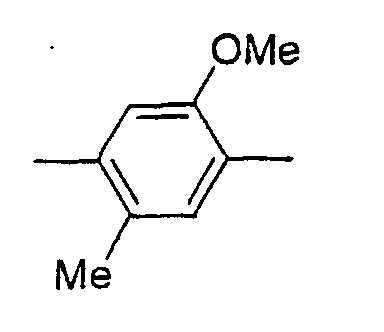
Compounds represented by Formula (Ia) wherein:
Compounds represented by Formula (Ib) wherein:
Compounds represented by Formula (Ic) wherein:
More typically, the compounds described in WO98/04508 or the following
compounds are preferred (Tables 1 to 3 show the structures of the moieties represented
by the symbols A1, A2, ..., B1, B2, ..., C1, C2, ... employed in Table 4 or later. In the
tables, cHex represents cyclohexyl, cPr represent cyclopropyl).
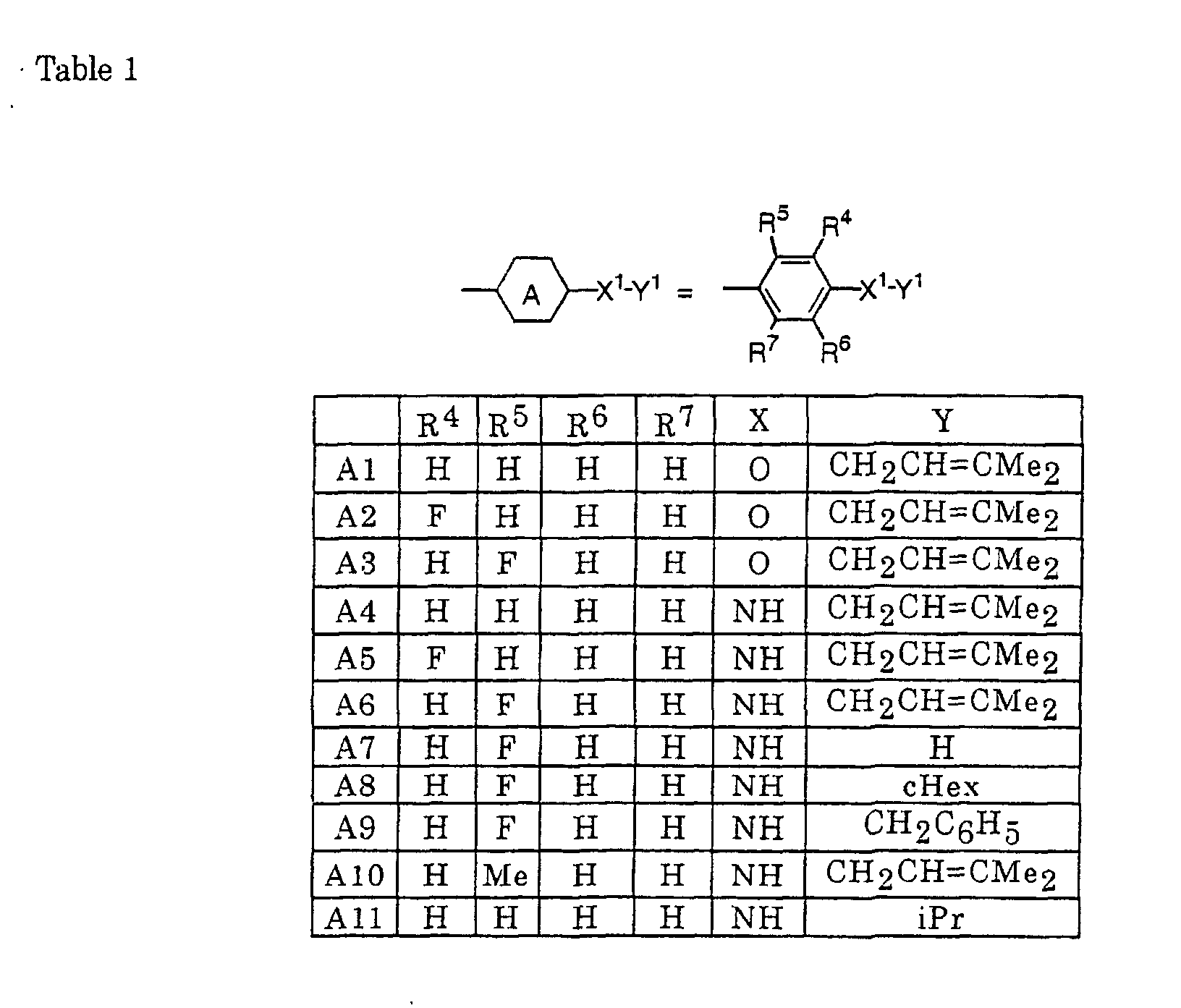
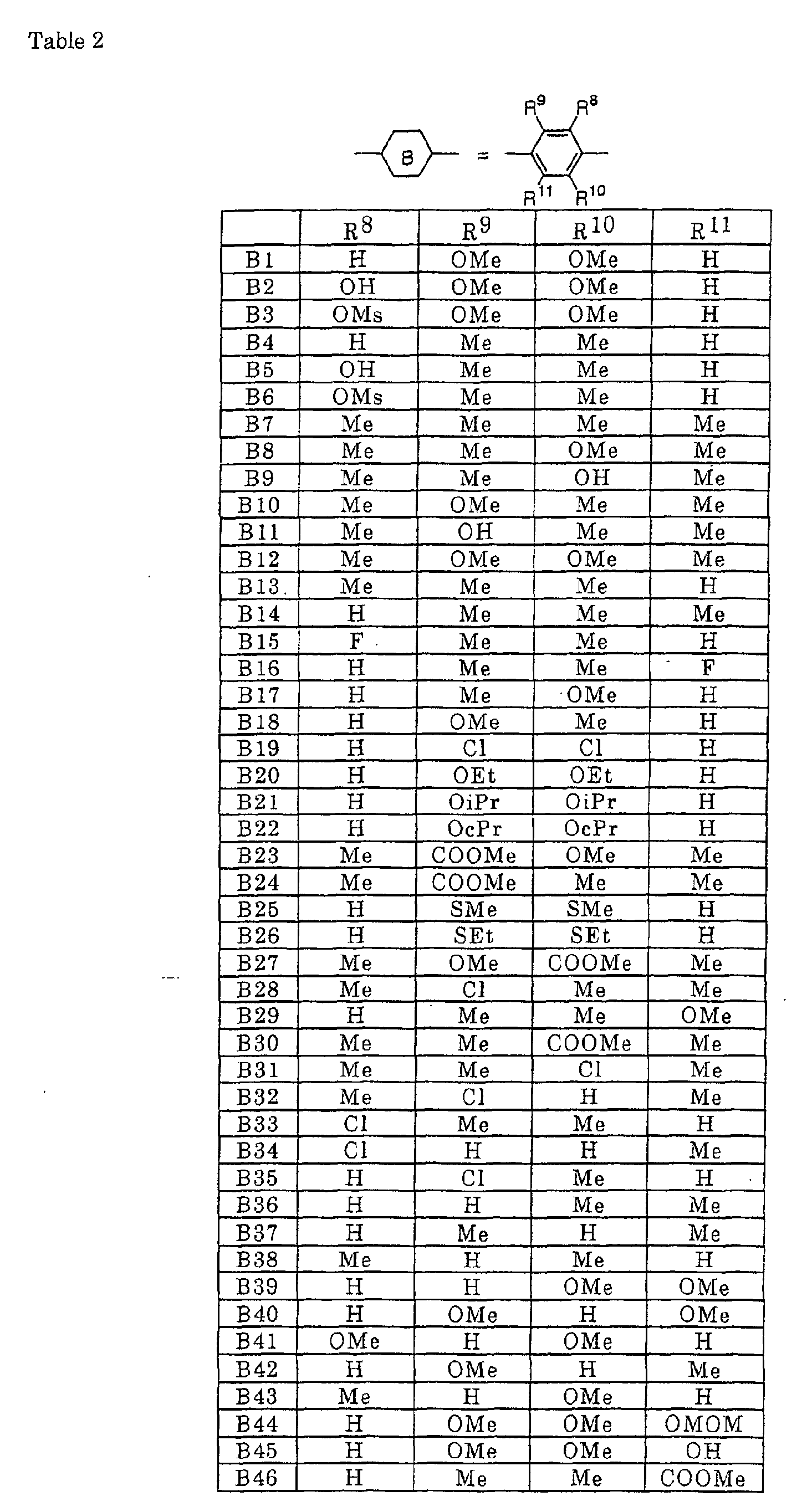

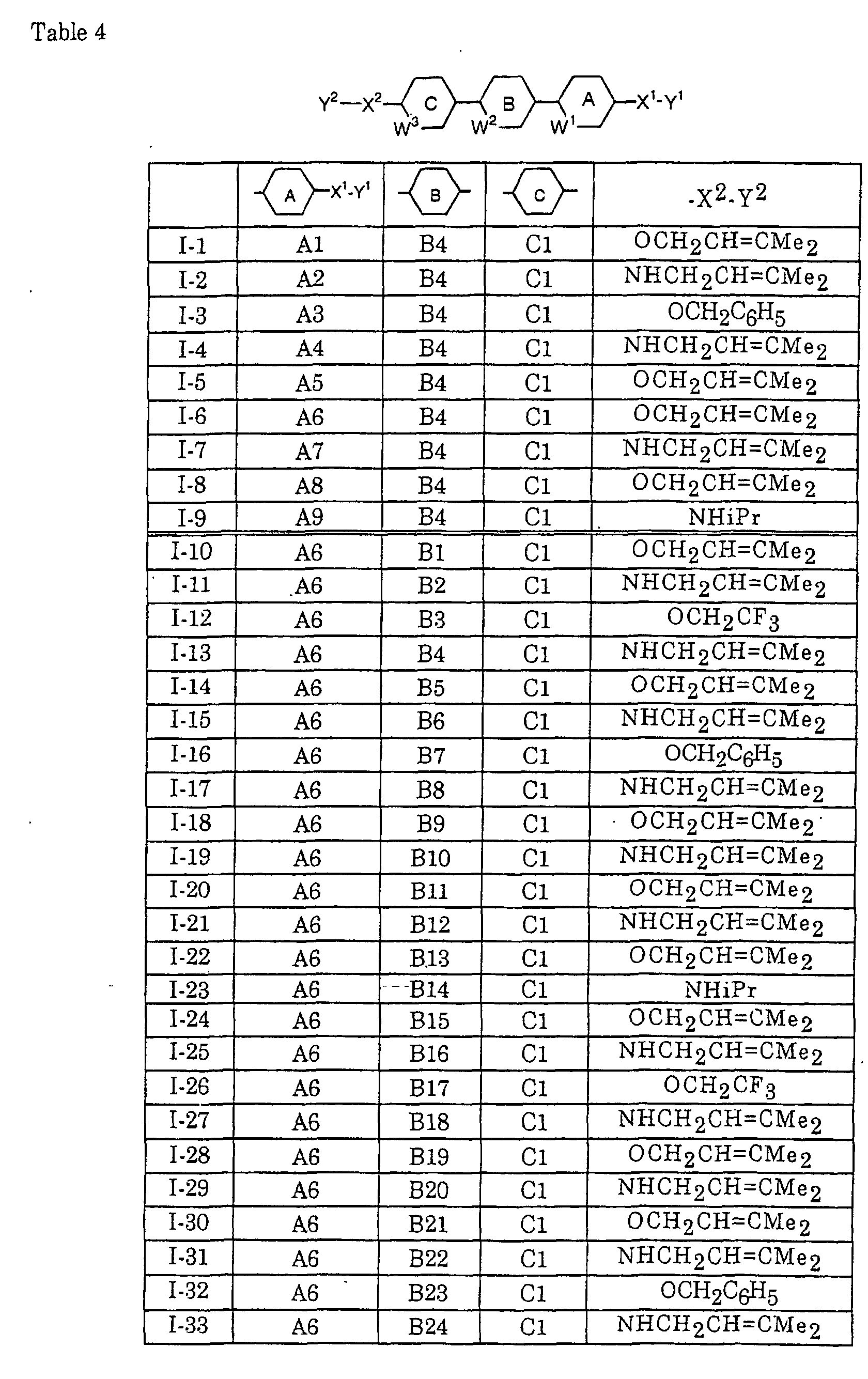
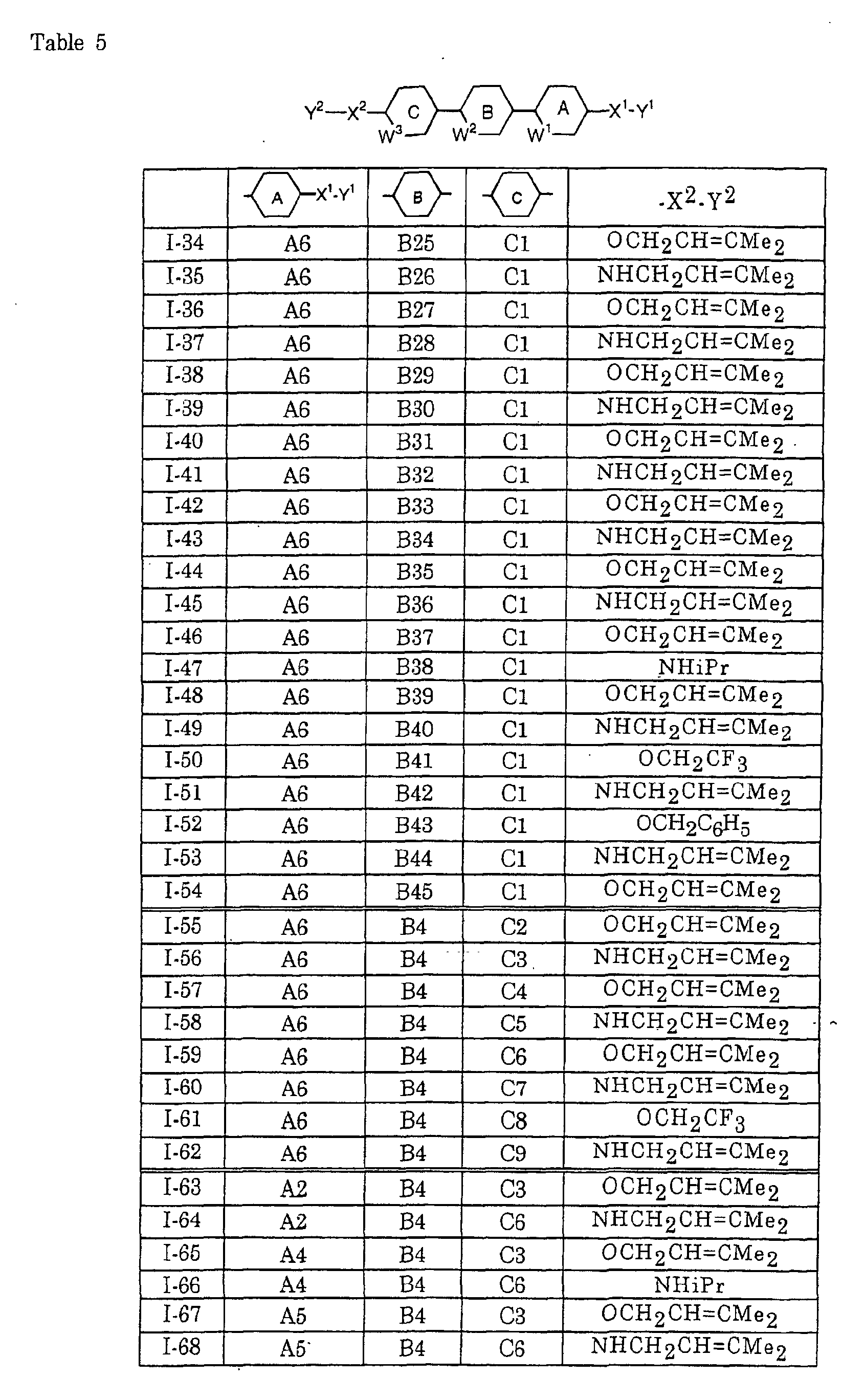
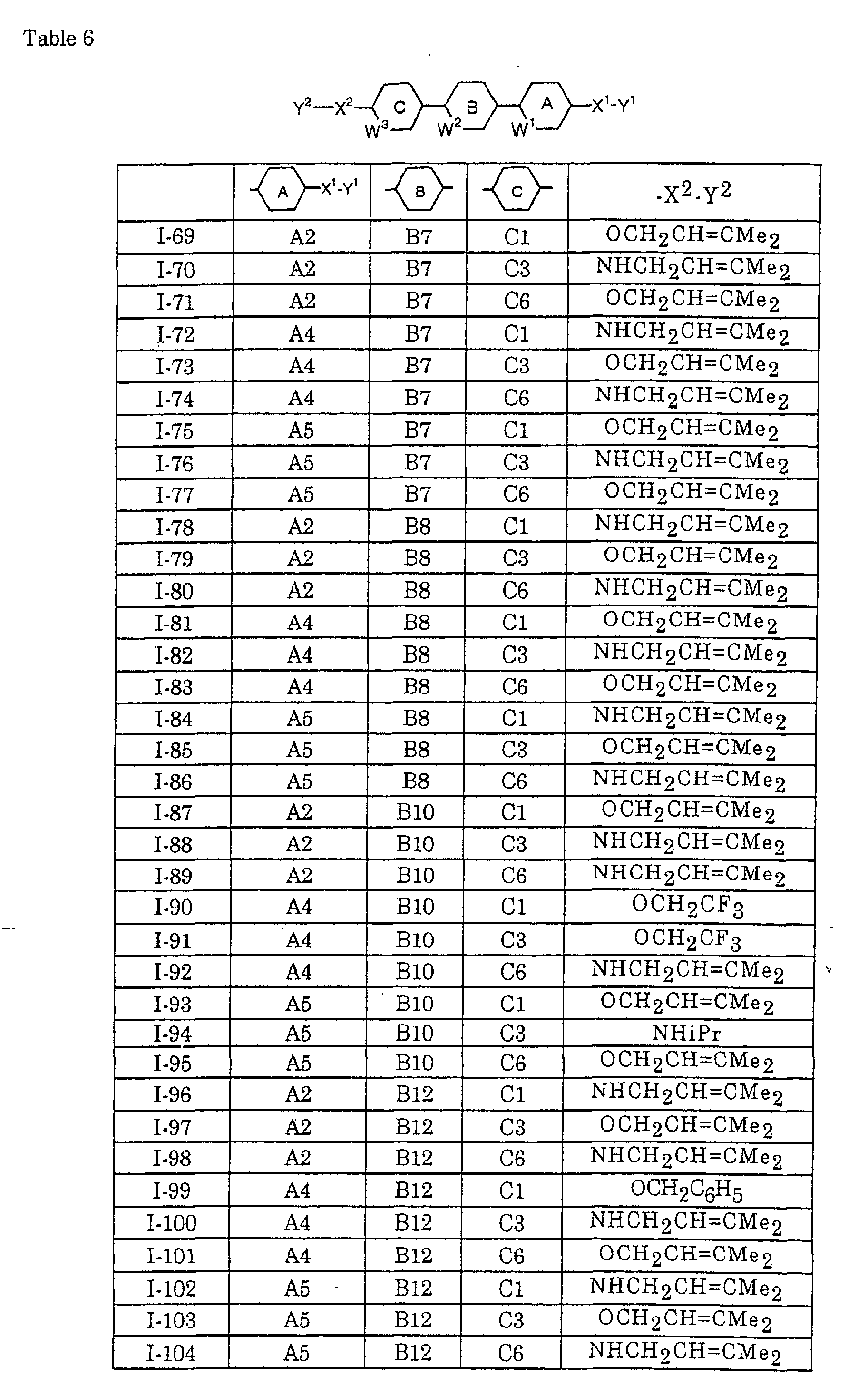


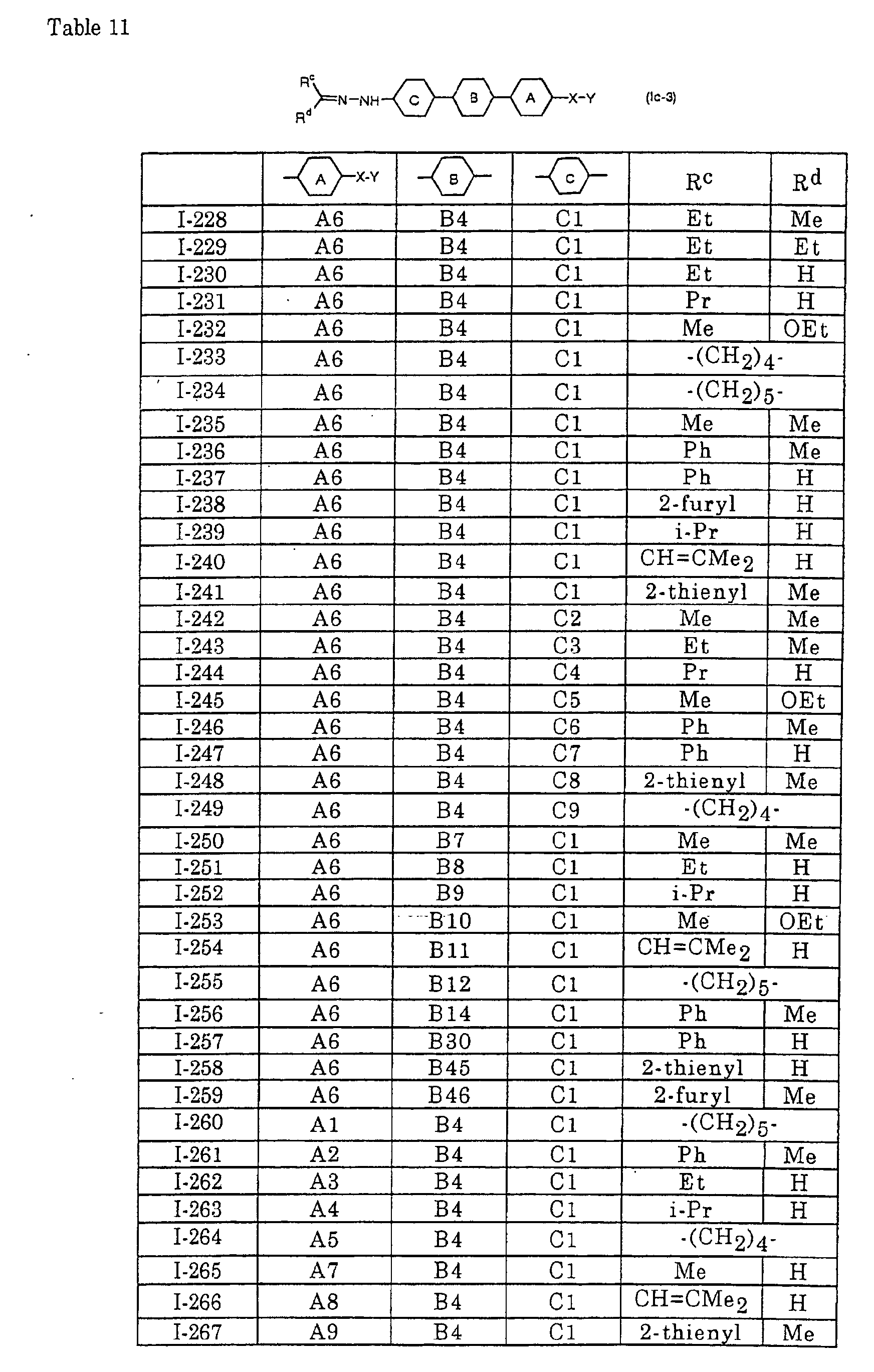

A method for producing Compound (I) is described below.
A compound represented by Formula (I') shown below (hereinafter referred to
as Compound (I')) can be produced by reacting a compound represented by Formula
(IIa) (hereinafter referred to as Compound (IIa)) with a bicyclic compound represented
by Formula (IIIa) (hereinafter referred to as Compound (IIIa)), or reacting a compound
represented by Formula (IIb) (hereinafter referred to as Compound (IIb)) with a bicyclic
compound represented by Formula (IIIb) (hereinafter referred to as Compound (IIIb)):
 wherein one of L and Z is dihydroxyboryl, di-lower alkylboryl or di-lower alkoxyboryl,
and the other is halogen or -OSO2 (CqF2q+1) (q is an integer of 0 to 4), and other
symbols are defined as described above).
wherein one of L and Z is dihydroxyboryl, di-lower alkylboryl or di-lower alkoxyboryl,
and the other is halogen or -OSO2 (CqF2q+1) (q is an integer of 0 to 4), and other
symbols are defined as described above).
Compound (IIa) and Compound (IIIa) or Compound (IIb) and Compound (IIIb)
are reacted in a mixture of a suitable solvent (for example, benzene, toluene, N, N-dimethylformamide,
dimethoxyethane, tetrahydrofuran, dioxane, ethanol or methanol)
with water or in an anhydrous system in the presence of a palladium catalyst (for
example Pd(PPh3)4, PdCl2(PPh3)2, PdCl2, Pd(OAc)2 or PdCl2(CH3CN)2, preferably
Pd(PPh3)4) in a basic condition (with a base such as K3PO4, NaHCO3, NaOEt, Na2CO3,
Et3N, Ba(OH)2, Cs2CO3, CsF, NaOH or Ag2CO3) at room temperature or with heating for
several ten minutes to several ten hours to give Compound (I').
One of substituents L and Z in compounds to be reacted with each other is any
boryl group capable of being used in Suzuki reaction (Chemical Communication 1979,
866, Journal of Organic Synthesis Society, 1993, Vol.51, NO.11, page 91 to 100), and
preferably dihydroxyboryl. The other is any leaving group applicable to Suzuki
reaction, such as halogen or -OSO2(CqF2q+1) wherein q is an integer of 0 to 4. Those
preferred especially are halogen and trifluoromethanesulfonyloxy (hereinafter
abbreviated as OTf), with bromine, iodine and OTf being most preferred.
Other substituents on ring A, ring B and ring C in Compounds (IIa), (IIIa),
(IIb) and (IIIb) and -X-Y are any groups by which Suzuki reaction is not affected
adversely, including those except for halogen and -OSO2(CqF2q+1) wherein q is an integer
of 0 to 4.
For example, Y may be optionally substituted lower alkyl, optionally
substituted lower alkenyl, optionally substituted lower alkynyl, optionally substituted
acyl, optionally substituted cycloalkyl, optionally substituted cycloalkenyl, optionally
substituted aryl or an optionally substituted 5- or 6-membered heterocyclic ring which
may be fused with a benzene ring, and when X is -CH2-, Y may also be optionally
substituted lower alkoxy. When X is -O- or -NR1- then Y may also be optionally
substituted lower alkoxycarbonyl, optionally substituted lower alkylsulfonyl or
optionally substituted arylsulfonyl.
Even when any of the substituents on rings A, B and C is halogen, the reaction
described above can satisfactorily be advanced when the reactivity between
substituents L and Z is higher relatively.
Also even when any of the substituents on rings A, B and C or -X-Y is hydroxy,
the reaction described above can be effected. The reaction is preferably effected after
introducing an ordinarily employed hydroxy protective group (for example,
methoxymethyl, benzyl, t-butyldimethylsilyl, methanesulfonyl or p-toluenesulfonyl)
which is subjected subsequently to a deprotection.
While Compound (I') is synthesized most efficiently and conveniently by
employing Suzuki reaction described above, silicon, zinc or tin may also be employed
instead of boryl group in the scheme shown above.
For example, when one of L and Z is -SiRe (3-r)(Hal)r(wherein each Re may be
different and is lower alkyl, Hal is halogen, r is an integer of 1 to 3) and the other is
halogen or -OSO2(CqF2q+1) wherein q is an integer of 0 to 4, an ordinarily employed
palladium catalyst is employed in a coupling reaction (Synlett, (1991) 845-853, J. Org.
Chem., 1996, 61, 7232-7233). A preferred palladium catalyst may for example be (i-Pr3P)2PdCl2,
[(dcpe)PdCl2](cdpe=1,2-bis(dicyclohexylphosphino)ethane), (η3-C3H5PdCl)2
and the like.
Also when one of L and Z is -SnRf 3 (wherein each Rf may be different and is
lower alkyl) and the other is halogen, acetyloxy or -OSO2(CqF2q+1) wherein q is an
integer of 0 to 4, an ordinarily employed palladium catalyst (preferably Pd(PPh3)4 and
the like) can be employed to obtain an intended compound (Angew. Chem. Int. Ed. Engl.,
25 (1986) 508-524).
Also by reacting a compound in which one of L and Z is -Zn(Hal) wherein Hal
is halogen and the other is halogen, an intended compound can be synthesized (Acc.
Chem. Res. 1982, 15, 340-348). While any ordinarily employed palladium catalyst can
be employed, those exemplified preferably are Pd(PPh3)4, PdCl2(dppf)(dppf=1,1'-bis(diphenylphosphino)ferrocene),
PdCl2(PPh3)2, PdCl2(P(o-Tolyl)3)2 and Pd(OAc)2.
Any of these reactions may be conducted in a suitable solvent (for example, N,
N-dimethylformamide, tetrahydrofuran) at room temperature or with heating for
several ten minutes to several ten hours.
Compounds (IIIa) and (IIIb) in a scheme shown above may be those known per
se, or may be derived from a compound represented by Formula (Va) (hereinafter
referred to as Compound (Va)) or a compound represented by Formula (Vb) (hereinafter
referred to as Compound (Vb)) which can be synthesized by a known method or a
method described below:

 wherein D and L are groups by which Suzuki reaction of Z is not affected adversely, and
when a compound represented by Formula (IVa) or (IVb) is a symmetric compound,they
may be groups similar to L, and other symbols are defined as described above.
wherein D and L are groups by which Suzuki reaction of Z is not affected adversely, and
when a compound represented by Formula (IVa) or (IVb) is a symmetric compound,they
may be groups similar to L, and other symbols are defined as described above.
First, a step similar to that described above is employed to react Compound
(IIb) with Compound (IVa) or Compound (IIa) with Compound (IVb) to give Compound
(Va) or (Vb). When Compound (IVa) or (IVb) is not a symmetric compound, D is
preferably a group which has no particular adverse effect on Suzuki reaction of L and Z
and which can conveniently be converted into L. For example, hydroxy, hydrogen,
formyl and nitro may be employed. L or Z may be subjected to a reaction employing
silicon, zinc or tin instead of a boryl group described above.
Subsequently, D is converted into a substituent L which is applicable to
Suzuki reaction.
For example when D is hydroxy, a reaction with a
trifluoromethanesulfonylating agent (for example, trifluoromethanesulfonic anhydride,
trifluoromethanesulfonyl chloride or N-phenyltrifluoromethanesulfonimide) is
conducted in a suitable solvent (for example, dichloromethane, chloroform,
tetrahydrofuran, benzene or toluene) in the presence of a base (sodium hydride,
pyridine, triethylamine or potassium carbonate) at -20°C or with heating for several
minutes to several ten hours to give an intended compound in which L is OTf.
When D is hydrogen, a reaction with a halogenating agent (for example,
chlorine, bromine, iodine or N-bromosuccinimide) is conducted in a suitable solvent (for
example, acetic acid, dichloromethane, chloroform, carbon tetrachloride, N, N-dimethylformamide
or water) at -20°C or with heating for several minutes to several
ten hours to give an intended compound in which L is halogen.
When D is formyl, it is subjected to Baeyer-Villiger oxidation by a standard
method to form formyloxy, which is then hydrolyzed to form hydroxy. Thereafter, a
procedure similar to that described above is employed to give a compound in which L is
OTf.
When D is nitro, it is reduced to amino and subjected to Sandmeyer reaction to
give a compound in which L is halogen.
A compound represented by Formula (I") shown below (hereinafter referred to
as Compound (I")) can be produced by Suzuki reaction between a compound
represented by Formula (VI) (hereinafter referred to as Compound (VI)) and a
compound represented by Formula (IIa) (hereinafter referred to as Compound (IIa)), or
by a condensation between a compound represented by Formula (VII) (hereinafter
referred to as Compound (VII)) and a compound represented by Formula (VIII)
(hereinafter referred to as Compound (VIII)):
 wherein one of M and Q is hydroxy or amino and the other is halogen, lower
alkylsulfonyloxy, arylsulfonyloxy, lower alkylsulfonyl or arylsulfonyl as itself or as a
substituent on methyl, or, one is lithium or Mg(Hal) wherein Hal is halogen and the
other is carboxy, lower alkoxycarbonyl, carbamoyl or formyl, or one is formyl and the
other is halogenated methyl, or one is ethynyl and the other is halogen, and other
symbols are defined as described above.
wherein one of M and Q is hydroxy or amino and the other is halogen, lower
alkylsulfonyloxy, arylsulfonyloxy, lower alkylsulfonyl or arylsulfonyl as itself or as a
substituent on methyl, or, one is lithium or Mg(Hal) wherein Hal is halogen and the
other is carboxy, lower alkoxycarbonyl, carbamoyl or formyl, or one is formyl and the
other is halogenated methyl, or one is ethynyl and the other is halogen, and other
symbols are defined as described above.
The conditions under which Compound (VI) and Compound (IIa) are reacted
are similar to those in a method for producing Compound (I').
In the reaction of Compound (VII) and Compound (VIII), when V2 in an
intended compound is -O-, -NH-, -OCH2-, -CH2O- or -NHCH2-, one of substituents M
and Q is hydroxy or amino and the other is a leaving group such as halogen, lower
alkylsulfonyloxy, arylsulfonyloxy, lower alkylsulfonyl or arylsulfonyl or methyl having
such leaving group as a substituent. These two compounds are reacted in a suitable
solvent (for example, benzene, toluene, acetone, acetonitrile, N, N-dimethylformamide,
dimethylsulfoxide, pyridine, methanol or ethanol) in the presence of a base (for example,
sodium hydride, pyridine, triethylamine, potassium carbonate, sodium hydroxide or
potassium hydroxide) optionally with a copper catalyst (copper powder, CuCl or CuO) at
0°C or with heating for several minutes to several tens hours to give an intended
compound.
In the reaction of Compound (VII) and Compound (VIII), when V2 in an
intended compound is -CO- or -CH(OH)-, one of substituents M and Q is lithium or an
organic metal such as Mg(Hal) wherein Hal is halogen and the other is carboxy, lower
alkoxycarbonyl, carbamoyl or formyl. These two compounds are reacted in a suitable
solvent (for example, diethylether, tetrahydrofuran, dimethoxyethane or dioxane) at -
78°C or with heating for several minutes to several hours to give an intended compound.
When V2 in an intended compound is -CH(ORg)- wherein Rg is lower alkyl, a
compound in which V2 is -CH(OH)- is obtained and subsequently alkylated.
An intended compound in which V2 is -CO- can be obtained by reacting a
compound in which V2 is -CH(OH)- with an oxidizing agent such as chromic anhydride
or Jones reagent in a solvent suitable for the oxidizing agent such as t-butyl alcohol or
acetone at 0°C or with heating for several hours. An intended compound in which V2
is -CH(OH)- can be obtained by reducing a compound in which V2 is -CO- in a suitable
solvent (for example diethylether, tetrahydrofuran, dimethoxyethane, dioxane,
methanol and ethanol) with sodium borohydride, lithium aluminum hydride and the
like.
When V2 in an intended compound is -CH=CH-, one of substituents M and Q is
formyl and the other is a halogenated methyl (halogen may for example be chlorine,
bromine or iodine). In this case, an intended compound can be obtained by Wittig
reaction (Organic Reaction, 1965, Vol.14, page 270).
When V2 in an intended compound is -CH≡CH-, one of substituents M and Q is
ethynyl and the other is halogen (preferably bromine or iodine), and the synthesis can
be effected by a coupling reaction (for example, Synthesis (1980) 627, Tetrahedron, 1982,
38, 631) using an ordinarily employed palladium catalyst.
Other substituents on ring A, ring B and ring C in Compounds (VI), (IIa), (VII)
and (VIII) and -X-Y are any groups by which Suzuki reaction of L and Z or the
condensation between M and Q is not affected adversely. Even when any of the
substituents in the reaction of Compound (VI) and (IIa) is halogen, the reaction
described above can satisfactorily be advanced when the reactivity between
substituents L and Z is higher relatively. While the reaction described above is
possible even when any of the substituents is hydroxy, it is preferable in such case that
the reaction is effected after introducing a protective group which is subjected
subsequently to an ordinary deprotection.
Compound (VI) in the reaction scheme described above may be a known
compound or may be synthesized from a compound represented by Formula (X)
(hereinafter refereed to as Compound (X)) which is synthesized by a method described
below:
 wherein D' is a group by which the condensation between M and Q is not affected
adversely, and, when a compound represented by Formula (IX) is a symmetric
compound, it may be a group identical to Q, and other symbols are defined as described
above.
wherein D' is a group by which the condensation between M and Q is not affected
adversely, and, when a compound represented by Formula (IX) is a symmetric
compound, it may be a group identical to Q, and other symbols are defined as described
above.
When Compound (IX) is not a symmetric compound, D' is preferably a group
which has no particular adverse effect on the condensation between M and Q and which
can conveniently be converted into L. For example, hydrogen, formyl or protected
hydroxy or nitro is employed. A protective group for hydroxy may for example be
benzyl, t-butyldimethylsilyl and methoxymethyl. A method for converting D' into L is
similar to that for converting D into L described above. Other conditions are similar to
those in the reaction of Compound (VII) and Compound (VIII).
Compound (VIII) may be a known compound or may be derived by a known
method or a compound synthesized from Compound (Vb) described above by a standard
method.
A compound represented by Formula (I"'):
 wherein each symbol is defined as described above
may also be synthesized similarly to Compound (I").
wherein each symbol is defined as described above
may also be synthesized similarly to Compound (I").
With regard to Compound (Ic), the following methods may be exemplified for
obtaining intended compounds.
For example, a compound represented by Formula (Ic') (hereinafter referred to
as Compound (Ic')) wherein each of Ra and Rb is independently hydrogen, optionally
substituted lower alkyl, optionally substituted lower alkenyl, optionally substituted aryl,
optionally substituted cycloalkyl, optionally substituted acyl or optionally substituted
lower alkoxycarbonyl, or they are taken together to form -(CReRf)r- can be obtained
from a compound represented by Formula (XI) (hereinafter referred to as Compound
(XI)) and a compound represented by Formula (XII) (hereinafter referred to as
Compound (XII)):
 wherein substituent L is a leaving group such as halogen, lower alkylsulfonyl,
arylsulfonyl, lower alkylsulfonyloxy or arylsulfonyloxy, and other symbols are defined as
described above.
wherein substituent L is a leaving group such as halogen, lower alkylsulfonyl,
arylsulfonyl, lower alkylsulfonyloxy or arylsulfonyloxy, and other symbols are defined as
described above.
Compounds (XI) and (XII) are reacted in a suitable solvent (for example,
benzene, toluene, acetone, acetonitrile, tetrahydrofuran, N, N-dimethylformamide,
dimethylsulfoxide, pyridine, methanol or ethanol) optionally in the presence of a base
(for example, sodium hydride, potassium t-butoxide, pyridine, triethylamine, potassium
carbonate, sodium hydroxide or potassium hydroxide) at 0°C or with heating for several
minutes to several tens hours to give intended Compound (Ic').
Compound (Ic") wherein Ra and Rb are taken together to form RcRdC= is
produced from RcRdC=N-X3 and Compound (XI) as described above or from Compound
(Ic') wherein Ra and Rb are hydrogens obtained from Compound (XI) and a compound
represented by Formula (XIII) (hereinafter referred to as Compound (XIII)):
 wherein each symbol is defined as described above.
First, Compound (XI) is reacted with hydrazine in a suitable solvent (for
example, toluene, tetrahydrofuran, N, N-dimethylformamide, dimethylsulfoxide,
pyridine, methanol or ethanol) or without using any solvent to give Compound (Ic',
X3=NH) or subjected to a method employing N-hydroxyphthalimide as described in
Journal of Chemical Society, 1926, 2348 or a method employing benzohydroxamic acid
as described in Journal of Chemical Society, 1927, 874 to give Compound (Ic', X3=O). A
compound thus obtained is subjected to a dehydration condensation with a carbonyl
compound (XIII) such as ketone or aldehyde optionally in the presence of an acid
catalyst (hydrochloric acid, acetic acid, trifluoroacetic acid, lower alkanesulfonic acid,
arylsulfonic acid and the like) to give intended Compound (Ic").
When one of Rc and Rd in Compound (Ic") is lower alkoxy, a reaction with a
carbonyl compound (RcC(=O)Rd) in a suitable solvent (for example, toluene,
tetrahydrofuran, dioxane or dichloromethane) in the presence of an acid (hydrochloric
acid, acetic acid, perchloric acid and the like) is effected, whereby converting into an
intended compound having other Rc and Rd.
Compound (Ic') wherein Ra and Rb are hydrogens can also be synthesized from
a compound represented by Formula (XI") (hereinafter referred to as Compound (XI'):
 wherein Q is NH2 or a group by which Suzuki reaction is not affected adversely and
which can be converted into substituent L by a general method, and other symbols are
defined as described above.
wherein Q is NH2 or a group by which Suzuki reaction is not affected adversely and
which can be converted into substituent L by a general method, and other symbols are
defined as described above.
For example, Compound (XI', Q=OH) is converted into an alkoxide or
phenoxide using a suitable base (for example, sodium hydride, potassium t-butoxide,
potassium carbonate, sodium hydroxide and potassium hydroxide) and then reacted
with chloramine or O-arylsulfonylhydroxylamine (Journal of Organic Chemistry, 1973
(38) 1239-1241) or Compound (XI', Q=NH2) is reacted with chloramine or
hydroxylamine-O-sulfonic acid (Journal of Organic Chemistry, 1949 (14) 813).
Compound (Ic') can be produced also by reacting a compound represented by
Formula (XIV) (hereinafter referred to as Compound (XIV)) with a compound
represented by Formula (XV) (hereinafter referred to as Compound (XV)):
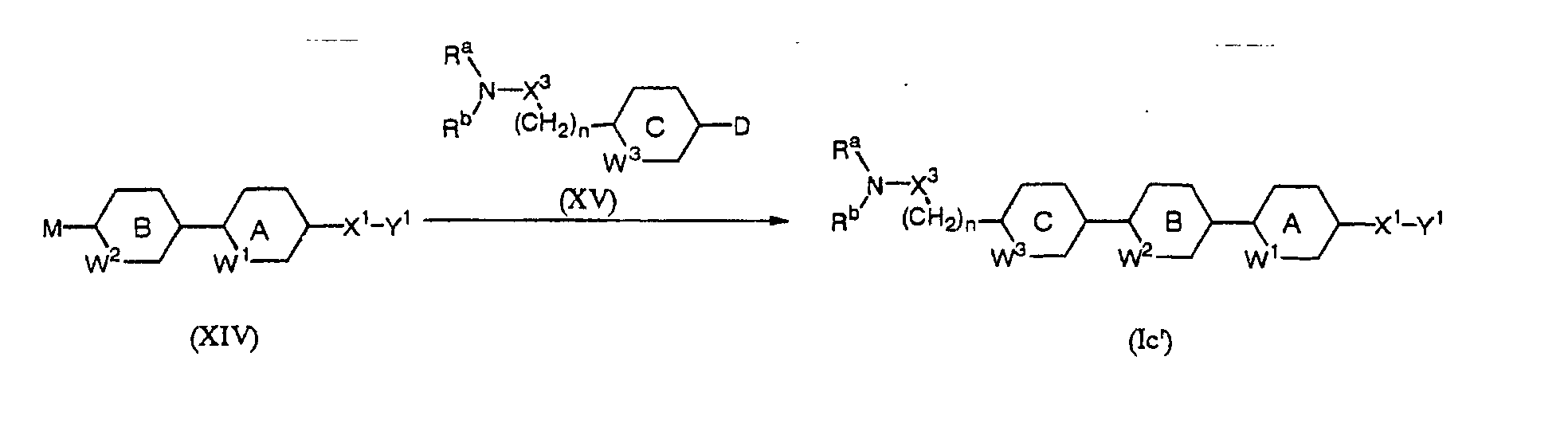 wherein one of M and D is dihydroxyboryl, di-lower alkylboryl or di-lower alkoxyboryl
and the other is halogen or -OSO2(CqF2q+1) wherein q is an integer of 0 to 4, and other
symbols are defined as described above.
wherein one of M and D is dihydroxyboryl, di-lower alkylboryl or di-lower alkoxyboryl
and the other is halogen or -OSO2(CqF2q+1) wherein q is an integer of 0 to 4, and other
symbols are defined as described above.
Compound (XIV) and Compound (XV) are reacted in a mixture of a suitable
solvent (for example, benzene, toluene, N, N-dimethylformamide, dimethoxyethane,
tetrahydrofuran, dioxane, ethanol or methanol) with water or in an anhydrous system
in the presence of a palladium catalyst (for example Pd(PPh3)4, PdCl2(PPh3)2, PdCl2,
Pd(OAc)2 or PdCl2(CH3CN)2, preferably Pd(PPh3)4) in a basic condition (with a base such
as K3PO4, NaHCO3, NaOEt, Na2CO3, Et3N, Ba(OH)2, Cs2CO3, CsF, NaOH or Ag2CO3) at
room temperature or with heating for several tens minutes to several tens hours to
give Compound (Ic').
Compound (XV) may be a known compound or may be obtained by a method
for Compounds (Ic') and (IC") described above.
One of substituent M and substituent D is any boryl group capable of being
used in Suzuki reaction, and preferably dihydroxyboryl. The other is any leaving
group applicable to Suzuki reaction, such as halogen or -OSO2(CqF2q+1) wherein q is an
integer of 0 to 4. Those preferred especially are halogen and
trifluoromethanesulfonyloxy (hereinafter abbreviated as OTf), with bromine, iodine and
OTf being most preferred.
Other substituents on ring A, ring B and ring C in Compounds (XIV) and (XV)
and -X1-Y1 are any groups by which Suzuki reaction is not affected adversely, including
those except for halogen and -OSO2(CqF2q+1) wherein q is an integer of 0 to 4, and even
when any of the substituents on rings A, B and C is halogen, the reaction described
above can satisfactorily be advanced when the reactivity between substituents M and D
is higher relatively.
Compounds (XI) and (XI') in the reaction scheme shown above may be known
compounds or can be synthesized by a known method or by the following method:
 wherein substituent Q is NH2 or a group by which Suzuki reaction is not affected
adversely and which can be converted into substituent L by a general method, and
other symbols are defined as described above.
wherein substituent Q is NH2 or a group by which Suzuki reaction is not affected
adversely and which can be converted into substituent L by a general method, and
other symbols are defined as described above.
Using Compound (XIV) which is a known compound or obtained by a method
described in WO98/04508 and Compound (XV') which is a known compound or obtained
from a known compound by a standard method, Compound (XI) is obtained by Suzuki
reaction similarly to the steps described above. When substituent L has any adverse
effect on Suzuki reaction, Compound (XV") is employed first to obtain Compound (XI")
and then substituent Q is converted into substituent L.
For example, when substituent Q is hydroxy, conversion into halogen can be
accomplished under a standard condition, or, an intended compound can be obtained
using a suitable sulfonylating agent (for example, methanesulfonyl chloride, p-toluenesulfonyl
chloride or trifluoromethanesulfonic anhydride). Also when
substituent Q is hydroxy which has previously been protected with a suitable protective
group such as benzyl, t-butyldimethylsilyl or methoxymethyl, it is deprotected by a
standard method into hydroxy, and subsequent procedure in accordance with the
method described above results in an intended compound.
Also when substituent Q is lower alkylthio or optionally substituted arylthio, each may be converted into a corresponding sulfone form using a suitable oxidizing agent (for example, hydrogen peroxide, peracetic acid, m-chloroperbenzoic acid, oxone monopersulfate compound).
Also when substituent Q is lower alkylthio or optionally substituted arylthio, each may be converted into a corresponding sulfone form using a suitable oxidizing agent (for example, hydrogen peroxide, peracetic acid, m-chloroperbenzoic acid, oxone monopersulfate compound).
Compound (XIV) employed in the reaction described above may be a known
compound, or may be produced from a known compound by Suzuki reaction.
While Compound (I) is synthesized most efficiently and conveniently by
employing Suzuki reaction described above, silicon, zinc or tin may also be employed
instead of a boryl group in the scheme shown above as described in WO98/04508.
In the case of a compound having a substituent which interferes with a
reaction described above, such group is protected first with a suitable protective group,
which is then cleaved at an appropriate stage by a standard method. For example,
when hydroxy interferes with a reaction, it is protected for example with
methoxymethyl, methanesulfonyl, benzyl, trifluoromethanesulfonyl or t-butyldimethylsilyl,
which is cleaved at an appropriate stage.
For example, when hydroxy is protected with methanesulfonyl,
methanesulfonyl chloride is allowed to react in a solvent such as dichloromethane,
chloroform or carbon tetrachloride in the presence of a base such as triethylamine or
pyridine under cooling with ice or at room temperature for several hours. A
deprotection can be effected in a solvent such as dimethylsulfoxide, N, N-dimethylformamide,
tetrahydrofuran, dioxane and dimethoxyethane using 1 to 4 N
sodium hydroxide, potassium hydroxide, an aqueous solution thereof, sodium
methoxide or ethylmagnesium bromide at room temperature or with heating for several
tens minutes to several hours.
When methoxymethyl is used to protect hydroxy, a reaction with chloromethyl
methyl ether is carried out in a solvent such as tetrahydrofuran, dioxane and
dimethoxyethane in the presence of sodium hydride or diisopropylethylamine, whereby
forming protected hydroxy. A deprotection may ordinarily be carried out in a solvent
such as methanol, tetrahydrofuran and acetic acid using hydrochloric acid or sulfuric
acid.
When t-butyldimethylsilyl is used as a protective group, a reaction with t-butyldimethylsilyl
chloride or t-butyldimethylsilyl triflate is carried out in a solvent
such as N, N-dimethylformamide, acetonitrile, tetrahydrofuran and dichloromethane in
the presence of imidazole, triethylamine or 2, 6-lutidine. For a deprotection, a
protective group can be cleaved by a reaction with tetrabutylammonium fluoride in a
solvent such as tetrahydrofuran.
A compound according to the invention obtained as described above can
further be converted into a prodrug.
The term "prodrug" is any compound that can readily be subjected to an in
vivo conversion into an active compound according to the invention, and a prodrug can
be obtained by any standard method. A method for selecting and producing a suitable
prodrug derivative is described for example in Design of Prodrugs, Elsevier, Amsterdam,
1985. According to this reference, a group employed usually for obtaining a prodrug is
introduced into carboxy, hydroxy or amino bound at any position in a compound of the
invention.
For example, when hydroxy is present as a substituent on ring A or ring C, -
COCH2CH2COOH, -COCH=CHCOOH, -COCH2SO3H, -PO3H2, -COCH2NMe2 and -CO-Py
(Py is pyridyl) can for example be introduced.
When amino is present as a substituent on ring A or ring C, -COOCRhRiOCOCH2Rj
(wherein each of Rh and Ri is independently hydrogen or lower alkyl, Rj is H, -OH, -CONHRk,-OCONHRk,
-(NHCOCRlRm)uNHCOCH3, -(NHCOCRlRm)uNHCOC2H5, -CSNH2,-(OCH2CH2)tOH,
-OCH3, -(OCH2CH2)tOCH3, -COCH3, -COC2H5, -OCOCH3, -OCOC2H5, -NHOH,
-NHCONH2, -NHCSNH2, -NHSO2CH3, -N(SO2CH3)2, -SO2NH2, -SOMe, -SO2CH3,-OCH2CONH2,
-OCH2CON(CH3)2, -SO2N(CH3)2, -PO(OCH3)2, -NHCSNHC2H5Et,-CH=NNHCONH2,
-CH=NNHCSNH2, -CH=NNHSO2CH3, triazolyl, tetrazolyl and the like,
each of Rk, Rl and Rm is hydrogen or lower alkyl, t is 1 or 2, u is an integer of 0 to 2),-COOCH(Me)OCOCMe3,
-COOCH2OCO(CH2)14Me, -COOCH2OCO-Pyr, -CH2NHCO-C6H4-o-OCH2OAc
and the like wherein Pyr is pyridyl, Ac is acetyl can be introduced.
When introducing substituted acyloxycarbonyl (-COOCRhRiOCOCH2Rj)
described above into amino present at any position in a compound of the invention to
form a prodrug, the amino present in any position of the compound of the invention is
α-haloalkoxycarbonylated and reacted with a suitable carboxylic acid under an
appropriate condition, whereby obtaining the prodrug.
A method for synthesizing such an acyloxyalkylcarbamate is described for
example in WO96/18605.
Typically, an amino-containing compound of the invention and α-haloalkyl
chloroformate are reacted in an inert solvent (diethylether, tetrahydrofuran, 1,4-dioxane,
ethyl acetate, toluene and the like) in the presence of a base (pyridine,
triethylamine, N-methylmorpholine and the like) at 0°C to room temperature to give a
haloalkoxycarbamate compound. Then a compound thus obtained was reacted in a
solvent (N, N-dimethylformamide, N, N-dimethylacetoamide, dimethylsulfoxide,
sulfolane and the like) with a salt of a substituted carboxylic acid (for example, alkaline
metal salt, alkaline earth metal salt, silver salt, mercury salt and the like) at room
temperature or with heating for several hours to several days to give a prodrug
compound.
A substituent interfering with the formation of a prodrug, if any, can
previously be protected with an appropriate protective group and then cleaved at an
appropriate stage by a standard method.
In the specification, the term "Th2 differentiation inhibitor" is a
pharmaceutical composition which inhibits the differentiation from Th0 cells to Th2
cells, thus, a pharmaceutical composition for treating and/or preventing diseases
induced by Th2 cells or by cytokines produced by Th2 cells.
Th2 differentiation inhibitors of the invention reduce the population of Th2
cells to give a reduction in the level of Th2 cell-derived cytokines, whereby exerting its
inhibitory effects on B-cells activation and antibody production, which are associated
further with the following characteristics.
An activation of B-cells while resting is believed to require a contact between
Th2 cells and the B-cells as well as a stimulation of Th2 cell-derive cytokines, and Th2
differentiation inhibitors of the invention have an inhibitory effect also on the activation
of the B-cells by the Th2 cells themselves. Accordingly, a more effective treatment and
prevention of allergic diseases or autoimmune diseases is possible when compared with
conventional anti-allergic agents.
A certain allergic diseases such as asthma and airway inflammation is known
to be induced by Th2 cells themselves, and Th2 differentiation inhibitors of the
invention is effective also in treating diseases against which IgE production inhibitors
alone, for example, are not expected to be so effective.
Th2 differentiation inhibitors of the invention do not inhibit the differentiation
from Th0 cells to Th1 cells, thus exhibiting a high Th2 selectivity. Accordingly, it
shows no inhibitory effect on the protection against an infection with a virus or
intracellular parasite in which Th1 cells are believed to be involved (for example,
tuberculosis, leprosy, chlamydia), but inhibits advantageously the advancement of
acquired immunodeficiency syndrome (AIDS), thus being an excellent pharmaceutical
having less side effects.
Th2 differentiation inhibitors of the invention are effective against immune
diseases classified as type-Th2 immune diseases. For example, they are used
preferably as therapeutic and/or prophylactic agents against graft immune diseases
(chronic GVHD), autoimmune diseases (especially organ non-specific autoimmune
diseases) and type-Th2 allergic diseases. Diseases exemplified typically are ulcerative
colitis, systemic lupus erythematodes, myasthenia gravis, systemic progressive
scleroderma, rheumatoid arthritis, interstitial cystitis, Hashimoto's diseases, Basedow's
diseases, autoimmune hemolytic anemia, idiopathic thrombocytopenic purpura,
Goodpasture's syndrome, atrophic gastritis, pernicious anemia, Addison diseases,
pemphigus, pemphigoid, lenticular uveitis, sympathetic ophthalmia, primary biliary
cirrhosis, active chronic hepatitis, Sjogren's syndrome, multiple myositis,
dermatomyositis, polyarteritis nodosa, rheumatic fever, glomerular nephritis (lupus
nephritis, IgA nephtopathy, and the like), allergic encephalitis, atopic allergic diseases
(for example, bronchial asthma, allergic rhinitis, allergic dermatitis, allergic
conjunctivitis, pollinosis, urticaria, food allergy and the like), Omenn's syndrome, vernal
conjunctivitis and hypereosinophilic syndrome. A particular effectiveness is observed
especially in organ non-specific autoimmune diseases such as graft immune diseases
(chronic GVHD), ulcerative colitis, systemic lupus erythematosus, myasthenia gravis,
systemic progressive scleroderma, rheumatoid arthritis, lupus nephritis, interstitial
cystitis and the like.
When Th2 differentiation inhibitors of the invention are administered, it can
be given orally and parenterally. When administered orally, a formulation employed
customarily such as tablet, granule, powder, capsule, pill, solution, syrup, buccal or
sublingual formulation may be given in a standard manner. When administered
parenterally, a formulation employed customarily such as intramuscular or intravenous
injection formulation, suppository, percutaneous absorption and inhalation
formulations can preferably be given. An oral administration is particularly preferred.
An effective amount of a compound according to the invention can be mixed if
necessary with various pharmaceutical additives suitable for its particular dosage form
such as excipient, binder, lubricant, disintegrant, lubricant, diluent and the like to form
a pharmaceutical formulation. A formulation for injection may be prepared using a
suitable vehicle to be sterilized simultaneously.
Those exemplified typically are lactose, sugar, glucose, starch, calcium
carbonate or crystalline cellulose as an excipient, methyl cellulose, carboxymethyl
cellulose, hydroxypropyl cellulose, gelatin or polyvinyl pyrrolidone as a binder,
carboxymethyl cellulose, sodium carboxymethyl cellulose, starch, sodium alginate, agar
power or sodium laurylsulfate as a disintegrant, talc, magnesium stearate or Macrogol
as a lubricant. A suppository base may for example be cocoa butter, Macrogol and
methylcellulose. A liquid, emulsion or suspension formulation for injection may be
formulated using customarily employed solubilizing agent, suspending agent,
emulsifier, stabilizer, preservative, isotonizing agent and other additives, and an oral
formulation may contain sweetening agents and flavors.
Th2 differentiation inhibitors of the invention can be given alone or in
combination with other anti-allergic agents if necessary. An agent which can be
employed in combination may for example be a steroid, a known anti-allergic agent and
a bronchodilator.
While the dose of Th2 differentiation inhibitors of the invention are adjusted
preferably on the basis of patient's age, body weight, type and severity of the diseases as
well as the administration route, it is usually 0.05 to 100 mg/kg/day preferably 0.1 to 10
mg/kg/day in adults. While the dose when given parenterally varies greatly depending
on the administration route, it is usually 0.0001 to 10 mg/kg/day, preferably 0.001 to 1
mg/kg/day. Such dose may be divided into several portions, which are given over a day.
The present invention is further described in the following Examples, which
are not intended to restrict the invention.

To a solution of Compound (1) (23.7 g, 0.1 mol) in dimethoxyethane (300 ml)-ethanol
(150 ml), an aqueous solution (150 ml) of boronic acid (2) (22.88 g, 0.1 mol) and
sodium carbonate (31.8 g, 0.3 mol) was added and the reaction mixture was deaerated.
Tetrakis(triphenylphosphine)palladium (3.47 g, 3 mmol) was added and the mixture
was heated under reflux under nitrogen atmosphere for 2 hours, and then diluted with
water and extracted with ethyl acetate. The extract was washed with saturated brine,
dried, concentrated, and the resultant residue was crystallized from hexane to obtain
Compound (3) (24.92g, yield: 84%).
Similarly to Step 1, Compound (3) (20.0 g, 68.0 mmol) and boronic acid (4)
(14.94 g, 88.3 mmol) were reacted for 18 hours and the extraction residue was purified
by a chromatography on silica gel (hexane:ethyl acetate=2:1) to obtain Compound 5
(19.24 g; Yield: 84%).
To a solution of Compound (5) (21.15 g, 62.5 mmol) in dichloromethane (200
ml) under cooling on ice, pyridine (6.6 ml, 81.2 mmol) and then trifluoroacetic anhydride
(10.6 ml, 75.0 mmol) were added, and the mixture was stirred at room temperature for
1 hour. The reaction mixture was diluted with ethyl acetate, and then washed
successively with water, 1 N hydrochloric acid and a 5% aqueous solution of sodium
hydrogen carbonate, dried, concentrated to give Compound (6) (22.80 g; Yield: 84%).
To a solution of Compound (6) (14.0 g, 32.2 mmol) in dichloromethane (300 ml)
under cooling on ice, m-chloroperbenzoic acid (14.46 g, 83.8 mmol) was added and the
mixture was stirred at room temperature for 3 hours. The reaction mixture was
combined with an aqueous solution of sodium thiosulfate, extracted with ethyl acetate,
washed twice with an saturated aqueous solution of sodium hydrogen carbonate, dried
and concentrated. The residue was washed with hexane to obtain Compound (7)
(12.97 g; Yield 86%).
A solution of Compound (7) (15.0 g, 32.2 mmol) in DMF (65 ml) was combined
with potassium carbonate (6.67 g, 48.2 mmol) followed by prenyl bromide (4.81 ml, 41.8
mmol), and then stirred for 18 hours at room temperature. The reaction mixture was
diluted with ethyl acetate, washed successively with water and saturated brine, dried
and concentrated to obtain a residue, which was then dissolved in tetrahydrofuran (150
ml). A reaction mixture prepared by adding sodium hydride (60% in mineral oil, 3.85 g,
96.5 mmol) to a solution of prenol (9.8 ml, 96.5 mmol) in tetrahydrofuran (150 ml) was
added under cooling on ice, and the mixture was stirred further for 2 hours at the same
temperature. The reaction mixture was diluted with ethyl acetate, washed
successively with water and saturated brine, dried and concentrated. The residue was
purified by a chromatography on silica gel (hexane: ethyl acetate = 7:1) to obtain
Compound (I-6) (12.5 g; Yield: 87%).
mp 87 to 88°C
1H NMR (CDCl3) δ H1.74 (s, 3H), 1.78 (s, 3H), 1.79 (s, 3H), 1.80 (s, 3H), 2.22 (s, 3H), 2.26 (s, 3H), 3.71 (d, J = 6.9Hz, 2H), 4.87 (d, J = 7.2Hz, 2H), 5.32-5.37 (m, 1H), 5.55-5.60 (m, 1H), 6.35-6.47 (m, 2H), 6.81 (dd, J = 0.6, 8.4Hz, 1H), 7.02-7.13 (m, 3H), 7.59 (dd, J = 2.4, 8.4Hz, 1H), 8.16 (dd, J = 0.9, 5.7Hz, 1H) ppm.
IR (Nujol): 3330, 2923, 2853, 1627, 1606, 1564, 1527, 1481, 1471, 1395, 1376, 1357, 1337, 1284, 1240, 1178, 1116, 990 cm-1
mp 87 to 88°C
1H NMR (CDCl3) δ H1.74 (s, 3H), 1.78 (s, 3H), 1.79 (s, 3H), 1.80 (s, 3H), 2.22 (s, 3H), 2.26 (s, 3H), 3.71 (d, J = 6.9Hz, 2H), 4.87 (d, J = 7.2Hz, 2H), 5.32-5.37 (m, 1H), 5.55-5.60 (m, 1H), 6.35-6.47 (m, 2H), 6.81 (dd, J = 0.6, 8.4Hz, 1H), 7.02-7.13 (m, 3H), 7.59 (dd, J = 2.4, 8.4Hz, 1H), 8.16 (dd, J = 0.9, 5.7Hz, 1H) ppm.
IR (Nujol): 3330, 2923, 2853, 1627, 1606, 1564, 1527, 1481, 1471, 1395, 1376, 1357, 1337, 1284, 1240, 1178, 1116, 990 cm-1
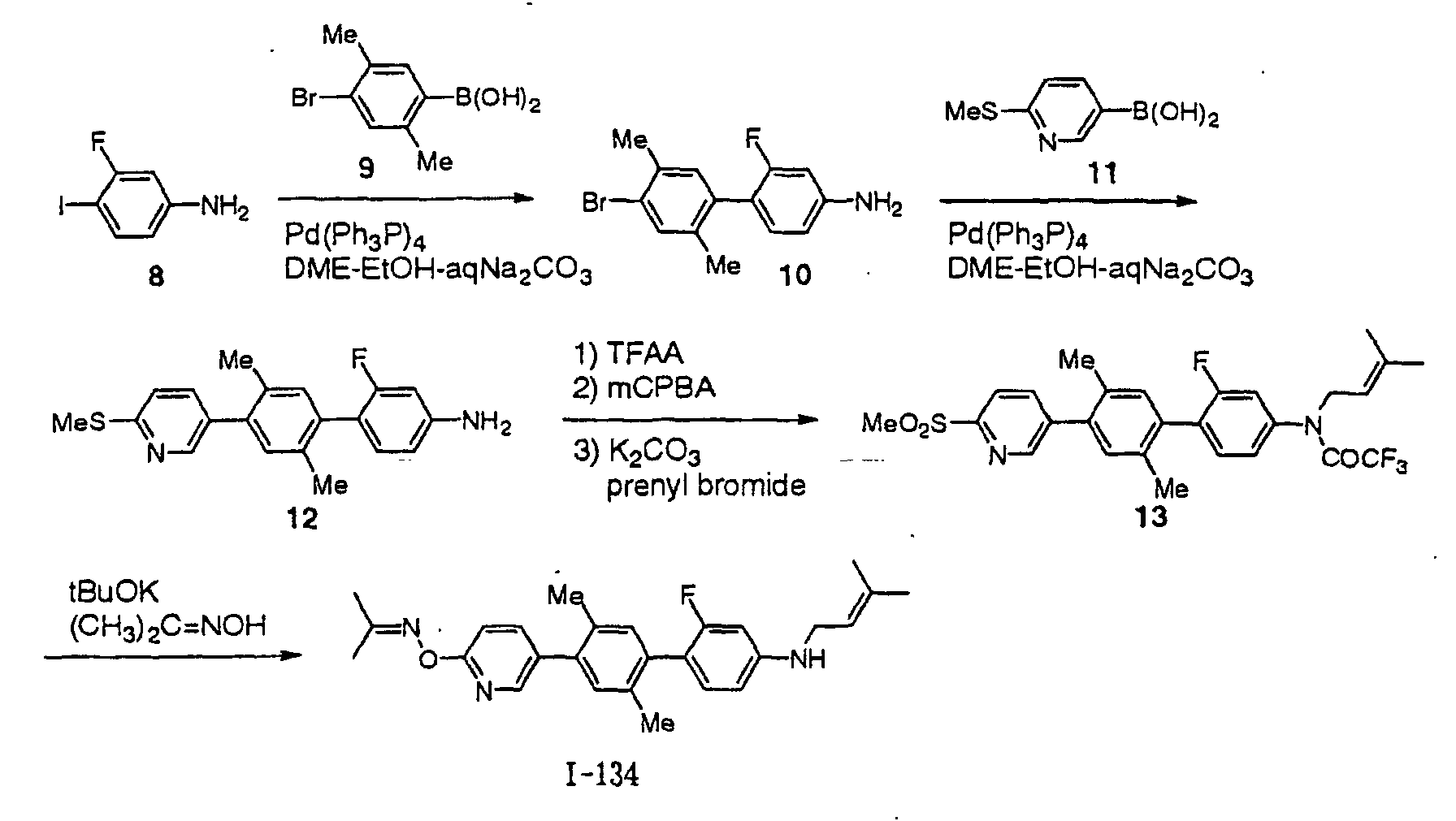
To a solution of Compound (8) (23.7 g, 0.1 mol, Journal of Organic Chemistry,
1961 (26) 3351-3356) in dimethoxyethane (300 ml) - ethanol (150 ml), boronic acid (9)
(22.88 g, 0.1 mol) and an aqueous solution (150 ml) of sodium carbonate (31.8 g, 0.3 mol)
was added and the reaction mixture was deaerated. Tetrakis (triphenylphosphine)
palladium (3.47 g, 3 mmol) was added and the mixture was heated under reflux under
nitrogen atmosphere for 2 hours, and then diluted with water and extracted with ethyl
acetate. The extract was washed with saturated brine, dried and concentrated, and
the resultant residue was crystallized from hexane to obtain Compound (10) (24.92g,
yield: 84%).
Similarly to Step 1, Compound (12) (1.56 g; Yield: 92%) was obtained from
Compound (10) (1.47 g, 5 mmol) and boronic acid (11) (1.01 g, 6 mmol).
To a solution of Compound (12) (1.56 g, 4.62 mmol) in dichloromethane (5 ml)
under cooling on ice, pyridine (0.56 ml, 6.92 mmol) and then trifluoroacetic anhydride
(0.78 ml, 5.54 mmol) were added, and the mixture was stirred at room temperature for
1 hour. The reaction mixture was diluted with ethyl acetate, and then washed
successively with water, a 5% aqueous solution of sodium hydrogen carbonate and
saturated brine, and then dried and concentrated. The residue dissolved in
dichloromethane (16 ml) was treated under cooling on ice with m-chloroperbenzoic acid
(2.0 g, 11.6 mmol) and stirred at room temperature for 3 hours. The reaction mixture
was treated with an aqueous solution of sodium thiosulfate and extracted with
chloroform, washed twice with a 5% aqueous solution of sodium hydrogen carbonate,
dried and then concentrated. The residue was dissolved in N, N-dimethylformamide
(8 ml), combined with potassium carbonate (720 mg, 5.21 mmol) followed by prenyl
bromide (0.52 ml, 4.34 mmol), and stirred at room temperature for 14 hours. The
reaction mixture was diluted with ethyl acetate, washed successively with water and
saturated brine, dried and concentrated. The residue was purified by a
chromatography on silica gel (hexane:ethyl acetate = 2:1) to obtain Compound (13) (1.71
g; Yield: 69%).
To a solution of acetoxime (137 mg, 1.87 mmol) in N, N-dimethylformamide (3
ml), sodium hydride (60% in mineral oil, 137 mg, 1.87 mmol) was added, and the
mixture was stirred at room temperature for 1 hour, and then Compound (13) (250 mg,
0.468 mmol) was further added. The mixture was stirred at room temperature for 14
hours, diluted with ethyl acetate, washed successively with a 5% aqueous solution of
citric acid and saturated brine, dried and concentrated. The residue was purified by a
chromatography on silica gel (hexane: ethyl acetate = 7:3) to obtain Compound (I-134)
(126 mg; Yield: 62%).
mp 135 to 137°C; 1H NMR (CDCl3) δ 1.74 (s, 3H), 1.78 (s, 3H), 2.09 (s, 3H), 2.16 (s, 3H), 2.22 (s, 3H), 2.26 (s, 3H), 3.72 (d, J = 6.6Hz, 2H), 3.90 (br s, 1H), 5.35 (m, 1H), 6.39 (dd, J = 2.4, 12.3Hz, 1H), 6.46 (dd, J= 2.4, 8.4Hz, 1H), 7.06 (t, J= 8.4Hz, 1H), 7.12 (s, 1H), 7.13 (s, 1H), 7.23 (dd, J = 0.6, 8.7Hz, 1H), 7.70 (dd, J = 2.4, 8.7Hz, 1H), 8.28 (dd, J = 0.6, 2.4Hz, 1H) ppm
mp 135 to 137°C; 1H NMR (CDCl3) δ 1.74 (s, 3H), 1.78 (s, 3H), 2.09 (s, 3H), 2.16 (s, 3H), 2.22 (s, 3H), 2.26 (s, 3H), 3.72 (d, J = 6.6Hz, 2H), 3.90 (br s, 1H), 5.35 (m, 1H), 6.39 (dd, J = 2.4, 12.3Hz, 1H), 6.46 (dd, J= 2.4, 8.4Hz, 1H), 7.06 (t, J= 8.4Hz, 1H), 7.12 (s, 1H), 7.13 (s, 1H), 7.23 (dd, J = 0.6, 8.7Hz, 1H), 7.70 (dd, J = 2.4, 8.7Hz, 1H), 8.28 (dd, J = 0.6, 2.4Hz, 1H) ppm
A suspension of 1,4-dibromo-2,5-dimethylbenzene (154 g, 583 mmol) in
tetrahydrofuran (1.3 L) was cooled to -78°C, and a 1.53 M solution of butyllithium -
hexane (400 ml, 612 mmol) was added dropwise over 30 minutes. After stirring the
reaction mixture at the same temperature further for 1 hour, triisopropyl borate (170 ml,
734 mmol) was added at once and the cooling medium was removed to allow the
mixture to warm with stirring for 1 hour. After adding water (300 ml) and 1 N
hydrochloric acid (650 ml), the mixture was extracted with ethyl acetate, and the
extract was washed with water and saturated brine, dried and concentrated. A
crystalline residue was washed with hexane and filtered to give Compound (9) (115 g;
Yield 86%).
A solution of a 1.53 M solution of butyllithium - hexane (500 ml, 765 mmol) in
tetrahydrofuran (1.28 L) was cooled to -78°C, and a solution of 5-bromo-2-methylchiopyridine
(142 g, 695 mmol) in tetrahydrofuran (400 ml) was added dropwise
over 40 minutes. After stirring the reaction mixture at the same temperature further
for 30 minutes, triisopropyl borate (195 ml, 834 mmol) was added dropwise over 30
minutes. The cooling medium was removed, and the mixture was allowed to warm
with stirring for 30 minutes. After adding water (320 ml), the mixture was
concentrated under reduced pressure and the residue was diluted again with water
(710 ml) and isopropylether (210 ml). The reaction mixture was stirred at room
temperature with a dropwise addition of 3 N hydrochloric acid (675 ml), and the
precipitating crystal was filtered, washed with water and isopropylether and dried to
obtain Compound (11) (111 g; Yield:95%).
mp 151 to 154°C
Anal Calcd for C6H8BNO2S: C, 42.64; H, 4.77; N, 8.29; S, 18.97.
Found: C, 42.56; H, 4.88; N, 8.14; S, 18.79.
1H-NMR(DMSO-d6)δ 2.51 (s, 3H), 7.25 (dd, J = 0.9, 8.1Hz, 1H), 7.93 (dd, J = 2.1, 8.1Hz, 1H), 8.73 (dd, J = 0.9, 2.1Hz, 1H) ppm.
mp 151 to 154°C
Anal Calcd for C6H8BNO2S: C, 42.64; H, 4.77; N, 8.29; S, 18.97.
Found: C, 42.56; H, 4.88; N, 8.14; S, 18.79.
1H-NMR(DMSO-d6)δ 2.51 (s, 3H), 7.25 (dd, J = 0.9, 8.1Hz, 1H), 7.93 (dd, J = 2.1, 8.1Hz, 1H), 8.73 (dd, J = 0.9, 2.1Hz, 1H) ppm.

A solution of Compound (14) (261 mg, 0.65 mmol), which was obtained by a
method described in WO98/04508, in methanol (4 ml) was cooled to 0°C, treated with
potassium t-butoxide (75 mg, 0.65 mmol) and stirred for 15 minutes. After distilling
the solvent off under reduced pressure followed by drying, the residue was dissolved in
N, N-dimethylformamide (2.5 ml). O-Mesithylene sulfonyl hydroxylamine (Journal of
Organic Chemistry, 1973 (38) 1239-1241) (251 mg, 1.16 mmol) was added, and the
reaction mixture was stirred for 1 hour, poured into water, and extracted with
ethylether:ethyl acetate (1:1). The extract was washed with water and saturated brine,
dried, concentrated to obtain a residue, which was dissolved in methanol (3 ml),
combined with acetone (0.48 ml, 6.5 mmol) and stirred at room temperature for 1 hour.
The reaction mixture was concentrated, and the residue was purified by a
chromatography on silica gel (hexane:ethyl acetate = 10:1) to obtain Compound (I-179)
(118 mg; Yield: 40%).
mp 129 to 130°C; 1H NMR (CDCl3) δ 1.74 (s, 3H), 1.78 (s, 3H), 1.96 (s, 6H), 1.98 (s, 6H), 2.06 (s, 3H), 2.15 (s, 3H), 3.60 (br s, 1H), 3.74 (d, J = 6.6Hz, 2H), 5.40 (m, 1H), 6.69 (d, J = 8.7Hz, 2H), 6.87-6.98 (m, 4H), 7.48 (t, J =8.4Hz, 1H) ppm
mp 129 to 130°C; 1H NMR (CDCl3) δ 1.74 (s, 3H), 1.78 (s, 3H), 1.96 (s, 6H), 1.98 (s, 6H), 2.06 (s, 3H), 2.15 (s, 3H), 3.60 (br s, 1H), 3.74 (d, J = 6.6Hz, 2H), 5.40 (m, 1H), 6.69 (d, J = 8.7Hz, 2H), 6.87-6.98 (m, 4H), 7.48 (t, J =8.4Hz, 1H) ppm

To a solution of Compound (15) (4.41 g, 15.0 mmol) in dichloromethane (45 ml),
3-methyl-2-butenal (1.74 ml, 18.0 mmol), acetic acid (1.8 g, 30.0 mmol) and sodium
triacetoxyborohydride (6.36 g, 30.0 mmol) were added successively, and the reaction
mixture was stirred for 15 hours. The reaction mixture was poured into water,
extracted with ethyl acetate, and the extract was washed with an aqueous solution of
sodium hydrogen carbonate and saturated brine, dried and concentrated. The residue
was purified by a chromatography on silica gel (hexane:ethyl acetate = 9:1) to obtain
Compound (16) (4.09 g; Yield: 75%).
A solution of Compound (16) (2.4 g, 6.62 mmol) in tetrahydrofuran (24 ml) was
cooled to -78°C, and treated dropwise with 1.53 M butyllithium (10.4 ml, 15.9 mmol)
over 30 minutes. After stirring the reaction mixture for further 2 hours followed by
adding triisopropyl borate (5.5 ml, 23.8 mmol), the cooling medium was removed and
the mixture was allowed to warm to room temperature with stirring for 30 minutes.
the reaction mixture was poured into water, which was then extracted with ethyl
acetate, and the extract was washed with an aqueous solution of ammonium chloride
and saturated brine, dried and concentrated. The crystalline residue was washed with
hexane and filtered to obtain Compound (17) (1.82 g; Yield: 87%).
1H-NMR(DMSO-d6)δ 1.70 (s, 3H), 1.72 (s, 3H), 2.12 (s, 3H), 2.63 (s, 3H), 3.63 (br t, 2H), 5.28 (br t, 1H), 6.01 (br t, 1H), 6.37 (dd, J = 2.1, 13.2Hz, 1H), 6.46 (dd, J = 2.1, 8.4Hz, 1H), 6.92(s, 1H), 6.97 (t, J = 8.4Hz, 1H), 7.77 (s, 1H) ppm.
1H-NMR(DMSO-d6)δ 1.70 (s, 3H), 1.72 (s, 3H), 2.12 (s, 3H), 2.63 (s, 3H), 3.63 (br t, 2H), 5.28 (br t, 1H), 6.01 (br t, 1H), 6.37 (dd, J = 2.1, 13.2Hz, 1H), 6.46 (dd, J = 2.1, 8.4Hz, 1H), 6.92(s, 1H), 6.97 (t, J = 8.4Hz, 1H), 7.77 (s, 1H) ppm.
Similarly to Step 1 in Reference Example 2, Compound (I-235) (268 mg; Yield:
83%) was obtained from Compound (18) (175 mg, 0.75 mmol) and boronic acid (17) (245
mg, 0.75 mmol).
foam; 1H NMR (CDCl3) δ 1.74 (s, 3H), 1.78 (s, 3H), 1.93 (s, 3H), 2.08 (s, 3H), 2.22 (s, 3H), 2.27 (s, 3H), 3.72 (br d, J = 5.4Hz, 2H), 3.77 (br s, 1H), 5.35 (m, 1H), 6.38 (dd, J = 2.4Hz, 12.3, 1H), 6.45 (dd, J = 2.4, 8.4Hz, 1H), 7.06 (t, J = 8.4Hz, 1H), 7.12 (s, 1H), 7.13 (s, 1H), 7.27 (d, J = 8.4Hz, 1H), 7.61 (dd, J = 2.1, 8.4Hz, 1H), 7.68 (br s, 1H), 8.13 (d, J = 2.1Hz, 1H) ppm.
foam; 1H NMR (CDCl3) δ 1.74 (s, 3H), 1.78 (s, 3H), 1.93 (s, 3H), 2.08 (s, 3H), 2.22 (s, 3H), 2.27 (s, 3H), 3.72 (br d, J = 5.4Hz, 2H), 3.77 (br s, 1H), 5.35 (m, 1H), 6.38 (dd, J = 2.4Hz, 12.3, 1H), 6.45 (dd, J = 2.4, 8.4Hz, 1H), 7.06 (t, J = 8.4Hz, 1H), 7.12 (s, 1H), 7.13 (s, 1H), 7.27 (d, J = 8.4Hz, 1H), 7.61 (dd, J = 2.1, 8.4Hz, 1H), 7.68 (br s, 1H), 8.13 (d, J = 2.1Hz, 1H) ppm.
5-Bromo-2-hydrazinopyridine (Journal of Heterocyclic Chemistry, 1986 (23)
1071) (376 mg, 2.0 mmol) was heated under reflux for 15 minutes in acetone (1 ml) and
ethanol (4 ml). The reaction mixture was concentrated to obtain Compound (18) as a
crystalline residue (456 mg, quantitative yield).

To a solution of Compound (19) (500 mg, 1.42 mmol) in dimethoxyethane (6
ml) - ethanol (1.5 ml), boronic acid (20) (624 mg, 1.57 mmol) and a 2 M aqueous solution
of sodium carbonate (3 ml) were added, and the reaction mixture was deaerated.
Tetrakis(triphenylphosphine)palladium (49 mg, 0.04 mmol) was added, and the mixture
was heated under reflux under nitrogen atmosphere for 18 hours, cooled, diluted with
water, and then extracted with ethyl acetate. The extract was washed with saturated
brine, dried, concentrated to obtain a residue, which was purified by a chromatography
on silica gel (hexane:ethyl acetate = 4:1) to obtain Compound (21) (604 mg; Yield: 95%).
(Step 2) Synthesis of Compound (22)
To a solution of Compound (21) (604 mg, 1.36 mmol) in tetrahydrofuran (6 ml)
under cooling on ice, triethylamine (0.28 ml, 2.03 mmol) and then trifluoroacetic
anhydride (0.23 ml, 1.63 mmol) were added and the mixture was stirred for 15 minutes.
The reaction mixture was diluted with ethyl acetate, and then washed successively with
water and saturated brine, dried and concentrated.
A solution of a crude product in N, N-dimethylformamide (4 ml) was combined
with potassium carbonate (375 mg, 2.71 mmol) followed by prenyl bromide (0.31 ml,
2.71 mmol) and stirred at room temperature for 3 hours. The reaction mixture was
poured into water, extracted with ethyl acetate - ethylether (1:1), and the extract was
washed successively with water and saturated brine, dried and concentrated. The
residue was purified by a chromatography on silica gel (hexane:ethyl acetate = 19:1)
and dissolved in tetrahydrofuran (8 ml). Under cooling on ice, a 1 M
tetrabutylammonium fluoride solution in tetrahydrofuran(0.15 ml, 1.5 mmol) was
added, and the mixture was stirred for 1 hour. The reaction mixture was poured into
water, extracted with ethyl acetate, and the extract was washed with saturated brine,
dried and concentrated. The residue was purified by a chromatography on silica gel
(hexane:ethyl acetate = 3:1) to obtain Compound (22) (543 mg; Yield: 81%).
A solution of Compound (22) (236 mg, 0.48 mmol) in dichloromethane (4 ml)
under cooling on ice was treated with triphenylphosphine (162 mg, 0.62 mmol) followed
by carbon tetrabromide (205 mg, 0.62 mmol) and stirred for 30 minutes. The reaction
mixture was diluted with ethyl acetate, washed successively with water and saturated
brine, dried and concentrated. The residue was purified by a chromatography on silica
gel (hexane:ethyl acetate = 9:1) and dissolved in N, N-dimethylformamide (3 ml).
To a solution of acetoxime (139 mg, 1.9 mmol) in N, N-dimethylformamide (2
ml), potassium t-butoxide (187 mg, 1.67 mmol) was added and the mixture was stirred
at room temperature for 30 minutes and then cooled to 0°C. This reaction mixture
was combined with a solution of the bromide in N, N-dimethylformamide and stirred at
room temperature for 3 hours. The reaction mixture was poured into water, extracted
with ethylether:ethyl acetate (1:1), and the extract was washed with saturated brine,
dried and concentrated. The residue was purified by a chromatography on silica gel
(hexane:ethyl acetate = 10:1) and crystallized from ethylether - hexane to obtain
Compound (I-189) (117 mg; Yield: 54%).
mp 127.5-128.5 °C; 1H NMR (CDCl3) ™ 1.73 (s, 3H), 1.78 (s, 3H), 1.92 (s, 3H), 1.95 (s, 9H), 1.99 (s, 6H), 3.76 (d, J = 6.6Hz, 2H), 5.15 (s, 2H), 5.41 (m, 1H), 6.74 (d, J = 8.1Hz, 2H), 7.00 (d, J = 8.1Hz, 2H), 7.16 (d, J = 8.1Hz, 2H), 7.41 (d, J = 8.1Hz, 2H) ppm
mp 127.5-128.5 °C; 1H NMR (CDCl3) ™ 1.73 (s, 3H), 1.78 (s, 3H), 1.92 (s, 3H), 1.95 (s, 9H), 1.99 (s, 6H), 3.76 (d, J = 6.6Hz, 2H), 5.15 (s, 2H), 5.41 (m, 1H), 6.74 (d, J = 8.1Hz, 2H), 7.00 (d, J = 8.1Hz, 2H), 7.16 (d, J = 8.1Hz, 2H), 7.41 (d, J = 8.1Hz, 2H) ppm

To a solution of 2,4,5-trimethylphenol (68.0, 0.5 mol) in dichloromethane (450
ml), a solution of bromine (52.8 ml, 1.03 mol) in dichloromethane (150 ml) was added
dropwise under cooling on ice over a period of 1 hour and 23 minutes. After the
dropwise addition, the mixture was stirred further for 2 hours and 40 minutes. To a
mixture of sodium hydrogen carbonate (100 g), sodium thiosulfate pentahydrate (60 g)
and water (1 L), the reaction mixture was added with stirring vigorously. The reaction
mixture was extracted twice with dichloromethane, and the extract was dried over
anhydrous magnesium sulfate and concentrated under reduced pressure. The residue
was crystallized from hexane to obtain Compound (23) (117 g; Yield: 80%).
mp 138 to 142°C
mp 138 to 142°C
To a solution of Compound (23) (88.2 g, 0.3 mol) in dimehtoxyethane (600 ml) -
ethanol (300 ml), an aqueous solution (600 mL) of boronic acid (24) (73.8 g, 0.3 mol) and
sodium carbonate (127 g, 1.2 mol) was added and the reaction mixture was deaerated.
Tetrakis(triphenylphosphine)palladium (17.3 g, 15 mmol) was added and the mixture
was heated under reflux under nitrogen atmosphere for 3 hours. The reaction mixture
was combined with 4 N hydrochloric acid (600 ml) and extracted with ethyl acetate.
The extract was washed with water, a saturated aqueous solution of sodium hydrogen
carbonate and saturated brine, dried and concentrated to obtain a residue, which was
crystallized from methanol to obtain Compound (25) (92.9 g; Yield: 75%).
mp 148 to 150°C
mp 148 to 150°C
To a solution of Compound (25) (83.0 g, 0.2 mol) in N, N-dimethylformamide
(500 ml), potassium carbonate (30.4 g, 0.22 mol) and methyl iodide (13.7 ml, 0.22 mol)
were added and the mixture was stirred at room temperature for 24 hours. The
reaction mixture was combined with 1 N hydrochloric acid (220 ml) and water (300 ml)
and extracted with ethyl acetate. The extract was washed with water and saturated
brine, dried and concentrated to obtain a residue, which was crystallized from methanol
to obtain Compound (26) (78.5 g; Yield 92%).
mp 112 to 114°C
mp 112 to 114°C
To a solution of Compound (26) (73.0 g, 170 mmol) in dimethoxyethane (500
ml) - ethanol (100 ml), boronic acid (27) (27.4 g, 200 mmol), barium hydroxide
octahydrate (126 mg, 400 mmol) and water (100 ml) were added, and the reaction
mixture was deaerated. Palladium acetate (0.4 g, 1.78 mmol) was added, and the
mixture was heated under reflux under nitrogen atmosphere for 1 hour, palladium
acetate (0.4 g, 1.78 mmol) was further added, and the mixture was heated under reflux
for further 7 hours. To the reaction mixture, activated charcoal (10 g) was added, and
the mixture was filtered through celite and concentrated. The residue was dissolved in
ethyl acetate (1 L), washed with water, dried and concentrated. Under cooling on ice,
the residue was combined with 4 N hydrogen chloride - ethyl acetate solution (85 ml)
was added, and the precipitated hydrochloride was recovered by filtration. The
hydrochloride was combined with a 1 N aqueous solution of sodium hydroxide (170 ml),
and extracted with ethyl acetate. The extract was washed with water, saturated brine,
a saturated aqueous solution of sodium hydrogen carbonate and saturated brine, dried,
concentrated, and crystallized from methanol to obtain Compound (28) (47.8 g; Yield:
64%).
mp 151 to 153°C
mp 151 to 153°C
To a solution of Compound (28) (40.0 g, 90.6 mmol) in ethyl acetate (300 ml)
under cooling on ice, pyridine (8.9 ml, 110 mmol) and then trifluoroacetic anhydride
(14.1 ml, 100 mmol) were added and the mixture was stirred for 20 minutes. The
reaction mixture was washed successively with an aqueous solution of ammonium
chloride, water, an aqueous solution of sodium hydrogen carbonate and saturated brine,
dried, concentrated and crystallized from ethyl acetate - hexane to obtain Compound
(29) (47.5 g; Yield: 98%).
mp 167 to 169°C
mp 167 to 169°C
To a solution of Compound (29) (45.0 g, 83.7 mmol) in tetrahydrofuran (300 ml),
20% palladium hydroxide/carbon (3.0 g) was added, and the mixture was stirred under
hydrogen atmosphere at room temperature for 3 hours. The catalyst was filtered off,
and the reaction mixture was concentrated and crystallized from ethyl acetate - hexane
to obtain Compound (30) (37.1 g; Yield: 99%).
mp 242 to 244°C
mp 242 to 244°C
To a solution of Compound (30) (36.0 g, 80.5 mmol) in DMF (400 ml),
potassium carbonate (25.0 g, 181 mmol) was added and then prenyl bromide (19.9 ml,
173 mmol) was added dropwise under cooling on ice over 5 minutes. After stirring at
room temperature for 18 hours, potassium carbonate (5.5 g, 40 mmol) and prenyl
bromide (4.6 ml, 40 mmol) were added and the mixture was stirred further for 1 hour.
The reaction mixture was combined with 1 N hydrochloric acid (250 ml) and water (250
ml), and extracted with ethyl acetate. The extract was washed with water and
saturated brine, dried, and concentrated to obtain a crude product of Compound (31) as
an oil. This product was used in the next reaction without further purification.
The crude product of Compound (31) obtained as described above was
dissolved in tetrahydrofuran (100 ml) - methanol (500 ml) and treated under cooling on
ice with a 3 N aqueous solution of potassium hydroxide (80 ml) and stirred for 2 hours.
The precipitated crystal was recovered by filtration and then washed with water and
methanol. The resultant crystal was purified by a chromatography on silica gel
(hexane: ethyl acetate = 10:1) and crystallized from ethanol (250 ml) to obtain
Compound (I-80) (31.3 g; Yield: 80%).
mp 106 to 108 °C (EtOH);
1H NMR (CDCl3) δ 1.74 (s, 3H), 1.77 (s, 3H), 1.78 (s, 3H), 1.82 (s, 3H), 1.988 (s, 3H), 1.992 (s, 3H), 2.03 (s, 3H), 3.34 (s, 3H), 3.70 (brs, 1H), 3.74 (d, J=6.7Hz, 2H), 4.64 (d, J=7.0Hz, 2H), 5.36-5.42 (m, 1H), 5.54-5.60 (m, 1H), 6.69 (d, J=8.9Hz, 2H), 6.96 (d, J=8.5Hz, 2H), 6.98-7.25 (m,, 3H) ppm;
IR (nujor): 3438, 2927, 2854, 1612, 1518, 1466, 1292, 991, 816 cm-1;
Anal Calcd for C32H38FNO2: C, 78.82; H, 7.85; N, 2.87, F, 3.90.
Found: C, 78.92; H, 7.67; N, 2.96, F, 3.82.
mp 106 to 108 °C (EtOH);
1H NMR (CDCl3) δ 1.74 (s, 3H), 1.77 (s, 3H), 1.78 (s, 3H), 1.82 (s, 3H), 1.988 (s, 3H), 1.992 (s, 3H), 2.03 (s, 3H), 3.34 (s, 3H), 3.70 (brs, 1H), 3.74 (d, J=6.7Hz, 2H), 4.64 (d, J=7.0Hz, 2H), 5.36-5.42 (m, 1H), 5.54-5.60 (m, 1H), 6.69 (d, J=8.9Hz, 2H), 6.96 (d, J=8.5Hz, 2H), 6.98-7.25 (m,, 3H) ppm;
IR (nujor): 3438, 2927, 2854, 1612, 1518, 1466, 1292, 991, 816 cm-1;
Anal Calcd for C32H38FNO2: C, 78.82; H, 7.85; N, 2.87, F, 3.90.
Found: C, 78.92; H, 7.67; N, 2.96, F, 3.82.
The following Compounds (I) were synthesized similarly to Reference Example
9.
(I-89)
mp 93 to 94.5 °C;
1H NMR (CDCl3, 300 MHz) δ 1.74 (s, 3H), 1.77 (s, 6H), 1.82 (s, 3H), 1.57 (s, 3H), 1.96 (s, 3H), 2.06 (s, 3H), 3.32 (s, 3H), 3.75 (d, J= 6.9 Hz, 2H), 4.64 (d, J= 6.9 Hz, 2H), 5.37-5.42 (m, 1H), 5.54-5.60 (m, 1H), 6.71 (d, J= 7.8 Hz, 2H), 6.85 (dq, J= 8.3, 1.1 Hz, 1H), 6.92 (dd, J= 12.0, 1.8 Hz, 1H), 7.04 (t, J= 8.6 Hz, 1H), 7.13 (d, J= 8.7 Hz, 2H) ppm;
IR(Nujol) 3437, 1610, 1576, 1518, 1292, 1242, 1115, 991, 814 cm-1; Anal Calcd for C32H38FNO2: C, 78.82; H, 7.85; F, 3.90; N, 2.87.
Found: C, 78.90; H, 7.92; F, 3.78; N, 3.11.
(I-102)
mp 143 to 144 °C; 1H NMR (300 MHz, CDCl3) δ 1.75 (s, 3H), 1.79 (s, 3H), 2.06 (s, 3H), 2.09 (s, 3H), 3.35 (s, 3H), 3.36 (s, 3H), 3.78 (t, J = 6.0 Hz, 2H), 3.83-3.94 (m, 3H), 4.53 (br s, 1H), 5.34-5.44 (m, 2H), 6.48 (dd, J= 8.4, 0.9 Hz; 1H), 6.73-6.79 (m, 1H), 6.92-6.98 (m, 2H), 7.43 (dd, J= 8.4, 2.4 Hz, 1H), 8.05 (dd, J = 2.4, 0.6 Hz, 1H) ppm.
(I-108)
mp 96 to 97 °C; 1H NMR (CDCl3) δ 1.74 (s, 3H), 1.79 (s, 6H), 1.82 (s, 3H), 2.05 (s, 6H), 2.18 (s, 3H), 3.74 (d, J = 6.6Hz, 2H), 4.87 (d, J = 7.2Hz, 2H), 5.39 (t, J = 6.9Hz, 1H), 5.58 (t, J = 7.2Hz, 1H), 6.70 (d, J = 8.4Hz, 2H), 6.81 (d, J = 8.4Hz, 1H), 6.96-6.99 (m, 3H), 7.57 (dd, J = 0.9, 8.7Hz 1H), 8.16 (d, J = 2.1Hz, 1H) ppm; IR (KBr): 3345, 2972, 2913, 1613, 1560, 1522, 1490, 1466, 1281, 1240, 982, 827 cm-1
(I-55)
mp 84 to 86 °C; 1H NMR (CDCl3) δ 1.74 (s, 3H), 1.77 (s, 3H), 1.79 (s, 3H), 2.23 (s, 3H), 2.28 (s, 3H), 3.71 (d, J = 6.9Hz, 2H), 4.93 (d, J = 6.9Hz, 2H), 5.32-5.61 (m, 2H), 6.36-6.48 (m, 2H), 7.05 (t, J = 8.4Hz, 1H), 7.09(s, 1H), 7.15(s, 1H), 8.53 (s, 2H) ppm, IR (KBr): 3224, 3315, 2970, 2923, 1628, 1592, 1534, 1474, 1438, 1377, 1341, 1317, 1249, 1173, 1110, 993 cm-1.
(I-81)
1H NMR (300 MHz, CDCl3) δ 1.74 (s, 3H), 1.78 (s, 3H), 1.80 (s, 3H), 1.83 (s, 3H), 1.98 (s, 3H), 2.07 (s, 3H), 3.33 (s, 3H), 3.75 (d, J = 6.6 Hz, 2H), 4.88 (d, J = 6.9 Hz, 2H), 5.36-5.43 (m, 1H), 5.55-5.62 (m, 1H), 6.71 (d, J = 8.0 Hz, 2H), 6.84 (dd, J = 2.4, 0.8 Hz, 1H), 7.30 (d, J = 8.0 Hz, 2H), 7.40 (dd, J = 8.6, 2.4 Hz, 1H), 7.98 (dd, J = 2.4, 0.8 Hz, 1H) ppm.
(I-90)
mp 111 to 112 °C; 1H NMR (CDCl3) δ 1.75 (s, 3H), 1.78 (s, 3H), 2.00 (s, 6H), 2.05 (s, 3H), 3.32 (s, 3H), 3.75 (d, J=6.9Hz, 2H), 4.82 (dq, J=1.4, 8.6Hz, 2H), 5.39 (m, 1H), 6.70 (d, J=8.7Hz, 2H), 6.93-6.97 (m, 3H), 7.64 (dd, J=2.4, 8.4Hz, 1H), 8.10 (dd, J=0.3, 2.1Hz, 1H) ppm, IR (KBr): 3407, 2931, 2860, 1613, 1521, 1292, 1274, 1259, 1240, 1164, 1070, 823 cm-1
(I-114)
mp 91 to 91 °C; 1H NMR (CDCl3 δ 1.73 (s, 6H), 1.77 (s, 6H), 2.03 (s, 3H), 2.05 (s,6H), 2.7 (s, 3H), 3.73 (d, J=6.6Hz, 4H), 5.39 (t, J=6.9Hz, 2H), 6.52-6.57 (m, 4H), 6.95-7.01(m, 4H) ppm
(I-120)
mp 79 to 81 °C; 1H NMR (CDCl3) δ 1.73 (s, 3H), 1.74 (s, 3H), 1.77 (s, 6H), 2.06 (s, 3H), 2.07 (s, 3H), 2.27 (s, 3H), 3.72 (d, J=6.9Hz, 2H), 3.89 (m, 2H), 4.47 (m, 1H), 5.37 (m, 2H), 6.43-6,53 (m, 3H), 6.95 (d, J=8.1Hz, 1H), 7.01 (s, 1H), 7.07 (s, 1H), 7.48 (dd, J=2.1, 8.4Hz, 1H), 8,14 (d, J=2.1Hz, 1H) ppm
(I-121)
mp 180 to 182 °C; 1H NMR (CDCl3) δ 1.26 (d, J = 6.3Hz, 12H), 1.99 (s, 12H), 3.47 (s, 2H), 3.68 (sept, J = 6.3Hz, 2H), 6.65 (d, J = 8.6Hz, 4H), 6.97 (d, J = 8.6Hz, 4H) ppm; IR (KBr): 3392, 1612, 1520, 1313, 1290, 1182, 810 cm-1.
(I-122)
mp 151 to 153 °C; 1H NMR (CDCl3) δ 1.27 (d, J=6.0Hz, 12H), 1.96 (s, 3H), 1.97 (s, 3H), 2.01 (s, 3H), 3.68 (m, 2H), 3.20-3.78 (bs, 2H), 4.90 (s, 1H), 6.67 (bd, J=6.9Hz, 2H), 6.71 (d, J= 8.4Hz, 2H), 6.97 (d, J=7.8Hz, 2H), 7.11 (d, J=8.4Hz, 2H) ppm, IR (KBr): 3504, 3397, 2965, 2923, 2869, 1610, 1519, 1461, 1413, 1382, 1317, 1292, 1245, 1180, 1126, 1074, 815 cm-1
(I-123)
mp 165 to 167 °C; 1H NMR (CDCl3) δ 1.27 (d, J=6.0Hz, 12H), 2.06 (s, 6H), 3.32 (s, 6H), 3.69 (sept, J=6.0Hz, 2H), 6.75 (br s, 4H), 7.14 (br d, J=8.4Hz, 4H) ppm.
(I-124)
mp 192 to 194 °C; 1H NMR (CDCl3) δ 1.26 (d, J=6.6Hz, 12H), 1.99 (s, 6H), 2.06 (s, 3H), 3.32 (s, 3H), 3.48 (br s, 2H), 3.68 (sept, J=6.6Hz, 2H), 6.66 (d, J=8.4Hz, 4H), 6.96 (d, J=8.4Hz, 2H), 7.12 (br d, J=8.4Hz, 2H) ppm.
(I-125)
mp 102 to 104 °C; 1H NMR (CDCl3) δ 1.25 (d, J=6.3Hz, 6H), 1.26 (d, J=6.0Hz, 6H), 2.04 (s, 6H), 2.21 (s, 3H), 3.50 (brs, 2H), 3.63-3.72 (m, 2H), 6.62-6.67 (m, 4H), 6.96 (d, J=8.7Hz, 2H), 7.01 (s, 1H), 7.17 (d, J=8.4Hz, 2H) ppm, IR (KBr): 3377, 2964, 2921, 1612, 1521, 1482, 1463, 1382, 1315, 1290, 1245, 1184, 825 cm-1
(I-126)
mp 113 to 115 °C; 1H NMR (CDCl3) δ1.73 (s,6H), 1.77 (s, 6H), 2.20 (s, 6H), 3.72 (d, 4H, J=6.6Hz), 4.07 (br s, 2H), 5.36 (t, J=6.6Hz, 2H), 6.40 (dd, J=12.3, 2.3Hz, 2H), 6.46 (dd, J=8.1, 2.3Hz, 2H), 7.05-7.10 (m, 4H) ppm.
(I-132)
mp 72 to 73 °C; 1H NMR (CDCl3) δ 1.74 (s, 3H), 1.77 (s, 3H), 1.80 (s, 6H), 2.05 (s, 3H), 2.09 (s, 3H), 2.26 (s, 3H), 3.72 (d, J = 6.6Hz, 2H), 4.94 (d, J = 6.9Hz, 2H), 5.35-5.39 (m, 1H), 5.57-5.62 (m, 1H), 6.50-6.54 (m, 2H), 6.93 (d, J = 7.8Hz, 1H), 7.05 (s, 1H), 7.07 (s, 1H), 8.54 (s, 2H) ppm.
(I-133)
mp 111 to 112°C. 1H-NMR :δ(CDCl3):1.07(3H,s) 1.09(3H,s) 1.73(3H,s) 1.77(3H,s) 1.97(3H,s) 198(3H,s) 2.06(3H, s) 2.18(1H,m) 3.32(3H,s) 3.76(2H,d,J=6.9Hz) 3.87(2H, d,J=6.9Hz),5.40(1H,m),5.69(1H,brs), 6.63(1H,dd,J=2.1,J=8.1) 6.73(2H,d,J=8.1Hz) 6.77(1H, d, J=2.1Hz) 6,90(1H, d,J=8.4Hz) 7.14(2H, d, J=7.5Hz) ppm.
(I-89)
mp 93 to 94.5 °C;
1H NMR (CDCl3, 300 MHz) δ 1.74 (s, 3H), 1.77 (s, 6H), 1.82 (s, 3H), 1.57 (s, 3H), 1.96 (s, 3H), 2.06 (s, 3H), 3.32 (s, 3H), 3.75 (d, J= 6.9 Hz, 2H), 4.64 (d, J= 6.9 Hz, 2H), 5.37-5.42 (m, 1H), 5.54-5.60 (m, 1H), 6.71 (d, J= 7.8 Hz, 2H), 6.85 (dq, J= 8.3, 1.1 Hz, 1H), 6.92 (dd, J= 12.0, 1.8 Hz, 1H), 7.04 (t, J= 8.6 Hz, 1H), 7.13 (d, J= 8.7 Hz, 2H) ppm;
IR(Nujol) 3437, 1610, 1576, 1518, 1292, 1242, 1115, 991, 814 cm-1; Anal Calcd for C32H38FNO2: C, 78.82; H, 7.85; F, 3.90; N, 2.87.
Found: C, 78.90; H, 7.92; F, 3.78; N, 3.11.
(I-102)
mp 143 to 144 °C; 1H NMR (300 MHz, CDCl3) δ 1.75 (s, 3H), 1.79 (s, 3H), 2.06 (s, 3H), 2.09 (s, 3H), 3.35 (s, 3H), 3.36 (s, 3H), 3.78 (t, J = 6.0 Hz, 2H), 3.83-3.94 (m, 3H), 4.53 (br s, 1H), 5.34-5.44 (m, 2H), 6.48 (dd, J= 8.4, 0.9 Hz; 1H), 6.73-6.79 (m, 1H), 6.92-6.98 (m, 2H), 7.43 (dd, J= 8.4, 2.4 Hz, 1H), 8.05 (dd, J = 2.4, 0.6 Hz, 1H) ppm.
(I-108)
mp 96 to 97 °C; 1H NMR (CDCl3) δ 1.74 (s, 3H), 1.79 (s, 6H), 1.82 (s, 3H), 2.05 (s, 6H), 2.18 (s, 3H), 3.74 (d, J = 6.6Hz, 2H), 4.87 (d, J = 7.2Hz, 2H), 5.39 (t, J = 6.9Hz, 1H), 5.58 (t, J = 7.2Hz, 1H), 6.70 (d, J = 8.4Hz, 2H), 6.81 (d, J = 8.4Hz, 1H), 6.96-6.99 (m, 3H), 7.57 (dd, J = 0.9, 8.7Hz 1H), 8.16 (d, J = 2.1Hz, 1H) ppm; IR (KBr): 3345, 2972, 2913, 1613, 1560, 1522, 1490, 1466, 1281, 1240, 982, 827 cm-1
(I-55)
mp 84 to 86 °C; 1H NMR (CDCl3) δ 1.74 (s, 3H), 1.77 (s, 3H), 1.79 (s, 3H), 2.23 (s, 3H), 2.28 (s, 3H), 3.71 (d, J = 6.9Hz, 2H), 4.93 (d, J = 6.9Hz, 2H), 5.32-5.61 (m, 2H), 6.36-6.48 (m, 2H), 7.05 (t, J = 8.4Hz, 1H), 7.09(s, 1H), 7.15(s, 1H), 8.53 (s, 2H) ppm, IR (KBr): 3224, 3315, 2970, 2923, 1628, 1592, 1534, 1474, 1438, 1377, 1341, 1317, 1249, 1173, 1110, 993 cm-1.
(I-81)
1H NMR (300 MHz, CDCl3) δ 1.74 (s, 3H), 1.78 (s, 3H), 1.80 (s, 3H), 1.83 (s, 3H), 1.98 (s, 3H), 2.07 (s, 3H), 3.33 (s, 3H), 3.75 (d, J = 6.6 Hz, 2H), 4.88 (d, J = 6.9 Hz, 2H), 5.36-5.43 (m, 1H), 5.55-5.62 (m, 1H), 6.71 (d, J = 8.0 Hz, 2H), 6.84 (dd, J = 2.4, 0.8 Hz, 1H), 7.30 (d, J = 8.0 Hz, 2H), 7.40 (dd, J = 8.6, 2.4 Hz, 1H), 7.98 (dd, J = 2.4, 0.8 Hz, 1H) ppm.
(I-90)
mp 111 to 112 °C; 1H NMR (CDCl3) δ 1.75 (s, 3H), 1.78 (s, 3H), 2.00 (s, 6H), 2.05 (s, 3H), 3.32 (s, 3H), 3.75 (d, J=6.9Hz, 2H), 4.82 (dq, J=1.4, 8.6Hz, 2H), 5.39 (m, 1H), 6.70 (d, J=8.7Hz, 2H), 6.93-6.97 (m, 3H), 7.64 (dd, J=2.4, 8.4Hz, 1H), 8.10 (dd, J=0.3, 2.1Hz, 1H) ppm, IR (KBr): 3407, 2931, 2860, 1613, 1521, 1292, 1274, 1259, 1240, 1164, 1070, 823 cm-1
(I-114)
mp 91 to 91 °C; 1H NMR (CDCl3 δ 1.73 (s, 6H), 1.77 (s, 6H), 2.03 (s, 3H), 2.05 (s,6H), 2.7 (s, 3H), 3.73 (d, J=6.6Hz, 4H), 5.39 (t, J=6.9Hz, 2H), 6.52-6.57 (m, 4H), 6.95-7.01(m, 4H) ppm
(I-120)
mp 79 to 81 °C; 1H NMR (CDCl3) δ 1.73 (s, 3H), 1.74 (s, 3H), 1.77 (s, 6H), 2.06 (s, 3H), 2.07 (s, 3H), 2.27 (s, 3H), 3.72 (d, J=6.9Hz, 2H), 3.89 (m, 2H), 4.47 (m, 1H), 5.37 (m, 2H), 6.43-6,53 (m, 3H), 6.95 (d, J=8.1Hz, 1H), 7.01 (s, 1H), 7.07 (s, 1H), 7.48 (dd, J=2.1, 8.4Hz, 1H), 8,14 (d, J=2.1Hz, 1H) ppm
(I-121)
mp 180 to 182 °C; 1H NMR (CDCl3) δ 1.26 (d, J = 6.3Hz, 12H), 1.99 (s, 12H), 3.47 (s, 2H), 3.68 (sept, J = 6.3Hz, 2H), 6.65 (d, J = 8.6Hz, 4H), 6.97 (d, J = 8.6Hz, 4H) ppm; IR (KBr): 3392, 1612, 1520, 1313, 1290, 1182, 810 cm-1.
(I-122)
mp 151 to 153 °C; 1H NMR (CDCl3) δ 1.27 (d, J=6.0Hz, 12H), 1.96 (s, 3H), 1.97 (s, 3H), 2.01 (s, 3H), 3.68 (m, 2H), 3.20-3.78 (bs, 2H), 4.90 (s, 1H), 6.67 (bd, J=6.9Hz, 2H), 6.71 (d, J= 8.4Hz, 2H), 6.97 (d, J=7.8Hz, 2H), 7.11 (d, J=8.4Hz, 2H) ppm, IR (KBr): 3504, 3397, 2965, 2923, 2869, 1610, 1519, 1461, 1413, 1382, 1317, 1292, 1245, 1180, 1126, 1074, 815 cm-1
(I-123)
mp 165 to 167 °C; 1H NMR (CDCl3) δ 1.27 (d, J=6.0Hz, 12H), 2.06 (s, 6H), 3.32 (s, 6H), 3.69 (sept, J=6.0Hz, 2H), 6.75 (br s, 4H), 7.14 (br d, J=8.4Hz, 4H) ppm.
(I-124)
mp 192 to 194 °C; 1H NMR (CDCl3) δ 1.26 (d, J=6.6Hz, 12H), 1.99 (s, 6H), 2.06 (s, 3H), 3.32 (s, 3H), 3.48 (br s, 2H), 3.68 (sept, J=6.6Hz, 2H), 6.66 (d, J=8.4Hz, 4H), 6.96 (d, J=8.4Hz, 2H), 7.12 (br d, J=8.4Hz, 2H) ppm.
(I-125)
mp 102 to 104 °C; 1H NMR (CDCl3) δ 1.25 (d, J=6.3Hz, 6H), 1.26 (d, J=6.0Hz, 6H), 2.04 (s, 6H), 2.21 (s, 3H), 3.50 (brs, 2H), 3.63-3.72 (m, 2H), 6.62-6.67 (m, 4H), 6.96 (d, J=8.7Hz, 2H), 7.01 (s, 1H), 7.17 (d, J=8.4Hz, 2H) ppm, IR (KBr): 3377, 2964, 2921, 1612, 1521, 1482, 1463, 1382, 1315, 1290, 1245, 1184, 825 cm-1
(I-126)
mp 113 to 115 °C; 1H NMR (CDCl3) δ1.73 (s,6H), 1.77 (s, 6H), 2.20 (s, 6H), 3.72 (d, 4H, J=6.6Hz), 4.07 (br s, 2H), 5.36 (t, J=6.6Hz, 2H), 6.40 (dd, J=12.3, 2.3Hz, 2H), 6.46 (dd, J=8.1, 2.3Hz, 2H), 7.05-7.10 (m, 4H) ppm.
(I-132)
mp 72 to 73 °C; 1H NMR (CDCl3) δ 1.74 (s, 3H), 1.77 (s, 3H), 1.80 (s, 6H), 2.05 (s, 3H), 2.09 (s, 3H), 2.26 (s, 3H), 3.72 (d, J = 6.6Hz, 2H), 4.94 (d, J = 6.9Hz, 2H), 5.35-5.39 (m, 1H), 5.57-5.62 (m, 1H), 6.50-6.54 (m, 2H), 6.93 (d, J = 7.8Hz, 1H), 7.05 (s, 1H), 7.07 (s, 1H), 8.54 (s, 2H) ppm.
(I-133)
mp 111 to 112°C. 1H-NMR :δ(CDCl3):1.07(3H,s) 1.09(3H,s) 1.73(3H,s) 1.77(3H,s) 1.97(3H,s) 198(3H,s) 2.06(3H, s) 2.18(1H,m) 3.32(3H,s) 3.76(2H,d,J=6.9Hz) 3.87(2H, d,J=6.9Hz),5.40(1H,m),5.69(1H,brs), 6.63(1H,dd,J=2.1,J=8.1) 6.73(2H,d,J=8.1Hz) 6.77(1H, d, J=2.1Hz) 6,90(1H, d,J=8.4Hz) 7.14(2H, d, J=7.5Hz) ppm.
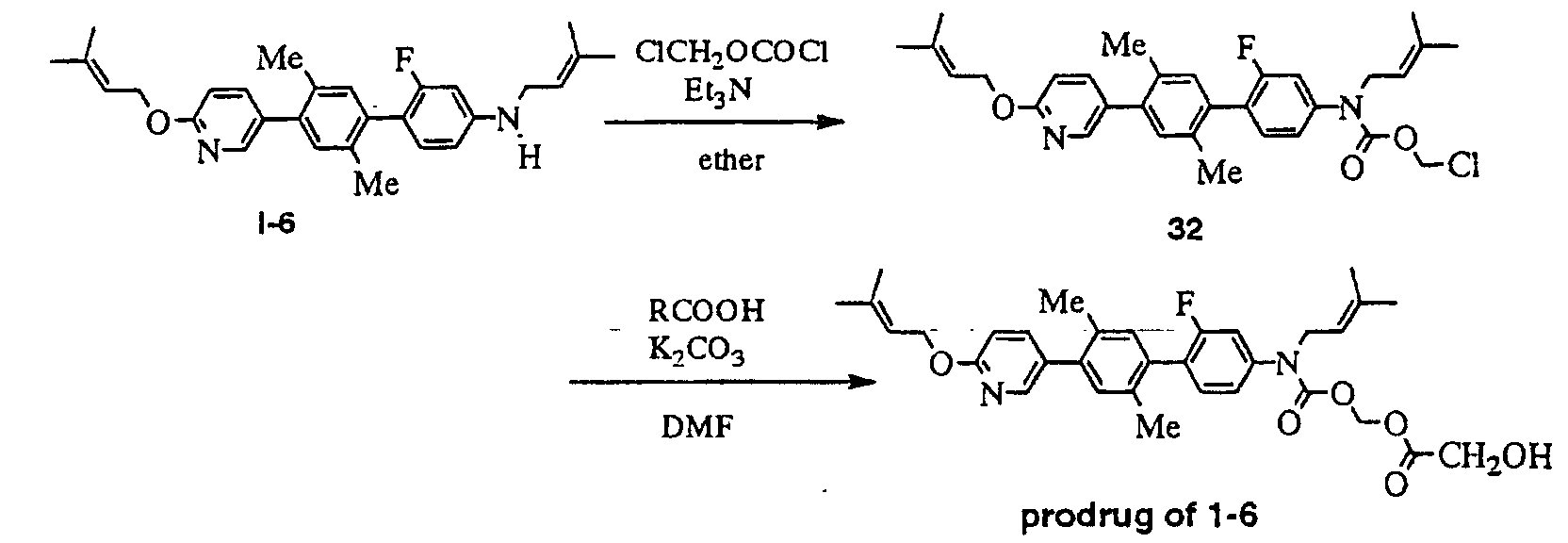
Compound (I-6) obtained in Reference Example 1 (444 mg, 1 mmol) was dissolved in
anhydrous ether (40 ml) and cooled on ice, stirred under nitrogen flow while being
treated successively with chloromethyl chloroformate (194 mg, 1 mmol) and
triethylamine (210 ml, 1mmol), and then the ice bath was removed and the mixture
was stirred further for 4 hours. The precipitate in the reaction mixture was filtered off,
and the mixture was washed with water and dried over anhydrous sodium sulfate, and
the solvent was distilled off under reduced pressure, whereby obtaining 540 mg of
Compound (32) as an oil.
Anal Calcd for C31H34N2O3FCl: C, 69.33; H, 6.38; N, 5.22; F, 3.54; Cl, 6.60.
Found: C, 68.85; H, 6.42; N, 5.21; F, 3.58; Cl, 7.06.
Anal Calcd for C31H34N2O3FCl: C, 69.33; H, 6.38; N, 5.22; F, 3.54; Cl, 6.60.
Found: C, 68.85; H, 6.42; N, 5.21; F, 3.58; Cl, 7.06.
A mixture of glycolic acid (38 mg, 0.5 mmol), potassium carbonate (35 mg, 0.25
mmol) and N, N-dimethylformamide (1 mL) was stirred under reduced pressure at
room temperature for 10 minutes, and then treated with a solution of Compound (32)
(54 mg, 0.1 mmol) in N, N-dimethylformamide (0.5 ml) followed by potassium bromide
(12 mg, 0.1 mmol) and then stirred vigorously under argon atmosphere for 20 hours.
The reaction mixture was diluted with ether (5 ml), and the solid was filtered off, and
the mixture was washed with water and dried over anhydrous sodium sulfate, and then
the solvent was distilled off under reduced pressure to obtain a crude product, which
was purified by a chromatography on silica gel (eluent: hexane:ethyl acetate = 2:1) to
obtain 27 mg of a prodrug of Compound (I-6) as an oil.
1HNMR (CDCl3): δ 1.58 (3H, s), 1.73 (3H, s), 1.80 (3H, s), 1.82 (3H, s), 2.20 (3H, s), 2.28 (3H, s), 2.33 (1H, bs), 4.25 (2H, bs), 4.30 (2H, d, J= 6.9Hz), 4.88 (2H, d, J= 6.9Hz), 5.30 (1H, bt, J = 6.9Hz), 5.58 (2H, bt, J = 6.9Hz), 5.90 (2H, bs), 6.83 (1H, d, J = 8.4Hz), 6.95-7.30 (3H), 7.13 (2H, bs), 7.60 (1H, dd, J = 8.4Hz, 2.4Hz), 8.18 (1H, d, J = 2.4Hz) ppm. Anal Calcd for C33H37N2O6F: C, 68.73; H, 6.47; N, 4.86; F, 3.29.
Found: C, 68.59; H, 6.68; N, 4.98; F, 3.25.
1HNMR (CDCl3): δ 1.58 (3H, s), 1.73 (3H, s), 1.80 (3H, s), 1.82 (3H, s), 2.20 (3H, s), 2.28 (3H, s), 2.33 (1H, bs), 4.25 (2H, bs), 4.30 (2H, d, J= 6.9Hz), 4.88 (2H, d, J= 6.9Hz), 5.30 (1H, bt, J = 6.9Hz), 5.58 (2H, bt, J = 6.9Hz), 5.90 (2H, bs), 6.83 (1H, d, J = 8.4Hz), 6.95-7.30 (3H), 7.13 (2H, bs), 7.60 (1H, dd, J = 8.4Hz, 2.4Hz), 8.18 (1H, d, J = 2.4Hz) ppm. Anal Calcd for C33H37N2O6F: C, 68.73; H, 6.47; N, 4.86; F, 3.29.
Found: C, 68.59; H, 6.68; N, 4.98; F, 3.25.
In an experiment to induce the differentiation from Th0 cells to Th2 cells, 9 to
11 week-old female mice of BALB/cCrSlc purchased from Japan SLC, Inc. or of
BALB/cAnNCrj purchased from Charles River Japan, Inc. were used.
In an experiment to induce the differentiation from Th0 cells to Th1 cells, 8
week-old female mice of C57BL/6NCrj purchased from Charles River Japan, Inc. were
used.
In an experiment to induce the differentiation from Th0 cells to Th2 cells, a
DNP-As (dinitrophenylated Ascaris protein (porcine ascarid extract protein)) was used
as an antigen, 10 µg of which and 250 µg of Alum (aluminum hydroxide adjuvant) in
physiological saline in the final volume of 50 µl was injected into the soles of the both
hind legs of each mouse, whereby effecting immunization. In a negative control group,
each animal was treated similarly by an injection of 50 µl of physiological saline. 6
Days after injection, two popliteal lymph nodes were removed from right and left knees,
and passed through a metal mesh (200 mesh size) in Hanks' balanced salt solution
(HBSS) to prepare a cell suspension. In the group treated with physiological saline,
preparations from two animals were combined and subjected to the experiment because
of a small cell number. A compound according to the invention was suspended in 0.5%
methylcellulose (MC) and 0.1 ml per 20 g mouse was given orally every day over a
period from the day of immunization through the 5th day. The immunized vehicle
control group and the negative control group were treated with the same volume of
0.5% MC.
On the other hand, in an experiment to induce the differentiation from Th0
cells to Th1 cells, a non-viable Mycobacterium tuberculosis H37RA (DIFCO) was
suspended in physiological saline, and 125 µg/50 µl was used for immunization as
described above. In the group treated with physiological saline, the preparations from
4 animals were combined and subjected to the experiment.
Cells prepared from popliteal lymph nodes of these mice were suspended at 1 -
2 x 10⁶ cells/ml (1-2 ml) in an RPMI 1640 medium (containing 10% fetal bovine serum -
FBS and 50 µM 2-mercaptoethanol) and supplemented with PMA (Phorbol 12-Myristate
13-Acetate) at the final concentration of 50 ng/ml and 250 ng/ml A23187 (Ca
ionophore) and then incubated at 37°C in the presence of 5% CO2. After incubating for
4 hours, Brefeldin A was added at the final concentration of 10 µg/ml and the mixture
was incubated further for 2 hours. The cells were recovered and washed twice with a
staining buffer (PBS containing 1% FBS and 0.1% sodium azide) and suspended in 100
µl of the staining buffer containing 5 µg/ml of Fc Block (rat anti-mouse CD16/CD32
purified monoclonal antibody, Pharmingen) and incubated on ice for 5 minutes to block
the non-specific adsorption of the labeled antibody, and then combined with an equal
volume of a Cy-Chrome-labelled rat anti-mouse CD4 monoclonal antibody
(Pharmingen) which had been 200-fold diluted with the staining buffer and incubated
on ice for 30 minutes. After washing three times with the staining buffer, the cells
were suspended in PBS and combined with an equal volume of a fixation solution (4%
p-formaldehyde) and incubated at 4°C overnight, whereby effecting the fixation. The
fixed cells thus obtained were washed twice with the staining buffer and suspended in a
permeabilazation buffer (PBS containing 1% FBS, 0.5% saponin and 0.1% sodium
azide) and incubated on ice for 10 minutes, and then each cell sample was recovered as
being divided into two equal portions. Each portion was suspended in 100 µl of the
permeabilazation buffer containing 5 µg/ml Fc Block and incubated on ice for 5 minutes
to block the non-specific adsorption of the labeled antibody into the cells. One portion
was combined with each 100 µl of an FITC-labelled rat anti-mouse IFNγ monoclonal
antibody (Pharmingen) and a PE-labeled rat anti-mouse IL-4 monoclonal antibody
(Pharmingen) each had been 50-fold diluted with the permeabilazation buffer and
incubated on ice for 30 minutes. The other portion, serving as a control representing
the non-specific adsorption of the labeled antibody, was combined with each 100 µl of
each control antibody at the same concentration, i.e., an FITC-labelled rat IgG1κ
purified antibody (Pharmingen) and a PE-labeled rat IgG1κ purified antibody
(Pharmingen) to effect the similar staining. After washing three times with the cell
membrane permeation buffer and twice with the staining buffer, the cells were
suspended in 500 µl of the staining buffer and transferred through a nylon mesh into a
FACS analysis tube.
FACScan (Nippon Becton Dickinson Company Ltd.) was used to determine the
percentage of IFNγ positive cells (Th1) and the percentage of IL-4 positive cells (Th2) in
CD4 positive T cells, from each of which the percentage of non-specific positive cells
stained by a control antibody was subtracted to obtain % Th1 and % Th2, while in the
Th2 differentiation experiment a Th2/Th1 cell ratio was determined, and then based on
these data the effect of a compound according to the invention of the differentiation
from Th0 to Th1 or Th2 was investigated. The significant difference was analyzed by
Dunnett multiple comparison test and Student t test. The results are shown in Tables
13 and 14.

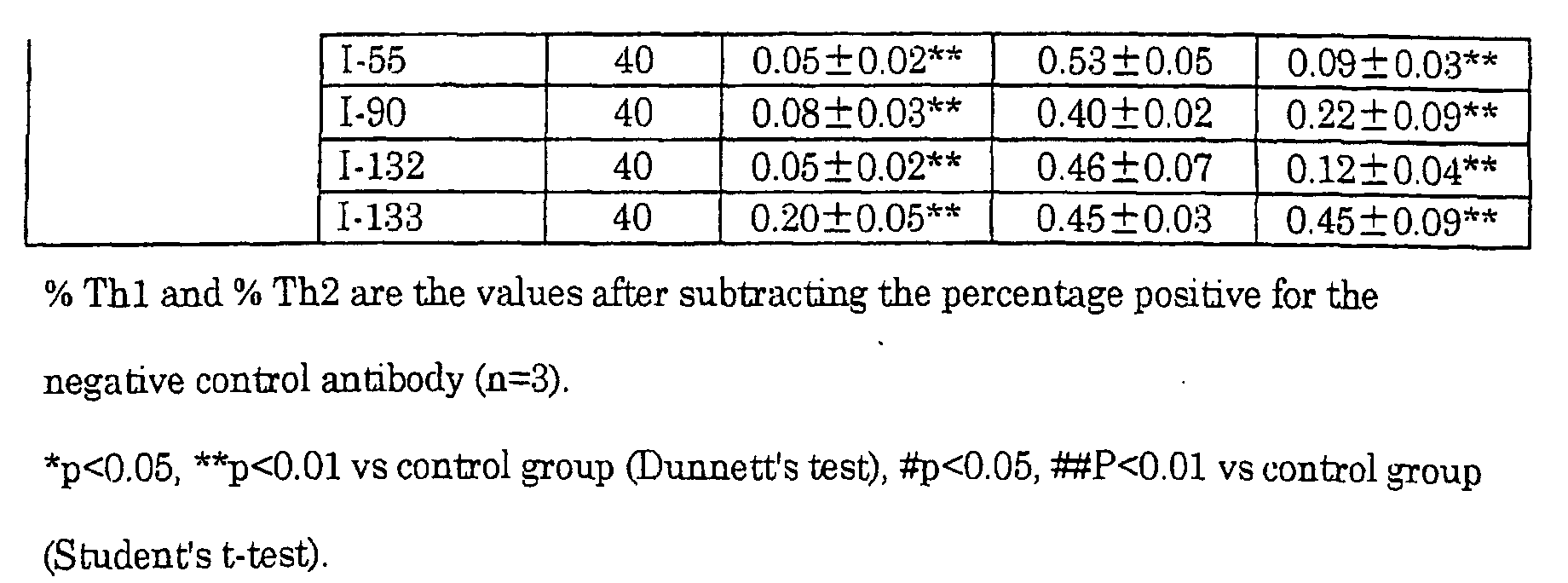
| Effect of compounds on change in %Th1 and %Th2 in popliteal lymph node 6 days after immunization of C57BL/6N mice with non-viable Mycobacterium tuberculosis | ||||
| Immunization method | Compound | Dose (mg/kg) | %Th1 | %Th2 |
| Physiological saline | 0.28± 0.09 | -0.20± 0.19 | ||
| M. tuberculosis | Control | 1.22± 0.10 | 0.13± 0.11 | |
| I-6 | 40 | 1.03± 0.10 | 0.03± 0.02 | |
| I-80 | 40 | 0.93± 0.11 | 0.02± 0.04 | |
| I-89 | 10 | 0.70± 0.20 | 0.02± 0.06 | |
| I-102 | 40 | 0.82± 0.16 | 0.07± 0.04 |
As shown in Table 13, the CD4 positive T cells in the popliteal lymph node of
BALB/c mice immunized with DNP-As exhibited an increase in the % Th2 and in the
Th2/Th1 ratio when compared with the non-immunized group received the injection
only of physiological saline, thus validating the induction of the Th2-dominant
differentiation. Against such induction, each of Compounds I-55, I-80, I-90, I-102, I-132
and I-133 at 40 mg/kg and I-89 at 10 mg/kg significantly inhibited the increase in
the %Th2 and in the Th2/Th1 ratio when given orally for consecutive 6 days after
immunization, resulting in the correction from the Th2-dominant condition.
Compound I-6 significantly inhibited the increase in the %Th2 and in the Th2/Th1 ratio at a concentration of 10 mg/kg or higher, resulting in the correction from the Th2-dominant condition.
Compound I-6 significantly inhibited the increase in the %Th2 and in the Th2/Th1 ratio at a concentration of 10 mg/kg or higher, resulting in the correction from the Th2-dominant condition.
On the other hand, as shown in Table 4, the CD4 positive T cells in the
popliteal lymph node of C57BL/6 mice immunized with non-viable Mycobacterium
tuberculosis exhibited a selective increase in the %Th1 when compared with the non-immunized
group received the injection only of physiological saline, thus validating the
induction of the Th1-dominant differentiation. Against such induction, any of
Compounds I-6, I-80, I-89 and I-102 showed no effect on the increase in the %Th1.
Accordingly, the compounds according to the invention were revealed to have
the selective inhibitory effect on the differentiation from Th0 to Th2.
| Example 1 Tablet | |
| Compound (I-6) | 15 mg |
| Starch | 15 mg |
| Lactose | 15 mg |
| Crystalline cellulose | 19 mg |
| Polyvinyl alcohol | 3 mg |
| Distilled water | 30 ml |
| Calcium stearate | 3 mg |
The components other than calcium stearate were mixed uniformly, pulverized
and dried to form a granule of an appropriate particle size. Subsequently, calcium
stearate was added and the mixture was compressed into a tablet.
| Example 2 Granule | |
| Compound (I-80) | 30 g |
| Lactose | 265 g |
| Magnesium stearate | 5 g |
The components were mixed well and compressed and then pulverized, sized
and sieved to obtain a granule of an appropriate particle size.
| Example 3 Capsule | |
| Compound (I-89) | 10g |
| Heavy magnesium oxide | 20 g |
| Lactose | 70 g |
The components shown above were mixed well into a particulate or fine
particulate powder, and filled in a capsule.
As evident from Experiments described above, any of the compounds according
to the invention exhibited an inhibitory effect on the differentiation from Th0 cells to
Th2 cells, and thus is extremely useful as Th2 cell differentiation inhibitors and as
therapeutic agents against autoimmune diseases.
Claims (22)
- A pharmaceutical composition for use as a Th2 differentiation inhibitor comprising a compound represented by Formula (I):
 or a prodrug, pharmaceutically acceptable salt or solvate thereof.wherein each of ring A, ring B and ring C is independently an optionally substituted aromatic carbocyclic ring or an optionally substituted 5- or 6-membered heterocyclic ring which may be fused with a benzene ring, andwhen ring A, ring B and/or ring C is an optionally substituted 5-membered heterocyclic ring, W1, W2 and/or W3 is a bond;X is a single bond, -O-, -CH2-, -NR1- (wherein R1 is hydrogen, optionally substituted lower alkyl, lower alkenyl or lower alkylcarbonyl) or -S(O)-p- wherein p is an integer of 0 to 2;Y is hydrogen, optionally substituted lower alkyl, optionally substituted lower alkoxy, optionally substituted lower alkenyl, optionally substituted lower alkynyl, optionally substituted acyl, optionally substituted cycloalkyl, optionally substituted cycloalkenyl, optionally substituted lower alkoxycarbonyl, optionally substituted sulfamoyl, optionally substituted amino, optionally substituted aryl or optionally substituted 5- or 6-membered heterocyclic group;R1 and Y taken together may form -(CH2)m-, -(CH2)2-T-(CH2)2- wherein T is O, S or NR', -CR'=CH-CH=CR'-, -CH=N-CH=CH-, -N=CH-N=CH-, -C(=O)-O-(CH2)r-, -C(=O)-NR'-(CH2)r- or -C(=O)-NR'-N=CH- wherein m is 4 or 5, r is 2 or 3 and R' is hydrogen, lower alkyl or lower alkenyl;Y may be halogen when X is -CH2- or -NR1- andY may be optionally substituted lower alkylsulfonyl or optionally substituted arylsulfonyl when X is -O- or -NR1-;one of V1 and V2 is a single bond and the other is -O-, -NH-, -OCH2-, -CH2O-, -CH=CH-,-C≡C-, -CH(OR2)-wherein R2 is hydrogen or lower alkyl, -CO-, -NHCHR3- or -CHR3NH- wherein R3 is hydrogen or hydroxy,
 - The pharmaceutical composition for use as a Th2 differentiation inhibitor as claimed in Claim 1 wherein X is -O- or -NR1- wherein R1 is hydrogen, lower alkyl or lower alkenyl.
- The pharmaceutical composition for use as a Th2 differentiation inhibitor as claimed in Claim 1 wherein Y is optionally substituted lower alkyl or optionally substituted lower alkenyl.
- The pharmaceutical composition for use as a Th2 differentiation inhibitor as claimed in Claim 1 wherein both of V1 and V2 are single bonds.
- A pharmaceutical composition for use as a Th2 differentiation inhibitor comprising a compound represented by Formula (Ia):
 or a prodrug, pharmaceutically acceptable salt or solvate thereof.wherein each of R4, R5, R6, R7, R8, R9, R10, R11, R12, R13, R14 and R15 is independently hydrogen, halogen, hydroxy, optionally substituted lower alkyl, optionally substituted lower alkoxy, carboxy or lower alkoxycarbonyl;each of X1 and X2 is independently -O-, -CH2- or -NH-;each of Y1 and Y2 is independently optionally substituted lower alkyl, optionally substituted arylalkyl or optionally substituted lower alkenyl,
 - A pharmaceutical composition for use as a Th2 differentiation inhibitor comprising a compound represented by Formula (Ib):
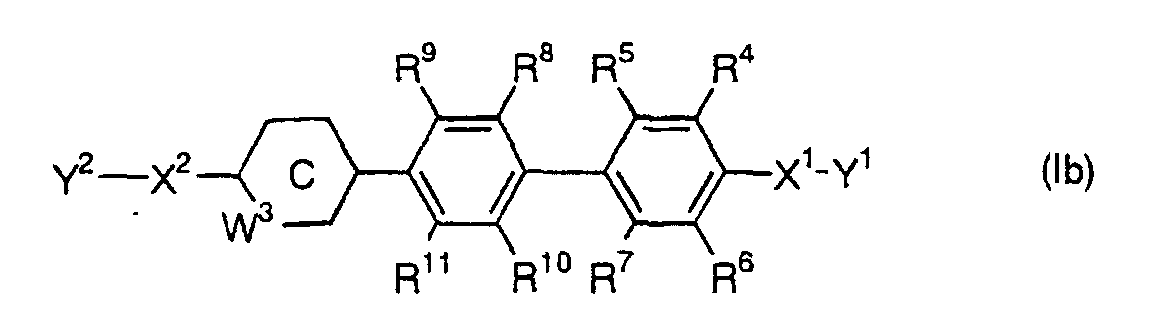 or a prodrug, pharmaceutically acceptable salt or solvate thereof.wherein ring C is an optionally substituted 5- or 6-membered heterocyclic ring containing 1 or 2 hetero atoms, and when ring C is a 5-membered heterocyclic ring, W3 is a bond and other symbols have the meanings defined in Claim 5,
 - A pharmaceutical composition for use as a Th2 differentiation inhibitor comprising a compound represented by Formula (Ic):
 or a prodrug, pharmaceutically acceptable salt or solvate thereof.wherein each of ring A, ring B and ring C is independently an optionally substituted benzene ring or an optionally substituted 5- or 6-membered heterocyclic ring containing 1 or 2 heteroatoms, andwhen ring A, ring B and/or ring C is an optionally substituted 5-membered heterocyclic ring, W1, W2 and/or W3 is a bond;X1 and Y1 have the meanings defined in Claim 5;X3 is -O- or -NH-;each of Ra and Rb is independently hydrogen, optionally substituted lower alkyl, optionally substituted lower alkenyl, optionally substituted aryl, optionally substituted cycloalkyl, optionally substituted acyl, optionally substituted lower alkoxycarbonyl or optionally substituted lower alkylsulfonyl, or they are taken together to form RcRdC= or -(CReRf)s-;each of Rc and Rd is independently hydrogen, optionally substituted lower alkyl, optionally substituted lower alkenyl, optionally substituted lower alkynyl, optionally substituted lower alkoxy, optionally substituted lower alkylthio, optionally substituted lower alkenyloxy, optionally substituted lower alkynyloxy, optionally substituted cycloalkyl, optionally substituted aryl or optionally substituted 5- or 6-membered heterocyclyl or they are taken together with a carbon atom to which they are attached to form optionally substituted cycloalkylidene;each Re is independently hydrogen, lower alkyl, lower alkoxy or amino, and each Rf is independently hydrogen, lower alkyl, lower alkoxy or amino;n is an integer of 0 to 2 and s is an integer of 2 to 6,
 - The pharmaceutical composition for use as a Th2 differentiation inhibitor as claimed in Claim 1, 2, 3, 4 or 7 wherein ring A is an optionally substituted benzene ring.
- The pharmaceutical composition for use as a Th2 differentiation inhibitor as claimed in Claim 1, 2, 3, 4 or 7 wherein ring B is an optionally substituted benzene ring.
- The pharmaceutical composition for use as a Th2 differentiation inhibitor as claimed in Claim 1, 2, 3, 4, 6 or 7 wherein ring C is an optionally substituted benzene ring, an optionally substituted pyridine ring, an optionally substituted pyrimidine ring, an optionally substituted pyridazine ring or an optionally substituted pyrazine ring.
- The pharmaceutical composition for use as a Th2 differentiation inhibitor as claimed in Claim 5 or 6 wherein one of R4 and R5 is hydrogen, hydroxy or lower alkyl and the other is hydrogen or halogen, and both of R6 and R7 are hydrogens.
- The pharmaceutical composition for use as a Th2 differentiation inhibitor as claimed in Claim 5 or 6 wherein each of R8 and R11 is independently hydrogen, hydroxy, lower alkyl or lower alkoxycarbonyl, and each of R9 and R10 is independently hydroxy, lower alkyl, lower alkoxy or lower alkoxycarbonyl.
- The pharmaceutical composition for use as a Th2 differentiation inhibitor as claimed in Claim 5 wherein each of R12, R13, R14 and R15 is independently hydrogen or halogen.
- The pharmaceutical composition for use as a Th2 differentiation inhibitor as claimed in Claim 5 or 6 wherein one of X1 and X2 is -O- and the other is -NH-.
- The pharmaceutical composition for use as a Th2 differentiation inhibitor as claimed in Claim 5 or 6 wherein each of Y1 and Y2 is independently optionally halogen-substituted lower alkyl or optionally halogen-substituted lower alkenyl.
- The pharmaceutical composition for use as a Th2 differentiation inhibitor as claimed in Claim 5 or 6 wherein one of -X1-Y1 and -X2-Y2 is prenylamino and the other is prenyloxy.
- The pharmaceutical composition for use as a Th2 differentiation inhibitor as claimed in Claim 6 or 7 which is a therapeutic and/or prophylactic agent against an autoimmune disease.
- The pharmaceutical composition for use as a Th2 differentiation inhibitor as claimed in any one of Claims 1 to 16 which is a therapeutic and/or prophylactic agent against ulcerative colitis, myasthenia gravis or lupus nephritis.
- A method for treating and/or preventing a disease caused by Th2 cells or cytokines produced by Th2 cells comprising administering the compound represented by Formula (I) according to Claim 1 or a prodrug, pharmaceutically acceptable salt or solvate thereof.
- A method for inhibiting the differentiation from Th0 cells to Th2 cells comprising administering the compound represented by Formula (I) according to Claim 1 or a prodrug, pharmaceutically acceptable salt or solvate thereof.
- Use of the compound represented by Formula (I) according to Claim 1 or a prodrug, pharmaceutically acceptable salt or solvate thereof for producing a medicament for treating and/or preventing a disease caused by Th2 cells or cytokines produced by Th2 cells.
- Use of the compound represented by Formula (I) according to Claim 1 or a prodrug, pharmaceutically acceptable salt or solvate thereof for producing a medicament for inhibiting the differentiation from Th0 cells to Th2 cells.
Applications Claiming Priority (3)
| Application Number | Priority Date | Filing Date | Title |
|---|---|---|---|
| JP20929899 | 1999-07-23 | ||
| JP20929899 | 1999-07-23 | ||
| PCT/JP2000/004725 WO2001007032A1 (en) | 1999-07-23 | 2000-07-14 | Th2 differentiation inhibitors |
Publications (2)
| Publication Number | Publication Date |
|---|---|
| EP1206935A1 true EP1206935A1 (en) | 2002-05-22 |
| EP1206935A4 EP1206935A4 (en) | 2008-07-30 |
Family
ID=16570644
Family Applications (1)
| Application Number | Title | Priority Date | Filing Date |
|---|---|---|---|
| EP00946316A Withdrawn EP1206935A4 (en) | 1999-07-23 | 2000-07-14 | TH2 DIFFERENTIATION INHIBITORS |
Country Status (16)
| Country | Link |
|---|---|
| US (1) | US7008954B1 (en) |
| EP (1) | EP1206935A4 (en) |
| KR (1) | KR20020012309A (en) |
| CN (1) | CN1364080A (en) |
| AU (1) | AU763976B2 (en) |
| BR (1) | BR0012697A (en) |
| CA (1) | CA2375982A1 (en) |
| HK (1) | HK1046645A1 (en) |
| HU (1) | HUP0203575A3 (en) |
| MX (1) | MXPA01013452A (en) |
| NO (1) | NO20016401L (en) |
| PL (1) | PL353476A1 (en) |
| RU (1) | RU2230551C2 (en) |
| TR (1) | TR200200099T2 (en) |
| WO (1) | WO2001007032A1 (en) |
| ZA (1) | ZA200109785B (en) |
Cited By (8)
| Publication number | Priority date | Publication date | Assignee | Title |
|---|---|---|---|---|
| WO2003030905A1 (en) * | 2001-10-01 | 2003-04-17 | Shionogi & Co., Ltd. | Dihydroorotate dehydrogenase inhibitor |
| US6765096B1 (en) * | 1999-07-19 | 2004-07-20 | Shionogi & Co., Ltd. | Tricyclic compound having acyloxymethoxycarbonyl side chain |
| US7557131B2 (en) | 2005-01-20 | 2009-07-07 | Pfizer Inc | Substituted triazole derivatives as oxytocin antagonists |
| US8722695B2 (en) | 2009-12-11 | 2014-05-13 | Autifony Therapeutics Limited | Imidazolidinedione derivatives |
| US9133175B2 (en) | 2010-12-06 | 2015-09-15 | Autifony Therapeutics Limited | Compounds |
| US9193704B2 (en) | 2011-06-07 | 2015-11-24 | Autifony Therapeutics Limited | Hydantoin derivatives as KV3 inhibitors |
| US9422252B2 (en) | 2012-05-22 | 2016-08-23 | Autifony Therapeutics Limited | Triazoles as Kv3 inhibitors |
| US9669030B2 (en) | 2012-05-22 | 2017-06-06 | Autifony Therapeutics Limited | Hydantoin derivatives as Kv3 inhibitors |
Families Citing this family (25)
| Publication number | Priority date | Publication date | Assignee | Title |
|---|---|---|---|---|
| WO2002057216A1 (en) * | 2001-01-18 | 2002-07-25 | Shionogi & Co., Ltd. | Terphenyl compounds bearing substituted amino groups |
| WO2002057237A1 (en) * | 2001-01-22 | 2002-07-25 | Shionogi & Co., Ltd. | Hetero-tricyclic compounds having substituted amino groups |
| US6818787B2 (en) | 2001-06-11 | 2004-11-16 | Xenoport, Inc. | Prodrugs of GABA analogs, compositions and uses thereof |
| US7232924B2 (en) | 2001-06-11 | 2007-06-19 | Xenoport, Inc. | Methods for synthesis of acyloxyalkyl derivatives of GABA analogs |
| US8048917B2 (en) | 2005-04-06 | 2011-11-01 | Xenoport, Inc. | Prodrugs of GABA analogs, compositions and uses thereof |
| US7186855B2 (en) | 2001-06-11 | 2007-03-06 | Xenoport, Inc. | Prodrugs of GABA analogs, compositions and uses thereof |
| PL375552A1 (en) | 2002-05-22 | 2005-11-28 | Amgen Inc. | Vanilloid receptor ligands and their medical applications |
| EP2270006A1 (en) | 2002-08-08 | 2011-01-05 | Amgen, Inc | Pyridazine derivatives useful as vanilloid receptor ligands |
| US20050282814A1 (en) * | 2002-10-03 | 2005-12-22 | Targegen, Inc. | Vasculostatic agents and methods of use thereof |
| MY139645A (en) | 2004-02-11 | 2009-10-30 | Amgen Inc | Vanilloid receptor ligands and their use in treatments |
| JP2007522233A (en) | 2004-02-11 | 2007-08-09 | アムジエン・インコーポレーテツド | Vanilloid receptor ligands and their use in therapy |
| US7456176B2 (en) | 2004-04-08 | 2008-11-25 | Targegen, Inc. | Benzotriazine inhibitors of kinases |
| US7652051B2 (en) | 2004-08-25 | 2010-01-26 | Targegen, Inc. | Heterocyclic compounds and methods of use |
| WO2006089311A1 (en) | 2005-02-15 | 2006-08-24 | Amgen Inc. | Vanilloid receptor ligands and their use in treatments |
| JP2006298775A (en) * | 2005-04-15 | 2006-11-02 | Dainippon Sumitomo Pharma Co Ltd | Selective Th2 immune response inhibitor |
| US8604042B2 (en) | 2005-11-01 | 2013-12-10 | Targegen, Inc. | Bi-aryl meta-pyrimidine inhibitors of kinases |
| US7528143B2 (en) | 2005-11-01 | 2009-05-05 | Targegen, Inc. | Bi-aryl meta-pyrimidine inhibitors of kinases |
| US8133900B2 (en) | 2005-11-01 | 2012-03-13 | Targegen, Inc. | Use of bi-aryl meta-pyrimidine inhibitors of kinases |
| WO2009031627A1 (en) * | 2007-09-04 | 2009-03-12 | Riken | Para-terphenyl compound or pharmacologically acceptable salt thereof, method for production of the same, and use of the same |
| UA103319C2 (en) | 2008-05-06 | 2013-10-10 | Глаксосмитклайн Ллк | Thiazole- and oxazole-benzene sulfonamide compounds |
| AR081626A1 (en) | 2010-04-23 | 2012-10-10 | Cytokinetics Inc | AMINO-PYRIDAZINIC COMPOUNDS, PHARMACEUTICAL COMPOSITIONS THAT CONTAIN THEM AND USE OF THE SAME TO TREAT CARDIAC AND SKELETIC MUSCULAR DISORDERS |
| EP2560488B1 (en) | 2010-04-23 | 2015-10-28 | Cytokinetics, Inc. | Certain amino-pyridines and amino-triazines, compositions thereof, and methods for their use |
| AR081331A1 (en) | 2010-04-23 | 2012-08-08 | Cytokinetics Inc | AMINO- PYRIMIDINES COMPOSITIONS OF THE SAME AND METHODS FOR THE USE OF THE SAME |
| WO2012060847A1 (en) | 2010-11-07 | 2012-05-10 | Targegen, Inc. | Compositions and methods for treating myelofibrosis |
| WO2021138391A1 (en) | 2019-12-30 | 2021-07-08 | Tyra Biosciences, Inc. | Indazole compounds |
Family Cites Families (9)
| Publication number | Priority date | Publication date | Assignee | Title |
|---|---|---|---|---|
| RU2130317C1 (en) * | 1992-03-27 | 1999-05-20 | Пептайд Текнолоджи Лимитед | Linear or cyclic peptides, their using and method of patient treatment |
| US5693611A (en) * | 1996-02-01 | 1997-12-02 | Eli Lilly And Company | Cyclic peptide antifungal agents |
| DE69704057T2 (en) * | 1996-04-22 | 2001-09-13 | Shionogi & Co., Ltd. | TERPHENYL COMPOUNDS AND MEDICINAL PRODUCTS CONTAINING THEM |
| PT933346E (en) | 1996-07-31 | 2004-03-31 | Shionogi & Co | NEW P-TERPHENYL COMPOUNDS |
| HN1997000027A (en) * | 1996-12-06 | 1997-06-05 | Pfizer Prod Inc | DERIVATIVES OF 6-PHENYL PIRIDIL - 2 AMINE |
| WO1998056785A1 (en) * | 1997-06-12 | 1998-12-17 | Sumitomo Pharmaceuticals Co., Ltd. | Pyrazole derivatives |
| US6003360A (en) | 1997-07-01 | 1999-12-21 | Wilson Tool International, Inc. | Press brake tool holder |
| EP1052238A4 (en) * | 1998-01-28 | 2007-05-02 | Shionogi & Co | Novel tricyclic compound |
| WO2001005768A1 (en) * | 1999-07-19 | 2001-01-25 | Shionogi & Co., Ltd. | Tricyclic compounds bearing acyloxymethoxycarbonyl pendants |
-
2000
- 2000-07-14 CA CA002375982A patent/CA2375982A1/en not_active Abandoned
- 2000-07-14 HU HU0203575A patent/HUP0203575A3/en unknown
- 2000-07-14 CN CN00810786A patent/CN1364080A/en active Pending
- 2000-07-14 RU RU2002103201/15A patent/RU2230551C2/en not_active IP Right Cessation
- 2000-07-14 TR TR2002/00099T patent/TR200200099T2/en unknown
- 2000-07-14 US US09/980,475 patent/US7008954B1/en not_active Expired - Fee Related
- 2000-07-14 EP EP00946316A patent/EP1206935A4/en not_active Withdrawn
- 2000-07-14 BR BR0012697-7A patent/BR0012697A/en not_active IP Right Cessation
- 2000-07-14 KR KR1020027000498A patent/KR20020012309A/en not_active Ceased
- 2000-07-14 WO PCT/JP2000/004725 patent/WO2001007032A1/en not_active Ceased
- 2000-07-14 MX MXPA01013452A patent/MXPA01013452A/en unknown
- 2000-07-14 HK HK02108343.5A patent/HK1046645A1/en unknown
- 2000-07-14 AU AU60159/00A patent/AU763976B2/en not_active Ceased
- 2000-07-14 PL PL00353476A patent/PL353476A1/en not_active Application Discontinuation
-
2001
- 2001-11-28 ZA ZA200109785A patent/ZA200109785B/en unknown
- 2001-12-21 NO NO20016401A patent/NO20016401L/en not_active Application Discontinuation
Cited By (30)
| Publication number | Priority date | Publication date | Assignee | Title |
|---|---|---|---|---|
| US6765096B1 (en) * | 1999-07-19 | 2004-07-20 | Shionogi & Co., Ltd. | Tricyclic compound having acyloxymethoxycarbonyl side chain |
| EP1219606A4 (en) * | 1999-07-19 | 2005-08-31 | Shionogi & Co | Tricyclic compounds bearing acyloxymethoxycarbonyl pendants |
| WO2003030905A1 (en) * | 2001-10-01 | 2003-04-17 | Shionogi & Co., Ltd. | Dihydroorotate dehydrogenase inhibitor |
| US9023872B2 (en) | 2005-01-20 | 2015-05-05 | Ixchelsis Limited | Substituted triazole derivatives as oxytocin antagonists |
| US8207198B2 (en) | 2005-01-20 | 2012-06-26 | Pfizer Inc. | Substituted triazole derivatives as oxytocin antagonists |
| US7557131B2 (en) | 2005-01-20 | 2009-07-07 | Pfizer Inc | Substituted triazole derivatives as oxytocin antagonists |
| US10150752B2 (en) | 2005-01-20 | 2018-12-11 | Ixchelsis Limited | Substituted triazole derivatives as oxytocin antagonists |
| US9394278B2 (en) | 2005-01-20 | 2016-07-19 | Ixchelsis Limited | Substituted triazole derivatives as oxytocin antagonists |
| US8722695B2 (en) | 2009-12-11 | 2014-05-13 | Autifony Therapeutics Limited | Imidazolidinedione derivatives |
| US9849131B2 (en) | 2009-12-11 | 2017-12-26 | Autifony Therapeutics Limited | Imidazolidinedione derivatives |
| US10632118B2 (en) | 2009-12-11 | 2020-04-28 | Autifony Therapeutics Limited | Imidazolidinedione derivatives |
| US9216967B2 (en) | 2009-12-11 | 2015-12-22 | Autifony Therapeutics Limited | Imidazolidinedione derivatives |
| US10058551B2 (en) | 2009-12-11 | 2018-08-28 | Autifony Therapeutics Limited | Imidazolidinedione derivatives |
| US10265316B2 (en) | 2010-12-06 | 2019-04-23 | Autifony Therapeuctics Limited | Hydantoin derivatives useful as Kv3 inhibitors |
| US10555945B2 (en) | 2010-12-06 | 2020-02-11 | Autifony Therapeutics Limited | Compounds |
| US9833452B2 (en) | 2010-12-06 | 2017-12-05 | Autifony Therapeutics Limited | Compounds |
| US11583527B2 (en) | 2010-12-06 | 2023-02-21 | Autifony Therapeutics Limited | Hydantoin derivatives useful as Kv3 inhibitors |
| US9422272B2 (en) | 2010-12-06 | 2016-08-23 | Autifony Therapeutics Limited | Compounds |
| US10098881B2 (en) | 2010-12-06 | 2018-10-16 | Autifony Therapeutics Limited | Compounds |
| US9346790B2 (en) | 2010-12-06 | 2016-05-24 | Autifony Therapeutics Limited | Hydantoin derivatives useful as Kv3 inhibitors |
| US11541052B2 (en) | 2010-12-06 | 2023-01-03 | Autifony Therapeutics Limited | Compounds |
| US11197859B2 (en) | 2010-12-06 | 2021-12-14 | Autifony Therapeutics Limited | Hydantoin derivatives useful as Kv3 inhibitors |
| US10835534B2 (en) | 2010-12-06 | 2020-11-17 | Autifony Therapeutics Limited | Compounds |
| US9133175B2 (en) | 2010-12-06 | 2015-09-15 | Autifony Therapeutics Limited | Compounds |
| US9193704B2 (en) | 2011-06-07 | 2015-11-24 | Autifony Therapeutics Limited | Hydantoin derivatives as KV3 inhibitors |
| US10611735B2 (en) | 2012-05-22 | 2020-04-07 | Autifony Therapeutics Limited | Triazoles as Kv3 inhibitors |
| US9669030B2 (en) | 2012-05-22 | 2017-06-06 | Autifony Therapeutics Limited | Hydantoin derivatives as Kv3 inhibitors |
| US11180461B2 (en) | 2012-05-22 | 2021-11-23 | Autifony Therapeutics Limited | Triazoles as Kv3 inhibitors |
| US10160730B2 (en) | 2012-05-22 | 2018-12-25 | Autifony Therapeutics Limited | Triazoles as KV3 inhibitors |
| US9422252B2 (en) | 2012-05-22 | 2016-08-23 | Autifony Therapeutics Limited | Triazoles as Kv3 inhibitors |
Also Published As
| Publication number | Publication date |
|---|---|
| BR0012697A (en) | 2002-04-09 |
| HUP0203575A2 (en) | 2003-02-28 |
| NO20016401D0 (en) | 2001-12-21 |
| CN1364080A (en) | 2002-08-14 |
| TR200200099T2 (en) | 2002-06-21 |
| AU6015900A (en) | 2001-02-13 |
| NO20016401L (en) | 2002-01-23 |
| HK1046645A1 (en) | 2003-01-24 |
| KR20020012309A (en) | 2002-02-15 |
| US7008954B1 (en) | 2006-03-07 |
| CA2375982A1 (en) | 2001-02-01 |
| HUP0203575A3 (en) | 2003-11-28 |
| PL353476A1 (en) | 2003-11-17 |
| AU763976B2 (en) | 2003-08-07 |
| EP1206935A4 (en) | 2008-07-30 |
| MXPA01013452A (en) | 2002-07-02 |
| RU2230551C2 (en) | 2004-06-20 |
| ZA200109785B (en) | 2002-11-28 |
| WO2001007032A1 (en) | 2001-02-01 |
Similar Documents
| Publication | Publication Date | Title |
|---|---|---|
| RU2230551C2 (en) | Inhibitors of th2-differentiation | |
| US20240254137A1 (en) | Cot modulators and methods of use thereof | |
| JP3634861B2 (en) | Trisubstituted phenyl derivatives as selective phosphodiesterase IV inhibitors | |
| JPWO1999038829A1 (en) | New tricyclic compound | |
| US11779583B2 (en) | Tricyclic amino containing compounds for treatment or prevention of symptoms associated with endocrine dysfunction | |
| EP1052238A1 (en) | Novel tricyclic compound | |
| JP2009543802A (en) | CXCR4 antagonists containing diazine and triazine structures for the treatment of medical diseases | |
| KR20090090352A (en) | Amino Nicotine and Isnicotinic Acid Derivatives as DHODH Inhibitors | |
| JP2005507420A (en) | Aminobenzamide derivatives as glycogen synthase kinase 3β inhibitors | |
| WO2006074426A2 (en) | Cxcr4 antagonists for the treatment of hiv infection | |
| WO2017001812A1 (en) | Compounds and their use as inhibitors of n-myristoyl transferase | |
| JP2022530405A (en) | Compounds containing N-methyl-2-pyridone, and pharmaceutically acceptable salts | |
| EP1219606A1 (en) | Tricyclic compounds bearing acyloxymethoxycarbonyl pendants | |
| JP2023022252A (en) | Methods of using trisubstituted benzotriazole derivatives as dihydroorotate oxygenase inhibitors | |
| US9206136B2 (en) | Pyrazolyl-based carboxamides I | |
| JP2007505888A (en) | Substituted triazole derivatives as oxytocin antagonists | |
| EP1359139A1 (en) | Terphenyl compounds bearing substituted amino groups | |
| TW201313684A (en) | Azaspiroalkane compounds | |
| US12312324B2 (en) | Fluorine-containing substituted benzothiophene compound, and pharmaceutical composition and application thereof | |
| JP2007015952A (en) | Naphthalene derivatives | |
| US20230293539A1 (en) | Mll1-wdr5 protein-protein interaction inhibitor compounds and uses thereof | |
| US20040087604A1 (en) | Hetero-tricyclic compounds having substituted amino groups | |
| JPWO2001007032A1 (en) | Th2 differentiation inhibitor | |
| JPWO2006051937A1 (en) | Hetero 5-membered ring derivatives | |
| TW202416998A (en) | Prostaglandin ep receptor agonist compounds |
Legal Events
| Date | Code | Title | Description |
|---|---|---|---|
| PUAI | Public reference made under article 153(3) epc to a published international application that has entered the european phase |
Free format text: ORIGINAL CODE: 0009012 |
|
| 17P | Request for examination filed |
Effective date: 20020215 |
|
| AX | Request for extension of the european patent |
Free format text: AL PAYMENT 20020215;LT PAYMENT 20020215;LV PAYMENT 20020215;MK PAYMENT 20020215;RO PAYMENT 20020215;SI PAYMENT 20020215 |
|
| A4 | Supplementary search report drawn up and despatched |
Effective date: 20080701 |
|
| 17Q | First examination report despatched |
Effective date: 20081104 |
|
| R17C | First examination report despatched (corrected) |
Effective date: 20081105 |
|
| STAA | Information on the status of an ep patent application or granted ep patent |
Free format text: STATUS: THE APPLICATION IS DEEMED TO BE WITHDRAWN |
|
| 18D | Application deemed to be withdrawn |
Effective date: 20090317 |