EP1206467B1 - N-heterocyclic derivatives as nos inhibitors - Google Patents
N-heterocyclic derivatives as nos inhibitors Download PDFInfo
- Publication number
- EP1206467B1 EP1206467B1 EP00959333A EP00959333A EP1206467B1 EP 1206467 B1 EP1206467 B1 EP 1206467B1 EP 00959333 A EP00959333 A EP 00959333A EP 00959333 A EP00959333 A EP 00959333A EP 1206467 B1 EP1206467 B1 EP 1206467B1
- Authority
- EP
- European Patent Office
- Prior art keywords
- amino
- methylpyrimidin
- imidazol
- acetamide
- ethyl
- Prior art date
- Legal status (The legal status is an assumption and is not a legal conclusion. Google has not performed a legal analysis and makes no representation as to the accuracy of the status listed.)
- Expired - Lifetime
Links
- 239000003112 inhibitor Substances 0.000 title abstract description 12
- 150000001875 compounds Chemical class 0.000 claims abstract description 144
- 238000000034 method Methods 0.000 claims abstract description 26
- 239000008194 pharmaceutical composition Substances 0.000 claims abstract description 5
- -1 naphthyl radical Chemical group 0.000 claims description 139
- MWUXSHHQAYIFBG-UHFFFAOYSA-N Nitric oxide Chemical compound O=[N] MWUXSHHQAYIFBG-UHFFFAOYSA-N 0.000 claims description 49
- XEKOWRVHYACXOJ-UHFFFAOYSA-N Ethyl acetate Chemical compound CCOC(C)=O XEKOWRVHYACXOJ-UHFFFAOYSA-N 0.000 claims description 35
- 229910052739 hydrogen Inorganic materials 0.000 claims description 25
- 239000001257 hydrogen Substances 0.000 claims description 25
- 125000004435 hydrogen atom Chemical group [H]* 0.000 claims description 25
- 125000004209 (C1-C8) alkyl group Chemical group 0.000 claims description 23
- 125000003118 aryl group Chemical group 0.000 claims description 16
- 125000002924 primary amino group Chemical group [H]N([H])* 0.000 claims description 16
- 125000003545 alkoxy group Chemical group 0.000 claims description 13
- 125000004093 cyano group Chemical group *C#N 0.000 claims description 12
- 125000000623 heterocyclic group Chemical group 0.000 claims description 12
- 238000004519 manufacturing process Methods 0.000 claims description 12
- 239000000203 mixture Substances 0.000 claims description 12
- 150000003839 salts Chemical class 0.000 claims description 11
- 125000001188 haloalkyl group Chemical group 0.000 claims description 10
- 125000004356 hydroxy functional group Chemical group O* 0.000 claims description 10
- DLFVBJFMPXGRIB-UHFFFAOYSA-N Acetamide Chemical compound CC(N)=O DLFVBJFMPXGRIB-UHFFFAOYSA-N 0.000 claims description 8
- 230000005856 abnormality Effects 0.000 claims description 8
- 239000003814 drug Substances 0.000 claims description 7
- 125000001997 phenyl group Chemical group [H]C1=C([H])C([H])=C(*)C([H])=C1[H] 0.000 claims description 7
- 208000001953 Hypotension Diseases 0.000 claims description 6
- 230000036543 hypotension Effects 0.000 claims description 6
- 125000001495 ethyl group Chemical group [H]C([H])([H])C([H])([H])* 0.000 claims description 5
- 125000003837 (C1-C20) alkyl group Chemical group 0.000 claims description 4
- RXGDZSDYEUTQSC-UHFFFAOYSA-N 2-[3-[1,3-benzodioxol-5-ylmethyl(methyl)amino]propyl-(2-imidazol-1-yl-6-methylpyrimidin-4-yl)amino]acetamide Chemical compound C=1C=C2OCOC2=CC=1CN(C)CCCN(CC(N)=O)C(N=1)=CC(C)=NC=1N1C=CN=C1 RXGDZSDYEUTQSC-UHFFFAOYSA-N 0.000 claims description 4
- WQKKKOGYKNIJKZ-UHFFFAOYSA-N 2-[3-aminopropyl-(2-imidazol-1-yl-6-methylpyrimidin-4-yl)amino]-n-[2-(4-methoxyphenyl)ethyl]acetamide Chemical compound C1=CC(OC)=CC=C1CCNC(=O)CN(CCCN)C1=CC(C)=NC(N2C=NC=C2)=N1 WQKKKOGYKNIJKZ-UHFFFAOYSA-N 0.000 claims description 4
- 206010001052 Acute respiratory distress syndrome Diseases 0.000 claims description 4
- 208000013616 Respiratory Distress Syndrome Diseases 0.000 claims description 4
- 206010040070 Septic Shock Diseases 0.000 claims description 4
- 208000011341 adult acute respiratory distress syndrome Diseases 0.000 claims description 4
- 201000000028 adult respiratory distress syndrome Diseases 0.000 claims description 4
- 230000001404 mediated effect Effects 0.000 claims description 4
- 125000002496 methyl group Chemical group [H]C([H])([H])* 0.000 claims description 4
- 201000006417 multiple sclerosis Diseases 0.000 claims description 4
- 206010039073 rheumatoid arthritis Diseases 0.000 claims description 4
- 230000036303 septic shock Effects 0.000 claims description 4
- IBSIMIUVROENBM-UHFFFAOYSA-N 2-[(2-imidazol-1-yl-6-methylpyrimidin-4-yl)-[3-(methanesulfonamido)propyl]amino]-n-[2-(4-methoxyphenyl)ethyl]acetamide Chemical compound C1=CC(OC)=CC=C1CCNC(=O)CN(CCCNS(C)(=O)=O)C1=CC(C)=NC(N2C=NC=C2)=N1 IBSIMIUVROENBM-UHFFFAOYSA-N 0.000 claims description 3
- WDYBAXFBPLDUML-UHFFFAOYSA-N 2-[3-(1,3-benzodioxol-5-ylmethylamino)propyl-(2-imidazol-1-yl-6-methylpyrimidin-4-yl)amino]-n,n-diethylacetamide Chemical compound C=1C=C2OCOC2=CC=1CNCCCN(CC(=O)N(CC)CC)C(N=1)=CC(C)=NC=1N1C=CN=C1 WDYBAXFBPLDUML-UHFFFAOYSA-N 0.000 claims description 3
- WDIOEXUICSFGPB-UHFFFAOYSA-N 2-[3-(1,3-benzodioxol-5-ylmethylamino)propyl-(2-imidazol-1-yl-6-methylpyrimidin-4-yl)amino]-n-methylacetamide Chemical compound C=1C=C2OCOC2=CC=1CNCCCN(CC(=O)NC)C(N=1)=CC(C)=NC=1N1C=CN=C1 WDIOEXUICSFGPB-UHFFFAOYSA-N 0.000 claims description 3
- ZCQIBPMJNYYICV-UHFFFAOYSA-N 2-[3-(1,3-benzodioxol-5-ylmethylamino)propyl-(2-imidazol-1-yl-6-methylpyrimidin-4-yl)amino]acetamide Chemical compound N=1C(C)=CC(N(CCCNCC=2C=C3OCOC3=CC=2)CC(N)=O)=NC=1N1C=CN=C1 ZCQIBPMJNYYICV-UHFFFAOYSA-N 0.000 claims description 3
- LLPOYBQEDFUEST-UHFFFAOYSA-N 2-[3-(2,3-dihydro-1,4-benzodioxin-6-ylmethylamino)propyl-(2-imidazol-1-yl-6-methylpyrimidin-4-yl)amino]-n,n-diethylacetamide Chemical compound C=1C=C2OCCOC2=CC=1CNCCCN(CC(=O)N(CC)CC)C(N=1)=CC(C)=NC=1N1C=CN=C1 LLPOYBQEDFUEST-UHFFFAOYSA-N 0.000 claims description 3
- HIEWOWAWIPSVMZ-UHFFFAOYSA-N 2-[3-(2,3-dihydro-1,4-benzodioxin-6-ylmethylamino)propyl-(2-imidazol-1-yl-6-methylpyrimidin-4-yl)amino]-n-methylacetamide Chemical compound C=1C=C2OCCOC2=CC=1CNCCCN(CC(=O)NC)C(N=1)=CC(C)=NC=1N1C=CN=C1 HIEWOWAWIPSVMZ-UHFFFAOYSA-N 0.000 claims description 3
- LWZQLHNZDHZPQJ-UHFFFAOYSA-N 2-[3-(2,3-dihydro-1,4-benzodioxin-6-ylmethylamino)propyl-(2-imidazol-1-yl-6-methylpyrimidin-4-yl)amino]acetamide Chemical compound N=1C(C)=CC(N(CCCNCC=2C=C3OCCOC3=CC=2)CC(N)=O)=NC=1N1C=CN=C1 LWZQLHNZDHZPQJ-UHFFFAOYSA-N 0.000 claims description 3
- QAJHUEORHXZEAJ-UHFFFAOYSA-N 2-[3-(benzylamino)propyl-(2-imidazol-1-yl-6-methylpyrimidin-4-yl)amino]-n-[2-(2,3-dihydro-1-benzofuran-5-yl)ethyl]acetamide Chemical compound N=1C(C)=CC(N(CCCNCC=2C=CC=CC=2)CC(=O)NCCC=2C=C3CCOC3=CC=2)=NC=1N1C=CN=C1 QAJHUEORHXZEAJ-UHFFFAOYSA-N 0.000 claims description 3
- IOPQAZJFVHBDEH-UHFFFAOYSA-N 2-[3-(benzylamino)propyl-(2-imidazol-1-yl-6-methylpyrimidin-4-yl)amino]-n-[2-(4-methoxyphenyl)ethyl]acetamide Chemical compound C1=CC(OC)=CC=C1CCNC(=O)CN(C=1N=C(N=C(C)C=1)N1C=NC=C1)CCCNCC1=CC=CC=C1 IOPQAZJFVHBDEH-UHFFFAOYSA-N 0.000 claims description 3
- UJAOJIVAHXSQIW-UHFFFAOYSA-N 2-[3-(carbamoylamino)propyl-(2-imidazol-1-yl-6-methylpyrimidin-4-yl)amino]-n-[2-(2,3-dihydro-1,4-benzodioxin-6-yl)ethyl]acetamide Chemical compound N=1C(C)=CC(N(CCCNC(N)=O)CC(=O)NCCC=2C=C3OCCOC3=CC=2)=NC=1N1C=CN=C1 UJAOJIVAHXSQIW-UHFFFAOYSA-N 0.000 claims description 3
- QUVHNXWUOVDZFB-UHFFFAOYSA-N 2-[3-(carbamoylamino)propyl-(2-imidazol-1-yl-6-methylpyrimidin-4-yl)amino]-n-[2-(2,3-dihydro-1-benzofuran-5-yl)ethyl]acetamide Chemical compound N=1C(C)=CC(N(CCCNC(N)=O)CC(=O)NCCC=2C=C3CCOC3=CC=2)=NC=1N1C=CN=C1 QUVHNXWUOVDZFB-UHFFFAOYSA-N 0.000 claims description 3
- GYILQDYKDBFMSV-UHFFFAOYSA-N 2-[3-(carbamoylamino)propyl-(2-imidazol-1-yl-6-methylpyrimidin-4-yl)amino]-n-[2-(4-methoxyphenyl)ethyl]acetamide Chemical compound C1=CC(OC)=CC=C1CCNC(=O)CN(CCCNC(N)=O)C1=CC(C)=NC(N2C=NC=C2)=N1 GYILQDYKDBFMSV-UHFFFAOYSA-N 0.000 claims description 3
- FAWPWEIMWVLFKU-UHFFFAOYSA-N 2-[3-(dibenzylamino)propyl-(2-imidazol-1-yl-6-methylpyrimidin-4-yl)amino]-n-[2-(2,3-dihydro-1,4-benzodioxin-6-yl)ethyl]acetamide Chemical compound N=1C(C)=CC(N(CCCN(CC=2C=CC=CC=2)CC=2C=CC=CC=2)CC(=O)NCCC=2C=C3OCCOC3=CC=2)=NC=1N1C=CN=C1 FAWPWEIMWVLFKU-UHFFFAOYSA-N 0.000 claims description 3
- IEDJSRYIOAHQPE-UHFFFAOYSA-N 2-[3-(dimethylamino)propyl-(2-imidazol-1-yl-6-methylpyrimidin-4-yl)amino]-n-[2-(4-methoxyphenyl)ethyl]acetamide Chemical compound C1=CC(OC)=CC=C1CCNC(=O)CN(CCCN(C)C)C1=CC(C)=NC(N2C=NC=C2)=N1 IEDJSRYIOAHQPE-UHFFFAOYSA-N 0.000 claims description 3
- GQHIJOJSONRCNI-UHFFFAOYSA-N 2-[3-[1,3-benzodioxol-5-ylmethyl(methyl)amino]propyl-(2-imidazol-1-yl-6-methylpyrimidin-4-yl)amino]-n,n-diethylacetamide Chemical compound C=1C=C2OCOC2=CC=1CN(C)CCCN(CC(=O)N(CC)CC)C(N=1)=CC(C)=NC=1N1C=CN=C1 GQHIJOJSONRCNI-UHFFFAOYSA-N 0.000 claims description 3
- PUQYVQJRSOTOOI-UHFFFAOYSA-N 2-[3-[1,3-benzodioxol-5-ylmethyl(methyl)amino]propyl-(2-imidazol-1-yl-6-methylpyrimidin-4-yl)amino]-n-[2-(dimethylamino)ethyl]acetamide Chemical compound C=1C=C2OCOC2=CC=1CN(C)CCCN(CC(=O)NCCN(C)C)C(N=1)=CC(C)=NC=1N1C=CN=C1 PUQYVQJRSOTOOI-UHFFFAOYSA-N 0.000 claims description 3
- BKVGLKCBPRJHLI-UHFFFAOYSA-N 2-[3-acetamidopropyl-(2-imidazol-1-yl-6-methylpyrimidin-4-yl)amino]-n-[2-(1,3-benzodioxol-5-yl)ethyl]acetamide Chemical compound C=1C=C2OCOC2=CC=1CCNC(=O)CN(CCCNC(=O)C)C(N=1)=CC(C)=NC=1N1C=CN=C1 BKVGLKCBPRJHLI-UHFFFAOYSA-N 0.000 claims description 3
- WBKRPOMRLNLDMG-UHFFFAOYSA-N 2-[3-acetamidopropyl-(2-imidazol-1-yl-6-methylpyrimidin-4-yl)amino]-n-[2-(2,3-dihydro-1,4-benzodioxin-6-yl)ethyl]acetamide Chemical compound C=1C=C2OCCOC2=CC=1CCNC(=O)CN(CCCNC(=O)C)C(N=1)=CC(C)=NC=1N1C=CN=C1 WBKRPOMRLNLDMG-UHFFFAOYSA-N 0.000 claims description 3
- PYPCKZZXFWYVPR-UHFFFAOYSA-N 2-[3-acetamidopropyl-(2-imidazol-1-yl-6-methylpyrimidin-4-yl)amino]-n-[2-(2,3-dihydro-1-benzofuran-5-yl)ethyl]acetamide Chemical compound C=1C=C2OCCC2=CC=1CCNC(=O)CN(CCCNC(=O)C)C(N=1)=CC(C)=NC=1N1C=CN=C1 PYPCKZZXFWYVPR-UHFFFAOYSA-N 0.000 claims description 3
- HEEIBSQQCUUDPD-UHFFFAOYSA-N 2-[3-acetamidopropyl-(2-imidazol-1-yl-6-methylpyrimidin-4-yl)amino]-n-[2-(4-methoxyphenyl)ethyl]acetamide Chemical compound C1=CC(OC)=CC=C1CCNC(=O)CN(CCCNC(C)=O)C1=CC(C)=NC(N2C=NC=C2)=N1 HEEIBSQQCUUDPD-UHFFFAOYSA-N 0.000 claims description 3
- CRXPOUAGFNUNGP-UHFFFAOYSA-N 2-[3-aminopropyl-(2-imidazol-1-yl-6-methylpyrimidin-4-yl)amino]-n-[2-(2,3-dihydro-1,4-benzodioxin-6-yl)ethyl]acetamide Chemical compound N=1C(C)=CC(N(CCCN)CC(=O)NCCC=2C=C3OCCOC3=CC=2)=NC=1N1C=CN=C1 CRXPOUAGFNUNGP-UHFFFAOYSA-N 0.000 claims description 3
- WBZZTXDOHPTWME-UHFFFAOYSA-N 2-[3-aminopropyl-(2-imidazol-1-yl-6-methylpyrimidin-4-yl)amino]-n-[2-(2,3-dihydro-1-benzofuran-5-yl)ethyl]acetamide Chemical compound N=1C(C)=CC(N(CCCN)CC(=O)NCCC=2C=C3CCOC3=CC=2)=NC=1N1C=CN=C1 WBZZTXDOHPTWME-UHFFFAOYSA-N 0.000 claims description 3
- 201000006474 Brain Ischemia Diseases 0.000 claims description 3
- 206010007559 Cardiac failure congestive Diseases 0.000 claims description 3
- 206010008120 Cerebral ischaemia Diseases 0.000 claims description 3
- 206010056370 Congestive cardiomyopathy Diseases 0.000 claims description 3
- 201000010046 Dilated cardiomyopathy Diseases 0.000 claims description 3
- 206010019280 Heart failures Diseases 0.000 claims description 3
- 208000022559 Inflammatory bowel disease Diseases 0.000 claims description 3
- 208000006011 Stroke Diseases 0.000 claims description 3
- 206010067584 Type 1 diabetes mellitus Diseases 0.000 claims description 3
- 206010008118 cerebral infarction Diseases 0.000 claims description 3
- ZDPIAFVWMJLTHY-UHFFFAOYSA-N methyl n-[3-[(2-imidazol-1-yl-6-methylpyrimidin-4-yl)-[2-[2-(4-methoxyphenyl)ethylamino]-2-oxoethyl]amino]propyl]carbamate Chemical compound C=1C(C)=NC(N2C=NC=C2)=NC=1N(CCCNC(=O)OC)CC(=O)NCCC1=CC=C(OC)C=C1 ZDPIAFVWMJLTHY-UHFFFAOYSA-N 0.000 claims description 3
- HIAFUWOOUFJWMC-UHFFFAOYSA-N methyl n-[3-[[2-[2-(2,3-dihydro-1,4-benzodioxin-6-yl)ethylamino]-2-oxoethyl]-(2-imidazol-1-yl-6-methylpyrimidin-4-yl)amino]propyl]carbamate Chemical compound C=1C=C2OCCOC2=CC=1CCNC(=O)CN(CCCNC(=O)OC)C(N=1)=CC(C)=NC=1N1C=CN=C1 HIAFUWOOUFJWMC-UHFFFAOYSA-N 0.000 claims description 3
- KIBVEQSMOJHKJL-UHFFFAOYSA-N methyl n-[3-[[2-[2-(2,3-dihydro-1-benzofuran-5-yl)ethylamino]-2-oxoethyl]-(2-imidazol-1-yl-6-methylpyrimidin-4-yl)amino]propyl]carbamate Chemical compound C=1C=C2OCCC2=CC=1CCNC(=O)CN(CCCNC(=O)OC)C(N=1)=CC(C)=NC=1N1C=CN=C1 KIBVEQSMOJHKJL-UHFFFAOYSA-N 0.000 claims description 3
- RFDRHYYZJZKGJC-UHFFFAOYSA-N n-[2-(1,3-benzodioxol-5-yl)ethyl]-2-[(2-imidazol-1-yl-6-methylpyrimidin-4-yl)-(2-morpholin-4-ylethyl)amino]acetamide Chemical compound N=1C(C)=CC(N(CCN2CCOCC2)CC(=O)NCCC=2C=C3OCOC3=CC=2)=NC=1N1C=CN=C1 RFDRHYYZJZKGJC-UHFFFAOYSA-N 0.000 claims description 3
- INCFMSIUPITLRG-UHFFFAOYSA-N n-[2-(1,3-benzodioxol-5-yl)ethyl]-2-[(2-imidazol-1-yl-6-methylpyrimidin-4-yl)-[3-(methanesulfonamido)propyl]amino]acetamide Chemical compound N=1C(C)=CC(N(CCCNS(C)(=O)=O)CC(=O)NCCC=2C=C3OCOC3=CC=2)=NC=1N1C=CN=C1 INCFMSIUPITLRG-UHFFFAOYSA-N 0.000 claims description 3
- QIEUVOYADAMVFA-UHFFFAOYSA-N n-[2-(1,3-benzodioxol-5-yl)ethyl]-2-[1,3-benzodioxol-5-ylmethyl-(2-imidazol-1-yl-6-methylpyrimidin-4-yl)amino]acetamide Chemical compound N=1C(C)=CC(N(CC(=O)NCCC=2C=C3OCOC3=CC=2)CC=2C=C3OCOC3=CC=2)=NC=1N1C=CN=C1 QIEUVOYADAMVFA-UHFFFAOYSA-N 0.000 claims description 3
- AUMOUGNMXVJKSH-UHFFFAOYSA-N n-[2-(1,3-benzodioxol-5-yl)ethyl]-2-[3-(benzylamino)propyl-(2-imidazol-1-yl-6-methylpyrimidin-4-yl)amino]acetamide Chemical compound N=1C(C)=CC(N(CCCNCC=2C=CC=CC=2)CC(=O)NCCC=2C=C3OCOC3=CC=2)=NC=1N1C=CN=C1 AUMOUGNMXVJKSH-UHFFFAOYSA-N 0.000 claims description 3
- IKMZGIYIRZYQEA-UHFFFAOYSA-N n-[2-(1,3-benzodioxol-5-yl)ethyl]-2-[3-(dimethylamino)propyl-(2-imidazol-1-yl-6-methylpyrimidin-4-yl)amino]acetamide Chemical compound C=1C=C2OCOC2=CC=1CCNC(=O)CN(CCCN(C)C)C(N=1)=CC(C)=NC=1N1C=CN=C1 IKMZGIYIRZYQEA-UHFFFAOYSA-N 0.000 claims description 3
- BBOZKZDVHDDKMQ-UHFFFAOYSA-N n-[2-(2,3-dihydro-1,4-benzodioxin-6-yl)ethyl]-2-[(2-imidazol-1-yl-6-methylpyrimidin-4-yl)-[3-(methanesulfonamido)propyl]amino]acetamide Chemical compound N=1C(C)=CC(N(CCCNS(C)(=O)=O)CC(=O)NCCC=2C=C3OCCOC3=CC=2)=NC=1N1C=CN=C1 BBOZKZDVHDDKMQ-UHFFFAOYSA-N 0.000 claims description 3
- OEKGWYWPMJPKAU-UHFFFAOYSA-N n-[2-(2,3-dihydro-1,4-benzodioxin-6-yl)ethyl]-2-[3-(dimethylamino)propyl-(2-imidazol-1-yl-6-methylpyrimidin-4-yl)amino]acetamide Chemical compound C=1C=C2OCCOC2=CC=1CCNC(=O)CN(CCCN(C)C)C(N=1)=CC(C)=NC=1N1C=CN=C1 OEKGWYWPMJPKAU-UHFFFAOYSA-N 0.000 claims description 3
- GFLOCDMTYVNMLD-UHFFFAOYSA-N n-[2-(2,3-dihydro-1-benzofuran-5-yl)ethyl]-2-[(2-imidazol-1-yl-6-methylpyrimidin-4-yl)-[3-(methanesulfonamido)propyl]amino]acetamide Chemical compound N=1C(C)=CC(N(CCCNS(C)(=O)=O)CC(=O)NCCC=2C=C3CCOC3=CC=2)=NC=1N1C=CN=C1 GFLOCDMTYVNMLD-UHFFFAOYSA-N 0.000 claims description 3
- RPQSMVPYGVHCKL-UHFFFAOYSA-N n-[2-(2,3-dihydro-1-benzofuran-5-yl)ethyl]-2-[3-(dimethylamino)propyl-(2-imidazol-1-yl-6-methylpyrimidin-4-yl)amino]acetamide Chemical compound C=1C=C2OCCC2=CC=1CCNC(=O)CN(CCCN(C)C)C(N=1)=CC(C)=NC=1N1C=CN=C1 RPQSMVPYGVHCKL-UHFFFAOYSA-N 0.000 claims description 3
- 125000001436 propyl group Chemical group [H]C([*])([H])C([H])([H])C([H])([H])[H] 0.000 claims description 3
- CMLFZCBPNDDVJZ-UHFFFAOYSA-N 2-[3-(benzylamino)propyl-(2-imidazol-1-yl-6-methylpyrimidin-4-yl)amino]-n-[2-(2,3-dihydro-1,4-benzodioxin-6-yl)ethyl]acetamide Chemical compound N=1C(C)=CC(N(CCCNCC=2C=CC=CC=2)CC(=O)NCCC=2C=C3OCCOC3=CC=2)=NC=1N1C=CN=C1 CMLFZCBPNDDVJZ-UHFFFAOYSA-N 0.000 claims description 2
- QOXOZONBQWIKDA-UHFFFAOYSA-N 3-hydroxypropyl Chemical group [CH2]CCO QOXOZONBQWIKDA-UHFFFAOYSA-N 0.000 claims description 2
- 208000024827 Alzheimer disease Diseases 0.000 claims description 2
- 201000001320 Atherosclerosis Diseases 0.000 claims description 2
- 206010009900 Colitis ulcerative Diseases 0.000 claims description 2
- 208000011231 Crohn disease Diseases 0.000 claims description 2
- 206010012289 Dementia Diseases 0.000 claims description 2
- 201000004624 Dermatitis Diseases 0.000 claims description 2
- 208000007342 Diabetic Nephropathies Diseases 0.000 claims description 2
- 208000032131 Diabetic Neuropathies Diseases 0.000 claims description 2
- 206010018364 Glomerulonephritis Diseases 0.000 claims description 2
- 208000009329 Graft vs Host Disease Diseases 0.000 claims description 2
- 208000032456 Hemorrhagic Shock Diseases 0.000 claims description 2
- 208000004852 Lung Injury Diseases 0.000 claims description 2
- 201000009906 Meningitis Diseases 0.000 claims description 2
- 208000018737 Parkinson disease Diseases 0.000 claims description 2
- 208000031481 Pathologic Constriction Diseases 0.000 claims description 2
- 206010035664 Pneumonia Diseases 0.000 claims description 2
- 201000004681 Psoriasis Diseases 0.000 claims description 2
- 206010049771 Shock haemorrhagic Diseases 0.000 claims description 2
- 206010052779 Transplant rejections Diseases 0.000 claims description 2
- 206010069363 Traumatic lung injury Diseases 0.000 claims description 2
- 201000006704 Ulcerative Colitis Diseases 0.000 claims description 2
- 230000001154 acute effect Effects 0.000 claims description 2
- 208000006673 asthma Diseases 0.000 claims description 2
- 230000001684 chronic effect Effects 0.000 claims description 2
- 208000033679 diabetic kidney disease Diseases 0.000 claims description 2
- 208000024908 graft versus host disease Diseases 0.000 claims description 2
- 208000014674 injury Diseases 0.000 claims description 2
- 231100000515 lung injury Toxicity 0.000 claims description 2
- QFVRQNYLDTYLEJ-UHFFFAOYSA-N n-[2-(1,3-benzodioxol-5-yl)ethyl]-2-[(2-imidazol-1-yl-6-methylpyrimidin-4-yl)-(pyridin-3-ylmethyl)amino]acetamide Chemical compound N=1C(C)=CC(N(CC(=O)NCCC=2C=C3OCOC3=CC=2)CC=2C=NC=CC=2)=NC=1N1C=CN=C1 QFVRQNYLDTYLEJ-UHFFFAOYSA-N 0.000 claims description 2
- IBKVWNZJNLELKT-UHFFFAOYSA-N n-[2-(1,3-benzodioxol-5-yl)ethyl]-2-[2-cyanoethyl-(2-imidazol-1-yl-6-methylpyrimidin-4-yl)amino]acetamide Chemical compound N=1C(C)=CC(N(CCC#N)CC(=O)NCCC=2C=C3OCOC3=CC=2)=NC=1N1C=CN=C1 IBKVWNZJNLELKT-UHFFFAOYSA-N 0.000 claims description 2
- 210000000056 organ Anatomy 0.000 claims description 2
- 201000008482 osteoarthritis Diseases 0.000 claims description 2
- 244000052769 pathogen Species 0.000 claims description 2
- 230000001717 pathogenic effect Effects 0.000 claims description 2
- WGYKZJWCGVVSQN-UHFFFAOYSA-N propylamine Chemical group CCCN WGYKZJWCGVVSQN-UHFFFAOYSA-N 0.000 claims description 2
- 208000037803 restenosis Diseases 0.000 claims description 2
- 239000000779 smoke Substances 0.000 claims description 2
- 230000036262 stenosis Effects 0.000 claims description 2
- 208000037804 stenosis Diseases 0.000 claims description 2
- 201000000596 systemic lupus erythematosus Diseases 0.000 claims description 2
- 230000008733 trauma Effects 0.000 claims description 2
- 208000035408 type 1 diabetes mellitus 1 Diseases 0.000 claims description 2
- 125000001475 halogen functional group Chemical group 0.000 claims 9
- 208000000453 Skin Neoplasms Diseases 0.000 claims 1
- 239000000546 pharmaceutical excipient Substances 0.000 claims 1
- 201000000849 skin cancer Diseases 0.000 claims 1
- 108010021487 Nitric Oxide Synthase Proteins 0.000 abstract description 23
- 102000008299 Nitric Oxide Synthase Human genes 0.000 abstract description 23
- 230000002194 synthesizing effect Effects 0.000 abstract 1
- OKKJLVBELUTLKV-UHFFFAOYSA-N Methanol Chemical compound OC OKKJLVBELUTLKV-UHFFFAOYSA-N 0.000 description 39
- 150000003254 radicals Chemical class 0.000 description 36
- 238000006243 chemical reaction Methods 0.000 description 22
- 239000002904 solvent Substances 0.000 description 22
- 238000003756 stirring Methods 0.000 description 20
- VYPSYNLAJGMNEJ-UHFFFAOYSA-N Silicium dioxide Chemical compound O=[Si]=O VYPSYNLAJGMNEJ-UHFFFAOYSA-N 0.000 description 19
- YMWUJEATGCHHMB-UHFFFAOYSA-N Dichloromethane Chemical compound ClCCl YMWUJEATGCHHMB-UHFFFAOYSA-N 0.000 description 18
- IAZDPXIOMUYVGZ-WFGJKAKNSA-N Dimethyl sulfoxide Chemical compound [2H]C([2H])([2H])S(=O)C([2H])([2H])[2H] IAZDPXIOMUYVGZ-WFGJKAKNSA-N 0.000 description 18
- 150000005840 aryl radicals Chemical class 0.000 description 18
- IAZDPXIOMUYVGZ-UHFFFAOYSA-N Dimethylsulphoxide Chemical compound CS(C)=O IAZDPXIOMUYVGZ-UHFFFAOYSA-N 0.000 description 15
- 239000007787 solid Substances 0.000 description 15
- 108010029485 Protein Isoforms Proteins 0.000 description 13
- 102000001708 Protein Isoforms Human genes 0.000 description 13
- XLYOFNOQVPJJNP-UHFFFAOYSA-N water Substances O XLYOFNOQVPJJNP-UHFFFAOYSA-N 0.000 description 13
- 238000003556 assay Methods 0.000 description 12
- PMZURENOXWZQFD-UHFFFAOYSA-L Sodium Sulfate Chemical compound [Na+].[Na+].[O-]S([O-])(=O)=O PMZURENOXWZQFD-UHFFFAOYSA-L 0.000 description 11
- 229910052938 sodium sulfate Inorganic materials 0.000 description 11
- WEVYAHXRMPXWCK-UHFFFAOYSA-N Acetonitrile Chemical compound CC#N WEVYAHXRMPXWCK-UHFFFAOYSA-N 0.000 description 10
- 239000007832 Na2SO4 Substances 0.000 description 9
- RAXXELZNTBOGNW-UHFFFAOYSA-N imidazole Natural products C1=CNC=N1 RAXXELZNTBOGNW-UHFFFAOYSA-N 0.000 description 9
- 239000012044 organic layer Substances 0.000 description 9
- 239000007858 starting material Substances 0.000 description 9
- 125000000217 alkyl group Chemical group 0.000 description 8
- 210000004027 cell Anatomy 0.000 description 8
- 238000004587 chromatography analysis Methods 0.000 description 8
- 125000005843 halogen group Chemical group 0.000 description 8
- 238000011282 treatment Methods 0.000 description 8
- QGZKDVFQNNGYKY-UHFFFAOYSA-N Ammonia Chemical compound N QGZKDVFQNNGYKY-UHFFFAOYSA-N 0.000 description 7
- 108010076864 Nitric Oxide Synthase Type II Proteins 0.000 description 7
- 102000011779 Nitric Oxide Synthase Type II Human genes 0.000 description 7
- 230000015572 biosynthetic process Effects 0.000 description 7
- 229910052799 carbon Inorganic materials 0.000 description 7
- 239000000243 solution Substances 0.000 description 7
- CSCPPACGZOOCGX-UHFFFAOYSA-N Acetone Chemical compound CC(C)=O CSCPPACGZOOCGX-UHFFFAOYSA-N 0.000 description 6
- OKTJSMMVPCPJKN-UHFFFAOYSA-N Carbon Chemical compound [C] OKTJSMMVPCPJKN-UHFFFAOYSA-N 0.000 description 6
- JGFZNNIVVJXRND-UHFFFAOYSA-N N,N-Diisopropylethylamine (DIPEA) Chemical compound CCN(C(C)C)C(C)C JGFZNNIVVJXRND-UHFFFAOYSA-N 0.000 description 6
- RJKFOVLPORLFTN-LEKSSAKUSA-N Progesterone Chemical compound C1CC2=CC(=O)CC[C@]2(C)[C@@H]2[C@@H]1[C@@H]1CC[C@H](C(=O)C)[C@@]1(C)CC2 RJKFOVLPORLFTN-LEKSSAKUSA-N 0.000 description 6
- 239000012267 brine Substances 0.000 description 6
- 125000004432 carbon atom Chemical group C* 0.000 description 6
- 230000000694 effects Effects 0.000 description 6
- 230000001939 inductive effect Effects 0.000 description 6
- 229910052757 nitrogen Inorganic materials 0.000 description 6
- 238000002360 preparation method Methods 0.000 description 6
- 239000000377 silicon dioxide Substances 0.000 description 6
- HPALAKNZSZLMCH-UHFFFAOYSA-M sodium;chloride;hydrate Chemical compound O.[Na+].[Cl-] HPALAKNZSZLMCH-UHFFFAOYSA-M 0.000 description 6
- 125000001424 substituent group Chemical group 0.000 description 6
- OXVXIAFAFHECEA-UHFFFAOYSA-N 2-[2-cyanoethyl-(2-imidazol-1-yl-6-methylpyrimidin-4-yl)amino]acetic acid Chemical compound CC1=CC(N(CCC#N)CC(O)=O)=NC(N2C=NC=C2)=N1 OXVXIAFAFHECEA-UHFFFAOYSA-N 0.000 description 5
- VHUUQVKOLVNVRT-UHFFFAOYSA-N Ammonium hydroxide Chemical compound [NH4+].[OH-] VHUUQVKOLVNVRT-UHFFFAOYSA-N 0.000 description 5
- 241000700159 Rattus Species 0.000 description 5
- 239000007788 liquid Substances 0.000 description 5
- IJGRMHOSHXDMSA-UHFFFAOYSA-N nitrogen Substances N#N IJGRMHOSHXDMSA-UHFFFAOYSA-N 0.000 description 5
- 230000008961 swelling Effects 0.000 description 5
- 238000003786 synthesis reaction Methods 0.000 description 5
- KIALYWHWRPRMMN-UHFFFAOYSA-N 2-[3-[1,3-benzodioxol-5-ylmethyl(methyl)amino]propyl-(2-imidazol-1-yl-6-methylpyrimidin-4-yl)amino]acetic acid Chemical compound C=1C=C2OCOC2=CC=1CN(C)CCCN(CC(O)=O)C(N=1)=CC(C)=NC=1N1C=CN=C1 KIALYWHWRPRMMN-UHFFFAOYSA-N 0.000 description 4
- YGIHVPAUKPUJCZ-UHFFFAOYSA-N 2-[3-aminopropyl-(2-imidazol-1-yl-6-methylpyrimidin-4-yl)amino]-n-[2-(1,3-benzodioxol-5-yl)ethyl]acetamide Chemical compound N=1C(C)=CC(N(CCCN)CC(=O)NCCC=2C=C3OCOC3=CC=2)=NC=1N1C=CN=C1 YGIHVPAUKPUJCZ-UHFFFAOYSA-N 0.000 description 4
- BVKZGUZCCUSVTD-UHFFFAOYSA-M Bicarbonate Chemical compound OC([O-])=O BVKZGUZCCUSVTD-UHFFFAOYSA-M 0.000 description 4
- CURLTUGMZLYLDI-UHFFFAOYSA-N Carbon dioxide Chemical compound O=C=O CURLTUGMZLYLDI-UHFFFAOYSA-N 0.000 description 4
- 102000002004 Cytochrome P-450 Enzyme System Human genes 0.000 description 4
- 108010015742 Cytochrome P-450 Enzyme System Proteins 0.000 description 4
- 102000004127 Cytokines Human genes 0.000 description 4
- 108090000695 Cytokines Proteins 0.000 description 4
- 102000004190 Enzymes Human genes 0.000 description 4
- 108090000790 Enzymes Proteins 0.000 description 4
- WMFOQBRAJBCJND-UHFFFAOYSA-M Lithium hydroxide Chemical compound [Li+].[OH-] WMFOQBRAJBCJND-UHFFFAOYSA-M 0.000 description 4
- IOVCWXUNBOPUCH-UHFFFAOYSA-M Nitrite anion Chemical compound [O-]N=O IOVCWXUNBOPUCH-UHFFFAOYSA-M 0.000 description 4
- JUJWROOIHBZHMG-UHFFFAOYSA-N Pyridine Chemical compound C1=CC=NC=C1 JUJWROOIHBZHMG-UHFFFAOYSA-N 0.000 description 4
- 239000004480 active ingredient Substances 0.000 description 4
- 206010003246 arthritis Diseases 0.000 description 4
- 239000002775 capsule Substances 0.000 description 4
- 125000003917 carbamoyl group Chemical group [H]N([H])C(*)=O 0.000 description 4
- 125000000753 cycloalkyl group Chemical group 0.000 description 4
- 125000004663 dialkyl amino group Chemical group 0.000 description 4
- 125000004473 dialkylaminocarbonyl group Chemical group 0.000 description 4
- 239000002158 endotoxin Substances 0.000 description 4
- 230000006698 induction Effects 0.000 description 4
- 230000005764 inhibitory process Effects 0.000 description 4
- 239000002609 medium Substances 0.000 description 4
- 239000000047 product Substances 0.000 description 4
- UCSJYZPVAKXKNQ-HZYVHMACSA-N streptomycin Chemical compound CN[C@H]1[C@H](O)[C@@H](O)[C@H](CO)O[C@H]1O[C@@H]1[C@](C=O)(O)[C@H](C)O[C@H]1O[C@@H]1[C@@H](NC(N)=N)[C@H](O)[C@@H](NC(N)=N)[C@H](O)[C@H]1O UCSJYZPVAKXKNQ-HZYVHMACSA-N 0.000 description 4
- 238000002560 therapeutic procedure Methods 0.000 description 4
- 0 *N(c1nc(N(*C=C)C=NC=C)cc(I)n1)I Chemical compound *N(c1nc(N(*C=C)C=NC=C)cc(I)n1)I 0.000 description 3
- JKMHFZQWWAIEOD-UHFFFAOYSA-N 2-[4-(2-hydroxyethyl)piperazin-1-yl]ethanesulfonic acid Chemical compound OCC[NH+]1CCN(CCS([O-])(=O)=O)CC1 JKMHFZQWWAIEOD-UHFFFAOYSA-N 0.000 description 3
- 125000001731 2-cyanoethyl group Chemical group [H]C([H])(*)C([H])([H])C#N 0.000 description 3
- QTBSBXVTEAMEQO-UHFFFAOYSA-N Acetic acid Chemical compound CC(O)=O QTBSBXVTEAMEQO-UHFFFAOYSA-N 0.000 description 3
- WFDIJRYMOXRFFG-UHFFFAOYSA-N Acetic anhydride Chemical compound CC(=O)OC(C)=O WFDIJRYMOXRFFG-UHFFFAOYSA-N 0.000 description 3
- 108091003079 Bovine Serum Albumin Proteins 0.000 description 3
- OYPRJOBELJOOCE-UHFFFAOYSA-N Calcium Chemical compound [Ca] OYPRJOBELJOOCE-UHFFFAOYSA-N 0.000 description 3
- LFQSCWFLJHTTHZ-UHFFFAOYSA-N Ethanol Chemical compound CCO LFQSCWFLJHTTHZ-UHFFFAOYSA-N 0.000 description 3
- ODKSFYDXXFIFQN-BYPYZUCNSA-N L-arginine Chemical compound OC(=O)[C@@H](N)CCCN=C(N)N ODKSFYDXXFIFQN-BYPYZUCNSA-N 0.000 description 3
- 229930064664 L-arginine Natural products 0.000 description 3
- 235000014852 L-arginine Nutrition 0.000 description 3
- 206010028980 Neoplasm Diseases 0.000 description 3
- 102100022397 Nitric oxide synthase, brain Human genes 0.000 description 3
- 101710111444 Nitric oxide synthase, brain Proteins 0.000 description 3
- 102100028452 Nitric oxide synthase, endothelial Human genes 0.000 description 3
- 101710090055 Nitric oxide synthase, endothelial Proteins 0.000 description 3
- 239000007868 Raney catalyst Substances 0.000 description 3
- NPXOKRUENSOPAO-UHFFFAOYSA-N Raney nickel Chemical compound [Al].[Ni] NPXOKRUENSOPAO-UHFFFAOYSA-N 0.000 description 3
- 229910000564 Raney nickel Inorganic materials 0.000 description 3
- HEMHJVSKTPXQMS-UHFFFAOYSA-M Sodium hydroxide Chemical compound [OH-].[Na+] HEMHJVSKTPXQMS-UHFFFAOYSA-M 0.000 description 3
- YXFVVABEGXRONW-UHFFFAOYSA-N Toluene Chemical compound CC1=CC=CC=C1 YXFVVABEGXRONW-UHFFFAOYSA-N 0.000 description 3
- ZMANZCXQSJIPKH-UHFFFAOYSA-N Triethylamine Chemical compound CCN(CC)CC ZMANZCXQSJIPKH-UHFFFAOYSA-N 0.000 description 3
- DTQVDTLACAAQTR-UHFFFAOYSA-N Trifluoroacetic acid Chemical compound OC(=O)C(F)(F)F DTQVDTLACAAQTR-UHFFFAOYSA-N 0.000 description 3
- 239000002253 acid Substances 0.000 description 3
- 239000002671 adjuvant Substances 0.000 description 3
- 125000003342 alkenyl group Chemical group 0.000 description 3
- 125000004453 alkoxycarbonyl group Chemical group 0.000 description 3
- 125000005078 alkoxycarbonylalkyl group Chemical group 0.000 description 3
- 125000000304 alkynyl group Chemical group 0.000 description 3
- 229910021529 ammonia Inorganic materials 0.000 description 3
- 239000000908 ammonium hydroxide Substances 0.000 description 3
- 230000000708 anti-progestin effect Effects 0.000 description 3
- 239000003418 antiprogestin Substances 0.000 description 3
- 239000012298 atmosphere Substances 0.000 description 3
- 239000011575 calcium Substances 0.000 description 3
- 229910052791 calcium Inorganic materials 0.000 description 3
- 201000011510 cancer Diseases 0.000 description 3
- PFKFTWBEEFSNDU-UHFFFAOYSA-N carbonyldiimidazole Chemical compound C1=CN=CN1C(=O)N1C=CN=C1 PFKFTWBEEFSNDU-UHFFFAOYSA-N 0.000 description 3
- 125000003178 carboxy group Chemical group [H]OC(*)=O 0.000 description 3
- 125000004181 carboxyalkyl group Chemical group 0.000 description 3
- 239000000969 carrier Substances 0.000 description 3
- 229940079593 drug Drugs 0.000 description 3
- 239000003937 drug carrier Substances 0.000 description 3
- 238000011156 evaluation Methods 0.000 description 3
- 239000012091 fetal bovine serum Substances 0.000 description 3
- 238000001914 filtration Methods 0.000 description 3
- 125000004438 haloalkoxy group Chemical group 0.000 description 3
- 125000005842 heteroatom Chemical group 0.000 description 3
- 125000002883 imidazolyl group Chemical group 0.000 description 3
- 230000002757 inflammatory effect Effects 0.000 description 3
- 229920006008 lipopolysaccharide Polymers 0.000 description 3
- 210000004962 mammalian cell Anatomy 0.000 description 3
- 238000007726 management method Methods 0.000 description 3
- 125000000449 nitro group Chemical group [O-][N+](*)=O 0.000 description 3
- 125000004433 nitrogen atom Chemical group N* 0.000 description 3
- 230000003647 oxidation Effects 0.000 description 3
- 238000007254 oxidation reaction Methods 0.000 description 3
- 230000008506 pathogenesis Effects 0.000 description 3
- 125000000951 phenoxy group Chemical group [H]C1=C([H])C([H])=C(O*)C([H])=C1[H] 0.000 description 3
- 125000003884 phenylalkyl group Chemical group 0.000 description 3
- 239000000044 progesterone antagonist Substances 0.000 description 3
- 229920006395 saturated elastomer Polymers 0.000 description 3
- 239000000741 silica gel Substances 0.000 description 3
- 229910002027 silica gel Inorganic materials 0.000 description 3
- 238000006467 substitution reaction Methods 0.000 description 3
- NDYXFQODWGEGNU-UHFFFAOYSA-N 2-(1,3-benzodioxol-5-yl)ethanamine;hydron;chloride Chemical compound Cl.NCCC1=CC=C2OCOC2=C1 NDYXFQODWGEGNU-UHFFFAOYSA-N 0.000 description 2
- OLOLDTJCNAOMQJ-UHFFFAOYSA-N 4-chloro-6-methyl-2-methylsulfonylpyrimidine Chemical compound CC1=CC(Cl)=NC(S(C)(=O)=O)=N1 OLOLDTJCNAOMQJ-UHFFFAOYSA-N 0.000 description 2
- 102000000584 Calmodulin Human genes 0.000 description 2
- 108010041952 Calmodulin Proteins 0.000 description 2
- 206010008267 Cervical incompetence Diseases 0.000 description 2
- RTZKZFJDLAIYFH-UHFFFAOYSA-N Diethyl ether Chemical compound CCOCC RTZKZFJDLAIYFH-UHFFFAOYSA-N 0.000 description 2
- WSFSSNUMVMOOMR-UHFFFAOYSA-N Formaldehyde Chemical compound O=C WSFSSNUMVMOOMR-UHFFFAOYSA-N 0.000 description 2
- UFHFLCQGNIYNRP-UHFFFAOYSA-N Hydrogen Chemical compound [H][H] UFHFLCQGNIYNRP-UHFFFAOYSA-N 0.000 description 2
- 206010061218 Inflammation Diseases 0.000 description 2
- 102000008070 Interferon-gamma Human genes 0.000 description 2
- 108010074328 Interferon-gamma Proteins 0.000 description 2
- 108010044467 Isoenzymes Proteins 0.000 description 2
- RHGKLRLOHDJJDR-BYPYZUCNSA-N L-citrulline Chemical compound NC(=O)NCCC[C@H]([NH3+])C([O-])=O RHGKLRLOHDJJDR-BYPYZUCNSA-N 0.000 description 2
- CSNNHWWHGAXBCP-UHFFFAOYSA-L Magnesium sulfate Chemical compound [Mg+2].[O-][S+2]([O-])([O-])[O-] CSNNHWWHGAXBCP-UHFFFAOYSA-L 0.000 description 2
- 241001529936 Murinae Species 0.000 description 2
- MBBZMMPHUWSWHV-BDVNFPICSA-N N-methylglucamine Chemical compound CNC[C@H](O)[C@@H](O)[C@H](O)[C@H](O)CO MBBZMMPHUWSWHV-BDVNFPICSA-N 0.000 description 2
- RHGKLRLOHDJJDR-UHFFFAOYSA-N Ndelta-carbamoyl-DL-ornithine Natural products OC(=O)C(N)CCCNC(N)=O RHGKLRLOHDJJDR-UHFFFAOYSA-N 0.000 description 2
- 101150053185 P450 gene Proteins 0.000 description 2
- 229930182555 Penicillin Natural products 0.000 description 2
- JGSARLDLIJGVTE-MBNYWOFBSA-N Penicillin G Chemical compound N([C@H]1[C@H]2SC([C@@H](N2C1=O)C(O)=O)(C)C)C(=O)CC1=CC=CC=C1 JGSARLDLIJGVTE-MBNYWOFBSA-N 0.000 description 2
- CIUQDSCDWFSTQR-UHFFFAOYSA-N [C]1=CC=CC=C1 Chemical compound [C]1=CC=CC=C1 CIUQDSCDWFSTQR-UHFFFAOYSA-N 0.000 description 2
- 206010000210 abortion Diseases 0.000 description 2
- 231100000176 abortion Toxicity 0.000 description 2
- 150000007513 acids Chemical class 0.000 description 2
- 125000002252 acyl group Chemical group 0.000 description 2
- 125000004442 acylamino group Chemical group 0.000 description 2
- 125000004183 alkoxy alkyl group Chemical group 0.000 description 2
- 125000004414 alkyl thio group Chemical group 0.000 description 2
- VREFGVBLTWBCJP-UHFFFAOYSA-N alprazolam Chemical compound C12=CC(Cl)=CC=C2N2C(C)=NN=C2CN=C1C1=CC=CC=C1 VREFGVBLTWBCJP-UHFFFAOYSA-N 0.000 description 2
- 125000004103 aminoalkyl group Chemical group 0.000 description 2
- 125000005097 aminocarbonylalkyl group Chemical group 0.000 description 2
- 239000005557 antagonist Substances 0.000 description 2
- 125000004104 aryloxy group Chemical group 0.000 description 2
- 125000002393 azetidinyl group Chemical group 0.000 description 2
- HUMNYLRZRPPJDN-UHFFFAOYSA-N benzaldehyde Chemical compound O=CC1=CC=CC=C1 HUMNYLRZRPPJDN-UHFFFAOYSA-N 0.000 description 2
- 125000001797 benzyl group Chemical group [H]C1=C([H])C([H])=C(C([H])=C1[H])C([H])([H])* 0.000 description 2
- 230000004071 biological effect Effects 0.000 description 2
- 210000004369 blood Anatomy 0.000 description 2
- 239000008280 blood Substances 0.000 description 2
- 210000004556 brain Anatomy 0.000 description 2
- 125000003739 carbamimidoyl group Chemical group C(N)(=N)* 0.000 description 2
- 235000011089 carbon dioxide Nutrition 0.000 description 2
- 239000003795 chemical substances by application Substances 0.000 description 2
- HVYWMOMLDIMFJA-DPAQBDIFSA-N cholesterol Chemical compound C1C=C2C[C@@H](O)CC[C@]2(C)[C@@H]2[C@@H]1[C@@H]1CC[C@H]([C@H](C)CCCC(C)C)[C@@]1(C)CC2 HVYWMOMLDIMFJA-DPAQBDIFSA-N 0.000 description 2
- 229960002173 citrulline Drugs 0.000 description 2
- 235000013477 citrulline Nutrition 0.000 description 2
- 125000004122 cyclic group Chemical group 0.000 description 2
- 125000001995 cyclobutyl group Chemical group [H]C1([H])C([H])([H])C([H])(*)C1([H])[H] 0.000 description 2
- 125000004985 dialkyl amino alkyl group Chemical group 0.000 description 2
- HPNMFZURTQLUMO-UHFFFAOYSA-N diethylamine Chemical compound CCNCC HPNMFZURTQLUMO-UHFFFAOYSA-N 0.000 description 2
- 201000010099 disease Diseases 0.000 description 2
- 208000037265 diseases, disorders, signs and symptoms Diseases 0.000 description 2
- 239000002552 dosage form Substances 0.000 description 2
- 230000002357 endometrial effect Effects 0.000 description 2
- 239000002038 ethyl acetate fraction Substances 0.000 description 2
- 210000003414 extremity Anatomy 0.000 description 2
- 230000004720 fertilization Effects 0.000 description 2
- 125000002485 formyl group Chemical group [H]C(*)=O 0.000 description 2
- ZDXPYRJPNDTMRX-UHFFFAOYSA-N glutamine Natural products OC(=O)C(N)CCC(N)=O ZDXPYRJPNDTMRX-UHFFFAOYSA-N 0.000 description 2
- 238000010438 heat treatment Methods 0.000 description 2
- 125000002768 hydroxyalkyl group Chemical group 0.000 description 2
- 238000002649 immunization Methods 0.000 description 2
- 230000003053 immunization Effects 0.000 description 2
- 238000002513 implantation Methods 0.000 description 2
- 125000001041 indolyl group Chemical group 0.000 description 2
- 208000027866 inflammatory disease Diseases 0.000 description 2
- 230000004054 inflammatory process Effects 0.000 description 2
- 239000004615 ingredient Substances 0.000 description 2
- 230000002401 inhibitory effect Effects 0.000 description 2
- 210000003141 lower extremity Anatomy 0.000 description 2
- 210000002540 macrophage Anatomy 0.000 description 2
- 238000012423 maintenance Methods 0.000 description 2
- 238000005259 measurement Methods 0.000 description 2
- ZXPQLPUUZGYLML-UHFFFAOYSA-N methyl n-[3-[[2-[2-(1,3-benzodioxol-5-yl)ethylamino]-2-oxoethyl]-(2-imidazol-1-yl-6-methylpyrimidin-4-yl)amino]propyl]carbamate Chemical compound C=1C=C2OCOC2=CC=1CCNC(=O)CN(CCCNC(=O)OC)C(N=1)=CC(C)=NC=1N1C=CN=C1 ZXPQLPUUZGYLML-UHFFFAOYSA-N 0.000 description 2
- 150000007522 mineralic acids Chemical class 0.000 description 2
- 125000002950 monocyclic group Chemical group 0.000 description 2
- 125000002757 morpholinyl group Chemical group 0.000 description 2
- LVIZSYJHJCYDPG-UHFFFAOYSA-N n'-(1,3-benzodioxol-5-ylmethyl)-n'-methylpropane-1,3-diamine Chemical compound NCCCN(C)CC1=CC=C2OCOC2=C1 LVIZSYJHJCYDPG-UHFFFAOYSA-N 0.000 description 2
- VLKZOEOYAKHREP-UHFFFAOYSA-N n-Hexane Chemical class CCCCCC VLKZOEOYAKHREP-UHFFFAOYSA-N 0.000 description 2
- OZMXBPIAPZEPCD-UHFFFAOYSA-N n-[2-(1,3-benzodioxol-5-yl)ethyl]-2-[3-hydroxypropyl-(2-imidazol-1-yl-6-methylpyrimidin-4-yl)amino]acetamide Chemical compound N=1C(C)=CC(N(CCCO)CC(=O)NCCC=2C=C3OCOC3=CC=2)=NC=1N1C=CN=C1 OZMXBPIAPZEPCD-UHFFFAOYSA-N 0.000 description 2
- XCWBIEXHPLQJCV-UHFFFAOYSA-N n-[2-(1,3-benzodioxol-5-yl)ethyl]-2-chloroacetamide Chemical compound ClCC(=O)NCCC1=CC=C2OCOC2=C1 XCWBIEXHPLQJCV-UHFFFAOYSA-N 0.000 description 2
- 239000013642 negative control Substances 0.000 description 2
- 231100000252 nontoxic Toxicity 0.000 description 2
- 230000003000 nontoxic effect Effects 0.000 description 2
- 150000007524 organic acids Chemical class 0.000 description 2
- 235000005985 organic acids Nutrition 0.000 description 2
- 229940049954 penicillin Drugs 0.000 description 2
- 125000005359 phenoxyalkyl group Chemical group 0.000 description 2
- 125000002071 phenylalkoxy group Chemical group 0.000 description 2
- 125000004193 piperazinyl group Chemical group 0.000 description 2
- 125000003386 piperidinyl group Chemical group 0.000 description 2
- SATCULPHIDQDRE-UHFFFAOYSA-N piperonal Chemical compound O=CC1=CC=C2OCOC2=C1 SATCULPHIDQDRE-UHFFFAOYSA-N 0.000 description 2
- 239000013641 positive control Substances 0.000 description 2
- BWHMMNNQKKPAPP-UHFFFAOYSA-L potassium carbonate Chemical compound [K+].[K+].[O-]C([O-])=O BWHMMNNQKKPAPP-UHFFFAOYSA-L 0.000 description 2
- 239000000843 powder Substances 0.000 description 2
- 229960003387 progesterone Drugs 0.000 description 2
- 239000000186 progesterone Substances 0.000 description 2
- 239000000583 progesterone congener Substances 0.000 description 2
- 150000003180 prostaglandins Chemical class 0.000 description 2
- UMJSCPRVCHMLSP-UHFFFAOYSA-N pyridine Natural products COC1=CC=CN=C1 UMJSCPRVCHMLSP-UHFFFAOYSA-N 0.000 description 2
- 125000000719 pyrrolidinyl group Chemical group 0.000 description 2
- 125000000168 pyrrolyl group Chemical group 0.000 description 2
- 125000004621 quinuclidinyl group Chemical group N12C(CC(CC1)CC2)* 0.000 description 2
- 239000011541 reaction mixture Substances 0.000 description 2
- 235000011152 sodium sulphate Nutrition 0.000 description 2
- 239000012321 sodium triacetoxyborohydride Substances 0.000 description 2
- 229960005322 streptomycin Drugs 0.000 description 2
- 125000003107 substituted aryl group Chemical group 0.000 description 2
- 239000000725 suspension Substances 0.000 description 2
- ASPZXKMQLZZJHM-UHFFFAOYSA-N tert-butyl n-[2-[2-(1,3-benzodioxol-5-yl)ethylamino]-2-oxoethyl]-n-(2-cyanoethyl)carbamate Chemical compound CC(C)(C)OC(=O)N(CCC#N)CC(=O)NCCC1=CC=C2OCOC2=C1 ASPZXKMQLZZJHM-UHFFFAOYSA-N 0.000 description 2
- 125000003831 tetrazolyl group Chemical group 0.000 description 2
- 230000001225 therapeutic effect Effects 0.000 description 2
- 125000004568 thiomorpholinyl group Chemical group 0.000 description 2
- 210000001519 tissue Anatomy 0.000 description 2
- 125000001425 triazolyl group Chemical group 0.000 description 2
- VXNZUUAINFGPBY-UHFFFAOYSA-N 1-Butene Chemical group CCC=C VXNZUUAINFGPBY-UHFFFAOYSA-N 0.000 description 1
- 125000004973 1-butenyl group Chemical group C(=CCC)* 0.000 description 1
- 125000004972 1-butynyl group Chemical group [H]C([H])([H])C([H])([H])C#C* 0.000 description 1
- 125000004206 2,2,2-trifluoroethyl group Chemical group [H]C([H])(*)C(F)(F)F 0.000 description 1
- CWKXDPPQCVWXAG-UHFFFAOYSA-N 2,3-dihydro-1,4-benzodioxine-6-carbaldehyde Chemical compound O1CCOC2=CC(C=O)=CC=C21 CWKXDPPQCVWXAG-UHFFFAOYSA-N 0.000 description 1
- MJSYUXKKXKFWNX-UHFFFAOYSA-N 2-(2,3-dihydro-1,4-benzodioxin-6-yl)ethanamine Chemical compound O1CCOC2=CC(CCN)=CC=C21 MJSYUXKKXKFWNX-UHFFFAOYSA-N 0.000 description 1
- RRHIUMVWYKNQAV-UHFFFAOYSA-N 2-[2-cyanoethyl-(2-imidazol-1-yl-6-methylpyrimidin-4-yl)amino]-n,n-diethylacetamide Chemical compound CCN(CC)C(=O)CN(CCC#N)C1=CC(C)=NC(N2C=NC=C2)=N1 RRHIUMVWYKNQAV-UHFFFAOYSA-N 0.000 description 1
- NDGLONJHPBGXCZ-UHFFFAOYSA-N 2-[2-cyanoethyl-(2-imidazol-1-yl-6-methylpyrimidin-4-yl)amino]-n-[2-(2,3-dihydro-1,4-benzodioxin-6-yl)ethyl]acetamide Chemical compound N=1C(C)=CC(N(CCC#N)CC(=O)NCCC=2C=C3OCCOC3=CC=2)=NC=1N1C=CN=C1 NDGLONJHPBGXCZ-UHFFFAOYSA-N 0.000 description 1
- XYHOKAQRZGSVIS-UHFFFAOYSA-N 2-[2-cyanoethyl-(2-imidazol-1-yl-6-methylpyrimidin-4-yl)amino]-n-methylacetamide Chemical compound CNC(=O)CN(CCC#N)C1=CC(C)=NC(N2C=NC=C2)=N1 XYHOKAQRZGSVIS-UHFFFAOYSA-N 0.000 description 1
- KZXDHURCHCUJPW-UHFFFAOYSA-N 2-[2-cyanoethyl-(2-imidazol-1-yl-6-methylpyrimidin-4-yl)amino]acetamide Chemical compound CC1=CC(N(CCC#N)CC(N)=O)=NC(N2C=NC=C2)=N1 KZXDHURCHCUJPW-UHFFFAOYSA-N 0.000 description 1
- KRSMAQOZWBFLTM-UHFFFAOYSA-N 2-[2-cyanoethyl-[(2-methylpropan-2-yl)oxycarbonyl]amino]acetic acid Chemical compound CC(C)(C)OC(=O)N(CC(O)=O)CCC#N KRSMAQOZWBFLTM-UHFFFAOYSA-N 0.000 description 1
- RBVKRDSGCJJMBN-UHFFFAOYSA-N 2-[3-(1,3-benzodioxol-5-ylmethylamino)butyl-(2-imidazol-1-yl-6-methylpyrimidin-4-yl)amino]acetic acid Chemical compound C=1C=C2OCOC2=CC=1CNC(C)CCN(CC(O)=O)C(N=1)=CC(C)=NC=1N1C=CN=C1 RBVKRDSGCJJMBN-UHFFFAOYSA-N 0.000 description 1
- 125000000143 2-carboxyethyl group Chemical group [H]OC(=O)C([H])([H])C([H])([H])* 0.000 description 1
- 125000006088 2-oxoazepinyl group Chemical group 0.000 description 1
- TYEYBOSBBBHJIV-UHFFFAOYSA-M 2-oxobutanoate Chemical compound CCC(=O)C([O-])=O TYEYBOSBBBHJIV-UHFFFAOYSA-M 0.000 description 1
- 125000004638 2-oxopiperazinyl group Chemical group O=C1N(CCNC1)* 0.000 description 1
- 125000004637 2-oxopiperidinyl group Chemical group O=C1N(CCCC1)* 0.000 description 1
- UNIJBMUBHBAUET-UHFFFAOYSA-N 3-(methylamino)propanenitrile Chemical compound CNCCC#N UNIJBMUBHBAUET-UHFFFAOYSA-N 0.000 description 1
- 125000005986 4-piperidonyl group Chemical group 0.000 description 1
- DWSUJONSJJTODA-UHFFFAOYSA-N 5-(chloromethyl)-1,3-benzodioxole Chemical compound ClCC1=CC=C2OCOC2=C1 DWSUJONSJJTODA-UHFFFAOYSA-N 0.000 description 1
- IOQOWPIWGFTIAM-UHFFFAOYSA-N 6-(2-nitroethenyl)-2,3-dihydro-1,4-benzodioxine Chemical compound O1CCOC2=CC(C=C[N+](=O)[O-])=CC=C21 IOQOWPIWGFTIAM-UHFFFAOYSA-N 0.000 description 1
- HBAQYPYDRFILMT-UHFFFAOYSA-N 8-[3-(1-cyclopropylpyrazol-4-yl)-1H-pyrazolo[4,3-d]pyrimidin-5-yl]-3-methyl-3,8-diazabicyclo[3.2.1]octan-2-one Chemical class C1(CC1)N1N=CC(=C1)C1=NNC2=C1N=C(N=C2)N1C2C(N(CC1CC2)C)=O HBAQYPYDRFILMT-UHFFFAOYSA-N 0.000 description 1
- USFZMSVCRYTOJT-UHFFFAOYSA-N Ammonium acetate Chemical compound N.CC(O)=O USFZMSVCRYTOJT-UHFFFAOYSA-N 0.000 description 1
- 239000005695 Ammonium acetate Substances 0.000 description 1
- 208000023275 Autoimmune disease Diseases 0.000 description 1
- 241000894006 Bacteria Species 0.000 description 1
- 206010006187 Breast cancer Diseases 0.000 description 1
- 208000026310 Breast neoplasm Diseases 0.000 description 1
- COVZYZSDYWQREU-UHFFFAOYSA-N Busulfan Chemical compound CS(=O)(=O)OCCCCOS(C)(=O)=O COVZYZSDYWQREU-UHFFFAOYSA-N 0.000 description 1
- BVKZGUZCCUSVTD-UHFFFAOYSA-L Carbonate Chemical compound [O-]C([O-])=O BVKZGUZCCUSVTD-UHFFFAOYSA-L 0.000 description 1
- 208000005623 Carcinogenesis Diseases 0.000 description 1
- VGCXGMAHQTYDJK-UHFFFAOYSA-N Chloroacetyl chloride Chemical compound ClCC(Cl)=O VGCXGMAHQTYDJK-UHFFFAOYSA-N 0.000 description 1
- 108020004635 Complementary DNA Proteins 0.000 description 1
- 102000004328 Cytochrome P-450 CYP3A Human genes 0.000 description 1
- 108010081668 Cytochrome P-450 CYP3A Proteins 0.000 description 1
- MYMOFIZGZYHOMD-UHFFFAOYSA-N Dioxygen Chemical compound O=O MYMOFIZGZYHOMD-UHFFFAOYSA-N 0.000 description 1
- 201000009273 Endometriosis Diseases 0.000 description 1
- PIICEJLVQHRZGT-UHFFFAOYSA-N Ethylenediamine Chemical compound NCCN PIICEJLVQHRZGT-UHFFFAOYSA-N 0.000 description 1
- 206010015548 Euthanasia Diseases 0.000 description 1
- 208000009386 Experimental Arthritis Diseases 0.000 description 1
- ZRALSGWEFCBTJO-UHFFFAOYSA-N Guanidine Chemical group NC(N)=N ZRALSGWEFCBTJO-UHFFFAOYSA-N 0.000 description 1
- 241000238631 Hexapoda Species 0.000 description 1
- 241000282412 Homo Species 0.000 description 1
- 101001128158 Homo sapiens Nanos homolog 2 Proteins 0.000 description 1
- 101001124991 Homo sapiens Nitric oxide synthase, inducible Proteins 0.000 description 1
- DGAQECJNVWCQMB-PUAWFVPOSA-M Ilexoside XXIX Chemical compound C[C@@H]1CC[C@@]2(CC[C@@]3(C(=CC[C@H]4[C@]3(CC[C@@H]5[C@@]4(CC[C@@H](C5(C)C)OS(=O)(=O)[O-])C)C)[C@@H]2[C@]1(C)O)C)C(=O)O[C@H]6[C@@H]([C@H]([C@@H]([C@H](O6)CO)O)O)O.[Na+] DGAQECJNVWCQMB-PUAWFVPOSA-M 0.000 description 1
- 206010062016 Immunosuppression Diseases 0.000 description 1
- 102000015696 Interleukins Human genes 0.000 description 1
- 108010063738 Interleukins Proteins 0.000 description 1
- KDXKERNSBIXSRK-YFKPBYRVSA-N L-lysine Chemical compound NCCCC[C@H](N)C(O)=O KDXKERNSBIXSRK-YFKPBYRVSA-N 0.000 description 1
- WHXSMMKQMYFTQS-UHFFFAOYSA-N Lithium Chemical compound [Li] WHXSMMKQMYFTQS-UHFFFAOYSA-N 0.000 description 1
- 239000004472 Lysine Substances 0.000 description 1
- KDXKERNSBIXSRK-UHFFFAOYSA-N Lysine Natural products NCCCCC(N)C(O)=O KDXKERNSBIXSRK-UHFFFAOYSA-N 0.000 description 1
- FYYHWMGAXLPEAU-UHFFFAOYSA-N Magnesium Chemical compound [Mg] FYYHWMGAXLPEAU-UHFFFAOYSA-N 0.000 description 1
- 241000124008 Mammalia Species 0.000 description 1
- 229920000168 Microcrystalline cellulose Polymers 0.000 description 1
- 241000186359 Mycobacterium Species 0.000 description 1
- 208000009525 Myocarditis Diseases 0.000 description 1
- 102100031887 Nanos homolog 1 Human genes 0.000 description 1
- 101710196788 Nanos homolog 1 Proteins 0.000 description 1
- 102100031893 Nanos homolog 3 Human genes 0.000 description 1
- 101710196784 Nanos homolog 3 Proteins 0.000 description 1
- 102100029438 Nitric oxide synthase, inducible Human genes 0.000 description 1
- KDLHZDBZIXYQEI-UHFFFAOYSA-N Palladium on carbon Substances [Pd] KDLHZDBZIXYQEI-UHFFFAOYSA-N 0.000 description 1
- ZLMJMSJWJFRBEC-UHFFFAOYSA-N Potassium Chemical compound [K] ZLMJMSJWJFRBEC-UHFFFAOYSA-N 0.000 description 1
- WUGQZFFCHPXWKQ-UHFFFAOYSA-N Propanolamine Chemical compound NCCCO WUGQZFFCHPXWKQ-UHFFFAOYSA-N 0.000 description 1
- 239000012980 RPMI-1640 medium Substances 0.000 description 1
- 241000219061 Rheum Species 0.000 description 1
- 240000004808 Saccharomyces cerevisiae Species 0.000 description 1
- FAPWRFPIFSIZLT-UHFFFAOYSA-M Sodium chloride Chemical compound [Na+].[Cl-] FAPWRFPIFSIZLT-UHFFFAOYSA-M 0.000 description 1
- 229920002472 Starch Polymers 0.000 description 1
- NINIDFKCEFEMDL-UHFFFAOYSA-N Sulfur Chemical group [S] NINIDFKCEFEMDL-UHFFFAOYSA-N 0.000 description 1
- FEWJPZIEWOKRBE-UHFFFAOYSA-N Tartaric acid Natural products [H+].[H+].[O-]C(=O)C(O)C(O)C([O-])=O FEWJPZIEWOKRBE-UHFFFAOYSA-N 0.000 description 1
- 238000012338 Therapeutic targeting Methods 0.000 description 1
- 108060008682 Tumor Necrosis Factor Proteins 0.000 description 1
- 241000700605 Viruses Species 0.000 description 1
- HCHKCACWOHOZIP-UHFFFAOYSA-N Zinc Chemical compound [Zn] HCHKCACWOHOZIP-UHFFFAOYSA-N 0.000 description 1
- XJLXINKUBYWONI-DQQFMEOOSA-N [[(2r,3r,4r,5r)-5-(6-aminopurin-9-yl)-3-hydroxy-4-phosphonooxyoxolan-2-yl]methoxy-hydroxyphosphoryl] [(2s,3r,4s,5s)-5-(3-carbamoylpyridin-1-ium-1-yl)-3,4-dihydroxyoxolan-2-yl]methyl phosphate Chemical compound NC(=O)C1=CC=C[N+]([C@@H]2[C@H]([C@@H](O)[C@H](COP([O-])(=O)OP(O)(=O)OC[C@@H]3[C@H]([C@@H](OP(O)(O)=O)[C@@H](O3)N3C4=NC=NC(N)=C4N=C3)O)O2)O)=C1 XJLXINKUBYWONI-DQQFMEOOSA-N 0.000 description 1
- 125000002777 acetyl group Chemical group [H]C([H])([H])C(*)=O 0.000 description 1
- 230000002378 acidificating effect Effects 0.000 description 1
- 125000000641 acridinyl group Chemical group C1(=CC=CC2=NC3=CC=CC=C3C=C12)* 0.000 description 1
- 239000000556 agonist Substances 0.000 description 1
- 125000004448 alkyl carbonyl group Chemical group 0.000 description 1
- 125000004390 alkyl sulfonyl group Chemical group 0.000 description 1
- 125000004656 alkyl sulfonylamino group Chemical group 0.000 description 1
- 125000002947 alkylene group Chemical group 0.000 description 1
- HSFWRNGVRCDJHI-UHFFFAOYSA-N alpha-acetylene Natural products C#C HSFWRNGVRCDJHI-UHFFFAOYSA-N 0.000 description 1
- XAGFODPZIPBFFR-UHFFFAOYSA-N aluminium Chemical compound [Al] XAGFODPZIPBFFR-UHFFFAOYSA-N 0.000 description 1
- 229910052782 aluminium Inorganic materials 0.000 description 1
- 150000001408 amides Chemical class 0.000 description 1
- 235000001014 amino acid Nutrition 0.000 description 1
- 150000001413 amino acids Chemical class 0.000 description 1
- 125000004397 aminosulfonyl group Chemical group NS(=O)(=O)* 0.000 description 1
- 229940043376 ammonium acetate Drugs 0.000 description 1
- 235000019257 ammonium acetate Nutrition 0.000 description 1
- 238000010171 animal model Methods 0.000 description 1
- 230000000843 anti-fungal effect Effects 0.000 description 1
- 125000003710 aryl alkyl group Chemical group 0.000 description 1
- 125000005100 aryl amino carbonyl group Chemical group 0.000 description 1
- 125000005141 aryl amino sulfonyl group Chemical group 0.000 description 1
- 125000005161 aryl oxy carbonyl group Chemical group 0.000 description 1
- 125000004391 aryl sulfonyl group Chemical group 0.000 description 1
- QVGXLLKOCUKJST-UHFFFAOYSA-N atomic oxygen Chemical group [O] QVGXLLKOCUKJST-UHFFFAOYSA-N 0.000 description 1
- 125000002785 azepinyl group Chemical group 0.000 description 1
- 230000009286 beneficial effect Effects 0.000 description 1
- JUHORIMYRDESRB-UHFFFAOYSA-N benzathine Chemical compound C=1C=CC=CC=1CNCCNCC1=CC=CC=C1 JUHORIMYRDESRB-UHFFFAOYSA-N 0.000 description 1
- SRSXLGNVWSONIS-UHFFFAOYSA-M benzenesulfonate Chemical compound [O-]S(=O)(=O)C1=CC=CC=C1 SRSXLGNVWSONIS-UHFFFAOYSA-M 0.000 description 1
- 125000003785 benzimidazolyl group Chemical group N1=C(NC2=C1C=CC=C2)* 0.000 description 1
- 125000002047 benzodioxolyl group Chemical group O1OC(C2=C1C=CC=C2)* 0.000 description 1
- 125000000499 benzofuranyl group Chemical group O1C(=CC2=C1C=CC=C2)* 0.000 description 1
- WPYMKLBDIGXBTP-UHFFFAOYSA-N benzoic acid group Chemical group C(C1=CC=CC=C1)(=O)O WPYMKLBDIGXBTP-UHFFFAOYSA-N 0.000 description 1
- 125000004619 benzopyranyl group Chemical group O1C(C=CC2=C1C=CC=C2)* 0.000 description 1
- 125000001164 benzothiazolyl group Chemical group S1C(=NC2=C1C=CC=C2)* 0.000 description 1
- 125000004196 benzothienyl group Chemical group S1C(=CC2=C1C=CC=C2)* 0.000 description 1
- 125000004541 benzoxazolyl group Chemical group O1C(=NC2=C1C=CC=C2)* 0.000 description 1
- 125000003236 benzoyl group Chemical group [H]C1=C([H])C([H])=C(C([H])=C1[H])C(*)=O 0.000 description 1
- 125000000051 benzyloxy group Chemical group [H]C1=C([H])C([H])=C(C([H])=C1[H])C([H])([H])O* 0.000 description 1
- 125000001584 benzyloxycarbonyl group Chemical group C(=O)(OCC1=CC=CC=C1)* 0.000 description 1
- 125000002619 bicyclic group Chemical group 0.000 description 1
- 239000011230 binding agent Substances 0.000 description 1
- 230000005540 biological transmission Effects 0.000 description 1
- 210000004204 blood vessel Anatomy 0.000 description 1
- NNTOJPXOCKCMKR-UHFFFAOYSA-N boron;pyridine Chemical compound [B].C1=CC=NC=C1 NNTOJPXOCKCMKR-UHFFFAOYSA-N 0.000 description 1
- 230000036952 cancer formation Effects 0.000 description 1
- 125000000609 carbazolyl group Chemical group C1(=CC=CC=2C3=CC=CC=C3NC12)* 0.000 description 1
- 150000001721 carbon Chemical group 0.000 description 1
- 125000002915 carbonyl group Chemical group [*:2]C([*:1])=O 0.000 description 1
- 125000002057 carboxymethyl group Chemical group [H]OC(=O)C([H])([H])[*] 0.000 description 1
- 231100000504 carcinogenesis Toxicity 0.000 description 1
- 210000000845 cartilage Anatomy 0.000 description 1
- 239000003054 catalyst Substances 0.000 description 1
- 238000006555 catalytic reaction Methods 0.000 description 1
- 238000004113 cell culture Methods 0.000 description 1
- 239000012069 chiral reagent Substances 0.000 description 1
- VDANGULDQQJODZ-UHFFFAOYSA-N chloroprocaine Chemical compound CCN(CC)CCOC(=O)C1=CC=C(N)C=C1Cl VDANGULDQQJODZ-UHFFFAOYSA-N 0.000 description 1
- 229960002023 chloroprocaine Drugs 0.000 description 1
- 235000012000 cholesterol Nutrition 0.000 description 1
- OEYIOHPDSNJKLS-UHFFFAOYSA-N choline Chemical compound C[N+](C)(C)CCO OEYIOHPDSNJKLS-UHFFFAOYSA-N 0.000 description 1
- 229960001231 choline Drugs 0.000 description 1
- 125000000259 cinnolinyl group Chemical group N1=NC(=CC2=CC=CC=C12)* 0.000 description 1
- 239000003636 conditioned culture medium Substances 0.000 description 1
- 238000013270 controlled release Methods 0.000 description 1
- 238000007796 conventional method Methods 0.000 description 1
- 210000004748 cultured cell Anatomy 0.000 description 1
- WZHCOOQXZCIUNC-UHFFFAOYSA-N cyclandelate Chemical compound C1C(C)(C)CC(C)CC1OC(=O)C(O)C1=CC=CC=C1 WZHCOOQXZCIUNC-UHFFFAOYSA-N 0.000 description 1
- 125000000113 cyclohexyl group Chemical group [H]C1([H])C([H])([H])C([H])([H])C([H])(*)C([H])([H])C1([H])[H] 0.000 description 1
- 125000001559 cyclopropyl group Chemical group [H]C1([H])C([H])([H])C1([H])* 0.000 description 1
- 125000005507 decahydroisoquinolyl group Chemical group 0.000 description 1
- 125000004855 decalinyl group Chemical group C1(CCCC2CCCCC12)* 0.000 description 1
- 230000001419 dependent effect Effects 0.000 description 1
- 238000011161 development Methods 0.000 description 1
- 206010012601 diabetes mellitus Diseases 0.000 description 1
- 125000004472 dialkylaminosulfonyl group Chemical group 0.000 description 1
- SPWVRYZQLGQKGK-UHFFFAOYSA-N dichloromethane;hexane Chemical compound ClCCl.CCCCCC SPWVRYZQLGQKGK-UHFFFAOYSA-N 0.000 description 1
- ZBCBWPMODOFKDW-UHFFFAOYSA-N diethanolamine Chemical compound OCCNCCO ZBCBWPMODOFKDW-UHFFFAOYSA-N 0.000 description 1
- 229940043237 diethanolamine Drugs 0.000 description 1
- 125000001028 difluoromethyl group Chemical group [H]C(F)(F)* 0.000 description 1
- 239000003085 diluting agent Substances 0.000 description 1
- 125000006263 dimethyl aminosulfonyl group Chemical group [H]C([H])([H])N(C([H])([H])[H])S(*)(=O)=O 0.000 description 1
- 125000005879 dioxolanyl group Chemical group 0.000 description 1
- 229910001882 dioxygen Inorganic materials 0.000 description 1
- 239000006185 dispersion Substances 0.000 description 1
- 239000000839 emulsion Substances 0.000 description 1
- 230000003511 endothelial effect Effects 0.000 description 1
- 210000003038 endothelium Anatomy 0.000 description 1
- 210000002919 epithelial cell Anatomy 0.000 description 1
- 210000000981 epithelium Anatomy 0.000 description 1
- 230000003628 erosive effect Effects 0.000 description 1
- 125000003754 ethoxycarbonyl group Chemical group C(=O)(OCC)* 0.000 description 1
- SBPUJTNHAUBDKF-UHFFFAOYSA-N ethyl 2-(2-cyanoethylamino)acetate Chemical compound CCOC(=O)CNCCC#N SBPUJTNHAUBDKF-UHFFFAOYSA-N 0.000 description 1
- XCWIZKWAZREOTP-UHFFFAOYSA-N ethyl 2-[3-(1,3-benzodioxol-5-ylmethylamino)propylamino]acetate Chemical compound CCOC(=O)CNCCCNCC1=CC=C2OCOC2=C1 XCWIZKWAZREOTP-UHFFFAOYSA-N 0.000 description 1
- 125000006260 ethylaminocarbonyl group Chemical group [H]N(C(*)=O)C([H])([H])C([H])([H])[H] 0.000 description 1
- 229940012017 ethylenediamine Drugs 0.000 description 1
- 125000006125 ethylsulfonyl group Chemical group 0.000 description 1
- 125000002534 ethynyl group Chemical group [H]C#C* 0.000 description 1
- 238000001704 evaporation Methods 0.000 description 1
- 230000008020 evaporation Effects 0.000 description 1
- 230000005284 excitation Effects 0.000 description 1
- 238000002474 experimental method Methods 0.000 description 1
- 239000000706 filtrate Substances 0.000 description 1
- FVTCRASFADXXNN-SCRDCRAPSA-N flavin mononucleotide Chemical compound OP(=O)(O)OC[C@@H](O)[C@@H](O)[C@@H](O)CN1C=2C=C(C)C(C)=CC=2N=C2C1=NC(=O)NC2=O FVTCRASFADXXNN-SCRDCRAPSA-N 0.000 description 1
- 125000001153 fluoro group Chemical group F* 0.000 description 1
- 125000002541 furyl group Chemical group 0.000 description 1
- 229940044627 gamma-interferon Drugs 0.000 description 1
- 239000008187 granular material Substances 0.000 description 1
- 239000003979 granulating agent Substances 0.000 description 1
- 239000001963 growth medium Substances 0.000 description 1
- 150000003278 haem Chemical class 0.000 description 1
- 238000001631 haemodialysis Methods 0.000 description 1
- 230000000322 hemodialysis Effects 0.000 description 1
- 125000004415 heterocyclylalkyl group Chemical group 0.000 description 1
- 239000005457 ice water Substances 0.000 description 1
- 125000002632 imidazolidinyl group Chemical group 0.000 description 1
- 125000002636 imidazolinyl group Chemical group 0.000 description 1
- 230000003832 immune regulation Effects 0.000 description 1
- 230000003308 immunostimulating effect Effects 0.000 description 1
- 230000001506 immunosuppresive effect Effects 0.000 description 1
- 238000005462 in vivo assay Methods 0.000 description 1
- 125000003387 indolinyl group Chemical group N1(CCC2=CC=CC=C12)* 0.000 description 1
- 125000003406 indolizinyl group Chemical group C=1(C=CN2C=CC=CC12)* 0.000 description 1
- 150000007529 inorganic bases Chemical class 0.000 description 1
- 229960003130 interferon gamma Drugs 0.000 description 1
- 238000007918 intramuscular administration Methods 0.000 description 1
- 238000001990 intravenous administration Methods 0.000 description 1
- 125000004594 isoindolinyl group Chemical group C1(NCC2=CC=CC=C12)* 0.000 description 1
- 125000000904 isoindolyl group Chemical group C=1(NC=C2C=CC=CC12)* 0.000 description 1
- 125000002183 isoquinolinyl group Chemical group C1(=NC=CC2=CC=CC=C12)* 0.000 description 1
- 125000004628 isothiazolidinyl group Chemical group S1N(CCC1)* 0.000 description 1
- 125000001786 isothiazolyl group Chemical group 0.000 description 1
- 125000003965 isoxazolidinyl group Chemical group 0.000 description 1
- 125000000842 isoxazolyl group Chemical group 0.000 description 1
- 210000003734 kidney Anatomy 0.000 description 1
- 239000010410 layer Substances 0.000 description 1
- 238000011694 lewis rat Methods 0.000 description 1
- 229910052744 lithium Inorganic materials 0.000 description 1
- 210000004185 liver Anatomy 0.000 description 1
- 239000000314 lubricant Substances 0.000 description 1
- 210000004072 lung Anatomy 0.000 description 1
- 230000002101 lytic effect Effects 0.000 description 1
- 239000011777 magnesium Substances 0.000 description 1
- 229910052749 magnesium Inorganic materials 0.000 description 1
- 229910052943 magnesium sulfate Inorganic materials 0.000 description 1
- 230000007246 mechanism Effects 0.000 description 1
- 229960003194 meglumine Drugs 0.000 description 1
- 125000001160 methoxycarbonyl group Chemical group [H]C([H])([H])OC(*)=O 0.000 description 1
- 125000006261 methyl amino sulfonyl group Chemical group [H]N(C([H])([H])[H])S(*)(=O)=O 0.000 description 1
- 125000004458 methylaminocarbonyl group Chemical group [H]N(C(*)=O)C([H])([H])[H] 0.000 description 1
- 125000004170 methylsulfonyl group Chemical group [H]C([H])([H])S(*)(=O)=O 0.000 description 1
- 235000019813 microcrystalline cellulose Nutrition 0.000 description 1
- 239000008108 microcrystalline cellulose Substances 0.000 description 1
- 229940016286 microcrystalline cellulose Drugs 0.000 description 1
- 210000001616 monocyte Anatomy 0.000 description 1
- SLBJDTHKZBATNS-UHFFFAOYSA-N n-[2-(1,3-benzodioxol-5-yl)ethyl]-2-(1,3-benzodioxol-5-ylmethylamino)acetamide Chemical compound C1=C2OCOC2=CC(CCNC(CNCC=2C=C3OCOC3=CC=2)=O)=C1 SLBJDTHKZBATNS-UHFFFAOYSA-N 0.000 description 1
- INJRSALYPFSUKA-UHFFFAOYSA-N n-[2-(1,3-benzodioxol-5-yl)ethyl]-2-(2-cyanoethylamino)acetamide Chemical compound N#CCCNCC(=O)NCCC1=CC=C2OCOC2=C1 INJRSALYPFSUKA-UHFFFAOYSA-N 0.000 description 1
- JSZNOJJPPGLZDZ-UHFFFAOYSA-N n-[2-(1,3-benzodioxol-5-yl)ethyl]-2-(2-morpholin-4-ylethylamino)acetamide Chemical compound C=1C=C2OCOC2=CC=1CCNC(=O)CNCCN1CCOCC1 JSZNOJJPPGLZDZ-UHFFFAOYSA-N 0.000 description 1
- XFKOUUPQWABWQX-UHFFFAOYSA-N n-[2-(1,3-benzodioxol-5-yl)ethyl]-2-(3-hydroxypropylamino)acetamide Chemical compound OCCCNCC(=O)NCCC1=CC=C2OCOC2=C1 XFKOUUPQWABWQX-UHFFFAOYSA-N 0.000 description 1
- 125000004108 n-butyl group Chemical group [H]C([H])([H])C([H])([H])C([H])([H])C([H])([H])* 0.000 description 1
- 125000000740 n-pentyl group Chemical group [H]C([H])([H])C([H])([H])C([H])([H])C([H])([H])C([H])([H])* 0.000 description 1
- 125000004123 n-propyl group Chemical group [H]C([H])([H])C([H])([H])C([H])([H])* 0.000 description 1
- 125000004706 n-propylthio group Chemical group C(CC)S* 0.000 description 1
- XTBLDMQMUSHDEN-UHFFFAOYSA-N naphthalene-2,3-diamine Chemical compound C1=CC=C2C=C(N)C(N)=CC2=C1 XTBLDMQMUSHDEN-UHFFFAOYSA-N 0.000 description 1
- 125000004593 naphthyridinyl group Chemical group N1=C(C=CC2=CC=CN=C12)* 0.000 description 1
- 210000005036 nerve Anatomy 0.000 description 1
- 230000001537 neural effect Effects 0.000 description 1
- 229930027945 nicotinamide-adenine dinucleotide Natural products 0.000 description 1
- QJGQUHMNIGDVPM-UHFFFAOYSA-N nitrogen group Chemical group [N] QJGQUHMNIGDVPM-UHFFFAOYSA-N 0.000 description 1
- 229910000069 nitrogen hydride Inorganic materials 0.000 description 1
- LYGJENNIWJXYER-UHFFFAOYSA-N nitromethane Chemical compound C[N+]([O-])=O LYGJENNIWJXYER-UHFFFAOYSA-N 0.000 description 1
- 239000007764 o/w emulsion Substances 0.000 description 1
- 125000005060 octahydroindolyl group Chemical group N1(CCC2CCCCC12)* 0.000 description 1
- 125000005061 octahydroisoindolyl group Chemical group C1(NCC2CCCCC12)* 0.000 description 1
- 150000007530 organic bases Chemical class 0.000 description 1
- 230000011164 ossification Effects 0.000 description 1
- 125000001715 oxadiazolyl group Chemical group 0.000 description 1
- 125000000160 oxazolidinyl group Chemical group 0.000 description 1
- 125000002971 oxazolyl group Chemical group 0.000 description 1
- 125000005476 oxopyrrolidinyl group Chemical group 0.000 description 1
- 229910052760 oxygen Inorganic materials 0.000 description 1
- 239000001301 oxygen Chemical group 0.000 description 1
- QNGNSVIICDLXHT-UHFFFAOYSA-N para-ethylbenzaldehyde Natural products CCC1=CC=C(C=O)C=C1 QNGNSVIICDLXHT-UHFFFAOYSA-N 0.000 description 1
- 230000007170 pathology Effects 0.000 description 1
- 230000018052 penile erection Effects 0.000 description 1
- 239000008177 pharmaceutical agent Substances 0.000 description 1
- 125000001791 phenazinyl group Chemical group C1(=CC=CC2=NC3=CC=CC=C3N=C12)* 0.000 description 1
- 125000001484 phenothiazinyl group Chemical group C1(=CC=CC=2SC3=CC=CC=C3NC12)* 0.000 description 1
- 125000001644 phenoxazinyl group Chemical group C1(=CC=CC=2OC3=CC=CC=C3NC12)* 0.000 description 1
- 125000006678 phenoxycarbonyl group Chemical group 0.000 description 1
- UYWQUFXKFGHYNT-UHFFFAOYSA-N phenylmethyl ester of formic acid Natural products O=COCC1=CC=CC=C1 UYWQUFXKFGHYNT-UHFFFAOYSA-N 0.000 description 1
- 125000003170 phenylsulfonyl group Chemical group C1(=CC=CC=C1)S(=O)(=O)* 0.000 description 1
- 125000004592 phthalazinyl group Chemical group C1(=NN=CC2=CC=CC=C12)* 0.000 description 1
- 230000035479 physiological effects, processes and functions Effects 0.000 description 1
- 230000035790 physiological processes and functions Effects 0.000 description 1
- 229940081310 piperonal Drugs 0.000 description 1
- 231100000683 possible toxicity Toxicity 0.000 description 1
- 239000011591 potassium Substances 0.000 description 1
- 229910052700 potassium Inorganic materials 0.000 description 1
- 229910000027 potassium carbonate Inorganic materials 0.000 description 1
- GKKCIDNWFBPDBW-UHFFFAOYSA-M potassium cyanate Chemical compound [K]OC#N GKKCIDNWFBPDBW-UHFFFAOYSA-M 0.000 description 1
- 239000002244 precipitate Substances 0.000 description 1
- 229960004919 procaine Drugs 0.000 description 1
- MFDFERRIHVXMIY-UHFFFAOYSA-N procaine Chemical compound CCN(CC)CCOC(=O)C1=CC=C(N)C=C1 MFDFERRIHVXMIY-UHFFFAOYSA-N 0.000 description 1
- 125000001501 propionyl group Chemical group O=C([*])C([H])([H])C([H])([H])[H] 0.000 description 1
- 125000001042 pteridinyl group Chemical group N1=C(N=CC2=NC=CN=C12)* 0.000 description 1
- 125000000561 purinyl group Chemical group N1=C(N=C2N=CNC2=C1)* 0.000 description 1
- 125000003373 pyrazinyl group Chemical group 0.000 description 1
- 125000003072 pyrazolidinyl group Chemical group 0.000 description 1
- 125000003226 pyrazolyl group Chemical group 0.000 description 1
- 125000002098 pyridazinyl group Chemical group 0.000 description 1
- 125000004076 pyridyl group Chemical group 0.000 description 1
- 125000000714 pyrimidinyl group Chemical group 0.000 description 1
- 125000002294 quinazolinyl group Chemical group N1=C(N=CC2=CC=CC=C12)* 0.000 description 1
- 125000002943 quinolinyl group Chemical group N1=C(C=CC2=CC=CC=C12)* 0.000 description 1
- 125000001567 quinoxalinyl group Chemical group N1=C(C=NC2=CC=CC=C12)* 0.000 description 1
- 230000004648 relaxation of smooth muscle Effects 0.000 description 1
- 230000001850 reproductive effect Effects 0.000 description 1
- 230000004044 response Effects 0.000 description 1
- 150000004492 retinoid derivatives Chemical class 0.000 description 1
- FNKQXYHWGSIFBK-RPDRRWSUSA-N sapropterin Chemical compound N1=C(N)NC(=O)C2=C1NC[C@H]([C@@H](O)[C@@H](O)C)N2 FNKQXYHWGSIFBK-RPDRRWSUSA-N 0.000 description 1
- 229960004617 sapropterin Drugs 0.000 description 1
- 238000007493 shaping process Methods 0.000 description 1
- 210000002027 skeletal muscle Anatomy 0.000 description 1
- 239000002002 slurry Substances 0.000 description 1
- 239000011734 sodium Substances 0.000 description 1
- 229910052708 sodium Inorganic materials 0.000 description 1
- 239000011780 sodium chloride Substances 0.000 description 1
- 210000004872 soft tissue Anatomy 0.000 description 1
- 238000003153 stable transfection Methods 0.000 description 1
- 235000019698 starch Nutrition 0.000 description 1
- 150000003431 steroids Chemical class 0.000 description 1
- 239000011550 stock solution Substances 0.000 description 1
- 238000007920 subcutaneous administration Methods 0.000 description 1
- 235000000346 sugar Nutrition 0.000 description 1
- 150000008163 sugars Chemical class 0.000 description 1
- 125000006296 sulfonyl amino group Chemical group [H]N(*)S(*)(=O)=O 0.000 description 1
- 229910052717 sulfur Chemical group 0.000 description 1
- 239000011593 sulfur Chemical group 0.000 description 1
- 125000004434 sulfur atom Chemical group 0.000 description 1
- 239000013589 supplement Substances 0.000 description 1
- 238000001356 surgical procedure Methods 0.000 description 1
- 238000013268 sustained release Methods 0.000 description 1
- 239000012730 sustained-release form Substances 0.000 description 1
- 239000003826 tablet Substances 0.000 description 1
- 235000002906 tartaric acid Nutrition 0.000 description 1
- 239000011975 tartaric acid Substances 0.000 description 1
- 238000012360 testing method Methods 0.000 description 1
- 125000003718 tetrahydrofuranyl group Chemical group 0.000 description 1
- 125000001412 tetrahydropyranyl group Chemical group 0.000 description 1
- 125000001113 thiadiazolyl group Chemical group 0.000 description 1
- 125000001984 thiazolidinyl group Chemical group 0.000 description 1
- 125000000335 thiazolyl group Chemical group 0.000 description 1
- 125000001544 thienyl group Chemical group 0.000 description 1
- WCNFFKHKJLERFM-UHFFFAOYSA-N thiomorpholinyl sulfone group Chemical group N1(CCSCC1)S(=O)(=O)N1CCSCC1 WCNFFKHKJLERFM-UHFFFAOYSA-N 0.000 description 1
- ZCAGUOCUDGWENZ-UHFFFAOYSA-N thiomorpholinyl sulfoxide group Chemical group N1(CCSCC1)S(=O)N1CCSCC1 ZCAGUOCUDGWENZ-UHFFFAOYSA-N 0.000 description 1
- 238000001890 transfection Methods 0.000 description 1
- 238000003146 transient transfection Methods 0.000 description 1
- 238000002054 transplantation Methods 0.000 description 1
- 125000003866 trichloromethyl group Chemical group ClC(Cl)(Cl)* 0.000 description 1
- 125000002023 trifluoromethyl group Chemical group FC(F)(F)* 0.000 description 1
- 102000003390 tumor necrosis factor Human genes 0.000 description 1
- 239000003981 vehicle Substances 0.000 description 1
- 125000000391 vinyl group Chemical group [H]C([*])=C([H])[H] 0.000 description 1
- 238000010792 warming Methods 0.000 description 1
- 229910052725 zinc Inorganic materials 0.000 description 1
- 239000011701 zinc Substances 0.000 description 1
Classifications
-
- C—CHEMISTRY; METALLURGY
- C07—ORGANIC CHEMISTRY
- C07D—HETEROCYCLIC COMPOUNDS
- C07D231/00—Heterocyclic compounds containing 1,2-diazole or hydrogenated 1,2-diazole rings
- C07D231/02—Heterocyclic compounds containing 1,2-diazole or hydrogenated 1,2-diazole rings not condensed with other rings
- C07D231/10—Heterocyclic compounds containing 1,2-diazole or hydrogenated 1,2-diazole rings not condensed with other rings having two or three double bonds between ring members or between ring members and non-ring members
- C07D231/12—Heterocyclic compounds containing 1,2-diazole or hydrogenated 1,2-diazole rings not condensed with other rings having two or three double bonds between ring members or between ring members and non-ring members with only hydrogen atoms, hydrocarbon or substituted hydrocarbon radicals, directly attached to ring carbon atoms
-
- A—HUMAN NECESSITIES
- A61—MEDICAL OR VETERINARY SCIENCE; HYGIENE
- A61P—SPECIFIC THERAPEUTIC ACTIVITY OF CHEMICAL COMPOUNDS OR MEDICINAL PREPARATIONS
- A61P1/00—Drugs for disorders of the alimentary tract or the digestive system
- A61P1/04—Drugs for disorders of the alimentary tract or the digestive system for ulcers, gastritis or reflux esophagitis, e.g. antacids, inhibitors of acid secretion, mucosal protectants
-
- A—HUMAN NECESSITIES
- A61—MEDICAL OR VETERINARY SCIENCE; HYGIENE
- A61P—SPECIFIC THERAPEUTIC ACTIVITY OF CHEMICAL COMPOUNDS OR MEDICINAL PREPARATIONS
- A61P11/00—Drugs for disorders of the respiratory system
-
- A—HUMAN NECESSITIES
- A61—MEDICAL OR VETERINARY SCIENCE; HYGIENE
- A61P—SPECIFIC THERAPEUTIC ACTIVITY OF CHEMICAL COMPOUNDS OR MEDICINAL PREPARATIONS
- A61P11/00—Drugs for disorders of the respiratory system
- A61P11/06—Antiasthmatics
-
- A—HUMAN NECESSITIES
- A61—MEDICAL OR VETERINARY SCIENCE; HYGIENE
- A61P—SPECIFIC THERAPEUTIC ACTIVITY OF CHEMICAL COMPOUNDS OR MEDICINAL PREPARATIONS
- A61P13/00—Drugs for disorders of the urinary system
- A61P13/12—Drugs for disorders of the urinary system of the kidneys
-
- A—HUMAN NECESSITIES
- A61—MEDICAL OR VETERINARY SCIENCE; HYGIENE
- A61P—SPECIFIC THERAPEUTIC ACTIVITY OF CHEMICAL COMPOUNDS OR MEDICINAL PREPARATIONS
- A61P17/00—Drugs for dermatological disorders
-
- A—HUMAN NECESSITIES
- A61—MEDICAL OR VETERINARY SCIENCE; HYGIENE
- A61P—SPECIFIC THERAPEUTIC ACTIVITY OF CHEMICAL COMPOUNDS OR MEDICINAL PREPARATIONS
- A61P17/00—Drugs for dermatological disorders
- A61P17/02—Drugs for dermatological disorders for treating wounds, ulcers, burns, scars, keloids, or the like
-
- A—HUMAN NECESSITIES
- A61—MEDICAL OR VETERINARY SCIENCE; HYGIENE
- A61P—SPECIFIC THERAPEUTIC ACTIVITY OF CHEMICAL COMPOUNDS OR MEDICINAL PREPARATIONS
- A61P17/00—Drugs for dermatological disorders
- A61P17/06—Antipsoriatics
-
- A—HUMAN NECESSITIES
- A61—MEDICAL OR VETERINARY SCIENCE; HYGIENE
- A61P—SPECIFIC THERAPEUTIC ACTIVITY OF CHEMICAL COMPOUNDS OR MEDICINAL PREPARATIONS
- A61P19/00—Drugs for skeletal disorders
- A61P19/02—Drugs for skeletal disorders for joint disorders, e.g. arthritis, arthrosis
-
- A—HUMAN NECESSITIES
- A61—MEDICAL OR VETERINARY SCIENCE; HYGIENE
- A61P—SPECIFIC THERAPEUTIC ACTIVITY OF CHEMICAL COMPOUNDS OR MEDICINAL PREPARATIONS
- A61P21/00—Drugs for disorders of the muscular or neuromuscular system
-
- A—HUMAN NECESSITIES
- A61—MEDICAL OR VETERINARY SCIENCE; HYGIENE
- A61P—SPECIFIC THERAPEUTIC ACTIVITY OF CHEMICAL COMPOUNDS OR MEDICINAL PREPARATIONS
- A61P25/00—Drugs for disorders of the nervous system
-
- A—HUMAN NECESSITIES
- A61—MEDICAL OR VETERINARY SCIENCE; HYGIENE
- A61P—SPECIFIC THERAPEUTIC ACTIVITY OF CHEMICAL COMPOUNDS OR MEDICINAL PREPARATIONS
- A61P25/00—Drugs for disorders of the nervous system
- A61P25/14—Drugs for disorders of the nervous system for treating abnormal movements, e.g. chorea, dyskinesia
- A61P25/16—Anti-Parkinson drugs
-
- A—HUMAN NECESSITIES
- A61—MEDICAL OR VETERINARY SCIENCE; HYGIENE
- A61P—SPECIFIC THERAPEUTIC ACTIVITY OF CHEMICAL COMPOUNDS OR MEDICINAL PREPARATIONS
- A61P25/00—Drugs for disorders of the nervous system
- A61P25/28—Drugs for disorders of the nervous system for treating neurodegenerative disorders of the central nervous system, e.g. nootropic agents, cognition enhancers, drugs for treating Alzheimer's disease or other forms of dementia
-
- A—HUMAN NECESSITIES
- A61—MEDICAL OR VETERINARY SCIENCE; HYGIENE
- A61P—SPECIFIC THERAPEUTIC ACTIVITY OF CHEMICAL COMPOUNDS OR MEDICINAL PREPARATIONS
- A61P29/00—Non-central analgesic, antipyretic or antiinflammatory agents, e.g. antirheumatic agents; Non-steroidal antiinflammatory drugs [NSAID]
-
- A—HUMAN NECESSITIES
- A61—MEDICAL OR VETERINARY SCIENCE; HYGIENE
- A61P—SPECIFIC THERAPEUTIC ACTIVITY OF CHEMICAL COMPOUNDS OR MEDICINAL PREPARATIONS
- A61P3/00—Drugs for disorders of the metabolism
- A61P3/08—Drugs for disorders of the metabolism for glucose homeostasis
- A61P3/10—Drugs for disorders of the metabolism for glucose homeostasis for hyperglycaemia, e.g. antidiabetics
-
- A—HUMAN NECESSITIES
- A61—MEDICAL OR VETERINARY SCIENCE; HYGIENE
- A61P—SPECIFIC THERAPEUTIC ACTIVITY OF CHEMICAL COMPOUNDS OR MEDICINAL PREPARATIONS
- A61P35/00—Antineoplastic agents
-
- A—HUMAN NECESSITIES
- A61—MEDICAL OR VETERINARY SCIENCE; HYGIENE
- A61P—SPECIFIC THERAPEUTIC ACTIVITY OF CHEMICAL COMPOUNDS OR MEDICINAL PREPARATIONS
- A61P37/00—Drugs for immunological or allergic disorders
-
- A—HUMAN NECESSITIES
- A61—MEDICAL OR VETERINARY SCIENCE; HYGIENE
- A61P—SPECIFIC THERAPEUTIC ACTIVITY OF CHEMICAL COMPOUNDS OR MEDICINAL PREPARATIONS
- A61P37/00—Drugs for immunological or allergic disorders
- A61P37/02—Immunomodulators
-
- A—HUMAN NECESSITIES
- A61—MEDICAL OR VETERINARY SCIENCE; HYGIENE
- A61P—SPECIFIC THERAPEUTIC ACTIVITY OF CHEMICAL COMPOUNDS OR MEDICINAL PREPARATIONS
- A61P37/00—Drugs for immunological or allergic disorders
- A61P37/02—Immunomodulators
- A61P37/06—Immunosuppressants, e.g. drugs for graft rejection
-
- A—HUMAN NECESSITIES
- A61—MEDICAL OR VETERINARY SCIENCE; HYGIENE
- A61P—SPECIFIC THERAPEUTIC ACTIVITY OF CHEMICAL COMPOUNDS OR MEDICINAL PREPARATIONS
- A61P43/00—Drugs for specific purposes, not provided for in groups A61P1/00-A61P41/00
-
- A—HUMAN NECESSITIES
- A61—MEDICAL OR VETERINARY SCIENCE; HYGIENE
- A61P—SPECIFIC THERAPEUTIC ACTIVITY OF CHEMICAL COMPOUNDS OR MEDICINAL PREPARATIONS
- A61P9/00—Drugs for disorders of the cardiovascular system
-
- A—HUMAN NECESSITIES
- A61—MEDICAL OR VETERINARY SCIENCE; HYGIENE
- A61P—SPECIFIC THERAPEUTIC ACTIVITY OF CHEMICAL COMPOUNDS OR MEDICINAL PREPARATIONS
- A61P9/00—Drugs for disorders of the cardiovascular system
- A61P9/02—Non-specific cardiovascular stimulants, e.g. drugs for syncope, antihypotensives
-
- A—HUMAN NECESSITIES
- A61—MEDICAL OR VETERINARY SCIENCE; HYGIENE
- A61P—SPECIFIC THERAPEUTIC ACTIVITY OF CHEMICAL COMPOUNDS OR MEDICINAL PREPARATIONS
- A61P9/00—Drugs for disorders of the cardiovascular system
- A61P9/04—Inotropic agents, i.e. stimulants of cardiac contraction; Drugs for heart failure
-
- A—HUMAN NECESSITIES
- A61—MEDICAL OR VETERINARY SCIENCE; HYGIENE
- A61P—SPECIFIC THERAPEUTIC ACTIVITY OF CHEMICAL COMPOUNDS OR MEDICINAL PREPARATIONS
- A61P9/00—Drugs for disorders of the cardiovascular system
- A61P9/08—Vasodilators for multiple indications
-
- A—HUMAN NECESSITIES
- A61—MEDICAL OR VETERINARY SCIENCE; HYGIENE
- A61P—SPECIFIC THERAPEUTIC ACTIVITY OF CHEMICAL COMPOUNDS OR MEDICINAL PREPARATIONS
- A61P9/00—Drugs for disorders of the cardiovascular system
- A61P9/10—Drugs for disorders of the cardiovascular system for treating ischaemic or atherosclerotic diseases, e.g. antianginal drugs, coronary vasodilators, drugs for myocardial infarction, retinopathy, cerebrovascula insufficiency, renal arteriosclerosis
-
- C—CHEMISTRY; METALLURGY
- C07—ORGANIC CHEMISTRY
- C07D—HETEROCYCLIC COMPOUNDS
- C07D233/00—Heterocyclic compounds containing 1,3-diazole or hydrogenated 1,3-diazole rings, not condensed with other rings
- C07D233/54—Heterocyclic compounds containing 1,3-diazole or hydrogenated 1,3-diazole rings, not condensed with other rings having two double bonds between ring members or between ring members and non-ring members
- C07D233/56—Heterocyclic compounds containing 1,3-diazole or hydrogenated 1,3-diazole rings, not condensed with other rings having two double bonds between ring members or between ring members and non-ring members with only hydrogen atoms or radicals containing only hydrogen and carbon atoms, attached to ring carbon atoms
-
- C—CHEMISTRY; METALLURGY
- C07—ORGANIC CHEMISTRY
- C07D—HETEROCYCLIC COMPOUNDS
- C07D249/00—Heterocyclic compounds containing five-membered rings having three nitrogen atoms as the only ring hetero atoms
- C07D249/02—Heterocyclic compounds containing five-membered rings having three nitrogen atoms as the only ring hetero atoms not condensed with other rings
- C07D249/08—1,2,4-Triazoles; Hydrogenated 1,2,4-triazoles
Definitions
- the invention relates to a series of N -heterocyclic compounds and derivatives useful as inhibitors of nitric oxide synthase (NOS) and to methods of therapy for various diseases employing those compounds.
- NOS nitric oxide synthase
- Nitric oxide is produced under various conditions by virtually all nucleated mammalian cells. A number of pathologies are ascribed to abnormalities in NO production including stroke, insulin dependent diabetes, septic shock-induced hypotension, rheumatoid arthritis and multiple sclerosis. Nitric oxide is synthesized in biological tissues by an enzyme called nitric oxide synthase (NOS) which uses NADPH and molecular oxygen to oxidize L-arginine to citrulline and nitric oxide.
- NOS nitric oxide synthase
- Nitric oxide synthase exists in at least three isoforms, which fall into two primary categories: constitutive and inducible. Two constitutive isoforms, which are calcium and calmodulin dependent, have been identified, and one inducible isoform has been identified.
- the constitutive isoforms are (1) a neuronal isoform, NOS-1 or nNOS, which is found in the brain and skeletal muscles and (2) an endothelial isoform, NOS-3 or eNOS, which is expressed in the endothelium of blood vessels, the epithelium of the bronchial tree and in the brain. These constitutive isoforms are not the target of the NOS inhibitors of the present invention.
- the inducible isoform (NOS2 or iNOS) is expressed in virtually all nucleated mammalian cells following exposure to inflammatory cytokines or lipopolysaccharide. Its presence in macrophages and lung epithelial cells is particularly noteworthy.
- the inducible isoform is neither stimulated by calcium nor blocked by calmodulin antagonists. It contains several tightly bound co-factors, including FMN, FAD and tetrahydrobiopterin.
- Nitric oxide generated by the inducible form of NOS has been implicated in the pathogenesis of inflammatory diseases.
- hypotension induced by lipopolysaccharide or tumor necrosis factor a can be reversed by NOS inhibitors.
- Conditions which lead to cytokine-induced hypotension include septic shock, hemodialysis and interleukin therapy in cancer patients. It is expected that an iNOS inhibitor would be effective in treating cytokine-induced hypotension.
- NOS inhibitors would therefore have beneficial effects on inflammatory bowel disease, cerebral ischemia and arthritis.
- Inhibitors of NOS may also be useful in treating adult respiratory distress syndrome (ARDS) and myocarditis, and they may be useful as adjuvants to short term immunosuppression in transplant therapy.
- ARDS adult respiratory distress syndrome
- myocarditis myocarditis
- WO 98/37079 discloses N-heterocyclic derivatives as NOS inhibitors.
- the invention is directed to compounds of formula (Ya), formula (Yb) and formula (Yc): wherein:
- the invention is directed to pharmaceutical compositions comprising a compound of formula (Ya), formula (Yb), and formula (Yc), as described above, and a pharmaceutically acceptable carrier.
- the invention is directed to methods for the manufacture of a medicament for treating a condition resulting from an abnormality in nitric oxide production, the medicament comprising a therapeutically effective amount of a compound of formula (Ya), formula (Yb) or formula (Yc), as described above.
- Alkyl refers to a straight or branched hydrocarbon chain radical consisting solely of carbon and hydrogen atoms, containing no unsaturation, having from one to eight carbon atoms, and which is attached to the rest of the molecule by a single bond, e . g ., methyl, ethyl, n -propyl, 1-methylethyl ( iso -propyl), n -butyl, n -pentyl, 1,1-dimethylethyl ( t -butyl), and the like.
- Alkyl radicals having more than eight carbon atoms are indicated herein by the notation "[C x -C y alkyl]" where x and y indicate the number of carbons present.
- Alkyl radicals may be optionally substituted by one or more substituents independently selected from the group consisting of halo, hydroxy, alkoxy, carboxy, cyano, carbonyl, alkoxycarbonyl, cyano, amino, monoalkylamino, dialkylamino, nitro, alkylthio, amidino, aryl, heterocyclyl, aryloxy, aralkoxy, acylamino, aminocarbonyl, monoalkylaminocarbonyl, and dialkylaminocarbonyl.
- Alkenyl refers to a straight or branched chain monovalent or divalent radical consisting solely of carbon and hydrogen, containing at least one double bond and having from one to eight carbon atoms, e . g ., ethenyl, prop-1-enyl, but-1-enyl, pent-1-enyl, penta-1,4-dienyl, and the like.
- Alkynyl refers to a straight or branched chain monovalent or divalent radical consisting solely of carbon and hydrogen. containing at least one triple bond and having from one to eight carbon atoms, e . g ., ethynyl, prop-1-ynyl, but-1-ynyl, pent-1-ynyl, pent-3-ynyl, and the like.
- Alkoxy refers to a radical of the formula -OR, where R a is an alkyl radical as defined above, e.g ., methoxy, ethoxy, propoxy, and the like
- Alkoxycarbonyl refers to a radical of the formula -C(O)OR a where R a is an alkyl radical as defined above, e . g . methoxycarbonyl, ethoxycarbonyl. n -propoxycarbonyl, and the like.
- Alkoxycarbonylalkyl refers to a radical of the formula -R a -C(O)OR a where each R a is independently an alkyl radical as defined above, e.g ., 2-(methoxycarbonyl)ethyl, 3-(ethoxycarbonyl)propyl, 4-( n -propoxycarbonyl)butyl, and the like.
- Alkylsulfonylamino refers to a radical of the formula -N(H)S(O) 2 -R a where R a is an alkyl radical as defined above. e . g . methylsulfonylamino, ethylsulfonylamino, and the like.
- Alkylsulfonyl refers to a radical of the formula -S(O) 2 -R a where R a is an alkyl radical as defined above, e . g ., methylsulfonyl, ethylsulfonyl, and the like.
- Alkylthio refers to a radical of the formula -S-R a where R a is an alkyl radical as defined above, e . g ., methylthio, ethylthio. n -propylthio, and the like.
- Amidino refers to a radical of the formula -C(NH)-NH 2 .
- Amino refers to a radical of the formula -NH 2 .
- Aminocarbonyl refers to a radical of the formula -C(O)NH 2 .
- Aminosulfonyl refers to a radical of the formula -S(O) 2 NH 2 .
- Aryl refers to a phenyl or naphthyl radical.
- the aryl radical may be optionally substituted by one or more substituents selected from the group consisting of hydroxy, mercapto, halo, alkyl, alkenyl, alkynyl, phenyl, phenylalkyl, phenylalkenyl, alkoxy, phenoxy, phenylalkoxy, haloalkyl, haloalkoxy, formyl, nitro, cyano, cycloalkyl, hydroxyalkyl, alkoxyalkyl, phenoxyalkyl, phenylalkoxyalkyl, amidino, ureido, alkoxycarbonyamino, amino, monoalkylamino, dialkylamino, monophenylamino, monophenylalkylamino, sulfonylamino, akylsulfonylamino, aminoalkyl, mono
- Alkyl refers to a radical of the formula -R a R b where R a is an alkyl radical as defined above and R b is an aryl radical as defined above, e.g., benzyl, and the like.
- the aryl radical may be optionally substituted as described above.
- Aryloxy refers to a radical of the formula -OR b where R b is an aryl radical as defined above, e . g ., phenoxy and naphthoxy, and the like.
- the aryl radical may be optionally substituted as described above.
- Aryloxycarbonyl refers to a radical of the formula -C(O)OR b where R b is an aryl radical as defined above, e . g ., phenoxycarbonyl.
- Alkoxy refers to a radical of the formula -OR c where R c is an aralkyl radical as defined above, e . g ., benzyloxy, and the like.
- the aralkyl radical may be optionally substituted as described above.
- Alkoxycarbonyl refers to a radical of the formula -C(O)OR c where R c is an aralkyl radical as defined above, e . g ., benzyloxycarbonyl, and the like.
- R c is an aralkyl radical as defined above, e . g ., benzyloxycarbonyl, and the like.
- the aralkyl radical may be optionally substituted as described above.
- Arylaminocarbonyl refers to a radical of the formula -C(O)N(R b )H where R b is an aryl radical as defined above, e.g ., phenylaminocarbonyl, and the like.
- the aryl radical may be optionally substituted as described above.
- Arylaminosulfonyl refers to a radical of the formula -S(O) 2 N(R b )H where R b is an aryl radical as defined above, e.g ., phenylaminosulfonyl, and the like.
- the aryl radical may be optionally substituted as described above.
- Arylsulfonyl refers to a radical of the formula -S(O) 2 -R b where R b is an aryl radical as defined above, e.g ., phenylsulfonyl, and the like.
- the aryl radical may be optionally substituted as described above.
- Arylsulfonylaminocarbonyl refers to a radical of the formula -C(O)N(H)S(O) 2 R b where R b is an aryl radical as defined above, e.g ., phenylsulfonylaminocarbonyl, and the like.
- the aryl radical may be optionally substituted as described above.
- Acyl refers to a radical of the formula -C(O)-R a and -C(O)R b where R a is an alkyl radical as defined above and R b is an aryl radical as defined above, e.g., acetyl, propionyl, benzoyl, and the like.
- Acylamino refers to a radical of the formula -N(H)-C(O)-R a and -N(H)-C(O)-R b where R a is an alkyl radical as defined above and R b is an aryl radical as defined above, e . g ., acetylamino, benzoylamino and the like.
- Alkylene refers to straight or branched chain divalent radical consisting solely of carbonyl and hydrogen, containing no unsaturation and having from one to eight carbon atoms, e.g. , methylene, ethylene, propylene, n-butylene, and the like.
- the alkylene radical may be optionally substituted by one or more substituents selected from the group consisting of alkyl, hydroxy, -N(R 16 )R 21 or -C(O)N(R 1 )R 16 where R 1 , R 16 and R 21 are as defined above in the Summary of the Invention.
- Cycloalkyl refers to a stable 3- to 10-membered monocyclic or bicyclic radical which is saturated, and which consist solely of carbon and hydrogen atoms, e . g ., cyclopropyl, cyclobutyl, cyclobutyl, cyclohexyl, decalinyl and the like. Unless otherwise stated specifically in the specification, the term “cycloalkyl” is meant to include cycloalkyl radicals which are optionally substituted by one or more substituents independently selected from the group consisting of alkyl, halo, hydroxy, amino, cyano, nitro, alkoxy, carboxy and alkoxycarbonyl.
- Carboxy refers to the radical of the formula -C(O)OH.
- Carboxyalkyl refers to a radical of the formula -R a -C(O)OH where R a is an alkyl radical as defined above, e . g ., carboxymethyl, 2-carboxyethyl, 3-carboxypropyl, and the like.
- Di(alkoxy)alkyl refers to a radical of the formula -R a (-OR a ) 2 where each R a is independently an alkyl radical as defined above and where the -OR a groups may be attached to any carbon in the R a group, e . g ., 3,3-dimethoxypropyl, 2,3-dimethoxypropyl, and the like.
- Dialkylamino refers to a radical of the formula -N(R a )R a where each R a is independently an alkyl radical as defined above, e . g ., dimethylamino, diethylamino, (methyl)(ethyl)amino, and the like.
- Dialkylaminocarbonyl refers to a radical of the formula -C(O)N(R a )R a where each R a is independently an alkyl radical as defined above, e . g ., dimethylaminocarbonyl, methylethylaminocarbonyl, diethylaminocarbonyl, dipropylaminocarbonyl, ethylpropylaminocarbonyl, and the like.
- Dialkylaminosulfonyl refers to a radical of the formula -S(O) 2 N(R a )R a where each R a is independently an alkyl radical as defined above, e . g ., dimethylaminosulfonyl, methylethylaminosulfonyl, diethylaminosulfonyl, dipropylaminsulfonyl, ethylpropylaminosulfonyl, and the like.
- Halo refers to bromo, chloro, iodo or fluoro.
- Haloalkyl refers to an alkyl radical, as defined above, that is substituted by one or more halo radicals, as defined above, e.g ., trifluoromethyl, difluoromethyl, trichloromethyl, 2,2,2-trifluoroethyl, 1-fluoromethyl-2-fluoroethyl, 3-bromo-2-fluoropropyl, 1-bromomethyl-2-bromoethyl, and the like.
- Haloalkoxy refers to a radical of the formula -OR d where R d is an haloalkyl radical as defined above, e.g ., trifluoromethoxy, difluoromethoxy, trichloromethoxy, 2,2,2-trifluoroethoxy, 1-fluoromethyl-2-fluoroethoxy, 3-bromo-2-fluoropropoxy, 1-bromomethyl-2-bromoethoxy, and the like.
- Heterocyclyl refers to a stable 3- to 15-membered ring radical which consists of carbon atoms and from one to five heteroatoms selected from the group consisting of nitrogen, oxygen and sulfur.
- the heterocyclyl radical may be a monocyclic, bicyclic or tricyclic ring system, which may include fused or bridged ring systems; and the nitrogen, carbon or sulfur atoms in the heterocyclyl radical may be optionally oxidized; the nitrogen atom may be optionally quaternized; and the heterocyclyl radical may be partially or fully saturated or aromatic.
- the heterocyclyl radical may be attached to the main structure at any heteroatom or carbon atom which results in the creation of a stable compound.
- heterocyclyl radicals include, but are not limited to, azepinyl, azetidinyl, acridinyl, benzimidazolyl, benzodioxolyl, benzodioxanyl, benzothiazolyl, benzoxazolyl, benzopyranyl, benzofuranyl, benzothienyl, carbazolyl, cinnolinyl, decahydroisoquinolyl, dioxolanyl, furyl, isothiazolyl, quinuclidinyl, imidazolyl, imidazolinyl, imidazolidinyl, isothiazolidinyl, indolyl, isoindolyl, indolinyl, isoindolinyl, indolizinyl, isoxazolyl, isoxazolidinyl, morpholinyl, naphthyridinyl, oxadiazolyl,
- the heterocyclyl radical may be optionally substituted by R 6 as defined above in the Summary of the Invention or may be optionally substituted by one or more substituents selected from the group consisting of hydroxy, mercapto, halo, alkyl, alkenyl, alkynyl, phenyl, phenylalkyl, phenylalkenyl, alkoxy, phenoxy, phenylalkoxy, haloalkyl, haloalkoxy, formyl, nitro, cyano, amidino, cycloalkyl, hydroxyalkyl, alkoxyalkyl, phenoxyalkyl, phenylalkoxyalkyl, amidino, ureido, alkoxycarbonyamino, amino, monoalkylamino, dialkylamino, monophenylamino, monophenylalkylamino, aminoalkyl, monoalkylaminoalkyl, dialkylaminoalkyl, mono
- Heterocyclylalkyl refers to a radical of the formula -R a -R e where R a is an alkyl radical as defined above and R e is a heterocyclyl radical as defined above, e.g., 2-(1,3-benzodioxol-5-yl)ethyl, and 3-(1,4-benzodioxan-6-yl)propyl, and the like.
- “Monoalkylamino” refers to a radical of the formula -N(H)R a where R a is an alkyl radical as defined above, e . g ., methylamino, ethylamino, propylamino, and the like.
- “Monoalkylaminocarbonyl” refers to a radical of the formula -C(O)N(H)R a where R a is an alkyl radical as defined above, e . g ., methylaminocarbonyl, ethylaminocarbonyl, propylaminocarbonyl, and the like.
- “Monoalkylaminosulfonyl” refers to a radical of the formula -S(O) 2 N(H)R a where R a is an alkyl radical as defined above, e . g ., methylaminosulfonyl, ethylaminosulfonyl, propylaminosulfonyl, and the like.
- N -heterocyclyl refers to a heterocyclyl radical as defined above which contains at least one nitrogen atom and which is attached to the main structure through the nitrogen atom.
- the N -heterocyclyl radical may contain up to three additional hetero atoms. Examples include piperidinyl, piperazinyl, pyrrolidinyl, morpholinyl, thiomorpholinyl, azetidinyl, indolyl, pyrrolyl, imidazolyl, tetrahydroisoquinolyl, perhydroazepinyl, tetrazolyl, triazolyl, oxazinyl, and the like.
- N -heterocyclyl radical may also be optionally substituted by R 6 as defined above in the Summary of the Invention.
- Phenylalkyl refers to an alkyl radical as defined above substituted by a phenyl radical, e . g ., benzyl, and the like.
- Optional or “optionally” means that the subsequently described event of circumstances may or may not occur, and that the description includes instances where said event or circumstance occurs and instances in which it does not.
- optionally substituted aryl means that the aryl radical may or may not be substituted and that the description includes both substituted aryl radicals and aryl radicals having no substitution.
- -[C 2 -C 8 alkyl]-R 10 (optionally substituted by hydroxy) means that the alkyl has the optional substitution.
- optionally substituted -S(O) 1 R 22 means that the R 22 substituents all have the optional substitution.
- Phenylalkenyl refers to an alkenyl radical as defined above substituted by a phenyl radical.
- pharmaceutically acceptable salt refers to salts prepared from pharmaceutically acceptable non-toxic acids or bases including inorganic acids and bases and organic acids and bases.
- salts may be prepared from pharmaceutically acceptable non-toxic acids including inorganic and organic acids.
- Suitable pharmaceutically acceptable acid addition salts for the compounds of the present invention include acetic, benzenesulfonic (besylate), benzoic, camphorsulfonic, citric, ethenesulfonic, fumaric, gluconic, glutamic, hydrobromic, hydrochloric, isethionic, lactic, maleic, malic, mandelic, methanesulfonic, mucic, nitric, pamoic, pantothenic, phosphoric, succinic, sulfuric, tartaric acid, p -toluenesulfonic, and the like.
- suitable pharmaceutically acceptable base addition salts for the compounds of the present invention include metallic salts made from aluminum, calcium, lithium, magnesium, potassium, sodium and zinc or organic salts made from lysine, N,N '-dibenzylethylenediamine, chloroprocaine, choline, diethanolamine, ethylenediamine, meglumine ( N -methylglucamine) and procaine.
- “Therapeutically effective amount” refers to that amount of a compound of the invention which, when administered to a human in need thereof, is sufficient to effect treatment, as defined below, for conditions resulting from an abnormality in nitric oxide production.
- the amount of a compound of the invention which constitutes a “therapeutically effective amount” will vary depending on the compound, the condition and its severity, and the age of the human to be treated, but can be determined routinely by one of ordinary skill in the art having regard to his own knowledge and to this disclosure.
- Treating covers the treatment of a condition in a human, which condition results from an abnormality in nitric oxide production, and includes:
- Nitric oxide generated by the inducible form of nitric oxide synthase has been implicated in the pathogenesis of numerous inflammatory and autoimmune diseases and also in diseases which are generally not regarded as inflammatory, but nevertheless may involve cytokines which locally up-regulate i-NOS.
- the compounds of the invention alone or in combination with other pharmaceutical agents, are therefore useful in treating mammals, preferably humans, having a condition resulting from an abnormality in nitric oxide production.
- Such conditions include, but are not limited to, the following:
- Parkinson's disease Hunot, S. et al., Neuroscience (1996), Vol. 72, pp. 355-363); meningitis (Koedel, U. et al., Ann. Neurol. (1995), Vol. 37, pp. 313-323); dilated cardiomyopathy and congestive heart failure (Satoh M et al., J. Am. Coll. Cardiol. (1997), Vol. 29, pp. 716-724); atherosclerosis (Wilcox, J.N. et al., Arterioscler. Thromb. Vasc. Biol. (1997), Vol. 17, pp.
- the compounds of the current invention may also be useful for the management of male and female reproductive functions when used alone or combined with other drugs commonly used for these indications.
- examples include: inhibition of fertilization, endometrial receptivity and implantation (alone or in combination with a progesterone antagonist); post-coital contraception (alone or in combination with a progesterone antagonist); induction of abortion (in combination with an antiprogestin and in further combination with a prostaglandin); control and management of labor and delivery; treatment of cervical incompetence (alone or in combination with progesterone or a progestin); treatment of endometriosis (alone or in combination with other drugs, including LHRH-agonists/antagonists, antiprogestins orprogestins by either sequential application or by concomitant administration).
- the compounds of the present invention include 1-substituted imidazoles
- This class of compounds has previously been described as mechanism-based, heme-binding inhibitors of the cytochrome P450 family of enzymes (Maurice, M. et al., FASEB J. (1992). Vol. 6, pp. 752-8) in addition to nitric oxide synthesis (Chabin, R.NM. et al., Biochemistry (1996). Vol 35, pp. 9567-9575).
- the compounds of the present invention may thus be useful as inhibitors of selected cytochrome P450 family members of therapeutic interest including, but not limited to.
- Imidazole-based compounds may also have antifungal activity (Aoyama, Y. et al., Biochem. Pharmacol. (1992), Vol. 44, pp. 1701-1705).
- the P450 inhibitory activity of the compounds of the present invention can be assessed using appropriate assay systems specific for the P450 isoform of interest. Such assays are included in the references cited above.
- mammalian cytochrome P450 isoform that may be inhibited by the compounds of the present invention is cytochrome P450 3A4 which can be assayed in a manner similar to the method described in Yamazaki et al., Carcinogenesis (1995), Vol. 16, pp. 2167-2170.
- Nitric oxide synthases are complex enzymes that catalyze the conversion of L-arginine to nitric oxide (NO) and citrulline. Catalysis proceeds through two successive oxidations of the guanidinium group of L-arginine.
- a cell-based nitric oxide synthase assay employing the measurement of nitric oxide oxidation product, nitrite, in the conditioned medium of cultured cells was employed for the evaluation of the compounds of the invention.
- the murine monocytic cell lines RAW 264.7 and J774 are well documented as capable of producing >10 ⁇ M nitrite in response to immunostimulation:
- RAW 264.7 murine macrophage cells were obtained from American Type Culture Collection (Rockville, Maryland) and were maintained in RPMI 1640 containing 10% fetal bovine serum (FBS), 5000 units/mL of penicillin and streptomycin, and 2mM glutamine (maintenance medium). NOS activity was measured by a fluorescent assay of the nitric oxide oxidation product, nitrite, (Diamani et al., Talanta (1986), Vol. 33, pp. 649-652). Induction of iNOS (inducible nitric oxide synthase) is stimulated by treatment of the cells with lipopolysaccharide and ⁇ -interferon. The method of the assay is described below.
- Cells are harvested, diluted to 500,000 cells/mL with maintenance medium, and seeded into 96-well plates at 100 ⁇ l/well. The plates are incubated overnight at 37°C, under a 5% CO 2 atmosphere. The medium is then replaced with 90 ⁇ l of BME medium containing 10% FBS, 100 units/mL of penicillin, 100 ⁇ l streptomycin, 2 mM glutamine, 100 units/mL of interferon- ⁇ and 2 ⁇ g/mL of lipopoly-saccharide.
- N-guanidino-methyl-L-arginine is added to four wells (negative control) at a final concentration of 200 ⁇ M using 10 ⁇ l of 2 mM stock solution in 100 mM Hepes, pH 7.3 + 0.1 % DMSO and four wells receive only the 100 mM Hepes/0.1% DMSO buffer (positive control).
- Compounds for evaluation are dissolved at 10-fold the desired final concentration in Hepes/DMSO and 10 ⁇ L of these solutions is transferred to the 96-well plate. The plates are incubated for 17 hrs at 37°C, under a 5% CO 2 atmosphere.
- Nitrite accumulated in the culture medium is determined as follows: add 15 ⁇ L of 2,3-diaminonaphthalene (10 ⁇ g/mL in 0.75 M HCl) to each well and incubate for 10 minutes at room temperature. Add 15 ⁇ l of 1 N NaOH and measure the fluorescence emission at 405 nm, using an excitation wavelength of 365 nm. Enzyme activity in experimental wells is normalized to percent control using the positive and negative control values. The signal to noise ratio is >10 for the assay.
- the compounds of the invention when tested in this assay, demonstrated the ability to inhibit nitric oxide production.
- Various in vivo assays may be employed to determine the efficacy of the compounds of the invention in treating a condition resulting from an abnormality in nitric oxide production, such as arthritis.
- the following is a description of such an assay utilizing rats:
- mice were injected intradermally (proximal quarter of the tail) with 0.1 mL of Mycobacterium butyricum in Incomplete Freund's Adjuvant (10 mg/mL). Either vehicle (acidified saline, 1 mL/kg) or a compound of the invention (3, 10, or 30 mg/kg) were administered subcutaneously (b.i.d.), starting on the day following adjuvant immunization, and continued until the end of the experiment (N 10 rats per treatment group). Clinical scores (see below) were measured in all limbs 3 times per week throughout the study. Rats were euthanized 34-35 days after immunization.
- a radiologic evaluation (see below) of the hind paws was performed, a blood sample was collected for clinical blood chemistry and drug levels (high dose group only; 6 or 12 hours post final dose), a section of liver was obtained for measurement of potential toxicity, and the hind limbs were preserved for histopathological determination.
- Radiological scoring - each hind limb was graded on a scale of 0-3 for each of the following parameters:
- the compounds of the invention when tested in this assay, demonstrated the ability to treat the arthritis present in the rats.
- Any suitable route of administration may be employed for providing a patient with an effective dosage of compounds of the invention.
- oral, rectal, parenteral (subcutaneous, intramuscular, intravenous), transdermal, and like forms of administration may be employed.
- Dosage forms include tablets, troches, dispersions, suspensions, solutions, capsules, patches, and the like.
- compositions of the present invention comprise the compounds of the invention as the active ingredient, and may also contain a pharmaceutically acceptable carrier, and optionally, other therapeutic ingredients.
- Carriers such as starches, sugars, and microcrystalline cellulose, diluents, granulating agents, lubricants, binders, disintegrating agents, and the like are suitable in the case of oral solid preparations (such as powders, capsules, and tablets), and oral solid preparations are preferred over the oral liquid preparations. Methods for their preparation are well known in the art.
- tablets and capsules represent the most advantageous oral dosage unit forms, in which case solid pharmaceutical carriers are employed. If desired, tablets may be coated by standard aqueous or nonaqueous techniques. In addition to the common dosage forms set out above, the compounds of the present invention may also be administered by controlled or sustained release means and delivery devices.
- compositions of the present invention suitable for oral administration may be presented as discrete units such as capsules, cachets, or tablets, each containing a predetermined amount of the active ingredient, as a powder or granules, or as a solution or a suspension in an aqueous liquid, a non-aqueous liquid, an oil-in-water emulsion, or a water-in-oil liquid emulsion.
- Such compositions may be prepared by any of the methods of pharmacy, but all methods include the step of bringing into association the active ingredient with the carrier which constitutes one or more necessary ingredients.
- the compositions are prepared by uniformly and intimately admixing the active ingredient with liquid carriers or finely divided solid carriers or both, and then, if necessary, shaping the product into the desired presentation.
- a preferred group of compounds are those compounds having the formula (Yc) wherein n is 1; m is 2 or 3; A is -C(O)OR 1 or -C(O)N(R 1 )R 2 ; each W is CH; R 1 is hydrogen or C 1 -C 8 alkyl; and R 2 is hydrogen, C 1 -C 8 alkyl, -(CH) n -N(R 1 ) 2 , optionally substituted heterocyclyl C 1 -C 8 alkyl or optionally substituted aryl-C 1 -C 8 alkyl.
- a preferred class of compounds are those compounds wherein R 4 is -N(R 1 )R 2 where R 1 is hydrogen or C 1 -C 8 alkyl and R 2 is heterocyclyl C 1 -C 8 alkyl selected from the group consisting of (1,3-benzodioxol-5-yl)methyl or (1,4-benzodioxan-6-yl)methyl.
- preferred compounds are selected from the group consisting of:
- a preferred class of compounds are those compounds wherein R 4 is heterocyclyl.
- preferred compounds are selected from the group consisting of:
- R 4 is hydroxy, cyano, -N(R 1 )R 2 , -N(R 1 )-C(O)-R 1 , -N(R 1 )-C(O)OR 1 , -N(R 1 )-S(O) 1 -R 1 , or -N(R 1 )-C(O)-N(R 1 ) 2 , where each R 1 and each R 2 is independently hydrogen, aryl C 1 -C 8 alkyl or aryl-C 1 -C 8 alkyl.
- preferred compounds are selected from the group consisting of:
- Reaction Schemes 1 through 4 depict methods of preparing compounds of formula (Yc).
- Compounds of formula (Ya) and formula (Yc) may be similarly prepared:
- compounds of formula (Y 3 ) may be reacted as follows to form compounds of formula (Yc3) wherein R 1 and R 2 are both hydrogen, which may be further reacted with a compound of formula (Y5) to form compounds of formula (Yc4):
- Reaction Scheme 2 depicts another method of preparing compounds of formula (Yc).
- Compounds of formula (Ya) and formula (Yb) may be similarly prepared:
- Reaction Scheme 3 depicts another method of preparing compounds of formula (Yc).
- Compounds of formula (Ya) and formula (Yb) may be similarly prepared with the appropriately substituted starting materials
- Reaction Scheme 4 depicts another method of preparing compounds of formula (Yc).
- Compounds of formula (Ya) and formula (Yb) may be similarly prepared.
Landscapes
- Health & Medical Sciences (AREA)
- Organic Chemistry (AREA)
- Chemical & Material Sciences (AREA)
- Bioinformatics & Cheminformatics (AREA)
- Engineering & Computer Science (AREA)
- General Health & Medical Sciences (AREA)
- Life Sciences & Earth Sciences (AREA)
- Animal Behavior & Ethology (AREA)
- Public Health (AREA)
- Chemical Kinetics & Catalysis (AREA)
- General Chemical & Material Sciences (AREA)
- Medicinal Chemistry (AREA)
- Nuclear Medicine, Radiotherapy & Molecular Imaging (AREA)
- Veterinary Medicine (AREA)
- Pharmacology & Pharmacy (AREA)
- Immunology (AREA)
- Cardiology (AREA)
- Neurology (AREA)
- Heart & Thoracic Surgery (AREA)
- Neurosurgery (AREA)
- Biomedical Technology (AREA)
- Dermatology (AREA)
- Pulmonology (AREA)
- Diabetes (AREA)
- Rheumatology (AREA)
- Urology & Nephrology (AREA)
- Hospice & Palliative Care (AREA)
- Physical Education & Sports Medicine (AREA)
- Orthopedic Medicine & Surgery (AREA)
- Obesity (AREA)
- Transplantation (AREA)
- Emergency Medicine (AREA)
- Psychology (AREA)
- Psychiatry (AREA)
- Vascular Medicine (AREA)
- Pain & Pain Management (AREA)
- Endocrinology (AREA)
- Hematology (AREA)
- Pharmaceuticals Containing Other Organic And Inorganic Compounds (AREA)
- Plural Heterocyclic Compounds (AREA)
Abstract
Description
- The invention relates to a series of N-heterocyclic compounds and derivatives useful as inhibitors of nitric oxide synthase (NOS) and to methods of therapy for various diseases employing those compounds.
- Nitrogen monoxide (NO) has been implicated in a number of diverse physiological processes, including smooth muscle relaxation, platelet inhibition, nerve transmission, immune regulation and penile erection. Nitric oxide is produced under various conditions by virtually all nucleated mammalian cells. A number of pathologies are ascribed to abnormalities in NO production including stroke, insulin dependent diabetes, septic shock-induced hypotension, rheumatoid arthritis and multiple sclerosis. Nitric oxide is synthesized in biological tissues by an enzyme called nitric oxide synthase (NOS) which uses NADPH and molecular oxygen to oxidize L-arginine to citrulline and nitric oxide.
- Nitric oxide synthase (NOS) exists in at least three isoforms, which fall into two primary categories: constitutive and inducible. Two constitutive isoforms, which are calcium and calmodulin dependent, have been identified, and one inducible isoform has been identified. The constitutive isoforms are (1) a neuronal isoform, NOS-1 or nNOS, which is found in the brain and skeletal muscles and (2) an endothelial isoform, NOS-3 or eNOS, which is expressed in the endothelium of blood vessels, the epithelium of the bronchial tree and in the brain. These constitutive isoforms are not the target of the NOS inhibitors of the present invention.
- The inducible isoform (NOS2 or iNOS) is expressed in virtually all nucleated mammalian cells following exposure to inflammatory cytokines or lipopolysaccharide. Its presence in macrophages and lung epithelial cells is particularly noteworthy. The inducible isoform is neither stimulated by calcium nor blocked by calmodulin antagonists. It contains several tightly bound co-factors, including FMN, FAD and tetrahydrobiopterin.
- Nitric oxide generated by the inducible form of NOS has been implicated in the pathogenesis of inflammatory diseases. In experimental animals, hypotension induced by lipopolysaccharide or tumor necrosis factor a can be reversed by NOS inhibitors. Conditions which lead to cytokine-induced hypotension include septic shock, hemodialysis and interleukin therapy in cancer patients. It is expected that an iNOS inhibitor would be effective in treating cytokine-induced hypotension. In addition, recent studies have suggested a role for NO in the pathogenesis of inflammation, and NOS inhibitors would therefore have beneficial effects on inflammatory bowel disease, cerebral ischemia and arthritis. Inhibitors of NOS may also be useful in treating adult respiratory distress syndrome (ARDS) and myocarditis, and they may be useful as adjuvants to short term immunosuppression in transplant therapy.
- The diversity and ubiquity of NO function in physiology make the specific therapeutic targeting of NO-related phenomena an important consideration. Since endogenous NO production is the result of the actions of related but distinct isozymes, the differential inhibition of NOS isozymes allows more selective therapy with fewer side effects.
- WO 98/37079 discloses N-heterocyclic derivatives as NOS inhibitors.
- In one aspect, the invention is directed to compounds of formula (Ya), formula (Yb) and formula (Yc):wherein:
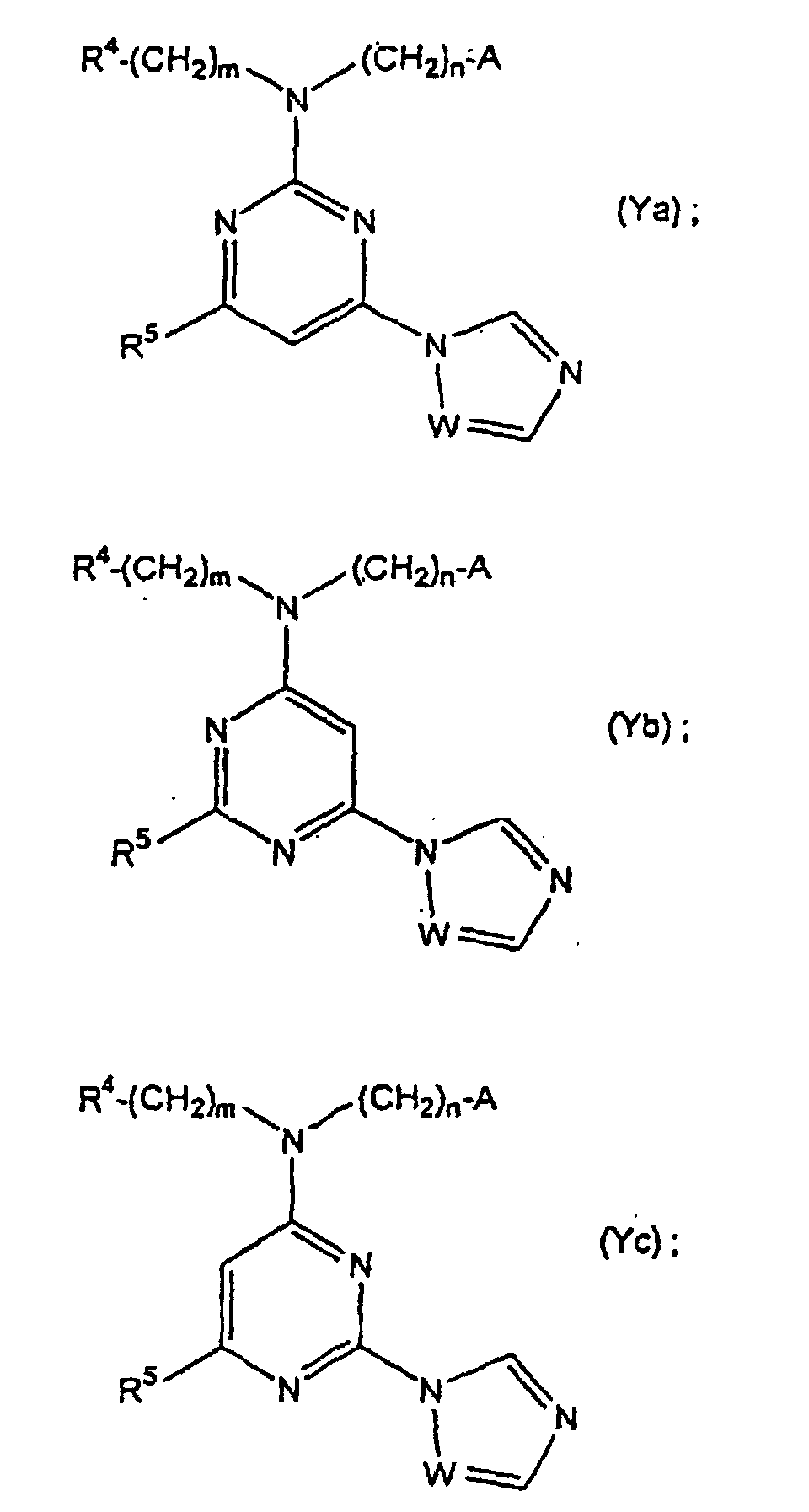
- n and m are each independently an integer from 1 to 4;
- A is -C(O)OR1 or -C(O)N(R1)R2;
- each W is N or CH;
- each R1 is independently hydrogen, C1-C8 alkyl, aryl or aryl-C1-C8 alkyl
- each R2 is independently hydrogen, C1-C20 alkyl, -(CH2)n-N(R1)2, heterocyclyl C1-C8 alkyl (optionally substituted by C1-C8 alkyl, halo, C1-C8 haloalkyl or C1-C8 alkoxy), aryl-C1-C8 alkyl (optionally substituted by halo, C1-C8 alkyl, C1-C8 alkoxy, or -N(R1)2);
- when m is an integer from 2 to 4,
- R4 can be hydroxy, cyano, heterocyclyl, -N(R1)R2, -N(R1)-C(O)-R1, -N(R1)-C(O)OR1, -N(R1)-S(O)1-R1, or-N(R1)-C(O)-N(R1)2;
- when m is 1, R4 can be cyano or heterocyclyl;
- R5 is hydrogen, halo, C1-C8 alkyl, aryl, aryl-C1-C8 alkyl, or C1-C8 haloalkyl;
- t is an integer from 0 to 2; wherein aryl refers to a phenyl or naphthyl radical as a single stereoisomer or mixture thereto, or a pharmaceutically acceptable salt thereof.
-
- In another aspect, the invention is directed to pharmaceutical compositions comprising a compound of formula (Ya), formula (Yb), and formula (Yc), as described above, and a pharmaceutically acceptable carrier.
- In another aspect, the invention is directed to methods for the manufacture of a medicament for treating a condition resulting from an abnormality in nitric oxide production, the medicament comprising a therapeutically effective amount of a compound of formula (Ya), formula (Yb) or formula (Yc), as described above.
- As used in this specification and appended claims, unless specified to the contrary, the following terms have the meaning indicated:
- "Alkyl" refers to a straight or branched hydrocarbon chain radical consisting solely of carbon and hydrogen atoms, containing no unsaturation, having from one to eight carbon atoms, and which is attached to the rest of the molecule by a single bond, e.g., methyl, ethyl, n-propyl, 1-methylethyl (iso-propyl), n-butyl, n-pentyl, 1,1-dimethylethyl (t-butyl), and the like. Alkyl radicals having more than eight carbon atoms are indicated herein by the notation "[Cx-Cy alkyl]" where x and y indicate the number of carbons present. Alkyl radicals may be optionally substituted by one or more substituents independently selected from the group consisting of halo, hydroxy, alkoxy, carboxy, cyano, carbonyl, alkoxycarbonyl, cyano, amino, monoalkylamino, dialkylamino, nitro, alkylthio, amidino, aryl, heterocyclyl, aryloxy, aralkoxy, acylamino, aminocarbonyl, monoalkylaminocarbonyl, and dialkylaminocarbonyl.
- "Alkenyl" refers to a straight or branched chain monovalent or divalent radical consisting solely of carbon and hydrogen, containing at least one double bond and having from one to eight carbon atoms, e.g., ethenyl, prop-1-enyl, but-1-enyl, pent-1-enyl, penta-1,4-dienyl, and the like.
- "Alkynyl" refers to a straight or branched chain monovalent or divalent radical consisting solely of carbon and hydrogen. containing at least one triple bond and having from one to eight carbon atoms, e.g., ethynyl, prop-1-ynyl, but-1-ynyl, pent-1-ynyl, pent-3-ynyl, and the like.
- "Alkoxy" refers to a radical of the formula -OR, where Ra is an alkyl radical as defined above, e.g., methoxy, ethoxy, propoxy, and the like
- "Alkoxycarbonyl" refers to a radical of the formula -C(O)ORa where Ra is an alkyl radical as defined above, e.g. methoxycarbonyl, ethoxycarbonyl. n-propoxycarbonyl, and the like.
- "Alkoxycarbonylalkyl" refers to a radical of the formula -Ra-C(O)ORa where each Ra is independently an alkyl radical as defined above, e.g., 2-(methoxycarbonyl)ethyl, 3-(ethoxycarbonyl)propyl, 4-(n-propoxycarbonyl)butyl, and the like.
- "Alkylsulfonylamino" refers to a radical of the formula -N(H)S(O)2-Ra where Ra is an alkyl radical as defined above. e.g . methylsulfonylamino, ethylsulfonylamino, and the like.
- "Alkylsulfonyl" refers to a radical of the formula -S(O)2-Ra where Ra is an alkyl radical as defined above, e.g., methylsulfonyl, ethylsulfonyl, and the like.
- "Alkylthio" refers to a radical of the formula -S-Ra where Ra is an alkyl radical as defined above, e.g., methylthio, ethylthio. n-propylthio, and the like.
- "Amidino" refers to a radical of the formula -C(NH)-NH2.
- "Amino" refers to a radical of the formula -NH2.
- "Aminocarbonyl" refers to a radical of the formula -C(O)NH2.
- "Aminosulfonyl" refers to a radical of the formula -S(O)2NH2.
- "Aryl" refers to a phenyl or naphthyl radical. The aryl radical may be optionally substituted by one or more substituents selected from the group consisting of hydroxy, mercapto, halo, alkyl, alkenyl, alkynyl, phenyl, phenylalkyl, phenylalkenyl, alkoxy, phenoxy, phenylalkoxy, haloalkyl, haloalkoxy, formyl, nitro, cyano, cycloalkyl, hydroxyalkyl, alkoxyalkyl, phenoxyalkyl, phenylalkoxyalkyl, amidino, ureido, alkoxycarbonyamino, amino, monoalkylamino, dialkylamino, monophenylamino, monophenylalkylamino, sulfonylamino, akylsulfonylamino, aminoalkyl, monoalkylaminoalkyl, dialkylaminoalkyl, monophenylaminoalkyl, monophenylalkylaminoalkyl, acyl, carboxyalkyl, alkoxycarbonylalkyl, aminocarbonyl, monoalkylaminocarbonyl, dialkylaminocarbonyl, aminocarbonylalkyl, monoalkylaminocarbonylalkyl, and dialkylaminocarbonylalkyl, as defined herein.
- "Aralkyl" refers to a radical of the formula -RaRb where Ra is an alkyl radical as defined above and Rb is an aryl radical as defined above, e.g., benzyl, and the like. The aryl radical may be optionally substituted as described above.
- "Aryloxy" refers to a radical of the formula -ORb where Rb is an aryl radical as defined above, e.g., phenoxy and naphthoxy, and the like. The aryl radical may be optionally substituted as described above.
- "Aryloxycarbonyl" refers to a radical of the formula -C(O)ORb where Rb is an aryl radical as defined above, e.g., phenoxycarbonyl.
- "Aralkoxy" refers to a radical of the formula -ORc where Rc is an aralkyl radical as defined above, e.g., benzyloxy, and the like. The aralkyl radical may be optionally substituted as described above.
- "Aralkoxycarbonyl" refers to a radical of the formula -C(O)ORc where Rc is an aralkyl radical as defined above, e.g., benzyloxycarbonyl, and the like. The aralkyl radical may be optionally substituted as described above.
- "Arylaminocarbonyl" refers to a radical of the formula -C(O)N(Rb)H where Rb is an aryl radical as defined above, e.g., phenylaminocarbonyl, and the like. The aryl radical may be optionally substituted as described above.
- "Arylaminosulfonyl" refers to a radical of the formula -S(O)2N(Rb)H where Rb is an aryl radical as defined above, e.g., phenylaminosulfonyl, and the like. The aryl radical may be optionally substituted as described above.
- "Arylsulfonyl" refers to a radical of the formula -S(O)2-Rb where Rb is an aryl radical as defined above, e.g., phenylsulfonyl, and the like. The aryl radical may be optionally substituted as described above.
- "Arylsulfonylaminocarbonyl" refers to a radical of the formula -C(O)N(H)S(O)2Rb where Rb is an aryl radical as defined above, e.g., phenylsulfonylaminocarbonyl, and the like. The aryl radical may be optionally substituted as described above.
- "Acyl" refers to a radical of the formula -C(O)-Ra and -C(O)Rb where Ra is an alkyl radical as defined above and Rb is an aryl radical as defined above, e.g., acetyl, propionyl, benzoyl, and the like.
- "Acylamino" refers to a radical of the formula -N(H)-C(O)-Ra and -N(H)-C(O)-Rb where Ra is an alkyl radical as defined above and Rb is an aryl radical as defined above, e.g., acetylamino, benzoylamino and the like.
- "Alkylene" refers to straight or branched chain divalent radical consisting solely of carbonyl and hydrogen, containing no unsaturation and having from one to eight carbon atoms, e.g., methylene, ethylene, propylene, n-butylene, and the like. The alkylene radical may be optionally substituted by one or more substituents selected from the group consisting of alkyl, hydroxy, -N(R16)R21 or -C(O)N(R1)R16 where R1, R16 and R21 are as defined above in the Summary of the Invention.
- "Cycloalkyl" refers to a stable 3- to 10-membered monocyclic or bicyclic radical which is saturated, and which consist solely of carbon and hydrogen atoms, e.g., cyclopropyl, cyclobutyl, cyclobutyl, cyclohexyl, decalinyl and the like. Unless otherwise stated specifically in the specification, the term "cycloalkyl" is meant to include cycloalkyl radicals which are optionally substituted by one or more substituents independently selected from the group consisting of alkyl, halo, hydroxy, amino, cyano, nitro, alkoxy, carboxy and alkoxycarbonyl.
- "Carboxy" refers to the radical of the formula -C(O)OH.
- "Carboxyalkyl" refers to a radical of the formula -Ra-C(O)OH where Ra is an alkyl radical as defined above, e.g., carboxymethyl, 2-carboxyethyl, 3-carboxypropyl, and the like.
- "Di(alkoxy)alkyl" refers to a radical of the formula -Ra(-ORa)2 where each Ra is independently an alkyl radical as defined above and where the -ORa groups may be attached to any carbon in the Ra group, e.g., 3,3-dimethoxypropyl, 2,3-dimethoxypropyl, and the like.
- "Dialkylamino" refers to a radical of the formula -N(Ra)Ra where each Ra is independently an alkyl radical as defined above, e.g., dimethylamino, diethylamino, (methyl)(ethyl)amino, and the like.
- "Dialkylaminocarbonyl" refers to a radical of the formula -C(O)N(Ra)Ra where each Ra is independently an alkyl radical as defined above, e.g., dimethylaminocarbonyl, methylethylaminocarbonyl, diethylaminocarbonyl, dipropylaminocarbonyl, ethylpropylaminocarbonyl, and the like.
- "Dialkylaminosulfonyl" refers to a radical of the formula -S(O)2N(Ra)Ra where each Ra is independently an alkyl radical as defined above, e.g., dimethylaminosulfonyl, methylethylaminosulfonyl, diethylaminosulfonyl, dipropylaminsulfonyl, ethylpropylaminosulfonyl, and the like.
- "Halo" refers to bromo, chloro, iodo or fluoro.
- "Haloalkyl" refers to an alkyl radical, as defined above, that is substituted by one or more halo radicals, as defined above, e.g., trifluoromethyl, difluoromethyl, trichloromethyl, 2,2,2-trifluoroethyl, 1-fluoromethyl-2-fluoroethyl, 3-bromo-2-fluoropropyl, 1-bromomethyl-2-bromoethyl, and the like.
- "Haloalkoxy" refers to a radical of the formula -ORd where Rd is an haloalkyl radical as defined above, e.g., trifluoromethoxy, difluoromethoxy, trichloromethoxy, 2,2,2-trifluoroethoxy, 1-fluoromethyl-2-fluoroethoxy, 3-bromo-2-fluoropropoxy, 1-bromomethyl-2-bromoethoxy, and the like.
- "Heterocyclyl" refers to a stable 3- to 15-membered ring radical which consists of carbon atoms and from one to five heteroatoms selected from the group consisting of nitrogen, oxygen and sulfur. For purposes of this invention, the heterocyclyl radical may be a monocyclic, bicyclic or tricyclic ring system, which may include fused or bridged ring systems; and the nitrogen, carbon or sulfur atoms in the heterocyclyl radical may be optionally oxidized; the nitrogen atom may be optionally quaternized; and the heterocyclyl radical may be partially or fully saturated or aromatic. The heterocyclyl radical may be attached to the main structure at any heteroatom or carbon atom which results in the creation of a stable compound. Examples of such heterocyclyl radicals include, but are not limited to, azepinyl, azetidinyl, acridinyl, benzimidazolyl, benzodioxolyl, benzodioxanyl, benzothiazolyl, benzoxazolyl, benzopyranyl, benzofuranyl, benzothienyl, carbazolyl, cinnolinyl, decahydroisoquinolyl, dioxolanyl, furyl, isothiazolyl, quinuclidinyl, imidazolyl, imidazolinyl, imidazolidinyl, isothiazolidinyl, indolyl, isoindolyl, indolinyl, isoindolinyl, indolizinyl, isoxazolyl, isoxazolidinyl, morpholinyl, naphthyridinyl, oxadiazolyl, octahydroindolyl, octahydroisoindolyl, 2-oxopiperazinyl, 2-oxopiperidinyl, 2-oxopyrrolidinyl, 2-oxoazepinyl, oxazolyl, oxazolidinyl, perhydroazepinyl, piperidinyl, piperazinyl, 4-piperidonyl, phenazinyl, phenothiazinyl, phenoxazinyl, phthalazinyl, pteridinyl, purinyl, pyrrolyl, pyrrolidinyl, pyrazolyl, pyrazolidinyl, pyridinyl, pyrazinyl, pyrimidinyl, pyridazinyl, quinazolinyl, quinoxalinyl, quinolinyl, quinuclidinyl, isoquinolinyl, thiazolyl, thiazolidinyl, thiadiazolyl, triazolyl, tetrazolyl, tetrahydrofuryl, tetrahydropyranyl, tetrahydroisoquinolyl, thienyl, thiomorpholinyl, thiomorpholinyl sulfoxide, and thiomorpholinyl sulfone. The heterocyclyl radical may be optionally substituted by R6 as defined above in the Summary of the Invention or may be optionally substituted by one or more substituents selected from the group consisting of hydroxy, mercapto, halo, alkyl, alkenyl, alkynyl, phenyl, phenylalkyl, phenylalkenyl, alkoxy, phenoxy, phenylalkoxy, haloalkyl, haloalkoxy, formyl, nitro, cyano, amidino, cycloalkyl, hydroxyalkyl, alkoxyalkyl, phenoxyalkyl, phenylalkoxyalkyl, amidino, ureido, alkoxycarbonyamino, amino, monoalkylamino, dialkylamino, monophenylamino, monophenylalkylamino, aminoalkyl, monoalkylaminoalkyl, dialkylaminoalkyl, monophenylaminoalkyl, monophenylalkylaminoalkyl, alkylcarbonyl, carboxyalkyl, alkoxycarbonylalkyl, aminocarbonyl, monoalkylaminocarbonyl, dialkylaminocarbonyl, aminocarbonylalkyl, monoalkylaminocarbonylalkyl, dialkylaminocarbonylalkyl, and imidazolyl, as defined herein.
- "Heterocyclylalkyl" refers to a radical of the formula -Ra-Re where Ra is an alkyl radical as defined above and Re is a heterocyclyl radical as defined above, e.g., 2-(1,3-benzodioxol-5-yl)ethyl, and 3-(1,4-benzodioxan-6-yl)propyl, and the like.
- "Monoalkylamino" refers to a radical of the formula -N(H)Ra where Ra is an alkyl radical as defined above, e.g., methylamino, ethylamino, propylamino, and the like.
- "Monoalkylaminocarbonyl" refers to a radical of the formula -C(O)N(H)Ra where Ra is an alkyl radical as defined above, e.g., methylaminocarbonyl, ethylaminocarbonyl, propylaminocarbonyl, and the like.
- "Monoalkylaminosulfonyl" refers to a radical of the formula -S(O)2N(H)Ra where Ra is an alkyl radical as defined above, e.g., methylaminosulfonyl, ethylaminosulfonyl, propylaminosulfonyl, and the like.
- "N-heterocyclyl" refers to a heterocyclyl radical as defined above which contains at least one nitrogen atom and which is attached to the main structure through the nitrogen atom. The N-heterocyclyl radical may contain up to three additional hetero atoms. Examples include piperidinyl, piperazinyl, pyrrolidinyl, morpholinyl, thiomorpholinyl, azetidinyl, indolyl, pyrrolyl, imidazolyl, tetrahydroisoquinolyl, perhydroazepinyl, tetrazolyl, triazolyl, oxazinyl, and the like. and may be optionally substituted as described above for heterocyclyl radicals. In addition to being optionally substituted by the substituents listed above for a heterocyclyl radical, the N-heterocyclyl radical may also be optionally substituted by R6 as defined above in the Summary of the Invention.
- "Phenylalkyl" refers to an alkyl radical as defined above substituted by a phenyl radical, e.g., benzyl, and the like.
- "Optional" or "optionally" means that the subsequently described event of circumstances may or may not occur, and that the description includes instances where said event or circumstance occurs and instances in which it does not. For example, "optionally substituted aryl" means that the aryl radical may or may not be substituted and that the description includes both substituted aryl radicals and aryl radicals having no substitution. The term "-[C2-C8 alkyl]-R10 (optionally substituted by hydroxy)" means that the alkyl has the optional substitution. The same goes for the term "-[C1-C8 alkyl]-R11 (optionally substituted by hydroxy)". The term "optionally substituted -S(O)1R22" means that the R22 substituents all have the optional substitution.
- "Phenylalkenyl" refers to an alkenyl radical as defined above substituted by a phenyl radical.
- The term "pharmaceutically acceptable salt" refers to salts prepared from pharmaceutically acceptable non-toxic acids or bases including inorganic acids and bases and organic acids and bases. When the compounds of the present invention are basic, salts may be prepared from pharmaceutically acceptable non-toxic acids including inorganic and organic acids. Suitable pharmaceutically acceptable acid addition salts for the compounds of the present invention include acetic, benzenesulfonic (besylate), benzoic, camphorsulfonic, citric, ethenesulfonic, fumaric, gluconic, glutamic, hydrobromic, hydrochloric, isethionic, lactic, maleic, malic, mandelic, methanesulfonic, mucic, nitric, pamoic, pantothenic, phosphoric, succinic, sulfuric, tartaric acid, p-toluenesulfonic, and the like. When the compounds contain an acidic side chain, suitable pharmaceutically acceptable base addition salts for the compounds of the present invention include metallic salts made from aluminum, calcium, lithium, magnesium, potassium, sodium and zinc or organic salts made from lysine, N,N'-dibenzylethylenediamine, chloroprocaine, choline, diethanolamine, ethylenediamine, meglumine (N-methylglucamine) and procaine.
- "Therapeutically effective amount" refers to that amount of a compound of the invention which, when administered to a human in need thereof, is sufficient to effect treatment, as defined below, for conditions resulting from an abnormality in nitric oxide production. The amount of a compound of the invention which constitutes a "therapeutically effective amount" will vary depending on the compound, the condition and its severity, and the age of the human to be treated, but can be determined routinely by one of ordinary skill in the art having regard to his own knowledge and to this disclosure.
- "Treating" or "treatment" as used herein covers the treatment of a condition in a human, which condition results from an abnormality in nitric oxide production, and includes:
- (i) preventing the condition from occurring in a human, in particular, when such human is predisposed to the condition but has not yet been diagnosed as having it;
- (ii) inhibiting the condition, i.e., arresting its development; or
- (iii) relieving the condition, i.e., causing regression of the condition.
-
- The yield of each of the reactions described herein is expressed as a percentage of the theoretical yield.
- Most of the compounds described herein contain one or more asymmetric centers and may thus give rise to enantiomers, diastereomers, and other stereoisomeric forms that may be defined, in terms of absolute stereochemistry, as (R)- or (S)- or, as (D)- or (L)- for amino acids. The present invention is meant to include all such possible isomers, as well as, their racemic and optically pure forms. Optically active (R)- and (S)-, or (D)- and (L)- isomers may be prepared using chiral synthons or chiral reagents, or resolved using conventional techniques. When the compounds described herein contain olefinic double bonds or other centers of geometric asymmetry, and unless specified otherwise, it is intended that the compounds include both E and Z geometric isomers. Likewise, all tautomeric forms are also intended to be included.
- The nomenclature used herein is a modified form of the I.U.P.A.C. nomenclature system wherein the compounds of the invention are named herein as amide derivatives. For example, the following compound of the invention:is named herein as 2-[[3-[(1,3-benzodioxal-5-yl)methyl]aminopropyl][2-(1H-imidazol-1-yl)-6-methylpyrimidin-4-yl]amino]-N,N-diethylacetamide. Unless otherwise indicated, compound names are intended to include any single stereoisomer, enantiomer, racemate or mixtures thereof.

- Nitric oxide generated by the inducible form of nitric oxide synthase (i-NOS) has been implicated in the pathogenesis of numerous inflammatory and autoimmune diseases and also in diseases which are generally not regarded as inflammatory, but nevertheless may involve cytokines which locally up-regulate i-NOS. The compounds of the invention, alone or in combination with other pharmaceutical agents, are therefore useful in treating mammals, preferably humans, having a condition resulting from an abnormality in nitric oxide production. Such conditions include, but are not limited to, the following:
- Multiple sclerosis (Parkinson, J.F. et al., J. Mol. Med. (1997), Vol. 75, pp. 174-186); stroke or cerebral ischemia (Iadecola, C. et al., J. Neurosci. (1997), Vol. 17, pp. 9157-9164); Alzheimer's disease (Smith, M.A. et al., J. Neurosci. (1997), Vol. 17, pp. 2653-2657; Wallace, M.N. et al., Exp. Neurol. (1997), Vol. 144, pp. 266-272); HIV dementia (Adamson D.C. et al., Science (1996), Vol. 274, pp. 1917-1921); Parkinson's disease (Hunot, S. et al., Neuroscience (1996), Vol. 72, pp. 355-363); meningitis (Koedel, U. et al., Ann. Neurol. (1995), Vol. 37, pp. 313-323); dilated cardiomyopathy and congestive heart failure (Satoh M et al., J. Am. Coll. Cardiol. (1997), Vol. 29, pp. 716-724); atherosclerosis (Wilcox, J.N. et al., Arterioscler. Thromb. Vasc. Biol. (1997), Vol. 17, pp. 2479-2488); restenosis or graft stenosis, septic shock and hypotension (Petros, A. et al., Cardiovasc. Res. (1994), Vol. 28, pp. 34-39); hemorrhagic shock (Thiemermann, C. et al., Proc. Natl. Acad. Sci. (1993), Vol. 90, pp. 267-271); asthma (Barnes, P.J., Ann. Med. (1995), Vol. 27, pp. 389-393; Flak, T.A. et al., Am. J. Respir. Crit. Care Med. (1996), Vol. 154, pp. S202-S206); adult respiratory distress syndrome, smoke or particulate-mediated lung injury (Ischiropoulos, H. et al., Am. J. Respir. Crit. Care Med. (1994), Vol. 150, pp. 337-341; Van Dyke, K., Agents Actions (1994), Vol. 41, pp. 44-49); pathogen-mediated pneumonias (Adler, H. et al., J. Exp. Med. (1997), Vol. 185, pp. 1533-1540); trauma of various etiologies (Thomae, K.R. et al., Surgery (1996), Vol. 119, pp. 61-66); rheumatoid arthritis and osteoarthritis (Grabowski, P.S. et al., Br. J. Rheumatol. (1997), Vol. 36, pp. 651-655); glomerulonephritis (Weinberg, J.B. et al., J. Exp. Med. (1994), Vol. 179, pp. 651-660); systemic lupus erythematosus (Belmont, H.M. et al., Arthritis Rheum. (1997), Vol. 40, pp. 1810-1816); inflammatory bowel diseases such as ulcerative colitis and Crohn's disease (Godkin, A.J. et al., Eur. J. Clin. Invest. (1996), Vol. 26, pp. 867-872; Singer, I.I. et al., Gastroenterology (1996), Vol. 111, pp. 871-885); insulin dependent diabetes mellitus (McDaniel, M.L., et al., Proc. Soc. Exp. Biol. Med. (1996), Vol. 211, pp. 24-32); diabetic neuropathy or nephropathy (Sugimoto, K. and Yagihashi, S., Microvasc. Res. (1997), Vol. 53, pp. 105-112; Amore, A. et al., Kidney Int. (1997), Vol. 51, pp. 27-35); acute and chronic organ transplant rejection (Worrall, N.K. et al., Transplantation (1997), Vol. 63, pp. 1095-1101); transplant vasculopathies (Russell, M.E. et al., (1995), Vol. 92, pp. 457-464); graft-versus-host disease (Kichian, K. et al., J. Immunol. (1996), Vol. 157, pp. 2851-2856); psoriasis and other inflammatory skin diseases (Bruch-Gerharz, D. et al., J. Exp. Med. (1996), Vol. 184, pp. 2007-2012); and cancer (Thomsen, L.L. et al., Cancer Res. (1997), Vol. 57, pp. 3300-3304).
- The compounds of the current invention may also be useful for the management of male and female reproductive functions when used alone or combined with other drugs commonly used for these indications. Examples, without implied limitation, include: inhibition of fertilization, endometrial receptivity and implantation (alone or in combination with a progesterone antagonist); post-coital contraception (alone or in combination with a progesterone antagonist); induction of abortion (in combination with an antiprogestin and in further combination with a prostaglandin); control and management of labor and delivery; treatment of cervical incompetence (alone or in combination with progesterone or a progestin); treatment of endometriosis (alone or in combination with other drugs, including LHRH-agonists/antagonists, antiprogestins orprogestins by either sequential application or by concomitant administration). See, for example, the following references: Chwalisz, K. et al., J. Soc. Gynecol. Invest. (1997), Vol. 4, No. 1 (Supplement), page 104a, which discusses the inhibition of fertilization, endometrial receptivity and implantation. or post-coital contraception, alone or in combination with a progesterone antagonist, Chwalisz, K. et al., Prenat. Neonat. Med. (1996), Vol. 1, pp. 292-329, which discusses the induction of abortion, in combination with an antiprogestin and in further combination with a prostaglandin, and the control and management of labor and delivery; and Chwalisz, K. et al., Hum Reprod. (1997). vol. 12. pp 101-109, which discusses the treatment of cervical incompetence alone or in combination with progesterone or a progestin.
- Those skilled in the art will also recognize that the compounds of the present invention include 1-substituted imidazoles This class of compounds has previously been described as mechanism-based, heme-binding inhibitors of the cytochrome P450 family of enzymes (Maurice, M. et al., FASEB J. (1992). Vol. 6, pp. 752-8) in addition to nitric oxide synthesis (Chabin, R.NM. et al., Biochemistry (1996). Vol 35, pp. 9567-9575). The compounds of the present invention may thus be useful as inhibitors of selected cytochrome P450 family members of therapeutic interest including, but not limited to. P450 enzymes involved in steroid and retinoid biosynthesis (Masamura et al., Breast Cancer Res. Treat. (1995), Vol. 33, pp. 19-26; Swart, P. et al., J. Clin. Endocrinol. Metab., Vol. 77, pp. 98-102; Docks, P. et al., Br. J. Dermatol. (1995), Vol. 133, pp. 426-32) and cholesterol biosynthesis (Burton, P.M. et al., Biochem. Pharmacol. (1995), Vol. 50, pp. 529-544; and Swinney. D.C. et al., Biochemistry (1994), Vol. 33, pp. 4702-4713). Imidazole-based compounds may also have antifungal activity (Aoyama, Y. et al., Biochem. Pharmacol. (1992), Vol. 44, pp. 1701-1705). The P450 inhibitory activity of the compounds of the present invention can be assessed using appropriate assay systems specific for the P450 isoform of interest. Such assays are included in the references cited above. One additional example of mammalian cytochrome P450 isoform that may be inhibited by the compounds of the present invention is cytochrome P450 3A4 which can be assayed in a manner similar to the method described in Yamazaki et al., Carcinogenesis (1995), Vol. 16, pp. 2167-2170.
- Nitric oxide synthases are complex enzymes that catalyze the conversion of L-arginine to nitric oxide (NO) and citrulline. Catalysis proceeds through two successive oxidations of the guanidinium group of L-arginine.
- A cell-based nitric oxide synthase assay employing the measurement of nitric oxide oxidation product, nitrite, in the conditioned medium of cultured cells was employed for the evaluation of the compounds of the invention. The murine monocytic cell lines RAW 264.7 and J774 are well documented as capable of producing >10 µM nitrite in response to immunostimulation:
- RAW 264.7 murine macrophage cells were obtained from American Type Culture Collection (Rockville, Maryland) and were maintained in RPMI 1640 containing 10% fetal bovine serum (FBS), 5000 units/mL of penicillin and streptomycin, and 2mM glutamine (maintenance medium). NOS activity was measured by a fluorescent assay of the nitric oxide oxidation product, nitrite, (Diamani et al., Talanta (1986), Vol. 33, pp. 649-652). Induction of iNOS (inducible nitric oxide synthase) is stimulated by treatment of the cells with lipopolysaccharide and γ-interferon. The method of the assay is described below.
- Cells are harvested, diluted to 500,000 cells/mL with maintenance medium, and seeded into 96-well plates at 100 µl/well. The plates are incubated overnight at 37°C, under a 5% CO2 atmosphere. The medium is then replaced with 90 µl of BME medium containing 10% FBS, 100 units/mL of penicillin, 100 µl streptomycin, 2 mM glutamine, 100 units/mL of interferon-γ and 2 µg/mL of lipopoly-saccharide. N-guanidino-methyl-L-arginine is added to four wells (negative control) at a final concentration of 200 µM using 10 µl of 2 mM stock solution in 100 mM Hepes, pH 7.3 + 0.1 % DMSO and four wells receive only the 100 mM Hepes/0.1% DMSO buffer (positive control). Compounds for evaluation are dissolved at 10-fold the desired final concentration in Hepes/DMSO and 10 µL of these solutions is transferred to the 96-well plate. The plates are incubated for 17 hrs at 37°C, under a 5% CO2 atmosphere. Nitrite accumulated in the culture medium is determined as follows: add 15 µL of 2,3-diaminonaphthalene (10 µg/mL in 0.75 M HCl) to each well and incubate for 10 minutes at room temperature. Add 15 µl of 1 N NaOH and measure the fluorescence emission at 405 nm, using an excitation wavelength of 365 nm. Enzyme activity in experimental wells is normalized to percent control using the positive and negative control values. The signal to noise ratio is >10 for the assay.
- The compounds of the invention, when tested in this assay, demonstrated the ability to inhibit nitric oxide production.
- Various in vivo assays may be employed to determine the efficacy of the compounds of the invention in treating a condition resulting from an abnormality in nitric oxide production, such as arthritis. The following is a description of such an assay utilizing rats:
- Male Lewis rats were injected intradermally (proximal quarter of the tail) with 0.1 mL of Mycobacterium butyricum in Incomplete Freund's Adjuvant (10 mg/mL). Either vehicle (acidified saline, 1 mL/kg) or a compound of the invention (3, 10, or 30 mg/kg) were administered subcutaneously (b.i.d.), starting on the day following adjuvant immunization, and continued until the end of the experiment (N= 10 rats per treatment group). Clinical scores (see below) were measured in all limbs 3 times per week throughout the study. Rats were euthanized 34-35 days after immunization. At the time of euthanasia, a radiologic evaluation (see below) of the hind paws was performed, a blood sample was collected for clinical blood chemistry and drug levels (high dose group only; 6 or 12 hours post final dose), a section of liver was obtained for measurement of potential toxicity, and the hind limbs were preserved for histopathological determination.
- Clinical scoring - each limb was graded according to the following scale:
- 0 no signs of inflammation
- 1 moderate redness, first indication of swelling, joint flexible
- 2 moderate redness, moderate swelling, joint flexible
- 3 redness, significant swelling and distortion of the paw, joint beginning to fuse
- 4 redness, gross swelling and distortion of the paw, joint completely fused
-
- Radiological scoring - each hind limb was graded on a scale of 0-3 for each of the following parameters:
- soft tissue swelling
- cartilage loss
- erosion
- heterotropic ossification
-
- The compounds of the invention, when tested in this assay, demonstrated the ability to treat the arthritis present in the rats.
- Those skilled in the art will also recognize that numerous assays for the activity of the NOS isoforms (iNOS, nNOS and eNOS) exist which can be used to evaluate the biological activity of the compounds of the current invention. These include assays for native NOS isoforms in tissues studied ex vivo (Mitchell et al., Br. J. Pharmacol. (1991), Vol. 104, pp. 289-291; Szabo et al., Br. J. Pharmacol. (1993), Vol. 108, pp. 786-792; Joly et al., Br. J. Pharmacol. (1995), Vol. 115, pp. 491-497) as well as primary cell cultures and cell lines (Forstermann et al., Eur. J. Pharmacol. (1992), Vol. 225, pp. 161-165; Radmoski et al., Cardiovasc. Res. (1993), Vol. 27, pp. 1380-1382; Wang et al., J. Pharmacol. Exp. Ther. (1994), Vol. 268, pp. 552-557). Those skilled in the art will also recognize that recombinant NOS enzymes can be expressed in heterologous cells by either transient transfection (Karlsen et al., Diabetes, (1995), Vol. 44, pp. 753-758), stable transfection (McMillan et al., Proc. Natl. Acad. Sci. (1992), Vol. 89, pp. 11141-11145; Sessa et al., J. Biol. Chem. (1995), Vol. 270, pp. 17641-17644) or via the use of lytic virus transfection (Busconi & Michel, Mol. Pharmacol. (1995), Vol. 47, pp. 655-659; List et al., Biochem. J. (1996), Vol. 315, pp. 57-63) using NOS cDNAs. Heterologous expression can be achieved in mammalian cells (McMillan et al., Proc. Natl. Acad. Sci. (1992), Vol. 89, pp. 11141-11145), insect cells (Busconi & Michel, Mol. Pharmacol. (1995), Vol. 47, pp. 655-659; List et al., Biochem. J. (1996), Vol. 315, pp. 57-63), yeast (Sari et al., Biochemistry (1996), Vol. 35, pp. 7204-7213) or bacteria (Roman et al., Proc. Natl. Acad. Sci. (1995), Vol. 92, pp. 8428-8432; Martasek et al., Biochem. Biophys. Res. Commun. (1996), Vol. 219, pp. 359-365). Any of these heterologous expression systems can be used to establish iNOS, nNOS and eNOS assay systems to evaluate the biological activity of the compounds of the present invention.
- Any suitable route of administration may be employed for providing a patient with an effective dosage of compounds of the invention. For example, oral, rectal, parenteral (subcutaneous, intramuscular, intravenous), transdermal, and like forms of administration may be employed. Dosage forms include tablets, troches, dispersions, suspensions, solutions, capsules, patches, and the like.
- The pharmaceutical compositions of the present invention comprise the compounds of the invention as the active ingredient, and may also contain a pharmaceutically acceptable carrier, and optionally, other therapeutic ingredients. Carriers such as starches, sugars, and microcrystalline cellulose, diluents, granulating agents, lubricants, binders, disintegrating agents, and the like are suitable in the case of oral solid preparations (such as powders, capsules, and tablets), and oral solid preparations are preferred over the oral liquid preparations. Methods for their preparation are well known in the art.
- Because of their ease of administration, tablets and capsules represent the most advantageous oral dosage unit forms, in which case solid pharmaceutical carriers are employed. If desired, tablets may be coated by standard aqueous or nonaqueous techniques. In addition to the common dosage forms set out above, the compounds of the present invention may also be administered by controlled or sustained release means and delivery devices.
- Pharmaceutical compositions of the present invention suitable for oral administration may be presented as discrete units such as capsules, cachets, or tablets, each containing a predetermined amount of the active ingredient, as a powder or granules, or as a solution or a suspension in an aqueous liquid, a non-aqueous liquid, an oil-in-water emulsion, or a water-in-oil liquid emulsion. Such compositions may be prepared by any of the methods of pharmacy, but all methods include the step of bringing into association the active ingredient with the carrier which constitutes one or more necessary ingredients. In general, the compositions are prepared by uniformly and intimately admixing the active ingredient with liquid carriers or finely divided solid carriers or both, and then, if necessary, shaping the product into the desired presentation.
- Of the compounds of formula (Ya), formula (Yb) and formula (Yc) as described above in the Summary of the invention, a preferred group of compounds are those compounds having the formula (Yc) wherein n is 1; m is 2 or 3; A is -C(O)OR1 or -C(O)N(R1)R2; each W is CH; R1 is hydrogen or C1-C8 alkyl; and R2 is hydrogen, C1-C8 alkyl, -(CH)n-N(R1)2, optionally substituted heterocyclyl C1-C8 alkyl or optionally substituted aryl-C1-C8 alkyl.
- Of this subgroup of compounds, a preferred class of compounds are those compounds wherein R4 is -N(R1)R2 where R1 is hydrogen or C1-C8 alkyl and R2 is heterocyclyl C1-C8 alkyl selected from the group consisting of (1,3-benzodioxol-5-yl)methyl or (1,4-benzodioxan-6-yl)methyl.
- Of this class of compounds, preferred compounds are selected from the group consisting of:
- 2-[[3-[[(1,3-benzodioxol-5-yl)methyl](methyl)amino]propyl][2-(1H-imidazol-1-yl)-6-methylpyrimidin-4-yl]amino]acetic acid, ethyl ester;
- 2-[[3-[[(1,3-benzodioxol-5-yl)methyl](methyl)amino]propyl][2-(1H-imidazol-1-yl)-6-methylpyrimidin-4-yl]amino]-N,N-diethylacetamide;
- 2-[[3-[[(1,3-benzodioxol-5-yl)methyl](methyl)amino]propyl][2-(1H-imidazol-1-yl)-6-methylpyrimidin-4-yl]amino]-N-(2-dimethylaminoethyl)acetamide;
- 2-[[3-[[(1,3-benzodioxol-5-yl)methyl](methyl)amino]propyl][2-(1H-imidazol-1-yl)-6-methylpyrimidin-4-yl]amino]acetamide;
- 2-[[3-[(1,3-benzodioxol-5-yl)methyl]aminopropyl][2-(1H-imidazol-1-yl)-6-methylpyrimidin-4-yl]amino]-N,N-diethylacetamide;
- 2-[[3-[(1,3-benzodioxol-5-yl)methyl]aminopropyl][2-(1H-imidazol-1-yl)-6-methylpyrimidin-4-yl]amino]-N-methylacetamide;
- 2-[[3-[(1,4-benzodioxan-6-yl)methyl]aminopropyl][2-(1H-imidazol-1-yl)-6-methylpyrimidin-4-yl]amino]-N-methylacetamide;
- 2-[[3-[(1,4-benzodioxan-6-yl)methyl]aminopropyl][2-(1H-imidazol-1-yl)-6-methylpyrimidin-4-yl]amino]-N,N-diethylacetamide;
- 2-[[3-[(1,4-benzodioxan-6-yl)methyl]aminopropyl][2-(1H-imidazol-1-yl)-6-methylpyrimidin-4-yl]amino]acetamide; and
- 2-[[3-[(1,3-benzodioxol-5-yl)methyl]aminopropyl][2-(1H-imidazol-1-yl)-6-methylpyrimidin-4-yl]amino]acetamide.
-
- Of the preferred subgroup of compounds, a preferred class of compounds are those compounds wherein R4 is heterocyclyl.
- Of this class of compounds, preferred compounds are selected from the group consisting of:
- 2-[[pyridin-3-ylmethyl][2-(1H-imidazol-1-yl)-6-methylpyrimidin-4-yl]amino]-N-[2-(1,3-benzodioxol-5-yl)ethyl]acetamide;
- 2-[[2-(1H-imidazol-1-yl)-6-methylpyrimidin-4-yl][(1,3-benzodioxol-5-yl)methyl]amino]-N-[2-(1,3-benzodioxol-5-yl)ethyl]acetamide; and
- 2-[[2-(1H-imidazol-1-yl)-6-methylpyrimidin-4-yl][2-(morpholin-4-yl)ethyl]amino]-N-[2-(1,3-benzodioxol-5-yl)ethyl]acetamide.
-
- Of this subgroup of compounds, another preferred class of compounds are those compounds wherein R4 is hydroxy, cyano, -N(R1)R2, -N(R1)-C(O)-R1, -N(R1)-C(O)OR1, -N(R1)-S(O)1-R1, or -N(R1)-C(O)-N(R1)2, where each R1 and each R2 is independently hydrogen, aryl C1-C8 alkyl or aryl-C1-C8 alkyl.
- Of this class of compounds, preferred compounds are selected from the group consisting of:
- 2-[[3-hydroxypropyl][2-(1H-imidazol-1-yl)-6-methylpyrimidin-4-yl]amino]-N-[2-(1,3-benzodioxol-5-yl)ethyl]acetamide;
- 2-[[2-cyanoethyl][2-(1H-imidazol-1-yl)-6-methylpyrimidin-4-yl]amino]-N-[2-(1,3-benzodioxol-5-yl)ethyl)acetamide;
- 2-[[3-(dimethylamino)propyl][2-(1H-imidazol-1-yl)-6-methylpyrimidin-4-yl]amino]-N-[2-(1,3-benzodioxol-5-yl)ethyl]acetamide;
- 2-[[3-(acetylamino)propyl][2-(1H-imidazol-1-yl)-6-methylpyrimidin-4-yl]amino]-N-[2-(1,3-benzodioxol-5-yl)ethyl]acetamide;
- 2-[[3-(methylsulfonylamino)propyl][2-(1H-imidazol-1-yl)-6-methylpyrimidin-4-yl]amino]-N-[2-(1,3-benzodioxol-5-yl)ethyl]acetamide;
- 2-[[3-(methoxycarbonylamino)propyl][2-(1H-imidazol-1-yl)-6-methylpyrimidin-4-yl]amino]-N-[2-(1,3-benzodioxol-5-yl)ethyl]acetamide;
- 2-[[3-(phenylmethylamino)propyl][2-(1H-imidazol-1-yl)-6-methylpyrimidin-4-yl]amino]-N-[2-(1,3-benzodioxol-5-yl)ethyl]acetamide;
- 2-[[3-aminopropyl][2-(1 H-imidazol-1-yl)-6-methylpyrimidin-4-yl]amino]-N-[2-(1,3-benzodioxol-5-yl)ethyl]acetamide;
- 2-[[3-aminopropyl][2-(1H-imidazol-1-yl)-6-methylpyrimidin-4-yl]amino]-N-[2-(4-methoxyphenyl)ethyl]acetamide.
- 2-[[3-(methylsulfonylamino)propyl][2-(1H-imidazol-1-yl)-6-methylpyrimidin-4-yl]amino]-N-[2-(4-methoxyphenyl)ethyl]acetamide.
- 2-[[3-(methoxycarbonylamino)propyl][2-(1H-imidazol-1-yl)-6-methylpyrimidin-4-yl]amino]-N-[2-(4-methoxyphenyl)ethyl]acetamide.
- 2-[[3-(phenylmethylamino)propyl][2-(1H-imidazol-1-yl)-6-methylpyrimidin-4-yl]amino]-N-[2-(4-methoxyphenyl)ethyl]acetamide.
- 2-[[3-(acetylamino)propyl][2-(1H-imidazol-1-yl)-6-methylpyrimidin-4-yl]amino]-N-[2-(4-methoxyphenyl)ethyl]acetamide.
- 2-[[3-aminopropyl][2-(1H-imidazol-1-yl)-6-methylpyrimidin-4-yl]amino]-N-[2-(1,4-benzodioxan-6-yl)ethyl]acetamide;
- 2-[[3-(methoxycarbonylamino)propyl][2-(1H-imidazol-1-yl)-6-methylpyrimidin-4-yl]amino]-N-[2-(1,4-benzodioxan-6-yl)ethyl]acetamide;
- 2-[[3-(di(phenylmethyl)amino)propyl][2-(1H-imidazol-1-yl)-6-methylpyrimidin-4-yl]amino]-N-[2-(1,4-benzodioxan-6-yl)ethyl]acetamide;
- 2-[[3-(acetylamino)propyl][2-(1H-imidazol-1-yl)-6-methylpyrimidin-4-yl]amino]-N-[2-(1,4-benzodioxan-6-yl)ethyl]acetamide;
- 2-[[3-(methylsulfonylamino)propyl][2-(1H-imidazol-1-yl)-6-methylpyrimidin-4-yl]amino]-N-[2-(1,4-benzodioxan-6-yl)ethyl]acetamide;
- 2-[[3-(dimethylamino)propyl][2-(1H-imidazol-1-yl)-6-methylpyrimidin-4-yl]amino]-N-[2-(1,4-benzodioxan-6-yl)ethyl]acetamide;
- 2-[[3-(dimethylamino)propyl][2-(1H-imidazol-1-yl)-6-methylpyrimidin-4-yl]amino]-N-[2-(4-methoxyphenyl)ethyl]acetamide;
- 2-[[3-(ureido)propyl][2-(1H-imidazol-1-yl)-6-methylpyrimidin-4-yl]amino]-N-[2-(4-methoxyphenyl)ethyl]acetamide;
- 2-[[3-(phenylmethylamino)propyl][2-(1H-imidazol-1-yl)-6-methylpyrimidin-4-yl]aminol-N-[2-(1,4-benzodioxan-6-yl)ethyl]acetamide;
- 2-[[3-(phenylmethylamino)propyl][2-(1H-imidazol-1-yl)-6-methylpyrimidin-4-yl]amino]-N-[2-(2,3-dihydrobenzofuran-5-yl)ethyl]acetamide;
- 2-[[3-aminopropyl][2-(1H-imidazol-1-yl)-6-methylpyrimidin-4-yl]amino]-N-[2-(2,3-dihydrobenzofuran-5-yl)ethyl]acetamide;
- 2-[[3-(dimethylamino)propyl][2-(1H-imidazol-1-yl)-6-methylpyrimidin-4-yl]amino]-N-[2-(2,3-dihydrobenzofuran-5-yl)ethyl]acetamide;
- 2-[[3-(acetylamino)propyl][2-(1H-imidazol-1-yl)-6-methylpyrimidin-4-yl]amino]-N-[2-(2,3-dihydrobenzofuran-5-yl)ethyl]acetamide;
- 2-[[3-(methoxycarbonylamino)propyl][2-(1H-imidazol-1-yl)-6-methylpyrimidin-4-yl]amino]-N-[2-(2,3-dihydrobenzofuran-5-yl)ethyl]acetamide;
- 2-[[3-(methylsulfonylamino)propyl][2-(1H-imidazol-1-yl)-6-methylpyrimidin-4-yl]amino]-N-[2-(2,3-dihydrobenzofuran-5-yl )ethyl]acetamide;
- 2-[[3-(ureido)propyl][2-(1H-imidazol-1-yl)-6-methylpyrimidin-4-yl]amino]-N-[2-(1,4-benzodioxan-6-yl)ethyl]acetamide; and
- 2-[[3-(ureido)propyl][2-(1H-imidazol-1-yl)-6-methylpyrimidin-4-yl]amino]-N-[2-(2,3-dihydrobenzofuran-5-yl)ethyl]acetamide.
-
- Reaction Schemes 1 through 4 depict methods of preparing compounds of formula (Yc). Compounds of formula (Ya) and formula (Yc) may be similarly prepared:

- Compounds of formulae (Y1), (Y2), (Y4) and (Y5) are commercially available or may be prepared by methods disclosed herein or by methods known to those of ordinary skill in the art. Each R1, R2, m and n are independently as described above in the Summary of the Invention for compounds of formula (Ya), formula (Yb) and formula (Yc); and R5 and W are also as described above in the Summary of the Invention for compounds of formula (Ya), formula (Yb) and formula (Yc).
- The above synthesis may be carried out as follows:
- To N-cyanoethylglycine, ethyl ester (15.9 g, 102 mmol) (a compound of formula (Y2)) dissolved in DMSO (70 mL) was added 4-chloro-6-methyl-2-methylsulfonylpyrimidine (18.8 g, 91 mmol) (a compound of formula (Y1)) and diisopropylethylamine (18 mL, 100 mmol). After stirring for 16 hours, the reaction temperature was raised to 70°C and imidazole (26.5 g, 0.39 mol) was added. After stirring for 1 day, the reaction was cooled to ambient temperature and added to ice water. The solid that formed was suction filtered and collected on paper to give 9.9 g of 2-[(2-cyanoethyl)[2-(1H-imidazol-1-yl)-6-methylpyrimidin-4-yl]amino]acetic acid, ethyl ester (a compound of formula (Yc1)).
- To 2-[(2-cyanoethyl)[2-(1H-imidazol-1-yl)-6-methylpyrimidin-4-yl]amino]acetic acid, ethyl ester (4.51 g, 14.4 mmol) dissolved in THF (250 mL) was added LiOH (0.91 g, 21.7 mmol) and water (30 mL). After stirring for 18 hours, most of the solvent was removed in vacuo and 1 N HCl (21.7 mL, 21.7 mmol) was added. The solid that formed was suction filtered and collected on paper to give 3.17 g of 2-[(2-cyanoethyl)[2-(1H-imidazol-1-yl)-6-methylpyrimidin-4-yl]amino]acetic acid (a compound of formula (Yc2)).
- To 2-[(2-cyanoethyl)[2-(1H-imidazol-1-yl)-6-methylpyrimidin-4-yl]amino]acetic acid (1.53 g, 5.3 mmol) slurried in DMF (25 mL) was added carbonyldiimidazole (0.87 g, 5.4 mmol). After stirring for 2 hours, diethylamine (1.0 mL, 9.7 mmol) (a compound of formula (Y4)) was added. After stirring for 18 hours, the reaction was partitioned with ethyl acetate and water. The organic layer was separated, dried (Na2SO4), and the solvent was removed in vacuo to give 0.91 g of 2-[(2-cyanoethyl)[2-(1H-imidazol-1-yl)-6-methylpyrimidin-4-yl)amino]-N,N-diethylacetamide (a compound of formula (Yc3)).
- The following compounds of formula (Yc3) and derivatives thereof were prepared in a similar manner with the appropriately substituted starting materials:
- 2-[(2-cyanoethyl)[2-(1H-imidazol-1-yl)-6-methylpyrimidin-4-yl]amino]-N-methylacetamide;
- 2-[(2-cyanoethyl)[2-(1H-imidazol-1-yl)-6-methylpyrimidin-4-yl]amino]-N-[2-(1,4-benzodioxan-6-yl)ethyl]acetamide.
-
- Ammonia (g) was bubbled into 2-[(2-cyanoethyl)[2-(1 H-imidazol-1-yl)-6-methylpyrimidin-4-yl]amino]-N,N-diethylacetamide (0.22 g, 0.65 mmol) dissolved in MeOH (25 mL). Raney Nickel (0.8 g) was added and the mixture was placed under nitrogen at 50 psi. When the reaction was determined to be complete by TLC, the reaction mixture was suction filtered through celite and the solvent was removed in vacuo. To the residue dissolved in MeOH (10 mL) was added piperonal (0.29 g, 1.9 mmol) and NaBH(OAc)3 (0.40 g, 1.9 mmol). After stirring for 18 hours, the solvent was evaporated and the residue was partitioned between ethyl acetate and aqueous bicarbonate solution. The organic layer was separated, dried (Na2SO4), and the solvent was removed in vacuo. Chromatography on silica with acetonitrile/ammonium hydroxide (19/1) gave 2-[[3-[(1,3-benzodioxol-5-yl)methyl]aminopropyl][2-(1H-imidazol-1-yl)-6-methylpyrimidin-4-yl]amino]-N,N-diethylacetamide, a compound of formula (Yc4); NMR (CDCl3) 8.4 (s, 1), 7.65 (s, 1), 7.0 (s, 1), 6.85 (s, 1), 6.75 (d, 1), 6.5 (d, 1), 6.05 (br, 1), 5.85 (s, 2), 4.3 (s, 2), 3.85 (s, 2), 3.65 (br, 2), 3.4 (m, 4), 2.95 (t, 2), 2.3 (s, 3), 2.2 (m, 2), 1.25 (t, 3), 1.1 (t, 3) ppm.
- The following compounds of formula (Yc4) and derivatives thereof were prepared in a similar manner with appropriately substituted starting materials:
- 2-[[3-[(1,4-benzodioxan-6-yl)methyl]aminopropyl][2-(1H-imidazol-1-yl)-6-methylpyrimidin-4-yl]amino]-N-methylacetamide; NMR (CDCl3) 8.5 (s, 1), 7.8 (s, 1), 7.1 (s, 1), 6.75 (m, 3), 6.25 (br, 1), 4.25 (s, 4), 4.15 (br, 2), 3.7 (s, 2), 3.6 (s, 2), 2.8 (d, 3), 2.75 (m, 2), 2.4 (s, 3), 1.85 (m, 2) ppm;
- 2-[[3-[(1,3-benzodioxol-5-yl)methyl]aminopropyl][2-(1H-imidazol-1-yl)-6-methylpyrimidin-4-yl]amino]-N-methylacetamide; NMR (DMSO-d6) 8.4 (s, 1), 8.0 (m, 1), 7.8 (s, 1), 7.05 (s, 1), 6.9 (s, 1), 6.8 (m, 2), 6.65 (s, 1), 6.3 (br, 1), 5.95 (s, 2), 4.1 (br, 2), 3.6 (s, 2), 3.55 (br, 2), 3.3 (br, 3), 2.6 (m, 2), 2.3 (s, 3), 1.75 (m, 2) ppm;
- 2-[[3-[(1,4-benzodioxan-6-yl)methyl]aminopropyl][2-(1H-imidazol-1-yl)-6-methylpyrimidin-4-yl]amino]-N,N-diethylacetamide; NMR (CDCl3) 8.4 (s, 1), 7.7 (s, 1), 7.05 (s, 1), 6.85 (s, 1), 6.6 (m, 2), 6.3 (br, 1), 4.4 (s, 2), 4.25 (s, 4), 3.7 (s, 2), 3.6 (m, 2), 3.4 (q, 4), 2.7 (t, 2), 2.35 (s, 3), 1.9 (m, 2), 1.35 (t, 3), 1.15 (t, 3) ppm;
- 2-[[3-[(1,4-benzodioxan-6-yl)methyl]aminopropyl][2-(1H-imidazol-1-yl)-6-methylpyrimidin-4-yl]amino]acetamide; NMR (CDCl3) 8.5 (s, 1), 7.8 (s, 1), 7.1 (s, 1), 6.75 (m, 3), 6.3 (br, 1), 6.0 (br, 1), 4.2 (s, 4), 4.15 (s, 2), 3.65 (m, 4), 2.75 (m, 2), 2.4 (s, 3), 1.85 (m, 2) ppm;
- 2-[[3-[(1,3-benzodioxol-5-yl)methyl]aminopropyl][2-(1H-imidazol-1-yl)-6-methylpyrimidin-4-yl]amino]acetamide; NMR (CDCl3) 8.5 (s, 1), 7.75 (s, 1), 7.05 (s, 1), 6.75 (m, 3), 6.3 (br, 1), 5.95 (s, 2), 5.4 (br, 1), 4.15 (s, 2), 3.7 (br, 2), 3.6 (s, 2), 2.75 (t, 2), 2.4 (s, 3), 1.85 (m, 2) ppm.
-
- Compounds of formula (Y4) wherein R2 is 2-(1,4-benzodioxan-6-yl)ethyl may be prepared as follows and reacted with the compound of formula (Yc2) to prepare compounds of formula (Yc3), which may be further reacted as described above to form compounds of formula (Yc4):
- To 1,4-benzodioxane-6-carboxaldehyde (10.0 g, 60 mmol) in acetic acid (50 mL) was added nitromethane (6.3 mL, 1.9 eq.) and ammonium acetate (5.1 g, 1.1 eq.). After heating at 110°C for 4 hours the mixture was cooled to ambient temperature, water (150 mL) was added, and the solid precipitate was collected by filtration. The solid was crystallized from methylene chloride-hexane (1:1, 45 mL) to obtain 7.6 g (61 %) of 6-(2-nitroethenyl)-1,4-benzodioxane. To a portion of the solid (3.58 g) dissolved in MeOH-EtOH-AcOEt (1:1:1, 450 mL) was added 10% Pd/C (1.7 g) and concentrated HCl (3.3 mL, 2.3 eq). After shaking on a Parr hydrogenator at 45 psi for 5 hours, the catalyst was removed by filtration through Celite and washed with methanol. Evaporation of the filtrate gave 3.59 g (96%) of 1,4-benzodioxan-6-ethanamine, hydrochloride.
- Alternatively, compounds of formula (Y3) may be reacted as follows to form compounds of formula (Yc3) wherein R1 and R2 are both hydrogen, which may be further reacted with a compound of formula (Y5) to form compounds of formula (Yc4):
- To 2-[(2-cyanoethyl)[2-(1H-imidazol-1-yl)-6-methylpyrimidin-4-yl]amino]acetic acid, ethyl ester (2.3 g, 7.3 mmol) slurried in MeOH (50 mL) and cooled in a dry ice/acetone bath was bubbled NH3. The bomb was sealed and heated in an oil bath at 65°C for 2 days. The reaction was cooled in a dry ice/acetone bath and the seal was broken. The solid was suction filtered to give 1.7 g of 2-[(2-cyanoethyl)[2-(1H-imidazol-1-yl)-6-methylpyrimidin-4-yl]amino]acetamide.
- Reaction Scheme 2 depicts another method of preparing compounds of formula (Yc). Compounds of formula (Ya) and formula (Yb) may be similarly prepared:
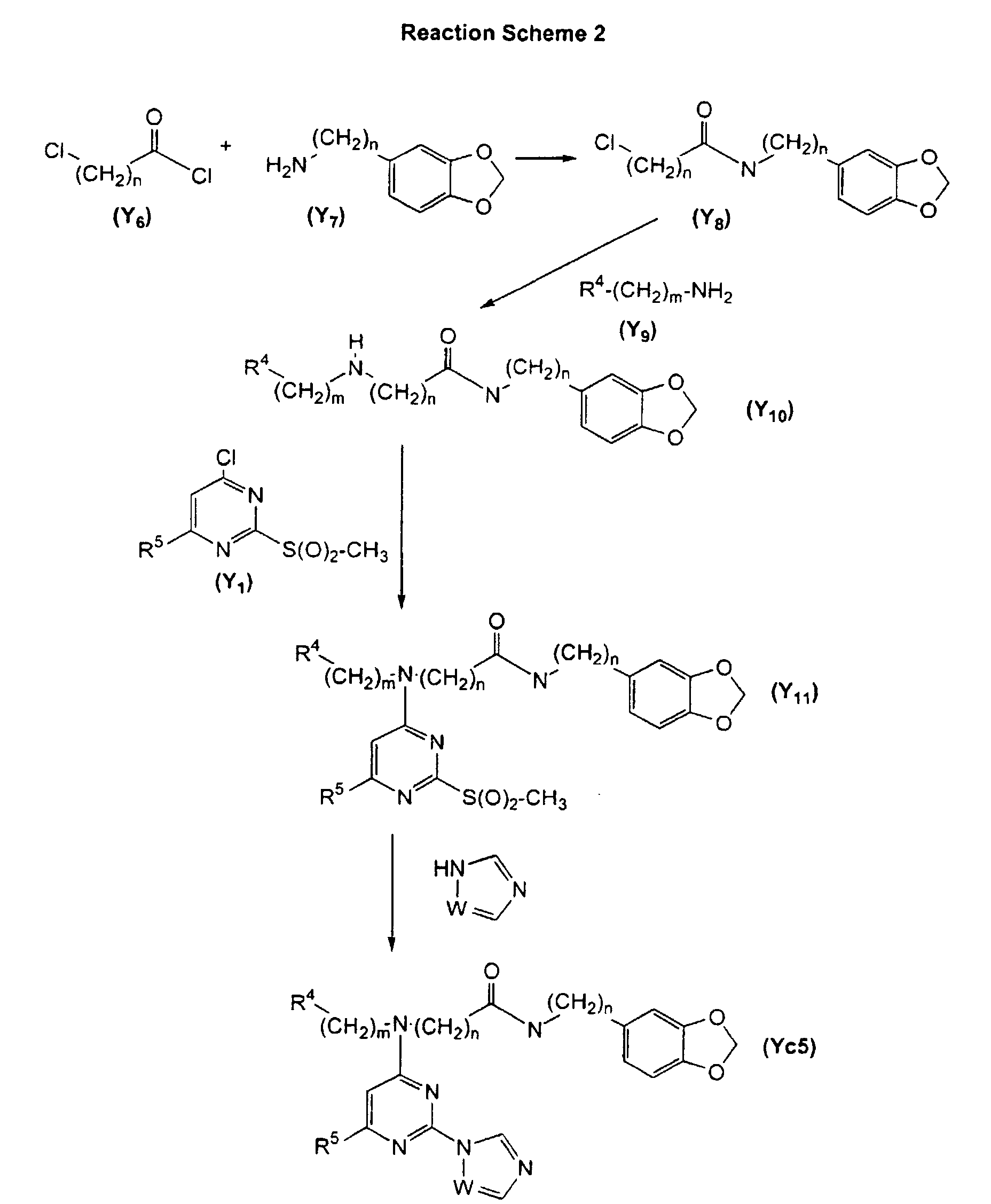
- Compounds of formulae (Y1), (Y6), (Y7), (Y9) and (Y5) are commercially available or may be prepared by methods disclosed herein or by methods known to those of ordinary skill in the art. Each R1, R2, m and n are independently as described above in the Summary of the Invention for compounds of formula (Ya), formula (Yb) and formula (Yc); and R4, R5 and W are also as described above in the Summary of the Invention for compounds of formula (Ya), formula (Yb) and formula (Yc).
- The above synthesis may be carried out as follows:
- To homopiperonylamine hydrochloride (2.14 g, 10.6 mmol) (a compound of formula (Y7)) in CH2Cl2 (20 mL) in an ice bath was added triethylamine (3.1 mL, 21 mmol) and chloroacetyl chloride (0.85 mL, 10 mmol) (a compound of formula (Y6)). After warming to ambient temperature and stirring for 16 hours, the reaction was partitioned with 1 N HCl. The organic layer was separated, washed with aqueous bicarbonate, dried (Na2SO4), and the solvent was removed in vacuo to give 1.8 g of 2-chloro-N-[2-(1,3-benzodioxol-5-yl)ethyl]acetamide, a compound of formula (Y8).
- To 2-chloro-N-[2-(1,3-benzodioxol-5-yl)ethyl]acetamide (0.45 g, 1.9 mmol) in ethanol (10 mL) was added 3-aminopropanol (0.72 mL, 9.4 mmol) (a compound of formula (Y9)). After heating the reaction in an oil bath at 60°C for 1 day, the reaction was partitioned with ethyl acetate and water. The organic layer was separated, washed with brine, dried (Na2SO4), and the solvent was removed in vacuo to give 0.44 g of 2-[(3-hydroxypropyl)amino]-N-[2-(1,3-benzodioxol-5-yl)ethyl]acetamide, a compound of formula (Y10).
- The following compounds of formula (Y10) were prepared in a similar manner from the appropriately substituted starting materials:
- 2-[(3-pyridinylmethyl)amino)-N-[2-(1,3-benzodioxol-5-yl)ethyl]acetamide;
- 2-[[2-(4-morpholinyl)ethyl]amino]-N-[2-(1,3-benzodioxol-5-yl)ethyl]acetamide;
- 2-[(1,3-benzodioxol-5-ylmethyl)amino]-N-[2-(1,3-benzodioxol-5-yl)ethyl]acetamide.
-
- To 2-[(3-hydroxypropyl)amino)-N-(1,3-benzodioxol-5-ylmethyl)acetamide (0.44 g, 1.6 mmol) dissolved in DMSO (5 mL) was added 4-chloro-6-methyl-2-methylsulfonylpyrimidine (0.31 g, 1.5 mmol) (a compound of formula (Y.) and diisopropylethylamine (0.55 mL, 3.1 mmol). After stirring for 16 hours, the reaction temperature was raised to 70°C and imidazole (0.47 g, 6.9 mol) was added. After stirring for 1 day, the reaction was cooled to ambient temperature and partitioned with water and ethyl acetate The organic layer is separated, dried (Na2SO4), and the solvent was removed in vacuo. Chromatography on silica with CH2Cl2/MeOH gave 2-[[3-hydroxypropyl][2-(1H-imidazol-1-yl)-6-methylpyrimidin-4-yl]amino]-N-[2-(1,3-benzodioxol-5-yl)ethyl]acetamide, a compound of formula (Yc5).
- The following compounds of formula (Yc5) and derivatives thereof were prepared in a similar manner with the appropriately substituted starting materials:
- 2-[[pyridin-3-ylmethyl][2-(1H-imidazol-1-yl)-6-methylpyrimidin-4-yl]amino)-N-[2-(1,3-benzodioxol-5-yl)ethyl]acetamide; NMR (CDCl3) 8 6 (s. 1), 8.45 (s, 2), 8.15 (t, 1), 7.8 (s, 1), 7.7 (d, 1), 7.35 (br, 1), 7.05 (s, 1), 6.8 (br, 2), 6.6 (br, 2), 6.0 (s, 2), 4.8 (m, 2), 4.2 (m, 2), 3.3 (m, 2), 2.6 (m, 2), 2.3 (s, 3) ppm;
- 2-[[2-cyanoethyl][2-(1H-imidazol-1-yl)-6-methylpyrimidin-4-yl]amino]-N-[2-(1,3-benzodioxol-5-yl)ethyl]acetamide; NMR(CDCl3) 8.5 (s, 1), 7.8 (s, 1), 7.1 (s, 1), 6.6 (d, 1), 6.55 (d, 1), 6.3 (t, 1), 6.2 (s, 1), 5.9 (s, 2), 4.2 (s, 2), 3.9 (t, 2), 3.55 (t, 2), 2.8 (t, 2), 2.75 (t, 2), 2.45 (s, 3) ppm;
- 2-[[3-[[(1,3-benzodioxol-5-yl)methyl](methyl)amino]propyl][2-(1H-imidazol-1-yl)-6-methylpyrimidin-4-yl]amino]acetic acid, ethyl ester; NMR (CDCl3) 8.5 (s, 1), 7.8 (s, 1), 7.05 (s, 1), 6.85 (s, 1), 6.75 (m, 2), 6.4 (br, 1), 5.9 (s, 2), 4.2 (m, 4), 3.6 (m, 2), 3.4 (s, 2), 2.4 (t, 2), 2.35 (s, 3), 2.2 (s, 3), 1.9 (t, 3), 1.2 (t, 3) ppm;
- 2-[[2-(1H-imidazol-1-yl)-6-methylpyrimidin-4-yl][2-(morpholin-4-yl)ethyl]amino]-N-[2-(1,3-benzodioxol-5-yl)ethyl]acetamide; NMR (CDCl3) 8.5 (s, 1), 7.8 (s, 1), 7.1 (s, 1), 6.5 (d, 1), 6.3 (br, 1), 6.15 (s, 2), 5.7 (br, 2), 4.0 (m, 4), 3.45 (m, 8), 2.6 (m, 2), 2.4 (s, 3), 2.35 (m, 4) ppm; and
- 2-[[2-(1H-imidazol-1-yl)-6-methylpyrimidin-4-yl][(1,3-benzodioxol-5-yl)methyl]amino]-N-[2-(1,3-benzodioxol-5-yl)ethyl]acetamide; NMR (CDCl3) 8.75 (s, 1), 8,15 (t, 1), 7.8 (s, 1), 7.15 (s, 1), 6.75 (d, 1), 6.7 (m, 2), 6.55 (d, 1), 6.4 (m, 2), 6.2 (br, 1), 6.0 (s, 2), 5.9 (s, 2), 4.65 (br, 2), 4.1 (br, 2), 3.4 (m, 2), 2.3 (s, 3) ppm.
-
- Alternatively, compounds of formula (Y10) and derivatives thereof are prepared as follows:
- In a manner similar to the preparation of compounds of formula (Yc3) above, to 2-[(2-cyanoethyl)(dimethylethoxycarbonyl)amino]acetic acid (8.3 g, 39 mmol) dissolved in CH2Cl2 (100 mL) was added carbonyldiimidazole (6.2 g, 38 mmol). After stirring for 30 minutes, homopiperonylamine, hydrochloride (8.0 g, 41 mmol) and diisopropylethylamine (7.5 mL, 43 mmol) were added. After stirring for 18 hours, most of the solvent was removed in vacuo and the residue was partitioned with ethyl acetate and 1 N HCl. The organic layer was separated, washed with aqueous bicarbonate and brine, dried (Na2SO4), and the solvent was removed in vacuo to give 13 g of 2-[(2-cyanoethyl)(dimethylethoxycarbonyl)amino]-N-[2-(1,3-benzodioxol-5-yl)ethyl]acetamide.
- To 2-[(2-cyanoethyl)(dimethylethoxycarbonyl)amino]-N-[2-(1,3-benzodioxol-5-yl)ethyl]acetamide (14 g, 37 mmol) in CH2Cl2 (75 mL) cooled in an ice bath was added trifluoroacetic acid (50 mL). After stirring for 1 hour the ice bath was removed and the solvent was removed in vacuo. The residue was triturated with ether and a solid formed. The solid was collected by filtration to give 12 g of 2-[(2-cyanoethyl)amino]-N-[2-(1,3-benzodioxol-5-yl)ethyl]acetamide, trifluoroacetic acid salt, a compound of formula (Y10).
- Alternatively, compounds of formula (Y10) and derivatives thereof are prepared as follows:
- To N-methyl-β-alaninenitrile (50 g, mmol in acetonitrile was added piperonyl chloride (50 g, mmol). After stirring for 18 h, the solvent was removed in vacuo. The residue was dissolved in CH2Cl2, washed with aqueous carbonate, dried (MgSO4), and the solvent was removed in vacuo. The residue was dissolved in methanol saturated with ammonia (600 mL) and Raney nickel (10 g) was added. After shaking under an atmosphere of hydrogen at 20 psi for 6 h, the reaction was filtered through celite and the solvent was removed in vacuo to give 65 g of N-(1,3-benzodioxol-5-ylmethyl)-N-methyl-1,3-propanediamine.
- To N-(1,3-benzodioxol-5-ylmethyl)-N-methyl-1,3-propanediamine (33 g, 0.15 mol) in CH2Cl2 (500 mL) was added ethyl glyoxalate (30 mL of a 50% toluene solution, 0.15 mol) and sodium triacetoxyborohydride (40 g, 0.19 mol). After stirring for 4 hours, the reaction was washed with aqueous potassium carbonate and the solvent removed in vacuo. Chromatography on silica with CH2Cl2/ MeOH/ ammonium hydroxide gave 14 g of 2-[[3-[(1,3-benzodioxol-5-ylmethyl)amino]propyl]amino]acetic acid, ethyl ester, a compound of formula (Y10).
- Reaction Scheme 3 depicts another method of preparing compounds of formula (Yc). Compounds of formula (Ya) and formula (Yb) may be similarly prepared with the appropriately substituted starting materials
-

- Compounds of formulae (Yc3) are prepared by methods disclosed herein. Each R1, R2, m and n are independently as described above in the Summary of the Invention for compounds of formula (Ya), formula (Yb) and formula (Yc); and R5 and W are also as described above in the Summary of the Invention for compounds of formula (Ya), formula (Yb) and formula (Yc).
- The above synthesis may be carried out as follows:
- To 2-[(2-cyanoethyl)[2-(1H-imidazol-1-yl)-6-methylpyrimidin-4-yl)amino]-N-[2-(1,3-benzodioxol-5-yl)ethyl)acetamide (2.5 g, 5.8 mmol) (a compound of formula (Yc3)) in MeOH (50 mL) was bubbled ammonia. Raney nickel (1.0 g of a 50 % slurry) was added and the reaction was placed on a Parr hydrogenator at 50 psi. After shaking for 16 hours, the pressure was released and the reaction mixture was suction filtered through Celite. The solvent was removed in vacuo and the residue was chromatographed on silica gel (9:1 CH3CN/NH4OH) to afford 2-[[3-aminopropyl][2-(1H-imidazol-1-yl)-6-methylpyrimidin-4-yl]amino]-N-[2-(1,3-benzodioxol-5-yl)ethyl]acetamide, a compound of formula (Yc6); as a white solid; NMR (DMSO-d6, 90°C) 8.4 (s, 1), 7.8 (s, 1), 7.0 (s, 1), 6.75 (d, 1), 6.7 (s, 1), 6.6 (d, 1), 5.9 (s, 2), 4.1 (s, 2), 3.6 (br, 2), 3.3 (m, 2), 2.75 (t, 2), 2.6 (t, 2), 2.3 (s, 3), 1.8 (m, 2) ppm.
- The following compounds of formula (Yc6) and derivatives thereof were prepared in a similar manner with appropriately substituted starting materials:
- 2-[[3-aminopropyl][2-(1H-imidazol-1-yl)-6-methylpyrimidin-4-yl]amino]-N-[2-(4-methoxyphenyl)ethyl]acetamide; NMR (DMSO-d6, 90 C) 8.4 (s, 1), 7.8 (s, 1), 7.05 (m, 3), 6.75 (d, 2), 6.45 (s, 1), 4.1 (s, 2), 3.7 (s, 3), 3.55 (t, 2), 3.3 (m, 2), 3.2 (s, 2), 3.6 (m, 4), 2.3 (s, 3) ppm;
- 2-[[3-aminopropyl][2-(1H-imidazol-1-yl)-6-methylpyrimidin-4-yl]amino]-N-[2-(1,4-benzodioxan-6-yl)ethyl]acetamide; NMR (DMSO-d6) 8.42 (br, 1), 8.08 (br, 1), 7.80 (br, 1), 7.02 (s, 1), 6.65 (m, 4), 4.16 (m, 6), 4.05 (br, 1), 3.65 (br, 1), 3.45 (br, 2), 3.15 (br, 2), 2.59 (m, 4), 2.35 (s, 3), 1.62 (m, 2) ppm; and
- 2-[[3-aminopropyl][2-(1H-imidazol-1-yl)-6-methylpyrimidin-4-yl]amino]-N-[2-(2,3-dihydrobenzofuran-5-yl)ethyl]acetamide; NMR (CDCl3) 8.46 (s, 1), 7.75 (s, 1), 7.06 (s, 1), 6.80 (s, 1), 6.70 (d, 1), 6.52 (d, 1), 6.18 (br, 1), 4.46 (t, 2), 4.06 ( br, 2), 3.60 (br, 2), 3.45 (m, 2), 3.05 (m, 2), 2.78 (br, 2), 2.65 (m, 2), 2.39 (s, 3), 1.70 (br, 4) ppm.
-
- Compounds of formula (Yc6) may be used to prepare compounds of formula (Yc7), (Yc8) and (Yc9) as set forth below:
- To 2-[(3-aminopropyl)[2-(1H-imidazol-1-yl)-6-methylpyrimidin-4-yl]amino]-N-[2-(1,3-benzodioxol-5-yl)ethyl]acetamide (0.3 g, 0.7 mmol) (a compound of formula (Yc6)) dissolved in MeOH (10 mL) was added formalin (0.15 mL, 2.0 mmol) and sodium triacetoxyborohydride (0.37 g, 1.7 mmol). After stirring for 16 hours, the solvent was removed in vacuo. The residue was partitioned with ethyl acetate and aqueous bicarbonate. The organic layer was separated, washed with brine, dried (Na2SO4), and the solvent was removed in vacuo. Chromatography on silica with acetonitrile/ammonium hydroxide gave 0.14 g of 2-[[3-(dimethylamino)propyl][2-(1H-imidazol-1-yl)-6-methylpyrimidin-4-yl]amino]-N-[2-(1,3-benzodioxol-5-yl)ethyl]acetamide, a compound of formula (Yc8); NMR (CDCl3) 8.5 (s, 1), 7.8 (s, 1), 7.1 (s, 1), 6.5 (d, 1), 6.45 (s, 2), 6.4 (d, 1), 6.2 (m, 1), 5.9 (s, 2), 4.15 (s, 2), 3.55 (m, 2), 3.5 (q, 2), 2.6 (t, 2), 2.4 (s, 3), 2.3 (t, 2), 2.25 (s, 6), 1.7 (m, 2) ppm.
- To 2-[(3-aminopropyl)[2-(1H-imidazol-1-yl)-6-methylpyrimidin-4-yl]amino]-N-[2-(1,3-benzodioxol-5-yl)ethyl]acetamide (50 mg, 0.11 mmol) (a compound of formula (Yc6)) in methanol (2 mL) was added benzaldehyde (0.2 M in methanol, 68 µL, 0.14 mmol). After stirring for 15 minutes, borane-pyridine complex (0.2 M in methanol, 0.14 mmol) was added. After 2 hours, the solution was evaporated. The residue was partitioned into water and ethyl acetate. The aqueous layer was extracted twice with ethyl acetate. The combined ethyl acetate fractions were washed with brine, dried over sodium sulfate and concentrated. The residue was purified by chromatography on silica gel (2:1 ethyl acetate/hexanes) to provide 2-[[3-(phenylmethylamino)propyl][2-(1H-imidazol-1-yl)-6-methylpyrimidin-4-yl]amino]-N-[2-(1,3-benzodioxol-5-yl)ethyl]acetamide, a compound of formula (Yc8); as a white solid; NMR (CDCl3) 8.65 (s, 1), 7.7 (s, 1), 7.2 (br, 5), 7.1 (s, 1), 6.6 (d, 1), 6.55 (s, 1), 6.5 (d, 1), 6.1 (br, 2), 5.9 (s, 2), 3.95 (br, 2), 3.5 (br, 6), 2.7 (m, 3), 2.35 (s, 6) ppm.
- The following compounds of formula (Yc8) and derivatives thereof were prepared in a similar manner with appropriately substituted starting materials:
- 2-[[3-(phenylmethylamino)propyl][2-(1H-imidazol-1-yl)-6-methylpyrimidin-4-yl]amino]-N-[2-(4-methoxyphenyl)ethyl]acetamide; NMR (CDCl3) 8.45 (s, 1), 7.75 (s, 1), 7.2 (br, 5), 7.05 (s, 1), 6.9 (d, 2), 6.65 (d, 2), 6.4 (br, 1), 4.1 (s, 2), 3.75 (s, 2), 3.7 (s, 3), 3.6 (br, 2), 3.45 (dd, 2), 2.7 (m, 4), 2.35 (s, 3), 1.8 (s, 2) ppm;
- 2-[[3-(dimethylamino)propyl][2-(1H-imidazol-1-yl)-6-methylpyrimidin-4-yl]amino]-N-[2-(4-methoxyphenyl)ethyl]acetamide; NMR (CDCl3) 8.45 (s, 1), 7.75 (s, 1), 7.05 (s, 1), 6.85 (d, 2), 6.6 (d, 2), 6.3 (br, 1), 6.25 (br, 1), 4.1 (s, 2), 3.7 (s, 3), 3.5(m, 4), 2.7 (t, 2), 2.4 (s, 3), 2.3 (t, 2), 2.2 (s, 6), 1.75 (m, 2) ppm;
- 2-[[3-(di(phenylmethyl)amino)propyl][2-(1H-imidazol-1-yl)-6-methylpyrimidin-4-yl]amino]-N-[2-(1,4-benzodioxan-6-yl)ethyl]acetamide; NMR (CDCl3) 8.45 (s, 1), 7.70 (s, 1), 7.35 (m, 10), 7.04 (s, 1), 6.62 (d, 1), 6.45 (s, 1), 6.40 (d, 1), 6.06 (br, 1), 5.96 (br, 1), 4.15 (br, 4), 3.92 (br, 2), 3.60 (s, 4), 3.45 (m, 4), 2.62 (t, 2), 2.50 (t, 2), 2.30 (s, 3), 1.72 (m, 2) ppm;
- 2-[[3-(phenylmethylamino)propyl][2-(1H-imidazol-1-yl)-6-methylpyrimidin-4-yl]amino]-N-[2-(1,4-benzodioxan-6-yl)ethyl]acetamide; NMR (CDCl3) 8.45 (s, 1), 7.75 (s, 1), 7.25 ( m, 6), 7.05 ( s, 1), 6.60 (d, 1), 6.45 (s, 1), 6.40 (d, 1), 6.20 (br, 1), 4.10 (m, 6), 3.70 (br, 4), 3.40 (m, 2), 2.65 (t, 2), 2.60 (t, 2), 2.40 (s, 3), 1.90 (br, 1), 1.76 (m, 2) ppm;
- 2-[[3-(dimethylamino)propyl][2-(1H-imidazol-1-yl)-6-methylpyrimidin-4-yl]amino]-N-[2-(1,4-benzodioxan-6-yl)ethyl]acetamide; NMR (CDCl3) 8.45 (s, 1), 7.75 (s, 1), 7.05 (s, 1), 6.65 (d, 1), 6.50 (s, 1), 6.42 (s, 1), 6.30 (t, 1), 6.16 (br, 1), 4.12 ( m, 6), 3.50 (m, 4), 2.75 (m, 2), 2.62 (t, 2), 2.56 (s, 6), 2.40 (s, 3), 2.10 (m, 2) ppm;
- 2-[[3-(phenylmethylamino)propyl][2-(1H-imidazol-1-yl)-6-methylpyrimidin-4-yl]amino]-N-[2-(2,3-dihydrobenzofuran-5-yl)ethyl]acetamide; NMR (CDCl3) 8.46 (s, 1), 7.75 (s, 1), 7.30 (m, 6), 7.10 (s, 1), 6.82 (s, 1), 6.68 (d, 1), 6.54 (d, 1), 6.25 (br, 1), 4.46 (t, 2), 4.10 (br, 2), 3.70 (br, 2), 3.62 (br, 2), 3.45 (m, 2), 3.05 (t, 2), 2.65 (m, 4), 2.40 (s, 3), 1.78 (m, 2) ppm; and
- 2-[[3-(dimethylamino)propyl][2-(1H-imidazol-1-yl)-6-methylpyrimidin-4-yl]amino]-N-[2-(2,3-dihydrobenzofuran-5-yl)ethyl]acetamide; NMR (CDCl3) 8.45 (s, 1), 7.76 (s, 1), 7.06 (s, 1), 6.85 (s, 1), 6.70 (d, 1), 6.50 (d, 1), 6.16 (br, 2), 4.50 (t, 2), 4.10 (s, 2), 3.52 (m, 4), 3.05 (t, 2), 2.76 (m, 2), 2.68 (m, 2), 2.62 (s, 6), 2.42 (s, 3), 2.10 (m, 2) ppm.
-
- To 2-[(3-aminopropyl)(2-(1H-imidazol-1-yl)-6-methylpyrimidin-4-yl]amino]-N-[2-(1,3-benzodioxol-5-yl)ethyl]acetamide (0.3 g, 0.7 mmol) (a compound of formula (Yc6)) dissolved in pyridine (5 mL) was added acetic anhydride (0.10 mL, 1.0 mmol). After stirring for 16 hours, the reaction was partitioned with ethyl acetate and water. The organic layer was separated, washed with water and brine, dried (Na2SO4), and the solvent was removed in vacuo. Chromatography on silica with CH2Cl2 gave 0.14 g of 2-[[3-(acetylamino)propyl][2-(1H-imidazol-1-yl)-6-methylpyrimidin-4-yl]amino]-N-[2-(1,3-benzodioxol-5-yl)ethyl]acetamide, a compound of formula (Yc7); NMR (DMSO-d6) 8.4 (s, 1), 8.05 (t, 2), 7.85 (t, 1), 7.8 (s, 1), 7.05 (s, 1), 6.7 (m, 2), 6.6 (m, 1), 6.2 (s, 1), 5.9 (s, 2), 4.1 (m, 2), 3-3.6 (m, 6), 2.6 (m, 2), 2.3 (m, 3), 1.8 (s, 3), 1.65 (m, 2) ppm.
- The following compounds of formula (Yc7) and derivatives thereof were prepared in a similar manner with appropriately substituted starting materials:
- 2-[[3-(methylsulfonylamino)propyl][2-(1H-imidazol-1-yl)-6-methylpyrimidin-4-yl]amino]-N-[2-(1,3-benzodioxol-5-yl)ethyl]acetamide; NMR (CDCl3) 8.45 (s, 1), 7.65 (s, 1), 7.0 (s, 1), 6.55 (m, 2), 6.5 (s, 1), 6.45 (d, 1), 6.15 (br, 1), 5.95 (br, 1), 5.85 (s, 2), 4.1 (s, 2), 3.65 (br, 2), 3.45 (m, 2), 3.2 (dd,2), 2.9 (s, 3), 2.65 (t, 2), 2.35 (s, 3), 1.9 (m, 2) ppm;
- 2-[[3-(methoxycarbonylamino)propyl][2-(1H-imidazol-1-yl)-6-methylpyrimidin-4-yl]amino]-N-[2-(1,3-benzodioxol-5-yl)ethyl]acetamide; NMR (CDCl3) 8.45 (s, 1), 7.7 (s, 1), 7.1(s, 1), 6.55 (d, 1), 6.5 (s, 1), 6.45 (d, 1), 6.3 (br, 1), 6.1 (br, 1), 5.9 (s, 2), 4.1 (s, 2), 3.7 (s, 3), 3.5 (m, 2), 3.2 (dd, 2), 2.7 (t, 2), 2.4 (s, 3), 1.85 (m, 4) ppm;
- 2-[[3-(methylsulfonylamino)propyl][2-(1H-imidazol-1-yl)-6-methylpyrimidin-4-yl]amino]-N-[2-(4-methoxyphenyl)ethyl]acetamide; NMR (CDCl3) 8.45 (s, 1), 7.75 (s, 1), 7.1 (s, 1), 6.95 (d, 2), 6.7 (d, 2), 6.25 (br, 1), 6.15 (br, 1), 4.1 (s, 2), 3.75 (s, 3), 3.6 (br, 2), 3.5 (m, 2), 3.2 (dd, 2), 2.95 (s, 3), 2.7 (t, 2), 2.4 (s, 3), 1.85 (m, 2) ppm;
- 2-[[3-(methoxycarbonylamino)propyl][2-(1H-imidazol-1-yl)-6-methylpyrimidin-4-yl]amino]-N-[2-(4-methoxyphenyl)ethyl]acetamide; NMR (CDCl3) 8.45 (s, 1), 7.75 (s, 1), 7.1 (s, 1), 6.9 (d, 2), 6.7 (d, 2), 6.2 (br, 1), 6.1 (br, 1), 4.05 (s, 2), 3.75 (s, 3), 3.65 (s, 2), 3.5 (s, 3), 3.2 (m, 2), 2.7 (t, 2), 2.4 (s, 3), 1.8 (m, 4) ppm;
- 2-[[3-(acetylamino)propyl][2-(1H-imidazol-1-yl)-6-methylpyrimidin-4-yl]amino]-N-[2-(4-methoxyphenyl)ethyl]acetamide; NMR (CDCl3) 8.45 (s, 1), 7.7 (s, 1), 7.05 (s, 1), 6.9 (d, 2), 6.65 (d, 2), 6.4 (br, 1), 6.1 (s, 1), 4.05 (s, 2), 3.7 (s, 3), 3.5 (m, 4), 3.25 (dd, 2), 2.7 (t, 2), 2.4 (s, 3), 1.9 (s, 3), 1.8 (m, 2) ppm;
- 2-[[3-(methoxycarbonylamino)propyl][2-(1H-imidazol-1-yl)-6-methylpyrimidin-4-yl]amino]-N-[2-(1,4-benzodioxan-6-yl)ethyl]acetamide; NMR (CDCl3) 8.60 (s, 1), 7.78 (s, 1), 7.08 (s, 1), 6.64 ( d, 1), 6.45 (s, 1), 6.44 (d, 1), 6.25 (br, 1), 6.15 (s, 1), 5.05 (br, 1), 4.12 ( m, 6), 3.65 (s, 3), 3.45 (m, 4), 3.20 (m, 2), 2.65 (t, 2), 2.40 (s, 3), 1.80 (m, 2) ppm;
- 2-[[3-(acetylamino)propyl][2-(1H-imidazol-1-yl)-6-methylpyrimidin-4-yl]amino]-N-[2-(1,4-benzodioxan-6-yl)ethyl]acetamide; NMR (CDCl3) 8.50 (s, 1), 7.75 (s, 1), 7.06 ( s, 1), 6.62 ( d, 1), 6.58 (br, 1), 6.45 (s, 1), 6.42 (d, 1), 6.15 (s, 1), 4.10 ( m, 6), 3.55 (m, 4), 3.30 (m, 2), 2.64 (t, 2), 2.40 (s, 3), 1.92 (s, 3), 1.82 (m, 2) ppm;
- 2-[[3-(methylsulfonylamino)propyl][2-(1H-imidazol-1-yl)-6-methylpyrimidin-4-yl]amino]-N-[2-(1,4-benzodioxan-6-yl)ethyl]acetamide; NMR (CDCl3) 8.46 (s, 1), 7.76 (s, 1), 7.03 (s, 1), 6.65 (d, 1), 6.50 (s, 1), 6.42 (d, 1), 6.18 (br, 1), 5.80 (br, 1), 4.20 (m, 6), 3.65 (br, 2), 3.48 (m, 2), 3.20 (m, 2), 2.92 (s, 3), 2.65 (m, 2), 2.40 (s, 3), 1.90 (m, 2) ppm;
- 2-[[3-(acetylamino)propyl][2-(1H-imidazol-1-yl)-6-methylpyrimidin-4-yl]amino]-N-[2-(2,3-dihydrobenzofuran-5-yl)ethyl]acetamide; NMR (CDCl3) 8.46 (s, 1), 7.76 (s, 1), 7.05 (s, 1), 6.86 (s, 1), 6.72 (d, 1), 6.55 (d, 1), 6.45 (br, 2), 6.13 (s, 1), 4.50 (t, 2), 4.08 (s, 2), 3.55 (m, 4), 3.30 (q, 2), 3.06 (t, 2), 2.66 (t, 2), 2.40 (s, 3), 1.93 (s, 3), 1.85 (m, 2) ppm;
- 2-[[3-(methoxycarbonylamino)propyl][2-(1H-imidazol-1-yl)-6-methylpyrimidin-4-yl]amino]-N-[2-(2,3-dihydrobenzofuran-5-yl)ethyl]acetamide; NMR (CDCl3) 8.46 (s, 1), 7.76 (s, 1), 7.05 (s, 1), 6.84 (s, 1), 6.70 (d, 1), 6.54 (d, 1), 6.26 (br, 2), 6.10 (s, 1), 5.08 (br, 1), 4.50 (t, 2), 4.06 (s, 2), 3.65 (s, 3), 3.50 (m, 4), 3.22 (q, 2), 3.04 (t, 2), 2.66 (t, 2), 2.42 (s, 3), 1.80 (m, 2) ppm; and
- 2-[[3-(methylsulfonylamino)propyl][2-(1H-imidazol-1-yl)-6-methylpyrimidin-4-yl]amino]-N-[2-(2,3-dihydrobenzofuran-5-yl)ethyl]acetamide; NMR (CDCl3) 8.44 (s, 1), 7.74 (s, 1), 7.02 (s, 1), 6.86 (s, 1), 6.72 (d, 1), ), 6.52 (m, 2), 6.19 (s, 2), 5.80 (br, 1), 4.50 (t, 2), 4.10 (s, 2), 3.62 (br, 2), 3.46 (q, 2), 3.20 (q, 2), 3.06 (t, 2), 2.95 (s, 3), 2.66 (t, 2), 2.38 (s, 3), 1.86 (m, 2) ppm.
-
- To 2-[(3-aminopropyl)[2-(1H-imidazol-1-yl)-6-methylpyrimidin-4-yl]amino]-N-[2-(4-methoxyphenyl)ethyl]acetamide (135 mg. 0.32 mmol) (a compound of formula (Yc6)) in pyridine (1.5mL) was added water (1.5 mL) solution of potassium cyanate (64 mg, 0.76 mmol). The mixture was stirred and heated in an oil bath at 80°C overnight. The mixture was poured into water and extracted with ethyl acetate (3x20mL). The combined ethyl acetate fractions were washed with brine, dried over sodium sulfate and concentrated. The residue was purified by chromatography on silica gel (9:1 CH1CN/NH4OH) to afford 2-[[3-(ureido)propyl][2-(1H-imidazol-1-yl)-6-methylpyrimidin-4-yl]amino]-N-[2-(4-methoxyphenyl)ethyl]acetamide, a compound of formula (Yc9); as a white solid; NMR (DMSO-d6, 90 C) 8.4 (s, 1), 7.8 (s, 1), 7.05 (d, 2), 7.0 (s, 1), 6.75 (d, 2), 6.4 (s, 1), 4.1 (s, 2), 3.7 (s, 3). 3 5 (m, 2), 3.25 (m, 2), 3.05 (m, 2), 2.65 (t, 2), 2.3 (s, 3), 1.7 (m, 2) ppm.
- The following compounds of formula (Yc9) and derivatives thereof were prepared in a similar manner with the appropriately substituted starting materials:
- 2-[[3-(ureido)propyl][2-(1H-imidazol-1-yl)-6-methylpyrimidin-4-yl]amino]-N-[2-(1,4-benzodioxan-6-yl)ethyl]acetamide; NMR (DMSO-d6) 8.42 (br, 1), 8.08 (t, 1), 7.80 (br, 1), 7.05 (s, 1), 6.60 (m, 3), 6.03 (br, 1), 5.45 (br, 1), 4.18 (br, 6), 3.40 (m, 6), 3.00 (m, 2), 2.55 (m, 2), 2.35 (br, 3), 1.70 (m, 2) ppm; and
- 2-[[3-(ureido)propyl][2-(1H-imidazol-1-yl)-6-methylpyrimidin-4-yl]amino]-N-[2-(2,3-dihydrobenzofuran-5-yl)ethyl]acetamide; NMR (DMSO-d6) 8.45 (br, 1), 8.12 (br, 1), 7.80 (br, 1), 7.00 (m, 2), 6.82 (m, 1), 6.60 (br, 1), 6.10 (br, 1), 5.42 (br, 1), 4.42 (t, 2), 4.14 (m, 2), 3.00-3.60 (m, 10), 2.60 (m, 2), 2.30 (s, 3), 1.68 (m, 2) ppm.
-
- Reaction Scheme 4 depicts another method of preparing compounds of formula (Yc). Compounds of formula (Ya) and formula (Yb) may be similarly prepared.
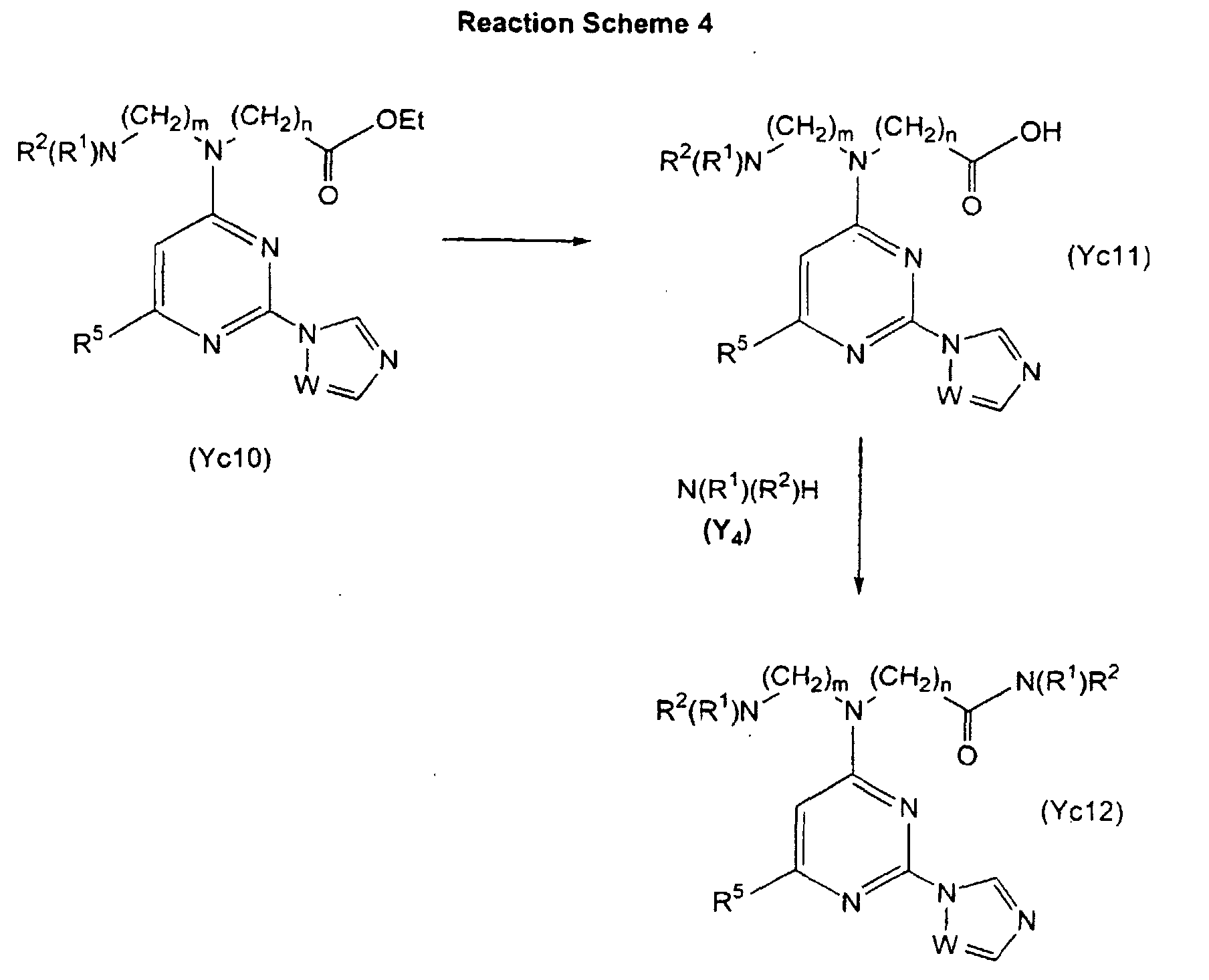
- Compounds of formulae (Yc10) are prepared by methods disclosed herein. Each R1, R2, m and n are independently as described above in the Summary of the Invention for compounds of formula (Ya), formula (Yb) and formula (Yc); and R5 and W are also as described above in the Summary of the Invention for compounds of formula (Ya), formula (Yb) and formula (Yc).
- The above synthesis may be carried out as follows:
- To 2-[[3-[(1,3-benzodioxol-5-ylmethyl)amino](methyl)propyl][2-(1H-imidazol-1-yl)-6-methylpyrimidin-4-yl]amino]acetic acid, ethyl ester (2.2 g, 4.6 mmol) (a compound of formula (Yc10)) dissolved in THF (50 mL) was added LiOH (0.34 g, 8.1 mmol) and water (10 mL). After stirring for 16 hours, the solvent was removed in vacuo and 1 N HCl (8.1 mL, 8.1 mmol) was added. The solvent was removed in vacuo to give 2-[[3-[(1,3-benzodioxol-5-ylmethyl)(methyl)amino]propyl][2-(1H-imidazol-1-yl)-6-methylpyrimidin-4-yl]amino]acetic acid. a compound of formula (Yc11).
- To 2-[[3-[(1,3-benzodioxol-5-ylmethyl)(methyl)amino]propyl][2-(1H-imidazol-1-yl)-6-methylpyrimidin-4-yl]amino]acetic acid (0.35 g, 0.8 mmol) (a compound of formula (Yc11)) slurried in DMF (5 mL) was added carbonyldiimidazole (0.14 g, 0.8 mmol). After stirring for 20 minutes, diethylamine (0.25 mL, 2.4 mmol) was added. After stirring for 18 hours, the reaction was partitioned with ethyl acetate and water. The organic layer was separated, washed with water, dried (Na2SO4), and the solvent was removed in vacuo to give 0.91 g of the desired product. Chromatography on silica with CH2Cl2/ MeOH gave 2-[[3-[[(1,3-benzodioxol-5-yl)methyl](methyl)amino]propyl][2-(1H-imidazol-1-yl)-6-methylpyrimidin-4-yl]amino]-N,N-diethylacetamide; NMR (CDCl3) 8.4 (s, 1), 7.85 (s, 1), 7.1 (m, 1), 6.85 (s, 1), 6.75 (m, 2), 6.4 (br, 1), 5.95 (s, 2), 4.4 (br, 2), 3.6 (br, 2), 3.4 (m, 6), 2.45 (t, 2), 2.35 (s, 3), 2.2 (s, 3), 1.9 (m, 2), 1.3 (t, 3), 1.15 (t, 3) ppm.
- The following compounds of formula (Yc12) and derivatives thereof were prepared in a similar manner:
- 2-[[3-[[(1,3-benzodioxol-5-yl)methyl](methyl)amino]propyl][2-(1H-imidazol-1-yl)-6-methylpyrimidin-4-yl]amino]-N-(2-dimethylaminoethyl)acetamide; NMR (CDCl3) 8.5 (s, 1), 7.8 (s, 1), 7.1 (s, 1), 6.8 (s, 1), 6.75 (m, 2), 6.25 (br, 1), 5.95 (s; 2), 4.15 (br, 2), 3.6 (br, 2), 3.4 (s, 2), 3.35 (m, 2), 2.4 (t, 2), 2.4 (s, 3), 2.35 (t, 2), 2.2 (s, 3), 2.0 (br, 6), 1.8 (m, 2), 1.6 (m, 2) ppm; and
- 2-[[3-[[(1,3-benzodioxol-5-yl)methyl](methyl)amino]propyl][2-(1H-imidazol-1-yl)-6-methylpyrimidin-4-yl]amino]acetamide; NMR (DMSO-d6) 8.4 (s, 1), 7.8 (s, 1), 7.5 (s, 1), 7.1 (m, 2), 6.8 (m, 3), 6.3 (br, 1), 6.0 (s, 2), 5.4 (br, 1), 4.1 (m, 2), 3.4 (m, 4), 2.4 (t, 2), 2.3 (s, 3), 2.1 (s, 3), 1.75 (m, 2) ppm.
-
Claims (16)
- A compound of formula (Ya), formula (Yb) or formula (Yc):

 wherein:
 n and m are each independently an integer from 1 to 4;A is -C(O)OR1 or -C(O)N(R1)R2;each W is N or CH;each R1 is independently hydrogen, C1-C8 alkyl, aryl or aryl C1-C8 alkyl;each R2 is independently hydrogen, C1-C20 alkyl, -(CH2)n-N(R1)2, heterocyclyl C1-C8 alkyl (optionally substituted by C1-C8 alkyl, halo, C1-C8 haloalkyl or C1-C8 alkoxy), aryl-C1-C8 alkyl (optionally substituted by halo, C1-C8 alkyl, C1-C8 alkoxy, or -N(R1)2);when m is an integer from 2 to 4, R4 can be cyano, heterocyclyl, hydroxy, -N(R1)R2, -N(R1)-C(O)-R1, -N(R1)-C(O)OR1, -N(R1)-S(O)1-R1, or-N(R1)-C(O)-N(R1)2;when m is 1, R4 can be cyano or heterocyclyl;R5 is hydrogen, halo, C1-C8 alkyl, aryl, aryl C1-C8 alkyl, or C1-C8 haloalkyl;t is an integer from 0 to 2; wherein aryl refers to a phenyl or naphthyl radical; as a single stereoisomer or mixture thereto, or a pharmaceutically acceptable salt thereof.
 - The compound of Claim 1 having the formula (Yc) wherein:n is 1;m is 2 or 3;A is -C(O)OR1 or -C(O)N(R1)R2;each W is CH;R1 is hydrogen or C1-C8 alkyl; andR2 is hydrogen, C1-C20-alkyl,-(CH2)n-N(R1)2, optionally substituted heterocyclyl C1-C8 alkyl or optionally substituted aryl-C1-C8 alkyl.
- The compound of Claim, 2 wherein R4 is -N(R1)R2 where R1 is hydrogen or C1-C8 alkyl and R2 is heterocyclyl C1-C8 alkyl selected from the group consisting of (1,3-benzodioxol-5-yl)methyl or (1,4-benzodioxan-6-yl)methyl.
- The compound of Claim 3 selected from the group consisting of:2-[[3-[[(1,3-benzodioxol-5-yl)methyl](methyl)amino]propyl][2-(1H-imidazolo-1-yl)-6-methylpyrimidin-4-yl]amino]acetic acid, ethyl ester;2-[[3-[[(1,3-benzodioxol-5-yl)methyl](methyl)amino]propyl][2-(1H-imidazol-1-yl)-6-methylpyrimidin-4-yl]amino]-N,N-diethylacetamide;2-[[3-[[(1,3-benzodioxol-5-yl)methyl](methyl)amino]propyl][2-(1H-imidazol-1-yl)-6-methylpyrimidin-4-yl]amino]-N-(2-dimethylaminoethyl)acetamide;2-[[3-[[(1,3-benzodioxol-5-yl)methyl](methyl)amino]propyl][2-(1H-imidazol-1-yl)-6-methylpyrimidin-4-yl]amino]acetamide;2-[[3-[(1,3-benzodioxol-5-yl)methyl]aminopropyl][2-(1H-imidazol-1-yl)-6-methylpyrimidin-4-yl]amino]-N,N-diethylacetamide;2-[[3-[(1,3-benzodioxol-5-yl)methyl]aminopropyl][2-(1H-imidazol-1-yl)-6-methylpyrimidin-4-yl]amino]-N-methylacetamide;2-[[3-[(1,4-benzodioxan-6-yl)methyl]aminopropyl][2-(1H-imidazol-1-yl)-6-methylpyrimidin-4-yl]amino]-N-methylacetamide;2-[[3-[(1,4-benzodioxan-6-yl)methyl]aminopropyl][2-(1H-imidazol-1-yl)-6-methylpyrimidin-4-yl]amino]-N,N-diethylacetamide;2-[[3-[(1,4-benzodioxan-6-yl)methyl]aminopropyl][2-(1H-imidazol-1-yl)-6-methylpyrimidin-4-yl]amino]acetamide; and2-[[3-[(1,3-benzodioxol-5-yl)methyl]aminopropyl][2-(1H-imidazol-1-yl)-6-methylpyrimidin-4-yl]amino]acetamide.
- The compound of claim 4, which is2-[[3-[[(1,3-benzodioxol-5-yl)methyl](methyl)amino]propyl][2-(1H-imidazol-1-yl)-6-methylpyrimidin-4-yl]amino]acetamide
- The compound of Claim 2 wherein R4 is heterocyclyl.
- The compound of Claim 6 selected from the group consisting of:2-[[pyridin-3-ylmethyl][2-(1H-imidazol-1-yl)-6-methylpyrimidin-4-yl]amino]-N-[2-(1,3-benzodioxol-5-yl)ethyl]acetamide;2-[[2-(1H-imidazol-1-yl)-6-methylpyrimidin-4-yl][(1,3-benzodioxol-5-yl)methyl]amino]-N-[2-(1,3-benzodioxol-5-yl)ethyl]acetamide; and2-[[2-(1H-imidazol-1-yl)-6-methylpyrimidin-4-yl][2-(morpholin-4-yl)ethyl]amino]-N-[2-(1,3-benzodioxol-5-yl)ethyl]acetamide.
- The compound of Claim 2 wherein R4 is hydroxy, cyano, -N(R1)R2, -N(R1)-C(O)-R1, -N(R1)-C(O)OR1, -N(R1)-S(O),-R1, or -N(R1)-C(O)-N(R1)2, where each R1 and each R2 is independently hydrogen, C1-C8 alkyl or aryl C1-C8 alkyl.
- The compound of Claim 8 selected from the group consisting of:2-[[3-hydroxypropyl][2-(1H-imidazol-1-yl)-6-methylpyrimidin-4-yl]amino]-N-[2-(1,3-benzodioxo)-5-yl)ethyl]acetamide;2-[[2-cyanoethyl][2-(1H-imidazol-1-yl)-6-methylpyrimidin-4-yl]amino]-N-[2-(1,3-benzodioxol-5-yl)ethyl]acetamide;2-[[3-(dimethylamino)propyl][2-(1H-imidazol-1-yl)-6-methylpyrimidin-4-yl]amino]-N-[2-(1,3-benzodioxol-5-yl)ethyl]acetamide;2-[[3-(acetylamino)propyl][2-(1H-imidazol-1-yl)-6-methylpyrimidin-4-yl]amino]-N-[2-(1,3-benzodioxol-5-yl)ethyl]acetamide;2-[[3-(methylsulfonylamino)propyl][2-(1H-imidazol-1-yl)-6-methylpyrimidin-4-yl]amino]-N-[2-(1,3-benzodioxol-5-yl)ethyl]acetamide;2-[[3-(methoxycarbonylamino)propyl][2-(1H-imidazol-1-yl)-6-methylpyrimidin-4-yl]amino]-N-[2-(1,3-benzadioxol-5-yl)ethyl]acetamide;2-[[3-(phenylmethylamino)propyl][2-(1H-imidazol-1-yl)-6-methylpyrimidin-4-yl]amino]-N-[2-(1,3-benzodioxol-5-yl)ethyl]acetamide;2-[[3-aminopropyl][2-(1H-imidazol-1-yl)-6-methylpyrimidin-4-yl]amino]-N-[2-(1,3-benzadioxol-5-yl)ethyl]acetamide;2-[[3-aminopropyl][2-(1H-imidazol-1-yl)-6-methylpyrimidin-4-yl]amino]-N-[2-(4-methoxyphenyl)ethyl]acetamide;2-[[3-(methylsulfonylamino)propyl][2-(1H-imidazol-1-yl)-6-methylpyrimidin-4-yl]amino]-N-[2-(4-methoxyphenyl)ethyl]acetamide;2-[[3-(methoxycarbonylamino)propyl][2-(1H-imidazol-1-yl)-6-methylpyrimidin-4-yl]amino]-N-[2-(4-methoxyphenyl)ethyl]acetamide;2-[[3-(phenylmethylamino)propyl][2-(1H-imidazol-1-yl)-6-methylpyrimidin-4-yl]amino]-N-[2-(4-methoxyphenyl)ethyl]acetamide;2-[[3-(acetylamino)propyl][2-(1H-imidazol-1-yl)-6-methylpyrimidin-4-yl]amino]-N-[2-(4-methoxyphenyl)ethyl]acetamide;2-[[3-aminopropyl][2-(1H-imidazol-1-yl)-6-methylpyrimidin-4-yl]amino]-N-[2-(1,4-benzodioxan-6-yl)ethyl]acetamide;2-[[3-(methoxycarbonylamino)propyl][2-(1H-imidazol-1-yl)-6-methylpyrimidin-4-yl]amino]-N-[2-(1,4-benzodioxan-6-yl)ethyl]acetamide;2-[[3-(di(phenylmethyl)amino)propyl][2-(1H-imidazol-1-yl)-6-methylpyrimidin-4-yl]amino]-N-[2-(1,4-benzodioxan-6-yl)ethyl]acetamide;2-[[3-(acetylamino)propyl][2-(1H-imidazol-1-yl)-6-methylpyrimidin-4-yl]amino]-N-[2-(1,4-benzodioxan-6-yl)ethyl]acetamide;2-[[3-(methylsulfonylamino)propyl][2-(1H-imidazol-1-yl)-6-methylpyrimidin-4-yl]amino]-N-[2-(1,4-benzodioxan-6-yl)ethyl]acetamide;2-[[3-(dimethylamino)propyl][2-(1H-imidazol-1-yl)-6-methylpyrimidin-4-yl]amino]-N-[2-(1,4-benzodioxan-6-yl)ethyl]acetamide;2-[[3-(dimethylamino)propyl][2-(1H-imidazol-1-yl)-6-methylpyrimidin-4-yl]amino]-N-[2-(4-methoxyphenyl)ethyl]acetamide;2-[[3-(ureido)propyl][2-(1H-imidazol-1-yl)-6-methylpyrimidin-4-yl]amino]-N-[2-(4-methoxyphenyl)ethyl]acetamide;2-[[3-(phenylmethylamino)propyl][2-(1H-imidazol-1-yl)-6-methylpyrimidin-4-yl]amino]-N-[2-(1,4-benzodioxan-6-yl)ethyl]acetamide;2-[[3-(phenylmethylamino)propyl][2-(1H-imidazol-1-yl)-6-methylpyrimidin-4-yl]amino]-N-[2-(2,3-dihydrobenzofuran-5-yl)ethyl]acetamide;2-[[3-aminopropyl][2-(1H-imidazol-1-yl)-6-methylpyrimidin-4-yl]amino]-N-[2-(2,3-dihydrobenzofuran-5-yl)ethyl]acetamide;2-[[3-(dimethylamino)propyl][2-(1H-imidazol-1-yl)-6-methylpyrimidin-4-yl]amino]-N-[2-(2,3-dihydrobenzofuran-5-yl)ethyl]acetamide;2-[[3-(acetylamino)propyl][2-(1H-imidazol-1-yl)-6-methylpyrimidin-4-yl]amino]-N-[2-(2,3-dihydrobenzofuran-5-yl)ethyl]acetamide;2-[[3-(methoxycarbonylamino)propyl][2-(1H-imidazol-1-yl)-6-methylpyrimidin-4-yl]amino]-N-[2-(2,3-dihydrobenzofuran-5-yl)ethyl]acetamide;2-[[3-(methylsulfonylamino)propyl][2-(1H-imidazol-1-yl)-6-methylpyrimidin-4-yl]amino]-N-[2-(2,3-dihydrobenzofuran-5-yl)ethyl]acetamide;2-[[3-(ureido)propyl][2-(1H-imidazol-1-yl)-6-methylpyrimidin-4-yl]amino]-N-[2-(1,4-benzodioxan-6-yl)ethyl]acetamide; and2-[[3-(ureido)propyl][2-(1H-imidazol-1-yl)-6-methylpyrimidin-4-yl]amino]-N-[2-(2,3-dihydrobenzofuran-5-yl)ethyl]acetamide.
- A pharmaceutical composition composition a comprising of formula (Ya), formula (Yb) or formula (Yc):

 wherein:
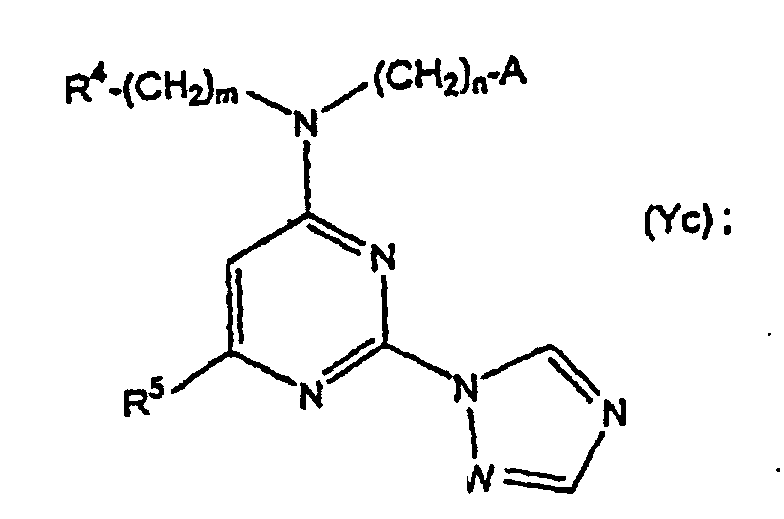 n and m are each independently an integer from 1 to 4;A is -C(O)OR1 or -C(O)N(R1)R2;each W is N or CH;each R1 is independently hydrogen, C1-C8 alkyl, aryl or aryl-C1-C8 alkyl;each R2 is independently hydrogen, C1-C20 alkyl, -(CH2)n-N(R1)2, heterocyclyl C1-C8 alkyl (optionally substituted by C1-C8 alkyl, halo, C1-C8 haloalkyl or C1-C8 alkoxy), aryl -C1-C8 alkyl (optionally substituted by halo, C1-C8 alkyl, C1-C8 alkoxy, or -N(R1)2);when m is an integer from 2 to 4, R4 can be cyano, heterocyclyl, hydroxy,-N(R1)R2, -N(R1)-C(O)-R1, -N(R1)-C(O)OR1, -N(R1)-S(O)1-R1, or -N(R1)-C(O)-N(R1)2:when m is 1, R4 can be cyano or heterocyclyl;R5 is hydrogen, halo, C1-C8 alkyl, aryl, aryl C1-C8 alkyl, or C1-C8haloalkyl;t is an integer from 0 to 2; wherein aryl refers to a phenyl or naphthyl radical; as a single stereoisomer or mixture thereto, or a pharmaceutically acceptable salt thereof, and a pharmaceutically acceptable excipient thereof.
 - A method for the manufacture of a medicament for treating a condition resulting from an abnormality in nitric oxide production, the medicament comprising a therapeutically effective amount of a compound of formula (Ya), formula (Yb) or formula (Yc):

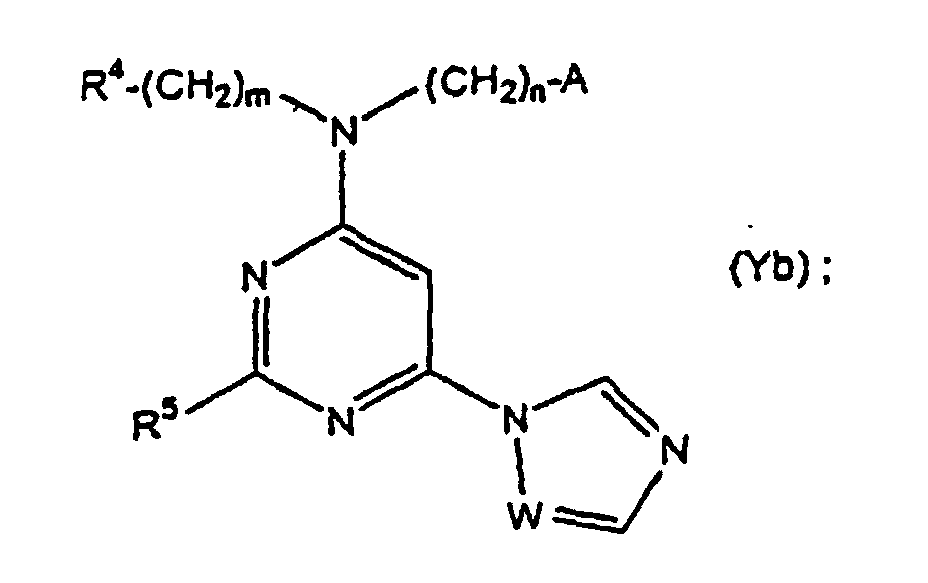 wherein:
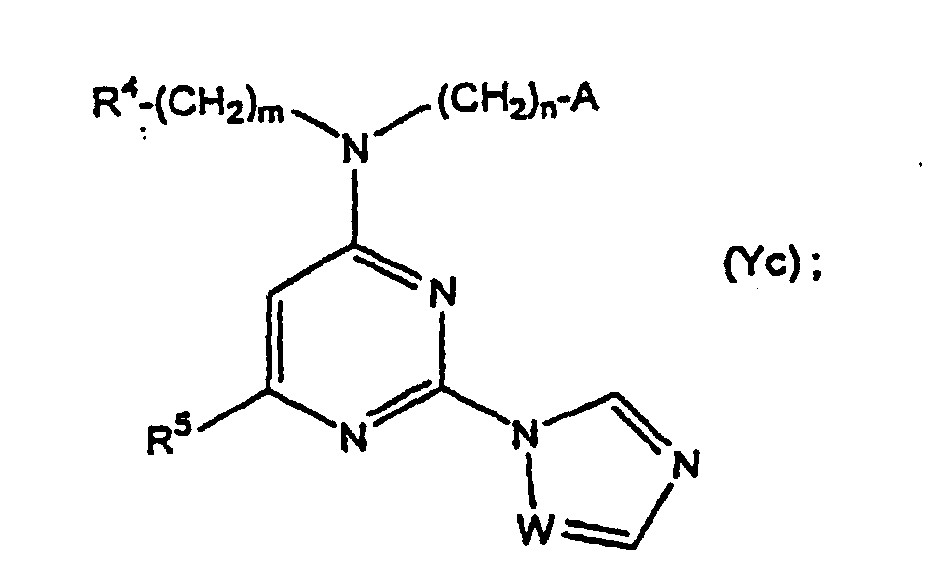 n and m are each independently an integer from 1 to 4;A is -C(O)OR1 or -C(O)N(R1)R2;each W is N or CH;each R1 is independently hydrogen, C1-C8 alkyl, aryl or aryl C1-C8 alkyl;each R2 is independently hydrogen, C1 -C20 alkyl, -(CH2)n-N(R1)2, heterocyclyl C1-C8 alkyl (optionally substituted by C1-C8 alkyl, halo, C1-C8 haloalkyl or C1-C8 alkoxy), aryl C1-C8 alkyl (optionally substituted by halo, C1-C8 alkyl, C1-C8 alkoxy, or -N(R1)2);when m is an integer from 2 to 4, R4 can be cyano, heterocyclyl, hydroxy, -N(R1)R2, -N(R1)-C(O)-R1, -N(R1)-C(O)OR1, -N(R1)-S(O)1-R1, or-N(R1)-C(O)-N(R1)2);when m is 1, R4 can be cyano or heterocyclyl;R5 is hydrogen, halo, C1-C8 alkyl, aryl, aryl C1-C8 alkyl, or C1-C8 haloalkyl;t is an integer from 0 to 2; wherein aryl refers to a phenyl or naphthyl radical ;as a single stereoisomer or mixture thereto, or a pharmaceutically acceptable salt thereof.
 - The method according to Claim 11 wherein said condition resulting from an abnormality in nitric oxide production is chosen from the group consisting of multiple sclerosis, stroke or cerebral ischemia, Alzheimer's disease, HIV dementia, Parkinson's disease, meningitis, dilated cardiomyopathy and congestive heart failure, atherosclerosis, restenosis or graft stenosis, septic shock and hypotension, hemorrhagic shock, asthma, adult respiratory distress syndrome, smoke or particulate-mediated lung injury, pathogen-mediated pneumonias, trauma of various etiologies, rheumatoid arthritis and osteoarthritis, glomerulonephritis, systemic lupus erythematosus, inflammatory bowel diseases such as ulcerative colitis and Crohn's disease, insulin dependent diabetes mellitus, diabetic neuropathy or nephropathy, acute and chronic organ transplant rejection, transplant vasculopathies, graft-versus-host disease, psoriasis and other inflammatory skin diseases, and cancer.
- The method of Claim 1 2 wherein the condition is multiple sclerosis.
- The method of Claim 12 wherein the condition is rheumatoid arthritis.
- The method of Claim 12 wherein the condition is dilated cardiomyopathy.
- The method of Claim 12 wherein the condition is congestive heart failure.
Applications Claiming Priority (3)
| Application Number | Priority Date | Filing Date | Title |
|---|---|---|---|
| US383813 | 1999-08-26 | ||
| US09/383,813 US6432947B1 (en) | 1997-02-19 | 1999-08-26 | N-heterocyclic derivatives as NOS inhibitors |
| PCT/US2000/023173 WO2001014371A1 (en) | 1999-08-26 | 2000-08-24 | N-heterocyclic derivatives as nos inhibitors |
Publications (2)
| Publication Number | Publication Date |
|---|---|
| EP1206467A1 EP1206467A1 (en) | 2002-05-22 |
| EP1206467B1 true EP1206467B1 (en) | 2003-12-17 |
Family
ID=23514822
Family Applications (1)
| Application Number | Title | Priority Date | Filing Date |
|---|---|---|---|
| EP00959333A Expired - Lifetime EP1206467B1 (en) | 1999-08-26 | 2000-08-24 | N-heterocyclic derivatives as nos inhibitors |
Country Status (34)
| Country | Link |
|---|---|
| US (11) | US6432947B1 (en) |
| EP (1) | EP1206467B1 (en) |
| JP (1) | JP4739625B2 (en) |
| KR (1) | KR100708783B1 (en) |
| CN (1) | CN1206228C (en) |
| AT (1) | ATE256681T1 (en) |
| AU (1) | AU769405B2 (en) |
| BG (1) | BG65804B1 (en) |
| BR (1) | BR0014144A (en) |
| CA (1) | CA2376355C (en) |
| CZ (1) | CZ2002642A3 (en) |
| DE (1) | DE60007329T2 (en) |
| DK (1) | DK1206467T3 (en) |
| EE (1) | EE05199B1 (en) |
| ES (1) | ES2213599T3 (en) |
| HK (1) | HK1043594A1 (en) |
| HR (1) | HRP20020175B1 (en) |
| HU (1) | HUP0202450A3 (en) |
| IL (2) | IL148313A0 (en) |
| LT (1) | LT4982B (en) |
| LV (1) | LV12887B (en) |
| MX (1) | MXPA02002022A (en) |
| NO (1) | NO323886B1 (en) |
| NZ (1) | NZ517411A (en) |
| PL (1) | PL353539A1 (en) |
| PT (1) | PT1206467E (en) |
| RO (1) | RO122202B1 (en) |
| RS (1) | RS50378B (en) |
| RU (1) | RU2277094C2 (en) |
| SI (1) | SI20818B (en) |
| SK (1) | SK2622002A3 (en) |
| UA (1) | UA72930C2 (en) |
| WO (1) | WO2001014371A1 (en) |
| ZA (1) | ZA200201485B (en) |
Families Citing this family (63)
| Publication number | Priority date | Publication date | Assignee | Title |
|---|---|---|---|---|
| US6432947B1 (en) * | 1997-02-19 | 2002-08-13 | Berlex Laboratories, Inc. | N-heterocyclic derivatives as NOS inhibitors |
| NZ525513A (en) | 1998-08-07 | 2004-09-24 | Pont Pharmaceuticals Du | Succinoylamino lactams as inhibitors of Abeta protein production |
| HRP990246A2 (en) | 1998-08-07 | 2000-06-30 | Du Pont Pharm Co | Succinoylamino benzodiazepines as inhibitors of a beta protein production |
| EP1196411B1 (en) * | 1999-07-15 | 2003-09-17 | Pharmacopeia, Inc. | Bradykinin b1 receptor antagonists |
| GB2361473C (en) | 2000-03-08 | 2005-06-28 | Microgenics Corp | Ecstasy-class analogs and use of same in detection of ecstasy-class compounds |
| EP1268433A1 (en) | 2000-04-03 | 2003-01-02 | Bristol-Myers Squibb Pharma Company | Cyclic lactams as inhibitors of a-beta-protein production |
| US20030055249A1 (en) * | 2001-07-17 | 2003-03-20 | Fick David B. | Synthesis and methods of use of pyrimidine analogues and derivatives |
| US8571653B2 (en) * | 2001-08-31 | 2013-10-29 | Bio Control Medical (B.C.M.) Ltd. | Nerve stimulation techniques |
| US7904176B2 (en) | 2006-09-07 | 2011-03-08 | Bio Control Medical (B.C.M.) Ltd. | Techniques for reducing pain associated with nerve stimulation |
| US7885709B2 (en) * | 2001-08-31 | 2011-02-08 | Bio Control Medical (B.C.M.) Ltd. | Nerve stimulation for treating disorders |
| US8386056B2 (en) * | 2001-08-31 | 2013-02-26 | Bio Control Medical (B.C.M.) Ltd. | Parasympathetic stimulation for treating atrial arrhythmia and heart failure |
| US6982259B2 (en) * | 2002-04-30 | 2006-01-03 | Schering Aktiengesellschaft | N-heterocyclic derivatives as NOS inhibitors |
| EP1795192A3 (en) * | 2002-04-30 | 2008-05-07 | Bayer Schering Pharma Aktiengesellschaft | 1-(Pyridazin-3-yl)-imidazole derivatives as inhibitors of nitric oxide synthase (NOS) |
| AU2003260033A1 (en) * | 2002-08-29 | 2004-03-19 | Schering Aktiengesellschaft | Methods of treating acute respiratory distress syndrome |
| AU2003267728A1 (en) * | 2002-10-18 | 2004-05-04 | Pfizer Products Inc. | Cannabinoid receptor ligands and uses thereof |
| CN1918145A (en) * | 2004-02-12 | 2007-02-21 | 默克公司 | Amino heterocyclic modulators of chemokine receptor activity |
| EP1568698A1 (en) * | 2004-02-27 | 2005-08-31 | Aventis Pharma Deutschland GmbH | Pyrrole-derivatives as factor Xa inhibitors |
| KR100935273B1 (en) * | 2004-06-10 | 2010-01-06 | 아이알엠 엘엘씨 | Protein Kinase Inhibitor Compounds and Compositions |
| ES2396135T3 (en) * | 2004-06-10 | 2013-02-19 | Irm Llc | Compounds and compositions as protein kinase inhibitors |
| CA2581623A1 (en) * | 2004-09-23 | 2006-03-30 | Reddy Us Therapeutics, Inc. | Novel pyridine compounds, process for their preparation and compositions containing them |
| UY29177A1 (en) * | 2004-10-25 | 2006-05-31 | Astex Therapeutics Ltd | SUBSTITUTED DERIVATIVES OF PURINA, PURINONA AND DEAZAPURINA, COMPOSITIONS THAT CONTAIN METHODS FOR THEIR PREPARATION AND ITS USES |
| MY179032A (en) * | 2004-10-25 | 2020-10-26 | Cancer Research Tech Ltd | Ortho-condensed pyridine and pyrimidine derivatives (e.g.purines) as protein kinase inhibitors |
| US8153630B2 (en) * | 2004-11-17 | 2012-04-10 | Miikana Therapeutics, Inc. | Kinase inhibitors |
| US20070123572A1 (en) * | 2005-11-28 | 2007-05-31 | Kalypsys, Inc. | Novel method of preparation of 5-chloro-3-imidazol-1-yl-[1,2,4]thiadiazole and (3-imidazol-1-yl-[1,2,4]thiadiazol-5yl)-dialkyl-amines |
| WO2006060424A2 (en) * | 2004-12-01 | 2006-06-08 | Kalypsys, Inc. | Inducible nitric oxide synthase dimerization inhibitors |
| KR101155335B1 (en) * | 2005-01-07 | 2012-06-11 | 엘지전자 주식회사 | Multimedia message service operating method for mobile communication terminal |
| WO2006108103A1 (en) * | 2005-04-05 | 2006-10-12 | Pharmacopeia, Inc. | Purine and imidazopyridine derivatives for immunosuppression |
| US7884109B2 (en) * | 2005-04-05 | 2011-02-08 | Wyeth Llc | Purine and imidazopyridine derivatives for immunosuppression |
| EP1923388A4 (en) | 2005-08-12 | 2011-03-09 | Takeda Pharmaceutical | BRAIN / NERVE CELL PROTECTION AND THERAPEUTIC FOR SLEEP DISORDERS |
| WO2007041358A2 (en) * | 2005-09-30 | 2007-04-12 | Miikana Therapeutics, Inc. | Substituted pyrazole compounds |
| AU2006318223A1 (en) * | 2005-11-28 | 2007-05-31 | Kalypsys, Inc. | Imidazole derivatives as nitric oxide synthase dimerisation inhibitor |
| US20090281075A1 (en) * | 2006-02-17 | 2009-11-12 | Pharmacopeia, Inc. | Isomeric purinones and 1h-imidazopyridinones as pkc-theta inhibitors |
| US7989459B2 (en) * | 2006-02-17 | 2011-08-02 | Pharmacopeia, Llc | Purinones and 1H-imidazopyridinones as PKC-theta inhibitors |
| US8017612B2 (en) * | 2006-04-18 | 2011-09-13 | Japan Tobacco Inc. | Piperazine compound and use thereof as a HCV polymerase inhibitor |
| US20090124610A1 (en) * | 2006-04-25 | 2009-05-14 | Gordon Saxty | Pharmaceutical compounds |
| JP5606734B2 (en) * | 2006-04-25 | 2014-10-15 | アステックス、セラピューティックス、リミテッド | Pharmaceutical compounds |
| DK2066791T3 (en) | 2006-10-03 | 2012-10-15 | Genzyme Corp | Gene therapy for amyotrophic lateral sclerosis and other spinal cord diseases |
| CL2007002866A1 (en) * | 2006-10-04 | 2008-07-04 | Pharmacopeia Inc | COMPOUNDS DERIVED FROM 6-SUBSTITUTES-2- (BENCIMIDAZOLIL) PURINA AND PURINONA; PHARMACEUTICAL COMPOSITION THAT INCLUDES SUCH COMPOUND; AND USE OF THE COMPOUND IN THE TREATMENT OF AUTOIMMUNE DISEASES, INFLAMMATORY DISEASE, DISEASE MEDIATED BY M |
| CL2007002867A1 (en) * | 2006-10-04 | 2008-06-27 | Pharmacopeia Inc | COMPOUNDS DERIVED FROM 2- (BENCIMIDAZOLIL) PURINA, INHIBITORS OF JANUS QUINASA 3; PHARMACEUTICAL COMPOSITION THAT CONTAINS THEM; AND ITS USE TO TREAT AUTOIMMUNE, INFLAMMATORY, CARDIOVASCULAR DISEASES, IMPLANT REJECTION, AMONG OTHERS. |
| US7902187B2 (en) * | 2006-10-04 | 2011-03-08 | Wyeth Llc | 6-substituted 2-(benzimidazolyl)purine and purinone derivatives for immunosuppression |
| US20080119496A1 (en) * | 2006-11-16 | 2008-05-22 | Pharmacopeia Drug Discovery, Inc. | 7-Substituted Purine Derivatives for Immunosuppression |
| EP1939181A1 (en) * | 2006-12-27 | 2008-07-02 | sanofi-aventis | Heteroaryl-substituted carboxamides and use thereof for the stimulation of the expression of NO synthase |
| AU2008262291A1 (en) * | 2007-06-11 | 2008-12-18 | Miikana Therapeutics, Inc. | Substituted pyrazole compounds |
| BRPI0818533B8 (en) | 2007-10-11 | 2021-05-25 | Astrazeneca Ab | compound, pharmaceutical composition, use of a compound, and, process for preparing a compound |
| JP2011510996A (en) * | 2008-01-30 | 2011-04-07 | グラクソスミスクライン・リミテッド・ライアビリティ・カンパニー | Novel sEH inhibitors and uses thereof |
| US20100311776A1 (en) * | 2008-01-30 | 2010-12-09 | Smithkline Beecham Corporation | Novel sEH Inhibitors and their Use |
| EP2240025A4 (en) * | 2008-01-30 | 2012-03-28 | Glaxosmithkline Llc | NOVEL sEH INHIBITORS AND THEIR USE |
| JP2011515462A (en) * | 2008-03-27 | 2011-05-19 | アウククランド ウニセルビセス リミテッド | Substituted pyrimidines and triazines and their use in cancer therapy |
| GB0908394D0 (en) | 2009-05-15 | 2009-06-24 | Univ Leuven Kath | Novel viral replication inhibitors |
| GB0913636D0 (en) | 2009-08-05 | 2009-09-16 | Univ Leuven Kath | Novel viral replication inhibitors |
| JP5642794B2 (en) | 2009-09-18 | 2014-12-17 | ボルボ ラストバグナー アーベー | Vehicle including console attached to vehicle chassis and suspension support console |
| BR112013011737A2 (en) | 2010-11-15 | 2016-08-09 | Univ Leuven Kath | compound, use of a compound pharmaceutical composition, and method of treating or preventing an HIV infection |
| CN102617503B (en) * | 2011-03-03 | 2014-05-07 | 上海常丰生物医药科技有限公司 | Novel synthetic method of (S)-3-morpholinyl carboxylic acid |
| WO2012131399A1 (en) | 2011-04-01 | 2012-10-04 | Astrazeneca Ab | Therapeutic treatment |
| PT2785349T (en) | 2011-11-30 | 2019-12-11 | Astrazeneca Ab | Combination treatment of cancer |
| AU2013204533B2 (en) | 2012-04-17 | 2017-02-02 | Astrazeneca Ab | Crystalline forms |
| EP3166938A4 (en) * | 2014-07-11 | 2018-01-17 | Northwestern University | 2-imidazolyl-pyrimidine scaffolds as potent and selective inhibitors of neuronal nitric oxide synthase |
| GB201512635D0 (en) | 2015-07-17 | 2015-08-26 | Ucl Business Plc | Uses of therapeutic compounds |
| PE20191474A1 (en) | 2016-12-20 | 2019-10-16 | Astrazeneca Ab | AMINO-TRIAZOLOPYRIDINE COMPOUNDS AND THEIR USE IN THE TREATMENT OF CANCER |
| CN107115334A (en) * | 2017-03-04 | 2017-09-01 | 王宏 | A kind of pharmaceutical composition for treating immunity miscarriage |
| AU2019237507B2 (en) | 2018-03-23 | 2025-04-03 | Carmot Therapeutics, Inc. | Modulators of G-protein coupled receptors |
| EP3628669A1 (en) | 2018-09-28 | 2020-04-01 | GenKyoTex Suisse SA | Novel compounds as nadph oxidase inhibitors |
| IL308392A (en) | 2021-05-13 | 2024-01-01 | Carmot Therapeutics Inc | Modulators of g-protein coupled receptors |
Family Cites Families (16)
| Publication number | Priority date | Publication date | Assignee | Title |
|---|---|---|---|---|
| JPS6339875A (en) | 1986-08-05 | 1988-02-20 | Nissin Food Prod Co Ltd | Pyrimidine derivative |
| DE4118720A1 (en) | 1991-06-07 | 1992-12-10 | Bayer Ag | SUBSTITUTED IMIDAZOLINYLPYRIMIDINE |
| EP0548553A1 (en) * | 1991-11-25 | 1993-06-30 | Takeda Chemical Industries, Ltd. | Optically active azole compounds, their production and use |
| DE69322076D1 (en) | 1992-02-28 | 1998-12-17 | Zenyaku Kogyo Kk | S-TRIAZINE DERIVATIVES AND THESE ACTIVE INGREDIENTS AGAINST OSTROGEN-DEPENDENT DISEASES |
| TW279864B (en) * | 1993-02-19 | 1996-07-01 | Janssen Pharmaceutica Nv | |
| US5593992A (en) | 1993-07-16 | 1997-01-14 | Smithkline Beecham Corporation | Compounds |
| ATE163647T1 (en) | 1993-08-26 | 1998-03-15 | Ono Pharmaceutical Co | 4-AMINOPYRIMIDINE DERIVATIVES |
| US5426110A (en) | 1993-10-06 | 1995-06-20 | Eli Lilly And Company | Pyrimidinyl-glutamic acid derivatives |
| US5629322A (en) | 1994-11-15 | 1997-05-13 | Merck & Co., Inc. | Cyclic amidine analogs as inhibitors of nitric oxide synthase |
| AU4149696A (en) | 1994-11-15 | 1996-06-06 | Merck & Co., Inc. | Substituted heterocycles as inhibitors of nitric oxide synthase |
| PT874846E (en) * | 1995-11-01 | 2003-08-29 | Novartis Ag | PURINA DERIVATIVES AND PROCESSES FOR THEIR PREPARATION |
| ZA977427B (en) | 1996-09-04 | 1998-03-02 | Dainippon Pharmaceutical Co | 2,4-disubstituted pyrimidine derivative, process for preparing the same, and a pharmaceutical composition containing the same. |
| US6432947B1 (en) * | 1997-02-19 | 2002-08-13 | Berlex Laboratories, Inc. | N-heterocyclic derivatives as NOS inhibitors |
| JP4495257B2 (en) * | 1997-02-19 | 2010-06-30 | バーレツクス ラボラトリーズ インコーポレーテツド | N-heterocyclic derivatives as NOS inhibitors |
| AU725548B2 (en) * | 1997-03-11 | 2000-10-12 | E.I. Du Pont De Nemours And Company | Heteroaryl azole herbicides |
| US6525051B2 (en) | 2000-03-27 | 2003-02-25 | Schering Aktiengesellschaft | N-heterocyclic derivatives as NOS inhibitors |
-
1999
- 1999-08-26 US US09/383,813 patent/US6432947B1/en not_active Expired - Fee Related
-
2000
- 2000-08-24 CN CNB008146691A patent/CN1206228C/en not_active Expired - Fee Related
- 2000-08-24 JP JP2001518702A patent/JP4739625B2/en not_active Expired - Fee Related
- 2000-08-24 RO ROA200200205A patent/RO122202B1/en unknown
- 2000-08-24 ES ES00959333T patent/ES2213599T3/en not_active Expired - Lifetime
- 2000-08-24 NZ NZ517411A patent/NZ517411A/en unknown
- 2000-08-24 PT PT00959333T patent/PT1206467E/en unknown
- 2000-08-24 AU AU70671/00A patent/AU769405B2/en not_active Ceased
- 2000-08-24 HK HK02105317.3A patent/HK1043594A1/en unknown
- 2000-08-24 BR BR0014144-5A patent/BR0014144A/en not_active Application Discontinuation
- 2000-08-24 SI SI200020040A patent/SI20818B/en not_active IP Right Cessation
- 2000-08-24 EP EP00959333A patent/EP1206467B1/en not_active Expired - Lifetime
- 2000-08-24 AT AT00959333T patent/ATE256681T1/en not_active IP Right Cessation
- 2000-08-24 WO PCT/US2000/023173 patent/WO2001014371A1/en not_active Ceased
- 2000-08-24 RU RU2002107203/04A patent/RU2277094C2/en not_active IP Right Cessation
- 2000-08-24 HR HR20020175A patent/HRP20020175B1/en not_active IP Right Cessation
- 2000-08-24 KR KR1020027002407A patent/KR100708783B1/en not_active Expired - Fee Related
- 2000-08-24 CA CA002376355A patent/CA2376355C/en not_active Expired - Fee Related
- 2000-08-24 DK DK00959333T patent/DK1206467T3/en active
- 2000-08-24 PL PL00353539A patent/PL353539A1/en not_active Application Discontinuation
- 2000-08-24 HU HU0202450A patent/HUP0202450A3/en unknown
- 2000-08-24 DE DE60007329T patent/DE60007329T2/en not_active Expired - Lifetime
- 2000-08-24 CZ CZ2002642A patent/CZ2002642A3/en unknown
- 2000-08-24 RS YUP-120/02A patent/RS50378B/en unknown
- 2000-08-24 IL IL14831300A patent/IL148313A0/en active IP Right Grant
- 2000-08-24 SK SK262-2002A patent/SK2622002A3/en unknown
- 2000-08-24 MX MXPA02002022A patent/MXPA02002022A/en active IP Right Grant
- 2000-08-24 UA UA2002032401A patent/UA72930C2/en unknown
- 2000-08-24 EE EEP200200091A patent/EE05199B1/en not_active IP Right Cessation
-
2002
- 2002-02-21 IL IL148313A patent/IL148313A/en not_active IP Right Cessation
- 2002-02-21 ZA ZA200201485A patent/ZA200201485B/en unknown
- 2002-02-26 NO NO20020925A patent/NO323886B1/en not_active IP Right Cessation
- 2002-02-26 BG BG106440A patent/BG65804B1/en unknown
- 2002-03-15 LT LT2002028A patent/LT4982B/en not_active IP Right Cessation
- 2002-03-26 LV LVP-02-50A patent/LV12887B/en unknown
- 2002-04-12 US US10/122,047 patent/US6887865B2/en not_active Expired - Fee Related
- 2002-04-12 US US10/121,758 patent/US6846829B2/en not_active Expired - Fee Related
- 2002-04-12 US US10/121,212 patent/US6849739B2/en not_active Expired - Fee Related
- 2002-04-12 US US10/121,682 patent/US20030073669A1/en not_active Abandoned
- 2002-04-12 US US10/121,886 patent/US6841673B2/en not_active Expired - Fee Related
- 2002-04-12 US US10/121,659 patent/US6864263B2/en not_active Expired - Fee Related
- 2002-04-12 US US10/121,808 patent/US6670473B2/en not_active Expired - Fee Related
- 2002-04-12 US US10/122,006 patent/US6864368B2/en not_active Expired - Fee Related
- 2002-04-12 US US10/121,379 patent/US6747031B2/en not_active Expired - Fee Related
- 2002-04-12 US US10/122,072 patent/US6841674B2/en not_active Expired - Fee Related
Also Published As
Similar Documents
| Publication | Publication Date | Title |
|---|---|---|
| CA2376355C (en) | N-heterocyclic derivatives as nos inhibitors | |
| EP0968206B1 (en) | N-heterocyclic derivatives as nos inhibitors | |
| EP1501504B1 (en) | 1-substituted imidazole derivatives as nos inhibitors | |
| US5656629A (en) | 6-substituted pyrazolo (3,4-d)pyrimidin-4-ones and compositions and methods of use thereof | |
| EP1268471B1 (en) | N-heterocyclic derivatives as nos inhibitors | |
| HUT54125A (en) | Process for producing triazine derivatives and pharmaceutical compositions comprising same | |
| EP1795192A2 (en) | 1-Substituted imidazole derivatives as nos inhibitors |
Legal Events
| Date | Code | Title | Description |
|---|---|---|---|
| PUAI | Public reference made under article 153(3) epc to a published international application that has entered the european phase |
Free format text: ORIGINAL CODE: 0009012 |
|
| 17P | Request for examination filed |
Effective date: 20020226 |
|
| AX | Request for extension of the european patent |
Free format text: AL PAYMENT 20020226;LT PAYMENT 20020226;LV PAYMENT 20020226;MK PAYMENT 20020226;RO PAYMENT 20020226;SI PAYMENT 20020226 |
|
| 17Q | First examination report despatched |
Effective date: 20020823 |
|
| GRAH | Despatch of communication of intention to grant a patent |
Free format text: ORIGINAL CODE: EPIDOS IGRA |
|
| GRAS | Grant fee paid |
Free format text: ORIGINAL CODE: EPIDOSNIGR3 |
|
| GRAL | Information related to payment of fee for publishing/printing deleted |
Free format text: ORIGINAL CODE: EPIDOSDIGR3 |
|
| GRAS | Grant fee paid |
Free format text: ORIGINAL CODE: EPIDOSNIGR3 |
|
| GRAA | (expected) grant |
Free format text: ORIGINAL CODE: 0009210 |
|
| AK | Designated contracting states |
Kind code of ref document: B1 Designated state(s): AT BE CH CY DE DK ES FI FR GB GR IE IT LI LU MC NL PT SE |
|
| AX | Request for extension of the european patent |
Extension state: AL LT LV MK RO SI |
|
| REG | Reference to a national code |
Ref country code: GB Ref legal event code: FG4D |
|
| REG | Reference to a national code |
Ref country code: CH Ref legal event code: EP |
|
| REG | Reference to a national code |
Ref country code: CH Ref legal event code: NV Representative=s name: A. BRAUN, BRAUN, HERITIER, ESCHMANN AG PATENTANWAE |
|
| REG | Reference to a national code |
Ref country code: IE Ref legal event code: FG4D |
|
| REF | Corresponds to: |
Ref document number: 60007329 Country of ref document: DE Date of ref document: 20040129 Kind code of ref document: P |
|
| REG | Reference to a national code |
Ref country code: SE Ref legal event code: TRGR |
|
| REG | Reference to a national code |
Ref country code: GR Ref legal event code: EP Ref document number: 20040400833 Country of ref document: GR |
|
| REG | Reference to a national code |
Ref country code: DK Ref legal event code: T3 |
|
| LTIE | Lt: invalidation of european patent or patent extension |
Effective date: 20031217 |
|
| REG | Reference to a national code |
Ref country code: PT Ref legal event code: SC4A Free format text: AVAILABILITY OF NATIONAL TRANSLATION Effective date: 20040317 |
|
| REG | Reference to a national code |
Ref country code: ES Ref legal event code: FG2A Ref document number: 2213599 Country of ref document: ES Kind code of ref document: T3 |
|
| ET | Fr: translation filed | ||
| PLBE | No opposition filed within time limit |
Free format text: ORIGINAL CODE: 0009261 |
|
| STAA | Information on the status of an ep patent application or granted ep patent |
Free format text: STATUS: NO OPPOSITION FILED WITHIN TIME LIMIT |
|
| 26N | No opposition filed |
Effective date: 20040920 |
|
| PGFP | Annual fee paid to national office [announced via postgrant information from national office to epo] |
Ref country code: CY Payment date: 20060823 Year of fee payment: 7 |
|
| REG | Reference to a national code |
Ref country code: CH Ref legal event code: PFA Owner name: BERLEX LABORATORIES, INC. Free format text: BERLEX LABORATORIES, INC.#15049 SAN PABLO AVENUE, P.O. BOX 4099#RICHMOND, CA 94804-0099 (US) $ PHARMACOPEIA, INC.#3000 EASTPARK BOULEVARD#CRANBURY, NJ 08512 (US) -TRANSFER TO- BERLEX LABORATORIES, INC.#15049 SAN PABLO AVENUE, P.O. BOX 4099#RICHMOND, CA 94804-0099 (US) $ PHARMACOPEIA, INC.#3000 EASTPARK BOULEVARD#CRANBURY, NJ 08512 (US) |
|
| PG25 | Lapsed in a contracting state [announced via postgrant information from national office to epo] |
Ref country code: CY Free format text: LAPSE BECAUSE OF NON-PAYMENT OF DUE FEES Effective date: 20070824 |
|
| REG | Reference to a national code |
Ref country code: HK Ref legal event code: WD Ref document number: 1043594 Country of ref document: HK |
|
| PGFP | Annual fee paid to national office [announced via postgrant information from national office to epo] |
Ref country code: MC Payment date: 20090813 Year of fee payment: 10 Ref country code: DK Payment date: 20090811 Year of fee payment: 10 Ref country code: IE Payment date: 20090821 Year of fee payment: 10 |
|
| PGFP | Annual fee paid to national office [announced via postgrant information from national office to epo] |
Ref country code: FI Payment date: 20090814 Year of fee payment: 10 Ref country code: SE Payment date: 20090813 Year of fee payment: 10 Ref country code: CH Payment date: 20090825 Year of fee payment: 10 Ref country code: NL Payment date: 20090814 Year of fee payment: 10 Ref country code: PT Payment date: 20090807 Year of fee payment: 10 Ref country code: AT Payment date: 20090814 Year of fee payment: 10 Ref country code: LU Payment date: 20090820 Year of fee payment: 10 |
|
| PGFP | Annual fee paid to national office [announced via postgrant information from national office to epo] |
Ref country code: BE Payment date: 20090915 Year of fee payment: 10 |
|
| PGFP | Annual fee paid to national office [announced via postgrant information from national office to epo] |
Ref country code: GR Payment date: 20090825 Year of fee payment: 10 |
|
| BERE | Be: lapsed |
Owner name: *BERLEX LABORATORIES INC. Effective date: 20100831 Owner name: *PHARMACOPEIA INC. Effective date: 20100831 |
|
| REG | Reference to a national code |
Ref country code: PT Ref legal event code: MM4A Free format text: LAPSE DUE TO NON-PAYMENT OF FEES Effective date: 20110224 |
|
| REG | Reference to a national code |
Ref country code: NL Ref legal event code: V1 Effective date: 20110301 |
|
| REG | Reference to a national code |
Ref country code: DK Ref legal event code: EBP |
|
| EUG | Se: european patent has lapsed | ||
| PG25 | Lapsed in a contracting state [announced via postgrant information from national office to epo] |
Ref country code: MC Free format text: LAPSE BECAUSE OF NON-PAYMENT OF DUE FEES Effective date: 20100831 |
|
| REG | Reference to a national code |
Ref country code: CH Ref legal event code: PL |
|
| PG25 | Lapsed in a contracting state [announced via postgrant information from national office to epo] |
Ref country code: LI Free format text: LAPSE BECAUSE OF NON-PAYMENT OF DUE FEES Effective date: 20100831 Ref country code: CH Free format text: LAPSE BECAUSE OF NON-PAYMENT OF DUE FEES Effective date: 20100831 |
|
| REG | Reference to a national code |
Ref country code: IE Ref legal event code: MM4A |
|
| PG25 | Lapsed in a contracting state [announced via postgrant information from national office to epo] |
Ref country code: NL Free format text: LAPSE BECAUSE OF NON-PAYMENT OF DUE FEES Effective date: 20110301 Ref country code: PT Free format text: LAPSE BECAUSE OF NON-PAYMENT OF DUE FEES Effective date: 20110224 Ref country code: AT Free format text: LAPSE BECAUSE OF NON-PAYMENT OF DUE FEES Effective date: 20100824 Ref country code: FI Free format text: LAPSE BECAUSE OF NON-PAYMENT OF DUE FEES Effective date: 20100824 |
|
| PG25 | Lapsed in a contracting state [announced via postgrant information from national office to epo] |
Ref country code: GR Free format text: LAPSE BECAUSE OF NON-PAYMENT OF DUE FEES Effective date: 20110302 |
|
| PG25 | Lapsed in a contracting state [announced via postgrant information from national office to epo] |
Ref country code: BE Free format text: LAPSE BECAUSE OF NON-PAYMENT OF DUE FEES Effective date: 20100831 Ref country code: IE Free format text: LAPSE BECAUSE OF NON-PAYMENT OF DUE FEES Effective date: 20100824 |
|
| PG25 | Lapsed in a contracting state [announced via postgrant information from national office to epo] |
Ref country code: DK Free format text: LAPSE BECAUSE OF NON-PAYMENT OF DUE FEES Effective date: 20100831 |
|
| PGFP | Annual fee paid to national office [announced via postgrant information from national office to epo] |
Ref country code: GB Payment date: 20110824 Year of fee payment: 12 Ref country code: ES Payment date: 20110824 Year of fee payment: 12 Ref country code: FR Payment date: 20110818 Year of fee payment: 12 Ref country code: DE Payment date: 20110729 Year of fee payment: 12 |
|
| PGFP | Annual fee paid to national office [announced via postgrant information from national office to epo] |
Ref country code: IT Payment date: 20110728 Year of fee payment: 12 |
|
| PG25 | Lapsed in a contracting state [announced via postgrant information from national office to epo] |
Ref country code: LU Free format text: LAPSE BECAUSE OF NON-PAYMENT OF DUE FEES Effective date: 20100824 Ref country code: SE Free format text: LAPSE BECAUSE OF NON-PAYMENT OF DUE FEES Effective date: 20100825 |
|
| GBPC | Gb: european patent ceased through non-payment of renewal fee |
Effective date: 20120824 |
|
| REG | Reference to a national code |
Ref country code: FR Ref legal event code: ST Effective date: 20130430 |
|
| PG25 | Lapsed in a contracting state [announced via postgrant information from national office to epo] |
Ref country code: IT Free format text: LAPSE BECAUSE OF NON-PAYMENT OF DUE FEES Effective date: 20120824 |
|
| PG25 | Lapsed in a contracting state [announced via postgrant information from national office to epo] |
Ref country code: GB Free format text: LAPSE BECAUSE OF NON-PAYMENT OF DUE FEES Effective date: 20120824 Ref country code: DE Free format text: LAPSE BECAUSE OF NON-PAYMENT OF DUE FEES Effective date: 20130301 |
|
| PG25 | Lapsed in a contracting state [announced via postgrant information from national office to epo] |
Ref country code: FR Free format text: LAPSE BECAUSE OF NON-PAYMENT OF DUE FEES Effective date: 20120831 |
|
| REG | Reference to a national code |
Ref country code: DE Ref legal event code: R119 Ref document number: 60007329 Country of ref document: DE Effective date: 20130301 |
|
| PG25 | Lapsed in a contracting state [announced via postgrant information from national office to epo] |
Ref country code: ES Free format text: LAPSE BECAUSE OF NON-PAYMENT OF DUE FEES Effective date: 20120825 |
|
| REG | Reference to a national code |
Ref country code: ES Ref legal event code: FD2A Effective date: 20131031 |