EP1206144A2 - Minimum cost path search apparatus and corresponding method - Google Patents
Minimum cost path search apparatus and corresponding method Download PDFInfo
- Publication number
- EP1206144A2 EP1206144A2 EP01124386A EP01124386A EP1206144A2 EP 1206144 A2 EP1206144 A2 EP 1206144A2 EP 01124386 A EP01124386 A EP 01124386A EP 01124386 A EP01124386 A EP 01124386A EP 1206144 A2 EP1206144 A2 EP 1206144A2
- Authority
- EP
- European Patent Office
- Prior art keywords
- path
- cost
- paths
- node
- minimum
- Prior art date
- Legal status (The legal status is an assumption and is not a legal conclusion. Google has not performed a legal analysis and makes no representation as to the accuracy of the status listed.)
- Withdrawn
Links
Images


Classifications
-
- H—ELECTRICITY
- H04—ELECTRIC COMMUNICATION TECHNIQUE
- H04L—TRANSMISSION OF DIGITAL INFORMATION, e.g. TELEGRAPHIC COMMUNICATION
- H04L12/00—Data switching networks
- H04L12/28—Data switching networks characterised by path configuration, e.g. LAN [Local Area Networks] or WAN [Wide Area Networks]
-
- H—ELECTRICITY
- H04—ELECTRIC COMMUNICATION TECHNIQUE
- H04Q—SELECTING
- H04Q3/00—Selecting arrangements
- H04Q3/64—Distributing or queueing
- H04Q3/66—Traffic distributors
-
- H—ELECTRICITY
- H04—ELECTRIC COMMUNICATION TECHNIQUE
- H04Q—SELECTING
- H04Q2213/00—Indexing scheme relating to selecting arrangements in general and for multiplex systems
- H04Q2213/13054—Expert system
-
- H—ELECTRICITY
- H04—ELECTRIC COMMUNICATION TECHNIQUE
- H04Q—SELECTING
- H04Q2213/00—Indexing scheme relating to selecting arrangements in general and for multiplex systems
- H04Q2213/13056—Routines, finite state machines
-
- H—ELECTRICITY
- H04—ELECTRIC COMMUNICATION TECHNIQUE
- H04Q—SELECTING
- H04Q2213/00—Indexing scheme relating to selecting arrangements in general and for multiplex systems
- H04Q2213/13103—Memory
-
- H—ELECTRICITY
- H04—ELECTRIC COMMUNICATION TECHNIQUE
- H04Q—SELECTING
- H04Q2213/00—Indexing scheme relating to selecting arrangements in general and for multiplex systems
- H04Q2213/13138—Least cost routing, LCR
-
- H—ELECTRICITY
- H04—ELECTRIC COMMUNICATION TECHNIQUE
- H04Q—SELECTING
- H04Q2213/00—Indexing scheme relating to selecting arrangements in general and for multiplex systems
- H04Q2213/13141—Hunting for free outlet, circuit or channel
-
- H—ELECTRICITY
- H04—ELECTRIC COMMUNICATION TECHNIQUE
- H04Q—SELECTING
- H04Q2213/00—Indexing scheme relating to selecting arrangements in general and for multiplex systems
- H04Q2213/13335—Simulation, emulation
Definitions
- the present invention relates to a minimum cost path search apparatus and a minimum cost path search method used by the apparatus, and more particularly to a method for searching for a minimum cost path from an entrance node to an exit node in a network.
- the Dijkstra method is generally known as the minimum cost path search method of this type.
- the Dijkstra method searches for only one minimum cost path for one exit node.
- the Dijkstra method is a mathematical programming method widely used as a shortest path problem, one of typical optimization problems associated with a network. This is a method for solving a shortest path problem that finds the shortest path from a source node to a destination node.
- the shortest path is mathematically obtained using the optimization principle in which the shortest path from a source node to a destination node is divided into two at a specific node such that each of the two paths produced by the division becomes the shortest path in the set. That is, the Dijkstra method starts processing beginning with a null set, finds shortest path nodes, one at a time, to increase the elements of the shortest path subset, and finally finds the shortest path for the entire nodes.
- the search method described above first generates a link diversion list, an input to output list, and a cost difference list and, using these lists, grows a minimum cost path tree to the destination point.
- the method of growing a minimum cost path searches for all paths. This, in turn, requires a large amount of storage in which to store the paths during the search. Another problem is that the amount of necessary storage cannot be determined before the search starts. In particular, in a topology where there are many branches, the paths to be stored cannot be stored in some cases. In this case, a path to be found may not be included in the search with the result that the paths are not obtained in order of costs.
- the minimum cost path search apparatus is a minimum cost path search apparatus that searches for a minimum cost path from an entrance node to an exit node in a network.
- the minimum cost path search apparatus comprises cost estimator for estimating a cost in advance from an intermediate node to the exit node; path generator for generating, for an intermediate path from the entrance node to the intermediate node, paths each extending to a node adjacent to the intermediate node; path storing memory for selecting paths to be stored, from the paths generated by the path generator, while controlling a number of paths to be stored; path selector for selecting one optimum path from the paths stored by the path storing memory; and path outputting unit for outputting obtained paths when the path storing memory stores no path.
- the minimum cost path search method is a minimum cost path search method that searches for a minimum cost path from an entrance node to an exit node in a network.
- the minimum cost path search method comprises the steps of estimating a cost in advance from an intermediate node to the exit node; generating, for an intermediate path from the entrance node to the intermediate node, paths each extending to a node adjacent to the intermediate node; selecting paths to be stored, from the paths generated by the path generating means, while controlling a number of paths to be stored; selecting one optimum path from the stored paths; and outputting obtained paths when no path is stored.
- Fig. 1 is a block diagram showing the configuration of a minimum cost path search apparatus in a first embodiment according to the present invention.
- the minimum cost path search apparatus in this embodiment comprises a cost estimator 1, a path generator 2, a path storing unit 3, a path selector 4, a path output unit 5, and a storage unit 6.
- the cost estimator 1 estimates the costs of all nodes, from an intermediate node to all exit nodes.
- the path generator 2 generates a path from the current search path to an adjacent node .
- the path storing unit 3 checks paths generated by the path generator 2 and stores in the storage unit 6 up to a predetermined number of paths for the ending node.
- the path selector 4 selects a path, which is not yet selected and whose total of the path cost and the minimum estimated cost is the minimum, from the paths stored in the entries of all intermediate nodes and the entrance node .
- the path output unit 5 outputs the paths, stored in the exit node, as a search result. In that case, the path output unit 5 outputs, in ascending order of costs, as many paths as is prepared for each of the exit nodes.
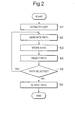
- Fig. 2 is a flowchart showing the operation of a minimum cost path search method in this embodiment.
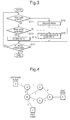
- Fig. 3 is a flowchart showing the operation of the path storing unit 3 shown in Fig. 1. Referring to Figs. 1 - 3, the following describes the operation of the minimum cost path search method used in this embodiment.
- the cost estimator 1 estimates the costs of nodes, from an intermediate node to all exit nodes (step S1 in Fig. 2). In this case, the cost estimator 1 stores for each intermediate node the minimum value of the estimated costs of the nodes, from that node to the exit nodes, as the minimum estimated cost. Costs are estimated in one of the following three ways: (1) Allow the user of the search method to enter a cost, (2) Calculate the minimum cost using a method such as the Dijkstra method, a mathematical programming method widely used as a shortest path problem for networks, and (3) Enter a fixed value.
- the path generator 2 generates a path that is extended to an adjacent node of the current search path (step S2 in Fig. 2).
- the path generator 2 executes path generation with the entrance node as the current search path.
- the path storing unit 3 first checks the paths generated by the path generator 2 (step S11 in Fig. 3). During the path check, the path storing unit 3 checks if a path passes through the same node two or more times.
- the path storing unit 3 rejects and discards the path (step S12 in Fig. 3). If a path does not pass through the same node two or more times, the path storing unit 3 accepts the path and checks the number of paths stored in the storage unit 6 (step S13 in Fig. 3). When checking the number of paths, the path storing unit 3 checks the number of paths stored in the entry of the ending node of the path. Note that a predetermined number of paths are stored in the storage unit 6 for each node and that this number is constant for all nodes in the topology.
- the path storing unit 3 stores the route of the path and the total of passage costs on the links of the path that is though of as the path cost (step S14 in Fig. 3). If there is no free entry, the path storing unit 3 discards the maximum cost path (step S15 in Fig. 3). When discarding the maximum cost path, the path storing unit 3 discards the maximum cost path out of those stored in the entry of the ending node of the path.
- the path storing unit 3 After discarding a path stored in the entry of the ending node, the path storing unit 3 stores the route and the path cost of the new path in the resulting vacant entry. The path storing unit 3 repeatedly executes the above operation for all paths generated by the path generator 2 (steps S11 - S16 in Fig. 3).
- the path selector 4 selects a path, which is not yet selected and whose total of the path cost and the minimum estimated cost is the minimum, as the current search path (step S4 in Fig. 2). If such a path is selected successfully (step S5 in Fig. 2), control returns to step S2 to generate a path.
- control is passed to the path output unit 5 that outputs the paths, stored in the entry of the exit node, as the search result (step S6 in Fig. 2) and ends the path search.
- the path search operation described above as many paths as the number of paths, predetermined for each node in the storage unit 6, are output for the exit node in ascending order of costs.
- Fig. 4 is a diagram showing an example of topology used in this embodiment.
- Fig. 5 is a diagram showing the estimated costs calculated for the topology shown in Fig. 4 using the Dijkstra method. With reference to Fig. 1, Fig. 4, and Fig. 5, the operation of the minimum cost path search method used in this embodiment will be described.
- the entrance node is indicated by a
- the exit nodes are indicated by b and c
- the intermediate nodes are indicated by A, B, C, D, and E.
- a number beside a link indicates the passage cost. For example, the cost of "1" is required when passing through the link between node a and node A. Note that, in this example, up to two paths may be stored in the entry of each node.
- the cost estimator 1 calculates the estimated cost from each intermediate node to each of the exit nodes and stores the minimum estimated cost.
- Fig. 5 shows the estimate result produced by the Dijkstra method.
- the path generator 2 In the first path generation, the path generator 2 generates the path a ⁇ A by extending the path to node A, which is adjacent to entrance node a, with entrance node a as the current search path.
- the path storing unit 3 checks the path a ⁇ A.
- the path a ⁇ A which does not pass through the same node two or more times, is accepted.
- the path storing unit 3 checks the number of stored paths and finds that no path is stored in the entry of node A, the ending node of the path. Therefore, the path storing unit 3 stores the path a ⁇ A and the path cost "1" in the entry of node A in the storage unit 6.
- the path selector 4 selects this path as the current search path and returns control to the path generator 2.
- the path generator 2 In the second path generation, the path generator 2 generates three paths, a ⁇ A ⁇ B, a ⁇ A ⁇ C, and a ⁇ A ⁇ a, with the path a ⁇ A as the current search path.
- the path storing unit 3 checks those paths, rejects the path a ⁇ A ⁇ a which passes through node a twice, and discards the path.
- the path selector 4 selects the path a ⁇ A ⁇ C, whose total of the path cost and the minimum estimated cost is the minimum, as the current search path and passes control back to the path generator 2.
- the path generator 2 In the third path generation, the path generator 2 generates three paths, a ⁇ A ⁇ C ⁇ E, a ⁇ A ⁇ C ⁇ B, and a ⁇ A ⁇ C ⁇ A, with the path a ⁇ A ⁇ C as the current search path.
- the path storing unit 3 checks those paths, rejects the path a ⁇ A ⁇ C ⁇ A which passes through node A twice, and discards the path.
- the path selector 4 selects the path a ⁇ A ⁇ C ⁇ B, whose total of the path cost and the minimum estimated cost is the minimum, as the current search path and passes control back to the path generator 2.
- the path generator 2 In the fourth path generation, the path generator 2 generates four paths, a ⁇ A ⁇ C ⁇ B ⁇ c, a ⁇ A ⁇ C ⁇ B ⁇ D , a ⁇ A ⁇ C ⁇ B ⁇ A, and a ⁇ A ⁇ C ⁇ B ⁇ C, with the path a ⁇ A ⁇ C ⁇ B as the current search path.
- the path storing unit 3 checks those paths, rejects the path a ⁇ A ⁇ C ⁇ B ⁇ A which passes through node A twice and a ⁇ A ⁇ C ⁇ B ⁇ C which passes through node C twice, and discards the paths.
- the path selector 4 selects the path a ⁇ A ⁇ B, whose total of the path cost and the minimum estimated cost is the minimum, as the current search path and passes control back to the path generator 2.
- the path generator 2 In the fifth path generation, the path generator 2 generates four paths, a ⁇ A ⁇ B ⁇ c, a ⁇ A ⁇ B ⁇ D, a ⁇ A ⁇ B ⁇ A, and a ⁇ A ⁇ B ⁇ C, with the path a ⁇ A ⁇ B as the current search path.
- the path storing unit 3 checks those paths, rejects the path a ⁇ A ⁇ B ⁇ A which passes through node A twice, and discards the path.
- the path selector 4 selects the path a ⁇ A ⁇ C ⁇ E, whose total of the path cost and the minimum estimated cost is the minimum, as the current search path and passes control back to the path generator 2.
- path selector 4 selects one of them.
- the path generator 2 In the sixth path generation, the path generator 2 generates three paths, a ⁇ A ⁇ C ⁇ E ⁇ b, a ⁇ A ⁇ C ⁇ E ⁇ D, and a ⁇ A ⁇ C ⁇ E ⁇ C, with the path a ⁇ A ⁇ C ⁇ E as the current search path.
- the path storing unit 3 checks those paths, rejects the path a ⁇ A ⁇ C ⁇ E ⁇ C which passes through node C twice, and discards the path.
- the path selector 4 selects the path a ⁇ A ⁇ C ⁇ B ⁇ D, whose total of the path cost and the minimum estimated cost is the minimum, as the current search path and passes control back to the path generator 2.
- the path generator 2 In the seventh path generation, the path generator 2 generates two paths, a ⁇ A ⁇ C ⁇ B ⁇ D ⁇ B and a ⁇ A ⁇ C ⁇ B ⁇ D ⁇ E, with the path a ⁇ A ⁇ C ⁇ B ⁇ D as the current search path.
- the path storing unit 3 checks those paths, rejects the path a ⁇ A ⁇ C ⁇ B ⁇ D ⁇ B which passes through node B twice, and discards the path.
- the path selector 4 selects the path a ⁇ A ⁇ B ⁇ C, whose total of the path cost and the minimum estimated cost is the minimum, as the current search path and passes control back to the path generator 2.
- the path selector 4 selects one of them.
- the path generator 2 In the eighth path generation, the path generator 2 generates three paths, a ⁇ A ⁇ B ⁇ C ⁇ B, a ⁇ A ⁇ B ⁇ C ⁇ E, and a ⁇ A ⁇ B ⁇ C ⁇ A, with the path a ⁇ A ⁇ B ⁇ C as the current search path.
- the path storing unit 3 checks those paths, rejects the paths a ⁇ A ⁇ B ⁇ D ⁇ B which passes through node B twice and a ⁇ A ⁇ B ⁇ C ⁇ A which pass through node A twice, and discards the paths.
- the path selector 4 selects the path a ⁇ A ⁇ B ⁇ D, whose total of the path cost and the minimum estimated cost is the minimum, as the current search path and passes control back to the path generator 2.
- path selector 4 selects one of them.
- the path generator 2 In the ninth path generation, the path generator 2 generates two paths, a ⁇ A ⁇ B ⁇ D ⁇ B and a ⁇ A ⁇ B ⁇ D ⁇ E, with the path a ⁇ A ⁇ B ⁇ D as the current search path.
- the path storing unit 3 checks those paths, rejects the path a ⁇ A ⁇ B ⁇ D ⁇ B which passes through node B twice, and discards the path.
- the path selector 4 selects this path as the current search path and passes control back to the path generator 2.
- the path generator 2 In the tenth path generation, the path generator 2 generates three paths, a ⁇ A ⁇ C ⁇ B ⁇ D ⁇ E ⁇ b, a ⁇ A ⁇ C ⁇ B ⁇ D ⁇ E ⁇ D, and a ⁇ A ⁇ C ⁇ B ⁇ D ⁇ E ⁇ C, with the path a ⁇ A ⁇ C ⁇ B ⁇ D ⁇ E as the current search path.
- the path storing unit 3 checks those paths, rejects the path a ⁇ A ⁇ C ⁇ B ⁇ D ⁇ E ⁇ C which passes through node C twice and the path a ⁇ A ⁇ C ⁇ B ⁇ D ⁇ E ⁇ D which passes through D twice, and discards the paths.
- the path output unit 5 outputs two paths, a ⁇ A ⁇ C ⁇ E ⁇ b and a ⁇ A ⁇ C ⁇ B ⁇ D ⁇ E ⁇ b stored in the entry of node b and two paths, a ⁇ A ⁇ C ⁇ B ⁇ c and a ⁇ A ⁇ B ⁇ c stored in the entry of exit node c.
- the above operation outputs two paths, each for exit node b and exit node c, in ascending order of costs.
- paths to be stored when storing paths in the entries of intermediate nodes and exit nodes during the search, selecting paths to be stored, with the number of paths limited, allows a specified number of minimum cost paths to be obtained in ascending order of costs for each exit node in a limited amount of storage.
- paths may be searched for speedily by estimating the costs in advance and by limiting the number of entries for a path during the search to narrow the search range.
- the minimum cost path search method in the second embodiment is different in the number of stored paths and the way in which paths are selected in the processing of the path storing unit 3 in order to select paths different from those selected in the first embodiment. Except them, the minimum cost path search method in the second embodiment is similar to that in the first embodiment.
- the apparatus configuration is similar to that in the first embodiment.
- the number of paths that can be stored is constant in the whole topology. This change in design allows any number of paths to be obtained for all exit nodes in ascending order of costs.
- the operation of the second embodiment will be described below. Note that cost estimation and path generation are the same as those in the first embodiment.
- the path storing unit 3 in the second embodiment first checks the paths generated by the path generator 2. During the path check, the path storing unit 3 checks if a path passes through the same node two or more times. If a path passes through the same node two or more times, the path storing unit 3 rejects and discards the path.
- the path storing unit 3 accepts the path and checks the number of paths that are already stored. When checking the number of paths, the path storing unit 3 checks the number of paths stored in the whole topology. If there is one or more free entries, the path storing unit 3 stores the path, that is, it stores the route of the path and the total of the path cost and the minimum estimated cost.
- the path storing unit 3 discards the maximum cost path.
- the path storing unit 3 discards one of the paths which include the path itself and those paths stored in the entry of the ending node of the path and whose total of the path cost and the minimum estimated cost is the maximum among the paths in the entrance node and the intermediate nodes.
- the path storing unit 3 stores the route and the total of the path cost and the minimum estimated cost in the resulting vacant entry. This is executed repeatedly for all paths generated by the path generator 2.
- the path selector 4 in this embodiment selects, from the paths stored in the whole topology, a path whose ending node is the entrance node or an intermediate node and whose total of the path cost and the estimated minimum cost is the minimum.
- the selected path is deleted from the storage unit 6. If such a path is selected, control returns to the path generator 2. If such a path cannot be selected, control is passed to the path output unit 5.
- the path output unit 5 in this embodiment outputs, as the search result, the paths which are stored in the whole topology and whose ending node is an exit node and then ends the path search.
- the path search operation in this embodiment outputs the predetermined number of paths in ascending order of costs in the whole topology.
- the cost estimator 1 performs the same operation as that described in the first embodiment.
- the Dijkstra method if used in this embodiment, produces the result as shown in Fig. 5.
- the path generator 2 In the first path generation, the path generator 2 generates the path a ⁇ A by extending the path to node A, which is adjacent to entrance node a, with entrance node a as the current search path.
- the path storing unit 3 checks the path a ⁇ A.
- the path a ⁇ A which does not pass through the same node two or more times, is accepted.
- the path storing unit 3 checks the number of stored paths and finds that no path is stored in the whole topology. Therefore, the path storing unit 3 stores the path a ⁇ A and the total "5" of the path cost "1" and the minimum estimated cost "4" in the entry of node A.
- the path selector 4 deletes this path from the storage unit 6 and, with this path as the current search path, returns control to the path generator 2.
- the path generator 2 In the second path generation, the path generator 2 generates three paths, a ⁇ A ⁇ B, a ⁇ A ⁇ C, and a ⁇ A ⁇ a, with the path a ⁇ A as the current search path.
- the path storing unit 3 checks those paths, rejects the path a ⁇ A ⁇ a which passes through node a twice, and discards the path.
- the path selector 4 deletes the path a ⁇ A ⁇ C whose total of the path cost and the minimum estimated cost is the minimum from the storage unit 6 and, with this path as the current search path, passes control back to the path generator 2.
- the path generator 2 In the third path generation, the path generator 2 generates three paths, a ⁇ A ⁇ C ⁇ A, a ⁇ A ⁇ C ⁇ B, and a ⁇ A ⁇ C ⁇ E, with the path a ⁇ A ⁇ C as the current search path.
- the path storing unit 3 checks those paths, rejects the path a ⁇ A ⁇ C ⁇ A which passes through node A twice, and discards the path.
- the path selector 4 deletes the path a ⁇ A ⁇ C ⁇ B whose total of the path cost and the minimum estimated cost is the minimum from the storage unit 6 and, with this path as the current search path, passes control back to the path generator 2.
- the path generator 2 In the fourth path generation, the path generator 2 generates four paths, a ⁇ A ⁇ C ⁇ B ⁇ A, a ⁇ A ⁇ C ⁇ B ⁇ C, a ⁇ A ⁇ C ⁇ B ⁇ c, and a ⁇ A ⁇ C ⁇ B ⁇ D, with the path a ⁇ A ⁇ C ⁇ B as the current search path.
- the path storing unit 3 checks those paths, rejects the path a ⁇ A ⁇ C ⁇ B ⁇ A which passes through node A twice and the path a ⁇ A ⁇ C ⁇ B ⁇ C which passes though node C twice, and discards the paths.
- the path selector 4 deletes the path a ⁇ A ⁇ B whose total of the path cost and the minimum estimated cost is the minimum and whose ending node is an intermediate node from the storage unit 6 and, with this path as the current search path, passes control back to the path generator 2.
- the path generator 2 In the fifth path generation, the path generator 2 generates four paths, a ⁇ A ⁇ B ⁇ A, a ⁇ A ⁇ B ⁇ C, a ⁇ A ⁇ B ⁇ c, and a ⁇ A ⁇ B ⁇ D, with the path a ⁇ A ⁇ B as the current search path.
- the path storing unit 3 checks those paths, rejects the path a ⁇ A ⁇ B ⁇ A which passes through node A twice, and discards the path.
- the path storing unit 3 checks the number of paths, finds that there is no free entry in the storage unit 6, and then discards the maximum cost path.
- the path generator 2 In the sixth path generation, the path generator 2 generates three paths, a ⁇ A ⁇ C ⁇ E ⁇ C, a ⁇ A ⁇ C ⁇ E ⁇ b, and a ⁇ A ⁇ C ⁇ E ⁇ D, with the path a ⁇ A ⁇ C ⁇ E as the current search path.
- the path storing unit 3 checks those paths, rejects the path a ⁇ A ⁇ C ⁇ E ⁇ C which passes through node C twice, and discards the path.
- the path storing unit 3 checks the number of paths, finds that there is no free entry in the storage unit 6, and therefore discards the maximum cost path.
- the path selector 4 deletes the path a ⁇ A ⁇ C ⁇ B ⁇ D whose total of the path cost and the minimum estimated cost is the minimum and whose ending node is an intermediate node from the storage unit 6 and, with this path as the current search path, passes control back to the path generator 2.
- the path generator 2 In the seventh path generation, the path generator 2 generates two paths, a ⁇ A ⁇ C ⁇ D ⁇ E and a ⁇ A ⁇ C ⁇ B ⁇ D ⁇ B, with the path a ⁇ A ⁇ C ⁇ B ⁇ D as the current search path.
- the path storing unit 3 checks those paths, rejects the path a ⁇ A ⁇ C ⁇ B ⁇ D ⁇ B which passes through node B twice, and discards the path.
- the path selector 4 deletes the path a ⁇ A ⁇ C ⁇ B ⁇ D ⁇ E whose total of the path cost and the minimum estimated cost is the minimum and whose ending node is an intermediate node from the storage unit 6 and, with this path as the current search path, passes control back to the path generator 2.
- the path generator 2 In the eighth path generation, the path generator 2 generates three paths, a ⁇ A ⁇ C ⁇ B ⁇ D ⁇ E ⁇ C, a ⁇ A ⁇ C ⁇ B ⁇ D ⁇ E ⁇ b, and a ⁇ A ⁇ C ⁇ B ⁇ D ⁇ E ⁇ D, with the path a ⁇ A ⁇ C ⁇ B ⁇ D ⁇ E as the current search path.
- the path storing unit 3 checks those paths, rejects the path a ⁇ A ⁇ C ⁇ B ⁇ D ⁇ E ⁇ C which passes through node C twice and the path a ⁇ A ⁇ C ⁇ B ⁇ D ⁇ E ⁇ D which passes through node D twice, and discards the paths.
- the path selector 4 passes control to the path output unit 5 because there is no stored path whose ending node is an intermediate node.
- the path output unit 5 outputs four stored paths, a ⁇ A ⁇ C ⁇ B ⁇ c, a ⁇ A ⁇ B ⁇ c, a ⁇ A ⁇ C ⁇ E ⁇ b, and a ⁇ A ⁇ C ⁇ B ⁇ D ⁇ E ⁇ b.
- the above operation outputs from all exit nodes the specified number of paths, four in this example, in ascending order of costs.
- the minimum cost path search apparatus and the minimum cost search path method used by the apparatus have the advantages given below. That is, when searching for a minimum cost path, from an entrance node to exit nodes, in the network, the apparatus and the method according to the present invention estimate in advance the cost from each of the intermediate nodes to the exit nodes, generates a path from a node to an intermediate node by extending the path to a node adjacent to the intermediate node, selects from those generated paths one or more paths to be stored while controlling the number of paths to be stored, selects the optimum path from the stored paths, and outputs the paths when there is no stored paths . This method allows a specified number of minimum cost paths to be obtained speedily in ascending order of costs for each exit node in a limited amount of storage.
Landscapes
- Engineering & Computer Science (AREA)
- Computer Networks & Wireless Communication (AREA)
- Signal Processing (AREA)
- Data Exchanges In Wide-Area Networks (AREA)
- Navigation (AREA)
- Control Of Position, Course, Altitude, Or Attitude Of Moving Bodies (AREA)
- Management, Administration, Business Operations System, And Electronic Commerce (AREA)
- Supply And Distribution Of Alternating Current (AREA)
- Meter Arrangements (AREA)
Abstract
Description
Claims (12)
- A minimum cost path search apparatus that searches for a minimum cost path from an entrance node to exit nodes in a network, said minimum cost path search apparatus comprising:cost estimator for estimating a cost in advance from an intermediate node to the exit node;path generator for generating, for an intermediate path from the entrance node to the intermediate node, paths each extending to a node adjacent to the intermediate node;path storing memory for selecting paths to be stored, from the paths generated by said path generator, while controlling a number of paths to be stored;path selector for selecting one optimum path from the paths stored by said path storing memory; andpath outputting unit for outputting obtained paths when said path storing memory stores no path.
- The minimum cost path search apparatus according to claim 1,
wherein said cost estimator uses an externally entered cost as the estimated cost. - The minimum cost path search apparatus according to claim 1,
wherein said cost estimator calculates a minimum cost using a Dijkstra method that is a mathematical programming method. - The minimum cost path search apparatus according to claim 1,
wherein said cost estimator uses a predetermined fixed value as the estimated cost. - The minimum cost path search apparatus according to claim 1, 2, 3 or 4,
wherein said path storing memory limits a number of paths to be stored for each node. - The minimum cost path search apparatus according to claim 1, 2, 3 or 4,
wherein said path storing memory limits a number of paths to be stored for all nodes. - A minimum cost path search method that searches for a minimum cost path from an entrance node to exit nodes in a network, said minimum cost path search method comprising the steps of:estimating a cost in advance from an intermediate node to the exit node;generating, for an intermediate path from the entrance node to the intermediate node, paths each extending to a node adjacent to the intermediate node;selecting paths to be stored, from the paths generated by said path generating means, while controlling a number of paths to be stored;selecting one optimum path from the stored paths; andoutputting obtained paths when no path is stored.
- The minimum cost path search method according to claim 7,
wherein said step of estimating a cost uses an externally entered cost as the estimated cost. - The minimum cost path search method according to claim 7,
wherein said step of estimating a cost calculates a minimum cost using a Dijkstra method that is a mathematical programming method. - The minimum cost path search method according to claim 7,
wherein said step of estimating a cost uses a predetermined fixed value as the estimated cost. - The minimum cost path search method according to claim 7, 8, 9 or 10,
wherein said step of selecting paths limits a number of paths to be stored for each node. - The minimum cost path search method according to claim 7, 8, 9 or 10,
wherein said step of selecting paths limits a number of paths to be stored for all nodes.
Applications Claiming Priority (2)
| Application Number | Priority Date | Filing Date | Title |
|---|---|---|---|
| JP2000324808 | 2000-10-25 | ||
| JP2000324808A JP2002133351A (en) | 2000-10-25 | 2000-10-25 | Minimum cost route search apparatus and minimum cost route search method used therefor |
Publications (2)
| Publication Number | Publication Date |
|---|---|
| EP1206144A2 true EP1206144A2 (en) | 2002-05-15 |
| EP1206144A3 EP1206144A3 (en) | 2006-12-27 |
Family
ID=18802275
Family Applications (1)
| Application Number | Title | Priority Date | Filing Date |
|---|---|---|---|
| EP01124386A Withdrawn EP1206144A3 (en) | 2000-10-25 | 2001-10-24 | Minimum cost path search apparatus and corresponding method |
Country Status (5)
| Country | Link |
|---|---|
| US (1) | US20020059213A1 (en) |
| EP (1) | EP1206144A3 (en) |
| JP (1) | JP2002133351A (en) |
| KR (1) | KR100402528B1 (en) |
| CN (1) | CN1350244A (en) |
Cited By (3)
| Publication number | Priority date | Publication date | Assignee | Title |
|---|---|---|---|---|
| EP2048830A1 (en) * | 2007-10-10 | 2009-04-15 | Alcatel Lucent | Method for routing in optical communication networks |
| EP2495021A1 (en) * | 2010-12-20 | 2012-09-05 | Kabushiki Kaisha Square Enix (also trading as Square Enix Co., Ltd.) | Artificial intelligence for games |
| US20140058787A1 (en) * | 2011-05-05 | 2014-02-27 | Ron BANNER | Plan Choosing in Digital Commercial Print Workflows |
Families Citing this family (35)
| Publication number | Priority date | Publication date | Assignee | Title |
|---|---|---|---|---|
| KR20040008382A (en) * | 2002-07-18 | 2004-01-31 | 정문영 | Lcr |
| CN100346608C (en) * | 2003-11-06 | 2007-10-31 | 华为技术有限公司 | Path searching method |
| JP4128131B2 (en) * | 2003-11-19 | 2008-07-30 | 富士通株式会社 | False path detection program |
| SE0303576D0 (en) * | 2003-12-23 | 2003-12-23 | Ericsson Telefon Ab L M | Cost determination in a multihop network |
| ITMI20040052A1 (en) * | 2004-01-16 | 2004-04-16 | Marconi Comm Spa | METHOD FOR THE SELECTION OF A STRATEGY FOR THE RE-ROADING OF CIRCUITS IN A COMMUNICATION NETWORK AND NETWORK WITH SUCH METHOD |
| CN100383785C (en) * | 2004-08-29 | 2008-04-23 | 华为技术有限公司 | A Path Searching Method in Transmission Network Management System |
| FR2881862B1 (en) * | 2005-02-07 | 2007-04-13 | Michelin Soc Tech | METHOD AND DEVICE FOR DETERMINING ROUTE WITH POINTS OF INTEREST |
| US8738821B2 (en) * | 2005-11-18 | 2014-05-27 | International Business Machines Corporation | Selecting a path comprising ports on primary and secondary clusters to use to transmit data at a primary volume to a secondary volume |
| KR100791748B1 (en) | 2005-11-28 | 2008-01-04 | 유영근 | How to limit the search area, how to get the minimum expected value and how to search the shortest path |
| KR100798658B1 (en) * | 2007-04-20 | 2008-01-28 | (주)지오매틱코리아 | Optimal Pedestrian Path Estimation Algorithm in Future Residential Complex |
| JP5119762B2 (en) * | 2007-06-22 | 2013-01-16 | 村田機械株式会社 | Route search system and method, transport system, and computer program |
| AU2008338259A1 (en) * | 2007-12-17 | 2009-06-25 | Leximancer Pty Ltd | Methods for determining a path through concept nodes |
| US9049145B2 (en) * | 2008-06-18 | 2015-06-02 | Futurewei Technologies, Inc. | Method and apparatus for calculating MPLS traffic engineering paths |
| KR100994075B1 (en) | 2008-07-08 | 2010-11-12 | 한국과학기술연구원 | Optimal Path Planning Method of Pedestrian Robot |
| JP4730440B2 (en) | 2009-01-01 | 2011-07-20 | ソニー株式会社 | Trajectory planning apparatus, trajectory planning method, and computer program |
| KR101554515B1 (en) * | 2009-01-07 | 2015-09-21 | 삼성전자 주식회사 | Path planning device and method of robot |
| CN101848139B (en) * | 2009-03-26 | 2011-12-28 | 林定伟 | Quantized and multithreaded network intelligent routing method |
| JP5720441B2 (en) * | 2011-06-30 | 2015-05-20 | 富士通株式会社 | Route search program, route search device, and route search method |
| US9811130B2 (en) * | 2011-09-12 | 2017-11-07 | The Boeing Company | Power management control system |
| WO2012149795A1 (en) * | 2011-09-30 | 2012-11-08 | 华为技术有限公司 | Method and device for determining connection routing in multilayer network |
| CN102542432B (en) * | 2011-12-20 | 2015-11-25 | 纽海信息技术(上海)有限公司 | Inventory management system and method |
| US8972057B1 (en) * | 2013-01-09 | 2015-03-03 | The Boeing Company | Systems and methods for generating a robotic path plan in a confined configuration space |
| CN103472828A (en) * | 2013-09-13 | 2013-12-25 | 桂林电子科技大学 | Mobile robot path planning method based on improvement of ant colony algorithm and particle swarm optimization |
| CN103472835B (en) * | 2013-09-16 | 2017-01-04 | 苏州工业园区职业技术学院 | Based on double-core four-wheel micro computer Mus fast sprint controller |
| CN103472832A (en) * | 2013-09-16 | 2013-12-25 | 苏州工业园区职业技术学院 | Full-digital servo controller of two-wheel micro-mouse based on dual processors |
| JP6298322B2 (en) * | 2014-02-27 | 2018-03-20 | 株式会社ゼンリン | Route search device, route search method and program |
| US20170165835A1 (en) * | 2015-12-09 | 2017-06-15 | Qualcomm Incorporated | Rapidly-exploring randomizing feedback-based motion planning |
| JP6770839B2 (en) * | 2016-07-08 | 2020-10-21 | 株式会社クボタ | A route search program, a route search system, and a work platform incorporating this route search system. |
| CN107677285B (en) * | 2017-04-11 | 2019-05-28 | 平安科技(深圳)有限公司 | The path planning system and method for robot |
| JP7235060B2 (en) * | 2019-02-01 | 2023-03-08 | 日本電気株式会社 | Route planning device, route planning method, and program |
| CN110147040B (en) * | 2019-04-10 | 2022-05-20 | 中国人民解放军陆军工程大学 | Flight trajectory and power distribution joint optimization method for energy-carrying transmission of unmanned aerial vehicle |
| CN111930113A (en) * | 2020-06-30 | 2020-11-13 | 创新工场(北京)企业管理股份有限公司 | Method and device for setting driving path for autonomous navigation robot |
| KR102470845B1 (en) * | 2020-11-27 | 2022-11-28 | 한국도로공사 | How to calculate the shortest route for generating tolls |
| CN114754787A (en) * | 2022-04-21 | 2022-07-15 | 深兰人工智能(深圳)有限公司 | Path planning method and device, and computer readable storage medium |
| CN115657687B (en) | 2022-12-21 | 2023-03-10 | 广东技术师范大学 | Path optimization method and system for mobile robot |
Family Cites Families (14)
| Publication number | Priority date | Publication date | Assignee | Title |
|---|---|---|---|---|
| US4669113A (en) * | 1985-04-26 | 1987-05-26 | At&T Company | Integrated network controller for a dynamic nonhierarchical routing switching network |
| CA2111634C (en) * | 1992-12-17 | 1999-02-16 | Toshio Nishida | Private branch exchange |
| JP3672341B2 (en) * | 1993-07-21 | 2005-07-20 | 富士通株式会社 | Communication network separation design method and its management method |
| US6314092B1 (en) * | 1994-11-30 | 2001-11-06 | British Telecommunications Public Limited Company | Routing in a communications network |
| JP3173983B2 (en) * | 1995-12-28 | 2001-06-04 | 松下電器産業株式会社 | Route selection method and system |
| JP2964957B2 (en) * | 1996-08-15 | 1999-10-18 | 日本電気株式会社 | High-speed routing control method |
| KR100194608B1 (en) * | 1996-11-20 | 1999-06-15 | 이계철 | Multicast Path Allocation Method in ATM Networks |
| US5899986A (en) * | 1997-02-10 | 1999-05-04 | Oracle Corporation | Methods for collecting query workload based statistics on column groups identified by RDBMS optimizer |
| JP3147043B2 (en) * | 1997-06-18 | 2001-03-19 | 日本電気株式会社 | Cost routing device, cost routing method, and recording medium recording cost routing control program |
| US6633544B1 (en) * | 1998-06-24 | 2003-10-14 | At&T Corp. | Efficient precomputation of quality-of-service routes |
| JP3403335B2 (en) * | 1998-06-26 | 2003-05-06 | 日立ソフトウエアエンジニアリング株式会社 | Virtual geospatial object generation system and recording medium |
| DE19842850B4 (en) * | 1998-09-18 | 2004-09-09 | Siemens Ag | Procedure for configuring a private branch exchange |
| US6349403B1 (en) * | 1998-12-18 | 2002-02-19 | Synopsys, Inc. | Interative, gridless, cost-based layer assignment coarse router for computer controlled IC design |
| US6263277B1 (en) * | 2000-08-07 | 2001-07-17 | Alpine Electronics, Inc. | Route searching method |
-
2000
- 2000-10-25 JP JP2000324808A patent/JP2002133351A/en active Pending
-
2001
- 2001-10-24 EP EP01124386A patent/EP1206144A3/en not_active Withdrawn
- 2001-10-24 US US09/983,393 patent/US20020059213A1/en not_active Abandoned
- 2001-10-25 CN CN01136791A patent/CN1350244A/en active Pending
- 2001-10-25 KR KR10-2001-0065920A patent/KR100402528B1/en not_active Expired - Fee Related
Cited By (3)
| Publication number | Priority date | Publication date | Assignee | Title |
|---|---|---|---|---|
| EP2048830A1 (en) * | 2007-10-10 | 2009-04-15 | Alcatel Lucent | Method for routing in optical communication networks |
| EP2495021A1 (en) * | 2010-12-20 | 2012-09-05 | Kabushiki Kaisha Square Enix (also trading as Square Enix Co., Ltd.) | Artificial intelligence for games |
| US20140058787A1 (en) * | 2011-05-05 | 2014-02-27 | Ron BANNER | Plan Choosing in Digital Commercial Print Workflows |
Also Published As
| Publication number | Publication date |
|---|---|
| KR100402528B1 (en) | 2003-10-17 |
| US20020059213A1 (en) | 2002-05-16 |
| CN1350244A (en) | 2002-05-22 |
| EP1206144A3 (en) | 2006-12-27 |
| JP2002133351A (en) | 2002-05-10 |
| KR20020032385A (en) | 2002-05-03 |
Similar Documents
| Publication | Publication Date | Title |
|---|---|---|
| EP1206144A2 (en) | Minimum cost path search apparatus and corresponding method | |
| Ahn et al. | Vehicle-routeing with time windows and time-varying congestion | |
| Tung et al. | A multicriteria Pareto-optimal path algorithm | |
| US6882627B2 (en) | Methods and apparatus for selecting multiple paths taking into account shared risk | |
| US20030161338A1 (en) | Network path selection based on bandwidth | |
| CN101753425B (en) | Heuristic method for working out a plurality of shortest simple routes in network under multiple constraints | |
| US5577030A (en) | Data communication routing method and device | |
| US6992988B2 (en) | System and method for deadlock-free routing on arbitrary network topologies | |
| JPH06311162A (en) | Remote communication network, and disposition for retrieving most costless path | |
| Scano et al. | Adaptations of k-shortest path algorithms for transportation networks | |
| CN108683593B (en) | K short path calculation method | |
| WO2010058785A1 (en) | Path calculation order deciding method, program and calculating apparatus | |
| US11750955B2 (en) | Routing method for dynamic WDM optical networks with wavelength continuity constraints | |
| US6798752B1 (en) | Method and system for determining a network topology | |
| Agrawal et al. | Adaptive real-time routing in polynomial time | |
| Dasgupta et al. | Multiobjective search in VLSI design | |
| CN117978320A (en) | Method and system for solving shortest disjoint path pair in WDM network | |
| EP3157209B1 (en) | Route search apparatus and route search method | |
| Andrew et al. | Generalised analysis of a QoS-aware routing algorithm | |
| Tse et al. | An optimal lower bound for interval routing in general networks | |
| US10439939B2 (en) | Network management system, network, method and computer program product | |
| Jadczak | Traveling salesman problem: approach to optimality | |
| Xiao et al. | Approximation and heuristic algorithms for delay constrained path selection under inaccurate state information | |
| US7269134B2 (en) | Device for designing standby path, method for designing standby path, and program therefor | |
| Józsa et al. | Reroute sequence planning for label switched paths in multiprotocol label switching networks |
Legal Events
| Date | Code | Title | Description |
|---|---|---|---|
| PUAI | Public reference made under article 153(3) epc to a published international application that has entered the european phase |
Free format text: ORIGINAL CODE: 0009012 |
|
| AK | Designated contracting states |
Kind code of ref document: A2 Designated state(s): AT BE CH CY DE DK ES FI FR GB GR IE IT LI LU MC NL PT SE TR |
|
| AX | Request for extension of the european patent |
Free format text: AL;LT;LV;MK;RO;SI |
|
| PUAL | Search report despatched |
Free format text: ORIGINAL CODE: 0009013 |
|
| AK | Designated contracting states |
Kind code of ref document: A3 Designated state(s): AT BE CH CY DE DK ES FI FR GB GR IE IT LI LU MC NL PT SE TR |
|
| AX | Request for extension of the european patent |
Extension state: AL LT LV MK RO SI |
|
| 17P | Request for examination filed |
Effective date: 20061129 |
|
| AKX | Designation fees paid |
Designated state(s): DE GB IT |
|
| 17Q | First examination report despatched |
Effective date: 20090415 |
|
| STAA | Information on the status of an ep patent application or granted ep patent |
Free format text: STATUS: THE APPLICATION IS DEEMED TO BE WITHDRAWN |
|
| 18D | Application deemed to be withdrawn |
Effective date: 20090826 |