EP1206042A2 - Apparatus and method for decoding data of unknown frame length - Google Patents
Apparatus and method for decoding data of unknown frame length Download PDFInfo
- Publication number
- EP1206042A2 EP1206042A2 EP01306702A EP01306702A EP1206042A2 EP 1206042 A2 EP1206042 A2 EP 1206042A2 EP 01306702 A EP01306702 A EP 01306702A EP 01306702 A EP01306702 A EP 01306702A EP 1206042 A2 EP1206042 A2 EP 1206042A2
- Authority
- EP
- European Patent Office
- Prior art keywords
- data
- frame length
- parameter
- decoding
- preliminarily
- Prior art date
- Legal status (The legal status is an assumption and is not a legal conclusion. Google has not performed a legal analysis and makes no representation as to the accuracy of the status listed.)
- Withdrawn
Links
Images


Classifications
-
- H—ELECTRICITY
- H03—ELECTRONIC CIRCUITRY
- H03M—CODING; DECODING; CODE CONVERSION IN GENERAL
- H03M13/00—Coding, decoding or code conversion, for error detection or error correction; Coding theory basic assumptions; Coding bounds; Error probability evaluation methods; Channel models; Simulation or testing of codes
- H03M13/37—Decoding methods or techniques, not specific to the particular type of coding provided for in groups H03M13/03 - H03M13/35
-
- H—ELECTRICITY
- H03—ELECTRONIC CIRCUITRY
- H03M—CODING; DECODING; CODE CONVERSION IN GENERAL
- H03M13/00—Coding, decoding or code conversion, for error detection or error correction; Coding theory basic assumptions; Coding bounds; Error probability evaluation methods; Channel models; Simulation or testing of codes
- H03M13/37—Decoding methods or techniques, not specific to the particular type of coding provided for in groups H03M13/03 - H03M13/35
- H03M13/39—Sequence estimation, i.e. using statistical methods for the reconstruction of the original codes
- H03M13/3961—Arrangements of methods for branch or transition metric calculation
-
- H—ELECTRICITY
- H03—ELECTRONIC CIRCUITRY
- H03M—CODING; DECODING; CODE CONVERSION IN GENERAL
- H03M13/00—Coding, decoding or code conversion, for error detection or error correction; Coding theory basic assumptions; Coding bounds; Error probability evaluation methods; Channel models; Simulation or testing of codes
- H03M13/37—Decoding methods or techniques, not specific to the particular type of coding provided for in groups H03M13/03 - H03M13/35
- H03M13/39—Sequence estimation, i.e. using statistical methods for the reconstruction of the original codes
- H03M13/41—Sequence estimation, i.e. using statistical methods for the reconstruction of the original codes using the Viterbi algorithm or Viterbi processors
- H03M13/4107—Sequence estimation, i.e. using statistical methods for the reconstruction of the original codes using the Viterbi algorithm or Viterbi processors implementing add, compare, select [ACS] operations
-
- H—ELECTRICITY
- H03—ELECTRONIC CIRCUITRY
- H03M—CODING; DECODING; CODE CONVERSION IN GENERAL
- H03M13/00—Coding, decoding or code conversion, for error detection or error correction; Coding theory basic assumptions; Coding bounds; Error probability evaluation methods; Channel models; Simulation or testing of codes
- H03M13/37—Decoding methods or techniques, not specific to the particular type of coding provided for in groups H03M13/03 - H03M13/35
- H03M13/39—Sequence estimation, i.e. using statistical methods for the reconstruction of the original codes
- H03M13/41—Sequence estimation, i.e. using statistical methods for the reconstruction of the original codes using the Viterbi algorithm or Viterbi processors
- H03M13/4161—Sequence estimation, i.e. using statistical methods for the reconstruction of the original codes using the Viterbi algorithm or Viterbi processors implementing path management
- H03M13/4169—Sequence estimation, i.e. using statistical methods for the reconstruction of the original codes using the Viterbi algorithm or Viterbi processors implementing path management using traceback
Definitions
- the present invention relates to an apparatus and method for decoding data of an unknown frame length, and more particularly to an apparatus and method for decoding data of an unknown frame length capable of selectively outputting appropriate data from preliminarily decoded data which are decoded corresponding to each of the possible data frame lengths.
- a Viterbi Decoder In a digital communication system, a Viterbi Decoder generally decodes Tree codes which are used to correct data errors.
- the Tree codes are transmitted mainly by two methods according to the standard of the communication system. One method is to transmit the data successively, without limitation on the length of the data frame. The other method is to transmit the data with a uniform predetermined length of data frame.
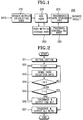
- FIG. 1 is a block diagram illustrating a conventional Viterbi Decoder.
- the Viterbi Decoder 200 includes a branch metrics processor 210, an ACS part (Add, Compare & Select part) 230, a path metrics storing part 250, a traceback data storing part 270, and a traceback control part 290.
- the branch metrics processor 210 calculates a set of branch metrics by comparing received data with a standard level.
- the ACS part 230 obtains a path metrics value of a current state by adding path metrics of a previous state to branch metrics input from the branch metrics processor 210, determines path selection data with the path metrics value, and outputs such determined data path selection to the traceback data storing part 270.
- the ACS part 230 also performs a controlling operation to ensure no overflow of path metrics values of the respective states.
- the path metrics storing part 250 stores the path metrics values of the respective states which are calculated by the ACS part 230.
- the path selection data is stored in the traceback data storing part 270, and trace-backed and decoded into output signals of the Viterbi Decoder 200 under the control of the traceback control part 290.
- the control operation of the traceback control part 290 of the Viterbi Decoder 200 ( Figure 1) are as follows. First, a parameter (i) for counting data input into the traceback data storing part 270 is initialized (step SS1). Then the parameter (i) is increased (step SS2). Next, i-th path selection data is stored in the traceback data storing part 270 (step SS3). Then the parameter (i) is compared with the decoding depth (D) (step SS4). If the parameter (i) is determined to be smaller than the decoding depth (D) in the decoding depth comparing step (step SS4), the parameter increasing step (SS2) is performed. That is, until the D-th data is input, the data input to the traceback data storing part 270 are continuously stored in the traceback data storing part 270.
- a frame end checking step (step SS5) is performed, that is, the parameter (i) is compared with the frame length (E).
- the frame end checking step (SS5) checks whether the input data is the end data of the data frame. If the input data is not the end data of the data frame in the frame end checking step (SS5), in the next step (step SS6), the data stored in the traceback data storing part 270 are trace-backed, and the end data of the trace-backed data is output as the output data of the Viterbi decoder 200, and the parameter increasing step (SS2) is performed.
- the input data is the end data of the frame, i.e., the E-th data in the frame end checking step (SS5)
- the data stored in the traceback data storing part 270 are trace-backed, and all the trace-backed data bits are output. Accordingly, the decoding operation of the Viterbi decoder is completed.
- the above-described decoder cannot efficiently decode data of unknown frame length. That is, when decoding data of unknown frame length, the conventional decoder needs to first detect the frame length by using a Cyclic Redundancy Check (CRC), zero path metrics, and minimum path metrics, or the like.
- CRC Cyclic Redundancy Check
- zero path metrics, and minimum path metrics for detecting the frame length of the data
- another inconvenience is brought in that the decoding has to be repetitiously performed corresponding to each of the possible data frame lengths. Accordingly, since decoding has to be performed corresponding to the number (n) of possible frame lengths, decoding efficiency is deteriorated. Still another problem is that the decoder requires considerably large memory capacity, since there has to be a separate storing part for storing the decoded data corresponding to each of the possible frame lengths.
- the present invention has been made with a view to reduce or to overcome at least one of the above-mentioned problems of the related art, and accordingly, it is an aim of embodiments of the present invention to provide an apparatus capable of accurately decoding data of unknown frame length.
- Another aim of embodiments of the present invention is to provide a method for decoding data of unknown frame length, without deteriorating the decoding efficiency.
- Yet another aim of embodiments of the present invention is to provide a method for decoding data of unknown frame length, capable of utilizing a memory efficiently.
- an apparatus for decoding data of unknown frame length including a preliminary decoding part for decoding input data into preliminarily decoded data according to each of the possible frame lengths; and a decoded data outputting part for selectively outputting data that correspond to a frame length detected from the input data, among the preliminarily decoded data which are decoded by the preliminary decoding part according to each of the possible frame lengths.
- the preliminary decoding part may include a branch metrics calculating part for calculating a set of branch metrics by comparing the input data with a standard level; an ACS (Adding, Calculating & Selecting) part for obtaining path metrics of a current state by adding path metrics of a previous state to the set of branch metrics, and from the path metrics, selectively outputting an optimum path of the current state as path selection data; a path metrics storing part for storing the path metrics of the current state calculated by the ACS part; a tracebacked data storing part for storing the path selection data output from the ACS part, and tracebacking the path selection data, and sequentially outputting the tracebacked data as preliminarily decoded data; and a traceback controlling part for controlling the tracebacking of the tracebacked data storing part according to each of the possible frame lengths.
- ACS Adding, Calculating & Selecting
- the decoded data outputting part preferably includes a frame length determining part for detecting the frame length based on the input data; an output storing part for storing the preliminarily decoded data output from the tracebacked data storing part; and an output controlling part for controlling the output storing part so as to output decoded data corresponding to the detected frame length.
- a method for decoding data of unknown frame length including the steps of: (a) decoding the input data into preliminarily decoded data according to each of the possible frame lengths; and (b) selectively outputting data corresponding to the frame length detected based on the input data, among the preliminarily decoded data which are decoded according to each of the possible frame lengths.
- the preliminarily decoding step (a) includes the sub-steps of (a1) calculating a set of branch metrics by comparing the input data with a standard level; (a2) obtaining path metrics of a current state by adding path metrics of a previous state to the set of branch metrics, and from the path metrics, selectively outputting an optimum path of the current state as path selection data; (a3) storing the path selection data; and (a4) tracebacking the path selection data according to each of the possible frame lengths, and sequentially outputting the tracebacked data as preliminarily decoded data.
- the tracebacking step (a4) preferably includes the sub-steps of (a41) initializing a data parameter for counting the path selection data, a frame length indicating parameter for indicating the possible frame lengths, and a frame length parameter for indicating the possible frame lengths; (a42) increasing the data parameter; (a43) storing path selection data corresponding to the data parameter; (a44) comparing the data parameter with the frame length parameter; (a45) if the data parameter is different from the frame length parameter, comparing the data parameter with a decoding depth, and, if the data parameter is smaller than the decoding depth, performing the data parameter increasing sub-step (a42); (a46) if the data parameter equals to, or is greater than the decoding depth, firstly tracebacking the path selection data, and sequentially outputting a lastly tracebacked bit of the data as first preliminarily decoded data, and performing the data parameter increasing sub-step (a42); (a47) if the data parameter equals the frame length parameter, secondly tracebacking
- the decoded data outputting step (b) preferably includes the sub-steps of (b1) detecting a frame length from the input data; and (b2) among the first and second preliminarily decoded data output in the sub-steps (a46 and a47), selectively outputting data corresponding to the detected frame length, as final decoded data.
- the frame length determining sub-step (b1) detects the frame length by using one of a Cyclic Redundancy Check, a zero path metric, and a minimum path metric.
- the decoded data outputting step (b2) preferably includes the sub-steps of (b21) initializing a preliminarily decoded data indicating parameter; (b22) increasing the preliminarily decoded data indicating parameter; (b23) if the preliminarily decoded data indicating parameter is smaller than the detected frame length, selectively outputting the data, among the first preliminarily decoded data, that are indicated by the preliminarily decoded data indicating parameter, and performing the preliminarily decoded data indicating parameter increasing sub-step (b22); and (b24) if the preliminarily decoded data indicating parameter equals the detected frame length, selectively outputting the data, among the first and the second preliminarily decoded data, that are indicated by the frame length indicating parameter.
- a decoding apparatus for decoding data of unknown frame length includes a preliminary decoding part 310, and a decoded data outputting part 330.
- the preliminary decoding part 310 decodes input data into preliminarily decoded data corresponding to each of the possible frame lengths.
- the decoded data outputting part 330 selectively outputs the preliminary decoded data that correspond to a data frame length detected from the input data.
- the preliminary decoding part 310 includes a branch metrics calculating part 311, an ACS part 312, a path metrics storing part 313, a tracebacked data storing part 314, and a traceback controlling part 315.
- the branch metrics calculating part 311 calculates a set of branch metrics by comparing the input data with a standard level.
- the ACS part 312 obtains path metrics of a current state, by adding branch metrics of the current state to the path metrics of previous state. Further, from the path metrics of the current state, the ACS part 312 selectively outputs an optimum path of the respective states as path selection data.
- the path metrics storing part 313 stores the path metrics of the respective states calculated by the ACS part 312.
- the tracebacked data storing part 314 stores the path selection data output from the ACS part 312, tracebacks the path selection data, and outputs preliminarily decoded data.
- the traceback controlling part 315 controls the traceback operation of the tracebacked data storing part 314 according to the respective possible data frame lengths. The controlling operation of the traceback controlling part 315 will be described in detail when describing the decoding method of the present invention.
- the decoded data outputting part 330 includes a frame length determining part 332, an output storing part 334, and an output controlling part 336.
- the frame length determining part 332 Based on the input data, the frame length determining part 332 detects a data frame length.
- the frame length can be detected by a generally known method, i.e., by using a Cyclic Redundancy Check (CRC), zero path metrics, and minimum path metrics.
- CRC Cyclic Redundancy Check
- the output storing part 334 stores preliminarily decoded data output from the tracebacked data storing part 314 under the control of the traceback controlling part 315.
- the output controlling part 336 controls the output storing part 334 so as to output decoded data according to the detected frame length. The control operation of the output controlling part 336 will be described in greater detail below.
- the decoding method for decoding data of unknown frame length includes a preliminary decoding step (step S1), and a decoded data outputting step (step S2).
- the preliminary decoding step (S1) decodes the input data into preliminarily decoded data according to the respective possible frame lengths.
- the decoded data outputting step (S2) selectively outputs the preliminarily decoded data that correspond to the frame length detected from the input data.
- the preliminary decoding step (S1) includes a branch metrics calculating step (step S11), a path selection data outputting step (step S12), a path selection data storing step (step S13), and a tracebacking step (step S14).
- the branch metrics calculating step (S11) calculates a set of branch metrics by comparing the data with a standard level.
- the path selection data outputting step (S12) obtains path metrics of current state by adding a set of branch metrics of the current state, to the path metrics of the previous state. Based on the path metrics, the path selection data outputting step (S12) selectively outputs an optimum path of the current state as path selection data.
- the path selection data storing step (S13) stores the path selection data which is output in the path selection data outputting step (S12).
- the tracebacking step (S14) tracebacks the path selection data according to the respective possible frame lengths and outputs the tracebacked data as preliminarily decoded data.
- the tracebacking step (S14) includes the sub-steps of an initializing step (step S141), a data parameter increasing step (step S142), a path selection data storing step (step S143), a frame length comparing step (step S144), a decoding depth comparing step (step S145), a first tracebacking step (step S146), a second tracebacking step (step S147), a longest frame length comparing step (step S148), and a frame length indicating parameter increasing step (step S149).
- a data parameter (s) for counting the path selection data a frame length indicating parameter (i) for indicating a possible frame length, a frame length parameter (Ei) for indicating a possible length of the frame, and a longest possible frame length (En) for indicating the longest possible frame length, are initialized.
- the frame length indicating parameter (i) varies from one (1) to (n) for counting the number of the possible frame lengths.
- the frame length parameter (Ei) is allotted with an i-th possible frame length.
- path selection data storing step (S413) path selection data corresponding to the increased data parameter (s) is stored.
- the frame length comparing step (S144) the increased data parameter (s) is compared with the frame length parameter (Ei).
- the decoding depth comparing step (S145) is performed, comparing the data parameter (s) with the decoding depth (D) when the data parameter (s) is determined to be different from the frame length parameter (Ei) in the frame length comparing step (S144). If the data parameter (s) is determined to be smaller than the decoding depth (D) in the decoding depth comparing step (S145), the data parameter increasing step (S142) is performed.
- the first tracebacking step (S146) is performed, tracebacking the stored path selection data, outputting an end bit as the first preliminarily decoded data (PDi), and performing the data parameter increasing step (S142).
- the second tracebacking step (S147) is performed, tracebacking the stored path selection data, and sequentially outputting all the tracebacked data as the second preliminarily decoded data (PDi*).
- the longest frame length comparing step (S148) is performed, comparing the frame length parameter (Ei) with the longest possible frame length (En). If the frame length parameter (Ei) equals the longest possible frame length (En) in the longest frame length comparing step (S148), the tracebacked data storing step (S14) is completed.
- the frame length indicating parameter increasing step (S149) is performed, increasing the frame length indicating parameter (i). Further, the frame length indicating parameter increasing step (S149) initializes the data parameter (s), and allots the frame length parameter (Ei) with the i-th possible frame length.
- the decoded data outputting step (S2) includes a frame length determining step (step S21) for detecting a frame length (Ek) based on the input data, and a decoding result outputting step (S22) for selectively outputting the preliminarily decoded data that correspond with the detected frame length (Ek) among the first and second preliminarily decoded data (PDi and PDi*).
- the frame length determining step (S21) preferably uses a general method for detecting the frame length, i.e., the CRC, zero path metrics, and minimum path metrics.
- the decoding result outputting step (S22) includes an initializing step (S221), a parameter increasing step (S222), a constant comparing step (S223), a first decoded data outputting step (S224), and a second decoded data outputting step (S225).
- a preliminarily decoded data indicating parameter (ps) is initialized. Then the preliminarily decoded data indicating parameter (ps) is increased in the parameter increasing step (S222). Next, in the constant comparing step (S223), the increased preliminarily decoded data indicating parameter (ps) is compared with a frame length indicating constant (k) that corresponds to the detected frame length (Ek).
- the first decoded data outputting step (S224) is performed, outputting data (PDps) that are indicated by the preliminarily decoded data indicating parameter (ps) among the first preliminarily decoded data, and performing the parameter increasing step (S222).
- the second decoded data outputting step (S225) is performed, outputting data (PDk) that are indicated by the frame length indicating parameter (k) among the first preliminarily decoded data, and outputting data (PDk*) that are indicated by the frame length indicating parameter (k) among the second preliminarily decoded data.
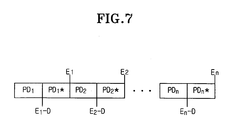
- Figure 7 shows an arrangement of the first and second preliminarily decoded data (PDi and PDi*) stored in the output storing part 334 according to the preferred embodiment of the present invention.
- PD1 and PD1* are the data decoded according to the first possible frame length (E1).
- PD2 and PD2* are the data decoded according to the second possible frame length (E2).
- PDn and PDn* are the data decoded according to the n-th possible frame length (En). Accordingly, if the frame length determined by the frame length determining part 332 is E2, then the corresponding decoded data are PD1, PD2, and PD2*.
- the decoding apparatus and method of the present invention even when the frame length of the data is unknown, the data can be accurately decoded. Secondly, accurate data decoding is performed without deteriorating decoding efficiency. Thirdly, the memory can be utilized more efficiently.
Landscapes
- Physics & Mathematics (AREA)
- Probability & Statistics with Applications (AREA)
- Engineering & Computer Science (AREA)
- Theoretical Computer Science (AREA)
- Compression Or Coding Systems Of Tv Signals (AREA)
- Compression, Expansion, Code Conversion, And Decoders (AREA)
- Error Detection And Correction (AREA)
- Detection And Correction Of Errors (AREA)
- Detection And Prevention Of Errors In Transmission (AREA)
Abstract
Description
Claims (9)
- An apparatus for decoding data of unknown frame length, comprising:a preliminary decoding part (310) for decoding input data into preliminarily decoded data according to each of the possible frame lengths; anda decoded data outputting part (330) for selectively outputting data that correspond to a frame length detected from the input data, from among the preliminarily decoded data which are decoded by the preliminary decoding part according to each of the possible frame lengths.
- The decoding apparatus of claim 1, wherein the preliminary decoding part (316) comprises:a branch metrics calculating part (311) for calculating a set of branch metrics by comparing the input data with a standard level;an ACS (Adding, Calculating & Selecting) part (312) for obtaining path metrics of a current state by adding path metrics of a previous state to the set of branch metrics, and from the path metrics, selectively outputting an optimum path of the current state as path selection data;a path metrics storing part (313) for storing the path metrics of the current state calculated by the ACS part;a tracebacked data storing part (314) for storing the path selection data output from the ACS part, and tracebacking the path selection data , and sequentially outputting the tracebacked data as preliminarily decoded data; anda traceback controlling part (315) for controlling the tracebacking of the tracebacked data storing part according to each of the possible frame lengths.
- The decoding apparatus of claim 1 or 2, wherein the decoded data outputting part (330) comprises:a frame length determining part (332) for detecting the frame length based on the input data;an output storing part (334) for storing the preliminarily decoded data output from the tracebacked data storing part; andan output controlling part (336) for controlling the output storing part so as to output decoded data corresponding to the detected frame length.
- A method for decoding data of unknown frame length, comprising the steps of:(a) decoding the input data into preliminarily decoded data according to each of the possible frame lengths; and(b) selectively outputting data corresponding to the frame length detected based on the input data, from among the preliminarily decoded data which are decoded according to each of the possible frame lengths.
- The decoding method of claim 4, wherein the preliminarily decoding step (a) comprises the sub-steps of:(a1) calculating a set of branch metrics by comparing the input data with a standard level;(a2) obtaining path metrics of a current state by adding path metrics of a previous state to the set of branch metrics, and from the path metrics, selectively outputting an optimum path of the current state as path selection data;(a3) storing the path selection data; and(a4) tracebacking the path selection data according to each of the possible frame lengths, and sequentially outputting the tracebacked data as preliminarily decoded data.
- The decoding method of claim 5, wherein the tracebacking step (a4) comprises the sub-steps of:(a41) initializing a data parameter for counting the path selection data, a frame length indicating parameter for indicating the possible frame lengths, and frame length parameter for indicating the possible frame lengths;(a42) increasing the data parameter;(a43) storing a path selection data corresponding to the data parameter;(a44) comparing the data parameter with the frame length parameter;(a45) if the data parameter is different from the frame length parameter, comparing the data parameter with a decoding depth, and, if the data parameter is smaller than the decoding depth, performing the data parameter increasing sub-step (a42);(a46) if the data parameter equals to, or is greater than the decoding depth, firstly tracebacking the path selection data, and sequentially outputting a lastly tracebacked bit of the data as first preliminarily decoded data, and performing the data parameter increasing sub-step (a42);(a47) if the data parameter equals the frame length parameter, secondly tracebacking the path selection data, and sequentially outputting all the tracebacked bits of data as second preliminarily decoded data;(a48) after completion of the sub-step (a47), comparing the frame length parameter with a longest possible frame length, and, if the frame length parameter equals the longest possible frame length, ending the tracebacking step (a4); and(a49) if the frame length parameter is different from the longest possible frame length, increasing the frame length indicating parameter, and performing the data parameter increasing sub-step (a42).
- The decoding method of claim 6, wherein the decoded data outputting step (b) comprises the sub-steps of:(b1) detecting a frame length from the input data; and(b2) among the first and second preliminarily decoded data output in the sub-steps (a46 and a47), selectively outputting data corresponding to the detected frame length, as final decoded data.
- The decoding method of claim 7, wherein the frame length determining sub-step (b1) detects the frame length by using one of a Cyclic Redundancy Check, a zero path metric, and a minimum path metric.
- The decoding method of claim 7, wherein the decoded data outputting step (b2) comprises the sub-steps of:(b21) initializing a preliminarily decoded data indicating parameter;(b22) increasing the preliminarily decoded data indicating parameter;(b23) if the preliminarily decoded data indicating parameter is smaller than the detected frame length, selectively outputting the data, among the first preliminarily decoded data, that are indicated by the preliminarily decoded data indicating parameter, and performing the preliminarily decoded data indicating parameter increasing sub-step (b22); and(b24) if the preliminarily decoded data indicating parameter equals to the detected frame length, selectively outputting the data, among the first and the second preliminarily decoded data, that are indicated by the frame length indicating parameter.
Applications Claiming Priority (2)
| Application Number | Priority Date | Filing Date | Title |
|---|---|---|---|
| KR2000066862 | 2000-11-10 | ||
| KR1020000066862A KR100742341B1 (en) | 2000-11-10 | 2000-11-10 | Apparatus for decoding data of unknown frame length and control method thereof |
Publications (2)
| Publication Number | Publication Date |
|---|---|
| EP1206042A2 true EP1206042A2 (en) | 2002-05-15 |
| EP1206042A3 EP1206042A3 (en) | 2004-03-03 |
Family
ID=19698416
Family Applications (1)
| Application Number | Title | Priority Date | Filing Date |
|---|---|---|---|
| EP01306702A Withdrawn EP1206042A3 (en) | 2000-11-10 | 2001-08-06 | Apparatus and method for decoding data of unknown frame length |
Country Status (5)
| Country | Link |
|---|---|
| US (1) | US7450667B2 (en) |
| EP (1) | EP1206042A3 (en) |
| JP (1) | JP3612048B2 (en) |
| KR (1) | KR100742341B1 (en) |
| CN (1) | CN1181638C (en) |
Families Citing this family (3)
| Publication number | Priority date | Publication date | Assignee | Title |
|---|---|---|---|---|
| JP4580927B2 (en) * | 2004-05-27 | 2010-11-17 | パナソニック株式会社 | Viterbi decoding apparatus and Viterbi decoding method |
| KR100829558B1 (en) * | 2005-01-12 | 2008-05-14 | 삼성전자주식회사 | Scalable audio data arithmetic decoding method and apparatus, and method for truncating audio data bitstream |
| CN110365342B (en) * | 2019-06-06 | 2023-05-12 | 中车青岛四方机车车辆股份有限公司 | Waveform decoding method and device |
Family Cites Families (12)
| Publication number | Priority date | Publication date | Assignee | Title |
|---|---|---|---|---|
| US5396516A (en) * | 1993-02-22 | 1995-03-07 | Qualcomm Incorporated | Method and system for the dynamic modification of control paremeters in a transmitter power control system |
| US5509020A (en) * | 1993-05-27 | 1996-04-16 | Sony Corporation | Viterbi decoding apparatus and methods |
| JP3393679B2 (en) * | 1993-07-28 | 2003-04-07 | 株式会社リコー | Color image processing device |
| KR960039670A (en) * | 1995-04-14 | 1996-11-25 | 김광호 | Viterbi decoding method using specified status |
| JP3233847B2 (en) | 1996-02-23 | 2001-12-04 | 沖電気工業株式会社 | Viterbi decoding method and Viterbi decoding circuit |
| KR970068627A (en) * | 1996-03-22 | 1997-10-13 | 구자홍 | Optimized Variable Length Table Device and Optimum Length Value Calculation Method |
| CN1194475C (en) | 1996-06-24 | 2005-03-23 | Ntt移动通信网株式会社 | Data transmitting method, data transmitting system, transmitter and receiver |
| US5978414A (en) * | 1996-07-03 | 1999-11-02 | Matsushita Electric Industrial Co., Ltd. | Transmission rate judging unit |
| US5928377A (en) * | 1996-10-04 | 1999-07-27 | Motorola, Inc. | Method and apparatus for data transmission through manipulation of encoding formats |
| BRPI9904789B8 (en) * | 1998-02-14 | 2016-09-13 | Samsung Electronics Co Ltd | code division multiple access system, cdma, and processes for transmitting and receiving messages of at least two different frame durations |
| JP3260714B2 (en) | 1998-12-24 | 2002-02-25 | エヌイーシーマイクロシステム株式会社 | Viterbi decoding device and Viterbi decoding method |
| JP2002076923A (en) | 2000-08-30 | 2002-03-15 | Sony Corp | Signal processing apparatus and method, and recording medium |
-
2000
- 2000-11-10 KR KR1020000066862A patent/KR100742341B1/en not_active Expired - Fee Related
-
2001
- 2001-07-03 US US09/897,732 patent/US7450667B2/en not_active Expired - Fee Related
- 2001-08-06 EP EP01306702A patent/EP1206042A3/en not_active Withdrawn
- 2001-09-04 JP JP2001267595A patent/JP3612048B2/en not_active Expired - Fee Related
- 2001-09-04 CN CNB011329084A patent/CN1181638C/en not_active Expired - Fee Related
Also Published As
| Publication number | Publication date |
|---|---|
| KR100742341B1 (en) | 2007-07-25 |
| CN1353520A (en) | 2002-06-12 |
| JP3612048B2 (en) | 2005-01-19 |
| CN1181638C (en) | 2004-12-22 |
| US7450667B2 (en) | 2008-11-11 |
| KR20020036607A (en) | 2002-05-16 |
| US20020057747A1 (en) | 2002-05-16 |
| JP2002171242A (en) | 2002-06-14 |
| EP1206042A3 (en) | 2004-03-03 |
Similar Documents
| Publication | Publication Date | Title |
|---|---|---|
| AU2002217598B2 (en) | Apparatus and method for stopping iterative decoding in a CDMA mobile communication system | |
| US8074151B1 (en) | Correcting errors in disk drive read back signals by iterating with the reed-solomon decoder | |
| US9203887B2 (en) | Bitstream processing using coalesced buffers and delayed matching and enhanced memory writes | |
| US20110271166A1 (en) | Pipeline architecture for maximum a posteriori (map) decoders | |
| JP2923430B2 (en) | Operation method of cyclic Viterbi decoder | |
| CN1679267A (en) | Parallel processing of decoding and of a cyclic redundancy check when mobile radio signals are received | |
| JP5058806B2 (en) | Puncturing / depuncturing using compressed differential puncture patterns | |
| EP1206042A2 (en) | Apparatus and method for decoding data of unknown frame length | |
| US20010034871A1 (en) | Decoding apparatus and decoding method | |
| EP1239595A3 (en) | Packet based ATM CRC-32 calculator | |
| US8332720B2 (en) | Apparatus and method for decoding in mobile communication system | |
| JP2003526986A (en) | Arithmetic decoding of arithmetically encoded information signals | |
| US7080307B2 (en) | Error correction decoder with correction of lowest soft decisions | |
| JPH06284018A (en) | Viterbi decoding method and error correcting and decoding device | |
| EP0472730B1 (en) | Data compression and restoration method and device therefor | |
| US20040261005A1 (en) | Algorithm for a memory-based Viterbi decoder | |
| KR20020018092A (en) | Signal processing apparatus, signal processing method and recording medium | |
| EP1176726A1 (en) | Decoder | |
| US7751138B1 (en) | Correcting errors in disk drive read back signals by iterating with the Reed-Solomon decoder | |
| TW200540609A (en) | System and method for detecting codeword errors in error correction code or cyclic redundancy check code | |
| JPH08251036A (en) | Error correction decoding method | |
| JP5035047B2 (en) | Image processing device | |
| JPH0537983A (en) | Learning remote controller | |
| US20060239569A1 (en) | System to rapidly compress and decompress binary image and method thereof | |
| JP2001244825A (en) | Decoder |
Legal Events
| Date | Code | Title | Description |
|---|---|---|---|
| PUAI | Public reference made under article 153(3) epc to a published international application that has entered the european phase |
Free format text: ORIGINAL CODE: 0009012 |
|
| 17P | Request for examination filed |
Effective date: 20010821 |
|
| AK | Designated contracting states |
Kind code of ref document: A2 Designated state(s): AT BE CH CY DE DK ES FI FR GB GR IE IT LI LU MC NL PT SE TR |
|
| AX | Request for extension of the european patent |
Free format text: AL;LT;LV;MK;RO;SI |
|
| PUAL | Search report despatched |
Free format text: ORIGINAL CODE: 0009013 |
|
| AK | Designated contracting states |
Kind code of ref document: A3 Designated state(s): AT BE CH CY DE DK ES FI FR GB GR IE IT LI LU MC NL PT SE TR |
|
| AX | Request for extension of the european patent |
Extension state: AL LT LV MK RO SI |
|
| RIC1 | Information provided on ipc code assigned before grant |
Ipc: 7H 04L 1/00 B Ipc: 7H 04L 25/02 B Ipc: 7H 03M 13/41 A |
|
| 17Q | First examination report despatched |
Effective date: 20040921 |
|
| AKX | Designation fees paid |
Designated state(s): DE FR GB |
|
| STAA | Information on the status of an ep patent application or granted ep patent |
Free format text: STATUS: THE APPLICATION IS DEEMED TO BE WITHDRAWN |
|
| 18D | Application deemed to be withdrawn |
Effective date: 20060529 |