EP1205942A1 - Proton conducting material and method for preparing the same, and electrochemical device using the same - Google Patents
Proton conducting material and method for preparing the same, and electrochemical device using the same Download PDFInfo
- Publication number
- EP1205942A1 EP1205942A1 EP00946422A EP00946422A EP1205942A1 EP 1205942 A1 EP1205942 A1 EP 1205942A1 EP 00946422 A EP00946422 A EP 00946422A EP 00946422 A EP00946422 A EP 00946422A EP 1205942 A1 EP1205942 A1 EP 1205942A1
- Authority
- EP
- European Patent Office
- Prior art keywords
- proton
- proton conductor
- groups
- carbonaceous material
- carbon
- Prior art date
- Legal status (The legal status is an assumption and is not a legal conclusion. Google has not performed a legal analysis and makes no representation as to the accuracy of the status listed.)
- Granted
Links
Images









Classifications
-
- B—PERFORMING OPERATIONS; TRANSPORTING
- B82—NANOTECHNOLOGY
- B82Y—SPECIFIC USES OR APPLICATIONS OF NANOSTRUCTURES; MEASUREMENT OR ANALYSIS OF NANOSTRUCTURES; MANUFACTURE OR TREATMENT OF NANOSTRUCTURES
- B82Y30/00—Nanotechnology for materials or surface science, e.g. nanocomposites
-
- H—ELECTRICITY
- H01—ELECTRIC ELEMENTS
- H01B—CABLES; CONDUCTORS; INSULATORS; SELECTION OF MATERIALS FOR THEIR CONDUCTIVE, INSULATING OR DIELECTRIC PROPERTIES
- H01B1/00—Conductors or conductive bodies characterised by the conductive materials; Selection of materials as conductors
- H01B1/04—Conductors or conductive bodies characterised by the conductive materials; Selection of materials as conductors mainly consisting of carbon-silicon compounds, carbon or silicon
-
- H—ELECTRICITY
- H01—ELECTRIC ELEMENTS
- H01B—CABLES; CONDUCTORS; INSULATORS; SELECTION OF MATERIALS FOR THEIR CONDUCTIVE, INSULATING OR DIELECTRIC PROPERTIES
- H01B1/00—Conductors or conductive bodies characterised by the conductive materials; Selection of materials as conductors
- H01B1/06—Conductors or conductive bodies characterised by the conductive materials; Selection of materials as conductors mainly consisting of other non-metallic substances
- H01B1/12—Conductors or conductive bodies characterised by the conductive materials; Selection of materials as conductors mainly consisting of other non-metallic substances organic substances
- H01B1/122—Ionic conductors
-
- H—ELECTRICITY
- H01—ELECTRIC ELEMENTS
- H01M—PROCESSES OR MEANS, e.g. BATTERIES, FOR THE DIRECT CONVERSION OF CHEMICAL ENERGY INTO ELECTRICAL ENERGY
- H01M8/00—Fuel cells; Manufacture thereof
- H01M8/10—Fuel cells with solid electrolytes
- H01M8/1004—Fuel cells with solid electrolytes characterised by membrane-electrode assemblies [MEA]
-
- H—ELECTRICITY
- H01—ELECTRIC ELEMENTS
- H01M—PROCESSES OR MEANS, e.g. BATTERIES, FOR THE DIRECT CONVERSION OF CHEMICAL ENERGY INTO ELECTRICAL ENERGY
- H01M8/00—Fuel cells; Manufacture thereof
- H01M8/10—Fuel cells with solid electrolytes
- H01M8/1016—Fuel cells with solid electrolytes characterised by the electrolyte material
-
- H—ELECTRICITY
- H01—ELECTRIC ELEMENTS
- H01M—PROCESSES OR MEANS, e.g. BATTERIES, FOR THE DIRECT CONVERSION OF CHEMICAL ENERGY INTO ELECTRICAL ENERGY
- H01M2300/00—Electrolytes
- H01M2300/0017—Non-aqueous electrolytes
- H01M2300/0065—Solid electrolytes
-
- H—ELECTRICITY
- H01—ELECTRIC ELEMENTS
- H01M—PROCESSES OR MEANS, e.g. BATTERIES, FOR THE DIRECT CONVERSION OF CHEMICAL ENERGY INTO ELECTRICAL ENERGY
- H01M4/00—Electrodes
- H01M4/86—Inert electrodes with catalytic activity, e.g. for fuel cells
- H01M4/8605—Porous electrodes
-
- Y—GENERAL TAGGING OF NEW TECHNOLOGICAL DEVELOPMENTS; GENERAL TAGGING OF CROSS-SECTIONAL TECHNOLOGIES SPANNING OVER SEVERAL SECTIONS OF THE IPC; TECHNICAL SUBJECTS COVERED BY FORMER USPC CROSS-REFERENCE ART COLLECTIONS [XRACs] AND DIGESTS
- Y02—TECHNOLOGIES OR APPLICATIONS FOR MITIGATION OR ADAPTATION AGAINST CLIMATE CHANGE
- Y02E—REDUCTION OF GREENHOUSE GAS [GHG] EMISSIONS, RELATED TO ENERGY GENERATION, TRANSMISSION OR DISTRIBUTION
- Y02E60/00—Enabling technologies; Technologies with a potential or indirect contribution to GHG emissions mitigation
- Y02E60/30—Hydrogen technology
- Y02E60/50—Fuel cells
Definitions
- the present invention relates to a proton (H + ) conductor, a production method thereof, and an electrochemical device using the proton conductor.
- the reason why the perfluorosulfonate resin can exhibit a very high proton conductivity even at ordinary temperature is that protons ionized from sulfonate groups of the resin are bonded (hydrogen-bonded) with moisture already entrapped in a polymer matrix in a large amount, to produce protonated water, that is oxonium ions (H 3 O + ), and the protons in the form of the oxonium ions can smoothly migrate in the polymer matrix.
- a composite metal oxide having a perovskite structure such as SrCeO 3 doped with Yb exhibits a proton conductivity without use of moisture as a migration medium.
- the conduction mechanism of this composite metal oxide has been considered such that protons are conducted while being singly channeled between oxygen ions forming a skeleton of the perovskite structure.
- the conductive protons are not originally present in the composite metal oxide but are produced by the following mechanism: namely, when the perovskite structure contacts the steam contained in an environmental atmospheric gas, water molecules at a high temperature react with oxygen deficient portions which have been formed in the perovskite structure by doping Yb or the like, to generate protons.
- the matrix material such as the above-identified perfluorosulfonate resin must be continuously placed in a sufficiently wet state during use in order to keep a high proton conductivity.
- a configuration of a system such as, a fuel cell using such a matrix material, requires a humidifier and various accessories, thereby giving rise to problems in enlarging the scale of the system and raising the cost of the system.
- the system using the matrix material has a further problem that the range of the operational temperature must be limited for preventing the freezing or boiling of the moisture contained in the matrix.
- the composite metal oxide having the perovskite structure has a problem that the operational temperature must be kept at a high temperature of 500°C or more for ensuring an effective proton conductivity.
- the related art proton conductors have the problems that the atmosphere dependence on the performance of each conductor becomes high, and more specifically, moisture or stream must be supplied to the conductor to ensure the performance of the conductor, and further, the operational temperature of the conductor is excessively high or the range of the operational temperature is limited.
- a first object of the present invention is to provide a proton conductor which is usable in a wide temperature range including ordinary temperature and has a low atmosphere dependence, that is, it requires no moisture despite whether or not the moisture is a migration medium; to provide a method of producing the proton conductor; and to provide an electrochemical device that employs the proton conductor.
- a second object of the present invention is to provide a proton conductor which exhibits a film formation ability while keeping the above-described performance, to be thereby usable as a thin film having a high strength, a gas permeation preventive or impermeable performance, and a good proton conductivity, to provide a method of producing the proton conductor, and to provide an electrochemical device using the proton conductor.
- the present invention provides a proton conductor comprising a carbonaceous material essentially comprising a carbon, into which proton dissociating groups are introduced.
- the present invention also provides a method of producing a proton conductor, comprising the step of introducing proton dissociating groups into a carbonaceous material essentially comprising a carbon.
- the present invention also provides an electrochemical device comprising a first electrode, a second electrode, and a proton conductor that is positioned between the first and second electrodes, the proton conductor comprising a carbonaceous material essentially comprising a carbon, into which proton dissociating groups are introduced.
- the conductor of the present invention since the conductor essentially comprises the carbonaceous material having a proton dissociating capability, protons are easily transferred or conducted, even in a dry state, and further, the protons can exhibit a high conductivity in a wide temperature range (at least in a range of about 160°C to -40°C) that includes ordinary temperatures. While the proton conductor of the present invention has a sufficient proton conductivity even in a dry state, it can also have a proton conductivity in a wet state. The moisture may come from the outside.
- the electrochemical device of the present invention since the proton conductor is held between the first and second electrodes, the electrochemical device can eliminate the need for a humidifier and the like which are necessary for known fuel cells that require moisture as a migration medium so as to enhance proton conductivity. Therefore, the device construction of the present invention has an advantageously smaller and more simplified construction.
- a proton conductor essentially comprises a carbonaceous material essentially comprising a carbon, into which proton dissociating groups are introduced.
- dissociating groups means “functional groups capable of transferring protons in reaction to ionization”.
- protons are migrated between the proton dissociating groups to manifest ionic conductivity.
- any suitable material may be used provided that it is mainly composed of carbon. It is however necessary that ion conduction after introducing proton dissociating groups is larger than electron conduction.
- the fullerene derivative as a matrix fullerene derivative, may specifically be enumerated by carbon clusters, as aggregates of carbon atoms, and a carbonaceous material containing a diamond structure.
- fullerene a fullerene structure at least a portion of which has an open end, and a carbonaceous tubular material, or so-called carbon nano-tube, are preferred.
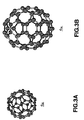
- the kind of fullerene molecule or molecules used as a base material for the fullerene derivative to which proton dissociating groups are introduced is not particularly limited insofar as the fullerene molecules are characterized as a spherical carbon cluster or carbon clusters that generally include the C 36 , C 60 (see Fig. 3A), C 70 (see Fig. 3B), C 76 , C 78 , C 80 , C 82 , and C 84 fullerene molecules. It should be noted that a mixture of these fullerene molecules or other like fullerene molecules may also be used as the base material of the fullerene derivative.
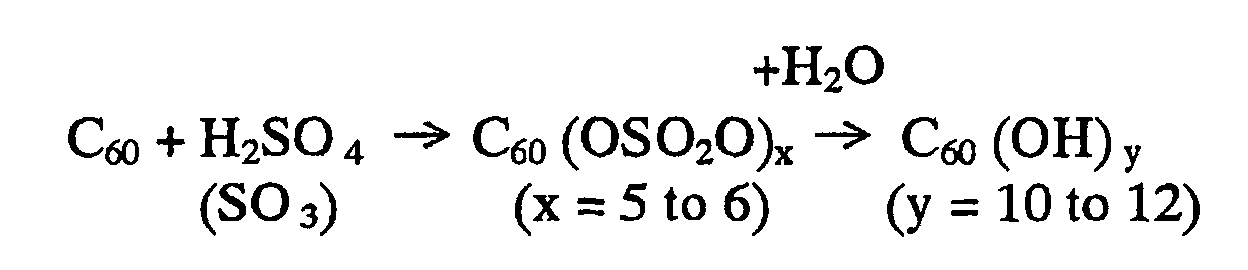
- the present invention has uniquely and advantageously examined the proton conductivities of derivatives of these fullerene molecules, and found that a polyhydroxylated fullerene obtained by introducing hydroxyl groups to a number of carbon atoms of a fullerene molecule or molecules exhibits, even in a dry state, a high proton conductivity in a wide temperature range including an ordinary temperature region, that is, a temperature range from less than the freezing point of water to more than the boiling point of water (at least -40°C to 160°C), and further found that the proton conductivity becomes higher when hydrogensulfate ester groups, namely, -OSO 3 H groups, are introduced, in place of the hydroxyl groups, to the fullerene molecule or molecules.
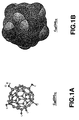
- the polyhydroxylated fullerene or fullerenol is a generic name of a fullerene-based compound that has a structure in which a plurality of hydroxyl groups are added to the fullerene molecule or molecules as shown in Figs. 1A and 1B.
- a plurality of hydroxyl groups are added to the fullerene molecule or molecules as shown in Figs. 1A and 1B.
- some variations can be considered.
- the first synthesis example of the polyhydroxylated fullerene has been reported by Chiang, et al. in 1992. (L. Y. Chiang, J. W. Swirczewski, C. S. Hsu, S. K. Chowdhury, S. Cameron and K. Creengan, J.
- a fullerene derivative can be formed from an aggregate of the polyhydroxylated fullerene molecules, as schematically shown in Fig. 2A, in which the hydroxyl groups of each of these molecules adjacent to each other (in the figure, ⁇ designates the polyhydroxylated fullerene molecule) act on each other, thereby exhibiting a high proton conductivity (that is, a high transferability of H + between the phenolic hydroxyl groups of the polyhydroxylated fullerene molecule or molecules) within the bulk or aggregate of the polyhydroxylated fullerene molecules.
- the aggregate of fullerene molecules wherein each or a number of the molecules have a plurality of -OSO 3 H groups may be used in place of the aggregate of polyhydroxylated fullerene molecules as previously discussed.
- the fullerene-based compound in which the OH groups are replaced with the -OSO 3 H groups as show in Fig. 2B, that is, a hydrogensulfate-esterificated fullerenol (polyhydroxyl hydrogen sulfated fullerene) was reported by Chiang, et al. in 1994. (L. Y. Chiang, L. Y. Wang, J. W. Swirczewski, S. Soled and S. Cameron, J. Org. Chem. 59, 3960 (1994)).
- the molecules of polyhydroxyl hydrogen sulfated fullerene may contain only the -OSO 3 H groups or contain a number of the -OSO 3 H groups and a number of the hydroxyl groups.
- an aggregate of a large number of fullerene derivative molecules that contain the hydroxyl groups or -OSO 3 H groups or combinations thereof is prepared. Since the protons derived from a large amount of hydroxyl groups or -OSO 3 H groups or combinations thereof that are originally contained in the molecules directly migrate, the proton conductivity of the bulk or aggregate of these fullerene molecules is self-determined without the need of entrapment of hydrogen resulting from steam molecules or protons from an atmosphere and also without the need of supply of water from an external environment, particularly, the need of absorption of water or the like from atmospheric air. In other words, the proton conductivity of the aggregate of the fullerene derivative molecules that contain the functional groups is not limited by the environmental atmosphere.
- the fullerene molecules as the base material of the fullerene derivative particularly have an electrophilic property, which property may allow not only the -OSO 3 H groups having a high acidity but also the hydroxyl groups to largely promote the ionization of hydrogen. This is one of the reasons why the proton conductor of an embodiment of the present invention exhibits an excellent proton conductivity.
- the proton conductor of an embodiment of the present invention since a large amount of hydroxyl groups or -OSO 3 H groups or combinations thereof can be introduced to each or a number of the fullerene molecules of the fullerene derivative, the numerical density of protons related to conductivity per unit volume of the conductor becomes very large. This is another reason why the proton conductor in this embodiment exhibits an effective conductivity.
- the fullerene derivative of the proton conductor in this embodiment are mostly or substantially composed of carbon atoms
- the fullerene derivative is light in weight, not easily decomposed, and relatively pure, that is, relatively free of contaminants that may negatively impact its desirable proton conductivity properties.
- the cost that is required to produce the fullerene derivative has been rapidly lowered. Accordingly, the fullerene derivative may be regarded as a desirable carbonaceous material based on resource, environmental, economic or other desirable considerations as previously discussed.
- the proton dissociating groups are not limited to the hydroxyl or -OSO 3 H functional groups.
- the proton dissociating groups can be expressed by a chemical formula of -XH where X is an arbitrary atom or atomic group having a bivalent bond, and further the group can be expressed by a chemical formula of -OH or -YOH where Y is an arbitrary atom or atomic group having a bivalent bond.
- the proton dissociating groups are preferably at least one of the -OH and -OSO 3 H, and -COOH, -SO 3 H and -OPO(OH) 3 functional groups.
- electron attractive groups such as, nitro groups, carbonyl groups and carboxyl groups, nitrile groups, alkyl halide groups or halogen atoms (fluorine or chlorine atoms) may be preferably introduced together with the proton dissociating groups, to carbon atoms of the fullerene molecule or molecules.
- Fig. 2C shows a fullerene molecule to which Z is introduced in addition to -OH, where Z represents at least one of the -NO 2 , -CN, -F, -Cl,-COOR, -CHO, -COR, -CF 3 , or -SO 3 CF 3 (R is an alkyl group) electron attractive groups.
- the number of the proton dissociating groups can be freely selected insofar as it is less than the number of the carbon atoms of the fullerene molecule or molecules, and preferably may include 5 functional groups or more.
- the number of functional groups is more preferably half or less than half of the number of carbon atoms of a fullerene molecule or molecules.
- desired proton dissociating groups may be introduced to carbon atoms of each or a number of the fullerene molecules of the fullerene derivative by subjecting a powder of the fullerene molecules to known treatments, such as, acid treatment and hydrolysis suitably in combination.
- the powder of the fullerene derivative thus obtained can be compacted into a desired shape, for example, into a pellet.
- the compacting of the powder can be performed without use of any binder, which is effective to enhance the proton conductivity and to reduce the weight of the proton conductor, resulting in a molded material that substantially contains the fullerene derivative.
- the proton conductor in this embodiment can be suitably used for various electrochemical devices.
- the present invention can be preferably applied to an electrochemical device having a basic structure that includes first and second electrodes and a proton conductor held therebetween, wherein the proton conductor is configured as the proton conductor in this embodiment.
- the proton conductor in this embodiment can be preferably applied to an electrochemical device in which at least one of the first and second electrodes is a gas electrode, or an electrochemical device in which at least one of the first and second electrodes is an active electrode.
- Fig. 8 is a schematic view showing the proton conductance of the fuel cell in which a proton conducting portion 1 is held between a first electrode (for example, hydrogen electrode) 1 and a second electrode (for example, oxygen electrode) 3, wherein protons dissociated or transferred in the proton conducting portion 1 migrate from the first electrode 2 side to the second electrode 3 side along the direction shown by an arrow in Fig. 8.
- a first electrode for example, hydrogen electrode
- a second electrode for example, oxygen electrode
- Fig. 9 is a schematic view showing one example of the fuel cell using the proton conductor in this embodiment.
- the fuel cell is configured such that a negative electrode (fuel electrode or hydrogen electrode) 2 to or in which a catalyst 2a is closely overlapped or dispersed and which has a terminal 8 faces to a positive electrode (oxygen electrode) 3 to or in which a catalyst 3a is closely overlapped or dispersed and which has a terminal 9, and a proton conducting portion 1 is held therebetween.
- hydrogen is supplied from an inlet 12 on the negative electrode 2 side, and is discharged from an outlet 13 (which is sometimes not provided) on the negative electrode 2 side.
- fuel (H 2 ) 14 passes through a flow passage 15
- protons are generated.
- the protons migrate together with protons generated in the proton conducting portion 1, onto the positive electrode 3 side, and react with oxygen (air) 19, which has been supplied in a flow passage 17 from an inlet 16 and flows toward an outlet 18, to generate a desired electromotive force.
- the proton conductivity becomes higher.
- Another embodiment of the present invention will be described below. Another embodiment is different from the present embodiment in that the above-described fullerene derivative is used in combination with a polymer material. However, the proton conductor of the second embodiment essentially has the same proton conductivity features of the present embodiment.
- a second proton conductor in this embodiment contains the above-described fullerene derivative (into which proton dissociating groups are introduced in carbon atoms constituting fullerene) and a polymer material.
- the polymer material may be one kind or two kinds or more known polymers having a film formation ability.
- the content of the polymer material is generally 50 wt% or less. If the content is more than 50 wt%, the proton conductivity of the fullerene derivative may degrade.
- the second proton conductor in this embodiment contains the fullerene derivative, it can exhibit a proton conductivity comparable to that of the proton conductor of the present embodiment.
- the second proton conductor in this embodiment having a film formation ability derived from the polymer material can be used as a flexible proton conductive thin film having a large strength and a gas impermeable property.
- the thickness of the proton conductive thin film is 300 ⁇ m or less.
- the kind of polymer material is not particularly limited insofar as it does not obstruct the proton conductivity as much as possible (due to the reaction with the fullerene derivative or the like) and has a film formation ability, but may be generally selected from polymers having no electronic conductivity and exhibiting a good stability.
- these polymers may include polyfluorethylene, polyvinylidene fluoride, and polyvinyl alcohol. The reason why polyfluorethylene, polyvinylidene fluoride or polyvinyl alcohol are suitable for the second proton conductor in this embodiment will be described below.
- polyfluorethylene is suitable for the second proton conductor. Even by adding polyfluorethylene to the fullerene derivative in an amount smaller than that of another polymer material, it is possible to easily form a thin film of the second proton conductor having a large strength.
- the content of polyfluorethylene includes 3 wt % or less, preferably, in a range of 0.5 to 1.5 wt%. By adding polyfluorethylene to the fullerene derivative in an amount within the above range, the thin film of the second proton conductor has a thickness that ranges from 1 ⁇ m to 100 ⁇ m.
- polyvinylidene fluoride or polyvinyl alcohol are suitable for the second proton conductor is that it is effective to form a proton conductive thin film having a good gas permeation preventive ability.
- the content of these in this case is preferably in the range of 5 to 15 wt%.
- the thin film of the second proton conductor in this embodiment may be obtained by using a known film formation technique, such as, extrusion molding, filtration, application, etc..
- the second proton conductor in this embodiment can be preferably applied to the electrochemical device to which the proton conductor in the present embodiment is applied.
- the proton conductor in the electrochemical device to which the present embodiment is applied, in which the proton conductor is held between the first and second electrodes, the proton conductor may be replaced with the second proton conductor in this embodiment.
- Fig. 10 is a schematic view showing a hydrogen-air cell to which the second proton conductor in this embodiment is applied.
- a hydrogen electrode 21 faces to an air electrode 22 with a proton conductor 20 formed into a thin film (configured as the second proton conductor) held therebetween, and the outsides of these electrodes 21 and 22 are held between a Teflon plate 24a and a Teflon plate 24b having a number of holes 25 and fixed thereto by way of bolts 26a and 26b and nuts 27a and 27b, and a hydrogen electrode reed 28a and an air electrode reed 28b extending from the electrodes 21 and 22 are extracted to the outside of the cell.
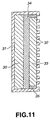
- Fig. 11 is a schematic view showing an electrochemical device to which the second proton conductor in this embodiment is applied.
- a proton conductor 34 (configured as the second proton conductor) is held between a negative electrode 31 having on its inner surface a negative electrode active material layer 30 and a positive electrode (gas electrode) 33 having on its outer surface a gas permeation support 32.
- the negative electrode active material may be configured as a hydrogen absorption alloy or a hydrogen absorption alloy supported by a carbon material such as a fullerene.
- the gas permeation support 32 may be configured as a porous carbon paper.
- the positive electrode 33 may be preferably formed by coating a paste of platinum supported by a powder of carbon. Gaps between the outer ends of the negative electrode 31 and the outer ends of the positive electrode 33 are blocked by gaskets 35. In this electrochemical device, charging can be performed by making water be present on the positive electrode 33 side.
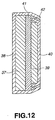
- Fig. 12 is a schematic view showing an electrochemical device to which the second proton conductor in this embodiment is applied.
- a proton conductor 41 formed into a thin film (configured as the second proton conductor) is held between a negative electrode 38 having on its inner surface a negative electrode active material layer 37 and a positive electrode 40 having on its inner surface a positive electrode active material layer 39.
- the positive electrode active material is typically configured as a material essentially comprising nickel hydroxide. Even in this electrochemical device, gaps between the outer ends of the negative electrode 38 and the outer ends of the positive electrode 40 are blocked with gaskets 42.
- Each of the above-described electrochemical devices using the second proton conductor in this embodiment can exhibit a good proton conductive effect on the basis of the same mechanism as that of the electromechanical device using the proton conductor in the present embodiment. Further, since the second proton conductor containing the fullerene derivative in combination with the polymer material having a film formation ability, it can be formed into a thin film having a large strength and a small gas permeability, and therefore, it can exhibit a good proton conductivity.
- the third embodiment is different from the first and second embodiments in that the proton conductor essentially comprises a carbon cluster derivative or derivatives, but is the same or similar to the first and second embodiments in other ways, such as, the basic function of the proton conduction mechanism.
- a third proton conductor in this embodiment essentially comprises a carbon cluster derivative in which the proton dissociating groups are introduced to a number of carbon atoms of each of the clusters or carbon clusters which are used as a base material for the carbon cluster derivative.
- the researches conducted by the present inventor have revealed that, for affording satisfactory proton conductivity to the carbonaceous material, as many proton conduction paths (sites or channels of conduction) as possible need to be provided to the carbonaceous materials. It has been found that satisfactory proton conductivity can be achieved as the entire bulk if a carbon cluster as small in size as possible is used and two or more proton dissociating substituents are introduced on its outer side. In this case, the solid-shaped proton conductor is improved appreciably in acidity.
- the carbon cluster is not deteriorated on oxidation and superior in durability, with the constituent atoms of the carbon cluster being bonded tightly to one another, with the result that the interatomic bond is not collapsed, that is chemical changes are less liable to occur, even if the acidity is high, thus enabling the film structure to be maintained.
- the third proton conductor in this embodiment having the above configuration can exhibit, even in a dry state, a high proton conductivity similar to that of each of the first and second proton conductors in the first and second embodiments.
- the cluster means an aggregate of up to several hundred carbon atoms that are closely bonded together. Due to this aggregated structure, proton conductivity is improved, at the same time as chemical properties are maintained to provide for sufficient film strength and ease with which a layered structure is formed.
- the cluster mainly composed of carbon means an aggregate of up to several hundred carbon atoms that are closely bonded together irrespective of the carbon to carbon molecular-type bonding that exists between the carbon atoms.
- the carbon cluster that is, an aggregate of that substantially contains carbon atoms is not necessarily entirely composed of carbon atoms. In this regard, a collection of atoms, the major part of which is carbon atoms, is herein termed a carbon cluster.
- Fig. 4 shows carbon clusters having spherical structures, spheroid structures, and planar structures similar thereto.
- Fig. 5 shows carbon clusters that have a partially open spherical structure which is characterized by an open end or ends. During production of the fullerene molecules by arc discharge, a large number of carbon clusters having a spherical structure with open ends are generated as sub-products.
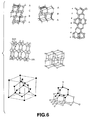
- Fig. 6 shows carbon clusters each having a diamond structure, in which most of the carbon atoms of the carbon cluster are in the SP 3 bonding.
- a carbon cluster material in which most of the carbon atoms are in the SP 2 bonding if it has a planar structure of graphite or has all or part of as fullerene or nano-tube structure, is undesirable as the base of the proton conductor because it has often an electronic conductivity due to the SP 2 bonding.
- a fullerene or nano-tube structure that has the SP 2 bonding often has no electronic conductivity because it also partially contains an element that exhibits the desirable SP 3 bonding, and therefore, it is desirable as the base of a proton conductor.
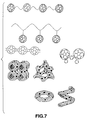
- Fig. 7 shows carbon clusters which are bonded to each other.
- the third proton conductor in this embodiment, it is required to introduce proton dissociating groups to the clusters or carbon clusters. Further, it may be desirable to further introduce electronic attractive groups to each of the clusters or carbon cluster.
- the proton dissociating groups may be introduced to each carbon cluster in accordance with the following production method.
- a carbon cluster derivative can be easily obtained by producing carbon clusters composed of carbon powder by arc discharge of a carbon-based electrode, and suitably subjecting the carbon clusters to acid treatment, typically using sulfuric acid and hydrolysis, and also subjected to sulfonation or phosphatation so as to introduce the sulfur and phosphorus-based functional groups, respectively.
- the carbon cluster derivative can be compacted into a suitable shape, for example, into a pellet.
- the length of the major axis of each of the carbon clusters as the base of the carbon cluster derivatives of the proton conductors may be 100 nm or less, preferably, 100 ⁇ or less, and the number of functional groups to be introduced therein may be preferably 2 or more.
- the carbon cluster used for the third proton conductor may be of a cage structure at least part of which has open ends.
- the carbon clusters having such a defect structure has a reactivity similar to that of a fullerene and also has a higher reactivity at its defect portions, that is, its open end portion or portions. Accordingly, the use of carbon clusters each having such a defect structure, that is, open end or ends, as the base of the third proton conductor can promote the introduction of proton dissociating substituents by acid treatment or the like, that is, increase the introduction efficiency of the proton dissociating substituents, thereby enhancing proton conductivity of the third proton conductor. Further, it is possible to synthesize a larger amount of carbon clusters as compared with fullerene molecules, and hence to produce the carbon clusters at a very low cost.
- the kinds of functional groups and the electron attractive groups to be introduced to each of the carbon clusters as the base of the third proton conductor in this embodiment may be the same as those described above.
- the third proton conductor in this embodiment can be suitably applied to various kinds of electrochemical devices, such as, a fuel cell.
- the configuration of the electrochemical device may be basically the same as that of the electromechanical device to which the first or second proton conductor in the first or second embodiment is applied except that the first or second proton conductor is replaced with the third proton conductor. Since the third proton conductor in this embodiment can also exhibit a good proton conductivity even in a dry state, it is possible to eliminate the need of providing any humidifier or other like instrument that produces an external migration, such as, water or steam, and hence to simplify the system configuration and reduce the weight of the system.
- a fourth embodiment of the present invention will be described below in which the proton conductor includes a tubular carbonaceous material derivative.
- the tubular carbonaceous material derivative includes a tubular carbonaceous material as its base material.
- the tubular carbonaceous material includes a CNT material that is composed of nano-tube molecules that each have a diameter of about several nanometers or less, typically, in a range of 1 to 2 nanometers.
- the tubular carbonaceous material includes a CNF material that is composed of nano-fiber molecules which each have a diameter of several nano-meters or more which may reach up to 1 mm.
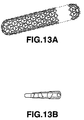
- the CNT material includes a single-wall carbon nano-tube (SWCNT) material that is composed of nano-tube molecules each being formed by a single layer or a multi-wall carbon nano-tube (MWCNT) that is composed of nano-tube molecules that are each formed of two or more layers which are concentrically overlapped.
- SWCNT single-wall carbon nano-tube
- MWCNT multi-wall carbon nano-tube
- the configurations of the SWCNT and the MWCNT molecules are respectively shown in Figs. 13A and 13B.
- the description of the CNT, the SWCNT and MWCNT materials are illustrative only wherein it is understood that the present invention is not limited to the same.
- the proton dissociating groups that are introduced to the tubular carbonaceous materials in order to form the tubular carbonaceous material derivatives include the same proton dissociating groups as previously discussed in regards to the other embodiment of the present invention.
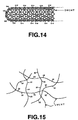
- Fig. 14 shows an example of a tubular carbonaceous material derivative that contains the hydroxyl functional groups.
- Fig. 15 illustrates a number of the tubular carbonaceous molecules or tubular molecules of the tubular carbonaceous material derivative as shown in Fig. 14.
- Fig. 16 illustrates the tubular molecules of another tubular carbonaceous material derivative that includes the -OSO 3 H functional groups.
- Such a tubular carbonaceous material derivative is produced by preparing a halogenated tubular carbonaceous material and subjecting the halogenated material to acid treatment by using sulfuric or nitric acid in order to introduce the -OSO 3 H functional groups to the tubular carbonaceous material so as to form its derivative.
- a hydrolysis technique may be used to introduce hydroxyl groups instead of the -OSO 3 H functional groups. If hydrolysis is used, an acid treatment may follow in order to substitute the hydroxyl groups for different functional groups, such as, the -OSO 3 H functional groups.
- a non-halogenated tubular carbonaceous material is used as a base or raw material so as to form the tubular carbonaceous material derivative, this material may be subjected to acid treatment by using sulfuric or nitric acid as previously discussed. With regards to the halogenated tubular carbonaceous material, fluorine is preferably used.
- the tubular carbonaceous material derivative can be produced not only by the above described wet method but also by the following dry method that utilizes plasma.
- a non-halogenated tubular carbonaceous material is subjected to plasma treatment in an oxygen gas and then subjected to further plasma treatment under a hydrogen gas in order to introduce the proton dissociating groups, typically, hydroxyl groups to the tubular molecules of the tubular carbonaceous material.
- the invention has examined the proton conductivities of these tubular carbonaceous material derivatives and found that these materials provided a high proton conductivity under a varying temperature range that includes the ordinary temperature region, that is, a temperature ranging from less than the freezing point of water to more than the boiling point of water (at least -40°C to 160°C.
- the present invention has further discovered that the proton conductivity is higher for tubular carbonaceous material derivatives that include the hydrogen sulfate as their groups in place of the hydroxyl groups.
- the polyhydroxylated SWCNT material is a generic name of a derivative that has a structure in which a plurality of hydroxyl groups are added to a number of tubular molecules so as to form the SWCNT material as illustrated in Fig. 14.
- a plurality of hydroxyl groups are added to a number of tubular molecules so as to form the SWCNT material as illustrated in Fig. 14.
- some variations are considered to be within the scope of the present invention.
- the present invention has newly discovered that an aggregate of polyhydroxylated tubular molecules, namely, a polyhydroxylated SWCNT material, as illustrated in Figs.
- the object of the present invention may also be achieved by a proton conductor mainly composed of an aggregate mass of a derivative of a carbonaceous tubular material having plural -OSO 3 H groups, such as an aggregate mass of SWCNT having plural -OSO 3 H groups.
- a proton conductor mainly composed of an aggregate mass of a derivative of a carbonaceous tubular material having plural -OSO 3 H groups, such as an aggregate mass of SWCNT having plural -OSO 3 H groups.
- hydrogen sulfate ester SWCNT in which OSO 3 H groups are substituted for OSO 3 H groups, may contain only OSO 3 H groups, as shown in Fig.16, or may simultaneously contain plural hydroxy groups and plural OSO 3 H groups in one molecule.
- the proton conductivity of the tubular carbonaceous material derivative that includes an aggregate of the tubular molecules having a number of functional groups is not limited by the environmental surroundings. In this way, an additional source of protons from migrating mediums, such as, water is not necessary in order to realize the desirable effects of the present invention.
- the reason why the tubular carbonaceous material derivative can exhibit such a desirable proton conductivity effect is that a large amount of the functional groups can be introduced to a number of the tubular molecules of the tubular carbonaceous material so that the proton density which corresponds to the conductivity per unit volume of the conductor is very large in size.
- tubular carbonaceous material derivative is mostly composed of carbon atoms of each of the tubular molecules and therefore is light in weight and does not decompose as readily nor contain any contaminants.
- the tubular carbonaceous material that is used for a base material for producing the derivative thereof can be produced by catalytic thermal decomposition of hydrocarbons at a low cost.
- the tubular carbonaceous material is regarded as a material that is desirable for reasons of resource, environment and economy. (Carbon Vol. 36, No. 11, pp. 1603-1612, 1998).
- the proton dissociating groups are not limited to the hydroxyl or -OSO 3 H functional groups as long as they present preferable proton conductivity.
- the proton dissociating groups can be expressed by a chemical formula of -XH where X is an arbitrary atom or atomic group having a bivalent bond, and further the group can be expressed by a chemical formula of -OH or -YOH where Y is an arbitrary atom or atomic group having a bivalent bond.
- the proton dissociating groups are preferably at least one of the -OH and -OSO 3 H, and -COOH, -SO 3 H and -OPO(OH) 3 functional groups.
- the proton dissociating groups to be introduced into these derivatives are arranged in a similar manner as in the aforementioned examples.
- electron attractive groups such as, nitro groups, carbonyl groups and carboxyl groups, nitrile groups, alkyl halide groups or halogen atoms (fluorine or chlorine atoms) may be preferably introduced together with the proton dissociating groups, to carbon atoms of the tubular carbonaceous material.
- the -NO 2 , -CN, -F, -Cl,-COOR, -CHO, -COR, -CF 3 , or -SO 3 CF 3 (R is an alkyl group) electron attractive groups can be introduced to SWCNT, as well as the proton dissociating groups such as OH groups.
- the number of proton dissociating groups of the tubular carbonaceous material derivative is limited to the extent that it is less than the number of carbon atoms of the tubular carbonaceous material derivative.
- the number of functional groups may be limited to the extent that is necessary to cancel the electronic conductivity. For example, this number is preferably one or more per ten carbon atoms for a SWCNT material.
- the proton conductor of the present embodiment is mainly composed of the above-mentioned carbonaceous tubular material and may contain other ingredients which are not obstructive to or raise the proton conductivity. Most preferred among these other ingredients is the fullerene derivative having introduced therein the aforementioned proton dissociating groups.
- tubular carbonaceous material derivatives may be desirably formed as a film to be used for an electrochemical device such as a fuel cell.
- These materials can be formed as a film by a known extrusion molding technique and more preferably by dispersing the tubular carbonaceous material derivative in a liquid and filtering the dispersion.
- a solvent such as water is generally used as the liquid.
- the liquid is not particularly limited insofar as the derivative can be dispersed in the liquid.
- the tubular carbonaceous material derivative is deposited in a film shape on the filter.
- the film does not contain any binder and is composed of only the tubular carbonaceous material derivative wherein the tubular molecules are entangled in complicated form.
- Such a film has a very high strength and can be easily peeled from the filter.
- the proton conductor of this embodiment is preferably used for a fuel cell.
- the structure of the fuel cell is as shown in Fig.9.
- the reactant was put little by little in diethyl ether anhydride cooled in an ice bath, and the deposit was fractionated by centrifugal separation, cleansed twice by diethyl ether and twice by a mixture of diethyl ether and acetonitrile at a mixing ratio of 2 : 1, and dried under a reduced pressure at 40°C.
- the deposit thus cleaned and dried was put into 60 ml of ion exchange water, and stirred for 10 hours at 85°C while being subjected to bubbling using nitrogen.
- the reactant was subjected to centrifugal separation, to separate a deposit, and the deposit was cleaned several times by pure water, repeatedly subjected to centrifugal separation, and dried under a reduced pressure at 40°C.
- the IR spectrum of the powder nearly conformed to that of a hydrogen sulfated fullerene in which the hydroxyl groups were entirely replaced with hydrogen sulfated groups, i.e. -OSO 3 H groups, shown in the document, and therefore, it confirmed that the powder was the hydrogen sulfated fullerene as the target material.
- both sides of the pellet were held between aluminum plates each having the same diameter as that of the pellet, that is, 15 mm, and AC voltages (amplitude: 0.1 V) at frequencies ranging from 7 MHz to 0.01 Hz are applied to the pellet, to measure a complex impedance at each frequency.
- the measurement was performed under a dry atmosphere.
- a proton conducting portion 1 of a proton conductor composed of the above pellet electrically constitutes an equivalent circuit shown in Fig. 17A, in which capacitances 6 and 6' are formed between first and second electrodes 2 and 3 with the proton conducting portion 1 expressed by a parallel circuit of a resistance 4 and a capacitance 5 held therebetween.
- the capacitance 5 designates a delay effect (phase delay at a high frequency) upon migration of protons
- the resistance 4 designates a parameter of difficulty of migration of protons.
- the frequency dependency on the proton conducting portion expressed by the above equivalent circuit was examined.
- Fig. 17B shows an equivalent circuit of a proton conductor (Comparative Example 1 described above) using the typical fullerene molecules without functional groups.
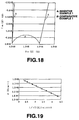
- Fig. 18 shows results of measuring the impedances of the pellets of Inventive Example 1 and Comparative Example 1.
- the frequency characteristics of the complex impedance is nearly the same as the behavior of a single capacitor, and the conductance of charged particles (electrons, ions and the like) of the aggregate of the fullerene molecules is not observed at all; while, for Inventive example 1, the impedance in a high frequency region depicts a flattened but very smooth single semi-circular arc, which shows the conductance of some charged particles in the pellet, and the imaginary number portion of the impedance is rapidly raised in a low frequency region, which shows the occurrence of blocking of charged particles between the aluminum electrode and the pellet as gradually nearing the DC voltage.
- the charged particles on the aluminum electrode side are electrons, and accordingly, it is apparent that the charged particles in the pellets are not electrons or holes but ions, more specifically, protons in consideration of the configuration of the fullerene derivative.
- the conductivity of the above-described charged particles can be calculated on the basis of an intercept of the circular-arc on the high frequency side with the X-axis.
- the conductivity of the charged particles becomes about 5. 10 -6 S/cm.
- the pellets of Inventive Examples 2 and 3 were subjected to the same measurement as described above. As a result, the whole shape in each of the frequency characteristic of the impedance in each of the Inventive Examples 2 and 3 is similar to that in Inventive Example 1; however, as shown in Table 1, the conductivity of charged particles in each of Inventive examples 2 and 3, obtained on the basis of an intercept of a circular-arc portion with the X-axis, is different than in Inventive Example 1.
- the conductivity of the pellet of the fullerene derivative containing the -OSO 3 H groups cause ionization of hydrogen easier than the hydroxyl groups.
- the results of Table 1 also show that the aggregate of the fullerene derivative containing the hydroxyl groups and OSO 3 H groups can exhibit, in a dry atmosphere, a good proton conductivity at ordinary temperature.
- the complex impedance of the pellet produced in Inventive Example 1 was measured in a temperature range from 160°C to -40°C, and the conductivity of the pellet was calculated on the basis of a circular-arc portion on the high frequency side of the complex impedance curve of the pellet measured at each temperature to examine the temperature dependency on the conductivity.
- Fig. 19 the Arrhenius plot
- data of Fig. 19 shows that a single ion conduction mechanism can occur at least within the temperature range of 160°C to -40°C.
- the proton conductor essentially comprising the fullerene derivative according to the present invention therefore, can exhibit a good proton conductivity in a wide temperature range from -40°C to 120°C that includes ordinary temperatures.
- a film of the polyhydroxylated fullerene was formed by the steps of: masking the surface of the electrode by a plastic mask having a rectangular opening, dripping the above-described solution in the opening, spreading the solution in the opening, drying in a room temperature in order to vaporize THF, and removing the mask.
- the upper electrode was pressed by about 5 tons/cm 2 to complete a composite. This composite was incorporated in a fuel cell as shown in Fig. 9.
- a generating electricity experiment was performed by supplying hydrogen gas to one electrode and air to another electrode in the fuel cell.
- the experimental result is shown in Fig. 20.
- the open circuit voltage was about 1.2V, and the characteristic of the closed circuit voltage was also excellent against the current value for the fuel cell.
- the IR spectrum of the powder nearly conformed to that of a fullerene derivative in which the hydroxyl groups were all hydrogen sulfate groups shown in the document, and therefore, it was confirmed that the powder was the hydrogen sulfated fullerene as the target material.
- the IR spectrum of the powder nearly conformed to that of a fullerene derivative containing the hydroxyl groups and OSO 3 H groups shown in the document, and therefore, it was confirmed that the powder was the polyhydroxyl hydrogen sulfated fullerene as the target material.
- the mixture was poured in a circular mold having a diameter of 15 mm, and the solvent was evaporated under a reduced pressure.
- the mixture from which the solvent was evaporated was then pressed into a pellet having a diameter of 15 mm and a thickness of about 300 ⁇ m. Such a pellet is taken as a pellet of
- both sides of the pellet were held between aluminum plates each having the same diameter as that of the pellet, that is, 15 mm, and AC voltages (amplitude: 0.1 V) at frequencies ranging from 7 MHz to 0.01 Hz are applied to the pellet, to measure a complex impedance at each frequency.
- the measurement was performed under a dry atmosphere.
- a proton conducting portion 1 of a proton conductor composed of the above pellet electrically constitutes an equivalent circuit shown in Fig. 17A, in which capacitances 6 and 6' are formed between first and second electrodes 2 and 3 with the proton conducting portion 1 expressed by a parallel circuit of a resistance 4 and a capacitance 5 held therebetween.
- the capacitance 5 designates a delay effect (phase delay at a high frequency) upon migration of protons
- the resistance 4 designates a parameter of difficulty of migration of protons.
- Fig. 17B shows an equivalent circuit of a proton conductor (Comparative Example to be described later) using the typical fullerene molecules that contain no dissociation of proton.
- Fig. 21 shows results of measuring the impedances of the pellet 1A of Inventive Example 4 and the pellet of Comparative Example 2.
- the frequency characteristics of the complex impedance is nearly the same as the behavior of a single capacitor, and the conductance of charged particles (electrons, ions and the like) of the aggregate of the fullerene molecules is not observed at all; while, for the pellet of Inventive Example 4, the impedance in a high frequency region depicts a flattened but very smooth single semi-circular arc, which shows the conductance of some charged particles in the pellet, and the imaginary number portion of the impedance is rapidly raised in a low frequency region, which shows the occurrence of blocking of charged particles between the aluminum electrode and the pellet as gradually nearing the DC voltage.
- the charged particles on the aluminum electrode side are electrons, and accordingly, it is apparent that the charged particles in the pellets are not electrons or holes but ions, more specifically, protons in consideration of the configuration of the fullerene derivative.
- the conductivity of the above-described charged particles can be calculated on the basis of an intercept of the circular-arc on the high frequency side with the X-axis.
- the conductivity of the charged particles become about 1X10 -6 S/cm.
- the pellets of 1B of Inventive Example 4, the pellets of Inventive Example 5, and the pellets of Inventive Example 6 were subjected to the same measurement as described above.
- the whole shape of the frequency characteristics of the impedance in each of the pellets is similar to that of Inventive Example 4; however, as shown in Table 2, the conductivity of charged particles in each of the pellets obtained on the basis of an intercept of a circular-arc portion with the X-axis, is different from that in the pellet.
- the complex impedance of the pellet 4A of Inventive Example 4 was measured in a temperature range from 160°C to -40°C, and the conductivity of the pellet was calculated on the basis of a circular-arc portion on the high frequency side of the complex impedance curve of the pellet measured at each temperature to examine the temperature dependency on the conductivity.
- the results are shown in Fig. 22 as the Arrhenius plot. From the data shown in Fig. 22, it is apparent that the conductivity and temperature exist in a linear relationship at least within the temperature range of 160°C to -40°C. In other words, data of Fig. 22 shows that a single ion conduction mechanism can proceed in the temperature range of 160°C to -40°C.
- the second proton conductor essentially comprising the fullerene derivative and a polymer material according to the present invention therefore, can exhibit a good proton conductivity in a wide temperature range including ordinary temperature, particularly, ranging from a high temperature of 160°C to a low temperature of -40°C.
- Arc discharge was performed by applying a current of 200 A between both electrodes composed of carbon bars in 0.05 MPa of an argon, to thus obtain 1 g of a carbon powder.
- the carbon powder was mixed with 100 ml of 60% fuming sulfuric acid, and kept for three days in a nitrogen flow at 60°C.
- the heating was performed by using a water bath.
- the reaction solution was dropped little by little in 500 ml of pure water, and a solid matter was separated from the water solution by centrifugal separation method.
- the solid matter was cleaned several times by diethyl ether anhydride, and dried for five hours under a reduced pressure at 40°C.
- the resultant powder was dissolved in 10 ml of tetrahydrofurane (THF), an insoluble component removed by filtering, and the solvent was evaporated under a reduced pressure to obtain a solid matter wherein the solid matter of 50 mg was pressed at a force of 5 tons/cm 2 into a circular pellet having a diameter of 15 mm. Such a pellet is taken as a pellet of Inventive Example 7.
- THF tetrahydrofurane
- the AC impedance of the pellet of Inventive Example 7 was measured in a dry air in accordance with the same manner as described above. As a result, it was confirmed that an impedance behavior resulting from ion conductance appeared in a frequency region of 10 MHz or less.
- the conductivity of the pellet of Inventive Example 7 was calculated, on the basis of the diameter of a circular-arc curve of the impedance behavior, at 3.0X10 -4 (S/cm).
- Arc discharge was performed by applying a current of 200 ⁇ between both electrodes composed of carbon bars in 0.05 MPa of an argon gas, to thus obtain 1 g of a carbon powder.
- the carbon powder was dissolved in toluene, an insoluble component was removed by filtering, and the solvent was evaporated under a reduced pressure to obtain a powder again.
- the resultant powder was mixed with 100 ml of 60% fuming sulfuric acid, and kept for three days under a nitrogen flow at 60°C.
- the heating was performed by using a water bath.
- the reaction solution was dropped little by little in 500 ml of pure water, and a solid matter was separated from the water solution by centrifugal separation method.
- the solid matter was cleaned several times by diethyl ether anhydride, and dried for five hours under a reduced pressure at 40°C.
- the solid matter of 50 mg was under a force of 7tons/ into a circular pellet of Inventive Example 8.
- the AC impedance of the pellet of Inventive Example 8 was measured in a dry air in accordance with the same manner as described above. As a result, it was confirmed that an impedance behavior resulting from ion conductance appeared in a frequency region of 10 MHz or less.
- the conductivity of the pellet of Inventive Example 8 was calculated, on the basis of the diameter of a circular-arc curve of the impedance behavior, at 3.4 ⁇ 10 -4 (S/cm).
- the main component of the carbon powder obtained by arc discharge was carbon clusters or molecules of carbon clusters not having a closed structure, such as, a cage structure, but having a structure at least part of which has open ends.
- molecules having a structure with a good electronic conductivity, similar to the graphite structure, which are slightly contained in the carbon cluster molecules obstruct the function of the ionic treatment in Inventive Example 7 and directly after arc discharge in Inventive Example 8.
- Fig. 23 shows the TOF-MS spectrum of [a] carbon powder obtained by arc discharge. As shown in Fig.
- most of the carbon powder has a mass number of 5500 or less, that is, the carbon number of 500 or less. Since the carbon-carbon bonding distance of the carbon powder is less than 2 ⁇ , the diameter of each of the carbon clusters of the powder is less than 100 nm.
- a refined SWCNT material was prepared and then burned for ten hours at 250°C under a fluorine gas in order to obtain polyfluorinated SWCNT.
- the polyfluorinated SWCNT was placed in pure water and refluxed for three days at 100°C while being strongly stirred in order to substitute the fluorine atoms for hydroxyl groups thereby resulting in the polyhydroxylated SWCNT material which is identified as a material in Inventive Example 9.
- Polyhydroxylated SWCNT produced in the same manner as that in Inventive Example 9 was placed in fuming sulfuric acid and stirred for three days at 60°C in order to replace the hydroxyl groups with the OSO 3 H groups thereby resulting in the hydrogen sulfated SWCNT material as identified in Inventive Example 10.
- a refined SWCNT material was prepared and then subjected to oxygen plasma treatment. Then, the atmosphere in the chamber was replaced with hydrogen and the material was subsequently subjected to hydrogen plasma treatment in order to obtain the polyhydroxylated SWCNT material as identified as Inventive Example 11.
- Each of the above three materials was dispersed in water and the dispersion was filtered on a filter paper having pores of 0.2 ⁇ m by suction in order to deposit the film on the filter paper.
- the amount of the dispersion to be filtered was adjusted to form the film having a thickness of 100 ⁇ m.
- both sides of the film were held between aluminum foils which were cut into a disc shape having a diameter 15 mm.
- the disc was held between electrodes, and AC voltages (amplitude: 0.1 V) at frequencies ranging from 7 MHz to 0.01 Hz were applied to the film to measure a complex impedance at each frequency.
- the measurement was performed under a dry atmosphere.
- the measurement result of the film in Comparative Example 4 will be described below.
- the complex impedance of the film was fixed at a low resistance, that is, was not changed over the above frequency range due to the fact that the electronic conductivity of the SWCNT material of Comparative Example 4 is high. As a result, it was revealed that the film in Comparative Example 4 cannot be used as an ionic conductor.
- FIG. 24 A complex impedance of the film of Inventive Example 10 is representatively shown in Fig. 24.
- the impedance in a high frequency region depicts a flattened but very smooth semi-circular curve, which shows the conductance of some charged particles in the film and the imaginary number portion of the impedance is rapidly raised in a low frequency region, which shows the occurrence of the blocking of charged particles between the aluminum electrodes and the film as gradually nearing to a DC voltage.
- the charged particles on the aluminum electrode side are electrons, and accordingly, it is apparent that the charged particles in the film are not electrons or holes but ions, more specifically, protons in considering of the structure of the tubular carbonaceous derivative that forms the film.
- the films in Inventive Examples 9, 11 and 12 the behavior of these films are similar to that of the film in Inventive Example 10 as observed although there was a difference in the size of the circular arc therebetween. Accordingly, it was revealed that the films in Inventive Examples 9 - 12 desirably function as a tubular carbonaceous material derivative of a proton conductor.
- the proton conducting portion 1 of the film-like proton conductor constitutes an electrically equivalent circuit in which a capacitance is formed between first and second electrodes with a resistance in the proton conducting portion held therebetween as similarly identified in the previously discussed embodiments and as further illustrated in Fig. 17A.
- the capacitance designates a delay effect (phase delay at a high frequency) upon migration of protons
- the resistance designates a parameter of difficulty of migration of protons.
- the conductivity of the above described charged particles can be calculated on the basis of an intercept of the circular-arc on the high frequency side of with the X-axis.
- the conductivity of the film in Inventive Example 10 is about 2 ⁇ 10 -5 S/cm.
- the conductivities of the film in other Inventive Examples are different from one another as shown in Table 3.
- Conductivities of proton conductor film of present invention 25°C
Landscapes
- Engineering & Computer Science (AREA)
- Chemical & Material Sciences (AREA)
- Life Sciences & Earth Sciences (AREA)
- Manufacturing & Machinery (AREA)
- Sustainable Development (AREA)
- Sustainable Energy (AREA)
- Chemical Kinetics & Catalysis (AREA)
- Electrochemistry (AREA)
- General Chemical & Material Sciences (AREA)
- Physics & Mathematics (AREA)
- Nanotechnology (AREA)
- General Physics & Mathematics (AREA)
- Condensed Matter Physics & Semiconductors (AREA)
- Materials Engineering (AREA)
- Crystallography & Structural Chemistry (AREA)
- Composite Materials (AREA)
- Spectroscopy & Molecular Physics (AREA)
- Conductive Materials (AREA)
- Fuel Cell (AREA)
- Battery Electrode And Active Subsutance (AREA)
- Carbon And Carbon Compounds (AREA)
- Primary Cells (AREA)
- Cell Electrode Carriers And Collectors (AREA)
- Superconductors And Manufacturing Methods Therefor (AREA)
- Secondary Cells (AREA)
- Electric Double-Layer Capacitors Or The Like (AREA)
- Ceramic Products (AREA)
Abstract
Description



| Conductivities of Pellets of Proton Conductors in Inventive Examples 1, 2 and 3 (at 25°C) | |
| Kind of Pellets | Conductivity (S/cm) |
| Inventive Example 1 | 5X10⁻⁶ |
| Inventive Example 2 | 9X10⁻⁴ |
| Inventive Example 3 | 2X10⁻⁵ |
Such a pellet is taken as a pellet 4A of Inventive Example 4.
| Conductivities of Pellets of Proton Conductors in Inventive Examples (at 25°C) | |
| Kind of Pellets | Conductivity (S/cm) |
| Pellet 4A of Inventive Example 4 | 1 × 10⁻⁶ |
| Pellet 5A of Inventive Example 5 | 2 × 10⁻⁴ |
| Pellet 6A of Inventive Example 6 | 6 × 10⁻⁵ |
| Pellet 4B of Inventive Example 4 | 3 × 10⁻⁶ |
| Pellet 5B of Inventive Example 5 | 7 × 10⁻⁴ |
| Pellet 6B of Inventive Example 6 | 3 × 10⁻⁶ |
| Conductivities of proton conductor film of present invention (25°C) | |
| Kind of film | Conductivity (S/cm) |
| Film of Inventive Example 9 | 2 × 10⁻⁷ |
| Film of Inventive Example 10 | 2 × 10⁻⁵ |
| Film of Inventive Example 11 | 7 × 10⁻⁸ |
| Film of Inventive Example 12 | 3 × 10⁻⁴ |
Claims (62)
- A proton conductor comprising a carbonaceous material essentially comprising a carbon, into which proton dissociating groups are introduced.
- The proton conductor according to claim 1, wherein protons migrate between the proton dissociating groups.
- The proton conductor according to claim 1, wherein its ion conductivity is larger than electron conductivity thereof.
- The proton conductor according to claim 1, wherein the carbonaceous material essentially comprises a carbon cluster as an aggregate of carbon atoms.
- The proton conductor according to claim 4, wherein the carbon cluster is a fullerene molecule.
- The proton conductor according to claim 4, wherein the carbon cluster has a structure in which at least part of the fullerene structure has open ends.
- The proton conductor according to claim 4, wherein the carbon cluster is a tubular carbonaceous material.
- The proton conductor according to claim 4, wherein some of the carbon clusters have diamond structures.
- The proton conductor according to claim 1, wherein the carbonaceous material comprises the carbon clusters bonded together.
- The proton conductor according to claim 1, wherein the proton dissociating groups are expressed by -XH where X represents an arbitrary atom or an atomic group that has a bivalent bond and where H represents a hydrogen atom.
- The proton conductor according to claim 10, wherein the proton dissociating groups are expressed by -OH or -YOH where Y is an arbitrary atom or an atomic group having a bivalent bond, and where O represents an oxygen atom.
- The proton conductor according to claim 11, wherein the proton dissociating groups are selected from the group consisting of -OH, -OSO3H, -COOH, -SO3H, and -OPO(OH)3.
- The proton conductor according to claim 1, wherein the proton dissociating groups and electron attractive groups are introduced in the carbonaceous material.
- The proton conductor according to claim 13, wherein the electron attractive groups are selected from the group consisting of nitro groups, carbonyl groups, carboxyl groups, nitrile groups, alkyl halide groups, and halogen atoms.
- The proton conductor according to claim 1, essentially consisting of the carbonaceous material into which the proton dissociating groups are introduced.
- The proton conductor according to claim 1, comprising the carbonaceous material into which the proton dissociating groups are introduced and a polymer material.
- The proton conductor according to claim 16, wherein the polymer material has no electronic conductivity.
- The proton conductor according to claim 16, wherein the polymer material is at least one kind selected from polyfluoroethylene, polyvinylidene fluoride, and polyvinylalcohol.
- The proton conductor according to claim 16, comprising the polymer material of 50 wt% or less.
- The proton conductor according to claim 16, wherein the polymer material comprises polytetrafluoroethylene of 3 wt% or less.
- The proton conductor according to claim 16, which is a thin film with a thickness of 300 µm or less.
- A method of producing a proton conductor, comprising the step of:introducing proton dissociating groups into a carbonaceous material essentially comprising a carbon.
- The method of producing a proton conductor according to claim 22, wherein a halogenated or non-halogenated carbonaceous material is prepared as a raw material, and the proton dissociating groups are introduced into carbon atoms containing the carbonaceous material by subjecting the raw material to hydrolysis, a plasma treatment, or an acid treatment.
- The method of producing a proton conductor according to claim 22, wherein the carbonaceous material essentially comprises a carbon cluster as an aggregate of carbon atoms.
- The method of producing a proton conductor according to claim 24, wherein the carbon cluster is a fullerene molecule.
- The method of producing a proton conductor according to claim 24, wherein the carbon cluster has a structure in which at least part of the fullerene structure has open ends.
- The method of producing a proton conductor according to claim 24, wherein the carbon cluster is a tubular carbonaceous material.
- The method of producing a proton conductor according to claim 27, wherein the tubular carbonaceous material into which the proton dissociating groups are introduced is dispersed within a liquid and filtered so as to form a film.
- The method of producing a proton conductor according to claim 24, wherein some of the carbon clusters have diamond structures.
- The method of producing a proton conductor according to claim 22, wherein the carbonaceous material comprises the carbon clusters bonded together.
- The method of producing a proton conductor according to claim 22, wherein the carbonaceous material including carbon clusters is obtained by an arc discharge technique that utilizes a carbon-based electrode, subjected to an acid treatment to introduce the proton dissociating groups into carbon atoms containing the carbon clusters.
- The method of producing a proton conductor according to claim 22, further comprising the steps of introducing the proton dissociating groups into the carbonaceous material, and compacting the carbonaceous material into which the proton dissociating groups are introduced into a desired shape.
- The method of producing a proton conductor according to claim 32, the compacting step comprises the step of substantially forming only the carbonaceous material into which the proton dissociating groups are introduced into a film or pellet shape.
- The method of producing a proton conductor according to claim 32, the compacting step comprises the step of mixing a polymer material with the carbonaceous material into which the proton dissociating groups are introduced and forming it into a film or pellet shape.
- The method of producing a proton conductor according to claim 34, wherein the polymer material is at least one kind selected from polyfluoroethylene, polyvinylidene fluoride, and polyvinylalcohol.
- The method of producing a proton conductor according to claim 34, wherein the proton conductor comprises the polymer material of 50 wt% or less.
- The method of producing a proton conductor according to claim 34, wherein the polymer material comprises polytetrafluoroethylene of 3 wt% or less.
- The method of producing a proton conductor according to claim 34, which is a thin film with a thickness of 300 µm or less.
- An electrochemical device comprising a first electrode, a second electrode, and a proton conductor that is positioned between the first and second electrodes, the proton conductor comprising a carbonaceous material essentially comprising a carbon, into which proton dissociating groups are introduced.
- The electrochemical device according to claim 39, wherein the ion conductivity of the proton conductor is larger than electron conductivity thereof.
- The electrochemical device according to claim 39, wherein the carbonaceous material essentially comprises a carbon cluster as an aggregate of carbon atoms.
- The electrochemical device according to claim 41, wherein the carbon cluster is a fullerene molecule.
- The electrochemical device according to claim 41, wherein the carbon cluster has a structure in which at least part of the fullerene structure has open ends.
- The electrochemical device according to claim 41, wherein the carbon cluster is a tubular carbonaceous material.
- The electrochemical device according to claim 41, wherein some of the carbon clusters have diamond structures.
- The electrochemical device according to claim 39, wherein the carbonaceous material comprises the carbon clusters bonded together.
- The electrochemical device according to claim 39, wherein the proton dissociating groups are expressed by -XH where X represents an arbitrary atom or an atomic group that has a bivalent bond and where H represents a hydrogen atom.
- The electrochemical device according to claim 47, wherein the proton dissociating groups are expressed by -OH or -YOH where Y is an arbitrary atom or an atomic group having a bivalent bond, and where O represents an oxygen atom.
- The electrochemical device according to claim 48, wherein the proton dissociating groups are selected from the group consisting of -OH, -OSO3H, -COOH, -SO3H, and -OPO(OH)3.
- The electrochemical device according to claim 39, wherein the proton dissociating groups and electron attractive groups are introduced in the carbonaceous material.
- The electrochemical device according to claim 50, wherein the electron attractive groups are selected from the group consisting of nitro groups, carbonyl groups, carboxyl groups, nitrile groups, alkyl halide groups, and halogen atoms.
- The electrochemical device according to claim 39, wherein the proton conductor essentially consists of the carbonaceous material into which the proton dissociating groups are introduced.
- The electrochemical device according to claim 39, wherein the proton conductor comprises the carbonaceous material into which the proton dissociating groups are introduced and a polymer material.
- The electrochemical device according to claim 53, wherein the polymer material has no electronic conductivity.
- The electrochemical device according to claim 53, wherein the polymer material is at least one kind selected from polyfluoroethylene, polyvinylidene fluoride, and polyvinylalcohol.
- The electrochemical device according to claim 53, wherein the proton conductor comprises the polymer material of 50 wt% or less.
- The electrochemical device according to claim 53, wherein the polymer material comprises polytetrafluoroethylene of 3 wt% or less.
- The electrochemical device according to claim 53, which is a thin film with a thickness of 300 µm or less.
- The electrochemical device according to claim 39, wherein the first electrode and/or the second electrode are gas electrodes.
- The electrochemical device according to claim 39, wherein the first electrode and/or the second electrode are electrodes including active materials.
- The electrochemical device according to claim 39, which is a fuel cell.
- The electrochemical device according to claim 39, which is a hydrogen-air cell.
Applications Claiming Priority (7)
| Application Number | Priority Date | Filing Date | Title |
|---|---|---|---|
| JP20403899 | 1999-07-19 | ||
| JP20403899 | 1999-07-19 | ||
| JP2000058116 | 2000-03-03 | ||
| JP2000058116 | 2000-03-03 | ||
| JP2000157509 | 2000-05-29 | ||
| JP2000157509 | 2000-05-29 | ||
| PCT/JP2000/004864 WO2001006519A1 (en) | 1999-07-19 | 2000-07-19 | Proton conducting material and method for preparing the same, and electrochemical device using the same |
Publications (3)
| Publication Number | Publication Date |
|---|---|
| EP1205942A1 true EP1205942A1 (en) | 2002-05-15 |
| EP1205942A4 EP1205942A4 (en) | 2008-12-17 |
| EP1205942B1 EP1205942B1 (en) | 2011-01-19 |
Family
ID=27328321
Family Applications (1)
| Application Number | Title | Priority Date | Filing Date |
|---|---|---|---|
| EP00946422A Expired - Lifetime EP1205942B1 (en) | 1999-07-19 | 2000-07-19 | Proton conducting material and method for preparing the same, and electrochemical device using the same |
Country Status (12)
| Country | Link |
|---|---|
| EP (1) | EP1205942B1 (en) |
| KR (1) | KR100714347B1 (en) |
| CN (1) | CN1225745C (en) |
| AT (1) | ATE496401T1 (en) |
| AU (1) | AU746761B2 (en) |
| BR (1) | BR0012582B1 (en) |
| CA (1) | CA2380120C (en) |
| DE (1) | DE60045554D1 (en) |
| DK (1) | DK1205942T3 (en) |
| IL (1) | IL147699A0 (en) |
| NZ (1) | NZ516548A (en) |
| WO (1) | WO2001006519A1 (en) |
Cited By (4)
| Publication number | Priority date | Publication date | Assignee | Title |
|---|---|---|---|---|
| EP1411568A4 (en) * | 2001-06-29 | 2005-04-06 | Sony Corp | PROTON DRIVER AND ELECTROCHEMICAL DEVICE USING THE SAME |
| GB2411169A (en) * | 2001-01-29 | 2005-08-24 | Univ Rice William M | Derivatizing carbon nanotubes and combining with a polymer |
| US7226699B2 (en) | 2001-01-19 | 2007-06-05 | Sony Corporation | Proton conductor film, manufacturing method therefor, fuel cell provided with proton conductor film and manufacturing method therefor |
| EP1383186A4 (en) * | 2001-03-19 | 2009-01-14 | Nec Corp | COMBUSTIBLE CELL LECTRODE AND COMBUSTIBLE CELL WITH THIS LECTRODE |
Families Citing this family (31)
| Publication number | Priority date | Publication date | Assignee | Title |
|---|---|---|---|---|
| US7153608B2 (en) | 1999-07-19 | 2006-12-26 | Sony Corporation | Ionic conductor, process for production thereof, and electrochemical device |
| JP4826002B2 (en) * | 2000-07-28 | 2011-11-30 | ソニー株式会社 | Electrochemical device and manufacturing method thereof |
| JP2002063917A (en) * | 2000-08-18 | 2002-02-28 | Sony Corp | Electrochemical device and method of using the same |
| JP4635306B2 (en) * | 2000-08-18 | 2011-02-23 | ソニー株式会社 | Proton conductor and electrochemical device |
| JP4892776B2 (en) * | 2000-10-20 | 2012-03-07 | ソニー株式会社 | Fuel cell |
| TW541751B (en) | 2001-01-15 | 2003-07-11 | Sony Corp | Power generator |
| JP2004192808A (en) | 2001-01-18 | 2004-07-08 | Sony Corp | Proton conductor, method for producing the same, and electrochemical device |
| CN1265490C (en) * | 2001-01-19 | 2006-07-19 | 索尼公司 | Electrode module |
| JP2002216791A (en) * | 2001-01-19 | 2002-08-02 | Sony Corp | Fuel cell, fuel cell module and stack |
| JP2002246034A (en) * | 2001-02-21 | 2002-08-30 | Sony Corp | Gas diffusible electrode body, method for producing the same, and electrochemical device |
| US7541308B2 (en) | 2001-04-11 | 2009-06-02 | Cabot Corporation | Fuel cells and other products containing modified carbon products |
| JP4715023B2 (en) * | 2001-05-08 | 2011-07-06 | ソニー株式会社 | Method for producing fullerene derivative |
| JP4019313B2 (en) * | 2001-09-03 | 2007-12-12 | ソニー株式会社 | Power supply device and operation method thereof |
| JP3951225B2 (en) | 2001-10-11 | 2007-08-01 | ソニー株式会社 | Proton conductor, method for producing the same, and electrochemical device |
| JP2003280747A (en) * | 2002-01-18 | 2003-10-02 | Sony Corp | Gas pressure adjusting device, electrochemical device, gas storage device, and gas pressure adjusting method |
| US6890676B2 (en) | 2002-02-05 | 2005-05-10 | Sony Corporation | Fullerene based proton conductive materials |
| JP4576784B2 (en) * | 2002-06-03 | 2010-11-10 | ソニー株式会社 | Proton conductor membrane and production method thereof, membrane-electrode assembly and production method thereof, and electrochemical device |
| JP4534445B2 (en) * | 2002-07-19 | 2010-09-01 | ソニー株式会社 | Ionic conductor, method for producing the same, and electrochemical device |
| JP5218467B2 (en) * | 2002-07-19 | 2013-06-26 | ソニー株式会社 | Ionic conductor, method for producing the same, and electrochemical device |
| JP4320581B2 (en) | 2003-08-04 | 2009-08-26 | ソニー株式会社 | Ionic conductor and electrochemical device |
| JP4524579B2 (en) * | 2003-08-08 | 2010-08-18 | ソニー株式会社 | Proton conductive composite and electrochemical device |
| ATE503253T1 (en) | 2003-09-16 | 2011-04-15 | Tokyo Inst Tech | SULFONATED AMORPHIC CARBON, PROCESS FOR PRODUCING IT AND USE THEREOF |
| WO2005101428A1 (en) * | 2004-04-13 | 2005-10-27 | Matsushita Electric Industrial Co., Ltd. | Proton conductor, electrolyte film, electrode, and fuel cell |
| JP5039955B2 (en) * | 2006-09-07 | 2012-10-03 | トヨタ自動車株式会社 | Fuel cell electrolyte and fuel cell |
| JP5297006B2 (en) * | 2007-07-09 | 2013-09-25 | 株式会社クレハ | Proton conductive resin composition |
| JP5398744B2 (en) * | 2008-02-12 | 2014-01-29 | カウンシル オブ サイエンティフィック アンド インダストリアル リサーチ | Composition with high proton conductivity |
| JP5604818B2 (en) * | 2009-07-01 | 2014-10-15 | ソニー株式会社 | Ion conductive composite, membrane electrode assembly (MEA), and electrochemical device |
| JP5444904B2 (en) * | 2009-07-15 | 2014-03-19 | ソニー株式会社 | Method for producing ion-conductive fine particles |
| RU2643156C1 (en) * | 2016-10-21 | 2018-01-31 | МСД Текнолоджис С.а.р.л. | Coaxial cable |
| US9997334B1 (en) * | 2017-02-09 | 2018-06-12 | Lyten, Inc. | Seedless particles with carbon allotropes |
| RU178132U1 (en) * | 2017-07-12 | 2018-03-26 | МСД Текнолоджис С.а.р.л. | EXTERNAL CONDUCTOR FOR COAXIAL TYPE ELECTRIC COMMUNICATION CABLES |
Family Cites Families (3)
| Publication number | Priority date | Publication date | Assignee | Title |
|---|---|---|---|---|
| JPH0690881B2 (en) * | 1989-11-27 | 1994-11-14 | 工業技術院長 | Carbonaceous solid electrolyte material and solid electrolyte battery using the same |
| US5177248A (en) * | 1991-10-28 | 1993-01-05 | Exxon Research And Engineering Company | Process of forming polysubstituted fullerenes |
| JP2000256007A (en) * | 1999-03-11 | 2000-09-19 | Jsr Corp | Method for producing proton conductive material |
-
2000
- 2000-07-19 BR BRPI0012582-2A patent/BR0012582B1/en not_active IP Right Cessation
- 2000-07-19 NZ NZ516548A patent/NZ516548A/en not_active IP Right Cessation
- 2000-07-19 DE DE60045554T patent/DE60045554D1/en not_active Expired - Lifetime
- 2000-07-19 KR KR1020027000723A patent/KR100714347B1/en not_active Expired - Fee Related
- 2000-07-19 IL IL14769900A patent/IL147699A0/en not_active IP Right Cessation
- 2000-07-19 WO PCT/JP2000/004864 patent/WO2001006519A1/en not_active Ceased
- 2000-07-19 AU AU60216/00A patent/AU746761B2/en not_active Ceased
- 2000-07-19 CA CA2380120A patent/CA2380120C/en not_active Expired - Fee Related
- 2000-07-19 EP EP00946422A patent/EP1205942B1/en not_active Expired - Lifetime
- 2000-07-19 DK DK00946422.3T patent/DK1205942T3/en active
- 2000-07-19 CN CNB008105561A patent/CN1225745C/en not_active Expired - Fee Related
- 2000-07-19 AT AT00946422T patent/ATE496401T1/en active
Cited By (5)
| Publication number | Priority date | Publication date | Assignee | Title |
|---|---|---|---|---|
| US7226699B2 (en) | 2001-01-19 | 2007-06-05 | Sony Corporation | Proton conductor film, manufacturing method therefor, fuel cell provided with proton conductor film and manufacturing method therefor |
| GB2411169A (en) * | 2001-01-29 | 2005-08-24 | Univ Rice William M | Derivatizing carbon nanotubes and combining with a polymer |
| GB2411169B (en) * | 2001-01-29 | 2005-10-26 | Univ Rice William M | Process for derivatizing carbon nanotubes with diazonium species and compositions thereof |
| EP1383186A4 (en) * | 2001-03-19 | 2009-01-14 | Nec Corp | COMBUSTIBLE CELL LECTRODE AND COMBUSTIBLE CELL WITH THIS LECTRODE |
| EP1411568A4 (en) * | 2001-06-29 | 2005-04-06 | Sony Corp | PROTON DRIVER AND ELECTROCHEMICAL DEVICE USING THE SAME |
Also Published As
| Publication number | Publication date |
|---|---|
| KR20020034160A (en) | 2002-05-08 |
| EP1205942A4 (en) | 2008-12-17 |
| DE60045554D1 (en) | 2011-03-03 |
| ATE496401T1 (en) | 2011-02-15 |
| KR100714347B1 (en) | 2007-05-04 |
| DK1205942T3 (en) | 2011-04-18 |
| AU746761B2 (en) | 2002-05-02 |
| CA2380120A1 (en) | 2001-01-25 |
| NZ516548A (en) | 2004-03-26 |
| WO2001006519A1 (en) | 2001-01-25 |
| CA2380120C (en) | 2010-10-26 |
| BR0012582A (en) | 2003-07-22 |
| CN1225745C (en) | 2005-11-02 |
| CN1361916A (en) | 2002-07-31 |
| BR0012582B1 (en) | 2010-08-24 |
| AU6021600A (en) | 2001-02-05 |
| EP1205942B1 (en) | 2011-01-19 |
| IL147699A0 (en) | 2002-08-14 |
Similar Documents
| Publication | Publication Date | Title |
|---|---|---|
| EP1205942B1 (en) | Proton conducting material and method for preparing the same, and electrochemical device using the same | |
| US6821665B2 (en) | Proton conductor, production method thereof, and electrochemical device using the same | |
| CN101563801B (en) | carbon nanowire structure | |
| KR101183801B1 (en) | Method of producing fuel cell catalyst layer | |
| EP1411568A1 (en) | Proton conductor and electrochemical device using the same | |
| US20100240527A1 (en) | Process for producing catalyst electrode | |
| WO2000011741A1 (en) | Fuel cell and method of menufacture thereof | |
| RU2265257C2 (en) | Proton conductor, its production process, and electrochemical device using it | |
| JP3951225B2 (en) | Proton conductor, method for producing the same, and electrochemical device | |
| US6824912B2 (en) | Fuel cell and method for preparation thereof | |
| CN100459248C (en) | Proton conductive electrode, method for producing same, and electrochemical device | |
| JP4635306B2 (en) | Proton conductor and electrochemical device | |
| JP2007200762A (en) | Membrane electrode assembly for polymer electrolyte fuel cell and method for producing the same | |
| JP2002075420A (en) | Electrochemical device and driving method thereof | |
| JPWO2002058177A1 (en) | PROTON CONDUCTOR MEMBRANE, PROCESS FOR PRODUCING THE SAME, FUEL CELL WITH PROTON CONDUCTOR MEMBRANE, AND PROCESS FOR PRODUCING THE SAME | |
| JP4475002B2 (en) | Ionic conductor, method for producing the same, and electrochemical device | |
| JP2002216796A (en) | Electrochemical device and proton conductor | |
| JP2005050628A (en) | Ionic conductor, method for producing the same, and electrochemical device | |
| JP2003151581A (en) | Power supply device and operation method thereof | |
| JPWO2002013295A1 (en) | Proton-conducting electrode, method for producing the same, and electrochemical device | |
| JP2004227785A (en) | Electrolyte and fuel cells |
Legal Events
| Date | Code | Title | Description |
|---|---|---|---|
| PUAI | Public reference made under article 153(3) epc to a published international application that has entered the european phase |
Free format text: ORIGINAL CODE: 0009012 |
|
| 17P | Request for examination filed |
Effective date: 20020115 |
|
| AK | Designated contracting states |
Kind code of ref document: A1 Designated state(s): AT BE CH CY DE DK ES FI FR GB GR IE IT LI LU MC NL PT SE |
|
| AX | Request for extension of the european patent |
Free format text: AL;LT;LV;MK;RO;SI |
|
| A4 | Supplementary search report drawn up and despatched |
Effective date: 20081119 |
|
| RIC1 | Information provided on ipc code assigned before grant |
Ipc: H01M 8/10 20060101AFI20081113BHEP Ipc: H01B 1/12 20060101ALI20081113BHEP |
|
| 17Q | First examination report despatched |
Effective date: 20090226 |
|
| GRAP | Despatch of communication of intention to grant a patent |
Free format text: ORIGINAL CODE: EPIDOSNIGR1 |
|
| GRAS | Grant fee paid |
Free format text: ORIGINAL CODE: EPIDOSNIGR3 |
|
| GRAA | (expected) grant |
Free format text: ORIGINAL CODE: 0009210 |
|
| RIN1 | Information on inventor provided before grant (corrected) |
Inventor name: ROST, CONSTANCESONY CORPORATION Inventor name: HINOKUWA, KOICHIROSONY CORPORATION Inventor name: PIETZAK, BJOERNSONY CORPORATION Inventor name: ATA, MASAFUMISONY CORPORATION |
|
| RIN1 | Information on inventor provided before grant (corrected) |
Inventor name: ATA, MASAFUMISONY CORPORATION Inventor name: ROST, CONSTANCESONY CORPORATION Inventor name: PIETZAK, BJOERNSONY CORPORATION Inventor name: HINOKUMA, KOICHIROSONY CORPORATION |
|
| AK | Designated contracting states |
Kind code of ref document: B1 Designated state(s): AT BE CH CY DE DK ES FI FR GB GR IE IT LI LU MC NL PT SE |
|
| REG | Reference to a national code |
Ref country code: GB Ref legal event code: FG4D |
|
| REG | Reference to a national code |
Ref country code: CH Ref legal event code: EP |
|
| REG | Reference to a national code |
Ref country code: IE Ref legal event code: FG4D |
|
| REG | Reference to a national code |
Ref country code: NL Ref legal event code: T3 |
|
| REF | Corresponds to: |
Ref document number: 60045554 Country of ref document: DE Date of ref document: 20110303 Kind code of ref document: P |
|
| REG | Reference to a national code |
Ref country code: DE Ref legal event code: R096 Ref document number: 60045554 Country of ref document: DE Effective date: 20110303 |
|
| REG | Reference to a national code |
Ref country code: SE Ref legal event code: TRGR |
|
| REG | Reference to a national code |
Ref country code: DK Ref legal event code: T3 |
|
| PG25 | Lapsed in a contracting state [announced via postgrant information from national office to epo] |
Ref country code: GR Free format text: LAPSE BECAUSE OF FAILURE TO SUBMIT A TRANSLATION OF THE DESCRIPTION OR TO PAY THE FEE WITHIN THE PRESCRIBED TIME-LIMIT Effective date: 20110420 Ref country code: PT Free format text: LAPSE BECAUSE OF FAILURE TO SUBMIT A TRANSLATION OF THE DESCRIPTION OR TO PAY THE FEE WITHIN THE PRESCRIBED TIME-LIMIT Effective date: 20110519 Ref country code: ES Free format text: LAPSE BECAUSE OF FAILURE TO SUBMIT A TRANSLATION OF THE DESCRIPTION OR TO PAY THE FEE WITHIN THE PRESCRIBED TIME-LIMIT Effective date: 20110430 |
|
| PG25 | Lapsed in a contracting state [announced via postgrant information from national office to epo] |
Ref country code: BE Free format text: LAPSE BECAUSE OF FAILURE TO SUBMIT A TRANSLATION OF THE DESCRIPTION OR TO PAY THE FEE WITHIN THE PRESCRIBED TIME-LIMIT Effective date: 20110119 Ref country code: CY Free format text: LAPSE BECAUSE OF FAILURE TO SUBMIT A TRANSLATION OF THE DESCRIPTION OR TO PAY THE FEE WITHIN THE PRESCRIBED TIME-LIMIT Effective date: 20110119 |
|
| PGFP | Annual fee paid to national office [announced via postgrant information from national office to epo] |
Ref country code: DK Payment date: 20110720 Year of fee payment: 12 Ref country code: FR Payment date: 20110729 Year of fee payment: 12 |
|
| PLBE | No opposition filed within time limit |
Free format text: ORIGINAL CODE: 0009261 |
|
| STAA | Information on the status of an ep patent application or granted ep patent |
Free format text: STATUS: NO OPPOSITION FILED WITHIN TIME LIMIT |
|
| PGFP | Annual fee paid to national office [announced via postgrant information from national office to epo] |
Ref country code: AT Payment date: 20110714 Year of fee payment: 12 Ref country code: FI Payment date: 20110714 Year of fee payment: 12 Ref country code: SE Payment date: 20110722 Year of fee payment: 12 Ref country code: GB Payment date: 20110721 Year of fee payment: 12 |
|
| 26N | No opposition filed |
Effective date: 20111020 |
|
| PGFP | Annual fee paid to national office [announced via postgrant information from national office to epo] |
Ref country code: IT Payment date: 20110722 Year of fee payment: 12 |
|
| REG | Reference to a national code |
Ref country code: DE Ref legal event code: R097 Ref document number: 60045554 Country of ref document: DE Effective date: 20111020 |
|
| PG25 | Lapsed in a contracting state [announced via postgrant information from national office to epo] |
Ref country code: MC Free format text: LAPSE BECAUSE OF NON-PAYMENT OF DUE FEES Effective date: 20110731 |
|
| REG | Reference to a national code |
Ref country code: CH Ref legal event code: PL |
|
| REG | Reference to a national code |
Ref country code: IE Ref legal event code: MM4A |
|
| PG25 | Lapsed in a contracting state [announced via postgrant information from national office to epo] |
Ref country code: LI Free format text: LAPSE BECAUSE OF NON-PAYMENT OF DUE FEES Effective date: 20110731 Ref country code: CH Free format text: LAPSE BECAUSE OF NON-PAYMENT OF DUE FEES Effective date: 20110731 |
|
| PG25 | Lapsed in a contracting state [announced via postgrant information from national office to epo] |
Ref country code: IE Free format text: LAPSE BECAUSE OF NON-PAYMENT OF DUE FEES Effective date: 20110719 |
|
| REG | Reference to a national code |
Ref country code: DE Ref legal event code: R084 Ref document number: 60045554 Country of ref document: DE Effective date: 20120614 |
|
| PGFP | Annual fee paid to national office [announced via postgrant information from national office to epo] |
Ref country code: NL Payment date: 20120719 Year of fee payment: 13 |
|
| REG | Reference to a national code |
Ref country code: SE Ref legal event code: EUG |
|
| REG | Reference to a national code |
Ref country code: AT Ref legal event code: MM01 Ref document number: 496401 Country of ref document: AT Kind code of ref document: T Effective date: 20120719 |
|
| GBPC | Gb: european patent ceased through non-payment of renewal fee |
Effective date: 20120719 |
|
| REG | Reference to a national code |
Ref country code: DK Ref legal event code: EBP |
|
| REG | Reference to a national code |
Ref country code: FR Ref legal event code: ST Effective date: 20130329 |
|
| PG25 | Lapsed in a contracting state [announced via postgrant information from national office to epo] |
Ref country code: FR Free format text: LAPSE BECAUSE OF NON-PAYMENT OF DUE FEES Effective date: 20120731 Ref country code: SE Free format text: LAPSE BECAUSE OF NON-PAYMENT OF DUE FEES Effective date: 20120720 Ref country code: GB Free format text: LAPSE BECAUSE OF NON-PAYMENT OF DUE FEES Effective date: 20120719 Ref country code: FI Free format text: LAPSE BECAUSE OF NON-PAYMENT OF DUE FEES Effective date: 20120719 |
|
| PG25 | Lapsed in a contracting state [announced via postgrant information from national office to epo] |
Ref country code: IT Free format text: LAPSE BECAUSE OF NON-PAYMENT OF DUE FEES Effective date: 20120719 Ref country code: LU Free format text: LAPSE BECAUSE OF NON-PAYMENT OF DUE FEES Effective date: 20110719 |
|
| PG25 | Lapsed in a contracting state [announced via postgrant information from national office to epo] |
Ref country code: AT Free format text: LAPSE BECAUSE OF NON-PAYMENT OF DUE FEES Effective date: 20120719 |
|
| PG25 | Lapsed in a contracting state [announced via postgrant information from national office to epo] |
Ref country code: DK Free format text: LAPSE BECAUSE OF NON-PAYMENT OF DUE FEES Effective date: 20120731 |
|
| REG | Reference to a national code |
Ref country code: NL Ref legal event code: V1 Effective date: 20140201 |
|
| PG25 | Lapsed in a contracting state [announced via postgrant information from national office to epo] |
Ref country code: NL Free format text: LAPSE BECAUSE OF NON-PAYMENT OF DUE FEES Effective date: 20140201 |
|
| REG | Reference to a national code |
Ref country code: DE Ref legal event code: R082 Ref document number: 60045554 Country of ref document: DE Ref country code: DE Ref legal event code: R081 Ref document number: 60045554 Country of ref document: DE Owner name: MURATA MANUFACTURING CO., LTD., NAGAOKAKYO-SHI, JP Free format text: FORMER OWNER: TOHOKU MURATA MANUFACTURING CO., LTD, KORIYAMA-SHI, JP Ref country code: DE Ref legal event code: R081 Ref document number: 60045554 Country of ref document: DE Owner name: MURATA MANUFACTURING CO., LTD., NAGAOKAKYO-SHI, JP Free format text: FORMER OWNER: SONY CORPORATION, TOKIO/TOKYO, JP |
|
| PGFP | Annual fee paid to national office [announced via postgrant information from national office to epo] |
Ref country code: DE Payment date: 20190719 Year of fee payment: 20 |
|
| REG | Reference to a national code |
Ref country code: DE Ref legal event code: R071 Ref document number: 60045554 Country of ref document: DE |