EP1205568A1 - Cr-BASE ALLOY EXCELLENT IN BALANCE BETWEEN STRENGTH AND DUCTILITY AT HIGH TEMPERATURE - Google Patents
Cr-BASE ALLOY EXCELLENT IN BALANCE BETWEEN STRENGTH AND DUCTILITY AT HIGH TEMPERATURE Download PDFInfo
- Publication number
- EP1205568A1 EP1205568A1 EP00929875A EP00929875A EP1205568A1 EP 1205568 A1 EP1205568 A1 EP 1205568A1 EP 00929875 A EP00929875 A EP 00929875A EP 00929875 A EP00929875 A EP 00929875A EP 1205568 A1 EP1205568 A1 EP 1205568A1
- Authority
- EP
- European Patent Office
- Prior art keywords
- ductility
- strength
- mass ppm
- high temperature
- mass
- Prior art date
- Legal status (The legal status is an assumption and is not a legal conclusion. Google has not performed a legal analysis and makes no representation as to the accuracy of the status listed.)
- Granted
Links
Images

Classifications
-
- C—CHEMISTRY; METALLURGY
- C22—METALLURGY; FERROUS OR NON-FERROUS ALLOYS; TREATMENT OF ALLOYS OR NON-FERROUS METALS
- C22C—ALLOYS
- C22C27/00—Alloys based on rhenium or a refractory metal not mentioned in groups C22C14/00 or C22C16/00
- C22C27/06—Alloys based on chromium
-
- C—CHEMISTRY; METALLURGY
- C22—METALLURGY; FERROUS OR NON-FERROUS ALLOYS; TREATMENT OF ALLOYS OR NON-FERROUS METALS
- C22F—CHANGING THE PHYSICAL STRUCTURE OF NON-FERROUS METALS AND NON-FERROUS ALLOYS
- C22F1/00—Changing the physical structure of non-ferrous metals or alloys by heat treatment or by hot or cold working
- C22F1/16—Changing the physical structure of non-ferrous metals or alloys by heat treatment or by hot or cold working of other metals or alloys based thereon
- C22F1/18—High-melting or refractory metals or alloys based thereon
Definitions
- This invention relates to a Cr-based alloy having an excellent strength-ductility balance at high temperatures (not lower than 1000°C, particularly super-high temperature zone of not lower than 1050°C).
- high-temperature materials used from the old time were mainly Ni-based, Cr-based and Co-based alloys.
- JP-A-55-154542 proposes Ni-based alloy comprising Cr: 20 ⁇ 35 wt%, Si: 1 ⁇ 8 wt% and C: 1.7 ⁇ 3.5 wt% and forming M 7 C 3 type carbide
- JP-A-55-154542 proposes Ni-Co-Cr based alloy comprising Ni: 20 ⁇ 47 wt%, Co: 6 ⁇ 35 wt%, Cr: 18 ⁇ 36 wt%, C: 0.6 ⁇ 2.5 wt% and Si: 0.5 ⁇ 2.5 wt%.
- all of these alloys could be practically used up to only a temperature of about 500°C.
- these alloys containing a greater amount of Ni or Co have many problems that the cost of the material itself is very expensive and the thermal expansion coefficient is high.
- a Cr-based alloy is hopeful as a high-temperature material being cheaper than Ni- or Co-based alloy and small in the thermal expansion coefficient.
- JP-A-11-80902 proposes a high-Cr alloy containing C: 0.5 ⁇ 1.5 wt%, Si: 1.0 ⁇ 4.0 wt%, Mn: 0.5 ⁇ 2.0 wt% and Cr: 35 ⁇ 60 wt% and enhancing a resistance to erosion and corrosion at a higher temperature.
- it is difficult to obtain a sufficient strength at a high temperature zone, particularly above 1000°C.
- an object of the invention to solve the above problems of the conventional technique and to provide Cr-based alloys having an excellent strength-ductility balance, which has never been attained in the conventional alloy, at a high temperature above 1000°C, particularly a high temperature above 1050°C.
- the inventors have made various studies in order to solve the above problems by using the Cr-based alloy useful from economical reason and thermal expansion coefficient. As a result, it has been found that even in the Cr-based alloy containing Cr of not less than 60 mass%, the ductility can be provided and the high-temperature strength and ductility can be established by controlling contents of C+N, S and O in the alloy and an amount of an oxide to not more than limiting amounts and the invention has been accomplished.
- the invention lies in a Cr-based alloy having an excellent strength-ductility balance at higher temperatures, comprising Cr: not less than 60 mass%, C+N: not more than 20 mass ppm, S: not more than 20 mass ppm, O: not more than 100 mass ppm, O as an oxide: not more than 50 mass ppm, and the remainder being Fe and inevitable impurities.
- Fig. 1 is a graph showing a relation between strength-ductility balance at 1100°C and C+N amount.
- Various Cr-based alloys containing 65 mass% of Cr are produced by changing purities of starting materials and melting conditions and shaped into rod-shaped specimens of 25 mm by hot forging. In this case, hot forging ⁇ working ⁇ reheating ⁇ hot forging are repeated with respect to alloys hardly working into a rod because of poor workability.
- These rod-shaped specimens are heated to 1250°C and water-cooled, from which round specimens of 6.5 mm in diameter and 120 mm in length are cut out. The strength (tensile strength) and ductility ( reduction of cross section) at 1100°C are measured by using these round specimens by means of a high-temperature tensile testing machine of direct current system (Greeble testing machine).
- Fig. 1 is shown an influence of C+N amount upon strength-ductility balance (product of reduction of cross section RA by tensile strength TS) at a high temperature. From Fig. 1, it is understood that it is required to only decrease the C+N amount but also control S amount and O amount in order to provide RA ⁇ TS ⁇ 10000 (% ⁇ MPa) as a good region of strength-ductility balance at a high temperature zone. The invention is accomplished based on such a knowledge.
- the alloy according to the invention has excellent strength and ductility at a high temperature region above 1000°C.
- Such an alloy can be particularly produced according to usual manner except that starting materials having a higher purity are used and melting conditions are paid attention to.
- Various Cr-based alloys having a chemical composition as shown in Table 1 are produced by melting.
- a high purity chromium (purity: 99.95 mass%) and a super-high purity electrolytic iron (purity: 99.998 mass%) are used and a skull melting process using a water-cooled copper crucible is adopted.
- the resulting ingot is hot forged at 950 ⁇ 1200°C (forging is carried out by repeating hot forging ⁇ working ⁇ reheating ⁇ hot forging at a temperature region more giving a ductility) to form a rod-shaped specimen of 25 mm.
- the rod-shaped specimen is heated to 1250°C and water-cooled, from which is cut out a round specimen of 6.5 mm in diameter and 120 mm in length.
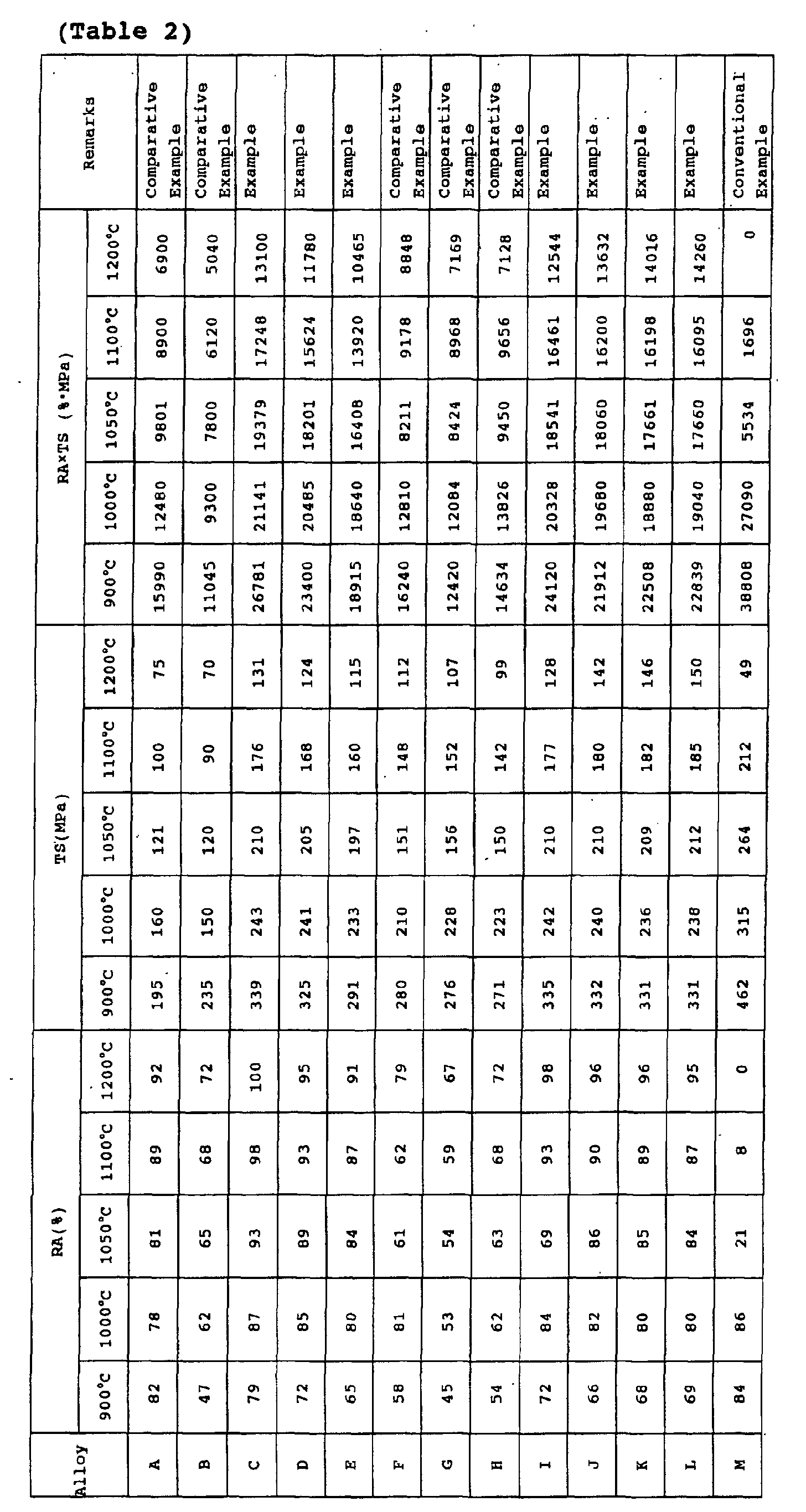
- the ductility ( reduction of cross section) at a high temperature is measured with respect to such a specimen by means of a high-temperature tensile testing machine of direct current system (Greeble testing machine).
- a high-temperature tensile testing machine of direct current system Garble testing machine.
- the same test is carried out with respect to 54Ni-18Cr-3Mo alloy (Inconel 718) as a commercial heat-resistant material.
- the invention alloys indicate RA ⁇ TS ⁇ 10000 (% ⁇ MPa) showing a strength-ductility balance at a high temperature above 1000°C and have a very excellent strength-ductility balance.
- the invention there can be provided Cr-based alloys having an excellent strength-ductility balance at a higher temperature above 1000°C, particularly above 1050°C. Therefore, the invention conducts in various industry fields requiring a high-temperature material and largely contributes to the improvement of earth environment.
Landscapes
- Chemical & Material Sciences (AREA)
- Engineering & Computer Science (AREA)
- Materials Engineering (AREA)
- Mechanical Engineering (AREA)
- Metallurgy (AREA)
- Organic Chemistry (AREA)
- Physics & Mathematics (AREA)
- Thermal Sciences (AREA)
- Crystallography & Structural Chemistry (AREA)
- Heat Treatment Of Steel (AREA)
- Forging (AREA)
- Manufacture And Refinement Of Metals (AREA)
- Turbine Rotor Nozzle Sealing (AREA)
Abstract
Description
- Cr: not less than 60 mass% Cr is an element required for ensuring the strength at the high temperature. When the amount is less than 60 mass%, it is difficult to ensure the strength above 1000°C, so that it is required to be not less than 60 mass%. Moreover, it is favorable to be not less than 65 mass% in order to develop sufficient properties. And also, the upper limit of Cr amount is not particularly restricted, but 99.99 mass% is critical from a viewpoint of production by melting.
- C+N: not more than 20 mass ppm C and N form carbonitride of Cr below 1000°C to bring about brittleness of Cr-based alloy and degradation of corrosion resistance. And also, C and N are existent at a solid solution state at a high temperature zone above 1000°C to lower the ductility. In order not to bring about the degradation of these properties, C+N are required to be not more than 20 mass ppm. Moreover, in order to more lessen the degradation of the ductility, C+N are favorable to be not more than 10 mass ppm. Furthermore, the lower limit is not particularly restricted, but it is desirable to be 0.1 mass ppm considering the melt production time in industry.
- S: not more than 20 mass ppm S exists in form of a sulfide with a slight amount of a metallic element such as Ti, Cu, Mn or the like slightly included in the Cr-based alloy, or segregates in a grain boundary at a solid solution state. In any case, it brings about the degradation of the ductility. Such a degradation of the ductility becomes remarkable when the S amount exceeds 20 mass ppm, so that the upper limit is 20 mass ppm. Moreover, in order to more lessen the degradation of the ductility, it is desirable to control the S amount to not more than 10 mass ppm. And also, the lower limit of the S amount is not particularly restricted, but it is desirable to be 0.1 mass ppm considering the melt producing cost.
- O (total O): not more than 100 mass ppm, O as an oxide: not more than 50 mass ppm O forms an oxide with a slight amount of a metallic element such as Al, Si or the like slightly included in the Cr-based alloy to bring about the degradation of the ductility. In order to avoid such a bad influence, it is necessary that the O amount (total O amount) is restricted to not more than 100 mass ppm and the O amount existing as an oxide is controlled to not more than 50 mass ppm. Moreover, in order to maintain the high ductility, it is favorable that the O amount is not more than 50 mass ppm and the O amount as an oxide is not more than 30 mass ppm. The lower limits of the O amount and the O amount as an oxide are not restricted, but they are preferable to be 5 mass ppm and 3 mass ppm, respectively, considering the melt producing cost.

Claims (1)
- A Cr-based alloy having an excellent strength-ductility balance at higher temperatures, comprising Cr: not less than 60 mass%, C+N: not more than 20 mass ppm, S: not more than 20 mass ppm, O: not more than 100 mass ppm, O as an oxide: not more than 50 mass ppm, and the remainder being Fe and inevitable impurities.
Applications Claiming Priority (3)
| Application Number | Priority Date | Filing Date | Title |
|---|---|---|---|
| JP14832699A JP3480698B2 (en) | 1999-05-27 | 1999-05-27 | Cr based alloy with excellent strength-ductility balance at high temperature |
| JP14832699 | 1999-05-27 | ||
| PCT/JP2000/003399 WO2000073523A1 (en) | 1999-05-27 | 2000-05-26 | Cr-BASE ALLOY EXCELLENT IN BALANCE BETWEEN STRENGTH AND DUCTILITY AT HIGH TEMPERATURE |
Publications (3)
| Publication Number | Publication Date |
|---|---|
| EP1205568A1 true EP1205568A1 (en) | 2002-05-15 |
| EP1205568A4 EP1205568A4 (en) | 2002-11-06 |
| EP1205568B1 EP1205568B1 (en) | 2004-12-01 |
Family
ID=15450286
Family Applications (1)
| Application Number | Title | Priority Date | Filing Date |
|---|---|---|---|
| EP00929875A Expired - Lifetime EP1205568B1 (en) | 1999-05-27 | 2000-05-26 | Cr-BASE ALLOY EXCELLENT IN BALANCE BETWEEN STRENGTH AND DUCTILITY AT HIGH TEMPERATURE |
Country Status (6)
| Country | Link |
|---|---|
| US (2) | US7037467B1 (en) |
| EP (1) | EP1205568B1 (en) |
| JP (1) | JP3480698B2 (en) |
| CA (1) | CA2375354C (en) |
| DE (1) | DE60016420T2 (en) |
| WO (1) | WO2000073523A1 (en) |
Families Citing this family (3)
| Publication number | Priority date | Publication date | Assignee | Title |
|---|---|---|---|---|
| JP3480698B2 (en) * | 1999-05-27 | 2003-12-22 | 兼次 安彦 | Cr based alloy with excellent strength-ductility balance at high temperature |
| JP5072154B2 (en) * | 2001-09-14 | 2012-11-14 | 日新製鋼株式会社 | High purity Fe-Cr alloy with excellent bending workability |
| DE102013214464A1 (en) * | 2013-07-24 | 2015-01-29 | Johannes Eyl | Method for producing a chromium-containing alloy and chromium-containing alloy |
Family Cites Families (18)
| Publication number | Priority date | Publication date | Assignee | Title |
|---|---|---|---|---|
| US2780545A (en) * | 1954-02-03 | 1957-02-05 | Battelle Development Corp | High-temperature alloy |
| US3640700A (en) * | 1970-08-31 | 1972-02-08 | Riken Piston Ring Ind Co Ltd | Process for producing an ingot of chromium metal or chromium-base alloy |
| DE2221220C3 (en) * | 1971-05-12 | 1974-01-17 | Gebrueder Sulzer Ag, Winterthur (Schweiz) | Use of a chrome-based alloy as mold material |
| JPS5222328B2 (en) | 1972-04-06 | 1977-06-16 | ||
| JPS524248B2 (en) | 1972-05-16 | 1977-02-02 | ||
| JPS49113712A (en) | 1973-03-05 | 1974-10-30 | ||
| US4118254A (en) | 1977-04-04 | 1978-10-03 | Eutectic Corporation | Wear and corrosion resistant nickel-base alloy |
| GB2050424B (en) | 1979-05-09 | 1983-06-15 | Special Metals Corp | Nickel-cobalt-chromium base alloy |
| US4901222A (en) | 1987-05-19 | 1990-02-13 | Bull Nh Information Systems Inc. | Method and apparatus for backing out of a software instruction after execution has begun |
| JP2607157B2 (en) | 1989-11-17 | 1997-05-07 | 株式会社クボタ | Heat-resistant alloy for supporting steel material to be heated in heating furnace |
| JP2801833B2 (en) | 1992-04-30 | 1998-09-21 | 川崎製鉄株式会社 | Fe-Cr alloy with excellent workability and pitting resistance |
| EP0597129A4 (en) * | 1992-04-30 | 1994-08-10 | Kawasaki Steel Co | Fe-cr alloy excellent in workability. |
| JP2737819B2 (en) * | 1993-06-30 | 1998-04-08 | 川崎製鉄株式会社 | Fe-Cr alloy with excellent ridging resistance |
| JPH07278718A (en) | 1994-04-04 | 1995-10-24 | Kubota Corp | Ultra-heat-resistant high-Cr alloy and steel hearth furnace heating material |
| JP3535290B2 (en) | 1994-12-22 | 2004-06-07 | 兼次 安彦 | Metals with excellent plastic deformability in the temperature range below the recrystallization temperature |
| JP3357226B2 (en) * | 1995-08-14 | 2002-12-16 | 川崎製鉄株式会社 | Fe-Cr alloy with excellent ridging resistance and surface properties |
| JP3899168B2 (en) | 1997-09-03 | 2007-03-28 | 株式会社神戸製鋼所 | High Cr alloy and high Cr alloy member with excellent high temperature erosion and corrosion resistance |
| JP3480698B2 (en) | 1999-05-27 | 2003-12-22 | 兼次 安彦 | Cr based alloy with excellent strength-ductility balance at high temperature |
-
1999
- 1999-05-27 JP JP14832699A patent/JP3480698B2/en not_active Expired - Fee Related
-
2000
- 2000-05-26 EP EP00929875A patent/EP1205568B1/en not_active Expired - Lifetime
- 2000-05-26 CA CA002375354A patent/CA2375354C/en not_active Expired - Fee Related
- 2000-05-26 DE DE60016420T patent/DE60016420T2/en not_active Expired - Lifetime
- 2000-05-26 WO PCT/JP2000/003399 patent/WO2000073523A1/en not_active Ceased
- 2000-05-26 US US09/926,600 patent/US7037467B1/en not_active Expired - Fee Related
-
2005
- 2005-08-26 US US11/211,641 patent/US8685315B2/en not_active Expired - Fee Related
Also Published As
| Publication number | Publication date |
|---|---|
| DE60016420T2 (en) | 2005-05-19 |
| CA2375354C (en) | 2007-04-10 |
| CA2375354A1 (en) | 2000-12-07 |
| DE60016420D1 (en) | 2005-01-05 |
| US20050281703A1 (en) | 2005-12-22 |
| JP2000336449A (en) | 2000-12-05 |
| US8685315B2 (en) | 2014-04-01 |
| WO2000073523A1 (en) | 2000-12-07 |
| US7037467B1 (en) | 2006-05-02 |
| EP1205568A4 (en) | 2002-11-06 |
| EP1205568B1 (en) | 2004-12-01 |
| JP3480698B2 (en) | 2003-12-22 |
Similar Documents
| Publication | Publication Date | Title |
|---|---|---|
| KR101668383B1 (en) | Nickel-chromium-aluminum alloy having good processability, creep resistance and corrosion resistance | |
| CN104245977B (en) | There is the nickel-chromium-alloy of good workability, creep resistant and corrosion resistance | |
| EP2675931B1 (en) | HIGH TEMPERATURE LOW THERMAL EXPANSION Ni-Mo-Cr ALLOY | |
| CA2841329A1 (en) | Hot-forgeable ni-based superalloy excellent in high temperature strength | |
| CN111868277B (en) | Use of nickel-chromium-iron-aluminium alloys | |
| JP2014500907A (en) | Ni-Fe-Cr-Mo-alloy | |
| US5158744A (en) | Oxidation- and corrosion-resistant alloy for components for a medium temperature range based on doped iron aluminide, Fe3 Al | |
| KR20180043361A (en) | Low thermal expansion super heat resistant alloys and method for manufacturing the same | |
| WO1992003584A1 (en) | Controlled thermal expansion alloy and article made therefrom | |
| CA3253249A1 (en) | USE OF A NICKEL-IRON-CHROME ALLOY WITH HIGH STRENGTH IN HIGHLY CORROSIVE ENVIRONMENTS AND SIMULTANEOUSLY GOOD PROCESSING ABILITY AND GOOD RESISTANCE | |
| EP1205568B1 (en) | Cr-BASE ALLOY EXCELLENT IN BALANCE BETWEEN STRENGTH AND DUCTILITY AT HIGH TEMPERATURE | |
| CA1073708A (en) | Oxidation resistant iron base alloys | |
| JP6787246B2 (en) | Alloy original plate for heat-resistant parts, alloy plate for heat-resistant parts, and gasket for exhaust system parts of engine | |
| CN118140003A (en) | Ferritic iron-chromium-aluminum powder and seamless pipe made therefrom | |
| CN120265803B (en) | Nickel-based alloys | |
| JP3779131B2 (en) | Cr-based alloy with excellent workability and strength-ductility balance at high temperature | |
| KR20240160625A (en) | Applications of nickel-iron-chromium alloys with high resistance to carburizing and sulfiding and chlorinating environments and at the same time excellent machinability and strength | |
| US20080124241A1 (en) | Chromium-Base Alloy and a Production Process Therefor |
Legal Events
| Date | Code | Title | Description |
|---|---|---|---|
| PUAI | Public reference made under article 153(3) epc to a published international application that has entered the european phase |
Free format text: ORIGINAL CODE: 0009012 |
|
| 17P | Request for examination filed |
Effective date: 20011219 |
|
| AK | Designated contracting states |
Kind code of ref document: A1 Designated state(s): AT BE CH CY DE DK ES FI FR GB GR IE IT LI LU MC NL PT SE |
|
| AX | Request for extension of the european patent |
Free format text: AL;LT;LV;MK;RO;SI |
|
| A4 | Supplementary search report drawn up and despatched |
Effective date: 20020925 |
|
| AK | Designated contracting states |
Kind code of ref document: A4 Designated state(s): DE FR GB |
|
| 17Q | First examination report despatched |
Effective date: 20030205 |
|
| GRAP | Despatch of communication of intention to grant a patent |
Free format text: ORIGINAL CODE: EPIDOSNIGR1 |
|
| RBV | Designated contracting states (corrected) |
Designated state(s): DE FR GB |
|
| RAP1 | Party data changed (applicant data changed or rights of an application transferred) |
Owner name: JAPAN SCIENCE AND TECHNOLOGY AGENCY |
|
| GRAS | Grant fee paid |
Free format text: ORIGINAL CODE: EPIDOSNIGR3 |
|
| GRAA | (expected) grant |
Free format text: ORIGINAL CODE: 0009210 |
|
| AK | Designated contracting states |
Kind code of ref document: B1 Designated state(s): DE FR GB |
|
| REG | Reference to a national code |
Ref country code: GB Ref legal event code: FG4D |
|
| REG | Reference to a national code |
Ref country code: IE Ref legal event code: FG4D |
|
| REF | Corresponds to: |
Ref document number: 60016420 Country of ref document: DE Date of ref document: 20050105 Kind code of ref document: P |
|
| ET | Fr: translation filed | ||
| PLBE | No opposition filed within time limit |
Free format text: ORIGINAL CODE: 0009261 |
|
| STAA | Information on the status of an ep patent application or granted ep patent |
Free format text: STATUS: NO OPPOSITION FILED WITHIN TIME LIMIT |
|
| 26N | No opposition filed |
Effective date: 20050902 |
|
| REG | Reference to a national code |
Ref country code: DE Ref legal event code: R082 Ref document number: 60016420 Country of ref document: DE Representative=s name: HASELTINE LAKE LLP, DE |
|
| REG | Reference to a national code |
Ref country code: FR Ref legal event code: PLFP Year of fee payment: 17 |
|
| PGFP | Annual fee paid to national office [announced via postgrant information from national office to epo] |
Ref country code: DE Payment date: 20160527 Year of fee payment: 17 Ref country code: GB Payment date: 20160525 Year of fee payment: 17 |
|
| PGFP | Annual fee paid to national office [announced via postgrant information from national office to epo] |
Ref country code: FR Payment date: 20160524 Year of fee payment: 17 |
|
| REG | Reference to a national code |
Ref country code: DE Ref legal event code: R119 Ref document number: 60016420 Country of ref document: DE |
|
| GBPC | Gb: european patent ceased through non-payment of renewal fee |
Effective date: 20170526 |
|
| REG | Reference to a national code |
Ref country code: FR Ref legal event code: ST Effective date: 20180131 |
|
| PG25 | Lapsed in a contracting state [announced via postgrant information from national office to epo] |
Ref country code: DE Free format text: LAPSE BECAUSE OF NON-PAYMENT OF DUE FEES Effective date: 20171201 Ref country code: GB Free format text: LAPSE BECAUSE OF NON-PAYMENT OF DUE FEES Effective date: 20170526 |
|
| PG25 | Lapsed in a contracting state [announced via postgrant information from national office to epo] |
Ref country code: FR Free format text: LAPSE BECAUSE OF NON-PAYMENT OF DUE FEES Effective date: 20170531 |