EP1205523A1 - Aluminium alloy heat exchanger resistive to tobacco odor impregnation - Google Patents
Aluminium alloy heat exchanger resistive to tobacco odor impregnation Download PDFInfo
- Publication number
- EP1205523A1 EP1205523A1 EP01309487A EP01309487A EP1205523A1 EP 1205523 A1 EP1205523 A1 EP 1205523A1 EP 01309487 A EP01309487 A EP 01309487A EP 01309487 A EP01309487 A EP 01309487A EP 1205523 A1 EP1205523 A1 EP 1205523A1
- Authority
- EP
- European Patent Office
- Prior art keywords
- acid
- coating layer
- component
- heat exchanger
- impregnation
- Prior art date
- Legal status (The legal status is an assumption and is not a legal conclusion. Google has not performed a legal analysis and makes no representation as to the accuracy of the status listed.)
- Granted
Links
Images

Classifications
-
- F—MECHANICAL ENGINEERING; LIGHTING; HEATING; WEAPONS; BLASTING
- F28—HEAT EXCHANGE IN GENERAL
- F28F—DETAILS OF HEAT-EXCHANGE AND HEAT-TRANSFER APPARATUS, OF GENERAL APPLICATION
- F28F19/00—Preventing the formation of deposits or corrosion, e.g. by using filters or scrapers
- F28F19/02—Preventing the formation of deposits or corrosion, e.g. by using filters or scrapers by using coatings, e.g. vitreous or enamel coatings
- F28F19/04—Preventing the formation of deposits or corrosion, e.g. by using filters or scrapers by using coatings, e.g. vitreous or enamel coatings of rubber; of plastics material; of varnish
-
- C—CHEMISTRY; METALLURGY
- C09—DYES; PAINTS; POLISHES; NATURAL RESINS; ADHESIVES; COMPOSITIONS NOT OTHERWISE PROVIDED FOR; APPLICATIONS OF MATERIALS NOT OTHERWISE PROVIDED FOR
- C09D—COATING COMPOSITIONS, e.g. PAINTS, VARNISHES OR LACQUERS; FILLING PASTES; CHEMICAL PAINT OR INK REMOVERS; INKS; CORRECTING FLUIDS; WOODSTAINS; PASTES OR SOLIDS FOR COLOURING OR PRINTING; USE OF MATERIALS THEREFOR
- C09D105/00—Coating compositions based on polysaccharides or on their derivatives, not provided for in groups C09D101/00 or C09D103/00
- C09D105/08—Chitin; Chondroitin sulfate; Hyaluronic acid; Derivatives thereof
-
- C—CHEMISTRY; METALLURGY
- C23—COATING METALLIC MATERIAL; COATING MATERIAL WITH METALLIC MATERIAL; CHEMICAL SURFACE TREATMENT; DIFFUSION TREATMENT OF METALLIC MATERIAL; COATING BY VACUUM EVAPORATION, BY SPUTTERING, BY ION IMPLANTATION OR BY CHEMICAL VAPOUR DEPOSITION, IN GENERAL; INHIBITING CORROSION OF METALLIC MATERIAL OR INCRUSTATION IN GENERAL
- C23C—COATING METALLIC MATERIAL; COATING MATERIAL WITH METALLIC MATERIAL; SURFACE TREATMENT OF METALLIC MATERIAL BY DIFFUSION INTO THE SURFACE, BY CHEMICAL CONVERSION OR SUBSTITUTION; COATING BY VACUUM EVAPORATION, BY SPUTTERING, BY ION IMPLANTATION OR BY CHEMICAL VAPOUR DEPOSITION, IN GENERAL
- C23C22/00—Chemical surface treatment of metallic material by reaction of the surface with a reactive liquid, leaving reaction products of surface material in the coating, e.g. conversion coatings, passivation of metals
- C23C22/05—Chemical surface treatment of metallic material by reaction of the surface with a reactive liquid, leaving reaction products of surface material in the coating, e.g. conversion coatings, passivation of metals using aqueous solutions
- C23C22/06—Chemical surface treatment of metallic material by reaction of the surface with a reactive liquid, leaving reaction products of surface material in the coating, e.g. conversion coatings, passivation of metals using aqueous solutions using aqueous acidic solutions with pH less than 6
- C23C22/48—Chemical surface treatment of metallic material by reaction of the surface with a reactive liquid, leaving reaction products of surface material in the coating, e.g. conversion coatings, passivation of metals using aqueous solutions using aqueous acidic solutions with pH less than 6 not containing phosphates, hexavalent chromium compounds, fluorides or complex fluorides, molybdates, tungstates, vanadates or oxalates
- C23C22/56—Treatment of aluminium or alloys based thereon
-
- Y—GENERAL TAGGING OF NEW TECHNOLOGICAL DEVELOPMENTS; GENERAL TAGGING OF CROSS-SECTIONAL TECHNOLOGIES SPANNING OVER SEVERAL SECTIONS OF THE IPC; TECHNICAL SUBJECTS COVERED BY FORMER USPC CROSS-REFERENCE ART COLLECTIONS [XRACs] AND DIGESTS
- Y10—TECHNICAL SUBJECTS COVERED BY FORMER USPC
- Y10T—TECHNICAL SUBJECTS COVERED BY FORMER US CLASSIFICATION
- Y10T428/00—Stock material or miscellaneous articles
- Y10T428/31504—Composite [nonstructural laminate]
- Y10T428/31678—Of metal
-
- Y—GENERAL TAGGING OF NEW TECHNOLOGICAL DEVELOPMENTS; GENERAL TAGGING OF CROSS-SECTIONAL TECHNOLOGIES SPANNING OVER SEVERAL SECTIONS OF THE IPC; TECHNICAL SUBJECTS COVERED BY FORMER USPC CROSS-REFERENCE ART COLLECTIONS [XRACs] AND DIGESTS
- Y10—TECHNICAL SUBJECTS COVERED BY FORMER USPC
- Y10T—TECHNICAL SUBJECTS COVERED BY FORMER US CLASSIFICATION
- Y10T428/00—Stock material or miscellaneous articles
- Y10T428/31504—Composite [nonstructural laminate]
- Y10T428/31678—Of metal
- Y10T428/31681—Next to polyester, polyamide or polyimide [e.g., alkyd, glue, or nylon, etc.]
-
- Y—GENERAL TAGGING OF NEW TECHNOLOGICAL DEVELOPMENTS; GENERAL TAGGING OF CROSS-SECTIONAL TECHNOLOGIES SPANNING OVER SEVERAL SECTIONS OF THE IPC; TECHNICAL SUBJECTS COVERED BY FORMER USPC CROSS-REFERENCE ART COLLECTIONS [XRACs] AND DIGESTS
- Y10—TECHNICAL SUBJECTS COVERED BY FORMER USPC
- Y10T—TECHNICAL SUBJECTS COVERED BY FORMER US CLASSIFICATION
- Y10T428/00—Stock material or miscellaneous articles
- Y10T428/31504—Composite [nonstructural laminate]
- Y10T428/31678—Of metal
- Y10T428/31681—Next to polyester, polyamide or polyimide [e.g., alkyd, glue, or nylon, etc.]
- Y10T428/31685—Natural source polyamide [e.g., casein, gelatin, etc.]
Definitions
- the present invention relates to an aluminum alloy heat exchanger resistive to tobacco odor impregnation.
- the present invention relates to an aluminum alloy heat exchanger with a coating having a reduced absorption of odorous components of tobacco, etc.
- 1-299,877 discloses a coating formed from a combination of polyvinyl alcohol with a specific water-soluble polymer and a cross-linking agent
- Japanese Unexamined Patent Publication No. 1-270,977 discloses use of polyacrylamide resins
- Japanese Unexamined Patent Publication No. 6-306,247 discloses copolymerization of specific hydrophilic monomers
- Japanese Patent Publication No. 2520308 discloses use of organic hydrophilic treating agents comprising carboxymethylcellulose polymers, N-methylolacrylamide, polyacrylic acid and zirconium compound.
- odorous components contained in the ambient atmospheric air or air contained in the heat exchanger are absorbed by the condensed water adhered to the surface of the heat exchanger and are gradually accumulated on the heat exchanger surface over time, and then the odorous components are released from the heat exchanger surface during operation of the air conditioner, and giving off an offensive odor.
- the activated carbon is shaped into pellets or a honeycomb, and the odorous components in air are absorbed in fine pores formed in the surface portions of the shaped activated carbon by diffusion or circulation or ventilation of the odorous component-carrying air through the heat exchanger.
- the absorbing material is reactivated by an electric heating procedure.
- an absorbing material and a noble metal oxide catalyst are carried on a surface of a heating resistor, while the absorbing material has a satisfactory absorbing activity, the absorbing material is used for deodorizing purposes at room temperature, and when the absorbing activity of the absorbing material becomes insufficient, the heating resistor is electrically activated to heat the absorbing material to a temperature of 300°C or more, and to oxidatively decompose the odorous components absorbed in the absorbing material, and to reactivate the absorbing material.
- Japanese Unexamined Patent Publication No. 8-296,992 discloses a heat exchanger utilizing a photocatalyst.
- a mixture of a photocatalyst with a binder is coated on the surfaces of heat exchanging aluminum fins, an ultraviolet ray lamp is arranged so that ultraviolet rays can be irradiated toward the heat exchanger.
- an ultraviolet ray lamp is arranged so that ultraviolet rays can be irradiated toward the heat exchanger.
- the methods using the absorption activity have the following problems.
- the deodorizing activity of the activated carbon decreases with an increase in the amount of the absorbed odorous components, with the activated carbon finally being saturated by the absorbed odorous components and ceasing to have deodorizing activity.
- activated carbon saturated by the odorous component itself becomes a source of generation of the offensive odor.
- the space velocity is too high, and thus the time of contact of the odorous component-containing gas with the deodorizing material is insufficient, the degree of deodorization of the deodorizing material per pass of the odorous component-containing gas is low, and thus the resultant deodorization effect is insufficient.
- the absorbing material and a certain carrier for the absorbing material must be formed into a large-scale honeycomb, and this causes the cost of the absorbing material to increase.
- the absorbing material In the deodorizing method in which the absorbing material is reactivated by electrical heating, replacement of the absorbing material is not necessary. However, for the purpose of reactivation, the absorbing material must be heated to a temperature of about 300°C or more, which may cause the absorbing material to be unnecessarily heated to a high temperature and the environs of the absorbing material to become dangerous.
- An object of the present invention is to provide an aluminum alloy heat exchanger resistive to impregnation of tobacco odor or other odorous components, to solve the above-mentioned problems of the prior art.
- the inventors of the present invention conducted extensive research in order to find solutions for the above-mentioned problems, and as a result, found that the amount of an odorous component such as tobacco odor absorbed in the surface of a heat exchanger can be significantly reduced by coating the surface of the heat exchanger with a coating layer comprising (A) at least are organic compound selected from chitosan and derivatives thereof and (B) at least one organic compound having at least two carboxyl groups per molecule of the compound, the total solid amount (A) + (B) of the organic compound component (A) and the organic component (B) being 20% by mass, based on the total amount by mass of the coating layer.
- a coating layer comprising (A) at least are organic compound selected from chitosan and derivatives thereof and (B) at least one organic compound having at least two carboxyl groups per molecule of the compound, the total solid amount (A) + (B) of the organic compound component (A) and the organic component (B) being 20% by mass, based on the total amount by mass
- the chitosan derivatives are preferably selected from glycerylated chitosan.
- the carboxylic compound is preferably selected from oxalic acid, malonic acid, maleic acid, fumaric acid, succinic acid, malic acid, tartaric acid, citric acid, phthalic acids, itaconic acid, mellitic acid, trimellitic acid, trimesic acid, pyromellitic acid, naphthalenetetracarboxylic acid, propanedicarboxylic acid, butanedicarboxylic acid, pentanedicarboxylic acid, hexanedicarboxylic acid, heptanedicarboxylic acid, butanetricarboxylic acid, butanetetracarboxylic acid, cyclohexanetetracarboxylic acid, hexanetricarboxylic acid, acrylic acid polymers, methacrylic acid polymers and acrylic acid-methacrylic acid copolymers.
- component (A) and the component (B) are preferably present in a solid mass ratio (A)/(B) of 3:1 to 1:3.
- the aluminum alloy heat exchanger of the present invention comprises a base body made from an aluminum alloy usable for the heat exchanger, and an organic hydrophilic coating layer formed on at least a portion of the surface of the heat exchanger base body and comprising a component (A) comprising at least one chitosan compound selected from chitosan and derivatives thereof and a component (B) comprising at least one carboxylic compound having two or more carboxyl groups per molecule of the compound, the total solid amount of the components (A) and (B) being 20% by mass or more, based on the total mass amount of the organic hydrophilic coating layer.
- the aluminum alloy heat exchanger exhibit a significantly reduced absorption of odorous components of tobacco and other odorous materials.
- the chitosan compound usable as the component (A) of the coating layer is selected from chitosan and derivatives thereof.
- Chitosan is produced by deacetylating chitin ( ⁇ -1,4-poly(N-acetyl-D-glucosamine)) which is a polysaccharide compound, namely ⁇ (1 ⁇ 4) bonded N-acetyl- ⁇ -D-glucosamine.
- the chitosan derivatives are preferably selected from glycerylated chitosans.
- the glycerylated chitosans preferably have a degree of glycerylation of 2:1 to 1:2.
- the glucerylated chitosans are preferably employed to assuredly impart high hydrophilicity to the coating layer.
- the carboxylic compound for the component (B) must be reactive with the chitosan compound of the component (A) having amino groups or hydroxyl groups to cross-link the chitosan compound molecules therethrough and to provide a water resistant cross-linked molecular network structure in the coating layer.
- the carboxylic compound for the component (B) must have two or more carboxylic groups and is preferably selected from, for example, oxalic acid, malonic acid, maleic acid, humaric acid, succinic acid, malic acid, tartaric acid, citric acid, phthalic acids, itaconic acid, mellitic acid, trimellitic acid, trimeric acid, pyromellitic acid, naphthalenetetracarboxylic acid, propanedicarboxylic acid, butanedicarboxylic acid, pentanedicarboxylic acid, hexanedicarboxylic acid, heptanedicarboxylic acid, butanetricarboxylic acid, butanetetracarboxylic acid, cyclohexanetetracarboxylic acid, hexanetricarboxylic acid, acrylic polymers, methacrylic acid polymers and acrylic acid-methacrylic acid copolymers.
- oxalic acid malonic acid
- the coating layer formed on at least a portion of the base body of the heat exchanger must have a total solid content of the components (A) and (B) of 20% by mass or more based on the total mass amount of the coating layer. If the total solid content ((A) + (B)) is less than 20% by mass, the reduction effect of the resultant coating layer on the absorption of the odorous components of tobacco and other odorous materials is unsatisfactory.
- the ratio (A)/(B) in the content by mass of the component (A) to the component (B) is in the range of from 3:1 to 1:3.
- the ratio (A)/(B) in the range of from 3:1 to 1:3 is preferable to obtain the coating layer having a satisfactory water resistance.
- the organic hydrophilic coating layer further comprises a surfactant or a hydrophilic polymer to enhance the hydrophilicity of the coating layer, and/or an antibacterial agent and/or antifungus agent, to prevent proliferation of bacteria and fungi.
- a surfactant or a hydrophilic polymer to enhance the hydrophilicity of the coating layer, and/or an antibacterial agent and/or antifungus agent, to prevent proliferation of bacteria and fungi.
- a deodorizer can be contained in the coating layer, as long as the purpose of the present invention can be attained.
- the surface of the base body of the heat exchanger is cleaned with a solvent-type cleaning agent or alkaline or acid type aqueous detergent. If the base body surface is clean, the cleaning procedure may be omitted.
- the clean surface of the base body of the heat exchanger is optionally ground-treated with a known chromate-treating agent, iron phosphate-coating liquid, zinc phosphate-treating liquid, titanium or zirconium-containing treating liquid or an organic coating liquid to enhance corrosion resistance and/or coating layer-adhesion of the base body surface.
- the base body surface is coated with a coating liquid for forming the organic hydrophilic coating layer, by a spraying, dipping, roll-coating, or shower-coating method, and the coated coating liquid layer is dried to form the coating layer.
- the dry coating layer is preferably in an amount of 0.05 to 5 g/m 2 , more preferably 0.1 to 2.0 g/m 2 . If the amount of the coating layer is less than 0.05 g/m 2 , the resultant coating layer exhibits an unsatisfactory reduction effect in odorous component-absorption or impregnation of tobacco or other odorous materials and insufficient hydrophilicity. If the coating layer amount is more than 5 g/m 2 , it is difficult to uniformly form the coating layer.
- An aluminum alloy base body for heat exchanger was immersed in an aqueous cleaning liquid containing 30 g/liter of an weak alkaline degreasing agent (trademark: Finecleaner 315, made by Nihon Parkerizing Co.) and kept at a temperature of 60°C for 90 seconds, to remove stains on the base body surface, and rinsed with city water for 30 minutes. Then the surface-cleaned base body was immersed in a chromate treating liquid containing 72 g/liter of chromic acid-chromating agent (trademark: Alchrom 713, made of Nihon Parkerizing Co.) and kept at a temperature of 50°C for 60 seconds, and then rinsed with city water for 30 seconds, to form an undercoat layer on the base body.
- an aqueous cleaning liquid containing 30 g/liter of an weak alkaline degreasing agent (trademark: Finecleaner 315, made by Nihon Parkerizing Co.) and kept at a temperature of 60°C for 90 seconds, to remove stains on the base
- the under-coated aluminum alloy base body of the heat exchanger was coated with an organic hydrophilic coating layer by the procedures as described in each of the following examples and comparative examples.
- the contents of components in the compositions for the coating layer are based on solid mass.
- the undercoated aluminum alloy base body for the heat exchanger was immersed in a coating liquid having the composition shown below at room temperature for 30 seconds, and the resultant coating liquid layer on the base body surface was dried and heat treated in an electric oven at a temperature of 145°C for 30 minutes, to form a hydrophilic coating layer.
- Coating liquid composition Glycerylated chitosan (degree of glycerylation: 1.3) 6.0 g/liter Citric acid (First grade) 6.0 g/liter Water Balance
- the undercoated aluminum alloy base body for the heat exchanger was immersed in a coating liquid having the composition shown below at room temperature for 30 seconds, and the resultant coating liquid layer on the base body surface was dried and heat treated in an electric oven kept at a temperature of 180°C for 30 minutes, to form a hydrophilic coating layer.
- Coating liquid composition Glycerylated chitosan (degree of glycerylation: 1.1) 3.0 g/liter Citric acid (First grade) 5.0 g/liter Polyethylene glycol (Molecular weight: about 20.000) 3.0 g/liter Surfactant (Nonylphenyl-(EO) 20 addition product) 1.0 g/liter Water Balance
- the undercoated aluminum alloy base body for the heat exchanger was immersed in a coating liquid having the composition shown below at room temperature for 30 seconds, and the resultant coating liquid layer on the base body surface was dried and heat treated in an electric oven at a temperature of 145°C for 30 minutes, to form a hydrophilic coating layer.
- Coating liquid composition Chitosan 3.0 g/liter Mellitic acid 4.0 g/liter Polyacrylamide (MW: about 25.000) 4.0 g/liter 1,2-benzoisothiazoline-3-one 1.0 g/liter Water Balance
- the undercoated aluminum alloy base body for the heat exchanger was immersed in a coating liquid having the composition shown below at room temperature for 30 seconds, and the resultant coating liquid layer on the base body surface was dried and heat treated in an electric oven at a temperature of 145°C for 30 minutes, to form a hydrophilic coating layer.
- Coating liquid composition Hydroxypropylcellulose 6.0 g/liter Citric acid (First grade) 6.0 g/liter Water Balance
- the undercoated aluminum alloy base body for the heat exchanger was immersed in a coating liquid having the composition shown below at room temperature for 30 seconds, and the resultant coating liquid layer on the base body surface was dried and heat treated in an electric oven at a temperature of 145°C for 30 minutes, to form a hydrophilic coating layer.
- Coating liquid composition Chitosan 6.0 g/liter Phosphoric acid (First grade) 6.0 g/liter Water Balance
- the undercoated aluminum alloy base body for the heat exchanger was immersed in a coating liquid having the composition shown below at room temperature for 30 seconds, and the resultant coating liquid layer on the base body surface was dried and heat treated in an electric oven at a temperature of 145°C for 30 minutes, to form a hydrophilic coating layer.
- Coating liquid composition Glycerylated chitosan (degree of glycerylation: 1.3) 1.0 g/liter Mellitic acid (First grade) 1.0 g/liter Hydroxypropylcellulose 10.0 g/liter Water Balance
- the undercoated aluminum alloy base body for the heat exchanger was immersed in a coating liquid having the composition shown below at room temperature for 30 seconds, and the resultant coating liquid layer on the base body surface was dried and heat treated in an electric oven at a temperature of 145°C for 30 minutes, to form a hydrophilic coating layer.
- Coating liquid composition Glycerylated chitosan (degree of glycerylation: 1.3) 6.0 g/liter Acetic acid (First grade) 6.0 g/liter Water Balance
- Example 2 The same aluminum alloy base body of heat exchanger as used in Example 1 was coated by the following procedures as disclosed in Japanese Unexamined Patent Publication No. 9-14889, Example 1, to form a coating layer.
- a base body made of an aluminum alloy for a heat exchanger was immersed in an aqueous solution of 30 g/liter of a weak alkaline degreasing agent (trademark: Finecleaner 315, made by Nihon Parkerizing Co.) kept at a temperature of 60°C for 50 seconds to remove staining material such as greasy materials on the surface, and rinsed with city water for 30 seconds. Then, the cleaned base body was immersed in an aqueous treating liquid containing 72 g/liter of chromic acid-chromating agent (trademark: Alchrom 713, made by Nihon Parkerizing Co.) and kept at a temperature of 50°C for 60 seconds, and rinsed with city water for 30 seconds, to form a first protecting layer on the base body surface.
- a weak alkaline degreasing agent trademark: Finecleaner 315, made by Nihon Parkerizing Co.
- the first coating layer surface of the base body was immersed in an aqueous treating liquid containing 100 parts by mass of polyacrylamide (made by Daiichi Kogyoseiyaku K.K.), 110 parts by mass of polyvinylsulfonic acid (made by Nihon Shokubai K.K.), 40 parts by mass of a nonionic water-soluble nylon having polyethyleneoxide groups in molecular skeleton thereof (made by Toray K.K.) and 10 parts by mass of a cross-linking agent consisting of chromium biphosphate, at a temperature of 25°C for 30 seconds, and the treating liquid layer on the base body surface was subjected to an air blow treatment, and then dried and heat treated in a hot air circulation dryer at a temperature of 140°C for 20 minutes, to form a second protecting layer.
- polyacrylamide made by Daiichi Kogyoseiyaku K.K.
- polyvinylsulfonic acid made by Nihon Shokubai K.K.
- a testing apparatus shown in Figs. 1 and 2 for absorption or impregnation of odorous components of tobacco was employed.
- the testing apparatus has a bell-shaped glass 1 container for containing therein specimens 2a, 2b, and 2c, a smoking cylinder 5 containing therein a cigarette 4 and having an outlet 5a connected to the bell-shaped container 1 through a conduit 1a and an inlet 5b, and a flow meter 3 connected to the inlet 5b of the smoking cylinder 5 through a conduit 3a, and a fresh air-supply conduit 6 connected to the smoking cylinder 5.
- one or more specimens are contained in the bell-shaped container 1, and air is blown into the smoking cylinder 5 at a predetermined flow rate through the conduit 6 and flow meter 3, conduit 3a and inlet 5b, to smoke the cigarette 4.
- the resultant smoke containing odorous components of tobacco is blown into the container 1 through the outlet 5a and conduit 1a.
- the odorous components are absorbed by or impregnated in the specimen, and the remaining smoke is removed from the container through an outlet 1b.
- the specimen is placed in a GC-MS analyzer as shown in Fig. 2, and an amount of evaporated substance from the specimen is measured by GC-MS analysis.
- coated fins 2a of Examples 1 to 3, coated fins 2b of Comparative Examples 1 to 4 and a coated fin 2c of Comparative Example 5, in total 8 coated fins, were placed in the bell-shaped container, and exposed to tobacco smoke, in the manner as described above, until the cigarette was used up.
- Each of the specimens 2a, 2b and 2c was placed in a GC-MO analyzer 7 having an opening 7a as shown in Fig. 2, and subjected to GC-MO analysis.
- the odorous component-absorption or impregnation of each specimen was represented by the amount of the substance evaporated from the specimen.
- the odorous component absorptions of the coated fins according to the present invention were 0.41 in Example 1, 0.55 in Example 2 and 0.76 in Example 4.
- the coated heat exchangers of the present invention had a high resistance to absorption or impregnation of the odorous components of tobacco and exhibited high initial hydrophilicity and high durability of hydrophilicity.
- the coating layer contained no component (A) and exhibited a high absorption of tobacco odorous components of 1.38, which is higher than that of Comparative Example 5, and low hydrophilicity.
- the coating layer contained no component (B) and was soluble in water.
- the resistance to absorption of tobacco odorous components was higher than that of Comparative Example 5, the durability of hydrophilicity of the coated heat exchanger was very poor.
- Comparative Example 3 the total content of the components (A) and (B) was less than 20% by mass, based on the total mass of the coating layer, and the resistance of the coating layer to the absorption of tobacco odorous components was low.
- Comparative Example 4 the carboxylic compound in component (B) had only one carboxyl group per molecule thereof, and the properties of the resultant coating layer were similar to those of Comparative Example 2.
- Comparative Example 5 was carried out to provide a conventional coated heat exchanger as a standard.
- the aluminum alloy heat exchanger according to the present invention in which the surface of the base body is coated with a specific coating layer, exhibits a significantly reduced absorption of odorous substances, for example, odorous components of tobacco, and high hydrophilicity and high durability of hydrophilicity.
Landscapes
- Chemical & Material Sciences (AREA)
- Engineering & Computer Science (AREA)
- Organic Chemistry (AREA)
- Mechanical Engineering (AREA)
- Materials Engineering (AREA)
- General Engineering & Computer Science (AREA)
- General Chemical & Material Sciences (AREA)
- Chemical Kinetics & Catalysis (AREA)
- Physics & Mathematics (AREA)
- Metallurgy (AREA)
- Thermal Sciences (AREA)
- Life Sciences & Earth Sciences (AREA)
- Wood Science & Technology (AREA)
- Paints Or Removers (AREA)
- Other Surface Treatments For Metallic Materials (AREA)
- Application Of Or Painting With Fluid Materials (AREA)
- Laminated Bodies (AREA)
Abstract
Description
- The present invention relates to an aluminum alloy heat exchanger resistive to tobacco odor impregnation. In particular, the present invention relates to an aluminum alloy heat exchanger with a coating having a reduced absorption of odorous components of tobacco, etc.
- When an aluminum alloy heat exchanger usable as an air conditioner for a motor car is operated, condensed water adheres to the surfaces of fins. When the fin surfaces have a low wetting property, the condensed water forms water droplets substantially in the form of semispheres on the fin surfaces, or water bridges are formed between the fin surfaces. The semispheric water drops and the water bridges form resistance to airflow and other problems, for example, a reduction in heat exchange efficiency and generation of noise. In the prior art for solving the above-mentioned disadvantages, an organic hydrophilic coating is usually formed on the surface of the heat exchanger. For example, Japanese Unexamined Patent Publication No. 1-299,877 discloses a coating formed from a combination of polyvinyl alcohol with a specific water-soluble polymer and a cross-linking agent, Japanese Unexamined Patent Publication No. 1-270,977 discloses use of polyacrylamide resins, Japanese Unexamined Patent Publication No. 6-306,247 discloses copolymerization of specific hydrophilic monomers, and Japanese Patent Publication No. 2520308 discloses use of organic hydrophilic treating agents comprising carboxymethylcellulose polymers, N-methylolacrylamide, polyacrylic acid and zirconium compound.
- It is also known that odorous components contained in the ambient atmospheric air or air contained in the heat exchanger are absorbed by the condensed water adhered to the surface of the heat exchanger and are gradually accumulated on the heat exchanger surface over time, and then the odorous components are released from the heat exchanger surface during operation of the air conditioner, and giving off an offensive odor.
- As a method for deodorizing the heat exchanger, it is well known to employ activated carbon. In this method, the activated carbon is shaped into pellets or a honeycomb, and the odorous components in air are absorbed in fine pores formed in the surface portions of the shaped activated carbon by diffusion or circulation or ventilation of the odorous component-carrying air through the heat exchanger.
- In other deodorizing methods not using the absorption procedure, the absorbing material is reactivated by an electric heating procedure. In this method, an absorbing material and a noble metal oxide catalyst are carried on a surface of a heating resistor, while the absorbing material has a satisfactory absorbing activity, the absorbing material is used for deodorizing purposes at room temperature, and when the absorbing activity of the absorbing material becomes insufficient, the heating resistor is electrically activated to heat the absorbing material to a temperature of 300°C or more, and to oxidatively decompose the odorous components absorbed in the absorbing material, and to reactivate the absorbing material.
- Also, as a technology for activating a heat exchanger surface, Japanese Unexamined Patent Publication No. 8-296,992 discloses a heat exchanger utilizing a photocatalyst. In this heat exchanger, a mixture of a photocatalyst with a binder is coated on the surfaces of heat exchanging aluminum fins, an ultraviolet ray lamp is arranged so that ultraviolet rays can be irradiated toward the heat exchanger. When the photocatalyst-containing coatins are irradiated by the ultraviolet rays, the adhesion and accumulation of the odorous components on the heat exchanger surface can be reduced.
- Among the above-mentioned deodorizing methods, the methods using the absorption activity have the following problems. When activated carbon is used, the deodorizing activity of the activated carbon decreases with an increase in the amount of the absorbed odorous components, with the activated carbon finally being saturated by the absorbed odorous components and ceasing to have deodorizing activity. Sometimes, activated carbon saturated by the odorous component itself becomes a source of generation of the offensive odor. Also, when the deodorizing material is placed in an air conditioner for practice, the space velocity is too high, and thus the time of contact of the odorous component-containing gas with the deodorizing material is insufficient, the degree of deodorization of the deodorizing material per pass of the odorous component-containing gas is low, and thus the resultant deodorization effect is insufficient. To improve the above-mentioned method, it is necessary to decrease the space velocity and to increase the deodorizing activity. However, to satisfy this requirement, the absorbing material and a certain carrier for the absorbing material must be formed into a large-scale honeycomb, and this causes the cost of the absorbing material to increase.
- In the deodorizing method in which the absorbing material is reactivated by electrical heating, replacement of the absorbing material is not necessary. However, for the purpose of reactivation, the absorbing material must be heated to a temperature of about 300°C or more, which may cause the absorbing material to be unnecessarily heated to a high temperature and the environs of the absorbing material to become dangerous.
- When the photocatalyst as disclosed in Japanese Unexamined Patent Publication No. 8-296,992 is employed, the necessary ultraviolet ray lamps cause the method cost to increase, and a new problem in that intermediate decomposition products of the odorous components produced in the presence of the photocatalyst may be a source of offensive odor.
- An object of the present invention is to provide an aluminum alloy heat exchanger resistive to impregnation of tobacco odor or other odorous components, to solve the above-mentioned problems of the prior art.
- The inventors of the present invention conducted extensive research in order to find solutions for the above-mentioned problems, and as a result, found that the amount of an odorous component such as tobacco odor absorbed in the surface of a heat exchanger can be significantly reduced by coating the surface of the heat exchanger with a coating layer comprising (A) at least are organic compound selected from chitosan and derivatives thereof and (B) at least one organic compound having at least two carboxyl groups per molecule of the compound, the total solid amount (A) + (B) of the organic compound component (A) and the organic component (B) being 20% by mass, based on the total amount by mass of the coating layer.
- In the aluminum alloy heat-exchanger of the present invention, which is resistive to impregnation of tobacco odor, the chitosan derivatives are preferably selected from glycerylated chitosan.
- In addition, the carboxylic compound is preferably selected from oxalic acid, malonic acid, maleic acid, fumaric acid, succinic acid, malic acid, tartaric acid, citric acid, phthalic acids, itaconic acid, mellitic acid, trimellitic acid, trimesic acid, pyromellitic acid, naphthalenetetracarboxylic acid, propanedicarboxylic acid, butanedicarboxylic acid, pentanedicarboxylic acid, hexanedicarboxylic acid, heptanedicarboxylic acid, butanetricarboxylic acid, butanetetracarboxylic acid, cyclohexanetetracarboxylic acid, hexanetricarboxylic acid, acrylic acid polymers, methacrylic acid polymers and acrylic acid-methacrylic acid copolymers.
- Further, the component (A) and the component (B) are preferably present in a solid mass ratio (A)/(B) of 3:1 to 1:3.
-
- Fig. 1 is an explanatory front view of a apparatus for testing an absorption of odorous components of tobacco by a coated fin of heat exchanger, and
- Fig. 2 is an explanatory front view of a GC-MS analyser for evaporized substances.
-
- The aluminum alloy heat exchanger of the present invention comprises a base body made from an aluminum alloy usable for the heat exchanger, and an organic hydrophilic coating layer formed on at least a portion of the surface of the heat exchanger base body and comprising a component (A) comprising at least one chitosan compound selected from chitosan and derivatives thereof and a component (B) comprising at least one carboxylic compound having two or more carboxyl groups per molecule of the compound, the total solid amount of the components (A) and (B) being 20% by mass or more, based on the total mass amount of the organic hydrophilic coating layer. The aluminum alloy heat exchanger exhibit a significantly reduced absorption of odorous components of tobacco and other odorous materials.
- The chitosan compound usable as the component (A) of the coating layer is selected from chitosan and derivatives thereof. Chitosan is produced by deacetylating chitin (β-1,4-poly(N-acetyl-D-glucosamine)) which is a polysaccharide compound, namely β(1→4) bonded N-acetyl-β-D-glucosamine. The chitosan derivatives are preferably selected from glycerylated chitosans. The glycerylated chitosans preferably have a degree of glycerylation of 2:1 to 1:2. The glucerylated chitosans are preferably employed to assuredly impart high hydrophilicity to the coating layer.
- The carboxylic compound for the component (B) must be reactive with the chitosan compound of the component (A) having amino groups or hydroxyl groups to cross-link the chitosan compound molecules therethrough and to provide a water resistant cross-linked molecular network structure in the coating layer.
- The carboxylic compound for the component (B) must have two or more carboxylic groups and is preferably selected from, for example, oxalic acid, malonic acid, maleic acid, humaric acid, succinic acid, malic acid, tartaric acid, citric acid, phthalic acids, itaconic acid, mellitic acid, trimellitic acid, trimeric acid, pyromellitic acid, naphthalenetetracarboxylic acid, propanedicarboxylic acid, butanedicarboxylic acid, pentanedicarboxylic acid, hexanedicarboxylic acid, heptanedicarboxylic acid, butanetricarboxylic acid, butanetetracarboxylic acid, cyclohexanetetracarboxylic acid, hexanetricarboxylic acid, acrylic polymers, methacrylic acid polymers and acrylic acid-methacrylic acid copolymers. To assuredly impart a high hydrophilicity to the coating layer, citric acid which has polar groups in addition to the carboxyl group and mellitic acid having a large number of carboxyl groups are preferably employed.
- In the heat exchanger of the present invention, the coating layer formed on at least a portion of the base body of the heat exchanger must have a total solid content of the components (A) and (B) of 20% by mass or more based on the total mass amount of the coating layer. If the total solid content ((A) + (B)) is less than 20% by mass, the reduction effect of the resultant coating layer on the absorption of the odorous components of tobacco and other odorous materials is unsatisfactory.
- Also, with respect to the contents of the components (A) and (B) in the coating layer, preferably the ratio (A)/(B) in the content by mass of the component (A) to the component (B) is in the range of from 3:1 to 1:3. The ratio (A)/(B) in the range of from 3:1 to 1:3 is preferable to obtain the coating layer having a satisfactory water resistance.
- Optionally, the organic hydrophilic coating layer further comprises a surfactant or a hydrophilic polymer to enhance the hydrophilicity of the coating layer, and/or an antibacterial agent and/or antifungus agent, to prevent proliferation of bacteria and fungi.
- Also, optionally, for purpose of enhancing the reduction effect of the coating layer on the absorption or impregnation of odorous components of tobacco or other odorous materials, or of reducing the odor of the coating layer per se, a deodorizer can be contained in the coating layer, as long as the purpose of the present invention can be attained.
- The method of forming the organic hydrophilicic coating layer on the surface of the base body of the heat exchanger will be explained below.
- The surface of the base body of the heat exchanger is cleaned with a solvent-type cleaning agent or alkaline or acid type aqueous detergent. If the base body surface is clean, the cleaning procedure may be omitted. The clean surface of the base body of the heat exchanger is optionally ground-treated with a known chromate-treating agent, iron phosphate-coating liquid, zinc phosphate-treating liquid, titanium or zirconium-containing treating liquid or an organic coating liquid to enhance corrosion resistance and/or coating layer-adhesion of the base body surface. Then, the base body surface is coated with a coating liquid for forming the organic hydrophilic coating layer, by a spraying, dipping, roll-coating, or shower-coating method, and the coated coating liquid layer is dried to form the coating layer. The dry coating layer is preferably in an amount of 0.05 to 5 g/m2, more preferably 0.1 to 2.0 g/m2. If the amount of the coating layer is less than 0.05 g/m2, the resultant coating layer exhibits an unsatisfactory reduction effect in odorous component-absorption or impregnation of tobacco or other odorous materials and insufficient hydrophilicity. If the coating layer amount is more than 5 g/m2, it is difficult to uniformly form the coating layer.
- The present invention will be further explained by the following examples.
- In the examples and comparative examples, the following procedures were carried out.
- An aluminum alloy base body for heat exchanger was immersed in an aqueous cleaning liquid containing 30 g/liter of an weak alkaline degreasing agent (trademark: Finecleaner 315, made by Nihon Parkerizing Co.) and kept at a temperature of 60°C for 90 seconds, to remove stains on the base body surface, and rinsed with city water for 30 minutes. Then the surface-cleaned base body was immersed in a chromate treating liquid containing 72 g/liter of chromic acid-chromating agent (trademark: Alchrom 713, made of Nihon Parkerizing Co.) and kept at a temperature of 50°C for 60 seconds, and then rinsed with city water for 30 seconds, to form an undercoat layer on the base body.
- The under-coated aluminum alloy base body of the heat exchanger was coated with an organic hydrophilic coating layer by the procedures as described in each of the following examples and comparative examples.
- In all of the examples and comparative examples, the contents of components in the compositions for the coating layer are based on solid mass.
- The undercoated aluminum alloy base body for the heat exchanger was immersed in a coating liquid having the composition shown below at room temperature for 30 seconds, and the resultant coating liquid layer on the base body surface was dried and heat treated in an electric oven at a temperature of 145°C for 30 minutes, to form a hydrophilic coating layer.
Coating liquid composition Glycerylated chitosan (degree of glycerylation: 1.3) 6.0 g/liter Citric acid (First grade) 6.0 g/liter Water Balance - The undercoated aluminum alloy base body for the heat exchanger was immersed in a coating liquid having the composition shown below at room temperature for 30 seconds, and the resultant coating liquid layer on the base body surface was dried and heat treated in an electric oven kept at a temperature of 180°C for 30 minutes, to form a hydrophilic coating layer.
Coating liquid composition Glycerylated chitosan (degree of glycerylation: 1.1) 3.0 g/liter Citric acid (First grade) 5.0 g/liter Polyethylene glycol (Molecular weight: about 20.000) 3.0 g/liter Surfactant (Nonylphenyl-(EO)20 addition product) 1.0 g/liter Water Balance - The undercoated aluminum alloy base body for the heat exchanger was immersed in a coating liquid having the composition shown below at room temperature for 30 seconds, and the resultant coating liquid layer on the base body surface was dried and heat treated in an electric oven at a temperature of 145°C for 30 minutes, to form a hydrophilic coating layer.
Coating liquid composition Chitosan 3.0 g/liter Mellitic acid 4.0 g/liter Polyacrylamide (MW: about 25.000) 4.0 g/ liter 1,2-benzoisothiazoline-3-one 1.0 g/liter Water Balance - The undercoated aluminum alloy base body for the heat exchanger was immersed in a coating liquid having the composition shown below at room temperature for 30 seconds, and the resultant coating liquid layer on the base body surface was dried and heat treated in an electric oven at a temperature of 145°C for 30 minutes, to form a hydrophilic coating layer.
Coating liquid composition Hydroxypropylcellulose 6.0 g/liter Citric acid (First grade) 6.0 g/liter Water Balance - The undercoated aluminum alloy base body for the heat exchanger was immersed in a coating liquid having the composition shown below at room temperature for 30 seconds, and the resultant coating liquid layer on the base body surface was dried and heat treated in an electric oven at a temperature of 145°C for 30 minutes, to form a hydrophilic coating layer.
Coating liquid composition Chitosan 6.0 g/liter Phosphoric acid (First grade) 6.0 g/liter Water Balance - The undercoated aluminum alloy base body for the heat exchanger was immersed in a coating liquid having the composition shown below at room temperature for 30 seconds, and the resultant coating liquid layer on the base body surface was dried and heat treated in an electric oven at a temperature of 145°C for 30 minutes, to form a hydrophilic coating layer.
Coating liquid composition Glycerylated chitosan (degree of glycerylation: 1.3) 1.0 g/liter Mellitic acid (First grade) 1.0 g/liter Hydroxypropylcellulose 10.0 g/liter Water Balance - The undercoated aluminum alloy base body for the heat exchanger was immersed in a coating liquid having the composition shown below at room temperature for 30 seconds, and the resultant coating liquid layer on the base body surface was dried and heat treated in an electric oven at a temperature of 145°C for 30 minutes, to form a hydrophilic coating layer.
Coating liquid composition Glycerylated chitosan (degree of glycerylation: 1.3) 6.0 g/liter Acetic acid (First grade) 6.0 g/liter Water Balance - The same aluminum alloy base body of heat exchanger as used in Example 1 was coated by the following procedures as disclosed in Japanese Unexamined Patent Publication No. 9-14889, Example 1, to form a coating layer.
- A base body made of an aluminum alloy for a heat exchanger was immersed in an aqueous solution of 30 g/liter of a weak alkaline degreasing agent (trademark: Finecleaner 315, made by Nihon Parkerizing Co.) kept at a temperature of 60°C for 50 seconds to remove staining material such as greasy materials on the surface, and rinsed with city water for 30 seconds. Then, the cleaned base body was immersed in an aqueous treating liquid containing 72 g/liter of chromic acid-chromating agent (trademark: Alchrom 713, made by Nihon Parkerizing Co.) and kept at a temperature of 50°C for 60 seconds, and rinsed with city water for 30 seconds, to form a first protecting layer on the base body surface.
- The first coating layer surface of the base body was immersed in an aqueous treating liquid containing 100 parts by mass of polyacrylamide (made by Daiichi Kogyoseiyaku K.K.), 110 parts by mass of polyvinylsulfonic acid (made by Nihon Shokubai K.K.), 40 parts by mass of a nonionic water-soluble nylon having polyethyleneoxide groups in molecular skeleton thereof (made by Toray K.K.) and 10 parts by mass of a cross-linking agent consisting of chromium biphosphate, at a temperature of 25°C for 30 seconds, and the treating liquid layer on the base body surface was subjected to an air blow treatment, and then dried and heat treated in a hot air circulation dryer at a temperature of 140°C for 20 minutes, to form a second protecting layer.
- The heat exchangers obtained in each of Examples 1 to 3 and Comparative Examples 1 to 5 were subjected to the following tests and evaluations.
- A testing apparatus shown in Figs. 1 and 2 for absorption or impregnation of odorous components of tobacco was employed.
- As shown in Fig. 1, the testing apparatus has a bell-shaped
glass 1 container for containing thereinspecimens smoking cylinder 5 containing therein acigarette 4 and having anoutlet 5a connected to the bell-shapedcontainer 1 through aconduit 1a and aninlet 5b, and aflow meter 3 connected to theinlet 5b of thesmoking cylinder 5 through aconduit 3a, and a fresh air-supply conduit 6 connected to thesmoking cylinder 5. - Generally, one or more specimens are contained in the bell-shaped
container 1, and air is blown into thesmoking cylinder 5 at a predetermined flow rate through theconduit 6 and flowmeter 3,conduit 3a andinlet 5b, to smoke thecigarette 4. The resultant smoke containing odorous components of tobacco is blown into thecontainer 1 through theoutlet 5a andconduit 1a. The odorous components are absorbed by or impregnated in the specimen, and the remaining smoke is removed from the container through anoutlet 1b. - The specimen is placed in a GC-MS analyzer as shown in Fig. 2, and an amount of evaporated substance from the specimen is measured by GC-MS analysis.
- In this test,
coated fins 2a of Examples 1 to 3,coated fins 2b of Comparative Examples 1 to 4 and acoated fin 2c of Comparative Example 5, in total 8 coated fins, were placed in the bell-shaped container, and exposed to tobacco smoke, in the manner as described above, until the cigarette was used up. Each of thespecimens MO analyzer 7 having anopening 7a as shown in Fig. 2, and subjected to GC-MO analysis. The odorous component-absorption or impregnation of each specimen was represented by the amount of the substance evaporated from the specimen. Also, the amount of the substance evaporated fromspecimen 2c (Comparative Example 5) was represented as 1.0, as standard, and the evaporation amounts ofother specimens specimen 2c. The results are shown in Table 1. - The contact angle of each specimen (coated fin) with water was measured by using a FACE contact angle meter (Model CA-P, made by Kyowa Kaimenkagaku K.K.). The results are shown in Table 1.
- Each specimen (coated fin) was immersed in a water stream at room temperature for 72 hours, and then the contact angle of each specimen with water was measured by using the above-mentioned contact angle meter. The results are shown in Table 1.
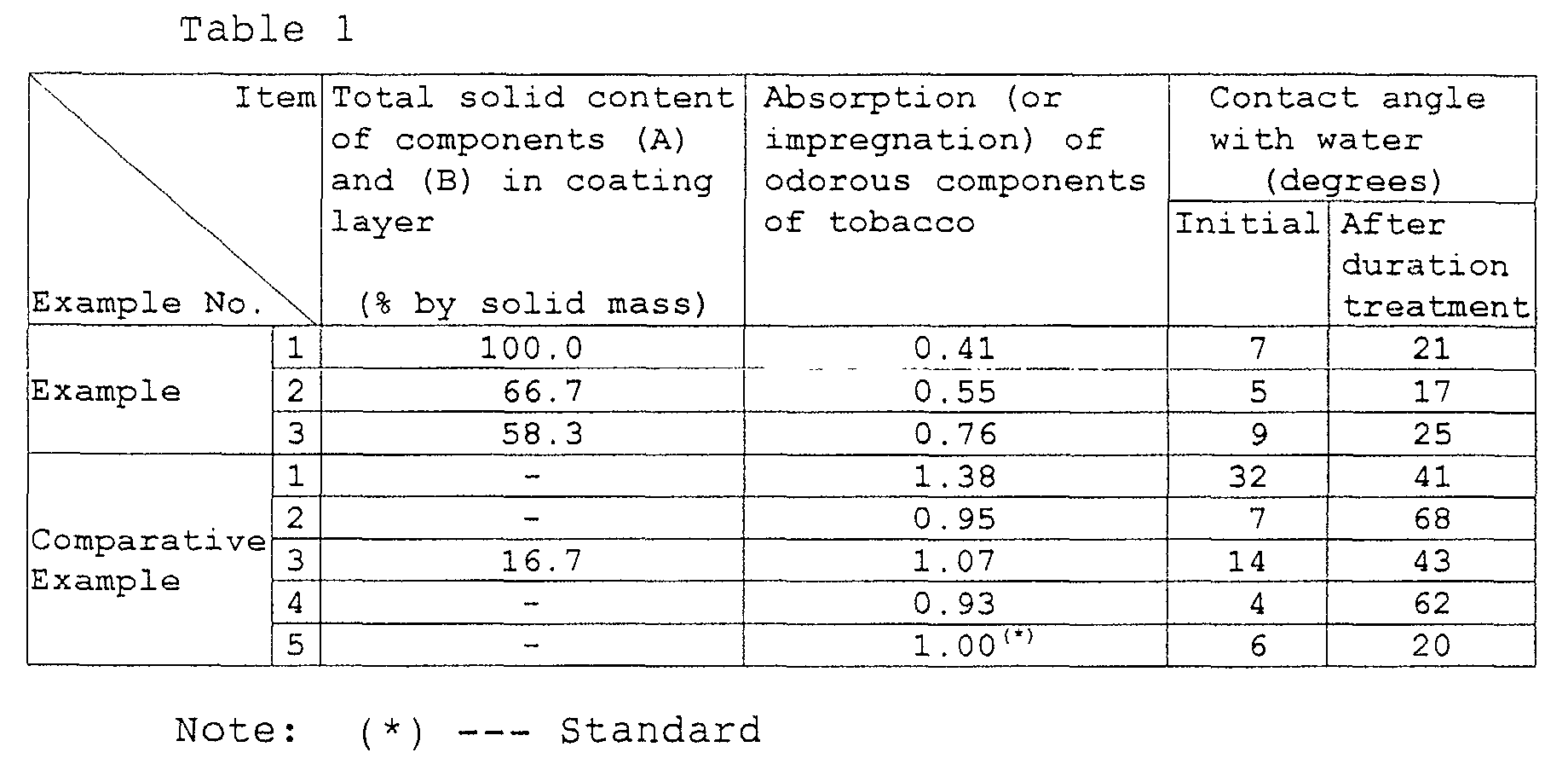
- When the absorption or impregnation of the odorous components of tobacco in the coated fin of Comparative Example 5 according to a conventional art is represented as 1.0, the odorous component absorptions of the coated fins according to the present invention were 0.41 in Example 1, 0.55 in Example 2 and 0.76 in Example 4. In other words, the coated heat exchangers of the present invention had a high resistance to absorption or impregnation of the odorous components of tobacco and exhibited high initial hydrophilicity and high durability of hydrophilicity.
- Compared with Examples 1 to 3 according to the present invention, in Comparative Example 1, the coating layer contained no component (A) and exhibited a high absorption of tobacco odorous components of 1.38, which is higher than that of Comparative Example 5, and low hydrophilicity.
- In Comparative Example 2, the coating layer contained no component (B) and was soluble in water. Thus, while the resistance to absorption of tobacco odorous components was higher than that of Comparative Example 5, the durability of hydrophilicity of the coated heat exchanger was very poor.
- In Comparative Example 3, the total content of the components (A) and (B) was less than 20% by mass, based on the total mass of the coating layer, and the resistance of the coating layer to the absorption of tobacco odorous components was low.
- In Comparative Example 4, the carboxylic compound in component (B) had only one carboxyl group per molecule thereof, and the properties of the resultant coating layer were similar to those of Comparative Example 2.
- Comparative Example 5 was carried out to provide a conventional coated heat exchanger as a standard.
- As is clear from the above description, the aluminum alloy heat exchanger according to the present invention, in which the surface of the base body is coated with a specific coating layer, exhibits a significantly reduced absorption of odorous substances, for example, odorous components of tobacco, and high hydrophilicity and high durability of hydrophilicity.
Claims (8)
- An aluminum alloy heat exchanger resistive to impregnation of tobacco odor comprising a base body of an aluminum alloy heat exchanger and an organic hydrophilic coating layer formed on at least a portion of the surface of the heat exchanger base body,the organic hydrophilic coating layer comprisinga component (A) comprising at least one chitosan compound selected from chitosan and derivatives thereof, anda component (B) comprising at least one carboxylic compound having two or more carboxyl groups per molecule thereof, andthe component (A) and the component (B) being present in a total solid amount of 20% by mass or more, based on the total amount by mass of the organic hydrophilic coating layer.
- The aluminum alloy heat exchanger resistive to impregnation of tobacco odor as claimed in claim 1, wherein the chitosan derivatives are selected from glycerylated chitosans.
- The aluminum alloy heat-exchanger resistive to impregnation of tobacco odor as claimed in claim 1, wherein the carboxylic compound is selected from oxalic acid, malonic acid, maleic acid, fumaric acid, succinic acid, malic acid, tartaric acid, citric acid, phthalic acids, itaconic acid, mellitic acid, trimellitic acid, trimesic acid, pyromellitic acid, naphthalenetetracarboxylic acid, propanedicarboxylic acid, butanedicarboxylic acid, pentanedicarboxylic acid, hexanedicarboxylic acid, heptanedicarboxylic acid, butanetricarboxylic acid, butanetetracarboxylic acid, cyclohexanetetracarboxylic acid, hexanetricarboxylic acid, acrylic acid polymers, methacrylic acid polymers and acrylic acid-methacrylic acid copolymers.
- The aluminum alloy heat-exchanger resistive to impregnation of tobacco odor as claimed in claim 1, wherein the component (A) and the component (B) are present in a solid mass ratio (A)/(B) of 3:1 to 1:3.
- An aluminium alloy heat-exchanger resistive to impregnation of tobacco odor as claimed in any of claims 1 to 4, wherein the hydrophilic coating layer comprises a surfactant or a hydrophilic polymer to enhance the hydrophilicity of the coating layer.
- An aluminium alloy heat-exchanger resistive to impregnation of tobacco odor as claimed in any of claims 1 to 5, wherein the hydrophilic coating layer comprises an antibacterial agent and/or antifungus agent, to prevent proliferation of bacteria and/or fungi.
- An aluminium alloy heat-exchanger resistive to impregnation of tobacco odor as claimed in any of claims 1 to 6, wherein the hydrophilic coating layer comprises a deodorizer.
- Use of an organic hydrophilic coating layer to improve the resistance of an aluminium alloy to the impregnation of odorous materials, the organic hydrophilic coating layer comprisinga component (A) comprising at least one chitosan compound selected from chitosan and derivatives thereof, anda component (B) comprising at least one carboxylic compound having two or more carboxyl groups per molecule thereof, andthe component (A) and the component (B) being present in a total solid amount of 20% by mass or more, based on the total amount by mass of the organic hydrophilic coating layer.
Applications Claiming Priority (2)
| Application Number | Priority Date | Filing Date | Title |
|---|---|---|---|
| JP2000344173 | 2000-11-10 | ||
| JP2000344173 | 2000-11-10 |
Publications (2)
| Publication Number | Publication Date |
|---|---|
| EP1205523A1 true EP1205523A1 (en) | 2002-05-15 |
| EP1205523B1 EP1205523B1 (en) | 2006-05-10 |
Family
ID=18818416
Family Applications (1)
| Application Number | Title | Priority Date | Filing Date |
|---|---|---|---|
| EP01309487A Expired - Lifetime EP1205523B1 (en) | 2000-11-10 | 2001-11-09 | Aluminium alloy heat exchanger resistive to tobacco odor impregnation |
Country Status (7)
| Country | Link |
|---|---|
| US (1) | US6689481B2 (en) |
| EP (1) | EP1205523B1 (en) |
| JP (1) | JP4850810B2 (en) |
| CN (1) | CN1284960C (en) |
| AU (2) | AU8936701A (en) |
| BR (1) | BR0105140B1 (en) |
| DE (1) | DE60119477T2 (en) |
Cited By (4)
| Publication number | Priority date | Publication date | Assignee | Title |
|---|---|---|---|---|
| EP1329535A1 (en) * | 2002-01-11 | 2003-07-23 | Nihon Parkerizing Co., Ltd. | Aluminium alloy heat exchanger resistive to tobacco odor impregnation |
| EP1299487A4 (en) * | 2000-07-12 | 2004-05-06 | Dainichiseika Color Chem | AQUEOUS COMPOSITIONS AND METHOD FOR MODIFYING THE SURFACE OF ARTICLES USING SUCH AQUEOUS COMPOSITIONS |
| US7294362B2 (en) * | 2002-01-11 | 2007-11-13 | Nihon Parkerizing Co., Ltd. | Aqueous agent for treating substrate, method for treating substrate and treated substrate |
| EP2537674A4 (en) * | 2010-02-15 | 2013-10-30 | Nihon Parkerizing | ALUMINUM OR ALUMINUM ALLOY MATERIAL HAVING SURFACE TREATMENT COATING FILM, AND SURFACE TREATMENT METHOD THEREOF |
Citations (5)
| Publication number | Priority date | Publication date | Assignee | Title |
|---|---|---|---|---|
| US4528283A (en) * | 1982-06-23 | 1985-07-09 | Wella Aktiengesellschaft | Cosmetic composition based upon chitosan derivatives, new chitosan derivatives as well as processes for the production thereof |
| JPH07190676A (en) * | 1993-12-27 | 1995-07-28 | Katagi Aruminiyuumu Seisakusho:Kk | Surface-treated fins for heat exchangers |
| DE19604706A1 (en) * | 1996-02-09 | 1997-08-14 | Merck Patent Gmbh | Crosslinking products of biopolymers containing amino groups |
| EP0911427A1 (en) * | 1997-10-24 | 1999-04-28 | Nihon Parkerizing Co., Ltd. | Process for surface-treating an aluminium-containing metal |
| JPH11293149A (en) * | 1998-04-14 | 1999-10-26 | Nippon Light Metal Co Ltd | Hydrophilic surface treatment composition and hydrophilic surface treatment film |
Family Cites Families (10)
| Publication number | Priority date | Publication date | Assignee | Title |
|---|---|---|---|---|
| JPS59186557A (en) * | 1983-04-06 | 1984-10-23 | ライオン株式会社 | Room aromatic agent |
| JP2506924B2 (en) | 1988-04-20 | 1996-06-12 | 日本パーカライジング株式会社 | Aluminum heat exchanger |
| JPH01299877A (en) | 1988-05-26 | 1989-12-04 | Kansai Paint Co Ltd | Surface treating agent for heat exchanger aluminum fin and its treatment |
| US4973359A (en) | 1989-01-04 | 1990-11-27 | Nippon Paint Co., Ltd. | Surface treatment chemical and bath for forming hydrophilic coatings and method of surface-treating aluminum members |
| JPH04342701A (en) * | 1991-05-17 | 1992-11-30 | Shin Etsu Chem Co Ltd | Polymer scale deposition inhibitor and method for preventing polymer scale from depositing |
| JPH06306247A (en) | 1993-04-26 | 1994-11-01 | Hitachi Chem Co Ltd | Water-soluble resin composition and hydrophilization treatment therewith |
| JPH07268274A (en) * | 1994-04-01 | 1995-10-17 | Kansai Paint Co Ltd | Composition and method for imparting hydrophilicity |
| JP3093953B2 (en) | 1995-04-24 | 2000-10-03 | シャープ株式会社 | Heat exchanger with deodorizing function |
| TW513472B (en) * | 2000-07-12 | 2002-12-11 | Dainichiseika Color & Amp Chem | Aqueous compositions and process for the surface modification of articles by use of the aqueous compositions |
| US6508958B1 (en) * | 2001-07-16 | 2003-01-21 | Gerald Wojcik | Composition and process for inhibiting corrosion of metallic substrates |
-
2001
- 2001-11-07 US US10/010,654 patent/US6689481B2/en not_active Expired - Fee Related
- 2001-11-09 AU AU89367/01A patent/AU8936701A/en not_active Abandoned
- 2001-11-09 CN CNB011378603A patent/CN1284960C/en not_active Expired - Fee Related
- 2001-11-09 EP EP01309487A patent/EP1205523B1/en not_active Expired - Lifetime
- 2001-11-09 DE DE60119477T patent/DE60119477T2/en not_active Expired - Lifetime
- 2001-11-12 BR BRPI0105140-7A patent/BR0105140B1/en not_active IP Right Cessation
-
2007
- 2007-11-02 JP JP2007285931A patent/JP4850810B2/en not_active Expired - Fee Related
-
2008
- 2008-12-10 AU AU2008255206A patent/AU2008255206B2/en not_active Ceased
Patent Citations (5)
| Publication number | Priority date | Publication date | Assignee | Title |
|---|---|---|---|---|
| US4528283A (en) * | 1982-06-23 | 1985-07-09 | Wella Aktiengesellschaft | Cosmetic composition based upon chitosan derivatives, new chitosan derivatives as well as processes for the production thereof |
| JPH07190676A (en) * | 1993-12-27 | 1995-07-28 | Katagi Aruminiyuumu Seisakusho:Kk | Surface-treated fins for heat exchangers |
| DE19604706A1 (en) * | 1996-02-09 | 1997-08-14 | Merck Patent Gmbh | Crosslinking products of biopolymers containing amino groups |
| EP0911427A1 (en) * | 1997-10-24 | 1999-04-28 | Nihon Parkerizing Co., Ltd. | Process for surface-treating an aluminium-containing metal |
| JPH11293149A (en) * | 1998-04-14 | 1999-10-26 | Nippon Light Metal Co Ltd | Hydrophilic surface treatment composition and hydrophilic surface treatment film |
Non-Patent Citations (4)
| Title |
|---|
| DATABASE WPI Week 199550, Derwent World Patents Index; AN 1995-384896 * |
| DATABASE WPI Week 200002, Derwent World Patents Index; AN 2000-018836 * |
| PATENT ABSTRACTS OF JAPAN vol. 1995, no. 10 30 November 1995 (1995-11-30) * |
| PATENT ABSTRACTS OF JAPAN vol. 2000, no. 1 31 January 2000 (2000-01-31) * |
Cited By (6)
| Publication number | Priority date | Publication date | Assignee | Title |
|---|---|---|---|---|
| EP1299487A4 (en) * | 2000-07-12 | 2004-05-06 | Dainichiseika Color Chem | AQUEOUS COMPOSITIONS AND METHOD FOR MODIFYING THE SURFACE OF ARTICLES USING SUCH AQUEOUS COMPOSITIONS |
| EP1329535A1 (en) * | 2002-01-11 | 2003-07-23 | Nihon Parkerizing Co., Ltd. | Aluminium alloy heat exchanger resistive to tobacco odor impregnation |
| US6698507B2 (en) | 2002-01-11 | 2004-03-02 | Nihon Parkerizing Co., Ltd. | Aluminum alloy heat exchanger resistive to tobacco odor impregnation |
| US7294362B2 (en) * | 2002-01-11 | 2007-11-13 | Nihon Parkerizing Co., Ltd. | Aqueous agent for treating substrate, method for treating substrate and treated substrate |
| EP2537674A4 (en) * | 2010-02-15 | 2013-10-30 | Nihon Parkerizing | ALUMINUM OR ALUMINUM ALLOY MATERIAL HAVING SURFACE TREATMENT COATING FILM, AND SURFACE TREATMENT METHOD THEREOF |
| US8741445B2 (en) | 2010-02-15 | 2014-06-03 | Nihon Parkerizing Co., Ltd. | Aluminum or aluminum alloy material having surface treatment coating film, and method for treating a surface thereof |
Also Published As
| Publication number | Publication date |
|---|---|
| JP2008150585A (en) | 2008-07-03 |
| AU8936701A (en) | 2002-05-16 |
| BR0105140A (en) | 2002-06-25 |
| DE60119477T2 (en) | 2007-05-03 |
| BR0105140B1 (en) | 2011-10-04 |
| US20020090523A1 (en) | 2002-07-11 |
| DE60119477D1 (en) | 2006-06-14 |
| EP1205523B1 (en) | 2006-05-10 |
| AU2008255206A1 (en) | 2009-12-10 |
| AU2008255206B2 (en) | 2011-09-15 |
| CN1353295A (en) | 2002-06-12 |
| US6689481B2 (en) | 2004-02-10 |
| CN1284960C (en) | 2006-11-15 |
| JP4850810B2 (en) | 2012-01-11 |
Similar Documents
| Publication | Publication Date | Title |
|---|---|---|
| JP5663174B2 (en) | Aluminum or aluminum alloy material having surface treatment film and surface treatment method thereof | |
| JP4008620B2 (en) | Aluminum alloy heat exchanger | |
| JP5570127B2 (en) | Hydrophilic treatment agent, aluminum-containing metal material and aluminum alloy heat exchanger | |
| JPS6357674A (en) | Treating material and method used in forming hydrophilic coating film | |
| JP2010096416A (en) | Precoat aluminum fin material for heat exchanger | |
| US6698507B2 (en) | Aluminum alloy heat exchanger resistive to tobacco odor impregnation | |
| AU2008255206B2 (en) | Aluminium alloy heat exchanger resistive to tobacco odour impregnation | |
| CN100392341C (en) | Method for producing aluminum heat sink material and aluminum heat sink material produced by the method | |
| JP4769159B2 (en) | Aluminum coated plate and pre-coated aluminum fin material using the same | |
| JP2002285140A (en) | Hydrophilizing agent, hydrophilizing method and hydrophilized aluminum material or aluminum alloy material | |
| CA1319571C (en) | Treatment method for imparting antimicrobial and hydrophilic properties to aluminum surfaces | |
| JPH0914889A (en) | Aluminum-containing metal heat exchanger and manufacturing method | |
| AU2006201441A1 (en) | Aluminium alloy heat exchanger resistive to tabacco odor impregnation | |
| JP2000256579A (en) | Hydrophilic coating composition and hydrophilic coating comprising the composition | |
| JP2548449B2 (en) | Surface treatment method for aluminum heat exchanger | |
| JP2009139036A (en) | COATING COMPOSITION FOR HYDROPHILIC POSTCOAT FOR HEAT EXCHANGER AND HEAT EXCHANGER USING SAME | |
| JP2002206894A (en) | Aluminum alloy heat exchanger with less odor components | |
| JP6215990B2 (en) | Aluminum fin material | |
| JP3154897B2 (en) | Aluminum heat exchanger and surface treatment method | |
| JP2011214766A (en) | Alkali-resistant aluminum fin material for heat exchanger and heat exchanger | |
| JPS6058269A (en) | Surface treatment method | |
| JPH0818005B2 (en) | Method for hydrophilic treatment of aluminum surface | |
| JPH09292197A (en) | Hydrophilizing agent for heat exchanger, treating method and treated aluminum material |
Legal Events
| Date | Code | Title | Description |
|---|---|---|---|
| PUAI | Public reference made under article 153(3) epc to a published international application that has entered the european phase |
Free format text: ORIGINAL CODE: 0009012 |
|
| AK | Designated contracting states |
Kind code of ref document: A1 Designated state(s): AT BE CH CY DE DK ES FI FR GB GR IE IT LI LU MC NL PT SE TR |
|
| AX | Request for extension of the european patent |
Free format text: AL;LT;LV;MK;RO;SI |
|
| 17P | Request for examination filed |
Effective date: 20020531 |
|
| AKX | Designation fees paid |
Designated state(s): DE FR GB IT |
|
| 17Q | First examination report despatched |
Effective date: 20030224 |
|
| GRAP | Despatch of communication of intention to grant a patent |
Free format text: ORIGINAL CODE: EPIDOSNIGR1 |
|
| GRAS | Grant fee paid |
Free format text: ORIGINAL CODE: EPIDOSNIGR3 |
|
| GRAA | (expected) grant |
Free format text: ORIGINAL CODE: 0009210 |
|
| AK | Designated contracting states |
Kind code of ref document: B1 Designated state(s): DE FR GB IT |
|
| PG25 | Lapsed in a contracting state [announced via postgrant information from national office to epo] |
Ref country code: IT Free format text: LAPSE BECAUSE OF FAILURE TO SUBMIT A TRANSLATION OF THE DESCRIPTION OR TO PAY THE FEE WITHIN THE PRESCRIBED TIME-LIMIT;WARNING: LAPSES OF ITALIAN PATENTS WITH EFFECTIVE DATE BEFORE 2007 MAY HAVE OCCURRED AT ANY TIME BEFORE 2007. THE CORRECT EFFECTIVE DATE MAY BE DIFFERENT FROM THE ONE RECORDED. Effective date: 20060510 |
|
| REG | Reference to a national code |
Ref country code: GB Ref legal event code: FG4D |
|
| REF | Corresponds to: |
Ref document number: 60119477 Country of ref document: DE Date of ref document: 20060614 Kind code of ref document: P |
|
| ET | Fr: translation filed | ||
| PLBE | No opposition filed within time limit |
Free format text: ORIGINAL CODE: 0009261 |
|
| STAA | Information on the status of an ep patent application or granted ep patent |
Free format text: STATUS: NO OPPOSITION FILED WITHIN TIME LIMIT |
|
| 26N | No opposition filed |
Effective date: 20070213 |
|
| PGFP | Annual fee paid to national office [announced via postgrant information from national office to epo] |
Ref country code: GB Payment date: 20131128 Year of fee payment: 13 Ref country code: DE Payment date: 20131128 Year of fee payment: 13 Ref country code: FR Payment date: 20131118 Year of fee payment: 13 |
|
| PGFP | Annual fee paid to national office [announced via postgrant information from national office to epo] |
Ref country code: IT Payment date: 20131120 Year of fee payment: 13 |
|
| REG | Reference to a national code |
Ref country code: DE Ref legal event code: R119 Ref document number: 60119477 Country of ref document: DE |
|
| GBPC | Gb: european patent ceased through non-payment of renewal fee |
Effective date: 20141109 |
|
| REG | Reference to a national code |
Ref country code: FR Ref legal event code: ST Effective date: 20150731 |
|
| PG25 | Lapsed in a contracting state [announced via postgrant information from national office to epo] |
Ref country code: DE Free format text: LAPSE BECAUSE OF NON-PAYMENT OF DUE FEES Effective date: 20150602 Ref country code: GB Free format text: LAPSE BECAUSE OF NON-PAYMENT OF DUE FEES Effective date: 20141109 |
|
| PG25 | Lapsed in a contracting state [announced via postgrant information from national office to epo] |
Ref country code: FR Free format text: LAPSE BECAUSE OF NON-PAYMENT OF DUE FEES Effective date: 20141201 |
|
| PG25 | Lapsed in a contracting state [announced via postgrant information from national office to epo] |
Ref country code: IT Free format text: LAPSE BECAUSE OF NON-PAYMENT OF DUE FEES Effective date: 20141109 |