EP1204115A2 - Information reproducing apparatus and information reproducing method - Google Patents
Information reproducing apparatus and information reproducing method Download PDFInfo
- Publication number
- EP1204115A2 EP1204115A2 EP01126242A EP01126242A EP1204115A2 EP 1204115 A2 EP1204115 A2 EP 1204115A2 EP 01126242 A EP01126242 A EP 01126242A EP 01126242 A EP01126242 A EP 01126242A EP 1204115 A2 EP1204115 A2 EP 1204115A2
- Authority
- EP
- European Patent Office
- Prior art keywords
- information
- directory
- recorded
- reproducing
- path table
- Prior art date
- Legal status (The legal status is an assumption and is not a legal conclusion. Google has not performed a legal analysis and makes no representation as to the accuracy of the status listed.)
- Withdrawn
Links
Images



Classifications
-
- G—PHYSICS
- G11—INFORMATION STORAGE
- G11B—INFORMATION STORAGE BASED ON RELATIVE MOVEMENT BETWEEN RECORD CARRIER AND TRANSDUCER
- G11B27/00—Editing; Indexing; Addressing; Timing or synchronising; Monitoring; Measuring tape travel
- G11B27/10—Indexing; Addressing; Timing or synchronising; Measuring tape travel
- G11B27/19—Indexing; Addressing; Timing or synchronising; Measuring tape travel by using information detectable on the record carrier
- G11B27/28—Indexing; Addressing; Timing or synchronising; Measuring tape travel by using information detectable on the record carrier by using information signals recorded by the same method as the main recording
- G11B27/32—Indexing; Addressing; Timing or synchronising; Measuring tape travel by using information detectable on the record carrier by using information signals recorded by the same method as the main recording on separate auxiliary tracks of the same or an auxiliary record carrier
- G11B27/327—Table of contents
- G11B27/329—Table of contents on a disc [VTOC]
-
- G—PHYSICS
- G11—INFORMATION STORAGE
- G11B—INFORMATION STORAGE BASED ON RELATIVE MOVEMENT BETWEEN RECORD CARRIER AND TRANSDUCER
- G11B27/00—Editing; Indexing; Addressing; Timing or synchronising; Monitoring; Measuring tape travel
- G11B27/10—Indexing; Addressing; Timing or synchronising; Measuring tape travel
- G11B27/102—Programmed access in sequence to addressed parts of tracks of operating record carriers
- G11B27/105—Programmed access in sequence to addressed parts of tracks of operating record carriers of operating discs
-
- G—PHYSICS
- G11—INFORMATION STORAGE
- G11B—INFORMATION STORAGE BASED ON RELATIVE MOVEMENT BETWEEN RECORD CARRIER AND TRANSDUCER
- G11B27/00—Editing; Indexing; Addressing; Timing or synchronising; Monitoring; Measuring tape travel
- G11B27/10—Indexing; Addressing; Timing or synchronising; Measuring tape travel
- G11B27/11—Indexing; Addressing; Timing or synchronising; Measuring tape travel by using information not detectable on the record carrier
-
- G—PHYSICS
- G11—INFORMATION STORAGE
- G11B—INFORMATION STORAGE BASED ON RELATIVE MOVEMENT BETWEEN RECORD CARRIER AND TRANSDUCER
- G11B2220/00—Record carriers by type
- G11B2220/20—Disc-shaped record carriers
- G11B2220/21—Disc-shaped record carriers characterised in that the disc is of read-only, rewritable, or recordable type
- G11B2220/213—Read-only discs
-
- G—PHYSICS
- G11—INFORMATION STORAGE
- G11B—INFORMATION STORAGE BASED ON RELATIVE MOVEMENT BETWEEN RECORD CARRIER AND TRANSDUCER
- G11B2220/00—Record carriers by type
- G11B2220/20—Disc-shaped record carriers
- G11B2220/25—Disc-shaped record carriers characterised in that the disc is based on a specific recording technology
- G11B2220/2537—Optical discs
- G11B2220/2545—CDs
Definitions
- the present invention relates to an information reproducing apparatus and an information reproducing method for reproducing data recorded in a format different from that used in CD (compact disc).
- CD compact disc
- ISO9660 logical file format which can be used for storing a hierarchical structure file in CD-ROM.
- ISO9660 logical file format is so formed that disc volume space has been divided into a plurality of logical blocks which are provided with addresses indicated by a series of continuous numbers starting from 0.
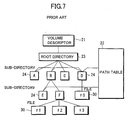
- Fig. 7 is a block diagram showing the structure of a logical file of ISO9660 format.
- reference numeral 21 is a volume descriptor storing information concerning logical block address of path table, size of path table, as well as logical block address of root directory, and size of the root directory.
- the volume descriptor 21 is fixed in its recording position and its size, serving as a start point of an access to a hierarchical structure file.
- Reference numeral 22 is a path table storing information concerning logical block addresses of all directories, sizes of the all directories, as well as a hierarchical structure of the directories. In fact, the path table 22 is variable in its recording position and its size.
- Reference numeral 23 is a root directory, 24 is a sub-directory, storing information concerning (for example) sizes of files 30... (which serves as unit information existing under the sub-directory.
- the directory 23 is also variable in its recording position and its size.
- logical file structure of ISO9660 format is characterized in that it has the path table 22 which is in fact an address table storing directory information of various hierarchies, rendering it possible to reduce the number of necessary accesses to a desired file.
- the path table 22 is a table containing all directory informations (name and position of each directory, parent directory, all arranged in accordance with a preferential order according to their width) and is for use in searching a directory at a high speed.
- CD-ROM is slow in seek operation, when sub-directory is searched, a considerable amount of time is necessary in searching (one by one) respective sub-directories separately located in a usual file system.
- the path table since the path table usually has one to several sectors, it is allowed to perform a high speed access by performing a constant caching.
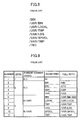
- the order of path table records will be like that shown in Fig. 9.
- the front head (No. 1) is constantly a root directory. If a file named as /USR/TMP/README. TXT; 1 is to be searched, an operation procedure will be as follows.
- a root directory is searched from a group of path table records having a level 1.
- the number is 1.
- the number 1 is held as a parent (it is obvious that parent level 2 is root), while a number for searching an identifier called USR is number 4.
- number 4 is held as a parent, thereby searching for an identifier called TMP. At this time, the number is 8.
- directory searching can be accomplished only by searching a path table from its front head, without having to search each of sub-directories separately dispersed on a disc.
- An object of the present invention is to provide a method of and an apparatus for reproducing information, capable of generating TOC data from path table, reproducing data recorded in a different format from CD in accordance with TOC data, using a software conventionally possessed by a CD player to perform program reproduction and repetition reproduction.
- an information reproducing apparatus for reproducing information formed by a plurality of unit information recorded in a hierarchical structure, said apparatus comprising an absolute time generation means for generating absolute time information from position information of the unit information; and a reproducing means for reproducing recorded information in accordance with the absolute time information.
- the absolute time generation means is adapted to generate absolute time information of the unit information, in accordance with management information for managing positional information of the unit information.
- the unit information is data prescribed in accordance with ISO9660
- the absolute time information is time information corresponding to TOC (Table Of Contents) prescribed in accordance with Red Book.
- an information reproducing method for reproducing information formed by a plurality of unit information recorded in a hierarchical structure comprising generating absolute time information from position information of the unit information; and reproducing recorded information in accordance with the absolute time information.
- TOC data (which is the same as CD) in accordance with data recorded in a format different from CD
- TOC data since it is allowed to execute the same functions as provided by CD player when performing program reproduction and repetition reproduction, it is allowed to use the software contained within a conventional CD player (without having to modify the software to any extent).
- Fig. 1 is a block diagram showing an internal structure of an information reproducing apparatus formed according to the present invention.
- the information reproducing apparatus comprises a TOC data generating section 11 and an information reproducing section 12.
- the TOC data generating section 11 also serves as an absolute time generating means, and is capable of generating pseudo TOC data in accordance with information recorded in a path table storing directory information (recorded in ISO 9660 format) of various hierarchies.
- the information reproducing section 12 is provided to reproduce data recorded using data compression technology suitable for recording music contents represented by MP3 (MPG1: Moving Picture Experts Group 1, audio layer III).
- MP3 Moving Picture Experts Group 1, audio layer III
- the TOC data generating section 11 is formed by using a program of a system controller contained within a CD player, with CPU 12 reading and executing the program.
- the information reproducing section 12 operates under the control of the system controller to output (through a speaker) data formed by decoding the data read from CD and processing the data in a D/A converter.
- the program reproduction and repetition reproduction are also performed, exhibiting the functions for use in reproducing CD.
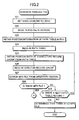
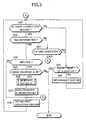
- Figs. 2 - 4 are flowcharts showing operations of the reproducing apparatus of the present invention, indicating a first main routine 1, a second main routine 2, and a sub-routine, all for generating TOC data.
- the TOC data generating section 11 operates to initialize a song counter contained within the system controller, thereby setting the counter at "0" (step S21). Then, PVD (Primary Volume Descriptor) is read from CD-ROM storing song data in ISO9660 format. Within the Volume, system areas are recorded in addresses "0000"h - "7FFF"h (0 - 15 sectors), while volume descriptors, path table groups, directories and files are recorded in "8000"h - (16 sectors - ). PVD is recorded in the areas of 16 - 17 sectors.
- PVD Primary Volume Descriptor
- the path table is formed by preparing and properly arranging path table records relating to all directories within the volume.
- the path table records are those storing the positions of extents (front head address) covering paths extending from a root directory to the respective directories as well as related directories.
- position data containing directory records are obtained from the path table records (step S25).
- position information of the extents within the path table records it is allowed to know the position storing directory records (serving as management information).
- directory records are read-in (step S26). In practice, one sector (2048 bytes) of data is read-in.
- Directory records are those storing flags indicating the positions of directories or positions of extents of files (all managed by directory records), also indicating whether the above data is file information or directory information.
- MP3 file is searched out from a directory record (step S27).
- file identifier information within the directory record is referred to, thereby searching out an object whose extender is "mp3".
- step S28 it is checked whether MP3 file has been found or not (step S28). If MP3 file has been found, the process goes to step S31 shown in Fig. 3. On the other hand, if the MP3 file has not been found, the process goes to step S29, so as to check whether there is a next path table record.
- step S24 it is determined, from the path table read-in at step S24, whether there is a next path table record. If there is such a next path table record, the process goes to step S25. On the other hand, if there is not such a next path table record, it is determined that the disc does not contain MP3 file (step S30), so that the process is terminated.
- step S31 it is determined whether there is a directory record. Actually, it is determined whether length information of directory record is "0" or not. If the length is "0" , it can be determined that there is no directory record information. If the length is not "0", it can be determined that such directory record information is existing, so that the process goes to step S32. If not, the process goes to step S39.
- step S32 it is determined whether the directory record is a file information and such determination may be effected by referring to a file flag within the directory record. If the directory record is a file information, the process proceeds to step S34. On the other hand, if the directory record is a directory information, the process proceeds to step S33. At step S33, it is determined whether the directory record information is "its own directory". Actually, if a file/directory identifier within the directory record is "00", it can be determined that the directory record information is "its own directory”.
- step S39 if the directory record information is "its own directory”, the process goes to step S39. If not, the process goes to step S38.
- "its own directory” means an initial directory record in certain directory.
- step S34 it is checked whether the above file information is an MP3 file.
- file identifier information within the directory record is referred, thereby determining whether an extender is an "MP3". If it is an MP3 file, the process goes to step S35. if it is not an MP3 file, the process goes to step S38.
- step S35 it is checked whether a song counter is "99" or lower. This is because Red Book (which is a standard of CD) requires that one CD contain 99 or fewer songs. If the song counter indicates a number of "99" or less, TOC data is prepared at step S36. On the other hand, it the number is "100" or more, the process is ended. Specifically, TOC data can be prepared at step S36, in accordance with a flowchart shown in Fig. 4.
- step S361 and step S362 it is required to detect the position of an extent within the directory record, i.e., LBN of front head of unit information managed by the directory record, and to convert a value of the position of the extent into a time value, with one second serving as 75 frames (step S361 and step S362). Then, two seconds are added in the calculated time value (a similar practice when authoring is performed on a video tape), thereby producing TOC data by registering the time value as an absolute time (steps S363, S364).
- step S37 the song counter is increased by 1.
- step S38 a next directory record is obtained.
- a next directory record is obtained from a directory record group read-in at step S36.
- the position of the next directory record can be known from the length information of the directory record inside the present directory record.
- step S39 it is checked whether the position of the directory record is the front head of a sector. In fact, this can be known from the present address information, in the form of "1 sector/2048 byte. If it is the front head of a sector, the process is ended. If not, directory record group of a next sector is read-in (step S40). However, information of one directory record group isn't always within one sector. If information of one directory record group can not be received within one sector, continued information can be stored in a next sector. But, ISO9660 format fails to record information of one directory record over boundaries between sectors.
- a directory record B in connection with a directory record A recorded in sector N.
- the directory record B After directory record A is recorded, if a vacant capacity (hatched portion) of sector N is smaller than the length of directory record B, the directory record B will be recorded in an area starting from the front head of sector N+1. If it is determined at step S31 that there is no directory record, for example, at a time a directory data next to directory record A (shown in Fig. 5) is about to be obtained, and if this position at this time is not a front head of a sector, it is allowed to assume that there is a next directory record. If, at step S39 it is determined that this is not a front head of a sector, an operation at step S40 will read-in a directory record group of a next sector.
- step S33 it is determined whether information of a directory record is "its own directory”. If it is determined that a directory record is "its own directory”, this will be an initial directory record in the directory. At this time, it is determined at step S39 whether the position of the directory record at this time is a front head of a sector. If an answer is YES, it is allowed to determine that information of other albums has started in a manner shown in Fig. 5.
- ISO9660 format data may be converted into TOC information of CD, (i.e., converted into absolute time information)
- the present invention should not be limited to this specific example.
- the present invention can be realized in any other embodiments, provided that the position of unit information managed under hierarchical structure can be converted into absolute time.
- TOC data is generated from the information of the path table and if the data recorded in a format different from CD is reproduced in accordance with the TOC data, it is possible to perform program reproduction and repeat reproduction, allowing the use of software contained within a conventional CD player (without having to modify the software to any extent), thus providing a user with a convenience as if he or she is using a conventional CD.
Landscapes
- Signal Processing For Digital Recording And Reproducing (AREA)
- Management Or Editing Of Information On Record Carriers (AREA)
Abstract
Description
The present application claims priority from Japanese Application No. 2000-337831, the disclosure of which is incorporated herein by reference for all purposes.
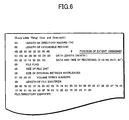
Some detailed examples of conversion into the TOC data will be described below by explaining a directory record within ISO9660 file shown in Fig. 6. Here, the position of an extent is acquired, and this is used as the number of sub-code frames of CD and two seconds are converted into a total frame time, followed by adding the above data ("0000254B" h) in the total frame time.
In other words, since one second can cover 75 frames, the total frame time of two seconds can cover "96" h frames. Therefore, "254B" h + "96" h becomes a "251E1" h frames. When this is converted into a time unit (hour, minute, second), it will become "25E1" h/75= 129 + 22, thereby becoming 2 minutes and 9 seconds and 22 frames. This data is than stored in the TOC area.
However, information of one directory record group isn't always within one sector. If information of one directory record group can not be received within one sector, continued information can be stored in a next sector. But, ISO9660 format fails to record information of one directory record over boundaries between sectors.
If it is determined at step S31 that there is no directory record, for example, at a time a directory data next to directory record A (shown in Fig. 5) is about to be obtained, and if this position at this time is not a front head of a sector, it is allowed to assume that there is a next directory record. If, at step S39 it is determined that this is not a front head of a sector, an operation at step S40 will read-in a directory record group of a next sector.
Claims (4)
- An information reproducing apparatus for reproducing information formed by a plurality of unit information recorded in a hierarchical structure, said apparatus comprising:an absolute time generation means (11) for generating absolute time information from position information of the unit information; anda reproducing means (12) for reproducing recorded information in accordance with the absolute time information.
- An information reproducing apparatus according to claim 1, wherein the absolute time generation means (11) is adapted to generate absolute time information of the unit information, in accordance with management information for managing position information of the unit information.
- An information reproducing apparatus according to claim 1, wherein the unit information is data prescribed in accordance with ISO9660, the absolute time information is time information corresponding to TOC (Table Of Contents) prescribed in accordance with Red Book.
- An information reproducing method for reproducing information formed by a plurality of unit information recorded in a hierarchical structure, said method comprising:generating absolute time information from position information of the unit information; andreproducing recorded information in accordance with the absolute time information.
Applications Claiming Priority (2)
| Application Number | Priority Date | Filing Date | Title |
|---|---|---|---|
| JP2000337831A JP2002150687A (en) | 2000-11-06 | 2000-11-06 | Information reproducing apparatus and method |
| JP2000337831 | 2000-11-06 |
Publications (2)
| Publication Number | Publication Date |
|---|---|
| EP1204115A2 true EP1204115A2 (en) | 2002-05-08 |
| EP1204115A3 EP1204115A3 (en) | 2005-08-24 |
Family
ID=18813148
Family Applications (1)
| Application Number | Title | Priority Date | Filing Date |
|---|---|---|---|
| EP01126242A Withdrawn EP1204115A3 (en) | 2000-11-06 | 2001-11-05 | Information reproducing apparatus and information reproducing method |
Country Status (3)
| Country | Link |
|---|---|
| US (1) | US20020054545A1 (en) |
| EP (1) | EP1204115A3 (en) |
| JP (1) | JP2002150687A (en) |
Family Cites Families (6)
| Publication number | Priority date | Publication date | Assignee | Title |
|---|---|---|---|---|
| US5341356A (en) * | 1991-04-02 | 1994-08-23 | U.S. Philips Corporation | Method and device for recording information volumes in a track of a record carrier, and a device for reading the record carrier |
| JP3235706B2 (en) * | 1994-05-31 | 2001-12-04 | 三星電子株式会社 | Recording method of disk recording medium and reproducing method thereof |
| JPH0855462A (en) * | 1994-08-11 | 1996-02-27 | Funai Techno Syst Kk | Header searching method |
| MY112755A (en) * | 1995-06-06 | 2001-08-30 | Sony Corp | Information data reproducing system, reproducing apparatus, reproducing method, data forming apparatus and data record medium |
| JPH0963253A (en) * | 1995-08-23 | 1997-03-07 | Sony Corp | Disk unit |
| US6381403B1 (en) * | 1997-01-31 | 2002-04-30 | Victor Company Of Japan, Ltd. | Audio disk of improved data structure and reproduction apparatus thereof |
-
2000
- 2000-11-06 JP JP2000337831A patent/JP2002150687A/en not_active Abandoned
-
2001
- 2001-11-05 EP EP01126242A patent/EP1204115A3/en not_active Withdrawn
- 2001-11-05 US US09/985,570 patent/US20020054545A1/en not_active Abandoned
Also Published As
| Publication number | Publication date |
|---|---|
| EP1204115A3 (en) | 2005-08-24 |
| JP2002150687A (en) | 2002-05-24 |
| US20020054545A1 (en) | 2002-05-09 |
Similar Documents
| Publication | Publication Date | Title |
|---|---|---|
| US6253026B1 (en) | Optical disc, recording apparatus, and computer-readable recording medium | |
| US7079757B2 (en) | Optical disc, recording apparatus, and computer-readable recording medium | |
| US6757480B1 (en) | Recording medium for storing information for still picture recording and/or reproducing method and apparatus therefor | |
| US7747136B2 (en) | Recording medium for storing information for still picture, recording and/or reproducing method and apparatus therefor | |
| KR100302497B1 (en) | Generation / recording method of still image management data on rewritable recording media | |
| JP3997428B2 (en) | Recording apparatus, file management method, file management method program, and recording medium recording file management method program | |
| KR20010034131A (en) | Information recording medium, apparatus and method for recording or reproducing data thereof | |
| KR20000017047A (en) | Recording media, Recording device, Play-back device, Recording method and Computer-readable Recording media | |
| US7616867B2 (en) | Recording medium for storing virtually deleted still picture information, recording and/or reproducing method and apparatus therefor | |
| US6674957B1 (en) | Recording medium for storing information for still picture, recording and/or reproducing method and apparatus therefor | |
| KR20010085662A (en) | Recording method, recording apparatus, and record medium | |
| KR100569816B1 (en) | A method for addressing bitstream recording, a storage medium, and a device for recording a bitstream on or reproducing a bitstream from a storage medium. | |
| RU2265963C2 (en) | Method for recording unfinished video data streams | |
| US8046341B2 (en) | Information processing apparatus for reproducing metadata and method, program, and recording medium | |
| RU2344496C2 (en) | Device of files management, method of files control and record medium, on which files management method program is recorded | |
| EP1204115A2 (en) | Information reproducing apparatus and information reproducing method | |
| US7835614B2 (en) | Data recording method, data recording apparatus, and data recording medium | |
| JP2003242722A (en) | Information recording medium, information recording apparatus and method, information reproducing apparatus and method, information recording and reproducing apparatus and method, computer program for recording or reproduction control, and data structure including control signal | |
| JP4164753B2 (en) | File management apparatus, file management method, file management method program, and recording medium recording file management method program | |
| KR100448453B1 (en) | Rewritable optical disc recorded still pictures and apparatus and method for reproducing the still pictures | |
| RU2246140C2 (en) | Method for addressing recording of bit flow, data carrier and device for recording bit flow on data carrier | |
| KR20100094915A (en) | Semiconductor memory based mobile storage medium for providing highquality uncompressed audio, and audio playing system using the storage medium | |
| RU2246141C2 (en) | Method for addressing recording of bit flow | |
| WO2005057581A1 (en) | Information recorder, information recording method and recording medium recorded with program | |
| KR20110078854A (en) | A portable storage medium based on a semiconductor memory for providing high quality uncompressed audio and an audio reproduction system using the same |
Legal Events
| Date | Code | Title | Description |
|---|---|---|---|
| PUAI | Public reference made under article 153(3) epc to a published international application that has entered the european phase |
Free format text: ORIGINAL CODE: 0009012 |
|
| AK | Designated contracting states |
Kind code of ref document: A2 Designated state(s): AT BE CH CY DE DK ES FI FR GB GR IE IT LI LU MC NL PT SE TR |
|
| AX | Request for extension of the european patent |
Free format text: AL;LT;LV;MK;RO;SI |
|
| PUAL | Search report despatched |
Free format text: ORIGINAL CODE: 0009013 |
|
| AK | Designated contracting states |
Kind code of ref document: A3 Designated state(s): AT BE CH CY DE DK ES FI FR GB GR IE IT LI LU MC NL PT SE TR |
|
| AX | Request for extension of the european patent |
Extension state: AL LT LV MK RO SI |
|
| STAA | Information on the status of an ep patent application or granted ep patent |
Free format text: STATUS: THE APPLICATION HAS BEEN WITHDRAWN |
|
| 18W | Application withdrawn |
Effective date: 20051025 |