EP1203827B1 - Polymorphisms in the human KDR gene - Google Patents
Polymorphisms in the human KDR gene Download PDFInfo
- Publication number
- EP1203827B1 EP1203827B1 EP01309193A EP01309193A EP1203827B1 EP 1203827 B1 EP1203827 B1 EP 1203827B1 EP 01309193 A EP01309193 A EP 01309193A EP 01309193 A EP01309193 A EP 01309193A EP 1203827 B1 EP1203827 B1 EP 1203827B1
- Authority
- EP
- European Patent Office
- Prior art keywords
- polymorphism
- seq
- kdr
- human
- sequence
- Prior art date
- Legal status (The legal status is an assumption and is not a legal conclusion. Google has not performed a legal analysis and makes no representation as to the accuracy of the status listed.)
- Expired - Lifetime
Links
- 102000054765 polymorphisms of proteins Human genes 0.000 title abstract description 31
- 101100372765 Homo sapiens KDR gene Proteins 0.000 title abstract description 4
- 238000000034 method Methods 0.000 claims abstract description 51
- 239000002773 nucleotide Substances 0.000 claims abstract description 43
- 125000003729 nucleotide group Chemical group 0.000 claims abstract description 43
- 101150088608 Kdr gene Proteins 0.000 claims abstract description 27
- 108010053099 Vascular Endothelial Growth Factor Receptor-2 Proteins 0.000 claims abstract description 27
- 102100033177 Vascular endothelial growth factor receptor 2 Human genes 0.000 claims abstract description 27
- 102000005789 Vascular Endothelial Growth Factors Human genes 0.000 claims abstract description 20
- 108010019530 Vascular Endothelial Growth Factors Proteins 0.000 claims abstract description 19
- 201000010099 disease Diseases 0.000 claims abstract description 17
- 208000037265 diseases, disorders, signs and symptoms Diseases 0.000 claims abstract description 17
- 230000001404 mediated effect Effects 0.000 claims abstract description 13
- 206010028980 Neoplasm Diseases 0.000 claims abstract description 8
- 201000011510 cancer Diseases 0.000 claims abstract description 5
- 208000027866 inflammatory disease Diseases 0.000 claims abstract description 5
- 241000282414 Homo sapiens Species 0.000 claims description 44
- 108700028369 Alleles Proteins 0.000 claims description 41
- 239000000523 sample Substances 0.000 claims description 20
- 230000003321 amplification Effects 0.000 claims description 18
- 238000003199 nucleic acid amplification method Methods 0.000 claims description 18
- 150000007523 nucleic acids Chemical group 0.000 claims description 17
- 238000001514 detection method Methods 0.000 claims description 15
- 238000003556 assay Methods 0.000 claims description 9
- 230000000295 complement effect Effects 0.000 claims description 9
- 238000007894 restriction fragment length polymorphism technique Methods 0.000 claims description 9
- 108020004707 nucleic acids Proteins 0.000 claims description 8
- 102000039446 nucleic acids Human genes 0.000 claims description 8
- 238000012360 testing method Methods 0.000 claims description 7
- 108020005187 Oligonucleotide Probes Proteins 0.000 claims description 6
- 238000003745 diagnosis Methods 0.000 claims description 6
- 238000009396 hybridization Methods 0.000 claims description 6
- 239000002751 oligonucleotide probe Substances 0.000 claims description 6
- 108091034117 Oligonucleotide Proteins 0.000 claims description 5
- 238000011161 development Methods 0.000 claims description 5
- 238000009007 Diagnostic Kit Methods 0.000 claims description 3
- 238000011330 nucleic acid test Methods 0.000 claims description 3
- 238000003752 polymerase chain reaction Methods 0.000 claims description 3
- 238000004393 prognosis Methods 0.000 claims description 3
- 108091008146 restriction endonucleases Proteins 0.000 claims description 3
- 108010073929 Vascular Endothelial Growth Factor A Proteins 0.000 abstract description 14
- 108090000623 proteins and genes Proteins 0.000 abstract description 12
- 150000001413 amino acids Chemical class 0.000 abstract description 7
- 102000004169 proteins and genes Human genes 0.000 abstract description 6
- 108020003589 5' Untranslated Regions Proteins 0.000 abstract description 5
- 230000008859 change Effects 0.000 abstract description 5
- 108090000765 processed proteins & peptides Proteins 0.000 abstract description 5
- 108091026890 Coding region Proteins 0.000 abstract description 4
- 108700039691 Genetic Promoter Regions Proteins 0.000 abstract description 4
- 239000003446 ligand Substances 0.000 abstract description 4
- 229920001184 polypeptide Polymers 0.000 abstract description 4
- 102000004196 processed proteins & peptides Human genes 0.000 abstract description 4
- 239000000463 material Substances 0.000 abstract description 3
- 239000013615 primer Substances 0.000 description 46
- 108020004414 DNA Proteins 0.000 description 30
- 239000003814 drug Substances 0.000 description 17
- 230000035772 mutation Effects 0.000 description 16
- 108020004705 Codon Proteins 0.000 description 15
- 229940079593 drug Drugs 0.000 description 15
- 102000054766 genetic haplotypes Human genes 0.000 description 13
- 230000002441 reversible effect Effects 0.000 description 10
- 238000004458 analytical method Methods 0.000 description 8
- 108091028043 Nucleic acid sequence Proteins 0.000 description 6
- 238000002405 diagnostic procedure Methods 0.000 description 6
- 230000029087 digestion Effects 0.000 description 6
- 230000002974 pharmacogenomic effect Effects 0.000 description 6
- 238000012163 sequencing technique Methods 0.000 description 6
- 238000002965 ELISA Methods 0.000 description 5
- 229940024606 amino acid Drugs 0.000 description 5
- 235000001014 amino acid Nutrition 0.000 description 5
- 238000006243 chemical reaction Methods 0.000 description 5
- 230000000875 corresponding effect Effects 0.000 description 5
- 230000004044 response Effects 0.000 description 5
- FWMNVWWHGCHHJJ-SKKKGAJSSA-N 4-amino-1-[(2r)-6-amino-2-[[(2r)-2-[[(2r)-2-[[(2r)-2-amino-3-phenylpropanoyl]amino]-3-phenylpropanoyl]amino]-4-methylpentanoyl]amino]hexanoyl]piperidine-4-carboxylic acid Chemical compound C([C@H](C(=O)N[C@H](CC(C)C)C(=O)N[C@H](CCCCN)C(=O)N1CCC(N)(CC1)C(O)=O)NC(=O)[C@H](N)CC=1C=CC=CC=1)C1=CC=CC=C1 FWMNVWWHGCHHJJ-SKKKGAJSSA-N 0.000 description 4
- HEDRZPFGACZZDS-UHFFFAOYSA-N Chloroform Chemical compound ClC(Cl)Cl HEDRZPFGACZZDS-UHFFFAOYSA-N 0.000 description 4
- 238000013461 design Methods 0.000 description 4
- 238000002866 fluorescence resonance energy transfer Methods 0.000 description 4
- 239000012634 fragment Substances 0.000 description 4
- 102100034976 Cystathionine beta-synthase Human genes 0.000 description 3
- 108010073644 Cystathionine beta-synthase Proteins 0.000 description 3
- AGPKZVBTJJNPAG-WHFBIAKZSA-N L-isoleucine Chemical compound CC[C@H](C)[C@H](N)C(O)=O AGPKZVBTJJNPAG-WHFBIAKZSA-N 0.000 description 3
- ISWSIDIOOBJBQZ-UHFFFAOYSA-N Phenol Chemical compound OC1=CC=CC=C1 ISWSIDIOOBJBQZ-UHFFFAOYSA-N 0.000 description 3
- KZSNJWFQEVHDMF-UHFFFAOYSA-N Valine Natural products CC(C)C(N)C(O)=O KZSNJWFQEVHDMF-UHFFFAOYSA-N 0.000 description 3
- 238000013459 approach Methods 0.000 description 3
- 210000004369 blood Anatomy 0.000 description 3
- 239000008280 blood Substances 0.000 description 3
- 210000000349 chromosome Anatomy 0.000 description 3
- 238000012217 deletion Methods 0.000 description 3
- 230000037430 deletion Effects 0.000 description 3
- 238000003935 denaturing gradient gel electrophoresis Methods 0.000 description 3
- 238000002651 drug therapy Methods 0.000 description 3
- 230000007274 generation of a signal involved in cell-cell signaling Effects 0.000 description 3
- 238000003780 insertion Methods 0.000 description 3
- 230000037431 insertion Effects 0.000 description 3
- 238000013507 mapping Methods 0.000 description 3
- 235000018102 proteins Nutrition 0.000 description 3
- 108020003175 receptors Proteins 0.000 description 3
- 102000005962 receptors Human genes 0.000 description 3
- 238000011160 research Methods 0.000 description 3
- 238000000123 temperature gradient gel electrophoresis Methods 0.000 description 3
- 108010047303 von Willebrand Factor Proteins 0.000 description 3
- 102100036537 von Willebrand factor Human genes 0.000 description 3
- 229960001134 von willebrand factor Drugs 0.000 description 3
- 101000829171 Hypocrea virens (strain Gv29-8 / FGSC 10586) Effector TSP1 Proteins 0.000 description 2
- OUYCCCASQSFEME-QMMMGPOBSA-N L-tyrosine Chemical compound OC(=O)[C@@H](N)CC1=CC=C(O)C=C1 OUYCCCASQSFEME-QMMMGPOBSA-N 0.000 description 2
- KZSNJWFQEVHDMF-BYPYZUCNSA-N L-valine Chemical compound CC(C)[C@H](N)C(O)=O KZSNJWFQEVHDMF-BYPYZUCNSA-N 0.000 description 2
- JLCPHMBAVCMARE-UHFFFAOYSA-N [3-[[3-[[3-[[3-[[3-[[3-[[3-[[3-[[3-[[3-[[3-[[5-(2-amino-6-oxo-1H-purin-9-yl)-3-[[3-[[3-[[3-[[3-[[3-[[5-(2-amino-6-oxo-1H-purin-9-yl)-3-[[5-(2-amino-6-oxo-1H-purin-9-yl)-3-hydroxyoxolan-2-yl]methoxy-hydroxyphosphoryl]oxyoxolan-2-yl]methoxy-hydroxyphosphoryl]oxy-5-(5-methyl-2,4-dioxopyrimidin-1-yl)oxolan-2-yl]methoxy-hydroxyphosphoryl]oxy-5-(6-aminopurin-9-yl)oxolan-2-yl]methoxy-hydroxyphosphoryl]oxy-5-(6-aminopurin-9-yl)oxolan-2-yl]methoxy-hydroxyphosphoryl]oxy-5-(6-aminopurin-9-yl)oxolan-2-yl]methoxy-hydroxyphosphoryl]oxy-5-(6-aminopurin-9-yl)oxolan-2-yl]methoxy-hydroxyphosphoryl]oxyoxolan-2-yl]methoxy-hydroxyphosphoryl]oxy-5-(5-methyl-2,4-dioxopyrimidin-1-yl)oxolan-2-yl]methoxy-hydroxyphosphoryl]oxy-5-(4-amino-2-oxopyrimidin-1-yl)oxolan-2-yl]methoxy-hydroxyphosphoryl]oxy-5-(5-methyl-2,4-dioxopyrimidin-1-yl)oxolan-2-yl]methoxy-hydroxyphosphoryl]oxy-5-(5-methyl-2,4-dioxopyrimidin-1-yl)oxolan-2-yl]methoxy-hydroxyphosphoryl]oxy-5-(6-aminopurin-9-yl)oxolan-2-yl]methoxy-hydroxyphosphoryl]oxy-5-(6-aminopurin-9-yl)oxolan-2-yl]methoxy-hydroxyphosphoryl]oxy-5-(4-amino-2-oxopyrimidin-1-yl)oxolan-2-yl]methoxy-hydroxyphosphoryl]oxy-5-(4-amino-2-oxopyrimidin-1-yl)oxolan-2-yl]methoxy-hydroxyphosphoryl]oxy-5-(4-amino-2-oxopyrimidin-1-yl)oxolan-2-yl]methoxy-hydroxyphosphoryl]oxy-5-(6-aminopurin-9-yl)oxolan-2-yl]methoxy-hydroxyphosphoryl]oxy-5-(4-amino-2-oxopyrimidin-1-yl)oxolan-2-yl]methyl [5-(6-aminopurin-9-yl)-2-(hydroxymethyl)oxolan-3-yl] hydrogen phosphate Polymers Cc1cn(C2CC(OP(O)(=O)OCC3OC(CC3OP(O)(=O)OCC3OC(CC3O)n3cnc4c3nc(N)[nH]c4=O)n3cnc4c3nc(N)[nH]c4=O)C(COP(O)(=O)OC3CC(OC3COP(O)(=O)OC3CC(OC3COP(O)(=O)OC3CC(OC3COP(O)(=O)OC3CC(OC3COP(O)(=O)OC3CC(OC3COP(O)(=O)OC3CC(OC3COP(O)(=O)OC3CC(OC3COP(O)(=O)OC3CC(OC3COP(O)(=O)OC3CC(OC3COP(O)(=O)OC3CC(OC3COP(O)(=O)OC3CC(OC3COP(O)(=O)OC3CC(OC3COP(O)(=O)OC3CC(OC3COP(O)(=O)OC3CC(OC3COP(O)(=O)OC3CC(OC3COP(O)(=O)OC3CC(OC3COP(O)(=O)OC3CC(OC3CO)n3cnc4c(N)ncnc34)n3ccc(N)nc3=O)n3cnc4c(N)ncnc34)n3ccc(N)nc3=O)n3ccc(N)nc3=O)n3ccc(N)nc3=O)n3cnc4c(N)ncnc34)n3cnc4c(N)ncnc34)n3cc(C)c(=O)[nH]c3=O)n3cc(C)c(=O)[nH]c3=O)n3ccc(N)nc3=O)n3cc(C)c(=O)[nH]c3=O)n3cnc4c3nc(N)[nH]c4=O)n3cnc4c(N)ncnc34)n3cnc4c(N)ncnc34)n3cnc4c(N)ncnc34)n3cnc4c(N)ncnc34)O2)c(=O)[nH]c1=O JLCPHMBAVCMARE-UHFFFAOYSA-N 0.000 description 2
- 125000000539 amino acid group Chemical group 0.000 description 2
- 230000033115 angiogenesis Effects 0.000 description 2
- 230000015572 biosynthetic process Effects 0.000 description 2
- 210000004027 cell Anatomy 0.000 description 2
- 238000003776 cleavage reaction Methods 0.000 description 2
- 150000001875 compounds Chemical class 0.000 description 2
- 230000000694 effects Effects 0.000 description 2
- 210000002889 endothelial cell Anatomy 0.000 description 2
- 230000002255 enzymatic effect Effects 0.000 description 2
- 230000002068 genetic effect Effects 0.000 description 2
- ZDXPYRJPNDTMRX-UHFFFAOYSA-N glutamine Natural products OC(=O)C(N)CCC(N)=O ZDXPYRJPNDTMRX-UHFFFAOYSA-N 0.000 description 2
- HNDVDQJCIGZPNO-UHFFFAOYSA-N histidine Natural products OC(=O)C(N)CC1=CN=CN1 HNDVDQJCIGZPNO-UHFFFAOYSA-N 0.000 description 2
- 238000003018 immunoassay Methods 0.000 description 2
- 229960000310 isoleucine Drugs 0.000 description 2
- AGPKZVBTJJNPAG-UHFFFAOYSA-N isoleucine Natural products CCC(C)C(N)C(O)=O AGPKZVBTJJNPAG-UHFFFAOYSA-N 0.000 description 2
- 238000010369 molecular cloning Methods 0.000 description 2
- 239000002547 new drug Substances 0.000 description 2
- 239000008177 pharmaceutical agent Substances 0.000 description 2
- 230000026731 phosphorylation Effects 0.000 description 2
- 238000006366 phosphorylation reaction Methods 0.000 description 2
- 238000002360 preparation method Methods 0.000 description 2
- 230000008569 process Effects 0.000 description 2
- 230000007017 scission Effects 0.000 description 2
- 238000003786 synthesis reaction Methods 0.000 description 2
- 238000002560 therapeutic procedure Methods 0.000 description 2
- 210000001519 tissue Anatomy 0.000 description 2
- OUYCCCASQSFEME-UHFFFAOYSA-N tyrosine Natural products OC(=O)C(N)CC1=CC=C(O)C=C1 OUYCCCASQSFEME-UHFFFAOYSA-N 0.000 description 2
- 239000004474 valine Substances 0.000 description 2
- 108020005345 3' Untranslated Regions Proteins 0.000 description 1
- 229930024421 Adenine Natural products 0.000 description 1
- 101100381481 Caenorhabditis elegans baz-2 gene Proteins 0.000 description 1
- KRKNYBCHXYNGOX-UHFFFAOYSA-K Citrate Chemical compound [O-]C(=O)CC(O)(CC([O-])=O)C([O-])=O KRKNYBCHXYNGOX-UHFFFAOYSA-K 0.000 description 1
- 238000000018 DNA microarray Methods 0.000 description 1
- 239000003155 DNA primer Substances 0.000 description 1
- 238000001712 DNA sequencing Methods 0.000 description 1
- 108010014303 DNA-directed DNA polymerase Proteins 0.000 description 1
- 102000016928 DNA-directed DNA polymerase Human genes 0.000 description 1
- KCXVZYZYPLLWCC-UHFFFAOYSA-N EDTA Chemical compound OC(=O)CN(CC(O)=O)CCN(CC(O)=O)CC(O)=O KCXVZYZYPLLWCC-UHFFFAOYSA-N 0.000 description 1
- 108700024394 Exon Proteins 0.000 description 1
- 108091027305 Heteroduplex Proteins 0.000 description 1
- 241000282412 Homo Species 0.000 description 1
- 101000851007 Homo sapiens Vascular endothelial growth factor receptor 2 Proteins 0.000 description 1
- 102000016844 Immunoglobulin-like domains Human genes 0.000 description 1
- 108050006430 Immunoglobulin-like domains Proteins 0.000 description 1
- 108091092195 Intron Proteins 0.000 description 1
- CKLJMWTZIZZHCS-REOHCLBHSA-N L-aspartic acid Chemical compound OC(=O)[C@@H](N)CC(O)=O CKLJMWTZIZZHCS-REOHCLBHSA-N 0.000 description 1
- FFFHZYDWPBMWHY-VKHMYHEASA-N L-homocysteine Chemical compound OC(=O)[C@@H](N)CCS FFFHZYDWPBMWHY-VKHMYHEASA-N 0.000 description 1
- 108091026898 Leader sequence (mRNA) Proteins 0.000 description 1
- KDXKERNSBIXSRK-UHFFFAOYSA-N Lysine Natural products NCCCCC(N)C(O)=O KDXKERNSBIXSRK-UHFFFAOYSA-N 0.000 description 1
- 239000004472 Lysine Substances 0.000 description 1
- 241000699670 Mus sp. Species 0.000 description 1
- 108091000080 Phosphotransferase Proteins 0.000 description 1
- 208000032236 Predisposition to disease Diseases 0.000 description 1
- 206010036790 Productive cough Diseases 0.000 description 1
- 108090000412 Protein-Tyrosine Kinases Proteins 0.000 description 1
- 102000004022 Protein-Tyrosine Kinases Human genes 0.000 description 1
- 238000001069 Raman spectroscopy Methods 0.000 description 1
- 101100372762 Rattus norvegicus Flt1 gene Proteins 0.000 description 1
- FAPWRFPIFSIZLT-UHFFFAOYSA-M Sodium chloride Chemical compound [Na+].[Cl-] FAPWRFPIFSIZLT-UHFFFAOYSA-M 0.000 description 1
- 108010006785 Taq Polymerase Proteins 0.000 description 1
- 108091036066 Three prime untranslated region Proteins 0.000 description 1
- 108091008605 VEGF receptors Proteins 0.000 description 1
- 101150045640 VWF gene Proteins 0.000 description 1
- 102000009484 Vascular Endothelial Growth Factor Receptors Human genes 0.000 description 1
- 230000002159 abnormal effect Effects 0.000 description 1
- 230000004913 activation Effects 0.000 description 1
- 229960000643 adenine Drugs 0.000 description 1
- GFFGJBXGBJISGV-UHFFFAOYSA-N adenyl group Chemical group N1=CN=C2N=CNC2=C1N GFFGJBXGBJISGV-UHFFFAOYSA-N 0.000 description 1
- 230000002411 adverse Effects 0.000 description 1
- 230000004075 alteration Effects 0.000 description 1
- 230000002491 angiogenic effect Effects 0.000 description 1
- 238000000137 annealing Methods 0.000 description 1
- 235000003704 aspartic acid Nutrition 0.000 description 1
- 230000035578 autophosphorylation Effects 0.000 description 1
- 230000008901 benefit Effects 0.000 description 1
- OQFSQFPPLPISGP-UHFFFAOYSA-N beta-carboxyaspartic acid Natural products OC(=O)C(N)C(C(O)=O)C(O)=O OQFSQFPPLPISGP-UHFFFAOYSA-N 0.000 description 1
- 230000004071 biological effect Effects 0.000 description 1
- 230000000903 blocking effect Effects 0.000 description 1
- 210000001124 body fluid Anatomy 0.000 description 1
- 239000010839 body fluid Substances 0.000 description 1
- 239000000872 buffer Substances 0.000 description 1
- 230000001413 cellular effect Effects 0.000 description 1
- 239000003795 chemical substances by application Substances 0.000 description 1
- 108010041758 cleavase Proteins 0.000 description 1
- 238000010367 cloning Methods 0.000 description 1
- 230000002860 competitive effect Effects 0.000 description 1
- 239000002299 complementary DNA Substances 0.000 description 1
- 230000002596 correlated effect Effects 0.000 description 1
- 230000001086 cytosolic effect Effects 0.000 description 1
- 239000008367 deionised water Substances 0.000 description 1
- 238000004925 denaturation Methods 0.000 description 1
- 230000036425 denaturation Effects 0.000 description 1
- LOKCTEFSRHRXRJ-UHFFFAOYSA-I dipotassium trisodium dihydrogen phosphate hydrogen phosphate dichloride Chemical compound P(=O)(O)(O)[O-].[K+].P(=O)(O)([O-])[O-].[Na+].[Na+].[Cl-].[K+].[Cl-].[Na+] LOKCTEFSRHRXRJ-UHFFFAOYSA-I 0.000 description 1
- 238000006073 displacement reaction Methods 0.000 description 1
- 238000001962 electrophoresis Methods 0.000 description 1
- 210000003743 erythrocyte Anatomy 0.000 description 1
- 238000000605 extraction Methods 0.000 description 1
- 239000012530 fluid Substances 0.000 description 1
- 238000002875 fluorescence polarization Methods 0.000 description 1
- 238000010230 functional analysis Methods 0.000 description 1
- 239000000499 gel Substances 0.000 description 1
- 230000007614 genetic variation Effects 0.000 description 1
- 230000012010 growth Effects 0.000 description 1
- 230000001900 immune effect Effects 0.000 description 1
- 238000010348 incorporation Methods 0.000 description 1
- 239000003112 inhibitor Substances 0.000 description 1
- 238000007834 ligase chain reaction Methods 0.000 description 1
- 238000004949 mass spectrometry Methods 0.000 description 1
- 230000008774 maternal effect Effects 0.000 description 1
- 230000002297 mitogenic effect Effects 0.000 description 1
- 230000004048 modification Effects 0.000 description 1
- 238000012986 modification Methods 0.000 description 1
- 238000002966 oligonucleotide array Methods 0.000 description 1
- 230000002018 overexpression Effects 0.000 description 1
- 238000004806 packaging method and process Methods 0.000 description 1
- 230000008775 paternal effect Effects 0.000 description 1
- 230000004526 pharmaceutical effect Effects 0.000 description 1
- 239000012071 phase Substances 0.000 description 1
- 239000002953 phosphate buffered saline Substances 0.000 description 1
- 102000020233 phosphotransferase Human genes 0.000 description 1
- 230000004962 physiological condition Effects 0.000 description 1
- 230000036470 plasma concentration Effects 0.000 description 1
- 239000002987 primer (paints) Substances 0.000 description 1
- 230000037452 priming Effects 0.000 description 1
- 230000005180 public health Effects 0.000 description 1
- 238000010791 quenching Methods 0.000 description 1
- 230000000171 quenching effect Effects 0.000 description 1
- 108091008598 receptor tyrosine kinases Proteins 0.000 description 1
- 102000027426 receptor tyrosine kinases Human genes 0.000 description 1
- 230000006798 recombination Effects 0.000 description 1
- 238000005215 recombination Methods 0.000 description 1
- 230000001105 regulatory effect Effects 0.000 description 1
- 230000010076 replication Effects 0.000 description 1
- 239000011780 sodium chloride Substances 0.000 description 1
- 239000007790 solid phase Substances 0.000 description 1
- 239000000243 solution Substances 0.000 description 1
- 238000001228 spectrum Methods 0.000 description 1
- 210000003802 sputum Anatomy 0.000 description 1
- 208000024794 sputum Diseases 0.000 description 1
- 239000000126 substance Substances 0.000 description 1
- 238000006467 substitution reaction Methods 0.000 description 1
- 230000002459 sustained effect Effects 0.000 description 1
- 238000011287 therapeutic dose Methods 0.000 description 1
- 238000013518 transcription Methods 0.000 description 1
- 230000035897 transcription Effects 0.000 description 1
- 230000014616 translation Effects 0.000 description 1
- 230000004614 tumor growth Effects 0.000 description 1
- 238000011144 upstream manufacturing Methods 0.000 description 1
- 210000005166 vasculature Anatomy 0.000 description 1
Classifications
-
- C—CHEMISTRY; METALLURGY
- C12—BIOCHEMISTRY; BEER; SPIRITS; WINE; VINEGAR; MICROBIOLOGY; ENZYMOLOGY; MUTATION OR GENETIC ENGINEERING
- C12Q—MEASURING OR TESTING PROCESSES INVOLVING ENZYMES, NUCLEIC ACIDS OR MICROORGANISMS; COMPOSITIONS OR TEST PAPERS THEREFOR; PROCESSES OF PREPARING SUCH COMPOSITIONS; CONDITION-RESPONSIVE CONTROL IN MICROBIOLOGICAL OR ENZYMOLOGICAL PROCESSES
- C12Q1/00—Measuring or testing processes involving enzymes, nucleic acids or microorganisms; Compositions therefor; Processes of preparing such compositions
- C12Q1/68—Measuring or testing processes involving enzymes, nucleic acids or microorganisms; Compositions therefor; Processes of preparing such compositions involving nucleic acids
- C12Q1/6876—Nucleic acid products used in the analysis of nucleic acids, e.g. primers or probes
- C12Q1/6883—Nucleic acid products used in the analysis of nucleic acids, e.g. primers or probes for diseases caused by alterations of genetic material
-
- A—HUMAN NECESSITIES
- A61—MEDICAL OR VETERINARY SCIENCE; HYGIENE
- A61K—PREPARATIONS FOR MEDICAL, DENTAL OR TOILETRY PURPOSES
- A61K31/00—Medicinal preparations containing organic active ingredients
- A61K31/70—Carbohydrates; Sugars; Derivatives thereof
- A61K31/7088—Compounds having three or more nucleosides or nucleotides
-
- A—HUMAN NECESSITIES
- A61—MEDICAL OR VETERINARY SCIENCE; HYGIENE
- A61P—SPECIFIC THERAPEUTIC ACTIVITY OF CHEMICAL COMPOUNDS OR MEDICINAL PREPARATIONS
- A61P29/00—Non-central analgesic, antipyretic or antiinflammatory agents, e.g. antirheumatic agents; Non-steroidal antiinflammatory drugs [NSAID]
-
- A—HUMAN NECESSITIES
- A61—MEDICAL OR VETERINARY SCIENCE; HYGIENE
- A61P—SPECIFIC THERAPEUTIC ACTIVITY OF CHEMICAL COMPOUNDS OR MEDICINAL PREPARATIONS
- A61P35/00—Antineoplastic agents
-
- C—CHEMISTRY; METALLURGY
- C12—BIOCHEMISTRY; BEER; SPIRITS; WINE; VINEGAR; MICROBIOLOGY; ENZYMOLOGY; MUTATION OR GENETIC ENGINEERING
- C12Q—MEASURING OR TESTING PROCESSES INVOLVING ENZYMES, NUCLEIC ACIDS OR MICROORGANISMS; COMPOSITIONS OR TEST PAPERS THEREFOR; PROCESSES OF PREPARING SUCH COMPOSITIONS; CONDITION-RESPONSIVE CONTROL IN MICROBIOLOGICAL OR ENZYMOLOGICAL PROCESSES
- C12Q2600/00—Oligonucleotides characterized by their use
- C12Q2600/156—Polymorphic or mutational markers
-
- C—CHEMISTRY; METALLURGY
- C12—BIOCHEMISTRY; BEER; SPIRITS; WINE; VINEGAR; MICROBIOLOGY; ENZYMOLOGY; MUTATION OR GENETIC ENGINEERING
- C12Q—MEASURING OR TESTING PROCESSES INVOLVING ENZYMES, NUCLEIC ACIDS OR MICROORGANISMS; COMPOSITIONS OR TEST PAPERS THEREFOR; PROCESSES OF PREPARING SUCH COMPOSITIONS; CONDITION-RESPONSIVE CONTROL IN MICROBIOLOGICAL OR ENZYMOLOGICAL PROCESSES
- C12Q2600/00—Oligonucleotides characterized by their use
- C12Q2600/172—Haplotypes
Definitions
- This invention relates to polymorphisms in the human KDR gene and corresponding novel allelic polypeptides encoded thereby.
- the invention also relates to methods and materials for analysing allelic variation in the KDR gene, and to the use of KDR polymorphism in treatment of KDR ligand (Vascular Endothelial Growth Factor VEGF)-mediated diseases such as cancer and various inflammatory diseases (Reviewed by Carmeliet and Jain (2000) Nature 407 :249-257; Ferrara and Alitalo (1999) Nature Medicine 5 :1359-1364) with KDR Inhibitors.
- KDR ligand Vascular Endothelial Growth Factor VEGF
- the KDR cDNA (EMBL Accession Number AF035121, 5830 bp) encodes a mature protein of 1356 amino acids.
- the KDR protein consists of an external domain containing seven immunoglobulin like domains, a transmembrane region and a cytoplasmic region containing a tyrosine kinase domain.
- the kinase domain of KDR is in two segments with an intervening sequence of ⁇ 70 amino acids.
- VEGF Vascular Endothelial Growth Factor
- the location of the polymorphisms can be precisely mapped by reference to published EMBL (or other sequence database) sequence accession numbers (i.e. EMBL Accession Number AC021220 or AF035121), alternatively, the person skilled in the art can precisely identify the location of the polymorphism in the KDR gene simply by provision of flanking sequence adjacent the polymorphism sufficient to unambiguously locate the polymorphism. Provision of 10 or more nucleotides each side of the polymorphism should be sufficient to achieve precise location mapping of the particular polymorphism.
- VEGF vascular endothelial growth factor
- VEGF and its receptors are overexpressed in many tumour types and blocking of VEGF function inhibits angiogenesis and suppresses growth of tumours while overexpression of VEGF enhances angiogenesis and tumour growth (Skobe et al., (1997) Nature Medicine 3 :1222-12227). Compounds acting at the KDR receptor are therefore indicated as pharmaceuticals for use in the treatment of a wide variety of tumours (Ferrara and Alitalo (1999) Nature Medicine 5 :1359-1364).
- Pharmacogenetics can also be used in pharmaceutical research to assist the drug selection process. Polymorphisms are used in mapping the human genome and to elucidate the genetic component of diseases. The reader is directed to the following references for background details on pharmacogenetics and other uses of polymorphism detection: Linder et al. (1997), Clinical Chemistry, 43 :254; Marshall (1997), Nature Biotechnology. 15 :1249; International Patent Application WO 97/40462, Spectra Biomedical; and Schafer et al, (1998), Nature Biotechnology. 16 :33.
- Point mutations in polypeptides will be referred to as follows: natural amino acid (using 1 or 3 letter nomenclature), position, new amino acid.
- D25K or “Asp25Lys” means that at position 25 an aspartic acid (D) has been changed to lysine (K).
- Multiple mutations in one polypeptide will be shown between square brackets with individual mutations separated by commas.
- the presence of a particular base at a polymorphism position will be represented by the base following the polymorphism position.
- the presence of adenine at position 300 will be represented as: 300A.
- the present invention is based on the discovery of polymorphisms in the KDR gene.
- polymorphisms in the coding sequence of the KDR gene, each of which lead to an amino acid change in the sequence of expressed protein.
- SNPs single nucleotide polymorphisms
- the KDR gene includes exon coding sequence, intron sequences intervening the exon sequences and, 3' and 5' untranslated region (3' UTR and 5' UTR) sequences, and the promoter element of the KDR gene upstream of the 5' UTR.
- a method for the detection of a polymorphism in KDR in a human comprises determining the sequence of the human at position 162 in the promoter region of the KDR gene (as defined by the position in SEQ ID NO: 1) in a nucleic acid test sample obtained from the human.
- the method is used to assess the pharmacogenetics of a drug acting on KDR.
- the term human includes both a human having or suspected of having a KDR-mediated disease and an asymptomatic human who may be tested for predisposition or susceptibility to such disease. At each position the human may be homozygous for an allele or the human may be a heterozygote.
- polymorphism includes single nucleotide substitution, nucleotide insertion and nucleotide deletion which in the case of insertion and deletion includes insertion or deletion of one or more nucleotides at a position of a gene and corresponding alterations in expressed protein.
- the method for diagnosis described herein is one in which the polymorphism at position 162 (according to the position in SEQ ID NO: 1) is the presence of T and/or C.
- the human may be homozygous for an allele or the human may be a heterozygote. If the individual is heterozygote the presence of both alternate polymorphisms may be present.
- the nucleic acid sequence method for diagnosis is preferably one which is determined by a method selected from amplification refractory mutation system, restriction fragment length polymorphism and primer extension.
- the amino acid sequence method for diagnosis is preferably one which is determined by immunological methods such as enzyme linked immunosorbent assay (ELISA).
- a method for the diagnosis or prognosis of VEGF-mediated disease which method comprises:
- a method for the diagnosis or prognosis of VEGF-mediated disease which method comprises:
- the status of the individual may be determined by reference to allelic variation at any 1, 2, 3, 4, 5, 6, 7, 8, 9, 10, 11, 12, 13, 14, 15, 16, 17, 18, 19, 20, 21, 22, 23, 24, 25, 26, 27, 28, 29, 30 or more positions using the allelic variants identified herein, optionally in addition to other variants.
- Haplotype analysis is particularly useful in determining the status of the individual
- test sample of nucleic acid is conveniently a sample of blood, bronchoalveolar lavage fluid, sputum, or other body fluid or tissue obtained from an individual. It will be appreciated that the test sample may equally be a nucleic acid sequence corresponding to the sequence in the test sample, that is to say that all or a part of the region in the sample nucleic acid may firstly be amplified using any convenient technique e.g. PCR, before analysis of allelic variation.
- allelic variation requires a mutation discrimination technique, optionally an amplification reaction and optionally a signal generation system.
- Table 1 lists a number of mutation detection techniques, some based on the PCR. These may be used in combination with a number of signal generation systems, a selection of which is listed in Table 2. Further amplification techniques are listed in Table 3. Many current methods for the detection of allelic variation are reviewed by Nollau et al., Clin. Chem.
- ALEX TM Amplification refractory mutation system linear extension APEX Arrayed primer extension ARMS TM Amplification refractory mutation system b-DNA Branched DNA bp base pair CMC Chemical mismatch cleavage COPS Competitive oligonucleotide priming system DGGE Denaturing gradient gel electrophoresis ELISA Enzyme Linked ImmunoSorbent Assay FRET Fluorescence resonance energy transfer LCR Ligase chain reaction MASDA Multiple allele specific diagnostic assay NASBA Nucleic acid sequence based amplification OLA Oligonucleotide ligation assay PCR Polymerase chain reaction PTT Protein truncation test RFLP Restriction fragment length polymorphism SDA Strand displacement amplification SNP Single nucleotide polymorphism SSCP Single-strand conformation polymorphism analysis SSR Self sustained replication TGGE Temperature gradient gel electrophoresis
- Solid phase hybridisation Dot blots, MASDA, Reverse dot blots, Oligonucleotide arrays (DNA Chips).
- Preferred mutation detection techniques include ARMS TM , ALEX TM , COPS, Taqman, Molecular Beacons, RFLP, and restriction site based PCR and FRET techniques.
- Immunoassay techniques are known in the art e.g. A Practical Guide to ELISA by D M Kemeny, Pergamon Press 1991; Principles and Practice of Immnunoassay, 2 nd edition, C P Price & D J Newman, 1997, published by Stockton Press in USA & Canada and by Macmillan Reference in the United Kingdom.
- Particularly preferred methods include ARMS TM -allele specific amplification, OLA and RFLP based methods.
- the allele specific amplification technique known in the art as ARMS TM is an especially preferred method.
- ARMS TM -allele specific amplification (described in European patent No. EP-B-332435, US patent No. 5,595,890 and Newton et al. (Nucleic Acids Research, Vol. 17, p.2503; 1989)), relies on the complementarity of the 3' terminal nucleotide of the primer and its template.
- the 3' terminal nucleotide of the primer being either complementary or non-complementary to the specific mutation, allele or polymorphism to be detected.
- primer extension from the primer whose 3' terminal nucleotide complements the base mutation, allele or polymorphism. Those primers which have a 3' terminal mismatch with the template sequence severely inhibit or prevent enzymatic primer extension.
- Polymerase chain reaction or unidirectional primer extension reactions therefore result in product amplification when the 3' terminal nucleotide of the primer complements that of the template, but not, or at least not efficiently, when the 3' terminal nucleotide does not complement that of the template.
- the diagnostic methods of the invention are used to assess the pharmacogenetics of a drug acting at KDR.
- Assays for example reporter-based assays, may be devised to detect whether one or more of the above polymorphisms affect transcription levels and/or message stability.
- allelic variants of the KDR gene may therefore exhibit differences in their ability to regulate protein biosynthesis under different physiological conditions and will display altered abilities to react to different diseases.
- differences arising as a result of allelic variation may have a direct effect on the response of an individual to drug therapy.
- the diagnostic methods of the invention may be useful both to predict the clinical response to such agents and to determine therapeutic dose.
- the diagnostic methods of the invention are used to assess the predisposition and/or susceptibility of an individual to diseases mediated by VEGF. This may be particularly relevant in the development of cancer and inflammatory disease, and the present invention may be used to recognise individuals who are particularly at risk from developing these conditions.
- the diagnostic methods of the invention are used in the development of new drug therapies which selectively target one or more allelic variants of the KDR gene. Identification of a link between a particular allelic variant and predisposition to disease development or response to drug therapy may have a significant impact on the design of new drugs. Drugs may be designed to regulate the biological activity of variants implicated in the disease process whilst minimising effects on other variants.
- the presence or absence of variant nucleotides is detected by reference to the loss or gain of, optionally engineered, sites recognised by restriction enzymes.
- restriction enzymes The person of ordinary skill will be able to design and implement diagnostic procedures based on the detection of restriction fragment length polymorphism due to the loss or gain of one or more of the restriction sites due to the presence of a polymorphism (see Examples herein).
- nucleic acid comprising a nucleic acid sequence of at least 20 bases possessing the following polymorphism: 162C, (according to SEQ ID NO: 1) or a complementary strand thereof comprising said polymorphism.
- an isolated or recombinantly produced nucleic acid comprising a nucleic acid sequence of at least 20 bases possessing the following polymorphism: 162C (according to SEQ ID NO: 1), or a complementary strand thereof comprising said polymorphism.
- the invention further provides nucleotide primers which detect the KDR gene polymorphisms of the invention.
- primers can be of any length, for example between 8 and 100 nucleotides in length, but will preferably be between 12 and 50 nucleotides in length, more preferable between 17 and 30 nucleotides in length.
- an allele specific primer capable of detecting a KDR gene polymorphism, preferably at one or more of the positions as defined herein.
- An allele specific primer is used, generally together with a constant primer, in an amplification reaction such as a PCR reaction, which provides the discrimination between alleles through selective amplification of one allele at a particular sequence position e.g. as used for ARMS TM -allele specific amplification assays.
- the allele specific primer is preferably 17- 50 nucleotides, more preferably about 17-35 nucleotides, more preferably about 17-30 nucleotides.
- An allele specific primer preferably corresponds exactly with the allele to be detected but derivatives thereof are also contemplated wherein about 6-8 of the nucleotides at the 3' terminus correspond with the allele to be detected and wherein up to 10, such as up to 8, 6, 4, 2, or 1 of the remaining nucleotides may be varied without significantly affecting the properties of the primer. Often the nucleotide at the -2 and/or -3 position (relative to the 3' terminus) is mismatched in order to optimise differential primer binding and preferential extension from the correct allele discriminatory primer only.
- Primers may be manufactured using any convenient method of synthesis. Examples of such methods may be found in standard textbooks, for example "Protocols for Oligonucleotides and Analogues; Synthesis and Properties," Methods in Molecular Biology Series; Volume 20; Ed. Sudhir Agrawal, Humana ISBN: 0-89603-247-7; 1993; 1 st Edition. If required the primer(s) may be labelled to facilitate detection.
- an allele-specific oligonucleotide probe capable of detecting a KDR gene polymorphism, preferably at one or more of the positions defined herein.
- the allele-specific oligonucleotide probe is preferably 17-50 nucleotides, more preferably about 17-35 nucleotides, more preferably about 17-30 nucleotides.
- probes will be apparent to the molecular biologist of ordinary skill.
- Such probes are of any convenient length such as up to 50 bases, up to 40 bases, more conveniently up to 30 bases in length, such as for example 8-25 or 8-15 bases in length.
- such probes will comprise base sequences entirely complementary to the corresponding wild type or variant locus in the gene.
- one or more mismatches may be introduced, provided that the discriminatory power of the oligonucleotide probe is not unduly affected.
- the probes of the invention may carry one or more labels to facilitate detection, such as in Molecular Beacons.
- Single stranded oligonucleotides corresponding to SEQ ID NOs: 8, 9 or their complement could be used as probes to detect the particular polymorphism at the central position (emboldened).
- the probe would bind more efficiently to a target sequence that possessed the particular complementary polymorphism base at this central (polymorphism) location than one with a base mismatch.
- an allele specific oligonucleotide probe capable of detecting the KDR gene polymorphism at position 162 (according to SEQ ID NO: 1).
- a diagnostic kit comprising an allele specific oligonucleotide probe of the invention.
- kits may comprise appropriate packaging and instructions for use in the methods of the invention. Such kits may further comprise appropriate buffer(s) and polymerase(s) such as thermostable polymerases, for example taq polymerase. Such kits may also comprise companion primers and/or control primers or probes.
- a companion primer is one that is part of the pair of primers used to perform PCR. Such primer usually complements the template strand precisely.
- the polymorphisms of this invention may be used as genetic markers in linkage studies. This particularly applies to the polymorphisms of relatively high frequency.
- the KDR gene has been localised to chromosome 4q11-q12 (Sait et al ( 1995 ) Cytogen Cell Genet 70,145-146; Spritz et al ( 1994 ) Genomics 22,431-436).
- Low frequency polymorphisms may be particularly useful for haplotyping as described below.
- a haplotype is a set of alleles found at linked polymorphic sites (such as within a gene) on a single (paternal or maternal) chromosome.
- haplotypes there may be as many as 2" haplotypes, where 2 is the number of alleles at each SNP and n is the number of SNPs.
- One approach to identifying mutations or polymorphisms which are correlated with clinical response is to carry out an association study using all the haplotypes that can be identified in the population of interest.
- the frequency of each haplotype is limited by the frequency of its rarest allele, so that SNPs with low frequency alleles are particularly useful as markers of low frequency haplotypes.
- low frequency SNPs may be particularly useful in identifying these mutations (for examples see: Linkage disequilibrium at the cystathionine beta synthase (CBS) locus and the association between genetic variation at the CBS locus and plasma levels of homocysteine.
- CBS cystathionine beta synthase
- nucleic acid sequences of the invention particularly those relating to and identifying the single nucleotide polymorphisms identified herein represent a valuable information source with which to characterise individuals in terms of, for example, their identity, haplotype and other sub-groupings, such as susceptibility to treatment with particular drugs.
- These approaches are most easily facilitated by storing the sequence information in a computer readable medium and then using the information in standard macromolecular structure programs or to search sequence databases using state of the art searching tools such as GCG (Genetics Computer Group), BlastX BlastP, BlastN, FASTA (refer to Altschul et al. J. Mol. Biol. 215 :403-410, 1990).
- the polymorphism containing nucleic acid sequences of the invention are particularly useful as components in databases useful for sequence identity, genome mapping, pharmacogenetics and other search analyses.
- sequence information relating to the nucleic acid sequences and polymorphisms of the invention may be reduced to, converted into or stored in a tangible medium, such as a computer disk, preferably in a computer readable form.
- a tangible medium such as a computer disk, preferably in a computer readable form.
- chromatographic scan data or peak data photographic scan or peak data
- mass spectrographic data sequence gel (or other) data.
- Preferably determination of the status of the human is clinically useful. Examples of clinical usefulness include deciding which drug or drugs to administer and/or in deciding on the effective amount of the drug or drugs.
- drug acting at KDR means that drug binding with the KDR protein in humans is an important part of a drug exerting its pharmaceutical effect in man.
- AMPLITAQ TM available from Perkin-Elmer Cetus, is used as the source of thermostable DNA polymerase.
- Electropherograms were obtained in a standard manner: data was collected by ABI377 data collection software and the wave form generated by ABI Prism sequencing analysis (2.1.2).
- DNA was prepared from frozen blood samples collected in EDTA following protocol I (Molecular Cloning: A Laboratory Manual, p392, Sambrook, Fritsch and Maniatis, 2 nd Edition, Cold Spring Harbor Press, 1989) with the following modifications.
- the thawed blood was diluted in an equal volume of standard saline citrate instead of phosphate buffered saline to remove lysed red blood cells.
- Samples were extracted with phenol, then phenol/chloroform and then chloroform rather than with three phenol extractions.
- the DNA was dissolved in deionised water. 29 individual samples were analysed
- Templates were prepared by PCR using the oligonucleotide primers and annealing temperatures set out below.
- the extension temperature was 72° and denaturation temperature 94°.
- 50 ng of genomic DNA was used in each reaction and subjected to 35 cycles of PCR.
- the primary fragment was diluted 1/100 and two microlitres were used as template for amplification of secondary fragments.
- PCR was performed in two stages (primary fragment then secondary fragment) to ensure specific amplification of the desired target sequence.
- Polymorphism at position 224 results in a codon change from Valine (GTA) to Isoleucine (ATA) at codon position 297 (codon numbering according to EMBL Accession Number AF035121). Codon 297 is located within exon 7 and amino acid residue 297 forms part of the third Ig like domain in the extracellular region of KDR (Terman et al., (1992) Biochem Biophys Res Comm 187 :1579-1586.). The third Ig like domain is thought to play a role in ligand binding (Lu et al., supra ) .
- T-C nucleotide 225
- GTAC polymorphic RsaI site
- a PCR product (244bp) generated from a wild type individual (G variant) will not be cleaved on digestion with RsaI (New England Biolabs). Digestion of a product derived from a heterozygote individual will generate products of 244 bp, 224bp and 20 bp. Digestion of a product derived from an individual homozygous for the A variant will give rise to products of 224bp and 20 bp.
- Polymorphism at position 145 results in a codon change from Glutamine (CAA) to histidine (CAT) at codon position 472 (codon numbering according to EMBL Accession Number AF035121). Codon 472 is located within exon 11 and amino acid residue 472 is located in the fifth Ig like domain in the extracellular region of KDR (Terman et al., 1992, supra ) .
- Polymorphism at position 145 creates an NIaIII restriction site (CATG) which can be used as a diagnostic test.
- a PCR product (499 bp) generated from a wild type individual (A variant) will not be cleaved on digestion with NlaIII (New England Biolabs).
- Digestion of a product derived from a heterozygote individual will generate products of 146 bp, 353 bp and 499 bp.
- Digestion of a PCR product derived from an individual homozygous for the T variant will generate products of 146 bp and 353 bp.
- Novel polymorphisms within the Promoter of the KDR gene (SEQ ID NO: 1. positions 16-534 EMBL Accession Number No X89776)
- T/C polymorphism at position 162 SEQ ID No: 1
- SEQ ID NO: 1 Corresponds to positions 16-534 of EMBL Accession No X89776) Positions 1-519 ( Promoter region) PolymorphismT/C 162 C/G 423 T/C 461 Forward primer 1-20; Reverse primer 500-519
- SEQ ID NO: 2 (Corresponds to positions 150523-151026 of EMBL Accession AC 021220) Flanking intron 1-178 Exon 2 178-272 Flanking intron 273-503 Polymorphism G/A 345 Forward primer 1-20; Reverse primer 484-503
- SEQ ID NO: 3 (Corresponds to positions 143659-144055 of EMBL Accession AC 021220) Forward primer 1-20; Reverse primer 388-397 Flanking intron 1-135 Exon 6 136-275 Flanking intron 276-397 Polymorphism G/A 112 Polymorphism G/A 329
- Position 1-393 corresponds to positions 143269-142877 of AC021220. Positions 394-453 correspond to novel sequence which was determined by sequencing of BAC clone 81A1.
- SEQ ID NO: 5 (Corresponds to 11289-113265 of EMBL Accession Number AC021220) Forward primer 1-20; Reverse primer 358-377 Flanking intron 1-57 Exon 9 58-221 Flanking intron 221-377 Polymorphism G/A 339
- SEQ ID NO: 6 (Corresponds to 109095-109593 of EMBL Accession Number AC021220) Forward primer 1-20; Reverse primer 480-499 Flanking intron 1-141 Exon 11 142-275 Flanking intron 276-499 Polymorphism A/C 103 Polymorphism A/T 145
- SEQ ID NO: 7 (Corresponds to 79362-79718 of AC021220) Forward primer 1-20; Reverse primer 338-357 Flanking intron 1-130 Exon 21 131-284 Flanking intron 285-357 Polymorphism T/G 32 Polymorphism A/T 94
- SEQ ID NO: 22 (Intron sequence derived from EMBL Accession AC021220 Positions 187 - 556 correspond to positions 1 - 370 EMBL Accession AF035121 Position 218 corresponds to position 32 in EMBL Accession AF035121) Flanking Intron 1-186 Exon 1 187-556 Flanking Intron 557-628 Polymorphism G/A 218 Forward primer 1- 24; Reverse primer 605 - 628
- SEQ ID NO: 23 (Intron sequence derived from EMBL Accession AC021220 Positions 124-315 correspond to positions 1 - 192 EMBL Accession AF035121 Position 145 corresponds to position 32 in EMBL Accession AF035121) Flanking Intron 1-123 Exon 1 124-315 Polymorphism G/A 145 Forward primer 1-24; Reverse primer 292-315
Landscapes
- Health & Medical Sciences (AREA)
- Chemical & Material Sciences (AREA)
- Life Sciences & Earth Sciences (AREA)
- Organic Chemistry (AREA)
- Proteomics, Peptides & Aminoacids (AREA)
- General Health & Medical Sciences (AREA)
- Medicinal Chemistry (AREA)
- Pharmacology & Pharmacy (AREA)
- Molecular Biology (AREA)
- Animal Behavior & Ethology (AREA)
- Wood Science & Technology (AREA)
- Public Health (AREA)
- Veterinary Medicine (AREA)
- Genetics & Genomics (AREA)
- Engineering & Computer Science (AREA)
- Analytical Chemistry (AREA)
- Zoology (AREA)
- Biophysics (AREA)
- General Engineering & Computer Science (AREA)
- Pathology (AREA)
- Biotechnology (AREA)
- Immunology (AREA)
- Microbiology (AREA)
- Nuclear Medicine, Radiotherapy & Molecular Imaging (AREA)
- General Chemical & Material Sciences (AREA)
- Chemical Kinetics & Catalysis (AREA)
- Biochemistry (AREA)
- Bioinformatics & Cheminformatics (AREA)
- Physics & Mathematics (AREA)
- Epidemiology (AREA)
- Rheumatology (AREA)
- Pain & Pain Management (AREA)
- Measuring Or Testing Involving Enzymes Or Micro-Organisms (AREA)
- Peptides Or Proteins (AREA)
- Medicines That Contain Protein Lipid Enzymes And Other Medicines (AREA)
- Pharmaceuticals Containing Other Organic And Inorganic Compounds (AREA)
- Apparatus Associated With Microorganisms And Enzymes (AREA)
- Micro-Organisms Or Cultivation Processes Thereof (AREA)
Abstract
Description
- This invention relates to polymorphisms in the human KDR gene and corresponding novel allelic polypeptides encoded thereby. The invention also relates to methods and materials for analysing allelic variation in the KDR gene, and to the use of KDR polymorphism in treatment of KDR ligand (Vascular Endothelial Growth Factor VEGF)-mediated diseases such as cancer and various inflammatory diseases (Reviewed by Carmeliet and Jain (2000) Nature 407:249-257; Ferrara and Alitalo (1999) Nature Medicine 5:1359-1364) with KDR Inhibitors.
- The KDR cDNA (EMBL Accession Number AF035121, 5830 bp) encodes a mature protein of 1356 amino acids. The KDR protein consists of an external domain containing seven immunoglobulin like domains, a transmembrane region and a cytoplasmic region containing a tyrosine kinase domain. In contrast to other members of the receptor tyrosine kinase family, the kinase domain of KDR is in two segments with an intervening sequence of ~ 70 amino acids. The biology of the VEGF (Vascular Endothelial Growth Factor) receptor family has been reviewed (Neufeld et al., (1999) FASEB Journal. 13:11-22; Zachary (1998) Experimental Nephrology 6:480-487) and the tyrosine phosphorylation sites have been characterised. Ligand binding sites in the extracellular domain of KDR have been identified (Lu et al, (2000) J Biol Chem 275:14321-14330). The genomic structure of the human KDR gene has been described (Yin et al (1998) Mammalian Genome. 9:408-410.). The gene contains 28 exons spanning 45 kb and has been localised to chromosome 4 q11-q12 (Sait et al (1995) Cytogen Cell Genet 70:145-146; Spritz et al (1994) Genomics 22:431-436). The genomic sequence of contigs spanning the region containing the KDR gene has been published (EMBL Accession AC021220, 226334 bp). The publication by Patterson et al. (September 29th, 1995) comprises the cloning and functional analysis of the promoter for KDR, a receptor for vascular endothelial growth factor (Journal of cellular Biology, volume 270, number 39, pages 23111 - 23118). Although this document comprises a Cytosin-residue at position 162, this revelation is coincidental and does not anticipate the finding of the underlying application, whereby this particular position was identified as (1.) a single nucleotide polymorphism and, (2.) linked to a VEGF-mediated disease.
- The location of the polymorphisms can be precisely mapped by reference to published EMBL (or other sequence database) sequence accession numbers (i.e. EMBL Accession Number AC021220 or AF035121), alternatively, the person skilled in the art can precisely identify the location of the polymorphism in the KDR gene simply by provision of flanking sequence adjacent the polymorphism sufficient to unambiguously locate the polymorphism. Provision of 10 or more nucleotides each side of the polymorphism should be sufficient to achieve precise location mapping of the particular polymorphism.
- It is thought that KDR (VEGFR2) mediates the mitogenic and angiogenic effects of VEGF in endothelial cells while another VEGF receptor (flt-1) plays an important role in regulating the tissue architecture in developing vasculature. Evidence to support this theory has come from knockout studies in mice (Fong et al., (1995) Nature 376:66-70; Shalaby et al., (1995) Nature 376:62-66) and from biochemical studies (Waltenberger et al., (1994) J Biol Chem. 269:26988-26995). Activation of endothelial cells by VEGF leads to autophosphorylation of KDR and subsequent tyrosine phosphorylation of multiple downstream targets (reviewed by Gingras et al., (2000) Biochem J. 348:273-280).
- VEGF and its receptors are overexpressed in many tumour types and blocking of VEGF function inhibits angiogenesis and suppresses growth of tumours while overexpression of VEGF enhances angiogenesis and tumour growth (Skobe et al., (1997) Nature Medicine 3:1222-12227). Compounds acting at the KDR receptor are therefore indicated as pharmaceuticals for use in the treatment of a wide variety of tumours (Ferrara and Alitalo (1999) Nature Medicine 5:1359-1364).
- The use of knowledge of polymorphisms to help identify patients most suited to therapy with particular pharmaceutical agents is often termed "pharmacogenetics". Pharmacogenetics can also be used in pharmaceutical research to assist the drug selection process. Polymorphisms are used in mapping the human genome and to elucidate the genetic component of diseases. The reader is directed to the following references for background details on pharmacogenetics and other uses of polymorphism detection: Linder et al. (1997), Clinical Chemistry, 43:254; Marshall (1997), Nature Biotechnology. 15:1249; International Patent Application WO 97/40462, Spectra Biomedical; and Schafer et al, (1998), Nature Biotechnology. 16:33.
- Clinical trials have shown that patient response to treatment with pharmaceuticals is often heterogeneous. Thus there is a need for improved approaches to pharmaceutical agent design and therapy.
- Point mutations in polypeptides will be referred to as follows: natural amino acid (using 1 or 3 letter nomenclature), position, new amino acid. For (a hypothetical) example "D25K" or "Asp25Lys" means that at position 25 an aspartic acid (D) has been changed to lysine (K). Multiple mutations in one polypeptide will be shown between square brackets with individual mutations separated by commas. The presence of a particular base at a polymorphism position will be represented by the base following the polymorphism position. For (a hypothetical) example, the presence of adenine at position 300 will be represented as: 300A.
- The present invention is based on the discovery of polymorphisms in the KDR gene. In particular, we have found two polymorphisms in the coding sequence of the KDR gene, each of which lead to an amino acid change in the sequence of expressed protein. We have also found three single nucleotide polymorphisms (SNPs) in the promoter region, one SNP in the 5' UTR and seven SNPs in intronic sequence.
- As defined herein, the KDR gene includes exon coding sequence, intron sequences intervening the exon sequences and, 3' and 5' untranslated region (3' UTR and 5' UTR) sequences, and the promoter element of the KDR gene upstream of the 5' UTR.
- For the avoidance of doubt the location of the two codon change polymorphisms (emboldened; only the unpublished allele illustrated) and nucleic acid sequence immediately flanking said polymorphism sites is as follows:
- (a) (codon 297) TTAACTATAGATGGTATAACCCGGAGTGACC (SEQ ID No.8)
- (b) (codon 472) TCTTTCTTATAGCCATGCTGTCTCAGTGACA (SEQ ID No.9)
(Codon 297 is encoded by nucleotides 1192-1194 of AF035121, codon 472 is encoded by nucleotides 1717-1719 of AF035121) - Particular polymorphic positions identified herein include:
- 162, 423, 461 according to SEQ ID NO: 1;
- 345 according to SEQ ID NO: 2;
- 112, 329 according to SEQ ID NO: 3;
- 224 according to SEQ ID NO: 4;
- 339 according to SEQ ID NO:5;
- 103,145 according to SEQ ID NO:6;
- 32, 94 according to SEQ ID NO:7; and,
- 26 according to SEQ ID NO:24.
- According to another aspect of the invention there is provided a method for the detection of a polymorphism in KDR in a human, which method comprises determining the sequence of the human at position 162 in the promoter region of the KDR gene (as defined by the position in SEQ ID NO: 1) in a nucleic acid test sample obtained from the human.
- In a preferred embodiment, the method is used to assess the pharmacogenetics of a drug acting on KDR.
- The term human includes both a human having or suspected of having a KDR-mediated disease and an asymptomatic human who may be tested for predisposition or susceptibility to such disease. At each position the human may be homozygous for an allele or the human may be a heterozygote.
- The term polymorphism includes single nucleotide substitution, nucleotide insertion and nucleotide deletion which in the case of insertion and deletion includes insertion or deletion of one or more nucleotides at a position of a gene and corresponding alterations in expressed protein.
- In one embodiment of the invention preferably the method for diagnosis described herein is one in which the polymorphism at position 162 (according to the position in SEQ ID NO: 1) is the presence of T and/or C.
- As noted above, at each position the human may be homozygous for an allele or the human may be a heterozygote. If the individual is heterozygote the presence of both alternate polymorphisms may be present.
- The nucleic acid sequence method for diagnosis is preferably one which is determined by a method selected from amplification refractory mutation system, restriction fragment length polymorphism and primer extension. The amino acid sequence method for diagnosis is preferably one which is determined by immunological methods such as enzyme linked immunosorbent assay (ELISA).
- In another aspect of the invention there is provided a method for the diagnosis or prognosis of VEGF-mediated disease, which method comprises:
- i) detecting the presence or absence of a variant nucleotide at position 162, (according to SEQ ID NO: 1), in the KDR gene in a test sample from an individual; and,
- ii) determining the diagnostic or prognostic status of the individual by reference to polymorphism in the KDR gene.
- In another aspect of the invention there is provided a method for the diagnosis or prognosis of VEGF-mediated disease, which method comprises:
- i) obtaining sample nucleic acid from an individual,
- ii) detecting the presence or absence of a variant nucleotide at position 162 (according to SEQ ID NO: 1), in the KDR gene; and,
- iii) determining the diagnostic or prognostic status of the individual by reference to polymorphism in the KDR gene.
- The status of the individual may be determined by reference to allelic variation at any 1, 2, 3, 4, 5, 6, 7, 8, 9, 10, 11, 12, 13, 14, 15, 16, 17, 18, 19, 20, 21, 22, 23, 24, 25, 26, 27, 28, 29, 30 or more positions using the allelic variants identified herein, optionally in addition to other variants. Haplotype analysis is particularly useful in determining the status of the individual
- The test sample of nucleic acid is conveniently a sample of blood, bronchoalveolar lavage fluid, sputum, or other body fluid or tissue obtained from an individual. It will be appreciated that the test sample may equally be a nucleic acid sequence corresponding to the sequence in the test sample, that is to say that all or a part of the region in the sample nucleic acid may firstly be amplified using any convenient technique e.g. PCR, before analysis of allelic variation.
- It will be apparent to the person skilled in the art that there are a large number of analytical procedures which may be used to detect the presence or absence of variant nucleotides at one or more polymorphic positions of the invention. In general, the detection of allelic variation requires a mutation discrimination technique, optionally an amplification reaction and optionally a signal generation system. Table 1 lists a number of mutation detection techniques, some based on the PCR. These may be used in combination with a number of signal generation systems, a selection of which is listed in Table 2. Further amplification techniques are listed in Table 3. Many current methods for the detection of allelic variation are reviewed by Nollau et al., Clin. Chem. 43, 1114-1120, 1997; and in standard textbooks, for example "Laboratory Protocols for Mutation Detection", Ed. by U. Landegren, Oxford University Press, 1996 and "PCR", 2nd Edition by Newton & Graham, BIOS Scientific. Publishers Limited, 1997.
-
ALEX™ Amplification refractory mutation system linear extension APEX Arrayed primer extension ARMS™ Amplification refractory mutation system b-DNA Branched DNA bp base pair CMC Chemical mismatch cleavage COPS Competitive oligonucleotide priming system DGGE Denaturing gradient gel electrophoresis ELISA Enzyme Linked ImmunoSorbent Assay FRET Fluorescence resonance energy transfer LCR Ligase chain reaction MASDA Multiple allele specific diagnostic assay NASBA Nucleic acid sequence based amplification OLA Oligonucleotide ligation assay PCR Polymerase chain reaction PTT Protein truncation test RFLP Restriction fragment length polymorphism SDA Strand displacement amplification SNP Single nucleotide polymorphism SSCP Single-strand conformation polymorphism analysis SSR Self sustained replication TGGE Temperature gradient gel electrophoresis -
- General: DNA sequencing, Sequencing by hybridisation
- Scanning: PTT*, SSCP, DGGE, TGGE, Cleavase, Heteroduplex analysis, CMC, Enzymatic mismatch cleavage
* Note: not useful for detection of promoter polymorphisms. - Solid phase hybridisation: Dot blots, MASDA, Reverse dot blots, Oligonucleotide arrays (DNA Chips).
- Solution phase hybridisation: Taqman™ - US-5210015 & US-5487972 (Hoffmann-La Roche), Molecular Beacons - Tyagi et al (1996), Nature Biotechnology, 14, 303; WO 95/13399 (Public Health Inst., New York)
- Extension Based: ARMS™, ALEX™ - European Patent No. EP 332435 B1 (Zeneca Limited), COPS - Gibbs et al (1989), Nucleic Acids Research, 17, 2347.
- Incorporation Based: Mini-sequencing, APEX
- Restriction Enzyme Based: RFLP, Restriction site generating PCR
- Ligation Based: OLA
- Other: Invader assay
-
- Fluorescence: FRET, Fluorescence quenching, Fluorescence polarisation - United Kingdom Patent No. 2228998 (Zeneca Limited)
- Other: Chemiluminescence, Electrochemiluminescence, Raman, Radioactivity, Colorimetric, Hybridisation protection assay, Mass spectrometry
- SSR, NASBA, LCR, SDA, b-DNA
-
- Immunoassay
- Immunohistology
- Peptide sequencing
- Preferred mutation detection techniques include ARMS™, ALEX™, COPS, Taqman, Molecular Beacons, RFLP, and restriction site based PCR and FRET techniques. Immunoassay techniques are known in the art e.g. A Practical Guide to ELISA by D M Kemeny, Pergamon Press 1991; Principles and Practice of Immnunoassay, 2nd edition, C P Price & D J Newman, 1997, published by Stockton Press in USA & Canada and by Macmillan Reference in the United Kingdom.
- Particularly preferred methods include ARMS™-allele specific amplification, OLA and RFLP based methods. The allele specific amplification technique known in the art as ARMS™ is an especially preferred method.
- ARMS™-allele specific amplification (described in European patent No. EP-B-332435, US patent No. 5,595,890 and Newton et al. (Nucleic Acids Research, Vol. 17, p.2503; 1989)), relies on the complementarity of the 3' terminal nucleotide of the primer and its template. The 3' terminal nucleotide of the primer being either complementary or non-complementary to the specific mutation, allele or polymorphism to be detected. There is a selective advantage for primer extension from the primer whose 3' terminal nucleotide complements the base mutation, allele or polymorphism. Those primers which have a 3' terminal mismatch with the template sequence severely inhibit or prevent enzymatic primer extension. Polymerase chain reaction or unidirectional primer extension reactions therefore result in product amplification when the 3' terminal nucleotide of the primer complements that of the template, but not, or at least not efficiently, when the 3' terminal nucleotide does not complement that of the template.
- In a further aspect, the diagnostic methods of the invention are used to assess the pharmacogenetics of a drug acting at KDR.
- Assays, for example reporter-based assays, may be devised to detect whether one or more of the above polymorphisms affect transcription levels and/or message stability.
- Individuals who carry particular allelic variants of the KDR gene may therefore exhibit differences in their ability to regulate protein biosynthesis under different physiological conditions and will display altered abilities to react to different diseases. In addition, differences arising as a result of allelic variation may have a direct effect on the response of an individual to drug therapy. The diagnostic methods of the invention may be useful both to predict the clinical response to such agents and to determine therapeutic dose.
- In a further aspect, the diagnostic methods of the invention, are used to assess the predisposition and/or susceptibility of an individual to diseases mediated by VEGF. This may be particularly relevant in the development of cancer and inflammatory disease, and the present invention may be used to recognise individuals who are particularly at risk from developing these conditions.
- In a further aspect, the diagnostic methods of the invention are used in the development of new drug therapies which selectively target one or more allelic variants of the KDR gene. Identification of a link between a particular allelic variant and predisposition to disease development or response to drug therapy may have a significant impact on the design of new drugs. Drugs may be designed to regulate the biological activity of variants implicated in the disease process whilst minimising effects on other variants.
- In a further diagnostic aspect of the invention the presence or absence of variant nucleotides is detected by reference to the loss or gain of, optionally engineered, sites recognised by restriction enzymes. The person of ordinary skill will be able to design and implement diagnostic procedures based on the detection of restriction fragment length polymorphism due to the loss or gain of one or more of the restriction sites due to the presence of a polymorphism (see Examples herein).
- According to another aspect of the present invention there is provided a nucleic acid comprising a nucleic acid sequence of at least 20 bases possessing the following polymorphism: 162C, (according to SEQ ID NO: 1) or a complementary strand thereof comprising said polymorphism.
- According to another aspect of the present invention there is provided an isolated or recombinantly produced nucleic acid comprising a nucleic acid sequence of at least 20 bases possessing the following polymorphism: 162C (according to SEQ ID NO: 1), or a complementary strand thereof comprising said polymorphism.
- The invention further provides nucleotide primers which detect the KDR gene polymorphisms of the invention. Such primers can be of any length, for example between 8 and 100 nucleotides in length, but will preferably be between 12 and 50 nucleotides in length, more preferable between 17 and 30 nucleotides in length.
- According to another aspect of the present invention there is provided an allele specific primer capable of detecting a KDR gene polymorphism, preferably at one or more of the positions as defined herein.
- An allele specific primer is used, generally together with a constant primer, in an amplification reaction such as a PCR reaction, which provides the discrimination between alleles through selective amplification of one allele at a particular sequence position e.g. as used for ARMS™-allele specific amplification assays. The allele specific primer is preferably 17- 50 nucleotides, more preferably about 17-35 nucleotides, more preferably about 17-30 nucleotides.
- An allele specific primer preferably corresponds exactly with the allele to be detected but derivatives thereof are also contemplated wherein about 6-8 of the nucleotides at the 3' terminus correspond with the allele to be detected and wherein up to 10, such as up to 8, 6, 4, 2, or 1 of the remaining nucleotides may be varied without significantly affecting the properties of the primer. Often the nucleotide at the -2 and/or -3 position (relative to the 3' terminus) is mismatched in order to optimise differential primer binding and preferential extension from the correct allele discriminatory primer only.
- Primers may be manufactured using any convenient method of synthesis. Examples of such methods may be found in standard textbooks, for example "Protocols for Oligonucleotides and Analogues; Synthesis and Properties," Methods in Molecular Biology Series; Volume 20; Ed. Sudhir Agrawal, Humana ISBN: 0-89603-247-7; 1993; 1st Edition. If required the primer(s) may be labelled to facilitate detection.
- According to another aspect of the present invention there is provided an allele-specific oligonucleotide probe capable of detecting a KDR gene polymorphism, preferably at one or more of the positions defined herein.
- The allele-specific oligonucleotide probe is preferably 17-50 nucleotides, more preferably about 17-35 nucleotides, more preferably about 17-30 nucleotides.
- The design of such probes will be apparent to the molecular biologist of ordinary skill. Such probes are of any convenient length such as up to 50 bases, up to 40 bases, more conveniently up to 30 bases in length, such as for example 8-25 or 8-15 bases in length. In general such probes will comprise base sequences entirely complementary to the corresponding wild type or variant locus in the gene. However, if required one or more mismatches may be introduced, provided that the discriminatory power of the oligonucleotide probe is not unduly affected. The probes of the invention may carry one or more labels to facilitate detection, such as in Molecular Beacons. Single stranded oligonucleotides corresponding to SEQ ID NOs: 8, 9 or their complement, could be used as probes to detect the particular polymorphism at the central position (emboldened). The probe would bind more efficiently to a target sequence that possessed the particular complementary polymorphism base at this central (polymorphism) location than one with a base mismatch.
- According to another aspect of the present invention there is provided an allele specific oligonucleotide probe capable of detecting the KDR gene polymorphism at position 162 (according to SEQ ID NO: 1).
- According to another aspect of the present invention there is provided a diagnostic kit comprising an allele specific oligonucleotide probe of the invention.
- The diagnostic kits may comprise appropriate packaging and instructions for use in the methods of the invention. Such kits may further comprise appropriate buffer(s) and polymerase(s) such as thermostable polymerases, for example taq polymerase. Such kits may also comprise companion primers and/or control primers or probes. A companion primer is one that is part of the pair of primers used to perform PCR. Such primer usually complements the template strand precisely.
- In another aspect of the invention, the polymorphisms of this invention may be used as genetic markers in linkage studies. This particularly applies to the polymorphisms of relatively high frequency. The KDR gene has been localised to chromosome 4q11-q12 (Sait et al (1995) Cytogen Cell Genet 70,145-146; Spritz et al (1994) Genomics 22,431-436). Low frequency polymorphisms may be particularly useful for haplotyping as described below. A haplotype is a set of alleles found at linked polymorphic sites (such as within a gene) on a single (paternal or maternal) chromosome. If recombination within the gene is random, there may be as many as 2" haplotypes, where 2 is the number of alleles at each SNP and n is the number of SNPs. One approach to identifying mutations or polymorphisms which are correlated with clinical response is to carry out an association study using all the haplotypes that can be identified in the population of interest. The frequency of each haplotype is limited by the frequency of its rarest allele, so that SNPs with low frequency alleles are particularly useful as markers of low frequency haplotypes. As particular mutations or polymorphisms associated with certain clinical features, such as adverse or abnormal events, are likely to be of low frequency within the population, low frequency SNPs may be particularly useful in identifying these mutations (for examples see: Linkage disequilibrium at the cystathionine beta synthase (CBS) locus and the association between genetic variation at the CBS locus and plasma levels of homocysteine. Ann Hum Genet (1998) 62:481-90, De Stefano V, Dekou V, Nicaud V, Chasse JF, London J, Stansbie D, Humphries SE, and Gudnason V; and Variation at the von willebrand factor (vWF) gene locus is associated with plasma vWF:Ag levels: identification of three novel single nucleotide polymorphisms in the vWF gene promoter. Blood (1999) 93:4277-83, Keightley AM, Lam YM, Brady JN, Cameron CL, Lillicrap D).
- The nucleic acid sequences of the invention, particularly those relating to and identifying the single nucleotide polymorphisms identified herein represent a valuable information source with which to characterise individuals in terms of, for example, their identity, haplotype and other sub-groupings, such as susceptibility to treatment with particular drugs. These approaches are most easily facilitated by storing the sequence information in a computer readable medium and then using the information in standard macromolecular structure programs or to search sequence databases using state of the art searching tools such as GCG (Genetics Computer Group), BlastX BlastP, BlastN, FASTA (refer to Altschul et al. J. Mol. Biol. 215:403-410, 1990). Thus, the polymorphism containing nucleic acid sequences of the invention are particularly useful as components in databases useful for sequence identity, genome mapping, pharmacogenetics and other search analyses. Generally, the sequence information relating to the nucleic acid sequences and polymorphisms of the invention may be reduced to, converted into or stored in a tangible medium, such as a computer disk, preferably in a computer readable form. For example, chromatographic scan data or peak data, photographic scan or peak data, mass spectrographic data, sequence gel (or other) data.
- Preferably determination of the status of the human is clinically useful. Examples of clinical usefulness include deciding which drug or drugs to administer and/or in deciding on the effective amount of the drug or drugs. The term "drug acting at KDR" means that drug binding with the KDR protein in humans is an important part of a drug exerting its pharmaceutical effect in man.
- The invention will now be illustrated but not limited by reference to the following Examples. All temperatures are in degrees Celsius.
- In the Examples below, unless otherwise stated, the following methodology and materials have been applied.
- AMPLITAQ™ ,available from Perkin-Elmer Cetus, is used as the source of thermostable DNA polymerase.
- General molecular biology procedures can be followed from any of the methods described in "Molecular Cloning - A Laboratory Manual" Second Edition, Sambrook, Fritsch and Maniatis (Cold Spring Harbor Laboratory, 1989) or "Current Protocols in Molecular Biology Volumes 1-3, Edited by FM Asubel, R Brent, RE Kingston pub John Wiley 1998
- Electropherograms were obtained in a standard manner: data was collected by ABI377 data collection software and the wave form generated by ABI Prism sequencing analysis (2.1.2).
- DNA was prepared from frozen blood samples collected in EDTA following protocol I (Molecular Cloning: A Laboratory Manual, p392, Sambrook, Fritsch and Maniatis, 2nd Edition, Cold Spring Harbor Press, 1989) with the following modifications. The thawed blood was diluted in an equal volume of standard saline citrate instead of phosphate buffered saline to remove lysed red blood cells. Samples were extracted with phenol, then phenol/chloroform and then chloroform rather than with three phenol extractions. The DNA was dissolved in deionised water. 29 individual samples were analysed
- Templates were prepared by PCR using the oligonucleotide primers and annealing temperatures set out below. The extension temperature was 72° and denaturation temperature 94°. Generally 50 ng of genomic DNA was used in each reaction and subjected to 35 cycles of PCR. Where described below, the primary fragment was diluted 1/100 and two microlitres were used as template for amplification of secondary fragments. PCR was performed in two stages (primary fragment then secondary fragment) to ensure specific amplification of the desired target sequence.
-
Position Polymorphism Allele Frequency 224 G/A G 89% A 11% - Polymorphism at position 224 results in a codon change from Valine (GTA) to Isoleucine (ATA) at codon position 297 (codon numbering according to EMBL Accession Number AF035121). Codon 297 is located within exon 7 and amino acid residue 297 forms part of the third Ig like domain in the extracellular region of KDR (Terman et al., (1992) Biochem Biophys Res Comm 187:1579-1586.). The third Ig like domain is thought to play a role in ligand binding (Lu et al., supra).
- The sequences flanking the G/A polymorphism at position 224 are given below (positions 174 - 274, numbering according to SEQ ID No: 4)wherein R = G or A

- Engineering of nucleotide 225 (T-C) creates a polymorphic RsaI site (GTAC) which can be used as a diagnostic assay for the polymorphism at position 224.
Forward primer 1-20
Engineered primer 225-244 5' TCCTTGGTCACTCCGGGTTG (SEQ ID NO: 25) Altered base in bold - A PCR product (244bp) generated from a wild type individual (G variant) will not be cleaved on digestion with RsaI (New England Biolabs). Digestion of a product derived from a heterozygote individual will generate products of 244 bp, 224bp and 20 bp. Digestion of a product derived from an individual homozygous for the A variant will give rise to products of 224bp and 20 bp.
-
Position Polymorphism Allele Frequency 145 A/T A 73% T 27% - Polymorphism at position 145 results in a codon change from Glutamine (CAA) to histidine (CAT) at codon position 472 (codon numbering according to EMBL Accession Number AF035121). Codon 472 is located within exon 11 and amino acid residue 472 is located in the fifth Ig like domain in the extracellular region of KDR (Terman et al., 1992, supra).
- The sequences flanking the A/T polymorphism (W) at position 145 are given below (positions 95-195, numbering according to SEQ ID No: 6).wherein W = A or T

- Polymorphism at position 145 (A/T) creates an NIaIII restriction site (CATG) which can be used as a diagnostic test. A PCR product (499 bp) generated from a wild type individual (A variant) will not be cleaved on digestion with NlaIII (New England Biolabs). Digestion of a product derived from a heterozygote individual will generate products of 146 bp, 353 bp and 499 bp. Digestion of a PCR product derived from an individual homozygous for the T variant will generate products of 146 bp and 353 bp.
-
Position Polymorphism Allele Frequency T/C 162 T 75% C 25% - The sequences flanking the T/C polymorphism (Y) at position 162 are given below (positions 112-212 of SEQ ID NO: 1)wherein Y = T or C

-
Position Polymorphism Allele Frequency C/G 423 C 78% G 22% - The sequences flanking theC/G polymorphism (S) at position 423 are given below (corresponds to positions 373-473 of SEQ ID NO: 1)wherein S = C or G

-
Position Polymorphism Allele Frequency T/C 461 T 79% C 21% - The sequences flanking the T/C polymorphism (Y) at position 461 are given below (corresponds to positions 411-511 of SEQ ID NO: 1)wherein Y = T or C

-
Position Polymorphism Allele Frequency 345 G/A G 95% A 5% - The sequences flanking the G/A polymorphism (R) at position 345 (of SEQ ID NO:2) are shown below (corresponds to positions 295-395 of SEQ ID NO: 2)wherein R = G or A

-
Position Polymorphism Allele Frequency 112 G/A G 74% A 26% - The sequences flanking the G/A polymorphism (R) at position 112 (according to SEQ ID NO:3) are shown below (= positions 62-162 of SEQ ID NO: 3)wherein R = G or A

-
Position Polymorphism Allele Frequency 329 G/A G 59% A 41% - The sequences flanking the G/A polymorphism (R) at position 329 (according to SEQ ID N0:3) are shown below (= positions 279-379 of SEQ ID NO: 3)wherein R = G or A

-
Position Polymorphism Allele Frequency 339 G/A G 74% A 26% - The sequences flanking the G/A polymorphism (R) at position 339 (according to SEQ ID NO:6) are shown below (= 289-377 of SEQ ID NO: 6)wherein R = G or A

-
Position Polymorphism Allele Frequency 103 A/C A 98% C 2% - The sequences flanking the A/C polymorphism (M) at position 103 (according to SEQ ID NO:7) are shown below (= positions 53-153 of SEQ ID NO: 6)wherein M = A or C

-
Position Polymorphism Allele Frequency 32 T/G T 98% G 2% - The sequences flanking the T/G polymorphism (K) at position 32 (according to SEQ ID NO:7) are shown below (=positionsl-82 of SEQ ID NO:7)wherein K = T or G

-
Position Polymorphism Allele Frequency 94 A/T A 68% T 32% - The sequences flanking the A/T polymorphism (W) at position 94 (according to SEQ ID NO:8) are shown below (= positions 44-144 of SEQ ID NO: 7)wherein W = A or T

-
Position Polymorphism Allele Frequency 26 G/A G 70% A 30% - The sequences flanking the G/A polymorphism (R) at position 26 (according to SEQ ID NO:24) are shown below (= positions 193-243 of SEQ ID NO: 22):
TCCCGGGACCCCGGGAGAGCGGTCARTGTGTGGTCGCTGCGTTTCCTCTGC
wherein R = G or A
SEQ ID NO: 24 is a sub-sequence of SEQ ID NO: 23, which is a sub-sequence of SEQ ID NO: 22. - Two coding polymorphisms (Valine 297 Isoleucine; Glutamine 472 Histidine) in the KDR gene were used in conjunction with an intronic SNP (G/A Position 339 according to SEQ ID NO: 5) to predict haplotype frequencies.
Polymorphism Allele frequency Codon 297 Val (GTA)/Ile (ATA) G 89% A 11% Intron Position 339 in SEQ ID NO: 5 G 74% A 26% Codon 472 Gln (CAA)/His (CAT) A 73% T 27% - The polymorphisms span a distance of 6.5 kb, genotypes in 73 individuals were determined by sequencing and haplotype frequencies were determined using a combination of Clark's algorithm and the EH (end haplotype) software. Only 5 haplotypes were observed in the 73 individuals.
Haplotype Frequency (%) GGA 40 GGT 24 GAA 26 AGT 6 AAA 4 - SEQ ID NO: 1 (Corresponds to positions 16-534 of EMBL Accession No X89776) Positions 1-519 ( Promoter region)
PolymorphismT/C 162 C/G 423 T/C 461 Forward primer 1-20; Reverse primer 500-519 - SEQ ID NO: 2 (Corresponds to positions 150523-151026 of EMBL Accession AC 021220)
Flanking intron 1-178 Exon 2 178-272 Flanking intron 273-503 Polymorphism G/A 345 Forward primer 1-20; Reverse primer 484-503 - SEQ ID NO: 3 (Corresponds to positions 143659-144055 of EMBL Accession AC 021220)
Forward primer 1-20; Reverse primer 388-397 Flanking intron 1-135 Exon 6 136-275 Flanking intron 276-397 Polymorphism G/A 112 Polymorphism G/A 329 - SEQ ID NO : 4
Forward primer 1-20; Reverse primer 434-453 Flanking intron 1-133 Exon 7 134-311 Flanking intron 312-453 Polymorphism G/A 224 - SEQ ID NO: 5 (Corresponds to 11289-113265 of EMBL Accession Number AC021220)
Forward primer 1-20; Reverse primer 358-377 Flanking intron 1-57 Exon 9 58-221 Flanking intron 221-377 Polymorphism G/A 339 - SEQ ID NO: 6 (Corresponds to 109095-109593 of EMBL Accession Number AC021220)
Forward primer 1-20; Reverse primer 480-499 Flanking intron 1-141 Exon 11 142-275 Flanking intron 276-499 Polymorphism A/C 103 Polymorphism A/T 145 - SEQ ID NO: 7 (Corresponds to 79362-79718 of AC021220)
Forward primer 1-20; Reverse primer 338-357 Flanking intron 1-130 Exon 21 131-284 Flanking intron 285-357 Polymorphism T/G 32 Polymorphism A/T 94 - SEQ ID NO: 22 (Intron sequence derived from EMBL Accession AC021220 Positions 187 - 556 correspond to positions 1 - 370 EMBL Accession AF035121 Position 218 corresponds to position 32 in EMBL Accession AF035121)
Flanking Intron 1-186 Exon 1 187-556 Flanking Intron 557-628 Polymorphism G/A 218 Forward primer 1- 24; Reverse primer 605 - 628 - SEQ ID NO: 23 (Intron sequence derived from EMBL Accession AC021220 Positions 124-315 correspond to positions 1 - 192 EMBL Accession AF035121 Position 145 corresponds to position 32 in EMBL Accession AF035121)
Flanking Intron 1-123 Exon 1 124-315 Polymorphism G/A 145 Forward primer 1-24; Reverse primer 292-315 -
- <110> ASTRAZENECA AB
- <120> CHEMICAL COMPOUNDS
- <130> LDG/100189
- <140>
<141> - <150> 0026851.6
<151> 2000-11-03 - <160> 25
- <170> Patent In Ver. 2.1
- <210> 1
<211> 519
<212> DNA
<213> Human - <400> 1

- <210> 2
<211> 503
<212> DNA
<213> Human - <400> 2

- <210> 3
<211> 397
<212> DNA
<213> Human - <400> 3

- <210> 4
<211>453
<212> DNA
<213> Human - <400> 4
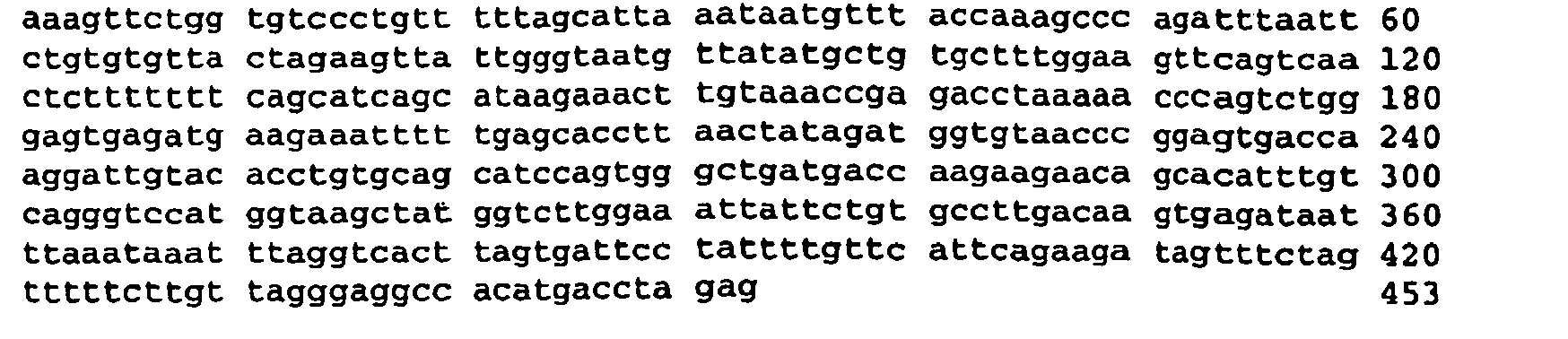
- <210> 5
<211> 377
<212> DNA
<213> Human - <400> 5

- <210> 6
<211> 499
<212> DNA
<213> Human - <400> 6

- <210> 7
<211> 357
<212> DNA
<213> Human - <400> 7

- <210> 8
<211> 31
<212> DNA
<213> Human - <400> 8
ttaactatag atggtataac ccggagtgac c 31 - <210> 9
<211> 31
<212> DNA
<213> Human - <400> 9
tctttcttat agccatgctg tctcagtgac a 31 - <210> 10
<211> 101
<212> DNA
<213> Human - <400> 10

- <210> 11
<211> 104
<212> DNA
<213> Human - <400> 11

- <210> 12
<211> 102
<212> DNA
<213> Human - <400> 12

- <210> 13
<211> 100
<212> DNA
<213> Human - <400> 13

- <210> 14
<211> 101
<212> DNA
<213> Human - <400> 14

- <210> 15
<211> 101
<212> DNA
<213> Human - <400> 15


- <210> 16
<211> 101
<212> DNA
<213> Human - <400> 16

- <210> 17
<211> 101
<212> DNA
<213> Human - <400> 17

- <210> 18
<211> 89
<212> DNA
<213> Human - <400> 18

- <210> 19
<211> 101
<212> DNA
<213> Human - <400> 19

- <210> 20
<211> 82
<212> DNA
<213> Human - <400> 20

- <210> 21
<211> 101
<212> DNA
<213> Human - <400> 21

- <210> 22
<211> 628
<212> DNA
<213> Human - <400> 22

- <210> 23
<211> 315
<212> DNA
<213> Human - <400> 23

- <210> 24
<211> 51
<212> DNA
<213> Human - <400> 24
tcccgggacc ccgggagagc ggtcartgtg tggtcgctgc gtttcctctg c 51 - <210> 25
<211> 20
<212> DNA
<213> Human - <400> 25
tccttggtca ctccgggttg 20
Claims (14)
- A method for the detection of a polymorphism in KDR in a human, which method comprises determining the sequence of the human at position 162, according to SEQ ID NO: 1 of KDR in a nucleic acid test sample obtained from the human.
- A method according to claim 1, in which the single nucleotide polymorphism at position 162 (according to the position in SEQ ID NO: 1) is the presence of T and/or C
- The method as claimed in claim 2, wherein the nucleic acid region containing the potential single nucleotide polymorphism is amplified by polymerase chain reaction prior to determining the sequence.
- The method as claimed in claim 2 or 3, wherein the presence or absence of the single nucleotide polymorphism is detected by reference to the loss or gain of, optionally engineered, sites recognised by restriction enzymes.
- The method as claimed in any of claims 2 - 4, wherein the particular polymorphism is determined by a method selected from ARMS-allele specific amplification, allele specific hybridisation, oligonucleotide ligation assay or restriction fragment length polymorphism (RFLP).
- A method as claimed in any of the preceding claims for use in assessing the predisposition and/or susceptibility of an individual to diseases mediated by VEGF.
- The method as claimed in claim 6, wherein the disease mediated by VEGF is selected from cancer and inflammatory disease.
- A method for the diagnosis or prognosis of VEGF-mediated disease, which method comprises:i) detecting the presence or absence of a variant nucleotide at position: 162 (according to SEQ ID NO: 1 in the KDR gene in a test sample from an individual; and,ii) determining the diagnostic or prognostic status of the individual by reference to said polymorphism in the KDR gene.
- A method for identifying an individuals' predisposition to VEGF-mediated disease development comprising:(i) identifying the nucleotide present at position 162 (according to SEQ ID NO: 1) in the KDR gene in a test sample obtained from the individual; and,(ii) determining the individual's predisposition to VEGF-mediated disease development according to the results obtained in step (i).
- The method as claimed in claim 8 or 9, wherein the nucleotide at position 162 is T and/or C.
- The method as claimed in claim 9 or 10, wherein the VEGF-mediated disease is selected from cancer and inflammatory disease.
- An allele-specific oligonucleotide probe capable of detecting a polymorphism in the KDR gene at position 162 (according to SEQ ID NO: 1).
- An allele specific nucleotide probe which comprises the sequence disclosed in SEQ ID NO: 12, or a sequence complementary thereto.
- A diagnostic kit comprising one or more allele-specific oligonucleotide probes(s) as defined in claim 12 or 13.
Priority Applications (1)
| Application Number | Priority Date | Filing Date | Title |
|---|---|---|---|
| EP04014565A EP1469084A3 (en) | 2000-11-03 | 2001-10-30 | Polymorphisms in the human KDR gene |
Applications Claiming Priority (4)
| Application Number | Priority Date | Filing Date | Title |
|---|---|---|---|
| GB0026851 | 2000-11-03 | ||
| GB0026851A GB0026851D0 (en) | 2000-11-03 | 2000-11-03 | Chemical compounds |
| GB0109602A GB0109602D0 (en) | 2001-04-19 | 2001-04-19 | Chemical compounds |
| GB0109602 | 2001-04-19 |
Related Child Applications (1)
| Application Number | Title | Priority Date | Filing Date |
|---|---|---|---|
| EP04014565A Division EP1469084A3 (en) | 2000-11-03 | 2001-10-30 | Polymorphisms in the human KDR gene |
Publications (3)
| Publication Number | Publication Date |
|---|---|
| EP1203827A2 EP1203827A2 (en) | 2002-05-08 |
| EP1203827A3 EP1203827A3 (en) | 2002-10-30 |
| EP1203827B1 true EP1203827B1 (en) | 2007-05-16 |
Family
ID=26245232
Family Applications (2)
| Application Number | Title | Priority Date | Filing Date |
|---|---|---|---|
| EP04014565A Withdrawn EP1469084A3 (en) | 2000-11-03 | 2001-10-30 | Polymorphisms in the human KDR gene |
| EP01309193A Expired - Lifetime EP1203827B1 (en) | 2000-11-03 | 2001-10-30 | Polymorphisms in the human KDR gene |
Family Applications Before (1)
| Application Number | Title | Priority Date | Filing Date |
|---|---|---|---|
| EP04014565A Withdrawn EP1469084A3 (en) | 2000-11-03 | 2001-10-30 | Polymorphisms in the human KDR gene |
Country Status (6)
| Country | Link |
|---|---|
| US (2) | US20030129596A1 (en) |
| EP (2) | EP1469084A3 (en) |
| JP (1) | JP2002345489A (en) |
| AT (1) | ATE362547T1 (en) |
| DE (1) | DE60128434T2 (en) |
| ES (1) | ES2284596T3 (en) |
Cited By (9)
| Publication number | Priority date | Publication date | Assignee | Title |
|---|---|---|---|---|
| US10538764B2 (en) | 2014-06-16 | 2020-01-21 | University Of Southampton | Reducing intron retention |
| US10683503B2 (en) | 2017-08-25 | 2020-06-16 | Stoke Therapeutics, Inc. | Antisense oligomers for treatment of conditions and diseases |
| US10696969B2 (en) | 2014-10-03 | 2020-06-30 | Cold Spring Harbor Laboratory | Targeted augmentation of nuclear gene output |
| US10941405B2 (en) | 2015-10-09 | 2021-03-09 | University Of Southampton | Modulation of gene expression and screening for deregulated protein expression |
| US11083745B2 (en) | 2015-12-14 | 2021-08-10 | Cold Spring Harbor Laboratory | Antisense oligomers for treatment of autosomal dominant mental retardation-5 and Dravet Syndrome |
| US11096956B2 (en) | 2015-12-14 | 2021-08-24 | Stoke Therapeutics, Inc. | Antisense oligomers and uses thereof |
| US11814622B2 (en) | 2020-05-11 | 2023-11-14 | Stoke Therapeutics, Inc. | OPA1 antisense oligomers for treatment of conditions and diseases |
| US12060558B2 (en) | 2018-05-04 | 2024-08-13 | Stoke Therapeutics, Inc. | Methods and compositions for treatment of cholesteryl ester storage disease |
| US12577561B2 (en) | 2019-02-27 | 2026-03-17 | Stoke Therapeutics, Inc. | Antisense oligomers for treatment of conditions and diseases |
Families Citing this family (5)
| Publication number | Priority date | Publication date | Assignee | Title |
|---|---|---|---|---|
| WO2007109515A2 (en) * | 2006-03-20 | 2007-09-27 | Novartis Ag | Mutations and polymorphisms of knockdown resistance polypeptide |
| WO2008128233A1 (en) * | 2007-04-15 | 2008-10-23 | University Of Chicago | Methods and compositions concerning the vegfr-2 gene (kinase domain receptor, kdr) |
| US9365899B2 (en) * | 2007-04-26 | 2016-06-14 | The Regents Of The University Of Michigan | FIG4 gene mutations in neurodegeneration |
| WO2016078067A1 (en) * | 2014-11-21 | 2016-05-26 | 深圳华大基因研究院 | Individual single nucleotide polymorphisms locus genotyping method and apparatus |
| CN104726608B (en) * | 2015-04-13 | 2016-05-25 | 中南大学湘雅医院 | Application method of VEGFR2 gene Val297Ile site |
-
2001
- 2001-09-28 JP JP2001300582A patent/JP2002345489A/en active Pending
- 2001-10-30 ES ES01309193T patent/ES2284596T3/en not_active Expired - Lifetime
- 2001-10-30 AT AT01309193T patent/ATE362547T1/en not_active IP Right Cessation
- 2001-10-30 DE DE60128434T patent/DE60128434T2/en not_active Expired - Fee Related
- 2001-10-30 EP EP04014565A patent/EP1469084A3/en not_active Withdrawn
- 2001-10-30 EP EP01309193A patent/EP1203827B1/en not_active Expired - Lifetime
- 2001-11-02 US US09/985,440 patent/US20030129596A1/en not_active Abandoned
-
2004
- 2004-09-10 US US10/938,071 patent/US20050059067A1/en not_active Abandoned
Cited By (14)
| Publication number | Priority date | Publication date | Assignee | Title |
|---|---|---|---|---|
| US11891605B2 (en) | 2014-06-16 | 2024-02-06 | University Of Southampton | Reducing intron retention |
| US10538764B2 (en) | 2014-06-16 | 2020-01-21 | University Of Southampton | Reducing intron retention |
| US10696969B2 (en) | 2014-10-03 | 2020-06-30 | Cold Spring Harbor Laboratory | Targeted augmentation of nuclear gene output |
| US11702660B2 (en) | 2015-10-09 | 2023-07-18 | University Of Southampton | Modulation of gene expression and screening for deregulated protein expression |
| US10941405B2 (en) | 2015-10-09 | 2021-03-09 | University Of Southampton | Modulation of gene expression and screening for deregulated protein expression |
| US11083745B2 (en) | 2015-12-14 | 2021-08-10 | Cold Spring Harbor Laboratory | Antisense oligomers for treatment of autosomal dominant mental retardation-5 and Dravet Syndrome |
| US11096956B2 (en) | 2015-12-14 | 2021-08-24 | Stoke Therapeutics, Inc. | Antisense oligomers and uses thereof |
| US10913947B2 (en) | 2017-08-25 | 2021-02-09 | Stoke Therapeutics, Inc. | Antisense oligomers for treatment of conditions and diseases |
| US11873490B2 (en) | 2017-08-25 | 2024-01-16 | Stoke Therapeutics, Inc. | Antisense oligomers for treatment of conditions and diseases |
| US10683503B2 (en) | 2017-08-25 | 2020-06-16 | Stoke Therapeutics, Inc. | Antisense oligomers for treatment of conditions and diseases |
| US12060558B2 (en) | 2018-05-04 | 2024-08-13 | Stoke Therapeutics, Inc. | Methods and compositions for treatment of cholesteryl ester storage disease |
| US12577561B2 (en) | 2019-02-27 | 2026-03-17 | Stoke Therapeutics, Inc. | Antisense oligomers for treatment of conditions and diseases |
| US11814622B2 (en) | 2020-05-11 | 2023-11-14 | Stoke Therapeutics, Inc. | OPA1 antisense oligomers for treatment of conditions and diseases |
| US12338437B2 (en) | 2020-05-11 | 2025-06-24 | Stoke Therapeutics, Inc. | OPA1 antisense oligomers for treatment of conditions and diseases |
Also Published As
| Publication number | Publication date |
|---|---|
| US20030129596A1 (en) | 2003-07-10 |
| EP1469084A2 (en) | 2004-10-20 |
| JP2002345489A (en) | 2002-12-03 |
| DE60128434T2 (en) | 2008-02-14 |
| ES2284596T3 (en) | 2007-11-16 |
| US20050059067A1 (en) | 2005-03-17 |
| ATE362547T1 (en) | 2007-06-15 |
| DE60128434D1 (en) | 2007-06-28 |
| EP1469084A3 (en) | 2005-08-17 |
| EP1203827A2 (en) | 2002-05-08 |
| EP1203827A3 (en) | 2002-10-30 |
Similar Documents
| Publication | Publication Date | Title |
|---|---|---|
| EP1186672B1 (en) | Polymorphisms in the human organic anion transporter C (OATP-C) gene | |
| US20050059067A1 (en) | Chemical compounds | |
| EP1130123A2 (en) | Diagnostic method | |
| WO2000079003A1 (en) | Polymorphisms in the human hmg-coa reductase gene | |
| EP1100962A1 (en) | Genetic polymorphisms in the human neurokinin 1 receptor gene and their uses in diagnosis and treatment of diseases | |
| EP1112381A1 (en) | Polymorphisms in the human alpha4 integrin subunit gene, suitable for diagnosis and treatment of integrin ligand mediated diseases | |
| WO2000006769A2 (en) | Human ccr-2 gene polymorphisms | |
| US20020160362A1 (en) | Diagnostic method | |
| EP1199372A2 (en) | Polymorphisms in the human P2X7 gene | |
| WO2008055196A2 (en) | Genemap of the human genes associated with male pattern baldness | |
| US20070122803A1 (en) | Methods for the detection of polymorphisms in the human oatpf gene | |
| EP1114183A1 (en) | Polymorphisms in the human beta1 integrin subunit gene, suitable for diagnosis and treatment of integrin ligand mediated diseases | |
| WO2000017392A1 (en) | Polymorphisms in the human vcam-1 gene, suitable for diagnosis and treatment of vcam-1 ligand mediated diseases | |
| US20030157484A1 (en) | Chemical compounds | |
| WO2000039331A1 (en) | Single nucleotide polymorphism in a pyruvate dehydrogenase kinase isoenzyme 2 (pdk2) in humans | |
| US20050118579A1 (en) | Chemical compounds | |
| US20070243528A1 (en) | Methods for detecting polymorphisms using arms or rflp | |
| EP1741722A2 (en) | Polymorphisms in the human P2X7 gene | |
| EP1184465A2 (en) | Method for diagnosing polymorphisms in human MCT-1 and drugs related to such polymorphisms | |
| US20040171010A1 (en) | Methods | |
| WO2000034515A1 (en) | Use of factor x polymorphism in the diagnosis and treatment of factor x and/or factor xa mediated diseases |
Legal Events
| Date | Code | Title | Description |
|---|---|---|---|
| PUAI | Public reference made under article 153(3) epc to a published international application that has entered the european phase |
Free format text: ORIGINAL CODE: 0009012 |
|
| AK | Designated contracting states |
Kind code of ref document: A2 Designated state(s): AT BE CH CY DE DK ES FI FR GB GR IE IT LI LU MC NL PT SE TR |
|
| AX | Request for extension of the european patent |
Free format text: AL;LT;LV;MK;RO;SI |
|
| PUAL | Search report despatched |
Free format text: ORIGINAL CODE: 0009013 |
|
| AK | Designated contracting states |
Kind code of ref document: A3 Designated state(s): AT BE CH CY DE DK ES FI FR GB GR IE IT LI LU MC NL PT SE TR |
|
| AX | Request for extension of the european patent |
Free format text: AL;LT;LV;MK;RO;SI |
|
| 17P | Request for examination filed |
Effective date: 20030502 |
|
| AKX | Designation fees paid |
Designated state(s): AT BE CH CY DE DK ES FI FR GB GR IE IT LI LU MC NL PT SE TR |
|
| 17Q | First examination report despatched |
Effective date: 20031217 |
|
| GRAP | Despatch of communication of intention to grant a patent |
Free format text: ORIGINAL CODE: EPIDOSNIGR1 |
|
| GRAS | Grant fee paid |
Free format text: ORIGINAL CODE: EPIDOSNIGR3 |
|
| GRAA | (expected) grant |
Free format text: ORIGINAL CODE: 0009210 |
|
| AK | Designated contracting states |
Kind code of ref document: B1 Designated state(s): AT BE CH CY DE DK ES FI FR GB GR IE IT LI LU MC NL PT SE TR |
|
| PG25 | Lapsed in a contracting state [announced via postgrant information from national office to epo] |
Ref country code: FI Free format text: LAPSE BECAUSE OF FAILURE TO SUBMIT A TRANSLATION OF THE DESCRIPTION OR TO PAY THE FEE WITHIN THE PRESCRIBED TIME-LIMIT Effective date: 20070516 |
|
| REG | Reference to a national code |
Ref country code: GB Ref legal event code: FG4D |
|
| REG | Reference to a national code |
Ref country code: CH Ref legal event code: EP |
|
| REG | Reference to a national code |
Ref country code: IE Ref legal event code: FG4D |
|
| REF | Corresponds to: |
Ref document number: 60128434 Country of ref document: DE Date of ref document: 20070628 Kind code of ref document: P |
|
| REG | Reference to a national code |
Ref country code: SE Ref legal event code: TRGR |
|
| ET | Fr: translation filed | ||
| NLV1 | Nl: lapsed or annulled due to failure to fulfill the requirements of art. 29p and 29m of the patents act | ||
| REG | Reference to a national code |
Ref country code: ES Ref legal event code: FG2A Ref document number: 2284596 Country of ref document: ES Kind code of ref document: T3 |
|
| PG25 | Lapsed in a contracting state [announced via postgrant information from national office to epo] |
Ref country code: AT Free format text: LAPSE BECAUSE OF FAILURE TO SUBMIT A TRANSLATION OF THE DESCRIPTION OR TO PAY THE FEE WITHIN THE PRESCRIBED TIME-LIMIT Effective date: 20070516 |
|
| PG25 | Lapsed in a contracting state [announced via postgrant information from national office to epo] |
Ref country code: BE Free format text: LAPSE BECAUSE OF FAILURE TO SUBMIT A TRANSLATION OF THE DESCRIPTION OR TO PAY THE FEE WITHIN THE PRESCRIBED TIME-LIMIT Effective date: 20070516 |
|
| PG25 | Lapsed in a contracting state [announced via postgrant information from national office to epo] |
Ref country code: DK Free format text: LAPSE BECAUSE OF FAILURE TO SUBMIT A TRANSLATION OF THE DESCRIPTION OR TO PAY THE FEE WITHIN THE PRESCRIBED TIME-LIMIT Effective date: 20070516 Ref country code: NL Free format text: LAPSE BECAUSE OF FAILURE TO SUBMIT A TRANSLATION OF THE DESCRIPTION OR TO PAY THE FEE WITHIN THE PRESCRIBED TIME-LIMIT Effective date: 20070516 Ref country code: PT Free format text: LAPSE BECAUSE OF FAILURE TO SUBMIT A TRANSLATION OF THE DESCRIPTION OR TO PAY THE FEE WITHIN THE PRESCRIBED TIME-LIMIT Effective date: 20071016 |
|
| PLBE | No opposition filed within time limit |
Free format text: ORIGINAL CODE: 0009261 |
|
| STAA | Information on the status of an ep patent application or granted ep patent |
Free format text: STATUS: NO OPPOSITION FILED WITHIN TIME LIMIT |
|
| 26N | No opposition filed |
Effective date: 20080219 |
|
| PG25 | Lapsed in a contracting state [announced via postgrant information from national office to epo] |
Ref country code: GR Free format text: LAPSE BECAUSE OF FAILURE TO SUBMIT A TRANSLATION OF THE DESCRIPTION OR TO PAY THE FEE WITHIN THE PRESCRIBED TIME-LIMIT Effective date: 20070817 |
|
| PG25 | Lapsed in a contracting state [announced via postgrant information from national office to epo] |
Ref country code: MC Free format text: LAPSE BECAUSE OF NON-PAYMENT OF DUE FEES Effective date: 20071031 |
|
| PG25 | Lapsed in a contracting state [announced via postgrant information from national office to epo] |
Ref country code: IE Free format text: LAPSE BECAUSE OF NON-PAYMENT OF DUE FEES Effective date: 20071030 |
|
| PGFP | Annual fee paid to national office [announced via postgrant information from national office to epo] |
Ref country code: GB Payment date: 20080915 Year of fee payment: 8 |
|
| PGFP | Annual fee paid to national office [announced via postgrant information from national office to epo] |
Ref country code: CH Payment date: 20081028 Year of fee payment: 8 Ref country code: DE Payment date: 20081031 Year of fee payment: 8 |
|
| PGFP | Annual fee paid to national office [announced via postgrant information from national office to epo] |
Ref country code: ES Payment date: 20081013 Year of fee payment: 8 |
|
| PGFP | Annual fee paid to national office [announced via postgrant information from national office to epo] |
Ref country code: IT Payment date: 20081018 Year of fee payment: 8 Ref country code: SE Payment date: 20081007 Year of fee payment: 8 |
|
| PGFP | Annual fee paid to national office [announced via postgrant information from national office to epo] |
Ref country code: FR Payment date: 20081006 Year of fee payment: 8 |
|
| PG25 | Lapsed in a contracting state [announced via postgrant information from national office to epo] |
Ref country code: CY Free format text: LAPSE BECAUSE OF FAILURE TO SUBMIT A TRANSLATION OF THE DESCRIPTION OR TO PAY THE FEE WITHIN THE PRESCRIBED TIME-LIMIT Effective date: 20070516 |
|
| PG25 | Lapsed in a contracting state [announced via postgrant information from national office to epo] |
Ref country code: LU Free format text: LAPSE BECAUSE OF NON-PAYMENT OF DUE FEES Effective date: 20071030 |
|
| PG25 | Lapsed in a contracting state [announced via postgrant information from national office to epo] |
Ref country code: TR Free format text: LAPSE BECAUSE OF FAILURE TO SUBMIT A TRANSLATION OF THE DESCRIPTION OR TO PAY THE FEE WITHIN THE PRESCRIBED TIME-LIMIT Effective date: 20070516 |
|
| REG | Reference to a national code |
Ref country code: CH Ref legal event code: PL |
|
| EUG | Se: european patent has lapsed | ||
| REG | Reference to a national code |
Ref country code: FR Ref legal event code: ST Effective date: 20100630 |
|
| PG25 | Lapsed in a contracting state [announced via postgrant information from national office to epo] |
Ref country code: FR Free format text: LAPSE BECAUSE OF NON-PAYMENT OF DUE FEES Effective date: 20091102 Ref country code: DE Free format text: LAPSE BECAUSE OF NON-PAYMENT OF DUE FEES Effective date: 20100501 |
|
| PG25 | Lapsed in a contracting state [announced via postgrant information from national office to epo] |
Ref country code: CH Free format text: LAPSE BECAUSE OF NON-PAYMENT OF DUE FEES Effective date: 20091031 Ref country code: LI Free format text: LAPSE BECAUSE OF NON-PAYMENT OF DUE FEES Effective date: 20091031 |
|
| PG25 | Lapsed in a contracting state [announced via postgrant information from national office to epo] |
Ref country code: GB Free format text: LAPSE BECAUSE OF NON-PAYMENT OF DUE FEES Effective date: 20091030 |
|
| REG | Reference to a national code |
Ref country code: ES Ref legal event code: FD2A Effective date: 20110330 |
|
| PG25 | Lapsed in a contracting state [announced via postgrant information from national office to epo] |
Ref country code: IT Free format text: LAPSE BECAUSE OF NON-PAYMENT OF DUE FEES Effective date: 20091030 |
|
| PG25 | Lapsed in a contracting state [announced via postgrant information from national office to epo] |
Ref country code: SE Free format text: LAPSE BECAUSE OF NON-PAYMENT OF DUE FEES Effective date: 20091031 |
|
| PG25 | Lapsed in a contracting state [announced via postgrant information from national office to epo] |
Ref country code: ES Free format text: LAPSE BECAUSE OF NON-PAYMENT OF DUE FEES Effective date: 20110317 |
|
| PG25 | Lapsed in a contracting state [announced via postgrant information from national office to epo] |
Ref country code: ES Free format text: LAPSE BECAUSE OF NON-PAYMENT OF DUE FEES Effective date: 20091031 |