EP1203772A2 - Thexylchlorosilanes, their manufacture and use - Google Patents
Thexylchlorosilanes, their manufacture and use Download PDFInfo
- Publication number
- EP1203772A2 EP1203772A2 EP01309294A EP01309294A EP1203772A2 EP 1203772 A2 EP1203772 A2 EP 1203772A2 EP 01309294 A EP01309294 A EP 01309294A EP 01309294 A EP01309294 A EP 01309294A EP 1203772 A2 EP1203772 A2 EP 1203772A2
- Authority
- EP
- European Patent Office
- Prior art keywords
- compound
- thexylchlorosilane
- aluminum chloride
- mol
- butene
- Prior art date
- Legal status (The legal status is an assumption and is not a legal conclusion. Google has not performed a legal analysis and makes no representation as to the accuracy of the status listed.)
- Granted
Links
- 238000004519 manufacturing process Methods 0.000 title claims description 4
- 150000001875 compounds Chemical class 0.000 claims abstract description 31
- VSCWAEJMTAWNJL-UHFFFAOYSA-K aluminium trichloride Chemical compound Cl[Al](Cl)Cl VSCWAEJMTAWNJL-UHFFFAOYSA-K 0.000 claims description 32
- WGLLSSPDPJPLOR-UHFFFAOYSA-N 2,3-dimethylbut-2-ene Chemical compound CC(C)=C(C)C WGLLSSPDPJPLOR-UHFFFAOYSA-N 0.000 claims description 26
- 125000004432 carbon atom Chemical group C* 0.000 claims description 7
- BTGZNTTVVQYMCC-UHFFFAOYSA-N chloro-(2,3-dimethylbutan-2-yl)-bis(2-methylpropyl)silane Chemical compound CC(C)C[Si](Cl)(CC(C)C)C(C)(C)C(C)C BTGZNTTVVQYMCC-UHFFFAOYSA-N 0.000 claims description 6
- GJYPSGRDRHQQBZ-UHFFFAOYSA-N chloro-(2,3-dimethylbutan-2-yl)-di(propan-2-yl)silane Chemical compound CC(C)C(C)(C)[Si](Cl)(C(C)C)C(C)C GJYPSGRDRHQQBZ-UHFFFAOYSA-N 0.000 claims description 6
- 150000002430 hydrocarbons Chemical group 0.000 claims description 6
- 125000000753 cycloalkyl group Chemical group 0.000 claims description 5
- 238000006884 silylation reaction Methods 0.000 claims description 3
- 238000000034 method Methods 0.000 claims description 2
- 230000001476 alcoholic effect Effects 0.000 claims 1
- KOPOQZFJUQMUML-UHFFFAOYSA-N chlorosilane Chemical class Cl[SiH3] KOPOQZFJUQMUML-UHFFFAOYSA-N 0.000 abstract description 11
- 239000003795 chemical substances by application Substances 0.000 abstract description 9
- 125000001424 substituent group Chemical group 0.000 abstract description 7
- 238000006243 chemical reaction Methods 0.000 description 11
- 239000002904 solvent Substances 0.000 description 7
- HEDRZPFGACZZDS-UHFFFAOYSA-N Chloroform Chemical compound ClC(Cl)Cl HEDRZPFGACZZDS-UHFFFAOYSA-N 0.000 description 6
- 239000005046 Chlorosilane Substances 0.000 description 5
- RDOXTESZEPMUJZ-UHFFFAOYSA-N anisole Chemical compound COC1=CC=CC=C1 RDOXTESZEPMUJZ-UHFFFAOYSA-N 0.000 description 4
- 238000002329 infrared spectrum Methods 0.000 description 4
- 239000000203 mixture Substances 0.000 description 4
- 238000000425 proton nuclear magnetic resonance spectrum Methods 0.000 description 4
- WEVYAHXRMPXWCK-UHFFFAOYSA-N Acetonitrile Chemical compound CC#N WEVYAHXRMPXWCK-UHFFFAOYSA-N 0.000 description 3
- YMWUJEATGCHHMB-UHFFFAOYSA-N Dichloromethane Chemical compound ClCCl YMWUJEATGCHHMB-UHFFFAOYSA-N 0.000 description 3
- -1 chlorosilane compound Chemical class 0.000 description 3
- VLKZOEOYAKHREP-UHFFFAOYSA-N n-Hexane Chemical compound CCCCCC VLKZOEOYAKHREP-UHFFFAOYSA-N 0.000 description 3
- 238000005160 1H NMR spectroscopy Methods 0.000 description 2
- 238000004566 IR spectroscopy Methods 0.000 description 2
- OFBQJSOFQDEBGM-UHFFFAOYSA-N Pentane Chemical compound CCCCC OFBQJSOFQDEBGM-UHFFFAOYSA-N 0.000 description 2
- 150000001298 alcohols Chemical class 0.000 description 2
- 238000009835 boiling Methods 0.000 description 2
- 150000001735 carboxylic acids Chemical class 0.000 description 2
- 239000003054 catalyst Substances 0.000 description 2
- 239000000460 chlorine Substances 0.000 description 2
- DCFKHNIGBAHNSS-UHFFFAOYSA-N chloro(triethyl)silane Chemical compound CC[Si](Cl)(CC)CC DCFKHNIGBAHNSS-UHFFFAOYSA-N 0.000 description 2
- LVFFNMMFDNKFDK-UHFFFAOYSA-N chloro-bis(2-methylpropyl)silane Chemical compound CC(C)C[SiH](Cl)CC(C)C LVFFNMMFDNKFDK-UHFFFAOYSA-N 0.000 description 2
- IGSUJBNDAWQLST-UHFFFAOYSA-N chloro-di(propan-2-yl)silicon Chemical compound CC(C)[Si](Cl)C(C)C IGSUJBNDAWQLST-UHFFFAOYSA-N 0.000 description 2
- KQIADDMXRMTWHZ-UHFFFAOYSA-N chloro-tri(propan-2-yl)silane Chemical compound CC(C)[Si](Cl)(C(C)C)C(C)C KQIADDMXRMTWHZ-UHFFFAOYSA-N 0.000 description 2
- IJOOHPMOJXWVHK-UHFFFAOYSA-N chlorotrimethylsilane Chemical compound C[Si](C)(C)Cl IJOOHPMOJXWVHK-UHFFFAOYSA-N 0.000 description 2
- 238000004949 mass spectrometry Methods 0.000 description 2
- 238000001819 mass spectrum Methods 0.000 description 2
- UZKWTJUDCOPSNM-UHFFFAOYSA-N methoxybenzene Substances CCCCOC=C UZKWTJUDCOPSNM-UHFFFAOYSA-N 0.000 description 2
- 230000009257 reactivity Effects 0.000 description 2
- 238000010992 reflux Methods 0.000 description 2
- ZVQWFGFPUWGXBY-UHFFFAOYSA-N CCC(C)[SiH](Cl)C(C)CC Chemical compound CCC(C)[SiH](Cl)C(C)CC ZVQWFGFPUWGXBY-UHFFFAOYSA-N 0.000 description 1
- XDTMQSROBMDMFD-UHFFFAOYSA-N Cyclohexane Chemical compound C1CCCCC1 XDTMQSROBMDMFD-UHFFFAOYSA-N 0.000 description 1
- LFQSCWFLJHTTHZ-UHFFFAOYSA-N Ethanol Chemical compound CCO LFQSCWFLJHTTHZ-UHFFFAOYSA-N 0.000 description 1
- NHTMVDHEPJAVLT-UHFFFAOYSA-N Isooctane Chemical compound CC(C)CC(C)(C)C NHTMVDHEPJAVLT-UHFFFAOYSA-N 0.000 description 1
- 150000001338 aliphatic hydrocarbons Chemical class 0.000 description 1
- 125000000217 alkyl group Chemical group 0.000 description 1
- LOZGIFLTJJLAKE-UHFFFAOYSA-N butan-2-yl-chloro-propan-2-ylsilane Chemical compound CCC(C)[SiH](Cl)C(C)C LOZGIFLTJJLAKE-UHFFFAOYSA-N 0.000 description 1
- 238000006555 catalytic reaction Methods 0.000 description 1
- 150000008280 chlorinated hydrocarbons Chemical class 0.000 description 1
- IOBUYOYOZJVCGU-UHFFFAOYSA-N chloro(dicyclohexyl)silane Chemical compound C1CCCCC1[SiH](Cl)C1CCCCC1 IOBUYOYOZJVCGU-UHFFFAOYSA-N 0.000 description 1
- WWICEIAZRQQXMT-UHFFFAOYSA-N chloro(dicyclopentyl)silane Chemical compound C1CCCC1[SiH](Cl)C1CCCC1 WWICEIAZRQQXMT-UHFFFAOYSA-N 0.000 description 1
- MDZRSMMPEFLLAJ-UHFFFAOYSA-N chloro-(2-methylpropyl)-propan-2-ylsilane Chemical compound CC(C)C[SiH](Cl)C(C)C MDZRSMMPEFLLAJ-UHFFFAOYSA-N 0.000 description 1
- ZYCBTZLSILRVJX-UHFFFAOYSA-N chloro-bis(2-ethylhexyl)silane Chemical compound CCCCC(CC)C[SiH](Cl)CC(CC)CCCC ZYCBTZLSILRVJX-UHFFFAOYSA-N 0.000 description 1
- XYLWEKMVKKCAHN-UHFFFAOYSA-N chloro-di(pentan-2-yl)silane Chemical compound CCCC(C)[SiH](Cl)C(C)CCC XYLWEKMVKKCAHN-UHFFFAOYSA-N 0.000 description 1
- KDXALWJSJQNWKQ-UHFFFAOYSA-N chloro-di(pentan-3-yl)silane Chemical compound CCC(CC)[SiH](Cl)C(CC)CC KDXALWJSJQNWKQ-UHFFFAOYSA-N 0.000 description 1
- 125000000113 cyclohexyl group Chemical group [H]C1([H])C([H])([H])C([H])([H])C([H])(*)C([H])([H])C1([H])[H] 0.000 description 1
- 125000001511 cyclopentyl group Chemical group [H]C1([H])C([H])([H])C([H])([H])C([H])(*)C1([H])[H] 0.000 description 1
- JVSWJIKNEAIKJW-UHFFFAOYSA-N dimethyl-hexane Natural products CCCCCC(C)C JVSWJIKNEAIKJW-UHFFFAOYSA-N 0.000 description 1
- 229940079593 drug Drugs 0.000 description 1
- 229910052739 hydrogen Inorganic materials 0.000 description 1
- 239000001257 hydrogen Substances 0.000 description 1
- 125000004435 hydrogen atom Chemical group [H]* 0.000 description 1
- 230000007062 hydrolysis Effects 0.000 description 1
- 238000006460 hydrolysis reaction Methods 0.000 description 1
- 239000000543 intermediate Substances 0.000 description 1
- 125000000959 isobutyl group Chemical group [H]C([H])([H])C([H])(C([H])([H])[H])C([H])([H])* 0.000 description 1
- 125000001449 isopropyl group Chemical group [H]C([H])([H])C([H])(*)C([H])([H])[H] 0.000 description 1
- 238000012986 modification Methods 0.000 description 1
- 230000004048 modification Effects 0.000 description 1
- 125000003538 pentan-3-yl group Chemical group [H]C([H])([H])C([H])([H])C([H])(*)C([H])([H])C([H])([H])[H] 0.000 description 1
- 239000000575 pesticide Substances 0.000 description 1
- 239000002798 polar solvent Substances 0.000 description 1
- 238000002360 preparation method Methods 0.000 description 1
- 230000001737 promoting effect Effects 0.000 description 1
- 125000002914 sec-butyl group Chemical group [H]C([H])([H])C([H])([H])C([H])(*)C([H])([H])[H] 0.000 description 1
- 125000003548 sec-pentyl group Chemical group [H]C([H])([H])C([H])([H])C([H])([H])C([H])(*)C([H])([H])[H] 0.000 description 1
- BCNZYOJHNLTNEZ-UHFFFAOYSA-N tert-butyldimethylsilyl chloride Chemical compound CC(C)(C)[Si](C)(C)Cl BCNZYOJHNLTNEZ-UHFFFAOYSA-N 0.000 description 1
- 239000005051 trimethylchlorosilane Substances 0.000 description 1
Images


Classifications
-
- C—CHEMISTRY; METALLURGY
- C07—ORGANIC CHEMISTRY
- C07F—ACYCLIC, CARBOCYCLIC OR HETEROCYCLIC COMPOUNDS CONTAINING ELEMENTS OTHER THAN CARBON, HYDROGEN, HALOGEN, OXYGEN, NITROGEN, SULFUR, SELENIUM OR TELLURIUM
- C07F7/00—Compounds containing elements of Groups 4 or 14 of the Periodic Table
- C07F7/02—Silicon compounds
- C07F7/08—Compounds having one or more C—Si linkages
- C07F7/12—Organo silicon halides
-
- C—CHEMISTRY; METALLURGY
- C07—ORGANIC CHEMISTRY
- C07F—ACYCLIC, CARBOCYCLIC OR HETEROCYCLIC COMPOUNDS CONTAINING ELEMENTS OTHER THAN CARBON, HYDROGEN, HALOGEN, OXYGEN, NITROGEN, SULFUR, SELENIUM OR TELLURIUM
- C07F7/00—Compounds containing elements of Groups 4 or 14 of the Periodic Table
- C07F7/02—Silicon compounds
- C07F7/08—Compounds having one or more C—Si linkages
- C07F7/18—Compounds having one or more C—Si linkages as well as one or more C—O—Si linkages
- C07F7/1804—Compounds having Si-O-C linkages
- C07F7/1872—Preparation; Treatments not provided for in C07F7/20
- C07F7/188—Preparation; Treatments not provided for in C07F7/20 by reactions involving the formation of Si-O linkages
Definitions
- This invention relates to novel chlorosilane compounds having a thexyl group, and a process for preparing the same. These novel compounds are useful as a silylating agent because their bulky substituent group improves the stability of silylated products.
- Silylating agents are used with alcohols and carboxylic acids for the purpose of protecting active hydrogen-bearing substituent groups thereon.
- the silylated compounds are useful in a variety of applications, typically as intermediates to pharmaceutical drugs and pesticides.
- silylating agents Most common among the silylating agents are compounds having a silicon-chlorine bond within their molecule, known as chlorosilane compounds. Silylation is effected by reacting the chlorosilane compounds with alcohols or carboxylic acids.
- the silylating agents of the chlorosilane type currently used in the art include trimethylchlorosilane, triethylchlorosilane, t-butyldimethylchlorosilane and triisopropylchlorosilane.
- products silylated with these silylating agents are still in some situations prone to hydrolysis and unsatisfactorily stable.
- An object of the invention is to provide new and useful chlorosilane compounds having a bulky substituent group useful as a silylating agent capable of affording more stable silylated products. Associated aspects are practical processes for preparing such chlorosilane compounds and the use thereof for silylation e.g. of alcohol and carboxylic groups.
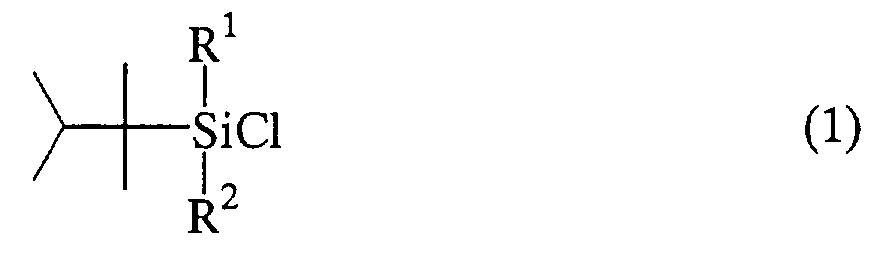
- a thexylchlorosilane compound having the following general formula (1): wherein each of R 1 and R 2 is a monovalent branched hydrocarbon group of 3 to 10 carbon atoms having a hydrocarbon group at the same or different ⁇ - or ⁇ -position or a monovalent cyclic hydrocarbon group of 3 to 10 carbon atoms can be prepared by reacting 2,3-dimethyl-2-butene with a hydrogenchlorosilane compound having the following general formula (2): HSiR 1 R 2 Cl wherein R 1 and R 2 are as defined above, in the presence of aluminum chloride.
- This chlorosilane compound having a thexyl group simply referred to as thexylchlorosilane compound, is novel. When used as a silylating agent, it affords a highly stable silylated product.
- the invention provides a thexylchlorosilane compound of the formula (1).
- the invention also provides a process for preparing the thexylchlorosilane compound of the formula (1) by reacting 2,3-dimethyl-2-butene with a hydrogenchlorosilane compound of the formula (2) in the presence of aluminum chloride.
- the thexylchlorosilane compound according to the invention has the following general formula (1).
- each of R 1 and R 2 is a monovalent branched hydrocarbon group of 3 to 10 carbon atoms having a hydrocarbon group at the same or different ⁇ - or ⁇ -position or a monovalent cyclic hydrocarbon group of 3 to 10 carbon atoms.
- the branched and cyclic hydrocarbon groups of 3 to 10 carbon atoms represented by R 1 and R 2 are preferably branched alkyl groups and cycloalkyl groups, for example, isopropyl, isobutyl, s-butyl, 1-methylbutyl, 1-ethylpropyl, 2-ethylhexyl, cyclopentyl and cyclohexyl.
- thexylchlorosilane compound of formula (1) include thexyldiisopropylchlorosilane, thexyldiisobutylchlorosilane, thexyldi-s-butylchlorosilane, thexyldi(1-methylbutyl)chlorosilane, thexyldi(1-ethylpropyl)chlorosilane, thexyldi(2-ethylhexyl)chlorosilane, thexyldicyclopentylchlorosilane, thexyldicyclohexylchlorosilane, thexylisopropylisobutylchlorosilane, and thexylisopropyl-s-butylchlorosilane.
- the thexylchlorosilane compound of the formula (1) according to the invention is prepared, for example, by reacting 2,3-dimethyl-2-butene with a hydrogenchlorosilane compound of the following general formula (2) in the presence of aluminum chloride.
- HSiR 1 R 2 Cl Herein R 1 and R 2 are as defined above.
- hydrogenchlorosilane compound of formula (2) include diisopropylchlorosilane, diisobutylchlorosilane, di-s-butylchlorosilane, di(1-methylbutyl)chlorosilane, di(1-ethylpropyl)chlorosilane, di(2-ethylhexyl)chlorosilane, dicyclopentylchlorosilane, dicyclohexylchlorosilane, isopropylisobutylchlorosilane, and isopropyl-s-butylchlorosilane.
- the proportion of 2,3-dimethyl-2-butene and the hydrogenchlorosilane compound of formula (2) is not critical although it is preferred for reactivity and productivity that 0.5 to 2.0 mol, and especially 0.8 to 1.2 mol of the hydrogenchlorosilane compound be used per mol of 2,3-dimethyl-2-butene.
- the amount of aluminum chloride added as the catalyst in the above reaction is not critical although it is preferred for reactivity and productivity that 0.001 to 0.5 mol, and especially 0.01 to 0.2 mol of aluminum chloride be used per mol of 2,3-dimethyl-2-butene. Less than 0.001 mol of aluminum chloride may fail to exert the desired catalysis whereas more than 0.5 mol of aluminum chloride may fail to achieve the reaction promoting effect for that catalyst amount.
- reaction conditions are not critical although the reaction is preferably effected at a temperature of -20°C to 150°C, especially 0°C to 100°C and atmospheric pressure or sufficient pressure.
- reaction proceeds even in a solventless system although a solvent is optionally used.
- solvent which can be used herein include aliphatic hydrocarbon solvents such as pentane, hexane, isooctane, and cyclohexane, aprotic polar solvents such as acetonitrile, and chlorinated hydrocarbon solvents such as dichloromethane and chloroform.
- the above reaction may be performed in various ways, for example, a way of adding aluminum chloride to a mixture of 2,3-dimethyl-2-butene and the hydrogenchlorosilane compound, a way of adding the hydrogenchlorosilane compound to a mixture of 2,3-dimethyl-2-butene and aluminum chloride, a way of adding 2,3-dimethyl-2-butene to a mixture of the hydrogenchlorosilane compound and aluminum chloride, and a way of adding both 2,3-dimethyl-2-butene and the hydrogenchlorosilane compound to a mixture of aluminum chloride and a solvent.
- the end compound can be recovered in a conventional manner.
- a flask equipped with a stirrer, reflux condenser, dropping funnel and thermometer was charged with 30.1 g (0.2 mol) of diisopropylchlorosilane and 2.7 g (0.02 mol) of aluminum chloride and heated at 50°C. Once the internal temperature became constant, 16.8 g (0.2 mol) of 2,3-dimethyl-2-butene was added dropwise over one hour. After the completion of dropwise addition, the reaction solution was stirred for one hour at 50°C. The aluminum chloride was deactivated by adding 4.3 g (0.04 mol) of anisole. The reaction solution was distilled, collecting 28.3 g of a boiling point 79°C/133 Pa fraction.
- a flask equipped with a stirrer, reflux condenser, dropping funnel and thermometer was charged with 35.8 g (0.2 mol) of diisobutylchlorosilane and 2.7 g (0.02 mol) of aluminum chloride and heated at 50°C. Once the internal temperature became constant, 16.8 g (0.2 mol) of 2,3-dimethyl-2-butene was added dropwise over one hour. After the completion of dropwise addition, the reaction solution was stirred for one hour at 50°C. The aluminum chloride was deactivated by adding 4.3 g (0.04 mol) of anisole. The reaction solution was distilled, collecting 32.5 g of a boiling point 83°C/133 Pa fraction.
Landscapes
- Chemical & Material Sciences (AREA)
- Organic Chemistry (AREA)
- Chemical Kinetics & Catalysis (AREA)
- Low-Molecular Organic Synthesis Reactions Using Catalysts (AREA)
Abstract
Description

Mass spectrum:
m/s 234 (M+), 149, 121, 93, 84, 43
1H-NMR spectrum (heavy chloroform solvent)
FIG. 1
IR spectrum
FIG. 2
Mass spectrum:
m/s 262 (M+), 177, 135, 95, 84, 43
1H-NMR spectrum (heavy chloroform solvent)
FIG. 3
IR spectrum
FIG. 4
Claims (4)
- A thexylchlorosilane compound having the following general formula (1):wherein each of R1 and R2 is a monovalent branched hydrocarbon group of 3 to 10 carbon atoms having a hydrocarbon group at the same or different α- or β-position or a monovalent cyclic hydrocarbon group of 3 to 10 carbon atoms.

- The thexylchlorosilane compound of claim 1 which is thexyldiisopropylchlorosilane or thexyldiisobutylchlorosilane.
- A process for preparing the thexylchlorosilane compound of the general formula (1) according to claim 1 or 2, said process comprising the step of reacting 2,3-dimethyl-2-butene with a hydrogenchlorosilane compound having the following general formula (2):
- The use of a thexylchlorosilane compound according to claim 1 or claim 2 for silylation, e.g. of carboxylic or alcoholic groups.
Applications Claiming Priority (2)
| Application Number | Priority Date | Filing Date | Title |
|---|---|---|---|
| JP2000337366 | 2000-11-06 | ||
| JP2000337366A JP2002145888A (en) | 2000-11-06 | 2000-11-06 | Chlorosilane compound having texyl group and method for producing the same |
Publications (3)
| Publication Number | Publication Date |
|---|---|
| EP1203772A2 true EP1203772A2 (en) | 2002-05-08 |
| EP1203772A3 EP1203772A3 (en) | 2003-04-02 |
| EP1203772B1 EP1203772B1 (en) | 2006-01-11 |
Family
ID=18812765
Family Applications (1)
| Application Number | Title | Priority Date | Filing Date |
|---|---|---|---|
| EP01309294A Expired - Lifetime EP1203772B1 (en) | 2000-11-06 | 2001-11-01 | Thexylchlorosilanes, their manufacture and use |
Country Status (4)
| Country | Link |
|---|---|
| US (1) | US6518447B2 (en) |
| EP (1) | EP1203772B1 (en) |
| JP (1) | JP2002145888A (en) |
| DE (1) | DE60116576T2 (en) |
Cited By (1)
| Publication number | Priority date | Publication date | Assignee | Title |
|---|---|---|---|---|
| WO2014096102A1 (en) * | 2012-12-19 | 2014-06-26 | Jotun A/S | Silyl ester copolymer |
Family Cites Families (7)
| Publication number | Priority date | Publication date | Assignee | Title |
|---|---|---|---|---|
| EP0177454B1 (en) * | 1984-10-04 | 1988-12-21 | Ciba-Geigy Ag | Silanes, process for their preparation and their use |
| JPH0637503B2 (en) * | 1987-07-09 | 1994-05-18 | 東レ・ダウコーニング・シリコーン株式会社 | Method for producing t-alkyldimethylhalogenosilane |
| US5136072A (en) * | 1990-11-30 | 1992-08-04 | Shin-Etsu Chemical Co., Ltd. | Thexyl C1 -C4 alkyl dialkoxy silane |
| JPH07157491A (en) * | 1993-12-03 | 1995-06-20 | Shin Etsu Chem Co Ltd | Method for producing silane having tertiary hydrocarbon group in α-position |
| JP3052841B2 (en) * | 1996-05-30 | 2000-06-19 | 信越化学工業株式会社 | Texyl dimethylchlorosilane and triorganochlorosilane co-production method |
| EP1238980B1 (en) * | 2001-03-06 | 2006-06-14 | Shin-Etsu Chemical Co., Ltd. | Silyl (meth)acrylates having bulky substituent group and preparation thereof |
| JP3874073B2 (en) * | 2001-04-06 | 2007-01-31 | 信越化学工業株式会社 | Method for producing chlorosilane compound having texyl group |
-
2000
- 2000-11-06 JP JP2000337366A patent/JP2002145888A/en active Pending
-
2001
- 2001-11-01 DE DE60116576T patent/DE60116576T2/en not_active Expired - Lifetime
- 2001-11-01 EP EP01309294A patent/EP1203772B1/en not_active Expired - Lifetime
- 2001-11-05 US US09/985,528 patent/US6518447B2/en not_active Expired - Lifetime
Cited By (2)
| Publication number | Priority date | Publication date | Assignee | Title |
|---|---|---|---|---|
| WO2014096102A1 (en) * | 2012-12-19 | 2014-06-26 | Jotun A/S | Silyl ester copolymer |
| CN104955828A (en) * | 2012-12-19 | 2015-09-30 | 佐敦集团 | Silyl ester copolymer |
Also Published As
| Publication number | Publication date |
|---|---|
| DE60116576T2 (en) | 2006-08-17 |
| US20020055647A1 (en) | 2002-05-09 |
| EP1203772B1 (en) | 2006-01-11 |
| JP2002145888A (en) | 2002-05-22 |
| EP1203772A3 (en) | 2003-04-02 |
| DE60116576D1 (en) | 2006-04-06 |
| US6518447B2 (en) | 2003-02-11 |
Similar Documents
| Publication | Publication Date | Title |
|---|---|---|
| EP0655454B1 (en) | Process for preparing 2,2-difluoroketene silyl acetals and alpha,alpha-difluoro-beta-silyloxy-1,3-dioxolane-4-propanoic acid esters | |
| EP1156052A2 (en) | Preparation of halopropyldimethylchlorosilanes | |
| US4968848A (en) | Process of the prparation of perfluoroalkyl compounds, and pentafluoroethyltrimethylsilane | |
| EP4410797A1 (en) | Method for producing cyclic silazane compound | |
| US7202375B2 (en) | Bissilylamino group-bearing chlorosilane compound and preparation method, and method of preparing bissilylamino group-bearing organooxysilane compound | |
| US6518447B2 (en) | Thexylchlorosilanes and making process | |
| JPS6320834B2 (en) | ||
| JP4664032B2 (en) | Method for producing silylalkoxymethyl halide | |
| US4203914A (en) | Silyl esters of perfluoroalkanesulphonic acid esters and a process for their preparation | |
| JP4058605B2 (en) | Silyl triflate compound having bulky substituent and method for producing the same | |
| JP2002020392A (en) | N-alkenyl azasilacyclopentane and method for producing the same | |
| Lazareva et al. | Synthesis of (chloromethyl) dimethylsilanol | |
| JP3874073B2 (en) | Method for producing chlorosilane compound having texyl group | |
| US6245925B1 (en) | Hydrosilylation of 4-vinyl-1-cyclohexene | |
| US11066427B2 (en) | Organosilane compounds having bulky substituent and preparation thereof | |
| US20030097015A1 (en) | Norbornyl-substituted silanes and the use thereof | |
| US6426427B1 (en) | Preparation of bissilylnorbornane compounds | |
| EP0759439B1 (en) | Synthesis of silylated cyanohydrins | |
| JP2538447B2 (en) | Method for producing N-tert-butyldialkylsilylmaleimide | |
| JPS63253090A (en) | Silyl (meth)acrylate having trimethylsiloxy group | |
| US9139603B2 (en) | [3-(2-norbornyl)-2-norbornyl]silane compound and making method | |
| US20040133025A1 (en) | Method of making mercaptoalkylalkyldialkoxysilanes | |
| JP2020147588A (en) | Carboxylic acid silyl ester group-containing alkoxysilane compound and method for producing the same | |
| JP2001139581A (en) | Method for producing phenoxysilane |
Legal Events
| Date | Code | Title | Description |
|---|---|---|---|
| PUAI | Public reference made under article 153(3) epc to a published international application that has entered the european phase |
Free format text: ORIGINAL CODE: 0009012 |
|
| AK | Designated contracting states |
Kind code of ref document: A2 Designated state(s): AT BE CH CY DE DK ES FI FR GB GR IE IT LI LU MC NL PT SE TR |
|
| AX | Request for extension of the european patent |
Free format text: AL;LT;LV;MK;RO;SI |
|
| PUAL | Search report despatched |
Free format text: ORIGINAL CODE: 0009013 |
|
| AK | Designated contracting states |
Kind code of ref document: A3 Designated state(s): AT BE CH CY DE DK ES FI FR GB GR IE IT LI LU MC NL PT SE TR |
|
| AX | Request for extension of the european patent |
Extension state: AL LT LV MK RO SI |
|
| 17P | Request for examination filed |
Effective date: 20030606 |
|
| AKX | Designation fees paid |
Designated state(s): DE FR GB |
|
| 17Q | First examination report despatched |
Effective date: 20040312 |
|
| GRAP | Despatch of communication of intention to grant a patent |
Free format text: ORIGINAL CODE: EPIDOSNIGR1 |
|
| GRAS | Grant fee paid |
Free format text: ORIGINAL CODE: EPIDOSNIGR3 |
|
| GRAA | (expected) grant |
Free format text: ORIGINAL CODE: 0009210 |
|
| AK | Designated contracting states |
Kind code of ref document: B1 Designated state(s): DE FR GB |
|
| REF | Corresponds to: |
Ref document number: 60116576 Country of ref document: DE Date of ref document: 20060406 Kind code of ref document: P |
|
| ET | Fr: translation filed | ||
| PLBE | No opposition filed within time limit |
Free format text: ORIGINAL CODE: 0009261 |
|
| STAA | Information on the status of an ep patent application or granted ep patent |
Free format text: STATUS: NO OPPOSITION FILED WITHIN TIME LIMIT |
|
| 26N | No opposition filed |
Effective date: 20061012 |
|
| REG | Reference to a national code |
Ref country code: FR Ref legal event code: PLFP Year of fee payment: 15 |
|
| REG | Reference to a national code |
Ref country code: FR Ref legal event code: PLFP Year of fee payment: 16 |
|
| REG | Reference to a national code |
Ref country code: FR Ref legal event code: PLFP Year of fee payment: 17 |
|
| REG | Reference to a national code |
Ref country code: FR Ref legal event code: PLFP Year of fee payment: 18 |
|
| PGFP | Annual fee paid to national office [announced via postgrant information from national office to epo] |
Ref country code: DE Payment date: 20181016 Year of fee payment: 18 |
|
| PGFP | Annual fee paid to national office [announced via postgrant information from national office to epo] |
Ref country code: GB Payment date: 20181031 Year of fee payment: 18 Ref country code: FR Payment date: 20181011 Year of fee payment: 18 |
|
| REG | Reference to a national code |
Ref country code: DE Ref legal event code: R119 Ref document number: 60116576 Country of ref document: DE |
|
| GBPC | Gb: european patent ceased through non-payment of renewal fee |
Effective date: 20191101 |
|
| PG25 | Lapsed in a contracting state [announced via postgrant information from national office to epo] |
Ref country code: GB Free format text: LAPSE BECAUSE OF NON-PAYMENT OF DUE FEES Effective date: 20191101 Ref country code: DE Free format text: LAPSE BECAUSE OF NON-PAYMENT OF DUE FEES Effective date: 20200603 Ref country code: FR Free format text: LAPSE BECAUSE OF NON-PAYMENT OF DUE FEES Effective date: 20191130 |