EP1203705A2 - Process for cleaning road machines and apparatus capable of carrying out the process - Google Patents
Process for cleaning road machines and apparatus capable of carrying out the process Download PDFInfo
- Publication number
- EP1203705A2 EP1203705A2 EP01109833A EP01109833A EP1203705A2 EP 1203705 A2 EP1203705 A2 EP 1203705A2 EP 01109833 A EP01109833 A EP 01109833A EP 01109833 A EP01109833 A EP 01109833A EP 1203705 A2 EP1203705 A2 EP 1203705A2
- Authority
- EP
- European Patent Office
- Prior art keywords
- compound
- machine
- fact
- nozzles
- sprays
- Prior art date
- Legal status (The legal status is an assumption and is not a legal conclusion. Google has not performed a legal analysis and makes no representation as to the accuracy of the status listed.)
- Granted
Links
- 238000000034 method Methods 0.000 title claims abstract description 22
- 230000008569 process Effects 0.000 title claims abstract description 20
- 238000004140 cleaning Methods 0.000 title claims abstract description 10
- 150000001875 compounds Chemical class 0.000 claims abstract description 38
- 239000000203 mixture Substances 0.000 claims abstract description 25
- 239000007921 spray Substances 0.000 claims abstract description 17
- 239000007791 liquid phase Substances 0.000 claims abstract description 6
- 239000007790 solid phase Substances 0.000 claims abstract description 5
- 239000000839 emulsion Substances 0.000 claims description 7
- 238000007599 discharging Methods 0.000 claims description 6
- 239000011253 protective coating Substances 0.000 claims description 5
- 239000007788 liquid Substances 0.000 claims description 3
- 239000002699 waste material Substances 0.000 claims description 3
- 230000009993 protective function Effects 0.000 claims description 2
- 238000000151 deposition Methods 0.000 claims 1
- 239000010426 asphalt Substances 0.000 abstract description 7
- 238000000889 atomisation Methods 0.000 abstract description 2
- 239000012071 phase Substances 0.000 abstract description 2
- 239000013049 sediment Substances 0.000 description 3
- CWYNVVGOOAEACU-UHFFFAOYSA-N Fe2+ Chemical group [Fe+2] CWYNVVGOOAEACU-UHFFFAOYSA-N 0.000 description 2
- 239000007864 aqueous solution Substances 0.000 description 2
- 239000000945 filler Substances 0.000 description 2
- 239000000243 solution Substances 0.000 description 2
- 239000002253 acid Substances 0.000 description 1
- 150000007513 acids Chemical class 0.000 description 1
- 230000001464 adherent effect Effects 0.000 description 1
- 238000000576 coating method Methods 0.000 description 1
- 238000010586 diagram Methods 0.000 description 1
- 230000007246 mechanism Effects 0.000 description 1
- 230000001590 oxidative effect Effects 0.000 description 1
- 238000009527 percussion Methods 0.000 description 1
- 239000007787 solid Substances 0.000 description 1
- 238000005507 spraying Methods 0.000 description 1
- 230000007480 spreading Effects 0.000 description 1
- 239000004575 stone Substances 0.000 description 1
- 230000009897 systematic effect Effects 0.000 description 1
- XLYOFNOQVPJJNP-UHFFFAOYSA-N water Substances O XLYOFNOQVPJJNP-UHFFFAOYSA-N 0.000 description 1
Images


Classifications
-
- E—FIXED CONSTRUCTIONS
- E01—CONSTRUCTION OF ROADS, RAILWAYS, OR BRIDGES
- E01C—CONSTRUCTION OF, OR SURFACES FOR, ROADS, SPORTS GROUNDS, OR THE LIKE; MACHINES OR AUXILIARY TOOLS FOR CONSTRUCTION OR REPAIR
- E01C19/00—Machines, tools or auxiliary devices for preparing or distributing paving materials, for working the placed materials, or for forming, consolidating, or finishing the paving
-
- B—PERFORMING OPERATIONS; TRANSPORTING
- B60—VEHICLES IN GENERAL
- B60S—SERVICING, CLEANING, REPAIRING, SUPPORTING, LIFTING, OR MANOEUVRING OF VEHICLES, NOT OTHERWISE PROVIDED FOR
- B60S1/00—Cleaning of vehicles
- B60S1/62—Other vehicle fittings for cleaning
- B60S1/66—Other vehicle fittings for cleaning for cleaning vehicle exterior
-
- B—PERFORMING OPERATIONS; TRANSPORTING
- B60—VEHICLES IN GENERAL
- B60S—SERVICING, CLEANING, REPAIRING, SUPPORTING, LIFTING, OR MANOEUVRING OF VEHICLES, NOT OTHERWISE PROVIDED FOR
- B60S1/00—Cleaning of vehicles
- B60S1/62—Other vehicle fittings for cleaning
- B60S1/66—Other vehicle fittings for cleaning for cleaning vehicle exterior
- B60S1/68—Other vehicle fittings for cleaning for cleaning vehicle exterior for freeing wheels or tyres from foreign matter, e.g. wheel scrapers
-
- E—FIXED CONSTRUCTIONS
- E01—CONSTRUCTION OF ROADS, RAILWAYS, OR BRIDGES
- E01C—CONSTRUCTION OF, OR SURFACES FOR, ROADS, SPORTS GROUNDS, OR THE LIKE; MACHINES OR AUXILIARY TOOLS FOR CONSTRUCTION OR REPAIR
- E01C19/00—Machines, tools or auxiliary devices for preparing or distributing paving materials, for working the placed materials, or for forming, consolidating, or finishing the paving
- E01C19/48—Machines, tools or auxiliary devices for preparing or distributing paving materials, for working the placed materials, or for forming, consolidating, or finishing the paving for laying-down the materials and consolidating them, or finishing the surface, e.g. slip forms therefor, forming kerbs or gutters in a continuous operation in situ
Definitions
- the present invention relates to a process used for maintaining the road machines clean, for example lorries for transporting bituminous mixes, apparatuses for producing said mixes, road vibratory finishing machines, road roller, tanks for spraying liquid bitumen and the like.
- These machines use and manipulate bitumen and/or bituminous mixes, which can damage the distribution mechanisms of the mixes; therefore, it is necessary to maintain the wheels clean, the worms for the mixes, the housings and all the parts of the machines which can be in contact with said mixes and their derivatives.
- the invention also relates to an apparatus capable of carrying out the process.
- the machines of the above type need a systematic cleaning because of the tendency of the mixes to settle on parts of the machines; these sediments adhere to the ferrous parts of the machines and incrust and damage said parts; their descaling is difficult, particularly when the mixes are dry.
- percussion tools hammers, chisels, etc.
- flames which calcine the sediments for detaching them; it is obvious that these methods of detaching damage the parts of the machines which are subjected to the blows or the superheating.
- a known compound is used for detaching the incrustation from the machines; this compound is biodegradable and dissolves the bitumen also if it is emulsified with water.
- the compound In order to prevent the mix from being settled, the compound is thrown, sprayed or brushed on the parts at caking risk by means of elements which do not proportion the quantity of compound necessary and sufficient for preventing the begin of the caking or for obtaining the removal of the previously settled mix.
- the purpose of this invention is to obviate these disadvantages.
- the invention, as claimed, solves the problem of creating a process for cleaning road machines.
- the process according to the present invention is, therefore, used for preventing the bituminous mixes from being settled on parts of a road machine, or for removing the previously settled mix.
- the process essentially consists in creating atomised sprays of said compound or of an aqueous solution of said compound; the atomised sprays are direct to the surfaces of the machine for creating protective coatings on the parts at caking risk; as consequence of the atomisation two phases mixtures are obtained; the liquid phase consists of the compound and the bitumen dissolved in the compound, while the solid phase comprises only the bituminous mix, i.e. crushed stone and non dissolved bitumen.
- the atomised sprays form protective coatings of an emulsified compound on the parts at caking risk of the machine; these coatings present thicknesses necessary and sufficient to perform their protective function in order to avoid any waste of compound.
- the heavy solid phase falls from the machine and is recycled, while the atomised liquid phase is soaked by the ground and killed without contaminate the environment. Therefore, the commercial compound is a liquid compatible with the ecosystem and the solution of the bitumen in the compound reaches a similar feature.
- the mix fallen from the machine is mixed with the featheredge or recovered in any other known way (for example, by bringing again the mix into the box of the machine).
- the process is frequently iterated, so that the incrustation of bituminous mix is prevented, or the descaling of the previously incrusted mix is reached.
- the iteration of the process is provided at pre-established intervals of time, the frequency and duration of which depend on several factors; typically on the type of machine, the quantity and quality of the mix to be strewed on the ground, the atmospheric conditions, etc.
- the process is preferably iterated at the end of a working session (workday or half workday) to move away any mix chip from the machine and prevent the chips from being dried during the break of the machine.
- a second purpose of the present invention consists in creating an apparatus capable of carrying out the process.
- the apparatus comprises at least a pump which sends a compressed ecological compound, aqueous emulsion or solution of the compound, to ducts the outlets of which are direct to the parts of the machine at caking risk because of the bituminous mixes.
- the outlets of the ducts consist of nozzles uniformly atomising the compound or the aqueous emulsion of the compound; each nozzle atomises the compound only for one part of the machine; therefore, it is assembled on a fixed structure of the machine; in addition, a hand-operated nozzle can be used, this nozzle being connected to the pump for cleaning the parts unreachable by the other nozzles.
- the pump is feed by the electrical system of the machine or by a battery, and at least a switch is used for feeding the pump.
- the apparatus is fitted with a time switch feeding the pump at pre-established time intervals and duration; these time switches are known in the prior art.
- the apparatus schematically shown in Fig.1 comprises a tank 1 containing a commercial compound or an aqueous solution or an emulsion of the compound; the tank 1 is filled through the filler 2 and is connected to the inlet 3 of a pump 4 through a duct 5; the pump 4 is jointed to discharging ducts 7, 8, 9 through a feed manifold 10 connected to the outlet 6 of the pump 4.
- Each discharging duct 7, 8, 9 presents a own opening 11, 12, 13, which, respectively, sends an atomised spray of the compound to the parts at caking risk 14, 15, 16 of the machine.
- the pump 4 is electrically feed by a battery 17 and a switch 19 is provided in the wire 18 between the battery 17 and the pump 4.
- the switch 19 is a time switch feeding the pump at pre-established time intervals and duration.
- the road machine shown in Fig.2 is fitted with an apparatus according to the invention for maintaining the parts of the machine at caking risk clean.
- the apparatus is assembled on the machine and consists of the devices shown in Fig.1; in particular, by means of this apparatus, the front solid tires 20, 21, the driving wheels 22, 23, the worm 24 and the conveyor chain 25 for the mix are cleaned.
- the bituminous mix is maintained in a box 26 of the machine at a temperature suitable for spreading on the road; once come out from the box 26, the mix covers the whole length of the machine until the mix reaches the outlet zone 27 at the end of the worm 24 for being successively spread on the featheredge.
- a first part consists of the front wheels 28, 29 located under the box 26 of the machine; therefore, near the wheels 20, 21, two nozzles 30, 31 are located defining the outlet 11 of the discharging duct 7; the nozzles are fastened to a structure 32 of the machine by means of a bracket 33 in order to maintain the direction of the atomised sprays of the nozzles 30, 31 (Fig.3) constant.
- the nozzles 30, 31 are calibrated for atomising the compound according to the requirements due to the type of machine, the quantity and quality of the mix to be strewed on the ground, the atmospheric conditions, etc.
- Another zone at caking risk because of the bituminous mixes consists of the driving wheels 22, 23 (Fig.4); therefore, two nozzles 35, 36 are provided fastened to a structure 37 of the machine by means of a bracket 38 in order to maintain the direction of the atomised sprays of the nozzles 35, 36 constant.
- the assembly and disassembly of the nozzles 35, 36 on and from the machine is a very easy operation since the bracket 38 is fastened to the structure 37 by means of bolts or fastening screws 39.
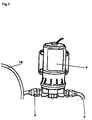
- the tank 1 fitted with the filler 2 is supported by a suitable part of the machine (Fig.6), so that the tank 1 is sufficiently near the pump 4 (Fig.7) and the above mentioned nozzles.
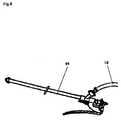
- the apparatus is also fitted with a hand-operated nozzle 44 connected to the pump 4, the nozzle 44 being used for cleaning the parts unreachable by the other nozzles (Fig.8).
- a lorry for transporting the bituminous mix is capable of supporting an apparatus according to the present invention.
- the apparatus conceits of the above mentioned details with a number of nozzles suitable for the type of vehicle.
Landscapes
- Engineering & Computer Science (AREA)
- Architecture (AREA)
- Civil Engineering (AREA)
- Structural Engineering (AREA)
- Mechanical Engineering (AREA)
- Road Paving Machines (AREA)
- Working-Up Tar And Pitch (AREA)
- Detergent Compositions (AREA)
- Vehicle Cleaning, Maintenance, Repair, Refitting, And Outriggers (AREA)
- Cleaning By Liquid Or Steam (AREA)
- Road Paving Structures (AREA)
- Road Repair (AREA)
Abstract
Description
- The present invention relates to a process used for maintaining the road machines clean, for example lorries for transporting bituminous mixes, apparatuses for producing said mixes, road vibratory finishing machines, road roller, tanks for spraying liquid bitumen and the like. These machines use and manipulate bitumen and/or bituminous mixes, which can damage the distribution mechanisms of the mixes; therefore, it is necessary to maintain the wheels clean, the worms for the mixes, the housings and all the parts of the machines which can be in contact with said mixes and their derivatives.
- The invention also relates to an apparatus capable of carrying out the process.
- The machines of the above type need a systematic cleaning because of the tendency of the mixes to settle on parts of the machines; these sediments adhere to the ferrous parts of the machines and incrust and damage said parts; their descaling is difficult, particularly when the mixes are dry. Usually, for detaching the bituminous sediments from the ferrous parts, percussion tools (hammers, chisels, etc.) or flames are used, which calcine the sediments for detaching them; it is obvious that these methods of detaching damage the parts of the machines which are subjected to the blows or the superheating.
- A known compound is used for detaching the incrustation from the machines; this compound is biodegradable and dissolves the bitumen also if it is emulsified with water.
- In order to prevent the mix from being settled, the compound is thrown, sprayed or brushed on the parts at caking risk by means of elements which do not proportion the quantity of compound necessary and sufficient for preventing the begin of the caking or for obtaining the removal of the previously settled mix.
- The purpose of this invention is to obviate these disadvantages. The invention, as claimed, solves the problem of creating a process for cleaning road machines.
- The process according to the present invention is, therefore, used for preventing the bituminous mixes from being settled on parts of a road machine, or for removing the previously settled mix.
- For this purpose, the process essentially consists in creating atomised sprays of said compound or of an aqueous solution of said compound; the atomised sprays are direct to the surfaces of the machine for creating protective coatings on the parts at caking risk; as consequence of the atomisation two phases mixtures are obtained; the liquid phase consists of the compound and the bitumen dissolved in the compound, while the solid phase comprises only the bituminous mix, i.e. crushed stone and non dissolved bitumen.
- The atomised sprays form protective coatings of an emulsified compound on the parts at caking risk of the machine; these coatings present thicknesses necessary and sufficient to perform their protective function in order to avoid any waste of compound.
- The heavy solid phase falls from the machine and is recycled, while the atomised liquid phase is soaked by the ground and killed without contaminate the environment. Therefore, the commercial compound is a liquid compatible with the ecosystem and the solution of the bitumen in the compound reaches a similar feature.
- The mix fallen from the machine is mixed with the featheredge or recovered in any other known way (for example, by bringing again the mix into the box of the machine).
- The process is frequently iterated, so that the incrustation of bituminous mix is prevented, or the descaling of the previously incrusted mix is reached.
- In particular, during the working of the road machines the iteration of the process is provided at pre-established intervals of time, the frequency and duration of which depend on several factors; typically on the type of machine, the quantity and quality of the mix to be strewed on the ground, the atmospheric conditions, etc.
- The process is preferably iterated at the end of a working session (workday or half workday) to move away any mix chip from the machine and prevent the chips from being dried during the break of the machine.
- This process does not damage the machine for the following reasons:
- 1- the compounds or their aqueous emulsions are lacking in acids or other oxidative;
- 2- the sprays of the compound on the walls have practically zero kinetic energy for do not damage the structures of the machine;
- 3- the sprays are only sent on the parts at caking risk of the machine in order to avoid any waste of compound, the cleaning of the other structures is made, if it is necessary, by hand-operated nozzles.
-
- A second purpose of the present invention consists in creating an apparatus capable of carrying out the process.
- The apparatus comprises at least a pump which sends a compressed ecological compound, aqueous emulsion or solution of the compound, to ducts the outlets of which are direct to the parts of the machine at caking risk because of the bituminous mixes.
- This caking occurs because the mix to be strewed on the featheredge is incoherent and tends to come out from the machine which has no sealed part.
- Preferably, the outlets of the ducts consist of nozzles uniformly atomising the compound or the aqueous emulsion of the compound; each nozzle atomises the compound only for one part of the machine; therefore, it is assembled on a fixed structure of the machine; in addition, a hand-operated nozzle can be used, this nozzle being connected to the pump for cleaning the parts unreachable by the other nozzles.
- The pump is feed by the electrical system of the machine or by a battery, and at least a switch is used for feeding the pump.
- Advantageously, the apparatus is fitted with a time switch feeding the pump at pre-established time intervals and duration; these time switches are known in the prior art.
- Therefore, this apparatus solves the following problems:
- a- the assembling of the apparatus on all types of commercial machines; this assembling is eased by the fact that the components of the apparatus are known in the technique structures or devices, as pumps, ducts, nozzles and the like which the technicians assemble in a very easy and immediate way;
- b- each nozzle is supported by a structure of the machine, so that the compound sprayed by the nozzle faces the part at caking risk because of the bituminous mixes;
- c- the timing of the sprayed compound avoids a driver for the apparatus.
-
- Further advantages, details and salient features of the invention will be outlined in the following description of preferred embodiments of the apparatus as in the present invention, with reference to the accompanying drawings:
- Fig.1 represents a block diagram of the apparatus;
- Fig.2 shows a road machine on which the apparatus is assembled;
- Figs 3 to 5 show constructive details of the apparatus;
- Fig.6 shows the tank for the compound supported by a first structure of the machine;
- Fig.7 represents the pump supported by a second structure of the machine
- Fig.8 shows a hand-operated nozzle used for cleaning the parts of the machine unreachable by the other nozzles;
-
- The apparatus schematically shown in Fig.1 comprises a
tank 1 containing a commercial compound or an aqueous solution or an emulsion of the compound; thetank 1 is filled through thefiller 2 and is connected to theinlet 3 of apump 4 through aduct 5; thepump 4 is jointed to dischargingducts feed manifold 10 connected to theoutlet 6 of thepump 4. Eachdischarging duct own opening caking risk - The
pump 4 is electrically feed by abattery 17 and aswitch 19 is provided in thewire 18 between thebattery 17 and thepump 4. - Preferably, the
switch 19 is a time switch feeding the pump at pre-established time intervals and duration. - The road machine shown in Fig.2 is fitted with an apparatus according to the invention for maintaining the parts of the machine at caking risk clean.
- The apparatus is assembled on the machine and consists of the devices shown in Fig.1; in particular, by means of this apparatus, the front
solid tires driving wheels worm 24 and theconveyor chain 25 for the mix are cleaned. - The bituminous mix is maintained in a
box 26 of the machine at a temperature suitable for spreading on the road; once come out from thebox 26, the mix covers the whole length of the machine until the mix reaches theoutlet zone 27 at the end of theworm 24 for being successively spread on the featheredge. - Along this run, a part of the mix falls on underlying structures of the machine and tends to remain adherent to the conveyor devices for the mix.
- A first part consists of the front wheels 28, 29 located under the
box 26 of the machine; therefore, near thewheels nozzles outlet 11 of the discharging duct 7; the nozzles are fastened to astructure 32 of the machine by means of abracket 33 in order to maintain the direction of the atomised sprays of thenozzles 30, 31 (Fig.3) constant. Thenozzles - The assembly and disassembly of the
nozzles bracket 33 is fastened to thestructure 32 by means of bolts or fastening screws 34 (Fig.3). - Another zone at caking risk because of the bituminous mixes consists of the
driving wheels 22, 23 (Fig.4); therefore, twonozzles structure 37 of the machine by means of abracket 38 in order to maintain the direction of the atomised sprays of thenozzles - Also in this case, the assembly and disassembly of the
nozzles bracket 38 is fastened to thestructure 37 by means of bolts or fasteningscrews 39. - The fouling of the
worm 40 and the conveyor chain 41 is particularly dangerous since these two devices are mechanically active; therefore, twonozzles 42, 43 (Fig.5) are provided sending their atomised sprays, respectively, to theworm 40 and the chain 41. The assembly and disassembly of these nozzles is wholly similar to those of the above mentioned nozzles. - The
tank 1 fitted with thefiller 2 is supported by a suitable part of the machine (Fig.6), so that thetank 1 is sufficiently near the pump 4 (Fig.7) and the above mentioned nozzles. - The apparatus is also fitted with a hand-operated
nozzle 44 connected to thepump 4, thenozzle 44 being used for cleaning the parts unreachable by the other nozzles (Fig.8). - Also a lorry for transporting the bituminous mix is capable of supporting an apparatus according to the present invention. Obviously, also in this case, the apparatus conceits of the above mentioned details with a number of nozzles suitable for the type of vehicle.
Claims (10)
- Process for cleaning road machines consisting in creating atomised sprays of an ecological compound, aqueous emulsion or solution of the compound; in directing the sprays to the surfaces of the machines at caking risk because of the bituminous mixes for crating protective coatings on said parts at caking risk.
- Process as in claim 1, characterised by the fact that the protective coatings present thicknesses necessary and sufficient to perform their protective function in order to avoid any waste of compound.
- Process as in claim 1, characterised by the fact that the solid phase falls from the machine and is recycled, while the atomised liquid phase is soaked by the ground and killed without contaminate the environment.
- Process as in claim 1, characterised by the fact that during the working of the road machines the iteration of the process is provided at pre-established intervals of time, the frequency and duration of which depend on several factors; typically on the type of machine, the quantity and quality of the mix to be strewed on the ground, the atmospheric conditions, etc.
- Apparatus capable of carrying out the process according to at least one of previous claims, characterised by the fact that the apparatus comprises:a tank (1) for the compound, the aqueous emulsion or solution of the compound;a pump (4), the inlet of which is connected to the tank (1) through a duct (5), and the outlet (6) is jointed to discharging ducts (7, 8, 9) through a feed manifold (10) connected to the outlet (6) for sending the compressed liquid to the discharging ducts (7, 8, 9), each discharging duct (7, 8, 9) presenting an own opening (11, 12, 13), each of which, respectively, sends an atomised spray of the compound to the parts (14, 15, 16) at caking risk of the machine on which the spay forms protective coatings.
- Apparatus as in claim 5, characterised by the fact that the openings (11, 12, 13) consist of nozzles (30,31,35,36,42,43) forming atomised sprays of the compound, the aqueous emulsion or solution of the compound, the sprays depositing in a quantity necessary and sufficient for preventing begin of the caking or for obtaining the removal of the previously settled mix.
- Apparatus as in claim 6, characterised by the fact that the nozzles (30,31,35,36,42,43) are fastened to structures (32) of the machine by means of brackets (33) in order to maintain the direction of the atomised sprays of the nozzles (30,31,35,36,42,43) constant, the brackets (33) are fastened to a structure (32) of the machine by means of bolts or fastening screws (34).
- Apparatus as in claim 5, characterised by the fact that the openings (11, 12, 13) consist of hand-operated nozzles (44) connected to the pump (4), hand-operated nozzles (44) being used for cleaning the parts unreachable by the other nozzles (30,31,35,36,42,43).
- Apparatus as in claim 5, characterised by the fact that the pump (4) is electrically feed by a battery (17) or by the electrical system of the machine, a switch (19) being provided in the wire (18) between the battery (17) or the electrical system and the pump (4).
- Apparatus as in claim 9, characterised by the fact that the switch (19) is a time switch feeding the pump at pre-established time intervals and duration.
Applications Claiming Priority (2)
| Application Number | Priority Date | Filing Date | Title |
|---|---|---|---|
| ITBO000144U | 2000-11-02 | ||
| IT2000BO000144U IT251177Y1 (en) | 2000-11-02 | 2000-11-02 | KIT TO CLEAN MACHINES THAT USE AND WORK VARIOUS BITUMENS AND BITUMINOUS CONGLOMERATES |
Publications (3)
| Publication Number | Publication Date |
|---|---|
| EP1203705A2 true EP1203705A2 (en) | 2002-05-08 |
| EP1203705A3 EP1203705A3 (en) | 2002-10-02 |
| EP1203705B1 EP1203705B1 (en) | 2005-09-14 |
Family
ID=11438327
Family Applications (1)
| Application Number | Title | Priority Date | Filing Date |
|---|---|---|---|
| EP01109833A Expired - Lifetime EP1203705B1 (en) | 2000-11-02 | 2001-04-23 | Process for cleaning road machines and apparatus capable of carrying out the process |
Country Status (4)
| Country | Link |
|---|---|
| EP (1) | EP1203705B1 (en) |
| AT (1) | ATE304468T1 (en) |
| DE (1) | DE60113366D1 (en) |
| IT (1) | IT251177Y1 (en) |
Cited By (2)
| Publication number | Priority date | Publication date | Assignee | Title |
|---|---|---|---|---|
| EP2799156A1 (en) * | 2013-05-02 | 2014-11-05 | Dynapac GmbH | Method for cleaning road surfacing or charging devices |
| ITUB20159562A1 (en) * | 2015-12-24 | 2017-06-24 | Alessio Gellini | Vehicle wheel control and maintenance device |
Families Citing this family (1)
| Publication number | Priority date | Publication date | Assignee | Title |
|---|---|---|---|---|
| CN104340182B (en) * | 2014-10-29 | 2016-07-06 | 浙江同泰建设集团有限公司 | A kind of rinser of mixing drum |
Family Cites Families (6)
| Publication number | Priority date | Publication date | Assignee | Title |
|---|---|---|---|---|
| US3477354A (en) * | 1967-11-01 | 1969-11-11 | Northwestern National Bank Of | Slip form paver |
| FR2041778A1 (en) * | 1969-05-28 | 1971-02-05 | Berton Pierre | |
| US4262849A (en) * | 1979-04-26 | 1981-04-21 | Elam Kenneth R | High pressure washer for mine equipment |
| DE3537619A1 (en) * | 1985-10-23 | 1987-04-23 | Bayer Ag | Agents for cold washing |
| US5222828A (en) * | 1991-10-30 | 1993-06-29 | Ingersoll-Rand Company | Device for cleaning and lubricating the exterior surface of asphalt compacting drums |
| DE29811212U1 (en) * | 1998-06-23 | 1998-09-17 | Joseph Vögele AG, 68163 Mannheim | Feeder |
-
2000
- 2000-11-02 IT IT2000BO000144U patent/IT251177Y1/en active
-
2001
- 2001-04-23 DE DE60113366T patent/DE60113366D1/en not_active Expired - Lifetime
- 2001-04-23 EP EP01109833A patent/EP1203705B1/en not_active Expired - Lifetime
- 2001-04-23 AT AT01109833T patent/ATE304468T1/en not_active IP Right Cessation
Non-Patent Citations (1)
| Title |
|---|
| None |
Cited By (3)
| Publication number | Priority date | Publication date | Assignee | Title |
|---|---|---|---|---|
| EP2799156A1 (en) * | 2013-05-02 | 2014-11-05 | Dynapac GmbH | Method for cleaning road surfacing or charging devices |
| DE102013007446A1 (en) * | 2013-05-02 | 2014-11-06 | Dynapac Gmbh | Process for cleaning road pavers or feeders |
| ITUB20159562A1 (en) * | 2015-12-24 | 2017-06-24 | Alessio Gellini | Vehicle wheel control and maintenance device |
Also Published As
| Publication number | Publication date |
|---|---|
| ITBO20000144V0 (en) | 2000-11-02 |
| IT251177Y1 (en) | 2003-11-04 |
| EP1203705A3 (en) | 2002-10-02 |
| ATE304468T1 (en) | 2005-09-15 |
| DE60113366D1 (en) | 2005-10-20 |
| EP1203705B1 (en) | 2005-09-14 |
| ITBO20000144U1 (en) | 2002-05-03 |
Similar Documents
| Publication | Publication Date | Title |
|---|---|---|
| US3877643A (en) | Method and apparatus for removing rubber coating from airport runways | |
| US9091029B2 (en) | Rotor housing for a milling device for soil processing, milling device, and method for cleaning a rotor housing | |
| US20140042656A1 (en) | Leftover concrete recycling device and method for leftover concrete recycling | |
| US11427164B2 (en) | Truck trackout cleaning system | |
| EP1367176A1 (en) | Dust control system for a road working machine | |
| CN112154237A (en) | Trench wall cutter and method for producing a cutting trench in soil | |
| EP1203705A2 (en) | Process for cleaning road machines and apparatus capable of carrying out the process | |
| EP2994250A1 (en) | A method and a system for cleaning the interior of a storage tank | |
| KR102241741B1 (en) | an apparatus for cleaning coupling | |
| JP3156221B2 (en) | Cleaning nozzle for the surface to be cleaned | |
| US20080230093A1 (en) | Apparatus, Vehicle and Method For Cleaning Surfaces Fouled With Chewing Gum | |
| KR20200089388A (en) | Movable spraying and cleaning device loaded with engine | |
| KR101578547B1 (en) | Ecofriendly apparatus for cleanning and removing attachments and paint | |
| KR101073886B1 (en) | sprinkler | |
| KR101998225B1 (en) | Vehicle for sprinkling water | |
| KR102382563B1 (en) | Automobile front-sprinkler saltwater snow plowlt with calcium chloride spray | |
| US20080283085A1 (en) | Concrete load cleaning apparatus and method | |
| US7725976B1 (en) | Apparatus and method for the automated cleaning of articles | |
| JP2009138469A (en) | Tamper washing apparatus for asphalt finisher | |
| EP2923902A1 (en) | Method of de-icing a top of a truck and device for de-icing a top of a truck | |
| JP3846751B2 (en) | Liquid spraying device for vibration type road surface compactor | |
| JP2000290919A (en) | Compaction vehicle | |
| US9555776B2 (en) | Portable undercarriage washer for vehicles | |
| RU2786384C1 (en) | Machine for cleaning roads from snow and ice formations | |
| US7270133B2 (en) | System and method for cleaning asphalt contact surfaces |
Legal Events
| Date | Code | Title | Description |
|---|---|---|---|
| PUAI | Public reference made under article 153(3) epc to a published international application that has entered the european phase |
Free format text: ORIGINAL CODE: 0009012 |
|
| AK | Designated contracting states |
Kind code of ref document: A2 Designated state(s): AT BE CH CY DE DK ES FI FR GB GR IE IT LI LU MC NL PT SE TR |
|
| AX | Request for extension of the european patent |
Free format text: AL;LT;LV;MK;RO;SI |
|
| PUAL | Search report despatched |
Free format text: ORIGINAL CODE: 0009013 |
|
| AK | Designated contracting states |
Kind code of ref document: A3 Designated state(s): AT BE CH CY DE DK ES FI FR GB GR IE IT LI LU MC NL PT SE TR |
|
| AX | Request for extension of the european patent |
Free format text: AL;LT;LV;MK;RO;SI |
|
| 17P | Request for examination filed |
Effective date: 20030325 |
|
| AKX | Designation fees paid |
Designated state(s): AT BE CH CY DE DK ES FI FR GB GR IE IT LI LU MC NL PT SE TR |
|
| 17Q | First examination report despatched |
Effective date: 20030604 |
|
| GRAP | Despatch of communication of intention to grant a patent |
Free format text: ORIGINAL CODE: EPIDOSNIGR1 |
|
| GRAS | Grant fee paid |
Free format text: ORIGINAL CODE: EPIDOSNIGR3 |
|
| GRAA | (expected) grant |
Free format text: ORIGINAL CODE: 0009210 |
|
| AK | Designated contracting states |
Kind code of ref document: B1 Designated state(s): AT BE CH CY DE DK ES FI FR GB GR IE IT LI LU MC NL PT SE TR |
|
| PG25 | Lapsed in a contracting state [announced via postgrant information from national office to epo] |
Ref country code: IT Free format text: LAPSE BECAUSE OF FAILURE TO SUBMIT A TRANSLATION OF THE DESCRIPTION OR TO PAY THE FEE WITHIN THE PRESCRIBED TIME-LIMIT;WARNING: LAPSES OF ITALIAN PATENTS WITH EFFECTIVE DATE BEFORE 2007 MAY HAVE OCCURRED AT ANY TIME BEFORE 2007. THE CORRECT EFFECTIVE DATE MAY BE DIFFERENT FROM THE ONE RECORDED. Effective date: 20050914 Ref country code: BE Free format text: LAPSE BECAUSE OF FAILURE TO SUBMIT A TRANSLATION OF THE DESCRIPTION OR TO PAY THE FEE WITHIN THE PRESCRIBED TIME-LIMIT Effective date: 20050914 Ref country code: FI Free format text: LAPSE BECAUSE OF FAILURE TO SUBMIT A TRANSLATION OF THE DESCRIPTION OR TO PAY THE FEE WITHIN THE PRESCRIBED TIME-LIMIT Effective date: 20050914 Ref country code: CH Free format text: LAPSE BECAUSE OF FAILURE TO SUBMIT A TRANSLATION OF THE DESCRIPTION OR TO PAY THE FEE WITHIN THE PRESCRIBED TIME-LIMIT Effective date: 20050914 Ref country code: NL Free format text: LAPSE BECAUSE OF FAILURE TO SUBMIT A TRANSLATION OF THE DESCRIPTION OR TO PAY THE FEE WITHIN THE PRESCRIBED TIME-LIMIT Effective date: 20050914 Ref country code: AT Free format text: LAPSE BECAUSE OF FAILURE TO SUBMIT A TRANSLATION OF THE DESCRIPTION OR TO PAY THE FEE WITHIN THE PRESCRIBED TIME-LIMIT Effective date: 20050914 Ref country code: LI Free format text: LAPSE BECAUSE OF FAILURE TO SUBMIT A TRANSLATION OF THE DESCRIPTION OR TO PAY THE FEE WITHIN THE PRESCRIBED TIME-LIMIT Effective date: 20050914 |
|
| REG | Reference to a national code |
Ref country code: GB Ref legal event code: FG4D |
|
| REG | Reference to a national code |
Ref country code: CH Ref legal event code: EP |
|
| REG | Reference to a national code |
Ref country code: IE Ref legal event code: FG4D |
|
| REF | Corresponds to: |
Ref document number: 60113366 Country of ref document: DE Date of ref document: 20051020 Kind code of ref document: P |
|
| PG25 | Lapsed in a contracting state [announced via postgrant information from national office to epo] |
Ref country code: DK Free format text: LAPSE BECAUSE OF FAILURE TO SUBMIT A TRANSLATION OF THE DESCRIPTION OR TO PAY THE FEE WITHIN THE PRESCRIBED TIME-LIMIT Effective date: 20051214 Ref country code: SE Free format text: LAPSE BECAUSE OF FAILURE TO SUBMIT A TRANSLATION OF THE DESCRIPTION OR TO PAY THE FEE WITHIN THE PRESCRIBED TIME-LIMIT Effective date: 20051214 Ref country code: GR Free format text: LAPSE BECAUSE OF FAILURE TO SUBMIT A TRANSLATION OF THE DESCRIPTION OR TO PAY THE FEE WITHIN THE PRESCRIBED TIME-LIMIT Effective date: 20051214 |
|
| PG25 | Lapsed in a contracting state [announced via postgrant information from national office to epo] |
Ref country code: DE Free format text: LAPSE BECAUSE OF FAILURE TO SUBMIT A TRANSLATION OF THE DESCRIPTION OR TO PAY THE FEE WITHIN THE PRESCRIBED TIME-LIMIT Effective date: 20051215 |
|
| PG25 | Lapsed in a contracting state [announced via postgrant information from national office to epo] |
Ref country code: ES Free format text: LAPSE BECAUSE OF FAILURE TO SUBMIT A TRANSLATION OF THE DESCRIPTION OR TO PAY THE FEE WITHIN THE PRESCRIBED TIME-LIMIT Effective date: 20051225 |
|
| PG25 | Lapsed in a contracting state [announced via postgrant information from national office to epo] |
Ref country code: PT Free format text: LAPSE BECAUSE OF FAILURE TO SUBMIT A TRANSLATION OF THE DESCRIPTION OR TO PAY THE FEE WITHIN THE PRESCRIBED TIME-LIMIT Effective date: 20060214 |
|
| NLV1 | Nl: lapsed or annulled due to failure to fulfill the requirements of art. 29p and 29m of the patents act | ||
| REG | Reference to a national code |
Ref country code: CH Ref legal event code: PL |
|
| PG25 | Lapsed in a contracting state [announced via postgrant information from national office to epo] |
Ref country code: GB Free format text: LAPSE BECAUSE OF NON-PAYMENT OF DUE FEES Effective date: 20060423 |
|
| PG25 | Lapsed in a contracting state [announced via postgrant information from national office to epo] |
Ref country code: IE Free format text: LAPSE BECAUSE OF NON-PAYMENT OF DUE FEES Effective date: 20060424 |
|
| PG25 | Lapsed in a contracting state [announced via postgrant information from national office to epo] |
Ref country code: MC Free format text: LAPSE BECAUSE OF NON-PAYMENT OF DUE FEES Effective date: 20060430 |
|
| PLBE | No opposition filed within time limit |
Free format text: ORIGINAL CODE: 0009261 |
|
| STAA | Information on the status of an ep patent application or granted ep patent |
Free format text: STATUS: NO OPPOSITION FILED WITHIN TIME LIMIT |
|
| 26N | No opposition filed |
Effective date: 20060615 |
|
| PG25 | Lapsed in a contracting state [announced via postgrant information from national office to epo] |
Ref country code: FR Free format text: LAPSE BECAUSE OF FAILURE TO SUBMIT A TRANSLATION OF THE DESCRIPTION OR TO PAY THE FEE WITHIN THE PRESCRIBED TIME-LIMIT Effective date: 20061020 |
|
| EN | Fr: translation not filed | ||
| EN | Fr: translation not filed | ||
| GBPC | Gb: european patent ceased through non-payment of renewal fee |
Effective date: 20060423 |
|
| REG | Reference to a national code |
Ref country code: IE Ref legal event code: MM4A |
|
| PG25 | Lapsed in a contracting state [announced via postgrant information from national office to epo] |
Ref country code: TR Free format text: LAPSE BECAUSE OF FAILURE TO SUBMIT A TRANSLATION OF THE DESCRIPTION OR TO PAY THE FEE WITHIN THE PRESCRIBED TIME-LIMIT Effective date: 20050914 Ref country code: LU Free format text: LAPSE BECAUSE OF NON-PAYMENT OF DUE FEES Effective date: 20060423 |
|
| PG25 | Lapsed in a contracting state [announced via postgrant information from national office to epo] |
Ref country code: FR Free format text: LAPSE BECAUSE OF FAILURE TO SUBMIT A TRANSLATION OF THE DESCRIPTION OR TO PAY THE FEE WITHIN THE PRESCRIBED TIME-LIMIT Effective date: 20050914 Ref country code: CY Free format text: LAPSE BECAUSE OF FAILURE TO SUBMIT A TRANSLATION OF THE DESCRIPTION OR TO PAY THE FEE WITHIN THE PRESCRIBED TIME-LIMIT Effective date: 20050914 |