EP1202248A1 - Musical sound generator - Google Patents
Musical sound generator Download PDFInfo
- Publication number
- EP1202248A1 EP1202248A1 EP01908301A EP01908301A EP1202248A1 EP 1202248 A1 EP1202248 A1 EP 1202248A1 EP 01908301 A EP01908301 A EP 01908301A EP 01908301 A EP01908301 A EP 01908301A EP 1202248 A1 EP1202248 A1 EP 1202248A1
- Authority
- EP
- European Patent Office
- Prior art keywords
- data
- musical
- sound
- processing unit
- region
- Prior art date
- Legal status (The legal status is an assumption and is not a legal conclusion. Google has not performed a legal analysis and makes no representation as to the accuracy of the status listed.)
- Withdrawn
Links
Images




Classifications
-
- G—PHYSICS
- G10—MUSICAL INSTRUMENTS; ACOUSTICS
- G10H—ELECTROPHONIC MUSICAL INSTRUMENTS; INSTRUMENTS IN WHICH THE TONES ARE GENERATED BY ELECTROMECHANICAL MEANS OR ELECTRONIC GENERATORS, OR IN WHICH THE TONES ARE SYNTHESISED FROM A DATA STORE
- G10H7/00—Instruments in which the tones are synthesised from a data store, e.g. computer organs
- G10H7/002—Instruments in which the tones are synthesised from a data store, e.g. computer organs using a common processing for different operations or calculations, and a set of microinstructions, e.g. programs, to control the sequence thereof
-
- G—PHYSICS
- G10—MUSICAL INSTRUMENTS; ACOUSTICS
- G10H—ELECTROPHONIC MUSICAL INSTRUMENTS; INSTRUMENTS IN WHICH THE TONES ARE GENERATED BY ELECTROMECHANICAL MEANS OR ELECTRONIC GENERATORS, OR IN WHICH THE TONES ARE SYNTHESISED FROM A DATA STORE
- G10H2240/00—Data organisation or data communication aspects, specifically adapted for electrophonic musical tools or instruments
- G10H2240/121—Musical libraries, i.e. musical databases indexed by musical parameters, wavetables, indexing schemes using musical parameters, musical rule bases or knowledge bases, e.g. for automatic composing methods
- G10H2240/145—Sound library, i.e. involving the specific use of a musical database as a sound bank or wavetable; indexing, interfacing, protocols or processing therefor
Definitions
- the present invention relates to a musical sound generation technique, and more particularly, to a highly expandable technique of processing sound data.
- Some musical sound generators which read musical score data and generate a sound have a group of functions called “sound library.”
- the sound library stores modules used to perform various special effects. Each module reads musical score data, converts the form of the data to produce data representing individual musical notes, subjects the resultant data to a special effect processing such as delay and filtering, and controls the sound processor in a series of processing. More specifically, the modules include all the functions used for processing from the reading of the musical score data to the control of the sound processor.
- the present invention is directed to a solution to the above-described problem associated with the conventional technique and it is an object of the present invention to provide a highly expandable sound library or a musical sound generation technique using such a library.
- musical note data representing a sound state in each tone is generated based on the musical score data.
- the musical note data is read and synthetic sound data is generated based on the musical note data for output.
- the synthetic sound data is read and a sound processor to generate a musical sound is controlled based on the synthetic sound data.
- a musical sound generator including an operation unit is used to perform the above-described processing.
- Fig. 1 is a diagram showing a hardware configuration in a musical sound generator according to the embodiment of the present invention.
- the musical sound generator according to the embodiment includes a CPU (Central Processing Unit) 10, a sound processor 30, and a memory 50, and they are connected with each other by a bus 80.
- CPU Central Processing Unit
- the memory 50 stores a sound source file 400, a sound library 500, musical score data 51, a coupling relation storing portion 52, and a screen control program 53.
- the sound source file 400 stores sound source data 410 based on which various sounds by various musical instruments are synthesized.
- the sound library 500 stores modules for performing processings to output sounds by the musical sound generator .
- the sound library 500 includes for example an input processing module 100 for reading the musical score data 51, a sound synthesis processing module 200 for synthesizing a sound, a sound processor control module 300 for controlling the sound processor, a special effect module for providing a special effect such as filtering and echoing and the like.
- the musical score data 51 is data produced by taking information represented by a musical score onto a computer.
- the coupling relation storing portion 52 stores coupling relation information 520 about modules stored in the sound library 500.
- the coupling relation information 520 indicates the coupling relation between modules necessary for performing a prescribed function.
- An example of the coupling relation information 520 is shown in Fig. 6.
- the coupling relation storing portion 52 stores the identifiers 522 of modules necessary for performing functions 521 in the order of execution.
- the function 1 is implemented by executing the modules M1, M3, M2 and M8 in this order.
- Settings for availability/unavailability for various special effect modules are included in the coupling relation storing portion 52.
- the screen control program 53 is a program for input/output related to a setting for a special effect.
- the screen control program 53 allows a display device (not shown) to display a special effect selection screen 600 which will be described.
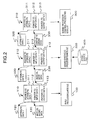
- Fig. 2 is the module configuration of the sound library 500 according to the embodiment operated by the CPU 10 and the data structure of the input/output data to/from each module.
- the module and data structure described above are implemented by execution of programs included in the sound library 500 by the CPU 10.
- the sound library 500 includes an input processing module 100, a sound synthesis processing module 200, a sound processor control processing module 300, and a sound source file 400.
- the modules 100, 200 and 300 receive pointer structures 110, 210 and 310, respectively as an argument for processing.
- the pointer structures 110, 210 and 310 include regions 111, 211 and 311 storing pointers to attribute data, regions 112, 212 and 312 storing pointers to input data, and regions 113, 213 and 313 to storing pointers to output data, respectively.
- Each pointer region stores the address of a buffer storing prescribed data or a buffer to store the data.
- Attribute data 120, 220 and 320 include definition information and the like necessary for each module to operate.
- the attribute data 120, 220 and 320 are information inherent to each module.
- the input processing module 100 reads musical score data 130 stored in a region pointed by the input data pointer 112 as input data. After the reading, the musical score data is analyzed, and musical note data 230 representing a tone and a sound state for each part of the musical score data is generated.
- the musical note data represents for example a sound state related to at least one of sound emission, sound stop, and the height of a sound to be emitted.
- the generated musical note data 230 is output to a region pointed by the output data pointer 113.
- An example of the musical note data 230 is shown in Fig. 5.
- the sound synthesis processing module 200 reads musical note data 230 from a region pointed by the input data pointer 212 as an input.
- the musical note data 230 is output by the input processing module 100. More specifically, the output data pointer 113 and the input data pointer 212 point the same region.
- the sound synthesis processing module 200 takes sound source data 410 corresponding to all the tones, the height of sounds, and volumes represented by the musical note data 230 from the sound source file 400.
- the sound synthesis processing module 200 further synthesizes the taken sound source data 410 and generates coded synthetic sound data 330.
- the sound synthetic processing module 200 outputs the generated synthetic sound data 330 to a region pointed by the output data pointer 213.
- the sound processor control processing module 300 reads the synthetic sound data 330 from a region pointed by the input data pointer 312 as an input. After the reading, the sound processor control processing module 300 controls the sound processor 30 based on the synthetic sound data 330 and emits a sound. In this case, the sound processor control processing module 300 simply emits a sound as an output, and does not write the output data to the buffer. Therefore, the output data pointer 313 does not store an address.
- the input processing module 100, the sound synthesis processing module 200 and the sound processor control processing module 300 are executed in this order, and sounds based on the musical score data 130 are emitted.
- the each region pointed by the input data pointers 112, 212 and 312 or the output data pointers 113, 213 and 313 stores one block data.
- a region pointed by a pointer may also store the pointer.
- the input data pointers 112, 212 and 312 or the output data pointers 113, 213 and 313 each may point a plurality of regions.
- the case of the input data pointer 112 will be detailed in conjunction with Fig. 3 by way of illustration.
- the input data pointer 112 stores a buffer group number 117 and a buffer group pointer 118.
- the region pointed by buffer group pointer 118 stores pointers 121 to 123 directed to buffers belonging to the buffer group.
- the regions pointed by buffer pointers 121, 122 and 123 have buffers 135, 140 and 150, respectively.
- the buffers 135, 140 and 150 each store input data. Note that herein the buffer group refers to a plurality of buffers associated with one another into a group.
- the buffer group is formed in this manner, and therefore if data is exchanged between modules using the pointer structures, the data may be exchanged to a plurality of buffers on a divisional data basis.
- the sound library 500 is formed to have a module structure as shown in Fig. 2, and therefore each module may be substituted by another processing or another processing may be added as long as the forms of input/output data coincide.
- the sound library 500 includes a special effect processing module for providing a special effect such as delay and filtering processings
- the special effect processing module may be inserted between the sound synthesis processing module 200 and the sound processor control processing module 300.
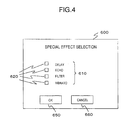
- a special effect selection screen 600 as shown in Fig. 4 may be prepared, and an instruction from the user may be received. Information set by the user is received by the special effect selection screen 600 and stored in the coupling relation storing portion 52. When a sound output processing is performed, a necessary module is read into the CPU 10 from the library by referring to the coupling relation storing portion 52.
- the special effect selection screen 600 as shown in Fig. 4 is displayed at a display device which is not shown by the CPU 10 which has read the screen control program 53.
- the special effect selection screen 600 is provided with a special effect display portion 610, a selection receiving portion 620 to receive a selection for a special effect, an OK button 650, and a cancel button 660.
- the information received by the special effect selection screen 600 is stored by the coupling relation storing portion 52. Details of the special effect selected by the selection receiving portion 620 may be further set using a detail setting screen which is not shown.
- the main module in the sound library 500 reads the coupling relation information 520 from the coupling relation storing portion 52 (S101). Modules corresponding to a function to be implemented are sequentially executed (S102). Theprocesswaits for matching the timings as required (S103). The process from S101 to S103 is repeated until the end.
- the updating of the coupling relation information 520 allows modules to be combined as desired.
- the expandability of the sound library is increased.
Landscapes
- Engineering & Computer Science (AREA)
- General Engineering & Computer Science (AREA)
- Physics & Mathematics (AREA)
- Acoustics & Sound (AREA)
- Multimedia (AREA)
- Electrophonic Musical Instruments (AREA)
- Auxiliary Devices For Music (AREA)
Abstract
A highly expandable musical sound generator using a
sound library. Each module receives pointer structures as
an argument and executes a processing. Each pointer
structures includes attribute data pointers, input data
pointers and output data pointers.
Description
The present invention relates to a musical sound
generation technique, and more particularly, to a highly
expandable technique of processing sound data.
Some musical sound generators which read musical score
data and generate a sound have a group of functions called
"sound library." The sound library stores modules used to
perform various special effects. Each module reads musical
score data, converts the form of the data to produce data
representing individual musical notes, subjects the
resultant data to a special effect processing such as delay
and filtering, and controls the sound processor in a series
of processing. More specifically, the modules include all
the functions used for processing from the reading of the
musical score data to the control of the sound processor.
Therefore, if for example only a part of a method of
processing a special effect in a certain module should be
modified, the entire module must be updated. A new function
must be added to another module in such a manner that the
existing part of the module is not affected, which is not
necessarily easy.
The present invention is directed to a solution to the
above-described problem associated with the conventional
technique and it is an object of the present invention to
provide a highly expandable sound library or a musical sound
generation technique using such a library.
In order to achieve the above-described object, the
following processings are performed according to the present
invention. More specifically, musical note data
representing a sound state in each tone is generated based
on the musical score data. The musical note data is read
and synthetic sound data is generated based on the musical
note data for output. The synthetic sound data is read and
a sound processor to generate a musical sound is controlled
based on the synthetic sound data.
According to the present invention, a musical sound
generator including an operation unit is used to perform
the above-described processing.
An embodiment of the present invention will be now
described in conjunction with the accompanying drawings.
Fig. 1 is a diagram showing a hardware configuration
in a musical sound generator according to the embodiment
of the present invention. The musical sound generator
according to the embodiment includes a CPU (Central
Processing Unit) 10, a sound processor 30, and a memory 50,
and they are connected with each other by a bus 80.
The memory 50 stores a sound source file 400, a sound
library 500, musical score data 51, a coupling relation
storing portion 52, and a screen control program 53.
The sound source file 400 stores sound source data 410
based on which various sounds by various musical instruments
are synthesized.
The sound library 500 stores modules for performing
processings to output sounds by the musical sound generator .
The sound library 500 includes for example an input processing
module 100 for reading the musical score data 51, a sound
synthesis processing module 200 for synthesizing a sound,
a sound processor control module 300 for controlling the
sound processor, a special effect module for providing a
special effect such as filtering and echoing and the like.
The musical score data 51 is data produced by taking
information represented by a musical score onto a computer.
The coupling relation storing portion 52 stores
coupling relation information 520 about modules stored in
the sound library 500. The coupling relation information
520 indicates the coupling relation between modules
necessary for performing a prescribed function. An example
of the coupling relation information 520 is shown in Fig.
6.
In the example shown in Fig. 6, the coupling relation
storing portion 52 stores the identifiers 522 of modules
necessary for performing functions 521 in the order of
execution. For example, the function 1 is implemented by
executing the modules M1, M3, M2 and M8 in this order.
Settings for availability/unavailability for various
special effect modules are included in the coupling relation
storing portion 52.
The screen control program 53 is a program for
input/output related to a setting for a special effect. For
example, the screen control program 53 allows a display device
(not shown) to display a special effect selection screen
600 which will be described.
Fig. 2 is the module configuration of the sound library
500 according to the embodiment operated by the CPU 10 and
the data structure of the input/output data to/from each
module. The module and data structure described above are
implemented by execution of programs included in the sound
library 500 by the CPU 10.
The sound library 500 includes an input processing
module 100, a sound synthesis processing module 200, a sound
processor control processing module 300, and a sound source
file 400. The modules 100, 200 and 300 receive pointer
structures 110, 210 and 310, respectively as an argument
for processing.
The pointer structures 110, 210 and 310 include regions
111, 211 and 311 storing pointers to attribute data, regions
112, 212 and 312 storing pointers to input data, and regions
113, 213 and 313 to storing pointers to output data,
respectively. Each pointer region stores the address of
a buffer storing prescribed data or a buffer to store the
data.
The input processing module 100 reads musical score
data 130 stored in a region pointed by the input data pointer
112 as input data. After the reading, the musical score
data is analyzed, and musical note data 230 representing
a tone and a sound state for each part of the musical score
data is generated. The musical note data represents for
example a sound state related to at least one of sound emission,
sound stop, and the height of a sound to be emitted. The
generated musical note data 230 is output to a region pointed
by the output data pointer 113. An example of the musical
note data 230 is shown in Fig. 5.
The musical note data 230 shown in Fig. 5 has the
following meaning. More specifically, "Program Change
P0=2" means that "an identifier sets musical instrument 2
for part 0", while "Volume P0=90" means that "the sound volume
of part 0 is set to 90." "Key on P0=60" means that "Emit
sound 60 (middle do) for part 0." The part 1 is similarly
set.
The sound synthesis processing module 200 reads musical
note data 230 from a region pointed by the input data pointer
212 as an input. The musical note data 230 is output by
the input processing module 100. More specifically, the
output data pointer 113 and the input data pointer 212 point
the same region. After the musical note data 230 is read,
the sound synthesis processing module 200 takes sound source
data 410 corresponding to all the tones, the height of sounds,
and volumes represented by the musical note data 230 from
the sound source file 400. The sound synthesis processing
module 200 further synthesizes the taken sound source data
410 and generates coded synthetic sound data 330. The sound
synthetic processing module 200 outputs the generated
synthetic sound data 330 to a region pointed by the output
data pointer 213.
The sound processor control processing module 300 reads
the synthetic sound data 330 from a region pointed by the
input data pointer 312 as an input. After the reading, the
sound processor control processing module 300 controls the
sound processor 30 based on the synthetic sound data 330
and emits a sound. In this case, the sound processor control
processing module 300 simply emits a sound as an output,
and does not write the output data to the buffer. Therefore,
the output data pointer 313 does not store an address.
The input processing module 100, the sound synthesis
processing module 200 and the sound processor control
processing module 300 are executed in this order, and sounds
based on the musical score data 130 are emitted.
Also according to the embodiment, the each region
pointed by the input data pointers 112, 212 and 312 or the
output data pointers 113, 213 and 313 stores one block data.
A region pointed by a pointer may also store the pointer.
In other words, the input data pointers 112, 212 and 312
or the output data pointers 113, 213 and 313 each may point
a plurality of regions. The case of the input data pointer
112 will be detailed in conjunction with Fig. 3 by way of
illustration.
The input data pointer 112 stores a buffer group number
117 and a buffer group pointer 118. The region pointed by
buffer group pointer 118 stores pointers 121 to 123 directed
to buffers belonging to the buffer group. The regions
pointed by buffer pointers 121, 122 and 123 have buffers
135, 140 and 150, respectively. The buffers 135, 140 and
150 each store input data. Note that herein the buffer group
refers to a plurality of buffers associated with one another
into a group.
The buffer group is formed in this manner, and therefore
if data is exchanged between modules using the pointer
structures, the data may be exchanged to a plurality of
buffers on a divisional data basis.
Furthermore, the sound library 500 is formed to have
a module structure as shown in Fig. 2, and therefore each
module may be substituted by another processing or another
processing may be added as long as the forms of input/output
data coincide. For example, when the sound library 500
includes a special effect processing module for providing
a special effect such as delay and filtering processings,
the special effect processing module may be inserted between
the sound synthesis processing module 200 and the sound
processor control processing module 300.
Whether or not to incorporate such a special effect
may be selected by the user of the musical sound generator.
More specifically, a special effect selection screen 600
as shown in Fig. 4 may be prepared, and an instruction from
the user may be received. Information set by the user is
received by the special effect selection screen 600 and stored
in the coupling relation storing portion 52. When a sound
output processing is performed, a necessary module is read
into the CPU 10 from the library by referring to the coupling
relation storing portion 52.
The special effect selection screen 600 as shown in
Fig. 4 is displayed at a display device which is not shown
by the CPU 10 which has read the screen control program 53.
The special effect selection screen 600 is provided with
a special effect display portion 610, a selection receiving
portion 620 to receive a selection for a special effect,
an OK button 650, and a cancel button 660. The information
received by the special effect selection screen 600 is stored
by the coupling relation storing portion 52. Details of
the special effect selected by the selection receiving
portion 620 may be further set using a detail setting screen
which is not shown.
The process flow of the musical sound generator will
be now described in conjunction with Fig. 7.
The main module in the sound library 500 reads the
coupling relation information 520 from the coupling relation
storing portion 52 (S101). Modules corresponding to a
function to be implemented are sequentially executed (S102).
Theprocesswaits for matching the timings as required (S103).
The process from S101 to S103 is repeated until the end.
As in the foregoing, the updating of the coupling
relation information 520 allows modules to be combined as
desired.
According to the present invention, the expandability
of the sound library is increased.
Claims (9)
- A musical sound generator, comprising:a musical score data input processing unit that generates musical note data based on musical score data, the musical note data representing a sound state of each tone;a musical note data processing unit that generates synthetic sound data by synthesizing a plurality of tones based on the musical note data; anda musical sound generation processing unit that controls a sound processor for generating a musical sound based on the synthetic sound data.
- A musical sound generator, comprising:a musical score data input processing unit that generates musical note data based on musical score data, the musical note data representing a sound state by a musical instrument for each kind of musical instruments;a musical note data processing unit that generates synthetic sound data by synthesizing sounds by a plurality of musical instruments based on the musical note data; anda musical sound generation processing unit that controls a sound processor for generating a musical sound based on the synthetic sound data.
- The musical sound generator according to any one of claims 1-2, further comprising at least one special effect processing unit to perform a special effect processing based on the musical note data,
wherein the musical note data processing unit generates the synthetic sound data based on the musical note data processed by the at least one special effect processing unit. - The musical sound generator according to any one of claims 1-2, wherein;
each of the musical score data input processing unit, the musical note data processing unit and musical sound generation processing unit receives as an argument a pointer structure having a first region, a second region and a third region; wherein
the first region directed to an attribute data region storing attribute data related to a processing attribute inherent to each processing, the second region directed to an input data region storing input data for each processing, and the third region directed to an output data region storing output data for each processing, and
wherein each the processing unit, in each received pointer structure, reads the attribute data from the first region pointed by a pointer when the pointer is set in the first region to perform each processing; and
wherein each the processing unit, in each received pointer structure, reads the input data from the second region pointed by a pointer when the pointer is set in the second region to perform each processing; and
wherein each the processing unit, in each received pointer structure, writes output data to the region pointed by a pointer when the pointer is set in the third region. - The musical sound generator according to any one of claims 1-4, further comprising storing unit to store correspondence information about the relation between identification information about the musical score data input processing unit, identification information about the musical note data processing unit, identification information about the musical sound generation processing unit, and identification information about the at least one special effect processing unit,
wherein musical sound generator executes each corresponding processing described above referring to the storing unit. - The musical sound generator according to claim 5 further comprising
a changing unit for adding the identification information about the special effect processing unit to the correspondence information stored in the storing unit and for deleting the identification information about the special effect processing unit to the correspondence information stored in the storing unit. - A storage medium storing a program readable and executable by a computer, the program enabling the computer having read the program to perform the processings of:reading musical score data;generating musical note data representing a sound state of each tone based on the musical score data;reading the musical note data;generating synthetic sound data by synthesizing a plurality of tones based on the musical note data;reading the synthetic sound data; andgenerating a musical sound based on the synthetic sound data.
- A program readable and executable by a computer, wherein the program enabling the computer having read the program to perform the processings of:reading musical score data;generating musical note data representing a sound state of each tone based on the musical score data;reading the musical note data;generating synthetic sound data by synthesizing a plurality of tones based on the musical note data;reading the synthetic sound data; andgenerating a musical sound based on the synthetic sound data.
- The musical sound generator according to claim 1, wherein
the musical note data represents a sound state related to at least one of sound emission, sound stop and the height of a sound to be emitted.
Applications Claiming Priority (5)
| Application Number | Priority Date | Filing Date | Title |
|---|---|---|---|
| JP2000059346 | 2000-03-03 | ||
| JP2000059346 | 2000-03-03 | ||
| JP2000344903 | 2000-11-13 | ||
| JP2000344903A JP2001318672A (en) | 2000-03-03 | 2000-11-13 | Musical sound generator |
| PCT/JP2001/001678 WO2001065535A1 (en) | 2000-03-03 | 2001-03-05 | Musical sound generator |
Publications (2)
| Publication Number | Publication Date |
|---|---|
| EP1202248A1 true EP1202248A1 (en) | 2002-05-02 |
| EP1202248A4 EP1202248A4 (en) | 2010-10-13 |
Family
ID=26586766
Family Applications (1)
| Application Number | Title | Priority Date | Filing Date |
|---|---|---|---|
| EP01908301A Withdrawn EP1202248A4 (en) | 2000-03-03 | 2001-03-05 | Musical sound generator |
Country Status (12)
| Country | Link |
|---|---|
| US (1) | US6545210B2 (en) |
| EP (1) | EP1202248A4 (en) |
| JP (1) | JP2001318672A (en) |
| KR (1) | KR20020001855A (en) |
| CN (1) | CN1241166C (en) |
| AU (1) | AU3608101A (en) |
| BR (1) | BR0104868A (en) |
| CA (1) | CA2370717A1 (en) |
| MX (1) | MXPA01011134A (en) |
| NZ (1) | NZ515833A (en) |
| TW (1) | TW574683B (en) |
| WO (1) | WO2001065535A1 (en) |
Families Citing this family (2)
| Publication number | Priority date | Publication date | Assignee | Title |
|---|---|---|---|---|
| US10635384B2 (en) * | 2015-09-24 | 2020-04-28 | Casio Computer Co., Ltd. | Electronic device, musical sound control method, and storage medium |
| CN105280170A (en) * | 2015-10-10 | 2016-01-27 | 北京百度网讯科技有限公司 | Method and device for playing music score |
Family Cites Families (14)
| Publication number | Priority date | Publication date | Assignee | Title |
|---|---|---|---|---|
| US5146833A (en) * | 1987-04-30 | 1992-09-15 | Lui Philip Y F | Computerized music data system and input/out devices using related rhythm coding |
| JP2932841B2 (en) * | 1991-10-16 | 1999-08-09 | ヤマハ株式会社 | Electronic musical instrument |
| US5393926A (en) * | 1993-06-07 | 1995-02-28 | Ahead, Inc. | Virtual music system |
| JPH096350A (en) * | 1993-11-02 | 1997-01-10 | Yamaha Corp | Effect adding device and electronic musical instrument using the same |
| JPH07325591A (en) * | 1994-05-31 | 1995-12-12 | Nec Corp | Method and device for generating imitated musical sound performance environment |
| JP3358324B2 (en) * | 1994-09-13 | 2002-12-16 | ヤマハ株式会社 | Electronic musical instrument |
| DE69517896T2 (en) * | 1994-09-13 | 2001-03-15 | Yamaha Corp., Hamamatsu | Electronic musical instrument and device for adding sound effects to the sound signal |
| JPH08160959A (en) * | 1994-12-02 | 1996-06-21 | Sony Corp | Sound source control device |
| CN100573659C (en) * | 1995-03-03 | 2009-12-23 | 雅马哈株式会社 | Computerize musical instrument with compatible software module |
| US5763800A (en) * | 1995-08-14 | 1998-06-09 | Creative Labs, Inc. | Method and apparatus for formatting digital audio data |
| JP3019755B2 (en) | 1995-10-02 | 2000-03-13 | ヤマハ株式会社 | Music sound generation method and music sound generation device |
| JP3763937B2 (en) | 1996-06-28 | 2006-04-05 | 富士通株式会社 | Object-oriented programming device and object combination program storage medium |
| US5998724A (en) * | 1997-10-22 | 1999-12-07 | Yamaha Corporation | Tone synthesizing device and method capable of individually imparting effect to each tone to be generated |
| JP3147846B2 (en) | 1998-02-16 | 2001-03-19 | ヤマハ株式会社 | Automatic score recognition device |
-
2000
- 2000-11-13 JP JP2000344903A patent/JP2001318672A/en active Pending
-
2001
- 2001-03-02 US US09/798,069 patent/US6545210B2/en not_active Expired - Lifetime
- 2001-03-02 TW TW90105069A patent/TW574683B/en not_active IP Right Cessation
- 2001-03-05 CA CA002370717A patent/CA2370717A1/en not_active Abandoned
- 2001-03-05 BR BR0104868-6A patent/BR0104868A/en not_active Application Discontinuation
- 2001-03-05 NZ NZ515833A patent/NZ515833A/en not_active IP Right Cessation
- 2001-03-05 KR KR1020017013753A patent/KR20020001855A/en not_active Withdrawn
- 2001-03-05 MX MXPA01011134A patent/MXPA01011134A/en unknown
- 2001-03-05 CN CNB01800377XA patent/CN1241166C/en not_active Expired - Fee Related
- 2001-03-05 WO PCT/JP2001/001678 patent/WO2001065535A1/en not_active Ceased
- 2001-03-05 AU AU36081/01A patent/AU3608101A/en not_active Abandoned
- 2001-03-05 EP EP01908301A patent/EP1202248A4/en not_active Withdrawn
Also Published As
| Publication number | Publication date |
|---|---|
| CN1363082A (en) | 2002-08-07 |
| US20010025562A1 (en) | 2001-10-04 |
| CN1241166C (en) | 2006-02-08 |
| WO2001065535A1 (en) | 2001-09-07 |
| EP1202248A4 (en) | 2010-10-13 |
| MXPA01011134A (en) | 2002-06-04 |
| CA2370717A1 (en) | 2001-09-07 |
| US6545210B2 (en) | 2003-04-08 |
| JP2001318672A (en) | 2001-11-16 |
| BR0104868A (en) | 2002-05-14 |
| AU3608101A (en) | 2001-09-12 |
| TW574683B (en) | 2004-02-01 |
| KR20020001855A (en) | 2002-01-09 |
| NZ515833A (en) | 2003-08-29 |
Similar Documents
| Publication | Publication Date | Title |
|---|---|---|
| US10373595B2 (en) | Musical sound generation device | |
| EP1217604B1 (en) | Musical sound generator | |
| JP2000221968A (en) | Automatic musical composition device and memory medium | |
| US10475425B2 (en) | Musical sound generation device | |
| CN109785868A (en) | Music file conversion and playback method, device, computer equipment and storage medium | |
| US10474387B2 (en) | Musical sound generation device, musical sound generation method, storage medium, and electronic musical instrument | |
| US6545210B2 (en) | Musical sound generator | |
| JP3840851B2 (en) | Recording medium and tone signal generation method | |
| JPH09244650A (en) | Musical sound synthesizing device and method | |
| JP2715677B2 (en) | Electronic musical instrument | |
| JPH06259064A (en) | Electronic musical instrument | |
| JP3197133B2 (en) | Karaoke equipment | |
| JPS63172196A (en) | electronic musical instruments | |
| JP2962075B2 (en) | Electronic musical instrument editing device | |
| JP4147661B2 (en) | Karaoke apparatus and karaoke apparatus program acquisition method | |
| JP2596168B2 (en) | Electronic musical instrument | |
| JPH07230285A (en) | Electronic musical instrument, editor and electronic musical instrument edition system | |
| JPH08221066A (en) | Control device for electronic musical instruments | |
| JPS6333791A (en) | Electronic musical instrument | |
| JPH11194770A (en) | Music data storage device and music data storage method | |
| JPS63172195A (en) | electronic musical instruments | |
| JPH0727376B2 (en) | Electronic musical instrument | |
| JP2007163845A (en) | Sound source system | |
| JP2000347660A (en) | Tone control device and recording medium storing tone control program | |
| JPH0990947A (en) | Electronic musical instrument |
Legal Events
| Date | Code | Title | Description |
|---|---|---|---|
| PUAI | Public reference made under article 153(3) epc to a published international application that has entered the european phase |
Free format text: ORIGINAL CODE: 0009012 |
|
| 17P | Request for examination filed |
Effective date: 20011204 |
|
| AK | Designated contracting states |
Kind code of ref document: A1 Designated state(s): AT BE CH CY DE DK ES FI FR GB GR IE IT LI LU MC NL PT SE TR |
|
| A4 | Supplementary search report drawn up and despatched |
Effective date: 20100914 |
|
| STAA | Information on the status of an ep patent application or granted ep patent |
Free format text: STATUS: THE APPLICATION IS DEEMED TO BE WITHDRAWN |
|
| 18D | Application deemed to be withdrawn |
Effective date: 20101214 |