EP1201782B1 - Method for adjusting properties of cu-ag alloy plate having high strength and high conductivity, and method for producing cu-ag alloy plate having high strength and high conductivity - Google Patents
Method for adjusting properties of cu-ag alloy plate having high strength and high conductivity, and method for producing cu-ag alloy plate having high strength and high conductivity Download PDFInfo
- Publication number
- EP1201782B1 EP1201782B1 EP01919805A EP01919805A EP1201782B1 EP 1201782 B1 EP1201782 B1 EP 1201782B1 EP 01919805 A EP01919805 A EP 01919805A EP 01919805 A EP01919805 A EP 01919805A EP 1201782 B1 EP1201782 B1 EP 1201782B1
- Authority
- EP
- European Patent Office
- Prior art keywords
- conductivity
- strength
- plate
- annealing
- alloy plate
- Prior art date
- Legal status (The legal status is an assumption and is not a legal conclusion. Google has not performed a legal analysis and makes no representation as to the accuracy of the status listed.)
- Expired - Lifetime
Links
Images



Classifications
-
- C—CHEMISTRY; METALLURGY
- C22—METALLURGY; FERROUS OR NON-FERROUS ALLOYS; TREATMENT OF ALLOYS OR NON-FERROUS METALS
- C22F—CHANGING THE PHYSICAL STRUCTURE OF NON-FERROUS METALS AND NON-FERROUS ALLOYS
- C22F1/00—Changing the physical structure of non-ferrous metals or alloys by heat treatment or by hot or cold working
- C22F1/08—Changing the physical structure of non-ferrous metals or alloys by heat treatment or by hot or cold working of copper or alloys based thereon
-
- C—CHEMISTRY; METALLURGY
- C22—METALLURGY; FERROUS OR NON-FERROUS ALLOYS; TREATMENT OF ALLOYS OR NON-FERROUS METALS
- C22C—ALLOYS
- C22C9/00—Alloys based on copper
Definitions
- the present invention relates to a method of producing high-strength, high-conductivity Cu-Ag alloy plate.
- high-conductivity materials has been urged for, e.g., IC lead frames and conductive materials of magnet for superstrong magnetic field.
- These electroconductive materials are required to have various properties, e.g., sufficient strength even under a high electromagnetic force produced by the magnetic field of high strength in which it is placed, and generate less heat due to the resistance even in the presence of large current.
- these trends become prominent.
- a Cu-Ag alloy is commonly used as an electroconductive material.
- the conventional Cu-Ag alloy it is difficult for the conventional Cu-Ag alloy to have sufficiently high strength and conductivity simultaneously, because ensuring of the conductivity and ensuring of the strength are not compatible with each other: increasing Ag content to improve strength decreases conductivity, and increasing Cu content to secure sufficient conductivity decreases strength. Therefore, the conventional alloy must keep Ag content at a very low level of about 0.3 to 0.5% by atom to secure conductivity, resulting in sacrifice of the strength.
- a high-strength, high-conductivity Cu-Ag alloy is produced by a method disclosed in Japanese Patent No. 2, 104, 108.
- the Cu-Ag alloy is produced through subjecting the alloy ingot containing Ag at 4 to 32% by atom, and Cu as the balance to casting, rapidly quenching, cold rolling, and annealing at 300 to 500°C for 0.5 to 5 hours in a vacuum or inert atmosphere, then repeating the cold rolling and annealing steps at least twice.
- the Cu-Ag alloy has a crystal structure with the Cu/Ag eutectic crystal phase distributed uniformly and finely, and with the primary Cu and eutectic crystal phases stretched in filament, and it has an advantage of very high strength while keeping high conductivity. It is assumed to be a promising material for the above purposes.
- This method employing cold rolling as the cold treatment step has been used to produce the high-strength, high-conductivity Cu-Ag alloy plate.
- the above-described high-strength, high-conductivity Cu-Ag alloy material is provided with the properties of high strength and conductivity by undergoing cold rolling and annealing twice or more for each treatment. It is normally treated further by finish rolling to have a desired thickness in the last stage before it becomes the final commercial products.
- the present invention is developed, in the context described above. It is an object of the present invention to provide a method of modifying properties for the high-strength, high-conductivity Cu-Ag alloy plate produced by the above-described steps, which allows to produce the product with two or more required properties at any reduction ratio, i.e., without changing processing history or reduction ratio for each property requirement. It is another object of the present invention to provide a method of producing high-strength, high-conductivity Cu-Ag alloy plate, based on the same method of modifying properties.
- the inventor of the present invention found, after having extensively studied to solve the above problems, that annealing of the finish-rolled plate changes its properties with respect to conductivity and strength.
- the inventor further found that the changed properties as a result of annealing show a certain tendency that increasing annealing temperature decreases strength and increases conductivity, irrespective of reduction ratio.
- the inventor investigated the trends of the properties changed by the annealing for the plates prepared at varying reduction ratios, and considered that the desired product could be produced by annealing the plate produced at a certain reduction ratio at varying temperature levels to modify its properties, reaching the present invention.
- the inventor of the present invention yet further found, after having investigated the changed properties by the annealing for an alloy plate prepared under two or more different processing history, that annealing of the plate at temperature in a constant range gives the product of well-balanced strength and conductivity, reaching the method of producing a high-strength, high-conductivity Cu-Ag alloy plate by annealing the finish-rolled plate at temperature in a given range.
- the invention provides a method of producing a Cu-Ag alloy plate, comprising the steps of:
- the steps (a) to (c) are similar to those for the conventional method of producing a high-strength, high conductivity Cu-Ag alloy plate, described earlier.
- the method of the present invention involves the additional annealing step for the finish-rolled plate at 150 to 200°C for 0.5 to 5 hours.
- annealing time 0.5 to 5 hours is adequate in consideration of production efficiency.
- the annealing is effected under a vacuum, or in an inert gas, reducing gas or mixed inert and reducing gas atmosphere, in order to prevent oxidation of the material.
- the annealing is effected at 150 to 200°C, when the balance between conductivity and strength is of special concern, because the plate tends to decrease in strength relatively significantly when annealed at 200°C or more.
- An alloy of Cu(76% by atom)-Ag(24% by atom) was molten in a vacuum smelting furnace, cast and rapidly quenched into the ingot, 50 mm thick and 200 mm wide. The ingot was then annealed and hot-rolled at 450 °C, and formed by pressing and facing into the 21 mm thick plate.
- the formed plate was cold-rolled and annealed, each twice, to have a thickness of 10.5 mm, wherein the annealing was effected at 450°C for 1 hour in a flow of nitrogen/hydrogen/steam mixture. It was further cold-rolled to have a thickness of 6.3 mm, annealed at 400 °C for 1 hour in a flow of nitrogen/hydrogen/steam mixture, and cold-rolled to have a thickness of 1.5 mm. Then, it was adjusted to have a given width, and finished by cold rolling to have a thickness of 0.4 mm.
- the finish-rolled plate was cut into test pieces for property evaluation, and they were heated at 100 to 500°C in a flow of nitrogen gas.
- the test pieces were heated for two different time periods, 0.5 and 1 hour, and they heated at each temperature level and time period were measured for their conductivity and tensile strength in two directions, 0° and 90° to the rolling direction.
- Fig. 2 shows the results, the relationship between conductivity and annealing temperature for the finish-rolled plate
- Fig. 3 shows the relationship between tensile strength and annealing temperature. As shown in Figs. 2 and 3, the observed results also indicate that tensile strength decreases and conductivity increases as annealing temperature increases with this electroconductive alloy.
- the optimum annealing temperature was determined to secure the conductivity-based properties (i.e., corresponding to Class III HH , conductivity: 80% IACS or more) using the curve, shown in Fig. 3, established with the test piece annealed for 0.5 hour and measured for its conductivity in the direction of 0 ° in the rolling direction.
- the optimum temperature corresponding to the 80% IACS level was 270°C.
- the alloy which had not been annealed was treated at 270°C for 0.5 hour. It was found to have a conductivity almost equivalent to that predicted using the curve, and a tensile strength of approximately 800 MPa.
- the alloy plate prepared by the above-described production steps can be modified to meet various property requirements when annealed at the optimum temperature determined for a given conductivity or tensile strength, thus dispensing with necessity to produce the plates of different properties by different steps.
- the finish-rolled plate was annealed at varying temperature levels, to draw the tensile strength-annealing temperature and conductivity-annealing temperature curves.
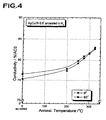
- the plate was annealed at the same temperature and rolled at the same reduction ratio as those for the first embodiment in the production steps up to the finish rolling. However, it was rolled at a different reduction ratio in the finish rolling to have a final thickness of 0.8 mm, and annealed at varying temperature levels.
- Figs. 4 and 5 show the conductivity-annealing temperature and tensile strength-annealing temperature curves, respectively, for the alloy plate prepared in this embodiment. These Figures also indicate that tensile strength decreases and conductivity increases as annealing temperature increases. The alloy which had been finish-rolled but not annealed was treated at the optimum temperature determined for the required conductivity using these Figures. It was also found to have a conductivity almost comparable with that predicted using the curve, as was the case with the first embodiment.
- the present invention can easily produce such products by annealing each type at the optimum temperature determined to give the required properties based on the pre-established characteristic curves. This allows to flexibly cope with the requirements for production of diversified products in small quantity, improving production efficiency and possibly reducing the product price.
Landscapes
- Chemical & Material Sciences (AREA)
- Engineering & Computer Science (AREA)
- Materials Engineering (AREA)
- Mechanical Engineering (AREA)
- Metallurgy (AREA)
- Organic Chemistry (AREA)
- Physics & Mathematics (AREA)
- Thermal Sciences (AREA)
- Crystallography & Structural Chemistry (AREA)
- Conductive Materials (AREA)
- Metal Rolling (AREA)
Description
The plate can be adequately annealed for 0.5 to 5 hours: it may be difficult to sufficiently change the properties in an annealing time of 0.5 hour or less, and the further effects may no longer expected when the plate is annealed for 5 hours or more. Therefore, annealing time of 0.5 to 5 hours is adequate in consideration of production efficiency.
Claims (1)
- A method of producing a high-strength, high-conductivity Cu-Ag alloy plate, comprising the steps of:(a) casting and rapidly quenching an alloy ingot composed of 4 to 32% by atom of Ag and Cu accounting for the balance,(b) cold rolling, then annealing the ingot at 300 to 500°C for 0.5 to 5 hours under a vacuum, or in an inert gas, reducing gas or mixture of inert and reducing gas atmosphere,(c) repeating the above step (b) once or more,(d) cold rolling as the finish rolling to provide a desired thickness of the plate, and(e) annealing the plate at 150 to 200°C for 0.5 to 5 hours.
Applications Claiming Priority (3)
| Application Number | Priority Date | Filing Date | Title |
|---|---|---|---|
| JP2000114756 | 2000-04-17 | ||
| JP2000114756A JP2001295010A (en) | 2000-04-17 | 2000-04-17 | Method for adjusting characteristics of high-strength and high-conductivity Cu-Ag alloy sheet and method for producing high-strength and high-conductivity Cu-Ag alloy sheet |
| PCT/JP2001/002986 WO2001079577A1 (en) | 2000-04-17 | 2001-04-06 | Method for adjusting properties of cu-ag alloy plate having high strength and high conductivity, and method for producing cu-ag alloy plate having high strength and high conductivity |
Publications (3)
| Publication Number | Publication Date |
|---|---|
| EP1201782A1 EP1201782A1 (en) | 2002-05-02 |
| EP1201782A4 EP1201782A4 (en) | 2002-09-18 |
| EP1201782B1 true EP1201782B1 (en) | 2005-11-16 |
Family
ID=18626509
Family Applications (1)
| Application Number | Title | Priority Date | Filing Date |
|---|---|---|---|
| EP01919805A Expired - Lifetime EP1201782B1 (en) | 2000-04-17 | 2001-04-06 | Method for adjusting properties of cu-ag alloy plate having high strength and high conductivity, and method for producing cu-ag alloy plate having high strength and high conductivity |
Country Status (5)
| Country | Link |
|---|---|
| US (1) | US6800151B1 (en) |
| EP (1) | EP1201782B1 (en) |
| JP (1) | JP2001295010A (en) |
| DE (1) | DE60114972D1 (en) |
| WO (1) | WO2001079577A1 (en) |
Families Citing this family (6)
| Publication number | Priority date | Publication date | Assignee | Title |
|---|---|---|---|---|
| CN101428304B (en) * | 2007-11-05 | 2012-04-18 | 江苏鸿尔有色合金实业有限公司 | Process for manufacturing silver copper plate (row, stick, tube) |
| CN100557063C (en) * | 2008-04-18 | 2009-11-04 | 浙江大学 | Solution and aging treatment method for cold drawing of Cu-Ag alloy |
| JP2011526653A (en) * | 2008-06-30 | 2011-10-13 | イートン コーポレーション | Continuous production system for magnetically treating metals and alloys to prepare next-generation materials |
| CN103572184B (en) * | 2013-10-17 | 2015-07-22 | 河南科技大学 | Preparation method of high-strength silver-copper alloy material |
| EP3091094A1 (en) | 2015-05-07 | 2016-11-09 | Akademia Gorniczo-Hutnicza im. Stanislawa Staszica w Krakowie | Flat rolled product made of a copper alloy comprising silver |
| TWI768097B (en) * | 2017-08-10 | 2022-06-21 | 日商田中貴金屬工業股份有限公司 | High-strength and high-conductivity copper alloy sheet and method for producing the same |
Family Cites Families (7)
| Publication number | Priority date | Publication date | Assignee | Title |
|---|---|---|---|---|
| US2353254A (en) * | 1941-10-28 | 1944-07-11 | Linde Air Prod Co | Bursting disk |
| US2567560A (en) * | 1948-05-06 | 1951-09-11 | Battelle Development Corp | Heat-treatment of copper-silver binary alloys |
| JPS6043904B2 (en) * | 1979-06-18 | 1985-10-01 | 三菱マテリアル株式会社 | Manufacturing method of highly conductive heat-resistant copper alloy material |
| JPS6043905B2 (en) * | 1979-09-14 | 1985-10-01 | 三菱マテリアル株式会社 | Manufacturing method of highly conductive heat-resistant copper alloy material |
| JPH04120227A (en) * | 1990-08-09 | 1992-04-21 | Natl Res Inst For Metals | High strength and high conductivity copper alloy and its manufacture |
| US5534087A (en) | 1992-09-16 | 1996-07-09 | Showa Electric Wire & Cable Co., Ltd. | Method of producing Cu - Ag alloy based conductive material |
| JP2714555B2 (en) * | 1992-09-17 | 1998-02-16 | 科学技術庁金属材料技術研究所長 | High strength and high conductivity copper alloy sheet material |
-
2000
- 2000-04-17 JP JP2000114756A patent/JP2001295010A/en active Pending
-
2001
- 2001-04-06 US US09/926,758 patent/US6800151B1/en not_active Expired - Lifetime
- 2001-04-06 DE DE60114972T patent/DE60114972D1/en not_active Expired - Lifetime
- 2001-04-06 EP EP01919805A patent/EP1201782B1/en not_active Expired - Lifetime
- 2001-04-06 WO PCT/JP2001/002986 patent/WO2001079577A1/en not_active Ceased
Also Published As
| Publication number | Publication date |
|---|---|
| US6800151B1 (en) | 2004-10-05 |
| EP1201782A4 (en) | 2002-09-18 |
| DE60114972D1 (en) | 2005-12-22 |
| JP2001295010A (en) | 2001-10-26 |
| WO2001079577A1 (en) | 2001-10-25 |
| EP1201782A1 (en) | 2002-05-02 |
Similar Documents
| Publication | Publication Date | Title |
|---|---|---|
| CN111485132B (en) | Copper alloy strip with excellent comprehensive performance and preparation method thereof | |
| US10174406B2 (en) | Copper alloy plate and method for producing same | |
| CN100510131C (en) | Copper alloy plate for electric and electronic parts having bending workability | |
| US8951371B2 (en) | Copper alloy | |
| JP4393663B2 (en) | Copper-based alloy strip for terminal and manufacturing method thereof | |
| JP3383615B2 (en) | Copper alloy for electronic materials and manufacturing method thereof | |
| CN114855026B (en) | High-performance precipitation strengthening type copper alloy and preparation method thereof | |
| CN114807672A (en) | Cu-Zn-Cr-Zr-Fe-Si alloy and preparation method thereof | |
| JP2002266042A (en) | Copper alloy sheet having excellent bending workability | |
| US5882442A (en) | Iron modified phosphor-bronze | |
| CN115386767B (en) | A kind of lead frame copper alloy strip material for VLSI chip packaging and preparation method thereof | |
| US6800151B1 (en) | Method of modifying properties of high-strength, high-conductivity Cu-Ag alloy plate, and method of producing high-strength, high conductivity Cu-Ag alloy plate | |
| US5322574A (en) | Method of manufacturing a high strength, high conductivity copper-silver alloy | |
| JPS5893860A (en) | Manufacture of high strength copper alloy with high electric conductivity | |
| JP2001262297A (en) | Copper base alloy strip for terminal and manufacturing method thereof | |
| CN117070867B (en) | Method for improving softening temperature of copper alloy and copper alloy | |
| JP2006291356A (en) | Ni-Sn-P copper alloy | |
| JP3410125B2 (en) | Manufacturing method of high strength copper base alloy | |
| JPH10324935A (en) | Copper alloy for lead frame and method of manufacturing the same | |
| JPH03223451A (en) | Production of metallic sheet for high strength lead frame | |
| JPS6142772B2 (en) | ||
| JPH0353036A (en) | Copper-iron-cobalt-titanium alloy having high mechanical and electric characteristics and preparation thereof | |
| JP2008024995A (en) | Copper alloy sheet for electrical and electronic parts with excellent heat resistance | |
| CN112639143B (en) | Titanium copper plate, press-processed product, and manufacturing method of press-processed product | |
| JPH0314901B2 (en) |
Legal Events
| Date | Code | Title | Description |
|---|---|---|---|
| PUAI | Public reference made under article 153(3) epc to a published international application that has entered the european phase |
Free format text: ORIGINAL CODE: 0009012 |
|
| 17P | Request for examination filed |
Effective date: 20011108 |
|
| AK | Designated contracting states |
Kind code of ref document: A1 Designated state(s): DE FR GB IT |
|
| RIC1 | Information provided on ipc code assigned before grant |
Free format text: 7C 22F 1/08 A, 7C 22C 9/00 B, 7H 01B 1/02 B |
|
| A4 | Supplementary search report drawn up and despatched |
Effective date: 20020801 |
|
| AK | Designated contracting states |
Kind code of ref document: A4 Designated state(s): DE FR GB IT |
|
| 17Q | First examination report despatched |
Effective date: 20030203 |
|
| GRAP | Despatch of communication of intention to grant a patent |
Free format text: ORIGINAL CODE: EPIDOSNIGR1 |
|
| GRAS | Grant fee paid |
Free format text: ORIGINAL CODE: EPIDOSNIGR3 |
|
| GRAA | (expected) grant |
Free format text: ORIGINAL CODE: 0009210 |
|
| AK | Designated contracting states |
Kind code of ref document: B1 Designated state(s): DE FR GB IT |
|
| PG25 | Lapsed in a contracting state [announced via postgrant information from national office to epo] |
Ref country code: IT Free format text: LAPSE BECAUSE OF FAILURE TO SUBMIT A TRANSLATION OF THE DESCRIPTION OR TO PAY THE FEE WITHIN THE PRESCRIBED TIME-LIMIT;WARNING: LAPSES OF ITALIAN PATENTS WITH EFFECTIVE DATE BEFORE 2007 MAY HAVE OCCURRED AT ANY TIME BEFORE 2007. THE CORRECT EFFECTIVE DATE MAY BE DIFFERENT FROM THE ONE RECORDED. Effective date: 20051116 |
|
| REG | Reference to a national code |
Ref country code: GB Ref legal event code: FG4D |
|
| REF | Corresponds to: |
Ref document number: 60114972 Country of ref document: DE Date of ref document: 20051222 Kind code of ref document: P |
|
| PG25 | Lapsed in a contracting state [announced via postgrant information from national office to epo] |
Ref country code: DE Free format text: LAPSE BECAUSE OF FAILURE TO SUBMIT A TRANSLATION OF THE DESCRIPTION OR TO PAY THE FEE WITHIN THE PRESCRIBED TIME-LIMIT Effective date: 20060217 |
|
| PG25 | Lapsed in a contracting state [announced via postgrant information from national office to epo] |
Ref country code: GB Free format text: LAPSE BECAUSE OF NON-PAYMENT OF DUE FEES Effective date: 20060406 |
|
| ET | Fr: translation filed | ||
| PLBE | No opposition filed within time limit |
Free format text: ORIGINAL CODE: 0009261 |
|
| STAA | Information on the status of an ep patent application or granted ep patent |
Free format text: STATUS: NO OPPOSITION FILED WITHIN TIME LIMIT |
|
| 26N | No opposition filed |
Effective date: 20060817 |
|
| GBPC | Gb: european patent ceased through non-payment of renewal fee |
Effective date: 20060406 |
|
| REG | Reference to a national code |
Ref country code: FR Ref legal event code: PLFP Year of fee payment: 15 |
|
| REG | Reference to a national code |
Ref country code: FR Ref legal event code: PLFP Year of fee payment: 16 |
|
| REG | Reference to a national code |
Ref country code: FR Ref legal event code: PLFP Year of fee payment: 17 |
|
| REG | Reference to a national code |
Ref country code: FR Ref legal event code: PLFP Year of fee payment: 18 |
|
| PGFP | Annual fee paid to national office [announced via postgrant information from national office to epo] |
Ref country code: FR Payment date: 20200420 Year of fee payment: 20 |