EP1201767A2 - Method of analyzing double stranded DNA - Google Patents
Method of analyzing double stranded DNA Download PDFInfo
- Publication number
- EP1201767A2 EP1201767A2 EP01124357A EP01124357A EP1201767A2 EP 1201767 A2 EP1201767 A2 EP 1201767A2 EP 01124357 A EP01124357 A EP 01124357A EP 01124357 A EP01124357 A EP 01124357A EP 1201767 A2 EP1201767 A2 EP 1201767A2
- Authority
- EP
- European Patent Office
- Prior art keywords
- double stranded
- stranded dna
- analyte
- recognizing substance
- support
- Prior art date
- Legal status (The legal status is an assumption and is not a legal conclusion. Google has not performed a legal analysis and makes no representation as to the accuracy of the status listed.)
- Granted
Links
Classifications
-
- C—CHEMISTRY; METALLURGY
- C12—BIOCHEMISTRY; BEER; SPIRITS; WINE; VINEGAR; MICROBIOLOGY; ENZYMOLOGY; MUTATION OR GENETIC ENGINEERING
- C12Q—MEASURING OR TESTING PROCESSES INVOLVING ENZYMES, NUCLEIC ACIDS OR MICROORGANISMS; COMPOSITIONS OR TEST PAPERS THEREFOR; PROCESSES OF PREPARING SUCH COMPOSITIONS; CONDITION-RESPONSIVE CONTROL IN MICROBIOLOGICAL OR ENZYMOLOGICAL PROCESSES
- C12Q1/00—Measuring or testing processes involving enzymes, nucleic acids or microorganisms; Compositions therefor; Processes of preparing such compositions
- C12Q1/68—Measuring or testing processes involving enzymes, nucleic acids or microorganisms; Compositions therefor; Processes of preparing such compositions involving nucleic acids
- C12Q1/6813—Hybridisation assays
- C12Q1/6816—Hybridisation assays characterised by the detection means
-
- C—CHEMISTRY; METALLURGY
- C12—BIOCHEMISTRY; BEER; SPIRITS; WINE; VINEGAR; MICROBIOLOGY; ENZYMOLOGY; MUTATION OR GENETIC ENGINEERING
- C12Q—MEASURING OR TESTING PROCESSES INVOLVING ENZYMES, NUCLEIC ACIDS OR MICROORGANISMS; COMPOSITIONS OR TEST PAPERS THEREFOR; PROCESSES OF PREPARING SUCH COMPOSITIONS; CONDITION-RESPONSIVE CONTROL IN MICROBIOLOGICAL OR ENZYMOLOGICAL PROCESSES
- C12Q1/00—Measuring or testing processes involving enzymes, nucleic acids or microorganisms; Compositions therefor; Processes of preparing such compositions
- C12Q1/68—Measuring or testing processes involving enzymes, nucleic acids or microorganisms; Compositions therefor; Processes of preparing such compositions involving nucleic acids
- C12Q1/6804—Nucleic acid analysis using immunogens
-
- C—CHEMISTRY; METALLURGY
- C12—BIOCHEMISTRY; BEER; SPIRITS; WINE; VINEGAR; MICROBIOLOGY; ENZYMOLOGY; MUTATION OR GENETIC ENGINEERING
- C12Q—MEASURING OR TESTING PROCESSES INVOLVING ENZYMES, NUCLEIC ACIDS OR MICROORGANISMS; COMPOSITIONS OR TEST PAPERS THEREFOR; PROCESSES OF PREPARING SUCH COMPOSITIONS; CONDITION-RESPONSIVE CONTROL IN MICROBIOLOGICAL OR ENZYMOLOGICAL PROCESSES
- C12Q1/00—Measuring or testing processes involving enzymes, nucleic acids or microorganisms; Compositions therefor; Processes of preparing such compositions
- C12Q1/68—Measuring or testing processes involving enzymes, nucleic acids or microorganisms; Compositions therefor; Processes of preparing such compositions involving nucleic acids
- C12Q1/6813—Hybridisation assays
- C12Q1/6816—Hybridisation assays characterised by the detection means
- C12Q1/6825—Nucleic acid detection involving sensors
-
- G—PHYSICS
- G01—MEASURING; TESTING
- G01N—INVESTIGATING OR ANALYSING MATERIALS BY DETERMINING THEIR CHEMICAL OR PHYSICAL PROPERTIES
- G01N33/00—Investigating or analysing materials by specific methods not covered by groups G01N1/00 - G01N31/00
- G01N33/48—Biological material, e.g. blood, urine; Haemocytometers
- G01N33/50—Chemical analysis of biological material, e.g. blood, urine; Testing involving biospecific ligand binding methods; Immunological testing
- G01N33/53—Immunoassay; Biospecific binding assay; Materials therefor
- G01N33/5308—Immunoassay; Biospecific binding assay; Materials therefor for analytes not provided for elsewhere, e.g. nucleic acids, uric acid, worms, mites
Definitions
- the present invention relates to a method of analyzing a double stranded nucleic acid (especially, double stranded DNA) present in an analyte and also relates to a method of quantifying an amount of double stranded nucleic acid present in an analyte.
- a double stranded nucleic acid especially, double stranded DNA
- a method of quantifying an amount of double stranded nucleic acid present in an analyte can be used in analysis and mapping of gene polymorphisms such as SNPs (Single Nucleotide Polymorphisms) etc.
- the present invention can also be employed to detect an exogenous gene group derived from a virus or bacteria present in an analyte.
- a method which involves immobilizing a nucleic acid probe and contacting it with a target nucleic acid to measure an amount of target nucleic acid has also been developed and is used in gene mapping, genetic diagnosis and the like.
- Southern et al have developed a DNA array where multiple nucleic acid probes are immobilized on a support in an array form, and have showed that DNA on a glass support binds to the complementary DNA.
- Affymax Inc. has succeeded in developing a high densification technique of DNA array by combining Southern's technique with a DNA solid-phase synthesis technique using a photoresist method, and has commercialized this in the form of GeneChip (S. Fodor; Science 277, 393 (1997), Nature Genetics Supplement 21, 20 (1999)).
- the subject of analysis is DNA in a genome
- the subject DNA forms a double strand.
- detection of SNP has been conducted by P. N. Gillies et al, with electric address method (Nature Biotechnology, 17, 365 (1999)) and further by R. J. Cho et al. with high-density oligo-DNA array (Nature Genetics 23, 203 (1999)).
- the determination of DNA involves a complex operation including denaturation into a single strand by heat denaturation after amplification by PCR of a target DNA portion present in a sample.
- an object of the present invention is to solve the problems in the above conventional techniques. That is, an object of the present invention is to provide a method for analyzing a double stranded DNA directly without denaturation. A further object of the present invention is to provide a simple and high-sensitive method of analyzing double stranded DNA. Further, another object of the present invention is to provide a method of analyzing double stranded DNA which enables a quick and high sensitive detection of a gene and polymorphism thereof.
- a still further object of the present invention is to provide a method for promoting reaction speed in a method for analyzing a double stranded DNA directly without denaturation.
- a still further object of the present invention is to provide a method of increasing signal/noise ratio by removing non-specifically adsorbent double stranded DNA which is transported into the vicinity of a double stranded recognizing substance.
- a still further object of the present invention is to provide a method for increasing precision of analysis of SNPs and the like by remove the double stranded DNA which binds weakly with the double stranded DNA recognizing substance from the double stranded DNA recognizing substance.
- the present inventors have found that it is possible to analyze a double stranded DNA directly without denaturation by contacting an analyte with a double stranded DNA recognizing substance immobilized on a support, and measuring an amount of double stranded DNA bound to the double stranded DNA recognizing substance. Further, the present inventors found that it is possible to detect, with high sensitivity, an amount of double stranded DNA bound to a double stranded DNA recognizing substance by using a double strand insertion agent such as a DNA intercalator.
- the present inventors have found that it is possible to analyze a double stranded DNA directly without denaturation of the double stranded DNA at an improved reaction speed, by contacting an analyte with a double stranded DNA recognizing substance immobilized on a support, promoting binding between the double stranded DNA recognizing substance immobilized on the support and the double stranded DNA in the analyte by applying an electric field between the support on which the double stranded DNA recognizing substance is immobilized and a solution containing the analyte and thereafter measuring double stranded DNA bound to the double stranded DNA recognizing substance.
- the present inventors have found that it is possible to increase signal/noise ratio by applying an electric field between a support on which the double stranded DNA recognizing substance is immobilized and the analyte to promote binding between the double stranded DNA recognizing substance immobilized on the support and the double stranded DNA present in the analyte, and thereafter applying an electric field in a direction which is opposite to the direction of the above electric field to remove non-specific adsorbed DNA and DNA that binds weakly to the double stranded DNA recognizing substance.
- the present invention was completed on the basis of these findings.
- a method of analyzing double stranded DNA present in an analyte which comprises the steps of:
- a method of analyzing double stranded DNA present in an analyte which comprises the steps of:
- a method of analyzing double stranded DNA present in an analyte which comprises the steps of:
- the double stranded DNA recognizing substance is a double stranded DNA recognizing antibody, a DNA transcription factor, a protein having Zn finger motif or Ring Finger motif, or a peptide nucleic acid.
- an insertion agent which recognizes double stranded DNA is added to a reaction system, and the double stranded DNA present in the analyte is measured by detecting the insertion agent inserted into the double stranded DNA.
- the insertion agent is a DNA intercalator.
- the DNA intercalator has an electrochemical activity, and the double stranded DNA present in the analyte is measured by detecting the DNA intercalator by electrochemical means.
- the DNA intercalator is detected by a fluorescence, luminescence or surface plasmon method.
- the method of analyzing double stranded DNA present in an analyte comprises the steps of:
- analyte used herein are not particularly limited so long as the analyte includes double stranded DNA.
- blood such as peripheral venous blood, leukocyte, serum, urine, feces, semen, saliva, cultured cells, tissue cells such as cells of various organs, or any other samples which comprise nucleic acid, can be used.
- tissue cells such as cells of various organs, or any other samples which comprise nucleic acid
- samples of tissue cells and the like described above may be used as they are, and preferably cells in an analyte sample are disrupted and an analyte in which double stranded DNA has been released is used.
- Disruption of cells in an analyte sample can be performed by usual methods, e.g.
- nucleic acid can be released from cells by using nucleic acid extraction solution (e.g. surfactants such as SDS, Triton-X or Tween-20, or solutions containing saponins, EDTA, protease and the like).
- nucleic acid extraction solution e.g. surfactants such as SDS, Triton-X or Tween-20, or solutions containing saponins, EDTA, protease and the like.
- reaction can be promoted by incubating at a temperature of 37°C or more.
- a double stranded DNA recognizing substance immobilized on a support is used.
- the support used in the present invention is not particularly limited so long as the double stranded DNA recognizing substance explained below can be immobilized thereon.
- Examples of a preferred support include non-porous supports such as glass, quartz, plastic, an electrode and the like.
- the materials for electrodes include carbon electrodes such as graphite or glassy carbon; noble metal electrodes such as platinum, gold, palladium or rhodium; oxide electrodes such as titanium oxide, tin oxide, manganese oxide or lead oxide; semiconductor electrodes such as those of Si, Ge, ZnO or CdS; and electronic conductors such as titanium.
- carbon electrodes such as graphite or glassy carbon
- noble metal electrodes such as platinum, gold, palladium or rhodium
- oxide electrodes such as titanium oxide, tin oxide, manganese oxide or lead oxide
- semiconductor electrodes such as those of Si, Ge, ZnO or CdS
- electronic conductors such as titanium.
- These electrical conductors may be coated with a conductive polymer or they may be covered with a monomolecular membrane.
- porous support such as nitrocellulose membrane, nylon membrane or PVDF membrane may be used as a support, and a composite of a non-porous support and a porous support can also be used.
- a double stranded DNA recognizing substance used in the present invention means a substance which recognizes double stranded DNA and specifically binds thereto.
- Specific examples of a double stranded DNA recognizing substance include DNA transcription factor, mismatch repair protein, double stranded DNA recognizing antibody, and peptide nucleic acid.
- DNA transcription factor is a substance which binds to a promoter region on a gene and controls transcription from DNA to mRNA (Tamura Takaaki: Transcription Factors (Yodosha 1995)). Therefore, a transcription factor is known to specifically bind to a double stranded DNA having a specific sequence.
- Zinc Finger Protein i.e. a group of transcription factors having a Zinc Finger or Ring Finger motif
- Zinc Finger Protein has an extremely high rate of appearance in eukaryotic organisms, with apparently 1% of the genome encoding this protein.
- Pabo et al. analyzed the tertiary structure of Zinc Finger motif and revealed the mechanism of binding with DNA (Science, 252, 809 (1991)).
- Choo et al have succeeded in producing, with gene recombinant techniques, a group of Zinc Finger proteins which are not present in nature, and which bind to specific sequences (Nature 372, 642 [1994], PNAS91, 11163 (1994)).
- a mismatch repair protein is an enzyme which repairs inappropriate base pairs (irregular or mismatched pairs) occurring between double strands of DNA.
- a nucleotide which does not form a pair with a base of template DNA is incorporated at a frequency of about one site in 10 8 base pairs.
- a mismatch repair enzyme binds to DNA immediately after replication within cells, and remove a portion comprising a mismatched base pair.
- peptide nucleic acid sugar and phosphate portions which is the skeleton structure of DNA are replaced with a polyamide skeleton.
- the peptide nucleic acid is known to specifically hybridize with DNA to form a double strand (P. E. Nielesen et al, Science, 254, 1497(1991); Gene and Biotechnology: N. Sugimoto, Maruzen, 1999).
- the peptide nucleic acid is functionally similar with DNA, the structure is completely different with each other.
- the peptide nucleic acid has a polyamide basic skeleton and contains no sugar or phosphate within its molecule.
- the peptide nucleic acid is able to insert itself within DNA-DNA strands to form a triple strand. In the present invention, by exploiting this property, the peptide nucleic acid can be used as a double stranded DNA recognizing substance.
- the above-mentioned double stranded DNA recognizing substance can be directly immobilized on a support. Concretely, a solution containing a double stranded DNA recognizing substance is spotted on a support, and allowed to stand for a certain period, thereby enabling double stranded DNA recognizing substance to be immobilized on a support.
- the method of analyzing a double stranded DNA present in an analyte comprises the steps of:
- the method of applying an electric field is not particularly limited, but it is necessary to apply an electric field in such a direction that double stranded DNA present in an analyte is directed toward the double stranded DNA recognizing substance immobilized on the support.
- an electric field By applying such an electric field, binding between double stranded DNA recognizing substance immobilized on a support and double stranded DNA in an analyte is promoted.
- Double stranded DNA typically has a negative charge, and so it is possible to promote binding between double stranded DNA recognizing substance immobilized on a support and double stranded DNA in an analyte by placing an anode on the side of the support on which double stranded DNA recognizing substance is immobilized, or making the support itself the anode, and placing a cathode within the analyte containing double stranded DNA (preferably the analyte being a solution), and applying an electric field between the anode and the cathode.
- the potential difference of an electric field for directing double stranded DNA in an analyte to the double stranded DNA recognizing substance immobilized on a support is within a range of 0 to +2V (that is, the potential of support side is 0 to +2V higher than that of the analyte fluid).
- One preferred embodiment of the present invention includes a process of preparing an electrode on which a substance which binds to double stranded DNA is immobilized, contacting an analyte fluid with the electrode, and thereafter applying an electric field (difference in potential) between the electrode and the analyte fluid.
- the method of analyzing double stranded DNA present in an analyte according to the present invention comprises the steps of:
- step (2) can be conducted in a manner similar to the above.
- Step (3) is a step of applying an electric field in a direction which is opposite to the direction of the electric field in step (2).
- a cathode on the side of the support on which double stranded DNA recognizing substance is immobilized, or making the support itself the cathode, and placing a anode in the analyte which contains double stranded DNA (preferably the analyte being a solution), and applying an electric field between the anode and the cathode, double stranded DNA in the vicinity of the double stranded DNA recognizing substance immobilized on the support can be removed from the support.
- non-specifically adsorbed DNA, and DNA which binds weakly to the double stranded DNA recognizing substance can be removed from the support, thereby allowing signal/noise ratio to be improved.
- the difference in potential of the oppositely directed potential is within a range of 0 to -2V (i.e. the potential of the support side is 0 to +2V lower than that of the analyte fluid).
- One preferred embodiment of the present invention includes a process of preparing an electrode on which a substance which binds to double stranded DNA is immobilized, contacting an analyte fluid with the electrode, thereafter applying potential between the electrode and the analyte fluid, and further thereafter applying potential in a direction which is opposite to the direction of the above-mentioned potential to remove unnecessary DNA molecules.
- Target DNA in an analyte is preferably detected directly without amplification by PCR and the like. Detection may be performed after amplification.
- the target DNA or amplified product thereof can be easily detected by labeling in advance.
- methods using enzymes Reverse Transcriptase, DNA polymerase, RNA Polymerase, Terminal deoxytransferase-and the like
- a labeling substance may be directly bound by chemical reaction.
- known techniques are described in texts (S. Nomura, Protocols for Experiments without Isotopes 1. Shujunsha 1994, Protocols for Experiments without Isotopes 2, Shujunsha 1998; M. Muramatu, DNA micro-array and Most Recent PCR Labeling Substances Shujunsha 2000). It is preferred that the labeling substance is a substance which can produce a detectable signal.
- the labeling substance is a substance capable of amplifying a signal such as an enzyme or catalyst, sensitivity of DNA detection is greatly improved.
- the labeling substance may also be one of a specifically binding pair such as biotin-avidin, antigen-antibody or hapten-antibody, and the labeling substance may be bound to a target DNA via its binding partner.
- an example of a more preferred detection method is that where DNA in an analyte is measured without labeling.
- a DNA insertion agent which recognizes a double stranded DNA so-called a DNA intercalator
- a DNA intercalator By use of a DNA intercalator, not only the detection procedure is simplified, but also the detection sensitivity is increased. For example, when a DNA of 1000bp is detected, with the so-called labeling method, at most only several labeling substances can be introduced, whereas if an intercalator is used, it is possible to introduce more than 100 labeling substances.
- Double stranded DNA insertion agent may be added after reaction between double stranded DNA which is the analyte and double stranded DNA recognizing substance on the support, or it may be added at the time of reaction.
- a DNA intercalator may itself be a substance capable of forming a detectable signal.
- a signal forming substance may be bound to a side chain thereof, or bound to an intercalator by means of a specifically binding pair such as biotin-avidin, antigen-antibody or hapten-antibody.
- detectable signals are preferably signals that can be detected by for example, fluorescence detection , luminescence detection, chemiluminescence detection, bio-luminescence detection, electrochemical luminescence detection, radioactivity detection, electrochemical detection, or colorimetric detection, but are not limited thereto.
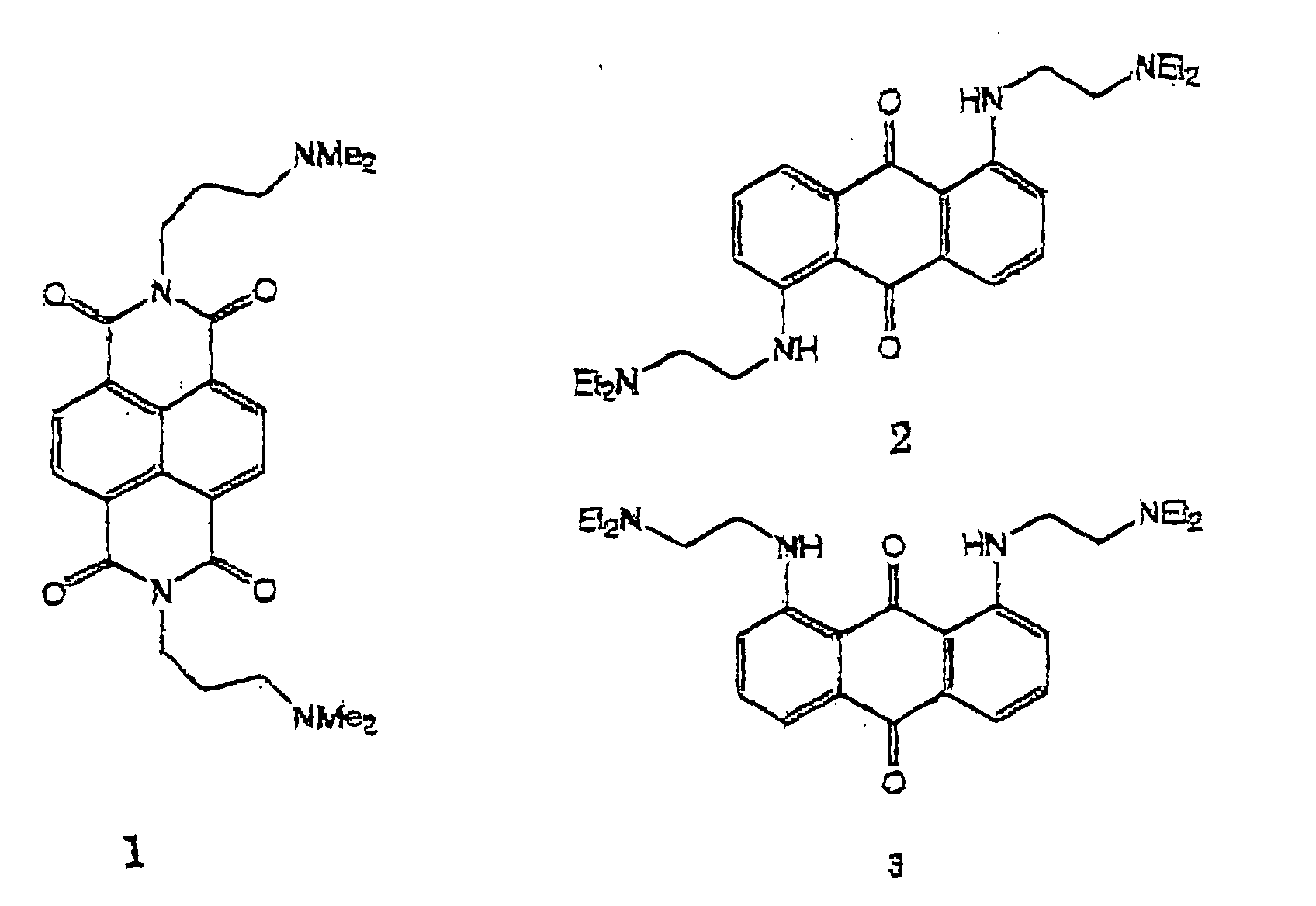
- Preferred examples of the DNA intercalator include an intercalator which itself has signal forming ability such as a fluorescent pigment, and a complex of an intercalator and a signal forming substance.
- Examples of a complex of an intercalator and a signal forming substance include those represented by the following formulae (1) and (2): Formula (1) X - L1 - I - L2 - Y Formula (2) X - L1 - I (In the formulae (1) and (2), I indicates a substance to be inserted into double stranded DNA, L1 and L2 represent linker sequences, and X and Y represent detectable molecules.)
- the substance to be inserted into double stranded DNA represented by I preferably has a plate-form insertion group such as a phenyl group in its molecule, and refers to a substance which can bind to double stranded DNA by inserting the insertion group between one base pair and another base pair in double stranded DNA.
- the linker sequences represented by L1 and L2 are not particularly limited, and examples thereof include an alkylene group, -O- group, -CO- group, -NH- group, and a group consisting of a combination thereof.
- detectable molecule represented by X and Y include fluorescent pigments such as Fluorescein, Rhodamin, Cy5, Cy3, Texas Red, and ruthenium complex; substances which form specifically binding pairs such as biotin-avidin, antigen-antibody and hapten-antibody; electrochemically detectable substances such as ferrocene derivatives; luminescent substances such as lucigenin derivatives and luminol derivatives; and enzymes such as those used in EIA (enzyme immunoassay).
- fluorescent pigments such as Fluorescein, Rhodamin, Cy5, Cy3, Texas Red, and ruthenium complex
- substances which form specifically binding pairs such as biotin-avidin, antigen-antibody and hapten-antibody
- electrochemically detectable substances such as ferrocene derivatives
- luminescent substances such as lucigenin derivatives and luminol derivatives
- enzymes such as those used in EIA (enzyme immunoassay).
- X and Y are substances which form a specifically binding pair
- fluorescent pigments such as Fluorescein, Rhodamin, Cy5, Cy3, Texas Red and ruthenium complex
- electrochemically detectable substances such as ferrocene derivatives, luminescent substances such as lucigenin derivatives and luminol derivatives, or enzymes such as those used in EIA (enzyme immunoassay)
- EIA enzyme immunoassay
- the electrochemically or photochemically active insertion agent used in the present invention is not particularly limited. Examples thereof include ethidium, ethidium bromide, acridine, aminoacridine, acridine orange, bisbentimide, diamino phenyl indole, proflavin, ellipticine, actinomycin D, thiazol, chromomycin, donomycin, mytomycin C, and derivatives thereof. Further, other examples of insertion agents that can be used include those described in Japanese Laid-Open Patent Publication No. 62-282599.
- One preferred embodiment of the present invention includes a process of preparing a slide (support) on which a substance which bonds to double stranded DNA is immobilized, and reacting the slide (support) with an analyte.
- the translated region (ORF) of Human alpha 2-HS-glycoprotein (HSGP) was cloned between the NotI and XhoI sites of multicloning sites of pBluescript II SK-.
- HSGP cDNA was amplified by a PCR method using this vector as a template.
- Sample A cDNA amplified by PCR was dissolved in TE to prepare a 0.1 ⁇ M solution which was denoted as Sample A.
- Sample A was boiled at 95°C for 3 minutes, and then quenched in an ice bath to prepare single stranded Sample B.
- the translated region (ORF) of Human alpha 2-HS-glycoprotein (HSGP) was cloned between the NotI and XhoI sites of multicloning sites of pBluescript II SK-.
- HSGP cDNA was amplified by a PCR method using this vector as a template.
- cDNA amplified by PCR was dissolved in TE to prepare a 0.1 ⁇ M solution. This solution was then used as a sample.
- this gold electrode was immersed in SybrGreen solution (Molecular Probe, 1000-times diluted TE solution) for 20 minutes and then washed with TE. The washed gold electrode was air-dried, and fluorescence intensity was measured by excitation at 633nm using FLA 2000 (Fuji Photo Film Co.).
- Fluorescence intensity was measured in a similar manner as in Example 2 except that a voltage of 1.5V is not applied to the surface of the gold electrode in (3) of Example 2. Results of Example 2 and Example 3 are shown below. Fluorescence intensity Example 2 16500 LAU Example 3 7500 LAU Background 3500 LAU (LAU is an unit which is proportional to fluorescence intensity)
- Example 2 shows that double stranded DNA can be detected by the method of the present invention.
- Example 2 shows that double stranded DNA can be detected in a promoted reaction by applying an electric field to direct double stranded DNA present in the analyte toward the double stranded DNA recognizing substance immobilized on the support.
- Example 4 DPV measurement was performed in the same way as in Example 4 except that a voltage of 1.5V was not applied to the surface of the gold electrode, and a value for peak current at applied voltage 260mV was determined.
- the results of Example 4 and Example 5 are shown below.
- Example 5 -2.1 ⁇ A Background -0.4 ⁇ A (“background” indicates peak current at the time of DPV measurement at the gold electrode prior to reacting with a sample)
- Example 4 shows that double stranded DNA can be detected by the method of the present invention.
- Example 4 shows that double stranded DNA can be detected in a promoted reaction by applying an electric field to direct double stranded DNA present in the analyte toward the double stranded DNA recognizing substance immobilized on the support.
- the present invention enables the analysis of double stranded DNA directly without denaturation. Further, the present invention enables the analysis of double stranded DNA directly without denaturation at a promoted reaction speed.
- the method of the present invention enables simple, rapid and highly sensitive analysis of double stranded DNA.
Landscapes
- Chemical & Material Sciences (AREA)
- Life Sciences & Earth Sciences (AREA)
- Health & Medical Sciences (AREA)
- Organic Chemistry (AREA)
- Engineering & Computer Science (AREA)
- Immunology (AREA)
- Zoology (AREA)
- Proteomics, Peptides & Aminoacids (AREA)
- Molecular Biology (AREA)
- Wood Science & Technology (AREA)
- Analytical Chemistry (AREA)
- General Health & Medical Sciences (AREA)
- Biotechnology (AREA)
- Microbiology (AREA)
- Physics & Mathematics (AREA)
- Biochemistry (AREA)
- Genetics & Genomics (AREA)
- Bioinformatics & Cheminformatics (AREA)
- Biophysics (AREA)
- General Engineering & Computer Science (AREA)
- Urology & Nephrology (AREA)
- Biomedical Technology (AREA)
- Pathology (AREA)
- Hematology (AREA)
- Tropical Medicine & Parasitology (AREA)
- Food Science & Technology (AREA)
- Medicinal Chemistry (AREA)
- General Physics & Mathematics (AREA)
- Cell Biology (AREA)
- Measuring Or Testing Involving Enzymes Or Micro-Organisms (AREA)
- Investigating Or Analysing Biological Materials (AREA)
Abstract
Description


| Fluorescence intensity | ||
| Sample A | 14300 | LAU |
| Sample B | 6400 | LAU |
| Background | 3500 | LAU |
| Fluorescence intensity | |
| Example 2 | 16500 LAU |
| Example 3 | 7500 LAU |
| Background | 3500 LAU |

| Peak current | |
| Example 4 | -6.8 µA |
| Example 5 | -2.1 µA |
| Background | -0.4 µA |
Claims (11)
- A method of analyzing double stranded DNA present in an analyte, which comprises the steps of:(1) contacting the analyte with a double stranded DNA recognizing substance immobilized on a support, and(2) measuring double stranded DNA bound to the double stranded DNA recognizing substance.
- A method of analyzing double stranded DNA present in an analyte, which comprises the steps of:(1) contacting the analyte with a double stranded DNA recognizing substance immobilized on a support,(2) applying an electric field between the support on which the double stranded DNA recognizing substance is immobilized and the analyte, to direct double stranded DNA present in an analyte toward the double stranded DNA recognizing substance immobilized on the support, and(3) measuring double stranded DNA bound to the double stranded DNA recognizing substance.
- A method of analyzing double stranded DNA present in an analyte, which comprises the steps of:(1) contacting the analyte with a double stranded DNA recognizing substance immobilized on a support,(2) applying an electric field between the support on which the double stranded DNA recognizing substance is immobilized and the analyte, to direct double stranded DNA present in an analyte toward the double stranded DNA recognizing substance immobilized on the support,(3) applying an electric field in a direction which is opposite to the direction of the electric field applied in step (2), and(4) measuring double stranded DNA bound to the double stranded DNA recognizing substance.
- The method of analysis according to claim 1 wherein the double stranded DNA recognizing substance is a double stranded DNA recognizing antibody.
- The method of analysis according to claim 1 wherein the double stranded DNA recognizing substance is a DNA transcription factor.
- The method of analysis according to claim 1 wherein the double stranded DNA recognizing substance is a protein having Zn finger motif or Ring finger motif.
- The method of analysis according to claim 1 wherein the double stranded DNA recognizing substance is a peptide nucleic acid.
- The method of analysis according to claim 1 wherein, in the step of measuring the double stranded DNA bound to the double stranded DNA recognizing substance, an insertion agent which recognizes double stranded DNA is added to a reaction system, and the double stranded DNA present in the analyte is measured by detecting the insertion agent inserted into the double stranded DNA.
- The method of analysis according to claim 8 wherein the insertion agent is a DNA intercalator.
- The method of analysis according to claim 9 wherein the DNA intercalator has an electrochemical activity, and the double stranded DNA present in the analyte is measured by detecting the DNA intercalator by electrochemical means.
- The method of analysis according to claim 9 wherein the DNA intercalator is detected by a fluorescence, luminescence or surface plasmon method.
Applications Claiming Priority (4)
| Application Number | Priority Date | Filing Date | Title |
|---|---|---|---|
| JP2000325136A JP2002125700A (en) | 2000-10-25 | 2000-10-25 | Method for analyzing double-stranded dna |
| JP2000325136 | 2000-10-25 | ||
| JP2000332249A JP4040834B2 (en) | 2000-10-31 | 2000-10-31 | Method for analyzing double-stranded DNA |
| JP2000332249 | 2000-10-31 |
Publications (3)
| Publication Number | Publication Date |
|---|---|
| EP1201767A2 true EP1201767A2 (en) | 2002-05-02 |
| EP1201767A3 EP1201767A3 (en) | 2003-12-17 |
| EP1201767B1 EP1201767B1 (en) | 2010-07-21 |
Family
ID=26602719
Family Applications (1)
| Application Number | Title | Priority Date | Filing Date |
|---|---|---|---|
| EP01124357A Expired - Lifetime EP1201767B1 (en) | 2000-10-25 | 2001-10-23 | Method of analyzing double stranded DNA |
Country Status (4)
| Country | Link |
|---|---|
| US (1) | US6924105B2 (en) |
| EP (1) | EP1201767B1 (en) |
| AT (1) | ATE474932T1 (en) |
| DE (1) | DE60142609D1 (en) |
Families Citing this family (1)
| Publication number | Priority date | Publication date | Assignee | Title |
|---|---|---|---|---|
| US7871571B2 (en) * | 2007-10-25 | 2011-01-18 | Parker John A | Biomolecule analyzing system |
Family Cites Families (7)
| Publication number | Priority date | Publication date | Assignee | Title |
|---|---|---|---|---|
| US4623627A (en) * | 1983-08-19 | 1986-11-18 | Cetus Corporation | Monoclonal antibody having specificity for the double-stranded conformation of native DNA and diagnostic methods using same |
| GB8517071D0 (en) * | 1985-07-05 | 1985-08-14 | Hoffmann La Roche | Gram-positive expression control sequence |
| DE69125441T2 (en) * | 1990-09-28 | 1997-11-06 | Toshiba Kawasaki Kk | Gene detection method |
| CA2170264A1 (en) * | 1993-09-10 | 1995-03-16 | Michael W. Konrad | Optical detection of position of oligonucleotides on large dna molecules |
| US5912129A (en) * | 1998-03-05 | 1999-06-15 | Vinayagamoorthy; Thuraiayah | Multi-zone polymerase/ligase chain reaction |
| GB9815933D0 (en) * | 1998-07-23 | 1998-09-23 | Secr Defence | Detection method |
| US6811867B1 (en) * | 2000-02-10 | 2004-11-02 | 3M Innovative Properties Company | Color stable pigmented polymeric films |
-
2001
- 2001-10-23 AT AT01124357T patent/ATE474932T1/en not_active IP Right Cessation
- 2001-10-23 EP EP01124357A patent/EP1201767B1/en not_active Expired - Lifetime
- 2001-10-23 DE DE60142609T patent/DE60142609D1/en not_active Expired - Lifetime
- 2001-10-24 US US10/039,642 patent/US6924105B2/en not_active Expired - Fee Related
Also Published As
| Publication number | Publication date |
|---|---|
| ATE474932T1 (en) | 2010-08-15 |
| EP1201767B1 (en) | 2010-07-21 |
| US6924105B2 (en) | 2005-08-02 |
| US20020177146A1 (en) | 2002-11-28 |
| DE60142609D1 (en) | 2010-09-02 |
| EP1201767A3 (en) | 2003-12-17 |
Similar Documents
| Publication | Publication Date | Title |
|---|---|---|
| EP0478319B1 (en) | Gene detection method | |
| JP2573443B2 (en) | Gene detection method | |
| US5776672A (en) | Gene detection method | |
| US6682648B1 (en) | Electrochemical reporter system for detecting analytical immunoassay and molecular biology procedures | |
| JP4963000B2 (en) | Rapid and sensitive molecular detection and quantification method using power-generating enzyme by charge measurement, and detection unit and apparatus for use in the method | |
| EP2510342A2 (en) | Detecting analytes | |
| CN103642924B (en) | Differentiate method and the test kit of food pathogenic hypotype fast in conjunction with test strip platform based on asymmetric pcr | |
| WO2018068134A1 (en) | Ultra-sensitive bioanalyte quantification from self-assembled quadruplex tags | |
| CN104145026A (en) | Detecting analytes | |
| EP2477031A2 (en) | Method for detecting and quantifying a target substance using a biochip | |
| CA2300268A1 (en) | Electrochemical reporter system for detecting analytical immunoassay and molecular biology procedures | |
| US6905829B2 (en) | Method for detecting hybridized nucleic acid with improved sensitivity | |
| KR20020065241A (en) | Mixed intercalators, electrochemical detection method of dna using same and detection kit therefor | |
| KR100800436B1 (en) | Bio sensor | |
| US6924105B2 (en) | Method of analyzing double stranded DNA | |
| US7655404B2 (en) | Method and device for detection of nucleic acids and/or polypeptides | |
| JP4040834B2 (en) | Method for analyzing double-stranded DNA | |
| US7132266B2 (en) | Method and kit for analyzing target nucleic acid fragment | |
| JP4969236B2 (en) | Method for measuring biomolecules or related substances | |
| EP1953241A1 (en) | Method of analyzing change in primary structure of nucleic acid | |
| JP2002125700A (en) | Method for analyzing double-stranded dna | |
| Kouřilová et al. | DNA hybridization on membrane‐modified carbon electrodes | |
| US20200354776A1 (en) | Method and device for analysing nucleic acids | |
| Vasilescu et al. | Recent Progress in the Electrochemical Detection of Disease‐Related Diagnostic Biomarkers | |
| JPH06245800A (en) | Gene detection method |
Legal Events
| Date | Code | Title | Description |
|---|---|---|---|
| PUAI | Public reference made under article 153(3) epc to a published international application that has entered the european phase |
Free format text: ORIGINAL CODE: 0009012 |
|
| AK | Designated contracting states |
Kind code of ref document: A2 Designated state(s): AT BE CH CY DE DK ES FI FR GB GR IE IT LI LU MC NL PT SE TR |
|
| AX | Request for extension of the european patent |
Free format text: AL;LT;LV;MK;RO;SI |
|
| PUAL | Search report despatched |
Free format text: ORIGINAL CODE: 0009013 |
|
| AK | Designated contracting states |
Kind code of ref document: A3 Designated state(s): AT BE CH CY DE DK ES FI FR GB GR IE IT LI LU MC NL PT SE TR |
|
| AX | Request for extension of the european patent |
Extension state: AL LT LV MK RO SI |
|
| 17P | Request for examination filed |
Effective date: 20040205 |
|
| 17Q | First examination report despatched |
Effective date: 20040706 |
|
| AKX | Designation fees paid |
Designated state(s): AT BE CH CY DE DK ES FI FR GB GR IE IT LI LU MC NL PT SE TR |
|
| 17Q | First examination report despatched |
Effective date: 20040706 |
|
| RAP1 | Party data changed (applicant data changed or rights of an application transferred) |
Owner name: FUJIFILM CORPORATION |
|
| GRAP | Despatch of communication of intention to grant a patent |
Free format text: ORIGINAL CODE: EPIDOSNIGR1 |
|
| GRAS | Grant fee paid |
Free format text: ORIGINAL CODE: EPIDOSNIGR3 |
|
| GRAA | (expected) grant |
Free format text: ORIGINAL CODE: 0009210 |
|
| AK | Designated contracting states |
Kind code of ref document: B1 Designated state(s): AT BE CH CY DE DK ES FI FR GB GR IE IT LI LU MC NL PT SE TR |
|
| REG | Reference to a national code |
Ref country code: GB Ref legal event code: FG4D |
|
| REG | Reference to a national code |
Ref country code: CH Ref legal event code: EP |
|
| REG | Reference to a national code |
Ref country code: IE Ref legal event code: FG4D |
|
| REF | Corresponds to: |
Ref document number: 60142609 Country of ref document: DE Date of ref document: 20100902 Kind code of ref document: P |
|
| REG | Reference to a national code |
Ref country code: NL Ref legal event code: VDEP Effective date: 20100721 |
|
| PG25 | Lapsed in a contracting state [announced via postgrant information from national office to epo] |
Ref country code: NL Free format text: LAPSE BECAUSE OF FAILURE TO SUBMIT A TRANSLATION OF THE DESCRIPTION OR TO PAY THE FEE WITHIN THE PRESCRIBED TIME-LIMIT Effective date: 20100721 Ref country code: FI Free format text: LAPSE BECAUSE OF FAILURE TO SUBMIT A TRANSLATION OF THE DESCRIPTION OR TO PAY THE FEE WITHIN THE PRESCRIBED TIME-LIMIT Effective date: 20100721 Ref country code: AT Free format text: LAPSE BECAUSE OF FAILURE TO SUBMIT A TRANSLATION OF THE DESCRIPTION OR TO PAY THE FEE WITHIN THE PRESCRIBED TIME-LIMIT Effective date: 20100721 |
|
| PG25 | Lapsed in a contracting state [announced via postgrant information from national office to epo] |
Ref country code: PT Free format text: LAPSE BECAUSE OF FAILURE TO SUBMIT A TRANSLATION OF THE DESCRIPTION OR TO PAY THE FEE WITHIN THE PRESCRIBED TIME-LIMIT Effective date: 20101122 Ref country code: CY Free format text: LAPSE BECAUSE OF FAILURE TO SUBMIT A TRANSLATION OF THE DESCRIPTION OR TO PAY THE FEE WITHIN THE PRESCRIBED TIME-LIMIT Effective date: 20100721 |
|
| PG25 | Lapsed in a contracting state [announced via postgrant information from national office to epo] |
Ref country code: BE Free format text: LAPSE BECAUSE OF FAILURE TO SUBMIT A TRANSLATION OF THE DESCRIPTION OR TO PAY THE FEE WITHIN THE PRESCRIBED TIME-LIMIT Effective date: 20100721 Ref country code: GR Free format text: LAPSE BECAUSE OF FAILURE TO SUBMIT A TRANSLATION OF THE DESCRIPTION OR TO PAY THE FEE WITHIN THE PRESCRIBED TIME-LIMIT Effective date: 20101022 Ref country code: SE Free format text: LAPSE BECAUSE OF FAILURE TO SUBMIT A TRANSLATION OF THE DESCRIPTION OR TO PAY THE FEE WITHIN THE PRESCRIBED TIME-LIMIT Effective date: 20100721 |
|
| PG25 | Lapsed in a contracting state [announced via postgrant information from national office to epo] |
Ref country code: DK Free format text: LAPSE BECAUSE OF FAILURE TO SUBMIT A TRANSLATION OF THE DESCRIPTION OR TO PAY THE FEE WITHIN THE PRESCRIBED TIME-LIMIT Effective date: 20100721 |
|
| PLBE | No opposition filed within time limit |
Free format text: ORIGINAL CODE: 0009261 |
|
| STAA | Information on the status of an ep patent application or granted ep patent |
Free format text: STATUS: NO OPPOSITION FILED WITHIN TIME LIMIT |
|
| PG25 | Lapsed in a contracting state [announced via postgrant information from national office to epo] |
Ref country code: MC Free format text: LAPSE BECAUSE OF NON-PAYMENT OF DUE FEES Effective date: 20101031 Ref country code: IT Free format text: LAPSE BECAUSE OF FAILURE TO SUBMIT A TRANSLATION OF THE DESCRIPTION OR TO PAY THE FEE WITHIN THE PRESCRIBED TIME-LIMIT Effective date: 20100721 |
|
| REG | Reference to a national code |
Ref country code: CH Ref legal event code: PL |
|
| 26N | No opposition filed |
Effective date: 20110426 |
|
| PG25 | Lapsed in a contracting state [announced via postgrant information from national office to epo] |
Ref country code: ES Free format text: LAPSE BECAUSE OF FAILURE TO SUBMIT A TRANSLATION OF THE DESCRIPTION OR TO PAY THE FEE WITHIN THE PRESCRIBED TIME-LIMIT Effective date: 20101101 |
|
| PG25 | Lapsed in a contracting state [announced via postgrant information from national office to epo] |
Ref country code: LI Free format text: LAPSE BECAUSE OF NON-PAYMENT OF DUE FEES Effective date: 20101031 Ref country code: CH Free format text: LAPSE BECAUSE OF NON-PAYMENT OF DUE FEES Effective date: 20101031 |
|
| REG | Reference to a national code |
Ref country code: DE Ref legal event code: R097 Ref document number: 60142609 Country of ref document: DE Effective date: 20110426 |
|
| PG25 | Lapsed in a contracting state [announced via postgrant information from national office to epo] |
Ref country code: IE Free format text: LAPSE BECAUSE OF NON-PAYMENT OF DUE FEES Effective date: 20101023 |
|
| PG25 | Lapsed in a contracting state [announced via postgrant information from national office to epo] |
Ref country code: LU Free format text: LAPSE BECAUSE OF NON-PAYMENT OF DUE FEES Effective date: 20101023 |
|
| PG25 | Lapsed in a contracting state [announced via postgrant information from national office to epo] |
Ref country code: TR Free format text: LAPSE BECAUSE OF FAILURE TO SUBMIT A TRANSLATION OF THE DESCRIPTION OR TO PAY THE FEE WITHIN THE PRESCRIBED TIME-LIMIT Effective date: 20100721 |
|
| PGFP | Annual fee paid to national office [announced via postgrant information from national office to epo] |
Ref country code: DE Payment date: 20121017 Year of fee payment: 12 Ref country code: FR Payment date: 20121018 Year of fee payment: 12 |
|
| PGFP | Annual fee paid to national office [announced via postgrant information from national office to epo] |
Ref country code: GB Payment date: 20121017 Year of fee payment: 12 |
|
| GBPC | Gb: european patent ceased through non-payment of renewal fee |
Effective date: 20131023 |
|
| PG25 | Lapsed in a contracting state [announced via postgrant information from national office to epo] |
Ref country code: GB Free format text: LAPSE BECAUSE OF NON-PAYMENT OF DUE FEES Effective date: 20131023 |
|
| REG | Reference to a national code |
Ref country code: FR Ref legal event code: ST Effective date: 20140630 |
|
| REG | Reference to a national code |
Ref country code: DE Ref legal event code: R119 Ref document number: 60142609 Country of ref document: DE Effective date: 20140501 |
|
| PG25 | Lapsed in a contracting state [announced via postgrant information from national office to epo] |
Ref country code: FR Free format text: LAPSE BECAUSE OF NON-PAYMENT OF DUE FEES Effective date: 20131031 Ref country code: DE Free format text: LAPSE BECAUSE OF NON-PAYMENT OF DUE FEES Effective date: 20140501 |