EP1201668A1 - Staurosporin derivatives - Google Patents

Staurosporin derivatives Download PDF

Info

Publication number
EP1201668A1
EP1201668A1 EP00946296A EP00946296A EP1201668A1 EP 1201668 A1 EP1201668 A1 EP 1201668A1 EP 00946296 A EP00946296 A EP 00946296A EP 00946296 A EP00946296 A EP 00946296A EP 1201668 A1 EP1201668 A1 EP 1201668A1
Authority
EP
European Patent Office
Prior art keywords
substituted
compound
mmol
brs
unsubstituted
Prior art date
Legal status (The legal status is an assumption and is not a legal conclusion. Google has not performed a legal analysis and makes no representation as to the accuracy of the status listed.)
Withdrawn
Application number
EP00946296A
Other languages
German (de)
French (fr)
Other versions
EP1201668A4 (en
Inventor
Fumihiko Kyowa Hakko Kogyo Co. Ltd. KANAI
Nobuyoshi Kyowa Hakko Kogyo Co. Ltd. AMISHIRO
Yushi Kyowa Hakko Kogyo Co. Ltd. KITAMURA
Chikara Kyowa Hakko Kogyo Co. Ltd. MURAKATA
Tadakazu Kyowa Hakko Kogyo Co. Ltd. AKIYAMA
Shiro Kyowa Hakko Kogyo Co. Ltd. AKINAGA
Eiichi Fuse
Takashi Kyowa Hakko Kogyo Co. Ltd. KUWABARA
Kenichi Kyowa Hakko Kogyo Co. Ltd. YASOSHIMA
Current Assignee (The listed assignees may be inaccurate. Google has not performed a legal analysis and makes no representation or warranty as to the accuracy of the list.)
KH Neochem Co Ltd
Original Assignee
Kyowa Hakko Kogyo Co Ltd
Priority date (The priority date is an assumption and is not a legal conclusion. Google has not performed a legal analysis and makes no representation as to the accuracy of the date listed.)
Filing date
Publication date
Application filed by Kyowa Hakko Kogyo Co Ltd filed Critical Kyowa Hakko Kogyo Co Ltd
Publication of EP1201668A1 publication Critical patent/EP1201668A1/en
Publication of EP1201668A4 publication Critical patent/EP1201668A4/en
Withdrawn legal-status Critical Current

Links

Classifications

    • CCHEMISTRY; METALLURGY
    • C07ORGANIC CHEMISTRY
    • C07DHETEROCYCLIC COMPOUNDS
    • C07D498/00Heterocyclic compounds containing in the condensed system at least one hetero ring having nitrogen and oxygen atoms as the only ring hetero atoms
    • C07D498/22Heterocyclic compounds containing in the condensed system at least one hetero ring having nitrogen and oxygen atoms as the only ring hetero atoms in which the condensed system contains four or more hetero rings
    • AHUMAN NECESSITIES
    • A61MEDICAL OR VETERINARY SCIENCE; HYGIENE
    • A61KPREPARATIONS FOR MEDICAL, DENTAL OR TOILETRY PURPOSES
    • A61K31/00Medicinal preparations containing organic active ingredients
    • A61K31/33Heterocyclic compounds
    • A61K31/395Heterocyclic compounds having nitrogen as a ring hetero atom, e.g. guanethidine or rifamycins
    • A61K31/55Heterocyclic compounds having nitrogen as a ring hetero atom, e.g. guanethidine or rifamycins having seven-membered rings, e.g. azelastine, pentylenetetrazole
    • A61K31/553Heterocyclic compounds having nitrogen as a ring hetero atom, e.g. guanethidine or rifamycins having seven-membered rings, e.g. azelastine, pentylenetetrazole having at least one nitrogen and one oxygen as ring hetero atoms, e.g. loxapine, staurosporine
    • AHUMAN NECESSITIES
    • A61MEDICAL OR VETERINARY SCIENCE; HYGIENE
    • A61PSPECIFIC THERAPEUTIC ACTIVITY OF CHEMICAL COMPOUNDS OR MEDICINAL PREPARATIONS
    • A61P35/00Antineoplastic agents
    • AHUMAN NECESSITIES
    • A61MEDICAL OR VETERINARY SCIENCE; HYGIENE
    • A61PSPECIFIC THERAPEUTIC ACTIVITY OF CHEMICAL COMPOUNDS OR MEDICINAL PREPARATIONS
    • A61P43/00Drugs for specific purposes, not provided for in groups A61P1/00-A61P41/00

Definitions

  • the present invention relates to staurosporin derivatives or pharmaceutically acceptable salts thereof, which are useful for the treatment of tumors. Further, the present invention relates to enhancers for activity of an antitumor agent.
  • Japanese Published Unexamined Application No.3-72485, Japanese Published Unexamined Application No.3-220194 and Japanese Published Unexamined Application No.4-364186 disclose only compounds wherein in the general formula (I) described below, R 1 is hydrogen, and R 2 and R 3 are hydrogen, nitro, amino, formyl, carboxy, lower alkoxycarbonyl, hydroxymethyl or hydroxy, and these compounds are used for inhibition of platelet aggregation, and their effect on the treatment of malignant tumors is not shown.
  • WO94/6799 disclose only compounds wherein in the general formula (I) described below, R 1 is hydrogen, and R 2 and R 3 are hydrogen, halogen, formyl, lower alkanoyl or lower alkoxy, and these compounds are used for the treatment of thrombocytopenia, and their effect on the treatment of malignant tumors is not shown. Further, the compounds described in WO97/5141 are characterized in that in the general formula (I) described below, compounds are the derivatives which have a ketone or an oxime at the 11-position, and there are neither specific compounds nor synthetic intermediates thereof wherein in the general formula (I) described below, at least one of R 2 and R 3 is not hydrogen.
  • h ⁇ 1 AGP human ⁇ 1 acidic glycoprotein
  • the pharmacokinetics etc. of such compounds can be influenced by the strong affinity for h ⁇ 1 AGP and the expected efficacy of the compounds upon administration into humans can also be influenced.
  • staurosporin derivatives with low affinity for h ⁇ 1 AGP are desired.
  • UCN-01 shows a synergistic effect when combined with known anticancer agents having actions on DNA or antimetabolites, such as Cisplatin, Mitomycin C or 5-Fluorouracil, in vitro and in vivo [Proc. Am. Assoc. Cancer Res., 33 , 514 (Publication No. 3072) (1992) and Cancer Chemotherapy Pharmacology, 32 , 183 (1993)].
  • the mechanism of bringing about the is estimated as follows: when DNA in cancer cells is damaged by anticancer agents having actions on DNA or by antimetabolites, the cancer cells act for repairing the DNA damage by stopping their cell cycle at the G2 or S stage (accumulation action at the G2 or S stage), and UCN-01 abrogates this accumulation action, thus promoting progress of the cell cycle, thereby depriving the cancer cells of a chance to repair the DNA damage and leading the cancer cells to apoptosis [Clinical Cancer Res., 2 , 791 (1996), Cell Growth and Differentiation, 8 , 779 (1997), J. Natl. Cancer Inst., 88 , 956 (1996), Proc. Am. Assoc. Cancer Res., 39 , 70 (Publication No.
  • UCN-01 which can abrogate accumulation action at the G2 or S stage at a low concentration of 100 nmol/L or less, is considered to be the strongest abrogation inducer known so far.
  • UCN-01 binds strongly to h ⁇ 1 AGP to lose its biological activity, thus making administration of a large amount of UCN-01 clinically necessary and simultaneously necessitating attention to the interaction among chemicals on h ⁇ 1 AGP, and therefore it is anticipated that the possibility of using UCN-01 as an abrogation inducer on accumulation action at the G2 and S stage is limited [Cancer Res., 58 , 3248 (1998)].
  • An object of the present invention is to provide staurosporin derivatives or pharmaceutically acceptable salts thereof, which are useful for the treatment of tumors. Another object is to provide enhancers for activity of antitumor agents.
  • the present invention relates to antitumor agents comprising a staurosporin derivative or a pharmaceutically acceptable salt thereof, as an active ingredient, which is represented by the general formula (I): wherein
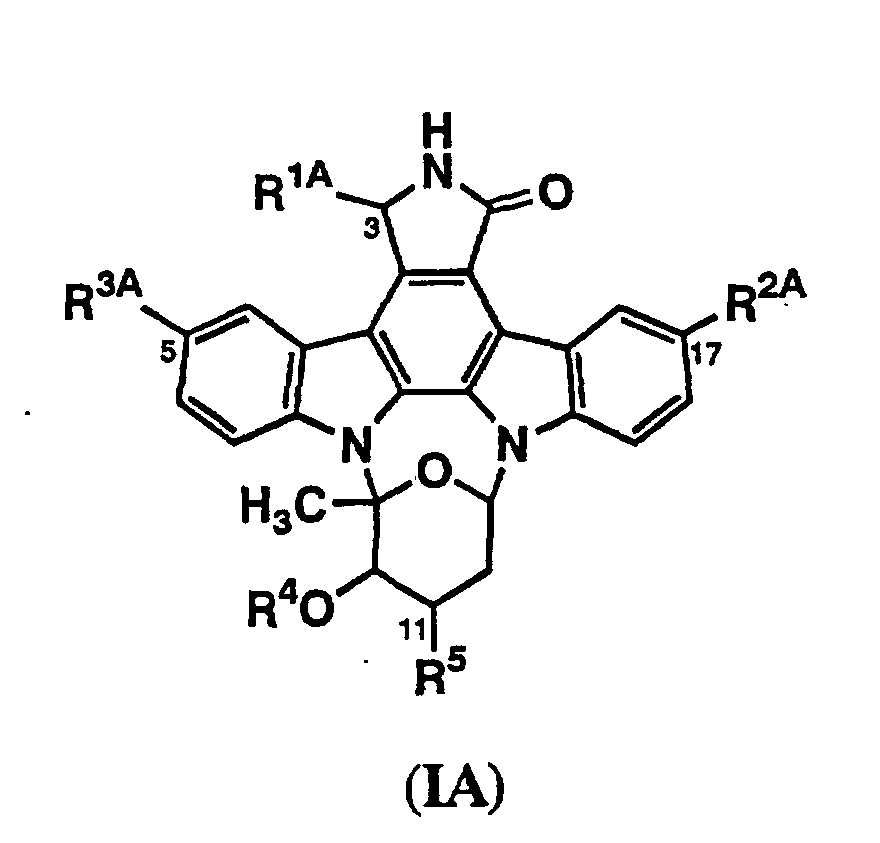
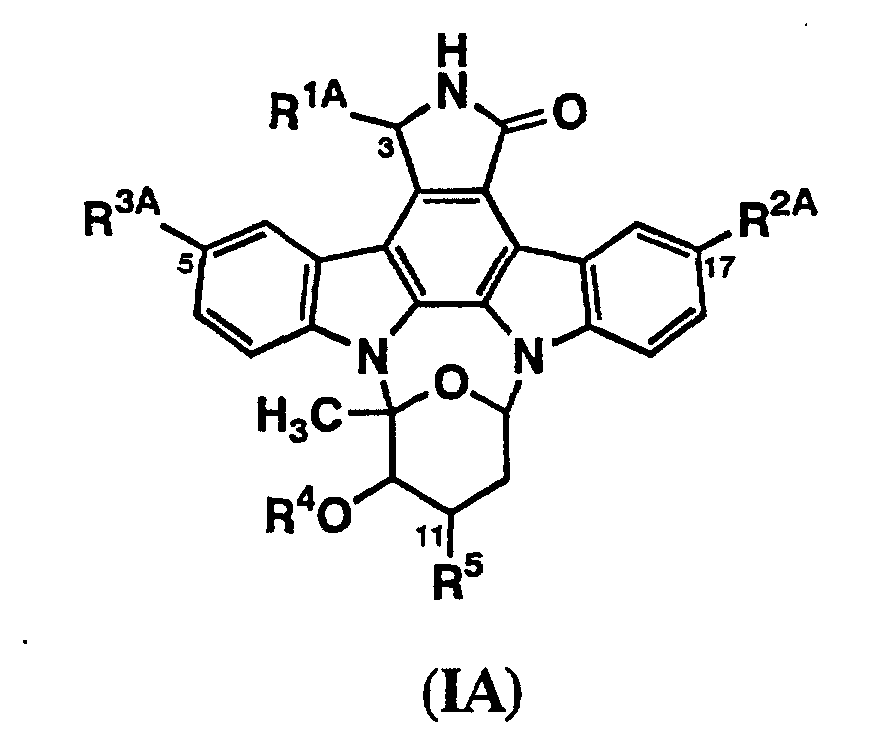
  • the present invention relates to staurosporin derivatives or pharmaceutically acceptable salts thereof, which are represented by the general formula (IA): wherein
  • staurosporin derivatives or the pharmaceutically acceptable salts thereof, wherein R 1A is hydroxy are preferable.
  • the present invention relates to staurosporin derivatives or pharmaceutically acceptable salts thereof, which are represented by the general formula (IB): wherein R 1B , R 2B and R 3B represent groups defined for the above R 1 , R 2 and R 3 , respectively, except when R 1 is hydrogen and R 2 and R 3 are the same or different and represent hydrogen, nitro, amino, carboxy, lower alkoxycarbonyl, hydroxy or hydroxymethyl, and when R 1 is hydrogen and R 2 and R 3 are the same or different and represent hydrogen, halogen, formyl, lower alkanoyl or lower alkoxy; and R 4 and R 5 have the same meanings as defined above, respectively.
  • R 1B , R 2B and R 3B represent groups defined for the above R 1 , R 2 and R 3 , respectively, except when R 1 is hydrogen and R 2 and R 3 are the same or different and represent hydrogen, nitro, amino, carboxy, lower alkoxycarbonyl, hydroxy or hydroxymethyl, and when R 1 is hydrogen and R 2
  • staurosporin derivatives or the pharmaceutically acceptable salts thereof, wherein R 1B is hydroxy are preferable.
  • the present invention relates to staurosporin derivatives or pharmaceutically acceptable salts thereof, wherein in the general formula (IA),
  • staurosporin derivatives or the pharmaceutically acceptable salts thereof, wherein R 1A is hydroxy are preferable.
  • the present invention relates to the staurosporin derivatives or the pharmaceutically acceptable salts thereof, wherein in the general formula (IB), R 2B and R 3B are the same or different and represent substituted or unsubstituted lower alkenyl, substituted or unsubstituted lower alkynyl, amino, halogen, formyl, hydroxy, substituted or unsubstituted lower alkyl, or NHCOR 13 (wherein R 13 has the same meaning as defined above).
  • staurosporin derivatives or the pharmaceutically acceptable salts thereof, wherein R 1B is hydroxy are preferable.
  • the present invention relates to a pharmaceutical composition
  • a pharmaceutical composition comprising at least one staurosporin derivative or pharmaceutically acceptable salt thereof, represented by the general formula (IA) or (IB), and a pharmaceutically acceptable carrier.
  • the present invention relates to enhancers for activity of an antitumor agent, comprising the staurosporin derivative represented by the general formula (I) or the pharmaceutically acceptable salt thereof, as an active ingredient. Further, the present invention relates to the enhancers for activity enhancing the activity of an antitumor agent by abrogating accumulation action at the G2 or S stage of the cell cycle.
  • the present invention relates to agents for abrogating accumulation action at the G2 or S stage of the cell cycle, comprising the staurosporin derivative represented by the general formula (I) or the pharmaceutically acceptable salt thereof, as an active ingredient.
  • the present invention relates to enhancers for activity of an antitumor agent, comprising the staurosporin derivative represented by the general formula (IA) or (IB) or the pharmaceutically acceptable salt, as an active ingredient. Further, the present invention relates to the enhancers for activity enhancing the activity of an antitumor agent by abrogating accumulation action at the G2 or S stage of the cell cycle.
  • the present invention relates to agents for abrogating accumulation action at the G2 or S stage of the cell cycle, comprising the staurosporin derivative represented by the general formula (IA) or (IB) or the pharmaceutically acceptable salt, as an active ingredient.
  • the present invention relates to antitumor agents comprising at least one staurosporin derivative or pharmaceutically acceptable salt thereof, represented by the general formula (IA) or (IB).
  • the present invention relates to a pharmaceutical composition
  • a pharmaceutical composition comprising at least one staurosporin derivative or pharmaceutically acceptable salt thereof, represented by the general formula (IA) or (IB).
  • the present invention relates to a method for treating a malignant tumor, comprising the step of administering a therapeutically effective amount of the staurosporin derivative represented by the general formula (I) or the pharmaceutically acceptable salt thereof.
  • the present invention relates to a method for enhancing the activity of an antitumor agent, comprising the step of administering a therapeutically effective amount of the staurosporin derivative represented by the general formula (I) or the pharmaceutically acceptable salt thereof.
  • the present invention relates to a method for abrogating accumulation action at the G2 or S stage of the cell cycle, comprising the step of administering a therapeutically effective amount of the staurosporin derivative represented by the general formula (I) or the pharmaceutically acceptable salt thereof.
  • the present invention relates to use of the staurosporin derivative represented by the general formula (I) or the pharmaceutically acceptable salt thereof for the manufacture of an antitumor agent.
  • the present invention relates to use of the staurosporin derivative represented by the general formula (I) or the pharmaceutically acceptable salt thereof for the manufacture of an enhancer for activity of an antitumor agent.
  • the present invention relates to use of the staurosporin derivative represented by the general formula (I) or the pharmaceutically acceptable salt thereof for the manufacture of an agent for abrogating accumulation action at the G2 or S stage of the cell cycle.
  • the present invention relates to a method for treating a malignant tumor, comprising the step of administering a therapeutically effective amount of the staurosporin derivative represented by the general formula (IA) or (IB) or the pharmaceutically acceptable salt thereof.
  • the present invention relates to a method for enhancing the activity of an antitumor agent, comprising the step of administering a therapeutically effective amount of the staurosporin derivative represented by the general formula (IA) or (IB) or the pharmaceutically acceptable salt thereof.
  • the present invention relates to a method for abrogating accumulation action at the G2 or S stage of the cell cycle, comprising the step of administering a therapeutically effective amount of the staurosporin derivative represented by the general formula (IA) or (IB) or the pharmaceutically acceptable salt thereof.
  • the present invention relates to use of the staurosporin derivative represented by the general formula (IA) or (IB) or the pharmaceutically acceptable salt thereof for the manufacture of an antitumor agent.
  • the present invention relates to use of the staurosporin derivative represented by the general formula (IA) or (IB) or the pharmaceutically acceptable salt thereof for the manufacture of an enhancer for activity of an antitumor agent.
  • the present invention relates to use of the staurosporin derivative represented by the general formula (IA) or (IB) or the pharmaceutically acceptable salt thereof for the manufacture of an agent for abrogating accumulation action at the G2 or S stage of the cell cycle.
  • Compound (I) the compound represented by the general formula (I) is referred to as Compound (I).
  • the compounds of other formula numbers are referred to in the same manner.
  • the lower alkyl means the straight-chain or branched alkyl having 1 to 8 carbon atoms, for example, methyl, ethyl, propyl, isopropyl, butyl, isobutyl, sec-butyl, tert-butyl, pentyl, neopentyl, hexyl, heptyl, octyl, etc.
  • the lower alkyl moieties of the lower alkoxy and lower alkoxycarbonyl have the same meaning as defined for the lower alkyl described above.
  • the cycloalkyl means the cycloalkyl having 3 to 6 carbon atoms, for example, cyclopropyl, cyclobutyl, cyclopentyl, cyclohexyl, etc.
  • the lower alkenyl means the straight-chain or branched alkenyl having 2 to 6 carbon atoms, for example, vinyl, allyl, butenyl, pentenyl, hexenyl, etc.
  • the lower alkadienyl means the straight-chain or branched alkadienyl having 5 to 8 carbon atoms, for example, pentadienyl, hexadienyl, heptadienyl, octadienyl, etc.
  • the lower alkynyl means the straight-chain or branched alkynyl having 2 to 8 carbon atoms, for example, ethynyl, propynyl, butynyl, pentynyl, hexynyl, heptynyl, octynyl, etc.
  • the lower alkanoyl means the straight-chain or branched alkanoyl having 2 to 9 carbon atoms, for example, acetyl, propionyl, butyryl, isobutyryl, valeryl, isovaleryl, pivaloyl, hexanoyl, heptanoyl, octanoyl, etc.
  • aryl and the aryl moiety of the aroyl mean, for example, phenyl, naphthyl, etc.
  • the heterocyclic group means, for example, aliphatic heterocyclic groups such as pyrrolidinyl, imidazolidinyl, piperidinyl, morpholinyl, thiomorpholinyl, piperidino, morpholino and piperadinyl, or aromatic heterocyclic groups such as furyl, thienyl, pyrrolyl, imidazolyl, triazolyl, oxazolyl, thiazolyl, pyridyl, pyrimidinyl, indolyl, quinolyl, isoquinolyl and quinazolinyl.
  • aliphatic heterocyclic groups such as pyrrolidinyl, imidazolidinyl, piperidinyl, morpholinyl, thiomorpholinyl, piperidino, morpholino and piperadinyl
  • aromatic heterocyclic groups such as furyl, thienyl, pyrrolyl, imidazolyl, triazoly
  • the heterocyclic group formed together with their adjacent N means pyrrolidinyl, morpholino, thiomorpholino, N-methylpiperadinyl, pyrazolidinyl, piperidino, piperadinyl, homopiperadinyl, indolyl, isoindolyl, etc.
  • the halogen means an atom of fluorine, chlorine, bromine or iodine atom.
  • the amino acid means ⁇ -amino acids such as glycine, alanine, proline, glutamic acid, lysine, serine, cysteine, cystine, threonine, valine, methionine, leucine, isoleucine, norleucine, phenylalanine, tyrosine, thyroxine, hydroxyproline, tryptophan, aspartic acid, arginine, ornithine and histidine.
  • ⁇ -amino acids such as glycine, alanine, proline, glutamic acid, lysine, serine, cysteine, cystine, threonine, valine, methionine, leucine, isoleucine, norleucine, phenylalanine, tyrosine, thyroxine, hydroxyproline, tryptophan, aspartic acid, arginine, ornithine and histidine.
  • the protective group for a functional group in the amino acid is the one used usually in peptide synthesis, and means, for example, benzyloxycarbonyl, tert-butoxycarbonyl, benzyloxy, tert-butoxy, methoxybenzenesulfonyl, etc.
  • the substituents in the substituted lower alkyl and substituted lower alkoxy include 1 to 3 substituents which are the same or different, for example, halogen, carboxy, lower alkoxycarbonyl, lower alkanoyl, aryl, substituted aryl (the substituents in the substituted aryl have the same meanings as defined for the substituents in the substituted aryl described below), a heterocyclic group, a substituted heterocyclic group (the substituents in the substituted heterocyclic group have the same meanings as defined for the substituents in the substituted heterocyclic group described below), CONR 15 R 16 ⁇ wherein R 15 and R 16 are the same or different and represent hydrogen, hydroxy, aralkyl, lower alkyl, lower alkenyl, aryl, substituted aryl (the substituents in the substituted aryl have the same meanings as defined for the substituents in the substituted aryl described below), a heterocyclic group, or a substituted heterocyclic group
  • the lower alkyl moieties of the lower alkyl, lower alkoxy, lower alkoxycarbonyl, lower alkylamino and di(lower alkyl)amino have the same meanings as defined for the lower alkyl described above.
  • the cycloalkyl and the lower alkenyl have the same meanings as defined for the cycloalkyl and lower alkenyl described above, respectively.
  • the lower alkanoyl has the same meaning as defined for the lower alkanoyl described above.
  • the aryl and the aryl moiety of the aroyl have the same meanings as defined for the aryl described above, and the aralkyl and the aralkyl moiety of the aralkyloxycarbonyl mean the aralkyl having 7 to 15 carbon atoms, for example, benzyl, phenetyl, benzhydryl, naphthylmethyl, etc.
  • the heterocyclic group has the same meaning as defined for the heterocyclic group described above, and the heterocyclic group formed together with their adjacent N has the same meaning as defined for the heterocyclic group formed together with their adjacent N described above.
  • the halogen has the same meaning as defined the halogen described above.
  • the substituents in the substituted lower alkenyl, substituted lower alkadienyl and substituted lower alkynyl include oxo in addition to the substituents in the substituted lower alkyl described above.
  • the substituents in the substituted lower alkanoyl include 1 to 3 substituents which are the same or different, for example, halogen, NR 17A R 18A (wherein R 17A and R 18A have the same meanings as defined for R 17 and R 18 described above, respectively), etc.
  • the substituents in the substituted aryl and substituted aroyl include 1 to 3 substituents which are the same or different, for example, halogen, lower alkyl, substituted lower alkyl (the substituents in the substituted lower alkyl are halogen, oxo, carboxy, lower alkoxycarbonyl, amino, lower alkylamino, di(lower alkyl)amino, hydroxy or lower alkoxy), nitro, hydroxy, lower alkoxy, amino, lower alkylamino, di(lower alkyl)amino, lower alkanoyl, cyano, etc.
  • the lower alkyl moieties in the lower alkyl, lower alkoxycarbonyl, lower alkoxy, lower alkylamino or di(lower alkyl)amino have the same meaning as defined for the lower alkyl described above.
  • the lower alkanoyl has the same meaning as defined for the lower alkanoyl described above.
  • the halogen has the same meaning as defined for the halogen described above.
  • the substituents in the substituted heterocyclic group and substituted heterocyclic group formed together with their adjacent N include oxo in addition to the substituents in the substituted aryl and the substituted aroyl described above.
  • the pharmaceutically acceptable salts of Compound (I) include pharmaceutically acceptable acid addition salts, metal salts, ammonium salts, organic amine addition salts, aminoacid addition salts, etc.
  • the acid addition salts include inorganic acid salts such as hydrochloride, sulfate and phosphate and organic acid salts such as methane sulfonate, acetate, maleate, fumarate, tartrate, citrate and lactate; themetal salts include alkali metal salts such as sodium salt and potassium salt, alkaline earth metal salts such as magnesium salt and calcium salt, aluminum salt, zinc salt, etc.;
  • the ammonium salts include salts of ammonium, tetramethylammonium, etc.;
  • the organic amine addition salts include addition salts of morpholine, piperidine, etc.; and the amino acid addition salts include addition salts of lysine, glycine, phenylalanine, aspartic acid, glutamic acid, etc.
  • the antitumor agent which can be used in combination withthe enhancers for activity provided by the present invention, includes anticancer agents having actions on DNA, for example, platina preparations such as Cisplatin and Carboplatin, Mitomycin type drugs, nitrogen mustard type drugs, nitrosourea type- drugs, Camptothecine derivatives (topoisomerase I inhibitors) such as CPT-11 and Topotecan, and Etoposide (topoisomerase II inhibitor), etc., and antimetabolites, for example, 5-Fluorouracil derivatives, Cytidine derivatives such as Cytosine arabinoside (Ara-C) and Gemcitabine, Adenosine derivatives such as Fludarabine, Methotrexate derivatives, TS (thymidylic acid synthase) inhibitors such as Toumidex, etc.
  • platina preparations such as Cisplatin and Carboplatin
  • Mitomycin type drugs nitrogen mustard type drugs
  • Compound (I) can be produced by the following reaction steps.
  • the objective compounds can be obtained using the methods for introducing and eliminating protective groups ordinarily used in synthetic organic chemistry [for example, T. W. Greene: Protective Groups inorganic Synthesis, John Wiley & Sons Inc. (1981)]. And also, the order of the reaction steps such as introduction of the substituents etc., can be altered, if necessary.
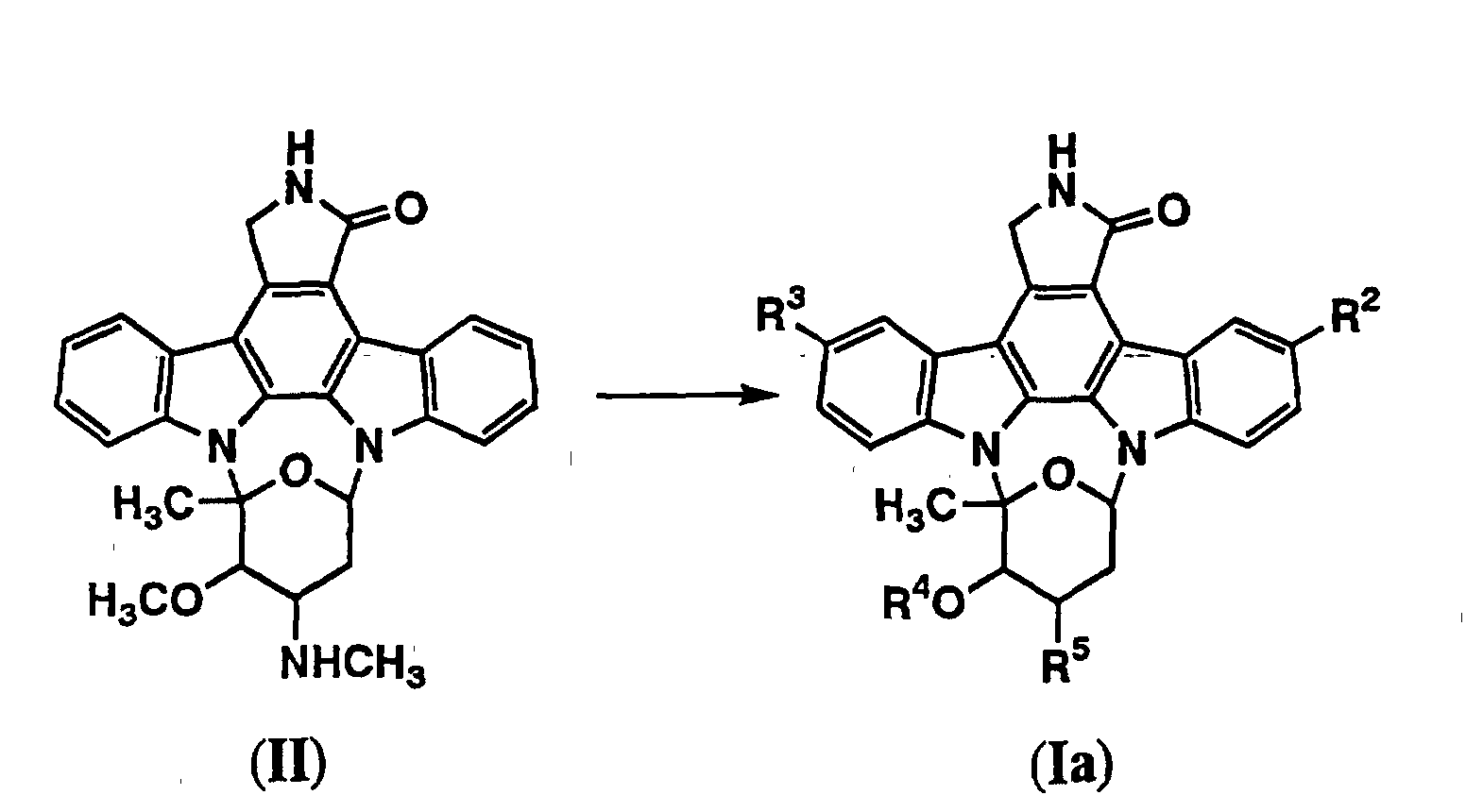
  • Compound (Ia) that is, Compound (I) wherein R 1 is hydrogen
  • R 2 or R 3 is substituted or unsubstituted lower alkyl, substituted or unsubstituted lower alkenyl, substituted or unsubstituted lower alkynyl, substituted or unsubstituted aryl, a substituted or unsubstituted heterocyclic group, halogen, nitro, formyl, COR 6 (wherein R 6 has the same meaning as defined above), NR 11 R 12 (wherein R 11 and R 12 have the same meanings as defined above, respectively), etc., can be obtained in a method described in WO88/7045, WO97/46565, etc.
  • R 2 or R 3 is formyl, lower alkanoyl, carboxy, lower alkoxycarbonyl, OR 14 (wherein R 14 has the same meaning as defined above), etc.
  • R 14 has the same meaning as defined above
  • Compound (II) which can be obtained in a known method [J. Am. Chem. Soc., 117 , 552 (1995), J. Antibiotics, 30 , 275 (1977), J. Chem. Soc., Chem. Comm., 800 (1978), etc.] (wherein R 2 , R 3 , R 4 and R 5 have the same meanings as defined above, respectively)
  • Compound (Ib) that is, Compound (I) wherein R 1 is hydroxy or lower alkoxy
  • a known method for example, the compound, wherein R 1 is hydroxy, can be obtained in a method described in WO89/7105, Japanese Published Unexamined Application No.1-168689, Japanese Published Unexamined Application No.6-9645, etc., and the compound, wherein R 1 is lower alkoxy, can be obtained in a method described in WO89/7105, Japanese Published Unexamined Application No.1-168689, etc.) or in a method similar thereto, from Compound (Ia). (wherein R 1a is hydroxy or lower alkoxy, and R 2 , R 3 , R 4 and R 5 have the same meanings as defined above, respectively)
  • Transformations of functional groups, contained in substituents in R 1 , R 2 , R 3 , R 4 or R 5 in Compound (I), obtained in the Examples, and the compounds, obtained in the Reference Examples, can also be conducted by other methods known in the art [for example, R. C. Larock: Comprehensive Organic Transformations (1989)], in addition to the method described above.
  • the objective products in the processes described above can be isolated and purified by a suitable combination of techniques used in ordinary organic synthesis, such as filtration, extraction, washing, drying, concentration, crystallization and various kinds of chromatography. Further, the intermediates can also be subjected to the subsequent reaction without particular purification.
  • Compound (I) can exist as isomers such as regioisomers, geometrical isomers, tautomers or optical isomers, and in the present invention, all possible isomers or the mixture thereof in any ratio can be used as the antitumor agents, the enhancers for activity of an antitumor agent, and the agents for abrogating accumulation action at the G2 or S stage of the cell cycle.
  • Compound (I) or pharmaceutically acceptable salts thereof may exist in the form of adducts with water or various solvents, and these adducts also fall under the scope of the present invention.
  • Compound (I) or pharmaceutically acceptable salts thereof can be used as it is or in various pharmaceutical forms, depending on the pharmacological action thereof and the object of administration.
  • the pharmaceutical compositions of the present invention can be produced by uniformly mixing an effective amount of Compound (I) or a pharmaceutically acceptable salt thereof as an active ingredient with a pharmaceutically acceptable carrier.
  • the carrier can be in various forms depending on the form of a preparation desirable for administration.
  • These pharmaceutical compositions are desirably in a unit administration form being suitable for oral administration or parenteral administration such as an ointment or injection.
  • an excipient such as lactose, glucose, sucrose, mannitol or methyl cellulose, a disintegrator such as starch, sodium alginate, carboxymethyl cellulose calcium or crystalline cellulose, a lubricant such as magnesium stearate or talc, a binder such as gelatin, polyvinylalcohol, polyvinylpyrrolidone, hydroxypropyl cellulose or methyl cellulose, or a surfactant such as a sucrose fatty acid ester or a sorbitol fatty acid ester may be used in a usual manner. Tablets containing 1 to 200 mg of an active ingredient per tablet are preferred.
  • an excipient such as lactose or sucrose, a disintegrator such as starch, or a binder such as gelatin may be used in a usual manner.
  • a disintegrator such as starch
  • a binder such as gelatin
  • an excipient such as lactose or mannitol may be used in a usual manner.
  • capsules for example, gelatin, water, sucrose, gum Arabia, sorbitol, glycerin, crystalline cellulose, magnesium stearate, talc, etc., may be used in a usual manner.
  • Capsules containing 0.1 to 200 mg of an active ingredient per capsule are preferred.
  • a sugar such as sucrose, water, ethanol, etc.
  • a sugar such as sucrose, water, ethanol, etc.
  • a sugar such as sucrose, water, ethanol, etc.
  • anointment base such as vaseline, liquid paraffin, lanoline or Macrogol, or an emulsifier such as sodium lauryl lactate, benzalkonium chloride, a sorbitan mono-fatty acid ester, carmellose sodium, or gum Arabia, etc.
  • an emulsifier such as sodium lauryl lactate, benzalkonium chloride, a sorbitan mono-fatty acid ester, carmellose sodium, or gum Arabia, etc.
  • a solubilizing agent sodium benzoate, sodium salicylate, urethane, etc.
  • an isotonizing agent sodium chloride, glucose, etc.
  • a preservative phenol, cresol, p-hydroxybenzoic acid ester, chlorobutanol, etc.
  • an antioxidant ascorbic acid, sodium pyrosulfite, etc
  • Compound (I) or pharmaceutically acceptable salts thereof can be administered orally or parenterally as an ointment or injection, and generally preferred to be administered in a dose of 0.1 to_200 mg/kg per day, although the effective dose and frequency of administration are varied depending on the administration form, patient's age or weight, symptoms, etc.
  • Test Example 1 Test for inhibitory activity on cell growth in human lung cancer cell line A-549
  • a human lung cancer cell line A-549 which was prepared at a density of 1.0 ⁇ 10 4 cells/mL in a Roswell Park Memorial Institute's Medium (PRMI) 1640 medium containing 10 % fetal bovine serum and Penicillin/Streptomycin, was put in an amount of 0.1 mL/well on a 96 MicroWellTM plate (Catalog No. 167008, produced by Nunc).
  • PRMI Roswell Park Memorial Institute's Medium
  • the cells were cultured at 37 °C for 20 hours in a CO 2 gas incubator, a 10 mmol/L solution of each test compound in dimethyl sulf oxide (DMSO) was diluted with the culture medium, the diluted mixture was added into each well in an amount of 0.05 mL/well, the mixture was diluted stepwise by pipetting on the plate, and the cells were cultured at 37 °C for 72 hours in a CO 2 gas incubator.
  • DMSO dimethyl sulf oxide
  • a medium containing 1 mg/mL of 3-(4,5-dimethylthiazol-2-yl)-2,5-diphenyltetrazolium bromide (Sigma) was added into each well in an amount of 0.05 mL/well and the cells were cultured at 37 °C for 5 hours in a CO 2 gas incubator. Then, the medium was removed, and DMSO was added into each well in an amount of 0.1 mL/well.
  • the plate was vigorously stirred using a plate mixer, and then the absorbance of each cell at 550 nm was measured by a microplate reader (Wako Pure Chemical Industries, Ltd.)
  • the inhibitory activity on cell growth was calculated as a 50 % inhibitory concentration (IC 50 ) by use of the formula in measurement software (Soft Max Pro) attached to the microplate reader.
  • Test Example 2 Test for affinity with human AGP using Dextran Coated Charcoal (DCC)
  • the solution was pre-incubated at 37 °C for 15 minutes and then mixed with an equal volume of 4 mg/mL of DCC in PBS, and incubation was further continued. After two hours from mixing, a part of the solution was sampled and centrifuged (4 °C, 20000 ⁇ g, 2 minutes) to precipitate the charcoal, and the supernatant was subjected to HPLC analysis.
  • the ratio of the peak area of the DCC-treated sample to the average peak area of the DCC-untreated sample (the solution mixed with PBS) was calculated as the degree of binding (%).
  • a compound showing a lower degree of binding was regarded as a compound having a lower binding activity to human AGP.
  • Test Examples 1 and 2 are shown in Table 3.
  • Compound No. Inhibitory activity on cell growth (IC 50 / ⁇ mol/L) Degree of binding to h ⁇ 1 AGP (%)
  • UCN-01 0.018 76.8 2 0.015 20.5 3 0.059 10.6 11 0.053 5.8 15 0.074 18.0 36 0.076 36.1 40 0.024 33.5 44 0.0051 16.4 64 0.026 19.8 102 0.0092 37.7 129 0.11 18.4 and 9.6 147 0.19 36.9 172 0.14 18.0 176 0.034 21.2
  • Test Example 3 Action of the compound on abrogation of accumulation action at the G2 stage and S stage of the cell cycle
  • A431 cells human epidermal cancer cell line A431 (hereinafter referred to as A431 cells).
  • a suspension of A431 cells which was prepared at a density of 3 ⁇ 10 4 cells/mL in DMEM medium containing 10 % fetal bovine serum (hereinafter referred to as medium A, produced by Nissui), was pipetted in a volume of 10 mL onto a 10 cm Petri dish (Catalog No. 3003, produced by Falcon). The Petri dish was incubated at 37 °C for 24 hours in a CO 2 gas incubator. Then, Cisplatin (Sigma) prepared at a final concentration of 20 ⁇ mol/L in medium A, was added into the Petri dish and the Petri dish was further incubated at 37 °C for 1 hour in a CO 2 gas incubator.
  • the cells were washed with PBS(-) [phosphate buffered saline (not containing calcium ions), produced by Dainippon Pharmaceutical Co., Ltd.], then medium A was further added into the Petri dish, and the cells were cultured at 37°C for 15 hours in a CO 2 gas incubator.
  • the test compound diluted appropriately with medium A was added into the Petri dish, and then the cells were cultured at 37 °C for 8 hours in a CO 2 gas incubator.
  • the cells were washed with PBS(-), detached in an aqueous solution of 0.25 % of Trypsin (GIBCO BRL) and 0.02 % of ethylenediaminetetraacetic acid (Wako Pure Chemical Industries, Ltd.), then fixed at a density of 10 6 cells/mL with a 70 % aqueous solution of ethanol and stored in a cold room at 4 °C. Ethanol was removed by centrifugation from the fixed cells, and then the fixed cells were washed with PBS(-).
  • the cells were treated at 37 °C for 30 minutes with a 0.25 mg/mL PBS(-)solution of ribonuclease A type 1-A (Sigma) containing 0.1 % of Nonidet P-40 (Nacalai Tesque, Inc.), and then a solution of propidium iodide (Sigma) in 0.1 % NP-40/PBS(-) was added into the cells at a final concentration of 50 ⁇ g/mL, and the cells were stained in ice for at least 20 minutes.
  • a DNA histogram was taken by EPICS ELITE Flow Cytometer, and the cell cycle distribution was analyzed by use of MultiCycle Program.
  • Cisplatin(20 ⁇ mo/L) 5.5 77.0 17.5 Cisplatin(20 ⁇ mo/L) + UCN-01(50nmol/L) 31.9 40.5 27.6 Cisplatin(20 ⁇ mo/L) + Compound 3(200nmol/L) 22.0 55.3 22.7 Cisplatin(20 ⁇ mo/L) + Compound 11(200nmol/L) 28.5 54.0 17.5 Cisplatin(20 ⁇ mo/L) + Compound 22(200nmol/L) 15.7 46.3 38.1 Cisplatin(20 ⁇ mo/L) + Compound 52(200nmol/L) 22.9 63.7 13.4
  • reaction mixture was diluted with tetrahydrofuran and ethyl acetate, and then neutralized by the gradual addition of a saturated aqueous solution of sodium bicarbonate.
  • the resulting precipitates were separated by filtration.
  • the filtrate was subjected to extraction with ethyl acetate, the extract was washed with a saturated saline solution and dried over anhydrous sodium sulfate, and then the solvent was distilled away under reduced pressure.
  • step 2 of Example 1 111 mg (0.162 mmol) of 5,17-bis(dimethylamino)-11-N-benzyloxycarbonyl staurosporin was subjected to catalytic reduction in an atmosphere of hydrogen in the presence of 113 mg of 10 % palladium carbon (50 % hydrous product) to give 55.6 mg of 5,17-bis(dimethylamino)staurosporin (62 %).
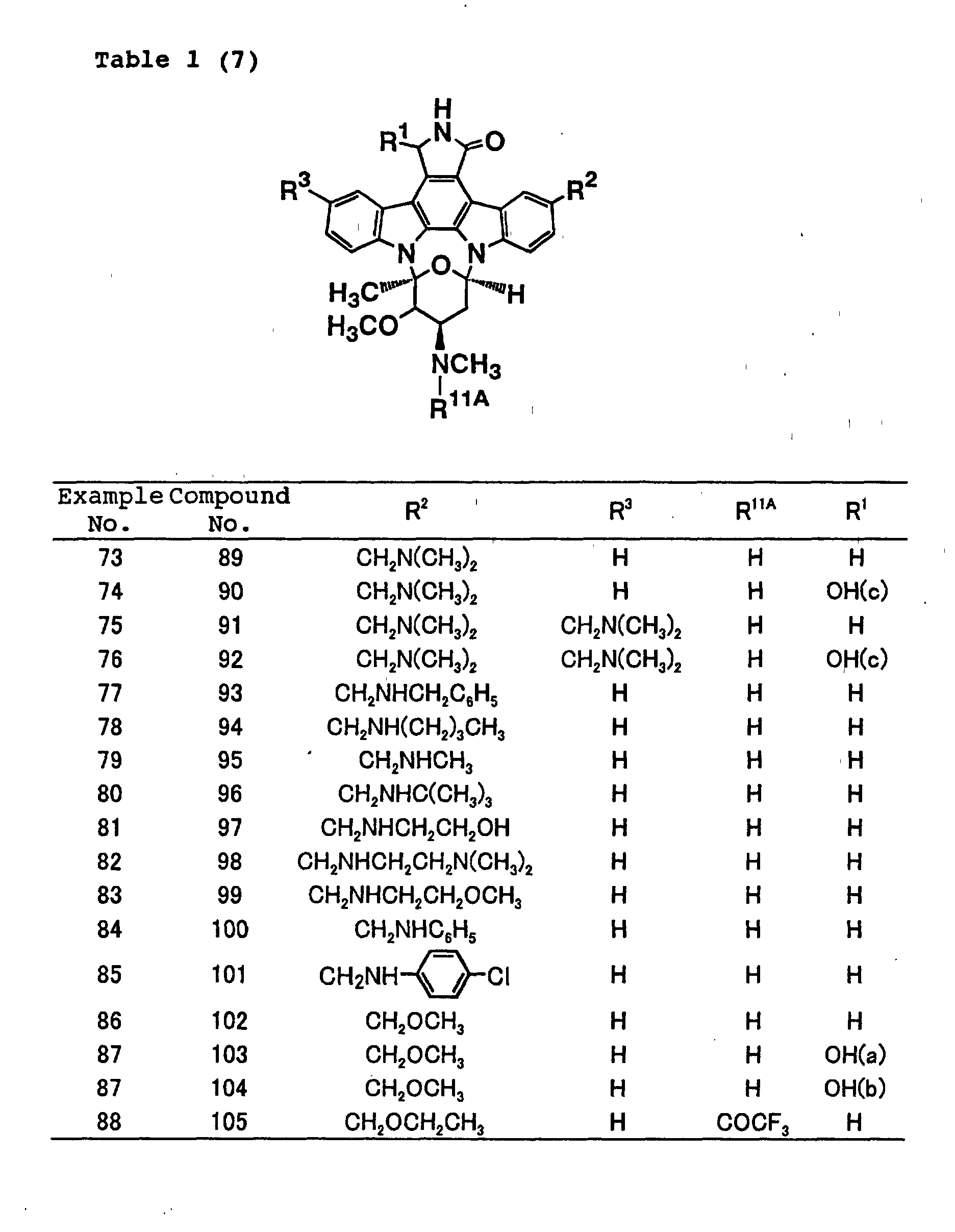
  • Example 86 In a manner similar to that in Example 86, 554 mg (0.834 mmol) of Compound n obtained in Reference Example 11 was treated with 20 mL of methanol and 1.90 g (8.20 mmol) of DL-camphor-10-sulfonic acid. Then in a manner similar to that in step 2 of Example 3, the reaction mixture was treated with a 6 mol/L aqueous solution of sodium hydroxide, to give 328 mg of Compound 108 (71 %).
  • Example 100 Compounds 121 and 122
  • the reaction was terminated by adding water thereto, and the reaction mixture was diluted with ethyl acetate, neutralized with a saturated aqueous solution of sodium bicarbonate, and subjected to extraction with ethyl acetate.
  • the organic layer was washed with a saturated saline solution and dried over anhydrous sodium sulfate.
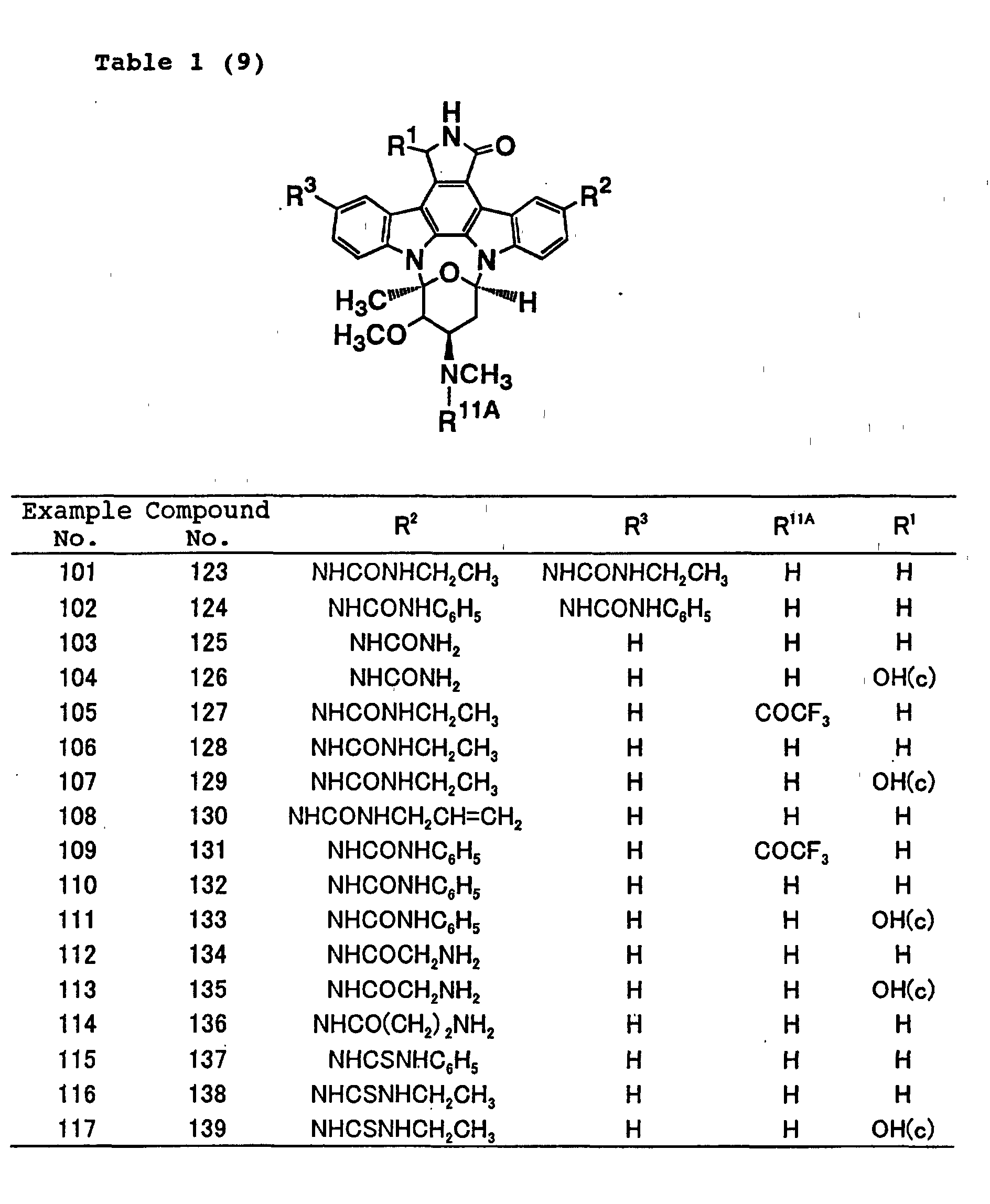
  • step 2 of Example 114 513 mg of 17-prolylamino-11-N-trifluoroacetyl staurosporin (quant.) was obtained from 379 mg (0.490 mmol) of 17-tert-butoxycarbonylprolylamino-11-N-trifluoroacetyl staurosporin and 20 mL of trifluoroacetic acid.
  • Example 40 50 mg (0.065 mmol) of 17-bromo-5-(4-methylbenzamido)-11-N-trifluoroacetyl staurosporin obtained in step 1 of Example 145 was treated with 0.030 mL (0.33 mmol) of methyl acrylate, 1.1 mg (0.005 mmol) of palladium acetate, 4.3 mg (0.014 mmol) of tri-o-tolylphosphine and 0.18 mL (1.3 mmol) of triethylamine, and in a manner similar to that in Example 19, the reaction mixture was treated with a 7 mol/L methanolic solution of ammonia, to give 12.6 mg of Compound 170 (28 %).
  • step 2 of Example 1 In a manner similar to that in step 2 of Example 1, 28.8 mg (0.0400 mmol) of 5-nitro-17-trifluoroacetamido-11-N-trifluoroacetyl staurosporin was subjected to catalytic reduction in an atmosphere of hydrogen in the presence of 32 mg of 10 % palladium carbon (50 % hydrous product), to give 16.2 mg of 5-amino-17-trifluoroacetamido-11-N-trifluoroacetyl staurosporin (59 %).
  • step 1 of Example 108 50 mg (0.087 mmol) of 5-amino-11-N-trifluoroacetyl staurosporin obtained in step 1 of Example 24 was reacted with 55 mg of polyvinylpyridine and 0.040 mL (0.35 mmol) of benzoyl chloride, followed by treatment with 420 mg of aminomethyl resin and 36 mg of polyvinylpyridine. Then in a manner similar to that in Example 19, the reaction mixture was treated with a 7 mol/L methanolic solution of ammonia, to give 13.2 mg of Compound 173 (26 %).
  • step 1 of Example 108 50 mg (0.087 mmol) of 5-amino-11-N-trifluoroacetyl staurosporin obtained in step 1 of Example 24 was reacted with 55 mg of polyvinylpyridine and 0.049 mL (0.35 mmol) of p-methoxybenzoyl chloride, followed by treatment with 420 mg of aminomethyl resin and 36 mg of polyvinylpyridine. Then in a manner similar to that in Example 19, the reaction mixture was treated with a 7 mol/L methanolic solution of ammonia, to give 20.8 mg of Compound 174 (39 %).
  • step 1 of Example 108 50 mg (0.087 mmol) of 5-amino-11-N-trifluoroacetyl staurosporin obtained in step 1 of Example 24 was reacted with 55 mg of polyvinylpyridine and 0.044 mL (0.35 mmol) of p-chlorobenzoyl chloride, followed by treatment with 420 mg of aminomethyl resin and 36 mg of polyvinylpyridine. Then in a manner similar to that in Example 19, the reaction mixture was treated with a 7 mol/L methanolic solution of ammonia, to give 36.0 mg of Compound 176 (67 %).
  • step 1 of Example 108 50 mg (0.087 mmol) of 5-amino-11-N-trifluoroacetyl staurosporin obtained in step 1 of Example 24 was reacted with 55 mg of polyvinylpyridine and 0.027 mL (0.35 mmol) of ethyl isocyanate, followed by treatment with 420 mg of aminomethyl resin and 36 mg of polyvinylpyridine. Then in a manner similar to that in Example 19, the reaction mixture was treated with a 7 mol/L methanolic solution of ammonia, to give 20.7 mg of Compound 177 (43 %).
  • step 1 of Example 108 48 mg (0.083 mmol) of 5-amino-11-N-trifluoroacetyl staurosporin obtained in step 1 of Example 24 was reacted with 52 mg of polyvinylpyridine and 0.033 mL (0.35 mmol) of allyl isocyanate, followed by treatment with 415 mg of aminomethyl resin. Then in a manner similar to that in Example 19, the reaction mixture was treated with a 7 mol/L methanolic solution of ammonia, to give 17.7 mg of Compound 179 (38 %).
  • step 1 of Example 108 51 mg (0.088 mmol) of 5-amino-11-N-trifluoroacetyl staurosporin obtained in step 1 of Example 24 was reacted with 52 mg of polyvinylpyridine and 0.033 mL (0.35 mmol) of bromoethyl isocyanide, followed by treatment with 438 mg of aminomethyl resin. Then in a manner similar to that in Example 19, the reaction mixture was treated with a 7 mol/L methanolic solution of ammonia, to give 12.3 mg of Compound 180 (25 %).
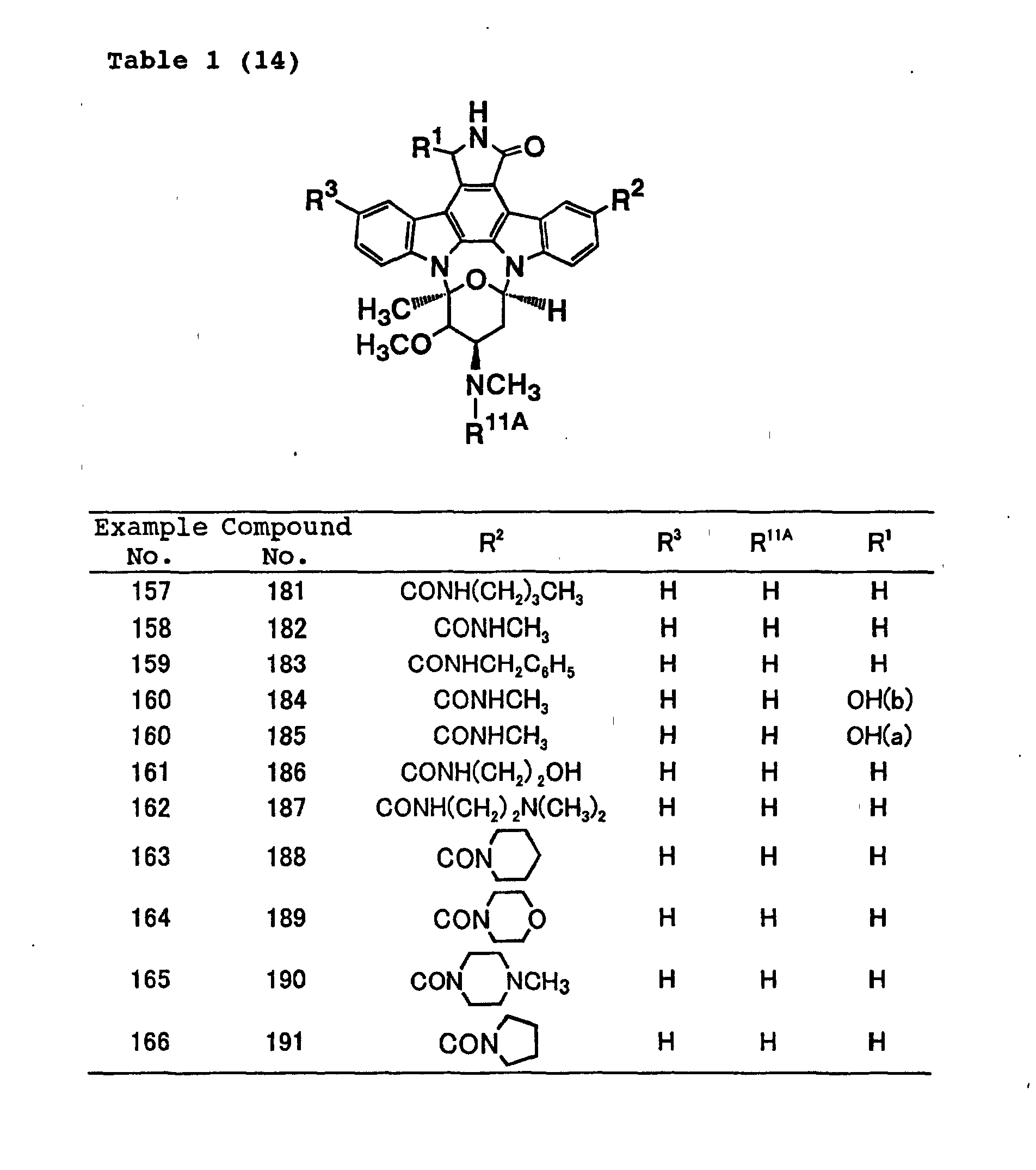
  • Example 160 Compounds 184 and 185
  • the solvent was distilled away under reduced pressure.
  • the residue was dissolved in 8 mL of chloroform and the solution was washed twice with 3 mL each of a saturated aqueous solution of ammonium chloride, a saturated aqueous solution of sodium bicarbonate and a saturated saline and then dried over anhydrous sodium sulfate.
  • the solvent was distilled away under reduced pressure. 4 mL of a 7 mol/L methanolic solution of ammonia and 4 mL of chloroform were added to the resulting residue and the mixture was stirred at room temperature for 10 hours.
  • Granules having the following composition were prepared in a usual manner.
  • a syrup having the following composition was prepared in a usual manner.
  • Compound 16 1 mg Refined white sugar 40 g Ethyl p-hydroxybenzoate 40 mg Propyl p-hydroxybenzoate 10 mg Strawberry flavor 0.1 cc
  • novel staurosporin derivatives effective for the treatment of tumors or pharmaceutically acceptable salts thereof.

Landscapes

  • Chemical & Material Sciences (AREA)
  • Health & Medical Sciences (AREA)
  • Organic Chemistry (AREA)
  • General Health & Medical Sciences (AREA)
  • Veterinary Medicine (AREA)
  • Pharmacology & Pharmacy (AREA)
  • Life Sciences & Earth Sciences (AREA)
  • Animal Behavior & Ethology (AREA)
  • Medicinal Chemistry (AREA)
  • Public Health (AREA)
  • Epidemiology (AREA)
  • Chemical Kinetics & Catalysis (AREA)
  • General Chemical & Material Sciences (AREA)
  • Nuclear Medicine, Radiotherapy & Molecular Imaging (AREA)
  • Engineering & Computer Science (AREA)
  • Bioinformatics & Cheminformatics (AREA)
  • Pharmaceuticals Containing Other Organic And Inorganic Compounds (AREA)
  • Nitrogen And Oxygen Or Sulfur-Condensed Heterocyclic Ring Systems (AREA)

Abstract

The present invention provides an antitumor agent comprising a staurosporin derivative or a pharmaceutically acceptable salt thereof, as an active ingredient, which is represented by the general formula (I):
Figure 80000001
wherein R1 represents hydrogen, hydroxy or lower alkoxy, R2 and R3 are the same or different and represent hydrogen, substituted or unsubstituted alkyl, substituted or unsubstituted lower alkenyl, substituted or unsubstituted lower alkynyl, substituted or unsubstituted aryl, a substituted or unsubstituted heterocyclic group, halogen, nitro, formyl, etc., R4 represents hydrogen; etc., R5 represents NR11AR12A (wherein R11A and R12A represent hydrogen, substituted or unsubstituted lower alkyl, etc.), provided that R2 and R3 are not simultaneously hydrogen.

Description

Technical Field
The present invention relates to staurosporin derivatives or pharmaceutically acceptable salts thereof, which are useful for the treatment of tumors. Further, the present invention relates to enhancers for activity of an antitumor agent.
Background Art
As staurosporin derivatives effective for the treatment of tumors, UCN-1 in WO89/7105, CGP41251 in EP657164A, etc. are described.
Figure 00010001
The staurosporin derivatives as described in the above two literatures, Japanese Published Unexamined Application No. 62-220196, WO94/20106, WO95/32974, WO95/32975, WO95/32976, EP624590A, etc. are characterized in that in the general formula (I) described below, both of R2 and R3 are hydrogen.
As the staurosporin derivatives wherein in the general formula (I) described below, at least one of R2 and R3 is not hydrogen, compounds described in Japanese Published Unexamined Application No.3-72485, Japanese Published Unexamined Application No.3-220194 and Japanese Published Unexamined Application No.4-364186, compounds described in WO94/6799, and compounds described in WO97/5141 are known. However, Japanese Published Unexamined Application No.3-72485, Japanese Published Unexamined Application No.3-220194 and Japanese Published Unexamined Application No.4-364186 disclose only compounds wherein in the general formula (I) described below, R1 is hydrogen, and R2 and R3 are hydrogen, nitro, amino, formyl, carboxy, lower alkoxycarbonyl, hydroxymethyl or hydroxy, and these compounds are used for inhibition of platelet aggregation, and their effect on the treatment of malignant tumors is not shown. WO94/6799 disclose only compounds wherein in the general formula (I) described below, R1 is hydrogen, and R2 and R3 are hydrogen, halogen, formyl, lower alkanoyl or lower alkoxy, and these compounds are used for the treatment of thrombocytopenia, and their effect on the treatment of malignant tumors is not shown. Further, the compounds described in WO97/5141 are characterized in that in the general formula (I) described below, compounds are the derivatives which have a ketone or an oxime at the 11-position, and there are neither specific compounds nor synthetic intermediates thereof wherein in the general formula (I) described below, at least one of R2 and R3 is not hydrogen.
On the other hand, it is known that some of these compounds in the prior art have strong affinity for human α1 acidic glycoprotein (hereinafter referred to as hα1AGP), which is contained in human plasma [Pharmacogenetics, 6, 411 (1996)]. The pharmacokinetics etc. of such compounds can be influenced by the strong affinity for hα1AGP and the expected efficacy of the compounds upon administration into humans can also be influenced. Thus, staurosporin derivatives with low affinity for hα1AGP are desired. The above-described staurosporin derivatives wherein in the general formula (I) described below, both of R2 and R3 are hydrogen are shown to have strong bonding to hα1AGP [Abstracts of 118th The Pharmaceutical Society of Japan Annual Meeting, 4, 43 (1998)].
On the other hand, it is known that UCN-01 shows a synergistic effect when combined with known anticancer agents having actions on DNA or antimetabolites, such as Cisplatin, Mitomycin C or 5-Fluorouracil, in vitro and in vivo [Proc. Am. Assoc. Cancer Res., 33, 514 (Publication No. 3072) (1992) and Cancer Chemotherapy Pharmacology, 32, 183 (1993)]. The mechanism of bringing about the is estimated as follows: when DNA in cancer cells is damaged by anticancer agents having actions on DNA or by antimetabolites, the cancer cells act for repairing the DNA damage by stopping their cell cycle at the G2 or S stage (accumulation action at the G2 or S stage), and UCN-01 abrogates this accumulation action, thus promoting progress of the cell cycle, thereby depriving the cancer cells of a chance to repair the DNA damage and leading the cancer cells to apoptosis [Clinical Cancer Res., 2, 791 (1996), Cell Growth and Differentiation, 8, 779 (1997), J. Natl. Cancer Inst., 88, 956 (1996), Proc. Am. Assoc. Cancer Res., 39, 70 (Publication No. 476) (1998)]. This action is called abrogation action on accumulation action at the G2 or S stage, and caffeine is known as a known chemical having this abrogation action, but its concentration for inducing action is as very high as mmol/L level, and so there is little clinical usefulness [Cancer Res., 55, 1643 (1995)].
Among such compounds, UCN-01, which can abrogate accumulation action at the G2 or S stage at a low concentration of 100 nmol/L or less, is considered to be the strongest abrogation inducer known so far.
On the other hand, UCN-01 binds strongly to hα1AGP to lose its biological activity, thus making administration of a large amount of UCN-01 clinically necessary and simultaneously necessitating attention to the interaction among chemicals on hα1AGP, and therefore it is anticipated that the possibility of using UCN-01 as an abrogation inducer on accumulation action at the G2 and S stage is limited [Cancer Res., 58, 3248 (1998)].
Accordingly, there is demand for enhancers for activity of antitumor agents, which are capable of exerting abrogation action on accumulation action at the G2 and S stage while preventing binding to a series of hα1AGPs.
Disclosure of the Invention
An object of the present invention is to provide staurosporin derivatives or pharmaceutically acceptable salts thereof, which are useful for the treatment of tumors. Another object is to provide enhancers for activity of antitumor agents.
The present invention relates to antitumor agents comprising a staurosporin derivative or a pharmaceutically acceptable salt thereof, as an active ingredient, which is represented by the general formula (I):
Figure 00050001
wherein
  • R1 represents hydrogen, hydroxy, or lower alkoxy;
  • R2 represents hydrogen, substituted or unsubstituted lower alkyl, substituted or unsubstituted lower alkenyl, substituted or unsubstituted lower alkadienyl, substituted or unsubstituted lower alkynyl, substituted or unsubstituted aryl, a substituted or unsubstituted heterocyclic group, halogen, nitro, formyl, COR6 <wherein R6 represents substituted or unsubstituted lower alkyl, substituted or unsubstituted aryl, a substituted or unsubstituted heterocyclic group, NR7R8 {wherein R7 and R8 are the same or different and represent hydrogen, substituted or unsubstituted lower alkyl, substituted or unsubstituted lower alkenyl, cycloalkyl, substituted or unsubstituted aryl, or a substituted or unsubstituted heterocyclic group, or are combined with their adjacent N to form a substituted or unsubstituted heterocyclic group (the heterocyclic group formed by R7 and R8 together with their adjacent N may contain an oxygen atom, a sulfur atom, or another nitrogen atom)}, OR9 (wherein R9 represents hydrogen, substituted or unsubstituted lower alkyl, substituted or unsubstituted lower alkenyl, cycloalkyl, or substituted or unsubstituted aryl), or SR10 (wherein R10 represents substituted or unsubstituted lower alkyl, or substituted or unsubstituted aryl)>, NR11R12 <wherein R11 and R12 are the same or different and represent hydrogen, substituted or unsubstituted lower alkyl, substituted or unsubstituted lower alkenyl, cycloalkyl, COR13 {wherein R13 represents substituted or unsubstituted lower alkyl, substituted or unsubstituted lower alkenyl, lower alkoxycarbonyl, substituted or unsubstituted aryl, a substituted or unsubstituted heterocyclic group, OR9A (wherein R9A has the same meaning as defined for R9 above), NR7AR8A (wherein R7A and R8A have the same meaning as defined for R7 and R8 above, respectively)}, CSR13A (wherein R13A has the same meaning as defined for R13 above), SO2R13B (wherein R13B has the same meaning as defined for R13 above), or a residue of an amino acid, excluding a hydroxyl group in a carboxylic group of the amino acid (a functional group in the amino acid may be protected with a protective group)>, or OR14 {wherein R14 represents hydrogen, substituted or unsubstituted lower alkyl, substituted or unsubstituted lower alkenyl, cycloalkyl, substituted or unsubstituted lower alkanoyl, substituted or unsubstituted aroyl, or CONR7BR8B (wherein R7B and R8B have the same meanings as defined for R7 and R8 above, respectively)};
  • R4 represents hydrogen or substituted or unsubstituted lower alkyl;
  • R5 represents NR11AR12A (wherein R11A and R12A have the same meanings as defined for R11 and R12 above, respectively); and
  • R3 has the same meaning as defined for R2, with the proviso that R2 and R3 are not simultaneously hydrogen.
  • Further, the present invention relates to staurosporin derivatives or pharmaceutically acceptable salts thereof, which are represented by the general formula (IA):
    Figure 00080001
    wherein
  • R2A represents hydrogen, hydroxy, halogen, formyl, nitro, amino, COR6A1 (wherein R6A1 represents substituted or unsubstituted lower alkyl, hydroxy, or substituted or unsubstituted lower alkoxy), OR14A1 (wherein R14A1 represents substituted or unsubstituted lower alkyl), lower alkyl, substituted lower alkyl, substituted or unsubstituted lower alkenyl, substituted or unsubstituted lower alkadienyl, substituted or unsubstituted lower alkynyl, substituted or unsubstituted aryl, a substituted or unsubstituted heterocyclic group, COR6A3 (wherein R6A3 has the same meaning as defined for R6A2 below), NR11A2R12A2 (wherein R11A2 and R12A2 have the same meanings as defined for R11A1 and R12A1 below, respectively), or OR14A3 (wherein R14A3 has the same meaning as defined for R14A2 below);
  • when R2A represents hydrogen, hydroxymethyl, hydroxy, halogen, formyl, nitro, amino, COR6A1 (wherein R6A1 represents substituted or unsubstituted lower alkyl, hydroxy, or substituted or unsubstituted lower alkoxy), or OR14A1 (wherein R14A1 represents substituted or unsubstituted lower alkyl),
  • R3A represents lower alkyl, substituted lower alkyl (the substituted lower alkyl is not hydroxymethyl), substituted or unsubstituted lower alkenyl, substituted or unsubstituted lower alkadienyl, substituted or unsubstituted lower alkynyl, substituted or unsubstituted aryl, a substituted or unsubstituted heterocyclic group, COR6A2 <wherein R6A2 represents substituted or unsubstituted aryl, a substituted or unsubstituted heterocyclic group, NR7A1R8A1 (wherein R7A1 and R8A1 have the same meanings as defined for R7 and R8 above, respectively), OR9A1 (wherein R9A1 represents substituted or unsubstituted lower alkenyl, cycloalkyl, or substituted or unsubstituted aryl), or SR10A1 (wherein R10A1 has the same meaning as defined for R10 above)>, NR11A1R12A1 (wherein NR11A1 and R12A1 have the same meanings as defined for R11 and R12 above, respectively, with the proviso that R11A1 and R12A1 are not simultaneously hydrogen), or OR14A2 {wherein R14A2 represents substituted or unsubstituted lower alkenyl, cycloalkyl, substituted or unsubstituted lower alkanoyl, substituted or unsubstituted aroyl, or CONR7B1R8B1 (wherein R7B1 and R8B1 have the same meanings as defined for R7 and R8 above, respectively)};
  • when R2A represents lower alkyl, substituted lower alkyl (the substituted lower alkyl is not hydroxymethyl), substituted or unsubstituted lower alkenyl, substituted or unsubstituted lower alkadienyl, substituted or unsubstituted lower alkynyl, substituted or unsubstituted aryl, a substituted or unsubstituted heterocyclic group, COR6A3 (wherein R6A3 has the same meaning as defined for R6A2 above), NR11A2R12A2 (wherein R11A2 and R12A2 have the same meanings as defined for R11A1 and R12A1 above, respectively), or OR14A3 (wherein R14A3 has the same meaning as defined for R14A2 above),
  • R3A represents substituted or unsubstituted lower alkyl, substituted or unsubstituted lower alkenyl, substituted or unsubstituted lower alkadienyl, substituted or unsubstituted lower alkynyl, substituted or unsubstituted aryl, a substituted or unsubstituted heterocyclic group, halogen, nitro, formyl, COR6A4 [wherein R6A4 represents substituted or unsubstituted lower alkyl, substituted or unsubstituted aryl, a substituted or unsubstituted heterocyclic group, NR7A2R8A2 {wherein R7A2 and R8A2 have the same meanings as defined for R7 and R8 above, respectively}, OR9A2 (wherein R9A2 has the same meaning as defined for R9 above), or SR10A2 (wherein R10A2 has the same meaning as defined for R10 above)], NR11A3R12A3 (wherein R11A3 and R12A3 have the same meanings as defined for R11 and R12 above, respectively), or OR14A4 (wherein R14A4 has the same meaning as defined for R14 above);
  • R1A has the same meaning as defined for R1 above; and
  • R4 and R5 have the same meanings as defined above, respectively.
  • In particular, the staurosporin derivatives or the pharmaceutically acceptable salts thereof, wherein R1A is hydroxy, are preferable.
    Further, the present invention relates to staurosporin derivatives or pharmaceutically acceptable salts thereof, which are represented by the general formula (IB):
    Figure 00110001
    wherein R1B, R2B and R3B represent groups defined for the above R1, R2 and R3, respectively, except when R1 is hydrogen and R2 and R3 are the same or different and represent hydrogen, nitro, amino, carboxy, lower alkoxycarbonyl, hydroxy or hydroxymethyl, and when R1 is hydrogen and R2 and R3 are the same or different and represent hydrogen, halogen, formyl, lower alkanoyl or lower alkoxy; and R4 and R5 have the same meanings as defined above, respectively.
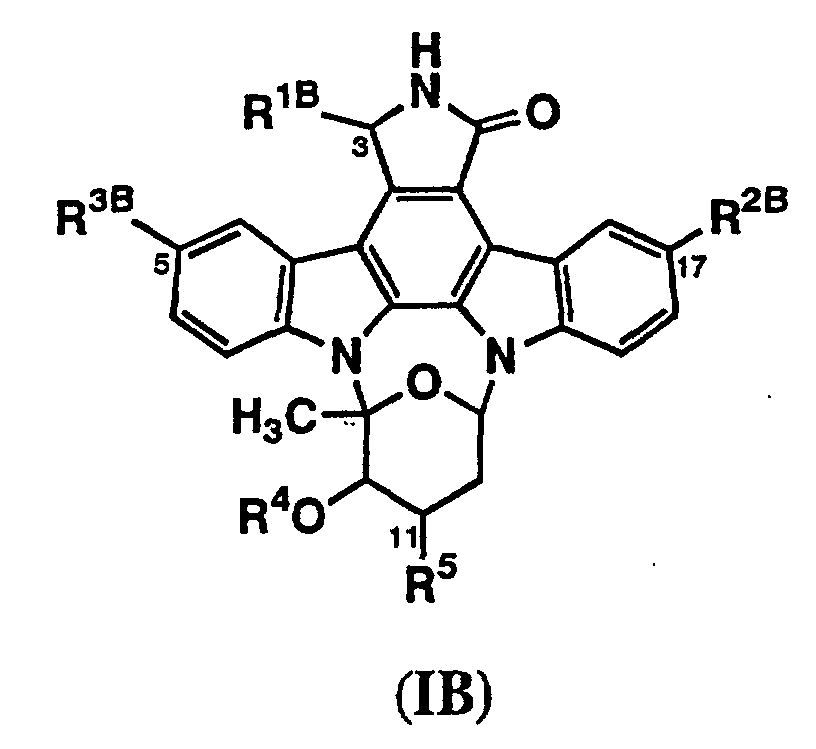
    In particular, the staurosporin derivatives or the pharmaceutically acceptable salts thereof, wherein R1B is hydroxy, are preferable. '
    Further, the present invention relates to staurosporin derivatives or pharmaceutically acceptable salts thereof, wherein in the general formula (IA),
  • R2A represents amino, halogen, formyl or hydroxy, and
  • R3A represents substituted or unsubstituted lower alkenyl, substituted or unsubstituted lower alkynyl, lower alkyl, substituted lower alkyl (the substituted lower alkyl is not hydroxymethyl), or NHCOR13A1 (wherein R13A1 has the same meaning as defined for R13 above); or
  • R2A represents substituted or unsubstituted lower alkenyl, substituted or unsubstituted lower alkynyl, lower alkyl, substituted lower alkyl (the substituted lower alkyl is not hydroxymethyl), or NHCOR13A2 (wherein R13A2 has the same meaning as defined for R13 above), and
  • R3A represents substituted or unsubstituted lower alkenyl, substituted or unsubstituted lower alkynyl, amino, substituted or unsubstituted lower alkyl, or NHCOR13A3 (wherein R13A3 has the same meaning as defined for R13 above).
  • In particular, the staurosporin derivatives or the pharmaceutically acceptable salts thereof, wherein R1A is hydroxy, are preferable.
    Further, the present invention relates to the staurosporin derivatives or the pharmaceutically acceptable salts thereof, wherein in the general formula (IB), R2B and R3B are the same or different and represent substituted or unsubstituted lower alkenyl, substituted or unsubstituted lower alkynyl, amino, halogen, formyl, hydroxy, substituted or unsubstituted lower alkyl, or NHCOR13 (wherein R13 has the same meaning as defined above).
    In particular, the staurosporin derivatives or the pharmaceutically acceptable salts thereof, wherein R1B is hydroxy, are preferable.
    Further, the present invention relates to a pharmaceutical composition comprising at least one staurosporin derivative or pharmaceutically acceptable salt thereof, represented by the general formula (IA) or (IB), and a pharmaceutically acceptable carrier.
    Further, the present invention relates to enhancers for activity of an antitumor agent, comprising the staurosporin derivative represented by the general formula (I) or the pharmaceutically acceptable salt thereof, as an active ingredient. Further, the present invention relates to the enhancers for activity enhancing the activity of an antitumor agent by abrogating accumulation action at the G2 or S stage of the cell cycle.
    Further, the present invention relates to agents for abrogating accumulation action at the G2 or S stage of the cell cycle, comprising the staurosporin derivative represented by the general formula (I) or the pharmaceutically acceptable salt thereof, as an active ingredient.
    Further, the present invention relates to enhancers for activity of an antitumor agent, comprising the staurosporin derivative represented by the general formula (IA) or (IB) or the pharmaceutically acceptable salt, as an active ingredient. Further, the present invention relates to the enhancers for activity enhancing the activity of an antitumor agent by abrogating accumulation action at the G2 or S stage of the cell cycle.
    Further, the present invention relates to agents for abrogating accumulation action at the G2 or S stage of the cell cycle, comprising the staurosporin derivative represented by the general formula (IA) or (IB) or the pharmaceutically acceptable salt, as an active ingredient.
    Further, the present invention relates to antitumor agents comprising at least one staurosporin derivative or pharmaceutically acceptable salt thereof, represented by the general formula (IA) or (IB).
    Further, the present invention relates to a pharmaceutical composition comprising at least one staurosporin derivative or pharmaceutically acceptable salt thereof, represented by the general formula (IA) or (IB).
    Further, the present invention relates to a method for treating a malignant tumor, comprising the step of administering a therapeutically effective amount of the staurosporin derivative represented by the general formula (I) or the pharmaceutically acceptable salt thereof.
    Further, the present invention relates to a method for enhancing the activity of an antitumor agent, comprising the step of administering a therapeutically effective amount of the staurosporin derivative represented by the general formula (I) or the pharmaceutically acceptable salt thereof.
    Further, the present invention relates to a method for abrogating accumulation action at the G2 or S stage of the cell cycle, comprising the step of administering a therapeutically effective amount of the staurosporin derivative represented by the general formula (I) or the pharmaceutically acceptable salt thereof.
    Further, the present invention relates to use of the staurosporin derivative represented by the general formula (I) or the pharmaceutically acceptable salt thereof for the manufacture of an antitumor agent.
    Further, the present invention relates to use of the staurosporin derivative represented by the general formula (I) or the pharmaceutically acceptable salt thereof for the manufacture of an enhancer for activity of an antitumor agent.
    Further, the present invention relates to use of the staurosporin derivative represented by the general formula (I) or the pharmaceutically acceptable salt thereof for the manufacture of an agent for abrogating accumulation action at the G2 or S stage of the cell cycle.
    Further, the present invention relates to a method for treating a malignant tumor, comprising the step of administering a therapeutically effective amount of the staurosporin derivative represented by the general formula (IA) or (IB) or the pharmaceutically acceptable salt thereof.
    Further, the present invention relates to a method for enhancing the activity of an antitumor agent, comprising the step of administering a therapeutically effective amount of the staurosporin derivative represented by the general formula (IA) or (IB) or the pharmaceutically acceptable salt thereof.
    Further, the present invention relates to a method for abrogating accumulation action at the G2 or S stage of the cell cycle, comprising the step of administering a therapeutically effective amount of the staurosporin derivative represented by the general formula (IA) or (IB) or the pharmaceutically acceptable salt thereof.
    Further, the present invention relates to use of the staurosporin derivative represented by the general formula (IA) or (IB) or the pharmaceutically acceptable salt thereof for the manufacture of an antitumor agent.
    Further, the present invention relates to use of the staurosporin derivative represented by the general formula (IA) or (IB) or the pharmaceutically acceptable salt thereof for the manufacture of an enhancer for activity of an antitumor agent.
    Further, the present invention relates to use of the staurosporin derivative represented by the general formula (IA) or (IB) or the pharmaceutically acceptable salt thereof for the manufacture of an agent for abrogating accumulation action at the G2 or S stage of the cell cycle.
    Hereinafter, the compound represented by the general formula (I) is referred to as Compound (I). The compounds of other formula numbers are referred to in the same manner.
    In the definition of each group in Compound (I), Compound (IA) and Compound (IB), the lower alkyl means the straight-chain or branched alkyl having 1 to 8 carbon atoms, for example, methyl, ethyl, propyl, isopropyl, butyl, isobutyl, sec-butyl, tert-butyl, pentyl, neopentyl, hexyl, heptyl, octyl, etc.
    The lower alkyl moieties of the lower alkoxy and lower alkoxycarbonyl have the same meaning as defined for the lower alkyl described above.
    The cycloalkyl means the cycloalkyl having 3 to 6 carbon atoms, for example, cyclopropyl, cyclobutyl, cyclopentyl, cyclohexyl, etc.
    The lower alkenyl means the straight-chain or branched alkenyl having 2 to 6 carbon atoms, for example, vinyl, allyl, butenyl, pentenyl, hexenyl, etc.
    The lower alkadienyl means the straight-chain or branched alkadienyl having 5 to 8 carbon atoms, for example, pentadienyl, hexadienyl, heptadienyl, octadienyl, etc.
    The lower alkynyl means the straight-chain or branched alkynyl having 2 to 8 carbon atoms, for example, ethynyl, propynyl, butynyl, pentynyl, hexynyl, heptynyl, octynyl, etc.
    The lower alkanoyl means the straight-chain or branched alkanoyl having 2 to 9 carbon atoms, for example, acetyl, propionyl, butyryl, isobutyryl, valeryl, isovaleryl, pivaloyl, hexanoyl, heptanoyl, octanoyl, etc.
    The aryl and the aryl moiety of the aroyl mean, for example, phenyl, naphthyl, etc.
    The heterocyclic group means, for example, aliphatic heterocyclic groups such as pyrrolidinyl, imidazolidinyl, piperidinyl, morpholinyl, thiomorpholinyl, piperidino, morpholino and piperadinyl, or aromatic heterocyclic groups such as furyl, thienyl, pyrrolyl, imidazolyl, triazolyl, oxazolyl, thiazolyl, pyridyl, pyrimidinyl, indolyl, quinolyl, isoquinolyl and quinazolinyl.
    The heterocyclic group formed together with their adjacent N (the heterocyclic group formed together with their adjacent N may contain oxygen, sulfur, or other nitrogen atoms) means pyrrolidinyl, morpholino, thiomorpholino, N-methylpiperadinyl, pyrazolidinyl, piperidino, piperadinyl, homopiperadinyl, indolyl, isoindolyl, etc.
    The halogen means an atom of fluorine, chlorine, bromine or iodine atom.
    The amino acid means α-amino acids such as glycine, alanine, proline, glutamic acid, lysine, serine, cysteine, cystine, threonine, valine, methionine, leucine, isoleucine, norleucine, phenylalanine, tyrosine, thyroxine, hydroxyproline, tryptophan, aspartic acid, arginine, ornithine and histidine. The protective group for a functional group in the amino acid is the one used usually in peptide synthesis, and means, for example, benzyloxycarbonyl, tert-butoxycarbonyl, benzyloxy, tert-butoxy, methoxybenzenesulfonyl, etc.
    The substituents in the substituted lower alkyl and substituted lower alkoxy include 1 to 3 substituents which are the same or different, for example, halogen, carboxy, lower alkoxycarbonyl, lower alkanoyl, aryl, substituted aryl (the substituents in the substituted aryl have the same meanings as defined for the substituents in the substituted aryl described below), a heterocyclic group, a substituted heterocyclic group (the substituents in the substituted heterocyclic group have the same meanings as defined for the substituents in the substituted heterocyclic group described below), CONR15R16 {wherein R15 and R16 are the same or different and represent hydrogen, hydroxy, aralkyl, lower alkyl, lower alkenyl, aryl, substituted aryl (the substituents in the substituted aryl have the same meanings as defined for the substituents in the substituted aryl described below), a heterocyclic group, or a substituted heterocyclic group (the substituents in the substituted heterocyclic group have the same meanings as the substituents in the substituted heterocyclic group described below), or are combined with their adjacent N to form a heterocyclic group (the heterocyclic group formed together with their adjacent-N may contain oxygen, sulfur, or other nitrogen atoms)}, NR17R18 [wherein R17 and R18 are the same or different and represent hydrogen, lower alkyl, lower alkenyl, lower alkanoyl, aroyl, aryl, substituted aryl (the substituents in the substituted aryl have the same meanings as defined for the substituents in the substituted aryl described below), a heterocyclic group, a substituted heterocyclic group (the substituents in the substituted heterocyclic group have the same meanings as the substituents in the substituted heterocyclic group described below), substituted lower alkyl {the substituted lower alkyl is replaced by at least one of hydroxy, lower alkoxy, O(CH2CH2O)nR19 (wherein n is an integer of 1 to 15, and R19 is lower alkyl), oxo, carboxy, lower alkoxycarbonyl, aryl, substituted aryl (the substituents in the substituted aryl have the same meanings as defined for the substituents in the substituted aryl described below), a heterocyclic group, a substituted heterocyclic group (the substituents in the substituted heterocyclic group have the same meanings as defined for the substituents in the substituted heterocyclic group described below), CONR15AR16A (wherein R15A and R16A have the same meanings as defined for R15 and R16 described above, respectively), amino, lower alkylamino, and di(lower alkyl)amino}, cycloalkyl, or aralkyloxycarbonyl, are combined with their adjacent N to form a heterocyclic group (the heterocyclic group formed together with their adjacent N may contain oxygen, sulfur, or other nitrogen atoms), or are combined with their adjacent N to form a substituted heterocyclic group (the substituted heterocyclic group formed together with their adjacent N may contain oxygen, sulfur, or other nitrogen atoms, and the substituents in the substituted heterocyclic group formed together with their adjacent N have the same meanings as defined for the substituents in the substituted heterocyclic group formed together with their adjacent N described below)], N+R20R21R22X- {wherein R20 and R21 are the same or different and represent lower alkyl, or are combined with their adjacent N to form a heterocyclic group (the heterocyclic group formed together with their adjacent N may contain oxygen, sulfur, or other nitrogen atoms), R22 is lower alkyl, and X is an atom of chlorine, bromine or iodine}, OR23 {wherein R23 represents hydrogen, lower alkyl, lower alkanoyl, substituted lower alkyl {the substituted lower alkyl is replaced by at least one of hydroxy, lower alkoxy, O(CH2CH2O)nAR19A (wherein nA is an integer of 1 to 15, and R19A is lower alkyl), oxo, carboxy, lower alkoxycarbonyl, aryl, substituted aryl (the substituents in the substituted aryl have the same meanings as defined for the substituents in the substituted aryl described below), a heterocyclic group, a substituted heterocyclic group (the substituents in the substituted heterocyclic group have the same meanings as defined for the substituents in the substituted heterocyclic group described below), CONR15BR16B {wherein R15B and R16B have the same meanings as defined for R15 and R16 described above, respectively}, amino, lower alkylamino, and di(lower alkyl)amino}, aryl, substituted aryl (the substituents in the substituted aryl have the same meanings as defined for the substituents in the substituted aryl described below), a heterocyclic group, and a substituted heterocyclic group (the substituents in the substituted heterocyclic group have the same meanings as defined for the substituents in the substituted heterocyclic group described below)}, SR23A (wherein R23A has the same meaning as defined for R23 described above) or SO2R23B (wherein R23B is lower alkyl), etc. The lower alkyl moieties of the lower alkyl, lower alkoxy, lower alkoxycarbonyl, lower alkylamino and di(lower alkyl)amino have the same meanings as defined for the lower alkyl described above. The cycloalkyl and the lower alkenyl have the same meanings as defined for the cycloalkyl and lower alkenyl described above, respectively. The lower alkanoyl has the same meaning as defined for the lower alkanoyl described above. The aryl and the aryl moiety of the aroyl have the same meanings as defined for the aryl described above, and the aralkyl and the aralkyl moiety of the aralkyloxycarbonyl mean the aralkyl having 7 to 15 carbon atoms, for example, benzyl, phenetyl, benzhydryl, naphthylmethyl, etc. The heterocyclic group has the same meaning as defined for the heterocyclic group described above, and the heterocyclic group formed together with their adjacent N has the same meaning as defined for the heterocyclic group formed together with their adjacent N described above. The halogen has the same meaning as defined the halogen described above.
    The substituents in the substituted lower alkenyl, substituted lower alkadienyl and substituted lower alkynyl include oxo in addition to the substituents in the substituted lower alkyl described above.
    The substituents in the substituted lower alkanoyl include 1 to 3 substituents which are the same or different, for example, halogen, NR17AR18A (wherein R17A and R18A have the same meanings as defined for R17 and R18 described above, respectively), etc.
    The substituents in the substituted aryl and substituted aroyl include 1 to 3 substituents which are the same or different, for example, halogen, lower alkyl, substituted lower alkyl (the substituents in the substituted lower alkyl are halogen, oxo, carboxy, lower alkoxycarbonyl, amino, lower alkylamino, di(lower alkyl)amino, hydroxy or lower alkoxy), nitro, hydroxy, lower alkoxy, amino, lower alkylamino, di(lower alkyl)amino, lower alkanoyl, cyano, etc. The lower alkyl moieties in the lower alkyl, lower alkoxycarbonyl, lower alkoxy, lower alkylamino or di(lower alkyl)amino have the same meaning as defined for the lower alkyl described above. The lower alkanoyl has the same meaning as defined for the lower alkanoyl described above. The halogen has the same meaning as defined for the halogen described above.
    The substituents in the substituted heterocyclic group and substituted heterocyclic group formed together with their adjacent N include oxo in addition to the substituents in the substituted aryl and the substituted aroyl described above.
    The pharmaceutically acceptable salts of Compound (I) include pharmaceutically acceptable acid addition salts, metal salts, ammonium salts, organic amine addition salts, aminoacid addition salts, etc. The acid addition salts include inorganic acid salts such as hydrochloride, sulfate and phosphate and organic acid salts such as methane sulfonate, acetate, maleate, fumarate, tartrate, citrate and lactate; themetal salts include alkali metal salts such as sodium salt and potassium salt, alkaline earth metal salts such as magnesium salt and calcium salt, aluminum salt, zinc salt, etc.; the ammonium salts include salts of ammonium, tetramethylammonium, etc.; the organic amine addition salts include addition salts of morpholine, piperidine, etc.; and the amino acid addition salts include addition salts of lysine, glycine, phenylalanine, aspartic acid, glutamic acid, etc.
    The antitumor agent, which can be used in combination withthe enhancers for activity provided by the present invention, includes anticancer agents having actions on DNA, for example, platina preparations such as Cisplatin and Carboplatin, Mitomycin type drugs, nitrogen mustard type drugs, nitrosourea type- drugs, Camptothecine derivatives (topoisomerase I inhibitors) such as CPT-11 and Topotecan, and Etoposide (topoisomerase II inhibitor), etc., and antimetabolites, for example, 5-Fluorouracil derivatives, Cytidine derivatives such as Cytosine arabinoside (Ara-C) and Gemcitabine, Adenosine derivatives such as Fludarabine, Methotrexate derivatives, TS (thymidylic acid synthase) inhibitors such as Toumidex, etc.
    Hereinafter, the processes for the production of Compound (I) are described.
    Unless otherwise specified, each group in the reaction steps described below has the same meaning as defined above.
    Compound (I) can be produced by the following reaction steps.
    In the processes shown below, if the defined groups are changed under the conditions of the practical process or are not appropriate for the practice of the process, the objective compounds can be obtained using the methods for introducing and eliminating protective groups ordinarily used in synthetic organic chemistry [for example, T. W. Greene: Protective Groups inorganic Synthesis, John Wiley & Sons Inc. (1981)]. And also, the order of the reaction steps such as introduction of the substituents etc., can be altered, if necessary.
    Process 1
    Compound (Ia), that is, Compound (I) wherein R1 is hydrogen, can-be produced in a known method [for example, the compound, wherein R2 or R3 is substituted or unsubstituted lower alkyl, substituted or unsubstituted lower alkenyl, substituted or unsubstituted lower alkynyl, substituted or unsubstituted aryl, a substituted or unsubstituted heterocyclic group, halogen, nitro, formyl, COR6 (wherein R6 has the same meaning as defined above), NR11R12 (wherein R11 and R12 have the same meanings as defined above, respectively), etc., can be obtained in a method described in WO88/7045, WO97/46565, etc. and the compound, wherein, R2 or R3 is formyl, lower alkanoyl, carboxy, lower alkoxycarbonyl, OR14 (wherein R14 has the same meaning as defined above), etc., can be obtained in a method described in Japanese Published Unexamined Application No.3-220194, WO94/6799, etc.] or in a method similar thereto, from Compound (II), which can be obtained in a known method [J. Am. Chem. Soc., 117, 552 (1995), J. Antibiotics, 30, 275 (1977), J. Chem. Soc., Chem. Comm., 800 (1978), etc.]
    Figure 00270001
    (wherein R2, R3, R4 and R5 have the same meanings as defined above, respectively)
    Process 2
    Compound (Ib), that is, Compound (I) wherein R1 is hydroxy or lower alkoxy, can be produced in a known method (for example, the compound, wherein R1 is hydroxy, can be obtained in a method described in WO89/7105, Japanese Published Unexamined Application No.1-168689, Japanese Published Unexamined Application No.6-9645, etc., and the compound, wherein R1 is lower alkoxy, can be obtained in a method described in WO89/7105, Japanese Published Unexamined Application No.1-168689, etc.) or in a method similar thereto, from Compound (Ia).
    Figure 00280001
    (wherein R1a is hydroxy or lower alkoxy, and R2, R3, R4 and R5 have the same meanings as defined above, respectively)
    Transformations of functional groups, contained in substituents in R1, R2, R3, R4 or R5 in Compound (I), obtained in the Examples, and the compounds, obtained in the Reference Examples, can also be conducted by other methods known in the art [for example, R. C. Larock: Comprehensive Organic Transformations (1989)], in addition to the method described above.
    By a suitable combination of the methods described above, Compound (I) having objective functional groups at objective positions can be obtained.
    The objective products in the processes described above can be isolated and purified by a suitable combination of techniques used in ordinary organic synthesis, such as filtration, extraction, washing, drying, concentration, crystallization and various kinds of chromatography. Further, the intermediates can also be subjected to the subsequent reaction without particular purification.
    Compound (I) can exist as isomers such as regioisomers, geometrical isomers, tautomers or optical isomers, and in the present invention, all possible isomers or the mixture thereof in any ratio can be used as the antitumor agents, the enhancers for activity of an antitumor agent, and the agents for abrogating accumulation action at the G2 or S stage of the cell cycle.
    Among Compound (I), compounds having the same configuration at the 9-, 10-, 11- and 13-positions as in staurosporin shown in the following formula, are more preferred.
    Figure 00290001
    In the case where a salt of Compound (I) is desired, when Compound (I) is obtained in the form of the salt, it may be directly purified, while when Compound (I) is obtained in its free form, it may be dissolved or suspended in a suitable solvent, and converted into the salt followed by adding an acid or a base thereto.
    Compound (I) or pharmaceutically acceptable salts thereof may exist in the form of adducts with water or various solvents, and these adducts also fall under the scope of the present invention.
    Specific examples of Compound (I) are shown in Table 1, and the compounds described in the Reference Examples are shown in Table 2. With respect to stereochemistry based on the substituent R1 at the 3-position, (a), (b) and (c) in the tables indicate an isomer of longer retention time, an isomer of shorter retention time, and a mixture of the two isomers, respectively, under the following conditions for high performance liquid chromatography (HPLC).
  • HPLC analysis was conducted as follows.
  • Column: YMC AM312 (50×6 mm I.D.)
  • Mobile phase: Starting from 50 % methanol-a 0.02 mol/L phosphate buffer (pH = 7), the concentration of methanol was increased at a predetermined rate over 15 minutes to 100 % methanol, and thereafter, the sample was eluted with 100 % methanol.
  • Figure 00310001
    Figure 00320001
    Figure 00330001
    Figure 00340001
    Figure 00350001
    Figure 00360001
    Figure 00370001
    Figure 00380001
    Figure 00390001
    Figure 00400001
    Figure 00410001
    Figure 00420001
    Figure 00430001
    Figure 00440001
    Figure 00450001
    Figure 00460001
    Figure 00470001
    Compound (I) or pharmaceutically acceptable salts thereof can be used as it is or in various pharmaceutical forms, depending on the pharmacological action thereof and the object of administration. The pharmaceutical compositions of the present invention can be produced by uniformly mixing an effective amount of Compound (I) or a pharmaceutically acceptable salt thereof as an active ingredient with a pharmaceutically acceptable carrier. The carrier can be in various forms depending on the form of a preparation desirable for administration. These pharmaceutical compositions are desirably in a unit administration form being suitable for oral administration or parenteral administration such as an ointment or injection.
    For the preparation of tablets, for example, an excipient such as lactose, glucose, sucrose, mannitol or methyl cellulose, a disintegrator such as starch, sodium alginate, carboxymethyl cellulose calcium or crystalline cellulose, a lubricant such as magnesium stearate or talc, a binder such as gelatin, polyvinylalcohol, polyvinylpyrrolidone, hydroxypropyl cellulose or methyl cellulose, or a surfactant such as a sucrose fatty acid ester or a sorbitol fatty acid ester may be used in a usual manner. Tablets containing 1 to 200 mg of an active ingredient per tablet are preferred.
    For the preparation of granules, for example, an excipient such as lactose or sucrose, a disintegrator such as starch, or a binder such as gelatin may be used in a usual manner.
    For the preparation of powders, for example, an excipient such as lactose or mannitol may be used in a usual manner.
    For the preparation of capsules, for example, gelatin, water, sucrose, gum Arabia, sorbitol, glycerin, crystalline cellulose, magnesium stearate, talc, etc., may be used in a usual manner. Capsules containing 0.1 to 200 mg of an active ingredient per capsule are preferred.
    For the preparation of syrups, for example, a sugar such as sucrose, water, ethanol, etc., may be used in a usual manner.
    For the preparation of ointments, for example, anointment base such as vaseline, liquid paraffin, lanoline or Macrogol, or an emulsifier such as sodium lauryl lactate, benzalkonium chloride, a sorbitan mono-fatty acid ester, carmellose sodium, or gum Arabia, etc., may be used in a usual manner.
    For the preparation of injections, for example, water, physiological saline, a vegetable oil (olive oil, peanut oil, etc.), a solvent (ethyl oleate, propylene glycol, polyethylene glycol, etc.), a solubilizing agent (sodium benzoate, sodium salicylate, urethane, etc.), an isotonizing agent (sodium chloride, glucose, etc.), a preservative (phenol, cresol, p-hydroxybenzoic acid ester, chlorobutanol, etc.), or an antioxidant (ascorbic acid, sodium pyrosulfite, etc.), may be used in a usual manner.
    Compound (I) or pharmaceutically acceptable salts thereof can be administered orally or parenterally as an ointment or injection, and generally preferred to be administered in a dose of 0.1 to_200 mg/kg per day, although the effective dose and frequency of administration are varied depending on the administration form, patient's age or weight, symptoms, etc.
    Hereinafter, the activity of Compound (I) is described by reference to Test Examples.
    Test Example 1. Test for inhibitory activity on cell growth in human lung cancer cell line A-549
    A human lung cancer cell line A-549, which was prepared at a density of 1.0×10⁴ cells/mL in a Roswell Park Memorial Institute's Medium (PRMI) 1640 medium containing 10 % fetal bovine serum and Penicillin/Streptomycin, was put in an amount of 0.1 mL/well on a 96 MicroWell™ plate (Catalog No. 167008, produced by Nunc). The cells were cultured at 37 °C for 20 hours in a CO2 gas incubator, a 10 mmol/L solution of each test compound in dimethyl sulf oxide (DMSO) was diluted with the culture medium, the diluted mixture was added into each well in an amount of 0.05 mL/well, the mixture was diluted stepwise by pipetting on the plate, and the cells were cultured at 37 °C for 72 hours in a CO2 gas incubator.
    After the removal of the culture supernatant, a medium containing 1 mg/mL of 3-(4,5-dimethylthiazol-2-yl)-2,5-diphenyltetrazolium bromide (Sigma) was added into each well in an amount of 0.05 mL/well and the cells were cultured at 37 °C for 5 hours in a CO2 gas incubator. Then, the medium was removed, and DMSO was added into each well in an amount of 0.1 mL/well. The plate was vigorously stirred using a plate mixer, and then the absorbance of each cell at 550 nm was measured by a microplate reader (Wako Pure Chemical Industries, Ltd.) The inhibitory activity on cell growth was calculated as a 50 % inhibitory concentration (IC50) by use of the formula in measurement software (Soft Max Pro) attached to the microplate reader.
    Test Example 2. Test for affinity with human AGP using Dextran Coated Charcoal (DCC)
    A solution of the test compound in DMSO was added to an isotonic phosphate buffer (PBS, pH = 7.4) containing human AGP, to prepare an equimolar solution (20 µmol/L) of the test compound and human AGP. The solution was pre-incubated at 37 °C for 15 minutes and then mixed with an equal volume of 4 mg/mL of DCC in PBS, and incubation was further continued. After two hours from mixing, a part of the solution was sampled and centrifuged (4 °C, 20000×g, 2 minutes) to precipitate the charcoal, and the supernatant was subjected to HPLC analysis. Separately, an equimolar solution (20 µmol/L) of the test compound and human AGP was mixed with an equal volume of PBS (pH = 7.4), and then the mixed solution was subjected as a DCC-untreated sample to HPLC analysis. The ratio of the peak area of the DCC-treated sample to the average peak area of the DCC-untreated sample (the solution mixed with PBS) was calculated as the degree of binding (%). A compound showing a lower degree of binding was regarded as a compound having a lower binding activity to human AGP.
    The results in Test Examples 1 and 2 are shown in Table 3.
    Compound No. Inhibitory activity on cell growth (IC50/µmol/L) Degree of binding to hα1AGP (%)
    UCN-01 0.018 76.8
    2 0.015 20.5
    3 0.059 10.6
    11 0.053 5.8
    15 0.074 18.0
    36 0.076 36.1
    40 0.024 33.5
    44 0.0051 16.4
    64 0.026 19.8
    102 0.0092 37.7
    129 0.11 18.4 and 9.6
    147 0.19 36.9
    172 0.14 18.0
    176 0.034 21.2
    Test Example 3. Action of the compound on abrogation of accumulation action at the G2 stage and S stage of the cell cycle
    The action of the compound on abrogation of accumulation action at G2 stage and S stage of the cell cycle was examined by using human epidermal cancer cell line A431 (hereinafter referred to as A431 cells). A suspension of A431 cells, which was prepared at a density of 3×10⁴ cells/mL in DMEM medium containing 10 % fetal bovine serum (hereinafter referred to as medium A, produced by Nissui), was pipetted in a volume of 10 mL onto a 10 cm Petri dish (Catalog No. 3003, produced by Falcon). The Petri dish was incubated at 37 °C for 24 hours in a CO2 gas incubator. Then, Cisplatin (Sigma) prepared at a final concentration of 20 µmol/L in medium A, was added into the Petri dish and the Petri dish was further incubated at 37 °C for 1 hour in a CO2 gas incubator.
    After the removal of the medium, the cells were washed with PBS(-) [phosphate buffered saline (not containing calcium ions), produced by Dainippon Pharmaceutical Co., Ltd.], then medium A was further added into the Petri dish, and the cells were cultured at 37°C for 15 hours in a CO2 gas incubator. The test compound diluted appropriately with medium A was added into the Petri dish, and then the cells were cultured at 37 °C for 8 hours in a CO2 gas incubator. After the removal of the culture supernatant, the cells were washed with PBS(-), detached in an aqueous solution of 0.25 % of Trypsin (GIBCO BRL) and 0.02 % of ethylenediaminetetraacetic acid (Wako Pure Chemical Industries, Ltd.), then fixed at a density of 106 cells/mL with a 70 % aqueous solution of ethanol and stored in a cold room at 4 °C. Ethanol was removed by centrifugation from the fixed cells, and then the fixed cells were washed with PBS(-). The cells were treated at 37 °C for 30 minutes with a 0.25 mg/mL PBS(-)solution of ribonuclease A type 1-A (Sigma) containing 0.1 % of Nonidet P-40 (Nacalai Tesque, Inc.), and then a solution of propidium iodide (Sigma) in 0.1 % NP-40/PBS(-) was added into the cells at a final concentration of 50 µg/mL, and the cells were stained in ice for at least 20 minutes.
    A DNA histogram was taken by EPICS ELITE Flow Cytometer, and the cell cycle distribution was analyzed by use of MultiCycle Program.
    The results are shown in Table 4. In the method shown in Test Example 3, the G2 stage and the M stage of the cell cycle can not be distinguished from each other, and thus the distribution of the G2 stage combined with that of the M stage (G2 stage + M stage) is expressed in percentage. However, the M stage accounts for only 1 % of the whole (100 %), so the ratio of the distribution of (G2 stage + M stage) is considered almost identical with that of the G2 stage.
    Cell cycle distribution (%)
    G1 stage S stage G2 stage + M stage
    Non-treatment 36.1 49.9 14.0
    Cisplatin(20µmo/L) 5.5 77.0 17.5
    Cisplatin(20µmo/L) + UCN-01(50nmol/L) 31.9 40.5 27.6
    Cisplatin(20µmo/L) + Compound 3(200nmol/L) 22.0 55.3 22.7
    Cisplatin(20µmo/L) + Compound 11(200nmol/L) 28.5 54.0 17.5
    Cisplatin(20µmo/L) + Compound 22(200nmol/L) 15.7 46.3 38.1
    Cisplatin(20µmo/L) + Compound 52(200nmol/L) 22.9 63.7 13.4
    An increase in the S stage, an increase in (G2 stage + M stage) and a decrease in the G1 stage (prevention of progress toward the next cell cycle, that is, accumulation action at the G2 stage or S stage) were recognized in the cell cycle distribution in the group, which was treated with only Cisplatin (20 µmol/L), in comparison to the cell cycle distribution in the untreated group.
    When UCN-01 (50 nmol/L) was used in combination with Cisplatin (20 µmol/L), a decrease in the S stage and an increase in the G1 stage (abrogation of accumulation action at the G2 stage and S stage) were recognized.
    Also when Compound 3, 11, 22 or 52 (each 200 nmol/L) was used in combination with Cisplatin, the action of abrogating accumulation action at the G2 stage and S stage was also similarly confirmed. Accordingly, it was suggested that the compounds of the present invention abrogate accumulation action at the G2 stage and S stage, thus enhancing the cell-killing effect of Cisplatin.
    Best Mode for Carrying Out the Invention
    Hereinafter, the present invention is described in more detail by the Examples.
    In proton nuclear magnetic resonance spectrum (1H-NMR) used in the Examples, an exchangeable hydrogen may not clearly be measured depending on the compound used and measurement conditions. Signal multiplicity is expressed in conventional terms where br is indicative of an apparently broad signal.
    Example 1. Compounds 1 and 2 Step 1
    1.01 g (1.68 mmol) of Compound b obtained in Reference Example 2 was dissolved in 100 mL of methylene chloride followed by adding 0.30 mL (6.9 mmol) of fuming nitric acid, and then the mixture was stirred for 10 minutes. The reaction mixture was neutralized with a saturated aqueous solution of sodium bicarbonate, and subjected to extraction with chloroform. The organic layer was washed with water and then with a saturated saline solution, and dried over anhydorus sodium sulfate. After the solvent was distilled away, the residue was purified by silica gel column chromatography (eluted with chloroform/methanol = 40/1) and triturated in methanol to give 800 mg of 17-nitro-11-N-benzyloxycarbonyl staurosporin (73 %).
       1H-NMR (270 M Hz, DMSO-d6) δ (ppm) : 10.24 (1H, brs), 8.48 (1H, s), 8.34 (1H, dd, J = 8.6, 1.7 Hz), 8.08 (1H, d, J = 7.9 Hz), 7.95 (1H, d, J = 8.6 Hz), 7.78 (1H, brd, J = 9.2 Hz), 7.53 (1H, dd, J = 7.9, 7.6 Hz), 7.44 - 7.12 (6H, m), 7.10 (1H, m), 5.24 (1H, d, J = 13.2 Hz), 5.18 (1H, d, J = 12.5 Hz), 5.08 (2H, s), 4.68 (1H, m), 4.26 (1H, brs), 2.83 (1H, m), 2.75 (3H, s), 2.64 (3H, s), 2.35 (1H, m), 2.32 (3H, s).
       MS (FAB, m/z): 646 (M + 1)+
    Step 2
    205 mg (0.318 mmol) of 17-nitro-11-N-benzyloxycarbonyl staurosporin was dissolved in 20 mL of N,N-dimethylformamide and, subjected to catalytic reduction in an atmosphere of hydrogen in the presence of 206 mg of palladium hydroxide at ordinary temperature under normal pressure for 2 hours. After the reaction mixture was filtered with Celite, the solvent was removed under reduced pressure, and the residue was purified by preparative thin-layer chromatography (developed with chloroform/methanol = 4/1), to give 114 mg of 17-aminostaurosporin (75 %).
       1H-NMR (270 M Hz, DMSO-d6) δ (ppm): 8.48 (1H, d, J = 1.3 Hz), 8.43 (1H, s), 7.99 - 7.92 (2H, m), 7.40 (1H, dd, J = 8.6, 7.3 Hz), 7.29 - 7.24 (2H, m), 6.85 (1H, dd, J = 8.6, 1.3 Hz), 6.61 (1H, m), 4.90 (2H, s), 4.10 (1H, brs), 3.26 (1H, m), 3.18 (3H, brs), 2.41 (2H, m), 2.31 (3H, s), 1.66 (3H, brs).
       MS (FAB, m/z): 482 (M + 1)+
    Step 3
    108 mg (0.224 mmol) of 17-aminostaurosporin was dissolved in dimethyl sulfoxide followed by adding 2.0 mL of a 6 mol/L aqueous solution of sodium hydroxide, and then the mixture was stirred at room temperature for 1 hour. After the reaction was completed, the reaction mixture was diluted with an iced water, and treated with HP-20 resin (Mitsubishi Kagaku Diaion HP20) to remove the dimethyl sulfoxide by washing with water. And the components absorbed were eluted with methanol and then with acetone, and the solvent was distilled away under reduced pressure. The residue was separated and purified by preparative thin-layer chromatography (developed with chloroform/methanol/28 % ammonia water = 40/10/1) and then by preparative thin-layer chromatography (developed with chloroform/methanol = 4/1) and triturated in a mixed solvent of ethyl acetate and diisopropyl ether to give 19.1 mg of Compound 1 (17 %) and 26.1 mg of Compound 2 (23 %). The ratio of the respective diastereoisomers based on their hydroxyl group by HPLC was as follows: Compound 1 (96 % d.e.) and Compound 2 (95 % d.e.)
    Compound 1
    1H-NMR (270 M Hz, DMSO-d6) δ (ppm): 8.65 (1H, s), 8.42 (1H, d, J = 2. 2 Hz), 8.40 (1H, d, J = 8.6 Hz), 7.94 (1H, d, J = 8.3 Hz), 7.37 (1H, ddd, J = 8.3, 7.5, 0.8 Hz), 6.84 (1H, dd, J = 8.6, 2.2 Hz), 7.30 - 7.20 (2H, m), 6.56 (1H, m), 6.39 (1H, d, J = 10.0 Hz), 6.34 (1H, d, J = 10.0 Hz), 4.86 (2H, brm), 4.08 (1H, brd, J = 3.0 Hz), 3.27 (3H, brs), 3.33 (1H, m), 2.50 (2H, m), 2.27 (3H, s), 1.67 (3H, brs).
       MS (FAB, m/z): 498 (M + 1)+
    Compound 2
    1H-NMR (270 M Hz, DMSO-d6) δ (ppm): 8.65 (1H, s), 8.42 (1H, d, J = 2. 0 Hz), 8.34 (1H, dd, J = 7.9, 0.8 Hz), 7.95 (1H, d, J = 8.6 Hz), 7.37 (1H, ddd, J = 8.6, 7.9, 0.8 Hz), 7.29 - 7.20 (2H, m), 6.84 (1H, dd, J = 8.6, 2.0 Hz), 6.57 (1H, m), 6.34 (2H, s), 4.08 (1H, m), 3.33 (1H, m), 3.25 (3H, brs), 2.43 (2H, m), 2.28 (3H, s), 1.60 (3H, brs).
       MS (FAB, m/z): 498 (M + 1)+
    Example 2. Compounds 3 and 4 Step 1
    In a manner similar to that in step 2 of Example 1, 210 mg (0.305 mmol) of Compound f obtained in Reference Example 6 was subjected to catalytic reduction in an atmosphere of hydrogen in the presence of 211 mg of palladium hydroxide to give 116 mg of 5,17-diaminostaurosporin (77 %).
       1H-NMR (270 MHz, DMSO-d6) δ (ppm): 8.45 (1H, d, J = 2.0 Hz), 8.33 (1H, s), 7.64 (1H, d, J = 9.2 Hz), 7.23 (1H, d, J = 8.6 Hz), 7.10 (1H, s), 6.82 (1H, dd, J = 8.6, 2.0 Hz), 6.76 (1H, d, J = 9.2 Hz), 6.55 (1H, m), 4.80 (2H, s), 4.77 (4H, brm), 4.02 (1H, brs), 3.34 (1H, m), 3.11 (3H, brs), 2.68 (1H, m), 2.50 (1H, m), 2.24 (3H, s), 1.76 (3H, brs).
       MS (FAB, m/z): 497 (M + 1)+
    Step 2
    In a manner similar to that in step 3 of Example 1, 9.9 mg of Compound 3 (11 %) and 11.4 mg of Compound 4 (13 %) were obtained from 87.1 mg (0.170 mmol) of 5,17-diaminostaurosporin, dimethyl sulfoxide, and 1.7 mL of a 6 mol/L aqueous solution of sodium hydroxide. The ratio of the respective diastereoisomers based on their hydroxyl group by HPLC was as follows: Compound 3 (90 % d.e.) and Compound 4 (91 % d.e.) Compound 3
       1H-NMR (270 MHz, DMSO-d6) δ (ppm): 8.55 (1H, s), 8.40 (1H, d, J = 2. 3 Hz), 7.62 (1H, d, J = 8.8 Hz), 7.59 (1H, brs), 7.24 (1H, d, J = 8.8 Hz), 6.81 (1H, dd, J = 8.8, 2.2 Hz), 6.75 (1H, dd, J = 8.8, 2.3 Hz), 6.53 (1H, m), 6.22 (1H, d, J = 10.5 Hz), 6.21 (1H, d, J = 10.5 Hz), 4.81 (4H, brm), 4.01 (1H, brs), 3.33 (1H, m), 3.18 (3H, brs), 2.38 (2H, m), 2.20 (3H, s), 1.77 (3H, brs).
       MS (FAB, m/z): 513 (M + 1)+
    Compound 4
    1H-NMR (270 M Hz, DMSO-d6) δ (ppm): 8.57 (1H, s), 8.40 (1H, d, J = 2.0 Hz), 7.63 (1H, d, J = 8.7 Hz), 7.54 (1H, brs), 7.23 (1H, d, J = 8.7 Hz), 6.82 (1H, dd, J = 8.7, 2.3 Hz), 6.75 (1H, dd, J = 8.7, 2.0 Hz), 6.54 (1H, m), 6.24 (1H, d, J = 10.4 Hz), 6.18 (1H, d, J = 10.4 Hz), 4.85 (4H, m), 4.03 (1H, brs), 3.34 (1H, m), 3.11 (3H, brm), 2.50 (1H, m), 2.32 (1H, m), 2.24 (3H, s), 1.77 (3H, brs).
       MS (FAB, m/z): 513 (M + 1)+
    Example 3. Compound 5 Step 1
    115 mg (0.183 mmol) of Compound d obtained in Reference Example 4 was dissolved in 14 mL of dichloroethane followed by adding 0.20 mL (2.5 mmol) of a 37 % aqueous solution of formaldehyde, 515 mg (2.43 mmol) of sodium triacetoxyborohydride and 0.15 mL (2.5 mmol) of acetic acid, under an atmosphere of argon, and then the mixture was stirred at room temperature for 20 minutes. The reaction was terminated by adding water, and the reaction mixture was neutralized with a saturated aqueous solution of sodium bicarbonate, and subjected to extraction with chloroform. The organic Layer was washed with a saturated saline solution and dried over anhydrous sodium sulfate. After the solvent was distilled away under reduced pressure, the residue was purified by preparative thin-layer chromatography (developed with chloroform/methanol = 15/1) to give 90.4 mg of 17-dimethylamino-11-N-trifluoroacetyl staurosporin (62 %).
       1H-NMR (270 M Hz, DMSO-d6) δ (ppm): 8.89 (1H, brs), 8.56 (1H, brs), 8.06 - 7.95 (2H, m), 7.64 - 7.20 (4H, m), 6.99 (1H, brs), 4.99 (2H, s), 4.90 (1H, m), 4.43 (1H, brs), 2.97 (6H, s), 2.89 (3H, s), 2.84 (1H, m), 2.77 (3H, s), 2.50 (1H, m), 2.37 (3H, s).
       MS (FAB, m/z): 606 (M + 1)+
    Step 2
    90.1 mg (0.149 mmol) of 17-dimethylamino-11-N-trifluoroacetyl staurosporin was dissolved in a mixed solvent of 20 mL of chloroform and 10 mL of methanol followed by adding 3 mL of a 6 mol/L aqueous solution of sodium hydroxide, and then the mixture was stirred at room temperature for 30 minutes. After neutralization with 1 mol/L hydrochloric acid, the reaction mixture was made weakly alkaline with a saturated aqueous solution of sodium bicarbonate, and subjected to extraction with chloroform. The organic layer was washed with a saturated saline solution, and dried over anhydrous sodium sulfate. The solvent was distilled away under reduced pressure, and the residue was purified by preparative thin-layer chromatography (developed with chloroform/methanol = 15/1) to give 58.2 mg of Compound 5 (77 %).
       1H-NMR (270 M Hz, DMSO-d6) δ (ppm): 8.81 (1H, d, J = 2.5 Hz), 8.41 (1H, s), 7.99 - 7.93 (2H, m), 7.45 - 7.37 (2H, m), 7.26 (1H, t, J = 7.3 Hz), 7.08 (1H, dd, J = 8.9, 2.5 Hz), 6.63 (1H, m), 4.92 (2H, s), 4.07 (1H, brs), 3.34 (1H, m), 3.28 (3H, brs), 2.95 (6H, s), 2.50 (2H, m), 2.30 (3H, s), 1.53 (3H, brs).
       MS (FAB, m/z): 509 (M)+
    Example 4. Compounds 6 and 7
    In a manner similar to that in step 3 of Example 1, 7.4 mg of Compound 6 (15 %) and 12.1 mg of Compound 7 (24 %) were obtained from 48.0 mg (0.094 mmol) of Compound 5, dimethyl sulfoxide and 1.0 mL of a 6 mol/L aqueous solution of sodium hydroxide. The ratio of the respective diastereoisomers based on their hydroxyl group by HPLC was as follows: Compound 6 (95 % d.e.) and Compound 7 (91 % d.e.)
    Compound 6
    1H-NMR (270 M Hz, DMSO-d6) δ (ppm): 8.75 (1H, d, J = 2.3 Hz), 8.65 (1H, s), 8.40 (1H, d, J = 7.9 Hz), 7.94 (1H, d, J = 8.7 Hz), 7.44 (1H, d, J = 9.0 Hz), 7.37 (1H, dd, J = 8.7, 7.4 Hz), 7.23 (1H, dd, J = 7.9, 7.4 Hz), 7.09 (1H, dd, J = 9.0, 2.3 Hz), 6.60 (1H, m), 6.42 (1H, d, J = 9.9 Hz), 6.36 (1H, d, J = 9.9 Hz), 4.06 (1H, brs), 3.34 (4H, m), 2.95 (6H, s), 2.50 (2H, m), 2.27 (3H, s), 1.57 (3H, brs).
       MS (FAB, m/z): 526 (M + 1)+
    Compound 7
    1H-NMR (270 M Hz, DMSO-d6) δ (ppm): 8.75 (1H, d, J = 2.3 Hz), 8.66 (1H, s), 8.35 (1H, d, J = 7.6 Hz), 7.95 (1H, d, J = 8.4 Hz), 7.44 (1H, d, J = 8.9 Hz), 7.38 (1H, dd, J = 8.4, 7.3 Hz), 7.23 (1H, dd, J = 7.6, 7.3 Hz), 7.09 (1H, dd, J = 8.9, 2.3 Hz), 6.61 (1H, m), 6.36 (2H, s), 4.06 (1H, brs), 3.34 (1H, m), 3.28 (3H, brm), 2.95 (6H, s), 2.50 (2H, m), 2.28 (3H, s), 1.48 (3H, brs).
       MS (FAB, m/z): 526 (M + 1)+
    Example 5. Compounds 8 and 9 Step 1
    1.02 g (1.48 mmol) of Compound f obtained in Reference Example 6 was dissolved in a mixed solvent of 50 mL of tetrahydrofuran and 50 mL of ethanol followed by adding 4.42 g (19.6 mmol) of tin (II) chloride·2H2O, and then the mixture was heated to 60 °C. A solution of 169 mg (4.47 mmol) of sodium borohydride in a mixed solvent of 10 mL of tetrahydrofuran and 10 mL of ethanol was added to the above mixture, and the mixture was stirred for 7 hours. After the reaction was completed, the reaction mixture was diluted with tetrahydrofuran and ethyl acetate, and then neutralized by the gradual addition of a saturated aqueous solution of sodium bicarbonate. The resulting precipitates were separated by filtration. The filtrate was subjected to extraction with ethyl acetate, the extract was washed with a saturated saline solution and dried over anhydrous sodium sulfate, and then the solvent was distilled away under reduced pressure. The residue was purified by silica gel column chromatography (eluted with chloroform/methanol/acetic acid = 9/1/0.1) and triturated in ethyl acetate to give 388 mg of 5,17-diamino-11-N-benzyloxycarbonyl staurosporin (44 %).
       1H-NMR (270 M Hz, DMSO-d6) δ (ppm): 8.48 (1H, s), 8.09 (1H, brs), 7.55 (1H, d, J = 7.9 Hz), 7.43 - 7.41 (5H, m), 7.26 - 7.18 (2H, m), 6.83 - 6.74 (3H, m), 5.26 (1H, d, J = 12.1 Hz), 5.16 (1H, d, J = 12.1 Hz), 4.83 (2H, s), 4.66 (1H, m), 4.08 (1H, s), 2.73 (3H, s), 2.63 (3H, s), 2.50 (2H, m), 2.21 (3H, s).
       MS (FAB, m/z): 631 (M + 1)+
    Step 2
    In a manner similar to that in step 1 of Example 3, 114 mg of 5,17-bis(dimethylamino)-11-N-benzyloxycarbonyl staurosporin (91 %) was obtained from 115 mg (0.183 mmol) of 5,17-diamino-11-N-benzyloxycarbonyl staurosporin, 0.30 mL (3.7 mmol) of a 37 % aqueous solution of formaldehyde, 777 mg (3.67 mmol) of sodium triacetoxyborohydride and 0.22 mL (3.7 mmol) of acetic acid.
       1H-NMR (270 MHz, DMSO-d6) δ (ppm): 8.95 (1H, brs), 8.17 (1H, brm), 7.74 (1H, brm), 7.19 - 7.43 (9H, m), 6.86 (1H, m), 5.19 - 5.26 (2H, m), 5.14 (2H, s), 4.65 (1H, m), 4.13 (1H, brs), 3.03 (14H, m), 2.74 (3H, s), 2.62 (3H, s), 2.25 (3H, s).
       MS (FAB, m/z): 687 (M + 1)+
    Step 3
    In a manner similar to that in step 2 of Example 1, 111 mg (0.162 mmol) of 5,17-bis(dimethylamino)-11-N-benzyloxycarbonyl staurosporin was subjected to catalytic reduction in an atmosphere of hydrogen in the presence of 113 mg of 10 % palladium carbon (50 % hydrous product) to give 55.6 mg of 5,17-bis(dimethylamino)staurosporin (62 %).
       1H-NMR (270 M Hz, DMSO-d6) δ (ppm): 8.82 (1H, d, J = 2.0 Hz), 7.83 (1H, m), 7.41 (1H, m), 7.17 (1H, m), 7.11 - 6.99 (2H, m), 6.67 (1H, m), 5.12 (2H, brs), 4.13 (1H, m), 3.35 (1H, m), 3.01 - 2.95 (15H, m), 2.50 (2H, m), 2.31 (3H, s), 1.94 (3H, brm).
       MS (FAB, m/z): 553 (M + 1)+
    Step 4
    In a manner similar to that in step 3 of Example 1, 3.5 mg of Compound 8 (5 %) and 14.8 mg of Compound 9 (20 %) were obtained from 72.1 mg (0.130 mmol) of 5,17-bis(dimethylamino)staurosporin, dimethyl sulfoxide and 1.5 mL of a 6 mol/L aqueous solution of sodium hydroxide. The ratio of the respective diastereoisomers based on their hydroxyl group by HPLC was as follows: Compound 8 (99 % d.e.) and Compound 9 (97 % d.e.)
    Compound 8
    1H-NMR (270 M Hz, DMSO-d6) δ (ppm): 8.74 (1H, d, J = 2.6 Hz), 8.57 (1H, s), 7.83 - 7.70-(2H, m), 7.41 (1H, d, J = 9.2 Hz), 7.09 - 6.97 (2H, m), 6.58 (1H, m), 6.39 (2H, m), 4.03 (1H, brs), 3.35 (1H, m), 3.27 (3H, brm), 2.95 (12H, s), 2.50 (2H, m), 2.23 (3H, s), 1.65 (3H, brs).
       MS (FAB, m/z): 569 (M + 1)+
    Compound 9
    1H-NMR (270 M Hz, DMSO-d6) δ (ppm): 8.73 (1H, d, J = 2.6 Hz), 8.61 (1H, s), 7.80 - 7.71 (2H, m), 7.41 (1H, d, J = 8.8 Hz), 7.07 (1H, dd, J = 8.9, 2.6 Hz), 6.99 (1H, dd, J = 8.8, 2.6 Hz), 6.59 (1H, m), 6.35 (2H, brs), 4.01 (1H, brs), 3.35 (1H, m), 3.28 (3H, brs), 2.95 (12H, s), 2.50 (2H, m), 2.23 (3H, s), 1.53 (3H, brs).
       MS (FAB, m/z): 569 (M + 1)+
    Example 6. Compound 10
    In a manner similar to that in step 3 of Example 1, 9.5 mg of Compound 10 (20 %) was obtained from 12.4 mg (0.0216 mmol) of Compound g obtained in Reference Example 7, dimethyl sulfoxide and 0.2 mL of a 6 mol/L aqueous solution of sodium hydroxide. The resulting product was a mixture (1 : 1) of isomers based on their hydroxyl group by HPLC.
       1H-NMR (270 MHz, DMSO-d6) δ (ppm): 10.09 (1H, s), 9.74 (1H, brs), 8.90 (1H, brs), 8.43 and 8.37 (Total 1H, 2d, J = 7.6 Hz), 8.01 (1H, d, J = 8.6 Hz), 8.01 (1H, d, J = 8.6 Hz), 7.80 (1H, d, J = 8.6 Hz), 7.42 (1H, dd, J = 8.2, 7.6 Hz), 7.26 (1H, dd, J = 7.6, 6.9 Hz), 6.79 (1H, brs), 6.60 - 6.36 (2H, m), 4.10 (1H, d, J = 3.3 Hz), 3.38 (3H, s), 3.34 - 3.26 (1H, m), 2.64 - 2.40 (2H, m), 2.29 (3H, s), 1.46 and 1.38 (Total 3H, 2brs).
       MS (FAB, m/z): 511 (M + 1)+
    Example 7. Compounds 11 and 12
    In a manner similar to that in step 3 of Example 1, 9.7 mg of Compound 11 (24 %) and 7.1 mg of Compound 12 (18 %) were obtained from 46.5 mg (0.0752 mmol) of Compound h obtained in Reference Example 7, dimethyl sulfoxide and 0.20 mL of a 6 mol/L aqueous solution of sodium hydroxide. The ratio of the respective diastereoisomers based on their hydroxyl group by HPLC was as follows: Compound 11 (89.9 % d.e.) and Compound 12 (85.4 % d.e.)
    Compound 11
    1H-NMR (270 MHz, DMSO-d6) δ (ppm): 10.10 (1H, s), 10.09 (1H, s), 9.76 (1H, d, J = 1.3 Hz), 9.03 (1H, brs), 8.98 (1H, d, J = 1.3 Hz), 8.15 (1H, d, J = 8.9 Hz), 8.03 (1H, dd, J = 8.6, 1.3 Hz), 7.94 (1H, dd, J = 8. 9, 1.7 Hz), 7.83 (1H, d, J = 8.6 Hz), 6.81 (1H, brs), 6.68 (1H, d, J = 9.9 Hz), 6.51 (1H, d, J = 9.9 Hz), 4.14 (1H, d, J = 3.3 Hz), 3.42 (3H, s), 3.34 - 3.26 (1H, m), 2.70 - 2.40 (2H, m), 2.32 (3H, s), 1.39 (3H, brs).
       MS (FAB, m/z): 539 (M + 1)+
    Compound 12
    1H-NMR (270 MHz, DMSO-d6) δ (ppm): 10.10 (1H, s), 10.09 (1H, s), 9.76 (1H, d, J = 1.3 Hz), 9.04 (1H, brs), 8.92 (1H, d, J = 1.3 Hz), 8.16 (1H, d, J = 8.9 Hz), 8.04 (1H, dd, J = 8.6, 1.3 Hz), 7.94 (1H, dd, J = 8.9, 1.3 Hz), 7.84 (1H, d, J = 8.6 Hz), 6.81 (1H, brs), 6.68 (1H, d, J = 9.9 Hz), 6.51 (1H, d, J = 9.9 Hz), 4.14 (1H, d, J = 3.3 Hz), 3.42 (3H, s), 3.34 - 3.26 (1H, m), 2.70 - 2.40 (2H, m), 2.32 (3H, s), 1.39 (3H, brs).
       MS (FAB, m/z): 539 (M + 1)+
    Example 8. Compounds 13 and 14
    In a manner similar to that in step 3 of Example 1, 10.6 mg of Compound 13 (24 %) and 7.1 mg of Compound 14 (16 %) were obtained from 43.3 mg (0.0866 mmol) of Compound p obtained in Reference Example 12, dimethyl sulfoxide and 0.10 mL of a 6 mol/L aqueous solution of sodium hydroxide. The ratio of the respective diastereoisomers based on their hydroxyl group by HPLC was as follows: Compound 13 (76.8 % d.e.) and Compound 14 (90.3 % d.e.)
    Compound 13
    1H-NMR (270 MHz, DMSO-d6) δ (ppm): 9.14 (1H, brs), 8.74 (1H, brs), 8.41 (1H, d, J = 7.6 Hz), 7.95 (1H, d, J = 8.6 Hz), 7.55 (1H, d, J = 8.6 Hz), 7.45 (1H, dd, J = 8.3, 1.0 Hz), 7.38 (1H, dd, J = 7.9, 7.6 Hz), 7.23 (1H, dd, J = 7.6, 7.6 Hz), 6.66 (1H, brs), 6.52 - 6.30 (2H, m), 5.17 (1H, t, J = 5.3 Hz), 4.65 (2H, d, J = 5.3 Hz), 4.08 (1H, d, J = 3.3 Hz), 3.34 - 3.26 (4H, m), 2.52 - 2.46 (2H, m), 2.27 (3H, s), 1.52 (3H, brs).
       MS (FAB, m/z): 513 (M + 1)+
    Compound 14
    1H-NMR (270 MHz, DMSO-d6) δ (ppm): 9.13 (1H, brs), 8.75 (1H, brs), 8.32 (1H, d, J = 7.3 Hz), 7.95 (1H, d, J = 8.3 Hz), 7.54 (1H, d, J = 8.2 Hz), 7.45 (1H, dd, J = 8.6, 1.3 Hz), 7.38 (1H, dd, J = 7.6, 7.3 Hz), 7.23 (1H, dd, J = 7.6, 7.3 Hz), 6.68 (1H, dd, J = 3.3, 3.0 Hz), 6.50 - 6.30 (2H, m), 5.18 (1H, t, J = 5.6 Hz), 4.66 (2H, d, J = 5.6 Hz), 4.07 (1H, d, J = 3.3 Hz), 3.34 - 3.26 (4H, m), 2.52 - 2.46 (2H, m), 2.28 (3H, s), 1.45 (3H, brs).
       MS (FAB, m/z): 513 (M + 1)+
    Example 9. Compounds 15 and 16
    In a manner similar to that in step 3 of Example 1, 4.0 mg of Compound 15 (6 %) and 6.3 mg of Compound 16 (9 %) were obtained from 68.6 mg (0.130 mmol) of Compound q obtained in Reference Example 13, dimethyl sulfoxide and 0.20 mL of a 6 mol/L aqueous solution of sodium hydroxide. The ratio of the respective diastereoisomers based on their hydroxyl group by HPLC was as follows: Compound 15 (99.3 % d.e.) and Compound 16 (94.7 % d.e.)
    Compound 15
    1H-NMR (270 MHz, DMSO-d6) δ (ppm): 9.14 (1H, brs), 8.69 (1H, brs), 8.29 (1H, brs), 7.91 (1H, d, J = 8.9 Hz), 7.53 (1H, d, J = 8.3 Hz), 7.45 (1H, dd, J = 8.3, 1.3 Hz), 7.37 (1H, dd, J = 8.6, 1.0 Hz), 6.69 (1H, brs), 6.50 - 6.30 (2H, m), 5.13 (1H, t, J = 5.6 Hz), 5.12 (1H, t, J = 5.6 Hz), 4.84 - 4.56 (4H, m), 4.08 (2H, d, J = 2.6 Hz), 3.36 (3H, s), 3.34 - 3.26 (1H, m), 2.52 - 2.46 (2H, m), 2.29 (3H, s), 1.53 (3H, brs).
       MS (FAB, m/z): 543 (M + 1)+
    Compound 16
    1H-NMR (270 MHz, DMSO-d6) δ (ppm): 9.14 (1H, brs), 8.68 (1H, brs), 8.34 (1H, brs), 7.90 (1H, d, J = 8.9 Hz), 7.53 (1H, d, J = 8.2 Hz), 7.44 (1H, dd, J = 8.3, 1.3 Hz), 7.37 (1H, dd, J = 8.6, 1.3 Hz), 6.65 (1H, brs), 6.41 (2H, brs), 5.22 - 5.02 (2H, m), 4.66 (2H, d, J = 5.3 Hz), 4.64 (2H, d, J = 5.9 Hz), 4.06 (1H, d, J = 3.6 Hz), 3.39 (3H, s), 3.34 - 3.26 (1H, m), 2.52 - 2.46 (2H, m), 2.27 (3H, s), 1.53 (3H, brs).
       MS (FAB, m/z): 543 (M + 1)+
    Example 10. Compound 17
    2 mL of methylene chloride, 1.0 mL (13 mmol) of trifluoroacetic acid and 0.10 mL (0.63 mmol) of triethylsilane were added to 124 mg (0.211 mmol) of Compound g obtained in Reference Example 7, and then the mixture was stirred at room temperature for 20 minutes. The solvent was distilled away under reduced pressure, and the residue was purified by preparative thin-layer chromatography (developed with chloroform/ethyl acetate = 1/1) and then treated with a 6 mol/L aqueous solution of sodium hydroxide in accordance with step 2 of Example 3 to give 34.0 mg of Compound 17 (32 %).
       1H-NMR (270 MHz, DMSO-d6) δ (ppm): 9.05 (1H, brs), 8.48 (1H, brs), 7.98 (1H, d, J = 8.6 Hz), 7.93 (1H, d, J = 7.9 Hz), 7.47 (1H, d, J = 8.3 Hz), 7.39 (1H, ddd, J = 8.9, 7.6, 1.3 Hz), 7.30 - 7.20 (2H, m), 6.65 (1H, dd, J = 3.6, 2.6 Hz), 4.92 (2H, s), 4.05 (1H, d, J = 3.3 Hz), 3.36 (3H, s), 3.34 - 3.26 (1H, m), 2.52 - 2.46 (5H, m), 2.28 (3H, s), 1.43 (3H, s).
       MS (FAB, m/z): 481 (M + 1)+
    Example 11. Compound 18
    In a manner similar to that in step 3 of Example 1, 8.8 mg of Compound 18 (28 %) was obtained from 30.3 mg (0.0631 mmol) of Compound 17, dimethyl sulfoxide and 0.20 mL of a 6 mol/L aqueous solution of sodium hydroxide. The resulting product was a mixture (1.39 : 1) of isomers based on their hydroxyl group by HPLC.
       1H-NMR (270 MHz, DMSO-d6) δ (ppm): 9.00 (1H, brs), 8.72 (1H, brs), 8.40 and 8.34 (Total 1H, 2d, J = 6.9 Hz), 7.94 (1H, d, J = 8.3 Hz), 7.48 (1H, d, J = 8.3 Hz), 7.38 (1H, dd, J = 8.2, 7.3 Hz), 7.28 (1H, dd, J = 8.3, 1.3 Hz), 7.23 (1H, dd, J = 7.9, 7.3 Hz), 6.63 (1H, brs), 6.50 - 6.30 (2H, m), 4.07 (1H, d, J = 3.3 Hz), 3.40 (3H, s), 3.34 - 3.26 (1H, m), 2.52 - 2.46 (2H, m), 2.53 (3H, s), 2.27 and 2.26 (Total 3H, 2s), 1.53 and 1.45 (Total 3H, 2s).
       MS (FAB, m/z): 497 (M + 1)+
    Example 12. Compound 19
    In a manner similar to that in Example 10, 111 mg (0.180 mmol) of Compound h obtained in Reference Example 7 was treated with 1.0 mL (13 mmol) of trifluoroacetic acid and 0.15 mL (0.90 mmol) of triethylsilane, followed by treatment with a 6 mol/L aqueous solution of sodium hydroxide, to give 34.6 mg of Compound 19 (41 %).
       1H-NMR (270 MHz, DMSO-d6) δ (ppm): 9.04 (1H, brs), 8.46 (1H, brs), 7.83 (1H, d, J = 8.6 Hz), 7.71 (1H, brs), 7.45 (1H, d, J = 8.6 Hz), 7.25 (1H, dd, J = 8.2, 1.3 Hz), 7.20 (1H, dd, J = 8.9, 1.3 Hz), 6.64 (1H, dd, J = 3.6, 3.0 Hz), 4.90 (2H, s), 4.02 (1H, d, J = 3.3 Hz), 3.39 (3H, s), 3.34 - 3.26 (1H, m), 2.52 - 2.46 (8H, m), 2.25 (3H, s), 1.43 (3H, s).
       MS (FAB, m/z): 495 (M + 1)+
    Example 13. Compound 20
    In a manner similar to that in step 3 of Example 1, 15.0 mg of Compound 20 (52 %) was obtained from 28.0 mg (0.0567 mmol) of Compound 19, dimethyl sulfoxide and 0.20 mL of a 6 mol/L aqueous solution of sodium hydroxide. The resulting product was a mixture (1.10 : 1) of isomers based on their hydroxyl group by HPLC.
       1H-NMR (270 MHz, DMSO-d6) δ (ppm): 8.99 (1H, brs), 8.70 (1H, brs), 8.20 and 8.14 (Total 1H, 2brs), 7.82 and 7.82 (Total 1H, 2d, J = 8.6 Hz), 7.46 (1H, d, J = 8.6 Hz), 7.27 (1H, dd, J = 8.6, 1.3 Hz), 7.20 (1H, dd, J = 8.9, 1.7 Hz), 6.63 (1H, m), 6.50 - 6.30 (2H, m), 4.04 (1H, d, J = 2.6 Hz), 3.40 (3H, s), 3.34 - 3.26 (1H, m), 2.52 - 2.46 (8H, m), 2.25 and 2.24 (Total 3H, 2s), 1.55 and 1.46 (Total 3H, 2s).
       MS (FAB, m/z): 511 (M + 1)+
    Example 14. Compound 21
    In a manner similar to that in step 3 of Example 1, 5.9 mg of Compound 21 (20 %) was obtained from 28.0 mg (0.0581 mmol) of Compound r obtained in Reference Example 14, dimethyl sulfoxide and 0.10 mL of a 6 mol/L aqueous solution of sodium hydroxide. The ratio of the diastereoisomers based on their hydroxyl group by HPLC was (93.5 % d.e.)
       1H-NMR (270 MHz, DMSO-d6) δ (ppm) : 9.03 (1H, brs), 8.71 (1H, brs), 8.62 (1H, d, J = 2.3 Hz), 8.33 (1H, d, J = 7.3 Hz), 7.94 (1H, d, J = 8.6 Hz), 7.44 - 7.32 (2H, m), 7.22 (1H, dd, J = 7.6, 6.9 Hz), 6.94 (1H, dd, J = 8.6, 2.3 Hz), 6.60 (1H, brs), 6.44 - 6.30 (2H, m), 4.06 (1H, d, J = 3.3 Hz), 3.34 - 3.26 (1H, m), 3.28 (3H, s), 2.52 - 2.46 (2H, m), 2.27 (3H, s), 1.51 (3H, brs).
       MS (FAB, m/z): 499 (M + 1)+
    Example 15. Compounds 22 and 23
    In a manner similar to that in step 3 of Example 1, 7.5 mg of Compound 22 (18 %) and 11.9 mg of Compound 23 (29 %) were obtained from 39.4 mg (0.0791 mmol) of Compound s obtained in Reference Example 15, dimethyl sulfoxide and 0.20 mL of a 6 mol/L aqueous solution of sodium hydroxide. The ratio of the respective diastereoisomers based on their hydroxyl group by HPLC was as follows: Compound 22 (85.8 % d.e.) and Compound 23 (67.3 % d.e.)
    Compound 22
    1H-NMR (270 MHz, DMSO-d6) δ (ppm): 9.07 (1H, brs), 9.01 (1H, brs), 8.63 (1H, brs), 8.61 (1H, d, J = 2.3 Hz), 7.78 (1H, d, J = 2.3 Hz), 7.72 (1H, d, J = 9.2 Hz), 7.35 (1H, d, J = 8.9 Hz), 6.98 - 6.80 (2H, m), 6.56 (1H, brs), 6.31 (1H, d, J = 10.2 Hz), 6.25 (1H, d, J = 10.6 Hz), 4.01 (1H, d, J = 3.0 Hz), 3.36 (3H, s), 3.34 - 3.26 (1H, m), 2.50 - 2.35 (2H, m), 2.20 (3H, s), 1.63 (3H, brs).
       MS (FAB, m/z): 515 (M + 1)+
    Compound 23
    1H-NMR (270 MHz, DMSO-d6) δ (ppm): 9.07 (1H, brs), 9.00 (1H, brs), 8.64 (1H, brs), 8.60 (1H, d, J = 2.3 Hz), 7.73 (1H, d, J = 8.6 Hz), 7.71 (1H, d, J = 3.0 Hz), 7.34 (1H, d, J = 8.6 Hz), 7.00 - 6.80 (2H, m), 6.57 (1H, brs), 6.32 - 6.20 (2H, m), 4.01 (1H, d, J = 3.0 Hz), 3.34 - 3.26 (1H, m), 3.25 (3H, s), 2.58 - 2.36 (2H, m), 2.21 (3H, s), 1.56 (3H, brs).
       MS (FAB, m/z): 515 (M + 1)+
    Example 16. Compound 24
    In a manner similar to that in step 3 of Example 1, 20.5 mg of Compound 24 (23 %) was obtained from 100 mg (0.156 mmol) of Compound z obtained in Reference Example 21, dimethyl sulfoxide and 0.3 mL of a 6 mol/L aqueous solution of sodium hydroxide. The resulting product was a mixture (1.22 : 1) of isomers based on their hydroxyl group by HPLC.
       1H-NMR (270 MHz, DMSO-d6) δ (ppm): 9.39 (1H, brs), 8.84 (1H, brs), 8.42 and 8.36 (Total 1H, 2d, J = 7.6 Hz), 7.97 (1H, d, J = 8.6 Hz), 7.61 (2H, m), 7.41 (1H, dd, J = 7.9, 7.3 Hz), 7.26 (1H, dd, J = 7.6, 7.3 Hz), 6.71 (1H, m), 6.47 (1H, m), 6.42 (1H, m), 4.08 (1H, d, J = 3.3 Hz), 3.37 and 3.36 (Total 3H, 2s), 3.32 (1H, m), 2.51 (2H, m), 2.29 and 2.30 (Total 3H, 2s), 1.49 and 1.41 (Total 3H, 2s).
       MS (FAB, m/z): 563, 561 (M + 1)+
    Example 17. Compound 25
    In a manner similar to that in step 3 of Example 1, 19.1 mg of Compound 25 (21 %) was obtained from 100 mg (0.139 mmol) of Compound ab obtained in Reference Example 23, dimethyl sulfoxide and 0.3 mL of a 6 mol/L aqueous solution of sodium hydroxide. The resulting product was a mixture (1 : 2.2) of isomers based on their hydroxyl group by HPLC.
       1H-NMR (270 MHz, DMSO-d6) δ (ppm): 9.39 (1H, brs), 8.89 (1H, brs), 8.57 and 8.49 (Total 1H, 2d, J = 2.0 Hz), 7.93 (1H, d, J = 9.2 Hz), 7.63 (2H, m), 7.52 (1H, dd, J = 8.9, 2.0 Hz), 6.72 (1H, m), 6.56 (1H, m), 6.41 (1H, m), 4.07 (1H, brs), 3.42 (1H, m), 3.40 and 3.39 (Total 3H, 2s), 2.51 (2H, m), 2.27 (3H, s), 1.43 and 1.35 (Total 3H, 2s).
       MS (FAB, m/z): 483 (M + 1)+
    Example 18. Compound 26
    Compound 26 (4 %: yield from Compound a) was obtained as a by-product, when Compound ad was obtained in Reference Example 25.
       1H-NMR (270 MHz, CDCl3) δ (ppm): 9.65 (1H, d, J = 1.3 Hz), 8.38 (1H, d, J = 2.0 Hz), 8.32 (1H, brs), 7.70 (1H, dd, J = 8.9, 1.7 Hz), 7.56 (1H, dd, J = 8.6, 1.7 Hz), 7.48 (1H, d, J = 8.9 Hz), 6.69 (1H, dd, J = 8.6, 2.3 Hz), 6.41 (1H, dd, J = 9.2, 3.3 Hz), 6.29 (1H, s), 4.98 (1H, m), 3.79 (1H, s), 3.34 (3H, s), 2.89 (3H, s), 2.58 (3H, s), 2.54 (1H, m), 2.35 (1H, m), 2.06 (3H, s).
       MS (FAB, m/z): 845 (M + 1)+
    Example 19. Compound 27
    37.9 mg (0.0449 mmol) of Compound 26 was dissolved in a mixed solvent 1.1 mL of a 7 mol/L methanolic solution of ammonia and 0.23 mL of chloroform and the mixture was stirred at room temperature for 17.5 hours. The solvent was distilled away under reduced pressure, and the residue was purified by preparative thin-layer chromatography (developed with chloroform/methanol = 15/1) to give 26.3 mg of Compound 27 (78%).
       1H-NMR (270 MHz, DMSO-d6) δ (ppm): 9.55 (1H, s), 9.06 (1H, brs), 8.53-(1H, s), 7.82 (1H, d, J = 8.9 Hz), 7.76 (1H, d, J = 8.6 Hz), 7.66 (1H, d, J = 9.2 Hz), 7.52 (1H, d, J = 8.6 Hz), 6.70 (1H, m), 6.49 (1H, s), 4.04 (1H, d, J = 3.0 Hz), 3.33 (3H, s), 3.23 (1H, m), 3.21 (3H, s), 2.47 (2H, m), 2.27 (3H, s), 1.34 (3H, s).
       MS (FAB, m/z): 749 (M + 1)+
    Example 20. Compound 28
    In a manner similar to that in step 3 of Example 1, 16.1 mg of Compound 28 (11 %) was obtained from 168 mg (0.206 mmol) of Compound ae obtained in Reference Example 26, dimethyl sulfoxide and 0.40 mL of a 6 mol/L aqueous solution of sodium hydroxide. The resulting product was a mixture (1 : 1.35) of isomers based on their hydroxyl group by HPLC.
       1H-NMR (270 MHz, DMSO-d6) δ (ppm) : 9.57 (1H, s), 8.87 (1H, brs), 8.75 and 8.67 (Total 1H, 2s), 7.81 (1H, d, J = 8.6 Hz), 7.75 (1H, d, J = 8.6 Hz), 7.66 (1H, d, J = 8.6 Hz), 7.52 (1H, d, J = 8.6 Hz), 6.69 (1H, m), 6.55 (1H, m), 6.39 (1H, m), 4.06 (1H, brs), 3.38 (3H, s), 3.25 (1H, m), 2.55 (2H, m), 2.25 (3H, s), 1.44 and 1.36 (Total 3H, 2s).
       MS (FAB, m/z): 735 (M + 1)+
    Example 21. Compound 29
    In a manner similar to that in step 1 of Example 1, 3.96 g of Compound 29 (64 %) was obtained from 5.40 g (8.95 mmol) of Compound y obtained in Reference Example 20 and 1.5 mL (36 mmol) of fuming nitric acid.
       1H-NMR (270 MHz, CDCl3+CD3OD) δ (ppm): 9.42 (1H, d, J = 2.0 Hz), 8.73 (1H, d, J = 2.1 Hz), 8.38 (1H, dd, J = 9.6, 2.1 Hz), 7.79 (1H, d, J = 9.6 Hz), 7.48 (1H, dd, J = 8.7, 2.0 Hz), 7.10 (1H, d, J = 8.7 Hz), 6.77 (1H, dd, J = 9.2, 4.9 Hz), 5.06 (1H, d, J = 17.7 Hz), 5.01 (1H, d, J = 17.7 Hz), 4.99 (1H, m), 4.09 (1H, brs), 3.01 (3H, s), 2.74 (1H, m), 2.57 (1H, m), 2.52 (3H, s), 2.47 (3H, s).
       MS (FAB, m/z): 686 (M + 1)+
    Example 22. Compound 30
    In a manner similar to that in Example 19, 50.0 mg (0.0728 mmol) of Compound 29 was treated with a 7 mol/L methanolic solution of ammonia, to give 12.3 mg of Compound 30 (29 %).
       1H-NMR (270 MHz, DMSO-d6) δ (ppm): 9.47 (1H, d, J = 1.9 Hz), 8.75 (1H, d, J = 2.4 Hz), 8.73 (1H, brs), 8.29 (1H, dd, J = 9.5, 2.4 Hz), 8.17 (1H, d, J = 9.5 Hz), 7.68 (1H, d, J = 8.7 Hz), 7.62 (1H, dd, J = 8.7, 1.9 Hz), 6.75 (1H, d, J = 4.2 Hz), 5.08 (2H, s), 4.12 (1H, d, J = 3.5 Hz), 3.44 (3H, s), 3.32 (1H, m), 2.54 (2H, m), 2.33 (3H, s), 1.27 (3H, s).
       MS (FAB, m/z): 590 (M + 1)+
    Example 23. Compound 31
    In a manner similar to that in step 1 of Example 5, 12.3 mg of Compound 31 (29 %) was obtained from 1.64 g (2.39 mmol) of Compound 29, 6.58 g (29.1 mmol) of tin (II) chloride·2H2O and 271 mg (7.16 mmol) of sodium borohydride.
       1H-NMR (270 MHz, DMSO-d6) δ (ppm): 9.43 (1H, s), 8.60 (1H, brs), 7.70 (1H, d, J = 8.9 Hz), 7.59 (2H, m), 7.21 (1H, s), 7.01 (1H, m), 6.85 (1H, d, J = 8.9 Hz), 4.89 (2H, s), 4.84 (1H, m), 4.32 (1H, brs), 4.09 (2H, brs), 3.32 (1H, m), 2.95 (3H, s), 2.82 (2H, m), 2.70 (3H, s), 2.30 (3H, s).
       MS (FAB, m/z): 656 (M + 1)+
    Example 24. Compounds 32 and 33 Step 1
    In a manner similar to that in step 2 of Example 1, 3.00 g (4.37 mmol) of Compound 29 was subjected to catalytic reduction in an atmosphere of hydrogen in the presence of 3.00 g of palladium hydroxide, to give 1.53 g of 5-amino-11-N-trifluoroacetyl staurosporin (60 %).
       MS (FAB, m/z): 577 (M)+
    Step 2
    In a manner similar to that in step 3 of Example 1, 13.6 mg of Compound 32 (12 %) and 8.5 mg of Compound 33 (7 %) were obtained from 136 mg (0.235 mmol) of 5-amino-11-N-trifluoroacetyl staurosporin, dimethyl sulfoxide and 0.40 mL of a 6 mol/L aqueous solution of sodium hydroxide. The ratio of the respective diastereoisomers based on their hydroxyl group by HPLC was as follows: Compound 32 (31.9 % d.e.) and Compound 33 (91.6 % d.e.)
    Compound 32
    1H-NMR (270 MHz, DMSO-d6) δ (ppm): 9.19 (1H, d, J = 7.9 Hz), 8.62 (1H, brs), 7.64 (1H, d, J = 9.2 Hz), 7.62 (1H, d, J = 2.3 Hz), 7.55 (1H, d, J = 7.6 Hz), 7.43 (1H, dd, J = 7.6, 7.3 Hz), 7.24 (1H, dd, J = 7.9, 7. 3 Hz), 6.77 (1H, dd, J = 9.2, 2.3 Hz), 6.65 (1H, m), 6.27 (2H, s), 4.02 (1H, d, J = 3.6 Hz), 3.32 (1H, m), 3.29 (3H, s), 2.50 (2H, m), 2.22 (3H, s), 1.63 (3H, s).
       MS (FAB, m/z): 498 (M + 1)+
    Compound 33
    1H-NMR (270 MHz, DMSO-d6) δ (ppm): 9.19 (1H, d, J = 7.9 Hz), 8.64 (1H, brs), 7.65 (1H, d, J = 9.1 Hz), 7.55 (1H, d, J = 2.3 Hz), 7.54 (1H, d, J = 7.6 Hz), 7.43 (1H, dd, J = 7.6, 7.3 Hz), 7.24 (1H, dd, J = 7.9, 7. 3 Hz), 6.77 (1H, dd, J = 9.1, 2.3 Hz), 6.66 (1H, m), 6.25 (2H, m), 4.02 (1H, d, J = 3.3 Hz), 3.32 (1H, m), 3.26 (3H, s), 2.50 (2H, m), 2.23 (3H, s), 1.56 (3H, s).
       MS (FAB, m/z): 498 (M + 1)+
    Example 25. Compound 34 Step 1
    In a manner similar to that in Reference Example 20, 870 mg of 5-bromo-17-nitro-11-N-trifluoroacetyl staurosporin (82 %) was obtained from 938 mg (1.54 mmol) of Compound c obtained in Reference Example 3 and 282 mg (1.58 mmol) of N-bromosuccinimide.
       1H-NMR (270 MHz, DMSO-d6) δ (ppm): 10.18 (1H, d, J = 2.3 Hz), 8.79 (1H, brs), 8.34 (1H, dd, J = 8.9, 2.3 Hz), 8.17 (1H, d, J = 1.7 Hz), 7.99 (1H, d, J = 9.2 Hz), 7.78 (1H, d, J = 8.9 Hz), 7.63 (1H, dd, J = 9.2, 1. 7 Hz), 7.14 (1H, dd, J = 8.6, 6.3 Hz), 5.04 (2H, s), 4.90 (1H, brm), 4.43 (1H, brs), 3.30 (3H, s), 2.67 (3H, s), 2.42 (2H, m), 2.37 (3H, s).
       MS (FAB, m/z): 686 (M + 1)+
    Step 2
    In a manner similar to that in step 1 of Example 5, 46.3 mg of Compound 34 (56 %) was obtained from 101 mg (0.147 mmol) of 5-bromo-17-nitro-11-N-trifluoroacetyl staurosporin, 277 mg (1.47 mmol) of tin (II) chloride 2H2O and 55 mg (1.5 mmol) of sodium borohydride.
       1H-NMR (270 MHz, DMSO-d6) δ (ppm) : 8.47 (1H, s), 8.45 (1H, brs), 8.02 (1H, s), 7.91 (1H, d, J = 8.9 Hz), 7.49 (1H, d, J = 9.2 Hz), 7.30 (1H, d, J = 8.4 Hz), 6.85 (1H, d, J = 8.4 Hz), 6.57 (1H, brm), 4,92 (2H, s), 4.74 (2H, brs), 4.03 (1H, d, J = 2.3 Hz), 3.31 (3H, s), 3.25 (1H, m), 2.46 (2H, m), 2.25 (3H, s), 1.45 (3H, s).
       MS (FAB, m/z) : 560 (M + 1)+
    Example 26. Compound 35
    500 mg (0.726 mmol) of Compound ac obtained in Reference Example 24 was dissolved in 15 mL of diethylamine followed by adding 26 mg (0.036 mmol) of Pd[P(C6H5)3]2Cl2, 345 mg (0.18 mmol) of copper iodide (CuI) and 1.4 mL (15 mmol) of 2-methyl-3-butyn-2-ol, and the mixture was stirred under an atmosphere of argon at room temperature for 2 hours. Water was added to the reaction mixture, and then the mixture was extracted with chloroform. The organic layer was washed with a saturated saline solution and dried over anhydrous sodium sulfate. The solvent was distilled away under reduced pressure. The residue was purified by silica gel column chromatography (eluted with chloroform/methanol = from 50/1 to 30/1) to give 429 mg of Compound 35 (92 %).
       1H-NMR (270 MHz, CDCl3) δ (ppm): 9.48 (1H, brs), 7.83 (1H, d, J = 7.9 Hz), 7.69 (1H, d, J = 8.6 Hz), 7.44 (1H, dd, J = 8.3, 7.6 Hz), 7.42 (1H, d, J = 8.3 Hz), 7.30 (1H, dd, J = 7.6, 7.3 Hz), 7.02 (1H, d, J = 8.6 Hz), 6.91 (1H, brs), 6.62 (1H, dd, J = 8.6, 4.6 Hz), 4.99 (1H, m), 4.94 (2H, s), 4.00 (1H, brs), 2.96 (3H, s), 2.68 (1H, m), 2.58 (1H, m), 2.47 (3H, s), 2.40 (3H, s), 1.71 (6H, s).
       MS (FAB, m/z): 645 (M + 1)+
    Example 27. Compound 36
    In a manner similar to that in Example 19, 50.0 mg (0.078 mmol) of Compound 35 was treated with a 7 mol/L methanolic solution of ammonia, to give 39.1 mg of Compound 36 (92 %).
       1H-NMR (270 MHz, DMSO-d6) δ (ppm): 9.33 (1H, brs), 8.57 (1H, brs), 7.99 (1H, d, J = 7.9 Hz), 7.96 (1H, d, J = 6.3 Hz), 7.60 (1H, d, J = 8.6 Hz), 7.46 (1H, d, J = 8.3 Hz), 7.43 (1H, dd, J = 8.3, 7.6 Hz), 7.29 (1H, dd, J = 7.6, 7.3 Hz), 6.72 (1H, m), 4.95 (2H, s), 4.07 (1H, d, J = 3.0 Hz), 3.34 (3H, s), 3.27 (1H, m), 2.51 (2H, m), 2.31 (3H, s), 1.53 (6H, s), 1.44 (3H, s).
       MS (FAB, m/z): 549 (M + 1)+
    Example 28. Compounds 37 and 38
    In a manner similar to that in step 3 of Example 1, 6.8 mg of Compound 37 (4.3 %) and 6.4 mg of Compound 38 (4.1 %) were obtained from 180 mg (0.279 mmol) of Compound 35, dimethyl sulfoxide and 0.55 mL of a 6 mol/L aqueous solution of sodium hydroxide. The ratio of the respective diastereoisomers based on their hydroxyl group by HPLC was as follows: Compound 37 (90.0 % d.e.) and Compound 38 (97.6 % d.e.)
    Compound 37
    1H-NMR (270 MHz, DMSO-d6) δ (ppm): 9.26 (1H, brs), 8.81 (1H, s), 8.37 (1H, d, J = 7.9 Hz), 7.97 (1H, d, J = 8.6 Hz), 7.60 (1H, d, J = 8.6 Hz), 7.47 (1H, d, J = 8.6 Hz), 7.41 (1H, dd, J = 8.6, 7.3 Hz), 7.26 (1H, dd, J = 7.6, 7.3 Hz), 6.71 (1H, m), 6.41 (2H, m), 5.48 (1H, s), 4.08 (1H, d, J = 3.3 Hz), 3.32 (3H, s), 3.30 (1H, m), 2.51 (2H, m), 2.30 (3H, s), 1.53 (6H, s), 1.44 (3H, s).
       MS (FAB, m/z): 565 (M + 1)+
    Compound 38
    1H-NMR (270MHz, DMSO-d6) δ (ppm): 9.27 (1H, brs), 8.81 (1H, s), 8.42 (1H, d, J = 7.9 Hz), 7.96 (1H, d, J = 8.9 Hz), 7.60 (1H, d, J = 8.3 Hz), 7.47 (1H, dd, J = 8.6, 1.7 Hz), 7.41 (1H, dd, J = 8.6, 7.3 Hz), 7.25 (1H, dd, J = 7.6, 7.3 Hz), 6.69 (1H, m), 6.48 (1H, m), 6.40 (1H, m), 5.49 (1H, S), 4.08 (1H, d, J =3.3 Hz), 3.33 (3H, s), 3.30 (1H, m), 2.51 (2H, m), 2.29 (3H, s), 1.53 (9H, s).
       MS (FAB, m/z): 565 (M + 1)+
    Example 29. Compound 39
    In a manner similar to that in Example 26, 75.5 mg of Compound 39 (83 %) was obtained from 100 mg (0.145 mmol) of Compound ac obtained in Reference Example 24, 5.1 mg (0.0073 mmol) of Pd[P(C6H5)3]2Cl2, 6.9 mg (0.036 mmol) of copper iodide (CuI) and 0.22 mL (2.9 mmol) of 3-butyn-1-ol.
       1H-NMR (270 MHz, CDCl3) δ (ppm): 9.40 (1H, d, J = 1.3 Hz), 7.82 (1H, d, J = 7.6 Hz), 7.74 (1H, d, J = 8.3 Hz), 7.47 (1H, dd, J = 7.6, 7.3 Hz), 7.46 (1H, dd, J = 8.3, 1.7 Hz), 7.33 (1H, dd, J = 8.3, 7.3 Hz), 7.08 (1H, d, J = 8.2 Hz), 6.61 (1H, dd, J = 9.1, 4.8 Hz), 4.99 (1H, m), 4.92 (1H, d, J = 17.5 Hz), 4.83 (1H, d, J = 17.5 Hz), 4.02 (1H, brs), 3.86 (2H, t, J = 6.6 Hz), 2.99 (3H, s), 2.74 (2H, t, J = 6.6 Hz), 2.67 (1H, m), 2.54 (1H, ddd, J = 15.2, 12.9, 4.6 Hz), 2.49 (3H, s), 2.40 (3H, s).
       MS (FAB, m/z): 631 (M + 1)+
    Example 30. Compound 40
    In a manner similar to that in Example 19, 49.3 mg (0.0782 mmol) of Compound 39 was treated with a 7 mol/L methanolic solution of ammonia, to give 33.7 mg of Compound 40 (81 %).
       1H-NMR (270 MHz, DMSO-d6) δ (ppm): 9.32 (1H, d, J = 1.0 Hz), 8.57 (1H, brs), 7.99 (1H, d, J = 7.9 Hz), 7.96 (1H, d, J = 6.3 Hz), 7.58 (1H, d, J = 8.6 Hz), 7.47 (1H, dd, J = 8.3, 1.7 Hz), 7.42 (1H, dd, J = 7.6, 7. 3 Hz), 7.28 (1H, dd, J = 7.6, 7.3 Hz), 6.71 (1H, m) , 4.95 (2H, s), 4.07 (1H, d, J = 3.3 Hz), 3.63 (1H, t, J = 6.6 Hz), 3.33 (3H, s), 3.28 (1H, m), 2.62 (2H, t, J = 6.6 Hz), 2.51 (2H, m), 2.30 (3H, s), 1.44 (3H, s).
       MS (FAB, m/z): 535 (M + 1)+
    Example 31. Compounds 41 and 42
    In a manner similar to that in step 3 of Example 1, 16.1 mg of Compound 41 (10.4 %) and 11.2 mg of Compound 42 (7.2 %) were obtained from 177 mg (0.281 mmol) of Compound 39, dimethyl sulfoxide and 0.55 mL of a 6 mol/L aqueous solution of sodium hydroxide. The ratio of the respective diastereoisomers based on their hydroxyl group by HPLC was as follows: Compound 41 (81.3 % d.e.) and Compound 42 (77.2 % d.e.)
    Compound 41
    1H-NMR (270 MHz, DMSO-d6) δ (ppm): 9.26 (1H, s), 8.83 (1H, s), 8.36 (1H, d, J = 7.3 Hz), 7.97 (1H, d, J = 8.6 Hz), 7.58 (1H, d, J = 8.6 Hz), 7.48 (1H, dd, J = 8.4, 1.5 Hz), 7.41 (1H, dd, J = 7.3, 7.3 Hz), 7.25 (1H, dd, J = 7.6, 7.3 Hz), 6.70 (1H, m), 6.44 (1H, m), 6.38 (1H, m), 4.93 (1H, m), 4.07 (1H, d, J = 3.3 Hz), 3.63 (2H, t, J = 6.8 Hz), 3.34 (3H, s), 3.26 (1H, m), 2.62 (2H, t, J = 6.8 Hz), 2.51 (2H, m), 2.29 (3H, s), 1.43 (3H, s).
       MS (FAB, m/z): 551 (M + 1)+
    Compound 42
    1H-NMR (270 MHz, DMSO-d6) δ (ppm): 9.27 (1H, d, J = 1.3 Hz), 8.82 (1H, s), 8.42 (1H, d, J = 7.6 Hz), 7.96 (1H, d, J = 8.6 Hz), 7.58 (1H, d, J = 8.3 Hz), 7.48 (1H, dd, J = 8.4, 1.5 Hz), 7.40 (1H, dd, J = 7.3, 7.3 Hz), 7.25 (1H, dd, J = 7.6, 7.6 Hz), 6.69 (1H, m), 6.48 (1H, m), 6.40 (1H, m), 4.93 (1H, m), 4.08 (1H, d, J = 3.3 Hz), 3.63 (2H, t, J = 6.9 Hz), 3.35 (3H, s), 3.28 (1H, m), 2.62 (2H, t, J = 6.9 Hz), 2.51 (2H, m), 2.28 (3H, s), 1.51 (3H, s).
       MS (FAB, m/z): 551 (M + 1)+
    Example 32. Compounds 43 and 44
    46.5 mg (0.0721 mmol) of Compound 35 was dissolved in 2.3 mL toluene followed by adding 2.9 mg (0.072 mmol) of sodium hydride, and the mixture was heated under reflux for 7.5 hours. Water was added to the reaction mixture, and then the mixture was extracted with chloroform. The organic layer was washed with a saturated saline solution and dried over anhydrous sodium sulfate. The solvent was distilled away under reduced pressure. The residue was purified by preparative thin-layer chromatography (developed with chloroform/methanol = 14/1) to give 9.5 mg of Compound 43 (22 %) and 8.8 mg of Compound 44 (25 %).
    Compound 43
    1H-NMR (270 MHz, CDCl3) δ (ppm) : 9.64 (1H, brs), 7.95 (1H, d, J = 8.3 Hz), 7.75 (1H, d, J = 8.3 Hz), 7.62 (1H, dd, J = 8.6, 1.7 Hz), 7.49 (1H, dd, J = 7.3, 6.9 Hz), 7.38 (1H, dd, J = 7.6, 6.9 Hz), 7.18 (1H, d, J = 6.3 Hz), 6.78 (1H, dd, J = 8.2, 5.6 Hz), 6.30 (1H, m), 5.08 (1H, m), 5.04 (2H, s), 4.11 (1H, brs), 3.09 (1H, s), 3.04 (3H, s), 2.70 (2H, m), 2.54 (3H, s), 2.51 (3H, s).
       MS (FAB, m/z): 587 (M + 1)+
    Compound 44
    1H-NMR (270 MHz, DMSO-d6) δ (ppm): 9.42 (1H, d, J = 1.0 Hz), 8.59 (1H, brs), 7.99 (1H, d, J = 7.2 Hz), 7.96 (1H, d, J = 6.9 Hz), 7.62 (1H, d, J = 8.6 Hz), 7.54 (1H, dd, J = 8.6, 1.7 Hz), 7.42 (1H, dd, J = 8.3, 7. 6 Hz), 7.29 (1H, dd, J = 7.6, 7.3 Hz), 6.73 (1H, m), 4.96 (2H, s), 4.07 (1H, d, J = 3.3 Hz), 4.05 (1H, s), 3.35 (3H, s), 3.28 (1H, m), 2.52 (2H, m), 2.30 (3H, s), 1.42 (3H, s).
       MS (FAB, m/z): 491 (M + 1)+
    Example 33. Compounds 45 and 46
    In a manner similar to that in step 3 of Example 1, 13.2 mg of Compound 45 (13 %) and 11.0 mg of Compound 46 (11 %) were obtained from 105 mg (0.201 mmol) of a mixture containing Compound 43 and Compound 44, dimethyl sulfoxide and 0.39 mL of a 6 mol/L aqueous solution of sodium hydroxide. The ratio of the respective diastereoisomers based on their hydroxyl group by HPLC was as follows: Compound 45 (84.3 % d.e.) and Compound 46 (89.6 % d.e.)
    Compound 45
    1H-NMR (270 MHz, DMSO-d6) δ (ppm): 9.36 (1H, s), 8.84 (1H, s), 8.37 (1H, d, J = 7.6 Hz), 7.97 (1H, d, J = 8.6 Hz), 7.63 (1H, d, J = 8.6 Hz), 7.55 (1H, dd, J = 8.4, 1.5 Hz), 7.41 (1H, dd, J = 8.3, 7.3 Hz), 7.26 (1H, dd, J = 7.6, 7.6 Hz), 6.72 (1H, m), 6.45 (1H, m), 6.39 (1H, m), 4.08 (1H, brs), 4.07 (1H, s), 3.35 (3H, s), 3.31 (1H,m), 2.51 (2H, m), 2.30 (3H, s), 1.41 (3H, s).
       MS (FAB, m/z): 507 (M + 1)+
    Compound 46
    1H-NMR (270 MHz, DMSO-d6) δ (ppm): 9.37 (1H, s), 8.84 (1H, s), 8.43 (1H, d, J = 7.6 Hz), 7.97 (1H, d, J = 8.9 Hz), 7.63 (1H, d, J = 8.6 Hz), 7.55 (1H, dd, J = 8.4, 1.5 Hz), 7.41 (1H, dd, J = 8.3, 7.3 Hz), 7.25 (1H, dd, J = 7.6, 7.3 Hz), 6.70 (1H, m), 6.49 (1H, m), 6.40 (1H, m), 4.08 (1H, d, J = 3.6 Hz), 4.07 (1H, s), 3.37 (3H, s), 3.32 (1H, m), 2.51 (2H, m), 2.29 (3H, s), 1.49 (3H, s).
       MS (FAB, m/z): 507 (M + 1)+
    Example 34. Compound 47
    In a manner similar to that in Example 26, 75.3 mg of Compound 47 (78 %) was obtained from 100 mg (0.145 mmol) of Compound ac obtained in Reference Example 24, 5.1 mg (0.0073 mmol) of Pd[P(C6H5)3]2Cl2, 5.5 mg (0.029 mmol) of copper iodide (CuI) and 0.32 mL (2.9 mmol) of phenyl acetylene.
       1H-NMR (270 MHz, CDCl3) δ (ppm): 9.60 (1H, d, J = 1.3 Hz), 7.78 (1H, d, J = 6.9 Hz), 7.71 (1H, d, J = 8.6 Hz), 7.63 (2H, dd, J = 7.9, 1.7 Hz), 7.52 (1H, dd, J = 8.2, 1.7 Hz), 7.44 (1H, dd, J = 7.3, 7.3 Hz), 7.37 (3H, m), 7.29 (1H, dd, J = 7.6, 7.6 Hz), 7.04 (1H, d, J = 8.3 Hz), 7.02 (1H, brs), 6.61 (1H, dd, J = 8.9, 4.3 Hz), 4.97 (1H, m), 4.92 (1H, d, J = 17.5 Hz), 4.83 (1H, d, J = 16.2 Hz), 3.97 (1H, brs), 2.96 (3H, s), 2.64 (1H, m), 2.56 (1H, m), 2.50 (3H, s), 2.32 (3H, s).
       MS (FAB, m/z): 663 (M + 1)+
    Example 35. Compound 48
    In a manner similar to that in Example 19, 44.9 mg (0.0678 mmol) of Compound 47 was treated with a 7 mol/L methanolic solution of ammonia, to give 31.9 mg of Compound 48 (83 %).
       1H-NMR (270 MHz, DMSO-d6) δ (ppm): 9.48 (1H, brs), 8.62 (1H, brs), 7.99 (1H, d, J = 8.3 Hz), 7.97 (1H, d, J = 7.0 Hz), 7.63 (4H, m), 7.44 (4H, m), 7.29 (1H, dd, J = 7.6, 7.3 Hz), 6.75 (1H, m), 4.97 (2H, s), 4.08 (1H, d, J = 3.6 Hz), 3.33 (3H, s), 3.28 (1H, m), 2.52 (2H, m), 2.31 (3H, s), 1.43 (3H, s).
       MS (FAB, m/z): 491 (M + 1)+
    Example 36. Compounds 49 and 50
    In a manner similar to that in Example 26, 30.9 mg of Compound 49 (33 %) and 7.1 mg of Compound 50 (9 %) were obtained from 100 mg (0.145 mmol) of Compound ac obtained in Reference Example 24, 5.1mg (0.0073 mmol) of Pd[P(C6H5)3]2Cl2, 5.5mg (0.029 mmol) of copper iodide (CuI) and 0.31 mL (2.9 mmol) of 1-dimethylamino-2-propyne.
    Compound 49
    1H-NMR (270 MHz, CDCl3) δ (ppm): 9.56 (1H, brs), 7.82 (1H, d, J = 7.6 Hz), 7.71 (1H, d, J = 8.3 Hz), 7.51 (1H, d, J = 8.2 Hz), 7.45 (1H, dd, J = 8.3, 7.3 Hz), 7.32 (1H, dd, J = 7.6, 7.3 Hz), 7.06 (1H, d, J = 8.2 Hz), 6.90 (1H, brs), 6.61 (1H, dd, J = 8.6, 4.6 Hz), 4.99 (1H, m), 4.95 (1H, d, J = 16.8 Hz), 4.86 (1H, d, J = 16.5 Hz), 4.00 (1H, brs), 3.56 (2H, s), 2.98 (3H, s), 2.65 (1H, m), 2.54 (1H, m), 2.49 (3H, s), 2.46 (6H, s), 2.39 (3H, s).
       MS (FAB, m/z): 644 (M + 1)+
    Compound 50
    1H-NMR (270 MHz, CDCl3) δ (ppm): 9.55 (1H, brs), 7.91 (1H, d, J = 8.9 Hz), 7.88 (1H, d, J = 8.9 Hz), 7.55 (1H, d, J = 8.6 Hz), 7.42 (1H, dd, J = 7.6, 7.3 Hz), 7.31 (1H, dd, J = 7.6, 7.3 Hz), 7.20 (1H, d, J = 8.6 Hz), 6.52 (1H, brd, J = 5.3 Hz), 6.32 (1H, brs), 5.01 (2H, s), 3.86 (1H, d, J = 3.3 Hz), 3.57 (2H, s), 3.42 (3H, s), 3.33 (1H, m), 2.72 (1H, m), 2.44 (6H, s), 2.41 (1H, m), 2.35 (3H, s), 1.51 (3H, s).
       MS (FAB), m/z): 548 (M + 1)+
    Example 37. Compounds 51 and 52
    In a manner similar to that in step 3 of Example 1, 17.0 mg of Compound 51 (7.6 %) and 6.1 mg of Compound 52 (2.7 %) were obtained from 254 mg (0.395 mmol) of a mixture containing Compound 49 and Compound 50, dimethyl sulfoxide and 0.77 mL of a 6 mol/L aqueous solution of sodium hydroxide. The ratio of the respective diastereoisomers based on their hydroxyl group by HPLC was as follows: Compound 51 (61.2 % d.e.) and Compound 52 (94.9 % d.e.)
    Compound 51
    1H-NMR (270 MHz, DMSO-d6) δ (ppm): 9.32 (1H, s), 8.82 (1H, s), 8.37 (1H, d, J = 7.6 Hz), 7.97 (1H, d, J = 8.2 Hz), 7.61 (1H, d, J = 8.6 Hz), 7.52 (1H, dd, J = 8.4, 1.5 Hz), 7.41 (1H, dd, J = 8.3, 7.3 Hz), 7.26 (1H, dd, J = 7.6, 7.3 Hz), 6.71 (1H, m), 6.40 (2H, m), 4.08 (1H, d, J = 3.3 Hz), 3.51 (2H, s), 3.36 (3H, s), 3.27 (1H, m), 2.51 (2H, m), 2.30 (9H, s), 1.42 (3H, s).
       MS (FAB, m/z): 564 (M + 1)+
    Compound 52
    1H-NMR (270 MHz, DMSO-d6) δ (ppm): 9.33 (1H, s), 8.82 (1H, s), 8.43 (1H, d, J = 7.9 Hz), 7.97 (1H, d, J = 8.2 Hz), 7.61 (1H, d, J = 8.6 Hz), 7.52 (1H, dd, J = 8.3, 1.7 Hz), 7.42 (1H, dd, J = 8.6, 6.9 Hz), 7.26 (1H, dd, J = 7.6, 7.3 Hz), 6.71 (1H, m), 6.50 (1H, m), 6.41 (1H, m), 4.10 (1H, d, J = 3.3 Hz), 3.53 (2H, s), 3.32 (3H, s), 3.25 (1H, m), 2.51 (2H, m), 2.31 (6H, s), 2.30 (3H, s), 1.56 (3H, s).
       MS (FAB, m/z): 564 (M + 1)+
    Example 38. Compound 53
    In a manner similar to that in Example 26, 54.2 mg of Compound 53 (59 %) was obtained from 100 mg (0.145 mmol) of Compound ac obtained in Reference Example 24, 5.1 mg (0.0073 mmol) of Pd[P(C6H5)3]2Cl2, 5.5 mg (0.029 mmol) of copper iodide (CuI) and 0.25 mL (2.9 mmol) of methyl propargyl ether.
       1H-NMR (270 MHz, CDCl3) δ (ppm): 9.54 (1H, s), 7.78 (1H, d, J = 7.6 Hz), 7.71 (1H, d, J = 8.3 Hz), 7.47 (1H, dd, J = 8.3, 1.7 Hz), 7.44 (1H, dd, J = 7.6, 6.9 Hz), 7.30 (1H, dd, J = 7.6, 7.3 Hz), 7.17 (1H, brs), 7.01 (1H, d, J = 8.6 Hz), 6.57 (1H, dd, J = 8.9, 4.3 Hz), 4.98 (1H, m), 4.92 (1H, d, J = 16.8 Hz), 4.82 (1H, d, J = 16.5 Hz), 4.42 (2H, s), 3.96 (1H, brs), 3.54 (3H, s), 2.95 (3H, s), 2.63 (1H, m), 2.56 (1H, m), 2.50 (3H, m), 2.32 (3H, s).
       MS (FAB, m/z): 535 (M + 1)+
    Example 39. Compound 54
    In a manner similar to that in Example 19, 34.4 mg (0.0545 mmol) of Compound 53 was treated with a 7 mol/L methanolic solution of ammonia, to give 24.4 mg of Compound 54 (84 %).
       1H-NMR (270 MHz, DMSO-d6 + CD3OD) δ (ppm): 9.38 (1H, s), 8.17 (1H, s), 7.98 (1H, d, J = 9.2 Hz), 7.94 (1H, d, J = 7.9 Hz), 7.56 (1H, d, J = 8.3 Hz), 7.55 (1H, dd, J = 7.6, 7.3 Hz), 7.41 (1H, dd, J = 7.6, 7.3 Hz), 7.28 (1H, d, J = 8.6 Hz), 6.68 (1H, m), 4.94 (2H, s), 4.36 (2H, s), 4.03 (1H, m), 3.66 (3H, s), 3.38 (3H, s), 3.26 (1H, m), 2.45 (2H, m), 2.30 (3H, s), 1.44 (3H, s).
       MS (FAB, m/z): 631 (M + 1)+
    Example 40. Compound 55
    80 mg (0.12 mmol) of Compound ac obtained in Reference Example 24 was dissolved in 2.4 mL of N,N-dimethylformamide followed by adding 1.3 mg (0.0058 mmol) of palladium acetate, 7.1 mg (0.023 mmol) of tri-o-tolylphosphine, 0.053 mL (0.58 mmol) of methyl acrylate and 0.32 mL (2.3 mmol) of triethylamine, and the mixture was stirred at 60°C for 8 hours under an atmosphere of argon. Water was added to the reaction mixture, and then the mixture was extracted with ethyl acetate. The organic layer was washed with a saturated saline solution and dried over anhydrous sodium sulfate. The solvent was distilled away under reduced pressure. The residue was purified by preparative thin-layer chromatography (developed with chloroform/acetone = 3/1 and then with hexane/ethyl acetate = 1/2) to give 51.6 mg of Compound 55 (69 %).
       1H-NMR (270 MHz, CDCl3) δ (ppm): 9.54 (1H, brs), 7.96 (1H, d, J = 16. 2 Hz), 7.90 (1H, d, J = 7.9 Hz), 7.71 (1H, d, J = 8.2 Hz), 7.57 (1H, d, J = 8.6 Hz), 7.47 (1H, dd, J = 7.9, 7.3 Hz), 7.35 (1H, dd, J = 7.6, 6.9 Hz), 7.13 (1H, d, J = 8.6 Hz), 6.95 (1H, brs), 6.73 (1H, dd, J = 8.9, 4.6 Hz), 6.51 (1H, d, J = 15.8 Hz), 5.05 (1H, m) , 5.01 (2H, s), 4.02 (1H, brs), 3.86 (3H, s), 2.99 (3H, s), 2.69 (1H, m), 2.58 (1H, m), 2.52 (3H, s), 2.39 (3H, s).
       MS (FAB, m/z): 647 (M + 1)+
    Example 41. Compound 56
    In a manner similar to that in Example 19, 37 mg (0.0572 mmol) of Compound 55 was treated with a 7 mol/L methanolic solution of ammonia, to give 28.1 mg of Compound 56 (89 %).
       1H-NMR (270 MHz, DMSO-d6) δ (ppm): 9.53 (1H, d, J = 1.3 Hz), 8.58 (1H, brs), 7.99 (1H, d, J = 8.6 Hz), 7.97 (1H, d, J = 6.3 Hz), 7.87 (1H, dd, J = 7.9, 1.7 Hz), 7.86 (1H, d, J = 16.2 Hz), 7.67 (1H, d, J = 8.6 Hz), 7.43 (1H, dd, J = 7.6, 7.3 Hz), 7.29 (1H, dd, J = 7.6, 7.3 Hz), 6.75 (1H, m), 6.58 (1H, d, J = 15.8 Hz), 4.97 (2H, s), 4.08 (1H, d, J = 3.3 Hz), 3.76 (3H, s), 3.37 (3H, s), 3.28 (1H, m), 2.51 (2H, m), 2.31 (3H, s), 1.42 (3H, s).
       MS (FAB, m/z): 551 (M + 1)+
    Example 42. Compound 57
    100 mg (0.145 mmol) of Compound ac obtained in Reference Example 24 was dissolved in 3 mL of toluene followed by adding 8.4 mg (0.0073 mmol) of tetrakistriphenylphosphine palladium and 0.051 mL (0.17 mmol) of vinyl tributyl tin, and the mixture was stirred at 60 °C for 2 hours under an atmosphere of argon. A 5 % aqueous solution of ammonium fluoride was added to the reaction mixture, and then the mixture was extracted with ethyl acetate. The organic layer was washed with a saturated saline solution and dried over anhydrous sodium sulfate. The solvent was distilled away under reduced pressure. The residue was purified by preparative thin-layer chromatography (developed with hexane/ethyl acetate = 1/2) to give 49.4 mg of Compound 57 (58 %).
       1H-NMR (270 MHz, CDCl3 MHz) δ (ppm): 9.46 (1H, brs), 7.84 (1H, d, J = 7.3 Hz), 7.70 (1H, d, J = 8.6 Hz), 7.54 (1H, dd, J = 8.6, 1.7 Hz), 7.44 (1H, dd, J = 8.3, 7.3 Hz), 7.32 (1H, dd, J = 7.6, 7.3 Hz), 7.04 (1H, d, J = 8.3 Hz), 7.02 (1H, dd, J = 17.2, 10.9 Hz), 6.80 (1H, m), 6.57 (1H, dd, J = 8.6, 5.3 Hz), 5.85 (1H, d, J = 17.5 Hz), 5.25 (1H, d, J = 10.9 Hz), 4.97 (1H, m), 4.96 (1H, d, J = 16.2 Hz), 4.88 (1H, d, J = 16.8 Hz), 3.99 (1H, brs), 2.95 (3H, s), 2.71 (1H, m), 2.59 (1H, m), 2.46 (3H, s), 2.38 (3H, s).
       MS (FAB, m/z): 589 (M + 1)+
    Example 43. Compound 58
    In a manner similar to that in Example 19, 49.4 mg (0.0839 mmol) of Compound 57 was treated with a 7 mol/L methanolic solution of ammonia, to give 27.8 mg of Compound 58 (67 %).
       1H-NMR (270 MHz, DMSO-d6) δ (ppm): 9.34 (1H, brs), 8.51 (1H, brs), 7.98 (1H, d, J = 7.9 Hz), 7.95 (1H, d, J = 7.3 Hz), 7.63 (1H, dd, J = 8.3, 1.7 Hz), 7.57 (1H, d, J = 8.3 Hz), 7.41 (1H, dd, J = 7.6, 7.6 Hz), 7.28 (1H, dd, J = 7.6, 7.3 Hz), 6.92 (1H, dd, J = 17.8, 10.9 Hz), 6.71 (1H, m), 5.80 (1H, d, J = 17.5 Hz), 5.21 (1H, d, J = 11.2 Hz), 4.95 (2H, s), 4.07 (1H, d, J = 3.6 Hz), 3.35 (3H, s), 3.27 (1H, m), 2.51 (2H, m), 2.30 (3H, s), 1.43 (3H, s).
       MS (FAB, m/z): 493 (M + 1)+
    Example 44. Compound 59
    In a manner similar to that in Example 40, 103 mg of Compound 59 (53 %) was obtained from 200 mg (0.291 mmol) of Compound ac obtained in Reference Example 24, 3.3 mg (0.015 mmol) of palladium acetate, 18 mg (0.058 mmol) of tri-o-tolylphosphine, 0.16 mL (1.5 mmol) of N-vinyl-2-pyrrolidinone and 0.81 mL (5.8 mmol) of triethylamine.
       1H-NMR (270 MHz, CDCl3) δ (ppm): 9.44 (1H, d, J = 1.7 Hz), 7.76 (1H, d, J = 8.6 Hz), 7.70 (1H, d, J = 7.6 Hz), 7.51 (1H, dd, J = 8.6, 1.7 Hz), 7.46 (1H, dd, J = 8.9, 7.6 Hz), 7.34 (1H, dd, J = 7.6, 7.3 Hz), 6.97 (1H, d, J = 8.6 Hz), 6.38 (1H, brs), 6.28 (1H, dd, J = 9.2, 3.6 Hz), 5.63 (1H, s), 5.30 (1H, s), 4.96 (1H, m), 4.66 (1H, d, J = 16.5 Hz), 4.17 (1H, d, J = 16.8 Hz), 3.88 (1H, brs), 3.84 (2H, m), 2.90 (3H, s), 2.73 (3H, m), 2.57 (3H, s), 2.39 (1H, ddd, J = 14.7, 12.5, 4.0 Hz), 2.38 (2H, m), 2.17 (3H, s).
       MS (FAB, m/z): 672 (M + 1)+
    Example 45. Compound 60
    In a manner similar to that in Example 19, 35.0 mg (0.0521 mmol) of Compound 59 was treated with a 7 mol/L methanolic solution of ammonia, to give 28.6 mg of Compound 60 (95 %).
       1H-NMR (270 MHz, DMSO-d6) δ (ppm): 9.31 (1H, brs), 8.53 (1H, brs), 7.99 (1H, d, J = 7.9 Hz), 7.96 (1H, d, J = 6.6 Hz), 7.58 (1H, d, J = 9.2 Hz), 7.54 (1H, d, J = 9.6 Hz), 7.42 (1H, dd, J = 8.3, 7.3 Hz), 7.28 (1H, dd, J = 7.6, 7.3 Hz), 6.71 (1H, m), 5.50 (1H, s), 5.20 (1H, s), 4.95 (2H, br), 4.07 (1H, d, J = 3.3 Hz), 3.66 (2H, m), 3.34 (3H, s), 3.28 (1H, m), 2.51 (2H, m), 2.30 (3H, s), 2.18 (2H, m), 1.45 (3H, s).
       MS (FAB, m/z): 576 (M + 1)+
    Example 46. Compound 61
    In a manner similar to that in Example 40, 125 mg of Compound 61 (86 %) was obtained from 150 mg (0.218 mmol) of Compound ac obtained in Reference Example 24, 3.9 mg (0.017 mmol) of palladium acetate, 21 mg (0.070 mmol) of tri-o-tolylphosphine, 0.12 mL (1.1 mmol) of 2-vinyl pyridine and 0.61 mL (4.4 mmol) of triethylamine.
       1H-NMR (270 MHz, CDCl3 + CD3OD) δ (ppm): 9.52 (1H, brs), 8.55 (1H, brd, J = 4.0 Hz), 7.83 (1H, d, J = 9.2 Hz), 7.74 (2H, m), 7.74 (1H, d, J = 7.9 Hz), 7.72 (1H, d, J = 16.2 Hz), 7.59 (1H, d, J = 7.9 Hz), 7.45 (1H, dd, J = 7.6, 6.9 Hz), 7.31 (1H, dd, J = 7.6, 6.9 Hz), 7.28 (1H, d, J = 16.2 Hz), 7.19 (1H, ddd, J = 6.9, 5.6, 1.0 Hz), 7.17 (1H, d, J = 8.6 Hz), 6.67 (1H, dd, J = 9.2, 4.6 Hz), 5.00 (1H, m), 4.95 (1H, d, J = 17.8 Hz), 4.88 (1H, d, J = 17.2 Hz), 4.02 (1H, brs), 2.99 (3H, s), 2.70 (1H, m), 2.56 (1H, ddd, J = 15.2, 12.9, 4.6 Hz), 2.50 (3H, s), 2.38 (3H, s).
       MS (FAB, m/z): 570 (M + 1)+
    Example 47. Compound 62
    In a manner similar to that in Example 19, 25.9 mg (0.0389 mmol) of Compound 61 was treated with a 7 mol/L methanolic solution of ammonia, to give 17.9 mg of Compound 62 (81 %).
       1H-NMR (270 MHz, DMSO-d6) δ (ppm): 9.52 (1H, brs), 8.59 (1H, brd, J = 5.6 Hz), 8.57 (1H, brs), 7.99 (1H, d, J = 8.3 Hz), 7.97 (1H, d, J = 6.3 Hz), 7.90 (1H, d, J = 16.2 Hz), 7.83 (1H, d, J = 7.6 Hz), 7.79 (1H, ddd, J = 7.6, 7.6, 1.7 Hz), 7.64 (1H, d, J = 8.6 Hz), 7.59 (1H, d, J = 7.9 Hz), 7.42 (1H, dd, J = 7.9, 7.6 Hz), 7.29 (1H, dd, J = 7.6, 7.3 Hz), 7.27 (1H, d, J = 16.2 Hz), 7.24 (1H, dd, J = 7.6, 5.4 Hz), 6.73 (1H, m), 4.97 (2H, s), 4.07 (1H, d, J = 3.0 Hz), 3.35 (3H, s), 3.27 (1H, m), 2.51 (2H, m), 2.31 (3H, s), 1.44 (3H, s).
       MS (FAB, m/z): 666 (M + 1)+
    Example 48. Compound 63
    In a manner similar to that in Example 40, 153 mg of Compound 63 (54 %) was obtained from 300 mg (0.436 mmol) of Compound ac obtained in Reference Example 24, 9.8 mg (0.044 mmol) of palladium acetate, 53 mg (0.17 mmol) of tri-o-tolylphosphine, 0.20 mL (2.2 mmol) of 1-vinylimidazole and 1.2 mL (8.7 mmol) of triethylamine.
       1H-NMR (270 MHz, CDCl3) δ (ppm): 9.42 (1H, brs), 7.85 (1H, d, J = 8.9 Hz), 7.84 (1H, s), 7.70 (1H, d, J = 8.3 Hz), 7.46 (1H, d, J = 8.3 Hz), 7.42 (1H, d, J = 14.9 Hz), 7.41 (1H, dd, J = 8.6, 8.3 Hz), 7.34 (1H, brs), 7.31 (1H, dd, J = 8.3, 7.3 Hz), 7.17 (1H, brs), 7.10 (1H, d, J = 8.6 Hz), 6.93 (1H, d, J = 14.5 Hz), 6.85 (1H, brs), 6.68 (1H, dd, J = 8.7, 4.8 Hz), 5.01 (1H, m), 4.98 (2H, s), 4.01 (1H, brs), 2.97 (3H, s), 2.64 (1H, m), 2.56 (1H, ddd, J = 15.4, 12.9, 5.0 Hz), 2.48 (3H, s), 2.39 (3H, s).
       MS (FAB, m/z): 655 (M + 1)+
    Example 49. Compound 64
    In a manner similar to that in Example 19, 70.1 mg (0.107 mmol) of Compound 63 was treated with a 7 mol/L methanolic solution of ammonia, to give 36.2 mg of Compound 64 (61 %).
       1H-NMR (270 MHz, CDCl3) δ (ppm): 9.35 (1H, brs), 8.54 (1H, brs), 8.12 (1H, s), 7.99 (1H, d, J = 7.9 Hz), 7.96 (1H, d, J = 6.3 Hz), 7.83 (1H, brs), 7.78 (1H, d, J = 14.9 Hz), 7.71 (1H, d, J = 8.6 Hz), 7.63 (1H, d, J = 8.6 Hz), 7.42 (1H, dd, J = 8.6, 7.3 Hz), 7.28 (1H, dd, J = 7.6, 6.3 Hz), 7.24 (1H, d, J = 14.5 Hz), 7.06 (1H, brs), 6.72 (1H, m), 4.96 (2H, s), 4.07 (1H, d, J = 3.0 Hz), 3.35 (3H, s), 3.27 (1H, m), 2.51 (2H, m), 2.31 (3H, s), 1.45 (3H, s).
       MS (FAB, m/z): 559 (M + 1)+
    Example 50. Compound 65
    In a manner similar to that in step 3 of Example 1, 7.2 mg of Compound 65 (11 %) was obtained from 75.0 mg (0.115 mmol) of Compound 63, dimethyl sulfoxide, and 0.23 mL of a 6 mol/L aqueous solution of sodium hydroxide. The resulting product was a mixture (1.19 : 1) of isomers based on their hydroxyl group by HPLC.
       1H-NMR (270 MHz, DMSO-d6) δ (ppm): 9.29 (1H, s), 8.77 (1H, s), 8.44 and 8.37 (Total 1H, 2d, J = 7.6 Hz), 8.12 (1H, 5), 7.97 (1H, d, J = 8.2 Hz), 7.83 (1H, s), 7.78 (1H, d, J = 14.5 Hz), 7.72 (1H, d, J = 9.2 Hz), 7.64 (1H, d, J = 8.6 Hz), 7.40 (1H, dd, J = 7.9, 7.6 Hz), 7.25 (1H, m), 7.24 (1H, d, J = 14.5 Hz), 7.06 (1H, s), 6.71 (1H, m), 6.41 (1H, m), 4.08 (1H, brs), 3.37 and 3.35 (Total 3H, 2s), 3.32 (1H, m), 2.50 (2H, m), 2.30 and 2.29 (Total 3H, 2s), 1.54 and 1.46 (Total 3H, 2s).
       MS (FAB, m/z): 575 (M + 1)+
    Example 51. Compound 66
    In a manner similar to that in Example 40, 89.4 mg of Compound 66 (77 %) was obtained from 120 mg (0.174 mmol) of Compound ac obtained in Reference Example 24, 4.0 mg (0.017 mmol) of palladium acetate, 21.0 mg (0.070 mmol) of tri-o-tolylphosphine, 0.094 mL (0.87 mmol) of 4-vinylpyridine and 0.49 mL (3.5 mmol) of triethylamine.
       1H-NMR (270 MHz, CDCl3) δ (ppm): 9.54 (1H, brs), 8.56 (2H, d, J = 5.9 Hz), 7.83 (1H, d, J = 7.6 Hz), 7.69 (1H, d, J = 8.6 Hz), 7.54 (1H, dd, J = 8.6, 1.7 Hz), 7.53 (1H, d, J = 16.2 Hz), 7.44 (1H, dd, J = 7.3, 7.3 Hz), 7.40 (2H, d, J = 6.3 Hz), 7.31 (1H, dd, J = 7.6, 7.3 Hz), 7.05 (1H, d, J = 8.2 Hz), 7.03 (1H, d, J = 16.5 Hz), 6.92 (1H, brs), 6.61 (1H, dd, J = 8.6, 5.0 Hz), 4.97 (2H, s), 4.91 (1H, m), 3.98 (1H, brs), 2.96 (3H, s), 2.62 (1H, m), 2.58 (1H, ddd, J = 14.7, 12.2, 5.0 Hz), 2.47 (3H, s), 2.36 (3H, s).
       MS (FAB, m/z): 666 (M + 1)+
    Example 52. Compound 67
    In a manner similar to that in Example 19, 57.2 mg (0.0859 mmol) of Compound 66 was treated with a 7 mol/L methanolic solution of ammonia, to give 48.4 mg of Compound 67 (99 %).
       1H-NMR (270 MHz, DMSO-d6) δ (ppm): 9.51 (1H, brs), 8.55 (1H, brs), 8.54 (2H, d, J = 5.9 Hz), 7.99 (1H, d, J = 7.9 Hz), 7.97 (1H, d, J = 5.9 Hz), 7.85 (1H, d, J = 8.6 Hz), 7.74 (1H, d, J = 16.2Hz), 7.66 (1H, d, J = 8.9 Hz), 7.62 (2H, d, J = 5.9 Hz), 7.43 (1H, dd, J = 8.3, 7.3 Hz), 7.29 (1H, dd, J = 7.6, 7.3 Hz), 7.19 (1H, d, J = 16.5 Hz), 6.74 (1H, m), 4.97 (2H, s), 4.08 (1H, d, J = 3.6 Hz), 3.36 (3H, s), 3.31 (1H, m), 2.54 (2H,m), 2.31 (3H, s), 1.45 (3H, s).
       MS (FAB, m/z): 570 (M + 1)+
    Example 53. Compounds 68 and 69
    In a manner similar to that in step 3 of Example 1, 11.8 mg of Compound 68 (5.2 %) and 9.4 mg of Compound 69 (4.2 %) were obtained from 257 mg (0.386 mmol) of Compound 66, dimethyl sulfoxide and 0.76 mL of a 6 mol/L aqueous solution of sodium hydroxide. The ratio of the respective diastereoisomers based on their hydroxyl group by HPLC was as follows: Compound 68 (90.1 % d.e.) and Compound 69 (96.7 % d.e.)
    Compound 68
    1H-NMR (270 MHz, DMSO-d6) δ (ppm) : 9.45 (1H, s), 8.81 (1H, s), 8.54 (2H, d, J = 5.0 Hz), 8.38 (1H, d, J = 7.9 Hz), 7.97 (1H, d, J = 8.6 Hz), 7.86 (1H, d, J = 8.3 Hz), 7.75 (1H, d, J = 16.2 Hz), 7.66 (1H, d, J = 8. 4 Hz), 7.63 (2H, d, J = 5.6 Hz), 7.41 (1H, dd, J = 7.9, 7.3 Hz), 7.26 (1H, dd, J = 10.9, 7.3 Hz), 7.19 (1H, d, J = 16.5 Hz), 6.73 (1H, m), 6.45 (2H, m), 4.08 (1H, brs), 3.36 (3H, s), 3.31 (1H, m), 2.54 (2H, m), 2.30 (3H, s), 1.44 (3H, s).
       MS (FAB, m/z): 586 (M + 1)+
    Compound 69
    1H-NMR (270 MHz, DMSO-d6) δ (ppm): 9.46 (1H, s), 8.80 (1H, s), 8.54 (2H, d, J = 5.3 Hz), 8.43 (1H, d, J = 7.9 Hz), 7.97 (1H, d, J = 8.6 Hz), 7.86 (1H, d, J = 8.3 Hz), 7.75 (1H, d, J = 16.2 Hz), 7.66 (1H, d, J = 8. 4 Hz), 7.63 (2H, d, J = 5.6 Hz), 7.41 (1H, dd, J = 8.3, 7.3 Hz), 7.25 (1H, dd, J = 9.2, 7.6 Hz), 7.19 (1H, d, J = 16.5 Hz), 6.72 (1H, m), 6.50 (1H, m), 6.43 (1H, m), 4.08 (1H, brs), 3.38 (3H, s), 3.31 (1H, m), 2.51 (2H, m), 2.29 (3H, s), 1.52 (3H, s).
       MS (FAB, m/z): 586 (M + 1)+
    Example 54. Compound 70 Step 1
    In a manner similar to that in Example 40, 78.4 mg of 17-[2-(4-methyl-1,3-thiazol-5-yl)vinyl]-11-N-trifluoroacet yl staurosporin (79 %) was obtained from 100 mg (0.145 mmol) of Compound ac obtained in Reference Example 24, 2.6 mg (0.012 mmol) of palladium acetate, 14 mg (0.046 mmol) of tri-o-tolylphosphine, 0.083 mL (0.73 mmol) of 4-methyl-5-vinyl-1,3-thiazole and 0.40 mL (2.9 mmol) of triethylamine.
       1H-NMR (270 MHz, CDCl3) δ (ppm): 9.50 (1H, s), 8.57 (1H, s), 7.88 (1H, d, J = 7.3 Hz), 7.72 (1H, d, J = 8.6 Hz), 7.61 (1H, dd, J = 8.6, 1.7 Hz), 7.46 (1H, dd, J = 7.3, 7.3 Hz), 7.34 (1H, dd, J = 7.6, 7.6 Hz), 7.27 (1H, d, J = 15.8 Hz), 7.17 (1H, d, J = 8.6 Hz), 7.10 (1H, d, J = 16.2 Hz), 6.73 (1H, dd, J = 8.6, 5.3 Hz), 6.56 (1H, s), 5.04 (1H, m), 4.99 (2H, s), 4.06 (1H, brs), 3.00 (3H, s), 2.70 (1H, m), 2.65 (1H, s), 2.62 (3H, s), 2.50 (3H, s), 2.47 (3H, s).
       MS (FAB, m/z): 686 (M + 1)+
    Step 2
    In a manner similar to that in Example 19, 40.0 mg (0.0583 mmol) of 17-[2-(4-methyl-1,3-thiazol-5-yl)vinyl]-11-N-trifluoroacet yl staurosporin was treated with a 7 mol/L methanolic solution of ammonia, to give 25.7 mg of Compound 70 (75 %).
       1H-NMR (270 MHz, DMSO-d6) δ (ppm): 9.41 (1H, s), 8.89 (1H, s), 8.54 (1H, s), 7.97 (2H, m), 7.85 (1H, d, J = 8.6 Hz), 7.62 (1H, d, J = 8.6 Hz), 7.42 (1H, dd, J = 7.6, 7.3 Hz), 7.38 (1H, d, J = 15.8 Hz), 7.28 (1H, dd, J = 7.6, 7.3 Hz), 7.05 (1H, d, J = 15.8 Hz), 6.73 (1H, m), 4.96 (2H, s), 4.07 (1H, d, J = 3.3 Hz), 3.33 (3H, s), 3.28 (1H, m), 2.54 (3H, s), 2.51 (2H, m), 2.31 (3H, s), 1.44 (3H, s).
       MS (FAB, m/z): 590 (M + 1)+
    Example 55. Compound 71 Step 1
    In a manner similar to that in Example 40, 54.2 mg of 17-[2-(1,2,4-triazol-1-yl)vinyl]-11-N-trifluoroacetyl staurosporin (57 %) was obtained from 100 mg (0.145 mmol) of Compound ac obtained in Reference Example 24, 2.6 mg (0.0116 mmol) of palladium acetate, 14 mg (0.046 mmol) of tri-o-tolylphosphine, 0.063 mL (0.73 mmol) of 1-vinyl-1,2,4-triazole and 0.40 mL (2.9 mmol) of triethylamine.
       1H-NMR (270 MHz, CDCl3) δ (ppm) : 9.46 (1H, brs), 8.44 (1H, s), 8.08 (1H, s), 7.84 (1H, d, J = 7.3 Hz), 7.67 (1H, d, J = 8.6 Hz), 7.61 (1H, d, J = 14.5 Hz), 7.42 (1H, d, J = 14.5 Hz), 7.39 (1H, dd, J = 9.9, 8.9 Hz), 7.29 (3H, m), 7.05 (1H, d, J = 8.2 Hz), 6.66 (1H, dd, J = 8.9, 4.6 Hz), 5.04 (1H, d, J = 16.5 Hz), 4.98 (1H, m), 4.95 (1H, d, J = 16.5 Hz), 3.97 (1H, brs), 2.96 (3H, s), 2.63 (1H, m), 2.55 (1H, m), 2.49 (3H, s), 2.32 (3H, s).
       MS (FAB, m/z): 656 (M + 1)+
    Step 2
    In a manner similar to that in Example 19, 37.0 mg (0.0564 mmol) of 17-[2-(1,2,4-triazol-1-yl)vinyl]-11-N-trifluoroacetyl staurosporin was treated with a 7 mol/L methanolic solution of ammonia, to give 28.3 mg of Compound 71 (90 %).
       1H-NMR (270 MHz, DMSO-d6) δ (ppm): 9.41 (1H, brs), 8.97 (1H, s), 8.56 (1H, s), 8.19 (1H, s), 7.99 (1H, m), 7.97 (1H, d, J = 14.5 Hz), 7.96 (1H, d, J = 7.9 Hz), 7.76 (1H, d, J = 8.9 Hz), 7.66 (1H, d, J = 8.6 Hz), 7.46 (1H, d, J = 14.5 Hz), 7.42 (1H, m), 7.28 (1H, dd, J = 7.6, 7.6 Hz), 6.73 (1H, m), 4.96 (2H, s), 4.08 (1H, d, J = 3.3 Hz), 3.36 (3H, s), 3.29 (1H, m), 2.51 (2H, m), 2.31 (3H, s), 1.44 (3H, s).
       MS (FAB, m/z): 560 (M + 1)+
    Example 56. Compound 72 Step 1
    In a manner similar to that in Example 40, 52.8 mg of 17-(2-carbamoylvinyl)-11-N-trifluoroacetyl staurosporin (58 %) was obtained from 100 mg (0.145 mmol) of Compound ac obtained in Reference Example 24, 1.6 mg (0.0073 mmol) of palladium acetate, 8.8mg (0.029 mmol) of tri-o-tolylphosphine, 0.052 mg (0.73 mmol) of acrylamide and 0.40 mL (2.9 mmol) of triethylamine.
       1H-NMR (270 MHz, CDCl3 + CD3OD) δ (ppm) : 9.59 (1H, s), 7.82 (1H, d, J = 15.5 Hz), 7.81 (1H, d, J = 7.9 Hz), 7.71 (1H, d, J = 8.6 Hz), 7.47 (1H, dd, J = 8.3, 6.3 Hz), 7.45 (1H, d, J = 8.3 Hz), 7.33 (1H, dd, J = 8.6, 7.6 Hz), 7.05 (1H, d, J = 8.2 Hz), 6.74 (1H, d, J = 15.5 Hz), 6.61 (1H, dd, J = 8.9, 4.6 Hz), 4.96 (1H, m), 4.92 (2H, s), 3.98 (1H, s), 2.96 (3H, s), 2.69 (1H, m), 2.60 (1H, m), 2.51 (3H, s), 2.33 (3H, s).
       MS (FAB, m/z): 632 (M + 1)+
    Step 2
    In a manner similar to that in Example 19, 40.0 mg (0.0633 mmol) of 17-(2-carbamoylvinyl)-11-N-trifluoroacetyl staurosporin was treated with a 7 mol/L methanolic solution of ammonia, to give 29.2 mg of Compound 72 (86 %).
       1H-NMR (270 MHz, DMSO-d6) δ (ppm): 9.51 (1H, s), 8.57 (1H, s), 7.99 (1H, d, J = 8.3 Hz), 7.97 (1H, d, J = 7.3 Hz), 7.65 (4H, m), 7.42 (1H, dd, J = 8.3, 7.6 Hz), 7.28 (1H, dd, J = 7.6, 7.3 Hz), 7.02 (1H, brs), 6.73 (1H, m), 6.63 (1H, d, J = 15.8 Hz), 4.97 (2H, s), 4.07 (1H, d, J = 3.3 Hz), 3.29 (1H, m), 2.51 (2H, m), 2.30 (3H, s), 1.43 (3H, s).
       MS (FAB, m/z): 536 (M + 1)+
    Example 57. Compound 73 Step 1
    In a manner similar to that in Example 40, 1.36 g of 17-(2-tert-butoxycarbonylvinyl)-11-N-trifluoroacetyl staurosporin (91 %) was obtained from 1.50 g (2.18 mmol) of Compound ac obtained in Reference Example 24, 39 mg (0.17 mmol) of palladium acetate, 212 mg (0.697 mmol) of tri-o-tolylphosphine, 1.6 mg (11 mmol) of tert-butyl acrylate and 6.1 mL (44 mmol) of triethylamine.
       1H-NMR (270 MHz, CDCl3) δ (ppm): 9.47 (1H, s), 7.86 (1H, d, J = 7.6 Hz), 7.83 (1H, d, J = 15.8 Hz), 7.68 (1H, d, J = 8.2 Hz), 7.48 (1H, d, J = 8.3 Hz), 7.44 (1H, dd, J = 7.9, 6.6 Hz), 7.32 (1H, dd, J = 7.6, 7.6 Hz), 7.04 (1H, d, J = 8.6 Hz), 6.67 (1H, dd, J = 8.2, 4.6 Hz), 6.41 (1H, d, J = 15.8 Hz), 4.99 (1H, m), 4.98 (2H, s), 3.96 (1H, s), 2.96 (3H, s), 2.67 (1H, m), 2.60 (1H, m), 2.52 (3H, s), 2.30 (3H, s), 1.62 (9H, s).
       MS (FAB, m/z): 689 (M + 1)+
    Step 2
    In a manner similar to that in Example 19, 39.0 mg (0.0566 mmol) of 17-(2-tert-butoxycarbonylvinyl)-11-N-trifluoroacetyl staurosporin was treated with a 7 mol/L methanolic solution of ammonia, to give 26.5 mg of Compound 73 (62 %).
       1H-NMR (270 MHz, DMSO-d6) δ (ppm): 9.51 (1H, s), 8.57 (1H, s), 7.99 (2H, m), 7.83 (1H, d, J = 8.6 Hz), 7.74 (1H, d, J = 15.8 Hz), 7.64 (1H, d, J = 8.6 Hz), 7.43 (1H, dd, J = 8.3, 7.3 Hz), 7.29 (1H, dd, J = 7.3, 7. 3 Hz), 6.74 (1H, m), 6.47 (1H, d, J = 15.8 Hz), 4.97 (2H, s), 4.07 (1H, brs), 3.35 (3H, s), 3.29 (1H, m), 2.50 (2H, m), 2.30 (3H, s), 1.53 (9H, s), 1.42 (3H, s).
       MS (FAB, m/z): 593 (M + 1)+
    Example 58. Compound 74
    1.36 g (1.97 mmol) of 17-(2-tert-butoxycarbonylvinyl)-11-N-trifluoroacetyl staurosporin was dissolved in 41 mL dichloromethane followed by adding 1.5 mL (20 mmol) of trifluoroacetic acid, and the mixture was stirred at room temperature for 24 hours. The solvent was distilled away under reduced pressure from the reaction mixture, and the residue was purified by silica gel column chromatography (eluted with chloroform/methanol = from 30/1 to 20/1), to give 883 mg of Compound 74 (71 %).
       1H-NMR (270 MHz, CDCl3+CD3OD) δ (ppm): 9.48 (1H, s), 7.95 (1H, d, J = 15.8 Hz), 7.83 (1H, d, J = 7.3 Hz), 7.71 (1H, d, J = 8.6 Hz), 7.56 (1H, d, J = 8.3 Hz), 7.46 (1H, dd, J = 7.3, 7.3 Hz), 7.33 (1H, dd, J = 7.6, 7.6 Hz), 7.11 (1H, d, J = 8.3 Hz), 6.69 (1H, dd, J = 8.9, 4.3 Hz), 6.55 (1H, d, J = 15.8 Hz), 5.01 (1H, m), 4.92 (2H, s), 3.98 (1H, brs), 2.97 (3H, s), 2.68 (1H, m), 2.55 (1H, m), 2.51 (3H, s), 2.32 (3H, s).
       MS (FAB, m/z): 633 (M + 1)+
    Example 59. Compound 75 Step 1
    30.0 mg (0.0474 mmol) of Compound 74 was dissolved in 1.5 mL of dichloromethane followed by adding 36 mg (0.14 mmol) of 2-chloro-1-methylpyridinium iodide, 0.028 mL (0.28 mmol) of piperidine and 0.040 mL (0.28 mmol) of triethylamine, and the mixture was heated under reflux for 4.5 hours. A saturated aqueous solution of sodium bicarbonate was added to the reaction mixture, and then the mixture was extracted with chloroform. The organic layer was washed with a saturated saline solution and dried over anhydrous sodium sulfate. The solvent was distilled away under reduced pressure. The residue was purified by preparative thin-layer chromatography (developed with chloroform/methanol = 15/1) to give 18.0 mg of 17-(2-piperidinocarbonylvinyl)-11-N-trifluoroacetyl staurosporin (54 %).
    Major component [E isomer]
    1H-NMR (270 MHz, CDCl3) δ (ppm): 9.65 (1H, s), 7.94 (1H, d, J = 15.2 Hz), 7.85 (1H, d, J = 7.6 Hz), 7.72 (1H, d, J = 8.6 Hz), 7.54 (1H, d, J = 8.6 Hz), 7.46 (1H, dd, J = 7.3, 6.9 Hz), 7.33 (1H, dd, J = 7.6, 7.3 Hz), 7.20 (1H, br), 7.11 (1H, d, J = 8.3 Hz), 7.08 (1H, d, J = 15.5 Hz), 6.68 (1H, dd, J = 8.9, 4.6 Hz), 5.02 (1H, m), 4.94 (2H, m), 4.01 (1H, brs), 3.73 (4H,br), 2.98 (3H, s), 2.68 (1H, m), 2.53 (1H, m), 2.52 (3H, s), 2.39 (3H, s), 1.92 (2H, br), 1.70 (4H, br).
       MS (FAB, m/z): 700 (M + 1)+
    Step 2
    In a manner similar to that in Example 19, 29.0 mg (0.0414 mmol) of 17-(2-piperidinocarbonylvinyl)-11-N-trifluoroacetyl staurosporin was treated with a 7 mol/L methanolic solution of ammonia, to give 17.9 mg of Compound 75 (72 %). The resulting product was a mixture (E/Z = 91/9) of isomers based on their olefin moiety by 1H-NMR and HPLC.
    Major component [E isomer]
    1H-NMR (270 MHz, DMSO-d6) δ (ppm): 9.44 (1H, brs), 8.57 (1H, s), 7.99 (1H, d, J = 8.6 Hz), 7.93 (2H, d, J = 8.6 Hz), 7.70 (1H, d, J = 15.5 Hz), 7.64 (1H, d, J = 8.6 Hz), 7.42 (1H, dd, J = 8.6, 7.3 Hz), 7.29 (1H, dd, J = 7.6, 7.3 Hz), 7.18 (1H, d, J = 15.2 Hz), 6.75 (1H, m), 4.96 (2H, s), 4.08 (1H, d, J = 3.6 Hz), 3.62 (4H, br), 3.33 (3H, s), 3.31 (1H, m), 2.51 (2H, m), 2.31 (3H, s), 1.59 (6H, br), 1.42 (3H, s).
       MS (FAB, m/z): 604 (M + 1)+
    Example 60. Compound 76 Step 1
    In a manner similar to that in step 1 of Example 59, 41.4 mg of 17-[2-(1,4-thiomorpholinocarbonyl)vinyl]-11-N-trifluoroace tyl staurosporin (37 %) was obtained from 100 mg (0.158 inmol) of Compound 74, 121 mg (0.474 mmol) of 2-chloro-1-methylpyridinium iodide, 0.095 mL (0.95 mmol) of thiomorpholine and 0.013 mL (0.96 mmol) of triethylamine.
    Major component [E isomer]
    1H-NMR (270 MHz, CDCl3) δ (ppm): 9.63 (1H, s), 7.97 (1H, d, J = 15.2 Hz), 7.77 (1H, d, J = 7.6 Hz), 7.70 (1H, d, J = 8.3 Hz), 7.65 (1H, br), 7.51 (1H, d, J = 8.2 Hz), 7.44 (1H, dd, J = 8.3, 7.3 Hz), 7.31 (1H, m), 7.06 (1H, d, J = 8.6 Hz), 7.00 (1H, d, J = 15.2 Hz), 6.60 (1H, in), 5.01 (1H, m), 4.95 (2H, s), 4.06 (4H, br), 3.96 (1H, brs), 2.95 (3H, s), 2.74 (4H, br), 2.64 (1H, m), 2.57 (1H, m), 2.53 (3H, s), 2.31 (3H, s).
       MS (FAB, m/z): 718 (M + 1)+
    Step 2
    In a manner similar to that in Example 19, 30.0 mg (0.0418 mmol) of 17-[2-(1,4-thiomorpholinocarbonyl)vinyl]-11-N-trifluoroace tyl staurosporin was treated with a 7 mol/L methanolic solution of ammonia, to give 17.9 mg of Compound 76 (69 %). The resulting product was a mixture (E/Z = 89/11) of isomers based on their olefin moiety by 1H-NMR and HPLC.
    Major component [E isomer]
    1H-NMR (270 MHz, DMSO-d6) δ (ppm) : 9.43 (1H, 5), 8.58 (1H, s), 7.98 (3H, m), 7.72 (1H, d, J = 15.5 Hz), 7.66 (1H, d, J = 8.6 Hz), 7.42 (1H, dd, J = 7.9, 7.6 Hz), 7.28 (1H, dd, J = 7.6, 6.9 Hz), 7.18 (1H, d, J = 15.5 Hz), 6.76 (1H, m), 4.96 (2H, s), 4.08 (1H, d, J = 3.0 Hz), 3.91 (4H, br), 3.36 (3H, s), 3.30 (1H, m), 2.66 (4H, br), 2.51 (2H, m), 2.31 (3H, s), 1.42 (3H, s).
       MS (FAB, m/z): 622 (M + 1)+
    Example 61. Compound 77 Step 1
    In a manner similar to that in Example 40, 64.1 mg of 17-(2-methanesulfonylvinyl)-11-N-trifluoroacetyl staurosporin (66 %) was obtained from 100 mg (0.145 mmol) of Compound ac obtained in Reference Example 24, 3.3 mg (0.015 mmol) of palladium acetate, 18 mg (0.058 mmol) of tri-o-tolylphosphine, 0.13mL (1.5 mmol) of methyl vinyl sulfone and 0.40 mL (2.9 mmol) of triethylamine.
       1H-NMR (270 MHz, CDCl3) δ (ppm): 9.40 (1H, s), 7.85 (1H, d, J = 7.6 Hz), 7.75 (1H, d, J = 15.2 Hz), 7.75 (1H, brs), 7.66 (1H, d, J = 8.2 Hz), 7.45 (1H, dd, J = 7.9, 7.3 Hz), 7.35 (1H, dd, J = 7.6, 7.3 Hz), 7.34 (1H, d, J = 7.3 Hz), 7.04 (1H, d, J = 8.6 Hz), 6.97 (1H, d, J = 15.2 Hz), 6.76 (1H, dd, J = 9.2, 4.0 Hz), 4.98 (3H, m), 3.92 (1H, brs), 3.14 (3H, s), 2.94 (3H,s), 2.68 (1H, m), 2.52 (3H, s), 2.50 (1H, m), 2.23 (3H, s).
       MS (FAB, m/z): 667 (M + 1)+
    Step 2
    In a manner similar to that in Example 19, 48.0 mg (0.072 mmol) of 17-(2-methanesulfonylvinyl)-11-N-trifluoroacetyl staurosporin was treated with a 7 mol/L methanolic solution of ammonia, to give 27.6 mg of Compound 77 (67 %).
       1H-NMR (270 MHz, DMSO-d6) δ (ppm): 9.50 (1H, s), 8.62 (1H, s), 7.99 (1H, d, J = 8.6 Hz), 7.97 (1H, d, J = 7.6 Hz), 7.89 (1H, d, J = 8.6 Hz), 7.72 (1H, d, J = 8.6 Hz), 7.64 (1H, d, J = 15.5 Hz), 7.43 (1H, dd, J = 8.6, 7.3 Hz), 7.35 (1H, d, J = 15.5 Hz), 7.29 (1H, dd, J = 7.6, 7.3 Hz), 6.76 (1H, m), 4.97 (2H, s), 4.08 (1H, d, J = 3.0 Hz), 3.35 (3H, br), 3.33 (3H, s), 2.51 (2H, m), 2.31 (3H, s), 1.40 (3H, s).
       MS (FAB, m/z): 571 (M + 1)+
    Example 62. Compound 78 Step 1
    In a manner similar to that in Example 40, 26.9 mg of 17-(3-OXO-1-buten-1-Y1)-11-N-trifluoroacetyl staurosporin (29 %) was obtained from 100 mg (0.145 mmol) of Compound ac obtained in Reference Example 24, 3.3 mg (0.015 mmol) of palladium acetate, 18 mg (0.058 mmol) of tri-o-tolylphosphine, 0.12 mL (1.5 mmol) of methyl vinyl ketone and 0.40 mL (2.9 mmol) of triethylamine.
       1H-NMR (270 MHz, CDCl3 + CD3OD) δ (ppm): 9.47 (1H, d, J = 1.3 Hz), 7.88 (1H, d, J = 7.3 Hz), 7.77 (1H, d, J = 16.2 Hz), 7.73 (1H, d, J = 8.3 Hz), 7.64 (1H, dd, J = 8.6, 1.3 Hz), 7.47 (1H, dd, J = 7.3, 6.9 Hz), 7.35 (1H, dd, J = 7.6, 7.3 Hz), 7.20 (1H, d, J = 8.6 Hz), 6.79 (1H, d, J = 16.2 Hz), 6.75 (1H, dd, J = 10.1, 4.0 Hz), 5.04 (1H, m), 4.97 (2H, s), 4.04 (1H, s), 3.00 (3H, s), 2.74 (1H, m), 2.58 (1H, ddd, J = 15.2, 12.9, 4.6 Hz), 2.50 (3H, s), 2.45 (3H, s), 2.40 (3H, s).
       MS (FAB, m/z): 631 (M + 1)+
    Step 2
    In a manner similar to that in Example 19, 25.0 mg (0.0396 mmol) of 17-(3-oxo-1-buten-1-yl)-11-N-trifluoroacetyl staurosporin was treated with a 7 mol/L methanolic solution of ammonia, to give 12.1 mg of Compound 78 (57 %).
       1H-NMR (270 MHz, DMSO-d6) δ (ppm): 9.57 (1H, s), 8.59 (1H, s), 7.99 (1H, d, J = 8.3 Hz), 7.96 (1H, d, J = 6.3 Hz), 7.86 (1H, d, J = 7.3 Hz), 7.82 (1H, d, J = 15.8 Hz), 7.68 (1H, d, J = 8.6 Hz), 7.43 (1H, dd, J = 8.3, 7.6 Hz), 7.29 (1H, dd, J = 7.6, 7.6 Hz), 6.79 (1H, d, J = 16.5 Hz), 6.76 (1H, m), 4.97 (2H, s), 4.08 (1H, d, J = 3.3 Hz), 3.36 (3H, s), 3.26 (1H, m), 2.50 (2H, m), 2.40 (3H, s), 2.31 (3H, s), 1.42 (3H, s).
       MS (FAB, m/z): 535 (M + 1)+
    Example 63. Compound 79 Step 1
    In a manner similar to that in Example 40, 30.4 mg of 5,17-bis[2-(2-pyridyl)vinyl]-11-N-trifluoroacetyl staurosporin (41 %) was obtained from 70.0 mg (0.0972 mmol) of Compound aa obtained in Reference Example 22, 3.5 mg (0.016 mmol) of palladium acetate, 19 mg (0.063 mmol) of tri-o-tolylphosphine, 0.13 mL (1.2 mmol) of 2-vinylpyridine and 0.41 mL (2.9 mmol) of triethylamine.
       1H-NMR (270 MHz, CDCl3) δ (ppm): 9.61 (1H, s), 8.58 (2H, br), 7.91 (1H, d, J = 16.2 Hz), 7.76 (1H, brs), 7.68 (1H, d, J = 15.2 Hz), 7.58-7.60 (4H, m), 7.53 (1H, dd, J = 7.6, 7.3 Hz), 7.41 (1H, d, J = 7.9 Hz), 7.35 (1H, d, J = 7.6 Hz), 7.19 (1H, d, J = 15.8 Hz), 7.11 (1H, d, J = 16.5 Hz), 7.10 (1H, dd, J = 7.3, 5.0 Hz), 7.00 (1H, dd, J = 7.3, 5.0 Hz), 6.93 (1H, d, J = 8.6 Hz), 6.49 (1H, dd, J = 9.1, 3.8 Hz), 5.08 (1H, d, J = 16.8 Hz), 5.02 (1H, m), 4.94 (1H, d, J = 16.5 Hz), 3.83 (1H, s), 2.90 (3H, s), 2.54 (1H, m), 2.43 (1H, ddd, J = 13.8, 13.0, 3.6 Hz), 2.14 (3H, s).
       MS (FAB, m/z): 769 (M + 1)+
    Step 2
    In a manner similar to that in Example 19, 26.4 mg (0.0343 mmol) of 5,17-bis[2-(2-pyridyl)vinyl]-11-N-trifluoroacetyl staurosporin was treated with a 7 mol/L methanolic solution of ammonia, to give 19.2 mg of Compound 79 (83 %).
       1H-NMR (270 MHz, DMSO-d6) δ (ppm): 9.53 (1H, s), 8.65 (1H, brs), 8.59 (2H, d, J = 4.3 Hz), 8.21 (1H, s), 8.00 (1H, d, J = 8.9 Hz), 7.94 (1H, d, J = 16.2 Hz), 7.90 (1H, d, J = 16.2 Hz), 7.77-7.85 (4H, m), 7.65 (1H, d, J = 8.9 Hz), 7.59 (2H, m), 7.38 (1H, d, J = 16.2 Hz), 7.27 (1H, d, J = 16.2 Hz), 7.22 (2H, m), 6.74 (1H, br), 5.07 (2H, s), 4.09 (1H, d, J = 3.0 Hz), 3.33 (3H, s), 3.31 (1H, m), 2.51 (2H, m), 2.32 (3H, s), 1.43 (3H, s).
       MS (FAB, m/z): 673 (M + 1)+
    Example 64. Compound 80 Step 1
    In a manner similar to that in Example 40, 15.6 mg of 5,17-bis(2-methoxycarbonylvinyl)-11-N-trifluoroacetyl staurosporin (19 %) was obtained from 80.0 mg (0.111 mmol) of Compound aa obtained in Reference Example 22, 5.0 mg (0.022 mmol) of palladium acetate, 27 mg (0.089 mmol) of tri-o-tolylphosphine, 0.20 mL (2.2 mmol) of methyl acrylate and 0.46 mL (3.3 mmol) of triethylamine.
       1H-NMR (270 MHz, CDCL3) δ (ppm): 9.46 (1H, s), 7.94 (1H, brs), 7.91 (1H, d, J = 15.8 Hz), 7.78 (1H, d, J = 15.8 Hz), 7.70 (1H, s), 7.66 (1H, d, J = 8.9 Hz), 7.59 (1H, d, J = 8.9 Hz), 7.44. (1H, d, J = 8.6 Hz), 6.91 (1H, d, J = 8.6 Hz), 6.55 (1H, dd, J = 9.2, 4.0 Hz), 6.44 (1H, d, J = 16.2 Hz), 6.43 (1H, d, J = 15.8 Hz), 5.10 (1H, d, J = 16.8 Hz), 5.02 (1H, m), 4.95 (1H, d, J = 17.2 Hz), 3.90 (3H, s), 3.85 (1H, brs), 3.83 (3H, s), 2.91 (3H, s), 2.63 (1H, m), 2.59 (3H, s), 2.41 (1H, ddd, J = 14.5, 12.9, 4.0 Hz), 2.14 (3H, s).
       MS (FAB, m/z): 731 (M + 1)+
    Step 2
    In a manner similar to that in Example 19, 15.0 mg (0.0205 mmol) of 5,17-bis(2-methoxycarbonylvinyl)-11-N-trifluoroacetyl staurosporin was treated with a 7 mol/L methanolic solution of ammonia, to give 6.8 mg of Compound 80 (52 %).
       1H-NMR (270 MHz, DMSO-d6) δ (ppm): 9.53 (1H, d, J = 1.3 Hz), 8.68 (1H, s), 8.29 (1H, s), 7.99 (1H, d, J = 9.2 Hz), 7.92 (1H, d, J = 15.8 Hz), 7.89 (1H, d, J = 8.0 Hz), 7.85 (1H, d, J = 15.8 Hz), 7.80 (1H, d, J = 10.2 Hz), 7.67 (1H, d, J = 8.6 Hz), 6.75 (1H, br), 6.72 (1H, d, J = 16.2 Hz), 6.57 (1H, d, J = 15.8 Hz), 5.03 (2H, s), 4.08 (1H, d, J = 3.3 Hz), 3.76 (3H, s), 3.75 (3H, s), 3.33 (3H, s), 3.27 (1H, m), 2.51 (2H, m), 2.31 (3H, s), 1.36 (3H, s).
       MS (FAB, m/z): 635 (M + 1)+
    Example 65. Compound 81
    In a manner similar to that in step 2 of Example 1, 69.0 mg (0.104 mmol) of Compound 61 was subjected to catalytic reduction in an atmosphere of hydrogen in the presence of 20 mg of 10 % palladium carbon (50 % hydrous product), to give 56.1 mg of Compound 81 (81 %).
       1H-NMR (270 MHz, CDCl3) δ (ppm): 9.37 (1H, s), 8.60 (1H, brd, J = 5.0 Hz), 7.84 (1H, d, J = 7.6 Hz), 7.70 (1H, d, J = 8.6 Hz), 7.60 (1H, ddd, J = 7.9, 7.6, 2.0 Hz), 7.43 (1H, dd, J = 8.3, 7.3 Hz), 7.34 (1H, dd, J = 8.3, 1.7 Hz), 7.30 (1H, dd, J = 7.9, 7.3 Hz), 7.25 (1H, d, J = 8.6 Hz), 7.13 (1H, dd, J = 7.3, 5.0 Hz), 7.10 (1H, d, J = 8.3 Hz), 6.94 (1H, brs), 6.62 (1H, dd, J = 7.9, 5.6 Hz), 5.02 (1H, m), 4.97 (2H, s), 4.02 (1H, d, J = 2.0 Hz), 3.30 (4H, m), 2.98 (3H, s), 2.65 (2H, m), 2.47 (3H, s), 2.43 (3H, s).
       MS (FAB, m/z): 668 (M + 1)+
    Example 66. Compound 82
    In a manner similar to that in Example 19, 38.5 mg (0.0577 mmol) of Compound 81 was treated with a 7 mol/L methanolic solution of ammonia, to give 22.8 mg of Compound 82 (69 %).
       1H-NMR (270 MHz, DMSO-d6) δ (ppm): 9.17 (1H, d, J = 1.3 Hz), 8.54 (1H, brd, J = 4.0 Hz), 8.50 (1H, brs), 7.98 (1H, d, J = 8.3 Hz), 7.95 (1H, d, J = 6.6 Hz), 7.68 (1H, ddd, J = 7.6, 7.6, 2.0 Hz), 7.48 (1H, d, J = 8.6 Hz), 7.41 (1H, dd, J = 7.9, 7.6 Hz), 7.33 (1H, dd, J = 8.3, 1.7 Hz), 7.32 (1H, d, J = 8.9 Hz), 7.27 (1H, dd, J = 7.9, 7.6 Hz), 7.21 (1H, dd, J = 6.6, 5.0 Hz), 6.66 (1H, dd, J = 3.6, 3.3 Hz), 4.94 (2H, s), 4.05 (1H, d, J = 3.3 Hz), 3.32 (3H, s), 3.25 (1H, m), 3.17 (4H, br), 2.49 (2H, m), 2.29 (3H, s), 1.46 (3H, s).
       MS (FAB, m/z): 572 (M + 1)+
    Example 67. Compound 83 Step 1
    In a manner similar to that in step 2 of Example 1, 50.0 mg (0.0764 mmol) of Compound 63 was subjected to catalytic reduction in an atmosphere of hydrogen in the presence of 40 mg of 10 % palladium carbon (50 % hydrous product), to give 17.5 mg of 17-[2-(1,3-imidazol-1-yl)ethyl]-11-N-trifluoroacetyl staurosporin (35 %).
       1H-NMR (270 MHz, CDCl3) δ (ppm): 9.32 (1H, s), 7.90 (1H, d, J = 7.6 Hz), 7.72 (1H, d, J = 8.6 Hz), 7.46 (1H, dd, J = 7.3, 7.3 Hz), 7.37 (1H, s), 7.35 (1H, dd, J = 7.3, 6.9 Hz), 7.11 (1H, d, J = 8.3 Hz), 7.05 (1H, brs), 7.02 (1H, dd, J = 8.3, 1.7 Hz), 6.98 (1H, brs), 6.70 (1H, dd, J = 8.1, 5.8 Hz), 6.57 (1H, br), 5.06 (1H, m), 5.02 (2H, s), 4.32 (2H, t, J = 7.1 Hz), 4.07 (1H, d, J = 2.0 Hz), 3.29 (2H, t, J = 7.1 Hz), 3.01 (3H, s), 2.70 (1H, m), 2.60 (1H, m), 2.50 (3H, s), 2.48 (3H, s).
       MS (FAB, m/z): 657 (M + 1)+
    Step 2
    In a manner similar to that in Example 19, 24.4 mg (0.0372 mmol) of 17-[2-(1,3-imidazol-1-yl)ethyl]-11-N-trifluoroacetyl staurosporin was treated with a 7 mol/L methanolic solution of ammonia, to give 7.8 mg of Compound 83 (37 %).
       1H-NMR (270 MHz, DMSO-d6) δ (ppm): 9.14 (1H, s), 8.50 (1H, s), 7.98 (1H, d, J = 8.3 Hz), 7.95 (1H, d, J = 7.3 Hz), 7.60 (1H, s), 7.52 (1H, d, J = 8.6 Hz), 7.41 (1H, dd, J = 7.6, 7.6 Hz), 7.29 (1H, d, J = 6.9 Hz), 7.27 (1H, dd, J = 9.6, 6.9 Hz), 7.24 (1H, s), 6.86 (1H, s), 6.68 (1H, m), 4.94 (2H, s), 4.32 (2H, t, J = 7.3 Hz), 4.07 (1H, d, J = 3.3 Hz), 3.33 (2H, s), 3.27 (1H, m), 3.23 (2H, t, J = 7.3 Hz), 2.51 (2H, m), 2.30 (3H, s), 1.46 (3H, s).
       MS (FAB, m/z): 561 (M + 1)+
    Example 68. Compound 84 Step 1
    In a manner similar to that in step 2 of Example 1, 50.0 mg (0.0773 mmol) of Compound 55 was subjected to catalytic reduction in an atmosphere of hydrogen in the presence of 20 mg of 10 % palladium carbon (50 % hydrous product), to give 35.8 mg of 17-(2-methoxycarbonylethyl)-11-N-trifluoroacetyl staurosporin (71 %).
       1H-NMR (270 MHz, CDCl3) δ (ppm): 9.28 (1H, s), 7.89 (1H, d, J = 7.3 Hz), 7.71 (1H, d, J = 8.6 Hz), 7.45 (1H, dd, J = 7.3, 7.3 Hz), 7.34 (1H, dd, J = 7.6, 6.6 Hz), 7.32 (1H, d, J = 7.9 Hz), 7.12 (1H, d, J = 8.3 Hz), 6.74 (1H, br), 6.66 (1H, dd, J = 8.3, 5.3 Hz), 5.02 (1H, m), 4.97 (2H, s), 4.04 (1H, d, J = 1.7 Hz), 3.73 (3H, s), 3.21 (2H, t, J = 7.9 Hz), 2.99 (3H, s), 2.80 (2H, t, J = 7.9 Hz), 2.68 (1H, m), 2.58 (1H, m), 2.48 (3H, s), 2.44 (3H, s).
       MS (FAB, m/z): 649 (M + 1)+
    Step 2
    In a manner similar to that in Example 19, 27.0 mg (0.0416 mmol) of 17-(2-methoxycarbonylethyl)-11-N-trifluoroacetyl staurosporin was treated with a 7 mol/L methanolic solution of ammonia, to give 14.4 mg of Compound 84 (63 %).
       1H-NMR (270 MHz, DMSO-d6) δ (ppm): 9.11 (1H, s), 8.49 (1H, s), 7.98 (1H, d, J = 8.6 Hz), 7.95 (1H, d, J = 6.9 Hz), 7.50 (1H, d, J = 8.6 Hz), 7.41 (1H, dd, J = 8.3, 7.3 Hz), 7.33 (1H, d, J = 8.6 Hz), 7.27 (1H, dd, J = 7.6, 7.3 Hz), 6.67 (1H, m), 4.94 (2H, s), 4.06 (1H, d, J = 3.3 Hz), 3.62 (3H, s), 3.33 (3H, s), 3.25 (1H, m), 3.06 (2H, t, J = 7.6 Hz), 2.73 (2H, t, J = 7.6 Hz), 2.49 (2H, m), 2.29 (3H, s), 1.45 (3H, s).
       MS (FAB, m/z): 553 (M + 1)+
    Example 69. Compound 85
    50.0 mg (0.0780 mmol) of Compound y obtained in Reference Example 20 was dissolved in a mixed solvent of 1.2 mL of toluene and 0.3 mL of ethanol followed by adding 4.5 mg (0.0039 mmol) of tetrakistriphenylphosphine palladium, 11 mg (0.098 mmol) of phenylboric acid and 0.16 mL of a 1 mol/L aqueous solution of sodium carbonate, and the mixture was stirred at 60 °C for 1.5 hours under an atmosphere of argon. Water was added to the reaction mixture, and then the mixture was extracted with chloroform. The organic layer was washed with a saturated saline solution and dried over anhydrous sodium sulfate. The solvent was distilled away under reduced pressure. The residue was purified by preparative thin-layer chromatography (developed with chloroform/methanol = 15/1) to give 37.9 mg of Compound 85 (76 %).
       1H-NMR (270 MHz, CDCl3) δ (ppm): 9.78 (1H, t, J = 1.7 Hz), 7.79 (3H, m), 7.69 (1H, d, J = 8.6 Hz), 7.61 (1H, dd, J = 8.6, 2.0 Hz), 7.47 (3H, m), 7.36 (1H, dd, J = 8.6, 7.6 Hz), 7.28 (1H, dd, J = 7.6, 7.3 Hz), 7.05 (1H, d, J = 8.6 Hz), 6.79 (1H, brs), 6.50 (1H, dd, J = 6.9, 6.6 Hz), 4.91 (1H, d, J = 16.5 Hz), 4.83 (1H, m), 4.83 (1H, d, J = 16.2 Hz), 3.95 (1H, d, J = 1.7 Hz), 2.92 (3H, s), 2.52 (2H, m), 2.44 (3H, s), 2.32 (3H, s).
       MS (FAB, m/z): 639 (M + 1)+
    Example 70. Compound 86
    In a manner similar to that in Example 19, 21.6 mg (0.0338 mmol) of Compound 85 was treated with a 7 mol/L methanolic solution of ammonia, to give 16.5 mg of Compound 86 (90 %).
       1H-NMR (270 MHz, DMSO-d6) δ (ppm): 9.63 (1H, d, J = 1.3 Hz), 8.51 (1H, brs), 7.99 (1H, d, J = 7.9 Hz), 7.97 (1H, d, J = 7.3 Hz), 7.76 (3H, d, J = 7.3 Hz), 7.67 (1H, d, J = 8.6 Hz), 7.52 (1H, dd, J = 7.9, 7.6 Hz), 7.42 (1H, dd, J = 7.9, 7.6 Hz), 7.35 (1H, dd, J = 7.6, 7.3 Hz), 7.29 (1H, dd, J = 7.6, 7.3 Hz), 6.73 (1H, m), 4.97 (2H, s), 4.07 (1H, d, J = 3.3 Hz), 3.35 (3H, s), 3.29 (1H, m), 2.53 (2H, m), 2.31 (3H, s), 1.47 (3H, s).
       MS (FAB, m/z): 543 (M + 1)+
    Example 71. Compound 87
    In a manner similar to that in Example 69, 49.8 mg of Compound 87 (54 %) was obtained from 100 mg (0.145 mmol) of Compound ac obtained in Reference Example 24, 8.4 mg (0.0073 mmol) of tetrakistriphenylphosphine palladium, 26 mg (0.17 mmol) of diethyl (3-pyridyl) borane and 0.29 mL of a 1 mol/L aqueous solution of sodium carbonate.
       1H-NMR (270 MHz, CDCl3) δ (ppm): 9.69 (1H, d, J = 1.7 Hz), 9.01 (1H, d, J = 2.0 Hz), 8.59 (1H, dd, J = 4.8, 1.5 Hz), 8.08 (1H, ddd, J = 7.9, 2.3, 1.7 Hz), 7.81 (1H, d, J = 7.6 Hz), 7.69 (1H, d, J = 8.6 Hz), 7.61 (1H, dd, J = 8.4, 1.8 Hz), 7.42 (1H, dd, J = 7.3, 7.3 Hz), 7.39 (1H, dd, J = 7.9, 4.6 Hz), 7.27 (1H, dd, J = 7.6, 7.3 Hz), 7.19 (1H, d, J = 8.6 Hz), 7.00 (1H, brs), 6.69 (1H, dd, J = 8.9, 4.6 Hz), 5.00 (1H, m), 4.93 (2H, s), 3.99 (1H, brs), 2.96 (3H, s), 2.67 (1H, m), 2.57 (1H, ddd, J = 15.2, 12.9, 4.6 Hz), 2.49 (3H, s), 2.34 (3H, s).
       MS (FAB, m/z): 640 (M + 1)+
    Example 72. Compound 88
    In a manner similar to that in Example 19, 31.2 mg (0.0488 mmol) of Compound 87 was treated with a 7 mol/L methanolic solution of ammonia, to give 20.7 mg of Compound 88 (78 %).
       1H-NMR (270 MHz, DMSO-d6) δ (ppm) : 9.66 (1H, d, J = 2.0 Hz), 8.99 (1H, d, J = 1.7 Hz), 8.57 (1H, dd, J = 4.8, 1.5 Hz), 8.53 (1H, brs), 8.14 (1H, ddd, J = 7.9, 2.3, 1.7 Hz), 8.00 (1H, d, J = 8.3 Hz), 7.98 (1H, d, J = 6.3 Hz), 7.83 (1H, dd, J = 8.6, 2.0 Hz), 7.73 (1H, d, J = 8.6 Hz), 7.54 (1H, ddd, J = 7.9, 5.0, 0.7 Hz), 7.43 (1H, ddd, J = 8.6, 7.3, 1.3 Hz), 7.29 (1H, dd, J = 7.6, 7.3 Hz), 6.76 (1H, m), 4.97 (2H, s), 4.08 (1H, d, J = 3.3 Hz), 3.36 (3H, s), 3.29 (1H, m), 2.53 (2H, m), 2.32 (3H, s), 1.46 (3H, s).
       MS (FAB, m/z): 544 (M + 1)+
    Example 73. Compound 89
    100 mg (0.170 mmol) of Compound g obtained in Reference Example 7 was dissolved in 8 mL of 1,2-dichloroethane followed by adding 1.2 mL (1.7 mmol) of 1.5 mol/L dimethylamine in 1,2-dichloroethane, 364 mg (1.72 mmol) of sodium triacetoxyborohydride and 0.12 mL (2.1 mmol) of acetic acid, and the mixture was stirred at room temperature for 12 hours. A saturated aqueous solution of sodium bicarbonate was added to the reaction mixture, and then the mixture was extracted with tetrahydrofuran. The organic layer was washed with a saturated saline solution and dried over anhydrous sodium sulfate. The solvent was distilled away under reduced pressure. The residue was purified by preparative thin-layer chromatography (developed with chloroform/methanol/water = 80/30/3) and then treated with a 7 mol/L methanolic solution of ammonia in a manner similar to that in Example 19, to give 4.4 mg of Compound 89 (5 %).
       1H-NMR (270 MHz, DMSO-d6) δ (ppm) : 9.38 (1H, brs), 8.68 (1H, brs), 8.09 (1H, d, J = 7.9 Hz), 8.09 (1H, d, J = 7.9 Hz), 7.80 - 7.60 (2H, m), 7.60 - 7.50 (1H, m), 7.50 - 7.40 (1H, m), 6.92 (1H, brs), 5.01 (2H, s), 4.60 - 4.38 (3H, m), 3.37 (3H, s), 3.34 - 3.26 (1H, m), 2.77 (6H, s), 2.80 - 2.00 (8H, m).
       MS (FAB, m/z): 524 (M + 1)+
    Example 74. Compound 90
    In a manner similar to that in step 3 of Example 1, 7.5 mg of Compound 90 (16 %) was obtained from 45.4 mg (0.0868 mmol) of Compound 89, dimethyl sulfoxide and 0.10 mL of a 6 mol/L aqueous solution of sodium hydroxide. The resulting product was a mixture (1 : 1) of isomers based on their hydroxyl group by HPLC.
       1H-NMR (270 MHz, DMSO-d6) δ (ppm): 9.12 (1H, brs), 8.74 (1H, brs), 8.41 and 8.35 (Total 1H, 2d, J = 7.6 Hz), 7.96 (1H, d, J = 8.6 Hz), 7.56 (1H, d, J = 8.6 Hz), 7.44 (1H, dd, J = 8.3, 1.3 Hz), 7.39 (1H, dd, J = 8.6, 8.3 Hz), 7.24 (1H, dd, J = 7.6, 7.3 Hz), 6.80 - 6.60 (1H, m), 6.50 - 6.32 (2H, m), 4.08 (1H, d, J = 3.0 Hz), 3.69 (2H, brs), 3.34 - 3.26 (4H, m), 2.52 - 2.46 (2H, m), 2.28 (3H, s), 2.27 (6H, s), 1.23 (3H, s).
       MS (FAB, m/z): 497 (M + 1)+
    Example 75. Compound 91
    In a manner similar to that in Example 73, 12.0 mg of Compound 91 (12 %) was obtained from 95.3 mg (0.154 mmol) of Compound h obtained in Reference Example 7, 1.1 mL (1.6 mmol) of 1.5 mol/L dimethylamine in 1,2-dichoroethane, 324 mg (1.53 mmol) of sodium triacetoxyborohydride, 0.11 mL (1.9 mmol) of acetic acid and a 7 mol/L methanolic solution of ammonia.
       1H-NMR (270 MHz, DMSO-d6) δ (ppm): 9.33 (1H, brs), 8.69 (1H, brs), 8.20 - 8.00 (2H, m), 7.72 (1H, d, J = 7.6 Hz), 7.62 - 7.46 (2H, m), 6.80 (1H, brs), 4.98 (2H, S), 4.56 - 4.10 (5H, m), 3.34 - 3.26 (4H, m), 2.71 (12H, brs), 2.52 - 2.46 (2H, m), 2.36 (3H, s), 1.50 (3H, brs).
       MS (FAB, m/z): 581 (M + 1)+
    Example 76. Compound 92
    In a manner similar to that in step 3 of Example 1, 24.4 mg of Compound 92 (26 %) was obtained from 92.2 mg (0.159 mmol) of Compound 91, dimethyl sulfoxide and 0.20 mL of a 6 mol/L aqueous solution of sodium hydroxide. The resulting product was a mixture (1 : 1) of isomers based on their hydroxyl group by HPLC.
       1H-NMR (270 MHz, DMSO-d6) δ (ppm) : 9.10 (1H, brs), 8.73 (1H, d, J = 2.3 Hz), 8.32 and 8.26 (Total 1H, 2brs), 7.90 (1H, d, J = 8.6 Hz), 7.54 (1H, d, J = 8.3 Hz), 7.42 (1H, dd, J = 8.3, 1.3 Hz), 7.33 (1H, dd, J = 8.6, 1.0 Hz), 6.70 - 6.60 (1H, m), 6.50 - 6.30 (2H, m), 4.07 (1H, d, J = 3.0 Hz), 3.62 (2H, s), 3.58 (2H, s), 3.34 (3H, s), 3.34 - 3.26 (1H, m), 2.52 - 2.46 (2H, m), 2.27 (3H, s), 2.24 (6H, s), 2.23 (6H, s), 1.54 and 1.48 (Total 3H, 2s).
       MS (FAB, m/z): 597 (M + 1)+
    Example 77. Compound 93
    In a manner similar to that in Example 73, 13.4 mg of Compound 93 (59 %) was obtained from 53.0 mg (0.0839 mmol) of Compound j obtained in Reference Example 9, 0.087 mL (0.80 mmol) of benzylamine, 171 mg (0.810 mmol) of sodium triacetoxyborohydride, 0.055 mL (0.96 mmol) of acetic acid and a 7 mol/L methanolic solution of ammonia.
       1H-NMR (270 MHz, DMSO-d6) δ (ppm): 9.22 (1H, brs), 8.61 (1H, brs), 7.97 (1H, d, J = 8.3 Hz), 7.94 (1H, d, J = 7.6 Hz), 7.60 - 7.20 (9H, m), 6.69 (1H, brs), 4.93 (2H, s), 4.06 (1H, d, J = 3.3 Hz), 3.94 (2H, s), 3.85 (2H, s), 3.34 - 3.26 (4H, m), 2.52 - 2.46 (2H, m), 2.29 (3H, s), 1.44 (3H, s).
       MS (FAB, m/z): 586 (M + 1)+
    Example 78. Compound 94
    In a manner similar to that in Example 73, 15.8 mg of Compound 94 (44 %) was obtained from 1.3 mL (0.065 mmol) of 50 mmol/L Compound j obtained in Reference Example 9 in 1,2-dichloroethane, 0.058 mL (0.58 mmol) of butylamine, 126 mg (0.592 mmol) of sodium triacetoxyborohydride, 0.045 mL (0.78 mmol) of acetic acid and a 7 mol/L methanolic solution of ammonia.
       1H-NMR (270 MHz, DMSO-d6) δ (ppm): 9.19 (1H, brs), 8.48 (1H, brs), 7.97 (1H, d, J = 8.6 Hz), 7.94 (1H, d, J = 7.3 Hz), 7.56 (1H, d, J = 8.6 Hz), 7.48 (1H, dd, J = 8.3, 1.7 Hz), 7.40 (1H, ddd, J = 8.3, 6.9, 1.3 Hz), 7.26 (1H, dd, J = 7.6, 7.3 Hz), 6.68 (1H, dd, J = 3.6, 3.3 Hz), 4.93 (2H, s), 4.06 (1H, d, J = 3.6 Hz), 3.94 (2H, s), 3.34 (3H, s), 3.34 - 3.26 (1H, m), 2.52- 2.46 (2H, m), 2.66 (2H, t, J = 6.9 Hz), 2.29 (3H, s), 1.56 - 1.26 (4H, m), 1.43 (3H, s), 0.87 (3H, t, J = 7.3 Hz).
       MS (FAB, m/z): 552 (M + 1)+
    Example 79. Compound 95
    In a manner similar to that in Example 73, 5.2 mg of Compound 95 (16 %) was obtained from 1.3 mL (0.065 mmol) of 50 mmol/L Compound j obtained in Reference Example 9 in 1,2-dichloroethane, 0.50 mL (0.59 mmol) of 0.86 mol/L methylamine in 1,2-dichloroethane, 126 mg (0.592 mmol) of sodium triacetoxyborohydride, 0.045 mL (0.78 mmol) of acetic acid and a 7 mol/L methanolic solution of ammonia.
       1H-NMR (270 MHz, DMSO-d6) δ (ppm): 9.24 (1H, d, J = 1.3 Hz), 8.50 (1H, brs), 7.98 (1H, d, J = 8.3 Hz), 7.95 (1H, d, J = 7.3 Hz), 7.61 (1H, J = 8.6 Hz), 7.52 (1H, dd, J = 8.6, 1.7 Hz), 7.41 (1H, ddd, J = 8.6, 7.3, 1.3 Hz), 7.27 (1H, dd, J = 7.6, 7.3 Hz), 6.70 (1H, dd, J = 3.6, 3.0 Hz), 4.94 (2H, s), 4.07 (1H, d, J = 3.6 Hz), 4.04 (2H, s), 3.35 (3H, s), 3.34 - 3.26 (4H, m), 2.52 - 2.46 (2H, m), 2.29 (3H, s), 1.41 (3H, s).
       MS (FAB, m/z): 510 (M + 1)+
    Example 80. Compound 96
    In a manner similar to that in Example 73, 16.8 mg of Compound 96 (47 %) was obtained from 1.3 mL (0.065 mmol) of 50 mmol/L Compound j obtained in Reference Example 9 in 1,2-dichloroethane, 0.066 mL (0.59 mmol) of tert-butylamine, 118 mg (0.557 mmol) of sodium triacetoxyborohydride, 0.045 mL (0.78 mmol) of acetic acid and a 7 mol/L methanolic solution of ammonia.
       1H-NMR (270 MHz, DMSO-d6) δ (ppm): 9.26 (1H, brs), 8.49 (1H, brs), 7.98 (1H, d, J = 8.6 Hz), 7.95 (1H, d, J = 7.3 Hz), 7.63 (1H, d, J = 8.3 Hz), 7.53 (1H, dd, J = 8.6, 1.3 Hz), 7.41 (1H, ddd, J = 8.3, 6.0, 1.3 Hz), 7.27 (1H, dd, J = 7.6, 7.3 Hz), 6.71 (1H, brs), 6.74 - 6.60 (1H, m), 4.94 (2H, s), 4.14 - 4.00 (3H, m), 3.34 - 3.26 (1H, m), 3.30 (3H, s), 2.52 - 2.46 (2H, m), 2.29 (3H, s), 1.39 (3H, s), 1.30 (9H, s).
       MS (FAB, m/z): 552 (M + 1)+
    Example 81. Compound 97
    In a manner similar to that in Example 79, 14.6 mg of Compound 97 (42 %) was obtained from 1.3 mL (0.065 mmol) of 50 mmol/L Compound j obtained in Reference Example 9 in 1,2-dichloroethane, 0.035 mL (0.59 mmol) of ethanolamine, 117 mg (0.552 mmol) of sodium triacetoxyborohydride, 0.045 mL (0.78 mmol) of acetic acid and a 7 mol/L methanolic solution of ammonia.
       1H-NMR (270 MHz, DMSO-d6) δ (ppm): 9.19 (1H, brs), 8.48 (1H, brs), 7.97 (1H, d, J = 8.6 Hz), 7.94 (1H, d, J = 7.6 Hz), 7.56 (1H, d, J = 8.3 Hz), 7.49 (1H, dd, J = 8.6, 1.3 Hz), 7.40 (1H, ddd, J = 7.6, 7.3, 0.7 Hz), 7.26 (1H, dd, J = 7.6, 7.3 Hz), 6.69 (1H, brs), 4.93 (2H, s), 4.63 (1H, brs), 4.06 (1H, d, J = 3.3 Hz), 3.97 (2H, s), 3.54 (2H, t, J = 5.6 Hz), 3.34 - 3.26 (4H, m), 2.74 (2H, t, J = 5.6 Hz), 2.52 - 2.46 (2H, m), 2.29 (3H, s), 1.43 (3H, s).
       MS (FAB, m/z): 540 (M + 1)+
    Example 82. Compound 98
    In a manner similar to that in Example 73, 10.3 mg of Compound 98 (28 %) was obtained from 1.3 mL (0.065 mmol) of 50 mmol/L Compound j obtained in Reference Example 9 in 1,2-dichloroethane, 0.064 mL (0.59 mmol) of N,N-dimethylethylenediamine, 118 mg (0.557 mmol) of sodium triacetoxyborohydride, 0.045 mL (0.78 mmol) of acetic acid and a 7 mol/L methanolic solution of ammonia.
       1H-NMR (270 MHz, DMSO-d6) δ (ppm): 9.20 (1H, d, J = 1.3 Hz), 8.48 (1H, brs), 7.97 (1H, d, J = 8.6 Hz), 7.94 (1H, d, J = 7.3 Hz), 7.57 (1H, d, J = 8.6 Hz), 7.48 (1H, dd, J = 8.3, 1.7 Hz), 7.40 (1H, ddd, J = 8.6, 7.3, 1.3 Hz), 7.26 (1H, dd, J = 7.6, 7.6 Hz), 6.69 (1H, dd, J = 3.6, 3.3 Hz), 4.93 (2H, s), 4.06 (1H, d, J = 3.3 Hz), 3.98 (2H, s), 3.34 (3H, s), 3.34 - 3.26 (1H, m), 2.75 (2H, t, J = 6.3 Hz), 2.52 - 2.46 (2H, m), 2.42 (2H, t, J = 6.3 Hz), 2.29 (3H, s), 2.15 (6H, s), 1.42 (3H, s).
       MS (FAB, m/z): 567 (M + 1)+
    Example 83. Compound 99
    In a manner similar to that in Example 73, 21.7 mg of Compound 99 (60 %) was obtained from 1.3 mL (0.065 mmol) of 50 mmol/L Compound j obtained in Reference Example 9 in 1,2-dichloroethane, 0.051 mL (0.59 mmol) of 2-methoxyethylamine, 122 mg (0.575 mmol) of sodium triacetoxyborohydride, 0.045 mL (0.78 mmol) of acetic acid and a 7 mol/L methanolic solution of ammonia.
       1H-NMR (270 MHz, DMSO-d6) δ (ppm): 9.18 (1H, d, J = 0.7 Hz), 8.48 (1H, brs), 7.97 (1H, d, J = 8.6 Hz), 7.94 (1H, d, J = 7.3 Hz), 7.55 (1H, d, J = 8.6 Hz), 7.47 (1H, dd, J = 8.3, 1.7 Hz), 7.40 (1H, ddd, J = 8.3, 6.9, 1.2 Hz), 7.26 (1H, dd, J = 7.6, 7.3 Hz), 6.68 (1H, dd, J = 3.6, 3.0 Hz), 4.93 (2H, s), 4.06 (1H, d, J = 3.3 Hz), 3.95 (2H, s), 3.46 (2H, t, J = 5.6 Hz), 3.34 - 3.26 (4H, m), 3.25 (3H, s), 2.80 (2H, t, J = 5.6 Hz), 2.52 - 2.46 (2H, m), 2.29 (3H, s), 1.43 (3H, s).
       MS (FAB, m/z): 553 (M + 1)+
    Example 84. Compound 100
    In a manner similar to that in Example 73, 8.4 mg of Compound 100 (23 %) was obtained from 1.3 mL (0.065 mmol) of 50 mmol/L Compound j obtained in Reference Example 9 in 1,2-dichloroethane, 0.053 mL (0.59 mmol) of aniline, 122 mg (0.575 mmol) of sodium triacetoxyborohydride, 0.045 mL (0.78 mmol) of acetic acid and a 7 mol/L methanolic solution of ammonia.
       1H-NMR (270 MHz, DMSO-d6) δ (ppm): 9.27 (1H, brs), 8.49 (1H, brs), 7.98 (1H, d, J = 8.3 Hz), 7.95 (1H, d, J = 6.6 Hz), 7.55 (1H, d, J = 8.6 Hz), 7.48 (1H, dd, J = 8.4, 1.5 Hz), 7.41 (1H, brdd, J = 7.3, 7.6 Hz), 7.27 (1H, dd, J = 7.6, 7.3 Hz), 7.03 (2H, dd, J = 8.3, 7.3 Hz), 6.72 - 6.65 (1H, m), 6.65 (2H, d, J = 7.9 Hz), 6.49 (1H, brt, J = 7.3 Hz), 6.17 (1H, brdd, J = 5.3, 5.9 Hz), 4.93 (2H, s), 4.39 (2H, d, J = 5.3 Hz), 4.09 (1H, d, J = 3.0 Hz), 3.30 (3H, s), 3.34 - 3.26 (1H, m), 2.52 - 2.46 (2H, m), 2.30 (3H, s), 1.53 (3H, brs).
       MS (FAB, m/z): 572 (M + 1)+
    Example 85. Compound 101
    In a manner similar to that in Example 73, 15.1 mg of Compound 101 (38 %) was obtained from 1.3 mL (0.065 mmol) of 50 mmol/L Compound j obtained in Reference Example 9 in 1,2-dichloroethane, 73.1 mg (0.590 mmol) of p-chloroaniline, 125 mg (0.590 mmol) of sodium triacetoxyborohydride, 0.045 mL (0.78 mmol) of acetic acid, 3.0 mL of a 7 mol/L methanolic solution of ammonia and chloroform.
       1H-NMR (270 MHz, DMSO-d6) δ (ppm) : 9.25 (1H, brs), 8.48 (1H, brs), 7.98 (1H, d, J = 8.3 Hz), 7.98 (1H, d, J = 6.9 Hz), 7.54 (1H, d, J = 8.6 Hz), 7.45 (1H, dd, J = 8.7, 1.5 Hz), 7.39 (1H, brdd, J = 6.9, 8.2 Hz), 7.27 (1H, dd, J = 7.6, 7.3 Hz), 7.10 - 7.02 (2H, m), 6.72 - 6.60 (3H, m), 6.42 (1H, t, J = 5.6 Hz), 4.93 (2H, s), 4.39 (2H, d, J = 5.3 Hz), 4.09 (1H, d, J = 2.6 Hz), 3.34 - 3.26 (1H, m), 3.31 (3H, s), 2.52 - 2.46 (2H, m), 2.30 (3H, s), 1.52 (3H, brs).
       MS (FAB, m/z): 606, 608 (M + 1)+
    Example 86. Compound 102
    127 mg (0.200 mmol) of Compound m obtained in Reference Example 10 was dissolved in 2 mL of chloroform followed by adding 4 mL of methanol and 234 mg (1.00 mmol) of DL-camphor-10-sulfonic acid, and the mixture was heated under reflux for 3 hours. After cooling the reaction mixture to room temperature, a saturated aqueous solution of sodium bicarbonate was added thereto and the mixture was extracted with chloroform. The organic layer was washed with a saturated saline solution and dried over anhydrous sodium sulfate. The solvent was distilled away under reduced pressure. The residue was purified by preparative thin-layer chromatography (developed with chloroform/methanol = 20/1) and then treated with a 6 mol/L aqueous solution of sodium hydroxide in a manner similar to that in step 2 of Example 3, to give 67.8 mg of Compound 102 (66 %).
       1H-NMR (270 MHz, DMSO-d6) δ (ppm): 9.21 (1H, d, J = 1.0 Hz), 8.49 (1H, brs), 7.97 (1H, d, J = 8.3 Hz), 7.94 (1H, d, J = 7.6 Hz), 7.56 (1H, d, J = 8.3 Hz), 7.45 - 7.35 (2H, m), 7.27 (1H, dd, J = 7.6, 7.3 Hz), 6.70 (1H, dd, J = 3.3, 3.3 Hz), 4.93 (2H, s), 4.57 (2H, s), 4.06 (1H, d, J = 3.3 Hz), 3.33 (3H, s), 2.29 (3H, s), 1.44 (3H, s).
       MS (FAB, m/z): 511 (M + 1)+
    Example 87. Compounds 103 and 104
    In a manner similar to that in step 3 of Example 1, 15.8 mg of Compound 103 (29 %) and 17.4 mg of Compound 104 (32 %) were obtained from 52.2 mg (0.102 mmol) of Compound 102, dimethyl sulfoxide and 0.50 mL of a 6 mol/L aqueous solution of sodium hydroxide. The ratio of the respective diastereoisomers based on their hydroxyl group by HPLC was as follows: Compound 103 (83.1 % d.e.) and Compound 104 (64.0 % d.e.)
    Compound 103
    1H-NMR (270 MHz, DMSO-d6) δ (ppm): 9.16 (1H, d, J = 1.0 Hz), 8.71 (1H, brs), 8.41 (1H, d, J = 7.9 Hz), 7.95 (1H, d, J = 8.3 Hz), 7.57 (1H, d, J = 8.3 Hz), 7.46 - 7.34 (2H, m), 7.23 (1H, dd, J = 7.3, 7.3 Hz), 6.67 (1H, dd, J = 3.6, 3.3 Hz), 6.48 - 6.34 (2H, m), 4.57 (2H, s), 4.07 (1H, d, J = 3.3 Hz), 3.35 (3H, s), 3.34 - 3.26 (1H, m), 3.33 (3H, s), 2.52 - 2.46 (2H, m), 2.27 (3H, s), 1.52 (3H, s).
       MS (FAB, m/z): 527 (M + 1)+
    Compound 104
    1H-NMR (270 MHz, DMSO-d6) δ (ppm): 9.15 (1H, d, J = 1.0 Hz), 8.73 (1H, brs), 8.35 (1H, d, J = 7.6 Hz), 7.96 (1H, d, J = 8.6 Hz), 7.57 (1H, d, J = 8.3 Hz), 7.47 - 7.34 (2H, m), 7.24 (1H, dd, J = 7.9, 7.3 Hz), 6.68 (1H, dd, J = 3.6, 2.3 Hz), 6.42- 6.36 (2H, m), 4.57 (2H, s), 4.06 (1H, d, J = 3.6 Hz), 3.34 (3H, s), 3.34 - 3.26 (1H, m), 3.33 (3H, s), 2.52 - 2.46 (2H, m), 2.28 (3H, s), 1.43 (3H, s).
       MS (FAB, m/z): 527 (M + 1)+
    Example 88. Compound 105
    42.4 mg (0.0669 mmol) of Compound m obtained in Reference Example 10 was dissolved in 5 mL of chloroform followed by adding 10 mL of ethanol and 91 mg (0.39 mmol) of DL-camphor-10-sulfonic acid, and the mixture was heated under reflux for 7 hours. After cooling the reaction mixture to room temperature, a saturated aqueous solution of sodium bicarbonate was added thereto and the mixture was extracted with chloroform. The organic layer was washed with a saturated saline solution and dried over anhydrous sodium sulfate. The solvent was distilled away under reduced pressure. The residue was purified by preparative thin-layer chromatography (developed with chloroform/methanol = 20/1), to give 10.7 mg of Compound 105 (26 %) and 28.9 mg of 2-acetyl-17-ethoxymethyl-11-N-trifluoroacetyl staurosporin (65 %) (the compound wherein hydrogen on a nitrogen atom in the lactam moiety of Compound 105 was replaced by an acetyl group).
    Compound 105
    1H-NMR (270 MHz, DMSO-d6) δ (ppm): 9.23 (1H, d, J = 1.0 Hz), 8.59 (1H, brs), 8.05 (1H, d, J = 7.9 Hz), 8.00 (1H, d, J = 8.6 Hz), 7.60 (1H, d, J = 8.3 Hz), 7.54 - 7.44 (2H, m), 7.27 (1H, dd, J = 7.6, 7.3 Hz), 7.04 (1H, dd, J = 8.3, 6.3 Hz), 4.99 (2H, s), 4.96-4.84 (1H, m), 4.62 (2H, s), 4.43 (1H, brs), 3.53 (2H, q, J = 6.9 Hz), 2.52 - 2.46 (2H, m), 2.96 (3H, brs), 2.75 (3H, s), 2.36 (3H, s), 1.17 (3H, t, J = 6.9 Hz).
       MS (FAB, m/z).: 621 (M + 1)+
    2-Acetyl-17-ethoxymethyl-11-N-trifluoroacetyl staurosporin
    1H-NMR (270 MHz, CDCl3) δ (ppm): 9.23 (1H, d, J = 1.0 Hz), 8.02 (1H, dd, J = 7.6, 0.7 Hz), 7.75 (1H, d, J = 8.6 Hz), 7.59 (1H, dd, J = 8.3, 1.3 Hz), 7.49 (1H, ddd, J = 7.3, 7.3, 1.0 Hz), 7.40 (1H, dd, J = 7.6, 7.3 Hz), 7.25 (1H, d, J = 7.3 Hz), 6.73 (1H, dd, J = 8.9, 5.0 Hz), 5.32 (1H, d, J = 17.8 Hz), 5.22 (1H, d, J = 17.8 Hz), 5.04 (1H, ddd, J = 12.9, 5.6, 2.0 Hz), 4.77 (2H, s), 4.05 (1H, brs), 3.65 (2H, q, J = 6.9 Hz), 3.00 (3H, brs), 2.80 - 2.50 (2H, m), 2.80 (3H, s), 2.52 (3H, s), 2.44 (3H, s), 1.29 (3H, t, J = 6.9 Hz).
       MS (FAB, m/z): 663 (M + 1)+
    Example 89. Compound 106
    In a manner similar to that in step 2 of Example 3, 28.9 mg (0.0437 mmol) of 2-acetyl-17-ethoxymethyl-11-N-trifluoroacetyl staurosporin obtained in Example 88 was treated with 0.5 mL of a 6 mol/L aqueous solution of sodium hydroxide, to give 19.8 mg of Compound 106 (86 %).
       1H-NMR (270 MHz, DMSO-d6) δ (ppm): 9.21 (1H, d, J = 1.0 Hz), 8.49 (1H, brs), 7.97 (1H, d, J = 8.3 Hz), 7.94 (1H, d, J = 7.9 Hz), 7.56 (1H, d, J = 8.2 Hz), 7.45 - 7.35 (2H, m), 7.26 (1H, dd, J = 7.6, 7.3 Hz), 6.69 (1H, brs), 4.93 (2H, s), 4.61 (2H, s), 4.06 (1H, d, J = 3.3 Hz), 3.54 (2H, q, J = 6.9 Hz), 3.34 (3H, s), 3.34 - 3.26 (1H, m), 2.52 - 2.46 (2H, m), 2.29 (3H, s), 1.43 (3H, s), 1.18 (3H, t, J = 6.9 Hz).
       MS (FAB, m/z): 525 (M + 1)+
    Example 90. Compound 107
    In a manner similar to that in Example 88, 112 mg (0.168 mmol) of Compound n obtained in Reference Example 11 was treated with 20 mL of methanol and 585 mg (2.52 mmol) of DL-camphor-10-sulfonic acid, and 36.8 mg out of 179 mg of the resulting crude product was purified by preparative thin-layer chromatography (developed with chloroform/methanol = 20/1 and then developed with chloroform/methanol/28 % aqueous ammonia = 100/10/1), to give 8.2 mg of Compound 107 (36 %).
       1H-NMR (270 MHz, DMSO-d6) δ (ppm) : 9.23 (1H, brs), 8.61 (1H, brs), 8.03 - 7.94 (2H, m), 7.60 (1H, d, J = 8.6 Hz), 7.50 - 7.40 (2H, m), 7.05 (1H, dd, J = 7.6, 6.6 Hz), 4.99 (2H, s), 4.95 - 4.86 (1H, m), 4.61 (2H, s), 4.58 (2H, s), 4.43 (1H, brs), 3.36 (3H, s), 3.32 (3H, s), 2.96 (3H, s), 2.75 (3H, s), 2.52 - 2.46 (2H, m), 2.36 (3H, s).
       MS (FAB, m/z): 651 (M + 1)+
    Example 91. Compound 108
    In a manner similar to that in Example 86, 554 mg (0.834 mmol) of Compound n obtained in Reference Example 11 was treated with 20 mL of methanol and 1.90 g (8.20 mmol) of DL-camphor-10-sulfonic acid. Then in a manner similar to that in step 2 of Example 3, the reaction mixture was treated with a 6 mol/L aqueous solution of sodium hydroxide, to give 328 mg of Compound 108 (71 %).
       1H-NMR (270 MHz, DMSO-d6) δ (ppm): 9.21 (1H, brs), 8.50 (1H, brs), 7.92 (1H, d, J = 8.9 Hz), 7.87 (1H, brs), 7.56 (1H, d, J = 8.3 Hz), 7.42 (1H, dd, J = 8.3, 1.3 Hz), 7.37 (1H, brd, J = 8.6 Hz), 6.70 (1H, brs), 4.94 (2H, s), 4.58 (2H, s), 4.57 (2H, s), 4.06 (1H, d, J = 3.0 Hz), 3.35 (3H, s), 3.35 (3H, s), 3.34 - 3.26 (1H, m), 3.33 (3H, s), 2.52 - 2.46 (2H, m), 2.29 (3H, s), 1.45 (3H, s).
       MS (FAB, m/z): 555 (M + 1)+
    Example 92. Compounds 109 and 110
    In a manner similar to that in step 3 of Example 1, 15.0 mg of Compound 109 (29 %) and 12.8 mg of Compound 110 (25 %) were obtained from 50.7 mg (0.0915 mmol) of Compound 108, dimethyl sulfoxide and 0.50 mL of a 6 mol/L aqueous solution of sodium hydroxide. The ratio of the respective diastereoisomers based on their hydroxyl group by HPLC was as follows: Compound 109 (16.4 % d.e.) and Compound 110 (49.8 % d.e.)
    Compound 109
    1H-NMR (270 MHz, DMSO-d6) δ (ppm) : 9.16 (1H, brs), 8.72 (1H, brs), 8.36 (1H, brs), 7.92 (1H, d, J = 8.9 Hz), 7.56 (1H, d, J = 8.6 Hz), 7.43 (1H, dd, J = 8.3, 1.7 Hz), 7.35 (1H, dd, J = 8.6, 1.7 Hz), 6.72 - 6.64 (1H, m), 6.48 - 6.36 (2H, m), 4.57 (2H, s), 4.55 (2H, s), 4.07 (1H, d, J = 3.3 Hz), 3.35 (3H, s), 3.34 (3H, s), 3.34 - 3.26 (1H, m), 3.33 (3H, s), 2.52 - 2.46 (2H, m), 2.27 (3H, s), 1.51 (3H, s).
       MS (FAB, m/z): 571 (M + 1)+
    Compound 110
    1H-NMR (270 MHz, DMSO-d6) δ (ppm): 9.16 (1H, brs), 8.73 (1H, brs), 8.30 (1H, brs), 7.93 (1H, d, J = 8.9 Hz), 7.56 (1H, d, J = 8.3 Hz), 7.43 (1H, dd, J = 8.3, 1.3 Hz), 7.35 (1H, dd, J = 8.6, 1.3 Hz), 6.68 (1H, brs), 6.45 - 6.34 (2H, m), 4.57 (2H, s), 4.55 (2H, s), 4.06 (1H, d, J = 3. 3 Hz), 3.34 (3H, s), 3.34 - 3.26 (1H, m), 3.33 (3H, s), 3.33 (3H, s), 2. 52 - 2.46 (2H, m), 2.28 (3H, s), 1.43 (3H, s).
       MS (FAB, m/z): 571 (M + 1)+
    Example 93. Compound 111 Step 1
    190 mg (0.305 mmol) of Compound m obtained in Reference Example 10 was dissolved in 10 mL of methylene chloride followed by adding 0.21 mL (1.5 mmol) of trifluoroacetic anhydride and 0.23 mL (3.1 mmol) of ethanethiol, and the mixture was stirred at room temperature for 6 hours. A saturated aqueous solution of sodium bicarbonate was added to the reaction mixture, and the mixture was extracted with chloroform. The organic layer was washed with a saturated saline solution and dried over anhydrous sodium sulfate. The solvent was distilled away under reduced pressure. The residue was purified by silica gel column chromatography (eluted with chloroform) to give 185 mg of 2-acetyl-17-ethylthiomethyl-11-N-trifluoroacetyl staurosporin (90 %).
       Rf = 0.11 (CHCl3)
    Step 2
    In a manner similar to that in step 2 of Example 3, 84.4 mg (0.124 mmol) of 2-acetyl-17-ethylthiomethyl-11-N-trifluoroacetyl staurosporin was treated with 0.5 mL of a 6 mol/L aqueous solution of sodium hydroxide to give 61.3 mg of Compound 111 (92 %).
       1H-NMR (270 MHz, DMSO-d6) δ (ppm): 9.18 (1H, brs), 8.46 (1H, brs), 7.97 (1H, d, J = 8.6 Hz), 7.94 (1H, d, J = 7.3 Hz), 7.53 (1H, d, J = 8.2 Hz), 7.41 (1H, d, J = 7.6 Hz), 7.40 (1H, dd, J = 7.6, 7.3 Hz), 7.27 (1H, dd, J = 7.6, 7.3 Hz), 6.68 (1H, dd, J = 3.3, 3.3 Hz), 4.93 (2H, s), 4.06 (1H, d, J = 3.3 Hz), 3.94 (2H, s), 3.34 - 3.26 (4H, m), 2.52 - 2.46 (2H, m), 2.48 (2H, q, J = 7.3 Hz), 2.29 (3H, s), 1.46 (3H, s), 1.22 (3H, t, J = 7.3 Hz).
       MS (FAB, m/z): 541 (M + 1)+
    Example 94. Compounds 112 and 113
    In a manner similar to that in step 3 of Example 1, 11.0 mg of Compound 112 (25 %) and 14.7 mg of Compound 113 (34 %) were obtained from 42.0 mg (0.0780 mmol) of Compound 111, dimethyl sulfoxide and 0.50 mL of a 6 mol/L aqueous solution of sodium hydroxide. The ratio of the respective diastereoisomers based on their hydroxyl group by HPLC was as follows: Compound 112 (77.4 % d.e.) and Compound 113 (84.8 % d.e.)
    Compound 112
    1H-NMR (270 MHz, DMSO-d6) δ (ppm): 9.13 (1H, d, J = 1.3 Hz), 8.71 (1H, brs), 8.41 (1H, d, J = 7.6 Hz), 7.95 (1H, d, J = 8.6 Hz), 7.54 (1H, d, J = 8.6 Hz), 7.42 (1H, dd, J = 8.3, 1.3 Hz), 7.38 (1H, brdd, J = 7.3, 7.6 Hz), 7.23 (1H, dd, J = 7.6, 7.3 Hz), 6.65 (1H, dd, J = 3.6, 3.0 Hz), 6.48 - 6.36 (2H, m), 4.07 (1H, d, J = 3.3 Hz), 3.94 (2H, s), 3.35 (3H, s), 3.34 - 3.26 (1H, m), 2.52 - 2.46 (2H, m), 2.49 (1H, q, J = 7.6 Hz), 2.27 (3H, s), 1.53 (3H, s), 1.22 (3H, t, J = 7.6 Hz).
       MS (FAB, m/z): 557 (M + 1)+
    Compound 113
    1H-NMR (270 MHz, DMSO-d6) δ (ppm) : 9.13 (1H, d, J = 1.3 Hz), 8.72 (1H, brs), 8.35 (1H, d, J = 7.6 Hz), 7.96 (1H, d, J = 8.6 Hz), 7.54 (1H, d, J = 8.2 Hz), 7.47 - 7.34 (2H, m), 7.24 (1H, dd, J = 7.6, 7.3 Hz), 6.67 (1H, dd, J = 3.6, 3.0 Hz), 6.44 - 6.36 (2H, m), 4.06 (1H, d, J = 3.6 Hz), 3.94 (2H, s), 3.34 - 3.26 (1H, m), 3.33 (3H, s), 2.52 - 2.46 (2H, m), 2.47 (1H, q, J = 7.6 Hz), 2.28 (3H, s), 1.45 (3H, s), 1.22 (3H, t, J = 7.6 Hz).
       MS (FAB, m/z): 557 (M + 1)+
    Example 95. Compound 114 Step 1
    In a manner similar to that in step 1 of Example 93, 148 mg of 2-acetyl-5,17-bis(ethylthiomethyl)-11-N-trifluoroacetyl staurosporin (77 %) was obtained from 171 mg (0.257 mmol) of Compound n obtained in Reference Example 11, 0.18 mL (1.3 mmol) of trifluoroacetic anhydride and 0.19 mL (2.6 mmol) of ethanethiol.
       1H-NMR (270 MHz, CDCl3) δ (ppm) : 9.22 (1H, d, J = 1.0 Hz), 7.92 (1H, brs), 7.68 (1H, d, J = 8.9 Hz), 7.57 (1H, dd, J = 8.3, 1.7 Hz), 7.49 (1H, dd, J = 8.6, 1.7 Hz), 7.23 (1H, d, J = 8.6 Hz), 6.69 (1H, dd, J = 8. 6, 5.0 Hz), 5.36 (1H, d, J = 17.8 Hz), 5.26 (1H, d, J = 17.8 Hz), 5.04 (1H, ddd, J = 12.5, 5.9, 2.0 Hz), 4.08 (1H, d, J = 5.9 Hz), 4.04 (2H, s), 3.98 (2H, s), 3.02 (3H, brs), 2.84 (3H, s), 2.57 (2H, q, J = 7.6 Hz), 2.56 (2H, q, J = 7.6 Hz), 2.52 - 2.46 (2H, m), 2.50 (3H, s), 2.49 (3H, s), 1.32 (3H, t, J = 7.3 Hz), 1.30 (3H, t, J = 7.3 Hz).
       MS (FAB, m/z): 753 (M + 1)+
    Step 2
    In a manner similar to that in step 2 of Example 3, 75.1 mg (0.0999 mmol) of 2-acetyl-5,17-bis(ethylthiomethyl)-11-N-trifluoroacetyl staurosporin was treated with an aqueous solution of sodium hydroxide, to give 44.4 mg of Compound 114 (72 %).
       1H-NMR (270 MHz, DMSO-d6) δ (ppm): 9.17 (1H, d, J = 1.0 Hz), 8.46 (1H, brs), 7.91 (1H, d, J = 8.6 Hz), 7.84 (1H, brs), 7.53 (1H, d, J = 8.2 Hz), 7.41 (1H, dd, J = 8.6, 1.3 Hz), 7.36 (1H, d, J = 8.9 Hz), 6.67 (1H, brs), 4.91 (2H, s), 4.05 (1H, d, J = 3.3 Hz), 3.94 (4H, s), 3.34 - 3.26 (4H, m), 2.52 - 2.46 (2H, m), 2.27 (3H, s), 1.45 (3H, s), 1.23 (3H, t, J = 7.6 Hz), 1.21 (3H, t, J = 7.3 Hz).
       MS (FAB, m/z): 615 (M + 1)+
    Example 96. Compounds 115 and 116
    In a manner similar to that in step 3 of Example 1, 8.0 mg of Compound 115 (37 %) and 8.0 mg of Compound 116 (37 %) were obtained from 21.0 mg (0.0342 mmol) of Compound 114, dimethyl sulfoxide and 0.50 mL of a 6 mol/L aqueous solution of sodium hydroxide. The ratio of the respective diastereoisomers based on their hydroxyl group by HPLC was as follows: Compound 115 (77.5 % d.e.) and Compound 116 (97.2 % d.e.)
    Compound 115
    1H-NMR (270 MHz, DMSO-d6) δ (ppm): 9.12 (1H, d, J = 0.7 Hz), 8.70 (1H, brs), 8.31 (1H, brs), 7.89 (1H, d, J = 8.9 Hz), 7.53 (1H, d, J = 8.6 Hz), 7.42 (1H, dd, J = 8.3, 1.3 Hz), 7.35 (1H, brd, J = 8.6 Hz), 6.70 - 6.62 (1H, m), 6.47 - 6.33 (2H, m), 4.06 (1H, d, J = 3.3 Hz), 3.94 (2H, s), 3.90 (2H, s), 3.35 (3H, s), 3.34 - 3.26 (1H, m), 2.52 - 2.46 (2H, m), 2.26 (3H, s), 1.52 (3H, s), 1.30- 1.18 (6H, m).
       MS (FAB, m/z): 631 (M + 1)+
    Compound 116
    1H-NMR (270 MHz, DMSO-d6) δ (ppm): 9.12 (1H, brs), 8.71 (1H, brs), 8.26 (1H, brs), 7.90 (1H, d, J = 8.9 Hz), 7.53 (1H, d, J = 8.2 Hz), 7.42 (1H, brd, J = 8.3 Hz), 7.35 (1H, brd, J = 8.9 Hz), 6.66 (1H, brs), 6.43 - 6.30 (2H, m), 4.05 (1H, d, J = 3.0 Hz), 3.94 (2H, s), 3.91 (2H, s), 3.34 - 3.26 (4H, m), 2.52 - 2.46 (2H, m), 2.26 (3H, s), 1.44 (3H, s), 1.30 - 1.18 (6H, m).
       MS (FAB, m/z): 631 (M + 1)+
    Example 97. Compound 117
    94.0 mg (0.139 mmol) of 2-acetyl-17-ethylthiomethyl-11-N-trifluoroacetyl staurosporin obtained in step 1 of Example 93 was dissolved in 5 mL of chloroform followed by adding 245 mg (1.42 mmol) of p-chloroperbenzoic acid, and the mixture was stirred at room temperature for 2 hours. A saturated aqueous solution of sodium bicarbonate was added to the reaction mixture, and then the mixture was extracted with chloroform. The organic layer was washed with a saturated aqueous solution of sodium thiosulfate and with a saturated saline solution, and then dried over anhydrous sodium sulfate. The solvent was distilled away under reduced pressure. The residue was purified by preparative thin-layer chromatography (developed with chloroform/methanol = 20/1) and then treated with a 7 mol/L methanolic solution of ammonia in a manner similar to that in Example 19, to give 55.0 mg of Compound 117 (69 %).
       1H-NMR (270 MHz, DMSO-d6) δ (ppm): 9.21 (1H, d, J = 1.3 Hz), 8.49 (1H, brs), 7.98 (1H, d, J = 8.6 Hz), 7.95 (1H, d, J = 7.6 Hz), 7.62 (1H, d, J = 8.3 Hz), 7.48 (1H, dd, J = 8.3, 1.7 Hz), 7.41 (1H, ddd, J = 8.3, 7.0, 1.3 Hz), 7.27 (1H, dd, J = 7.6, 7.3 Hz), 6.71 (1H, dd, J = 3.3, 3.3 Hz), 4.94 (2H, s), 4.59 (2H, s), 4.07 (1H, d, J = 3.6 Hz), 3.34 - 3.26 (4H, m), 3.09 (2H, q, J = 7.3 Hz), 2.52 - 2.46 (2H, m), 2.30 (3H, s), 1.45 (3H, s), 1.28 (3H, t, J = 7.6 Hz).
       MS (FAB, m/z): 573 (M + 1)+
    Example 98. Compounds 118 and 119
    In a manner similar to that in step 3 of Example 1, 6.4 mg of Compound 118 (12 %) and 11.5 mg of Compound 119 (22 %) were obtained from 50.2 mg (0.0878 mmol) of Compound 117, dimethyl sulfoxide and 0.20 mL of a 6 mol/L aqueous solution of sodium hydroxide. The ratio of the respective diastereoisomers based on their hydroxyl group by HPLC was as follows: Compound 118 (82.4 % d.e.) and Compound 119 (58.5 % d.e.)
    Compound 118
    1H-NMR (270 MHz, DMSO-d6) δ (ppm) : 9.23 (1H, d, J = 1.3 Hz), 8.72 (1H, brs), 8.42 (1H, d, J = 7.9 Hz), 7.96 (1H, d, J = 8.6 Hz), 7.62 (1H, d, J = 8.6 Hz), 7.49 (1H, dd, J = 8.3, 1.7 Hz), 7.39 (1H, ddd, J = 8.6, 7.3, 1.3 Hz), 7.24 (1H, dd, J = 7.6, 7.3 Hz), 6.69 (1H, dd, J = 3.6, 3.0 Hz), 6.46 (1H, d, J = 9.6 Hz), 6.39 (1H, d, J = 9.6 Hz), 4.10 (2H, s), 4.08 (1H, d, J = 3.3 Hz), 3.35 (3H, s), 3.34 - 3.26 (1H, m), 3.08 (2H, q, J = 7.3 Hz), 2.58 - 2.46 (2H, m), 2.28 (3H, s), 1.53 (3H, s), 1.28 (3H, t, J = 7.3 Hz).
       MS (FAB, m/z): 589 (M + 1)+
    Compound 119
    1H-NMR (270 MHz, DMSO-d6) δ (ppm): 9.22 (1H, d, J = 1.3 Hz), 8.73 (1H, brs), 8.36 (1H, d, J = 7.6 Hz), 7.96 (1H, d, J = 8.6 Hz), 7.62 (1H, d, J = 8.6 Hz), 7.49 (1H, dd, J = 8.6, 1.7 Hz), 7.40 (1H, ddd, J = 8.6, 7.3, 1.3 Hz), 7.24 (1H, dd, J = 7.6, 7.3 Hz), 6.70 (1H, brs), 6.42 - 6.36 (2H, m), 4.60 (2H, s), 4.08 (1H, d, J = 3.3 Hz), 3.34 (3H, s), 3.34 - 3.26 (1H, m), 3.08 (2H, q, J = 7.6 Hz), 2.56 - 2.46 (2H, m), 2.29 (3H, s), 1.45 (3H, s), 1.28 (3H, t, J = 7.6 Hz).
       MS (FAB, m/z): 589 (M + 1)+
    Example 99. Compound 120
    In a manner similar to that in Example 97, 32.0 mg of Compound 120 (57 %) was obtained from 62.4 mg (0.0830 mmol) of 2-acetyl-5,17-bis(ethylthiomethyl)-11-N-trifluoroacetyl staurosporin obtained in step 1 of Example 95, 285 mg (1.65 mmol) of m-chloroperbenzoic acid and a 7 mol/L methanolic solution of ammonia.
       1H-NMR (270 MHz, DMSO-d6) δ (ppm): 9.27 (1H, d, J = 1.3 Hz), 8.52 (1H, brs), 8.02 - 7.94 (2H, m), 7.63 (1H, d, J = 8.3 Hz), 7.49 (1H, dd, J = 8.6, 1.7 Hz), 7.43 (1H, dd, J = 8.9, 1.7 Hz), 6.71 (1H, brs), 4.90 (2H, s), 4.62 (2H, s), 4.59 (2H, s), 4.07 (1H, d, J = 3.6 Hz), 3.36 (3H, s), 3.34 - 3.26 (1H, m), 3.09 (2H, q, J = 7.6 Hz), 3.08 (2H, q, J = 7.6 Hz), 2.56 - 2.46 (2H, m), 2.30 (3H, s), 1.41 (3H, s), 1.28 (3H, t, J = 7. 3 Hz), 1.27 (3H, t, J = 7.3 Hz).
       MS (FAB, m/z): 679 (M + 1)+
    Example 100. Compounds 121 and 122
    In a manner similar to that in step 3 of Example 1, 7.3 mg of Compound 121 (36 %) and 10.3 mg of Compound 122 (42 %) were obtained from 24.1 mg (0.0355 mmol) of Compound 120, dimethyl sulfoxide and 0.50 mL of a 6 mol/L aqueous solution of sodium hydroxide. The ratio of the respective diastereoisomers based on their hydroxyl group by HPLC was as follows: Compound 121 (98.2 % d.e.) and Compound 122 (73.7 % d.e.)
    Compound 121
    1H-NMR (270 MHz, DMSO-d6) δ (ppm): 9.23 (1H, d, J = 1.0 Hz), 8.75 (1H, brs), 8.43 (1H, brs), 7.97 (1H, d, J = 8.9 Hz), 7.63 (1H, d, J = 8.6 Hz), 7.54 - 7.34 (2H, m), 6.73 - 6.66 (1H, m), 6.47 - 6.33 (2H, m), 4.68 4.48 (4H, m), 4.08 (1H, d, J = 3.3 Hz), 3.39 (3H, s), 3.34 - 3.26 (1H, m), 3.16 - 3.02 (4H, m), 2.58 - 2.46 (2H, m), 2.28 (3H, s), 1.48 (3H, s), 1.28 (6H, t, J = 7.3 Hz).
       MS (FAB, m/z): 695 (M + 1)+
    Compound 122
    1H-NMR (270 MHz, DMSO-d6) δ (ppm): 9.22 (1H, d, J = 1.0 Hz), 8.77 (1H, brs), 8.38 (1H, brs), 7.98 (1H, d, J = 8.9 Hz), 7.63 (1H, d, J = 8.6 Hz), 7.50 (1H, dd, J = 8.3, 1.3 Hz), 7.42 (1H, dd, J = 8.9, 1.3 Hz), 6.71 (1H, brs), 6.47 - 6.28 (2H, m), 4.67 - 4.50 (4H, m), 4.08 (1H, d, J = 3.3 Hz), 3.38 (3H, s), 3.34 - 3.26 (1H, m), 3.11 (2H, q, J = 7.6 Hz), 3.08 (2H, q, J = 7.6 Hz), 2.57 - 2.50 (2H, m), 2.29 (3H, s), 1.40 (3H, s), 1.29 (3H, t, J = 7.6 Hz), 1.28 (3H, t, J = 7.6 Hz).
       MS (FAB, m/z): 695 (M + 1)+
    Example 101. Compound 123 Step 1
    22.5 mg (0.0380 mmol) of Compound e obtained in Reference Example 5 was dissolved in 4 mL of methylene chloride followed by adding 0.053 mL (0.38 mmol) of triethylamine and 0.038 mL (0.48 mmol) of ethyl isocyanate under an atmosphere of argon, and the mixture was stirred overnight. Water was added to the reaction mixture, and then the mixture was extracted with methylene chloride. The organic layer was washed with a saturated saline solution and dried over anhydrous sodium sulfate. The solvent was distilled away under reduced pressure, and the residue was purified by preparative thin-layer chromatography (developed with chloroform/methanol = 9/1) to give 12.2 mg of 5,17-bis(3-ethylureido)-11-N-trifluoroacetyl staurosporin (44 %).
       1H-NMR (270 M Hz, DMSO-d6) δ (ppm): 8.91 (1H, s), 8.56 (2H, s), 8.49 (1H, s), 8.19 (1H, s), 7.91 - 7.83 (2H, m), 7.49 (1H, d, J = 10.4 Hz), 7.40 (1H, d, J = 9.9Hz), 6.97 (1H, t, J = 7.3 Hz), 6.14 (1H, brs), 6.03 (1H, brs), 4.91 (3H, m), 4.36 (1H, brs), 3.17 (4H, brm), 2.90 (3H, s), 2.88 (2H, m), 2.74 (3H, s), 2.34 (3H, s), 1.10 (3H, t, J = 7.1 Hz), 1.09 (3H, t, J = 7.1 Hz).
       MS (FAB, m/z): 735 (M + 1)+
    Step 2
    In a manner similar to that in step 2 of Example 3, 12.2 mg (0.017 mmol) of 5,17-bis(3-ethylureido)-11-N-trifluoroacetyl staurosporin was treated with a 6 mol/L solution of sodium hydroxide, to give 5.4 mg of Compound 123 (51 %).
       1H-NMR (270 M Hz, DMSO-d6) δ (ppm): 8.88 (1H, d, J = 2.0 Hz), 8.54 (1H, s), 8.49 (1H, s), 8.45 (1H, s), 8.10 (1H, s), 7.86 - 7.82 (2H, m), 7. 45 (1H, d, J = 8.9 Hz), 7.33 (1H, brd, J = 8.6 Hz), 6.69 (1H, m), 6.16 (1H, t, J = 5.8 Hz), 6.03 (1H, t, J = 5.3 Hz), 4.85 (2H, s), 4.11 (1H, brs), 3.35 (1H, m), 3.18 - 3.11 (7H, m), 2.50 (2H, m), 2.29 (3H, s), 1.69 (3H, brs), 1.08 (3H, t, J = 7.1 Hz), 1.07 (3H, t, J = 7.1 Hz).
       MS (FAB, m/z): 639 (M + 1)+
    Example 102. Compound 124 Step 1
    In a manner similar to that in step 1 of Example 101, 107 mg of 5,17-bis(3-phenylureido)-11-N-trifluoroacetyl staurosporin (74 %) was obtained from 103 mg (0.174 mmol) of Compound e obtained in Reference Example 5, 0.12 mL (0.86 mmol) of triethylamine and 0.19 mL (1.8 mmol) of phenyl isocyanate.
       1H-NMR (270 M Hz, DMSO-d6) δ (ppm): 9.04 (1H, d, J = 2.0 Hz), 8.80 (2H, s), 8.73 (1H, s), 8.62 (2H, s), 8.26 (1H, d, J = 2.0 Hz), 7.97 - 7.92 (2H, m), 7.59 - 7.48 (6H, m), 7.34 - 7.26 (4H, m), 7.05 - 6.94 (3H, m), 4.96 (2H, s), 4.89 (1H, m), 4.40 (1H, brs), 2.99 (3H, s), 2.86 (1H, m), 2.78 (3H, s), 2.37 (3H, s), 2.31 (1H, m).
       MS (FAB, m/z): 831 (M + 1)+
    Step 2
    In a manner similar to that in step 2 of Example 3, 98.4 mg (0.118 mmol) of 5,17-bis(3-phenylureido)-11-N-trifluoroacetyl staurosporin was treated with a 6 mol/L solution of sodium hydroxide, to give 75.5 mg of Compound 124 (83 %).
       1H-NMR (270 M Hz, DMSO-d6) δ (ppm): 9.00 (1H, s), 8.75 (2H, s), 8.64 (1H, s), 8.52 (1H, s), 8.16 (1H, s), 7.91 - 7.88 (2H, m), 7.55- 7.48 (5H, m), 7.39- 7.26 (6H, m), 7.00 - 6.96 (2H, m), 6.69 (1H, m), 4.90 (2H, s), 4.06 (1H, brs), 3.35 (4H, m), 2.50 (2H, m), 2.29 (3H, s), 1.52 (3H, brs).
       MS (FAB, m/z): 735 (M + 1)+
    Example 103. Compound 125 Step 1
    105 mg (0.182 mmol) of Compound d obtained in Reference Example 4 was dissolved in 10 mL of tetrahydrofuran and 1 mL of acetic acid followed by adding 151 mg (1.86 mmol) of potassium cyanate dissolved in 1 mL of water, and the mixture was stirred at room temperature for 10 minutes. The solvent was distilled away, and then the residue was purified by preparative thin-layer chromatography (developed with chloroform/methanol = 9/1) to give 68.6 mg 17-ureido-11-N-trifluoroacetyl staurosporin (61 %).
       1H-NMR (270 M Hz, DMSO-d6) δ (ppm): 8.91 (1H, d, J = 2.0 Hz), 8.63 (1H, s), 8.60 (1H, s), 8.05 (1H, d, J = 7.6 Hz), 8.00 (1H, d, J = 8.3 Hz), 7.92 (1H, dd, J = 8.9, 2.0 Hz), 7.61 - 7.46 (2H, m), 7.36 (1H, dd, J = 7.6, 7.3 Hz), 7.03 - 6.97 (1H, m), 5.78 (2H, s), 4.99 (2H, s), 4.90 (1H, m), 4.44 (1H, brs), 2.97 (3H, s), 2.84 (1H, m), 2.77 (3H, s), 2.36 (3H, s), 2.32 (1H, m).
       MS (FAB, m/z): 621 (M + 1)+
    Step 2
    In a manner similar to that in step 2 of Example 3, 63.0 mg (0.102mmol) of 17-ureido-11-N-trifluoroacetyl staurosporin was treated with a 6 mol/L solution of sodium hydroxide, to give 50.9 mg of Compound 125 (95 %).
       1H-NMR (270 M Hz, DMSO-d6) δ (ppm): 8.89 (1H, s), 8.53 (1H, s), 8.52 (1H, d, J = 2.3 Hz), 8.33 - 7.85 (3H, m), 7.47 (1H, d, J = 8.9 Hz), 7.40 (1H, dd, J = 8.6, 7.1 Hz), 7.27 (1H, dd, J = 7.3, 7.1 Hz), 6.65 (1H, m), 5.76 (2H, brs), 4.93 (2H, s), 4.07 (1H, brs), 3.35 (4H, m), 2.50 (2H, m), 2.30 (3H, s), 1.47 (3H, brs).
       MS (FAB, m/z): 525 (M + 1)+
    Example 104. Compound 126
    In a manner similar to that in step 3 of Example 1, 18.4 mg of Compound 126 (41 %) was obtained from 44.0 mg (0.0840 mmol) of Compound 125, dimethyl sulfoxide and 1.0 mL of a 6 mol/L solution of sodium hydroxide. The resulting product was a mixture (1 : 1) of isomers based on their hydroxyl group by 1H-NMR.
       1H-NMR (270 M Hz, DMSO-d6) δ (ppm): 8.84 (1H, s), 8.76 (1H, s), 8.56 (1H, s), 8.41 and 8.35 (Total 1H, 2d, J = 7.6 Hz), 7.96 (1H, d, J = 8.6 Hz), 7.88 (1H, d, J = 7.8 Hz), 7.47 (1H, d, J = 8.6 Hz), 7.39 (1H, dd, J = 7.8, 7.1 Hz), 7.24 (1H, dd, J = 7.6, 7.1 Hz), 6.65 (1H, m), 6.45 (2H, m), 5.77 (2H, s), 4.09 (1H, brs), 3.35 (4H, m), 2.50 (2H, m), 2.29 (3H, s), 1.57 and 1.49 (Total 3H, 2brs).
       MS (FAB, m/z): 541 (M + 1)+
    Example 105. Compound 127
    In a manner similar to that in step 1 of Example 101, 114 mg of Compound 127 (75 %) was obtained from 135 mg (0.234 mmol) of Compound d obtained in Reference Example 4, 0.16 mL (1.1 mmol) of triethylamine and 0.088 mL (1.1 mmol) of ethyl isocyanate.
       1H-NMR (270 M Hz, DMSO-d6) δ (ppm): 8.92 (1H, brs), 8.60 (1H, s), 8.48 (1H, s), 8.05 (1H, d, J = 7.8 Hz), 8.00 (1H, d, J = 8.6 Hz), 7.90 (1H, dd, J = 8.9, 2.0 Hz), 7.36 (1H, dd, J = 7.8, 7.3 Hz), 7.52 - 7.46 (2H, m), 7.00 (1H, m), 6.02 (1H, t, J = 5.5 Hz), 4.99 (2H, s), 4.90 (1H, brs), 4.43 (1H, brs), 3.15 (2H, m), 2.97 (3H, s), 2.85 (1H, m), 2.76 (3H, s), 2.37 (3H, s), 2.30 (1H, m), 1.08 (3H, t, J = 7.1 Hz).
       MS (FAB, m/z): 649 (M + 1)+
    Example 106. Compound 128
    In a manner similar to that in step 2 of Example 3, 110 mg (0.170 mmol) of Compound 127 was treated with a 6 mol/L solution of sodium hydroxide, to give 76.7 mg of Compound 128 (82 %).
       1H-NMR (270 M Hz, DMSO-d6) δ (ppm) : 8.89 (1H, d, J = 1.7 Hz), 8.50 (1H, 5), 8.42 (1H, s), 8.00 - 7.94 (2H, m) , 7.85 (1H, d, J = 8.4 Hz), 7.47 (1H, d, J = 8.9 Hz), 7.41 (1H, dd, J = 8.4, 7.3 Hz), 7.27 (1H, t, J = 7.3 Hz), 6.66 (1H, m), 6.03 (1H, t, J = 5.8 Hz), 4.93 (2H, s), 4.08 (1H, brs), 3.34 (4H, m), 3.14 (2H, m), 2.50 (2H, m), 2.30 (3H, s), 1.51 (3H, brs), 1.08 (3H, t, J = 6.9 Hz).
       MS (FAB, m/z): 553 (M + 1)+
    Example 107. Compound 129
    In a manner similar to that in step 3 of Example 1, 30.4 mg of Compound 129 (50 %) was obtained from 58.6 mg (0.106 mmol) of Compound 128, dimethyl sulfoxide and 1.0 mL of a 6 mol/L solution of sodium hydroxide. The resulting product was a mixture (1.2 : 1) of isomers based on their hydroxyl group by HPLC.
       1H-NMR (270 M Hz, DMSO-d6) δ (ppm): 8.85 (1H, d, J = 1.7 Hz), 8.71 (1H, s), 8.43 (1H, s), 8.35 and 8.41 (Total 1H, 2d, J = 8.3 Hz), 7.95 (1H, d, J = 8.7 Hz), 7.85 (1H, d, J = 8.3 Hz), 7.47 (1H, d, J = 8.7 Hz), 7-37 (1H, dd, J = 8.3, 7.6 Hz), 7.24 (1H, dd, J = 8.3, 7.6 Hz), 6.63 (1H, m), 6.44 - 6.35 (2H, m), 6.02 (1H, t, J = 5.6 Hz), 4.07 (1H, brs), 3.32 (4H, m), 3.14 (2H, m), 2.50 (2H, m), 2.28 (3H, s), 1.52 (3H, s), 1.08 (3H, t, J = 7.1 Hz).
       MS (FAB, m/z): 569 (M + 1)+
    Example 108. Compound 130 Step 1
    50 mg (0.087 mmol) of Compound d obtained in Reference Example 4 was dissolved in 1 mL of chloroform followed by adding 55 mg of polyvinylpyridine and 0.031 mL (0.35 mmol) of allyl isocyanate, and the mixture was shaken for 1 hour. After the reaction was completed, 36 mg of polyvinylpyridine and 420 mg of aminomethyl resin were added thereto and the mixture was further shaken overnight. The polymer was separated by filtration and the solvent was distilled away under reduced pressure. The residue was purified by preparative thin-layer chromatography (developed with chloroform/methanol = 5/1) to give 42.5 mg of 17-(3-allylureido)-11-N-trifluoroacetyl staurosporin (74 %).
       1H-NMR (270 M Hz, CDCl3) δ (ppm): 9.18 (1H, s), 8.16 (1H, brs), 8.01 (1H, brs), 7.86 (1H, d, J = 8.6 Hz), 7.61 (2H, m), 7.34 (1H, t, J = 7.4 Hz), 7.17 (1H, t, J = 7.4 Hz), 7.06 (1H, d, J = 8.6 Hz), 6.51 (1H, m), 5.82 (1H, m), 5.55 (1H, brs), 5.15 (1H, d, J = 17.2 Hz), 4.98 (1H, d, J = 10.2 Hz), 4.85 (1H, m), 4.78 (2H, s), 3.87 (2H, d, J = 5.3 Hz), 3.84 (1H, brs), 2.86 (3H, s), 2.55 (2H, m), 2.40 (3H, s), 2.15 (3H, s).
       MS (FAB, m/z): 660 (M)+
    Step 2
    In a manner similar to that in Example 19, 42.0 mg (0.064 mmol) of 17-(3-allylureido)-11-N-trifluoroacetyl staurosporin was treated with a 7 mol/L methanolic solution of ammonia, to give 28.0 mg of Compound 130 (78 %).
       1H-NMR (270 M Hz, DMSO-d6) δ (ppm): 8.91 (1H, d, J = 2.3 Hz), 8.53 (1H, brs), 8.49 (1H, brs), 7.97 (1H, d, J = 8.4 Hz), 7.94 (1H, d, J = 7.6 Hz), 7.86 (1H, dd, J = 8.9, 2.3 Hz), 7.48 (1H, d, J = 8.9 Hz), 7.40 (1H, dd, J = 8.4, 7.6 Hz), 7.27 (1H, t, J = 7.6 Hz), 6.65 (1H, brm), 6.18 (1H, t, J = 5.6 Hz), 5.91 (1H, m), 5.21 (1H, dd, J = 1.7, 17.3 Hz), 5.09 (1H, dd, J = 1.7, 10.2 Hz), 4.93 (2H, s), 4.06 (1H, d, J = 3.3 Hz), 3.77 (2H, brt, J = 5.6 Hz), 3.31 (3H, s), 3.27 (1H, m), 2.50 (2H, m), 2.29 (3H, s), 1.47 (3H, s).
       MS (FAB, m/z): 565 (M + 1)+
    Example 109. Compound 131
    In a manner similar to that in step 1 of Example 101, 115 mg of Compound 131 (70 %) was obtained from 136 mg (0.236 mmol) of Compound d obtained in Reference Example 4, 0.16 mL (1.1 mmol) of triethylamine and 0.12 mL (1.1 mmol) of phenyl isocyanate.
       1H-NMR (270 M Hz, DMSO-d6) δ (ppm): 9.05 (1H, d, J = 2.0 Hz), 8.79 (1H, s), 8.62 (2H, s), 8.06 (1H, d, J = 7.9 Hz), 8.01 (1H, d, J = 8.6 Hz), 7.95 (1H, dd, J = 8.9, 2.0 Hz), 7.57 (1H, d, J = 8.9 Hz), 7.51 - 7.47 (3H, m), 7.39 - 7.26 (3H, m), 7.05 - 6.94 (2H, m), 5.00 (2H, s), 4.91 (1H, m), 4.44 (1H, brs), 2.98 (3H, s), 2.86 (1H, m), 2.77 (3H, s), 2.38 (3H, s), 2.31 (1H, s).
       MS (FAB, m/z): 697 (M + 1)+
    Example 110. Compound 132
    In a manner similar to that in step 2 of Example 3, 109 mg (0.156 mmol) of Compound 131 was treated with a 6 mol/L solution of sodium hydroxide, to give 60.0 mg of Compound 132 (64 %).
       1H-NMR (270 M Hz, DMSO-d6) δ (ppm): 9.01 (1H, d, J = 2.0 Hz), 8.74 (1H, s), 8.65 (1H, s), 8.53 (1H, s), 8.00 - 7.89 (3H, m), 7.56 - 7.39 (4H, m), 7.32 - 7.26 (3H, m), 6.96 (1H, t, J = 7.3 Hz), 6.69 (1H, m), 4.94 (2H, s), 4.09 (1H, brs), 3.34 (4H, m), 2.50 (2H, m), 2.31 (3H, s), 1.51 (3H, brs).
       MS (FAB, m/z): 601 (M + 1)+
    Example 111. Compound 133
    In a manner similar to that in step 3 of Example 1, 17.4 mg of Compound 133 (44 %) was obtained from 38.9 mg (0.0650 mmol) of Compound 132, dimethyl sulfoxide and 0.8 mL of a 6 mol/L solution of sodium hydroxide. The resulting product was a mixture of isomers (1 : 1.3) based on their hydroxide group by HPLC.
       1H-NMR (270 M Hz, DMSO-d6) δ (ppm): 8.97 (1H, s), 8.76 (2H, s), 8.64 (1H, s), 8.36 and 8.42 (Total 1H, 2d, J = 7.9 Hz), 7.98 - 7.90 (2H, m), 7.56 - 7.48 (3H, m), 7.39 (1H, dd, J = 8.3, 7.6 Hz), 7.32 - 7.22 (3H, m), 6.96 (1H, t, J = 7.3 Hz), 6.67 (1H, m), 6.41 (2H, m), 4.08 (1H, brd), 3.33 (4H, m), 2.50 (2H, m), 2.28 and 2.29 (Total 3H, 2s), 1.48 and 1.56 (Total 3H, 2s).
       MS (FAB, m/z): 617 (M + 1)+
    Example 112. Compound 134 Step 1
    201 mg (0.347 mmol) of Compound d obtained in Reference Example 4 was dissolved in 20 mL of tetrahydrofuran followed by adding 97 mg (0.56 mmol) of tert-butoxycarbonyl glycine, 107 mg (0.559 mmol) of 3-(3-dimethylaminopropyl)-1-ethylcarbodiimide hydrochloride and 68 mg (0.56 mmol) of 4-dimethylaminopyridine under an atmosphere of argon, and the mixture was stirred at room temperature for 2 hours. The reaction was terminated by adding water thereto, and the reaction mixture was diluted with ethyl acetate, neutralized with a saturated aqueous solution of sodium bicarbonate, and subjected to extraction with ethyl acetate. The organic layer was washed with a saturated saline solution and dried over anhydrous sodium sulfate. The solvent was distilled away under reduced pressure, and then the residue was purified by preparative thin-layer chromatography (developed with chloroform/methanol = 15/1) to give 174 mg of 17-tert-butoxycarbonylglycylamino-11-N-trifluoroacetyl staurosporin (68 %).
       1H-NMR (270 M Hz, DMSO-d6) δ (ppm): 10.04 (1H, s), 9.18 (1H, brs), 8.61 (1H, S), 8.06 (1H, d, J = 7.8 Hz), 8.01 (1H, d, J = 8.6 Hz), 7.89 (1H, dd, J = 7.8, 2.0 Hz), 7.57 (1H, d, J = 7.8 Hz), 7.49 (1H, dd, J = 8.6, 7.3 Hz), 7.36 (1H, dd, J = 7.8, 7.3 Hz), 7.05 - 7.00 (2H, m), 4.99 (2H, s), 4.91 (1H, m), 4.44 (1H, brs), 3.80 (2H, d, J = 5.9 Hz), 2.98 (3H, s), 2.77 (3H, s), 2.50 (2H, m), 2.37 (3H, s), 1.42 (9H, s).
       MS (FAB, m/z): 734 (M)+
    Step 2
    171 mg (0.233 mmol) of 17-tert-butoxycarbonylglycylamino-11-N-trifluoroacetyl staurosporin was dissolved in 10 mL of trifluoroacetic acid and the mixture was stirred at room temperature for 10 minutes under an atmosphere of argon. After the reaction was completed, the solvent was distilled away, and the residue was purified by preparative thin-layer chromatography (developed with chloroform/methanol/28 % aqueous ammonia = 60/10/1) to give 122 mg of 17-glycylamino-11-N-trifluoroacetyl staurosporin (83 %).
       1H-NMR (270 M Hz, DMSO-d6) δ (ppm): 9.18 (1H, d, J = 2.0 Hz), 8.62 (1H, s), 8.06 (1H, d, J = 7.8 Hz), 8.01 (1H, d, J = 8.3 Hz), 7.95 (1H, dd, J = 8.9, 2.0 Hz), 7.58 (1H, d, J = 8.9 Hz), 7.50 (1H, dd, J = 8.3, 7.3 Hz), 7.36 (1H, dd, J = 7.8, 7.3 Hz), 7.03 (1H, m), 5.00 (2H, s), 4.91 (1H, m), 4.44 (1H, brs), 3.34 (2H, m), 2.98 (3H, s), 2.76 (3H, s), 2.50 (2H, m), 2.37 (3H, s).
       MS (FAB, m/z): 635 (M + 1)+
    Step 3
    In a manner similar to that in step 2 of Example 3, 118 mg (0.187 mmol) of 17-glycylamino-11-N-trifluoroacetyl staurosporin was treated with a 6 mol/L solution of sodium hydroxide, to give 97.6 mg of Compound 134 (97 %).
       1H-NMR (270 M Hz, DMSO-d6) δ (ppm): 9.92 (1H, brm), 9.15 (1H, d, J = 2.2 Hz), 8.50 (1H, s), 8.00 - 7.94 (2H, m), 7.91 (1H, dd, J = 8.9, 2.2 Hz), 7.60 (1H, d, J = 8.6 Hz), 7.40 (1H, dd, J = 8.6, 7.9 Hz), 7.27 (1H, dd, J = 7.9, 7.6 Hz), 6.68 (1H, m), 4.94 (2H, s), 4.07 (1H, brd, J = 3.3 Hz), 3.35 (6H, m), 2.50 (2H, m), 2.30 (3H, s), 1.16 (3H, brs).
       MS (FAB, m/z): 539 (M + 1)+
    Example 113. Compound 135
    In a manner similar to that in step 3 of Example 1, 19.2 mg of Compound 135 (24 %) was obtained from 79.0 mg (0.147 mmol) of Compound 134, dimethyl sulfoxide and 1.0 mL of a 6 mol/L solution of sodium hydroxide. The product was a mixture (1.1 : 1) of isomers based on their hydroxyl group by HPLC.
       1H-NMR (270 M Hz, DMSO-d6) δ (ppm): 10.15 (1H, brs), 9.14 (1H, s), 8.75 (1H, s), 8.36 and 8.42 (Total 1H, 2d, J = 7.9 Hz), 7.97 (1H, d, J = 8.3 Hz), 7.90 (1H, d, J = 8.4 Hz), 7.57 (1H, d, J = 8.6 Hz), 7.40 (1H, dd, J = 8.4, 7.6 Hz), 7.25 (1H, dd, J = 7.9, 7.6 Hz), 6.68 (1H, m), 6.40 (2H, brm), 4.08 (1H, brs), 3.36 (6H, m), 2.50 (2H, m), 2.29 (3H, s), 1.46 and 1.54 (Total 3H, 2s).
       MS (FAB, m/z): 555 (M + 1)+
    Example 114. Compound 136 Step 1
    In a manner similar to that in step 1 of Example 112, 334 mg of 17-tert-butoxycarbonyl-β-alanylamino-11-N-trifluoroacetyl staurosporin (85 %) was obtained from 303 mg (0.525 mmol) of Compound d obtained in Reference Example 4, 161 mg (0.850 mmol) of tert-butoxycarbonyl-β-alanine, 161 mg (0.837 mmol) of 3-(3-dimethylaminopropyl)-1-ethylcarbodiimide hydrochloride and 104 mg (0.847 mmol) of 4-dimethylaminopyridine.
       1H-NMR (270 M Hz, DMSO-d6) δ (ppm) : 10.08 (1H, s), 9.18 (1H, d, J = 2.0 Hz), 8.60 (1H, s), 8.06 (1H, d, J = 7.4 Hz), 8.00 (1H, d, J = 8.4 Hz), 7.91 (1H, dd, J = 8.9, 2.0 Hz), 7.56 (1H, d, J = 8.9 Hz), 7.50 (1H, dd, J = 8.4, 7.3 Hz), 7.36 (1H, dd, J = 7.4, 7.3 Hz), 7.02 (1H, m), 6.87 (1H, brm), 4.99 (2H, s), 4.90 (1H, m), 4.44 (1H, brs), 3.34 (4H, m), 2.97 (3H, d, J = 1.3 Hz), 2.85 (1H, m), 2.77 (3H, s), 2.50 (1H, m), 2.36 (3H, s), 1.40 (9H, s).
       MS (FAB, m/z): 748 (M)+
    Step 2
    In a manner similar to that in step 2 of Example 112, 409 mg of 17-β-alanylamino-11-N-trifluoroacetyl staurosporin (quant.) was obtained from 328 mg (0.438 mmol) of 17-tert-butoxycarbonyl-β-alanylamino-11-N-trifluoroacetyl staurosporin and 20 mL of trifluoroacetic acid.
       1H-NMR (270 M Hz, DMSO-d6) δ (ppm): 10.31 (1H, s), 9.23 (1H, d, J = 2.0 Hz), 8.60 (1H, s), 8.06 (1H, d, J = 7.4 Hz), 8.01 (1H, d, J = 8.6 Hz), 7.89 (1H, dd, J = 8.9, 2.0 Hz), 7.52 (1H, d, J = 8.9 Hz), 7.50 (1H, dd, J = 8.6, 7.3 Hz), 7.37 (1H, dd, J = 7.4, 7.3 Hz), 7.20 (2H, brs), 7.03 (1H, m), 5.00 (2H, s), 4.91 (1H, m), 4.45 (1H, brs), 3.15 (2H, t, J = 6.6 Hz), 2.97 (3H, s), 2.82 (2H, m), 2.77 (3H, s), 2.50 (1H, m), 2.37 (3H, s), 2.31 (1H, m).
       MS (FAB, m/z): 649 (M + 1)+
    Step 3
    In a manner similar to that in step 2 of Example 3, 398 mg (0.613 mmol) of 17-β-alanylamino-11-N-trifluoroacetyl staurosporin was treated with a 6 mol/L solution of sodium hydroxide, to give 243 mg of Compound 136 (72 %).
       1H-NMR (270 M Hz, DMSO-d6) δ (ppm): 10.26 (1H, s), 9.22 (1H, d, J = 2.0 Hz), 8.53 (1H, s), 8.04 - 8.00 (2H, m), 7.89 (1H, dd, J = 8.6, 2.0 Hz), 7.79 (2H, brm), 7.58 - 7.43 (2H, m), 7.33 (1H, t, J = 7.6 Hz), 6.77 (1H, m), 4.96 (2H, s), 4.21 (1H, brs), 3.32 (4H, m), 3.14 (2H, t, J = 6.0 Hz), 2.77 (2H, t, J = 6.0 Hz), 2.50 (2H, m), 2.37 (3H, s), 1.92 (3H, brm).
       MS (FAB, m/z): 553 (M + 1)+
    Example 115. Compound 137 Step 1
    In a manner similar to that in step 1 of Example 101, 279 mg of 17-(3-phenylthioureido)-11-N-trifluoroacetyl staurosporin (75 %) was obtained from 301 mg (0.521 mmol) of Compound d obtained in Reference Example 4, 0.36 mL (2.6 mmol) of triethylamine and 0.31 mL (2.6 mmol) of phenyl isothiocyanate.
       1H-NMR (270 M Hz, DMSO-d6) δ (ppm): 9.92 (1H, s), 9.60 (1H, s), 9.14 (1H, s), 8.66 (1H, s), 8.07 (1H, d, J = 7.6 Hz), 8.02 (1H, d, J = 8.6 Hz), 7.63 - 7.48 (5H, m), 7.40 - 7.30 (3H, m), 7.15 - 7.03 (2H, m), 5.01 (2H, s), 4.93 (1H, m), 4.44 (1H, brs), 2.98 (3H, d, J = 1.0 Hz), 2.86 (1H, m), 2.72 (3H, s), 2.50 (1H, m), 2.39 (3H, s).
       MS (FAB, m/z): 713 (M + 1)+
    Step 2
    In a manner similar to that in step 2 of Example 3, 275 mg (0.386 mmol) of 17-(3-phenylthioureido)-11-N-trifluoroacetyl staurosporin was treated with a 6 mol/L solution of sodium hydroxide, to give 34.8 mg of Compound 137 (15 %).
       1H-NMR (270 MHz, DMSO-d6) δ (ppm): 9.87 (1H, s), 9.59 (1H, s), 9.13 (1H, s), 8.55 (1H, s), 7.99 (1H, d, J = 8.6 Hz), 7.96 (1H, d, J = 7.6 Hz), 7.58 - 7.53 (4H, m), 7.45 - 7.28 (4H, m), 7.12 (1H, dd, J = 7.6, 7.3 Hz), 6.72 (1H, m), 4.95 (2H, s), 4.09 (1H, brs), 3.32 (4H, m), 2.50 (2H, m), 2.31 (3H, s), 1.51 (3H, brs).
       MS (FAB, m/z): 617 (M + 1)+
    Example 116. Compound 138 Step 1
    In a manner similar to that in step 1 of Example 101, 287 mg of 17-(3-ethylthioureido)-11-N-trifluoroacetyl staurosporin (82 %) was obtained from 303 mg (0.524 mmol) of Compound d obtained in Reference Example 4, 0.55 mL (3.9 mmol) of triethylamine and 0.35 mL (4.0 mmol) of ethyl isothiocyanate.
       1H-NMR (270 M Hz, DMSO-d6) δ (ppm): 9.52 (1H, s), 9.08 (1H, d, J = 1. 7 Hz), 8.65 (1H, s), 8.07 (1H, d, J = 8.3 Hz), 8.02 (1H, d, J = 8.3 Hz), 7.61 - 7.34 (5H, m), 7.05 (1H, m), 5.01 (2H, s), 4.93 (1H, m), 4.44 (1H, brs), 3.53 - 3.78 (2H, m), 2.98 (3H, s), 2.89 (1H, m), 2.71 (3H, s), 2.50 (1H, m), 2.39 (3H, s), 1.12 (3H, t, J = 6.8 Hz).
       MS (FAB, m/z): 665 (M + 1)+
    Step 2
    In a manner similar to that in Example 19, 99.9 mg of Compound 138 (42 %) was obtained from 282 mg (0.424 mmol) of 17-(3-ethylthioureido)-11-N-trifluoroacetyl staurosporin and 5 mL of a 7 mol/L methanolic solution of ammonia.
       1H-NMR (270 M Hz, DMSO-d6) δ (ppm): 9.50 (1H, s), 9.05 (1H, d, J = 2. 0 Hz), 8.57 (1H, s), 8.02 - 7.96 (2H, m), 7.58 (1H, d, J = 8.6 Hz), 7.46 - 7.40 (3H, m), 7.30 (1H, t, J = 7.6 Hz), 6.73 (1H, m), 4.95 (2H, s), 4.12 (1H, brs), 3.48 (2H, m), 3.32 (1H, m), 3.23 (3H, brs), 2.50 (2H, m), 2.33 (3H, s), 1.61 (3H, brs), 1.12 (3H, t, J = 7.1 Hz).
       MS (FAB, m/z): 569 (M + 1)+
    Example 117. Compound 139
    In a manner similar to that in step 3 of Example 1, 21.0 mg of Compound 139 (30 %) was obtained from 67.1 mg (0.118 mmol) of Compound 138, dimethyl sulfoxide and 1.0 mL of a 6 mol/L solution of sodium hydroxide.
       1H-NMR (270 M Hz, DMSO-d6) δ (ppm): 9.51 (1H, s), 9.00 (1H, d, J = 2. 0 Hz), 8.79 (1H, s), 8.39 (1H, m), 7.97 (1H, d, J = 8.9 Hz), 7.58 (1H, d, J = 8.9 Hz), 7.46 - 7.37 (3H, m), 7.25 (1H, dd, J = 7.6, 7.3 Hz), 6.68 (1H, m), 6.50 - 6.38 (2H, m), 4.09 (1H, brd), 3.50 (2H, m), 3.32 (4H, m), 2.50 (2H, m), 2.29 and 2.30 (Total 3H, 2s), 1.51 and 1.58 (Total 3H, 2s), 1.12 (3H, t, J = 7.1 Hz).
       MS (FAB, m/z): 585 (M + 1)+
    Example 118. Compound 140 Step 1
    In a manner similar to that in step 1 of Example 112, 388 mg of 17-tert-butoxycarbonylprolylamino-11-N-trifluoroacetyl staurosporin (95 %) was obtained from 303 mg (0.525 mmol) of Compound d obtained in Reference Example 4, 181 mg (0.842 mmol) of tert-butoxycarbonyl proline, 162 mg (0.843 mmol) of 3-(3-dimethylaminopropyl)-1-ethylcarbodiimide hydrochloride and 105 mg (0.858 mmol) of 4-dimethylaminopyridine.
       1H-NMR (270 M Hz, DMSO-d6) δ (ppm): 10.14 (1H, s), 9.18 (1H, d, J = 1.6 Hz), 8.59 (1H, s), 8.06 (1H, d, J = 7.6 Hz), 8.02 - 7.93 (2H, m), 7.58 (1H, d, J = 8.9 Hz), 7.50 (1H, d, J = 7.6 Hz), 7.36 (1H, t, J = 7.6 Hz), 7.02 (1H, dd, J = 8.1, 6.8 Hz), 5.00 (2H, s), 7.91 (1H, m), 4.44 (1H, brs), 4.34 (1H, m), 2.97 (3H, s), 2.85 (1H, m), 2.75 (3H, s), 2.50 (1H, m), 2.37 (3H, s), 2.39 - 2.18 (2H, m), 2.32- 1.81 (4H, m), 1.42 - 1.33 (9H, m).
       MS (FAB, m/z): 774 (M)+
    Step 2
    In a manner similar to that in step 2 of Example 114, 513 mg of 17-prolylamino-11-N-trifluoroacetyl staurosporin (quant.) was obtained from 379 mg (0.490 mmol) of 17-tert-butoxycarbonylprolylamino-11-N-trifluoroacetyl staurosporin and 20 mL of trifluoroacetic acid.
       1H-NMR (270 MHz, DMSO-d6) δ (ppm): 10.71 (1H, s), 9.52 (1H, brm), 9.29 (1H, d, J = 2.0 Hz), 8.62 (1H, s), 8.07 (1H, d, J = 7.8 Hz), 8.02 (1H, d, J = 8.3 Hz), 7.90 (1H, dd, J = 8.9, 2.0 Hz), 7.63 (1H, d, J = 8.9 Hz), 7.51 (1H, dd, J = 8.3, 7.3 Hz), 7.37 (1H, dd, J = 7.8, 7.3 Hz), 7.08 (1H, m), 5.01 (2H, s), 4.91 (1H, m), 4.45 (1H, brs), 4.42 (1H, m), 2.98 (3H, s), 2.84 (1H, m), 2.76 (3H, s), 2.50 (3H, m), 2.38 (3H, s), 2.08 - 1.97 (4H, m).
       MS (FAB, m/z): 675 (M + 1)+
    Step 3
    In a manner similar to that in Example 19, 8.4 mg of Compound 140 (2 %) was obtained from 504 mg (0.746 mmol) of 17-prolylamino-11-N-trifluoroacetyl staurosporin and 5 mL of a 6.8 mol/L methanolic solution of ammonia.
       1H-NMR (270 M Hz, DMSO-d6) δ (ppm): 10.07 (1H, s), 9.14 (1H, d, J = 2.0 Hz), 8.50 (1H, s), 8.00 - 7.91 (3H, m), 7.56 (1H, d, J = 8.9 Hz), 7.41 (1H, dd, J = 8.3, 7.6 Hz), 7.27 (1H, dd, J = 7.6, 6.9 Hz), 6.68 (1H, m), 4.94 (2H, s), 4.07 (1H, d, J = 3.3 Hz), 3.83 (1H, dd, J = 8.6, 5.6 Hz), 3.33 (3H, s), 3.28 (1H, m), 2.99 (2H, t, J = 6.4 Hz), 2.50 (2H, m) , 2.30 (3H, s), 2.26- 1.69 (4H, m), 1.44 (3H, brs).
       MS (FAB, m/z): 579 (M + 1)+
    Example 119. Compound 141
    In a manner similar to that in step 1 of Example 108, 100 mg (0.173 mmol) of Compound d obtained in Reference Example 4 was reacted with 109 mg of polyvinylpyridine and 0.080 mL (0.69 mmol) of benzoyl chloride, followed by treatment with 216 mg of aminomethyl resin and 73 mg of polyvinylpyridine, to give 75.2 mg of Compound 141 (75 %).
       1H-NMR (270 M Hz, DMSO-d6) δ (ppm): 10.45 (1H, brs); 9.39 (1H, s), 8.60 (1H, brs), 8.08 - 7.96 (4H, m), 7.83 (1H, d, J = 8.9 Hz), 7.64 - 7.48 (5H, m), 7.37 (1H, t, J = 7.4 Hz), 7.06 (1H, m), 5.00 (2H, s), 4.93 (1H, brm), 4.45 (1H, brs), 2.99 (3H, s), 2.89 (1H, m), 2.78 (3H, s), 2.41 (1H, m), 2.38 (3H, s).
       MS (FAB, m/z): 682 (M + 1)+
    Example 120. Compound 142
    In a manner similar to that in Example 19, 55.0 mg (0.0810 mmol) of Compound 141 was treated with a 7 mol/L methanolic solution of ammonia, to give 75.2 mg of Compound 142 (75 %).
       1H-NMR (270 M Hz, DMSO-d6) δ (ppm): 10.40 (1H, brs), 9.35 (1H, d, J = 2.0 Hz), 8.48 (1H, brs), 8.05 (2H, d, J = 8.3 Hz), 7.99 (1H, d, J = 7.9 Hz), 7.96 (1H, d, J = 8.6 Hz), 7.78 (1H, dd, J = 8.9, 2.0 Hz), 7.61 - 7.52 (4H, m), 7.41 (1H, dd, J = 8.6, 7.3 Hz), 7.28 (1H, dd, J = 7.9, 7.3 Hz), 6.71 (1H, brm), 4.94 (2H, s), 4.08 (1H, d, J = 3.3 Hz), 3.36 (3H, s), 3.30 (1H, m), 2.51 (2H, m), 2.31 (3H, s), 1.47 (3H, s).
       MS (FAB, m/z): 586 (M + 1)+
    Example 121. Compound 143
    In a manner similar to that in step 1 of Example 108, 100 mg (0.173 mmol) of Compound d obtained in Reference Example 4 was reacted with 109 mg of polyvinylpyridine and 0.098 mL (0.69 mmol) of p-methoxybenzoyl chloride, followed by treatment with 216 mg of aminomethyl resin and 73 mg of polyvinylpyridine, to give 76.0 mg of Compound 143 (64 %).
       1H-NMR (270 M Hz, DMSO-d6) δ (ppm): 10.30 (1H, brs), 9.35 (1H, d, J = 2.0 Hz), 8.60 (1H, brs), 8.07 (2H, d, J = 8.7 Hz), 8.00 (2H, m), 7.81 (1H, dd, J = 8.7, 2.0 Hz), 7.61 (1H, d, J = 8.7 Hz), 7.50 (1H, t, J = 7. 6 Hz), 7.37 (1H, t, J = 7.6 Hz), 7.08 (2H, d, J = 8.7 Hz), 7.03 (1H, m), 5.00 (2H, s), 4.93 (1H, brm), 4.45 (1H, brs), 3.86 (3H, s), 2.99 (3H, s), 2.86 (1H, m), 2.78 (3H, s), 2.40 (1H, m), 2.38 (3H, s).
       MS (FAB, m/z): 712 (M + 1)+
    Example 122. Compound 144
    In a manner similar to that of Example 19, 53.0 mg (0.0750 mmol) of Compound 143 was treated with a 7 mol/L methanolic solution of ammonia, to give 33.0 mg of Compound 144 (69 %).
       1H-NMR (270 M Hz, DMSO-d6) δ (ppm): 10.25 (1H, brs), 9.32 (1H, d, J = 2.1 Hz), 8.49 (1H, brs), 8.06 (2H, d, J = 8.9 Hz), 7.99 (1H, d, J = 8.6 Hz), 7.96 (1H, d, J = 7.6 Hz), 7.77 (1H, dd, J = 8.9, 2.1 Hz), 7.58 (1H, d, J = 8.9 Hz), 7.41 (1H, dd, J = 8.6, 7.3 Hz), 7.28 (1H, dd, J = 7.6, 7.3 Hz), 7.08 (2H, d, J = 8.9 Hz), 6.71 (1H, brm), 4.94 (2H, s), 4.08 (1H, d, J = 3.3 Hz), 3.86 (3H, s), 3.35 (3H, s), 3.33 (1H, m), 2.51 (2H, m), 2.31 (3H, s), 1.47 (3H, s).
       MS (FAB, m/z): 616 (M + 1)+
    Example 123. Compound 145
    In a manner similar to that in step 1 of Example 108, 100 mg (0.173 mmol) of Compound d obtained in Reference Example 4 was reacted with 109 mg of polyvinylpyridine and 0.088 mL (0.69 mmol) of p-chlorobenzoyl chloride, followed by treatment with 216 mg of aminomethyl resin and 73 mg of polyvinylpyridine, to give 73.1 mg of Compound 145 (59 %).
       1H-NMR (270 M Hz, DMSO-d6) δ (ppm): 10.54 (1H, brs), 9.38 (1H, s), 8.61 (1H, brs), 8.09 (2H, d, J = 8.6 Hz), 8.04 (2H, m), 7.84 (1H, d, J = 8. 6 Hz), 7.63 (3H, d, J = 8.6 Hz), 7.50 (1H, t, J = 7.6 Hz), 7.37 (1H, t, J = 7.6 Hz), 7.06 (1H, t, J = 7.6 Hz), 5.00 (2H, s), 4.92 (1H, brm), 4.45 (1H, brs), 2.99 (3H, s), 2.86 (1H, m), 2.77 (3H, s), 2.40 (1H, m), 2.38 (3H, s).
       MS (FAB, m/z): 716 (M + 1)+
    Example 124. Compound 146
    In a manner similar to that in Example 19, 45.0 mg (0.0630 mmol) of Compound 145 was treated with a 7 mol/L methanolic solution of ammonia, to give 8.8 mg of Compound 146 (23 %).
       1H-NMR (270 M Hz, DMSO-d6) δ (ppm): 10.48 (1H, brs), 9.34 (1H, d, J = 2.0 Hz), 8.48 (1H, brs), 8.08 (2H, d, J = 8.4 Hz), 7.99 (1H, d, J = 8.4 Hz), 7.96 (1H, d, J = 7.8 Hz), 7.80 (1H, brd, J = 8.6 Hz), 7.63 (2H, d, J = 8.4 Hz), 7.60 (1H, d, J = 8.6 Hz), 7.42 (1H, dd, J = 8.4, 7.3 Hz), 7.28 (1H, dd, J = 7.8, 7.3 Hz), 6.71 (1H, brm), 4.94 (2H, s), 4.08 (1H, d, J = 3.3 Hz), 3.36 (3H, s), 3.33 (1H, m), 2.51 (2H, m), 2.31 (3H, s), 1.46 (3H, s).
       MS (FAB, m/z): 620 (M + 1)+
    Example 125. Compound 147
    In a manner similar to that in step 1 of Example 108, 100 mg (0.173 mmol) of Compound d obtained in Reference Example 4 was reacted with 109 mg of polyvinylpyridine and 0.088 mL (0.69 mmol) of thiophene-2-carbonyl chloride, followed by treatment with 216 mg of aminomethyl resin and 73 mg of polyvinylpyridine. Then in a manner similar to that in Example 19, the reaction mixture was treated with a 7 mol/L methanolic solution of ammonia, to give 13.4 mg of Compound 147 (13 %).
       1H-NMR (270 M Hz, DMSO-d6) δ (ppm): 10.42 (1H, brs), 9.31 (1H, d, J = 2.0 Hz), 8.49 (1H, brs), 8.10 (1H, brd, J = 3.8 Hz), 7.99 (1H, d, J = 8.6 Hz), 7.96 (1H, d, J = 7.3 Hz), 7.84 (1H, dd, J = 4.9, 1.0 Hz), 7.77 (1H, dd, J = 8.7, 2.0 Hz), 7.59 (1H, d, J = 8.7 Hz), 7.42 (1H, dd, J = 8. 6, 7.3 Hz), 7.28 (1H, m), 7.24 (1H, dd, J = 4.9, 3.8 Hz), 6.71 (1H, m), 4.95 (2H, s), 4.08 (1H, d, J = 3.3 Hz), 3.35 (3H, s), 3.33 (1H, m), 2.51 (2H, m), 2.31 (3H, s), 1.47 (3H, s).
       MS (FAB, m/z): 592 (M + 1)+
    Example 126. Compounds 148 and 149
    In a manner similar to that in step 3 of Example 1, 13.8 mg of Compound 148 (16 %) and 18.0 mg of Compound 149 (21 %) were obtained from 83.9 mg (0.142 mmol) of Compound 147, dimethyl sulfoxide and 0.7 mL of a 6 mol/L solution of sodium hydroxide. The ratio of the respective diastereoisomers based on their hydroxyl group by HPLC was as follows: Compound 148 (96.6 % d.e.) and Compound 149 (83.2 % d.e.)
    Compound 148
    1H-NMR (270 MHz, DMSO-d6) δ (ppm): 10.43 (1H, brs), 9.27 (1H, s), 8.73 (1H, brs), 8.37 (1H, d, J = 7.9 Hz), 8.10 (1H, d, J = 3.3 Hz), 7.97 (1H, d, J = 8.3 Hz), 7.84 (1H, d, J = 5.0 Hz), 7.78 (1H, d, J = 8.9 Hz), 7.59 (1H, d, J = 8.9 Hz), 7.40 (1H, dd, J = 8.3, 7.3 Hz), 7.28 - 7.23 (2H, in), 6.70 (1H, brm), 6.40 (2H, brs), 4.08 (1H, d, J = 3.0 Hz), 3.32 (1H, m), 3.30 (3H, s), 2.50 (2H, m), 2.30 (3H, s), 1.47 (3H, s).
       MS (FAB, m/z): 608 (M + 1)+
    Compound 149
    1H-NMR (270 M Hz, DMSO-d6) δ (ppm): 10.44 (1H, brs), 9.27 (1H, s), 8.74 (1H, brs), 8.43 (1H, d, J = 7.6 Hz), 8.12 (1H, m), 7.97 (1H, d, J = 8.6 Hz), 7.85 (1H, d, J = 5.0 Hz), 7.80 (1H, d, J = 8.7 Hz), 7.60 (1H, d, J = 8.7 Hz), 7.40 (1H, dd, J = 8.6, 7.3 Hz), 7.26 - 7.23 (2H, m), 6.70 (1H, m), 6.47 (1H, d, J = 9.9 Hz), 6.39 (1H, d, J = 9.9 Hz), 4.10 (1H, m), 3.34 (1H, m), 3.32 (3H, s), 2.50 (2H, m), 2.29 (3H, s), 1.55 (3H, s).
       MS (FAB, m/z): 608 (M + 1)+
    Example 127. Compound 150
    In a manner similar to that in step 1 of Example 101, 23.8 mg of Compound 150 (56 %) was obtained from 35.3 mg (0.0630 mmol) of Compound 34, 0.013 mL (0.095 mmol) of triethylamine and 0.009 mL (0.008 mmol) of thiophene-2-carbonyl chloride.
       1H-NMR (270 M Hz, DMSO-d6) δ (ppm): 10.43 (1H, brs), 9.32 (1H, d, J = 2.0 Hz), 8.55 (1H, brs), 8.10 (1H, brd, J = 3.9 Hz), 8.07 (1H, d, J = 2.0 Hz), 7.94 (1H, d, J = 8.9 Hz), 7.84 (1H, dd, J =5.0, 1.0 Hz), 7.78 (1H, dd, J = 8.9, 2.0 Hz), 7.61 (1H, d, J = 8.9 Hz), 7.52 (1H, dd, J = 8. 9, 2.0 Hz), 7.24 (1H, dd, J = 5.0, 3.9 Hz), 6.71 (1H, m), 4.97 (2H, s), 4.07 (1H, d, J = 3.6 Hz), 3.39 (3H, s), 3.33 (1H, m), 2.50 (2H, m), 2.28 (3H, s), 1.41 (3H, s).
       MS (FAB, m/z): 670 (M + 1)+
    Example 128. Compound 151
    In a manner similar to that in step 1 of Example 108, 100 mg (0.173 mmol) of Compound d obtained in Reference Example 4 was reacted with 109 mg of polyvinylpyridine and 0.070 mL (0.69 mmol) of 3-carbomethoxypropionyl chloride, followed by treatment with 216 mg of aminomethyl resin and 73 mg of polyvinylpyridine, to give 72.5 mg of Compound 151 (61 %).
       1H-NMR (270 MHz, DMSO-d6) δ (ppm): 10.13 (1H, brs), 9.19 (1H, s), 8. 60 (1H, brs), 8.06 (1H, d, J = 7.8 Hz), 8.00 (1H, d, J = 8.6 Hz), 7.89 (1H, d, J = 8.9 Hz), 7.55 (1H, d, J = 8.9 Hz), 7.50 (1H, m), 7.36 (1H, t, J = 7.8 Hz), 7.02 (1H, m), 4.99 (2H, s), 4.90 (1H, brm), 4.44 (1H, brs), 3.62 (3H, s), 2.97 (3H, s), 2.85 (1H, m), 2.77 (3H, s), 2.66 (4H, m), 2.36 (3H, s), 2.32 (1H, m).
       MS (FAB, m/z): 692 (M + 1)+
    Example 129. Compound 152
    In a manner similar to that in step 1 of Example 108, 56.3 mg (0.097 mmol) of Compound d obtained in Reference Example 4 was reacted with 60.8 mg of polyvinylpyridine and 0.049 mL (0.39 mmol) of o-chlorobenzoyl chloride, followed by treatment with 675 mg of aminomethyl resin and 62 mg of polyvinylpyridine. Then in a manner similar to that in Example 19, the reaction mixture was treated with a 7 mol/Lmethanolic solution of ammonia, to give 10.6 mg of Compound 152 (18 %).
       1H-NMR (270 M Hz, DMSO-d6) δ (ppm): 9.34 (1H, d, J = 2.0 Hz), 8.44 (1H, brs), 8.00 - 7.92 (3H, m), 7.64 - 7.46 (5H, m), 7.42 (1H, t, J = 7.3 Hz), 7.28 (1H, t, J = 7.6 Hz), 6.71 (1H, brm), 4.94 (2H, s), 4.09 (1H, d, J = 3.3 Hz), 3.32 (1H, m), 3.30 (3H, s), 2.50 (2H, m), 2.31 (3H, s), 1.46 (3H, brs).
       MS (FAB, m/z): 620 (M + 1)+
    Example 130. Compound 153
    In a manner similar to that in step 1 of Example 108, 53.3 mg (0.0920 mmol) of Compound d obtained in Reference Example 4 was reacted with 59.4 mg of polyvinylpyridine and 0.045 mL (0.37 mmol) of pivaloyl chloride, followed by treatment with 675 mg of aminomethyl resin and 62 mg of polyvinylpyridine. Then in a manner similar to that in Example 19, the reaction mixture was treated with a 7 mol/Lmethanolic solution of ammonia, to give 9.0 mg of Compound 153 (17 %).
       1H-NMR (270 M Hz, DMSO-d6) δ (ppm): 9.35 (1H, brs), 9.17 (1H, d, J = 2.0 Hz), 8.44 (1H, brs), 7.98 (1H, d, J = 8.4 Hz), 7.95 (1H, d, J = 7.6 Hz), 7.61 (1H, dd, J = 8.9, 2.0 Hz), 7.52 (1H, d, J = 8.9 Hz), 7.41 (1H, dd, J = 8.4, 7.6 Hz), 7.27 (1H, t, J = 7.6 Hz), 6.68 (1H, brm), 4.93 (2H, s), 4.07 (1H, d, J = 3.3 Hz), 3.31 (1H, m), 3.30 (3H, s), 2.50 (2H, m), 2.30 (3H, s), 1.45 (3H, s), 1.29 (9H, s).
       MS (FAB, m/z): 566 (M + 1)+
    Example 131. Compound 154
    In a manner similar to that in step 1 of Example 108, 51.9mg (0.0900 mmol) of Compound d obtained in Reference Example 4 was reacted with 56.3 mg of polyvinylpyridine and 0.054 mL (0.36 mmol) of o-methoxybenzoyl chloride, followed by treatment with 675 mg of aminomethyl resin and 62 mg of polyvinylpyridine. Then in a manner similar to that in Example 19, the reaction mixture was treated with a 7 mol/L methanolic solution of ammonia, to give 11.2 mg of Compound 154 (20 %).
       1H-NMR (270 M Hz, DMSO-d6) δ (ppm): 10.17 (1H, brs), 9.34 (1H, d, J = 2.0 Hz), 8.46 (1H, brs), 7.99 (1H, d, J = 8.4 Hz), 7.96 (1H, d, J = 7.3 Hz), 7.85 (1H, dd, J = 8.9, 2.0 Hz), 7.76 (1H, dd, J = 7.6, 2.0 Hz), 7.58 (1H, d, J = 8.9 Hz), 7.52 (1H, brdd, J = 6.9, 7.9 Hz), 7.41 (1H, dd, J = 8.4, 7.3 Hz), 7.28 (1H, t, J = 7.3 Hz), 7.21 (1H, d, J = 7.9 Hz), 7.10 (1H, dd, J = 7.6, 6.9 Hz), 6.71 (1H, brm), 4.94 (2H, s), 4.08 (1H, d, J = 3.6 Hz), 3.97 (3H, s), 3.31 (1H, m), 3.30 (3H, s), 2.50 (2H, m), 2.31 (3H, s), 1.46 (3H, s).
       MS (FAB, m/z): 616 (M + 1)+
    Example 132. Compound 155
    In a manner similar to that in step 1 of Example 108, 55.0 mg (0.0950 mmol) of Compound d obtained in Reference Example 4 was reacted with 60.9 mg of polyvinylpyridine and 0.031 mL (0.38 mmol) of acryloyl chloride, followed by treatment with 675 mg of aminomethyl resin and 62 mg of polyvinylpyridine. Then in a manner similar to that in Example 19, the reaction mixturewas treatedwith a 7 mol/Lmethanolic solution of ammonia, to give 8.0 mg of Compound 155 (16 %).
       1H-NMR (270 MHz, DMSO-d6) δ (ppm): 10.26 (1H, brs), 9.21 (1H, d, J = 1.7 Hz), 8.49 (1H, brs), 8.00 - 7.94 (3H, m), 7.56 (1H, d, J = 9.2 Hz), 7.41 (1H, t, J = 7.3 Hz), 7.27 (1H, t, J = 7.3 Hz), 6.68 (1H, brm), 6.58 (1H, dd, J = 17.0, 10.1 Hz), 6.27 (1H, dd, J = 17.0, 2.1 Hz), 5.73 (1H, dd, J = 10.1, 2.1 Hz), 4.94 (2H, s), 4.07 (1H, m), 3.32 (1H, m), 3.31 (3H, s), 2.50 (2H, m), 2.30 (3H, s), 1.46 (3H, s).
       MS (FAB, m/z): 536 (M + 1)+
    Example 133. Compound 156
    In a manner similar to that in step 1 of Example 108, 52.0 mg (0.090 mmol) of Compound d obtained in Reference Example 4 was reacted with 57.0 mg of polyvinylpyridine and 0.061 mL (0.36 mmol) of octanoyl chloride, followed by treatment with 675 mg of aminomethyl resin and 62 mg of polyvinylpyridine. Then in a manner similar to that in Example 19, the reaction mixture was treated with a 7 mol/L methanolic solution of ammonia, to give 9.0 mg of Compound 156 (16 %).
       1H-NMR (270 M Hz, DMSO-d6) δ (ppm): 9.93 (1H, brs), 9.13 (1H, d, J = 1.8 Hz), 8.47 (1H, brs), 7.98 (1H, d, J = 8.6 Hz), 7.95 (1H, d, J = 7.8 Hz), 7.86 (1H, dd, J = 8.7, 1.8 Hz), 7.51 (1H, d, J = 8.7 Hz), 7.41 (1H, dd, J = 8.6, 7.3 Hz), 7.27 (1H, dd, J = 7.8, 7.3 Hz), 6.67 (1H, m), 4.93 (2H, s), 4.07 (1H, d, J = 3.3 Hz), 3.33 (1H, m), 3.31 (3H, s), 2.50 (2H, m), 2.35 (2H, t, J = 7.3 Hz), 2.30 (3H, s), 1.64 (2H, m), 1.45 (3H, s), 1.31 (8H, m), 0.88 (3H, t, J = 6.8 Hz).
       MS (FAB, m/z): 608 (M + 1)+
    Example 134. Compound 157
    In a manner similar to that in step 1 of Example 108, 52.0 mg (0.0900 mmol) of Compound d obtained in Reference Example 4 was reacted with 57.0 mg of polyvinylpyridine and 0.075 mL (0.36 mmol) of 2,6-dichlorobenzoyl chloride, followed by treatment with 1.01 g of aminomethyl resin and 87 mg of polyvinylpyridine. Then in a manner similar to that in Example 19, the reaction mixture was treated with a 7 mol/L methanolic solution of ammonia, to give 14.2 mg of Compound 157 (24 %).
       1H-NMR (270 M Hz, DMSO-d6) δ (ppm): 10.83 (1H, brs), 9.29 (1H, d, J = 2.0 Hz), 8.47 (1H, brs), 8.06 - 7.94 (3H, m), 7.64 - 7.37 (5H, m), 7.28 (1H, t, J = 7.4 Hz), 6.72 (1H, m), 4.94 (2H, s), 4.08 (1H, d, J = 3.3 Hz), 3.32 (1H, m), 3.30 (3H, s), 2.50 (2H, m), 2.31 (3H, s), 1.44 (3H, s).
       MS (FAB, m/z): 654 (M + 1)+
    Example 135. Compound 158
    In a manner similar to that in step 1 of Example 108, 52.0 mg (0.0900 mmol) of Compound d obtained in Reference Example 4 was reacted with 57.0 mg of polyvinylpyridine and 0.047 mL (0.36 mmol) of isobutyl chloroformate, followed by treatment with 675 mg of aminomethyl resin and 65 mg of polyvinylpyridine. Then in a manner similar to that in Example 19, the reaction mixture was treated with a 7 mol/Lmethanolic solution of ammonia, to give 11.4 mg of Compound 158 (22 %).
       1H-NMR (270MHz, DMSO-d6) δ (ppm): 9.47 (1H, brs), 9.18 (1H, s), 8.45 (1H, brs), 7.98 (1H, d, J = 8.7 Hz), 7.95 (1H, d, J = 7.8 Hz), 7.52 (2H, m), 7.41 (1H, dd, J = 8.7, 7.3 Hz), 7.27 (1H, dd, J = 7.8, 7.3 Hz), 6.67 (1H, m), 4.93 (2H, s), 4.07 (1H, d, J = 3.6 Hz), 3.89 (2H, d, J = 6. 6 Hz), 3.32 (1H, m), 3.30 (3H, s), 2.50 (2H, m), 2.30 (3H, s), 1.95 (1H, m), 1.45 (3H, s), 0.97 (6H, d, J = 6.9 Hz).
       MS (FAB, m/z): 582 (M + 1)+
    Example 136. Compound 159
    In a manner similar to that in step 1 of Example 108, 52.0 mg (0.0900 mmol) of Compound d obtained in Reference Example 4 was reacted with 57.0 mg of polyvinylpyridine and 0.028 mL (0.36 mmol) of methanesulfonyl chloride, followed by treatment with 675 mg of aminomethyl resin and 65 mg of polyvinylpyridine. Then in a manner similar to that in Example 19, the reaction mixture was treated with a 7 mol/L methanolic solution of ammonia, to give 11.2 mg of Compound 159 (22 %).
       1H-NMR (270 M Hz, DMSO-d6) δ (ppm): 9.49 (1H, brs), 9.18 (1H, d, J = 2.0 Hz), 8.48 (1H, brs), 7.99 (1H, d, J = 7.9 Hz), 7.96 (1H, d, J = 7.6 Hz), 7.58 (1H, d, J = 8.7 Hz), 7.42 (1H, m), 7.37 (1H, dd, J = 8.7, 2.0 Hz), 7.28 (1H, d, J = 7.6 Hz), 6.70 (1H, m), 4.94 (2H, s), 4.08 (1H, d, J = 3.0 Hz), 3.31 (1H, m), 3.30 (3H, s), 2.97 (3H, s), 2.50 (2H, m), 2.30 (3H, s), 1.47 (3H, s).
       MS (FAB, m/z): 560 (M + 1)+
    Example 137. Compound 160
    In a manner similar to that in step 1 of Example 108, 52.0 mg (0.0900 mmol) of Compound d obtained in Reference Example 4 was reacted with 57.0 mg of polyvinylpyridine and 0.046 mL (0.36 mmol) of benzenesulfonyl chloride, followed by treatment with 675 mg of aminomethyl resin and 65 mg of polyvinylpyridine, to give 17-methanesulfonamido-11-N-trifluoroacetyl staurosporin. Then in a manner similar to that in Example 19, the reaction mixture was treated with a 7 mol/L methanolic solution of ammonia, to give 10.0 mg of Compound 160 (18 %).
       1H-NMR (270 M Hz, DMSO-d6) δ (ppm) : 10.03 (1H, brs), 9.06 (1H, d, J = 2.1 Hz), 8.46 (1H, brs), 7.97 (1H, d, J = 7.9 Hz), 7.94 (1H, d, J = 7.3 Hz), 7.78 (2H, m), 7.59 - 7.34 (5H, m), 7.26 (1H, t, J = 7.3 Hz), 7.10 (1H, dd, J = 8.6, 2.1 Hz), 6.62 (1H, m), 4.92 (2H, s), 4.05 (1H, d, J = 3.3 Hz), 3.31 (1H, m), 3.30 (3H, s), 2.50 (2H, m), 2.28 (3H, s), 1.44 (3H, s).
       MS (FAB, m/z): 622 (M + 1)+
    Example 138. Compound 161
    In a manner similar to that in step 1 of Example 108, 57.7 mg (0.100 mmol) of Compound d obtained in Reference Example 4 was reacted with 65.3 mg of polyvinylpyridine and 0.028 mL (0.40 mmol) of acetyl chloride, followed by treatment with 675 mg of aminomethyl resin and 65 mg of polyvinylpyridine. Then in a manner similar to that in Example 19, the reaction mixture was treated with a 7 mol/L methanolic solution of ammonia, to give 4.7 mg of Compound 161 (9 %).
       1H-NMR (270 M Hz, DMSO-d6) δ (ppm): 10.00 (1H, brs), 9.12 (1H, d, J = 2.0 Hz), 8.48 (1H, brs), 7.98 (1H, d, J = 8.4 Hz), 7.95 (1H, d, J = 7.6 Hz), 7.84 (1H, dd, J = 8.8, 2.0 Hz), 7.51 (1H, d, J = 8.8 Hz), 7.41 (1H, brdd, J = 8.4, 7.6 Hz), 7.27 (1H, t, J = 7.6 Hz), 6.67 (1H, m), 4.93 (2H, s), 4.07 (1H, d, J = 3.3 Hz), 3.31 (1H, m), 3.30 (3H, s), 2.50 (2H, m), 2.30 (3H, s), 2.08 (3H, s), 1.48 (3H, S).
       MS (FAB, m/z): 524 (M + 1)+
    Example 139. Compound 162
    In a manner similar to that in step 1 of Example 108, 50 mg (0.076 mmol) of Compound 31 was reacted with 100 mg of polyvinylpyridine and 0.028 mL (0.30 mmol) of benzoyl chloride, followed by treatment with 385 mg of aminomethyl resin and 60 mg polyvinylpyridine. Then in a manner similar to that in Example 19, the reaction mixture was treated with a 7 mol/L methanolic solution of ammonia, to give 10.7 mg of Compound 162 (21 %).
       1H-NMR (270 M Hz, DMSO-d6) δ (ppm): 10.35 (1H, brs), 9.44 (1H, s), 8.60 (1H, brs), 8.44 (1H, s), 8.04 (2H, d, J = 6.6 Hz), 7.96 (1H, d, J = 9.2 Hz), 7.83 (1H, brd, J = 9.2 Hz), 7.64 - 7.57 (5H, m), 6.73 (1H, m), 4.92 (2H, s), 4.06 (1H, m), 3.37 (3H, s), 3.26 (1H, m), 2.50 (2H, m), 2.31 (3H, s), 1.42 (3H, s).
       MS (FAB, m/z): 664 (M + 1)+
    Example 140. Compound 163
    In a manner similar to that in step 1 of Example 108, 50 mg (0.076 mmol) of Compound 31 was reacted with 100 mg of polyvinylpyridine and 0.039 mL (0.30 mmol) of p-chlorobenzoyl chloride, followed by treatment with 385 mg of aminomethyl resin and 60 mg of polyvinylpyridine, to give 7.9 mg of Compound 163 (13 %).
       1H-NMR (270 M Hz, DMSO-d6) δ (ppm): 10.48 (1H, brs), 9.47 (1H, s), 8.71 (1H, brs), 8.56 (1H, s), 8.06 (2H, d, J = 8.6 Hz), 7.96 (2H, m), 7.65 (4H, m), 7.07 (1H, brt, J = 7.4 Hz), 4.98 (2H, s), 4.90 (1H, brm), 4.42 (1H, brs), 2.97 (3H, s), 2.84 (1H, m), 2.75 (3H, s), 2.55 (1H, m), 2.38 (3H, s).
       MS (FAB, m/z): 794 (M + 1)+
    Example 141. Compound 164
    In a manner similar to that in step 1 of Example 108, 50 mg (0.076 mmol) of Compound 31 was reacted with 100 mg of polyvinylpyridine and 0.028 mL (0.30 mmol) of methyloxazalyl chloride, followed by treatment with 385 mg of aminomethyl resin and 60 mg of polyvinylpyridine, to give 11.3 mg of Compound 164 (20 %).
       1H-NMR (270 M Hz, DMSO-d6) δ (ppm): 10.97 (1H, brs), 9.47 (1H, s), 8.72 (1H, brs), 8.52 (1H, s), 8.00 (2H, m), 7.64 (2H, m), 7.07 (1H, m), 4.94 (2H, s), 4.87 (1H, brm), 4.41 (1H, brs), 3.90 (3H, s), 3.30 (3H, s), 2.75 (2H, m), 2.54 (3H, s), 2.36 (3H, s).
    Example 142. Compound 165
    In a manner similar to that in step 1 of Example 108, 50 mg (0.076 mmol) of Compound 31 was reacted with 100 mg of polyvinylpyridine and 0.033 mL (0.30 mmol) of thiophene-2-carbonyl chloride, followed by treatment with 385 mg of aminomethyl resin and 60 mg of polyvinylpyridine. Then in a manner similar to that in Example 19, the reaction mixture was treated with a 7 mol/L methanolic solution of ammonia, to give 17.9 mg of Compound 165 (35 %).
       1H-NMR (270 MHz, DMSO-d6) δ (ppm) : 10.34 (1H, brs), 9.44 (1H, d, J = 1.7 Hz), 8.60 (1H, brs), 8.35 (1H, d, J = 2.0 Hz), 8.08 (1H, d, J = 4.0 Hz), 7.97 (1H, d, J = 9.1 Hz), 7.88 (1H, d, J = 4.6 Hz), 7.77 (1H, brd, J = 9.1 Hz), 7.63 (1H, d, J = 8.6 Hz), 7.58 (1H, dd, J = 8.6, 2.0 Hz), 7.26 (1H, dd, J = 4.6, 4.0 Hz), 6.72 (1H, brm), 4.92 (2H, s), 4.07 (1H, d, J = 3.6 Hz), 3.30 (3H, s), 3.26 (1H, m), 2.50 (2H, m), 2.31 (3H, s), 1.41 (3H, s).
       MS (FAB, m/z): 670 (M + 1)+
    Example 143. Compound 166
    In a manner similar to that in step 1 of Example 108, 50 mg (0.076 mmol) of Compound 31 was reacted with 100 mg of polyvinylpyridine and 0.043 mL (0.30 mmol) of p-methoxybenzoyl chloride, followed by treatment with 385 mg of aminomethyl resin and 60 mg of polyvinylpyridine. Then in a manner similar to that in Example 19, the reaction mixture was treated with a 7 mol/L methanolic solution of ammonia, to give 15.9 mg of Compound 166 (30 %).
       1H-NMR (270 MHz, DMSO-d6) δ (ppm): 10.18 (1H, brs), 9.44 (1H, d, J = 1.7 Hz), 8.59 (1H, brs), 8.42 (1H, d, J = 2.0 Hz), 8.04 (2H, d, J = 8.7 Hz), 7.95 (1H, d, J = 9.2 Hz), 7.81 (1H, brd, J = 9.2 Hz), 7.63 (1H, d, J = 8.6 Hz), 7.58 (1H, dd, J = 8.6, 2.0 Hz), 7.10 (2H, d, J = 8.7 Hz), 6.73 (1H, m), 4.92 (2H, s), 4.07 (1H, d, J = 3.3 Hz), 3.87 (3H, s), 3.36 (3H, s), 3.17 (1H, m), 2.50 (2H, m), 2.31 (3H, s), 1.44 (3H, s).
       MS (FAB, m/z): 694 (M + 1)+
    Example 144. Compounds 167 and 168
    In a manner similar to that in step 3 of Example 1, 93 mg of Compound 167 (14 %) and 163 mg of Compound 168 (24 %) were obtained from 577 mg (0.937 mmol) of Compound 166, dimethyl sulfoxide and 1.3 mL of a 6 mol/L aqueous solution of sodium hydroxide. The ratio of the respective diastereoisomers based on their hydroxyl group by HPLC was as follows: Compound 167 (91.5 % d.e.) and Compound 168 (96.7 % d.e.)
    Compound 167
    1H-NMR (270 M Hz, DMSO-d6) δ (ppm): 10.20 (1H, brs), 9.39 (1H, s), 8.83 (1H, brs), 8.64 (1H, d, J = 2.0 Hz), 8.04 (2H, d, J = 8.7 Hz), 7.94 (1H, d, J = 8.9 Hz), 7.72 (1H, dd, J = 8.9, 2.0 Hz), 7.61 (2H, m), 7.08 (2H, d, J = 8.7 Hz), 6.72 (1H, m), 6.34 (2H, s), 4.07 (1H, m), 3.86 (3H, s), 3.36 (3H, s), 3.33 (1H, m), 2.50 (2H, m), 2.30 (3H, s), 1.43 (3H, s).
       MS (FAB, m/z): 710 (M + 1)+
    Compound 168
    1H-NMR (270 M Hz, DMSO-d6) δ (ppm): 10.20 (1H, brs), 9.39 (1H, d, J = 1.7 Hz), 8.83 (1H, brs), 8.69 (1H, m), 8.04 (2H, d, J = 8.9 Hz), 7.93 (1H, d, J = 9.2 Hz), 7.72 (1H, m), 7.61 (2H, m), 7.08 (2H, d, J = 8.9 Hz), 6.70 (1H, m), 6.36 (2H, m), 4.08 (1H, d, J = 3.6 Hz), 3.86 (3H, s), 3.33 (1H, m), 3.30 (3H, s), 2.50 (2H, m), 2.29 (3H, s), 1.52 (3H, s).
       MS (FAB, m/z): 710 (M + 1)+
    Example 145. Compound 169 Step 1
    In a manner similar to that in step 1 of Example 101, 1.00 g (1.53 mmol) of Compound 31 was reacted with 0.32 mL (2.3 mmol) of triethylamine and 0.25 mL (1.9 mmol) of p-toluoyl chloride, to give 722 mg of 17-bromo-5-(4-methylbenzamido)-11-N-trifluoroacetyl staurosporin (65 %).
       1H-NMR (270 M Hz, DMSO-d6) δ (ppm): 10.32 (1H, brs), 9.47 (1H, s), 8.70 (1H, brs), 8.57 (1H, s), 7.99 (2H, m), 7.95 (2H, d, J = 8.1 Hz), 7.63 (2H, m), 7.37 (2H, d, J = 8.1 Hz), 7.06 (1H, m), 4.98 (2H, s), 4.90 (1H, brm), 4.41 (1H, brs), 2.97 (3H, s), 2.75 (3H, s), 2.50 (2H, m), 2.41 (3H, s), 2.38 (3H, s).
       MS (FAB, m/z): 775 (M + 1)+
    Step 2
    In a manner similar to that in Example 19, 31 mg (0.040 mmol) of 17-bromo-5-(4-methylbenzamido)-11-N-trifluoroacetyl staurosporin was treated with a 7 mol/L methanolic solution of ammonia, to give 25.5 mg of Compound 169 (94 %).
       1H-NMR (270 M Hz, DMSO-d6) δ (ppm): 10.25 (1H, brs), 9.44 (1H, d, J = 1.7 Hz), 8.59 (1H, brs), 8.42 (1H, d, J = 2.0 Hz), 7.95 (3H, m), 7.82 (1H, dd, J = 9.2, 2.0 Hz), 7.62 (1H, d, J = 8.6 Hz), 7.57 (1H, dd, J = 8. 6, 1.7 Hz), 7.37 (2H, d, J = 7.9 Hz), 6.72 (1H, m), 4.92 (2H, s), 4.07 (1H, d, J = 3.3 Hz), 3.36 (3H, s), 3.34 (1H, m), 2.50 (2H, m), 2.41 (3H, s), 2.31 (3H, s), 1.43 (3H, s).
       MS (FAB, m/z): 678 (M + 1)+
    Example 146. Compound 170
    In a manner similar to that in Example 40, 50 mg (0.065 mmol) of 17-bromo-5-(4-methylbenzamido)-11-N-trifluoroacetyl staurosporin obtained in step 1 of Example 145 was treated with 0.030 mL (0.33 mmol) of methyl acrylate, 1.1 mg (0.005 mmol) of palladium acetate, 4.3 mg (0.014 mmol) of tri-o-tolylphosphine and 0.18 mL (1.3 mmol) of triethylamine, and in a manner similar to that in Example 19, the reaction mixture was treated with a 7 mol/L methanolic solution of ammonia, to give 12.6 mg of Compound 170 (28 %).
       1H-NMR (270 M Hz, DMSO-d6) δ (ppm): 10.26 (1H, brs), 9.53 (1H, d, J = 1.3 Hz), 8.59 (1H, brs), 8.43 (1H, d, J = 2.0 Hz), 7.96 (3H, m), 7.94 - 7.81 (4H, m), 7.67 (1H, d, J = 8.6 Hz), 7.37 (2H, d, J = 8.1 Hz), 6.76 (1H, m), 6.58 (1H, d, J = 15.8 Hz), 4.93 (2H, s), 4.07 (1H, d, J = 3.3 Hz), 3.76 (3H, s), 3.37 (3H, s), 3.26 (1H, m), 2.50 (2H, m), 2.41 (3H, s), 2.31 (3H, s), 1.43 (s, 3H).
       MS (FAB, m/z): 684 (M + 1)+
    Example 147. Compound 171 Step 1
    To 2.36 g (4.08 mmol) of Compound d obtained in Reference Example 4 was added 20 mL of methylene chloride and 5.8 mL (41 mmol) of trifluoroacetic anhydride and the mixture was stirred at room temperature for 20 minutes. The reaction was terminated by adding a saturated aqueous solution of sodium bicarbonate, and the mixture was subjected to extraction with methylene chloride. The organic layer was dried over anhydrous sodium sulfate, and the solvent was distilled away under reduced pressure. The residue was purified by silica gel column chromatography (eluted with chloroform/methanol = 30/1), and then triturated in a mixed solvent of ethyl acetate and diisopropyl ether, to give 912 mg of 17-trifluoroacetamido-11-N-trifluoroacetyl staurosporin (33 %).
       1H-NMR (270 M Hz, DMSO-d6) δ (ppm): 11.46 (1H, brs), 9.39 (1H, d, J = 2.0 Hz), 8.66 (1H, brs), 8.07 (1H, d, J = 7.3 Hz), 8.02 (1H, d, J = 8.6 Hz), 7.74 (1H, dd, J = 8.9, 2.0 Hz), 7.66 (1H, d, J = 8.9 Hz), 7.51 (1H, dd, J = 8.6, 7.3 Hz), 7.37 (1H, t, J = 7.3 Hz), 7.06 (1H, dd, J = 8.1, 6.4 Hz), 5.01 (2H, s), 4.93 (1H, m), 4.45 (1H, brs), 2.98 (3H, s), 2.85 (1H, m), 2.75 (3H, s), 2.40 (1H, m), 2.38 (3H, s).
    Step 2
    In a manner similar to that in step 1 of Example 1, 28.8 mg of 5-nitro-17-trifluoroacetamido-11-N-trifluoroacetyl staurosporin (35 %) was obtained from 79.4 mg (0.115 mmol) of 17-trifluoroacetamido-11-N-trifluoroacetyl staurosporin and 0.020 mL (0.47 mmol) of fuming nitric acid.
       1H-NMR (270 M Hz, DMSO-d6) δ (ppm): 11.46 (1H, brs), 9.40 (1H, d, J = 1.8 Hz), 8.80 (1H, d, J = 2.3 Hz), 8.74 (1H, brs), 8.33 (1H, dd, J = 9. 6, 2.3 Hz), 8.20 (1H, d, J = 9.6 Hz), 7.76 (1H, dd, J = 8.7, 1.8 Hz), 7.66 (1H, d, J = 8.7 Hz), 7.06 (1H, m), 5.10 (2H, s), 4.89 (1H, m), 4.49 (1H, brs), 2.96 (3H, s), 2.86 (2H, m), 2.77 (3H, s), 2.39 (3H, s).
       MS (FAB, m/z): 719 (M + 1)+
    Step 3
    In a manner similar to that in step 2 of Example 1, 28.8 mg (0.0400 mmol) of 5-nitro-17-trifluoroacetamido-11-N-trifluoroacetyl staurosporin was subjected to catalytic reduction in an atmosphere of hydrogen in the presence of 32 mg of 10 % palladium carbon (50 % hydrous product), to give 16.2 mg of 5-amino-17-trifluoroacetamido-11-N-trifluoroacetyl staurosporin (59 %).
       1H-NMR (270 M Hz, DMSO-d6) δ (ppm): 11.43 (1H, brs), 9.36 (1H, s), 8.53 (1H, brs), 7.70 (2H, m), 7.62 (1H, d, J = 8.9 Hz), 7.21 (1H, s), 7.02 (1H, m), 6.85 (1H, d, J = 8.9 Hz), 4.98 (1H, brm), 4.90 (2H, s), 4.33 (1H, brs), 2.96 (3H, s), 2.86 (2H, m), 2.72 (3H, s), 2.31 (3H, s).
    Step 4
    In a manner similar to that in step 1 of Example 103, 16.0 mg (0.0230 mmol) of 5-amino-17-trifluoroacetamido-11-N-trifluoroacetyl staurosporinwas reacted with 0.010 mL (72 mmol) of triethylamine and 0.007 mL (0.05 mmol) of p-toluoyl chloride, and in a manner similar to that in step 2 of Example 3, the reaction mixture was treated with a 6 mol/L aqueous solution of sodium hydroxide, to give 7.8 mg of Compound 171 (55 %).
       1H-NMR (270 M Hz, DMSO-d6) δ (ppm): 10.23 (1H, brs), 8.46 (1H, d, J = 2.3 Hz), 8.41 (1H, brs), 8.39 (1H, d, J = 2.0 Hz), 7.96 (2H, d, J = 8.2 Hz), 7.92 (1H, d, J = 9.2 Hz), 7.78 (1H, dd, J = 9.2, 2.0 Hz), 7.37 (2H, d, J = 8.2 Hz), 7.28 (1H, d, J = 8.6 Hz), 6.84 (1H, dd, J = 8.6, 2.3 Hz), 6.57 (1H, m), 4.86 (2H, s), 4.72 (2H, brm), 4.03 (1H, d, J = 3.3 Hz), 3.33 (1H, m), 3.31 (3H, s), 2.50 (2H, m), 2.41 (3H, s), 2.28 (3H, s), 1.54 (3H, s).
       MS (FAB, m/z): 615 (M + 1)+
    Example 148. Compound 172
    In a manner similar to that in step 1 of Example 108, 50 mg (0.076 mmol) Compound 31 was reacted with 100 mg of polyvinylpyridine and 0.031 mL (0.30 mmol) of 3-carbomethoxypropionyl chloride, followed by treatment with 385 mg of aminomethyl resin and 60 mg of polyvinylpyridine. Then in a manner similar to that in Example 19, the reaction mixture was treated with a 7 mol/Lmethanolic solution of ammonia, to give 5.3 mg of Compound 172 (10 %).
       1H-NMR (270 MHz, DMSO-d6) δ (ppm): 10.08 (1H, brs), 9.43 (1H, s), 8.56 (1H, brs), 8.28 (1H, s), 7.90 (1H, d, J = 9.2 Hz), 7.64 - 7.54 (3H, m), 6.71 (1H, m), 4.88 (2H, s), 4.05 (1H, d, J = 3.6 Hz), 3.62 (3H, s), 3.34 (4H, m), 2.67 (4H, m), 2.50 (2H, m), 2.28 (3H, s), 1.42 (3H, s).
       MS (FAB, m/z): 674 (M + 1)+
    Example 149. Compound 173
    In a manner similar to that in step 1 of Example 108, 50 mg (0.087 mmol) of 5-amino-11-N-trifluoroacetyl staurosporin obtained in step 1 of Example 24 was reacted with 55 mg of polyvinylpyridine and 0.040 mL (0.35 mmol) of benzoyl chloride, followed by treatment with 420 mg of aminomethyl resin and 36 mg of polyvinylpyridine. Then in a manner similar to that in Example 19, the reaction mixture was treated with a 7 mol/L methanolic solution of ammonia, to give 13.2 mg of Compound 173 (26 %).
       1H-NMR (270 M Hz, DMSO-d6) δ (ppm): 10.35 (1H, brs), 9.26 (1H, d, J = 8.3 Hz), 8.52 (1H, brs), 8.44 (1H, s), 8.04 (2H, dd, J = 7.8, 1.5 Hz), 7.96 (1H, d, J = 9.2 Hz), 7.82 (1H, brd, J = 9.2 Hz), 7.61 - 7.55 (4H, m), 7.46 (1H, dd, J = 8.3, 6.9 Hz), 7.26 (1H, dd, J = 8.3, 6.9 Hz), 6.73 (1H, brm), 4.91 (2H, s), 4.08 (1H, d, J = 3.6 Hz), 3.33 (1H, m), 3.31 (3H, s), 2.50 (2H, m), 2.32 (3H, s), 1.49 (3H, brs).
       MS (FAB, m/z): 586 (M + 1)+
    Example 150. Compound 174
    In a manner similar to that in step 1 of Example 108, 50 mg (0.087 mmol) of 5-amino-11-N-trifluoroacetyl staurosporin obtained in step 1 of Example 24 was reacted with 55 mg of polyvinylpyridine and 0.049 mL (0.35 mmol) of p-methoxybenzoyl chloride, followed by treatment with 420 mg of aminomethyl resin and 36 mg of polyvinylpyridine. Then in a manner similar to that in Example 19, the reaction mixture was treated with a 7 mol/L methanolic solution of ammonia, to give 20.8 mg of Compound 174 (39 %).
       1H-NMR (270 M Hz, DMSO-d6) δ (ppm): 10.19 (1H, brs), 9.26 (1H, d, J = 7.9 Hz), 8.51 (1H, brs), 8.41 (1H, s), 8.04 (1H, d, J = 8.6 Hz), 7.95 (1H, d, J = 9.2 Hz), 7.80 (1H, brd, J = 9.2 Hz), 7.60 (1H, d, J = 7.9 Hz), 7.46 (1H, t, J = 7.9 Hz), 7.26 (1H, t, J = 7.9 Hz), 7.10 (2H, d, J = 8.6 Hz), 6.73 (1H, brm), 4.90 (2H, s), 4.08 (1H, m), 3.86 (3H, s), 3.30 (1H, m), 3.16 (3H, s), 2.50 (2H, m), 2.31 (3H, s), 1.49 (3H, brs).
       MS (FAB, m/z): 616 (M + 1)+
    Example 151. Compound 175
    In a manner similar to that in step 1 of Example 108, 100 mg (0.173 mmol) of 5-amino-11-N-trifluoroacetyl staurosporin obtained in step 1 of Example 24 was reacted with 109 mg of polyvinylpyridine and 0.070 mL (0.69 mmol) of 3-carbomethoxypropionyl chloride, followed by treatment with 840 mg of aminomethyl resin and 73 mg of polyvinylpyridine. Then in a manner similar to that in Example 19, the reaction mixturewas treatedwith a 7 mol/Lmethanolic solution of ammonia, to give 17.9 mg of Compound 175 (18 %).
       1H-NMR (270 MHz, DMSO-d6) δ (ppm): 10.02 (1H, brs), 9.25 (1H, d, J = 7.6 Hz), 8.48 (1H, brs), 8.31 (1H, d, J = 2.0 Hz), 7.89 (1H, d, J = 9.1 Hz), 7.59 (1H, d, J = 8.3 Hz), 7.56 (1H, brd, J = 7.1 Hz), 7.45 (1H, dd, J = 8.3, 7.6 Hz), 7.26 (1H, t, J = 7.6 Hz), 6.80 (2H, brs), 6.72 (1H, brm), 4.87 (2H, s), 4.06 (1H, d, J = 4.6 Hz), 3.29 (1H, m), 3.16 (3H, s), 2.59 (2H, t, J = 6.9 Hz), 2.50 (2H, m), 2.44 (2H, t, J = 6.9 Hz), 2.29 (3H, s), 1.50 (3H, brs).
       MS (FAB, m/z): 581 (M + 1)+
    Example 152. Compound 176
    In a manner similar to that in step 1 of Example 108, 50 mg (0.087 mmol) of 5-amino-11-N-trifluoroacetyl staurosporin obtained in step 1 of Example 24 was reacted with 55 mg of polyvinylpyridine and 0.044 mL (0.35 mmol) of p-chlorobenzoyl chloride, followed by treatment with 420 mg of aminomethyl resin and 36 mg of polyvinylpyridine. Then in a manner similar to that in Example 19, the reaction mixture was treated with a 7 mol/L methanolic solution of ammonia, to give 36.0 mg of Compound 176 (67 %).
       1H-NMR (270 M Hz, DMSO-d6) δ (ppm): 10.42 (1H, brs), 9.26 (1H, d, J = 7.9 Hz), 8.51 (1H, brs), 8.41 (1H, d, J = 2.0 Hz), 8.07 (2H, d, J = 8.6 Hz), 7.96 (1H, d, J = 9.2 Hz), 7.79 (1H, dd, J = 9.2, 2.0 Hz), 7.65 (2H, d, J = 8.6 Hz), 7.60 (1H, d, J = 7.9 Hz), 7.46 (1H, t, J = 7.9 Hz), 7.26 (1H, t, J = 7.9 Hz), 6.73 (1H, brm), 4.91 (2H, s), 4.08 (1H, d, J = 3.3 Hz), 3.35 (3H, s), 3.32 (1H, m), 2.50 (2H, m), 2.32 (3H, s), 1.49 (3H, s).
       MS (FAB, m/z): 620 (M + 1)+
    Example 153. Compound 177
    In a manner similar to that in step 1 of Example 108, 50 mg (0.087 mmol) of 5-amino-11-N-trifluoroacetyl staurosporin obtained in step 1 of Example 24 was reacted with 55 mg of polyvinylpyridine and 0.027 mL (0.35 mmol) of ethyl isocyanate, followed by treatment with 420 mg of aminomethyl resin and 36 mg of polyvinylpyridine. Then in a manner similar to that in Example 19, the reaction mixture was treated with a 7 mol/L methanolic solution of ammonia, to give 20.7 mg of Compound 177 (43 %).
       1H-NMR (270 M Hz, DMSO-d6) δ (ppm): 9.25 (1H, d, J = 7.9 Hz), 8.45 (1H, brs), 8.42 (1H, brs), 8.06 (1H, brs), 7.83 (1H, d, J = 9.2 Hz), 7.58 (1H, d, J = 8.3 Hz), 7.44 (1H, dd, J = 8.3, 7.1 Hz), 7.33 (1H, brd, J = 9.2 Hz), 7.25 (1H, dd, J = 7.9, 7.1 Hz), 6.70 (1H, brm), 6.09 (1H, m), 4.86 (2H, s), 4.04 (1H, d, J = 3.6 Hz), 3.31 (3H, s), 3.24 (1H, m), 3.16 (2H, m), 2.50 (2H, m), 2.27 (3H, s), 1.48 (3H, s), 1.09 (3H, t, J = 7.1 Hz).
       MS (FAB, m/z): 553 (M + 1)+
    Example 154. Compound 178
    In a manner similar to that in step 1 of Example 108, 100 mg (0.0870 mmol) of 5-amino-11-N-trifluoroacetyl staurosporin obtained in step 1 of Example 24 was reacted with 109 mg of polyvinylpyridine and 0.027 mL (0.35 mmol) of trimethylsilyl isocyanide, followed by treatment with 840 mg of aminomethyl resin and 73 mg of polyvinylpyridine. Then in a manner similar to that in Example 19, the reaction mixture was treated with a 7 mol/L methanolic solution of ammonia, to give 31.8 mg of Compound 178 (35 %).
       1H-NMR (270 M Hz, DMSO-d6) δ (ppm): 9.26 (1H, d, J = 7.8 Hz), 8.57 (1H, brs), 8.48 (1H, brs), 8.02 (1H, s), 7.85 (1H, d, J = 9.2 Hz), 7.57 (1H, d, J = 7.9 Hz), 7.44 (2H, m), 7.26 (1H, t, J = 7.8 Hz), 6.74 (1H, brm), 5.82 (2H, s), 4.87 (2H, s), 4.09 (1H, brs), 3.31 (3H, s), 3.16 (1H, m), 2.50 (2H, m), 2.30 (3H, s), 1.66 (3H, brs).
       MS (FAB, m/z): 525 (M + 1)+
    Example 155. Compound 179
    In a manner similar to that in step 1 of Example 108, 48 mg (0.083 mmol) of 5-amino-11-N-trifluoroacetyl staurosporin obtained in step 1 of Example 24 was reacted with 52 mg of polyvinylpyridine and 0.033 mL (0.35 mmol) of allyl isocyanate, followed by treatment with 415 mg of aminomethyl resin. Then in a manner similar to that in Example 19, the reaction mixture was treated with a 7 mol/L methanolic solution of ammonia, to give 17.7 mg of Compound 179 (38 %).
       1H-NMR (270 M Hz, DMSO-d6) δ (ppm): 9.25 (1H, d, J = 7.3 Hz), 8.52 (1H, brs), 8.44 (1H, brs), 8.07 (1H, d, J = 2.3 Hz), 7.84 (1H, d, J = 9.2 Hz), 7.58 (1H, d, J = 7.9 Hz), 7.44 (1H, t, J = 7.9 Hz), 7.34 (1H, dd, J = 17.5, 2.0 Hz), 7.25 (1H, t, J = 7.9 Hz), 6.70 (1H, brm), 6.26 (1H, t, J = 5.9 Hz), 5.91 (1H, m), 5.21 (1H, dd, J = 17.5, 2.0 Hz), 5.09 (1H, dd, J = 10.2, 2.0 Hz), 4.86 (2H, s), 4.04 (1H, d, J = 3.6 Hz), 3.79 (2H, m), 3.31 (1H, m), 3.30 (3H, s), 2.50 (2H, m), 2.27 (3H, s), 1.48 (3H, s).
       MS (FAB, m/z): 565 (M + 1)+
    Example 156. Compound 180
    In a manner similar to that in step 1 of Example 108, 51 mg (0.088 mmol) of 5-amino-11-N-trifluoroacetyl staurosporin obtained in step 1 of Example 24 was reacted with 52 mg of polyvinylpyridine and 0.033 mL (0.35 mmol) of bromoethyl isocyanide, followed by treatment with 438 mg of aminomethyl resin. Then in a manner similar to that in Example 19, the reaction mixture was treated with a 7 mol/L methanolic solution of ammonia, to give 12.3 mg of Compound 180 (25 %).
       1H-NMR (270 M Hz, DMSO-d6) δ (ppm): 9.24 (1H, d, J = 7.9 Hz), 8.43 (1H, brs), 8.26 (1H, brm), 7.83 (1H, d, J = 9.2 Hz), 7.62 - 7.50 (3H, m), 7.44 (1H, dd, J = 7.9, 6.9 Hz), 7.25 (1H, dd, J = 7.9, 6.9 Hz), 6.70 (1H, m), 4.85 (2H, s), 4.28 (2H, brt, J = 8.3 Hz), 4.04 (1H, d, J = 3.6 Hz), 3.82 (2H, brm), 3.33 (1H, m), 3.30 (3H, s), 2.50 (2H, m), 2.27 (3H, s), 1.48 (3H, s).
       MS (FAB, m/z): 551 (M + 1)+
    Example 157. Compound 181
    35.6 mg (0.0549 mmol) of Compound t obtained in Reference Example 16 was dissolved in 5 mL of N,N-dimethylformamide followed by adding 0.82 mL (0.082 mmol) of 100 mmol/L butylamifie in N,N-dimethylformamide, 28 mg (0.18 mmol) of 1-hydroxybenzotriazole 1 H2O and 22 mg (0.11 mmol) of 3-(3-dimethylaminopropyl)-1-ethylcarbodiimide hydrochloride, and the mixture was stirred at room temperature for 17 hours. A saturated aqueous solution of ammonium chloride was added to the reaction mixture, and then the mixture was extracted with chloroform. The organic layer was washed with a saturated aqueous solution of sodium bicarbonate and then with a saturated saline solution, and dried over anhydrous sodium sulfate. The solvent was distilled away under reduced pressure. Then in a manner similar to that in Example 19, the residue was treated with a 7 mol/L methanolic solution of ammonia, to give 15.8 mg of Compound 181 (51 %).
       1H-NMR (270 MHz, DMSO-d6) δ (ppm): 9.71 (1H, d, J = 1.3 Hz), 8.53 (1H, brs), 8.29 (1H, brt, J = 4.3 Hz), 7.95 (1H, d, J = 7.6 Hz), 7.95 (1H, d, J = 6.9 Hz), 7.88 (1H, dd, J = 8.6, 1.7 Hz), 7.62 (1H, d, J = 8.6 Hz), 7.41 (1H, ddd, J = 8.3, 7.3, 1.0 Hz), 7.28 (1H, dd, J = 7.6, 7.6 Hz), 6.74 (1H, brs), 4.95 (2H, s), 4.08 (1H, d, J = 3.3 Hz), 3.36 (3H, s), 3. 34 - 3.26 (3H, m), 2.52 - 2.46 (2H, m), 2.30 (3H, s), 1.62 - 1.50 (2H, m), 1.46 - 1.30 (2H, m), 1.40 (3H, s), 0.93 (3H, t, J = 7.3 Hz).
       MS (FAB, m/z): 566 (M + 1)+
    Example 158. Compound 182
    128 mg (0.197 mmol) of Compound t obtained in Reference Example 16 was dissolved in a mixed solvent of 10 mL of N,N-dimethylformamide and 2 mL of methylene chloride followed by adding 20 mg (0.30 mmol) of methylamine hydrochloride, 0.041 mL (0.30 mmol) of triethylamine, 107 mg (0.697 mmol) of 1-hydroxybenzotriazole·1H2O, and 77 mg (0.40 mmol) of 3-(3-dimethylaminopropyl)-1-ethylcarbodiimide hydrochloride, and the mixture was stirred at room temperature for 10 hours. A saturated aqueous solution of ammonium chloride was added to the reaction mixture, and then the mixture was extracted with chloroform. The organic layer was washed with a saturated aqueous solution of sodiumbicarbonate, and then with a saturated saline solution and dried over anhydrous sodium sulfate. The solvent was distilled away under reduced pressure. Then in a manner similar to that in Example 19, the residue was treated with a 7 mol/L methanolic solution of ammonia, to give 83.0 mg of Compound 182 (80 %).
       1H-NMR (270 MHz, DMSO-d6) δ (ppm): 9.70 (1H, d, J = 1.3 Hz), 8.52 (1H, brs), 8.27 (1H, brq, J = 4.6 Hz), 7.98 (1H, d, J = 7.6 Hz), 7.96 (1H, d, J = 6.9 Hz), 7.88 (1H, dd, J = 8.6, 1.7 Hz), 7.63 (1H, d, J = 8.6 Hz), 7.41 (1H, ddd, J = 7.2, 6.9, 1.3 Hz), 7.28 (1H, dd, J = 7.6, 7.3 Hz), 6.74 (1H, dd, J = 3.6, 2.6 Hz), 4.95 (2H, s), 4.07 (1H, d, J = 3.3 Hz), 3.36 (3H, s), 3.34 - 3.26 (1H, m), 2.84 (3H, d, J = 4.6 Hz), 2.58 - 2.40 (2H, m), 2.30 (3H, s), 1.41 (3H, s).
       MS (FAB, m/z): 524 (M + 1)+
    Example 159. Compound 183
    0.98 mL (0.098 mmol) of 100 mmol/L benzylamine in N,N-dimethylformamide, 2.0 mL (0.20 mmol) of 100 mmol/L 1-hydroxybenzotriazole monohydrate in N,N-dimethylformamide, and 1.3 mL (0.13 mmol) of 100 mmol/L 3-(3-dimethylaminopropyl)-1-ethylcarbodiimidehydrochloride in methylene chloride were added to 1.3 mL (0.065 mmol) of 50 mmol/L Compound t obtained in Reference Example 16 in N,N-dimethylformamide, and the mixture was stirred at room temperature for 6 hours. The solvent was distilled away under reduced pressure, and the residue was purified by Bondesil SCX benzenesulfonic acid column chromatography (produced by GL Sciences Inc., eluted with chloroform/methanol = 4/1) and then by Bondesil SAX quarternary amine column chromatography (produced by GL Sciences Inc., eluted with chloroform/methanol = 4/1). Then in a manner similar to that in Example 19, the product was treated with a 7 mol/Lmethanolic solution of ammonia, to give 19.7 mg of Compound 183 (51 %).
       1H-NMR (270 MHz, DMSO-d6) δ (ppm): 9.78 (1H, d, J = 1.7 Hz), 8.92 (1H, brt, J = 5.9 Hz), 8.54 (1H, brs), 8.02 - 7.92 (3H, m), 7.65 (1H, d, J = 8.6 Hz), 7.46 - 7.20 (7H, m), 6.80 - 6.72 (1H, m), 4.95 (2H, s), 4.54 (2H, d, J = 6.3 Hz), 4.07 (1H, d, J = 3.6 Hz), 3.36 (3H, s), 3.34 - 3.26 (1H, m), 2.58 - 2.46 (2H, m), 2.30 (3H, s), 1.39 (3H, s).
       MS (FAB, m/z): 600 (M + 1)+
    Example 160. Compounds 184 and 185
    In a manner similar to that in step 3 of Example 1, 9.0 mg of Compound 184 (14 %) and 10.4 mg of Compound 185 (16 %) were obtained from 63.6 mg (0.122 mmol) of Compound 182, dimethyl sulfoxide and 0.50 mL of a 6 mol/L aqueous solution of sodium hydroxide. The ratio of the respective diastereoisomers based on their hydroxyl group by HPLC was as follows: Compound 184 (56.1 % d.e.) and Compound 185 (68.6 % d.e.)
    Compound 184
    1H-NMR (270 MHz, DMSO-d6) δ (ppm): 9.66 (1H, d, J = 1.7 Hz), 8.78 (1H, brs), 8.36 (1H, d, J = 7.9 Hz), 8.28 (1H, brq, J = 4.0 Hz), 7.96 (1H, d, J = 8.6 Hz), 7.89 (1H, dd, J = 8.6, 1.7 Hz), 7.63 (1H, d, J = 8.6 Hz), 7.40 (1H, brdd, J = 7.3, 7.3 Hz), 7.25 (1H, dd, J = 7.6, 7.3 Hz), 6.72 (1H, brs), 6.39 (2H, brs), 4.08 (1H, d, J = 3.3 Hz), 3.36 (3H, s), 3.34 - 3.26 (1H, m), 2.84 (3H, d, J = 4.0 Hz), 2.52 - 2.46 (2H, m), 2.29 (3H, s), 1.39 (3H, s).
       MS (FAB, m/z): 540 (M + 1)+
    Compound 185
    1H-NMR (270 MHz, DMSO-d6) δ (ppm): 9.66 (1H, d, J = 1.3 Hz), 8.77 (1H, brs), 8.42 (1H, d, J = 7.6 Hz), 8.29 (1H, brq, J = 4.0 Hz), 7.96 (1H, d, J = 8.6 Hz), 7.89 (1H, dd, J = 8.6, 1.7 Hz), 7.63 (1H, d, J = 8.9 Hz), 7.40 (1H, brdd, J = 7.6, 8.3 Hz), 7.24 (1H, dd, J = 7.6, 7.3 Hz), 6.76 - 6.68 (1H, m), 6.40 (2H, brs), 4.08 (1H, d, J = 3.3 Hz), 3.37 (3H, s), 3.34 - 3.26 (1H, m) , 2.84 (3H, d, J = 4.0 Hz), 2.52 - 2.46 (2H, m), 2.28 (3H, s), 1.48 (3H, s).
       MS (FAB, m/z): 540 (M + 1)+
    Example 161. Compound 186
    In a manner similar to that in Example 157, 24.6 mg of Compound 186 (68 %) was obtained from 1.3 mL (0.065 mmol) of 50 mmol/L Compound t obtained in Reference Example 16 in N,N-dimethylformamide, 0.98 mL (0.098 mmol) of 100 mmol/L ethanolamine in N,N-dimethylformamide, 2.0 mL (0.20 mmol) of 100 mmol/L 1-hydroxybenzotriazole monohydrate in N,N-dimethylformamide, 1.3 mL (0.13 mmol) of 100 mmol/L 3-(3-dimethylaminopropyl)-1-ethylcarbodiimide hydrochloride in methylene chloride, and a 7 mol/L methanolic solution of ammonia.
       1H-NMR (270 MHz, DMSO-d6) δ (ppm): 9.82 (1H, d, J = 1.7 Hz), 8.62 (1H, brs), 8.34 (1H, brs), 8.12 - 7.98 (3H, m), 7.73 (1H, d, J = 8.6 Hz), 7.52 (1H, ddd, J = 8.6, 7.3, 1.3 Hz), 7.38 (1H, dd, J = 7.6, 7.3 Hz), 6.84 (1H, dd, J = 3.3, 3.0 Hz), 5.05 (2H, s), 4.84 (1H, brt, J = 5.3 Hz), 4.18 (1H, d, J = 3.3 Hz), 3.67 (2H, t, J = 5.9 Hz), 3.50 (2H, dt, J = 5.9, 5.9 Hz), 3.45 (3H, s), 3.34 - 3.26 (1H, m), 2.52 - 2.46 (2H, m), 2.40 (3H, s), 1.50 (3H, s).
       MS (FAB, m/z): 554 (M + 1)+
    Example 162. Compound 187
    In a manner similar to that in Example 157, 30.9 mg of Compound 187 (82 %) was obtained from 1.3 mL (0.065 mmol) of 50 mmol/L Compound t obtained in Reference Example 16 in N,N-dimethylformamide, 0.98 mL (0.098 mmol) of 100 mmol/L N,N-dimethylethylenediamine in N,N-dimethylformamide, 2.0 mL (0.20 mmol) of 100 mmol/L 1-hydroxybenzotriazole monohydrate in N,N-dimethylformamide, 1.3 mL (0.13 mmol) of 100 mmol/L 3-(3-dimethylaminopropyl)-1-ethylcarbodiimide hydrochloride in methylene chloride, and a 7 mol/L methanolic solution of ammonia.
       1H-NMR (270 MHz, DMSO-d6) δ (ppm): 9.88 (1H, d, J = 1.7 Hz), 8.66 (1H, brs), 8.16 - 8.02 (3H, m), 7.76 (1H, d, J = 8.9 Hz), 7.55 (1H, ddd, J = 8.3, 7.3, 1.0 Hz), 7.41 (1H, dd, J = 7.6, 7.3 Hz), 6.96 - 6.88 (1H, m), 5.07 (2H, s), 4.29 (1H, brs), 3.79 - 3.68 (2H, m), 3.34 - 3.14 (3H, m), 2.84 (6H, s), 2.52 - 2.46 (2H, m), 2.45 (3H, s), 1.84 (3H, s).
       MS (FAB, m/z): 581 (M + 1)+
    Example 163. Compound 188
    In a manner similar to that in Example 157, 22.0 mg of Compound 188 (59 %) was obtained from 1.3 mL (0.065 mmol) of 50 mmol/L Compound t obtained in Reference Example 16 in N,N-dimethylformamide, 0.98 mL (0.098 mmol) of 100 mmol/L piperidine in N,N-dimethylformamide, 2.0 mL (0.20 mmol) of 100 mmol/L 1-hydroxybenzotriazole monohydrate in N,N-dimethylformamide, 1.3 mL (0.13 mmol) of 100 mmol/L 3-(3-dimethylaminopropyl)-1-ethylcarbodiimide hydrochloride in methylene chloride, and a 7 mol/L methanolic solution of ammonia.
       1H-NMR (270 MHz, DMSO-d6) δ (ppm): 9.35 (1H, d, J = 1.3 Hz), 8.54 (1H, brs), 7.99 (1H, d, J = 7.9 Hz), 7.96 (1H, d, J = 7.3 Hz), 7.64 (1H, d, J = 8.6 Hz), 7.48 (1H, dd, J = 8.3, 1.3 Hz), 7.42 (1H, brdd, J = 7.3, 8.6 Hz), 7.28 (1H, dd, J = 7.6, 7.3 Hz), 6.74 (1H, dd, J = 3.6, 3.0 Hz), 4.95 (2H, s), 4.08 (1H, d, J = 3.3 Hz), 3.64 - 3.46 (4H, m), 3.34 - 3.26 (1H, m), 3.33 (3H, s), 2.58 - 2.46 (2H, m), 2.30 (3H, s), 1.70 - 1.56 (6H, m), 1.45 (3H, s).
       MS (FAB, m/z): 578 (M + 1)+
    Example 164. Compound 189
    In a manner similar to that in Example 157, 25.6 mg of Compound 189 (68 %) was obtained from 1.3 mL (0.065 mmol) of 50 mmol/L Compound t obtained in Reference Example 16 in N,N-dimethylformamide, 0.98 mL (0.098 mmol) of 100 mmol/L morpholine in N,N-dimethylformamide, 2.0 mL (0.20 mmol) of 100 mmol/L 1-hydroxybenzotriazole monohydrate in N,N-dimethylformamide, 1.3 mL (0.13 mmol) of 100 mmol/L 3-(3-dimethylaminopropyl)-1-ethylcarbodiimide hydrochloride in methylene chloride, and a 7 mol/L methanolic solution of ammonia.
       1H-NMR (270 MHz, DMSO-d6) δ (ppm): 9.39 (1H, d, J = 1.7 Hz), 8.54 (1H, brs), 7.99 (1H, d, J = 7.9 Hz), 7.96 (1H, d, J = 6.9 Hz), 7.65 (1H, d, J = 8.6 Hz), 7.53 (1H, dd, J = 8.6, 1.6 Hz), 7.42 (1H, ddd, J = 7.9, 6.9, 1.0 Hz), 7.28 (1H, dd, J = 7.6, 7.3 Hz), 6.74 (1H, dd, J = 3.6, 3.3 Hz), 4.95 (2H, s), 4.08 (1H, d, J = 3.6 Hz), 3.74 - 3.54 (8H, m), 3.34 (3H, s), 3.34 - 3.26 (1H, m), 2.57 - 2.50 (2H, m), 2.30 (3H, s), 1.44 (3H, s).
       MS (FAB, m/z): 580 (M + 1)+
    Example 165. Compound 190
    In a manner similar to that in Example 157, 23.9 mg of Compound 190 (62 %) was obtained from 1.3 mL (0.065 mmol) of 50 mmol/L Compound t obtained in Reference Example 16 in N,N-dimethylformamide, 0.98 mL (0.098 mmol) of 100 mmol/L N-methylpiperazine in N,N-dimethylformamide, 2.0 mL (0.20 mmol) of 100 mmol/L 1-hydroxybenzotriazole monohydrate in N,N-dimethylformamide, 1.3 mL (0.13 mmol) of 100 mmol/L 3-(3-dimethylaminopropyl)-1-ethylcarbodiimide hydrochloride in methylene chloride, and a 7 mol/L methanolic solution of ammonia.
       1H-NMR (270 MHz, DMSO-d6) δ (ppm): 9.36 (1H, d, J = 1.7 Hz), 8.57 (1H, brs), 7.99 (1H, d, J = 7.9 Hz), 7.96 (1H, d, J = 7.3 Hz), 7.64 (1H, d, J = 8.6 Hz), 7.50 (1H, dd, J = 8.6, 2.0 Hz), 7.42 (1H, ddd, J = 8.3, 7.3, 1.0 Hz), 7.28 (1H, dd, J = 7.9, 6.9 Hz), 6.77 - 6.70 (1H, m), 4.95 (2H, s), 4.08 (1H, d, J = 3.6 Hz), 3.66 - 3.50 (4H, m), 3.34 - 3.26 (1H, m), 3.33 (3H, s), 2.58 - 2.46 (2H, m), 2.46 - 2.36 (4H, m), 2.30 (3H, s), 2.23 (3H, s), 1.44 (3H, s).
       MS (FAB, m/z): 593 (M + 1)+
    Example 166. Compound 191
    In a manner similar to that in Example 157, 24.1 mg of Compound 191 (66 %) was obtained from 1.3 mL (0.065 mmol) of 50 mmol/L Compound t obtained in Reference Example 16 in N,N-dimethylformamide, 0.98 mL (0.098 mmol) of 100 mmol/L pyrrolidine in N,N-dimethylformamide, 2.0 mL (0.20 mmol) of 100 mmol/L 1-hydroxybenzotriazole monohydrate in N,N-dimethylformamide, 1.3 mL (0.13 mmol) of 100 mmol/L 3-(3-dimethylaminopropyl)-1-ethylcarbodiimide hydrochloride in methylene chloride, and a 7 mol/L methanolic solution of ammonia.
       1H-NMR (270 MHz, DMSO-d6) δ (ppm): 9.51 (1H, brs), 8.53 (1H, brs), 7.99 (1H, d, J = 7.9 Hz), 7.96 (1H, d, J = 6.3 Hz), 7.70 - 7.58 (2H, m), 7.42 (1H, ddd, J = 8.6, 7.3, 1.3 Hz), 7.28 (1H, dd, J = 7.6, 7.3 Hz), 6.74 (1H, dd, J = 3.3, 3.3 Hz), 4.95 (2H, s), 4.08 (1H, d, J = 3.6 Hz), 3.64 - 3.50 (4H, m), 3.34 - 3.26 (1H, m), 3.33 (3H, s), 2.57 - 2.46 (2H, m), 2.30 (3H, s), 2.00 - 1.80 (4H, m), 1.44 (3H, s).
       MS (FAB, m/z): 564 (M + 1)+
    Example 167. Compound 192
    In a manner similar to that in Example 158, 17.8 mg of Compound 192 (51 %) was obtained from 1.3 mL (0.065 mmol) of 50 mmol/L Compound t obtained in Reference Example 16 in N,N-dimethylformamide, 0.98 mL (0.098 mmol) of 100 mmol/L dimethylamine hydrochloride in N,N-dimethylformainide, 0.098 mL (0.098 mmol) of 1.0 mol/L triethylamine in N,N-dimethylformamide, 2.0 mL (0.20 mmol) of 100 mmol/L 1-hydroxybenzotriazole monohydrate in N,N-dimethylformamide, 1.3 mL (0.13 mmol) of 100 mmol/L 3-(3-dimethylaminopropyl)-1-ethylcarbodiimide hydrochloride in methylene chloride, and a 7 mol/L methanolic solution of ammonia.
       1H-NMR (270 MHz, DMSO-d6) δ (ppm): 9.35 (1H, d, J = 1.3 Hz), 8.54 (1H, brs), 7.98 (1H, d, J = 7.9 Hz), 7.96 (1H, d, J = 7.3 Hz), 7.63 (1H, d, J = 8.3 Hz), 7.51 (1H, dd, J = 8.6, 1.7 Hz), 7.42 (1H, ddd, J = 8.6, 7.3, 1.3 Hz), 7.28 (1H, dd, J = 7.6, 7.3 Hz), 6.74 (1H, dd, J = 3.3, 3.0 Hz), 4.95 (2H, s), 4.07 (1H, d, J = 3.3 Hz), 3.34 (3H, s), 3.34 - 3.26 (1H, m), 3.05 (6H, s), 2.58 - 2.46 (2H, m), 2.30 (3H, s), 1.43 (3H, s).
       MS (FAB, m/z): 538 (M + 1)+
    Example 168. Compound 193
    In a manner similar to that in Example 158, 11.6 mg of Compound 193 (32 %) was obtained from 1.3 mL (0.065 mmol) of 50 mmol/L Compound t obtained in Reference Example 16 in N,N-dimethylformamide, 0.98 mL (0.098 mmol) of 100 mmol/L glycine ethyl ester hydrochloride in N,N-dimethylformamide, 0.098 mL (0.098 mmol) of 1.0 mol/L triethylamine in N,N-dimethylformamide, 2.0 mL (0.20 mmol) of 100 mmol/L 1-hydroxybenzotriazolemonohydrate in N,N-dimethylformamide, 1.3 mL (0.13 mmol) of 100 mmol/L 3-(3-dimethylaminopropyl)-1-ethylcarbodiimide hydrochloride in methylene chloride, and a 7 mol/L methanolic solution of ammonia.
       1H-NMR (270 MHz, DMSO-d6) δ (ppm): 9.76 (1H, d, J = 1.7 Hz), 8.54 (1H, brs), 8.43 (1H, brt, J = 5.6 Hz), 8.02- 7.92 (3H, m), 7.66 (1H, d, J = 8.6 Hz), 7.46 - 7.34 (2H, m), 7.28 (1H, dd, J = 7.6, 7.3 Hz), 7.05 (1H, brs), 6.78 - 6.72 (1H, m), 4.95 (2H, s), 4.08 (1H, d, J = 3.3 Hz), 3.88 (2H, d, J = 5.9 Hz), 3.36 (3H, s), 3.34 - 3.26 (1H, m), 2.58 - 2.50 (2H, m), 2.31 (3H, s), 1.39 (3H, s).
       MS (FAB, m/z): 567 (M + 1)+
    Example 169. Compound 194
    0.98 mL (0.098 mmol) of 100 mmol/L diisopropylamine in N,N-dimethylformamide, 2.0 mL (0.20 mmol) of 100 mmol/L 1-hydroxybenzotriazole monohydrate in N,N-dimethylformamide, and 1.3 mL (0.13 mmol) of 100 mmol/L 3-(3-dimethylaminopropyl)-1-ethylcarbodiimide hydrochloride in methylene chloride were added to 1.3 mL (0.065 mmol) of 50 mmol/L Compound t obtained in Reference Example 16 in N,N-dimethylformamide, and the mixture was stirred at room temperature for 10 hours. The solvent was distilled away under reduced pressure. The residue was dissolved in 8 mL of chloroform and the solution was washed twice with 3 mL each of a saturated aqueous solution of ammonium chloride, a saturated aqueous solution of sodium bicarbonate and a saturated saline and then dried over anhydrous sodium sulfate. The solvent was distilled away under reduced pressure. 4 mL of a 7 mol/L methanolic solution of ammonia and 4 mL of chloroform were added to the resulting residue and the mixture was stirred at room temperature for 10 hours. The solvent was distilled away under reduced pressure, and 5 mL of a 7 mol/L methanolic solution of ammonia was added again to the resulting residue and the mixture was stirred at room temperature for 30 hours. The solvent was distilled away under reduced pressure, and the resulting residue was purified by preparative thin-layer chromatography (developed with chloroform/methanol/28 % aqueous ammonia = 100/10/1) to give 7.8 mg of Compound 194 (24 %).
       1H-NMR (270 MHz, DMSO-d6) δ (ppm): 9.75 (1H, d, J = 1.7 Hz), 8.54 (1H, brs), 8.02 - 7.90 (3H, m), 7.82 (1H, brs), 7.62 (1H, d, J = 8.6 Hz), 7.42 (1H, ddd, J = 8.6, 7.3, 1.3 Hz), 7.28 (1H, dd, J = 7.6, 7.3 Hz), 7.19 (1H, brs), 6.75 (1H, dd, J = 3.3, 3.3 Hz), 4.95 (2H, s), 4.08 (1H, d, J = 3.3 Hz), 3.34 - 3.26 (4H, m), 2.58 - 2.46 (2H, m), 2.31 (3H, s), 1.44 (3H, brs).
       MS (FAB, m/z): 510 (M + 1)+
    Example 170. Compound 195
    In a manner similar to that in Example 157, 21.5 mg of Compound 195 (59 %) was obtained from 1.3 mL (0.065 mmol) of 50 mmol/L Compound t obtained in Reference Example 16 in N,N-dimethylformamide, 0.98 mL (0.098 mmol) of 100 mmol/L tert-butylamine in N,N-dimethylformamide, 2.0 mL (0.20 mmol) of 100 mmol/L 1-hydroxybenzotriazole monohydrate in N,N-dimethylformamide, 1.3 mL (0.13 mmol) of 100 mmol/L 3-(3-dimethylaminopropyl)-1-ethylcarbodiimide hydrochloride in methylene chloride, and a 7 mol/L methanolic solution of ammonia.
       1H-NMR (270 MHz, DMSO-d6) δ (ppm): 9.65 (1H, d, J = 1.7 Hz), 8.54 (1H, brs), 7.98 (1H, d, J = 7.9 Hz), 7.95 (1H, d, J = 6.3 Hz), 7.89 (1H, dd, J = 8.6, 1.7 Hz), 7.64 - 7.56 (2H, m), 7.41 (1H, ddd, J = 8.3, 7.3, 1.0 Hz), 7.27 (1H, dd, J = 7.6, 7.3 Hz), 6.74 (1H, brs), 4.95 (2H, s), 4.08 (1H, d, J = 3.6 Hz), 3.37 (3H, s), 3.34 - 3.26 (1H, m), 2.52 - 2.46 (2H, m), 2.30 (3H, s), 1.44 (9H, s), 1.37 (3H, s).
       MS (FAB, m/z): 566 (M + 1)+
    Example 171. Compounds 196 and 197
    In a manner similar to that in Example 158, 1.3 mL (0.065 mmol) of 50 mmol/L Compound t obtained in Reference Example 16 in N,N-dimethylformamide was treated with 0.98 mL (0.098 mmol) of 100 mmol/L glycine ethyl ester hydrochloride in N,N-dimethylformamide, 0.098 mL (0.098 mmol) of 1.0 mol/L triethylamine in N,N-dimethylformamide, 2.0 mL (0.20 mmol) of 100 mmol/L 1-hydroxybenzotriazole monohydrate in N,N-dimethylformamide and 1.3 mL (0.13 mmol) of 100 mmol/L 3-(3-dimethylaminopropyl)-1-ethylcarbodiimide hydrochloride in methylene chloride followed by adding 1.0 mL (500 mmol) of a 500 mmol/L ethanolic solution of sodium ethoxide, and the mixture was stirred at room temperature for 1 hour. The solvent was distilled away under reduced pressure, and the resulting residue was purified by preparative thin-layer chromatography (developed with chloroform/methanol = 20/1 and then with chloroform/methanol/water = 5/4/1) to give 5.3 mg of Compound 196 (14 %) and 14.2 mg of Compound 197 (39 %).
    Compound 196
    1H-NMR (270 MHz, DMSO-d6) δ (ppm): 9.76 (1H, d, J = 1.3 Hz), 8.76 (1H, brt, J = 5.6 Hz), 8.55 (1H, brs), 8.02 - 7.90 (3H, m), 7.67 (1H, d, J = 8.6 Hz), 7.42 (1H, brdd, J = 7.3, 8.6 Hz), 7.28 (1H, dd, J = 7.6, 7. 3 Hz), 6.76 (1H, brs), 4.95 (2H, s), 4.14 (2H, q, J = 7.3 Hz), 4.08 (1H, d, J = 5.6 Hz), 4.04 (2H, d, J = 5.6 Hz), 3.35 (3H, s), 3.34 - 3.26 (1H, m), 2.58 - 2.50 (2H, m), 2.31 (3H, s), 1.41 (3H, s), 1.23 (1H, t, J = 7.3 Hz).
       MS (FAB, m/z): 596 (M + 1)+
    Compound 197
    1H-NMR (270 MHz, DMSO-d6) δ (ppm): 9.76 (1H, d, J = 1.3 Hz), 8.59 (1H, brt, J = 5.6 Hz), 8.55 (1H, brs), 8.03 - 7.91 (3H, m), 7.66 (1H, d, J = 8.6 Hz), 7.42 (1H, brdd, J = 7.3, 8.3 Hz), 7.40 (1H, brs), 7.28 (1H, dd, J = 7.6, 7.3 Hz), 6.81 - 6.74 (1H, m), 4.95 (2H, s), 4.11 (1H, d, J = 3.3 Hz), 3.96 (2H, d, J = 5.3 Hz), 3.41 (3H, s), 3.34 - 3.26 (1H, m), 2.58 - 2.50 (2H, m), 2.32 (3H, s), 1.47 (3H, s).
       MS (FAB, m/z): 568 (M + 1)+
    Example 172. Compound 198 Step 1
    51 mg (0.37 mmol) of p-nitrophenol, 7.4 mL (0.74 mmol) of 100 mmol/L 1-hydroxybenzotriazole monohydrate in N,N-dimethylformamide and 5.0 mL (0.50 mmol) of 100 mmol/L 3-(3-dimethylaminopropyl)-1-ethylcarbodiimide hydrochloride in methylene chloride were added to 161 mg (0.249 mmol) of Compound t obtained in Reference Example 16, and the mixture was stirred at room temperature for 5 hours. A saturated aqueous solution of ammonium chloride was added to the reaction mixture, and the mixture was extracted with chloroform. The organic layer was washed with a saturated aqueous solution of sodium bicarbonate and then with a saturated saline solution and dried over anhydrous sodium sulfate. The solvent was distilled away under reduced pressure. The residue was purified by silica gel column chromatography (eluted with chloroform/methanol = 100/) to give 172 mg of 2-acetyl-17-(4-nitrophenyl)oxycarbonyl-11-N-trifluoroacety 1 staurosporin (90 %).
       1H-NMR (270 MHz, DMSO-d6) δ (ppm): 10.04 (1H, d, J = 1.6 Hz), 8.43- 8.36 (2H, m), 8.30 (1H, dd, J = 8.6, 1.7 Hz), 8.10 (1H, d, J = 8.6 Hz), 8.07 (1H, d, J = 8.6 Hz), 7.86 (1H, d, J = 8.6 Hz), 7.73 - 7.65 (2H, m), 7.60 - 7.52 (1H, m), 7.47 (1H, dd, J = 8.3, 8.3 Hz), 7.18 (1H, brdd, J = 6.3, 7.3 Hz), 5.42 (2H, brs), 5.00 - 4.80 (1H, m), 4.49 (1H, brs), 3.29 (3H, s), 2.77 (3H, s), 2.68 (3H, s), 2.52 - 2.46 (2H, m), 2.39 (3H, s).
       MS (FAB, m/z): 770 (M + 1)+
    Step 2
    54.3 mg (0.0706 mmol) of 2-acetyl-17-(4-nitrophenyl)oxycarbonyl-11-N-trifluoroacety 1 staurosporin was dissolved in 2 mL of chloroform followed by adding 83 mg (0.67 mmol) of p-methoxyaniline, and the mixture was stirred at room temperature for 17 hours. The solvent was distilled away under reduced pressure, and the residue was purified by preparative thin-layer chromatography (developed with chloroform/methanol = 50/1) to give 33.5 mg of 2-acetyl-17-(4-methoxyphenyl)carbamoyl-11-N-trifluoroacety 1 staurosporin. The resulting product was treated with a 7 mol/L methanolic solution of ammonia in a manner similar to that in Example 19, to give 20.8 mg of Compound 198 (63 %).
       1H-NMR (270 MHz, DMSO-d6) δ (ppm) : 10.15 (1H, brs), 9.78 (1H, d, J = 1.0 Hz), 8.56 (1H, brs), 8.03 - 7.92 (3H, m), 7.77 - 7.66 (3H, m), 7.42 (1H, brdd, J = 7.6, 8.3 Hz), 7.28 (1H, dd, J = 7.6, 7.6 Hz), 6.98 - 6.90 (2H, m), 6.96 (1H, brs), 4.96 (2H, s), 4.09 (1H, d, J = 3.3 Hz), 3.35 (3H, s), 3.34 - 3.26 (4H, m), 2.63 - 2.46 (2H, m), 2.31 (3H, s), 1.40 (3H, s).
       MS (FAB, m/z): 616 (M + 1)+
    Example 173. Compound 199
    In a manner similar to that in step 2 of Example 172, 15.7 mg of Compound 199 (29 %) was obtained from 54.8 mg (0.0713 mmol) of 2-acetyl-17-(4-nitrophenyl)oxycarbonyl-11-N-trifluoroacety 1 staurosporin obtained in step 1 of Example 172, 89 mg (0.70 mmol) of p-chloroaniline and a 7 mol/L methanolic solution of ammonia.
       1H-NMR (270 MHz, DMSO-d6) δ (ppm): 10.43 (1H, brs), 9.81 (1H, d, J = 1.7 Hz), 8.56 (1H, brs), 8.04 - 7.94 (3H, m), 7.92 - 7.84 (2H, m), 7.72 (1H, d, J = 8.6 Hz), 7.48 - 7.38 (3H, m), 7.28 (1H, dd, J = 7.6, 7.3 Hz), 6.78 (1H, brs), 4.96 (2H, s), 4.09 (1H, d, J = 3.3 Hz), 3.36 (3H, s), 3.34 - 3.26 (1H, m), 2.62 - 2.45 (2H, m), 2.31 (3H, s), 1.39 (3H, s).
       MS (FAB, m/z): 620, 622 (M + 1)+
    Example 174. Compound 200
    In a manner similar to that in Example 157, 15.8 mg of Compound 200 (72 %) was obtained from 22.8 mg (0.0329 mmol) of Compound u obtained in Reference Example 17, 0.98 mL (0.098 mmol) of 100 mmol/L butylamine in N,N-dimethylformamide, 2.0 mL (0.20 mmol) of 100 mmol/L 1-hydroxybenzotriazole monohydrate in N,N-dimethylformamide, 1.3 mL (0.13 mmol) of 100 mmol/L 3-(3-dimethylaminopropyl)-1-ethylcarbodiimide hydrochloride in methylene chloride, and a 7 mol/L methanolic solution of ammonia.
       1H-NMR (270 MHz, DMSO-d6) δ (ppm): 9.72 (1H, d, J = 1.7 Hz), 8.63 (1H, brs), 8.53 (1H, brt, J = 5.3 Hz), 8.38 (1H, d, J = 1.0 Hz), 8.31 (1H, brt, J = 5.6 Hz), 8.00 (1H, d, J = 8.9 Hz), 7.91 (1H, dd, J = 8.9, 1. 6 Hz), 7.90 (1H, dd, J = 8.6, 1.7 Hz), 7.64 (1H, d, J = 8.9 Hz), 6.75 (1H, brs), 5.02 (2H, s), 4.09 (1H, d, J = 3.3 Hz), 3.36 (3H, s), 3.34 - 3.26 (5H, m), 2.52 - 2.46 (2H, m), 2.26 (3H, s), 1.64 - 1.50 (4H, m), 1.46- 1.30 (4H, m), 1.36 (3H, s), 0.93 (6H, t, J = 7.3 Hz).
       MS (FAB, m/z): 665 (M + 1)+
    Example 175. Compound 201
    In a manner similar to that in Example 158, 12.9 mg of Compound 201 (64 %) was obtained from 22.0 mg (0.0333 mmol) of Compound u obtained in Reference Example 17, 0.98 mL (0.098 mmol) of 100 mmol/L dimethylamine hydrochloride in N,N-dimethylformamide, 0.098 mL (0.098 mmol) of 1.0 mol/L triethylamine in N,N-dimethylformamide, 2.0 mL (0.20 mmol) of 100 mmol/L 1-hydroxybenzotriazole monohydrate in N,N-dimethylformamide, 1.3 mL (0.13 mmol) of 100 mmol/L 3-(3-dimethylaminopropyl)-1-ethylcarbodiimide hydrochloride in methylene chloride, and a 7 mol/L methanolic solution of ammonia.
       1H-NMR (270 MHz, DMSO-d6) δ (ppm): 9.36 (1H, d, J = 1.0 Hz), 8.59 (1H, brs), 8.01 (1H, d, J = 8.6 Hz), 7.97 (1H, d, J = 1.0 Hz), 7.65 (1H, d, J = 8.6 Hz), 7.52 (1H, dd, J = 8.3, 1.7 Hz), 7.48 (1H, dd, J = 8.6, 1.7 Hz), 6.75 (1H, brs), 4.97 (2H, s), 4.09 (1H, d, J = 3.3 Hz), 3.36 (3H, s), 3.34 - 3.26 (1H, m), 3.06 (6H, s), 3.05 (6H, s), 2.58 - 2.46 (2H, m), 2.31 (3H, s), 1.40 (3H, s).
       MS (FAB, m/z): 609 (M + 1)+
    Example 176. Compound 202
    In a manner similar to that in Example 157, 14.7 mg of Compound 202 (64 %) was obtained from 23.6 mg (0.0358 mmol) of Compound u obtained in Reference Example 17, 0.98 mL (0.098 mmol) of 100 mmol/L ethanolamine in N,N-dimethylformamide, 2.0 mL (0.20 mmol) of 100 mmol/L 1-hydroxybenzotriazolemonohydrate in N,N-dimethylformamide, 1.3 mL (0.13 mmol) of 100 mmol/L 3-(3-dimethylaminopropyl)-1-ethylcarbodiimide hydrochloride in methylene chloride, and a 7 mol/L methanolic solution of ammonia.
       1H-NMR (270 MHz, DMSO-d6) δ (ppm): 9.73 (1H, d, J = 1.7 Hz), 8.63 (1H, brs), 8.57 (1H, brt, J = 5.0 Hz), 8.41 (1H, d, J = 1.3 Hz), 8.26 (1H, brt, J = 5.3 Hz), 8.01 (1H, d, J = 9.2 Hz), 7.98 - 7.88 (2H, m), 7.65 (1H, d, J = 8.6 Hz), 6.75 (1H, brs), 5.03 (2H, s), 4.77 (1H, t, J = 5.6 Hz), 4.75 (1H, t, J = 5.6 Hz), 4.09 (1H, d, J = 3.3 Hz), 3.62 - 3.50 (4H, m), 3.46 - 3.22 (4H, m), 3.36 (3H, s), 3.34 - 3.26 (1H, m), 2.56 - 2.44 (2H, m), 2.31 (3H, s), 1.37 (3H, s).
       MS (FAB, m/z): 641 (M + 1)+
    Example 177. Compound 203
    In a manner similar to that in Example 158, 13.1 mg of Compound 203 (68 %) was obtained from 21.8 mg (0.0330 mmol) of Compound u obtained in Reference Example 17, 0.98 mL (0.098 mmol) of 100 mmol/L methylamine hydrochloride in N,N-dimethylformamide, 0.098 mL (0.098 mmol) of 1.0 mol/L triethylamine in N,N-dimethylformamide, 2.0 mL (0.20 mmol) of 100 mmol/L 1-hydroxybenzotriazole monohydrate in N,N-dimethylformamide, 1.3 mL (0.13 mmol) of 100 mmol/L 3-(3-dimethylaminopropyl)-1-ethylcarbodiimide hydrochloride in methylene chloride, and a 7 mol/L methanolic solution of ammonia.
       1H-NMR (270 MHz, DMSO-d6) δ (ppm): 9.71 (1H, d, J = 1.3 Hz), 8.64 (1H, brs), 8.53 (1H, brq, J = 4.6 Hz), 8.39 (1H, d, J = 1.3 Hz), 8.29 (1H, brq, J = 4.3 Hz), 8.01 (1H, d, J = 8.9 Hz), 7.92 (1H, dd, J = 5.6, 1. 7 Hz), 7.88 (1H, d, J = 2.0, 5.3 Hz), 7.65 (1H, d, J = 8.6 Hz), 6.78 - 6.72 (1H, m), 5.01 (2H, s), 4.08 (1H, d, J = 3.3 Hz), 3.36 (3H, s), 3.34 - 3.26 (1H, m), 2.87 (3H, d, J = 4.6 Hz), 2.84 (3H, d, J = 4.6 Hz), 2.62 - 2.44 (2H, m), 2.31 (3H, s), 1.36 (3H, s).
       MS (FAB, m/z): 581 (M + 1)+
    Reference Example 1. Compound a
    116.5 g (250 mmol) of staurosporin was suspended in 230 mL of methylene chloride followed by adding 350 mL (2.5 mol) of trifluoroacetic anhydride, and the mixture was stirred for 3 hours. The solvent was distilled away under reduced pressure, 500 mL of chloroform and 500 mL of methanol were added thereto and the mixture was further stirred at 40 °C for 1 hour. The solvent was distilled away under reduced pressure, and the residue was purified by silica gel column chromatography (eluted with toluene/ethyl acetate = 1/1) and recrystallized from ethyl acetate to give 121.7 g of Compound a (87 %).
       1H-NMR (270 M Hz, DMSO-d6) δ (ppm) : 9.30 (1H, d, J = 7.9 Hz), 8.62 (1H, s), 8.06 (1H, d, J = 7.9 Hz), 8.00 (1H, d, J = 8.6 Hz), 7.63 (1H, d, J = 8.3 Hz), 7.53 - 7.47 (2H, m), 7.39 - 7.28 (2H, m), 7.06 (1H, dd, J = 8.3, 6.6 Hz), 5.00 (2H, s), 4.93 (1H, m), 4.44 (1H, brs), 2.98 (3H, s), 2.85 (1H, m), 2.77 (3H, s), 2.38 (3H, s), 2.34 (1H, m).
       MS (FAB, m/z): 563 (M + 1)+
    Reference Example 2. Compound b
    10.0 g (21.4 mmol) of staurosporin was suspended in 300 mL of acetone and 200 mL of water followed by adding 9.02 g (107 mmol) of sodium bicarbonate and 4.6 mL (32 mmol) of benzyloxycarbonyl chloride under cooling on ice, and the mixture was stirred at 0°C for 2 hours. After the reaction was completed, the product was crystallized by adding ice, purified by silica gel column chromatography (eluted with chloroform/acetone = 3/2) and recrystallized from a mixed solvent of methylene chloride and methanol to give 11.9 g of Compound b (93 %).
       1H-NMR (270 M Hz, DMSO-d6) δ (ppm): 9.30 (1H, d, J = 7.9 Hz), 8.25 (1H, s), 8.04 (1H, d, J = 7.9 Hz), 7.90 (1H, d, J = 8.3Hz), 7.58 (1H, d, J = 8.3 Hz), 7.51 - 7.24 (9H, m), 6.96 (1H, t, J = 5.9 Hz), 5.24 (1H, d, J = 12.5 Hz), 5.18 (1H, d, J = 12.5 Hz), 4.97 (2H, s), 4.68 (1H, m), 4.23 (1H, brs), 2.78 (1H, m), 2.75 (3H, s), 2.65 (3H, s), 2.31 (3H, s), 2.29 (1H, m).
       MS (FAB, m/z): 601 (M + 1)+
    Reference Example 3. Compound c
    6.00 g (10.7 mmol) of Compound a was dissolved in 400 mL of methylene chloride followed by adding 6.90 mL (107 mmol) of nitric acid under cooling on ice, and the mixture was stirred at room temperature for 6 hours. After the reaction suspension was dissolved in 40 mL methanol, 14.9 mL (107 mmol) of triethylamine was added thereto, and the solvent was distilled away. The residue was triturated in water to give 6.50 g of Compound c (quant.)
       1H-NMR (270 M Hz, DMSO-d6) δ (ppm) : 10.21 (1H, d, J = 2.3 Hz), 8.79 (1H, brs), 8.35 (1H, dd, J = 9.2, 2.3 Hz), 8.08 (1H, d, J = 7.8 Hz), 8.02 (1H, d, J = 7.8 Hz), 7.79 (1H, d, J = 9.2 Hz), 7.53 (1H, dd, J = 7.8, 7.3 Hz), 7.39 (1H, dd, J = 7.8, 7.3 Hz), 7.19 (1H, m), 5.04 (2H, s), 4.93 (1H, m), 4.40 (1H, m), 2.69 (3H, s), 2.50 (1H, m), 2.41 (3H, s), 2.40 (1H, m), 2.30 (3H, s).
       MS (FAB, m/z): 608 (M + 1)+
    Reference Example 4. Compound d
    6.04 g (9.95 mmol) of Compound c was dissolved in 160 mL of N,N-dimethylformamide and subjected to catalytic reduction at 40 °C for 4 hours in an atmosphere of hydrogen in the presence of 6.10 g of palladium hydroxide. After the reaction was completed, the catalyst was filtered off, and the solvent was distilled away under reduced pressure. The residue was purified by silica gel column chromatography (eluted with chloroform/methanol = 20/1) and triturated in a mixed solvent of ethyl acetate and diisopropyl ether to give 2.80 g of Compound d (44 %).
       1H-NMR (270 M Hz, DMSO-d6) δ (ppm): 8.53 (1H, s), 8.52 (1H, s), 8.03 (1H, d, J = 7.6 Hz), 7.98 (1H, d, J = 8.2 Hz), 7.47 (1H, dd, J = 8.2, 7. 3Hz), 7.38 - 7.31 (2H, m), 6.93 - 6.88 (2H, m), 5.17 (2H, brs), 4.95 (2H, s), 4.89 (1H, m), 4.41 (1H, brs), 2.97 (3H, brs), 2.85 (1H, m), 2.77 (3H, s), 2.35 (3H, s), 2.28 (1H, m).
       MS (FAB, m/z): 578 (M + 1)+
    Reference Example 5. Compound e Step 1
    3.20 mL (36.2 mmol) of trifluoromethanesulfonic acid and 1.55 mL (36.3 mmol) of fuming nitric acid were added to 80 mL of methylene chloride under cooling on ice, the mixture was stirred for 30 minutes and cooled to -78 °C, a solution of 1.02 g (1.81 mmol) of Compound a in methylene chloride (20 mL) was added thereto and the mixture was stirred for 20 minutes. The reaction solution was neutralized with a saturated aqueous solution of sodium bicarbonate and subjected to extraction with a mixed solvent of chloroform and methanol. The solvent was distilled away under reduced pressure, and the residue was triturated in a mixed solvent of N,N-dimethylformamide and water, to give 1.08 g of 5,17-dinitro-11-N-trifluoroacetyl staurosporin (91 %).
       1H-NMR (270 M Hz, DMSO-d6) δ (ppm): 10.16 (1H, d, J = 2.3 Hz), 8.91 (1H, s), 8.81 (1H, d, J = 2.3 Hz), 8.36 (2H, dd, J = 9.2, 2.3 Hz), 8.22 (1H, d, J = 9.4 Hz), 7.81 (1H, d, J = 9.1 Hz), 7.18 (1H, m), 5.15 (2H, s), 4.90 (m, 1H), 4.50 (1H, brs), 2.95 (1H, m), 2.95 (3H, s), 2.71 (3H, s), 2.43 (1H, m), 2.43 (3H, s).
       MS (FAB, m/z): 653 (M + 1)+
    Step 2
    In a manner similar to that in step 2 of Example 1, 1.20 g (1.84 mmol) of 5,17-dinitro-11-N-trifluoroacetyl staurosporin was subjected to catalytic reduction in an atmosphere of hydrogen in the presence of 1.21 g of palladium hydroxide, to give 623 mg of Compound e (57 %).
       1H-NMR (270 M Hz, DMSO-d6) δ (ppm): 8.46 (1H, d, J = 2.0 Hz), 8.45 (1H, s), 7.66 (1H, d, J = 8.9 Hz), 7.29 (1H, d, J = 8.6 Hz), 7.15 (1H, d, J = 2.0 Hz), 6.88 - 6.78 (3H, m), 4.98 (4H, brs), 4.87 (1H, m), 4.84 (2H, s), 4.29 (1H, brs), 2.96 (3H, s), 2.83 (1H, m), 2.73 (3H, s), 2.27 (3H, s), 2.23 (1H, m).
       MS (FAB, m/z): 593 (M + 1)+
    Reference Example 6. Compound f
    In a manner similar to that in step 1 of Reference Example 5, 48.6 mg of Compound f (85 %) was obtained from 50.0 mg (0.0830 mmol) of Compound b, 0.037 mL (0.42 mmol) of trifluoromethanesulfonic acid and 0.018 mL (0.42 mmol) of fuming nitric acid.
       1H-NMR (270 M Hz, DMSO-d6) δ (ppm): 10.23 (1H, d, J = 2.0 Hz), 8.83 (1H, d, J = 2.0 Hz), 8.60 (1H, brs), 8.37 - 8.33 (2H, m), 8.14 (1H, d, J = 9.2 Hz), 7.81 (1H, d, J = 9.2 Hz), 7.46 - 7.33 (5H, m), 7.39 (1H, m), 5.21 (2H, s), 5.12 (2H, s), 4.68 (1H, m), 4.33 (1H, brs), 2.87 (1H, m) , 2.75 (3H, s), 2.71 (3H, s), 2.36 (3H, s), 2.31 (1H, m).
       MS (FAB, m/z): 691 (M + 1)+
    Reference Example 7. Compounds g and h
    9.38 g (16.7 mmol) of Compound a was dissolved in 250 mL of 1,2-dichloroethane followed by adding 7.5 mL (68 mmol) of titanium tetrachloride, and 12 mL (110 mmol) of dichloromethyl methyl ether was added thereto in 3 divided portions over 3 hours under stirring. The mixture was further stirred at room temperature for 1 hour and then cooled to 0 °C, and tetrahydrofuran and a saturated aqueous solution of sodium bicarbonate were added thereto. The mixture was extracted with tetrahydrofuran, and the organic layer was washed with a saturated saline solution and dried over anhydrous sodium sulfate. The solvent was distilled away under reduced pressure. The residue was purified by silica gel column chromatography (eluted with chloroform/methanol = 20/1) to give 1.75 g of Compound g (yield 18 %) and 2.69 g of Compound h (yield 26 %).
    Compound g
    1H-NMR (270 MHz, CDCl3) δ (ppm): 10.15 (1H, s), 9.81 (1H, brs), 8.03 (1H, d, J = 8.6 Hz), 7.90 (1H, d, J = 7.6 Hz), 7.73 (1H, d, J = 8.3 Hz), 7.50 (1H, ddd, J = 8.3, 7.3, 1.0 Hz), 7.38 (1H, dd, J = 7.3, 7.3 Hz), 7.30 - 7.20 (1H, m), 6.79 (1H, dd, J = 8.9, 4.6 Hz), 6.58 (1H, brs), 5.12 - 4.96 (1H, m), 5.00 (2H, s), 4.05 (1H, brs), 3.01 (3H, brs), 2.52 (3H, s), 2.52 - 2.46 (2H, m), 2.43 (3H, s).
       MS (FAB, m/z): 591 (M + 1)+
    Compound h
    1H-NMR (270 MHz, DMSO-d6) δ (ppm): 10.17 (1H, s), 10.08 (1H, s), 9.81 (1H, d, J = 1.3 Hz), 8.86 (1H, brs), 8.64 (1H, brs), 8.20 (1H, d, J = 8.9 Hz), 8.03 (1H, d, J = 8.9 Hz), 8.02 (1H, d, J = 8.9 Hz), 8.09 (1H, d, J = 8.6 Hz), 7.16 (1H, dd, J = 7.9, 6.9 Hz), 5.11 (2H, s), 4.90 (1H, ddd, J = 13.5, 6.3, 3.3 Hz), 4.51 (1H, brs), 3.34 - 3.26 (1H, m), 2.96 (3H, s), 2.78 (3H, s), 2.42 - 2.28 (2H, m), 2.39 (3H, s).
       MS (FAB, m/z): 619 (M + 1)+
    Reference Example 8. Compound i
    1.21 g (2.15 mmol) of Compound a was dissolved in 50 mL of tetrahydrofuran followed by adding 4.0 mL (42. mmol) of acetic anhydride and 1.05 g (8.61 mmol) of 4-dimethylaminopyridine, and the mixture was stirred for 9 hours. Further 4.0 mL (42 mmol) of acetic anhydride and 1.06 g (8.70 mmol) of 4-dimethylaminopyridine were additionally added thereto, and the mixture was heated under reflux for 2 hours. After the reaction mixture was cooled to room temperature followed by adding 200 mL of a saturated aqueous solution of sodium bicarbonate, the mixture was extracted with chloroform. The organic layer was washed with a saturated aqueous solution of ammonium chloride and then with a saturated saline solution, and dried over anhydrous sodium sulfate. The solvent was distilled a way under reduced pressure. The residue was purified by silica gel column chromatography (eluted with toluene/chloroform = 1/2) to give 1.14 g of Compound i (yield 87 %).
       1H-NMR (270 MHz, DMSO-d6) δ (ppm) : 9.19 (1H, d, J = 8.1 Hz), 8.07 (1H, d, J = 8.1 Hz), 8.04 (1H, d, J = 8.1 Hz), 7.67 (1H, d, J = 8.1 Hz), 7.57 - 7.43 (2H, m), 7.41 (1H, dd, J = 8.1, 8.1 Hz), 7.35 (1H, dd, J = 8. 1, 8.1 Hz), 7.07 (1H, dd, J = 7.7, 6.7 Hz), 5.38 (2H, s), 4.92 (1H, ddd, J = 13.2, 3.0, 3.0 Hz), 4.45 (1H, brs), 3.34 - 3.26 (1H, m), 2.97 (3H, s), 2.75 (3H, s), 2.68 (3H, s), 2.52 - 2.46 (2H, m), 2.38 (3H, s).
       MS (FAB, m/z): 605 (M + 1)+
    Reference Example 9. Compounds j and k
    10.0 g (16.6 mmol) of Compound i was dissolved in 1 L of dichloromethane followed by adding 18 mL (17 mmol) of titanium tetrachloride at 0 °C, then 150 mL (150 mmol) of 1.0 mol/L dichloromethyl methyl ether in dichloromethane was dropwise added thereto over 2 hours, and the mixture was stirred at 0 °C for 3 hours and then at room temperature for 4 hours. 1 L of a saturated aqueous solution of sodium bicarbonate was added to the reaction mixture, and the mixture was adjusted to pH 2 with 6 mol /L hydrochloric acid, and then subjected to extraction with chloroform. The organic layer was washed with water and then with a saturated saline solution and dried over anhydrous sodium sulfate followed by distilling the solvent away under reduced pressure. The residuewas purified by silica gel column chromatography (eluted with chloroform/ethyl acetate =20/1, then with the same eluting solvent combination in a ratio of 9/1 and further in a ratio 4/1), to give 5.24 g of Compound j (yield 50 %) and 1.53 g of Compound k (yield 14 %).
    Compound j
    1H-NMR (270 MHz, CDCl3) δ (ppm): 10.17 (1H, s), 9.63 (1H, d, J = 1.3 Hz), 8.01 (1H, dd, J = 8.6, 1.7 Hz), 7.98 (1H, brd, J = 7.9 Hz), 7.73 (1H, d, J = 8.3 Hz), 7.52 (1H, ddd, J = 8.3, 7.3, 1.0 Hz), 7.42 (1H, dd, J = 7.6, 7.3 Hz), 7.26 (1H, d, J = 8.9 Hz), 6.78 (1H, dd, J = 9.2, 4.6 Hz), 5.26 (1H, d, J = 17.8 Hz), 5.14 (1H, d, J = 17.8 Hz), 5.06 (1H, ddd, J = 13.2, 5.6, 1.3 Hz), 4.03 (1H, brs), 3.00 (3H, brs), 2.77 (3H, s), 2.56 (3H, s), 2.52 - 2.46 (2H, m), 2.37 (3H, s).
       MS (FAB, m/z): 633 (M + 1)+
    Compound k
    1H-NMR (270 MHz, CDCl3) δ (ppm): 10.20 (1H, s), 10.20 (1H, s), 9.71 (1H, d, J = 1.0 Hz), 8.45 (1H, d, J = 1.3 Hz), 8.09 (1H, dd, J = 8.6, 1.7 Hz), 8.07 (1H, dd, J = 8.9, 1.7 Hz), 7.85 (1H, d, J = 8.9 Hz), 7.35 (1H, d, J = 8.6 Hz), 6.83 (1H, dd, J = 8.9, 5.0 Hz), 5.36 (1H, d, J = 17.8 Hz), 5.25 (1H, d, J = 17.8 Hz), 5.05 (1H, ddd, J = 12.9, 5.3, 1.6 Hz), 4.12 (1H, brs), 3.02 (3H, s), 2.78 (3H, s), 2.57 (3H, s), 2.52 - 2.46 (2H, m), 2.51 (3H, s).
       MS (FAB, m/z): 661 (M + 1)+
    Reference Example 10. Compound m
    478 mg (0.768 mmol) of Compound j was dissolved in 10 mL of dichloromethane followed by adding 4.4 mL (77 mmol) of acetic acid and 850 mg (4.01 mmol) of sodium triacetoxyborohydride, and the mixture was stirred at room temperature for 10 hours. After the solvent was distilled away under reduced pressure, a saturated aqueous solution of sodium bicarbonatewas added thereto, and then the mixture was extracted with chloroform. The organic layer was washed with a saturated aqueous solution of sodium bicarbonate and then with a saturated saline solution, and dried over anhydrous sodium sulfate. The solvent was distilled away under reduced pressure. The residue was purified by silica gel column chromatography (eluted with chloroform/methanol = from 100/1 to 50/1) to give 492 mg of Compound m (yield 100 %).
       1H-NMR (270 MHz, CDCl3) δ (ppm): 9.09 (1H, d, J = 1.0 Hz), 7.74 (1H, d, J = 8.6 Hz), 7.62 (1H, dd, J = 8.3, 1.3 Hz), 7.60 (1H, d, J = 7.3 Hz), 7.47 (1H, dd, J = 7.3, 7.3 Hz), 7.34 (1H, dd, J = 7.3, 7.3 Hz), 6.96 (1H, d, J = 8.6 Hz), 5.89 (1H, dd, J = 9.2, 3.3 Hz), 5.10-4.80 (2H, m), 4.90 (2H, s), 4.83 (1H, d, J = 17.8 Hz), 4.35 (1H, d, J = 17.8 Hz), 3.79 (1H, brs), 2.88 (3H, s), 2.84 (3H, s), 2.59 (3H, S), 2.52 - 2.46 (2H, m), 2.05 (3H, s).
       MS (FAB, m/z): 635 (M + 1)+
    Reference Example 11. Compound n
    In a manner similar to that in Reference Example 10, 422 mg of Compound n (yield 84 %) was obtained from 502 mg (0.761 mmol) of Compound k, 4.4 mL (77 mmol) of acetic acid and 800 mg (3.77 mmol) of sodium triacetoxyborohydride.
       1H-NMR (270 MHz, CDCl3) δ (ppm) : 9.09 (1H, brs), 7.73 (1H, d, J = 7.9 Hz), 7.72 (1H, brs), 7.56 (1H, dd, J = 8.3, 1.7 Hz), 7.53 (1H, dd, J = 7.9, 1.3 Hz), 7.02 (1H, d, J = 8.3 Hz), 6.16 (1H, dd, J = 9.2, 4.0 Hz), 5.00-4.60 (9H, m), 3.87 (1H, brs), 2.90 (3H, s), 2.70 (3H, s), 2.58 (3H, s), 2.52 - 2.46 (2H, m), 2.17 (3H, s).
       MS (FAB, m/z): 665 (M + 1)+
    Reference Example 12. Compound p
    113 mg (0.192 mmol) of Compound g was dissolved in a mixed solvent of 4 mL of chloroform and 1 mL of methanol followed by adding 23.8 mg (0.629 mmol) of sodium borohydride at 0 °C, and the mixture was stirred at 0 °C for 1 hour. 1 mol/mL hydrochloric acid and a saturated aqueous solution of sodium bicarbonatewere added thereto in this order, and then the mixture was extracted with tetrahydrofuran. The organic layer was washed with a saturated saline solution and dried over anhydrous sodium sulfate. The solvent was distilled away under reduced pressure. The residue was purified by preparative thin-layer chromatography (developed with chloroform/methanol/28% aqueous ammonia = 100/10/1) to give 51.0 mg of Compound p (yield 54 %).
       1H-NMR (270 MHz, DMSO-d6) δ (ppm): 9.19 (1H, d, J = 1.0 Hz), 8.50 (1H, brs), 7.97 (1H, d, J = 8.6 Hz), 7.94 (1H, d, J = 7.3 Hz), 7.54 (1H, d, J = 8.6 Hz), 7.44 (1H, dd, J = 8.3, 1.7 Hz), 7.40 (1H, ddd, J = 7.3, 7.3, 1.3 Hz), 7.27 (1H, dd, J = 7.6, 7.3 Hz), 6.69 (1H, brs), 5.16 (1H, t, J = 5.6Hz), 4.93 (2H, s), 4.66 (2H, d, J = 5.6 Hz), 4.08 (1H, d, J = 3.3 Hz), 3.41 (3H, s), 3.34 - 3.26 (1H, m), 2.52 - 2.46 (2H, m), 2.30 (3H, s), 1.46 (3H, s).
       MS (FAB, m/z): 497 (M + 1)+
    Reference Example 13. Compound q
    In a manner similar to that in Reference Example 12, 88.7 mg of Compound q (yield 99 %) was obtained from 105 mg (0.170 mmol) of Compound h and 21.4 mg (0.565 mmol) of sodium borohydride.
       1H-NMR (270 MHz, DMSO-d6) δ (ppm): 9.18 (1H, d, J = 1.0 Hz), 8.49 (1H, brs), 7.92 (1H, d, J = 8.9 Hz), 7.86 (1H, d, J = 1.0 Hz), 7.54 (1H, d, J = 8.6 Hz), 7.43 (1H, dd, J = 8.6, 1.7 Hz), 7.36 (1H, dd, J = 8.6, 1. 3 Hz), 6.69 (1H, dd, J = 3.3, 3.3 Hz), 5.19 (1H, t, J = 5.9 Hz), 5.16 (1H, t, J = 5.6 Hz), 4.91 (2H, s), 4.67 (2H, d, J = 5.3 Hz), 4.65 (2H, d, J = 5.3 Hz), 4.06 (1H, d, J = 3.3 Hz), 3.42 (3H, s), 3.34 - 3.26 (1H, m), 2.52 - 2.46 (2H, m), 2.29 (3H, s), 1.45 (3H, s).
       MS (FAB, m/z): 527 (M + 1)+
    Reference Example 14. Compound r
    104 mg (0.176 mmol) of Compound g was dissolved in 10 mL dichloromethane followed by adding 152 mg (0.881 mmol) of p-chloroperbenzoic acid and 119 mg (1.41 mmol) of sodium bicarbonate, and the mixture was stirred at room temperature for 2 hours. A saturated aqueous solution of sodium thiosulfate was added to the reaction mixture, and then the mixture was extracted with chloroform. The organic layer was washed with a saturated saline solution and dried over anhydrous sodium sulfate, and the solvent was distilled away under reduced pressure. 10 mL (68 mmol) of a 6.8 mol/L methanolic solution of ammonia was added to the residue and the mixture was stirred for 24 hours. The solvent was distilled away under reduced pressure, and the residue was purified by preparative thin-layer chromatography (developed with chloroform/methanol = 9/1) to give 36.4 mg of Compound r (yield 43 %).
       1H-NMR (270 MHz, DMSO-d6) δ (ppm): 10.08 (1H, s), 9.80 (1H, d, J = 1. 3 Hz), 8.66 (1H, brs), 8.10 - 7.90 (3H, m), 7.80 (1H, d, J = 8.6 Hz), 7.44 (1H, dd, J = 7.9, 7.6 Hz), 7.29 (1H, dd, J = 7.6, 7.3 Hz), 6.81 (1H, brs), 4.98 (2H, s), 4.10 (1H, d, J = 3.0 Hz), 3.41 (3H, s), 3.34 - 3.26 (1H, m), 2.60 - 2.50 (2H, m), 2.31 (3H, s), 1.41 (3H, brs).
       MS (FAB, m/z): 495 (M + 1)+
    Reference Example 15. Compound s
    In a manner similar to that in Reference Example 14, 48.4 mg of Compound s (yield 63 %) was obtained from 95.8 mg (0.155 mmol) of Compound h, 134 mg (0.776 mmol) of p-chloroperbenzoic acid, 107 mg (1.27 mmol) of sodium bicarbonate and 10 mL (68 mmol) of a 6.8 mol/L methanolic solution of ammonia.
       1H-NMR (270 MHz, DMSO-d6) δ (ppm): 10.14 (1H, s), 10.09 (1H, s), 9.82 (1H, d, J = 1.0 Hz), 8.78 (1H, brs), 8.55 (1H, brs), 8.16 (1H, d, J = 8.9 Hz), 8.02 (1H, dd, J = 8.6, 1.3 Hz), 7.94 (1H, dd, J = 8.9, 1.3 Hz), 7.83 (1H, d, J = 8.6 Hz), 6.83 (1H, brs), 5.07 (2H, s), 4.13 (1H, d, J = 3.3 Hz), 3.40 (3H, s), 3.34 - 3.26 (1H, m), 2.64 - 2.42 (2H, m), 2.34 (3H, s), 1.31 (3H, s).
       MS (FAB, m/z): 523 (M + 1)+
    Reference Example 16. Compound t
    1.00 g (1.58 mmol) of Compound j was dissolved in 200 mL of 2-methyl-2-propanol and 100 mL of chloroform followed by adding 10 mL (94 mmol) of 2-methyl-2-butene and 15 mL (17 mmol) of a 1.1 mol/L aqueous solution of sodium chlorite, and the mixture was stirred at room temperature for 6 hours. Water was added to the reaction mixture, and the mixture was extracted with chloroform. The organic layer was washed with a saturated aqueous solution of sodium thiosulfate, water, 0.1 mol/L hydrochloric acid and a saturated saline solution, and dried over anhydrous sodium sulfate followed by distilling the solvent away under reduced pressure, to give 1.16 g of Compound t (quant.)
       1H-NMR (270 MHz, DMSO-d6) δ (ppm): 12.65 (1H, m), 9.85 (1H, d, J = 1. 3 Hz), 8.10 (1H, dd, J = 8.9, 1.7 Hz), 8.07 (1H, d, J = 7.9 Hz), 8.03 (1H, d, J = 8.6 Hz), 7.71 (1H, d, J = 8.6 Hz), 7.53 (1H, ddd, J = 8.3, 7.3, 1.0 Hz), 7.41 (1H, dd, J = 7.6, 7.3 Hz), 7.10 (1H, dd, J = 8.6, 6.6 Hz), 5.40 (1H, d, J = 17.8 Hz), 5.33 (1H, d, J = 17.8 Hz), 4.96-4.84 (1H, m) , 4.46 (1H, brs), 2.96 (3H, brs), 2.73 (3H, s), 2.68 (3H, s), 2.52 - 2.46 (2H, m), 2.37 (3H, s).
       MS (FAB, m/z): 649 (M + 1)+
    Reference Example 17. Compound u
    In a manner similar to that in Reference Example 16, 145 mg of Compound u (yield 28 %) was obtained from 501 mg (0.760 mmol) of Compound k, 5.0 mL (47 mmol) of 2-methyl-2-butene, and 7.5 mL (8.3 mmol) of a 1.1 mol/L aqueous solution of sodium chlorite.
       MS (FAB, m/z): 693 (M + 1)+
    Reference Example 18. Compound v
    347 mg (0.588 mmol) of Compound g was dissolved in a mixed solvent of 50 mL of 2-methyl-2-propanol and 25 mL of chloroform followed by adding 3.1 mL (29 mmol) of 2-methyl-2-butene and 5.2 mL (5.7 mmol) of a 1.1 mol/L aqueous solution of sodium chlorite, and the mixture was stirred at room temperature for 7 hours. Water was added to the reaction mixture, and the mixture was adjusted to pH 2 with 6 mol/L hydrochloric acid, and subjected to extraction with chloroform. The organic layer was washed with a saturated saline solution and dried over anhydrous sodium sulfate, and the solvent was distilled away under reduced pressure. The residue was purified by silica gel column chromatography (eluted with chloroform/methanol/water = 80/10/1) and then treated with a 6 mol/L aqueous solution of sodium hydroxide in a manner similar to that in step 2 of Example 3, to give 70.5 mg of Compound v (yield 24 %).
       1H-NMR (270 MHz, DMSO-d6) δ (ppm): 9.92 (1H, d, J = 1.7 Hz), 8.56 (1H, brs), 8.05 (1H, dd, J = 8.6, 1.7 Hz), 7.99 (1H, d, J = 7.6 Hz), 7.96 (1H, d, J = 5.9 Hz), 7.66 (1H, d, J = 8.6 Hz), 7.42 (1H, dd, J = 7.6, 7.3 Hz), 7.28 (1H, dd, J = 7.6, 7.3 Hz), 6.75 (1H, brs), 4.95 (2H, s), 4.08 (1H, d, J = 3.3 Hz), 3.44 (3H, s), 3.34 - 3.26 (1H, m), 2.60 - 2.40 (2H, m), 2.30 (3H, s), 1.40 (3H, s).
       MS (FAB, m/z): 511 (M + 1)+
    Reference Example 19. Compound w
    In a manner similar to that in Reference Example 18, 90.3 mg of Compound w (yield 33 %) was obtained from 308 mg (0.499 mmol) of Compound h, 2.7 mL (25 mmol) of 2-methyl-2-butene, 4.4 mL (4.8 mmol) of a 1.1 mol/L aqueous solution of sodium chlorite and a 6 mol/L aqueous solution of sodium hydroxide.
       1H-NMR (270 MHz, DMSO-d6) δ (ppm): 9.96 (1H, d, J = 1.7 Hz), 8.67 (1H, brs), 8.55 (1H, brs), 8.20-8.00 (3H, m), 7.68 (1H, d, J = 8.9 Hz), 6.87 (1H, brs), 5.04 (2H, s), 4.27 (1H, brs), 3.34 - 3.26 (4H, m), 2.52 - 2.46 (2H, m), 2.40 (3H, s), 1.60 (3H, m).
       MS (FAB, m/z): 555 (M + 1)+
    Reference Example 20. Compound y
    500 mg (0.889 mmol) of Compound a was dissolved in 25 mL of methanol followed by adding 158 mg (0.889 mmol) of N-bromosuccinimide, and the mixture was stirred at room temperature for 1 hour. Water was added to the reaction mixture, then the mixture was extracted with chloroform, the organic layer was washed with a saturated saline solution and dried over anhydrous sodium sulfate, and the solvent was distilled away under reduced pressure. The residue was purified by silica gel column chromatography (eluted with hexane/ethyl acetate = from 2/1 to 1/2) to give 510 mg of Compound y (90 %).
       1H-NMR (270 MHz, CDCl3) δ (ppm) : 9.59 (1H, d, J = 2.0 Hz), 7.92 (1H, d, J = 7.6 Hz), 7.74 (1H, d, J = 8.6 Hz), 7.55 (1H, dd, J = 8.6, 2.0 Hz), 7.49 (1H, dd, J = 8.3, 7.6 Hz), 7.37 (1H, dd, J = 7.6, 7.3 Hz), 7.10 (1H, d, J = 8.9 Hz), 6.73 (1H, dd, J = 8.6, 5.0 Hz), 6.47 (1H, brs), 5.05 (1H, ddd, J = 10.6, 6.3, 2.0 Hz), 4.99 (2H, s), 4.07 (1H, brs), 3.02 (3H, s), 2.67 (2H, m), 2.51 (3H, s), 2.48 (3H, s).
       MS (FAB, m/z): 643, 641 (M + 1)+
    Reference Example 21. Compound z
    In a manner similar to that in Example 19, 50.0 mg (0.078 mmol) of Compound y was treated with a 7 mol/L methanolic solution of ammonia, to give 35 mg of Compound z (82 %).
       1H-NMR (270 MHz, CDCl3) δ (ppm): 9.45 (1H, d, J = 1.3 Hz), 8.59 (1H, brs), 7.99 (1H, d, J = 7.9 Hz), 7.96 (1H, d, J = 6.3 Hz), 7.62 (1H, d, J = 8.6 Hz), 7.58 (1H, dd, J = 8.6, 2.0 Hz), 7.43 (1H, dd, J = 8.6, 6.9.Hz), 7.29 (1H, dd, J = 7.6, 7.3 Hz), 6.71 (1H, m), 4.96 (2H, s), 4.07 (1H, d, J = 3.3 Hz), 3.36 (3H, s), 3.28 (1H, m), 2.51 (2H, m), 2.30 (3H, s), 1.41 (3H, s).
       MS (FAB, m/z): 547, 545 (M + 1)+
    Reference Example 22. Compound aa
    In a manner similar to that in Reference Example 20, 108 mg of Compound aa (84 %) was obtained from 100 mg (0.178 mmol) of Compound a and 63.4 mg (0.356 mmol) of N-bromosuccinimide.
       1H-NMR (270 MHz, CDCl3) δ (ppm): 9.45 (1H, d, J = 2.0 Hz), 8.36 (1H, brs), 7.90 (1H, s), 7.57 (1H, d, J = 8.9 Hz), 7.52 (1H, dd, J = 9.1, 1.5 Hz), 7.29 (1H, dd, J = 8.7, 1.8 Hz), 6.83 (1H, d, J = 8.6 Hz), 6.61 (1H, dd, J = 9.2, 4.0 Hz), 5.00 (1H, d, J = 15.8 Hz), 5.00 (1H, m), 4.91 (1H, d, J = 17.2 Hz), 3.85 (1H, brs), 2.91 (3H, s), 2.63 (1H, m), 2.39 (1H, ddd, J = 14.8, 12.9, 4.0 Hz), 2.16 (3H, s).
       MS (FAB, m/z): 723, 721, 719 (M + 1)+
    Reference Example 23. Compound ab
    In a manner similar to that in Example 19, 28.1 mg (0.039 mmol) of Compound aa was treated with a 7 mol/L methanolic solution of ammonia, to give 17.1 mg of Compound ab (70 %).
       1H-NMR (270 MHz, DMSO-d6) δ (ppm): 9.46 (1H, d, J = 1.7 Hz), 8.64 (1H, s), 8.08 (1H, d, J = 2.0 Hz), 7.95 (1H, d, J = 8.9 Hz), 7.64 (1H, d, J = 8.9 Hz), 7.59 (1H, dd, J = 8.9, 2.0 Hz), 7.53 (1H, dd, J = 8.9, 2.0 Hz), 6.73 (1H, m), 4.98 (2H, s), 4.07 (1H, d, J = 3.6 Hz), 3.38 (3H, s), 3.26 (1H, m), 2.51 (2H, m), 2.28 (3H, s), 1.35 (3H, s).
       MS (FAB, m/z): 627, 625, 623 (M + 1)+
    Reference Example 24. Compound ac
    In a manner similar to that in Reference Example 22, 4.89 g Compound ac (80 %) was obtained from 5.00 g (8.89 mmol) of Compound a and 3.00 g (13.3 mmol) of N-iodosuccinimide.
       1H-NMR (270 MHz, CDCl3) δ (ppm): 9.71 (1H, d, J = 1.7 Hz), 7.81 (1H, d, J = 7.6 Hz), 7.70 (1H, d, J = 8.6 Hz), 7.56 (1H, dd, J = 8.4, 1.8 Hz), 7.45 (1H, dd, J = 7.3, 7.3 Hz), 7.38 (1H, brs), 7.34 (1H, dd, J = 7.9, 7.3 Hz), 6.83 (1H, d, J = 8.6 Hz), 6.58 (1H, dd, J = 8.9, 4.3 Hz), 4.97 (1H, m), 4.90 (1H, d, J = 17.2 Hz), 4.80 (1H, d, J = 16.8 Hz), 3.93 (1H, brs), 2.93 (3H, s), 2.62 (1H, m), 2.52 (3H, s), 2.47 (1H, ddd, J = 14.9, 12.7, 4.5 Hz), 2.26 (3H, s).
       MS (FAB, m/z): 689 (M + 1)+
    Reference Example 25. Compound ad
    1.00 g (1.78 mmol) of Compound a was dissolved in a mixed solvent of 9 mL of methanol and 24 mL of chloroform followed by adding 1.34 g (3.92 mmol) of mercury nitrate [Hg(NO3)2] and 994 mg (3.92 mmol) of iodine, and the mixture was stirred at room temperature for 1 hour. A 0.1 mol/L aqueous solution of sodium thiosulfate was added to the reaction mixture, and then the mixture was extracted with chloroform. The organic layer was washed with a saturated saline solution, and dried over anhydrous sodium sulfate, and the solvent was distilled away under reduced pressure. The residue was purified by silica gel column chromatography (eluted with hexane/ethyl acetate = from 1/1 to 1/2) to give 965 mg of Compound ad (67 %) and 60.8 mg of Compound 26 (4 %).
       1H-NMR (270 MHz, CDCl3) δ (ppm): 9.70 (1H, d, J = 1.3 Hz), 8.10 (1H, d, J = 1.7 Hz), 7.71 (1H, dd, J = 8.9, 1.7 Hz), 7.62 (1H, dd, J = 8.6, 1.7 Hz), 7.49 (1H, d, J = 8.9 Hz), 6.95 (1H, brs), 6.87 (1H, d, J = 8.6 Hz), 6.64 (1H, dd, J = 9.1, 4.5 Hz), 5.00 (1H, m), 4.89 (2H, s), 3.95 (1H, brs), 2.96 (3H, s), 2.65 (1H, m), 2.51 (3H, s), 2.47 (1H, m), 2.33 (3H, s).
       MS (FAB, m/z): 815 (M + 1)+
    Reference Example 26. Compound ae
    In a manner similar to that in Example 19, 52.4 mg (0.0643 mmol) of Compound ad was treated with a 7 mol/L methanolic solution of ammonia, to give 35.7 mg of Compound ae (77 %).
       1H-NMR (270 MHz, DMSO-d6) δ (ppm): 9.64 (1H, d, J = 1.7 Hz), 8.62 (1H, brs), 8.22 (1H, d, J = 1.7 Hz), 7.82 (1H, d, J = 9.2 Hz), 7.72 (1H, dd, J = 8.6, 1.7 Hz), 7.67 (1H, dd, J = 8.9, 1.7 Hz), 7.50 (1H, d, J = 8.6 Hz), 6.70 (1H, m), 4.97 (2H, s), 4.05 (1H, d, J = 3.3 Hz), 3.37 (3H, s), 3.28 (1H, m), 2.49 (2H, m), 2.26 (3H, s), 1.34 (3H, s).
       MS (FAB, m/z): 719 (M + 1)+
    Preparation Example 1 (Tablets)
    Tablets having the following composition were prepared in a usual manner.
    Compound 166 5 mg
    Lactose 60 mg
    Potato starch 30 mg
    Polyvinyl alcohol 2 mg
    Magnesium stearate 1 mg
    Tar pigment trace
    Preparation Example 2 (Granules)
    Granules having the following composition were prepared in a usual manner.
    Compound 108 5 mg
    Lactose 280 mg
    Preparation Example 3 (Syrup)
    A syrup having the following composition was prepared in a usual manner.
    Compound 16 1 mg
    Refined white sugar 40 g
    Ethyl p-hydroxybenzoate 40 mg
    Propyl p-hydroxybenzoate 10 mg
    Strawberry flavor 0.1 cc
    Water is added to these ingredients to adjust the total volume to 100 cc.
    Industrial Applicability
    According to the present invention, there are provided novel staurosporin derivatives effective for the treatment of tumors or pharmaceutically acceptable salts thereof.

    Claims (28)

    1. An antitumor agent comprising a staurosporin derivative or a pharmaceutically acceptable salt thereof, as an active ingredient, which is represented by the general formula (I):
      Figure 02390001
      wherein
      R1 represents hydrogen, hydroxy, or lower alkoxy;
      R2 represents hydrogen, substituted or unsubstituted lower alkyl, substituted or unsubstituted lower alkenyl, substituted or unsubstituted lower alkadienyl, substituted or unsubstituted lower alkynyl, substituted or unsubstituted aryl, a substituted or unsubstituted heterocyclic group, halogen, nitro, formyl, COR6 <wherein R6 represents substituted or unsubstituted lower alkyl, substituted or unsubstituted aryl, a substituted or unsubstituted heterocyclic group, NR7R8 {wherein R7 and R8 are the same or different and represent hydrogen, substituted or unsubstituted lower alkyl, substituted or unsubstituted lower alkenyl, cycloalkyl, substituted or unsubstituted aryl, or a substituted or unsubstituted heterocyclic group, or are combined with their adjacent N to form a substituted or unsubstituted heterocyclic group (the heterocyclic group formed by R7 and R8 together with their adjacent N may contain an oxygen atom, a sulfur atom, or another nitrogen atom)}, OR9 (wherein R9 represents hydrogen, substituted or unsubstituted lower alkyl, substituted or unsubstituted lower alkenyl, cycloalkyl, or substituted or unsubstituted aryl), or SR10 (wherein R10 represents substituted or unsubstituted lower alkyl, or substituted or unsubstituted aryl)>, NR11R12 <wherein R11 and R12 are the same or different and represent hydrogen, substituted or unsubstituted lower alkyl, substituted or unsubstituted lower alkenyl, cycloalkyl, COR13 {wherein R13 represents substituted or unsubstituted lower alkyl, substituted or unsubstituted lower alkenyl, lower alkoxycarbonyl, substituted or unsubstituted aryl, a substituted or unsubstituted heterocyclic group, OR9A (wherein R9A has the same meaning as defined for R9 above), NR7AR8A (wherein R7A and R8A have the same meanings as defined for R7 and R8 above, respectively)}, CSR13A (wherein R13A has the same meaning as defined for R13 above), SO2R13B (wherein R13B has the same meaning as defined for R13 above), or a residue of an amino acid, excluding a hydroxyl group in a carboxylic group of the amino acid (a functional group in the amino acid may be protected with a protective group)>, or OR14 {wherein R14 represents hydrogen, substituted or unsubstituted lower alkyl, substituted or unsubstituted lower alkenyl, cycloalkyl, substituted or unsubstituted lower alkanoyl, substituted or unsubstituted aroyl, or CONR7BR8B (wherein R7B and R8B have the same meanings as defined for R7 and R8 above, respectively)};
      R4 represents hydrogen, or substituted or unsubstituted lower alkyl;
      R5 represents NR11AR12A (wherein R11A and R12A have the same meanings as defined for R11 and R12 above, respectively); and
      R3 has the same meaning as defined for R2, with the proviso that R2 and R3 are not simultaneously hydrogen.
    2. A staurosporin derivative or a pharmaceutically acceptable salt thereof, which is represented by the general formula (IA):
      Figure 02410001
      wherein
      R2A represents hydrogen, hydroxy, halogen, formyl, nitro, amino, COR6A1 (wherein R6A1 represents substituted or unsubstituted lower alkyl, hydroxy, or substituted or unsubstituted lower alkoxy), OR14A1 (wherein R14A1 represents substituted or unsubstituted lower alkyl), lower alkyl, substituted lower alkyl, substituted or unsubstituted lower alkenyl, substituted or unsubstituted lower alkadienyl, substituted or unsubstituted lower alkynyl, substituted or unsubstituted aryl, a substituted or unsubstituted heterocyclic group, COR6A3 (wherein R6A3 has the same meaning as defined for R6A2 below), NR11A2R12A2 (wherein R11A2 and R12A2 have the samemeaning as defined for R11A1 and R12A1 below, respectively), or OR14A3 (wherein R14A3 has the same meaning as defined for R14A2 below);
      when R2A represents hydrogen, hydroxymethyl, hydroxy, halogen, formyl, nitro, amino, COR6A1 (wherein R6A1 represents substituted or unsubstituted lower alkyl, hydroxy, or substituted or unsubstituted lower alkoxy), or OR14A1 (wherein R14A1 represents substituted or unsubstituted lower alkyl),
      R3A represents lower alkyl, substituted lower alkyl (the substituted lower alkyl is not hydroxymethyl), substituted or unsubstituted lower alkenyl, substituted or unsubstituted lower alkadienyl, substituted or unsubstituted lower alkynyl, substituted or unsubstituted aryl, a substituted or unsubstituted heterocyclic group, COR6A2 <wherein R6A2 represents substituted or unsubstituted aryl, a substituted or unsubstituted heterocyclic group, NR7A1R8A1 (wherein R7A1 and R8A1 have the same meanings as defined for R7 and R8 above, respectively), OR9A1 (wherein R9A1 represents substituted or unsubstituted lower alkenyl, cycloalkyl, or substituted or unsubstituted aryl), or SR10A1 (wherein R10A1 has the same meaning as defined for R10 above)>, NR11A1R12A1 (wherein NR11A1 and R12A1 have the same meanings as defined for R11 and R12 above, respectively, with the proviso that R11A1 and R12A1 are not simultaneously hydrogen), or OR14A2 {wherein R14A2 represents substituted or unsubstituted lower alkenyl, cycloalkyl, substituted or unsubstituted lower alkanoyl, substituted, or unsubstituted aroyl, or CONR7B1R8B1 (wherein R7B1 and R8B1 have the same meanings as defined for R7 and R8 above, respectively)};
      when R2A represents lower alkyl, substituted lower alkyl (the substituted lower alkyl is not hydroxymethyl), substituted or unsubstituted lower alkenyl, substituted or unsubstituted lower alkadienyl, substituted or unsubstituted lower alkynyl, substituted or unsubstituted aryl, a substituted or unsubstituted heterocyclic group, COR6A3 (wherein R6A3 has the same meaning as defined for R6A2 above), NR11A2R12A2 (wherein R11A2 and R12A2 have the same meanings as defined for R11A1 and R12A1 above, respectively), or OR14A3 (wherein R14A3 has the same meaning as defined for R14A2 above),
      R3A represents substituted or unsubstituted lower alkyl, substituted or unsubstituted lower alkenyl, substituted or unsubstituted lower alkadienyl, substituted or unsubstituted lower alkynyl, substituted or unsubstituted aryl, a substituted or unsubstituted heterocyclic group, halogen, nitro, formyl, COR6A4 [wherein R6A4 represents substituted or unsubstituted lower alkyl, substituted or unsubstituted aryl, a substituted or unsubstituted heterocyclic group, NR7A2R8A2 {wherein R7A2 and R8A2 have the same meanings as defined for R7 and R8 above, respectively}, OR9A2 (wherein R9A2 has the same meaning as defined for R9 above), or SR10A2 (wherein R10A2 has the same meaning as defined for R10 above)], NR11A3R12A3 (wherein R11A3 and R12A3 have the same meaning as defined for R11 and R12 above, respectively), or OR14A4 (wherein R14A4 has the same meaning as defined for R14 above);
      R1A has the same meaning as defined for R1 above; and
      R4 and R5 have the same meanings as defined above, respectively.
    3. A staurosporin derivative or a pharmaceutically acceptable salt thereof, which is represented by the general formula (IB):
      Figure 02440001
      wherein R1B, R2B and R3B represent groups defined for the above R1, R2 and R3, respectively, except when R1 is hydrogen and R2 and R3 are the same or different and represent hydrogen, nitro, amino, carboxy, lower alkoxycarbonyl, hydroxy or hydroxymethyl, and when R1 is hydrogen and R2 and R3 are the same or different and represent hydrogen, halogen, formyl, lower alkanoyl or lower alkoxy; and R4 and R5 have the same meanings as defined above, respectively.
    4. The staurosporin derivative or the pharmaceutically acceptable salt thereof according to claim 2, wherein R2A represents amino, halogen, formyl, or hydroxy, and
      R3A represents substituted or unsubstituted lower alkenyl, substituted or unsubstituted lower alkynyl, lower alkyl, substituted lower alkyl (the substituted lower alkyl is not hydroxymethyl), or NHCOR13A1 (wherein R13A1 has the same meaning as defined for R13 above); or
      R2A represents substituted or unsubstituted lower alkenyl, substituted or unsubstituted lower alkynyl, lower alkyl, substituted lower alkyl (the substituted lower alkyl is not hydroxymethyl), or NHCOR13A2 (wherein R13A2 has the same meaning as defined for R13 above), and
      R3A represents substituted or unsubstituted lower alkenyl, substituted or unsubstituted lower alkynyl, amino, substituted or unsubstituted lower alkyl, or NHCOR13A3 (wherein R13A3 has the same meaning as defined for R13 above).
    5. The staurosporin derivative or the pharmaceutically acceptable salt thereof according to claim 3, wherein R2B and R3B are the same or different and represent substituted or unsubstituted lower alkenyl, substituted or unsubstituted lower alkynyl, amino, halogen, formyl, hydroxy, substituted or unsubstituted lower alkyl, or NHCOR13 (wherein R13 has the same meaning as defined above).
    6. The staurosporin derivative or the pharmaceutically acceptable salt thereof according to claim 2 or 4, wherein R1A is hydroxy.
    7. The staurosporin derivative or the pharmaceutically acceptable salt thereof according to claim 3 or 5, wherein R1B is hydroxy.
    8. A pharmaceutical composition comprising at least one staurosporin derivative or pharmaceutically acceptable salt thereof according to any one of claims 2 to 7 and a pharmaceutically acceptable carrier.
    9. An enhancer for activity of an antitumor agent, comprising the staurosporin derivative or the pharmaceutically acceptable salt thereof according to claim 1, as an active ingredient.
    10. The enhancer for activity according to claim 9, enhancing the activity of an antitumor agent by abrogating accumulation action at the G2 or S stage of the cell cycle.
    11. An agent for abrogating accumulation action at the G2 or S stage of the cell cycle, comprising the staurosporin derivative or the pharmaceutically acceptable salt thereof according to claim 1, as an active ingredient.
    12. An enhancer for activity of an antitumor agent, comprising the staurosporin derivative or the pharmaceutically acceptable salt thereof according to any one of claims 2 to 7, as an active ingredient.
    13. The enhancer for activity according to claim 12, enhancing the activity of an antitumor agent by abrogating accumulation action at the G2 or S stage of the cell cycle.
    14. An agent for abrogating accumulation action at the G2 or S stage of the cell cycle, comprising the staurosporin derivative or the pharmaceutically acceptable salt thereof according to any one of claims 2 to 7, as an active ingredient.
    15. An antitumor agent comprising at least one staurosporin derivative or pharmaceutically acceptable salt thereof according to any one of claims 2 to 7.
    16. A pharmaceutical composition comprising at least one staurosporin derivative or pharmaceutically acceptable salt thereof according to any one of claims 2 to 7.
    17. A method for treating a malignant tumor, comprising the step of administering a therapeutically effective amount of the staurosporin derivative or the pharmaceutically acceptable salt thereof according to claim 1.
    18. A method for enhancing the activity of an antitumor agent, comprising the step of administering a therapeutically effective amount of the staurosporin derivative or the pharmaceutically acceptable salt thereof according to claim 1.
    19. A method for abrogating accumulation action at the G2 or S stage of the cell cycle, comprising the step of administering a therapeutically effective amount of the staurosporin derivative or the pharmaceutically acceptable salt thereof according to claim 1.
    20. Use of the staurosporin derivative or the pharmaceutically acceptable salt thereof according to claim 1 for the manufacture of an antitumor agent.
    21. Use of the staurosporin derivative or the pharmaceutically acceptable salt thereof according to claim 1 for the manufacture of an enhancer for activity of an antitumor agent.
    22. Use of the staurosporin derivative or the pharmaceutically acceptable salt thereof according to claim 1 for the manufacture of an agent for abrogating accumulation action at the G2 or S stage of the cell cycle.
    23. A method for treating a malignant tumor, comprising the step of administering a therapeutically effective amount of the staurosporin derivative or the pharmaceutically acceptable salt thereof according to any one of claims 2 to 7.
    24. Amethod for enhancing the activity of an antitumor agent, comprising the step of administering a therapeutically effective amount of the staurosporin derivative or the pharmaceutically acceptable salt thereof according to any one of claims 2 to 7.
    25. A method for abrogating accumulation action at the G2 or S stage of the cell cycle, comprising the step of administering a therapeutically effective amount of the staurosporin derivative or the pharmaceutically acceptable salt thereof according to any one of claims 2 to 7.
    26. Use of the staurosporin derivative or the pharmaceutically acceptable salt thereof according to any one of claims 2 to 7 for the manufacture of an antitumor agent.
    27. Use of the staurosporin derivative or the pharmaceutically acceptable salt thereof according to any one of claims 2 to 7 for the manufacture of an enhancer for activity of an antitumor agent.
    28. Use of the staurosporin derivative or the pharmaceutically acceptable salt thereof according to any one of claims 2 to 7 for production of an agent for abrogating accumulation action at the G2 or S stage of the cell cycle.
    EP00946296A 1999-07-13 2000-07-13 STAUROSPORINE DERIVATIVES Withdrawn EP1201668A4 (en)

    Applications Claiming Priority (3)

    Application Number Priority Date Filing Date Title
    JP19839399 1999-07-13
    JP19839399 1999-07-13
    PCT/JP2000/004702 WO2001004125A1 (en) 1999-07-13 2000-07-13 Staurosporin derivatives

    Publications (2)

    Publication Number Publication Date
    EP1201668A1 true EP1201668A1 (en) 2002-05-02
    EP1201668A4 EP1201668A4 (en) 2003-05-21

    Family

    ID=16390393

    Family Applications (1)

    Application Number Title Priority Date Filing Date
    EP00946296A Withdrawn EP1201668A4 (en) 1999-07-13 2000-07-13 STAUROSPORINE DERIVATIVES

    Country Status (5)

    Country Link
    US (1) US6806266B1 (en)
    EP (1) EP1201668A4 (en)
    AU (1) AU6014900A (en)
    CA (1) CA2379035A1 (en)
    WO (1) WO2001004125A1 (en)

    Cited By (1)

    * Cited by examiner, † Cited by third party
    Publication number Priority date Publication date Assignee Title
    WO2016046316A1 (en) * 2014-09-26 2016-03-31 Entrechem, S.L Antitumor activity of multi-kinase inhibitors in colorectal cancer

    Families Citing this family (19)

    * Cited by examiner, † Cited by third party
    Publication number Priority date Publication date Assignee Title
    ITMI992711A1 (en) * 1999-12-27 2001-06-27 Novartis Ag ORGANIC COMPOUNDS
    ES2263862T3 (en) * 2003-03-07 2006-12-16 Istituto Nazionale Per Lo Studio E La Cura Dei Tumori ANAPLASIC LYMPHOMA KINASE TEST, ITS REAGENTS AND COMPOSITIONS.
    WO2006002422A2 (en) 2004-06-24 2006-01-05 Novartis Vaccines And Diagnostics Inc. Compounds for immunopotentiation
    CN1298722C (en) * 2005-03-07 2007-02-07 中国海洋大学 Indole carbazole alkaloid and its preparing method and use
    KR20080046161A (en) * 2005-08-09 2008-05-26 요하네스 구텐베르크-유니버시타트 마인츠 Staurosporin Derivatives for the Treatment of Non-Small Cell Lung Cancer
    JO2660B1 (en) 2006-01-20 2012-06-17 نوفارتيس ايه جي PI-3 Kinase inhibitors and methods of their use
    AR060358A1 (en) 2006-04-06 2008-06-11 Novartis Vaccines & Diagnostic QUINAZOLINS FOR THE INHIBITION OF PDK 1
    EP2240475B1 (en) 2007-12-20 2013-09-25 Novartis AG Thiazole derivatives used as pi 3 kinase inhibitors
    US8293753B2 (en) 2009-07-02 2012-10-23 Novartis Ag Substituted 2-carboxamide cycloamino ureas
    EP2538935B1 (en) * 2010-02-22 2014-11-05 The Johns Hopkins University Suppression of cancer growth and metastasis using nordihydroguaiaretic acid derivatives with 7-hydroxystaurosporine
    AR082418A1 (en) 2010-08-02 2012-12-05 Novartis Ag CRYSTAL FORMS OF 1- (4-METHYL-5- [2- (2,2,2-TRIFLUORO-1,1-DIMETHYL-Ethyl) -PIRIDIN-4-IL] -TIAZOL-2-IL) -AMIDE OF 2 -AMIDA OF THE ACID (S) -PIRROLIDIN-1,2-DICARBOXILICO
    MX343706B (en) 2011-01-31 2016-11-18 Novartis Ag Novel heterocyclic derivatives.
    PT2771342T (en) 2011-10-28 2016-08-17 Novartis Ag Purine derivatives and their use in the treatment of disease
    WO2013173283A1 (en) 2012-05-16 2013-11-21 Novartis Ag Dosage regimen for a pi-3 kinase inhibitor
    CN105979947A (en) 2013-12-06 2016-09-28 诺华股份有限公司 Dosage regimen for an alpha-isoform selective phosphatidylinositol 3-kinase inhibitor
    RU2018119085A (en) 2015-11-02 2019-12-04 Новартис Аг SCHEME OF INTRODUCTION OF THE PHOSPHATIDYLINOSITOL-3-KINASE INHIBITOR
    WO2018060833A1 (en) 2016-09-27 2018-04-05 Novartis Ag Dosage regimen for alpha-isoform selective phosphatidylinositol 3-kinase inhibitor alpelisib
    WO2022006220A1 (en) * 2020-07-02 2022-01-06 Baylor University Indolocarbazole analogs of staurosporine and methods of synthesis thereof
    CN114437109B (en) * 2022-03-08 2023-09-29 贵州省中国科学院天然产物化学重点实验室(贵州医科大学天然产物化学重点实验室) Philippine halogenated derivative and preparation method and application thereof

    Family Cites Families (16)

    * Cited by examiner, † Cited by third party
    Publication number Priority date Publication date Assignee Title
    JPS62220196A (en) 1986-03-20 1987-09-28 Kyowa Hakko Kogyo Co Ltd Ucn-01 and production thereof
    EP0383919A4 (en) 1988-02-04 1992-08-05 Kyowa Hakko Kogyo Co., Ltd. Staurosporin derivatives
    JPH0372485A (en) 1989-05-23 1991-03-27 Asahi Chem Ind Co Ltd Staurosporine derivative
    JPH03220194A (en) 1989-11-30 1991-09-27 Asahi Chem Ind Co Ltd Staurosporine carboxylic acid derivative
    JPH04364186A (en) 1991-06-10 1992-12-16 Asahi Chem Ind Co Ltd Staurosporine derivative and inhibitor of blood platelet aggregation comprising the same compound as active ingredient
    JPH05140168A (en) 1991-11-13 1993-06-08 Asahi Chem Ind Co Ltd Indolocarbazole derivative and antitumor agent comprising the same as active ingredient
    CA2123895A1 (en) * 1992-09-21 1994-03-31 Tatsuya Tamaoki A therapeutic agent for thrombocytopenia
    WO1994020106A1 (en) 1993-03-03 1994-09-15 Kyowa Hakko Kogyo Co., Ltd. Sensitivity enhancer for antineoplastic agent
    PH30300A (en) 1993-05-07 1997-01-20 Ciba Geigy Ag Polycyclic compounds and processes for the preparation thereof
    GB9325395D0 (en) 1993-12-11 1994-02-16 Ciba Geigy Ag Compositions
    US5604219A (en) * 1994-03-18 1997-02-18 Kyowa Hakko Kogyo Co., Ltd. Indolocarbazole derivatives that stimulate platelet production
    AU2565795A (en) 1994-06-01 1995-12-21 Ciba-Geigy Ag Carbazole derivatives as agents against multi-drug resistance
    WO1995032975A1 (en) 1994-06-01 1995-12-07 Ciba-Geigy Ag Indolocarbazole derivatives for sensitizing multidrug-resistant cells to antitumor agents
    EP0763042A1 (en) 1994-06-01 1997-03-19 Novartis AG Polycyclic lactam derivatives for sensitizing multidrug-resistant cells to antitumour agents
    AU6733996A (en) 1995-07-31 1997-02-26 Ciba-Geigy Ag Staurosporine analogues
    CO4940430A1 (en) 1997-07-07 2000-07-24 Novartis Ag POLYCLIC COMPOUNDS CONTAINING HYDROGENATED STAUROSPORIN WITH CONVENIENT PHARMACOLOGICAL PROPERTIES AND AN INHIBITING EFFECT ON THE GROWTH OF TUMOR CELLS

    Cited By (2)

    * Cited by examiner, † Cited by third party
    Publication number Priority date Publication date Assignee Title
    WO2016046316A1 (en) * 2014-09-26 2016-03-31 Entrechem, S.L Antitumor activity of multi-kinase inhibitors in colorectal cancer
    US10238679B2 (en) 2014-09-26 2019-03-26 Entrechem, S.L. Antitumor activity of multi-kinase inhibitors in colorectal cancer

    Also Published As

    Publication number Publication date
    US6806266B1 (en) 2004-10-19
    EP1201668A4 (en) 2003-05-21
    WO2001004125A1 (en) 2001-01-18
    CA2379035A1 (en) 2001-01-18
    AU6014900A (en) 2001-01-30

    Similar Documents

    Publication Publication Date Title
    US6806266B1 (en) Staurosporin derivatives
    TWI907258B (en) Preparation and application of KRAS G12C mutant protein pyrimidine dioxane inhibitors
    US5948785A (en) Heterocyclic amide compounds and pharmaceutical use of the same
    JP2000501694A (en) Heterocyclic-substituted cyclopentane compounds
    KR20090109551A (en) Novel indole derivatives with IκB kinase β inhibitory activity
    EP3782995B1 (en) Spiro condensed imidazoline-2,4-dione derivatives as histone acetyltransferase inhibitors for the treatment of cancer diseases
    AU2010258437A1 (en) 2, 3-dihydro-1H-indene compounds and their use to treat cancer
    CN101547919B (en) Dihydropyrimidine compounds and their use in the preparation of medicines for treating and preventing viral diseases
    EP0760812A1 (en) Pharmaceutical diketopiperazine compounds
    EP2383262A1 (en) Phenyl pyrimidone compounds, pharmaceutical compositions, preparation methods and uses thereof
    KR100408538B1 (en) Acryloyl substituted distamycin derivatives, and process for preparing them
    CN115361999B (en) 2-[2-Methylazetidin-1-yl]-4-phenyl-6-(trifluoromethyl)-pyrimidine compound
    CN102811998A (en) New cyclophilin inhibitors and their uses
    CA2316352A1 (en) Acyl guanidine sodium/proton exchange inhibitors and method
    AU2013318779B2 (en) Dolastatin-10 derivative, method of producing the same and anticancer drug composition containing the same
    EP1719757A1 (en) Bicyclo derivative
    WO2025218831A2 (en) Thiadiazolidinone derivative with ptpn2/ptpn1 inhibitory activity, and preparation method therefor and use thereof
    WO2025007801A1 (en) Purine derivative and use thereof
    NZ280829A (en) 9-substituted 2-(2-n-alkoxyphenyl)-purin-6-one derivatives, preparation and medicaments
    JP2007501267A (en) Novel imidazole derivatives, their production and their use as pharmaceuticals
    EP0768311A1 (en) Pyrrolocarbazole derivatives
    WO2023078410A1 (en) Compound having activity of degrading gspt1 and application thereof
    JPH06329678A (en) Polycyclic compound and method for producing the same
    KR20110031481A (en) Novel indole derivatives having carbamoyl, ureide and substituted oxy groups
    EP3907221A1 (en) Fluorine-containing substituted benzothiophene compound, and pharmaceutical composition and application thereof

    Legal Events

    Date Code Title Description
    PUAI Public reference made under article 153(3) epc to a published international application that has entered the european phase

    Free format text: ORIGINAL CODE: 0009012

    17P Request for examination filed

    Effective date: 20020123

    AK Designated contracting states

    Kind code of ref document: A1

    Designated state(s): AT BE CH CY DE DK ES FI FR GB GR IE IT LI LU MC NL PT SE

    AX Request for extension of the european patent

    Free format text: AL;LT;LV;MK;RO;SI

    RIC1 Information provided on ipc code assigned before grant

    Ipc: 7A 61P 43/00 B

    Ipc: 7A 61K 31/553 B

    Ipc: 7A 61P 35/00 B

    Ipc: 7A 61K 31/55 B

    Ipc: 7C 07D 498/22 A

    A4 Supplementary search report drawn up and despatched

    Effective date: 20030403

    17Q First examination report despatched

    Effective date: 20040304

    GRAP Despatch of communication of intention to grant a patent

    Free format text: ORIGINAL CODE: EPIDOSNIGR1

    STAA Information on the status of an ep patent application or granted ep patent

    Free format text: STATUS: THE APPLICATION IS DEEMED TO BE WITHDRAWN

    18D Application deemed to be withdrawn

    Effective date: 20050225