EP1201633A1 - Verfahren zur Spaltung von wasserlöslichen Ethern - Google Patents
Verfahren zur Spaltung von wasserlöslichen Ethern Download PDFInfo
- Publication number
- EP1201633A1 EP1201633A1 EP00123092A EP00123092A EP1201633A1 EP 1201633 A1 EP1201633 A1 EP 1201633A1 EP 00123092 A EP00123092 A EP 00123092A EP 00123092 A EP00123092 A EP 00123092A EP 1201633 A1 EP1201633 A1 EP 1201633A1
- Authority
- EP
- European Patent Office
- Prior art keywords
- pdo
- solution
- cleavage
- dipdo
- ether
- Prior art date
- Legal status (The legal status is an assumption and is not a legal conclusion. Google has not performed a legal analysis and makes no representation as to the accuracy of the status listed.)
- Granted
Links
- 238000000034 method Methods 0.000 title claims abstract description 16
- 150000002170 ethers Chemical class 0.000 title claims abstract description 14
- 230000008569 process Effects 0.000 title claims abstract description 13
- 238000003776 cleavage reaction Methods 0.000 title claims description 22
- 230000007017 scission Effects 0.000 title claims description 22
- 239000000243 solution Substances 0.000 claims abstract description 38
- HGINCPLSRVDWNT-UHFFFAOYSA-N Acrolein Chemical compound C=CC=O HGINCPLSRVDWNT-UHFFFAOYSA-N 0.000 claims abstract description 28
- YPFDHNVEDLHUCE-UHFFFAOYSA-N 1,3-propanediol Substances OCCCO YPFDHNVEDLHUCE-UHFFFAOYSA-N 0.000 claims abstract description 18
- RTZKZFJDLAIYFH-UHFFFAOYSA-N Diethyl ether Chemical compound CCOCC RTZKZFJDLAIYFH-UHFFFAOYSA-N 0.000 claims abstract description 18
- DNIAPMSPPWPWGF-VKHMYHEASA-N (+)-propylene glycol Chemical compound C[C@H](O)CO DNIAPMSPPWPWGF-VKHMYHEASA-N 0.000 claims abstract description 16
- 229920000166 polytrimethylene carbonate Polymers 0.000 claims abstract description 16
- 229910001868 water Inorganic materials 0.000 claims abstract description 15
- 230000036571 hydration Effects 0.000 claims abstract description 10
- 238000006703 hydration reaction Methods 0.000 claims abstract description 10
- XLYOFNOQVPJJNP-UHFFFAOYSA-N water Substances O XLYOFNOQVPJJNP-UHFFFAOYSA-N 0.000 claims abstract description 10
- 239000002253 acid Substances 0.000 claims abstract description 9
- AKXKFZDCRYJKTF-UHFFFAOYSA-N 3-Hydroxypropionaldehyde Chemical compound OCCC=O AKXKFZDCRYJKTF-UHFFFAOYSA-N 0.000 claims abstract description 8
- 239000006227 byproduct Substances 0.000 claims abstract description 7
- 239000007864 aqueous solution Substances 0.000 claims abstract description 6
- 238000009903 catalytic hydrogenation reaction Methods 0.000 claims abstract description 6
- 150000007513 acids Chemical class 0.000 claims abstract description 5
- 238000009835 boiling Methods 0.000 claims abstract description 5
- 230000002378 acidificating effect Effects 0.000 claims abstract description 4
- 239000003054 catalyst Substances 0.000 claims abstract description 4
- 238000002360 preparation method Methods 0.000 claims abstract description 4
- 238000010626 work up procedure Methods 0.000 claims abstract 3
- 239000007795 chemical reaction product Substances 0.000 claims abstract 2
- 238000004821 distillation Methods 0.000 claims description 18
- 239000011541 reaction mixture Substances 0.000 claims description 7
- 238000005661 deetherification reaction Methods 0.000 claims description 6
- 239000000047 product Substances 0.000 abstract description 6
- 238000006386 neutralization reaction Methods 0.000 abstract description 3
- 230000003472 neutralizing effect Effects 0.000 abstract 1
- 238000004064 recycling Methods 0.000 abstract 1
- OKKJLVBELUTLKV-UHFFFAOYSA-N Methanol Chemical compound OC OKKJLVBELUTLKV-UHFFFAOYSA-N 0.000 description 18
- 238000006243 chemical reaction Methods 0.000 description 17
- QAOWNCQODCNURD-UHFFFAOYSA-N Sulfuric acid Chemical compound OS(O)(=O)=O QAOWNCQODCNURD-UHFFFAOYSA-N 0.000 description 15
- SZXQTJUDPRGNJN-UHFFFAOYSA-N dipropylene glycol Chemical compound OCCCOCCCO SZXQTJUDPRGNJN-UHFFFAOYSA-N 0.000 description 13
- 229940035437 1,3-propanediol Drugs 0.000 description 12
- SBZXBUIDTXKZTM-UHFFFAOYSA-N diglyme Chemical compound COCCOCCOC SBZXBUIDTXKZTM-UHFFFAOYSA-N 0.000 description 8
- XBDQKXXYIPTUBI-UHFFFAOYSA-N dimethylselenoniopropionate Natural products CCC(O)=O XBDQKXXYIPTUBI-UHFFFAOYSA-N 0.000 description 8
- FENFUOGYJVOCRY-UHFFFAOYSA-N 1-propoxypropan-2-ol Chemical compound CCCOCC(C)O FENFUOGYJVOCRY-UHFFFAOYSA-N 0.000 description 7
- 238000002474 experimental method Methods 0.000 description 7
- BDERNNFJNOPAEC-UHFFFAOYSA-N propan-1-ol Chemical compound CCCO BDERNNFJNOPAEC-UHFFFAOYSA-N 0.000 description 7
- 229910052715 tantalum Inorganic materials 0.000 description 7
- GUVRBAGPIYLISA-UHFFFAOYSA-N tantalum atom Chemical compound [Ta] GUVRBAGPIYLISA-UHFFFAOYSA-N 0.000 description 7
- CUDYYMUUJHLCGZ-UHFFFAOYSA-N 2-(2-methoxypropoxy)propan-1-ol Chemical compound COC(C)COC(C)CO CUDYYMUUJHLCGZ-UHFFFAOYSA-N 0.000 description 6
- 238000012360 testing method Methods 0.000 description 6
- MTHSVFCYNBDYFN-UHFFFAOYSA-N diethylene glycol Chemical compound OCCOCCO MTHSVFCYNBDYFN-UHFFFAOYSA-N 0.000 description 4
- 229910052500 inorganic mineral Inorganic materials 0.000 description 4
- 239000011707 mineral Substances 0.000 description 4
- 235000019260 propionic acid Nutrition 0.000 description 4
- IUVKMZGDUIUOCP-BTNSXGMBSA-N quinbolone Chemical compound O([C@H]1CC[C@H]2[C@H]3[C@@H]([C@]4(C=CC(=O)C=C4CC3)C)CC[C@@]21C)C1=CCCC1 IUVKMZGDUIUOCP-BTNSXGMBSA-N 0.000 description 4
- LYCAIKOWRPUZTN-UHFFFAOYSA-N Ethylene glycol Chemical compound OCCO LYCAIKOWRPUZTN-UHFFFAOYSA-N 0.000 description 3
- -1 H 2 SO 4 Chemical class 0.000 description 3
- LRHPLDYGYMQRHN-UHFFFAOYSA-N N-Butanol Chemical compound CCCCO LRHPLDYGYMQRHN-UHFFFAOYSA-N 0.000 description 3
- 229910000831 Steel Inorganic materials 0.000 description 3
- YXFVVABEGXRONW-UHFFFAOYSA-N Toluene Chemical compound CC1=CC=CC=C1 YXFVVABEGXRONW-UHFFFAOYSA-N 0.000 description 3
- 230000015572 biosynthetic process Effects 0.000 description 3
- 238000004519 manufacturing process Methods 0.000 description 3
- 239000005416 organic matter Substances 0.000 description 3
- 239000010959 steel Substances 0.000 description 3
- CXWXQJXEFPUFDZ-UHFFFAOYSA-N tetralin Chemical compound C1=CC=C2CCCCC2=C1 CXWXQJXEFPUFDZ-UHFFFAOYSA-N 0.000 description 3
- 230000007306 turnover Effects 0.000 description 3
- DURPTKYDGMDSBL-UHFFFAOYSA-N 1-butoxybutane Chemical compound CCCCOCCCC DURPTKYDGMDSBL-UHFFFAOYSA-N 0.000 description 2
- ARXJGSRGQADJSQ-UHFFFAOYSA-N 1-methoxypropan-2-ol Chemical compound COCC(C)O ARXJGSRGQADJSQ-UHFFFAOYSA-N 0.000 description 2
- KJCVRFUGPWSIIH-UHFFFAOYSA-N 1-naphthol Chemical compound C1=CC=C2C(O)=CC=CC2=C1 KJCVRFUGPWSIIH-UHFFFAOYSA-N 0.000 description 2
- BPRJQFIHEGORJE-UHFFFAOYSA-N 2-(1-hydroxypropan-2-yloxy)propan-1-ol 1-(2-hydroxypropoxy)propan-2-ol Chemical compound CC(O)COCC(C)O.CC(CO)OC(C)CO BPRJQFIHEGORJE-UHFFFAOYSA-N 0.000 description 2
- ZTQSAGDEMFDKMZ-UHFFFAOYSA-N Butyraldehyde Chemical compound CCCC=O ZTQSAGDEMFDKMZ-UHFFFAOYSA-N 0.000 description 2
- LFQSCWFLJHTTHZ-UHFFFAOYSA-N Ethanol Chemical compound CCO LFQSCWFLJHTTHZ-UHFFFAOYSA-N 0.000 description 2
- ISWSIDIOOBJBQZ-UHFFFAOYSA-N Phenol Chemical compound OC1=CC=CC=C1 ISWSIDIOOBJBQZ-UHFFFAOYSA-N 0.000 description 2
- DNIAPMSPPWPWGF-UHFFFAOYSA-N Propylene glycol Chemical compound CC(O)CO DNIAPMSPPWPWGF-UHFFFAOYSA-N 0.000 description 2
- DTQVDTLACAAQTR-UHFFFAOYSA-N Trifluoroacetic acid Chemical compound OC(=O)C(F)(F)F DTQVDTLACAAQTR-UHFFFAOYSA-N 0.000 description 2
- 238000005336 cracking Methods 0.000 description 2
- 150000002148 esters Chemical class 0.000 description 2
- 230000004992 fission Effects 0.000 description 2
- 239000011521 glass Substances 0.000 description 2
- 150000002500 ions Chemical class 0.000 description 2
- 150000007524 organic acids Chemical class 0.000 description 2
- 239000012071 phase Substances 0.000 description 2
- BOTNYLSAWDQNEX-UHFFFAOYSA-N phenoxymethylbenzene Chemical compound C=1C=CC=CC=1COC1=CC=CC=C1 BOTNYLSAWDQNEX-UHFFFAOYSA-N 0.000 description 2
- 238000012545 processing Methods 0.000 description 2
- AOJFQRQNPXYVLM-UHFFFAOYSA-N pyridin-1-ium;chloride Chemical compound [Cl-].C1=CC=[NH+]C=C1 AOJFQRQNPXYVLM-UHFFFAOYSA-N 0.000 description 2
- 238000000197 pyrolysis Methods 0.000 description 2
- 238000009419 refurbishment Methods 0.000 description 2
- 150000003839 salts Chemical class 0.000 description 2
- 239000000126 substance Substances 0.000 description 2
- RYHBNJHYFVUHQT-UHFFFAOYSA-N 1,4-Dioxane Chemical compound C1COCCO1 RYHBNJHYFVUHQT-UHFFFAOYSA-N 0.000 description 1
- VLXSIHLNPYRFFN-UHFFFAOYSA-N 1,4-dioxane;methanol Chemical compound OC.C1COCCO1 VLXSIHLNPYRFFN-UHFFFAOYSA-N 0.000 description 1
- VXNZUUAINFGPBY-UHFFFAOYSA-N 1-Butene Chemical compound CCC=C VXNZUUAINFGPBY-UHFFFAOYSA-N 0.000 description 1
- DABOOAVTBIRGHP-UHFFFAOYSA-N 1-phenoxynaphthalene Chemical compound C=1C=CC2=CC=CC=C2C=1OC1=CC=CC=C1 DABOOAVTBIRGHP-UHFFFAOYSA-N 0.000 description 1
- XRABMQSZUPRKAS-UHFFFAOYSA-N 3-(hydroxymethyl)oxan-4-ol Chemical compound OCC1COCCC1O XRABMQSZUPRKAS-UHFFFAOYSA-N 0.000 description 1
- DZKIUEHLEXLYKM-UHFFFAOYSA-N 9-phenanthrol Chemical compound C1=CC=C2C(O)=CC3=CC=CC=C3C2=C1 DZKIUEHLEXLYKM-UHFFFAOYSA-N 0.000 description 1
- HNEOMEDYKKTSAC-UHFFFAOYSA-N 9-phenoxyphenanthrene Chemical compound C=1C2=CC=CC=C2C2=CC=CC=C2C=1OC1=CC=CC=C1 HNEOMEDYKKTSAC-UHFFFAOYSA-N 0.000 description 1
- ZAMOUSCENKQFHK-UHFFFAOYSA-N Chlorine atom Chemical compound [Cl] ZAMOUSCENKQFHK-UHFFFAOYSA-N 0.000 description 1
- 235000008733 Citrus aurantifolia Nutrition 0.000 description 1
- 235000011941 Tilia x europaea Nutrition 0.000 description 1
- BZHJMEDXRYGGRV-UHFFFAOYSA-N Vinyl chloride Chemical compound ClC=C BZHJMEDXRYGGRV-UHFFFAOYSA-N 0.000 description 1
- QYKIQEUNHZKYBP-UHFFFAOYSA-N Vinyl ether Chemical class C=COC=C QYKIQEUNHZKYBP-UHFFFAOYSA-N 0.000 description 1
- 238000009825 accumulation Methods 0.000 description 1
- 239000003377 acid catalyst Substances 0.000 description 1
- 150000001298 alcohols Chemical class 0.000 description 1
- 150000001336 alkenes Chemical class 0.000 description 1
- 238000004458 analytical method Methods 0.000 description 1
- 230000008901 benefit Effects 0.000 description 1
- IAQRGUVFOMOMEM-UHFFFAOYSA-N butene Natural products CC=CC IAQRGUVFOMOMEM-UHFFFAOYSA-N 0.000 description 1
- AXCZMVOFGPJBDE-UHFFFAOYSA-L calcium dihydroxide Chemical compound [OH-].[OH-].[Ca+2] AXCZMVOFGPJBDE-UHFFFAOYSA-L 0.000 description 1
- 239000000920 calcium hydroxide Substances 0.000 description 1
- 229910001861 calcium hydroxide Inorganic materials 0.000 description 1
- 125000003178 carboxy group Chemical group [H]OC(*)=O 0.000 description 1
- 239000000460 chlorine Substances 0.000 description 1
- 229910052801 chlorine Inorganic materials 0.000 description 1
- 150000001805 chlorine compounds Chemical class 0.000 description 1
- 238000001816 cooling Methods 0.000 description 1
- 238000001704 evaporation Methods 0.000 description 1
- 230000008020 evaporation Effects 0.000 description 1
- 239000012527 feed solution Substances 0.000 description 1
- 238000001914 filtration Methods 0.000 description 1
- PCHJSUWPFVWCPO-UHFFFAOYSA-N gold Chemical compound [Au] PCHJSUWPFVWCPO-UHFFFAOYSA-N 0.000 description 1
- 239000010931 gold Substances 0.000 description 1
- 229910052737 gold Inorganic materials 0.000 description 1
- 238000004128 high performance liquid chromatography Methods 0.000 description 1
- 239000004571 lime Substances 0.000 description 1
- 239000007791 liquid phase Substances 0.000 description 1
- 239000008267 milk Substances 0.000 description 1
- 210000004080 milk Anatomy 0.000 description 1
- 235000013336 milk Nutrition 0.000 description 1
- 230000004048 modification Effects 0.000 description 1
- 238000012986 modification Methods 0.000 description 1
- IJDNQMDRQITEOD-UHFFFAOYSA-N n-butane Chemical compound CCCC IJDNQMDRQITEOD-UHFFFAOYSA-N 0.000 description 1
- 150000005612 n-butylarylethers Chemical class 0.000 description 1
- 235000005985 organic acids Nutrition 0.000 description 1
- 150000002989 phenols Chemical class 0.000 description 1
- 229920000570 polyether Polymers 0.000 description 1
- 239000000376 reactant Substances 0.000 description 1
- 238000010992 reflux Methods 0.000 description 1
- 238000000926 separation method Methods 0.000 description 1
- 238000007086 side reaction Methods 0.000 description 1
- 239000011949 solid catalyst Substances 0.000 description 1
- 239000002904 solvent Substances 0.000 description 1
- 238000001228 spectrum Methods 0.000 description 1
- 238000001149 thermolysis Methods 0.000 description 1
- HGBOYTHUEUWSSQ-UHFFFAOYSA-N valeric aldehyde Natural products CCCCC=O HGBOYTHUEUWSSQ-UHFFFAOYSA-N 0.000 description 1
Classifications
-
- C—CHEMISTRY; METALLURGY
- C07—ORGANIC CHEMISTRY
- C07C—ACYCLIC OR CARBOCYCLIC COMPOUNDS
- C07C29/00—Preparation of compounds having hydroxy or O-metal groups bound to a carbon atom not belonging to a six-membered aromatic ring
- C07C29/74—Separation; Purification; Use of additives, e.g. for stabilisation
- C07C29/88—Separation; Purification; Use of additives, e.g. for stabilisation by treatment giving rise to a chemical modification of at least one compound
-
- C—CHEMISTRY; METALLURGY
- C07—ORGANIC CHEMISTRY
- C07C—ACYCLIC OR CARBOCYCLIC COMPOUNDS
- C07C29/00—Preparation of compounds having hydroxy or O-metal groups bound to a carbon atom not belonging to a six-membered aromatic ring
- C07C29/09—Preparation of compounds having hydroxy or O-metal groups bound to a carbon atom not belonging to a six-membered aromatic ring by hydrolysis
- C07C29/10—Preparation of compounds having hydroxy or O-metal groups bound to a carbon atom not belonging to a six-membered aromatic ring by hydrolysis of ethers, including cyclic ethers, e.g. oxiranes
-
- C—CHEMISTRY; METALLURGY
- C07—ORGANIC CHEMISTRY
- C07C—ACYCLIC OR CARBOCYCLIC COMPOUNDS
- C07C29/00—Preparation of compounds having hydroxy or O-metal groups bound to a carbon atom not belonging to a six-membered aromatic ring
- C07C29/132—Preparation of compounds having hydroxy or O-metal groups bound to a carbon atom not belonging to a six-membered aromatic ring by reduction of an oxygen containing functional group
- C07C29/136—Preparation of compounds having hydroxy or O-metal groups bound to a carbon atom not belonging to a six-membered aromatic ring by reduction of an oxygen containing functional group of >C=O containing groups, e.g. —COOH
- C07C29/14—Preparation of compounds having hydroxy or O-metal groups bound to a carbon atom not belonging to a six-membered aromatic ring by reduction of an oxygen containing functional group of >C=O containing groups, e.g. —COOH of a —CHO group
- C07C29/141—Preparation of compounds having hydroxy or O-metal groups bound to a carbon atom not belonging to a six-membered aromatic ring by reduction of an oxygen containing functional group of >C=O containing groups, e.g. —COOH of a —CHO group with hydrogen or hydrogen-containing gases
-
- C—CHEMISTRY; METALLURGY
- C07—ORGANIC CHEMISTRY
- C07C—ACYCLIC OR CARBOCYCLIC COMPOUNDS
- C07C45/00—Preparation of compounds having >C = O groups bound only to carbon or hydrogen atoms; Preparation of chelates of such compounds
- C07C45/61—Preparation of compounds having >C = O groups bound only to carbon or hydrogen atoms; Preparation of chelates of such compounds by reactions not involving the formation of >C = O groups
- C07C45/64—Preparation of compounds having >C = O groups bound only to carbon or hydrogen atoms; Preparation of chelates of such compounds by reactions not involving the formation of >C = O groups by introduction of functional groups containing oxygen only in singly bound form
Definitions
- the invention relates to a method for cleaving water soluble ethers.
- the invention relates to a method for Production of 1,3-propanediol (PDO) based on the Hydration of acrolein to 3-hydroxypropionaldehyde (HPA) with subsequent catalytic hydrogenation.
- PDO 1,3-propanediol
- HPA 3-hydroxypropionaldehyde
- stage (a) of Hydration of acrolein in the presence of an acidic Hydration catalyst stage (b) of the catalytic Hydrogenation of the 3-hydroxypropionaldehyde obtained from unreacted acrolein free reaction mixture
- stage (a) and stage (c) the working up of the distillative Reaction mixture.
- the object of the present invention is a way to show the yield of 1,3 propanediol in the process for the production of 1,3-propanediol from acrolein in easy way to raise.
- the invention relates to a method for cleaving water-soluble ethers, which is characterized that an aqueous solution of the ether in the presence of Acids treated in the temperature range of 200 to 300 ° C. and neutralize the solution obtained.
- the High-boiling sump for processing (c) also as a PDO sump solution designated -for the purpose of ether cleavage in aqueous Solution in the presence of acid, such as Sulfuric acid, in the temperature range from 200 ° C to 300 ° C, for example in a tantalum tube, treated, the obtained Solution neutralized and in the distillative Processing stage (c) leads back.
- acid such as Sulfuric acid
- Ether splits are also possible in the liquid phase, for example, the pyrolysis of dibutyl ether in the reactor Gold in n-butane, butyraldehyde and also 1-butanol.
- Ether cleavage in the tantalum tube with sulfuric acid can be also transferred to other water-soluble ethers (C4-C7).
- a fission solution can be used together with the raw PDO current Plant without problems in the existing refurbishment Modification are distilled. There is no Loss of quality.
- a high DiPDO concentration leads to high conversions (up to 87%), but the selectivity is only 20%.
- TriPDO 4-fold and 5-fold PDO polyethers are increasingly formed, which is visually noticeable as oily stains on the solutions.
- the DiPDO concentration is relatively low (weight% ratio DiPDO: H20 of 1:10), conversion (61%) and selectivity (73%) are relatively high, but the Ac content is approx. 4 % the highest of all attempts made. With a very low H 2 SO 4 concentration of only 0.05%, only a little DiPDO is converted: 19% at 280 ° C.
- the PDO swamp solution also contains the two cis / trans isomers H-HMT1 and H-HMT2 with approx. 15% or 7% in organic matters. Because these connections also contribute to the formation of PDO, these are in the Revenue and selectivity calculations included.
- the cleavage of ethers with sulfuric acid can be generally only with water-soluble ethers.
- the Cleavage with dibutyl ether was not possible with this method possible.
- reaction conditions are:
Landscapes
- Chemical & Material Sciences (AREA)
- Organic Chemistry (AREA)
- Chemical Kinetics & Catalysis (AREA)
- General Chemical & Material Sciences (AREA)
- Organic Low-Molecular-Weight Compounds And Preparation Thereof (AREA)
- Preparation Of Compounds By Using Micro-Organisms (AREA)
Abstract
Description
- Abtrennung von DiPDO ist notwendig
Der Vorteil unseres Verfahrens ist, daß der im Verfahren anfallende Hochsiedersumpf direkt eingesetzt werden kann. Es entstehen nicht, wie behauptet, Nebenprodukte, die nicht abzutrennen sind.- Nachteil Feststoffkatalysatoren: kurze Standzeit
- Mineralsäurekatalysatoren sind nicht unzweckmäßig. Die Säure kann durch einen Ionentauscher entfernt werden. Ionentauscher können regeneriert werden. Oder es wird ein unlösliches Salz (im Fall von H2SO4) durch Zugabe von Kalkmilch Ca(OH)2 gebildet, welches dann abfiltriert wird.

| T = 250°C | T = 280°C | ||||
| Versuch 1 | Versuch 2 | ||||
| DiPDO:H2O = 1:4 | DiPDO:H2O = 1:4 | ||||
| CH2SO4 = 0,5 % | CH2SO4 = 0,5 % | ||||
| t8 [h] | U9 [%] | S10 [%] | t [h] | U [%] | S [%] |
| 0,08 | 4,8 | 27,6 | 0,08 | 14,8 | 33,3 |
| 0,16 | 5,8 | 48,6 | 0,16 | 27,2 | 63,1 |
| 0,32 | 16,2 | 35,5 | 0,32 | 47,8 | 60,9 |
| 1 | 33,1 | 58,1 | 1 | 74,8 | 52,8 |
| 2 | 49,5 | 61,4 | |||
| Versuch 3 | Versuch 4 | ||||
| DiPDO:H2O = 1:8 | DiPDO:H2O = 1:8 | ||||
| CH2SO4 = 0,5 % | CH2SO4 = 0,5 % | ||||
| t [h] | U [%] | S [%] | t [h] | U [%] | S [%] |
| 0,08 | 2,1 | 34,3 | 0,08 | 4,8 | 80,2 |
| 0,16 | 1,9 | 98 | 0,16 | 14,4 | 74,5 |
| 0,32 | 6,0 | 70,6 | 0,32 | 29,6 | 73,9 |
| 1 | 20,2 | 65,5 | 1 | 64,1 | 68,5 |
| 2 | 35,9 | 68,6 | |||
| 8 Verweilzeit | |||||
| 9 Umsatz | |||||
| 10 Selektivität |
| T = 250°C | T = 280°C | ||||
| Versuch 5 | Versuch 6 | ||||
| DiPDO:H2O = 1:4 | DiPDO:H2O = 1:4 | ||||
| CH2SO4 = 2,5 % | CH2SO4 = 2,5 % | ||||
| t [h] U [%] S [%] | t [h] U [%] S [%] | ||||
| 0,08 | 8,7 | 46,8 | 0,08 | 39,6 | 63,6 |
| 0,16 | 21,7 | 50,8 | 0,16 | 68,2 | 54,9 |
| 0,32 | 39,7 | 54,9 | 0,32 | 80,5 | 44,3 |
| 1 | 69,8 | 61,1 | |||
| Versuch 7 | Versuch 8 | ||||
| DiPDO:H2O = 1:8 | DiPDO:H2O = 1:8 | ||||
| CH2SO4 = 2,5 % | CH2SO4 = 2,5 % | ||||
| t [h] | U [%] | S [%] | t [h] | U [%] | S [%] |
| 0,08 | 4,8 | 50,5 | 0,08 | 25,2 | 64,3 |
| 0,16 | 11,0 | 65,4 | 0,16 | 51,7 | 69,7 |
| 0,32 | 23,7 | 65,6 | 0,32 | 74,2 | 59,9 |
- Einfluß der Temperatur (Verweilzeit von 0,33 h)
T [°C] Organik:H20 DiPDO-Umsatz [%] PDO-Selektivität [%] 150 1:8 0,6 23,7 250 1:8 4,5 22,6 - Einfluß der DiPDO-Konzentration bei 250°C
Mit den in Tabelle 6 aufgeführten Versuchsparametern werden
folgende Umsätze und Selektiväten erzielt:
T [°C] Organik:H2O t [h] Betriebszeit Reaktor [h] DiPDO-Umsatz [%] PDO-Selektivität [%] 250 1:8 2 3 34,2 21,7 4 22,5 36,9 250 1:4 2 3 54,7 24,8 4 47,0 39,3 250 1:1 2 3 62,4 30,1 4 61,7 30,0 5 60,2 29,8 - Ergebnisse der optimalen Versuchsparametern Mittels den Bedingungen T = 280°C, Organik:H2O von 1:8, Verweilzeit 1 h und H2SO4-Konzentration von 0,5 % erhält man einen Umsatz von 53 % und eine PDO-Selektivität von 44 %.
- Neutralisation der Spaltlösung Die Spaltlösung wird mit wäßriger Ca(OH)2-Lösung neutralisiert und mit anschließender Filtration vom ausgefallenen CaSO4 befreit.
- Destillation
Eine mit Spaltlösung abgemischte PDO-Reaktionslösung wird
mittels Restwasserdestillation mit anschließender
Zwischensiederdestillation und Reindestillation der
erhaltenen Sumpflösungen wie beim herkömmlichen PDO-Verfahren
aufgearbeitet. Destillationsbedingungen sind in
Tabelle 7 aufgeführt.
Packungen T [°C] P [mbar] Volumenstrom [ml/h] Rücklaufverhältnis Restwasserdestillation Sulzer CY 1m, 50 mm 150 100 325-250 5:1 Zwischensieder-destillation Sulzer CY 1m, 50 mm 170 50 150 1:100 Reindestillation Sulzer CY 1m, 50 mm 160 20 230 1:1
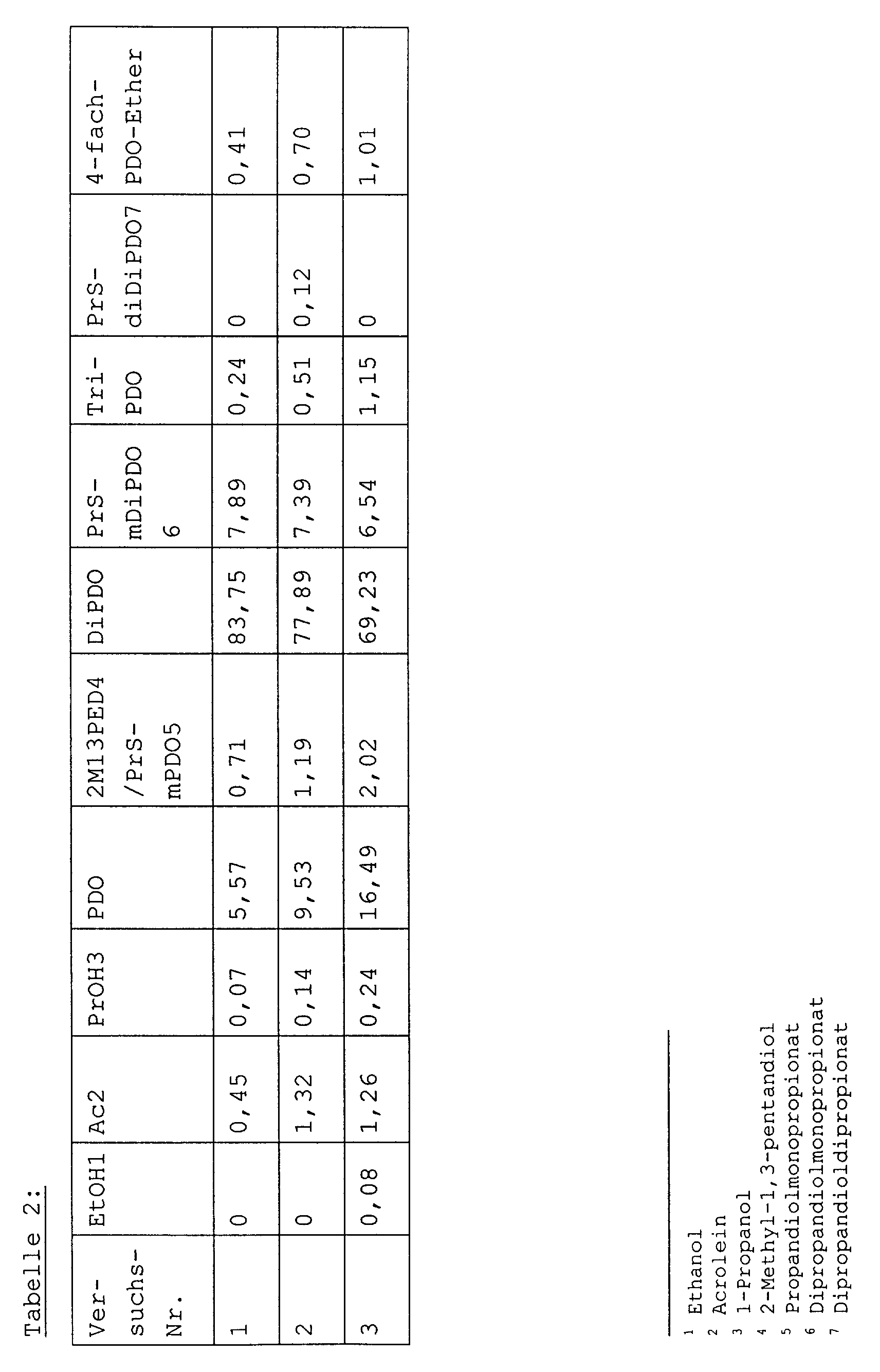
| Substanz | SL | EL RWD neu | EL RWD alt | EL ZSD neu | EL ZSD alt | EL RD neu | EL RD alt | Rein-PDO-Lösung neu | Rein-PDO-Lösung alt |
| MeOH | 0,17 | 151 | 15 | 108 | 0 | 59 | 35 | 10 | 32 |
| EtOH | 0,13 | 117 | 222 | 0 | 0 | 0 | 0 | 0 | 0 |
| Ac | 0,99 | 436 | 337 | 63 | 18 | 20 | 154 | 26 | 146 |
| AllOH | 0,35 | 280 | 0 | 0 | 0 | 0 | 0 | 0 | 0 |
| PrOH | 0,35 | 320 | 157 | 0 | 0 | 0 | 0 | 0 | 0 |
| HPA | 96 | 81 | 84 | 0 | 39 | 0 | 0 | 0 | 0 |
| Et-PDO | 290 | 306 | 633 | 0 | 515 | 0 | 0 | 0 | 0 |
| PDO | 34,4 | 82,5 | 86,8 | 84,6 | 87,0 | 79,6 | 86,1 | 99,9 | 99,8 |
| 2M13PED | 153 | 588 | 161 | 338 | 125 | 55 | 76 | 80 | 106 |
| 3-HMT | 3,59 | 0,51 | 0,11 | 0,42 | 0,10 | 131 | 117 | 58 | 62 |
| Substanz | SL | EL RWD neu | EL RWD alt | EL ZSD neu | EL ZSD alt | EL RD neu | EL RD alt | Rein-PDO-Lösung neu | Rein-PDO-Lösung alt |
| HED | 0,27 | 0,34 | 0,53 | 0,29 | 0,53 | 11 | 397 | 49 | 350 |
| 2M15PED | 294 | 0,21 | 0,12 | 0,20 | 0,11 | 0,24 | 0,13 | 0 | 0 |
| CHDO1 | 0 | 0,25 | 0,28 | 0,25 | 0,28 | 0,35 | 0,30 | 0 | 0 |
| CHDO2 | 0 | 0,47 | 0,39 | 0,49 | 0,38 | 0,65 | 0,40 | 0 | 104 |
| DiPDO | 41,9 | 8,84 | 7,45 | 8,75 | 7,51 | 12,4 | 8,65 | 0 | 269 |
| H-HMT1 | 0 | 1,76 | 1,85 | 1,73 | 1,84 | 2,59 | 2,10 | 0 | 417 |
| H-HMT2 | 0 | 0,77 | 0,76 | 0,79 | 0,77 | 1,13 | 0,87 | 17 | 104 |
| 136HT | 378 | 0,35 | 0,34 | 0,31 | 0,31 | 0,57 | 0,32 | 0 | 98 |
| TriPDO | 2,10 | 0,18 | 0 | 0,17 | 0 | 0,30 | 0 | 0 | 0 |
| 4-fach-PDO-Ether | 0,35 | 541 | 0 | 371 | 0 | 895 | 0 | 0 | 0 |
| Es wird ein Reinprodukt mit 99,9 % PDO erhalten. Die Reinheit des PDO bleibt somit unbeeinflußt trotz Beimischen der Spaltlösung zu Beginn der Destillationen. |
- Diethylenglykoldimethylether (Diglyme)
- Diglykol
- Dipropylenglykol (DiPG)
- Dipropylenglykolmethylether (DiPGME)
- Propylenglykolpropylether (PGPE)
| Nr. | T [°C] | Betriebszeit Reaktor [h] | U [%] | MeOH | Diglyme | unbekannt |
| 1 | 150 | 1,5 | 20,1 | 0,1 | 98,8 | 0 |
| 2 | 220 | 2,25 | 17,8 | 1,1 | 94,5 | 3,6 |
| 3,25 | 10,3 | 1,2 | 94,1 | 4,0 | ||
| 3 | 240 | 4,75 | 14,1 | 3,8 | 81,2 | 12,8 |
- Spaltung von Diglykol
Nr. T [°C] Betriebszeit Reaktor [h] U [%] S (EG) [%] MeOH 1,4-Dioxan EG Diglykol 1 240 2 7,5 37,8 0,4 2,0 2,9 93,8 2 280 3,75 47,9 55,7 6,9 15,9 24,9 48,4 4,75 54,4 49,9 7,4 16,1 27,0 45,3 Diglykol läßt sich bei 280°C bei einem Umsatz von 54 % zu 50 % selektiv in Ethylenglykol spalten. - Spaltung von DiPG
Im Temperaturbereich von 200°C bis 280°C läßt sich zwar der Umsatz bis fast 100 % erhöhen, dagegen bildet sich kaup beziehungsweise nur mit maximal 16 % Selektivität (250 °C) das gewünschte 1,2-PDO, sondern vermehrt Acrolein.

- Spaltung von DiPGME
Im Bereich von 200°C bis 260°C steigt des Umsatz bis auf 97 % an, allerdings werden dabei verstärkt Acrolein (31 %) und MeOH (22 %) gebildet.

- Spaltung von PGPE
Nr. T [°C] Betriebszeit Reaktor [h] U [%] S (PrOH) [%] Ac PrOH PGPE Unbebekannt 1 150 1 54,1 0 0 0 94,0 4,7 2,5 43,8 0 0 0 93,9 4,7 2 180 3,5 52,5 0 0 0 94,3 4,7 3 200 2,25 24,9 4,5 0 1,4 91,7 4,5 3,75 24,0 4,9 0 1,4 91,7 4,5 4 240 4,75 26,7 88,8 9,8 20,4 62,9 2,7 5 270 1 83,7 31,9 21,6 45,3 27,6 0,9 3 91,7 59,6 25,3 59,5 9,0 0,1
Claims (2)
- Verfahren zur Spaltung von wasserlöslichen Ethern, dadurch gekennzeichnet, daß man eine wäßrige Lösung des Ethers in Gegenwart von Säuren im Temperaturbereich von 200 bis 300 °C behandelt und die erhaltene Lösung neutralisiert.
- Verfahren zur Herstellung von 1,3-Propandiol, umfassend die Stufenman den Hochsiedersumpf der Aufarbeitung (c) - auch als PDO-Sumpflösung bezeichnet - zwecks Etherspaltung in wäßriger Lösung in Gegenwart von Säure im Temperaturbereich von 200 bis 300 °C behandelt, die erhaltene Lösung neutralisiert und in die destillative Aufarbeitungsstufe (c) zurückführt.a) Hydratisierung von Acrolein in Gegenwart eines sauren Hydratisierungskatalysators,b) katalytische Hydrierung des 3-Hydroxypropionaldehyd enthaltenden, von nicht umgesetztem Acrolein befreiten Reaktionsgemisch der Stufe (a) undc) destillative Aufarbeitung des Wassers, 1,3-Propandiol und oberhalb 1,3-Propandiol siedende Nebenprodukte enthaltenden Reaktionsgemischs der Stufe (b), dadurch gekennzeichnet, daß
Priority Applications (3)
| Application Number | Priority Date | Filing Date | Title |
|---|---|---|---|
| AT00123092T ATE269841T1 (de) | 2000-10-25 | 2000-10-25 | Verfahren zur herstellung von 1,3-propandiol |
| EP00123092A EP1201633B1 (de) | 2000-10-25 | 2000-10-25 | Verfahren zur Herstellung von 1,3-Propandiol |
| DE50006894T DE50006894D1 (de) | 2000-10-25 | 2000-10-25 | Verfahren zur Herstellung von 1,3-Propandiol |
Applications Claiming Priority (1)
| Application Number | Priority Date | Filing Date | Title |
|---|---|---|---|
| EP00123092A EP1201633B1 (de) | 2000-10-25 | 2000-10-25 | Verfahren zur Herstellung von 1,3-Propandiol |
Publications (2)
| Publication Number | Publication Date |
|---|---|
| EP1201633A1 true EP1201633A1 (de) | 2002-05-02 |
| EP1201633B1 EP1201633B1 (de) | 2004-06-23 |
Family
ID=8170185
Family Applications (1)
| Application Number | Title | Priority Date | Filing Date |
|---|---|---|---|
| EP00123092A Expired - Lifetime EP1201633B1 (de) | 2000-10-25 | 2000-10-25 | Verfahren zur Herstellung von 1,3-Propandiol |
Country Status (3)
| Country | Link |
|---|---|
| EP (1) | EP1201633B1 (de) |
| AT (1) | ATE269841T1 (de) |
| DE (1) | DE50006894D1 (de) |
Cited By (3)
| Publication number | Priority date | Publication date | Assignee | Title |
|---|---|---|---|---|
| WO2004076392A1 (en) * | 2003-02-24 | 2004-09-10 | Shell Internationale Research Maatschappij B.V. | Purification of 1,3-propanediol by distillation |
| WO2005075392A2 (en) | 2004-02-05 | 2005-08-18 | Showa Denko K.K. | Production process of 3-alkoxy-1-propanols, and 3-alkoxy-1-propanols obtained by the production process |
| RU2317970C2 (ru) * | 2003-02-24 | 2008-02-27 | Шелл Интернэшнл Рисерч Маатсхаппий Б.В. | Очистка 1,3-пропандиола путем перегонки |
Citations (3)
| Publication number | Priority date | Publication date | Assignee | Title |
|---|---|---|---|---|
| CH502971A (de) * | 1968-07-08 | 1971-02-15 | Dow Chemical Co | Verfahren zum Hydrolysieren von Epoxiden |
| EP0577972A1 (de) * | 1992-07-10 | 1994-01-12 | Degussa Aktiengesellschaft | Verfahren zur Herstellung von 1,3-Propandiol |
| EP0915075A1 (de) * | 1997-11-07 | 1999-05-12 | Degussa Aktiengesellschaft | Verfahren zur intermolekularen Veretherung und zur Etherspaltung |
-
2000
- 2000-10-25 AT AT00123092T patent/ATE269841T1/de not_active IP Right Cessation
- 2000-10-25 DE DE50006894T patent/DE50006894D1/de not_active Expired - Lifetime
- 2000-10-25 EP EP00123092A patent/EP1201633B1/de not_active Expired - Lifetime
Patent Citations (3)
| Publication number | Priority date | Publication date | Assignee | Title |
|---|---|---|---|---|
| CH502971A (de) * | 1968-07-08 | 1971-02-15 | Dow Chemical Co | Verfahren zum Hydrolysieren von Epoxiden |
| EP0577972A1 (de) * | 1992-07-10 | 1994-01-12 | Degussa Aktiengesellschaft | Verfahren zur Herstellung von 1,3-Propandiol |
| EP0915075A1 (de) * | 1997-11-07 | 1999-05-12 | Degussa Aktiengesellschaft | Verfahren zur intermolekularen Veretherung und zur Etherspaltung |
Non-Patent Citations (1)
| Title |
|---|
| C.A. ROHJAN, ET AL.: "Über Polyäther des Trimethylenglykols", BERICHTE DER DEUTSCHEN CHEMISCHEN GESELLSCHAFT, vol. 54, no. 11, 10 December 1921 (1921-12-10), Verlag Chemie, Weinheim, DE, pages 3118 - 3121, XP002164675 * |
Cited By (5)
| Publication number | Priority date | Publication date | Assignee | Title |
|---|---|---|---|---|
| WO2004076392A1 (en) * | 2003-02-24 | 2004-09-10 | Shell Internationale Research Maatschappij B.V. | Purification of 1,3-propanediol by distillation |
| RU2317970C2 (ru) * | 2003-02-24 | 2008-02-27 | Шелл Интернэшнл Рисерч Маатсхаппий Б.В. | Очистка 1,3-пропандиола путем перегонки |
| WO2005075392A2 (en) | 2004-02-05 | 2005-08-18 | Showa Denko K.K. | Production process of 3-alkoxy-1-propanols, and 3-alkoxy-1-propanols obtained by the production process |
| WO2005075392A3 (en) * | 2004-02-05 | 2005-11-17 | Showa Denko Kk | Production process of 3-alkoxy-1-propanols, and 3-alkoxy-1-propanols obtained by the production process |
| US7754926B2 (en) | 2004-02-05 | 2010-07-13 | Showa Denko K.K. | Production process of 3-alkoxy-1-propanols, and 3-alkoxy-1-propanols obtained by the production process |
Also Published As
| Publication number | Publication date |
|---|---|
| DE50006894D1 (de) | 2004-07-29 |
| EP1201633B1 (de) | 2004-06-23 |
| ATE269841T1 (de) | 2004-07-15 |
Similar Documents
| Publication | Publication Date | Title |
|---|---|---|
| DE69916755T2 (de) | Verfahren zur Herstellung von Alkoholen | |
| DE2629769C3 (de) | Verfahren zur Herstellung von reinem Methyl-tertiär-butyläther | |
| EP0544118B1 (de) | Verfahren zur Herstellung von 3-Hydroxyalkanalen | |
| DE69301579T2 (de) | Verbessertes Verfahren zur Gleichzeitigen Herstellung von Propylenoxid und Styrolmonomer | |
| DE69710092T2 (de) | Verfahren zur ununterbrochenen herstellung von neopentylglykol | |
| DE2011163A1 (de) | Verfahren zur Herstellung von ungesättigten Alkoholen, Äthern und Ätheralkoholen | |
| EP0739332B1 (de) | VERFAHREN ZUR HERSTELLUNG VON n-BUTYRALDEHYD UND/ODER n-BUTANOL | |
| EP0983984A2 (de) | Verfahren zur reduzierenden Spaltung von linearen und cyclischen Acetalen, insbesondere Formalen | |
| KR20050025357A (ko) | 아세탈을 함유하는 부산물의 분해에 의한 다가 알콜의제조에서의 수율 향상 방법 | |
| EP0778819B1 (de) | Verfahren zur herstellung von n-butyraldehyd und/oder n-butanol | |
| DE2759237A1 (de) | Verfahren zur herstellung von alkoholen mit 2 - 4 c-atomen durch katalytische hydratation von olefinen | |
| EP0726241B1 (de) | Verfahren zur Spaltung von Tertiärbutylalkohol in einer Reaktionsdestillationskolonne | |
| DE10295220B4 (de) | Verfahren zur Herstellung von N-Butyraldehyd und n-Butanol aus 1,3-butadienhaltigen Kohlenwasserstoffströmen | |
| EP0137433B1 (de) | Verfahren zur kontinuierlichen Herstellung von Alkoholen | |
| EP1201633B1 (de) | Verfahren zur Herstellung von 1,3-Propandiol | |
| EP0700889B1 (de) | Verfahren zur Herstellung von 1,1,3-Trialkoxypropan | |
| DE69012491T2 (de) | Rückgewinnung von Tertiärbutylhydroperoxid und Tertiärbutylalkohol. | |
| DE3744212A1 (de) | Verfahren zur herstellung von 2-methylbutanal | |
| EP0183029A2 (de) | Kontinuierliches Verfahren zur Herstellung von 1,2-Pentandiol | |
| DE3643010A1 (de) | Verfahren zur herstellung von caprolactam | |
| DE69801783T2 (de) | Methode zur Gewinnung von Alkylvinylethern | |
| DE3246978A1 (de) | Verfahren zur herstellung von aminen | |
| DE69912314T2 (de) | Ein verfahren zur herstellung von butyraldehyd aus butadien | |
| DE69930283T2 (de) | Verfahren zur herstellung von glykolbutylethern | |
| US6693222B2 (en) | Process for splitting water-soluble ethers |
Legal Events
| Date | Code | Title | Description |
|---|---|---|---|
| PUAI | Public reference made under article 153(3) epc to a published international application that has entered the european phase |
Free format text: ORIGINAL CODE: 0009012 |
|
| 17P | Request for examination filed |
Effective date: 20001025 |
|
| AK | Designated contracting states |
Kind code of ref document: A1 Designated state(s): AT BE CH CY DE DK ES FI FR GB GR IE IT LI LU MC NL PT SE |
|
| AX | Request for extension of the european patent |
Free format text: AL;LT;LV;MK;RO;SI |
|
| AKX | Designation fees paid |
Free format text: AT BE CH CY DE DK ES FI FR GB GR IE IT LI LU MC NL PT SE |
|
| 17Q | First examination report despatched |
Effective date: 20030305 |
|
| GRAP | Despatch of communication of intention to grant a patent |
Free format text: ORIGINAL CODE: EPIDOSNIGR1 |
|
| RTI1 | Title (correction) |
Free format text: PROCESS FOR THE PRODUCTION OF 1,3-PROPANEDIOL |
|
| GRAS | Grant fee paid |
Free format text: ORIGINAL CODE: EPIDOSNIGR3 |
|
| GRAA | (expected) grant |
Free format text: ORIGINAL CODE: 0009210 |
|
| AK | Designated contracting states |
Kind code of ref document: B1 Designated state(s): AT BE CH CY DE DK ES FI FR GB GR IE IT LI LU MC NL PT SE |
|
| PG25 | Lapsed in a contracting state [announced via postgrant information from national office to epo] |
Ref country code: FI Free format text: LAPSE BECAUSE OF FAILURE TO SUBMIT A TRANSLATION OF THE DESCRIPTION OR TO PAY THE FEE WITHIN THE PRESCRIBED TIME-LIMIT Effective date: 20040623 Ref country code: IE Free format text: LAPSE BECAUSE OF FAILURE TO SUBMIT A TRANSLATION OF THE DESCRIPTION OR TO PAY THE FEE WITHIN THE PRESCRIBED TIME-LIMIT Effective date: 20040623 Ref country code: NL Free format text: LAPSE BECAUSE OF FAILURE TO SUBMIT A TRANSLATION OF THE DESCRIPTION OR TO PAY THE FEE WITHIN THE PRESCRIBED TIME-LIMIT Effective date: 20040623 Ref country code: CY Free format text: LAPSE BECAUSE OF FAILURE TO SUBMIT A TRANSLATION OF THE DESCRIPTION OR TO PAY THE FEE WITHIN THE PRESCRIBED TIME-LIMIT Effective date: 20040623 |
|
| REG | Reference to a national code |
Ref country code: GB Ref legal event code: FG4D Free format text: NOT ENGLISH |
|
| REG | Reference to a national code |
Ref country code: CH Ref legal event code: EP |
|
| REG | Reference to a national code |
Ref country code: IE Ref legal event code: FG4D Free format text: GERMAN |
|
| REF | Corresponds to: |
Ref document number: 50006894 Country of ref document: DE Date of ref document: 20040729 Kind code of ref document: P |
|
| PG25 | Lapsed in a contracting state [announced via postgrant information from national office to epo] |
Ref country code: SE Free format text: LAPSE BECAUSE OF FAILURE TO SUBMIT A TRANSLATION OF THE DESCRIPTION OR TO PAY THE FEE WITHIN THE PRESCRIBED TIME-LIMIT Effective date: 20040923 Ref country code: GR Free format text: LAPSE BECAUSE OF FAILURE TO SUBMIT A TRANSLATION OF THE DESCRIPTION OR TO PAY THE FEE WITHIN THE PRESCRIBED TIME-LIMIT Effective date: 20040923 Ref country code: DK Free format text: LAPSE BECAUSE OF FAILURE TO SUBMIT A TRANSLATION OF THE DESCRIPTION OR TO PAY THE FEE WITHIN THE PRESCRIBED TIME-LIMIT Effective date: 20040923 |
|
| PG25 | Lapsed in a contracting state [announced via postgrant information from national office to epo] |
Ref country code: ES Free format text: LAPSE BECAUSE OF FAILURE TO SUBMIT A TRANSLATION OF THE DESCRIPTION OR TO PAY THE FEE WITHIN THE PRESCRIBED TIME-LIMIT Effective date: 20041004 |
|
| PGFP | Annual fee paid to national office [announced via postgrant information from national office to epo] |
Ref country code: FR Payment date: 20041008 Year of fee payment: 5 |
|
| PGFP | Annual fee paid to national office [announced via postgrant information from national office to epo] |
Ref country code: GB Payment date: 20041020 Year of fee payment: 5 |
|
| PG25 | Lapsed in a contracting state [announced via postgrant information from national office to epo] |
Ref country code: LU Free format text: LAPSE BECAUSE OF NON-PAYMENT OF DUE FEES Effective date: 20041025 Ref country code: AT Free format text: LAPSE BECAUSE OF NON-PAYMENT OF DUE FEES Effective date: 20041025 |
|
| GBT | Gb: translation of ep patent filed (gb section 77(6)(a)/1977) | ||
| PG25 | Lapsed in a contracting state [announced via postgrant information from national office to epo] |
Ref country code: CH Free format text: LAPSE BECAUSE OF NON-PAYMENT OF DUE FEES Effective date: 20041031 Ref country code: MC Free format text: LAPSE BECAUSE OF NON-PAYMENT OF DUE FEES Effective date: 20041031 Ref country code: LI Free format text: LAPSE BECAUSE OF NON-PAYMENT OF DUE FEES Effective date: 20041031 |
|
| NLV1 | Nl: lapsed or annulled due to failure to fulfill the requirements of art. 29p and 29m of the patents act | ||
| PGFP | Annual fee paid to national office [announced via postgrant information from national office to epo] |
Ref country code: BE Payment date: 20041216 Year of fee payment: 5 |
|
| ET | Fr: translation filed | ||
| REG | Reference to a national code |
Ref country code: IE Ref legal event code: FD4D |
|
| PLBE | No opposition filed within time limit |
Free format text: ORIGINAL CODE: 0009261 |
|
| STAA | Information on the status of an ep patent application or granted ep patent |
Free format text: STATUS: NO OPPOSITION FILED WITHIN TIME LIMIT |
|
| 26N | No opposition filed |
Effective date: 20050324 |
|
| REG | Reference to a national code |
Ref country code: CH Ref legal event code: PL |
|
| PG25 | Lapsed in a contracting state [announced via postgrant information from national office to epo] |
Ref country code: IT Free format text: LAPSE BECAUSE OF NON-PAYMENT OF DUE FEES Effective date: 20051025 Ref country code: GB Free format text: LAPSE BECAUSE OF NON-PAYMENT OF DUE FEES Effective date: 20051025 |
|
| PG25 | Lapsed in a contracting state [announced via postgrant information from national office to epo] |
Ref country code: BE Free format text: LAPSE BECAUSE OF NON-PAYMENT OF DUE FEES Effective date: 20051031 |
|
| GBPC | Gb: european patent ceased through non-payment of renewal fee |
Effective date: 20051025 |
|
| PG25 | Lapsed in a contracting state [announced via postgrant information from national office to epo] |
Ref country code: FR Free format text: LAPSE BECAUSE OF NON-PAYMENT OF DUE FEES Effective date: 20060630 |
|
| REG | Reference to a national code |
Ref country code: FR Ref legal event code: ST Effective date: 20060630 |
|
| BERE | Be: lapsed |
Owner name: E.I. *DUPONT DE NEMOURS AND CY Effective date: 20051031 |
|
| PG25 | Lapsed in a contracting state [announced via postgrant information from national office to epo] |
Ref country code: PT Free format text: LAPSE BECAUSE OF NON-PAYMENT OF DUE FEES Effective date: 20041123 |
|
| PGFP | Annual fee paid to national office [announced via postgrant information from national office to epo] |
Ref country code: DE Payment date: 20101020 Year of fee payment: 11 |
|
| PG25 | Lapsed in a contracting state [announced via postgrant information from national office to epo] |
Ref country code: DE Free format text: LAPSE BECAUSE OF NON-PAYMENT OF DUE FEES Effective date: 20130501 |
|
| REG | Reference to a national code |
Ref country code: DE Ref legal event code: R119 Ref document number: 50006894 Country of ref document: DE Effective date: 20130501 |