EP1199871A2 - System and method for confirming calls in a telephone system - Google Patents
System and method for confirming calls in a telephone system Download PDFInfo
- Publication number
- EP1199871A2 EP1199871A2 EP01402586A EP01402586A EP1199871A2 EP 1199871 A2 EP1199871 A2 EP 1199871A2 EP 01402586 A EP01402586 A EP 01402586A EP 01402586 A EP01402586 A EP 01402586A EP 1199871 A2 EP1199871 A2 EP 1199871A2
- Authority
- EP
- European Patent Office
- Prior art keywords
- call
- terminal
- confirmation
- telephone
- control centre
- Prior art date
- Legal status (The legal status is an assumption and is not a legal conclusion. Google has not performed a legal analysis and makes no representation as to the accuracy of the status listed.)
- Withdrawn
Links
Images

Classifications
-
- H—ELECTRICITY
- H04—ELECTRIC COMMUNICATION TECHNIQUE
- H04M—TELEPHONIC COMMUNICATION
- H04M3/00—Automatic or semi-automatic exchanges
- H04M3/42—Systems providing special services or facilities to subscribers
- H04M3/436—Arrangements for screening incoming calls, i.e. evaluating the characteristics of a call before deciding whether to answer it
Definitions
- the present invention refers to a method for providing users of both mobile and fixed telephones with a call confirmation service, which is based on the telephone user having the possibility of selecting a call confirmation state.
- a telephone user is in this state, and an incoming call arrives for said user, the calling party is required to acknowledge confirmation of the call for the completion of the setting up of the call. In this manner, it is the calling user who decides whether the call is to be set up or not.
- a known solution consists in enabling the telephone user to select the telephone numbers from which he permits incoming calls to be received. In this manner, the calls coming from non-selected telephone numbers are not received.
- the method of the invention is based on providing the user with a telephone service, both mobile or fixed, with a new procedure for confirming calls which is based on granting the user the option of selecting on his telephone terminal, by means of a key or combination of keys or any other method, two different states insofar as call reception is concerned.
- a first state is that of the reception of all incoming calls to the telephone without limitation whatsoever; a state which could be termed "normal".
- a second state which the invention proposes, is a call confirmation state.
- a telephone When a telephone is in this second state, on receiving an incoming call it generates a return message to the calling party alerting him that the called user has selected said call confirmation state for the time being, granting him the possibility of confirming the setting up of his call.
- the calling party decides whether his call should be set up or not, for reasons which in his own consideration justify said setting up of the call. Examples of this type of call are many and varied, for example it may concern a call having a certain importance regarding professional, commercial or personal matters, etc.; or an emergency call in the case of accidents, illness, travel arrangements and the like.
- the user of the called telephone receives the call, and in the event of non-confirmation, the call is not set up, it being possible to access the voice mailbox, redirect it to another telephone number that may be, for example, of an assistant or a secretary of the called user, or any other option of this nature.
- an object of the present invention is that of providing a method for selecting incoming calls in a telecommunications system employing telephone terminals, characterised in that it comprises the steps of:
- the handling of the call confirmation service comprises the steps of:
- the handling of the call confirmation service is performed by the network infrastructure.
- the handling of the call confirmation service is performed by the very terminal which is receiving the incoming call.
- completion of the call set-up procedure in the called terminal itself comprises the following steps:
- Another object of the invention is that of providing a telephone terminal for carrying out the steps of the method explained above.
- An additional object of the invention is that of providing a telephone network for carrying out the steps of the method of the invention.
- An additional object of the invention is that of providing a control centre capable of implementing the call set-up procedures both in the called terminal telephone and in the telephone network.
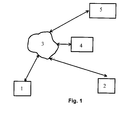
- the user of terminal 2 opts to make use of the call confirmation service. Said user selects the call confirmation state on his terminal by activation of a key or combination of keys or voice recognition or any other method known in the state of the art. The information of this change of state is sent to a control centre 5 in a conventional manner.
- the control centre 5 has the information of the call confirmation state in which terminal 2 is and thereafter a return message is produced either in the control centre, or in some other point of the network, said message being sent to terminal 1, alerting it of the call confirmation state in which terminal 2 is, and offering the user of terminal 1 the possibility of confirming the call if said user considers his call to be truly important or urgent.
- control centre 5 If the user of terminal 1 confirms the call, said confirmation is received by the control centre 5, which in turn advises the network 3 that the call can be set up, whereby said call shall be received by terminal 2.
- the control centre produces another message for the network 3 with appropriate instructions, like for example the possibility that the call should be directed to a call mailbox 4, which can be consulted later by terminal 2, or that it be directed to another telephone number, for example of a known person, an assistant or a secretary of the user of the terminal 2, or any other option of this kind.
- the manner in which the user of calling terminal 1 confirms his call can be by means of carrying out any of the procedures presently available in telephony for this purpose, for example pressing a digit or giving a spoken answer.
- the user of terminal 2 opts for making use of the call confirmation service. Said user selects the call confirmation state on his terminal by activation of a key or combination of keys or voice recognition or any other method known in the state of the art.
- the information of this change of state is stored in terminal 2 itself for example in its memory.
- terminal 1 wishes to make a call to terminal 2.
- terminal 2 On initiating the call, this is connected through the telephone network 3 to terminal 2. Since terminal 2 is in the call confirmation state, said terminal 2 transmits a return message to terminal 1, alerting it of the call confirmation state in which terminal 2 is, and offering the user of terminal 1 the possibility of confirming the call if said user considers his call to be truly important or urgent.
- the control centre 5 which in this case is located in terminal 2, which proceeds to set up the communication. Otherwise, the call shall be treatable in like manner to that described in the first preferred embodiment.
Landscapes
- Engineering & Computer Science (AREA)
- Signal Processing (AREA)
- Telephonic Communication Services (AREA)
- Exchange Systems With Centralized Control (AREA)
Abstract
Description
- selection of a call confirmation state in a terminal in such a manner that in said state the direct reception of incoming calls is avoided;
- when a call originated in a calling terminal is made to said terminal, an alerting message is transmitted to said calling terminal in order to request confirmation that its call has to be set up; and
- setting up of said call if the calling terminal confirms that the call has to be set up.
- storing the call confirmation state;
- sending a return message to the calling terminal, in the event that the called terminal is presently in said call confirmation state;
- reception of a call confirmatory message sent by the calling terminal; and
- completion of the setting up of the call.
- making of a call to the called terminal by the user of the calling terminal;
- reception of said call by the called terminal in its control centre;
- sending of an alerting message produced by the control centre of said called terminal to said calling terminal requesting its confirmation; and
- completion of the setting up of the call by the called terminal on receiving said confirmation from the calling terminal.
- first the user of
terminal 1 makes the call toterminal 2; - terminal 2 receives said call in its
control centre 5 and immediately transmits a return message toterminal 1 requesting confirmation; and - when confirmation is received by
terminal 2, the control centre proceeds to the setting up of the communication.
Claims (11)
- Method for selecting incoming calls in a telecommunications system using telephone terminals (1; 2), characterised in that it comprises the steps of:selection of a call confirmation state in a terminal (2) in such a manner that in said state the direct reception of incoming calls is avoided;when a call is made to said terminal (2) coming from a calling terminal (1), it sends an alerting message to said calling terminal (1) to request it for confirmation that its call ought to be set up; andsetting up of said call if the calling terminal (1) confirms that the call has to be set up.
- Method of claim 1 in which the handling of the call confirmation service comprises the steps of:storing the call confirmation state;sending a return message to the calling terminal (1), in the event that the called terminal (2) is in said call confirmation state;reception of a message confirming the call sent by the calling terminal (1); andcompletion of the setting up of the call.
- Method of claim 2 in which the handling of the call confirmation procedure is performed by a control centre (5) in a telephone network infrastructure (3).
- Method of claim 2 in which the handling of the call confirmation procedure is performed by a control centre (5) in the very terminal (2) which receives the incoming call.
- Method of claim 4 in which the set-up procedure of the call is completed by means of the following steps:making of a call by the user of the calling terminal (1) to the called terminal (2);reception of said call by the called terminal (2) in its control centre (5);sending of an alerting message produced by the control centre (5) of said called terminal (2) to said calling terminal (1) requesting its confirmation; andcompletion of the setting up of the call by the called terminal (2) on receiving said confirmation from the calling terminal (1).
- Method according to any of the previous claims in which a non-confirmed call is stored.
- Method according to any of claims 1 to 4 in which a non-confirmed call is redirected to another telephone number.
- Telephone terminal for carrying out the steps of claim 1.
- Telephone terminal of claim 8 for carrying out the steps of claim 2.
- Telephone network for carrying out the steps of claim 2.
- Control centre in order to be included in the telephone terminal of claim 9 or in the telephone network of claim 10.
Applications Claiming Priority (2)
| Application Number | Priority Date | Filing Date | Title |
|---|---|---|---|
| ES200002507 | 2000-10-19 | ||
| ES200002507 | 2000-10-19 |
Publications (2)
| Publication Number | Publication Date |
|---|---|
| EP1199871A2 true EP1199871A2 (en) | 2002-04-24 |
| EP1199871A3 EP1199871A3 (en) | 2003-03-19 |
Family
ID=8495306
Family Applications (1)
| Application Number | Title | Priority Date | Filing Date |
|---|---|---|---|
| EP01402586A Withdrawn EP1199871A3 (en) | 2000-10-19 | 2001-10-08 | System and method for confirming calls in a telephone system |
Country Status (2)
| Country | Link |
|---|---|
| US (1) | US20020048357A1 (en) |
| EP (1) | EP1199871A3 (en) |
Family Cites Families (4)
| Publication number | Priority date | Publication date | Assignee | Title |
|---|---|---|---|---|
| US5553125A (en) * | 1991-01-11 | 1996-09-03 | Nokia Mobile Phones (U.K.) Limited | Telephone apparatus with calling line identification |
| JP2970531B2 (en) * | 1996-05-15 | 1999-11-02 | 日本電気株式会社 | Mobile phones and mobile phone systems |
| US5818920A (en) * | 1996-12-04 | 1998-10-06 | Telefonaktiebolaget Lm Ericsson | Apparatus for controlling communication connections based on local time |
| US20010031633A1 (en) * | 1999-12-01 | 2001-10-18 | Nokia Mobile Phones Ltd. | Method and apparatus for providing context-based call transfer operation |
-
2001
- 2001-10-08 EP EP01402586A patent/EP1199871A3/en not_active Withdrawn
- 2001-10-16 US US09/977,281 patent/US20020048357A1/en not_active Abandoned
Also Published As
| Publication number | Publication date |
|---|---|
| US20020048357A1 (en) | 2002-04-25 |
| EP1199871A3 (en) | 2003-03-19 |
Similar Documents
| Publication | Publication Date | Title |
|---|---|---|
| RU2140723C1 (en) | System and procedure for selective reception of phone calls without establishment of speech exchange | |
| JP3194571B2 (en) | How to connect a telephone system caller to a called party | |
| US6577721B1 (en) | Conference call | |
| PL181147B1 (en) | Method of and apparatus for keeping a directory of network subscriber numbers for a cellular telephone | |
| US7340246B1 (en) | Transmission of information during call establishment | |
| JP2003513537A (en) | Communication system for displaying call type for group call | |
| US5649003A (en) | Method in a communications systems for providing an out-of-band signaling response based on predetermined conditions | |
| US7983707B2 (en) | System and method for mobile PTT communication | |
| JP2002158780A (en) | Call transfer system | |
| JP3398278B2 (en) | Communication method and communication system | |
| EP1199871A2 (en) | System and method for confirming calls in a telephone system | |
| JPH08223294A (en) | Method and device for displaying message designaed by caller | |
| JPH10322454A (en) | Communication network | |
| WO1999027699A2 (en) | Method of transmitting an acknowledgement to an a-subscriber | |
| JP2001127913A (en) | Mobile communication terminal | |
| KR20020007448A (en) | Method for auto-dialing in a communication system | |
| KR100585251B1 (en) | Apparatus and method for providing text message voice | |
| JPH04101596A (en) | Response holding/callback system for mobile communication system | |
| EP1305972A2 (en) | Method and apparatus for displaying a call notification message prior to a call acceptance | |
| JPH0342949A (en) | Automobile telephone set | |
| JPH0591199A (en) | Button telephone device | |
| JPH10164243A (en) | Doorphone call transfer device | |
| JPH10107915A (en) | Speechless conversation system | |
| WO2004075522A1 (en) | System for conducting absence message of mobile communication terminal using wireless communication network and method therefore | |
| JPH07231354A (en) | Extension incoming call method using a voice recognition device |
Legal Events
| Date | Code | Title | Description |
|---|---|---|---|
| PUAI | Public reference made under article 153(3) epc to a published international application that has entered the european phase |
Free format text: ORIGINAL CODE: 0009012 |
|
| AK | Designated contracting states |
Kind code of ref document: A2 Designated state(s): AT BE CH CY DE DK ES FI FR GB GR IE IT LI LU MC NL PT SE TR |
|
| AX | Request for extension of the european patent |
Free format text: AL;LT;LV;MK;RO;SI |
|
| PUAL | Search report despatched |
Free format text: ORIGINAL CODE: 0009013 |
|
| AK | Designated contracting states |
Kind code of ref document: A3 Designated state(s): AT BE CH CY DE DK ES FI FR GB GR IE IT LI LU MC NL PT SE TR Designated state(s): AT BE CH CY DE DK ES FI FR GB GR IE IT LI LU MC NL PT SE TR |
|
| AX | Request for extension of the european patent |
Extension state: AL LT LV MK RO SI |
|
| STAA | Information on the status of an ep patent application or granted ep patent |
Free format text: STATUS: THE APPLICATION HAS BEEN WITHDRAWN |
|
| 18W | Application withdrawn |
Effective date: 20030428 |