EP1199817A1 - Transmission system of high speed signal in apparatus - Google Patents
Transmission system of high speed signal in apparatus Download PDFInfo
- Publication number
- EP1199817A1 EP1199817A1 EP00949889A EP00949889A EP1199817A1 EP 1199817 A1 EP1199817 A1 EP 1199817A1 EP 00949889 A EP00949889 A EP 00949889A EP 00949889 A EP00949889 A EP 00949889A EP 1199817 A1 EP1199817 A1 EP 1199817A1
- Authority
- EP
- European Patent Office
- Prior art keywords
- sections
- high speed
- signal
- transmitting
- speed signal
- Prior art date
- Legal status (The legal status is an assumption and is not a legal conclusion. Google has not performed a legal analysis and makes no representation as to the accuracy of the status listed.)
- Withdrawn
Links
Images



Classifications
-
- H—ELECTRICITY
- H04—ELECTRIC COMMUNICATION TECHNIQUE
- H04B—TRANSMISSION
- H04B7/00—Radio transmission systems, i.e. using radiation field
- H04B7/24—Radio transmission systems, i.e. using radiation field for communication between two or more posts
- H04B7/26—Radio transmission systems, i.e. using radiation field for communication between two or more posts at least one of which is mobile
-
- H—ELECTRICITY
- H04—ELECTRIC COMMUNICATION TECHNIQUE
- H04W—WIRELESS COMMUNICATION NETWORKS
- H04W88/00—Devices specially adapted for wireless communication networks, e.g. terminals, base stations or access point devices
- H04W88/08—Access point devices
- H04W88/085—Access point devices with remote components
-
- H—ELECTRICITY
- H04—ELECTRIC COMMUNICATION TECHNIQUE
- H04B—TRANSMISSION
- H04B1/00—Details of transmission systems, not covered by a single one of groups H04B3/00 - H04B13/00; Details of transmission systems not characterised by the medium used for transmission
- H04B1/38—Transceivers, i.e. devices in which transmitter and receiver form a structural unit and in which at least one part is used for functions of transmitting and receiving
- H04B1/40—Circuits
- H04B1/401—Circuits for selecting or indicating operating mode
Definitions
- the present invention relates to a transmission system of spread-processed high speed signal which is handled in apparatus such as CDMA apparatus, and relates to a transmission system of high speed signal in apparatus, which is provided with transmitting/receiving sections corresponding to each of a plurality of sectors and a channel sections for processing a base band signal corresponding to a plurality of channels and which transmits the high speed signal between the transmitting/receiving sections and the channel sections, and more particularly, relates to a transmission system of high speed signal in apparatus, in which hand-over between the sectors is easily carried out and which is capable of reducing the number of signal lines interconnecting the transmitting/receiving sections and the channel sections and is capable of achieving high reliability.
- an interface between transmitting/receiving sections provided with a card form and channel sections for processing a base band signal, and a function share of the sections are important from the stand point of apparatus construction, because signal speed is very high. Further, high reliability is required to the high speed signal handled in the apparatus.
- the transmitting/receiving sections (TRX) 101 and the channel sections (CH) 102 are directly interconnected, as shown in Fig. 1. That is, optional transmitting/receiving sections (TRX) 101 and optional channel sections (CH) 102 are connected to each other in order to comply with the above requirements and the hand-over between sectors. Accordingly, the number of connection paths for communication to be required is (N M) which is the product of the transmitting/receiving sections (TRX) 101-1 to -N and the channel sections (CH) 102-1 to -M.
- a first problem is that the hand-over processing accompanied by a sector transfer between transmitting/receiving) sections and channel sections is complicated. The reason is that one connection point for communication is selected from many transmitting/receiving sections provided with a card form and many channel sections, respectively.
- a second problem is that a trouble or failure ratio in apparatus is high due to large size of the apparatus.
- the reason is that the number of paths interconnecting the transmitting/receiving sections and the channel sections is a product of the number of these sections and, as a result, interface circuits of the same numbers exist.
- An object of the invention is to provide a transmission system of high speed signal in apparatus which is capable of reducing the number of paths interconnecting the transmitting/receiving sections and the channel sections.
- a transmission system of high speed signal in apparatus comprises providing transmitting/receiving sections corresponding to each of a plurality of sectors and channel sections for processing base band signals corresponding to a plurality of channels in the apparatus; transmitting the high speed signal between the transmitting/receiving sections and the channel sections; further providing a plurality of repeating switching sections of which the number is less than that of the transmitting/receiving sections; connecting all of the transmitting/receiving sections to one end of all repeating switching sections to transmit/receive the high speed signal; connecting all of the channel sections to the other end of all repeating switching sections to transmit/receive the high speed signal; and switching the interconnection of the transmitting/receiving sections and the channel sections by the repeating switching sections to repeat the high speed signal.
- the number of paths interconnecting the transmitting/receiving sections and the channel sections can be reduced by inserting the few number of the repeating switching sections between the transmitting/receiving sections and the channel sections to make the interconnection paths.
- the number of interconnection paths for communication of the transmission signal has been reduced and the selection number of interconnection paths to be switched is less, and therefore, the hand-over between the sectors of high speed serial signals can be easily and quickly realized. Accordingly, constructions suitable for serial signals with higher speed can be provided.
- the construction of the channel sections makes smaller than conventional construction by providing the repeating switching sections with a spreading circuit for spread-processing a downstream signal from a host processor to a mobile terminal. As a result, whole size of the apparatus becomes smaller.
- the channel sections may be connected to the other end of all repeating switching sections. And, the channel sections may be divided in groups corresponding to the repeating switching sections and a group of the channel sections corresponding to the repeating switching sections may be connected to the other end of the repeating switching sections. It is preferred that two of the repeating switching sections are used in a pair and one of them can be used where the other of them is failure, because the number of the interconnection paths between the repeating switching sections and the channel sections can be reduced.
- two of the channel sections are used in a pair, each of which can be connected to different repeating switching sections, and that a pair of the channel sections have a transmission path which can mutually transmit/receive signals and the signals to be transmitted/received to or from the repeating switching sections are transmitted/received through the transmission path and either of the pair of the channel sections where the other of the pair of the repeating switching sections to be connected is failure.
- a pair of repeating switching sections have a signal transmission path for interconnecting therebetween, and that the signals to be transmitted/received to or from the channel sections are transmitted/received through the transmission path and the other of the pair of the repeating switching sections, where inside of the repeating switching section is failure.
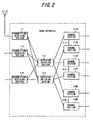
- Fig. 2 is a functional block diagram showing an embodiment of the invention and Fig. 3 is a functional block diagram showing an embodiment of each functional section in Fig. 2.
- the graphically expressed construction is only a form of signal transmission path in the invention, and transmission/reception of control information regarding other connections is omitted in the drawings and explanation because various well-known techniques can be used for it.
- transmitting/receiving sections (hereinafter called TRX) 1-1 to 1-N for transmitting/ receiving a wireless signal corresponding to each of the "N" number of sectors
- channel sections (hereinafter called CH) 2-1O, 2-1E to 2-MO, 2-ME which are grouped into pairs of O/Es and are for processing a base band signal corresponding to the "2M" number of channels
- REP repeating switching sections
- TRX1 is composed of N sheets of TRX cards
- CH2 is composed of 2M sheets of TRX cards
- REP3 is composed of two sheets of REP cards.
- the N sheets of TRX1 have the connection paths with all of two sheets of REP3.
- the M sheets of CH2-10 to CH2-MO have the connection paths with REP3-O
- the M sheets of CH2-1E to CH2-ME have the connection paths with REP3-E.
- Two sheets of CH cards forming a pair of O/Es have the transmission paths 4-1 to 4-M which are formed of back wiring.
- a high speed signal to be transmitted in a band apparatus is composed of an upstream signal which is from a mobile terminal to a host processor, and a downstream signal which is from the host processor to the mobile terminal.
- TRX1 is provided with demodulation circuit 11 for demodulating an upstream wireless signal of CDMA system received from mobile terminals through antennas which are provided in each sector to a high speed base band signal. The demodulated signal is transmitted through REP3 to CH2 in apparatus. TRX1 is also provided with modulation circuit 12 for modulating a spread-processing base band signal received from REP3 to a wireless signal. The modulated signal is transmitted through antennas of each sector.
- CH2 is provided with a de-spreading circuit 21 for decoding an upstream base band signal received from REP3 by de-spreading. The decoded signal is transmitted to a host processor. CH2 is also provided with a coding conversion circuit 22 for coding a downstream signal received from a host processor per transmission path and converting it into a wireless signal format. The converted coding signal is transmitted to REP3.
- REP3 transmits all of upstream base band signals received from TRX1 to CH2.
- REP3 is provided with a spreading circuit 31 for spread-processing a downstream coding signal received from CH2.
- the spread-processed base band signal is transmitted to one or more TRX1 set to each customer.
- a pair of CH2 have a signal transmission path 4 for interconnecting between CHs.
- An upstream signal received from REP3 is transmitted from one of a pair of CH2 to the other of the pair of CH2 and a downstream signal transmitted to REP3 is transmitted from one of a pair of CH2 to the other of the pair of CH2.
- a redundancy construction that, where communication is interrupted through one of REP3, the other operates instead of it is adopted. According to the construction, transmitting volume of signal between CH2 and REP3 is two times as much as that of one of CH2.
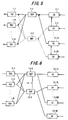
- TRX1-1 to TRX1-6 six TRXs (TRX1-1 to TRX1-6), twenty CHs (CH2-1 to CH2-20) and two REPs (REP3-1 to REP3-2) are provided, and a connection path is formed between REP3 and CH2 through an odd number group or an even number group, each of which is composed of an odd suffix number or an even suffix number.
- a pair of CH2 is composed of an odd suffix number and an even suffix number which is one plus the odd suffix number.
- REP3-1 which belongs to a group of the odd suffix number relays reception signals received from all of TRX1-1 to TRX1-6 and transmits them to CH2-1, CH2-3 to CH2-19 which belong to a group of the odd suffix number, respectively.
- reception signal from REP3-2 is not transmitted to CH2-2, CH2-4 to CH2-20 which belong to a group of the even suffix number
- reception signals received from TRX1-1 to TRX1-6 can be transmitted from CH with the odd suffix number, which is one of the pair of CH with the even suffix number, through transmission path for interconnection between CHs.
- Fig. 5 shows an embodiment that downstream signal is interrupted in REP3-2, and although each of CH2-2, CH2-4 to CH2-20 which belongs to a group of the even suffix number can not transmit signal to be transmitted to REP3-2, it can transmit the signal to each of CH with the odd suffix number which is one of the pair of CH with the even suffix number.
- Each of CH2-1, CH2-3 to CH2-19 which belongs to a group of the odd suffix number and is the other of the pair transmits transmission signal received from CH with the even suffix number which is the pair, to REP3-1 together with its transmission signal.
- the transmission signal to be transmitted is transmitted to TRX1 by REP3-1.
- the number of connection path between each processing section made by a card becomes "2N + M" connection paths among N sheets of TRX and M sheets of CH to 2 sheets of REP. According to conventional construction in the same situation, it is required that the number of connection path is "N x M" paths.
- a transmission path interconnecting between CHs is interconnection of adjacent cards and is formed by back wiring, and therefore, its size is very small to a size of apparatus as a whole.
- a transmission path 14 interconnecting between a pair of REPs is provided instead of the transmission path interconnecting between a pair of CHs. That is, REP13 - O is provided corresponding to CH12-1O to CH12-MO which belong to a group of the odd suffix number and of which the number is M, and REP13-E is provided corresponding to CH12-1E to CH12-ME which belong to a group of the even suffix number and of which the number is M.
- REP13-O and REP13-E can transmit/receive a transmission signal to be transmitted from and received to CH12 through the transmission path 14 between REPs to REP13-E and REP13-O which are the other of the pair, respectively.
- the transmission signal between CH and REP can be transmitted through the transmission path between the REPs, avoiding one of the REP through which communication is interrupted.
- the number of connection path is reduced by subjecting REPs to be adjacent and as a result, size reduction of apparatus can be achieved.
- each CH and each REP are connected as well as each TRX and each REP are connected.
- the number of connection path between each processing section formed by the card is "2(N+M)" paths between N sheets of TRXs and M sheets of CHs to 2 sheets of REPs.
- the number of connection path in the example is less than "N+M" which is the number of conventional connecting construction.
- the construction of the invention is characterized that the small number of repeating switching sections (REP) are provided between channel sections (CH) and transmitting/receiving sections (TRX), and that the connection path is provided through the repeating switching sections (REP).
- REP repeating switching sections
- TX transmitting/receiving sections
- REP repeating switching sections
- the invention is useful because sector hand-over between the channel sections (CH) and the transmitting/receiving sections (TRX) can be easily achieved.
- the reason is that the number of connection paths is more reduced in each functional processing section which transmits a high speed signal between the channel sections (CH) and the transmitting/receiving sections (TRX) through the repeating switching sections (REP) .
- the invention is useful because size of apparatus is reduced and ratio of failure is reduced.
- the reason is that the number of connection path between the channel sections (CH) and the transmitting/receiving sections (TRX) can be reduced through the repeating switching sections (REP) by providing the small number of the repeating switching sections (REP) and by providing signal transmission path between the channel sections (CH) or the transmitting/receiving sections (TRX) as a pair construction.
- the invention is useful because high reliability is obtained by complete present/preliminary redundancy construction in spite of less connection path.
- the reason is that even if one of the repeating switching sections (REP) is interrupted, communication path is kept through the other of the repeating switching sections (REP) by dividing the channel sections (CH) adjacent to each other and two of the repeating switching sections (REP) into two groups, respectively and by transmitting/receiving a transmission signal to be transmitted/received between the repeating switching sections (REP), between the adjacent channel sections (CH).
Landscapes
- Engineering & Computer Science (AREA)
- Computer Networks & Wireless Communication (AREA)
- Signal Processing (AREA)
- Mobile Radio Communication Systems (AREA)
- Radio Relay Systems (AREA)
- Digital Transmission Methods That Use Modulated Carrier Waves (AREA)
- Time-Division Multiplex Systems (AREA)
- Detection And Prevention Of Errors In Transmission (AREA)
Abstract
Description
Claims (8)
- In a transmission system of high speed signal in apparatus in which a transmitting/receiving section corresponding to each of a plurality of sectors and a channel section for processing a base band signal corresponding to a plurality of channels are provided, said high speed signal being transmitted between the transmitting/receiving section and the channel section, the improvement which comprises;
further providing a plurality of repeating switching sections in the apparatus, of which the number is less than the number of the transmitting/receiving sections,
connecting all of the transmitting/receiving sections to either end of the repeating switching sections to transmit/receive the high speed signal,
connecting the channel sections to the other end of the predetermined repeating switching sections to transmit/receive the high speed signal, and
switching the interconnection between the transmitting/receiving sections and the channel sections by the repeating switching sections to switch the high speed signal. - The transmission system of high speed signal in apparatus according to Claim 1 wherein the repeating switching section has a spreading circuit for spread-processing a downstream signal from a host processor to a mobile terminal.
- The transmission system of high speed signal in apparatus according to Claim 1 wherein the channel section is connected to the other end of all the repeating switching sections.
- The transmission system of high speed signal in apparatus according to Claim 1 wherein the channel section is divided into groups corresponding to repeating switching section and is connected to the other end of only the repeating switching section corresponding thereto.
- The transmission system of high speed signal in apparatus according to Claim 4 wherein two of the repeating switching sections are provided as a pair and where one of them is trouble, the other is operated.
- The transmission system of high speed signal in apparatus according to Claim 5 wherein two of the channel sections are made as a pair and each of the pair is connected to the separate repeating switching sections.
- The transmission system of high speed signal in apparatus according to Claim 6 wherein a pair of the channel sections have a transmission path for transmitting/receiving a signal with each other, and transmit and receive a signal to be transmitted from and received to the repeating switching sections through the transmission path and the channel section which is the other of the pair, where the repeating switching sections directly connected thereto are trouble.
- The transmission system of high speed signal in apparatus according to Claim 6 wherein a pair of the repeating switching sections have a signal transmission path to be connected to each other, and transmit and receive a signal to be transmitted from and received to the channel section through the transmission path and the repeating and switching section which is the other of the pair, where inside of the repeating and switching section is trouble.
Applications Claiming Priority (3)
| Application Number | Priority Date | Filing Date | Title |
|---|---|---|---|
| JP21760899A JP2001044910A (en) | 1999-07-30 | 1999-07-30 | Transmission system of high speed signal in device |
| JP21760899 | 1999-07-30 | ||
| PCT/JP2000/004962 WO2001010058A1 (en) | 1999-07-30 | 2000-07-26 | Transmission system of high speed signal in apparatus |
Publications (2)
| Publication Number | Publication Date |
|---|---|
| EP1199817A1 true EP1199817A1 (en) | 2002-04-24 |
| EP1199817A4 EP1199817A4 (en) | 2003-01-22 |
Family
ID=16706967
Family Applications (1)
| Application Number | Title | Priority Date | Filing Date |
|---|---|---|---|
| EP00949889A Withdrawn EP1199817A4 (en) | 1999-07-30 | 2000-07-26 | Transmission system of high speed signal in apparatus |
Country Status (7)
| Country | Link |
|---|---|
| EP (1) | EP1199817A4 (en) |
| JP (1) | JP2001044910A (en) |
| KR (1) | KR20020014837A (en) |
| CN (1) | CN1365549A (en) |
| AU (1) | AU6314000A (en) |
| BR (1) | BR0013060A (en) |
| WO (1) | WO2001010058A1 (en) |
Families Citing this family (2)
| Publication number | Priority date | Publication date | Assignee | Title |
|---|---|---|---|---|
| JP4433202B2 (en) * | 2003-07-11 | 2010-03-17 | 日本電気株式会社 | Transport layer relay method, transport layer relay device, and program |
| KR100924012B1 (en) * | 2007-02-20 | 2009-10-28 | 서울대학교산학협력단 | Method for synthesizing communication architecture having cascade bus matrix structure and system thereof |
Family Cites Families (4)
| Publication number | Priority date | Publication date | Assignee | Title |
|---|---|---|---|---|
| IT1255618B (en) * | 1992-09-30 | 1995-11-09 | Sits Soc It Telecom Siemens | DUPLICATED CONTROL AND PROCESSING UNIT FOR TELECOMMUNICATIONS EQUIPMENT |
| CN1154313C (en) * | 1994-12-29 | 2004-06-16 | 摩托罗拉公司 | Multiple access digital transmitter and receiver |
| WO1998013956A1 (en) * | 1996-09-25 | 1998-04-02 | Matsushita Electric Industrial Co., Ltd. | Base station equipment for mobile communication |
| JP3076252B2 (en) * | 1996-11-25 | 2000-08-14 | 日本電気株式会社 | Multi-sector switching control device in cellular mobile communication system |
-
1999
- 1999-07-30 JP JP21760899A patent/JP2001044910A/en active Pending
-
2000
- 2000-07-26 KR KR1020027001008A patent/KR20020014837A/en not_active Ceased
- 2000-07-26 WO PCT/JP2000/004962 patent/WO2001010058A1/en not_active Ceased
- 2000-07-26 BR BR0013060A patent/BR0013060A/en not_active IP Right Cessation
- 2000-07-26 AU AU63140/00A patent/AU6314000A/en not_active Abandoned
- 2000-07-26 CN CN00811059A patent/CN1365549A/en active Pending
- 2000-07-26 EP EP00949889A patent/EP1199817A4/en not_active Withdrawn
Also Published As
| Publication number | Publication date |
|---|---|
| BR0013060A (en) | 2002-05-28 |
| EP1199817A4 (en) | 2003-01-22 |
| CN1365549A (en) | 2002-08-21 |
| WO2001010058A1 (en) | 2001-02-08 |
| KR20020014837A (en) | 2002-02-25 |
| AU6314000A (en) | 2001-02-19 |
| JP2001044910A (en) | 2001-02-16 |
Similar Documents
| Publication | Publication Date | Title |
|---|---|---|
| US7324837B2 (en) | Base station apparatus of which installation is facilitated | |
| EP2222130A1 (en) | Base band unit, radio frequency unit and distributed bs system based on srio protocol | |
| KR860007804A (en) | Digital phone systems | |
| CN105633554B (en) | A kind of antenna circuit, electronic equipment | |
| EP1833270A1 (en) | A base band processing module n+m backup method based on switching and device thereof | |
| EP0844801B1 (en) | Cellsite station having switcher units to implement intra-cell handover | |
| JP3736211B2 (en) | Radio base station apparatus and radio function stop prevention method | |
| US20030003881A1 (en) | Antenna connection and switching for transmit and receive diversity | |
| CA2254648A1 (en) | Multi-sector cell pattern for a wireless communication system | |
| CN111817745B (en) | Radio frequency device and mobile terminal | |
| CN1365549A (en) | Transmission system for high speed signal in apparatus | |
| CN110830754B (en) | A network-based heterogeneous video conferencing device | |
| EP1280287A1 (en) | Composite radio apparatus and diversity switching method | |
| KR100300085B1 (en) | Multiple sector base transceiver station in mobile communication system | |
| CN113098555B (en) | Radio frequency structure and electronic equipment | |
| HK40053212B (en) | Distributed antenna system and signal transmission method | |
| JPH05153018A (en) | Time division multidirectional multiplex communication system | |
| JPS61111034A (en) | Radio communication system | |
| JP3177880B2 (en) | Digital wireless communication device | |
| RU2136120C1 (en) | Remote control cross commutator | |
| KR20030058897A (en) | Method for sharing antenna in wireless communication system | |
| JP2005033322A (en) | Radio network module | |
| EP1006625A1 (en) | Straight/cross connection using double connector | |
| JPH0456550A (en) | Signal transmission system | |
| JPH04167720A (en) | Method for hand-off of mobile communication system and mobile receiver |
Legal Events
| Date | Code | Title | Description |
|---|---|---|---|
| PUAI | Public reference made under article 153(3) epc to a published international application that has entered the european phase |
Free format text: ORIGINAL CODE: 0009012 |
|
| 17P | Request for examination filed |
Effective date: 20020215 |
|
| AK | Designated contracting states |
Kind code of ref document: A1 Designated state(s): AT BE CH DE DK ES FI FR GB IE IT LI NL PT SE |
|
| A4 | Supplementary search report drawn up and despatched |
Effective date: 20021206 |
|
| AK | Designated contracting states |
Kind code of ref document: A4 Designated state(s): DE FI FR GB IT |
|
| STAA | Information on the status of an ep patent application or granted ep patent |
Free format text: STATUS: THE APPLICATION HAS BEEN WITHDRAWN |
|
| 17Q | First examination report despatched |
Effective date: 20030319 |
|
| 18W | Application withdrawn |
Effective date: 20030324 |
|
| RBV | Designated contracting states (corrected) |
Designated state(s): DE FI FR GB IT |