EP1198060A2 - Circuit for driving stepping motor - Google Patents
Circuit for driving stepping motor Download PDFInfo
- Publication number
- EP1198060A2 EP1198060A2 EP01124120A EP01124120A EP1198060A2 EP 1198060 A2 EP1198060 A2 EP 1198060A2 EP 01124120 A EP01124120 A EP 01124120A EP 01124120 A EP01124120 A EP 01124120A EP 1198060 A2 EP1198060 A2 EP 1198060A2
- Authority
- EP
- European Patent Office
- Prior art keywords
- needle
- excitation
- stepping motor
- data
- signals
- Prior art date
- Legal status (The legal status is an assumption and is not a legal conclusion. Google has not performed a legal analysis and makes no representation as to the accuracy of the status listed.)
- Granted
Links
Images


Classifications
-
- H—ELECTRICITY
- H02—GENERATION; CONVERSION OR DISTRIBUTION OF ELECTRIC POWER
- H02P—CONTROL OR REGULATION OF ELECTRIC MOTORS, ELECTRIC GENERATORS OR DYNAMO-ELECTRIC CONVERTERS; CONTROLLING TRANSFORMERS, REACTORS OR CHOKE COILS
- H02P8/00—Arrangements for controlling dynamo-electric motors rotating step by step
- H02P8/32—Reducing overshoot or oscillation, e.g. damping
-
- B—PERFORMING OPERATIONS; TRANSPORTING
- B60—VEHICLES IN GENERAL
- B60K—ARRANGEMENT OR MOUNTING OF PROPULSION UNITS OR OF TRANSMISSIONS IN VEHICLES; ARRANGEMENT OR MOUNTING OF PLURAL DIVERSE PRIME-MOVERS IN VEHICLES; AUXILIARY DRIVES FOR VEHICLES; INSTRUMENTATION OR DASHBOARDS FOR VEHICLES; ARRANGEMENTS IN CONNECTION WITH COOLING, AIR INTAKE, GAS EXHAUST OR FUEL SUPPLY OF PROPULSION UNITS IN VEHICLES
- B60K35/00—Instruments specially adapted for vehicles; Arrangement of instruments in or on vehicles
- B60K35/10—Input arrangements, i.e. from user to vehicle, associated with vehicle functions or specially adapted therefor
-
- B—PERFORMING OPERATIONS; TRANSPORTING
- B60—VEHICLES IN GENERAL
- B60K—ARRANGEMENT OR MOUNTING OF PROPULSION UNITS OR OF TRANSMISSIONS IN VEHICLES; ARRANGEMENT OR MOUNTING OF PLURAL DIVERSE PRIME-MOVERS IN VEHICLES; AUXILIARY DRIVES FOR VEHICLES; INSTRUMENTATION OR DASHBOARDS FOR VEHICLES; ARRANGEMENTS IN CONNECTION WITH COOLING, AIR INTAKE, GAS EXHAUST OR FUEL SUPPLY OF PROPULSION UNITS IN VEHICLES
- B60K35/00—Instruments specially adapted for vehicles; Arrangement of instruments in or on vehicles
- B60K35/20—Output arrangements, i.e. from vehicle to user, associated with vehicle functions or specially adapted therefor
-
- B—PERFORMING OPERATIONS; TRANSPORTING
- B60—VEHICLES IN GENERAL
- B60K—ARRANGEMENT OR MOUNTING OF PROPULSION UNITS OR OF TRANSMISSIONS IN VEHICLES; ARRANGEMENT OR MOUNTING OF PLURAL DIVERSE PRIME-MOVERS IN VEHICLES; AUXILIARY DRIVES FOR VEHICLES; INSTRUMENTATION OR DASHBOARDS FOR VEHICLES; ARRANGEMENTS IN CONNECTION WITH COOLING, AIR INTAKE, GAS EXHAUST OR FUEL SUPPLY OF PROPULSION UNITS IN VEHICLES
- B60K35/00—Instruments specially adapted for vehicles; Arrangement of instruments in or on vehicles
- B60K35/20—Output arrangements, i.e. from vehicle to user, associated with vehicle functions or specially adapted therefor
- B60K35/21—Output arrangements, i.e. from vehicle to user, associated with vehicle functions or specially adapted therefor using visual output, e.g. blinking lights or matrix displays
- B60K35/215—Output arrangements, i.e. from vehicle to user, associated with vehicle functions or specially adapted therefor using visual output, e.g. blinking lights or matrix displays characterised by the combination of multiple visual outputs, e.g. combined instruments with analogue meters and additional displays
Definitions
- This invention relates to a circuit for driving a stepping motor to return efficiently a needle of a meter used especially in a vehicle to a zero position when drive starting.
- Meters mounted in a vehicle such as a speed meter to indicate a vehicle drive speed or a tachometer to indicate an engine rotation speed or the like are using a stepping motor recently to meet requirement of response speed or indicating accuracy.
- a stepping motor for indicating preciously with a stepping motor, synchronizing of timing, on which a stopper piece rotating together with a stepping motor abuts on a fixed stopper, and a specific step of excitation signals to drive the stepping motor is required.
- Such synchronization is usually done by sensing a timing on which said stopper piece abuts on the fixed stopper to monitor induced voltage in coils by a stepping motor rotation when a battery is turned ON or ignition is switched ON/OFF.
- This invention has been accomplished to overcome the above drawbacks and an object of this invention is to provide a drive circuit for a stepping motor to eliminate sensing function for induced voltage and to reduce vibrated motion of a needle on return-to-zero process and to reduce process time with a simple circuit structure.
- a drive circuit for a stepping motor is for controlling position of a needle of a meter mounted in a vehicle by needle control signals and comprises an excitation signal generating means for generating excitation signals, wherein one electrical cycle is formed by a plurality of excitation steps supplied in drive coils to rotate a rotor with N-poles and S-poles, magnetized equally and alternately, of a stepping motor and a first excitation signal supply controlling means for controlling the excitation signal generating means to supply the excitation signals to the drive coils, wherein said needle is connected with the rotor through a speed change gear and rotates correspondingly to the rotor rotation, so that said excitation signals correspond to a needle rotating angle more than a maximum needle rotating angle toward a zero position to respond to the needle control signals generated at a timing when a vehicle battery turns ON.
- the excitation signals corresponding to rotating the needle with an angle more than the maximum needle rotating angle toward a zero position are supplied to the drive coils by means of controlling the excitation signal generating means with the first excitation signal supply controlling means at a timing when a car battery turns ON.
- the needle is always set on the zero position.
- a circuit for driving a stepping motor is for controlling a needle position of a meter mounted in a vehicle by needle control signals and comprises an excitation signal generating means for generating excitation signals, wherein one electrical cycle is formed by a plurality of excitation steps supplied in drive coils to rotate a rotor with N-poles and S-poles, magnetized equally and alternately, of a stepping motor and a first excitation signal supply controlling means for controlling the excitation signal generating means to supply the excitation signals to the drive coils, wherein said needle is connected with the rotor through a speed change gear and rotates correspondingly to the rotor rotation, so that said excitation signals correspond to double of said one electrical cycle rotating toward a zero position to respond to the needle control signals generated at a timing when an ignition turns ON or OFF.
- the excitation signals corresponding to double of one electrical cycle rotating the needle toward a zero position are supplied to the drive coils by means of controlling the excitation signal generating means at timing of turning ignition ON or OFF by the first excitation signal supply controlling means.
- the needle is almost usually set on the zero position.
- a drive circuit for a stepping motor has the excitation signal generating means, in the drive circuit for a stepping motor according to the invention, comprising a filtering means for filtering the needle control signals to move the needle faster to the zero position and a SIN/COS table for generating SIN/COS data corresponding to the excitation signal of micro-steps based on filtering result by means of the filtering means and an output circuit for outputting excitation signals supplied into the drive coil as a required voltage value to rotate the rotor based on SIN/COS data by the SIN/COS table.
- the excitation signal of micro-steps is supplied into the drive coil by the filtering means, the SIN/COS table and the output circuit in the excitation signal generating means, the vibrated motion of the needle during return-to-zero is reduced and may not make a car driver feel strange. Since the vibrated motion of the needle becomes small and then, the needle wobbling may not be continued.
- the drive circuit for a stepping motor has the filtering means , in the drive circuit for a stepping motor mentioned above , comprising a first filter for filtering the needle control signals to add or subtract predetermined value corresponding to change values of the needle control signals, a second filter for smoothing data change value to weighted-average filtering results by the first filter every predetermined time period and a third filter for weighted-averaging filtering results by the second filter every predetermined time period to prevent out-of-step of a stepping motor and sending the data to the SIN/COS table.
- the needle control signals is filtered by two steps of the first filter and the second filter, the change values of the needle control signals is smoothed very much. Furthermore, out-of-step of a stepping motor is prevented by weighted-averaging two steps filtered needle control signals by the third filter. Thus, return-to-zero is done smoothly and securely.
- the drive circuit for a stepping motor comprises the drive circuit for a stepping motor mentioned above, the wherein the rotor is magnetized equally alternately in N-pole and S-pole to pair of 5 poles, wherein the excitation signals is generated to be formed with equally-divided 32 excitation steps, based on sine wave shape.
- the rotor is magnetized equally alternately in N-pole and S-pole to pair of 5 poles and the excitation signals are generated to be formed with equally-divided 32 excitation steps and then return-to-zero is done smoothly as shown in Fig. 6, 7.
- the drive circuit for a stepping motor comprises, in the drive circuit for a stepping motor mentioned above, a second excitation signal supply controlling means for controlling the excitation signal generating means to supply to the drive coils the excitation signals for moving the needle in amount based on a measured signal toward the zero position or counter to the zero position, responding to the needle control signals generated based on the measured signals supplied by a measurement unit in a vehicle.
- the second excitation signal supply controlling means controls the excitation signal generating means to supply to the drive coils the excitation signals for moving the needle in amount based on a measured signal.
- the similar excitation signals used for return-to-zero can be also used for indicating in a meter, responding normal measured signals. Therefore, the same rotation controlling of the rotor is applied on return-to-zero and normal condition and then the processing can be simplified and a CPU load for rotation controlling of a rotor is enhanced.
- the drive circuit for a stepping motor comprises the drive circuit for a stepping motor mentioned above, wherein an amount of the excitation signal corresponding to rotating the needle more than the maximum needle rotating angle is the amount to rotate the needle 360 degree.
- the excitation signal corresponding to rotating the needle 360 degree toward the zero position is supplied into the drive coils. Therefore, a needle of any meter is always set on the zero position securely since usually a needle does not rotate over 360 degree in maximum and the excitation signal corresponding to rotating the needle 360 degree is supplied into the drive coils.
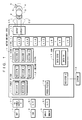
- Fig. 1 is a whole block diagram, showing one embodiment according to this invention.
- a motor driver 1 for driving a stepping motor supplies excitation signals to drive coils C1, C2 for rotating a rotor 2.
- the excitation signals are formed with equally-divided 32 excitation steps generated fundamentally based on sine and cosine wave shapes, later more described.
- the motor driver 1 comprises with a CPU for filtering process, later described, and data conversion as basic functions of the driver 1 and then the motor driver 1 may be described as a driver CPU or simply CPU in later some descriptions.
- the rotor 2 driven by the drive coils C1, C2 placed with 90 degree correspondingly to each other, is magnetized equally alternately in N-pole and S-pole to pair of 5 poles, herein.
- the rotor 2 is connected with an intermediate gear 3 and an output gear 4.
- the output gear 4 is provided with a needle or a stopper piece 5.
- the needle or the stopper piece 5 rotates together with rotation of the rotor 2 corresponding to excitation signals at a zero position determined by a fixed stopper 6 and indicates not-shown required scale.
- the needle or the stopper piece 5 rotates clockwise as shown by an arrow when accelerating speed and inversely rotates counterclockwise by an inverse direction of an arrow when decelerating speed.
- the motor driver 1 is connected with an ignition switch 8 (IGN 8) through I/F 81 and with a speed sensor 9 through I/F 91.
- the motor driver 1 responding to ING 8 turning ON or OFF, generates excitation signals to return said needle or stopper piece 5 to a zero position and supplies the signals to the drive coils C1 and C2.
- the motor driver 1 also receives a sensor output (speed pulse) corresponding to a vehicle speed from the speed sensor 9 and generates excitation signals to move the needle or stopper piece 5 correspondingly to a vehicle speed and supplies the signals to the drive coils C1 and C2.
- the motor driver 1 is supplied electric power through a 5V power supply IC 71 from a car battery 7.
- the motor driver 1 generates excitation signals to return the needle or stopper pieces 5 to a zero position at a timing of the power supply IC 71 turning ON or the IGN 8 turning ON or OFF and supplies the signals to the drive coils C1 and C2, later described more with reference to Fig. 2 - 7.
- the motor driver 1 is connected with a E2PROM 10.
- the E2PROM 10 is a rewritable memorizing means and stores data of corresponding relation between timing of said needle or stopper piece 5 abutting on the fixed stopper 6 and later-described a stable step of excitation signals.
- the motor driver 1 is described to control only one kind of motor elements or devices (drive coils C1, C2, C3, C4, C5 and C6) corresponding to a speedometer.
- driving a tachometer, a fuel meter, a thermometer or the like including the speedometer by time sharing control is effective.
- Said motor driver 1 is provided with a first filter 11, a second filter 12, a third filter 13, a SIN/COS table 14, an output circuit 15, a speed filter 16, a ROM 17 and resisters 1 - 9.
- the motor driver 1 is basically structured with a CPU and generates excitation signals to drive a stepping motor.
- the first filter 11 is for controlling the maximum motor rotating speed and, when a remainder of subtracting absolute value of previous angle data from absolute value of new angle data is positive and 8 degree or more, adds 8 degree to previous angle data and sends the data to the second filter 12 or, when the remainder is not over 8 degree, sends the new angle data to the second filter 12.
- a remainder of subtracting absolute value of previous angle data from absolute value of new angle data is negative and 8 degree or more
- the first filter subtracts 8 degree from previous angle data and sends the data to the second filter 12 or, when the remainder is not over 8 degree, sends the new angle data to the second filter 12.
- the second filter 12 is for smoothing a motor rotation and smoothes data changing every about 20.48 msec by 1/8 weighted-average filtering and sends the data to the third filter 13.
- the third filter 13 is for smoothing more a motor rotation and smoothes data changing every about 0.256 msec by 1/512 weighted-average filtering to prevent out-of-step of a stepping motor. Thereafter, a remainder of divided the data by 32 is sent to the SIN/COS table 14.
- the SIN/COS table is for converting output data to drive coils C1, C2 and sends output data to C1, C2 (SIN/COS conversion data) corresponding to received data from the third filter 13 to the output circuit 15.
- S0, s4, s8, s12, s16, s20, s24 and s28 described in the table 14 show step numbers by every 4 steps in 32 steps forming said excitation signals.
- one electric cycle of excitation signals is formed with 32 steps of divided equally s0, s31, s30, s29, s28, s27, s26, s25, s24, s23, s22, s21, s20, s19, s18, s17, s16, s15, s14, s13, s12, s11, s10, s9, s8, s7, s6, s5, s4, s3, s2 and s1.
- steps between above each 4 steps for example, s2 and s3 between s0 and s4, however, steps between each 4 steps are omitted for simplifying description herein.
- the output circuit 15 is for supplying excitation signals of a motor controlling output to the drive coils C1, C2 and supplies voltage values of D/A or PWN conversion data from the SIN/COS table 14 to the coils C1, C2.
- micro-step excitation signals are supplied to drive coils by means of the filter 11, 12, 13, the SIN/COS table 14 and the output circuit 15 as mentioned above, the vibrated motion of the needle during return-to-zero is reduced and may not make a car driver feel strange. Since the vibrated motion of the needle becomes small and then, the needle wobbling may not be continued.
- the excitation signals supplying to the coils C1, C2 from the output circuit 15 are formed into wave shape based on two phases sine wave with 90 degree shifted phase to each other. Which excitation signals of two phases are supplied to the coil C1 or the coil C2 is determined by conditions of the coils C1, C2 position against the rotor 2 and rotating direction of the rotor 2 and the other condition.
- the output gear 4 rotates 2 degree by one electric cycle at gear ratio 36:1.
- One electric cycle is formed with 32 equal steps and then the output gear 4 rotates 0.0625 degree by one step.
- the excitation signals generated as mentioned above are not only for rotating toward the zero position at return-to-zero, but also are generated to rotate the rotor 2 clockwise or counterclockwise based on angle data generated by a car speed or the like.
- the same hardware and software can be used to generate the data by controlling angle data (corresponding to needle control signal in claims) . Therefore, controlling rotor rotation at the both conditions of return-to-zero and normal can be done by the same way and then processing data is simplified and load on CPU for controlling rotor rotation is reduced.
- a speed filter 16 converts speed pulse, supplied by said speed sensor 9, to angle data and output the data to the first filter 11.
- a ROM 17 stores data required for CPU processing, such as a target angle data of excitation signals generated on return-to-zero.
- data 5760 and 64 corresponding to each 360 degree and 4 degree are stored therein. The reason of 360 degree and 4 degree will be described later.
- Said first, second and third filters 11, 12 and 13 have resisters 1 - 8 for temporally storing data generated during above filtering process.
- a resister 9 stores temporally motor stable position data transferred from E2PROM 10 in excitation signal generating process. Specific functions of these resisters will be described clearly in Fig. 2 - 5.
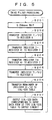
- Fig. 1 is a flowchart, showing an example of the CPU processing in Fig. 1 according to this embodiment.
- Fig. 3 is a flowchart, showing an example of the first filter processing shown in Fig. 2 flowchart.
- Fig. 4 is a flowchart, showing an example of the second filter processing shown in Fig. 2 flowchart.
- Fig. 5 is a flowchart, showing an example of the third filter processing shown in Fig. 2 flowchart.
- the first filter processing (S9) and the second filter processing (S10) are repeated every 20.48 msec (S8) if data stored in the resister 4 is not smaller than 8 (N of S11) and the process proceeds to S12 when data stored in the resister 4 becomes smaller than 8 (Y of S11).
- the first filter processing in S9 is basically to control the maximum rotating speed of a motor and an example will be described later with reference to Fig. 3.
- the second filter processing in S12 is to smooth motor rotation and an example will be described later with reference to Fig. 4.
- absolute value of remainder of subtraction of data stored in the resister 2 and the resister 1 is judged over 128 or not in S901. If the absolute value is over 128, the process proceeds to S902 (Y of S901). If not (N of S901), the process proceeds to S905.
- S902 a remainder of subtracting data stored in the resister 1 from data stored in the resister 2 is judged over zero or not. If the remainder is over zero (Y of S902), the process proceeds to S903. If not, the process proceeds to S904. In S903, data, stored in the resister 2, added 128 is transferred to the resister 2 and the process returns to the main flowchart. In S904, data, stored in the resister 2, subtracted 128 is transferred to the resister 2 and the process returns.
- S101 data stored in the resister 2 is transferred to the resister 3 and the process proceeds to S102.
- data, stored in the resister 4, divided by 8 is transferred to the resister 5 and the process proceeds to S103.
- S103 data of subtracting data stored in the resister 5 from data stored in the resister 4 is transferred to the resister 4 and the process proceeds to S104.
- S105 data of adding data stored in the resister 4 to data stored in the resister 3 is transferred to the resister 4 and the process proceeds to S105.
- S105 data, stored in the resister 4, divided by 8 is transferred to the resister 6 and the process returns.
- S205 data of dividing data stored in the resister 7 by 512 is transferred to the resister 8 and the process proceeds to S206.
- S206 a remainder of dividing data stored in the resister 8 by 32 is transferred to the SIN/COS table 14 and the process proceeds to S207.
- S207 SIN/COS data given by the SIN/COS table 14 is transferred to the output circuit 15 and the process returns to S201.
- the excitation signal corresponding to rotate the needle 360 degree toward the zero position is supplied into the drive coils. Therefore, a needle of any meter is always set on the zero position securely since usually a needle does not rotate over 360 degree in maximum and the excitation signal corresponding to rotate the needle 360 degree is supplied into the drive coils.
- the excitation signal corresponding to the maximum value of 360 degree is supplied into the drive coils.
- the maximum indicating angle, for example 300 degree, of a meter is known previously, supplying the excitation signal corresponding to 310 degree into the drive coils, a needle can be set on the zero position securely and effectively.
- value of excitation signals supplied at timing of a car battery ON may be fixed correspondingly to 360 degree for assurance or may be adjusted occasionally such as correspondingly to 310 degree.
- the processing at ignition ON can be done by altering S1, S3, S4 and S13 in return-to-zero process at battery ON, mentioned above.
- IGN 8 is sensed ON in S1.
- data 64 corresponding to 4 degree, stored in the ROM 17, is transferred to the resister 2 and 3.
- the process does not proceed to CPU sleep mode such as at battery ON but proceeds to needle control process in normal measuring mode.
- the 4 degree is determined to rotate the output gear 4 two degree by one electric cycle.
- a needle can be set in a zero position by one electric cycle, however in this embodiment, excitation signals corresponding to two electric cycles are supplied for assurance.
- the processing at ignition OFF can be done by altering S1, S3 and S4 in return-to-zero process at battery ON, mentioned above.
- IGN 8 is sensed OFF in S1.
- data 64 corresponding to 4 degree, stored in the ROM 17, is transferred to the resister 2 and 3.
- a needle is almost always set on a zero position. Since a zero position setting can be done by not requiring to sense induced voltage, a needle continuously wobbling on the each time to turn ignition ON/OFF is enhanced and looking is improved. Circuit structure is also simplified by requiring no sensing coil for induced voltage and no sensing circuit and then a unit size can be miniaturized.
- needle control processing in normal measuring mode to control a needle correspondingly to a car speed or the like, by altering angle data for above return-to-zero into angle data corresponding to measurement value in above process from the end of processing at ignition ON to ignition OFF, needle control can be done similarly as above processing shown in Fig. 1 - 5.
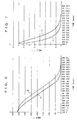
- Fig. 6 is a graph showing an example of angle control by return-to-zero process at battery ON.
- Fig. 7 is graph showing an example of angle control by return-to-zero process at ignition ON.
- A is an example of angle control by the first and second filter and B is an example of angle control by all filters including the third filter.
- 360-degree angle control by filtering with all filters including the third filter is done very smoothly. And after the data by the first and second filter becomes zero, the data by the third filter becomes zero about 250 msec later.
- C is an example of angle control by the first and second filter and D is an example of angle control by all filters including the third filter.
- 4-degree angle control by filtering with all filters including the third filter is done very smoothly.
- the parameter values shown in Fig. 1 - 5 may be not limited.
- the parameter values in Fig. 1 - 5 can be adjusted occasionally.
- pole locations of drive coils C1, C2 and fixed stopper position are not limited in this embodiment. Pole locations of drive coils C1, C2 and fixed stopper position can be altered occasionally.
Landscapes
- Engineering & Computer Science (AREA)
- Chemical & Material Sciences (AREA)
- Combustion & Propulsion (AREA)
- Transportation (AREA)
- Mechanical Engineering (AREA)
- Power Engineering (AREA)
- Control Of Stepping Motors (AREA)
- Instrument Panels (AREA)
Abstract
Description
Claims (7)
- A circuit for driving a stepping motor to control a needle position of a meter mounted in a vehicle by needle control signals, comprising:an excitation signal generating means for generating excitation signals, their one electrical cycle being formed by a plurality of excitation steps supplied in drive coils to rotate a rotor with N-poles and S-poles, magnetized equally and alternately, of a stepping motor; anda first excitation signal supply controlling means for controlling said excitation signal generating means to supply said excitation signals to said drive coils, wherein the needle is connected with the rotor through a speed change gear and rotates correspondingly to the rotor rotation, so that said excitation signals correspond to a needle rotating angle more than a maximum needle rotating angle toward a zero position to respond to the needle control signals generated at a timing when a vehicle battery turns ON.
- A drive circuit for a stepping motor, for controlling position of a needle of a meter mounted in a vehicle by needle control signals, comprising;an excitation signal generating means for generating excitation signals, their one electrical cycle being formed by a plurality of excitation steps supplied in drive coils to rotate a rotor with N-poles and S-poles, magnetized equally and alternately, of a stepping motor; anda first excitation signal supply controlling means for controlling said excitation signal generating means to supply said excitation signals to said drive coils, wherein the needle is connected with the rotor through a speed change gear and rotates correspondingly to the rotor rotation, so that said excitation signals correspond to double of said one electrical cycle rotating toward a zero position to respond to the needle control signals generated at a timing when an ignition turns ON or OFF.
- The drive circuit for a stepping motor according to claims 1 and 2, wherein said excitation signal generating means comprises;a filtering means for filtering the needle control signals to move the needle faster to the zero position;a SIN/COS table for generating SIN/COS data corresponding to the excitation signal of micro-steps based on filtering result by means of the filtering means; andan output circuit for outputting excitation signals supplied into the drive coil as a required voltage value to rotate the rotor based on SIN/COS data by the SIN/COS table.
- The drive circuit for a stepping motor according to claims 3, wherein said filtering means comprises;a first filter for filtering the needle control signals to add or subtract predetermined value corresponding to change values of the needle control signals;a second filter for smoothing data change value to weighted-average filtering results by the first filter every predetermined time period; anda third filter for weighted-averaging filtering results by the second filter every predetermined time period to prevent out-of-step of a stepping motor and sending the data to said SIN/COS table.
- The drive circuit for a stepping motor according to claim 4, wherein the rotor is magnetized equally alternately in N-pole and S-pole to pair of 5 poles, wherein the excitation signals is generated to be formed with equally-divided 32 excitation steps, based on sine wave shape.
- The drive circuit for a stepping motor according to claims 1 and 2 comprises a second excitation signal supply controlling means for controlling the excitation signal generating means to supply to the drive coils the excitation signals for moving the needle in amount based on a measured signal toward the zero position or counter to the zero position, responding to the needle control signals generated based on the measured signals supplied by a measurement unit in a vehicle.
- The drive circuit for a stepping motor according to claim 1, wherein an amount of the excitation signal corresponding to rotating the needle more than the maximum needle rotating angle is the amount to rotate the needle 360 degree.
Applications Claiming Priority (2)
| Application Number | Priority Date | Filing Date | Title |
|---|---|---|---|
| JP2000310455A JP2002119090A (en) | 2000-10-11 | 2000-10-11 | Stepper motor drive circuit |
| JP2000310455 | 2000-10-11 |
Publications (3)
| Publication Number | Publication Date |
|---|---|
| EP1198060A2 true EP1198060A2 (en) | 2002-04-17 |
| EP1198060A3 EP1198060A3 (en) | 2004-07-14 |
| EP1198060B1 EP1198060B1 (en) | 2006-12-20 |
Family
ID=18790411
Family Applications (1)
| Application Number | Title | Priority Date | Filing Date |
|---|---|---|---|
| EP01124120A Expired - Lifetime EP1198060B1 (en) | 2000-10-11 | 2001-10-10 | Circuit for driving stepping motor |
Country Status (4)
| Country | Link |
|---|---|
| US (1) | US6677723B2 (en) |
| EP (1) | EP1198060B1 (en) |
| JP (1) | JP2002119090A (en) |
| DE (1) | DE60125303T2 (en) |
Families Citing this family (8)
| Publication number | Priority date | Publication date | Assignee | Title |
|---|---|---|---|---|
| JP4267424B2 (en) * | 2003-10-31 | 2009-05-27 | 矢崎総業株式会社 | Stepper motor drive device |
| JP2005241526A (en) * | 2004-02-27 | 2005-09-08 | Calsonic Kansei Corp | Indicating instrument |
| US7816883B2 (en) * | 2007-10-09 | 2010-10-19 | Delphi Technologies, Inc. | Return-to-zero control method for a stepper motor |
| JP5105067B2 (en) * | 2008-01-30 | 2012-12-19 | 日本精機株式会社 | Instrument device |
| DE102010000286B4 (en) | 2009-02-05 | 2019-05-23 | Denso Corporation | Indicator for a vehicle |
| JP5190406B2 (en) * | 2009-04-03 | 2013-04-24 | 矢崎総業株式会社 | How to return the pointer to the origin |
| JP5342356B2 (en) * | 2009-07-24 | 2013-11-13 | 矢崎総業株式会社 | Vehicle meter initialization drive device |
| CN102350950B (en) * | 2011-07-29 | 2013-10-30 | 深圳市元征软件开发有限公司 | Resetting method for pointer of automobile instrument |
Family Cites Families (11)
| Publication number | Priority date | Publication date | Assignee | Title |
|---|---|---|---|---|
| JPS5813744Y2 (en) * | 1978-10-27 | 1983-03-17 | カルソニックカンセイ株式会社 | Cross coil instrument drive circuit |
| JPH0638593A (en) * | 1992-07-13 | 1994-02-10 | Yazaki Corp | Indicating instrument |
| DE4423119C1 (en) * | 1994-07-01 | 1995-12-14 | Moto Meter Gmbh | Procedure for zero positioning of a pointer |
| US5546888A (en) * | 1994-09-09 | 1996-08-20 | Delco Electronics Corporation | Surface mounted gauge with illuminated pointer |
| JP3389727B2 (en) * | 1995-03-15 | 2003-03-24 | 株式会社デンソー | Indicating instrument |
| JP3013775B2 (en) * | 1996-04-11 | 2000-02-28 | 日本精機株式会社 | Driving device for stepping motor type instrument |
| US5665897A (en) * | 1996-08-09 | 1997-09-09 | Delco Electronics Corporation | Method of calibrating and zeroing stepper motor gauges |
| JPH1169890A (en) * | 1997-08-26 | 1999-03-09 | Oriental Motor Co Ltd | Method and circuit for resetting stepping motor to excitation origin |
| US5914579A (en) * | 1997-10-02 | 1999-06-22 | Dana Corporation | Direct current command generation for a stepper motor drive |
| US5932987A (en) * | 1998-04-14 | 1999-08-03 | Millipore Corporation | Variable step rate precision pumping apparatus |
| JP2000078892A (en) * | 1998-08-28 | 2000-03-14 | Matsushita Electric Ind Co Ltd | Driving device for stepping motor |
-
2000
- 2000-10-11 JP JP2000310455A patent/JP2002119090A/en active Pending
-
2001
- 2001-10-10 US US09/973,003 patent/US6677723B2/en not_active Expired - Lifetime
- 2001-10-10 EP EP01124120A patent/EP1198060B1/en not_active Expired - Lifetime
- 2001-10-10 DE DE60125303T patent/DE60125303T2/en not_active Expired - Lifetime
Also Published As
| Publication number | Publication date |
|---|---|
| EP1198060B1 (en) | 2006-12-20 |
| DE60125303T2 (en) | 2007-07-12 |
| DE60125303D1 (en) | 2007-02-01 |
| US20020041170A1 (en) | 2002-04-11 |
| JP2002119090A (en) | 2002-04-19 |
| US6677723B2 (en) | 2004-01-13 |
| EP1198060A3 (en) | 2004-07-14 |
Similar Documents
| Publication | Publication Date | Title |
|---|---|---|
| KR100499729B1 (en) | Indicating instrument for a vehicle | |
| JP3284838B2 (en) | Stepping motor type indicating instrument | |
| JP4206713B2 (en) | Indicating instrument | |
| US6731092B2 (en) | Apparatus and method for initializing stepper motor | |
| EP1198060B1 (en) | Circuit for driving stepping motor | |
| US8237394B2 (en) | Method for initializing indicating instrument for vehicle | |
| WO2008053640A1 (en) | Stepping motor drive control device and drive control method | |
| JP2005114459A (en) | Pointed position correcting method and apparatus, and pointing device | |
| WO2015037673A1 (en) | Needle-pointer-type meter device | |
| US7898206B2 (en) | Stepping motor drive | |
| JP2000050695A (en) | Method and device for detecting step-out of stepping motor | |
| JP2002272190A (en) | Electric angle setting device for step motor and indicating instrument for vehicle | |
| JP5528902B2 (en) | Stepping motor device | |
| JP2000018975A (en) | Device for stepping motor type instrument | |
| JP2002267501A (en) | Indicators for vehicles | |
| JP4591301B2 (en) | Pointer-type instrument | |
| JP2000283997A (en) | Pointer display | |
| JPH0754327B2 (en) | Instrument control circuit | |
| JP2002005698A (en) | Indicators for vehicles | |
| JP2004328836A (en) | Indicating instrument for vehicle having stepping motor | |
| JP4695900B2 (en) | Instrument device | |
| JP2002084791A (en) | Stepper motor drive circuit | |
| JP2010243455A (en) | Pointer instrument for vehicle | |
| JP4209731B2 (en) | Stepper motor drive device | |
| JP3224009B2 (en) | Pointer display |
Legal Events
| Date | Code | Title | Description |
|---|---|---|---|
| PUAI | Public reference made under article 153(3) epc to a published international application that has entered the european phase |
Free format text: ORIGINAL CODE: 0009012 |
|
| AK | Designated contracting states |
Kind code of ref document: A2 Designated state(s): AT BE CH CY DE DK ES FI FR GB GR IE IT LI LU MC NL PT SE TR |
|
| AX | Request for extension of the european patent |
Free format text: AL;LT;LV;MK;RO;SI |
|
| PUAL | Search report despatched |
Free format text: ORIGINAL CODE: 0009013 |
|
| AK | Designated contracting states |
Kind code of ref document: A3 Designated state(s): AT BE CH CY DE DK ES FI FR GB GR IE IT LI LU MC NL PT SE TR |
|
| AX | Request for extension of the european patent |
Extension state: AL LT LV MK RO SI |
|
| RIC1 | Information provided on ipc code assigned before grant |
Ipc: 7H 02P 8/00 A Ipc: 7H 02P 8/32 B |
|
| 17P | Request for examination filed |
Effective date: 20041201 |
|
| 17Q | First examination report despatched |
Effective date: 20050124 |
|
| AKX | Designation fees paid |
Designated state(s): DE FR GB SE |
|
| GRAP | Despatch of communication of intention to grant a patent |
Free format text: ORIGINAL CODE: EPIDOSNIGR1 |
|
| GRAS | Grant fee paid |
Free format text: ORIGINAL CODE: EPIDOSNIGR3 |
|
| GRAA | (expected) grant |
Free format text: ORIGINAL CODE: 0009210 |
|
| AK | Designated contracting states |
Kind code of ref document: B1 Designated state(s): DE FR GB SE |
|
| REG | Reference to a national code |
Ref country code: GB Ref legal event code: FG4D |
|
| REF | Corresponds to: |
Ref document number: 60125303 Country of ref document: DE Date of ref document: 20070201 Kind code of ref document: P |
|
| REG | Reference to a national code |
Ref country code: SE Ref legal event code: TRGR |
|
| RAP2 | Party data changed (patent owner data changed or rights of a patent transferred) |
Owner name: YAZAKI CORPORATION |
|
| EN | Fr: translation not filed | ||
| PLBE | No opposition filed within time limit |
Free format text: ORIGINAL CODE: 0009261 |
|
| STAA | Information on the status of an ep patent application or granted ep patent |
Free format text: STATUS: NO OPPOSITION FILED WITHIN TIME LIMIT |
|
| 26N | No opposition filed |
Effective date: 20070921 |
|
| PG25 | Lapsed in a contracting state [announced via postgrant information from national office to epo] |
Ref country code: FR Free format text: LAPSE BECAUSE OF FAILURE TO SUBMIT A TRANSLATION OF THE DESCRIPTION OR TO PAY THE FEE WITHIN THE PRESCRIBED TIME-LIMIT Effective date: 20070810 |
|
| GBPC | Gb: european patent ceased through non-payment of renewal fee |
Effective date: 20071010 |
|
| PG25 | Lapsed in a contracting state [announced via postgrant information from national office to epo] |
Ref country code: FR Free format text: LAPSE BECAUSE OF FAILURE TO SUBMIT A TRANSLATION OF THE DESCRIPTION OR TO PAY THE FEE WITHIN THE PRESCRIBED TIME-LIMIT Effective date: 20061220 Ref country code: GB Free format text: LAPSE BECAUSE OF NON-PAYMENT OF DUE FEES Effective date: 20071010 |
|
| PGFP | Annual fee paid to national office [announced via postgrant information from national office to epo] |
Ref country code: DE Payment date: 20141007 Year of fee payment: 14 |
|
| REG | Reference to a national code |
Ref country code: DE Ref legal event code: R119 Ref document number: 60125303 Country of ref document: DE |
|
| PG25 | Lapsed in a contracting state [announced via postgrant information from national office to epo] |
Ref country code: DE Free format text: LAPSE BECAUSE OF NON-PAYMENT OF DUE FEES Effective date: 20160503 |
|
| PGFP | Annual fee paid to national office [announced via postgrant information from national office to epo] |
Ref country code: SE Payment date: 20181011 Year of fee payment: 18 |
|
| PG25 | Lapsed in a contracting state [announced via postgrant information from national office to epo] |
Ref country code: SE Free format text: LAPSE BECAUSE OF NON-PAYMENT OF DUE FEES Effective date: 20191011 |