EP1198019A2 - Cathode active material for non aqueous lithium secondary battery and methods for preparation thereof - Google Patents
Cathode active material for non aqueous lithium secondary battery and methods for preparation thereof Download PDFInfo
- Publication number
- EP1198019A2 EP1198019A2 EP01123899A EP01123899A EP1198019A2 EP 1198019 A2 EP1198019 A2 EP 1198019A2 EP 01123899 A EP01123899 A EP 01123899A EP 01123899 A EP01123899 A EP 01123899A EP 1198019 A2 EP1198019 A2 EP 1198019A2
- Authority
- EP
- European Patent Office
- Prior art keywords
- active material
- cathode active
- aqueous electrolyte
- synthesis
- cathode
- Prior art date
- Legal status (The legal status is an assumption and is not a legal conclusion. Google has not performed a legal analysis and makes no representation as to the accuracy of the status listed.)
- Withdrawn
Links
- 0 C=C=CC*CCN Chemical compound C=C=CC*CCN 0.000 description 5
Images

Classifications
-
- H—ELECTRICITY
- H01—ELECTRIC ELEMENTS
- H01M—PROCESSES OR MEANS, e.g. BATTERIES, FOR THE DIRECT CONVERSION OF CHEMICAL ENERGY INTO ELECTRICAL ENERGY
- H01M4/00—Electrodes
- H01M4/02—Electrodes composed of, or comprising, active material
- H01M4/36—Selection of substances as active materials, active masses, active liquids
- H01M4/58—Selection of substances as active materials, active masses, active liquids of inorganic compounds other than oxides or hydroxides, e.g. sulfides, selenides, tellurides, halogenides or LiCoFy; of polyanionic structures, e.g. phosphates, silicates or borates
- H01M4/5825—Oxygenated metallic salts or polyanionic structures, e.g. borates, phosphates, silicates, olivines
-
- H—ELECTRICITY
- H01—ELECTRIC ELEMENTS
- H01M—PROCESSES OR MEANS, e.g. BATTERIES, FOR THE DIRECT CONVERSION OF CHEMICAL ENERGY INTO ELECTRICAL ENERGY
- H01M4/00—Electrodes
- H01M4/02—Electrodes composed of, or comprising, active material
- H01M4/36—Selection of substances as active materials, active masses, active liquids
- H01M4/48—Selection of substances as active materials, active masses, active liquids of inorganic oxides or hydroxides
-
- C—CHEMISTRY; METALLURGY
- C01—INORGANIC CHEMISTRY
- C01B—NON-METALLIC ELEMENTS; COMPOUNDS THEREOF; METALLOIDS OR COMPOUNDS THEREOF NOT COVERED BY SUBCLASS C01C
- C01B25/00—Phosphorus; Compounds thereof
- C01B25/16—Oxyacids of phosphorus; Salts thereof
- C01B25/26—Phosphates
- C01B25/45—Phosphates containing plural metal, or metal and ammonium
-
- H—ELECTRICITY
- H01—ELECTRIC ELEMENTS
- H01M—PROCESSES OR MEANS, e.g. BATTERIES, FOR THE DIRECT CONVERSION OF CHEMICAL ENERGY INTO ELECTRICAL ENERGY
- H01M10/00—Secondary cells; Manufacture thereof
- H01M10/05—Accumulators with non-aqueous electrolyte
- H01M10/052—Li-accumulators
- H01M10/0525—Rocking-chair batteries, i.e. batteries with lithium insertion or intercalation in both electrodes; Lithium-ion batteries
-
- H—ELECTRICITY
- H01—ELECTRIC ELEMENTS
- H01M—PROCESSES OR MEANS, e.g. BATTERIES, FOR THE DIRECT CONVERSION OF CHEMICAL ENERGY INTO ELECTRICAL ENERGY
- H01M10/00—Secondary cells; Manufacture thereof
- H01M10/05—Accumulators with non-aqueous electrolyte
- H01M10/058—Construction or manufacture
-
- H—ELECTRICITY
- H01—ELECTRIC ELEMENTS
- H01M—PROCESSES OR MEANS, e.g. BATTERIES, FOR THE DIRECT CONVERSION OF CHEMICAL ENERGY INTO ELECTRICAL ENERGY
- H01M4/00—Electrodes
- H01M4/02—Electrodes composed of, or comprising, active material
- H01M4/04—Processes of manufacture in general
-
- H—ELECTRICITY
- H01—ELECTRIC ELEMENTS
- H01M—PROCESSES OR MEANS, e.g. BATTERIES, FOR THE DIRECT CONVERSION OF CHEMICAL ENERGY INTO ELECTRICAL ENERGY
- H01M10/00—Secondary cells; Manufacture thereof
- H01M10/05—Accumulators with non-aqueous electrolyte
- H01M10/056—Accumulators with non-aqueous electrolyte characterised by the materials used as electrolytes, e.g. mixed inorganic/organic electrolytes
- H01M10/0564—Accumulators with non-aqueous electrolyte characterised by the materials used as electrolytes, e.g. mixed inorganic/organic electrolytes the electrolyte being constituted of organic materials only
- H01M10/0565—Polymeric materials, e.g. gel-type or solid-type
-
- H—ELECTRICITY
- H01—ELECTRIC ELEMENTS
- H01M—PROCESSES OR MEANS, e.g. BATTERIES, FOR THE DIRECT CONVERSION OF CHEMICAL ENERGY INTO ELECTRICAL ENERGY
- H01M10/00—Secondary cells; Manufacture thereof
- H01M10/42—Methods or arrangements for servicing or maintenance of secondary cells or secondary half-cells
- H01M10/44—Methods for charging or discharging
-
- H—ELECTRICITY
- H01—ELECTRIC ELEMENTS
- H01M—PROCESSES OR MEANS, e.g. BATTERIES, FOR THE DIRECT CONVERSION OF CHEMICAL ENERGY INTO ELECTRICAL ENERGY
- H01M4/00—Electrodes
- H01M4/02—Electrodes composed of, or comprising, active material
- H01M4/13—Electrodes for accumulators with non-aqueous electrolyte, e.g. for lithium-accumulators; Processes of manufacture thereof
- H01M4/133—Electrodes based on carbonaceous material, e.g. graphite-intercalation compounds or CFx
-
- H—ELECTRICITY
- H01—ELECTRIC ELEMENTS
- H01M—PROCESSES OR MEANS, e.g. BATTERIES, FOR THE DIRECT CONVERSION OF CHEMICAL ENERGY INTO ELECTRICAL ENERGY
- H01M4/00—Electrodes
- H01M4/02—Electrodes composed of, or comprising, active material
- H01M4/13—Electrodes for accumulators with non-aqueous electrolyte, e.g. for lithium-accumulators; Processes of manufacture thereof
- H01M4/136—Electrodes based on inorganic compounds other than oxides or hydroxides, e.g. sulfides, selenides, tellurides, halogenides or LiCoFy
-
- Y—GENERAL TAGGING OF NEW TECHNOLOGICAL DEVELOPMENTS; GENERAL TAGGING OF CROSS-SECTIONAL TECHNOLOGIES SPANNING OVER SEVERAL SECTIONS OF THE IPC; TECHNICAL SUBJECTS COVERED BY FORMER USPC CROSS-REFERENCE ART COLLECTIONS [XRACs] AND DIGESTS
- Y02—TECHNOLOGIES OR APPLICATIONS FOR MITIGATION OR ADAPTATION AGAINST CLIMATE CHANGE
- Y02E—REDUCTION OF GREENHOUSE GAS [GHG] EMISSIONS, RELATED TO ENERGY GENERATION, TRANSMISSION OR DISTRIBUTION
- Y02E60/00—Enabling technologies; Technologies with a potential or indirect contribution to GHG emissions mitigation
- Y02E60/10—Energy storage using batteries
-
- Y—GENERAL TAGGING OF NEW TECHNOLOGICAL DEVELOPMENTS; GENERAL TAGGING OF CROSS-SECTIONAL TECHNOLOGIES SPANNING OVER SEVERAL SECTIONS OF THE IPC; TECHNICAL SUBJECTS COVERED BY FORMER USPC CROSS-REFERENCE ART COLLECTIONS [XRACs] AND DIGESTS
- Y02—TECHNOLOGIES OR APPLICATIONS FOR MITIGATION OR ADAPTATION AGAINST CLIMATE CHANGE
- Y02P—CLIMATE CHANGE MITIGATION TECHNOLOGIES IN THE PRODUCTION OR PROCESSING OF GOODS
- Y02P70/00—Climate change mitigation technologies in the production process for final industrial or consumer products
- Y02P70/50—Manufacturing or production processes characterised by the final manufactured product
Definitions
- This invention relates to a cathode active material capable of doping/dedoping lithium reversibly, a non-aqueous electrolyte cell containing the cathode active material, and to the methods for the preparation of the cathode active material and the non-aqueous electrolyte cell.
- a rechargeable secondary cell as a power source that may be used conveniently and economically for a prolonged period of time, are proceeding briskly.
- typical secondary cells there are a lead storage cell, an alkali storage cell and a non-aqueous electrolyte secondary cell.
- a lithium ion secondary cell as a non-aqueous electrolyte secondary cell, has advantages such as high output or high energy density.
- a lithium ion secondary cell is made up of at least a cathode and an anode, each having an active material capable of reversibly doping/dedoping lithium ions, and a non-aqueous electrolyte.
- the charging reaction of the lithium ion secondary cell proceeds as lithium ions are deintercalated into an electrolyte solution at the cathode and are intercalated at the anode into the anode active material.
- reaction opposite to the charging reaction proceeds, such that lithium ions are intercalated at the cathode. That is, charging/discharging is repeated as the reaction of entrance/exiting of lithium ions from the cathode into the anode active material and from the anode active material occurs repeatedly.
- LiCoO 2 , Li NiO 2 or LiMn 2 O 4 is used as the cathode active material of the lithium ion secondary cell because these materials have a high energy density and a high voltage.
- cathode active materials containing metal elements of low Clark number in their composition, suffer from high cost and difficulties caused by supply instability. Moreover, these cathode active materials are higher in toxicity and liable to pollute the environment significantly. So, there is raised a demand for a novel substitute material usable as a cathode active material.
- LiFe x PO 4 has a volumetric density as high as 3.6 g/m 3 and generates a high potential of 3.4V, while having a theoretical capacity as high as 170 mAh/g. Additionally, LiFePO 4 contains an electrochemically dedopable Li at a rate of one atom per Fe atom, in its initial state, and hence is a promising candidate for a cathode active material for a lithium ion secondary cell.
- LiFePO 4 includes iron, as an inexpensive material plentiful in supply, in its composition, and hence is less costly than any of the aforementioned materials, that is LiCoO 2 , LiNiO 2 or LiMn 2 O 4 . Moreover, it is low in toxicity and is less liable to pollute the environment.
- the portion of the starting materials for synthesis exceeding the stoichiometric amounts of the reaction formula (1) is not used for the synthesis reaction, but is left as impurity in the cathode active material. If this portion of the starting materials for synthesis left in the cathode active material is excessive, the non-aqueous electrolyte cell employing the cathode active material is deteriorated in cell performance.
- the present invention provides a cathode active material mainly composed of a compound represented by a general formula Li x FePO 4 , where 0 ⁇ x ⁇ 1, wherein a molar ratio of Li 3 PO 4 to the compound represented by the general formula Li x FePO 4, which ratio represented by Li 3 PO 4 /LiFePO 4, is Li 3 PO 4 /LiFePO 4 ⁇ 6.67 ⁇ 10 -2 .
- the non-aqueous electrolyte cell can be of high capacity by setting the ratio Li 3 PO 4 /Li x FePO 4 in the cathode active material as described above to optimize the amount of Li 3 PO 4 left in the cathode active material.
- the present invention provides a non-aqueous electrolyte cell having a cathode containing a cathode active material, an anode containing an anode active material and a non-aqueous electrolyte, wherein said cathode active material is mainly composed of a compound represented by a general formula Li x FePO 4 , where 0 ⁇ x ⁇ 1, and wherein a molar ratio of Li 3 PO 4 to the compound represented by the general formula Li x FePO 4. which ratio is represented by Li 3 PO 4 /LiFePO 4, is Li 3 PO 4 /LiFePO 4 ⁇ 6.67 ⁇ 10 -2 .
- the non-aqueous electrolyte cell In the non-aqueous electrolyte cell according to the present invention, a cathode active material mainly composed of Li x FePO 4 is used. In this cathode active material,Li 3 PO 4 is occasionally left without being utilized in the synthesis reaction. However, this Li 3 PO 4 imperils the cell characteristics.
- the high capacity nonaqueous electrolyte cell produced can be of high capacity by setting the ratio Li 3 PO 4 /LiFe x PO 4 in the cathode active material as described above to optimize the amount of Li 3 PO 4 left in the cathode active material.
- the present invention provides a method for preparing a cathode active material comprising a mixing step of mixing Li 3 PO 4 and Fe 3 (PO 4 ) 2 or hydrates of the Fe 3 (PO 4 ) 2 represented by Fe 3 (PO 4 ) 2 ⁇ nH 2 O, where n denotes a number of hydrates, as starting materials for synthesis, so as to form a mixture and sintering step of sintering the mixture obtained in said mixing step, wherein a mixing ratio of said starting materials for synthesis in terms of an element molar ratio of Li to Fe represented by Li/Fe is 1/1.05 ⁇ Li/Fe ⁇ 1.2/1.
- a cathode active material mainly composed of LiFe x PO 4 can be produced.
- Li 3 PO 4 is occasionally left without being utilized in the synthesis reaction.
- this Li 3 PO 4 imperils the cell characteristics.
- by setting the ratio Li 3 PO 4 /LiFe x PO 4 in the cathode active material as described above, to optimize the amount of residual Li 3 PO 4 such a cathode active material can be produced which enables a non-aqueous electrolyte cell of high capacity to be produced.
- the present invention provides a method for the preparing a non-aqueous electrolyte cell having a cathode containing a cathode active material, an anode containing an anode active material and a non-aqueous electrolyte, comprising mixing step of, when preparing said cathode active material, mixing Li 3 PO 4 and Fe 3 (PO 4 ) 2 or hydrates of Fe 3 (PO 4 ) 2 represented by Fe 3 (PO 4 ) 2 ⁇ nH 2 O, where n denotes a number of hydrates, as starting materials for synthesis so as to form a mixture and sintering step of sintering the mixture obtained in said mixing step, wherein a mixing ratio of said starting materials for synthesis in terms of an element molar ratio of Li to Fe represented by Li/Fe is 1/1.05 ⁇ Li/Fe ⁇ 1.2/1.
- a cathode active material mainly composed of LiFe x PO 4 can be produced.
- Li 3 PO 4 is occasionally left without being utilized in the synthesis reaction. Since this Li 3 PO 4 imperils the cell characteristics, the ratio Li 3 PO 4 /LiFe x PO 4 in the cathode active material is set as described above to optimize the amount of residual Li 3 PO 4 to provide the cathode active material which enables a high capacity non-aqueous electrolyte cell to be produced.
- the cathode active material according to the present invention mainly composed of a compound represented by the general formula Li x FePO 4 , where 0 ⁇ x ⁇ 1, a molar ratio of a compound represented by the general formula Li 3 PO 4 to the compound represented by the general formula Li x FePO 4 , or Li 3 PO 4 /LiFePO 4 , is such that Li 3 PO 4 /LiFePO 4 ⁇ 6.67 ⁇ 10 -2 . So, the amount of residual Li 3 PO 4 in the cathode active material is in an optimum range, and hence the cathode active material allows to realize a high capacity non-aqueous electrolyte cell. On the other hand, the non-aqueous electrolyte cell employing this cathode active material is of a high capacity and superior in cell characteristics.
- Li 3 PO 4 and Fe 3 (PO 4 ) 2 or hydrates Fe 3 (PO 4 ) 2 ⁇ nH 2 O thereof, where n is the number of hydrates, as starting materials for synthesis, are mixed to form a mixture, which then is sintered.
- the mixing ratio of the starting materials for synthesis in terms of an element molar ratio of Li to Fe, or Li/Fe, is set so that 1/1.05 ⁇ Li/Fe ⁇ 1.2/1. So, with the method for the preparation of a non-aqueous electrolyte cell with the use of the cathode active material, such a non-aqueous electrolyte cell which is of high capacity and which is superior in cell characteristics may be produced.
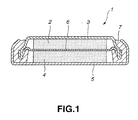
- a non-aqueous electrolyte cell 1 prepared in accordance with the present invention, includes an anode 2, an anode can 3 for holding the anode 2, a cathode 4, a cathode can 5 for holding the cathode 4, a separator 6 interposed between the cathode 4 and the anode 2, and an insulating gasket 7.
- anode can 3 and in the cathode can 5 is charged a non-aqueous electrolytic solution.
- the anode 2 is formed by e.g., a foil of metal lithium as an anode active material. If a material capable of doping/dedoping lithium is used as the anode active material, the anode 2 is a layer of an anode active material formed on an anode current collector, which may, for example, be a nickel foil.
- anode active material capable of doping/dedoping lithium, metal lithium, lithium alloys, lithium-doped electrically conductive high molecular materials or layered compounds, such as carbon materials or metal oxides, may be used.
- the binder contained in the layer of the anode active material may be any suitable known resin material, routinely used as the binder of the layer of the anode active material for this sort of the non-aqueous electrolyte cell.
- the anode can 3 holds the anode 2, and serves as an external anode of the non-aqueous electrolyte cell 1.
- the cathode 4 is a layer of the cathode active material, formed on a cathode current collector, such as an aluminum foil.
- the cathode active material, contained in the cathode 4 is able to reversibly emit or occlude lithium electro-chemically.
- the cathode active material a composite material of carbon and a compound of an olivinic structure represented by the general formula Li x FePO 4 , where 0 ⁇ x ⁇ 1.0, is used.
- This Li x FePO 4 is synthesized by mixing the starting materials for synthesis and subsequently firing the resulting mixture. The detailed manufacturing method will be explained later.
- the reaction formula (2) Li 3 PO 4 + Fe 3 (PO 4 ) 2 ⁇ 3LiFePO 4
- the molar ratio of Li 3 PO 4 to the compound Li x FePO 4 which ratio represented by Li 3 PO 4 /Li x FePO 4. is set to be Li 3 PO 4 /Li x FePO 4 ⁇ 6.67 ⁇ 10 -2 .
- the cathode active material synthesized from Li 3 PO 4 and Fe 3 (PO 4 ) 2 , is mainly composed of Li x FePO 4 .
- Li 3 PO 4 not used for the synthesis reaction, may be left over in the cathode active material to imperil the cell characteristics. Therefore, by optimizing the range of the ratio Li 3 PO 4 /Li x FePO 4 as defined above, the non-aqueous electrolyte cell 1 can be realized which is of high capacity and superior in cell characteristics.
- the binder contained in the layer of the cathode active material may be formed of any suitable known resin material routinely used as the binder for the layer of the cathode active material for this sort of the non-aqueous electrolyte cell.
- the cathode can 5 holds the cathode 4, while serving as an external cathode of the non-aqueous electrolyte cell 1.
- the separator 6, used for separating the cathode 4 and the anode 2 from each other, may be formed of any suitable known resin material routinely used as a separator for this sort of the non-aqueous electrolyte cell.
- a film of a high molecular material, such as polypropylene, is used.
- the separator thickness which is as thin as possible is desirable. Specifically, the separator thickness desirably is 50 ⁇ m or less.
- the insulating gasket 7 is built in and unified to the anode can 3.
- the role of this insulating gasket 7 is to prevent leakage of the non-aqueous electrolyte solution charged into the anode can 3 and into the cathode can 5.
- non-aqueous electrolyte solution such a solution obtained on dissolving an electrolyte in a non-protonic aqueous solvent is used.
- propylene carbonate ethylene carbonate, butylene carbonate, vinylene carbonate, ⁇ -butyllactone, sulfolane, 1, 2-dimethoxyethane, 1, 2-diethoxyethane, 2-methyl tetrahydrofuran, 3-methyl-1,3-dioxolane, methyl propionate, methyl butyrate, dimethyl carbonate, diethyl carbonate and dipropyl carbonate, for example, may be used.
- cyclic carbonates such as propylene carbonate, ethylene carbonate, butylene carbonate or vinylene carbonate
- chained carbonates such as dimethyl carbonate, diethyl carbonate and dipropyl carbonate
- non-aqueous solvents may be used either alone or in combination.
- lithium salts such as LiPF 6 , LiClO 4 , LiAsF 6 , LiBF 4 , LiCF 3 SO 3 or LiN(CF 3 SO 2 ) 2 .
- LiPF 6 and LiBF 4 are preferred.
- non-aqueous electrolyte cell is the non-aqueous electrolyte secondary cell 1 employing a non-aqueous electrolyte solution
- present invention is not limited thereto, but may be applied to such a cell employing a solid electrolyte as the non-aqueous electrolyte.
- the solid electrolyte used may be an inorganic solid electrolyte or a high molecular solid electrolyte, such as gel electrolyte, provided that the material used exhibits lithium ion conductivity.
- the inorganic solid electrolyte may be enumerated by lithium nitride and lithium iodide.
- the high molecular solid electrolyte is comprised of an electrolyte salt and a high molecular compound dissolving it.
- the high molecular compound may be an ether based high molecular material, such as poly(ethylene oxide), cross-linked or the like, a poly(methacrylate) ester based compound, or an acrylate based high molecular material, either alone or in combination in the state of being copolymerized or mixed in the molecules.
- the matrix of the gel electrolyte may be a variety of high molecular materials capable of absorbing and gelating the non-aqueous electrolyte solution.
- fluorine based high molecular materials such as, for example, poly(vinylidene fluoride) or poly(vinylidene fluoride- CO-hexafluoropropylene), ether based high molecular materials, such as polyethylene oxide, cross-linked products or the like, or poly(acrylonitrile), may be used.
- ether based high molecular materials such as polyethylene oxide, cross-linked products or the like, or poly(acrylonitrile
- LiFePO 4 as the cathode active material is manufactured by the following manufacturing method:
- the mixing ratio of the starting materials for synthesis is set to 1/1.05 ⁇ Li/Fe ⁇ 1.2/1, and preferably to 1/1.025 ⁇ Li/Fe ⁇ 1.1/1, in terms of the Li to Fe elementary molar ratio Li/Fe.
- the starting materials for synthesis are synthesized to give LiFePO 4 in the ensuing sintering step.
- the portion of the starting materials for synthesis exceeding the stoichiometric amounts is not used for the synthesis reaction, such excess portion is left as impurity in the cathode active material.
- This portion ofthe starting materials for synthesis thus left over, imperils the cell characteristics.
- a cathode active material in which the proportion of the starting materials for synthesis left over is in an optimum range. By using this cathode active material, the non-aqueous electrolyte cell 1 of high capacity may be produced.
- the mixing of the starting materials for synthesis needs to be performed thoroughly.
- the respective starting materials are mixed homogeneously to increase the number of contact points of the starting materials to enable the synthesis reaction in the ensuing sintering step to proceed expeditiously.
- the mixture from the mixing step then is sintered in the sintering step.
- the mixture is sintered in an inert gas atmosphere or in a reducing gas atmosphere, such as hydrogen or carbon monoxide, to yield LiFePO 4 having an olivinic structure.
- a reducing gas atmosphere such as hydrogen or carbon monoxide
- the sintering temperature for the mixture may be 400 to 900°C by the above method for synthesis. However, in consideration of the cell performance, the temperature of 500 to 700°C is desirable. If the sintering temperature is below 400°C, there is a fear that the chemical reaction or crystallization does not proceed sufficiently so that no homogeneous LiFePO 4 cannot be produced. On the other hand, if the sintering temperature exceeds 900°C, there is a risk that crystallization proceeds excessively so that LiFePO 4 grain size is coarse and hence no sufficient discharge capacity can be produced.
- the non-aqueous electrolyte cell 1, employing the so prepared LiFePO 4 as a cathode active material, may be prepared e.g., as follows:
- an anode active material and a binder are dispersed in a solvent to prepare a slurried cathode mixture.
- the so produced cathode mixture is uniformly coated on the current collector and dried to form a layer of an cathode active material to prepare the anode 2.
- the binder for the anode mixture any suitable known binder may be used.
- the anode mixture may be added to with any suitable additive.
- metal lithium, as an anode active material may directly be used as the anode 2.
- the cathode active material is mainly composed of a compound represented by a general formula Li x FePO 4 , where 0 ⁇ x ⁇ 1, and the molar ratio of Li 3 PO 4 to the compound represented by the general formula Li x FePO 4, which ratio represented by Li 3 PO 4 /LiFePO 4 , is Li 3 PO 4 /LiFePO 4 ⁇ 6.67 ⁇ 10 -2 .
- the so produced slurried cathode mixture is uniformly coated on a current collector and dried to form a layer of a cathode active material to complete the cathode 4.
- a binder for the cathode mixture any suitable binder of the known type may be used, or additive agents of the known type may be added to the cathode mixture.
- the non-aqueous electrolyte solution may be prepared by dissolving an electrolyte salt in a non-aqueous solvent.
- the anode 2 is inserted into the anode can 3, the cathode 4 is inserted into the cathode can 5 and the separator 6 comprised of a polypropylene porous film is arranged between the anode 2 and the cathode 4.
- a non-aqueous electrolyte solution was charged into the anode can 3 and the cathode can 5.
- the anode can 3 and the cathode can 5 are caulked and secured together, via insulating gasket 7, placed in-between, to complete a coin-shaped non-aqueous electrolyte cell 1.
- non-aqueous electrolyte cell 1 embodying the present invention may be cylindrically-shaped, square-shaped, coin-shaped or button-shaped, while it may be of desired variable sizes, such as of a thin type or of a large format.
- Li 3 PO 4 and Fe 3 (PO 4 ) 2 ⁇ 8H 2 O were mixed to yield a lithium to iron elementary ratio represented by Li/Fe of 1.000:1.075and acetylene black powders were added in an amount of 10 wt% of the entire sintered product to yield a mixture.
- This mixture and alumina balls 10 mm in diameter were then charged into an alumina vessel, having a diameter of 100 mm, with the mixture to alumina ball mass ratio of 1:2, and the mixture was milled using a planetary ball mill.
- a planetary rotating pot mill for test manufactured by ITO SEISAKUSHO KK under the trade name of LA-PO 4 , was used, and the mixture was milled under the following conditions:
- the milled mixture was charged into a ceramic crucible and sintered for five hours at a temperature of 600°C in an electrical furnace maintained in a nitrogen atmosphere to produce an LiFePO 4 carbon composite material.
- a foil of metal lithium was then punched to substantially the same shape as the cathode to form an anode.
- a non-aqueous electrolyte solution was prepared by dissolving LiPF 6 in a solvent mixture comprised of equal volumes of propylene carbonate and dimethyl carbonate, at a concentration of 1 mol/l, to prepare a non-aqueous electrolyte solution.
- the cathode thus prepared, was charged into the cathode can, while the anode was held in the anode can and the separator was arranged between the cathode and the anode.
- the non-aqueous electrolytic solution is injected into the anode can and into the cathode can.
- the anode can and the cathode can 5 were caulked and secured together to complete a type 2016 coin-shaped non-aqueous electrolyte cell having the diameter of 20.0mm and the thickness of 1.6mm.
- test cell was prepared in the same way as in sample 1 except preparing the cathode active material as the ratio Li/Fe was set in mixing the starting materials for synthesis to 1.000/1.050.
- test cell was prepared in the same way as in sample 1 except preparing the cathode active material as the ratio Li/Fe was set in mixing the starting materials for synthesis to 1.000/1.025.
- test cell was prepared in the same way as in sample 1 except preparing the cathode active material as the ratio Li/Fe was set in mixing the starting materials for synthesis to 1.000/1.000.
- test cell was prepared in the same way as in sample 1 except preparing the cathode active material as the ratio Li/Fe was set in mixing the starting materials for synthesis to 1.025/1.000.
- test cell was prepared in the same way as in sample 1 except preparing the cathode active material as the ratio Li/Fe was set in mixing the starting materials for synthesis to 1.050/1.000.
- test cell was prepared in the same way as in sample 1 except preparing the cathode active material as the ratio Li/Fe was set in mixing the starting materials for synthesis to 1.075/1.000.
- test cell was prepared in the same way as in sample except preparing the cathode active material as the ratio Li/Fe was set in mixing the starting materials for synthesis to 1.100/1.000.
- test cell was prepared in the same way as in sample 1 except preparing the cathode active material as the ratio Li/Fe was set in mixing the starting materials for synthesis to 1.125/1.000.
- test cell was prepared in the same way as in sample 1 except preparing the cathode active material as the ratio Li/Fe was set in mixing the starting materials for synthesis to 1.150/1.000.
- test cell was prepared in the same way as in sample 1 except preparing the cathode active material as the ratio Li/Fe was set in mixing the starting materials for synthesis to 1.175/1.000.
- test cell was prepared in the same way as in sample 1 except preparing the cathode active material as the ratio Li/Fe was set in mixing the starting materials for synthesis to 1.200/1.000.
- test cell was prepared in the same way as in sample 1 except preparing the cathode active material as the ratio Li/Fe was set in mixing the starting materials for synthesis to 1.225/1.00.
- X-ray diffractometry was carried on the cathode active material samples of samples 1 to 13, prepared as described above, in accordance with the Rietveld method.
- X-ray diffractometry an X-ray diffraction pattern was measured of a cathode active material, using an X-ray diffraction unit RINT2000, manufactured by RIGAKUSHA, through a range of a diffraction angle of 10.0° ⁇ 2 ⁇ ⁇ 90.0°, at a scanning speed of 0.02°/sec.
- a tube bulb with a copper target (CuK ⁇ rays) and a monochrometer were used.
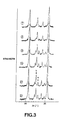
- a peak integration strength of the main peak of LiFePO 4 appearing in the vicinity of the diffraction angle of 22.6° and a peak integration strength of the main peak of Li 3 PO 4 appearing in the vicinity of the diffraction angle of 23.1° were found to find the ratio of the main peak integration strength of Li 3 PO 4 to the main peak integration strength of LiFePO 4 , referred to below simply as peak integration strength ratio.
- Figs.2 and 3 show an X-ray diffraction pattern of samples 1 to 6 in a diffraction angle range of 20° ⁇ 2 ⁇ ⁇ 25° and an X-ray diffraction pattern of samples 7 to 12 in a diffraction angle range of 20° ⁇ 2 ⁇ ⁇ 25°, respectively.
- the numerals affixed to the respective X-ray diffraction patterns coincide with the sample numbers.
- a and b indicate the main peak of Li 3 PO 4 appearing in the vicinity of the diffraction angle of 23.1° and the main peak of LiFePO 4 appearing in the vicinity of the diffraction angle of 22:6°, respectively.
- the peak integration strength ratio is shown in Table 1. Meanwhile, in a range of the composition of the starting materials for synthesis of 1/1.05 ⁇ Li/Fe ⁇ 1/1, the totality of the amount charged of Li 3 PO 4 is used in the synthesis reaction, so that no peak of Li 3 PO 4 is measured. On the other hand, Li 3 PO 4 added in an amount exceeding the theoretical amount used for the synthesis reaction is presumably left in the cathode active material along with Li 3 PO 4 as produced.
- Li 3 PO 4 /LiFePO 4 theoretical value
- Table 1 mixing ratio of starting materials for synthesis (Li/Fe) peak integration strength ratio Li 3 PO 4 /LiFePO 4 (theoretical value) sample 1 1.000/1.075 0 0 sample 2 1.000/1.050 0 0 sample 3 1.000/1.025 0 0 sample 4 1.000/1.000 0 0 sample 5 1.025/1.000 8.26 ⁇ 10 -3 8.33 ⁇ 10 -3 sample 6 1.050/1.000 1.57 ⁇ 10 -2 1.66 ⁇ 10 -2 sample 7 1.075/1.000 2.43 ⁇ 10 -2 2.50 ⁇ 10 -2 sample 8 1.100/1.000 3.26 ⁇ 10 -2 3.33 ⁇ 10 -2 sample 9 1.125/1.000 4.13 ⁇ 10 -2 4.17 ⁇ 10 -2 sample 10
- the peak integration strength ratio obtained on actual measurement, approximately coincides with Li 3 PO 4 /LiFePO 4 (theoretical value). That is, the peak integration strength ratio may be said to be proportionate to Li 3 PO 4 /LiFePO 4 in the actual cathode active material.
- the peak integration strength ratio obtained on actual measurement, is represented as values smaller than Li 3 PO 4 /LiFePO 4 (theoretical value). This is presumably ascribable to the fact that not all of Li 3 PO 4 added in an amount exceeding the theoretical value used for synthetic reaction are directly left in the cathode active material but are partially left as other compounds.
- test cells of samples 1 to 13, prepared as described above were put to the following charging/discharging tests to measure the initial discharge capacity to evaluate cell characteristics.
- Each test cell was charged at a constant current and, when the cell voltage reached 4.2 V, the constant current charging was changed over to constant voltage charging, and the charging was continued as the voltage was kept at 4.2 V.
- the charging was discontinued when the current reaches 0.01mA/cm 2 or less.
- the discharge was then carried out and discontinued when the cell voltage was lowered to 2.0V to measure the initial discharge capacity.
- Both the charging and the discharge were carried out at ambient temperature (25°C) and the current density at this time was set to 0.1mA/cm 2 .
- the initial discharge capacity density means the initial discharge capacity per unit weight of LiFePO 4 .
- the cell samples with the initial capacity less than 140 mAh/g, not less than 140 mAh/g and not less than 150 mAh/g were evaluated as practically unusable, practically usable and optimum, respectively.
- the measured results and the evaluation are shown in Table 2, wherein ⁇ , ⁇ and o ⁇ denote being practically unusable, practically usable and optimum, respectively.
- the samples 2 to 11 of the non-aqueous electrolyte cell in which, in the mixing of the starting materials for synthesis, the anode active materials were prepared to a range of 1/1.05 ⁇ Li/Fe ⁇ 1.2/1 are of the initial discharge capacity of not less than 140 mAh/g and thus are practically usable.
- the samples 3 to 8 of the non-aqueous electrolyte cell in which, in the mixing of the starting materials for synthesis, the cathode active materials were prepared to a range of 1/1.025 ⁇ Li/Fe ⁇ 1.1/1, are of the initial discharge capacity of not less than 150mAh/g and thus are practically usable.
- the sample 1 ofthe non-aqueous electrolyte cell in which the anode active material was prepared to a range of 1/1.05>Li/Fe in mixing the starting materials for synthesis, is of a low initial capacity and thus is not practically usable.
- the sample 13 of the non-aqueous electrolyte cell, in which the anode active material was prepared to a range of 1.2/1 > Li/Fe in mixing the starting materials for synthesis is also of a low initial capacity and thus is not practically usable.
- the amount of the starting materials for synthesis left in the cathode active material can be in an optimum range to render it possible to obtain a non-aqueous electrolyte cell having superior cell characteristics.
- a gelated electrode was first prepared as follows: First, polyvinylidene fluoride, copolymerized with 6.9wt% of hexafluoropropylene, a non-aqueous electrolyte and dimethyl carbonate, were mixed, agitated and dissolved to a sol-like electrolytic solution. To the sol-like electrolytic solution was added 0.5 wt% of vinylene carbonate VC to form a gelated electrolytic solution.
- the non-aqueous electrolyte solution such a solution obtained on mixing ethylene carbonate EC and propylene carbonate PC at a volumetric ratio of 6:4 and on dissolving LiPF 6 at a rate of 0.85 mol/kg in the resulting mixture was used.
- a cathode was then prepared as follows: First; 95 parts by weight of the cathode active material prepared as sample 4, and 5 parts by weight of poly (vinylidene fluoride), in the form of fluorine resin powders, as a binder, were mixed together, and added to with N-methyl pyrrolidone to give a slurry, which slurry was then coated on an aluminum foil 20 ⁇ m in thickness, then dried under heating and pressed to form a cathode coating film. A gelated electrolytic solution then was applied to one surface of the cathode coating film and dried to remove the solvent. The resulting product was punched to a circle 15 mm in diameter, depending on the cell diameter, to form a cathode electrode.
- the anode then was prepared as follows: First, 10 wt% of fluorine resin powders, as a binder, were mixed into graphite powders, and added to with N-methyl pyrrolidone to form a slurry, which then was coated on a copper foil, dried under heating and pressed. The resulting product was punched to a circle 16.5 mm in diameter, depending on the cell diameter, to form an anode electrode.
- the cathode thus prepared, was charged into the cathode can, while the anode was held in the anode can and the separator was arranged between the cathode and the anode.
- the anode can and the cathode can were caulked and secured together to complete a type 2016 coin-shaped lithium polymer cell having a diameter of 20 mm and a thickness of 1.6 mm.
- the charging/discharging cyclic characteristics were evaluated based on the capacity upkeep ratio after repeated charging/discharging.
- Each coin-shaped lithium polymer cell was charged at a constant current and, at a time point the cell voltage reached 4.2 V, the constant current charging was switched to constant voltage charging and charging was carried out as the cell voltage was kept at 4.2 V. The charging was terminated at a time point the current value fell to 0.01 mA/cm 2 or less. Each test was then discharged. The discharging was terminated at a time point the cell voltage fell to 2.0 V.
- both the initial discharging capacity and capacity upkeep ratio after 30 cycles are of satisfactory values. From this, it may be seen that the cathode active material prepared in accordance with the manufacturing method of the present invention gives meritorious effects, such as improved discharge capacity and improved cyclic characteristics, even in case the gelated electrolyte is used in place of the non-aqueous electrolyte as the non-aqueous electrolytic solution.
Landscapes
- Chemical & Material Sciences (AREA)
- Chemical Kinetics & Catalysis (AREA)
- Electrochemistry (AREA)
- General Chemical & Material Sciences (AREA)
- Inorganic Chemistry (AREA)
- Organic Chemistry (AREA)
- Engineering & Computer Science (AREA)
- Manufacturing & Machinery (AREA)
- Crystallography & Structural Chemistry (AREA)
- Materials Engineering (AREA)
- Secondary Cells (AREA)
- Battery Electrode And Active Subsutance (AREA)
- Compounds Of Iron (AREA)
Abstract
Description
| mixing ratio of starting materials for synthesis (Li/Fe) | peak integration strength ratio | Li3PO4/LiFePO4 (theoretical value) | |
| | 1.000/1.075 | 0 | 0 |
| | 1.000/1.050 | 0 | 0 |
| | 1.000/1.025 | 0 | 0 |
| | 1.000/1.000 | 0 | 0 |
| | 1.025/1.000 | 8.26 × 10⁻³ | 8.33 × 10⁻³ |
| | 1.050/1.000 | 1.57 × 10⁻² | 1.66 × 10⁻² |
| sample 7 | 1.075/1.000 | 2.43 × 10⁻² | 2.50 × 10⁻² |
| | 1.100/1.000 | 3.26 × 10⁻² | 3.33 × 10⁻² |
| | 1.125/1.000 | 4.13 × 10⁻² | 4.17 × 10⁻² |
| | 1.150/1.000 | 4.96 × 10⁻² | 5.00 × 10⁻² |
| sample 11 | 1.175/1.000 | 5.79 × 10⁻² | 5.83 × 10⁻² |
| | 1.200/1.000 | 6.66 × 10⁻² | 6.67 × 10⁻² |
| sample 13 | 1.225/1.000 | 7.47 × 10⁻² | 7.50 × 10⁻² |
| mixing ratio of starting materials for synthesis (Li/Fe) | initial discharge capacity (mAh/g) | | |
| sample | |||
| 1 | 1.000/1.075 | 118.8 | × |
| | 1.000/1.050 | 141.8 | ○ |
| | 1.000/1.025 | 150.2 | o ○ |
| | 1.000/1.000 | 157.8 | o ○ |
| | 1.025/1.000 | 159.0 | o ○ |
| | 1.050/1.000 | 160.7 | o ○ |
| sample 7 | 1.075/1.000 | 162.5 | o ○ |
| | 1.100/1.000 | 160.1 | o ○ |
| | 1.125/1.000 | 143.6 | ○ |
| | 1.150/1.000 | 141.6 | ○ |
| sample 11 | 1.175/1.000 | 146.0 | ○ |
| | 1.200/1.000 | 141.1 | ○ |
| sample 13 | 1.225/1.000 | 136.9 | × |
| mixing ratio of starting materials for synthesis (Fe/Li) | initial discharging capacity (mAh/g) | discharge capacity upkeep ratio (%) | |
| sample 14 | 1.000/1.000 | 158 | 95.7 |
Claims (10)
- A cathode active material mainly composed of a compound represented by a general formula LixFePO4, where 0 < x ≤ 1, wherein
a molar ratio of Li3PO4 to the compound represented by the general formula LixFePO4. which ratio represented by Li3PO4/LiFePO4. is Li3PO4/LiFePO4 ≤ 6.67 × 10⁻². - The cathode active material according to claim 1 wherein starting materials for synthesis for the compound represented by the general formula LixFePO4. where 0< x≤1, are Li3PO4 and Fe3(PO4)2 or hydrates of Fe3(PO4)2 represented by Fe3(PO4)2·nH2O, where n denotes a number of hydrates.
- A non-aqueous electrolyte cell having a cathode containing a cathode active material, an anode containing an anode active material and a non-aqueous electrolyte, wherein said cathode active material is mainly composed of a compound represented by a general formula LixFePO4, where 0<x≤1 and wherein a molar ratio of Li3PO4 to the compound represented by the general formula LixFePO4, which ratio is represented by Li3PO4/LiFePO4, is Li3PO4/LiFePO4 ≤ 6.67 × 10⁻².
- The non-aqueous electrolyte cell according to claim 3 wherein starting materials for synthesis for the compound represented by the general formula LixFePO4, where 0< x≤1 are Li3PO4 and Fe3(PO4)2 or hydrates of the Fe3(PO4)2 represented by Fe3(PO4)2·nH2O, where n denote a number of hydrates.
- The non-aqueous electrolyte cell according to claim 3 wherein said non-aqueous electrolyte is a non-aqueous electrolyte solution composed of an electrolyte dissolved in a non-aqueous protonic solution.
- The non-aqueous electrolyte cell according to claim 3 wherein said non-aqueous electrolyte is a solid electrolyte.
- A method for preparing a cathode active material comprising:wherein a mixing ratio of said starting materials for synthesis in terms of an element molar ratio of Li to Fe represented by Li/Fe is 1/1.05 ≤ Li/Fe ≤ 1.2/1.a mixing step of mixing Li3PO4 and Fe3(PO4)2 or hydrates of the Fe3(PO4)2 represented by Fe3(PO4)2·nH2O, where n denotes a number of hydrates, as starting materials for synthesis, so as to form a mixture; andsintering step of sintering the mixture obtained in said mixing step;
- A method for the preparing a non-aqueous electrolyte cell having a cathode containing a cathode active material, an anode containing an anode active material and a non-aqueous electrolyte, comprising:wherein a mixing ratio of said starting materials for synthesis in terms of an element molar ratio of Li to Fe represented by Li/Fe is 1/1.05 ≤ Li/Fe ≤ 1.2/1.mixing step of, when preparing said cathode active material, mixing Li3PO4 and Fe3(PO4)2 or hydrates of Fe3(PO4)2 represented by Fe3(PO4)2·nH2O, where n denotes a number of hydrates, as starting materials for synthesis so as to form a mixture; andsintering step of sintering the mixture obtained in said mixing step;
- The method for preparing the non-aqueous electrolyte cell according to claim 8 wherein said non-aqueous electrolyte is a non-aqueous electrolyte solution composed of an electrolyte dissolved in a non-aqueous protonic solution.
- The method for preparing the non-aqueous electrolyte cell according to claim 8 wherein said non-aqueous electrolyte is a solid electrolyte.
Applications Claiming Priority (2)
| Application Number | Priority Date | Filing Date | Title |
|---|---|---|---|
| JP2000308299A JP4848582B2 (en) | 2000-10-06 | 2000-10-06 | Method for producing positive electrode active material |
| JP2000308299 | 2000-10-06 |
Publications (2)
| Publication Number | Publication Date |
|---|---|
| EP1198019A2 true EP1198019A2 (en) | 2002-04-17 |
| EP1198019A3 EP1198019A3 (en) | 2004-12-22 |
Family
ID=18788632
Family Applications (1)
| Application Number | Title | Priority Date | Filing Date |
|---|---|---|---|
| EP01123899A Withdrawn EP1198019A3 (en) | 2000-10-06 | 2001-10-05 | Cathode active material for non aqueous lithium secondary battery and methods for preparation thereof |
Country Status (8)
| Country | Link |
|---|---|
| US (1) | US20020106562A1 (en) |
| EP (1) | EP1198019A3 (en) |
| JP (1) | JP4848582B2 (en) |
| KR (1) | KR100837579B1 (en) |
| CN (1) | CN1185730C (en) |
| CA (1) | CA2358344A1 (en) |
| MX (1) | MXPA01009974A (en) |
| TW (1) | TW523957B (en) |
Cited By (4)
| Publication number | Priority date | Publication date | Assignee | Title |
|---|---|---|---|---|
| EP1339119A4 (en) * | 2000-11-09 | 2007-03-28 | Sony Corp | ANODE MATERIAL AND BATTERY ELEMENT COMPRISING THIS MATERIAL |
| WO2008117215A1 (en) * | 2007-03-26 | 2008-10-02 | The Gillette Company | Lithium ion secondary batteries |
| EP2360118A4 (en) * | 2008-10-22 | 2012-10-03 | Lg Chemical Ltd | FERRITHIUM PHOSPHATE OF OLIVINE STRUCTURE AND METHOD OF ANALYSIS THEREOF |
| WO2015003947A1 (en) * | 2013-07-08 | 2015-01-15 | Basf Se | Electrode materials for lithium ion batteries |
Families Citing this family (16)
| Publication number | Priority date | Publication date | Assignee | Title |
|---|---|---|---|---|
| JP3997702B2 (en) * | 2000-10-06 | 2007-10-24 | ソニー株式会社 | Nonaqueous electrolyte secondary battery |
| KR101209346B1 (en) | 2001-12-21 | 2013-09-09 | 메사추세츠 인스티튜트 오브 테크놀로지 | Conductive lithium storage electrode |
| FR2848549B1 (en) * | 2002-12-16 | 2005-01-21 | Commissariat Energie Atomique | PROCESS FOR THE PREPARATION OF ALKALI METAL INSERTION COMPOUNDS, ACTIVE MATERIALS CONTAINING THEM, AND DEVICES COMPRISING THESE ACTIVE MATERIALS |
| CN100448071C (en) * | 2003-03-18 | 2008-12-31 | 黄穗阳 | Lithium battery positive electrode material and preparation method thereof |
| US7842420B2 (en) | 2005-02-03 | 2010-11-30 | A123 Systems, Inc. | Electrode material with enhanced ionic transport properties |
| CA2622675A1 (en) | 2007-02-28 | 2008-08-28 | Sanyo Electric Co., Ltd. | Method of producing active material for lithium secondary battery, method of producing electrode for lithium secondary battery, method of producing lithium secondary battery, and method of monitoring quality of active material for lithium secondary battery |
| TWI466370B (en) | 2008-01-17 | 2014-12-21 | A123 Systems Inc | Hybrid metal olivine electrode material for lithium ion battery |
| EP2339675B1 (en) * | 2008-10-22 | 2013-10-02 | Lg Chem, Ltd. | Positive electrode active material with enhanced electrode efficiency and energy density characteristics |
| US20160141580A1 (en) * | 2013-06-19 | 2016-05-19 | Basf Se | Alkali-ion conductive separator assembly for rechargeable electrochemical cells |
| CN103647045A (en) * | 2013-11-15 | 2014-03-19 | 成都兴能新材料有限公司 | Preparation method of cathode material LiFePO4-C |
| CN104868120B (en) * | 2015-04-20 | 2017-04-26 | 陕西科技大学 | Li2-2FexTiO3/Li3PO4 conjugate coated lithium ion phosphate material as well as preparation method and application thereof |
| JP6065133B1 (en) * | 2016-02-26 | 2017-01-25 | 住友大阪セメント株式会社 | Positive electrode material for lithium ion secondary battery, positive electrode for lithium ion secondary battery, lithium ion secondary battery |
| JP6090497B1 (en) * | 2016-03-30 | 2017-03-08 | 住友大阪セメント株式会社 | Positive electrode material for lithium ion secondary battery |
| JP6774634B2 (en) * | 2017-08-23 | 2020-10-28 | トヨタ自動車株式会社 | Non-aqueous secondary battery |
| EP4191711B1 (en) * | 2020-11-26 | 2026-03-25 | LG Energy Solution, Ltd. | Additive for positive electrode of lithium secondary battery, method for manufacturing same, and lithium secondary battery comprising same |
| CN115557482A (en) * | 2021-07-01 | 2023-01-03 | 惠州比亚迪电池有限公司 | Preparation method of lithium iron phosphate cathode material and lithium ion battery |
Family Cites Families (17)
| Publication number | Priority date | Publication date | Assignee | Title |
|---|---|---|---|---|
| JP3102005B2 (en) * | 1989-10-03 | 2000-10-23 | 松下電器産業株式会社 | Positive active material for lithium secondary battery and method for producing the same |
| JP3126007B2 (en) * | 1993-03-26 | 2001-01-22 | 日本電信電話株式会社 | Non-aqueous electrolyte battery |
| JP3484003B2 (en) * | 1995-11-07 | 2004-01-06 | 日本電信電話株式会社 | Non-aqueous electrolyte secondary battery |
| JP3319258B2 (en) * | 1995-12-21 | 2002-08-26 | ソニー株式会社 | Method for producing positive electrode active material for lithium secondary battery and method for producing lithium secondary battery |
| US5910382A (en) * | 1996-04-23 | 1999-06-08 | Board Of Regents, University Of Texas Systems | Cathode materials for secondary (rechargeable) lithium batteries |
| JPH09306547A (en) * | 1996-05-16 | 1997-11-28 | Sony Corp | Non-aqueous electrolyte secondary battery |
| JP4547748B2 (en) * | 1999-10-29 | 2010-09-22 | パナソニック株式会社 | Non-aqueous electrolyte battery |
| US7001690B2 (en) * | 2000-01-18 | 2006-02-21 | Valence Technology, Inc. | Lithium-based active materials and preparation thereof |
| US6528033B1 (en) * | 2000-01-18 | 2003-03-04 | Valence Technology, Inc. | Method of making lithium-containing materials |
| JP4769995B2 (en) * | 2000-03-06 | 2011-09-07 | ソニー株式会社 | Method for producing positive electrode active material and method for producing non-aqueous electrolyte battery |
| JP4151210B2 (en) * | 2000-08-30 | 2008-09-17 | ソニー株式会社 | Positive electrode active material and method for producing the same, non-aqueous electrolyte battery and method for producing the same |
| JP4491946B2 (en) * | 2000-09-29 | 2010-06-30 | ソニー株式会社 | Method for producing positive electrode active material and method for producing non-aqueous electrolyte battery |
| JP4742413B2 (en) * | 2000-09-29 | 2011-08-10 | ソニー株式会社 | Method for producing positive electrode active material and method for producing non-aqueous electrolyte battery |
| JP4734700B2 (en) * | 2000-09-29 | 2011-07-27 | ソニー株式会社 | Method for producing positive electrode active material and method for producing non-aqueous electrolyte battery |
| JP4734701B2 (en) * | 2000-09-29 | 2011-07-27 | ソニー株式会社 | Method for producing positive electrode active material and method for producing non-aqueous electrolyte battery |
| JP3921931B2 (en) * | 2000-09-29 | 2007-05-30 | ソニー株式会社 | Cathode active material and non-aqueous electrolyte battery |
| TW513822B (en) * | 2000-10-06 | 2002-12-11 | Sony Corp | Method for producing cathode active material and method for producing non-aqueous electrolyte cell |
-
2000
- 2000-10-06 JP JP2000308299A patent/JP4848582B2/en not_active Expired - Fee Related
-
2001
- 2001-09-30 CN CNB011303484A patent/CN1185730C/en not_active Expired - Fee Related
- 2001-10-03 MX MXPA01009974A patent/MXPA01009974A/en unknown
- 2001-10-04 US US09/970,573 patent/US20020106562A1/en not_active Abandoned
- 2001-10-04 CA CA002358344A patent/CA2358344A1/en not_active Abandoned
- 2001-10-05 EP EP01123899A patent/EP1198019A3/en not_active Withdrawn
- 2001-10-05 KR KR1020010061393A patent/KR100837579B1/en not_active Expired - Fee Related
- 2001-10-05 TW TW090124684A patent/TW523957B/en not_active IP Right Cessation
Cited By (8)
| Publication number | Priority date | Publication date | Assignee | Title |
|---|---|---|---|---|
| EP1339119A4 (en) * | 2000-11-09 | 2007-03-28 | Sony Corp | ANODE MATERIAL AND BATTERY ELEMENT COMPRISING THIS MATERIAL |
| USRE46187E1 (en) | 2000-11-09 | 2016-10-25 | Sony Corporation | Positive electrode material and battery using the same |
| USRE46667E1 (en) | 2000-11-09 | 2018-01-09 | Sony Corporation | Positive electrode material and battery using the same |
| WO2008117215A1 (en) * | 2007-03-26 | 2008-10-02 | The Gillette Company | Lithium ion secondary batteries |
| EP2360118A4 (en) * | 2008-10-22 | 2012-10-03 | Lg Chemical Ltd | FERRITHIUM PHOSPHATE OF OLIVINE STRUCTURE AND METHOD OF ANALYSIS THEREOF |
| US10249877B2 (en) | 2008-10-22 | 2019-04-02 | Lg Chem, Ltd. | Lithium iron phosphate having olivine structure and method for analyzing the same |
| WO2015003947A1 (en) * | 2013-07-08 | 2015-01-15 | Basf Se | Electrode materials for lithium ion batteries |
| US10026954B2 (en) | 2013-07-08 | 2018-07-17 | Basf Se | Electrode materials for lithium ion batteries |
Also Published As
| Publication number | Publication date |
|---|---|
| CN1348226A (en) | 2002-05-08 |
| JP2002117847A (en) | 2002-04-19 |
| KR100837579B1 (en) | 2008-06-13 |
| JP4848582B2 (en) | 2011-12-28 |
| EP1198019A3 (en) | 2004-12-22 |
| CA2358344A1 (en) | 2002-04-06 |
| KR20020027262A (en) | 2002-04-13 |
| MXPA01009974A (en) | 2003-08-20 |
| US20020106562A1 (en) | 2002-08-08 |
| CN1185730C (en) | 2005-01-19 |
| TW523957B (en) | 2003-03-11 |
Similar Documents
| Publication | Publication Date | Title |
|---|---|---|
| KR100816272B1 (en) | Cathode active material, method for preparation thereof, non-aqueous electrolyte cell and method for preparation thereof | |
| KR100962053B1 (en) | Method for producing cathode active material and method for producing non-aqueous electrolyte cell | |
| KR100776523B1 (en) | Non-aqueous Electrolyte Secondary Battery | |
| KR100835127B1 (en) | Method for the preparation of cathode active material and method for the preparation of non-aqueous electrolyte | |
| EP0582173B1 (en) | Non-aqueous electrolyte secondary battery and its production method | |
| KR100777932B1 (en) | Method for the preparation of cathode active material and method for the preparation of non-aqueous electrolyte cell | |
| KR100884216B1 (en) | Method for producing cathode active material and method for producing non-aqueous electrolyte cell | |
| US20020106562A1 (en) | Cathode active material, non-aqueous electrolyte cell and methods for preparation thereof | |
| US20020102459A1 (en) | Method for the preparation of cathode active material and method for the preparation of non-aqueous electrolyte | |
| EP1443575A1 (en) | Positive plate material and cell comprising it | |
| JP4207434B2 (en) | Positive electrode active material and method for producing non-aqueous electrolyte battery | |
| KR100483735B1 (en) | Cathode active material for lithium secondary battery and lithium secondary battery | |
| JP2001250555A (en) | Method for producing positive electrode active material and method for producing nonaqueous electrolyte battery | |
| JP4724912B2 (en) | Method for producing positive electrode active material and method for producing non-aqueous electrolyte secondary battery | |
| JP4724911B2 (en) | Nonaqueous electrolyte secondary battery | |
| KR20110011497A (en) | Cathode active material, a cathode comprising the same, and a lithium battery employing the anode | |
| JP2550990B2 (en) | Non-aqueous electrolyte battery | |
| JP4491947B2 (en) | Method for producing positive electrode active material and method for producing non-aqueous electrolyte battery | |
| JP5553057B2 (en) | Cathode active material and non-aqueous electrolyte battery | |
| JPH10214626A (en) | Lithium secondary battery and positive electrode active material for lithium secondary battery | |
| KR20250158346A (en) | Electrolyte for lithium secondary battery and method of preparing the same | |
| JP2001058828A (en) | Method for synthesizing lithium manganese composite oxide and method for producing nonaqueous electrolyte battery |
Legal Events
| Date | Code | Title | Description |
|---|---|---|---|
| PUAI | Public reference made under article 153(3) epc to a published international application that has entered the european phase |
Free format text: ORIGINAL CODE: 0009012 |
|
| AK | Designated contracting states |
Kind code of ref document: A2 Designated state(s): AT BE CH CY DE DK ES FI FR GB GR IE IT LI LU MC NL PT SE TR |
|
| AX | Request for extension of the european patent |
Free format text: AL;LT;LV;MK;RO;SI |
|
| PUAL | Search report despatched |
Free format text: ORIGINAL CODE: 0009013 |
|
| AK | Designated contracting states |
Kind code of ref document: A3 Designated state(s): AT BE CH CY DE DK ES FI FR GB GR IE IT LI LU MC NL PT SE TR |
|
| AX | Request for extension of the european patent |
Extension state: AL LT LV MK RO SI |
|
| RIC1 | Information provided on ipc code assigned before grant |
Ipc: 7C 01B 25/45 B Ipc: 7H 01M 10/40 B Ipc: 7H 01M 4/58 A |
|
| 17P | Request for examination filed |
Effective date: 20050530 |
|
| AKX | Designation fees paid |
Designated state(s): DE FI FR GB SE |
|
| STAA | Information on the status of an ep patent application or granted ep patent |
Free format text: STATUS: THE APPLICATION IS DEEMED TO BE WITHDRAWN |
|
| 18D | Application deemed to be withdrawn |
Effective date: 20051119 |