EP1197965A2 - Data delivery system with copyright protection - Google Patents
Data delivery system with copyright protection Download PDFInfo
- Publication number
- EP1197965A2 EP1197965A2 EP01308660A EP01308660A EP1197965A2 EP 1197965 A2 EP1197965 A2 EP 1197965A2 EP 01308660 A EP01308660 A EP 01308660A EP 01308660 A EP01308660 A EP 01308660A EP 1197965 A2 EP1197965 A2 EP 1197965A2
- Authority
- EP
- European Patent Office
- Prior art keywords
- data
- storage medium
- information
- reproducing
- recording
- Prior art date
- Legal status (The legal status is an assumption and is not a legal conclusion. Google has not performed a legal analysis and makes no representation as to the accuracy of the status listed.)
- Withdrawn
Links
Images


















Classifications
-
- G—PHYSICS
- G11—INFORMATION STORAGE
- G11B—INFORMATION STORAGE BASED ON RELATIVE MOVEMENT BETWEEN RECORD CARRIER AND TRANSDUCER
- G11B20/00—Signal processing not specific to the method of recording or reproducing; Circuits therefor
- G11B20/00086—Circuits for prevention of unauthorised reproduction or copying, e.g. piracy
- G11B20/0021—Circuits for prevention of unauthorised reproduction or copying, e.g. piracy involving encryption or decryption of contents recorded on or reproduced from a record carrier
-
- G—PHYSICS
- G11—INFORMATION STORAGE
- G11B—INFORMATION STORAGE BASED ON RELATIVE MOVEMENT BETWEEN RECORD CARRIER AND TRANSDUCER
- G11B20/00—Signal processing not specific to the method of recording or reproducing; Circuits therefor
- G11B20/00086—Circuits for prevention of unauthorised reproduction or copying, e.g. piracy
-
- G—PHYSICS
- G11—INFORMATION STORAGE
- G11B—INFORMATION STORAGE BASED ON RELATIVE MOVEMENT BETWEEN RECORD CARRIER AND TRANSDUCER
- G11B20/00—Signal processing not specific to the method of recording or reproducing; Circuits therefor
- G11B20/00086—Circuits for prevention of unauthorised reproduction or copying, e.g. piracy
- G11B20/00166—Circuits for prevention of unauthorised reproduction or copying, e.g. piracy involving measures which result in a restriction to authorised contents recorded on or reproduced from a record carrier, e.g. music or software
- G11B20/00181—Circuits for prevention of unauthorised reproduction or copying, e.g. piracy involving measures which result in a restriction to authorised contents recorded on or reproduced from a record carrier, e.g. music or software using a content identifier, e.g. an international standard recording code [ISRC] or a digital object identifier [DOI]
-
- G—PHYSICS
- G11—INFORMATION STORAGE
- G11B—INFORMATION STORAGE BASED ON RELATIVE MOVEMENT BETWEEN RECORD CARRIER AND TRANSDUCER
- G11B20/00—Signal processing not specific to the method of recording or reproducing; Circuits therefor
- G11B20/00086—Circuits for prevention of unauthorised reproduction or copying, e.g. piracy
- G11B20/00188—Circuits for prevention of unauthorised reproduction or copying, e.g. piracy involving measures which result in a restriction to authorised devices recording or reproducing contents to/from a record carrier
-
- G—PHYSICS
- G11—INFORMATION STORAGE
- G11B—INFORMATION STORAGE BASED ON RELATIVE MOVEMENT BETWEEN RECORD CARRIER AND TRANSDUCER
- G11B20/00—Signal processing not specific to the method of recording or reproducing; Circuits therefor
- G11B20/00086—Circuits for prevention of unauthorised reproduction or copying, e.g. piracy
- G11B20/0021—Circuits for prevention of unauthorised reproduction or copying, e.g. piracy involving encryption or decryption of contents recorded on or reproduced from a record carrier
- G11B20/00217—Circuits for prevention of unauthorised reproduction or copying, e.g. piracy involving encryption or decryption of contents recorded on or reproduced from a record carrier the cryptographic key used for encryption and/or decryption of contents recorded on or reproduced from the record carrier being read from a specific source
- G11B20/00231—Circuits for prevention of unauthorised reproduction or copying, e.g. piracy involving encryption or decryption of contents recorded on or reproduced from a record carrier the cryptographic key used for encryption and/or decryption of contents recorded on or reproduced from the record carrier being read from a specific source wherein the key is obtained from a local external medium, e.g. a card
-
- G—PHYSICS
- G11—INFORMATION STORAGE
- G11B—INFORMATION STORAGE BASED ON RELATIVE MOVEMENT BETWEEN RECORD CARRIER AND TRANSDUCER
- G11B20/00—Signal processing not specific to the method of recording or reproducing; Circuits therefor
- G11B20/00086—Circuits for prevention of unauthorised reproduction or copying, e.g. piracy
- G11B20/0021—Circuits for prevention of unauthorised reproduction or copying, e.g. piracy involving encryption or decryption of contents recorded on or reproduced from a record carrier
- G11B20/00485—Circuits for prevention of unauthorised reproduction or copying, e.g. piracy involving encryption or decryption of contents recorded on or reproduced from a record carrier characterised by a specific kind of data which is encrypted and recorded on and/or reproduced from the record carrier
- G11B20/00557—Circuits for prevention of unauthorised reproduction or copying, e.g. piracy involving encryption or decryption of contents recorded on or reproduced from a record carrier characterised by a specific kind of data which is encrypted and recorded on and/or reproduced from the record carrier wherein further management data is encrypted, e.g. sector headers, TOC or the lead-in or lead-out areas
-
- G—PHYSICS
- G11—INFORMATION STORAGE
- G11B—INFORMATION STORAGE BASED ON RELATIVE MOVEMENT BETWEEN RECORD CARRIER AND TRANSDUCER
- G11B20/00—Signal processing not specific to the method of recording or reproducing; Circuits therefor
- G11B20/00086—Circuits for prevention of unauthorised reproduction or copying, e.g. piracy
- G11B20/00666—Circuits for prevention of unauthorised reproduction or copying, e.g. piracy involving a step of erasing or nullifying data, e.g. data being overwritten with a random string
-
- G—PHYSICS
- G11—INFORMATION STORAGE
- G11B—INFORMATION STORAGE BASED ON RELATIVE MOVEMENT BETWEEN RECORD CARRIER AND TRANSDUCER
- G11B20/00—Signal processing not specific to the method of recording or reproducing; Circuits therefor
- G11B20/00086—Circuits for prevention of unauthorised reproduction or copying, e.g. piracy
- G11B20/0071—Circuits for prevention of unauthorised reproduction or copying, e.g. piracy involving a purchase action
-
- G—PHYSICS
- G11—INFORMATION STORAGE
- G11B—INFORMATION STORAGE BASED ON RELATIVE MOVEMENT BETWEEN RECORD CARRIER AND TRANSDUCER
- G11B20/00—Signal processing not specific to the method of recording or reproducing; Circuits therefor
- G11B20/00086—Circuits for prevention of unauthorised reproduction or copying, e.g. piracy
- G11B20/00731—Circuits for prevention of unauthorised reproduction or copying, e.g. piracy involving a digital rights management system for enforcing a usage restriction
- G11B20/00746—Circuits for prevention of unauthorised reproduction or copying, e.g. piracy involving a digital rights management system for enforcing a usage restriction wherein the usage restriction can be expressed as a specific number
- G11B20/00753—Circuits for prevention of unauthorised reproduction or copying, e.g. piracy involving a digital rights management system for enforcing a usage restriction wherein the usage restriction can be expressed as a specific number wherein the usage restriction limits the number of copies that can be made, e.g. CGMS, SCMS, or CCI flags
-
- G—PHYSICS
- G11—INFORMATION STORAGE
- G11B—INFORMATION STORAGE BASED ON RELATIVE MOVEMENT BETWEEN RECORD CARRIER AND TRANSDUCER
- G11B20/00—Signal processing not specific to the method of recording or reproducing; Circuits therefor
- G11B20/00086—Circuits for prevention of unauthorised reproduction or copying, e.g. piracy
- G11B20/00731—Circuits for prevention of unauthorised reproduction or copying, e.g. piracy involving a digital rights management system for enforcing a usage restriction
- G11B20/00746—Circuits for prevention of unauthorised reproduction or copying, e.g. piracy involving a digital rights management system for enforcing a usage restriction wherein the usage restriction can be expressed as a specific number
- G11B20/00753—Circuits for prevention of unauthorised reproduction or copying, e.g. piracy involving a digital rights management system for enforcing a usage restriction wherein the usage restriction can be expressed as a specific number wherein the usage restriction limits the number of copies that can be made, e.g. CGMS, SCMS, or CCI flags
- G11B20/00768—Circuits for prevention of unauthorised reproduction or copying, e.g. piracy involving a digital rights management system for enforcing a usage restriction wherein the usage restriction can be expressed as a specific number wherein the usage restriction limits the number of copies that can be made, e.g. CGMS, SCMS, or CCI flags wherein copy control information is used, e.g. for indicating whether a content may be copied freely, no more, once, or never, by setting CGMS, SCMS, or CCI flags
-
- G—PHYSICS
- G11—INFORMATION STORAGE
- G11B—INFORMATION STORAGE BASED ON RELATIVE MOVEMENT BETWEEN RECORD CARRIER AND TRANSDUCER
- G11B20/00—Signal processing not specific to the method of recording or reproducing; Circuits therefor
- G11B20/00086—Circuits for prevention of unauthorised reproduction or copying, e.g. piracy
- G11B20/00731—Circuits for prevention of unauthorised reproduction or copying, e.g. piracy involving a digital rights management system for enforcing a usage restriction
- G11B20/00746—Circuits for prevention of unauthorised reproduction or copying, e.g. piracy involving a digital rights management system for enforcing a usage restriction wherein the usage restriction can be expressed as a specific number
- G11B20/00797—Circuits for prevention of unauthorised reproduction or copying, e.g. piracy involving a digital rights management system for enforcing a usage restriction wherein the usage restriction can be expressed as a specific number wherein the usage restriction limits the number of times a content can be reproduced, e.g. using playback counters
-
- G—PHYSICS
- G11—INFORMATION STORAGE
- G11B—INFORMATION STORAGE BASED ON RELATIVE MOVEMENT BETWEEN RECORD CARRIER AND TRANSDUCER
- G11B2220/00—Record carriers by type
- G11B2220/60—Solid state media
Definitions
- the present invention relates to data delivery.
- An illustrative embodiment of the present invention relates to a data delivery system suitable for use, for example, by a movie distribution company to deliver movie data to a movie theatre via a relay server.
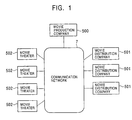
- a movie produced by a movie production company 500 is distributed, via movie distribution companies 501a, 501b, 501c, and so on, to movie theaters 502a, 502b, 502c, 502d, and so on under contract.
- a movie producer edits a negative master film by cutting and connecting the film. After completion of the editing, an edited positive film is produced from the edited negative master film.
- the movie production company 500 produces a negative master film from which films to be distributed will be produced.
- Each of movie distribution companies 501a, 501b, and so on produces a large number of negative films from a delivered positive film.
- the produced negative films are delivered (transported) from the movie distribution companies 501a, 501b, and so on to movie theaters 502a, 502b, and so on in accordance with a contract.
- the movie theaters 502a, 502b, and so on show the movie using distributed films.
- the negative films are returned to the movie distribution company 501a from movie theaters 502a, 502b,.., and so on.
- the movie distribution companies 502a, 502b, and so on dispose the negative films returned from the movie theaters thereby preventing the films from being used in an unauthorized manner.
- the movie production company 500 collects all movie films from the movie distribution companies 502a, 502b, and so on to prevent unauthorized use of the films.
- content data is not corporeal. This can cause content data to be easily copied at a movie theater site without permission. This means that it is impossible to completely prevent an unauthorized copy of content data by means of withdrawing, unlike films.
- a possible technique of preventing distributed video contents from being copied without permission is to encrypt video content data.
- it is required to transmit key data used by movie distribution companies 501 or movie theaters 502 to decrypt the encrypted video content data.
- a decryption key data is transmitted in a similar manner to content data, if the key data is hacked together with the video content data during transmission process, an unauthorized copy can be made.
- Embodiments of the present invention seek to provide a system in which movies can be distributed by means of transmission of electronic data without danger of being copied in an unauthorised manner, and distributed video sources can be properly managed.
- a data delivery system comprising: encrypting means for encrypting data and outputting the resultant encrypted data; transmitting means for transmitting the encrypted data; recording means for recording, on a storage medium, a key used to decrypt the encrypted data; receiving means for receiving the encrypted data transmitted by the transmitting means; reading means for reading the key stored on the storage medium; decrypting means for decrypting the encrypted data received by the receiving means, using the key read by the reading means; reproducing means for reproducing the data decrypted by the decrypting means; control means for controlling the reproduction of the data performed by the reproducing means in accordance with information stored on the storage medium; and judgment means for detecting unauthorized use of the data, on the basis of information stored on the storage medium.
- the recording means records an allowed reproduction period during which data corresponding to the key stored on the storage medium is allowed to be reproduced, and the judgment means detects unauthorized use of the data, on the basis of the allowed reproduction period recorded on the storage medium.
- the data delivery system may further comprise settling means for performing settlement corresponding to data reproduced by the reproducing means; and settlement information recording means for recording settlement information on the storage medium in response to the settlement, wherein the judgment means detects unauthorized use of the data, on the basis of the settlement information stored on the storage medium.
- the data delivery system may further comprise storage means for storing the received encrypted data; and delete flag recording means for, when the encrypted data stored in the storage means is deleted, recording a delete flag on the storage medium, wherein the judgment means detects unauthorized use of the data by judging whether the delete flag is recorded on the storage medium.
- the recording means may record an allowed reproduction period during which data corresponding to the key stored on the storage medium is allowed to be reproduced, and the control means may enable or disable the reproducing means to reproduce the data, in accordance with the allowed reproduction period recorded on the storage means.
- the recording means may record a number-of-times value indicating the number of times data corresponding to the key stored on the storage medium is allowed to be reproduced, and the control means may enable or disable the reproducing means to reproduce the data in accordance with the number-of-times value recorded on the storage medium.
- the data delivery system may further comprise embedding means for embedding an electronic watermark indicating the allowance of reproduction into the data, wherein the control means reduces the number-of-times value each time the reproducing means reproduces the data, and the control means rewrites the electronic watermark embedded in the data so as to indicate inhibition of reproduction when the number-of-times value becomes equal to zero.
- the data delivery system may further comprise transfer means capable of transferring the encrypted data received by the receiving means to another electronic apparatus; detecting means for detecting a transfer operation performed by the transfer means; and ID recording means for, when the detecting means detects a transfer operation, recording an ID corresponding to the transfer means on the storage medium.
- the data delivery system may further comprise a mounting part for mounting the storage medium therein: memory means on which information recorded on the storage medium is stored when the storage medium is mounted in the mounting part; and rewriting means for rewriting the information recorded on the storage medium, wherein the control means controls the reproduction of the data performed by the reproducing means in accordance with the information stored in the memory means.
- the data delivery system may further comprise rewriting means capable of rewriting the allowed reproduction period during which the data corresponding to the key stored on the storage medium is allowed to be reproduced, so as to extend the allowed reproduction period.
- the data delivery system may further comprise updating means for updating the information recorded on the storage medium if the judgment means determines, from the information recorded on the storage medium, that the use of the data is valid.
- the recording means may record, on the storage medium, an identifier of the data, an allowed reproduction period assigned to the data, and a key used to decrypt the data
- the updating means may update the information recorded on the storage medium, if the judgment means determines, from the information recorded on the storage medium, that the use of the data is valid.
- the data delivery system may further comprise settling means for performing settlement in accordance with the number-of-times value recorded on the storage medium by the recording means, the number-of-times value indicating the number of times the data is allowed to be reproduced.
- the data delivery system may further comprise counter means for counting the number of times the data is reproduced by the reproducing means; and settlement means for performing settlement in accordance with a count value output by the counter means.
- the data delivery system may further comprise payment amount recording means for recording payment amount information on the storage medium in response to paying a fee; and payment amount updating means for updating the payment amount information recorded on the storage medium in such a manner as to reduce the payment amount in accordance with the information recorded on the storage medium by the recording means.
- a server apparatus for delivering data to a reproducing apparatus, comprising: encrypting means for encrypting data and outputting the resultant encrypted data; transmitting means for transmitting the encrypted data to the reproducing apparatus; recording means for recording, on a storage medium, a key used to decrypt the encrypted data; and judgment means for detecting unauthorized use of the data transmitted from the transmitting means, on the basis of information stored on the storage medium returned from the reproduction apparatus.
- the recording means records an allowed reproduction period during which data corresponding to the key stored on the storage medium is allowed to be reproduced.
- the judgment means detects unauthorized use of the data, on the basis of the allowed reproduction period recorded on the storage medium.
- the judgment means may detect unauthorized use of the data, on the basis of the settlement information recorded on the storage medium by the reproducing apparatus.
- the judgment means may detect unauthorized use of the data by judging whether a delete flag, which indicates that the data transmitted from the transmitting means has been deleted, is recorded on a storage medium returned from the reproducing apparatus.
- the recording means may record a number-of-times value indicating the number of times data corresponding to the key stored on the storage medium is allowed to be reproduced.
- the server apparatus may further comprise embedding means for embedding an electronic watermark indicating the allowance of reproduction into the data.
- the judgment means may detect unauthorized use of the data by judging whether information indicating that the data transmitted from the transmitting means has been transferred is recorded on a storage medium returned from the reproducing apparatus.
- the server apparatus may further comprise rewriting means capable of rewriting the allowed reproduction period during which the data corresponding to the key stored on the storage medium is allowed to be reproduced, so as to extend the allowed reproduction period.
- the server apparatus may further comprise updating means for updating the information recorded on the storage medium if the judgment means determines, from the information recorded on the storage medium, that the use of the data is valid.
- the recording means may record, on the storage medium, an identifier of the data, an allowed reproduction period assigned to the data, and a key used to decrypt the data
- the updating means may update the information recorded on the storage medium, if the judgment means determines, from the information recorded on the storage medium, that the use of the data is valid.
- the server apparatus may further comprise, payment amount updating means for, when payment amount information is recorded on the storage medium in response to payment of a fee performed by the reproducing apparatus, updating the payment amount information recorded on the storage medium in such a manner as to reduce the payment amount in accordance with the information recorded on the storage medium by the recording means.
- a reproducing apparatus to which encrypted data is transmitted from a predetermined server apparatus and to which a storage medium including a key stored thereon for use in decrypting the encrypted data is sent, the reproducing apparatus comprising: receiving means for receiving the encrypted data transmitted from the predetermined server apparatus; reading means for reading the key stored on the storage medium; decrypting means for decrypting the encrypted data received by the receiving means, using the key read by the reading means; reproducing means for reproducing the data decrypted by the decrypting means; and control means for controlling the reproduction of the data performed by the reproducing means in accordance with information stored on the storage medium.
- the recording means records an allowed reproduction period during which data corresponding to the key stored on the storage medium is allowed to be reproduced, and the control means enables or disables the reproducing means to reproduce the data, in accordance with the allowed reproduction period recorded on the storage means.
- the reproducing apparatus may further comprise settling means for performing settlement corresponding to data reproduced by the reproducing means; and settlement information recording means for recording settlement information on the storage medium in response to the settlement.
- the reproducing apparatus may further comprise storage means for storing the received encrypted data; and delete flag recording means for, when the encrypted data stored in the storage means is deleted, recording a delete flag on the storage medium.
- a number-of-times value indicating the number of times data corresponding to the key stored on the storage medium is allowed to be reproduced, may be stored on the storage medium, and the control means may enable or disable the reproducing means to reproduce the data in accordance with the number-of-times value recorded on the storage medium.
- the data received by the receiving means may include an electronic watermark embedded in the data, the watermark indicating that the data is permitted to be reproduced, and the control means may reduce the number-of-times value each time the reproducing means reproduces the data, and the control means rewrites the electronic watermark embedded in the data so as to indicate inhibition of reproduction when the number-of-times value becomes equal to zero.
- the reproducing apparatus may further comprise transfer means capable of transferring the encrypted data received by the receiving means to another electronic apparatus; detecting means for detecting a transfer operation performed by the transfer means; and ID recording means for, when the detecting means detects a transfer operation, recording an ID corresponding to the transfer means on the storage medium.
- the reproducing apparatus may further comprise a mounting part for mounting the storage medium therein: memory means on which information recorded on the storage medium is stored when the storage medium is mounted in the mounting part; and rewriting means for rewriting the information recorded on the storage medium, wherein the control means controls the reproduction of the data performed by the reproducing means in accordance with the information stored in the memory means.
- the reproducing apparatus may further comprise rewriting means capable of rewriting the allowed reproduction period during which the data corresponding to the key stored on the storage medium is allowed to be reproduced, so as to extend the allowed reproduction period.
- the reproducing apparatus may further comprising settling means for performing settlement in accordance with the number-of-times value recorded on the storage medium, the number-of-times value indicating the number of times the data is allowed to be reproduced.
- the reproducing apparatus may further comprise counter means for counting the number of times the data is reproduced by the reproducing means; and settlement means for performing settlement in accordance with a count value output by the counter means.
- the reproducing apparatus may further comprise payment amount recording means for recording payment amount information on the storage medium in response to paying a fee.
- a data delivery method comprising: an encrypting step for encrypting data and outputting the resultant encrypted data; a transmitting step for transmitting the encrypted data; a recording step for recording, on a storage medium, a key used to decrypt the encrypted data; a receiving step for receiving the encrypted data transmitted in the transmitting step; a reading step for reading the key stored on the storage medium; a decrypting step for decrypting the encrypted data received in the receiving step, using the key read in the reading step; a reproducing step for reproducing the data decrypted in the decrypting step; a control step for controlling the reproduction of the data performed in the reproducing step, in accordance with information stored on the storage medium; and a judgment step for detecting unauthorized use of the data, on the basis of information stored on the storage medium.
- the recording step records an allowed reproduction period during which data corresponding to the key stored on the storage medium is allowed to be reproduced, and the judgment step detects unauthorized use of the data, on the basis of the allowed reproduction period recorded on the storage medium.
- the data delivery method may further comprise a settling step for performing settlement corresponding to data reproduced in the reproducing step; and a settlement information recording step for recording settlement information on the storage medium in response to the settlement, wherein the judgment step detects unauthorized use of the data, on the basis of the settlement information stored on the storage medium.
- the data delivery method may further comprise a storing step for storing the received encrypted data in storage means; and a delete flag recording step for, when the encrypted data stored in the storage means is deleted, recording a delete flag on the storage medium, wherein the judgment step detects unauthorized use of the data by judging whether the delete flag is recorded on the storage medium.
- the recording step may record an allowed reproduction period during which data corresponding to the key stored on the storage medium is allowed to be reproduced, and the control step may enable or disable the reproduction of the data in the reproducing step, in accordance with the allowed reproduction period recorded on the storage medium.
- the recording step may record a number-of-times value indicating the number of times data corresponding to the key stored on the storage medium is allowed to be reproduced, and the control means may enable or disable the reproduction of the data in the reproducing step in accordance with the number-of-times value recorded on the storage medium.
- the data delivery method may further comprise an embedding step for embedding an electronic watermark indicating the allowance of reproduction into the data, wherein the control step reduces the number-of-times value each time the reproducing step reproduces the data, and the control step rewrites the electronic watermark embedded in the data so as to indicate inhibition of reproduction when the number-of-times value becomes equal to zero.
- the data delivery method may further comprise a transfer step in which the encrypted data received in the receiving step may be transferred by transfer means to another electronic apparatus; a detecting step for detecting transferring, in the transfer step, of the encrypted data received in the receiving step to another electronic apparatus; and an ID recording step for, when the detecting step detects transferring of the encrypted data, recording an ID corresponding to the transfer means on the storage medium.
- the data delivery method may further comprise a mounting step for mounting the storage medium into a mounting part; a memorizing step for storing, into memory means, information recorded on the storage medium when the storage medium is mounted in the mounting part; and a rewriting step for rewriting the information recorded on the storage medium, wherein the control step controls the reproduction of the data performed in the reproducing step in accordance with the information stored in the memory means.
- the data delivery method may further comprise a rewriting step in which the allowed reproduction period, during which the data corresponding to the key stored on the storage medium is allowed to be reproduced, may be rewritten so as to extend the allowed reproduction period.
- the data delivery method may further comprise an updating step for updating the information recorded on the storage medium if the judgment step determines, from the information recorded on the storage medium, that the use of the data is valid.
- the recording step may record, on the storage medium, an identifier of the data, an allowed reproduction period assigned to the data, and a key used to decrypt the data
- the updating step may update the information recorded on the storage medium, if the judgment step determines, from the information recorded on the storage medium, that the use of the data is valid.
- the data delivery method may further comprise a settling step for performing settlement in accordance with the number-of-times value recorded on the storage medium in the recording step, the number-of-times value indicating the number of times the data is allowed to be reproduced.
- the data delivery method may further comprise a counting step for counting the number of times the data is reproduced in the reproducing step; and a settlement step for performing settlement in accordance with a count value counted in the counting step.
- the data delivery method may further comprise a payment amount recording step for recording payment amount information on the storage medium in response to paying a fee; and a payment amount updating step for updating the payment amount information recorded on the storage medium in such a manner as to reduce the payment amount in accordance with the information recorded on the storage medium in the recording step.
- a method of controlling a server apparatus so as to deliver data from the server apparatus to a reproducing apparatus comprising: an encrypting step for encrypting data and outputting the resultant encrypted data; a transmitting step for transmitting the encrypted data to the reproducing apparatus; a recording step for recording, on a storage medium, a key used to decrypt the encrypted data; and a judgment step for detecting unauthorized use of the data transmitted in the transmitting step, on the basis of information stored on the storage medium returned from the reproduction apparatus.
- the recording step records an allowed reproduction period during which data corresponding to the key stored on the storage medium is allowed to be reproduced.
- the judgment step detects unauthorized use of the data, on the basis of the allowed reproduction period recorded on the storage medium.
- the judgment step may detect unauthorized use of the data, on the basis of the settlement information recorded on the storage medium by the reproducing apparatus.
- the judgment step may detect unauthorized use of the data by judging whether a delete flag, which indicates that the data transmitted in the transmitting step has been deleted, is recorded on a storage medium returned from the reproducing apparatus.
- the recording step may record a number-of-times value indicating the number of times data corresponding to the key stored on the storage medium is allowed to be reproduced.
- the method of controlling the server apparatus may further comprise an embedding step for embedding an electronic watermark indicating the allowance of reproduction into the data.
- the judgment step may detect unauthorized use of the data by judging whether information indicating that the data transmitted in the transmitting step has been transferred is recorded on a storage medium returned from the reproducing apparatus.
- the method of controlling the server apparatus may further comprise a rewriting step in which the allowed reproduction period, during which the data corresponding to the key stored on the storage medium is allowed to be reproduced, may be rewritten so as to extend the allowed reproduction period.
- the method of controlling the server apparatus may further comprise an updating step for updating the information recorded on the storage medium if the judgment step determines, from the information recorded on the storage medium, that the use of the data is valid.
- the recording step may record, on the storage medium, an identifier of the data, an allowed reproduction period assigned to the data, and a key used to decrypt the data
- the updating step may update the information recorded on the storage medium, if the judgment step determines, from the information recorded on the storage medium, that the use of the data is valid.
- the method of controlling the server apparatus may further comprise a payment amount updating step for, when payment amount information is recorded on the storage medium in response to payment of a fee performed by the reproducing apparatus, updating the payment amount information recorded on the storage medium in such a manner as to reduce the payment amount in accordance with the information recorded on the storage medium in the recording step.
- a method of controlling a reproducing apparatus to which encrypted data is transmitted from a predetermined server apparatus and to which a storage medium including a key stored thereon for use in decrypting the encrypted data is sent comprising: a receiving step for receiving the encrypted data transmitted from the predetermined server apparatus; a reading step for reading the key stored on the storage medium; a decrypting step for decrypting the encrypted data received in the receiving step, using the key read in the reading step; a reproducing step for reproducing the data decrypted in the decrypting step; and a control step for controlling the reproduction of the data performed in the reproducing step in accordance with information stored on the storage medium.
- the recording step records an allowed reproduction period during which data corresponding to the key stored on the storage medium is allowed to be reproduced, and the control step enables or disables the reproduction of the data in the reproducing step, in accordance with the allowed reproduction period recorded on the storage means.
- the method of controlling the reproducing apparatus may further comprise a settling step for performing settlement corresponding to data reproduced in the reproducing step; and a settlement information recording step for recording settlement information on the storage medium in response to the settlement.
- the method of controlling the reproducing apparatus may further comprise a storing step for storing the received encrypted data into storage means; and a delete flag recording step for, when the encrypted data stored in the storage means is deleted, recording a delete flag on the storage medium.
- a number-of-times value indicating the number of times data corresponding to the key stored on the storage medium is allowed to be reproduced, may be stored on the storage medium, and the control step may enable or disable the reproduction of the data in the reproducing step, in accordance with the number-of-times value recorded on the storage medium.
- the data received in the receiving step may include an electronic watermark embedded in the data, the watermark indicating that the data is permitted to be reproduced, and the control step may reduce the number-of-times value each time the reproducing step reproduces the data, and the control step may rewrite the electronic watermark embedded in the data so as to indicate inhibition of reproduction when the number-of-times value becomes equal to zero.
- the method of controlling the reproducing apparatus may further comprise a transfer step in which the encrypted data received in the receiving step may be transferred by transfer means to another electronic apparatus; a detecting step for detecting transferring, in the transfer step, of the encrypted data received in the receiving step to another electronic apparatus; and an ID recording step for, when the detecting step detects transferring of the encrypted data, recording an ID corresponding to the transfer means on the storage medium.
- the method of controlling the reproducing apparatus may further comprise a mounting step for mounting the storage medium into a mounting part; a memorizing step for storing, into memory means, information recorded on the storage medium when the storage medium is mounted in the mounting part; and a rewriting step for rewriting the information recorded on the storage medium, wherein the control step controls the reproduction of the data performed in the reproducing step in accordance with the information stored in the memory means.
- the method of controlling the reproducing apparatus may further comprise a rewriting step in which the allowed reproduction period, during which the data corresponding to the key stored on the storage medium is allowed to be reproduced, may be rewritten so as to extend the allowed reproduction period.
- the method of controlling the reproducing apparatus may further comprise a settling step for performing settlement in accordance with the number-of-times value recorded on the storage medium, the number-of-times value indicating the number of times the data is allowed to be reproduced.
- the method of controlling the reproducing apparatus may further comprise a counting step for counting the number of times the data is reproduced in the reproducing step; and a settlement step for performing settlement in accordance with a count value counted in the counting step.
- the method of controlling the reproducing apparatus may further comprise a payment amount recording step for recording payment amount information on the storage medium in response to paying a fee.
- a program storage medium including a processing program, stored thereon, for controlling a server apparatus to perform a process of delivering data from the server apparatus to a reproducing apparatus, the process comprising: an encrypting step for encrypting data and outputting the resultant encrypted data; a transmitting step for transmitting the encrypted data to the reproducing apparatus; a recording step for recording, on an information storage medium, a key used to decrypt the encrypted data; and a judgment step for detecting unauthorized use of the data transmitted in the transmitting step, on the basis of information stored on the information storage medium returned from the reproduction apparatus.
- the recording step records an allowed reproduction period during which data corresponding to the key stored on the information storage medium is allowed to be reproduced.
- the judgment step detects unauthorized use of the data, on the basis of the allowed reproduction period recorded on the information storage medium.
- the judgment step may detect unauthorized use of the data, on the basis of the settlement information recorded on the information storage medium by the reproducing apparatus.
- the judgment step may detect unauthorized use of the data by judging whether a delete flag, which indicates that the data transmitted in the transmitting step has been deleted, is recorded on an information storage medium returned from the reproducing apparatus.
- the recording step may record a number-of-times value indicating the number of times data corresponding to the key stored on the information storage medium is allowed to be reproduced.
- the process may further comprise an embedding step for embedding an electronic watermark indicating the allowance of reproduction into the data.
- the judgment step may detect unauthorized use of the data by judging whether information indicating that the data transmitted in the transmitting step has been transferred is recorded on an information storage medium returned from the reproducing apparatus.
- the process may further comprise a rewriting step in which the allowed reproduction period, during which the data corresponding to the key stored on the storage medium is allowed to be reproduced, may be rewritten so as to extend the allowed reproduction period.
- the process may further comprise an updating step for updating the information recorded on the storage medium if the judgment step determines, from the information recorded on the storage medium, that the use of the data is valid.
- the recording step may record, on the information storage medium, an identifier of the data, an allowed reproduction period assigned to the data, and a key used to decrypt the data
- the updating step may update the information recorded on the information storage medium, if the judgment step determines, from the information recorded on the information storage medium, that the use of the data is valid.
- the process may further comprise a payment amount updating step for, when payment amount information is recorded on the information storage medium in response to payment of a fee performed by the reproducing apparatus, updating the payment amount information recorded on the information storage medium in such a manner as to reduce the payment amount in accordance with the information recorded on the information storage medium in the recording step.
- a program storage medium including a processing program, stored thereon, for controlling a reproducing apparatus, to which encrypted data is transmitted from a predetermined server apparatus and to which an information storage medium including a key stored thereon for use in decrypting the encrypted data is sent, so as to perform a process comprising a receiving step for receiving the encrypted data transmitted from the predetermined server apparatus; a reading step for reading the key stored on the information storage medium; a decrypting step for decrypting the encrypted data received in the receiving step, using the key read in the reading step; a reproducing step for reproducing the data decrypted in the decrypting step; and a control step for controlling the reproduction of the data performed in the reproducing step in accordance with information stored on the information storage medium.
- the recording step records an allowed reproduction period during which data corresponding to the key stored on the information storage medium is allowed to be reproduced, and the control step enables or disables the reproduction of the data in the reproducing step, in accordance with the allowed reproduction period recorded on the information storage means.
- the process may further comprise a settling step for performing settlement corresponding to data reproduced in the reproducing step, and a settlement information recording step for recording settlement information on the information storage medium in response to the settlement.
- the process may further comprise a storing step for storing the received encrypted data into storage means; and a delete flag recording step for, when the encrypted data stored in the storage means is deleted, recording a delete flag on the information storage medium.
- a program storage medium according to Claim 91, wherein the process further comprises a number-of-times value, indicating the number of times data corresponding to the key stored on the information storage medium is allowed to be reproduced, is stored on the information storage medium; and the control step enables or disables the reproduction of the data in the reproducing step, in accordance with the number-of-times value recorded on the information storage medium.
- data received in the receiving step may include an electronic watermark embedded in the data, the watermark indicating that the data is permitted to be reproduced, and the control step may reduce the number-of-times value each time the reproducing step reproduces the data, and the control step may rewrite the electronic watermark embedded in the data so as to indicate inhibition of reproduction when the number-of-times value becomes equal to zero.
- the process may further comprise a transfer step in which the encrypted data received in the receiving step may be transferred by transfer means to another electronic apparatus; a detecting step for detecting transferring, in the transfer step, of the encrypted data received in the receiving step to another electronic apparatus; and an ID recording step for, when the detecting step detects transferring of the encrypted data, recording an ID corresponding to the transfer means on the information storage medium.
- the process may further comprise a mounting step for mounting the information storage medium into a mounting part; a memorizing step for storing, into memory means, information recorded on the information storage medium when the information storage medium is mounted in the mounting part; and a rewriting step for rewriting the information recorded on the information storage medium, wherein the control step controls the reproduction of the data performed in the reproducing step in accordance with the information stored in the memory means.
- the process may further comprise a rewriting step in which the allowed reproduction period, during which the data corresponding to the key stored on the information storage medium is allowed to be reproduced, may be rewritten so as to extend the allowed reproduction period.
- the process may further comprise a settling step for performing settlement in accordance with the number-of-times value recorded on the information storage medium, the number-of-times value indicating the number of times the data is allowed to be reproduced.
- the process may further comprise a counting step for counting the number of times the data is reproduced in the reproducing step; and a settlement step for performing settlement in accordance with a count value counted in the counting step.
- the process may further comprise a payment amount recording step for recording payment amount information on the information storage medium in response to paying a fee.
- a control signal for controlling a server apparatus to perform a process of delivering data from the server apparatus to a reproducing apparatus, the process comprising: an encrypting step for encrypting data and outputting the resultant encrypted data; a transmitting step for transmitting the encrypted data to the reproducing apparatus; a recording step for recording, on an information storage medium, a key used to decrypt the encrypted data; and a judgment step for detecting unauthorized use of the data transmitted in the transmitting step, on the basis of information stored on the information storage medium returned from the reproduction apparatus.
- the recording step records an allowed reproduction period during which data corresponding to the key stored on the information storage medium is allowed to be reproduced.
- the judgment step detects unauthorized use of the data, on the basis of the allowed reproduction period recorded on the information storage medium.
- the judgment step may detect unauthorized use of the data, on the basis of the settlement information recorded on the information storage medium by the reproducing apparatus.
- the judgment step may detect unauthorized use of the data by judging whether a delete flag, which indicates that the data transmitted in the transmitting step has been deleted, is recorded on an information storage medium returned from the reproducing apparatus.
- the recording step may record a number-of-times value indicating the number of times data corresponding to the key stored on the information storage medium is allowed to be reproduced.
- the process may further comprise an embedding step for embedding an electronic watermark indicating the allowance of reproduction into the data.
- the judgment step may detect unauthorized use of the data by judging whether information indicating that the data transmitted in the transmitting step has been transferred is recorded on an information storage medium returned from the reproducing apparatus.
- the process may further comprise a rewriting step in which the allowed reproduction period, during which the data corresponding to the key stored on the storage medium is allowed to be reproduced, may be rewritten so as to extend the allowed reproduction period.
- the process may further comprise an updating step for updating the information recorded on the storage medium if the judgment step determines, from the information recorded on the storage medium, that the use of the data is valid.
- the recording step may record, on the information storage medium, an identifier of the data, an allowed reproduction period assigned to the data, and a key used to decrypt the data
- the updating step updates the information recorded on the information storage medium, if the judgment step determines, from the information recorded on the information storage medium, that the use of the data is valid.
- the process may further comprises a payment amount updating step for, when payment amount information is recorded on the information storage medium in response to payment of a fee performed by the reproducing apparatus, updating the payment amount information recorded on the information storage medium in such a manner as to reduce the payment amount in accordance with the information recorded on the information storage medium in the recording step.
- a control signal for controlling a reproducing apparatus to which encrypted data is transmitted from a predetermined server apparatus and to which an information storage medium including a key stored thereon for use in decrypting the encrypted data is sent, so as to perform a process comprising a receiving step for receiving the encrypted data transmitted from the predetermined server apparatus; a reading step for reading the key stored on the information storage medium; a decrypting step for decrypting the encrypted data received in the receiving step, using the key read in the reading step; a reproducing step for reproducing the data decrypted in the decrypting step; and a control step for controlling the reproduction of the data performed in the reproducing step in accordance with information stored on the information storage medium.
- the recording step records an allowed reproduction period during which data corresponding to the key stored on the information storage medium is allowed to be reproduced, and the control step enables or disables the reproduction of the data in the reproducing step, in accordance with the allowed reproduction period recorded on the information storage means.
- the process may further comprise a settling step for performing settlement corresponding to data reproduced in the reproducing step; and a settlement information recording step for recording settlement information on the information storage medium in response to the settlement.
- the process may further comprise a storing step for storing the received encrypted data into storage means; and a delete flag recording step for, when the encrypted data stored in the storage means is deleted, recording a delete flag on the information storage medium.
- the process may further comprise a number-of-times value, indicating the number of times data corresponding to the key stored on the information storage medium is allowed to be reproduced, is stored on the information storage medium; and the control step enables or disables the reproduction of the data in the reproducing step, in accordance with the number-of-times value recorded on the information storage medium.
- data received in the receiving step may include an electronic watermark embedded in the data, the watermark indicating that the data is permitted to be reproduced, and the control step may reduce the number-of-times value each time the reproducing step reproduces the data, and the control step may rewrite the electronic watermark embedded in the data so as to indicate inhibition of reproduction when the number-of-times value becomes equal to zero.
- the process may further comprise a transfer step in which the encrypted data received in the receiving step may be transferred by transfer means to another electronic apparatus; a detecting step for detecting transferring, in the transfer step, of the encrypted data received in the receiving step to another electronic apparatus; and an ID recording step for, when the detecting step detects transferring of the encrypted data, recording an ID corresponding to the transfer means on the information storage medium.
- the process may further comprise a mounting step for mounting the information storage medium into a mounting part; a memorizing step for storing, into memory means, information recorded on the information storage medium when the information storage medium is mounted in the mounting part; and a rewriting step for rewriting the information recorded on the information storage medium, wherein the control step controls the reproduction of the data performed in the reproducing step in accordance with the information stored in the memory means.
- the process may further comprise a rewriting step in which the allowed reproduction period, during which the data corresponding to the key stored on the information storage medium is allowed to be reproduced, may be rewritten so as to extend the allowed reproduction period.
- the process may further comprise a settling step for performing settlement in accordance with the number-of-times value recorded on the information storage medium, the number-of-times value indicating the number of times the data is allowed to be reproduced.
- the process may further comprise a counting step for counting the number of times the data is reproduced in the reproducing step; and a settlement step for performing settlement in accordance with a count value counted in the counting step.
- the process may further comprise a payment amount recording step for recording payment amount information on the information storage medium in response to paying a fee.
- a data delivery method comprising: an encrypting step for encrypting data and outputting the resultant encrypted data; a transmitting step for transmitting the encrypted data; a recording step for recording, on a storage medium, a key used to decrypt the encrypted data; a receiving step for receiving the encrypted data transmitted from the predetermined server apparatus; a reading step for reading the key stored on the storage medium; a decrypting step for decrypting the encrypted data received in the receiving step, using the key read in the reading step; a controlling step for enabling or disabling reproduction of the data decrypted in the decrypting step, in accordance with the information recorded on the storage medium; a reproducing step for reproducing the decrypted data, in accordance with the control in the controlling step; and a judging step for detecting unauthorized use of the data, on the basis of information stored on the storage medium.
- a method of delivering data to a reproducing apparatus comprising: an encrypting step for encrypting data and outputting the resultant encrypted data; a transmitting step for transmitting the encrypted data; a recording step for recording, on a storage medium, a key used to decrypt the encrypted data; and a judging step for detecting unauthorized use of the data, on the basis of information stored on a storage medium returned from the reproducing apparatus.
- a method of reproducing data by a reproducing apparatus to which encrypted data is transmitted from a predetermined server apparatus and to which a storage medium including a key stored thereon for use in decrypting the encrypted data is sent comprising: a receiving step for receiving the encrypted data transmitted from the predetermined server apparatus; a reading step for reading the key stored on the storage medium; a decrypting step for decrypting the encrypted data received in the receiving step, using the key read in the reading step; a controlling step for enabling or disabling reproduction of the data decrypted in the decrypting step, in accordance with the information recorded on the storage medium; and a reproducing step for reproducing the decrypted data, in accordance with the control in the controlling step.
- a storage medium including a processing program, stored thereon, for controlling a server apparatus to execute a data delivery process for delivering data to a reproducing apparatus, the processing program comprising: an encrypting step for encrypting data and outputting the resultant encrypted data; a transmitting step for transmitting the encrypted data; a recording step for recording, on a storage medium, a key used to decrypt the encrypted data; and a judging step for detecting unauthorized use of the data, on the basis of information stored on a storage medium returned from the reproducing apparatus.
- a program storage medium including a processing program, stored thereon, for controlling a reproducing apparatus to which encrypted data is transmitted from a predetermined server apparatus and to which an information storage medium including a key stored thereon for use in decrypting the encrypted data is sent, the processing program serving to control the reproducing apparatus to perform a process of reproducing the data, the process comprising: a receiving step for receiving the encrypted data transmitted from the predetermined server apparatus; a reading step for reading the key stored on the information storage medium; a decrypting step for decrypting the encrypted data received in the receiving step, using the key read in the reading step; a controlling step for enabling or disabling reproduction of the data decrypted in the decrypting step, in accordance with the information recorded on the information storage medium; and a reproducing step for reproducing the decrypted data, in accordance with the control in the controlling step.
- a storage medium which is delivered between a server apparatus and a reproducing apparatus in a data delivery system for delivering encrypted data from the server apparatus to the reproducing apparatus, wherein at least information indicating an identifier of the data, a key used to decrypt the data, and a reproduction condition of the data is stored on the storage medium.
- the information indicating the reproduction condition is information indicating a period during which the data is allowed to be reproduced.
- the information indicating the reproduction condition may be information indicating the number of times the data is allowed to be reproduced.
- Settlement information may be stored on the storage medium in response to settlement associated with the data reproduced by the reproducing apparatus.
- a delete flag may be stored on the storage medium in response to deleting data from the reproducing apparatus.
- Information indicating that the data is transferred or output from the reproducing apparatus may be stored on the storage medium.
- Payment amount information may be stored on the storage medium in response to payment of a fee performed by the reproducing apparatus.
- a control signal for controlling a server apparatus to perform a process of delivering data to a reproducing apparatus, the process comprising an encrypting step for encrypting data and outputting the resultant encrypted data; a transmitting step for transmitting the encrypted data; a recording step for recording, on a storage medium, a key used to decrypt the encrypted data; and a judging step for detecting unauthorized use of the data, on the basis of information stored on a storage medium returned from the reproducing apparatus.
- a control signal for controlling a reproducing apparatus to which encrypted data is transmitted from a predetermined server apparatus and to which a storage medium including a key stored thereon for use in decrypting the encrypted data is sent, the control signal serving to control the reproducing apparatus to perform a process of reproducing the data, the process comprising: a receiving step for receiving the encrypted data transmitted from the predetermined server apparatus; a reading step for reading the key stored on the storage medium; a decrypting step for decrypting the encrypted data received in the receiving step, using the key read in the reading step; a controlling step for enabling or disabling reproduction of the data decrypted in the decrypting step, in accordance with the information recorded on the storage medium; and a reproducing step for reproducing the decrypted data, in accordance with the control in the controlling step.
- a transmission data signal which is transmitted between a server apparatus and a reproducing apparatus in a data delivery system for delivering encrypted data from the server apparatus to the reproducing apparatus, wherein the transmission data signal includes at least information indicating an identifier of the data, a key used to decrypt the data, and a reproduction condition of the data.
- the information indicating the reproduction condition includes information indicating a period during which the data is allowed to be reproduced.
- the information indicating the reproduction condition may include information indicating the number of times the data is allowed to be reproduced.
- the information may include settlement information created in response to settlement associated with the data reproduced by the reproducing apparatus.
- the information may include a delete flag created in response to deleting the data from the reproducing apparatus.
- the information may include information generated in response to outputting or transferring the data from the reproducing apparatus, so as to indicate that the data has been output or transferred.
- the information may include payment amount information created in response to payment of a fee performed by the reproducing apparatus.
- a movie production company 500, movie delivery companies 501, and movie theaters 502 are connected to one another, or at least movie delivery companies 501 and movie theaters 502 are connected to one another, via a communication network such that data can be transmitted among them.
- a movie production company 500, movie distribution companies 501, and movie theaters 502 are connected to one another via a transmission line 7 serving as a communication network such that data can be transmitted among them.
- a movie is distributed to respective movie theaters 502 not via a film but in the form of content data.
- the content data is encrypted before being distributed.
- each movie theater the distributed movie is projected on a screen using not a film projector but a content data player.
- a content data player it may be possible to project a movie on a screen in a movie theater 502 after converting content data into the form of a film, each embodiment described below is assumed to use a content data player to project a movie on a screen.
- the content data of a movie or the like includes video data and audio data.
- the audio data may be of multi-channel data including, for example, 2, 3, 4, or greater number of channels.
- the content data may include multi-language information.
- the transmission line 7 serving as the communication network may be a public communication network in a wire or wireless form.
- a private communication line may also be employed as the transmission line 7 for connection between a movie distribution company 501 and a movie theater 502.
- the Internet a satellite communication network, an optical fiber network, or other various types communication lines can be used.
- a storage medium is distributed separately from the movie content data.
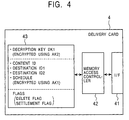
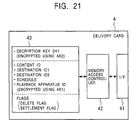
- information about a condition under which a movie is to be played information used to mange distribution, and key data (also referred to simply as a key) used to decrypt encrypted content data are stored.
- a card medium may be employed as the storage medium and distributed (transported) as a delivery card from the movie production company 500 to movie distribution companies 501 and further to movie theaters 502.
- a storage medium serving as a playback card may be delivered from the movie distribution companies 501 to the movie theaters 502.
- the storage medium various types of media such as a card medium, a disk medium, or a tape medium can be employed.
- a card medium is employed by way of example.
- card media include a plastic card, a magnetic card, an IC card, and an optical card.
- an IC card is employed by way of example.
- IC cards are classified into two types: a contact type in which metal terminals are exposed to the outside of a card; and a non-contact type in which data is transmitted via an electromagnetic wave.
- a contact type in which metal terminals are exposed to the outside of a card
- a non-contact type in which data is transmitted via an electromagnetic wave.
- Each type of IC cards can be further classified into sub types.
- a contact-type memory card is employed.
- the present invention is not limited to the contact-type memory card, but any type of storage medium can also be employed.
- contact-type IC cards they are preferably capable of transmitting data at a frequency equal to or higher than 3.57 MHz and at a data transmission rate equal to or higher than 9.6 Kbps.
- the server in the movie production company 500 the relay server in the movie distribution company 501, and the playback apparatus in the movie theater 502 are described below for each embodiment.
- the server and the relay sever are not necessarily required to be disposed in a separate fashion.
- the movie production company 500 may distribute a movie directly to movie theaters 502.
- the server of the movie production company 500 also has functions of the relay server of the relay server of the movie distribution company 501.
- the present invention is not limited to a movie distribution system but may also be applied to other various systems in which data which needs high security is transmitted and also to various systems in which management of transmitted data is needed.
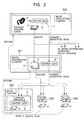
- a first embodiment of a movie distribution system is described below. First, the outline of this movie distribution system is described with reference to Fig. 2.
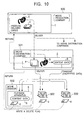
- Fig. 2 illustrates flows of content data 5 and storage medium (delivery card 4) transmitted or transported among a server 1 installed in a movie production company 500, relay server 2 installed in a movie distribution company 501, and a playback apparatus 3 installed in a movie theater 502.
- the server 1 converts a movie film 5, which has been edited after being shot, into the form of content data 6 so as to be able to be transmitted via a transmission line 7 to movie distribution companies 501 (which are, for example, located in various countries and have a contract with the movie production company 500).
- the server 1 In addition to the content data 6, the server 1 also produces delivery cards 4 to be distributed to the movie distribution companies 501. In this production process, the server 1 produces as many delivery cards 5 as there are movie theaters 502 to which delivery cards 5 will be finally distributed. Information, called additional information, associated with the content data 6 is stored in each delivery card 4, as will be described in detail later.
- the server 1 encrypts the content data 1 and the associated additional information and transmits them to relay servers 2 of the respective movie distribution companies 501. Furthermore, the server 1 also sends the required number of delivery cards 4 in which the additional information is stored to the respective movie distribution companies 501.
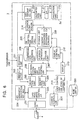
- the relay server 2 receives the transmitted content data 6 and the associated additional information and also receives the delivery card 4.
- the relay server 2 performs a necessary process upon the content data 6 and the information stored on the delivery card 4.
- the relay server 2 then transmits the encrypted content data 6 and the additional information to each theater movie 502 and also sends one delivery card 4 in which the additional information is stored to each movie theater 502.
- the playback apparatus 3 in each movie theater 502 receives the content data 6 and the associated additional information.
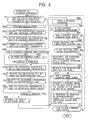
- the playback apparatus 3 reads the information stored on the delivery card 4. Using a key read from the delivery card 4, the playback apparatus 3 decrypts the encrypted content data and additional information, and plays back the content data in accordance with the additional information read from the delivery card 4.
- each movie theater 502 when the predetermined playing period has expired, the content data 6 stored in the playback apparatus 3 is deleted. Furthermore, a delete flag in the delivery card 4 is set to indicate that the content data 6 has been deleted.
- the delivery cards 4 are returned to the movie distribution companies 501.
- the delivery cards 4 are then returned to the movie production company 500.
- the server 1 checks whether the distributed content data 6 has been used adequately. More specifically, for example, the server 1 checks whether the movie was played only during the allowed period according to the contract and whether the content data 6 has been correctly deleted after the expiration of the playing period.
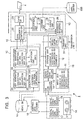
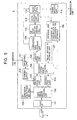
- the server 1 includes a film scanner 1A, a distribution managing unit 1B, a copyright managing unit 1C, a return managing unit 1D, a card controller 1E, and a movie database 16.
- the film scanner 1A converts a movie film 5 into the form of data which can be transmitted.
- the film scanner 1A includes a digital video reading unit 18 for scanning an image formed on the film 5 and converting it into digital video data, and the film scanner 1A also includes a digital audio reading unit 17 for converting a sound track signal recorded on the film 5 into an audio signal and outputting the resultant signal.
- the digital video data and the digital audio data read from the movie film 5 are supplied to a compression coder 19 and converted into content data in a predetermined format. More specifically, the compression coder 19 converts the input digital video data and digital audio data into compressed content data, for example, according to the MPEG standard. Note that there is no particular restriction on the format of the content data. Another format other than the MPEG format, such as the AVI format or the Window Media Technology format, may also be employed.
- the advantage obtained by compressing the data is that the amount of data to be transmitted can be reduced.
- the content data is not necessarily required to be compressed, as long as the content data can be used to play back a movie.
- the content data generated by the compression coder 19 is stored in the movie database 16.
- a movie to be distributed is converted, by the film scanner 1A and the compression coder 19, into the form of content data and is stored in the movie database 16. This makes it possible to transmit the content data to movie distribution companies at a desired later time.
- the distribution managing unit 1B controls and manages the distributing operation performed by the server 1.
- the distribution managing unit 1B includes an input unit 11, a storage unit 12, a distribution controller 13, a database controller 14, a modulator 30, and a transmission unit 31.
- the input unit 11 is used by a human operator of the server 1 to input information concerning a distribution condition according to a distribution contract made between a movie distribution company 501 and a movie theater 502 and additional information which will be described later.
- the input unit 11 is also used by the human operator to input a command indicating an operation to be performed by the server 1.
- the information input via the input unit 11 as the additional information associated with one movie content includes a content ID uniquely assigned to the movie content, a destination identifier ID1 serving as an identifier of a movie distribution company 501 (relay server 1) to which the movie content is to be transmitted, a destination identifier ID2 serving as an identifier of a movie theater 502 (playback apparatus 3) to which the movie content is to be transmitted, and schedule information indicating a playing period during which the movie content is to be played back in the movie theater 502.
- the information input via the input unit 11 is stored in the storage unit 12.
- the distribution controller 13 controls various parts so that the content data is distributed in an adequate fashion in accordance with an operation command input via the input unit 11 and also in accordance with the information such as the schedule information stored in the storage unit 12.
- the database controller 14 controls the operation of the film scanner 1A and the operation of the movie database 16. For example, when information associated with a movie, such as a content ID, a destination identifier ID1, a destination identifier ID2, and schedule information, is input via the input unit 11, the database controller 14 controls the film scanner 1A so as to convert the movie indicated by the content ID into content data and then controls the movie database 16 so as to stores the resultant content data.
- information associated with a movie such as a content ID, a destination identifier ID1, a destination identifier ID2, and schedule information
- the content ID, the destination identifier ID1, the destination identifier ID2, the schedule information, associated with each movie are stored, in advance, in the storage unit 12 or on another storage medium so that when a movie recorded on a film 5 is converted into the form of content data, the content ID of that movie can be selected automatically or in accordance with a selection command input via the input unit 11.
- the database controller 14 also controls the operation such that the information such as the content ID which is retained in the storage unit 12 after being input via the input unit 11 (or which is selected from the stored data) is stored as the additional information associated with the content data into the movie database 16.
- the database controller 14 controls the operation such that content data and associated additional data are read or rewritten from or to the movie database 16 or such that content data and associated additional data are transmitted to the modulator 30.
- the modulator 30 modulates the content data read from the movie database 16, by means of, for example, PSK modulation so as to convert the content data into a form which can be transmitted. After being modulated by the modulator 30, the modulated content data is transmitted from the transmission unit 31 over the transmission line 7 to the relay server 2 of each movie distribution company 501.
- the content data read from the movie database 16 is encrypted by an encryption unit 22 of the copyright managing unit 10 and the resultant encrypted content data is again stored into the movie database 16.
- a specified encrypted content data is read from the movie database 16 and transmitted from the transmitting unit 31.
- an encrypted content ID, an encrypted destination identifier ID1, an encrypted destination identifier ID2, and encrypted schedule information corresponding to the encrypted content data are added as additional information (encrypted additional information) to the encrypted content data, and they are transmitted together.
- the copyright managing unit 1C maintains security of copyright by encrypting the content data and associated additional data.
- the copyright managing unit 1C includes a key generators 23 and 24 and encryption units 22 and 25.
- the key generator 23 generates an encryption key AK1 for use in encryption of the content data and associated additional data and also generates a decryption key DK1 for use in decryption of data encrypted using the encryption key AK1.
- the encryption key AK1 is supplied to the encryption unit 22, and the decryption key DK1 is supplied to the encryption unit 25.
- the encryption unit 22 When the encryption unit 22 receives the content data and the associated additional information which are read from the movie database 16 under the control of the distribution controller 13 and the database controller 14, the encryption unit 22 encrypts the received content data and additional information, using the encryption key AK1.
- the encrypted content data and additional information are returned to the movie database 16 and stored therein as data for use of distribution.
- the encrypted additional information is also supplied to the card controller 1E.
- the key generator 24 generates an encryption key AK2 used to encrypt an encryption key AK1 and also generates a decryption key DK2 used to decrypt data encrypted using the encryption key AK2.
- the encryption key AK2 is supplied to the encryption unit 24, and the decryption key DK2 is supplied to the schedule managing unit 26 in the return managing unit 1D.
- the encryption unit 24 When the encryption unit 24 receives the decryption key DK1 generated by the key generator 23, the encryption unit 24 encrypts the received decryption key DK1 using the encryption key AK2. The resultant encrypted decryption key DK1 is supplied to the card controller 1E.
- the card controller 1E serves to read and write data from or to the delivery card 4. To this end, the card controller 1E includes a card read/write controller 20 and a card interface 21.
- the card interface 21 gets access to an inserted delivery card to read or write data such as additional information from or to the delivery card 4.
- the card controller 1E produces a delivery card 4, which is to be delivered to the distribution company 501 separately from the transmission of the content data thereto, by writing, into a new blank card 4, the additional information encrypted using the encryption key AK1 and the decryption key DK1 encrypted using the encryption key AK2.
- the card controller 1E also reads the additional information stored in a delivery card 4 returned from the movie theater 502 or the distribution company 501.
- the return managing unit 1D serves to examine the additional information stored on a returned delivery card 4 to check whether the content data has been used in an authorized manner (in the playing-back operation at the movie theater 502) and check whether there is any problem.
- the return managing unit 1D includes a schedule managing unit 26, a decryption unit 27, a judgment unit 28, and an output unit 29.
- the schedule managing unit 26 checks and manages the additional information associated with each content data stored in the storage unit 12, and also manages, together with the content ID, the decryption key DK2 which is generated by the key generator 24 in correspondence with the content data and the associated additional information.
- the decryption unit 27 decrypts the encrypted decryption key DK1 stored in the delivery card 4, using the decryption key DK2 managed by the schedule managing unit 26. Using the decryption key DK1 decrypted by the decryption unit 27, it is possible to decrypt the encrypted additional information stored in the delivery card 4.
- the judgment unit 28 judges whether the corresponding content data has been correctly used in an authorized fashion by comparing the additional information read from the delivery card 4 with the additional information stored in the managing unit 26; checking the content of the additional information itself; or examining the payment status of the movie theater 502 by checking the account of the movie theater 502 via communication with the bank center 550.
- the output unit 29 serves to output the result of the judgment made by the judgment unit 28 concerning the management status or unauthorized use.
- a monitor device or a printer may be employed as the output unit 29.
- the output unit 29 may output an invoice, a demand letter, a warning message or the like.
- the delivery card 4 may be configured, for example, as shown in Fig. 4.
- the delivery card 4 may be connected to the card interface 21 of the server 1 to write/read information.
- the delivery card 4 may also be connected to the relay server 2 or the playback apparatus 3, which will be described later.
- the delivery card 4 includes an interface 41, a memory access controller 42, and a memory 43.
- the interface 41 is connected to the card interface 21 of the server 1 or the card interface 111 or 211 of the relay server 2 or the playback apparatus 3 which will be described later so that various kinds of information and control signals can be transferred. More specifically, for example, the interface 41 transmits information to be recorded as additional information and handles, adjusts or provides the operation clock, the access control signal, and the supply voltage.
- the memory access controller 42 gets access to the memory 43 to read or write data from or to the memory 43 in response to a request (control signal) issued from a device to which the delivery card 4 is connected.
- the memory 43 is formed of, for example, a memory device such as a flash memory.
- the memory 43 stores the decryption key DK1 encrypted using the encryption key AK2 and also stores the additional information, such as the content ID, the destination identifier ID1, the destination identifier ID2, and the schedule information, encrypted using the encryption key AK1.
- flags are also stored in the memory 43 during the operation of the relay server 2 or the playback apparatus 3. For example, when the content data distributed to the playback apparatus 3 is deleted after expiration of the playing period, the delete flag (deletion-from-playback-apparatus flag) is written. On the other hand, when the content data distributed to the relay server 2 is deleted, the delete flag (deletion-from-relay-server flag) is written.
- the deletion-from-playback-apparatus flag is represented by two bits stored in a particular area of the memory 43. For example, “10" indicates that the data has not yet been deleted, and "11" indicates that the data has been deleted.
- the playback apparatus 3 writes "10" in the deletion-from-playback-apparatus flag. Thereafter, if the content data is deleted by the playback apparatus 3, the deletion-from-playback-apparatus flag is changed to "11".
- the playback apparatus flag Before the delivery card 4 is inserted into the playback apparatus 3 after being received, the playback apparatus flag has a value of "00". In the present description, "there is no deletion-from-playback-apparatus flag” or a similar expression is used to describe that "00" is stored in the storage area assigned to the deletion-from-playback-apparatus flag.
- the deletion-from-relay-server flag may take a value as follows.
- the flag is set so as to have a value of "10".
- the value of the flag is changed to "11".
- Fig. 5 illustrates a configuration of the relay server 2.
- a receiving unit 101 serves to receive data transmitted via the transmission line 7. More specifically, in this example, the receiving unit 101 receives the content data transmitted by the server 1.
- a demodulator 102 demodulates the data received by the receiving unit 101. Because the received data is PSK-modulated data, the demodulation is performed by means of PSK demodulation. As a result of the demodulation, the encrypted content data and the encrypted additional information transmitted from the server 1 are obtained.
- the card interface 111 gets access to an inserted delivery card 4 to read or write data such as additional information from or to the delivery card 4.
- the card interface 111 gets access to a delivery card 4 delivered from the server 1 or a delivery card 4 returned from a movie theater 502 and reads or writes additional information, a decryption key, and various flags.
- a decryption unit 103 decrypts encrypted data such as the encrypted content data or the encrypted additional information obtained via the demodulation performed by the demodulator 102 or the encrypted additional information or flag read from the delivery card 4 via the card read/write controller 105.
- the decryption key DK1 is necessary to decrypt the content data and additional information encrypted using the encryption key AK1.
- the decryption key DK1 can be obtained by reading it from the delivery card 4. However, because the decryption key DK1 read from the delivery card 4 has a form encrypted using the encryption key AK2, a decryption key DK2 is necessary to decrypt the decryption key DK1.
- a key generator 104 serves to generate the decryption key DK2.
- the key generator 104 generates the same decryption key DK2 as that generated by the key generator 24 of the server 1.
- a symmetric key encryption technique may be employed. In this case, during a predetermined period, both the key generator 24 of the server 1 and the key generator 104 of the relay server 2 generate the same decryption key DK2.
- a public key encryption technique may be employed.
- the scheme of generating keys is determined so that the decryption key DK1 corresponding to the decryption key DK2 can be identified.
- the decryption unit 103 can obtain the decryption key DK1 using the decryption key DK2 which is generated by the key generator 104 and supplied to the decryption unit 103 via the card read/write controller 105. That is, it becomes possible to decrypt the encrypted decryption key DK1 read from the delivery card 4. Obtaining the decryption key DK1 then makes it possible to decrypt the encrypted content data and the encrypted additional information which have been demodulated by the demodulator 102 and makes it possible to decrypt the encrypted additional information and flags which are read from the delivery card 4 via the card read/write controller 105.
- the authentication/write controller 106 performs various processes including authentication and judgment concerning the obtained additional information. Furthermore, the authentication/write controller 106 controls the writing of the content data or the additional information, depending upon the results of the authentication and the judgment in accordance with the control program.
- the content data and associated additional information which have been demodulated and decrypted after being received from the server 1, are encrypted by the encryption unit 108 under the control of the authentication/write controller 106 and stored into the compressed data storage unit 109.
- the compressed data storage unit 109 serves to store the content data and associated additional information which have been converted into an encrypted form so as to be able to be transmitted to the movie theaters 502.
- the compressed data storage unit 109 for example, a built-in hard disk may be employed.
- a removable storage medium such as a removable hard disk, optical disk, magneto-optical disk, semiconductor memory, or magnetic tape (video tape) may also be employed.
- the authentication/write controller 106 controls the process such that the additional information is stored in the storage unit 110 without being encrypted.
- additional information and various flags are set and encrypted by the encryption unit 116 under the control of the authentication/write controller 106.
- the resultant data is written into the delivery card 4 via the card read/write controller 105 and the card interface 111.
- a relay server ID uniquely assigned to the relay server 2 is stored in the relay server ID storage unit 107.
- the authentication/write controller 106 also judges whether the destination identifier ID1 described in the additional information is consistent with the relay server ID.
- the encryption key AK1 is used.
- a key generator for generating the same encryption key AK1 as that generated by the key generator 23 of the server 1.
- the encryption key AK1 may be generated on the basis of the decryption key DK1 such that the encryption key AK1 corresponds to the decryption key DK1.
- the delivery card 4 is a card returned from the playback apparatus 3
- the content ID in the additional information stored in the delivery card 4 has been converted by the playback apparatus 3 into a non-encrypted form, although the other data of the additional information is maintained in the encrypted form. This makes it possible for the relay server 2 to recognize the content ID of the returned delivery card without having to use the decryption key DK2.
- the authentication/write controller 106 stores the decryption key DK2, in correspondence with the associated content ID, into an internal memory so that they can be used later to decrypt the encrypted additional information and flags read from the returned delivery card 4. This makes it possible to determine the decryption key DK2 on the basis of the unencrypted content ID, when the delivery card 4 is returned from the movie theater 502. Thus, it becomes possible to decrypt the decryption key DK1 and further decrypt other encrypted additional information and flags using the obtained decryption DK1.
- the relay server 2 when the card information is rewritten to add a flag or the like to a returned delivery card 4, the content ID is not encrypted so that when the delivery card 4 is returned to the server 1, the server 1 can read the content ID of the returned delivery card 4 without having to use the decryption key.
- the distribution controller 112 controls the operation of transmitting content data and associated additional information to a playback apparatus 3 of a movie theater 502.
- the database controller 113 controls the operation of writing and reading data into or from the compressed data storage unit 109.
- the distribution controller 112 From data, such as schedule information, of the additional information stored in the storage unit 110, the distribution controller 112 detects content data and date/time at which that content data should be transmitted. If content data is detected which should be transmitted at the present time, the distribution controller 112 requests the database controller 113 to retrieve the content data to be transmitted. The obtained encrypted content data and associated additional information are supplied to the modulator 114.
- the modulator 114 modulates the content data and the additional information read from the compressed data storage unit 109, by means of, for example, PSK modulation so as to convert the data into a form which can be transmitted. After being modulated by the modulator 114, the modulated content data is transmitted from the transmission unit 115 via the transmission line 7 to the playback apparatus 3 of each movie theater 502.
- Fig. 6 illustrates the structure of the playback apparatus 3.
- a receiving unit 201 serves to receive data transmitted via a transmission line 7. More specifically, the receiving unit 201 receives content data and associated additional information transmitted from the relay server 2.
- a demodulator 202 demodulates the data received via the receiving unit 201. Because the received data is PSK-modulated data, the demodulation is performed by means of PSK demodulation. Thus, via the demodulation process described above, the encrypted content data and associated additional information transmitted from the relay server 2 are obtained.
- the card interface 211 gets access to an inserted delivery card 4 to read or write data such as additional information from or to the delivery card.
- the card interface 211 gets access to the delivery card 4 returned from the relay server 2 to read the additional information and the decryption key and also writes the additional information including a deletion-from-playback-apparatus flag or a settlement completion flag which has been set to a particular value.
- a decryption unit 203 decrypts encrypted data such as the encrypted content data and the encrypted additional information obtained via the demodulation performed by the demodulator 202 or decrypts the encrypted additional information or flag read from the delivery card 4 via the card read/write controller 205.
- the decryption key DK1 is necessary to decrypt the content data and additional information encrypted using the encryption key AK1.
- the decryption key DK1 can be obtained by reading it from the delivery card 4.
- a decryption key DK2 is necessary to decrypt the decryption key DK1.
- a key generator 204 generates the decryption key DK2.
- the key generator 204 like the key generator 104 of the relay server 2, generates the decryption key DK2 identical to that generated by the key generator 24 of the server 1.
- a symmetric key encryption technique may be employed. In this case, during a predetermined period, both the key generator 24 and the key generator 104 generate the same decryption key DK2.
- a public key encryption technique may be employed.
- the decryption unit 203 can obtain the decryption key DK1 using the decryption key DK2 which is generated by the key generator 204 and which is supplied to the decryption unit 203 via the card read/write controller 205. That is, the decryption unit 203 can obtain the decryption key DK1 by decrypting the encrypted key DK1 read from the delivery card 4. Obtaining the decryption key DK1 makes it possible to decrypt the encrypted content data and the encrypted additional information which have been demodulated by the demodulator 202 and makes it possible to decrypt the encrypted additional information which is read from the delivery card 4 via the card read/write controller 205.
- the authentication/write controller 206 performs various processes including authentication of the obtained additional information.
- the authentication/write controller 206 also judges whether the additional information read from the delivery card 4 is consistent with the additional information obtained via the transmission.
- the authentication/write/delete controller 206 controls the writing of the content data or the additional information, depending upon the results of the authentication and the judgment in accordance with the control program.
- the authentication/write/delete controller 206 writes them into the compressed data storage unit 208.
- the compressed data storage unit 208 serves to store content data and associated additional information which have been converted into a decrypted form so as to be capable of being played back by the playback apparatus 3.
- the content data may be stored in the form of encrypted data in the compressed storage unit 208.
- the content data is decrypted when it is played back.
- the additional information which has been demodulated and decrypted after being received via transmission and the additional information which has been decrypted after being read from the delivery card 4 are stored in the storage unit 209 under the control of the authentication/write/delete controller 206.
- a built-in hard disk may be employed.
- a removable storage medium such as a removable hard disk, optical disk, magneto-optical disk, semiconductor memory, or magnetic tape (video tape) may also be employed.
- Employing a removable storage medium allows a human operator to manage content data in units of media.
- the content data can be easily played back simply by inserting the storage medium.
- desired content data can be easily and correctly selected without having to perform retrieval, unlike the case in which a large-capacity hard disk is employed.
- the authentication/write/delete controller 206 re-determines the value of the flag.
- the resultant flag is encrypted by the encryption unit 220 together with the other data of the additional information and written into the delivery card 4 via the card read/write controller 205 and the card interface 211.
- the content ID is not encrypted so that when the delivery card 4 is returned to the relay server 2, the relay server 2 can recognize the content ID of the returned delivery card without having to use the decryption key.
- a playback apparatus ID uniquely assigned to the playback apparatus 3 is stored in a playback apparatus ID storage unit 207.
- the authentication/write/delete controller 206 also judges whether the destination identifier ID2 described in the additional information is consistent with the playback apparatus ID.
- the encryption key AK1 is used.
- the encryption key AK1 may be generated on the basis of the decryption key DK1 such that the encryption key AK1 corresponds to the decryption key DK1.
- a playback controller 214 controls the operation performed by the playback apparatus 3 to play back content data.
- the database controller 215 controls the operation of writing and reading data into or from the compressed data storage unit 208.
- the playback controller 214 detects a content to be played back, a playing period during which the content is allowed to be played back, and a time at which playback is to be started.
- the playback controller 214 retrieves, via the database controller 215, the content data to be played back. The retrieved content data is supplied to a digital projector 3a.
- the digital projector 3a is a part in the playback apparatus which actually plays back the content data and which includes a data separating unit 216, a decompression unit 217, a D/A converter 218, and a projection unit 219.
- the data separating unit 216 separates the content data supplied from the compressed data storage unit 208 into video data and audio data.
- the decompression unit 217 decodes the video data and the audio data so as to decompress them.
- the decompressed video data and audio data are then converted by the D/A converter into an analog video signal and an analog audio signal and reproduced by the playback unit 219.
- the playback unit 219 not only serves as a video projector for forming a projected image but also serves to output an audio sound thereby playing a movie.
- the user control unit 210 is used by a human operator to issue various commands or data to the playback apparatus 3.
- the display unit 213 displays formation such as the additional information stored in the storage unit 209 so that the human operator can read the information.
- the display unit 213 also displays an operation guide or various menus.
- the user control unit 210 is used to issue various commands such as a command to play back content data stored in the compressed data storage unit 208, a command to delete content data whose playing period has expired, a command to end a process, or a command to pay a fee.
- the playback controller 214 commands the database controller 215 to delete the specified content data from the compressed data storage unit 208.
- a charge controller 221 performs a payment process in response to a pay command issued from the user control unit 210. For example, the charge controller 221 communicates with the bank center 550 and sends money into an account of the movie distribution company 501 or the movie production company 500 thereby paying a fee to the movie distribution company 501 or the movie production company 500 in accordance with the a contract.
- step F1 it is determined whether a human operator of the server 1 has input, via the input unit 11, a content ID, a destination identifier ID1, a destination identifier ID2, and schedule information associated with a movie content. If yes, the process proceeds to step F2. However, if it is determined in step F1 that no information has been input, the process jumps to step F7.
- the content ID is an identifier uniquely assigned to a movie content.
- the destination identifier ID1 is a relay server ID of a relay server 2
- the destination identifier ID2 is a playback apparatus ID of a playback apparatus 3 of a movie theater 502 to which movie content is finally supplied.
- the schedule information has a value such as "2000.01.01-2000.04.30" indicating a playing period during which the movie is permitted to be played by the movie theater 502 in accordance with a contract.
- step F2 the information input via the input unit 11, that is, the additional information, is stored in the storage unit 12.
- step F3 the distribution controller 13 transmits a content data write command to the film scanner 1A and the movie database 16 via the database controller 14.
- step F4 in response to the content data write command, the digital audio reader 17 of the film scanner 1A reads digital audio data from the film 5, and the digital video data reader 18 reads digital video data from the film 5.
- the resultant digital audio data and digital video data are transmitted to the compression encoder 19.
- step F5 the compression encoder 19 compresses the digital audio data and the digital video data according to, for example, the MPEG standard thereby producing content data in the MPEG format.
- the resultant compressed content data is supplied to the movie database 16.
- the digital audio data includes 8-channel data, and also includes a copy inhibition flag to prevent the digital audio data from being digitally copied.
- Copy control information may be embedded in the form of a digital watermark in the digital audio data.
- step F6 the compressed content data is stored in the movie database 16 together with the associated additional information such as the content ID stored in the storage unit 12. Thereafter, the process proceeds to step F7.
- step F7 the card read/write controller 20 judges, via the card interface 21, whether a delivery card 4 is inserted.
- step F8 An inserted delivery card 4 is detected, the process proceeds to step F8. However, it is determined that no delivery card is inserted, the process jumps to step F24.
- authentication of the human operator may be performed to confirm that the human operator is an authorized operator of the delivery card 4. Authentication may be performed by asking the operator to input his/her personal ID and/or password, and verifying the input data. To this end, an ID and/or a password corresponding to the operator may be stored in the delivery card 4 or the storage unit 12.
- the delivery card 4 shown in Fig. 4 is constructed such that the additional information stored in the storage unit 12 cannot be transferred into the delivery card 4 unless the authentication of the user is successfully passed.
- Similar authentication may be performed in other embodiments which will be described later, or may be performed when a process associated with the delivery card 4 is performed in the relay server 2 or the playback apparatus 3.
- the card read/write controller 20 reads, in step F8, the information stored in the delivery card 4 to determine whether the delivery card 4 is a new card.
- the "new card” refers to a blank card in which no information such as additional information or a decryption key DK1 has not yet been written and which is inserted to produce a delivery card 4 which will be sent to a relay server 2 in parallel with transmission of content data.
- the inserted delivery card 4 is one which has been returned from a movie distribution company 501 (or a movie theater 502), it is determined that the delivery card 4 is not a new card.
- step F9 If the inserted delivery card 4 is determined as a new card, the process proceeds to step F9. However, in the case where the inserted delivery card 4 is determined as a returned card, the process jumps to step F18.
- the distribution controller 13 determines whether it is time to send the delivery card.
- schedule information associated with a content data is given as "2000.01.01-2000.04.30"
- the process proceeds to step F10. However, if it is determined that it is not time to send the card, the process jumps to step F24.
- the database controller 14 retrieves, from the movie database 16, content data corresponding to the content ID which has been determined as being required to be sent, in accordance with the schedule information.
- step F11 the additional information associated with the content ID and stored in the storage unit 12 is transferred to the encryption unit 22. Furthermore, the compressed content data corresponding to the content ID, retrieved from the movie database 16, is transmitted to the encryption unit 22.
- step F12 the encryption unit 22 encrypts the received compressed content data and associated additional information, using the encryption key AK1 generated by the key generator 23.
- step F13 the content data and additional information encrypted using the encryption key AK1 are stored in the movie database 16.
- step F14 the additional information encrypted using the encryption key AK1 is supplied to the card read/write controller 20 and written, via the card interface 21, into the inserted new card.
- step F15 the encryption unit 25 encrypts, using the encryption key AK2 generated by the key generator 24, the decryption key DK1 generated by the encryption unit 23.
- step F16 the decryption key F16 encrypted using the encryption key AK2 is supplied to the card read/write controller 20 and is written, via the card interface 21, into the inserted new card.
- the encrypted decryption key DK1 and the encrypted additional information are written in the inserted new card, thereby producing a delivery card 4 such as that shown in Fig. 4 to be delivered to a relay server 2 or a playback apparatus 3.
- a delivery card 4 such as that shown in Fig. 4 to be delivered to a relay server 2 or a playback apparatus 3.
- various flags are stored in the delivery card 4. Note that these flags are written by the relay server 2 or the playback apparatus 3, as described earlier.
- step F17 the schedule managing unit 26 stores the decryption key DK2 together with the additional information stored in the storage unit 12.
- the server 1 produces the delivery card 4 by writing the additional information and the decryption key into a new card.
- the delivery card 4 may be produced by the relay server 2. In this case, steps F8 to F16 in Fig. 7 are performed by the relay server 2.
- step F8 determines in step F8 that the inserted card is not a new card, that is, if the inserted card is determined as a delivery card 4 which has been returned from the relay server 2 or the playback apparatus 3 and which includes already-written additional information, the process proceeds to step F18.
- step F18 the card read/write controller 20 reads, from the delivery card 4, the encrypted decryption key DK1, the encrypted additional information, and the content ID which is not encrypted when the delivery card 4 is returned.
- step F19 the decryption key DK2 corresponding to the content ID read in step F18 is read from the schedule managing unit 26, and the decryption unit 27 decrypts, using the decryption key DK2, the encrypted decryption key DK1 read from the delivery card 4.
- step F20 using the decrypted decryption key DK1, the decryption unit 27 decrypts the additional information and the flags read from the delivery card 4.
- the judgment unit 28 judges whether the date/time, the delete flag, the settlement amount and other information are valid, on the basis of the decrypted additional information and flags. More specifically, for example, the judgment is made by comparing the additional information read from the delivery card 4 with the additional information stored in the schedule managing unit 26. The judgment of the settlement amount is made by asking the bank center 550 connected to the server 1 about the status of an account having a corresponding account number. In the case where the value of the deletion-from-playback-apparatus flag is defined such that "11" indicates that the data has been deleted, checking of the deletion-from-playback-apparatus flag is performed by determining whether its value is equal to "11". If the value of the deletion-from-playback-apparatus flag is equal to "10", it is determined that the content data has not been deleted adequately by the playback apparatus 3. The deletion-from-relay-server flag is also judged in a similar manner.
- step F22 an invoice is output from the output unit 29.
- step F23 a demand letter, a warning message, or a confirmation request message is output from the output unit 29 to the corresponding destination identifier ID2.
- the output unit 29 may print the invoice or the demand letter on a sheet.
- the invoice or the demand letter is printed on a sheet and the printed sheet is sent by mail
- the invoice or the demand letter may be described in the form of electronic data and may be directly transmitted from the distribution controller 13 to the corresponding playback apparatus 3.
- the distribution controller 13 may transmit a program to the playback apparatus 3 thereby disabling the playback apparatus 3 and may remotely control the operation of the playback apparatus 3 thereafter.
- the judgment concerning the returned delivery card 4 is performed by the server 1.
- the relay server 2 may perform the judgment concerning the returned delivery card 4.
- step F8 and steps F18 to F23 are performed by the card read/write controller 105 and the authentication/write controller 106 of the relay server 2.
- the card read/write controller 20 may delete all data stored in the inserted delivery card 4 so as to invalidate the delivery card 4.
- step F24 the distribution controller 13 determines whether it is time to transmit a content ID stored in the storage unit 12.
- step F25 If it is determined that there is a content data to be transmitted at the present time, the process proceeds to step F25. In the case where there is no such content data, the process jumps to step F28.
- the time at which content data is transmitted is determined such that the time is a predetermined period earlier than the day when the content data is started to be played.
- the content data may be transmitted at the same time as the delivery card.
- content data may be transmitted one week before the day when the content data is started to be played.
- the database controller 14 retrieves the content data corresponding to the content ID which should be transmitted at the present time.
- step F26 the retrieved content data and the associated additional information which have been already encrypted are transferred to the modulator 30.
- the modulator 30 performs PSK modulation upon the received data.
- step F27 the transmitting unit 31 transmits the encrypted content and additional information modulated in the previous step.
- the content data is transmitted to the relay server 2.
- step F28 the controller such as the distribution controller 13 determines whether an end command has been issued by a human operator. If an end command has not been issued, the flow returns to step F1 to repeat the above-described process. If an end command is detected, the process is ended.
- step F31 it is determined whether the receiving unit 101 has received the encrypted content data and associated information from the server 1. If no, the process jumps to step F36. If yes, the process proceeds to step F32.
- the demodulator 102 demodulates the received encrypted content and additional information.
- step F33 the decryption unit 103 reads, via the card read/write controller 105, the decryption key DK2 generated by the key generator 104. Using this decryption key DK2, the decryption unit 103 decrypts the decryption key DK1 which has been received and demodulated.
- the decryption unit 103 decrypts the content data and the additional information.
- the authentication/write controller 106 determines whether the destination identifier ID1 described in the additional information is consistent with the ID of the relay server 2 stored in the relay server ID storage unit 107. If they are not consistent with each other, it is determined that the received data is not content data addressed to the relay server 2, and thus the process jumps to step F36.
- step F35 the encryption unit 108 determines the encryption key AK1 corresponding to the decryption key DK1. Using this encryption key AK1, the encryption unit 108 re-encrypts the compressed content data and the associated additional data which have been received and demodulated. The resultant data is stored in the compressed data storage unit 109 so that it can be transmitted later to the playback apparatus 3.
- the additional information is also stored in the storage unit 110 without being encrypted.
- the received data is processed in steps F32 to F35 in the above-described manner.
- the re-encryption is performed using the encryption key AK1 corresponding to the decryption key DK1.
- the encryption unit 108 may perform re-encryption using a higher-graded encryption key than the encryption key AK1. For example, an encryption key having a greater number of bits may be employed.
- step F36 the card read/write controller 105 determines whether a delivery card 4 is inserted in the card interface 111.
- step F37 If it is determined that a delivery card 4 is inserted, the process proceeds to step F37. However, when no inserted card is detected, the process jumps to step F41.
- the card read/write controller 105 reads the encrypted decryption key DK1 and additional information from the delivery card 4.
- the encrypted decryption key DK1 and additional information are decrypted. More specifically, the decryption unit 103 decrypts the decryption key DK1, by using the decryption key DK2 generated by the key generator 104, and further decrypts the additional information by using the decrypted decryption key DK1.
- the storage area for the deletion-from-relay-server flag has a value of "00".
- "10" is written as the deletion-from-relay-server flag so as to indicate that the content data associated with this delivery card 4 is stored in the relay server 2 and also indicate that the delivery card 4 has been inserted in the relay server 2 at least once.
- step F40 the authentication/write controller 106 determines whether the information read from the delivery card 4 includes a deletion-from-playback-apparatus flag.
- the delivery card 4 is determined as having been sent from the server 1. In the case where there is a deletion-from-playback-apparatus flag (that is, in the case where the storage area for the deletion-from-playback-apparatus flag has a value of "10" or "11"), the delivery card 4 is determined as having been returned from the playback apparatus 3.
- step F41 the distribution controller 112 determines whether the content IDs stored in the storage unit 110 include one which corresponds to content data which should be transmitted at the present time.
- step F42 If such a content ID is detected, the process proceeds to step F42. However, such a content ID is not detected, the process jumps to step F49.
- step F42 under the control of the distribution controller 112, the database controller 113 retrieves the content data to be transmitted from the compressed data storage unit 109.
- step F43 the retrieved encrypted content data and associated additional information are modulated by the modulator 114 and transmitted, in the next step F44, from the transmitting unit 115 to the playback apparatus 3.
- the content data and the additional information are transmitted to the playback apparatus 3 of each movie theater 502.
- step F40 the deletion-from-playback-apparatus flag stored in the inserted delivery card 4 has a value of "10" or "11"
- the delivery card 4 is determined to be one which has been returned after the expiration of the playing period during which the corresponding content data was permitted to be played back by the playback apparatus 3.
- step F45 the authentication/write controller 106 starts to delete the compressed content data corresponding to that delivery card 4 from the compressed data storage unit 109. That is, the content data, which was transmitted to the playback apparatus 3 in the past and the playing period of which has expired, is deleted from the relay server 2. Normally, this content data has already been deleted from the playback apparatus 3, and thus the deletion-from-playback-apparatus flag has a value of "11".
- step F46 the authentication/write controller 106 determines whether the deleting process has been properly performed. If yes, the process proceeds to step F47. However, if the deleting process has been ended abnormally, the process jumps to step F49.
- the encryption unit 116 re-encrypts, under the control of the authentication/write controller 106, the deletion-from-relay-server flag having a value of "11" indicating that the content data has been deleted, as well as the associated additional information, using the encryption key AK1.
- the card read/write controller 105 writes the re-encrypted data into the inserted delivery card 4 via the card interface 111.
- the flag and the additional information written in the returned delivery card 4 is rewritten.
- the server 1 can read the content ID from the returned delivery card 4 without having to use the decryption key.
- the content ID is not encrypted while the other data of the additional information is encrypted.
- the delivery card 4 is sent to the server 1 and subjected to the above-described process in steps F18 to F23 in Fig. 7.
- step F49 a controller such as the authentication/write controller 106 determines whether an end command has been issued by a human operator. If the end command is detected, the process is ended. However, if the end command is not detected, the flow returns to step F31 to repeat the above-described process.
- step F51 it is determined whether an encrypted content data and associated additional information transmitted from the relay server 2 have been received by the receiving unit 201. If content data and associated additional information have been received, the process proceeds to step F52. However, when no data has been received, the process jumps to step F56.
- the demodulator 202 demodulates the received encrypted content data and associated additional information.
- step F53 the decryption unit 203 reads, via the card read/write controller 205, the decryption key DK2 generated by the key generator 204 and decrypts the received and demodulated decryption key DK1 using the decryption key DK2.
- the decryption unit 103 decrypts the content data and the additional information.
- step F54 the authentication/write/delete controller 206 determines whether the destination identifier ID2 described in the additional information is consistent with the playback apparatus ID stored in the playback apparatus ID storage unit 207. If they are not consistent with each other, it is determined that the received data is not addressed to the playback apparatus 3, and the process jumps to step F56.
- step F55 the compressed content data and the associated additional information, which have been received, demodulated and decrypted, are stored as playback data in the compressed data storage unit 208 such that the content data and the additional information are related to each other.
- the additional information is also stored in the storage unit 209.
- the received data is processed in steps F52 to F55 in the above-described manner.
- step F56 it is determined whether a playback command has been issued by a human operator via the user control unit 210. If yes, the process proceeds to step F57.
- step F57 the card read/write controller 205 determines, via the card interface 211, whether a delivery card 4 is inserted. If no inserted card is detected, the process proceeds to step F58.
- step F58 detection information indicating that no inserted delivery card is detected is applied to the authentication/write/delete controller 206 via the decryption unit 203.
- the authentication/write/delete controller 206 controls the display controller 212 to display a warning on the display unit 213. Thereafter, the process returns to step F57.
- the human operator is requested to insert the delivery card 4.
- step F57 the process proceeds to step F59.
- step F59 the card read/write controller 205 reads the encrypted decryption key DK1 and additional information from the delivery card 4.
- step F60 the decryption key DK1 is decrypted using the decryption key DK2 generated by the key generator 204.
- step F61 the additional information is decrypted using the decryption key DK1.
- the storage area for the deletion-from-playback-apparatus flag has a value of "00".
- "10" is written into the deletion-from-playback-apparatus flag so as to indicate that the content data associated with this delivery card 4 is stored in the playback apparatus 3 and also indicate that the delivery card 4 has been inserted in the playback apparatus 3 at least once.
- step F62 the authentication/write/delete controller 206 determines whether the additional information stored in the storage unit 209 after being received, demodulated and decrypted is consistent with the additional information decrypted after being read from the delivery card 4. If they are consistent with each other, it is further determined whether the present time is within the playing period indicated by the schedule information described in the additional information.
- step F64 If it is determined that the present time is within the playing period, the process proceeds to step F64. However, if inconsistency regarding the additional information is detected, or if the present time is not within the playing period although the consistency is obtained, the content data is not allowed to be played back in accordance with the contract, and thus the process proceeds to step F63. In step F63, as in step F58, a warning is displayed on the display 213. The process then proceeds to step F75.
- the database controller 215 retrieves, under the control of the playback controller 214, the content data to be played back, from the compressed data storage unit 208.
- step F65 the playback controller 214 issues a command to play back the compressed content data stored in the compressed data storage unit 208 via the database controller 215.
- the compressed content data is read from the compressed data storage unit 208 and transmitted to the data separating unit 216.
- the data separating unit 216 separates the received content data into audio and video data.
- the audio and video data are decompressed by the decompressing unit 217 and then converted by the D/A converter 218 into analog form.
- the playback unit 219 generates a sound/voice and an image in accordance with the analog audio and video data.
- step F66 the playback controller 214 monitors whether the playing-back operation is completed. If the playing-back of the content data of the movie is completed, the process proceeds to step F67.
- step F56 to step F66 is performed by the playback apparatus 3 to play a movie one time.
- step F56 In the case where the playback command from the user control unit 210 is not detected is step F56, or in the case where completion of the playing-back operation is detected in step F66, the process proceeds to step F67.
- step F67 it is determined whether a content delete command has been issued from the user control unit 210. If the content delete command is detected, the process proceeds to step F68. However, the content delete command is not detected, the process jumps to step F72.
- the content data is deleted, in response to a demand issued by the movie production company 500 or the movie distribution company 501, from the compressed data storage unit 208 after the end of the allowed playing period thereby protecting the copyright of the content data.
- the operator of the playback apparatus 3 has to delete the movie content at an arbitrary time (within a predetermined period) after the end of the allowed playing period in response to the content delete command detected in step F67.
- step F68 In the case where the process has proceeded to step F68 in response to detecting the content delete command, compressed content data corresponding to a content ID specified by the operator is started to be deleted from the compressed data storage unit 208, under the control of the authentication/write/delete controller 206.
- step F69 the authentication/write/delete controller 206 monitors whether the specified content data has been deleted successfully. If the deleting has been completed successfully, the process proceeds to step F70. However, the deleting is not completed successfully, the process jumps to step F72.
- the encryption unit 220 re-encrypts, under the control of the authentication/write/delete controller 206, the deletion-from-playback-apparatus flag, now having a value of "11" which indicates that the content data has been deleted, together with the corresponding additional information, using the encryption key AK1.
- the re-encrypted data is written into the inserted delivery card 4 via the card read/write controller 205 and the card interface 211.
- the flag and the additional information are rewritten into the delivery card 4 which will be returned later.
- the relay server 2 can read the content ID from the delivery card 4 without having to use the decryption key.
- the content ID is not encrypted in steps F70 and F71.
- the movie theater 502 has to pay a predetermined fee to the movie distribution company 501 or the movie production company 500 in accordance with the delivery contract.
- the operator of the playback apparatus 3 performs an operation to pay the fee.
- step F72 the charge controller 221 determines whether a pay command has been issued from the user control unit 210. If the pay command is detected, the process proceeds to step F73. However, if the pay command is not detected, the process jumps to step F75.
- the charge controller 221 transmits a pay request message to the bank center 550 to request the bank center 550 to pay the fee to the relay server 2 or the server 1.
- the bank center 550 transfers a specified amount of money to the account of the relay server 2 or the server 1.
- the fee has been paid from the movie theater 502 to the relay server 2 or the server 1.
- the charge controller 221 After transmitting the pay request message, the charge controller 221 waits for a response message from the bank center 522. If a response message arrives, the charge controller 221 determines whether the payment has been properly performed. If it is determined that the payment has been properly performed, the charge controller 221 informs the authentication/write/delete controller 206 that the payment has been properly performed.
- the authentication/write/delete controller 206 sets the settlement completion flag and writes it into inserted delivery card 4 via the card read/write controller 205 and the card interface 211 after encrypting it via the encryption unit 220.
- the deletion-from-playback-apparatus flag or the settlement completion flag is written into the delivery card 4 in steps F67 to F74.
- the delivery card 4 into which the flags have been written is sent to the relay server 2 and subjected to the above-described process in step F45 to step F48.
- step F75 a controller such as the authentication/write/delete controller 206 determines whether an end command has been issued from the user control unit 210. If the end command is detected, the process is ended. However, if the end command is not detected, the flow returns to step F51 to repeat the above-described process.
- Fig. 10 is a diagram similar to Fig. 2 and illustrates flows of content data 6 and storage medium (delivery card 4) transmitted or transported among a server 1 installed in a movie production company 500, relay server 2 installed in a movie distribution company 501, and a playback apparatus 3 installed in a movie theater 502.
- delivery card 4 content data 6 and storage medium
- the server 1 does not distribute content data by means of transmission but the server 1 delivers a movie film 5, which has been edited after being shot, to the respective movie distribution companies 501.
- the server 1 produces as many delivery cards 4 as required, and the server 1 sends the delivery cards 4 to the respective movie distribution companies 501 in parallel with or together with the films 5.
- a relay server 2 receives a film 5 and a delivery card 4 sent from the server 1.
- the movie recorded on the film 5 is converted into the form of content data 6 so that it can be transmitted.
- the relay server 2 then transmits the encrypted content data 6 and additional information to each theater movie 502 and also sends one distribution card 4 to each movie theater 502.
- the playback apparatus 3 in each movie theater 502 receives the content data 6 and the associated additional information.
- the playback apparatus 3 also reads various kinds of information such as the additional information stored on the received distribution card 4.
- the playback apparatus 3 uses a key read from the delivery card 4, the playback apparatus 3 decrypts the encrypted content data and additional information, and plays back the content data 6 in accordance with the additional information read from the delivery card 4 and the additional information received via electronic transmission.
- a delete flag in the delivery card 4 is set to "11" so as to indicate that the content data 6 has been deleted.
- the delivery cards 4 are returned to the movie distribution companies 501.
- the delivery cards 4 are then returned to the movie production company 500.
- the server 1 checks whether the distributed content data 6 has been used adequately. More specifically, for example, the server 1 checks whether the movie was played only during the period allowed by the contract and whether the content data 6 has been correctly deleted after the expiration of the playing period.
- the server 1 includes, as in the first embodiment (Fig. 3), a distribution managing unit 1B, a copyright managing unit 1C, a return managing unit 1D, and a card controller 1E.
- the server 1 does not include the film scanner 1A, the compression coder 19, and the movie database 16 which are included in the server 1 shown in Fig. 3, because the server 1 sends a movie source in the form of a film 5 to the relay servers 2.
- the distribution managing unit 1B does not include the modulator 30, the transmitting unit 31, and the database controller 14 shown in Fig. 3.
- an encryption unit 22 of the copyright managing unit 1C decrypts only additional information. That is, additional information stored in a storage unit 12 is supplied to the encryption unit 22 under the control of the distribution controller 13, and the encryption unit 22 encrypts the received additional information.
- the encrypted additional information is written into a delivery card 4 under the control of the card controller 1E.
- Fig. 11 The other parts shown in Fig. 11 are similar to those of the first embodiment, and thus they are not described herein in further detail.
- the delivery card 4 is constructed in a similar manner to that shown in Fig. 4.
- the delivery card 4 is produced by the server 1 by writing additional information and other information into the memory 43 provided in the delivery card 4.
- the information written in the delivery card 4 includes, as shown in Fig. 4, a decryption key DK1 encrypted using an encryption key AK2 and additional information such as a content ID, destination identifiers ID1 and ID2, and schedule information.
- Fig. 12 illustrates a configuration of the relay server 2.
- the relay server 2 converts the movie recorded on the film 5 into the content data 6.
- the relay server 2 includes, in addition to those shown in Fig. 5, a film scanner 2a, a compression coder 118, and an input unit 117, as shown in Fig. 12.
- the relay server 2 does not include the receiving unit 101 and demodulator 102 shown in Fig. 5 (a receiving unit and a demodulator may be provided to achieve a capability of transmitting and receiving general data via the transmission line 7, but they are not necessary to receive content data).
- the film scanner 2a converts a movie film 5 received from the server 1 into the form of data so as to be able to be transmitted.
- the film scanner 2a includes a digital video reading unit 121 for scanning an image formed on the film 5 and converting it into digital video data and also includes a digital audio reading unit 120 for converting a sound track signal recorded on the film 5 into an audio signal and outputting the resultant signal.
- the digital video data and the digital audio data read from the movie film 5 are supplied to a compression coder 118 and converted into content data in a predetermined format. More specifically, the compression coder 118 converts the input digital video data and digital audio data into compressed content data, for example, according to the MPEG standard. Note that there is no particular restriction on the format of the content data, and formats other than the MPEG format, such as the AVI format or the Window Media Technology format, may also be employed.
- the advantage obtained by compressing the data is that the amount of data to be transmitted can be reduced.
- the content data is not necessarily required to be compressed, as long as the content data can be used to play back a movie.
- the content data generated by the compression coder 118 is supplied to the authentication/write controller 106 and written into the compressed data storage unit 109 under the control of the authentication/write controller 106.
- the content data generated from the film 5 is stored in the relay server 2.
- the input unit 117 is used by a human operator to input a scan command to control the film scanner 2a and to input a command to input additional information.
- Additional information which is input via the input unit 117 when the film is scanned is stored in the storage unit 110 under the control of the authentication/write controller 106.
- the write/write controller 106 checks whether the additional information stored in the delivery card 4 is consistent with the additional information stored in the storage unit 110. If they are consistent with each other, the generated content data is stored together with the additional information, as information for use of distribution, into the compressed data storage unit 109.
- the content data and the associated additional information stored in the compressed data storage unit 109 are encrypted by the encryption unit 108 and rewritten into the compressed data storage unit 109 under the control of the authentication/write controller 106. That is, the encrypted content data and associated additional information are stored in the compressed data storage unit 109 so that they can be distributed to the movie theaters 502.
- the encryption key AK1 is used.
- a key generator for generating the same encryption key AK1 as that generated by the key generator 23 of the server 1, although the key generator is not shown in the figure.
- the encrypted decryption key DK1 is read from the delivery card 4 and decrypted using the decryption key DK2, and then the encryption key AK1 is generated from the decryption key DK1.
- the playback apparatus 3 according to the second embodiment has a similar configuration to the playback apparatus 3 according to the first embodiment (Fig. 6).
- step F101 it is determined whether a human operator of the server 1 has input, via the input unit 11, a content ID, a destination identifier ID1, a destination identifier ID2, and schedule information associated with a movie content. If yes, the process proceeds to step F102. However, if it is determined in step F101 that no information has been input, the process jumps to step F103.
- step F102 the information input via the input unit 11, that is, the additional information, is stored in the storage unit 12.
- step F102 When the above process in step F102 started in response to the command input by the operator is completed, or when no operation is performed by the operator, the card read/write controller 20 determines in step F103 whether the delivery card 4 is inserted via the card interface 21.
- step F104 If it is determined that the delivery card 4 is inserted, the process proceeds to step F104. However, no inserted delivery card is detected, the process jumps to step F119.
- the card read/write controller 20 reads the information stored in the delivery card 4 and determines whether the inserted delivery card 4 is a new card.
- the "new card” refers to a blank card in which no information such as additional information or a decryption key DK1 has not yet been written and which is inserted to produce a delivery card 4 to be sent to a relay server 2.
- the inserted delivery card 4 is one which has been returned from a movie distribution company 501 (or a movie theater 502), it is determined that the delivery card 4 is not a new card.
- step F105 If the inserted delivery card 4 is determined as a new card, the process proceeds to step F105. However, the inserted delivery card 4 is determined as a returned card, the process jumps to step F113.
- the distribution controller 13 determines whether it is time to send the delivery card.
- step F106 it is determined whether it is time to send the delivery card on the basis of the schedule information associated with the content data stored in the storage unit 12. If it is determined that it is time to send the delivery card 4, the process proceeds to step F106. However, if it is determined that it is not time to send the delivery card 4, the process jumps to step F119.
- step F106 In the case where the process has proceeded to step F106 after determining that it is time to send the delivery card 4, the additional information including the schedule information is transferred to the encryption unit 22.
- the encryption unit 22 encrypts the received additional information using the encryption key AK1 generated by the key generator 23.
- step F108 the additional information encrypted using the encryption key AK1 is stored.
- the encrypted additional information may be stored in the storage unit 12, or may be stored in an internal memory of the encryption unit 22 if the encryption unit 22 has the internal memory.
- the encrypted additional information may be stored in a storage unit such as a hard disk.
- step F109 the additional information encrypted using the encryption key AK1 is supplied to the card read/write controller 20 and written into the inserted new card via the card interface 21.
- step F110 using the encryption key AK2 generated by the key generator 24, the encryption unit 25 encrypts the decryption key DK1 generated by the encryption unit 23.
- step F111 the decryption key DK1 encrypted using the encryption key AK2 is supplied to the card read/write controller 20 and written into the inserted new card via the card interface 21.
- the encrypted decryption key DK1 and the encrypted additional information have been written into the inserted new card thereby producing a delivery card 4 such as that shown in Fig. 4, which will be sent to a relay server 2 or a playback apparatus 3.
- step F112 the schedule managing unit 26 stores the decryption key DK2 together with the additional information stored in the storage unit 12.
- the delivery card 4 is produced by the server 1 by writing the additional information and the decryption key into a new card
- the delivery card 4 may be produced by the relay server 2.
- the process from step F106 to step F112 shown in Fig. 13 is performed by the relay server 2.
- step F104 determines in step F104 that the inserted card is not a new card, that is, in the case where the inserted card is a delivery card 4 which has been returned from the relay server 2 or the playback apparatus 3 and in which additional information has already been stored, the process jumps to step F113.
- step F113 the card read/write controller 20 reads, from the delivery card, the encrypted decryption key DK1, the encrypted additional information, and the content ID which was stored in an unencrypted form when the delivery card 4 was returned.
- step F114 the decryption key DK2 corresponding to the content ID read from the delivery card 4 is read from the schedule managing unit 26, and the decryption unit 27 decrypts the encrypted decryption key DK1 read from the delivery card 4.
- step F115 using the decrypted decryption key DK1, the decryption unit 27 decrypts the additional information and the flags read from the delivery card 4.
- the judgment unit 28 judges whether the date/time, the delete flag, and the settlement amount are valid, on the basis of the decrypted additional information and the flag. For example, the judgment is performed by comparing the additional information read from the delivery card 4 with the additional information stored in the schedule managing unit 26. The judgment of the settlement amount is made by asking the bank center 550 connected to the server 1 about the status of an account having a corresponding account number.
- step F117 an invoice is output by the output unit 29.
- step F118 a demand letter, a warning message, or a confirmation request message is output from the output unit 29 to the corresponding destination identifier ID2.
- the output unit 29 may print the invoice or the demand letter on a sheet.
- the invoice or the demand note is printed on a sheet and the printed sheet is sent by mail.
- the server 1 may have a capability of transmitting data via the transmission line 7 whereby the invoice or the demand letter may be described in the form of electronic data and may be directly transmitted from the distribution controller 13 to the corresponding playback apparatus 3.
- a program may be transmitted to the playback apparatus 3 thereby disabling the playback apparatus 3 and the operation of the playback apparatus 3 may be remotely controlled thereafter.
- the judgment concerning the returned delivery card 4 is performed by the server 1.
- the relay server 2 may perform the judgment concerning the returned delivery card 4.
- step F104 and steps F113 to F118 are performed by the card read/write controller 105 and the authentication/write controller 106 of the relay server 2.
- the card read/write controller 20 may delete all data stored in the inserted delivery card 4 so as to invalidate the delivery card 4.
- step F119 the controller such as the distribution controller 13 determines whether an end command has been issued by a human operator. If an end command has not been issued, the flow returns to step F1 to repeat the above-described process. If an end command is detected, the process is ended.
- step F121 it is determined whether a playback command has been issued by a human operator of the relay server 1 via the input unit 117.
- the playback command refers to a command to play back the film 5 mounted on the film scanner 2a in order to generate content data of a movie source.
- the operator also inputs additional information concerning the film 5 via the input unit 117.
- step F122 If the playback command to play back the film 5 which has been mounted on the film scanner 2a after being received from the server 1 is detected, and if the content ID, the destination identifier ID2, and the schedule information associated with the movie content have been input, the process proceeds to step F122. If the command or the data is not input, the process jumps to step F126.
- the content ID is an identifier uniquely assigned to a movie content.
- the destination identifier ID2 corresponds to the playback apparatus ID of the playback apparatus 3 of the movie theater 502 to which the content data will be finally sent.
- the destination identifier ID1 is an identifier of the relay server 2 itself. Because the destination identifier ID1 is stored in the relay server ID storage unit 107, it is not required to input it via the input unit 117.
- the schedule information has a value such as "2000.01.01-2000.04.30" indicating a playing period during which the movie is permitted to be played by the movie theater 502 in accordance with a contract.
- step F122 the various kinds of data of the additional information input via the input unit 117 are encrypted by the encryption unit 108 and stored into the compressed data storage unit 109, under the control of the authentication/write controller 106.
- the authentication/write controller 106 issues a command to write the content data into the compressed data storage unit 109 and then starts the operation of the film scanner 2a.
- step F124 the digital audio reader 120 of the film scanner 2a reads digital audio data from the film 5 and the digital video reader 121 reads digital video data therefrom.
- the obtained digital audio and video data are transmitted to the compression coder 118.
- step F125 the compression encoder 118 compresses the digital audio data and the digital video data according to, for example, the MPEG standard thereby producing content data in the MPEG format.
- the compressed content data generated by the compression coder 118 is written into the compressed data storage unit 109 under the control of the authentication/write controller 106. Note that at this stage the compressed content data stored in the compressed data storage unit 109 has not yet been encrypted by the encryption unit 108.
- the additional information input via the input unit 117 in step F121 is stored in the storage unit 110.
- the content data is generated from the from 5.
- step F126 the card read/write controller 105 determines whether a delivery card 4 is inserted in the card interface 111.
- step F127 If it is determined that an inserted delivery card 4 is detected, the process proceeds to step F127. However, when no inserted card is detected, the process jumps to step F134.
- the card read/write controller 105 read the encrypted decryption key DK1 and the encrypted additional information from the delivery card 4.
- the decryption key DK1 is decrypted. More specifically, the decryption unit 103 decrypts the decryption key DK1 using the decryption key DK2 generated by the key generator 104.
- step F129 using the decrypted decryption key DK1, the decryption unit 103 decrypts the additional information. Thereafter, using for example the content ID as a retrieval key, the authentication/write controller 106 retrieves additional information stored in the storage unit 110 to judge whether there is stored additional information which is identical to the additional information read from the delivery card 4.
- step F142 If identical additional information is not found, it is determined that the currently inserted delivery card 4 is not one associated with content data existing at this point of time in the compressed data storage unit 109, that is, it is determined that the delivery card 4 is not one associated with content data which is to be transmitted or was transmitted in the past to the movie theaters 502. In this case, the process proceeds to step F142 without doing anything.
- step F130 the authentication/write controller 106 judges whether the information read from the delivery card 4 includes a deletion-from-playback-apparatus flag.
- deletion-from-playback-apparatus flag "00"
- the deletion-from-playback-apparatus flag "00"
- step F131 an encryption key AK1 corresponding to the decryption key DK1 is produced from the decrypted decryption key DK1.
- step F132 using the encryption key AK1, the encryption unit 108 encrypts the content data and the additional information, under the control of the authentication/write controller 106. Then in step F133, the resultant encrypted content data and additional information are stored in the compressed data storage unit 109.
- the unencrypted content data which has been stored in the compressed data storage unit 109 after being produced from the film 5, is encrypted using the encryption key AK1 and is stored as content data for distribution in the compressed data storage unit 109.
- the unencrypted additional information stored in the storage unit 110 is encrypted and stored in the compressed data storage unit 109 such that the it is linked to the corresponding encrypted content data.
- the content data and the associated additional information to be transmitted to the movie theaters 502 are stored in the encrypted form in the compressed data storage unit 109.
- step F134 the distribution controller 112 determines whether the content IDs stored in the storage unit 110 include one which should be transmitted at the present time.
- step F135 the database controller 113 retrieves, under the control of the distribution controller 112, the content data to be transmitted from the compressed data stored unit 109.
- step F136 the retrieved encrypted content and associated additional information are modulated by the modulator 114 and transmitted, in the next step F137, from the transmitting unit 115 to the playback apparatus 3.
- the content data and the additional information are distributed to the playback apparatus 3 of each movie theater 502.
- the delivery card 4 is determined as one which has been returned after the expiration of the playing period during which the corresponding content data was permitted to be played back by the playback apparatus 3.
- step F138 the authentication/write controller 106 starts to delete the compressed content data corresponding to that delivery card 4 from the compressed data storage unit 109. That is, the content data, which was transmitted to the playback apparatus 3 in the past and the playing period of which has expired (and which has been deleted from the playback apparatus 3) is deleted also from the relay server 2.
- step F139 the write/write controller 106 determines whether the deleting process has been properly performed. If the deleting has been completed successfully, the process proceeds to step F140. However, the deleting has been ended abnormally, the process jumps to step F142.
- the encryption unit 116 re-encrypts, under the control of the authentication/write controller 106, the deletion-from-relay-server flag having a value of "11" indicating the completion of deleting the content data as well as the associated additional information, using the encryption key AK1.
- the re-encrypted data is written into the inserted delivery card 4 via the card read/write controller 105 and the card interface 111.
- the flag and the additional information written in the returned delivery card 4 are rewritten.
- the server 1 can read the content ID from the delivery card 4 without having to use the decryption key.
- the content ID is not encrypted while the other data of the additional information is encrypted.
- the delivery card 4 is sent to the server 1 and subjected to the above-described process from step F113 to step F118 shown in Fig. 13.
- step F142 a controller such as the authentication/write controller 106 determines whether an end command has been issued by a human operator. If the end command is detected, the process is ended. However, if the end command is not detected, the flow returns to step F121 to repeat the above-described process.
- the process performed by the playback apparatus 3 is similar to that performed by the playback apparatus 3 according to the first embodiment described above with reference to Fig. 9.
- the third embodiment has a configuration similar to that of the first embodiment and operates in a similar manner to the first embodiment.
- the flows of the content data 6 and the delivery card 4 are similar to those shown in Fig. 2.
- the third embodiment is different from the first embodiment in that the additional information further includes data indicating the maximum allowable number of times the content data 6 is played back by the playback apparatus 3 of the movie theater 502 to play the movie and in that a watermark (electronic watermark) indicating that the content data 6 is permitted to be played back is embedded in the content data 6.
- the playback apparatus 3 when the playback apparatus 3 receives the content data from the server 1, the playback apparatus 3 checks whether the playback permission watermark is embedded in the received content data. If the watermark is detected, the playback apparatus 3 is allowed to play back the content data as many times as the number-of-times value described in the additional information.
- the playback apparatus 3 When the playback apparatus 3 has played back the content data as many times as allowed by the additional information, the watermark embedded in the content data (video or audio signal) is replaced with a playback inhibition code thereby disabling further playback operation.
- the number-of-times value indicating the number of times the content data is allowed to be played back is set by the movie production company 500 or the movie distribution company 501 in accordance with the agreement between the movie theater 502 and the movie production company 500 or the movie distribution company 501.
- Fig. 15 illustrates a configuration of the server 1.
- the server 1 has a similar configuration to that shown in Fig. 3 but further includes a watermark embedding unit 32.
- the server 1 is also different from that shown in Fig. 3 in that additional information which is stored in the storage unit 12 after being input via the input unit 11 includes the number-of-times value indicating the number of times the content data is allowed to be played back, in addition to the content ID, the destination identifiers ID1 and ID2, and the schedule information.
- the watermark embedding unit 32 embeds a watermark (PN code) serving as a playback permission code into one or both of digital audio data and digital video data output from the film scanner 1A.
- PN code watermark
- the compression coder 19 compresses the digital audio data and the digital video data including the embedded watermark so as to produce content data in a predetermined format.
- the resultant content data is written into the movie database 16.
- the operations of the other parts are similar to those of the first embodiment, and thus they are not described herein.
- the number-of-times value indicating the number of times the content data is allowed to be played back is included in each of the additional information encrypted by the encryption unit 22, the additional information written by the card controller 1E into the delivery card 4, and the additional information transmitted together with the content data.
- the delivery card 4 is similar to that according to the first embodiment in that the delivery card 4 includes an interface 41, a memory access controller 42, and a memory 43.
- encrypted additional information written in the memory 43 further includes a number-of-times value indicating the number of times the content data is allowed to be played back.
- the relay server 2 has a similar configuration to that shown in Fig. 5. However, a number-of-times value indicating the number of times the content data is allowed to be played back is included in each of additional information which is demodulated and decrypted after being received by the receiving unit 101, additional information which is read from the delivery card 4 and then decrypted, additional information stored in the storage unit 110, and additional information which is stored together with content data in the compressed data storage unit 109 and transmitted to the movie theater 502.
- Fig. 17 illustrates the structure of the playback apparatus 3. As shown in Fig. 17, the playback apparatus includes a watermark detection/write controller 222 in addition to the parts shown in Fig. 6.
- a number-of-times value indicating the number of times the content data is allowed to be played back is included in each of additional information which is demodulated and decrypted after being received by the receiving unit 201, additional information which is read from the delivery card 4 and then decrypted, additional information stored in the storage unit 209, and additional information which is stored together with content data in the compressed data storage unit 208.
- the watermark detection/write controller 222 detects a watermark embedded in content data stored in the compressed data storage unit 208. More specifically, the watermark detection/write controller 222 examines a PN code embedded in the content data and determines whether or not the content data is allowed to be reproduced.
- the watermark detection/write controller 222 checks the number-of-times value included in the additional information indicating the number of times the content data is allowed to be played back and also checks the number of times the content data has been actually played back by the digital projector 3a. Depending upon the result of the checking, the watermark detection/write controller 222 rewrites the watermark, embedded in the content data stored in the compressed storage unit 208, into a playback inhibition code.
- the other parts operates in similar manners to those according to the first embodiment.
- Fig. 18 illustrates a process performed by the server 1.
- similar steps to those shown in Fig. 7 are denoted by similar step numbers, and they are not described in further detail herein. More specifically, steps F2 to F28 are similar to those shown in Fig. 7.
- step F150 inputting of data via the input unit 11 is monitored in step F150.
- the input additional information includes a number-of-times value indicating the number of times content data is allowed to be played back, in addition to a content ID, destination identifiers ID1 and ID2, schedule information.
- Step F150 checks whether these data have been input.
- step F2 If the process proceeds to step F2 after detecting inputting of the additional information, the content ID, the destination identifiers ID1 and ID2, the schedule information, and the number-of-times value indicating the number of times the content data is allowed to be played back are stored as the additional information into the storage unit 209.
- steps F3 to F6 content data is produced from a film 5 and the content data is written together with the associated additional information into the movie database 16.
- step F151 the watermark embedding unit 32 embeds a PN code indicating that data is permitted to be played back into one or both of the digital audio data and the digital video data which was read from the film 5 in step F4.
- the process performed by the relay server 2 is similar to that shown in Fig. 8 except that the number-of-time value indicating the number of times the content data is allowed to be played back is included in the additional information dealt with in steps F31 to F34, F37 to F39, F43, F44, F47, and F48.
- Figs. 19 The process performed by the playback apparatus 3 is described below with reference to Figs. 19 and 20.
- the steps shown in Fig. 19 are basically similar to those having the same step numbers shown in Fig. 9 except that the number-of-times value indicating the number of times the content data is allowed to be played back is included in the additional information dealt with in steps F51 to F55, F59 to F62, F70 and F71.
- the playback apparatus 3 in response to a playback command, performs steps F57 to F64 to check whether a delivery card 4 is inserted; decrypt the additional information stored in the delivery card 4; check whether the additional information stored in the delivery card 4 is identical to the additional information stored in the storage unit 209; and check whether the present date/time is within the allowed playing period indicated by the schedule information.
- steps F57 to F64 to check whether a delivery card 4 is inserted; decrypt the additional information stored in the delivery card 4; check whether the additional information stored in the delivery card 4 is identical to the additional information stored in the storage unit 209; and check whether the present date/time is within the allowed playing period indicated by the schedule information.
- the above-described checks are required to be successfully passed to play back the content.
- the difference is that when it is determined in step F64 that the content data to be played back exists in the compressed data storage unit 208, the process proceeds to step F160 shown in Fig. 20 to check whether a further condition necessary for playback is met.
- step F160 shown in Fig. 20 the watermark detection/write controller 222 detects a watermark embedded in the content data to be played back which has been retrieved from the compressed data storage unit 208.
- next step F161 it is determined whether the detected PN code indicates that the content data is permitted to be played back.
- step F63 the process jumps to step F63 to display a warning. Thereafter, the process proceeds to step F75. In this case, the content data is not played back.
- step F162 the process proceeds to step F162 to further check whether the number-of-times value, indicating the number of times the content data is allowed to be played back, described in the additional information corresponding to the content data is equal to or greater than 2.
- step F164 the number-of-times value indicating the number of times the content data is allowed to be played back is decremented by 1.
- the additional information written in the storage unit 209 is rewritten, and the updated additional information concerning the number-of-times value indicating the number of times the content data is allowed to be played back is supplied to the inserted delivery card 4 and the current additional information is replaced with the updated additional information.
- step F65 shown in Fig. 19 the process proceeds to step F65 shown in Fig. 19 to play back the content data using the digital projector 3a.
- the number-of-times value indicating the number of times the content data is allowed to be played back described in the additional information stored in the delivery card 4 and also that stored in the storage unit 209 are decremented in step F164, and thus the number-of-times value indicates the number of times the playback apparatus 3 is allowed to further play back the content data.
- step F161 the playback apparatus 3 is allowed to the last playback operation.
- the process proceeds to step F163 in which the watermark detection/write controller 222 rewrites the watermark embedded in the content data into a PN code so as to indicate that the content data is not allowed to be played back. More specifically, the rewritten watermark is re-compressed, combined with the content data, and rewritten into the compressed data storage unit 208.
- step F65 shown in Fig. 19 to start the last playback operation using the digital projector 3a.
- step F56 If a playback command is detected in step F56 after completion of the last playback operation, the content data is not played back because step F161 detects that the content data is not allowed to be played back.
- the third embodiment has the advantages described below in addition to the advantages (1) to (8) described above with reference to the first embodiment.
- the server 1 can controls the number of times the content data is played back by the playback apparatus 3 by describing the number-of-times value indicating the number of times the content data is allowed to be played back in the additional information in accordance with the contract.
- the playback apparatus 3 When the playback apparatus 3 has played back the content data as many times as indicated by the number-of-times value, the watermark embedded in the content data is rewritten so as to indicate that the content data is not permitted to be played back. Thus, the playback apparatus 3 can no longer play back the content data. This prevents the content data from being played back against the contract with the movie production company 500 or the movie distribution company 501. That is, it is ensured that the content data can be played back by the movie theater 502 only as many times as allowed according to the contract.
- the number-of-times value stored in the delivery card 4 is decremented each time the content data is played back. This allows the server 1 to know how many times the content data has been actually played back in the movie theater 502 by checking the number-of-times value described in the delivery card 4 returned from the movie theater 502. This is useful for management and for field investigation of the playing status.
- the fourth embodiment has a configuration similar to that of the first embodiment and operates in a similar manner to the first embodiment.
- the flows of the content data 6 and the delivery card 4 are similar to those shown in Fig. 2. However, the difference is that the playback apparatus 3 has a capability of managing and controlling the operation of copying the content data 6.
- the playback apparatus 3 outputs content data 6, which has been stored after being received by means of electronic transmission, to an external device, and if the content data is copied on a storage medium by the external device, the playback apparatus ID of the playback apparatus 3 is added to the additional information stored in the delivery card 4.
- the server 1 checks whether the additional information stored in the delivery card 4 includes the playback apparatus ID. If the playback apparatus ID is detected, the server 1 determines that the content data 6 has been copied by the playback apparatus 3 indicated by the playback apparatus ID.
- the server has a similar configuration to that shown in Fig. 3. However, the judgment unit 28 of the return managing unit 1D checks whether the additional information stored in the returned delivery card 4 includes a playback apparatus ID.
- the output unit 29 issues, to the playback apparatus 3 indicated by the playback apparatus ID, a notification to give a warning or to request the playback apparatus to explain the reason why the copy was made. This allows the server to take necessary action against the playback apparatus 3 (movie theater 502) which has made the copy.
- Fig. 21 illustrates the configuration of the delivery card 4. As shown in Fig. 21, the configuration is similar to that shown in Fig. 4. However, in the present embodiment, the additional information stored in the memory 43 can include a playback apparatus ID, depending upon the situation.
- the additional information generated by the sever 1 does not include a playback apparatus ID, but a playback apparatus ID is written by the playback apparatus 3 depending upon the situation. That is, when a delivery card 4 is returned to the server 1, there is a possibility that the additional information includes a playback apparatus ID.
- the relay server 2 has a similar configuration to that shown in Fig. 5.
- the additional information stored in the delivery card 4 returned from the playback apparatus 3 can include the playback apparatus ID.
- Fig. 22 illustrates the configuration of the playback apparatus 3.
- the configuration is basically similar to that shown in Fig. 6 except that there is further provided a digital output detector 233.
- Content data stored in the compressed data storage unit 208 can be output in the form of digital data. For example, when a data transfer command is issued from the user control unit 210, content data stored in the compressed data storage unit 208 is output to an external device and is copied by the external device.
- the digital output detector 233 detects that content data has been transferred to an external device in response to a command issued from the user control unit 210, the digital output detector 233 determines that the content data has been copied, and the digital output detector 233 outputs a detection signal to the authentication/write/delete controller 206.
- the authentication/write/delete controller 206 In response to receiving the detection signal from the digital output detector 233, the authentication/write/delete controller 206 adds the playback apparatus ID stored in the playback apparatus ID storage unit 207 to the additional information.
- the resultant additional information including the playback apparatus ID is transmitted to the card read/write controller 205.
- the card read/write controller 205 updates the additional information stored in the delivery card 4 in accordance with the received additional information.
- Fig. 23 illustrates the process performed by the server 1.
- similar steps to those shown in Fig. 7 are denoted by similar step numbers, and they are not described in further detail herein. More specifically, steps F1 to F23 and steps F24 to F28 are similar to those shown in Fig. 7.
- step F8 determines that the inserted delivery card 4 is not a new card but a returned card
- steps F18 to F23 are performed to decrypt the additional information stored in the delivery card; check whether the content data was correctly used by the playback apparatus 3 only during the allowed period, the content data has been adequately deleted, and the settlement has been correctly made; issue an invoice, a demand note, or a warning message depending upon the result of the checking.
- step F210 it is determined whether the additional information stored in the delivery card 4 includes a playback apparatus ID.
- step F24 If no playback apparatus ID is detected, the process proceeds to step F24 without performing anything. However, if a playback apparatus ID is detected, the process proceeds to step F211 to output a warning message from the output unit 29 to a playback apparatus 3 indicated by the playback apparatus ID, that is, to the playback apparatus 3 which used the returned delivery card 4. That is, a warning regarding the unauthorized copy is given.
- the process performed by the relay server 2 is similar to that shown in Fig. 8, except that the additional information dealt with in steps F37 to F39 and F47 to F48 can include a playback apparatus ID.
- Fig. 24 illustrates the process performed by the playback apparatus 3.
- similar steps to those shown in Fig. 9 are denoted by similar step numbers, and they are not described in further detail herein.
- the process according to this fourth embodiment includes a step F201 in which the digital output detector 233 monitors whether a command is issued to output content data stored in the compressed storage unit 208 of the playback apparatus 3 to an external device.
- step F202 the authentication/write/delete controller 206 reads the playback apparatus ID stored in the playback apparatus ID storage unit 207 and adds it to the additional information which is stored in the storage unit 209 and which corresponds to the output content data.
- the resultant additional information now including the playback apparatus ID is encrypted by the encryption unit 220 and transmitted to the card read/write controller 205.
- step F203 the card read/write controller 205 writes the encrypted additional information including the playback apparatus ID into the delivery card 4.
- the playback apparatus ID is written in the delivery card 4 in such as manner as shown in Fig. 21.
- the fourth embodiment has the advantages described below in addition to the advantages (1) to (8) described above with reference to the first embodiment.
- the server 1 is capable of checking whether content data has been copied by a particular playback apparatus 3, on the basis of information described in a returned delivery card 4. If unauthorized copying of content data is detected, the server 1 can give a warning or take action such as demanding of a penalty for breach of contract.
- Unauthorized copying can be monitored simply by checking information described in a returned delivery card 4 without having to use an additional special monitoring system. This makes it possible to easily perform monitoring for a very large number of movie theaters 502 to which content data is distributed.
- the fifth embodiment has a configuration similar to that of the first embodiment and operates in a similar manner to the first embodiment.
- the flows of the content data 6 and the delivery card 4 are similar to those shown in Fig. 2. However, the difference is that after the delivery card 4 is inserted into the playback apparatus 3, the delivery card is required to be maintained in the inserted state without being removed.
- the server has a similar configuration to that shown in Fig. 3.
- the configuration of the delivery card 4 is similar to that shown in Fig. 4.
- the relay server 2 has a similar configuration to that shown in Fig. 5.
- the configuration of the playback apparatus 3 is similar to that shown in Fig. 6 except that the authentication/write/delete controller 206 includes a counter for counting the number of times a playback command is issued, and the authentication/write/delete controller 206 controls the operation of rewriting the additional information stored in the delivery card 4 depending upon the counter value.
- the process performed by the server 1 is similar to that shown in Fig. 7.
- the process performed by the relay server 2 is similar to that shown in Fig. 8.
- step F56 if a playback command issued by a human operation is detected in step F56, and if it is determined in step F57 that a delivery card 4 is inserted, the process proceeds to step F301 in which the internal counter of the authentication/write/delete controller 206 serving as a playback counter Cp is incremented.
- step F302 it is determined whether the value of the playback counter Cp is equal to or greater than 2. The process branches to different steps depending upon the counter value.
- the playback counter Cp is reset by an interrupt routine shown in Fig. 26.
- step F311 after detecting removal in step F310, the playback counter Cp is reset to 0.
- the playback counter Cp is incremented in step F301 in Fig. 25 when the delivery card 4 remains in the inserted state, but it is reset when the delivery card 4 is removed, the value of the playback counter Cp indicates the number of times the content data has been played back while maintaining the delivery card 4 in the inserted state.
- the playback counter Cp When the content data is played back for the first time after the delivery card 4 is inserted, the playback counter Cp has a value of 1.
- step F302 the card read/write controller 205 reads the encrypted decryption key DK1 and the additional information from the delivery card 4.
- step F60 the decryption key DK1 is decrypted using the decryption key DK2 generated by the key generator 204.
- step F61 the additional information is decrypted using the decryption key DK1.
- step F303 the decrypted additional information is stored into the storage unit 209 under the control of the authentication/write controller 106.
- step F304 the authentication/write controller 106 rewrites the schedule information included in the additional information so as to indicate that the playing period has expired.
- the resultant additional information now indicating that the playing period has expired is encrypted by the encryption unit 220 and transferred to the card read/write controller 205.
- step F305 the additional information is written into the delivery card 4.
- the playing period indicated by the schedule information read from the delivery card 4 before performing the rewriting is "2001.1.1-2001.3.31"
- the present date is December 30, 2000
- the schedule information stored in the delivery card 4 is rewritten into, for example, "2000.1.1-2000.3.31" so as to indicate that the playing period has expired.
- step F302 the playback counter Cp is detected as being equal to 1, when the content data is played back for the first time after inserting the delivery card 4, steps F59 to F305 are performed first and then the process proceeds to step F306.
- step F302 if the playback counter Cp detected in step F302 is equal to or grater than 2, when the content data is played back a second or later time after inserting the delivery card 4, the process proceeds directly to step F306 without performing steps F59 to F305.
- step F306 the authentication/write controller 206 determines whether the additional information which was received together with the content data from the relay server 2 and stored in the storage unit 209 via the process from step F52 to step F55 is identical to the additional information which was read from the delivery card 4 and stored in the storage unit 209 via the process from step F59 to step F303. If they are identical to each other, the authentication/write controller 206 further determines whether the present time is within the allowed playing period indicated by the schedule information included in the additional information.
- the additional information is read from the delivery card 4 and is compared with the additional information which has been received via electronic transmission, and then the schedule information is checked.
- step F64 In the case where the additional information is valid and the present time is within the allowed playing period, the process proceeds to step F64. However, in the case where the additional information is invalid or in the case where the present time is not within the allowed playing period although the additional information is valid, the process proceeds to step F63 to display a warning on the display unit 213 because the contract does not allow the content data to be played back. The process then proceeds to step F75.
- step F306 in the case where the content data is tried to be played back when the delivery card 4 corresponding to the content data is not inserted or in the case where the playing period allowed for the content data has already expired, it is determined in step F306 that the required playback condition is not met, and a warning is displayed. In such a case, the content data is not allowed to be played back, as in the process according to the first embodiment described above with reference to Fig. 9.
- step F306 determines that the playback condition is not met, and the playing back of the content data is disabled also in the case where the content data is tried to be played back by re-inserting the delivery card 4 which was removed, even if the present time is within the playing period.
- step F306 the authentication/write controller 206 determines whether when the content data is tried to be played back for the first time after inserting the delivery card 4, it is determined in step F306 whether the additional information read from the delivery card 4 is identical to the additional information received from the relay server 2 via electronic transmission. Note that the schedule information of the delivery card 4 has been rewritten in step F305 so as to indicate that the allowed playing period has expired.
- step F302 If a playback command is issued after re-inserting the delivery card 4 which was removed once during the allowed playing period, it is determined in step F302 that the playback counter Cp has a value equal to 1 because the playback counter Cp was reset to 0 in the process shown in Fig. 26 when the delivery card 4 was removed, and thus steps F59 to F305 are performed.
- step F306 because the additional information including the rewritten schedule information is compared, in step F306, with the additional information including the original schedule information which has been received via electronic transmission, it is determined that they are not identical to each other, that is, it is determined that the playing period is invalid.
- step F63 a warning is displayed in step F63, and the content data is not allowed to be played back.
- step F306 When the delivery card 4 remains in the inserted state without being removed, it is determined in step F306 that the additional information is valid, because, in this case, the original additional information which was read from the delivery card 4 and stored, in step F303, into the storage unit 209 without being changed is compared with the additional information which was received via electronic transmission.
- step F64 the content data to be played back is retrieved from the compressed data storage unit 208, and the retrieved content data is started to be played back in the next step F65.
- step F67 determines whether a command to delete the content data has been issued from the user control unit 210. If the delete command is detected, the process proceeds to step F68.
- Deleting the content data is performed by the playback apparatus 3 when the allowed playing period has expired.
- the deleting is performed such that the content data is deleted, in step F68, from the compressed data storage unit 208 and then it is confirmed in step F69 that the content data has been successfully deleted.
- the process proceeds to step F307 to rewrite the additional information of the delivery card 4 into the original one.
- the authentication/write/delete controller 206 reads the original additional information which is retained in the storage unit 209 without being changed, and sets the deletion-from-playback-apparatus flag so as to indicate that the content data has been deleted.
- the resultant additional information is encrypted by the encryption unit 220 and transferred to the card read/write controller 205.
- step F71 the additional information including the deletion-from-playback-apparatus flag is written into the inserted delivery card 4 via the card interface 211 under the control of the card read/write controller 205.
- the schedule information which was changed is rewritten so as to have the original value, and the deletion-from-playback-apparatus flag is added to the additional information.
- the relay server 2 can read the content ID from the delivery card 4 without having to use the decryption key.
- the content ID is not encrypted while the other data of the additional information is encrypted.
- the fifth embodiment has the advantages described below in addition to the advantages (1) to (8) described above with reference to the first embodiment.
- the delivery card 4 After inserting the delivery card 4 into the playback apparatus 4, the delivery card 4 is required to be maintained in the inserted state during the allowed paying period. To further playback the content data in the playing period, the delivery card 4 must be maintained in the inserted state without being removed. This prevents the delivery card 4 from being dealt with for another purpose during the playing period, and thus prevents the additional information or the flag described in the delivery card 4 from being rewritten in an unauthorized fashion.
- the server 1 can check whether the delivery card 4 was inadequately removed from the playback apparatus 3 by examining the schedule information stored in the returned delivery card 4. The server 1 can take adequate action if necessary.
- the playback apparatus 3 has a capability of transmitting a request message to the server 1 to ask it to extend the playing period. If the request is accepted, it becomes possible for the playback apparatus 3 to update the additional information. More specifically, the playback apparatus 3 can update the schedule information described in the delivery card 4 so that the playback apparatus 3 can play back the content data during the extended period.
- Fig. 27 illustrates the flows of information and the delivery card 4.
- the content data 6 is transmitted and the delivery card 4 is delivered and returned in similar manners to those shown in Fig. 2 except that the playback apparatus 3 can transmits a request for extending the playing period to the server 1.
- the server 1 determines whether or not to permit the extension.
- the server 1 decides to permit the extension, the server 1 transmits, to the playback apparatus 3, a message indicating that additional information including schedule information having a value corresponding to an extended period is allowed to be employed as new additional information.
- the playback apparatus 3 Upon receiving the permission message, the playback apparatus 3 updates the additional information stored in the delivery card 4 and that stored in the storage unit 209 of the playback apparatus 3 so that the playback apparatus 3 can playback the content data during the extended playback period.
- the playback apparatus 3 cannot update the additional information to extend the playing period.
- the transmission of the period extension request from the playback apparatus 3 to the server 1 and the transmission of the new additional information from the server 1 to the playback apparatus 3 may be performed via the relay server 2.
- the reception of the period extension request, the decision on whether to permit the extension of the period, and the transmission of the new additional information may be performed by the relay server 2.
- the delivery card 4 may be returned to the server 1 or the relay server 2 and the server 1 or the relay server 2 may rewrite the additional information stored in the delivery card 4.
- the extension of the playing period may be permitted not only in response to a request issued by the playback apparatus 3, but the playing period may also be extended by the relay server 2 or the server 1 according to their will. That is, the movie production company 500 or the movie distribution company 501 may extend the playing period during which the movie is allowed to be shown in the movie theater 502 even if an extension request is not issued by the movie theater 502.
- the period extension request issued by the playback apparatus 3 may be generated in various forms, and a period extension permission message transmitted in response to the period extension request may be generated in various forms.
- the playback apparatus 3 generates a period extension request including new additional information which includes new schedule information indicating a new desired playing period.
- the generated period extension request is transmitted to the server 1.
- the server 1 determines whether to accept the new additional information and transmits a permission/refusal message together with encrypted new additional information.
- the playback apparatus 3 rewrites the current additional information into the new additional information.
- the process associated with extension of the playing period which will be described later, is also performed in a similar manner.
- the server 1 In response to the period extension request issued by the playback apparatus 3, the server 1 not only determines whether to accept the new additional information including the new desired schedule information, but the server 1 may modify the new additional information. In this case, the server 1 transmits the modified new additional information together with the permission message to the playback apparatus 3. The playback apparatus 3 rewrites the current additional information in the received new additional information.
- the playback apparatus 3 may simply issue a request for extension of the playing period.
- the server 1 may determine a new extended playing period and creates new additional information including new schedule information indicating the new extended playing period.
- the created new additional information is transmitted to the playback apparatus 3.
- the playback apparatus 3 updates the additional information in accordance with the received new additional information.
- the information transmitted between the playback apparatus 3 and the server 1 to extend the period is not limited to the above examples, but the information may also be formed in various fashions so that the period can be extended in response to the request issued by the playback apparatus 3.
- Fig. 28 illustrates the configuration of the server 1.
- the server 1 includes a receiving unit 35, a demodulator 36, and a schedule controller 37 in addition to the parts shown in Fig. 3.
- the receiving unit 35 receives information via the transmission line 7.
- the receiving unit 35 is used to receive a period extension request issued by the playback apparatus 3.
- the demodulator 36 performs PSK demodulation upon the received signal.
- the received information that is, the period extension request from the playback apparatus 3, is supplied to the schedule controller 37 after being demodulated.
- the period extension request is assumed to include new additional information including new schedule information requested by the playback apparatus 3.
- the schedule controller 37 From the additional information included in the period extension request received from the playback apparatus 3, the schedule controller 37 detects the extended period requested by the playback apparatus 3. The schedule controller 37 then checks whether the additional information (data such as the content ID other than the schedule information) is identical to the additional information stored in the schedule managing unit 26. The schedule controller 37 determines whether to permit the extension of the playing period requested by the playback apparatus 3, on the basis of the result of the checking of the validity of the additional information and in accordance with an extension permission judgment program or in accordance with a command issued via the input unit 11.
- additional information data such as the content ID other than the schedule information
- the schedule controller 37 When the schedule controller 37 decides to permit the extension, the schedule controller 37 transmits new additional information to the encryption unit 22. After being encrypted by the encryption unit 22, the new additional information is transmitted together with a signal indicating the permission to the playback apparatus 3 via the modulator 30 and the transmitting unit 31.
- the schedule controller 37 may modify the new additional information requested by the playback apparatus 3. For example, the playing period may be extended to a period shorter than is requested, and the resultant new additional information is transmitted after being encrypted.
- the configuration of the delivery card 4 is similar to that shown in Fig. 4.
- the configuration of the relay server 2 is similar to that shown in Fig. 5.
- Fig. 29 illustrates the structure of the playback apparatus 3.
- the playback apparatus 3 includes a modulator 241 and a transmitting unit 242 in addition to the parts shown in Fig. 6.
- the playback apparatus 3 is constructed so as to having a capability of transmitting a period extension request to the server 1.
- new additional information including schedule information indicating a desired period is created in accordance with data input by a human operator via the user control unit 210.
- the content of the additional information which corresponds to a certain content data and which is stored in the storage unit 209 is displayed on the display unit 213 so that the human operator can change the date value of the schedule information indicating the playing period by operating the user control unit 210.
- the new additional information created by the playback apparatus 3 in the above-described manner is supplied to modulator 241 and PSK-modulated.
- the modulated new additional information is transmitted from the transmitting unit 242 to the server 1 via the transmission line 7.
- the signal indicating the permission/refusal of the new additional information and the encrypted new additional information from the server 1 are received by the receiving unit 201 and PSK-demodulated by the demodulator 202. Thereafter, the permission/refusal signal and the new additional information are decrypted by the decryption unit 203 in a manner similar to that in which the received content data is decrypted, and the decrypted signal and information are applied to the authentication/write/delete controller 206.
- the authentication/write/delete controller 206 updates the additional information stored in the storage unit 209.
- the received new additional information is encrypted by the encryption unit 220 and transmitted to the card read/write controller 205.
- the card read/write controller 205 writes the encrypted new additional information into the inserted delivery card 4.
- steps F1 to F6 and steps F7 to F28 are similar to steps having similar step numbers shown in Fig. 7. That is, the inputting of additional information, conversion of a film 5 into content data, encryption, transmission of content data and additional information, production of a delivery card 4, and checking of a returned delivery card 4 are performed in similar manners to those shown in Fig. 7.
- step F401 the receiving unit 407 monitors whether a period extension request has been received together with new additional information from the playback apparatus 3. When the request is not detected, the process proceeds from step F401 to step F7 shown in Fig. 31 to perform a process associated with the delivery card 4.
- step F402 the demodulator 36 demodulates the received signal, and the resultant demodulated information is supplied to the schedule controller 37.
- the schedule controller 37 acquires the new additional information requested by the playback apparatus 3 as well as the period extension request.
- step F403 the schedule controller 37 examines the content of the acquired new additional information and determines whether the extension of the playing period should be permitted.
- the schedule controller 37 compares the received new additional information and the additional information (having the same content ID as that of the received new additional information) stored in the schedule managing unit 26 to check whether data other than the schedule information are identical. Furthermore, in accordance with a judgment program, the schedule controller 37 determines whether the extension of the period is permitted or refused. For example, the judgment program judges whether the additional information is consistent and/or whether the schedule information included in the new additional information has a proper value within an allowable range, and the judgment program determines whether the request for extension should be permitted or refused, depending upon the result of the judgment.
- the judgment, for a movie theater which has issued a request for extension and which is indicated by the destination identifier ID2, may be made using the judgment program, on the basis of other items such as the contract condition, the playing history of the movie theater 502, or the history of violence of the contract.
- a human operator may input a permission/refusal command via the input unit 11.
- the human operator may input a condition, and the schedule controller 37 may determine whether to accept or refuse the request in accordance with the input condition.
- step F403 the process proceeds from step F403 to step F7 shown in Fig. 31.
- the permission message and the encrypted new additional information are not transmitted to the playback apparatus 3.
- step F404 the encryption unit 22 encrypts the new additional information under the control of the schedule controller 37.
- step F405 the additional information described together with the content data in the movie database 16 is updated in accordance with the new additional information. That is, the old additional information in the movie database 16 is replaced with the new additional information decrypted by the decryption unit 22.
- step F406 the updated new additional information is then read from the movie database 16 and transmitted to the modulator 30 and PSK-modulated.
- step F407 the resultant PSK-modulated additional information is transmitted from the transmitting unit 31 to the playback apparatus 3.
- the process performed by the relay server 2 is similar to that shown in Fig. 8.
- the process performed by the playback apparatus 3 is described below with reference to Figs. 32 and 33. In these figures, similar steps to those shown in Fig. 9 are denoted by similar step numbers, and they are not described in further detail herein.
- the process is similar in that the received content data can be played back if it is determined that the additional information received via electronic transmission and the additional information recorded in the delivery card 4 are identical to each other, and if the schedule information is valid.
- the process performed in response to a command to delete the content data and the process performed in response to a pay command are also similar.
- the operator of the playback apparatus 3 When it is desired to extend the playing period of content data which is within the currently allowed playing period or whose playing period has expired, the operator of the playback apparatus 3 inputs new additional information indicating a desired new period via the user control unit 210.
- step F420 issuing of a period extension request by a human operator is monitored in step F420.
- step F422 the modulator 241 modulates the input new additional information together with the extension request message.
- step F422 the modulated new additional information is transmitted from the transmitting unit 242 to the server 1.
- the server 1 In response to receiving the period extension request, the server 1 performs the process described earlier. In the case where the request is accepted, a permission massage is transmitted together with encrypted new additional information.
- step F423 reception of the permission message and the encrypted new additional information transmitted from the server 1 is monitored.
- the process awaits the arrival of the permission message while repeating the monitoring process in steps F72, F75, F51, and F56.
- the process proceeds from step F423 to F424.
- the received message and information are demodulated by the demodulator 202.
- the decryption unit 203 decrypts the received new additional information in the encrypted form. The decryption is performed in a manner similar to that in which additional information received together with content data is decrypted.
- the authentication/write/delete controller 206 updates the additional information stored in the storage unit 209 in accordance with the decrypted new additional information.
- step F427 the authentication/write/delete controller 206 checks, via the card read/write controller 205, whether a delivery card 4 is inserted. If no inserted delivery card 4 is detected, the process proceeds to step F428 to display a warning on the display unit 213 thereby asking the operator to insert a delivery card 4. The warning is displayed until a delivery card 4 is inserted.
- step F429 the new additional information is encrypted by the encryption unit 220 and transferred to the card read/write controller 205.
- step F430 the card read/write controller 205 writes the encrypted new additional information into the delivery card 4. That is, the additional information stored in the delivery card 4 is updated in accordance with the new additional information.
- the additional information stored in the storage unit 209 and the additional information stored in the delivery card 4 are updated in accordance with the new additional information so that the schedule information indicates the extended new playing period.
- the process can proceed to steps F64 and F65 to play back the content data.
- the sixth embodiment has the advantages described below in addition to the advantages (1) to (8) described above with reference to the first embodiment.
- the playback apparatus 3 (movie theater 502) wishes to extend the playing period for a certain movie, because, for example, the movie is favorably received, the playback apparatus 3 can extend the playing period by issuing a period extension request to the server 1. That is, in the movie distribution system according to the present embodiment, it is possible to flexibly control the allowed playing period. This is very advantageous in managing the movie distribution system.
- Requesting the extension of the playing period can be performed simply by transmitting a period extension request from the playback apparatus 3, and the extension can be achieved simply by transmitting a permission message from the server 1 to the playback apparatus 3. That is, extension of the playing period can be easily and quickly performed without needing any complicated operation.
- the server 1 can determine whether to permit extension, taking account various factors. This allows the server 1 to manage and control the distribution of the content data. For example, the server 1 can determine whether to permit extension, depending upon whether unauthorized use is performed by an user. This ensures that the contract is well kept and that the copyright is protected in a highly reliable fashion.
- each movie theater 502 uses one IC card (one IC card for at lest one content data) to play back a movie. (Hereinafter, the IC card is referred to as a playback card.)
- Fig. 34 illustrates a movie distribution system according to the seventh embodiment of the present invention.
- the server 1 converts a movie film 5, which has been edited after being shot, into the form of content data 6 so as to be able to be transmitted to movie distribution companies 501 via a transmission line 7.
- the server 7 also produces delivery cards 4 to be distributed to the movie distribution companies 501.
- the server 1 produces as many delivery cards 4 as there are movie distribution companies 501 to which the delivery cards 4 are to be delivered.
- the server 1 encrypts the content data and the associated additional information and transmits them to the relay servers 2 of the respective distribution companies 501. Furthermore, the server 1 sends one delivery card 4 in which the additional information is stored to each movie distribution company 501.
- the relay server 2 receives the transmitted content data 6 and the associated additional information and also receives the transported delivery card 4.
- the relay server 2 performs a necessary process upon the content data 6 and the information stored on the delivery card 4. In particular, the relay server 2 writes the additional information described in the delivery card 4 into the playback cards 8 received from the respective movie theaters 502.
- the relay server 2 transmits the encrypted content data 6 and associated additional information to each movie theater 502. Separately, the relay server 2 delivers the a playback card 8 to each movie theater 502.
- the playback apparatus 3 in each movie theater 502 receives the content data 6 and the associated additional information.
- the playback apparatus 3 also reads the additional information and other information stored on the playback card 8 received from the relay server 2. Using a key read from the playback card 8, the playback apparatus 3 decrypts the encrypted content data and additional information, and plays back the content data 6 in accordance with the additional information read from the playback card 8.
- the movie theater 502 When a movie theater 502 wants to receive new content data from the relay server 2, the movie theater 502 sends, in advance, a playback card 8 uniquely assigned to the movie theater 502 to the relay server 2.
- the playback apparatus 3 of the movie theater 502 when the allowed playing period of content data has expired, the content data 6 stored in the playback apparatus 3 is deleted as in the previous embodiments described above. In response to deleting the content data 6, a delete flag indicating that the content data 6 has been deleted is written into the playback card 8.
- the relay server 2 When the relay server 2 receives the playback card 8 sent from the movie theater 502, the relay server 2 checks the information stored in the playback card 8 to determine whether the corresponding content data 6 was used in an authorized manner. Depending upon the result of the checking, the relay server 2 writes the same additional information as that stored in the delivery card 4 issued by the server 1 into the playback card 8. The resultant playback card 8 is delivered to the movie theater 502 so that the movie theater 502 can use the playback card 8 to play back content data which will be transmitted next.
- the relay server 2 When the relay server 2 receives the playback card 8 from the movie theater 502, the relay server 2 detects the flags or the like described in the playback card 8 and writes the detected flags together with the identifier (playback ID) uniquely assigned to the playback card 8 into the delivery card 4 and returns the delivery card 4 to the server 1.
- the identifier playback ID
- the server 1 checks the information described in the received delivery card 4 to determine whether the corresponding content data has been correctly deleted and whether payment for the fee has been correctly made.
- the configuration of the server 1 is similar to that shown in Fig. 3.
- Figs. 35A and 35B illustrate the configurations of the delivery card 4 and the playback card 8, respectively.
- the delivery card 4 includes an interface 41, a memory access controller 42, and a memory 43. As in the delivery card 4 shown in Fig. 4, the decryption key DK1 and the additional information decrypted by the server 1 are written in the delivery card 4.
- the delete flag and the settlement completion flag are not recorded by the playback apparatus 3, but these data are copied from the playback card 8 by the relay server 2. Although not shown in the figure, various flags are copied from a plurality of playback cards 8. For this reason, each flag is recorded together with a corresponding playback card ID.
- the playback card 8 is similar in structure to the delivery card 4 and includes an interface 81, a memory access controller 82, and a memory 83.
- the encrypted decryption key DK1 and the encrypted additional information including the content ID, the destination identifiers ID1 and ID2, and the schedule information are copied by the relay server 2 from the delivery card 4 into the playback card 8.
- destination identifiers ID2 of all playback apparatuses 3 to which the content data is to be transmitted are recorded. However, only a destination identifier ID2 indicating a playback apparatus 3 which will use a playback card 8 is copied into that playback card 8.
- a delete flag or a settlement completion flag are recorded in response to deleting process or payment process.
- the playback card 8 includes a playback card ID which is an identifier uniquely assigned to the playback card 8. Note that the playback card ID is recorded in such a manner that it cannot be rewritten. In the case where the playback card ID is not consistent with the destination identifier ID2, the data may not be copied to the playback card 8.
- Fig. 36 illustrates the configuration of the relay server 2.
- the relay server 2 includes an input unit 117, a judgment unit 130, and a display unit 131, in addition to those parts shown in Fig. 5.
- the input unit 117 is used to input various data or commands.
- the display unit 131 serves to display various kinds of information, data or operation guides thereby presenting the information to the human user or prompting the user to perform an operation.
- the judgment unit 130 judges the status regarding the playback operations performed in the past, on the basis of the additional information or flags stored in the playback card 8 received from the movie theater 502 or by communication with the bank center 550. In accordance with the result of the judgment made by the judgment unit 130, the distribution controller 112 controls the data distribution and the authentication/write controller 106 controls the operation of writing the additional information into the playback card 8.
- the relay server ID storage unit 107 stores not only the relay server ID but also the playback card IDs which serves as identifiers of the respective playback cards 8 used by the respective movie theaters 502 (playback apparatuses 3).
- Recording the playback card ID in the playback card 8 allows the relay server 2 to identify the corresponding playback apparatus 3 by detecting the playback card ID recorded in the playback card 8. This also makes it possible to produce a playback card 8.
- the construction of the playback apparatus 3 is similar to that shown in Fig. 6 except that the playback card 8 is employed as the card connected to the card interface 211.
- the process performed by the server 1 is similar to that shown in Fig. 7. However, information (such as a flag) of a large number of playback card 8 is recorded in each delivery card 4 wherein flags are recorded in correspondence with playback IDs. Therefore, when a returned delivery card 4 is checked in steps F18 to F23, flags are examined to detect the status of the playback apparatuses 3 corresponding to the respective playback card IDS.
- Figs. 37 and 38 illustrate the process performed by the relay server 2.
- similar steps to those shown in Fig. 8 are denoted by similar step numbers, and they are not described in further detail herein.
- Reception of encrypted content data and additional information from the sever 1 is performed in steps F31 to F35 in a similar manner as described above with reference to Fig. 8.
- step F36 it is checked whether a delivery card 4 received from the server 1 is inserted. If no inserted delivery card is detected, the process proceeds to step F501 to display, on the display unit 131, a message to ask a human operator to insert a delivery card 4. If, in response to the message, the operator inserts a delivery card 4 within a predetermined period of time, the process returns to step F36. However, if no delivery card 4 is inserted within the predetermined period of time, the process jumps to step F49 shown in Fig. 38.
- step F36 If it is determined in step F36 that an inserted delivery card 4 is detected, the decryption key DK1 stored in the delivery card 4 is decrypted and then the additional information is decrypted using the decryption key DK1 in steps F37 to F39, in a similar manner as described above with reference to Fig. 8.
- step F503 it is checked whether a playback card 8 is inserted. If no inserted playback card 8 is detected, the process proceeds to step F504 to display, on the display unit 131, a message to ask a human operator to insert a playback card 8. If, in response to the message, the operator inserts a playback card 8 within a predetermined period of time (for example, if the delivery card 4 is replaced with a playback card 8), the process returns to F503. However, if no playback card 8 is inserted within the predetermined period of time, the process jumps to step F49 shown in Fig. 38.
- step F503 If an inserted playback card 8 is detected in step F503, the additional information is decrypted in steps F506 to F508 in a similar manner to the delivery card 4.
- step F506 decryption key DK1 and the additional information (and various flags) encrypted using the encryption key AK2 are read from the playback card 8.
- step F507 the decryption key DK1 is decrypted using the decryption key DK2 generated by the key generator 104.
- step F508 the additional information and flags encrypted using the encryption key AK1 are decrypted using the decryption key DK1.
- the playback card ID is also read.
- step F509 the authentication/write controller 106 checks whether the information read from the playback card 8 includes a deletion-from-playback-apparatus flag indicating that the content data stored in the playback apparatus 3 has been deleted. If such a deletion-from-playback-apparatus flag is not detected, the process proceeds to step F49.
- step F510 the judgment unit 130 communicates with the bank center 550 to check the status regarding the payment.
- the judgment unit 130 checks whether the movie theater 502 having the playback apparatus indicated by the playback card ID has correctly paid the fee for the content data which was delivered to the movie theater 502 in the past.
- step F511 If it is determined that payment has been correctly performed, the process proceeds from step F511 to F512. However, it is determined that payment has not been correctly performed, the process jumps from F511 to F49.
- the movie theater 502 is required to pay the fee for the movie which has been already played.
- the movie theater 502 may pay the fee for a movie which will be received next (and will be played).
- step F512 it is determined which content data is to be transmitted next. That is, the schedule information is examined which is included in the additional information received from the server 1 or read from the delivery card 4. If it is determined that there is a content data to be transmitted at the present time, the process proceeds to step F513 to transmit the content data. However, no content data to be transmitted at the present time is detected, the process proceeds to step F49.
- step F513 the database controller 113 retrieves, under the control of the distribution controller 112, the content data to be transmitted from the compressed data stored unit 109.
- step F514 the encrypted content data and the associated additional information which have been retrieved are modulated by the modulator 114.
- step F515 information such as the additional information read from the delivery card 4 is written into the playback card 8. More specifically, under the control of the authentication/write controller 106, the encryption unit 116 encrypts the decryption key DK1 read from the delivery card 4 and transmits the encrypted decryption key DK1 to the card read/write controller 105. Furthermore, the encryption unit 116 encrypts the additional information including the content ID, the destination identifiers ID1 and ID2, and the schedule information using the encryption key AK1 and transmits the encrypted additional information to the card read/write controller 105. The card read/write controller 105 writes them into the playback card 8.
- step F516 the encrypted content data and additional information, which have been modulated in step F514 by the modulator 114 after being read from the compressed data storage unit 109, are transmitted from the transmitting unit 115 to the playback apparatus 3. Furthermore, the playback card 8 including the decryption key DK1 and the additional information written therein in step F515 is sent to the movie theater 502.
- transmission of the content data to the playback apparatus 3 is performed in steps F512 to F516 only if the deletion-from-playback-apparatus flag written in the playback card 8 indicates that the content data which was used in the past has been deleted from the playback apparatus 3 and if the checking of the account indicates that payment has been correctly performed. That is, transmission of the content data is performed only if it is determined that content data has been dealt with correctly and also payment has been made correctly by the playback apparatus 3.
- the process of writing data into the delivery card 4 to be returned to the server 1 is not shown in the flow charts in Figs. 38 and 39, the flags stored in the playback card 8 received from each movie theater 502 are written together with the playback card ID into the delivery card 4 at a proper time after reading the data from the playback card 8. This allows the server 1 to perform the checking process in steps F18 to F23 shown in Fig. 7 when the server 1 receives the delivery card 4.
- step F503 authentication of the human operator may be performed to confirm that the human operator who is now operating the playback apparatus 3 is an authorized operator. Authentication may be performed by asking the operator to input his/her personal ID and/or password, and verifying the input data.
- a user ID or a password for identifying an authorize operator be stored in the playback card 8 or the storage unit 110.
- the additional information stored in the storage unit 110 is prevented from being read out unless authentication is successfully passed.
- the playback ID recorded in the playback card 8 may be prevented from being read out unless authentication is successfully passed.
- Fig. 39 illustrates the process performed by the playback apparatus 3.
- the process shown in Fig. 39 is basically the same as that shown in Fig. 9.
- step F520 it is determined whether to permit a playback operation.
- step F520 it is checked whether the additional information read from the playback card 8 is identical to the additional information which is retained in the storage unit 209 after being received via electronic transmission; whether the present time is within the allowed playing period indicated by the schedule information included in the additional information; and whether the playback card ID is identical to (or consistent with) the playback apparatus ID. Only when the above requirements are all satisfied, it is determined that the playback operation should be permitted, and the process can proceed to step F64 and further to step F65 to perform the playback operation.
- the configuration and the operation according to the seventh embodiment of the present invention provide the advantages described below in addition to the advantages (1) to (8) described earlier with reference to the first embodiment.
- a relay server 2 When a relay server 2 receives a playback card 8, the relay server 2 checks whether content data transmitted in the past has been correctly deleted and/or whether payment has been correctly performed. Only if the answer to the check is affirmative, next content data is transmitted. This ensures that the movie theater 502 obeys the contract.
- a server 1 does not distribute content data by means of transmission but the server 1 delivers a movie film 5, which has been edited after being shot, to respective movie distribution companies 501.
- the server 1 produces as many delivery cards 4 as required, and the server 1 sends the delivery cards 4 to the respective movie distribution companies 501 in parallel with or together with the films 5.
- a relay server 2 receives a film 5 and a delivery card 4 sent from the server 1.
- the movie recorded on the film 5 is converted into the form of content data 6 so that it can be transmitted.
- the relay server 2 transmits the encrypted content data 6 and associated additional information to each movie theater 502. Furthermore, the relay sever 2 sends the playback card 8 produced on the basis of the delivery card 4 to each movie theater 502.
- the playback apparatus 3 in each movie theater 502 receives the content data 6 and the associated additional information.
- the playback apparatus 3 also reads various kinds of information such as the additional information stored on the received playback card 8. Furthermore, using the key read from the playback card 8, the encrypted content data and additional information are decrypted. Thereafter, the content data is played back in accordance with the additional information read from the playback card 8 and the additional information received via electronic transmission.
- the playback card 8 is then sent to the relay server 2 and updated so that another content data can be received.
- the information such as flags recorded in the playback card 8 is recorded into the delivery card 4. Thereafter, the delivery card 4 is sent to the movie production company 500.
- the server 1 checks whether the distributed content data 6 has been used adequately.
- the configuration of the server 1 is similar to that shown in Fig. 11.
- the configuration of the delivery card 4 and that of the playback card 8 are similar to those shown in Figs. 35A and 35B, respectively.
- Fig. 41 illustrates a configuration of the relay server 2.
- the relay server 2 includes a judgment unit 130 and a display unit 131, in addition to those parts shown in Fig. 12.
- the input unit 117 is used, as described earlier with reference to Fig. 12, to input additional information and other necessary data or commands when content data is produced from a film 5.
- the display unit 131 serves to display various kinds of information, data or operation guides thereby presenting the information to the human user or prompting the user to perform an operation.
- the judgment unit 130 judges the status regarding the playback operations performed in the past, on the basis of the additional information or flags stored in the playback card 8 received from the movie theater 502 or by communication with the bank center 550. In accordance with the result of the judgment made by the judgment unit 130, the distribution controller 112 controls the data distribution and the authentication/write controller 106 controls the operation of writing the additional information into the playback card 8.
- the relay server ID storage unit 107 stores not only the relay server ID but also the playback card IDs which serves as identifiers of the respective playback cards 8 used by the respective movie theaters 502 (playback apparatuses 3).
- Recording the playback card ID in the playback card 8 allows the relay server 2 to identify the corresponding playback apparatus 3 by detecting the playback card ID recorded in the playback card 8. This also makes it possible to produce a playback card 8.
- the construction of the playback apparatus 3 is similar to that shown in Fig. 6 except that the playback card 8 is employed as the card connected to the card interface 211.
- the process performed by the server 1 is similar to that shown in Fig. 13. However, information (such as a flag) of a large number of playback card 8 is recorded in each delivery card 4 wherein flags are recorded in correspondence with playback IDs. Therefore, when a returned delivery card 4 is checked in steps F113 to F118, flags are examined to detect the status of the playback apparatuses 3 corresponding to the respective playback card IDs.
- Figs. 42A and 42B illustrate the process performed by the relay server 2.
- similar steps to those shown in Fig. 14 are denoted by similar step numbers, and they are not described in further detail herein.
- step F126 it is checked whether a delivery card 4 received from the server 1 is inserted. If no inserted delivery card is detected, the process proceeds to step F501 to display, on the display unit 131, a message to ask a human operator to insert a delivery card 4. Thereafter, the process returns to step F126.
- step F126 If an inserted delivery card 4 is detected in step F126, the decryption key DK1 stored in the delivery card 4 is decrypted and then the additional information is decrypted using the decryption key DK1 in steps F127 to F129, in a similar manner as described above with reference to Fig. 8. Furthermore, it is judged whether the additional information is valid.
- the authentication/write controller 106 retrieves additional information which is retained in the storage unit 110 after being input via the input unit 117 to judge whether there is stored additional information which is identical to the additional information read from the delivery card 4.
- step F142 If identical additional information is not found, it is determined that the currently inserted delivery card 4 is not one associated with content data existing at this point of time in the compressed data storage unit 109, that is, it is determined that the delivery card 4 is not one associated with content data which is to be transmitted or was transmitted in the past to the movie theaters 502. In this case, the process proceeds to step F142 without doing anything.
- step F503 it is checked whether a playback card 8 is inserted. If no inserted playback card 8 is detected, the process proceeds to step F504 to display, on the display unit 131, a message to ask a human operator to insert a playback card 8. Thereafter, the process returns to step F503.
- step F503 If an inserted playback card 8 is detected in step F503, the additional information is decrypted in steps F506, F507, and F520 in a similar manner to the delivery card 4.
- step F506 decryption key DK1 and the additional information (and various flags) encrypted using the encryption key AK2 are read from the playback card 8.
- step F507 the decryption key DK1 is decrypted using the decryption key DK2 generated by the key generator 104.
- step F508 the additional information and flags encrypted using the encryption key AK1 are decrypted using the decryption key DK1.
- the playback card ID is also read. Furthermore, it is judged whether the decrypted additional information is valid.
- the authentication/write controller 106 retrieves additional information stored in the storage unit 110 to judge whether there is stored additional information which is identical to the additional information read from the playback key 8.
- step F142 If identical additional information is not found, it is determined that the currently inserted playback card 8 is not one associated with content data existing at this point of time in the compressed data storage unit 109, that is, it is determined that the playback card 8 is not one associated with content data which was transmitted in the past to the movie theaters 502. In this case, the process proceeds to step F142 without doing anything.
- step F509 the authentication/write controller 106 checks whether the information read from the playback card 8 includes a deletion-from-playback-apparatus flag indicating that the content data stored in the playback apparatus 3 has been deleted. If such a deletion-from-playback-apparatus flag is not detected, the process proceeds to step F142.
- step F510 the judgment unit 130 communicates with the bank center 550 to check the status regarding the payment.
- the judgment unit 130 checks whether the movie theater 502 having the playback apparatus indicated by the playback card ID has correctly paid the fee for the content data which was delivered to the movie theater 502 in the past.
- step F511 If it is determined that payment has been correctly performed, the process proceeds from step F511 to F512. However, it is determined that payment has not been correctly performed, the process jumps from F511 to F142.
- the movie theater 502 is required to pay the fee for the movie which has been already played.
- the movie theater 502 may pay the fee for a movie which will be received next (and will be played).
- step F512 it is determined which content data is to be transmitted next. That is, the schedule information is examined which is included in the additional information received from the server 1 or read from the delivery card 4. If it is determined that there is a content data to be transmitted at the present time, the process proceeds to step F513 to transmit the content data. However, no content data to be transmitted at the present time is detected, the process proceeds to step F142.
- step F513 the database controller 113 retrieves, under the control of the distribution controller 112, the content data to be transmitted from the compressed data stored unit 109.
- step F514 the encrypted content data and the associated additional information which have been retrieved are modulated by the modulator 114.
- step F515 information such as the additional information read from the delivery card 4 is written into the playback card 8. More specifically, under the control of the authentication/write controller 106, the encryption unit 116 encrypts the decryption key DK1 read from the delivery card 4 and transmits the encrypted decryption key DK1 to the card read/write controller 105. Furthermore, the encryption unit 116 encrypts the additional information including the content ID, the destination identifiers ID1 and ID2, and the schedule information using the encryption key AK1 and transmits the encrypted additional information to the card read/write controller 105. The card read/write controller 105 writes them into the playback card 8.
- step F516 the encrypted content data and additional information, which have been modulated in step F514 by the modulator 114 after being read from the compressed data storage unit 109, are transmitted from the transmitting unit 115 to the playback apparatus 3. Furthermore, the playback card 8 including the decryption key DK1 and the additional information written therein in step F515 is sent to the movie theater 502.
- transmission of the content data to the playback apparatus 3 is performed in steps F512 to F516 only if the deletion-from-playback-apparatus flag written in the playback card 8 indicates that the content data which was used in the past has been deleted from the playback apparatus 3 and if the checking of the account indicates that payment has been correctly performed. That is, transmission of the content data is performed only if it is determined that content data has been dealt with correctly and also payment has been made correctly by the playback apparatus 3.
- the process of writing data into the delivery card 4 to be returned to the server 1 is not shown in the flow charts shown in Figs. 42A and 42B, the flags stored in the playback card 8 received from each movie theater 502 are written together with the playback card ID into the delivery card 4 at a proper time after reading the data from the playback card 8. This allows the server 1 to perform the checking process in steps F113 to F118 shown in Fig. 13 when the server 1 receives the delivery card 4.
- step F503 when the check of whether the playback card 8 is inserted is performed in step F503, authentication of the human operator may be performed to confirm that the human operator who is now operating the playback apparatus 3 is an authorized operator. Authentication may be performed by asking the operator to input his/her personal ID and/or password, and verifying the input data.
- the additional information stored in the storage unit 110 is prevented from being read out unless authentication is successfully passed.
- the playback ID recorded in the playback card 8 may be prevented from being read out unless authentication is successfully passed.
- the process performed by the playback apparatus 3 is similar to that shown in Fig. 39.
- the eighth embodiment provides advantages (1) to (8) and advantages (20) and (21).
- the configuration and the operation of the ninth embodiment are based on the eighth embodiment described above, and the flows of the content data 6, the delivery card 4, and the playback card 8 are similar to those shown in Fig. 40.
- the additional information transmitted and the additional information recorded in the playback card 8 further include a number-of-times value indicating the number of times content data is allowed to be played back by the playback apparatus 3 of the movie theater 502 to play a movie.
- the number of times the playback apparatus 3 is allowed to play back the received content data is limited to the number-of-times value described in the corresponding additional information. If a playback command is further issued after the content data has been played back as many times as allowed, the commanded playback operation is not executed.
- the number-of-times value indicating the number of times the content data is allowed to be played back is set by the movie production company 500 or the movie distribution company 501 in accordance with the agreement between the movie theater 502 and the movie production company 500 or the movie distribution company 501.
- a watermark may be embedded in the content data as in the third embodiment described below.
- the relay server 2 embeds a PN code indicating that the content data is permitted to be played back into the content data.
- the playback apparatus 3 when the content data has been played back as many times as permitted, the watermark is rewritten into a PN code which disables the content data to be played back.
- the configuration of the server 1 is similar to that shown in Fig. 11.
- Figs. 43A and 43B illustrate the configurations of the delivery card 4 and the playback card 8, respectively. These are basically similar to those shown in Figs. 35A and 35B, respectively. However, the difference is that the number of times the content data is allowed to be played back is added to the additional information which is written in an encrypted form into the memory 83 of the playback card 8.
- the number of times the content data is allowed to be played back is set by the relay server 2, and thus the number of times the content data is allowed to be played back is not described in the delivery card 4.
- the number of times the content data is allowed to be played back may be set by the server 1. In this case, the number of times the content data is allowed to be played back is recorded in the delivery card 4 and delivered to the relay server 2.
- the relay server 2 has a similar configuration to that shown in Fig. 41. However, the difference is that the additional information input via the input unit 117, the additional information written in the playback card 8, the additional information stored in the storage unit 110, and the additional information which is stored together with the content data in the compressed data storage unit 109 and which is transmitted to the movie theater 502 all includes the number of times the content data is allowed to be played back.
- Fig. 44 illustrates the structure of the playback apparatus 3. As shown in Fig. 44, the playback apparatus 3 includes a maximum playback number detection/write controller 230.
- a number-of-times value indicating the number of times content data is allowed to be played back is included in additional information which is demodulated and decrypted after being received by the receiving unit 201, additional information which is read from the delivery card 4 and then decrypted, additional information stored in the storage unit 209, and additional information which is stored together with content data in the compressed data storage unit 208.
- the maximum playback number detection/write controller 230 detects the number-of-times value indicating the number of times the content data is allowed to be played back, from the additional information corresponding to the content data to be played back. On the basis of the detected value, the maximum playback number detection/write controller 230 determines whether to permit the content data to be played back.
- the number-of-times value indicating the number of times the content data is allowed to be played back is decremented under the control of the maximum playback number detection/write controller 230. More specifically, each time the content data is played back, the number-of-times value which indicates the number of times the content data is allowed to be played back and which is included in the additional information stored in the storage unit 209 and also in the playback card 8 is decremented by one.
- the process performed by the server 1 is similar to that shown in Fig. 13. However, information (such as a flag) of a large number of playback card 8 is recorded in each delivery card 4 wherein flags are recorded in correspondence with playback IDs. Therefore, when a returned delivery card 4 is checked in steps F113 to F118, flags are examined to detect the status of the playback apparatuses 3 corresponding to the respective playback card IDS.
- Figs. 45 and 46 illustrate the process performed by the relay server 2.
- similar steps to those shown in Fig. 14 or Fig. 42A or 42B are denoted by similar step numbers, and they are not described in further detail herein.
- steps F121 to F509 shown in Fig. 45 are similar to those shown in Fig. 42A.
- steps F510 to F512 and steps F513 to F516 shown in Fig. 46 are similar to those shown in Fig. 42B.
- the process according to the ninth embodiment is different from that shown in Figs. 42A and 42B in that the playback condition of the delivered content data is set in step F601 shown in Fig. 46.
- transmission of the content data to the playback apparatus 3 is performed in steps F512 to F516 only if the deletion-from-playback-apparatus flag written in the playback card 8 indicates that the content data which was used in the past has been deleted from the playback apparatus 3 and if the checking of the account indicates that payment has been correctly performed.
- the playback condition is set in step F601.
- the number of times the content data is allowed to be played back is set as the playback condition. More specifically, for example, the authentication/write controller 106 sets the number of times the content data is allowed to be played back in accordance with the contract. The resultant value is added to the additional information.
- the additional information which is modulated in step F514 and then transmitted in step F516 together with the content data and also the additional information which is written in step F515 into the playback card 8 both includes the number of times the content data is allowed to be played back.
- step F510 is performed as to whether the fee for the previous content data has been correctly paid.
- Fig. 47 illustrates the process performed by the playback apparatus 3.
- Fig. 51 similar steps to those shown in Fig. 39 or Fig. 9 are denoted by similar step numbers, and they are not described in further detail herein.
- step F520 it is determined whether to permit a playback operation.
- step F520 it is checked whether the additional information read from the playback card 8 is identical to the additional information which is retained in the storage unit 209 after being received via electronic transmission; whether the present time is within the allowed playing period indicated by the schedule information included in the additional information; and whether the playback card ID is identical to (or consistent with) the playback apparatus ID. Only when the above requirements are all satisfied, the process can proceed to step F64 to perform the playback operation.
- step F64 the process proceeds to step F610 in which the maximum playback number detection/write controller 230 detects the number-of-times value indicating the number of times the content data is allowed to be played back, from the corresponding additional information.
- step F611 If it is determined in step F611 that the number of times the content data is allowed to be played back is not equal to 0, it is determined that the specified content data is allowed to be further played back.
- step F612 the process proceeds to step F612 in which the number-of-times value described in the additional information is decremented by 1 under the control of the maximum playback number detection/write controller 230. More specifically, the number-of-times value described in the additional information stored in the storage unit 209 and also the number-of-times value described in the additional information stored in the compressed data storage unit 208 are decremented, and the authentication/write/delete controller 206 transmits the additional information including the decremented number-of-times value to the card read/write controller 205 via the encryption unit 220. The card read/write controller 205 updates the additional information recorded in the playback card 8 in accordance with the received additional information.
- step F65 the content data is played back.
- step F611 Because each time the content data is played back, the number-of-times value indicating the number of times the content data is allowed to be played back is decremented, if a playback command is issued after the content data has been played back as many times as the original number-of-times value which was set by the relay server 2, it is determined in step F611 that the number-of-times value indicating the number of times the content data is allowed to be played back is equal to 0, and thus the process can no longer proceed to step F65 to further play back the content data.
- step F613 the process proceeds to step F613 to display a warning on the display unit 213.
- step F68 the content data is deleted.
- step F67 even when no command issued by the human operator is detected in step F67, the content data is deleted from the compressed data storage unit 208 when the content data has been played back as many times as allowed.
- the movie theater 502 pays the fee to the relay server 2 or the server 1, depending upon the original number-of-times value which is set by the relay server 2 so as to indicate the number of times the content is allowed to be played back. That is, in the payment process in steps F72 to F74, the amount of money to be paid is determined according to the number-of-times value indicating the number of times the content data is allowed to be played back, which is detected a first time after the additional information was received (or after the additional information was read from the playback card 8).
- the decrementing of the number of times the content data is allowed to be played back is performed in step F612 for all the additional information stored in the storage unit 209, that stored in the compressed data storage unit 208, and that stored in the playback card 8.
- the decrementing may be performed only for the additional information recorded in the playback card 8, or for the additional information stored in the storage unit 209 or compressed data storage unit 208.
- the detection of the number of times the content data is allowed to be played back in step F610 must be performed for the additional information that is subjected to the decrementing.
- the ninth embodiment provides advantages (1) to (8) and advantages (20) and (21). In addition, the following advantages are obtained.
- the relay sever 2 (or the server 1) can control the number of times the content data is played back by the playback apparatus 3 by describing, in the additional information, the number of times the content data is allowed to be played back.
- the number of times the content data is allowed to be played back can be defined in the contract.
- the number of times the content data is allowed to be played back which is described in the playback card 8, is decremented each time the content data is played back. Therefore, when the playback card 8 is returned to the relay server 2, the relay server 2 can detect the number of times the content data has actually been played back in the movie theater 502 by checking the value of the number of times the content data is allowed to be played back, which is described in the playback card 8. This is useful for management and for field investigation of the playing status.
- the configuration and the operation of the tenth embodiment are based on those of the eighth embodiment. Therefore, the flows of the content data 6, the delivery card 4, and the playback card 8 are similar to those shown in Fig. 40.
- the number of times the content data has been played back by the playback apparatus 3 of the movie theater 502 is added to the additional information recorded in the playback card 8 which is sent from the playback apparatus 3 to the relay server 2.
- the playback apparatus 3 determines whether the received content data is allowed to be played back on the basis of the corresponding additional information. Each time the content data is played back, the count of the number of times the content data has been played back is incremented, and the count value is written into the playback card 8.
- the relay server 2 checks the count value recorded in the playback card 8 to determine how many times the content data has been actually played back by the playback apparatus 3. The relay server 2 further checks whether payment corresponding to the count value has been correctly made.
- the configuration of the server 1 is similar to that shown in Fig. 11.
- Figs. 48A and 48B illustrate the configurations of the delivery card 4 and the playback card 8, respectively.
- the configurations are basically similar to those shown in Figs. 35A and 35B, respectively.
- the number of times the content data has been played back is added to the additional information which is written in an encrypted form into the memory 83 of the playback card 8. Note that because the number of times the content data has been played back is written by the playback apparatus 3, the number of times the content data has been played back is not included in the additional information described in the playback card 8 when it is sent from the relay server 2 to the playback apparatus 3 in parallel with the transmission of the content data. Alternatively, the count value is reset to 0 when the playback card 8 is sent to the playback apparatus 3.
- the check on the number of times the content data has been played back is made by the relay sever 2. Therefore, it is not necessarily required that the number of times the content data has been played back be described in the delivery card 4.
- the relay server 2 may write the number of times the content data has been played back together with the playback card ID into the delivery card 4 in accordance with the count value detected from the playback card 8. This allows the server 1 to detect the number of times the content data has been actually played back by each playback apparatus 3. This is useful for management and for field investigation of the playing status.
- the relay server 2 has a similar configuration to that shown in Fig. 41. However, the difference is that the additional information read from the playback card 8 received from the movie theater 502 includes the number of times the content data has been played back.
- the authentication/write controller 106 and the judgment unit 130 perform the process using the detected number of times the content data has been played back.
- the count value may be set to 0.
- Fig. 49 illustrates the structure of the playback apparatus 3.
- the playback apparatus 3 includes a playback counter value detection/write controller 231, in addition to the parts shown in Fig. 6.
- the playback counter value detection/write controller 231 increments the playback counter value by one each time the content data is played back.
- the playback counter value included in the additional information recorded in the storage unit 209 and that recorded in the playback card 8 is updated under the control of the authentication/write/delete controller 206.
- the process performed by the server 1 is similar to that shown in Fig. 13. However, information (such as a flag) of a large number of playback cards 8 is recorded in each delivery card 4 wherein flags are recorded in correspondence with playback IDs. Therefore, when a returned delivery card 4 is checked in steps F113 to F118, flags are examined to detect the status of the playback apparatuses 3 corresponding to the respective playback card IDS.
- the playback counter value is recorded together with the playback card ID, the determination of how many times the content data has been actually played back can be made for each playback apparatus 3 on the basis of the playback counter value corresponding to the playback card ID.
- Figs. 50A and 50B illustrate the process performed by the relay server 2.
- similar steps to those shown in Fig. 14 or Fig. 42A or 42B are denoted by similar step numbers, and they are not described in further detail herein.
- steps F121 to F509 shown in Fig. 50A are similar to those shown in Fig. 42A.
- steps F511 to F516 shown in Fig. 50B are also similar to those shown in Fig. 42B.
- transmission of the content data to the playback apparatus 3 is performed in steps F512 to F516 only if the deletion-from-playback-apparatus flag written in the playback card 8 indicates that the content data which was used in the past has been deleted from the playback apparatus 3 and if the checking of the account indicates that payment has been correctly performed.
- the check on the payment in step F660 is performed differently.
- step F660 the judgment unit 130 checks the account by communicating with the bank center 550. This checking process performed by the judgment unit 130 is based on the playback counter value included in the additional information read from the playback card 8 which is mounted on the relay server 2 after being received from the movie theater 502.
- a fee is charged to the movie theater 502 on the basis of the playback counter value. If the amount of money paid into the bank account, detected by the judgment unit 130 in step F660, is equal to or greater than the value corresponding to the playback counter value, then in step F511 the judgment unit F550 makes an affirmative judgment.
- Fig. 51 illustrates the process performed by the playback apparatus 3.
- similar steps to those shown in Fig. 39 or Fig. 9 are denoted by similar step numbers, and they are not described in further detail herein.
- step F520 it is determined whether to permit a playback operation.
- step F520 it is checked whether the additional information read from the playback card 8 is identical to the additional information which is retained in the storage unit 209 after being received via electronic transmission; whether the present time is within the allowed playing period indicated by the schedule information included in the additional information; and whether the playback card ID is identical to (or consistent with) the playback apparatus ID. Only when the above requirements are all satisfied, it is determined that the playback operation should be permitted, and the process can proceed to step F64 to perform the playback operation.
- step F650 After retrieving the content data in step F64, the process proceeds to step F650 in which, under the control of the playback counter value detection/write controller 231, the playback counter value is detected from the additional information corresponding to the retrieved content data, and the playback counter value is incremented by one. More specifically, in the addition information stored in the storage unit 209 and in the additional information stored in the compressed data storage unit 208, the playback counter value is incremented, and the authentication/write/delete controller 206 transmits the additional information including the incremented playback counter value to the card read/write controller 205 via the encryption unit 220. The card read/write controller 205 updates the additional information recorded in the playback card 8 in accordance with the received additional information.
- step F65 the content data is played back.
- the playback counter value included in the additional information is counted so that it indicates the actual number of times the content data has been played back.
- the relay server 2 checks, in step F660 in Fig. 50B, whether payment corresponding to the playback counter value has been correctly made.
- the movie theater 502 pays the charge corresponding to the number of times the content data has been actually played back, to the relay server 2 or the server 1. Therefore, in the payment process in step F72 to F74, if payment is made by an amount corresponding to the playback counter value which is included in the additional information after completion of the deleting of the content data and the writing of the deletion-from-playback-apparatus flag in steps F67 to F71, then the payment is correctly made.
- the incrementing of the playback counter value is performed in step F650 for all the additional information stored in the storage unit 209, that stored in the compressed data storage unit 208, and that stored in the playback card 8.
- the playback counter value recorded in the playback card 8 may not be updated each time the content data is played back.
- the deletion-from-playback-apparatus flag is written in step F71, the additional information which is stored in the storage unit 209 at that time and which thus includes the correct playback counter value is written into the playback card 8.
- the tenth embodiment provides advantages (1) to (8) and advantages (20) and (21). In addition, the following advantages are obtained.
- the relay serve 2 (or server 1) charges the fee on the basis of the playback counter value indicating the number of times the content data has been actually played back by the playback apparatus 3. This makes it possible for the movie theater 502 to pay the fee on the basis of the number of times the content data has been actually played back. This allows the movie theater 502 to play back the content data as many times as the movie theater 502 desires. Therefore, this movie distribution system is very useful also for the movie theater 502.
- the relay server 2 or the server 1 can detect how many times the content data has been actually played back by the movie theater 502, from the playback counter value described in the playback card 8. This is useful for management and for field investigation of the playing status.
- the configuration and the operation of the eleventh embodiment are based on those of the eighth embodiment. Therefore, the flows of the content data 6, the delivery card 4, and the playback card 8 are similar to those shown in Fig. 40.
- the playback card 8 also serves as a prepaid card.
- the playback apparatus 3 makes payment, the payment amount is recorded as the prepaid amount in the playback card 8.
- the relay server 2 checks the prepaid amount recorded in the playback card 8 received from the playback apparatus 3, and the relay server 2 charges the fee according to the playback condition of the content data when the relay server 2 transmits the content data. More specifically, the relay server 2 reduces the prepaid amount recorded in the playback card 8 by a proper amount.
- the content data is not transmitted or the content data is transmitted after modifying the playback condition in accordance with the remaining prepaid amount. For example, the number of times the content data is allowed to be played back may be employed as the playback condition.
- the playback apparatus 3 writes the prepaid amount into the playback card 8 without making actual payment.
- the relay server 2 reduces the prepaid amount recorded in the playback card 3 by a proper amount
- the relay server 2 informs the bank center 550 of the amount of reduction.
- the bank center 550 transfers the specified amount of money from the account of the playback apparatus 3 to the account of the relay server 2 (or the server 1).
- the playback apparatus 3 pays money into an account for prepayment
- the prepaid amount is recorded in the playback card 8.
- the relay server 2 updates the prepaid amount recorded in the playback card 8
- the relay server 2 asks the bank center 550 to transfer a proper amount of money from the account for prepayment to the account of the relay server 2.
- the relay server 2 when the relay sever 2 transmits content data, the relay server 2 receives a proper amount of money depending upon the playback condition from the prepaid money.
- the playback counter value indicating the number of times the content data has been actually played back is written by the playback apparatus 3 into the playback card 8, and the relay server 2 reduces the prepaid amount by an amount corresponding to the playback counter value thereby receiving the corresponding amount of money. In this case, payment for the fee for the content data is made from the prepaid money after the end of the playing period.
- the configuration of the server 1 is similar to that shown in Fig. 11.
- Figs. 52A and 35B illustrate the configurations of the delivery card 4 and the playback card 8, respectively.
- the configurations are basically similar to those shown in Figs. 35A and 35B, respectively.
- the prepaid amount of money is added to the additional information which is written in an encrypted form into the memory 83 of the playback card 8.
- the prepaid amount of money is written by the playback apparatus 3.
- the relay server 2 can reduce the prepaid amount of money.
- the reduction of the prepaid amount of money performed by the relay server 2 is based on the number of times the content data is allowed to be played back, which is predetermined as the playback condition. In other words, the number of times the playback apparatus 3 plays back the content data is limited to the predetermined number.
- the number of times the content data is allowed to be played back is also recorded in the playback card 8.
- the number of times the content data is allowed to be played back is set by the relay server 2, and thus the number of times the content data is allowed to be played back is not described in the delivery card 4.
- the number of times the content data is allowed to be played back may be set by the server 1. In this case, the number of times the content data is allowed to be played back is recorded in the delivery card 4 and delivered to the relay server 2.
- the relay server 2 has a similar configuration to that shown in Fig. 41.
- the additional information read from the playback card 8 sent from the movie theater 502 includes the prepaid amount of money.
- the authentication/write controller 106 and the judgment unit 130 perform the charging process such that the prepaid amount is reduced by an amount corresponding to the number of times the content data has been played back.
- the additional information input via the input unit 117, the additional information written in the playback card 8, the additional information stored in the storage unit 110, and the additional information which is stored together with the content data in the compressed data storage unit 109 and which is transmitted to the movie theater 502 all includes the number of times the content data is allowed to be played back, wherein the number of times the content data is allowed to be played back is the playback condition determined according to the prepaid amount of money.
- the construction of the playback apparatus 3 is similar to that shown in Fig. 44 That is, the playback apparatus 3 includes a maximum playback number write/write controller 230.
- the number-of-times value indicating the number of times content data is allowed to be played back is included in additional information which is demodulated and decrypted after being received by the receiving unit 201, additional information which is read from the delivery card 4 and then decrypted, additional information stored in the storage unit 209, and additional information which is stored together with content data in the compressed data storage unit 109.
- the maximum playback number detection/write controller 230 detects the number-of-times value indicating the number of times the content data is allowed to be played back, from the additional information corresponding to the content data to be played back. On the basis of the detected value, the maximum playback number detection/write controller 230 determines whether to permit the content data to be played back.
- each time the content data is played back the number of times the content data is allowed to be played back is decremented under the control of the maximum playback number detection/write controller 230. More specifically, each time the content data is played back, the value which indicates the number of times the content data is allowed to be played back and which is included in the additional information stored in the storage unit 209 and also in the playback card 8 is decremented by one.
- the charge controller 221 communicates with the bank center 550 to prepay a particular amount of money into a specified account.
- the delete/write/delete controller 206 is informed of the prepaid amount.
- the authentication/write/delete controller 206 updates the prepaid amount of money stored in the playback card 8 or the storage unit 209 such that the prepaid amount is added to the current value described in the playback card 8.
- the process performed by the server 1 is similar to that shown in Fig. 13. However, information (such as a flag) of a large number of playback card 8 is recorded in each delivery card 4 wherein flags are recorded in correspondence with playback IDs. Therefore, when a returned delivery card 4 is checked in steps F113 to F118, flags are examined to detect the status of the playback apparatuses 3 corresponding to the respective playback card IDS.
- Figs. 53A and 53B illustrate the process performed by the relay server 2.
- Figs. 50A and 50B similar steps to those shown in Fig. 14 or Fig. 42A or 42B are denoted by similar step numbers, and they are not described in further detail herein.
- steps F121 to F509 shown in Fig. 53A are similar to those shown in Fig. 42A.
- transmission of the content data to the playback apparatus 3 is performed only if the deletion-from-playback-apparatus flag written in the playback card 8 indicates that the content data which was used in the past has been deleted from the playback apparatus 3.
- the following steps are performed in the manner as described below.
- step F720 If a deletion-from-playback-apparatus flag is detected in step F509, the process proceeds to step F720 to check whether there is content data to be transmitted at the present time. That is, the schedule information is examined which is included in the additional information received from the server 1 or read from the delivery card 4. If it is determined that there is a content data to be transmitted at the present time, the process proceeds to step F720 to transmit the content data. However, no content data to be transmitted at the present time is detected, the process proceeds to step F142.
- step F721 In the case where content data to be transmitted at the present time is detected, the process proceeds to step F721 to set the playback condition.
- the number of times the content data is allowed to be played back is set as the playback condition. More specifically, for example, according to the contract, the authentication/write controller 106 sets the number of times the content data is allowed to be played back.
- the allowed playing period may be employed as the playback condition. Still alternatively, both the number of times the content data is allowed to be played back and the playing period may be set as the playback conditions. In the case where the playing period is set so as to be different from the playing period indicated by the schedule information included in the additional information, the schedule information is changed.
- step F722 the prepaid amount is checked from the additional information read from the playback card 8 to determine whether the remaining amount is sufficient to charge the fee corresponding to the playback condition (the number of times the content data is allowed to be played back).
- step F142 If the remaining amount of money is insufficient, the process proceeds to step F142 without transmitting the content data.
- step F723 the database controller 113 retrieves, under the control of the distribution controller 112, the content data to be transmitted from the compressed data stored unit 109.
- step F724 the encrypted content data and the associated additional information which have been retrieved are modulated by the modulator 114.
- step F725 information such as the additional information read from the delivery card 4 is written into the playback card 8. More specifically, under the control of the authentication/write controller 106, the encryption unit 116 encrypts the decryption key DK1 read from the delivery card 4 and transmits the encrypted decryption key DK1 to the card read/write controller 105.
- the additional information including the content ID, the destination identifiers ID1 and ID2, the schedule information, and the number of times the content data is allowed to be played back, employed as the playback condition, are encrypted by the encryption unit 116 using the encryption key AK1, and supplied to the card read/write controller 105.
- the write/write controller 106 subtracts the amount of charge for the transmission of the content data, which was calculated in step F722, from the prepaid amount recorded in the playback card 8. The resultant reduced value is written into the additional information.
- the additional information including the prepaid amount is encrypted by the encryption unit 116 using the encryption key AK1 and supplied to the card read/write controller 105.
- the card read/write controller 105 writes them into the playback card 8. As a result, the prepaid amount described in the playback card 8 is updated into the reduced value.
- step F726 the encrypted content data and additional information, which have been modulated in step F724 by the modulator 114 after being read from the compressed data storage unit 109, are transmitted from the transmitting unit 115 to the playback apparatus 3. Furthermore, the playback card 8 including the decryption key DK1 and the additional information written therein in step F725 is sent to the movie theater 502.
- transmission of the content data to the playback apparatus 3 is performed only if the deletion-from-playback-apparatus flag written in the playback card 8 indicates that the content data which was used in the past has been deleted from the playback apparatus 3 and if the charging for the fee of the content data can be successfully performed by reducing the prepaid amount described in the playback card 8.
- the process of writing data into the delivery card 4 to be returned to the server 1 is not shown in the flow charts shown in Figs. 53A and 53B as in Figs. 42A and 42B, the flags stored in the playback card 8 received from each movie theater 502 are written together with the playback card ID into the delivery card 4 at a proper time after reading the data from the playback card 8. This allows the server 1 to perform the checking process in steps F113 to F118 shown in Fig. 13 when the server 1 receives the delivery card 4.
- Fig. 54 illustrates the process performed by the playback apparatus 3.
- similar steps to those shown in Fig. 47 or Fig. 9 are denoted by similar step numbers, and they are not described in further detail herein.
- step F56 if a playback command is detected in step F56, steps F57 to F61 are performed to read information such as the additional information from the playback card 8. Thereafter, in step F520, it is determined whether to permit a playback operation. In this process in step F520, it is checked whether the additional information read from the playback card 8 is identical to the additional information which is retained in the storage unit 209 after being received via electronic transmission; whether the present time is within the allowed playing period indicated by the schedule information included in the additional information; and whether the playback card ID is identical to (or consistent with) the playback apparatus ID. Only when the above requirements are all satisfied, the process can proceed to step F64 to perform the playback operation.
- step F64 After retrieving the content data in step F64, the process proceeds to step F610 in which the maximum playback number detection/write controller 230 detects the number of times the content data is allowed to be played back, from the corresponding additional information. If it is determined in the next step F611 that the number of times the content data is allowed to be played back is not equal to 0, it is determined that the content data should be permitted to be played back.
- step F612 the process proceeds to step F612 in which the number of times the content data is allowed to be played back, which is described in the additional information, is decremented by 1 under the control of the maximum playback number write/write controller 230. More specifically, in the additional information stored in the storage unit 209 and in the additional information stored in the compressed data storage unit 208, the number of times the content data is allowed to be played back is decremented, and the authentication/write/delete controller 206 transmits the additional information including the decremented number of times the content data is allowed to be played back to the card read/write controller 205 via the encryption unit 220. The card read/write controller 205 updates the additional information recorded in the playback card 8 in accordance with the received additional information.
- step F65 the content data is played back.
- step F611 the number of times the content data is allowed to be played back is determined, in step F611, as being equal to 0, and thus the process can no longer proceed to step F65 to further play back the content data. In this case, the process proceeds to step F613 to display a warning on the display unit 213. Then in step F68, the content data is deleted.
- the playback apparatus 3 can play back the content data only as many times as allowed by the original value of the number of times the content data is allowed to be played back, which is set by the relay server 2 in accordance to the prepaid amount.
- the relay server 2 sets the playing period as the playback condition and payment is made by means of prepayment, the judgment of whether the present time is within the playing period is made in step F520.
- the charging unit 221 makes payment by means of prepayment at an arbitrary time in response to a command issued by a human operator.
- step F73 the charging unit 221 communicates with the bank center 550 to ask the bank center 550 to make payment by an amount specified by the operator, into a specified bank account.
- step F701 If in step F701 a message indicating that the payment has been successfully made is received from the bank center 550, the additional information recorded in the playback card 8 is updated such that the amount of payment made this time is added to the current prepaid amount.
- the charging unit 221 informs the authentication/write/delete controller 206 of the amount of payment.
- the delete/write/delete controller 206 updates the prepaid amount described in the playback card 8 and also that stored in the storage unit 209 such that the resultant prepaid amount becomes equal to the sum the current prepaid amount described in the playback card 8 and the amount of payment made this time.
- the eleventh embodiment provides advantages (1) to (8) and advantages (20) and (21). In addition, the following advantages are obtained.
- the relay server 2 (or the server 1) properly sets the playback condition of the content data. For example, the number of times the content data is allowed to be played back by the playback apparatus 3 is set. After charging the fee corresponding to the playback condition on the prepayment basis, the content data is transmitted. This makes it possible for the relay server 2 to easily charge the fee in a highly reliable fashion.
- the relay server 2 may not transmit the content data or may transmit the content data after reducing the number of times the content data is allowed to be played back to a value corresponding to the remaining prepaid amount. That is, transmission of the content may be performed in a flexible manner depending upon the situation.
- the playback apparatus 3 can make payment for the fee of the transmission of the content data simply by make prepayment at an arbitrary time.
- the processes performed by the server 1, the relay server 2, and the playback apparatus 3, respectively, may be performed by means of hardware or software.
- a software program is installed on a computer embedded in special-purpose hardware such as a transmitter/receiver apparatus or a recording/playing back apparatus or is installed on a general-purpose computer.
- Fig. 55 illustrates an example of a configuration of a computer in which a program used to execute the processes described above is installed.
- the program may be stored, in advance, on a hard disk 405 serving as a storage medium or in a ROM 403 which are disposed inside the computer.
- the program may be stored (recorded) temporarily or permanently on a removable storage medium 111 such as a floppy disk, a CD-ROM (Compact Disc Read Only Memory), a MO (Magnetooptical) disk, a DVD (Digital Versatile Disc), a magnetic disk, or a semiconductor memory.
- a removable storage medium 111 such as a floppy disk, a CD-ROM (Compact Disc Read Only Memory), a MO (Magnetooptical) disk, a DVD (Digital Versatile Disc), a magnetic disk, or a semiconductor memory.
- a removable recording medium 411 may be provided in the form of so-called package software.
- the program may also be transferred to the computer from a download site via a digital broadcasting satellite by means of radio transmission or via a network such as a LAN (Local Area Network) or the Internet by means of wire communication.
- the computer receives, using a communication unit 408, the program transmitted in such a manner and installed the program on the hard disk 405 disposed in the computer.
- the computer includes a CPU (Central Processing Unit) 402.
- a CPU Central Processing Unit
- a user inputs a command by operating an input device 407 such as a keyboard or a mouse
- the command is transferred to the CPU 402 via the input/output interface 410.
- the CPU 402 executes a program stored in the ROM (Read Only Memory) 403.
- the CPU 402 may execute a program loaded in a RAM (Random Access Memory) 404 wherein the program may be loaded into the RAM 404 by transferring a program stored on the hard disk 405 into the RAM 404, or transferring a program which has been installed on the hard disk 405 after being received from a satellite or a network via the communication unit 408, or transferring a program which has been installed on the hard disk 405 after being read from a removable recording medium 411 loaded on a drive 409, By executing the program, the CPU 402 performs the process described above with reference to the flow charts.
- a RAM Random Access Memory
- the CPU 402 outputs the result of the process, as required, to an output device such as a LCD (Liquid Crystal Display) or a loudspeaker via an input/output interface 410.
- the result of the process may also be transmitted via the communication unit 408 or may be stored on the hard disk 405.
- processing steps described in the program to be executed by a computer to perform various kinds of processing are not necessarily required to be executed in time sequence according to the order described in the flow chart. Instead, the processing steps may be performed in parallel or separately (by means of parallel processing or object processing).
- the program may be executed either by a single computer or by a plurality of computers in a distributed fashion.
- the program may be transferred to a computer at a remote site and may be executed thereby.
- the first to eleventh embodiments have been described above by way of example only, but not limitation. Various modifications and changes in terms of the configuration and the process are possible. Furthermore, two or more embodiments regarding the configuration or process may be combined. Also in such a case, the configurations and the processes of the server 1, the relay server 2, and the playback apparatus 3 may be implemented using a computer such as that shown in Fig. 55.
- content data including a video source such as a movie data and/or an audio source is transmitted from a server apparatus to a playback apparatus after being encrypted.
- a key used to decrypt the encrypted data is stored on a storage medium such as a memory card and the storage medium is sent from the server apparatus to the playback apparatus in parallel with the transmission of the content data. This allows both the content data and the key to be delivered without being hacked during the delivery, and thus high security is achieved in the delivery.
Landscapes
- Engineering & Computer Science (AREA)
- Computer Security & Cryptography (AREA)
- Signal Processing (AREA)
- Multimedia (AREA)
- Storage Device Security (AREA)
- Signal Processing For Digital Recording And Reproducing (AREA)
- Two-Way Televisions, Distribution Of Moving Picture Or The Like (AREA)
- Data Exchanges In Wide-Area Networks (AREA)
Abstract
Description
Claims (147)
- A data delivery system comprising:encrypting means for encrypting data and outputting the resultant encrypted data;transmitting means for transmitting the encrypted data;recording means for recording, on a storage medium, a key used to decrypt the encrypted data;receiving means for receiving the encrypted data transmitted by the transmitting means;reading means for reading the key stored on the storage medium;decrypting means for decrypting the encrypted data received by the receiving means, using the key read by the reading means;reproducing means for reproducing the data decrypted by the decrypting means;control means for controlling the reproduction of the data performed by the reproducing means in accordance with information stored on the storage medium; andjudgment means for detecting unauthorized use of the data, on the basis of information stored on the storage medium.
- A data delivery system according to Claim 1, whereinthe recording means records an allowed reproduction period during which data corresponding to the key stored on the storage medium is allowed to be reproduced; andthe judgment means detects unauthorized use of the data, on the basis of the allowed reproduction period recorded on the storage medium.
- A data delivery system according to Claim 1, further comprising:wherein the judgment means detects unauthorized use of the data, on the basis of the settlement information stored on the storage medium.settling means for performing settlement corresponding to data reproduced by the reproducing means, andsettlement information recording means for recording settlement information on the storage medium in response to the settlement,
- A data delivery system according to Claim 1, further comprising:wherein the judgment means detects unauthorized use of the data by judging whether the delete flag is recorded on the storage medium.storage means for storing the received encrypted data; anddelete flag recording means for, when the encrypted data stored in the storage means is deleted, recording a delete flag on the storage medium,
- A data delivery system according to Claim 1, whereinthe recording means records an allowed reproduction period during which data corresponding to the key stored on the storage medium is allowed to be reproduced; andthe control means enables or disables the reproducing means to reproduce the data, in accordance with the allowed reproduction period recorded on the storage means.
- A data delivery system according to Claim 1, whereinthe recording means records a number-of-times value indicating the number of times data corresponding to the key stored on the storage medium is allowed to be reproduced; andthe control means enables or disables the reproducing means to reproduce the data in accordance with the number-of-times value recorded on the storage medium.
- A data delivery system according to Claim 6, further comprising embedding means for embedding an electronic watermark indicating the allowance of reproduction into the data, wherein the control means reduces the number-of-times value each time the reproducing means reproduces the data, and the control means rewrites the electronic watermark embedded in the data so as to indicate inhibition of reproduction when the number-of-times value becomes equal to zero.
- A data delivery system according to Claim 1, further comprising:transfer means capable of transferring the encrypted data received by the receiving means to another electronic apparatus;detecting means for detecting a transfer operation performed by the transfer means; andID recording means for, when the detecting means detects a transfer operation, recording an ID corresponding to the transfer means on the storage medium.
- A data delivery system according to Claim 1, further comprising:wherein the control means controls the reproduction of the data performed by the reproducing means in accordance with the information stored in the memory means.a mounting part for mounting the storage medium therein:memory means on which information recorded on the storage medium is stored when the storage medium is mounted in the mounting part; andrewriting means for rewriting the information recorded on the storage medium,
- A data delivery system according to Claim 2 or 5, further comprising rewriting means capable of rewriting the allowed reproduction period during which the data corresponding to the key stored on the storage medium is allowed to be reproduced, so as to extend the allowed reproduction period.
- A data delivery system according to Claim 1, further comprising updating means for updating the information recorded on the storage medium if the judgment means determines, from the information recorded on the storage medium, that the use of the data is valid.
- A data delivery system according to Claim 11, whereinthe recording means records, on the storage medium, an identifier of the data, an allowed reproduction period assigned to the data, and a key used to decrypt the data; andthe updating means updates the information recorded on the storage medium, if the judgment means determines, from the information recorded on the storage medium, that the use of the data is valid.
- A data delivery system according to Claim 6, further comprising settling means for performing settlement in accordance with the number-of-times value recorded on the storage medium by the recording means, the number-of-times value indicating the number of times the data is allowed to be reproduced.
- A data delivery system according to Claim 1, further comprising:counter means for counting the number of times the data is reproduced by the reproducing means; andsettlement means for performing settlement in accordance with a count value output by the counter means.
- A data delivery system according to Claim 1, further comprising:payment amount recording means for recording payment amount information on the storage medium in response to paying a fee; andpayment amount updating means for updating the payment amount information recorded on the storage medium in such a manner as to reduce the payment amount in accordance with the information recorded on the storage medium by the recording means.
- A server apparatus for delivering data to a reproducing apparatus, comprising:encrypting means for encrypting data and outputting the resultant encrypted data;transmitting means for transmitting the encrypted data to the reproducing apparatus;recording means for recording, on a storage medium, a key used to decrypt the encrypted data; andjudgment means for detecting unauthorized use of the data transmitted from the transmitting means, on the basis of information stored on the storage medium returned from the reproduction apparatus.
- A server apparatus according to Claim 16, wherein the recording means records an allowed reproduction period during which data corresponding to the key stored on the storage medium is allowed to be reproduced.
- A server apparatus according to Claim 17, wherein the judgment means detects unauthorized use of the data, on the basis of the allowed reproduction period recorded on the storage medium.
- A server apparatus according to Claim 16, wherein the judgment means detects unauthorized use of the data, on the basis of the settlement information recorded on the storage medium by the reproducing apparatus.
- A server apparatus according to Claim 16, wherein the judgment means detects unauthorized use of the data by judging whether a delete flag, which indicates that the data transmitted from the transmitting means has been deleted, is recorded on a storage medium returned from the reproducing apparatus.
- A server apparatus according to Claim 16, wherein the recording means records a number-of-times value indicating the number of times data corresponding to the key stored on the storage medium is allowed to be reproduced.
- A server apparatus according to Claim 16, further comprising embedding means for embedding an electronic watermark indicating the allowance of reproduction into the data.
- A server apparatus according to Claim 16, wherein the judgment means detects unauthorized use of the data by judging whether information indicating that the data transmitted from the transmitting means has been transferred is recorded on a storage medium returned from the reproducing apparatus.
- A server apparatus according to Claim 17, further comprising rewriting means capable of rewriting the allowed reproduction period during which the data corresponding to the key stored on the storage medium is allowed to be reproduced, so as to extend the allowed reproduction period.
- A server apparatus according to Claim 16, further comprising updating means for updating the information recorded on the storage medium if the judgment means determines, from the information recorded on the storage medium, that the use of the data is valid.
- A server apparatus according to Claim 25, whereinthe recording means records, on the storage medium, an identifier of the data, an allowed reproduction period assigned to the data, and a key used to decrypt the data; andthe updating means updates the information recorded on the storage medium, if the judgment means determines, from the information recorded on the storage medium, that the use of the data is valid.
- A server apparatus according to Claim 16, further comprising, payment amount updating means for, when payment amount information is recorded on the storage medium in response to payment of a fee performed by the reproducing apparatus, updating the payment amount information recorded on the storage medium in such a manner as to reduce the payment amount in accordance with the information recorded on the storage medium by the recording means.
- A reproducing apparatus to which encrypted data is transmitted from a predetermined server apparatus and to which a storage medium including a key stored thereon for use in decrypting the encrypted data is sent, the reproducing apparatus comprising:receiving means for receiving the encrypted data transmitted from the predetermined server apparatus;reading means for reading the key stored on the storage medium;decrypting means for decrypting the encrypted data received by the receiving means, using the key read by the reading means;reproducing means for reproducing the data decrypted by the decrypting means; andcontrol means for controlling the reproduction of the data performed by the reproducing means in accordance with information stored on the storage medium.
- A reproducing apparatus according to Claim 28, whereinthe recording means records an allowed reproduction period during which data corresponding to the key stored on the storage medium is allowed to be reproduced; andthe control means enables or disables the reproducing means to reproduce the data, in accordance with the allowed reproduction period recorded on the storage means.
- A reproducing apparatus according to Claim 28, further comprising:settling means for performing settlement corresponding to data reproduced by the reproducing means; andsettlement information recording means for recording settlement information on the storage medium in response to the settlement.
- A reproducing apparatus according to Claim 28, further comprising:storage means for storing the received encrypted data; anddelete flag recording means for, when the encrypted data stored in the storage means is deleted, recording a delete flag on the storage medium.
- A reproducing apparatus according to Claim 28, whereina number-of-times value, indicating the number of times data corresponding to the key stored on the storage medium is allowed to be reproduced, is stored on the storage medium; andthe control means enables or disables the reproducing means to reproduce the data in accordance with the number-of-times value recorded on the storage medium.
- A reproducing apparatus according to Claim 32, whereindata received by the receiving means includes an electronic watermark embedded in the data, the watermark indicating that the data is permitted to be reproduced; andthe control means reduces the number-of-times value each time the reproducing means reproduces the data, and the control means rewrites the electronic watermark embedded in the data so as to indicate inhibition of reproduction when the number-of-times value becomes equal to zero.
- A reproducing apparatus according to Claim 28, further comprising:transfer means capable of transferring the encrypted data received by the receiving means to another electronic apparatus;detecting means for detecting a transfer operation performed by the transfer means; andID recording means for, when the detecting means detects a transfer operation, recording an ID corresponding to the transfer means on the storage medium.
- A reproducing apparatus according to Claim 28, further comprising:wherein the control means controls the reproduction of the data performed by the reproducing means in accordance with the information stored in the memory means.a mounting part for mounting the storage medium therein;memory means on which information recorded on the storage medium is stored when the storage medium is mounted in the mounting part; andrewriting means for rewriting the information recorded on the storage medium,
- A reproducing apparatus according to Claim 29, further comprising rewriting means capable of rewriting the allowed reproduction period during which the data corresponding to the key stored on the storage medium is allowed to be reproduced, so as to extend the allowed reproduction period.
- A reproducing apparatus according to Claim 32, further comprising settling means for performing settlement in accordance with the number-of-times value recorded on the storage medium, the number-of-times value indicating the number of times the data is allowed to be reproduced.
- A reproducing apparatus according to Claim 28, further comprising:counter means for counting the number of times the data is reproduced by the reproducing means; andsettlement means for performing settlement in accordance with a count value output by the counter means.
- A reproducing apparatus according to Claim 28, further comprising payment amount recording means for recording payment amount information on the storage medium in response to paying a fee.
- A data delivery method comprising:an encrypting step for encrypting data and outputting the resultant encrypted data;a transmitting step for transmitting the encrypted data;a recording step for recording, on a storage medium, a key used to decrypt the encrypted data;a receiving step for receiving the encrypted data transmitted in the transmitting step;a reading step for reading the key stored on the storage medium;a decrypting step for decrypting the encrypted data received in the receiving step, using the key read in the reading step;a reproducing step for reproducing the data decrypted in the decrypting step;a control step for controlling the reproduction of the data performed in the reproducing step, in accordance with information stored on the storage medium; anda judgment step for detecting unauthorized use of the data, on the basis of information stored on the storage medium.
- A data delivery method according to Claim 40, whereinthe recording step records an allowed reproduction period during which data corresponding to the key stored on the storage medium is allowed to be reproduced; andthe judgment step detects unauthorized use of the data, on the basis of the allowed reproduction period recorded on the storage medium.
- A data delivery method according to Claim 40, further comprising:wherein the judgment step detects unauthorized use of the data, on the basis of the settlement information stored on the storage medium.a settling step for performing settlement corresponding to data reproduced in the reproducing step; anda settlement information recording step for recording settlement information on the storage medium in response to the settlement,
- A data delivery method according to Claim 40, further comprising:wherein the judgment step detects unauthorized use of the data by judging whether the delete flag is recorded on the storage medium.a storing step for storing the received encrypted data in storage means; anda delete flag recording step for, when the encrypted data stored in the storage means is deleted, recording a delete flag on the storage medium,
- A data delivery method according to Claim 40, whereinthe recording step records an allowed reproduction period during which data corresponding to the key stored on the storage medium is allowed to be reproduced; andthe control step enables or disables the reproduction of the data in the reproducing step, in accordance with the allowed reproduction period recorded on the storage medium.
- A data delivery method according to Claim 40, whereinthe recording step records a number-of-times value indicating the number of times data corresponding to the key stored on the storage medium is allowed to be reproduced; andthe control means enables or disables the reproduction of the data in the reproducing step in accordance with the number-of-times value recorded on the storage medium.
- A data delivery method according to Claim 45, further comprising an embedding step for embedding an electronic watermark indicating the allowance of reproduction into the data, wherein the control step reduces the number-of-times value each time the reproducing step reproduces the data, and the control step rewrites the electronic watermark embedded in the data so as to indicate inhibition of reproduction when the number-of-times value becomes equal to zero.
- A data delivery method according to Claim 40, further comprising:a transfer step in which the encrypted data received in the receiving step may be transferred by transfer means to another electronic apparatus;a detecting step for detecting transferring, in the transfer step, of the encrypted data received in the receiving step to another electronic apparatus; andan ID recording step for, when the detecting step detects transferring of the encrypted data, recording an ID corresponding to the transfer means on the storage medium.
- A data delivery method according to Claim 40, further comprising:wherein the control step controls the reproduction of the data performed in the reproducing step in accordance with the information stored in the memory means.a mounting step for mounting the storage medium into a mounting part;a memorizing step for storing, into memory means, information recorded on the storage medium when the storage medium is mounted in the mounting part; anda rewriting step for rewriting the information recorded on the storage medium,
- A data delivery method according to Claim 41 or 44, further comprising a rewriting step in which the allowed reproduction period, during which the data corresponding to the key stored on the storage medium is allowed to be reproduced, may be rewritten so as to extend the allowed reproduction period.
- A data delivery method according to Claim 40, further comprising an updating step for updating the information recorded on the storage medium if the judgment step determines, from the information recorded on the storage medium, that the use of the data is valid.
- A data delivery method according to Claim 50, whereinthe recording step records, on the storage medium, an identifier of the data, an allowed reproduction period assigned to the data, and a key used to decrypt the data; andthe updating step updates the information recorded on the storage medium, if the judgment step determines, from the information recorded on the storage medium, that the use of the data is valid.
- A data delivery method according to Claim 45, further comprising a settling step for performing settlement in accordance with the number-of-times value recorded on the storage medium in the recording step, the number-of-times value indicating the number of times the data is allowed to be reproduced.
- A data delivery method according to Claim 40, further comprising:a counting step for counting the number of times the data is reproduced in the reproducing step; anda settlement step for performing settlement in accordance with a count value counted in the counting step.
- A data delivery method according to Claim 40, further comprising:a payment amount recording step for recording payment amount information on the storage medium in response to paying a fee; anda payment amount updating step for updating the payment amount information recorded on the storage medium in such a manner as to reduce the payment amount in accordance with the information recorded on the storage medium in the recording step.
- A method of controlling a server apparatus so as to deliver data from the server apparatus to a reproducing apparatus, comprising:an encrypting step for encrypting data and outputting the resultant encrypted data;a transmitting step for transmitting the encrypted data to the reproducing apparatus;a recording step for recording, on a storage medium, a key used to decrypt the encrypted data; anda judgment step for detecting unauthorized use of the data transmitted in the transmitting step, on the basis of information stored on the storage medium returned from the reproduction apparatus.
- A method of controlling a server apparatus, according to Claim 55, wherein the recording step records an allowed reproduction period during which data corresponding to the key stored on the storage medium is allowed to be reproduced.
- A method of controlling a server apparatus, according to Claim 56, wherein the judgment step detects unauthorized use of the data, on the basis of the allowed reproduction period recorded on the storage medium.
- A method of controlling a server apparatus, according to Claim 55, wherein the judgment step detects unauthorized use of the data, on the basis of the settlement information recorded on the storage medium by the reproducing apparatus.
- A method of controlling a server apparatus, according to Claim 55, wherein the judgment step detects unauthorized use of the data by judging whether a delete flag, which indicates that the data transmitted in the transmitting step has been deleted, is recorded on a storage medium returned from the reproducing apparatus.
- A method of controlling a server apparatus, according to Claim 55, wherein the recording step records a number-of-times value indicating the number of times data corresponding to the key stored on the storage medium is allowed to be reproduced.
- A method of controlling a server apparatus, according to Claim 55, further comprising an embedding step for embedding an electronic watermark indicating the allowance of reproduction into the data.
- A method of controlling a server apparatus, according to Claim 55, wherein the judgment step detects unauthorized use of the data by judging whether information indicating that the data transmitted in the transmitting step has been transferred is recorded on a storage medium returned from the reproducing apparatus.
- A method of controlling a server apparatus, according to Claim 56, further comprising a rewriting step in which the allowed reproduction period, during which the data corresponding to the key stored on the storage medium is allowed to be reproduced, may be rewritten so as to extend the allowed reproduction period.
- A method of controlling a server apparatus, according to Claim 55, further comprising an updating step for updating the information recorded on the storage medium if the judgment step determines, from the information recorded on the storage medium, that the use of the data is valid.
- A method of controlling a server apparatus, according to Claim 64, whereinthe recording step records, on the storage medium, an identifier of the data, an allowed reproduction period assigned to the data, and a key used to decrypt the data; andthe updating step updates the information recorded on the storage medium, if the judgment step determines, from the information recorded on the storage medium, that the use of the data is valid.
- A method of controlling a server apparatus, according to Claim 55, further comprising a payment amount updating step for, when payment amount information is recorded on the storage medium in response to payment of a fee performed by the reproducing apparatus, updating the payment amount information recorded on the storage medium in such a manner as to reduce the payment amount in accordance with the information recorded on the storage medium in the recording step.
- A method of controlling a reproducing apparatus to which encrypted data is transmitted from a predetermined server apparatus and to which a storage medium including a key stored thereon for use in decrypting the encrypted data is sent, the method comprising:a receiving step for receiving the encrypted data transmitted from the predetermined server apparatus;a reading step for reading the key stored on the storage medium;a decrypting step for decrypting the encrypted data received in the receiving step, using the key read in the reading step;a reproducing step for reproducing the data decrypted in the decrypting step; anda control step for controlling the reproduction of the data performed in the reproducing step in accordance with information stored on the storage medium.
- A method of controlling a reproducing apparatus, according to Claim 67, whereinthe recording step records an allowed reproduction period during which data corresponding to the key stored on the storage medium is allowed to be reproduced; andthe control step enables or disables the reproduction of the data in the reproducing step, in accordance with the allowed reproduction period recorded on the storage means.
- A method of controlling a reproducing apparatus, according to Claim 67, further comprising:a settling step for performing settlement corresponding to data reproduced in the reproducing step; anda settlement information recording step for recording settlement information on the storage medium in response to the settlement.
- A method of controlling a reproducing apparatus, according to Claim 67, further comprising:a storing step for storing the received encrypted data into storage means; anda delete flag recording step for, when the encrypted data stored in the storage means is deleted, recording a delete flag on the storage medium.
- A method of controlling a reproducing apparatus, according to Claim 67, whereina number-of-times value, indicating the number of times data corresponding to the key stored on the storage medium is allowed to be reproduced, is stored on the storage medium; andthe control step enables or disables the reproduction of the data in the reproducing step, in accordance with the number-of-times value recorded on the storage medium.
- A method of controlling a reproducing apparatus, according to Claim 71, whereindata received in the receiving step includes an electronic watermark embedded in the data, the watermark indicating that the data is permitted to be reproduced; andthe control step reduces the number-of-times value each time the reproducing step reproduces the data, and the control step rewrites the electronic watermark embedded in the data so as to indicate inhibition of reproduction when the number-of-times value becomes equal to zero.
- A method of controlling a reproducing apparatus, according to Claim 67, further comprising:a transfer step in which the encrypted data received in the receiving step may be transferred by transfer means to another electronic apparatus;a detecting step for detecting transferring, in the transfer step, of the encrypted data received in the receiving step to another electronic apparatus; andan ID recording step for, when the detecting step detects transferring of the encrypted data, recording an ID corresponding to the transfer means on the storage medium.
- A method of controlling a reproducing apparatus, according to Claim 67, further comprising:wherein the control step controls the reproduction of the data performed in the reproducing step in accordance with the information stored in the memory means.a mounting step for mounting the storage medium into a mounting part;a memorizing step for storing, into memory means, information recorded on the storage medium when the storage medium is mounted in the mounting part; anda rewriting step for rewriting the information recorded on the storage medium,
- A method of controlling a reproducing apparatus, according to Claim 68, further comprising a rewriting step in which the allowed reproduction period, during which the data corresponding to the key stored on the storage medium is allowed to be reproduced, may be rewritten so as to extend the allowed reproduction period.
- A method of controlling a reproducing apparatus, according to Claim 71, further comprising a settling step for performing settlement in accordance with the number-of-times value recorded on the storage medium, the number-of-times value indicating the number of times the data is allowed to be reproduced.
- A method of controlling a reproducing apparatus, according to Claim 67, further comprising:a counting step for counting the number of times the data is reproduced in the reproducing step; anda settlement step for performing settlement in accordance with a count value counted in the counting step.
- A method of controlling a reproducing apparatus, according to Claim 67, further comprising a payment amount recording step for recording payment amount information on the storage medium in response to paying a fee.
- A program storage medium including a processing program, stored thereon, for controlling a server apparatus to perform a process of delivering data from the server apparatus to a reproducing apparatus, the process comprising:an encrypting step for encrypting data and outputting the resultant encrypted data;a transmitting step for transmitting the encrypted data to the reproducing apparatus;a recording step for recording, on an information storage medium, a key used to decrypt the encrypted data; anda judgment step for detecting unauthorized use of the data transmitted in the transmitting step, on the basis of information stored on the information storage medium returned from the reproduction apparatus.
- A program storage medium according to Claim 79, wherein the recording step records an allowed reproduction period during which data corresponding to the key stored on the information storage medium is allowed to be reproduced.
- A program storage medium according to Claim 80, wherein the judgment step detects unauthorized use of the data, on the basis of the allowed reproduction period recorded on the information storage medium.
- A program storage medium according to Claim 79, wherein the judgment step detects unauthorized use of the data, on the basis of the settlement information recorded on the information storage medium by the reproducing apparatus.
- A program storage medium according to Claim 79, wherein the judgment step detects unauthorized use of the data by judging whether a delete flag, which indicates that the data transmitted in the transmitting step has been deleted, is recorded on an information storage medium returned from the reproducing apparatus.
- A program storage medium according to Claim 79, wherein the recording step records a number-of-times value indicating the number of times data corresponding to the key stored on the information storage medium is allowed to be reproduced.
- A program storage medium according to Claim 79, wherein the process further comprises an embedding step for embedding an electronic watermark indicating the allowance of reproduction into the data.
- A program storage medium according to Claim 79, wherein the judgment step detects unauthorized use of the data by judging whether information indicating that the data transmitted in the transmitting step has been transferred is recorded on an information storage medium returned from the reproducing apparatus.
- A program storage medium according to Claim 80, wherein the process further comprises a rewriting step in which the allowed reproduction period, during which the data corresponding to the key stored on the storage medium is allowed to be reproduced, may be rewritten so as to extend the allowed reproduction period.
- A program storage medium according to Claim 79, wherein the process further comprises an updating step for updating the information recorded on the storage medium if the judgment step determines, from the information recorded on the storage medium, that the use of the data is valid.
- A program storage medium according to Claim 88, whereinthe recording step records, on the information storage medium, an identifier of the data, an allowed reproduction period assigned to the data, and a key used to decrypt the data; andthe updating step updates the information recorded on the information storage medium, if the judgment step determines, from the information recorded on the information storage medium, that the use of the data is valid.
- A program storage medium according to Claim 79, wherein the process further comprises a payment amount updating step for, when payment amount information is recorded on the information storage medium in response to payment of a fee performed by the reproducing apparatus, updating the payment amount information recorded on the information storage medium in such a manner as to reduce the payment amount in accordance with the information recorded on the information storage medium in the recording step.
- A program storage medium including a processing program, stored thereon, for controlling a reproducing apparatus, to which encrypted data is transmitted from a predetermined server apparatus and to which an information storage medium including a key stored thereon for use in decrypting the encrypted data is sent, so as to perform a process comprisinga receiving step for receiving the encrypted data transmitted from the predetermined server apparatus;a reading step for reading the key stored on the information storage medium;a decrypting step for decrypting the encrypted data received in the receiving step, using the key read in the reading step;a reproducing step for reproducing the data decrypted in the decrypting step; anda control step for controlling the reproduction of the data performed in the reproducing step in accordance with information stored on the information storage medium.
- A program storage medium according to Claim 91, whereinthe recording step records an allowed reproduction period during which data corresponding to the key stored on the information storage medium is allowed to be reproduced; andthe control step enables or disables the reproduction of the data in the reproducing step, in accordance with the allowed reproduction period recorded on the information storage means.
- A program storage medium according to Claim 91, wherein the process further comprises:a settling step for performing settlement corresponding to data reproduced in the reproducing step; anda settlement information recording step for recording settlement information on the information storage medium in response to the settlement.
- A program storage medium according to Claim 91, wherein the process further comprises:a storing step for storing the received encrypted data into storage means; anda delete flag recording step for, when the encrypted data stored in the storage means is deleted, recording a delete flag on the information storage medium.
- A program storage medium according to Claim 91, wherein the process further comprises:a number-of-times value, indicating the number of times data corresponding to the key stored on the information storage medium is allowed to be reproduced, is stored on the information storage medium; andthe control step enables or disables the reproduction of the data in the reproducing step, in accordance with the number-of-times value recorded on the information storage medium.
- A program storage medium according to Claim 95, whereindata received in the receiving step includes an electronic watermark embedded in the data, the watermark indicating that the data is permitted to be reproduced; andthe control step reduces the number-of-times value each time the reproducing step reproduces the data, and the control step rewrites the electronic watermark embedded in the data so as to indicate inhibition of reproduction when the number-of-times value becomes equal to zero.
- A program storage medium according to Claim 91, wherein the process further comprises:a transfer step in which the encrypted data received in the receiving step may be transferred by transfer means to another electronic apparatus;a detecting step for detecting transferring, in the transfer step, of the encrypted data received in the receiving step to another electronic apparatus; andan ID recording step for, when the detecting step detects transferring of the encrypted data, recording an ID corresponding to the transfer means on the information storage medium.
- A program storage medium according to Claim 91, wherein the process further comprises:wherein the control step controls the reproduction of the data performed in the reproducing step in accordance with the information stored in the memory means.a mounting step for mounting the information storage medium into a mounting part;a memorizing step for storing, into memory means, information recorded on the information storage medium when the information storage medium is mounted in the mounting part; anda rewriting step for rewriting the information recorded on the information storage medium,
- A program storage medium according to Claim 92, wherein the process further comprises a rewriting step in which the allowed reproduction period, during which the data corresponding to the key stored on the information storage medium is allowed to be reproduced, may be rewritten so as to extend the allowed reproduction period.
- A program storage medium according to Claim 95, wherein the process further comprises a settling step for performing settlement in accordance with the number-of-times value recorded on the information storage medium, the number-of-times value indicating the number of times the data is allowed to be reproduced.
- A program storage medium according to Claim 91, wherein the process further comprises:a counting step for counting the number of times the data is reproduced in the reproducing step; anda settlement step for performing settlement in accordance with a count value counted in the counting step.
- A program storage medium according to Claim 91, wherein the process further comprises a payment amount recording step for recording payment amount information on the information storage medium in response to paying a fee.
- A control signal for controlling a server apparatus to perform a process of delivering data from the server apparatus to a reproducing apparatus, the process comprising:an encrypting step for encrypting data and outputting the resultant encrypted data;a transmitting step for transmitting the encrypted data to the reproducing apparatus;a recording step for recording, on an information storage medium, a key used to decrypt the encrypted data; anda judgment step for detecting unauthorized use of the data transmitted in the transmitting step, on the basis of information stored on the information storage medium returned from the reproduction apparatus.
- A control signal according to Claim 103, wherein the recording step records an allowed reproduction period during which data corresponding to the key stored on the information storage medium is allowed to be reproduced.
- A control signal according to Claim 104, wherein the judgment step detects unauthorized use of the data, on the basis of the allowed reproduction period recorded on the information storage medium.
- A control signal according to Claim 103, wherein the judgment step detects unauthorized use of the data, on the basis of the settlement information recorded on the information storage medium by the reproducing apparatus.
- A control signal according to Claim 103, wherein the judgment step detects unauthorized use of the data by judging whether a delete flag, which indicates that the data transmitted in the transmitting step has been deleted, is recorded on an information storage medium returned from the reproducing apparatus.
- A control signal according to Claim 103, wherein the recording step records a number-of-times value indicating the number of times data corresponding to the key stored on the information storage medium is allowed to be reproduced.
- A control signal according to Claim 103, wherein the process further comprises an embedding step for embedding an electronic watermark indicating the allowance of reproduction into the data.
- A control signal according to Claim 103, wherein the judgment step detects unauthorized use of the data by judging whether information indicating that the data transmitted in the transmitting step has been transferred is recorded on an information storage medium returned from the reproducing apparatus.
- A control signal according to Claim 104, wherein the process further comprises a rewriting step in which the allowed reproduction period, during which the data corresponding to the key stored on the storage medium is allowed to be reproduced, may be rewritten so as to extend the allowed reproduction period.
- A control signal according to Claim 103, wherein the process further comprises an updating step for updating the information recorded on the storage medium if the judgment step determines, from the information recorded on the storage medium, that the use of the data is valid.
- A control signal according to Claim 112, whereinthe recording step records, on the information storage medium, an identifier of the data, an allowed reproduction period assigned to the data, and a key used to decrypt the data; andthe updating step updates the information recorded on the information storage medium, if the judgment step determines, from the information recorded on the information storage medium, that the use of the data is valid.
- A control signal according to Claim 103, wherein the process further comprises a payment amount updating step for, when payment amount information is recorded on the information storage medium in response to payment of a fee performed by the reproducing apparatus, updating the payment amount information recorded on the information storage medium in such a manner as to reduce the payment amount in accordance with the information recorded on the information storage medium in the recording step.
- A control signal for controlling a reproducing apparatus, to which encrypted data is transmitted from a predetermined server apparatus and to which an information storage medium including a key stored thereon for use in decrypting the encrypted data is sent, so as to perform a process comprising:a receiving step for receiving the encrypted data transmitted from the predetermined server apparatus;a reading step for reading the key stored on the information storage medium;a decrypting step for decrypting the encrypted data received in the receiving step, using the key read in the reading step;a reproducing step for reproducing the data decrypted in the decrypting step; anda control step for controlling the reproduction of the data performed in the reproducing step in accordance with information stored on the information storage medium.
- A control signal according to Claim 115, whereinthe recording step records an allowed reproduction period during which data corresponding to the key stored on the information storage medium is allowed to be reproduced; andthe control step enables or disables the reproduction of the data in the reproducing step, in accordance with the allowed reproduction period recorded on the information storage means.
- A control signal according to Claim 115, wherein the process further comprises:a settling step for performing settlement corresponding to data reproduced in the reproducing step; anda settlement information recording step for recording settlement information on the information storage medium in response to the settlement.
- A control signal according to Claim 115, wherein the process further comprises:a storing step for storing the received encrypted data into storage means; anda delete flag recording step for, when the encrypted data stored in the storage means is deleted, recording a delete flag on the information storage medium.
- A control signal according to Claim 115, wherein the process further comprises:a number-of-times value, indicating the number of times data corresponding to the key stored on the information storage medium is allowed to be reproduced, is stored on the information storage medium; andthe control step enables or disables the reproduction of the data in the reproducing step, in accordance with the number-of-times value recorded on the information storage medium.
- A control signal according to Claim 119, whereindata received in the receiving step includes an electronic watermark embedded in the data, the watermark indicating that the data is permitted to be reproduced; andthe control step reduces the number-of-times value each time the reproducing step reproduces the data, and the control step rewrites the electronic watermark embedded in the data so as to indicate inhibition of reproduction when the number-of-times value becomes equal to zero.
- A control signal according to Claim 115, wherein the process further comprises:a transfer step in which the encrypted data received in the receiving step may be transferred by transfer means to another electronic apparatus;a detecting step for detecting transferring, in the transfer step, of the encrypted data received in the receiving step to another electronic apparatus; andan ID recording step for, when the detecting step detects transferring of the encrypted data, recording an ID corresponding to the transfer means on the information storage medium.
- A control signal according to Claim 115, wherein the process further comprises:wherein the control step controls the reproduction of the data performed in the reproducing step in accordance with the information stored in the memory means.a mounting step for mounting the information storage medium into a mounting part;a memorizing step for storing, into memory means, information recorded on the information storage medium when the information storage medium is mounted in the mounting part; anda rewriting step for rewriting the information recorded on the information storage medium,
- A control signal according to Claim 116, wherein the process further comprises a rewriting step in which the allowed reproduction period, during which the data corresponding to the key stored on the information storage medium is allowed to be reproduced, may be rewritten so as to extend the allowed reproduction period.
- A control signal according to Claim 119, wherein the process further comprises a settling step for performing settlement in accordance with the number-of-times value recorded on the information storage medium, the number-of-times value indicating the number of times the data is allowed to be reproduced.
- A control signal according to Claim 115, wherein the process further comprises:a counting step for counting the number of times the data is reproduced in the reproducing step; anda settlement step for performing settlement in accordance with a count value counted in the counting step.
- A control signal according to Claim 115, wherein the process further comprises a payment amount recording step for recording payment amount information on the information storage medium in response to paying a fee.
- A data delivery method comprising:an encrypting step for encrypting data and outputting the resultant encrypted data;a transmitting step for transmitting the encrypted data;a recording step for recording, on a storage medium, a key used to decrypt the encrypted data;a receiving step for receiving the encrypted data transmitted from the predetermined server apparatus;a reading step for reading the key stored on the storage medium;a decrypting step for decrypting the encrypted data received in the receiving step, using the key read in the reading step;a controlling step for enabling or disabling reproduction of the data decrypted in the decrypting step, in accordance with the information recorded on the storage medium;a reproducing step for reproducing the decrypted data, in accordance with the control in the controlling step; anda judging step for detecting unauthorized use of the data, on the basis of information stored on the storage medium.
- A method of delivering data to a reproducing apparatus, comprising:an encrypting step for encrypting data and outputting the resultant encrypted data;a transmitting step for transmitting the encrypted data;a recording step for recording, on a storage medium, a key used to decrypt the encrypted data; anda judging step for detecting unauthorized use of the data, on the basis of information stored on a storage medium returned from the reproducing apparatus.
- A method of reproducing data by a reproducing apparatus to which encrypted data is transmitted from a predetermined server apparatus and to which a storage medium including a key stored thereon for use in decrypting the encrypted data is sent, the method comprising:a receiving step for receiving the encrypted data transmitted from the predetermined server apparatus;a reading step for reading the key stored on the storage medium;a decrypting step for decrypting the encrypted data received in the receiving step, using the key read in the reading step;a controlling step for enabling or disabling reproduction of the data decrypted in the decrypting step, in accordance with the information recorded on the storage medium; anda reproducing step for reproducing the decrypted data, in accordance with the control in the controlling step.
- A storage medium including a processing program, stored thereon, for controlling a server apparatus to execute a data delivery process for delivering data to a reproducing apparatus, the processing program comprising:an encrypting step for encrypting data and outputting the resultant encrypted data;a transmitting step for transmitting the encrypted data;a recording step for recording, on a storage medium, a key used to decrypt the encrypted data; anda judging step for detecting unauthorized use of the data, on the basis of information stored on a storage medium returned from the reproducing apparatus.
- A program storage medium including a processing program, stored thereon, for controlling a reproducing apparatus to which encrypted data is transmitted from a predetermined server apparatus and to which an information storage medium including a key stored thereon for use in decrypting the encrypted data is sent, the processing program serving to control the reproducing apparatus to perform a process of reproducing the data, the process comprising:a receiving step for receiving the encrypted data transmitted from the predetermined server apparatus;a reading step for reading the key stored on the information storage medium;a decrypting step for decrypting the encrypted data received in the receiving step, using the key read in the reading step;a controlling step for enabling or disabling reproduction of the data decrypted in the decrypting step, in accordance with the information recorded on the information storage medium; anda reproducing step for reproducing the decrypted data, in accordance with the control in the controlling step.
- A storage medium which is delivered between a server apparatus and a reproducing apparatus in a data delivery system for delivering encrypted data from the server apparatus to the reproducing apparatus, wherein at least information indicating an identifier of the data, a key used to decrypt the data, and a reproduction condition of the data is stored on the storage medium.
- A storage medium according to Claim 132, wherein the information indicating the reproduction condition is information indicating a period during which the data is allowed to be reproduced.
- A storage medium according to Claim 132, wherein the information indicating the reproduction condition is information indicating the number of times the data is allowed to be reproduced.
- A storage medium according to Claim 132, wherein settlement information is stored on the storage medium in response to settlement associated with the data reproduced by the reproducing apparatus.
- A storage medium according to Claim 132, wherein a delete flag is stored on the storage medium in response to deleting data from the reproducing apparatus.
- A storage medium according to Claim 132, wherein information indicating that the data is transferred or output from the reproducing apparatus is stored on the storage medium.
- A storage medium according to Claim 132, wherein payment amount information is stored on the storage medium in response to payment of a fee performed by the reproducing apparatus.
- A control signal for controlling a server apparatus to perform a process of delivering data to a reproducing apparatus, the process comprisingan encrypting step for encrypting data and outputting the resultant encrypted data;a transmitting step for transmitting the encrypted data;a recording step for recording, on a storage medium, a key used to decrypt the encrypted data; anda judging step for detecting unauthorized use of the data, on the basis of information stored on a storage medium returned from the reproducing apparatus.
- A control signal for controlling a reproducing apparatus to which encrypted data is transmitted from a predetermined server apparatus and to which a storage medium including a key stored thereon for use in decrypting the encrypted data is sent, the control signal serving to control the reproducing apparatus to perform a process of reproducing the data, the process comprising:a receiving step for receiving the encrypted data transmitted from the predetermined server apparatus;a reading step for reading the key stored on the storage medium;a decrypting step for decrypting the encrypted data received in the receiving step, using the key read in the reading step;a controlling step for enabling or disabling reproduction of the data decrypted in the decrypting step, in accordance with the information recorded on the storage medium; anda reproducing step for reproducing the decrypted data, in accordance with the control in the controlling step.
- A transmission data signal which is transmitted between a server apparatus and a reproducing apparatus in a data delivery system for delivering encrypted data from the server apparatus to the reproducing apparatus, wherein the transmission data signal includes at least information indicating an identifier of the data, a key used to decrypt the data, and a reproduction condition of the data.
- A transmission data signal according to Claim 141, wherein the information indicating the reproduction condition includes information indicating a period during which the data is allowed to be reproduced.
- A transmission data signal according to Claim 141, wherein the information indicating the reproduction condition includes information indicating the number of times the data is allowed to be reproduced.
- A transmission data signal according to Claim 141, wherein the information includes settlement information created in response to settlement associated with the data reproduced by the reproducing apparatus.
- A transmission data signal according to Claim 141, wherein the information includes a delete flag created in response to deleting the data from the reproducing apparatus.
- A transmission data signal according to Claim 141, wherein the information includes information generated in response to outputting or transferring the data from the reproducing apparatus, so as to indicate that the data has been output or transferred.
- A transmission data signal according to Claim 141, wherein the information includes payment amount information created in response to payment of a fee performed by the reproducing apparatus.
Applications Claiming Priority (2)
| Application Number | Priority Date | Filing Date | Title |
|---|---|---|---|
| JP2000314436 | 2000-10-10 | ||
| JP2000314436A JP4470312B2 (en) | 2000-10-10 | 2000-10-10 | Server device, playback device, data distribution method, data playback method, storage medium |
Publications (2)
| Publication Number | Publication Date |
|---|---|
| EP1197965A2 true EP1197965A2 (en) | 2002-04-17 |
| EP1197965A3 EP1197965A3 (en) | 2006-08-30 |
Family
ID=18793694
Family Applications (1)
| Application Number | Title | Priority Date | Filing Date |
|---|---|---|---|
| EP01308660A Withdrawn EP1197965A3 (en) | 2000-10-10 | 2001-10-10 | Data delivery system with copyright protection |
Country Status (3)
| Country | Link |
|---|---|
| US (1) | US7263188B2 (en) |
| EP (1) | EP1197965A3 (en) |
| JP (1) | JP4470312B2 (en) |
Cited By (1)
| Publication number | Priority date | Publication date | Assignee | Title |
|---|---|---|---|---|
| WO2005020540A1 (en) * | 2003-08-20 | 2005-03-03 | Matsushita Electric Industrial Co., Ltd. | Content reproduction system |
Families Citing this family (85)
| Publication number | Priority date | Publication date | Assignee | Title |
|---|---|---|---|---|
| US6647417B1 (en) | 2000-02-10 | 2003-11-11 | World Theatre, Inc. | Music distribution systems |
| US8656423B2 (en) | 1999-08-27 | 2014-02-18 | Ochoa Optics Llc | Video distribution system |
| US6952685B1 (en) | 1999-08-27 | 2005-10-04 | Ochoa Optics Llc | Music distribution system and associated antipiracy protection |
| US8090619B1 (en) | 1999-08-27 | 2012-01-03 | Ochoa Optics Llc | Method and system for music distribution |
| US7209900B2 (en) * | 1999-08-27 | 2007-04-24 | Charles Eric Hunter | Music distribution systems |
| US7370016B1 (en) | 1999-08-27 | 2008-05-06 | Ochoa Optics Llc | Music distribution systems |
| US7647618B1 (en) | 1999-08-27 | 2010-01-12 | Charles Eric Hunter | Video distribution system |
| US6850901B1 (en) | 1999-12-17 | 2005-02-01 | World Theatre, Inc. | System and method permitting customers to order products from multiple participating merchants |
| US9252898B2 (en) | 2000-01-28 | 2016-02-02 | Zarbaña Digital Fund Llc | Music distribution systems |
| WO2002035747A2 (en) * | 2000-10-20 | 2002-05-02 | Koninklijke Philips Electronics N.V. | Rendering device and arrangement |
| JP4407042B2 (en) * | 2000-11-15 | 2010-02-03 | パナソニック株式会社 | Information processing device |
| JP4300705B2 (en) * | 2000-12-05 | 2009-07-22 | ソニー株式会社 | Data transfer system, data transfer device, data transfer method, and recording medium |
| US20030061607A1 (en) * | 2001-02-12 | 2003-03-27 | Hunter Charles Eric | Systems and methods for providing consumers with entertainment content and associated periodically updated advertising |
| US8112311B2 (en) | 2001-02-12 | 2012-02-07 | Ochoa Optics Llc | Systems and methods for distribution of entertainment and advertising content |
| TW552808B (en) * | 2001-02-12 | 2003-09-11 | World Theatre Inc | Video distribution system |
| US20020112243A1 (en) * | 2001-02-12 | 2002-08-15 | World Theatre | Video distribution system |
| TW566041B (en) * | 2001-07-06 | 2003-12-11 | Hitachi Ltd | Digital data recording device and output device |
| US7960005B2 (en) | 2001-09-14 | 2011-06-14 | Ochoa Optics Llc | Broadcast distribution of content for storage on hardware protected optical storage media |
| KR20040067874A (en) * | 2001-11-12 | 2004-07-30 | 소니 가부시끼 가이샤 | Information delivery system, method, information processing apparatus, and method |
| US7400729B2 (en) * | 2001-12-28 | 2008-07-15 | Intel Corporation | Secure delivery of encrypted digital content |
| WO2003073295A1 (en) * | 2002-02-27 | 2003-09-04 | Matsushita Electric Industrial Co., Ltd. | Host device |
| US7890771B2 (en) * | 2002-04-17 | 2011-02-15 | Microsoft Corporation | Saving and retrieving data based on public key encryption |
| US7111171B2 (en) * | 2002-07-09 | 2006-09-19 | Kaleidescope, Inc. | Parallel distribution and fingerprinting of digital content |
| JP2004118642A (en) * | 2002-09-27 | 2004-04-15 | Nec Corp | Contents providing server, contents providing method and contents providing program |
| JP2004118640A (en) | 2002-09-27 | 2004-04-15 | Nec Corp | Contents providing route determination support server, method and program |
| JP2004140757A (en) * | 2002-10-21 | 2004-05-13 | Toshiba Corp | Content encryption method, decryption method for decrypting encrypted data, and apparatus therefor |
| FR2847104A1 (en) * | 2002-11-08 | 2004-05-14 | Thomson Licensing Sa | METHOD FOR DISTRIBUTING AUDIOVISUAL DOCUMENTS USING FIXED DOWNLOAD TERMINALS AND PORTABLE TERMINALS, TERMINALS AND TERMINALS FOR IMPLEMENTING THE METHOD |
| US20100017627A1 (en) | 2003-02-07 | 2010-01-21 | Broadon Communications Corp. | Ensuring authenticity in a closed content distribution system |
| US8131649B2 (en) * | 2003-02-07 | 2012-03-06 | Igware, Inc. | Static-or-dynamic and limited-or-unlimited content rights |
| US20040267384A1 (en) * | 2003-02-07 | 2004-12-30 | Broadon Communications, Inc. | Integrated console and controller |
| US7779482B1 (en) | 2003-02-07 | 2010-08-17 | iGware Inc | Delivery of license information using a short messaging system protocol in a closed content distribution system |
| KR100974449B1 (en) * | 2003-04-24 | 2010-08-10 | 엘지전자 주식회사 | How to manage copy protection information on optical discs |
| KR20040092649A (en) * | 2003-04-24 | 2004-11-04 | 엘지전자 주식회사 | Method for managing a copy protection information of optical disc |
| KR100974448B1 (en) * | 2003-04-24 | 2010-08-10 | 엘지전자 주식회사 | How to manage copy protection information on optical discs |
| US20040216163A1 (en) * | 2003-04-25 | 2004-10-28 | Shawn Whitcomb | System and method for digital content management and distribution of content streams within a theatre environment |
| US20050005146A1 (en) * | 2003-07-03 | 2005-01-06 | Maui X-Tream, Inc. | Methods, data structures, and systems for authenticating media stream recipients |
| US7370268B2 (en) * | 2003-08-01 | 2008-05-06 | Migo Software, Inc. | Systems and methods for managing and presenting multimedia and content rich data on a removable memory apparatus |
| KR20050045196A (en) * | 2003-11-10 | 2005-05-17 | 삼성전자주식회사 | Method and apparatus for copying av stream, and method for copying av copying av contents |
| JP3984951B2 (en) * | 2003-11-21 | 2007-10-03 | キヤノン株式会社 | Content usage frequency limiting method, content usage terminal device, content usage system, computer program, and computer-readable recording medium |
| KR101169021B1 (en) * | 2004-05-31 | 2012-07-26 | 삼성전자주식회사 | Method and Apparatus for sending right object information between device and portable storage |
| KR101100391B1 (en) * | 2004-06-01 | 2012-01-02 | 삼성전자주식회사 | Content playback method and device using digital copyright management between portable storage device and device, and portable storage device therefor |
| KR20060015115A (en) * | 2004-08-13 | 2006-02-16 | 삼성전자주식회사 | Multimedia content display system having a schedule function and its content playback method |
| US20060129821A1 (en) * | 2004-12-13 | 2006-06-15 | Microsoft Corporation | Believably trustworthy enforcement of privacy enhancing technologies in data processing |
| US8522293B2 (en) | 2004-12-15 | 2013-08-27 | Time Warner Cable Enterprises Llc | Method and apparatus for high bandwidth data transmission in content-based networks |
| US7685636B2 (en) * | 2005-03-07 | 2010-03-23 | International Business Machines Corporation | System, service, and method for enabling authorized use of distributed content on a protected media |
| US8028322B2 (en) | 2005-03-14 | 2011-09-27 | Time Warner Cable Inc. | Method and apparatus for network content download and recording |
| US20070079342A1 (en) * | 2005-09-30 | 2007-04-05 | Guideworks, Llc | Systems and methods for managing local storage of on-demand content |
| CA2630918A1 (en) * | 2005-12-05 | 2007-06-14 | Thomson Licensing | Method and apparatus for key distribution for secure digital cinema presentations |
| JP4585460B2 (en) * | 2006-01-27 | 2010-11-24 | 株式会社日立製作所 | Storage device, system, and method for preventing simultaneous use of different contents derived from same content at multiple locations |
| US7849330B2 (en) * | 2006-03-20 | 2010-12-07 | Hitachi, Ltd. | Apparatus and method for secure data disposal |
| US20070255659A1 (en) * | 2006-05-01 | 2007-11-01 | Wei Yen | System and method for DRM translation |
| WO2007130554A2 (en) | 2006-05-02 | 2007-11-15 | Broadon Communications Corp. | Content management system and method |
| US9386327B2 (en) | 2006-05-24 | 2016-07-05 | Time Warner Cable Enterprises Llc | Secondary content insertion apparatus and methods |
| US8280982B2 (en) | 2006-05-24 | 2012-10-02 | Time Warner Cable Inc. | Personal content server apparatus and methods |
| US8024762B2 (en) | 2006-06-13 | 2011-09-20 | Time Warner Cable Inc. | Methods and apparatus for providing virtual content over a network |
| JP2007336060A (en) * | 2006-06-13 | 2007-12-27 | Toshiba Corp | Information access management method and apparatus |
| US7624276B2 (en) * | 2006-10-16 | 2009-11-24 | Broadon Communications Corp. | Secure device authentication system and method |
| US7738676B1 (en) | 2006-11-02 | 2010-06-15 | Qurio Holdings, Inc. | Client-side watermarking using hybrid I-frames |
| US7983440B1 (en) | 2006-11-02 | 2011-07-19 | Qurio Holdings, Inc. | Selection of I-frames for client-side watermarking |
| US7613915B2 (en) * | 2006-11-09 | 2009-11-03 | BroadOn Communications Corp | Method for programming on-chip non-volatile memory in a secure processor, and a device so programmed |
| US8200961B2 (en) | 2006-11-19 | 2012-06-12 | Igware, Inc. | Securing a flash memory block in a secure device system and method |
| US7802306B1 (en) * | 2006-11-30 | 2010-09-21 | Qurio Holdings, Inc. | Multiple watermarks for digital rights management (DRM) and content tracking |
| US8000474B1 (en) | 2006-12-15 | 2011-08-16 | Quiro Holdings, Inc. | Client-side protection of broadcast or multicast content for non-real-time playback |
| US8181206B2 (en) | 2007-02-28 | 2012-05-15 | Time Warner Cable Inc. | Personal content server apparatus and methods |
| JP2008252806A (en) * | 2007-03-30 | 2008-10-16 | Ntt Docomo Inc | Content playback terminal, content management system, and content playback method |
| BRPI0721533A2 (en) * | 2007-05-08 | 2013-02-26 | Thomson Licensing | Method and apparatus for adjusting decryption checks |
| US20080294560A1 (en) * | 2007-05-22 | 2008-11-27 | Nokia Corporation | Method of storing content |
| JP4676473B2 (en) * | 2007-10-04 | 2011-04-27 | 日本電信電話株式会社 | Screening device with tamper resistance |
| US9503691B2 (en) | 2008-02-19 | 2016-11-22 | Time Warner Cable Enterprises Llc | Methods and apparatus for enhanced advertising and promotional delivery in a network |
| JP4459284B2 (en) * | 2008-07-14 | 2010-04-28 | 株式会社東芝 | Information processing device |
| US10133883B2 (en) * | 2009-02-09 | 2018-11-20 | International Business Machines Corporation | Rapid safeguarding of NVS data during power loss event |
| US9094713B2 (en) | 2009-07-02 | 2015-07-28 | Time Warner Cable Enterprises Llc | Method and apparatus for network association of content |
| US8605900B2 (en) * | 2009-10-30 | 2013-12-10 | Panasonic Corporation | AV data receiving device, AV data receiving method, and AV data transmission and receiving system |
| US20110119696A1 (en) * | 2009-11-13 | 2011-05-19 | At&T Intellectual Property I, L.P. | Gifting multimedia content using an electronic address book |
| US8359657B2 (en) * | 2010-03-30 | 2013-01-22 | Sandcastles Technology Inc. | Method and apparatus for enabling secure distribution of digital content |
| JP5539024B2 (en) * | 2010-05-27 | 2014-07-02 | キヤノン株式会社 | Data encryption apparatus and control method thereof |
| US9467285B2 (en) * | 2010-09-07 | 2016-10-11 | Nokia Technologies Oy | Security of a multimedia stream |
| US20120210447A1 (en) * | 2010-11-28 | 2012-08-16 | Pedro Javier Vazquez | Secure video download method |
| US8627097B2 (en) | 2012-03-27 | 2014-01-07 | Igt | System and method enabling parallel processing of hash functions using authentication checkpoint hashes |
| US10165026B2 (en) * | 2012-12-26 | 2018-12-25 | Disney Enterprises, Inc. | Intelligent generation and distribution of an encoded content transport stream according to metadata |
| US20140282786A1 (en) | 2013-03-12 | 2014-09-18 | Time Warner Cable Enterprises Llc | Methods and apparatus for providing and uploading content to personalized network storage |
| WO2014209264A1 (en) * | 2013-06-24 | 2014-12-31 | Intel Corporation | Techniques and system for multiple display media presentations |
| JP6269209B2 (en) * | 2014-03-18 | 2018-01-31 | 富士通株式会社 | Information processing apparatus, method, and program |
| JP2015207054A (en) * | 2014-04-17 | 2015-11-19 | 船井電機株式会社 | Content management system and method for controlling content management system |
| US9716726B2 (en) * | 2014-11-13 | 2017-07-25 | Cleafy S.r.l. | Method of identifying and counteracting internet attacks |
Family Cites Families (18)
| Publication number | Priority date | Publication date | Assignee | Title |
|---|---|---|---|---|
| US2656409A (en) * | 1949-03-15 | 1953-10-20 | Zenith Radio Corp | Subscriber signaling system |
| US3470309A (en) * | 1967-04-28 | 1969-09-30 | Intern Telemeter Corp | Billing and decoding box |
| US4696034A (en) * | 1984-10-12 | 1987-09-22 | Signal Security Technologies | High security pay television system |
| US5247575A (en) * | 1988-08-16 | 1993-09-21 | Sprague Peter J | Information distribution system |
| US5699370A (en) | 1994-02-17 | 1997-12-16 | Hitachi, Ltd. | Information recording and reproduction apparatus to be controlled by temporal information |
| US5661799A (en) * | 1994-02-18 | 1997-08-26 | Infosafe Systems, Inc. | Apparatus and storage medium for decrypting information |
| GB9405753D0 (en) | 1994-03-23 | 1994-05-11 | Gms Recordings Limited | Interactive compact disk system |
| CN1312549C (en) * | 1995-02-13 | 2007-04-25 | 英特特拉斯特技术公司 | Systems and methods for secure transaction management and electronic rights protection |
| JP3701350B2 (en) * | 1995-09-20 | 2005-09-28 | 富士通株式会社 | Content sales period verification terminal and center, and content decryption key expiration date verification terminal |
| JP3835655B2 (en) * | 1998-06-09 | 2006-10-18 | ソニー株式会社 | Information signal reproducing apparatus, information signal processing apparatus, information signal reproducing method and information signal output method |
| US6611812B2 (en) * | 1998-08-13 | 2003-08-26 | International Business Machines Corporation | Secure electronic content distribution on CDS and DVDs |
| JP3991178B2 (en) | 1998-11-11 | 2007-10-17 | ソニー株式会社 | Replication generation management method, information signal recording device, information signal output device, and information signal reproducing device |
| JP2000163871A (en) | 1998-11-26 | 2000-06-16 | Sony Corp | Copyright protection method for information signal, information signal recording method and apparatus, and information signal output method and apparatus |
| US6601046B1 (en) | 1999-03-25 | 2003-07-29 | Koninklijke Philips Electronics N.V. | Usage dependent ticket to protect copy-protected material |
| JP3977549B2 (en) * | 1999-04-30 | 2007-09-19 | 株式会社東芝 | Content management method, content usage management system, content usage management device, and playback device |
| JP2000322825A (en) * | 1999-05-13 | 2000-11-24 | Hitachi Ltd | Digital signal recording device |
| JP2001036723A (en) * | 1999-07-16 | 2001-02-09 | Sony Corp | Copyright protection method, information signal transmission system, information signal output device, information signal receiving device, and information signal recording medium |
| US6985589B2 (en) * | 1999-12-02 | 2006-01-10 | Qualcomm Incorporated | Apparatus and method for encoding and storage of digital image and audio signals |
-
2000
- 2000-10-10 JP JP2000314436A patent/JP4470312B2/en not_active Expired - Fee Related
-
2001
- 2001-10-09 US US09/973,336 patent/US7263188B2/en not_active Expired - Fee Related
- 2001-10-10 EP EP01308660A patent/EP1197965A3/en not_active Withdrawn
Cited By (2)
| Publication number | Priority date | Publication date | Assignee | Title |
|---|---|---|---|---|
| WO2005020540A1 (en) * | 2003-08-20 | 2005-03-03 | Matsushita Electric Industrial Co., Ltd. | Content reproduction system |
| US7631361B2 (en) | 2003-08-20 | 2009-12-08 | Panasonic Corporation | Content reproduction system |
Also Published As
| Publication number | Publication date |
|---|---|
| EP1197965A3 (en) | 2006-08-30 |
| JP4470312B2 (en) | 2010-06-02 |
| JP2002118834A (en) | 2002-04-19 |
| US20020057799A1 (en) | 2002-05-16 |
| US7263188B2 (en) | 2007-08-28 |
Similar Documents
| Publication | Publication Date | Title |
|---|---|---|
| EP1197965A2 (en) | Data delivery system with copyright protection | |
| US7010809B2 (en) | Reproduction device stopping reproduction of encrypted content data having encrypted region shorter than predetermined length | |
| USRE42106E1 (en) | Digital data file encryption apparatus and method and recording medium for recording digital data file encryption program thereon | |
| US7930558B2 (en) | Data recorder restoring original data allowed to exist only uniquely | |
| JP4247044B2 (en) | Content distribution service providing apparatus and content distribution service terminal apparatus | |
| US7310731B2 (en) | Contents processing system | |
| US20020136405A1 (en) | Data recording device allowing obtaining of license administration information from license region | |
| JP5739925B2 (en) | Record carrier | |
| US20050120232A1 (en) | Data terminal managing ciphered content data and license acquired by software | |
| US7325247B2 (en) | Information management method using a recording medium with a secure area and a user-use area | |
| US20050154880A1 (en) | Revocation information updating method, revocation information updating apparatus and storage medium | |
| US20080063203A1 (en) | Digital data file encryption apparatus and method | |
| US20140177904A1 (en) | Recording medium and producing method thereof, reproducing method and reproducing apparatus, and copyright managing method | |
| EP1006526B1 (en) | Data copying system, data copying apparatus, data copying method, and recording medium | |
| US7076063B2 (en) | Master digital data creation device and digital data reproduction device | |
| KR20020003359A (en) | Data decoding apparatus and method, charge information processing apparatus and method, data reproducing apparatus and method, electronic money, electronic use right, and terminal apparatus | |
| JP2001014221A (en) | Method and device for recording content information | |
| JP2002372910A (en) | Authenticating and reproducing method for contents information and contents information authenticating and reproducing device | |
| CN101292292B (en) | Method for etching and secure distribution of digital data, access device and writer | |
| JP2983504B2 (en) | Paid broadcast recording and playback method | |
| JP2001350727A (en) | Content distribution system | |
| JP2001077806A (en) | Data management card | |
| KR20010079885A (en) | Copy protection method for digital data stored on a medium | |
| JP2004254193A (en) | User equipment, server, content distribution system, content distribution method, and program | |
| JP4473556B2 (en) | Recording / playback device |
Legal Events
| Date | Code | Title | Description |
|---|---|---|---|
| PUAI | Public reference made under article 153(3) epc to a published international application that has entered the european phase |
Free format text: ORIGINAL CODE: 0009012 |
|
| AK | Designated contracting states |
Kind code of ref document: A2 Designated state(s): AT BE CH CY DE DK ES FI FR GB GR IE IT LI LU MC NL PT SE TR |
|
| AX | Request for extension of the european patent |
Free format text: AL;LT;LV;MK;RO;SI |
|
| PUAL | Search report despatched |
Free format text: ORIGINAL CODE: 0009013 |
|
| AK | Designated contracting states |
Kind code of ref document: A3 Designated state(s): AT BE CH CY DE DK ES FI FR GB GR IE IT LI LU MC NL PT SE TR |
|
| AX | Request for extension of the european patent |
Extension state: AL LT LV MK RO SI |
|
| 17P | Request for examination filed |
Effective date: 20070208 |
|
| AKX | Designation fees paid |
Designated state(s): DE FR GB |
|
| 17Q | First examination report despatched |
Effective date: 20070424 |
|
| STAA | Information on the status of an ep patent application or granted ep patent |
Free format text: STATUS: THE APPLICATION IS DEEMED TO BE WITHDRAWN |
|
| 18D | Application deemed to be withdrawn |
Effective date: 20140501 |