EP1197749A1 - Biosensor - Google Patents
Biosensor Download PDFInfo
- Publication number
- EP1197749A1 EP1197749A1 EP01921772A EP01921772A EP1197749A1 EP 1197749 A1 EP1197749 A1 EP 1197749A1 EP 01921772 A EP01921772 A EP 01921772A EP 01921772 A EP01921772 A EP 01921772A EP 1197749 A1 EP1197749 A1 EP 1197749A1
- Authority
- EP
- European Patent Office
- Prior art keywords
- biosensor
- sample solution
- reagent layer
- metallic salt
- organic acid
- Prior art date
- Legal status (The legal status is an assumption and is not a legal conclusion. Google has not performed a legal analysis and makes no representation as to the accuracy of the status listed.)
- Granted
Links
Images




Classifications
-
- C—CHEMISTRY; METALLURGY
- C12—BIOCHEMISTRY; BEER; SPIRITS; WINE; VINEGAR; MICROBIOLOGY; ENZYMOLOGY; MUTATION OR GENETIC ENGINEERING
- C12Q—MEASURING OR TESTING PROCESSES INVOLVING ENZYMES, NUCLEIC ACIDS OR MICROORGANISMS; COMPOSITIONS OR TEST PAPERS THEREFOR; PROCESSES OF PREPARING SUCH COMPOSITIONS; CONDITION-RESPONSIVE CONTROL IN MICROBIOLOGICAL OR ENZYMOLOGICAL PROCESSES
- C12Q1/00—Measuring or testing processes involving enzymes, nucleic acids or microorganisms; Compositions therefor; Processes of preparing such compositions
- C12Q1/001—Enzyme electrodes
- C12Q1/002—Electrode membranes
- C12Q1/003—Functionalisation
Definitions
- the present invention relates to a biosensor for analyzing a specific component in a liquid sample and, more particularly, to a reagent formulation for composing a reagent layer of the biosensor.
- a biosensor is a sensor which utilizes the molecule identifying abilities of organic materials such as microorganisms, enzymes, and antibodies, and applies the organic materials as molecular recognition elements. That is, the biosensor utilizes a reaction which occurs when an immobilized organic material recognizes a target specific substance, such as oxygen consumption by respiration of a microorganism, an enzyme reaction, and luminescence.
- enzyme sensors have been put to practical use.
- enzyme sensors for glucose, lactic acid, cholesterol, lactose, urea, and amino acid are utilized in medical measurement or food industry.
- An enzyme sensor reduces an electron acceptor by an electron generated by a reaction between a substrate included in a sample solution as a specimen and an enzyme, and a measuring device electrochemically measures the reduction quantity of the electron acceptor, thereby performing quantitative analysis of the specimen.
- a sensor proposed in Japanese Published Patent Application No. Hei. 11-324511 has been known.
- FIGS 11 and 12 are exploded perspective views illustrating conventional biosensors for measuring a blood sugar level.
- a measuring electrode 2 or 102 also referred to as a working electrode
- a counter electrode 3 or 103 and a detecting electrode 4, which electrodes comprise a conductive material, are formed on an insulating support 1 or 101 comprising polyethylene terephthalate or the like, and a reagent layer 5 or 105 including an enzyme which specifically reacts to a specific component in a sample solution, an electron transfer agent, and a hydrophilic polymer is formed on these electrodes.
- a spacer 6 or 106 having a spindly cutout part 7 or 107 in a position on the electrodes and the reagent layer, and a cover 8 or 108 having an air vent 9 or 109 are attached onto the insulating support.
- the sample solution is supplied from the inlet of the cavity (sample suction inlet) to the inside of the cavity by capillary phenomenon and is let to the position of the electrodes and the reagent layer.
- sample suction inlet sample suction inlet
- the reagent layer a specific component in the sample solution reacts to the reagent of the reagent layer, an electric current is generated, and the generated electric current is read by an external measuring device through leads of the biosensor, whereby quantitative analysis of the specimen is carried out.
- the reagent layer is extremely easily crystallized in the process of drying the reagent solution, whereby the surface of the reagent layer becomes rough and uneven, resulting in deterioration in the response (linearity, sensitivity) of the sensor to the substrate concentration and the measurement accuracy.
- an inorganic salt such as potassium ferricyanide
- the reagent layer is extremely easily crystallized in the process of drying the reagent solution, whereby the surface of the reagent layer becomes rough and uneven, resulting in deterioration in the response (linearity, sensitivity) of the sensor to the substrate concentration and the measurement accuracy.
- the present invention is made to solve the above-mentioned problems and has for its object to provide a highly-accurate biosensor which efficiently prevents deterioration of the performance of the biosensor due to contact with moisture, and has high response (linearity, sensitivity) of the sensor to the substrate concentration.
- a biosensor for measuring the concentration of a specific substance in a sample solution, wherein sugar alcohol is included in a previously-provided reagent layer so that it is dissolved in the sample solution and specifically reacts to the specific substance in the sample solution. Therefore, it is possible to suppress an increase in a background electric current with time, and suppress a needles reaction with various contaminants existing in the blood, without preventing an enzyme reaction or the like, thereby providing a high-performance biosensor which is excellent in linearity (having a big slope and a small intercept of a regression expression) and has small variations among individual sensors.
- the concentration of the specific substance is measured employing electrodes comprising at least a working electrode and a counter electrode provided on an insulating support. Therefore, it is possible to provide a biosensor which is suitable for an examination employing electrodes.
- the reagent layer is formed on the electrodes or so that the electrodes are arranged in a diffusion area where a reagent in the reagent layer is dissolved and diffused in the sample solution, and the reagent layer includes at least an enzyme and an electron transfer agent. Therefore, it is possible to provide a biosensor which is suitable for an examination employing a reaction between an enzyme and an electron transfer agent.
- the sugar alcohol is chain polyhydric alcohol or cyclic sugar alcohol, or a substitution product or derivative of the sugar alcohol.
- Claim 4 embodies the sugar alcohol defined in Claim 1 and, therefore, the same effect as in Claim 1 can be achieved.
- the sugar alcohol is either or both of multiol and lactitol.
- Claim 5 embodies the sugar alcohol in Claim 1 and therefore, the same effects as in Claim 1 are achieved.
- a biosensor for measuring the concentration of a specific substance in a sample solution, wherein metallic salt is included in a previously-provided reagent layer so that it is dissolved in the sample solution and specifically reacts to the specific substance in the sample solution. Therefore, it is possible to provide a biosensor which suppresses an increase in a background electric current with time, without preventing an enzyme reaction or the like.
- the concentration of the specific substance is measured employing electrodes comprising at least a working electrode and a counter electrode provided on an insulating support. Therefore, it is possible to provide a biosensor which is suitable for an examination employing electrodes.
- the reagent layer is formed on the electrodes or so that the electrodes are arranged in a diffusion area where a reagent in the reagent layer is dissolved and diffused in the sample solution, and the reagent layer includes at least an enzyme and an electron transfer agent. Therefore, it is possible to provide a biosensor which is suitable for an examination employing a reaction between an enzyme and an electron transfer agent.
- the metallic salt is metallic salt sulfate, metallic salt hydrogensulfate, metallic salt sulfite, metallic salt hydrogensulfite, or metallic salt hyposulfite.
- Claim 9 embodies the metallic salt in Claim 6 and, therefore, the same effect as in Claim 6 is achieved.
- the metallic salt is either or both of magnesium sulfate and calcium sulfate.
- Claim 10 embodies the metallic salt in Claim 6 and, therefore, the same effect as in Claim 6 is achieved.
- the metallic salt is metallic salt nitrate, metallic salt hydrogennitrate, metallic salt nitrite, metallic salt hydrogennitrite, or metallic salt hyponitrite.
- Claim 11 embodies the metallic salt in Claim 6 and, therefore, the same effect as in Claim 6 is achieved.
- the metallic salt is either or both of magnesium nitrate and calcium nitrate.
- Claim 12 embodies the metallic salt in Claim 6 and, therefore, the same effect as in Claim 6 is achieved.
- a biosensor for measuring the concentration of a specific substance in a sample solution wherein organic acid or organic acid salt which has at least one carboxyl group in its molecule is included in a previously-provided reagent layer so that it is dissolved in the sample solution and specifically reacts to the specific substance in the sample solution. Therefore, it is possible to suppress an increase in a background electric current with time, and suppress a needles reaction with various contaminants existing in the blood, without preventing an enzyme reaction or the like, thereby providing a high performance biosensor which is excellent in linearity (having a big slope and a small intercept of a regression expression) and has small variations among individual sensors.
- the concentration of the specific substance is measured employing electrodes comprising at least a working electrode and a counter electrode provided on an insulating support. Therefore, it is possible to provide a biosensor which is suitable for an examination employing electrodes.
- the reagent layer is formed on the electrodes or so that the electrodes are arranged in a diffusion area where a reagent in the reagent layer is dissolved and diffused in the sample solution, and the reagent layer includes at least an enzyme and an electron transfer agent. Therefore, it is possible to provide a biosensor which is suitable for an examination employing a reaction between an enzyme and an electron transfer agent.
- the organic acid is aliphatic carboxylic acid, carbocyclic carboxylic acid, or heterocyclic carboxylic acid, or a substitution product or derivative of the organic acid.
- Claim 19 embodies the organic acid in Claim 13 and, therefore, the same effect as in Claim 13 is achieved.
- the carboxylic acid is one of glutaric acid, adipic acid, phthalic acid, and benzoic acid, or a combination of these acids.
- Claim 17 embodies the carboxylic acid in Claim 13 and, therefore, the same effect as in Claim 13 is achieved.
- a biosensor for measuring the concentration of a specific substance in a sample solution wherein organic acid or organic acid salt which has at least one carboxyl group and one amino group in its molecule is included in a previously-provided reagent layer so that it is dissolved in the sample solution and specifically reacts to the specific substance in the sample solution. Therefore, it is possible to form the reagent layer closely and homogeneously packed, thereby providing a biosensor which can dramatically enhance a response (sensitivity, linearity) of the sensor to the substrate concentration.
- the concentration of the specific substance is measured employing electrodes comprising at least a working electrode and a counter electrode provided on an insulating support. Therefore, it is possible to provide a biosensor which is suitable for an examination employing electrodes.
- the reagent layer is formed on the electrodes or so that the electrodes are arranged in a diffusion area where a reagent in the reagent layer is dissolved and diffused in the sample solution, and the reagent layer includes at least an enzyme and an electron transfer agent. Therefore, it is possible to provide a biosensor which is suitable for an examination employing a reaction between enzyme and an electron transfer agent.
- the organic acid is amino acid, or a substitution product or derivative of the amino acid.
- Claim 21 embodies the organic acid in Claim 18 and, therefore, the same effect as in Claim 18 is achieved.
- the amino acid is one of glycine, serine, proline, threonine, lysine, and taurine, or a combinaiton of these acids.
- Claim 22 embodies the amino acid in Claim 18 and, therefore, the same effect as in Claim 18 is achieved.
- a biosensor for measuring the concentration of a specific substance in a sample solution wherein a combination of at least two of sugar alcohol, metallic salt, organic acid or organic acid salt which has at least one carboxyl group in its molecule, and organic acid or organic acid salt which has at least one carboxyl group and one amino group in its molecule, is included in a previously-provided reagent layer so that it is dissolved in the sample solution and specifically reacts to the specific substance in the sample solution. Therefore, it is possible to provide a highly-accurate biosensor which is excellent in stability and has high response (sensitivity, linearity) of the sensor to the substrate concentration.
- the reagent layer further includes a hydrophilic polymer. Since the reagent layer includes the hydrophilic polymer, formation of homogeneous reagent on the surface of the electrodes is facilitated, and adhesion between the electrodes and the reagent is enhanced. Further, since the respective substances are homogeneously dispersed in the reagent layer, homogeneous reagent formation can be realized, thereby providing a high performance biosensor which has small variations among individual sensors.
- an enzyme sensor which employs an enzyme as a molecular recognition element that specifically reacts to a specific substance in a sample solution, is exemplified.
- Figure 11 exemplifies an exploded perspective view of a three-electrode-system biosensor
- figure 12 exemplifies an exploded perspective view of a two-electrode-system biosensor.
- numeral 1 or 101 denotes an insulating support, on which a working electrode 2 or 102 and a counter electrode 3 or 103 are formed at prescribed positions in prescribed shapes.
- a detecting electrode 4 is formed on the insulating support 1 at a prescribed position in a prescribed shape.
- the detecting electrode 4 here serves as an electrode for detecting shortage of a specimen quantity and, further, it can be employed as a part of a reference electrode or the counter electrode.
- a material of the insulating support 1 or 101 is polyethylene terephthalate, polycarbonate, polyimide, or the like.
- a conductive substance constituting each electrode is a simple substance such as a carbon or a noble metal such as gold, platinum, palladium, or the like, or a compound material such as a carbon paste or a noble-metal paste.
- the simple substance such as carbon or noble metal such as gold, platinum, palladium, or the like can be easily formed into a conductive layer on the insulating support 1 or 101 employing spattering deposition or the like, and the compound material such as a carbon paste or a noble-metal paste can be easily formed into a conductive layer on the insulating support 1 or 101 employing screen printing or the like.
- the conductive layer is formed over the entire or partial insulating support 1 or 101 by the above-mentioned spattering deposition or screen printing and, thereafter, slits are formed using a laser or the like to divide the conductive layer into the respective electrodes.
- the electrodes can be similarly formed by screen printing or spattering deposition employing a printing plate or a mask plate on which an electrode pattern is previously formed.
- a reagent layer 5 or 105 which includes an enzyme, an electron transfer agent, a hydrophilic polymer, and sugar alcohol, is formed on the electrodes formed as described above.
- the first embodiment of the invention is characterized by that the sugar alcohol is included in the reagent layer 5 or 105, and the sugar alcohol prevents that the oxidized-form electron transfer agent gets contact with a part of a reactive functional group existing in enzyme protein or hydrophilic polymer included in the reagent, so that the electron transfer agent is denatured (reduced) from the oxidized-form to reduced-form in the reagent layer 5 or 105 formed on the electrodes.
- the biosensor with the above-described reagent formulation under the environment where heat and moisture exist, particularly under the environment of high temperature and humidity where the temperature is over 30°C and the humidity is over 80%, it is possible to suppress a background electric current (noise electric current) which occurs due to a reduction reaction between the electron transfer agent and a part of enzyme protein or hydrophilic polymer included in the reagent layer 5 or 105, and is increased with time, thereby preventing the performance of the biosensor from being deteriorated.
- a background electric current noise electric current
- the sugar alcohol is included in the reagent layer, a needles reaction with various contaminants existing in the blood, especially in blood corpuscles, can be also suppressed, thereby providing high performance biosensors which are excellent in linearity (having a big slope and a small segment of a regression expression) and have less variations among the individual sensors.
- the sugar alcohol included in the reagent layer 5 or 105 may be chain polyhydric alcohol or cyclic sugar alcohol such as sorbitol, maltitol, xylitol, mannitol, lactitol, reduced paratinose, arabinitol, glycerol, ribitol, galactitol, sedoheptitol, perseitol, boremitol, styratitol, polygalitol, iditol, talitol, allitol, ishylitol, reduced starch saccharified material, and ishylitol.
- chain polyhydric alcohol or cyclic sugar alcohol such as sorbitol, maltitol, xylitol, mannitol, lactitol, reduced paratinose, arabinitol, glycerol, ribitol, galactitol, sedoheptitol, perse
- maltitol and lactitol are the most suitable material since they are relatively low in the unit price, are easily available, and are highly effective in suppressing the background electric current.
- the addition quantity of the sugar alcohol is preferably 0.1-500mM as the reagent solution concentration, and more preferably, 1-100mM.
- the spacer 6 or 106 having the cutout part 7 or 107 and the cover 8 or 108 are attached onto the reagent layer 5 or 105 and the electrodes 2, 3, 4, 102, 103, whereby a cavity through which the sample solution is supplied is formed.
- a material suitable for the spacer 6 or 106 and the cover 8 or 108 may be polyethylene terephthalate, polycarbonate, polyimide, polybutylene terephthalate, polyamide, polyvinyl chloride, polyvinylidene chloride, nylon, and the like.
- the supply of the sample solution to the biosensor having such cavity is realized by capillary phenomenon, and an air vent 9 or 109 for letting air out of the biosensor is required in the cavity for smooth supply of the sample solution.
- the air vent 9 or 109 can be arranged at any position in the cavity unless it prevents the supply of the sample solution.
- the electric current value obtained by the reaction between a specific component in the sample solution and the reagent layer 5 or 105 including an enzyme or the like is read by an external measuring device connected through lead parts 10, 11, 12, 110, 111 of the working electrodes 2 or 102, the counter electrode 3 or 103, and the detecting electrode 4.
- the biosensor according to the second embodiment of the invention is the biosensor shown in figure 11 or 12 whose reagent layer 5 or 105 is formed of an enzyme, an electron transfer agent, a hydrophilic polymer, and a metallic salt.
- Other constituents are the same as those of the above-described biosensor according to the first embodiment and, therefore, descriptions thereof will be omitted.
- the second embodiment of the invention is characterized by that a metallic salt is included in the reagent layer 5 or 105, and the metallic salt prevents that the oxidized-form electron transfer agent gets contact with a part of a reactive functional group existing in enzyme protein and hydrophilic polymer included in the reagent, so that the electron transfer agent is denatured (reduced) from the oxidized form to reduced form in the reagent layer 5 or 105 formed on the electrodes.
- the biosensor with the above-described reagent constitution under the environment where heat and moisture exist, particularly under the environment of high temperature and humidity where the temperature is over 30°C and the humidity is over 80%, it is possible to suppress a background electric current (noise electric current) which occurs due to the reduction reaction between the electron transfer agent and a part of enzyme protein or hydrophilic polymer and is increased with time, thereby preventing the performance of the biosensor from being deteriorated.
- a background electric current noise electric current
- metallic salt sulfate or metallic salt nitrate is particularly effective.
- metallic salt sulfate metallic salt hydrogensulfate, metallic salt sulfite, metallic salt hydrogensulfite, or metallic salt hyposulfite
- aluminium sulfate magnesium sulfate, zinc sulfate, antimony sulfate, indium sulfate, uranyl sulfate, uranium sulfate, cadmium sulfate, potassium sulfate, gallium sulfate, calcium sulfate, silver sulfate, chromium sulfate, cobalt sulfate, potassium bisulfate, zirconium sulfate, mercury sulfate, tin sulfate, strontium sulfate, caesium sulfate, cerium sulfate
- magnesium sulfate, calcium sulfate, magnesium nitrate, and calcium nitrate are particularly suitable because they are highly effective in preventing moisture absorption.
- the addition quantity of the metallic salt is suitably 0.1-500mM as a reagent solution concentration, and more suitably, 1-50mM.
- the biosensor according to the third embodiment of the invention has a reagent layer 5 or 105 shown in figure 11 or 12, which is formed of an enzyme, an electron transfer agent, a hydrophilic polymer, and an organic acid or organic acid salt which has at least one carboxyl group in a molecule.
- Other constituents are the same as those of the above-described biosensor according to the first embodiment and, therefore, descriptions thereof will be omitted.
- the third embodiment of the invention is characterized by that an organic acid or organic acid salt having at least one carboxyl group in a molecule is included in the reagent layer 5 or 105, and the organic acid or organic acid salt prevents that the oxidized-form electron transfer agent gets contact with a part of a reactive functional group existing in enzyme protein and hydrophilic polymer included in the reagent, so that the electron transfer agent gets denatured (reduced) from the oxidized form to reduced form in the reagent layer 5 or 105 formed on the electrodes.
- the biosensor with the above-described reagent constitution under the environment where heat and moisture exist, particularly under the environment of high temperature and humidity where the temperature is over 30°C and the humidity is over 80%, it is possible to suppress a background electric current (noise electric current) which occurs due to the reduction reaction between a part of enzyme protein or hydrophilic polymer and the electron transfer agent and is increased with time, thereby preventing the performance of the biosensor from being deteriorated.
- a background electric current noise electric current
- the organic acid or organic acid salt having at least one carboxyl group in a molecule is included in the reagent layer, a needles reaction with various contaminants existing in the blood, particularly in blood corpuscles, can be also suppressed, thereby providing high performance biosensors which are excellent in linearity (having a big slope and a small intersept of a regression expression) and have less variations among individual sensors.
- the organic acid or organic acid salt which has at least one carboxyl group in a molecule and is included in the reagent layer 5 or 105 may be aliphatic carboxylic acid, carbocyclic carboxylic acid, heterocyclic carboxylic acid, or their salt.
- the aliphatic carboxylic acid may be malonic acid, succinic acid, glutaric acid, adipic acid, maleic acid, fumaric acid, and their salt.
- a reagent employed for the biosensor a reagent having more hydrophilic functional groups in the molecular structure is preferable since the reagent is required to be highly soluble in water.
- carbocyclic carboxylic acid may be benzoic acid, phthalic acid, isophthalic acid, terephthalic acid, and their salt, and the same effect as the above can be obtained by employing these.
- the heterocyclic carboxylic acid may be 2-phthalic-acid, nicotinic acid, isonicotinic acid, and their salt, and the same effect as the above can be obtained by employing these.
- glutaric acid glutaric acid, adipic acid, phthalic acid, and benzoic acid are most suitable.
- the addition quantity of the organic acid or organic acid salt is suitably 0.01-100mM as a reagent solution concentration and, more suitably, 0.1-10mM.
- the biosensor according to the fourth embodiment of the invention has a reagent layer 5 or 105 shown in figure 11 or 12, which is formed of an enzyme, an electron transfer agent, a hydrophilic polymer, and an organic acid or organic acid salt which has at least one carboxyl group and one amino group in a molecule.
- Other constituents are the same as those of the above-described biosensor according to the first embodiment and, therefore, descriptions thereof will be omitted.
- the fourth embodiment of the invention is characterized by the an organic acid or organic acid salt having at least one carboxyl group and one amino group in a molecule is included in the reagent layer 5 or 105, and addition of the organic acid or organic acid salt into the reagent layer 5 or 105 provides the effect that the surface state of the reagent layer 5 or 105 can be made extremely smooth and homogeneous.
- the reagent layer 5 or 105 is easily crystallized in the process of drying the reagent solution when inorganic salt such as potassium ferricyanide employed as an electron transfer agent is included in the reagent layer, the crystallization of the inorganic salt can be prevented by the organic acid or organic acid salt which has at least one carboxyl group and one amino group in a molecule and is included in the reagent.
- inorganic salt such as potassium ferricyanide employed as an electron transfer agent
- the inorganic salt prevented from being crystallized exists in the reagent layer as a particulate, it can get close and uniform contact with an enzyme molecule, resulting in a reagent layer condition which is excellent in efficiency of electron transfer with the enzyme molecule.
- the solubility of the reagent layer can be enhanced, the sensitivity and linearity of the sensor can be dramatically improved.
- the organic acid or organic acid salt which has at least one carboxyl group and one amino group in a molecule and is included in the reagent layer 5 or 105, may be an organic acid or organic acid salt such as glycine, alanine, valine, leucine, isoleucine, serine, threonine, methionine, asparagine, glutamine, arginine, lysine, histidine, phenylalanine, tryptophan, proline, or their salt, or sarcosine, betaine, taurine, or the like.
- an organic acid or organic acid salt such as glycine, alanine, valine, leucine, isoleucine, serine, threonine, methionine, asparagine, glutamine, arginine, lysine, histidine, phenylalanine, tryptophan, proline, or their salt, or sarcosine, betaine, taurine, or the like.
- glycine, serine, proline, threonine, lysine, and taurine are particularly suitable since they are effective in preventing crystallization.
- the addition quantity of the organic acid or organic acid salt is suitably 0.1-1000mM as a reagent solution concentration and, more suitably, 10-500mM.
- the enzyme which is included in the reagent in the first to fourth embodiments of the invention, may be glucose oxidase, lactate oxidase, cholesterol oxidase, cholesterol esterase, uricase, ascorbia acid oxidase, bilirubin oxidase, glucose dehydrogenase, lactate dehydrogenase, or the like, and the electron transfer agent may be potassium ferricyanide, p-benzoquinone or its derivative, phenazine methosulfate, methylene blue, ferrocene or its derivative, or the like.
- the reagent layer 5 or 105 includes a hydrophilic polymer, whereby the sample solution has a viscosity, and the formation of the reagent on the electrodes is facilitated and homogenized and, further, the adhesion between the electrodes and the reagent is enhanced. Furthermore, the hydrophilic polymer included in the reagent layer makes the condition of the reagent crystal after the reagent is dried even and homogeneous, resulting in a high-accurate biosensor.
- Hydrophilic polymers used for the above-described purpose may be carboxymethyl cellulose, hydroxyethyl cellulose, hydroxypropylcellulose, methyl cellulose, ethyl cellulose, ethyl hydroxyethyl cellulose, carboxymethyl ethyl cellulose, polyvinyl alcohol, polyvinyl pyrrolidone, polyamino acid such as polylysine, polystyrene sulfonate, or gelatine and its derivative, acrylic acid and its salt, methacrylic acid and its salt, starch and its derivative, maleic anhydride and its salt, and agarose gel and its derivative.
- the above-described reagent layer 5 or 105 is provided on the electrodes, specifically the reagent layer 5 or 105 can be arranged over the entire surface or part of the electrodes. Besides, the reagent layer 5 or 105 may be arranged within a range where the performance of the biosensor is not deteriorated, i.e., a range where the electrodes are provided within an area in which the reagent in the reagent layer is dissolved and diffused into the sample solution.
- a palladium thin film of approximately 10nm thick is formed over the entire surface of an insulating support comprising polyethylene terephthalate by spattering deposition and, thereafter, slits are formed in part of the thin film using a YAG laser so as to divide the thin film into a working electrode, a counter electrode, and a detecting electrode.
- an aqueous solution including an enzyme (glucose oxidase), an electron transfer agent (potassium ferricyanide), a hydrophilic polymer (carboxymethyl cellulose), and sugar alcohol is circularly dropped centering around the working electrode so as to cover parts of the counter electrode and the detecting electrode, and then it is dried, thereby forming a reagent layer.
- a spacer having a cutout part and comprising polyethylene terephthalate and a cover having an air vent and comprising polyethylene terephthalate are attached, thereby manufacturing a three-electrode-system sensor for measuring a blood sugar level, in which a cavity as a capillary for leading blood is formed.
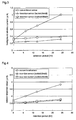
- Figure 1 illustrates sensor response characteristics when lactitol is added into the reagent solution as sugar alcohol, in the case where the sample solution is whole blood and the lactitol concentration is varied in four levels.
- figure 2 illustrates sensor response characteristics in the case where maltitol is added as sugar alcohol and the maltitol concentration is varied in four levels.
- a sensor in which the sugar alcohol addition concentration (the concentration as a sample aqueous solution) is 0 is handled as a conventional sensor, and sensors in which the sugar alcohol addition concentrations are 5, 10, 25, and 50mM are employed as invention sensors.
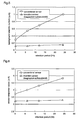
- Figure 3 illustrates change of a background electric current value with time under a harsh environment (exposure in temperature of 30°C and humidity of 80%), which is measured using the sensor manufactured as described above. Purified water including no glucose is employed as a sample solution.
- Figure 4 illustrates change of a sensor response value with time in the case where whole blood adjusted to have the glucose concentration of 80mg/dL is employed as a sample solution. In either case, there are four points of measurement in total: just after the sensor is manufactured (0-hour), 6-hour, 12-hour, and 24-hour after the manufacture.
- the current measurement condition is as follows. After confirming that the cavity is filled with the sample solution, enzyme reaction is promoted for twenty-five seconds. Thereafter, a voltage of 0.2V is applied among the working electrode, the counter electrode, and the detecting electrode, and an electric current value obtained five seconds after the application is measured.
- the detecting electrode is also employed as a part of the counter electrode.
- n 10 for each concentration and measurement time, and the average thereof is plotted in the figures.
- the response characteristics of the sensor in which lactitol is added as sugar alcohol tend to be high particularly in a range where the glucose concentration is high, i.e., over 400mg/dL, as compared with the conventional sensor including no sugar alcohol, and this result indicates that excellent response characteristics with a favorable regression expression (having a small intercept and a big slope) are obtained.
- a sensor for measuring a blood sugar level is manufactured by the same procedure as in the first example.
- magnesium sulfate as metallic salt sulfate is added instead of sugar alcohol as an addition agent for suppressing increase of a background electric current with time.
- Figure 5 illustrates change of a background electric current value with time under a harsh environment (exposure in temperature of 30°C and humidity of 80%), which is measured employing the sensor manufactured as described above. Purified water including no glucose is employed as a sample solution.
- Figure 6 illustrates change of a sensor response value with time in the case where whole blood adjusted to have the glucose concentration of 80mg/dL is employed as a sample solution.
- the number of measurement n is the same as that in the first example.
- An electrode layer comprising a working electrode and a counter electrode is formed on an insulating support comprising polyethylene terephthalate by screen printing, and a reagent layer including an enzyme (glucose oxidase), an electron transfer agent (potassium ferricyanide), a hydrophilic polymer (carboxymethyl cellulose), and aliphatic carboxylic acid (concentration of which is 5mM as a sample solution) is formed on the electrode layer.
- a spacer comprising polyethylene terephthalate and a cover also comprising polyethylene terephthalate are attached, thereby manufacturing a two-electrode-system sensor for measuring a blood sugar level, in which a cavity as a capillary for leading blood is formed.
- three sensors respectively including, as organic acids, malonic acid (HOOC-CH 2 -COOH) as aliphatic carboxylic acid, glutaric acid (HOOC-CH 2 -CH 2 -CH 2 -COOH), and adipic acid (HOOC-CH 2 -CH 2 -CH 2 -CH 2 -COOH), and a conventional sensor including no aliphatic carboxylic acid.
- malonic acid HOOC-CH 2 -COOH
- glutaric acid HOOC-CH 2 -CH 2 -CH 2 -COOH
- adipic acid HOOC-CH 2 -CH 2 -CH 2 -COOH
- Figure 7 illustrates background electric currents under a harsh environment (temperature of 40°C and humidity of 80%), which are measured employing the four sensors manufactured as mentioned above.
- Purified water including no glucose is employed as a sample solution.
- the measurement condition is as follows. The cavity is filled with the sample solution (purified water), and the reaction is promoted for twenty-five seconds. Thereafter, a voltage of 0.5V is applied between the working electrode and the counter electrode, and an electric current value obtained five seconds after the application is measured.
- a biosensor is manufactured by the same procedure as in the third example and the same evaluation as in the third example is made.
- This fourth example employs three kinds of organic acids as follows: benzoic acid and phthalic acid as carbocyclic carboxylic acids, and malic acid (derivative of succinic acid) with the structure in which a part of hydrocarbon chain of succinic acid is replaced by a hydroxyl group.
- An electrode layer comprising a working electrode and a counter electrode is formed on an insulating support comprising polyethylene terephthalate by screen printing, and a reagent layer including an enzyme (glucose dehydrogenase with pyrroloquinoline quinone as coenzyme), an electron transfer agent (potassium ferricyanide), a hydrophilic polymer (carboxymethyl cellulose), aliphatic carboxylic acid (phthalic acid), and amino acid is formed on the electrodes.
- an enzyme glucose dehydrogenase with pyrroloquinoline quinone as coenzyme
- an electron transfer agent potassium ferricyanide
- a hydrophilic polymer carboxymethyl cellulose
- aliphatic carboxylic acid phthalic acid
- a spacer comprising polyethylene terephthalate and a cover comprising polyethylene terephthalate as well are attached, thereby manufacturing a two-electrode-system sensor for measuring a blood sugar level, in which a cavity as a capillary for leading blood is formed.
- sensors in total are manufactured as follows: sensors respectively including, as organic acids, glycine (Gly), serine (Ser), proline (Pro), threonine (Thr), lysine (Lys), sarcosine (derivative of glycine), and taurine, which are amino acids having at least one carboxyl group and one amino group in a molecule, and a conventional sensor including no amino acid.
- glycine Gly
- Ser serine
- Pro proline
- Thr threonine
- Thr lysine
- taurine which are amino acids having at least one carboxyl group and one amino group in a molecule
- taurine which are amino acids having at least one carboxyl group and one amino group in a molecule
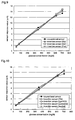
- FIGS 9 and 10 illustrate sensor response characteristics when glucose in human whole blood is measured employing the eight sensors manufactured as described above.
- This fifth example employs the glucose concentrations in whole blood, 40, 80, 350, 600, and 700mg/dl.
- the measurement condition is as follows. After the cavity is filled with the sample solution (human whole blood), a reaction is promoted for twenty-five seconds. Thereafter, a voltage of 0.5V is applied between the working electrode and the counter electrode, and an electric current value obtained five seconds after the application is measured.
- n 20 for each concentration, and the average thereof is plotted in the figure.
- considerable improvement of the CV value is recognized in the sensors of the invention which are added with amino acids. The reason is as follows. Since the amino acid added into the reagent layer prevents potassium ferricyanide from being crystallized, the reagent layer is formed smoothly and homogeneously, whereby solubility and diffusion of the reagent becomes homogeneous, resulting in a reduction of response variations.
- the sample solution and substance as targets of measurement and the type of biosensor are not restricted thereto.
- a liquid vital specimen such as saliva, intercellular substance liquid, urine, or sweat, as well as food or drinking water, can also be employed as a target sample solution besides blood.
- lactic acid, cholesterol, uric acid, ascorbic acid, or bilirubin can also be also employed as a target substance besides glucose.
- the three-electrode system constituted by the working electrode, the counter electrode, and the detecting electrode, which is employed in the first and second examples, or the two-electrode system constituted by the working electrode and the counter electrode, which is employed in the third and fifth examples, and the same effects as described above can be obtained whichever system is employed.
- the three-electrode system enables more accurate measurement as compared with the two-electrode system.
- the present invention is similarly applicable to a biosensor utilizing antibodies, microorganisms, DNA, RNA, or the like, besides enzyme, as a molecular recognition element which specifically reacts to a specific substance in a sample solution.
- a biosensor according to the present invention includes either one or a combination of sugar alcohol, metallic salt, organic acid or organic acid salt which has at least one carboxyl group in a molecule, or organic acid or organic acid salt which has at least one carboxyl group and amino group in a molecule in its reagent, so that increase of a background electric current with time can be suppressed, a needles reaction with various contaminants existing in the blood can be suppressed, or the reagent layer can be closely and homogeneously formed, without preventing an enzyme reaction or the like, thereby providing a highly stable and efficient biosensor.
Landscapes
- Chemical & Material Sciences (AREA)
- Organic Chemistry (AREA)
- Life Sciences & Earth Sciences (AREA)
- Zoology (AREA)
- Wood Science & Technology (AREA)
- Proteomics, Peptides & Aminoacids (AREA)
- Health & Medical Sciences (AREA)
- Engineering & Computer Science (AREA)
- Microbiology (AREA)
- Biochemistry (AREA)
- Physics & Mathematics (AREA)
- Molecular Biology (AREA)
- Biotechnology (AREA)
- Biophysics (AREA)
- Analytical Chemistry (AREA)
- Immunology (AREA)
- Bioinformatics & Cheminformatics (AREA)
- General Engineering & Computer Science (AREA)
- General Health & Medical Sciences (AREA)
- Genetics & Genomics (AREA)
- Investigating Or Analysing Biological Materials (AREA)
- Apparatus Associated With Microorganisms And Enzymes (AREA)
- Measuring Or Testing Involving Enzymes Or Micro-Organisms (AREA)
Abstract
Description
| Concentration (mg/dl) | 40 | 80 | 350 | 600 | 700 |
| Conventional sensor | 3.25% | 2.48% | 2.05% | 2.11% | 4.15% |
| Gly-133mM | 2.15% | 1.75% | 1.55% | 1.28% | 1.05% |
| Ser-95mM | 2.54% | 2.11% | 1.75% | 1.45% | 1.22% |
| Pro-87mM | 2.38% | 1.98% | 1.69% | 1.40% | 1.18% |
| Thr-84mM | 2.18% | 2.00% | 1.65% | 1.39% | 1.24% |
| Lys-HCl-55mM | 2.48% | 1.89% | 1.58% | 1.41% | 1.14% |
| Sarcosine-122mM | 2.65% | 2.08% | 1.68% | 1.35% | 1.25% |
| Taurine-80mM | 2.18% | 1.78% | 1.43% | 1.22% | 1.10% |
Claims (24)
- A biosensor for measuring the concentration of a specific substance in a sample solution, wherein
sugar alcohol is included in a previously-provided reagent layer so that it is dissolved in the sample solution and specifically reacts to the specific substance in the sample solution. - The biosensor as defined in Claim 1, wherein
the concentration of the specific substance is measured employing electrodes comprising at least a working electrode and a counter electrode provided on an insulating support. - The biosensor as defined in Claim 2, wherein
the reagent layer is formed on the electrodes or so that the electrodes are arranged in a diffusion area where a reagent in the reagent layer is dissolved and diffused in the sample solution, and the reagent layer includes at least an enzyme and an electron transfer agent. - The biosensor as defined in any of Claims 1 to 3, wherein
the sugar alcohol is chain polyhydric alcohol or cyclic sugar alcohol, or a substitution product or derivative of the sugar alcohol. - The biosensor as defined in any of Claims 1 to 3, wherein
the sugar alcohol is either or both of multiol and lactitol. - A biosensor for measuring the concentration of a specific substance in a sample solution, wherein
metallic salt is included in a previously-provided reagent layer so that it is dissolved in the sample solution and specifically reacts to the specific substance in the sample solution. - The biosensor as defined in Claim 6, wherein
the concentration of the specific substance is measured employing electrodes comprising at least a working electrode and a counter electrode provided on an insulating support. - The biosensor as defined in Claim 7, wherein
the reagent layer is formed on the electrodes or so that the electrodes are arranged in a diffusion area where a reagent in the reagent layer is dissolved and diffused in the sample solution, and the reagent layer includes at least an enzyme and an electron transfer agent. - The biosensor as defined in any of Claims 6 to 8, wherein
the metallic salt is metallic salt sulfate, metallic salt hydrogensulfate, metallic salt sulfite, metallic salt hydrogensulfite, or metallic salt hyposulfite. - The biosensor as defined in any of Claims 6 to 8, wherein
the metallic salt is either or both of magnesium sulfate and calcium sulfate. - The biosensor as defined in any of Claims 6 to 8, wherein
the metallic salt is metallic salt nitrate, metallic salt hydrogennitrate, metallic salt nitrite, metallic salt hydrogennitrite, or metallic salt hyponitrite. - The biosensor as defined in any of Claims 6 to 8, wherein
the metallic salt is either or both of magnesium nitrate and calcium nitrate. - A biosensor for measuring the concentration of a specific substance in a sample solution, wherein
organic acid or organic acid salt which has at least one carboxyl group in its molecule is included in a previously-provided reagent layer so that it is dissolved in the sample solution and specifically reacts to the specific substance in the sample solution. - The biosensor as defined in Claim 13, wherein
the concentration of the specific substance is measured employing electrodes comprising at least a working electrode and a counter electrode provided on an insulating support. - The biosensor as defined in Claim 14, wherein
the reagent layer is formed on the electrodes or so that the electrodes are arranged in a diffusion area where a reagent in the reagent layer is dissolved and diffused in the sample solution, and the reagent layer includes at least an enzyme and an electron transfer agent. - The biosensor as defined in any of Claims 13 to 15, wherein
the organic acid is aliphatic carboxylic acid, carbocyclic carboxylic acid, or heterocyclic carboxylic acid, or a substitution product or derivative of the organic acid. - The biosensor as defined in any of Claims 13 to 15, wherein
the carboxylic acid is one of glutaric acid, adipic acid, phthalic acid, and benzoic acid, or a combination of these acids. - A biosensor for measuring the concentration of a specific substance in a sample solution, wherein
organic acid or organic acid salt which has at least one carboxyl group and one amino group in its molecule is included in a previously-provided reagent layer so that it is dissolved in the sample solution and specifically reacts to the specific substance in the sample solution. - The biosensor as defined in Claim 18, wherein
the concentration of the specific substance is measured employing electrodes comprising at least a working electrode and a counter electrode provided on an insulating support. - The biosensor as defined in Claim 19, wherein
the reagent layer is formed on the electrodes or so that the electrodes are arranged in a diffusion area where a reagent in the reagent layer is dissolved and diffused in the sample solution, and the reagent layer includes at least an enzyme and an electron transfer agent. - The biosensor as defined in any of Claims 18 to 20, wherein
the organic acid is amino acid, or a substitution product or derivative of amino acid. - The biosensor as defined in any of Claims 18 to 20, wherein
the amino acid is one of glycine, serine, proline, threonine, lysine, and taurine, or a combinaiton of these acids. - A biosensor for measuring the concentration of a specific substance in a sample solution, wherein
a combination of at least two of sugar alcohol, metallic salt, organic acid or organic acid salt which has at least one carboxyl group in its molecule, and organic acid or organic acid salt which has at least one carboxyl group and one amino group in its molecule, is included in a previously-provided reagent layer so that it is dissolved in the sample solution and specifically reacts to the specific substance in the sample solution. - The biosensor as defined in any of Claims 1 to 23, wherein the reagent layer further includes a hydrophilic polymer.
Priority Applications (1)
| Application Number | Priority Date | Filing Date | Title |
|---|---|---|---|
| EP09176735.0A EP2154522B1 (en) | 2000-03-29 | 2001-03-28 | Biosensor |
Applications Claiming Priority (5)
| Application Number | Priority Date | Filing Date | Title |
|---|---|---|---|
| JP2000090362 | 2000-03-29 | ||
| JP2000090362 | 2000-03-29 | ||
| JP2000342537 | 2000-11-09 | ||
| JP2000342537 | 2000-11-09 | ||
| PCT/JP2001/002558 WO2001073419A1 (en) | 2000-03-29 | 2001-03-28 | Biosensor |
Related Child Applications (2)
| Application Number | Title | Priority Date | Filing Date |
|---|---|---|---|
| EP09176735.0A Division-Into EP2154522B1 (en) | 2000-03-29 | 2001-03-28 | Biosensor |
| EP09176735.0A Division EP2154522B1 (en) | 2000-03-29 | 2001-03-28 | Biosensor |
Publications (3)
| Publication Number | Publication Date |
|---|---|
| EP1197749A1 true EP1197749A1 (en) | 2002-04-17 |
| EP1197749A4 EP1197749A4 (en) | 2009-05-20 |
| EP1197749B1 EP1197749B1 (en) | 2016-07-20 |
Family
ID=26588660
Family Applications (2)
| Application Number | Title | Priority Date | Filing Date |
|---|---|---|---|
| EP01921772.8A Expired - Lifetime EP1197749B1 (en) | 2000-03-29 | 2001-03-28 | Biosensor |
| EP09176735.0A Expired - Lifetime EP2154522B1 (en) | 2000-03-29 | 2001-03-28 | Biosensor |
Family Applications After (1)
| Application Number | Title | Priority Date | Filing Date |
|---|---|---|---|
| EP09176735.0A Expired - Lifetime EP2154522B1 (en) | 2000-03-29 | 2001-03-28 | Biosensor |
Country Status (4)
| Country | Link |
|---|---|
| US (4) | US6911131B2 (en) |
| EP (2) | EP1197749B1 (en) |
| CN (2) | CN1268920C (en) |
| WO (1) | WO2001073419A1 (en) |
Cited By (7)
| Publication number | Priority date | Publication date | Assignee | Title |
|---|---|---|---|---|
| DE102004001145A1 (en) * | 2004-01-07 | 2005-08-04 | Engeland, Christine E. | Lactose measuring system, e.g. for food testing by lactose-intolerant patients, involves testing samples with a blood sugar test kit with control solution, a pipette and beta-galactosidase solution |
| WO2006122552A1 (en) * | 2005-05-17 | 2006-11-23 | Radiometer Medical Aps | Method of stabilising or reactivating a creatinine sensor with a solution of a divalent manganese ion |
| EP1557662A4 (en) * | 2002-10-31 | 2009-06-24 | Panasonic Corp | DETERMINATION METHOD FOR AUTOMATICALLY IDENTIFYING A LIQUID FOR ANALYZING, AND SOLUTION-STANDARD FOR BIOSENSOR |
| US7888061B2 (en) | 2005-05-17 | 2011-02-15 | Radiometer Medical Aps | Method of stabilising or reactivating a creatinine sensor with a divalent manganese ion |
| EP2348308A1 (en) * | 2006-04-19 | 2011-07-27 | Panasonic Corporation | Biosensor |
| EP2392921A4 (en) * | 2009-01-30 | 2013-05-29 | Panasonic Corp | METHOD FOR MEASURING BIOLOGICAL SAMPLE TEMPERATURE, METHOD FOR MEASURING BIOLOGICAL SAMPLE CONCENTRATION, SENSOR CHIP AND BIOSENSOR SYSTEM |
| EP2623974A4 (en) * | 2010-09-30 | 2015-01-07 | Panasonic Healthcare Co Ltd | REAGENT COMPOSITION, SENSOR, SENSOR SYSTEM, AND SENSOR MANUFACTURING METHOD |
Families Citing this family (117)
| Publication number | Priority date | Publication date | Assignee | Title |
|---|---|---|---|---|
| US6036924A (en) | 1997-12-04 | 2000-03-14 | Hewlett-Packard Company | Cassette of lancet cartridges for sampling blood |
| US8071384B2 (en) | 1997-12-22 | 2011-12-06 | Roche Diagnostics Operations, Inc. | Control and calibration solutions and methods for their use |
| US6391005B1 (en) | 1998-03-30 | 2002-05-21 | Agilent Technologies, Inc. | Apparatus and method for penetration with shaft having a sensor for sensing penetration depth |
| US20050103624A1 (en) | 1999-10-04 | 2005-05-19 | Bhullar Raghbir S. | Biosensor and method of making |
| EP1197749B1 (en) * | 2000-03-29 | 2016-07-20 | Panasonic Healthcare Holdings Co., Ltd. | Biosensor |
| DE10057832C1 (en) | 2000-11-21 | 2002-02-21 | Hartmann Paul Ag | Blood analysis device has syringe mounted in casing, annular mounting carrying needles mounted behind test strip and being swiveled so that needle can be pushed through strip and aperture in casing to take blood sample |
| US8641644B2 (en) | 2000-11-21 | 2014-02-04 | Sanofi-Aventis Deutschland Gmbh | Blood testing apparatus having a rotatable cartridge with multiple lancing elements and testing means |
| WO2002100460A2 (en) | 2001-06-12 | 2002-12-19 | Pelikan Technologies, Inc. | Electric lancet actuator |
| US9427532B2 (en) | 2001-06-12 | 2016-08-30 | Sanofi-Aventis Deutschland Gmbh | Tissue penetration device |
| US7344507B2 (en) | 2002-04-19 | 2008-03-18 | Pelikan Technologies, Inc. | Method and apparatus for lancet actuation |
| US8337419B2 (en) | 2002-04-19 | 2012-12-25 | Sanofi-Aventis Deutschland Gmbh | Tissue penetration device |
| US9795747B2 (en) | 2010-06-02 | 2017-10-24 | Sanofi-Aventis Deutschland Gmbh | Methods and apparatus for lancet actuation |
| US7981056B2 (en) | 2002-04-19 | 2011-07-19 | Pelikan Technologies, Inc. | Methods and apparatus for lancet actuation |
| US7041068B2 (en) | 2001-06-12 | 2006-05-09 | Pelikan Technologies, Inc. | Sampling module device and method |
| AU2002348683A1 (en) | 2001-06-12 | 2002-12-23 | Pelikan Technologies, Inc. | Method and apparatus for lancet launching device integrated onto a blood-sampling cartridge |
| US9226699B2 (en) | 2002-04-19 | 2016-01-05 | Sanofi-Aventis Deutschland Gmbh | Body fluid sampling module with a continuous compression tissue interface surface |
| US7537571B2 (en) | 2001-06-12 | 2009-05-26 | Pelikan Technologies, Inc. | Integrated blood sampling analysis system with multi-use sampling module |
| WO2002100461A2 (en) | 2001-06-12 | 2002-12-19 | Pelikan Technologies, Inc. | Method and apparatus for improving success rate of blood yield from a fingerstick |
| CA2448902C (en) | 2001-06-12 | 2010-09-07 | Pelikan Technologies, Inc. | Self optimizing lancing device with adaptation means to temporal variations in cutaneous properties |
| US7682318B2 (en) | 2001-06-12 | 2010-03-23 | Pelikan Technologies, Inc. | Blood sampling apparatus and method |
| US7879211B2 (en) * | 2001-07-13 | 2011-02-01 | Arkray, Inc. | Analyzing instrument, lancet-integrated attachment for concentration measuring device provided with analyzing instrument, and body fluid sampling tool |
| US7344894B2 (en) | 2001-10-16 | 2008-03-18 | Agilent Technologies, Inc. | Thermal regulation of fluidic samples within a diagnostic cartridge |
| US7331931B2 (en) | 2002-04-19 | 2008-02-19 | Pelikan Technologies, Inc. | Method and apparatus for penetrating tissue |
| US7371247B2 (en) | 2002-04-19 | 2008-05-13 | Pelikan Technologies, Inc | Method and apparatus for penetrating tissue |
| US7491178B2 (en) | 2002-04-19 | 2009-02-17 | Pelikan Technologies, Inc. | Method and apparatus for penetrating tissue |
| US8267870B2 (en) | 2002-04-19 | 2012-09-18 | Sanofi-Aventis Deutschland Gmbh | Method and apparatus for body fluid sampling with hybrid actuation |
| US8221334B2 (en) | 2002-04-19 | 2012-07-17 | Sanofi-Aventis Deutschland Gmbh | Method and apparatus for penetrating tissue |
| US7563232B2 (en) | 2002-04-19 | 2009-07-21 | Pelikan Technologies, Inc. | Method and apparatus for penetrating tissue |
| US7229458B2 (en) | 2002-04-19 | 2007-06-12 | Pelikan Technologies, Inc. | Method and apparatus for penetrating tissue |
| US7524293B2 (en) | 2002-04-19 | 2009-04-28 | Pelikan Technologies, Inc. | Method and apparatus for penetrating tissue |
| US7374544B2 (en) | 2002-04-19 | 2008-05-20 | Pelikan Technologies, Inc. | Method and apparatus for penetrating tissue |
| US7547287B2 (en) | 2002-04-19 | 2009-06-16 | Pelikan Technologies, Inc. | Method and apparatus for penetrating tissue |
| US7976476B2 (en) | 2002-04-19 | 2011-07-12 | Pelikan Technologies, Inc. | Device and method for variable speed lancet |
| US8784335B2 (en) | 2002-04-19 | 2014-07-22 | Sanofi-Aventis Deutschland Gmbh | Body fluid sampling device with a capacitive sensor |
| US7717863B2 (en) | 2002-04-19 | 2010-05-18 | Pelikan Technologies, Inc. | Method and apparatus for penetrating tissue |
| US7674232B2 (en) | 2002-04-19 | 2010-03-09 | Pelikan Technologies, Inc. | Method and apparatus for penetrating tissue |
| US7297122B2 (en) | 2002-04-19 | 2007-11-20 | Pelikan Technologies, Inc. | Method and apparatus for penetrating tissue |
| US7648468B2 (en) | 2002-04-19 | 2010-01-19 | Pelikon Technologies, Inc. | Method and apparatus for penetrating tissue |
| US7141058B2 (en) | 2002-04-19 | 2006-11-28 | Pelikan Technologies, Inc. | Method and apparatus for a body fluid sampling device using illumination |
| US7909778B2 (en) | 2002-04-19 | 2011-03-22 | Pelikan Technologies, Inc. | Method and apparatus for penetrating tissue |
| US7226461B2 (en) | 2002-04-19 | 2007-06-05 | Pelikan Technologies, Inc. | Method and apparatus for a multi-use body fluid sampling device with sterility barrier release |
| US7901362B2 (en) | 2002-04-19 | 2011-03-08 | Pelikan Technologies, Inc. | Method and apparatus for penetrating tissue |
| US9314194B2 (en) | 2002-04-19 | 2016-04-19 | Sanofi-Aventis Deutschland Gmbh | Tissue penetration device |
| US9248267B2 (en) | 2002-04-19 | 2016-02-02 | Sanofi-Aventis Deustchland Gmbh | Tissue penetration device |
| US7232451B2 (en) | 2002-04-19 | 2007-06-19 | Pelikan Technologies, Inc. | Method and apparatus for penetrating tissue |
| US8702624B2 (en) | 2006-09-29 | 2014-04-22 | Sanofi-Aventis Deutschland Gmbh | Analyte measurement device with a single shot actuator |
| US7582099B2 (en) | 2002-04-19 | 2009-09-01 | Pelikan Technologies, Inc | Method and apparatus for penetrating tissue |
| US7291117B2 (en) | 2002-04-19 | 2007-11-06 | Pelikan Technologies, Inc. | Method and apparatus for penetrating tissue |
| US7410468B2 (en) | 2002-04-19 | 2008-08-12 | Pelikan Technologies, Inc. | Method and apparatus for penetrating tissue |
| US7481776B2 (en) | 2002-04-19 | 2009-01-27 | Pelikan Technologies, Inc. | Method and apparatus for penetrating tissue |
| US7892183B2 (en) | 2002-04-19 | 2011-02-22 | Pelikan Technologies, Inc. | Method and apparatus for body fluid sampling and analyte sensing |
| US9795334B2 (en) | 2002-04-19 | 2017-10-24 | Sanofi-Aventis Deutschland Gmbh | Method and apparatus for penetrating tissue |
| US8579831B2 (en) | 2002-04-19 | 2013-11-12 | Sanofi-Aventis Deutschland Gmbh | Method and apparatus for penetrating tissue |
| US7352465B2 (en) * | 2002-07-23 | 2008-04-01 | Aperon Biosystems Corp. | Sample conditioning and environmental control techniques for gas sensor |
| US7291256B2 (en) * | 2002-09-12 | 2007-11-06 | Lifescan, Inc. | Mediator stabilized reagent compositions and methods for their use in electrochemical analyte detection assays |
| US8574895B2 (en) | 2002-12-30 | 2013-11-05 | Sanofi-Aventis Deutschland Gmbh | Method and apparatus using optical techniques to measure analyte levels |
| JP3910148B2 (en) * | 2003-03-14 | 2007-04-25 | アークレイ株式会社 | Analysis tool with exhaust port |
| ES2490740T3 (en) | 2003-06-06 | 2014-09-04 | Sanofi-Aventis Deutschland Gmbh | Apparatus for blood fluid sampling and analyte detection |
| KR100554649B1 (en) * | 2003-06-09 | 2006-02-24 | 주식회사 아이센스 | Electrochemical Biosensor |
| WO2006001797A1 (en) | 2004-06-14 | 2006-01-05 | Pelikan Technologies, Inc. | Low pain penetrating |
| US7604592B2 (en) | 2003-06-13 | 2009-10-20 | Pelikan Technologies, Inc. | Method and apparatus for a point of care device |
| US8071030B2 (en) | 2003-06-20 | 2011-12-06 | Roche Diagnostics Operations, Inc. | Test strip with flared sample receiving chamber |
| US7645373B2 (en) | 2003-06-20 | 2010-01-12 | Roche Diagnostic Operations, Inc. | System and method for coding information on a biosensor test strip |
| US7597793B2 (en) | 2003-06-20 | 2009-10-06 | Roche Operations Ltd. | System and method for analyte measurement employing maximum dosing time delay |
| US7452457B2 (en) | 2003-06-20 | 2008-11-18 | Roche Diagnostics Operations, Inc. | System and method for analyte measurement using dose sufficiency electrodes |
| US7718439B2 (en) | 2003-06-20 | 2010-05-18 | Roche Diagnostics Operations, Inc. | System and method for coding information on a biosensor test strip |
| US7604721B2 (en) | 2003-06-20 | 2009-10-20 | Roche Diagnostics Operations, Inc. | System and method for coding information on a biosensor test strip |
| US7645421B2 (en) | 2003-06-20 | 2010-01-12 | Roche Diagnostics Operations, Inc. | System and method for coding information on a biosensor test strip |
| HUE039852T2 (en) * | 2003-06-20 | 2019-02-28 | Hoffmann La Roche | Method and reagent for producing narrow, homogenous reagent strips |
| US8148164B2 (en) | 2003-06-20 | 2012-04-03 | Roche Diagnostics Operations, Inc. | System and method for determining the concentration of an analyte in a sample fluid |
| US8058077B2 (en) | 2003-06-20 | 2011-11-15 | Roche Diagnostics Operations, Inc. | Method for coding information on a biosensor test strip |
| US8206565B2 (en) | 2003-06-20 | 2012-06-26 | Roche Diagnostics Operation, Inc. | System and method for coding information on a biosensor test strip |
| US8679853B2 (en) | 2003-06-20 | 2014-03-25 | Roche Diagnostics Operations, Inc. | Biosensor with laser-sealed capillary space and method of making |
| JP4038575B2 (en) * | 2003-07-25 | 2008-01-30 | 独立行政法人産業技術総合研究所 | Biosensor, biosensor device or biosensor storage method |
| EP1671096A4 (en) | 2003-09-29 | 2009-09-16 | Pelikan Technologies Inc | METHOD AND APPARATUS FOR AN IMPROVED SAMPLING INTERFERENCE DEVICE |
| JP4458802B2 (en) * | 2003-10-02 | 2010-04-28 | パナソニック株式会社 | Method for measuring glucose in blood and sensor used therefor |
| EP1680014A4 (en) | 2003-10-14 | 2009-01-21 | Pelikan Technologies Inc | METHOD AND APPARATUS PROVIDING A VARIABLE USER INTERFACE |
| CN100432663C (en) | 2003-12-04 | 2008-11-12 | 松下电器产业株式会社 | Method for measuring hematocrit (Hct), and sensor and measuring device used in the method |
| EP3273232A2 (en) | 2003-12-04 | 2018-01-24 | Panasonic Healthcare Holdings Co., Ltd. | Method of measuring blood component, sensor used in the method, and measuring device |
| WO2005065414A2 (en) | 2003-12-31 | 2005-07-21 | Pelikan Technologies, Inc. | Method and apparatus for improving fluidic flow and sample capture |
| US7822454B1 (en) | 2005-01-03 | 2010-10-26 | Pelikan Technologies, Inc. | Fluid sampling device with improved analyte detecting member configuration |
| EP1742045B1 (en) | 2004-04-19 | 2016-11-02 | Panasonic Healthcare Holdings Co., Ltd. | Method for measuring blood components and biosensor and measuring instrument for use therein |
| GB0411162D0 (en) * | 2004-05-19 | 2004-06-23 | Precisense As | Optical sensor for in vivo detection of analyte |
| US8828203B2 (en) | 2004-05-20 | 2014-09-09 | Sanofi-Aventis Deutschland Gmbh | Printable hydrogels for biosensors |
| EP1765194A4 (en) | 2004-06-03 | 2010-09-29 | Pelikan Technologies Inc | METHOD AND APPARATUS FOR MANUFACTURING A DEVICE FOR SAMPLING LIQUIDS |
| US7556723B2 (en) | 2004-06-18 | 2009-07-07 | Roche Diagnostics Operations, Inc. | Electrode design for biosensor |
| US7569126B2 (en) | 2004-06-18 | 2009-08-04 | Roche Diagnostics Operations, Inc. | System and method for quality assurance of a biosensor test strip |
| US8652831B2 (en) | 2004-12-30 | 2014-02-18 | Sanofi-Aventis Deutschland Gmbh | Method and apparatus for analyte measurement test time |
| JP4501793B2 (en) * | 2005-06-24 | 2010-07-14 | パナソニック株式会社 | Biosensor |
| TW200718785A (en) * | 2005-11-10 | 2007-05-16 | Toyo Boseki | A process for improving the thermal stability of a composition containing a soluble coenzyme conjugated glucose dehydrogenase (GDH) |
| CN101374458B (en) | 2006-01-31 | 2012-04-18 | 松下电器产业株式会社 | Blood sensor and blood test device having same |
| US8809068B2 (en) | 2006-04-18 | 2014-08-19 | Advanced Liquid Logic, Inc. | Manipulation of beads in droplets and methods for manipulating droplets |
| US7439014B2 (en) | 2006-04-18 | 2008-10-21 | Advanced Liquid Logic, Inc. | Droplet-based surface modification and washing |
| EP2017608A4 (en) * | 2006-04-19 | 2012-12-12 | Panasonic Corp | BIOSENSOR |
| GB0609494D0 (en) * | 2006-05-12 | 2006-06-21 | Oxford Biosensors Ltd | HDL cholesterol sensor using specific surfactant |
| GB0609493D0 (en) * | 2006-05-12 | 2006-06-21 | Oxford Biosensors Ltd | Cholesterol sensor |
| CA2664186C (en) | 2006-09-22 | 2021-02-23 | Bayer Healthcare Llc | Biosensor system having enhanced stability and hematocrit performance |
| US8163146B2 (en) * | 2007-10-12 | 2012-04-24 | Abbott Diabetes Care Inc. | Mediator stabilized reagent compositions for use in biosensor electrodes |
| CN103760356B (en) * | 2007-12-10 | 2019-06-28 | 安晟信医疗科技控股公司 | Slope-based compensation |
| JP5856371B2 (en) * | 2007-12-10 | 2016-02-09 | バイエル・ヘルスケア・エルエルシーBayer HealthCareLLC | Reagent and method for detecting an analyte |
| EP2265324B1 (en) | 2008-04-11 | 2015-01-28 | Sanofi-Aventis Deutschland GmbH | Integrated analyte measurement system |
| US9375169B2 (en) | 2009-01-30 | 2016-06-28 | Sanofi-Aventis Deutschland Gmbh | Cam drive for managing disposable penetrating member actions with a single motor and motor and control system |
| US20110048972A1 (en) * | 2009-08-31 | 2011-03-03 | Lifescan Scotland Limited | Multi-analyte test strip with shared counter/reference electrode and inline electrode configuration |
| US9233788B2 (en) | 2010-01-22 | 2016-01-12 | Bayer Healthcare Llc | Biosensor desiccant system having enhanced measurement performance |
| CN105603045B (en) | 2010-01-22 | 2021-05-14 | 安晟信医疗科技控股公司 | Accuracy improving desiccant |
| US8965476B2 (en) | 2010-04-16 | 2015-02-24 | Sanofi-Aventis Deutschland Gmbh | Tissue penetration device |
| US9572922B2 (en) | 2012-12-21 | 2017-02-21 | Larry Leonard | Inventive diabetic systems, tools, kits, and supplies for better diabetic living and mobility |
| WO2014047566A1 (en) * | 2012-09-21 | 2014-03-27 | Arch Chemicals, Inc. | Electrochemical sensors for testing water |
| US9788765B2 (en) | 2012-09-28 | 2017-10-17 | Dexcom, Inc. | Zwitterion surface modifications for continuous sensors |
| US9737250B2 (en) | 2013-03-15 | 2017-08-22 | Dexcom, Inc. | Membrane for continuous analyte sensors |
| CN103412012B (en) | 2013-03-28 | 2015-09-09 | 利多(香港)有限公司 | biological sensor |
| AU2016381968B2 (en) * | 2015-12-30 | 2020-03-19 | Dexcom, Inc. | Biointerface layer for analyte sensors |
| MX2019000593A (en) * | 2016-07-15 | 2019-07-04 | Ketos Inc | Automated smart water quality monitor and analyzer and associated methods. |
| WO2019043578A1 (en) | 2017-09-01 | 2019-03-07 | 3M Innovative Properties Company | Fit-test method for respirator with sensing system |
| CN111050644A (en) | 2017-09-01 | 2020-04-21 | 3M创新有限公司 | Sensing system for respirator |
| BR112020004233A2 (en) | 2017-09-01 | 2020-09-01 | 3M Innovative Properties Company | respirator detection element |
| WO2019046696A1 (en) | 2017-09-01 | 2019-03-07 | 3M Innovative Properties Company | Sensor and sensing system for respirator fit-test method |
Family Cites Families (37)
| Publication number | Priority date | Publication date | Assignee | Title |
|---|---|---|---|---|
| US603367A (en) * | 1898-05-03 | Shank for boots or shoes | ||
| US3021991A (en) * | 1961-06-13 | 1962-02-20 | Cohen Max | Combined container and straw |
| JPS5921500B2 (en) * | 1978-01-28 | 1984-05-21 | 東洋紡績株式会社 | Enzyme membrane for oxygen electrode |
| JPS5877661A (en) * | 1981-11-02 | 1983-05-11 | Fuji Photo Film Co Ltd | Monolithic multilayered analyzing material for analysis of ammonia or ammonia forming substrate and detecting method for said substrate |
| WO1989009397A1 (en) * | 1988-03-31 | 1989-10-05 | Matsushita Electric Industrial Co., Ltd. | Biosensor and process for its production |
| JPH01289495A (en) * | 1988-05-13 | 1989-11-21 | Konica Corp | Alcohol analyzing element |
| JPH0652248B2 (en) | 1988-10-11 | 1994-07-06 | 松下電器産業株式会社 | Biosensor |
| US5242793A (en) * | 1989-03-08 | 1993-09-07 | Kanzaki Paper Manufacturing Co., Ltd. | Selective permeable membrane and electrode using the same |
| JPH0587767A (en) | 1991-09-26 | 1993-04-06 | Toto Ltd | Biosensor |
| DE69318332T2 (en) * | 1992-03-12 | 1998-09-03 | Matsushita Electric Ind Co Ltd | Biosensor with a catalyst made of phosphate |
| US5203468A (en) * | 1992-07-01 | 1993-04-20 | Hsu Chun Feng | Water container cap |
| JPH06229973A (en) | 1993-01-29 | 1994-08-19 | Kyoto Daiichi Kagaku:Kk | Current detection type dry ion selective electrode |
| US5413690A (en) | 1993-07-23 | 1995-05-09 | Boehringer Mannheim Corporation | Potentiometric biosensor and the method of its use |
| US5346081A (en) * | 1994-01-26 | 1994-09-13 | Shing Hong Industrial Co., Ltd. | Kettle with upward bounding cover and automatically extensible sucker |
| JPH0850112A (en) | 1994-08-05 | 1996-02-20 | Nok Corp | Glucose biosensor |
| JP3324050B2 (en) * | 1994-10-31 | 2002-09-17 | 日本光電工業株式会社 | Leukocyte classification reagent and leukocyte classification method |
| JP3498105B2 (en) * | 1995-04-07 | 2004-02-16 | アークレイ株式会社 | Sensor, method for manufacturing the same, and measuring method using the sensor |
| JPH0989831A (en) | 1995-09-21 | 1997-04-04 | Matsushita Electric Ind Co Ltd | Biosensor |
| JPH1078407A (en) | 1996-09-04 | 1998-03-24 | Fujitsu Ltd | Oxygen electrode and biosensor |
| US5747669A (en) | 1995-12-28 | 1998-05-05 | Fujitsu Limited | Oxygen electrode and its manufacture |
| JPH09234097A (en) * | 1995-12-28 | 1997-09-09 | Mochida Pharmaceut Co Ltd | Analytical method using hydrogen peroxide adduct |
| AU720225B2 (en) * | 1996-09-02 | 2000-05-25 | Hanger Company Limited, The | A container closure |
| US6059946A (en) | 1997-04-14 | 2000-05-09 | Matsushita Electric Industrial Co., Ltd. | Biosensor |
| US6764581B1 (en) | 1997-09-05 | 2004-07-20 | Abbott Laboratories | Electrode with thin working layer |
| US6033866A (en) * | 1997-12-08 | 2000-03-07 | Biomedix, Inc. | Highly sensitive amperometric bi-mediator-based glucose biosensor |
| JPH11324511A (en) | 1998-05-15 | 1999-11-26 | Eisuke Tougasawa | Installation method of energy saving new generation earthquake-resistant drop prevention, thermal insulation, and sound-proof glass |
| JP2000081407A (en) * | 1998-06-25 | 2000-03-21 | Omron Corp | Biosensor, manufacturing method thereof and measurement method using biosensor |
| JP2000009679A (en) | 1998-06-29 | 2000-01-14 | Matsushita Electric Ind Co Ltd | Glucose sensor and glucose determination method |
| JP3770757B2 (en) | 1998-07-03 | 2006-04-26 | 松下電器産業株式会社 | Biosensor |
| US6656702B1 (en) * | 1998-07-03 | 2003-12-02 | Matsushita Electric Industrial Co., Ltd. | Biosensor containing glucose dehydrogenase |
| JP3267936B2 (en) | 1998-08-26 | 2002-03-25 | 松下電器産業株式会社 | Biosensor |
| JP3694424B2 (en) | 1998-09-29 | 2005-09-14 | 松下電器産業株式会社 | Glucose sensor |
| US6413394B1 (en) * | 1999-07-08 | 2002-07-02 | Thomas Y. Shen | Disposable plate electrode with biological active film |
| JP2001059846A (en) | 1999-08-25 | 2001-03-06 | Toto Ltd | Detecting method for biosensor |
| DE60024965T2 (en) * | 1999-10-05 | 2006-07-13 | Matsushita Electric Industrial Co., Ltd., Kadoma | GLUCOSE SENSOR |
| EP1197749B1 (en) * | 2000-03-29 | 2016-07-20 | Panasonic Healthcare Holdings Co., Ltd. | Biosensor |
| US6773584B2 (en) * | 2001-10-17 | 2004-08-10 | Honeywell International Inc. | Apparatus for disinfecting water using ultraviolet radiation |
-
2001
- 2001-03-28 EP EP01921772.8A patent/EP1197749B1/en not_active Expired - Lifetime
- 2001-03-28 CN CNB2004100586724A patent/CN1268920C/en not_active Expired - Lifetime
- 2001-03-28 WO PCT/JP2001/002558 patent/WO2001073419A1/en not_active Ceased
- 2001-03-28 CN CNB018007341A patent/CN1187610C/en not_active Expired - Lifetime
- 2001-03-28 US US09/979,842 patent/US6911131B2/en not_active Expired - Lifetime
- 2001-03-28 EP EP09176735.0A patent/EP2154522B1/en not_active Expired - Lifetime
-
2005
- 2005-04-14 US US11/106,078 patent/US7648617B2/en not_active Expired - Lifetime
-
2009
- 2009-06-12 US US12/456,199 patent/US20100006432A1/en not_active Abandoned
-
2010
- 2010-12-21 US US12/928,841 patent/US8673127B2/en not_active Expired - Fee Related
Cited By (15)
| Publication number | Priority date | Publication date | Assignee | Title |
|---|---|---|---|---|
| EP1557662A4 (en) * | 2002-10-31 | 2009-06-24 | Panasonic Corp | DETERMINATION METHOD FOR AUTOMATICALLY IDENTIFYING A LIQUID FOR ANALYZING, AND SOLUTION-STANDARD FOR BIOSENSOR |
| DE102004001145A1 (en) * | 2004-01-07 | 2005-08-04 | Engeland, Christine E. | Lactose measuring system, e.g. for food testing by lactose-intolerant patients, involves testing samples with a blood sugar test kit with control solution, a pipette and beta-galactosidase solution |
| WO2006122552A1 (en) * | 2005-05-17 | 2006-11-23 | Radiometer Medical Aps | Method of stabilising or reactivating a creatinine sensor with a solution of a divalent manganese ion |
| US7888061B2 (en) | 2005-05-17 | 2011-02-15 | Radiometer Medical Aps | Method of stabilising or reactivating a creatinine sensor with a divalent manganese ion |
| EP2348308A1 (en) * | 2006-04-19 | 2011-07-27 | Panasonic Corporation | Biosensor |
| US8859292B2 (en) | 2009-01-30 | 2014-10-14 | Panasonic Healthcare Co., Ltd. | Method for measuring temperature of biological sample, method for measuring concentration of biological sample, sensor chip and biosensor system |
| EP2392921A4 (en) * | 2009-01-30 | 2013-05-29 | Panasonic Corp | METHOD FOR MEASURING BIOLOGICAL SAMPLE TEMPERATURE, METHOD FOR MEASURING BIOLOGICAL SAMPLE CONCENTRATION, SENSOR CHIP AND BIOSENSOR SYSTEM |
| US9395320B2 (en) | 2009-01-30 | 2016-07-19 | Panasonic Healthcare Holdings Co., Ltd. | Method for measuring temperature of biological sample, measuring device, and biosensor system |
| US9664639B2 (en) | 2009-01-30 | 2017-05-30 | Panasonic Healthcare Holdings Co., Ltd. | Method for measuring temperature of biological sample, measuring device, and biosensor system |
| US9874537B2 (en) | 2009-01-30 | 2018-01-23 | Panasonic Healthcare Holdings Co., Ltd. | Method for measuring temperature of biological sample, measuring device, and biosensor system |
| US10520461B2 (en) | 2009-01-30 | 2019-12-31 | Phc Holdings Corporation | Method for measuring temperature of biological sample, measuring device, and biosensor system |
| EP2623974A4 (en) * | 2010-09-30 | 2015-01-07 | Panasonic Healthcare Co Ltd | REAGENT COMPOSITION, SENSOR, SENSOR SYSTEM, AND SENSOR MANUFACTURING METHOD |
| US9594044B2 (en) | 2010-09-30 | 2017-03-14 | Panasonic Healthcare Holdings Co., Ltd. | Reagent composition, sensor, sensor system, and sensor manufacture process |
| US10571424B2 (en) | 2010-09-30 | 2020-02-25 | Phc Holdings Corporation | Sensor, sensor system, method of manufacturing sensor, and method of measuring concentration of target substance |
| US10761045B2 (en) | 2010-09-30 | 2020-09-01 | Phc Holdings Corporation | Sensor, sensor system, method of manufacturing sensor, and method of measuring concentration of target substance |
Also Published As
| Publication number | Publication date |
|---|---|
| CN1268920C (en) | 2006-08-09 |
| CN1590999A (en) | 2005-03-09 |
| EP1197749A4 (en) | 2009-05-20 |
| CN1187610C (en) | 2005-02-02 |
| EP1197749B1 (en) | 2016-07-20 |
| EP2154522A3 (en) | 2010-12-15 |
| EP2154522A2 (en) | 2010-02-17 |
| US20100006432A1 (en) | 2010-01-14 |
| US20020179442A1 (en) | 2002-12-05 |
| US8673127B2 (en) | 2014-03-18 |
| US20050194251A1 (en) | 2005-09-08 |
| CN1365446A (en) | 2002-08-21 |
| US7648617B2 (en) | 2010-01-19 |
| US6911131B2 (en) | 2005-06-28 |
| EP2154522B1 (en) | 2017-03-01 |
| WO2001073419A1 (en) | 2001-10-04 |
| US20110180404A1 (en) | 2011-07-28 |
Similar Documents
| Publication | Publication Date | Title |
|---|---|---|
| US7648617B2 (en) | Biosensor | |
| CN1095991C (en) | Method for quantitative measurement of substrate | |
| CN1134659C (en) | biological sensor | |
| US6656702B1 (en) | Biosensor containing glucose dehydrogenase | |
| CN1172181C (en) | biological sensor | |
| CN1122178C (en) | Substrate determining method | |
| JP5781127B2 (en) | Biosensor | |
| CN1098459C (en) | Biosensor | |
| CN1301963A (en) | Biological sensor | |
| JP4627912B2 (en) | Biosensor | |
| JP4627911B2 (en) | Biosensor | |
| JP3770757B2 (en) | Biosensor | |
| JP3494398B2 (en) | Biosensor |
Legal Events
| Date | Code | Title | Description |
|---|---|---|---|
| PUAI | Public reference made under article 153(3) epc to a published international application that has entered the european phase |
Free format text: ORIGINAL CODE: 0009012 |
|
| 17P | Request for examination filed |
Effective date: 20011217 |
|
| AK | Designated contracting states |
Kind code of ref document: A1 Designated state(s): AT BE CH CY DE DK ES FI FR GB GR IE IT LI LU MC NL PT SE TR |
|
| RBV | Designated contracting states (corrected) |
Designated state(s): DE FR GB IT |
|
| RAP1 | Party data changed (applicant data changed or rights of an application transferred) |
Owner name: PANASONIC CORPORATION |
|
| RIC1 | Information provided on ipc code assigned before grant |
Ipc: G01N 27/327 20060101AFI20011010BHEP Ipc: G01N 33/487 20060101ALI20090409BHEP Ipc: C12Q 1/00 20060101ALI20090409BHEP |
|
| A4 | Supplementary search report drawn up and despatched |
Effective date: 20090420 |
|
| 17Q | First examination report despatched |
Effective date: 20090722 |
|
| RAP1 | Party data changed (applicant data changed or rights of an application transferred) |
Owner name: PANASONIC HEALTHCARE CO., LTD. |
|
| RAP1 | Party data changed (applicant data changed or rights of an application transferred) |
Owner name: PANASONIC HEALTHCARE HOLDINGS CO., LTD. |
|
| GRAP | Despatch of communication of intention to grant a patent |
Free format text: ORIGINAL CODE: EPIDOSNIGR1 |
|
| INTG | Intention to grant announced |
Effective date: 20151104 |
|
| GRAP | Despatch of communication of intention to grant a patent |
Free format text: ORIGINAL CODE: EPIDOSNIGR1 |
|
| INTG | Intention to grant announced |
Effective date: 20160404 |
|
| GRAS | Grant fee paid |
Free format text: ORIGINAL CODE: EPIDOSNIGR3 |
|
| GRAA | (expected) grant |
Free format text: ORIGINAL CODE: 0009210 |
|
| AK | Designated contracting states |
Kind code of ref document: B1 Designated state(s): DE FR GB IT |
|
| REG | Reference to a national code |
Ref country code: GB Ref legal event code: FG4D |
|
| REG | Reference to a national code |
Ref country code: DE Ref legal event code: R081 Ref document number: 60150017 Country of ref document: DE Owner name: PHC HOLDINGS CORP., JP Free format text: FORMER OWNER: MATSUSHITA ELECTRIC INDUSTRIAL CO., LTD., KADOMA-SHI, OSAKA, JP |
|
| REG | Reference to a national code |
Ref country code: DE Ref legal event code: R096 Ref document number: 60150017 Country of ref document: DE |
|
| PG25 | Lapsed in a contracting state [announced via postgrant information from national office to epo] |
Ref country code: IT Free format text: LAPSE BECAUSE OF FAILURE TO SUBMIT A TRANSLATION OF THE DESCRIPTION OR TO PAY THE FEE WITHIN THE PRESCRIBED TIME-LIMIT Effective date: 20160720 |
|
| REG | Reference to a national code |
Ref country code: DE Ref legal event code: R097 Ref document number: 60150017 Country of ref document: DE |
|
| PLBE | No opposition filed within time limit |
Free format text: ORIGINAL CODE: 0009261 |
|
| STAA | Information on the status of an ep patent application or granted ep patent |
Free format text: STATUS: NO OPPOSITION FILED WITHIN TIME LIMIT |
|
| 26N | No opposition filed |
Effective date: 20170421 |
|
| GBPC | Gb: european patent ceased through non-payment of renewal fee |
Effective date: 20170328 |
|
| REG | Reference to a national code |
Ref country code: FR Ref legal event code: ST Effective date: 20171130 |
|
| PG25 | Lapsed in a contracting state [announced via postgrant information from national office to epo] |
Ref country code: FR Free format text: LAPSE BECAUSE OF NON-PAYMENT OF DUE FEES Effective date: 20170331 |
|
| PG25 | Lapsed in a contracting state [announced via postgrant information from national office to epo] |
Ref country code: GB Free format text: LAPSE BECAUSE OF NON-PAYMENT OF DUE FEES Effective date: 20170328 |
|
| REG | Reference to a national code |
Ref country code: DE Ref legal event code: R082 Ref document number: 60150017 Country of ref document: DE Representative=s name: NOVAGRAAF BREVETS, FR Ref country code: DE Ref legal event code: R081 Ref document number: 60150017 Country of ref document: DE Owner name: PHC HOLDINGS CORP., JP Free format text: FORMER OWNER: PANASONIC HEALTHCARE HOLDINGS CO., LTD., TOKYO, JP |
|
| PGFP | Annual fee paid to national office [announced via postgrant information from national office to epo] |
Ref country code: DE Payment date: 20200317 Year of fee payment: 20 |
|
| REG | Reference to a national code |
Ref country code: DE Ref legal event code: R071 Ref document number: 60150017 Country of ref document: DE |