EP1197588A1 - The kinds of glycols starting material containing dispersed superfine ceramic powders coagulates capable of forming polyester molded body having high mechanical strength and transparency - Google Patents
The kinds of glycols starting material containing dispersed superfine ceramic powders coagulates capable of forming polyester molded body having high mechanical strength and transparency Download PDFInfo
- Publication number
- EP1197588A1 EP1197588A1 EP01124570A EP01124570A EP1197588A1 EP 1197588 A1 EP1197588 A1 EP 1197588A1 EP 01124570 A EP01124570 A EP 01124570A EP 01124570 A EP01124570 A EP 01124570A EP 1197588 A1 EP1197588 A1 EP 1197588A1
- Authority
- EP
- European Patent Office
- Prior art keywords
- ceramic powder
- superfine ceramic
- starting material
- polyester molded
- glycol
- Prior art date
- Legal status (The legal status is an assumption and is not a legal conclusion. Google has not performed a legal analysis and makes no representation as to the accuracy of the status listed.)
- Granted
Links
Classifications
-
- C—CHEMISTRY; METALLURGY
- C08—ORGANIC MACROMOLECULAR COMPOUNDS; THEIR PREPARATION OR CHEMICAL WORKING-UP; COMPOSITIONS BASED THEREON
- C08K—Use of inorganic or non-macromolecular organic substances as compounding ingredients
- C08K3/00—Use of inorganic substances as compounding ingredients
- C08K3/18—Oxygen-containing compounds, e.g. metal carbonyls
- C08K3/20—Oxides; Hydroxides
- C08K3/22—Oxides; Hydroxides of metals
-
- C—CHEMISTRY; METALLURGY
- C08—ORGANIC MACROMOLECULAR COMPOUNDS; THEIR PREPARATION OR CHEMICAL WORKING-UP; COMPOSITIONS BASED THEREON
- C08K—Use of inorganic or non-macromolecular organic substances as compounding ingredients
- C08K3/00—Use of inorganic substances as compounding ingredients
- C08K3/18—Oxygen-containing compounds, e.g. metal carbonyls
- C08K3/20—Oxides; Hydroxides
- C08K3/22—Oxides; Hydroxides of metals
- C08K2003/2227—Oxides; Hydroxides of metals of aluminium
-
- C—CHEMISTRY; METALLURGY
- C08—ORGANIC MACROMOLECULAR COMPOUNDS; THEIR PREPARATION OR CHEMICAL WORKING-UP; COMPOSITIONS BASED THEREON
- C08K—Use of inorganic or non-macromolecular organic substances as compounding ingredients
- C08K3/00—Use of inorganic substances as compounding ingredients
- C08K3/18—Oxygen-containing compounds, e.g. metal carbonyls
- C08K3/20—Oxides; Hydroxides
- C08K3/22—Oxides; Hydroxides of metals
- C08K2003/2237—Oxides; Hydroxides of metals of titanium
- C08K2003/2241—Titanium dioxide
Definitions
- the present invention relates to an the kind of glycol starting material containing dispersed superfine ceramic powder aggregates that enables polyester molded body to be thin and to have fine fiber size, as well as its transparency to be improved, when the material is used for manufacturing the polyester molded body applicable for films and threads.
- polyesters have been manufactured by the steps comprising: esterifying terephthalic acid with ethylene glycol at 260°C in a reaction vessel; forming a polyester polymer by allowing the polymerization reaction to proceed; and quenching the polyester polymer by injecting the reaction product onto the surface of a quenching rotary drum for forming a film, or allowing the polyester polymer to spout out of fine perforation holes on a die having a number of the perforation holes on its surface and rotating at a high speed like a top for spinning fibers.
- the kind of glycol starting material used for manufacturing the polyester molded body contains 1 to 20% by mass of a superfine ceramic powder comprising silicon oxide (denoted as SiO 2 hereinafter), aluminum oxide (denoted as Al 2 O 3 hereinafter) and titanium oxide (denoted as TiO 2 hereinafter) relative to the content of the kind of glycol, in order to improve abrasion resistance and compatibility to dyes, and for preventing blocking.
- a superfine ceramic powder comprising silicon oxide (denoted as SiO 2 hereinafter), aluminum oxide (denoted as Al 2 O 3 hereinafter) and titanium oxide (denoted as TiO 2 hereinafter) relative to the content of the kind of glycol, in order to improve abrasion resistance and compatibility to dyes, and for preventing blocking.
- the superfine ceramic powder to be used for dispersing into the kind of glycol starting material is usually manufactured by a gas-phase reaction of SiCl 4 , AlCl 3 or TiCl 4 with hydrogen and oxygen in a combustion burner flame.
- the superfine ceramic powder obtained has a very fine mean grain size of 40 nm or less, as determined by averaging the measured largest longitudinal diameters of arbitrary plural grains observed in a field of view of the texture of the powder under a transmission type electron microscope. Since the powder comprises superfine grains, they inevitably aggregate to one another to form superfine ceramic powder aggregates generally with a mean diameter of 1 to 30 ⁇ m, even when the powder is added in an the kind of glycol starting material by grinding the powder in a ball mill.
- the polyester molded body has been made to be light weight and small size in compliance with the improvement and development of film casting and thread spinning technologies combined with diversity of needs, and more improvements in thinning the film or making the diameter of the thread fine as well as transparency of the films and threads are urgently desired in applying the technologies.
- thin films and fine threads have not been realized in the conventional polyester molded bodies due to insufficient mechanical strength, in addition to insufficient transparency of them.
- the object of the present invention is to provide a method for enabling a polyester molded body having a high mechanical strength and transparency to be manufactured using an the kind of glycol starting material containing dispersed superfine ceramic powder aggregates.
- the present invention for solving the foregoing problems provides an the kind of glycol starting material for manufacturing a polyester molded body containing 1 to 20% by mass of dispersed superfine ceramic powder aggregates relative to the total content of the kind of glycol for enabling polyester molded bodies having a high mechanical strength and transparency to be manufactured, wherein the superfine ceramic powder aggregates dispersed in the the kind of glycol starting material has a mean grain size of 0.05 to 0.5 ⁇ m as measured with a laser diffraction particle size distribution analyzer, and wherein the peak indicated in a particle size distribution curve of the superfine ceramic powder aggregates obtained based on the results of the measurement satisfies the relation of w/h ⁇ 0.7, wherein h is the peak height and w is the peak width at one half of the peak height (a half-width).
- the inventors of the present invention have noticed an the kind of glycol starting material containing dispersed superfine ceramic powder aggregates used for manufacturing polyester molded bodies, in order to improve the mechanical strength and transparency of the polyester molded body from the view point of the foregoing problems, and obtained the following experimental results.
- the mean grain size of the superfine ceramic powder aggregates in the kind of glycol starting material according to the present invention was adjusted to 0.05 to 0.5 ⁇ m because, when the mean grain size is less than 0.05 ⁇ m, blocking preventive effect in the polyester molded body rapidly decreases, while the mechanical strength of the polyester molded body rapidly decreases since coarse grains with a mean grain size of exceeding 0.5 ⁇ m function as the fracture initiation points.
- the mean grain size is within a range of 0.1 to 0.2 ⁇ m.
- the peak configuration of the particle size distribution curve of the superfine ceramic powder aggregates was made to satisfy the relation of w/h ⁇ 0.7 because, when the ratio is larger than 0.7, the proportion of the superfine ceramic powder aggregates having large differences in their grain size to one another becomes relatively so large that transparency becomes poor in the polyester molded body in which such superfine ceramic powder aggregates having large grain size differences among them are dispersed.
- the content of the superfine ceramic powder aggregates was adjusted within a range of 1 to 20% by mass because, when the content is less than 1% by mass, the polyester molded body cannot be endowed with desirable abrasion resitance, compatibility to dyes and blocking preventive effect while, when the content exceeds 20% by mass, the mechanical strength of the polyester molded body rapidly decreases.
- glycol starting material according to the present invention will be desscribed hereinafter with reference to the example.
- Superfine SiO 2 powder, Al 2 O 3 powder and TiO 2 powder were prepared by a gas phase hydrolysis reaction of SiCl 4 , AlCl 3 and TiCl 4 as stating materials with oxygen and hydrogen using a combustion burner. Textures of these superfine ceramic powders were observed under a scanning type electron microscope, and the maximum longitudinal length of each arbitrarily selected 50 grains in a field of view was measured. Mean grain sizes were determined from these measured values as shown in Table 2.
- These superfine ceramic powder aggregates were added in the kind of glycol with each proportion shown in Table 2 with stirring using a conventional mixer, and the kind of glycol starting materials No. 1 to 15 containing the conventional superfine ceramic powder aggregates (referred as the conventional kind of glycol starting materials hereinafter) shown in Table 2 were manufactured.
- Each of the conventional kind of glycol starting materials No. 1 to 15 were treated with a jet mill for a prescribed time using the conventional kind of glycol starting materials as jet sources, and the aggregates in the conventional kind of glycol starting material were allowed to collide to one another.
- the treatment conditions were collision radius of the jet stream of 0.1 mm, and jet stream speed of 600 m/sec.
- the the kind of glycol starting materials containing the dispersed superfine ceramic powder aggregates according to the present invention (referred as the the kind of glycol stating materials according to the present invention) No. 1 to 15 were manufactured by further pulverizing the superfine ceramic powder aggregates in the conventional kind of glycol starting material.
- the grain size distribution of the superfine ceramic powder aggregates in the kind of glycol starting materials No. 1 to 15 according to the present invention, and in the conventional kind of glycol starting materials No. 1 to 15, were measured using a laser diffraction grain size distribution analyzer.
- the mean grain size as well as the grain size distribution curve were obtained based on the results of these measurements, and w/h values of the peaks shown in the grain size distribution curves were calculated (wherein h is a peak height and w is a peak width (a half-width)).
- these kind of glycol starting materials were added in the esterification reaction vessel in a proportion of 52 parts by mass relative to 100 parts by mass of terephthalic acid.
- the esterification reactions were carried out at 260°C, and the esters obtained were further polymerized to form polyesters.
- the polymer solution was injected between two water-cool type drums with a diameter of 150 mm, which rotate toward the inside to one another and are horizontally arranged in parallel to one another, from the upward, and was extruded into a film with a thickness of 1 mm. Polyester molded bodies were manufactured by subsequently heat-treating these films at 210°C for three seconds.
- Test pieces of 50 mm in width and 5 mm in length were cut from the films, and fracture strenth of each film was measured for evaluating the mechanical strength. The results of these measurements are shown in Tables 1 and 2.
- Table 1 shows that the superfine ceramic powder aggregates dispersed in all the kind of glycol starting materials No. 1 to 15 according to the present invention have a mean grain size of 0.05 to 0.5 ⁇ m and the w/h values of 0.7 or less at the peak.
- the aggregates are finer and have better uniformity of the grain size distribution as compared with the superfine ceramic powder aggregates having a mean grain size of 1 to 30 ⁇ m and w/h values of 1 to 1.5 in the conventional kind of glycol starting material.
- the polyester molded bodies manufactured by using the kind of glycol starting materials No. 1 to 15 according to the present invention clearly have a relatively higher mechanical strength and better transparency as compared with the polyester molded bodies manufactured by using the conventional kind of glycol starting materials No. 1 to 15.
- the kind of glycol starting materials containing the superfine ceramic powder aggregates according to the present invention enable the polyester molded bodies having a high mechanical strength and transparency to be manufactured, making it possible to make the polyester molded body thinner and finer, and to improve transparency of the molded body.
- the kinds of glycols comprised of propylene glycols butyleneglycol and ethylene glycols and other glycols (the best component is 1,3-propyleneglycol, 1,4-butylene glycols and 1,2-ethyleneglycol)
Landscapes
- Chemical & Material Sciences (AREA)
- Health & Medical Sciences (AREA)
- Chemical Kinetics & Catalysis (AREA)
- Medicinal Chemistry (AREA)
- Polymers & Plastics (AREA)
- Organic Chemistry (AREA)
- Polyesters Or Polycarbonates (AREA)
- Compositions Of Oxide Ceramics (AREA)
Abstract
Description
- The present invention relates to an the kind of glycol starting material containing dispersed superfine ceramic powder aggregates that enables polyester molded body to be thin and to have fine fiber size, as well as its transparency to be improved, when the material is used for manufacturing the polyester molded body applicable for films and threads.
- Conventional polyesters have been manufactured by the steps comprising: esterifying terephthalic acid with ethylene glycol at 260°C in a reaction vessel; forming a polyester polymer by allowing the polymerization reaction to proceed; and quenching the polyester polymer by injecting the reaction product onto the surface of a quenching rotary drum for forming a film, or allowing the polyester polymer to spout out of fine perforation holes on a die having a number of the perforation holes on its surface and rotating at a high speed like a top for spinning fibers.
- It is known in the art that the kind of glycol starting material used for manufacturing the polyester molded body contains 1 to 20% by mass of a superfine ceramic powder comprising silicon oxide (denoted as SiO2 hereinafter), aluminum oxide (denoted as Al2O3 hereinafter) and titanium oxide (denoted as TiO2 hereinafter) relative to the content of the kind of glycol, in order to improve abrasion resistance and compatibility to dyes, and for preventing blocking.
- The superfine ceramic powder to be used for dispersing into the kind of glycol starting material is usually manufactured by a gas-phase reaction of SiCl4, AlCl3 or TiCl4 with hydrogen and oxygen in a combustion burner flame. The superfine ceramic powder obtained has a very fine mean grain size of 40 nm or less, as determined by averaging the measured largest longitudinal diameters of arbitrary plural grains observed in a field of view of the texture of the powder under a transmission type electron microscope. Since the powder comprises superfine grains, they inevitably aggregate to one another to form superfine ceramic powder aggregates generally with a mean diameter of 1 to 30 µm, even when the powder is added in an the kind of glycol starting material by grinding the powder in a ball mill.
- The polyester molded body has been made to be light weight and small size in compliance with the improvement and development of film casting and thread spinning technologies combined with diversity of needs, and more improvements in thinning the film or making the diameter of the thread fine as well as transparency of the films and threads are urgently desired in applying the technologies. However, thin films and fine threads have not been realized in the conventional polyester molded bodies due to insufficient mechanical strength, in addition to insufficient transparency of them.
- Accordingly, the object of the present invention is to provide a method for enabling a polyester molded body having a high mechanical strength and transparency to be manufactured using an the kind of glycol starting material containing dispersed superfine ceramic powder aggregates.
- The present invention for solving the foregoing problems provides an the kind of glycol starting material for manufacturing a polyester molded body containing 1 to 20% by mass of dispersed superfine ceramic powder aggregates relative to the total content of the kind of glycol for enabling polyester molded bodies having a high mechanical strength and transparency to be manufactured, wherein the superfine ceramic powder aggregates dispersed in the the kind of glycol starting material has a mean grain size of 0.05 to 0.5 µm as measured with a laser diffraction particle size distribution analyzer, and wherein the peak indicated in a particle size distribution curve of the superfine ceramic powder aggregates obtained based on the results of the measurement satisfies the relation of w/h ≤ 0.7, wherein h is the peak height and w is the peak width at one half of the peak height (a half-width).
-
- Fig. 1 shows a grain size distribution curve of the superfine ceramic powder aggregates in the the kind of glycol starting material according to the present invention; and
- Fig. 2 shows a grain size distribution curve of the superfine ceramic powder aggregates in the conventional kind of glycol starting material.
-
- The inventors of the present invention have noticed an the kind of glycol starting material containing dispersed superfine ceramic powder aggregates used for manufacturing polyester molded bodies, in order to improve the mechanical strength and transparency of the polyester molded body from the view point of the foregoing problems, and obtained the following experimental results.
- (a) The dispersed superfine ceramic powder aggregates contained in an the kind of glycol starting material has a mean grain size of 1 to 30 µm as measured with a laser diffraction grain size distribution analyzer. The particle size distribution curve of the superfine ceramic powder aggregates obtained based on the results of measurements showed a pattern in the graph in Fig. 2. The peak shown in the pattern is exhibited by a relation of w/h = 1 to 1.5, wherein h is the peak height and w is the peak width at one-half of the peak height (a half width). The relation shows that the superfine ceramic powder aggregates is relatively cause, and the grain size is irregular among the grains in the powder, or being poor in uniformity of the grain size. Since the fracture initiation points comprise the superfine ceramic powder aggregates having a relatively course particle size in the polyester molded body manufactured using the kind of glycol starting material containing dispersed superfine ceramic powder aggregates having a relatively coarse and irregular grain size distribution, the polyester cannot be endowed with a high mechanical strength besides causing a decrease in transparency.
- (b) The kind of glycol starting materials containing
conventional dispersed superfine ceramic powder
aggregates have been prepared by mixing, or by grinding
with mixing, the superfine ceramic powder aggregates
using a conventional mixer, ball-mill or rod-mill in
the kind of glycol. However, when the kind of glycol
starting material containing the conventional dispersed
superfine ceramic powder aggregates is treated with an
ultrasonic homogenizer, or with a jet-mill by which the
aggregates in a ultra-high jet stream collides to one
another for a given period of time, the superfine
ceramic powder aggregates in the kind of glycol are
quite rapidly pulverized with a high degree of
pulverization. By adjusting the treatment time
described above, the superfine ceramic powder
aggregates dispersed in the kind of glycol is
pulverized to a mean grain size of 0.05 to 0.5 µm as
measured with a laser grain size distribution analyzer.
In addition, the particle size distribution curve of the superfine ceramic powder aggregates obtained based on the results of the measurement, or the peak in the particle size distribution curve shown in Fig. 1, satisfies the relation of w/h ≤ 0.7, wherein h is the peak height and w is the peak width at one half of the peak height (a half-width). As a result, the superfine ceramic powder aggregates with good uniformity of the grain size, or having a homogeneous grain size distribution as a whole, are uniformly dispersed in the entire polyester molded body manufactured using the kind of glycol starting material in which the superfine ceramic powder aggregates are dispersed. Therefore, the superfine ceramic powder aggregates do not function as the fracture initiation points to endow the polyester molded body with high mechanical strength, besides improving transparency of the polyester molded body. -
- The mean grain size of the superfine ceramic powder aggregates in the kind of glycol starting material according to the present invention was adjusted to 0.05 to 0.5 µm because, when the mean grain size is less than 0.05 µm, blocking preventive effect in the polyester molded body rapidly decreases, while the mechanical strength of the polyester molded body rapidly decreases since coarse grains with a mean grain size of exceeding 0.5 µm function as the fracture initiation points. Desirably, the mean grain size is within a range of 0.1 to 0.2 µm.
- The peak configuration of the particle size distribution curve of the superfine ceramic powder aggregates was made to satisfy the relation of w/h ≤ 0.7 because, when the ratio is larger than 0.7, the proportion of the superfine ceramic powder aggregates having large differences in their grain size to one another becomes relatively so large that transparency becomes poor in the polyester molded body in which such superfine ceramic powder aggregates having large grain size differences among them are dispersed.
- In addition, the content of the superfine ceramic powder aggregates was adjusted within a range of 1 to 20% by mass because, when the content is less than 1% by mass, the polyester molded body cannot be endowed with desirable abrasion resitance, compatibility to dyes and blocking preventive effect while, when the content exceeds 20% by mass, the mechanical strength of the polyester molded body rapidly decreases.
- The kind of glycol starting material according to the present invention will be desscribed hereinafter with reference to the example.
- Superfine SiO2 powder, Al2O3 powder and TiO2 powder were prepared by a gas phase hydrolysis reaction of SiCl4, AlCl3 and TiCl4 as stating materials with oxygen and hydrogen using a combustion burner. Textures of these superfine ceramic powders were observed under a scanning type electron microscope, and the maximum longitudinal length of each arbitrarily selected 50 grains in a field of view was measured. Mean grain sizes were determined from these measured values as shown in Table 2. These superfine ceramic powder aggregates were added in the kind of glycol with each proportion shown in Table 2 with stirring using a conventional mixer, and the kind of glycol starting materials No. 1 to 15 containing the conventional superfine ceramic powder aggregates (referred as the conventional kind of glycol starting materials hereinafter) shown in Table 2 were manufactured.
- Each of the conventional kind of glycol starting materials No. 1 to 15 were treated with a jet mill for a prescribed time using the conventional kind of glycol starting materials as jet sources, and the aggregates in the conventional kind of glycol starting material were allowed to collide to one another. The treatment conditions were collision radius of the jet stream of 0.1 mm, and jet stream speed of 600 m/sec. The the kind of glycol starting materials containing the dispersed superfine ceramic powder aggregates according to the present invention (referred as the the kind of glycol stating materials according to the present invention) No. 1 to 15 were manufactured by further pulverizing the superfine ceramic powder aggregates in the conventional kind of glycol starting material.
- The grain size distribution of the superfine ceramic powder aggregates in the kind of glycol starting materials No. 1 to 15 according to the present invention, and in the conventional kind of glycol starting materials No. 1 to 15, were measured using a laser diffraction grain size distribution analyzer. The mean grain size as well as the grain size distribution curve were obtained based on the results of these measurements, and w/h values of the peaks shown in the grain size distribution curves were calculated (wherein h is a peak height and w is a peak width (a half-width)). These results are shown in Tables 1 and 2.
- For the purposes of investigating the effects of the the kind of glycol starting materials No. 1 to 15 according to the present invention, and of the conventional kind of glycol starting materials No. 1 to 15, on the mechanical strength and transparency of polyester molded bodies, these kind of glycol starting materials were added in the esterification reaction vessel in a proportion of 52 parts by mass relative to 100 parts by mass of terephthalic acid. The esterification reactions were carried out at 260°C, and the esters obtained were further polymerized to form polyesters. The polymer solution was injected between two water-cool type drums with a diameter of 150 mm, which rotate toward the inside to one another and are horizontally arranged in parallel to one another, from the upward, and was extruded into a film with a thickness of 1 mm. Polyester molded bodies were manufactured by subsequently heat-treating these films at 210°C for three seconds.
- Transparency and mechanical strength of each polyester molded body obtained were evaluated. The films were subjected to a pre-treatment in an atmosphere at a temperature of 23°C and a humidity of 75% for 1.5 hours following JS K6758, and transparency was evaluated by measuring haze values (%) according to JIS K6714 and JIS K6718.
- Test pieces of 50 mm in width and 5 mm in length were cut from the films, and fracture strenth of each film was measured for evaluating the mechanical strength. The results of these measurements are shown in Tables 1 and 2.


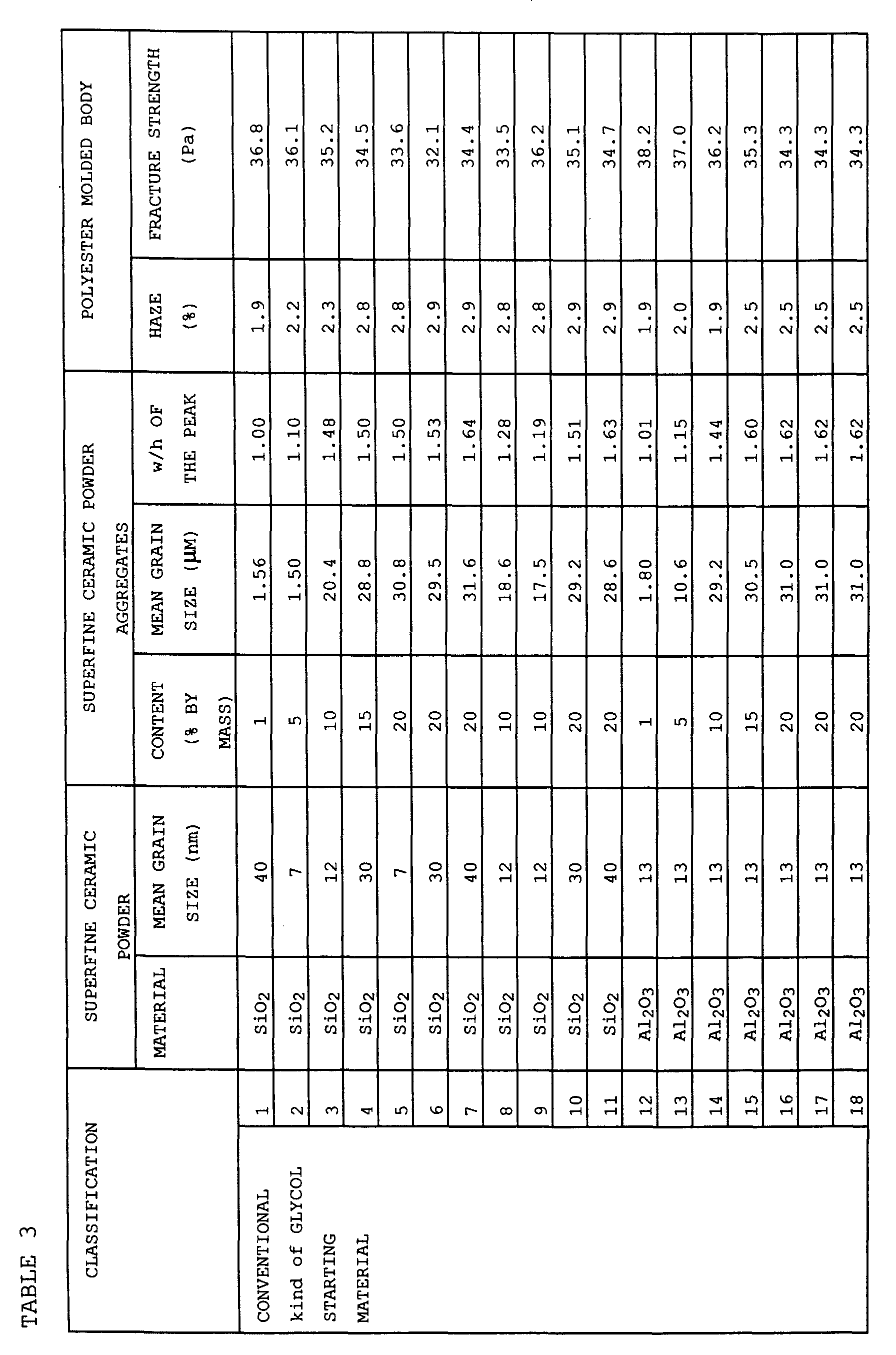

- Table 1 shows that the superfine ceramic powder aggregates dispersed in all the kind of glycol starting materials No. 1 to 15 according to the present invention have a mean grain size of 0.05 to 0.5 µm and the w/h values of 0.7 or less at the peak. The aggregates are finer and have better uniformity of the grain size distribution as compared with the superfine ceramic powder aggregates having a mean grain size of 1 to 30 µm and w/h values of 1 to 1.5 in the conventional kind of glycol starting material. Accordingly, the polyester molded bodies manufactured by using the kind of glycol starting materials No. 1 to 15 according to the present invention clearly have a relatively higher mechanical strength and better transparency as compared with the polyester molded bodies manufactured by using the conventional kind of glycol starting materials No. 1 to 15.
- As hitherto described, the kind of glycol starting materials containing the superfine ceramic powder aggregates according to the present invention enable the polyester molded bodies having a high mechanical strength and transparency to be manufactured, making it possible to make the polyester molded body thinner and finer, and to improve transparency of the molded body. And the kinds of glycols comprised of propylene glycols butyleneglycol and ethylene glycols and other glycols (the best component is 1,3-propyleneglycol, 1,4-butylene glycols and 1,2-ethyleneglycol)
Claims (1)
- An the kind of glycol starting material for manufacturing a polyester molded body containing 1 to 20% by mass of dispersed superfine ceramic powder aggregates relative to the total content of the kind of glycol for enabling polyester molded bodies having a high mechanical strength and transparency to be manufactured, wherein the superfine ceramic powder aggregates dispersed in the-the kind of glycol starting material has a mean grain size of 0.05 to 0.5 µm as measured with a laser diffraction grain size distribution analyzer, and wherein the peak indicated in a particle size distribution curve of the superfine ceramic powder aggregates obtained based on the results of the measurement satisfies the relation of w/h ≤ 0.7, wherein h is the peak height and w is the peak width at one half of the peak height (a half-width).
Priority Applications (1)
| Application Number | Priority Date | Filing Date | Title |
|---|---|---|---|
| EP20010124570 EP1197588B1 (en) | 2000-10-16 | 2001-10-15 | The kinds of glycols starting material containing dispersed superfine ceramic powders coagulates capable of forming polyester molded body having high mechanical strength and transparency |
Applications Claiming Priority (5)
| Application Number | Priority Date | Filing Date | Title |
|---|---|---|---|
| JP2000315108A JP2002121270A (en) | 2000-10-16 | 2000-10-16 | Glycol raw material containing ultra-fine ceramic powder aggregate dispersion that enables the production of polyester molded products having high strength and high transparency |
| JP2000315108 | 2000-10-16 | ||
| EP01121506A EP1199389A1 (en) | 2000-10-16 | 2001-09-08 | Ethylene glycol dispersion containing ceramic nanoparticle agglomerates suitable for production of high-strength and high-transparence polyester molded article |
| EP01121506 | 2001-09-08 | ||
| EP20010124570 EP1197588B1 (en) | 2000-10-16 | 2001-10-15 | The kinds of glycols starting material containing dispersed superfine ceramic powders coagulates capable of forming polyester molded body having high mechanical strength and transparency |
Publications (2)
| Publication Number | Publication Date |
|---|---|
| EP1197588A1 true EP1197588A1 (en) | 2002-04-17 |
| EP1197588B1 EP1197588B1 (en) | 2007-02-28 |
Family
ID=27224228
Family Applications (1)
| Application Number | Title | Priority Date | Filing Date |
|---|---|---|---|
| EP20010124570 Expired - Lifetime EP1197588B1 (en) | 2000-10-16 | 2001-10-15 | The kinds of glycols starting material containing dispersed superfine ceramic powders coagulates capable of forming polyester molded body having high mechanical strength and transparency |
Country Status (1)
| Country | Link |
|---|---|
| EP (1) | EP1197588B1 (en) |
Families Citing this family (1)
| Publication number | Priority date | Publication date | Assignee | Title |
|---|---|---|---|---|
| JP5345502B2 (en) * | 2008-11-10 | 2013-11-20 | 日本碍子株式会社 | Method for manufacturing ceramic honeycomb structure and coating material for ceramic honeycomb structure |
Citations (3)
| Publication number | Priority date | Publication date | Assignee | Title |
|---|---|---|---|---|
| JPH02160921A (en) * | 1988-12-13 | 1990-06-20 | Mitsubishi Rayon Co Ltd | Far infrared ray emitting polyester staple fiber |
| JPH02160862A (en) * | 1988-12-14 | 1990-06-20 | Diafoil Co Ltd | Hollow molded article made from ceramic particle-containing polyester |
| DE19606266A1 (en) * | 1995-07-14 | 1997-01-16 | Cheil Synthetics Inc | Process for the production of far infrared radiating polyester fibers |
-
2001
- 2001-10-15 EP EP20010124570 patent/EP1197588B1/en not_active Expired - Lifetime
Patent Citations (3)
| Publication number | Priority date | Publication date | Assignee | Title |
|---|---|---|---|---|
| JPH02160921A (en) * | 1988-12-13 | 1990-06-20 | Mitsubishi Rayon Co Ltd | Far infrared ray emitting polyester staple fiber |
| JPH02160862A (en) * | 1988-12-14 | 1990-06-20 | Diafoil Co Ltd | Hollow molded article made from ceramic particle-containing polyester |
| DE19606266A1 (en) * | 1995-07-14 | 1997-01-16 | Cheil Synthetics Inc | Process for the production of far infrared radiating polyester fibers |
Non-Patent Citations (1)
| Title |
|---|
| PATENT ABSTRACTS OF JAPAN vol. 014, no. 423 (C - 0757) 12 September 1990 (1990-09-12) * |
Also Published As
| Publication number | Publication date |
|---|---|
| EP1197588B1 (en) | 2007-02-28 |
Similar Documents
| Publication | Publication Date | Title |
|---|---|---|
| JP3954024B2 (en) | Aluminum flake pigment production method, aluminum flake pigment obtained by the production method, and grinding media used in the production method | |
| WO2001000719A1 (en) | Laser-writable polymer composition | |
| KR100912583B1 (en) | Slurries Containing Microfiber and Micropowder, and Methods for Using and Making Same | |
| EP2319613B1 (en) | Method for the dry dispersion of nanoparticles | |
| Hassan et al. | Mechanical and thermal properties of bio‐based CaCO3/soybean‐based hybrid unsaturated polyester nanocomposites | |
| Jesionowski et al. | The influence of filler modification on its aggregation and dispersion behaviour in silica/PBT composite | |
| EP4588975A1 (en) | Nanoparticle preparation, premix comprising such nanoparticle preparation and monomer, method for modulating the chemical and/or mechanical properties of a polymer, process for obtaining a modified polymer and modified polymer | |
| EP1197588B1 (en) | The kinds of glycols starting material containing dispersed superfine ceramic powders coagulates capable of forming polyester molded body having high mechanical strength and transparency | |
| EP1199389A1 (en) | Ethylene glycol dispersion containing ceramic nanoparticle agglomerates suitable for production of high-strength and high-transparence polyester molded article | |
| EP2914646B1 (en) | Agglomerate composition | |
| US6852789B2 (en) | Glycols starting materials containing dispersed superfine ceramic powder coagulates capable of forming polyester molded bodies having high mechanical strength and transparency | |
| JP2018108914A (en) | Monoclinic zirconia-based nanoparticle and production method of the same | |
| Kar et al. | Acrylonitrile‐butadiene‐styrene nanocomposites filled with nanosized alumina | |
| KR100463467B1 (en) | The kinds of glycols starting material containing dispersed superfine ceramic powders coagulates capable of forming polyester molded body having high mechanical strength and transparency | |
| US11186677B2 (en) | Fiber powder and aqueous dispersion thereof | |
| US6786964B2 (en) | Fine particle of aluminum hydroxide for filling resin and resin composition using the same | |
| Palaniandy et al. | Value adding limestone to filler grade through an ultra-fine grinding process in jet mill for use in plastic industries | |
| KR100508961B1 (en) | a composition powder with surface treatment and manufacturing method thereof | |
| JPH01119512A (en) | Platy basic calcium carbonate and its production | |
| Osman et al. | Surfactant Chain Length and Tensile Properties of Calcium Carbonate‐Polyethylene Composites | |
| KR101184734B1 (en) | Method for Preparing Cerium Oxide Nano Powder | |
| JPS59100156A (en) | Production of polyester composition | |
| WO1999003913A1 (en) | Glycol dispersion of inorganic powder, process for producing the same, and polyester composition containing the dispersion | |
| DE60126883T2 (en) | Glycol starting materials contain fine ceramic powder for molded article of polyester with high mechanical strength and transparency | |
| Ippolito et al. | Calcium Carbonate as Functional Filler in Polyamide 12-Manipulation of the Thermal and Mechanical Properties. Processes 2021, 9, 937 |
Legal Events
| Date | Code | Title | Description |
|---|---|---|---|
| PUAI | Public reference made under article 153(3) epc to a published international application that has entered the european phase |
Free format text: ORIGINAL CODE: 0009012 |
|
| AK | Designated contracting states |
Kind code of ref document: A1 Designated state(s): AT BE CH CY DE DK ES FI FR GB GR IE IT LI LU MC NL PT SE TR |
|
| AX | Request for extension of the european patent |
Free format text: AL;LT;LV;MK;RO;SI |
|
| 17P | Request for examination filed |
Effective date: 20020504 |
|
| AKX | Designation fees paid |
Free format text: AT BE CH CY DE DK ES FI FR GB GR IE IT LI LU MC NL PT SE TR |
|
| GRAP | Despatch of communication of intention to grant a patent |
Free format text: ORIGINAL CODE: EPIDOSNIGR1 |
|
| GRAS | Grant fee paid |
Free format text: ORIGINAL CODE: EPIDOSNIGR3 |
|
| GRAA | (expected) grant |
Free format text: ORIGINAL CODE: 0009210 |
|
| RAP1 | Party data changed (applicant data changed or rights of an application transferred) |
Owner name: DEGUSSA GMBH Owner name: NIPPON AEROSIL CO., LTD. |
|
| AK | Designated contracting states |
Kind code of ref document: B1 Designated state(s): AT BE CH CY DE DK ES FI FR GB GR IE IT LI LU MC NL PT SE TR |
|
| PG25 | Lapsed in a contracting state [announced via postgrant information from national office to epo] |
Ref country code: CH Free format text: LAPSE BECAUSE OF FAILURE TO SUBMIT A TRANSLATION OF THE DESCRIPTION OR TO PAY THE FEE WITHIN THE PRESCRIBED TIME-LIMIT Effective date: 20070228 Ref country code: DK Free format text: LAPSE BECAUSE OF FAILURE TO SUBMIT A TRANSLATION OF THE DESCRIPTION OR TO PAY THE FEE WITHIN THE PRESCRIBED TIME-LIMIT Effective date: 20070228 Ref country code: AT Free format text: LAPSE BECAUSE OF FAILURE TO SUBMIT A TRANSLATION OF THE DESCRIPTION OR TO PAY THE FEE WITHIN THE PRESCRIBED TIME-LIMIT Effective date: 20070228 Ref country code: LI Free format text: LAPSE BECAUSE OF FAILURE TO SUBMIT A TRANSLATION OF THE DESCRIPTION OR TO PAY THE FEE WITHIN THE PRESCRIBED TIME-LIMIT Effective date: 20070228 Ref country code: FI Free format text: LAPSE BECAUSE OF FAILURE TO SUBMIT A TRANSLATION OF THE DESCRIPTION OR TO PAY THE FEE WITHIN THE PRESCRIBED TIME-LIMIT Effective date: 20070228 Ref country code: NL Free format text: LAPSE BECAUSE OF FAILURE TO SUBMIT A TRANSLATION OF THE DESCRIPTION OR TO PAY THE FEE WITHIN THE PRESCRIBED TIME-LIMIT Effective date: 20070228 Ref country code: BE Free format text: LAPSE BECAUSE OF FAILURE TO SUBMIT A TRANSLATION OF THE DESCRIPTION OR TO PAY THE FEE WITHIN THE PRESCRIBED TIME-LIMIT Effective date: 20070228 |
|
| REG | Reference to a national code |
Ref country code: GB Ref legal event code: FG4D |
|
| REG | Reference to a national code |
Ref country code: CH Ref legal event code: EP |
|
| REF | Corresponds to: |
Ref document number: 60126883 Country of ref document: DE Date of ref document: 20070412 Kind code of ref document: P |
|
| REG | Reference to a national code |
Ref country code: IE Ref legal event code: FG4D |
|
| PG25 | Lapsed in a contracting state [announced via postgrant information from national office to epo] |
Ref country code: SE Free format text: LAPSE BECAUSE OF FAILURE TO SUBMIT A TRANSLATION OF THE DESCRIPTION OR TO PAY THE FEE WITHIN THE PRESCRIBED TIME-LIMIT Effective date: 20070531 |
|
| PG25 | Lapsed in a contracting state [announced via postgrant information from national office to epo] |
Ref country code: ES Free format text: LAPSE BECAUSE OF FAILURE TO SUBMIT A TRANSLATION OF THE DESCRIPTION OR TO PAY THE FEE WITHIN THE PRESCRIBED TIME-LIMIT Effective date: 20070608 |
|
| PG25 | Lapsed in a contracting state [announced via postgrant information from national office to epo] |
Ref country code: PT Free format text: LAPSE BECAUSE OF FAILURE TO SUBMIT A TRANSLATION OF THE DESCRIPTION OR TO PAY THE FEE WITHIN THE PRESCRIBED TIME-LIMIT Effective date: 20070730 |
|
| NLV1 | Nl: lapsed or annulled due to failure to fulfill the requirements of art. 29p and 29m of the patents act | ||
| ET | Fr: translation filed | ||
| REG | Reference to a national code |
Ref country code: CH Ref legal event code: PL |
|
| RAP2 | Party data changed (patent owner data changed or rights of a patent transferred) |
Owner name: NIPPON AEROSIL CO., LTD. Owner name: EVONIK DEGUSSA GMBH |
|
| PLBE | No opposition filed within time limit |
Free format text: ORIGINAL CODE: 0009261 |
|
| STAA | Information on the status of an ep patent application or granted ep patent |
Free format text: STATUS: NO OPPOSITION FILED WITHIN TIME LIMIT |
|
| 26N | No opposition filed |
Effective date: 20071129 |
|
| PG25 | Lapsed in a contracting state [announced via postgrant information from national office to epo] |
Ref country code: GR Free format text: LAPSE BECAUSE OF FAILURE TO SUBMIT A TRANSLATION OF THE DESCRIPTION OR TO PAY THE FEE WITHIN THE PRESCRIBED TIME-LIMIT Effective date: 20070529 |
|
| PG25 | Lapsed in a contracting state [announced via postgrant information from national office to epo] |
Ref country code: MC Free format text: LAPSE BECAUSE OF NON-PAYMENT OF DUE FEES Effective date: 20071031 |
|
| PG25 | Lapsed in a contracting state [announced via postgrant information from national office to epo] |
Ref country code: IE Free format text: LAPSE BECAUSE OF NON-PAYMENT OF DUE FEES Effective date: 20071015 |
|
| PG25 | Lapsed in a contracting state [announced via postgrant information from national office to epo] |
Ref country code: CY Free format text: LAPSE BECAUSE OF FAILURE TO SUBMIT A TRANSLATION OF THE DESCRIPTION OR TO PAY THE FEE WITHIN THE PRESCRIBED TIME-LIMIT Effective date: 20070228 |
|
| PG25 | Lapsed in a contracting state [announced via postgrant information from national office to epo] |
Ref country code: LU Free format text: LAPSE BECAUSE OF NON-PAYMENT OF DUE FEES Effective date: 20071015 |
|
| REG | Reference to a national code |
Ref country code: FR Ref legal event code: CA Ref country code: FR Ref legal event code: CD |
|
| PGFP | Annual fee paid to national office [announced via postgrant information from national office to epo] |
Ref country code: DE Payment date: 20091026 Year of fee payment: 9 |
|
| PGFP | Annual fee paid to national office [announced via postgrant information from national office to epo] |
Ref country code: FR Payment date: 20091110 Year of fee payment: 9 Ref country code: GB Payment date: 20091022 Year of fee payment: 9 Ref country code: IT Payment date: 20091023 Year of fee payment: 9 |
|
| GBPC | Gb: european patent ceased through non-payment of renewal fee |
Effective date: 20101015 |
|
| PG25 | Lapsed in a contracting state [announced via postgrant information from national office to epo] |
Ref country code: FR Free format text: LAPSE BECAUSE OF NON-PAYMENT OF DUE FEES Effective date: 20101102 |
|
| REG | Reference to a national code |
Ref country code: FR Ref legal event code: ST Effective date: 20110630 |
|
| PG25 | Lapsed in a contracting state [announced via postgrant information from national office to epo] |
Ref country code: GB Free format text: LAPSE BECAUSE OF NON-PAYMENT OF DUE FEES Effective date: 20101015 |
|
| REG | Reference to a national code |
Ref country code: DE Ref legal event code: R119 Ref document number: 60126883 Country of ref document: DE Effective date: 20110502 |
|
| PGFP | Annual fee paid to national office [announced via postgrant information from national office to epo] |
Ref country code: TR Payment date: 20090923 Year of fee payment: 9 |
|
| PG25 | Lapsed in a contracting state [announced via postgrant information from national office to epo] |
Ref country code: IT Free format text: LAPSE BECAUSE OF NON-PAYMENT OF DUE FEES Effective date: 20101015 |
|
| PG25 | Lapsed in a contracting state [announced via postgrant information from national office to epo] |
Ref country code: TR Free format text: LAPSE BECAUSE OF NON-PAYMENT OF DUE FEES Effective date: 20101015 |
|
| PG25 | Lapsed in a contracting state [announced via postgrant information from national office to epo] |
Ref country code: DE Free format text: LAPSE BECAUSE OF NON-PAYMENT OF DUE FEES Effective date: 20110502 |