Technical Field
The present invention relates to an electrically-conductive
composition having an excellent storage stability
at high temperatures and an electrically-conductive roller
prepared therefrom. More particularly, the electrically-conductive
composition of the invention comprises a compound
having at least one alkenyl group which can undergo
hydrosilylation reaction per molecule and an isobutylene
skeleton, a compound having at least two hydrosilyl groups per
molecule, a hydrosilylation catalyst, a compound having
aliphatically unsaturated bond, and an electrical
conductivity-providing material. The composition of the
invention exhibits a good storage stability at a temperature
as high as 30°C to 80°C.
Background Art
An addition type hardenable composition comprising a
compound having an alkenyl group and an isobutylene skeleton,
a compound having a hydrosilyl group and a hydrosilylating
catalyst or an electrically-conductive composition obtained
by adding an electrical conductivity-providing material to
such an addition type hardenable composition is known.
However, these compositions are mainly composed of
polymer and thus have a relatively high viscosity. The
components in these compositions may undergo thickening. Thus,
these compositions are disadvantageous in that their
workability and processability are very poor.
In order to lower the viscosity of the foregoing
composition and hence eliminate the foregoing disadvantage,
it has heretofore been practiced to add a plasticizer having
a lower viscosity than that of main components or the like.
However, it is disadvantageous in that when a large amount of
plasticizer is added, the hardened product obtained by
hardening the composition exhibits deteriorated physical
properties and there is a great risk of bleed, etc.
On the other hand, as the temperature rises, these
polymers show a viscosity drop. Thus, it is thought that if
the composition can be handled at temperatures higher than
ordinary temperature, a good workability can be given and no
adverse effects can be given to the physical properties thereof.
However, these compositions are disadvantageous in that they
are not always excellent in storage stability at temperatures
higher than room temperature and thus can readily be gelled,
that is, they exhibit an extremely poor storage stability at
high temperatures (e.g., higher than room temperature) (as
described in JP-A-3-188166 (The term "JP-A" as used herein
means an "unexamined published Japanese patent application"),
U.S. Patent 3,445,420).
Further, according to U.S. Patent 5,629,387, the use of
a long-chain α-acetylene alcohol makes it possible to improve
storage stability. However, this approach is disadvantageous
in that the resulting composition exhibits a deteriorated
hardenability.
Various techniques are known for composition for
addition type hardenable electrically-conductive roller
comprising a liquid polymer (as described in JP-A-7-300564,
JP-A-11-80669). However, it is the status of quo that no
compositions having an excellent storage stability and
hardenability have been obtained yet.
In general, an electrically-conductive roller is made
of a resin such as urethane and NBR. However, a roller prepared
from these resins is disadvantageous in that it is subject to
change of electrical properties due to environmental change
because these resins are somewhat hygroscopic themselves.
The present invention has been worked out in the light
of these circumstances. The present invention provides an
electrically-conductive composition having an excellent
storage stability at high temperatures which can be handled
at temperatures higher than room temperature and an
electrically-conductive roller having an excellent
productivity.
Disclosure of the Invention
The inventors made extensive studies of solution to the
foregoing problems. As a result, it was found that the
addition of a compound containing an aliphatically unsaturated
bond as a storage stability improver to the foregoing
electrically-conductive composition which can undergo
hydrosilylation reaction makes it possible to obtain a
composition having an excellent storage stability at
temperatures higher than room temperature and the use of such
a composition makes it possible to obtain an electrically-conductive
roller having an excellent productivity and
processability because the viscosity thereof can be lowered
by heating. The present invention has thus been worked out.
Further, the electrically-conductive roller of the
invention is characterized in that since the isobutylene
polymer as a main component has a low hygroscopicity, the roller
exhibits an excellent stability of electrical properties
against environmental change.
The electrically-conductive composition of the
invention comprises the following components (A) to (E):
In an embodiment, the foregoing alkenyl group which can
undergo hydrosilylation reaction in the polymer as component
(A) exists at the terminal of the polymer.
In an embodiment, the number-average molecular weight
of the isobutylene polymer as component (A) is from 1,000 to
50,000.
In an embodiment, the total amount of repeating units
derived from isobutylene in the component (A) is not smaller
than 50% by weight.
In an embodiment, the compound as component (B) is a
polyorganohydrogen siloxane containing at least two
hydrosilyl groups on the average per molecule.
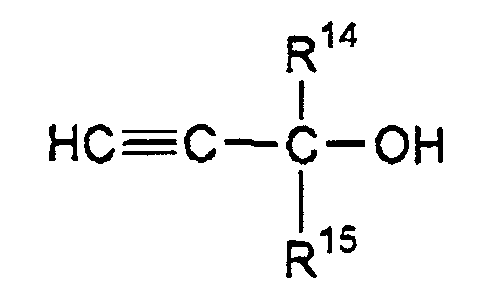
In an embodiment, the component (D) is an acetylene
alcohol having the following structure:
wherein R
14 and R
15 each independently represent a hydrogen atom,
alkyl group or aryl group, with the proviso that R
14 and R
15 may
be connected to each other to form a ring.
In an embodiment, the component (D) is an acetylene
alcohol having a molecular weight of not smaller than 110.
In an embodiment, the component (D) is an acetylene
alcohol having a boiling point of not lower than 140°C at
ordinary pressure.
In an embodiment, the sum of the number of carbon atoms
in R14 and R15 in the general formula of acetylene alcohol is
from 4 to 8.
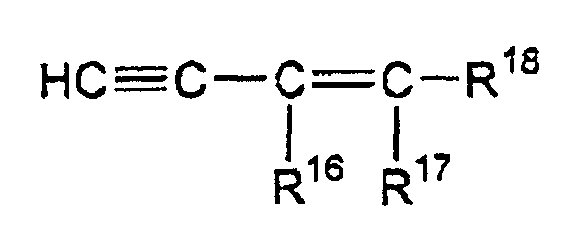
In an embodiment, the component (D) is an ene-yne
compound having the following structure:
wherein R
16 to R
18 each independently represent a hydrogen atom
or hydrocarbon group, with the proviso that the sum of the
number of carbon atoms in R
16 to R
18 is from 2 to 6 and R
16 and
R
17 or R
17 and R
1 8 may be connected to each other to form a ring.
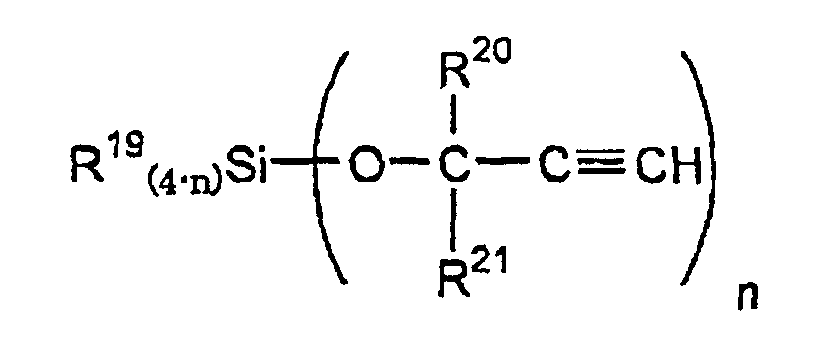
In an embodiment, the component (D) is a silane compound
having the following structure:
wherein R
19 to R
21 each independently represent a C
1-C
10
hydrocarbon group; and n represents an integer of from 1 to
3, with the proviso that R
20 and R
21 may be connected to each
other to form a ring.
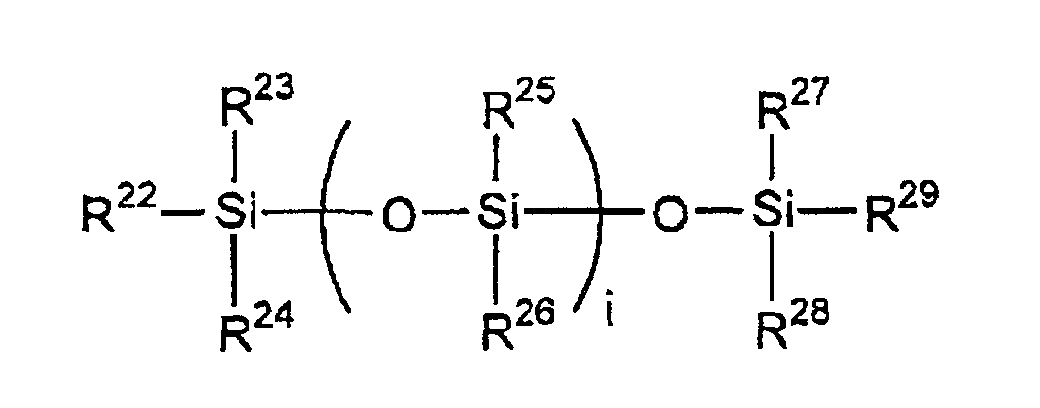
In an embodiment, the component (D) is a polysiloxane
compound having the following structure:
wherein at least one of R
22 to R
26 is a hydrocarbon group having
an acetylenically unsaturated bond and the other each are an
arbitrary hydrocarbon group; and i represents an integer of
from 0 to 50.
In an embodiment, the component (D) is a nitrile compound
containing an aliphatically unsaturated bond.
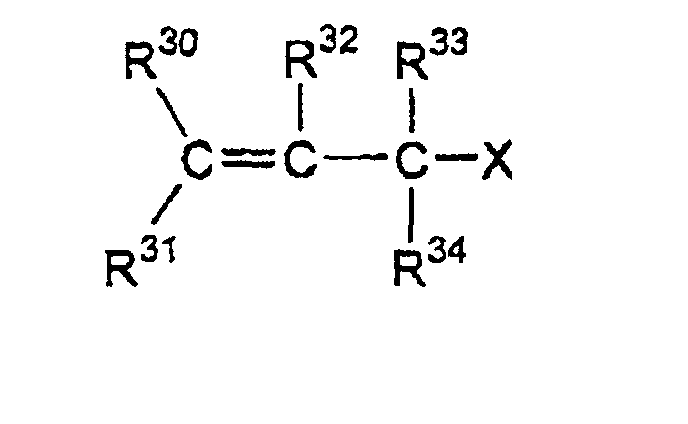
In an embodiment, the component (D) is an olefin compound
having the following structure:
wherein R
30 to R
34 each independently represent a hydrogen atom,
halogen or monovalent hydrocarbon group; and X represents a
halogen atom, alkoxy group or cyano group.
In an embodiment, the component (D) is an ester compound
having an aliphatically unsaturated bond.
In an embodiment, the component (D) is at least one
compound selected from the group consisting of 2-phenyl-3-butyne-2-ol,
1-ethynyl-1-cyclohexanol and 3,5-dimethyl-1-hexyne-3-ol.
In an embodiment, the component (E) is carbon black.
In another aspect of the invention, an electrically-conductive
roller obtained by hardening any of the foregoing
compositions around a metallic shaft is provided.
In an embodiment, the electrically-conductive roller is
obtained by heating the composition to a temperature of from
30°C to 80°C, injecting the composition into a mold, and then
hardening the mold at a temperature of not lower than 100°C.
In an embodiment, the electrically-conductive roller is
obtained by treating the foregoing composition as a two-part
liquid composition consisting of a composition (I) comprising
components (A), (B), (C) , (D) and (E) and a composition (II)
comprising components (A), (B), (D) and (E), heating the
various compositions to a temperature of from 30°C to 80°C,
measuring the weight of the various compositions, injecting
the various compositions into a mold while being mixed, and
then hardening the mixture at a temperature of not lower than
100°C.
In an embodiment, the ratio (I)/(II) of viscosity of the
composition (I) to the composition (II) is from 0.5 to 2.0.
In an embodiment, the roller resistivity is from 107 to
1011 Ω.
In an embodiment, the roller resistivity is from 103 to
1010 Ω.
In an embodiment, the roller resistivity is from 105 to
1010 Ω.
In an embodiment, the roller hardness is of not greater
than 30°.
Best Mode for Carrying Out the Invention
The component (A) to be used in the invention is an
isobutylene polymer having at least one alkenyl group which
can undergo hydrosilylation reaction per molecule. The term
"isobutylene polymer" as used herein is meant to indicate one
having a skeleton mainly composed of isobutylene units as
monomer units. In this case, all the monomers may be formed
by isobutylene units. Monomer units copolymerizable with
isobutylene may be contained in an amount of not greater than
50% (by weight hereinafter), more preferably not greater than
30%, particularly not greater than 20% based on the weight of
the isobutylene polymer. In the polymer skeleton, however,
it is particularly preferred that the repeating units
substantially free of carbon-carbon unsaturated bond other
than aromatic ring which constitute the main chain excluding
the alkenyl group be composed of saturated hydrocarbon from
the standpoint of humidity resistance, weathering resistance
and heat resistance. The isobutylene copolymer to be used as
component (A) in the invention may comprise a unit monomer which
leaves double bonds after polymerization such as polyene
compound (e.g., butadiene, isoprene, 1,13-tetradecadiene,
1,9-decadiene, 1,7-octadiene, 1,5-hexadiene) in a small
amount, preferably in an amount of not greater than 10%, so
far as the objects of the invention can be accomplished.
Specific examples of the copolymerizing components
constituting the main chain skeleton of the isobutylene polymer
include 1-butene, 2-butene, 2-methyl-butene, 3-methyl-1-butene,
pentene, 4-methyl-1-pentene, hexene, vinyl
cyclohexane, methyl vinyl ether, ethyl vinyl ether, isobutyl
vinyl ether, styrene, α-methylstyrene, dimethylstyrene, p-t-butoxystyrene,
p-hexenyloxystyrene, p-allyloxystyrene,
p-hydroxystyrene, β-pinene, indene, vinyl dimethyl
methoxysilane, vinyl trimethylsilane, divinyl
dimethoxysilane, divinyl dimethylsilane, 1,3-divinyl-1,1,3,3-tetramethyldisiloxane,
trivinyl methylsilane,
tetravinylsilane, allyl dimethyl methoxysilane, allyl
trimethylsilane, diallyl dimethoxysilane, diallyl
dimethylsilane, γ-methacryloyloxypropyl trimethoxysilane,
γ-methacryloyloxy propyl methyl dimethoxysilane, etc.
The alkenyl group which can undergo hydrosilylation
reaction is not specifically limited so far as it is a group
having a carbon-carbon double bond active to hydrosilylation
reaction. Examples of the alkenyl group include aliphatic
unsaturated hydrocarbon group such as vinyl group, allyl group,
methyl vinyl group, propenyl group, butenyl group, pentenyl
group and hexenyl group, cyclic unsaturated hydrocarbon group
such as cyclopropenyl group, cyclobutenyl group,
cyclopentenyl group and cyclohexenyl group, and methacryl
group. In the invention, the component (A) preferably has from
1 to 10 alkenyl groups per molecule. When the number of alkenyl
groups is too great, the resulting hardened product can easily
become rigid, making it difficult to obtain a good rubber
elasticity. When the number of alkenyl groups is too small,
the resulting composition can difficultly become sufficiently
hardened.
The alkenyl group which can undergo hydrosilylation
reaction preferably exists at the terminal of the molecule.
Thus, the alkenyl group preferably exists at the terminal of
the polymer because the finally formed hardened product has
many effective network chains, making it easy to obtain a
rubber-like hardened product having a high strength.
The number-average molecular weight (as determined by
GPC method in polystyrene equivalence) of the foregoing
isobutylene polymer is preferably from about 1,000 to 50,000.
In particular, a liquid or fluid isobutylene polymer having
a number-average molecular weight of from about 2,000 to 30,000
is preferred.
Referring to the process for the preparation of the
component (A) of the invention, the component (A) can be
prepared by the process described in JP-A-9-71611.
The process for the introduction of alkenyl group in the
preparation of the component (A) can be roughly divided into
two groups, i.e., process which comprises the introduction of
alkenyl group after the preparation of polymer and process
which comprises the introduction of alkenyl group during the
preparation of polymer.
Referring to the process which comprises the
introduction of alkenyl group after polymerization, the
hydroxyl group at the end or in the main or side chain of the
polymer is converted to a group such as -ONa or -OK.
Subsequently, the polymer is reacted with an organic halogen
compound represented by the following general formula (1):
CH2=CH-R1-Y
wherein Y represents a halogen atom such as chlorine atom and
iodine atom; and R1 represents a divalent organic group
represented by -R2-, -R2-OC(=O)- or -R2-C)=O)- (in which R2
represents a C1-C20 divalent hydrocarbon group, preferably an
alkylene, cycloalkylene, arylene or aralkylene group),
particularly a divalent group selected from the group
consisting of groups represented by R3-C6H4-CH2- (in which R3
is a C1-C10 hydrocarbon group) to prepare an isobutylene polymer
having a terminal alkenyl group. As the process for the
conversion of the terminal hydroxyl group in the hydroxyl-terminated
isobutylene polymer to oxymetal group there may be
used a process which comprises reacting the hydroxyl-terminated
isobutylene polymer with an alkaline metal such as
Na and K, metal hydride such as NaH, metal alkoxide such as
NaOCH3, caustic alkali such as caustic soda and caustic
potassium or the like.
Specific examples of the organic halogen compound
represented by the foregoing general formula (1) include allyl
chloride, allyl bromide, vinyl (chloromethyl)benzene, allyl
(chloromethyl)benzene, allyl (bromomethyl)benzene, allyl
(chloroethyl)ether, allyl (chloromethoxy)benzene, 1-hexenyl
(chloromethoxy)benzene, allyloxy (chloromethyl)benzene, etc.
The present invention is not limited to these organic halogen
compounds. Preferred among these organic halogen compounds
is allyl chloride because it is inexpensive and can easily
undergo reaction.
The process for the introduction of alkenyl group into
the isobutylene polymer having covalently bonded Cl group is
not specifically limited. For example, however, there may be
used a process which comprises Friedel-Crafts reaction of
various alkenyl phenyl ethers with Cl group, a process which
comprises substitution reaction of allyl trimethylsilane or
the like with Cl group in the presence of a Lewis acid, a method
which comprises subjecting various phenols and Cl group to
Friedel-Crafts reaction to introduce hydroxyl group into the
phenols, and then performing the foregoing process for the
introduction of alkenyl group, or the like.
Examples of the process which comprises the introduction
of alkenyl group during polymerization include a process for
the preparation of an isobutylene polymer terminated by allyl
which comprises the addition of an allyl trimethylsilane to
the polymerization system in the cationic polymerization of
cationically polymerizable monomers containing isobutylene in
the presence of a compound having a halogen atom bonded to a
carbon atom which is bonded to a carbon in an aromatic ring
and/or compound having a halogen atom bonded to a carbon atom
which is a tertiary carbon atom as an initiator/chain transfer
agent and a Lewis acid as a catalyst, and a process for the
preparation of an isobutylene polymer having alkenyl group at
the end of main chain or side chain which comprises the addition
of a non-conjugated diene such as 1,9-decadiene or
alkenyloxystyrene such as p-hexenyloxystyrene in the same
cationic polymerization as mentioned above.
Examples of the Lewis acid which can be used as a cationic
polymerization catalyst include compounds represented by the
general formula MX'n (in which M is a metal atom, and X' is
a halogen atom) (e.g., BCl3, Et2AlCl, EtAlCl2, AlCl3, SnCl4, TiCl4,
VCl5, FeCl3, BF3). However, the present invention is not
limited to these compounds. Preferred among these Lewis acids
are BCl3, SnCl4, BF3. Even more desirable among these Lewis
acids is TiCl4. The amount of the Lewis acid to be used is
preferably from 0.1 to 10 mols, more preferably from 2 to 5
mols per mol of the initiator/chain transfer agent.
The component (B) to be used in the composition of the
invention will be described hereinafter.
As the compound having hydrosilyl group as the component
(B) there may be used a compound having two or more hydrosilyl
groups per molecule.
The term "hydrosilyl group" as used herein is meant to
indicate a silyl group represented by the general formula
HnR(3-n)Si- (in which R is an arbitrary monovalent group) having
a hydrogen atom bonded to the silicon atom contained therein.
In the specification, a group having two hydrogen atoms (H)
bonded to a silicon atom (Si) is considered two hydrosilyl
groups for convenience.
Preferred examples of the compound as component (B)
include polyorganohydrogen siloxane. A polyorganohydrogen
siloxane is a siloxane compound having a hydrocarbon group or
hydrogen atom on a silicon atom. The siloxane compound may
be chain-like or cycle for example and is specifically
represented, e.g., by the following general formula:
wherein m
1 is not smaller than 2; n
1 is not greater than 0, with
the proviso that the sum of m
1 and n
1 is from not smaller than
2 to not greater than 50; and R
1 represents a C
2-C
20 hydrocarbon
group except alkenyl group and alkynyl group, with the proviso
that R
1 may be replaced by one or more phenyl groups as
necessary.
wherein m
2 is not smaller than 0; n
2 is not smaller than 0, with
the proviso that the sum of m
2 + n
2 is from not smaller than
0 to not greater than 50; and R
2 represents a C
2-C
20 hydrocarbon
group except alkenyl group and alkynyl group, with the proviso
that R
2 may be replaced by one or more phenyl groups as
necessary.
wherein m
3 is from not smaller than 2 to not greater than 19;
n
3 is from not smaller than 0 to less than 18, with the proviso
that the sum of m
3 + n
3 is from not smaller than 3 to not greater
than 20; and R
3 represents a C
2-C
20 hydrocarbon group, with the
proviso that R
3 may be replaced by one or more phenyl groups
as necessary.
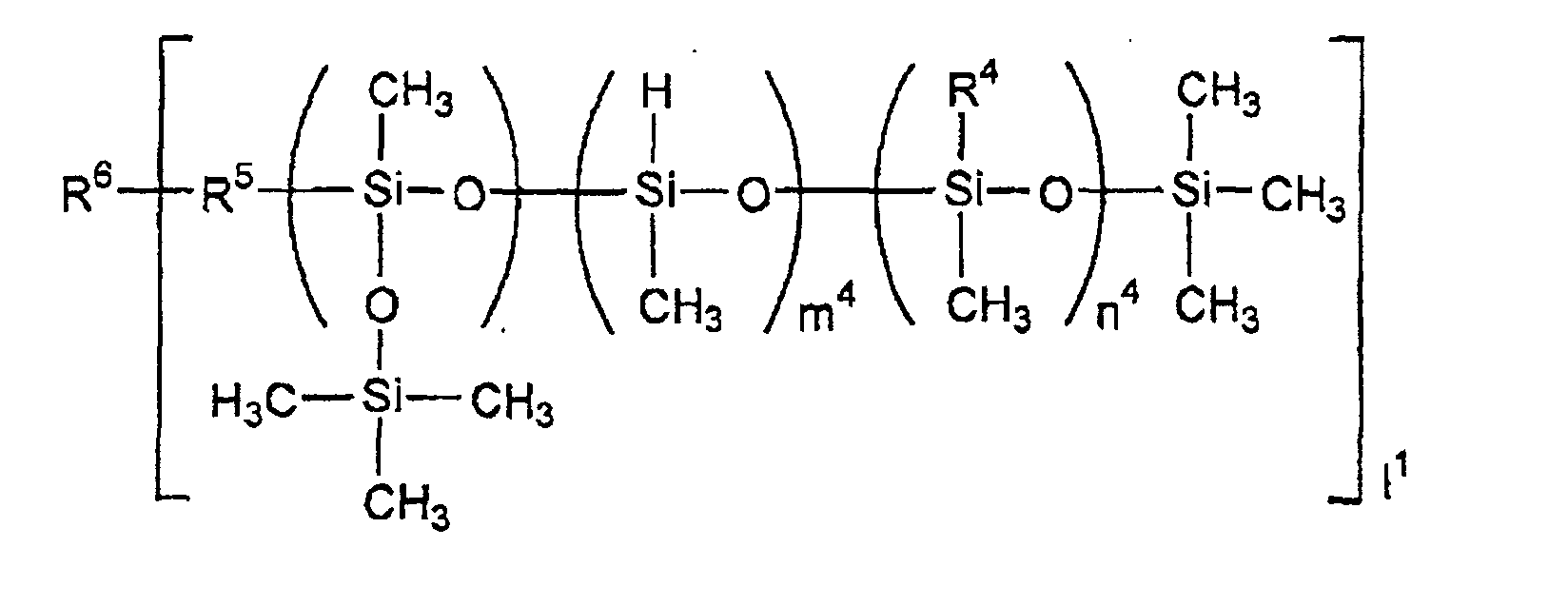
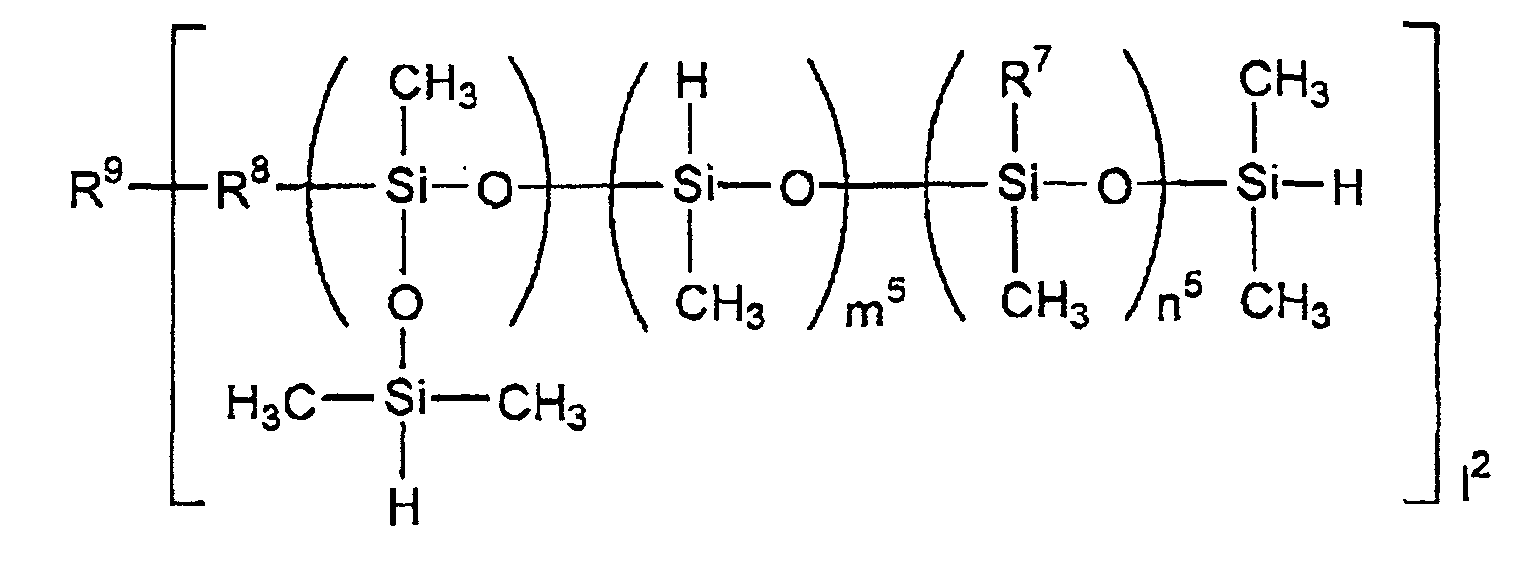
Alternatively, the siloxane compound may have two or more
siloxane units and is specifically represented, e.g., by the
following general formula:
wherein m
4 is not smaller than 1; n
4 is not smaller than 0, with
the proviso that the sum of m
4 + n
4 is from not smaller than
1 to not greater than 50 ; R
4 represents a C
2-C
20 hydrocarbon group,
with the proviso that R
4 may be replaced by one or more phenyl
groups as necessary; l
1 is not smaller than 2; R
5 may be a
divalent organic group or may not be present; and R
6 represents
a divalent to tetravalent organic group.
wherein m
5 is not smaller than 0; n
5 is not smaller than 0, with
the proviso that the sum of m
5 + n
5 is from not smaller than
0 to not greater than 50; R
7 represents a C
2-C
20 hydrocarbon group,
with the proviso that R
7 may be replaced by one or more phenyl
groups as necessary; l
2 is not smaller than 2; R
8 may be a
divalent organic group or may not be present; and R
9 represents
a divalent to tetravalent organic group.
wherein m
6 is not smaller than 1; n
6 is not smaller than 0, with
the proviso that the sum of m
6 + n
6 is from not smaller than
3 to not greater than 50; R
10 represents a C
2-C
20 hydrocarbon
group, with the proviso that R
10 may be replaced by one or more
phenyl groups as necessary; l
3 is not smaller than 2; R
11 may
be a divalent organic group or may not be present; and R
12
represents a divalent to tetravalent organic group.
The component (B) preferably has a good compatibility
with the components (A), (C), (D) and (E) or a good dispersion
stability in the system. In particular, in the case where the
viscosity of the entire system is low, when the component (B)
has a low compatibility with the foregoing various components,
phase separation can easily occur, causing malhardening.
Therefore, in order to prevent phase separation, the
composition may comprise a filler having a smaller particle
diameter such as particulate silica incorporated therein as
a dispersing agent.
Specific examples of the component (B) having a good
compatibility with the component (A), (C) , (D) or (E) or a good
dispersing agent include the following compounds.
wherein p represents an integer of from 6 to 12.
wherein k is from greater than 2 to less than 10; j is from
greater than 0 to less than 5; and R
13 represents a hydrocarbon
group having 8 or more carbon atoms.
The amount of the component (B) to be used is preferably
such that the total number of mols of hydrogen atoms bonded
to silicon atom in the component (B) is from 0.8 to 5.0
equivalents based on the total number of mols of alkenyl groups
in the component (A). When the amount of hydrogen atoms bonded
to silicon atom in the component (B) based on the total amount
of alkenyl groups in the component (A) is too small,
insufficient crosslinking can easily occur. On the contrary,
when the amount of hydrogen atoms bonded to silicon atom in
the component (B) based on the total amount of alkenyl groups
in the component (A) is too great, hydrogen atoms bonded to
silicon atom can easily be left in the hardened composition,
giving an effect of drastically changing the physical
properties of the composition. In order to inhibit this effect
in particular, the amount of the component (B) is preferably
predetermined to be from 1.0 to 2.0 equivalents.
The hydrosilylation catalyst as component (C) is not
specifically limited. Any hydrosilylation catalyst may be
used. Specific examples of the hydrosilylation catalyst
include catalyst having a solid platinum supported on a carrier
such as chloroplatinic acid, single body of platinum, alumina,
silica and carbon black, platinum-vinyl siloxane complex (e.g.,
Ptn(ViMe2SiOSiMe2Vi)n, Pt[(MeViSiO)4]m}, platinum-phosphine
complex {e.g., Pt(PPh3)4, Pt(PBu3)4}, platinum-phosphite
complex {e.g., Pt(OPh)3]4, Pt[P(OBu)3]4} (in which Me represents
a methyl group, Bu represents a butyl group, Vi represents a
vinyl group, Ph represents a phenyl group, and n and m each
represent an integer) , Pt(acac)2, platinum-hydrocarbon
composite disclosed in U.S. Patents 3,159,601 and 3,159,662
to Ashby et al., platinum alcoholate catalyst disclosed in U.S.
Patent 3,220,972 to Lamoreaux et al.
Examples of catalysts other than platinum compound
include RhCl(PPh3)3, RhCl3, Rh/Al2O3, RaCl3, IrCl3, FeCl3, AlCl3,
PdCl2·2H2O, NiCl2, TiCl4, etc. These catalysts may be used
singly or in combination of two or more thereof. From the
standpoint of catalytic activity, platinum-olefin complex,
platinum-vinyl siloxane complex, Pt(acac)2, etc. are
preferred.
The amount of the catalyst as component (C) is not
specifically limited but is preferably from 10-1 to 10-8 mols,
more preferably 10-2 to 10-6 mols per mol of the alkenyl group
in the component (A). Since a hydrosilylation catalyst is
normally expensive and corrosive and can cause the production
of a large amount of hydrogen gas that foams the hardened
product, it is preferred that the hydrosilylation catalyst be
not used too much.
The component (D) is a component which prevents gelation
or thickening of the composition of the invention attributed
to the component (B) or deactivation of the hydrosilylation
catalyst as component (C) to allow the improvement of storage
stability at temperatures higher than room temperature.
Examples of the compound as component (D) include
acetylene alcohols represented by the following general
formula:
wherein R
14 and R
15 each independently represent a hydrogen atom,
alkyl group or aryl group, with the proviso that R
14 and R
15 may
be connected to each other to form a ring.
In particular, in these acetylene alcohols, the
bulkiness of R14 or R15 makes a great contribution to the storage
stability of the composition. Therefore, the compound wherein
R14 or R15 is bulky is preferred from the standpoint of storage
stability at high temperatures. However, when R14 or R15 is too
bulky, it is disadvantageous in that the resulting composition
can easily have a bad hardenability. Therefore, it is
important to select an acetylene alcohol having well-balanced
storage stability and hardenability.
Preferred examples of the acetylene alcohol having
well-balanced storage stability and hardenability include
those having a molecular weight of not smaller than 110 and/or
a boiling point of not lower than 140°C at ordinary pressure.
Further examples of the acetylene alcohol having well-balanced
storage stability and hardenability include the foregoing
compound wherein the total number of carbon atoms in R14 and
R15 is from 4 to 8. Examples of these acetylene alcohols include
2-chenyl-3-butyne-2-ol, 1-ethynyl-1-cyclohexanol, 3,5-dimethyl-1-hexyne-3-ol,
etc.
Examples of the compound as component (D) other than
acetylene alcohols include an ene-yne compound having the
following structure:
wherein R
16 to R
18 each independently represent a hydrogen atom
or hydrocarbon group, with the proviso that the sum of the
number of carbon atoms in R
16 to R
18 is from 2 to 6 and R
16 and
R
17 or R
17 and R
1 8 may be connected to each other to form a ring;
a silane compound having the following structure:
wherein R
19 to R
21 each independently represent a C
1-C
10
hydrocarbon group; and n represents an integer of from 1 to
3, with the proviso that R
20 and R
21 may be connected to each
other to form a ring; a polysiloxane compound having the
following structure:
wherein at least one of R
22 to R
26 is a hydrocarbon group having
an acetylenically unsaturated bond and the other each are an
arbitrary hydrocarbon group; and i represents an integer of
from 0 to 50; and an olefin compound having the following
structure:
wherein R
30 to R
34 each independently represent a hydrogen atom,
halogen or monovalent hydrocarbon group; and X represents a
halogen atom, alkoxy group or cyano group. Further examples
of the compound as component (D) other than acetylene alcohols
include aliphatic carboxylic acid ester of olefin alcohol such
as vinyl acetate, cyclic tetravinyl siloxane, nitrile having
aliphatically unsaturated bond such as 2-pentenenitrile,
alkylacetylene dicarboxylate, maleic acid ester,
diorganofumarate, etc.
The amount of the component (D) to be used may be such
arbitrary that the component (D) can be uniformly dispersed
in the components (A) and (B). It is preferably from 2 to 10,000
mols per mol of the hydrosilylation catalyst as component (C) .
The compounds containing aliphatically unsaturated bond as
component (D) may be used singly or in combination of two or
more thereof.
The component (E) is a component which renders the
composition of the invention or a hardened product obtained
therefrom electrically conductive. Examples of the
electrical conductivity-providing material as component (E)
include carbon black, metal oxide, quaternary ammonium salt,
organic compound or polymer having carboxylic acid group,
sulfonic acid group, sulfuric acid ester group, phosphoric acid
ester group, etc., compound having electrically-conductive
unit such as ether esterimide polymer, ether imide polymer,
ethylene oxide-epihalohydrin copolymer and methoxy
polyethylene glycol acrylate, and compound such as antistat
for polymer compound.
Examples of the foregoing carbon black include furnace
black, acetylene black, lamp black, channel black, thermal
black, oil black, etc. The kind, particle diameter, etc. of
these carbon blacks are not limited.
Since the hydrosilylation reaction can be inhibited
depending on the kind and added amount of the electrical
conductivity-providing material, it is preferred that an
electrical conductivity-providing material having little
effect on the hydrosilylation reaction be used.
The amount of the component (E) to be incorporated can
be arbitrarily predetermined according to the required
electrical conductivity of the formed product to be obtained.
It is preferably from 0.1 to 200 parts by weight, more
preferably from 1 to 100 parts by weight based on 100 parts
by weight of the polymer as component (A). When the amount
of the component (E) to be incorporated is too small, it is
more likely that the resulting electrically-conductive
material can have scattered electrical conductivity. On the
contrary, when the amount of the component (E) to be
incorporated is too great, the fluidity of the composition can
be easily deteriorated, deteriorating the processability
thereof.
The substituents of the invention represented by the
foregoing general formulae will be described hereinafter.
The term "hydrocarbon" as used herein preferably means
an alkyl group, alkenyl group, alkynyl group, aryl group,
aralkyl group or cycloalkyl group unless otherwise specified.
The alkyl group is an alkyl group preferably having from
1 to 30 carbon atoms, more preferably from 1 to 20 carbon atoms,
even more preferably from 1 to 10 carbon atoms, e.g., methyl,
ethyl, propyl.
The alkenyl group is an alkenyl group preferably having
from 2 to 30 carbon atoms, more preferably from 2 to 20 carbon
atoms, even more preferably from 2 to 10 carbon atoms, e.g.,
vinyl, allyl.
The alkynyl group is an alkynyl group preferably having
from 2 to 30 carbon atoms, more preferably from 2 to 20 carbon
atoms, even more preferably from 2 to 10 carbon atoms, e.g.,
ethynyl, propargyl.
The aryl group is an aryl group preferably having from
6 to 30 carbon atoms, more preferably from 6 to 20 carbon atoms,
even more preferably from 6 to 10 carbon atoms, e.g., phenyl,
tollyl, naphthyl.
The aralkyl group is an aralkyl group preferably having
from 7 to 30 carbon atoms, more preferably from 7 to 20 carbon
atoms, even more preferably from 7 to 10 carbon atoms, e.g.,
benzyl, phenethyl.
The cycloalkyl group is a cycloalkyl group preferably
having from 3 to 10 carbon atoms, more preferably from 3 to
8 carbon atoms, e.g., cyclopentyl, cyclohexyl.
The alkoxy group is an alkoxy group preferably having
from 1 to 30 carbon atoms, more preferably from 1 to 20 carbon
atoms, even more preferably from 1 to 10 carbon atoms, e.g.,
methoxy, ethoxy, propoxy.
The divalent organic group is a divalent organic group
having no carbon atom, preferably from 1 to 10 carbon atoms,
more preferably from 1 to 3 carbon atoms, e.g., methylene,
ethylene.
The divalent to tetravalent organic group is, e.g., the
foregoing divalent organic group having N or C added thereto.
In a preferred embodiment, the composition of the
invention is added in an amount such that the resistivity of
the roller obtained from the composition of the invention is
from 107 to 1011 Ω.
In another preferred embodiment, the composition of the
invention is added in an amount such that the resistivity of
the roller obtained from the composition of the invention is
from 103 to 109 Ω.
In a further preferred embodiment, the composition of
the invention is added in an amount such that the resistivity
of the roller obtained from the composition of the invention
is from 105 to 1010 Ω.
The electrically-conductive composition of the
invention may comprise a plasticizer incorporated therein for
the purpose of adjusting the viscosity of the composition or
the hardness of the formed product obtained from the
composition. Examples of the plasticizer include
hydrocarbons or substituted hydrocarbons having a low polarity.
Specific examples of these plasticizers include saturated
hydrocarbon-based process oils having a molecular weight of
from 300 to 1,000, etc. The amount of the plasticizer to be
used is preferably not greater than 150 parts by weight based
on 100 parts by weight of the component (A). When the amount
of the plasticizer to be used exceeds the above defined range,
problems such as bleed can easily occur.
An adhesivity providing agent or adhesivity providing
resin for enhancing the adhesivity to various supports (e.g.,
metal core, plastic film, metal foil, paper) may be
incorporated in the electrically-conductive composition of
the invention according to the foregoing necessity. Examples
of the adhesivity providing agent include various silane
coupling agents, epoxy resins, etc. In particular, a silane
coupling agent having a functional group such as epoxy group,
methacryloyl group and vinyl group has little effect on the
hardenability of the composition and exerts a great effect of
realizing adhesivity and thus can be easily used. However,
the silane coupling agent employable herein is not limited to
these compounds. Alternatively, these reaction catalysts may
be added in combination with the silane coupling agent or epoxy
resin. For the use of these components, their effects on the
hydrosilylation reaction must be considered.
The adhesivity-providing resin is not specifically
limited. In general, any resins which are used as
adhesivity-providing agent may be used. Specific examples of
these resins include phenol resin, modified phenol resin,
cyclopentadiene-phenol resin, xylene resin, coumarone resin,
petroleum resin, terpene resin, terpene phenol resin, rosin
ester resin, etc. Particularly preferred among these resins
are terpene resin and petroleum resin because they have a good
compatibility and adhesivity.
The electrically-conductive composition of the
invention may comprise various fillers, oxidation inhibitors,
ultraviolet absorbers, pigments, surface active agents,
solvents, silicon compounds, etc. incorporated properly
therein according to the necessity of properties of the desired
formed products. Specific examples of the foregoing fillers
include particulate silica, calcium carbonate, clay, talc,
titanium oxide, zinc white, diatomaceous earth, barium sulfate,
etc. Particularly preferred among these fillers is
particulate silica preferably having a particle diameter of
from about 50 nm to 70 nm (BET specific surface area: 50 to
380 m2/g). Among these products, surface-treated hydrophobic
silica is particularly preferred because it has a great effect
of improving the strength of the electrically-conductive
composition in a desirable manner.
The composition of the invention is formed and heat-cured
by a conventional known method to form an
electrically-conductive formed product. For example, by
injecting the composition of the invention into a mold having
a forming space having a desired shape such as that of roller,
and then heating the composition, an electrically-conductive
formed product having a desired shape can be obtained.
In some detail, formation can be carried out by liquid
injection molding, extrusion, press molding or the like.
Liquid injection molding is preferred because the composition
is liquid and from the standpoint of productivity. The
electrically-conductive composition according to the
invention is relatively excellent in storage stability even
at high temperatures and thus can be heated so that it can be
treated with a low viscosity. Thus, the composition of the
invention is suitable for liquid injection molding at high
temperatures.
The composition of the invention is hardened, e.g., by
the reaction of addition of Si-H group to alkenyl group in the
presence of a noble metal catalyst. Accordingly, this process
provides a very high curing rate and is favorable to industrial
production. The temperature at which the composition of the
invention is heat-cured is preferably not lower than 100°C,
more preferably from 120°C to 200°C. When the temperature is
lower than 100°C, curing reaction proceeds little because the
composition has an excellent storage stability. However, when
the temperature is not lower than 100°C, hydrosilylation
reaction proceeds suddenly, making it possible to cure the
composition in a short period of time.
The electrically-conductive composition of the
invention can be used preferably as a material from which an
electrically-conductive roller is prepared. In some detail,
the electrically-conductive composition of the invention can
be used preferably for charging roller, developing roller,
transferring roller, paper feed roller, cleaning roller and
fixing pressure roller for electrophotographic apparatus.
The process for the preparation of the foregoing
electrically-conductive roller is not specifically limited.
Any conventional known process for the formation of various
rollers may be used. For example, the foregoing
electrically-conductive composition is formed in a mold in the
center of which a metallic shaft made of SUS or the like is
placed by any forming method such as extrusion, press molding,
injection molding, reaction injection molding (RIM), liquid
injection molding (LIM) and casting molding, and then
heat-cured at a proper temperature in a proper period of time
to form an electrically-conductive elastic layer around the
shaft. In this case, the foregoing hardenable
electrically-conductive composition may be half-cured before
curing process by which it is completely cured. Further, a
single or a plurality of layers may be provided outside the
foregoing electrically-conductive elastic layer. For example,
a surface layer-forming resin may be spray-coated, roll-coated
or dip-coated onto the foregoing electrically-conductive
elastic layer to a predetermined thickness, and then dried and
cured at a predetermined temperature to provide a surface layer
thereon.
The process for the preparation of an electrically-conductive
roller from the electrically-conductive
composition of the invention will be described with reference
to specific examples.
An example of the process for the preparation of an
electrically-conductive roller of the invention is liquid
injection molding. By injecting the composition of the
invention into a mold having a molding space having a desired
roller shape, and then heating the composition, an
electrically-conductive roller having a desired shape can be
obtained. In this case, it is preferred from the standpoint
of productivity or inhibition of occurrence of poor external
appearance that the composition be heated to a temperature of
from 30°C to 80°C where it is then molded at a lowered viscosity.
A preferred embodiment of the foregoing liquid injection
molding is a two-part liquid process. In the invention, this
two-part liquid process is of greater advantage than one-part
liquid process from the standpoint of storage stability because
the components (B) and (C) can be treated as separate
compositions as described later. The electrically-conductive
composition of the invention is preferably treated as two
liquids:
The various compositions are heated to a temperature of from
30°C to 80°C, separately measured for weight, injected into a
mold while being mixed, and then heat-cured to obtain an
electrically-conductive roller. The temperature at which the
composition is heat-cured is preferably not lower than 120°C.
The ratio (I)/(II) of viscosity of the composition (I)
to the composition (II) at a temperature of from 30°C to 80°C
is preferably from 0.5 to 2.0. When the difference in
viscosity between the two components (I) and (II) is great,
the two liquid compositions cannot be sufficiently mixed,
making it impossible to exhibit stabilized electrical
conductivity.
The viscosity of the composition at the forming
temperature is preferably not higher than 500 Pa·s, more
preferably not higher than 200 Pa·s. When the viscosity of the
composition is too high, the resulting productivity or
processability is deteriorated to disadvantage.
The resistivity of the foregoing electrically-conductive
roller is properly predetermined according to the
desired properties of the roller. An electrically-conductive
roller having a resistivity of from 107 to 1011 Ω can be used,
e.g., as a transferring roller for electrophotographic
apparatus. An electrically-conductive roller having a
resistivity of from 103 to 109 Ω can be used, e.g., as a
developing roller for electrophotographic apparatus. An
electrically-conductive roller having a resistivity of from
105 to 1010 Ω can be used, e.g., as a charging roller for
electrophotographic apparatus.
The roller resistivity can be adjusted to a desired range
by varying the amount of the electrical conductivity-providing
material as component (E) to be incorporated in the foregoing
hardenable electrically-conductive composition. The roller
resistivity indicates the electrical resistivity measured
when a d.c. voltage of 100 V is applied across the
electrically-conductive roller with a metal plate
horizontally pressed against the roller at a load of 500 g
applied toward the metal plate.
In the invention, the roller hardness is measured in
accordance with the method defined in JIS K6301A. In some
detail, the electrically-conductive roller according to the
invention is measured using a Type A hardness tester as a
measuring instrument. The hardness of the electrically-conductive
roller of the invention is preferably not greater
than 30°, more preferably not greater than 25° in terms of JIS
A hardness to lessen toner stress. The hardness of the
hardened product can be easily adjusted by adjusting the amount
of the electrically-conductive composition of the invention
to be incorporated.
The present invention will be further described in the
following examples, but the present invention should not be
construed as being limited thereto.
(Example 1)
A plasticizer PW-90 (saturated hydrocarbon-based
process oil produced by Idemitsu Kosan Co., Ltd.), carbon black
(#35, produced by Asahi Carbon Co., Ltd.) as component (E) and
MARK AO-50 (produced by ASAHI DENKA KOGYO K.K.) as an oxidation
inhibitor were mixed with EP400A (produced by KANEKA
CORPORATION) which is an allyl-terminated polyisobutylene
polymer as component (A) in an amount of 50 g, 20 g and 1 g
based on 100 g of EP400A, respectively. The mixture was then
kneaded over a roller three times. To the mixture was then
added 5.3 g of CR100 (produced by KANEKA CORPORATION) as
component (B).
Bis(1,3-divinyl-1,1,3,3-tetramethyldisiloxane)-platinum
complex catalyst (17.9 x 10⁻⁵ mmol/µl, xylene
solution) as component (C) was measured out in an amount of
57 µl (5 x 10⁻⁴ mols per mol of the alkenyl group in the component
(A)). 2-Phenyl-3-butyne-2-ol was measured out in an amount
of 0.3 g, which corresponds to 200 molar equivalents based on
platinum. The two components were then uniformly mixed. The
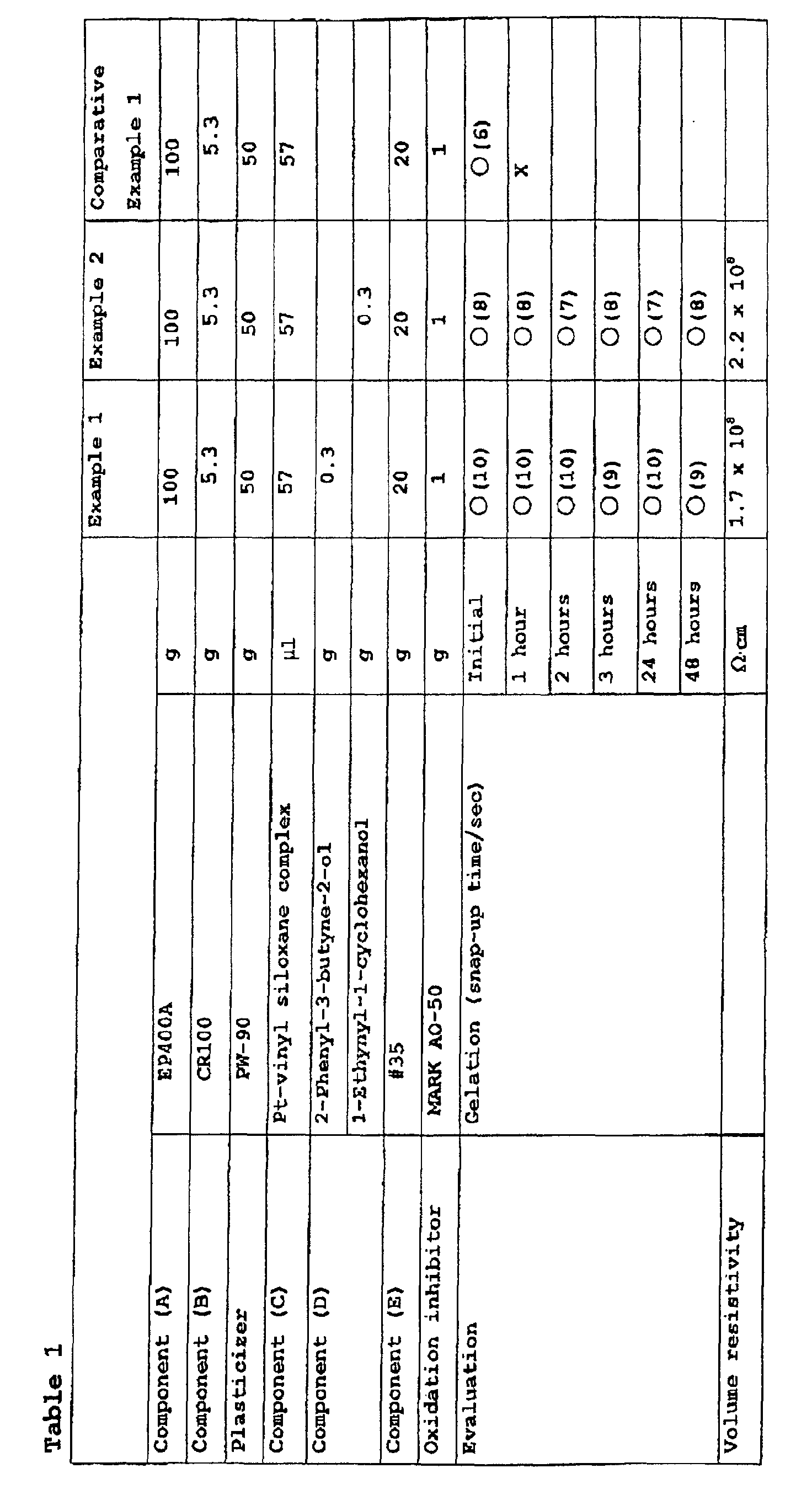
hardenable composition thus obtained was then stored in a 50°C
oven. Those showing no gelation after several weeks of elapse
were evaluated as ○. Those showing even a slight gelation
after several weeks of elapse were evaluated as X. During the
same elapse of time, these compositions were measured for
snap-up time at a temperature of 150°C. The term "snap-up time"
as used herein is meant to indicate the time required until
the composition thus incorporated can be visually judged
hardened at a predetermined temperature. In some detail,
snap-up time was determined by measuring the time required
until a small amount of the composition can be visually judged
hardened when stirred with a slender wood piece having a rounded
end on an aluminum plate heated over a hot plate the temperature
of which has been adjusted to 150°C. The formulation and
results of evaluation are set forth in Table 1.
The composition was heated to a temperature of 50°C for
5 hours to have a lowered viscosity, and then defoamed by a
vacuum-defoaming apparatus for 1 hour. The composition was
packed into an aluminum frame over which a teflon sheet was
spread, and then heated to a temperature of 150°C in a hot air
drier for 30 minutes to obtain to obtain a sheet-like hardened
product having a thickness of 2 mm. The sheet-like hardened
product thus obtained was then measured for volume resistivity
at a temperature of 23°C and a humidity of 65 ± 5%. The
measurements are set forth in Table 1.
(Example 2)
The procedure and evaluation of Example 1 was followed
except that the component (D) was changed to 1-ethynyl-1-cyclohexanol.
The formulation and results of evaluation are
set forth in Table 1.
(Comparative Example 1)
The procedure and evaluation of Example 1 was followed
except that the component (D) was not added. The formulation
and results of evaluation are set forth in Table 1. In an
attempt to form the composition into a sheet, the composition
was heated to a temperature of 50°C. As a result, the
composition partly underwent gelation. Thus, no sheet was
obtained.
Carbon black (#35, produced by Asahi Carbon Co., Ltd.)
as component (E) and MARK AO-50 (produced by ASAHI DENKA KOGYO
K.K.) as an oxidation inhibitor were mixed with EP400A
(produced by KANEKA CORPORATION) as component (A) in an amount
of 15 g and 1 g based on 100 g of EP400A, respectively. The
mixture was then kneaded over a roller three times. To the
mixture was then added 5.3 g of CR100 (produced by KANEKA
CORPORATION) as component (B).
Bis(1,3-divinyl-1,1,3,3-tetramethyldisiloxane) -
platinum complex catalyst (17.9 x 10⁻⁵ mmol/µl, xylene
solution) as component (C) was measured out in an amount of
57 µl. 2-Ethynyl-1-cyclohexanol was measured out in an amount
of 0.3 g. The two components were then uniformly mixed. The
composition thus obtained was heated to a temperature of 50°C
for 5 hours to have a lowered viscosity, and then defoamed by
a vacuum-defoaming apparatus for 1 hour. The compound was then
measured for viscosity at 23°C, 50°C and 70°C. As a result,
the viscosity of the compound was 2,700 Pa·s, 300 Pa·s and 90
Pa·s, respectively.
As can be seen in these results, heating caused a drastic
drop of viscosity. These results substantiate that heating
can enhance productivity and processability.
(Example 4)
A plasticizer PW-90 (produced by Idemitsu Kosan Co.,
Ltd.), carbon black (#35, produced by Asahi Carbon Co., Ltd.)
as component (E) and MARK AO-50 (produced by ASAHI DENKA KOGYO
K.K.) as an oxidation inhibitor were mixed with EP400A
(produced by KANEKA CORPORATION) as component (A) in an amount
of 100 g, 40 g and 2 g based on 200 g of EP400A, respectively.
The mixture was then kneaded over a roller three times. The
mixture thus obtained was then measured out in 170 g each in
two PP containers. In one of the two containers, bis(1,3-divinyl-1,1,3,3-tetramethyldisiloxane)
-platinum complex
catalyst (17.9 x 10⁻⁵ mmol/µl, xylene solution) as component
(C) and 1-ethynyl-1-cyclohexanol as component (D) were
measured out in an amount of 110 µl and 0.3 g, respectively.
These components were then uniformly mixed (to form a
composition (I)). In the other container, CR100 (produced by
KANEKA CORPORATION) as component (B) and 1-ethynyl-1-cyclohexanol
as component (D) were measured out in an amount
of 11 g and 0.3 g, respectively. These components were then
uniformly mixed (to form a composition (II)). The composition
in these containers were each subjected to defoamation in a
vacuum agitated defoaming apparatus for 5 hours. The
hardenable compositions thus obtained were each allowed to
stand in a 50°C oven. At each elapsed time, the compositions
(I) and (II) were each measured out in an amount of 5 g, and
then mixed. These compositions were each then measured for
snap-up time at a temperature of 150°C. Those compositions
showing no gelation at each elapsed time were evaluated as ○.
Those compositions showing even a slight gelation at each
elapsed time were evaluated as X. The results of evaluation
are set forth in Table 2.
(Comparative Example 2)
The compositions (I) and (II) were mixed in the same
manner as in Example 4 except that the component (D) was not
added. The composition was then evaluated for various
properties. The results are set forth in Table 2.
As can be seen in the results set forth in Table 3, the
two-part liquid composition ( (I) and (II)) can be improved in
its storage stability.
A plasticizer PW-380 (produced by Idemitsu Kosan Co.,
Ltd.) , carbon black (#35, produced by Asahi Carbon Co., Ltd.)
as component (E) and MARK AO-50 (produced by ASAHI DENKA KOGYO
K.K.) as an oxidation inhibitor were mixed with EP400A
(produced by KANEKA CORPORATION) as component (A) in an amount
of 150 g, 60 g and 3 g based on 300 g of EP400A, respectively.
The mixture was then kneaded over a roller three times.
Subsequently, to the mixture was added 16 g of CR100 (produced
by KANEKA CORPORATION) as component (B). Bis(1,3-divinyl-1,1,3,3-tetramethyldisiloxane)-platinum
complex catalyst
(17.9 x 10⁻⁵ mmol/µl, xylene solution) as component (C) was
measured out in an amount of 170 µl. 1-Ethynyl-1-cyclohexanol
was measured out in an amount of 0.9 g. These components were
then uniformly mixed. The composition was heated to a
temperature of 50°C, and then subjected to defoaming in a vacuum
agitated defoaming apparatus for 5 hours. The
electrically-conductive composition was injected into a
roller-forming mold at an injection pressure of 1 MPa to prepare
five electrically-conductive rollers having an
electrically-conductive rubber layer having a thickness of 3
mm and a length of 230 mm provided around an SUS shaft having
a diameter of 8 mm. (The hardening temperature during
formation was 150°C.) During this procedure, the viscosity of
the composition used and the time required until the
composition is injected into the mold were measured (the
temperature of the composition during the injection into the
mold was 50°C). The rollers thus obtained were each measured
for hardness (JIS A) and roller resistivity according to JIS
K6301A at a temperature of 23°C and a humidity of 65%. The
electrically-conductive rollers thus prepared were evaluated
also for external appearance. For the measurement of mold
injection time, roller hardness and roller resistivity, the
values obtained for the five rollers were averaged. As an
index of the degree of variation of roller resistivity among
the individual rollers, the ratio of minimum roller resistivity
to maximum roller resistivity in the five rollers thus prepared
was represented in terms of logarithm. The results are set
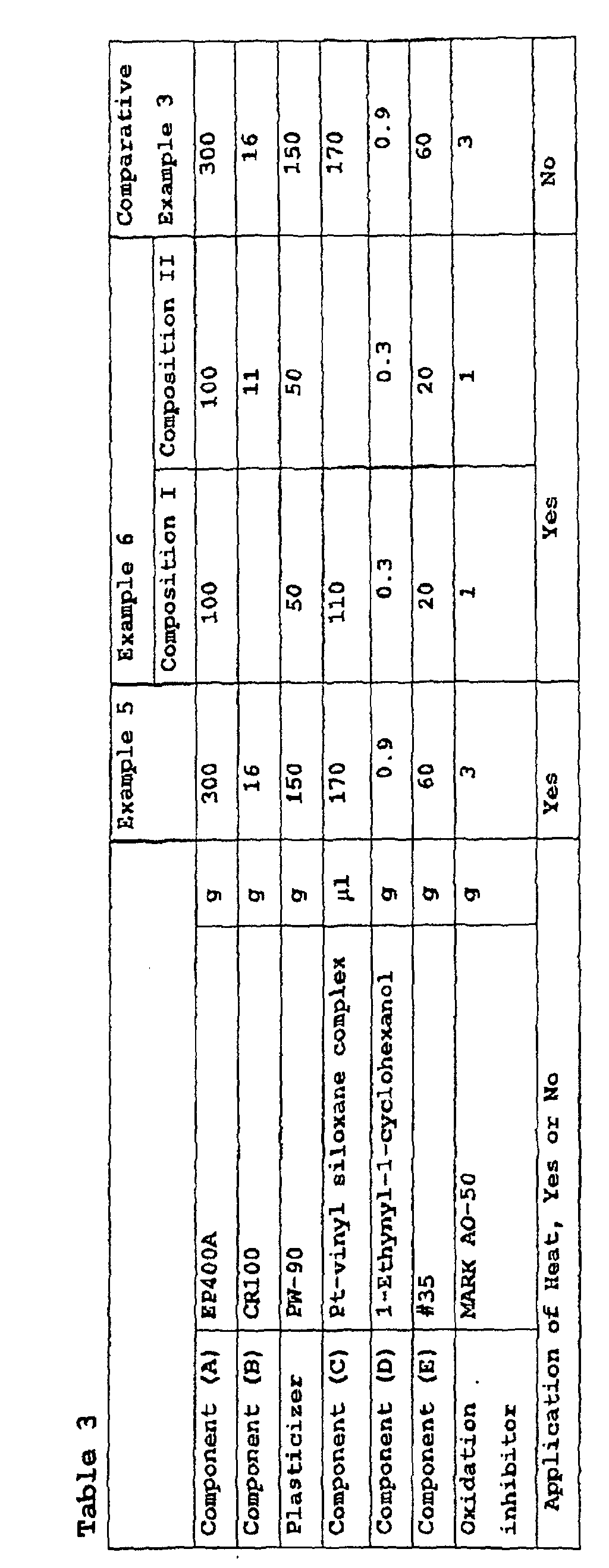
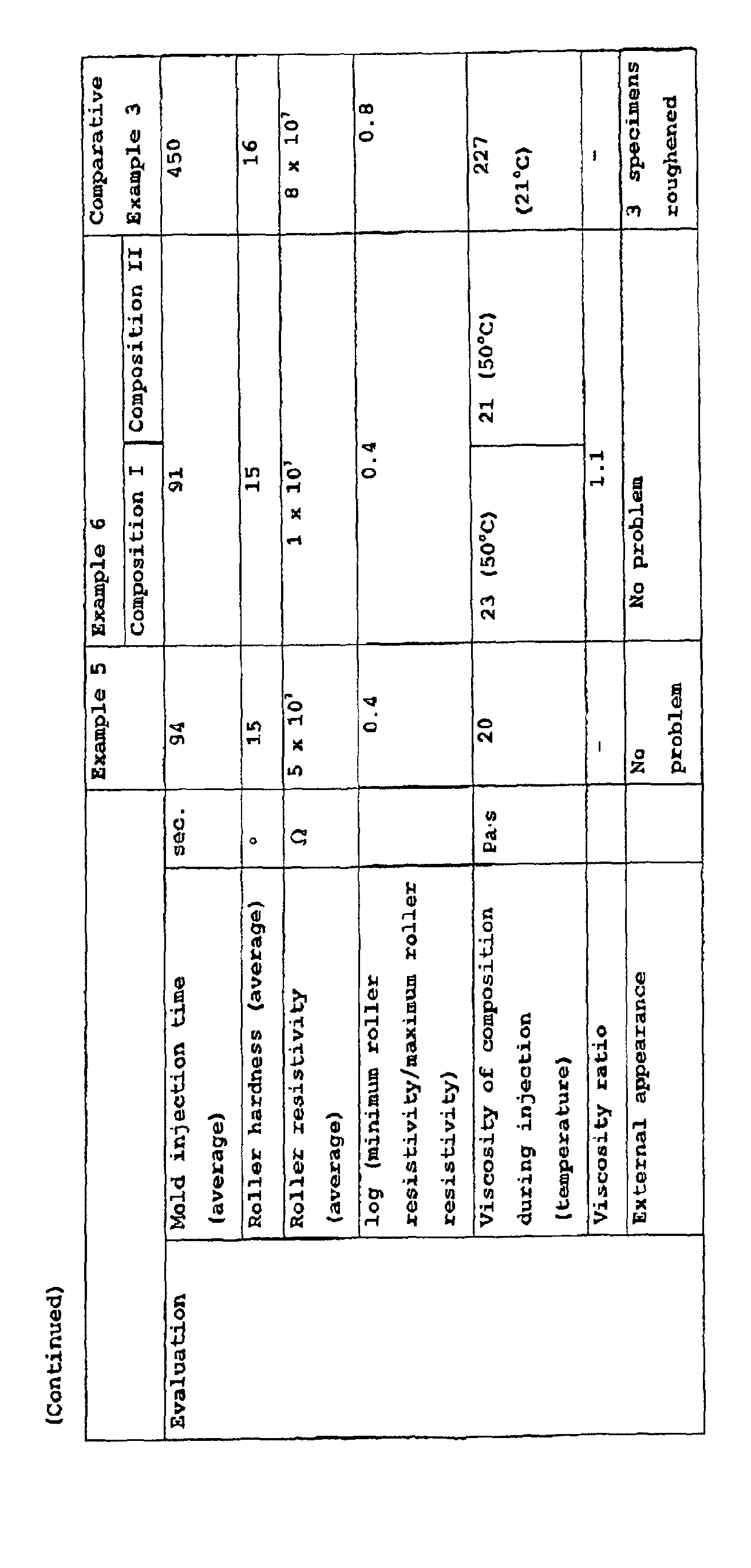
forth in Table 3.
(Example 6)
A plasticizer PW-380 (produced by Idemitsu Kosan Co.,
Ltd.), carbon black (#35, produced by Asahi Carbon Co., Ltd.)
as component (E) and MARK AO-50 (produced by ASAHI DENKA KOGYO
K.K.) as an oxidation inhibitor were mixed with EP400A
(produced by KANEKA CORPORATION) as component (A) in an amount
of 150 g, 60 g and 3 g based on 300 g of EP400A, respectively.
The mixture was then kneaded over a roller three times. The
mixture thus obtained was then measured out in an amount of
170 g each in two pail cans. In one of the two pail cans,
bis(1,3-divinyl-1,1,3,3-tetramethyldisiloxane)-platinum
complex catalyst (17.9 x 10⁻⁵ mmol/µl, xylene solution) as
component (C) and 1-ethynyl-1-cyclohexanol as component (D)
were measured out in an amount of 110 µl and 0.3 g, respectively.
These components were then uniformly mixed (to form a
composition (I)). In the other pail can, CR100 (produced by
KANEKA CORPORATION) as component (B) and 1-ethynyl-1-cyclohexanol
as component (D) were measured out in an amount
of 11 g and 0.3 g, respectively. These components were then
uniformly mixed (to form a composition (II)). The composition
in these containers were each heated in a 50°C oven for about
1 hour, and then subjected to defoamation in a vacuum agitated
defoaming apparatus for 5 hours. The two liquid compositions
were again heated in a 50°C oven for 3 hours, and then injected
into a roller-forming mold at an injection pressure of 1 MPa
while being mixed at a ratio of 1 : 1 to prepare five
electrically-conductive rollers having an electrically-conductive
rubber layer having a thickness of 3 mm and a length
of 230 mm provided around an SUS shaft having a diameter of
8 mm. (The hardening temperature during formation was 150°C.)
The viscosity of the two liquid compositions was measured, and
the time required until the compositions were injected into
the mold was measured (The temperature of the composition
during injection into the mold was 50°C). The rollers thus
obtained were each measured for hardness (JIS A) and roller
resistivity according to JIS K6301A at a temperature of 23°C
and a humidity of 65%. The electrically-conductive rollers
thus prepared were evaluated also for external appearance.
For the measurement of mold injection time, roller hardness
and roller resistivity, the values obtained for the five
rollers were averaged. As an index of the degree of variation
of roller resistivity among the individual rollers, the ratio
of minimum roller resistivity to maximum roller resistivity
in the five rollers thus prepared was represented in terms of
logarithm. The results are set forth in Table 3.
(Comparative Example 3)
A composition was prepared in the same method as
mentioned in Example 5. The composition was then formed into
a roller in the same manner as in Example 5 except that the
composition was not heated. The roller was then evaluated for
viscosity of composition, mold injection time, hardness,
roller resistivity, external appearance, etc. in the same
manner as in Example 5. However, the temperature of the
composition during injection into the mold was 21°C. The
results are set forth in Table 3.
As can be seen in Table 3, heating in the formation of
roller allows enhancement of productivity and processability
and reduction of risk of occurrence of poor external appearance.
It was also made obvious that the use of the molding process
with a two-part liquid composition provides a good
producibility and gives no difference in variation of roller
resistivity from the one-part liquid process, making it
possible to obtain rollers having no variation of electrical
conductivity.
The electrically-conductive roller prepared in Example
6 was subjected to environmental test. In some detail, the
electrically-conductive roller which had been allowed to stand
at a temperature of 35°C and a humidity of 85% for 7 days was
measured for roller resistivity. Subsequently, the
electrically-conductive roller which had been allowed to stand
at a temperature of 10°C and a humidity of 15% for 7 days was
measured for roller resistivity. As a result, the ratio of
roller resistivity under the various environments was
represented in terms of logarithm. The results are set forth
in Table 4.
(Comparative Example 4)
To 150 g of a polyester polyol (Kurapole P-2010, produced
by KURARAY CO., LTD.) was added 50 g of carbon black (#35,
produced by Asahi Carbon Co., Ltd.) as an electrical
conductivity-providing material. The mixture was then
kneaded over a roll three times. Subsequently, to the mixture
was added 60 g of Colonate HX (produced by Nippon Polyurethane
Industry Co., Ltd.). The mixture was then thoroughly stirred.
The composition thus obtained was injected into a roller-forming
mold, and then heated to a temperature of 130°C for
2 hours to prepare an electrically-conductive roller having
an electrically-conductive rubber layer having a thickness of
3 mm and a length of 230 mm provided around an SUS shaft having
a diameter of 8 mm. The electrically-conductive roller thus
obtained was then measured for roller resistivity under various
environments similarly to Example 7. The results are set forth
in Table 4.
| | Example 7 | Comparative Example 4 |
| Roller resistivity | Temperature 35°C/humidity 85% (HH environment) | Ω | 3 x 10⁷ | 5 x 10⁷ |
| Temperature 35°C/humidity 85% (HH environment) | Ω | 6 x 10⁷ | 4 x 10⁸ |
| Environmental change | log (roller resistivity (LL)/roller resistivity (HH)) | | 0.3 | 0.9 |
As can be seen in Table 4, the use of a composition mainly
composed of an isobutylene polymer as an electrically-conductive
roller material makes it possible to obtain a roller
having electrical properties stable to environment.
Industrial Applicability
In accordance with the present invention, the addition
of a compound containing an aliphatically unsaturated bond as
a storage stability improver to a hydrosilylating addition
reaction type hardenable electrically-conductive composition
comprising at least one alkenyl group-containing isobutylene
polymer which can undergo hydrosilylation reaction per
molecule and an electrical conductivity-providing material
makes it possible to obtain an electrically-conductive
composition having an excellent storage stability at high
temperatures.
In accordance with the present invention, an
electrically-conductive composition having an excellent
storage stability at high temperatures can be provided to
enable handling at high temperatures, making it possible to
handle as an electrically-conductive composition having a
relatively low viscosity without using a large amount of
diluent or the like. Further, the use of the composition of
the invention makes it possible to attain the enhancement of
productivity and processability of electrically-conductive
roller and the stabilization of excellent electrical
properties against environmental change.