EP1197509A1 - Process for producing hydrogenated ring-opening polymerization polymer of cycloolefin - Google Patents
Process for producing hydrogenated ring-opening polymerization polymer of cycloolefin Download PDFInfo
- Publication number
- EP1197509A1 EP1197509A1 EP00931629A EP00931629A EP1197509A1 EP 1197509 A1 EP1197509 A1 EP 1197509A1 EP 00931629 A EP00931629 A EP 00931629A EP 00931629 A EP00931629 A EP 00931629A EP 1197509 A1 EP1197509 A1 EP 1197509A1
- Authority
- EP
- European Patent Office
- Prior art keywords
- polymerization
- catalyst
- ring
- hydrogenation
- polymer
- Prior art date
- Legal status (The legal status is an assumption and is not a legal conclusion. Google has not performed a legal analysis and makes no representation as to the accuracy of the status listed.)
- Granted
Links
Classifications
-
- C—CHEMISTRY; METALLURGY
- C08—ORGANIC MACROMOLECULAR COMPOUNDS; THEIR PREPARATION OR CHEMICAL WORKING-UP; COMPOSITIONS BASED THEREON
- C08G—MACROMOLECULAR COMPOUNDS OBTAINED OTHERWISE THAN BY REACTIONS ONLY INVOLVING UNSATURATED CARBON-TO-CARBON BONDS
- C08G61/00—Macromolecular compounds obtained by reactions forming a carbon-to-carbon link in the main chain of the macromolecule
- C08G61/02—Macromolecular compounds containing only carbon atoms in the main chain of the macromolecule, e.g. polyxylylenes
- C08G61/04—Macromolecular compounds containing only carbon atoms in the main chain of the macromolecule, e.g. polyxylylenes only aliphatic carbon atoms
- C08G61/06—Macromolecular compounds containing only carbon atoms in the main chain of the macromolecule, e.g. polyxylylenes only aliphatic carbon atoms prepared by ring-opening of carbocyclic compounds
- C08G61/08—Macromolecular compounds containing only carbon atoms in the main chain of the macromolecule, e.g. polyxylylenes only aliphatic carbon atoms prepared by ring-opening of carbocyclic compounds of carbocyclic compounds containing one or more carbon-to-carbon double bonds in the ring
Definitions
- This invention relates to a process for producing a hydrogenated product of a cyclic olefin polymer prepared through ring-opening polymerization, with enhanced efficiency.
- a process for polymerizing a cyclic olefin by using a polymerization catalyst comprising a tungsten compound, a molybdenum compound, a ruthenium compound or an osmium compound has hitherto been well known.
- the polymer produced through ring-opening polymerization according to this process has poor heat-stability because of the presence of double bonds in the backbone chain.
- a process for hydrogenating a polymer prepared through ring-opening polymerization has been proposed.
- JP-A Japanese Unexamined Patent Publication
- JP-A H10-195182 a process has been reported wherein a cyclic olefin is polymerized through ring-opening polymerization using a catalyst comprising ruthenium-carbene compound, then a modifier such as ethyl vinyl ether is added to modify the catalyst, and then the as-produced polymer is hydrogenated in the presence of the modified catalyst.
- This process is advantageous in that the polymerization step and the hydrogenation step can be consecutively carried out.
- the present inventors have found that hydrogenation reaction does not proceed often to the desired extent in this process.
- the above-mentioned catalyst is a homogeneous catalyst and thus the separation and removal thereof from the polymerization system is troublesome.
- An object of the present invention is to provide an industrially advantageous process for producing a hydrogenation product of a cyclic olefin polymer prepared through ring-opening polymerization, wherein the hydrogenation reaction can be carried out subsequent to polymerization without separation and removal of a polymerization catalyst from the polymerization system, and the amount of a hydrogenation catalyst can be small.
- the present inventors have made extensive research, and found that, in the case where a cyclic olefin is polymerized through ring opening polymerization using an organoruthenium compound or an organoosmium compound as a polymerization catalyst, and then the obtained polymer is hydrogenated, if a hydrogenation catalyst and hydrogen are added in the polymerization system as-obtained by polymerization, the hydrogenation takes place efficiently to give a hydrogenation product with a high yield; and further found that, when a heterogeneous catalyst supported on a carrier is used as the hydrogenation catalyst added after completion of polymerization, the polymerization catalyst can be easily removed.
- a process for producing a hydrogenated product of a polymer prepared through ring-opening polymerization which comprises:
- a process for producing a polymer through ring-opening polymerization characterized in that a cyclic olefin is polymerized through ring-opening polymerization using a polymerization catalyst comprising an organoruthenium compound or an organoosmium compound, and a heteroatom-containing carbene compound in the absence of a solvent or in the presence of a halogen-free solvent.
- the cyclic olefin used in the present invention is chosen from (1) polycyclic olefins having a norbornene ring such as norbornenes, dicyclopentadienes and tetracyclododecenes, and (2) monocyclic olefins and monocyclic diolefins. These olefins may have a substituent such as an alkyl, alkenyl or alkylidene group, or may have a polar group, and further may have a double bond other than the double bonds of the norbornene ring.
- cyclic olefins having three rings through six rings which include a norbornene ring, are preferable.
- Cyclic olefins with three rings such as dicyclopentadienes, and cyclic olefins with four rings such as tetracyclododecenes are especially preferable.
- dicyclopentadienes used herein is meant cyclic olefins having three rings including a norbornene ring.
- the dicyclopentadienes may have a substituent such as an alkyl, alkenyl or alkylidene group.
- dicyclopentadienes there can be mentioned dicyclopentadiene and methyl-dicyclopentadiene.
- tricyclo[4.3.1 2,5 .0]-deca-3-ene also is included, which has a structure such that the double bonds in the five-membered ring of dicyclopentadiene are saturated.
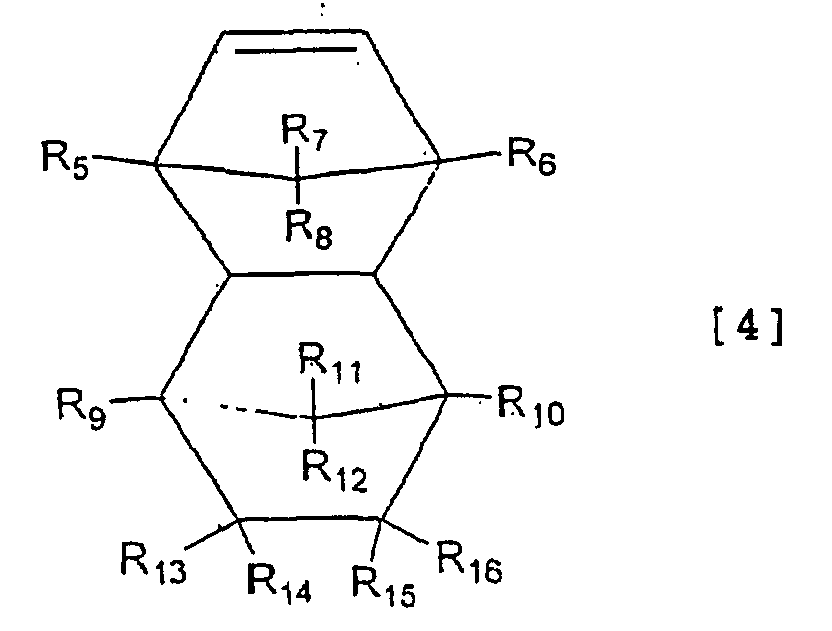
- Tetracyclododecenes are represented by the following formula [4]: wherein R 5 through R 12 represent a hydrocarbon group having 1 to 3 carbon atoms or a halogen atom, R 13 through R 16 represent a hydrogen atom, a hydrocarbon group having 1 to 20 carbon atoms or a substituent having a halogen, silicon, oxygen or nitrogen atom, and R 13 and R 16 may form together a ring.
- Tetracyclododecenes include four types of monomers: (a) monomers having no double bond except for the double bond of the norbornene ring, (b) monomers having a double bond in addition to the double bond of the norbornene ring, (c) monomers having an aromatic ring, and (d) monomers having a polar group.
- cyclic olefins having a norbornene ring other than the above-recited cyclic olefins with a norbornene ring can also be used.
- Said other cyclic olefins having a norbornene ring include, for example, those which have no ring other than a norbornene ring.
- norbornenes such as norbornene, 5-methylnorbornene, 5-ethylnorbornene, 5-butylnorbornene, 5-hexylnorbornene, 5-decylnorbornene, 5-cyclohexylnorbornene and 5-cyclopentyl-norbornene; oxanorbornenes such as 5-methyloxanorbornene, 5-ethyloxanorbornene, 5-butyloxanorbornene, 5-hexyloxanorbornene, 5-decyloxanorbornene, 5-cyclohexyloxanorbornene and 5-cyclopentyloxanorbornene; norbornenes having a double bond in addition to the double bond within the ring, such as 5-ethylidenenor
- the other cyclic olefins having a norbornene ring further include, for example, those which have a norbornene ring and a six membered ring structure.
- hexacycloheptadecenes such as hexacycloheptadecene, 12-methylhexacycloheptadecene, 12-ethylhexacycloheptadecene, 12-butylhexacycloheptadecene, 12-hexylhexacycloheptadecene, 12-decylhexacycloheptadecene, 12-cyclohexylhexacycloheptadecene and 12-cyclopentyl-hexacycloheptadecene; and hexacycloheptadecenes such as 12-ethylidenehexacycloheptadecene,12-vinylhexacycl
- the other cyclic olefins having a norbornene ring further include, for example, those which have a norbornene ring and an aromatic ring.
- the other cyclic olefins having a norbornene ring further include, for example, those which have a polar group.
- norbornenes having an oxygen atom-containing polar group such as 5-methoxycarbonylnorbornene, 5-ethoxycarbonylnorbornene, 5-methyl-5-methoxycarbonylnorbornene, 5-methyl-5-ethoxycarbonylnorbornene, norbornenyl-2-methyl propionate, norbornenyl-2-methyl octanoate, norbornene-5,6-dicarboxylic anhydride, 5-hydroxymethylnorbornene, 5,6-di(hydroxymethyl)norbornene, 5,5-di(hydroxymethyl)norbornene, 5-hydroxy-isopropylnorbornene, 5,6-dicarboxynorbornene and 5-methoxycarbonyl-6-carboxynorbornene; oxanorbornenes having an oxygen atom-containing
- cyclic olefins having a norbornene ring and an aromatic ring are polymerized alone or copolymerized with the above-mentioned cyclopentadiene or tetracyclododecene.
- a tetrahydrofluorene such as 4-methano-1,4,4a,9a-tetrahydrofluorene can be copolymerized with the above-mentioned cyclopentadiene or tetracyclododecene.
- Monocyclic olefins and monocyclic diolefins include cyclic olefins and cyclic diolefins, which have 4 to 20 carbon atoms, preferably 4 to 10 carbon atoms, and derivatives of these cyclic olefins and cyclic diolefins.
- monocyclic olefins and the monocyclic diolefins there can be mentioned monocyclic olefins described in JP-A S64-66216, such as cyclobutene, cyclopentene, methylcyclopentene, cyclohexene, methylcyclohexene, cycloheptene and cyclooctene; and cyclic diolefins described in JP-A H7-258318, such as cyclohexadiene, methylcyclohexadiene, cyclooctadiene, methylcyclooctadiene and phenylcyclooctadiene.
- monocyclic olefins described in JP-A S64-66216 such as cyclobutene, cyclopentene, methylcyclopentene, cyclohexene, methylcyclohexene, cycloheptene and cyclooctene
- the cyclic olefins may be used either alone or as a combination of at least two thereof.
- the copolymerization ratio is not particularly limited provided that the dicyclopentadiene or the cyclotetradodecene is contained in an amount of 1% to 100% by weight based on the total weight of the monomers.
- a dicyclopentadiene or a cyclotetradodecene is used preferably in a larger amount, more specifically, in an amount in the range of 10% to 100% by weight, and more preferably 20% to 100% by weight.
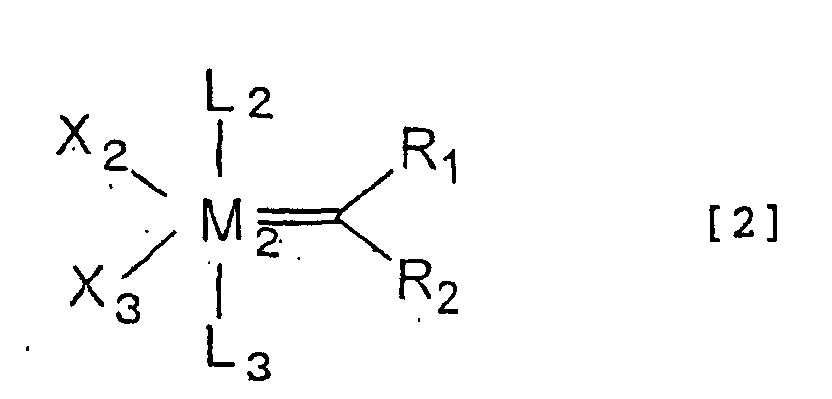
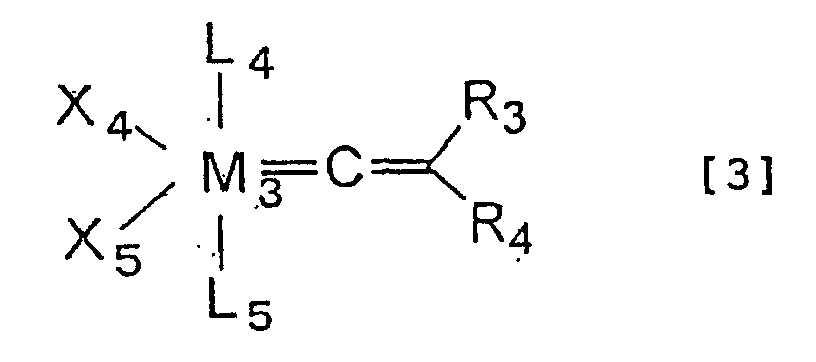
- An organoruthenium compound and an organoosmium compound, contained in a polymerization catalyst used in the present invention are a ruthenium compound and an osmium compound, respectively, which have an organic compound as a ligand, and include, for example, compounds represented by the following formulae [1], [2] and [3].
- M 1 represents a ruthenium atom or an osmium atom
- X 1 independently represents an optional anionic ligand
- L 1 independently represents an optional neutral electron donor compound
- a plurality of X 1 and L 1 may bond together to form a multidentate ligand
- m is an integer of 0 to 4
- n and z are integers of 1 to 4.
- M 2 represents a ruthenium atom or an osmium atom
- R 1 and R 2 independently represents a hydrogen atom, a halogen atom, or a hydrocarbon group having 1 to 20 carbon atoms which may contain at least one atom selected from halogen, oxygen, nitrogen, sulfur, phosphorus and silicon atoms
- X 2 and X 3 independently represents an optional anionic ligand
- L 2 and L 3 independently represents an optional neutral electron donor compound
- a plurality of R 1 , R 2 , X 2 , X 3 , L 2 and L 3 may bond together to form a multidentate ligand.
- M 3 represents a ruthenium atom or an osmium atom
- R 3 and R 4 independently represents a hydrogen atom, a halogen atom, or a hydrocarbon group having 1 to 20 carbon atoms and having at least one atom selected from halogen, oxygen, nitrogen, sulfur, phosphorus and silicon atoms
- X 4 and X 5 independently represents an optional anionic ligand
- L 4 and L 5 independently represents an optional neutral electron donor compound
- a plurality of R 3 , R 4 , X 4 , X 5 , L 4 and L 5 may bond together to form a multidentate ligand.
- the anionic ligand is not particularly limited provided that it is a ligand having a negative charge when it is kept apart from the central metal.
- the neutral electron donor compound is not particularly limited provided that it is a ligand having a neutral charge when it is kept apart from the central metal, i.e., a Lewis base.
- halogen atoms such as F, Br, Cl and I
- a hydrogen atom a hydrogen atom, and acetylacetonate, diketonate, cyclopentadienyl, allyl, alkenyl, alkyl., aryl, alkoxy, aryloxy, alkoxycarbonyl, arylcarboxyl, carboxyl, alkyl- or aryl-sulfonate, alkylthio, alkenylthio, arylthio, alkylsulfonyl and alkylsulfinyl groups.
- a halogen atom, a cyclopentadienyl group, an allyl group, an alkyl group and an aryl group are preferable in view of the high activity for polymerization.
- the neutral electron donor compound L 1 , L 2 , L 3 , L 4 and L 5 in formulae [1], [2] and [3] there can be mentioned oxygen, water, carbonyls, amines, pyridines, ethers, nitriles, esters, phosphines, phosphinites, phosphites, stibines, sulfoxides, thioethers, amides, aromatics, cyclic diolefins, olefins, isocyanides, thiocyanates and heteroatom-containing carbene compounds.
- pyridines, phosphines, aromatics, cyclic diolefins and heteroatom-containing carbene compounds are preferable in view of the high activity for polymerization.
- carbene compound as used herein is a generic name meaning compounds having a methylene compound, that is, compounds having a divalent carbon atom with no electrical charge such as that expressed by " > C :".
- a carbene compound is generally present as an unstable intermediate produced during a reaction.
- the carbene compound can be isolated as a relatively stable carbene compound.
- heteroatom as used herein is meant an atom selected from group 15 and group 16 of the periodic table.
- the heteroatom there can be mentioned N, O, P, S, As and Se atoms. Of these, N, O, P and S are preferable for provision of stable carbene compounds. N and P are especially preferable.
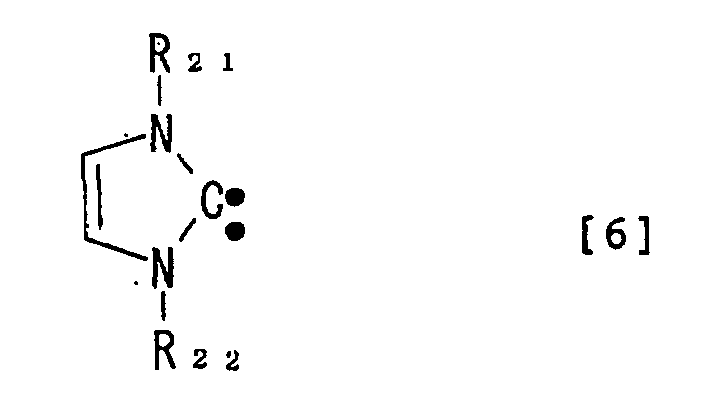
- the heteroatom-containing compound includes, for example, compounds represented by the following formulae [5] and [6]. wherein R 21 and R 22 each independently represents a hydrogen atom, or a hydrocarbon group having 1 to 20 carbon atoms which may contain at least one atom selected from halogen, oxygen, nitrogen, sulfur, phosphorus and silicon.
- heteroatom-containing carbene compound of formula [5] there can be mentioned 1,3-diisopropylimidazolidin-2-ylidene, 1,3-dicyclohexyl-imidazolidin-2-ylidene, 1,3-di(methylphenyl)imidazolidin-2-ylidene, 1,3-di(2,4,6-trimethyl)phenylimidazolidin-2-ylidene, 1,3-di(methylnaphthyl)imidazolidin-2-ylidene, 1,3-diadamantylimidazolidin-2-ylidene, 1,3-diphenylimidazolidin-2-ylidene and 1,3,4,5-tetramethylimidazolidin-2-ylidene.
- heteroatom-containing carbene compound of formula [6] there can be mentioned 1,3-diisopropyl-4-imidazolin-2-ylidene, 1,3-dicyclohexyl-4-imidazolin-2-ylidene, 1,3-di(methylphenyl) -4-imidazolin-2-ylidene, 1,3-di(2,4,6-trimethylphenyl)-4-imidazolin-2-ylidene, 1,3-di(methylnaphthyl)-4-imidazolin-2-ylidene, 1,3-diadamantyl-4-imidazolin-2-ylidene, 1,3-diphenyl-4-imidazolin-2-ylidene, 1,3,4,5-tetramethyl-4-imidazolin-2-ylidene and 1,3,4,5-tetraphenyl-4-imidazolin-2-ylidene.
- the heteroatom-containing carbene compound further includes, in addition to those represented by formulae [5] and [6], 1,3,4-triphenyl-2,3,4,5-tetrahydro-lH-1,2,4-triazol-5-ylidene, 3-(2,6-diisopropylphenyl)-2,3,4,5-tetrahydrothiazol-2-ylidene, 1,3-dicyclohexylhexahydropirymidin-2-ylidene, N,N,N',N'-tetraisopropylformamidinylidene, 1,3,4-triphenyl-4,5-dihydro-lH-1,2,4-triazol-5-ylidene and 3-(2,6-diisopropylphenyl)-2,3-dihydrothiazol-2-ylidene.
- heteroatom-containing compounds those in which an heteroatom adjacent to the carbene has a bulky substituent are especially preferable.
- Such preferable heteroatom-containing compounds include 1,3-diisopropylimidazolidin-2-ilidene, 1,3-dicyclohexylimidazolidin-2-ilidene, 1,3-di(methylphenyl)imidazolidin-2-ilidene, 1, 3-di(2,4,6-trimethylphenyl)imidazolidin-2-ilidene, 1,3-di(methylnaphthyl)imidazolidin-2-ilidene, 1,3-diadamantylimidazolidin-2-ilidene, 1,3-diphenylimidazolidin-2-ilidene, 1,3,4,5-tetraphenylimidazolidin-2-ilidene, 1,3-diisopropyl-4-imidazolin-2-ilidene, 1,3-
- R 1 , R 2 , R 3 and R 4 in formulae [2] and [3] there can be mentioned a hydrogen atom, and alkenyl, alkynyl, alkyl, aryl, carboxyl, alkoxy, alkenyloxy, alkinyloxy, aryloxy, alkoxycarbonyl, alkylthio, alkenylthio, arylthio, alkylsulfonyl and alkylsulfinyl groups.
- alkyl, aryl, alkoxy, aryloxy, alkylthio and arylthio groups are preferable in view of the high activity.
- polymerization catalysts of formula [1] include bis(cyclopentadienyl)ruthenium, chloro(cyclopentadienyl)-bis(triphenylphosphine)ruthenium, dichloro(1,5-cyclooctadiene)ruthenium, dichlorotris(triphenylphosphine)-ruthenium, cis-dichlorobis(2,2'-bipyridyl)ruthenium dihydrate, dichlorobis[(p-cymene)chlororuthenium)], dichloro(2,7-dimethylocta-2,6-dien-1,8-diyl)ruthenium, bis(cyclopentadienyl)osmium, dichloro(p-cymene)osmium, [1,3-diisopropylimidazolidin-2-ylidene](p-cymene)ruthenium dichloride, [1,3-didi
- Polymerization catalysts of formula [2] include ruthenium compounds having two heteroatom-containing carbene compounds coordinated thereto such as bis(tricyclohexylphosphine)-benzylideneruthenium dichloride, bis(triphenylphosphine)-3,3-diphenylpropenylideneruthenium dichloride, bis(1,3-diisopropylimidazolidin-2-ylidene)benzylideneruthenium dichloride, bis(1,3-dicyclohexylimidazolidin-2-ylidene)-benzylideneruthenium dichloride, bis(1,3-diisopropyl-4-imidazolin-2-ylidene)benzylideneruthenium dichloride and bis(1,3-dicyclohexyl-4-imidazolin-2-ylidene)-benzylideneruthenium dichloride; and ruthenium compounds having a heteroatom-containing carbene
- Polymerization catalysts of formula [3] include ruthenium compounds having two heteroatom-containing carbene compounds coordinated thereto such as bis(tricyclohexylphosphine)-phenylvinylideneruthenium dichloride, bis(triphenylphosphine) t-butylvinylideneruthenium dichloride, bis(1,3-diisopropylimidazolidin-2-ylidene)phenylvinylideneruthenium dichloride, bis(1,3-dicyclohexylimidazolidin-2-ylidene)t-butylvinylideneruthenium dichloride, bis(1,3-diisopropyl-4-imidazolin-2-ylidene)phenylvinylideneruthenium dichloride and bis(1,3-dicyclohexyl-4-imidazolin-2-ylidene)t-butylvinylideneruthenium dichloride; and
- the polymerization catalyst used in the present invention is usually prepared from a ruthenium-containing compound or an osmium-containing compound, or by mixing a ruthenium-containing compound or an osmium-containing compound with a heteroatom-containing compound and/or a neutral electron donor compound. Generally the respective compounds are dissolved in solvents and the solutions are mixed together in a predetermined ratio. The mixing is usually carried out in an inert gas at room temperature, but, it can be carried out at a higher temperature. When a heteroatom-containing carbene compound having a poor stability is used, it is possible that a precursor thereof is mixed with the other ingredient and the resulting mixture is heated to convert the precursor to the objective carbene compound.
- the entire amounts of the ruthenium-containing compound or the osmium-containing compound, the heteroatom-containing carbene compound and/or the neural electron donor compound are not involved in the reaction for production of the compounds of formulae [1], [2] and/or [3], but, the resulting reaction mixture can be used as it is as a polymerization catalyst in the present invention.
- the ruthenium-containing compound or the osmium-containing compound, and the heteroatom-containing carbene compound and/or the neural electron donor compound can be separately introduced into a polymerization system to form a polymerization catalyst therein.
- a diazo compound, an acetylene compound or a silyl compound can be added in an amount of 1 to 100 times by weight of the ruthenium or osmium metal.
- the process of the present invention for producing a polymer through ring-opening polymerization of a cyclic olefin using a polymerization catalyst comprising an organoruthenium compound or an organoosmium compound, and a heteroatom-containing carbene compound is believed to be novel.
- This polymerization process can be effected with a very high polymerization activity.
- This beneficial process can be carried out the absence of a solvent, but, is preferably carried out in the presence of a halogen-free solvent.
- the amount of a polymerization catalyst relative to the amount of the cyclic olefin, as expressed by the ratio of ruthenium metal or osmium metal in the polymerization catalyst/cyclic olefin by mol/mol is usually in the range of 1/100 to 1/2,000,000 (mol/mol), preferably 1/500 to 1/1,000,000 (mol/mol) and more preferably 1/1,000 to 1/500,000 (mol/mol). If the amount of a polymerization catalyst is too large, the catalyst is difficult to remove. In contrast, if the amount of a polymerization catalyst is too small, the desired polymerization activity cannot be obtained.
- the concentration of a cyclic olefin in its solution is preferably in the range of 1 to 50% by weight, more preferably 2 to 45% by weight and especially preferably 5 to 40% by weight.
- the monomer concentration is smaller than 1% by weight, the productivity is poor.
- the monomer concentration is larger than 50%, the as-obtained polymer solution exhibits undesirably high viscosity and the succeeding hydrogenation becomes difficult.
- the ring-opening polymerization can be carried out in the absence of a solvent.
- the polymerization is preferably carried out in a solvent, and especially preferably in a halogen-free solvent.
- Halogen-containing solvents are not general-purpose and contaminate the environment, and thus, a halogen-free solvent is beneficial.
- the halogen-free solvent used is not particularly limited, provided that the polymer and the hydrogenated polymer are soluble therein under certain conditions and the solvent does not exert baneful influence on both of the polymerization and the hydrogenation. But, general-purpose solvents are preferable.
- aliphatic hydrocarbon solvents such as pentane, hexane and heptane
- alicyclic hydrocarbon solvents such as cyclopentane, cyclohexane, methylcyclohexane, dimethylcyclohexane, trimethylcyclohexane, ethylcyclohexane, diethylcyclohexane, decahydronaphthalene, bicycloheptane, tricyclodecane and cyclooctane
- aromatic hydrocarbon solvents such as benzene, toluene and xylene
- nitrogen-containing hydrocarbon solvents such as nitromethane, nitrobenzene and acetonitrile
- ether solvents such as diethyl ether and tetrahydrofuran.
- aliphatic hydrocarbon solvents aliphatic hydrocarbon solvents
- alicyclic hydrocarbon solvents such as cyclohexane are most preferable.
- the polymerization reaction is initiated by mixing the above-mentioned monomer with the polymerization catalyst.
- the polymerization temperature is not particularly limited, but, is usually in the range of -30°C to 200°C, preferably 0°C to 180°C.
- the polymerization time is usually in the range of 1 minute to 100 hours.
- a molecular weight modifier can be used.
- the molecular weight modifier there can be mentioned ⁇ -olefins such as 1-butene, 1-pentene, 1-hexene and 1-octene; styrene and its analogues such as vinyltoluene; ethers such as ethyl vinyl ether, isobutyl vinyl ether and allyl glycidyl ether; halogen-containing vinyl compounds such as allyl chloride; oxygen-containing vinyl compounds such as allyl acetate, allyl alcohol and glycidyl methacrylate; and nitrogen-containing vinyl compounds such as acrylamide.
- the amount of the molecular weight modifier can be appropriately chosen within the range of 0.1% to 10% by mole based on the cyclic olefin.
- vinyl compounds such as those recited above as examples of a molecular weight modifier can be added to liberate a ruthenium compound or an osmium compound from a terminal of the polymer chain, thereby enhancing the activity for hydrogenation.
- the resulting polymer has a number average molecular weight (Mn) of 1,000 to 500,000, more preferably 5,000 to 200,000, as measured by gel permeation chromatography and expressed in terms of that of polystyrene.
- a hydrogenation catalyst and hydrogen are added to a polymerization system resulting from the ring-opening polymerization step to hydrogenate the carbon-carbon double bonds in the polymer prepared through the ring-opening polymerization.
- the hydrogenation catalyst used is not particularly limited, provided that it is capable of being generally used for hydrogenation of olefins and aromatic compounds.
- a metal catalyst supported on a carrier including those which comprise a transition metal such as palladium, platinum, nickel, rhodium or ruthenium supported on a carrier such as carbon, alumina, silica or diatomaceous earth, (2) a homogeneous catalyst comprising an organic transition metal compound such as those containing titanium, cobalt or nickel as the transition metal, and an organometallic compound such as those containing lithium, magnesium, aluminum or tin, and (3) a metal complex catalyst such as those containing rhodium or ruthenium.
- metal/carrier combinations such as nickel/silica, nickel/diatomaceous earth, nickel/alumina, palladium/carbon, palladium/silica, palladium/diatomaceous earth, palladium/alumina, platinum/silica, platinum/alumina, rhodium/silica, rhodium/alumina, ruthenium/silica and ruthenium/alumina.
- organic transition metal compound/organometallic compound combinations such as cobalt acetate/triethylaluminum, nickel acetylacetonate/triisobutylaluminum, titanocene dichloride/n-butyllthium, zirconocene dichloride/sec.-butyllithium and tetrabutoxy titanate/dimethylmagnesium.
- metal complex catalyst (3) there can be mentioned dihydridotetra(triphenylphosphine)-ruthenium, dihydrido(acetonitrile)tris(triphenylphosphine)-ruthenium and dihydrido(tetrahydrofuran)tris-(triphenylphosphine)ruthenium.
- the metal catalyst supported on a carrier (1) is beneficial in that it is capable of adsorbing an organoruthenium compound or an organoosmium compound, used as a polymerization catalyst, and therefore, when the hydrogenation catalyst is separated and recovered by filtration after completion of hydrogenation, the polymerization catalyst can be recovered together with the hydrogenation catalyst.
- the time at which the hydrogenation catalyst is added to a polymerization system is not particularly limited provided that the catalyst is added after the ring-opening polymerization.
- the catalyst can be added at any time of before, at the same time or after the commencement of hydrogen addition. Even when the hydrogenation catalyst is added after the commencement of hydrogen addition, it is possible that the hydrogenation proceeds to a slight extent due to the polymerization catalyst before the addition of the hydrogenation catalyst.
- Hydrogenation temperature is usually in the range of -20°C to 250°C, preferably -10°C to 220°C and more preferably 0°C to 200°C.
- Hydrogen pressure is usually in the range of 0.1 to 100 kg/cm 2 , preferably 0.5 to 70 kg/cm 2 and more preferably 1 to 50 kg/cm 2 .
- the rate of hydrogenation reaction is low.
- side reactions occur.
- the rate of hydrogenation reaction is low.
- a too high pressure a high pressure reactor must be used.
- the hydrogenation is carried out in an inert organic solvent.
- the organic solvent can be appropriately chosen depending upon solubility of the hydrogenation product.
- aromatic hydrocarbons such as benzene and toluene
- aliphatic hydrocarbons such as n-pentane and n-hexane
- alicyclic hydrocarbons such as cyclohexane and decalin
- ethers such as tetrahydrofuran and ethylene glycol dimethyl ether.
- hydrocarbons and ethers are preferable in view of high capability of dissolving the hydrogenation product therein.
- the hydrocarbon solvents alicyclic hydrocarbon solvents are especially preferable.
- the organic solvent may be the same as that used for polymerization. That is, the hydrogenation can be carried out by adding a hydrogenation catalyst to the as-produced organic solvent-containing polymerization system.
- Hydrogenation time is usually in the range of 0.1 to 10 hours, during which at least 70%, preferably at least 90% and more preferably at least 95% of the carbon-carbon double bonds in the backbone chain of polymer can be hydrogenated.
- the polymerization catalyst and the hydrogenation catalyst are removed from the hydrogenation reaction solution by the following process.
- the metal catalyst supported on a carrier (1) can be removed by filtration.
- the polymerization catalyst and the homogeneous catalyst (2) and the metal complex catalyst (3) such as those containing rhodium or ruthenium can be removed by a knwon process including a process using an adsorbent for adsorptive removal, and a process for washing with water or a lower alcohol in the presence of an organic acid and/or inorganic acid.
- the process using an adsorbent for adsorptive removal employed when the hydrogenation is conducted by using the catalyst (2) or (3) has a problem such that a large amount of an adsorbent is usually necessary, and the process for washing has a problem such that the washing must be repeated several times.
- the process using the metal catalyst supported on a carrier (1) is especially beneficial in that, as a polymerization catalyst is adsorbed by a small amount of a hydrogenation catalyst, the polymerization catalyst and the hydrogenation catalyst can be removed at the same time merely by filtration.
- the hydrogenated polymer product has a number average molecular weight such that the lower limit is preferably 5,000, more preferably 7,000 and especially preferably 10,000 and the upper limit is preferably 1,000,000, more preferably 500,000 and especially preferably 200,000. If the number average molecular weight is too small, the mechanical properties are poor. In contrast, if the number average molecular weight is too large, it becomes difficult to produce.
- the catalyst solution was added into the above-mentioned autoclave and polymerization was carried out at 60°C for 1 hour. Then, 2.76 parts of ethyl vinyl ether was added to terminate the polymerization. The molecular weight of the obtained polymer was measured by GPC. The polymer had a number average molecular weight (Mn) of 12,500 and a weight average molecular weight (Mw) of 29,500, as expressed in terms of that of polystyrene.
- reaction liquid wad filtered by a filter to remove anhydrous magnesium sulfate to obtain a colorless transparent polymer solution.
- Analysis of the polymer solution for determining the content of metal elements derived from the polymerization catalyst and the hydrogenation catalyst revealed that the contents of Ru and Ni in the polymer solution were 2 ppm and 5 ppm, respectively.
- the polymer solution was poured in a large amount of isopropanol to precipitate a polymer.
- the polymer was collected by filtration, washed, and dried under reduced pressure at 80°C for 40 hours.
- a hydrogenation product of polymer prepared through ring-opening polymerization was obtained in a yield of 29.0 parts.
- the product had a number average molecular weight (Mn) of 14,300 and a weight average molecular weight (Mw) of 32,200, as expressed in terms of that of polyisoprene.
- the hydrogenation percentage was 90%.
- Example 2 The polymerization procedures as described in Example 1 were repeated wherein 15.0 parts of tetracyclododecene and 15.0 parts of norbornene were used as cyclic olefins, 0.17 part of 1-hexene was used as a molecular weight modifier, and a solution prepared by dissolving 0.059 part of bis(1,3-diisopropylimidazol-2-ylidene)benzylideneruthenium dichloride in 10 ml of toluene was used as a polymerization catalyst. All other conditions remained the same as in Example 1.
- the resultant polymer had a number average molecular weight (Mn) of 14,100 and a weight average molecular weight (Mw) of 32,200, as expressed in terms of that of polystyrene.
- Example 2 By the same procedures as described in Example 1, a hydrogenation product of polymer was obtained. The yield was 29.0 parts. The product had a number average molecular weight (Mn) of 24,100 and a weight average molecular weight (Mw) of 48,100, as expressed in terms of that of polyisoprene. The hydrogenation percentage was 96%.
- Example 2 The polymerization procedures as described in Example 1 were repeated wherein 15.0 parts of dicyclopentadiene and 15.0 parts of norbornene were used as cyclic olefins, 0.26 part of 1-hexene was used as a molecular weight modifier, and a catalyst solution prepared by dissolving 0.017 part of bis(tricyclohexylphosphine)benzylideneruthenium dichloride in 10 ml of cyclohexane was used as a polymerization catalyst. All other conditions remained the same as in Example 1.
- the resultant polymer had a number average molecular weight (Mn) of 8,400 and a weight average molecular weight (Mw) of 18,200, as expressed in terms of that of polystyrene.
- Example 2 By the same procedures as described in Example 1, a hydrogenation product of polymer was obtained. The yield was 29.0 parts. The product had a number average molecular weight (Mn) of 9,300 and a weight average molecular weight (Mw) of 19,300, as expressed in terms of that of polyisoprene. The hydrogenation percentage was larger than 99%.
- Example 3 The procedures for polymerization and hydrogenation as described in Example 3 were repeated wherein, after the addition of ethyl vinyl ether, hydrogen was blown into the polymerization liquid but a hydrogenation catalyst was not newly added, and the hydrogenation reaction was carried out at a hydrogen pressure of 10 kg/cm 2 and a temperature of 150°C for 5 hours.
- the polymerization was carried out at a high temperature, i.e., 60°C, to enhance the polymerization activity, and therefore, the catalyst was deactivated and the hydrogenation percentage was 18%.
- Example 3 The polymerization procedures as described in Example 3 were repeated wherein a catalyst solution was prepared from 0.053 part of tungsten hexachloride, 0.13 part of tetrabutyltin and 0.048 part of dibutyl ether, instead of bis(tricyclohexylphosphine)benzylideneruthenium dichloride with all other conditions remaining the same.
- the resultant polymer had a number average molecular weight (Mn) of 7,300 and a weight average molecular weight (Mw) of 18,200, as expressed in terms of that of polystyrene.
- the yield of a hydrogenation product of polymer was 29.0 parts.
- the product had a number average molecular weight (Mn) of 7,700 and a weight average molecular weight (Mw) of 18,300, as expressed in terms of that of polyisoprene.
- the amount of a hydrogenation catalyst added was small and therefore the hydrogenation percentage was 10%.
- Example 2 The polymerization procedures as described in Example 1 were repeated wherein the amount of cyclohexane was changed to 90 parts, 21.0 parts of dicyclopentadiene and 9.0 parts of 8-ethyltetracyclododecene was used as cyclic olefins, 0.17 part of 1-hexene was used as a molecular weight modifier, and a solution prepared by dissolving 0.085 part of bis(tricyclophosphine)benzylideneruthenium dichloride in 10 parts of cyclohexane was used as a polymerization catalyst. All other conditions remained the same as in Example 1.
- the resultant polymer had a number average molecular weight (Mn) of 13,600 and a weight average molecular weight (Mw) of 31,100, as expressed in terms of that of polystyrene.
- Example 2 By the same procedures as described in Example 1, a hydrogenation product of polymer was obtained. The yield was 29.0 parts. The product had a number average molecular weight (Mn) of 14,300 and a weight average molecular weight (Mw) of 33,300, as expressed in terms of that of polyisoprene. The hydrogenation percentage was larger than 99%.
- a 100 ml glass reactor equipped with a stirrer was charged with 30 ml of cyclohexane, 3.97 g (30 milli-mol) of dicyclopentadiene and 0.10 milli-mol of 1-hexene as a molecular weight modifier.
- a catalyst solution prepared by dissolving 0.010 milli-mol of bis(1,3-diiospropyl-4-imidazolin-2-ylidene)benzylideneruthenium dichloride in 5 ml of toluene was added and polymerization was carried out at 60°C. After addition of the catalyst, the viscosity of the polymerization liquid gradually increased, but the polymerization liquid was a transparent solution and a polymer was not precipitated.
- the polymerization liquid was poured into a large amount of isopropanol to precipitate a polymer.
- the polymer was collected by filtration, washed, and dried under reduced pressure at 40°C for 40 hours.
- a polymer prepared through ring-opening polymerization was obtained in a yield of 3.6 g.
- the polymer had a number average molecular weight (Mn) of 55,500 and a weight average molecular weight (Mw) of 129,500, as expressed in terms of that of polystyrene.
- Mn number average molecular weight
- Mw weight average molecular weight
- the polymer was soluble in toluene and THF at room temperature.
- a 200 ml autoclave equipped with a stirrer was charged with 60 ml of cyclohexane, 7.94 g (60 milli-mol) of dicyclopentadiene and 0.90 milli-mol of 1-hexene as a molecular weight modifier.
- a catalyst solution prepared by dissolving 0.010 milli-mol of [1,3-bis(2,4,6-trimethylphenyl)-4-imidazolin-2-ylidene] (tricyclohexylphosphine)-benzylideneruthenium dichloride in 10 ml of toluene was added and polymerization was carried out at 60°C.
- the thus-obtained polymer had a number average molecular weight (Mn) of 10,500 and a weight average molecular weight (Mw) of 24,500, as expressed in terms of that of polystyrene.
- a 200 ml autoclave equipped with a stirrer was charged with 20 ml of cyclohexane, 7.94 g (60 milli-mol) of dicyclopentadiene and 0.90 milli-mol of 1-hexene as a molecular weight modifier.
- a catalyst solution prepared by dissolving 0.010 milli-mol of bis(1,3-dicyclohexyl-4-imidazolin-2-ylidene)benzylideneruthenium dichloride in 10 ml of toluene was added and polymerization was carried out at 60°C for 1 hour.
- the thus-obtained polymer had a number average molecular weight (Mn) of 10,700 and a weight average molecular weight (Mw) of 23,900, as expressed in terms of that of polystyrene.
- the hydrogenation product of polymer had a number average molecular weight (Mn) of 14,600 and a weight average molecular weight (Mw) of 32,100, as expressed in terms of that of polyisoprene.
- Example 5 The procedures described in Example 5 were repeated wherein tetracyclododecene was used instead of dicyclopentadiene with all other conditions remaining the same. After the addition of a catalyst, the viscosity of the polymerization liquid gradually increased, but the polymerization liquid was a transparent solution and a polymer was not precipitated. One hour later, the polymerization liquid was poured into a large amount of isopropanol to precipitate a polymer. The polymer was collected by filtration, washed, and dried under reduced pressure at 40°C for 40 hours. Thus, a polymer prepared through ring-opening polymerization was obtained in a yield of 3.4 g.
- the polymer had a number average molecular weight (Mn) of 68,100 and a weight average molecular weight (Mw) of 154,200, as expressed in terms of that of polystyrene.
- Mn number average molecular weight
- Mw weight average molecular weight
- the polymer was soluble in toluene, THF and chloroform at room temperature.
- the procedures for ring-opening polymerization and hydrogenation, described in Example 7 were repeated wherein tetracyclododecene was used instead of dicyclopentadiene and palladium/carbon catalyst was used instead of nickel/diatomaceous earth catalyst with all other conditions remaining the same.
- the thus-obtained polymer had a number average molecular weight (Mn) of 8,400 and a weight average molecular weight (Mw) of 20,100, as expressed in terms of that of polystyrene.
- the hydrogenation percentage was 96%.
- the hydrogenation product of polymer had a number average molecular weight (Mn) of 12,600 and a weight average molecular weight (Mw) of 29,500, as expressed in terms of that of polyisoprene.
- Example 5 The procedures described in Example 5 were repeated wherein 0.00030 milli-mol of [1,3-bis(2,4,6-trimethylphenyl)imidazolidin-2-ylidene]-(tricyclohexylphosphine)benzylideneruthenium dichloride was used instead of 0.010 milli-mol of bis(1,3-diiospropyl-4-imidazolin-2-ylidene)benzylideneruthenium dichloride with all other conditions remaining the same. After the addition of a catalyst, the viscosity of the polymerization liquid gradually increased, but the polymerization liquid was a transparent solution and a polymer was not precipitated.
- the polymerization liquid was poured into a large amount of isopropanol to precipitate a polymer.
- the polymer was collected by filtration, washed, and dried under reduced pressure at 40°C for 40 hours.
- a polymer prepared through ring-opening polymerization was obtained in a yield of 3.8 g.
- the polymer had a number average molecular weight (Mn) of 46,200 and a weight average molecular weight (Mw) of 123,200, as expressed in terms of that of polystyrene.
- Mn number average molecular weight
- Mw weight average molecular weight
- the polymer was soluble in toluene and THF at room temperature.
- Example 5 The procedures described in Example 5 were repeated wherein [1,3-bis(1-phenylethyl)imidazolidin-2-ylidene]-(tricyclohexylphosphine)benzylideneruthenium dichloride was used instead of bis(1,3-diiospropyl-4-imidazolin-2-ylidene)benzylideneruthenium dichloride and the amount of 1-hexene was changed to 0.30 milli-mol with all other conditions remaining the same. After the addition of a catalyst, the viscosity of the polymerization liquid gradually increased, but the polymerization liquid was a transparent solution and a polymer was not precipitated.
- the polymerization liquid was poured into a large amount of isopropanol to precipitate a polymer.
- the polymer was collected by filtration, washed, and dried under reduced pressure at 40°C for 40 hours.
- a polymer prepared through ring-opening polymerization was obtained in a yield of 3.9 g.
- the polymer had a number average molecular weight (Mn) of 25,100 and a weight average molecular weight (Mw) of 60,200, as expressed in terms of that of polystyrene.
- Mn number average molecular weight
- Mw weight average molecular weight
- the polymer was soluble in toluene and THF at room temperature.
- Example 5 The procedures described in Example 5 were repeated wherein 0.00030 milli-mol of [1,3-bis(2,6-diethylphenyl)-imidazolidin-2-ylidene](tricyclohexylphosphine)-benzylideneruthenium dichloride was used instead of 0.010 milli-mol of bis(1,3-diiospropyl-4-imidazolin-2-ylidene)-benzylideneruthenium dichloride and the amount of 1-hexene was changed to 0.30 milli-mol with all other conditions remaining the same.
- the viscosity of the polymerization liquid gradually increased, but the polymerization liquid was a transparent solution and a polymer was not precipitated.
- the polymerization liquid was poured into a large amount of isopropanol to precipitate a polymer.
- the polymer was collected by filtration, washed, and dried under reduced pressure at 40°C for 40 hours.
- a polymer prepared through ring-opening polymerization was obtained in a yield of 3.7 g.
- the polymer had a number average molecular weight (Mn) of 21,200 and a weight average molecular weight (Mw) of 44,800, as expressed in terms of that of polystyrene.
- the polymer was soluble in toluene and THF at room temperature.
- a cyclic olefin is polymerized through ring-opening polymerization using a polymerization catalyst comprising an organoruthenium compound or an organoosmium compound, and then a hydrogenation catalyst and hydrogen are added in the as-obtained polymerization system, even though the polymerization catalyst is not removed from the as-obtained polymerization system, a hydrogenation product of polymer prepared through ring-opening polymerization can be efficiently and industrially stably produced with the use of a small amount of the hydrogenation catalyst. Further, the polymerization catalyst and the hydrogenation catalyst can be efficiently removed after the hydrogenation reaction. Especially when a heterogeneous catalyst supported on a carrier is used as the hydrogenation catalyst added after polymerization, the polymerization catalyst and the hydrogenation catalyst can be more easily removed.
- a cyclic olefin can be polymerized with a higher activity, and the resulting polymer is not precipitated even in a general-purpose solvent such as cyclohexane.
Landscapes
- Chemical & Material Sciences (AREA)
- Health & Medical Sciences (AREA)
- Chemical Kinetics & Catalysis (AREA)
- Medicinal Chemistry (AREA)
- Polymers & Plastics (AREA)
- Organic Chemistry (AREA)
- Polyoxymethylene Polymers And Polymers With Carbon-To-Carbon Bonds (AREA)
Abstract
Description

Claims (9)
- A process for producing a hydrogenated product of a polymer prepared through ring-opening polymerization, which comprises:a polymerization step of polymerizing a cyclic olefin through ring-opening polymerization in the presence of a polymerization catalyst comprising an organoruthenium compound or an organoosmium compound to prepare a polymer, anda hydrogenation step of adding a hydrogenation catalyst and hydrogen into a polymerization system resulting from the polymerization step to hydrogenate the carbon-carbon double bonds in the polymer prepared through the ring-opening polymerization.
- The process for producing a hydrogenated product of a polymer prepared through ring-opening polymerization according to claim 1, wherein the polymerization catalyst further comprises a heteroatom-containing carbene compound.
- The process for producing a hydrogenated product of a polymer prepared through ring-opening polymerization according to claim 1 or 2, wherein the cyclic olefin contains at least 1% by weight, based on the total weight thereof, of at least one kind of compound selected from dicyclopentadienes and tetracyclododecenes.
- The process for producing a hydrogenated product of a polymer prepared through ring-opening polymerization according to any one of claims 1 to 3, wherein the hydrogenation catalyst is a catalyst supported on a carrier.
- The process for producing a hydrogenated product of a polymer prepared through ring-opening polymerization according to any one of claims 1 to 4, which further comprises, subsequent to the hydrogenation step, a catalyst-removing step of separating and removing the polymerization catalyst and the hydrogenation catalyst by filtration from the hydrogenation reaction product mixture.
- A process for producing a polymer through ring-opening polymerization, characterized in that a cyclic olefin is polymerized through ring-opening polymerization using a polymerization catalyst comprising an organoruthenium compound or an organoosmium compound, and a heteroatom-containing carbene compound in the absence of a solvent or in the presence of a halogen-free solvent.
- The process for producing a polymer prepared through ring-opening polymerization according to claim 6, wherein the cyclic olefin contains at least 1% by weight, based on the total weight thereof, of at least one kind of compound selected from dicyclopentadienes and tetracyclododecenes.
- A process for producing a hydrogenated product of a polymer prepared through ring-opening polymerization, characterized in that a hydrogenation catalyst and hydrogen are added into a polymerization system resulting from the ring-opening polymerization process as claimed in claim 6 or 7 to hydrogenate at least a part of the carbon-carbon double bonds of the polymer produced through ring-opening polymerization.
- The process for producing a hydrogenated product 'of a polymer prepared through ring-opening polymerization according to claim 8, wherein the hydrogenation catalyst is a catalyst supported on a carrier.
Priority Applications (1)
| Application Number | Priority Date | Filing Date | Title |
|---|---|---|---|
| EP10185192.1A EP2270063B1 (en) | 1999-05-31 | 2000-05-31 | Process for producing hydrogenated product of cyclic olefin polymer prepared through ring-opening polymerization |
Applications Claiming Priority (5)
| Application Number | Priority Date | Filing Date | Title |
|---|---|---|---|
| JP15267599 | 1999-05-31 | ||
| JP15267599 | 1999-05-31 | ||
| JP18437999 | 1999-06-29 | ||
| JP18437999 | 1999-06-29 | ||
| PCT/JP2000/003520 WO2000073366A1 (en) | 1999-05-31 | 2000-05-31 | Process for producing hydrogenated ring-opening polymerization polymer of cycloolefin |
Related Child Applications (2)
| Application Number | Title | Priority Date | Filing Date |
|---|---|---|---|
| EP10185192.1A Division EP2270063B1 (en) | 1999-05-31 | 2000-05-31 | Process for producing hydrogenated product of cyclic olefin polymer prepared through ring-opening polymerization |
| EP10185192.1 Division-Into | 2010-10-01 |
Publications (3)
| Publication Number | Publication Date |
|---|---|
| EP1197509A1 true EP1197509A1 (en) | 2002-04-17 |
| EP1197509A4 EP1197509A4 (en) | 2002-09-18 |
| EP1197509B1 EP1197509B1 (en) | 2011-07-06 |
Family
ID=26481525
Family Applications (2)
| Application Number | Title | Priority Date | Filing Date |
|---|---|---|---|
| EP10185192.1A Expired - Lifetime EP2270063B1 (en) | 1999-05-31 | 2000-05-31 | Process for producing hydrogenated product of cyclic olefin polymer prepared through ring-opening polymerization |
| EP00931629A Revoked EP1197509B1 (en) | 1999-05-31 | 2000-05-31 | Process for producing hydrogenated ring-opening polymerization polymer of cycloolefin |
Family Applications Before (1)
| Application Number | Title | Priority Date | Filing Date |
|---|---|---|---|
| EP10185192.1A Expired - Lifetime EP2270063B1 (en) | 1999-05-31 | 2000-05-31 | Process for producing hydrogenated product of cyclic olefin polymer prepared through ring-opening polymerization |
Country Status (4)
| Country | Link |
|---|---|
| US (2) | US6486264B1 (en) |
| EP (2) | EP2270063B1 (en) |
| JP (2) | JP4691867B2 (en) |
| WO (1) | WO2000073366A1 (en) |
Cited By (8)
| Publication number | Priority date | Publication date | Assignee | Title |
|---|---|---|---|---|
| US7622590B1 (en) | 1998-09-10 | 2009-11-24 | University Of New Orleans Foundation | Catalyst complex with carbene ligand |
| WO2013057286A1 (en) | 2011-10-21 | 2013-04-25 | Lanxess Deutschland Gmbh | Catalyst compositions and their use for hydrogenation of nitrile rubber |
| WO2013057285A1 (en) | 2011-10-21 | 2013-04-25 | Lanxess Deutschland Gmbh | Catalyst compositions and their use for hydrogenation of nitrile rubber |
| WO2013057289A2 (en) | 2011-10-21 | 2013-04-25 | Lanxess Deutschland Gmbh | Catalyst compositions and their use for hydrogenation of nitrile rubber |
| WO2013057295A2 (en) | 2011-10-21 | 2013-04-25 | Lanxess Deutschland Gmbh | Catalyst compositions and their use for hydrogenation of nitrile rubber |
| EP2933274A1 (en) | 2014-04-16 | 2015-10-21 | Evonik Degussa GmbH | Method for the production of polymers by means of ring-opening polymerisation |
| US10007029B2 (en) | 2013-10-21 | 2018-06-26 | National University Corporation Nagoya University | β-phellandrene polymer, production method for same, and molded article |
| CN117861668A (en) * | 2023-12-29 | 2024-04-12 | 上海中化科技有限公司 | Catalyst, preparation method and application thereof, hydrogenation method of cycloolefin polymer and polymer |
Families Citing this family (57)
| Publication number | Priority date | Publication date | Assignee | Title |
|---|---|---|---|---|
| JP4900633B2 (en) * | 2001-04-02 | 2012-03-21 | 日立化成工業株式会社 | Novel block copolymer, production method and use thereof |
| EP1395616B1 (en) * | 2001-04-16 | 2019-05-22 | California Institute Of Technology | Group 8 transition metal carbene complexes as enantioselective olefin metathesis catalysts |
| JP2002363263A (en) * | 2001-06-08 | 2002-12-18 | Nippon Zeon Co Ltd | Ring-opening copolymer, hydride of ring-opening copolymer, production method and composition thereof |
| JP3904458B2 (en) * | 2002-01-17 | 2007-04-11 | 三菱化学株式会社 | Method for producing alicyclic epoxy compound |
| US6884859B2 (en) * | 2001-08-29 | 2005-04-26 | California Institute Of Technology | Ring-opening metathesis polymerization of bridged bicyclic and polycyclic olefins containing two or more heteroatoms |
| TWI295410B (en) * | 2002-11-29 | 2008-04-01 | Zeon Corp | Radiation-sensitive resin composition |
| EP1856208B1 (en) | 2005-01-10 | 2016-12-28 | Elevance Renewable Sciences, Inc. | Wax composition containing metathesis products and method for making an article by extrusion thereof |
| JP5103177B2 (en) * | 2005-06-30 | 2012-12-19 | 三井化学株式会社 | Method for producing cyclic olefin resin composition and cyclic olefin resin composition |
| WO2007081987A2 (en) * | 2006-01-10 | 2007-07-19 | Elevance Renewable Sciences, Inc. | Method of making hydrogenated metathesis products |
| BRPI0708675B1 (en) | 2006-03-07 | 2017-04-04 | Elevance Renewable Sciences | compositions comprising metathesis unsaturated polyol esters and personal care articles comprising said compositions |
| WO2008008420A1 (en) | 2006-07-12 | 2008-01-17 | Elevance Renewable Sciences, Inc. | Hot melt adhesive compositions comprising metathesized unsaturated polyol ester wax |
| WO2008010961A2 (en) | 2006-07-13 | 2008-01-24 | Elevance Renewable Sciences, Inc. | Synthesis of terminal alkenes from internal alkenes and ethylene via olefin metathesis |
| KR101053817B1 (en) | 2006-10-11 | 2011-08-03 | 야스하라 케미카루 가부시키가이샤 | β-pinene polymer and preparation method thereof |
| WO2008048520A2 (en) * | 2006-10-13 | 2008-04-24 | Elevance Renewable Sciences, Inc. | Methods of making organic compounds by metathesis and hydrocyanation |
| CN101558027B (en) * | 2006-10-13 | 2013-10-16 | 埃莱文斯可更新科学公司 | Methods of making alpha, omega-dicarboxylic acid alkene derivatives by double decomposition |
| CN102123979A (en) | 2006-10-13 | 2011-07-13 | 埃莱文斯可更新科学公司 | Process for the synthesis of terminal olefins from internal olefins by olefin metathesis |
| EP2074079B1 (en) * | 2006-10-13 | 2011-08-10 | Elevance Renewable Sciences, Inc. | Metathesis methods involving hydrogenation and compositions relating to same |
| ES2543735T3 (en) * | 2007-10-22 | 2015-08-21 | Becton Dickinson And Company | Medical articles coated with organopolysiloxane containing a protein solution and a non-ionic surfactant |
| EP2128196B1 (en) | 2007-11-21 | 2016-10-26 | Zeon Corporation | Polymer composition and use thereof |
| US20110186537A1 (en) * | 2008-09-22 | 2011-08-04 | Becton, Dickinson And Company | Systems, Apparatus and Methods for Coating the Interior of a Container Using a Photolysis and/or Thermal Chemical Vapor Deposition Process |
| US8092628B2 (en) * | 2008-10-31 | 2012-01-10 | Brewer Science Inc. | Cyclic olefin compositions for temporary wafer bonding |
| JP2009167433A (en) * | 2009-05-07 | 2009-07-30 | Nippon Zeon Co Ltd | Ring-opening copolymer, hydrogenated ring-opening copolymer, production method and composition thereof |
| US9051519B2 (en) | 2009-10-12 | 2015-06-09 | Elevance Renewable Sciences, Inc. | Diene-selective hydrogenation of metathesis derived olefins and unsaturated esters |
| US8802603B2 (en) | 2010-06-17 | 2014-08-12 | Becton, Dickinson And Company | Medical components having coated surfaces exhibiting low friction and low reactivity |
| RU2482915C2 (en) * | 2010-08-13 | 2013-05-27 | Открытое акционерное общество "СИБУР Холдинг"(ОАО "СИБУР Холдинг") | Ruthenium catalyst for selective hydrogenation of unsaturated polymers and method for hydrogenation of unsaturated polymers |
| IN2014DN00290A (en) | 2011-06-17 | 2015-06-05 | Materia Inc | |
| KR101187549B1 (en) | 2011-10-27 | 2012-10-02 | 코오롱인더스트리 주식회사 | Hydrogenation method for ring opening metathesis polymer of tetracyclododecene derizatives and dicyclopentadiene mixture |
| CN104508101A (en) | 2011-12-28 | 2015-04-08 | 艾勒旺斯可再生科学公司 | Renewable fatty acid waxes and methods of making |
| US20150152283A1 (en) | 2012-06-12 | 2015-06-04 | Materia, Inc. | Method and composition for improving adhesion of metathesis compositions to substrates |
| CN104583369A (en) | 2012-06-20 | 2015-04-29 | 埃莱万斯可再生能源科学股份有限公司 | Natural oil metathesis compositions |
| US9527982B2 (en) | 2012-12-19 | 2016-12-27 | Materia, Inc. | Storage stable adhesion promoter compositions for cyclic olefin resin compositions |
| US9598531B2 (en) | 2013-02-27 | 2017-03-21 | Materia, Inc. | Olefin metathesis catalyst compositions comprising at least two metal carbene olefin metathesis catalysts |
| US9803046B2 (en) | 2013-03-15 | 2017-10-31 | Materia, Inc. | In-mold coating of ROMP polymers |
| CA2915486C (en) | 2013-06-24 | 2023-01-03 | Materia, Inc. | Thermal insulation |
| CN105492489B (en) | 2013-07-03 | 2017-06-13 | 马特里亚公司 | Liquid mold composition |
| TWI558727B (en) * | 2013-09-30 | 2016-11-21 | 陶氏全球科技有限責任公司 | A process to produce a polyolefin reactive telechelic pre-polymer, polyolefin reactive telechelic pre-polymers and crosslinked elastomers and high molecular weight elastomers |
| US10633484B2 (en) | 2014-01-10 | 2020-04-28 | Materia, Inc. | Method and composition for improving adhesion of metathesis compositions to substrates |
| SG11201605672PA (en) * | 2014-01-14 | 2016-08-30 | Dow Global Technologies Llc | A process to produce polyolefin ionomers and ionomers produced thereby |
| US9592476B2 (en) | 2014-05-30 | 2017-03-14 | Pall Corporation | Membrane comprising self-assembled block copolymer and process for producing the same by hybrid casting (IIb) |
| US9469733B2 (en) * | 2014-05-30 | 2016-10-18 | Pall Corporation | Self-assembled structure and membrane comprising block copolymer and process for producing the same by spin coating (IVa) |
| US9598543B2 (en) | 2014-05-30 | 2017-03-21 | Pall Corporation | Self-assembled structure and membrane comprising block copolymer and process for producing the same by spin coating (VIa) |
| US9593219B2 (en) | 2014-05-30 | 2017-03-14 | Pall Corporation | Membrane comprising self-assembled block copolymer and process for producing the same by spin coating (IIa) |
| US9765171B2 (en) | 2014-05-30 | 2017-09-19 | Pall Corporation | Self-assembling polymers—V |
| US9593217B2 (en) | 2014-05-30 | 2017-03-14 | Pall Corporation | Self-assembled structure and membrane comprising block copolymer and process for producing the same by spin coating (Va) |
| US9592477B2 (en) | 2014-05-30 | 2017-03-14 | Pall Corporation | Membrane comprising self-assembled block copolymer and process for producing the same by hybrid casting (Ib) |
| US9193835B1 (en) | 2014-05-30 | 2015-11-24 | Pall Corporation | Self-assembling polymers—IV |
| US9616395B2 (en) | 2014-05-30 | 2017-04-11 | Pall Corportaion | Membrane comprising self-assembled block copolymer and process for producing the same by spray coating (Ic) |
| US9604181B2 (en) | 2014-05-30 | 2017-03-28 | Pall Corporation | Membrane comprising self-assembled block copolymer and process for producing the same by spray coating (IIc) |
| US9441078B2 (en) * | 2014-05-30 | 2016-09-13 | Pall Corporation | Self-assembling polymers—I |
| US9593218B2 (en) | 2014-05-30 | 2017-03-14 | Pall Corporation | Self-assembled structure and membrane comprising block copolymer and process for producing the same by spin coating (IIIa) |
| US9328206B2 (en) | 2014-05-30 | 2016-05-03 | Pall Corporation | Self-assembling polymers—III |
| ES2797298T3 (en) | 2016-02-10 | 2020-12-01 | Becton Dickinson France | Procedure to evaluate the stability of a protein-based formulation |
| MX2019012272A (en) | 2017-04-12 | 2020-07-28 | Urigen Pharmaceuticals Inc | ARTICLE OF MANUFACTURE COMPRISING LOCAL ANESTHETIC, PH REGULATOR AND GLYCOSAMINOGLYCAN IN SYRINGE WITH ENHANCED STABILITY. |
| CN112194744B (en) * | 2020-10-12 | 2023-05-05 | 广东华锦达新材科技有限公司 | A kind of hydrogenated cyclic olefin polymer and preparation method thereof |
| US20220134293A1 (en) * | 2020-10-30 | 2022-05-05 | Entegris, Inc. | Low metal content polyolefin filter membrane |
| CN116496446B (en) * | 2022-12-26 | 2024-03-22 | 杭州睿丰融创科技有限公司 | Norbornene hydrogenated ring-opening polymer, preparation method thereof and optical material |
| US20250073123A1 (en) | 2023-08-30 | 2025-03-06 | Becton, Dickinson And Company | Medical Device Comprising Self-Lubricating Rubber Component |
Family Cites Families (24)
| Publication number | Priority date | Publication date | Assignee | Title |
|---|---|---|---|---|
| US5599882A (en) * | 1986-12-06 | 1997-02-04 | Nippon Zeon Co., Ltd. | Ring-opening polymer and a process for production thereof |
| DE3726325A1 (en) | 1987-08-07 | 1989-02-16 | Hoechst Ag | METHOD FOR PRODUCING AN OLEFIN POLYMER |
| US5198511A (en) * | 1991-12-20 | 1993-03-30 | Minnesota Mining And Manufacturing Company | Polymerizable compositions containing olefin metathesis catalysts and cocatalysts, and methods of use therefor |
| JP3326772B2 (en) | 1992-01-29 | 2002-09-24 | ジェイエスアール株式会社 | Method for hydrogenating olefinically unsaturated polymer and hydrogenation catalyst |
| EP1253156A3 (en) * | 1992-04-03 | 2004-01-07 | California Institute Of Technology | High activity ruthenium or osmium metal carbene complexes for olefin metathesis reactions and synthesis and application thereof |
| JPH07258318A (en) | 1993-05-21 | 1995-10-09 | Asahi Chem Ind Co Ltd | Polymerization catalyst |
| JPH072929A (en) * | 1993-06-16 | 1995-01-06 | Japan Synthetic Rubber Co Ltd | Method for producing hydrogenated ring-opening polymer |
| JP3522009B2 (en) * | 1995-07-21 | 2004-04-26 | 三井化学株式会社 | Cyclic olefin ring-opening metathesis polymer hydrogenated product and method for producing the same |
| JP3526668B2 (en) | 1995-09-13 | 2004-05-17 | 三井化学株式会社 | Cyclic olefin ring-opening metathesis polymer hydrogenated product and method for producing the same |
| US5939504A (en) * | 1995-12-07 | 1999-08-17 | Advanced Polymer Technologies | Method for extending the pot life of an olefin metathesis polymerization reaction |
| US6020443A (en) * | 1996-02-08 | 2000-02-01 | Advanced Polymer Technologies, Inc. | Polymerization of low grade DCPD monomers using an olefin metathesis catalyst |
| JP2000513393A (en) * | 1996-04-04 | 2000-10-10 | チバ スペシャルティ ケミカルズ ホールディング インコーポレーテッド | Catalyst mixture and polymerizable composition |
| US6060570A (en) * | 1996-08-12 | 2000-05-09 | Bp Amoco Corporation | Process for preparation of addition products of difunctional telechelic polyolefins from cyclic olefins by olefin metathesis reaction |
| US6310121B1 (en) * | 1996-12-02 | 2001-10-30 | Cymetech, Llc | Polymeric composites including dicyclopentadiene and related monomers |
| DE19654076A1 (en) | 1996-12-23 | 1998-06-25 | Bayer Ag | Transparent materials from hydrogenated products of ring-opened metathesis polymers with polar substituents |
| DE19654074C2 (en) | 1996-12-23 | 2001-01-25 | Bayer Ag | Process for the preparation of hydrogenated ring-opened metathesis polymers |
| JP3696388B2 (en) * | 1997-11-26 | 2005-09-14 | 三井化学株式会社 | Method for producing cyclic olefin-based ring-opening metathesis polymer hydrogenated product |
| JP3693484B2 (en) * | 1998-02-20 | 2005-09-07 | 三井化学株式会社 | Hydrogenated product of ring-opening metathesis copolymer and process for producing the same |
| DE19815275B4 (en) * | 1998-04-06 | 2009-06-25 | Evonik Degussa Gmbh | Alkylidene complexes of ruthenium with N-heterocyclic carbene ligands and their use as highly active, selective catalysts for olefin metathesis |
| KR100372985B1 (en) * | 1998-05-14 | 2003-02-25 | 히다치 가세고교 가부시끼가이샤 | Resin Composition and Process for Producing Cured Article Using the Same |
| JPH11322953A (en) * | 1998-05-22 | 1999-11-26 | Hitachi Chem Co Ltd | Preparation of crosslinked polymer molded product |
| CN1213032C (en) * | 1999-05-24 | 2005-08-03 | 加州理工学院 | Imidazolidine-based metal carbene metathesis catalysts |
| JP2001151869A (en) * | 1999-11-30 | 2001-06-05 | Nippon Zeon Co Ltd | Method for producing hydrogenated cyclic olefin ring-opening metathesis polymer |
| JP4096487B2 (en) * | 2000-02-29 | 2008-06-04 | 日本ゼオン株式会社 | Method for producing ring-opening metathesis polymer hydride |
-
2000
- 2000-05-31 WO PCT/JP2000/003520 patent/WO2000073366A1/en not_active Ceased
- 2000-05-31 EP EP10185192.1A patent/EP2270063B1/en not_active Expired - Lifetime
- 2000-05-31 US US09/980,200 patent/US6486264B1/en not_active Expired - Lifetime
- 2000-05-31 EP EP00931629A patent/EP1197509B1/en not_active Revoked
- 2000-05-31 JP JP2001500690A patent/JP4691867B2/en not_active Expired - Fee Related
-
2002
- 2002-10-07 US US10/265,244 patent/US6908970B2/en not_active Expired - Lifetime
-
2009
- 2009-09-14 JP JP2009211480A patent/JP4692668B2/en not_active Expired - Fee Related
Cited By (13)
| Publication number | Priority date | Publication date | Assignee | Title |
|---|---|---|---|---|
| US8859779B2 (en) | 1998-09-10 | 2014-10-14 | Materia, Inc. | Catalyst complex with carbene ligand |
| US7902389B2 (en) | 1998-09-10 | 2011-03-08 | Nolan Steven P | Catalyst complex with carbene ligand |
| US9339805B2 (en) | 1998-09-10 | 2016-05-17 | Materia, Inc. | Catalyst complex with carbene ligand |
| US7622590B1 (en) | 1998-09-10 | 2009-11-24 | University Of New Orleans Foundation | Catalyst complex with carbene ligand |
| US9233365B2 (en) | 1998-09-10 | 2016-01-12 | Materia, Inc. | Catalyst complex with carbene ligand |
| WO2013057285A1 (en) | 2011-10-21 | 2013-04-25 | Lanxess Deutschland Gmbh | Catalyst compositions and their use for hydrogenation of nitrile rubber |
| WO2013057295A2 (en) | 2011-10-21 | 2013-04-25 | Lanxess Deutschland Gmbh | Catalyst compositions and their use for hydrogenation of nitrile rubber |
| WO2013057289A2 (en) | 2011-10-21 | 2013-04-25 | Lanxess Deutschland Gmbh | Catalyst compositions and their use for hydrogenation of nitrile rubber |
| WO2013057286A1 (en) | 2011-10-21 | 2013-04-25 | Lanxess Deutschland Gmbh | Catalyst compositions and their use for hydrogenation of nitrile rubber |
| US10007029B2 (en) | 2013-10-21 | 2018-06-26 | National University Corporation Nagoya University | β-phellandrene polymer, production method for same, and molded article |
| EP2933274A1 (en) | 2014-04-16 | 2015-10-21 | Evonik Degussa GmbH | Method for the production of polymers by means of ring-opening polymerisation |
| US9309344B2 (en) | 2014-04-16 | 2016-04-12 | Evonik Degussa Gmbh | Process for preparing polymers by means of ring-opening polymerization |
| CN117861668A (en) * | 2023-12-29 | 2024-04-12 | 上海中化科技有限公司 | Catalyst, preparation method and application thereof, hydrogenation method of cycloolefin polymer and polymer |
Also Published As
| Publication number | Publication date |
|---|---|
| EP2270063B1 (en) | 2016-03-23 |
| EP1197509A4 (en) | 2002-09-18 |
| JP4691867B2 (en) | 2011-06-01 |
| US6486264B1 (en) | 2002-11-26 |
| JP4692668B2 (en) | 2011-06-01 |
| US6908970B2 (en) | 2005-06-21 |
| JP2009287042A (en) | 2009-12-10 |
| US20030050406A1 (en) | 2003-03-13 |
| EP2270063A3 (en) | 2013-10-30 |
| WO2000073366A1 (en) | 2000-12-07 |
| EP1197509B1 (en) | 2011-07-06 |
| EP2270063A2 (en) | 2011-01-05 |
Similar Documents
| Publication | Publication Date | Title |
|---|---|---|
| US6486264B1 (en) | Process for producing hydrogenated ring-opening polymerization polymer of cycloolefin | |
| JPWO2000073366A1 (en) | Method for producing hydrogenated ring-opened polymer of cyclic olefin | |
| US7037993B2 (en) | Norbornene-based ring-opening polymerization polymer, product of hydrogenation of norbornene-based ring-opening polymerization polymer, and processes for producing these | |
| JP5708538B2 (en) | Ring-opening copolymer hydride | |
| KR100883765B1 (en) | Ring-opening copolymers, ring-opening copolymer hydrides, preparation methods and compositions thereof | |
| JP2002249553A (en) | Method for producing hydrogenated norbornene ring-opening polymer | |
| WO2005016990A1 (en) | Norbornene ring-opening polymer hydrogenation product and process for producing the same | |
| US7084222B2 (en) | Ruthenium complexes, process for preparation thereof, and processes for producing open-ring polymer of cycloolefins and hydrogenation products thereof by using the complex as catalyst | |
| JPWO2001042332A1 (en) | Ring-opened copolymer, hydrogenated ring-opened copolymer, and method for producing the same | |
| JP4096487B2 (en) | Method for producing ring-opening metathesis polymer hydride | |
| JP2007137935A (en) | Tetracyclododecene ring-opened polymer hydride, method for producing the same, and optical material | |
| JP2009167433A (en) | Ring-opening copolymer, hydrogenated ring-opening copolymer, production method and composition thereof | |
| JP2002105180A (en) | Method for producing hydride of ring-opening polymer | |
| JP3928407B2 (en) | Ring-opening polymer and process for producing ring-opening polymer hydride | |
| JP2006063141A (en) | Method for producing polymer hydride | |
| JP2006183001A (en) | Random copolymer and method for producing the same | |
| JP2002121267A (en) | Method for producing block copolymer | |
| KR20240132272A (en) | Method for recovering cyclopentene | |
| JP2001151869A (en) | Method for producing hydrogenated cyclic olefin ring-opening metathesis polymer | |
| JP2006117716A (en) | Method for producing ring-opened polymer hydride | |
| JP2008222935A (en) | Polymer and hydrogenated product thereof |
Legal Events
| Date | Code | Title | Description |
|---|---|---|---|
| PUAI | Public reference made under article 153(3) epc to a published international application that has entered the european phase |
Free format text: ORIGINAL CODE: 0009012 |
|
| 17P | Request for examination filed |
Effective date: 20011206 |
|
| AK | Designated contracting states |
Kind code of ref document: A1 Designated state(s): AT BE CH CY DE DK ES FI FR GB GR IE IT LI LU MC NL PT SE |
|
| A4 | Supplementary search report drawn up and despatched |
Effective date: 20020805 |
|
| AK | Designated contracting states |
Kind code of ref document: A4 Designated state(s): DE GB |
|
| RBV | Designated contracting states (corrected) |
Designated state(s): DE GB |
|
| 17Q | First examination report despatched |
Effective date: 20050531 |
|
| GRAP | Despatch of communication of intention to grant a patent |
Free format text: ORIGINAL CODE: EPIDOSNIGR1 |
|
| RAP1 | Party data changed (applicant data changed or rights of an application transferred) |
Owner name: ZEON CORPORATION |
|
| GRAS | Grant fee paid |
Free format text: ORIGINAL CODE: EPIDOSNIGR3 |
|
| GRAA | (expected) grant |
Free format text: ORIGINAL CODE: 0009210 |
|
| RIN1 | Information on inventor provided before grant (corrected) |
Inventor name: SAKAMOTO, MASATO,ZEON CORPORATION Inventor name: TOKORO, MASAHARU,ZEON CORPORATION Inventor name: TAGUCHI, KAZUNORI,ZEON CORPORATION Inventor name: TSUNOGAE, YASUO,ZEON CORPORATION |
|
| AK | Designated contracting states |
Kind code of ref document: B1 Designated state(s): DE GB |
|
| REG | Reference to a national code |
Ref country code: GB Ref legal event code: FG4D |
|
| REG | Reference to a national code |
Ref country code: DE Ref legal event code: R096 Ref document number: 60046180 Country of ref document: DE Effective date: 20110825 |
|
| PLBI | Opposition filed |
Free format text: ORIGINAL CODE: 0009260 |
|
| 26 | Opposition filed |
Opponent name: MATERIA, INC. Effective date: 20120405 |
|
| PLAX | Notice of opposition and request to file observation + time limit sent |
Free format text: ORIGINAL CODE: EPIDOSNOBS2 |
|
| REG | Reference to a national code |
Ref country code: DE Ref legal event code: R026 Ref document number: 60046180 Country of ref document: DE Effective date: 20120405 |
|
| PGFP | Annual fee paid to national office [announced via postgrant information from national office to epo] |
Ref country code: DE Payment date: 20120523 Year of fee payment: 13 |
|
| PLAF | Information modified related to communication of a notice of opposition and request to file observations + time limit |
Free format text: ORIGINAL CODE: EPIDOSCOBS2 |
|
| PGFP | Annual fee paid to national office [announced via postgrant information from national office to epo] |
Ref country code: GB Payment date: 20120530 Year of fee payment: 13 |
|
| RDAF | Communication despatched that patent is revoked |
Free format text: ORIGINAL CODE: EPIDOSNREV1 |
|
| REG | Reference to a national code |
Ref country code: DE Ref legal event code: R064 Ref document number: 60046180 Country of ref document: DE Ref country code: DE Ref legal event code: R103 Ref document number: 60046180 Country of ref document: DE |
|
| PLBB | Reply of patent proprietor to notice(s) of opposition received |
Free format text: ORIGINAL CODE: EPIDOSNOBS3 |
|
| RDAG | Patent revoked |
Free format text: ORIGINAL CODE: 0009271 |
|
| STAA | Information on the status of an ep patent application or granted ep patent |
Free format text: STATUS: PATENT REVOKED |
|
| 27W | Patent revoked |
Effective date: 20121117 |
|
| GBPR | Gb: patent revoked under art. 102 of the ep convention designating the uk as contracting state |
Effective date: 20121117 |
|
| REG | Reference to a national code |
Ref country code: DE Ref legal event code: R107 Ref document number: 60046180 Country of ref document: DE Effective date: 20130926 |