EP1196374B1 - Process of preparing a high-energy softening agent - Google Patents
Process of preparing a high-energy softening agent Download PDFInfo
- Publication number
- EP1196374B1 EP1196374B1 EP99956364A EP99956364A EP1196374B1 EP 1196374 B1 EP1196374 B1 EP 1196374B1 EP 99956364 A EP99956364 A EP 99956364A EP 99956364 A EP99956364 A EP 99956364A EP 1196374 B1 EP1196374 B1 EP 1196374B1
- Authority
- EP
- European Patent Office
- Prior art keywords
- reactor
- alkyl
- ethanolamine
- water
- product
- Prior art date
- Legal status (The legal status is an assumption and is not a legal conclusion. Google has not performed a legal analysis and makes no representation as to the accuracy of the status listed.)
- Expired - Lifetime
Links
- 238000000034 method Methods 0.000 title claims description 57
- 230000008569 process Effects 0.000 title claims description 36
- 239000004902 Softening Agent Substances 0.000 title 1
- 238000010924 continuous production Methods 0.000 claims abstract description 25
- 238000004519 manufacturing process Methods 0.000 claims abstract description 19
- JIAARYAFYJHUJI-UHFFFAOYSA-L zinc dichloride Chemical group [Cl-].[Cl-].[Zn+2] JIAARYAFYJHUJI-UHFFFAOYSA-L 0.000 claims description 74
- WFDIJRYMOXRFFG-UHFFFAOYSA-N Acetic anhydride Chemical compound CC(=O)OC(C)=O WFDIJRYMOXRFFG-UHFFFAOYSA-N 0.000 claims description 72
- XLYOFNOQVPJJNP-UHFFFAOYSA-N water Substances O XLYOFNOQVPJJNP-UHFFFAOYSA-N 0.000 claims description 55
- 239000000203 mixture Substances 0.000 claims description 48
- GRYLNZFGIOXLOG-UHFFFAOYSA-N Nitric acid Chemical compound O[N+]([O-])=O GRYLNZFGIOXLOG-UHFFFAOYSA-N 0.000 claims description 47
- 229910017604 nitric acid Inorganic materials 0.000 claims description 47
- 239000011592 zinc chloride Substances 0.000 claims description 35
- 238000006243 chemical reaction Methods 0.000 claims description 33
- 239000000047 product Substances 0.000 claims description 33
- 235000005074 zinc chloride Nutrition 0.000 claims description 33
- 229940031098 ethanolamine Drugs 0.000 claims description 29
- 238000005406 washing Methods 0.000 claims description 20
- LJDSTRZHPWMDPG-UHFFFAOYSA-N 2-(butylamino)ethanol Chemical group CCCCNCCO LJDSTRZHPWMDPG-UHFFFAOYSA-N 0.000 claims description 19
- -1 halide ion Chemical class 0.000 claims description 17
- 239000002253 acid Substances 0.000 claims description 12
- 239000003054 catalyst Substances 0.000 claims description 12
- 238000001816 cooling Methods 0.000 claims description 9
- 238000009826 distribution Methods 0.000 claims description 7
- 238000010626 work up procedure Methods 0.000 claims description 5
- 239000012467 final product Substances 0.000 claims description 4
- 238000000926 separation method Methods 0.000 claims description 4
- 238000003860 storage Methods 0.000 claims description 3
- 238000002347 injection Methods 0.000 claims description 2
- 239000007924 injection Substances 0.000 claims description 2
- HZAXFHJVJLSVMW-UHFFFAOYSA-N monoethanolamine hydrochloride Natural products NCCO HZAXFHJVJLSVMW-UHFFFAOYSA-N 0.000 claims description 2
- 238000011144 upstream manufacturing Methods 0.000 claims description 2
- 239000011541 reaction mixture Substances 0.000 description 28
- 239000007788 liquid Substances 0.000 description 21
- 241000196324 Embryophyta Species 0.000 description 14
- 238000002360 preparation method Methods 0.000 description 13
- 239000013067 intermediate product Substances 0.000 description 11
- 239000003380 propellant Substances 0.000 description 11
- 238000003756 stirring Methods 0.000 description 9
- 239000002360 explosive Substances 0.000 description 8
- 239000005457 ice water Substances 0.000 description 8
- 238000010923 batch production Methods 0.000 description 7
- CDBYLPFSWZWCQE-UHFFFAOYSA-L Sodium Carbonate Chemical compound [Na+].[Na+].[O-]C([O-])=O CDBYLPFSWZWCQE-UHFFFAOYSA-L 0.000 description 6
- 238000013019 agitation Methods 0.000 description 6
- 230000015572 biosynthetic process Effects 0.000 description 6
- 150000001875 compounds Chemical class 0.000 description 5
- 238000003786 synthesis reaction Methods 0.000 description 5
- MIJDSYMOBYNHOT-UHFFFAOYSA-N 2-(ethylamino)ethanol Chemical compound CCNCCO MIJDSYMOBYNHOT-UHFFFAOYSA-N 0.000 description 4
- QTBSBXVTEAMEQO-UHFFFAOYSA-N Acetic acid Chemical compound CC(O)=O QTBSBXVTEAMEQO-UHFFFAOYSA-N 0.000 description 4
- IJGRMHOSHXDMSA-UHFFFAOYSA-N Atomic nitrogen Chemical compound N#N IJGRMHOSHXDMSA-UHFFFAOYSA-N 0.000 description 4
- OPKOKAMJFNKNAS-UHFFFAOYSA-N N-methylethanolamine Chemical compound CNCCO OPKOKAMJFNKNAS-UHFFFAOYSA-N 0.000 description 4
- 150000008065 acid anhydrides Chemical class 0.000 description 4
- 230000008901 benefit Effects 0.000 description 4
- 230000003197 catalytic effect Effects 0.000 description 4
- 239000007791 liquid phase Substances 0.000 description 4
- 239000000463 material Substances 0.000 description 4
- 239000012071 phase Substances 0.000 description 4
- 239000000243 solution Substances 0.000 description 4
- 239000007858 starting material Substances 0.000 description 4
- 235000015854 Heliotropium curassavicum Nutrition 0.000 description 3
- 244000301682 Heliotropium curassavicum Species 0.000 description 3
- 125000000217 alkyl group Chemical group 0.000 description 3
- 239000004615 ingredient Substances 0.000 description 3
- 238000006396 nitration reaction Methods 0.000 description 3
- 239000004014 plasticizer Substances 0.000 description 3
- 229910000029 sodium carbonate Inorganic materials 0.000 description 3
- 0 *NCCO[N+]([O-])=O Chemical compound *NCCO[N+]([O-])=O 0.000 description 2
- 229910002651 NO3 Inorganic materials 0.000 description 2
- 239000000020 Nitrocellulose Substances 0.000 description 2
- 150000001412 amines Chemical class 0.000 description 2
- 239000013078 crystal Substances 0.000 description 2
- 238000010908 decantation Methods 0.000 description 2
- 238000000354 decomposition reaction Methods 0.000 description 2
- 230000007613 environmental effect Effects 0.000 description 2
- 238000002474 experimental method Methods 0.000 description 2
- 239000012535 impurity Substances 0.000 description 2
- 230000016507 interphase Effects 0.000 description 2
- 229920001220 nitrocellulos Polymers 0.000 description 2
- 229910052757 nitrogen Inorganic materials 0.000 description 2
- 230000035484 reaction time Effects 0.000 description 2
- 230000001105 regulatory effect Effects 0.000 description 2
- 230000002000 scavenging effect Effects 0.000 description 2
- POCJOGNVFHPZNS-ZJUUUORDSA-N (6S,7R)-2-azaspiro[5.5]undecan-7-ol Chemical group O[C@@H]1CCCC[C@]11CNCCC1 POCJOGNVFHPZNS-ZJUUUORDSA-N 0.000 description 1
- 206010013647 Drowning Diseases 0.000 description 1
- 206010019233 Headaches Diseases 0.000 description 1
- 241000575946 Ione Species 0.000 description 1
- LTXREWYXXSTFRX-QGZVFWFLSA-N Linagliptin Chemical compound N=1C=2N(C)C(=O)N(CC=3N=C4C=CC=CC4=C(C)N=3)C(=O)C=2N(CC#CC)C=1N1CCC[C@@H](N)C1 LTXREWYXXSTFRX-QGZVFWFLSA-N 0.000 description 1
- BSPUVYFGURDFHE-UHFFFAOYSA-N Nitramine Natural products CC1C(O)CCC2CCCNC12 BSPUVYFGURDFHE-UHFFFAOYSA-N 0.000 description 1
- SNIOPGDIGTZGOP-UHFFFAOYSA-N Nitroglycerin Chemical compound [O-][N+](=O)OCC(O[N+]([O-])=O)CO[N+]([O-])=O SNIOPGDIGTZGOP-UHFFFAOYSA-N 0.000 description 1
- 239000000006 Nitroglycerin Substances 0.000 description 1
- HCHKCACWOHOZIP-UHFFFAOYSA-N Zinc Chemical compound [Zn] HCHKCACWOHOZIP-UHFFFAOYSA-N 0.000 description 1
- 230000004075 alteration Effects 0.000 description 1
- 125000003277 amino group Chemical group 0.000 description 1
- 230000005587 bubbling Effects 0.000 description 1
- 125000000484 butyl group Chemical group [H]C([*])([H])C([H])([H])C([H])([H])C([H])([H])[H] 0.000 description 1
- 239000006227 byproduct Substances 0.000 description 1
- 239000000567 combustion gas Substances 0.000 description 1
- 230000001276 controlling effect Effects 0.000 description 1
- ZWWCURLKEXEFQT-UHFFFAOYSA-N dinitrogen pentoxide Inorganic materials [O-][N+](=O)O[N+]([O-])=O ZWWCURLKEXEFQT-UHFFFAOYSA-N 0.000 description 1
- 238000001035 drying Methods 0.000 description 1
- 238000005516 engineering process Methods 0.000 description 1
- 125000001495 ethyl group Chemical group [H]C([H])([H])C([H])([H])* 0.000 description 1
- 239000007789 gas Substances 0.000 description 1
- 229960003711 glyceryl trinitrate Drugs 0.000 description 1
- 150000004820 halides Chemical class 0.000 description 1
- 231100000869 headache Toxicity 0.000 description 1
- 125000002887 hydroxy group Chemical group [H]O* 0.000 description 1
- 230000006872 improvement Effects 0.000 description 1
- POCJOGNVFHPZNS-UHFFFAOYSA-N isonitramine Natural products OC1CCCCC11CNCCC1 POCJOGNVFHPZNS-UHFFFAOYSA-N 0.000 description 1
- 150000002823 nitrates Chemical class 0.000 description 1
- 239000012074 organic phase Substances 0.000 description 1
- 229920000642 polymer Polymers 0.000 description 1
- 125000001436 propyl group Chemical group [H]C([*])([H])C([H])([H])C([H])([H])[H] 0.000 description 1
- 239000000376 reactant Substances 0.000 description 1
- 230000009467 reduction Effects 0.000 description 1
- 150000003839 salts Chemical class 0.000 description 1
- 150000003335 secondary amines Chemical class 0.000 description 1
- 230000035945 sensitivity Effects 0.000 description 1
- 229910052709 silver Inorganic materials 0.000 description 1
- 239000004332 silver Substances 0.000 description 1
- 239000008399 tap water Substances 0.000 description 1
- 235000020679 tap water Nutrition 0.000 description 1
- 230000000304 vasodilatating effect Effects 0.000 description 1
- 239000002699 waste material Substances 0.000 description 1
- 239000011701 zinc Substances 0.000 description 1
- 229910052725 zinc Inorganic materials 0.000 description 1
Images

Classifications
-
- C—CHEMISTRY; METALLURGY
- C07—ORGANIC CHEMISTRY
- C07C—ACYCLIC OR CARBOCYCLIC COMPOUNDS
- C07C241/00—Preparation of compounds containing chains of nitrogen atoms singly-bound to each other, e.g. hydrazines, triazanes
-
- C—CHEMISTRY; METALLURGY
- C06—EXPLOSIVES; MATCHES
- C06B—EXPLOSIVES OR THERMIC COMPOSITIONS; MANUFACTURE THEREOF; USE OF SINGLE SUBSTANCES AS EXPLOSIVES
- C06B25/00—Compositions containing a nitrated organic compound
- C06B25/34—Compositions containing a nitrated organic compound the compound being a nitrated acyclic, alicyclic or heterocyclic amine
-
- C—CHEMISTRY; METALLURGY
- C06—EXPLOSIVES; MATCHES
- C06B—EXPLOSIVES OR THERMIC COMPOSITIONS; MANUFACTURE THEREOF; USE OF SINGLE SUBSTANCES AS EXPLOSIVES
- C06B45/00—Compositions or products which are defined by structure or arrangement of component of product
- C06B45/04—Compositions or products which are defined by structure or arrangement of component of product comprising solid particles dispersed in solid solution or matrix not used for explosives where the matrix consists essentially of nitrated carbohydrates or a low molecular organic explosive
- C06B45/06—Compositions or products which are defined by structure or arrangement of component of product comprising solid particles dispersed in solid solution or matrix not used for explosives where the matrix consists essentially of nitrated carbohydrates or a low molecular organic explosive the solid solution or matrix containing an organic component
- C06B45/10—Compositions or products which are defined by structure or arrangement of component of product comprising solid particles dispersed in solid solution or matrix not used for explosives where the matrix consists essentially of nitrated carbohydrates or a low molecular organic explosive the solid solution or matrix containing an organic component the organic component containing a resin
- C06B45/105—The resin being a polymer bearing energetic groups or containing a soluble organic explosive
-
- C—CHEMISTRY; METALLURGY
- C07—ORGANIC CHEMISTRY
- C07C—ACYCLIC OR CARBOCYCLIC COMPOUNDS
- C07C213/00—Preparation of compounds containing amino and hydroxy, amino and etherified hydroxy or amino and esterified hydroxy groups bound to the same carbon skeleton
- C07C213/06—Preparation of compounds containing amino and hydroxy, amino and etherified hydroxy or amino and esterified hydroxy groups bound to the same carbon skeleton from hydroxy amines by reactions involving the etherification or esterification of hydroxy groups
Definitions
- the present invention relates to a continuous process of preparing N-alkyl-nitratoethylnitramines (or NENA-compounds), and in a particularly preferred embodiment a continuous process of preparing butyl-nitratoethylnitramine (butyl-NENA). Further, the invention relates to a plant for effecting such a continuous process.
- Nitroethylnitramines in the field known as NENA-compounds, ( n itrato e thyl- n itr a mine). have recently been discovered to be potentially very useful ingredients in propellants and explosives (The NENA compounds constitute a large family of energetic plasticizers). This is due to an increasing demand for developing less sensitive propellants and explosive compositons. A large group of NENA-compounds are useful - methyl, ethyl, propyl, butyl etc.. wherein R 1 is alkyl.
- Alkyl-NENAs include a nitrate ester as well as a nitramino group, and as a consequence thereof, the NENA compounds are of high interest to both the propultion, rocket propultion, and military high explosives for low sensitivity ammunition.
- Alkyl-NENAs has numerous advantages as energetic materials. A well known property is the ability to readily plasticize cellulosic polymers (such as e.g. nitrocellulose) to yield a new type of double-base propellants. These double-base propellants offer very low molecule weight combustion gases (less than 20), which in turn provides for a higher driving force (impetus) at any given flame temperature than the conventional gun propellants or alternatively a lower flame temperature at any given impetus level. Alkyl-NENAs has also been demonstrated to be successful as ingredients in more modern propellant and explosive compositions, particularly as plasticizers in polymeric materials such as poly-NIMMO, HTPE and others.
- Alkyl-NENAs were first discovered in the early part of the second world war (most probably in 1942) by the research scientists George Wright and Walter Chute at the University of Toronto. At the same time the US Navy was searching for a new flashless gun propellant. Alkyl-NENAs appeared to be a promising solution. The research on Alkyl-NENAs quickly spread to other laboratories in other universities. Seven US patent applications were filed on the same day, December 30, 1944; George Wright and Walter Chute (US Patent 2,461,582, US Patent 2,462,052), Alfred Blomquist and Fred Fiedorek (US Patent 2, 481, 283, US Patent 2,485, 855, US Patent 2, 678,946 and US Patent 2,669,576) and John Kincaid (US Patent 2,698,228).
- butyl-NENA nitroglycerin
- NG nitroglycerin
- butyl-NENA has improved thermochemical properties, and is in addition a particularly good nitrocellulose plasticizer. It is expected that butyl-NENA can be used as an important, energetic material.
- the NENA-compounds are synthetized batch-wise in a two-step synthesis starting from commercially accessible alkylaminoethanols having a low price by using concentrated nitric acid followed by scavenging the water formed using acetic acid anhydride. By the nitration the hydroxyl group is converted to a nitrate ester group, and the amine group to a nitramine group.
- US-A-2 485 855, US-A-5 520 757 and the later mentioned US-A-2 678 946 disclose all batch-wise production methods for N-alkyl-nitratoethylnitramines.
- R 1 is alkyl
- R 1 is alkyl
- US Patent No. 2,678,946 was granted on May 18, 1954. Alfred Blomquist and Fred Fiedorek were mentioned as inventors in the patent.
- This patent relates to a process of preparing nitroxy alkylnitramines, in which the examples among others show the preparation of metyl-NENA (example II) and ethyl-NENA (example III).
- Claim 1 of said patent claims a process of preparing nitroxy alkylnitramines, wherein a secondary amine reacts with an equivalent amount of anhydrous nitric acid forming a liquid reaction mixture. This liquid reaction mixture is reacted with an equivalent amount of a water scavenging acid anhydride in the presence of a small amount of halide ione forming catalyst.
- reaction step 1 in which alkyl ethanol amine is added to cold nitric acid, is a very exothermic reaction.
- the additon of the amine must be effected below the liquid surface to avoid "spark spheres". Controlling the rate of addition, amount added and sufficient cooling of the reaction flask is thus of great importance when alkylethanolamine is added to nitric acid. It is also important that nitric acid is not allowed to enter the addition tube of the alkylethanolamine.
- reaction mixture from the first step should be left with stirring for about 1 hour before a second step is entered.
- a mixture of acetic acid anhydride is added to a halide ion forming catalyst by the addition to the reaction mixture from the first step.
- this reaction is an exotermic reaction, but the development of heat is less drastic than in the first part of the reaction.
- the final reaction mixture after step two should be left for about 1 hour with stirring before the reaction mixture is poured into ice water. After this mixture is discharged into ice water, the Alkyl-NENAs will separate as distinct liquid phases in the bottom of the drowning vessel (exception: methyl-NENA which will be precipitated as crystals). The product phase must be separated, and the product washed several times before it is separated and dried.
- N-alkyl-nitratoethylnitramines in which an N-alkyl-ethanolamine is first reacted with nitric acid and then with a mixture of acetic acid anhydride and a halide ion forming catalyst in a continuous process with subsequent work-up by being fed into an ejector, in which concurrently water is injected, and from which a mixture of water and N-alkyl-nitratoethylnitramine is passed to a separator, and therein separated into product and water containing residual acid.
- the first reaction between N-alkyl-ethanol amine and nitric acid is performed in a first reactor as a continuous process, and the product from this reactor is transferred to a second reactor in a continuous way, in which reactor it is further reacted by the continuous addition of acetic acid anhydride and a halide ion forming catalyst.
- both reactions are performed in one tube reactor, the alkyl-ethanolamine and nitric acid being added upstream in the reactor, whereas the acetic acid anhydride and halide ion forming catalyst is added downstream in the reactor.
- the product from the separator is transferred continuously to a washing step with water, whereupon the water and the washed product are separated.
- the wash water from the washing step is continuously transferred to a buffer tank to be returned to the ejector.
- halide ion forming catalyst zinc dichloride ZnCl 2
- ZnCl 2 zinc dichloride
- nitric acid ⁇ 97% nitric acid is preferably used.
- N-alkyl-ethanolamine is added to the reactor through a distribution system.
- nitric acid is added per mol N-alkyl-ethanolamine, and particularly that between 2.5 and 2.8 mol nitric acid is added per mol N-alkyl-ethanolamine.
- the temperature of the first reactor is kept between 5°C and 23°C.
- the temperature in the second reactor is kept between 25 and 35°C, and it is particularly preferred that the temperature of the second reactor is kept between 28 and 32°C.
- N-C 1 -C 4 alkyl-ethanolamine is used in the process of the present invention, and particularly that N-butyl-ethanolamine is used.
- a production plant for performing the process which is accomplished by two connected reactors as described above, comprising a first reactor (4) provided with feeding means of nitric acid (1a) and a distributed feeding of N-alkyl-ethanolamine (2a), an agitator (4a), means for internal and external cooling of the reactor (4b) and means for conveying product (4c) to another reactor (5), said reactor (5) being equipped for the feed of a mixture of acetic acid anhydride and halide ion forming catalyst (3a), an agitator (5a), means for internal and external cooling of the reactor (5b), means for conveying the final product to an ejector (5c) having injection means for water (7, 12a), transport means (6a) from the ejector to a separator (8a) for the separation of product and water containing residual acid.
- the separator (8) has outlet means for continuous transport of product (8a) to a washing tank with water (9), and outlet means for draining water containing residual acid (8b), and the washing tank (9) has outlet means for wash water and product (9a) to a separator (10), said separator (10) having outlet means of product to storage (10a) and outlet means for wash water to a buffer tank (10b).
- the buffer tank has a transport connection to the ejector (12a) for better utilisation of material and reduction of environmental strain.
- a continuous production of Alkyl-NENAs which is the subject of the present invention, further provides for an increased yield compared to the batch production.
- the present invention compared to the prior art, a large improvement is achieved with respect to the safety in the production of Alkyl-NENAs.
- the first reaction step of the process is a very exothermic reaction.
- the alkyl-ethanol-amine has to be added to large amounts of concentrated nitric acid, and the risk of accidents/disasters are much higher than in the production of large amounts of Alkyl-NENAs continuously, in which - after a specific starting procedure - alkyl-ethanol-amine and concentrated nitric acid are simultaneously added into a much smaller reactor.
- Another obvious advantage of the present invention is that the constant composition inside the reactor results in stable reaction conditions and the reaction composition functions as an excellent "cooling buffer". This is also for safety reasons a great advantage compared to the batch production in which small amounts of alkyl-ethanolamine is slowly added to large amounts of concentrated acid.
- a continuous production of Alkyl-NENAs results in larger amounts of product in a shorter time and by using smaller equipment units than the corresponding batch production of Alkyl-NENAs.
- This is a very important economic aspect of the present invention. It will also involve less manual operations by the operator of the production plant. This is important both to the capacity of the plant, and not at least to the safety of the operator. Concentrated nitric acid is very aggressive, and in addition particularly butyl-NENA is vasodilating, resulting in a strong headache.
- Treatment of the wastes in the production of Alkyl-NENAs will, due to the present invention, be less than in a batch production.
- the first washing step in the work-up of Alkyl-NENAs takes place in the continuous production.
- the first wash water goes into a return loop, is mixed with process water which is further mixed with the reaction mixture of the second step of the reaction. In this way an important environmental aspect is taken care of by consistently using the first wash water in the process. In addition, the loss of product is reduced.
- the present invention provides a continuous process of preparing Alkyl-NENAs.
- the starting materials for the production of the NENA compounds are, like previously known, nitric acid, alkyl-ethanolamine and acetic acid anhydride mixed with zinc chloride.
- day-tanks are further fed at a low liquid level from larger storage tanks outside the building. Day-tanks involve smaller amounts within the production facilities and thereby less risk of greater accidents/disasters.
- the continuous process is effected by a starting procedure of reactor 1 (4).
- the starting procedure used is the process as disclosed in well-known literature of batch reactions by feeding alkyl-ethanol-amine (2) through a distribution system below the liquid surface into a cooled nitric acid which is in advance charged into the reactor 1 (4).
- the reactor 1(4) has a very high cooling capacity of absorbing the heat released in the reaction.
- it is important that the alkyl-ethanolamine is added over as large an area as possible below the liquid surface of the nitric acid to evenly distribute the heat evolution in the nitric acid.
- the reaction composition is fed from the reactor 1 (4) to the reactor 2 (5).
- the reactor 2 (5) has also its own starting procedure. Part of the mixture of acetic acid anhydride and zinc chloride (3) is in advance charged to the reactor 2 (5).
- the reaction mixture is fed from reactor 1 (4), and simultaneously a mixture of acetic acid anhydride and zinc chloride (3) to the reactor 2 (5).
- this reaction mixture is fed into an ejector (6) together with process water (7).
- the amount of process water is in advance exactly calculated to achieve as high a yield as possible.
- Previously disclosed batch processes of preparing Alkyl-NENAs have only disclosed that the reaction mixture corresponding to the mixture of the reactor 2 (5) is drowned into ice-water , and is then left for a while before decantation. In the continuous process we have found that the temperature of the process water is sufficient (ice-water is not required for separation) provided that the reaction-mixture corresponding to the mixture of the reactor 2 (5) is added to water with vigorous stirring/velocity through the ejector (6).
- the reaction mixture When the reaction mixture from reactor 2 (5) is mixed with tap-water (7), the reaction mixture now constitutes two liquid phases.
- the reaction mixture/liquid phases are fed to a separator 1 (8).
- the feeding point of the separator 1 (8) is calculated from the density of the two respective liquids to obtain a minimum of turbulence in the interphase between the two liquids. In this way a mixture of the two liquids can be continuously fed, and they will be continuously separated without problems.
- the residence time inside the separator 1 (8) is calculated to 10 - 20 minutes, which has been found to be sufficient.
- Alkyl-NENAs has been prepared batch-wise, the liquid phases had been left for longer period of time before they were separated.
- the liquid volume has in addition been considerably smaller than described in the present invention.
- Alkyl-NENAs is separated in the bottom of the separator, and further passed to a washing tank (9) for a first wash, and water containing residual acid is separated from the top of the separator 1 (8) and brought to a collecting tank outside the production facilities (11).
- a washing tank (9) equivalent amounts of Alkyl-NENAs is fed from the separator 1 (8) concurrently with process water 7 (12a). This is thoroughly mixed by means of the agitator in the washing tank (9) and further brought to separator 2 (10).
- the feeding point is calculated from the density of the two liquids to achieve a minimum of turbulence in the liquid interphase between the two liquids.
- the wash water is separated to a buffer tank (12) which is connected to process water (7) to then be turned into the process via the ejector (6).
- the product from the separator 2 (10) is drained to a barrel, and further processed batch-wise to further washing steps.
- the practiotioner in the field it will, however, be a simple matter to extend the continuous process to comprise also these two last washing steps in a continuous way, and this option is also an aspect of the present invention.
- Nitric acid 99% (2912 g, 46 mol) was added to a 10 l reactor and cooled to 14°C.
- Butyl-ethanolamine (2077g, 17,7 mol) was slowly added by means of nitrogen pressure below the liquid surface of the nitric acid. The stirring was maintained at about 300 rpm. The temperature was kept between 15°C - 20°C. The butyl-ethanolamine addition took about 2 hours. The mixture was left with stirring at room temperature for about 1 hour and 15 minutes.
- a mixture of acetic acid anhydride (5100 g, 50 mol) and a catalytic amount of zinc chloride (47,2 g, 0,35 mol) was slowly added with stirring to the reaction mixture. The temperature was kept between 30°C and 35°C. The addition lasted for about 1 hour and 15 minutes.
- the mixture was left at room temperature with agitation for about 1 hour before being drained into ice-water (7 kg ice). The mixture was left at room temperature to the next day for a sufficient separation.
- the residual acid/water phase was separated by decantation, the organic phase was washed three times; the first time with equal amounts of water, the second time with a 5% sodium carbonate solution and at last water once more.
- the butyl-NENA was separated and then dried by nitrogen bubbling for 24 hours.
- Theoretical yield 3652 g Yield 2591 g: 71% Acidity 0.006% Purity 97% Moisture 0,25% DSC peak (10°C/min.) 210°C. This example shows that about 48 hours were required to produce 2,5 kg butyl-NENA; final work-up.
- Nitric acid 99% (2955 g, 46,9 mol) was added to a 10 l reactor and cooled to 19°C. At the same time acetic acid anhydride (2550 g, 25 mol) and zinc chloride (30 g, 0,22 mol) was added to reactor 2 and the agitation was started.
- the intermediate product from the reactor 1 was pumped into the reactor 2, wherein the mixture of acetic acid anhydride and a catalytic amount of the zinc chloride was ready, at a rate of 71,5 ml/min.
- the temperature of the reactor 2 was kept below 35°C, and the temperature of the reactor 1 did not exceed 22°C. After about 30 minutes, the start-up procedure of the reactor 2 was finished.
- Nitric acid and butyl-ethanolamine were now continuously pumped into the reactor 1. Simultaneously the intermediate product from the reactor 1 and mixture of acetid acid anhydride and zinc chloride was continuously pumped into the reactor 2. The feed rates are closely calculated and the temperatures were closely monitored.
- the reaction mixture from the reactor 2 was at a desired level added to an ice/water mixture in a given ratio by means of a siphon (about 1,3 kg reaction mixture in 11 kg ice-water).
- Zinc chloride (11.1 kg, 81.4 mol) and acetic acid anhydride (944,5 kg, 9,3 kmol) were mixed in a daytank (3) and agitation was activated at 65 rpm over night (at least 2 hours are required to dissolve all the zinc chloride).
- Nitric acid 99% (1) was pumped at a rate of 67 I/hour into reactor 1 (4). After exactly 29 minutes, the addition was stopped. The agitation of the reactor 1 (4) was set to 375 rpm, and the temperature was regulated to 19°C.
- a mixture of acetic acid anhydride and zinc chloride (3) was now added to reactor 2 (5) at a rate of 160 l/hour at the same time as intermediate product was added from reactor 1 (4) to reactor 2 (5).
- the temperatures of the reactors were maintained between 18°C and 22°C in the reactor 1 (4) and between 28°C and 32°C in the reactor 2 (5).
- Butyl-NENA was washed once with 5% sodium carbonate solution and finally once with water before drying. Yield 490.5 kg; 73.3% Acidity 0.001% Purity 99.5% Moisture 0.037% DSC (10°C/min.) 280°C.
- butyl-NENA is produced at a purity of 99.5%. This is a superior purity of the specific product and is far better than what was known to be obtained with the production of butyl-NENA in a batch-plant. This result is also better than presented in Shen et al. for the production of butyl-NENA in laboratory scale.
- the example indicates that 490 kg product has been produced in two days with reactors being no larger than 140 l and 260 l.
- butyl-NENA as indicated in Example 3 is performed in a plant (see the figure) having a capacity of above 100 kg/hour.
- the plant is, of course, able to be run continuously over several days when required. In this way it will have a capacity of producing Alkyl-NENAs which is very high.
- nitric acid 2835 g, 45.0 mol
- acetic acid anhydride 2288 g, 22.4 mol
- zinc chloride 30 g, 0.22 mol
- the agitator of the reactor 1 was started. Ethyl-ethanolamine (1780 g, 20 mol) was fed through a pressurized distribution system to the reactor 1 at a rate of 32.5 ml/min. The temperature was all the time monitored not to exceed 9°C. After about 1 hour the starting procedure of the reactor 1 is finished.
- Ethyl-ethanolamine (3560 g, 40.0 mol) and nitric acid, 99% (5670 g, 90.0 mol) was concurrently added to the reactor 1 with feed rates of 32,5 ml/min. and 31.5 ml/min. respectively.
- the intermediate product from the reactor 1 was pumped into the reactor 2, in which the mixture of acetic acid anhydride and a catalytic amount of zinc chloride was completed, at a rate of 64.0 ml/min.
- the temperature of the reactor 2 was kept below 35°C, and the temperature of the reactor 1 did not exceed 9°C. After about 30 minutes, the starting procedure of the reactor 2 was completed.
- a ready mixture of acetic acid anhydride (11437 g, 112.1 mol) and zinc chloride (150 g) was fed to the reactor 2 at a rate of 70.5 ml/min. concurrently with the intermediate product from the reactor 1 (at a rate of 64.0 ml/min.).
- Nitric acid and ethyl-ethanolamine were now pumped into the reactor 1.
- Simultaneously intermediate product from the reactor 1 and the mixture of acetic acid anhydride and zinc chloride was continuously pumped into the reactor 2.
- the feed rates are closely calculated, and the temperatures were closely monitored.
- the reaction mixture of the reactor 2 was at a desired level added to an ice/water mixture in a given ratio by means of a siphon (about 1.3 kg reaction mixture in 11 kg ice water).
- the continuous process was run for about 1 hour and 40 minutes, before the addition of ethyl-ethanolamine and concentrated nitric acid was stopped.
- the remaining reaction mixture of the reactor 1 was pumped into the reactor 2 simultaneously with the addition of acetic acid anhydride and zinc chloridie.
- the reactor 1 was empty, also the continuous addition of acetic acid anhydride and zinc chloride to reactor 2 was stopped.
- the contents of the reactor 2 was drained into the ice/water mixture, and ethyl-NENA precipitated as a light yellowish liquid.
- Theoretical yield 10740 g Yield (before wash) about 9000 g; i.e. 83.7%.
- Nitric acid 99% (2835 g. 45.0 mol) was added to a 10 l reactor and cooled to 19°C.
- Acetic acid anhydride 2228g, 22.4 mol
- zinc chloride 30 g, 0.22 mol
- the agitator of reactor 1 was started. Methyl-ethanolamine (1500 g, 20 mol) was fed through a gas pressurized distribution system to the reactor 1 at a rate of 26.6 ml/min. It was all the time monitored that the temperature did not exceed 9°C. After about 1 hour, the starting procedure of reactor 1 is complete.
- Methyl-ethanolamine (3000 g, 40.0 mol) and nitric acid, 99% (5670 g, 90.0 mol) were added concurrently to the reactor 1 at a feed rate of 26.6 ml/min. and 31.5 ml/min. ,respectively.
- the intermediate product from the reactor 1 was pumped into the reactor 2, in which the mixture of the acetic acid anhydride and a catalytic amount of zinc chloride was ready mixed, at a rate of 58.1 ml/min.
- the temperature of the reactor 2 was kept below 35°C, and the temperature of the reactor 1 did not exceed 9°C. After about 30 minutes, the starting procedure of the reactor 2 was complete.
- a ready mixture of acetic acid anhydride (11437 g, 112.1 mol) and zinc chloride (150 g) was fed to the reactor 2 at a rate of 70.5 ml/min., concurrently with the intermediate product from the reactor 1 (at a rate of 58.1 ml/min.).
- Nitric acid and methyl ethanol amine were now continuously pumped into the reactor 1.
- the intermediate product from the reactor 1 and a mixture of actic acid anhydride and zinc chloride was continuously pumped into the reactor 2.
- the feed rates are closely calculated, and the temperatures were closely monitored.
- the reaction mixture of the reactor 2 was added at a desired level to an ice/water mixture in a given ratio by means of a siphon (about 1.3 kg reaction mixture in 11 kg ice-water).
- the continuous process was run for about 2.5 hours, before the addition of methyl-ethanolamine and concentrated nitric acid was stopped.
- the rest of the reaction mixture of the reactor 1 was pumped into the reactor 2 concurrently with addition of acetic acid anhydride and zinc chloride.
- the reactor 1 was empty, also the continuous addition of acetic acid anhydride and zinc chloride to the reactor 2 was stopped.
- the contents of the reactor 2 was drained into the ice/water mixture and methyl-NENA precipitated as white crystals.
- Theoretical yield 9900 g Yield (before washing) about 7.6 kg; 76.8%.
Landscapes
- Chemical & Material Sciences (AREA)
- Organic Chemistry (AREA)
- Health & Medical Sciences (AREA)
- Life Sciences & Earth Sciences (AREA)
- Dispersion Chemistry (AREA)
- Molecular Biology (AREA)
- Crystallography & Structural Chemistry (AREA)
- Chemical Kinetics & Catalysis (AREA)
- Organic Low-Molecular-Weight Compounds And Preparation Thereof (AREA)
- Treatments For Attaching Organic Compounds To Fibrous Goods (AREA)
- Macromonomer-Based Addition Polymer (AREA)
- Steroid Compounds (AREA)
Abstract
Description
- The present invention relates to a continuous process of preparing N-alkyl-nitratoethylnitramines (or NENA-compounds), and in a particularly preferred embodiment a continuous process of preparing butyl-nitratoethylnitramine (butyl-NENA). Further, the invention relates to a plant for effecting such a continuous process.
- Nitroethylnitramines, in the field known as NENA-compounds, (nitratoethyl-nitramine). have recently been discovered to be potentially very useful ingredients in propellants and explosives (The NENA compounds constitute a large family of energetic plasticizers). This is due to an increasing demand for developing less sensitive propellants and explosive compositons. A large group of NENA-compounds are useful - methyl, ethyl, propyl, butyl etc..wherein R1 is alkyl.

- Alkyl-NENAs include a nitrate ester as well as a nitramino group, and as a consequence thereof, the NENA compounds are of high interest to both the propultion, rocket propultion, and military high explosives for low sensitivity ammunition. Alkyl-NENAs has numerous advantages as energetic materials. A well known property is the ability to readily plasticize cellulosic polymers (such as e.g. nitrocellulose) to yield a new type of double-base propellants. These double-base propellants offer very low molecule weight combustion gases (less than 20), which in turn provides for a higher driving force (impetus) at any given flame temperature than the conventional gun propellants or alternatively a lower flame temperature at any given impetus level. Alkyl-NENAs has also been demonstrated to be successful as ingredients in more modern propellant and explosive compositions, particularly as plasticizers in polymeric materials such as poly-NIMMO, HTPE and others.
- Alkyl-NENAs were first discovered in the early part of the second world war (most probably in 1942) by the research scientists George Wright and Walter Chute at the University of Toronto. At the same time the US Navy was searching for a new flashless gun propellant. Alkyl-NENAs appeared to be a promising solution. The research on Alkyl-NENAs quickly spread to other laboratories in other universities. Seven US patent applications were filed on the same day, December 30, 1944; George Wright and Walter Chute (US Patent 2,461,582, US Patent 2,462,052), Alfred Blomquist and Fred Fiedorek (US
Patent 2, 481, 283, US Patent 2,485, 855, USPatent 2, 678,946 and US Patent 2,669,576) and John Kincaid (US Patent 2,698,228). - In the last years particularly the interest for butyl-NENA has been increasing.- By substituting butyl-NENA for NG (nitroglycerin) in propellants and explosives and thus contributing to an increased safety, this type of propellants and explosives were able to comply with the present military requirements of advanced ammunition. Butyl-NENA has improved thermochemical properties, and is in addition a particularly good nitrocellulose plasticizer. It is expected that butyl-NENA can be used as an important, energetic material.
- The NENA-compounds are synthetized batch-wise in a two-step synthesis starting from commercially accessible alkylaminoethanols having a low price by using concentrated nitric acid followed by scavenging the water formed using acetic acid anhydride. By the nitration the hydroxyl group is converted to a nitrate ester group, and the amine group to a nitramine group. US-A-2 485 855, US-A-5 520 757 and the later mentioned US-A-2 678 946 disclose all batch-wise production methods for N-alkyl-nitratoethylnitramines.
- wherein R1 is alkyl.

- wherein R1 is alkyl.
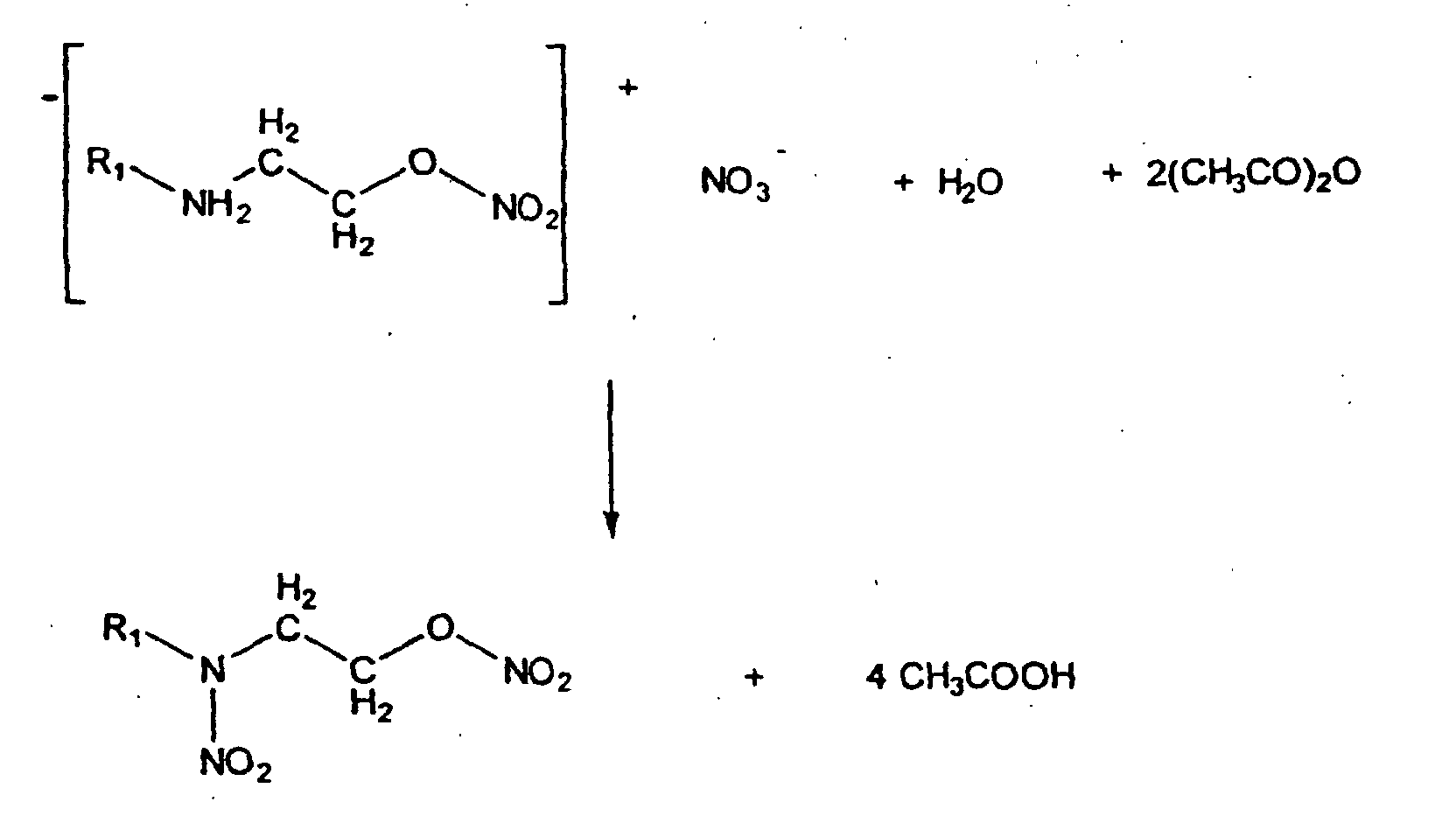
- US Patent No. 2,678,946 was granted on May 18, 1954. Alfred Blomquist and Fred Fiedorek were mentioned as inventors in the patent. This patent relates to a process of preparing nitroxy alkylnitramines, in which the examples among others show the preparation of metyl-NENA (example II) and ethyl-NENA (example III).
Claim 1 of said patent claims a process of preparing nitroxy alkylnitramines, wherein a secondary amine reacts with an equivalent amount of anhydrous nitric acid forming a liquid reaction mixture. This liquid reaction mixture is reacted with an equivalent amount of a water scavenging acid anhydride in the presence of a small amount of halide ione forming catalyst. - Shen Qiong-hua et al (28th International Conference of ICT, 25-28 June 1996, Karlsruhe, P133-1) discloses a method of preparing butyl-NENA batchwise in a laboratory scale by the use of very small amounts of starting materials. Nitric acid is initially cooled in an ice/salt water bath, whereupon n-butyl-ethanolamine is added below the liquid surface to the acid with vigorous stirring. The temperature is kept below 22°C. After all the amine is added, the mixture is left with stirring in about 50 minutes. A mixture of acetic acid anhydride and zinc chloride is then added to the mixture at such a rate that the temperature is kept below 35°C. When the entire mixture of acetic acid and zinc chloride is added, the reaction mixture is left for about 1 hour with stirring and then poured into an ice bath. Butyl-NENA separates as a yellowish liquid in the bottom of the ice-bath. Shen Qiong-hua et al concluded that the optimalized reaction conditions for the preparation of butyl-NENA was a reaction temperature of below 22°C in the first part of the reaction and a reaction of below 35°C in the second part of the reaction. The reaction time should be about 2,5 hours. In one experiment Shen et al obtained 98.9% purity and 84% yield. In the other experiments the purity was never better than 97% when the yield was higher than 67%.
- The literature does not exhaustingly disclose the preparation of Alkyl-NENAs in a larger scale than 5 liters (P.A. Silver and F. Stanley Hercules Aerospace Division, Hercules Incorporated, Allegany Ballistics Laboratory, Maryland). The total reaction time for step one of the reaction was 4,5 hours, and the addition time for the second step of the reaction was 2,5 hours. The product phase was separated and washed three times, each time having a washing time of about 1 hour per wash. Total time for the synthesis of butyl-NENA in this 5 liter flask was stated to be as much as 10 hours. No yield or purity of the product prepared by the process in a 5 liter scale is presented.
- Generally the technology of nitration includes very exothermic reactions. The synthesis of Alkyl-NENAs is so far no exception.
Reaction step 1, in which alkyl ethanol amine is added to cold nitric acid, is a very exothermic reaction. The additon of the amine must be effected below the liquid surface to avoid "spark spheres". Controlling the rate of addition, amount added and sufficient cooling of the reaction flask is thus of great importance when alkylethanolamine is added to nitric acid. It is also important that nitric acid is not allowed to enter the addition tube of the alkylethanolamine. - Formation of sparks quickly arises in the nitration acid when the alkylethanolamine is added, and this is not kept under control. At a larger scale (100 l, 1000 l or largers reactors) this reaction step is expected to be particularly dangerous, and extensive and well planned measures are required before such a reaction is performed.
- It is disclosed in the literature that the reaction mixture from the first step should be left with stirring for about 1 hour before a second step is entered. A mixture of acetic acid anhydride is added to a halide ion forming catalyst by the addition to the reaction mixture from the first step. Also this reaction is an exotermic reaction, but the development of heat is less drastic than in the first part of the reaction. It is in the literature disclosed that the final reaction mixture after step two should be left for about 1 hour with stirring before the reaction mixture is poured into ice water. After this mixture is discharged into ice water, the Alkyl-NENAs will separate as distinct liquid phases in the bottom of the drowning vessel (exception: methyl-NENA which will be precipitated as crystals). The product phase must be separated, and the product washed several times before it is separated and dried.
- It was therefore an object of the present invention to develop a synthesis for the use at a technical scale, which compared to the disclosure of the prior art, results in higher yields, higher purity, and to a better extent complies with the problematic safety aspects when N-alkyl-nitratoethylnitramines are prepared.
- Further it was an object of the invention to develop a suitable plant for accomplishing such a synthesis.
- These objects are surprisingly achieved according to the present invention by a process of preparing N-alkyl-nitratoethylnitramines, in which an N-alkyl-ethanolamine is first reacted with nitric acid and then with a mixture of acetic acid anhydride and a halide ion forming catalyst in a continuous process with subsequent work-up by being fed into an ejector, in which concurrently water is injected, and from which a mixture of water and N-alkyl-nitratoethylnitramine is passed to a separator, and therein separated into product and water containing residual acid.
- According to a preferred embodiment, the first reaction between N-alkyl-ethanol amine and nitric acid is performed in a first reactor as a continuous process, and the product from this reactor is transferred to a second reactor in a continuous way, in which reactor it is further reacted by the continuous addition of acetic acid anhydride and a halide ion forming catalyst.
- According to another possible embodiment, both reactions are performed in one tube reactor, the alkyl-ethanolamine and nitric acid being added upstream in the reactor, whereas the acetic acid anhydride and halide ion forming catalyst is added downstream in the reactor.
- Further, preferably the product from the separator is transferred continuously to a washing step with water, whereupon the water and the washed product are separated.
- According to a preferred embodiment, the wash water from the washing step is continuously transferred to a buffer tank to be returned to the ejector.
- As the halide ion forming catalyst zinc dichloride (ZnCl2) is particularly preferably used.
- As the nitric acid ≥97% nitric acid is preferably used.
- Further, it is preferred that the N-alkyl-ethanolamine is added to the reactor through a distribution system.
- Particularly, it is preferred that between 2.0 and 3.0 mol nitric acid is added per mol N-alkyl-ethanolamine, and particularly that between 2.5 and 2.8 mol nitric acid is added per mol N-alkyl-ethanolamine.
- It is strongly preferred that the temperature of the first reactor is kept between 5°C and 23°C.
- In the preparation of N-butyl-nitratoethylnitramine it is preferred that the temperature in the second reactor is kept between 25 and 35°C, and it is particularly preferred that the temperature of the second reactor is kept between 28 and 32°C.
- It is particularly preferred that an N-C1-C4 alkyl-ethanolamine is used in the process of the present invention, and particularly that N-butyl-ethanolamine is used.
- Further, the aim of the present invention is solved by a production plant for performing the process, which is accomplished by two connected reactors as described above, comprising a first reactor (4) provided with feeding means of nitric acid (1a) and a distributed feeding of N-alkyl-ethanolamine (2a), an agitator (4a), means for internal and external cooling of the reactor (4b) and means for conveying product (4c) to another reactor (5), said reactor (5) being equipped for the feed of a mixture of acetic acid anhydride and halide ion forming catalyst (3a), an agitator (5a), means for internal and external cooling of the reactor (5b), means for conveying the final product to an ejector (5c) having injection means for water (7, 12a), transport means (6a) from the ejector to a separator (8a) for the separation of product and water containing residual acid.
- According to a particularly preferred embodiment of this plant, the separator (8) has outlet means for continuous transport of product (8a) to a washing tank with water (9), and outlet means for draining water containing residual acid (8b), and the washing tank (9) has outlet means for wash water and product (9a) to a separator (10), said separator (10) having outlet means of product to storage (10a) and outlet means for wash water to a buffer tank (10b).
- For an economic operation of the plant it is preferred that the buffer tank has a transport connection to the ejector (12a) for better utilisation of material and reduction of environmental strain.
- By the present invention compared to the prior art, particularly an improved purity of the final product is achieved. It is obvious to the man skilled in the art that a higher purity results in an increased stability. This is particularly important in connection with energetic compounds. In addition, the performance of energetic products will be better the purer the product, provided that the side products are inert or less energetic. All energetic compounds (nitrate esters and nitramine compounds) are basically instable, and even at room temperature a slow decomposition takes place. The decomposition velocity increases at increasing temperatures and may be catalysed by the impurities of the product. Thus, it is also obvious that this may have an influence on the stability of propellants or explosives including Alkyl-NENAs. Further, it is obvious that presence of impurities may result in undesirable reactions with other ingredients of propellant or explosive compositions, and thus result in undesirable alterations in the properties of the final product.
- A continuous production of Alkyl-NENAs, which is the subject of the present invention, further provides for an increased yield compared to the batch production.
- By the present invention compared to the prior art, a large improvement is achieved with respect to the safety in the production of Alkyl-NENAs. As already mentioned, the first reaction step of the process is a very exothermic reaction. In the batch production of large amounts of Alkyl-NENAs (100 l, 1000 l, etc.) the alkyl-ethanol-amine has to be added to large amounts of concentrated nitric acid, and the risk of accidents/disasters are much higher than in the production of large amounts of Alkyl-NENAs continuously, in which - after a specific starting procedure - alkyl-ethanol-amine and concentrated nitric acid are simultaneously added into a much smaller reactor.
- Another obvious advantage of the present invention is that the constant composition inside the reactor results in stable reaction conditions and the reaction composition functions as an excellent "cooling buffer". This is also for safety reasons a great advantage compared to the batch production in which small amounts of alkyl-ethanolamine is slowly added to large amounts of concentrated acid.
- The consequences of an accident/disaster in the batch production will be very high compared to the consequences of an accident/disaster in the continuous production, as the volumes of the equipment units, starting materials, intermediate and final products in the production facilities are far less in a continuous production.
- A continuous production of Alkyl-NENAs results in larger amounts of product in a shorter time and by using smaller equipment units than the corresponding batch production of Alkyl-NENAs. This is a very important economic aspect of the present invention. It will also involve less manual operations by the operator of the production plant. This is important both to the capacity of the plant, and not at least to the safety of the operator. Concentrated nitric acid is very aggressive, and in addition particularly butyl-NENA is vasodilating, resulting in a strong headache.
- Treatment of the wastes in the production of Alkyl-NENAs will, due to the present invention, be less than in a batch production. The first washing step in the work-up of Alkyl-NENAs takes place in the continuous production. The first wash water goes into a return loop, is mixed with process water which is further mixed with the reaction mixture of the second step of the reaction. In this way an important environmental aspect is taken care of by consistently using the first wash water in the process. In addition, the loss of product is reduced.
- Further benefits of the present invention will be elucidated by the following closer description of the invention.
- The present invention provides a continuous process of preparing Alkyl-NENAs. The starting materials for the production of the NENA compounds are, like previously known, nitric acid, alkyl-ethanolamine and acetic acid anhydride mixed with zinc chloride.
- In the following it is referred to the figure for a closer description of the invention.
- In the continuous process the starting materials nitric acid and alkyl-ethanolamine are stored separately in intermediate tanks within the production facilities ((1) = concentrated nitric acid, (2) =alkyl-ethanolamine) and mixture of acetic acid anhydride and zinc chloride is stored in a day-tank ((3) = acetic acid anhydride added zinc chloride). These day-tanks are further fed at a low liquid level from larger storage tanks outside the building. Day-tanks involve smaller amounts within the production facilities and thereby less risk of greater accidents/disasters. The continuous process is effected by a starting procedure of reactor 1 (4). The starting procedure used is the process as disclosed in well-known literature of batch reactions by feeding alkyl-ethanol-amine (2) through a distribution system below the liquid surface into a cooled nitric acid which is in advance charged into the reactor 1 (4). The reactor 1(4) has a very high cooling capacity of absorbing the heat released in the reaction. In addition, it is important that the alkyl-ethanolamine is added over as large an area as possible below the liquid surface of the nitric acid to evenly distribute the heat evolution in the nitric acid.
- When equivalent amounts of alkyl-ethanolamine is added to the acid in the reactor 1(4), alkyl-ethanolamine (2) and nitric acid (1) are fed in equivalent amounts simultaneously to the reactor 1 (4). The reaction mixture of reactor 1(4) now partly works as a "cooling buffer", the cooling capacity of the reactor 1(4) at the same time being very high. If the temperature of the reactor 1 (4) under any circumstances exceeds a maximum temperature, the reactor 1 (4) is automatically opened to drown the reaction composition in water tanks being located below the reactor.
- When the liquid level of the reactor 1 (4) has reached a desired level, the reaction composition is fed from the reactor 1 (4) to the reactor 2 (5). The reactor 2 (5) has also its own starting procedure. Part of the mixture of acetic acid anhydride and zinc chloride (3) is in advance charged to the reactor 2 (5). When equivalent amounts of the reaction mixture from reactor 1 (4) have been added to the mixture of acetic acid anhydride and zinc chloride (3), the reaction mixture is fed from reactor 1 (4), and simultaneously a mixture of acetic acid anhydride and zinc chloride (3) to the reactor 2 (5).
- When the liquid level in the reactor 2 (5) has reached the desired level, this reaction mixture is fed into an ejector (6) together with process water (7). The amount of process water is in advance exactly calculated to achieve as high a yield as possible. Previously disclosed batch processes of preparing Alkyl-NENAs have only disclosed that the reaction mixture corresponding to the mixture of the reactor 2 (5) is drowned into ice-water, and is then left for a while before decantation. In the continuous process we have found that the temperature of the process water is sufficient (ice-water is not required for separation) provided that the reaction-mixture corresponding to the mixture of the reactor 2 (5) is added to water with vigorous stirring/velocity through the ejector (6). When the reaction mixture from reactor 2 (5) is mixed with tap-water (7), the reaction mixture now constitutes two liquid phases. The reaction mixture/liquid phases are fed to a separator 1 (8). The feeding point of the separator 1 (8) is calculated from the density of the two respective liquids to obtain a minimum of turbulence in the interphase between the two liquids. In this way a mixture of the two liquids can be continuously fed, and they will be continuously separated without problems. The residence time inside the separator 1 (8) is calculated to 10 - 20 minutes, which has been found to be sufficient. In the prior art literature, in which Alkyl-NENAs has been prepared batch-wise, the liquid phases had been left for longer period of time before they were separated. The liquid volume has in addition been considerably smaller than described in the present invention. By the present invention it is, however, possible to separate larger amounts of Alkyl-NENAs in a shorter time than what was previously known. From the separator 1 (8) Alkyl-NENAs is separated in the bottom of the separator, and further passed to a washing tank (9) for a first wash, and water containing residual acid is separated from the top of the separator 1 (8) and brought to a collecting tank outside the production facilities (11). In the washing tank (9) equivalent amounts of Alkyl-NENAs is fed from the separator 1 (8) concurrently with process water 7 (12a). This is thoroughly mixed by means of the agitator in the washing tank (9) and further brought to separator 2 (10). In a corresponding way as on the separator 1 (8), the feeding point is calculated from the density of the two liquids to achieve a minimum of turbulence in the liquid interphase between the two liquids. From the separator 2 (10) the wash water is separated to a buffer tank (12) which is connected to process water (7) to then be turned into the process via the ejector (6). The product from the separator 2 (10) is drained to a barrel, and further processed batch-wise to further washing steps. To the practiotioner in the field it will, however, be a simple matter to extend the continuous process to comprise also these two last washing steps in a continuous way, and this option is also an aspect of the present invention.
- A closer description of the present invention will now be presented through examples of embodiments:
- Example 1 shows the preparation of butyl-NENA in 10 l plant by batch-wise production (according to the prior art), whereas Example 2 shows the preparation of butyl-NENA in a 10 l plant by continuous production according to the present invention. Further, Example 3 will show a continuous process of preparing butyl-NENA in a larger production plant.
- Example 4 describes the continuous process of preparing ethyl-NENA in a 10 l plant. Example 5 describes the contiuous process of preparing methyl-NENA in a 10 l plant.
-
- Nitric acid 99% (2912 g, 46 mol) was added to a 10 l reactor and cooled to 14°C. Butyl-ethanolamine (2077g, 17,7 mol) was slowly added by means of nitrogen pressure below the liquid surface of the nitric acid. The stirring was maintained at about 300 rpm. The temperature was kept between 15°C - 20°C. The butyl-ethanolamine addition took about 2 hours. The mixture was left with stirring at room temperature for about 1 hour and 15 minutes. A mixture of acetic acid anhydride (5100 g, 50 mol) and a catalytic amount of zinc chloride (47,2 g, 0,35 mol) was slowly added with stirring to the reaction mixture. The temperature was kept between 30°C and 35°C. The addition lasted for about 1 hour and 15 minutes. The mixture was left at room temperature with agitation for about 1 hour before being drained into ice-water (7 kg ice). The mixture was left at room temperature to the next day for a sufficient separation.
- The residual acid/water phase was separated by decantation, the organic phase was washed three times; the first time with equal amounts of water, the second time with a 5% sodium carbonate solution and at last water once more. The butyl-NENA was separated and then dried by nitrogen bubbling for 24 hours.
Theoretical yield 3652 g Yield 2591 g: 71% Acidity 0.006% Purity 97% Moisture 0,25% DSC peak (10°C/min.) 210°C. - Nitric acid, 99% (2955 g, 46,9 mol) was added to a 10 l reactor and cooled to 19°C. At the same time acetic acid anhydride (2550 g, 25 mol) and zinc chloride (30 g, 0,22 mol) was added to
reactor 2 and the agitation was started. - The agitation in
reactor 1 was started. Butyl-ethanolamine (2066 g, 17.7 mol) was fed through a pressurized distribution system to thereactor 1 at a rate of 38.7 ml/min. The temperature was all the time monitored to not exceed 22°C. After about 1 hour the start-up procedure of thereactor 1 is completed. - Butyl-ethanolamine (3099 g, 26,5 mol) and nitric acid 99% (4430 g, 70.3 mol) were simultaneously added to
reactor 1 at a feed rate of 38,7 ml/min. and 32,8 ml/min, respectively. The intermediate product from thereactor 1 was pumped into thereactor 2, wherein the mixture of acetic acid anhydride and a catalytic amount of the zinc chloride was ready, at a rate of 71,5 ml/min. The temperature of thereactor 2 was kept below 35°C, and the temperature of thereactor 1 did not exceed 22°C. After about 30 minutes, the start-up procedure of thereactor 2 was finished. - A ready mixture of acetic acid anhydride (10200 g, 100 mol) and zinc chloride (120 g) was fed to the
reactor 2 at a rate of 78,6 ml/min., simultaneously with the intermediate product from the reactor 1 (at a rate of 71,5 ml/min.). - Nitric acid and butyl-ethanolamine were now continuously pumped into the
reactor 1. Simultaneously the intermediate product from thereactor 1 and mixture of acetid acid anhydride and zinc chloride was continuously pumped into thereactor 2. The feed rates are closely calculated and the temperatures were closely monitored. The reaction mixture from thereactor 2 was at a desired level added to an ice/water mixture in a given ratio by means of a siphon (about 1,3 kg reaction mixture in 11 kg ice-water). - The continuous process was run for about 2 hours before the addition of butyl-ethanolamine and nitric acid was stopped. The rest of the reaction mixture in
reactor 1 was pumped intoreactor 2 simultaneously adding acetid acid anhydride and zinc chloride. Whenreactor 1 was empty, also the continuous addition of acetid acid anhydride and zinc chloride toreactor 2 was stopped. The contents ofreactor 2 was drained into the ice/water mixture, and butyl-NENA separated as a light yellowish liquid.Theoretical yield 9138 g Yield (before washing) about 8100 g; i.e. 88,6%. - This example shows that it took one day of work to produce slightly more than 8 kg untreated butyl-NENA. This is at least the triple capacity compared to the batch operation of butyl-NENA.
- The same procedure and amounts were run for further 6 days of work, and the untreated butyl-NENA produced by-these total 7 batches were combined and subjected to work-up. However, only 2/5 of the one batch was used. Butyl-NENA was first washed in water, then in 5% sodium carbonate solution and finally the last time in water. (batch 341/98, ch. 10/98).
Theoretical yield about 58,5 kg Yield about 44 kg; 75% Acidity 0.002 Purity 99.1% Moisture 0.14% DSC (10°C/min.) 211°C. - The results show a purity of 99.1%. This above 2% better than butyl-NENA prepared by batch-operation, which is important with respect to both the stability and performance of butyl-NENA.
- The reference numbers in brackets refer to the figure.
- Zinc chloride (11.1 kg, 81.4 mol) and acetic acid anhydride (944,5 kg, 9,3 kmol) were mixed in a daytank (3) and agitation was activated at 65 rpm over night (at least 2 hours are required to dissolve all the zinc chloride).
- Nitric acid, 99% (1) was pumped at a rate of 67 I/hour into reactor 1 (4). After exactly 29 minutes, the addition was stopped. The agitation of the reactor 1 (4) was set to 375 rpm, and the temperature was regulated to 19°C.
- The mixture of acetic acid anhydride and zinc chloride (3) was pumped at a rate of 160 l/hour into reactor 2 (5) and at the same time butyl-ethanolamine (2) was pumped through a pressurised distribution system at a rate of 78 l/hour into reactor 1 (4). The temperature of reactor 1 (4) was continuously monitored to stay between 18°C and 20°C.
- After exactly 17.5 minutes, the addition of acetic acid anhydride and zinc chloride composition (3) into reactor 2 (5) was stopped. The addition of butyl-ethanolamine (2) for the start-up procedure of reactor 1 (4) was finished after exactly 29 minutes.
- After 29 minutes butyl-ethanolamine (2) and nitric acid, 99% (1) were added concurrently to reactor 1 (4) at a rate of 78l/hour and 67 l/hour respectively. The temperature of the reactor 1 (4) was consistently monitored to stay between 18°C and 22°C. The agitation of reactor 2 (5) was set to 300 rpm and the temperature was regulated to 30°C.
- After 15 minutes continuous addition of nitric acid, 99% (1) and butyl ethanolamine (2) an intermediate product stream from
reactor 1 toreactor 2 was observed. This stream was maintained for 17.5 minutes, the temperature of reactor 2 (5) being maintained between 28°C and 32°C. - A mixture of acetic acid anhydride and zinc chloride (3) was now added to reactor 2 (5) at a rate of 160 l/hour at the same time as intermediate product was added from reactor 1 (4) to reactor 2 (5). The temperatures of the reactors were maintained between 18°C and 22°C in the reactor 1 (4) and between 28°C and 32°C in the reactor 2 (5).
- After about 20 minutes, a stream from the reactor 2 (5) and towards the ejector (6) was observed. An addition of process water (7) was then started at a rate of 810 kg/hour (810 l/hour). The reaction mixture from the reactor 2 (5) mixed with water flowed into the separator 1 (8) in which phases separated after about 10 minutes. The process water (7) fed into the washing tank was set to 105 kg/hour when a product stream was observed from the separator 1 (8) to the washing tank (9). The wash water and the product flowed into the separator 2 (10) and the butyl-NENA (light yellowish liquid) was then drained to a barrel from the separator 2 (10). After 144 minutes of continuous operation, the plant was closed and drained. Draining the plant required 140 minutes.
Theoretical yield 669 kg Yield About 545 kg; 81.5% (after first wash). - Butyl-NENA was washed once with 5% sodium carbonate solution and finally once with water before drying.
Yield 490.5 kg; 73.3% Acidity 0.001% Purity 99.5% Moisture 0.037% DSC (10°C/min.) 280°C. - This example indicates that butyl-NENA is produced at a purity of 99.5%. This is a superior purity of the specific product and is far better than what was known to be obtained with the production of butyl-NENA in a batch-plant. This result is also better than presented in Shen et al. for the production of butyl-NENA in laboratory scale.
- In addition, the example indicates that 490 kg product has been produced in two days with reactors being no larger than 140 l and 260 l.
- The preparation of butyl-NENA as indicated in Example 3 is performed in a plant (see the figure) having a capacity of above 100 kg/hour. The plant is, of course, able to be run continuously over several days when required. In this way it will have a capacity of producing Alkyl-NENAs which is very high.
- 99% nitric acid (2835 g, 45.0 mol) was added to a 10 l reactor and cooled to 19°G. Concurrently acetic acid anhydride (2288 g, 22.4 mol) and zinc chloride (30 g, 0.22 mol) was added to the
reactor 2 and the agitator was started. - The agitator of the
reactor 1 was started. Ethyl-ethanolamine (1780 g, 20 mol) was fed through a pressurized distribution system to thereactor 1 at a rate of 32.5 ml/min. The temperature was all the time monitored not to exceed 9°C. After about 1 hour the starting procedure of thereactor 1 is finished. - Ethyl-ethanolamine (3560 g, 40.0 mol) and nitric acid, 99% (5670 g, 90.0 mol) was concurrently added to the
reactor 1 with feed rates of 32,5 ml/min. and 31.5 ml/min. respectively. The intermediate product from thereactor 1 was pumped into thereactor 2, in which the mixture of acetic acid anhydride and a catalytic amount of zinc chloride was completed, at a rate of 64.0 ml/min. The temperature of thereactor 2 was kept below 35°C, and the temperature of thereactor 1 did not exceed 9°C. After about 30 minutes, the starting procedure of thereactor 2 was completed. - A ready mixture of acetic acid anhydride (11437 g, 112.1 mol) and zinc chloride (150 g) was fed to the
reactor 2 at a rate of 70.5 ml/min. concurrently with the intermediate product from the reactor 1 (at a rate of 64.0 ml/min.). - Nitric acid and ethyl-ethanolamine were now pumped into the
reactor 1. Simultaneously intermediate product from thereactor 1 and the mixture of acetic acid anhydride and zinc chloride was continuously pumped into thereactor 2. The feed rates are closely calculated, and the temperatures were closely monitored. The reaction mixture of thereactor 2 was at a desired level added to an ice/water mixture in a given ratio by means of a siphon (about 1.3 kg reaction mixture in 11 kg ice water). - The continuous process was run for about 1 hour and 40 minutes, before the addition of ethyl-ethanolamine and concentrated nitric acid was stopped. The remaining reaction mixture of the
reactor 1 was pumped into thereactor 2 simultaneously with the addition of acetic acid anhydride and zinc chloridie. When thereactor 1 was empty, also the continuous addition of acetic acid anhydride and zinc chloride toreactor 2 was stopped. The contents of thereactor 2 was drained into the ice/water mixture, and ethyl-NENA precipitated as a light yellowish liquid.Theoretical yield 10740 g Yield (before wash) about 9000 g; i.e. 83.7%. - This example illustrates that it took one day of work to produce about 8 kg non-processed ethyl-NENA.
- Nitric acid, 99% (2835 g. 45.0 mol) was added to a 10 l reactor and cooled to 19°C. Acetic acid anhydride (2228g, 22.4 mol) and zinc chloride (30 g, 0.22 mol) were concurrently added to the
reactor 2 and the agitator was started. - The agitator of
reactor 1 was started. Methyl-ethanolamine (1500 g, 20 mol) was fed through a gas pressurized distribution system to thereactor 1 at a rate of 26.6 ml/min. It was all the time monitored that the temperature did not exceed 9°C. After about 1 hour, the starting procedure ofreactor 1 is complete. - Methyl-ethanolamine (3000 g, 40.0 mol) and nitric acid, 99% (5670 g, 90.0 mol) were added concurrently to the
reactor 1 at a feed rate of 26.6 ml/min. and 31.5 ml/min. ,respectively. The intermediate product from thereactor 1 was pumped into thereactor 2, in which the mixture of the acetic acid anhydride and a catalytic amount of zinc chloride was ready mixed, at a rate of 58.1 ml/min. The temperature of thereactor 2 was kept below 35°C, and the temperature of thereactor 1 did not exceed 9°C. After about 30 minutes, the starting procedure of thereactor 2 was complete. - A ready mixture of acetic acid anhydride (11437 g, 112.1 mol) and zinc chloride (150 g) was fed to the
reactor 2 at a rate of 70.5 ml/min., concurrently with the intermediate product from the reactor 1 (at a rate of 58.1 ml/min.). - Nitric acid and methyl ethanol amine were now continuously pumped into the
reactor 1. At the same time the intermediate product from thereactor 1 and a mixture of actic acid anhydride and zinc chloride was continuously pumped into thereactor 2. The feed rates are closely calculated, and the temperatures were closely monitored. The reaction mixture of thereactor 2 was added at a desired level to an ice/water mixture in a given ratio by means of a siphon (about 1.3 kg reaction mixture in 11 kg ice-water). - The continuous process was run for about 2.5 hours, before the addition of methyl-ethanolamine and concentrated nitric acid was stopped. The rest of the reaction mixture of the
reactor 1 was pumped into thereactor 2 concurrently with addition of acetic acid anhydride and zinc chloride. When thereactor 1 was empty, also the continuous addition of acetic acid anhydride and zinc chloride to thereactor 2 was stopped. The contents of thereactor 2 was drained into the ice/water mixture and methyl-NENA precipitated as white crystals.Theoretical yield 9900 g Yield (before washing) about 7.6 kg; 76.8%.
Claims (18)
- A process of preparing N-alkyl-nitratoethylnitramines, comprising at first reaction of a N-alkyl-ethanolamine with nitric acid and subsequently with a mixture of acetic acid anhydride and a halide ion forming catalyst in a continuous process with subsequent work-up by introduction into an ejector, into which water is concurrently injected, and from which the mixture of water and N-alkyl-nitratoethylnitramine is passed to a separator, and therein separated into product and water containing residual acid.
- The process of claim 1, wherein the first reaction between N-alkyl-ethanolamine and nitric acid is carried out in a first reactor as a continuous process, and the product from said reactor is transferred to another reactor in a continuous way, in which reactor it is further reacted by continuous addition of a mixture of acetic acid anhydride and a halide ion forming catalyst.
- The process of claim 1, wherein both reactions are carried out in one single tube reactor, the alkyl ethanol amine and nitric acid being added upstream in the reactor, whereas acetic acid anhydride and halide ion forming catalyst are added downstream in the reactor.
- The process of claim 1-3, wherein the product from the separator of claim 1 is continuously transferred to a washing step with water, whereupon the water and the washed product are separated.
- The process of claim 1-4, wherein the wash water from the washing step is continuously transferred to a buffer tank for return to the ejector.
- The process of claim 1-5, wherein the halide ion forming catalyst is zinc dichloride (ZnCl2).
- The process of claim 1-6, wherein ≥ 97% nitric acid is used.
- The process of claim 1-7, wherein the N-alkyl-ethanolamine is added to the reactor through a distribution system.
- The process of claim 1-8, wherein the reaction is added between 2.0 and 3.0 mol nitric acid per mol N-alkyl-ethanolamine.
- The process of claim 9, wherein the reaction is added between 2.5 and 2.8 mol nitric acid per mol N-alkyl-ethanolamine.
- The process of claim 2, wherein the temperature of the first reactor is kept between 5°C and 23°C.
- The process of claim 2, wherein the temperature of the second reactor is kept between 25 and 35°C.
- The process of claim 12, wherein the temperature of the second reactor is kept between 28 and 32°C.
- The process of claim 1-13, wherein the N-alkyl-ethanolamine is an N-C1C4 alkyl-ethanolamine.
- The process of claim 14, wherein the N-C1-C4 alkyl-ethanolamine is N-butyl-ethanolamine.
- A production plant for carrying out the process of the claims 2 and 4-15, comprising a first reactor (4) equipped with addition means for nitric acid (1a) and a distributed supply of N-alkyl-ethanolamine (2a), an agitator (4a), means for internal and external cooling of the reactor (4b), and means for the export of the product (4c) to another reactor (5) which reactor (5) is equipped for addition of a mixture of acetic acid anhydride and a halide ion forming catalyst (3a), agitator (5a), means for internal and external cooling of the reactor (5b), means for the transport of the final product to an ejector (5c) having injection means for water (7, 12a), transport means (6a) from the ejector to a separator (8) for the separation of product and water containing residual acid.
- The production plant of claim 16, wherein the separator of claim 16 (8) has export means for the continuous transport of the product (8a) to a washing tank with water (9), and export means for draining the water containing residual acid (8b), and the washing tank (9) has export means for washing water and product (9a) to a separator (10), which separator (10) has export means for the product to storage (10a) and export means for wash water to a buffer tank (10b).
- The production plant of claim 17, wherein the buffer tank has a transport connection to the ejector (12a).
Applications Claiming Priority (1)
| Application Number | Priority Date | Filing Date | Title |
|---|---|---|---|
| PCT/NO1999/000312 WO2001027073A1 (en) | 1999-10-14 | 1999-10-14 | Process of preparing a high-energy softening agent |
Publications (2)
| Publication Number | Publication Date |
|---|---|
| EP1196374A1 EP1196374A1 (en) | 2002-04-17 |
| EP1196374B1 true EP1196374B1 (en) | 2003-03-26 |
Family
ID=19907909
Family Applications (1)
| Application Number | Title | Priority Date | Filing Date |
|---|---|---|---|
| EP99956364A Expired - Lifetime EP1196374B1 (en) | 1999-10-14 | 1999-10-14 | Process of preparing a high-energy softening agent |
Country Status (8)
| Country | Link |
|---|---|
| EP (1) | EP1196374B1 (en) |
| AT (1) | ATE235460T1 (en) |
| AU (1) | AU1298800A (en) |
| CA (1) | CA2370145C (en) |
| DE (1) | DE69906393T2 (en) |
| ES (1) | ES2194529T3 (en) |
| NO (1) | NO327838B1 (en) |
| WO (1) | WO2001027073A1 (en) |
Cited By (2)
| Publication number | Priority date | Publication date | Assignee | Title |
|---|---|---|---|---|
| DE102004007706A1 (en) * | 2004-02-16 | 2005-08-25 | Dynamit Nobel Gmbh Explosivstoff- Und Systemtechnik | Liquid nitrate esters production by esterifying alcohols with nitrating acid is effected in a microreactor to give improved safety |
| EP3539943A1 (en) * | 2018-03-15 | 2019-09-18 | Nitrochemie Aschau GmbH | Process for the preparation of n-alkyl-nitratoethylnitramine |
Families Citing this family (3)
| Publication number | Priority date | Publication date | Assignee | Title |
|---|---|---|---|---|
| US8425703B1 (en) | 2010-03-24 | 2013-04-23 | The United States of Amierica as Represented by the Secretary of the Navy | Insensitive munitions primers |
| CN111763154A (en) * | 2019-04-01 | 2020-10-13 | 南京理工大学 | A kind of synthetic method of diethanol nitramine dinitrate |
| CN115784924A (en) * | 2022-11-29 | 2023-03-14 | 天元航材(营口)科技股份有限公司 | Novel process for preparing high-purity Bu-NENA by continuous method |
Family Cites Families (3)
| Publication number | Priority date | Publication date | Assignee | Title |
|---|---|---|---|---|
| US2678946A (en) * | 1944-12-30 | 1954-05-18 | Us Navy | Process of preparing nitroxy alkyl nitramines |
| US2485855A (en) * | 1944-12-30 | 1949-10-25 | Us Seeretary Of The Navy | Nitramines |
| US5520757A (en) * | 1988-08-25 | 1996-05-28 | Ici Explosives Usa Inc. | Low vulnerability propellants |
-
1999
- 1999-10-14 WO PCT/NO1999/000312 patent/WO2001027073A1/en not_active Ceased
- 1999-10-14 AT AT99956364T patent/ATE235460T1/en not_active IP Right Cessation
- 1999-10-14 DE DE69906393T patent/DE69906393T2/en not_active Expired - Lifetime
- 1999-10-14 AU AU12988/00A patent/AU1298800A/en not_active Abandoned
- 1999-10-14 EP EP99956364A patent/EP1196374B1/en not_active Expired - Lifetime
- 1999-10-14 ES ES99956364T patent/ES2194529T3/en not_active Expired - Lifetime
- 1999-10-14 CA CA002370145A patent/CA2370145C/en not_active Expired - Lifetime
-
2002
- 2002-01-15 NO NO20020218A patent/NO327838B1/en not_active IP Right Cessation
Cited By (4)
| Publication number | Priority date | Publication date | Assignee | Title |
|---|---|---|---|---|
| DE102004007706A1 (en) * | 2004-02-16 | 2005-08-25 | Dynamit Nobel Gmbh Explosivstoff- Und Systemtechnik | Liquid nitrate esters production by esterifying alcohols with nitrating acid is effected in a microreactor to give improved safety |
| EP3539943A1 (en) * | 2018-03-15 | 2019-09-18 | Nitrochemie Aschau GmbH | Process for the preparation of n-alkyl-nitratoethylnitramine |
| WO2019175296A1 (en) * | 2018-03-15 | 2019-09-19 | Nitrochemie Aschau Gmbh | Process for the preparation of n-alkyl-nitratoethylnitramines |
| AU2019233659B2 (en) * | 2018-03-15 | 2021-04-29 | Nitrochemie Aschau Gmbh | Process for the preparation of N-alkyl-nitratoethylnitramines |
Also Published As
| Publication number | Publication date |
|---|---|
| ATE235460T1 (en) | 2003-04-15 |
| NO327838B1 (en) | 2009-10-05 |
| NO20020218L (en) | 2002-01-15 |
| CA2370145C (en) | 2003-05-06 |
| CA2370145A1 (en) | 2001-04-19 |
| WO2001027073A1 (en) | 2001-04-19 |
| AU1298800A (en) | 2001-04-23 |
| EP1196374A1 (en) | 2002-04-17 |
| DE69906393D1 (en) | 2003-04-30 |
| ES2194529T3 (en) | 2003-11-16 |
| DE69906393T2 (en) | 2003-10-30 |
| NO20020218D0 (en) | 2002-01-15 |
Similar Documents
| Publication | Publication Date | Title |
|---|---|---|
| EP0120668B1 (en) | Azido nitramine | |
| JPS6317072B2 (en) | ||
| CA2102587C (en) | A process for the preparation of dinitrotoluene | |
| US5345012A (en) | Process for the preparation of dinitrotoluene | |
| CA2370145C (en) | Process of preparing a high-energy softening agent | |
| US6262301B1 (en) | Process of preparing a high-energy softening agent | |
| US7632960B2 (en) | Process for the preparation of nitric esters of monohydric alcohols | |
| US2461582A (en) | Nitramines and their preparation | |
| US4476322A (en) | Synthesis of dimethylmethylene dinitramine | |
| US5520757A (en) | Low vulnerability propellants | |
| JP2025509949A (en) | Method for producing explosive HMX by flow synthesis | |
| GB2398567A (en) | Continuous process and system for production of glycidyl nitrate and its conversion to poly(glycidyl nitrate). | |
| GB2641052A (en) | Improved flow synthesis | |
| US5482581A (en) | Low vulnerability propellant plasticizers | |
| US3975452A (en) | Reprocessing of final acid from nitroglycerine production | |
| RU2567236C1 (en) | Safe method of producing aliphatic polynitrates of alcohols in industrial conditions | |
| KR20240060792A (en) | Improved flow synthesis | |
| US3238245A (en) | Preparation of pentaerythritol trinitrate acrylate | |
| ZA200302347B (en) | Method for producing DNDA. | |
| US2950312A (en) | Process for producing n-trinitroethyl urethanes, amides, and ureas | |
| US3309397A (en) | Production of pentaerythritol trinitrate | |
| CA2299891C (en) | Process for the production of crystalline energetic materials | |
| US2012986A (en) | Process of producing a liquid explosive composition | |
| Finalis | Towards the independence of the propellant industry for munitions and rocket | |
| US3002012A (en) | Method for the preparation of normal lead styphnate |
Legal Events
| Date | Code | Title | Description |
|---|---|---|---|
| PUAI | Public reference made under article 153(3) epc to a published international application that has entered the european phase |
Free format text: ORIGINAL CODE: 0009012 |
|
| 17P | Request for examination filed |
Effective date: 20020123 |
|
| AK | Designated contracting states |
Kind code of ref document: A1 Designated state(s): AT BE CH CY DE DK ES FI FR GB GR IE IT LI LU MC NL PT SE |
|
| AX | Request for extension of the european patent |
Free format text: AL;LT;LV;MK;RO;SI |
|
| GRAH | Despatch of communication of intention to grant a patent |
Free format text: ORIGINAL CODE: EPIDOS IGRA |
|
| GRAH | Despatch of communication of intention to grant a patent |
Free format text: ORIGINAL CODE: EPIDOS IGRA |
|
| GRAA | (expected) grant |
Free format text: ORIGINAL CODE: 0009210 |
|
| AK | Designated contracting states |
Designated state(s): AT BE CH CY DE DK ES FI FR GB GR IE IT LI LU MC NL PT SE |
|
| PG25 | Lapsed in a contracting state [announced via postgrant information from national office to epo] |
Ref country code: NL Free format text: LAPSE BECAUSE OF FAILURE TO SUBMIT A TRANSLATION OF THE DESCRIPTION OR TO PAY THE FEE WITHIN THE PRESCRIBED TIME-LIMIT Effective date: 20030326 Ref country code: GR Free format text: LAPSE BECAUSE OF FAILURE TO SUBMIT A TRANSLATION OF THE DESCRIPTION OR TO PAY THE FEE WITHIN THE PRESCRIBED TIME-LIMIT Effective date: 20030326 Ref country code: FI Free format text: LAPSE BECAUSE OF FAILURE TO SUBMIT A TRANSLATION OF THE DESCRIPTION OR TO PAY THE FEE WITHIN THE PRESCRIBED TIME-LIMIT Effective date: 20030326 Ref country code: BE Free format text: LAPSE BECAUSE OF FAILURE TO SUBMIT A TRANSLATION OF THE DESCRIPTION OR TO PAY THE FEE WITHIN THE PRESCRIBED TIME-LIMIT Effective date: 20030326 Ref country code: AT Free format text: LAPSE BECAUSE OF FAILURE TO SUBMIT A TRANSLATION OF THE DESCRIPTION OR TO PAY THE FEE WITHIN THE PRESCRIBED TIME-LIMIT Effective date: 20030326 |
|
| REG | Reference to a national code |
Ref country code: GB Ref legal event code: FG4D |
|
| REG | Reference to a national code |
Ref country code: CH Ref legal event code: EP |
|
| REF | Corresponds to: |
Ref document number: 69906393 Country of ref document: DE Date of ref document: 20030430 Kind code of ref document: P |
|
| REG | Reference to a national code |
Ref country code: IE Ref legal event code: FG4D |
|
| REG | Reference to a national code |
Ref country code: CH Ref legal event code: NV Representative=s name: BRAUN & PARTNER PATENT-, MARKEN-, RECHTSANWAELTE |
|
| RIN2 | Information on inventor provided after grant (corrected) |
Inventor name: CHRISTENSEN, MONA Inventor name: GRANBY, TRINE Inventor name: BERG, ALF Inventor name: HALVORSEN, TERJE Inventor name: GJERSOE, RICHARD Inventor name: JOHANSEN, OEYVIND, HAMMER Inventor name: SKJOLD, ERLEND |
|
| PG25 | Lapsed in a contracting state [announced via postgrant information from national office to epo] |
Ref country code: PT Free format text: LAPSE BECAUSE OF FAILURE TO SUBMIT A TRANSLATION OF THE DESCRIPTION OR TO PAY THE FEE WITHIN THE PRESCRIBED TIME-LIMIT Effective date: 20030626 Ref country code: DK Free format text: LAPSE BECAUSE OF FAILURE TO SUBMIT A TRANSLATION OF THE DESCRIPTION OR TO PAY THE FEE WITHIN THE PRESCRIBED TIME-LIMIT Effective date: 20030626 |
|
| REG | Reference to a national code |
Ref country code: SE Ref legal event code: TRGR |
|
| NLV1 | Nl: lapsed or annulled due to failure to fulfill the requirements of art. 29p and 29m of the patents act | ||
| LTIE | Lt: invalidation of european patent or patent extension |
Effective date: 20030326 |
|
| PG25 | Lapsed in a contracting state [announced via postgrant information from national office to epo] |
Ref country code: LU Free format text: LAPSE BECAUSE OF NON-PAYMENT OF DUE FEES Effective date: 20031014 Ref country code: IE Free format text: LAPSE BECAUSE OF NON-PAYMENT OF DUE FEES Effective date: 20031014 Ref country code: CY Free format text: LAPSE BECAUSE OF FAILURE TO SUBMIT A TRANSLATION OF THE DESCRIPTION OR TO PAY THE FEE WITHIN THE PRESCRIBED TIME-LIMIT Effective date: 20031014 |
|
| PG25 | Lapsed in a contracting state [announced via postgrant information from national office to epo] |
Ref country code: MC Free format text: LAPSE BECAUSE OF NON-PAYMENT OF DUE FEES Effective date: 20031031 |
|
| REG | Reference to a national code |
Ref country code: ES Ref legal event code: FG2A Ref document number: 2194529 Country of ref document: ES Kind code of ref document: T3 |
|
| ET | Fr: translation filed | ||
| PLBE | No opposition filed within time limit |
Free format text: ORIGINAL CODE: 0009261 |
|
| STAA | Information on the status of an ep patent application or granted ep patent |
Free format text: STATUS: NO OPPOSITION FILED WITHIN TIME LIMIT |
|
| 26N | No opposition filed |
Effective date: 20031230 |
|
| REG | Reference to a national code |
Ref country code: IE Ref legal event code: MM4A |
|
| REG | Reference to a national code |
Ref country code: FR Ref legal event code: PLFP Year of fee payment: 17 |
|
| REG | Reference to a national code |
Ref country code: FR Ref legal event code: PLFP Year of fee payment: 18 |
|
| REG | Reference to a national code |
Ref country code: FR Ref legal event code: PLFP Year of fee payment: 19 |
|
| REG | Reference to a national code |
Ref country code: CH Ref legal event code: PCAR Free format text: NEW ADDRESS: HOLEESTRASSE 87, 4054 BASEL (CH) |
|
| REG | Reference to a national code |
Ref country code: FR Ref legal event code: PLFP Year of fee payment: 20 |
|
| PGFP | Annual fee paid to national office [announced via postgrant information from national office to epo] |
Ref country code: DE Payment date: 20181019 Year of fee payment: 20 Ref country code: SE Payment date: 20181019 Year of fee payment: 20 |
|
| PGFP | Annual fee paid to national office [announced via postgrant information from national office to epo] |
Ref country code: CH Payment date: 20181019 Year of fee payment: 20 Ref country code: IT Payment date: 20181024 Year of fee payment: 20 Ref country code: GB Payment date: 20181019 Year of fee payment: 20 Ref country code: ES Payment date: 20181123 Year of fee payment: 20 Ref country code: FR Payment date: 20181022 Year of fee payment: 20 |
|
| REG | Reference to a national code |
Ref country code: DE Ref legal event code: R071 Ref document number: 69906393 Country of ref document: DE |
|
| REG | Reference to a national code |
Ref country code: CH Ref legal event code: PL |
|
| REG | Reference to a national code |
Ref country code: GB Ref legal event code: PE20 Expiry date: 20191013 |
|
| REG | Reference to a national code |
Ref country code: SE Ref legal event code: EUG |
|
| PG25 | Lapsed in a contracting state [announced via postgrant information from national office to epo] |
Ref country code: GB Free format text: LAPSE BECAUSE OF EXPIRATION OF PROTECTION Effective date: 20191013 |
|
| REG | Reference to a national code |
Ref country code: ES Ref legal event code: FD2A Effective date: 20200805 |
|
| PG25 | Lapsed in a contracting state [announced via postgrant information from national office to epo] |
Ref country code: ES Free format text: LAPSE BECAUSE OF EXPIRATION OF PROTECTION Effective date: 20191015 |