EP1196101B1 - Pediatric intramedullary nail - Google Patents
Pediatric intramedullary nail Download PDFInfo
- Publication number
- EP1196101B1 EP1196101B1 EP00937929A EP00937929A EP1196101B1 EP 1196101 B1 EP1196101 B1 EP 1196101B1 EP 00937929 A EP00937929 A EP 00937929A EP 00937929 A EP00937929 A EP 00937929A EP 1196101 B1 EP1196101 B1 EP 1196101B1
- Authority
- EP
- European Patent Office
- Prior art keywords
- proximal
- distal
- central section
- nail
- intramedullary nail
- Prior art date
- Legal status (The legal status is an assumption and is not a legal conclusion. Google has not performed a legal analysis and makes no representation as to the accuracy of the status listed.)
- Expired - Lifetime
Links
- 210000000988 bone and bone Anatomy 0.000 claims abstract description 36
- 239000007787 solid Substances 0.000 claims abstract description 11
- 230000035876 healing Effects 0.000 claims abstract description 8
- 238000004873 anchoring Methods 0.000 claims abstract description 3
- 238000003780 insertion Methods 0.000 claims description 21
- 230000037431 insertion Effects 0.000 claims description 21
- 238000005452 bending Methods 0.000 claims description 7
- 230000001154 acute effect Effects 0.000 claims description 3
- 238000000034 method Methods 0.000 abstract description 12
- 210000000689 upper leg Anatomy 0.000 description 24
- 208000010392 Bone Fractures Diseases 0.000 description 20
- 206010017076 Fracture Diseases 0.000 description 17
- 210000001367 artery Anatomy 0.000 description 8
- 210000000527 greater trochanter Anatomy 0.000 description 8
- 210000004349 growth plate Anatomy 0.000 description 4
- 230000008901 benefit Effects 0.000 description 3
- 239000008280 blood Substances 0.000 description 3
- 210000004369 blood Anatomy 0.000 description 3
- 238000010276 construction Methods 0.000 description 3
- 230000000399 orthopedic effect Effects 0.000 description 3
- RTAQQCXQSZGOHL-UHFFFAOYSA-N Titanium Chemical compound [Ti] RTAQQCXQSZGOHL-UHFFFAOYSA-N 0.000 description 2
- 238000013459 approach Methods 0.000 description 2
- 238000002594 fluoroscopy Methods 0.000 description 2
- 229910052719 titanium Inorganic materials 0.000 description 2
- 239000010936 titanium Substances 0.000 description 2
- 238000005303 weighing Methods 0.000 description 2
- 208000024779 Comminuted Fractures Diseases 0.000 description 1
- 238000005773 Enders reaction Methods 0.000 description 1
- 206010003246 arthritis Diseases 0.000 description 1
- 230000036770 blood supply Effects 0.000 description 1
- 230000001054 cortical effect Effects 0.000 description 1
- 238000005553 drilling Methods 0.000 description 1
- 230000000694 effects Effects 0.000 description 1
- 210000001105 femoral artery Anatomy 0.000 description 1
- 210000002436 femur neck Anatomy 0.000 description 1
- 208000014674 injury Diseases 0.000 description 1
- 230000001788 irregular Effects 0.000 description 1
- 210000003127 knee Anatomy 0.000 description 1
- 239000000463 material Substances 0.000 description 1
- 230000007246 mechanism Effects 0.000 description 1
- 230000008520 organization Effects 0.000 description 1
- 230000008439 repair process Effects 0.000 description 1
- 238000004904 shortening Methods 0.000 description 1
- 238000001356 surgical procedure Methods 0.000 description 1
- 230000007704 transition Effects 0.000 description 1
- 230000008733 trauma Effects 0.000 description 1
Images




Classifications
-
- A—HUMAN NECESSITIES
- A61—MEDICAL OR VETERINARY SCIENCE; HYGIENE
- A61B—DIAGNOSIS; SURGERY; IDENTIFICATION
- A61B17/00—Surgical instruments, devices or methods
- A61B17/56—Surgical instruments or methods for treatment of bones or joints; Devices specially adapted therefor
- A61B17/58—Surgical instruments or methods for treatment of bones or joints; Devices specially adapted therefor for osteosynthesis, e.g. bone plates, screws or setting implements
- A61B17/88—Osteosynthesis instruments; Methods or means for implanting or extracting internal or external fixation devices
- A61B17/8863—Apparatus for shaping or cutting osteosynthesis equipment by medical personnel
-
- A—HUMAN NECESSITIES
- A61—MEDICAL OR VETERINARY SCIENCE; HYGIENE
- A61B—DIAGNOSIS; SURGERY; IDENTIFICATION
- A61B17/00—Surgical instruments, devices or methods
- A61B17/56—Surgical instruments or methods for treatment of bones or joints; Devices specially adapted therefor
- A61B17/58—Surgical instruments or methods for treatment of bones or joints; Devices specially adapted therefor for osteosynthesis, e.g. bone plates, screws or setting implements
- A61B17/68—Internal fixation devices, including fasteners and spinal fixators, even if a part thereof projects from the skin
- A61B17/72—Intramedullary devices, e.g. pins or nails
- A61B17/7208—Flexible pins, e.g. ENDER pins
-
- A—HUMAN NECESSITIES
- A61—MEDICAL OR VETERINARY SCIENCE; HYGIENE
- A61B—DIAGNOSIS; SURGERY; IDENTIFICATION
- A61B17/00—Surgical instruments, devices or methods
- A61B17/16—Instruments for performing osteoclasis; Drills or chisels for bones; Trepans
- A61B17/17—Guides or aligning means for drills, mills, pins or wires
- A61B17/1725—Guides or aligning means for drills, mills, pins or wires for applying transverse screws or pins through intramedullary nails or pins
-
- A—HUMAN NECESSITIES
- A61—MEDICAL OR VETERINARY SCIENCE; HYGIENE
- A61B—DIAGNOSIS; SURGERY; IDENTIFICATION
- A61B17/00—Surgical instruments, devices or methods
- A61B17/56—Surgical instruments or methods for treatment of bones or joints; Devices specially adapted therefor
- A61B17/58—Surgical instruments or methods for treatment of bones or joints; Devices specially adapted therefor for osteosynthesis, e.g. bone plates, screws or setting implements
- A61B17/68—Internal fixation devices, including fasteners and spinal fixators, even if a part thereof projects from the skin
- A61B17/84—Fasteners therefor or fasteners being internal fixation devices
- A61B17/86—Pins or screws or threaded wires; nuts therefor
- A61B17/8625—Shanks, i.e. parts contacting bone tissue
- A61B17/863—Shanks, i.e. parts contacting bone tissue with thread interrupted or changing its form along shank, other than constant taper
-
- A—HUMAN NECESSITIES
- A61—MEDICAL OR VETERINARY SCIENCE; HYGIENE
- A61B—DIAGNOSIS; SURGERY; IDENTIFICATION
- A61B17/00—Surgical instruments, devices or methods
- A61B17/56—Surgical instruments or methods for treatment of bones or joints; Devices specially adapted therefor
- A61B17/58—Surgical instruments or methods for treatment of bones or joints; Devices specially adapted therefor for osteosynthesis, e.g. bone plates, screws or setting implements
- A61B17/88—Osteosynthesis instruments; Methods or means for implanting or extracting internal or external fixation devices
- A61B17/92—Impactors or extractors, e.g. for removing intramedullary devices
- A61B17/921—Impactors or extractors, e.g. for removing intramedullary devices for intramedullary devices
Definitions
- the present invention relates to devices and methods for repairing bone fractures, and, more particularly, to intramedullary nails and related internal fixation methods especially suitable for repairing long-bone fractures in children.
- intramedullary nails in the repair of long-bone fractures, such as in the femur, has been known in the orthopedic field.
- Exemplary devices include those known as the Rush and Enders and the Kuntschner nails, as well as those disclosed in U.S. Pat. Nos.
- a special problem in pediatric orthopedics exists in that reaming through the typical entry point in a femur 10, i.e., the piriformis fossa 11, can be too dangerous for the child.
- This is due to the presence of an artery 12 that supplies blood to the proximal femur.
- this is the lateral epiphyseal artery 12 which is a branch of the femoral artery. If this artery 12 is damaged during the fixation procedure, such as while the intramedullary canal is being reamed to accept a nail, or possibly during insertion or after insertion of the nail, various complications can result.
- the lateral epiphyseal artery 12 supplies 75% of the blood to the growing femoral head 16. If this artery 12 is damaged, then much of the femoral head 16 will die or necrose. The femoral head 16 will then heal with an irregular shape which inevitably leads to hip arthritis.
- Various nails such as flexible Rush nails, are non-interlocked meaning that cross fasteners are not used to secure the nail to the bone. These nails are often small diameter rods, on the order of approximately 3-4 mm in diameter. In addition to being flexible to a significant degree prior to plastic deformation, non-interlocked solid nails or rods can be relatively easily bent with plastic deformation to a desired shape.
- a plurality of these nails or rods are typically driven into the intramedullary canal depending on the support necessitated by the fracture and bone characteristics of the patient.
- Other more rigid solid or hollow nails are interlocked to the bone using cross fasteners typically at the proximal and distal ends of the nail.
- interlocked nails require sufficient cross-sectional dimensions to accommodate holes necessary for the cross fasteners.
- Currently available interlocked nails can be inserted away from the lateral epiphyseal artery 12 but are so rigid that they migrate during insertion dangerously close to the artery 12 and can endanger it.
- the large proximal size of small adult interlocked nails which have typically been used in children, increases the potential for damage to the growth plate 17 at the proximal femur.
- retrograde nailing avoids the proximal femur but also has at least one potential problem.
- the nails must be introduced close to the distal femoral growth plate or physis 19 (Fig. 5) at an awkward angle, potentially causing growth arrest distally on the femur, i.e., adjacent the knee.
- An approach through the greater trochanter 18 is also well recognized, but usually only one small diameter non-interlocked nail or rod can be used because of the narrow safe entry zone of the greater trochanter.
- a second small diameter nail or rod needs to be inserted retrograde or through the opposite end of the femur in these situations.
- non-interlocked nails work well for transverse fractures.
- spiral or comminuted fractures often need additional external support, such as with a cast or brace. This is due to the inability of the non-interlocked nail to effectively prevent rotation or length compromise at the fracture.
- an interlocked intramedullary nail especially suitable for pediatric use, which provides flexibility along a majority of the length of the nail to facilitate faster healing of a fracture, but which also provides for secure interlocking of the nail to the bone with cross fasteners to prevent compromising the fracture due to rotation or shortening at the fracture site.
- a nail and related methods of insertion would minimize trauma to the growth plates of the femur as well as the arteries that supply blood to the proximal end of the femur while still allowing easy insertion and fixation within the intramedullary canal.
- the present invention provides an intramedullary nail for insertion within an intramedullary canal of a long bone and fixing a fracture in the long bone.
- the nail is especially suitable for adolescent or preadolescent aged children, however, the nail may be useful in other orthopedic applications as well.
- the nail generally comprises an elongate member having a longitudinal axis, a proximal end section, a distal end section and a solid central section extending between the proximal and distal end sections.
- the proximal and distal end sections respectively have fastener receiving areas of greater cross sectional dimensions than the central section.
- the fastener receiving areas each include at least one hole extending transverse to the longitudinal axis of the elongate member for receiving a cross fastener adapted to secure to the bone on opposite sides of the elongate member.
- the proximal and distal end sections provide rigid anchoring locations relative to the central section and the central section provides flexibility to promote healing of the fracture.
- the central section of the elongate member is curved in the sagital plane to generally follow the curvature of a femur.
- the proximal and distal end sections are bent out of this plane and form acute angles with respect to the sagital plane.
- the proximal and distal end sections are each bent laterally to one side of the central section.
- the side to which the proximal and distal end sections are bent depends on whether the nail will be used in a right or left femur and also allows easier insertions across the fracture.
- the bend of the distal end section allows for easier insertion of the nail from an insertion point extending through the greater trochanter of the femur.
- the bend of the proximal end section ensures that the proximal tip is presented directly at the insertion point after fixation so that it may be easily accessed for removal purposes upon healing of the bone.
- a method of fixing a fracture in a long bone of a patient includes providing an elongate member having a solid central section with a cross sectional dimension and having proximal and distal fastener receiving areas of increased cross sectional dimension relative to the cross sectional dimension of the central section.
- the fastener receiving areas each have at least one hole extending transverse to a longitudinal axis of the elongate member.
- the method involves inserting the elongate member into the intramedullary canal of the long bone through an insertion point and across the fracture and inserting cross fasteners through each of the holes and into the bone on opposite sides of the elongate member to fix the fracture of the long bone against rotational and lengthwise movements.
- the bone nail and method of this invention allow the surgeon to better avoid the critical arterial blood supply to the femoral head which crosses at the piriformis fossa, i.e., the traditional point of entry for an adult nail. Instead, the entry point is on the greater trochanter, a location distinctly lateral of the critical region of the piriformis fossa. The very vulnerable growth plate between the greater trochanter and the femoral neck is also avoided using the nail and entry point in accordance with this invention.
- Another unique feature of the invention is the ability of the bone nail to be flexible, yet custom bent to match the exact geometry of the proximal femur, while also allowing interlocking with cross fasteners.
- the preferred inventive nail provides interlockability, a relatively small solid cross section to provide flexure along at least the majority of the length of the nail, and malleability to allow custom bending especially at the proximal end.
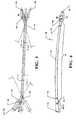
- An exemplary intramedullary nail 20, as illustrated in FIGS. 2-4, comprises an elongate member 22.
- the nail 20 is formed from titanium and has a generally cylindrical shape with a diameter along a solid central section 24 of between 4mm and 7mm, although this is not intended as a limitation.
- Central section 24 should have a certain amount of elastic flexibility to permit accurate placement within the femoral canal as discussed below. Such elastic flexibility, which permits some flexure during movement and weight bearing activity, confers an additional benefit in that it has been found to stimulate bone healing.
- the nail 20 preferably ends in a rounded, smooth and tapered distal tip 26.
- the nail 20 has two widened sections or fastener receiving areas 28, 30 in respective proximal and distal end sections 32, 34.
- Each fastener receiving area 28, 30 is formed with an increased cross sectional dimension relative to central section 24. Also, smooth, gradual transitions 36, 38 with the central section 24 avoid sharp edges along the length of nail 20.
- the distal fastener receiving area 28 is positioned adjacent to but in spaced relation from distal tip 26. The distal fastener receiving area 28 tapers on both proximal and distal sides thereof.
- proximal fastener receiving area 30 extends to proximal tip 42; that is, there is a distal taper but no proximal taper, and the widened proximal fastener receiving area 30 instead continues to the proximal tip 42 and forms the entire proximal end section 32.
- Each fastener receiving area 28, 30 includes a generally cylindrical hole 50, 52 extending generally normal to the portion of the longitudinal axis 54 in which it is located for receiving a fastener (not shown).
- Holes 50, 52 preferably have diameters in a range of 3 mm to 41 ⁇ 2 mm.
- Proximal tip 42 includes attachment structure 58 for receiving a driver, described below, which may be a conventional driver used in the bone nail art.
- attachment structure 58 comprises a threaded axial bore 60 extending along axis 54 and engageable with an externally threaded driver.
- a notch 62 extends across bore 60 and, as is known, aligns the driver for purposes of later drilling and cross fastening nail 20, as will be discussed below.
- nail 20 is curved in an anterior direction along a radius of curvature 70 to generally conform nail 20 to the typical femoral curvature.
- this radius of curvature 70 is in the range of 30 inches to 60 inches.
- a proximal bend 72 and a distal bend 74 are formed, respectively, in central section 24 directly adjacent proximal and distal end sections 32, 34. These bends 72, 74 are made in the same direction, i.e., laterally to one side of nail 20 or the other as shown best in Fig. 3.
- the solid lines in Fig. 3 illustrate lateral bends 72, 74 out of the sagital plane and generally in the coronal plane at angles A, B for inserting nail 20 into a left femur. Angles A', B' corresponding to the respective lateral bends of proximal and distal end sections 32, 34, shown in phantom, facilitate use of nail 20 in the right femur.
- interlocking nail 20 may be custom bent by the surgeon just prior to use, not only to facilitate insertion in the right or left femur, but also to accommodate other particular shapes necessary for a particular patient. For example, some patients may have deformities necessitating one or more corrective osteotomies or fractures made by the surgeon. These osteotomies may also be fixed using nail 20.
- nail 20 is formed from titanium, although other materials such as those known in the art may be used as well.
- Central section 24 is of solid cross section and at least substantially constant diameter with a smooth outer surface to facilitate removal in 6-9 months.
- Proximal and distal end sections 32, 34 are also solid, except for holes 50, 52, bore 60 and notch 62. As appreciated from Fig. 2, the axes of holes 50, 52 are coplanar.
- fastener receiving areas 28, 30 have a cross sectional dimension greater than the cross sectional dimension of central section 24.
- central section 24 may be formed with a solid cylindrical cross section having a diameter of between 4 mm and 7 mm.
- Fastener receiving area 28 has a generally bulbous, rounded shape, while proximal fastener receiving area 30, which is preferably continuous with distal end section 32, has a cylindrical cross sectional shape.
- proximal fastener receiving area 30 which is preferably continuous with distal end section 32, has a cylindrical cross sectional shape.
- the respective ratios of the cross sectional dimensions at these locations is at least about 1.3:1 relative to the cross sectional dimension of central section 24.
- a nail 20 substantially as shown in Fig. 2 had a cross sectional dimension of 5.5 mm for central section 24, an 8.5 mm cross sectional dimension for proximal end section 32, and also a maximum 8.5 mm cross sectional dimension at the largest diameter portion of distal fastener receiving area 28.
- This nail was used on children generally weighing less than 100 lbs.
- the 8.5 mm dimensions at the proximal and distal fastener receiving areas remained the same, while the cross sectional dimension for central section 24 was increased slightly to 6.5 mm to provide additional strength but still provide the desirable flexure.
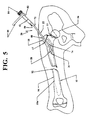
- an insertion point 80 is created in the greater trochanter 18 of the femur 10 of a child, for example, at a distinctly lateral position relative to the piriformis fossa 11.
- Intramedullary canal 10a of femur 10 is drilled and reamed in a known manner to accept bone nail 20.
- a driver 82 is coupled with proximal tip 42, also in a known manner, and the surgeon impacts the head 84 of the driver 82 while holding the handle portion 86.
- Bend 74 facilitates better positioning of distal tip 26 upon insertion of nail 20 by allowing distal tip 26 to naturally follow the intramedullary canal 10a relative to the angle of the insertion point 80 in the greater trochanter 18.
- bone nail 20 may be rotated in either direction represented by arrow 90 as the distal tip 26 approaches and crosses the fracture 92. This allows the surgeon, using fluoroscopy, to more easily locate and enter the intramedullary canal 10a of the distal bone segment 94.
- a drill rig 100 is attached to the proximal tip 42 through securement to handle portion 86.
- the drill rig 100 aligns a drill guide 102 with the proximal fastener receiving hole 52 and a drill (not shown) is used to form a hole through femur 10 in line with hole 52.
- a screw driving mechanism 104 is then used to insert a cross fastener 110 at this location.
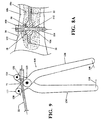
- a second hole is drilled and a second cross fastener 112, preferably of the same design as fastener 110, is inserted through the distal hole 50, as shown in Figs. 8 and 8A. More specifically, and as represented by distal fastener 112 in Fig.
- fastener 112 comprises a drive head 150, a proximal threaded portion 152, a distal threaded portion 154, and a central unthreaded portion 156 which is received within hole 50. Threaded portions 152, 154 are securely engaged within cortical layer 10b of femur 10. In this manner, bone nail 20 is interlocked to femur 10 at proximal and distal locations thereby preventing undesirable rotational and/or lengthwise bone movements at the fracture site.
- proximal tip 42 is presented directly at the insertion point 80 on the greater trochanter 18 so that, upon healing of the fracture, the cross fasteners 110, 112 may be removed and threaded bore 60 may be engaged to withdraw nail 20 from intramedullary canal 10a.
- bends 72, 74 may be pre-made by a manufacturer of nail 20, for example, the present invention further contemplates a manual bending device as shown in Fig. 9.
- nail 20 may be placed by the surgeon in a bending device 118 jaw structure comprising three rollers 120, 122, 124 with one roller 120 acting as a fulcrum and two opposite rollers 122, 124 applying forces in the direction of arrows 130, 132.
- handles 134, 136 of the device are squeezed together in the direction of arrows 138, 140, proximal end section 32 will be bent relative to central section 24 to form bend 72 as best illustrated in Fig. 3 and as previously described.
Landscapes
- Health & Medical Sciences (AREA)
- Orthopedic Medicine & Surgery (AREA)
- Surgery (AREA)
- Life Sciences & Earth Sciences (AREA)
- Heart & Thoracic Surgery (AREA)
- Nuclear Medicine, Radiotherapy & Molecular Imaging (AREA)
- Engineering & Computer Science (AREA)
- Biomedical Technology (AREA)
- Medical Informatics (AREA)
- Molecular Biology (AREA)
- Animal Behavior & Ethology (AREA)
- General Health & Medical Sciences (AREA)
- Public Health (AREA)
- Veterinary Medicine (AREA)
- Neurology (AREA)
- Surgical Instruments (AREA)
- Acyclic And Carbocyclic Compounds In Medicinal Compositions (AREA)
Applications Claiming Priority (3)
| Application Number | Priority Date | Filing Date | Title |
|---|---|---|---|
| US321369 | 1994-10-11 | ||
| US32136999A | 1999-05-27 | 1999-05-27 | |
| PCT/US2000/014840 WO2000072767A1 (en) | 1999-05-27 | 2000-05-26 | Pediatric intramedullary nail and method |
Publications (3)
| Publication Number | Publication Date |
|---|---|
| EP1196101A1 EP1196101A1 (en) | 2002-04-17 |
| EP1196101A4 EP1196101A4 (en) | 2002-08-21 |
| EP1196101B1 true EP1196101B1 (en) | 2004-04-07 |
Family
ID=23250333
Family Applications (1)
| Application Number | Title | Priority Date | Filing Date |
|---|---|---|---|
| EP00937929A Expired - Lifetime EP1196101B1 (en) | 1999-05-27 | 2000-05-26 | Pediatric intramedullary nail |
Country Status (7)
| Country | Link |
|---|---|
| EP (1) | EP1196101B1 (enExample) |
| JP (1) | JP2003500154A (enExample) |
| AT (1) | ATE263514T1 (enExample) |
| AU (1) | AU5304100A (enExample) |
| CA (1) | CA2372712A1 (enExample) |
| DE (1) | DE60009705D1 (enExample) |
| WO (1) | WO2000072767A1 (enExample) |
Cited By (1)
| Publication number | Priority date | Publication date | Assignee | Title |
|---|---|---|---|---|
| CN102599970A (zh) * | 2012-03-31 | 2012-07-25 | 杨永竑 | 一种骨干内固定系统 |
Families Citing this family (6)
| Publication number | Priority date | Publication date | Assignee | Title |
|---|---|---|---|---|
| US7008425B2 (en) | 1999-05-27 | 2006-03-07 | Jonathan Phillips | Pediatric intramedullary nail and method |
| WO2004014243A1 (en) | 2002-08-10 | 2004-02-19 | William H Simon | Method and apparatus for repairing the mid-food region via an intermedullary nail |
| US7588577B2 (en) * | 2004-07-15 | 2009-09-15 | Wright Medical Technology, Inc. | Guide assembly for intramedullary fixation and method of using the same |
| DE102005029165B4 (de) | 2005-06-23 | 2009-01-22 | Stryker Leibinger Gmbh & Co. Kg | Biegezange und Biegezangensystem für chirurgische Elemente |
| US8540714B2 (en) | 2010-05-11 | 2013-09-24 | Orthopediatrics Corp. | Pediatric intramedullary nail |
| EP2810611B1 (en) | 2013-06-06 | 2017-03-08 | Stryker European Holdings I, LLC | Bending instrument for a surgical element |
Citations (1)
| Publication number | Priority date | Publication date | Assignee | Title |
|---|---|---|---|---|
| US5034013A (en) * | 1989-04-24 | 1991-07-23 | Zimmer Inc. | Intramedullary nail |
Family Cites Families (8)
| Publication number | Priority date | Publication date | Assignee | Title |
|---|---|---|---|---|
| US4034013A (en) * | 1975-11-13 | 1977-07-05 | Rohm And Haas Company | Impact and melt strength improvement of poly(alkylene terephthalate) |
| US4913137A (en) * | 1988-02-09 | 1990-04-03 | Orthopedic Designs, Inc. | Intramedullary rod system |
| CH674613A5 (enExample) * | 1988-03-14 | 1990-06-29 | Synthes Ag | |
| US4862883A (en) * | 1988-04-21 | 1989-09-05 | Yosef Freeland | Interlocking intramedullary nail |
| US5019079A (en) * | 1989-11-20 | 1991-05-28 | Zimmer, Inc. | Bone screw |
| CH683065A5 (de) * | 1990-03-20 | 1994-01-14 | Synthes Ag | Tibia-Marknagel mit angepasstem Querschnitt. |
| US5433718A (en) * | 1992-08-20 | 1995-07-18 | Brinker; Mark | Antibiotic eluding intramedullary nail apparatus |
| US5490409A (en) * | 1994-11-07 | 1996-02-13 | K-Medic, Inc. | Adjustable cam action rod bender for surgical rods |
-
2000
- 2000-05-26 CA CA002372712A patent/CA2372712A1/en not_active Abandoned
- 2000-05-26 AU AU53041/00A patent/AU5304100A/en not_active Abandoned
- 2000-05-26 JP JP2000620882A patent/JP2003500154A/ja not_active Ceased
- 2000-05-26 AT AT00937929T patent/ATE263514T1/de not_active IP Right Cessation
- 2000-05-26 DE DE60009705T patent/DE60009705D1/de not_active Expired - Lifetime
- 2000-05-26 WO PCT/US2000/014840 patent/WO2000072767A1/en not_active Ceased
- 2000-05-26 EP EP00937929A patent/EP1196101B1/en not_active Expired - Lifetime
Patent Citations (1)
| Publication number | Priority date | Publication date | Assignee | Title |
|---|---|---|---|---|
| US5034013A (en) * | 1989-04-24 | 1991-07-23 | Zimmer Inc. | Intramedullary nail |
Cited By (1)
| Publication number | Priority date | Publication date | Assignee | Title |
|---|---|---|---|---|
| CN102599970A (zh) * | 2012-03-31 | 2012-07-25 | 杨永竑 | 一种骨干内固定系统 |
Also Published As
| Publication number | Publication date |
|---|---|
| CA2372712A1 (en) | 2000-12-07 |
| EP1196101A1 (en) | 2002-04-17 |
| EP1196101A4 (en) | 2002-08-21 |
| JP2003500154A (ja) | 2003-01-07 |
| DE60009705D1 (de) | 2004-05-13 |
| AU5304100A (en) | 2000-12-18 |
| ATE263514T1 (de) | 2004-04-15 |
| WO2000072767A1 (en) | 2000-12-07 |
| WO2000072767A9 (en) | 2001-12-27 |
Similar Documents
| Publication | Publication Date | Title |
|---|---|---|
| US7008425B2 (en) | Pediatric intramedullary nail and method | |
| US6524313B1 (en) | Intramedullary nail system | |
| EP2227160B1 (en) | Distal tibia plating system | |
| EP2568891B1 (en) | Pediatric intramedullary nail | |
| CA1322307C (en) | Medullary nail for the tibia | |
| EP0192840B1 (en) | Appliance for fixing fractures of the femur | |
| US7785326B2 (en) | System for intramedullary rod fixation and method therefor | |
| US9247946B2 (en) | Method of using a drill sleeve | |
| US8979846B2 (en) | Flexible nail assembly for fractures of long bones | |
| US4940467A (en) | Variable length fixation device | |
| JP4932715B2 (ja) | 螺旋状縦溝を有する骨髄内ロッド | |
| EP0853923A1 (en) | Intramedullary cavity nail for the treatment of fractures of the hip | |
| US20030093076A1 (en) | Bone screw, particularly for use with external fixators in fracture stabilization | |
| EP0359793A4 (en) | Variable length fixation device | |
| EP1196101A1 (en) | Pediatric intramedullary nail and method | |
| AU2005201063A1 (en) | Pediatric intramedullary nail and method | |
| JPWO2000047119A1 (ja) | 骨折治療具 |
Legal Events
| Date | Code | Title | Description |
|---|---|---|---|
| PUAI | Public reference made under article 153(3) epc to a published international application that has entered the european phase |
Free format text: ORIGINAL CODE: 0009012 |
|
| 17P | Request for examination filed |
Effective date: 20011224 |
|
| AK | Designated contracting states |
Kind code of ref document: A1 Designated state(s): AT BE CH CY DE DK ES FI FR GB GR IE IT LI LU MC NL PT SE |
|
| AX | Request for extension of the european patent |
Free format text: AL;LT;LV;MK;RO;SI |
|
| A4 | Supplementary search report drawn up and despatched |
Effective date: 20020704 |
|
| AK | Designated contracting states |
Kind code of ref document: A4 Designated state(s): AT BE CH CY DE DK ES FI FR GB GR IE IT LI LU MC NL PT SE |
|
| RIC1 | Information provided on ipc code assigned before grant |
Free format text: 7A 61B 17/58 A, 7A 61B 17/72 B |
|
| 17Q | First examination report despatched |
Effective date: 20030123 |
|
| GRAP | Despatch of communication of intention to grant a patent |
Free format text: ORIGINAL CODE: EPIDOSNIGR1 |
|
| RTI1 | Title (correction) |
Free format text: PEDIATRIC INTRAMEDULLARY NAIL |
|
| GRAS | Grant fee paid |
Free format text: ORIGINAL CODE: EPIDOSNIGR3 |
|
| GRAA | (expected) grant |
Free format text: ORIGINAL CODE: 0009210 |
|
| AK | Designated contracting states |
Kind code of ref document: B1 Designated state(s): AT BE CH CY DE DK ES FI FR GB GR IE IT LI LU MC NL PT SE |
|
| PG25 | Lapsed in a contracting state [announced via postgrant information from national office to epo] |
Ref country code: FR Free format text: LAPSE BECAUSE OF FAILURE TO SUBMIT A TRANSLATION OF THE DESCRIPTION OR TO PAY THE FEE WITHIN THE PRESCRIBED TIME-LIMIT Effective date: 20040407 Ref country code: LI Free format text: LAPSE BECAUSE OF FAILURE TO SUBMIT A TRANSLATION OF THE DESCRIPTION OR TO PAY THE FEE WITHIN THE PRESCRIBED TIME-LIMIT Effective date: 20040407 Ref country code: AT Free format text: LAPSE BECAUSE OF FAILURE TO SUBMIT A TRANSLATION OF THE DESCRIPTION OR TO PAY THE FEE WITHIN THE PRESCRIBED TIME-LIMIT Effective date: 20040407 Ref country code: BE Free format text: LAPSE BECAUSE OF FAILURE TO SUBMIT A TRANSLATION OF THE DESCRIPTION OR TO PAY THE FEE WITHIN THE PRESCRIBED TIME-LIMIT Effective date: 20040407 Ref country code: FI Free format text: LAPSE BECAUSE OF FAILURE TO SUBMIT A TRANSLATION OF THE DESCRIPTION OR TO PAY THE FEE WITHIN THE PRESCRIBED TIME-LIMIT Effective date: 20040407 Ref country code: NL Free format text: LAPSE BECAUSE OF FAILURE TO SUBMIT A TRANSLATION OF THE DESCRIPTION OR TO PAY THE FEE WITHIN THE PRESCRIBED TIME-LIMIT Effective date: 20040407 Ref country code: CH Free format text: LAPSE BECAUSE OF FAILURE TO SUBMIT A TRANSLATION OF THE DESCRIPTION OR TO PAY THE FEE WITHIN THE PRESCRIBED TIME-LIMIT Effective date: 20040407 Ref country code: CY Free format text: LAPSE BECAUSE OF FAILURE TO SUBMIT A TRANSLATION OF THE DESCRIPTION OR TO PAY THE FEE WITHIN THE PRESCRIBED TIME-LIMIT Effective date: 20040407 Ref country code: IT Free format text: LAPSE BECAUSE OF FAILURE TO SUBMIT A TRANSLATION OF THE DESCRIPTION OR TO PAY THE FEE WITHIN THE PRESCRIBED TIME-LIMIT;WARNING: LAPSES OF ITALIAN PATENTS WITH EFFECTIVE DATE BEFORE 2007 MAY HAVE OCCURRED AT ANY TIME BEFORE 2007. THE CORRECT EFFECTIVE DATE MAY BE DIFFERENT FROM THE ONE RECORDED. Effective date: 20040407 |
|
| REG | Reference to a national code |
Ref country code: GB Ref legal event code: FG4D |
|
| REG | Reference to a national code |
Ref country code: CH Ref legal event code: EP |
|
| PGFP | Annual fee paid to national office [announced via postgrant information from national office to epo] |
Ref country code: MC Payment date: 20040428 Year of fee payment: 5 |
|
| PGFP | Annual fee paid to national office [announced via postgrant information from national office to epo] |
Ref country code: NL Payment date: 20040505 Year of fee payment: 5 |
|
| PGFP | Annual fee paid to national office [announced via postgrant information from national office to epo] |
Ref country code: SE Payment date: 20040506 Year of fee payment: 5 |
|
| PGFP | Annual fee paid to national office [announced via postgrant information from national office to epo] |
Ref country code: FR Payment date: 20040510 Year of fee payment: 5 |
|
| PGFP | Annual fee paid to national office [announced via postgrant information from national office to epo] |
Ref country code: IE Payment date: 20040512 Year of fee payment: 5 Ref country code: AT Payment date: 20040512 Year of fee payment: 5 |
|
| REF | Corresponds to: |
Ref document number: 60009705 Country of ref document: DE Date of ref document: 20040513 Kind code of ref document: P |
|
| PGFP | Annual fee paid to national office [announced via postgrant information from national office to epo] |
Ref country code: DK Payment date: 20040517 Year of fee payment: 5 |
|
| PGFP | Annual fee paid to national office [announced via postgrant information from national office to epo] |
Ref country code: ES Payment date: 20040518 Year of fee payment: 5 |
|
| REG | Reference to a national code |
Ref country code: IE Ref legal event code: FG4D |
|
| PG25 | Lapsed in a contracting state [announced via postgrant information from national office to epo] |
Ref country code: LU Free format text: LAPSE BECAUSE OF NON-PAYMENT OF DUE FEES Effective date: 20040526 |
|
| PGFP | Annual fee paid to national office [announced via postgrant information from national office to epo] |
Ref country code: GR Payment date: 20040526 Year of fee payment: 5 |
|
| PG25 | Lapsed in a contracting state [announced via postgrant information from national office to epo] |
Ref country code: GR Free format text: LAPSE BECAUSE OF FAILURE TO SUBMIT A TRANSLATION OF THE DESCRIPTION OR TO PAY THE FEE WITHIN THE PRESCRIBED TIME-LIMIT Effective date: 20040707 Ref country code: SE Free format text: LAPSE BECAUSE OF FAILURE TO SUBMIT A TRANSLATION OF THE DESCRIPTION OR TO PAY THE FEE WITHIN THE PRESCRIBED TIME-LIMIT Effective date: 20040707 Ref country code: DK Free format text: LAPSE BECAUSE OF FAILURE TO SUBMIT A TRANSLATION OF THE DESCRIPTION OR TO PAY THE FEE WITHIN THE PRESCRIBED TIME-LIMIT Effective date: 20040707 |
|
| PG25 | Lapsed in a contracting state [announced via postgrant information from national office to epo] |
Ref country code: DE Free format text: LAPSE BECAUSE OF FAILURE TO SUBMIT A TRANSLATION OF THE DESCRIPTION OR TO PAY THE FEE WITHIN THE PRESCRIBED TIME-LIMIT Effective date: 20040708 |
|
| PGFP | Annual fee paid to national office [announced via postgrant information from national office to epo] |
Ref country code: BE Payment date: 20040716 Year of fee payment: 5 |
|
| PG25 | Lapsed in a contracting state [announced via postgrant information from national office to epo] |
Ref country code: ES Free format text: LAPSE BECAUSE OF FAILURE TO SUBMIT A TRANSLATION OF THE DESCRIPTION OR TO PAY THE FEE WITHIN THE PRESCRIBED TIME-LIMIT Effective date: 20040718 |
|
| LTIE | Lt: invalidation of european patent or patent extension |
Effective date: 20040407 |
|
| NLV1 | Nl: lapsed or annulled due to failure to fulfill the requirements of art. 29p and 29m of the patents act | ||
| REG | Reference to a national code |
Ref country code: CH Ref legal event code: PL |
|
| PLBE | No opposition filed within time limit |
Free format text: ORIGINAL CODE: 0009261 |
|
| STAA | Information on the status of an ep patent application or granted ep patent |
Free format text: STATUS: NO OPPOSITION FILED WITHIN TIME LIMIT |
|
| EN | Fr: translation not filed | ||
| 26N | No opposition filed |
Effective date: 20050110 |
|
| PG25 | Lapsed in a contracting state [announced via postgrant information from national office to epo] |
Ref country code: IE Free format text: LAPSE BECAUSE OF NON-PAYMENT OF DUE FEES Effective date: 20050526 |
|
| PG25 | Lapsed in a contracting state [announced via postgrant information from national office to epo] |
Ref country code: MC Free format text: LAPSE BECAUSE OF NON-PAYMENT OF DUE FEES Effective date: 20050531 |
|
| REG | Reference to a national code |
Ref country code: IE Ref legal event code: MM4A |
|
| PG25 | Lapsed in a contracting state [announced via postgrant information from national office to epo] |
Ref country code: PT Free format text: LAPSE BECAUSE OF NON-PAYMENT OF DUE FEES Effective date: 20040907 |
|
| PGFP | Annual fee paid to national office [announced via postgrant information from national office to epo] |
Ref country code: GB Payment date: 20100329 Year of fee payment: 11 |
|
| GBPC | Gb: european patent ceased through non-payment of renewal fee |
Effective date: 20110526 |
|
| PG25 | Lapsed in a contracting state [announced via postgrant information from national office to epo] |
Ref country code: GB Free format text: LAPSE BECAUSE OF NON-PAYMENT OF DUE FEES Effective date: 20110526 |