EP1195895A2 - Radio squelch techniques - Google Patents
Radio squelch techniques Download PDFInfo
- Publication number
- EP1195895A2 EP1195895A2 EP01119784A EP01119784A EP1195895A2 EP 1195895 A2 EP1195895 A2 EP 1195895A2 EP 01119784 A EP01119784 A EP 01119784A EP 01119784 A EP01119784 A EP 01119784A EP 1195895 A2 EP1195895 A2 EP 1195895A2
- Authority
- EP
- European Patent Office
- Prior art keywords
- signal
- noise
- detected
- generating
- response
- Prior art date
- Legal status (The legal status is an assumption and is not a legal conclusion. Google has not performed a legal analysis and makes no representation as to the accuracy of the status listed.)
- Withdrawn
Links
Images

Classifications
-
- H—ELECTRICITY
- H03—ELECTRONIC CIRCUITRY
- H03G—CONTROL OF AMPLIFICATION
- H03G3/00—Gain control in amplifiers or frequency changers
- H03G3/20—Automatic control
- H03G3/30—Automatic control in amplifiers having semiconductor devices
- H03G3/34—Muting amplifier when no signal is present
- H03G3/344—Muting responsive to the amount of noise (noise squelch)
Definitions
- This invention relates to radio reception, and more particularly relates to the squelching of a signal received by a radio.
- Squelching techniques have been known in the past. Typically, such techniques are based on an envelope detected signal which has already been subjected to automatic gain control. That is, the squelching is based on a normalized envelope detected signal. In addition, frequency division of signal and noise is used in most commercial radios.
- the preferred embodiment is useful in a radio receiver adapted to receive a radio frequency carrier signal.
- signal squelching is provided by generating a baseband carrier signal in response to the radio frequency carrier signal.
- a detected signal is generated in response to the baseband carrier signal and a noise estimate signal is generated by estimating at least the thermal noise in the detected signal.
- a threshold signal defining a predetermined signal level is generated in response to the noise estimate signal and one or more predetermined signal parameters.
- a first signal is generated in the event that a signal derived from the detected signal has a first predetermined relationship with respect to the predetermined signal level, and a second signal is generated in the event that the signal derived from the detected signal has a second predetermined relationship with respect to the predetermined signal level.
- the detected signal is passed in response to the first signal, and the detected signal is squelched in response to the second signal.
- a squelch algorithm of acceptable computational complexity for a CPU processor can be provided.
- An estimate of signal quality can be made even with an 8.33 KHz channel spacing. The estimate does not require extensive filtering to separate signal power plus noise and noise power alone.
- Figure 1 is a schematic block diagram and functional block diagram of a preferred form of algorithm for squelch processing made in accordance with the present invention.
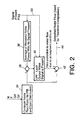
- Figure 2 is a flow diagram illustrating in more detail a portion of the functional block diagram shown in Figure 1.
- a preferred form of radio receiver 10 made in accordance with the present invention includes a conventional antenna 12 which receives a radio frequency carrier signal that is modulated by amplitude modulation and is transmitted in the VHF range of about 118 - 137 MHz.
- the radio frequency carrier signal is processed by carrier processing circuitry 14 that generates a baseband carrier signal in response to the radio frequency carrier signal.
- the carrier processing circuitry 14 provides AGC control for the radio frequency (RF) carrier signal, as well as an intermediate frequency (IF) carrier signal generated by circuitry 14.
- the carrier processing circuitry 14 converts the IF carrier to digital form and then converts the IF carrier to a baseband digital carrier signal.
- Circuitry 14 also resamples the digital baseband carrier to 42 kilosamples per second and generates orthogonal I and Q signals representing the baseband carrier.
- the conversion of the IF carrier to the baseband digital carrier and resampling is preferably accomplished by a digital signal processor 16 which performs the additional functions illustrated by blocks 20 - 52 in the remainder of Figure 1.
- the algorithm performed by processor 16 executes in real time floating point arithmetic.
- the algorithm performs an envelope detection operation 20 on the envelope of the baseband carrier signal which has been partially normalized by an IF and RF automatic gain control, but not by any baseband automatic gain control.
- the detected signal has a residual dynamic range of 67 decibels from which is derived a reliable estimate of signal with noise power and of noise power alone.
- Narrow band Mode 0 channels have an assigned 8.33 KHz frequency separation, making it difficult and unreliable to try to filter outside the band for a noise estimate.
- the detected signal is filtered by a decimate by 2 frequency impulse response (FIR) filter operation 22 with a six decibel bandwidth of 2.7 KHz and 60 decibel bandwidth of 3.5 KHz.
- FIR frequency impulse response
- the algorithm passes the detected and filtered audio signal when the average power out of FIR 22 exceeds a threshold based on the best estimate of the noise floor from the receiver gain distribution, the desired detection probability, and the measured noise whenever a signal is absent.
- the noise floor is calculated from the known gain distribution.
- the noise floor is updated in a Kalman filter. On a given channel, the noise estimate generally improves with time.
- the threshold is initialized to 6 decibels (adjustable) above an estimate of the noise floor.
- the estimate changes based on the known noise figure of the receiver, the desired probability of detection and false triggering, the known gain distribution which changes as the RF and IF attenuators change (driven by the AGC loops shown in the above-referenced application), on the minimum signal strength (sensitivity) desired, and the desired minimum signal to noise ratio (SNR).
- operation 26 and an averaging operation 28 which generates a signal PO corresponding to the averaged power out of the FIR filter operation 22.
- a Kalman filter operation 32 estimates the noise floor in-band value based on the PO value which is transmitted through a gate 30 when the PO value is below a threshold.
- Filter operation 32 also is based on the gain of the radio frequency stages (Grf) and the gain of the intermediate frequency stages (Gif), as well as a noise figure calculated for the various circuits in processing circuitry 14.
- the Grf and Gif values change depending on the gains dictated by the AGC operation in circuitry 14.
- the noise floor is transmitted along a signal path 44 and is used by a squelch threshold compute operation 50 which is based on a desired minimum signal to noise ratio (SNR) and a minimum signal strength or sensitivity (SENS).
- the SNR and SENS values are constants in the algorithm.
- the threshold calculated in operation 50 is transmitted to a threshold detection operation 52 which generates a first signal along a path 53 to gate 30 in the event that the PO value is less than the threshold and generates another signal along a path 55 in the event that the PO value is greater than the threshold (i.e., when the averaged power of the detected signal is greater than the threshold).
- a signal conditioner 54 such as a switch, passes the detected signal to an output path 56.
- gate 30 passes the PO signal to a Kalman filter operation 32 when it consists primarily of noise power alone. Additional details about Kalman filter operation 32 are shown in Figure 2.
- the average of the received noise power i.e., the average of signal PO when signal PO consists at least primarily of noise
- the noise floor (NkTFB) and the gain distribution from the RF and IF frequency stages of circuitry 14 are calculated in operation 34.
- the values resulting from operations 34 and 36 are subtracted in a subtraction operation 38 and the results are latched in a latching operation 40 when a signal is present on path 53 indicating that the PO value is less than the threshold determined in operation 50.
- the signal resulting from latching operation 40 and noise floor computation operation 34 are added in an adding operation 42 to result in the smoothed noise floor value transmitted on path 44 to the squelch threshold computing operation 50.
- noise power alone is updated by operations 34 and 36 whenever PO is less than the threshold and is taken over several samples before the detection occurs to avoid signal contamination.
- the combined signal power with noise power (PS) is computed when the threshold calculated by operation 50 is exceeded, making the signal to noise estimates orthogonal in time.
- the algorithm assumes that the channel noise statistics are quasi-stationary between noise and signal power estimates (i.e., are slowly varying on the same channel).
Landscapes
- Noise Elimination (AREA)
- Circuits Of Receivers In General (AREA)
- Control Of Amplification And Gain Control (AREA)
- Digital Transmission Methods That Use Modulated Carrier Waves (AREA)
Abstract
Description
Claims (10)
- In a radio receiver adapted to receive a radio frequency carrier signal, apparatus for providing signal squelching comprising:carrier processing circuitry arranged to generate a baseband carrier signal in response to said radio frequency carrier signal;a detector arranged to generate a detected signal in response to said baseband carrier signal;a noise estimator arranged to generate a noise estimate signal by estimating at least the noise in the detected signal due to atmospheric conditions;a threshold calculator arranged to calculate a threshold signal defining a predetermined signal level in response to the noise estimate signal and one or more predetermined signal parameters;a threshold detector arranged to generate a first signal in the event that a signal derived from said detected signal has a first predetermined relationship with respect to said predetermined signal level and to generate a second signal in the event that said signal derived from said detected signal has a second predetermined relationship with respect to said predetermined level; anda signal conditioner arranged to pass said detected signal in response to said first signal and to squelch said detected signal in response to said second signal.
- Apparatus, as claimed in claim 1, wherein said noise estimator is responsive to said detected signal in the event said second signal is generated and is unresponsive to said detected signal in the event said first signal is generated, and/or
wherein said noise estimator is responsive to said detected signal before said detected signal is subjected to automatic gain control. - Apparatus, as claimed in claim 1, wherein said baseband carrier signal comprises a digital signal and wherein said detector, noise estimator, threshold calculator and threshold detector comprise operations performed by a digital processor.
- Apparatus, as claimed in claim 1, wherein said one or more signal parameters comprise a minimum signal to noise ratio, and/or
wherein said one or more signal parameters comprise a minimum strength or sensitivity of said detected signal and a desired probability of detecting said minimum signal strength. - Apparatus, as claimed in claim 1, wherein said first predetermined relationship comprises an averaged power derived from the detected signal greater than said predetermined signal level, and/or
wherein said first predetermined relationship comprises an average of the square of the detected signal greater than the predetermined signal level, and/or
wherein said noise estimator further estimates the noise present in the detected signal due to receiver noise generated in at least part of the receiver, and/or
wherein said detected signal has a noise component and
wherein said noise estimator further comprises:a calculator arranged to generate a noise power signal related to an average of said noise component of the detected signal; anda latch arranged to store said noise power signal in response to said first signal. - In a radio receiver adapted to receive a radio frequency carrier signal, a method of providing signal squelching comprising:generating a baseband carrier signal in response to said radio frequency carrier signal;generating a detected signal in response to said baseband carrier signal;generating a noise estimate signal by estimating at least the noise in the detected signal due to atmospheric conditions;calculating a threshold signal defining a predetermined signal level in response to the noise estimate signal and one or more predetermined signal parameters;generating a first signal in the event that a signal derived from said detected signal has a first predetermined relationship with respect to said predetermined signal level;generating a second signal in the event that said signal derived from said detected signal has a second predetermined relationship with respect to said predetermined level;passing said detected signal in response to said first signal; andsquelching said detected signal in response to said second signal.
- A method, as claimed in claim 6, wherein said generating a noise estimate signal comprises generating a noise estimate signal in response to said detected signal in the event said second signal is generated and generating a noise estimate signal unresponsive to said detected signal in the event said first signal is generated, and/or
wherein said generating a noise estimate signal comprises generating a noise estimate signal responsive to said detected signal before said detected signal is subjected to automatic gain control. - A method, as claimed in claim 6, wherein said generating a baseband carrier signal comprises generating a digital baseband carrier signal and wherein said generating a detected signal, generating a noise estimate signal, calculating a threshold signal, generating a first signal and generating a second signal comprise digital processing.
- A method, as claimed in claim 6, wherein said calculating comprises calculating a threshold signal defining a predetermined signal level in response to the noise estimate signal and a minimum signal to noise ratio, and/or
wherein said calculating comprises calculating a threshold signal defining a predetermined signal level in response to the noise estimate signal and a minimum strength or sensitivity of said detected signal. - A method, as claimed in claim 6, wherein said generating a first signal comprises generating a first signal in the event that a signal derived from said detected signal has an averaged power derived from the detected signal greater than the predetermined signal level, and/or
wherein said generating a first signal comprises generating a first signal in the event that a signal derived from said detected signal has an average of the square of the detected signal greater than the predetermined signal level, and/or
wherein said generating a detected signal comprises generating a detected signal with a noise component and
wherein said generating a noise estimate signal further comprises:generating a noise power signal related to an average of said noise component of the detected signal; andlatching said noise power signal in response to said first signal.
Applications Claiming Priority (2)
| Application Number | Priority Date | Filing Date | Title |
|---|---|---|---|
| US675763 | 1991-03-27 | ||
| US09/675,763 US6671504B1 (en) | 2000-09-29 | 2000-09-29 | Radio squelch techniques |
Publications (2)
| Publication Number | Publication Date |
|---|---|
| EP1195895A2 true EP1195895A2 (en) | 2002-04-10 |
| EP1195895A3 EP1195895A3 (en) | 2005-12-28 |
Family
ID=24711875
Family Applications (1)
| Application Number | Title | Priority Date | Filing Date |
|---|---|---|---|
| EP01119784A Withdrawn EP1195895A3 (en) | 2000-09-29 | 2001-08-28 | Radio squelch techniques |
Country Status (3)
| Country | Link |
|---|---|
| US (1) | US6671504B1 (en) |
| EP (1) | EP1195895A3 (en) |
| JP (1) | JP2002198836A (en) |
Cited By (2)
| Publication number | Priority date | Publication date | Assignee | Title |
|---|---|---|---|---|
| WO2010011362A1 (en) * | 2008-07-24 | 2010-01-28 | Qualcomm Incorporated | Method and apparatus for reducing audio artifacts |
| EP2141817A3 (en) * | 2008-07-03 | 2014-04-30 | Honeywell International Inc. | Noise measurement for radio squelch function |
Families Citing this family (6)
| Publication number | Priority date | Publication date | Assignee | Title |
|---|---|---|---|---|
| WO2008039123A1 (en) * | 2006-09-25 | 2008-04-03 | Telefonaktiebolaget Lm Ericsson (Publ) | Methods and arrangements for memory-efficient estimation of noise floor |
| JP4079197B1 (en) * | 2007-02-06 | 2008-04-23 | 松下電器産業株式会社 | Receiving apparatus and receiving system using the same |
| US7890073B2 (en) * | 2007-09-28 | 2011-02-15 | Rockwell Collins, Inc. | Method and system for detecting carrier wave dropout |
| JP5670149B2 (en) * | 2010-06-09 | 2015-02-18 | 株式会社日立国際電気 | transceiver |
| US8554264B1 (en) * | 2011-11-17 | 2013-10-08 | Michael L. Gibbons | Systems and methods for optimizing broadcasts |
| KR102382197B1 (en) * | 2021-02-17 | 2022-04-04 | 엘아이지넥스원 주식회사 | DSB-TC amplitude modulation squelch detection device and DSB-TC amplitude modulation squelch detection method |
Family Cites Families (18)
| Publication number | Priority date | Publication date | Assignee | Title |
|---|---|---|---|---|
| US3325738A (en) * | 1964-02-17 | 1967-06-13 | Avco Corp | Signal to noise ratio controlled squelch circuit |
| US4044309A (en) * | 1974-07-18 | 1977-08-23 | Narco Scientific Industries, Inc. | Automatic squelch circuit with hysteresis |
| US3934206A (en) * | 1974-09-26 | 1976-01-20 | Rockwell International Corporation | Receiver with adjustable squelch |
| US4038604A (en) * | 1975-12-15 | 1977-07-26 | Cincinnati Electronics Corporation | Signal to noise ratio indicating circuit |
| US4203072A (en) * | 1978-05-15 | 1980-05-13 | Rockwell International Corporation | Reduction of impulse noise contribution to receiver squelch threshold |
| US4414689A (en) * | 1981-06-09 | 1983-11-08 | Rockwell International Corporation | Squelch circuit |
| US4411021A (en) * | 1981-07-27 | 1983-10-18 | Motorola, Inc. | Automatic threshold squelch |
| FR2514591B1 (en) * | 1981-10-09 | 1986-10-10 | Thomson Csf | DEVICE FOR REDUCING THE RATE OF FALSE ALARMS AND MONITORING RECEIVER COMPRISING SUCH A DEVICE |
| JPS6210930A (en) * | 1985-07-06 | 1987-01-19 | Nec Corp | Squelch detecting circuit |
| US4731873A (en) * | 1986-09-30 | 1988-03-15 | The Boeing Company | Squelch trigger circuit |
| US5020141A (en) * | 1987-10-02 | 1991-05-28 | Motorola, Inc. | Adaptive identifying signal detector |
| US5023940A (en) * | 1989-09-01 | 1991-06-11 | Motorola, Inc. | Low-power DSP squelch |
| US5465404A (en) * | 1993-01-29 | 1995-11-07 | Motorola, Inc. | Communications receiver with an adaptive squelch system |
| JP3216853B2 (en) * | 1993-12-28 | 2001-10-09 | ティーオーエー株式会社 | Wireless receiver |
| FR2744305B1 (en) * | 1996-01-25 | 1998-03-27 | Groupe President Electronics | AUTOMATICALLY ADJUSTING LOCKING CIRCUIT FOR RADIO RECEIVER |
| US6047170A (en) * | 1997-07-29 | 2000-04-04 | Honeywell Inc. | Automatic squelch control for narrow band AM radio |
| US6374095B1 (en) * | 1997-11-07 | 2002-04-16 | Honeywell International Inc. | Method and apparatus for providing a squelch function on narrow band radio receivers |
| US6397050B1 (en) * | 1999-04-12 | 2002-05-28 | Rockwell Collins, Inc. | Multiband squelch method and apparatus |
-
2000
- 2000-09-29 US US09/675,763 patent/US6671504B1/en not_active Expired - Lifetime
-
2001
- 2001-08-28 EP EP01119784A patent/EP1195895A3/en not_active Withdrawn
- 2001-09-26 JP JP2001293375A patent/JP2002198836A/en active Pending
Cited By (2)
| Publication number | Priority date | Publication date | Assignee | Title |
|---|---|---|---|---|
| EP2141817A3 (en) * | 2008-07-03 | 2014-04-30 | Honeywell International Inc. | Noise measurement for radio squelch function |
| WO2010011362A1 (en) * | 2008-07-24 | 2010-01-28 | Qualcomm Incorporated | Method and apparatus for reducing audio artifacts |
Also Published As
| Publication number | Publication date |
|---|---|
| US6671504B1 (en) | 2003-12-30 |
| EP1195895A3 (en) | 2005-12-28 |
| JP2002198836A (en) | 2002-07-12 |
Similar Documents
| Publication | Publication Date | Title |
|---|---|---|
| US8600312B2 (en) | Method and apparatus for spectral sensing | |
| US7830991B2 (en) | Frequency selective automatic gain control with dual non-symmetric attack and release times and interference detection feature | |
| US6978117B2 (en) | RF AGC amplifier system for satellite/terrestrial radio receiver | |
| US20070105519A1 (en) | Adaptive intermodulation distortion filter for zero-if receivers | |
| US6671504B1 (en) | Radio squelch techniques | |
| EP0701322B1 (en) | AM receiver | |
| US8804882B2 (en) | Receiving apparatus, and computer readable memory medium that stores a program | |
| US6192226B1 (en) | Carrier squelch processing system and apparatus | |
| CA1259102A (en) | Receiver including a multipath transmission detector | |
| JP2885267B2 (en) | Digitally modulated signal receiver | |
| US5649321A (en) | Method and apparatus for determining audio band energy of a squelch circuit input signal | |
| US5303408A (en) | Squelch detector | |
| AU2002340512B2 (en) | Method and apparatus for monitoring and controlling gain compression in a transmitted signal | |
| US4731873A (en) | Squelch trigger circuit | |
| EP1394936A2 (en) | Enhanced automatic gain control | |
| US6771721B1 (en) | Method and apparatus for eliminating audio clicks in a radio receiver | |
| US8095100B2 (en) | Receiver with sigma-delta structure | |
| JP3699026B2 (en) | Radio receiver automatic gain control method and apparatus | |
| JPH0879203A (en) | Noise suppressor | |
| JP3798596B2 (en) | Signal detection device | |
| JP7164377B2 (en) | wireless device | |
| US8139771B1 (en) | System and method for switching a mode of a receiver using block estimation | |
| JP4742859B2 (en) | Radio, control method and program | |
| US20080200127A1 (en) | Impulse Noise Correction | |
| JP3165520B2 (en) | Receiving machine |
Legal Events
| Date | Code | Title | Description |
|---|---|---|---|
| PUAI | Public reference made under article 153(3) epc to a published international application that has entered the european phase |
Free format text: ORIGINAL CODE: 0009012 |
|
| AK | Designated contracting states |
Kind code of ref document: A2 Designated state(s): AT BE CH CY DE DK ES FI FR GB GR IE IT LI LU MC NL PT SE TR |
|
| AX | Request for extension of the european patent |
Free format text: AL;LT;LV;MK;RO;SI |
|
| RAP1 | Party data changed (applicant data changed or rights of an application transferred) |
Owner name: NORTHROP GRUMMAN CORPORATION |
|
| RAP1 | Party data changed (applicant data changed or rights of an application transferred) |
Owner name: NORTHROP GRUMMAN CORPORATION |
|
| PUAL | Search report despatched |
Free format text: ORIGINAL CODE: 0009013 |
|
| AK | Designated contracting states |
Kind code of ref document: A3 Designated state(s): AT BE CH CY DE DK ES FI FR GB GR IE IT LI LU MC NL PT SE TR |
|
| AX | Request for extension of the european patent |
Extension state: AL LT LV MK RO SI |
|
| STAA | Information on the status of an ep patent application or granted ep patent |
Free format text: STATUS: THE APPLICATION IS DEEMED TO BE WITHDRAWN |
|
| 18D | Application deemed to be withdrawn |
Effective date: 20060301 |