EP1195436A1 - Expression vectors with modified ColE1 origin of replication for control of plasmid copy number - Google Patents
Expression vectors with modified ColE1 origin of replication for control of plasmid copy number Download PDFInfo
- Publication number
- EP1195436A1 EP1195436A1 EP00121709A EP00121709A EP1195436A1 EP 1195436 A1 EP1195436 A1 EP 1195436A1 EP 00121709 A EP00121709 A EP 00121709A EP 00121709 A EP00121709 A EP 00121709A EP 1195436 A1 EP1195436 A1 EP 1195436A1
- Authority
- EP
- European Patent Office
- Prior art keywords
- rnaii
- rnai
- loop
- replication
- plasmid
- Prior art date
- Legal status (The legal status is an assumption and is not a legal conclusion. Google has not performed a legal analysis and makes no representation as to the accuracy of the status listed.)
- Withdrawn
Links
- 230000010076 replication Effects 0.000 title claims abstract description 27
- 239000013604 expression vector Substances 0.000 title claims abstract description 17
- 239000013612 plasmid Substances 0.000 title abstract description 56
- 108091030071 RNAI Proteins 0.000 claims abstract description 47
- 108090000623 proteins and genes Proteins 0.000 claims abstract description 41
- 230000035772 mutation Effects 0.000 claims abstract description 39
- 108020004566 Transfer RNA Proteins 0.000 claims abstract description 38
- 239000013598 vector Substances 0.000 claims abstract description 9
- 108091026890 Coding region Proteins 0.000 claims abstract description 3
- 230000014509 gene expression Effects 0.000 claims description 25
- 108020004414 DNA Proteins 0.000 claims description 17
- 102000004169 proteins and genes Human genes 0.000 claims description 13
- 238000004519 manufacturing process Methods 0.000 claims description 12
- 230000001580 bacterial effect Effects 0.000 claims description 9
- 241000588724 Escherichia coli Species 0.000 claims description 8
- 230000000295 complement effect Effects 0.000 claims description 8
- 102000007056 Recombinant Fusion Proteins Human genes 0.000 abstract description 21
- 108010008281 Recombinant Fusion Proteins Proteins 0.000 abstract description 21
- 238000000034 method Methods 0.000 abstract description 10
- 210000004027 cell Anatomy 0.000 description 15
- 238000000855 fermentation Methods 0.000 description 11
- 230000004151 fermentation Effects 0.000 description 11
- 239000012634 fragment Substances 0.000 description 9
- 239000002773 nucleotide Substances 0.000 description 9
- 125000003729 nucleotide group Chemical group 0.000 description 9
- 239000000243 solution Substances 0.000 description 8
- 230000001965 increasing effect Effects 0.000 description 7
- 230000007246 mechanism Effects 0.000 description 7
- 230000002503 metabolic effect Effects 0.000 description 7
- XLYOFNOQVPJJNP-UHFFFAOYSA-N water Substances O XLYOFNOQVPJJNP-UHFFFAOYSA-N 0.000 description 7
- 150000001413 amino acids Chemical class 0.000 description 6
- 230000008569 process Effects 0.000 description 6
- 238000013459 approach Methods 0.000 description 5
- WQZGKKKJIJFFOK-VFUOTHLCSA-N beta-D-glucose Chemical compound OC[C@H]1O[C@@H](O)[C@H](O)[C@@H](O)[C@@H]1O WQZGKKKJIJFFOK-VFUOTHLCSA-N 0.000 description 5
- 239000000872 buffer Substances 0.000 description 5
- 230000003247 decreasing effect Effects 0.000 description 5
- 238000002474 experimental method Methods 0.000 description 5
- 229960001031 glucose Drugs 0.000 description 5
- 230000012010 growth Effects 0.000 description 5
- 230000006698 induction Effects 0.000 description 5
- 239000002609 medium Substances 0.000 description 5
- NLXLAEXVIDQMFP-UHFFFAOYSA-N Ammonia chloride Chemical compound [NH4+].[Cl-] NLXLAEXVIDQMFP-UHFFFAOYSA-N 0.000 description 4
- 239000002299 complementary DNA Substances 0.000 description 4
- 239000012153 distilled water Substances 0.000 description 4
- 238000012986 modification Methods 0.000 description 4
- 230000004048 modification Effects 0.000 description 4
- 238000012360 testing method Methods 0.000 description 4
- 238000013518 transcription Methods 0.000 description 4
- 230000035897 transcription Effects 0.000 description 4
- 230000014616 translation Effects 0.000 description 4
- 239000002028 Biomass Substances 0.000 description 3
- IAZDPXIOMUYVGZ-UHFFFAOYSA-N Dimethylsulphoxide Chemical compound CS(C)=O IAZDPXIOMUYVGZ-UHFFFAOYSA-N 0.000 description 3
- WQZGKKKJIJFFOK-GASJEMHNSA-N Glucose Natural products OC[C@H]1OC(O)[C@H](O)[C@@H](O)[C@@H]1O WQZGKKKJIJFFOK-GASJEMHNSA-N 0.000 description 3
- 238000007792 addition Methods 0.000 description 3
- AVKUERGKIZMTKX-NJBDSQKTSA-N ampicillin Chemical compound C1([C@@H](N)C(=O)N[C@H]2[C@H]3SC([C@@H](N3C2=O)C(O)=O)(C)C)=CC=CC=C1 AVKUERGKIZMTKX-NJBDSQKTSA-N 0.000 description 3
- 229960000723 ampicillin Drugs 0.000 description 3
- 230000003321 amplification Effects 0.000 description 3
- 230000027455 binding Effects 0.000 description 3
- 230000015572 biosynthetic process Effects 0.000 description 3
- 239000013611 chromosomal DNA Substances 0.000 description 3
- 239000008103 glucose Substances 0.000 description 3
- 235000003642 hunger Nutrition 0.000 description 3
- 230000003993 interaction Effects 0.000 description 3
- BPHPUYQFMNQIOC-NXRLNHOXSA-N isopropyl beta-D-thiogalactopyranoside Chemical compound CC(C)S[C@@H]1O[C@H](CO)[C@H](O)[C@H](O)[C@H]1O BPHPUYQFMNQIOC-NXRLNHOXSA-N 0.000 description 3
- 239000000203 mixture Substances 0.000 description 3
- 238000003199 nucleic acid amplification method Methods 0.000 description 3
- 238000002360 preparation method Methods 0.000 description 3
- 239000000126 substance Substances 0.000 description 3
- 238000011144 upstream manufacturing Methods 0.000 description 3
- 108091032973 (ribonucleotides)n+m Proteins 0.000 description 2
- 108020005098 Anticodon Proteins 0.000 description 2
- 241000272186 Falco columbarius Species 0.000 description 2
- 238000012408 PCR amplification Methods 0.000 description 2
- 108020005091 Replication Origin Proteins 0.000 description 2
- 102000008221 Superoxide Dismutase-1 Human genes 0.000 description 2
- 108010021188 Superoxide Dismutase-1 Proteins 0.000 description 2
- 235000019270 ammonium chloride Nutrition 0.000 description 2
- BFNBIHQBYMNNAN-UHFFFAOYSA-N ammonium sulfate Chemical compound N.N.OS(O)(=O)=O BFNBIHQBYMNNAN-UHFFFAOYSA-N 0.000 description 2
- 229910052921 ammonium sulfate Inorganic materials 0.000 description 2
- 235000011130 ammonium sulphate Nutrition 0.000 description 2
- 239000002518 antifoaming agent Substances 0.000 description 2
- 238000010923 batch production Methods 0.000 description 2
- 230000008901 benefit Effects 0.000 description 2
- 230000003115 biocidal effect Effects 0.000 description 2
- LLSDKQJKOVVTOJ-UHFFFAOYSA-L calcium chloride dihydrate Chemical compound O.O.[Cl-].[Cl-].[Ca+2] LLSDKQJKOVVTOJ-UHFFFAOYSA-L 0.000 description 2
- 229940052299 calcium chloride dihydrate Drugs 0.000 description 2
- 229940041514 candida albicans extract Drugs 0.000 description 2
- 230000008859 change Effects 0.000 description 2
- 238000006243 chemical reaction Methods 0.000 description 2
- MPTQRFCYZCXJFQ-UHFFFAOYSA-L copper(II) chloride dihydrate Chemical compound O.O.[Cl-].[Cl-].[Cu+2] MPTQRFCYZCXJFQ-UHFFFAOYSA-L 0.000 description 2
- 210000000805 cytoplasm Anatomy 0.000 description 2
- 238000010790 dilution Methods 0.000 description 2
- 239000012895 dilution Substances 0.000 description 2
- XQGPKZUNMMFTAL-UHFFFAOYSA-L dipotassium;hydrogen phosphate;trihydrate Chemical compound O.O.O.[K+].[K+].OP([O-])([O-])=O XQGPKZUNMMFTAL-UHFFFAOYSA-L 0.000 description 2
- 238000004520 electroporation Methods 0.000 description 2
- 239000012526 feed medium Substances 0.000 description 2
- 230000001976 improved effect Effects 0.000 description 2
- 210000003000 inclusion body Anatomy 0.000 description 2
- 239000000411 inducer Substances 0.000 description 2
- 239000000543 intermediate Substances 0.000 description 2
- WRUGWIBCXHJTDG-UHFFFAOYSA-L magnesium sulfate heptahydrate Chemical compound O.O.O.O.O.O.O.[Mg+2].[O-]S([O-])(=O)=O WRUGWIBCXHJTDG-UHFFFAOYSA-L 0.000 description 2
- 229940061634 magnesium sulfate heptahydrate Drugs 0.000 description 2
- 229910000402 monopotassium phosphate Inorganic materials 0.000 description 2
- 235000019796 monopotassium phosphate Nutrition 0.000 description 2
- 239000008188 pellet Substances 0.000 description 2
- PJNZPQUBCPKICU-UHFFFAOYSA-N phosphoric acid;potassium Chemical compound [K].OP(O)(O)=O PJNZPQUBCPKICU-UHFFFAOYSA-N 0.000 description 2
- 238000001556 precipitation Methods 0.000 description 2
- 108091008146 restriction endonucleases Proteins 0.000 description 2
- NLJMYIDDQXHKNR-UHFFFAOYSA-K sodium citrate Chemical compound O.O.[Na+].[Na+].[Na+].[O-]C(=O)CC(O)(CC([O-])=O)C([O-])=O NLJMYIDDQXHKNR-UHFFFAOYSA-K 0.000 description 2
- 230000037351 starvation Effects 0.000 description 2
- 239000011573 trace mineral Substances 0.000 description 2
- 235000013619 trace mineral Nutrition 0.000 description 2
- 230000009466 transformation Effects 0.000 description 2
- 230000014621 translational initiation Effects 0.000 description 2
- 239000012137 tryptone Substances 0.000 description 2
- 230000035899 viability Effects 0.000 description 2
- 239000011534 wash buffer Substances 0.000 description 2
- 239000012138 yeast extract Substances 0.000 description 2
- RZLVQBNCHSJZPX-UHFFFAOYSA-L zinc sulfate heptahydrate Chemical compound O.O.O.O.O.O.O.[Zn+2].[O-]S([O-])(=O)=O RZLVQBNCHSJZPX-UHFFFAOYSA-L 0.000 description 2
- 102000040650 (ribonucleotides)n+m Human genes 0.000 description 1
- QKNYBSVHEMOAJP-UHFFFAOYSA-N 2-amino-2-(hydroxymethyl)propane-1,3-diol;hydron;chloride Chemical compound Cl.OCC(N)(CO)CO QKNYBSVHEMOAJP-UHFFFAOYSA-N 0.000 description 1
- 108020005544 Antisense RNA Proteins 0.000 description 1
- OYPRJOBELJOOCE-UHFFFAOYSA-N Calcium Chemical compound [Ca] OYPRJOBELJOOCE-UHFFFAOYSA-N 0.000 description 1
- UXVMQQNJUSDDNG-UHFFFAOYSA-L Calcium chloride Chemical compound [Cl-].[Cl-].[Ca+2] UXVMQQNJUSDDNG-UHFFFAOYSA-L 0.000 description 1
- 102000053602 DNA Human genes 0.000 description 1
- 102000004594 DNA Polymerase I Human genes 0.000 description 1
- 108010017826 DNA Polymerase I Proteins 0.000 description 1
- 102000016928 DNA-directed DNA polymerase Human genes 0.000 description 1
- 108010014303 DNA-directed DNA polymerase Proteins 0.000 description 1
- 108090000626 DNA-directed RNA polymerases Proteins 0.000 description 1
- 102000004163 DNA-directed RNA polymerases Human genes 0.000 description 1
- 108090000204 Dipeptidase 1 Proteins 0.000 description 1
- KCXVZYZYPLLWCC-UHFFFAOYSA-N EDTA Chemical compound OC(=O)CN(CC(O)=O)CCN(CC(O)=O)CC(O)=O KCXVZYZYPLLWCC-UHFFFAOYSA-N 0.000 description 1
- 102100034343 Integrase Human genes 0.000 description 1
- 101710203526 Integrase Proteins 0.000 description 1
- 108700026244 Open Reading Frames Proteins 0.000 description 1
- 102000045595 Phosphoprotein Phosphatases Human genes 0.000 description 1
- 108700019535 Phosphoprotein Phosphatases Proteins 0.000 description 1
- 241000607142 Salmonella Species 0.000 description 1
- 101710137500 T7 RNA polymerase Proteins 0.000 description 1
- 238000002835 absorbance Methods 0.000 description 1
- 125000003275 alpha amino acid group Chemical group 0.000 description 1
- 238000004458 analytical method Methods 0.000 description 1
- 230000033228 biological regulation Effects 0.000 description 1
- 229960005069 calcium Drugs 0.000 description 1
- 239000011575 calcium Substances 0.000 description 1
- 229910052791 calcium Inorganic materials 0.000 description 1
- 239000001110 calcium chloride Substances 0.000 description 1
- 229960002713 calcium chloride Drugs 0.000 description 1
- 229910001628 calcium chloride Inorganic materials 0.000 description 1
- 244000309466 calf Species 0.000 description 1
- 238000005251 capillar electrophoresis Methods 0.000 description 1
- 230000015556 catabolic process Effects 0.000 description 1
- 230000030833 cell death Effects 0.000 description 1
- 230000003833 cell viability Effects 0.000 description 1
- 230000004637 cellular stress Effects 0.000 description 1
- 239000003795 chemical substances by application Substances 0.000 description 1
- 230000002759 chromosomal effect Effects 0.000 description 1
- 238000012411 cloning technique Methods 0.000 description 1
- 239000011248 coating agent Substances 0.000 description 1
- 238000000576 coating method Methods 0.000 description 1
- 239000003184 complementary RNA Substances 0.000 description 1
- 238000010276 construction Methods 0.000 description 1
- 238000011109 contamination Methods 0.000 description 1
- 230000001276 controlling effect Effects 0.000 description 1
- 238000007796 conventional method Methods 0.000 description 1
- 230000009089 cytolysis Effects 0.000 description 1
- 238000001514 detection method Methods 0.000 description 1
- 238000011161 development Methods 0.000 description 1
- 239000013024 dilution buffer Substances 0.000 description 1
- 230000000694 effects Effects 0.000 description 1
- 238000010828 elution Methods 0.000 description 1
- 238000011010 flushing procedure Methods 0.000 description 1
- 230000002068 genetic effect Effects 0.000 description 1
- 239000011521 glass Substances 0.000 description 1
- 230000007412 host metabolism Effects 0.000 description 1
- 238000009396 hybridization Methods 0.000 description 1
- 230000001771 impaired effect Effects 0.000 description 1
- 230000001939 inductive effect Effects 0.000 description 1
- 230000005764 inhibitory process Effects 0.000 description 1
- 238000003780 insertion Methods 0.000 description 1
- 230000037431 insertion Effects 0.000 description 1
- 210000000936 intestine Anatomy 0.000 description 1
- 231100000636 lethal dose Toxicity 0.000 description 1
- 238000005259 measurement Methods 0.000 description 1
- 238000002844 melting Methods 0.000 description 1
- 230000008018 melting Effects 0.000 description 1
- 230000006609 metabolic stress Effects 0.000 description 1
- 244000005700 microbiome Species 0.000 description 1
- 231100000252 nontoxic Toxicity 0.000 description 1
- 230000003000 nontoxic effect Effects 0.000 description 1
- 235000015097 nutrients Nutrition 0.000 description 1
- 238000005457 optimization Methods 0.000 description 1
- 230000002018 overexpression Effects 0.000 description 1
- 230000037361 pathway Effects 0.000 description 1
- 238000006116 polymerization reaction Methods 0.000 description 1
- 239000000843 powder Substances 0.000 description 1
- 238000001243 protein synthesis Methods 0.000 description 1
- 230000001105 regulatory effect Effects 0.000 description 1
- 101150078341 rop gene Proteins 0.000 description 1
- 241000894007 species Species 0.000 description 1
- 230000037352 starvation stress Effects 0.000 description 1
- 239000011550 stock solution Substances 0.000 description 1
- 238000013519 translation Methods 0.000 description 1
- 230000001960 triggered effect Effects 0.000 description 1
- 238000003260 vortexing Methods 0.000 description 1
- 238000005303 weighing Methods 0.000 description 1
Images

Classifications
-
- C—CHEMISTRY; METALLURGY
- C12—BIOCHEMISTRY; BEER; SPIRITS; WINE; VINEGAR; MICROBIOLOGY; ENZYMOLOGY; MUTATION OR GENETIC ENGINEERING
- C12N—MICROORGANISMS OR ENZYMES; COMPOSITIONS THEREOF; PROPAGATING, PRESERVING, OR MAINTAINING MICROORGANISMS; MUTATION OR GENETIC ENGINEERING; CULTURE MEDIA
- C12N15/00—Mutation or genetic engineering; DNA or RNA concerning genetic engineering, vectors, e.g. plasmids, or their isolation, preparation or purification; Use of hosts therefor
- C12N15/09—Recombinant DNA-technology
- C12N15/63—Introduction of foreign genetic material using vectors; Vectors; Use of hosts therefor; Regulation of expression
- C12N15/70—Vectors or expression systems specially adapted for E. coli
Definitions
- the present invention relates to improved expression vectors having a ColE1 origin of replication system for the production of recombinant proteins.
- GMO genetically modified microorganisms
- the strength of the transcription system for the recombinant protein is important. While some promotors are weak and do not take full advantage of the metabolic potential, many promotors are too strong and lead to overexpression of the recombinant protein. Since the metabolic resources have to shared between the expression of the recombinant protein and the host protein, a too strong expression system will soon lead to a depletion of the metabolic resources, which results in cell death.
- ColE1 plasmids For bacterial fermentation processes, ColE1 plasmids have been suggested mainly for high plasmid copy number.
- ColE1 replication starts with the transcription of the preprimer RNAII, 555 bp upstream of the replication origin by the host's RNA polymerase (Tomizawa, 1985).
- RNAII folds into specific structures during elongation and after polymerization of about 550 nucleotides begins to form a hybrid with the template DNA.
- the preprimer transcription terminates heterogeneously and after hybrid formation the RNAII preprimer is cleaved by RNase H to form the active primer with a free 3' OH terminus, which is accessible for DNA polymerase I (Tomizawa, 1990; Lin-Chao and Cohen, 1991; Merlin and Polisky, 1995).
- RNAI is an antisense RNA molecule of 108 nucleotides, which is transcribed from the second promoter on the opposite strand and is complementary to the 5' end of RNAII.
- RNAI is transcribed from 445 bp upstream from the replication origin, to about where the transcription of RNAII starts (Merlin and Polisky, 1995; Tomizawa, 1990).
- RNAII-DNA hybridization frequency Interaction between tRNA and RNAII, would most probably interfere with the interaction between RNAI and RNAII, resulting in a higher RNAII-DNA hybridization frequency (supposed that the tRNA interacting with RNAII does not change the RNAII structure in any drastic way). The latter would imply a higher replication frequency and thus a higher PCN.
- Zavachev and Ivanov (1988) compared the homology between all 21 tRNAs and RNAI / RNAII. Of these, 11 showed a homology greater than 40% to either RNAI or RNAII. They divided these into three categories: a) tRNAs homologous to RNAI: Arg, His, Leu, Lys, Phe and Thr, b) tRNAs homologous to RNAII: f-Met, Try and Gly and c) tRNAs homologous to both RNAI and RNAII: Met and Val. All tRNAs have anticodon loops of 7 nucleotides (Hjalt and Wagner, 1992). In the case with tRNAs homologous to RNAI, the highest homology was found in the region of loop 2, while most showed less homology in the 5' end of RNAI.
- WO 89/07141 suggests an expression vector having a ColE1 replication system, comprising a mutation in the RNAII gene and/or the rop gene with the goal to increase expression. This was achieved without substantially increasing plasmid copy number.
- ColE1-type replication was utilized. Specifically, a genetic approach was taken to alter, preferably decrease or completely abolish, the degree of homology of the ColE1 origin of replication to uncharged tRNAs.
- the present invention relates to an expression vector having a ColE1 replication system, in which the homology of the RNAI and RNAII of the ColEl origin of replication to uncharged tRNAs is modified by one or more mutations in the coding region of the RNAI gene and one or more corresponding mutations in the RNAII gene, said mutation(s) resulting in one or more base exchanges in loop 1 and/or loop 2 and/or loop 3 of RNAI and RNAII.
- the mutations are preferably complementary base exchanges, i.e. A ⁇ T, T ⁇ A, C ⁇ G, G ⁇ C mutations.
- Other mutation(s) may also be present, provided the mechanism of replication is not impaired.
- loop preferably encompasses the unpaired loop structure of RNAI or RNAII; however, this term is not strictly limited to the mere loop region, but may also comprise the adjacent nucleotides of the stem region, preferably not more than two nucleotides.
- the mutation(s) may be a single base exchange in either loop 1, loop 2 or loop 3 or a single or any number of base exchanges, including all base exchanges, in loop 1 and/or loop 2 and/or loop 3.
- the mutation(s) are in loop 2, which is the region with the highest homology to uncharged tRNAs.
- the desired mutations in the loop(s) of the RNAI and RNAII gene may be obtained according to conventional mutation and cloning techniques.Preferably, they are obtained as follows: starting from either the RNAI or the RNAII gene or a fragment thereof as a template, a PCR reaction is carried out which employs as primers two oligodesoxyribonucleotides, one or both carrying the desired mutation(s).
- the PCR reaction is a two-step PCR. In the first step, two overlapping fragments are amplified, one of which contains the desired mutation in the primer sequence between a restriction site that is designed for connecting the fragments, and the primer binding site.
- the amplified fragments are digested with the relevant restriction enzyme, ligated and used as a template in the next PCR amplification step.
- the same primers as in the first step which do not contain the newly-introduced restriction site, are used, which have been selected to bind upstream and downstream of the nearest unique restriction sites in the individual plasmid.
- RNAI and RNAII genes Due to the complementarity of the RNAI and RNAII genes, in the preparation of the vector, both genes or fragments thereof are equally suitable as a template for the PCR amplification. With the given complementarity, any mutation(s) in one or more loops of either of the genes will result in the corresponding mutation in the other, complementary gene; in the preferred method described above, the primer containing the mutation(s) not only serves for elongation by the polymerase, but also as a template for the DNA polymerase, thus yielding the complementary strand containing the mutation(s). Depending on whether the RNAI or RNAII gene is used as a template, RNAII or RNAI will automatically carry the complementary mutation.
- RNAI and RNAII genes are used as a template.
- a DNA molecule encoding the entire RNAI or RNAII gene may be used.
- the RNAI and RNAII genes were described by Tomizawa et al, 1977.
- the fragment In the case a RNAI or RNAII gene fragment is used as template, the fragment must have a size sufficient to contain all elements required, i.e. the sequence to be mutated, the primer binding site and, optionally, one or more restriction sites.
- the fragment comprises one or more loops (each of them consisting of approximately 7 nucleotides) and a primer binding site (approximately 18 nucleotides), i.e. the minimal size of a suitable fragment is approximately 25 to 30 nucleotides.
- the mutations are selected, in terms of site(s) and number, with the aim of substantially changing the degree of homology to as many uncharged tRNA species as possible.
- the modification of RNAI and RNAII is carried out by starting from a modification in loop 2, i.e. the loop with the highest homology, said modification representing the exchange of as many positions as possible.
- loop 2 may be modified by replacing six of its seven nucleotides, leaving one base (position 693 in plasmid ColE1, Genbank GI 9507253) unchanged and thus available as part of the new restriction site, preferably a Nco1 site.
- the bases are replaced by their respective complementary bases.
- this homology may be modified, i.e. increased or decreased, only to a certain desired degree.
- the yield of the product is unsatisfactory because the potential of the expression machinery is not fully exploited due to the decreased plasmid copy number and thus suboptimal amount of plasmids ("gene dosage")
- the sequence homologies for specific uncharged tRNAs is known from the literature (Zavachev and Ivanov, 1988).
- This strategy may also be useful for influencing the rate of protein synthesis such that the product is either present in the form of inclusion bodies or in soluble form.
- a certain degree of plasmid amplification may lead to the formation of inclusion bodies, while a slight decrease may favor the formation of soluble product.
- RNAI and RNAII uncharged tRNAs
- plasmid DNA production it is advantageous to drastically increase plasmid copy number by increasing the sequence homology of RNAI and RNAII to uncharged tRNAs, in particular for plasmid DNA production.
- the mutations required to increase sequence homology are also known in the literature (Zavachev and Ivanov, 1988) and can be carried out according to the same principles as described for the decrease of sequence homology.
- the process can be optimized by experimentally testing a range of mutations. Suitable experiments may be conducted as follows: a plasmid or a series of plasmid candidates carrying the mutation(s) to be tested are transfected into appropriate bacterial host cells, grown under suitable conditions in a small scale, e.g. in shake flasks, and the fermentation process is monitored with respect to the parameters of interest, in particular growth, product yield and quality, plasmid copy number.
- Another strategy which is particularly useful to obtain a wide range of sequence modifications, is to randomly mutate one or more positions of loop 1 and/or loop 2 and/or loop 3 and thus generating a library which may be used for the construction of an expression vector selected for any desired property of the expression system.
- a plasmid candidate may be selected due to certain selection parameters that are most relevant for recombinant protein production, e.g. growth rate, productivity and viability; the process is carried out in an standard experimental setup as described above.
- this approach allows efficient tuning of recombinant protein expression rate based on PCN manipulation. Provided the gene of interest is present in the vector containing the library, the selected plasmid will always be optimal for expression of the gene of interest.
- RNAII plasmid copy number
- the expression vector of the invention comprises the elements required for protein expression, i.e. expression control sequences operatively linked to the cDNA sequence encoding the protein of interest, including promotor, translation initiation region, selection markers (e.g. antibiotic resistence markers), restriction sites for insertion of the DNA encoding the protein of interest, etc.
- expression control sequences operatively linked to the cDNA sequence encoding the protein of interest, including promotor, translation initiation region, selection markers (e.g. antibiotic resistence markers), restriction sites for insertion of the DNA encoding the protein of interest, etc.
- the expression vector of the invention is derived from pMB1, pBR322, pUC 18/19, pTZ19R, pTZ19U, pBluescriptIIKS(+/-), pBluescriptIISK(+/-).
- the protein of interest there are no limitations in terms of sequence, as long as the expression of the plasmid in E. coli renders a functional protein.
- the cDNA encoding human Cu-Zn superoxide dismutase was used. From a vector carrying this cDNA, a highly soluble, 32 kDa dimeric protein can be produced which consists of 153 amino acids and is released into the cytoplasm (Cserjan-Puschmann et al., 1999).
- E. coli strains in particular strain HMS 174 (DE3) (Studier and Moffat, 1986), or Salmonella strains.
- the present invention relates to a host cell transformed with the expression vector carrying the modified ColE1 replication.
- any conventional technique may be used, e.g. electroporation or calcium chloride or calcium precipitation.
- the present invention relates to a method for producing a recombinant protein of interest, wherein a E. coli host cell is transformed with an expression vector having a ColE1 replication system with a mutation in one or more loops of the RNAI and RNAII gene, grown under suitable conditions and the protein of interest is recovered.
- the invention accelerates recombinant protein production process development by providing a tool for compensating the interference resulting from expression of recombinant proteins with the host metabolism.
- the method of the invention is particular adventageous in fed batch fermentation processes, i.e. processes wherein the addition of nutrients is coupled to the increase of biomass. To fully exploit the advantages of fed batch processes, which can be run over extended periods of time and thus result in higher biomass production and overall process economy than classical batch processes, a stable and regulatable expression system is required.
- the plasmid used in the experiments was pET11a from Stratagene. This plasmid contains the beta-lactamase gene for ampicillin resistance. The recombinant protein expression in this plasmid is controlled by the efficient T7 RNA polymerase. The lac operator is situated between the T7 promoter and translation initiation sequences. This results in repression in the absence of the inducer IPTG.
- the pET11a-SOD plasmid contains a cDNA gene coding for the recombinant protein human Cu-Zn superoxide dismutase (hSOD), a highly soluble, 32 kDa dimeric, 153 amino acids long and for the cell nontoxic protein, which is released into the cytoplasm (Cserjan-Puschmann et al., 1999).
- hSOD human Cu-Zn superoxide dismutase
- the bacterial strain used for plasmid propagation and expression of SOD was Escherichia coli HMS174(DE3) (Studier and Moffat, 1986). This strain has the T7 polymerase integrated in the chromosomal DNA. The T7 polymerase is essential for expression of the recombinant protein. Transformants were selected on amp plates (Antibiotic medium LB, containing 100 pg/ml ampicillin) (Maniatis, et al., 1982)
- the transformation technique used in these experiments is electroporation using a Bio-Rad Gene Pulser.
- the primers were ordered from Metabion (Martinsried, Germany) and delivered as vacuum-dried powder, which was dissolved in water to get stock solutions with the concentration of 100 pmol/ ⁇ l.
- PCR was carried out using a Thermoblock (T-gradient, Biometra, Germany) with heatable cover Dynazyme EXT polymerase 1 u/ ⁇ l (Finnzymes), 10X Mg-free buffer and 10mM MgCl (supplied) 1 mM dNTP, DMSO and distilled water.
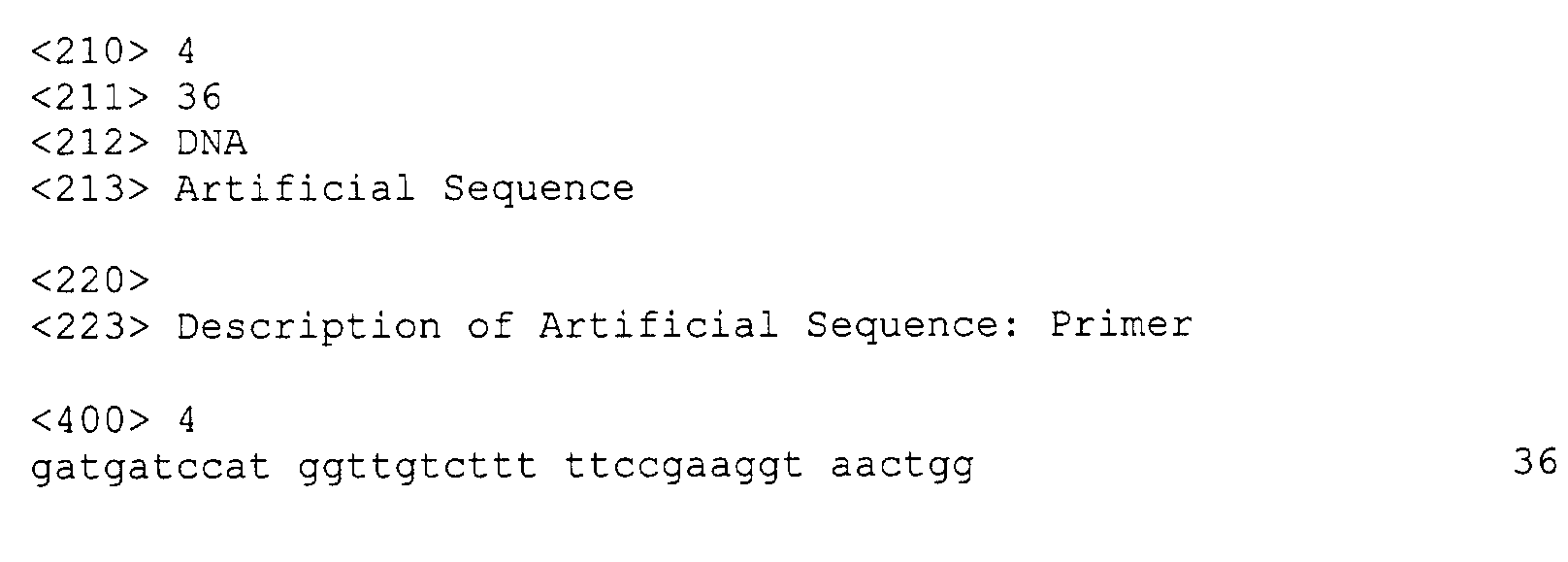
- Primers used were pET11a-114back (SEQ ID NO:1), pEZ11a656for (SEQ ID NO:2), RNAI-Ncoback (SEQ ID NO:3) and RNAI-Nco for (SEQ ID NO:4). Restriction endonucleases, Lambda markers, T4-Ligase, Calf intestine phosphatase, were obtained from MBI-Fermentas and used according to their recommendations.
- the fermentor used was a 20-liter fermentor from MBR Bioreactor AG (Wetzikon, Switzerland), with an MBR IMCS-2000 controller connected to it.
- the working volume of the fermentor was about 12 liters.
- the batch medium used was a semi-synthetic medium, containing small amounts of tryptone and yeast extract to facilitate growth at the start of the batch. The components were mixed together in a total volume of about 4 liters (4000g). But to avoid precipitations, chemicals with the same # (see table below) were first dissolved in distilled water separately. The glucose solution was filled out with distilled water to 300g and autoclaved separately.
- the Koch test was performed to determine the fraction of bacterial cells containing plasmids, and if the plasmid-carrying cells grew on plates containing the inducer IPTG. This latter test indicates if the plasmid-carrying cells produce SOD in "normal” amounts after induction (very small resources are then targeted for growth).
- the bacterial dry mass (BDM) gives the total amount of dry matter.
- PCN can be calculated from correlating the sizes (number of basepairs) of the genomic DNA and the plasmid DNA.
- plasmid DNA preparation For plasmid DNA preparation the cell pellet from sample preparation was resuspended in 150 ⁇ l solution I (50 mM glucose, 10 mM EDTA, 25 mM Tris-HCl pH 8.0) 200 ⁇ l SDS was added (0.5% SDS solution (ICN Biochemicals) 50 ⁇ l lysozym was added, tube got mixed and incubated for 10 min at 37°C, the solution homogenized by vortexing. The samples were stored on ice until fluorescence measurement with a spectrofluorometer (Hitachi F-2000)
- the DNA in the cell pellet was purified with the GFX kit according to the vendor's instructions, but with the following additions: after the lysis step a known amount ( ⁇ 2 ⁇ g) pUC 19 was added as int. standard. Elution of the DNA in 50 ⁇ l water was followed by a linearization of the plasmid with Hin d III for 1 hour at 37°C. Restricted DNA sample was transferred to a sample vial for capillary electrophoresis, avoiding air bubbles. The samples were loaded into an autosampler. The capillary calibrated by flushing with buffer for 15-20 min. Absorbance detection occurred at 260 nm and 280 nm by a diode array. After the analysis the capillary was flushed with buffer and stored at 4°C.
- the amount of chromosomal DNA was calculated by subtracting the amount of plasmid DNA/mg BDM from the total DNA content/mg BDM.
- capturing antibodies diluted was 1:100 in coating buffer (200 ⁇ g/ml). 100 ⁇ l of diluted antibody solution transferred to each well on microtiter plate. Incubated at 4°C overnight, or at room temperature for at least 2 hours. The plate washed tree times with washing buffer and buffer removed by knocking the plate gently. Sample and standard diluted in 1:2 steps by pipette robot on dilution plate. 50 ⁇ l of each different dilution transferred (by robot) to the antibody coated plate and incubated for 1 hour at room temperature.
Landscapes
- Genetics & Genomics (AREA)
- Health & Medical Sciences (AREA)
- Life Sciences & Earth Sciences (AREA)
- Engineering & Computer Science (AREA)
- Wood Science & Technology (AREA)
- Organic Chemistry (AREA)
- Biomedical Technology (AREA)
- Biotechnology (AREA)
- General Engineering & Computer Science (AREA)
- Chemical & Material Sciences (AREA)
- Zoology (AREA)
- Bioinformatics & Cheminformatics (AREA)
- Biophysics (AREA)
- Microbiology (AREA)
- Plant Pathology (AREA)
- Molecular Biology (AREA)
- Biochemistry (AREA)
- General Health & Medical Sciences (AREA)
- Physics & Mathematics (AREA)
- Micro-Organisms Or Cultivation Processes Thereof (AREA)
- Preparation Of Compounds By Using Micro-Organisms (AREA)
- Saccharide Compounds (AREA)
- Measuring Or Testing Involving Enzymes Or Micro-Organisms (AREA)
- Enzymes And Modification Thereof (AREA)
Abstract
Description
- The present invention relates to improved expression vectors having a ColE1 origin of replication system for the production of recombinant proteins.
- The use of fermentations with genetically modified microorganisms (GMO) for the production of recombinant proteins of interest has become widespread in industry. The major goal to optimize a fermentation process is to obtain as much product as possible, with good quality, in a cost-effective way. To achieve this, the volumetric productivity, defined as units of product formed per volume and time, needs to be optimized. Factors with great impact on the optimization process are the biomass per volume, i.e. the amount of cells capable of producing the product, and the quantity of protein each cell can produce. To a certain limit, the production capacity per cell is proportional to the plasmid copy number (PCN), the number of plasmids in the cell carrying the gene coding for the recombinant protein. Furthermore, the strength of the transcription system for the recombinant protein is important. While some promotors are weak and do not take full advantage of the metabolic potential, many promotors are too strong and lead to overexpression of the recombinant protein. Since the metabolic resources have to shared between the expression of the recombinant protein and the host protein, a too strong expression system will soon lead to a depletion of the metabolic resources, which results in cell death.
- For bacterial fermentation processes, ColE1 plasmids have been suggested mainly for high plasmid copy number.
- ColE1 replication starts with the transcription of the preprimer RNAII, 555 bp upstream of the replication origin by the host's RNA polymerase (Tomizawa, 1985). RNAII folds into specific structures during elongation and after polymerization of about 550 nucleotides begins to form a hybrid with the template DNA. The preprimer transcription terminates heterogeneously and after hybrid formation the RNAII preprimer is cleaved by RNase H to form the active primer with a free 3' OH terminus, which is accessible for DNA polymerase I (Tomizawa, 1990; Lin-Chao and Cohen, 1991; Merlin and Polisky, 1995).
- The ColE1 contains two promoters. RNAI is an antisense RNA molecule of 108 nucleotides, which is transcribed from the second promoter on the opposite strand and is complementary to the 5' end of RNAII. RNAI is transcribed from 445 bp upstream from the replication origin, to about where the transcription of RNAII starts (Merlin and Polisky, 1995; Tomizawa, 1990).
- For regulation of plasmid copy number in ColE1 plasmids, the kinetics is more important than the equilibrium features. For example, some mutant strains with mutations in the RNAII, although not influencing the regions complementary to RNAI, result in decreased inhibition by RNAI. This is probably due to affecting the half-life of intermediate RNA structures, decreasing the time for RNAI susceptibility, and hence resulting in increased plasmid copy numbers. This finding suggests the importance of intermediate RNAII structures and kinetics of RNAII folding pathway (Gultyaev et al, 1995).
- It has been noted that starvation of amino acids results in large amounts of tRNAs which are not charged with the specific amino acid. In the following, these tRNAs are termed "uncharged tRNAs". This observation could be compared to the circumstances at the time after induction of the recombinant protein expression, when the metabolic resources are depleted as discussed above.
- Wróbel and Wegrzyn (1998) tested a strategy of selectively inducing starvation of five different amino acids. It was found that there is a positive correlation between the homology of the anticodon loops of the tRNAs corresponding to the particular deprived amino acids, and particular loops in RNAI and RNAII. It was assumed that most of the charged tRNAs were captured by the translation mechanism, but that the uncharged tRNAs could instead have a chance to interact with other molecules, the RNAI and RNAII. Interaction between tRNA and RNAI or RNAII, would most probably interfere with the interaction between RNAI and RNAII, resulting in a higher RNAII-DNA hybridization frequency (supposed that the tRNA interacting with RNAII does not change the RNAII structure in any drastic way). The latter would imply a higher replication frequency and thus a higher PCN.
- Zavachev and Ivanov (1988) compared the homology between all 21 tRNAs and RNAI / RNAII. Of these, 11 showed a homology greater than 40% to either RNAI or RNAII. They divided these into three categories:
a) tRNAs homologous to RNAI: Arg, His, Leu, Lys, Phe and Thr, b) tRNAs homologous to RNAII: f-Met, Try and Gly and c) tRNAs homologous to both RNAI and RNAII: Met and Val. All tRNAs have anticodon loops of 7 nucleotides (Hjalt and Wagner, 1992). In the case with tRNAs homologous to RNAI, the highest homology was found in the region of loop 2, while most showed less homology in the 5' end of RNAI. - Starvation and cellular stress lead to increased pools of uncharged tRNAs, which interact with the origin of replication of ColE1 plasmids. This interaction occurrs due to the tRNAs' sequence homology to three RNA-loop structures, present in RNAI and RNAII of the origin of replication, which leads to interference with the PCN control mechanism of the system. Thus, PCN inceases rapidly and causes a breakdown of the fermentation process.
- WO 89/07141 suggests an expression vector having a ColE1 replication system, comprising a mutation in the RNAII gene and/or the rop gene with the goal to increase expression. This was achieved without substantially increasing plasmid copy number.
- Since a bacterial production process is only efficient when the system can be maintained over an extended period of time and since an increased plasmid copy number is one of the main factors that cause collapse of the expression system, it was an object of the invention to provide an improved expression system with a prolongued bacterial viability during fermentation.
- In particular, it was an object of the invention to provide an expression system in which plasmid copy number, after induction of the expression system, is limited with respect to uncontrolled amplification, in order to keep the metabolic burden below lethal doses.
- To solve the problem underlying the invention, the mechanism of ColE1-type replication was utilized. Specifically, a genetic approach was taken to alter, preferably decrease or completely abolish, the degree of homology of the ColE1 origin of replication to uncharged tRNAs.
- The present invention relates to an expression vector having a ColE1 replication system, in which the homology of the RNAI and RNAII of the ColEl origin of replication to uncharged tRNAs is modified by one or more mutations in the coding region of the RNAI gene and one or more corresponding mutations in the RNAII gene, said mutation(s) resulting in one or more base exchanges in
loop 1 and/or loop 2 and/or loop 3 of RNAI and RNAII. - The term "mutation" encompasses both mutations that increase and mutations that decrease homology of RNAI and RNAII to uncharged tRNAs.
- In order to maintain the secondary structure and melting temperature of RNAI and RNAII as far as possible in order not to impair replication, the mutations are preferably complementary base exchanges, i.e. A→T, T→A, C→G, G→C mutations. Other mutation(s) may also be present, provided the mechanism of replication is not impaired.
- As opposed to the ColE1 vector according to WO 89/07141, which contains a mutation in the RNAII gene and, due to its position, consequently, in the promotor of the RNAI gene, the vector of the invention comprises a mutation in the coding region, more specifically in the loop regions of both the RNAI and RNAII gene , which are homologous to uncharged tRNAs. The present invention thus provides a novel strategy to deliberately manipulate the degree of homology and ultimately tune the rate of plasmid replication.
- In the meaning of the present invention, the term "loop" preferably encompasses the unpaired loop structure of RNAI or RNAII; however, this term is not strictly limited to the mere loop region, but may also comprise the adjacent nucleotides of the stem region, preferably not more than two nucleotides.
- The mutation(s) may be a single base exchange in either
loop 1, loop 2 or loop 3 or a single or any number of base exchanges, including all base exchanges, inloop 1 and/or loop 2 and/or loop 3. - Preferably, the mutation(s) are in loop 2, which is the region with the highest homology to uncharged tRNAs.
- The desired mutations in the loop(s) of the RNAI and RNAII gene may be obtained according to conventional mutation and cloning techniques.Preferably, they are obtained as follows: starting from either the RNAI or the RNAII gene or a fragment thereof as a template, a PCR reaction is carried out which employs as primers two oligodesoxyribonucleotides, one or both carrying the desired mutation(s). Preferably, the PCR reaction is a two-step PCR. In the first step, two overlapping fragments are amplified, one of which contains the desired mutation in the primer sequence between a restriction site that is designed for connecting the fragments, and the primer binding site. Next, the amplified fragments are digested with the relevant restriction enzyme, ligated and used as a template in the next PCR amplification step. In this step, the same primers as in the first step, which do not contain the newly-introduced restriction site, are used, which have been selected to bind upstream and downstream of the nearest unique restriction sites in the individual plasmid.
- Due to the complementarity of the RNAI and RNAII genes, in the preparation of the vector, both genes or fragments thereof are equally suitable as a template for the PCR amplification. With the given complementarity, any mutation(s) in one or more loops of either of the genes will result in the corresponding mutation in the other, complementary gene; in the preferred method described above, the primer containing the mutation(s) not only serves for elongation by the polymerase, but also as a template for the DNA polymerase, thus yielding the complementary strand containing the mutation(s). Depending on whether the RNAI or RNAII gene is used as a template, RNAII or RNAI will automatically carry the complementary mutation.
- Preferably, a plasmid containing the entire RNAI and RNAII genes is used as a template. Alternatively, a DNA molecule encoding the entire RNAI or RNAII gene may be used. The RNAI and RNAII genes were described by Tomizawa et al, 1977.
- In the case a RNAI or RNAII gene fragment is used as template, the fragment must have a size sufficient to contain all elements required, i.e. the sequence to be mutated, the primer binding site and, optionally, one or more restriction sites. Preferably, the fragment comprises one or more loops (each of them consisting of approximately 7 nucleotides) and a primer binding site (approximately 18 nucleotides), i.e. the minimal size of a suitable fragment is approximately 25 to 30 nucleotides.
- In a preferred embodiment of the invention, the mutations are selected, in terms of site(s) and number, with the aim of substantially changing the degree of homology to as many uncharged tRNA species as possible.
- Thus, in a preferred embodiment, the modification of RNAI and RNAII is carried out by starting from a modification in loop 2, i.e. the loop with the highest homology, said modification representing the exchange of as many positions as possible. By way of example, as shown in the experiment of the invention, loop 2 may be modified by replacing six of its seven nucleotides, leaving one base (position 693 in plasmid ColE1, Genbank GI 9507253) unchanged and thus available as part of the new restriction site, preferably a Nco1 site. The bases are replaced by their respective complementary bases.
- By this approach, homology to all uncharged tRNAs is completely abolished, therefore this approach provides a maximum flexibility for the production of a great variety of recombinant proteins of interest independent of their amino acid sequence, in particular through control of plasmid replication maintaining cell viability during expression. In this case, plasmid amplification is subject only to the control by the ColE1 specific replication mechanism and independent of metabolic fluctuations of the host cell; in this case, plasmid copy number remains essentially constant throughout the fermentation process.
- Alternatively to completely abolishing the homology between RNAI and RNAII and uncharged tRNAs, this homology may be modified, i.e. increased or decreased, only to a certain desired degree. For some applications, e.g. if the yield of the product is unsatisfactory because the potential of the expression machinery is not fully exploited due to the decreased plasmid copy number and thus suboptimal amount of plasmids ("gene dosage"), it may be desirable to increase expression rates by slightly increasing plasmid copy number. This can be achieved by selectively maintaining sequence homology to some uncharged tRNAs, in particular to rare tRNAs. The sequence homologies for specific uncharged tRNAs is known from the literature (Zavachev and Ivanov, 1988). This strategy may also be useful for influencing the rate of protein synthesis such that the product is either present in the form of inclusion bodies or in soluble form. By way of example, a certain degree of plasmid amplification may lead to the formation of inclusion bodies, while a slight decrease may favor the formation of soluble product.
- For some applications it is advantageous to drastically increase plasmid copy number by increasing the sequence homology of RNAI and RNAII to uncharged tRNAs, in particular for plasmid DNA production. The mutations required to increase sequence homology are also known in the literature (Zavachev and Ivanov, 1988) and can be carried out according to the same principles as described for the decrease of sequence homology.
- For an individual application and/or product, the process can be optimized by experimentally testing a range of mutations. Suitable experiments may be conducted as follows: a plasmid or a series of plasmid candidates carrying the mutation(s) to be tested are transfected into appropriate bacterial host cells, grown under suitable conditions in a small scale, e.g. in shake flasks, and the fermentation process is monitored with respect to the parameters of interest, in particular growth, product yield and quality, plasmid copy number.
- Another strategy, which is particularly useful to obtain a wide range of sequence modifications, is to randomly mutate one or more positions of
loop 1 and/or loop 2 and/or loop 3 and thus generating a library which may be used for the construction of an expression vector selected for any desired property of the expression system. By way of example, a plasmid candidate may be selected due to certain selection parameters that are most relevant for recombinant protein production, e.g. growth rate, productivity and viability; the process is carried out in an standard experimental setup as described above. - Furthermore, this approach allows efficient tuning of recombinant protein expression rate based on PCN manipulation. Provided the gene of interest is present in the vector containing the library, the selected plasmid will always be optimal for expression of the gene of interest.
- While during normal fermentations an almost tenfold increase in plasmid copy number (PCN) after induction is being observed, according to the present invention the homology between tRNAs and RNAII being decreased or abolished. This has the effect that a larger pool of non-inhibited RNAI molecules is free to interact with RNAII. Thus, the mechanism of replication is detached from high pools of uncharged tRNAs caused by metabolic overload due to expression of recombinant protein. Detaching the mechanism of plasmid replication from metabolic stress related to recombinant protein expression results in higher yield of recombinant protein.
- Since the base exchanges according to the present invention are present both in RNAI and RNAII, which results in a change in homology to all tRNAs, the composition of uncharged tRNAs (depending on the recombinant product) is not relevent for this approach.
- In addition to the modified ColE1 replication system, the expression vector of the invention comprises the elements required for protein expression, i.e. expression control sequences operatively linked to the cDNA sequence encoding the protein of interest, including promotor, translation initiation region, selection markers (e.g. antibiotic resistence markers), restriction sites for insertion of the DNA encoding the protein of interest, etc.
- Preferably, the expression vector of the invention is derived from pMB1, pBR322, pUC 18/19, pTZ19R, pTZ19U, pBluescriptIIKS(+/-), pBluescriptIISK(+/-).With regard to the protein of interest, there are no limitations in terms of sequence, as long as the expression of the plasmid in E. coli renders a functional protein.
- In the experiments of the present invention, the cDNA encoding human Cu-Zn superoxide dismutase was used. From a vector carrying this cDNA, a highly soluble, 32 kDa dimeric protein can be produced which consists of 153 amino acids and is released into the cytoplasm (Cserjan-Puschmann et al., 1999).
- Any host cell that is compatible with ColE1 type plasmids may be used, preferably E. coli strains, in particular strain HMS 174 (DE3) (Studier and Moffat, 1986), or Salmonella strains.
- In a further embodiment, the present invention relates to a host cell transformed with the expression vector carrying the modified ColE1 replication.
- For transformation of the host strain, any conventional technique may be used, e.g. electroporation or calcium chloride or calcium precipitation.
- In a further embodiment, the present invention relates to a method for producing a recombinant protein of interest, wherein a E. coli host cell is transformed with an expression vector having a ColE1 replication system with a mutation in one or more loops of the RNAI and RNAII gene, grown under suitable conditions and the protein of interest is recovered. The invention accelerates recombinant protein production process development by providing a tool for compensating the interference resulting from expression of recombinant proteins with the host metabolism. The method of the invention is particular adventageous in fed batch fermentation processes, i.e. processes wherein the addition of nutrients is coupled to the increase of biomass. To fully exploit the advantages of fed batch processes, which can be run over extended periods of time and thus result in higher biomass production and overall process economy than classical batch processes, a stable and regulatable expression system is required.
- This need can be beneficially met by the use of the expression vector of the invention.
- The plasmid used in the experiments was pET11a from Stratagene. This plasmid contains the beta-lactamase gene for ampicillin resistance. The recombinant protein expression in this plasmid is controlled by the efficient T7 RNA polymerase. The lac operator is situated between the T7 promoter and translation initiation sequences. This results in repression in the absence of the inducer IPTG. The pET11a-SOD plasmid contains a cDNA gene coding for the recombinant protein human Cu-Zn superoxide dismutase (hSOD), a highly soluble, 32 kDa dimeric, 153 amino acids long and for the cell nontoxic protein, which is released into the cytoplasm (Cserjan-Puschmann et al., 1999).
- The bacterial strain used for plasmid propagation and expression of SOD was Escherichia coli HMS174(DE3) (Studier and Moffat, 1986). This strain has the T7 polymerase integrated in the chromosomal DNA. The T7 polymerase is essential for expression of the recombinant protein. Transformants were selected on amp plates (Antibiotic medium LB, containing 100 pg/ml ampicillin) (Maniatis, et al., 1982)
- The transformation technique used in these experiments is electroporation using a Bio-Rad Gene Pulser. The primers were ordered from Metabion (Martinsried, Germany) and delivered as vacuum-dried powder, which was dissolved in water to get stock solutions with the concentration of 100 pmol/µl. PCR was carried out using a Thermoblock (T-gradient, Biometra, Germany) with heatable cover Dynazyme EXT polymerase 1 u/µl (Finnzymes), 10X Mg-free buffer and 10mM MgCl (supplied) 1 mM dNTP, DMSO and distilled water.
- Primers used were pET11a-114back (SEQ ID NO:1), pEZ11a656for (SEQ ID NO:2), RNAI-Ncoback (SEQ ID NO:3) and RNAI-Nco for (SEQ ID NO:4). Restriction endonucleases, Lambda markers, T4-Ligase, Calf intestine phosphatase, were obtained from MBI-Fermentas and used according to their recommendations.
- The fermentor used was a 20-liter fermentor from MBR Bioreactor AG (Wetzikon, Switzerland), with an MBR IMCS-2000 controller connected to it. The working volume of the fermentor was about 12 liters.
- Feed media used: The amount of feed media pumped into the system during fed- batch state was measured by continuously weighing the vessel. The feed pump was regulated to give a constant growth rate of µ = 0.1. Antifoam addition triggered by a conductivity sensor. No contact with exterior, implying no risk of fermentor contamination.The batch medium used was a semi-synthetic medium, containing small amounts of tryptone and yeast extract to facilitate growth at the start of the batch. The components were mixed together in a total volume of about 4 liters (4000g). But to avoid precipitations, chemicals with the same # (see table below) were first dissolved in distilled water separately. The glucose solution was filled out with distilled water to 300g and autoclaved separately.
- Subsequently all but the glucose solution were mixed together in the given order, and filled out with distilled water to 3700g.
Composition of the batch medium (4000g). Values given in grams, if not other stated. # Weight (g) Chemical 1 12 Potassium dihydrogen phosphate 1 24 Di-Potassium hydrogen phosphate Trihydrate 2 2 Tryptone (Oxoid Ltd. Hampshire, UK) 2 1 Yeast extract 3 5 Tri-Sodium citrate dihydrate 3 2 Magnesium sulfate heptahydrate 4 0.2 Calcium chloride dihydrate 5 1000 Trace element solution [µl] 6 80 Copper(II) chloride dihydrate [mg] 6 64 Zinc sulfate heptahydrate [mg] 7 9 Ammonium sulfate 7 7.4 Ammonium chloride 8 66 Glucose Monohydrate Composition of the feeding medium (6000g) for fed-batch state. Values given in grams, if not other stated. # Weight (g) Chemical 1 18.00 Potassium dihydrogen phosphate 1 36.00 Di-Potassium hydrogen phosphate Trihydrate 2 51.57 Tri-Sodium citrate dihydrate 2 20.63 Magnesium sulfate heptahydrate 3 2.06 Calcium chloride dihydrate 4 10313.71 Trace element solution [µl] 5 825.10 Copper(II) chloride dihydrate [mg] 5 660.08 Zinc sulfate heptahydrate [mg] 6 0.6 Antifoam 7 92.82 Ammonium sulfate 7 76.32 Ammonium chloride 8 680.70 Glucose Monohydrate - The Koch test was performed to determine the fraction of bacterial cells containing plasmids, and if the plasmid-carrying cells grew on plates containing the inducer IPTG. This latter test indicates if the plasmid-carrying cells produce SOD in "normal" amounts after induction (very small resources are then targeted for growth).
- The bacterial dry mass (BDM) gives the total amount of dry matter.
- For each sample, a glass beaker was dried overnight at 105°C, cooled in exsiccatorand then weighed on an analytical scale.
- PCN can be calculated from correlating the sizes (number of basepairs) of the genomic DNA and the plasmid DNA.
- For plasmid DNA preparation the cell pellet from sample preparation was resuspended in 150 µl solution I (50 mM glucose, 10 mM EDTA, 25 mM Tris-HCl pH 8.0) 200 µl SDS was added (0.5% SDS solution (ICN Biochemicals) 50 µl lysozym was added, tube got mixed and incubated for 10 min at 37°C, the solution homogenized by vortexing. The samples were stored on ice until fluorescence measurement with a spectrofluorometer (Hitachi F-2000)
- For determination of plasmid DNA, the DNA in the cell pellet was purified with the GFX kit according to the vendor's instructions, but with the following additions: after the lysis step a known amount (∼2 µg) pUC 19 was added as int. standard. Elution of the DNA in 50 µl water was followed by a linearization of the plasmid with Hind III for 1 hour at 37°C. Restricted DNA sample was transferred to a sample vial for capillary electrophoresis, avoiding air bubbles. The samples were loaded into an autosampler. The capillary calibrated by flushing with buffer for 15-20 min. Absorbance detection occurred at 260 nm and 280 nm by a diode array. After the analysis the capillary was flushed with buffer and stored at 4°C.
- The amount of chromosomal DNA was calculated by subtracting the amount of plasmid DNA/mg BDM from the total DNA content/mg BDM. As the amount of internal standard added was known the PCN could, according to Breuer et al. (1998), be calculated by the following formulas:
- For determination of the amount of SOD, capturing antibodies diluted was 1:100 in coating buffer (200 µg/ml). 100 µl of diluted antibody solution transferred to each well on microtiter plate. Incubated at 4°C overnight, or at room temperature for at least 2 hours. The plate washed tree times with washing buffer and buffer removed by knocking the plate gently. Sample and standard diluted in 1:2 steps by pipette robot on dilution plate. 50 µl of each different dilution transferred (by robot) to the antibody coated plate and incubated for 1 hour at room temperature.
- The plate was washed with washing buffer. Conjugated antibody was diluted 1:500 in dilution buffer (Porstmann et al., 1988).
-
Positions changed (complete ColE1 sequence according to GI="9507253" Genbank): 692 G→ C 694 T→ A 695 A→ T 696 C→ G 697 C→ G 698 A→ T 699 A→ T 700 C→ G - The fermentation process using the plasmid in E. coli HMS 174 (DE3) pETllachSOD is shown in the figure. The total and specific production of the recombinant protein (SOD), along with the production rate, qp, is shown. Also shown are the total bacterial dry matter (BDM) and the plasmid copy number (PCN). As opposed to standard processes (e.g. as described by Cserjan-Puschmann, 1999), it was observed that the PCN is kept rather constant even after induction at the 45th hour.
Koch tests and plasmid copy number Fermentation time [h] CFU [ml-1] CFU on ampicillin plate Plasmid carrier [%] IPTG insens. plasmid carrier PCN 31 5,5x10⁹ 5,13x10⁹ 93,33 1,12x10⁷ 37 1, 98x10 101,96x10¹⁰ 98,99 6,67x10⁶ 50 41 48 45 42 46 38 47 3,03x10¹⁰ 2,66x10¹⁰ 87,69 1,63x10⁶ 45 48 44 50 51 52 1, 89x10 101,43x10¹⁰ 75,70 1,38x10⁶ 34 - Breuer, S. et al (1998) Off-line quantitative monitoring of plasmid copy number in bacterial fermentation by capillary electrophoresis. Electrophoresis 19, 2474-2478.
- Cserjan-Puschmann, M., W. Kramer, E. Dürrschmid, G. Striedner and K. Bayer (1999). Metabolic approaches for the optimisation of recombinant fermentation processes. Appl. Microb. Biotechnology. 53, 43-50.
- Gultyaev, A. et al (1995). The influence of a metastable structure in plasmid primer RNA on antisense RNA binding kinetics. Nucleic Acids Res. Sep 25;23(18):3718-25.
- Hjalt, T., Gerhart, E. and Wagner, H. (1992). The effect of loop size in antisense and target RNAs on the efficiency of antisense RNA control.
Nucleic Acids Research 20, 24, 6723-6732. - Lin-Chao, S. and Cohen, S. (1991). The rate of processing and degradation of antisense RNAI regulates the replication of ColE1-type plasmids in vivo. Cell 65, 1233-1242.
- Maniatis, T. (1982) Molecular Cloning: A Laboratory Manual, Cold Spring Harbor Laboratory, Cold Spring harbor, New York.
- Merlin, A. and Polisky, B. (1995) Assessment of quantitative models for plasmid ColE1 copy number control. J. Mol. Biol. 248, 211-219.
- Portstmann, T., Wietschke R., Schmechta H., Grunow R., Porstmann B., Bleiber R., Pergande M., Stachat S. and Baehr R. (1988) Rapid and Sensitive enzyme immuno assay for Cu/Zn spueroxide dismutase with polyclonal and monoclonal antibodies. Clinaica Chimica Acta 171:1-10
- Studier, FW. And Moffat BA. (1986) Use of bacteriophage T7 RNA polymerase to direct selective high level expression of cloned genes. J. Mol. Biol 189: 113-130
- Tomizawa, J. (1985). Control of ColE1 plasmid replication: Initial interaction of RNAI and the primer transcript is reversible,
Cell 40, 527-535. - Tomizawa, J. (1990). Control of ColE1 plasmid replication, intermediates in the binding of RNAI and RNAII, J. Mol. Biol. 212, 683-694.
- Wróbel, B. and Wegrzyn, G. (1998). Replication regulation of ColE1-like plasmids in amino acid-starved Escherichia coli.
Plasmid 39, 48-62. - Zavachev, L. and Ivanov, I. (1988). What does the homology between E. coli tRNAs and RNAs controlling ColE1 plasmid replication mean? J. theor. Biol. 131, 235-241.

Claims (10)
- An expression vector having a ColE1 replication system, wherein the homology of the RNAI and RNAII of the ColE1 origin of replication to uncharged tRNAs is modified by one or more mutations in the coding region of the RNAI gene and one or more corresponding mutations in the RNAII gene, said mutation(s) resulting in one or more base exchanges in loop 1 and/or loop 2 and/or loop 3 of RNAI and RNAII.
- The expression vector of claim 1, wherein said mutation results in a decrease or abolishment of RNAI/RNAII homology to uncharged tRNAs.
- The expression vector of claim 1 or 2, wherein said mutation is in loop 2 of RNAI and RNAII.
- The expression vector of claim 2, wherein loop 2 is modified by a mutation of essentially its complete sequence.
- The expression vector of claim 4, wherein six of seven bases of loop 2 are replaced by their respective complementary bases.
- The expression vector claim 1, which is derived from a vector selected from pMB1, pBR322, pUC 18/19, pTZ19R, pTZ19U, pBluescriptIIKS(+/-) and pBluescriptIISK(+/-).
- A bacterial host cell transformed with a vector of any one of claims 1 to 6.
- The host cell of claim 7, which is an E. coli cell.
- The host cell of claim 8, which is a cell of E.coli strain HMS 174.
- A method for producing a protein of interest, wherein a vector of any one of claims 1 to 9, which contains the DNA encoding the protein operatively linked to expression control sequences, is transformed in a host cell, the host cell is grown under suitable conditions and the protein of interest is recovered and purified.
Priority Applications (21)
| Application Number | Priority Date | Filing Date | Title |
|---|---|---|---|
| EP00121709A EP1195436A1 (en) | 2000-10-04 | 2000-10-04 | Expression vectors with modified ColE1 origin of replication for control of plasmid copy number |
| ES01972084T ES2286141T3 (en) | 2000-10-04 | 2001-09-28 | VECTOR OF EXPRESSION OF ORIGIN OF REPLICATION CO1E1 MODIFICACO TO CONTROL THE NUMBER OF COPIES OF PLASMIDOS. |
| DK01972084T DK1326989T3 (en) | 2000-10-04 | 2001-09-28 | Expression vectors with modified CoIE1 replication start region to control the number of plasmid copies |
| RU2003112609/13A RU2304618C2 (en) | 2000-10-04 | 2001-09-28 | EXPRESSION VECTORS WITH MODIFIED ColE1 REPLICATION INITIATING SITE TO CONTROL AMOUNT OF PLASMIDA COPIES |
| KR1020037004057A KR100801475B1 (en) | 2000-10-04 | 2001-09-28 | Expression Vectors with Modified COE1 Replication Origins for Control of Plasmid Copy Number |
| CA002424624A CA2424624C (en) | 2000-10-04 | 2001-09-28 | Expression vectors with modified cole1 origin of replication for control of plasmid copy number |
| DE60128580T DE60128580T2 (en) | 2000-10-04 | 2001-09-28 | EXPRESSION VECTORS WITH CHANGED COLE1 REPLICATION LEAD TO CHECK PLASMIDE COPY NUMBER |
| AT01972084T ATE362987T1 (en) | 2000-10-04 | 2001-09-28 | EXPRESSION VECTORS WITH ALTERED COLE1 ORIGIN OF REPLICATION FOR CONTROLLING PLASMID COPY NUMBER |
| AU9188301A AU9188301A (en) | 2000-10-04 | 2001-09-28 | Expression vectors with modified cole1 origin of replication for control of plasmid copy number |
| NZ525635A NZ525635A (en) | 2000-10-04 | 2001-09-28 | Expression vectors with modified ColE1 origin of replication to increase the yield of plasmid DNA in the plasmid production process in bacterial host cells |
| JP2002532636A JP5405708B2 (en) | 2000-10-04 | 2001-09-28 | Expression vector for control of plasmid copy number, having modified ColE1 origin of replication |
| PCT/EP2001/011240 WO2002029067A1 (en) | 2000-10-04 | 2001-09-28 | EXPRESSION VECTORS WITH MODIFIED ColE1 ORIGIN OF REPLICATION FOR CONTROL OF PLASMID COPY NUMBER |
| AU2001291883A AU2001291883B2 (en) | 2000-10-04 | 2001-09-28 | Expression vectors with modified ColE1 origin of replication for control of plasmid copy number |
| PT01972084T PT1326989E (en) | 2000-10-04 | 2001-09-28 | Expression vectors with modified cole1 origin of replication for control of plasmid copy number |
| EP01972084A EP1326989B1 (en) | 2000-10-04 | 2001-09-28 | EXPRESSION VECTORS WITH MODIFIED ColE1 ORIGIN OF REPLICATION FOR CONTROL OF PLASMID COPY NUMBER |
| US09/969,136 US6806066B2 (en) | 2000-10-04 | 2001-10-03 | Expression vectors with modified ColE1 origin of replication for control of plasmid copy number |
| TW090124670A TWI245798B (en) | 2000-10-04 | 2001-10-05 | Expression vectors with modified ColE1 origin of replication for control of plasmid copy number |
| ZA200302080A ZA200302080B (en) | 2000-10-04 | 2003-03-14 | Expression vectors with modified Co1E1 origin of replication for control of plasmid number. |
| NO20031513A NO331640B1 (en) | 2000-10-04 | 2003-04-03 | Expression vectors with modified Co1E1 replication origins and their use, host cell and method of producing a protein. |
| CY20071101010T CY1106773T1 (en) | 2000-10-04 | 2007-07-30 | EXPRESSION VECTORS WITH MODIFIED COLE1 REPLICATION START FOR PLASMID COPY NUMBER CONTROL |
| JP2013203972A JP2014012023A (en) | 2000-10-04 | 2013-09-30 | EXPRESSION VECTORS HAVING MODIFIED ColE1 ORIGIN OF REPLICATION FOR CONTROL OF PLASMID COPY NUMBER |
Applications Claiming Priority (1)
| Application Number | Priority Date | Filing Date | Title |
|---|---|---|---|
| EP00121709A EP1195436A1 (en) | 2000-10-04 | 2000-10-04 | Expression vectors with modified ColE1 origin of replication for control of plasmid copy number |
Publications (1)
| Publication Number | Publication Date |
|---|---|
| EP1195436A1 true EP1195436A1 (en) | 2002-04-10 |
Family
ID=8170014
Family Applications (2)
| Application Number | Title | Priority Date | Filing Date |
|---|---|---|---|
| EP00121709A Withdrawn EP1195436A1 (en) | 2000-10-04 | 2000-10-04 | Expression vectors with modified ColE1 origin of replication for control of plasmid copy number |
| EP01972084A Expired - Lifetime EP1326989B1 (en) | 2000-10-04 | 2001-09-28 | EXPRESSION VECTORS WITH MODIFIED ColE1 ORIGIN OF REPLICATION FOR CONTROL OF PLASMID COPY NUMBER |
Family Applications After (1)
| Application Number | Title | Priority Date | Filing Date |
|---|---|---|---|
| EP01972084A Expired - Lifetime EP1326989B1 (en) | 2000-10-04 | 2001-09-28 | EXPRESSION VECTORS WITH MODIFIED ColE1 ORIGIN OF REPLICATION FOR CONTROL OF PLASMID COPY NUMBER |
Country Status (18)
| Country | Link |
|---|---|
| US (1) | US6806066B2 (en) |
| EP (2) | EP1195436A1 (en) |
| JP (2) | JP5405708B2 (en) |
| KR (1) | KR100801475B1 (en) |
| AT (1) | ATE362987T1 (en) |
| AU (1) | AU9188301A (en) |
| CA (1) | CA2424624C (en) |
| CY (1) | CY1106773T1 (en) |
| DE (1) | DE60128580T2 (en) |
| DK (1) | DK1326989T3 (en) |
| ES (1) | ES2286141T3 (en) |
| NO (1) | NO331640B1 (en) |
| NZ (1) | NZ525635A (en) |
| PT (1) | PT1326989E (en) |
| RU (1) | RU2304618C2 (en) |
| TW (1) | TWI245798B (en) |
| WO (1) | WO2002029067A1 (en) |
| ZA (1) | ZA200302080B (en) |
Families Citing this family (10)
| Publication number | Priority date | Publication date | Assignee | Title |
|---|---|---|---|---|
| TWI311152B (en) | 2004-09-17 | 2009-06-21 | Boehringer Ingelheim Rcv Gmbh & Co K | Host-vector system for antibiotic-free cole1 plasmid propagation |
| US8999672B2 (en) | 2005-01-28 | 2015-04-07 | James A. Williams | Compositions and processes for improved plasmid DNA production |
| DE602006013479D1 (en) * | 2005-09-16 | 2010-05-20 | Monsanto Technology Llc | PLASMIDE WITH MOBILE HYBRID REPLICATION TROUBLES |
| WO2009036095A1 (en) * | 2007-09-10 | 2009-03-19 | Joule Biotechnologies, Inc. | Engineered light-harvesting organisms |
| EP2327769B1 (en) * | 2007-11-10 | 2013-03-27 | Joule Unlimited Technologies, Inc. | Hyperphotosynthetic organisms |
| US20110269184A1 (en) | 2009-07-16 | 2011-11-03 | Boehringer Ingelheim Rcv Gmbh & Co. Kg | Method for controlling plasmid copy number in e.coli |
| WO2012082946A2 (en) * | 2010-12-14 | 2012-06-21 | The Regents Of The University Of California | Creation of super-stable coie1 plasmids by duplication of sl 1-4 sequence and point mutations. |
| JP2023529980A (en) | 2020-06-17 | 2023-07-12 | ビーエーエスエフ ソシエタス・ヨーロピア | Plasmid copy number regulation and integration |
| WO2025175381A1 (en) * | 2024-02-22 | 2025-08-28 | Pegasus Biotech Incorporated | Plasmid and method for production of dna vaccines and dna products |
| KR20260051065A (en) | 2024-06-05 | 2026-04-15 | 와커 헤미 아게 | Plasmid with increased replication rate |
Citations (2)
| Publication number | Priority date | Publication date | Assignee | Title |
|---|---|---|---|---|
| US4716112A (en) * | 1982-09-16 | 1987-12-29 | Biogen N.V. | Vectors for increased expression of cloned genes |
| WO1989007141A1 (en) * | 1988-01-27 | 1989-08-10 | The Upjohn Company | Expression vectors |
Family Cites Families (1)
| Publication number | Priority date | Publication date | Assignee | Title |
|---|---|---|---|---|
| CA2323604A1 (en) * | 1998-03-19 | 1999-09-23 | Valentis, Inc. | Interferon alpha plasmids and delivery systems, and methods of making and using the same |
-
2000
- 2000-10-04 EP EP00121709A patent/EP1195436A1/en not_active Withdrawn
-
2001
- 2001-09-28 PT PT01972084T patent/PT1326989E/en unknown
- 2001-09-28 CA CA002424624A patent/CA2424624C/en not_active Expired - Fee Related
- 2001-09-28 EP EP01972084A patent/EP1326989B1/en not_active Expired - Lifetime
- 2001-09-28 AT AT01972084T patent/ATE362987T1/en active
- 2001-09-28 KR KR1020037004057A patent/KR100801475B1/en not_active Expired - Fee Related
- 2001-09-28 WO PCT/EP2001/011240 patent/WO2002029067A1/en not_active Ceased
- 2001-09-28 RU RU2003112609/13A patent/RU2304618C2/en not_active IP Right Cessation
- 2001-09-28 JP JP2002532636A patent/JP5405708B2/en not_active Expired - Fee Related
- 2001-09-28 DE DE60128580T patent/DE60128580T2/en not_active Expired - Lifetime
- 2001-09-28 DK DK01972084T patent/DK1326989T3/en active
- 2001-09-28 ES ES01972084T patent/ES2286141T3/en not_active Expired - Lifetime
- 2001-09-28 NZ NZ525635A patent/NZ525635A/en not_active IP Right Cessation
- 2001-09-28 AU AU9188301A patent/AU9188301A/en active Pending
- 2001-10-03 US US09/969,136 patent/US6806066B2/en not_active Expired - Lifetime
- 2001-10-05 TW TW090124670A patent/TWI245798B/en not_active IP Right Cessation
-
2003
- 2003-03-14 ZA ZA200302080A patent/ZA200302080B/en unknown
- 2003-04-03 NO NO20031513A patent/NO331640B1/en not_active IP Right Cessation
-
2007
- 2007-07-30 CY CY20071101010T patent/CY1106773T1/en unknown
-
2013
- 2013-09-30 JP JP2013203972A patent/JP2014012023A/en active Pending
Patent Citations (2)
| Publication number | Priority date | Publication date | Assignee | Title |
|---|---|---|---|---|
| US4716112A (en) * | 1982-09-16 | 1987-12-29 | Biogen N.V. | Vectors for increased expression of cloned genes |
| WO1989007141A1 (en) * | 1988-01-27 | 1989-08-10 | The Upjohn Company | Expression vectors |
Non-Patent Citations (5)
| Title |
|---|
| BORYS WRÓBEL ET AL.: "Replication regulation of ColE1-like plasmids in amino acid-starved Escherichia coli", PLASMID, vol. 39, no. 1, 1998, pages 48 - 62, XP000982751 * |
| R.M. LACATENA ET AL.: "Base pairing of RNA I with its complementary sequence in the primer precursor inhibits ColE1 replication", NATURE, vol. 294, 17 December 1981 (1981-12-17), LONDON GB, pages 623 - 626, XP002162162 * |
| R.M. LACATENA ET AL.: "Interaction between RNA1 and the primer precursor in the regulation of ColE1 replication", JOURNAL OF MOLECULAR BIOLOGY, vol. 170, no. 3, 5 November 1983 (1983-11-05), pages 635 - 650, XP000979398 * |
| RAZMIC S. GREGORIAN JR ET AL.: "Determinants of RNA hairpin loop-loop complex stability", JOURNAL OF MOLECULAR BIOLOGY, vol. 248, no. 5, 1995, pages 968 - 984, XP000982757 * |
| SLAGTER-JIGER J.G. ET AL: "Loop swapping in an antisense RNA/target RNA pair changes directionality of helix progression", JOURNAL OF BIOLOGICAL CHEMISTRY, vol. 278, no. 37, 12 September 2003 (2003-09-12), pages 35558 - 35563 * |
Also Published As
| Publication number | Publication date |
|---|---|
| RU2304618C2 (en) | 2007-08-20 |
| ZA200302080B (en) | 2004-05-05 |
| PT1326989E (en) | 2007-06-08 |
| CA2424624A1 (en) | 2002-04-11 |
| KR100801475B1 (en) | 2008-02-12 |
| JP2004510437A (en) | 2004-04-08 |
| NO331640B1 (en) | 2012-02-13 |
| NO20031513L (en) | 2003-05-28 |
| EP1326989B1 (en) | 2007-05-23 |
| ES2286141T3 (en) | 2007-12-01 |
| JP5405708B2 (en) | 2014-02-05 |
| KR20030074598A (en) | 2003-09-19 |
| AU2001291883C1 (en) | 2002-04-15 |
| WO2002029067A1 (en) | 2002-04-11 |
| DE60128580D1 (en) | 2007-07-05 |
| NZ525635A (en) | 2004-12-24 |
| US6806066B2 (en) | 2004-10-19 |
| CA2424624C (en) | 2008-11-18 |
| DE60128580T2 (en) | 2007-09-13 |
| US20030166053A1 (en) | 2003-09-04 |
| DK1326989T3 (en) | 2007-09-10 |
| NO20031513D0 (en) | 2003-04-03 |
| CY1106773T1 (en) | 2012-01-25 |
| EP1326989A1 (en) | 2003-07-16 |
| TWI245798B (en) | 2005-12-21 |
| JP2014012023A (en) | 2014-01-23 |
| ATE362987T1 (en) | 2007-06-15 |
| AU9188301A (en) | 2002-04-15 |
Similar Documents
| Publication | Publication Date | Title |
|---|---|---|
| Lange et al. | Identification of transcriptional start sites and the role of ppGpp in the expression of rpoS, the structural gene for the sigma S subunit of RNA polymerase in Escherichia coli | |
| Babst et al. | Two different mechanisms are involved in the heat‐shock regulation of chaperonin gene expression in Bradyrhizobium japonicum | |
| JP2014012023A (en) | EXPRESSION VECTORS HAVING MODIFIED ColE1 ORIGIN OF REPLICATION FOR CONTROL OF PLASMID COPY NUMBER | |
| JP3503705B2 (en) | Methods for regulating polypeptide production in bacteria | |
| DE LA CRUZ et al. | Increased sensitivity to protein synthesis inhibitors in cells lacking tmRNA | |
| CN114686990B (en) | Promoter library and preparation method and application thereof | |
| EP1658366A2 (en) | Compositions of orthogonal glutamyl-trna and aminoacyl trna synthetase pairs and uses thereof | |
| Souciet et al. | Characterization of two bifunctional Arabdopsis thaliana genes coding for mitochondrial and cytosolic forms of valyl‐tRNA synthetase and threonyl‐tRNA synthetase by alternative use of two in‐frame AUGs | |
| CN114277046B (en) | Three-gene tandem expression vector for synthesizing tetrahydropyrimidine and application thereof | |
| King-Chuen et al. | Cloning and nucleotide sequence of the structural gene coding for Bacillus subtilis tryptophanyl-tRNA synthetase | |
| CN120591268A (en) | A tryptophan-responsive promoter and its construction method and application | |
| AU2001291883B2 (en) | Expression vectors with modified ColE1 origin of replication for control of plasmid copy number | |
| AU2001291883A1 (en) | Expression vectors with modified ColE1 origin of replication for control of plasmid copy number | |
| ROMFO et al. | Molecular genetic analysis of U2AF59 in Schizosaccharomyces pombe: differential sensitivity of introns to mutational inactivation | |
| CN115896134A (en) | An engineering strain of Bacillus brevis that improves the synthesis of idamectin and its construction method and application | |
| WO2000024922A1 (en) | Method for producing in vivo proteins chemically diversified by incorporating non-standard amino acids | |
| CN112877309A (en) | N-terminal extended PTEN subtype PTEN zeta protein and coding gene and application thereof | |
| US9963708B2 (en) | Recombinant vector for foreign gene expression without biological circuit interference of host cell and uses thereof | |
| KR100207951B1 (en) | Overexpressed Recombinant Vectors of Escherichia Coli and Methods of Preparing Phospholipocyte Colony Stimulating Factor Using the Same | |
| Oostra et al. | A mutation in the RNA polymerase β′ subunit causing depressed ribosomal RNA synthesis in Escherichia coli | |
| Dudákova | Elucidation of the function of Kap60 and Kap95 in the tRNA retrograde pathway in Trypanosoma brucei | |
| CN118291474A (en) | ShRNA expression system and application thereof in spodoptera frugiperda gene interference | |
| CN118652919A (en) | Method for improving the production of anjimycin in Erwinia persica | |
| US20100028941A1 (en) | Method for Multiparallel Construction of Host/Vector-Systems for Expression of Proteins | |
| SCHIMMEL et al. | GENES FOR TWO E. COLI AMINOACYL tRNA SYNTHETASES |
Legal Events
| Date | Code | Title | Description |
|---|---|---|---|
| PUAI | Public reference made under article 153(3) epc to a published international application that has entered the european phase |
Free format text: ORIGINAL CODE: 0009012 |
|
| AK | Designated contracting states |
Kind code of ref document: A1 Designated state(s): DE Kind code of ref document: A1 Designated state(s): AT BE CH CY DE DK ES FI FR GB GR IE IT LI LU MC NL PT SE |
|
| AX | Request for extension of the european patent |
Free format text: AL;LT;LV;MK;RO;SI |
|
| 17P | Request for examination filed |
Effective date: 20021010 |
|
| AKX | Designation fees paid |
Free format text: DE |
|
| 17Q | First examination report despatched |
Effective date: 20040203 |
|
| RAP1 | Party data changed (applicant data changed or rights of an application transferred) |
Owner name: BOEHRINGER INGELHEIM AUSTRIA GMBH |
|
| STAA | Information on the status of an ep patent application or granted ep patent |
Free format text: STATUS: THE APPLICATION HAS BEEN WITHDRAWN |
|
| 18W | Application withdrawn |
Effective date: 20070514 |